Abstract
For each n-dimensional real Banach space X, each positive integer m, and each bounded set with diameter greater than 0, let be the infimum of such that can be represented as the union of m subsets of A, whose diameters are not greater than times the diameter of A. Estimating is an important part of Chuanming Zong’s quantitative program for attacking Borsuk’s problem. However, estimating the partitioning functionals of general convex bodies in finite dimensional Banach spaces is challenging, so we will begin with the estimation of partitioning functionals for special convex bodies. In this paper, we prove a series of inequalities about partitioning functionals of convex cones. Several estimations of partitioning functionals of the convex hull of and are also presented, where is a convex body with the origin o in its interior, and . These results contribute to the study of Borsuk’s problem through Zong’s program.
MSC:
52A21; 46B20
1. Introduction
Let be an n-dimensional real Banach space with origino and unit ball . For two distinct points , denote by the closed segment connecting x and y. For each , denote by and the convex hull and the interior of A, respectively. Let A be nonempty and bounded; the diameter of A is defined by
A compact convex subset of X with interior points is called a convex body. Let be the set of convex bodies in X. For each , set .
In 1933, Borsuk [1] posed the following problem:
Problem 1.
(Borsuk’s Problem). Is it possible to partition every bounded set in the n-dimensional Euclidean space into subsets of smaller diameters?
The answer is positive when (cf. [2,3,4,5]). In 1993, J. Kahn and G. Kalai gave counterexamples to Borsuk’s problem in high dimensions (cf. [6]). In 2003, dimensions with counterexamples were reduced by A. Hinrichs and C. Richter to (cf. [7]). In 2014, A. Bondarenko presented a 65-dimensional counterexample (cf. [8]). In the same year, T. Jenrich and A. E. Brouwer [9] gave a 64-dimensional one. Up to now, this problem has been open for . In 2021, C. Zong [10] proposed a quantitative program to attack it.
B. Grünbaum [11] extended Borsuk’s problem to Banach spaces. For a bounded set , let be the smallest positive integer m such that A can be represented as the union of m sets with smaller diameters. Recently, J. Wang, F. Xue, and C. Zong [12] proved that
holds for every bounded set . For more information about Borsuk’s problem, we refer to [13,14].
In 2021, Y. Lian and S. Wu [15] studied Borsuk’s partition problem in finite dimensional Banach spaces by estimating
for and , and
where . They obtained that , . Later, L. Zhang, L. Meng, and S. Wu improved this result by showing that (cf. [16]). Recently, this result was reduced to in [17].
The map
is called the partitioning functional in X.
Compared to Borsuk’s problem in Euclidean space, Borsuk’s problem in finite dimensional Banach spaces is more difficult due to the influence of the norm of the space on the partitioning functional of bounded sets. In addition, Chuanming Zong proposed a reformulation for Borsuk’s problem, converting the estimation of Borsuk partition numbers into the estimation of partitioning functionals for bounded sets. Therefore, we study the estimation of partitioning functionals for special convex bodies in finite dimensional Banach spaces.
In the sequel, let A be a convex body in with the origin o in its interior, and u be a point in . Without loss of generality, we assume that .
2. Partitioning Functionals of Convex Cones
For , and each subset B of A, we put
Lemma 1.
Let . Then,
Proof.
For every pair of points , there exist two numbers and two points such that
Assume, without loss of generality, that . Then,
If , then .
If , then
Therefore,
□
Lemma 2.
Let . Then,
Proof.
By Lemma 1,
Since and
we have and . It follows that
□
Remark 1.
Lemma 2 provides the diameter of convex cones, which is an indispensable step for estimating partitioning functionals of convex cones.
Put ; then, D is a cone with apex u and base A.
Theorem 1.
Let m be a positive integer satisfying , and . Then,
Proof.
For each , there exists a collection of subsets of A such that
and
Let . It is not difficult to verify that . Moreover,
By Lemmas 1 and 2,
and
We consider the following three cases.
Case 1: . Put . Then, , and
It follows that
Case 2: . In this case, we require further that . Put . Then, and
It follows that
Case 3: . Put . Then, and
It follows that
This completes the proof. □
Remark 2.
In Theorem 1, a partition method for convex cones is presented, from which an estimate of the partitioning functional of convex cones is derived. It is evident from Theorem 1 that the value of the partitioning functional of a bounded set in a Banach space is closely related to the properties of the set itself.
Corollary 1.
Let m be a positive integer satisfying . Then,
Proof.
Set
and
Then, is decreasing on and is increasing on . Hence,
By Theorem 1,
Since , . □
Proposition 1.
Let , , , and . Then,
Proof.
It is clear that . It follows from Proposition 4 in [15] that . By Theorem 1,
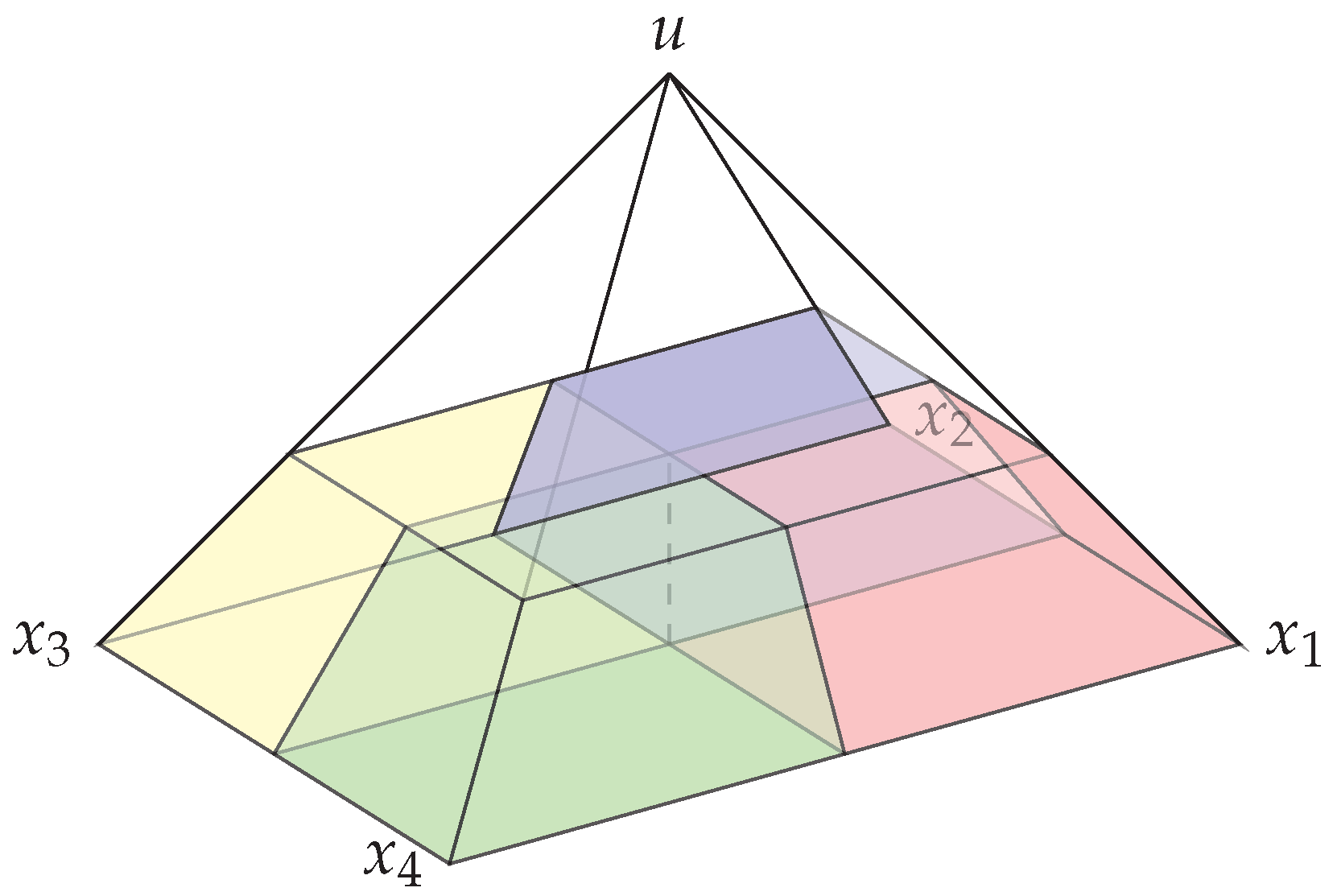
Suppose the contrary that . Then, there exist five subsets , , , , and of D such that and . Denote by the set of extreme points of A. We may assume that and , . The partition is shown in Figure 1. Since ,
and , we have , a contradiction. Therefore, . □
Figure 1.
A partition of Proposition 1.
It follows from Theorem 1 and Proposition 1 that estimations of partitioning functionals of convex cones, which are the best possible for certain pairs of m and D, are obtained.
Furthermore, when m and are sufficiently large, by (1), the above result is not optimal. Proposition 2 will give a better estimation in this situation.
For , and each subset B of A, we put
Lemma 3.
Let . Then,
Proof.
For every pair of points , there exist two numbers and two points such that
and
Assume, without loss of generality, that . Then,
Therefore,
Clearly, . Since and for any two points , . Thus,
Since, for arbitrary two points ,
we have
It follows that
□
Proposition 2.
Let m be a positive integer satisfying , and . Then,
Proof.
It is clear that
By Lemma 3, for each ,
Then,
Therefore,
□
When is sufficiently small, we have the following result.
Proposition 3.
Let m be a positive integer satisfying . If , then
Proof.
Since , . For each , there exists a collection of subsets of D such that
Then, . Thus,
It follows that .
For each , there exists a collection of subsets of A such that
Then,
Thus, by Lemma 2,
It follows that . □

3. Estimations of
Theorem 2.
Let m be a positive integer satisfying . Then,
Proof.
For each , there exists a collection of subsets of A such that
and
Put . Then,
By Lemma 3,
and
Since, for two arbitrary points ,
we have
Put . Then, and
Since , we have
Therefore,
This completes the proof. □
4. Estimations of
Put
It is clear that T is a centrally symmetric convex body in .
Lemma 4.
Let , defined as above. Then,
Proof.
For every pair of points , there exist two numbers and four points such that
and
Without loss of generality, we assume that . Then,
Therefore,
Since and for all , and . Thus,
Suppose that . Since, for each ,
we have . It follows that . Thus,
which is impossible. Therefore,
□
Theorem 3.
Let , defined as above, and m be a positive integer such that . Then,
Proof.
For each , there exists a collection of subsets of A such that
and
Then, and , where . Put
and
Without loss of generality, we assume that . Then,
where
and
For every pair of points , there exist two numbers , two points , and two points such that
and
Without loss of generality, we assume that . Then,
By Lemma 4,
Then, for each ,
By Lemma 4, . Put . Then, for ,
For every pair of points , there exist two numbers , two points , and two points such that
and
Without loss of generality, we assume that . Then,
By Lemma 4,
Then, for each ,
Thus,
It follows that . This completes the proof. □
5. Discussion
Estimating partitioning functionals of special convex bodies plays an important role in Chuanming Zong’s proof program to attack Borsuk’s problem. In this paper, when a convex body D is constructed from a convex body A, for example, is a convex cone with as the base, using a partition of A, we obtain a partition of D; it follows that a relationship between the partitioning functional of D and partitioning functional of A is given.
Funding
This research received no external funding.
Data Availability Statement
Data sharing not applicable to this article as no datasets were generated or analyzed during the current study.
Conflicts of Interest
The author declares no conflicts of interest.
References
- Borsuk, K. Drei Sätze über die n-dimensionale euklidische Sphäre. Fund. Math. 1933, 20, 177–190. [Google Scholar] [CrossRef]
- Eggleston, H. Covering a three-dimensional set with sets of smaller diameter. J. London Math. Soc. 1955, 30, 11–24. [Google Scholar] [CrossRef]
- Grünbaum, B. A simple proof of Borsuk’s conjecture in three dimensions. Proc. Cambridge Philos. Soc. 1957, 53, 776–778. [Google Scholar] [CrossRef]
- Heppes, A. On the partitioning of three-dimensional point-sets into sets of smaller diameter (Hungarian). Magyar Tud. Akad. Mat. Fiz. Oszt. Közl. 1957, 7, 413–416. [Google Scholar]
- Perkal, J. Sur la subdivision des ensembles en parties de diamètre inférieur. Colloq. Math. 1947, 1, 45. [Google Scholar]
- Kahn, J.; Kalai, G. A counterexample to Borsuk’s conjecture. Bull. Amer. Math. Soc. 1993, 29, 60–62. [Google Scholar] [CrossRef]
- Hinrichs, A.; Richter, C. New sets with large Borsuk numbers. Discrete Math. 2003, 270, 137–147. [Google Scholar] [CrossRef]
- Bondarenko, A. On Borsuk’s conjecture for two-distance sets. Discrete Comput. Geom. 2014, 51, 509–515. [Google Scholar] [CrossRef]
- Jenrich, T.; Brouwer, A. A 64-dimensional counterexample to Borsuk’s conjecture. Electron. J. Combin. 2014, 21, 29. [Google Scholar] [CrossRef] [PubMed]
- Zong, C. Borsuk’s partition conjecture. Jpn. J. Math. 2021, 16, 185–201. [Google Scholar] [CrossRef]
- Grünbaum, B. Borsuk’s partition conjecture in Minkowski planes. Bull. Res. Council Israel 1957, 7, 25–30. [Google Scholar]
- Wang, J.; Xue, F.; Zong, C. On Boltyanski and Gohberg’s partition conjecture. Bull. Lond. Math. Soc. 2023, 56, 140–149. [Google Scholar] [CrossRef]
- Boltyanski, V.G.; Gohberg, I.T. Results and Problems in Combinatorial Geometry; Nauka: Moscow, Russia, 1965; Cambridge University Press: Cambridge, UK, 1985. [Google Scholar]
- Boltyanski, V.; Martini, H.; Soltan, P.S. Excursions into Combinatorial Geometry; Universitext; Springer: Berlin/Heidelberg, Germany, 1997. [Google Scholar]
- Lian, Y.; Wu, S. Partition bounded sets into sets having smaller diameters. Results Math. 2021, 76, 116. [Google Scholar] [CrossRef]
- Zhang, L.; Meng, L.; Wu, S. Banach-Mazur distance from to . Math. Notes. 2023, 114, 1045–1051. [Google Scholar] [CrossRef]
- Zhang, X.; He, C. Partitioning bounded sets in symmetric spaces into subsets with reduced diameter. Math. Inequalities Appl. 2024, 27, 703–713. [Google Scholar] [CrossRef]
Disclaimer/Publisher’s Note: The statements, opinions and data contained in all publications are solely those of the individual author(s) and contributor(s) and not of MDPI and/or the editor(s). MDPI and/or the editor(s) disclaim responsibility for any injury to people or property resulting from any ideas, methods, instructions or products referred to in the content. |
© 2025 by the author. Licensee MDPI, Basel, Switzerland. This article is an open access article distributed under the terms and conditions of the Creative Commons Attribution (CC BY) license (https://creativecommons.org/licenses/by/4.0/).