


Abstract
Sedimentary manganese deposits are an important mineral resource and also play a significant role in restoring the ancient marine environment. The redox environment of the ocean during the Mesoproterozoic era has long been a subject of controversy. This paper takes a large-scale sedimentary manganese deposit in northwest China as the research object, attempting to analyze the changes in the marine environment during the Mesoproterozoic era and their impact on the Mn mineralization processes. In recent years, an exploration breakthrough has been made in the manganese deposits in the Annanba region on the southern margin of the Dunhuang block, NW China. The Qingshagou Mn deposit is the largest and most representative in the region. Geochemical characteristics show that the ores have low average ratios of Fe/Mn (<0.19), V/Cr (<1.20), V/(V + Ni) (<0.54), and Al/(Al + Fe + Mn) (<0.30) but high average ratios of U/Th (~0.95), and Y/Ho (~28). The Post-Archean Australian Shale (PAAS)-normalized rare earth element (REE) patterns exhibit that middle rare earth elements are slightly enriched with weak positive anomalies for both Y (0.93~1.01) and Ce (0.97~1.15) and weak negative anomalies for Eu (0.87~0.99). The δ13CPDB value of the ore ranges from −13.4‰ to −23.3‰, which is consistent with the δ13CPDB value range of organic matter. Synthesizing these findings, it is concluded that the Qingshagou Mn deposit formed in a suboxic to oxic environment, the ore-forming materials were primarily derived from a submarine hydrothermal system, and the changes in redox conditions promoted the Mn precipitation.
1. Introduction
The world’s manganese deposits are mainly distributed in the Paleoproterozoic, Neoproterozoic and Paleozoic eras, while Mesoproterozoic manganese deposits are relatively rare [1,2,3,4]. This time-controlled characteristic indicates that the formation of sedimentary manganese deposits is closely related to the redox state of the ancient ocean [4,5,6]. Mesoproterozoic has been widely accepted as the “boring billion” [7], characterized by low oxygen levels and the lack of large sedimentary ore deposits [4,8]. However, in recent years, increasing evidence has shown that the Mesoproterozoic biosphere was not “silent” but rather experienced significant fluctuations in redox conditions [9,10,11,12]. Scientists have discovered that the Mesoproterozoic Jixian System in North China is characterized by Mn-rich sequences and develops the Wafangzi manganese deposit in Liaoning Province [13] and Qinjiayu manganese deposit in Hebei Province [14,15]. Therefore, it is proposed that the Mesoproterozoic surface environment in North China experienced a significant “pulse oxygenation” event [16,17,18]. Recently, a large Mesoproterozoic manganese belt was also discovered in the Annanba region of Gansu Province, NW China. What were the redox conditions when this manganese deposit was formed? Can it provide evidence for “pulsatile oxygenation”? These are the questions that are the need of the hour.
Previous studies [19,20,21,22,23] have mainly focused on the geological characteristics of the ore-bearing strata and the ores of the Qingshagou manganese deposit in the Annanba region, indicating that the manganese deposits are mainly hosted in the fine clastic-carbonate rock formation in the Mesoproterozoic Annanba Group of Jixian System. However, regarding the regional tectonic background and its evolution, only a few studies have touched upon [24,25]. There is still a lack of in-depth research on the formation conditions and mechanism of the Qingshagou manganese deposit. This study, based on detailed field geological surveys and related element geochemical characteristics of ores and wall rocks, our aim is to reveal the formation conditions and mechanism of the Mesoproterozoic Qingshagou manganese deposit.
2. Regional Geology
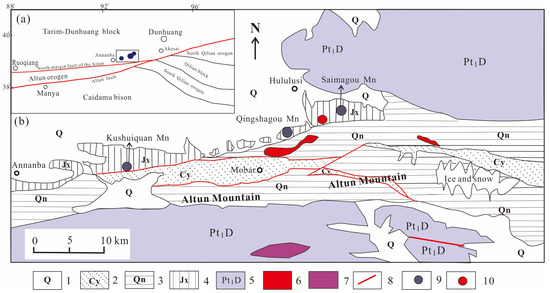
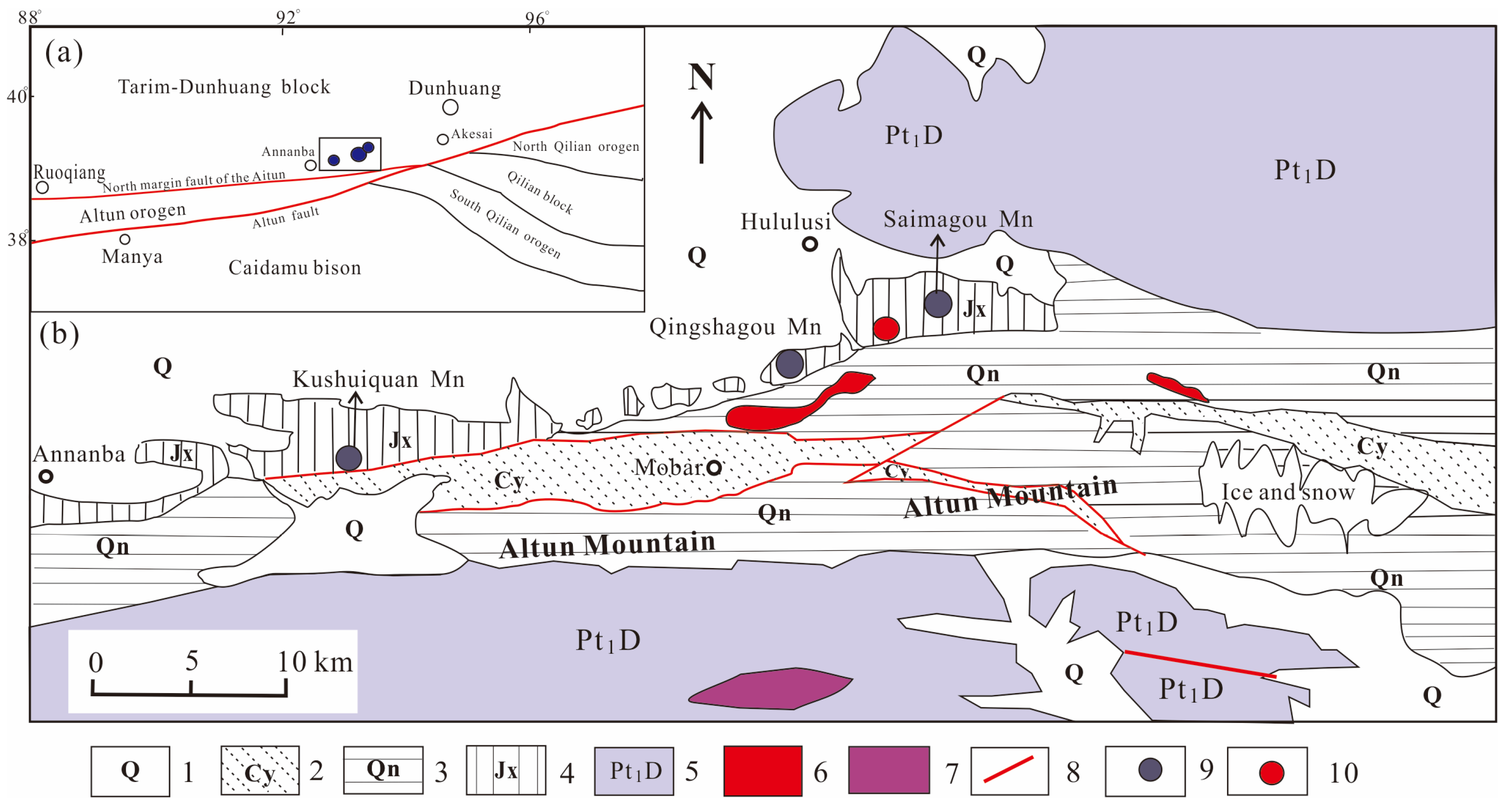
The Dunhuang block is located on the eastern side of the Tarim block. Regionally, the Tarim and the Dunhuang blocks are collectively referred to as the Tarim–Dunhuang block [23,24,25]. The Annanba manganese ore belt is located on the southern margin of the Dunhuang block and the northern foothills of the Altun Mountains (Figure 1a). The manganese ore belt consisting of Qingshagou, Kushuiquan and Saimagou Mn deposits is elongated in an east–west direction, starting from Annanba in the west and ending at Saimagou in the east, with an exposed length of more than 60 km (Figure 1b).
Figure 1.
The tectonic location of the ore deposit (a) and the geological diagram of the Mn ore belt (b) (modified after [19]). 1: Quaternary; 2: Yanghugou Formation of the Carboniferous; 3: Qingbaikou System of the Neoproterozoic; 4: Jixian System of the Mesoproterozoic; 5: Dunhuang Group of the Paleoproterozoic; 6: Granite; 7: Ultrabasic rock body; 8: Fault; 9: Mn deposit; 10: Fe deposit.
The regional strata mainly consist of the Paleoproterozoic Dunhuang Group, the Mesoproterozoic Annanba Group in the Jixian System, the Neoproterozoic Qingbaikou System, and the late Paleozoic Carboniferous System [19]. Among them, the Dunhuang Group is widely distributed over a large area. Its rock type consists of schist, gneiss, and marble. The Annanba Group in Jixian System is distributed in the Annanba-Qingshagou area and is exposed in a narrow strip shape. It is divided into two sections from bottom to top. The first section is mainly composed of a medium-thick layer of quartz sandstone, with dipping to the north at an angle of 45° to 70° and a thickness of 983 m. The second section, as the main Mn-bearing rock series, is mainly composed of carbonate rocks interbedded with siliceous rocks. The strata dip to the north at an angle of 50° to 76°, with thicknesses of 1400 m. The Qingbaikou System is in a fault contact with the underlying Jixian System [19]. Its rock types include crystalline limestone, marble and schist. The Carboniferous System consists of a series of coal-bearing strata and clastic rocks and is superimposed on the Qingbaikou System. The two are in an angular unconformity relationship. The Mesozoic and the Cenozoic strata are characterized by lacustrine and fluvial clastic sedimentary rocks [19,20,26,27].
The regional faults mainly consist of the Altun northern margin fault and its associated secondary faults (Figure 1b). Regional magmatic rocks are generally composed of small intrusive bodies or dykes, and their lithology is mainly acidic, followed by basic and intermediate acidic types. The igneous rocks are evenly distributed near the northern margin faults of the Altun mountain. Their ages are mainly Variscian and Yanshanian, with the secondary Caledonian [19].
The regional mineral resources are mainly composed of sedimentary manganese deposits along with sedimentary iron deposits and hydrothermal gold deposits [19,20,26,27].
3. Deposit Geology
3.1. Stratigraphic Lithology
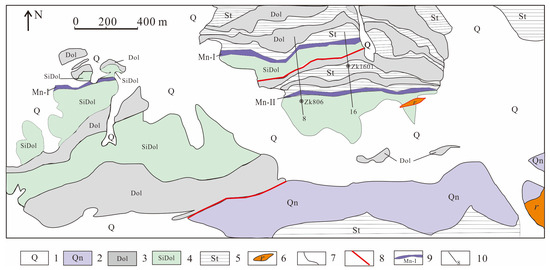
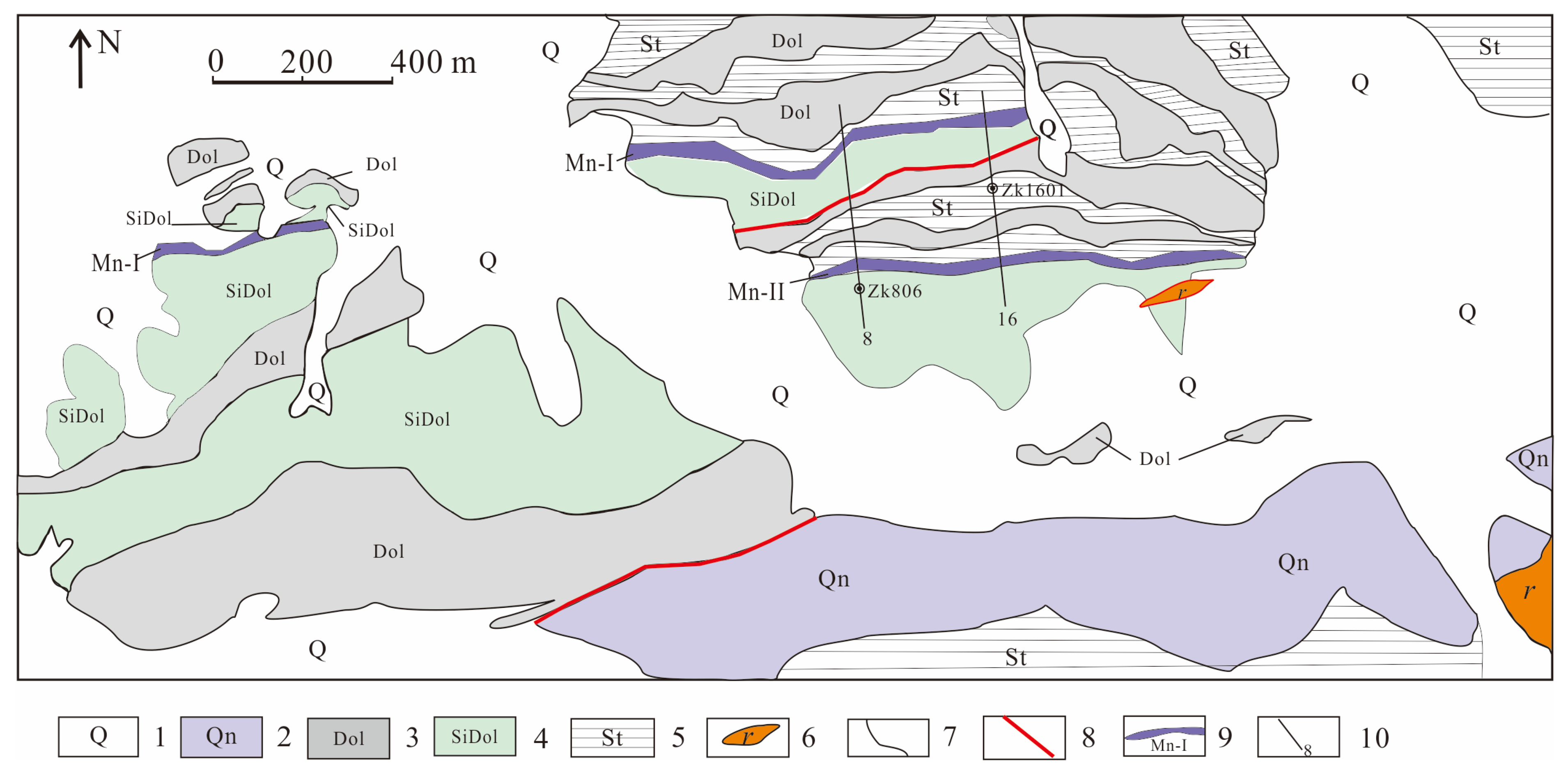
The Qingshagou manganese deposit is located on the southern edge of the Dunhuang block and on the northern side of the north margin fault of the Altun Mountains. The exposed strata in the ore district mainly consist of the Annanba Group of the Jixian System, followed by the Qingbaikou System (Figure 2). The Jixianian Annanba Group is distributed in most areas of the ore district, while the Qingbaikou System is only sparsely distributed in the southeastern part of the ore district. The two Systems have a fault contact relationship. The regional strata are distributed in a near east–west direction. The Qingbaikou System is composed of lower carbonate rocks and upper clastic rocks, reflecting a series of sedimentary cycles from transgression to regression. Jixianian Annanba Group is mainly composed of carbonaceous siltstone, fine sandstone, siliceous rock and siliceous dolomite. It roughly forms a sedimentary cycle ranging from clastic rocks to carbonate rocks [19,26].
Figure 2.
Geological map of the Qingshagou manganese deposit (modified after [26]). 1: Quaternary; 2: Qingbaikou System; 3: Dolomite in Annanba Group of the Jixian System; 4: Siliceous dolomite interbedded with siliceous rocks in Annanba Group of the Jixian System; 5: Siltstone and fine sandstone in Annanba Group of the Jixian System; 6: Granite; 7: Geological boundary; 8: Fault; 9: Manganese ore layers and their numbers; 10: Geological exploration lines and their numbers.
The strata in the ore district generally present a single-slope structure extending in a nearly east–west direction, with a southern dip and an angle ranging from 50° to 75°. The fault structures are relatively well-developed, mainly extending in an east–west direction and were formed at the stratigraphic boundary between the Qingbaikou System and Jixian System.
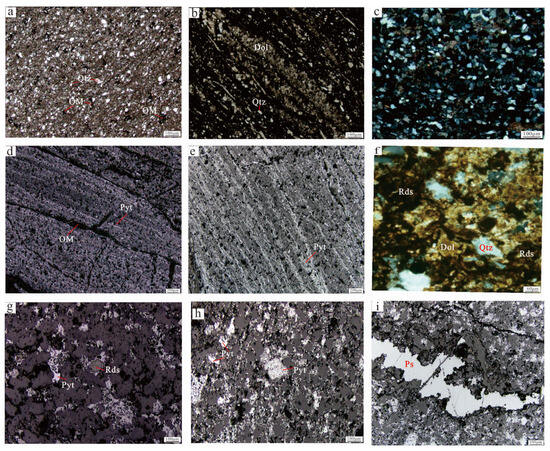
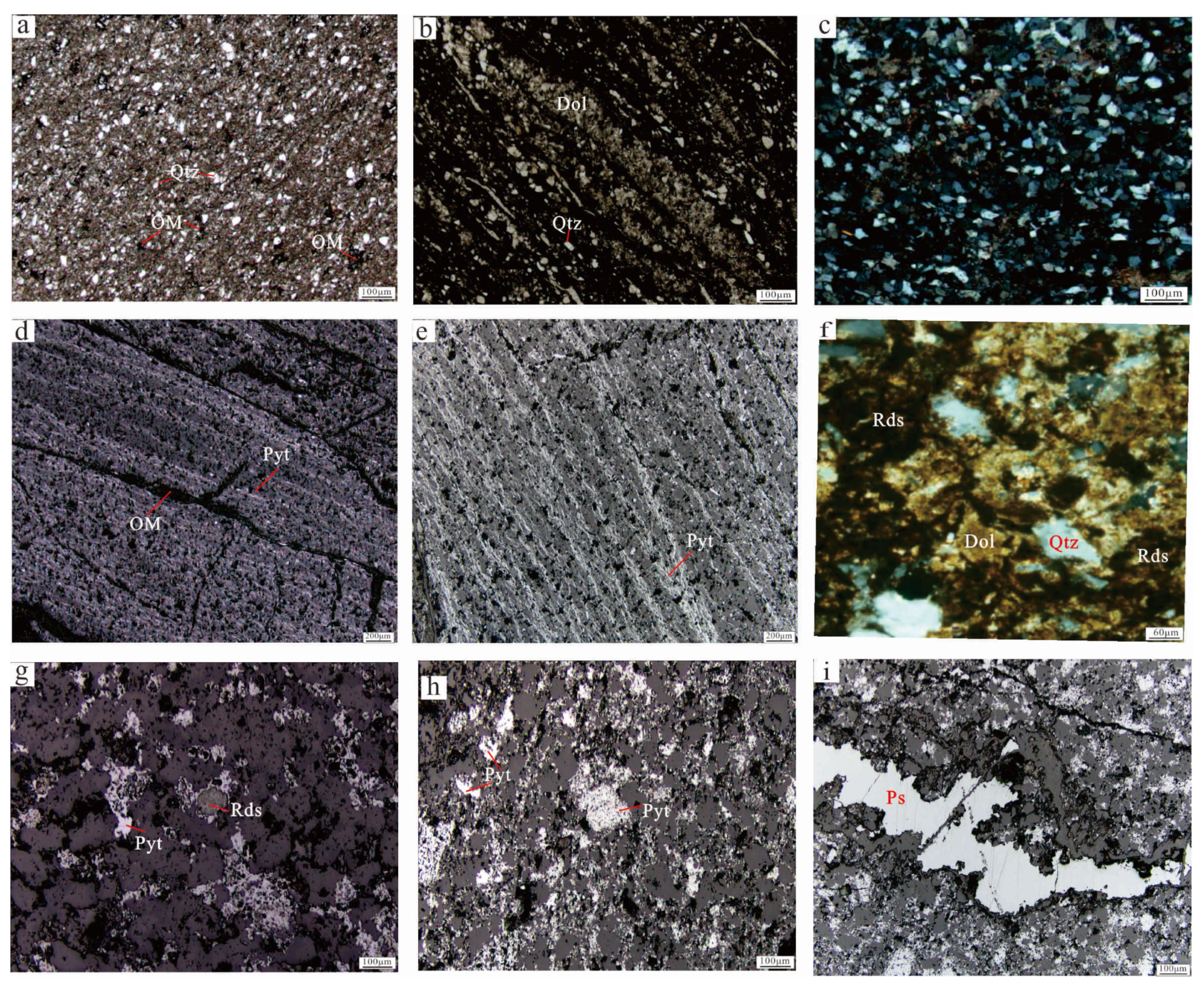
The floor of the Qingshagou manganese deposit is composed of carbonaceous siltstone, fine sandstone and dolomite, while the roof is mainly composed of dolomite. The ore bodies are primarily hosted in carbonaceous siltstone and siliceous dolomite. The carbonaceous siltstone (Figure 3a) has a residual silty structure and a lamellar texture. It is mainly composed of organic carbon (~5%), mud (~30%), and silty materials (~65%). The fine sandstone has a residual sand structure and blocky texture. The debris material (accounting for 84%) is mainly composed of quartz, feldspar and mica, with good sorting but poor roundness. The particle size ranges from 0.02 to 0.1 mm. The filling material (accounting for 16%) mainly consists of calcite and clay. Siliceous dolomite (Figure 3b) has a micritic structure and a blocky texture, mainly composed of micritic quartz (~10%) and micro- to fine-grained dolomite (~80%). Siliceous rock (Figure 3c) also has a micritic structure and a blocky texture, mainly consisting of micritic quartz (~80%) and a small amount of argillaceous material.
Figure 3.
Microscopic photos of typical wall rocks and manganese ores. (a): Organic-rich siltstone; (b): Siliceous dolomite; (c): Siliceous rock; (d,e): Lamellar pyrolusite; (f): Disseminated rhodochrosite in siliceous dolomite; (g): Disseminated pyrolusite, with local occurrences of rhodochrosite; (h): Fine vein: disseminated pyrolusite preserves the crystal form of rhodochrosite locally; (i): Vein Psilomelane. OM: Organic matter; Dol: Dolomite; Qtz: Quartz; Rds: Rhodochrosite; Pyt: pyrolusite; Ps: Psilomelane.
3.2. Ore Body
The Qingshagou ore district has two ore layers, namely, Mn-I and Mn-II (Figure 2). Each ore layer consists of multiple ore bodies.
The ore layer Mn-I is located in the northern part of the ore district, with a length of 1900 m and a maximum controlled depth of 556 m. The ore layer Mn-I has identified a total of 22 ore bodies, with lengths ranging from 86 to 1900 m and thicknesses ranging from 0.58 to 8.02 m. The average manganese ore grade is between 10.3% and 14.58%. No. I-1 is the main ore body, with a length of 1950 m, an average thickness of 4.55 m, and an average grade of 12.23%. This ore body has a trend of 150° to 187° and a dip angle of 40° to 49°. All other ore bodies are parallel to the main ore body No. I-1 [19,26].
The ore layer Mn-II is located 300 m south of the ore layer Mn-I, with a length of 1300 m and a controlled depth of 425 m. A total of 11 ore bodies were delineated in the ore layer Mn-II, with lengths ranging from 200 to 1900 m and average thicknesses of 0.52 to 4.24 m. The average Mn grade in the ore layer is 10.09% to 12.5%. No. II-1 ore body is the main ore body, with a length of 1900 m, an average thickness of 3.65 m, and an average Mn grade of 11.53%. The ore body shows a trend of 170° to 182° with a dip angle of 46° to 52°. All other ore bodies are parallel to the main ore body.
Generally, at a depth of about 60 m, the upper part is the oxidized ore, while the lower part is the primary ore. The main mineral components of the primary ore are rhodochrosite, manganese dolomite and pyrolusite, with gangue minerals of quartz, calcite, dolomite and feldspar. The ore mainly exhibits cryptocrystalline and fine-grained textures, as well as stripe, band, blocky and fine vein-disseminated structures. The near-surface oxidized ores are mainly composed of psilomelane, pyrolusite and limonite, as well as chlorite, sericite and kaolinite, and often present in a colloidal and granular structure (Figure 3).
Rhodochrosite is mainly distributed in the deep part of the ore body and is a primary mineral formed during the diagenetic process. Under the microscope, the rhodochrosite shows obvious double reflection and the internal reflection color is light yellowish. Rhodochrosite mostly has idiomorphic to subhedral granularity, with very fine grain size, generally ranging from 0.01 to 0.05 mm in diameter. The rhodochrosites in surface samples are mostly replaced by pyrolusite (Figure 3d,e), while some retain the crystal form of rhodochrosite locally (Figure 3f).
The pyrolusite shows pale yellow to gray-white color variation. It has no internal reflection and is mostly in an irregular granular form, with particle size of 0.02 to 0.05 mm. Some pyrolusites exhibit laminated structure (Figure 3g,h), reflecting the sedimentary characteristics. Psilomelane exhibits multi-color appearance ranging from white to grayish-white, with a brownish-yellow internal reflection color. Apart from a small amount of psilomelane in the form of microcrystalline grains, the majority is in the form of colloidal aggregates and fine veins (Figure 3i), with granularity size of 0.01 to 0.5 mm. The psilomelane is presumed to have been formed by the oxidation process near the surface, converting from pyrolusite or rhodochrosite.
4. Sampling and Analytical Methods
4.1. Sampling
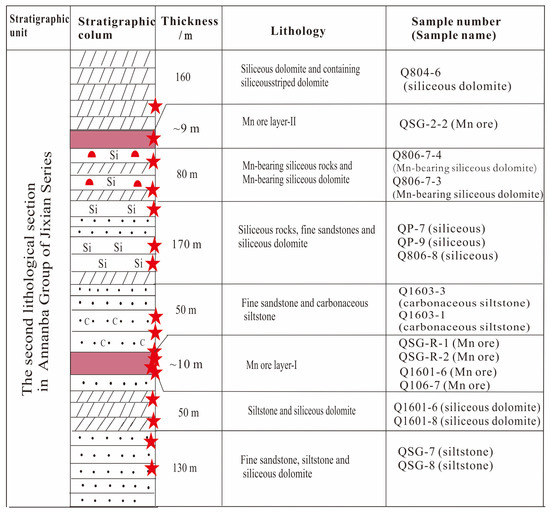
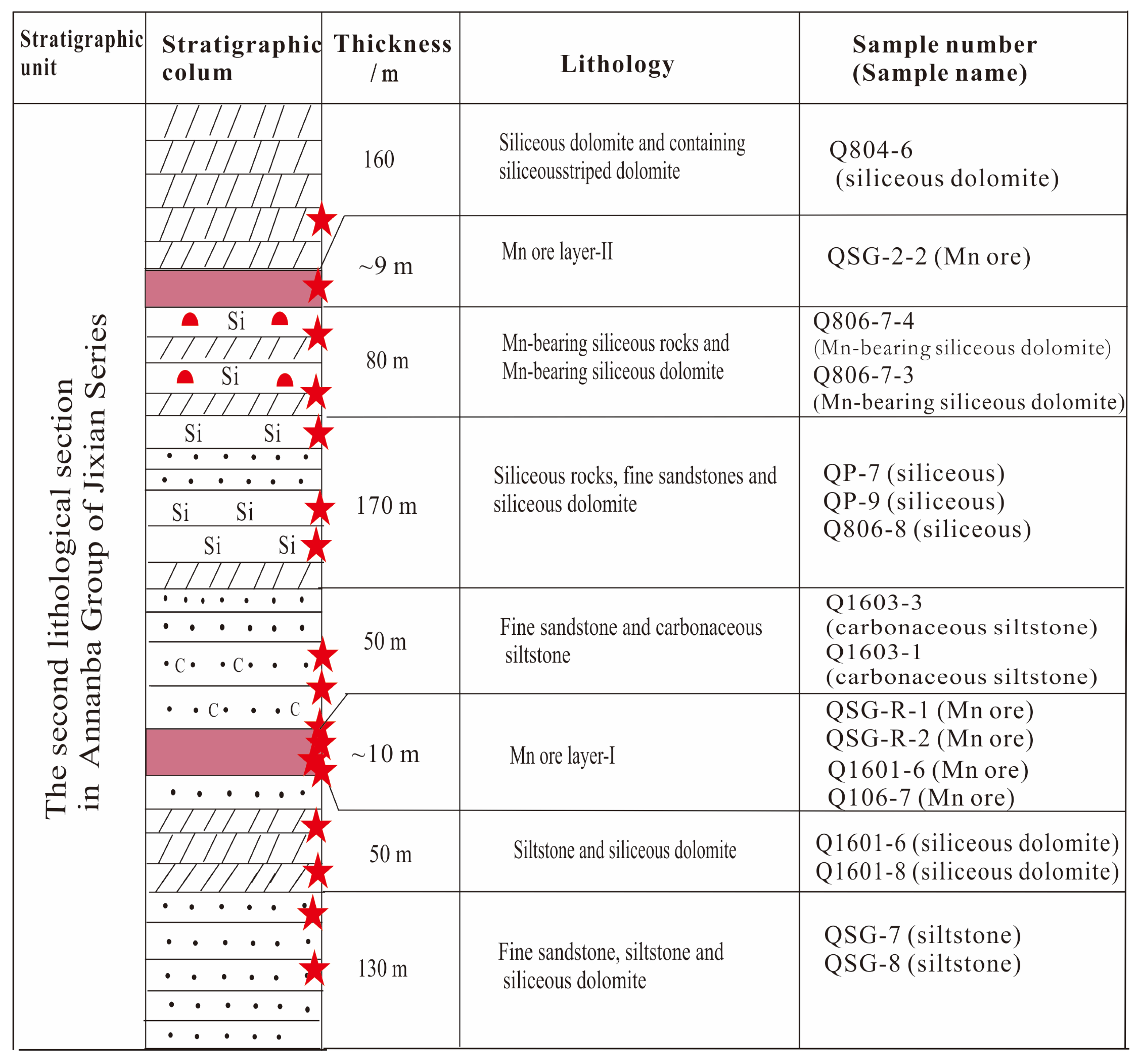
The test samples for this study were taken from depths of 50 to 80 m and 238 to 327 m in the borehole Zk806 (ore layer Mn-II and its underlying rocks), respectively, and 100 to 288 m in the borehole Zk1601 (ore layer Mn-I and its upper and lower rock layers). These samples cover the ore layers Mn-I and II as well as their upper and lower walls, and the interlayers between the ore layers I and II (Figure 4).
Figure 4.
Synthetic histogram of the Qingshagou manganese deposit with sampling locations (the asterisk represents the sampling site).
4.2. Analytical Methods
Samples were broken into small chips, and only fresh pieces were selected for analyses. Selected chips for geochemical analyses were then cleaned with alcohol in an ultrasonic cleaner, then dried and crushed to fine powder (<200 mesh) using an automated agate mill. Importantly, a concerted effort was made to avoid direct contact with metal during all sample preparation procedures.
Major elements analysis was carried out at the Guangzhou ALS Laboratory Group Analytical Chemistry and Testing Services. Major elements were determined using X-ray fluorescence (XRF) spectrometry with a PANalytical Zetium 4 kW instrument (Malvern Panalytical, made in the Almelo, The Netherlands). The analytical precision and accuracy were both better than 5% [28].
Trace elements and rare earth elements analyses were also carried out at the Guangzhou ALS Laboratory Group Analytical Chemistry and Testing Services. The analysis of trace elements and rare earth elements was carried out by using the HF + HNO3 sealed sample dissolution method to digest the samples. Then, after adding the Rh internal standard, the samples were converted to 1% HNO3 medium and tested by ICP-MS. The instrument used for the test was the Agilent 7900 (Agilent Technologies, produced in Yishun, Singapore) inductively coupled plasma mass spectrometer. GSR1 and GSR3 were used as standard samples for quality monitoring, and internal standards were used to correct instrument drift. The precision and accuracy of the analysis were both better than 10% [28].
5. Analysis Results
5.1. Oxides
The major element results of the samples from the Qingshagou Mn deposit are shown in Table S1.
Compared with the wall rocks, the contents of MnO, P2O5, and TFe2O3 in the primary ore are higher, ranging from 13.35% to 21.08% (ave. 17.02%), 0.02% to 0.11% (ave. 0.06%), and 2.57% to 4.63% (ave. 3.80%), respectively. The oxidized ore is characterized by relatively high contents of MnO (28.69%~45.69%) and TFe2O3 (2.67%~8.02%) while having relatively low contents of CaO (0.37%~0.62%) and MgO (0.17%~0.41%).
The SiO2 (61.29%~70.60%, ave. 67.19%) and K2O (9.21%~10.6%, ave. 10.12%) contents are relatively high, while the contents of MgO (ave. 0.56%), MnO (ave. < 0.01%), and CaO (ave. 0.10%) are relatively low in the wall rocks (siltstone and fine sandstone). Meanwhile, the SiO2 (7.02%~96.69%) and K2O (2.04%~3.76%) contents in siliceous rocks are relatively high, while the contents of MgO (0.03%~2.62%), MnO (0.01%~7.21%) and CaO (0.01%~5.32%) are relatively low.
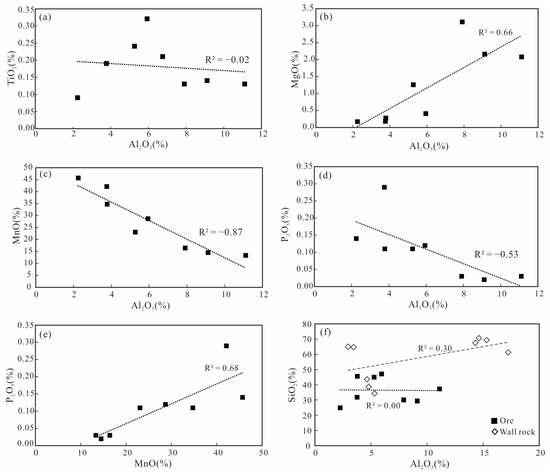
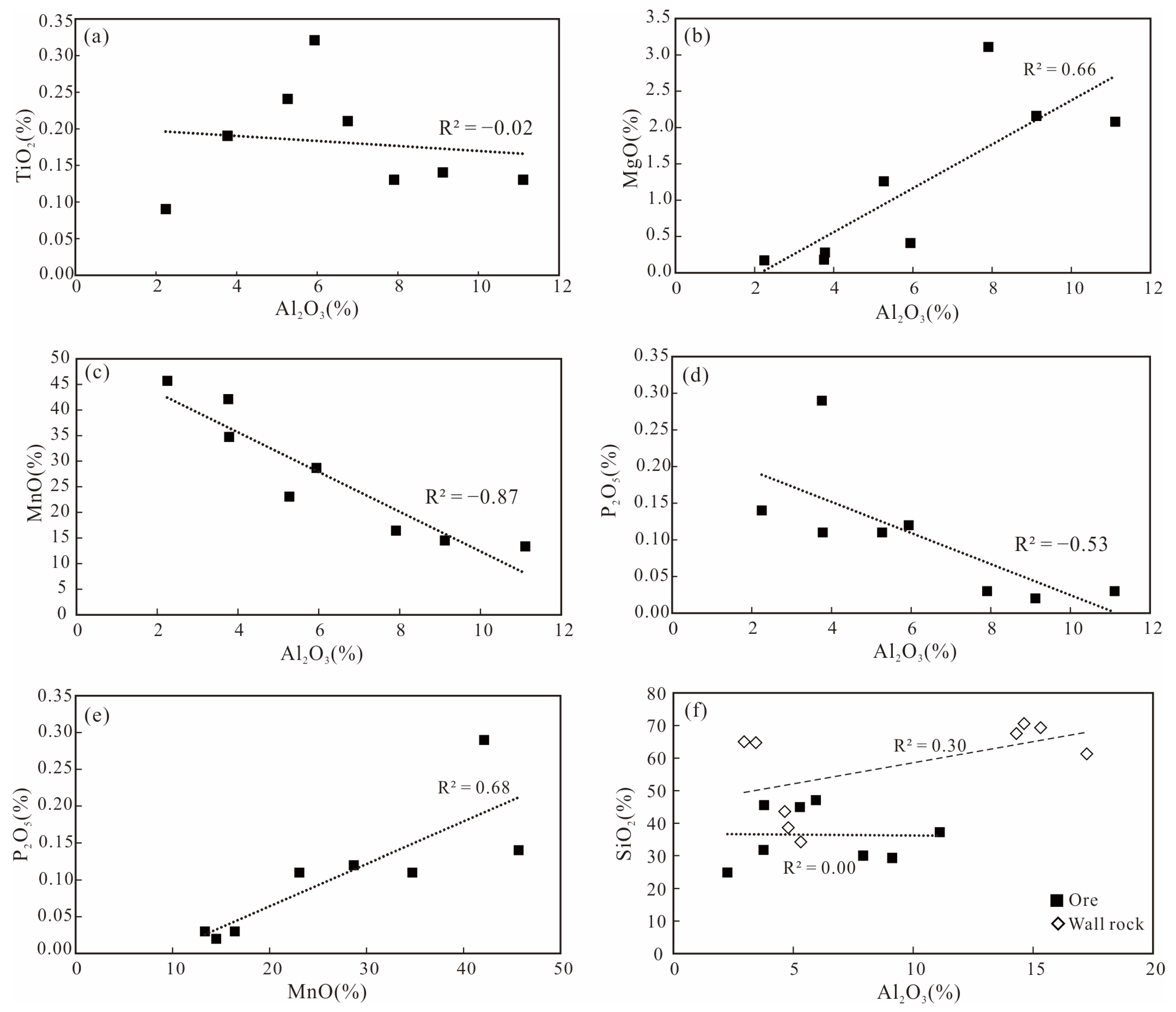
The correlation analysis diagram (Figure 5a–f) of the major elements in the samples shows that Al2O3 in the ores has a strong positive correlation with MgO (Figure 5b), while it has a negative correlation with MnO and P2O5 (Figure 5c,d). There is a positive correlation between MnO and P2O5 (Figure 5e), while the correlation between Al2O3 and SiO2, Al2O3 and TiO2 is not obvious (Figure 5a,f) in the ores.
Figure 5.
The Al2O3 vs. TiO2, MgO, MnO, P2O5 and SiO2 (a–d,f), MnO vs. P2O5 (e) correlation diagrams of ores in the Qingshagou Mn deposit.
5.2. Trace Elements
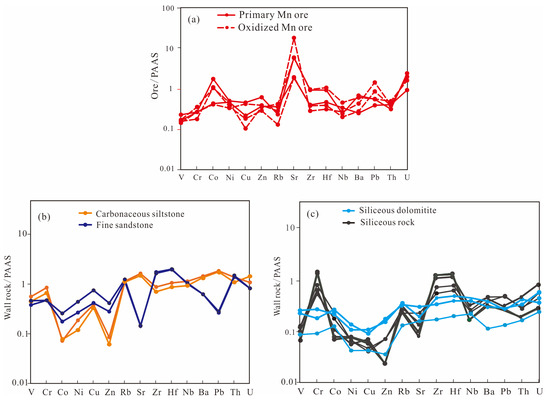
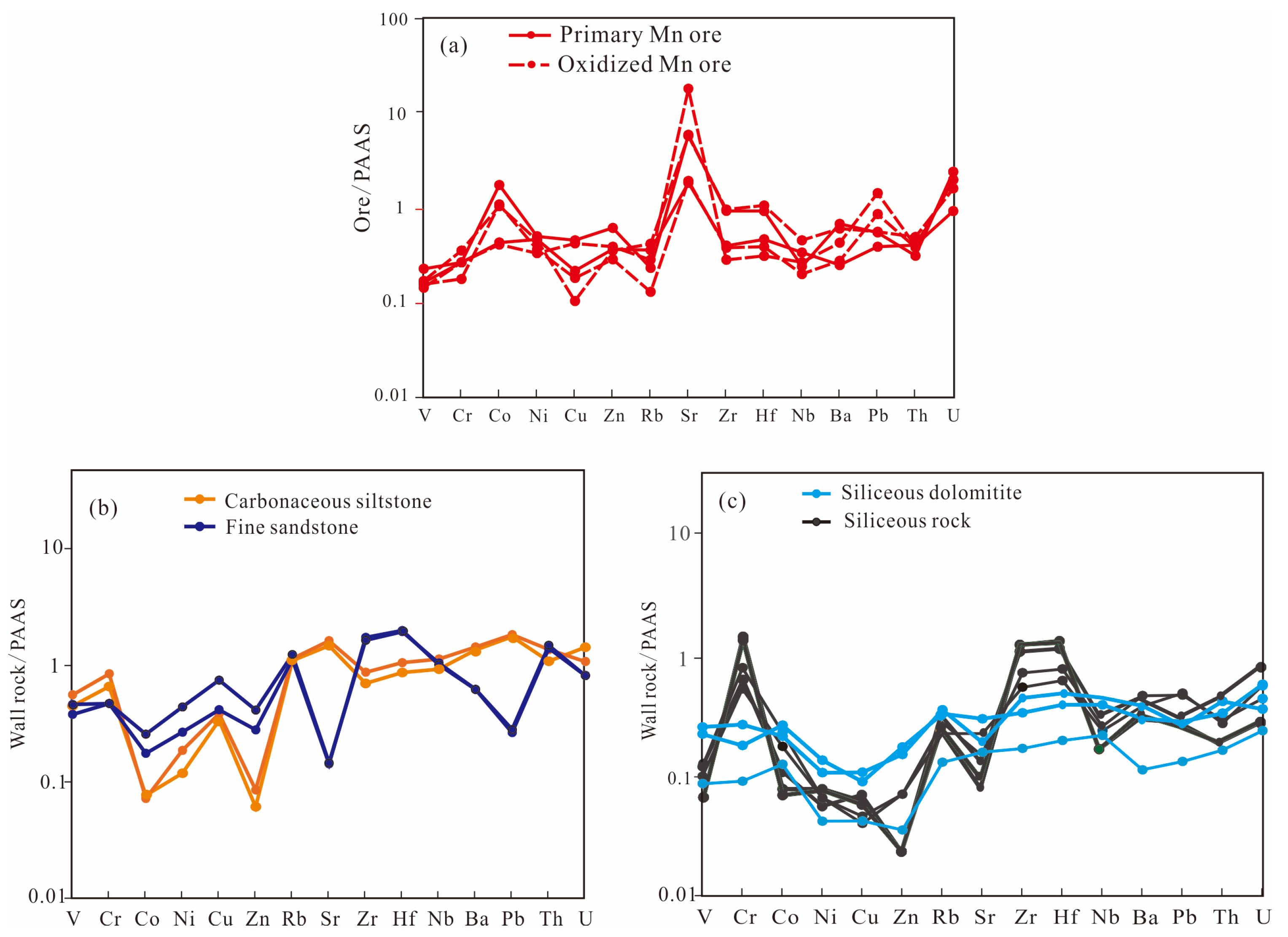
Since the trace elemental composition of the primary and oxidized ores is basically the same, we will not provide separate descriptions for them (the reasons are detailed in the Section 6). The analysis results of trace elements in the Mn-bearing rock series of the Qingshagou ore district are shown in Table S2. There are significant differences in the contents of trace elements between the manganese ores and the wall rocks. The ores are significantly enriched in Co, Sr, Pb, and U elements compared to PAAS (Post-Archean Australian Shale), while elements such as V, Cr, Rb, and Th are significantly depleted. The elemental composition of primary ores and oxidized ores is basically the same (Figure 6a). Compared with PAAS, the fine sandstone and siltstone have similar trends, but the values of Sr and Pb are significantly lower (Figure 6b), while siliceous rocks show significant relative enrichment of Cr, Zr, and Hf elements and significant depletion of Ni, Cu, Zn, and Nb elements (Figure 6c).
Figure 6.
PAAS-normalized trace element distribution patterns of ores (a) and surrounding rocks (b,c) in Qingshagou ore area (PAAS from [29]).
5.3. Rare Earth Elements
The analysis results of rare earth elements in the Qingshagou ore district are shown in Table S3. It was observed that there were significant differences in ∑REE + Y total content between manganese ores and wall rocks. The total amount in ores is 111~164 ppm, while that in fine sandstone and carbonaceous siltstone is relatively high (259~309 ppm), and that in dolomite and siliceous rocks is relatively low (45~99 ppm). However, the composition of rare earth elements in the primary ore and the oxidized ore is basically the same.
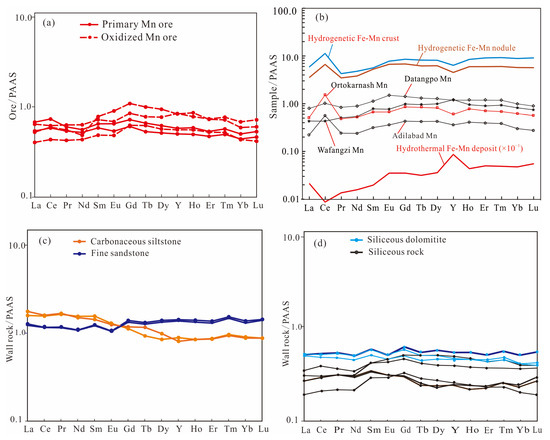
The PAAS-normalized distribution pattern of rare earth elements in manganese ores shows that the fractionation of light and heavy rare earth elements is not obvious, with (Nd/Yb) PAAS ranging from 0.82 to 1.18 (ave. 1.00). The manganese ores have a weak positive anomaly of Ce (0.97~1.15), while Eu shows a weak negative anomaly (0.87~0.96), and the Y anomaly (0.93~1.09) is not significant. However, the distribution patterns of rare earth elements in the primary ore and the oxidized ore are basically the same (Figure 7a). As can be seen from Figure 7a,b, the rare earth element distribution of some world’s famous large-scale sedimentary Mn deposits shows a distinct positive Ce anomaly [28]. Among them, the Qingshagou Mn deposit and Datangpo Mn deposit in South China show relatively low Ce positive anomaly values. However, the Ortokanashi Mn deposit in the West Kunlun mountains and the Adilabad Mn deposit in India, like hydrogenetic Fe-Mn nodules and crusts, has relatively high Ce positive anomaly values [28].
Figure 7.
PAAS-normalized REE distribution patterns of manganese ores (a) and wall rocks (b–d) in Qingshagou ore area (PAAS from [29]).
The rare earth distribution curve of the siltstone sample shows obvious fractionation of light and heavy rare earth elements with the (Nd/Yb)PAAS value of 1.70 to 1.72. But the anomalies of Ce (0.93~0.97), Eu (0.96) and Y (0.88~1.05) are not significant (Figure 7c). The rare earth element distribution curves of the fine sandstone samples show weak fractionation of light and heavy rare earth elements with the (Nd/Yb)PAAS value ranging from 0.79 to 0.83, while Ce (0.95~0.97) and Eu (0.80~0.83) show weak negative anomalies, and Y shows a weak positive anomaly (1.02~1.03) (Figure 7b). The rare earth element distribution curves of siliceous dolomite and siliceous rock show that the total amount of rare earth elements is relatively low, and there is no significant fractionation of light and heavy rare earth elements with the (Nd/Yb)PAAS value from 0.79 to 1.22. Moreover, the Ce anomaly (0.98~1.09) and Y anomaly (0.98~1.01) are not obvious, while Eu (0.89~0.99) shows a weak negative anomaly (Figure 7d).
6. Discussion
6.1. Influence of the Weathering on Geochemical Data of Manganese Ores
Due to the varying degrees of weathering effects on some collected samples, certain minerals underwent a phase transformation from carbonate to oxide, resulting in changes in the contents of some major elements. For instance, the contents of MnO and TFe2O3 in the ores increased, while the contents of CaO and MgO decreased (Table S1). However, the contents of trace elements, especially high field strength elements (V, Cr, Co, Ni, Nb, Zr, Hf, U, and Th) and rare earth elements, remained basically unchanged (Tables S2 and S3). By analyzing samples with different degrees of weathering and the primary samples, it can be observed that the trends of the REEs (rare earth elements) distribution patterns are basically consistent (Figure 7a). It is indicated that, in many cases, the geochemical characteristics of the high-field-strength elements and rare earth elements in the Mn ore that have undergone weak weathering can still reflect their original sedimentary environment. Bekker et al. [8], Bau [30], Bau and Koschinsky [31] also believed that even if a certain degree of weathering occurs, most of the REEs may still be present in these mineral remnants, preserving the original signals. Based on the above reasons, the analysis of the original sedimentary environment in the following text will no longer distinguish between oxidized samples and primary ore samples.
6.2. Redox Condition
Based on the content and ratios of some geochemical characteristic elements in manganese ores and wall rocks, the redox conditions before and after manganese precipitation can be understood.
(1) Fe/Mn Ratios. The separation of Fe and Mn is a prerequisite for forming high-grade manganese ore. The Fe/Mn ratio in the ore can directly reflect the degree of separation of Mn and Fe during the mineralization process [5,32]. The Fe/Mn ratio of the manganese ores in the Qingshagou deposit is within the range of 0.08 to 0.30 (Table S1), which indicates that during the period of hydrothermal transportation and mineralization, Mn and Fe underwent a significant separation. Under moderate oxidation conditions, since the redox potential of Fe is lower than that of Mn, Fe will precipitate preferentially [5]. Therefore, the Fe/Mn ratio can reflect the redox state of the Fe and Mn precipitation.
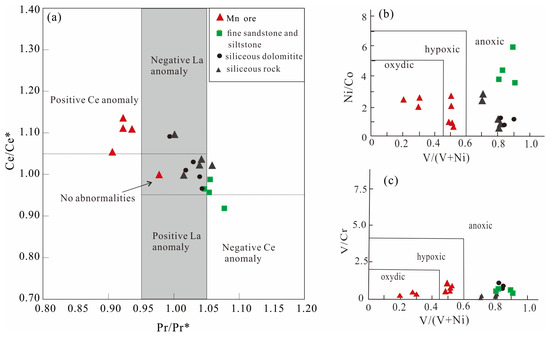
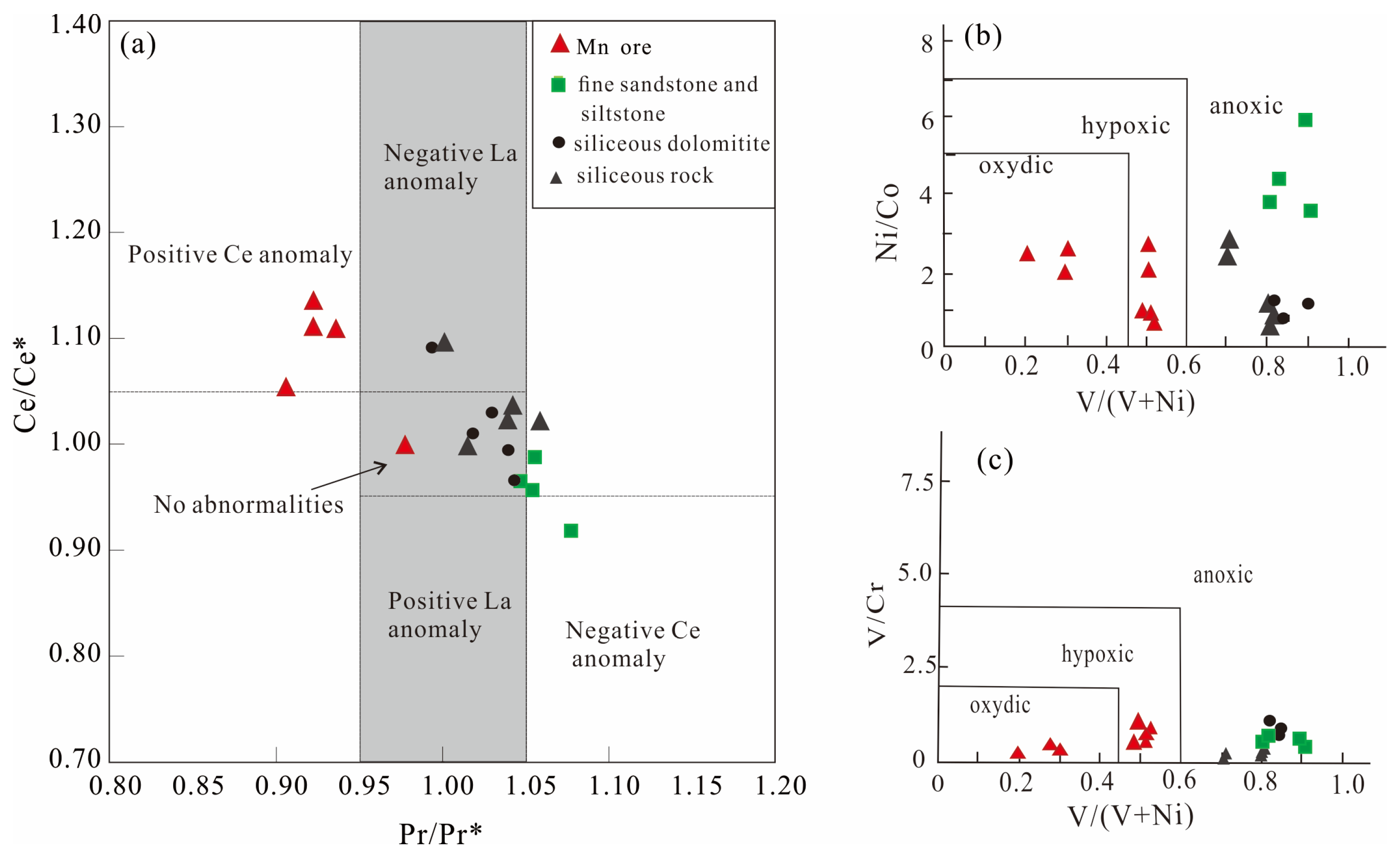
(2) Trace elements. The ratios of some trace elements, such as V/(V + Ni), V/Cr, and Ni/Co, can effectively indicate the depositional environment [33,34,35,36,37]. Under anoxic conditions, the V element is more likely to be enriched and precipitated compared to the Cr and Ni elements. Therefore, the V/(V + Ni) ratio will be higher. Generally, the ratio of V/(V + Ni) is 0.83 to 1.0 in anoxic conditions, 0.57 to 0.83 in a hypoxic condition, 0.46 to 0.57 in a weakly oxidized condition, and less than 0.46 in an oxidized condition. The V/(V + Ni) ratio of the manganese ore in the Qingshagou ore area ranges from 0.20 to 0.55 (Table S2), indicating an oxidized to sub-oxidized condition. The V/Cr ratio can also effectively indicate the sedimentary redox conditions. When V/Cr > 2, it indicates an anoxic environment, while V/Cr < 2 indicates an oxygen-rich environment [38]. In the study area, the V/Cr value of the manganese ore is 0.12 to 1.20 (Table S2), indicating an oxidized to sub-oxidized state. Hatch and Leventhal [34] and Jones and Manning [35] suggested that in oxygen-deficient marine sediments, the Ni/Co ratio is greater than 7; in oxygen-rich environments, the ratio is less than 5, and in weakly oxidized environments, the ratio is between 5 and 7. The Ni/Co ratio of the ores in Qingshagou ore district ranges from 0.68 to 2.58 (Table S2), indicating that the sedimentary environment of the Qingshagou Mn deposit is a weakly oxidized environment.
The V/(V + Ni), V/Cr and Ni/Co ratios (Table S2) of the wall rocks in the Qingshagou mining area range from 0.71 to 0.92, 0.06 to 1.34 and 0.79 to 6.19, respectively, indicating an anoxic–hypoxic condition.
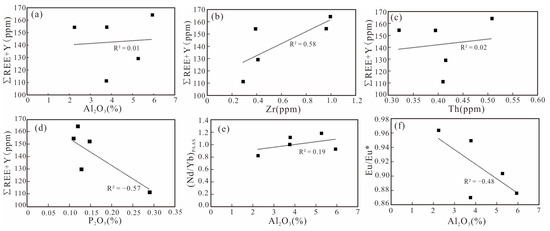
(3) Rare earth elements. For samples of fine-grained sedimentary rocks and carbonate rocks, the influence of terrestrial detritus needs to be excluded before conducting the anomaly analysis of rare earth elements. The detrital materials usually contain stable elements such as Al, Zr, and Th. If the rare earth elements mainly come from the input of the detritus, then the total content of REE + Y should have a strong positive correlation with Zr, Th, and Al [36]. The correlation between the total REE + Y content and Al2O3, Zr, Th is very weak in manganese ores from the Qingshagou ore district (Figure 8a–c). Meanwhile, Al2O3 has no correlation with (Nd/Yb)PAAS (Figure 8e) and has a negative correlation with Eu/Eu* (Figure 8f). Phosphate minerals are a common host of REEs and a resistant to weathering. The phosphates can be either detrital or authigenic [39]. As can be seen from Figure 8d, the content of REE + Y shows a significant negative correlation with the content of P2O5, indicating that the composition of rare earth elements is not affected by phosphate. The above results all indicate that the composition of rare earth elements in the Qingshagou Mn ores is basically not affected by terrestrial detrital materials.
Figure 8.
Correlation diagram of ∑REE + Y vs. Al2O3, Zr, Th and P2O5 (a–d), Al2O3 vs. (Nd/Yb)PAAS, and Al2O3 vs. Eu/Eu* (e,f) of ores from Qingshagou Mn deposit.
Among the rare earth elements, Ce is highly sensitive in reflecting the redox environment. In oxidized water bodies, Ce3+ is adsorbed by Fe-Mn oxides and rapidly converted into insoluble Ce4+ (i.e., CeO2), resulting in a strong negative Ce anomaly in the surface oxidized water bodies, while the sediment shows a positive Ce anomaly [6,38,40,41]. Therefore, manganese oxides formed in oxygen-rich marine environments, especially authigenic Fe-Mn nodules, typically exhibit a distinct positive Ce anomaly [42]. Many large sedimentary manganese carbonate deposits show a significant positive Ce anomaly, and their REE + Y distribution patterns are highly similar to those of authigenic Fe-Mn nodules or shells on the seafloor (Figure 7a). The rare earth element distribution pattern of the manganese ore layer in the Qingshagou deposit shows a similar situation as well (Figure 7b). It indicates that the initial manganese sediments in the Mn deposit were manganese oxides or hydroxides, and they adsorbed a considerable amount of Ce, resulting in a positive Ce anomaly in the manganese ores. This further demonstrates that the Mn in the manganese ore layer was precipitated and enriched in the form of oxides or hydroxides under a more oxidized environment [1].
Given that the Ce anomaly values of the Qingshagou Mn ore are relatively small (Ce/Ce* = 0.97~1.15, Table S3), the occasional La anomaly may cause false Ce anomalies. Therefore, we need to use the Ce-Pr discrimination diagram proposed by Bau & Dulski [40] to further evaluate the authenticity of the Ce anomalies in the samples of this study. As shown in Figure 9a, most of the manganese ore samples are located in the positive Ce anomaly area, while fine sandstone, siltstone, siliceous dolomite and siliceous rock are all distributed in the no-anomaly or negative Ce anomaly area. At the same time, in the Ni/Co vs. U/Th diagram and the V/(V + Ni) vs. V/Cr diagram, it can be observed that the ore samples are all in a weakly oxygenated environment, while the wall rock samples are mainly in an oxygen-deficient environment (Figure 9b,c).
Figure 9.
(a) Ce* vs. Pr* discrimination diagram (modified after [40]), (b) Ni/Co vs. V/(V + Ni) diagram and (c) the V/Cr vs. V/(V + Ni) diagram (modified after [34,35,36,37]) of ores and associated rocks from the Qingshagou Mn deposit.
6.3. Ore-Forming Material Source
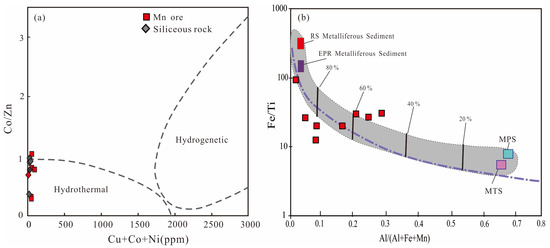
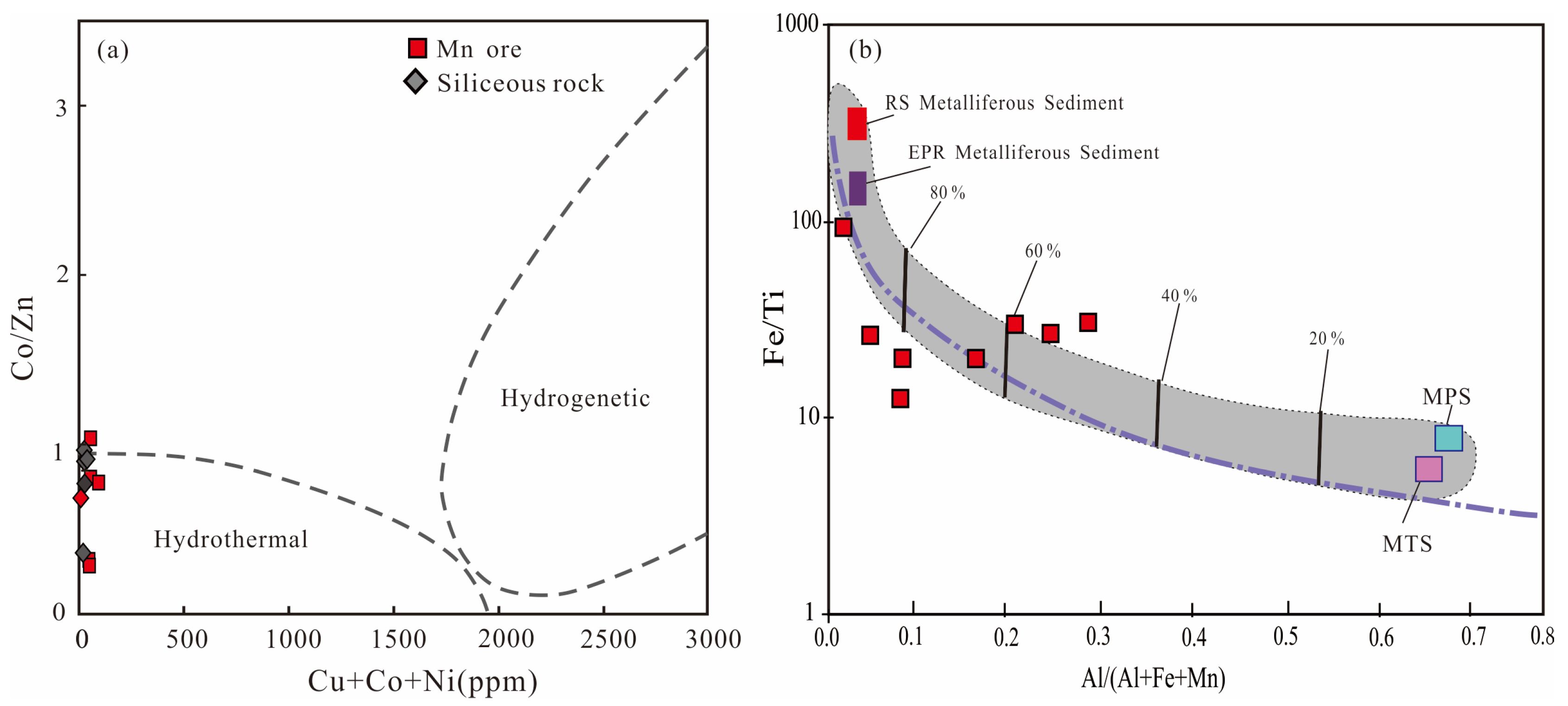
Statistics show (Table S1) that the SiO2/Al2O3 ratio of the Qingshagou Mn ore is 3.22~11.09 (with an average of 7.3), which is much higher than the land source value of 3.6 [43]. The typical ratio of Al/(Al + Fe + Mn) in hot water deposits is less than 0.35 [44]. The ratio of Al/(Al + Fe + Mn) in the Qingshagou Mn ore is 0.03 to 0.30 (with an average of 0.19), all of which indicate that the Qingshagou Mn ore has the characteristics of submarine hydrothermal deposition. At the same time, in the Co/Zn VS. (Cu + Co + Ni) diagram (Figure 10a) and the Fe/Ti vs. Al/(Al + Fe + Mn) diagram (Figure 10b), most of the ore samples from the Qingshagou are plotted in the hydrothermal endmember field or have hydrothermal contribution greater than 50%. These all indicate that the ore-forming materials mainly originated from submarine hydrothermal activities. It can be seen that the formation of the Qingshagou Mn deposit is closely related to the submarine hydrothermal process. Meanwhile, the average δ13CPDB value of the ore is −13.4‰~−23.3‰ [27], consistent with the δ13 C value range of organic matter, which indicates that the reduction in organic matter is an important factor in the formation of carbonate manganese deposits.
Figure 10.
(a) The Co/Zn vs. (Cu + Co + Ni) diagram (modified after [43]) and (b) Fe/Ti vs. Al/(Al + Fe + Mn) diagram (modified after [44]). (EPR: East Pacific Rise; RS: Red Sea; MTS: modern terrigenous sediment; MPS: modern pelagic sediment).
6.4. Tectonic Setting and Ore-Forming Mechanism
The formation of Proterozoic sedimentary Mn deposits is usually closely related to continental rifting events [1,12,45,46,47]. During the breakup event of the Columbia supercontinent, the rift tectonics of the North China craton had a significant controlling effect on the manganese deposits in the Gaoyuzhuang Formation [15,48]. In the overall hypoxic environment during the Mesoproterozoic period [49,50], the manganese deposits in the Gaoyuzhuang Formation recorded one or multiple oxygenation events [14,51,52]. The Mesoproterozoic rift basin at the southern edge of the Dunhuang block controlled the formation of the Annanba manganese ore belt [53]. It is speculated that the Mn ore belt is also related to a certain oxygenation process and breakup of the Columbia supercontinent.
The geochemical characteristics of clastic rocks can not only reflect the rock composition of the source region but also reflect the tectonic background of the source rock [54,55,56,57]. Bhatia [54] classified sandstone tectonic backgrounds into four types: oceanic island arc, continental island arc, active continental margin, and passive continental margin. The composition of major, minor, and rare earth elements varies in each tectonic background. He believed that some major elements and their ratios, such as Fe2O3 + MgO, TiO2, and Al2O3/SiO2, K2O/Na2O, and Al2O3/(CaO + Na2O) are the most important discriminant parameters in the tectonic background.
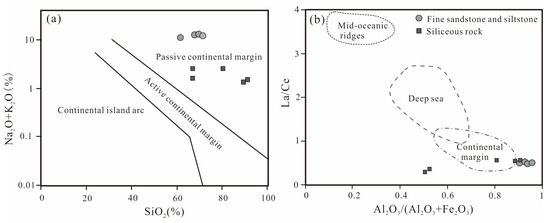
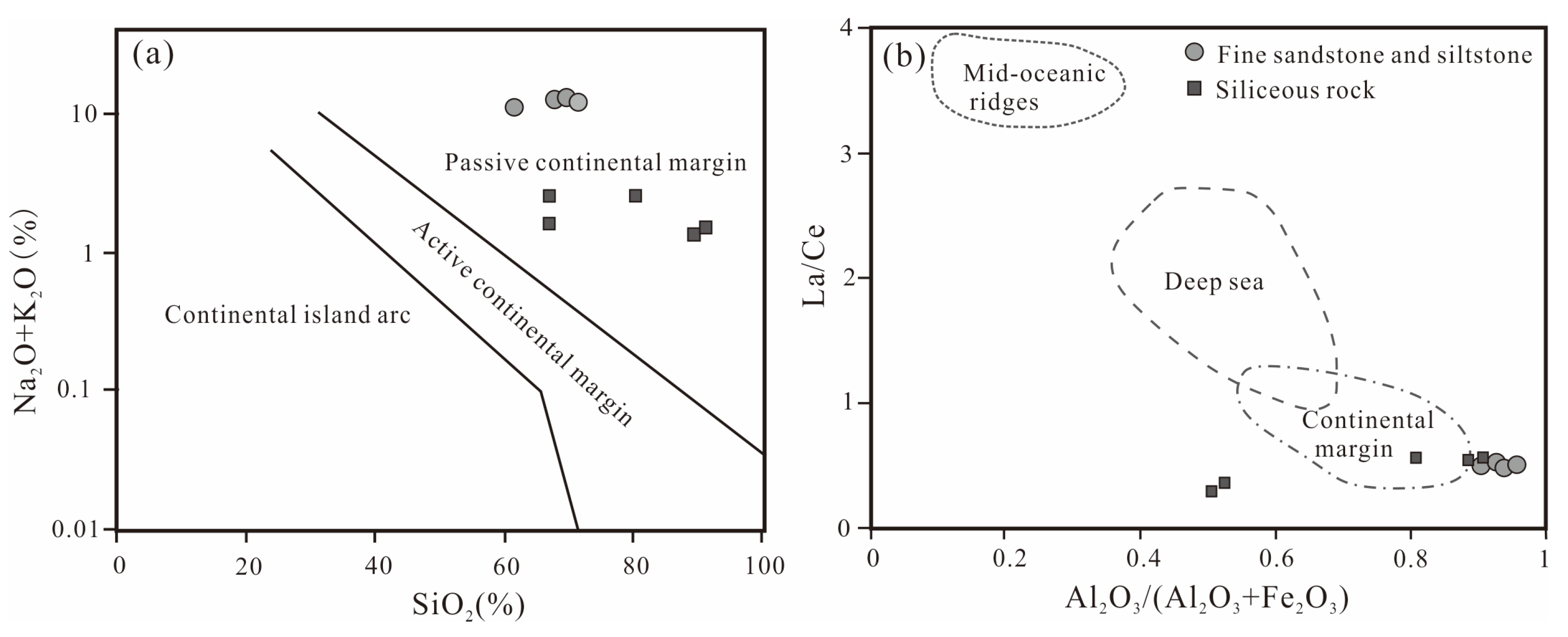
Murray [58] proposed that the Al2O3/(Al2O3 + Fe2O3) ratio can be used to distinguish the tectonic background of sediments. If the ratio ranges from 0.5 to 0.9, it belongs to the sedimentary region of the continental margin. The Al2O3/(Al2O3 + Fe2O3) ratio of the Mn ores in the Qingshagou deposit is 0.22~0.71 (ave. 0.55), while the ratio of Al2O3/(Al2O3 + Fe2O3) in the wall rocks ranges from 0.53 to 0.97 (ave. 0.77). They indicate that all samples of the Qingshagou ore district are all located within the sedimentary area of the continental margin. At the same time, in the SiO2 vs. (K2O + Na2O) diagram (Figure 11a) [56] and La/Ce vs. Al2O3/(Al2O3 + Fe2O3) tectonic diagram (Figure 11b) [58], the samples of siltstone, fine sandstone and siliceous rock from the Qingshagou deposit fall within the passive continental margin region. Therefore, it can be inferred that the tectonic background of the Qingshagou Mn deposit is the passive continental margin.
Figure 11.
(a) The SiO2 vs. (K2O + Na2O) (modified after [56]) and (b) La/Ce vs. Al2O3/(Al2O3 + Fe2O3) (modified after [58]) tectonic diagrams of the Qingshagou manganese deposit.
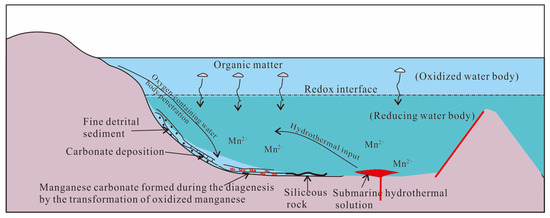
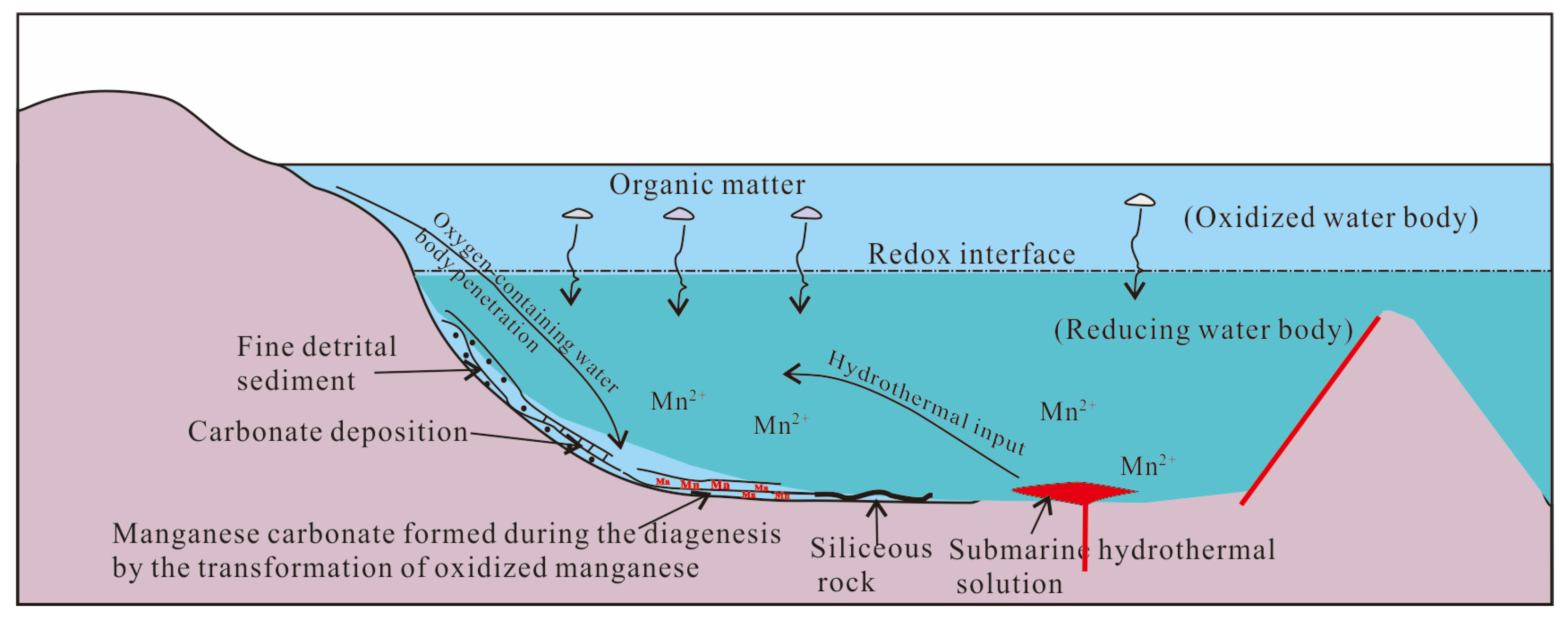
A further speculation on the formation mechanism of the Qingshagou Mn deposit is as follows: The Qingshagou region was located in a rift basin environment on the passive continental margin during the Mesoproterozoic Jixianian period. The bottom of the basin was in an anoxic state, which was conducive to the aggregation of Mn2+ brought by submarine hydrothermal activity, whereas the geochemical information from the manganese ore layer indicates a suboxic to oxic environment. This suggests that the Mn2+ originally accumulated in the anoxic environment underwent penetration by external oxygen—containing the water body, converting the Mn2+ into Mn4+ and causing Mn precipitate. It was supposed that the manganese was enriched in the form of manganese oxides or hydroxides at the initial stage. Subsequently, in the reducing environment during the diagenesis stage, with the participation of organic matter, the Mn4+ in the manganese oxides or hydroxides was reduced to Mn2+, while the organic matter released a large amount of CO32− which combined with Mn2+ to form rhodochrosite (Figure 12).
Figure 12.
The mineralization model of the Qingshagou manganese deposit.
7. Conclusions
- (1)
- The Mesoproterozoic Qingshagou Mn deposit was formed in the tectonic setting of a rift basin along the southern margin of the Dunhuang block. The main ore body of this deposit is located in the Annanba Group of Jixian System, which is composed of fine clastic rocks and carbonate rocks. The manganese deposit was formed primarily during the sedimentary-diagenetic stage and was predominantly composed of rhodochrosite, manganoan dolomite and pyrolusite, with observed framboidal pyrite.
- (2)
- Geochemical characteristics show that the ores have low average ratios of Fe/Mn (<0.19), V/Cr (<1.20), V/(V + Ni) (<0.54), and Al/(Al + Fe + Mn) (<0.30) but high average ratios of U/Th (~0.95), and Y/Ho (~28). The PAAS-normalized rare earth element (REE) patterns exhibit that middle rare earths are slightly enriched, with weak positive anomalies for both Y (0.93~1.01) and Ce (0.97~1.15) and weak negative anomalies for Eu (0.87~0.99).
- (3)
- Synthesizing geochemical findings, it is concluded that the manganese deposit formed in a suboxic-to-oxic environment, the ore-forming materials were primarily derived from a submarine hydrothermal system. The changes in redox conditions in the restricted basins during the Mesoproterozoic period promoted the precipitation of manganese oxide. During the diagenesis period, due to the addition of organic matter, it was transformed into rhodochrosite.
- (4)
- The geochemical characteristics of the Qingshagou Mn deposit on the southern margin of the Dunhuang block, in combination with the same period Qinjiayu and Wafangzi manganese deposits in the North China Craton, provide geological evidence for a relatively significant oxygenation event in the atmosphere during the Mesoproterozoic.
Supplementary Materials
The following supporting information can be downloaded at https://www.mdpi.com/article/10.3390/min16070664/s1, Table S1: Major elements; Table S2: Trace elements; Table S3: Rare earth elements.
Author Contributions
Conceptualization, W.L. (Wen Li) and M.Z.; methodology, W.C.; investigation, Z.Z., W.L. (Wenjun Li), M.Z. and C.W.; data curation, Z.Z. and W.L. (Wen Li); writing—original draft preparation, Z.Z.; writing—review and editing, W.C., Z.D., L.Z., W.L. (Wenjun Li), W.L. (Wen Li), M.Z. and C.W.; visualization, Z.D., W.L. (Wenjun Li) and C.W.; supervision, L.Z. and Z.D.; project administration, L.Z.; funding acquisition, W.C. All authors have read and agreed to the published version of the manuscript.
Funding
This work was supported by the National Key Research and Development Program of China (2022YFC2903405) and the Chief Expert Support Program of China Metallurgical Geology Bureau (CMGBKYS202402).
Data Availability Statement
All the new data obtained in this research are contained in the Supplementary Material.
Acknowledgments
We express our gratitude to Niu Sida from the Institute of Mineral Resources Research, China Metallurgical Geology Bureau, for her assistance during the field investigation and sample collection. We sincerely thank the three experts and the Editor-in-Chief for their meticulous review and valuable suggestions.
Conflicts of Interest
The authors declare no conflicts of interest.
References
- Maynard, J.B. The chemistry of manganese ores through time: A signal of increasing diversity of earth-surface environments. Econ. Geol. 2010, 105, 535–552. [Google Scholar] [CrossRef] [Scilit]
- Maynard, J.B. Manganiferous sediments, rocks, and ores. In Treatise on Geochemistry, 2nd ed.; Holland, H.D., Turekian, K.K., Eds.; Elsevier: Oxford, UK, 2014; pp. 327–349. [Google Scholar]
- Beukes, N.J.; Swindell, E.P.W.; Wabo, H. Manganese deposits of Africa. Episodes 2016, 39, 285–317. [Google Scholar] [CrossRef] [Scilit]
- Johnson, J.E.; Webb, S.M.; Ma, C.; Fischer, W.W. Manganese mineralogy and diagenesis in the sedimentary rock record. Geochim. Cosmochim. Acta 2016, 173, 210–231. [Google Scholar] [CrossRef] [Scilit]
- Roy, S. Sedimentary manganese metallogenesis in response to the evolution of the earth system. Earth-Sci. Rev. 2006, 77, 273–305. [Google Scholar] [CrossRef] [Scilit]
- Dong, Z.G.; Peng, Z.D.; Robbins, L.J.; Konhauser, K.O.; Zhang, B.L.; Li, J.; Li, W.J.; Zhang, L.C.; Wang, C.L. Episodic ventilation of euxinic bottom waters triggers the formation of black shale-hosted Mn carbonate deposits. Geochim. Cosmochim. Acta 2023, 341, 132–149. [Google Scholar]
- Brasier, M.D.; Lindsay, J.F. A billion years of environmental stability and the emergence of eukaryotes: New data from northern Australia. Geology 1998, 26, 555–558. [Google Scholar] [CrossRef] [Scilit] [PubMed]
- Bekker, A.; Slack, J.F.; Planavsky, N.; Krapež, B.; Hofmann, A.; Konhauser, K.O.; Rouxel, O.J. Iron formation: The sedimentary product of a complex interplay among mantle, tectonic, oceanic and biospheric processes. Econ. Geol. 2010, 105, 467–508. [Google Scholar] [CrossRef] [Scilit]
- Gilleaudeau, G.J.; Frei, R.; Kaufman, A.J.; Kah, L.C.; Azmy, K.; Bartley, J.K.; Chernyavskiy, P.; Knoll, A.H. Oxygenation of the mid-Proterozoic atmosphere: Clues from chromium isotopes in carbonates. Geochem. Perspect. Lett. 2016, 2, 178–187. [Google Scholar] [CrossRef] [Scilit]
- Hardisty, D.S.; Lu, Z.L.; Bekker, A.; Diamond, C.W.; Gill, B.C.; Jiang, G.Q.; Kah, L.C.; Knoll, A.H.; Loyd, S.J.; Osburn, M.R. Perspectives on Proterozoic surface ocean redox from iodine contents in ancient and recent carbonate. Earth Planet. Sci. Lett. 2017, 463, 159–170. [Google Scholar] [CrossRef] [Scilit]
- Diamond, C.W.; Lyons, T.W. Mid-Proterozoic redox evolution and the possibility of transient oxygenation events. Emerg. Top. Life Sci. 2018, 2, 235–245. [Google Scholar] [CrossRef] [Scilit] [PubMed]
- Spinks, S.C.; Sperling, E.A.; Thorne, R.L.; Lafountain, F.; White, A.J.R.; Armstrong, J.; Woltering, M.; Tyler, I.M. Mesoproterozoic surface oxygenation accompanied major sedimentary manganese deposition at 1.4 and 1.1 Ga. Geobiology 2023, 21, 28–43. [Google Scholar] [CrossRef] [Scilit] [PubMed]
- Fan, D.L.; Ye, J.; Li, J.J. Geology, mineralogy, and geochemistry of the Middle Proterozoic Wafangzi ferromanganese deposit, Liaoning Province, China. Ore Geol. Rev. 1999, 15, 31–53. [Google Scholar] [CrossRef] [Scilit]
- Fang, H.; Tang, D.J.; Shi, X.Y. Manganese-rich deposits in the Mesoproterozoic Gaoyuzhuang Formation (ca. 1.58 Ga), North China Platform: Genesis and Paleoenvironmental implications. Palaeogeogr. Palaeoclimatol. Palaeoecol. 2020, 559, 109966. [Google Scholar] [CrossRef] [Scilit]
- Jin, S.; Ma, P.; Guo, H.; Yu, W.; Xu, L.; Lin, Q. The Cause of the Mesoproterozoic Gaoyuzhuang formation manganese deposits in Qinjiayu, East Hebei: Constraints from mineralogy and geochemistry. Earth Sci. 2022, 47, 277–289, (In Chinese with English Abstract). [Google Scholar] [CrossRef] [Scilit]
- Zhang, S.C.; Wang, X.M.; Wang, H.J.; Bjerrum, C.J.; Hammarlund, E.U.; Costa, M.M.; Connelly, J.N.; Zhang, B.M.; Su, J.; Canfield, D.E. Sufficient oxygen for animal respiration 1400 million years ago. Proc. Natl. Acad. Sci. USA 2016, 113, 1731–1736. [Google Scholar] [PubMed]
- Zhang, S.C.; Wang, H.J.; Wang, X.M.; Ye, Y.T. The Mesoproterozoic oxygenation event. Sci. China Earth Sci. 2021, 64, 2043–2068, (In Chinese with English Abstract). [Google Scholar] [CrossRef] [Scilit]
- Wang, H.Y.; Zhang, Z.H.; Li, C.; Algeo, T.J.; Cheng, M.; Wang, W. Spatiotemporal redox heterogeneity and transient marine shelf oxygenation in the Mesoproterozoic ocean. Geochim. Cosmochim. Acta 2020, 270, 201–221. [Google Scholar] [CrossRef] [Scilit]
- Zhao, B.Q.; Chen, Y.L.; Yuan, B. Geological characteristics and prospecting indicators of the Qingshagou manganese deposit in Aksai County, Gansu Province. Gansu Sci. Technol. 2013, 29, 35–36, (In Chinese with English Abstract). [Google Scholar]
- Zhao, B.Q.; Yuan, B.; Chen, Y.L.; Liu, Y.Q. Analysis of geological characteristics, Genesis of deposits and prospecting potential of the Altyn manganese ore belt. Gansu Sci. Technol. 2013, 29, 36–38, (In Chinese with English Abstract). [Google Scholar]
- Yu, S.; Zhao, B.Q.; Jia, X.; Dong, S.L.; Zhao, B.B.; Bai, Y.P.; Li, S.X.; Yang, R.D. Location prediction and deep verification of concealed orebody in sedimatary manganese deposits—A case study of the Saimagou manganese mine in Aksaicounty. Miner. Explor. 2022, 13, 473, (In Chinese with English Abstract). [Google Scholar] [CrossRef] [Scilit]
- Kuang, H.W.; Liu, Y.Q.; Geng, Y.S.; Peng, N.; Wang, Y.C.; Chen, X.S.; Liu, Y.X.; Yang, F.J.; Zhao, F.X.; Liu, P.J.; et al. Research advances, a subdivision and correlation of the Meso-Neoproterozoic stratigraphy in China. Acta Geol. Sin. 2023, 97, 3861–3901, (In Chinese with English Abstract). [Google Scholar]
- Zhang, L.C.; Bai, Y.; Huang, H.; Liu, Y.L.; Li, W.; Dong, Z.G.; Wang, C.L.; Zhu, M.T. Metallogenic belt of sedimentary manganese deposits in periphery of the Qaidam Basin: A manganese ore concentration area with great resource potential. Miner. Explor. 2024, 15, 909–927, (In Chinese with English Abstract). [Google Scholar]
- Guo, Z.J.; Zhang, Z.C.; Jia, C.Z.; Wei, G.Q. Basement of Tarim craton and tectonic evolution. Sci. China (Ser. D) 2000, 30, 568–575, (In Chinese with English Abstract). [Google Scholar]
- Zhang, J.X.; Li, H.K.; Meng, F.C.; Xiang, Z.Q.; Yu, S.Y.; Li, J.P. Polyphase tectonothermal events recorded in “metamorphic basement” from the Altyn Tagh, the southeastern margin of the Tarim basin, western China: Constraint from U-Pb zircon geochronology. Acta Petrol. Sin. 2011, 27, 23–46, (In Chinese with English Abstract). [Google Scholar]
- Meng, Z.; Zhao, B.Q.; Zhang, X.H.; Liu, J.H.; Jia, Z.L. Discovery and Significance of Qingshagou Large Scale Low-Grade Manganese Deposit at Altyn Metallogenic Belt, Gansu. Gansu Geol. 2015, 24, 1–8, (In Chinese with English Abstract). [Google Scholar]
- Wang, S.; Shang, K.K.; Yang, J.B.; Zhang, S.C.; Li, Y. Research on the geological conditions and metallogenic regularity of manganese deposits in the northern Altun Mountain. China Manganese Ind. 2022, 40, 1–5+11, (In Chinese with English Abstract). [Google Scholar] [CrossRef]
- Zhang, B.L.; Wang, C.L.; Robbins, L.J.; Zhang, L.C. Petrography and geochemistry of the Carboniferous Ortokarnash manganese deposit in the Western Kunlun Mountains, Xinjiang Province, China: Implications for the depositional environment and the origin of mineralization. Econ. Geol. 2020, 115, 1559–1588. [Google Scholar] [CrossRef] [Scilit]
- McLennan, S.M. Rare earth elements in sedimentary rocks; influence of provenance and sedimentary processes. Rev. Mineral. Geochem. 1989, 21, 169–200. [Google Scholar] [CrossRef] [Scilit]
- Bau, M. Effects of syn-and post-depositional processes on the rare earth element distribution in Precambrian iron-formations. Eur. J. Mineral. 1993, 5, 257–267. [Google Scholar] [CrossRef] [Scilit]
- Bau, M.; Koschinsky, A. Oxidative scavenging of cerium on hydrous Fe oxide: Evidence from the distribution of rare earth elements and yttrium between Fe oxides and Mn oxides in hydrogenetic ferromanganese crusts. Geochem. J. 2009, 43, 37–47. [Google Scholar] [CrossRef] [Scilit]
- Maynard, J.B. Bedded manganese deposits. In Encyclopedia of Geology, 2nd ed.; David, A., Scott, A.E., Eds.; Academic Press: New York, NY, USA, 2021; pp. 931–944. [Google Scholar]
- Adams, J.A.S.; Weaver, C.E. Thorium-to-uranium ratios as indicators of sedimentary processes: Example of concept of geochemical facies. AAPG Bull. 1958, 42, 387. [Google Scholar]
- Hatch, J.R.; Leventhal, J.S. Relationship between inferred redox potential of the depositional environment and geochemistry of the Upper Pennsylvanian (Missourian) stark shale member of the Dennis limestone, Wabaunsee County, Kansas, U.S.A. Chem. Geol. 1992, 99, 65–82. [Google Scholar] [CrossRef] [Scilit]
- Jones, B.; Manning, D.A. Comparison of geochemical indices used for the interpretation of Palaeoredox conditions in ancient mudstones. Chem. Geol. 1994, 111, 111–129. [Google Scholar] [CrossRef] [Scilit]
- Frimmel, H.E. Trace element distribution in Neoproterozoic carbonates as palaeoenvironmental indicator. Chem. Geol. 2009, 258, 338–353. [Google Scholar] [CrossRef] [Scilit]
- Tribovilard, N.; Algeo, T.J.; Lyons, T. Trace Metals as paleoredox and paleoproductivity proxies: An update. Chem. Geol. 2006, 232, 12–32. [Google Scholar] [CrossRef] [Scilit]
- Alibo, D.S.; Nozaki, Y. Rare earth elements in seawater: Particle association, shale-normalization, and Ce oxidation. Geochim. Cosmochim. Acta 1999, 63, 363–372. [Google Scholar] [CrossRef] [Scilit]
- Berti, D.; Slowey, N.C.; Deng, Y.; Yancey, T.E.; Velazquez, A.L.B. Yttrium and REE mineralization in manganese pods occurring in bentonite deposits of the Eocene Texas coastal plain. Clays Clay Miner. 2023, 71, 253–273. [Google Scholar] [CrossRef] [Scilit]
- Bau, M.; Dulski, P. Comparing yttrium and rare-earth in hydrothermal fluids from the Mid-Atlantic Ridge: Implications for Y and REE behavior during near vent mixing and for the Y/Ho ratio of Proterozoic seawater. Chem. Geol. 1999, 155, 77–90. [Google Scholar] [CrossRef] [Scilit]
- Tostevin, R.; Shields, G.; Tarbuck, G.; He, T.C.; Clarkson, M.; Wood, R. Effective use of cerium anomalies as a redox proxy in carbonate-dominated marine settings. Chem. Geol. 2016, 438, 146–162. [Google Scholar] [CrossRef] [Scilit]
- Bau, M.; Schmidt, K.; Koschinsky, A. Discriminating between different genetic types of marine ferro-manganese crusts and nodules based on rare earth elements and yttrium. Chem. Geol. 2024, 381, 1–9. [Google Scholar] [CrossRef] [Scilit]
- Taylor, S.R.; Mclennan, S.M. The Continental Crust: Its Composition and Evolution; Blachwell Scientific Publication: Oxford, UK, 1985; pp. 1–312. [Google Scholar]
- Boström, K. Genesis of ferromanganese deposits-diagnostic criteria for recent and old deposits. In Hydrothermal Processes at Seafloor Spreading Centers; Rona, P.A., Ed.; Plenum Press: New York, NY, USA, 1983; pp. 473–489. [Google Scholar]
- Du, Y.S.; Zhou, Q.; Zhang, L.C. Major geological events and large-scale sedimentary metallogeny. J. Palaeogeogr. 2020, 22, 807–811, (In Chinese with English Abstract). [Google Scholar]
- Xu, L.G. Sedimentary manganese formation and its link with paleo-oceanic environment. Miner. Depos. 2020, 39, 959–973, (In Chinese with English Abstract). [Google Scholar]
- Liu, Y.L.; Zhang, A.K.; Zhang, J.P. Tectonic setting and metallogenic regualtion of sedimentary manganese deposits of east Kunlun, Qinghai Province. Earth Sci. 2024, 49, 4278–4302, (In Chinese with English Abstract). [Google Scholar]
- Rogers, J.J.; Santosh, M. Tectonics and surface effects of the supercontinent Columbia. Gondwana Res. 2009, 15, 373–380. [Google Scholar] [CrossRef] [Scilit]
- Force, E.R.; Cannon, W.F. Depositional model for shallow marine manganese deposits around black shale basins. Econ. Geol. 1988, 83, 93–117. [Google Scholar] [CrossRef] [Scilit]
- Poulton, S.W.; Canfield, D.E. Ferruginous conditions: A dominant feature of the ocean through earth’s history. Elements 2011, 7, 107–112. [Google Scholar] [CrossRef] [Scilit]
- Zhang, K.; Zhu, X.K.; Wood, R.A. Oxygenation of the Mesoproterozoic ocean and the evolution of complex eukaryotes. Nat. Geosci. 2018, 11, 345–350. [Google Scholar] [CrossRef] [Scilit]
- Shang, M.H.; Tang, D.J.; Shi, X.Y. A pulse of oxygen increse in the early Mesoproterozoic ocean at ca. 1.57–1.56 Ga. Earth Planet. Sci. Lett. 2019, 527, 115797. [Google Scholar] [CrossRef] [Scilit]
- Wu, Y.Z.; Xiao, X.J.; Qiao, G.B. Ascription and metallogenic characteristics of Altyn Orogenic Belt. Geotecton. Metallog. 2017, 41, 689–697, (In Chinese with English Abstract). [Google Scholar]
- Bhatia, M.R. Plate Tectonic and geochemical composition of sandstones. J. Geol. 1983, 91, 611–627. [Google Scholar] [CrossRef] [Scilit]
- Bhatia, M.R.; Crook, K.A.W. Trace element characteristics of graywackes and tectonic setting discrimination of sedimentary Basin. Contrib. Mineral. Petrol. 1986, 92, 181–193. [Google Scholar] [CrossRef] [Scilit]
- Roser, B.P.; Korsch, R.J. Plate Tectonics and geochemical composition of sandstones: A discussion. J. Geol. 1985, 93, 8–84. [Google Scholar] [CrossRef] [Scilit]
- Roser, B.P.; Korsch, R.J. Determination of tectonic setting of sandstone-mudstone suites using content and ratio. J. Geol. 1986, 94, 635–650. [Google Scholar] [CrossRef] [Scilit]
- Murray, R.W. Chemicalc riteriato identify the depositional environment of chert: General principles and applications. Sediment. Geol. 1994, 90, 213–232. [Google Scholar]
Disclaimer/Publisher’s Note: The statements, opinions and data contained in all publications are solely those of the individual author(s) and contributor(s) and not of MDPI and/or the editor(s). MDPI and/or the editor(s) disclaim responsibility for any injury to people or property resulting from any ideas, methods, instructions or products referred to in the content. |
© 2026 by the authors. Licensee MDPI, Basel, Switzerland. This article is an open access article distributed under the terms and conditions of the Creative Commons Attribution (CC BY) license.