


Abstract
The magmatic Ni-Co-Cu mineralization in the Iken deposit in the central part of the Kun-Manie complex, Amur Oblast, Russia, hosted by an olivine-bearing websterite, is of a low-sulfide type. The fine-grained disseminations of base metal sulfides (BMS), dominantly pyrrhotite, pentlandite (a major source of Ni of industrial importance), and chalcopyrite, are followed by a scarce Pd-Pt-Ag mineralization. Elevated contents of Al in orthopyroxene (mean 2.78 wt.% Al2O3) along with Al–Na enrichment in clinopyroxene (diopside; mean 5.10 wt.% Al2O3) are associated with highly aluminous compositions of low-chromium members of the spinel–hercynite series. High levels of TiO2 in kaersutite and titanian phlogopite also reflect a pronounced degree of fractionation of the ore-forming melt. Minor portions of sulfide melt are distributed evenly as a result of immiscibility at advanced stages of orthopyroxene crystallization, after the formation of olivine. Differentiated grains of droplet-like BMS largely settled in situ close to grain boundaries of orthopyroxene or occupied interstitial spaces of pyroxenes and olivine in association with spinel–hercynite and fluorapatite. A combination of late saturation in S with relatively quick cooling rates of the hypabyssal body prevented the effective settlement and accumulation of sulfide droplets in the ore zone. The well-developed lamellae of troilite (Fe50S50) exsolved from the host pyrrhotite Fe48S52 during subsolidus cooling, as a consequence of a low-temperature reaction triggered by a sudden drop in fO2. An influx of mantle-derived fluid bearing CO2, CO, and CH4 with the rising magma could be the primary cause of the fO2 reduction. Also, graphite-bearing metasedimentary rocks could have been assimilated. Tiny grains of minerals of noble metals (moncheite and merenskyite with essential amounts of melonite component, sperrylite, hessite, alloy Au63.2Ag36.8, and argentopentlandite) deposited late in a fluid-enriched medium under submagmatic conditions.
1. Introduction
The Kun-Manie ore field hosts large resources of Ni-bearing sulfide ores that also contain minerals enriched in Cu, Co, and platinum group elements (PGEs), especially Pt and Pd ([1,2] and references therein). The major deposits of the group are associated with a suite of Paleoproterozoic sill-like bodies of gabbronorite–websterite–lherzolite compositions. Vein-type and fine-grained disseminated ores, massive ores, and breccia ores are all present. The Iken (Sobolevskoe) deposit is one of the most productive in the ore field. The intrusive bodies were emplaced in the eastern part of the Stanovoi collisional orogenic belt in the southeastern portion of the Siberian platform.
We present the first detailed investigation of mineralized specimens from the Iken deposit, centrally located in the little-known Kun-Manie belt. Our primary focus lies with the textural information conveyed by the ore minerals. We have selected seven representative samples of Iken ore and report the composition of all rock-forming and ore-forming minerals. As in all deposits associated with basic and ultrabasic sills, we must evaluate what the magma produced and how the primary minerals evolved in the presence of an aqueous fluid phase during cooling. The platinum group minerals (PGMs) and the Au-Ag-bearing ore constituents seem to have formed late. Troilite also appeared late in the evolution of the ore assemblage. As the occurrence of troilite is highly unusual in terrestrial igneous rocks, we have made it a secondary focus of our report. Some of the 19 terrestrial occurrences involve the formation of troilite lamellae in pyrrhotite, as in the Iken Ni deposit. A late reduction in f(O2) is indicated. We evaluate the possible roles of the influx of mantle-derived fluid and the assimilation of graphite-bearing supracrustal rocks in controlling f(O2) during cooling. Our inferences shed light on ore-forming environments in low-sulfide hypabyssal deposits.
2. Background Information
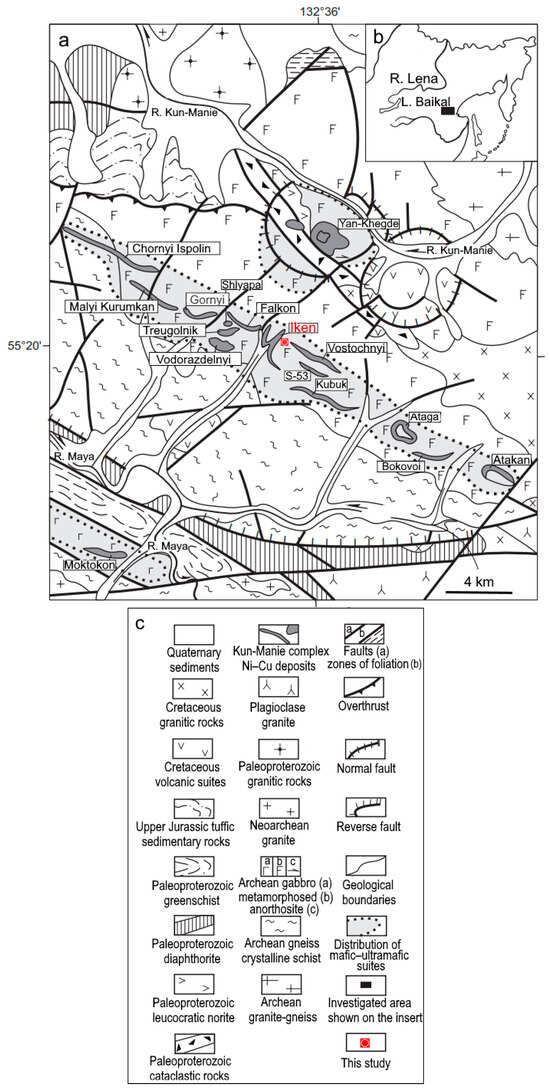
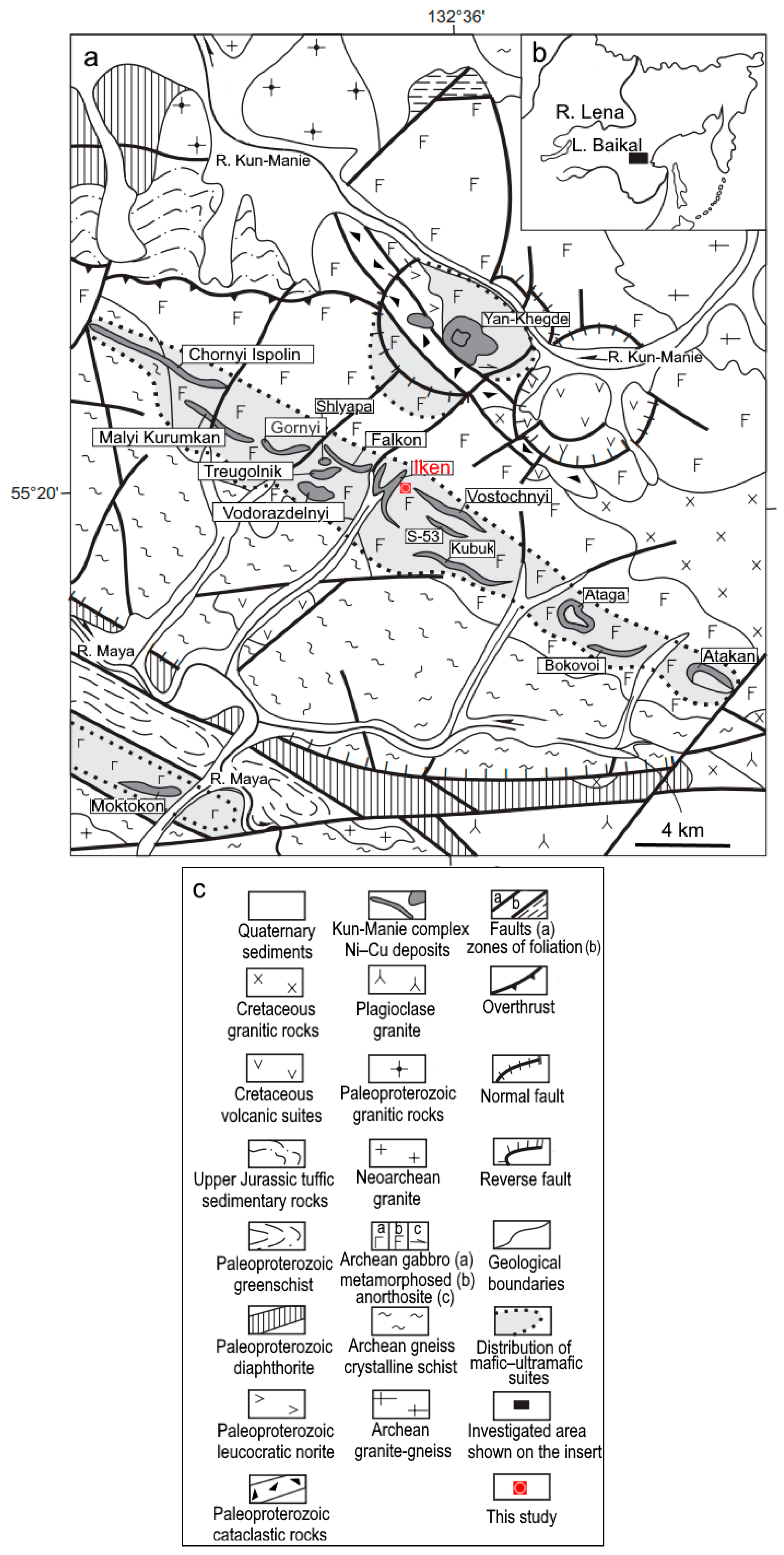
The Kun-Manie ore field, ~1 to 3 km wide, extends over 31 km northwestward (Figure 1). The regional structure hosts a total of about 160 separate bodies of mafic–ultramafic rocks of various sizes and shapes; some sill-like bodies are vertically stacked. These bodies also form lenticular intrusions and, less commonly, dikes that all host a Cu-Ni-Co-PGE sulfide-dominant mineralization. They are up to 0.12 km thick and 0.25 to ~5–6 km long, dipping shallowly northeast at 5 to 40°. The major Ni deposits are hosted in sills at Malyi Kurumkan, Gornyi, Treugolnik, Shlyapa, Falkon, Iken, and Kubuk (Figure 1).
Figure 1.
(a–c). Schematic geological map (a), location (b), and legend (c) pertaining to the mineralized suites of the Kun-Manie complex, Amur Oblast, northeastern Russia (after [1] and references therein).
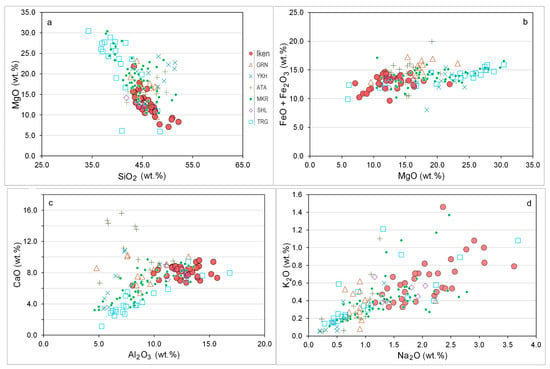
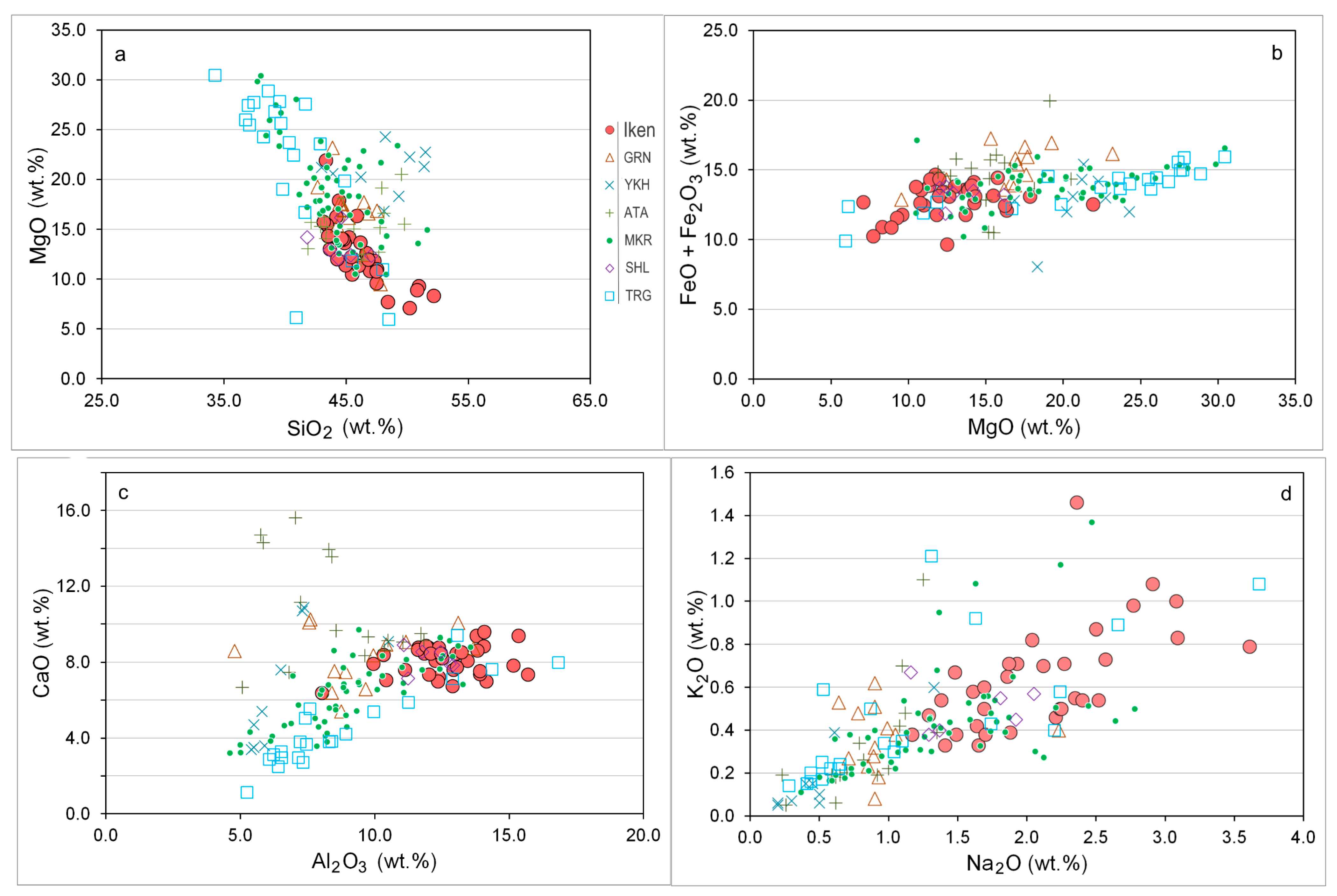
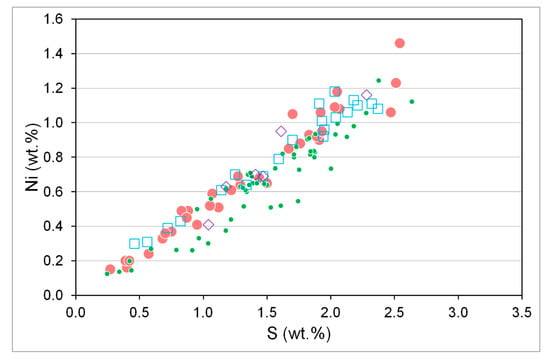
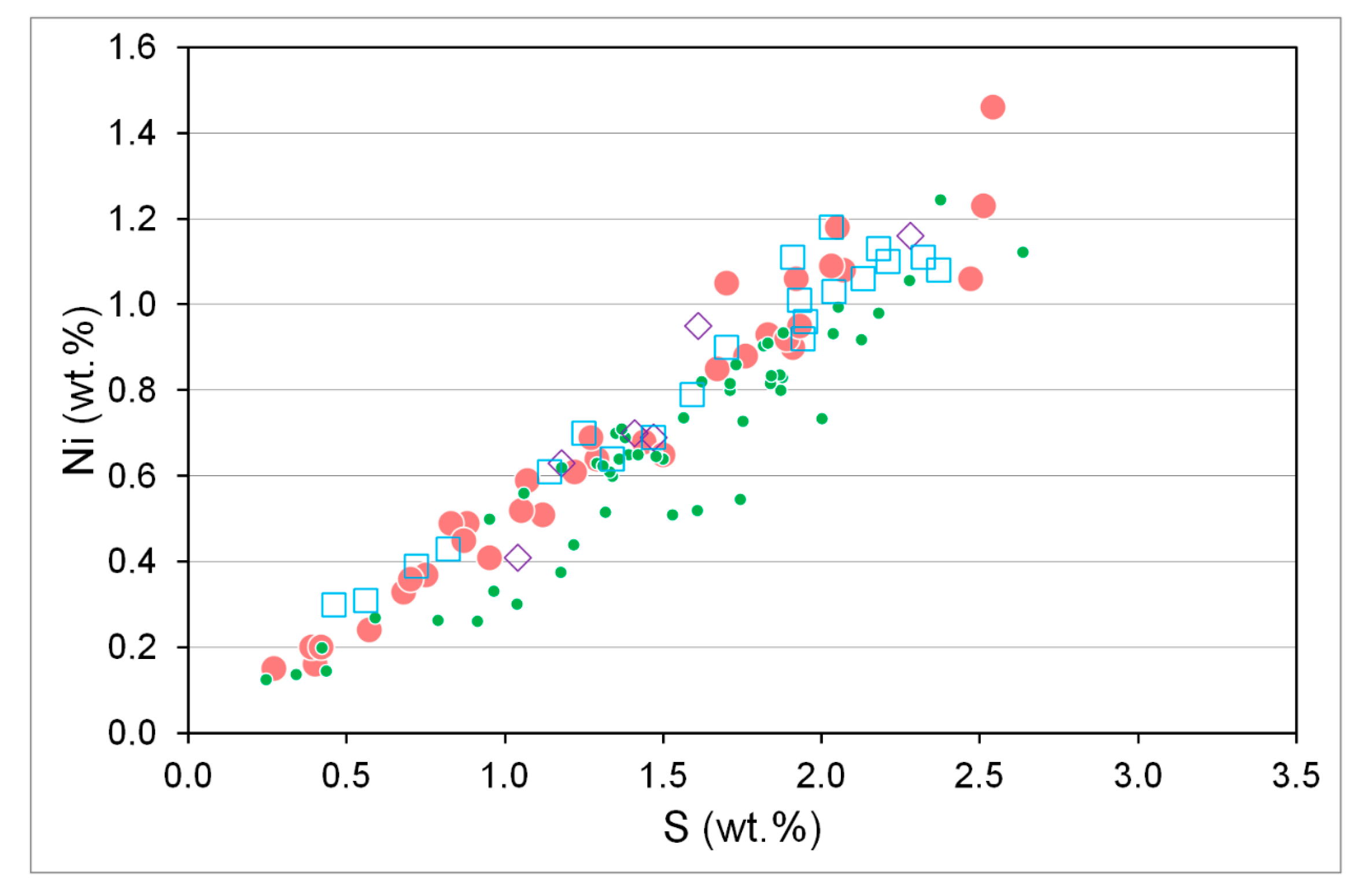
Intrusions of the complex are composed of websterite, olivine- or plagioclase-bearing variants of websterite, gabbronorite, and lherzolite. Several members of the Kun-Manie complex vary extensively in composition, as revealed in plots of major element concentrations, in weight % (Figure 2a–d; data of Kremenetskiy et al. 2009 [3]). The mineralized samples at four of the sites, Iken, Malyi Kurumkan, Shlyapa, and Treugolnik, display a wide range of Ni vs. S coherent covariation (Figure 3).
Figure 2.
(a–d). Plot of bulk rock contents of SiO2-MgO (a), MgO-(FeO + Fe2O3) (b), Al2O3-CaO (c), and Na2O-K2O (d), all expressed in weight %, for the following deposits of the Kun-Manie ore field: Iken (Sobolevskoe), Gornyi GRN, Yan-Khegde YKH, Ata ATA, Malyi Kurumkan MKR, Shlyapa SHL, and Treugolnik TRG (Figure 2a). The bulk rock data are from [3].
Figure 3.
Plot of bulk rock contents of S versus Ni showing variations, in weight %, observed in mineralized suites of the Kun-Manie complex. The symbols and data source are the same as in Figure 2a–d.
The Paleoproterozoic age of the complex is inferred based on results of zircon U-Pb dating: 1.76–1.69 Ga. The Sm-Nd data, obtained at Iken, are consistent: 1.812 ± 66 and 1.850 ± 90 Ga [εNd (T) = +2.8] [2,4].
3. Materials and Analytical Methods
Our materials involve seven fragments of ore specimens collected in the Ni-Co-Cu-PGE deposit hosted by the Iken body in the central part of the Kun-Manie complex (Figure 1a–c). The compositions were acquired at the Research and Development facility of Norilsk Nickel at the Siberian Federal University in Krasnoyarsk. The compositions were acquired by SEM-EDS analysis done on a Tescan Vega III SBH system (Tescan Orsay Holding, Brno, Czech Republic) equipped with an Oxford X-Act spectrometer (Oxford Instruments Nanoanalysis, High Wycombe, UK). The instrument was held at an accelerating voltage of 20 kV and a beam current of 1.2 nA. The commonly used combinations of X-ray lines were used. The Kα line was used for Na, K, Fe, Mg, Mn, Ca, Zn, Ni, Co, Cu, Cr, Al, V, Ti, Si, P, S, F, and Cl. The Lα line was used for Pd, Ag, Te, and As, and the Mα line was used for Pt, Au, and Bi. A set of standards used was provided by the Micro-Analysis Consultants Ltd. (MAC, St Ives, UK; registration no. 11,192). The beam current was monitored every 60 min using the MAC cobalt standard (registration no. 9941).
4. Results and Observations
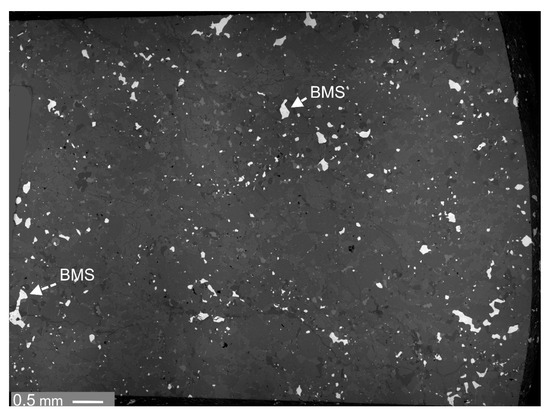
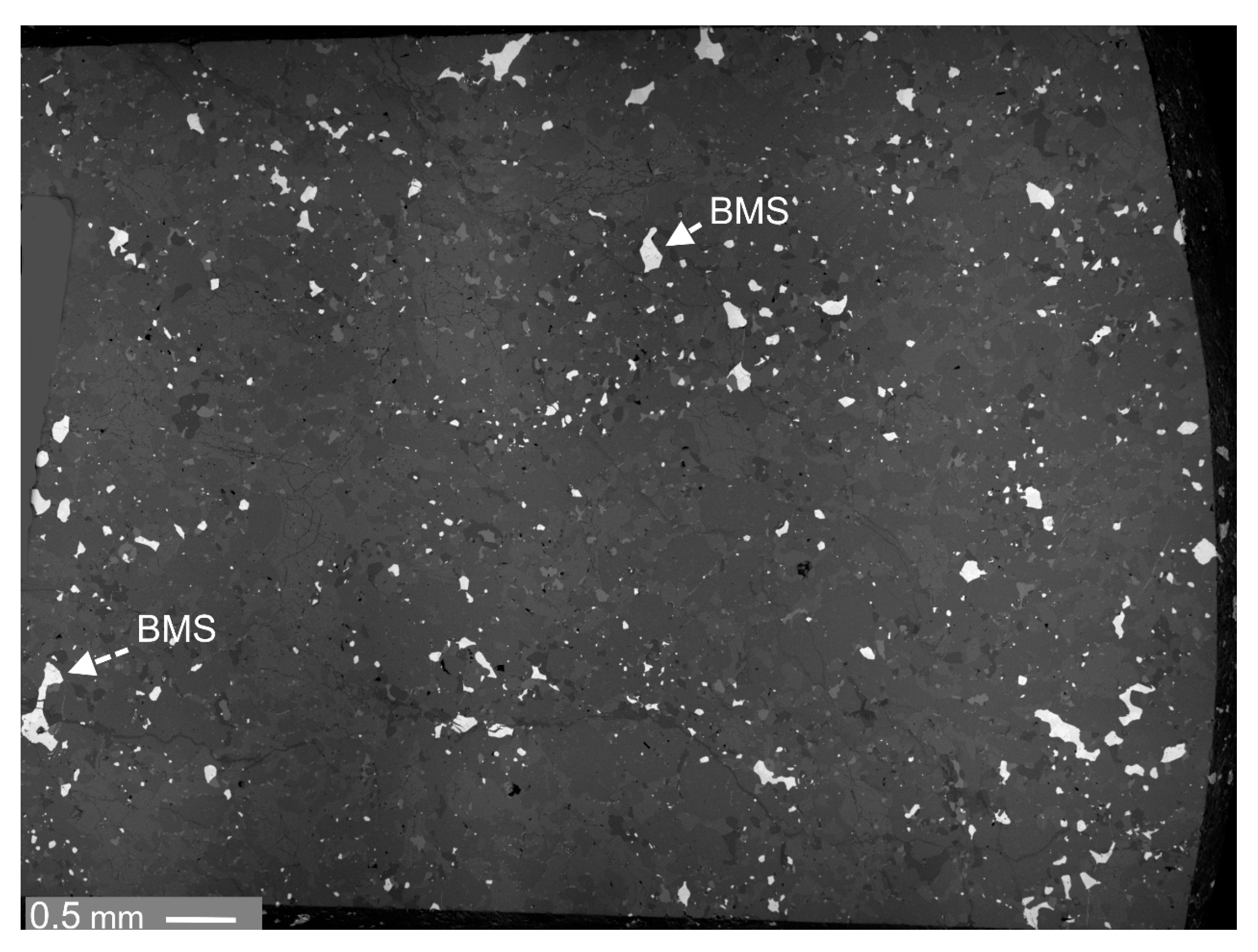
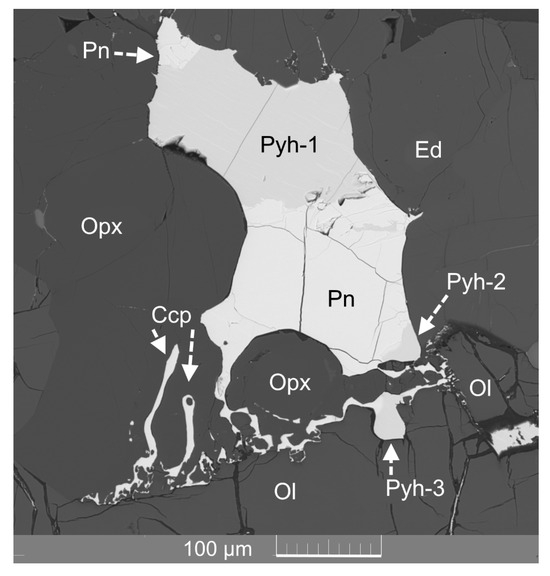
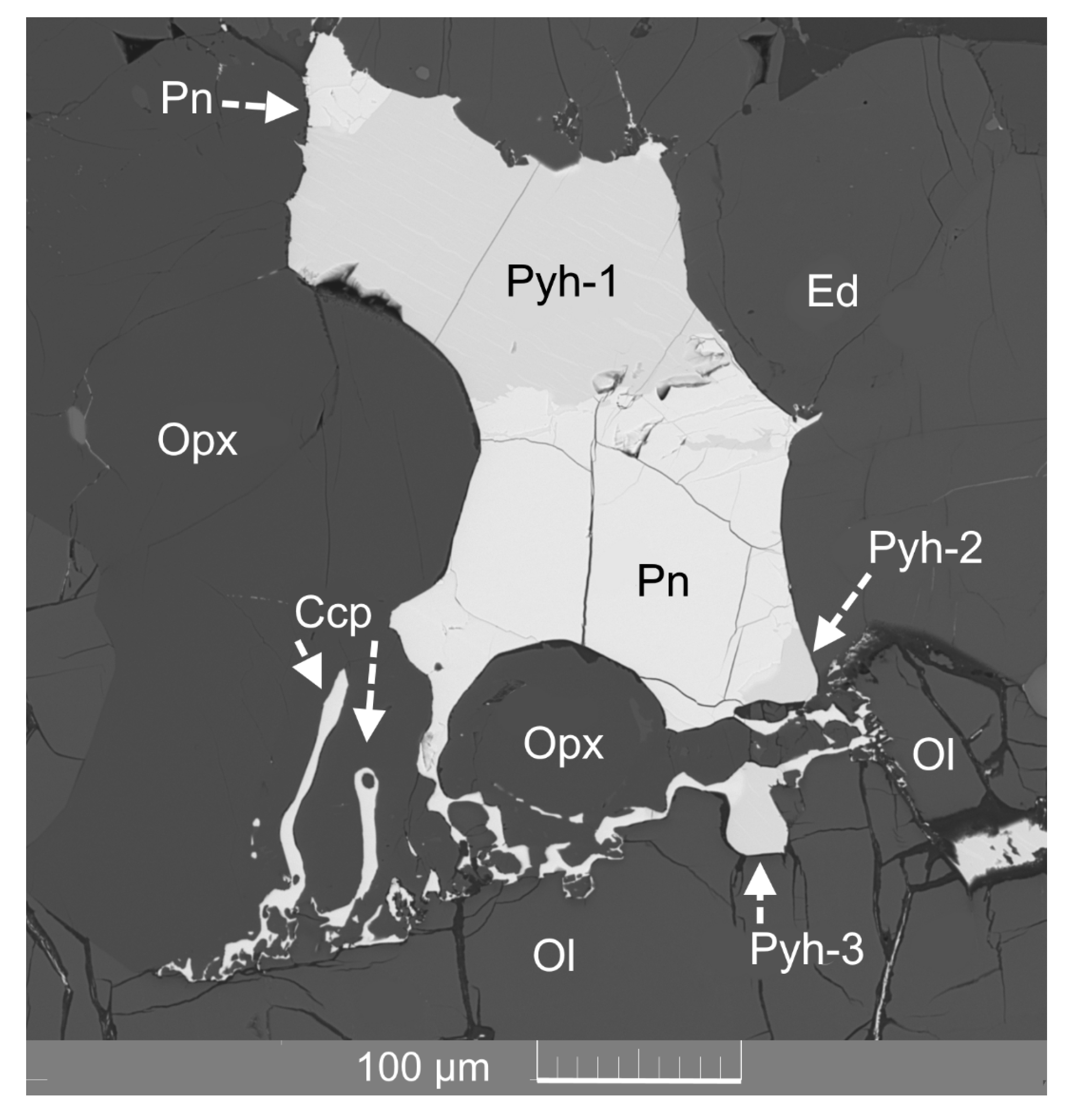
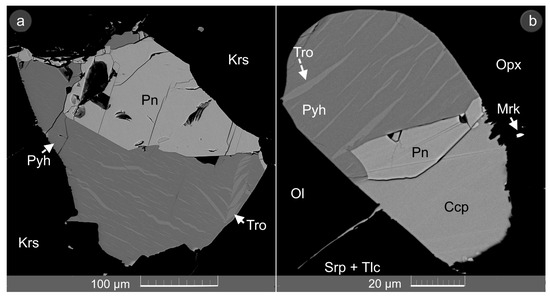
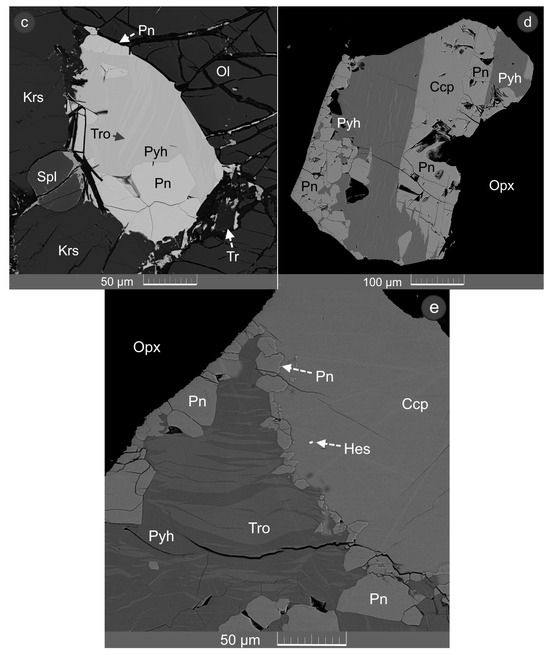
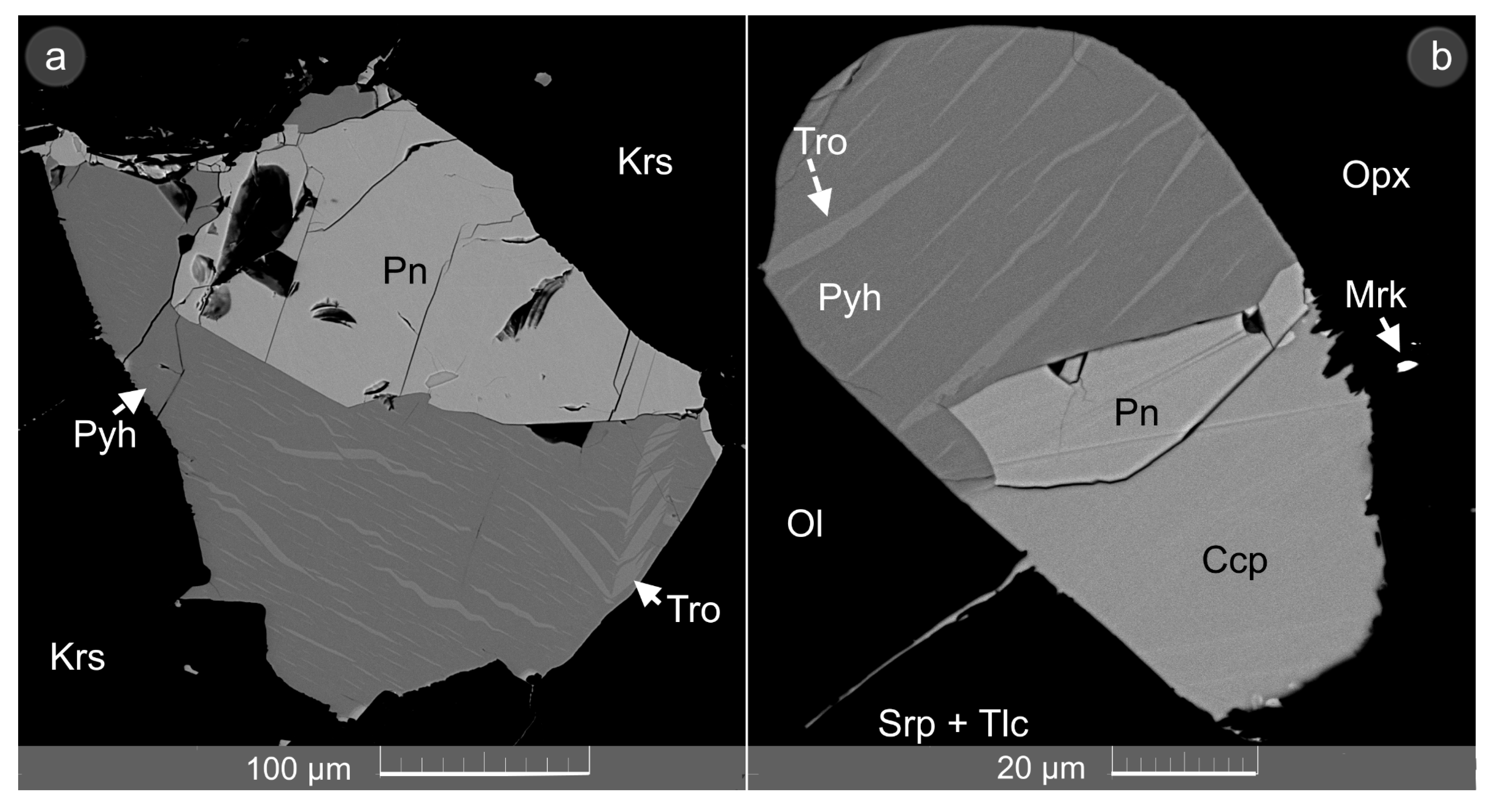
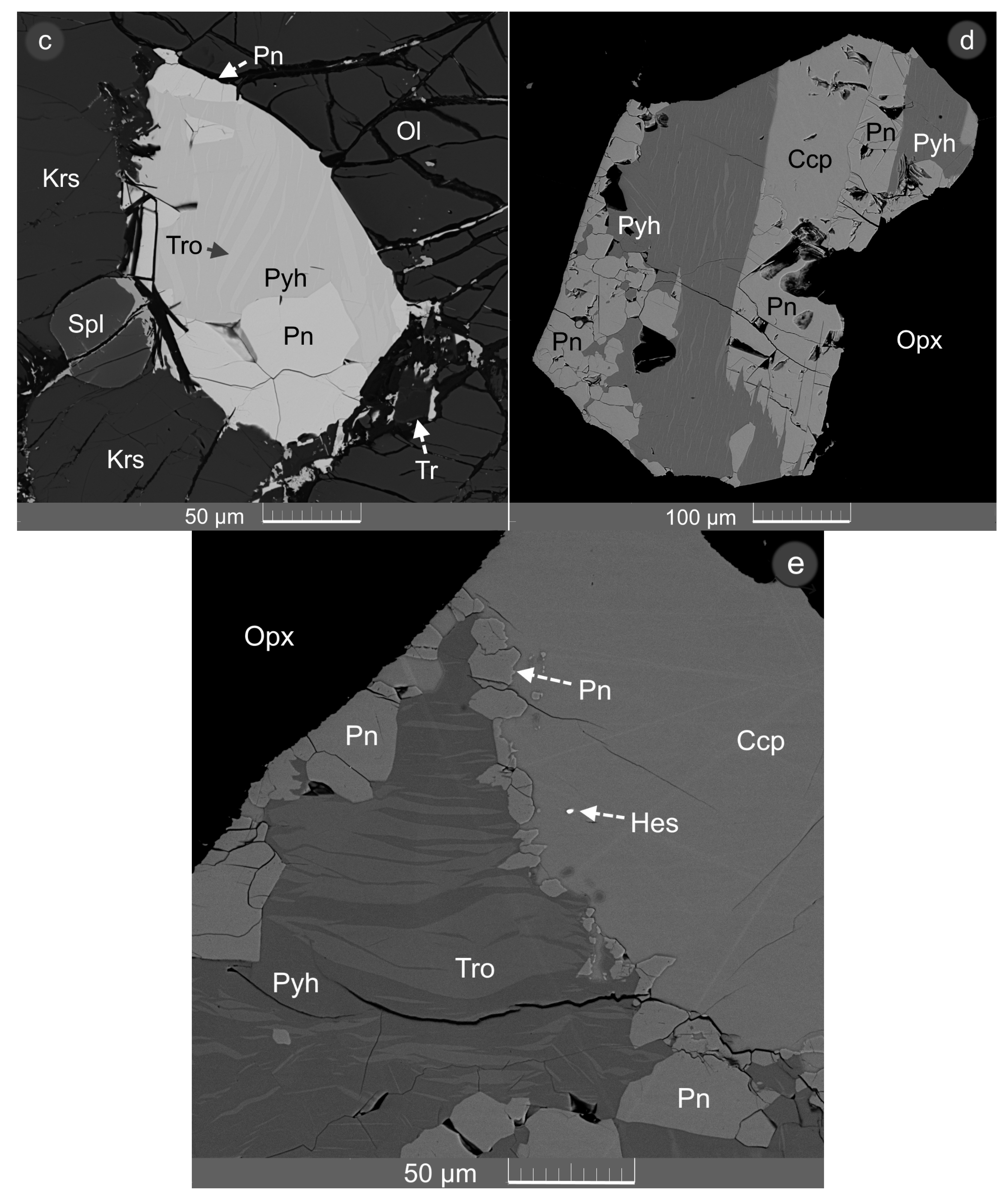
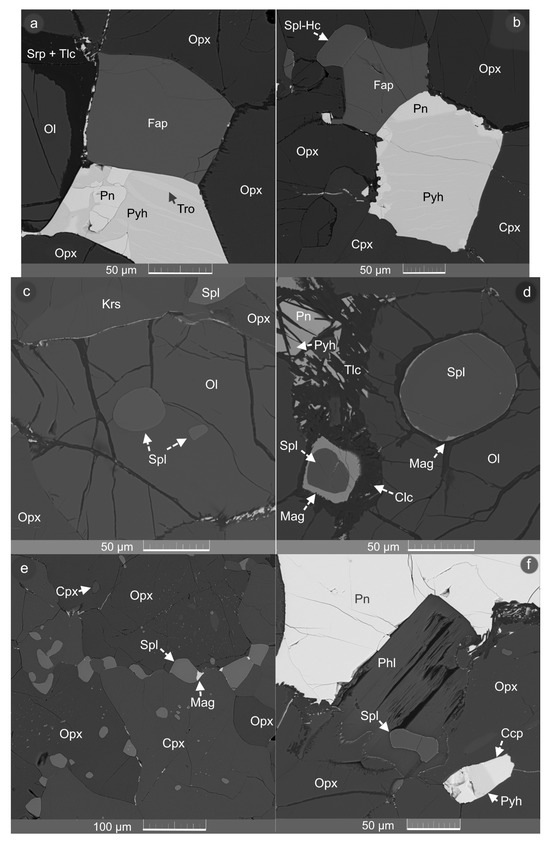
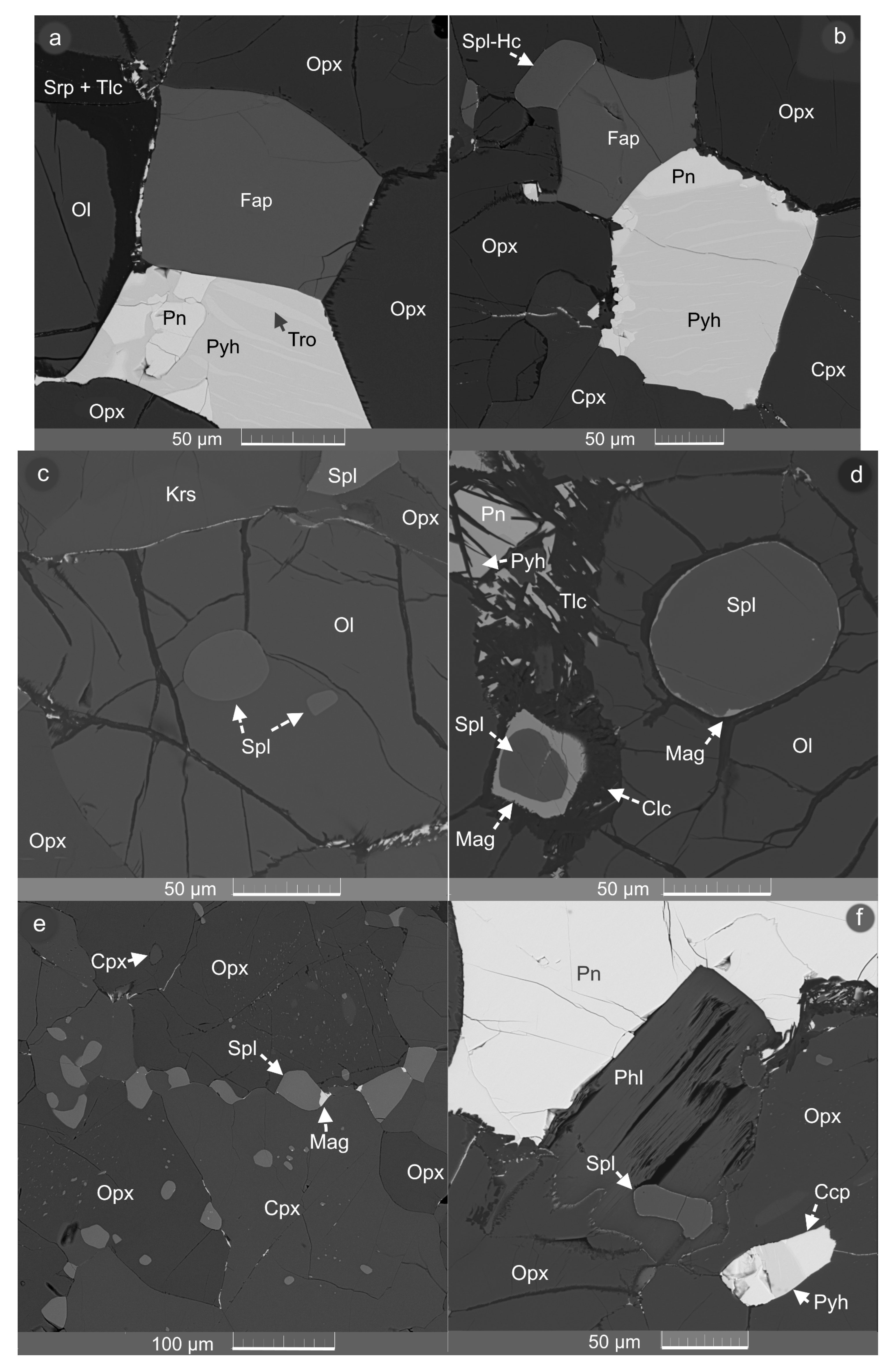
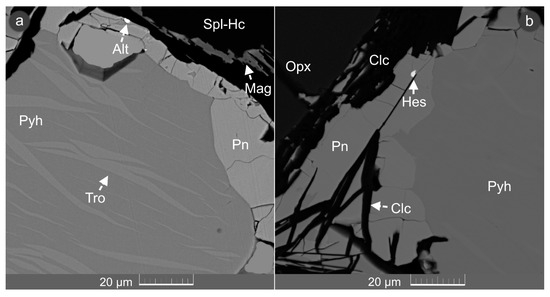
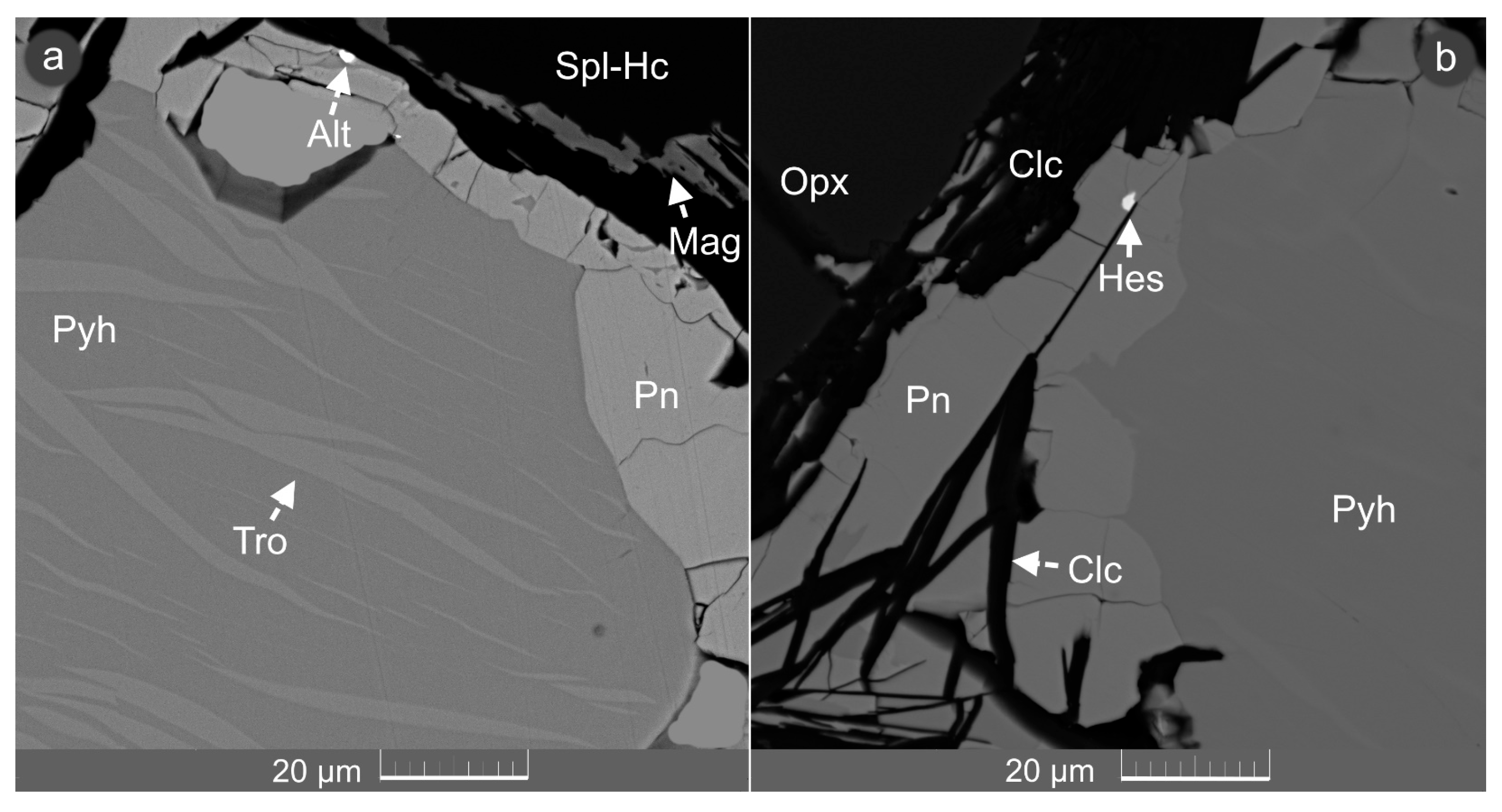
The fine-grained disseminations of base metal sulfides (BMS) are evenly distributed (Figure 4). Droplet-like grains consist of pyrrhotite, pentlandite, and chalcopyrite in various proportions. Mineralogical data are presented in Table 1. Such droplets are commonly present at the boundary of grains of orthopyroxene with olivine, clinopyroxene, or a kaersutitic amphibole (Figure 5, Figure 6a–d and Figure 7a,b). Some droplets are enclosed within interstitial spaces, intergrown with members of the spinel–hercynite series and fluorapatite. The textural relations are consistent with the formation of a sulfide melt immiscible in the silicate melt (Figure 5). An unusual feature of pyrrhotite grains in the assemblage is the presence of troilite lamellae in what appears to be an exsolution-induced arrangement (Figure 6a,b,e).
Figure 4.
A panoramic BSE image (SEM) shows a more or less even distribution of fine grains of base metal sulfides (BMS) in a typical sample of mineralized olivine-bearing websterite from the Iken deposit, Kun-Manie complex.
Table 1.
Mineralogical data on ore specimens of olivine websterite from the Iken nickel deposit, Kun-Manie complex.
Figure 5.
An immiscible irregular droplet with offshoots or apophyses of base metal sulfides deposited at the boundary of grains of olivine Ol (Fo80.4) and orthopyroxene Opx (Wo0.6–0.7En80.4–81.4Fs18.0–19.0) in the Iken deposit. The symbol Ed pertains to an edenitic and titanian variant (3.54 wt.% TiO2) of calcic amphibole: (Na0.61K0.27)Ca2.24(Mg2.96Fe2+0.70Ti0.37VIAl0.35Cr0.08)(Si6.51Al1.49)O22(OH)2. The two areas of pyrrhotite, Pyh-1 and 2, correspond to Fe47.7–47.8S52.2–52.3 (atomic %). The Pyh-3 grain is Fe48.6S51.4. The pentlandite grains (Pn) have a composition (Fe4.55–4.62Ni4.29–4.35Co0.12–0.13)Σ9.03S7.97. The chalcopyrite veinlets (Ccp; worm-like) are stoichiometric.
Figure 6.
(a–d). Examples of differentiated droplets of base metal sulfides from the Iken deposit (this study), which are shown in BSE images (SEM). The symbols are the same as in Figure 5. Note the exsolution of troilite (Tro) from pyrrhotite (Pyh). The symbol Krs (a) pertains to kaersutite grains (4.75–5.15 wt.% TiO2) of composition (Na0.68–0.78K0.37–0.39)Ca1.83–1.84(Mg2.94–3.02Fe2+0.89–0.94Ti0.52–0.56VIAl0.28–0.34)(Si6.02–6.06Al1.94–1.98)O22(OH)2. The compositions of Pyh and Tro phases are Fe47.6–47.7S52.3–52.4 and Fe49.8–50.0S50.0–50.2, respectively. The subhedral Pn grains have a composition (Fe4.64–4.66Ni4.23–4.27Co0.09–0.12)Σ8.99–9.03S7.97–8.01. The second droplet (b) occurs at the contact of grains of Ol (Fo80.5) and Opx (Wo0.8En82.1Fs17.1) with a cryptic mixture of alteration products, serpentine (Srp) and talc (Tlc), in which a minute grain of merenskyite (Mrk) is present: (Pd0.49Ni0.27Pt0.26)Σ1.02(Te1.88Bi0.11)Σ1.99. The composition of Pyh (b) is Fe47.9S52.1, that of the Tro lamellae (b) is Fe50.0–50.2S49.8–50.0, and that of Pn is (Fe4.62–4.71Ni4.28–4.39Co0.08–0.10)Σ9.07–9.11S7.89–7.93. The Ccp phase is stoichiometric. The third droplet (c) occurs at the boundary of grains of Ol (Fo80.3–82.2) and Krs (4.64–4.72 wt.% TiO2). It is intergrown with small grains of the spinel–hercynite solid solution labeled Spl (Mg0.55–0.59Fe2+0.41–0.45)(Al1.67–1.69Cr0.24Fe3+0.07–0.09)O4 and tremolite labeled Tr Ca1.89(Mg4.85Fe2+0.26Fe3+0.02)Si7.99O22(OH)2. The Tro lamellae (Fe50.1–50.4S49.6–49.9) are hosted by Pyh (Fe47.7–48.0S52.0–52.3). The associated Pn grains correspond to (Fe4.77–4.83Ni4.10–4.12Co0.06–0.13)Σ8.96–9.06S7.94–8.04. The next BMS grain (d) is hosted by Opx (Wo0.5En80.7Fs18.8). It is composed of Pyh (Fe48.0S52.0) with Tro lamellae (Fe49.6–50.3S49.7–50.4) and of areas of Pn (Fe4.32–4.39Ni4.25–4.32Co0.08–0.10)Σ8.72–8.74S8.26–8.28 and stoichiometric Ccp. (e) A pattern of well-developed lamellae of Tro (Fe50.3S49.7) has formed in the host phase of Pyh (Fe47.9–48.1S51.9–52.1). An aggregate of subhedral Pn grains occurs along the Pyh boundary; the pentlandite has a composition (Fe4.79–4.89Ni4.08–4.17Co0.05–0.09)Σ8.98–9.05S7.95–8.02. The stoichiometric Ccp grain hosts a tiny inclusion of hessite (Hes). Opx host has a composition Wo0.9En80.1Fs19.0.
Figure 7.
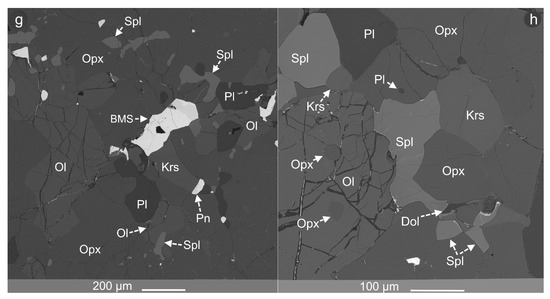
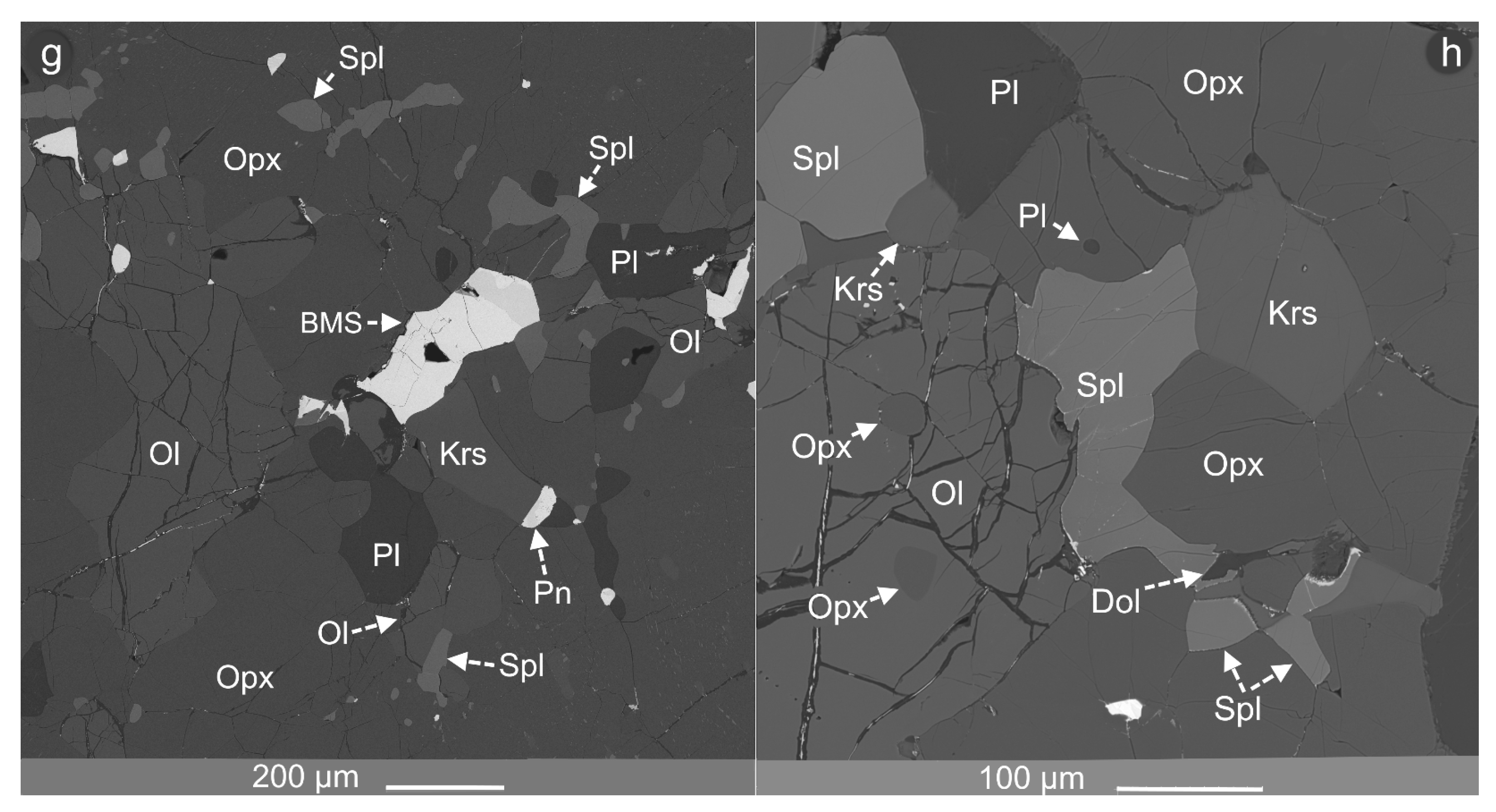
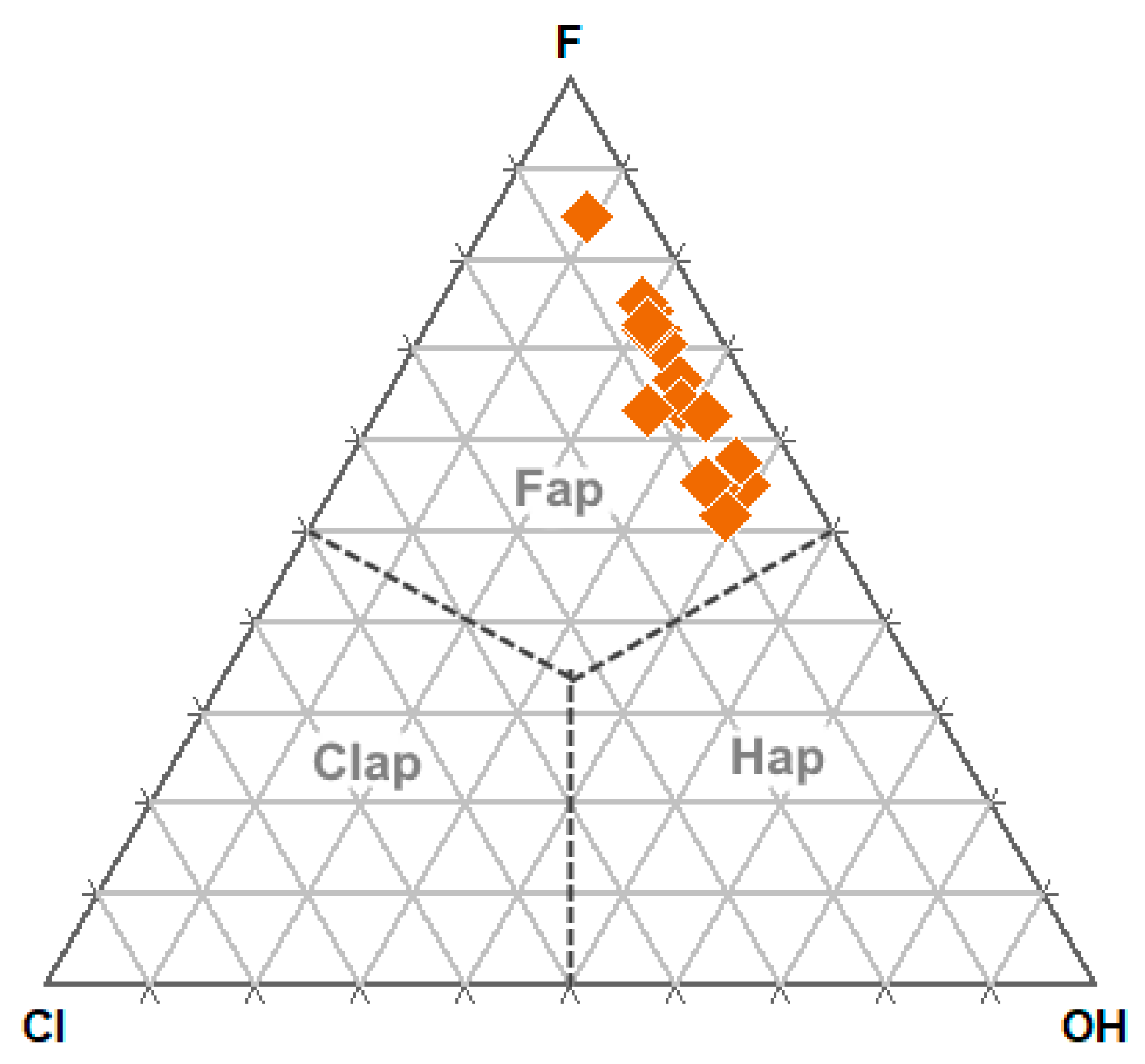
(a–h). Composite grains of sulfide minerals share a boundary with fluorapatite (Fap): Ca9.58–9.71(PO4)5.81–5.86(F1.10–1.50OH(calc.)0.39–0.72Cl0.11–0.18). The first intergrowth (a) is located in interstices of grains of Ol (Fo80.9) and Opx (Wo0.6–0.9En80.2–81.2Fs18.1–18.9). The second (b) occurs interstitially between grains of Opx (Wo0.6–0.7En81.2–81.7Fs17.7–18.0) and clinopyroxene Cpx (diopside: Wo45.4–45.6En42.1–42.4Fs7.8Aeg4.3–4.5). The Pyh compositions are consistent, Fe48.1–48.2S51.8–51.9 (a,b), as are the lamellae of Tro (Fe50.2S49.8). Compositions of Pn are (Fe4.59–4.72Ni4.27–4.39Co0.05–0.08)Σ9.04–9.06S7.94–7.96 (a,b). A mixture of Srp and Tlc formed along the rim of Ol (a). An intermediate member of the spinel–hercynite series (Spl-Hc), (Mg0.50Fe2+0.50)Σ1.00(Al1.60Cr0.30Fe3+0.10)Σ2.00O4, occurs in the second intergrowth (b). Inclusions of chromian Spl–Hc (Mg0.56–0.58Fe2+0.42–0.44)(Al1.74–1.79Cr0.15–0.18Fe3+0.05–0.08)O4 (c) are hosted by Ol (Fo79.7–80.4). Another Spl phase, slightly less magnesian and richer in Cr, (Mg0.52Fe2+0.48)(Al1.66Cr0.25Fe3+0.09)O4, occurs at the boundary of Opx (Wo0.8–0.9En80.8–81.7Fs17.4–18.4) and Krs (4.69 wt.% TiO2). The two grains of zoned Spl (d) have similar compositions: (Mg0.51–0.54Fe2+0.46–0.49)(Al1.60–1.65Cr0.25–0.28Fe3+0.08–0.14)O4. Their rims are composed of chromian Mag (6.97–9.50 wt.% Cr2O3). One of these grains is enclosed within Ol (Fo81.1–81.6). The second is hosted by clinochlore Clc (Mg4.61Fe2+0.42)Al1.00(Si3.23Al0.67)O10(OH)8 associated with talc Tlc (Mg2.90Fe2+0.11)Si3.99O10(OH)2. The BMS grain consists of Pyh (Fe48.0S52.0) and Pn (Fe4.77Ni4.22Co0.06)Σ9.05S7.95. A chain-like aggregate (e) of Spl-Hc grains of composition (Mg0.52Fe2+0.46–0.47)(Al1.60Cr0.28–0.30Fe3+0.10–0.12) was deposited along the boundary of grains of Opx (Wo0.5–0.7En81.0–81.3Fs18.0–18.4) and Cpx (diopside: Wo45.6–46.2En41.4–42.4Fs7.3–7.8Aeg4.2–5.2). Tiny grains of Mag (9.30 wt.% Cr2O3) are present. A grain of Spl (f) (Mg0.53–0.55Fe2+0.45–0.47)(Al1.77–1.80Cr0.18Fe3+0.02–0.05)O4 occurs at the contact of grains of Opx (Wo0.6–1.5En81.1–81.3Fs17.4–18.2) and titanian phlogopite Phl (7.92–8.16 wt.% TiO2). The BMS grain is composed of Pyh (Fe47.9S52.1) and stoichiometric Ccp. The associated grains of Pn correspond to (Fe4.77–4.82Ni4.21–4.24Co0.06–0.12)Σ9.09–9.13S7.87–7.91. Grains (g,h) of Ol (Fo79.6–80.5), Opx (Wo0.5–1.2En79.9–81.6Fs17.9–19.5), and Spl–Hc, (Mg0.50–0.55Fe2+0.45–0.49)(Al1.65–1.68Cr0.23–0.28Fe3+0.07–0.11)O4 are associated with interstitial grains of Pl (Or0–2.4Ab59.2–61.6An38.4–40.4) and (Ab63.8–67.3An32.7–36.2), kaersutite Krs (4.34–4.84 wt.% TiO2), and minor dolomite (Dol). The BMS grain (g) consists of Pyh (Fe48.1S51.9), Pn (Fe4.77Ni4.21Co0.09)Σ9.07S7.93, and stoichiometric Ccp.
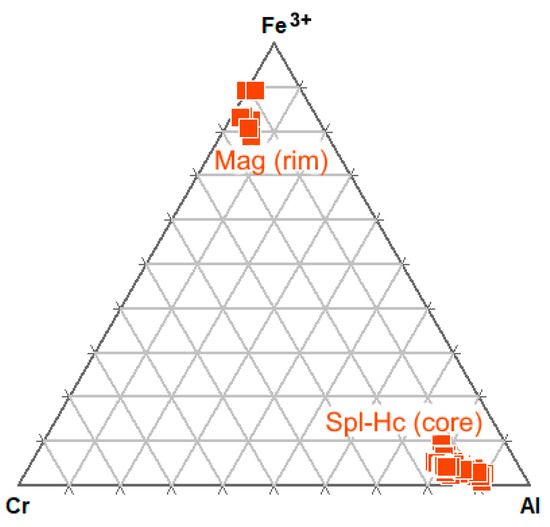
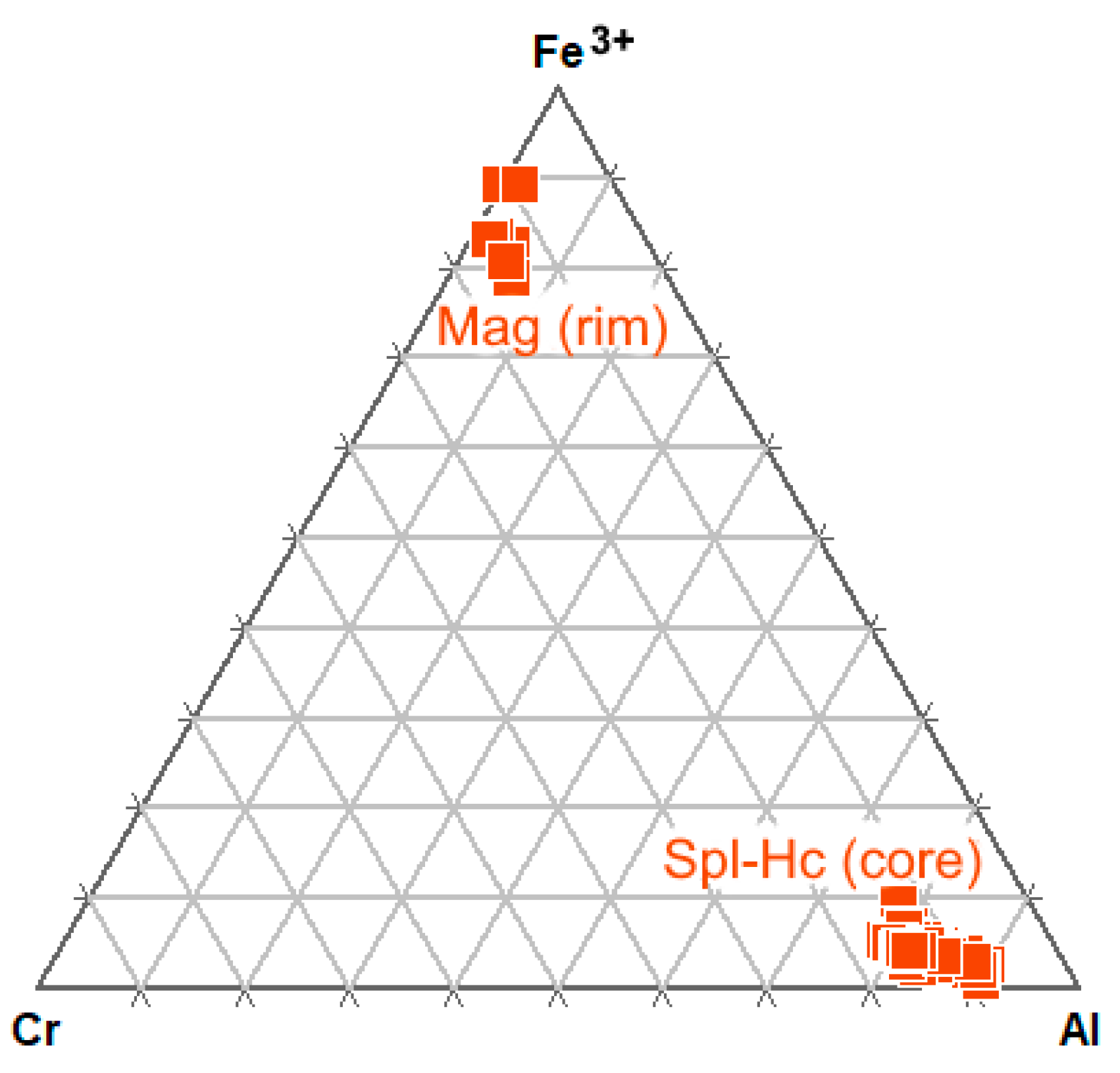
Spinel–hercynite occurs in a variety of textures: as irregular or rim-like grains or chain-like aggregates deposited at the boundary of orthopyroxene with clinopyroxene, plagioclase, or phlogopite, or as inclusions within grains of olivine, orthopyroxene, and kaersutite (Figure 6c and Figure 7b–h). Obvious patterns of zoning, in which a core of spinel–hercynite is surrounded by chromian magnetite (Figure 7d), are uncommon. In some cases, small grains or chains of chromian magnetite are deposited at the boundary of spinel–hercynite grains (Figure 7e).
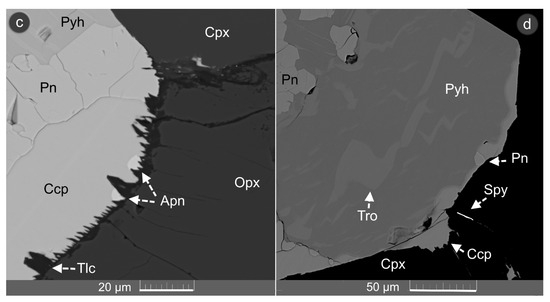
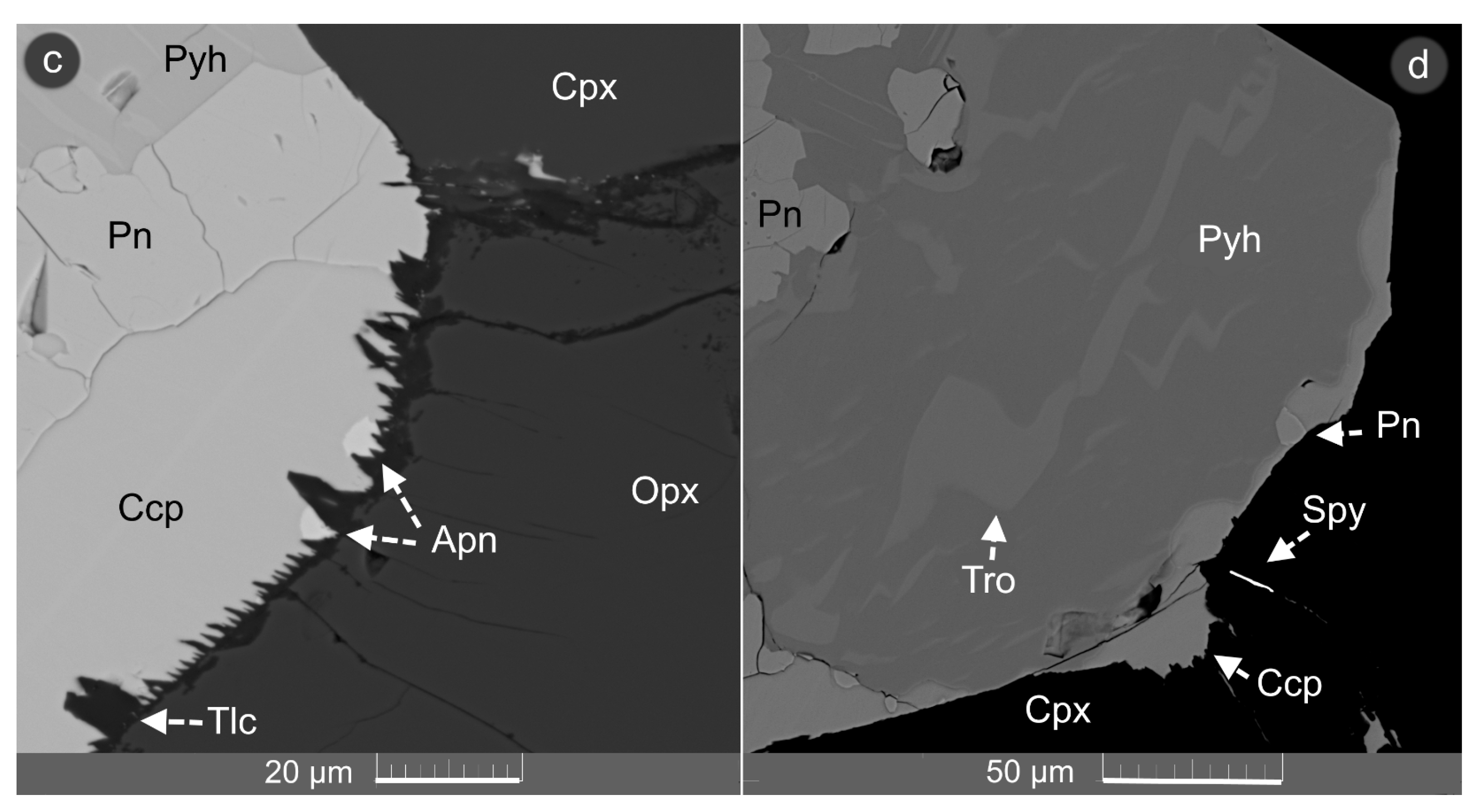
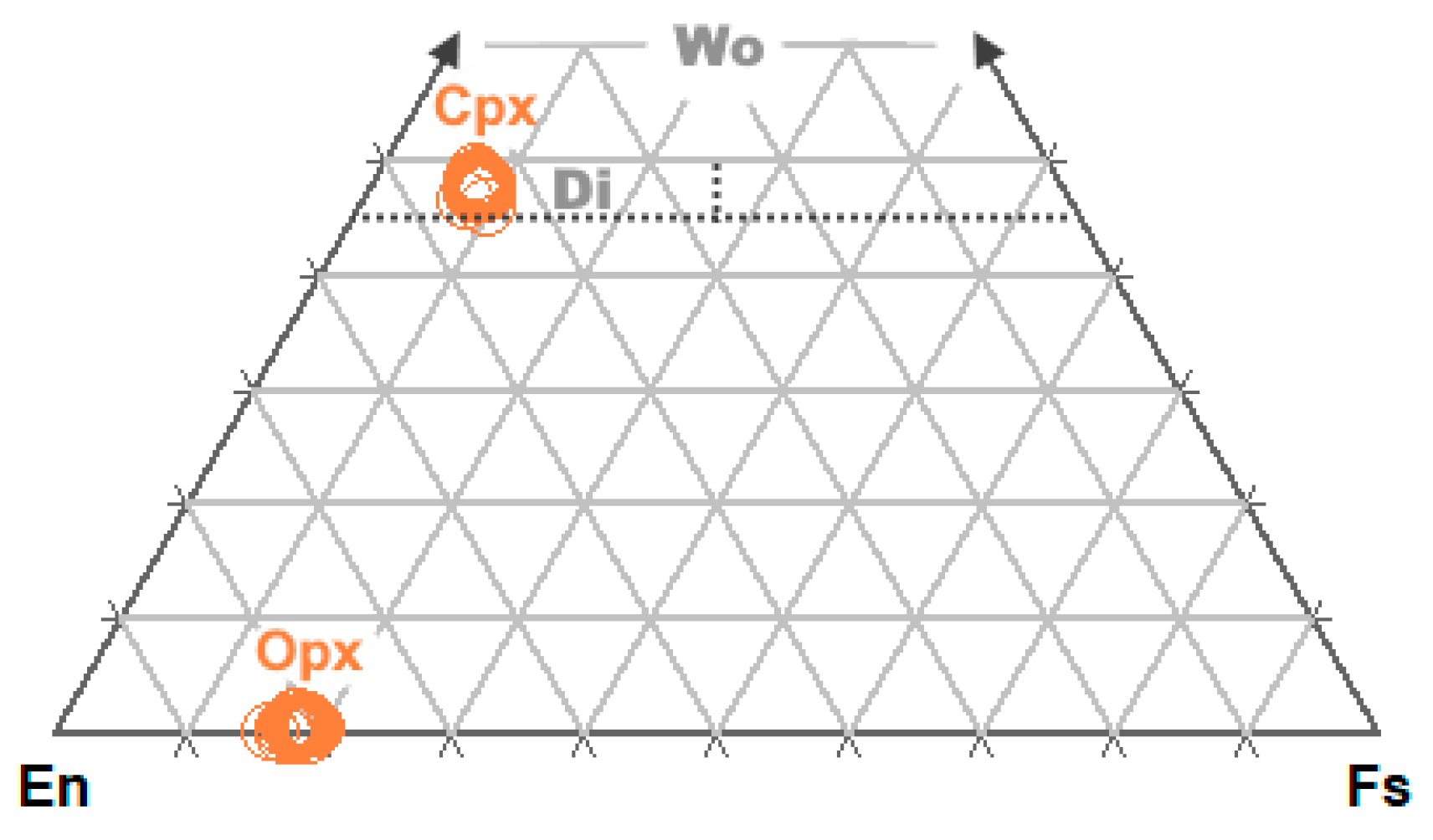
Occurrences of PGM are scarce in the Iken ore. Minute grains of Pt-Pd-Ni tellurides, members of the moncheite–merenskyite–melonite solid solution, and sperrylite are typically hosted by hydrous silicates or occur at BMS grain boundaries, within cavities, or infilling microcracks (Figure 6b and Figure 8d). They are accompanied by Ag-bearing species: hessite, argentopentlandite, Au-Ag alloy (Au63.2Ag36.8), and rare altaite (Figure 6e and Figure 8a–c). Compositions of the pyroxenes, spinel–hercynite, and apatite are plotted in Figure 9, Figure 10 and Figure 11. Representative sets of mineral compositions are listed in thirteen Supplementary Tables S1–S13.
Figure 8.
(a–d). A grain of Pyh (Fe47.9–48.3S51.7–52.1) with lamellae of stoichiometric Tro (Fe50.0S50.0) that is rimmed by Pn (Fe4.82Ni4.14Co0.13)Σ9.08S7.92 (a). The rim contains a tiny inclusion of altaite (Alt: Pb0.92Te1.08). The Spl grain (Mg0.53Fe2+0.47)(Al1.68Cr0.25Fe3+0.07)O4 is mantled partially by chromian Mag (8.46 wt.% Cr3O3). The next image (b) displays Pn (Fe4.62Ni4.31Co0.08)Σ9.01S7.99 hosted by Pyh (Fe48.2S51.8). A tiny inclusion of hessite Hes (Ag1.99Te1.01) is present; veinlets of Clc, (Mg4.54Fe2+0.46Ni0.05)Al1.00 (Si3.02Al0.86Cr0.09)O10(OH)8, replace the primary Opx (Wo0.8En80.3Fs18.8). A marginal portion of BMS grain (c) is composed of Pyh (Fe47.8S52.2), Pn (Fe4.62Ni4.34Co0.12)Σ9.08S7.92, and stoichiometric chalcopyrite Ccp that is in contact with grains of Opx (Wo0.7–0.9En80.3–80.4Fs18.7–19.1) and Cpx (Wo45.8En41.6Fs7.8Aeg4.8). The jagged edge is a result of the oriented growth of Tlc crystallites, (Mg2.89Fe2+0.11)Si4.00O10(OH)2. Two tiny grains of argentopentlandite (Apn: Ag1.01–1.05(Fe5.49–5.52Ni2.45Cu0–0.11)Σ7.97–8.05S7.93–7.97) occur at the edge. The two-phase grain (d) consists of the Pyh host (Fe48.0S52.0) and exsolution-induced lamellae of Tro (Fe50.4S49.6). The associated Pn is (Fe4.73Ni4.27Co0.07)Σ9.07S7.93. A rim-like phase of Ccp (Cu0.98–1.01Fe1.01–1.02S1.99) is developed along the sulfide boundary with Cpx (diopside: Wo45.2En42.0Fs9.1Aeg3.6). Note the minute acicular grain of sperrylite Spy, (Pt0.89Fe0.12Cu0.06)Σ1.07(As1.75S0.18)Σ1.93.
Figure 9.
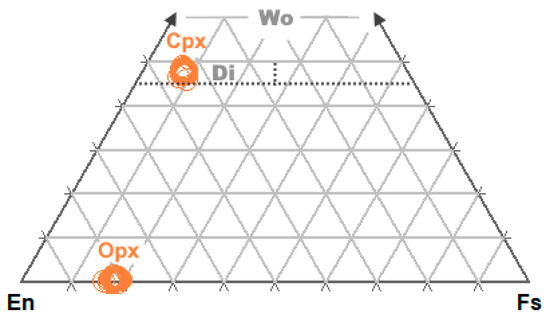
The composition of orthopyroxene (Opx) and clinopyroxene (Cpx) (diopside: Di) in the Iken ore deposit (this study) is expressed in terms of the components of enstatite (En), ferrosilite (Fs), and wollastonite (Wo) (mol.%).
Figure 10.
The composition of grains (and cores) of members of the spinel–hercynite series (Spl-Hc) and of the rims of chromian magnetite (Mag) in the Iken ore deposit (this study) is shown by the contents of Cr-Al-Fe3+ (atom %).
Figure 11.
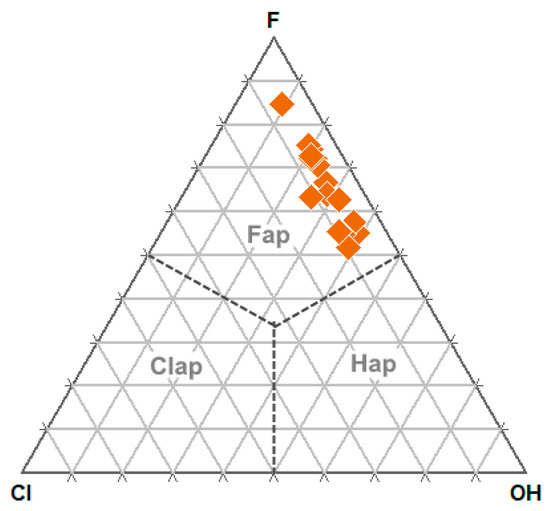
The compositional variation of accessory grains of apatite in the Iken ore deposit (this study) is expressed by the contents of Cl, (OHcalc), and F. The symbols Clap, Hap, and Fap represent chlorapatite, hydroxylapatite, and fluorapatite, respectively.
5. Discussion
The Ni–Co–Cu mineralization in the Iken deposit, hosted by olivine-bearing websterite, is representative of a magmatic low-sulfide type. It is followed by low-level Pd-Pt-Ag mineralization that is, nevertheless, an essential ore constituent in view of the large proportion of nickel (pentlandite) present in the complex.
The ore-bearing websterite has a modestly magnesian composition, with olivine Fo80–82, orthopyroxene Mg# 81, and clinopyroxene Mg# 84.5. These extents of magnesium enrichment are typical of pyroxenitic units in layered or differentiated complexes. An elevated level of Al in orthopyroxene (mean 2.78 wt.% Al2O3) and a Al-Na enrichment in diopside (mean 5.10 wt.% Al2O3) are associated with aluminous compositions of chromium-poor members of the spinel–hercynite series. In addition, high levels of TiO2 are notable in grains of calcic amphibole of kaersutite composition (5.06 wt.% TiO2), which are associated with highly titanian phlogopite (7.64 wt.% TiO2). These characteristics reflect a pronounced degree of fractionation attained in the ore-forming melt.
Droplets of immiscible sulfide melt separated at an advanced stage of orthopyroxene crystallization after olivine had appeared. The immiscible droplets commonly occur close to or at grain boundaries of orthopyroxene, enclosed among grains of pyroxene and olivine, or closely associated with fluorapatite or members of the spinel–hercynite series. We infer that a late saturation in sulfur in the crystallizing melt was accompanied by a quick cooling of the melt at Iken. Consequently, sulfide droplets largely remained in situ at their original sites of separation. These circumstances prevented effective settling and accumulation of the droplets to form an ore zone.
In the immiscible sulfide melt, pyrrhotite of composition Fe48S52 crystallized first from a monosulfide solid solution. It was followed by an intermediate solid solution enriched in copper, from which areas and rims of chalcopyrite formed. The rims or rim-like or chain-like aggregates of pentlandite are indicative of its late deposition, likely at an expected temperature not greater than 610 °C [5]. Modal variations in amounts of pentlandite, the major source of nickel in the deposit, are reflected in the bulk rock covariations of Ni versus S (Figure 3).
The exsolution of troilite (Figure 6a,b,e) from pyrrhotite, originally a homogeneous phase, can be induced experimentally below 140 °C [6] in the field of stability of the α or β polymorph [7]. Troilite is most common in extraterrestrial low-fO2 environments and is abundant in meteorites and lunar rocks. In contrast, troilite is decidedly uncommon in terrestrial environments. Table 2 is a compilation of the 19 examples of terrestrial troilite that we know about [8,9,10,11,12,13,14,15,16,17,18,19,20,21,22,23,24,25,26,27,28].
Table 2.
A review of terrestrial occurrences of troilite.
Troilite in meteorites presumably crystallizes far above 140 °C as troilite-γ, the phase stable above 327 °C (see below). Similarly, terrestrial troilite coexisting with iron (e.g., Table 2) possibly formed at a much higher temperature. Reducing conditions are clearly indicated by the close association of troilite with native iron or alloys, with graphite or bituminous matter, or with carbide species like cohenite or zoyashlyukovaite, a newly discovered molybdenum carbide [18].
The process of exsolution at Iken was triggered by a rapid drop in the fugacity of oxygen. The reducing conditions may be attributed to a variety of processes operating over a range of temperatures (Table 2).
It is known that serpentinization is able to produce hydrogen as a result of the oxidation of ferrous iron in olivine and pyroxene to ferric iron (e.g., incorporated into secondary grains of magnetite). Methane (CH4) can be produced by the reaction of H2 with CO2 through a Fischer–Tropsch type of reaction. Note that graphite or bituminous matter, indeed, commonly accompanies the troilite-native iron parageneses, e.g., in trap rocks or fenitic environments (Table 2). The interaction of magma with sediments or other types of surrounding rocks could be important, especially in cases of trap suites (Table 2). A low level of fO2 in the silicate magma could be linked with the presence of graphite-bearing rocks. This process was important for the Voisey’s Bay Ni-Cu-Co deposit, a huge nickel deposit in northern Labrador, Canada [21]. A reducing fluid phase rising through the asthenospheric dome is another possible reducing agent. Such a drop in fO2 can be expected to induce the nucleation and growth of PGM in the ultrabasic melt [29]. The intrusive body at Iken forms part of the Paleoproterozoic Kun-Manie complex produced by a magmatic dome (mantle diapir), which could likely involve the transport of transmagmatic solutions enriched in H2O, CO2, and CH4 upward through the partially molten dome [30].
5.1. Implications from Phase Relations
The phase relations of stoichiometric FeS are complex [31]. At room temperature and up to 147 °C, troilite has a NiAs-type derivative structure, with space group P2c and a = (3)½A, c = 2C, where A and C are the unit cell parameters of the hexagonal NiAs-type subcell and are approximately 3.4 and 5.9 Å, respectively. Above 147 °C, there is disagreement about which superstructure takes over rather sluggishly. The final transition is to the ideal NiAs-type structure with the 1A,1C subcell. This first-order transition coincides with the Néel transition at about 327 °C. It results in complete disorder and relaxation of the Fe and S sublattices. This subcell structure persists up to the melting point at about 1190 °C. In summary, the troilite lamellae likely crystallized as troilite-γ with the ideal NiAs-type structure at an unspecified temperature above 327 °C (Fleet 2006, pp. 372–373) [31]. One can expect that it then underwent a complex inversion to the low-temperature derivative structure (β, then α).
5.2. A Late Deposition of Platinum Group Minerals and Silver-Based Species
The PGM grains, hosted typically by grains of hydrous phases (Figure 6b and Figure 8d), likely deposited from late fluids at submagmatic conditions. The mode of occurrence observed for sperrylite (Figure 8d) is consistent with a late deposition at submagmatic conditions, cf. [32,33]. A narrow rim of hydrous silicates, clinochlore or talc, developed along the grain boundaries of the BMS with orthopyroxene (Figure 8b,c) is attributed to autometasomatic effects as a consequence of the release of H2O into the coexisting fluid at the contact of sulfide–silicate fractions of melt. Interestingly, the talc crystallites conform to the boundary. These likely crystallized in the same direction from the pyroxene toward chalcopyrite. Tiny grains of argentopentlandite are penetrated by some of the crystallites (Figure 8c) and presumably formed before the development of talc.
6. Conclusions
- The Ni-Co-Cu mineralization belongs to a magmatic low-sulfide type, the Iken Ni deposit in the central part of the Kun-Manie complex. Separation of an immiscible sulfide melt produced composite globules of base metal sulfides, mostly pyrrhotite, pentlandite, and chalcopyrite.
- These droplets settled close to orthopyroxene grains or occupied interstices among the pyroxenes and olivine in association with accessory spinel–hercynite and fluorapatite. The late saturation in S and a relatively quick cooling rate of the hypabyssal body prevented effective accumulation of the sulfide droplets in the ore zone.
- Well-developed lamellae of troilite exsolved from the host pyrrhotite. These lamellae likely crystallized with the ideal NiAs-type structure at an unspecified temperature above 327 °C, then underwent a complex inversion to the low-temperature derivative structure.
- The low-temperature production of troilite at the expense of pyrrhotite implies a drop in fO2. An influx of mantle-derived fluid bearing CO2, CO, and CH4 with the rising magma diapir could be the primary cause of the fO2 reduction. The assimilation of graphite-bearing supracrustal rocks by the basic melt could also account for the unusual formation of troilite.
- The presence of a kaersutitic amphibole, titanian phlogopite, and fluorapatite in the websterite reflects a pronounced degree of fractionation of the ore-forming melt and is consistent with focused mantle degassing.
- Sperrylite and other PGM grains, typically hosted by clinochlore and talc, were deposited from late fluids at submagmatic conditions. These sparsely developed ore minerals are attributed to the late release of H2O from the coexisting portions of sulfide and silicate melts.
Supplementary Materials
The following supporting information can be downloaded at: https://www.mdpi.com/article/10.3390/min16070665/s1, Table S1. Composition of olivine in the Iken nickel deposit, Kun-Manie complex, Amur Oblast, Russia. Table S2. Composition of orthopyroxene in the Iken nickel deposit, Kun-Manie complex, Amur Oblast, Russia. Table S3. Composition of clinopyroxene in the Iken nickel deposit, Kun-Manie complex, Amur Oblast, Russia. Table S4. Composition of plagioclase in the Iken nickel deposit, Kun-Manie complex, Amur Oblast, Russia. Table S5. Composition of members of the spinel–hercynite series in the Iken nickel deposit, Kun-Manie complex, Amur Oblast, Russia. Table S6. Composition of pyrrhotite in the Iken nickel deposit, Kun-Manie complex, Amur Oblast, Russia. Table S7. Composition of pentlandite in the Iken nickel deposit, Kun-Manie complex, Amur Oblast, Russia. Table S8. Composition of troilite lamellae in the Iken nickel deposit, Kun-Manie complex, Amur Oblast, Russia. Table S9. Composition of kaersutite in the Iken body, Kun-Manie complex, Amur Oblast, Russia. Table S10. Composition of titanian phlogopite, Iken nickel deposit, Kun-Manie complex, Amur Oblast, Russia. Table S11. Composition of fluorapatite in the Iken nickel deposit, Kun-Manie complex, Amur Oblast, Russia. Table S12. Composition of chromian magnetite in the Iken nickel deposit, Kun-Manie complex, Amur Oblast, Russia. Table S13. Composition of minerals of noble metals in the Iken nickel deposit, Kun-Manie complex, Amur Oblast, Russia.
Author Contributions
Investigation, A.Y.B., I.I.N., R.F.M., and B.M.L.; writing—original draft preparation, A.Y.B., I.I.N., R.F.M., and B.M.L.; writing—review and editing, A.Y.B., I.I.N., R.F.M., and B.M.L. All authors have read and agreed to the published version of the manuscript.
Funding
This research received no external funding.
Data Availability Statement
Additional data can be available upon request from the corresponding author, A.Y.B.
Acknowledgments
We thank the referees and editors for their efforts. The open-file data, reported by Kremenetskiy and coworkers [3], are greatly appreciated.
Conflicts of Interest
The authors declare no conflicts of interest.
References
- Gur’yanov, V.A.; Kirillov, V.Y. The nickel-bearing potential of the Kun-Manie minerogenic zone in the southeastern framing of the Siberian Platform. Otech. Geol. 2023, 2, 43–55. (In Russian) [Google Scholar]
- Gur’yanov, V.A.; Petukhova, L.L.; Kirillov, V.Y. Paleoproterozoic ultramafic dikes of the Kun-Manie area (southeast of the Siberian platform): Structural position, composition and setting of formation. Russ. J. Pac. Geol. 2023, 42, 68–87. (In Russian) [Google Scholar]
- Kremenetskiy, M.I.; Evlasyev, A.V.; Laponov, V.A.; Baranov, A.S. The Account with a Mineral Resource Calculation for Cobalt–Copper–Nickel Ores in the Malyi Kurumkan Area of the Kun-Manie Deposit; An Open-File Report in Russian; Kun-Manie ZAO Corp.: Khabarovsk, Russia, 2009; p. 243. [Google Scholar]
- Gur’yanov, V.A.; Roganov, G.V.; Zelepugin, V.N.; Rozinov, M.I.; Saltykova, T.Y. Isotope-geochronological studies of zircons from Early Precambrian rocks of the southeastern part of the Aldan-Stanovoi Shield: New results, their geological interpretation. Russ. J. Pac. Geol. 2012, 31, 3–21. (In Russian) [Google Scholar]
- Kullerud, G. Thermal stability of pentlandite. Can. Mineral. 1963, 7, 353–366. [Google Scholar]
- Yund, R.A.; Hall, H.T. The miscibility gap between FeS and Fe1−xS. Mater. Res. Bull. 1968, 3, 779–784. [Google Scholar] [CrossRef] [Scilit]
- Tenailleau, C.; Etschmann, B.; Wang, H.; Pring, A.; Grguric, B.A.; Studer, A. Thermal expansion of troilite and pyrrhotite determined by in situ cooling (873 to 373 °K) neutron powder diffraction measurements. Mineral. Mag. 2005, 69, 205–216. [Google Scholar] [CrossRef] [Scilit]
- Eakle, A.S. Massive troilite from Del Norte County, California. Am. Mineral. 1922, 7, 77–80. [Google Scholar]
- Dunning, G.E.; Cooper, J.F. Troilite from the Low Divide District, Del Norte County, California: Paragenetic considerations. BAM (Bay Area Mineral.) J. 1915, 9, 1–29. [Google Scholar]
- Vorma, A. Pyrrhotite—Troilite intergrowth from Luikoniahti copper deposit, eastern Finland. Bull. Geol. Soc. Finl. 1970, 134, 76. [Google Scholar]
- Konev, A.A.; Ushchapovskaya, Z.F.; Lebedeva, V.S. Troilite from skarn of the Tazheran alkalic intrusion. Dokl. Acad. Sci. Earth Sci. Sect. 1970, 191, 114–116. (In Russian) [Google Scholar]
- Karup-Møller, S. The ore minerals of the Ilίmaussaq intrusion: Their mode of occurrence and their conditions of formation. Bull. Grønlands Geol. Unders. 1978, 127, 51. [Google Scholar] [CrossRef] [Scilit]
- Bird, J.M.; Goodrich, C.A.; Weathers, M.S. Petrogenesis of Uivfaq iron, Disko Island, Greenland. J. Geophys. Res. 1981, 86, 11787–11805. [Google Scholar] [CrossRef] [Scilit]
- Genkin, A.D.; Distler, V.V.; Gladyshev, G.D.; Filimonova, A.A.; Evstigneeva, T.L.; Kovalenker, V.A.; Laputina, I.P.; Smirnov, A.V.; Grokhovskaya, T.L. Sulfide Copper-Nickel Ores of the Norilsk Deposits; Nauka: Moscow, Russia, 1981; p. 234. (In Russian) [Google Scholar]
- McQueen, K.G. The nature and metamorphic history of the Wannaway nickel deposit, western Australia. Econ. Geol. 1981, 76, 1444–1468. [Google Scholar] [CrossRef] [Scilit]
- Ding, K.S.; Wu, F. The discovery and significance of troilite in basic igneous rock of Panzhihua–Xichang district. Sci. Geol. Sin. 1985, 3, 243–250. (In Chinese) [Google Scholar]
- Shlyukova, Z.V. Mineralogy of Contacted Rocks of the Khibiny Massif; Nauka: Moscow, Russia, 1986; p. 96. (In Russian) [Google Scholar]
- Vereshchagin, O.S.; Britvin, S.N.; Vlasenko, N.S.; Sinichenko, O.A.; Mikhailova, J.A. Zoyashlyukovaite, IMA 2025-026, in: CNMNC Newsletter 86. Eur. J. Miner. 2025, 37, 549–553. [Google Scholar] [CrossRef]
- Chashchukhin, I.S.; Gmyra, V.G.; Lagutina, M.V.; Palgueva, G.V. Troilite and tochilinite in sulfide-bearing dunites of the Kempirsay massif. In Regional Mineralogy of the Urals; The Uralian Branch of the Academy of Sciences: Sverdlovsk, Russia, 1990; Volume 1, pp. 42–45. (In Russian) [Google Scholar]
- Nilsson, L.P.; Sturt, B.A. Magmatic and detrital pyrrhotite and pentlandite and magmatic troilite from Nordfjellmark, Velfjord-Tosen region, central Norwegian Caledonides. NGU Bull. 1995, 427, 116–118. [Google Scholar]
- Naldrett, A.J.; Singh, J.; Krstic, S.; Li, C. The mineralogy of the Voisey’s Bay Ni-Cu-Co deposit, northern Labrador, Canada: Influence of oxidation state on textures and mineral compositions. Econ. Geol. 2000, 95, 889–900. [Google Scholar] [CrossRef] [Scilit]
- Kawohl, A.; Frimmel, H.E. Isoferroplatinum–pyrrhotite–troilite intergrowth as evidence of desulfurization in the Merensky Reef at Rustenburg (western Bushveld Complex, South Africa). Mineral. Mag. 2016, 80, 1041–1053. [Google Scholar] [CrossRef] [Scilit]
- Ivanyuk, G.Y.; Pakhomovsky, Y.A.; Panikorovskii, T.L.; Mikhailova, J.A.; Kalashnikov, A.O.; Bazai, A.V.; Yakovenchuk, V.N.; Konopleva, N.G.; Goryainov, P.M. Three-D mineralogical mapping of the Kovdor phoscorite-carbonatite complex, NW Russia: II. Sulfides. Minerals 2018, 8, 292. [Google Scholar] [CrossRef] [Scilit]
- Tomshin, M.D.; Salikhov, R.F.; Matushkin, A.I.; Makovchuk, I.V.; Kopylova, A.G.; Vasileva, A.E. Native iron in dolerites of the Aikhal sill (the first discovery in Yakutia). Arct. Subarct. Nat. Resour. 2019, 24, 50–63. (In Russian) [Google Scholar] [CrossRef] [Scilit]
- Brzozowski, M.J.; Samson, I.M.; Gagnon, J.E.; Good, D.J.; Linnen, R.L. On the mechanisms for low-sulfide, high-platinum group element and high-sulfide, low-platinum group element mineralization in the Eastern Gabbro, Coldwell Complex, Canada: Evidence from textural associations, S/Se values, and platinum group element concentrations of base metal sulfides. Econ. Geol. 2020, 115, 355–384. [Google Scholar] [CrossRef] [Scilit]
- Korinevskii, V.G.; Korinevskii, E.V. Silurian black smoker deposits in the Urals. Geol. Ore Depos. 2022, 64, 180–201. [Google Scholar] [CrossRef] [Scilit]
- Tomshin, M.D.; Kopylova, A.G.; Vasilyeva, A.E. Native iron in Siberian Traps. Petrology 2023, 31, 223–236. [Google Scholar] [CrossRef] [Scilit]
- Vereshchagin, O.S.; Khmelnitskaya, M.O.; Vlasenko, N.S.; Perova, E.N.; Murashko, M.N.; Vapnik, Y.; Sukharzhevskaya, E.S.; Kopylova, A.G.; Britvin, S.N. Carbide-nitride assemblages of the Earth’s crustal telluric iron: A possible key to unraveling the formation pathways of metal rich asteroids. J. Geophys. Res. Planets 2026, 131, e2025JE009396. [Google Scholar] [CrossRef] [Scilit]
- Li, Y.Z.; Smith, W.D.; Jenkins, M.C.; Yao, Z.; Mungall, J.E. Assimilation of reduced carbon triggers platinum alloy saturation in mafic and ultramafic magmas. Econ. Geol. 2025, 120, 1029–1040. [Google Scholar] [CrossRef] [Scilit]
- Korzhinskii, D.S.; Pertsev, N.N.; Zotov, I.A. Transmagmatic fluids and magmatogenic ore formation. A problem of mantle ore sources. In Proceedings of the Sixth Quadrennial IAGOD Symposium; E. Schweizerbart’sche Verlagsbuchhandlung (Nagele u. Obermiller): Stuttgart, Germany, 1984; pp. 131–138. [Google Scholar]
- Fleet, M.E. Phase equilibria at high temperatures. Rev. Mineral. Geochem. 2006, 61, 365–419. [Google Scholar] [CrossRef] [Scilit]
- Barkov, A.Y.; Fleet, M.E. An unusual association of hydrothermal platinum-group minerals from the Imandra layered complex, Kola Peninsula, northwestern Russia. Can. Mineral. 2004, 42, 455–467. [Google Scholar] [CrossRef] [Scilit]
- Barkov, A.Y.; Nikulin, I.I.; Nikiforov, A.A.; Lobastov, B.M.; Silyanov, S.A.; Martin, R.F. Atypical mineralization involving Pd-Pt, Au-Ag, REE, Y, Zr, Th, U, and Cl-F in the Oktyabrsky deposit, Norilsk complex, Russia. Minerals 2021, 11, 1193. [Google Scholar] [CrossRef] [Scilit]

Disclaimer/Publisher’s Note: The statements, opinions and data contained in all publications are solely those of the individual author(s) and contributor(s) and not of MDPI and/or the editor(s). MDPI and/or the editor(s) disclaim responsibility for any injury to people or property resulting from any ideas, methods, instructions or products referred to in the content. |
© 2026 by the authors. Licensee MDPI, Basel, Switzerland. This article is an open access article distributed under the terms and conditions of the Creative Commons Attribution (CC BY) license.