


Abstract
The Bagenheigqier medium-sized Pb-Zn deposit is located in central-southern segment of Great Xing’an Range, northeastern China, where its vein-type orebodies are hosted within the structural contact zone between the Lower Permian Dashi Formation and granite porphyry intrusions. Five mineralization stages are divided into skarn (I), oxide (II), quartz-pyrite-arsenopyrite (III), quartz-polymetallic sulfide (IV), and quartz-calcite-pyrite (V). Three types of fluid inclusions (FIs) are identified in Bagenheigeqier Pb-Zn deposit, including daughter mineral-bearing three-phase (SL-type), vapor–liquid two-phase (VL-type), and vapor-rich two-phase (LV-type) FIs. All FI types occur in Stages I–III, with homogenization temperatures (Th) of 423–486, 389–441, 362–408 °C, and salinities of 1.1–49.2, 0.9–43.9 and 0.9–38.8 wt.% NaCl equiv, respectively. Stage IV hosts only VL- and LV-type FIs (Th: 277–319 °C; salinity: 2.1–8.7 wt.% NaCl equiv), whereas Stage V contains exclusively VL-type FIs with Th of 173–214 °C and salinity of 1.2–5.7 wt.% NaCl equiv. The H-O isotopic results of quartz in stage II–IV (δD = −103.5‰–−99.1‰, −115.7‰–−107.8‰ and −121.5‰–−117.2‰; δ18OH2O = 4.4‰–7.1‰, 1.1‰–3.5‰ and −4.6‰–−3.5‰) indicate the ore-forming fluids are predominantly of magmatic origin with subordinate meteoric water mixing. Fluid boiling and the mixing of meteoric water may lead to the precipitation of metal. The in situ trace elements analyses indicate that sphalerites in main mineralization stage are enriched in Fe, Mn, Co and In and depleted in Ga and Ge. The calculation results suggest that the sphalerites crystallized under moderate temperature conditions (286–330 °C) and intermediate fS2 (−10.5 to −9.2) conditions. The geological, fluid inclusion, isotopic and trace element evidences indicate that the Bagenheigeqier deposit is classified as a skarn-type deposit.
1. Introduction
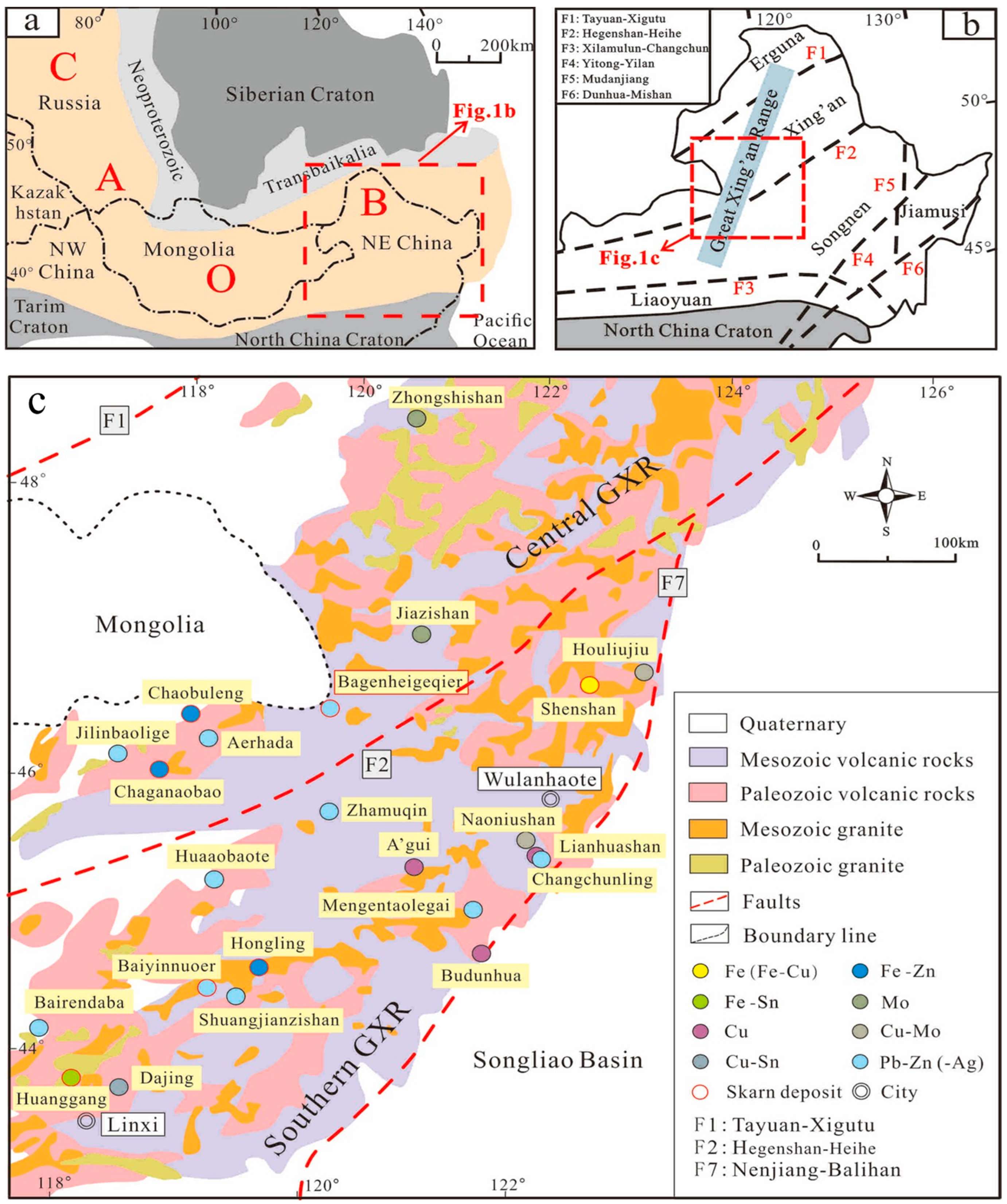
As critical raw materials that underpin national technological innovation and drive economic development across a broad spectrum of industrial sectors, the sustainable supply of lead (Pb) and zinc (Zn) resources in China are confronted with a series of prominent challenges, such as a high degree of external dependence (surpassing 30%), a pronounced imbalance between supply and demand, and the progressive depletion of domestic resources. Against this backdrop, advancing systematic research on lead-zinc deposits assumes profound theoretical value and far-reaching strategic significance [1,2]. The Greater Xing’an Range (GXR) situated in the eastern Central Asian Orogenic Belt (Figure 1a,b) boasts proven Pb-Zn reserves of over 300 million tons in its central-southern sector (Figure 1c), thus emerging as a vital Pb-Zn polymetallic metallogenic province in China [3,4,5,6,7,8,9].
The genetic types of Pb-Zn polymetallic deposits are complex, mainly including Sedimentary Exhalative (SEDEX)-type deposit, Mississippi Valley type (MVT) deposit, Volcanogenic Massive Sulfide (VMS)-type deposit, skarn-type deposit and (epithermal) hydrothermal vein-type deposit [2]. Previous studies on Pb-Zn polymetallic deposits in the GXR have focused on skarn- and vein-type deposits (such as Baiyinnuoer, Shuangjianzishan, Bianjiadayuan and Bairendaba deposits, etc.) in the southern segment [3,4,5,6,7,8,9]. In recent years, successive discoveries of Pb-Zn polymetallic deposits have been made in the central segment of the GXR; the research on these ore deposits, including deposit geology, fluid inclusions and mineralization ages, has also gradually deepened [10,11,12]. These studies have furnished novel data to underpin theoretical investigations into the Pb-Zn polymetallic mineralization framework in the central-southern GXR.
The Bagenheigeqier Pb-Zn polymetallic deposit is situated in the central-southern GXR (Figure 1c). Proven reserves of Pb and Zn total 229,600 t (Zn > 170,298 t, average grade of 38%; Pb > 59,326 t, average grade of 3.41%), classifying it as a medium-sized deposit. Previous studies have mainly focused on deposit geology, ore-forming fluids, materials and geochronology. The Pb-Zn orebodies in Bagenehigeqier deposit occur as veins and lenses, which are different from the banded and stratiform Pb-Zn orebodies in the MVT, SEDEX and VMS deposits. The initial ore-forming fluids and materials in the Bagenheigeqier deposit were predominantly magma-derived, with Pb-Zn mineralization likely forming in the Late Jurassic [11,13,14,15], which is different from the characteristics of medium–low-temperature basin brine or volcanic hydrothermal fluids (MVT, VMS and SEDEX deposit), and exhibits characteristics similar to those of magmatic hydrothermal deposits. This is also consistent with the main types of Pb-Zn polymetallic deposits in the GXR. However, the fluid evolution and competing views regarding the genetic type of Bagenheigeqier deposit remain unresolved (skarn type and hydrothermal vein type) [11,13,14,15]. This limitation restricts the study of the metallogenic theory in central-southern GXR and the further exploration direction of the Bagenheigeqier deposit. Sphalerite is a common mineral in different types of Pb-Zn polymetallic deposits; its trace element geochemistry can clarify the properties of fluid, trace element substitution mechanisms, and mineralization physicochemical conditions as well as determine deposit genesis [16,17,18,19]. Therefore, the new analyzed data of sphalerite trace elements may provide a reference for clarifying the disputes regarding the genetic type of the Bagenheigeqier Pb-Zn deposit.
In this study, we present new data of fluid inclusions, H-O isotopes, and sphalerite trace elements investigations for the Bagenheigqier Pb-Zn polymetallic deposit. It aims to characterize fluid evolution process and fluid sources, investigate trace element variations in sphalerite, comprehensively define the deposit genesis, and thus provide a robust basis for future regional exploration and theoretical research.
Figure 1.
(a) Tectonic map of the CAOB (modified after [20]). (b) Tectonic map of northeast China (modified after [21]). (c) Map of the regional geology in central-southern GXR (modified after [22]).
2. Geological Background
The research area is situated tectonically within the eastern segment of CAOB and south-central GXR, one of China’s significant polymetallic metallogenic belts [20,21,22]. Regionally, the exposed strata are arranged from the oldest to the youngest as follows: the Paleozoic Carboniferous and Permian (Shoushangou, Dashizhai, Zhesi, and Suolun Formations), Mesozoic Triassic (Hadataolegai Formation), Jurassic (Hongqi, Wanbao, Xinmin, Manketouebo, and Manitu Formations), and Cretaceous (Manitu, Meiletu, and Baiyingaolao Formations), as well as the Cenozoic Quaternary (Figure 1c; [11]).
The Paleozoic strata are mainly exposed around Dashizhai and Wulanhaote. The Carboniferous strata are poorly exposed, with lithologies dominated by acidic lava, slate and sandstone. The Permian strata have a wide distribution and generally exhibit a marine–continental transitional characteristic; among them, the Zhesi Formation and Dashizhai Formation are the main ore-bearing strata for Pb-Zn-Ag mineralization in the region. The lithology of the Permian strata mainly includes mudstone, slate, sandstone, andesite, tuff, limestone and marble. Jurassic and Cretaceous strata are widely distributed in the region, whereas the Triassic strata are poorly exposed, with lithologies dominated by clastic sedimentary rocks and acidic volcanic rocks. Volcanic eruptions during the Jurassic period formed a giant NE-trending volcanic belt [23], and the strata are composed of continental clastic-intermediate-acid volcanic rock formations. The Cretaceous strata are characterized by intermediate-acid to intermediate volcanic rock formations, with lithologies including trachyandesite, andesitic volcanic lava, and intermediate-acid volcanic clastic rocks [24]. Cenozoic strata are distributed around the Nenjiang Fault. The Quaternary comprises Pleistocene basalt of the Daheigou Formation and Holocene unconsolidated sediments such as loess and eluvial–deluvial glutenite.
The south-central GXR has undergone long-term and complex tectonic evolution [20,21], forming a regional tectonic framework consisting of varying directions-trending deep-large faults and a grid of secondary faults. The Hercynian and Yanshanian tectonic activities generated NE-trending folds as well as faults of varying directions and scales in the region [25,26]. Among these, the NE-trending faults are the most widely distributed, mostly occurring on both flanks of the anticlinoria, and they control the formation and distribution of most Yanshanian magmatic rocks and deposits in the area (Figure 1b,c; [27]).
Magmatic activities in the south-central GXR were frequent and intense, with intrusive rocks subdivided into five phases by formation age: Early-Middle Carboniferous, Late Carboniferous-Early Permian, Middle-Late Triassic, Middle-Late Jurassic, and Early Cretaceous [9,10,11,12,13,14,15,19,20,21,22]. Among these, the Middle-Late Jurassic intrusive rocks (182–151 Ma) are tightly linked to regional Cu-Sn-Pb-Zn-Ag-W-Mo polymetallic mineralization, dominated by lithologies including granodiorite, quartz porphyry, tonalite porphyry, and monzogranite [12,26,28,29]. These intrusions, highly fractionated I-type granites or lower-crust-derived adakites formed by partial melting of thickened lower crust, are genetically linked to the Mongolia-Okhotsk Ocean closure [22].
3. Deposit Geology
The Bagenheigeqier Pb-Zn deposit lies in approximately 230 km northwestern Wulanhaote, Inner Mongolia, with geographic coordinates ranging from 46°39′05″ to 46°39′48″ N and from 119°58′31″ to 119°59′46″ E.
3.1. Strata
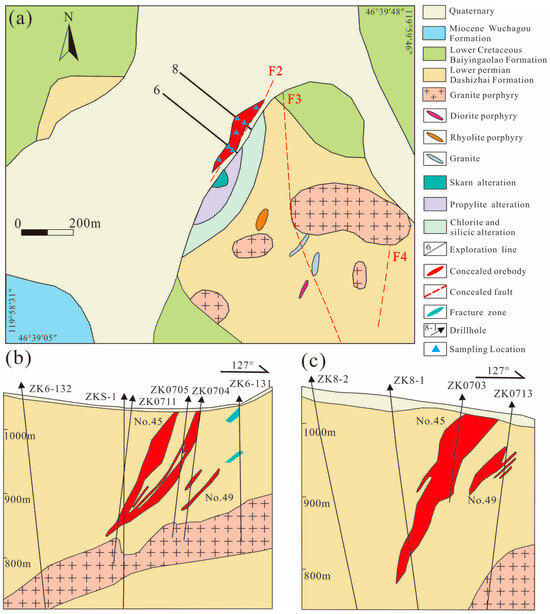
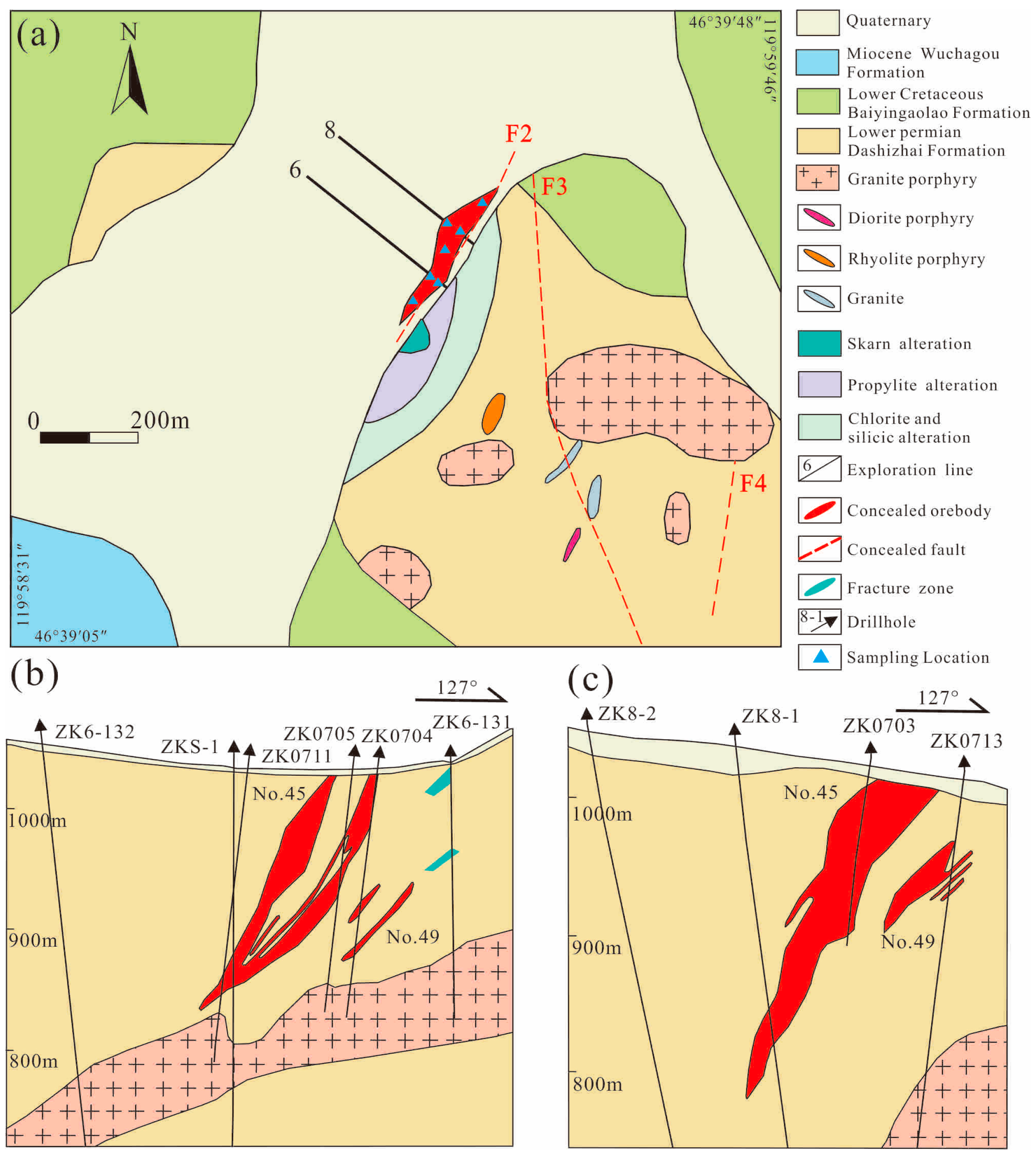
Strata exposed in the mining district include the Permian Dashizhai Formation, Cretaceous Baiyingaolao Formation, Cenozoic Neogene Wuchagou Formation and Quaternary System (Figure 2). Dashizhai Formation in the western mining district serves as the main ore-bearing stratum, with lithologies dominated by andesitic and rhyolitic crystal tuff, andesite, sandstone, sandy slate, tuffaceous sandstone and marble. It has an angular unconformable contact with the underlying Baiyingaolao Formation and is intruded by stock-like granite, rhyolite porphyry, granite porphyry and diorite porphyry. This stratum contains abundant calcium-rich minerals (e.g., plagioclase, amphibole; [11]). Combined with the discovery of marble in field (Figure 3b) and previous studies of Dashizhai Formation in the region [30,31,32], it also indicates that there should be marble development in Dashizhai Formation. The Baiyingaolao Formation is mainly occurring in the northern and southern mining district, striking NE-SW and dipping NW, with lithologies mainly including rhyolitic and andesitic lithic-crystal tuff and intermediate-acid volcanic rocks. The Wuchagou Formation is concentrated in the northwestern mining district, and its lithologies are mostly volcanic rocks such as vesicular basalt and andesitic basalt. The Quaternary System is distributed in gullies, slopes and valley bottoms, dominated by eluvial–deluvial sediments with a thickness of approximately 0.3–3 m.
Figure 2.
(a) Geologic map of the Bagenheigeqier deposit (modified after [11,14,15]). (b,c) Cross-Section 6 and 8.
Figure 3.
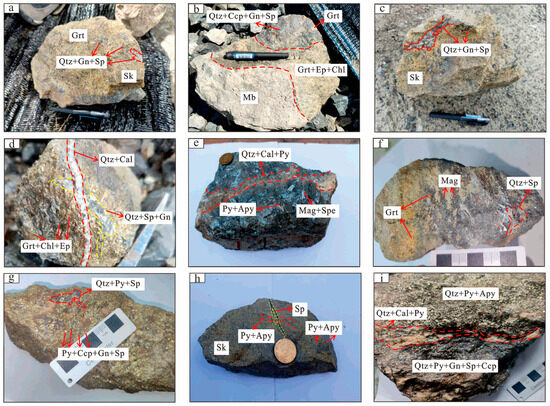
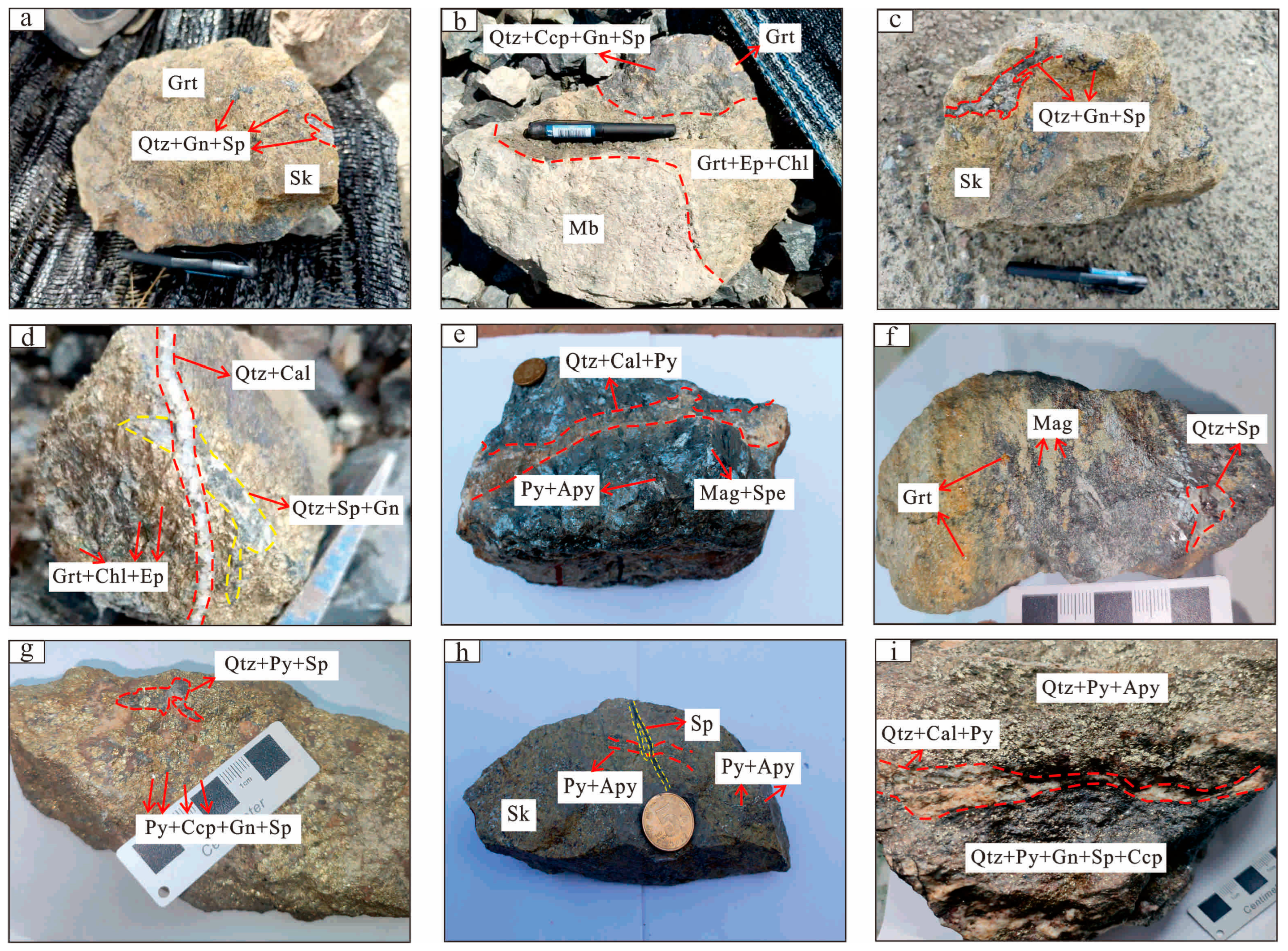
Photographs of the samples from the Bagenheigeqier deposit: (a) garnet skarn intruded by late Qtz-Gn-Sp veins; (b) Qtz-Ccp-Sp-Gn intruding skarn-marble contact zone; (c) Qtz-Gn-Sp veins cutting skarn; (d) Qtz-Gn-Sp veins intruding skarn, crosscut by Qtz-Cal veins; (e) Qtz-Cal-Py veins cutting early magnetite, specularite, pyrite and arsenopyrite; (f) magnetite intruding skarn, subsequently intruded by late Qtz-Sp veins; (g) massive ore; (h) sphalerite veinlets cross-cutting disseminated Apy-Py in skarn; (i) Qtz-Py-Cal veins cutting Qtz-Apy-Py and Qtz-Py-Gn-Ccp-Sp; Sk: Skarn; Mb: Marble; Qtz: Quartz; Grt: Garnet; Chl: Chlorite; Ep: Epidote; Mag: Magnetite; Py: Pyrite; Apy: Arsenopyrite; Spe: Specularite; Ccp: Chalcopyrite; Sp: Sphalerite; Gn: Galena; Cal: Calcite.
3.2. Structure
Faults dominate the structural framework of the study area, with three major faults identified herein, namely F2, F3 and F4 (Figure 2a). Of these, the F2 fault extends roughly 1300 m in length and 1–80 m in width, striking 35–55° and dipping 40–75°. As a tensional-shear fault, it coincides with the occurrence of lead-zinc orebodies and exerts control over their spatial distribution. The F3 fault strikes nearly 355°, dips 60–75°, measures 1000 m long and approximately 20 m wide; the rocks within its fault zone are highly fragmented, with late-stage carbonate veins of ~1 mm in width developed therein [13]. Striking 12° northeast and dipping 80°, the F4 fault spans 600 m in length and around 5 m in width, and is categorized as a compressive-shear fault.
3.3. Magmatic Rocks
Magmatic rocks are dominated by granite porphyry, with minor diorite porphyry, rhyolite porphyry, and granite. Granite porphyry occurs as batholiths in the eastern and southern mining district, intruding into Dashizhai Formation, and concealed rockbodies of this type are also present beneath the Pb-Zn orebodies (Figure 3; [11,15]). Skarns and carbonate veins are developed at the granite porphyry–strata contact zones. Diorite porphyry, granite, and rhyolite porphyry are mostly intruded into the Dashizhai Formation in the form of dykes and stocks.
3.4. Mineralization Characteristics and Wall Rock Alteration
Four Pb-Zn orebodies have been delineated, among which No. 45 and No. 49 orebodies are the largest primary orebodies (Figure 2). All orebodies are hosted in the Permian Dashizhai Formation and strictly controlled by the NE-trending faults.
No. 45 orebody occurs as veins and lenses in the central mining district, occurring within the andesitic tuff of the Lower Permian Dashizhai Formation and the contact zones between granite porphyry and strata. It strikes NE-SW, dips NW with a dip angle of 40–70°, extends approximately 320 m in length and has an average thickness of 40 m, yielding average Pb and Zn grades of 3.66% and 5.89%, respectively. No. 49 orebody occurs as veins and is located east side of No. 45 orebody, hosted in the Upper Permian Dashizhai Formation. It strikes NE-SW, dips NW with a dip angle of 40–71°, extends about 290 m in length and 6.82 m average thickness, yielding average Pb and Zn grades of 4.58% and 1.98%, respectively. The orebody is exposed at surface with extensive carbonates, with paragenetic assemblages of garnet, epidote and sphalerite developed [13].
The mining area exhibits distinct wall rock alterations, mainly including skarnization, chloritization, sericitization, epidotization, pyritization, propylitization and carbonatization. The wall rock alterations develop successively from the center to the periphery of the orebody in the horizontal direction, namely skarnization, propylitization, sericitization and chloritization (Figure 3a). The alteration is more intense near the orebody and gradually weakens as it moves outward. In the vertical direction, the alterations from bottom to top are skarnization, chloritization, epidotization, silicification and carbonatization [11].
3.5. Classification of Mineralization Stages
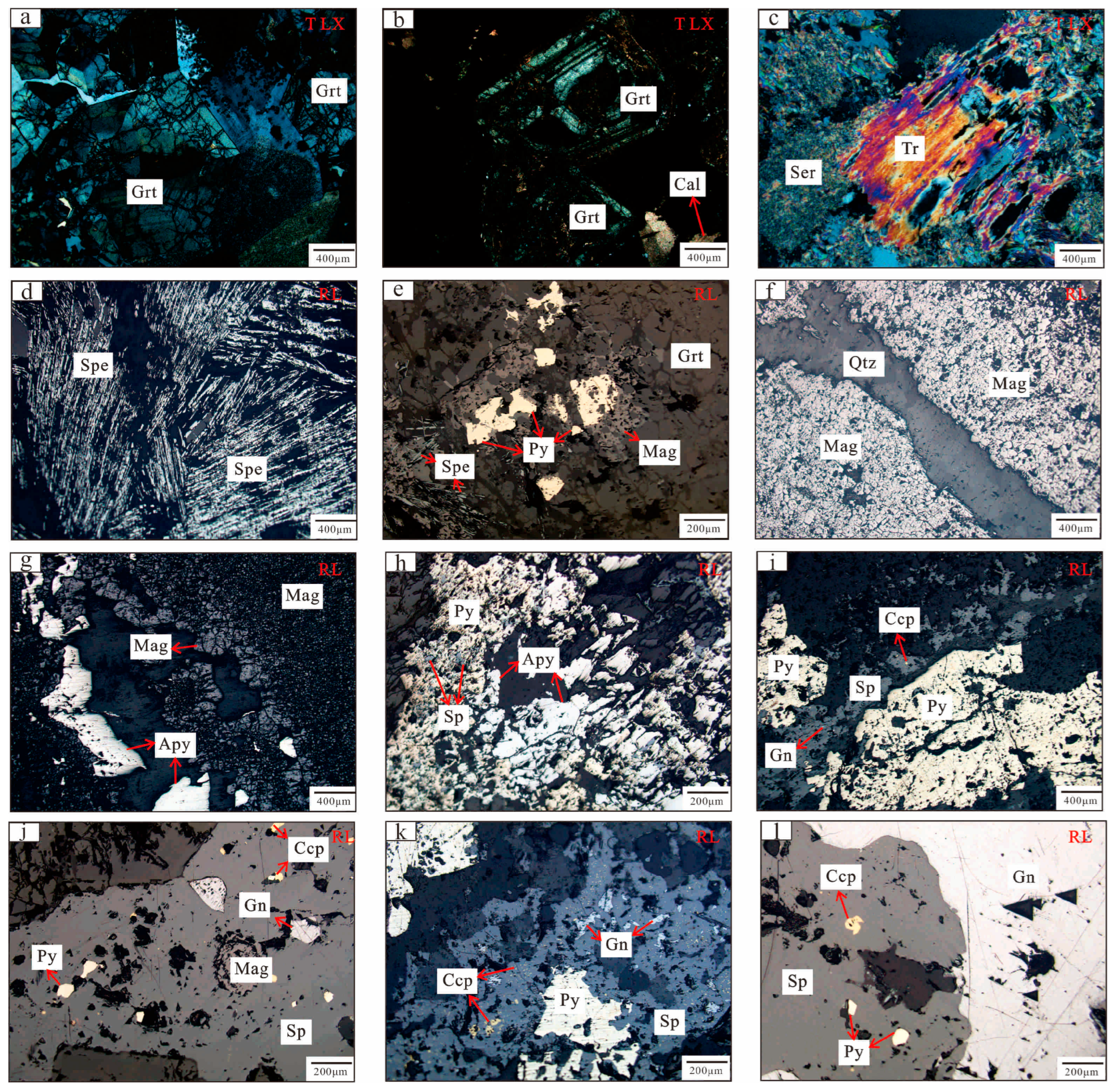
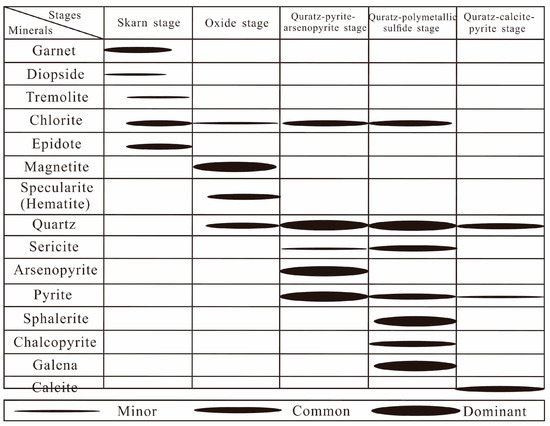
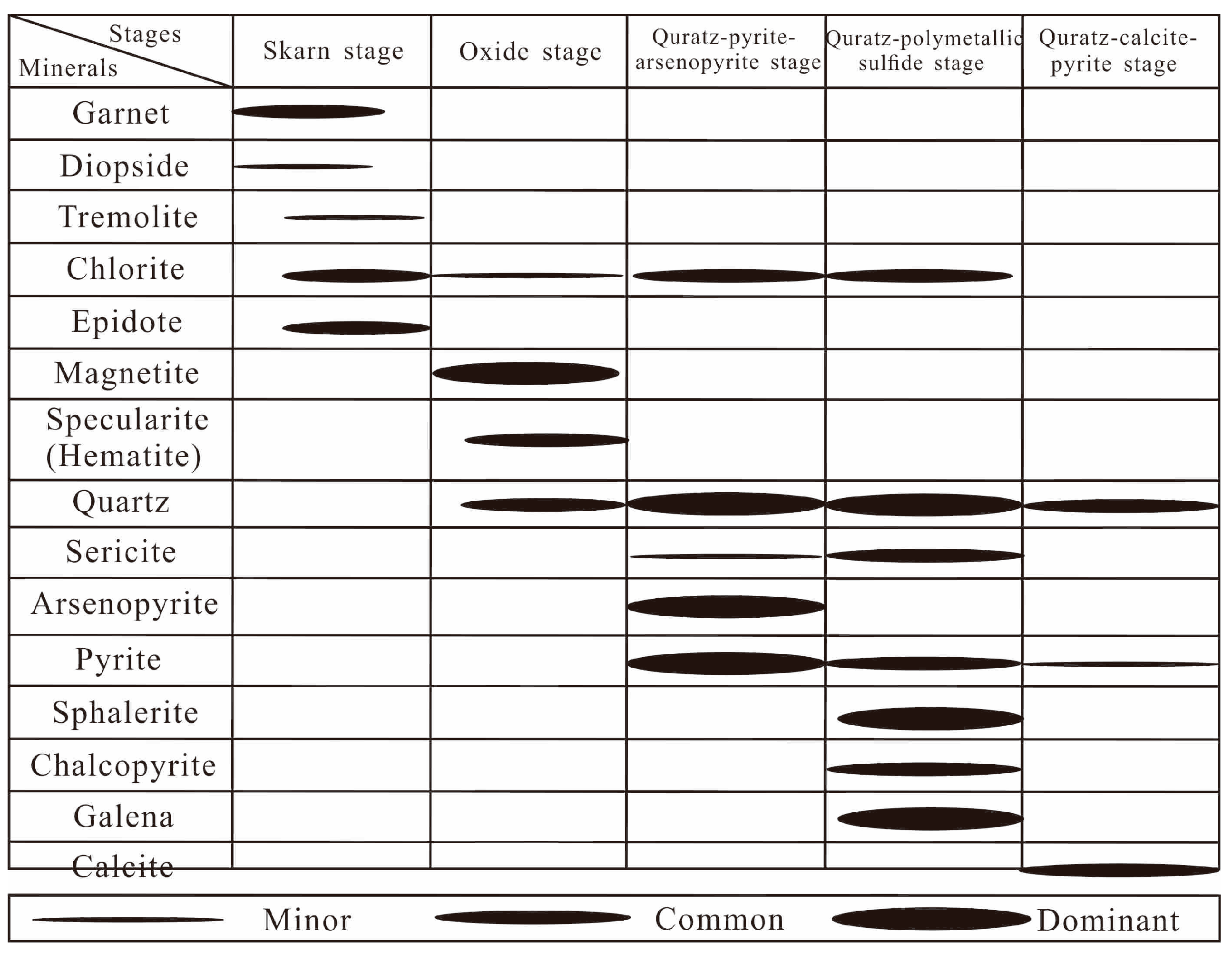
Based on field characteristics, mineral assemblages and microscopic identification results (Figure 3, Figure 4 and Figure 5), the hydrothermal metallogenic stages of the Bagenheigeqier deposit are divided into five mineralization stages, including the skarn stage (I), oxide stage (II), quartz-pyrite-arsenopyrite stage (III), quartz-polymetallic sulfide stage (IV), and quartz-calcite-pyrite stage (V) (Figure 5). The five mineralization stages overlap with each other in terms of space.
Figure 4.
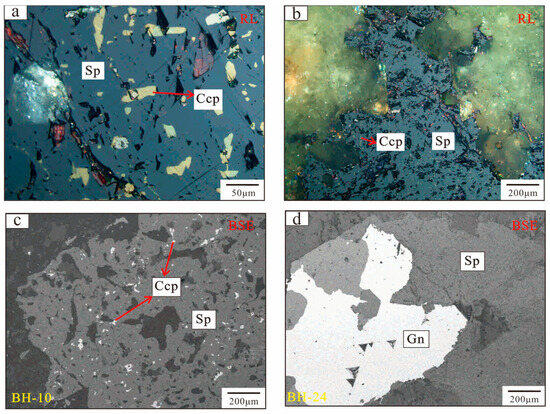
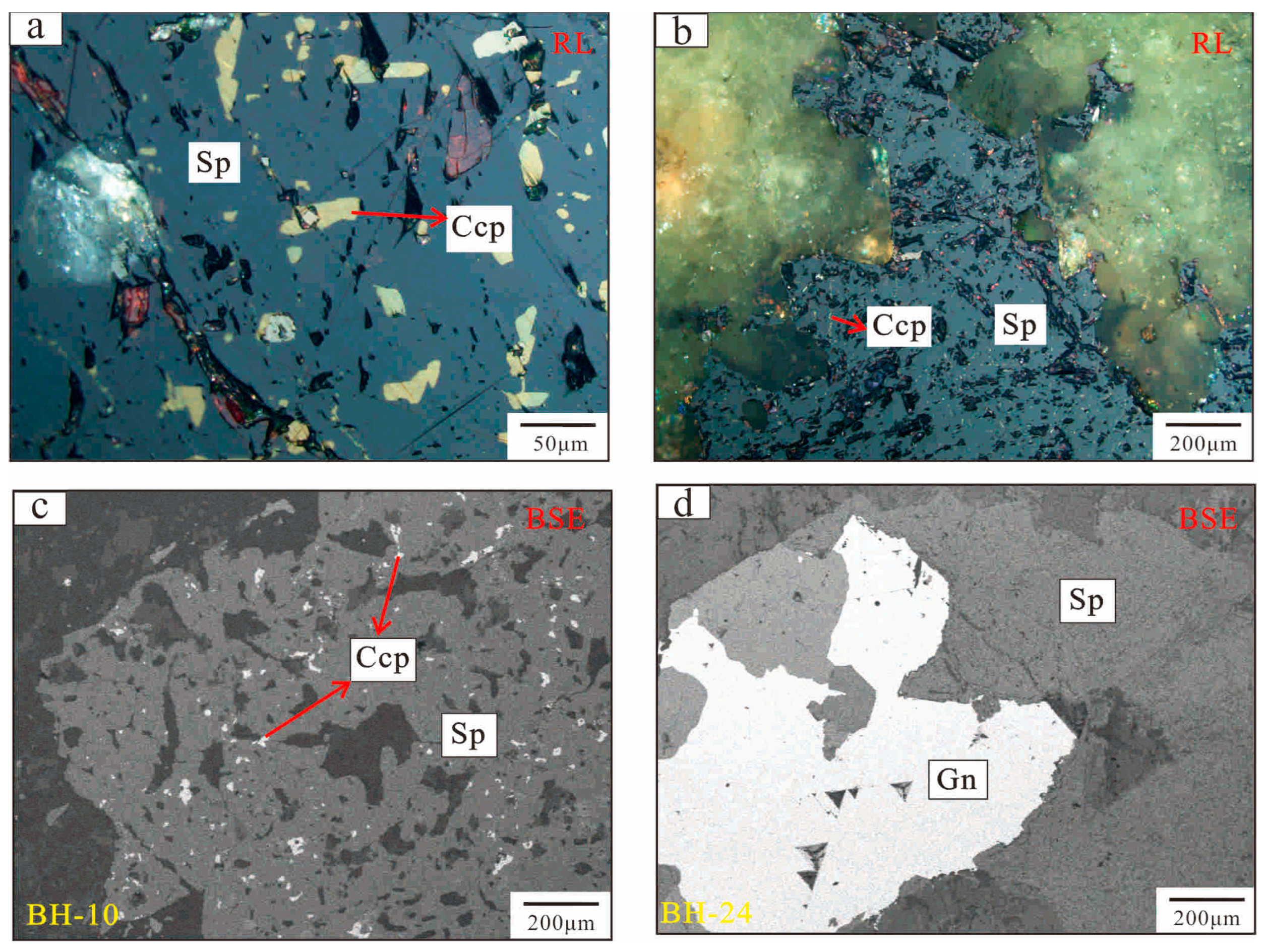
Photomicrographs of the samples from the Bagenheigeqier deposit: (a–c) altered skarn; (d) radiate-textured specularite; (e) magnetite, specularite and euhedral pyrite in skarn; (f) quartz veins cross-cutting magnetite aggregates; (g) arsenopyrite replacing magnetite; (h) arsenopyrite and pyrite occurring in paragenesis and replaced by late-stage sphalerite; (i) chalcopyrite occurring as droplet-like inclusions in sphalerite, paragenetic with galena and replacing early pyrite; (j) sphalerite, galena, chalcopyrite and pyrite in paragenesis, replacing early magnetite; (k) droplet-like chalcopyrite paragenetic with galena and sphalerite, replacing pyrite; (l) pyrite, galena, sphalerite paragenetic with chalcopyrite; Tr: tremolite; Ser: Sericite; RL: reflected light; TLX: transmitted light under crossed polars; other abbreviations are the same as in Figure 3.
Figure 5.
Mineral parageneses for the Bagenheigeqier deposit.
Stage I featured skarn minerals such as garnet, diopside, tremolite, chlorite and epidote. These skarn minerals are mostly replaced by late hydrothermal minerals including galena and sphalerite (Figure 3a–d,f). Microscopic observations reveal that garnet has zonal structure and is closely associated with carbonate minerals, while tremolite occurs as radial aggregates (Figure 4a–c). Stage II is marked by quartz, magnetite and specularite, which is mostly hosted in garnet skarn and replaces early-formed skarn minerals (Figure 3f,h). Specularite is blue-gray with acicular-columnar texture; magnetite is gray-brown with euhedral–subhedral texture, and is often replaced by late sulfides such as arsenopyrite and sphalerite (Figure 4d–g,j).
Stage III is dominantly composed of quartz, arsenopyrite and pyrite; minerals of this stage occur as disseminations and veins in quartz, replacing early skarn minerals and magnetite (Figure 3e,h,i). Both arsenopyrite and pyrite exhibit euhedral–subhedral texture. Quartz-arsenopyrite veins cut through magnetite, and some of them are replaced by late sphalerite (Figure 4e,g–i). Stage IV includes featuring quartz, chalcopyrite, pyrite, galena and sphalerite, representing the main Pb-Zn metallogenic stage. Minerals occur as veins and disseminations in skarn and quartz, replacing early skarn minerals and cross-cutting arsenopyrite-pyrite veins (Figure 3a–d,f–i). Chalcopyrite is copper-yellow and occurs as droplet-like inclusions in sphalerite; galena is gray-white with black triangular pits, coexisting with sphalerite (Figure 4j–l). Sphalerite is gray, showing red internal reflection color along fractures, indicating high iron content, and mostly has subhedral–anhedral texture, replacing early pyrite and arsenopyrite (Figure 4h–l and Figure 6a,b). SEM-BSE observations show that the sphalerite in this deposit contains numerous droplet-like chalcopyrite inclusions, with uniform physical structure and no obvious zoning (Figure 6c,d). Stage V is defined by quartz, calcite and minor pyrite, minerals of this stage mostly occur as veins, cross-cutting early oxide veins and quartz-polymetallic sulfide veins (Figure 3d,e,i).
4. Sampling and Analytical Methods
4.1. Fluid Inclusion Analyses
Quartz and garnet samples for fluid inclusions (FIs) analyses were collected from fresh ores. Petrographic observation and microthermometric measurement of fluid inclusions were carried out at the Geological Fluid Laboratory, College of Earth Sciences, Jilin University. Petrographic analysis was performed using a Carl Zeiss Axiolab microscope (Oberkochen, Germany, 10 × 50), while microthermometry was conducted with a Linkam THMSG-600 heating–freezing stage (Surrey, UK, temperature range: −195~600 °C). Calibration was performed using the pure water freezing point (0.0 °C) [33] to ensure temperature measurement accuracy, with respective precisions of ±0.2 °C (freezing cycles) and ±2 °C (heating cycles). The temperature change rate was controlled at 1~5 °C/min during the freezing and heating processes, and lowered to 0.1 °C/min upon approaching phase transitions, in order to obtain the homogenization temperatures (Th) and ice-melting temperatures (Tm-ice). Fluid inclusion data and corresponding salinities calculations (using daughter minerals dissolution temperatures and ice-melting temperatures) were accomplished using the MacFlincor (1995) software [34].
4.2. H-O Isotopic Analyses
Mineral samples across different metallogenic stages were crushed, ground to the particle size of 40–60 mesh, and manually picked under a binocular microscope to isolate high-purity monominerals (≥99% purity) for isotopic analysis. H-O isotope analyses were performed on a MAT253-EM mass spectrometer (Bremen, Germany)at the Beijing Research Institute of Uranium Geology [35]. For δD analysis, samples were heated to approximately 500 °C to rupture fluid inclusions, and the released water reacted with zinc to generate H2, whose isotopic ratios were determined by the mass spectrometer. For δ18O analysis, the BrF5 method was adopted: BrF5 reacted with oxygen-bearing minerals in an externally heated nickel reactor under high-temperature and vacuum conditions to produce O2, which was then analyzed for isotopic composition [36]. The relative standard for isotope analysis was Standard Mean Ocean Water (SMOW), with analytical uncertainties of ±2‰ (δD) and ±0.2‰ (δ18O) [36].
4.3. In Situ Sphalerite LA-ICP-MS Analyses
Suitable sphalerite samples from stage IV were selected to prepare polished sections. The morphological characteristics and internal structures of different sphalerites were observed in detail via reflected light polarizing microscopy and scanning electron microscopy-backscattered electron imaging (SEM-BSE) at the Scanning Laboratory, Electron Microscopy Center of Jilin University. Sphalerite samples without inclusions or with minimal micro-mineral inclusions were screened, and target areas were delineated for analysis.
Trace element analysis of sphalerites were conducted at Nanjing Hongchuang Geological Exploration Technology Service Co., Ltd. (Nanjing, China), using a Resolution SE deep ultraviolet laser ablation system coupled with an Agilent 8900 mass spectrometer (Agilent, Santa Clara, CA, USA). The laser parameters were set as follows: spot diameter of 50 μm, ablation frequency of 10 Hz, and energy density of 3.5 J/cm2. NIST 612 was used as the standard reference material for ablation, and NIST 610 was scanned linearly with a 100 μm spot for P/A tuning of the elements to be measured, with detailed parameters referring to [37].
The tested elements included Zn, S, Fe, Pb, Mn, Cd, Ge, Ga, Ag, Cu, Sn, Sb, In, Co, Tl, Bi, Se, etc. Data processing and calibration were performed using Iolite 4 software and its built-in 3D trace element module, respectively [38]. Elements such as U, Ti, W, Sr, Au, and Ni were mostly below the detection limit and thus excluded from the scope of this study.
5. Results
5.1. Fluid Inclusion Petrography
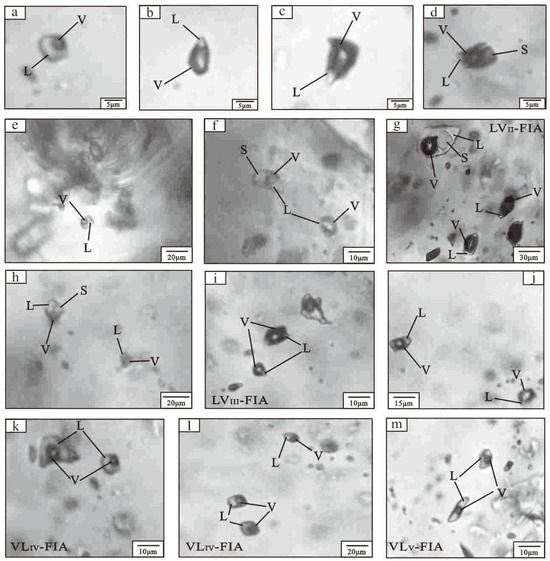
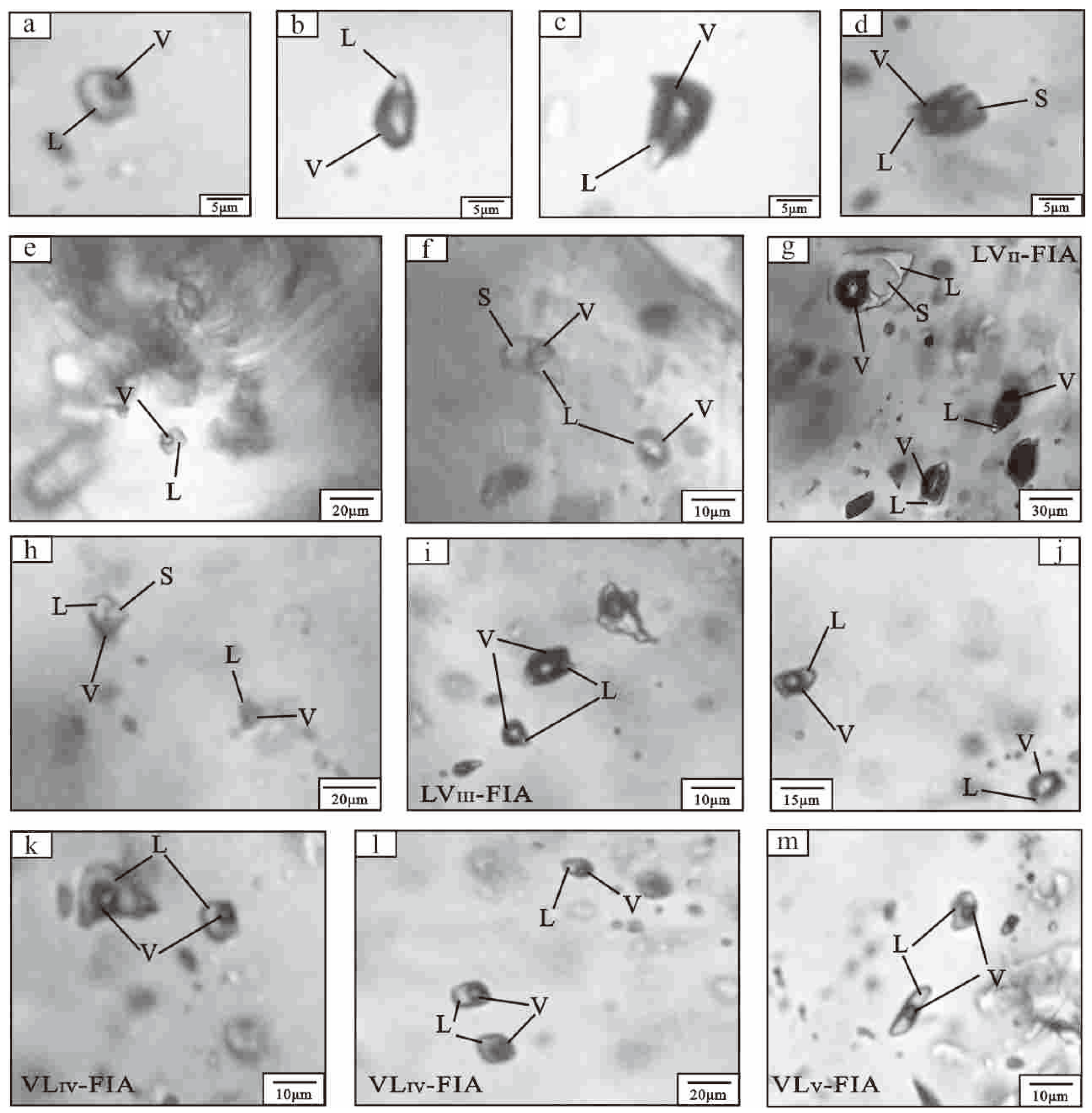
Fluid inclusion petrography observations indicate that three FI types are developed in the Bagenheigeqier deposit, namely daughter mineral-bearing three-phase (SL-type), vapor–liquid two-phase (VL-type), and vapor-rich two-phase (LV-type) (Figure 7; Table S1). Their characteristics are described as follows:
Figure 7.
Microphotographs of fluid inclusions from the Bagenheigeqier deposit. (a–d) Typical VL, LV and SL-type inclusions in the Bagenhei’geqier Deposit; (e,f) VL-type inclusions and coexisting SL and LV-type inclusions in stage I garnet; (g) coexisting LVII-FIA, VL and SL-type inclusions in stage II quartz; (h) coexisting LV and VL-type inclusions in stage III quartz; (i) coexisting LVIII-FIA and VL-type inclusions in stage III quartz; (j) coexisting LV and VL-type inclusions in stage IV quartz; (k,l) VLIV-FIA in stage IV quartz; (m) VLV-FIA in stage V quartz. Abbreviations: V: vapor; L: liquid.
SL-type: These FIs occur in Stage I garnets and Stages II-III quartz. Under room temperature and pressure, they consist of daughter minerals, liquid phase and vapor bubbles, with 15%–30% vapor–liquid ratio. The FIs are colorless and transparent, with daughter minerals showing cubic morphology typical of NaCl. They are irregular, elliptical or spindle-shaped, with a size range of 5–20 μm, occurring individually or in clusters, and exhibit the characteristics of primary inclusions (Figure 7d,f–h). They often coexist with VL- and LV-type FIs within the same crystal (Figure 7d,f–h).
VL-type: These FIs are widely hosted in quartz of all stages and Stage I garnets. Under room temperature and pressure, they are composed of liquid phase and vapor bubbles, with a vapor–liquid ratio mostly of 10%–30% and some up to 35%. The FIs are elliptical, irregular or crescent-shaped, with sizes of 5–30 μm, occurring individually or in clusters and showing the characteristics of primary inclusions (Figure 7a,e,g,i–m). They usually coexist with LV-, SL- or VL-type FIs within the same crystal (Figure 7g,i,j).
LV-type: These FIs are found in garnets of Stage I and quartz of Stages II–III. Under room temperature and pressure, they consist of liquid phase and vapor bubbles, with a vapor–liquid ratio of 65%–85%. The FIs are irregular, elliptical or spindle-shaped, with sizes of 5–25 μm, occurring individually or in clusters, and have the characteristics of primary inclusions (Figure 7b,c,f–j). They often coexist with VL-, SL- or VL- FIs in the same crystal (Figure 7f–h).
5.2. Fluid Inclusion Microthermometry
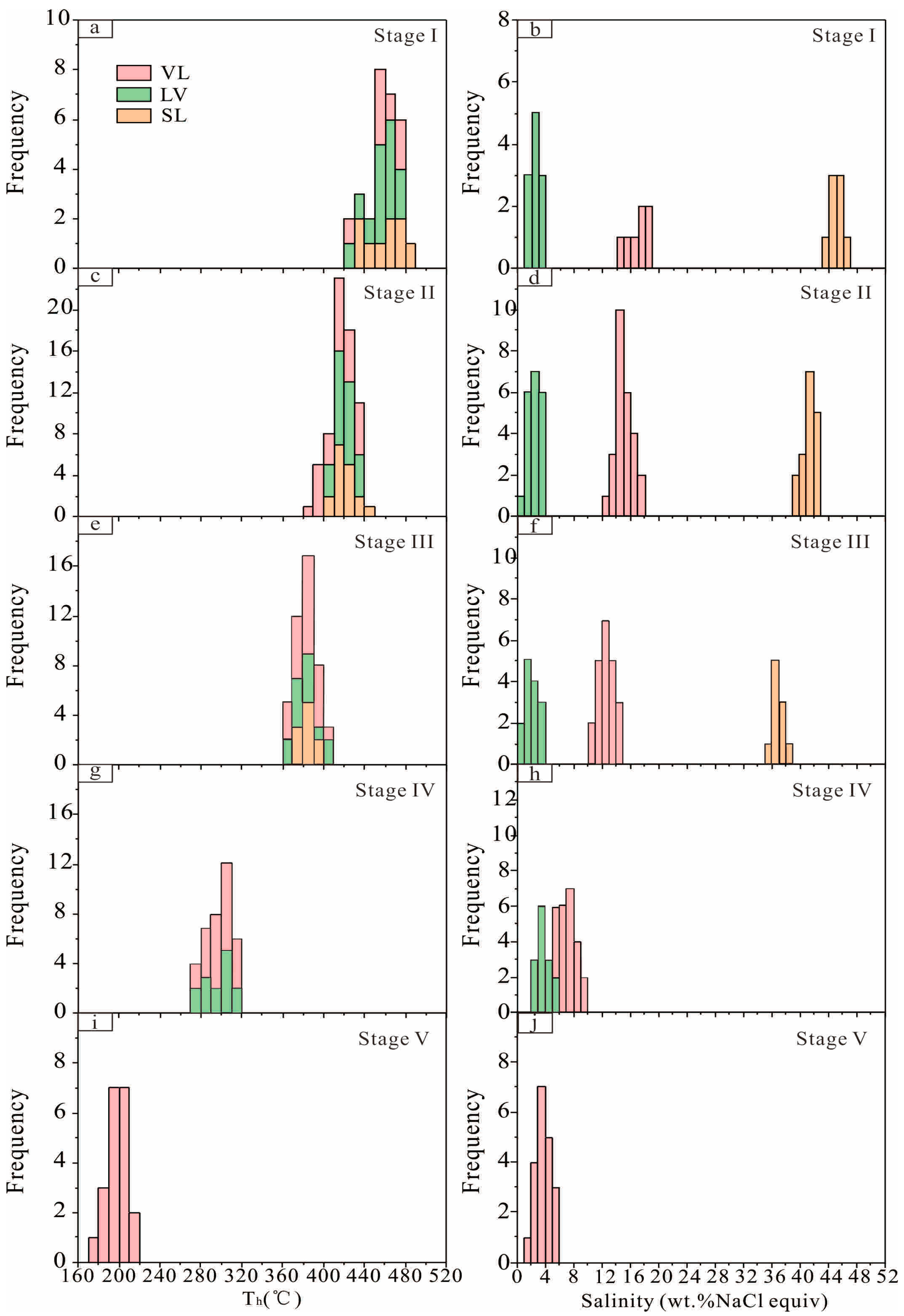
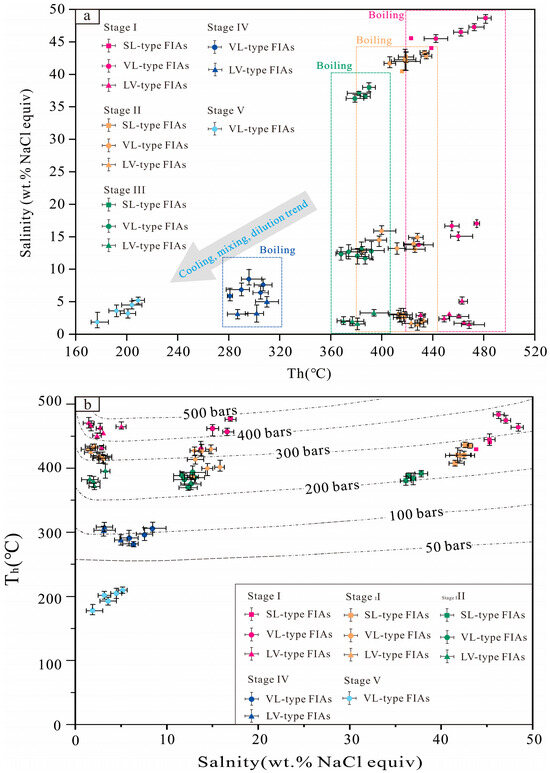
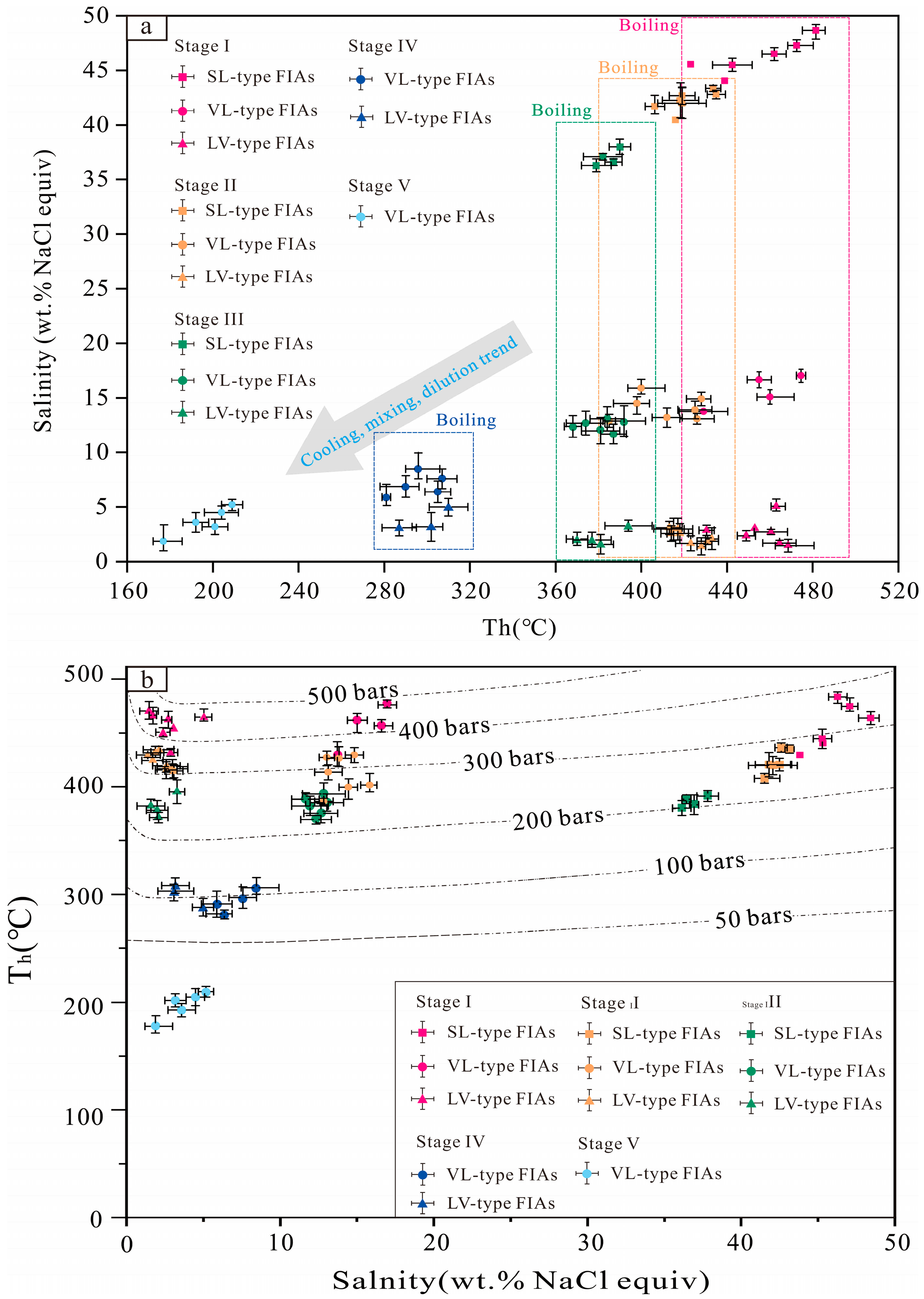
Based on the criteria defined by [39,40], petrographic identification of fluid inclusion assemblages (FIAs) was conducted, and the obtained microthermometric data from the five stages of the Bagenheigeqier deposit are summarized as average ± standard deviation in Table S1 and the temperature–salinity visualization and estimated pressure results are shown in Figure 8 and Figure 9.
Figure 8.
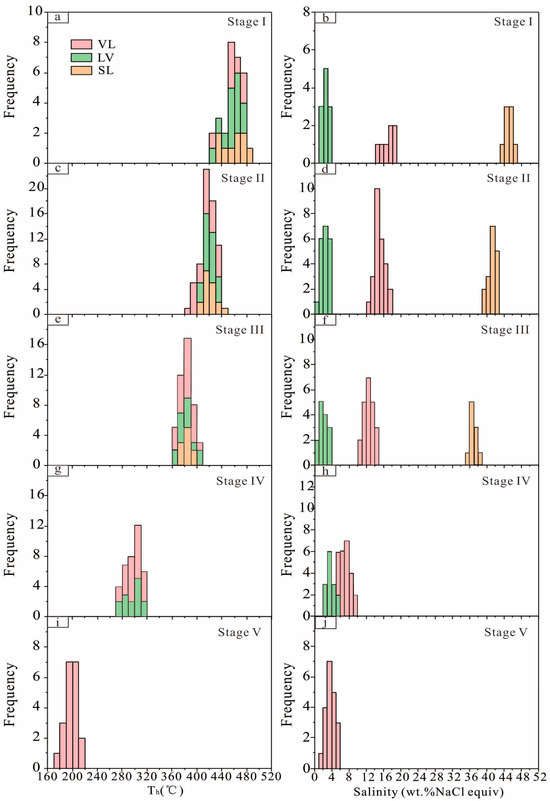
Histogram of Th-salinity of FIs in each stage from the Bagenheigeqier deposit. (a,b) stage I; (c,d) stage II; (e,f) stage III; (g,h) stage IV; (i,j) stage V.
Figure 9.
(a) Th -salinity evolution and (b) trapping pressure estimation (modified after [41]) of stage-specific fluid inclusions in the Bagenheigeqier deposit.
5.2.1. Stage I
All types of inclusions are developed in garnets of this stage. For six SL-type FIAs, daughter minerals dissolve prior to vapor bubbles during heating, with dissolution temperatures ranging from 367 to 416 °C, corresponding salinities of 44.0–49.2 wt.% NaCl equiv, and Th of 423–486 °C. For seven LV-type FIAs, FIs have ice-melting temperatures of −1 to −6 °C (salinities of 1.1–3.5 wt.% NaCl equiv) and homogenize to vapor phase at 428–475 °C. For four VL-type FIAs, FIs exhibit ice-melting temperatures of −3.5 to −8 °C (salinities of 13.8–17.5 wt.% NaCl equiv) and mostly homogenize to liquid phase at 429–476 °C.
5.2.2. Stage II
All types of inclusions are developed in quartz of this stage. For eight SL-type FIAs, daughter minerals dissolve earlier than vapor bubbles during heating, with dissolution temperatures of 328–366 °C, salinities of 40.4–43.9 wt.% NaCl equiv, and total Th of 402–441 °C. For nine LV-type FIAs, FIs have ice-melting temperatures of −3 to −0.5 °C (0.9–3.9 wt.% NaCl equiv salinities) and homogenize to vapor phase at 408–435 °C. For seven VL-type FIAs, FIs show ice-melting temperatures of −12.2 to −8.2 °C (12.0–16.2 wt.% NaCl equiv salinities) and homogenize to liquid phase at 389–436 °C.
5.2.3. Stage III
All types of inclusions are developed in quartz of this stage. For four SL-type FIAs, daughter minerals dissolve before vapor bubbles during heating, with dissolution temperatures of 264–308 °C, salinities of 35.6–38.8 wt.% NaCl equiv, and total Th of 373–395 °C. For four LV-type FIAs, FIs have ice-melting temperatures of −2.2 to −0.5 °C (0.9–3.7 wt.% NaCl equiv salinities) and homogenize to vapor phase at 364–403 °C. For six VL-type FIAs, FIs exhibit ice-melting temperatures of −10.3 to −6.8 °C (10.2–14.3 wt.% NaCl equiv salinities) and homogenize to liquid phase at 362–408 °C.
5.2.4. Stage IV
LV- and VL-type inclusions are developed in quartz of this stage. For three LV-type FIAs, FIs have ice-melting temperatures of −3.6 to −1.2 °C (2.1–5.9 wt.% NaCl equiv salinities) and homogenize to vapor phase at 277–319 °C. For five VL-type FIAs, FIs show ice-melting temperatures of −5.6 to −2.3 °C (3.9–8.7 wt.% NaCl equiv salinities) and homogenize to liquid phase at 279–316 °C.
5.2.5. Stage V
Only VL-type inclusions are developed in quartz of this stage. These five VL-type FIAs have ice-melting temperatures of −3.5 to −0.7 °C, corresponding to salinities of 1.2–5.7 wt.% NaCl equiv, and homogenize to liquid phase at 173–214 °C.
5.3. H-O Isotopic Composition
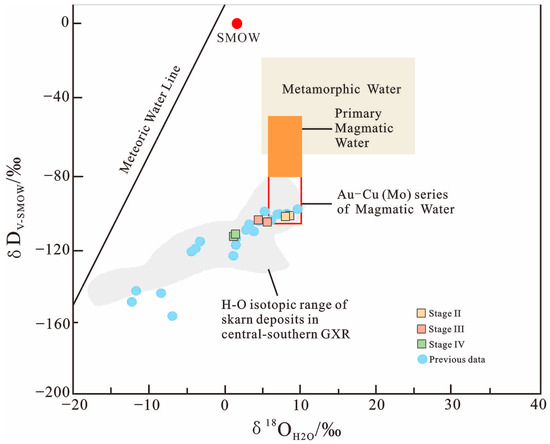
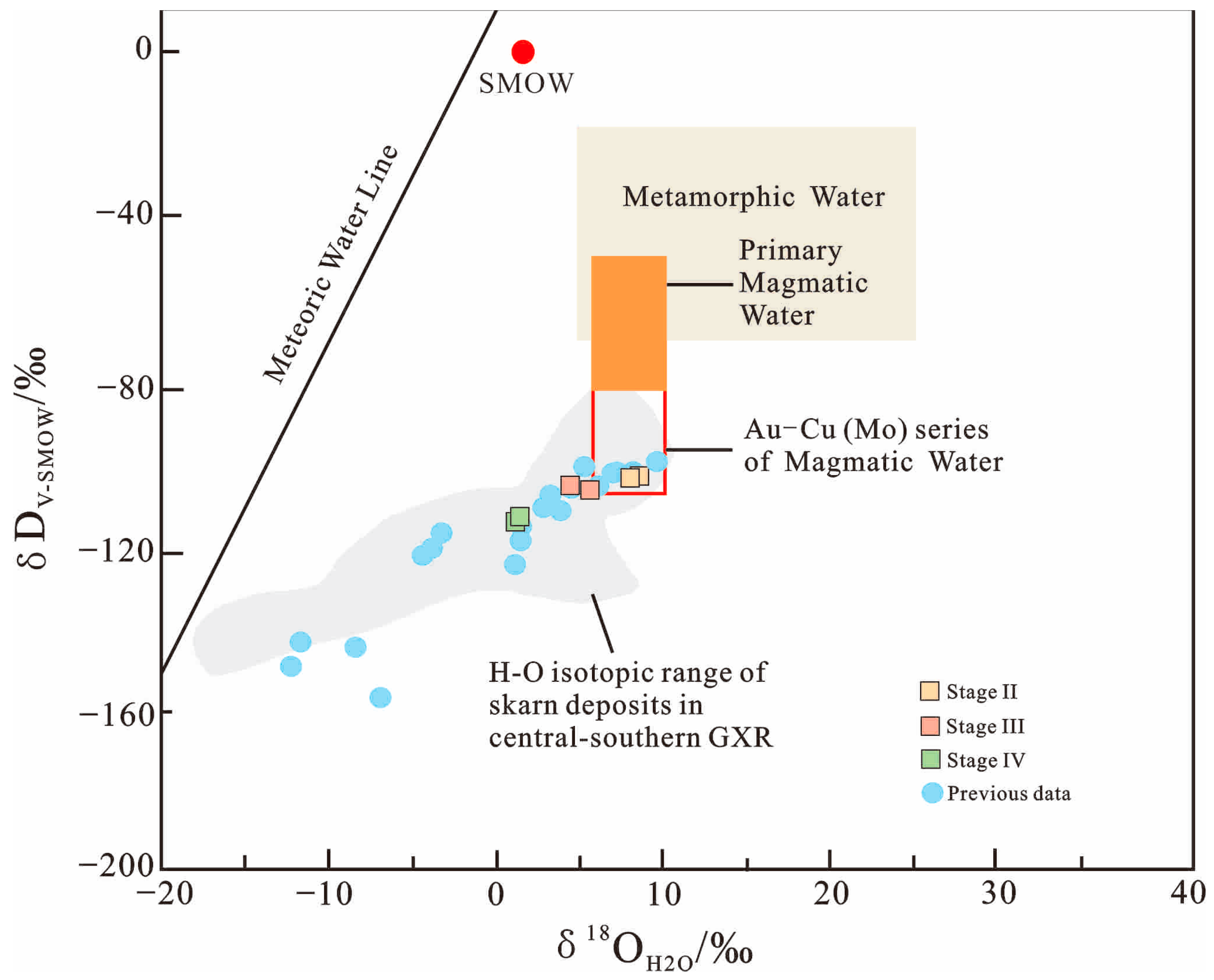
H-O isotope data for the Bagenheigeqier deposit, alongside previous study data ranges, are presented in Table S2 and Figure 10. Quartz δ18OH2O values were calculated via the equilibrium equation: 1000 lnαQtz-H2O = 3.38 × 10⁶/T2 − 3.40 [36], where T represents the average Th of FIs. The test results are as follows: Stage II quartz δD ranges from −103.5‰ to −99.1‰, with δ18OH2O values of 6.8‰ to 9.3‰; Stage III quartz δD ranges from −108.6‰ to −100.6‰, with δ18OH2O values of 4.4‰ to 7.1‰; Stage IV quartz δD from −115.7‰ to −107.8‰, with δ18OH2O values of 1.1‰ to 3.5‰; Stage V quartz δD ranges from −121.5‰ to −117.2‰, with δ18OH2O values of −4.6‰ to −3.5‰.
Figure 10.
The diagram of δD vs. δ18OH2O for the Bagenheigeqier deposit (base map modified after [42,43]). Previous H-O isotopic data of the Bagenheigeqier deposit and data range of skarn deposits in central-southern GXR are from [9,11,13,44,45,46,47].
5.4. Trace Element Composition in Sphalerite
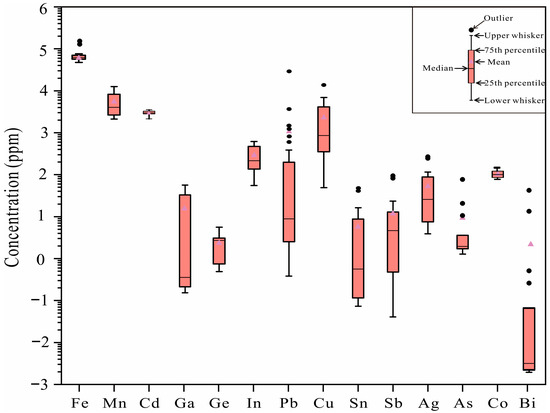
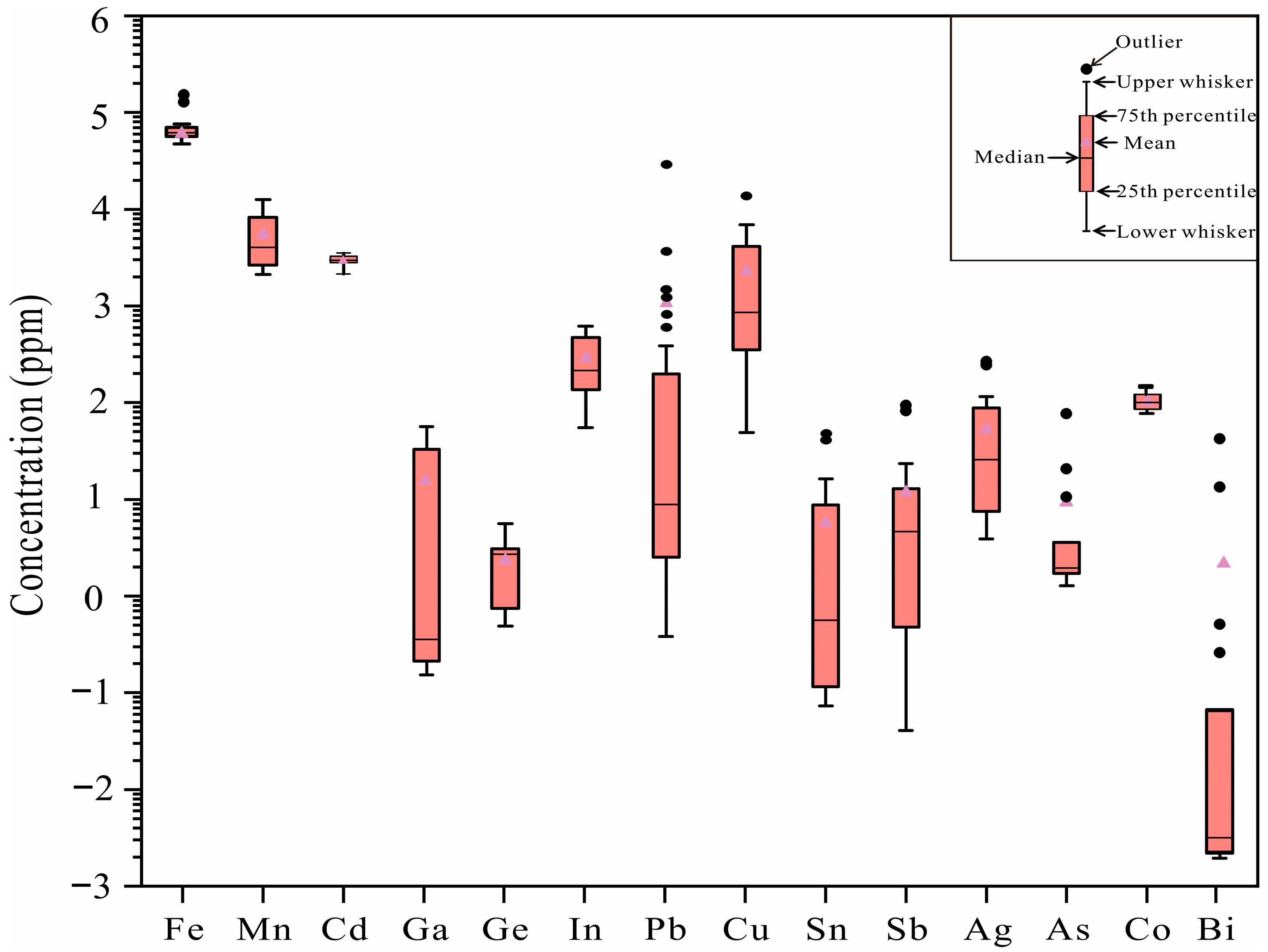
The content characteristics of various elements in sphalerite (Sp) from the Bagenheigeqier deposit are as follows (Figure 11; Table S3): Fe (4.7–12.9 wt.%, avg. 6.4 wt.%), Mn (2108–12,560 ppm, avg. 5390 ppm) and Cd (2146–3519 ppm, avg. 2977 ppm) are the major trace components; Ga ranges from 0.15 to 56.70 ppm (avg. 15.48 ppm), Ge from 0.49 to 5.60 ppm (avg. 2.31 ppm) and Pb from 0.38 to 29,037.47 ppm (avg. 1067.80 ppm); Cu content is 49.00–13,728.74 ppm (avg. 2303.05 ppm), Ag 3.90–264.34 ppm (avg. 52.57 ppm) and In 55.00–621.63 ppm (avg. 288.03 ppm), where the elevated In concentrations denote significant indium mineralization potential for the deposit. Minor elements include Co (80.28–136.90 ppm, avg. 115.52 ppm), Sn (0.07–45.32 ppm, avg. 5.67 ppm) and Sb (0.04–93.93 ppm, avg. 9.31 ppm).
Figure 11.
Box plot of trace elements in sphalerite from the Bagenheigeqier deposit.
6. Discussion
6.1. Source of Ore-Forming Fluids
H-O isotopic compositions in the Bagenheigeqier deposit clearly record their origin and evolutionary characteristics (Figure 10). The quartz δ18OH2O values from the early stage range from 6.8‰ to 9.3‰, which are highly consistent within typical magmatic water range (7‰–9‰; [48]). Combined with the characteristics of high-temperature, high-salinity fluid in this stage, it is confirmed that the early ore-forming fluids were dominated absolutely by magmatic hydrothermal fluids.
With the mineralization evolution from the early skarn stage to the late quartz-calcite stage, the δ18OH2O values (4.4‰–7.1‰ → 1.1‰–3.5‰ → −4.6‰–−3.5‰) and δD values (−103.5‰–−99.1‰ → −115.7‰–−107.8‰ → −121.5‰–−117.2‰) of quartz in each stage show a systematic and continuous decreasing trend (Figure 10). This evolutionary pattern is generally associated with two types of geological processes. First, during the ascent of ore-forming fluids, the open fault structures provided channels for the mixing of shallow meteoric water. Meteoric water with low δ18OH2O and δD values mixed with the original magmatic hydrothermal fluids, leading to a gradual decrease in the overall isotopic composition. Second, the extensive precipitation of O-rich minerals (e.g., magnetite, garnet and other skarn minerals) in the early stage of mineralization caused a continuous depletion of δ18OH2O in the residual fluids, which in turn resulted in the reduction of δ18OH2O values [9,49,50].
Notably, although the isotopic values exhibit a phased decrease, the degree of δ18OH2O depletion in quartz during the entire mineralization process is relatively moderate, without a significant shift toward the meteoric water line (Figure 10). Combined with the phenomenon that the salinity of fluid inclusions did not decrease sharply, it indicates a low mixing proportion of meteoric water in the ore-forming fluid system, which did not change the dominant status of magmatic hydrothermal fluids, reflecting the continuous contribution of magmatic hydrothermal fluids to ore formation.
6.2. Fluid Evolution
Petrographic observations and microthermometric measurements of FIs in the Bagenheigeqier deposit reveal that the temperature, salinity and inclusion types during Stages I to V exhibit distinct stage-specific evolutionary characteristics (Figure 6, Figure 7 and Figure 8; Table S1). Fluid boiling persisted from the early to the main stage, serving as the core mechanism controlling the migration and precipitation of ore-forming materials.
In stage I, primary SL-, LV-, and VL-type are closely associated within garnets. Among these, LV- and SL-type FIs share similar homogenization temperatures but differ significantly in homogenization modes and salinities, which is a typical indicator of fluid boiling [51,52]. Combined with microthermometric data, stage I fluid belongs to a high-T and high-salinity NaCl-H2O system, consistent with the evolutionary features of supercritical fluids exsolved from early magmatic hydrothermal fluids. The high-salinity characteristic provided favorable conditions for the efficient migration of metallic elements. The fluids may undergo metasomatism reactions with surrounding rocks (concealed marble), forming skarn minerals such as garnet [44]:
3CaCO3 + Fe2O3 + 3SiO2 → Ca3Fe2Si3O12 + 3CO2
Stages II and III show similar inclusion assemblage characteristics to Stage I, still dominated by the paragenesis of primary SL-, LV- and VL-type inclusions, indicating the sustained occurrence of fluid boiling. However, compared with Stage I, the fluid temperature and salinity in these two stages show a slight decreasing trend, and the fluid overall belongs to a moderate-high T and high-salinity NaCl-H2O system. This reflects that ore-forming fluid underwent gradual cooling and depressurization during continuous evolution, without large-scale mixing of external fluids.
Stage IV is mainly characterized by primary LV- and VL-type inclusions. These two types FIs homogenize to the vapor phase and liquid phase respectively, with concentrated homogenization temperatures and obvious salinity differences, confirming that fluid boiling continued. The continuous fluid boiling, as a key mechanism, leads to the increase in pH and the change in fO2, which is conducive to the precipitation of lead-zinc and other metallic sulfides [26]. The fluid temperature and salinity in this stage decreased significantly compared with those in stages I–III, forming a moderate-T low-salinity NaCl-H2O system. Combined with evolutionary characteristics of H-O isotopes, it is inferred that meteoric water had mixed in this stage, diluting the original magmatic hydrothermal fluid and further exacerbating the abrupt changes in the physicochemical conditions.
In Stage V, the inclusion assemblage is simplified to a single type of VL-type vapor–liquid two-phase inclusions, indicating the complete termination of fluid boiling. The fluid temperature and salinity dropped sharply in this stage, evolving into a low-T and low-salinity NaCl-H2O system. This reflects that meteoric water had mixed in large quantities and become the dominant component of the fluid, fluid system tended to be stable, and mineralization process basically terminated.
When fluid boiling occurs, trapping pressure can be estimated based on the NaCl-H2O system isochore pressure estimation diagram [41]. The estimation results show (Figure 8b) that the fluid trapping pressure in Stage I is approximately 290–480 bars; that in Stage II is about 240–370 bars; that in Stage III is roughly 190–280 bars; and that in Stage IV is around 80–120 bars. As mentioned earlier, the fluid in Stages I-III was in the ductile–brittle transition process (~400 °C). Based on the comprehensive calculation of lithostatic pressure and hydrostatic pressure conditions, the formation depth is estimated to be approximately 1.1–2.4 km. Under hydrostatic pressure conditions, the formation depth of Stage IV is calculated to be about 0.8–1.2 km.
6.3. The Substitution Mechanism of Trace Elements
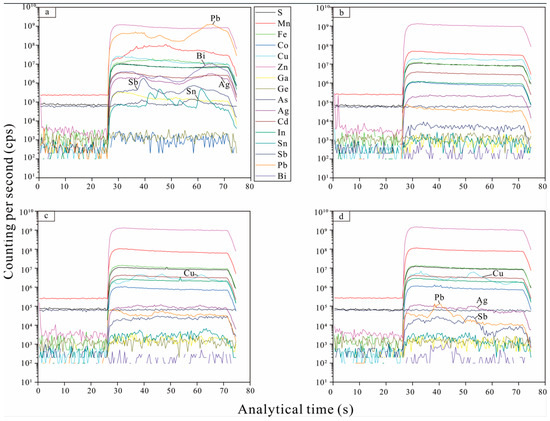
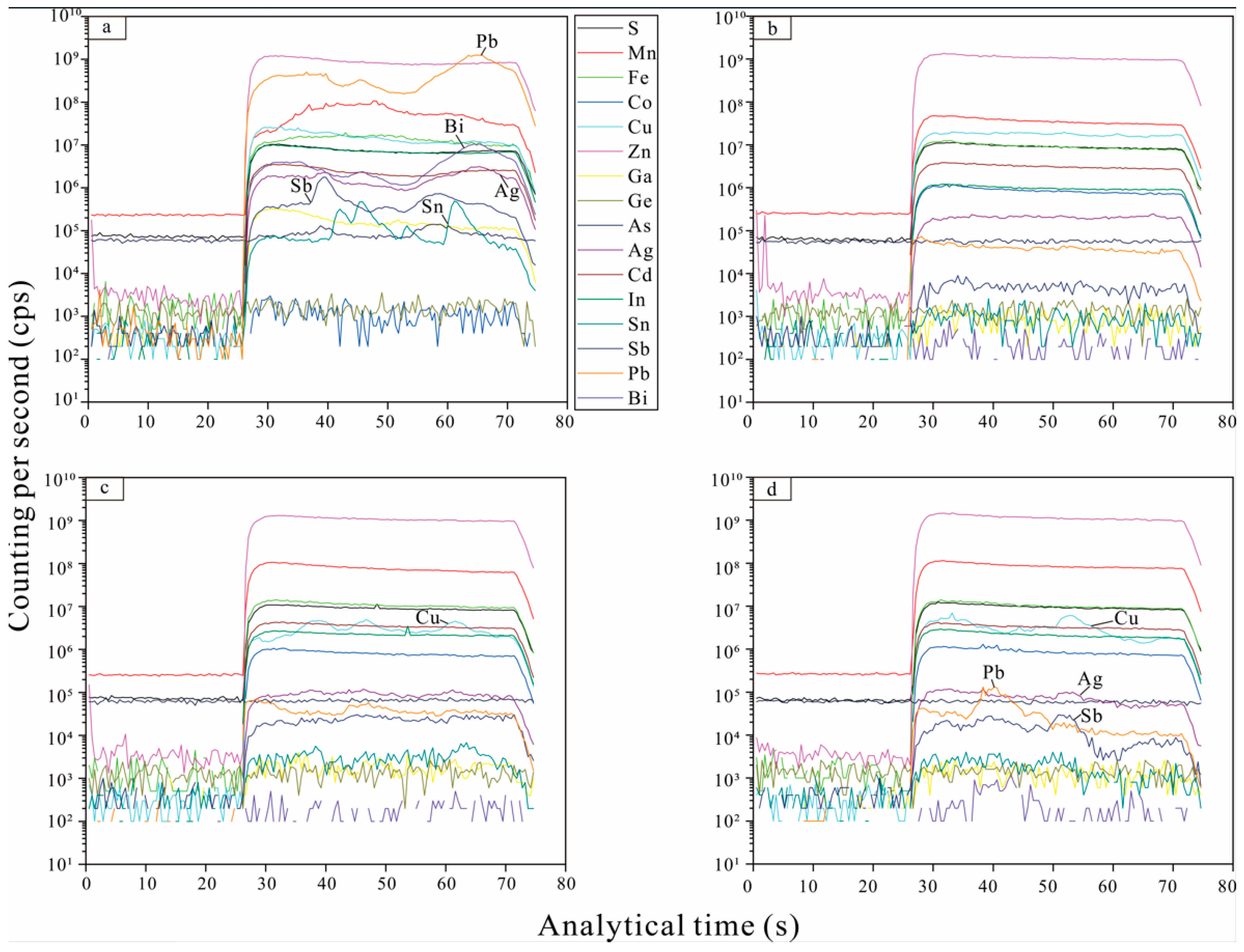
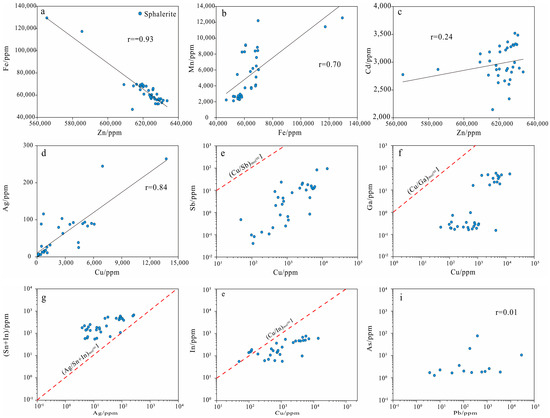
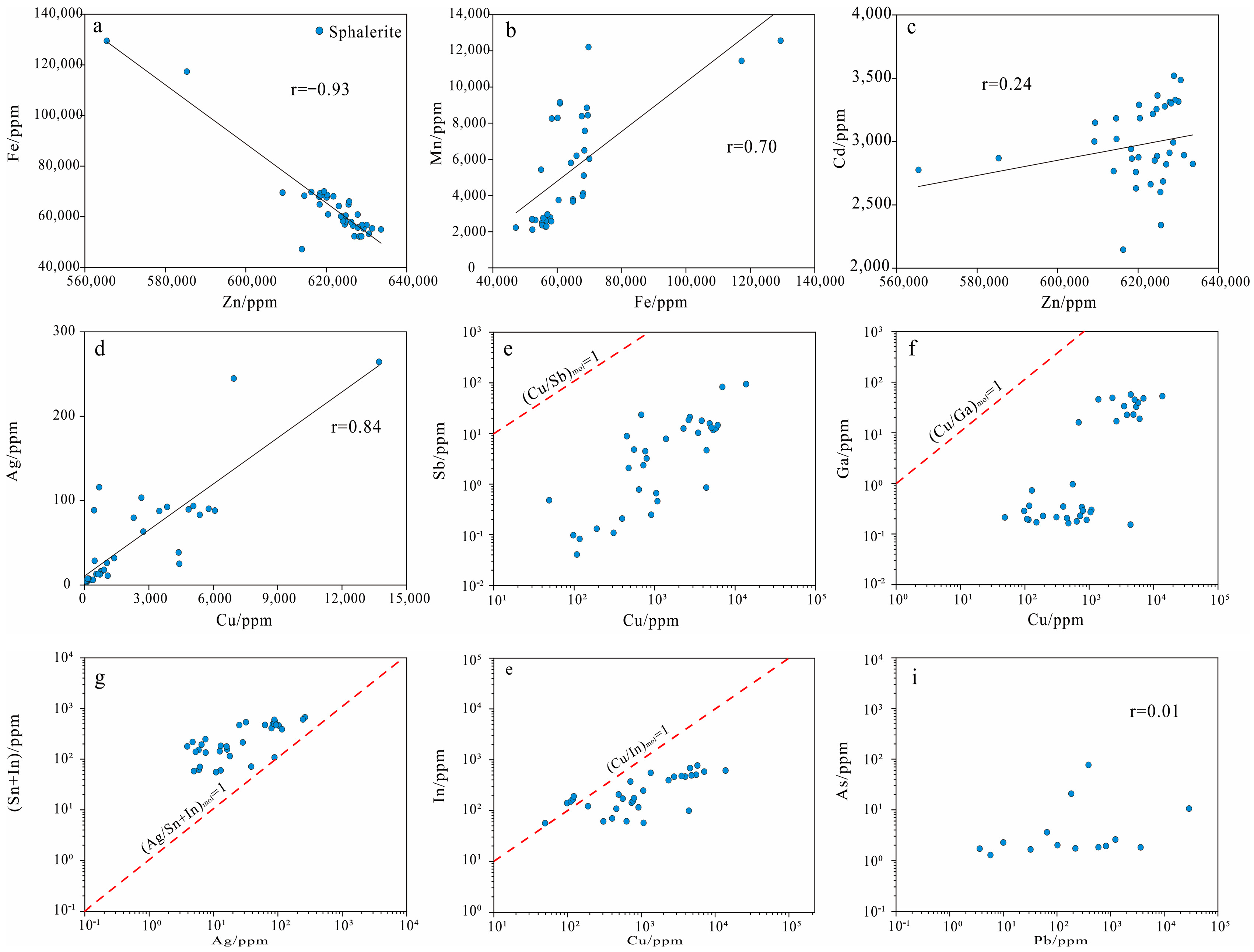
Time-resolved depth profiling reveals irregular peaks in the ablation curves of Cu, Ag, Sn, Pb, Sb, Bi and other elements in sphalerite from the Bagenheigeqier deposit (Figure 12), which testifies to their main presence as mineral inclusions, whereas the mostly smooth and flat curves of other elements indicate their primary entry into Sp by means of isomorphism [16,53]. The ablation profiles of Fe, Mn, and Cd in sphalerite from the Bagenheigeqier deposit are smooth and flat (Figure 12). A significant linear negative correlation is observed between Fe and Zn (Figure 13a; r = −0.93), indicating that Fe is likely incorporated into the Sp lattice via the substitution mechanism of Zn2+ ↔ Fe2+. Correlation analysis shows a distinct positive relationship between Fe and Mn (Figure 13b; r = 0.70), which conforms to the substitution scheme of 2Zn2+ ↔ Mn2+ + Fe2+ [54]. In the correlation diagram of Cd vs. Zn, a weak correlation is presented (Figure 13c; r = 0.24), suggesting that the substitution of Cd may be inhibited by the high Fe content.
Figure 12.
Time-resolved depth profiles of sphalerite from the Bagenheigeqier deposit. (a) Irregular ablation curves of Ag, Sn, Bi, Pb and Sb. (b,c) Relatively smooth ablation curves. (d) Similar irregular ablation curves of Ag, Cu and ablation curves of Pb, Sb.
Figure 13.
Binary diagrams (a) Zn vs. Fe; (b) Fe vs. Mn; (c) Zn vs. Cd; (d) Cu vs. Ag; (e) Cu vs. Sb; (f) Cu vs. Ga; (g) Ag vs. (Sn + In); (h) Cu vs. In; (i) Pb vs. As of trace elements in Sphalerite from the Bagenheigeqier deposit.
Monovalent, trivalent, and tetravalent cations are commonly incorporated into Sp through coupled substitution [55]. Cu and Ag represent the major monovalent cations in sphalerite, and they exhibit a strong positive correlation (Figure 13d; r = 0.84). Synchronous peaks of Ag and Cu are frequently detected in time-resolved depth profiles (Figure 13d), implying that these two elements might enter the sphalerite either via coupled substitution or in the form of inclusions [56]. Although Cu-Sb and Cu-Ga show relatively strong positive correlations in binary diagrams, the data points do not completely fall on the line with a molar ratio of 1 (Figure 13e,f). This phenomenon indicates that the coupled substitution mechanism of 2Zn2+ ↔ (Cu, Ag)+ + (Ga, Sb)3+ [17,55,56,57,58] is not the dominant mode for the incorporation of Cu, Sb, and Ga into sphalerite, and Cu is probably present as mineral inclusions. Indium (In) shows high concentrations in the sphalerite of the Bagenheigeqier deposit. A positive correlation exists between Ag and (Sn + In), and most trace element data points are parallel to the line with a Ag/(Sn + In) molar ratio of 1 (Figure 13g), implying the potential occurrence of the coupled substitution mechanism of 4Zn2+ ↔ In3+ + Sn4+ + (Cu, Ag)+ + □ [17]. Additionally, Cu and In are positively correlated, and the data points are mostly parallel to the line with a Cu/In molar ratio of 1 (Figure 13h), which may be attributed to the coupled substitution of 2Zn2+ ↔ Cu+ + In3+ [59].
The synchronous peak fluctuations in the ablation profiles of Pb, Bi, and Ag suggest that Pb occurs as galena inclusions in sphalerite [60], which is also observed in Figure 4j,k. Furthermore, Pb might theoretically be incorporated into sphalerite via the coupled substitution of 4Zn2+ ↔ Pb2+ + 2As3+ + □ [61]. However, correlation analysis reveals no obvious relationship between Pb and As (Figure 13i; r = 0.01), indicating that Pb is not incorporated into the sphalerite lattice through coupled substitution.
6.4. Temperature and Sulfur Fugacity
Trace elements characteristics and their ratios (Ga/In, Zn/Cd) in sphalerite can qualitatively estimate its crystallization temperature [16,62]. Low-T Sp is rich in elements such as Ga and Ge; conversely, high-temperature Sp is rich in elements like Fe, Mn, In and Sn. The Bagenheigeqier deposit Sp is characterized by enrichment in Fe, Mn and In and depletion in Ga, Ge and Cd, consistent with sphalerite crystallization at relatively high temperatures. Ga/In and Zn/Cd ratios of the sphalerite range from 0.001 to 0.121 and 178.7 to 287.2, respectively, showing characteristics of medium–high temperature [62,63].
In addition to qualitative estimation, the formation temperature of sphalerite can be quantitatively calculated by using the Fe/Zn [18] and the GGIMFis thermometer based on principal component analysis (PCA) of multivariate statistical analysis [64]. Both of these thermometers are applicable for point analysis using LA-ICP-MS and have been applied in different types of lead-zinc polymetallic ore deposits [54,65,66,67]. The specific formulas are as follows:
T = (Fe/Zn + 0.2953)/0.0013
PC1* = ln [(CGa0.22 * CGe0.22)/(CFe0.37 * CMn0.20 * Cln0.11)]
T′ = −(54.4 ± 7.3) × PC1* + (208 ± 10)
Excluding the sample points below the detection limit, the calculated results of the Fe/Zn and the GGIMFis thermometer in main mineralization stage are 286~315 °C and 299~330 °C, respectively. The temperature results of both thermometers are generally higher than those of FIAs (279~316 °C) in the corresponding stage, which may be caused by the difference between the ore minerals and the gangue minerals [68], but the temperature results obtained by the three methods are nearly consistent within the error range (±50 °C; [64,69]).
The pyrite that closely coexists with sphalerite can act as a buffer for the Fe in sphalerite. Therefore, the fugacity of sulfur (fS2) can be estimated based on the FeS content in sphalerite [69], as well as the temperature (T) and pressure (p). The specific formula is as follows:
log10 [FeS (sp)] = (0.80 ± 0.02) × log10 (53.1 × FeS/FeSmax) − (1.38 ± 0.03) FeSmax = 44.09 + 0.0125 × T − 3600 × p/T
lgfS2 = −2log10 [FeS (sp)] − (1.50 ± 0.02) × 104/T + (14.5 ± 0.3)
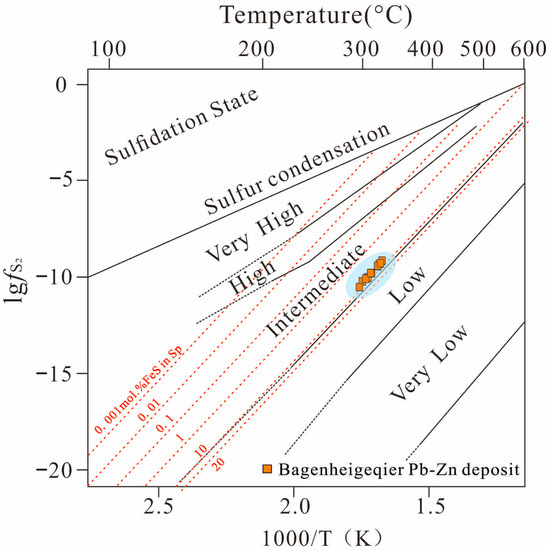
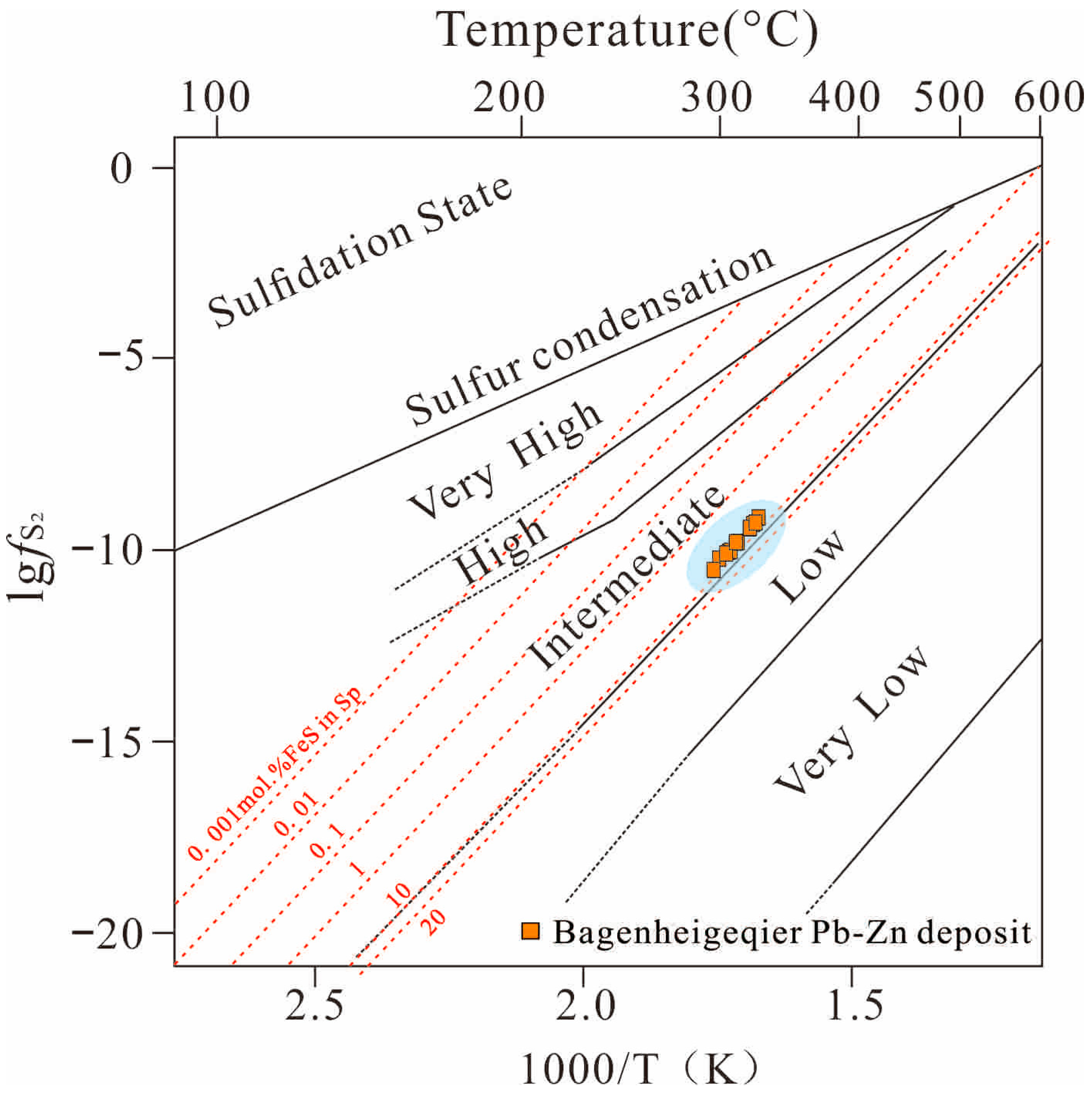
The fS2 range in stage IV of the Bageneheigeqier deposit is −10.5 to −9.2, which falls within the intermediate-sulfur range (Figure 14). The mineral assemblage developed in stage IV also exhibits the characteristics of intermediate-sulfur. The above results indicate that stage IV of the Bagenheigeqier deposit was formed under moderate temperature conditions with intermediate fS2. This condition can be often found in hydrothermal deposits and is conducive to the precipitation of metals [69].
Figure 14.
LogfS2–1000/T (K) Diagram of the Bagenheigeqier deposit (base map modified after [70]).
6.5. Genetic Type of Bagenheigeqier Deposit
Sphalerite trace elements show significant differences in different deposits. The contents of elements such as Fe, Mn, In and Sn are higher in magmatic deposits, while Ga and Ge contents are lower. For skarn deposits, the contents of Mn and Co are higher, while the contents of In, Fe and Sn are relatively lower [53,71]. The discriminant diagrams related to different element combinations can also provide new evidence for revealing the genesis of mineral deposits [67,71].
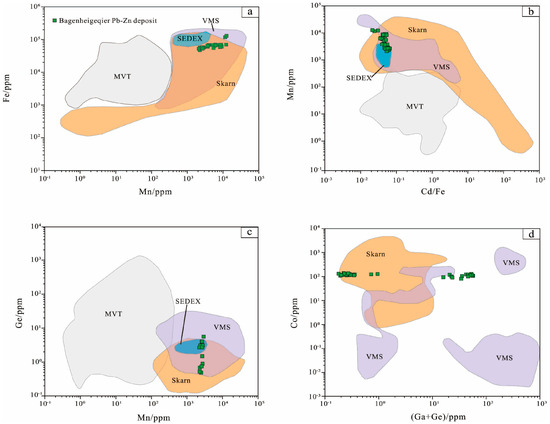
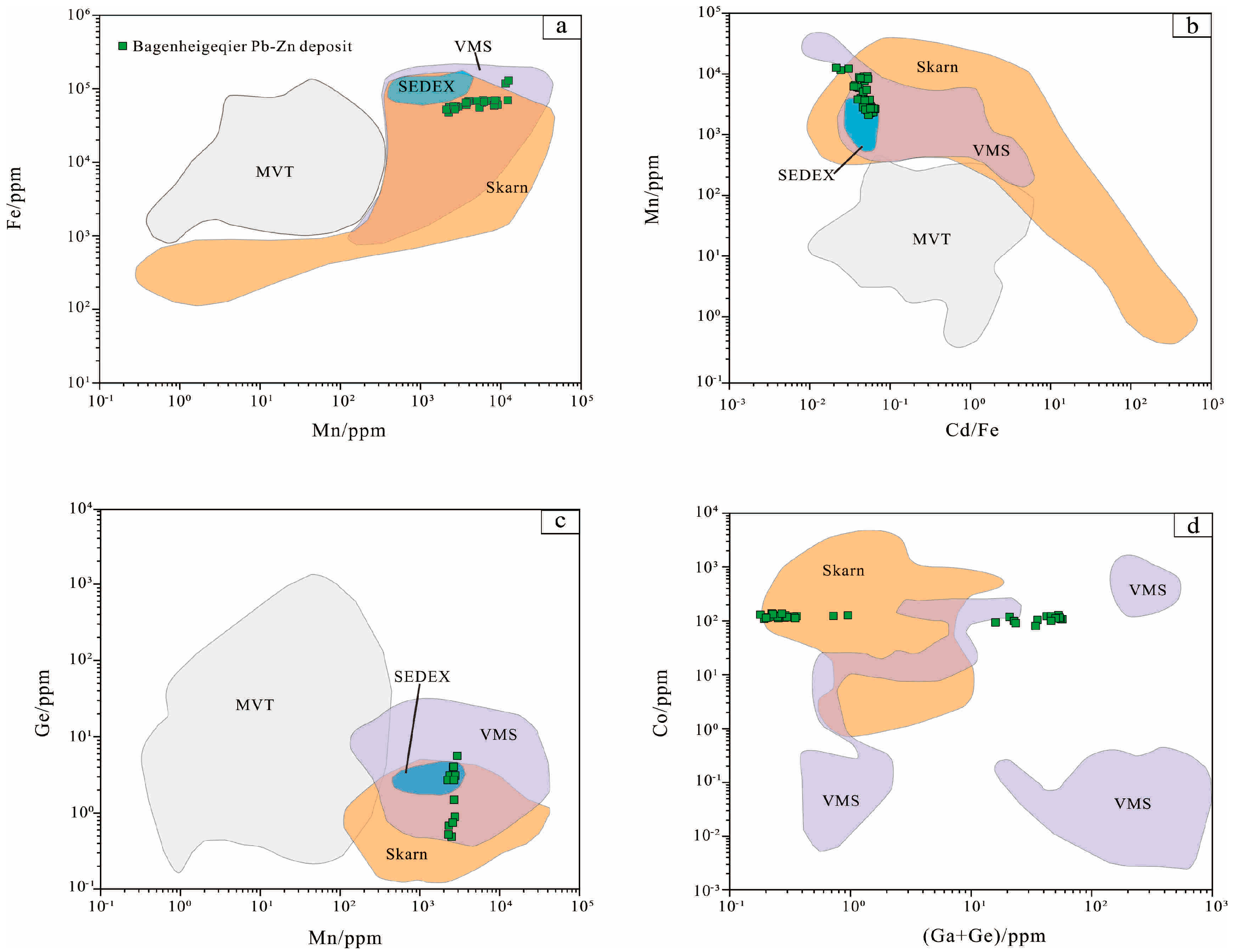
The Zn/Cd ratio of sphalerite (178.7 to 287.2) in the Bagenheigeqier deposit is similar to that of sphalerite in moderate-high temperature system deposits (such as skarn, VMS and porphyry deposits; [60]). In the binary relationship diagrams of Mn-Fe, Mn-Ge and Cd/Fe-Mn, the sphalerite in the Bagenheigeqier deposit is located within the range of skarn deposits and VMS deposits, unlike MVT and SEDEX deposits (Figure 15a–c). The sphalerite in skarn deposits usually has a relatively high content of Co [53,71,72]. The high Co content of sphalerite in the Haobugao and Huanggang skarn deposits in central-southern Great Xing’an Range also supports this point [53,73,74]. In the (Ga + Ge)-Co binary relationship diagram, the data of sphalerite have a high Co content and mostly fall within skarn deposits range (Figure 15d).
Figure 15.
Binary diagrams of trace elements (a) Mn vs. Fe; (b) Cd/Fe vs. Mn; (c) Mn vs. Ge; (d) (Ga + Ge) vs. Co in Sphalerite. The data range of Sphalerite for different types of deposit are from [16,53,71,75,76,77,78,79].
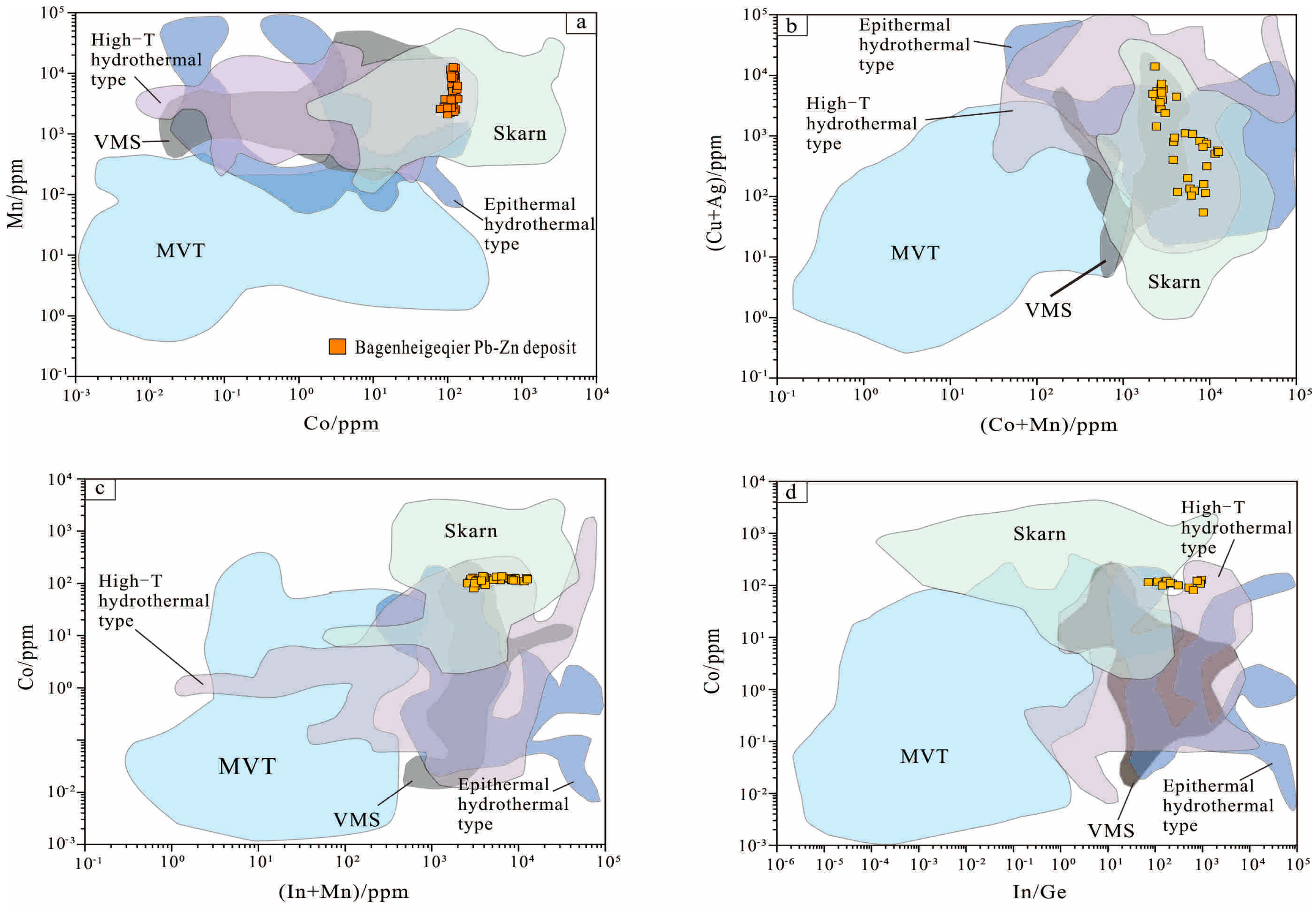
In the Bagenheigeqier deposit, some Ge contents of sphalerite are below the detection limit; therefore, additional discrimination diagrams such as Co-Mn, (Co + Mn)-(Cu + Ag), (In + Mn)-Co and In/Ge-Co were used for the discrimination of ore genesis. The trace element data of sphalerite from the Bagenheigeqier deposit mostly fall within the range of skarn deposits, and some are located in the overlapping area of VMS and skarn deposits (Figure 16). However, sphalerite in the VMS deposits generally has a relatively high Fe content (>10 wt.%; [80,81]), while in the Bagenheigeqier deposit, the average Fe content in sphalerite is lower than 10 wt.%, similar to the characteristics of sphalerite in skarn deposits [16,53,71].
Figure 16.
Trace element discrimination diagrams (a) Co vs. Mn; (b) (Co + Mn) vs. (Cu + Ag); (c) (In + Mn) vs. Co; (d) In/Ge vs. Co of Sphalerite. The data range of sphalerite for different types of deposit are from [16,53,68,82,83,84,85].
In conclusion, the characteristics of the Bagenheigeqier deposit indicate that it belongs to a skarn-type deposit: (1) The field geological surveys have shown that there are skarn minerals developed within the deposit and they are closely related to the Pb-Zn mineralization (Figure 3 and Figure 4). The mineral assemblages in the Bagenheigeqier deposit are similar to those of regional skarn deposit (Huanggang and Haobugao deposit; [6,30]). (2) The homogenization temperatures of FIAs in skarn-oxide stages range from 389 to 486 °C and the homogenization temperatures of FIAs in sulfide mineralization stage (stage III–IV) range from 277 to 408 °C, which are different from those (medium and low homogenization temperature) of regional hydrothermal vein-type deposits (such as shuangjianzishan, Weilasituo, Bairendaba and Lamahanshan deposits; [9,25,26,46]). (3) The H-O isotopic data in the Bagenheigeqier deposit are similar to those in skarn deposits in the region (Figure 10), indicating the fluid are mainly derived from magma and are later mixed with meteoric water. (4) The trace element characteristics and different discrimination diagrams of sphalerite (especially Co) in main Pb-Zn mineralization stage (stage IV) support that the Bagenheigeqier deposit is a skarn deposit.
7. Conclusions
- Fluid inclusion and H-O isotope studies suggest that early-stage fluids in the Bagenheigeqier skarn deposit were high-T, high-salinity NaCl-H2O systems, evolving into medium–low-T, low-salinity NaCl-H2O systems in late stage. Fluid boiling occurred during mineralization, with initial fluids derived from magmatic water and minor meteoric water incorporated at a later stage.
- Fluid boiling combined with meteoric water mixing caused system cooling, induced changes in physicochemical conditions, and facilitated lead-zinc precipitation and mineralization.
- Trace element analyses demonstrate that sphalerite from the Bagenheigeqier deposit is enriched in Fe, Mn, Co and In, yet depleted in Ga and Ge. Indium may enter lattice by the coupled substitution of Zn by Cu, Sn and Ag. Sphalerites in the main mineralization stage were formed under moderate temperature conditions (286–330 °C) and intermediate fS2 (−10.5 to −9.2).
- The geological, fluid inclusion, isotopic and trace element characteristics indicate that the Bagenheigeqier deposit is a skarn Pb-Zn deposit.
Supplementary Materials
The following supporting information can be downloaded at: https://www.mdpi.com/article/10.3390/min16030238/s1, Table S1. Microthermometric data of FIAs from different stages in the Bagenheigeqier Pb-Zn deposit; Table S2. H-O isotopic data of fluid inclusions from quartz in Bagenheigeqier Pb-Zndeposit; Table S3. Trace element concentration of sphalerite determined by LA ICP-MS in Bagenheigeqier Pb-Zn deposit.
Author Contributions
H.L.: Writing—Original Draft, Writing—Reviewing and Editing. J.L.: Conceptualization, Methodology, Supervision. X.W.: Resources, Software. K.W.: Funding Acquisition. W.M.: Formal Analysis, Resources. Y.L.: Project Administration. All authors have read and agreed to the published version of the manuscript.
Funding
The project was funded by the National Natural Science Foundation of China (92062216).
Data Availability Statement
The experimental data used to support the conclusions of this study are included within the article and Supplementary Materials.
Acknowledgments
We are grateful to the Analytical Laboratory, Beijing Research Institute of Uranium Geology, China National Nuclear Corporation, Nanjing Hongchuang Geological Exploration Technology Service Co., Ltd., and to the Key Laboratory of Geological Fluids, Jilin University, for their advice and assistance in the experimental analysis. In addition, we wish to thank the anonymous reviewers and editors for their insightful comments.
Conflicts of Interest
The authors declare no conflicts of interest. Haoming Li, Jianyong Liu, Wenxiang Meng and Yuan Liu are employed by Mining Research Institute, Baotou Iron and Steel (Group) Co., Ltd. The paper reflects the views of the scientists and not the companies. Xue Wang is employed by Research Institute of Exploration and Development, Petro China Liaohe Oilfield Company.
References
- Chen, W.D. The current situation and sustainable development of lead-zinc smelting in China. China Met. Bull. 2023, 9, 1667–1672. (In Chinese) [Google Scholar]
- Zhang, C.Q.; Wu, Y.; Wang, D.H.; Chen, Y.C.; Rui, Z.Y.; Lou, D.B.; Chen, Z.H. Brief Introduction on Metallogeny of Pb-Zn Deposits in China. Acta Geol. Sin. 2014, 12, 2252–2268, (In Chinese with English Abstract). [Google Scholar]
- Jiang, S.H.; Chen, C.L.; Bagas, L.; Liu, Y.; Han, N.; Kang, H.; Wang, Z.H. Two mineralization events in the Baiyinnuoer Zn-Pb deposit in Inner Mongolia, China: Evidence from field observations, S-Pb isotopic compositions and U-Pb zircon ages. J. Asian Earth Sci. 2017, 144, 339–367. [Google Scholar] [CrossRef] [Scilit]
- Zhang, X.B.; Wang, K.Y.; Fu, L.J.; Zhang, M.; Konare, Y.; Peng, D.W.; Cai, W.Y. Fluid inclusions, C-H-O-S isotope and geochronology of the Bujinhei Pb-Zn deposit in the southern Great Xing’an Range of northeast China: Implication for ore genesis. Resour. Geol. 2017, 67, 207–227. [Google Scholar] [CrossRef] [Scilit]
- Liu, L.J.; Zhou, T.F.; Zhang, D.Y.; Yuan, F.; Liu, G.X.; Zhao, Z.C.; Sun, J.D.; White, N. S isotopic geochemistry, zircon and cassiterite U-Pb geochronology of the Haobugao Sn polymetallic deposit, southern Great Xing’an Range, NE China. Ore Geol. Rev. 2018, 93, 168–180. [Google Scholar] [CrossRef] [Scilit]
- Wang, C.Y.; Li, J.F.; Wang, K.Y. Fluid Inclusions, Stable Isotopes, and Geochronology of the Haobugao Lead-Zinc Deposit, Inner Mongolia, China. Resour. Geol. 2019, 69, 65–84. [Google Scholar] [CrossRef] [Scilit]
- Zhai, D.G.; Anthony, E.W.-J.; Liu, J.J.; David, S.; Panagiotis, C.V.; Stylianos, T.; Li, K.; Li, P.L.; Sun, H.J. The Genesis of the Giant Shuangjianzishan Epithermal Ag-Pb-Zn Deposit, Inner Mongolia, Northeastern China. Econ. Geol. 2020, 115, 101–128. [Google Scholar] [CrossRef] [Scilit]
- Hui, K.X.; Rottier, B.; Qin, K.Z.; Zajacz, Z.; Tsay, A.; Zhao, J.X.; Gao, S.; Shi, R.Z. Silver Behavior During Magmatic and Magmatic-Hydrothermal Evolution of a Highly Evolved Reduced Granitic System Related to the Giant Shuangjianzishan Ag-Pb-Zn-(Sn) Epithermal Deposit, Northeast China. Econ. Geol. 2024, 119, 59–83. [Google Scholar] [CrossRef] [Scilit]
- Shi, J.P.; Wu, G.; Chen, G.Z.; Yang, F.; Zhang, T.; Jiang, B.; Liu, W.Y. Genesis of the supergiant Shuangjianzishan Ag-Pb-Zn deposit in the southern Great Xing’an Range, NE China: Constraints from geochronology, isotope geochemistry, and fluid inclusion. Minerals 2024, 14, 60. [Google Scholar] [CrossRef] [Scilit]
- Zhang, Q.; Zhu, X.Q.; He, Y.H.; Jiang, J.J.; Wang, D.P. Indium Enrichment in the Meng’entaolegai Ag-Pb-Zn Deposit, Inner Mongolia, China. Resour. Geol. 2006, 56, 337–346. [Google Scholar] [CrossRef] [Scilit]
- Cai, W.Y.; Wang, K.Y.; Li, J.; Fu, L.J.; Li, S.D.; Yang, H.; Konare, Y. Genesis of the Bagenheigeqier Pb-Zn skarn deposit in Inner Mongolia, NE China: Constraints from fluid inclusions, isotope systematics and geochronology. Geol. Mag. 2021, 158, 271–294. [Google Scholar] [CrossRef] [Scilit]
- Zhang, Y.; Sun, J.G.; Ma, Y.B. Genesis of the Meng’entaolegai Ag-Pb-Zn polymetallic deposit, Inner Mongolia, Northeastern China. Ore Geol. Rev. 2023, 160, 105585. [Google Scholar] [CrossRef] [Scilit]
- Wang, C. The Metallogenic Mechanism and the Analysis of Factors of the Mineralization of the Bagenhegeqier Zinc-Lead Polymetallic Deposit District in Xing’an District, Inner Mongolia Province. M.D. Thesis, China University of Geosciences (Beijing), Beijing, China, 2010. (In Chinese with English Abstract). [Google Scholar]
- Yang, F.T.; Wang, J.W.; Zhang, T.P. Geological characteristics and prospecting prediction of the Baigenheigeqier lead-zinc deposit in the middle section of the Greater Xing’an Range. West. Resour. 2018, 4, 1–2. (In Chinese) [Google Scholar]
- Guo, X.G.; Huang, M.H.; Wang, Z.Q.; Li, J.W.; Zhang, D.H.; Wang, S.J.; Wang, S.Y.; Jiao, T.L. Zircon U-Pb geochronology, geochemical characteristics and Sr-Nd-Pb-Hf isotopic composition of granite porphyry in the Bagenheigeqier ore district, Inner Mongolia. Acta Geol. Sin. 2020, 94, 527–552, (In Chinese with English Abstract). [Google Scholar]
- Cook, N.J.; Ciobanu, C.L.; Pring, A.; Skinner, W.; Shimizu, M.; Danyushevsky, L.; Saini, E.B.; Melcher, F. Trace and minor elements in sphalerite: A LA-ICP-MS study. Geochim. Cosmochim. Acta 2009, 73, 4761–4791. [Google Scholar] [CrossRef] [Scilit]
- Belissont, R.; Boiron, M.C.; Luais, B.; Cathelineau, M. LA-ICP-MS analysis of minor and trace elements and bulk Ge isotopes in zoned Ge-rich sphalerite from the NOailhac-Saint-Salvy deposit (France): Insights into incorporation mechanisms and ore deposition process. Geochim. Cosmochim. Acta 2014, 126, 518–540. [Google Scholar] [CrossRef] [Scilit]
- Keith, M.; Haase, K.M.; Schwarz-Schampera, U.; Klemd, R.; Petersen, S.; Bach, W. Effects of temperature, sulfur, and oxygen fugacity on the composition of sphalerite from submarine hydrothermal vents. Geology 2014, 42, 699–702. [Google Scholar] [CrossRef] [Scilit]
- Ye, Z.; Xu, J.; Zhao, J.F.; Chen, S.Y.; Chen, J.W.; Liu, W.Y. Mineralogy of indium mineralization in the Dajing Sn-Cu polymetallic deposit in Inner Mongolia. Ore Geol. Rev. 2023, 159, 105564. [Google Scholar] [CrossRef] [Scilit]
- Xiao, W.J.; Windley, B.F.; Hao, J.J.; Zhai, M.G. Accretion leading to collision and the Permian Solonker suture, Inner Mongolia, China: Termination of the Central Asian Orogenic Belt. Tectonics 2003, 22, 1–20. [Google Scholar] [CrossRef] [Scilit]
- Wu, F.Y.; Sun, D.Y.; Ge, W.C.; Zhang, Y.B.; Grant, M.L.; Wilde, S.A.; Jahn, B.M. Geochronology of the Phanerozoic granitoids in northeastern China. J. Asian Earth Sci. 2011, 41, 1–30. [Google Scholar] [CrossRef] [Scilit]
- Ma, X.L.; Wang, K.Y.; Zhou, H.Y.; Li, S.D.; Li, J.; Shi, K.T.; Wang, Z.G.; Yang, H.; Lai, C.K. Genesis and tectonic setting of Shenshan Fe–Cu deposit in Inner Mongolia, Northeast China: Constraints from geochemistry, U–Pb and Re–Os geochronology, and Hf isotopes. Ore Geol. Rev. 2019, 112, 103046. [Google Scholar] [CrossRef] [Scilit]
- Li, S.Q. Late Mesozoic Volcanism and Sedimentary Provenance Study of Typical Extensional Basins in Northeast China. Ph.D. Thesis, University of Science and Technology of China, Beijing, China, 2015. (In Chinese with English Abstract). [Google Scholar]
- Shao, J.A.; Zhang, H.F.; Liu, X.M.; Li, Z.T. Paleogene-Mesozoic magmatic intrusion chronology in the northern margin of North China: U-Pb dating results from late Mesozoic androclastic granites from western Liaoning. Prog. Nat. Sci. 2007, 5, 609–613. [Google Scholar]
- Ouyang, H.G. Metallogenesis of Bairendaba-Weilasituo Silver-Polytmetallic Deposit and its Geodynamic Setting, in the Southern Segment of Great Xing’an Range, NE China. Ph.D. Thesis, China University of Geosciences (Beijing), Beijing, China, 2013. (In Chinese with English Abstract). [Google Scholar]
- Sun, Q.F. Study of Pb-Zn Polymetallic Mineralization in the Southern Section of the Tianshan-Tuquan Metallogenic Subzone of the Great Xing’an Range. Ph.D. Thesis, Jilin University, Changchun, China, 2023. (In Chinese with English Abstract). [Google Scholar]
- Gu, A.L. Study on the Mineralization Processes and Metallogenic Model of Epithermal-Porphyry Copper-Polymetallic Mineralization System in the Central and Eastern of Great Xing’an Range, China. Ph.D. Thesis, Jilin University, Changchun, China, 2016. (In Chinese with English Abstract). [Google Scholar]
- Ge, W.C.; Wu, F.Y.; Zhou, C.Y.; Abdel, R.A.A. Emplacement age of the Tahe granite and its constraints on the tectonic nature of the Ergun block in the northern part of the Da Hinggan Range. Chin. Sci. Bull. 2005, 50, 2097–2105. [Google Scholar] [CrossRef] [Scilit]
- Shi, K.T.; Wang, K.Y.; Ma, X.L.; Li, S.D.; Li, J.; Wang, R. Fluid inclusions, C-H-O-S-Pb isotope systematics, geochronology and geochemistry of the Budunhua Cu deposit, northeast China: Implications for ore genesis. Geosci. Front. 2020, 11, 1145–1161. [Google Scholar] [CrossRef] [Scilit]
- Wang, C.Y. Lead-Zinc Polymetallic Metallogenic Series and Prospecting Direction of Huanggangliang-Ganzhuermiao Metallogenic Belt, Inner Mongolia. Ph.D. Thesis, Jilin University, Changchun, China, 2015. (In Chinese with English Abstract). [Google Scholar]
- Chen, J.D.; Wei, L.M.; Li, W.; Qin, J.J.; Liu, A.X.; Xu, J.X.; Zhang, Z.P.; Li, D.J. Geological characteristics and prospecting direction of Jixing lead-zinc deposit, Inner Mongolia. Miner. Explor. 2024, 15, 290–297, (In Chinese with English Abstract). [Google Scholar]
- Ji, Z.W.; Wang, X.J.; Zhao, K.; Wang, Q.; Xing, J.F. Geological characteristics and prospecting indicators of the pomegranate ore deposit in Baian Kotei Town, Zhalaiter County, Inner Mongolia. West. Resour. 2024, 2, 21–23. (In Chinese) [Google Scholar]
- Sterner, S.M.; Bodnar, R.J. Synthetic fluid inclusions in natural quartz. I. Compositional types synthesized and applications to experimental geochemistry. Geochim. Cosmochim. Acta 1984, 48, 59–68. [Google Scholar] [CrossRef] [Scilit]
- Brown, P.E.; Hagemann, S.G. MacFlincor and its application to fluids in Archean lode-gold deposits. Geochim. Cosmochim. Acta 1995, 59, 3943–3952. [Google Scholar] [CrossRef] [Scilit]
- Clayton, R.N.; Mayeda, T.K. The use of bromine pentafluoride in the extraction of oxygen from oxides and silicates for isotopic analysis. Geochim. Cosmochim. Acta 1963, 27, 43–52. [Google Scholar] [CrossRef] [Scilit]
- Clayton, R.N.; O’Neil, J.R.; Mayeda, T.K. Oxygen isotope exchange between quartz and water. J. Geophsic. Res. 1972, 77, 3057–3067. [Google Scholar] [CrossRef] [Scilit]
- Thompson, J.; Meffre, S.; Danyushevsky, L. Impact of air, laser pulse width and fluence on U-Pb dating of zircons by LA-ICPMS. J. Anal. At. Spectrom. 2018, 33, 221–230. [Google Scholar] [CrossRef] [Scilit]
- Paul, B.; Petrus, J.; Savard, D.; Woodhead, J.; Hergt, J.; Greig, A.; Paton, C.; Rayner, P. Time resolved trace element calibration strategies for LA-ICP-MS. J. Anal. At. Spectrom. 2023, 38, 1995–2006. [Google Scholar] [CrossRef] [Scilit]
- Goldstein, R.H. Petrographic analysis of fluid inclusions. In Fluid Inclusions: Analysis and Interpretation; Short Course Series; Mineralogical Association of Canada: Sudbury, ON, Canada, 2003; Volume 32, pp. 9–53. [Google Scholar]
- Fall, A.; Bodnar, R.J. How precisely can the temperature of a fluid event be constrained using fluid inclusions? Econ. Geol. 2018, 113, 1817–1843. [Google Scholar] [CrossRef] [Scilit]
- Driesner, T.; Heinrich, C.A. The system H2O-NaCl. Part I: Correlation formulae for phase relations in temperature-pressure-composition space from 0 to 1000 °C, 0 to 5000 bar, and 0 to 1 XNaCl. Geochim. Cosmochim. Acta 2007, 71, 4880–4901. [Google Scholar] [CrossRef] [Scilit]
- Taylor, H.P. The application of oxygen and hydrogen isotope studies to problems of hydrothermal alteration and ore deposition. Econ. Geol. 1974, 69, 843–883. [Google Scholar] [CrossRef] [Scilit]
- Zhang, L.G. Geological Appliance for the Stable Isotope; Shanxi Science and Technology Publishing House: Taiyuan, China, 1985; pp. 54–61. (In Chinese) [Google Scholar]
- Xue, H.W.; Wang, K.Y.; Sun, Q.F.; Chen, J.C.; Wang, X.; Li, H.M. Ore Genesis of the Huanggang Iron-Tin-Polymetallic Deposit, Inner Mongolia: Constraints from Fluid Inclusions, H–O–C Isotopes, and U-Pb Dating of Garnet and Zircon. Minerals 2025, 15, 518. [Google Scholar] [CrossRef] [Scilit]
- Wang, C.Y.; Li, J.F.; Wang, K.Y.; Yu, Q.; Liu, G.H. Geology, fluid inclusion, and stable isotope study of the skarn-related Pb-Zn (Cu-Fe-Sn) polymetallic deposits in the southern Great Xing’an Range, China: Implications for deposit type and metallogenesis. Arab. J. Geosci. 2018, 11, 88. [Google Scholar] [CrossRef] [Scilit]
- Zhang, H.Y.; Zhai, D.G.; Liu, J.J.; Li, P.L.; Li, K.; Sun, H.J. Fluid inclusion and stable (H-O-C) isotope studies of the giant Shuangjianzishan epithermal Ag-Pb-Zn deposit, Inner Mongolia, NE China. Ore Geol. Rev. 2019, 115, 103170. [Google Scholar] [CrossRef] [Scilit]
- Yang, H.; Ma, W.L.; Wang, R.; Ma, X.L.; Wang, K.Y. Factors controlling deposition of metallic minerals in the Meng’entaolegai Ag-Pb-Zn Deposit, Inner Mongolia, China: Evidence from fluid inclusions, isotope systematics, and thermodynamic mode. J. Earth Sci. 2020, 31, 271–286. [Google Scholar] [CrossRef] [Scilit]
- Hedenquist, J.W.; Lowenstern, J.B. The role of magmas in the formation of hydrothermal ore deposits. Nature 1994, 370, 519–527. [Google Scholar] [CrossRef] [Scilit]
- Palinkaš, S.S.; Palinkaš, L.A.; Renac, C.; Spangenberg, J.E.; Luders, V.; Molnar, F.; Maliqi, G. Metallogenic model of the trepca Pb-Zn-Ag skarn deposit, Kosovo: Evidence from fluid inclusions, rare earth elements, and stable isotope data. Econ. Geol. 2013, 108, 135–162. [Google Scholar] [CrossRef] [Scilit]
- Zhong, S.H.; Feng, C.Y.; Ren, Y.Q.; Li, D.X.; Zhao, Y.M. Characteristics and sources of ore-forming fluid from Weixi ore block of Weibaoskarn Cu-Pb-Zn deposit, Xinjiang. Miner. Depos. 2017, 36, 483–500, (In Chinese with English Abstract). [Google Scholar]
- Lu, H.Z.; Fan, H.R.; Ni, P.; Ou, G.X.; Shen, K.; Zhang, W.H. Fluid Inclusions; Science Press: Beijing, China, 2004; pp. 1–487. (In Chinese) [Google Scholar]
- Ma, X.L.; Wang, K.Y.; Li, S.D.; Li, J.; Shi, K.T.; Wang, W.Y.; Yang, H. Geology, fluid inclusion, and H–O–S–Pb isotopic study of the Shenshan skarn Fe–Cu deposit, Southern Great Xing’an Range, Northeast China. J. Geochem. Explor. 2019, 200, 167–180. [Google Scholar] [CrossRef] [Scilit]
- Ye, L.; Cook, N.J.; Ciobanu, C.L.; Liu, Y.P.; Zhang, Q.; Liu, T.G.; Gao, W.; Yang, Y.L.; Leonid, D. Trace and minor elements in sphalerite from base metal deposits in South China: A LA-ICP-MS study. Ore Geol. Rev. 2011, 39, 188–217. [Google Scholar] [CrossRef] [Scilit]
- Wu, J.C.; Zhai, D.G.; Zhao, Q.Q.; Zhang, H.Y.; Hong, J.X.; Zhao, G.; Liu, J.J. In situ trace element compositions of sulfides constraining the genesis of the worldclass Shuangjianzishan Ag-Pb-Zn. Ore Geol. Rev. 2023, 162, 105675. [Google Scholar] [CrossRef] [Scilit]
- Yang, Q.; Zhang, X.J.; Ulrich, T.; Zhang, J.; Wang, J. Trace element compositions of sulfides from Pb-Zn deposits in the Northeast Yunnan and Northwest Guizhou Provinces, SW China: Insights from LA-ICP-MS analyses of sphalerite and pyrite. Ore Geol. Rev. 2021, 141, 104639. [Google Scholar] [CrossRef] [Scilit]
- Li, Z.K.; Li, J.W.; Cooke, D.R.; Danyushevsky, L.; Zhang, L.J.; O’Brien, H.; Lahaye, Y.; Zhang, W.; Xu, H.J. Textures, trace elements, and Pb isotopes of sulfides from the Haopinggou vein deposit, southern North China Craton: Implications for discrete Au and Ag-Pb-Zn mineralization. Contrib. Mineral. Petrol. 2016, 171, 99. [Google Scholar] [CrossRef] [Scilit]
- Zhang, D.X.; Liu, J.B.; Wang, Z.L.; Richard, C.B.; Hu, Z.Q.; Xie, X.Y.; Chen, S.W. In situ LA-ICP-MS trace elements in sphalerite from the Fankou Pb-Zn deposit, South China: Implications for ore genesis. Ore Geol. Rev. 2024, 164, 105812. [Google Scholar] [CrossRef] [Scilit]
- Zhao, Y.H.; Chen, S.Y.; Tian, H.; Zhao, J.N.; Tong, X.; Chen, X.S. Trace element and S isotope characterization of sulfides from skarn Cu ore in the Laochang Sn-Cu deposit, Gejiu district, Yunnan, China: Implications for the ore-forming process. Ore Geol. Rev. 2021, 134, 1041552. [Google Scholar] [CrossRef] [Scilit]
- Xu, J.; Cook, N.J.; Ciobanu, C.L.; Li, X.F.; Alkiviaids, K.C.; Gilbert, S.; Lv, Y.H. Indium distribution in sphalerite from sulfide–oxide–silicate skarn assemblages: A case study of the Dulong Zn–Sn–In deposit, Southwest China. Miner. Depos. 2021, 56, 307–324. [Google Scholar] [CrossRef] [Scilit]
- Fan, X.J.; Lv, X.B.; Wang, X.D. Textural, chemical, isotopic and microthermometric features of sphalerite from the Wunuer deposit, Inner Mongolia: Implications for two stages of mineralization from hydrothermal to epithermal. Geol. J. 2020, 55, 6936–6958. [Google Scholar] [CrossRef] [Scilit]
- Zhuang, L.L.; Song, Y.C.; Liu, Y.C.; Fard, M.; Hou, Z.Q. Major and trace elements and sulfur isotopes in two stages of sphalerite from the world-class Angouran Zn-Pb deposit, Iran: Implications for mineralization conditions and type. Ore Geol. Rev. 2019, 109, 184–200. [Google Scholar] [CrossRef] [Scilit]
- Wen, H.J.; Zhu, C.W.; Zhang, Y.X.; Christophe, C.; Fan, H.F.; Fu, S.H. Zn/Cd ratios and cadmium isotope evidence for the classification of lead-zinc deposits. Sci. Rep. 2016, 6, 25273. [Google Scholar] [CrossRef] [Scilit]
- Jiang, B.; Wang, D.H.; Pu, X.L.; Liu, Y.; Chen, Y.C.; Wang, W.J.; Ma, W.W.; Wang, C.L.; Wang, Q.; Chen, W. Genesis of the newly discovered Pb–Zn vein of the Sucha giant fluorite deposit in Inner Mongolia: Constraints from LA-ICP-MS trace element of pyrite and sphalerite. Appl. Geochem. 2023, 158, 105801. [Google Scholar] [CrossRef] [Scilit]
- Frenzel, M.; Hrisch, T.; Gutzmer, J. Gallium, germanium, indium, and other trace and minor elements in sphalerite as a function of deposit type-a meta-analysis. Ore Geol. Rev. 2016, 76, 52–78. [Google Scholar] [CrossRef] [Scilit]
- Liu, S.Y.; Ye, L.; Yang, R.D.; Xiang, Z.Z.; Wei, C.; Hu, Y.S.; Huang, Z.L.; Liu, S.C. Ore-forming processes of the Baisong carbonate-hosted Pb-Zn deposit, SW China: Constraints from in-situ sphalerite trace element and sulfide S-isotopic compositions. Ore Geol. Rev. 2023, 159, 105529. [Google Scholar] [CrossRef] [Scilit]
- Wang, L.; Zhang, Y.; Han, R.S.; Li, X.D. LA-ICP-MS analyses of trace elements in zoned sphalerite: A study from the Maoping carbonate-hosted Pb-Zn (-Ge) deposit, southwest China. Ore Geol. Rev. 2023, 157, 105468. [Google Scholar] [CrossRef] [Scilit]
- Wang, X.; Yang, Q.; Lu, S.Y.; Shang, Q.Q.; Zhao, D.S.; Ren, Y.S. Ore genesis of the Bayanbaolege Ag-Pb-Zn deposit, NE China: Constraints on LA-ICP-MS studies of cadmium and related trace elements in sulfides. Ore Geol. Rev. 2024, 164, 105830. [Google Scholar] [CrossRef] [Scilit]
- Lüders, V. Contribution of infrared microscopy to studies of fluid inclusions hosted in some opaque ore minerals: Possibilities, limitations, and perspectives. Miner. Depos. 2017, 52, 663–673. [Google Scholar] [CrossRef] [Scilit]
- Frenzel, M.; Voudouris, P.; Cook, N.J.; Ciobanu, C.; Gilbert, S.; Wade, B.P. Evolution of a hydrothermal ore-forming system recorded by sulfide mineral chemistry: A case study from the Plaka Pb-Zn-Ag Deposit, Lavrion, Greece. Miner. Depos. 2022, 57, 417–438. [Google Scholar] [CrossRef] [Scilit]
- Einaudi, M.T.; Hedenquist, J.W.; Inan, E.E. Sulfidation state of fluids in active and extinct hydrothermal systems: Transitions from porphyry to epithermal environments. In Volcanic, Geothermal, and Ore-Forming Fluids: Rulers and Witnesses of Processes within the Earth; SEG Special Publication; Society of Economic Geologists: Littleton, CO, USA, 2003; Volume 10, pp. 285–314. [Google Scholar]
- Xing, B.; Mao, J.W.; Xiao, X.N.; Liu, H.; Zhang, C.; Guo, S.; Li, H.Y.; Huang, W.Y.; Lai, C.K. Metallogenic discrimination by sphalerite trace element geochemistry: An example from the Fengyan Zn-Pb deposit in central Fujian, SE China. Ore Geol. Rev. 2022, 141, 104651. [Google Scholar] [CrossRef] [Scilit]
- Li, X.M.; Zhang, Y.X.; Li, Z.K.; Zhao, X.F.; Zuo, R.G.; Xiao, F.; Zheng, Y. Discrimination of Pb-Zn deposit types using sphalerite geochemistry: New insights from machine learning algorithm. Geosci. Front. 2023, 14, 101580. [Google Scholar] [CrossRef] [Scilit]
- Xu, Z.B.; Shao, Y.J.; Yang, Z.A.; Liu, Z.F.; Wang, W.X.; Ren, X.M. LA-ICP-MS analysis of trace elements in sphalerite from the HuanggangliangFe-Sn deposit, Inner Mongolia, and its implications. Acta Petrol. Mineral. 2017, 36, 360–370, (In Chinese with English Abstract). [Google Scholar]
- Zeng, Q.W.; Dai, X.L.; Dong, G.C.; Wei, L.M.; Qin, J.J.; Chen, J.D.; Xiao, Y.; Shu, Q.H. Trace element characteristics of sphalerite in the Haobugao Zn-Pb deposit, Inner Mongolia, and their geological significance. Acta Petrol. Sin. 2023, 39, 567–582, (In Chinese with English Abstract). [Google Scholar] [CrossRef] [Scilit]
- Revan, M.K.; Genç, Y.; Maslennikov, V.V.; Maslennikova, S.P.; Large, R.R.; Danyushevsky, L.V. Mineralogy and trace-element geochemistry of sulfide minerals in hydrothermal chimneys from the Upper-Cretaceous VMS deposits of the eastern Pontide orogenic belt (NE Turkey). Ore Geol. Rev. 2014, 63, 129–149. [Google Scholar] [CrossRef] [Scilit]
- George, L.L.; Cook, N.J.; Ciobanu, C.L. Partitioning of trace elements in co-crystallized sphalerite-galena-chalcopyrite hydrothermal ores. Ore Geol. Rev. 2016, 77, 97–116. [Google Scholar] [CrossRef] [Scilit]
- Yuan, B.; Zhang, R.Q.; Yu, H.J.; Yang, Y.M.; Zhao, Y.X.; Zhu, C.C.; Ding, Q.F.; Zhou, Y.B.; Yang, J.C.; Xu, Y. Element enrichment characteristics: Insights from element geochemistry of sphalerite in Daliangzi Pb-Zn deposit, Sichuan, Southwest China. J. Geochem. Explor. 2018, 186, 187–201. [Google Scholar] [CrossRef] [Scilit]
- Li, G.M. Metallogenic Mechanism of the Daliangzi MVT Pb-Zn (Cd) Deposit in Sichuan Yunnan-Guizhou Metallogenic Province, SW China. Ph.D. Thesis, China University of Geosciences (Wuhan), Wuhan, China, 2023. (In Chinese with English Abstract). [Google Scholar]
- Liu, S. Genesis of the Qingshuitang Veined Pb-Zn Deposit in Southern Hunan, South China. Ph.D. Thesis, Central South University, Changsha, China, 2023. (In Chinese with English Abstract). [Google Scholar]
- Ye, L.; Yang, Y.L.; Bao, T. The elemental composition characteristics of sphalerite in different types of lead-zinc ore deposits—Taking LA-ICPMS analysis and testing as an example. Miner. Depos. 2012, A1, 985–986, (In Chinese with English Abstract). [Google Scholar]
- Lu, S.Y. Paleozoic Sedimentary Exhalative Mineralization and Superimposed Mineralization in the Central-Eastern Jilin Province. Ph.D. Thesis, Jilin University, Changchun, China, 2023. (In Chinese with English Abstract). [Google Scholar]
- Wei, C.; Ye, L.; Hu, Y.; Huang, Z.L.; Danyushevsky, L.V.; Wang, H.Y. LA-ICP-MS analyses of trace elements in base metal sulfides from carbonate-hosted Zn-Pb deposits, South China: A case study of the Maoping deposit. Ore Geol. Rev. 2021, 130, 103945. [Google Scholar] [CrossRef] [Scilit]
- Bauer, M.E.; Burisch, M.; Ostendorf, J.; Krause, J.; Frenzel, M.; Seifert, T.; Gutzmer, J. Trace element geochemistry of sphalerite in contrasting hydrothermal fluid systems of the Freiberg district, Germany: Insights from LA-ICP-MS analysis, near-infrared light microthermometry of sphalerite hosted fluid inclusions, and sulfur isotope geochemistry. Miner. Depos. 2019, 54, 237–262. [Google Scholar]
- Knorsch, M.; Nadoll, R.; Klemd, R. Trace elements and textures of hydrothermal sphalerite and pyrite in Upper Permian (Zechstein) carbonates of the North German. J. Geochem. Explor. 2020, 209, 106416. [Google Scholar] [CrossRef] [Scilit]
- Hu, Y.; Ye, L.; Wei, C.; Li, Z.L.; Huang, Z.L.; Wang, H.Y. Trace Elements in Sphalerite from the Dadongla Zn-Pb Deposit, Western Hunan-Eastern Guizhou Zn-Pb Metallogenic Belt, South China. Acta Geol. Sin. 2020, 94, 2152–2164. [Google Scholar] [CrossRef] [Scilit]
Disclaimer/Publisher’s Note: The statements, opinions and data contained in all publications are solely those of the individual author(s) and contributor(s) and not of MDPI and/or the editor(s). MDPI and/or the editor(s) disclaim responsibility for any injury to people or property resulting from any ideas, methods, instructions or products referred to in the content. |
© 2026 by the authors. Licensee MDPI, Basel, Switzerland. This article is an open access article distributed under the terms and conditions of the Creative Commons Attribution (CC BY) license.