


Abstract
Quantitative electron probe microanalysis (EPMA) of oxygen was performed on selected oxy-(chloro)-sulfosalt minerals and representative oxygen-free sulfosalts using an accelerating voltage of 10 kV, a beam current of 50 nA, and a defocused beam diameter of 5 μm. The results show that: (1) no measurable oxygen signal was detected in the oxygen-free sulfosalts boulangerite, robinsonite, and zinkenite, indicating that sample preparation and carbon coating did not contribute a detectable oxygen signal under the analytical conditions used; (2) oxygen contents measured in the confirmed oxygen-bearing sulfosalts scainiite, pillaite, and pellouxite agree with values expected from their crystal structures; and (3) oxygen concentrations in chovanite, rouxelite, and meerschautite are below the analytical detection limit (approximately 600 ppm). These findings have implications for the classification of chovanite, rouxelite, and meerschautite as oxy-sulfosalts and call for re-evaluation of the oxygen contents assumed in their currently accepted ideal formulae.
1. Introduction
Moëlo et al. (2008) [1] provided the most recent comprehensive reassessment of sulfosalt classification. In addition to reviewing the definition, systematics, and nomenclature of sulfosalts, they introduced a classification scheme for a group of rare sulfosalt minerals containing oxygen, chlorine, or both. These minerals were divided into three categories: oxy-sulfosalts, chloro-sulfosalts, and oxy-chloro-sulfosalts.
At the time of publication, kermesite, Sb2S2O [2], and scainiite, Pb14Sb30S54O5 [3,4], were classified as oxy-sulfosalts. Ardaite, Pb19Sb13S35Cl7 [5], playfairite, Pb16(Sb,As)19S44Cl [6], and dadsonite, Pb23Sb25S60Cl [7,8], were designated as chloro-sulfosalts. Pillaite, Pb9Sb10S23ClO0.5 [9,10], and pellouxite, (Cu,Ag)2Pb21Sb23S55ClO [11,12], were identified as oxy-chloro-sulfosalts.
Moëlo et al. (2008) [1] noted that “careful EPMA of sulfosalts in routine conditions (for instance, 20 kV, 20 nA, counting time 10 s, compositionally close secondary standards) permits a very good mineral identification, if no minor element is omitted (down to 0.n wt.%)”. They further emphasized that some sulfosalts contain only very small amounts of oxygen that are nevertheless structurally essential and cautioned that EPMA alone may not establish structural oxygen because oxidation of a polished surface can contribute to the measured signal.
In recent years, three additional sulfosalts have been recognized as members of the oxy-sulfosalt group: chovanite, Pb15−2xSb14+2xS36Ox (x ≈ 0.2) [13,14,15]; rouxelite, Cu2HgPb22Sb28S64.67O1.33 [16,17]; and meerschautite, (Ag,Cu)5.5Pb42.4(Sb,As)45.1S112O0.8 [18]. More recently, huntingdonite, Pb19Sb16As6S51Cl2 [19], was described as a new natural member of the chloro-sulfosalt group.
During peer review of the study describing the 8 Å crystal structure of rouxelite from the Monte Arsiccio mine [17], questions were raised concerning the lack of unequivocal evidence for oxygen in the refined structure. This concern contrasts with the earlier model for rouxelite from Buca della Vena, in which a specific crystallographic site was assigned 67% O and 33% S occupancy [16]. We therefore initiated a systematic investigation of oxygen contents in all oxy-(chloro)-sulfosalts available to us using high-sensitivity EPMA measurements.
To the best of our knowledge, no dedicated study addressing this analytical problem has been published. Moreover, the analytical procedures used to determine oxygen directly in scainiite, pellouxite, and rouxelite [3,11,16] were not described in sufficient detail for a direct methodological comparison.
The present study reports the results of this investigation and discusses their implications for the chemical and structural characterization of oxy-(chloro)-sulfosalts, with particular emphasis on the role of oxygen and on the validity of the presently accepted ideal formulae.
2. Published Data on Oxygen in Oxy-(chloro)-sulfosalts
The determination of oxygen contents in oxy-(chloro)-sulfosalts has generally relied on three principal approaches:
- (i)
- Direct EPMA measurement. Oxygen is measured by electron probe microanalysis (EPMA) and reported as wt.%. In some studies, the measured oxygen concentration was subsequently corrected by subtracting an assumed contribution from surface oxidation, which was considered to artificially increase the detected oxygen signal.
- (ii)
- Crystal-structure refinement. The presence and abundance of oxygen are inferred from single-crystal X-ray diffraction data, typically through refinement of site occupancies. Depending on the refinement strategy, oxygen may be introduced as a constrained component of a mixed-anion site or refined freely, either as part of a mixed S/O site or as an independent oxygen site.
- (iii)
- Stoichiometric calculation. Oxygen contents are calculated from the ideal chemical formula derived from crystal-structure data.
These approaches frequently yield inconsistent results. In several cases, oxygen concentrations obtained by EPMA were subsequently adjusted to achieve better agreement with values inferred from crystal-structure refinements. The available data for individual oxy-(chloro)-sulfosalts are summarized below. Formulae given below follow the cited primary mineral descriptions and subsequent structure determinations relevant to the oxygen-site models compared here; where different published normalisations or idealisations exist, these are listed separately in Table 1.
Table 1.
Oxy-(chloro)-sulfosalt minerals: published ideal formulae, unit-cell parameters, space groups, and refinement statistics. Locality abbreviations: Pezinok (Pez), Buca della Vena (BdV), Dúbrava (D), Monte Arsiccio (MA), and Pollone (P).
Scainiite. Orlandi et al. (1999) [3] determined oxygen directly by EPMA (method i). Analyses were performed at 10 kV and 20 nA, with a counting time of 10 s and albite as the oxygen standard. Ten measurements yielded an average oxygen content of 0.87(15) wt.%, with a reported detection limit of 0.05 wt.%. The authors subtracted 0.22 wt.% O, attributed to a “small oxide film” on the sample surface and reported to occur on other sulfosalts analysed under similar conditions, thereby obtaining a corrected value of 0.65 wt.% O. The basis for this correction was not described in sufficient detail. The corrected value is substantially lower than the 0.956 wt.% O inferred from the structure refinement and stoichiometric calculation of Moëlo et al. (2000) [4], whose model contains four fully occupied oxygen sites and yields the ideal formula Pb14Sb30S54O5.
Pillaite. Orlandi et al. (2001) [9] did not determine oxygen directly by EPMA. Instead, oxygen was introduced from crystal-structure refinement and stoichiometric calculation (methods ii and iii). A value of 0.21 wt.% O was therefore added to the chemical composition based on a crystallographic site constrained to 50% oxygen occupancy in the structural model [10]. This procedure yielded the ideal formula Pb9Sb10S23ClO0.5.
Pellouxite. Orlandi et al. (2004) [11] determined oxygen by EPMA (method i) at an accelerating voltage of 10 kV. The measured oxygen concentration was corrected by subtracting an estimated contribution from a “thin oxide film” on the analysed grain surfaces. Even after this correction, the reported value of 0.39(15) wt.% O was approximately twice the ≈0.18 wt.% O expected from the ideal composition derived from the crystal structure [12]. The ideal formula was given as (Cu,Ag)2Pb21Sb23S55ClO.
The structure refinement [12] used fixed half occupancies for three anion sites assigned to Cl, S, and O, respectively, leading to the ideal formula (Cu,Ag)2Pb21Sb23S55ClO.
Chovanite. Topa et al. (2012) [13] investigated chovanite from Dúbrava using crystal-structure refinement (method ii). Unlike most earlier studies of oxy-sulfosalts, oxygen occupancy was refined freely, giving 0.18 apfu O and an idealized formula Pb14.6Sb15.4S36O0.2. This corresponds to only 0.054 wt.% O.
For chovanite from the Pollone mine, Biagioni and Moëlo (2017) [14] refined the O-site occupancy freely to 0.89(4), a value consistent with full occupancy, and proposed the ideal formula Pb28(Sb,As)30S72O. For Tl-bearing chovanite from Monte Arsiccio, Biagioni et al. (2018) [15] proposed TlPb26(Sb,As)31S72O. These formulae correspond to oxygen contents of 0.137 and 0.136 wt.%, respectively.
Rouxelite. Orlandi et al. (2005) [16] measured rouxelite from Buca della Vena directly by EPMA (method i), obtaining 0.39(11) wt.% O. By contrast, the crystal-structure model (method ii) implied 0.205 wt.% O by assigning a mixed (O,S) site fixed occupancies of ⅔ O and ⅓ S. The corresponding ideal formula can be written as Cu2HgPb22Sb28S64(O1.33S0.67)Σ2.
More recently, Topa et al. (2025) [17] evaluated several alternative models for the putative oxygen site in rouxelite from Monte Arsiccio: (1) sulfur only, with freely refined occupancy [69(3)% S]; (2) sulfur and oxygen with independently refined occupancies [67(3)% S and 19(4)% O]; and (3) sulfur and oxygen with their summed occupancy constrained to unity [68(3)% S and 32(3)% O]. The first two models imply an anion vacancy. Idealized formulae used for comparison include Cu8Hg4Pb94Sb106S261 and Cu8Hg4Pb92Sb108S261O, corresponding to calculated oxygen contents of 0 and 0.038 wt.%, respectively; compositions calculated directly from the partially occupied models are summarized in Table 2. These formulae refer to the 8 Å structure of rouxelite from Monte Arsiccio (Z = 1) and are normalised to ΣMe = 212, in contrast to the formula reported by Orlandi et al. [16] for the 4 Å structure from Buca della Vena (Z = 2; ΣMe = 53). The expanded formula basis permits a more explicit representation of the small proposed oxygen content and facilitates comparison between alternative structural models.
Table 2.
Published measured chemical compositions (MC), calculated compositions (CC), ideal formulae (IF), and corresponding ideal compositions (IC), expressed in wt.% of the constituent elements, with particular emphasis on oxygen values (shown in bold). Mineral and locality abbreviations are as in Table 1.
Meerschautite. Biagioni et al. (2016) [18] did not determine oxygen by EPMA and instead relied on crystal-structure refinement (method ii). Their structure solution included an oxygen site that was modeled as fully occupied and was subsequently incorporated into the ideal formula and chemical composition by stoichiometric calculation (method iii). The ideal formula, (Ag,Cu)5.5Pb42.4(Sb,As)45.1S112O0.8, corresponds to approximately 0.069 wt.% O.
A summary of published data for oxy-(chloro)-sulfosalt minerals, including ideal formulae, unit-cell parameters, space groups, and refinement statistics, is presented in Table 1. Published measured chemical compositions (MC), corresponding ideal formulae (IF), and compositions calculated from those formulae (IC), expressed in wt.% of the constituent elements, are presented in Table 2. This table distinguishes published structure-derived ideal compositions from measured bulk chemistry. Oxygen values are highlighted in bold for emphasis. The oxygen-site occupancies are structural hypotheses to be assessed against, not derived from, the present EPMA measurements.
For several oxy-sulfosalts, most notably scainiite and rouxelite from Buca della Vena, compositions calculated from the proposed ideal formulae differ appreciably from the corresponding measured chemical data. The discrepancy is especially relevant for oxygen, for which concentrations inferred from crystal-structure models are not always consistent with direct chemical analyses.
In summary, published attempts to determine oxygen directly by EPMA in scainiite, pellouxite, and rouxelite have required post-analytical corrections to obtain even moderate agreement with oxygen concentrations inferred from crystal-structure studies. Only a few investigations allowed oxygen occupancy to be refined without being fixed a priori, notably those of chovanite from Dúbrava [13], rouxelite from Monte Arsiccio [17], and Tl-bearing chovanite from Monte Arsiccio [15]. In many other structural studies, oxygen-bearing sites were fixed or partly constrained, reducing the independence of the structural evidence used to assess oxygen content. In several cases, the rationale for the selected fixed occupancies was also not documented in sufficient detail for independent evaluation.
3. Materials and Methods
The localities investigated in this study, together with the observed mineral associations and sources of the analyzed oxy-(chloro)-sulfosalt samples, are summarized in Table 3. Although additional occurrences are known for several of these minerals (e.g., [14]; Table 1), the present study was restricted to specimens available to the authors.
Table 3.
Localities, mineral associations, and sample sources of the investigated oxy-(chloro)-sulfosalts.
All samples, including the kermesite standard, received a final polish with 0.25 μm diamond paste and were briefly cleaned with acetone. They were then transferred immediately to the coating unit, where an approximately 10 nm carbon film was deposited by vacuum evaporation. The freshly coated samples were introduced into the JEOL microanalyzer without delay.
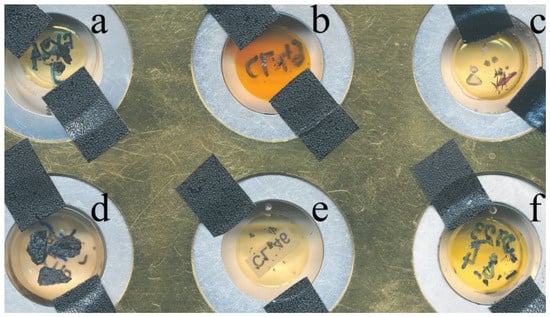
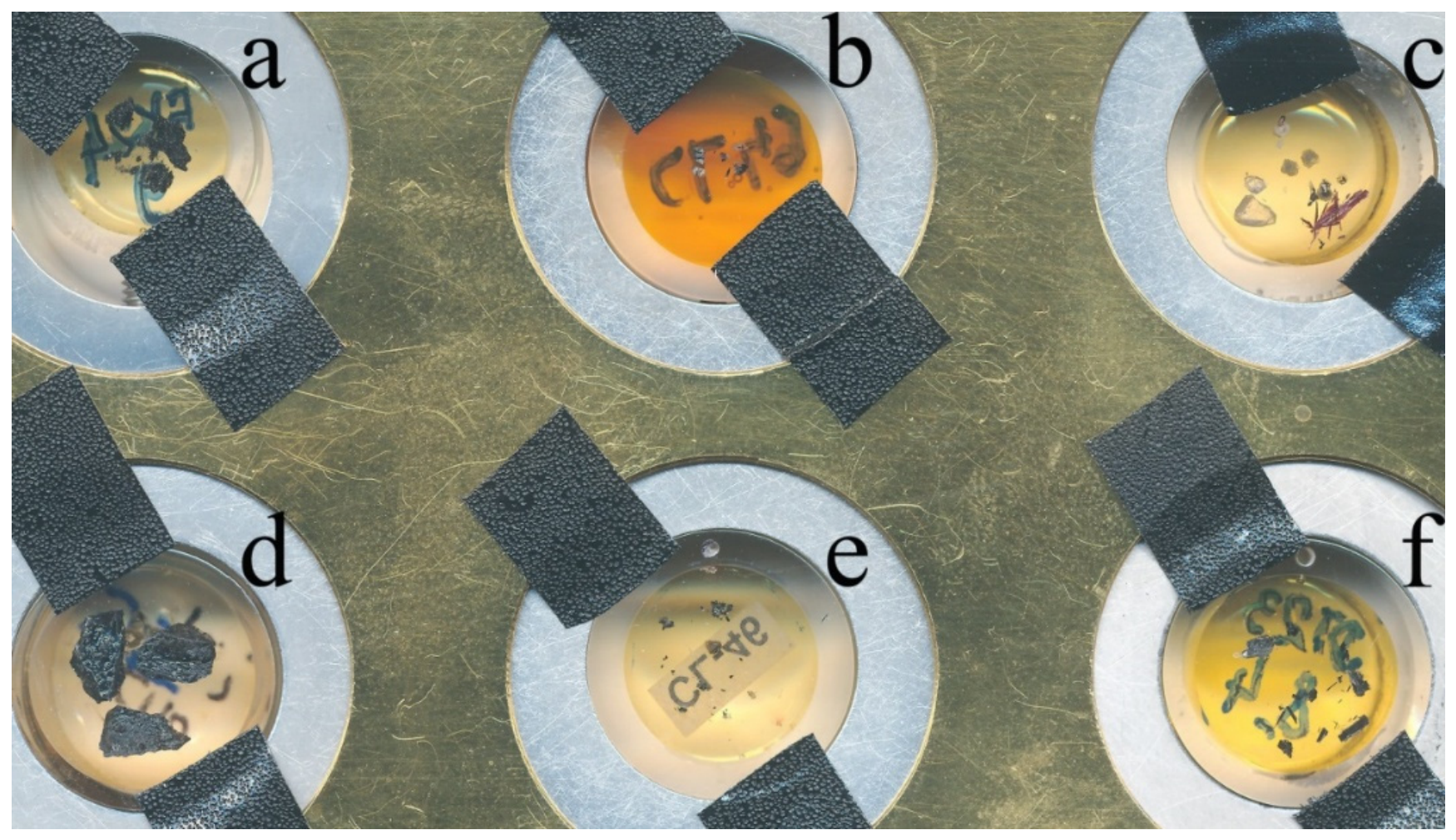
Figure 1 shows the arrangement of the samples in the EPMA specimen holder and the general appearance of the analyzed grains.
Figure 1.
Optical images of the oxygen standard ((c)—kermesite from Pezinok) and investigated samples: (a) rouxelite from Buca della Vena (BdV); (b) scainiite and zinkenite from BdV; (d) boulangerite, chovanite, and robinsonite from Malé Železné (MZ); (e) pillaite and pellouxite from BdV; and (f) rouxelite from Monte Arsiccio (MA).
Preliminary EPMA measurements of the major elements (metals, sulfur, and chlorine) were performed at 25 kV to establish representative average chemical compositions for each mineral. These compositions were subsequently used to simulate the corresponding analytical matrices for oxygen measurements at accelerating voltages of 7, 10, and 15 kV, as described below.
3.1. Chemical Composition
3.1.1. Determination of Metals, Sulfur, and Chlorine Contents
Chemical analyses of the oxy-(chloro)-sulfosalt minerals were performed at the Central Research Laboratories of the Natural History Museum Vienna using a JEOL JXA-8530F HyperProbe (JEOL Ltd., Tokyo, Japan) field-emission electron microprobe (FE-EPMA). Measurements were acquired in wavelength-dispersive spectrometry (WDS) mode using a synchronous analytical procedure. For each analytical run, the spectrometers were first positioned at the peak positions of the selected elements, after which the stage was moved sequentially to all analysis points and peak intensities were recorded. The spectrometers were then moved to the corresponding background positions, and background intensities were acquired at the same points. This sequence was repeated for the second and third element groups (Table 4). All five spectrometers and all six diffracting crystals available on the instrument were used.
Table 4.
EPMA measurement conditions for metals, S, Cl, and O.
The following analytical lines and natural or synthetic reference materials were used: AsLα and TlLα (lorándite, TlAsS2), PbMα (galena), AgLα (Ag metal), SbLα and SKα (stibnite), HgLα (cinnabar), CuKα and FeKα (chalcopyrite), and ClKα (KCl). Elements present only at trace levels, such as Bi and Mn, were not analysed.
Detailed analytical conditions, including general operating parameters, JEOL-specific instrumental settings, and characteristics of the reference materials, are summarized in Table 4.
An empirical correction was applied for interference of the third-order SbLα line with the AsLα signal on the JEOL instrument. Raw X-ray intensities were corrected for matrix effects using the standard JEOL ZAF procedure.
The analytical configuration included all major elements commonly encountered in oxy-(chloro)-sulfosalts: Ag, Cu, Tl, Hg, Pb, Fe, As, Sb, S, and Cl.
The analytical results are presented in Table 5 as average chemical compositions (wt.%) calculated from the number of analyzed points (No.) reported for each sample. Under the conditions used to determine metals, sulfur, and chlorine, the average detection limits (DLs), expressed in wt.% with standard deviations in parentheses, were 0.016(0) for Cu, 0.033(1) for Ag, 0.074(2) for Tl, 0.062(2) for Hg, 0.047(2) for Pb, 0.016(0) for Fe, 0.037(0) for As, 0.025(1) for Sb, 0.010(1) for S, and 0.001(0) for Cl.
Table 5.
EPMA analyses of metals, sulfur, and chlorine at 25 kV: average chemical compositions (wt.%) based on the reported number of analysed points (No.). Mineral and locality abbreviations are as in Table 1; MZ = Malé Železné. DL denotes the detection limit. EPMA analyses for all measured points, except for rouxelite Rxl from MA, are given in Table S1 in Supplementary Materials.
The compositions obtained in the present study (Table 5) generally agree with previously published chemical data (MC; Table 2). Chlorine in scainiite (0.13 wt.%, corresponding to 0.31 apfu) is clearly detectable and noteworthy. Trace concentrations of Cu, Ag, Tl, Hg, and Fe in some samples fall below their respective detection limits; these values are nevertheless retained in Table 5 for completeness and to facilitate comparison with published analyses.
For rouxelite from the Monte Arsiccio deposit, the average compositional data reported by Topa et al. (2025) [17] were used.
3.1.2. Measurement of Oxygen Content
Kermesite, Sb2S2O, with a theoretical oxygen content of 4.944 wt.%, was used as the oxygen reference standard. The red kermesite crystals (Figure 1c) were provided by Uwe Kolitsch from an NHM specimen without a collection number, originating from the Nová Alexander adit, Kolársky vrch deposit, Pezinok, Slovakia.
The selected analytical conditions—accelerating voltages of 7, 10, and 15 kV, a beam current of 50 nA, a beam diameter of 5 μm, and a total counting time of 50 s per analysis point (peak plus background)—did not produce visible bubble formation or sample surface damage during individual measurements.
Oxygen was measured in synchronous WDS mode for both the kermesite standard and the selected oxy-(chloro)-sulfosalt samples. Detectable but low count rates were obtained at 7, 10, and 15 kV (Table 4) using the half-slit setting of the flow proportional counter on spectrometer 1. A fully open slit produced substantially higher background noise and was therefore not used.
Potential interferences from PbMα, SbLα, and SLα at the oxygen peak and background positions (Table 4) were evaluated at 7, 10, and 15 kV. The JEOL software (Ver. 3.0.1.17) indicated no line interferences for reflection orders up to n = 3. Raw data were processed using the JEOL online ZAF correction program.
Estimated generation depths and lateral spatial resolution for a focused beam were approximately 0.3, 0.5, and 1.1 μm at 7, 10, and 15 kV, respectively. Because oxygen measurements were acquired with a 5 μm defocused beam, the effective lateral spatial resolution is correspondingly broader.
Measurements at 7 and 15 kV were less reliable than those at 10 kV. At 7 kV, low count rates produced poor signal-to-noise ratios and large statistical uncertainties. At 15 kV, the large absorption correction required for oxygen (absorption factor ≈ 1.65) reduced analytical precision. Oxygen data obtained at 7 and 15 kV are therefore not discussed further. Oxygen concentrations (wt.%) and empirical formulae derived from the 10 kV measurements are presented in Table 6.
Table 6.
EPMA measurements of oxygen at 10 kV: average oxygen contents (wt.%) based on the reported number of analysed points (No.) and matrix compositions derived from Table 5. Mineral and locality abbreviations are as in Table 1; MZ = Malé Železné. Oxygen values above the corresponding detection limits are shown in bold; values below the detection limits are shown in bold italics. Empirical formulae are expressed as atoms per formula unit (apfu). Formula calculations for chovanite, rouxelite, and meerschautite are normalized to the sum of metal atoms. (All data are in Table S2).
The oxygen detection limit was determined separately for each analysed mineral and is reported with its standard deviation. Detection limits range from 0.056(2) wt.% O for rouxelite from Buca della Vena and meerschautite to 0.070(2) wt.% O for kermesite.
Excluding the five measurements on the kermesite reference standard, 127 analytical points were collected from five samples on six oxy-(chloro)-sulfosalts (scainiite, pillaite, pellouxite, chovanite, rouxelite, and meerschautite) and three oxygen-free sulfosalts (boulangerite, robinsonite, and zinkenite). The results yield three principal observations:
- No measurable oxygen was detected in the oxygen-free sulfosalts.
- Scainiite, pillaite, and pellouxite yielded oxygen contents consistent with the theoretical values derived from their ideal formulae.
- Oxygen concentrations in chovanite, rouxelite, and meerschautite remained below the analytical detection limits.
For chovanite (MZ and MA), rouxelite (BdV and MA), and meerschautite (P), mean oxygen concentrations and standard deviations were calculated from all analytical points. The total number of analyses (No.) was subdivided into three categories: x, analyses with no detectable oxygen signal; y, analyses in which oxygen was detected but remained below the detection limit; and z, analyses in which oxygen was detected above the detection limit, such that No. = x + y + z.
The results are as follows:
- Chovanite (MZ): 0.037(37) wt.% O (No. = 10; x = 3, y = 5, z = 2)
- Chovanite (MA): 0.035(51) wt.% O (No. = 7; x = 4, y = 1, z = 2)
- Rouxelite (BdV): 0.045(30) wt.% O (No. = 10; x = 2, y = 6, z = 2)
- Rouxelite (MA): 0.034(41) wt.% O (No. = 26; x = 11, y = 8, z = 7)
- Meerschautite (P): 0.035(40) wt.% O (No. = 30; x = 13, y = 7, z = 10).
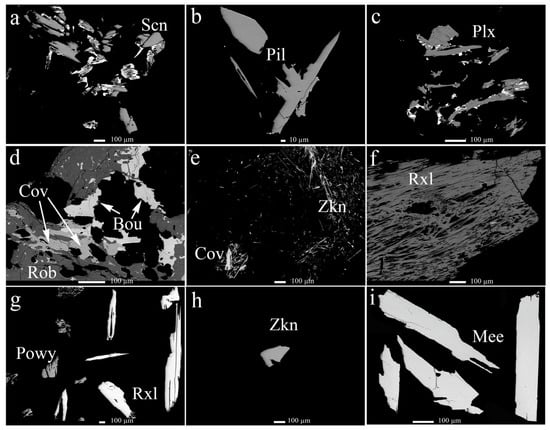
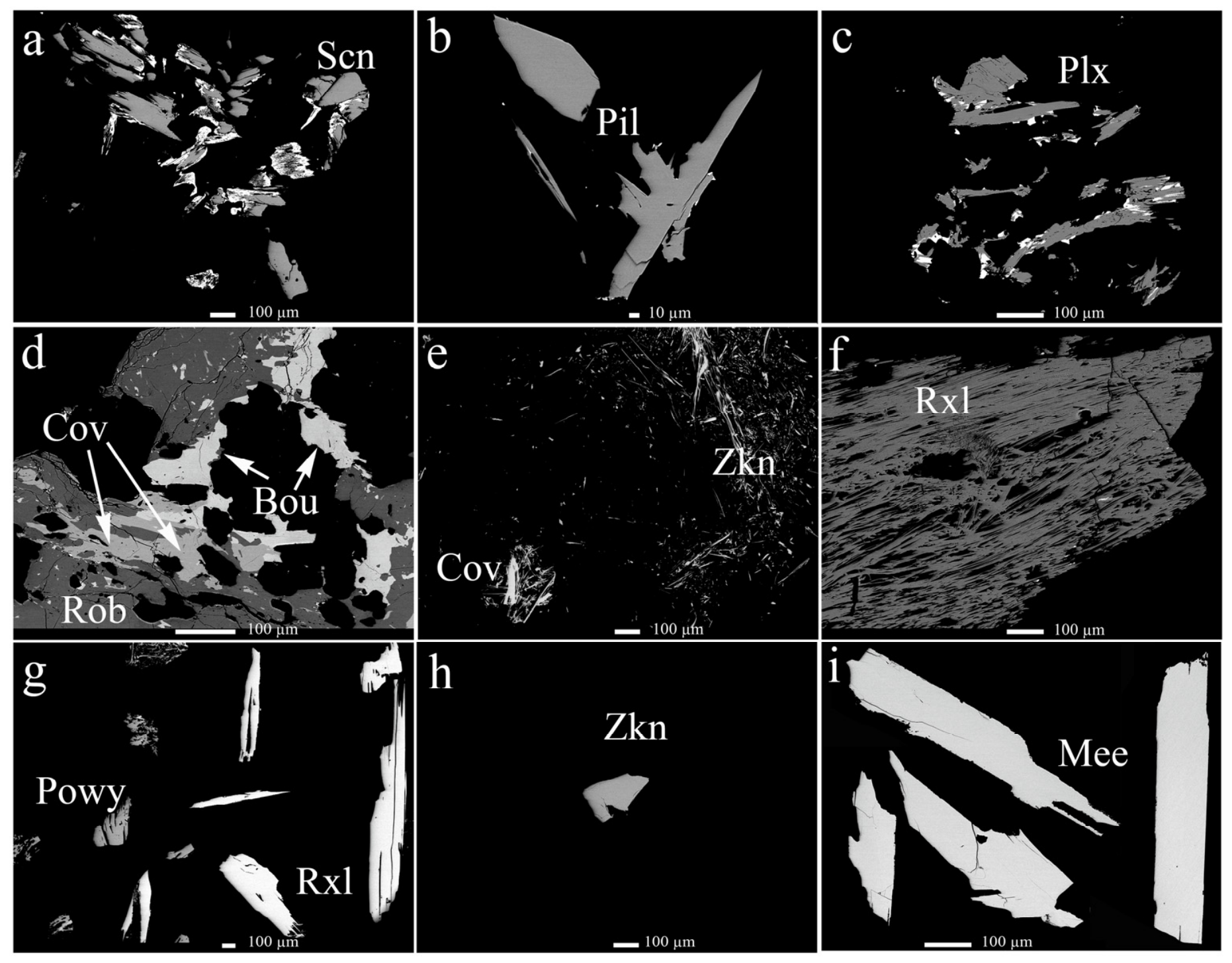
In all cases, the standard deviations are equal to or greater than the corresponding mean values, indicating substantial scatter and poor analytical precision. In addition, only about one-third of the analytical points yielded oxygen concentrations above the relevant detection limits (z values). The number of reliable oxygen analyses was further limited by: (1) small crystal dimensions relative to the more than 5 μm beam diameter (e.g., chovanite and zinkenite from Monte Arsiccio; Figure 2e); (2) possible contamination from the surrounding oxygen-bearing epoxy (e.g., rouxelite from Buca della Vena; Figure 2f); (3) quartz inclusions (e.g., chovanite from Malé Železné; Figure 2d); and (4) local exfoliation of the carbon coating during prolonged analytical sessions. The mean oxygen concentrations reported for chovanite, rouxelite, and meerschautite should therefore not be treated as robust quantitative values. Because they lie below the analytical detection limits, their absolute magnitudes depend strongly on the number and distribution of measurement points and cannot by themselves be interpreted as evidence for structurally significant oxygen.
Figure 2.
Backscattered-electron (BSE) images of chemically homogeneous grains: (a) scainiite (Scn) and Sb-bearing galena from BdV; (b) pillaite (Pil) and Sb-bearing galena from BdV; (c) pellouxite (Plx) from BdV; (d) boulangerite (Bou), chovanite (Cov), and robinsonite (Rob) from Malé Železné (MZ); (e) chovanite (Cov) and zinkenite (Zkn) from MA; (f) rouxelite (Rxl) from BdV; (g) rouxelite (Rxl) and proto-owyheeite (Powy) from MA; (h) zinkenite (Zkn) from BdV; and (i) meerschautite (Mee) from Pollone (P).
4. Discussion
4.1. Chemistry
The oxygen contents measured for scainiite, pillaite, and pellouxite (Table 6) agree, within analytical uncertainty, with the values predicted from their accepted ideal formulae (Table 2). This agreement shows that kermesite provides a suitable oxygen standard and that the analytical conditions used here can yield reliable EPMA oxygen determinations at these concentration levels.
The potential introduction of oxygen during sample preparation was evaluated on the basis of analyses of three oxygen-free sulfosalts (boulangerite, robinsonite, and zinkenite), all of which yielded oxygen contents below the detection limit.
The mean oxygen concentrations obtained for chovanite from Monte Arsiccio, rouxelite from Buca della Vena, and meerschautite from Pollone—0.035, 0.045, and 0.035 wt.% O, respectively—are lower than values inferred from the published structural models (0.136, 0.205, and 0.069 wt.% O, respectively). Because oxygen contents near 0.2 wt.% are readily detected in pillaite and pellouxite, the rouxelite discrepancy is particularly significant. For chovanite and meerschautite, whose proposed oxygen contents are much closer to the detection limit, the present EPMA data provide weaker but still independent constraints on the structural models.
For rouxelite from Monte Arsiccio, the measured mean oxygen content (0.034 wt.%) is also below the calculated values of 0.059 and 0.098 wt.% O for the models with independently refined S and O occupancies [67(3)% S and 19(4)% O] and with the summed S + O occupancy constrained to unity [68(3)% S and 32(3)% O], respectively. The first predicted value is close to the 0.065 wt.% detection limit for this sample, whereas the constrained model predicts an oxygen content clearly above it.
An alternative analytical approach is using the Probe for EPMA software package (Ver. 11.5.3) package installed on the JEOL instrument, which permits more sophisticated treatment of potential spectral interferences during data acquisition. Such measurements are currently in progress and may further improve the practical oxygen detection limit; their results will be reported separately.
Other methods may provide greater sensitivity to trace oxygen or independent evidence for oxygen-bearing structural units. Techniques such as secondary ion mass spectrometry (SIMS), laser-induced breakdown spectroscopy (LIBS), and vibrational spectroscopy offer different trade-offs in detection limit, quantification, spatial resolution, and sample damage. Used alongside EPMA and crystallography, they could help to test the presence of trace oxygen in the minerals considered here.
Theoretical approaches may also be valuable. Ab initio calculations, bond-valence analysis, and vibrational-spectral modelling could help evaluate: (a) preferred crystallographic sites for oxygen incorporation; (b) the energetic feasibility of oxygen substitution in sulfosalt structures; (c) Raman-active modes associated with oxygen-bearing structural units; (d) crystallographic artifacts that could mimic oxygen occupancy; and (e) the influence of oxygen incorporation on bonding, stability, and electronic structure. Although these approaches are beyond the scope of the present study, they could provide important constraints in future investigations.
4.2. Structure
The published structures of the minerals considered here have been described using different modular representations, including rod- and boxwork-based models. These representations provide useful descriptions of structural topology, but the present comparison is restricted to the local coordination environments and occupancies of sites assigned to oxygen. The corresponding global structural architectures are described in the cited original studies. In rod-based descriptions, oxygen sites occur within closed PbS-like or SnS-like rods, except in meerschautite, for which a boxwork representation is commonly used.
A comparison of oxygen–cation distances and oxygen occupancies in published oxy-(chloro)-sulfosalt structures is presented in Table 7. For kermesite, scainiite, pillaite, and pellouxite, whose oxygen contents are independently supported by EPMA, the oxygen–metal distances are consistent with plausible bonding environments (i.e., short Sb–O contacts, commonly around 2.0–2.25 Å). By contrast, several proposed oxygen sites in chovanite, rouxelite, and meerschautite include unusually long oxygen–cation contacts and less compelling coordination geometries (e.g., Pb–O contacts whose contribution is expected to be substantially weaker).
Table 7.
Oxygen–cation distances and oxygen occupancies in published oxy-(chloro)-sulfosalt structures. Sites and bond distances shown in italics correspond to long contacts with negligible bond strength according to the charge-distribution hierarchy approach. Bold lettering denotes occupancies of oxygen positions.
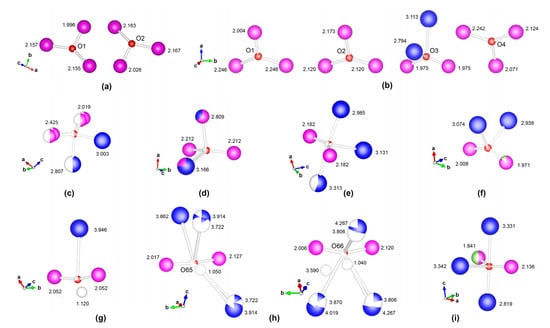
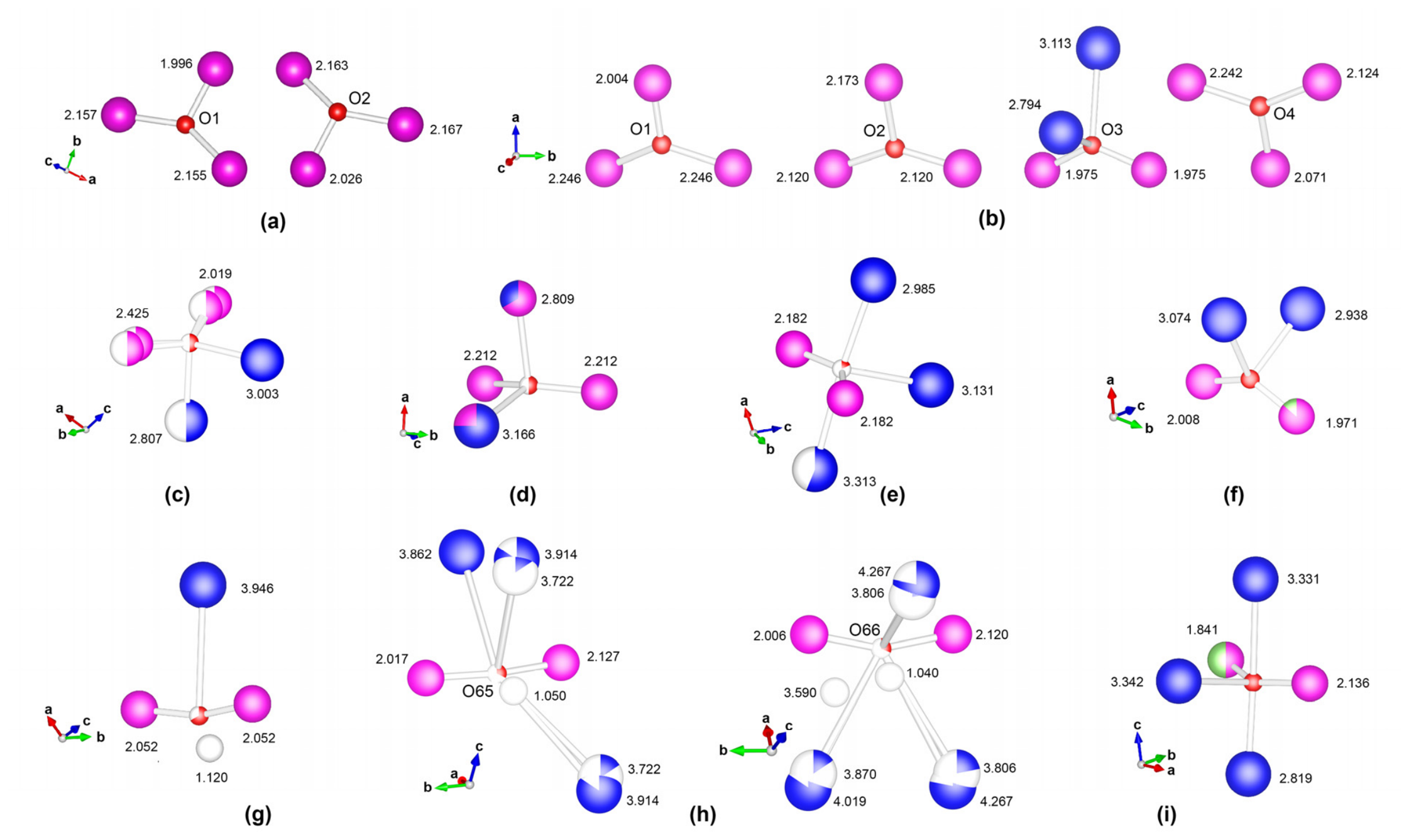
Figure 3 presents a synoptic comparison of oxygen-centred coordination polyhedra in the structures considered here. Full structure projections and descriptions of the corresponding modular architectures are provided in the original crystallographic references cited in the figure caption. Coordination environments were evaluated using a 4 Å cutoff and by considering interactions according to charge-distribution hierarchy principles [21]. In this approach, bonds are assigned relative weights that decrease exponentially with increasing bond length, so that sufficiently long contacts make negligible contributions to the effective coordination number and charge distribution. The 4 Å limit therefore includes both significant bonds and longer, weakly contributing contacts.
Figure 3.
Synoptic comparison of oxygen-centered coordination environments in the crystal structures considered in this study: (a) kermesite [2]; (b) scainiite [4]; (c) pellouxite [12]; (d) pillaite [10]; (e) chovanite from Dúbrava [13]; (f) chovanite from Pollone [14] and Monte Arsiccio [15]; (g) rouxelite from Buca della Vena [16]; (h) rouxelite from Monte Arsiccio (present paper); and (i) meerschautite from Pollone [18]. Purple spheres represent Sb atoms, dark-blue spheres Pb, red spheres O, and white spheres S. Arsenic, occurring as an isomorphic substitute for Sb, is shown in green. Partially coloured spheres denote sites with incomplete occupancy. Numbers adjacent to neighbouring atoms indicate bond lengths (Å) to the central oxygen atom. For rouxelite from Monte Arsiccio (h), three refinement models were evaluated: (1) a sulfur-only site with freely refined occupancy [69(3)% S]; (2) oxygen and sulfur with independently refined occupancies [67(3)% S and 19(4)% O]; and (3) oxygen and sulfur with their total occupancy constrained to unity [68(3)% S and 32(3)% O]. The coordination in the figure depicts the third situation. The (h) panel also includes the more distant splitting counterparts of the partially occupied Pb atoms.
No unique coordination scheme emerges. Oxygen generally has a low coordination number: values near three occur in Sb-dominated environments, whereas mixed Sb–Pb (±As) environments commonly approach four. Coordination numbers as high as five occur only in chovanite and meerschautite.
The shortest and most chemically plausible contacts are Sb–O bonds, which in the structures compared here range from approximately 1.84 to 2.81 Å. Contacts involving Pb or mixed Pb–Sb environments extend to substantially greater distances (approximately 2.79–3.91 Å), with some overlap between the two ranges. Several contacts longer than 3 Å contribute little or no bond strength in bond-valence terms. These observations question the structural significance of some proposed oxygen sites and are consistent with the lack of independent chemical evidence for substantial oxygen in chovanite, rouxelite, and meerschautite.
In rouxelite from Buca della Vena (Figure 3g) and Monte Arsiccio (Figure 3h), oxygen was modelled on mixed or split positions shared with sulfur. The lack of a distinctive recurrent oxygen-coordination environment, together with the low electron density associated with partly occupied oxygen sites, means that alternative O/S/vacancy models may yield similar conventional refinement statistics. Crystallographic refinement alone may therefore be insufficient to establish the presence and abundance of oxygen at these sites.
Bulk oxygen abundance and the occupancy of an individual crystallographic site are related but distinct quantities. In the proposed oxy-sulfosalt formulae discussed here, oxygen is strongly subordinate to sulfur, yet it may be concentrated at one or a few specific sites. Examples include chovanite from Dúbrava, with approximately 0.2 O versus 36 S atoms per formula unit [13]; chovanite from Monte Arsiccio and Pollone, with 1 O versus 72 S atoms [14,15]; rouxelite from Buca della Vena, with 1.33 O versus 64.67 S atoms [16]; rouxelite from Monte Arsiccio, with 1 O versus 261 S atoms in the idealized oxygen-bearing model [17]; and meerschautite, with 0.8 O versus 112 S atoms [18]. Such low oxygen-to-sulfur ratios inherently complicate independent chemical verification of oxygen.
A low oxygen concentration in a bulk chemical formula does not, by itself, establish how oxygen is distributed among crystallographic sites. In rouxelite, this distinction is critical because the proposed mixed-site O/S ratios differ substantially between published structural models. The present EPMA results do not support the ⅔O–⅓S model proposed for rouxelite from Buca della Vena [16] or the fully occupied mixed (S,O) model evaluated for rouxelite from Monte Arsiccio [17], because both imply oxygen concentrations above the relevant detection limits. The data are more compatible with a partly vacant anion site. In the refinement of the Monte Arsiccio material [17], oxygen occupancy is only 19(4)%, remaining subordinate even at the site in which it is proposed to occur. At present, the combined data do not demonstrate that oxygen is an essential constituent of the rouxelite structure.
5. Conclusions
Quantitative EPMA measurements under optimized low-voltage conditions show that oxygen can be reliably detected and quantified in oxy-(chloro)-sulfosalts at concentrations of approximately 0.2 wt.% O and above. Measured oxygen contents in scainiite, pillaite, and pellouxite agree with the values expected from their accepted crystal structures and ideal formulae, supporting the analytical procedure used in this study.
No oxygen was detected in the oxygen-free sulfosalts boulangerite, robinsonite, and zinkenite. Under the present polishing, carbon-coating, and analytical conditions, sample preparation therefore did not generate a measurable oxygen signal. A surface-oxidation correction should not be assumed without independent evidence under the specific analytical conditions used.
In contrast, the mean oxygen concentrations measured in the examined chovanite, rouxelite, and meerschautite specimens (0.034–0.045 wt.%) were below their respective detection limits (0.056–0.066 wt.%). Although these results do not establish the absence of oxygen, they do not provide reliable quantitative confirmation of the oxygen abundances inferred from published structural models. The discrepancy is particularly significant for rouxelite, for which certain models predict oxygen concentrations well above the detection limit. For models predicting oxygen contents close to this limit, the present EPMA results are less conclusive.
Accordingly, not all minerals presently classified as oxy-sulfosalts may ultimately prove to contain structurally significant oxygen. Resolving this issue will require analytical methods with lower oxygen detection limits, combined with minimally constrained crystallographic refinements and independent crystal-chemical or theoretical tests.
If future studies confirm only trace oxygen in some of these minerals, their currently accepted ideal formulae may require revision. In such cases, oxygen should be represented in a manner consistent with experimentally supported site occupancies rather than by assuming fully occupied oxygen-bearing sites.
A broader mineralogical question is whether oxygen concentrations of only a few hundred parts per million can be structurally essential enough to justify classification as an oxy-sulfosalt. Resolving this issue may affect mineral nomenclature, classification, and the definition of the oxy-sulfosalt group itself.
If further measurements and minimally constrained refinements demonstrate lower oxygen occupancies than currently assumed, the oxygen and sulfur coefficients in the published ideal formulae may need to be reassessed. Such a reassessment would not, by itself, constitute a proposal for a new mineral species.
Supplementary Materials
The following supporting information can be downloaded at: https://www.mdpi.com/article/10.3390/min16121227/s1, Table S1: Data for 25 kV element measurements in oxy-(chloro)-sulfosalts. Table S2: Data for 10 kV oxygen measurements in oxy-(chloro)-sulfosalts.
Author Contributions
Conceptualization, D.T. and F.N.K.; investigation (EPMA), D.T.; data interpretation, D.T., F.N.K., B.S. and G.I.; writing—original draft preparation, D.T.; writing—review and editing, D.T., F.N.K., B.S. and G.I. All authors have read and agreed to the published version of the manuscript.
Funding
This research received no external funding.
Data Availability Statement
The original contributions presented in this study are included in the article and its Supplementary Material. Further inquiries can be directed to the corresponding author.
Acknowledgments
The authors thank Uwe Kolitsch, Csanad Loranth, Hubert Putz, and A. Lechner for providing mineral specimens used in this study.
Conflicts of Interest
The authors declare no conflicts of interest.
References
- Moëlo, Y.; Makovicky, E.; Mozgova, N.N.; Jambor, J.L.; Cook, N.; Pring, A.; Paar, W.H.; Nickel, E.H.; Graeser, S.; Karup-Møller, S.; et al. Sulfosalt systematics: A review. Report of the sulfosalt sub-committee of the IMA Commission on Ore Mineralogy. Eur. J. Mineral. 2008, 20, 7–62. [Google Scholar] [CrossRef] [Scilit]
- Bonazzi, P.; Menchetti, S.; Sabelli, C. Structure refinement of kermesite: Symmetry, twinning and comparison with stibnite. Neues Jahrb. Mineral. Monatshefte 1987, 557–567. [Google Scholar]
- Orlandi, P.; Moëlo, Y.; Meerschaut, A.; Palvadeau, P. Lead–antimony sulfosalts from Tuscany (Italy). I. Scainiite, Pb14Sb30S54O5, the first Pb–Sb oxy-sulfosalt, from Buca della Vena mine. Eur. J. Mineral. 1999, 11, 949–954. [Google Scholar] [CrossRef] [Scilit]
- Moëlo, Y.; Meerschaut, A.; Orlandi, P.; Palvadeau, P. Lead–antimony sulfosalts from Tuscany (Italy). II. Crystal structure of scainiite, Pb14Sb30S54O5, an expanded monoclinic derivative of Ba12Bi24S48 hexagonal sub-type (zinkenite series). Eur. J. Mineral. 2000, 12, 835–846. [Google Scholar] [CrossRef] [Scilit]
- Breskovska, V.V.; Mozgova, N.N.; Bortnikov, N.S.; Gorshkov, A.I.; Tsepin, A.I. Ardaite—A new lead-antimony chloro-sulphosalt. Mineral. Mag. 1982, 46, 357–361. [Google Scholar] [CrossRef] [Scilit]
- Laflamme, J.H.G.; Walker, D.A.; Jambor, J.L. A re-examination of the Madoc sulfosalts. Mineral. Rec. 1982, 13, 93–100. [Google Scholar]
- Jambor, J.L. Dadsonite (minerals Q and QM), a new lead sulphantimonide. Mineral. Mag. 1969, 37, 437–441. [Google Scholar] [CrossRef] [Scilit]
- Makovicky, E.; Topa, D.; Mumme, W.G. The crystal structure of dadsonite. Can. Mineral. 2006, 44, 1499–1512. [Google Scholar] [CrossRef] [Scilit]
- Orlandi, P.; Moëlo, Y.; Meerschaut, A.; Palvadeau, P. Lead–antimony sulfosalts from Tuscany (Italy). III. Pillaite, Pb9Sb10S23ClO0.5, a new Pb–Sb oxy-chloro-sulfosalt, from Buca della Vena mine. Eur. J. Mineral. 2001, 13, 605–610. [Google Scholar] [CrossRef] [Scilit]
- Meerschaut, A.; Palvadeau, P.; Moëlo, Y.; Orlandi, P. Lead–antimony sulfosalts from Tuscany (Italy). IV. Crystal structure of pillaite, Pb9Sb10S23ClO0.5, an expanded monoclinic derivative of hexagonal Bi(Bi2S3)9I3, from the zinkenite group. Eur. J. Mineral. 2001, 13, 779–790. [Google Scholar] [CrossRef] [Scilit]
- Orlandi, P.; Moëlo, Y.; Meerschaut, A.; Palvadeau, P.; Léone, P. Lead–antimony sulfosalts from Tuscany (Italy). VI. Pellouxite, (Cu,Ag)2Pb21Sb23S55ClO, a new oxy-chloro-sulfosalt, from Buca della Vena mine, Apuan Alps. Eur. J. Mineral. 2004, 16, 839–844. [Google Scholar] [CrossRef] [Scilit]
- Palvadeau, P.; Meerschaut, A.; Orlandi, P.; Moëlo, Y. Lead–antimony sulfosalts from Tuscany (Italy). VII. Crystal structure of pellouxite, (Cu,Ag)2Pb21Sb23S55ClO, an expanded monoclinic derivative of Ba12Bi24S48 hexagonal sub-type (zinkenite group). Eur. J. Mineral. 2004, 16, 845–855. [Google Scholar] [CrossRef] [Scilit]
- Topa, D.; Sejkora, J.; Makovicky, E.; Pršek, J.; Ozdín, D.; Putz, H.; Dittrich, H.; Karup-Møller, S. Chovanite, Pb15−2xSb14+2xS36Ox (x ≈ 0.2), a new sulphosalt species from the Low Tatra Mountains, Western Carpathians, Slovakia. Eur. J. Mineral. 2012, 24, 727–740. [Google Scholar] [CrossRef] [Scilit]
- Biagioni, C.; Moëlo, Y. Lead-antimony sulfosalts from Tuscany (Italy). XIX. Crystal chemistry of chovanite from two new occurrences in the Apuan Alps and its 8 Å crystal structure. Mineral. Mag. 2017, 81, 811–831. [Google Scholar] [CrossRef] [Scilit]
- Biagioni, C.; Moëlo, Y.; Perchiazzi, N.; Demitri, N.; Lepore, G.O. Lead-antimony sulfosalts from Tuscany (Italy). XXIV. Crystal structure of thallium-bearing chovanite, TlPb26(Sb,As)31S72O, from the Monte Arsiccio Mine, Apuan Alps. Minerals 2018, 8, 535. [Google Scholar] [CrossRef] [Scilit]
- Orlandi, P.; Meerschaut, A.; Moëlo, Y.; Palvadeau, P.; Léone, P. Lead–antimony sulfosalts from Tuscany (Italy). VIII. Rouxelite, Cu2HgPb22Sb28S64(O,S)2, a new sulfosalt from Buca della Vena mine, Apuan Alps: Definition and crystal structure. Can. Mineral. 2005, 43, 919–933. [Google Scholar] [CrossRef] [Scilit]
- Topa, D.; Stoeger, B.; Keutsch, F.N.; Ilinca, G. The 8 Å crystal structure and new crystal-chemical data of rouxelite from the Monte Arsiccio mine, Apuan Alps, Italy. Eur. J. Mineral. 2025, 37, 591–616. [Google Scholar] [CrossRef] [Scilit]
- Biagioni, C.; Moëlo, Y.; Orlandi, P.; Stanley, C. Lead-antimony sulfosalts from Tuscany (Italy). XVII. Meerschautite, (Ag,Cu)5.5Pb42.4(Sb,As)45.1S112O0.8, a new expanded derivative of owyheeite from the Pollone mine, Valdicastello Carducci: Occurrence and crystal structure. Mineral. Mag. 2016, 80, 675–690. [Google Scholar] [CrossRef] [Scilit]
- Topa, D.; Stoeger, B.; Keutsch, F.N.; Stanley, C. Huntingdonite, IMA 2024-027. In CNMNC Newsletter 81. Eur. J. Mineral. 2024, 36, 917–923. [Google Scholar] [CrossRef] [Scilit]
- Warr, L.N. IMA–CNMNC approved mineral symbols. Mineral. Mag. 2021, 85, 291–320. [Google Scholar] [CrossRef] [Scilit]
- Ilinca, G. Charge distribution and bond valence sum analysis of sulfosalts—The ECoN21 computer program. Minerals 2022, 12, 924. [Google Scholar] [CrossRef] [Scilit]

Disclaimer/Publisher’s Note: The statements, opinions and data contained in all publications are solely those of the individual author(s) and contributor(s) and not of MDPI and/or the editor(s). MDPI and/or the editor(s) disclaim responsibility for any injury to people or property resulting from any ideas, methods, instructions or products referred to in the content. |
© 2026 by the authors. Licensee MDPI, Basel, Switzerland. This article is an open access article distributed under the terms and conditions of the Creative Commons Attribution (CC BY) license.