


Abstract
Tantalum and niobium are critical strategic rare refractory metals; however, most associated tantalum–niobium resources are characterized by ultra-low grade, finely disseminated grains, and severe argillization, which causes pronounced slime coating of gangue mica on valuable mineral surfaces and impedes efficient recovery via gravity separation. In this study, an innovative beneficiation route combining sodium silicate pre-dispersion conditioning with shaking-table gravity separation was proposed to recover a spodumene-dominant pegmatitic lithium ore containing trace associated Nb–Ta minerals, with mica as the major slime-forming gangue. Process mineralogy analysis revealed that the raw ore has a total (Nb,Ta)2O5 grade of only 0.019%, with the main valuable minerals being columbite-(Mn), columbite–tantalite, and tantalite, whereas layered mica minerals constitute the primary argillization gangue that readily generates micro-fine slimes smaller than 5 μm. Single-factor tests demonstrated that the optimal grinding fineness was 84.4% passing 200 mesh, and the optimal feed pulp density for gravity separation was 28.6%. Adjusting pulp concentration alone, without a dispersant, yielded a Nb2O5 concentrate grade of merely 0.144%, as severe slime coating greatly limited separation selectivity. Following the introduction of sodium silicate for pre-dispersion, the separation performance improved markedly at the optimal dosage of 300 g/t: the concentrate Nb2O5 grade reached 1.28% (8-fold higher than the blank test), and the Ta2O5 grade increased to 0.47% (85-fold higher than the blank test). Multi-scale characterization, including zeta potential measurements, ultraviolet–visible (UV–vis) diffuse reflectance spectroscopy, Fourier-transform infrared spectroscopy (FTIR), and X-ray photoelectron spectroscopy (XPS), was employed to elucidate the dispersion mechanism of sodium silicate. The results confirmed that sodium silicate undergoes selective chemisorption on mica surfaces by forming Si–O–Al bonds with surface Al–OH active sites, which substantially increases electrostatic repulsion between mineral particles and eliminates mica slime coating on tantalum–niobium minerals. In contrast, sodium silicate exhibits only weak physical adsorption on tantalum–niobium mineral surfaces, with no evident chemical bonding. This work provides a low-cost, eco-friendly pretreatment–gravity separation coupling technology for the efficient enrichment of argillized ultra-low-grade tantalum–niobium associated ores and offers theoretical guidance for the green utilization of complex tantalum–niobium tailings and low-grade mineral resources.
1. Introduction
Tantalum (Ta) and niobium (Nb) are critical rare refractory strategic metals. Owing to their outstanding high-temperature resistance, corrosion resistance, superconductivity, and dielectric properties, they serve as indispensable foundational materials in numerous high-end fields, including national defense, aerospace, precision electronic manufacturing, nuclear fusion, special metallurgy, and the nuclear industry [1]. Given their pivotal strategic status, major economies, represented by the United States and the European Union, have included tantalum and niobium in their lists of critical minerals for priority protection, as these metals are essential for safeguarding the autonomy and stability of global industrial and supply chains [2]. Globally, tantalum and niobium resources are highly geographically concentrated, with high-grade independent deposits located primarily in a small number of countries, such as Brazil and Canada. This geographical imbalance results in long-term high external reliance and pronounced supply shortages in major consuming regions [3,4]. Despite considerable global niobium reserves, high-grade independent niobium deposits are extremely scarce. More than 90% of tantalum and niobium resources occur as associated minerals in iron ores, rare-earth polymetallic ores, and tailings, which are generally characterized by low grade, fine particle size, complex mineral composition, and extensive paragenesis [5,6]. Against the backdrop of growing demand from high-end manufacturing, the mismatch between limited high-quality mineral resources and industrial demand necessitates the efficient exploitation of low-grade associated resources and improved resource recycling efficiency, which is essential for mitigating strategic mineral supply risks and achieving sustainable resource utilization.
Nevertheless, the industrial exploitation of associated tantalum–niobium resources remains hampered by formidable technical bottlenecks worldwide. Their inherent ultra-low grade and finely disseminated grains, which are susceptible to argillization, fundamentally restrict the efficient separation and recovery of target minerals. This issue is prevalent in typical Chinese tantalum–niobium metallogenic belts, including Bayan Obo, Yichun, and Keketuohai [7]. As a world-class niobium-rich zone, the western Bayan Obo deposit contains iron beneficiation tailings with an Nb2O5 grade of only 0.068%. Although this grade exceeds the cut-off grade (typically 0.012%–0.026%), it remains far below the industrial grade of major global niobium deposits, rendering these tailings a typical ultra-low-grade refractory mineral resource. The gangue minerals are predominantly carbonates (dolomite and calcite) and layered silicates (biotite and pyroxene) [8]. These minerals exhibit low hardness and high brittleness, and are readily pulverized into abundant fine-grained slimes during grinding, severely complicating the mineral separation process. Three dominant technical bottlenecks constrain the efficient recovery of such ores. First, tantalum and niobium minerals are extremely finely disseminated, with most grains smaller than 38 μm, resulting in poor liberation and intensive intergrowth with gangue minerals [9]. Second, fine slime particles tend to aggregate and coat the surfaces of target minerals, which severely impairs interfacial selective separation and causes substantial losses of valuable minerals [10]. Third, the ultra-low feed grade demands an extremely high enrichment ratio, whereas conventional separation techniques fail to achieve a favorable trade-off between concentrate grade and recovery [11]. Consequently, considerable amounts of tantalum and niobium remain in tailings, resulting not only in the waste of strategic mineral resources but also in potential environmental hazards such as tailings land occupation and heavy metal leaching [12,13].
Current commercial techniques for recovering associated tantalum and niobium resources mainly include gravity separation, magnetic separation, flotation, and combined processes thereof, all of which exhibit inherent limitations in treating ultra-low-grade, readily argillized ores [14]. Gravity separation is widely used for pre-enrichment owing to its simple operation, low operational cost, and reagent-free nature [15]. However, it relies heavily on stable pulp dispersion [16]. In argillized pulp systems, fine gangue particles disrupt density stratification, leading to substantial losses of fine tantalum–niobium grains, with typical recovery rates below 30% and unsatisfactory grade upgrading [17]. Magnetic separation enables preliminary enrichment of weakly magnetic minerals but cannot effectively separate silicate and carbonate gangue with similar magnetic properties, thus failing to produce qualified high-grade concentrates [18,19]. Flotation achieves mineral separation through reagent regulation; however, the treatment of argillized ores requires excessive depressants and collectors, resulting in high reagent consumption and economic costs [20]. Furthermore, fine slimes severely disrupt bubble mineralization and degrade process stability, rendering flotation economically unviable for low-grade ore beneficiation [21]. Although the integrated magnetic–gravity–flotation process can moderately improve separation performance, its complicated workflow, high energy consumption, and substantial capital investment cannot fundamentally resolve slime interference, thereby limiting its large-scale industrial application [22]. Overall, existing technologies are incapable of simultaneously addressing the dual challenges of slime interference and efficient enrichment of ultra-low-grade tantalum–niobium resources [23]. It is therefore imperative to develop efficient, low-consumption, and eco-friendly pretreatment–separation coupled strategies to overcome the technical barriers to recovering such refractory resources.
To address these widespread technical challenges in mineral processing, this work proposes an innovative technical route involving water-glass-assisted pre-dispersion conditioning combined with gravity separation for the efficient enrichment of tantalum and niobium. A systematic investigation was conducted on the beneficiation of ultra-low-grade, argillization-prone associated tantalum–niobium resources. As a low-cost, widely available, and eco-friendly inorganic dispersant, water glass can modulate the surface electrical properties and dispersion behavior of mineral particles [24]. It effectively disintegrates fine slime aggregates and eliminates the coating of gangue minerals on tantalum–niobium surfaces, thereby optimizing pulp rheological properties and particle dispersion uniformity [25]. These modifications improve the density stratification environment during gravity separation and fundamentally eliminate separation deterioration induced by ore argillization. The coupling of optimized pre-conditioning and efficient gravity separation achieves effective pre-enrichment of ultra-low-grade tantalum and niobium minerals, simultaneously improving concentrate grade and metal recovery while ensuring economic efficiency and environmental sustainability. Compared with conventional flotation-dominated technologies, this route avoids heavy reagent reliance and reduces the energy consumption and operational costs associated with lengthy beneficiation workflows, making it highly compatible with the metallurgical characteristics of low-grade, argillization-prone associated ores. The proposed strategy can efficiently recover tantalum and niobium from abandoned tailings and low-grade ores, providing a novel approach for the green and efficient utilization of complex associated mineral resources. This study focuses on the dispersion and conditioning mechanism of water glass, parameter optimization of gravity separation, and the enrichment behavior of fine-grained tantalum–niobium minerals, aiming to provide a theoretical basis and technical guidance for the industrial beneficiation of ultra-low-grade argillized tantalum–niobium associated resources.
2. Materials and Methods
2.1. Materials
The low-grade mica-bearing tantalum–niobium ore used in this study was sourced from a locality in Sichuan Province, China. A portion of the ore was crushed to below 3 mm for mineralogical characterization. Another portion was crushed to below 2 mm using a roller crusher and then ground in a ball mill. The resulting product, with a −200 mesh content of 60%–65%, was used as the feed material for subsequent experiments. The water glass used was of industrial grade (Foshan Zhongfa Water-glass Factory, Foshan, China), with a modulus ranging from 2.3 to 2.4.
The main chemical composition of the raw ore is presented in Table 1. The total (Nb,Ta)2O5 grade of the sample is 0.019%, which is below or close to the minimum industrial grade (0.022%–0.028%) and can accordingly be classified as a spodumene-dominant pegmatitic lithium ore containing trace associated Nb–Ta minerals, with mica as the major slime-forming gangue.
Table 1.
Chemical multi-element analysis of the raw ore.
Mineralogically, this sample belongs to an LCT-type pegmatite-related rare-metal ore. Albite, quartz and spodumene are the predominant rock-forming minerals, while tantalum–niobium oxides occur as low-grade associated accessory phases. Mica-group gangue minerals readily produce fine slimes during grinding and cause severe slime-coating effects, which constitute the main technical obstacle for tantalum–niobium gravity separation. Therefore, this ore is termed “mica-bearing associated tantalum–niobium ore”, and the present work targets the comprehensive recovery of such scarce associated Ta-Nb resources.
2.2. Methods
The prepared sample was mixed with deionized water to form a slurry with a solids concentration of 28.6%. A predetermined amount of sodium silicate solution was then added as a dispersant, and the mixture was vigorously agitated for 30 min using a three-blade impeller at 600 rpm. The conditioned slurry was subsequently fed onto a laboratory-scale slime shaking table for gravity separation. The slurry was introduced at a volumetric feed rate of approximately 500 mL/min. The shaking table was operated at a shaking frequency of 45 Hz, a stroke length of 10 mm, a transverse tilt angle of 5°, and a wash-water flow rate of 2.0 L/min; these conditions had been optimized for fine-particle separation. Replicate shaking-table tests were conducted for each beneficiation condition. Error bars in Figure 1, Figure 2 and Figure 3 denote the standard deviation derived from repeated experimental runs. Surface characterization measurements (zeta potential, FTIR, UV–vis and XPS) were performed without experimental replication owing to the limited availability of hand-picked mineral separates; these results are interpreted as qualitative comparative evidence.
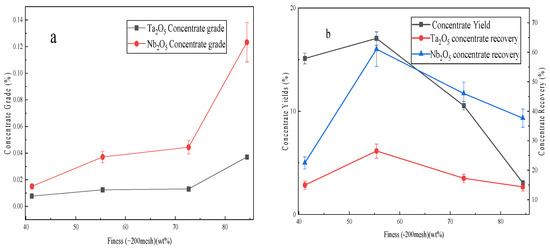
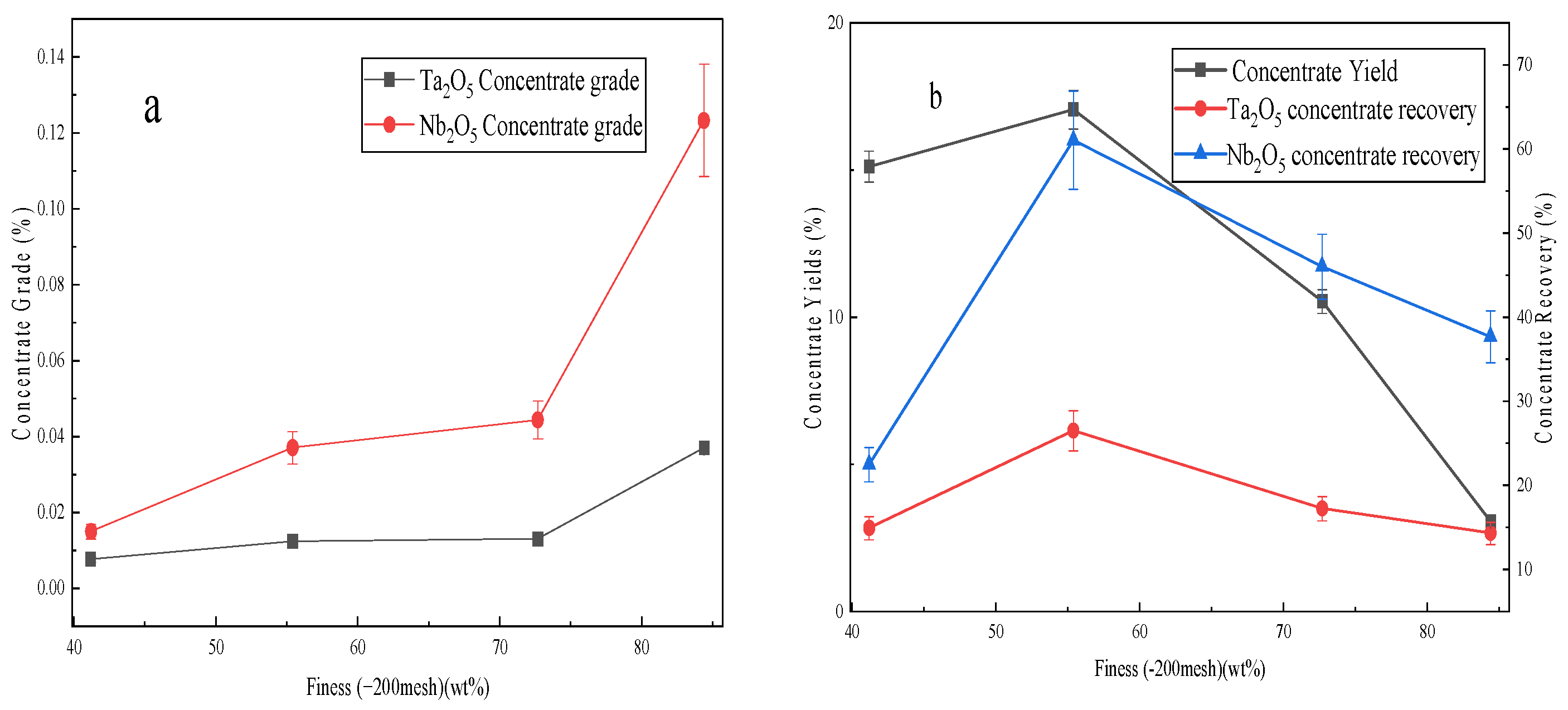
Figure 1.
Correlation of grinding fineness with concentrate grade, concentrate yield, and metal recovery ((a) Relationship between concentrate grade and grinding fineness. (b) Relationship between concentrate recovery-yield and grinding fineness. error bars represent the standard deviation calculated from replicate beneficiation tests).
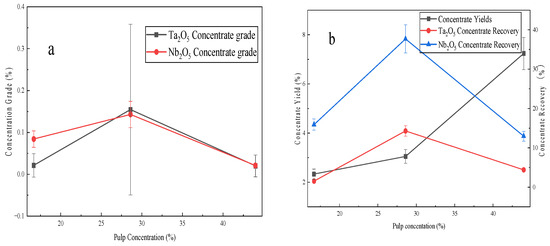
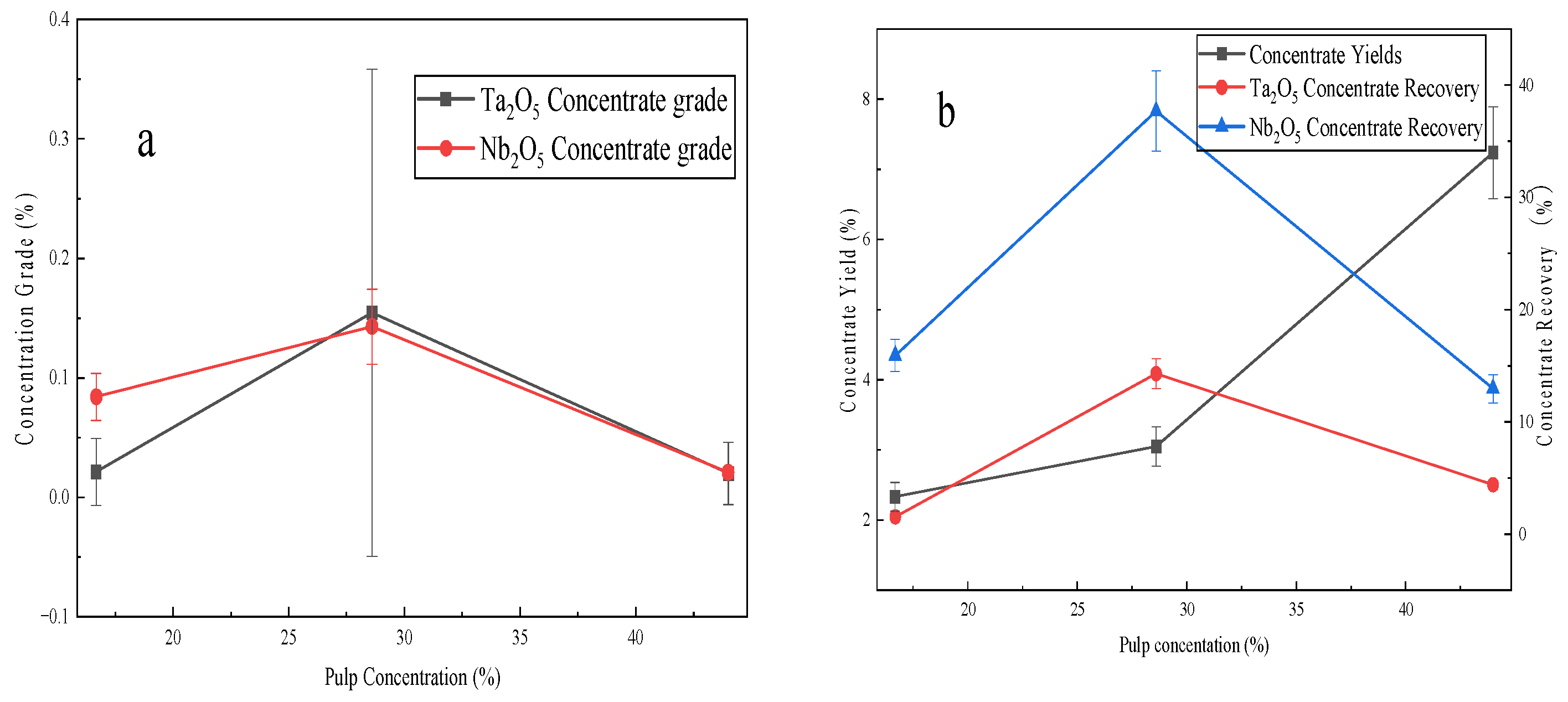
Figure 2.
Correlation of pulp concentration with concentrate grade, concentrate yield, and metal recovery ((a) Relationship between concentrate grade and pulp concentration. (b) Relationship between concentrate recovery and yield and pulp concentration. error bars represent the standard deviation calculated from replicate beneficiation tests).
Figure 3.
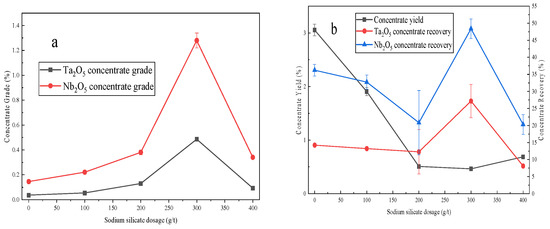
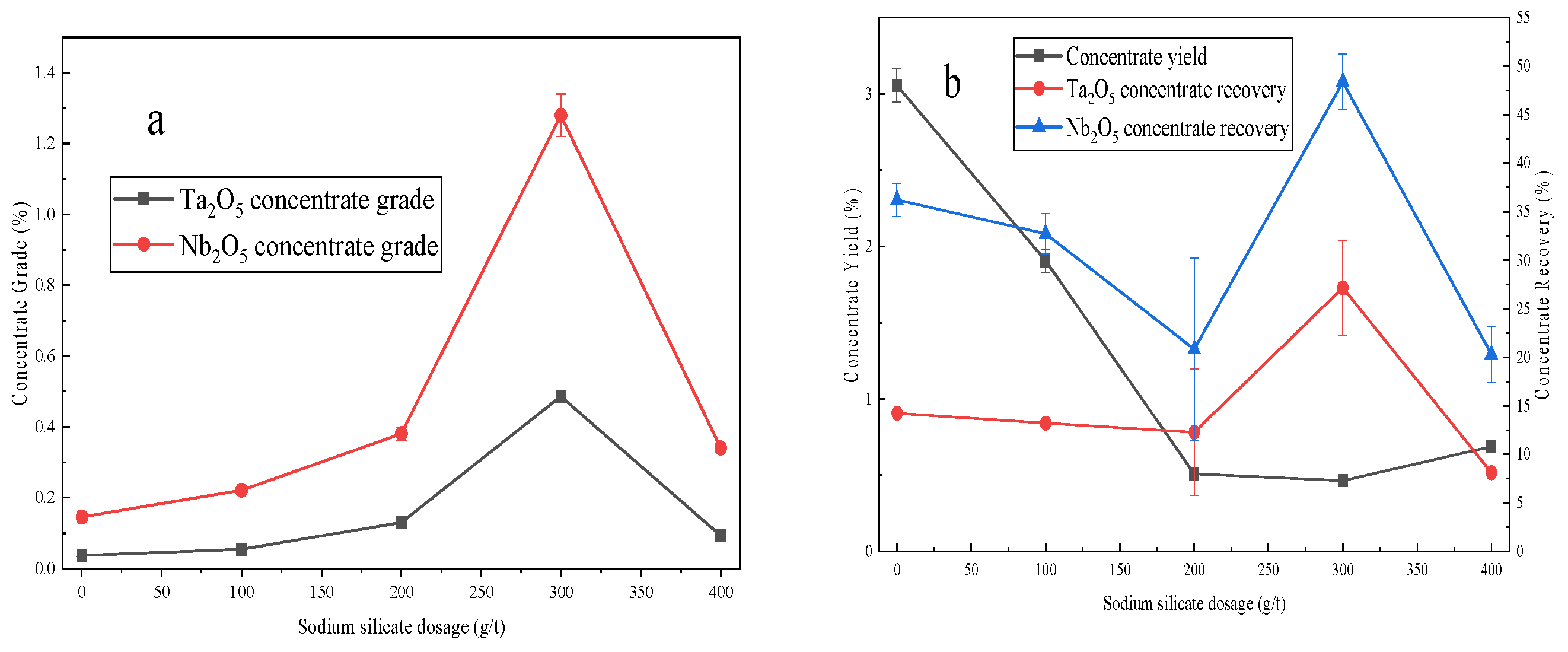
Correlation of sodium silicate dosage with concentrate grade, concentrate yield, and metal recovery ((a) Relationship between concentrate grade and sodium silicate dosage. (b) Relationship between concentrate recovery and yield and sodium silicate dosage. error bars represent the standard deviation calculated from replicate beneficiation tests).
2.3. Characterization
In each test, 16 g of pure mineral sample was suspended in 40 mL of deionized water, and sodium silicate was added at dosages of 0, 100, 200, 300, and 400 g/t, respectively. After treatment, the sample suspension was filtered. The filtrate was retained, and the collected solid fraction was dried and used for characterization. The elemental contents of the ore samples were quantified by inductively coupled plasma–optical emission spectrometry (ICP–OES) using an Agilent 5800 spectrometer (Agilent Technologies Inc., Santa Clara, CA, USA). Sample powders were pretreated by microwave acid digestion prior to measurement. The ICP–OES measurements were performed at an RF power of 1300 W, a cooling gas flow rate of 15.0 L/min, an auxiliary gas flow rate of 0.20 L/min, and a nebulizer gas flow rate of 0.60 L/min under axial-view observation mode. The elemental distribution and process mineralogy of the samples were characterized by scanning electron microscopy (scanning electron microscopy (SEM), Model TM3000, Hitachi High-Tech Corporation, Tokyo, Japan) coupled with Mineral Liberation Analyzer (MLA 650, FEI Company, Hillsboro, OR, USA) automated mineral analysis software. The mineralogical composition was determined by X-ray diffraction (XRD) using a Rigaku MiniFlex-600 diffractometer (Rigaku Corporation, Tokyo, Japan) with Cu Kα monochromatic radiation (λ = 1.54184 Å). XRD patterns were recorded at a tube voltage of 40 kV and a tube current of 15 mA over a 2θ range of 10°–90° at a scanning speed of 10.0°/min. Fourier transform infrared (FTIR) spectra were acquired on a Bruker Alpha ATR Platinum spectrometer (Bruker Optics GmbH, Ettlingen, Germany) at ambient temperature and pressure, over a wavenumber range of 4000–500 cm−1 with a resolution of 4 cm−1. Zeta potential measurements of the sample suspensions were performed using a Zetasizer Nano ZS analyzer (Malvern Panalytical Ltd., Worcestershire, UK), and data were collected and analyzed with the instrument’s proprietary software. Zeta potential measurements were carried out at the natural pulp pH (measured pH ≈ 7.2–7.4) without pH adjustment. After the addition of sodium silicate, the suspension was magnetically conditioned for 30 min. X-ray photoelectron spectroscopy (XPS) was conducted on an Escalab 250Xi spectrometer (Thermo Fisher Scientific Inc., Waltham, MA, USA) equipped with a monochromatic Al Kα X-ray source (hν = 1486.6 eV). Survey spectra were acquired at a pass energy of 100 eV and a step size of 1.0 eV, while high-resolution spectra were recorded at a pass energy of 30 eV and a step size of 0.05 eV. All binding energies were calibrated against the C 1s peak at 284.8 eV to correct for charging effects. Ultraviolet–visible (UV–vis)absorption measurements of the supernatant solutions were performed on a UV-2600i spectrophotometer (Shimadzu Corporation, Kyoto, Japan). Deionized water was used as the reference blank. Spectra were recorded over the wavelength range of 200–800 nm at a scan speed of 200 nm/min with a fixed spectral bandwidth of 2.0 nm. Prior to measurement, the suspension samples were centrifuged to obtain a clear supernatant for absorbance detection.
3. Results
3.1. Effect of Grinding Fineness on Gravity Separation
Grinding tests were conducted in a laboratory ball mill. For each test, 1.0 kg of ore sample was mixed with 700 mL of tap water to yield a pulp density of approximately 58.8 wt% solids, and the mixture was ground for predetermined durations of 5, 10, 15, and 20 min, respectively. After grinding, the pulps were filtered, and the ground products were air-dried for subsequent processing. For each grinding condition, a 1.0 kg aliquot of the dried ground sample was repulped with 2.5 L of tap water to prepare a feed pulp with a solids concentration of approximately 28.6 wt%, which was then subjected to shaking-table concentration. The shaking-table experiments were performed under fixed operating conditions, including stroke length, stroke frequency, table inclination, and wash-water flow rate, to evaluate the beneficiation performance as a function of grinding fineness.
As the grinding fineness increased from 41.2% to 84.4% passing 200 mesh, the Ta2O5 and Nb2O5 grades in the concentrate exhibited a continuous upward trend, rising from 0.0068% to 0.0360% and from 0.0140% to 0.123%, respectively. Notably, a substantial increase in both Ta2O5 and Nb2O5 grades was observed when the grinding fineness was increased from 72.7% to 84.4% passing 200 mesh, with the grades improving by approximately 2.8-fold and 2.7-fold, respectively, indicating that a significant proportion of the Nb–Ta minerals were liberated at this finer grind size.
In terms of recovery, the recovery first increased and then decreased with increasing grinding fineness. The decline in recovery beyond the intermediate fineness is attributed to the over-grinding of soft mica minerals, which generates excessive fine slimes that entrain a proportion of the liberated fine Ta–Nb particles into the tailings. Nevertheless, at 84.4% passing 200 mesh, the concentrate grade was significantly higher than at the intermediate point. Given the ultra-low feed grade of this ore, achieving a sufficiently high concentrate grade is the primary objective for subsequent metallurgical processing; therefore, 84.4% passing 200 mesh was selected as the optimal condition, as it represents the most favorable trade-off between grade and recovery.
3.2. Effect of Pulp Density on Gravity Separation
To investigate the effect of pulp concentration on gravity separation performance and particle dispersion behavior, a series of shaking-table tests were conducted at varying feed pulp densities. The ore samples were ground for 20 min under the conditions described above, and the ground products were filtered and air-dried. For each test, 1.0 kg of the dried ground sample was repulped with tap water to prepare feed pulps with solids concentrations of 16.67%, 28.6%, and 44%, respectively. It is noteworthy that mica, being a readily slime-forming mineral, tends to generate fine particles more readily than other minerals under the same grinding time, owing to its soft and flaky nature [26]. These fine mica slimes can readily coat the surfaces of other mineral particles, thereby hindering improvements in concentrate grade and deteriorating separation performance. This set of experiments was designed primarily to evaluate the relationship between pulp concentration and the dispersion behavior of mineral particles in a water-only system, with the aim of identifying an optimal concentration that enhances subsequent separation efficiency.
The effect of pulp concentration on the separation performance of Nb–Ta minerals was evaluated at solids concentrations of 16.67%, 28.6%, and 44%. As the pulp concentration increased, the concentrate Nb grade first increased and then decreased, reaching its maximum of 0.144% at 28.6%, which was 1.5-fold and 6.7-fold higher than those obtained at 16.67% and 44%, respectively; the tantalum concentrate grade exhibited a similar trend. At a pulp concentration of 16.67%, the concentrate Nb grade was merely 0.095%, indicating poor enrichment efficiency, whereas at 44%, the concentrate Nb grade dropped sharply to 0.0214%, suggesting severe deterioration of separation selectivity. Based on a comprehensive consideration of concentrate grade, a pulp concentration of 28.6% was identified as the optimal condition. Nevertheless, it should be noted that even at this optimal concentration, the Nb2O5 concentrate grade was only 0.144%, and the separation efficiency remained far from satisfactory. In addition, with respect to metal recovery, both tantalum and niobium achieved their maximum recoveries at a pulp concentration of 28.6%. This further confirms that in a water-only system, adjusting pulp concentration alone is insufficient to achieve effective separation, and that slime coating of mica fines on mineral surfaces remains the dominant factor limiting separation performance. Therefore, the addition of dispersants should be considered in subsequent studies to improve pulp dispersion.
3.3. Experimental Investigation on Pre-Dispersion and Gravity Separation
The preceding experiments demonstrated that the use of water alone as a dispersant yielded limited improvement in separation performance, as the slime generated from mica particles tended to coat the surfaces of other valuable minerals, thereby deteriorating beneficiation efficiency. Accordingly, alternative interventions were required to mitigate this adverse effect. In the subsequent tests, sodium silicate (water glass) with a modulus (SiO2/Na2O molar ratio) of 2.3, a commonly used and cost-effective dispersant in mineral processing, was introduced to improve pulp dispersion. The grinding and pulp conditioning procedures were kept consistent with those described above (solids concentration: 28.6%; grinding fineness: 84.4% passing −200 mesh). Sodium silicate was added at dosages of 100, 200, 300, and 400 g/t (grams per ton of ore), respectively, and the pulps were thoroughly agitated to ensure homogeneous mixing. Subsequently, shaking-table concentration was performed to evaluate the effect of sodium silicate pre-dispersion on separation performance.
To evaluate the effect of sodium silicate pre-dispersion on shaking-table separation performance, comparative tests were conducted at dosages of 100, 200, 300, and 400 g/t. The results indicated that with increasing sodium silicate dosage, the Nb–Ta concentrate grades first increased and then decreased, reaching their peak values at 300 g/t. At this dosage, the Nb2O5 grade in the concentrate was dramatically elevated from 0.144% (without dispersant) to 1.28% (an approximately 8-fold increase), while the Ta2O5 grade increased from 0.036% to 0.47% (an approximately 85-fold increase). When the sodium silicate dosage was further increased to 400 g/t, the Nb–Ta concentrate grades decreased markedly, with the Nb2O5 grade dropping to 0.34% and the Ta2O5 grade to 0.092%, indicating that excessive dispersant dosage adversely affected separation selectivity. Meanwhile, the maximum metal recovery was obtained at a sodium silicate dosage of 300 g/t. Based on a comprehensive consideration of Nb–Ta concentrate grades and recovery, a sodium silicate dosage of 300 g/t was identified as the optimal condition. Under this condition, the Nb–Ta minerals were significantly enriched, demonstrating that sodium silicate pre-dispersion can effectively improve pulp dispersion, alleviate slime coating of mica fines on Nb–Ta mineral surfaces, and thereby substantially enhance the selectivity of shaking-table separation.
4. Discussion
4.1. Raw Ore Analysis
To systematically investigate the effect of sodium silicate dispersion on separation performance, a comprehensive characterization of the feed ore was first conducted. Based on the mineralogical analysis results, representative pure minerals were selected for subsequent verification experiments. The mineralogical study was performed using Mineral Liberation Analysis (MLA) coupled with scanning electron microscopy and energy-dispersive X-ray spectroscopy (SEM–EDS), which enabled precise identification of mineral species, determination of phase associations, and examination of the textural characteristics and liberation properties of the target minerals [27]. This approach ensured that the experimental design was grounded in the actual mineralogical features of the ore, thereby providing a reliable basis for evaluating the dispersion mechanism of sodium silicate and its influence on the beneficiation of Nb–Ta-bearing minerals.
Based on the MLA analysis (Table 2), the niobium- and tantalum-bearing minerals were identified as columbite-(Mn), columbite–tantalite, columbite, and tantalite, all of which are metal oxides. Among them, columbite-(Mn) exhibited the highest content at 0.007%, followed by columbite–tantalite at 0.004%, columbite at 0.002%, and tantalite at the lowest content of 0.0004%. The total content of Nb–Ta minerals was relatively low, amounting to only 0.0134%. The dominant gangue minerals were feldspar and mica. Notably, mica is highly susceptible to slime formation, and the generated slime particles tend to coat the surfaces of valuable minerals, thereby deteriorating separation performance [28].
Table 2.
Analysis of mineral composition of raw ore.
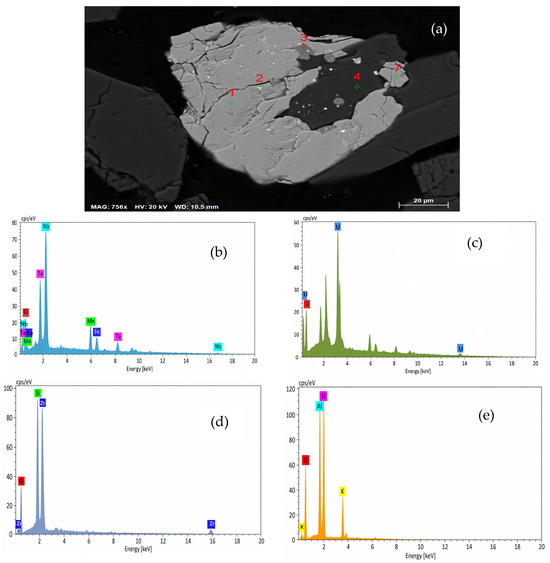
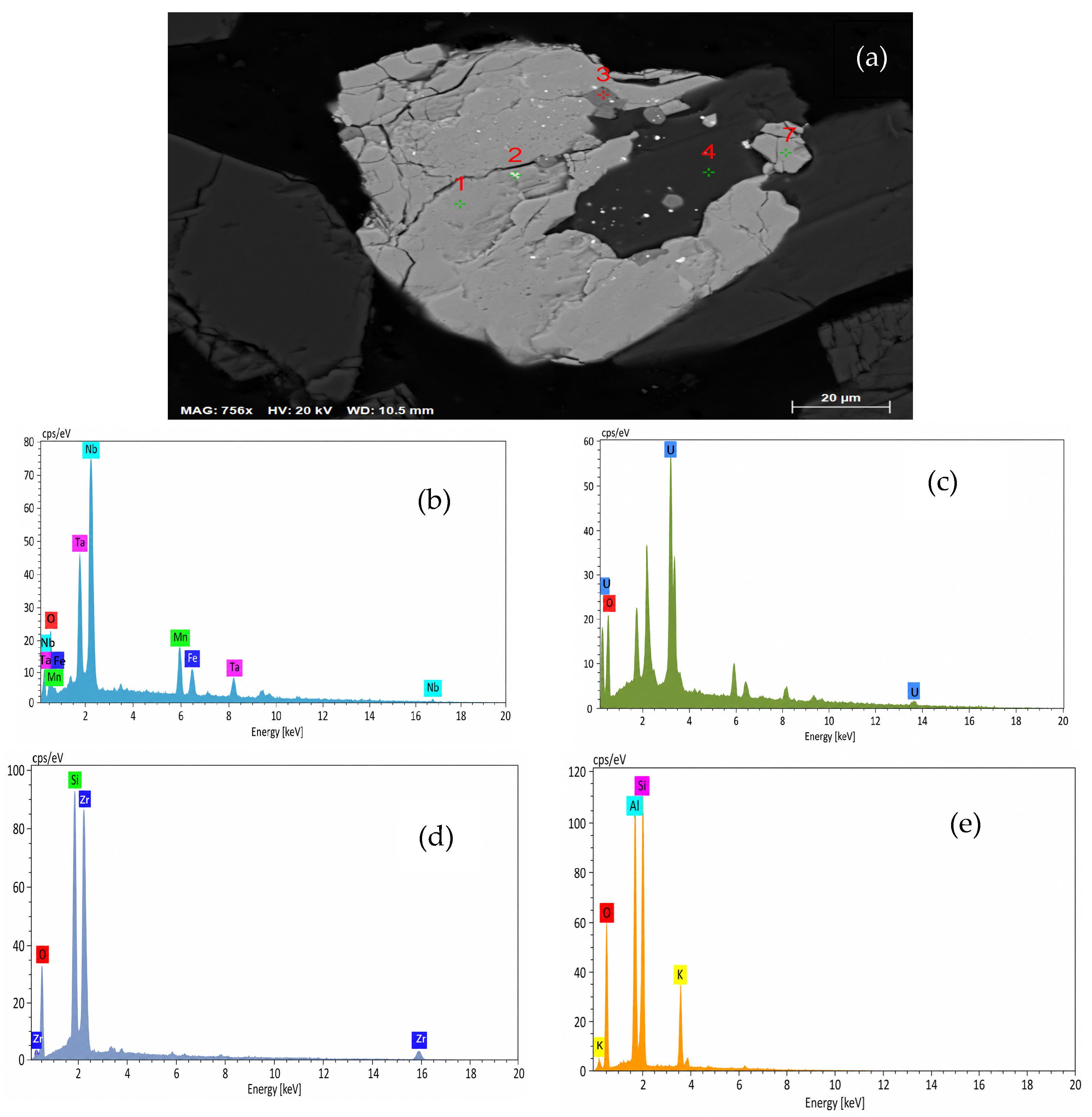
Furthermore, SEM-EDS (Figure 4) can visually characterize the intergrowth and dissemination relationships between Nb–Ta minerals and mica-group minerals. When the raw ore was ground to a fineness of 84.4% passing −200 mesh, the analytical results indicated that the niobium- and tantalum-bearing minerals (primarily columbite-(Mn), columbite–tantalite, columbite, and tantalite) occurred as discrete grains with limited exposure to mica minerals. Most Nb–Ta oxide particles were liberated, while a minor proportion was observed in binary or ternary intergrowths. In the case of columbite-(Mn), it was locally intergrown with or hosted by muscovite, as exemplified by semi-encapsulation textures where columbite-(Mn) grains were partially enclosed by muscovite. However, pervasive intergrowths between Nb–Ta oxides and mica phases (including lepidolite and muscovite) were uncommon; instead, the Nb–Ta minerals were more frequently associated with quartz, feldspar, and Mn-bearing phosphates. Given the extremely fine dissemination of these Nb–Ta oxides and the propensity of mica to generate slimes during grinding, the limited but existing mica–Nb–Ta mineral intergrowths, combined with the slime-coating effect of finely ground mica, could potentially compromise separation performance in subsequent beneficiation processes.
Figure 4.
BSE-SEM images of mica wrapped and semi-wrapped by columbite-(Mn). (a) BSE-SEM Images; (b) EDS spectra of columbite-(Mn) (1,7); (c) EDS spectra of uraninite (2); (d) EDS spectra of zircon (3); (e) EDS spectra of mica (4).
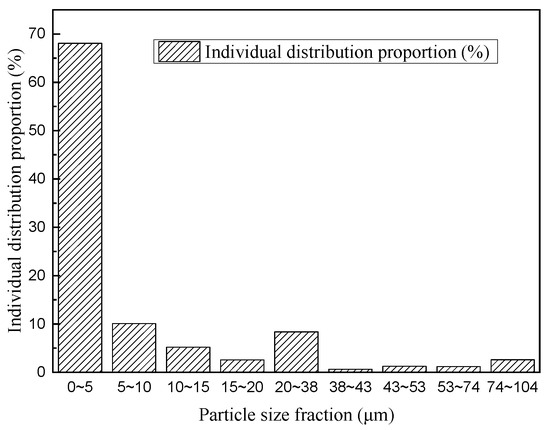
Figure 5 shows that at a grinding fineness of 84.4% passing 200 mesh (corresponding to a grinding time of 20 min), mica particles are predominantly concentrated in the 0–38 μm fraction, with the 0–5 μm size class accounting for the largest proportion at 68.05%. Overall, the mica in the ground product exhibited a predominantly micro-fine dissemination, with minor proportions of extremely fine and fine particles. Notably, the sample had already undergone significant slime formation under this grinding condition, which is considered the primary factor responsible for the deterioration of separation performance.
Figure 5.
Mica particle size distribution at 84.4% −200 mesh.
4.2. Pure Mineral Analysis
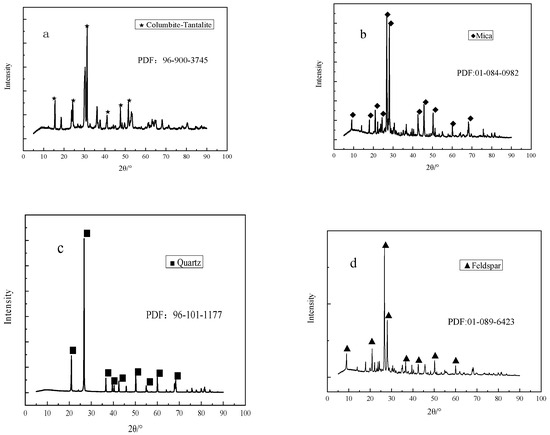
Based on the process mineralogical analysis results, pure mineral samples corresponding to the major constituent minerals of the feed ore were selected for fundamental mechanism studies. All pure mineral samples were hand-picked under a binocular microscope from run-of-mine ore collected from the Sichuan mining area. The phase purity and crystallinity of these samples were confirmed by X-ray diffraction (XRD), and the obtained diffraction patterns are presented in Figure 6. These pure mineral tests were designed to elucidate the inherent surface properties and flotation/gravity response of individual minerals, free from the interference of complex mineral associations, thereby providing a theoretical basis for understanding the separation behavior of the actual ore.
Figure 6.
XRD patterns of pure minerals: (a) columbite–tantalite, (b) mica, (c) quartz, and (d) feldspar.
The XRD patterns show good crystallinity for the hand-picked mineral grains. Despite potential trace impurity phases inherited from natural paragenesis, these samples are adequate for our comparative surface-characterization experiments. Furthermore, the valuable minerals in the ore predominantly occur as discrete phases with well-defined diffraction patterns, enabling effective characterization and facilitating the elucidation of the underlying separation mechanisms.
4.3. Zeta Potential Analysis of Mineral Surfaces
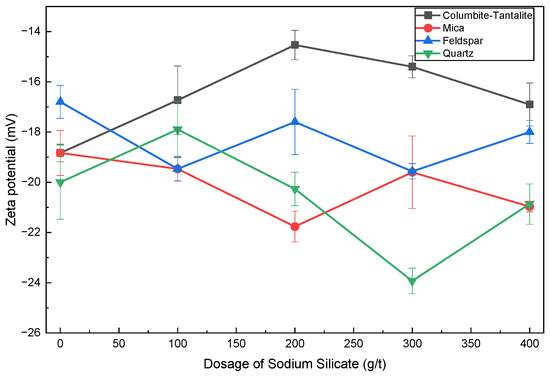
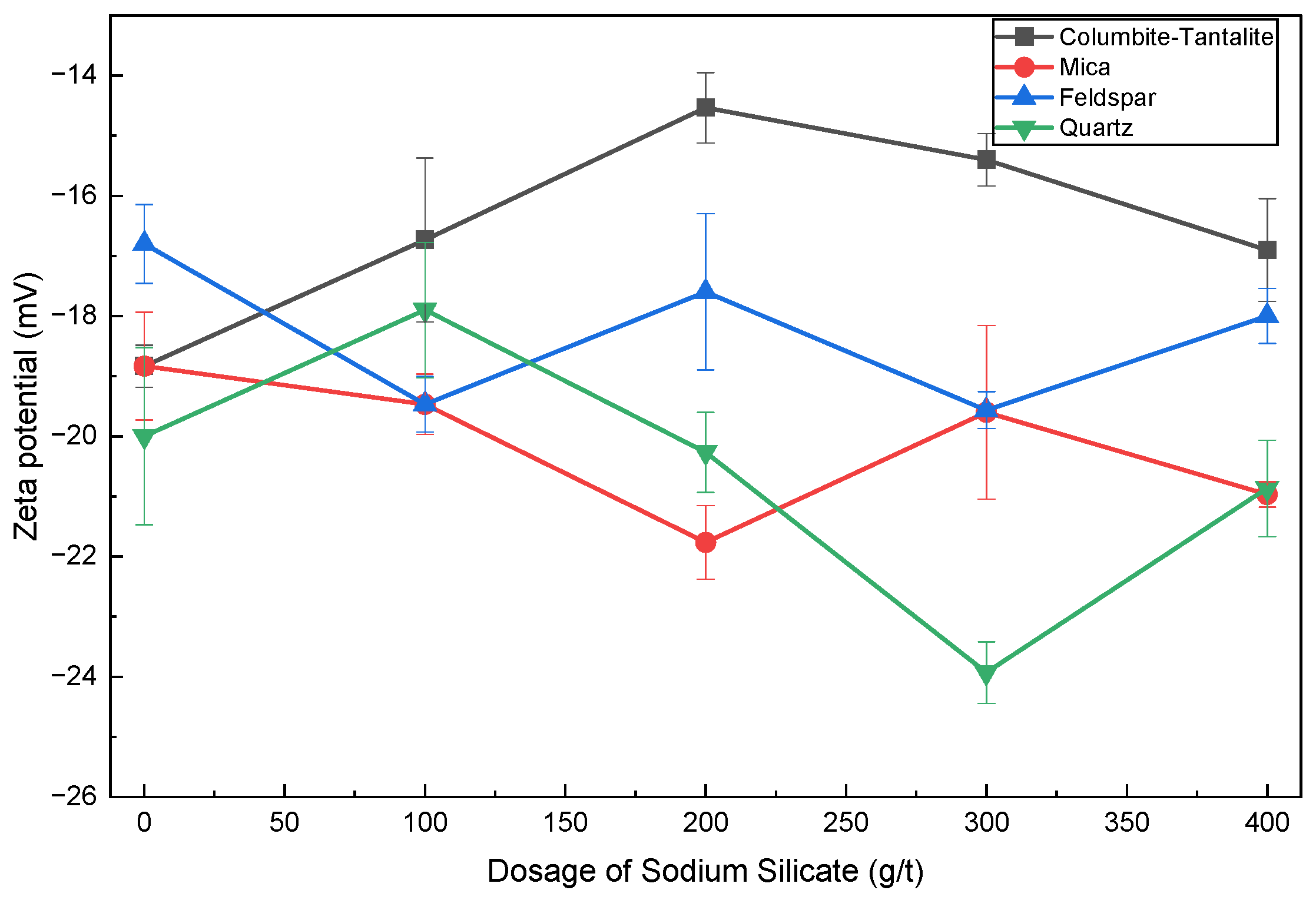
Sodium silicate is known to achieve efficient dispersion in mineral processing through the synergistic effects of multiple mechanisms, including electrostatic repulsion, steric hindrance, and chemisorption [29]. To elucidate the dispersion mechanism of sodium silicate on mineral surfaces, zeta potential measurements were conducted as a function of sodium silicate dosage. Pure mineral powders were ground to −5 μm in an agate mortar before testing. The zeta potential of the mineral surfaces was then measured, and the results are presented in Figure 7.
Figure 7.
Zeta potential of different mineral surfaces as a function of sodium silicate dosage.
As shown in Figure 7, with increasing sodium silicate dosage, the zeta potential of the Nb–Ta mineral surfaces exhibited an initial increase followed by a decrease, reaching a maximum at a dosage of 200 g/t. In contrast, the zeta potentials of the other mineral surfaces showed an opposite trend, first decreasing and then increasing. Notably, when the sodium silicate dosage reached 300 g/t, the zeta potentials of all mineral surfaces approached their minimum values, with all surfaces carrying negative charges [30]. This resulted in the maximum electrostatic repulsion among the mineral particles [31,32], which is considered one of the predominant dispersion mechanisms of sodium silicate in this system.
4.4. Ultraviolet Spectroscopic Analysis
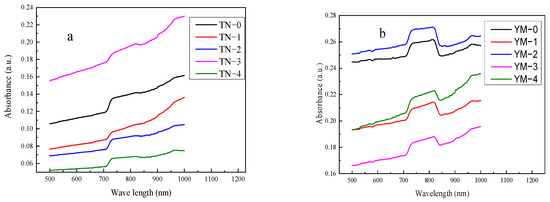
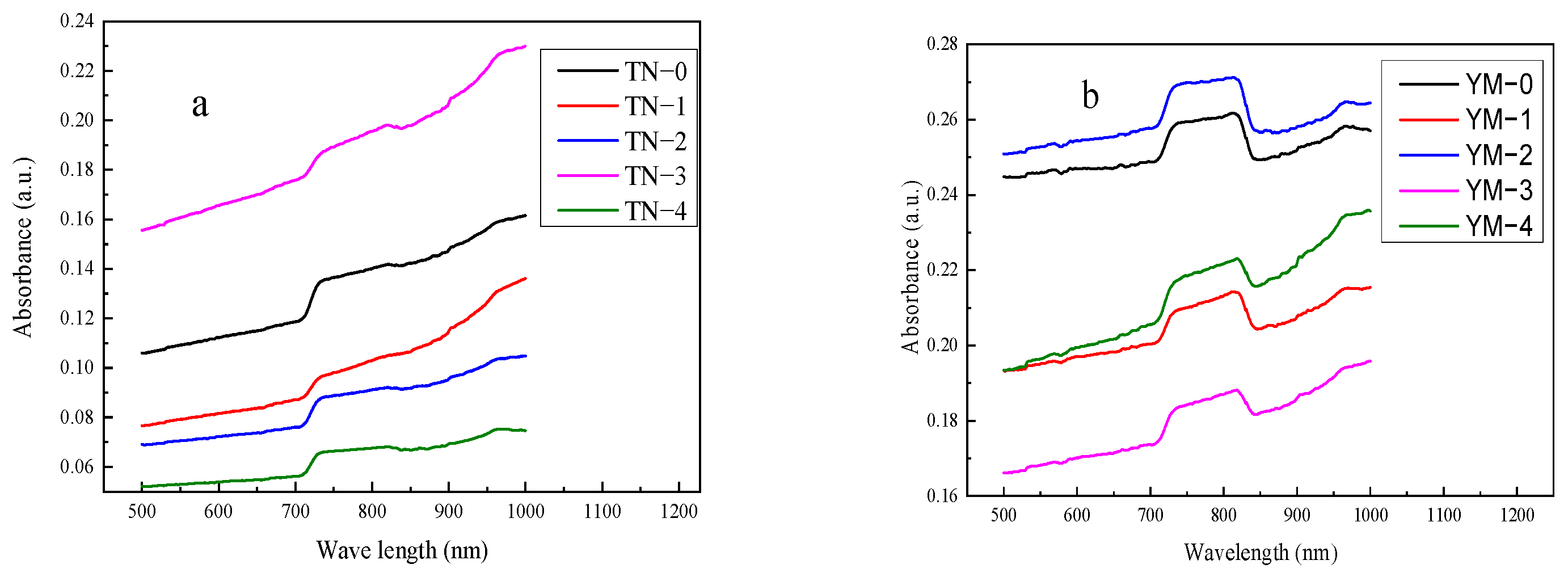
To further verify that the electrostatic repulsion induced by zeta potential changes is the dominant mechanism, the adsorption amount of sodium silicate on the mineral surfaces was investigated to elucidate the relationship between reagent dosage and surface charge evolution. The supernatant from the aforementioned experimental samples was collected and analyzed by UV–vis spectrophotometry. In this analysis, TN-0, TN-1, TN-2, TN-3, and TN-4 represent the absorbance of the Nb–Ta mineral samples at sodium silicate dosages of 0, 100, 200, 300, and 400 g/t, respectively, while YM-0, YM-1, YM-2, YM-3, and YM-4 correspond to the absorbance of the mica samples under the same dosage conditions. The results are presented in Figure 8.
Figure 8.
Correlation of absorbance and water glass dosage (YM: pure mica; TN: pure columbite–tantalite). ((a) UV-vis spectra of tantalum-niobium mineral separate treated with different sodium silicate concentrations; (b) UV-vis spectra of mica treated with different sodium silicate concentrations). Note: The square-shaped plateau within 720–820 nm is an instrumental artifact caused by detector saturation, rather than an intrinsic absorption feature of the mineral sample.
As shown in Figure 8, the absorbance intensity is generally correlated with the residual sodium silicate concentration in the supernatant: a higher absorbance indicates a higher residual concentration, which inversely reflects a lower adsorption amount on the mineral surfaces [33,34]. For the Nb–Ta mineral samples, with increasing sodium silicate dosage, the absorbance exhibited an initial decrease followed by an increase and then a further decrease. Notably, the absorbance reached its maximum at a sodium silicate dosage of 300 g/t, indicating that the adsorption amount of sodium silicate on the Nb–Ta mineral surfaces was at its minimum under this condition. When the dosage was further increased beyond 300 g/t, the absorbance decreased again, which may be attributed to the electrostatic screening effect induced by excessive sodium silicate addition. In the case of mica, the absorbance reached its minimum at a sodium silicate dosage of 300 g/t. Combined with the observation that the zeta potential also reached its minimum at the same dosage, this suggests that sodium silicate is selectively adsorbed onto the mica mineral surfaces, leading to significant changes in surface charge and consequently enhancing pulp dispersion. These results further confirm that the selective adsorption of sodium silicate onto mica surfaces effectively creates a uniformly negative surface charge state on all mineral particles, maximizing interparticle electrostatic repulsion, thereby alleviating the slime coating of mica fines on valuable mineral surfaces and improving subsequent separation performance.
4.5. Infrared Spectroscopy Analysis
To further elucidate the adsorption characteristics of sodium silicate on mica and Nb–Ta mineral surfaces, Fourier-transform infrared spectroscopy (FTIR) analysis was conducted. The samples designated as YM-0, YM-3, TN-0, and TN-3 from the aforementioned experimental tests were selected for comparative analysis, and the results are presented below.
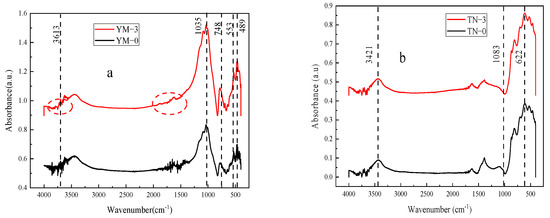
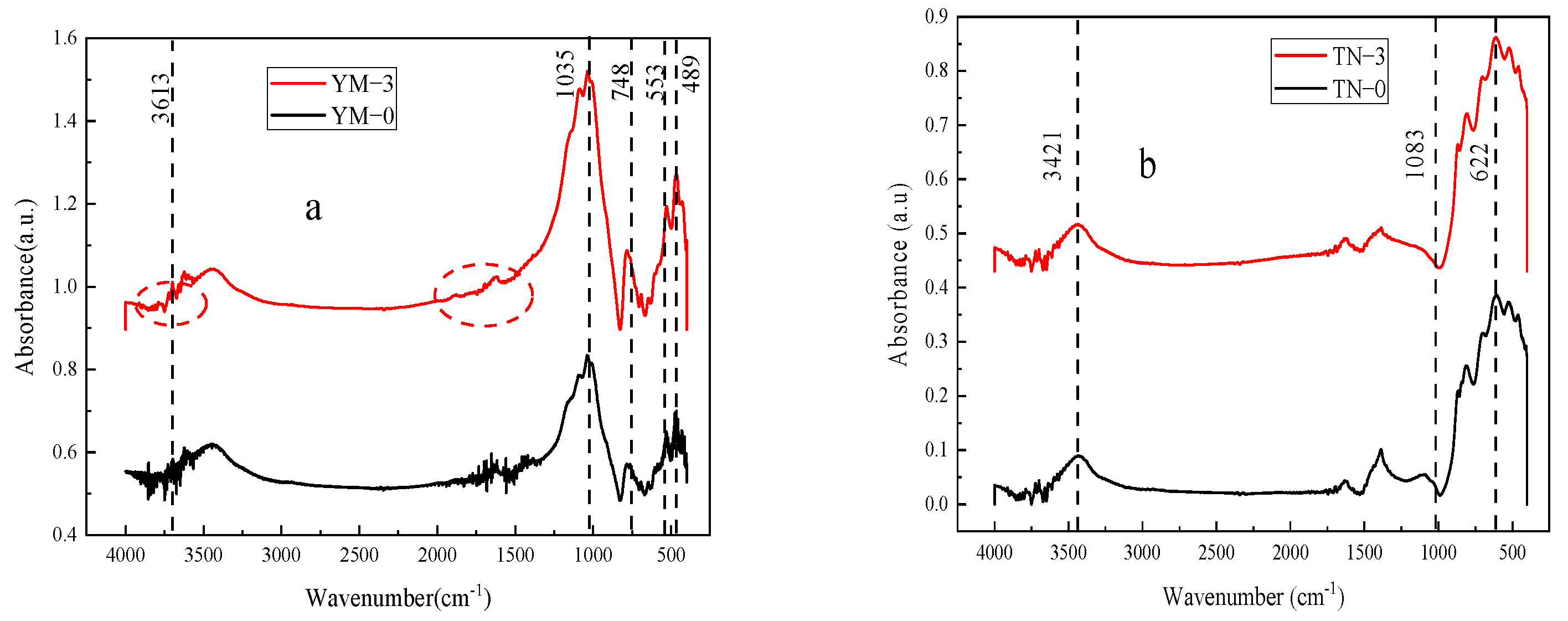
As shown in Figure 9, the characteristic absorption bands of mica, including the O–H stretching vibration at 3613 cm−1, the Si–O stretching vibration at 1035 cm−1, the (AlIV–O–Si) in-plane vibration at 748 cm−1, and the Si–O bending vibrations at 553 and 489 cm−1, exhibited no significant changes before and after sodium silicate dispersion, indicating that the bulk structure of mica remained intact [35]. However, after sodium silicate treatment, a relative reduction of the band near 3620 cm−1 (Al-OH stretching vibration of structural hydroxyls in mica) can be observed for YM-3 compared with YM-0, despite baseline noise present in the raw spectra. Note that the spectra exhibit noticeable noise, and this comparison is based on paired-sample measurements under identical experimental conditions rather than absolute peak intensity. The absorption features within 1500–1750 cm−1 are not interpreted here due to severe noise interference [36]. This observation, together with zeta potential, UV–vis and XPS results, supports the chemisorption interaction between silicate species and surface Al-OH active sites on mica through dehydration condensation to form Si–O–Al linkages. The significant attenuation of the Al–OH band suggests that the silicate species chemically interacted with the surface-active hydroxyl sites of mica through dehydration condensation, forming Si–O–Al linkages [37]. Meanwhile, the marked reduction of the 1500–1750 cm−1 bands indicates the partial removal of surface-adsorbed water and carbonate species from the mica surfaces. These observations collectively demonstrate that sodium silicate underwent chemisorption onto the mica surfaces rather than merely physical adsorption, which facilitates the stable dispersion of mica slimes and alleviates their slime coating on valuable mineral surfaces during subsequent beneficiation.
Figure 9.
Infrared spectroscopy analysis (YM: pure mica; TN: pure columbite–tantalite) ((a) FTIR spectra of tantalum-niobium mineral treated with different sodium silicate concentrations; (b) FTIR spectra of mica treated with different sodium silicate concentrations).
In contrast, the characteristic absorption bands of the Nb–Ta mineral remained essentially unchanged after sodium silicate treatment. Specifically, the lattice vibration band at 622 cm−1 assigned to Fe/Mn-O stretching shows no obvious shift. The bands near 1100 cm−1 (Ta-O/Nb-O stretching) and weak absorption near 1400 cm−1 show apparent intensity variation after conditioning. However, such changes are complicated by spectrum noise, baseline drift and partial removal of surface-adsorbed carbonate impurities during sample treatment, and cannot be interpreted as evidence for chemical bonding between sodium silicate and columbite–tantalite. Combined with zeta potential, UV–vis and Si 2p XPS results, these FTIR data indicate that sodium silicate exhibits only weak interaction with the Nb-Ta mineral surface [38].
In summary, the FTIR analysis preliminarily indicates that sodium silicate is selectively adsorbed onto the mica surface, modifying the mineral surface and altering its surface charge distribution, which enhances the dispersion of mica particles. Consequently, this selective dispersion mitigates the slime coating of mica fines on Nb–Ta mineral surfaces, thereby improving the shaking-table separation efficiency of the Nb–Ta-bearing minerals.
4.6. X-Ray Photoelectron Spectroscopy Analysis
To elucidate the adsorption behavior and chemical interaction mechanisms of sodium silicate on mineral surfaces, X-ray photoelectron spectroscopy (XPS) analysis was performed on both Nb–Ta mineral and mica samples. The Nb–Ta mineral samples included TN-0 (without sodium silicate) and TN-3 (300 g/t); the mica samples included YM-0 (without sodium silicate) and YM-3 (300 g/t). Since the binding energies of adventitious carbon (C 1s) exhibited systematic differences among the samples, all spectra were cross-calibrated using the C 1s peak of adventitious carbon as an internal reference prior to analysis to ensure the reliability of peak position comparisons across different samples [37].
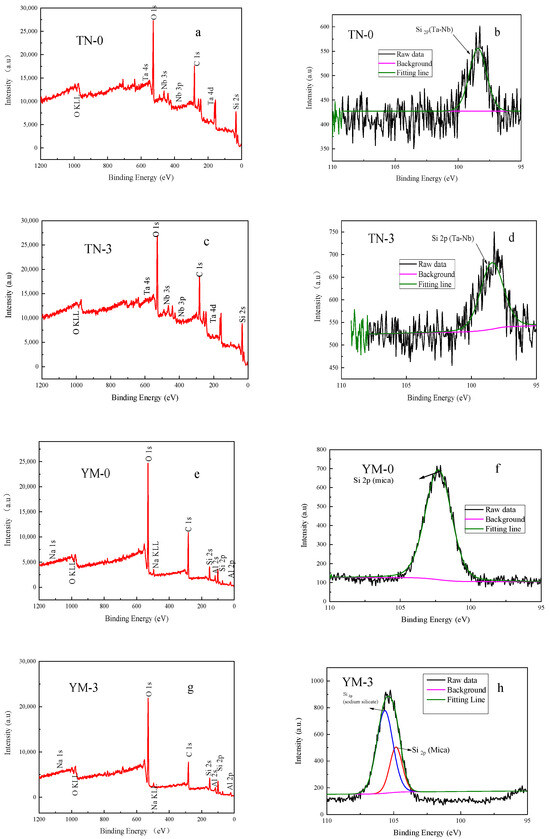
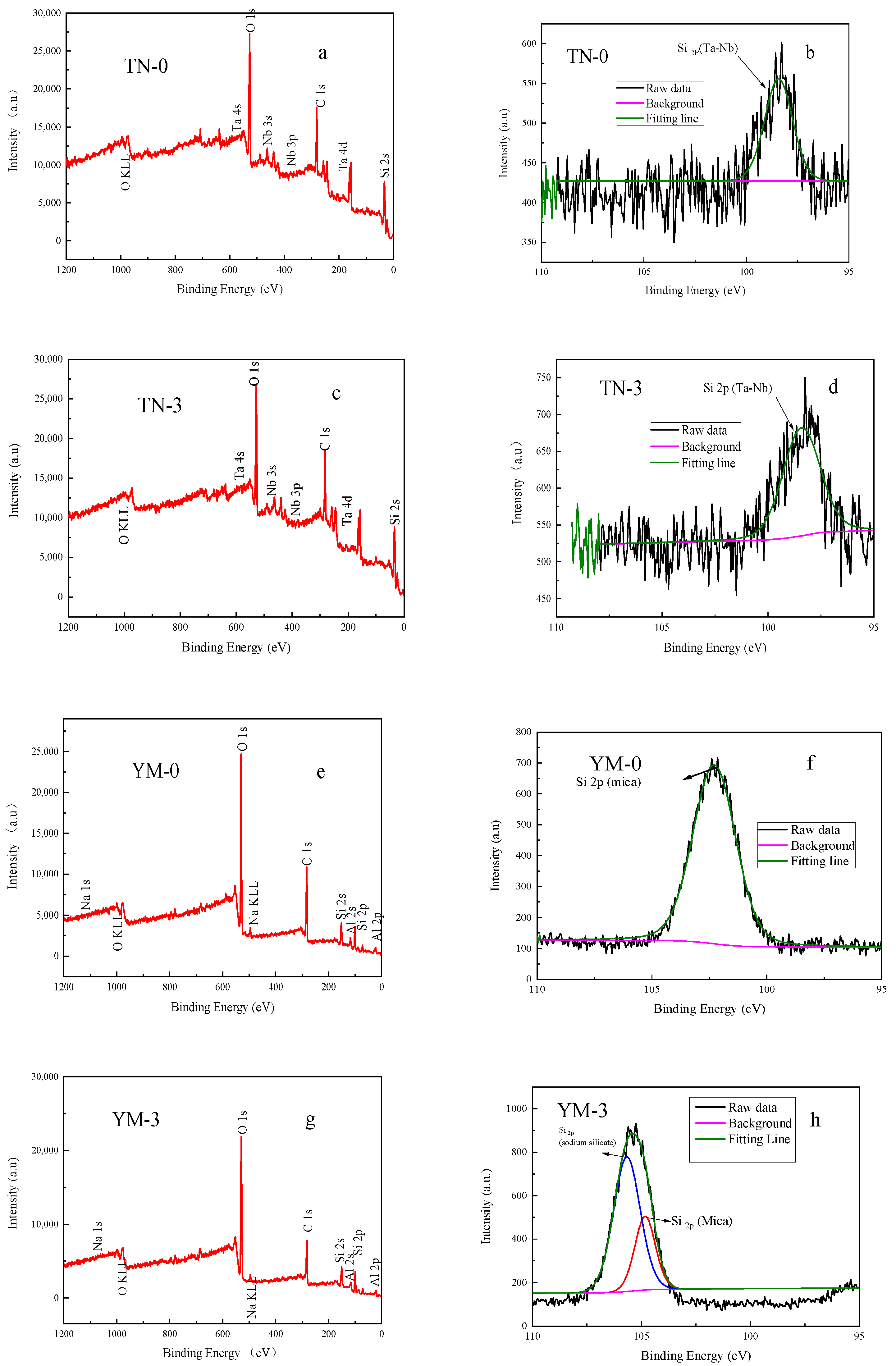
X-ray photoelectron spectroscopy (XPS) was employed to investigate the interaction between sodium silicate and the Nb–Ta mineral surface (Figure 10a–d). The survey spectra of the Nb–Ta mineral before and after sodium silicate treatment exhibited no significant differences in either the types or the relative intensities of the characteristic photoelectron peaks, indicating that the overall surface chemical composition remained essentially unaltered following reagent addition.
Figure 10.
XPS spectra: (a) Tantalum–niobium pure mineral samples before dispersion; (b) Si 2p narrow spectra tantalum–niobium pure mineral samples before dispersion; (c) tantalum–niobium pure mineral samples after dispersion; (d) Si 2p narrow spectra tantalum–niobium pure mineral samples after dispersion; (e) mica before dispersion; (f) Si 2p narrow spectra mica before dispersion; (g) mica after dispersion; (h) Si 2p narrow spectra Mica after dispersion.
Further analysis of the high-resolution Si 2p core-level spectra revealed that only a single Si 2p peak was detected on both the untreated and treated Nb–Ta mineral surfaces. Given that the Nb–Ta mineral is known to contain a minor amount of quartz as a gangue component, the Si 2p signal observed in the untreated sample is primarily attributable to this quartz impurity. After sodium silicate treatment, the Si 2p peak (103.5 eV) remained as a single peak with no discernible splitting or additional components, and no significant binding energy shift was observed. In XPS analysis, the formation of new chemical bonds (chemisorption) between an adsorbate and a substrate typically induces a measurable change in the binding energy of the relevant core-level electrons, whereas physical adsorption generally does not result in such shifts [39]. Moreover, the absence of any new Si 2p components arising from the adsorbed silicate species suggests that sodium silicate did not form a chemically distinct surface layer on the Nb–Ta mineral surface.
Collectively, these XPS observations—namely, the lack of substantial changes in the survey spectra, the absence of new Si 2p components attributable to sodium silicate adsorption beyond the existing quartz background, and the lack of a detectable binding energy shift—indicate that the interaction between sodium silicate and the Nb–Ta mineral surface is relatively weak. It should be noted that only the Si 2p high-resolution spectra were collected to probe silicate-related surface modifications on columbite–tantalite. No new Si-containing species or distinct binding energy shifts were observed in the Si 2p spectra, suggesting negligible chemisorption of sodium silicate on columbite–tantalite surfaces. This inference is further supported by zeta potential, UV–vis and FTIR results showing weak reagent–mineral interaction. High-resolution narrow-scan spectra for Nb 3d, Ta 4f, Fe 2p and Mn 2p were not acquired in the present work and will be considered in future studies [40]. It is therefore inferred that sodium silicate is primarily adsorbed onto the Nb–Ta mineral surface via physisorption (e.g., electrostatic attraction or van der Waals forces), rather than through chemisorption. This weak interaction implies that the sodium silicate species are unlikely to form stable surface complexes with the Nb–Ta mineral, which is consistent with the observed limited modification of the Nb–Ta mineral surface properties.
In contrast to the Nb–Ta mineral, the mica mineral exhibited distinctly different XPS spectral features after sodium silicate treatment, as shown in Figure 10e–h. After sodium silicate conditioning, the Si 2p spectrum of mica shifted evidently toward higher binding energy. Only one silicon-related chemical state can be resolved for the surface layer, with the Si 2p3/2 component at 104.00 eV, which is assigned to polymerized silicate species derived from sodium silicate [41]. It should be noted that the signal of lattice silicon from the underlying muscovite is largely masked by the surface silicate-rich precipitation layer; therefore, monomolecular chemisorption cannot be further distinguished from thick-layer precipitation merely by XPS deconvolution. Combined with the zeta potential and FTIR results, it can be inferred that sodium silicate preferentially interacts with the mica surface.
Combined with the pronounced attenuation of the Al–OH stretching band in the FTIR spectra, these observations strongly suggest that silicate species may interact with Al-OH active sites on mica surfaces to form Si-O-Al linkages. It should be stressed that the present dataset cannot definitively distinguish monomolecular chemisorption from surface precipitation of polymerized silicate species on mica surfaces.
5. Conclusions
(1) Grinding fineness significantly affects gravity separation performance; the optimal fineness was identified as 84.4% passing 200 mesh, achieving concentrate grades of 0.0360% for Ta2O5 and 0.123% for Nb2O5. Pulp concentration adjustment alone in a water-only system was insufficient to achieve effective separation, as the slime coating of mica fines on mineral surfaces remained the dominant limiting factor, necessitating the addition of dispersants to enhance pulp dispersion. Sodium silicate pre-dispersion substantially improved separation efficiency; at the optimal dosage of 300 g/t, the Nb2O5 concentrate grade was elevated from 0.144% to 1.28% and the Ta2O5 concentrate grade from 0.0055% to 0.47%.
(2) Multi-characterization results strongly suggest that sodium silicate preferentially interacts with mica surfaces, potentially via chemisorption involving Si-O-Al bond formation, which modifies surface charge and improves mica particle dispersion. It is noted that the current measurements cannot fully differentiate monomolecular chemisorption from the surface precipitation of silicate species. By contrast, only weak interaction occurs between sodium silicate and tantalum–niobium mineral surfaces. This selective interfacial behavior effectively mitigates slime coating and improves gravity separation performance for Ta-Nb minerals.
Author Contributions
Conceptualization, L.W. and X.S.; methodology, G.Y.; formal analysis, H.L.; data curation, H.S.; writing—original draft preparation, L.W.; writing—review and editing, M.L. and L.W.; project administration, H.L.; funding acquisition, G.Y. All authors have read and agreed to the published version of the manuscript.
Funding
This research was funded by the Regional Innovation and Development Joint Fund of the National Natural Science Foundation of China (Grant number U24A2097).
Data Availability Statement
Data is contained within the article.
Conflicts of Interest
The authors Lei Wang, Xinyue Shi, Guocheng Yao, He Shang, Hongxia Li, and Meilin Liu were employed by the companies China GRINM Group Co., Ltd., and GRINM Resources and Environment Tech. Co., Ltd. The paper reflects the views of the scientists and not the companies.
References
- U.S. Geological Survey. Mineral Commodity Summaries 2024; USGS: Reston, VA, USA, 2024.
- European Commission. Study on the Critical Raw Materials for the EU 2023—Final Report; Publications Office of the European Union: Luxembourg, 2023. [Google Scholar]
- Tkaczyk, A.H.; Bartl, A.; Amato, A.; Lapkovskis, V.; Petranikova, M. Sustainability evaluation of essential critical raw materials: Cobalt, niobium, tungsten and rare earth elements. J. Phys. D Appl. Phys. 2018, 51, 203001. [Google Scholar] [CrossRef] [Scilit]
- Schulz Klaus, J.; DeYoung, J.H., Jr.; Seal, R.R., II; Bradley, D.C. (Eds.) Critical Mineral Resources of the United States: Economic and Environmental Geology and Prospects for Future Supply; U.S. Geological Survey: Reston, VA, USA, 2017.
- Deng, P.; Chen, Y.; Ye, J.; Zhang, W. Study on the resource distribution and industry development of global niobium and tantalum. China Min. Mag. 2019, 28, 63–68. [Google Scholar]
- Zhai, M.; Hu, R.; Wang, Y.; Jiang, S.; Wang, R.; Li, J.; Chen, H.; Yang, Z.; Lü, Q.; Qi, T.; et al. Mineral resource science in China: Review and perspective. Geogr. Sustain. 2021, 2, 107–114. [Google Scholar] [CrossRef] [Scilit]
- Cao, M.; Bu, H.; Gao, Y. Preconcentration of Low-Grade Ta-Nb Deposit Using Physical Separation Methods: Cao, Bu, and Gao. JOM 2021, 73, 1310–1320. [Google Scholar]
- Zhou, Y.; Zhao, X.; Chen, W. Beneficiation Experiment of Low Grade Niobium Ore for Super Enrichment. Min. Metall. Eng. 2025, 45, 63–67. [Google Scholar]
- Srdjan, M.B. Handbook of Flotation Reagents Chemistry, Theory and Practice: Flotation of Sulfide Ores; Elsevier Science & Technology Books: Amsterdam, The Netherlands, 2007. [Google Scholar]
- Tian, P.; Gao, P.; Tang, Z.; Tang, Z.; Wang, X.; He, J. Study on the mechanism of hydrogen-based mineral phase transformation to enhance the grinding characteristics of Bayan Obo polymetallic ore. Miner. Eng. 2025, 227, 109298. [Google Scholar] [CrossRef] [Scilit]
- Chang, S.; Rao, M.; Wang, B.; Jiang, T.; Li, G.; Yang, Z.; Jia, Z. Enrichment of ferroniobium from bayan obo tailings using selective carbonization roasting and magnetic separation. J. Mater. Res. Technol. 2025, 38, 4446–4454. [Google Scholar] [CrossRef] [Scilit]
- Zhang, Q.; Sun, Y.; Han, Y.; Li, Y.; Gao, P. Comprehensive utilization of Bayan Obo polymetallic ore: A review. Miner. Eng. 2026, 235, 109850. [Google Scholar] [CrossRef] [Scilit]
- Linnen, R.; Trueman, D.L.; Burt, R. Tantalum and niobium. In Critical Metals Handbook; John Wiley & Sons: Hoboken, NJ, USA, 2014; pp. 361–384. [Google Scholar]
- Hassan, E.-S.R.E.; Chen, Y.; Abdel-Khalek, N.A.; Elbendari, A.M. Enhanced tantalum and niobium recovery from fine-grained low-grade Abu Dabbab ore using Falcon concentration and magnetic separation. Sci. Rep. 2025, 15, 10432. [Google Scholar] [CrossRef] [Scilit] [PubMed]
- Cheng, H.; Xu, J.; Wang, S.; Lv, Z.; Wei, F.; Zhao, D.; Wu, D. Mineralogical factors affecting the separation behavior of Ta-Nb-bearing minerals in the gravity field: Mineral grain size, liberation, and association relationship. Physicochem. Probl. Miner. Process. 2023, 59. [Google Scholar] [CrossRef] [Scilit]
- Fandrich, R.; Gu, Y.; Burrows, D.; Moeller, K. Modern SEM-based mineral liberation analysis. Int. J. Miner. Process. 2007, 84, 310–320. [Google Scholar] [CrossRef] [Scilit]
- Gu, Y. Automated scanning electron microscope based mineral liberation analysis. J. Miner. Mater. Charact. Eng. 2003, 2, 33–41. [Google Scholar]
- Araújo, A.C.A.; Lima, R.M.F. Influence of cations Ca2+, Mg2+ and Zn2+ on the flotation and surface charge of smithsonite and dolomite with sodium oleate and sodium silicate. Int. J. Miner. Process. 2017, 167, 35–41. [Google Scholar] [CrossRef] [Scilit]
- Hao, H.; Cao, Y.; Li, L.; Fan, G.; Liu, J. Dispersion and depression mechanism of sodium silicate on quartz: Combined molecular dynamics simulations and density functional theory calculations. Appl. Surf. Sci. 2021, 537, 147926. [Google Scholar] [CrossRef] [Scilit]
- Liu, M.; Hu, B.; Zhang, C.; Wang, Q.; Sun, Z.; He, P.; Chen, Y.; Chen, D.; Zhu, J. Effect of sodium silicate on the flotation separation of chalcopyrite and galena using sodium sulfite and sulfonated lignin as depressant. Miner. Eng. 2022, 182, 107563. [Google Scholar] [CrossRef] [Scilit]
- Yuan, Z.; Du, Y.; Meng, Q.; Yu, L. Influence of sodium silicate on the selective dispersion and flotation separation of ilmenite against fine titanaugite in hydrophobic systems. Appl. Surf. Sci. 2025, 680, 161348. [Google Scholar] [CrossRef] [Scilit]
- Xia, L.; Hart, B.; Sidorkiewicz, V.; Shaw, D. The Role of Soluble Sodium Silicate for Enhancing Flotation Selectivity of Sulphides Towards Grade and Recovery Improvements: Example from a Cu-Sulphide Ore. In Proceedings of the First Global Conference on Extractive Metallurgy, Ottawa, ON, Canada, 26–29 August 2018; Springer International Publishing: Cham, Switzerland, 2018; pp. 2901–2913. [Google Scholar]
- Ramirez, A.; Rojas, A.; Gutierrez, L.; Laskowski, J.S. Sodium hexametaphosphate and sodium silicate as dispersants to reduce the negative effect of kaolinite on the flotation of chalcopyrite in seawater. Miner. Eng. 2018, 125, 10–14. [Google Scholar] [CrossRef] [Scilit]
- Chen, Z.; Jiang, J.; Ye, G.; Tao, Y.; Tang, Y.; Hu, Y. Dispersion behavior and mechanism of micro-fine particle low-grade iron tailings. Min. Metall. 2021, 30. [Google Scholar] [CrossRef]
- Zhao, X.; Meng, Q.; Yuan, Z.; Zhang, Y.; Li, L. Effect of sodium silicate on the magnetic separation of ilmenite from titanaugite by magnetite selective coating. Powder Technol. 2019, 344, 233–241. [Google Scholar] [CrossRef] [Scilit]
- Yuan, Z.T.; Lu, J.W.; Wu, H.F.; Liu, J.T. Mineralogical characterization and comprehensive utilization of micro-fine tantalum-niobium ores from Songzi. Rare Met. 2015, 34, 282–290. [Google Scholar] [CrossRef] [Scilit]
- Li, L.; Liang, D. Studies on process mineralogy and separability of a weathered pegmatite type tantalum-niobium ore from Africa. Multipurp. Util. Miner. Resour. 2020, 6, 131–134. [Google Scholar]
- Xu, J.; Gao, C.; Luo, H.; Yang, H.; Zhang, L.; Sai, M.; Wang, H.; Hu, J.; Cheng, H. Effect of Mineralogical Characteristics on the Separation Behavior of Columbite-Tantalite Group Minerals in a Magnetic Field. Min. Metall. Explor. 2025, 42, 1095–1105. [Google Scholar] [CrossRef] [Scilit]
- Chastain, J.; King, R.C., Jr. Handbook of X-ray photoelectron spectroscopy. Perkin-Elmer Corp. 1992, 40, 25. [Google Scholar]
- Rumble, J.R., Jr.; Bickham, D.M.; Powell, C.J. The NIST X-ray photoelectron spectroscopy database. Surf. Interface Anal. 1992, 19, 241–246. [Google Scholar] [CrossRef] [Scilit]
- Chanturiya, V.A.; Bunin, I.Z.; Ryazantseva, M.V.; Chanturiya, E.L.; Koporulina, E.V.; Khabarova, I.A.; Anashkina, N.E. Effect of High-Voltage Nanosecond Pulses on the Physicochemical and Technological Properties of Rare-Metal Minerals. Bull. Russ. Acad. Sci. Phys. 2018, 82, 781–785. [Google Scholar] [CrossRef] [Scilit]
- Chanturia, V.A.; Chanturia, E.L.; Bunin, I.Z.; Ryazantseva, M.V.; Koporulina, E.V.; Samusev, A.L.; Anashkina, N.E. Effect of acid and electrochemical treatment on physicochemical and electrical properties of tantalite, columbite, zircon and feldspar. J. Min. Sci. 2016, 52, 778–792. [Google Scholar] [CrossRef] [Scilit]
- Binnemans, K.; Jones, P.T.; Blanpain, B.; Van Gerven, T.; Pontikes, Y. Towards zero-waste valorisation of rare-earth-containing industrial process residues: A critical review. J. Clean. Prod. 2015, 99, 17–38. [Google Scholar] [CrossRef] [Scilit]
- Cheng, W.; Zheng, X.; Wang, Y.; Lu, D. Enhancing the recovery of tantalum and niobium minerals associated in spodumene ore by high gradient magnetic separation coupling with magnetic fluid. Sep. Purif. Technol. 2025, 378, 134511. [Google Scholar] [CrossRef] [Scilit]
- Fan, C.; Ren, L.; Zhang, Y.; Bao, S. Grinding effect of sodium silicate on muscovite and its mechanism analysis. Miner. Eng. 2023, 199, 108106. [Google Scholar] [CrossRef] [Scilit]
- Wang, Y.; Wang, Y.; Wen, K.; Dang, W.; Xun, J. Strengthening the inhibition effect of sodium silicate on muscovite by electrochemical modification. Miner. Eng. 2021, 161, 106731. [Google Scholar] [CrossRef] [Scilit]
- Hu, Y.; Wang, J.; Qin, Q.; Cao, Z.; Lu, W.; Shi, J.; Wu, X.; Wang, P.; Sun, Y. Enhancing the flotation of columbite via the synergistic effect of mixed collectors. Miner. Eng. 2025, 225, 109235. [Google Scholar] [CrossRef] [Scilit]
- Cao, Z.; Cheng, Z.; Wang, J.; Cao, Y. Synergistic depression mechanism of Ca2+ ions and sodium silicate on bastnaesite flotation. J. Rare Earths 2022, 40, 988–995. [Google Scholar] [CrossRef] [Scilit]
- Liu, C.; Song, S.; Li, H.; Li, Y.; Ai, G. Elimination of the adverse effect of calcite slimes on the sulfidization flotation of malachite in the presence of water glass. Colloids Surf. A Physicochem. Eng. Asp. 2019, 563, 324–329. [Google Scholar] [CrossRef] [Scilit]
- Liu, C.; Zhang, X.; Zheng, Y.; Ren, Z.; Fu, W.; Yang, S. Utilization of water glass as a dispersant to improve the separation performance of fluorite from barite slimes. Colloids Surf. A Physicochem. Eng. Asp. 2022, 635, 128036. [Google Scholar] [CrossRef] [Scilit]
- Wang, W.; Wang, H.; Wu, Q.; Zheng, Y.; Cui, Y.; Yan, W.; Deng, J.; Peng, T. Comparative study on adsorption and depressant effects of carboxymethyl cellulose and sodium silicate in flotation. J. Mol. Liq. 2018, 268, 140–148. [Google Scholar] [CrossRef] [Scilit]

Disclaimer/Publisher’s Note: The statements, opinions and data contained in all publications are solely those of the individual author(s) and contributor(s) and not of MDPI and/or the editor(s). MDPI and/or the editor(s) disclaim responsibility for any injury to people or property resulting from any ideas, methods, instructions or products referred to in the content. |
© 2026 by the authors. Licensee MDPI, Basel, Switzerland. This article is an open access article distributed under the terms and conditions of the Creative Commons Attribution (CC BY) license.