


Abstract
The Dilaqiu pegmatite-type rare-metal deposit lies in the southeastern part of the Ke’eryin orefield, within the Central Songpan–Ganzi orogenic belt. It is a large, recently discovered lithium-dominated deposit with associated tin, niobium, and tantalum resources. Detailed petrographic observations were combined with electron probe microanalysis (EPMA), laser ablation inductively coupled plasma mass spectrometry (LA-ICP-MS) trace element analysis and U−Pb dating of cassiterite from albite–spodumene pegmatite. The mineralogical, EPMA major element, and LA-ICP-MS trace element data indicate that cassiterite is genetically linked to the rare-metal pegmatite rather than to a later hydrothermal event. Cassiterite U−Pb dating yielded an age of 194.8 ± 1.2 Ma (n = 28, MSWD = 0.94), which is interpreted to indicate Early Jurassic mineralization associated with early Yanshanian magmatism. Comparison with rare-metal deposits elsewhere in the Songpan–Ganzi orogenic belt further indicates broadly similar metallogenic ages and mineralization types and a shared post-orogenic extensional setting.
1. Introduction
Lithium is a strategically important critical metal [1,2]. Its importance has increased with the rapid growth of the battery industry and rising global demand for clean energy [3] and electric vehicles [4]. Among the principal sources of lithium, granitic pegmatite-type deposits are second only to salt-lake deposits [5,6,7]. The Ke’eryin area of Sichuan Province, China, contains numerous lithium-rich granitic pegmatite dikes and several large to superlarge pegmatite-type lithium deposits, including Dangba and Lijiagou [8,9,10,11]. Recent exploration also identified the large Dilaqiu Li−Nb−Sn polymetallic deposit (average Li2O grade of 1.39 wt%) within the Ke’eryin orefield [12]. Although previous studies have documented its geological setting and deposit characteristics in considerable detail [12,13], the timing of mineralization and the associated geodynamic setting remain poorly constrained.
Cassiterite is a tetragonal SnO2 mineral. Through isomorphous substitution, its crystal lattice can accommodate a wide range of trace elements, including Nb, Ta, Fe, Mn, W, Ti, Zr, Hf, In, Sc, and Si [14,15,16]. Its trace element composition can therefore retain information about the system in which it crystallized and help constrain its genesis. Cassiterite also has a closure temperature that exceeds its crystallization temperature (300–450 °C) [17]. Consequently, the cassiterite U−Pb system generally remains closed under most geological conditions, while its stable crystal structure makes it resistant to subsequent hydrothermal alteration [18]. Cassiterite U−Pb ages are therefore widely used to constrain the timing of deposit formation [19,20].
In this study, cassiterite from the Dilaqiu Li−Nb−Sn polymetallic deposit was characterized using scanning electron microscopy (SEM), electron probe microanalysis (EPMA), and laser ablation inductively coupled plasma mass spectrometry (LA-ICP-MS). Petrographic observations were integrated with cassiterite trace element data and U−Pb geochronology to constrain the metallogenic age, clarify the ore-forming process, and characterize the metallogenic setting of the deposit.
2. Geological Background
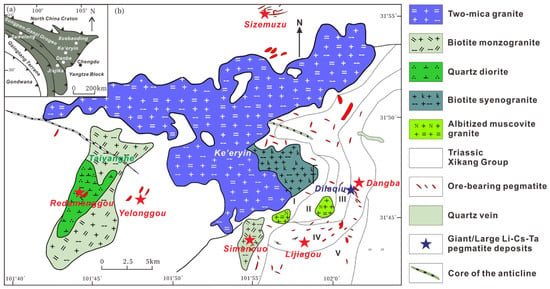
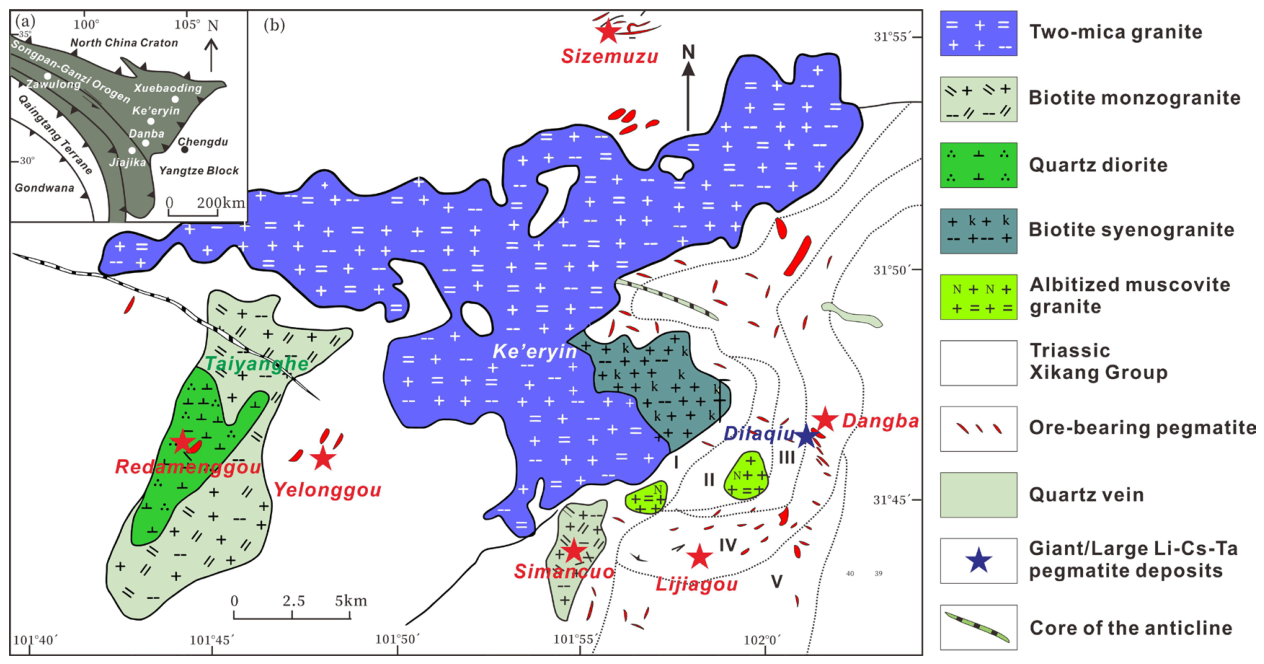
The study area lies in the Ke’eryin rare-metal orefield, within the Central Songpan–Ganzi orogenic belt of the Western Sichuan Basin. The Songpan–Ganzi orogenic belt forms an approximately triangular region covering 2.2 × 10⁵ km2. It developed after the closure of the Paleo-Tethys Ocean in the Late Triassic through mutual subduction and collision among the North China Block, the Qiangtang–Chamdo Block, and the Yangtze Block (Figure 1a). The region contains thick flysch deposits of the Xikang Group and has a complex structural architecture. Exposed strata are dominated by the Xikang Group (Figure 1b), including the Upper Triassic Zagunao, Zhuwo, and Xinduqiao formations. These strata comprise gray-black felsic sandstone, siltstone, sericite slate, argillaceous slate, and limestone. Jurassic, Cretaceous, and Tertiary strata are absent owing to uplift, weathering, and denudation since the Indosinian period. The Triassic succession is unconformably overlain by Quaternary deposits, whereas contacts among the internal stratigraphic units are conformable. Indosinian intracontinental orogenesis generated numerous NW-, NWW-, and E-W-trending folds in the area. Later Yanshanian horizontal compression produced NE-trending faults. The Ke’eryin–Rilongguan composite anticline and NE-trending thrust faults constitute the principal regional ore-controlling structures.
Figure 1.
Sketch map of regional tectonics (a), modified after [21], and simplified geological map of the Ke’eryin ore field (b), modified after [22].
Regional magmatism is represented mainly by the Ke’eryin and Taiyanghe plutons (Figure 1b). The Taiyanghe pluton is composed predominantly of diorite and granite, including quartz diorite and biotite monzogranite. Quartz diorite is exposed near Redamen, whereas biotite monzogranite occurs west of Yelonggou. The pluton forms irregularly shaped stocks that intrude into and partly assimilate the Redamen quartz diorite. The Ke’eryin pluton is granitic and includes porphyritic biotite K-feldspar granite, two-mica granite, biotite monzogranite, and muscovite granite. Two-mica granite is the most extensive lithology, occupying approximately 190 km2. It forms a batholith that intrudes along the core of the Ke’eryin anticline. Muscovite granite has the smallest outcrop area and occurs sporadically near Genze in the southeastern part of the Ke’eryin pluton. Granitic pegmatite dikes are distributed in strata within approximately 5 km of the Ke’eryin pluton and display clustered and zoned patterns. Based on mineral assemblages, five horizontal zones are recognized in sequence: (I) microcline pegmatite zone (0.8 km), (II) microcline–albite pegmatite zone (0.8–1.5 km), (III) albite pegmatite zone (1.5–2.5 km), (IV) albite–spodumene pegmatite zone (2.5–5 km), and (V) lepidolite pegmatite dikes (>5 km) (Figure 1b). Most pegmatite dikes are concordant with stratigraphic bedding and form stratiform bodies, although irregular bodies occur locally. Crosscutting dikes are less common and are mainly lenticular. Other dikes occur along fold hinges or on both limbs of anticlines, where they form mainly stratiform-like and lenticular bodies. Recent exploration has identified several large- and medium-sized rare-metal deposits around the Ke’eryin pluton, including Lijiagou, Dangba, Yelonggou, Simancuo, Sizemuzu, Redamen, and Dilaqiu (Figure 1b).
3. Geological Characteristics of the Deposit
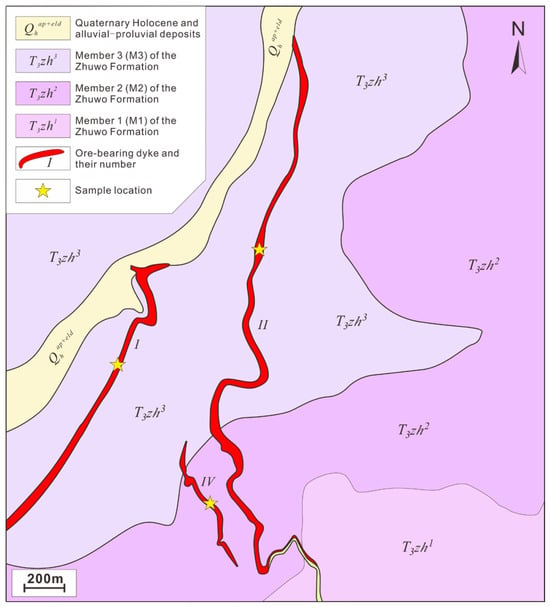
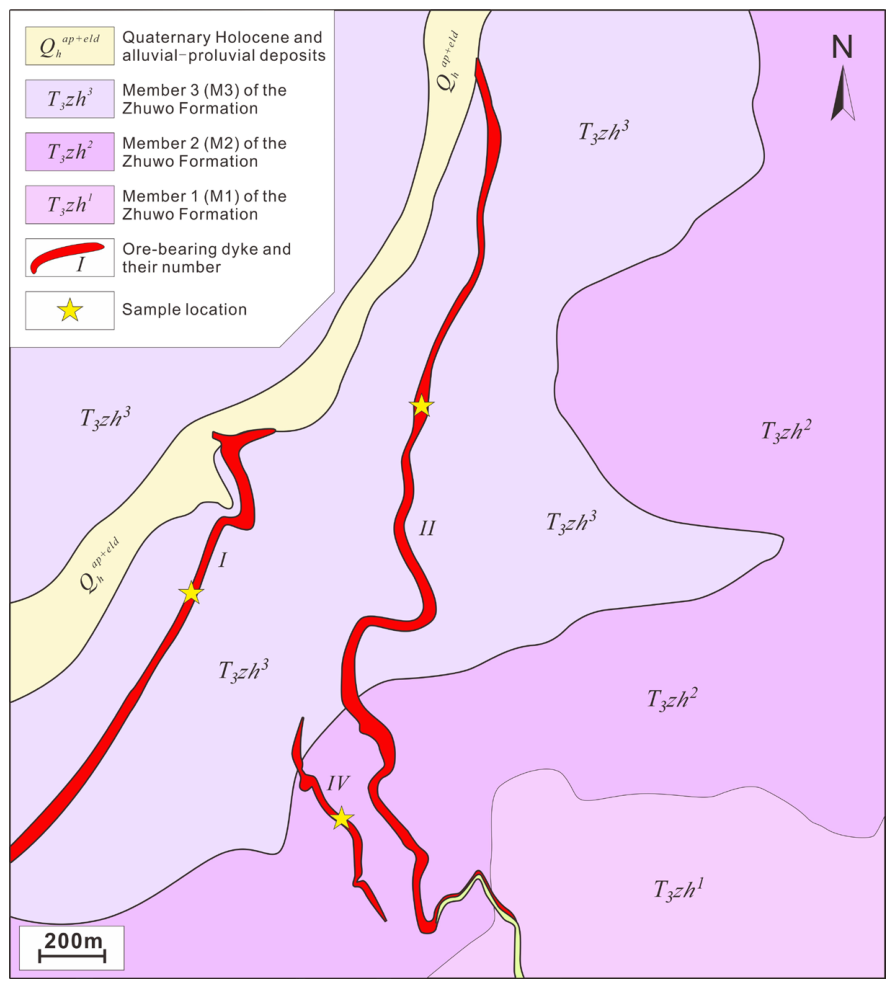
The deposit lies in the core of the Dilaqiu syncline at the southern end of the Ma’erkang synclinorium. Well-developed NW-trending crosscutting faults and interlayer detachment structures controlled the emplacement of densely distributed spodumene pegmatite dikes that constitute the principal orebodies in the area. The mining area exposes two metamorphosed shallow-marine clastic successions (Figure 2). The first is the flysch succession of the Upper Triassic Zhuwo Formation, which is dominated by biotite hornfels facies. Its protoliths include gray to dark-gray, thin- to medium-bedded and locally thick-bedded to massive feldspathic quartz sandstone, lithic sandstone, fine sandstone, siltstone, and dark-gray silty slate and sericite slate interbedded in unequal thicknesses. The second is the clastic succession of the upper member of the Middle Triassic Zagunao Formation, which is dominated by amphibolite facies. Its protoliths include dark-gray to gray, medium- to thick-bedded to massive lithic sandstone and feldspathic quartz sandstone intercalated with dark-gray to gray-black silty slate and peaty slate. The Dilaqiu lithium deposit is situated on the southwestern limb of an overturned syncline. Fissures of various scales and small post-vein faults are common. The fissures controlled the positions and geometries of the ore-bearing pegmatites, whereas the faults disrupted their continuity. The Dilaqiu syncline is the dominant fold structure in the mining area. Its axial trace trends 310°, extends for 1112 m, and is parallel to the strata. The core consists of Zhuwo Formation strata, while both limbs consist of strata from the upper member of the Zagunao Formation. The southwestern and northeastern limbs have attitudes of 90–120°∠24–34° and 220°∠38–42°, respectively. Interlayer detachment fracture zones and fold-related tensile fissures provided both conduits and accommodation space for spodumene pegmatite emplacement and are important ore-controlling structures. Acidic pegmatitic magmatism was widespread in the mining area during the Early Yanshanian. Magma was emplaced mainly along NW-trending interlayer slip fracture zones and longitudinal tensional fault-fracture zones associated with folds, as well as along two sets of NNE- and NNW-trending transtensional fissures. The resulting intrusions occur in groups and belts as vein-like, lenticular, and irregular bodies. Three principal ore-bearing albite–spodumene granitic pegmatite dikes, designated Nos. I, II, and IV, are presented (Figure 2). Wall-rock alteration is intense and dominated by pegmatitic metasomatism. The alteration sequence, from early to late, comprises muscovitization, albitization, lepidolitization, greisenization, and sericitization, with albitization being the most extensively developed.
Figure 2.
Geological map of the Dilaqiu deposit.
4. Samples and Analytical Methods
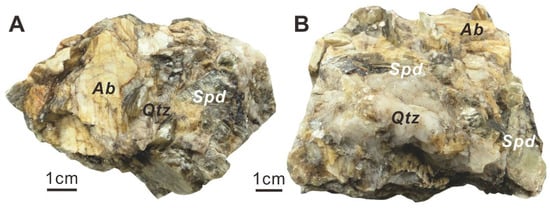
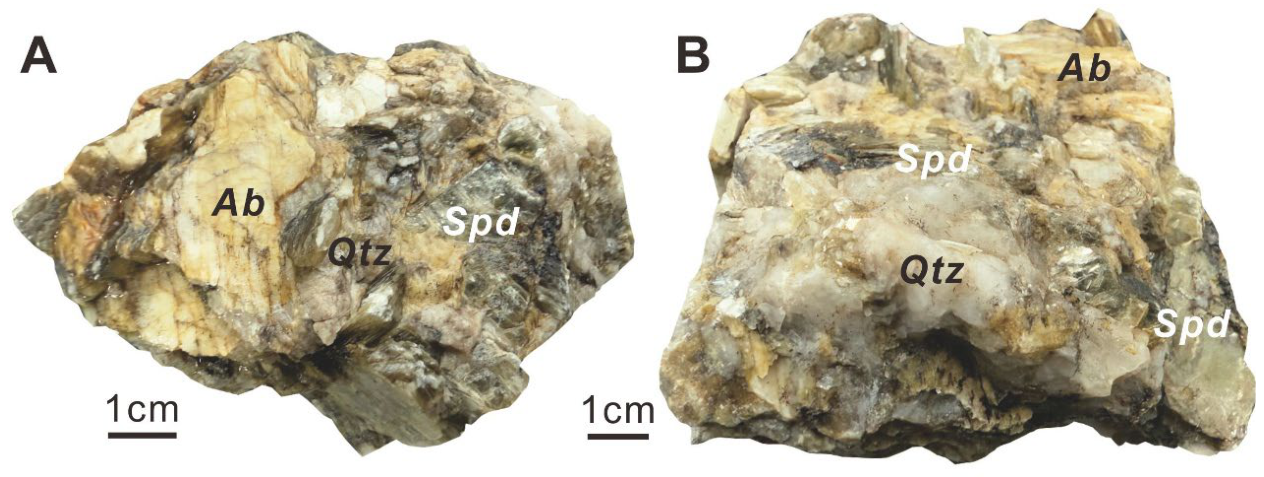
Twenty-four samples were collected from albite–spodumene pegmatite (Figure 3) in the Dilaqiu deposit. After detailed petrographic examination, albite–spodumene pegmatite samples were selected for further analysis. Polished sections were prepared, and mineral occurrence and morphology were documented by scanning electron microscopy. Cassiterite in these sections was then analyzed in situ by laser ablation inductively coupled plasma mass spectrometry (LA-ICP-MS). Backscattered-electron and cathodoluminescence images were first used to classify cassiterite. On the basis of this classification, suitable domains were selected for in situ LA-ICP-MS trace element analysis and U−Pb isotopic geochronology. Analytical spots were placed, wherever possible, away from cracks, inclusions, and other impurity-bearing domains to minimize interference from common lead [23,24].
Figure 3.
Hand specimens of the albite–spodumene pegmatite from the Dilaqiu deposit. (A) Coarse-grained albite–spodumene pegmatite composed mainly of albite (Ab), spodumene (Spd), and quartz (Qtz), showing a typical pegmatitic texture with centimeter-scale crystals. (B) Quartz-rich albite–spodumene pegmatite characterized by coarse prismatic spodumene enclosed within massive quartz and blocky albite.
4.1. SEM
The scanning electron microscopy experiment was completed at the Institute of Multipurpose Utilization of Mineral Resources, Chinese Academy of Geological Sciences. The analytical instrument was a ZEISS Sigma 300 field emission scanning electron microscope (ZEISS, Oberkochen, Germany), with an operating voltage of 10 kV, a current of 15 nA, and a working distance of 8.0 mm.
4.2. Cassiterite LA-ICP-MS U−Pb Dating
In this study, cassiterite U−Pb isotope analysis was conducted at Beijing Yandu Zhongshi Testing Technology Co., Ltd. using laser ablation inductively coupled plasma mass spectrometry (LA-ICP-MS). The laser ablation system employed was an NWR 193 nm ArF excimer laser system, and the ICP-MS instrument was an Analytikjena PlasmaQuant MSQ (Analytik Jena GmbH + Co. KG, Jena, Germany) inductively coupled plasma mass spectrometer. For dating, the cassiterite standard Yankee [23,25] (UPbk TIMS = (246.48 ± 0.51) Ma) was used as an external standard to correct for fractionation effects, while the AY-4 [26,27] and Cligga Head [28] standards were used to ensure data quality. The external standard for calculating U and Pb contents was NIST610. The standard sample set (NIST610, Yankee, AY-4, Cligga Head) was run once after every 10 sample points were analyzed. Laser ablation used helium as the carrier gas, which was mixed with argon via a T-junction before entering the mass spectrometer. Each cycle collected approximately 15 s of background signal and 50 s of sample signal. The laser settings were as follows: spot size of 30 μm, frequency of 10 Hz, and energy density of 4.0 J/cm2. Post-analysis offline data processing was performed using ICPMSDataCal [29] software. Additionally, Isoplot 4.15 software was used to generate the Tera–Wasserburg diagram for the U−Pb ages of cassiterite samples.
4.3. Cassiterite LA-ICP-MS Trace Element Analysis
In situ trace element analyses in this study were conducted via laser ablation inductively coupled plasma mass spectrometry (LA-ICP-MS) at Nanjing Hongchuang Geological Exploration Technology Service Co., Ltd. The laser ablation system employed was a Resolution SE 193 nm deep ultraviolet laser ablation sampling system manufactured by Applied Spectra (West Sacramento, CA, USA), equipped with an S155 dual-volume ablation cell. An Agilent 8900 inductively coupled plasma mass spectrometer (Agilent Technologies, Santa Clara, CA, USA) served as the mass detector.
For instrument tuning, NIST SRM 612 glass was ablated with a laser beam diameter of 50 μm, repetition rate of 10 Hz, and energy density of 3.5 J/cm2. Carrier gas flows were optimized to achieve a 238U signal intensity of approximately 6 × 10⁵ counts per second (cps), while the oxide production ratio (ThO/Th) was controlled below 0.2%. In addition, line-scan analyses on NIST SRM 610 with a 100 μm beam diameter were performed for presence/absence (P/A) tuning of target elements. The monitored isotopic masses included 27Al, 45Sc, 49Ti, 51V, 55Mn, 57Fe, 71Ga, 90Zr, 93Nb, 115In, 178Hf, 181Ta, and 184W; the total acquisition time per single mass sweep was ~0.31 s. Prior to analysis, thin sections were mounted on sample holders, and sample surfaces were wiped with analytically pure ethanol to eliminate surface contaminants. Five laser pulses were applied for pre-ablation at each analysis spot to remove surface pollution, corresponding to an ablation depth of roughly 1 μm. During formal data acquisition, laser parameters were set as follows: beam diameter 50 μm, repetition rate 5 Hz, energy density 4.5 J/cm2.
Raw data reduction was completed using the Iolite 4.0 software package [30], with quantitative corrections performed via the built-in “3D Trace Element” data reduction scheme [31]. Reference glasses NIST SRM 610, NIST SRM 612, BCR-2G, and BHVO-2G were used for external calibration. One batch of these reference materials was measured every ten unknown sample spots. Each analytical run consisted of a 20 s gas blank measurement followed by a 35–40 s sample signal collection; signal intervals were manually screened for subsequent data processing.
4.4. Cassiterite EPMA Major Element Analysis
Electron probe microanalysis (EPMA) of cassiterite was conducted at the Institute of Multipurpose Utilization of Mineral Resources, Chinese Academy of Geological Sciences, using a SHIMADZU EPMA-1720 electron probe microanalyzer (SHIMADZU, Tokyo, Japan). Quantitative analyses were performed using wavelength-dispersive X-ray spectrometry (WDS), while energy-dispersive X-ray spectrometry (EDS) was used for qualitative phase identification. The operating conditions were as follows: an accelerating voltage of 15 kV, a beam current of 20 nA, and a beam diameter of 10 μm. The counting times were 20 s for background and 40 s for peak positions. All data were corrected using the ZAF matrix-correction procedure. The detection limit was 0.01 wt%, and the analytical precision was better than 5% relative for major elements.
5. Analytical Results
5.1. Mineralogical Characteristics
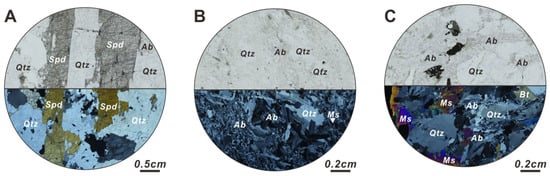
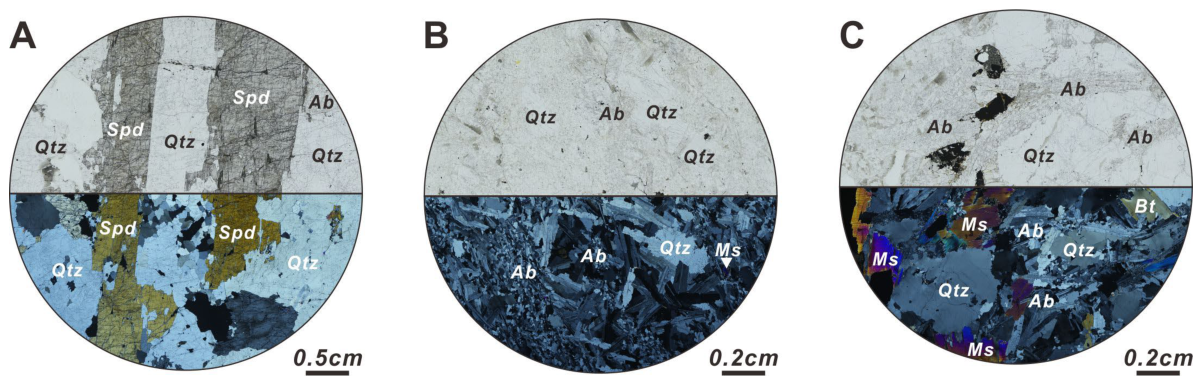
Ore samples from the Dilaqiu lithium polymetallic deposit are generally grayish-white to grayish-yellow, with massive structures and medium- to coarse-grained pegmatitic textures (Figure 4). The major mineral assemblage consists of spodumene (grain size approximately 0.5–2 cm, 8%–15%), quartz (30%–35%), albite (25%–30%), microcline (5%–10%), and muscovite (2%–5%) (Figure 4). Accessory phases include zircon, cassiterite, tourmaline, apatite, and other minerals (Figure 5).
Figure 4.
Photomicrographs of typical thin sections from the Dilaqiu deposit. The upper half of each circular view is plane-polarized light (PPL), while the lower half is cross-polarized light (XPL). (A) Spodumene-bearing coarse-grained pegmatite. Spodumene (Spd) occurs as columnar, fractured megacrysts coexisting with quartz (Qtz) and albite (Ab). (B) Medium-grained albite–quartz pegmatite. Tabular albite crystals are intergrown with anhedral quartz, with minor muscovite (Ms) dispersed among mineral grains. (C) Muscovite-bearing albite–quartz pegmatite. Albite and quartz constitute the major rock-forming minerals, with abundant flaky muscovite (Ms) and sparse biotite (Bt) distributed along grain boundaries.
Figure 5.
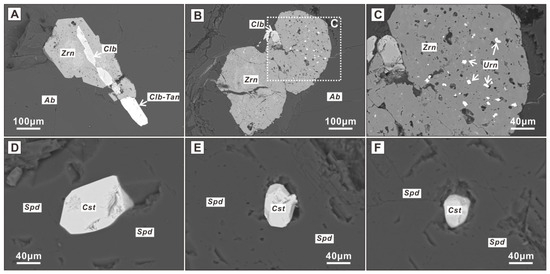
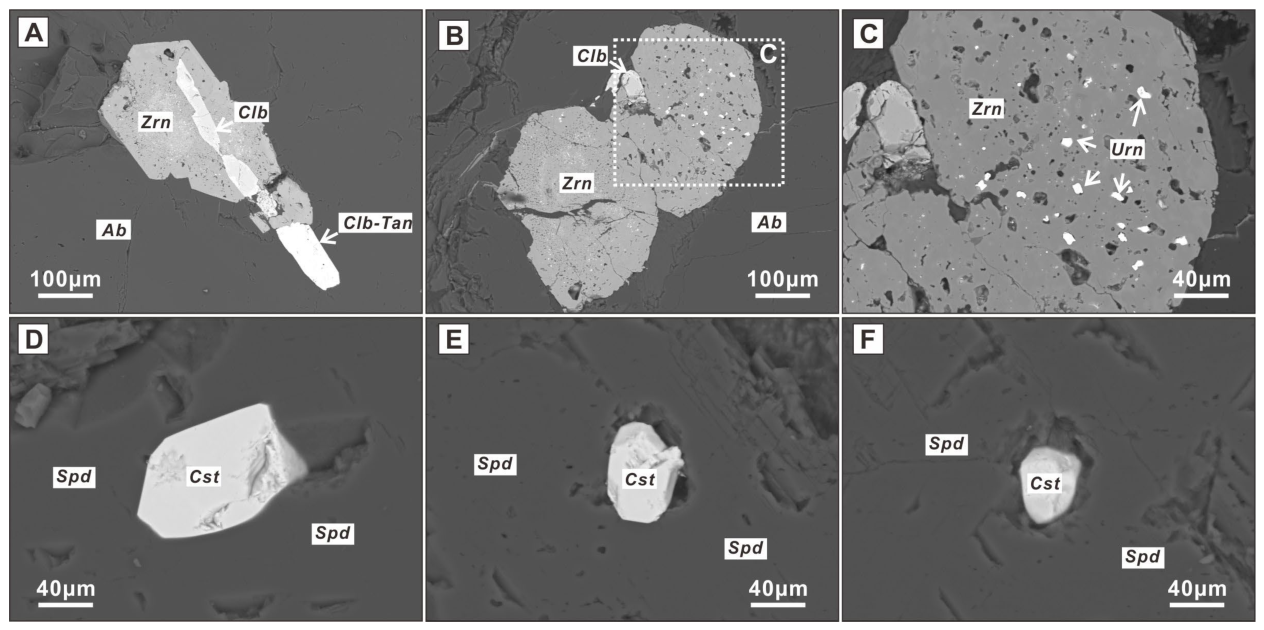
Backscattered electron (BSE) scanning electron microscope (SEM) images of accessory minerals hosted in pegmatite samples from the Western Sichuan Li-polymetallic pegmatite deposit. (A) Euhedral zircon (Zrn) grain with vein-like columbite (Clb), embedded within albite (Ab). (B) Aggregated zircon grains hosted in an albite matrix, with small columbite occurring at the margin of zircon; the white dashed rectangle denotes the magnified region shown in panel C. (C) High-magnification BSE image corresponding to the dashed area in panel B; abundant bright uraninite (Urn) micro-inclusions are scattered inside the zircon crystal. (D–F) Cassiterite (Cst) crystals with distinct euhedral morphology enclosed within spodumene (Spd).
Cassiterite in the ore is fine-grained (5–70 μm) (Figure 5D–F) and occurs predominantly as subhedral granular crystals closely intergrown with spodumene. It is commonly enclosed within spodumene crystals (Figure 5D–F). This textural and paragenetic relationship indicates a close genetic association between cassiterite and spodumene.
5.2. Cassiterite EPMA Results
Electron probe microanalysis data were obtained from 28 cassiterite spots and are reported in Table 1. SnO2 is the dominant component (93.17–96.97 wt%, mean 94.89 wt%). Nb2O5 (0.31–1.55 wt%, mean 0.99 wt%) and Ta2O5 (1.83–4.09 wt%, mean 3.08 wt%) occur in minor amounts, whereas FeO (0.01–1.33 wt%, mean 0.51 wt%) and MnO (from below the detection limit to 0.05 wt%, mean 0.02 wt%) are present at low concentrations.
Table 1.
Major element chemical composition of the cassiterite from the Dilaqiu deposit analyzed by EPMA.
5.3. Cassiterite LA-ICP-MS Trace Element Results
All LA-ICP-MS trace element analysis spots were strictly co-located with the EPMA analysis spots to ensure consistency in subsequent data processing and quantitative calculations. The trace element composition of cassiterite from the Dilaqiu deposit (Table 2) is characterized by enrichment in Nb and Ta. Among the analyzed elements, Ta (9042–52,516 ppm, mean 38,095 ppm), Nb (2854–11,347 ppm, mean 8159 ppm), and Fe (1388–8442 ppm, mean 6262 ppm) have the highest concentrations. Ti (612–2751 ppm, mean 1754 ppm) and Mn (41.4–341.3 ppm, mean 187.6 ppm) are present at intermediate concentrations. Hf (105–741 ppm, mean 391 ppm) occurs at comparatively low concentrations, whereas W (2.7–42.9 ppm, mean 21.3 ppm) is the least abundant.
Table 2.
Trace element chemical composition of cassiterite from the Dilaqiu deposit analyzed by LA-ICP-MS.
5.4. Cassiterite U−Pb Geochronology
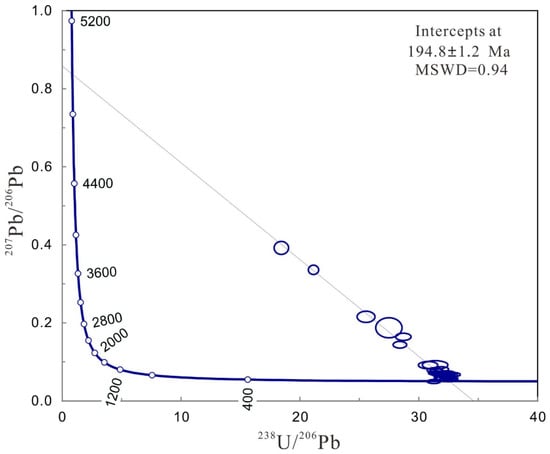
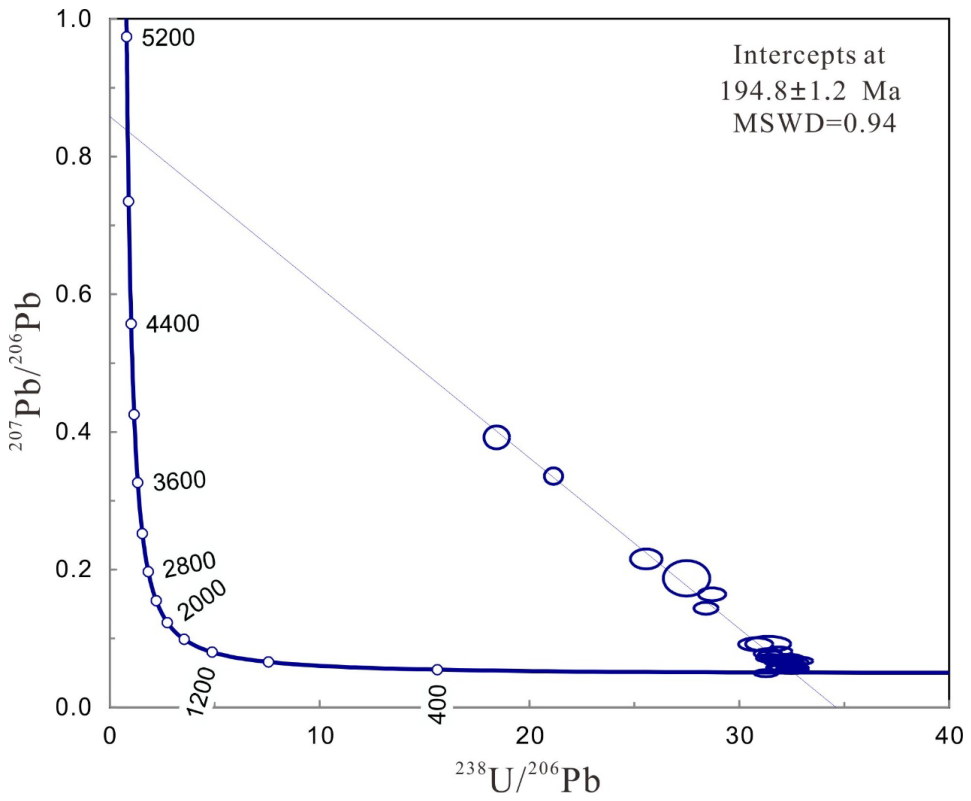
The LA-ICP-MS U−Pb results for cassiterite from the Dilaqiu Li−Nb−Sn polymetallic deposit are reported in Table 3. A total of 30 cassiterite spots were analyzed by LA-ICP-MS. Two analyses (SCLK-3-07 and SCLK-3-09) were excluded from the age calculation due to Pb loss and common-Pb contamination. U contents range from 1.36 ppm to 9.61 ppm, whereas Th contents range from below the detection limit to 0.645 ppm. The remaining 28 concordant to near-concordant analyses define a Tera–Wasserburg lower-intercept age of 194.8 ± 1.2 Ma (MSWD = 0.94, n = 28) (Figure 6).
Table 3.
LA-ICP-MS U−Pb dating results of cassiterite for the Dilaqiu deposit.
Figure 6.
U−Pb Tera–Wasserburg concordia plots of cassiterite from the Dilaqiu deposit.
6. Discussion
6.1. Genesis of Cassiterite
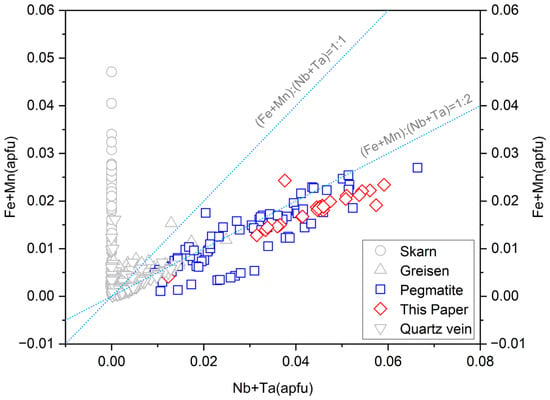
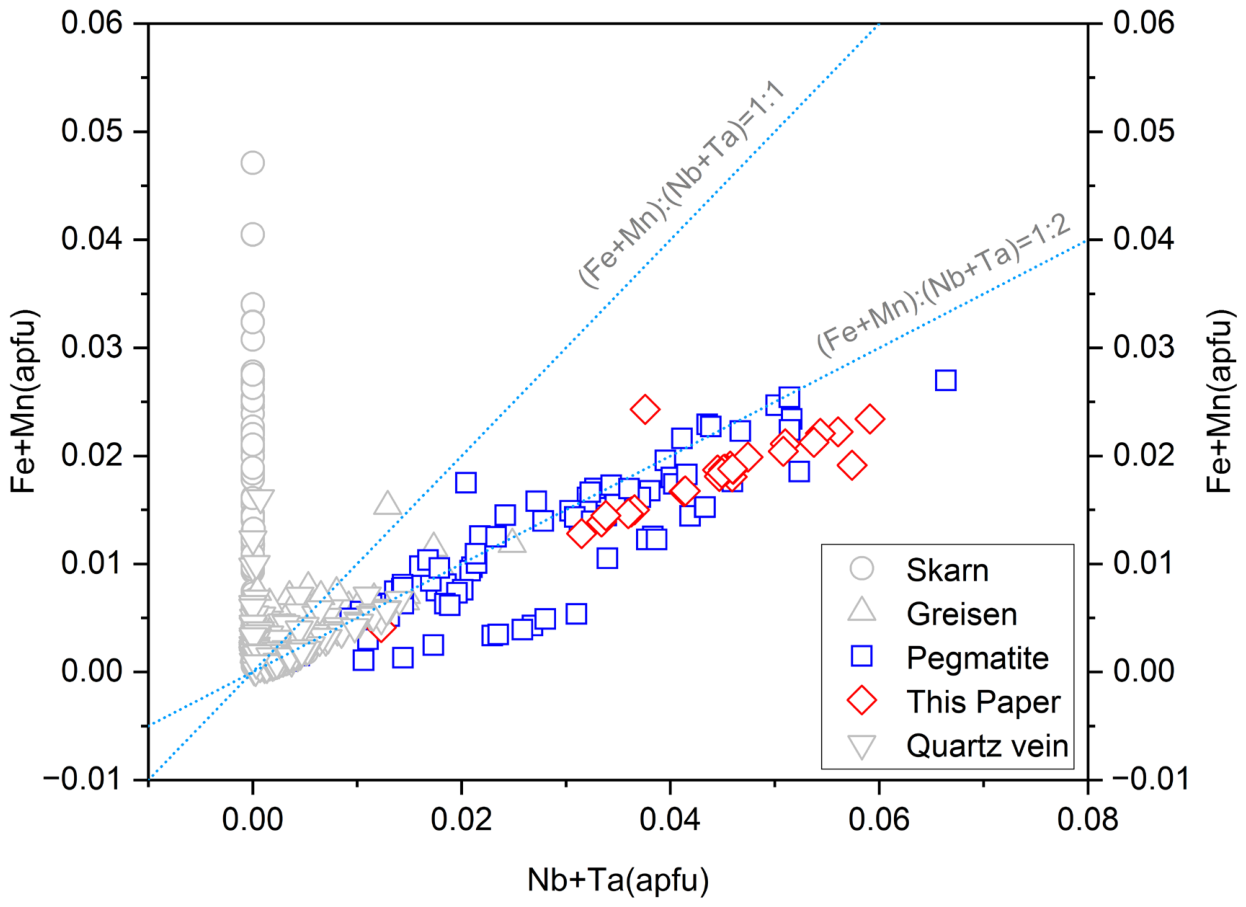
Whether the formation age of cassiterite records the metallogenic age of the deposit depends on the genesis of the cassiterite. Cassiterite trace element compositions provide important constraints on its origin [32]. Ions such as Nb5+, Ta5+, Fe2+, and Mn2+ can enter the cassiterite structure by substituting for Sn4+, with charge balance maintained through the mechanism 3Sn4+ = 2(Nb + Ta)5+ + (Fe + Mn)2+. Previous studies indicate that Fe and Mn are preferentially enriched in low-temperature hydrothermal systems, whereas Nb and Ta are preferentially enriched in high-temperature hydrothermal systems [33,34,35]. At high temperatures, Nb and Ta also tend to enter magmatic fluids [36,37]. The (Nb + Ta):(Fe + Mn) ratio in cassiterite can therefore be used to constrain the source of the cassiterite-forming fluid [32]. Cation normalization was carried out using EPMA major element and LA-ICP-MS trace element data for cassiterite to obtain the (Nb + Ta):(Fe + Mn) ratios of cassiterite. All values obtained in this study exceed 2 (Figure 7). They are consistent with values for cassiterite from high-temperature pegmatite systems but differ markedly from those of lower-temperature systems, such as skarn and quartz-vein deposits. The elevated Nb + Ta contents therefore suggest that cassiterite crystallized from the high-temperature magmatic fluids that formed the regional pegmatite dikes. Textural evidence supports this interpretation. Most cassiterite grains are enclosed within spodumene (Figure 5D–F), indicating a close paragenetic and genetic association. Taken together, these observations suggest that cassiterite crystallized from the pegmatite-forming magmatic fluids and that its formation age can constrain the timing of lithium mineralization in the pegmatite.
Figure 7.
Variations in the (Fe + Mn):(Nb + Ta) ratios of cassiterite in different ore-forming fluid systems. (Skarn data from [16,38,39]; greisen data from [40]; quartz vein data from [16,32,40,41]; pegmatite data from [41]).
6.2. Cassiterite Geochronology
Previous studies have proposed close spatial, temporal, and genetic links between rare-metal granitic pegmatites in the Ke’eryin orefield and the Ke’eryin pluton [8,21]. Published geochronological data for granites in the Ke’eryin area span a broad interval and differ markedly among dating methods. Much of this discrepancy arises from the K-Ar and 40Ar−39Ar ages reported for numerous granitic pegmatites (116–176.2 Ma) [21,42]. The Ar isotopic system has a relatively low closure temperature of 300–400 °C [43] and is readily disturbed by later hydrothermal activity, so it may record the timing of hydrothermal overprinting. Hydrothermal activity can also cause partial Ar loss and further compromise the accuracy of the resulting ages. The K−Ar and 40Ar−39Ar ages of granitic pegmatites in this area may therefore provide temporal evidence of later hydrothermal activity, but they should not be interpreted directly as pegmatite crystallization ages or metallogenic ages of rare-metal mineralization [44]. The development of laser ablation multi-collector inductively coupled plasma mass spectrometry (LA-MC-ICP-MS) has established cassiterite U−Pb dating as a geochronological method [24]. Because cassiterite is an important ore mineral in Sn polymetallic deposits and pegmatite-type Li−Sn polymetallic deposits, it is well suited to dating these systems [19,22,43,44,45,46]. In the present study, cassiterite U−Pb dating constrains the metallogenic age of the Dilaqiu deposit to 194.8 ± 1.2 Ma, indicating that lithium mineralization occurred during the early Yanshanian. Regional columbite-tantalite, zircon, and cassiterite ages from pegmatite-type Li polymetallic deposits in the Ke’eryin area are concentrated between 195 and 216 Ma [22,47,48,49,50,51]. The cassiterite U−Pb age of 194.8 ± 1.2 Ma obtained for the Dilaqiu deposit falls within this principal interval, indicating that the deposit formed during the active episode of regional Li polymetallic mineralization. Regional geochronological data, however, indicate that rare-metal mineralization was not a single event. Cassiterite and columbite-tantalite U−Pb ages from the Lijiagou lithium deposit constrain mineralization to approximately 210 Ma [48]. Cassiterite U−Pb ages from the Dangba lithium deposit record two mineralization stages at 208.1 ± 1.9 Ma and 199.3 ± 1.6 Ma [22]. Li et al. (2024) [51] identified three U−Pb age peaks at 216, 205, and 195 Ma in columbite-group minerals from the Jiada lithium deposit over the interval from 216 to 195 Ma. Together, these ages indicate a multistage mineralization history in the Ke’eryin pegmatite-type rare-metal ore concentration area, with peaks at approximately 195 Ma, 200–205 Ma, and 210 Ma. The Dilaqiu Li polymetallic deposit records the mineralization event at approximately 195 Ma.
6.3. Metallogenic Tectonic Setting of the Deposit
Globally, the formation of LCT (Li-Cs-Ta-Rb-Be-Sn) granitic pegmatites has been linked to supercontinent convergence and orogenesis [52,53]. The Ke’eryin rare-metal ore concentration area, which hosts the Dilaqiu Li polymetallic deposit, lies within the Songpan–Ganzi orogenic belt. Following the closure of the Paleo-Tethys Ocean in the Late Triassic, collision among the North China-Tarim Block, the Qiangtang Block, and the Yangtze Block formed this belt [54]. The Paleo-Tethys Ocean closed at approximately 230 Ma [55,56]. Collision and intracontinental orogenesis in the Songpan–Ganzi orogenic belt continued from approximately 220 to 200 Ma, after which the belt entered a post-collisional extensional stage [57]. The metallogenic age of 194.8 ± 1.2 Ma obtained for the Dilaqiu Li polymetallic deposit slightly postdates collision and intracontinental orogenesis in the belt and falls within the subsequent post-collisional extensional stage. This interval was characterized by large-scale granite-pegmatite magmatism throughout the orogenic belt [58,59]. The pegmatites in the deposit are mainly leucogranitic, and leucogranites commonly form during collisional orogenesis [60]. LCT-type rare-metal granitic pegmatites are also closely associated with late-orogenic S-type granites [61]. The Keyin pluton in the study area exhibits peraluminous S-type granite affinities [48,51]. The Lijiagou, Dangba, and Dilaqiu deposits (the focus of this study) are spatially and temporally linked to this pluton and are all classified as LCT-type lithium polymetallic deposits, collectively indicating a post-orogenic origin for this mineralization system. A comparable association occurs in the Jiajika ore district, which, like the Ke’eryin orefield, forms part of the Songpan–Ganzi orogenic belt. There, the Majingzi monzogranite, aplite, and granitic pegmatite all exhibit S-type granite characteristics, and the granitic pegmatite is an LCT-type rare-metal pegmatite that likewise represents a late-orogenic product [62]. These relationships indicate that the granitic pegmatite-type rare-metal deposits of the Ke’eryin orefield, including Dilaqiu, Lijiagou, and Dangba, formed during post-collisional orogenesis following collision among the North China-Tarim Block, the Qiangtang Block, and the Yangtze Block after closure of the Paleo-Tethys Ocean.
7. Conclusions
- (1)
- Petrographic and trace element evidence indicates that cassiterite in the ore is genetically associated with the rare-metal pegmatite. Its formation age can therefore be used to constrain the metallogenic age of the Dilaqiu polymetallic deposit.
- (2)
- Cassiterite LA-ICP-MS U−Pb geochronology indicates that the Dilaqiu Li polymetallic deposit formed during the Early Yanshanian, coinciding with the main episode of regional Li polymetallic mineralization.
- (3)
- The granitic pegmatite-type rare-metal deposits in the Ke’eryin orefield, including Dilaqiu, Lijiagou, and Dangba, are interpreted to have formed during post-collisional orogenesis following collision among the North China-Tarim Block, the Qiangtang Block, and the Yangtze Block after closure of the Paleo-Tethys Ocean.
Author Contributions
Investigation, W.Y., L.Y., B.H., Z.W. and H.L.; resources, H.L.; data curation, W.Y., Y.W. and H.L.; writing—original draft, W.Y. and H.L.; writing—review & editing, W.Y., L.Y., B.H., Z.W., Y.W. and H.L. All authors have read and agreed to the published version of the manuscript.
Funding
This research was funded by China Geological Survey grant number DD202602410605.
Data Availability Statement
All data supporting the findings of this study are presented within the manuscript.
Acknowledgments
We thank the Ninth Geological Brigade of Sichuan BGMR for fieldwork support. Technical assistance from the testing staff who performed SEM, cassiterite LA-ICP-MS U−Pb dating and LA-ICP-MS trace element analyses is highly appreciated. We acknowledge the anonymous reviewers for insightful comments that improved this manuscript.
Conflicts of Interest
The authors declare no conflicts of interest. The funder had no role in the design of the study, in the collection, analyses, or interpretation of data, in the writing of the manuscript or in the decision to publish the results.
References
- American Physical Society. Energy Critical Elements: Securing Materials for Emerging Technologies; American Physical Society: College Park, MD, USA, 2011. [Google Scholar]
- Graedel, T.E.; Harper, E.M.; Nassar, N.T.; Nuss, P.; Reck, B.K. Criticality of Metals and Metalloids. Proc. Natl. Acad. Sci. USA 2015, 112, 4257–4262. [Google Scholar] [CrossRef] [Scilit]
- Quaschning, V.V. Renewable Energy and Climate Change; John Wiley & Sons: Hoboken, NJ, USA, 2019. [Google Scholar]
- Winter, M.; Barnett, B.; Xu, K. Before Li ion batteries. Chem. Rev. 2018, 118, 11433–11456. [Google Scholar] [CrossRef] [Scilit]
- London, D. Pegmatites; The Canadian Mineralogist, Special Publication 10; The Mineralogical Association of Canada: Sudbury, ON, Canada, 2008; pp. 1–347. [Google Scholar]
- London, D. The Transition from Granite to Pegmatite. Geol. Soc. Am. Abstr. Programs 2008, 40, 334. [Google Scholar]
- Kesler, S.E.; Gruber, P.W.; Medina, P.A.; Keoleian, G.A.; Everson, M.P.; Wallington, T.J. Global Lithium Resources: Relative Importance of Pegmatite, Brine and Other Deposits. Ore Geol. Rev. 2012, 48, 55–69. [Google Scholar] [CrossRef] [Scilit]
- Fei, G.; Li, B.; Yang, J.; Chen, X.; Luo, W.; Li, Y.; Tang, W.; Gu, C.; Zhong, W.; Yang, G. Geology, Fluid Inclusion Characteristics and HO–C Isotopes of Large Lijiagou Pegmatite Spodumene Deposit in Songpan–Garze Fold Belt, Eastern Tibet: Implications for Ore Genesis. Resour. Geol. 2018, 68, 37–50. [Google Scholar] [CrossRef] [Scilit]
- Luo, W.; Peng, J.; Jin, T.F.; Yang, B.; Pang, L.W. Petrogenesis of Granite Aplite in the Lijiagou Lithium Polymetallic Ore District in Western Sichuan: Constraints from Geochemistry, Zircon U−Pb Geochronology and Hf Isotope. Sediment. Geol. Tethyan Geol. 2023, 43, 36–47. [Google Scholar]
- Luo, X.L.; Cai, Y.H.; Liu, Y.; Zhu, H.P.; Tan, H.; Fei, G.C. Mineralogical Characteristics of Spodumene in No. VIII Pegmatite Vein of Dangba Spodumene Deposit, Sichuan. Multipurp. Util. Miner. Resour. 2023, 44, 219–224. [Google Scholar]
- Wang, Z.P.; Liu, S.B.; Ma, S.C.; Liu, L.J.; Dai, H.Z.; Guo, W.M.; Chen, B.Z. Metallogenic Regularity, Deep and Periphery Prospecting of Dangba Superlarge Spodumene Deposit in Aba, Sichuan Province. Earth Sci. 2018, 43, 2029–2041. [Google Scholar]
- Yue, X.; Zhang, Y.; Zhu, X. Metallogenic geological background of the Dilaqiu lithium deposit in Barkam County, Sichuan Province. Geol. Rev. 2016, 62, 69–70. [Google Scholar]
- Rao, K. Geological characteristics and prospecting direction of Dilaqiu lithium deposit in Barkam, Sichuan Province. Sichuan Nonferrous Met. 2016, 1, 54–57. [Google Scholar]
- Plimer, I.R.; Lu, J.; Kleeman, J.D. Trace and rare earth elements in cassiterite: Sources of components for the tin deposits of the Mole Granite, Australia. Miner. Depos. 1991, 26, 267–274. [Google Scholar] [CrossRef] [Scilit]
- Dill, H.G.; Melcher, F.; Fuessl, M.; Weber, B. Accessory minerals in cassiterite: A tool for provenance and environmental analyses of colluvial–fluvial placer deposits (NE Bavaria, Germany). Sediment. Geol. 2006, 191, 171–189. [Google Scholar] [CrossRef] [Scilit]
- Cheng, Y.; Spandler, C.; Kemp, A.; Mao, J.; Rusk, B.; Hu, Y.; Blake, K. Controls on cassiterite (SnO2) crystallization: Evidence from cathodoluminescence, trace-element chemistry, and geochronology at the Gejiu Tin District. Am. Mineral. 2019, 104, 118–129. [Google Scholar] [CrossRef] [Scilit]
- Zhang, D.L.; Peng, J.T.; Hu, R.Z.; Yuan, S.D.; Zheng, D.S. The closure of U−Pb isotope system in cassiterite and its reliability for dating. Geol. Rev. 2011, 57, 549–554. [Google Scholar]
- Jiang, S.Y.; Yu, J.M.; Lu, J.J. Trace and rare-earth element geochemistry in tourmaline and cassiterite from the Yunlong tin deposit, Yunnan, China: Implication for migmatitic–hydrothermal fluid evolution and ore genesis. Chem. Geol. 2004, 209, 193–213. [Google Scholar] [CrossRef] [Scilit]
- Zhang, R.; Lehmann, B.; Seltmann, R.; Sun, W.; Li, C. Cassiterite U−Pb geochronology constrains magmatic-hydrothermal evolution in complex evolved granite systems: The classic Erzgebirge tin province (Saxony and Bohemia). Geology 2017, 45, 1095–1098. [Google Scholar] [CrossRef] [Scilit]
- Zhang, Q.; Zhao, K.D.; Li, W.Q.; Palmer, M.R.; Jiang, S.Y.; Jiang, H.; Zhang, W.; Zhang, D.; Hussain, A. Timing and Tectonic Setting of Tin Mineralization in Southern Myanmar: Constraints from Cassiterite and Wolframite U–Pb Ages. Miner. Depos. 2022, 57, 977–999. [Google Scholar] [CrossRef] [Scilit]
- Li, J.K.; Wang, D.H.; Fu, X.F. 40Ar/39Ar Ages of the Ke’eryin Pegmatite Type Rare Metal Deposit, Western Sichuan, and Its Tectonic Significances. Acta Geol. Sin. 2006, 80, 843–848. [Google Scholar]
- Fei, G.C.; Yang, Z.; Yang, J.Y.; Luo, W.; Deng, Y.; Lai, Y.T.; Tao, X.X.; Zheng, L.; Tang, W.C.; Li, J. New Precise Timing Constraint for the Dangba Granitic Pegmatite-Type Rare-Metal Deposit, Markam, Sichuan Province: Evidence from Cassiterite LA-MC-ICP-MS U−Pb Dating. Acta Geol. Sin. 2020, 94, 836–849. [Google Scholar]
- Cui, Y.; Tu, J.; Chen, F.; Hao, S.; Ye, L.; Zhou, H.; Li, H. The Research Advances in LA-(MC)-ICP-MS U−Pb Dating of Cassiterite. Acta Geol. Sin. 2017, 91, 1386–1399. [Google Scholar]
- Li, H.M.; Zhou, H.Y.; Hao, S.; Cui, Y.R.; Zhang, Y.Q. Age Correction Strategies of Cassiterite U−Pb Isotope Dating and the Age Correction Problems of Ore Minerals U−Pb Isotope Dating. Acta Mineral. Sin. 2013, 33, 595–596, (In Chinese with English abstract). [Google Scholar]
- Carr, P.A.; Zink, S.; Bennett, V.C.; Norman, M.D.; Amelin, Y.; Blevin, P.L. A New Method for U−Pb Geochronology of Cassiterite by ID-TIMS Applied to the Mole Granite Polymetallic System, Eastern Australia. Chem. Geol. 2020, 539, 119539. [Google Scholar] [CrossRef] [Scilit]
- Yang, M.; Romer, R.L.; Yang, Y.H.; Wu, S.T.; Wang, H.; Tu, J.R.; Zhou, H.Y.; Xie, L.W.; Huang, C.; Xu, L.; et al. U−Pb Isotopic Dating of Cassiterite: Development of Reference Materials and in Situ Applications by LA-SF-ICP-MS. Chem. Geol. 2022, 593, 120754. [Google Scholar] [CrossRef] [Scilit]
- Tapster, S.; Bright, J.W. High-Precision ID-TIMS Cassiterite U–Pb Systematics Using a Low-Contamination Hydrothermal Decomposition: Implications for LA-ICP-MS and Ore Deposit Geochronology. Geochronology 2020, 2, 425–441. [Google Scholar] [CrossRef] [Scilit]
- Liu, Y.S.; Gao, S.; Hu, Z.C.; Gao, C.G.; Zong, K.Q.; Wang, D.B. Continental and Oceanic Crust Recycling-Induced Melt–Peridotite Interactions in the Trans-North China Orogen: U–Pb Dating, Hf Isotopes and Trace Elements in Zircons from Mantle Xenoliths. J. Petrol. 2010, 51, 537–571. [Google Scholar] [CrossRef] [Scilit]
- Liu, Y.S.; Hu, Z.C.; Gao, S.; Günther, D.; Xu, J.; Gao, C.G.; Chen, H.H. In Situ Analysis of Major and Trace Elements of Anhydrous Minerals by LA-ICP-MS Without Applying an Internal Standard. Chem. Geol. 2008, 257, 34–43. [Google Scholar] [CrossRef] [Scilit]
- Paton, C.; Woodhead, J.D.; Hellstrom, J.C.; Hergt, J.M.; Greig, A.; Maas, R. Improved Laser Ablation U–Pb Zircon Geochronology through Robust Downhole Fractionation Correction. Geochem. Geophys. Geosyst. 2010, 11, 3. [Google Scholar] [CrossRef] [Scilit]
- Paul, B.; Petrus, J.; Savard, D.; Woodhead, J.; Hergt, J.; Greig, A.; Paton, C.; Rayner, P. Time Resolved Trace Element Calibration Strategies for LA-ICP-MS. J. Anal. At. Spectrom. 2023, 38, 1995–2006. [Google Scholar] [CrossRef] [Scilit]
- Wang, C.; Zhao, K.D.; Chen, J.; Ma, X. Examining Fingerprint Trace Elements in Cassiterite: Implications for Primary Tin Deposit Exploration. Ore Geol. Rev. 2022, 149, 105082. [Google Scholar] [CrossRef] [Scilit]
- Murciego, A.; Sanchez, A.G.; Dusausoy, Y.; Pozas, J.M.; Ruck, R. Geochemistry and EPR of cassiterites from the Iberian Hercynian Massif. Mineral. Mag. 1997, 61, 357–365. [Google Scholar] [CrossRef] [Scilit]
- Tindle, A.G.; Breaks, F.W. Oxide minerals of the Separation Rapids rare-element granitic pegmatite group, northwestern Ontario. Can. Mineral. 1998, 36, 609–635. [Google Scholar]
- Guo, J.; Zhang, R.; Li, C.; Sun, W.; Hu, Y.; Kang, D.; Wu, J. Genesis of the Gaosong Sn–Cu deposit, Gejiu district, SW China: Constraints from in situ LA-ICP-MS cassiterite U–Pb dating and trace element fingerprinting. Ore Geol. Rev. 2018, 92, 627–642. [Google Scholar] [CrossRef] [Scilit]
- Timofeev, A.; Migdisov, A.A.; Williams-Jones, A.E. An experimental study of the solubility and speciation of niobium in fluoride-bearing aqueous solutions at elevated temperature. Geochim. Cosmochim. Acta 2015, 158, 103–111. [Google Scholar] [CrossRef] [Scilit]
- Timofeev, A.; Migdisov, A.A.; Williams-Jones, A.E. An experimental study of the solubility and speciation of tantalum in fluoride-bearing aqueous solutions at elevated temperature. Geochim. Cosmochim. Acta 2017, 197, 294–304. [Google Scholar] [CrossRef] [Scilit]
- Liu, S.; Liu, Y.; Ye, L.; Wei, C.; Cai, Y.; Chen, W. Genesis of the Dulong Sn–Zn–In Polymetallic Deposit in Yunnan Province, South China: Insights from Cassiterite U–Pb Ages and Trace Element Compositions. Minerals 2021, 11, 199. [Google Scholar] [CrossRef] [Scilit]
- Benites, D.; Torró, L.; Vallance, J.; Laurent, O.; Quispe, P.; Rosas, S.; Uzieda, M.F.; Holm-Denoma, C.S.; Pianowski, L.S.; Camprubí, A.; et al. Geology, Mineralogy, and Cassiterite Geochronology of the Ayawilca Zn–Pb–Ag–In–Sn–Cu Deposit, Pasco, Peru. Miner. Depos. 2022, 57, 481–507. [Google Scholar] [CrossRef] [Scilit]
- Chen, L.L.; Ni, P.; Dai, B.Z.; Li, W.S.; Chi, Z.; Pan, J.Y. The Genetic Association between Quartz Vein- and Greisen-Type Mineralization at the Maoping W–Sn Deposit, Southern Jiangxi, China: Insights from Zircon and Cassiterite U–Pb Ages and Cassiterite Trace Element Composition. Minerals 2019, 9, 411. [Google Scholar] [CrossRef] [Scilit]
- Nambaje, C.; Eggins, S.M.; Yaxley, G.M.; Sajeev, K. Micro-Characterisation of Cassiterite by Geology, Texture and Zonation: A Case Study of the Karagwe–Ankole Belt, Rwanda. Ore Geol. Rev. 2020, 126, 103609. [Google Scholar] [CrossRef] [Scilit]
- Li, J.K. Mineralizing Mechanism and Continental Geodynamics of Typical Pegmatite Deposits in Western Sichuan. China. Ph.D. Thesis, China University of Geosciences, Beijing, China, 2006. [Google Scholar]
- Mezger, K. Geochronology in Granulites. In Granulites and Crustal Evolution; Vielzeuf, D., Vidal, P., Eds.; Kluwer Academic Publishers: Dordrecht, The Netherlands, 1990; pp. 451–470. [Google Scholar]
- McCauley, A.; Bradley, D.C. The Global Age Distribution of Granitic Pegmatites. Can. Mineral. 2014, 52, 183–190. [Google Scholar] [CrossRef] [Scilit]
- Gemmrich, L.; Torró, L.; Melgarejo, J.C.; Laurent, O.; Vallance, J.; Chelle-Michou, C.; Sempere, T.P. Trace element composition and U−Pb ages of cassiterite from the Bolivian tin belt. Mineral. Depos. 2021, 56, 1491–1520. [Google Scholar] [CrossRef] [Scilit]
- Han, J.; Chen, H.; Zhang, J.; Zhang, Y.; Zhang, R. Age and evolution of the Nanyangshan rare-metal mineralized pegmatite revealed by cassiterite U−Pb geochronology and tourmaline chemistry. Ore Geol. Rev. 2022, 150, 105121. [Google Scholar] [CrossRef] [Scilit]
- Zhao, Z.B.; Du, J.X.; Liang, F.H.; Wu, C.; Liu, X.J. Structure and Metamorphism of Markam Gneiss Dome From the Eastern Tibetan Plateau and Its Implications for Crustal Thickening, Metamorphism, and Exhumation. Geochem. Geophys. Geosyst. 2018, 20, 24–45. [Google Scholar] [CrossRef] [Scilit]
- Fei, G.C.; Menuge, J.F.; Li, Y.Q.; Yang, J.Y.; Deng, Y.; Chen, C.S.; Yang, Y.F.; Yang, Z.; Qin, L.Y.; Zheng, L.; et al. Petrogenesis of the Lijiagou spodumene pegmatite deposit in Songpan-Garze Fold Belt, West Sichuan, China: Evidence from geochemistry, zircon, cassiterite and coltan U−Pb geochronology and Hf isotopic compositions. Lithos 2020, 364–365, 105555. [Google Scholar] [CrossRef] [Scilit]
- Xu, J. LA-MC-ICP-MS U−Pb dating of cassiterite from the Lijiagou pegmatite-type rare-metal deposit in the Ke’eryin orefield, Sichuan Province and its geological implication. Geol. Explor. 2020, 56, 346–358. [Google Scholar]
- Zheng, Y.L.; Xu, Z.Q.; Li, G.W.; Lian, D.Y.; Zhao, Z.B.; Ma, Z.L.; Gao, W.Q. Genesis of the Markam gneiss dome within the Songpan-Ganzi orogenic belt, eastern Tibetan Plateau. Lithos 2020, 362–363, 105475. [Google Scholar] [CrossRef] [Scilit]
- Li, X.; Dai, H.Z.; Wang, D.H.; Liu, S.B.; Fan, X.D.; Liang, Z.; Gao, Y.; Wen, J.H.; Zhu, H.Y. Metallogenic regularity and exploration prediction of the Ke’eryin lithium ore field in Aba, Sichuan. Acta Petrol. Sin. 2024, 40, 2819–2840. [Google Scholar] [CrossRef] [Scilit]
- Černý, P. Rare-element granite pegmatites. Part I: Anatomy and internal evolution of pegmatite deposits. Geosci. Can. 1991, 18, 49–67. [Google Scholar]
- Tkachev, A.V. Evolution of Metallogeny of Granitic Pegmatites Associated with Orogens Throughout Geological Time; Geological Society Special Publication: London, UK, 2011; Volume 350, pp. 7–23. [Google Scholar]
- Xu, Z.Q.; Hou, L.W.; Wang, Z.X.; Fu, X.F.; Huang, M.H. Orogenic Processes of the Songpan–Garzê Orogenic Belt, China; Geological Publishing House: Beijing, China, 1992; (In Chinese with English abstract). [Google Scholar]
- Yin, A.; Harrison, T.M. Geologic evolution of the Himalayan–Tibetan orogen. Annu. Rev. Earth Planet. Sci. 2000, 28, 211–280. [Google Scholar] [CrossRef] [Scilit]
- Yu, L.; Yan, M.D.; Domeier, M.; Guan, C.; Shen, M.M.; Fu, Q.; Xu, W.L.; Xu, Z.B.; Niu, Z.C.; Yang, L.Y.; et al. New paleomagnetic and chronological constraints on the Late Triassic position of the Eastern Qiangtang Terrane: Implications for the closure of the Paleo-Jinshajiang Ocean. Geophys. Res. Lett. 2022, 49, e2021GL096902. [Google Scholar] [CrossRef] [Scilit]
- Wang, P.; Zhao, G.; Liu, Q.; Yao, J.; Han, Y. Evolution of the Paleo-Tethys Ocean in Eastern Kunlun, North Tibetan Plateau: From continental rift-drift to final closure. Lithos 2022, 422–423, 106717. [Google Scholar] [CrossRef] [Scilit]
- Li, P.; Li, J.; Chou, I.M.; Wang, D.; Xiong, X. Mineralization Epochs of Granitic Rare-Metal Pegmatite Deposits in the Songpan–Ganzê Orogenic Belt and Their Implications for Orogeny. Minerals 2019, 9, 280. [Google Scholar] [CrossRef] [Scilit]
- Xu, Z.; Fu, X.; Wang, R.; Li, G.; Zheng, Y.; Zhao, Z.; Lian, D. Generation of Lithium-Bearing Pegmatite Deposits within the Songpan-Ganze Orogenic Belt, East Tibet. Lithos 2020, 354–355, 105281. [Google Scholar] [CrossRef] [Scilit]
- Nabelek, P.I.; Liu, M. Petrologic and thermal constraints on the origin of leucogranites in collisional orogens. Earth Environ. Sci. Trans. R. Soc. Edinb. 2004, 95, 73–85. [Google Scholar] [CrossRef] [Scilit]
- Černý, P.; Ercit, T.S. The classification of granitic pegmatites revisited. Can. Mineral. 2005, 43, 2005–2026. [Google Scholar] [CrossRef] [Scilit]
- Dai, H.Z.; Wang, D.H.; Liu, L.J.; Yu, Y.; Dai, J.J.; Fu, X.F. Geochronology, geochemistry and their geological significance of the No. 308 pegmatite vein in the Jiajika deposit, western Sichuan, China. Earth Sci. 2018, 43, 3664–3681, (In Chinese with English abstract). [Google Scholar]

Disclaimer/Publisher’s Note: The statements, opinions and data contained in all publications are solely those of the individual author(s) and contributor(s) and not of MDPI and/or the editor(s). MDPI and/or the editor(s) disclaim responsibility for any injury to people or property resulting from any ideas, methods, instructions or products referred to in the content. |
© 2026 by the authors. Licensee MDPI, Basel, Switzerland. This article is an open access article distributed under the terms and conditions of the Creative Commons Attribution (CC BY) license.