


Abstract
Ammonium precipitation is widely used to recover vanadium from slag-derived liquors as ammonium metavanadate or polyvanadate, but chromium control is often evaluated less systematically than vanadium recovery. This focused process-diagnostic review draws on the topic-guided literature identified from academic literature sources, preliminary literature-discovery tools, and reference-list tracing. It presents a diagnostic framework integrating V/Cr speciation, cake entrainment, washing response, soluble-ion tracers (Na+, SO42−, Cl−), and recycle-accumulation assessment to identify whether product chromium originates from retained mother liquor, solid-associated transfer, or recycle accumulation. The analysis shows that high single-pass vanadium precipitation efficiency alone is insufficient; credible process assessment requires product-Cr source diagnosis, Cr(VI) control, purge/salt-recovery planning, and multi-cycle validation.
1. Introduction
Vanadium slag and related iron- and steel-metallurgical by-products are important secondary resources for vanadium recovery due to their enrichment in vanadium and compatibility with existing metallurgical processing circuits [1,2]. However, vanadium in these residues is frequently accompanied by chromium. Depending on the upstream roasting, leaching, and conditioning routes, chromium may remain in the solid residue, enter the solution as Cr(III), or be oxidized to soluble Cr(VI) [3,4]. This multi-phase distribution poses significant challenges for product purity, Cr(VI)-related occupational and environmental risks, discharge compliance, and residue stabilization.
Ammonium-assisted precipitation is widely utilized because V(V) can be selectively recovered as ammonium metavanadate (AMV) or ammonium polyvanadate (APV) through appropriate pH and salinity adjustments [1]. Ammonium-rich circuits typically originate from ammonium-sulfate leaching, ammonium conditioning of sodium vanadate liquors, or ammonium-assisted precipitation following solvent extraction [5,6,7]. Since the roasting and leaching routes dictate both the Cr(VI)/Cr(III) distribution and the Na+/NH4+/SO42−/Cl− salt matrix entering the precipitation stage, chromium control during ammonium vanadate precipitation must be assessed in conjunction with upstream process history [8].
Cr(VI) oxyanions generally remain soluble under weakly acidic-to-alkaline conditions, although their solubility in concentrated industrial liquors depends strongly on counterions, ionic strength and solution composition [9,10]. This behavior renders a vanadium-first (V-first) recovery strategy feasible: vanadium is selectively precipitated as AMV or APV while Cr(VI) remains predominantly in the mother liquor [5,9,11]. To close this metallurgical loop, subsequent processes should address this residual Cr(VI) in a downstream stage; for example, Yang et al. [12] developed a cyclic lead–salt precipitation–leaching route for chromium separation and recovery. However, dissolved chromium can still enter the vanadium product via mother-liquor entrainment or surface adsorption. In contrast, Cr(III) can hydrolyze, form colloids, co-precipitate with impurity metal hydroxides, or become physically trapped within vanadium filter cakes [13,14,15].
Although extensive work has addressed vanadium extraction and ammonium vanadate crystallization [9,16,17], many reported studies summarized in Tables S1–S4 still evaluate chromium control mainly using single-pass indicators, such as vanadium precipitation efficiency, total chromium removal, residual Cr concentration, or final product grade, rather than Cr contamination mechanism. These indicators fail to identify whether product chromium originates from retained mother liquor, surface adsorption, lattice occlusion, co-precipitation, or colloid capture. Furthermore, they do not illustrate the accumulation dynamics of Cr(VI) and salts during mother-liquor recycling. This review addresses three critical diagnostic gaps: chromium speciation, product-Cr uptake mechanism, and recycle stability.
The expressions employed are elementary mass balances, and no new mathematical formulation is claimed; the contribution lies in their integrated deployment as a sequential diagnostic procedure for identifying the origin of chromium in the vanadium product. Specifically, this review contributes to the literature by: (1) Establishing a speciation-based interpretation of chromium behavior during ammonium vanadate precipitation to distinguish soluble Cr(VI), hydrolyzed Cr(III), adsorbed chromium, and colloid-associated chromium. (2) Assembling an entrainment-based diagnostic procedure that bounds and screens measured product chromium against the theoretical chromium mass contributed by retained mother liquor. (3) Proposing the use of soluble-ion tracers such as Na+, SO42− and Cl− to differentiate between mother-liquor carryover and solid-associated chromium transfer. (4) Connecting product-Cr diagnosis with mother-liquor recycle inventory, thereby highlighting Cr(VI) and accumulation of dissolved salts (Na+, SO42− and Cl−) as critical process-stability risks that cannot be evaluated by single-pass vanadium precipitation efficiency alone.
2. Scope, Evidence Base and Stream Definitions
In this review, “ammonium-rich” refers to precipitation or post-precipitation liquors in which NH4+ is deliberately introduced as a major conditioning or precipitation reagent (e.g., via ammonium sulfate, ammonium chloride, ammonium bicarbonate, or ammonia-based pH adjustment), rather than being present only as a trace background ion.
2.1. Process Context
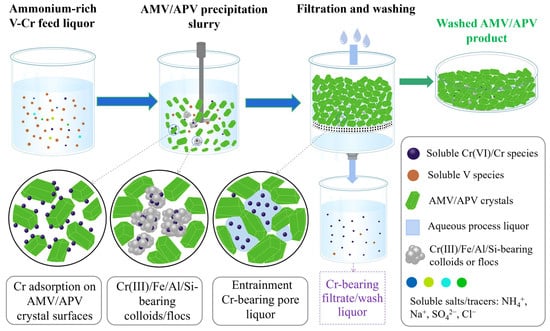
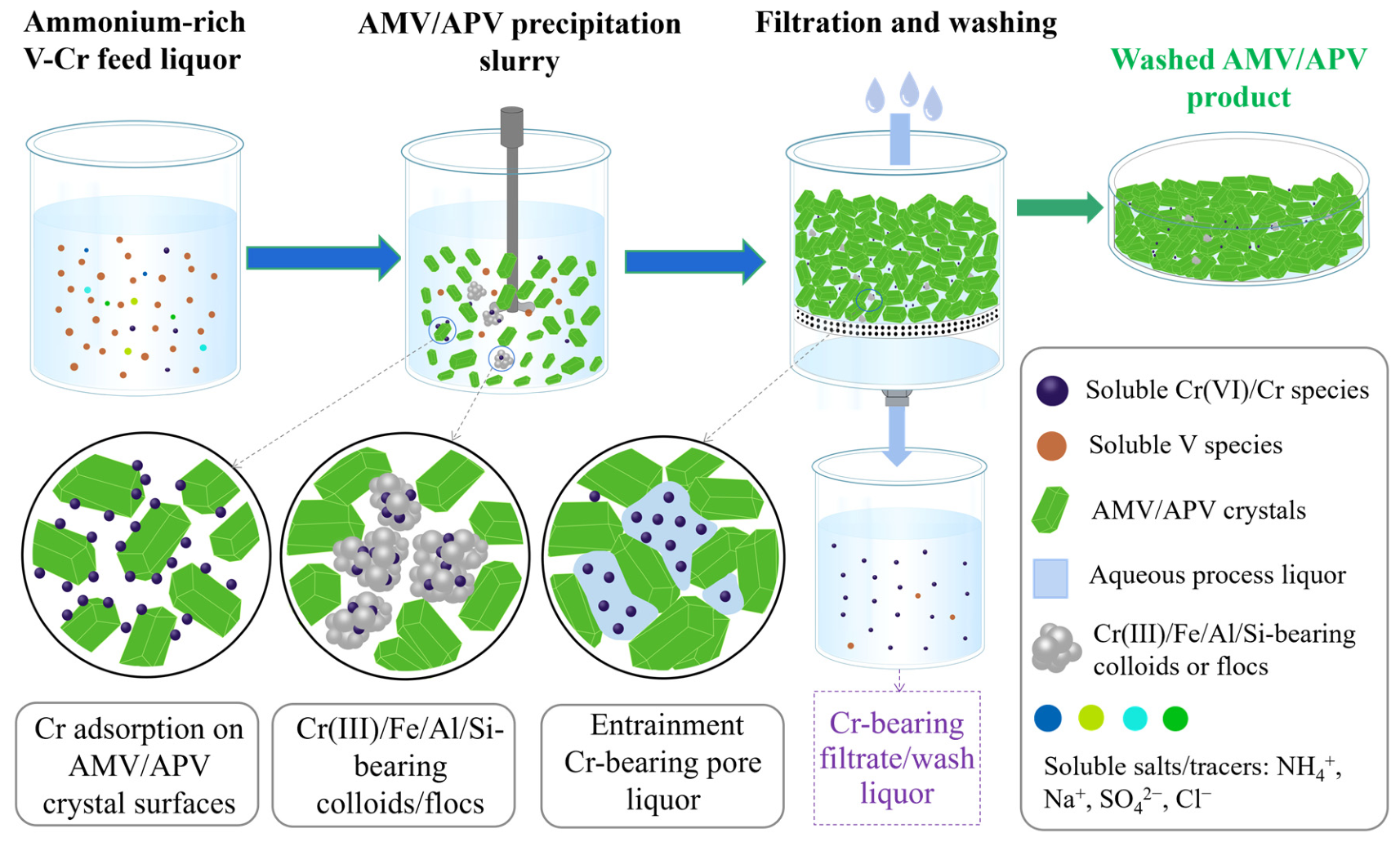
The circuits covered here follow a common sequence: oxidative roasting of vanadium slag (most commonly with sodium salts; routes are compared in Section 6.3), water or ammonium-sulfate leaching to give an alkaline, oxidizing liquor (pH ≈ 10.5–13 [5,8])—acid leaching (standard for calcification-roasted slag) converges on the same downstream steps—optional purification and solid–liquid separation, and ammonium-salt conditioning with pH adjustment to precipitate AMV or APV, followed by filtration and washing (Figure 1). Because oxidative roasting fixes vanadium as V(V), no separate Eh adjustment is needed upstream of precipitation; the same oxidizing conditions retain chromium as soluble Cr(VI).
Figure 1.
Chromium-transfer pathways during ammonium vanadate precipitation and solid–liquid separation—the downstream steps of the sequence in Section 2.1. During AMV/APV precipitation, soluble Cr(VI)-bearing species may remain in the liquor, while Cr(VI) oxyanions may also adsorb onto AMV/APV crystals, and Cr(III) may associate with Fe/Al- or Si-bearing colloids/flocs. During filtration and washing, Cr can enter products through retained pore liquor, adsorption, co-precipitation or colloid capture.
2.2. Scope and Literature Selection
This work presents a focused narrative and process-diagnostic review rather than a systematic review or meta-analysis. The evidence base was drawn primarily from peer-reviewed journal articles and review papers. The literature was identified through searches in Google Scholar up to January 2026, with preliminary literature discovery assisted by AI-based semantic search as described in Section 2.4. No fixed starting year was imposed on the search. Searches used combinations of keywords including “vanadium slag” (a feedstock in which chromium is most significantly co-enriched with vanadium and co-extracted during roasting and leaching (Section 6.3)), “vanadium extraction”, “ammonium vanadate”, “ammonium metavanadate”, “chromium”, “Cr(VI)”, “chromate”, “precipitation”, “crystallization”, “separation”, “mother liquor”, “entrainment”, “washing”, and “salt recovery”, tailored to four thematic blocks: (i) vanadium slag processing with chromium co-extraction; (ii) ammonium vanadate precipitation and crystallization; (iii) V/Cr separation from post-precipitation liquor; and (iv) Cr speciation and reoxidation thermodynamics. Vanadium sources without significant chromium co-enrichment (e.g., direct processing of VTM ores or stone coal) were not systematically targeted. Retrieved records were screened by title and abstract. Publications were included when they provided data, evidence, or transferable methodology on at least one of the following aspects: chromium speciation, ammonium vanadate precipitation, impurity transfer to products, washing or filtration, residual V/Cr recovery, salt crystallization, or mother-liquor recycling. Records were excluded when chromium was not valence-resolved or when the precipitation stage was insufficiently described. No publication-year restriction was applied. Backward tracing of reference lists and forward citation tracing were used extensively to ensure coverage. The resulting evidence base comprises 56 cited publications, of which 32 primary studies meeting the chromium-relevance criteria are tabulated in Tables S1–S4
2.3. Process Streams and Chromium-Control Functions
The main process streams considered in this review are summarized in Table 1. They are distinguished because chromium-control functions and challenges differ throughout the circuit.
Table 1.
Stream definitions and chromium-control issues in ammonium-rich vanadium precipitation circuits.
2.4. Evidence Limitations
The available literature is uneven in both scope and reporting detail. Most studies were designed to optimize vanadium recovery or product grade rather than to resolve chromium-transfer pathways or recycle evolution. Consequently, complete datasets linking liquor chemistry, solid–liquid separation, product impurities, and recycle behavior are uncommon. The proposed framework provides a diagnostic structure for hypothesis generation and consistency checking. A detailed evidence matrix summarizing key variables and reporting gaps across selected studies is provided in Tables S1–S4 in the Supplementary Materials.
2.5. Use of AI-Assisted Tools
AI-assisted tools were utilized during the preparation of this manuscript to improve preliminary literature identification and writing efficiency. Specifically, the semantic search engine Consensus (Pro subscription) was used as a supplementary tool to assist in the initial discovery of potentially relevant publications, after which formal literature searches were conducted in Google Scholar. All retrieved publications, bibliographic information, and technical data were manually verified and checked against the original sources by the authors. Additionally, GPT-based large language models (GPT-4/GPT-5 series) were employed to assist with research structuring, outline development, and language polishing. All retrieved studies, interpretations, and scientific arguments were critically reviewed and verified manually by the authors. No AI tools were used to generate raw research data, perform independent calculations, or draw independent scientific conclusions.
3. Speciation and Crystallization Basis of Chromium Control
3.1. V(V) Speciation and AMV/APV Crystallization
In ammonium-rich precipitation systems, vanadium recovery is governed by V(V) oxyanion protonation, condensation, and crystallization under specific pH, ionic-strength, and temperature conditions. In alkaline and weakly alkaline liquors, V(V) occurs mainly as monomeric or protonated vanadate species, while acidification and concentration promote polyvanadate formation, including decavanadate-like species [18,19]. These transformations determine vanadium activity and supersaturation; as vanadium is removed during precipitation, the equilibrium speciation shifts toward monomeric vanadates, leaving an increasingly dilute residual liquor whose speciation governs residual-vanadium recovery and chromium behavior in the recycled stream.
Ammonium vanadate precipitation is a crystallization–purification operation whose product phase, crystal habit, and filterability depend on pH trajectory, NH4+ dosage, temperature, vanadium concentration, and co-existing impurities. Phase assignment (AMV vs. APV) should be supported by X-ray diffraction (XRD) or thermal analysis, which identify the bulk crystalline phase but do not resolve where impurities reside. Jiang et al. (2023) [17] showed that hydrolysis during acidic ammonium salt precipitation from high-concentration alkaline vanadium solutions can increase Na impurity in APV. In V–Cr systems, weakly acidic precipitation has been applied; for example, APV precipitation at pH 4.5, 293 K and 60 min gave a reported V precipitation efficiency of 94.8%, while Cr remained largely in solution, Cr in the product was not reported [5]. However, this pH is not a universal optimum because the precipitation window shifts with salt matrix, V/Cr ratio and recycle history.
Furthermore, dissolved chromium and co-existing salts can modify ammonium vanadate crystallization. Cr(VI) can increase the apparent solubility of NH4VO3, reduce supersaturation, alter crystal morphology, and raise Cr impurities in the final product; in NH4VO3 precipitation, increasing Cr(VI) from 2.0 to 25 g L−1 decreased V precipitation efficiency from 83.5% to 60.3% [9]. Salt background matters as well: NH4VO3 solubility decreases markedly at high (NH4)2SO4 and NH4Cl concentrations [20], raising supersaturation; the resulting preference for nucleation over growth is expected to yield finer crystals with greater surface area and higher mother-liquor retention, as reflected in the entrainment of mother liquor by explosively formed fine crystals reported by Chen et al. [16]. Zhan et al. [21] further showed that impurities such as Na+, K+, Cr(VI), and H2PO4− affect the nucleation kinetics of APV, with phosphate notably altering the crystal morphology from flake to spheroidal. Crystallization control offers a countermeasure: in the heterogeneous self-assembly process of Chen et al. [16], slow NH3 supply via (NH4)2CO3 pyrolysis confined nucleation to the container wall at low supersaturation; at a feed Cr(VI) of only 0.05 g L−1 (pH 12.5, 60 °C), this route yielded 1.8 mm NH4VO3 crystals at 93.09% yield with only 1 ppm Cr, versus ~110 ppm for direct precipitation. Explicit seeding, though seldom reported for vanadate systems, could in principle act through the same surface-mediated mechanism in conventional stirred crystallizers.
3.2. Chromium Valence, Hydrolysis, and Residue Stability
Chromium behavior is governed primarily by the Cr(VI)/Cr(III) redox couple and by Cr(III) hydrolysis. Cr(VI) predominantly exists as chromate (CrO42−), hydrogen chromate (HCrO4−), or dichromate-related (Cr2O72−) oxyanions depending on pH [8]. These oxyanions are generally more soluble than Cr(III) hydroxide phases under the weakly acidic-to-alkaline conditions relevant to most vanadium precipitation circuits. Therefore, Cr(VI) remains in solution during V-first ammonium vanadate precipitation, shifting the primary chromium-control burden to the mother-liquor circuit. To mitigate this, various post-precipitation techniques, such as lead carbonate precipitation, have been developed to scavenge and recover residual chromium directly from these vanadium-precipitated solutions. In the cyclic route of Yang et al. [12], PbCO3 precipitation removed chromium to 0.001 g L−1 as PbCrO4 while the dissolved vanadium remained unchanged (0.01 g L−1), i.e., vanadium co-precipitation was negligible; the lead precipitant was regenerated by Na2CO3 leaching and the chromium-depleted liquor recycled to the vanadium circuit.
Cr(III) is readily hydrolyzed and precipitated. At pH ≈ 6–10, Cr(III) hydrolyzes and precipitates as Cr(OH)3 or Cr-bearing hydroxide phases with minimum solubility around pH 8–9 [22]; above pH ≈ 11, amphoteric redissolution as Cr(OH)4− becomes appreciable. This hydrolysis behavior has been utilized in various separation processes [8,11,13] and can be simulated using thermodynamic software such as PHREEQC (version 3) [23]. However, if reduction or pH adjustment occurs before or during ammonium vanadate crystallization, Cr(III)-bearing hydroxides may form colloids or impurity-associated solids. These can impair filtration, increase cake moisture, trap mother liquor and promote chromium transfer into AMV/APV products.
Because this precipitation is pH-reversible, a decrease in total Cr in the separated liquor does not by itself demonstrate durable removal: the precipitate can redissolve at high pH, and colloidal Cr(III) may enter the analyzed fraction depending on sample filtration (Section 3.3 and Section 4.2). Although E–pH diagrams and speciation calculations provide theoretical thermodynamic limits, they must be validated with high-salt liquor analyses because highly concentrated electrolytes induce significant activity-coefficient deviations [8,10,14,23,24]. This reversibility likewise underlies the residue-stability evaluation below.
Cr(III)-bearing residues may be reoxidized under alkaline, oxic or Mn-bearing conditions [25,26]. Cr(VI) reduction should therefore be evaluated together with immediate removal efficiency and long-term residue stability.
3.3. High-Salt Matrix, Impurities and Analytical Considerations
The sulfate–sodium salt matrix itself exerts a strong ionic-strength effect on ammonium vanadate crystallization. High concentrations of (NH4)2SO4 and NH4Cl sharply decrease the solubility of NH4VO3 [20], so that for a given vanadium concentration the solution becomes more supersaturated; under such conditions, nucleation dominates over crystal growth, producing finer crystals that retain more mother liquor per unit mass of cake during filtration [15]. This ionic-strength effect is particularly relevant in sulfate-rich ammonium vanadate circuits where (NH4)2SO4 concentrations can reach several mol·kg−1 [20].
The effects of secondary impurities are condition-dependent. Slag-derived leach liquors are typically alkaline and oxidizing, with pH commonly between about 10.5 and 13 [5,8]. Full liquor compositions and precipitation conditions for these systems are compiled in Table S2 (Supplementary Materials). Silicate is most problematic when pH adjustment (particularly into the near-neutral range, pH ~6–9) or aging promotes polymerization of supersaturated silica, especially with Ca2+/Mg2+ acting as cross-linkers; for example, roasted vanadium slag leachate may contain g L−1-level residual Si and require desiliconization before ammonium vanadate precipitation [27], while thiourea-dioxide reduction of Cr(VI) from industrial sodium vanadate liquor (pH 11.0, 90 °C) also removed ~60% of Si, because CO2 released by thermal decomposition of the urea by-product lowers the pH and precipitates dissolved silicate as H2SiO3 together with the Cr(OH)3 residue [8]. Fe(III) and Al(III) hydrolyze at pH ≈ 3–4 and ≈4.5–5, respectively, and the points of zero charge of ferrihydrite and Al(OH)3 lie near pH 7–8 [28,29] and 8–9 [30], respectively; these solids therefore remain positively charged throughout the weakly acidic-to-neutral precipitation window (e.g., pH 4.5–8) and adsorb chromate and vanadate oxyanions via electrostatic attraction. Consequently, Fe/Al carried into the precipitation stage transfers chromium from solution to the solid phase rather than merely consuming the reagent. Similarly, Cr(III) hydrolysis products (e.g., Cr(OH)3), which form over the pH range given in Section 3.2, can co-precipitate with or become entrained in the vanadium product if they are generated during ammonium vanadate precipitation. In sulfate-rich ammonium vanadate liquors, gypsum (CaSO4·2H2O) becomes supersaturated once the ion activity product [Ca2+][SO42−] exceeds its solubility product (Ksp ≈ 2.4–2.5 × 10⁻⁵ mol2 L−2 at 25–40 °C) [31], meaning that even tens of mg L−1 Ca can trigger scaling when sulfate is in the tens of g L−1 range. Mg(OH)2 precipitation is significant only above pH ≈ 9.5 under typical liquor Mg concentrations [23]. Accordingly, Ca/Mg scaling should be evaluated using saturation indices of gypsum, carbonate or hydroxide phases under the measured pH, temperature, sulfate/carbonate content and ionic strength, rather than from total Ca/Mg concentration alone [23].
Reliable chromium control requires valence-specific analysis using standard methods. Cr(VI) can be measured by 1,5-diphenylcarbazide UV–vis or ion chromatography, while Cr(III) is often estimated by difference between total Cr and Cr(VI) [32,33,34]. In vanadium slag leach liquors, high V and Fe/Al concentrations can interfere with Cr(VI) determination; colloidal particles not only adsorb dissolved Cr(VI) (biasing the dissolved fraction to be low) but their turbidity also scatters/absorbs light in colorimetric reading (biasing it to be high) if samples are not filtered appropriately; and redox-sensitive samples require prompt analysis or preservation to avoid valence changes during storage. Samples should be reported with filtration method, membrane pore size, dilution factor, preservation, storage time, pH, temperature and Cr(VI) method.
pH and oxidation–reduction potential (ORP) are useful operational indicators but not thermodynamic descriptors. Measured ORP is governed mainly by the high ionic strength (via activity coefficients) and by the dominant redox couples (V(V)/V(IV), Cr(VI)/Cr(III), and Fe(III)/Fe(II)) that set the mixed potential, rather than by the reference electrode or junction potential. E–pH diagrams and speciation models can delimit feasible redox and precipitation windows, but these are theoretical starting points only and the actual window must be confirmed experimentally, since they cannot represent activity effects, metastable phases, nucleation, aging, adsorption, colloid formation or mother-liquor entrainment in real high-salt liquors [10,23,24].
4. Chromium Transfer into Ammonium Vanadate Products
Chromium can contaminate ammonium vanadate products through three main pathways: mother-liquor entrainment, surface adsorption, and co-precipitation or colloid capture. These pathways are controlled by chromium valence, AMV/APV crystal size and morphology, filtration behavior, washing efficiency and impurity hydrolysis. They are illustrated schematically in Figure 1.
The entrainment and cake-washing equations used in this section are conventional mass-balance tools. Their value here is diagnostic rather than mathematical: when combined with Cr valence analysis, mother-liquor chemistry, cake moisture, washing response and soluble-ion tracers such as Na+, SO42− and Cl−, they can test whether the measured product Cr is quantitatively consistent with retained Cr-bearing mother liquor. If the calculated entrainment contribution is much lower than the measured product Cr, solid-associated pathways such as adsorption, occlusion, co-precipitation or colloid capture should be investigated.
4.1. Mother-Liquor Entrainment: Diagnostic Balance and Washing Response
Mother-liquor entrainment is a major but often under-quantified pathway. When chromium remains mainly in the liquid phase, product contamination may still occur through retention of Cr-bearing mother liquor in filter-cake pores. Thus, favorable chemical V/Cr separation does not guarantee low chromium in the dried or calcined product.
Unless otherwise stated, liquid concentrations are expressed in mg L−1, liquid volumes in L, dry product mass in kg, product impurity contents in mg kg−1 on a dry AMV/APV basis, and in kg L−1. Cake moisture is defined on a wet-mass basis. Solid and solution concentrations must use the same chemical basis, e.g., Cr as Cr, sulfur as S or sulfate, and chlorine as Cl or Cl−. If products are calcined to V2O5, impurity contents should be converted using the appropriate mass yield and reporting basis.
For diagnostic accounting, the measured product Cr can be conceptually partitioned as:
where is the total chromium mass in the dried product, is the chromium mass attributed to mother-liquor entrainment, is adsorbed chromium, and is chromium associated with co-precipitation or colloid capture. It must be emphasized that none of the three terms is directly measurable: mCr,ent is inferred from the retained mother-liquor volume, itself obtained from tracer-based estimates subject to the uncertainties detailed below, while mCr,ads and mCr,cp both reside in the solid phase and cannot be separated by a solution mass balance. Equation (1) therefore serves as a conceptual screening framework rather than a rigorous mechanistic partitioning tool. For practical purposes, the two solid-associated terms are treated as a single lumped quantity:
This lumped term is obtained by the difference from the overall balance:
It thus carries the combined uncertainty of its input quantities and should, whenever possible, be reported as a range with propagated uncertainty rather than as a single value. Further distinguishing the individual contributions of adsorption, co-precipitation, and colloid capture to mCr,solid requires independent solid-phase characterization (e.g., sequential extraction, XPS, or SEM–EDS) and is beyond the scope of the present balance. In screening applications, if mCr,ent is close to mCr,prod and washing removes Cr in parallel with conservative tracers, retained mother liquor is sufficient to explain most product chromium; if mCr,ent is substantially lower, solid-associated pathways (mCr,solid) become the dominant contribution and warrant further investigation.
The entrainment contribution can be estimated as:
where is the chromium concentration in the mother liquor, and is the equivalent volume of original mother liquor retained after filtration and washing.
If physical entrainment dominates, the entrainment-derived chromium content in the dry product is:
where is the dry mass of ammonium vanadate product. If is expressed in mg L−1, in L and in kg, then is obtained in mg kg−1.
For an unwashed cake, the initial retained mother-liquor volume is:
where is the wet-basis cake moisture and ρML is the density of the mother liquor. After washing:
where is the residual fraction of original mother liquor remaining in the cake at wash ratio W, defined as the ratio of the cumulative volume of washwater applied to the volume of mother liquor initially retained in the unwashed cake. Thus:
is process-dependent and should be determined experimentally via washing curves or tracer tests [15,35,36], a practical tracer mass-balance estimator is given in Equation (10) below. In ammonium vanadate systems, washing should also be evaluated for vanadium loss, which depends on the wash-liquor composition: pure water may partially dissolve the precipitate [17], whereas ammonium-salt-bearing liquors suppress dissolution through the common-ion effect—for AMV, (NH4)2SO4 or NH4Cl additions lower NH4VO3 solubility by up to two orders of magnitude [20]. This risk is greater for AMV than for the less-soluble APV [37].
For illustrative calculations, wet-basis cake moisture of 0.25–0.35 and a mother-liquor density around 1.15–1.25 kg L−1 (the latter corresponding to a sulfate/ammonium-rich solution) are assumed as representative ranges; these values are illustrative estimates rather than literature-validated upper limits. The following calculations use θ = 0.30 and ρML = 1.20 kg L−1 as representative values. These θ and ρML values are illustrative assumptions, as they are not reported in the cited sources (Section 6.4); the corresponding liquor compositions and precipitation conditions are given in Table S2.
An apparent entrainment contribution ratio is:
where is the measured total chromium content in the dried product. Fent,W must be read as an upper limit on the entrainment contribution. Fent,W < 1 places a lower limit of (1 − Fent,W) on the solid-associated share, whereas Fent,W ≈ 1 shows only that retained mother liquor is sufficient to account for the product chromium, because adsorbed Cr-bearing species with a washing response similar to that of entrained solute cannot be distinguished on this basis alone.
The most useful extension of the entrainment balance is the use of conservative or semi-conservative soluble impurities as internal tracers of retained mother liquor. In slag-derived ammonium-rich liquors, Na+ and Cl− can serve this purpose; sulfate may also be used provided that its concentration remains below the saturation limit of sulfate salts under the operating conditions. However, the application of tracer components carries inherent inaccuracies. Ammonium vanadate precipitates, particularly when fine or needle-like, often exhibit large specific surface areas, and adsorption of tracer ions onto the solid surface cannot be neglected; this adsorption adds to wj,prod independently of entrainment, making the tracer-based residual fraction defined below an upper limit of the residual mother-liquor fraction.
The adsorption propensity differs among tracers: Cl− is generally the least strongly adsorbed onto oxide/hydroxide surfaces; Na+ may undergo adsorption or ion exchange, particularly on Cr(III)-, Fe- or Al-bearing hydroxide residues; and sulfate may both adsorb and precipitate (e.g., as gypsum) in Ca-bearing liquors. Two practical safeguards are recommended. First, at least two tracers with contrasting surface affinities (e.g., Cl− and Na+) should be applied in parallel: mutually consistent Rj,W values strengthen the entrainment interpretation, whereas systematic divergence (e.g., RNa,W consistently exceeding RCl,W) signals adsorption or precipitation artifacts, in which case the lower value is preferred. Second, the washing curve for each tracer should be examined: physically entrained solute is displaced rapidly and decreases approximately exponentially with wash ratio, whereas an adsorbed fraction desorbs slowly and produces asymptotic behavior at high wash ratios. Where feasible, the magnitude of surface adsorption can be constrained independently, e.g., by BET surface-area measurement combined with adsorption isotherms of the tracer ions on the product.
For a tracer component j, such as Na, Cl or SO42−, the apparent residual fraction of original mother liquor after washing can be estimated as:
where is the content of component in the dried product, is the dry product mass, and is the concentration of the same component (j) in the mother liquor before washing, and is the initial volume of retained mother liquor in the unwashed cake. In this equation, is preferably expressed in mg kg−1 on a dry-product basis, in kg, in mg L−1, and () in L; is therefore dimensionless.
The analytical basis must be identical between solid and solution before applying Equation (10). For example, sulfur should be reported consistently either as elemental S or as sulfate; chromium as elemental Cr or as Cr2O3; chlorine as Cl or Cl−. If different bases are used, stoichiometric conversion is required. Even when incorporation or precipitation of tracer j into the crystal lattice is negligible, surface adsorption on the high-specific-area precipitate inflates wj,prod and makes Rj,W an upper limit on the true residual mother-liquor fraction rather than a true value. If the washwater contains a non-negligible concentration of j, its contribution should be included in the tracer mass balance when calculating Rj,W. This may occur with the ammonium-salt washes, which introduce SO42− or Cl−. Under these conditions, Na+ is the preferred tracer, provided that the washwater is sodium-free.
Given the indirect nature of both the entrainment and tracer estimates, the differentiation between entrainment-dominated and solid-associated Cr should be presented as upper and lower limits rather than exact fractions. If the apparent retention fractions for Cr and the soluble-ion tracers (Na+, Cl−, SO42−) are similar across multiple tracers and decrease in parallel during washing, mother-liquor entrainment is likely the dominant pathway for product chromium. Conversely, if Cr persists in the product after washing has effectively removed Na, Cl, and SO42−, or if Rj,W values from different tracers diverge substantially, then adsorption, occlusion, co-precipitation, or colloid capture should be considered. This interpretation should, where possible, be supported by independent solid-phase characterization, such as XPS for surface Cr speciation or validated sequential extraction for operationally defined Cr associations, rather than by the solution balance alone.
4.2. Adsorption, Co-Precipitation and Colloid Capture
Besides entrainment, chromium may transfer to vanadium solids by surface adsorption [9]. This pathway becomes more important when the specific surface area of the crystals is high, pH favors adsorption [9], or impurity hydroxides provide reactive surfaces. It should be stressed that a large apparent particle size does not necessarily imply a low surface area: larger particles formed by agglomeration of fine crystallites retain the high internal surface area of their constituents, which remain accessible to the mother liquor, and therefore do not suppress surface-related uptake of contaminants. A genuine reduction in surface-related Cr uptake requires the growth of truly larger single crystals, which in practice is achievable only by controlled crystallization with proper seeding, not by spontaneous precipitation [16]. Under such conditions, surface-related Cr uptake can be reduced and product purity improved. In contrast, Cr(VI) had little effect on APV nucleation [21].
Co-precipitation and colloid capture are especially relevant when chromium exists as Cr(III). Cr(OH)3, Fe(OH)3, Al(OH)3 and silica gels can impair filtration, trap mother liquor and attach to vanadium product crystals. High-Al and sulfate-bearing vanadium systems also show that Al/Na/SO42− precipitation chemistry can affect impurity behavior [38]. Therefore, product Cr should not be interpreted solely as a V/Cr separation problem.
Cr(III)-bearing colloids should be distinguished operationally from truly dissolved Cr(III) using different pore-size filtration (e.g., unfiltered, 0.45 μm, and finer filters). The difference between unfiltered total Cr and 0.45 μm filtered Cr represents coarse suspended or particulate Cr; the difference between 0.45 μm filtered and finer-filtered Cr provides an operational estimate of colloidal Cr. Acidification before filtration should be avoided when colloid speciation is the target.
No single solid-characterization technique resolves adsorbed chromium, impurity-phase chromium and physically entrained mother liquor; XRD in particular identifies only the major crystalline phases and gives no information on the composition of individual phases or on adsorbed ions. Surface-analytical methods (XPS), XANES and EXAFS analyses of dried solids, and sequential extraction can indicate the oxidation state and mineral association of solid-bound chromium. The entrained-liquor contribution is accessible only through the mass balance and soluble-ion tracers of Section 4.1.
4.3. Literature-Constrained Illustrative Consistency Checks
The diagnostic balances in Section 4.1 are most reliable when final Cr concentration in the mother liquor, product Cr content, cake moisture, wash ratio, wash-liquor composition and conservative tracers are reported together. Such complete datasets are rarely available. The following examples are therefore literature-constrained, order-of-magnitude consistency checks rather than source-apportionment validations. Even in this constrained form, the data identify whether entrainment is a significant contributor to product Cr, helping to determine which pathway should be prioritized for process improvement under the specific process conditions. The key is that the entrainment estimate is an upper limit (Section 4.1): where this limit falls well below the measured product Cr, entrainment can be ruled out as the dominant source even though the exact partitioning is uncertain.
Hu et al. (2021) [9] investigated NH4VO3 precipitation from a chromium-containing vanadate solution using NH4HCO3. In one experiment with an initial Cr(VI) concentration of 5000 mg L−1, N/V molar ratio of 2.0, pH 8.0, 30 °C and 5 h, the V precipitation efficiency was 80.1%, and the calcined V2O5 product contained 0.61 wt% Cr. If this value is elemental Cr on a calcined V2O5 basis and Cr is retained during calcination, it corresponds to 6100 × 0.778 ≈ 4.7 × 10³ mg kg−1 on a dry NH4VO3 precursor basis. The factor 0.778 is the theoretical mass yield for 2NH4VO3 → V2O5 + 2NH3 + H2O. This conversion is approximate because the reported Cr basis, precursor purity, hydration state, washing history and Cr retention during calcination were not fully constrained. Using Equation (4), and kg L−1 give L kg−1 dry product. Because the final Cr concentration in the mother liquor was not reported, the initial Cr(VI) concentration was used only as a rough proxy for the upper limit. With no washing and assuming the initial Cr(VI) concentration persists (a rough upper limit), the calculated entrainment-derived Cr would be 5000 × 0.357 = 1.8 × 10³ mg kg−1, about 38% of the converted product Cr. If the final mother-liquor Cr did not increase substantially during precipitation, this upper-limit calculation suggests that entrainment might account for up to ~40% of the product Cr under the no-wash scenario. If this upper limit is representative, solid-associated pathways (adsorption, occlusion, co-precipitation, or crystallization-related transfer) would then contribute the balance; however, without knowledge of the final mother-liquor composition and washing conditions, this attribution remains tentative. For this system, process improvement should target these solid-phase mechanisms (e.g., controlled crystal growth) rather than intensifying cake washing alone.
Chen et al. (2023) [16] prepared ultra-pure NH4VO3 from a solution containing 0.05 g L−1 Cr(VI) using controlled heterogeneous self-assembly crystallization. The final product contained <10 mg kg−1 Cr. Using the same cake-retention parameters, the maximum entrainment-derived Cr would be ≈18 mg kg−1. Because this upper limit already exceeds the measured product Cr, and only a moderate reduction in retained mother liquor (RML,W ≈ 0.56) is needed to reach <10 mg kg−1, entrainment provides a sufficient and self-consistent explanation of the product Cr. The determination is therefore that entrainment can account for the observed contamination in full. Here, further reductions in product Cr would be most efficiently pursued through improved washing and dewatering. However, controlled crystal growth may also reduce Cr(VI) incorporation into the AMV product, as reported for the AMV system by Chen et al. [16]. Because the detailed AMV preparation conditions and the chromium speciation in the final product were not fully reported, this mechanistic interpretation is conditional on the assumption that the relevant chromium was present as Cr(VI).
Neither example described previously constitutes a validated source apportionment because Cr-specific key variables—final mother-liquor Cr, cake moisture, wash ratio, washwater composition and conservative tracer concentrations—were not reported. Nevertheless, both examples illustrate the intended diagnostic use of the mass balance: rather than merely confirming that entrainment is plausible, it can determine whether entrainment contributes significantly, which is what directs process improvement. In the first case, the low entrainment upper limit rules out entrainment as the dominant source and redirects effort toward solid-associated pathways; in the second, the limit on the product Cr identifies entrainment control as the effective lever. Future studies should report the variables listed above together with product Cr, as summarized in the reporting checklist in Section 6, so that this determination can be made quantitatively rather than relying on limit assumptions.
5. Mother-Liquor Treatment and Recycle Stability
5.1. Residual V/Cr Recovery and Cr(VI) Control
Post-precipitation mother liquors should be treated as active process streams rather than simple effluents. After AMV/APV precipitation, these may contain residual V, Cr, NH4+, Na+, sulfate, chloride, carbonate, reductant by-products and other impurity metals. These components affect residual metal recovery, Cr(VI) discharge risk, salt accumulation, water balance and recycle stability.
Residual V in mother liquor is both a recovery opportunity and a recycle burden. The appropriate recovery method depends primarily on the residual V concentration and the NH4+/Na+/SO42− matrix. When residual V is relatively high (typically on the order of grams per liter), secondary precipitation by further addition of ammonium salt or acid hydrolysis is usually the most direct option [11,39], or the liquor may be returned to an upstream leaching or conditioning step [6,7]. At lower residual V (below roughly hundreds of mg L−1), adsorption [40] or ion exchange [41] becomes more effective; solvent extraction [42,43,44] is preferred for large liquor volumes or where co-recovery of V and Cr is desired. In cyclic V/Cr processes, V recovery and Cr recovery are linked with liquor reuse and process circulation [11,39,40,41,42,43,44,45]. Therefore, residual V removal should be designed together with Cr control.
In V-first circuits, defined here as a process in which vanadium is precipitated or recovered before chromium treatment, Cr(VI) reduction followed by Cr(III) precipitation is commonly applied after AMV/APV removal [5,11,13,39]. A representative route uses sulfur-bearing reductants such as sodium metabisulfite, for which Cr(VI) reduction is rapid at pH 2–3 under mildly acidic conditions [4]; practical dosages are typically 1.3–1.5 times [46] the theoretical stoichiometric requirement to compensate for side consumption by dissolved oxygen and other oxidants. This stage should be controlled by Cr(VI) concentration rather than total Cr, because unreduced Cr(VI) cannot be removed by hydrolysis and will be carried into downstream recycle or discharge. Reduction should continue until residual Cr(VI) meets the applicable target (commonly ≤0.5 mg L−1); a sharp drop in ORP accompanies the depletion of Cr(VI) and provides a convenient in-line indicator. Effective reporting should include reductant type, dosage, pH, ORP, reaction time, residual Cr(VI), total Cr and residual V [8,10,14].
Cr(III) precipitation must be controlled within a defined pH window. Cr(OH)3 reaches its minimum solubility near pH 8–9; if pH is too low (below ~7), Cr(III) removal is incomplete; if pH is too high (above ~10), colloid formation, impurity co-precipitation or amphoteric redissolution as Cr(OH)4− may occur. Efficient removal of residual V before Cr precipitation can improve chromium recovery by reducing competitive co-precipitation and the formation of voluminous V–Cr gels that impair filtration [11,39,42].
Trace-impurity removal is useful when bulk V/Cr separation has been achieved but trace contaminants remain above the concentration limits required for liquor recycling, downstream salt recovery, or discharge. Methods include ion exchange, adsorption, or solvent extraction [40,41,43,44,47,48], which can lower residual V and Cr to the low mg L−1 level or below. A relevant post-precipitation example is N263 co-extraction of V and Cr followed by selective stripping of chromium with NaOH and then of vanadium with HCl [42]. However, residual extractant or entrained organic phase must be assessed, since co-extracted sulfate or entrained organic phase can itself become a contaminant and disrupt downstream salt recovery.
For dissolved salts such as Na+, sulfate and chloride, selective V/Cr treatment alone is insufficient: these species accumulate during closed-loop recycle and must be managed by purge or salt recovery. Rather than treating the purge as an adjustable loss stream, the practical route is to recover the salt load directly. Comprehensive treatment of vanadium precipitation liquor can recover Cr, ammonia and salts [13], while fractional crystallization of Na2SO4 and (NH4)2SO4 provides a direct route for treating salt-rich purge streams [49]. The fate of residual V and Cr(VI) during salt crystallization should be verified before integration, because both may report to the crystalline salt phase, remain in the mother liquor, or concentrate in a recycled side stream.
Beyond metal recovery, post-precipitation liquor management involves several secondary burdens: ammonia loss through volatilization, salt accumulation requiring periodic purge, Cr(III) hydroxide sludge formed from reductive treatment, and washwater consumption. Certain Cr-separation methods, such as lead–salt precipitation, also introduce secondary Pb contamination. Process design should balance metal recovery against these environmental and resource impacts.
5.2. Mother-Liquor Recycle and Accumulation Risks
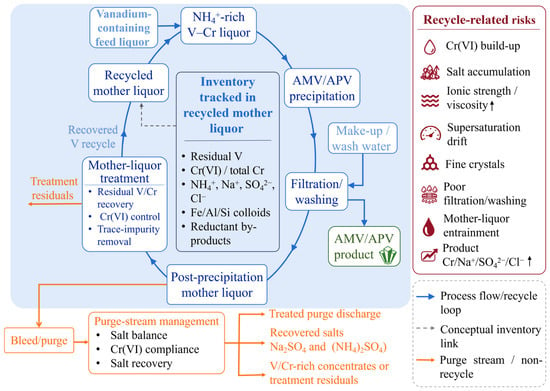
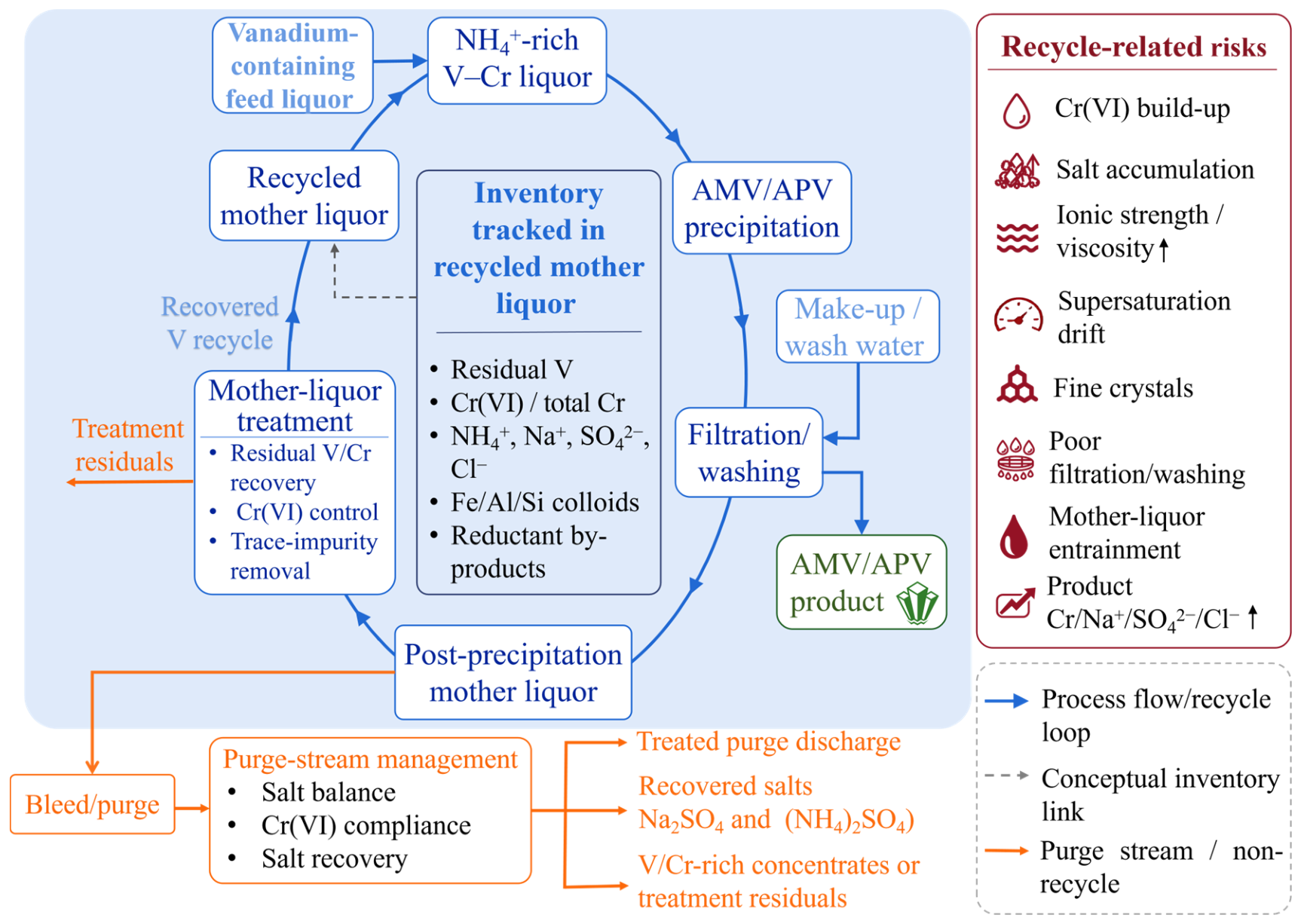
Mother-liquor recycling can reduce water consumption and recover residual reagents, but recycled liquors differ chemically from fresh liquors. Residual V/Cr and various salts may accumulate over cycles, changing ionic strength, viscosity, vanadium activity, supersaturation, nucleation, filtration behavior and impurity transfer. A conceptual representation of mother-liquor recycling and associated accumulation risks is shown in Figure 2.
Figure 2.
Schematic of the mother-liquor recycle loop and accumulation risks, showing the locations of makeup-water addition, purge withdrawal, salt recovery, trace-impurity removal, and the associated recovery and discharge pathways.
Because dissolved salts (such as Na+ and SO42−) and unreduced Cr(VI) accumulate in the absence of a proper bleed, salt accumulation can shift the solubility window, promote fine-particle nucleation, increase slurry viscosity and worsen filtration, ultimately raising Cr/Na/SO42− incorporation into the AMV/APV product. Cr(VI) build-up also severely increases product contamination risk. The steady-state concentration of a non-reacting species is governed by the balance between its net input per cycle and its removal rate—whether by purge (bleeding a fraction of the liquor, which removes all dissolved species indiscriminately) or by selective salt removal (e.g., crystallization of accumulated Na2SO4/(NH4)2SO4 [49], which targets the salts while retaining the liquor). In industrial circuits, however, variable liquor volume, makeup-water addition, evaporation, washwater return and salt precipitation mean that no constant enrichment factor (steady-state concentration relative to the first-cycle feed) can be assumed; the accumulation level must therefore be determined from cycle-resolved measurements—tracking Na+, SO42−, Cl−, Cr(VI) and product-impurity trends over multiple cycles. An industrially credible recycle strategy must treat purge design as a central control variable, and should include residual V/Cr recovery, purge or crystallization for accumulated salts, and multi-cycle validation of product quality, as summarized in the reporting checklist in Section 6.
6. Integrated Diagnostic and Process-Control Framework
This framework provides an engineering sequence tailored to ammonium-rich circuits by linking speciation, entrainment, and mother-liquor recycling. It complements the equilibrium-based speciation and precipitation analyses discussed in Section 3.1, Section 3.2 and Section 3.3 with practical industrial indicators.
6.1. Reporting Checklist
The framework supports four practical decisions: whether product Cr is caused mainly by entrained liquor or solid-associated transfer; whether washing or crystallization control is the more relevant corrective action; whether Cr(VI) should be controlled before recycle; and how the purge stream should be managed for long-term operation, including possible salt recovery.
Credible chromium-control evaluation requires coordinated reporting of feed chemistry, Cr valence, precipitation, solid–liquid separation, product quality, mother liquor and recycle history (Table 2).
Table 2.
Recommended reporting indicators for ammonium-rich vanadium precipitation circuits.
6.2. Diagnostic Decision Workflow
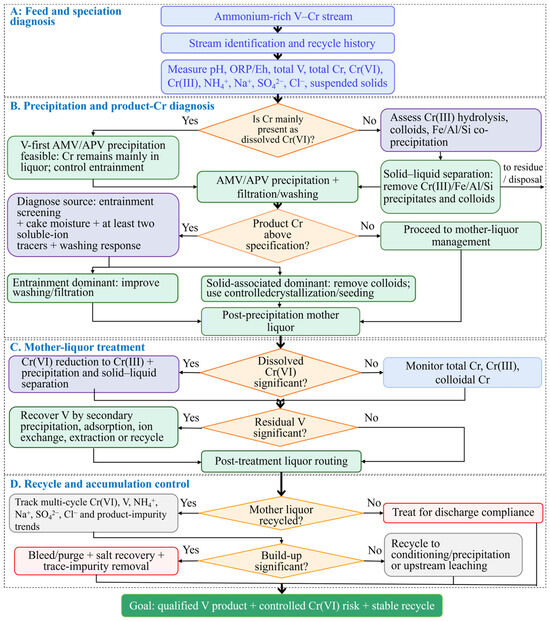
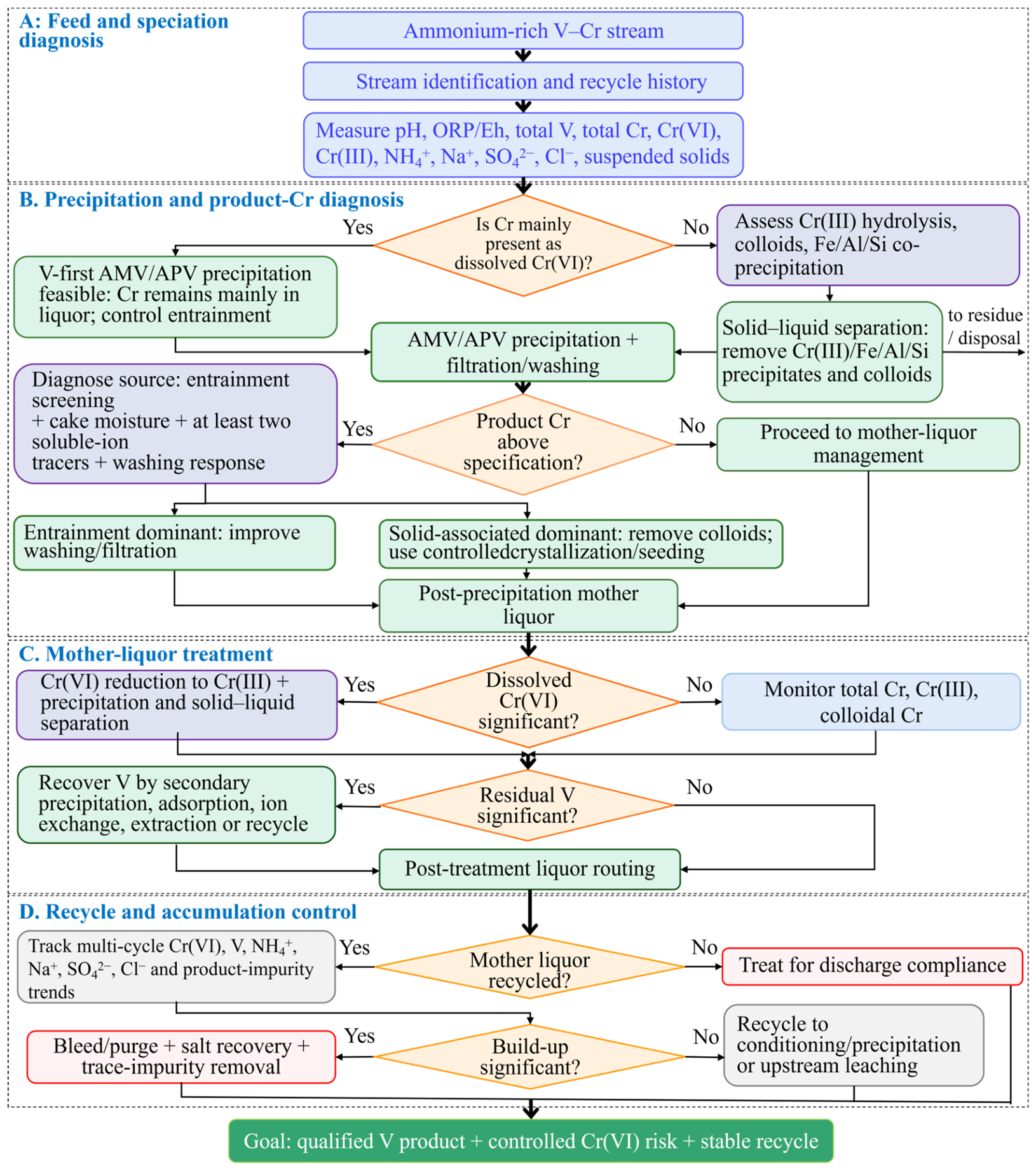
The workflow in Figure 3 starts with stream identification and chemical diagnosis. Key streams should be characterized by pH, ORP, total V/Cr, Cr(VI)/Cr(III), NH4+, Na+, sulfate, chloride, suspended solids and recycle history.
Figure 3.
Diagnostic decision workflow for chromium control in ammonium-rich vanadium precipitation circuits. Dashed regions indicate four functional modules: feed and speciation diagnosis, precipitation and product-Cr diagnosis, mother-liquor treatment, and recycle and accumulation control. An intermediate solid–liquid separation (filtration and washing) step follows impurity/Cr(III) removal and precedes AMV/APV precipitation.
If V is sufficiently concentrated for efficient precipitation and Cr is mainly present as Cr(VI), a V-first AMV/APV precipitation route can be used, with emphasis on supersaturation control, crystal size, filtration, washing and entrainment. If product Cr is high, the entrainment balance, cake moisture, washing response and Na/S/Cl tracer data should be checked before assuming failure of chemical V/Cr separation.
If the mother liquor contains significant Cr(VI), residual V recovery, Cr(VI) reduction, Cr(III) precipitation or trace-impurity removal should be selected according to liquor composition and recycle route. Solvent extraction (e.g., N263 co-extraction of V and Cr followed by selective stripping [42]) is included as a recovery option specifically for large liquor volumes or where co-recovery of V and Cr is desired; for typical mother-liquor volumes and V-only recovery, secondary precipitation, adsorption, or ion exchange is generally more practical. “Significant” residual V here refers to concentrations at or above the grams-per-liter level, at which secondary precipitation or return to an upstream step is the more direct recovery route; below roughly a few hundred mg L−1, recovery by adsorption or ion exchange is more effective and the liquor is otherwise recycled, as discussed in Section 5.1. During mother-liquor recycling, residual V/Cr, Cr(VI), NH4+, Na+, sulfate, purge ratio and product-impurity trends should be monitored over multiple cycles. Salt accumulation or Cr(VI) build-up should trigger trace-impurity removal from the bleed stream, salt recovery or purge redesign. Where Cr(III) hydrolysis or Fe/Al/Si removal is applied before vanadium precipitation, the resulting solids must be separated and the cake washed before the liquor enters AMV/APV precipitation; carrying these hydroxide or gel solids into the precipitation stage reintroduces the colloid-capture and entrainment pathways identified in Section 4.2. Where these solids are colloidal rather than filterable, removal relies on controlling the precipitation pH window (near the Cr(OH)3 solubility minimum at pH 8–9) and aging, as discussed in Section 5.1, rather than on conventional filtration alone.
6.3. Industrial Implications for Slag-Derived Vanadium Circuits
The preceding analysis has three direct implications for industrial practice, particularly for circuits processing high-chromium vanadium slags derived from the Panxi region in China. In this region, the Hongge vanadium–titanium magnetite is characterized by a distinctly high Cr2O3 content (0.4–1.1 wt%) [50], which is 5–10 times higher than that in surrounding deposits [3]. During subsequent converter smelting, most chromium in the feed is oxidized together with vanadium and enriched in vanadium slag [5,51]. Coarse vanadium slag from such high-chromium feedstocks may contain Cr2O3 in the range of 6–9 wt% or higher; for example, Li et al. [51] reported 6.32 wt% Cr2O3 in high-chromium vanadium slag, while Wen et al. [5] documented 9.45 wt% Cr2O3 in similar material and noted that this value is much larger than that in normal vanadium slag. This elevated chromium burden makes Cr control a particularly critical consideration in process design and operation.
First, upstream roasting determines Cr(VI) and salt load. The choice of sodium roasting, calcification roasting, ammonium-sulfate roasting or magnesiation roasting dictates not only vanadium extraction but also the initial Cr(VI)/Cr(III) ratio and the Na+/NH4+/SO42−/Cl− matrix entering the precipitation circuit [4,5,6,7,52,53,54,55,56]. A V-first strategy is most credible when the upstream process does not introduce an excessive soluble Cr(VI) burden that later accumulates in recycled mother liquor [8].
Second, ammonium vanadate precipitation should be optimized together with filtration and washing. Product chromium may correlate strongly with cake moisture, crystal size and washing efficiency, which are often optimized for throughput rather than chromium control. The entrainment balance and tracer approach in Section 4 provide a quantitative basis for deciding whether a product-Cr target requires lower cake moisture, improved washing, lower Cr concentration in the mother liquor or controlled crystal growth.
Third, mother-liquor recycling requires purge, Cr(VI) control and salt-balance management. Direct recycling can save reagents and water, but dissolved salts and unreduced Cr(VI) may accumulate. Where high water recovery or zero-discharge operation is required, fractional crystallization of Na2SO4/(NH4)2SO4, Cr(VI) reduction–precipitation and/or extensive purification of bleed streams should be integrated with the main precipitation circuit.
6.4. Research Needs
Future work should move from single-pass precipitation evaluation toward source-resolved chromium accounting and recycle validation. Five priorities are suggested.
First, chromium speciation should be linked with operationally defined solid size fractions so that dissolved, colloidal and particulate chromium can be distinguished.
Second, product-Cr source apportionment should be validated using combined entrainment, washing and soluble-tracer tests, rather than inferred only from final product grade.
Third, AMV/APV crystallization, filtration and washing should be studied as coupled operations because crystal size, cake structure (porosity and permeability) and wash efficiency jointly determine impurity transfer.
Fourth, mother-liquor recycle should be evaluated over multiple cycles with explicit purge or salt-recovery strategies, so that residual V, Cr(VI) and accumulated salts are controlled together.
Finally, Cr-bearing residues generated during reduction or precipitation should be assessed for reoxidation and subsequent Cr(VI) leaching risk under realistic storage conditions. If independent characterization confirms that product chromium is predominantly associated with Cr-rich Cr(III) colloids, controlled oxidative redissolution could be investigated as a possible treatment option to transfer chromium into solution. Any resulting Cr(VI) would then require reduction and subsequent solid–liquid separation. The feasibility of this approach would depend on colloid composition, co-precipitated phases and compatibility with V recovery, and therefore requires targeted validation rather than being assumed as a general treatment.
7. Conclusions
Chromium control in ammonium-rich vanadium precipitation circuits is governed by speciation, crystallization, solid–liquid separation, and recycle effects. Cr(VI) may remain soluble during V-first AMV/APV precipitation, whereas Cr(III) may hydrolyze to form hydroxide precipitates or colloids that can enter products through colloid capture or association with impurity hydroxides. Therefore, chromium behavior cannot be evaluated reliably from total Cr removal or single-pass vanadium precipitation efficiency alone.
This review integrates Cr valence analysis, entrainment balances, washing diagnostics, soluble-ion tracers and simplified recycle inventory checks into a diagnostic framework for ammonium-rich precipitation circuits. Product chromium can be screened by comparing measured Cr with the amount expected from retained mother liquor and by using Na+, SO42− and Cl− as soluble-ion tracers. Because none of the chromium fractions is directly measurable and tracer-based estimates are subject to adsorption artifacts on high-surface-area precipitates, this screening yields semi-quantitative limits rather than exact source attribution; it should be corroborated by at least two tracers of contrasting adsorption affinity, together with washing-response behavior and independent solid-phase characterization. Where retained liquor does not fully account for product chromium, adsorption, occlusion or colloid capture provide testable alternatives to entrainment; for Cr(III)-bearing colloids in particular, control rests on pH-window selection and aging during precipitation, together with reductive precipitation or Fe/Al/Si coagulation for downstream Cr(VI) removal.
Post-precipitation mother liquor is an integral component of the recycle circuit and influences residual V recovery, Cr(VI) control, purge design, salt recovery and multi-cycle behavior. These aspects should be evaluated together with precipitation, filtration and washing. The framework is designed for process diagnosis and reporting consistency. Quantitative prediction requires cycle-resolved data and validation in real high-salt liquors.
Supplementary Materials
The following supporting information can be downloaded at https://www.mdpi.com/article/10.3390/min16090866/s1, Table S1: Study and process characterization; Table S2: System and conditions; Table S3: Results and products; Table S4: Comprehensive matrix of reporting indicators.
Author Contributions
Conceptualization, X.-Y.W. and Y.-H.Q.; methodology, X.-Y.W. and H.-Q.Z.; investigation, X.-Y.W., H.-Q.Z. and L.-F.W.; resources, F.W. and Y.-H.Q.; data curation, X.-Y.W. and H.-Q.Z.; writing—original draft preparation, X.-Y.W.; writing—review and editing, H.-Q.Z., L.-F.W., F.W. and Y.-H.Q.; visualization, X.-Y.W.; supervision, F.W. and Y.-H.Q.; project administration, Y.-H.Q.; funding acquisition, Y.-H.Q. All authors have read and agreed to the published version of the manuscript.
Funding
This research received no external funding.
Data Availability Statement
No new data were created or analyzed in this study. Data sharing is not applicable to this article.
Acknowledgments
The authors would like to thank the State Key Laboratory of Advanced Steel Processes and Products, China Iron & Steel Research Institute Group Co., Ltd. (CISRI), and the College of Vanadium and Titanium, Panzhihua University, for their administrative and technical support. During the preparation of this manuscript, the AI tool Consensus (Pro subscription) was used to support preliminary literature search and identification, and GPT-4/GPT-5 series-based tools were used for manuscript structuring, outline development, and language editing. All AI-assisted outputs were critically reviewed and verified by the authors. The authors retain full responsibility for the scientific content, interpretations, and conclusions of this study.
Conflicts of Interest
Author Xin-Yu Wang, Feng Wang and Yuan-Hong Qi was employed by the company China Iron & Steel Research Institute Group Co., Ltd. (CISRI). The remaining authors declare that the research was conducted in the absence of any commercial or financial relationships that could be construed as a potential conflict of interest.
Abbreviations
The following abbreviations are used in this manuscript:
| AMV | Ammonium metavanadate |
| APV | Ammonium polyvanadate |
| BET | Brunauer–Emmett–Teller (surface area analysis) |
| Cr(VI) | Hexavalent chromium |
| Cr(III) | Trivalent chromium |
| DLS | Dynamic light scattering |
| ORP | Oxidation–reduction potential |
| V-first | Vanadium-first recovery strategy |
| XPS | X-ray photoelectron spectroscopy |
| XRD | X-ray diffraction |
References
- Li, C.; Jiang, T.; Wen, J.; Yu, T.; Li, F. Review of leaching, separation and recovery of vanadium from roasted products of vanadium slag. Hydrometallurgy 2024, 226, 106313. [Google Scholar] [CrossRef] [Scilit]
- Gao, F.; Olayiwola, A.U.; Liu, B.; Wang, S.; Du, H.; Li, J.; Wang, X.; Chen, D.; Zhang, Y. Review of vanadium production part I: Primary resources. Miner. Process. Extr. Metall. Rev. 2022, 43, 466–488. [Google Scholar] [CrossRef] [Scilit]
- Zhao, W.; Zhao, Z.; Xu, Y.; Cao, Z.; Zhao, T. Structural reconstruction and selective extraction of vanadium and chromium driven by calcium modification in the sodic roasting of high chromium vanadium slag. Sep. Purif. Technol. 2025, 371, 133231. [Google Scholar] [CrossRef] [Scilit]
- An, Y.; Ma, B.; Zhou, Z.; Chen, Y.; Wang, C.; Wang, B.; Gao, M.; Feng, G. Extraction of vanadium from vanadium slag by sodium roasting-ammonium sulfate leaching and removal of impurities from weakly alkaline leach solution. J. Environ. Chem. Eng. 2023, 11, 110458. [Google Scholar] [CrossRef] [Scilit]
- Wen, J.; Jiang, T.; Xu, Y.; Cao, J.; Xue, X. Efficient extraction and separation of vanadium and chromium in high chromium vanadium slag by sodium salt roasting-(NH4)2SO4 leaching. J. Ind. Eng. Chem. 2019, 71, 327–335. [Google Scholar] [CrossRef] [Scilit]
- Wen, J.; Jiang, T.; Zhou, W.; Gao, H.; Xue, X. A cleaner and efficient process for extraction of vanadium from high chromium vanadium slag: Leaching in (NH4)2SO4-H2SO4 synergistic system and NH4+ recycle. Sep. Purif. Technol. 2019, 216, 126–135. [Google Scholar] [CrossRef] [Scilit]
- Lin, Q.; Zhang, G.; Wang, K.; Luo, D.; Tang, S.; Yue, H. Two-stage cyclic ammonium sulfate roasting and leaching of extracting vanadium and titanium from vanadium slag. Chin. J. Chem. Eng. 2022, 47, 39–47. [Google Scholar] [CrossRef] [Scilit]
- Jiang, L.; Du, G.-C.; Wang, J.-P.; Wu, Z.-X.; Li, H.-Y. Eco-friendly efficient separation of Cr (VI) from industrial sodium vanadate leaching liquor for resource valorization. Sep. Purif. Technol. 2025, 361, 131673. [Google Scholar] [CrossRef] [Scilit]
- Hu, B.; Zhang, C.; Yang, M.; Liu, Q.; Wang, M.; Wang, X. A clean metallurgical process for vanadium precipitation from chromium-containing vanadate solution. Hydrometallurgy 2021, 205, 105742. [Google Scholar] [CrossRef] [Scilit]
- Li, X.; Xiang, X.-Y.; Wu, Y.-X.; Sun, Y.-M.; Wei, Y.-F. Separation of V(V) and Cr(VI) from vanadium-containing solutions based on E-pH diagrams of V-Cr-S-H2O system. Sep. Purif. Technol. 2024, 350, 127890. [Google Scholar] [CrossRef] [Scilit]
- Jiang, L.; Li, M.; Luo, J.-H.; Du, G.-C.; Wu, Z.-X. Extraction and separation of chromium from the solution after hydrolysis precipitation of vanadium. Sep. Sci. Technol. 2022, 57, 2198–2210. [Google Scholar] [CrossRef] [Scilit]
- Yang, M.; Yang, H.; Tian, S.; Wang, M.; Wang, X.-W. Cyclic metallurgical process for extracting V and Cr from vanadium slag: Part II. Separation and recovery of Cr from vanadium precipitated solution. Trans. Nonferrous Met. Soc. China 2021, 31, 2852–2860. [Google Scholar] [CrossRef] [Scilit]
- Li, S.; Hu, P.; Zhang, Y.; Xue, N.; Huang, J.; He, Y.; Zhang, Z.; Ye, S. Comprehensive recovery of valuable elements from vanadium precipitation liquor using selective impurity removal-reduction precipitation process. J. Clean. Prod. 2024, 467, 143013. [Google Scholar] [CrossRef] [Scilit]
- Chen, B.-F.; Huang, S.; Liu, B.; Ge, Q.; Xie, S.-S.; Wang, M.-Y.; Wang, X.-W. Thermodynamic analysis for separation of vanadium and chromium in V(IV)–Cr(III)–H2O system. Trans. Nonferrous Met. Soc. China 2018, 28, 567–573. [Google Scholar] [CrossRef] [Scilit]
- Tarleton, S.; Wakeman, R. Solid/Liquid Separation: Equipment Selection and Process Design; Elsevier: Amsterdam, The Netherlands, 2006. [Google Scholar]
- Chen, P.; He, K.; Yuan, B.; Liu, S.; He, J.; Wu, P.; Liu, C.; Jiang, W. Preparation of ultra-pure ammonium metavanadate via heterogeneous self-assembly crystallization. Colloids Surf. A Physicochem. Eng. Asp. 2023, 668, 131461. [Google Scholar] [CrossRef] [Scilit]
- Jiang, L.; He, W.; Du, G.; Zheng, H.; Peng, Y. Implication of hydrolysis on vanadium precipitation with acidic ammonium salt from high concentration of alkaline vanadium solution. Korean J. Chem. Eng. 2023, 40, 2513–2519. [Google Scholar] [CrossRef] [Scilit]
- Dinda, R.; Garribba, E.; Sanna, D.; Crans, D.C.; Costa Pessoa, J. Hydrolysis, ligand exchange, and redox properties of vanadium compounds: Implications of solution transformation on biological, therapeutic, and environmental applications. Chem. Rev. 2025, 125, 1468–1603. [Google Scholar] [CrossRef] [Scilit]
- Povar, I.; Spinu, O.; Zinicovscaia, I.; Pintilie, B.; Ubaldini, S. Revised Pourbaix diagrams for the vanadium–water system. J. Electrochem. Sci. Eng. 2019, 9, 75–84. [Google Scholar] [CrossRef] [Scilit]
- Liu, F.; Ning, P.; Cao, H.; Li, Z.; Zhang, Y. Solubilities of NH4VO3 in the NH3–NH4+–SO42−–Cl−–H2O system and modeling by the Bromley–Zemaitis equation. J. Chem. Eng. Data 2013, 58, 1321–1328. [Google Scholar] [CrossRef] [Scilit]
- Zhan, L.; Zhang, Y.; Zheng, S.; Zhang, Y.; Fan, B.; Li, P.; Zhang, Y. Crystallization kinetics of ammonium polyvanadate. J. Cryst. Growth 2019, 526, 125218. [Google Scholar] [CrossRef] [Scilit]
- Rai, D.; Sass, B.M.; Moore, D.A. Chromium (III) hydrolysis constants and solubility of chromium (III) hydroxide. Inorg. Chem. 1987, 26, 345–349. [Google Scholar] [CrossRef] [Scilit]
- Parkhurst, D.L.; Appelo, C. Description of Input and Examples for PHREEQC Version 3: A Computer Program for Speciation, Batch-Reaction, One-Dimensional Transport, and Inverse Geochemical Calculations; US Geological Survey Techniques and Methods; Book 6; Chapter A43; U.S. Geological Survey: Middleton, WI, USA, 2013.
- Santucci, R., Jr.; McMahon, M.; Scully, J. Utilization of chemical stability diagrams for improved understanding of electrochemical systems: Evolution of solution chemistry towards equilibrium. npj Mater. Degrad. 2018, 2, 1. [Google Scholar] [CrossRef] [Scilit]
- Liu, Q.; Liu, H.; Chen, H.; Wang, X.; Hu, D.; Cheng, X.; Xu, H. Thermodynamic investigation with chemical kinetic analysis on the reoxidation phenomenon of the Cr (III) in air. RSC Adv. 2020, 10, 27775–27787. [Google Scholar] [CrossRef] [Scilit]
- Liu, W.; Li, J.; Zheng, J.; Song, Y.; Shi, Z.; Lin, Z.; Chai, L. Different pathways for Cr (III) oxidation: Implications for Cr (VI) reoccurrence in reduced chromite ore processing residue. Environ. Sci. Technol. 2020, 54, 11971–11979. [Google Scholar] [CrossRef] [Scilit]
- Liu, L.; Kauppinen, T.; Tynjälä, P.; Hu, T.; Lassi, U. Water leaching of roasted vanadium slag: Desiliconization and precipitation of ammonium vanadate from vanadium solution. Hydrometallurgy 2023, 215, 105989. [Google Scholar] [CrossRef] [Scilit]
- Mendez, J.C.; Hiemstra, T. Surface area of ferrihydrite consistently related to primary surface charge, ion pair formation, and specific ion adsorption. Chem. Geol. 2020, 532, 119304. [Google Scholar] [CrossRef] [Scilit]
- Kosmulski, M. The pH dependent surface charging and points of zero charge. VIII. Update. Adv. Colloid Interface Sci. 2020, 275, 102064. [Google Scholar] [CrossRef] [Scilit]
- Kosmulski, M. Isoelectric points and points of zero charge of metal (hydr) oxides: 50 years after Parks’ review. Adv. Colloid Interface Sci. 2016, 238, 1–61. [Google Scholar] [CrossRef] [Scilit]
- Cherry, J. Chemical equilibrium between gypsum and brackish and slightly saline waters at low temperatures and pressures. Chem. Geol. 1968, 3, 239–247. [Google Scholar] [CrossRef] [Scilit]
- Guo, Q.; Yu, D.; Yang, J.; Zhao, T.; Yu, D.; Li, L.; Wang, D. A novel sequential extraction method for the measurement of Cr (VI) and Cr (III) species distribution in soil: New insights into the chromium speciation. J. Hazard. Mater. 2024, 480, 135864. [Google Scholar] [CrossRef] [Scilit]
- US EPA. Method 7196A. Chromium, Hexavalent (Colorimetric); US EPA: Washington, DC, USA, 1992.
- US EPA. Method 7199. Determination of Hexavalent Chromium in Drinking Water, Groundwater and Industrial Wastewater Effluents by Ion Chromatography. [Internet]; Test Methods for Evaluating Solid Waste (SW-846); US EPA: Washington, DC, USA, 1996.
- Huhtanen, M.; Salmimies, R.; Kinnarinen, T.; Häkkinen, A.; Ekberg, B.; Kallas, J. Empirical modelling of cake washing in a pressure filter. Sep. Sci. Technol. 2012, 47, 1102–1112. [Google Scholar] [CrossRef] [Scilit]
- Wakeman, R.; Rushton, A. A structural model for filter cake washing. Chem. Eng. Sci. 1974, 29, 1857–1865. [Google Scholar] [CrossRef] [Scilit]
- Yoon, H.-S.; Heo, S.J.; Park, Y.; Kim, R.; Kim, C.-J.; Chung, K.W.; Kim, H.I. Effects of Vanadate Solution Property on the Precipitation of Ammonium (Meta, Poly) Vanadate. Resour. Recycl. 2023, 32, 26–37. [Google Scholar] [CrossRef] [Scilit]
- Wang, L.; Xue, N.; Zhang, Y.; Hu, P. Controlled hydrothermal precipitation of alunite and natroalunite in high-aluminum vanadium-bearing aqueous system. Minerals 2021, 11, 892. [Google Scholar] [CrossRef] [Scilit]
- Hu, B.; Chen, B.; Zhang, C.; Dai, Y.; Wang, M.; Wang, X. Separation and recovery of chromium from solution after vanadium precipitation. Min. Metall. Explor. 2021, 38, 289–297. [Google Scholar] [CrossRef] [Scilit]
- Li, C.; You, E.; Ci, J.X.; Huang, Q.; Zhao, Y.S.; Li, W.Z.; Yan, Y.C.; Zuo, Z. Removal of V (V) from a Mixed Solution Containing Vanadium and Chromium Using a Micropocrous Resin in a Column: Migration Regularity of the Mass Transfer Zone and Analysis of Dynamic Properties. ACS Omega 2024, 9, 23688–23702. [Google Scholar] [CrossRef] [Scilit]
- Fan, Y.; Wang, X.; Wang, M. Separation and recovery of chromium and vanadium from vanadium-containing chromate solution by ion exchange. Hydrometallurgy 2013, 136, 31–35. [Google Scholar] [CrossRef] [Scilit]
- Hu, B.; Zhang, C.; Dai, Y.; Wang, X.; Wang, M. Separation of vanadium and chromium in solution after vanadium precipitation by co-extraction with N263 and selective stripping with NaOH solution. Hydrometallurgy 2022, 208, 105798. [Google Scholar] [CrossRef] [Scilit]
- Ying, Z.; Chen, M.; Wu, G.; Li, J.; Liu, J.; Wei, Q.; Ren, X. Separation and recovery vanadium (V) and chromium (VI) using amide extractants based on the steric hindrance effect. J. Environ. Chem. Eng. 2021, 9, 105939. [Google Scholar] [CrossRef] [Scilit]
- Sun, P.; Huang, K.; Liu, H. Separation of V and Cr in alkaline aqueous solution using acidified primary amine N1923. Hydrometallurgy 2016, 165, 370–380. [Google Scholar] [CrossRef] [Scilit]
- Wang, X.-W.; Yang, M.-E.; Meng, Y.-Q.; Gao, D.-X.; Wang, M.-Y.; Fu, Z.-B. Cyclic metallurgical process for extracting V and Cr from vanadium slag: Part I. Separation and recovery of V from chromium-containing vanadate solution. Trans. Nonferrous Met. Soc. China 2021, 31, 807–816. [Google Scholar] [CrossRef] [Scilit]
- Iorungwa, M.; Wuana, R.; Yiase, S.; Tor-Anyiin, T. A kinetic, thermodynamic and stoichiometric study on the reductive detoxification of Cr (VI) in aqueous phase by sodium metabisulphite. J. Environ. Earth Sci. 2014, 4, 61–71. [Google Scholar]
- Vinco, J.H.; Junior, A.B.; Duarte, H.A.; Espinosa, D.C.R.; Tenório, J.A.S. Purification of an iron contaminated vanadium solution through ion exchange resins. Miner. Eng. 2022, 176, 107337. [Google Scholar] [CrossRef] [Scilit]
- Li, M.; Zhang, B.; Zou, S.; Liu, Q.; Yang, M. Highly selective adsorption of vanadium (V) by nano-hydrous zirconium oxide-modified anion exchange resin. J. Hazard. Mater. 2020, 384, 121386. [Google Scholar] [CrossRef] [Scilit]
- Song, J.; Gao, Z.; Su, H.; Shi, H.; Zhu, C. Exploration of process optimization for recovery of sodium and ammonium sulfate crystals from vanadium precipitation wastewater. J. Cryst. Growth 2022, 598, 126872. [Google Scholar] [CrossRef] [Scilit]
- Wen, J.; Yu, T.; Jiang, T.; Sun, H.; Li, M.; Peng, Y. Effect of chromium content on the phase composition, crystallization and components extraction of vanadium slag. Process Saf. Environ. Prot. 2022, 165, 13–21. [Google Scholar] [CrossRef] [Scilit]
- Li, Q.; Gu, S.; Yu, L.; Han, F.; Dong, J. Separation of vanadium and chromium from vanadium-chromium slag by high-temperature heating. Sep. Purif. Technol. 2024, 336, 126098. [Google Scholar] [CrossRef] [Scilit]
- Wen, J.; Jiang, T.; Zheng, X.; Wang, J.; Cao, J.; Zhou, M. Efficient separation of chromium and vanadium by calcification roasting–sodium carbonate leaching from high chromium vanadium slag and V2O5 preparation. Sep. Purif. Technol. 2020, 230, 115881. [Google Scholar] [CrossRef] [Scilit]
- Li, H.-Y.; Wang, C.-J.; Yuan, Y.-H.; Guo, Y.; Diao, J.; Xie, B. Magnesiation roasting-acid leaching: A zero-discharge method for vanadium extraction from vanadium slag. J. Clean. Prod. 2020, 260, 121091. [Google Scholar] [CrossRef] [Scilit]
- Li, H.-Y.; Cheng, J.; Wang, C.-J.; Shen, S.; Diao, J.; Xie, B. Ecofriendly selective extraction of vanadium from vanadium slag with high chromium content via magnesiation roasting–acid leaching. Metall. Mater. Trans. B 2022, 53, 604–616. [Google Scholar] [CrossRef] [Scilit]
- Peng, H.; Li, B.; Shi, W.; Liu, Z. Efficient recovery of vanadium from high-chromium vanadium slag with calcium-roasting acidic leaching. Minerals 2022, 12, 160. [Google Scholar] [CrossRef] [Scilit]
- Yu, J.; Ma, B.; Zhao, S.; Yao, Z.; Wang, C.; Wang, B.; Gao, M.; Feng, G. Vanadium extraction from water-cooled vanadium converter slag via salt-free roasting and acid leaching. Process Saf. Environ. Prot. 2023, 172, 727–737. [Google Scholar] [CrossRef] [Scilit]

Disclaimer/Publisher’s Note: The statements, opinions and data contained in all publications are solely those of the individual author(s) and contributor(s) and not of MDPI and/or the editor(s). MDPI and/or the editor(s) disclaim responsibility for any injury to people or property resulting from any ideas, methods, instructions or products referred to in the content. |
© 2026 by the authors. Licensee MDPI, Basel, Switzerland. This article is an open access article distributed under the terms and conditions of the Creative Commons Attribution (CC BY) license.