


Abstract
The Damiao titanomagnetite deposit on the northern margin of the North China Craton is a typical Fe-Ti-P polymetallic ore with significant deep resource potential. However, the mineralogical factors controlling its beneficiation remain poorly quantified. This study integrates multi-element analysis, chemical phase analysis, XRD, EPMA, and MLA to systematically characterize the ore’s chemistry, mineralogy, element deportment, grain size, dissemination, and liberation. Results show that Fe (25.81% TFe), Ti (6.50% TiO2), and P (0.95% P2O5) are the main valuables. Fe is mainly in magnetite (59.53%), Ti in ilmenite (48.90%) and rutile (33.89%), and P almost entirely in fluorapatite. Magnetite, ilmenite, apatite, and pyrite are coarse-grained and achieve >80% free + rich intergrowths at 60% passing −0.074 mm, while rutile is fine and poorly liberated, representing the key titanium bottleneck. Silicate-bound iron (28.07% of Fe) causes irreversible loss; Ca-gangue (>20%) and chlorite slimes interfere with flotation. A staged flowsheet—primary grinding, magnetic separation, regrinding of rough concentrate, desulfurization, and sequential flotation—is proposed. This work provides a mineralogical basis for process optimization and offers references for similar deposits.
1. Introduction
The comprehensive recovery of low-grade and complex polymetallic ores increasingly depends on a clear understanding of the occurrence states of valuable elements, the dissemination characteristics of target minerals, and their liberation behavior during comminution and separation [1,2,3,4]. Process mineralogy addresses these issues by systematically characterizing the chemical composition, mineral assemblages, mineral properties, and their variations in ores and processing products, thereby providing an essential basis for beneficiation flowsheet design, process optimization, and improvement of production performance [5,6].
Titanomagnetite is a typical complex polymetallic ore characterized by intricate mineral intergrowths and diverse element occurrence states. Large-scale deposits are widely distributed across China, South Africa, Canada, Norway and other countries, which are mostly associated with anorthosite and layered mafic intrusions and formed via magmatic differentiation [7]. In addition to iron, titanium represents an important high-value component of such ores and is widely used in aerospace, military, shipbuilding, chemical, and biomedical industries [8]. For this type of ore, the beneficiation performance is controlled not only by bulk grade, but more fundamentally by the mineralogical occurrence of Fe-, Ti-, and P-bearing phases, their grain-size distribution, and the degree to which they can be liberated under practical grinding conditions [9].
For industrial exploitation, the standard economic cut-off grades for this type of ore are generally 20% for total Fe and 5% for TiO2. In this study, the ore has total Fe of 25.81% and TiO2 of 6.50%, meeting commercial mining standards. This work aims to conduct a systematic process mineralogy study on the Damiao ore, clarify element occurrence, mineral dissemination and liberation characteristics, identify key mineralogical constraints on beneficiation, and propose targeted separation schemes. The findings can not only support local resource utilization, but also provide technical references for the development of analogous titanomagnetite deposits worldwide.
The Damiao-Tougou anorthosite complex in Chengde, Hebei Province, located on the northern margin of the North China Craton (NCC), is one of the most important titanomagnetite concentration areas in China and one of the few known apatite-Fe-Ti oxide deposits associated with Precambrian anorthosite bodies [10,11,12,13]. Recent deep exploration has identified new deep orebodies, indicating considerable resource potential and the possibility of comprehensive recovery of Fe, Ti, and P [14]. However, despite the geological significance and economic value of the Damiao deposit, previous studies have mainly concentrated on regional geology, petrogenesis, and geochronology, whereas the mineralogical factors directly relevant to beneficiation have remained insufficiently documented.
Accordingly, this study presents a systematic process-mineralogy investigation of the Damiao titanomagnetite ore. It focuses on the chemical composition, mineral composition, element deportment, dissemination characteristics, particle-size distribution, and liberation behavior of the key minerals, with particular emphasis on the mineralogical constraints governing the recovery of Fe, Ti, and P. The aim is to provide scientific mineralogical and geological guidance for the efficient comprehensive utilization of mineral resources in this mining district.
2. Samples and Research Methods
2.1. Sample Collection and Geological Context
Research samples were collected from the Heishan Iron Mine within the Damiao–Heishan iron metallogenic belt [11,12]. The deposit is situated in the southern part of the Damiao anorthosite complex, a major ore-bearing tectonic unit with great economic potential [13,14]. This complex is roughly EW-trending and consists of anorthosite and later intruded norite, and hosts three super-large iron deposits including the Heishan Deposit [15,16,17,18,19].
Orebodies in the mining area show distinct vertical zonation of “upper phosphorus, lower iron” [20,21]. They were formed by magmatic crystallization differentiation and emplacement of volatile-rich residual melts, and gradually transition from massive Fe–P ores to dense titanomagnetite ores downward. The orebodies occur within contact alteration zones associated with norite and pegmatitic norite, and feature branched, podiform structures hosted in anorthosite. Deep orebodies are large in scale and high in grade, indicating considerable resource potential.
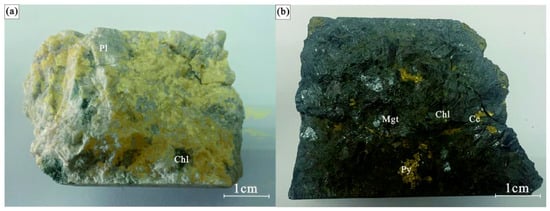
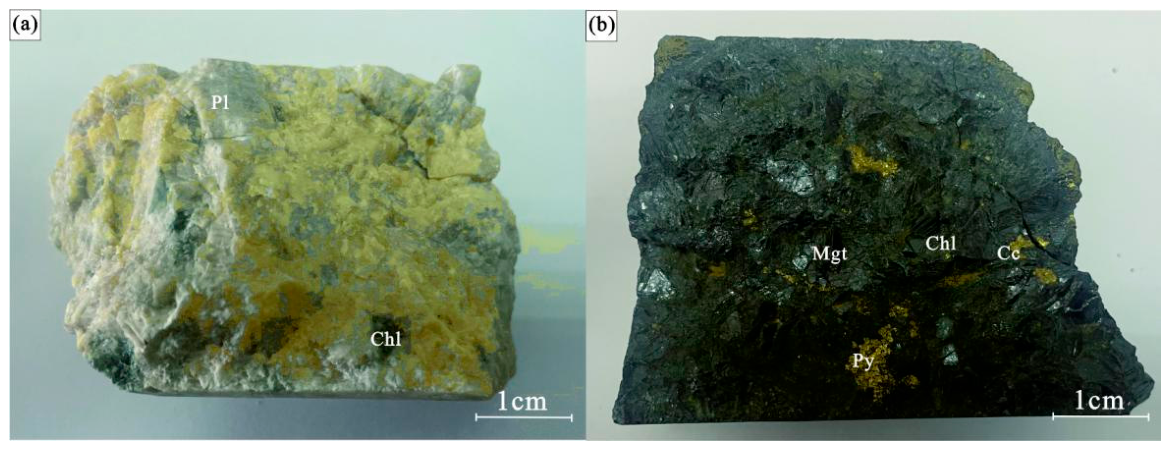
The sampled section develops chloritization, carbonatization and pyritization [22]. The ore has average grades of 38.20% TFe (Total Fe), 25.59% mFe (Magnetic Fe), 10.35% TiO2 and 0.348% V2O5, with definite industrial value. Chloritization mainly occurs in anorthosite, carbonatization is developed in both anorthosite and norite, and pyritization is concentrated in norite. The orebodies range from 4.32 m to 139.63 m in thickness (average 42.69 m), striking NE 45–55° and dipping SE 35–40°. Fe–Ti minerals are predominantly disseminated in the chloritized alteration zone, and chloritized anorthosite serves as the main wall rock. The ore surrounding rock is predominantly chloritized anorthosite, with Fe–Ti mineralization mainly occurring as disseminations within the chloritized alteration zone (Figure 1).
Figure 1.
Different types of ore specimens and surrounding rocks. (a): Chloritized anorthosite; (b): chloritized Fe–Ti ore. Abbreviations: Py—pyrite; Mgt—magnetite; Chl—chlorite; Cc—calcite; Pl—plagioclase.
Combined with the deposit’s vertical zonation, variable orebody morphology and zonal alteration, six surrounding rock samples and eleven ore samples were collected. Ore samples were taken from the mineralized zone exhibiting visible Fe–Ti mineralization across different mineralization zones and structural positions, while surrounding rock samples were collected from chloritized anorthosite at least 10 m away from the mineralized zone. Ore samples cover major ore types and typical alterations, while wall rock samples were taken from non-mineralized areas with various alteration intensities. Each sample weighed approximately 3 kg. Immediately after collection, samples were sealed in polyethylene bags to prevent contamination and oxidation. In the laboratory, samples were crushed to <2 mm using a jaw crusher, then thoroughly mixed and split using a rotary splitter to obtain representative subsamples (approximately 300 g each) for chemical analysis, mineralogical characterization and liberation tests.
2.2. Analytical Methods
To comprehensively characterize the process mineralogy of the Chengde Damiao titanomagnetite ore, a systematic investigation was conducted using multiple complementary techniques:
2.2.1. Multi-Element XRF Analysis
The bulk sample was pulverized to fully pass −0.074 mm and tested with a Thermo Niton XL2 GOLDD handheld XRF (Thermo Fisher Scientific, Waltham, MA, USA) (Ag target tube). Calibration curves and drift standards guaranteed test precision; matrix-matched reference materials were applied for correction as needed. The instrument enables rapid ambient-pressure elemental detection from Mg to U without vacuum or helium.
2.2.2. Chemical Composition of Fe, Ti Ores
Samples ground to −0.074 mm underwent sequential acid–base leaching to separate Fe, Ti and P phases and quantify element partitioning and recoverability. Specific dissolution sequences were set for each element: magnetite → pyrite → ilmenite → hematite-limonite → silicate iron for Fe; magnetite → ilmenite → rutile → silicate-bound Ti for Ti; apatite first followed by other phosphorus-bearing phases for P.
2.2.3. XRD Identification
Pulverized −0.074 mm powder was analyzed on a Rigaku Ultima IV diffractometer (Rigaku Corporation, Tokyo, Japan) (Cu Kα, λ = 1.540598 Å; 40 kV, 40 mA, step 0.02°, scan speed 10°/min, 2θ = 5–90°). Jade 9 software was used solely for mineral phase identification and semi-quantitative analysis.
2.2.4. SEM-EDS Observation
Micro-morphology and microarea elemental composition of thick sections were characterized via Zeiss Sigma 360 SEM (Carl Zeiss AG, Oberkochen, Germany) coupled with Bruker QUANTAXE EDS (Bruker Nano GmbH, Berlin, Germany). Test parameters were set as follows: SEM accelerating voltage of 20 kV, beam diameter of 30 µm; EDS analysis was performed at 20 kV with a beam diameter of 60 µm.
2.2.5. EPMA Quantitative Mineral Composition Analysis
Polished thin sections were carbon-coated prior to testing on a Shimadzu EPMA-1720H electron probe (Shimadzu Corporation, Kyoto, Japan). Measurement conditions: 20 kV, 20 nA, beam diameter 5 μm; peak counting 10–30 s and background counting 5–15 s adjusted by element content. Natural mineral standards were adopted, and raw data were ZAF-corrected.
2.2.6. Optical Microscopic Mineral Size, Dissemination and Liberation Analysis
Dissemination and particle size: Forty representative lump samples were cut into 3 × 4 cm blocks and prepared into polished sections. Mineral morphology, dissemination and grain size distribution were observed under 200× magnification with a Zeiss Scope A1 polarizing microscope (Carl Zeiss AG, Oberkochen, Germany) and grain size fractions were statistically counted via the intercept method.
Liberation degree: Bulk ore was ball-milled to four finenesses (50%, 60%, 70%, 80% passing −0.074 mm, calibrated with Tyler sieves). Subsamples of each fineness were epoxy-mounted and polished. Under polarizing microscope, free grains and intergrown grains (classified by target mineral area proportion) were counted separately; encapsulated minerals were defined as inclusions. Liberation degree was calculated as the proportion of free target mineral grains to total grains.
3. Results
3.1. Bulk Chemical Composition
Multi-element chemical analysis results are presented in Table 1. The principal valuable elements are TFe, TiO2, and P2O5, with contents of 25.81%, 6.50%, and 0.95%, respectively, demonstrating significant comprehensive recovery value. Associated elements including Cu (0.028%), Pb (0.01%), Zn (0.033%), Co (0.012%), and Ni (0.02%) occur at relatively low concentrations and currently lack economic recovery potential under existing technical and economic conditions.
Table 1.
Chemical composition analysis results of the ore (wt.%).
The main oxide constituents are SiO2 (29.88%), Al2O3 (11.34%), CaO (6.77%), and MgO (4.89%). Loss on ignition is 3.02%, primarily resulting from the dehydration of clay minerals (e.g., chlorite) and the decomposition of carbonates. Sulfur content is 0.91%, mainly present as pyrite. Trace elements such as Cr and Mn are extremely low and exert no significant influence on beneficiation and comprehensive recovery.
3.2. Chemical Phase Analysis of Iron, Titanium, and Phosphorus
3.2.1. Iron Distribution
Chemical phase analysis of iron (Table 2) reveals that iron is predominantly distributed in the magnetic iron phase, containing 15.63% Fe with an occupancy of 60.60%. This represents the most important recoverable iron phase, amenable to conventional magnetic separation. Silicate-bound iron constitutes the second largest phase, with 8.07% Fe and 31.29% occupancy. This iron occurs as isomorphous substitutions in silicate minerals (chlorite, grossular) and resists recovery by conventional beneficiation methods [23].
Table 2.
Distribution of Fe amongst different minerals (wt.%).
Iron distribution in ilmenite, sulfide, and hematite/limonite phases accounts for 5.12%, 2.95%, and 0.05%, respectively. These proportions are relatively low and contribute minimally to overall iron recovery. The recoverability of iron is fundamentally constrained by the substantial silicate-bound iron fraction, with the magnetic iron phase representing the core target for iron recovery.
3.2.2. Titanium Distribution
Titanium phase analysis (Table 3) shows a total TiO2 content of 6.49%, mainly distributed in ilmenite (30.04% occupancy) and rutile (31.11% occupancy), which constitute the primary titanium recovery targets.
Table 3.
Distribution of Ti amongst different minerals (wt.%).
TiO2 occupancy in the magnetic iron phase reaches 18.95%, primarily due to isomorphous titanium substitution in magnetite and fine-grained titanium mineral inclusions within magnetite. The silicate phase contains 19.90% TiO2 occupancy, occurring as isomorphous substitutions in silicate minerals, which is currently non-recoverable. This distribution pattern, with approximately one-third of titanium hosted in ilmenite and one-third in rutile, presents both opportunities and challenges for titanium recovery [24,25].
3.2.3. Phosphorus Distribution
Phosphorus phase analysis (Table 4) indicates a P2O5 content of 0.95%, with 98.95% occurring in the apatite phase and only 1.05% in other phases. Phosphorus in other phases includes adsorbed phosphorus on gangue mineral surfaces and minor isomorphous phosphorus. The characteristic of phosphorus occurring predominantly as a single apatite phase provides favorable conditions for phosphorus recovery by flotation. During beneficiation, the effective separation of apatite from gangue minerals is the primary requirement for obtaining a qualified phosphorus concentrate [26].
Table 4.
Distribution of phosphorous amongst different minerals (wt.%).
3.3. Mineral Composition and Relative Content
Optical microscopy, scanning electron microscopy (SEM), and X-ray energy dispersive spectrometer (EDS) were used to identify the main mineral species in the ore. Based on multi-element analysis and combined with chemical phase analysis, an element balance calculation method was applied to determine the relative contents of the main minerals in the ore (Table 5). Among metallic minerals, magnetite exhibits the highest content (21.73%), followed by ilmenite (6.49%) and pyrite (1.64%), with minor hematite, chalcopyrite, galena, and sphalerite. Titanium minerals, besides ilmenite, include titanite (3.14%) and rutile (2.20%). The sole phosphorus mineral is apatite (2.09%).
Table 5.
Relative content of main minerals in the ore (wt.%).
Among non-metallic minerals, chlorite (Chl) is most abundant (26.48%), followed by grossular (Grs) (12.29%) and common hornblende (Hbl) (7.98%). Others include albite (7.32%), quartz (2.79%), muscovite (2.15%), actinolite (0.68%), K-feldspar (0.52%), and biotite (0.23%). Carbonate minerals are represented by calcite (Cc) (1.98%), with other minor minerals totaling 0.13%. The high content of gangue minerals, particularly chlorite, grossular, and common hornblende, constitutes the main gangue component and will influence beneficiation performance.
3.4. Occurrence States of Iron, Titanium, and Phosphorus
3.4.1. Iron Distribution in Minerals
The distribution of iron among iron-bearing minerals (Table 6) demonstrates that iron is primarily hosted in magnetite, containing 15.34% Fe metal with a distribution rate of 59.53%, making magnetite the most important iron carrier. Iron distribution in ilmenite reaches 9.34%, and in pyrite 2.91%. Iron distribution rates in hematite and chalcopyrite are both below 0.5%. Metallic sulfides and other oxide minerals contribute minimally to total iron.
Table 6.
Distribution rate of iron in various iron-bearing minerals, in wt.%.
Notably, 28.07% of iron occurs as isomorphous substitutions in silicate minerals. Among these, chlorite hosts 20.20% of total iron, grossular 3.51%, and common hornblende 3.65%. Iron distribution rates in actinolite, biotite, titanite, and other minerals are all below 0.5%. This silicate-bound iron fraction cannot be recovered by conventional magnetic separation or flotation processes and represents inherent loss during iron recovery, a common challenge in processing ores [27].
3.4.2. Titanium Distribution in Minerals
The distribution of TiO2 among titanium-bearing minerals (Table 7) reveals that titanium mainly exists as independent titanium minerals, with minor isomorphous substitutions. Ilmenite is the most important titanium carrier, containing 3.18% TiO2 metal with a distribution rate of 48.90%. Rutile follows, containing 2.20% TiO2 metal with a distribution rate of 33.89%. Titanite contains 16.21% of the TiO2 distribution, making it the third most significant titanium-bearing mineral.
Table 7.
Distribution rate of TiO2 in various titanium-bearing minerals, in wt.%.
Minerals such as magnetite, chlorite, and biotite contain trace titanium, with TiO2 distribution rates of 0.78%, 0.16%, and 0.05%, respectively, totaling less than 1%. These contribute negligibly to titanium recovery. Overall, recoverable titanium minerals are ilmenite and rutile, accounting for 82.79% of total titanium distribution. Titanium in titanite is currently non-recoverable under existing economic and technical conditions, representing a significant limitation on overall titanium recovery [28,29].
3.4.3. Phosphorus Occurrence
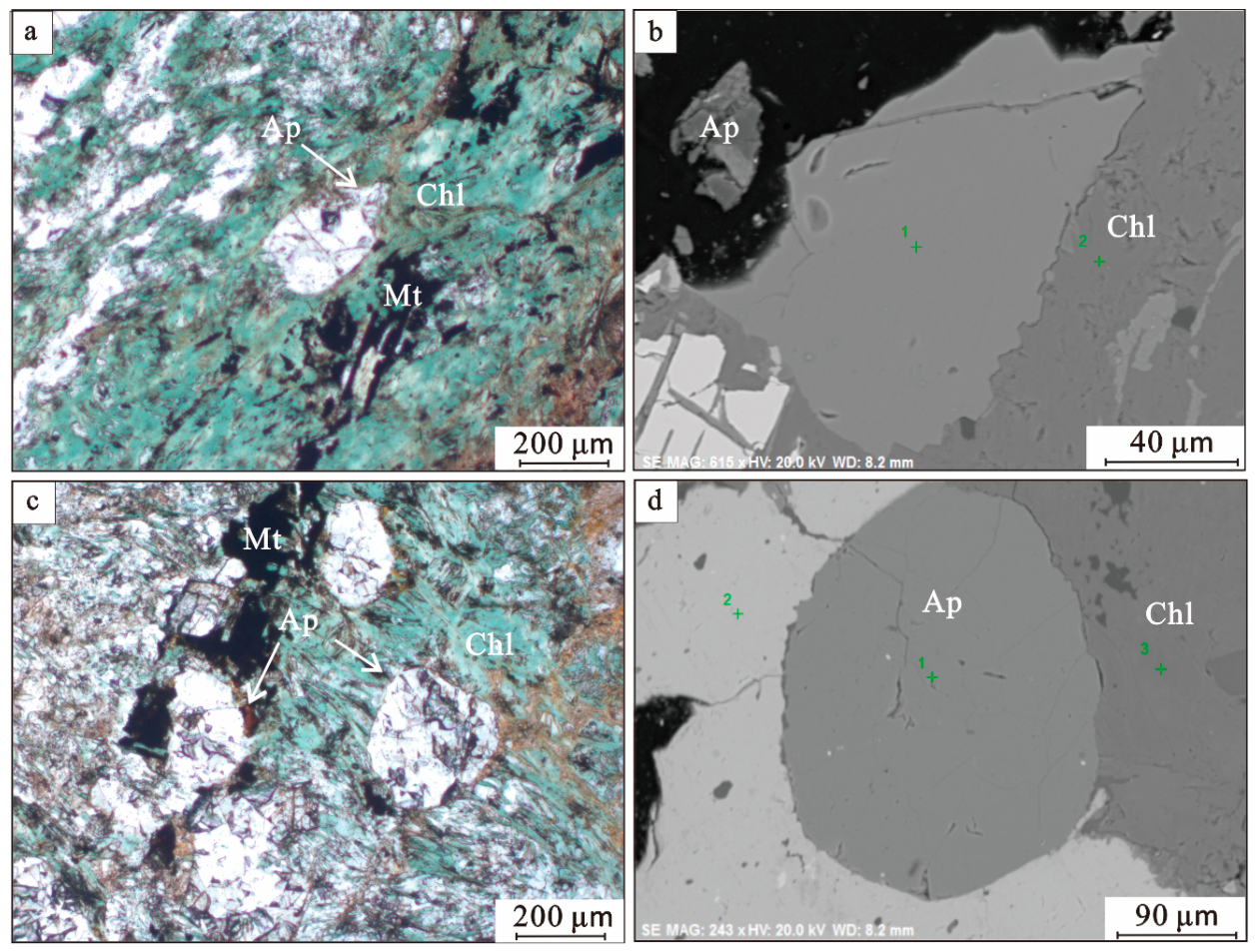
Combining phosphorus phase analysis and mineral composition results, 98.95% of phosphorus exists as the independent mineral apatite. SEM-EDS analysis shows apatite is fluorapatite with a stable chemical composition: CaO (50.87–52.61%), P2O5 (44.52–46.75%), and F (1.85–3.99%). Apatite occurs as euhedral to subhedral granular disseminations with no significant isomorphous substitutions. This simple occurrence state is favorable for phosphorus recovery by flotation [30].
3.5. Dissemination Characteristics Distribution of Key Minerals
The key minerals identified in this ore include magnetite (Mag), ilmenite (Ilm), rutile (Rt), apatite (Ap), and pyrite (Py). Their dissemination characteristics and particle size distributions are described below.
3.5.1. Magnetite
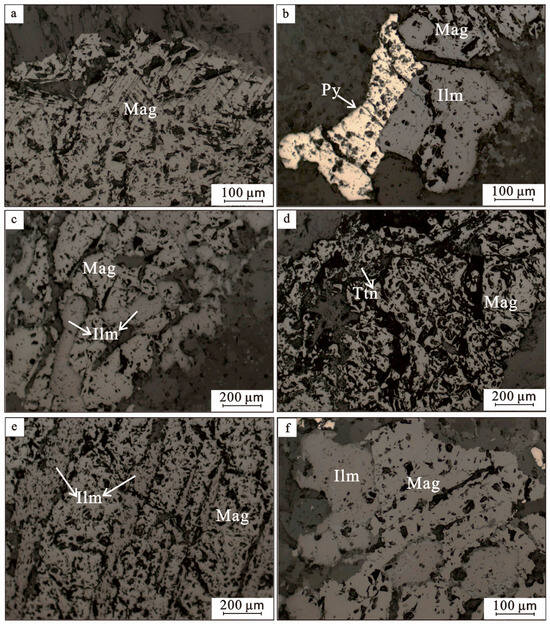
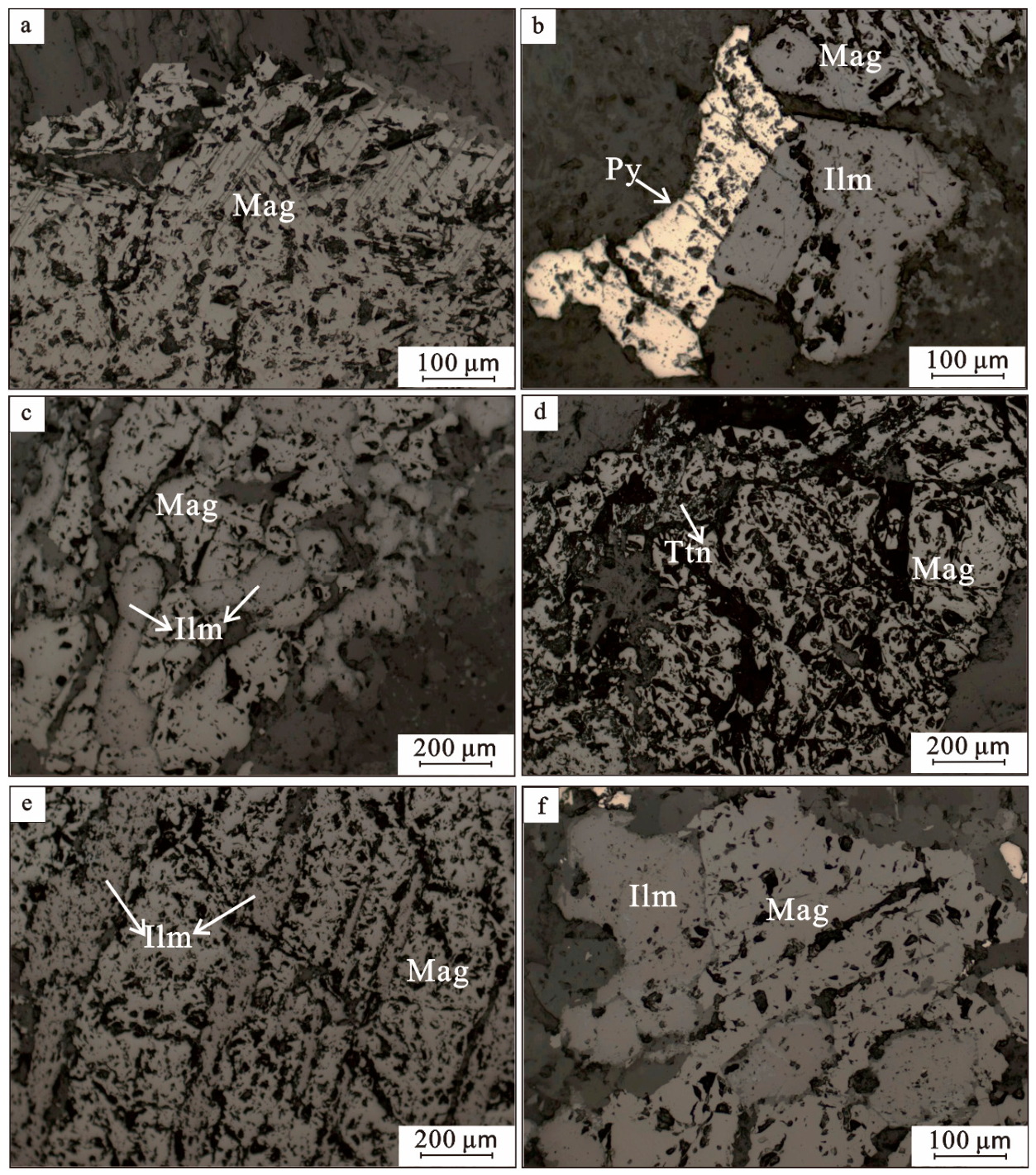
Magnetite (Mgt) predominantly occurs as subhedral granular and irregular disseminations within gangue minerals (Figure 2a). It is frequently closely intergrown with sulfides (pyrite, chalcopyrite) and ilmenite (Figure 2b,f). Some magnetite grains contain inclusions of fine-grained pyrite and chalcopyrite. Ilmenite is distributed along fractures in some magnetite grains (Figure 2e), with magnetite margins occasionally replaced by ilmenite or titanite. Exsolution lamellae of titanite and ilmenite are observable in some coarse-grained magnetite (Figure 2c,d). Locally, magnetite margins and fractures are replaced by hematite.
Figure 2.
Dissemination characteristics of magnetite (under reflected light microscopy). (a) Magnetite predominantly occurs as subhedral granular and irregular disseminations within gangue minerals; (b) Magnetite intergrown with Pyrite and ilmenite; (c) Exsolution lamellae of ilmenite are observable in some coarse-grained magnetite; (d) Exsolution lamellae of titanite are observable in some coarse-grained magnetite; (e) Ilmenite is distributed along fractures in some magnetite grains; (f) Magnetite intergrown with ilmenite.
Electron probe microanalysis (Table 8) reveals a stable magnetite composition, with Fe content ranging from 69.27% to 71.03%. Minor impurity elements include Al, Ti, and V, with no elevated harmful impurities, thus posing no significant impediment to magnetic separation recovery.
Table 8.
EPMA results of magnetite in the ore (wt.%).
3.5.2. Ilmenite
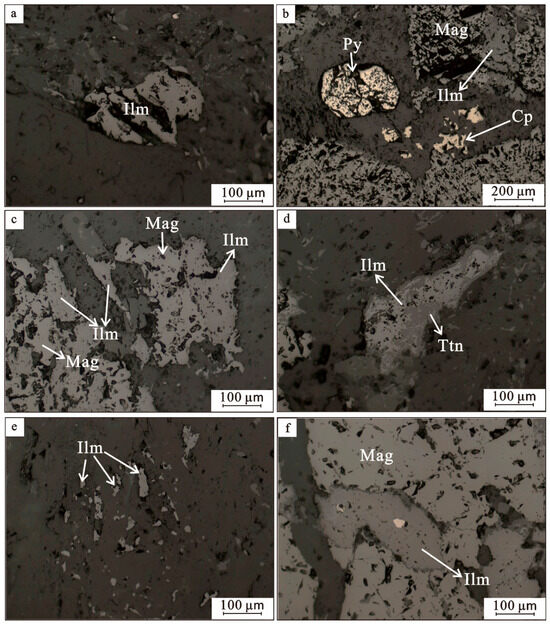
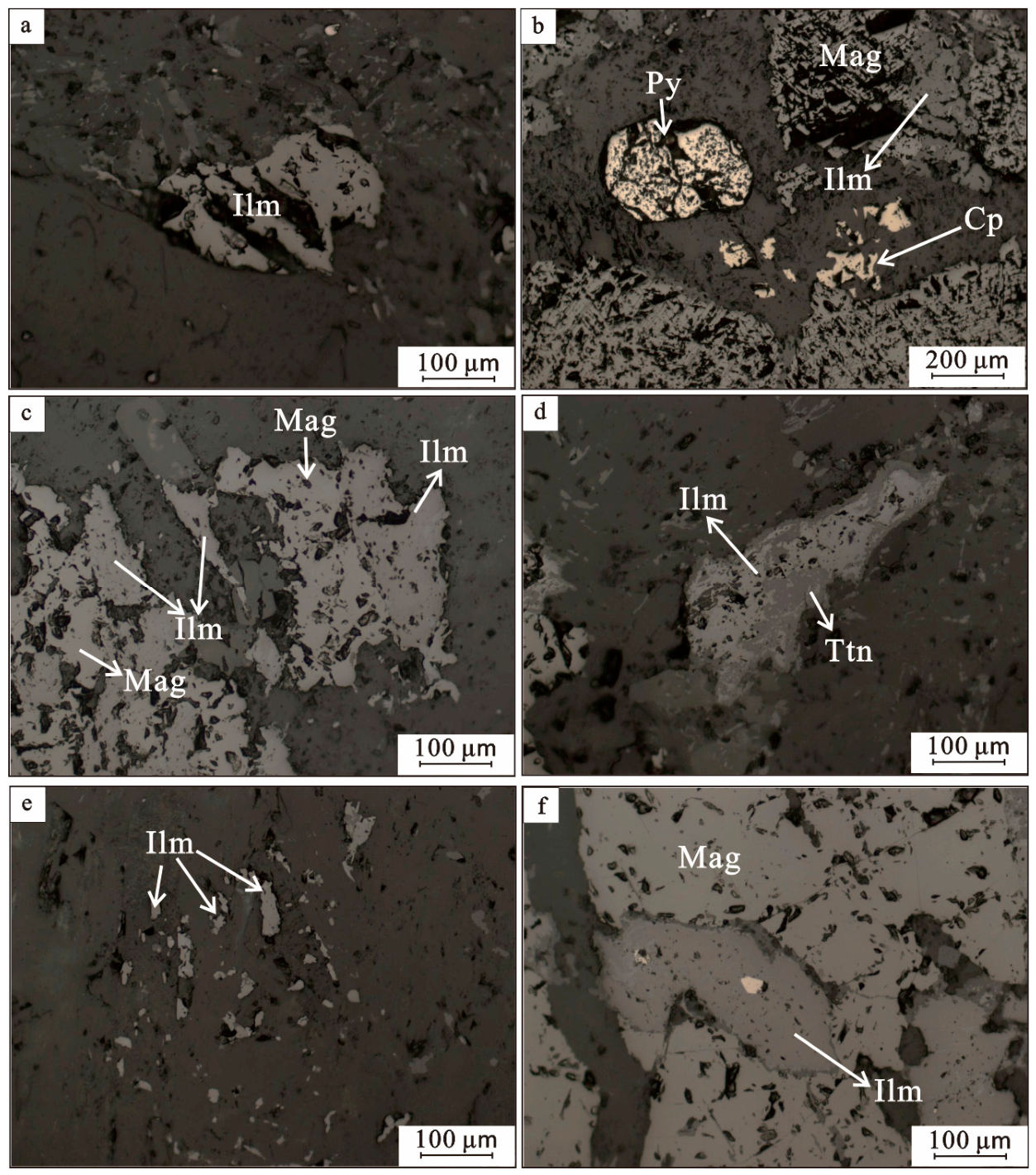
Ilmenite (Ilm) mostly exhibits unevenly sized subhedral to anhedral granular textures (Figure 3a,e), with minor lamellar textures. It is often distributed between magnetite grains or adjacent to magnetite (Figure 3c,f). Some ilmenite occurs as lamellar disseminations within magnetite. Margins of some ilmenite grains are replaced by titanite (Figure 3d). Occasionally, ilmenite is observed intergrown with pyrite and chalcopyrite within gangue minerals (Figure 3b).
Figure 3.
Dissemination characteristics of ilmenite (under reflected light microscopy). (a) Ilmenite exhibits unevenly sized subhedral to anhedral granular textures; (b) Ilmenite intergrown with pyrite and chalcopyrite within gangue minerals; (c) Ilmenite disseminations within magnetite; (d) Ilmenite grains are replaced by titanite; (e) Fine-grained ilmenite; (f) ilmenite disseminations within magnetite.
EPMA results (Table 9) show ilmenite contains Fe ranging from 35.459% to 38.346% and Ti from 28.082% to 29.998%, generally with minor Mn and Mg impurities. The chemical composition is relatively stable without obvious impurity excess.
Table 9.
EPMA results of ilmenite in the ore (wt.%).
3.5.3. Rutile
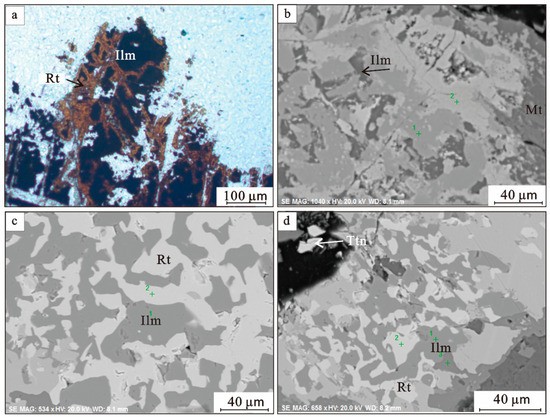
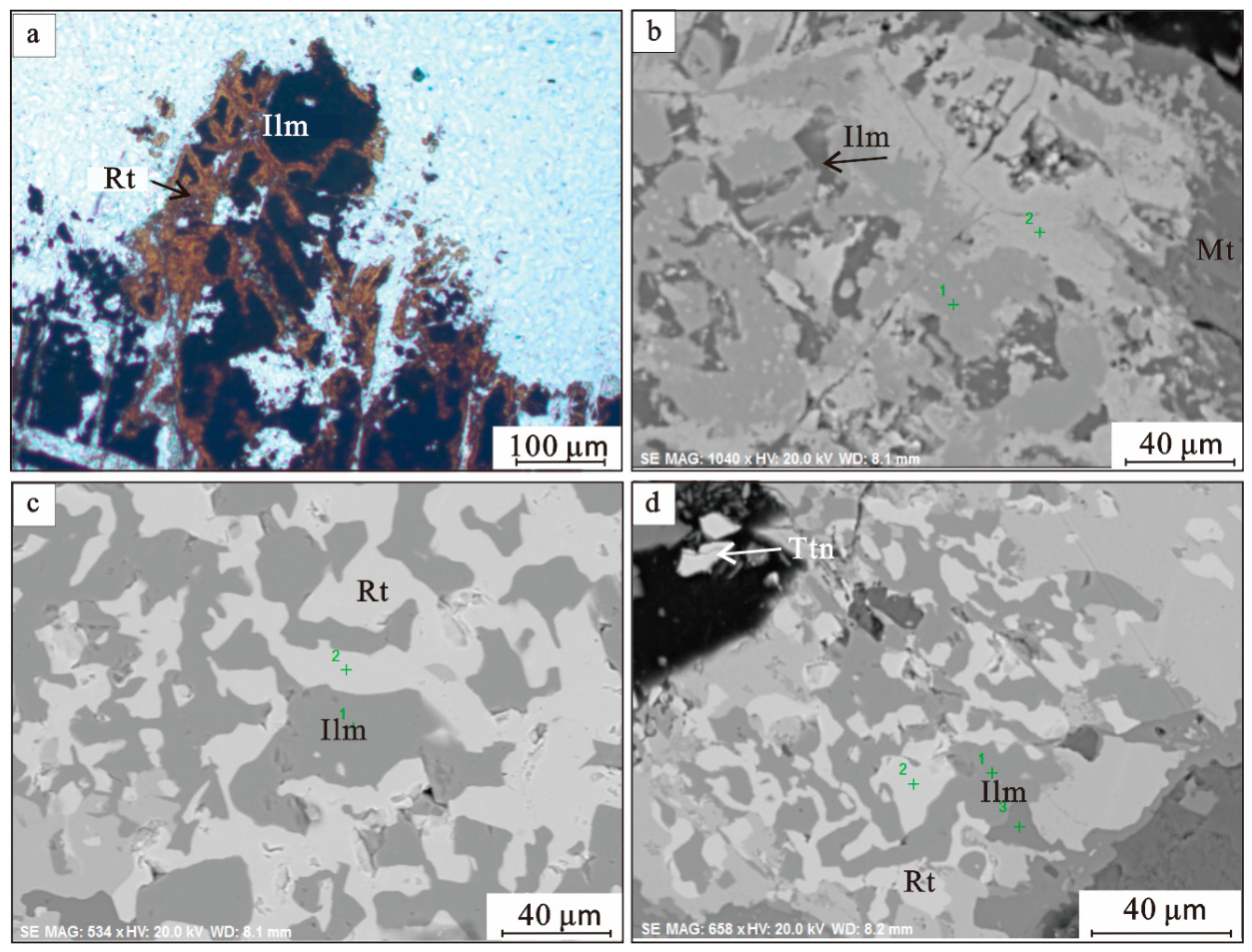
Rutile (Rt) exhibits the closest dissemination relationship with magnetite and ilmenite (Figure 4). It often occurs along margins and fractures of magnetite and ilmenite through replacement. Some rutile contains inclusions of very fine-grained magnetite and ilmenite. Some rutile is closely intergrown with titanite. Occasionally, rutile occurs as irregular granular disseminations within gangue minerals such as chlorite.
Figure 4.
Dissemination characteristics of rutile (under reflected light microscopy). (a) Rutile coexists with ilmenite; (b) Fine-grained ilmenite and magnetite are enclosed as inclusions within rutile; (c) Rutile intergrown with ilmenite; (d) Rutile intergrown with titanite.
3.5.4. Apatite
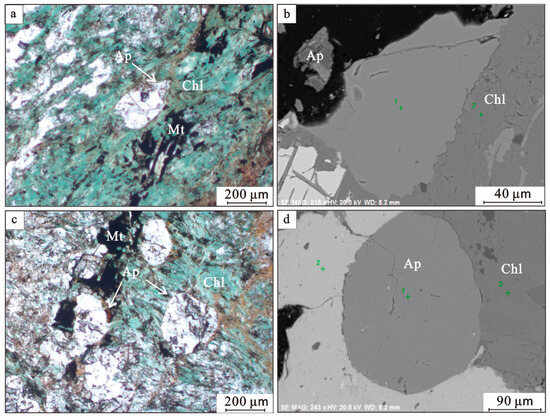
Apatite (Ap) mainly occurs as euhedral to subhedral granular disseminations within chlorite (Figure 5), followed by distribution between grains of gangue minerals including plagioclase, grossular, and common hornblende. Some apatite is adjacent to magnetite and ilmenite. Minor apatite is included within magnetite. No significant isomorphous substitutions with other minerals are observed.
Figure 5.
Dissemination characteristics of apatite (under reflected light microscopy). (a) Apatite occurs as euhedral granular crystals; (b) Apatite presents subhedral granular morphology; (c) Apatite is disseminated within chlorite; (d) Apatite occurs as euhedral granular crystals.
3.5.5. Pyrite
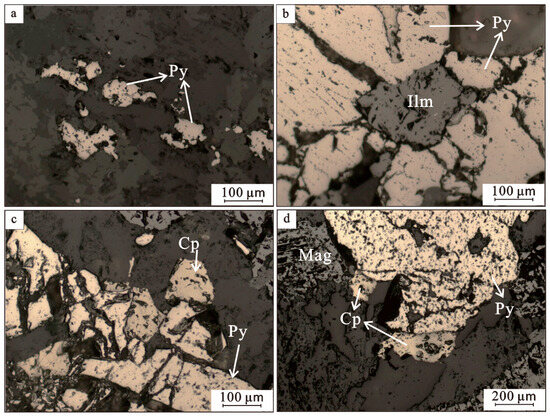
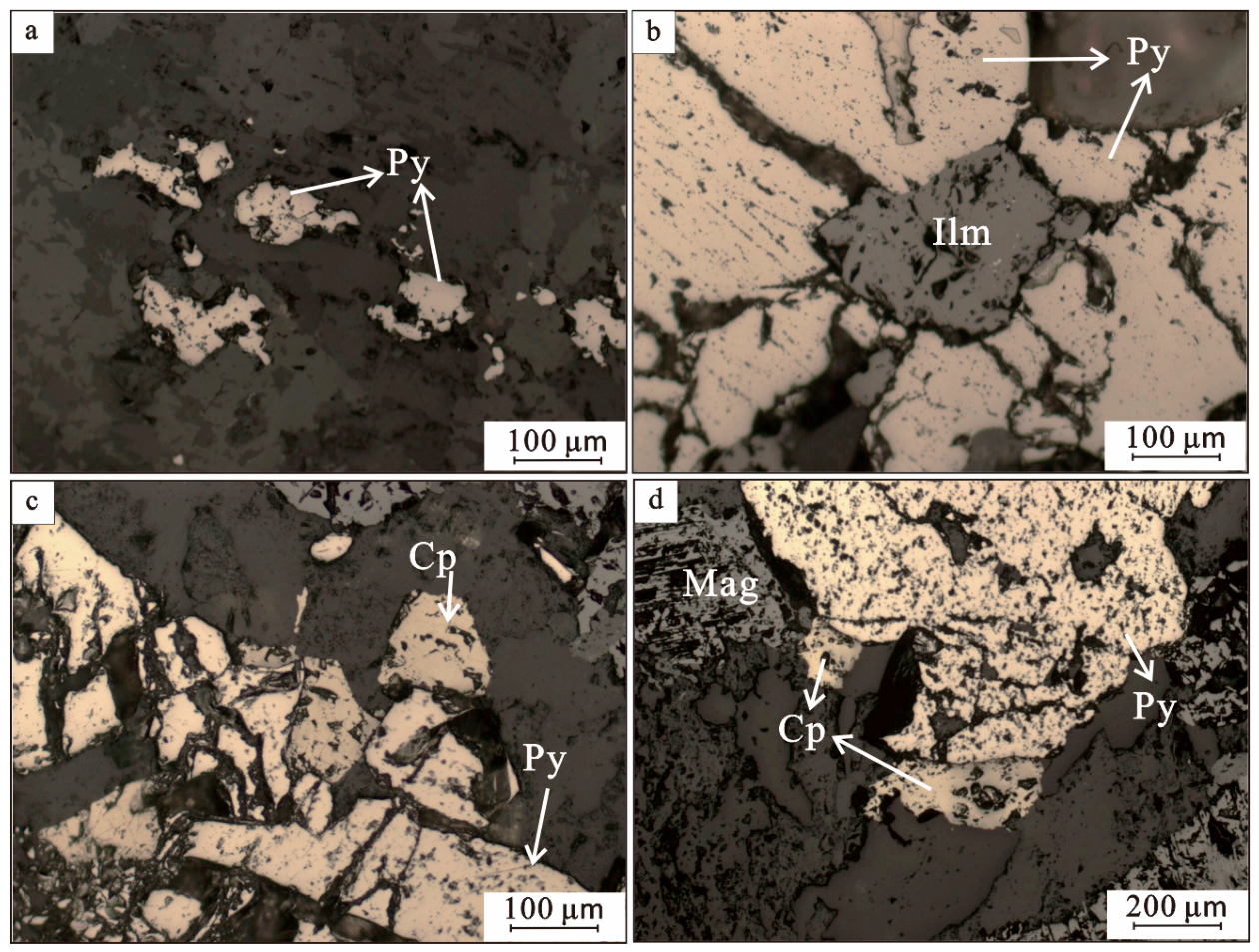
Pyrite (Py) mainly occurs as subhedral to anhedral granular disseminations within gangue minerals (Figure 6a,b). It is often adjacent to ilmenite. Some pyrite is adjacent to chalcopyrite or contains inclusions of fine-grained chalcopyrite (Figure 6c,d). Its dissemination relationship with magnetite is relatively weak.
Figure 6.
Dissemination characteristics of pyrite (under reflected light microscopy). (a) Pyrite occurs as subhedral to anhedral granular disseminations within gangue minerals; (b) Pyrite intergrown with ilmenite; (c) Pyrite intergrown with chalcopyrite; (d) Pyrite intergrown with magnetite.
EPMA results (Table 10) show pyrite has stable composition, with Fe ranging from 44.43% to 46.405% and S from 52.106% to 52.996%. Some pyrite contains minor impurity elements including Co, Ni, and Ca.
Table 10.
EPMA results of pyrite in the ore (wt.%).
3.6. Particle Size Distribution of Key Minerals
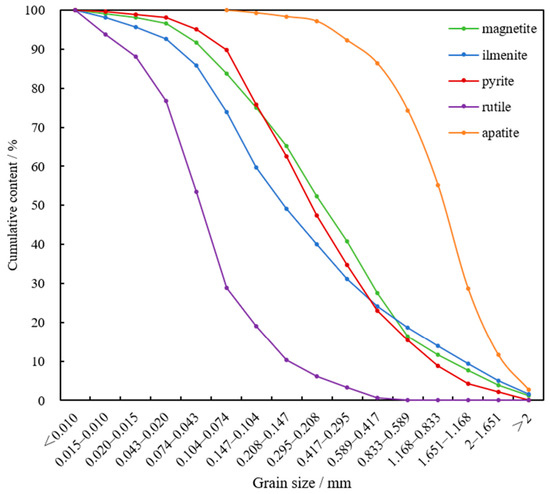
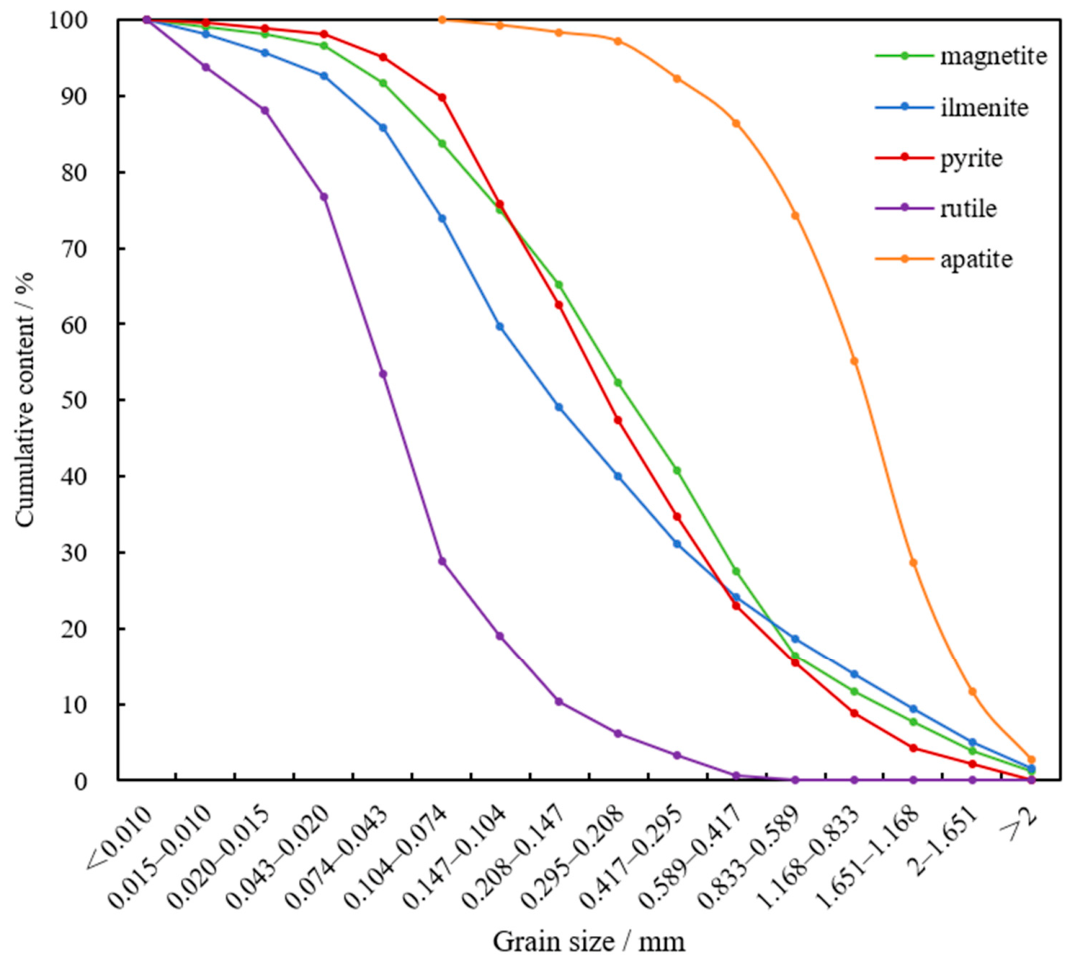
The liberation degrees of magnetite, ilmenite, pyrite, rutile, and apatite under different grinding fineness levels are presented in Table 11 and Figure 7. Particle size distribution of magnetite is heterogeneous, mainly concentrated in the 0.147–0.589 mm range. The distribution rate in the +0.074 mm fraction is 83.83%, while the −0.010 mm fraction accounts for only 0.93%. The overall relatively coarse particle size facilitates liberation through grinding. Ilmenite particle size is mainly concentrated in the 0.043–0.295 mm range. The distribution rate in the +0.074 mm fraction is 73.91%, and in the −0.010 mm fraction it is 1.81%. Particle size is slightly finer than magnetite but remains relatively coarse overall, suitable for liberation through grinding. Rutile is the main recoverable mineral with the finest particle size in the ore. Its dissemination particle size is mainly concentrated in the 0.02–0.104 mm range. The distribution rate in the +0.074 mm fraction is only 28.81%, while the −0.010 mm fraction accounts for 6.14%. The high proportion of fine particles and complex dissemination make rutile difficult to liberate adequately by grinding, thereby constituting the principal mineralogical challenge for titanium recovery. This characteristic is consistent with observations from other deposits where fine-grained rutile poses significant recovery challenges [31,32]. Apatite has a relatively coarse particle size, mainly concentrated in the 0.074–0.295 mm range. Distribution rate in the +0.074 mm fraction reaches 86.33%, and the −0.010 mm fraction accounts for only 0.69%. The relatively coarse particle-size distribution and comparatively simple dissemination of apatite are conducive to its liberation and subsequent flotation recovery [33]. Pyrite particle size is mainly concentrated in the 0.074–0.417 mm range. The distribution rate in the +0.074 mm fraction is 89.73%, and in the −0.010 mm fraction only 0.37%. Its relatively coarse grain size and favorable flotation behavior are conducive to desulfurization by flotation [34,35].
Table 11.
Grain size distribution of the key minerals in the ore.
Figure 7.
Grain size cumulative curve of the key minerals in the ore.
3.7. Liberation Characteristics of Key Minerals
The liberation degrees of magnetite, ilmenite, pyrite, rutile, and apatite under different grinding fineness levels are presented in Table 12, Table 13, Table 14, Table 15 and Table 16. To ensure the representativeness of test data, more than 3000 mineral particles were counted for each grinding fineness sample. Liberation increases systematically with increasing grinding fineness, but the response differs markedly among minerals and closely follows their grain-size characteristics.
Table 12.
Liberation characteristics of magnetite.
Table 13.
Liberation characteristics of ilmenite.
Table 14.
Liberation characteristics of pyrite.
Table 15.
Liberation characteristics of rutile.
Table 16.
Liberation characteristics of apatite.
At a grinding fineness of 60% passing −0.074 mm, the liberation degrees of magnetite, pyrite, and apatite are 73.74%, 79.31%, and 75.02%, respectively, and the combined proportion of liberated particles plus rich intergrowths (≥1/2) reaches 84.63%, 87.86%, and 83.90%. Ilmenite shows a liberation degree of 64.01%, but the combined proportion of liberated particles and rich intergrowths is still 83.34%. Rutile remains distinctly less liberated, with only 17.79% liberated particles and 52.29% liberated-plus-rich-intergrowth particles.
When fineness is increased to 80% passing −0.074 mm, liberation improves further for magnetite, ilmenite, pyrite, and apatite, but the incremental gain becomes smaller relative to the likely increase in fines generation and grinding cost. Accordingly, the choice of about 60% passing −0.074 mm is not presented here as an experimentally optimized operating condition, but as a mineralogically reasonable starting point for future beneficiation tests because it already provides comparatively good liberation for Fe-, P-, and coarse Ti-bearing minerals while avoiding unnecessarily fine grinding [36].
4. Discussion
Through systematic process mineralogy analysis, this study has clarified the occurrence states, dissemination characteristics, and liberation behaviors of Fe, Ti, and P in the Damiao titanomagnetite ore. On this basis, it is necessary to combine the mineralogical features with beneficiation practice, and to discuss the ore from the perspectives of deposit genesis, global comparison, key constraints, and technological responses, in order to identify the potential and bottlenecks for comprehensive utilization and to provide a theoretical foundation for process optimization.
4.1. Mineralogical Features and Comparison with Global Typical Deposits
The occurrence states of Fe, Ti, and P in this ore differ markedly. Iron mainly occurs as magnetite (59.53%) and silicate-bound iron (28.07%); titanium is predominantly hosted in ilmenite (48.90%) and rutile (33.89%); and phosphorus is almost entirely present as fluorapatite (98.95%). This mineral assemblage shares some commonalities with major titanomagnetite deposits worldwide, but also exhibits distinct differences.
Compared with the Panzhihua deposit in China [37], the Panzhihua ore typically has higher TiO2 grades (10–12%), with titanium mainly occurring as exsolution lamellae in titanomagnetite, rather than as discrete ilmenite and rutile grains as in this ore. From a beneficiation perspective, discrete Ti minerals are more amenable to physical separation via gravity, magnetic, and flotation methods; however, the extremely fine grain size and complex dissemination of rutile in this ore make titanium recovery particularly challenging [38].
Notably, the silicate-bound iron proportion in this ore reaches 28.07%, significantly higher than that in Panzhihua (10–15%) and some Brazilian ores (15–20%). This high value is closely related to the hydrothermal alteration history of the deposit—chloritization transformed a large portion of primary ferromagnesian minerals into iron-bearing silicates, causing irreversible iron loss and increasing slime interference in subsequent separation. Therefore, this ore can be classified as a complex, refractory type with “high silicate-bound iron, fine-grained rutile, and high Ca-bearing gangue,” making its comprehensive recovery more difficult than most industrially exploited deposits.
4.2. Key Mineralogical Constraints on Iron Recovery
The core constraint on iron recovery is that magnetite is not the sole iron carrier. Chemical phase analysis and mineral-based iron distribution both show that only 59.53% of total Fe is hosted in magnetite and can be effectively recovered by low-intensity magnetic separation, while 28.07% of Fe occurs as isomorphous substitutions or fine inclusions in silicate minerals such as chlorite, grossular, and common hornblende [39]. This silicate-bound fraction cannot be liberated at practical grinding finenesses and will report entirely to tailings during magnetic separation, constituting an unrecoverable metal loss.
Considering the grain-size distribution of magnetite (83.83% >0.074 mm) and its liberation degree (73.74% free grains at 60% passing −0.074 mm), magnetite itself exhibits good separability. However, owing to the high proportion of silicate-bound iron, the maximum theoretical iron recovery under current technology is limited to approximately 72% of total Fe. This upper bound should be treated as an important constraint in flowsheet design and economic evaluation. It is also noteworthy that magnetite particles occasionally contain fine inclusions of ilmenite and rutile; these Ti-bearing phases may report to the magnetic concentrate, lowering iron grade and causing cross-loss of titanium, which necessitates regrinding and re-separation.
4.3. Key Mineralogical Constraints and Differentiated Challenges for Titanium Recovery
Titanium recovery exhibits significant mineralogical asymmetry. On one hand, ilmenite and rutile together account for 82.79% of total Ti [40,41], indicating high theoretical recovery potential; on the other hand, the beneficiation behaviors of these two minerals are dramatically different, posing the greatest challenge for overall titanium recovery.
Ilmenite has a relatively coarse grain size (73.91% >0.074 mm) and good liberation (64.01% free grains and 83.34% free + rich intergrowths at 60% passing −0.074 mm), making it amenable to conventional magnetic separation and flotation. In contrast, rutile is extremely fine (only 28.81% >0.074 mm) and exhibits complex intergrowths and replacement relationships with magnetite and ilmenite. Even at a grinding fineness of 80% passing −0.074 mm, the proportion of free rutile grains is only 26.95%, far below the level required for effective flotation.
More critically, the intimate association of fine-particle rutile with magnetite causes rutile to report to the magnetic concentrate during iron separation, contaminating the iron product and causing titanium loss. Therefore, the poor liberation of rutile and its mis-distribution in magnetic separation are the key bottlenecks limiting titanium recovery. Emerging fine-particle flotation technologies, such as nanobubble flotation, carrier flotation, and shear flocculation, offer potential pathways for improving ultrafine rutile recovery, but their adaptability and economic feasibility for this ore require further investigation.
4.4. Mineralogical Constraints on Phosphorus Recovery and Flotation Selectivity Contradiction
Phosphorus is present as discrete fluorapatite with relatively coarse grain size (86.33% >0.074 mm) and excellent liberation (75.02% free grains at 60% passing −0.074 mm), all of which are favorable for flotation recovery. However, the primary challenge in phosphorus beneficiation does not lie in the phosphorus occurrence, but rather in the competitive flotation of Ca-bearing gangue minerals [38].
The ore contains substantial Ca-bearing gangue minerals, including grossular (12.29%), common hornblende (7.98%), calcite (1.98%), and actinolite (0.68%), totaling more than 20%. These minerals exhibit surface chemical properties similar to fluorapatite and respond to fatty-acid collectors, thereby readily reporting to the concentrate and significantly lowering the apatite grade. Thus, the success of phosphorus upgrading depends largely on the development and application of efficient selective depressants (e.g., modified starches, sodium silicate, and combined inorganic depressants) to suppress Ca-bearing silicates and carbonates while maintaining apatite floatability.
4.5. Integrated Effects of Secondary Factors and Beneficiation Process Responses
In addition to the direct constraints of the major elements Fe, Ti, and P, other mineralogical secondary factors also significantly influence separation performance.
Pyrite (1.64%) has excellent floatability and readily reports to rutile and apatite flotation concentrates, contaminating the final products. Therefore, pre-desulfurization flotation is essential before titanium and phosphorus flotation. Chlorite is abundant (26.48%); it not only hosts a large portion of unrecoverable iron but also tends to generate slimes during grinding. These slimes deteriorate flotation performance by coating valuable mineral surfaces, increasing reagent consumption, and raising pulp viscosity [42,43]. Practical measures such as desliming, selective flocculation, and clay-tolerant reagents should be considered to mitigate these adverse effects.
Based on the above mineralogical constraints, the proposed staged grinding-staged magnetic separation–desulfurization–flotation flowsheet demonstrates good mineralogical adaptability: primary grinding to 60% passing −0.074 mm provides adequate liberation for magnetite, ilmenite, pyrite, and apatite while limiting excessive slime generation; regrinding and re-separation of the rough magnetic concentrate dissociate fine Fe-Ti intergrowths; and desulfurization prior to subsequent flotation for apatite and fine rutile, combined with selective depressants, addresses the Ca-gangue and clay challenges. This scheme balances liberation efficiency and slime control, and is a reasonable process architecture aligned with the ore’s mineralogical characteristics.
4.6. Future Research Directions
To improve the comprehensive utilization level of this ore, future research should focus on the following three areas:
- (1)
- Efficient recovery of fine-particle rutile: Systematically evaluate the applicability and economic feasibility of emerging technologies (e.g., nanobubble flotation, carrier flotation, shear flocculation) for recovering ultrafine rutile (with >23% in the −0.020 mm fraction), and explore surface modification methods such as pre-oxidation to enhance rutile floatability.
- (2)
- Development of selective depressants for Ca-bearing gangue: Targeting the flotation separation difficulty between Ca-silicates (grossular, hornblende) and apatite, develop highly efficient, low-cost, and environmentally friendly combined depressant systems to improve phosphorus concentrate grade.
- (3)
- Techno-economic modeling of integrated recovery: Based on mineralogical parameters, establish a cost–benefit prediction model that considers market prices of Fe, Ti, and P products, grinding energy, reagent costs, and tailings disposal, to support industrial scale-up and process optimization.
The mineralogical knowledge established in this work provides a reliable basis for efficient utilization of resources in the Damiao area, and also serves as a valuable reference for process mineralogy studies and flowsheet design of similar complex deposits on the northern margin of the North China Craton and elsewhere.
5. Conclusions
The systematic process mineralogy study of the Damiao titanomagnetite ore reveals the fundamental mechanisms governing Fe, Ti, and P recovery and provides actionable guidance for beneficiation.
- (1)
- Iron recovery is intrinsically capped by silicate-bound iron formed during hydrothermal alteration. Approximately one-quarter of the total Fe is atomically incorporated into chlorite, grossular, and hornblende, rendering it irrecoverable by physical separation. This sets a firm upper recovery ceiling regardless of grinding fineness. The practical implication is that beneficiation should prioritize magnetic separation efficiency for magnetite while accepting an unavoidable iron loss to tailings.
- (2)
- Titanium recovery is constrained by the extreme fine grain size and complex interlocking of rutile, not by bulk TiO2 grade. Rutile is the finest and most poorly liberated valuable phase; incremental grinding yields only marginal liberation gains but generates excessive slimes and energy costs. A pragmatic approach is to recover coarse ilmenite and magnetite first, then treat rutile-bearing fractions separately with advanced fine-particle flotation, accepting a moderate rutile loss to avoid over-grinding the whole ore.
- (3)
- Apatite flotation is limited by the competitive floatability of Ca-bearing gangue minerals (grossular, hornblende, calcite, actinolite), which exceed 20% of the ore and respond similarly to fatty-acid collectors. The key to phosphorus upgrading is therefore selective depression of these Ca-silicates rather than further apatite liberation.
- (4)
- Pyrite and chlorite impose secondary but critical operational challenges. Pyrite must be pre-desulfurized to prevent contamination of subsequent concentrates. Chlorite generates abundant slimes that coat particles and increase pulp viscosity; desliming, selective flocculation, or clay-tolerant reagents are recommended.
- (5)
- A staged flowsheet—primary grinding to moderate fineness, magnetic separation, regrinding of the rough concentrate, pre-desulfurization, and sequential flotation for apatite and fine rutile—is mineralogically justified. This scheme respects the differential liberation behavior of minerals, applying extra energy only to intergrown fractions, thus balancing recovery, grade, and energy consumption.
- (6)
- The mineralogical criteria established here—the silicate iron ceiling, the rutile liberation threshold, and the Ca-gangue interference—provide a quantitative framework for flowsheet design and economic assessment. These findings are transferable to similar deposits, enabling mineralogy-based decisions on grinding fineness, circuit layout, and reagent regimes, ultimately improving the technical and economic viability of comprehensive resource utilization.
Author Contributions
Conceptualization, M.F.; Data curation, M.F. and M.W.; investigation, Q.D.; writing—original draft, M.F.; writing—review and editing, M.F. and Q.D. All authors have read and agreed to the published version of the manuscript.
Funding
This research received no external funding.
Data Availability Statement
Data are contained within the article.
Conflicts of Interest
Mingshan Fang, Qinwang Dang and Minyan Wang are employees of BGRIMM Technology Group. The paper reflects the views of the scientists and not the company. All authors declare no conflicts of interest.
References
- Gulley, A.L.; Nassar, N.T.; Xun, S. China, the United States, and Competition for Resources That Enable Emerging Technologies. Proc. Natl. Acad. Sci. USA 2018, 115, 4111–4115. [Google Scholar] [CrossRef] [Scilit]
- Zhou, L.G. Process Mineralogy, 3rd ed.; Metallurgical Industry Press: Beijing, China, 2014; pp. 230–235. [Google Scholar]
- Xiao, Y.W.; Fang, M.S.; Fu, Q. New Techniques and Concepts in Process Mineralogy. Conserv. Util. Miner. Resour. 2018, 3, 49–54. [Google Scholar]
- Fang, M.S.; Wang, L.; Xiao, Y.W. Research on Mineralogical Factors Influencing Copper Flotation Indexes of a Copper Ore in Anhui. Nonferrous Met. Miner. Process Sect. 2014, 2, 1–4, 8. [Google Scholar]
- Ye, X.L.; Xiao, Y.W. Application of Process Mineralogy for Process Optimization in Concentrator Plant. Nonferrous Met. Miner. Process Sect. 2020, 4, 13–16, 33. [Google Scholar]
- Yuan, J.Q.; Ding, Z.; Li, J.; Bi, Y.; Wen, S.; Bai, S. Research on the Process Mineralogy of a Sandstone Type Copper Sulfur Ore in Yunnan. Min. Met. 2023, 32, 137–142. [Google Scholar]
- Zhou, M.F.; Pichavant, M. Geochemistry, Petrogenesis and Metallogenesis of the Panzhihua Gabbroic Layered Intrusion and Associated Fe–Ti–V Oxide Deposits, Sichuan Province, SW China. J. Petrol. 2005, 46, 2253–2280. [Google Scholar] [CrossRef] [Scilit]
- Zhai, M.; Bian, A.; Zhao, T. The Amalgamation of the Supercontinent of North China Craton at the End of Neo-Archaean and Its Breakup during Late Palaeoproterozoic and Meso-Proterozoic. Sci. China Ser. D Earth Sci. 2000, 43, 219–232. [Google Scholar] [CrossRef] [Scilit]
- Ouyang, D.; Jiao, S.; Collins, W.J.; Qi, Y.; Liu, H.; Guo, J. Evolution of A-type Granites during the Late Paleoproterozoic Orogenic Cycle of North China Craton: Implications for Post-Collisional Magmatism. Lithos 2024, 474–475, 107584. [Google Scholar] [CrossRef] [Scilit]
- Charlier, B.; Namur, O.; Bolle, O.; Latypov, R.; Duchesne, J.-C. Fe–Ti–V–P ore deposits associated with Proterozoic massif-type anorthosites and related rocks. Earth-Sci. Rev. 2015, 141, 56–81. [Google Scholar] [CrossRef] [Scilit]
- Cheng, Z.; Du, W.; Chen, B.; Han, F.; Wang, Y.; Sun, Y.; Wu, Y. Ore-Controlling Structures of the Heishan Iron Deposit, Damiao Anorthosite Complex in North China Craton and Ore-Prospecting. Acta Geol. Sin. (Engl. Ed.) 2014, 88, 1595–1596. [Google Scholar] [CrossRef] [Scilit]
- Zhao, T.; Chen, W.; Zhou, M. Geochemical and Nd–Hf Isotopic Constraints on the Origin of the ~1.74-Ga Damiao Anorthosite Complex, North China Craton. Lithos 2009, 113, 673–690. [Google Scholar] [CrossRef] [Scilit]
- Li, L.; Li, H.; Zi, J.; Rasmussen, B.; Sheppard, S.; Ma, Y.; Meng, J.; Song, Z. The Link between an Anorthosite Complex and Underlying Olivine–Ti-Magnetite-Rich Layered Intrusion in Damiao, China: Insights into Magma Chamber Processes in the Formation of Proterozoic Massif-Type Anorthosites. Contrib. Mineral. Petrol. 2019, 174, 68. [Google Scholar] [CrossRef] [Scilit]
- He, H.; Yu, S.; Song, X.; Du, Z.S.; Dai, Z.H.; Zhou, T.; Xie, W. Origin of Nelsonite and Fe-Ti Oxides Ore of the Damiao Anorthosite Complex, NE China: Evidence from Trace Element Geochemistry of Apatite, Plagioclase, Magnetite and Ilmenite. Ore Geol. Rev. 2016, 79, 367–381. [Google Scholar] [CrossRef] [Scilit]
- Chen, W.; Zhou, M.; Zhao, T. Differentiation of Nelsonitic Magmas in the Formation of the ~1.74 Ga Damiao Fe–Ti–P Ore Deposit, North China. Contrib. Miner. Petrol. 2013, 165, 1341–1362. [Google Scholar] [CrossRef] [Scilit]
- Li, L.; Li, H.; Li, Y.; Yao, T.; Yang, X.-Q.; Chen, J. Origin of Rhythmic Anorthositic-Pyroxenitic Layering in the Damiao Anorthosite Complex, China: Implications for Late-Stage Fractional Crystallization and Genesis of Fe-Ti Oxide Ores. J. Asian Earth Sci. 2015, 113, 1035–1055. [Google Scholar] [CrossRef] [Scilit]
- Li, H.; Li, L.; Zhang, Z.; Santosh, M.; Liu, M.; Cui, Y.; Yang, X.; Chen, J.; Yao, T. Alteration of the Damiao Anorthosite Complex in the Northern North China Craton: Implications for High-Grade Iron Mineralization. Ore Geol. Rev. 2014, 57, 574–588. [Google Scholar] [CrossRef] [Scilit]
- Yakymchuk, C.; Szilas, K. Corundum Formation by Metasomatic Reactions in Archean Metapelite, SW Greenland: Exploration Vectors for Ruby Deposits within High-Grade Greenstone Belts. Geosci. Front. 2018, 9, 727–749. [Google Scholar] [CrossRef] [Scilit]
- Liu, B.B.; Chu, Q.Q.; Huang, Y.F.; Han, G.H.; Sun, H.; Zhang, L. Preparation and characterization of electromagnetic wave absorbing material from polymetallic vanadium titano-magnetite (VTM): Oriented phase transformation underlying formation mechanism. Ceram. Int. 2023, 49, 10914–10927. [Google Scholar] [CrossRef] [Scilit]
- Nevondo, M.; Koech, L.; Ola-Omole, O.; Ramakokovhu, M.; Teffo, M.; Sadiku, R. Phase transformation sequence of pre-oxidized roast-leach ferrovanadium residues. Heliyon 2024, 10, e27893. [Google Scholar] [CrossRef] [Scilit] [PubMed]
- Pradhan, I.; Rath, S.S.; Senapati, S.; Angadi, S. A comprehensive review of beneficiation strategies for beach sand minerals. Miner. Eng. 2026, 175, 107287. [Google Scholar]
- Wang, H.; Zhang, X.; Qu, R.; Zhang, L.; Li, W. Recent technology developments in beneficiation and enrichment of ilmenite: A review. Miner. Eng. 2024, 219, 109084. [Google Scholar] [CrossRef] [Scilit]
- Bulatovic, S. Process development for treatment of complex perovskite, ilmenite and rutile ores. Miner. Eng. 1999, 12, 1407–1417. [Google Scholar] [CrossRef] [Scilit]
- Yan, H.; Hu, M.L.; Dai, Z.D.; Deng, Q.Y.; Chen, B.X. Effects of TiO2, binary basicity and MgO content on the liquidus temperatures of TiO2–CaO–SiO2–MgO–Al2O3 slags. Iron Steel Vanadium Titan. 2022, 43, 118–124. [Google Scholar]
- El Khalloufi, M.; Drevelle, O.; Soucy, G. Titanium: An overview of resources and production methods. Minerals 2021, 11, 1425. [Google Scholar] [CrossRef] [Scilit]
- Du, Y.; Chen, M.; Yuan, Z.; Klein, B.; Li, L.; Lu, J. Effect of acid surface pretreatment on the floatability difference between ilmenite and titanaugite pre-absorbed by flotation reagents. Appl. Surf. Sci. 2023, 613, 156121. [Google Scholar] [CrossRef] [Scilit]
- Fan, G.; Wang, M.; Dang, J.; Zhang, R.; Lv, Z.; He, W.; Lv, X. A novel recycling approach for efficient extraction of titanium from high-titanium-bearing blast furnace slags. Waste Manag. 2021, 128, 626–634. [Google Scholar] [CrossRef] [Scilit] [PubMed]
- Chen, F.; Lv, W.; Zhou, G.; Liu, Z.; Chu, M.; Lv, X. Effect of pre-oxidation on the hydrogen-rich reduction of Panzhihua ilmenite concentrate powder: Reduction kinetics and mechanisms. Int. J. Hydrogen Energy 2023, 48, 13415–13429. [Google Scholar] [CrossRef] [Scilit]
- Deng, L.; Zhu, L.; Fei, L.; Ma, X.; Deng, F.; Zuo, R.; Huang, Z.; Li, L.; Xie, Y.; Xiao, Z.; et al. Froth flotation of ilmenite by using the dendritic surfactant 2-decanoylamino-pentanedioic acid. Miner. Eng. 2021, 165, 106861. [Google Scholar] [CrossRef] [Scilit]
- Aldrich, C.; Feng, D. Effect of ultrasonic preconditioning of pulp on the flotation of sulphide ores. Miner. Eng. 1999, 12, 701–707. [Google Scholar] [CrossRef] [Scilit]
- Cilek, E.C.; Ozgen, S. Effect of ultrasound on separation selectivity and efficiency of flotation. Miner. Eng. 2009, 22, 1209–1217. [Google Scholar] [CrossRef] [Scilit]
- Yi, L.; Zhang, H.; Miao, Q.; Liu, J.; Chen, M.; Shu, Y.; Li, G.; Jiang, T. Direct reduction-magnetic separation of VTM using biomass: Evolution and separation characteristics of iron/vanadium/titanium bearing components. Sep. Purif. Technol. 2025, 376, 134011. [Google Scholar]
- Gonzalez, J.A.; Forssberg, E. Beneficiation of vanadium and titanium oxides from a vanadium titanomagnetite ore by dry magnetic separation. Miner. Process Extr. Met. Rev. 2001, 22, 487–506. [Google Scholar]
- Silva, A.M.; Souza, R.F.; Aguilera, L.S.; de Campos, J.B.; Brocchi, E.A. Upgrade of titanium content in a vanadiferous titanomagnetite waste: Design of a roast-leach route based on thermodynamics simulations. Miner. Eng. 2022, 179, 107460. [Google Scholar] [CrossRef] [Scilit]
- Bai, S.; Yu, P.; Ding, Z.; Bi, Y.; Li, C.; Wu, D.; Wen, S. New insights into lead ions activation for microfine particle ilmenite flotation in sulfuric acid system: Visual MINTEQ models, XPS, and ToF–SIMS studies. Miner. Eng. 2020, 155, 106473. [Google Scholar] [CrossRef] [Scilit]
- Chen, B.; Chen, M.; Zhang, K.; Bai, C.; Yu, W.; Hu, M. Metallurgical properties of vanadium titanomagnetite sinter in the cohesive zone of H2-rich oxygen blast furnaces. Met. Mater. Trans. B 2025, 56, 6310–6321. [Google Scholar] [CrossRef] [Scilit]
- Chen, P.; Chen, Y.; Liu, H.; Li, H.; Chai, X.; Lu, X.; Sun, W.; Wang, H.; Luo, Y.; Wang, X. Novel approach for fine ilmenite flotation using hydrophobized glass bubbles as the buoyant carriers. Minerals 2021, 11, 231. [Google Scholar] [CrossRef] [Scilit]
- Zhu, F.; Ma, Z.; Gao, G.; Qiu, K.; Peng, W. Process mineralogy of vanadium titanomagnetite ore in Panzhihua, China. Minerals 2023, 10, 147. [Google Scholar] [CrossRef] [Scilit]
- Xin, R.; Zhao, J.; Gao, X.; You, Z.; Yu, W.; Zhang, S.; Dang, J.; Bai, C. Softening–melting properties and slag evolution of vanadium titano-magnetite sinter in hydrogen-rich gases. Crystals 2023, 13, 210. [Google Scholar] [CrossRef] [Scilit]
- Sun, J.; Du, W.H.; Wang, D.Z.; Li, J.; Xu, G.X.; Han, Y.C. Geological characteristics and genesis of Damiao-Heishan vanadium-titanium magnetite deposit in Chengde, Hebei Province. Acta Geol. Sin. 2009, 83, 1344–1363. [Google Scholar]
- Cai, X.Y.; Chen, F.L.; Li, S.; Wang, Z.; Huang, Y.; Zhong, X.; Wu, N. Experimental study on iron separation of a high-chromium vanadium-titanium magnetite ore in Panxi area. Iron Steel Vanadium Titan. 2025, 46, 90–96. [Google Scholar]
- Hong, Q.Y.; Li, M.R.; Li, B.; Liang, D.Y.; Liu, C.; Zhang, H.L. Process mineralogical characteristics of a refractory vanadium-titanium iron ore abroad. Conserv. Util. Miner. Resour. 2020, 3, 48–53. [Google Scholar]
- Zhang, L.; Wang, C.F. Research progress on mineral processing technology and comprehensive utilization of vanadium-titanium magnetite resources. Conserv. Util. Miner. Resour. 2023, 43, 127–137. [Google Scholar]

Disclaimer/Publisher’s Note: The statements, opinions and data contained in all publications are solely those of the individual author(s) and contributor(s) and not of MDPI and/or the editor(s). MDPI and/or the editor(s) disclaim responsibility for any injury to people or property resulting from any ideas, methods, instructions or products referred to in the content. |
© 2026 by the authors. Licensee MDPI, Basel, Switzerland. This article is an open access article distributed under the terms and conditions of the Creative Commons Attribution (CC BY) license.