


Abstract
This study investigates the effect of uranium in situ leaching using solutions containing an antiscaling inhibitor on the productivity and workover interval of technological wells. For the first time, the relationship between calcium ion (Ca2+) dissolution and inhibitor concentration has been established, as well as its impact on redox potential and uranium concentration dynamics during the leaching process. Laboratory and pilot-scale field studies demonstrated that the application of the antiscaling reagent significantly enhances calcium dissolution, preventing the formation of colmatation deposits in the near-wellbore zone. The maximum Ca2+ dissolution was achieved at an optimal inhibitor concentration of 2%, reaching up to 760 mg/dm3. The implementation of the inhibitor in industrial conditions resulted in improved well productivity and an increase in the workover interval by up to 28% compared to the baseline technology. The obtained results confirm the effectiveness of inhibitor application for improving the operational performance of wells in uranium in situ leaching.
1. Introduction
Uranium extraction at the deposits is carried out using the in situ leaching (ISL) technology. In addition, global practice employs other uranium mining methods, including open-pit and underground mining, the selection of which depends on the deposit type, depth of ore occurrence, and mining and geological conditions [1,2]. The ISL method is based on the selective transfer of the target component (uranium) into the liquid phase, achieved through the controlled movement of a leaching solution (sulfuric acid) through the ore-bearing horizon. As a result, the uranium-enriched pregnant leach solution is brought to the surface and delivered to the processing plant for further treatment [3].
The deposit belongs to the Khorasan ore field of the Karamurun uranium district within the Syrdarya uranium province. It is located on the left bank of the Syrdarya River in the Kyzylorda Region of the Republic of Kazakhstan.
According to mineralogical data, the ores of the deposit are predominantly silicate in composition, with the total content of clastic material ranging from 70% to 90%, and minor amounts of iron disulfides, carbonates, phosphorites, and other minerals [4]. In the sands of the ore-hosting formations, the average quartz content ranges from 53.09% to 74.54%, feldspars from 5.45% to 13.47%, and clay minerals from 5.12% to 17.44%. Among other authigenic minerals, calcite (dominant) and dolomite are widely distributed in the host rocks, occurring unevenly within the ore-bearing strata at contents of up to 3.26% [5].
The productive horizons are represented by tabular bodies in cross-section, with thicknesses ranging from 20 to 30 m, and by sinuous, ribbon-like bodies in plan view, with lengths from 1 to 10 km and widths from 50 to 600 m. These bodies exhibit a relatively simple morphology compared to their constituent elements, which include ore bodies and barren intervals.
For deposit development, predominantly hexagonal and line-drive well patterns are employed. The spacing between production and injection wells ranges from 50 to 100 m, while the distance between injection wells varies from 15 to 50 m. The average well depth is 680–700 m. The productivity of production wells is 4.5–5.0 m3/h, whereas the injection wells operate at 2.2–2.5 m3/h. The sulfuric acid concentration in the leaching solution is maintained at 7–10 g/L; at the same time, the pH of the pregnant leach solutions is kept within 1.8–2.0, and the oxidation–reduction potential (ORP) within 250–450 mV.
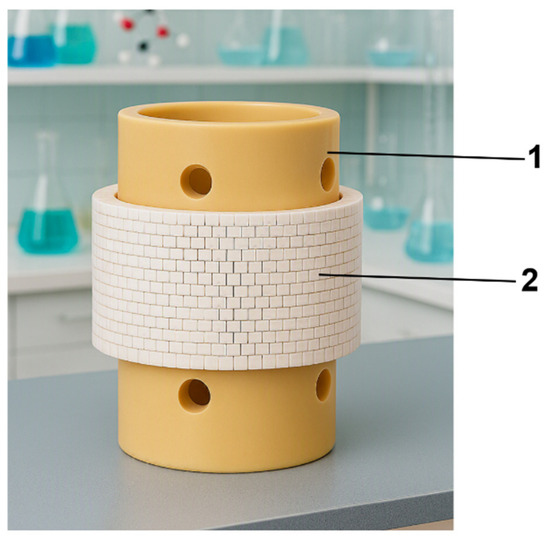
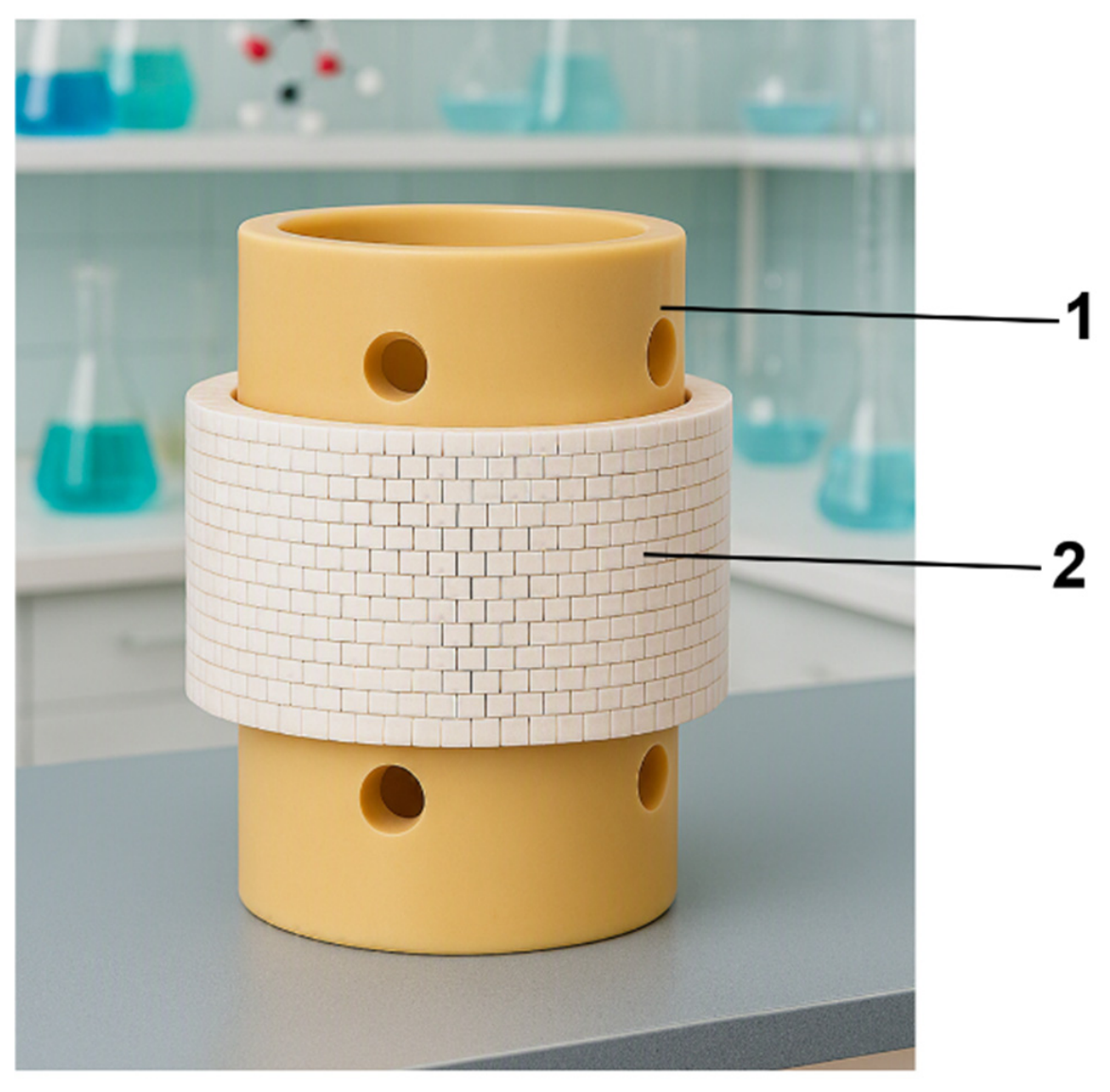
Frame-disc well screens of the KDF-118/90 mm type are installed within the thickness of the aquifer hosting the uranium-bearing horizon (Figure 1). Frame-disc filters (type KDF-118/90 mm) with a slot opening of 0.70 mm are installed across the thickness of the aquifer containing the uranium-bearing horizon.
Figure 1.
Structure of the frame-disc filter (1—inner perforated pipe; 2—filter discs).
The lower part of the well is cased with polyvinyl chloride (PVC) pipes of 90/8 mm diameter, with a length of 10–11 m, and is sealed with a bottom plug. After drilling, technological wells undergo cleaning operations aimed at removing clay, fine sand, and drilling cuttings from the screen and near-wellbore zone along the entire length of the screened interval [6].
During operation, a decrease in the performance of both production and injection wells is observed in the vast majority of cases, leading to instability in well operation and a reduction in the workover interval (Stable well operation period between declogging events).
This decline is caused by several factors: the deposition of chemically induced clogging compounds on the well screen and in the near-wellbore zone; the presence of clay particles remaining due to incomplete removal of drilling mud during well development; the formation of sand plugs within the screen as a result of sand suffusion from the productive horizon; and mechanical clogging of injection wells due to suspended solids present in the leaching solutions [7].
A colmatant refers to substances or particulate matter that obstruct the pore space of the productive formation and well screens during uranium in situ leaching (ISL), resulting in reduced formation permeability and well productivity.
In this regard, there arises a need to implement various measures aimed at restoring well productivity, including well rehabilitation and stimulation operations focused on removing sand plugs and clogging deposits from the well screen surface and the near-wellbore zone [8].
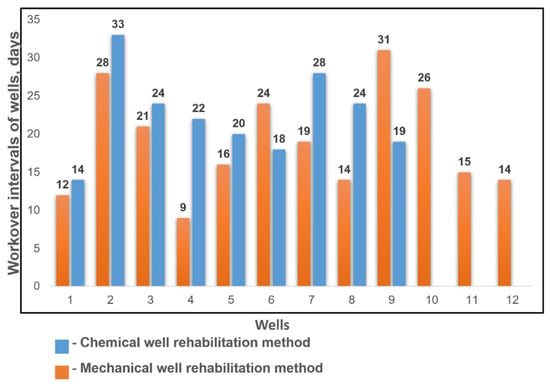
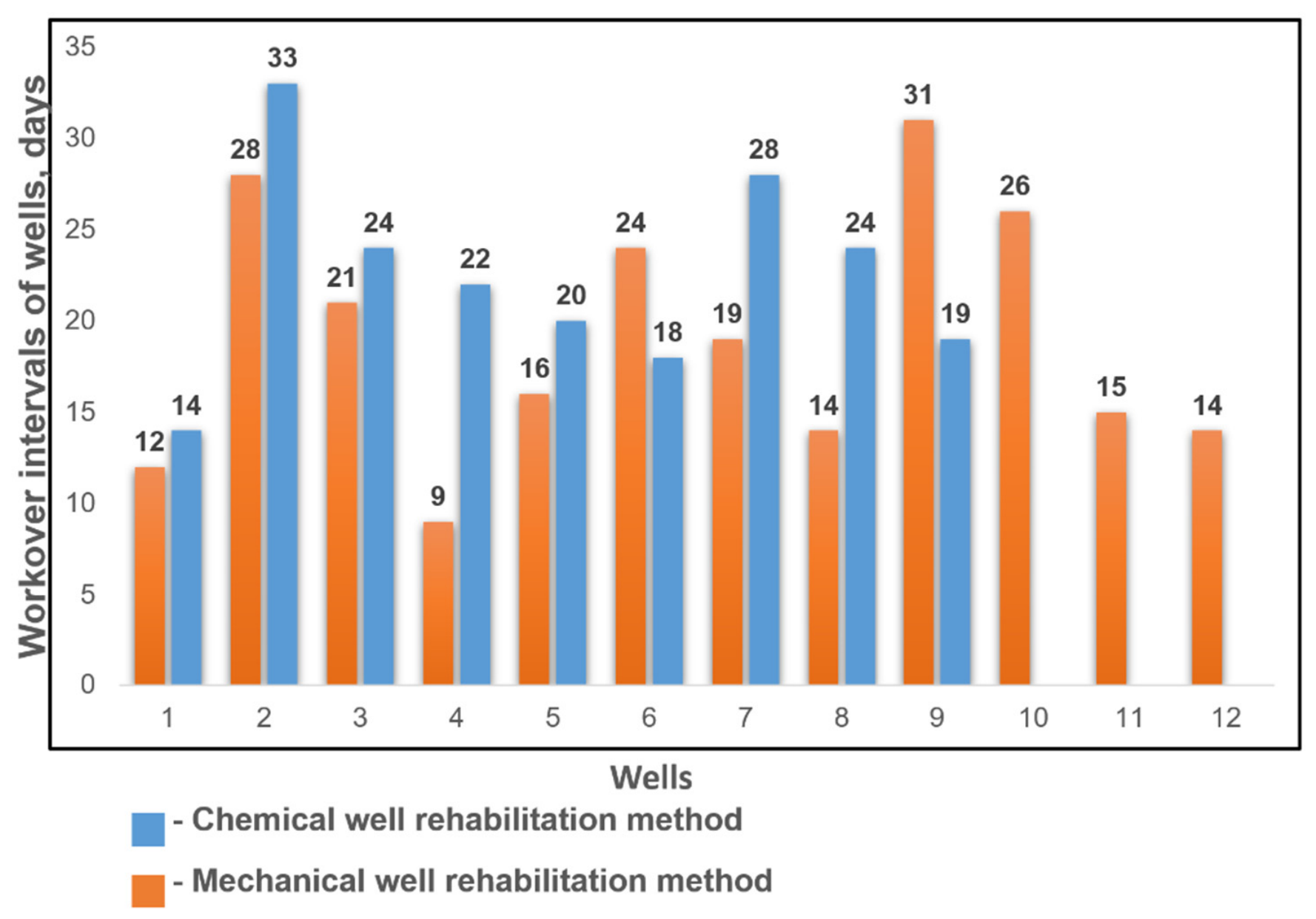
At uranium mining operations, mechanical and chemical well rehabilitation methods are predominantly applied [9,10]. Figure 2 presents the workover intervals of 12 wells after mechanical rehabilitation and 9 wells after chemical rehabilitation operations.
Figure 2.
Workover intervals of 12 wells after mechanical and chemical well rehabilitation methods.
As can be seen from Figure 2, when mechanical well rehabilitation methods are applied, the workover interval of wells ranges from 9 to 31 days, with an average value of 19 days. In the case of chemical rehabilitation, the workover interval varies from 14 to 33 days, averaging 22.5 days. The higher effectiveness of the chemical method at this site is explained by the fact that the colmatant represents a complex assemblage of salts, metal hydroxides, and other solid particles. Its main components include calcium carbonate (CaCO3) in the form of aragonite and calcite; calcium sulfate (CaSO4·2H2O) in the form of gypsum; as well as microbiological or mechanically dispersed particles [11,12]. The colmatant formed as a result of the interaction of these components is solid, exhibits high adhesive properties, and cannot be destroyed by standard water pressure or injected leaching solutions.
In such cases, various well treatment methods are applied at uranium mining operations. Acid treatments significantly enhance the permeability of the ore-bearing formation and improve well productivity, as colmatating compounds such as alunite (Al2(SO4)(OH)7·7H2O) are readily soluble in acidic solutions. For example, a solution with an acid concentration of 100 g/L increased the injectivity of injection wells from 0.2 to 0.5 m3/h to 4.5 m3/h, representing an increase of more than ninefold. However, the specified concentration of sulfuric acid results in high reagent consumption and significantly increases the cost of the final product [13].
In addition, 15%–20% hydrochloric acid solutions are used. However, its application is associated with significant technological risks and regulatory restrictions due to the release of highly toxic chlorine gas when interacting with certain host rocks [14].
Sodium polyphosphates ((NaPO3)n) are also used as effective dissolving agents; however, they require relatively high concentrations in the range of 30–100 g/L. Furthermore, solutions of technical-grade sodium tripolyphosphate are employed for treatment of the well screen and near-wellbore zone. The use of these reagents leads to the precipitation of insoluble calcium phosphates, resulting in secondary precipitation processes, while phosphates also contaminate groundwater [15].
However, the above-mentioned well rehabilitation methods do not always provide the desired results: in some cases, the increase in well productivity is insignificant, while in others the achieved effect is short-lived. As a result, the time required for uranium reserve depletion within the block increases, leading to higher operating costs (including labor, reagent consumption, and energy expenses).
Therefore, in recent years, the primary approach to combating colmatation has involved well treatment using increased concentrations of sulfuric acid in combination with ammonium bifluoride, NH4HF2. When ammonium bifluoride interacts with sulfuric acid solutions, hydrofluoric acid is formed [16]:
NH4 (HF2) + H2SO4 = (NH4)2SO4 + 4HF
The hydrofluoric acid formed as a result of the reaction dissolves poorly soluble compounds within the well screen and the near-wellbore zone.
A major drawback of using ammonium bifluoride is the high toxicity of this reagent. It belongs to hazard class VIII and is classified as a poisonous substance [17,18]. Ammonium bifluoride poses significant toxicity risks to humans, flora, and fauna and exhibits strong corrosive properties. Therefore, strict compliance with safety regulations is required during its transportation, storage, and application.
Long-term operational experience shows that the most effective approach to combating inorganic salt deposition is the prevention of scale formation at an early stage. For this purpose, the use of antiscaling chemical reagents has been proposed. Their effectiveness is associated with physicochemical mechanisms that directly affect salt formation processes. Reagents of different classes inhibit crystallization and precipitation through various interaction mechanisms.
The main mechanisms of action include:
- Threshold inhibition: delaying or preventing precipitation by increasing the ion supersaturation threshold [19];
- Crystal modification: adsorption on the crystal surface, altering crystal structure and inhibiting crystal growth [20];
- Dispersion: maintaining formed microcrystals in a stable suspension to prevent aggregation and sedimentation [21].
To date, no studies have been conducted on the application of antiscaling reagents for preventing well colmatation during in situ uranium leaching.
Therefore, the objective of this study is to investigate the effect of uranium leaching with a concentrated anti-scaling reagent solution on the productivity and workover intervals of technological wells. To achieve this objective, a series of laboratory experiments and pilot-scale field trials were conducted to assess the effectiveness of the proposed approach and its impact on well performance.
2. Materials and Methods
The study included an analysis of the causes of well colmatation, the types of well rehabilitation methods applied to well screens and the near-wellbore zone, as well as an investigation of the carbonate content of the host rocks. The presence of a significant amount of carbonates in the ore-bearing formations is considered the main cause of chemical colmatation. An analysis of the geological conditions of the study area shows that the carbonate content at the deposit reaches up to 1.7%, whereas at other uranium deposits in the Republic of Kazakhstan it does not exceed 0.5% [22].
To conduct the study, an antiscaling reagent was used, the composition of which is presented in Table 1.
Table 1.
Composition of the antiscaling reagent used.
The antiscaling reagent suppressing the formation of colmatant precipitates consists of a 10% solution of organic phosphonates with a density ranging from 1.01 to 1.10 g/cm3 and a pH value between 0 and 5, indicating an acidic medium. According to the hazard classification, the reagent belongs to hazard class IV.
At the first stage, laboratory studies were conducted to determine the degree of carbonate dissolution as a function of the concentration of the antiscaling reagent in the solution.
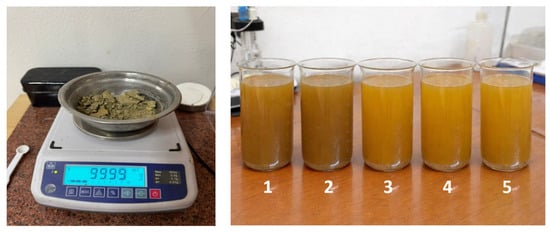
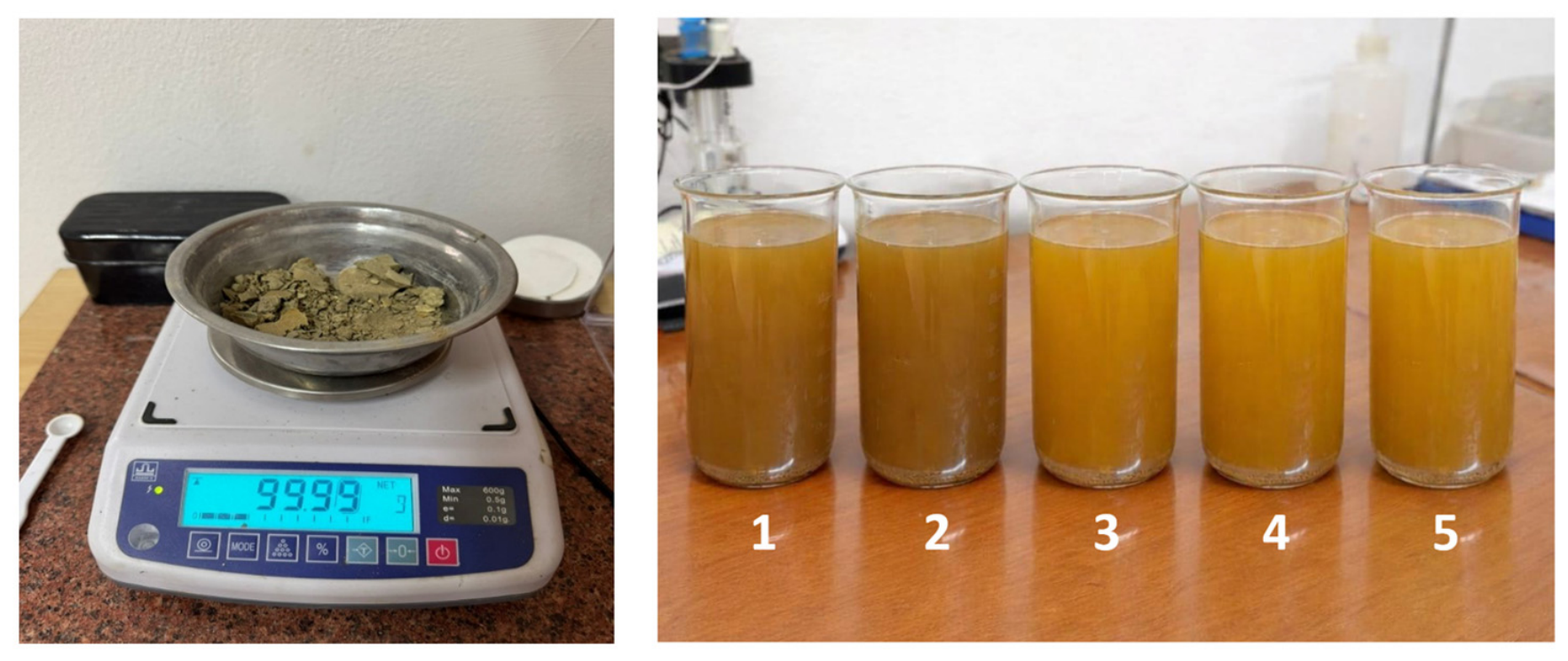
For the laboratory experiments, five beakers with a volume of 1000 mL were prepared, each containing 100 g of core samples taken from wells of the uranium deposit (Figure 3).
Figure 3.
Core samples and solutions prepared in five beakers for laboratory experiments.
In the first beaker, a 2.5% sulfuric acid solution was prepared in 1000 mL of water. In the second, third, fourth, and fifth beakers, a 2.5% sulfuric acid solution with the addition of 1%, 2%, 3%, and 4% of the antiscaling reagent, respectively, was prepared in a total volume of 1000 mL. All samples were stirred at room temperature, after which the concentration of Ca2+ ions was analyzed.
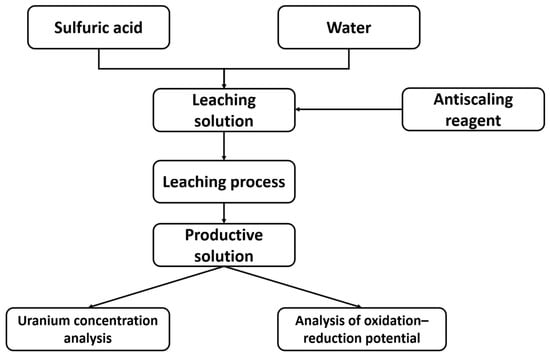
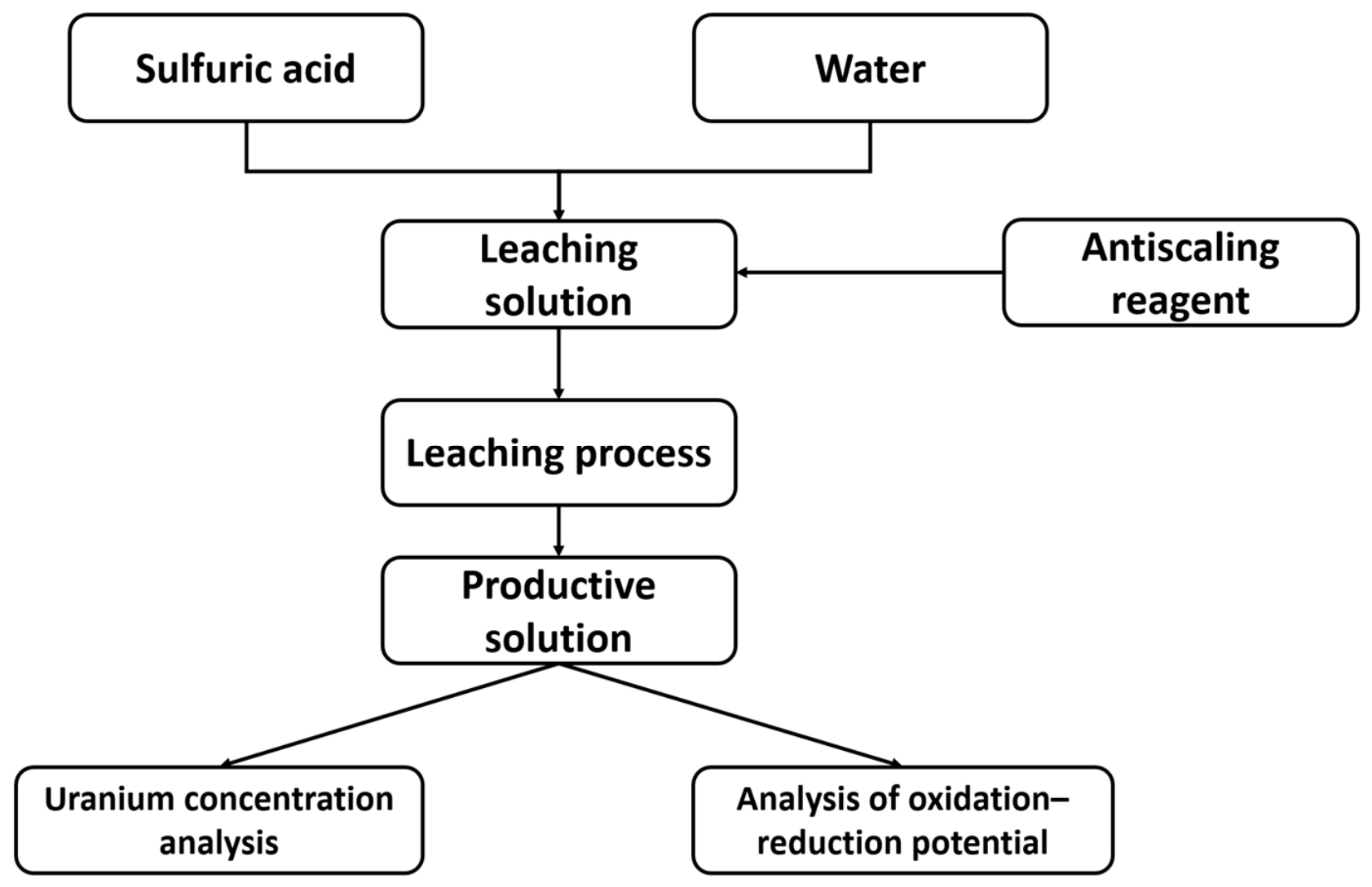
Considering that the antiscaling reagent may reduce the chemical activity of the leaching solution, the second stage of laboratory experiments was carried out to determine the effect of this reagent on uranium concentration and oxidation–reduction potential (ORP) in the pregnant leach solution using a dedicated experimental setup. The laboratory setup consisted of a thermostated glass vessel and a mechanical stirrer. The leaching time was 30 min, the sulfuric acid concentration was 10 g/L, and the mass of the core material was 50 g. Uranium concentration samples were taken at 5 min intervals.
The laboratory experiments were first conducted using a solution without reagent addition, and subsequently with the addition of the antiscaling reagent, using core material in both cases.
Uranium and calcium concentrations in the process solutions generated during both laboratory and pilot-scale experiments were analyzed at the analytical laboratory of the uranium mine. Measurement quality was controlled through routine laboratory procedures, with relative standard deviation (RSD) values maintained within the acceptable range of 3%–5%.
Uranium concentrations were quantified using a standard spectrophotometric method (Shimadzu UV-1800, Shimadzu, Kyoto, Japan) at a wavelength of 665 nm. This method is routinely applied for uranium monitoring and process control in in situ recovery (ISR) uranium mining operations. The Ca2+ concentration was measured by complexometric titration. Instrument calibration and analytical quality-control procedures were performed according to the laboratory’s established protocols.
A flowchart of the laboratory experimental procedure is presented in Figure 4.
Figure 4.
Flowchart of the laboratory experimental procedure.
To validate the proposed technology, pilot-scale field studies were conducted to assess changes in well productivity and workover intervals resulting from the addition of the antiscaling reagent to the leaching solution.
3. Results and Discussion
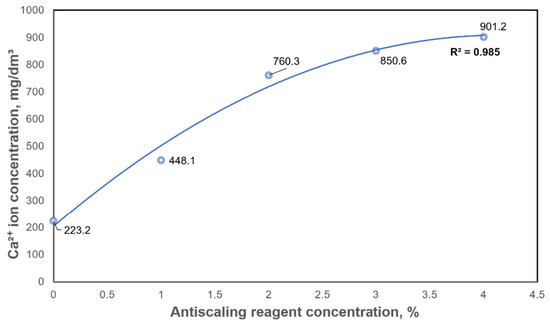
Processing of the results obtained from the first stage of laboratory experiments revealed changes in the degree of carbonate dissolution as a function of the antiscaling reagent concentration (Figure 5).
Figure 5.
Changes in the degree of Ca2+ ion dissolution in the solutions.
As shown in Figure 5, in the first solution without the addition of the antiscaling reagent, the concentration of calcium ions is only 223.2 mg/dm3, indicating that only a small fraction of calcium transfers into the liquid phase, while the majority remains in the solid phase. This may lead to colmatation and a reduction in the workover interval of wells. When 1.0% of the antiscaling reagent is added to the solution, up to 450 mg/dm3 of calcium ions are transferred into the liquid phase, i.e., the calcium ion concentration increases by more than 100% compared to the solution without the antiscaling reagent. With the addition of the antiscaling reagent at concentrations of 2%, 3%, and 4%, the calcium ion concentration increases by approximately 240%, 280%, and 300%, respectively.
This phenomenon indicates that a significant portion of calcium is transferred into the solution in ionic form under the action of the antiscaling reagent as follows. The application of the proposed antiscaling reagent, 1-hydroxyethylidene-1,1-diphosphonic acid (HEDP), can be theoretically justified as follows.
The reagent has the molecular formula C2H8O7P2 and the structural formula CH3–C(OH)(PO3H2)2. The molecule contains two phosphonic groups (–PO3H2): one hydroxyl group (–OH) and a central carbon atom that ensures the spatial arrangement of oxygen donor atoms.
In acidic media, the phosphonic groups partially dissociate, forming anionic species capable of coordinating calcium ions via a chelation mechanism. As a result, stable soluble complexes are formed:
The stability constant of this complex is sufficiently high (logK ≈ 6–7), ensuring effective binding of Ca2+ ions even at low pH values typical of sulfuric acid uranium leaching.
A decrease in the concentration of free calcium ions shifts the dissolution equilibrium of gypsum toward the dissolution of the solid phase:
The released calcium ions are subsequently bound again by HEDP, which leads to the gradual dissolution of existing gypsum deposits and prevents their re-precipitation.
Polyacrylate-sulfonated polymers are anionic high-molecular-weight compounds containing carboxyl and sulfonate functional groups. Their generalized structural formula can be represented as:
Upon dissociation in an acidic medium, functional groups such as carboxylate (–COO−) and sulfonate (–SO3−) are formed. These groups interact with calcium ions and adsorb on the surface of gypsum crystals, forming surface complexes:
As a result, active crystal growth sites are blocked, the rate of crystal growth is reduced, and the re-precipitation of gypsum is prevented. In addition, the polymer chains create electrostatic repulsion between particles, which inhibits particle aggregation and prevents their fixation within the pore space.
The mechanism of action of the proposed inhibitor composition for the dissolution of colmatants is based on a combination of two effects. HEDP binds calcium ions into soluble complexes and promotes gypsum dissolution, whereas polyacrylate-sulfonated polymers reduce crystallization rates and prevent the re-precipitation of salt deposits.
Consequently, calcium does not accumulate as a solid precipitate but remains in a stable state in the liquid phase, which, in turn, contributes to the prevention of well screen colmatation.
It should be noted that the maximum dissolution of calcium ions is achieved at an antiscaling reagent concentration of 2%, where the calcium ion concentration increases from 223.2 mg/dm3 to 760.3 mg/dm3. Further increases in reagent concentration to 3% and 4% do not result in a significant enhancement of calcium ion dissolution.
It is well known that during uranium leaching with sulfuric acid solutions, the oxidation–reduction potential of the leaching solutions plays a critical role, as it intensifies the in situ leaching process and reduces the specific consumption of sulfuric acid [23].
Therefore, at the second stage of the study, it was necessary to determine the effect of adding the antiscaling reagent on the preservation of the oxidizing capacity of the solution and on uranium concentration. For this purpose, laboratory experiments were conducted using core materials from the deposit on a dedicated experimental setup.
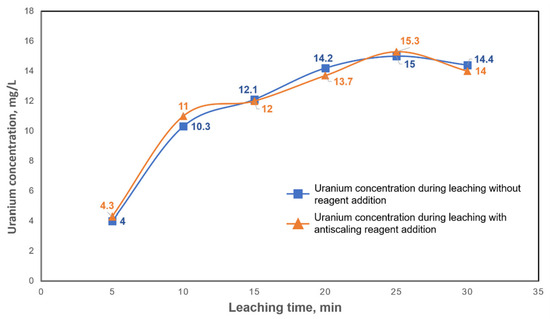
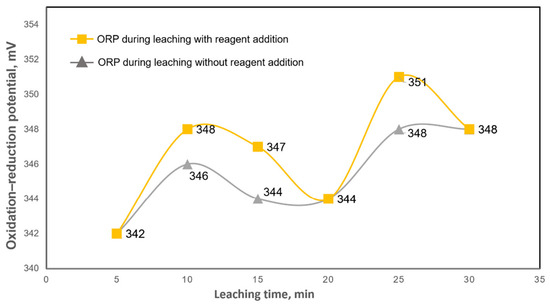
Processing of the laboratory data yielded dependencies of uranium concentration in the pregnant leach solution and the oxidation–reduction potential of the solution on leaching time, both without and with the addition of the antiscaling reagent (Figure 6 and Figure 7).
Figure 6.
Dependences of uranium concentration in the pregnant leach solution on leaching time.
Figure 7.
Dependences of oxidation–reduction potential (ORP) on leaching time.
Analysis of the graphs in Figure 6 and Figure 7 shows that the introduction of the antiscaling reagent into the leaching solution at leaching times of up to 10 min leads to a slight increase in leaching intensity, by approximately 7% compared to leaching with a solution without the antiscaling reagent. However, with a further increase in leaching time up to 30 min, the uranium concentration in the pregnant leach solution increases similarly for both cases, i.e., with and without the addition of the antiscaling reagent.
As the leaching time increases to 10 min, a similar and insignificant increase in the oxidation–reduction potential of the solution, by approximately 1%–2%, is observed for both leaching without and with the antiscaling reagent. Further increases in leaching time do not lead to significant changes in the oxidation–reduction potential of the solution.
Based on these results, it can be concluded that the addition of the antiscaling reagent to the leaching solution promotes an increased degree of calcium dissolution while not exerting a negative effect on uranium concentration in the pregnant leach solution or on the oxidation–reduction potential of the solution.
To validate the laboratory findings, pilot-scale field tests were conducted to restore the injectivity and workover intervals of injection wells by adding the antiscaling reagent to the leaching solution for a period of one day. Monitoring of injectivity changes was carried out over 8–10 days, while the workover interval was evaluated over a two-month period. A total of four injection wells were involved in the tests; to obtain comparative data, leaching solutions containing the antiscaling reagent were injected into wells No. 1, No. 2, and No. 3, whereas well No. 4 operated without reagent addition. These wells belong to the same production block, operate under identical mining and geological conditions, and have been in operation for more than 8 months.
Prior to the injection of the solution containing the antiscaling reagent, these wells were planned to be shut down due to colmatation and critically reduced injectivity. The reagent was delivered to the mine in ready-to-use form and transferred into a specially prepared and heated storage tank with a capacity of 25 m3. A plunger pump with a maximum capacity of 700 L/h and an operating pressure of up to 7 atm was connected to the tank. Through this pump, the reagent was injected into the leaching solution line. The reagent injection line was equipped with a flow meter and shut-off valves, allowing accurate monitoring of reagent consumption and ensuring safe injection.
The sulfuric acid concentration was maintained at 20 g/L in accordance with operational regulations, and the daily consumption of the antiscaling reagent, based on laboratory results, amounted to 6.0 t for three wells.
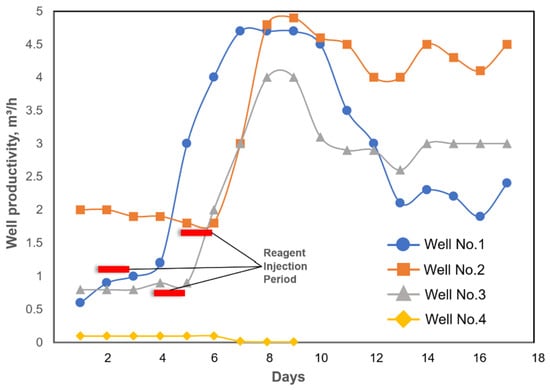
Changes in the injectivity of the three injection wells treated with the reagent-enriched leaching solution, as well as one well without reagent addition, are shown in Figure 8.
Figure 8.
Changes in injection well performance before and after reagent injection.
As shown in Figure 8, in well No. 1, during leaching with the solution prior to reagent addition, the injectivity of the injection well was 0.8 m3/h. After enrichment of the solution with the antiscaling reagent, injectivity initially increased to 4.7 m3/h and subsequently stabilized within the range of 1.9–2.4 m3/h. Overall, the average injectivity increased to 3.2 m3/h, corresponding to an approximately threefold increase.
In well No. 2, during leaching with a solution without the antiscaling reagent, the injectivity was 1.7 m3/h. After enrichment of the solution with the reagent, injectivity increased and remained within the range of 4.0–4.9 m3/h. On average, injectivity increased to 4.3 m3/h, i.e., by a factor of 1.5.
In well No. 3, the injectivity during leaching without the reagent was 0.8 m3/h. Following enrichment of the solution with the antiscaling reagent, injectivity increased to 4.0 m3/h and then slightly decreased to 2.6–3.0 m3/h. Overall, the average injectivity increased to 3.0 m3/h, corresponding to an increase by a factor of 2.7.
In well No. 4, where a leaching solution with an increased sulfuric acid concentration but without the antiscaling reagent was injected, injectivity was only 0.1 m3/h. Despite the elevated sulfuric acid concentration, the treatment did not yield the desired results, and injectivity continued to decline to 0 m3/h. This injection well was subsequently shut down for well rehabilitation operations.
The obtained results indicate a significant effect of the addition of an antiscaling reagent on the filtration characteristics of injection wells. In all cases (wells No. 1–3), a substantial increase in productivity is observed after treatment of the solution with the reagent, indicating a reduction in the colmatation process. In contrast, the results for well No. 4 demonstrate the ineffectiveness of simply increasing the sulfuric acid concentration without the use of scale inhibitors.
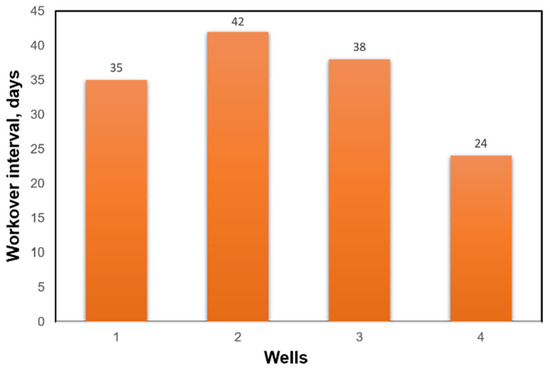
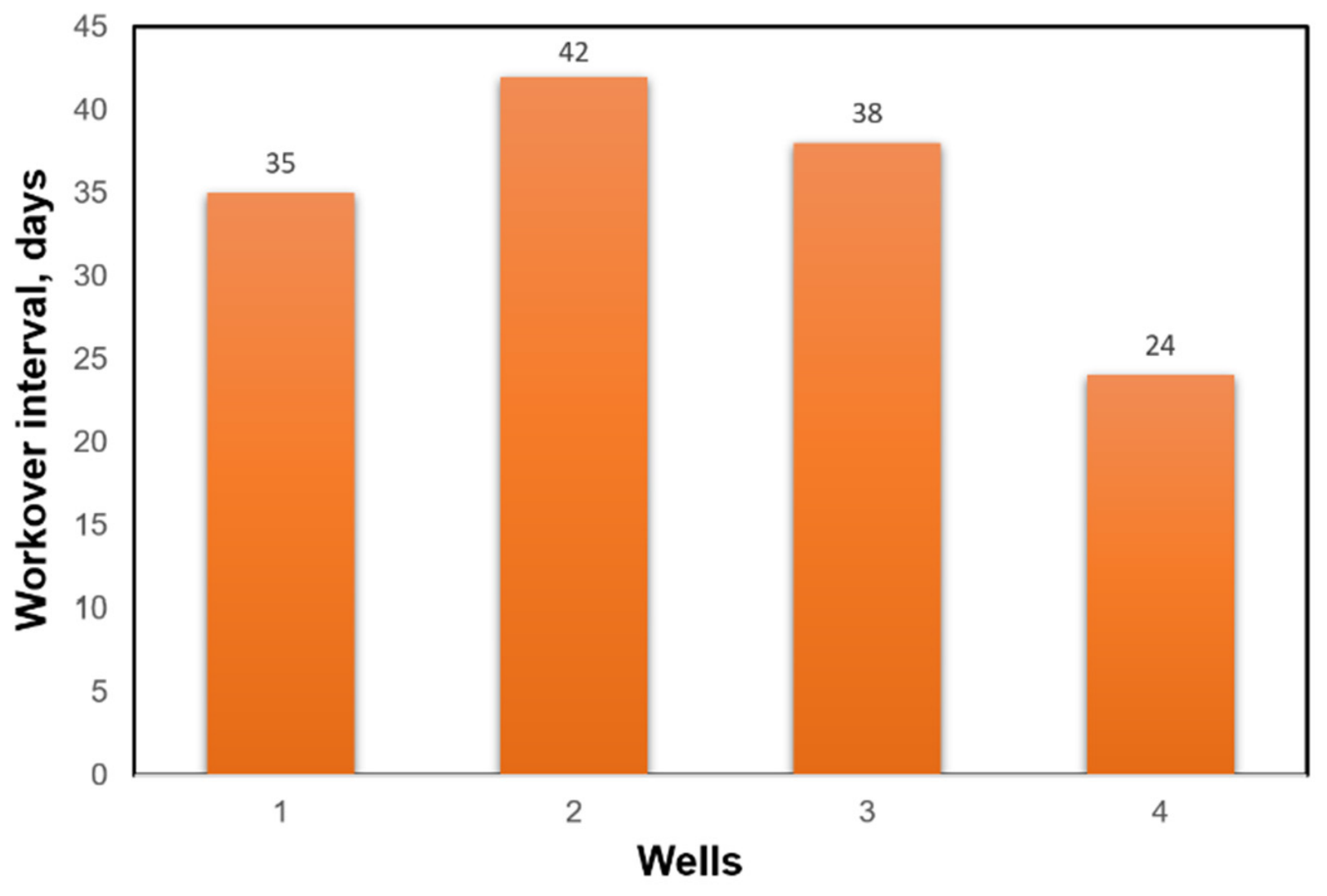
The results of the workover intervals for these four wells are presented in Figure 9.
Figure 9.
Workover intervals of the wells. Wells No. 1, 2, and 3 were treated using the proposed reagent, whereas well No. 4 was operated without the addition of the proposed reagent.
As shown in Figure 9, the workover interval of well No. 4, where the antiscaling reagent was not added to the leaching solution, was 24 days. In contrast, the average workover interval of wells No. 1, No. 2, and No. 3, where the antiscaling reagent was added to the leaching solution, was 38 days, representing an increase of 28%. The observed increase in the workover interval by 28% in the treated wells is interpreted as a direct indicator of improved stability of the filtration characteristics in the near-wellbore zone.
Additional evidence of the effectiveness of the antiscaling reagent is the increased duration of stable well operation, indicating a reduced rate of scale formation and prolonged preservation of reservoir permeability.
Thus, the use of an antiscaling reagent is not only a means of short-term productivity enhancement, but also may extend the operational lifespan of wells.
4. Conclusions
Despite the implementation of various technological approaches and extensive research, the problem of reduced productivity of technological wells during in situ uranium leaching remains unresolved due to the significant presence of carbonate and clay minerals in ore-bearing formations.
Long-term operational experience shows that the most effective strategy for mitigating inorganic scale formation is its prevention at an early stage of the process.
The practical contribution of this study lies in the proposed technology for the application of an antiscaling reagent to increase the interval between well maintenance operations and to maintain stable well productivity.
The theoretical contribution of the study consists of substantiating the mechanism of action of the proposed inhibitor composition for dissolving colmatants: HEDP binds calcium ions into soluble complexes and promotes gypsum dissolution, while polyacrylsulfonated polymers reduce the crystallization rate.
The conducted laboratory studies demonstrate that the introduction of an antiscaling reagent into sulfuric acid solutions significantly enhances the dissolution of carbonate compounds. As a result, calcium is predominantly retained in the solution in a stable ionic form, preventing the formation and accumulation of solid precipitates responsible for colmatation.
The relationships between the degree of carbonate dissolution and the concentration of the antiscaling reagent have been established, and the optimal reagent concentration (2%) ensuring maximum dissolution efficiency has been identified.
It was also determined that the addition of the antiscaling reagent does not adversely affect key technological parameters of the leaching process, including the oxidation–reduction potential and uranium concentration in the pregnant leach solution.
Pilot-scale field tests fully confirmed the laboratory results. The application of the antiscaling reagent led to a significant improvement in well performance and operational stability. In the treated wells, the workover interval increased by up to 28% compared to the control well.
Thus, the proposed approach provides a technically and technologically effective solution for reducing colmatation processes and improving the efficiency and reliability of uranium in situ leaching operations.
A limitation of this study is that additional investigations are required for other deposits, taking into account their specific mining and geological conditions.
Author Contributions
Conceptualization, K.Y. and S.M.; methodology, K.Y.; software, E.A. and N.N.; validation, K.Y., S.M. and S.Y.; formal analysis, E.A. and S.Y.; investigation, E.A.; resources, S.M.; data curation, N.N.; writing—original draft preparation, K.Y.; writing—review and editing, S.Y. and E.A.; visualization, N.N.; supervision, K.Y.; project administration, S.M.; funding acquisition, S.M. All authors have read and agreed to the published version of the manuscript.
Funding
This research was funded by the Science Committee of the Ministry of Science and Higher Education of the Republic of Kazakhstan (Grant No. AP26198685).
Data Availability Statement
The data supporting the findings of this study are available from the corresponding author upon reasonable request.
Conflicts of Interest
The authors declare that there are no conflicts of interest regarding the publication of this manuscript. In addition, ethical standards, including those regarding plagiarism, informed consent, misconduct, data fabrication and/or falsification, double publication and/or submission, and redundancies, have been completely adhered to by the authors.
Abbreviations
The following abbreviations are used in this manuscript:
| ISL | In Situ Leaching |
| ORP | Oxidation–Reduction Potential, mV |
| PVC | Polyvinyl Chloride |
| CaCO3 | Calcium Carbonate |
| NH4HF2 | Ammonium Bifluoride |
| Ca2+ | Calcium Ion Concentration, mg/L |
References
- Almenov, T.; Zhanakova, R.; Sarybayev, M.; Seitkazynova, B.; Shabaz, D.M.; Nurperzent, B. Innovative Compositions of Shotcrete Mixtures for Reinforcement of Underground Mine Excavations. HighTech Innov. J. 2025, 6, 1238–1263. [Google Scholar] [CrossRef] [Scilit]
- Rysbekov, K.B.; Bitimbayev, M.Z.; Akhmetkanov, D.K.; Miletenko, N.A. Improvement and systematization of principles and process flows in mineral mining in the Republic of Kazakhstan. Eurasian Min. 2022, 1, 41–46. [Google Scholar] [CrossRef] [Scilit]
- Li, G.; Yao, J. A Review of In Situ Leaching (ISL) for Uranium Mining. Mining 2024, 4, 120–148. [Google Scholar] [CrossRef] [Scilit]
- Vershina, L.L.P. Report on the Results of Detailed Exploration of the Central Area of the Mynkuduk Uranium Deposit with Uranium Reserve Estimation; Technical Report; Vershina L.L.P.: Almaty, Kazakhstan, 2010; p. 131. [Google Scholar]
- Mudd, G.M. Acid In Situ Leach uranium mining—2. Soviet Block and Asia. In Tailings and Mine Waste 2000; CRC Press: London, UK, 2022; pp. 527–536. [Google Scholar]
- Rakishev, B.R.; Mataev, M.M.; Kenzhetaev, Z.S. Analysis of mineralogical composition of sediments in in-situ leach mining of uranium. Min. Informational Anal. Bull. 2019, 7, 123–131. [Google Scholar] [CrossRef] [Scilit]
- Zhou, C.; Wang, H.; Wu, T.; Hu, E.; Lei, Z.; Wang, Q. Simulation study on clogging of suspended particles in in-situ leaching of uranium at different concentrations and flow velocity. Physicochem. Probl. Miner. Process. 2023, 59, 162150. [Google Scholar] [CrossRef] [Scilit]
- Jurda, M.; Němec, M. Remediation of the uranium industry in the Czech Republic: Regulation aspects and main technologies. J. Radiol. Prot. 2022, 42, 010504. [Google Scholar] [CrossRef] [Scilit]
- Yussupov, K.; Aben, E.; Myrzakhmetov, S.; Akhmetkanov, D.; Sarybayev, N. Increasing the Efficiency of Underground Block Leaching of Metal. Civ. Eng. J. 2024, 10, 3339–3349. [Google Scholar] [CrossRef] [Scilit]
- Kurmanseiit, M.; Shayakhmetov, N.; Aizhulov, D.; Tleuberdy, A.; Abdullayeva, B.; Tungatarova, M. Comparative Evaluation of Flow Rate Distribution Methods for Uranium In-Situ Leaching via Reactive Transport Modeling. Minerals 2025, 15, 1066. [Google Scholar] [CrossRef] [Scilit]
- Martínez-Rodríguez, P.; Sánchez-Castro, I.; Ojeda, J.J.; Abad, M.M.; Descostes, M.; Merroun, M.L. Effect of different phosphate sources on uranium biomineralization by the Microbacterium sp. Be9 strain: A multidisciplinary approach study. Front. Microbiol. 2023, 13, 1092184. [Google Scholar] [CrossRef] [Scilit] [PubMed]
- Zhou, Y.; Li, G.; Xu, L.; Liu, J.; Sun, Z.; Shi, W. Uranium recovery from sandstone-type uranium deposit by acid in-situ leaching - an example from the Kujieertai. Hydrometallurgy 2020, 191, 105209. [Google Scholar] [CrossRef] [Scilit]
- Li, Z.; Zhang, Y.; Luo, T.; Xia, P.; Mu, H.; Sun, P.; Wang, X.; Wang, J. In-Situ Leaching Mining Technique for Deep Bauxite Extraction and the Countermeasures for Water Pollution Prevention: An Example in the Ordos Basin, China. Water 2023, 15, 2381. [Google Scholar] [CrossRef] [Scilit]
- Sunilkumar, B.; Krishnakumar, M.; Patwardhan, A. Analysis of iron-rich hydrochloric acid solutions for uranium, thorium, rare-earth elements and other heavy metals. J. Anal. Sci. Technol. 2023, 14, 43. [Google Scholar] [CrossRef] [Scilit]
- Sunilkumar, B.; Nagabhushanam, P.; George, J.; Durani, S. Innovative fusion-based approach for uranium analysis in zircon mineral using Light Emitting Diode fluorimetry (LEDF). J. Radioanal. Nucl. Chem. 2025, 334, 8419–8426. [Google Scholar] [CrossRef] [Scilit]
- Yussupov, K.; Mikhalovsky, S.; Khalid, M.; Rysbekov, K.; Omarov, A.; Azat, S.; Akzholova, A. Research of influence of various factors on repair-and-renewal operations in technological wells during uranium geotechnology in complex mining and geological conditions. Min. Miner. Depos. 2025, 19, 132–141. [Google Scholar] [CrossRef] [Scilit]
- Yussupov, K.; Abdissattar, G.; Aben, E.; Myrzakhmetov, S.; Akhmetkanov, D.; Yelzhanov, E. A Novel Process for Decolmatation of Wells During In Situ Leach Mining of Uranium. Civ. Eng. J. 2025, 11, 1447–1457. [Google Scholar] [CrossRef] [Scilit]
- Foster, K.R.; Schorne-Pinto, J.; Booth, R.E.; Husek, A.; Aziziha, M.; Tisdale, H.B.; Fitzpatrick, B.W.N.; zur Loye, H.-C.; Piro, M.H.A.; Besmann, T.M. Purification of uranium tetrafluoride using ammonium bifluoride. J. Fluor. Chem. 2025, 285–286, 110449. [Google Scholar] [CrossRef] [Scilit]
- Kinnunen, P.C.; Humphries, B.A.; Luker, G.D.; Luker, K.E.; Linderman, J.J. Characterizing heterogeneous single-cell dose responses computationally and experimentally using threshold inhibition surfaces and dose-titration assays. npj Syst. Biol. Appl. 2024, 10, 42. [Google Scholar] [CrossRef] [Scilit] [PubMed]
- Shtukenberg, A.G.; Ward, M.D.; Kahr, B. Crystal growth inhibition by impurity stoppers, now. J. Cryst. Growth 2022, 597, 126839. [Google Scholar] [CrossRef] [Scilit]
- Lausch, K.N.; El Haouari, R.; Trzewik, D.; Behler, J. Impact of the damping function in dispersion-corrected density functional theory on the properties of liquid water. J. Chem. Phys. 2025, 163, 034101. [Google Scholar] [CrossRef] [Scilit]
- Ortalyk Mining Company. Technological Regulations of Uranium Recovery at the Central Section of the Mynkuduk Deposit; Internal Report (Not Publicly Available); Ortalyk Mining Company: Shymkent, Kazakhstan, 2021; p. 136. [Google Scholar]
- Yussupov, K.; Aben, E.; Abdissattar, G.; Myrzakhmetov, S.; Akhmetkanov, D. Improving the efficiency of in-situ uranium leaching via oxygen-enriched lixiviant injection. Rud.-Geol.-Naft. Zb. 2026, 41, 189–196. [Google Scholar] [CrossRef] [Scilit]

Disclaimer/Publisher’s Note: The statements, opinions and data contained in all publications are solely those of the individual author(s) and contributor(s) and not of MDPI and/or the editor(s). MDPI and/or the editor(s) disclaim responsibility for any injury to people or property resulting from any ideas, methods, instructions or products referred to in the content. |
© 2026 by the authors. Licensee MDPI, Basel, Switzerland. This article is an open access article distributed under the terms and conditions of the Creative Commons Attribution (CC BY) license.