


Abstract
Limited sample diversity poses a major challenge for deep learning-based coal–gangue recognition using mineral laser speckle images under complex industrial conditions. To address this issue, we propose an improved data augmentation framework based on a Deep Convolutional Generative Adversarial Network (DCGAN). Dense Blocks are introduced to enhance high-dimensional feature representation without significantly increasing network complexity, while self-attention modules strengthen multiscale feature interactions between localized flare features and global speckle distributions. Residual-based sampling modules and the Wasserstein GAN with Gradient Penalty (WGAN-GP) objective are further employed to improve gradient propagation and adversarial training stability. Experimental results on synthesizing 512 × 512 mineral laser speckle images show that the proposed model reduces the Fréchet Inception Distance (FID) by 72.75% relative to the baseline DCGAN. Furthermore, the YOLOv5 detectors trained on the augmented datasets achieve a peak mean Average Precision (mAP) of 99.3%, significantly outperforming conventional geometric transformation methods and typical generative baselines including StyleGAN2-ADA and SAGAN. These results demonstrate that the proposed method effectively improves alignment between the synthetic and real distributions, enhances speckle feature diversity and boosts the accuracy and robustness of coal–gangue recognition under limited-sample conditions.
1. Introduction
Coal resources occupy a crucial position in the global energy system [1,2]. During the coal mining process, low-carbon solid wastes such as gangue are often mixed with raw coal. These impurities not only reduce the calorific efficiency of coal combustion but may also cause environmental pollution if not properly managed [3,4]. Therefore, efficiently and accurately separating coal from gangue is of vital importance. The precise identification of coal and gangue is a key step in achieving effective separation and holds significant research value.
With the rapid development of deep learning, laser speckle image recognition methods based on object detection models have demonstrated excellent performance in coal-gangue discrimination and have shown considerable potential for industrial application [5,6]. However, the performance of deep learning-based detection models is highly dependent on the quality and scale of the datasets used. To ensure that the model can effectively learn the characteristic information of various mineral categories under different conditions, the dataset must contain a large number of diverse laser speckle images. Nevertheless, due to significant variations in the surface properties of coal and gangue across different mining areas, relying solely on a limited number of laboratory-collected mineral samples to construct datasets often leads to overfitting in deep learning networks, thereby hindering effective and accurate coal-gangue detection [7,8,9]. In addition, the complex operating conditions of actual mineral processing environments make it difficult to collect balanced and diverse mineral samples within a limited timeframe [10,11]. Therefore, a critical challenge in improving the performance of intelligent coal-gangue detection lies in how to generate a larger volume of realistic laser speckle image data from a limited number of original mineral samples to expand the training dataset for deep learning models.
With the advancement of computer vision technologies, data augmentation methods have been extensively studied as effective solutions to the aforementioned challenges. These methods are generally categorized into two types: non-generative data augmentation and generative data augmentation. Non-generative approaches, such as traditional image-processing techniques, involve operations like rotation, geometric transformation, and color variation. Although these methods can significantly increase the number of images, their ability to enrich the feature distribution is limited, thereby constraining improvements in the generalization performance of detection models. In contrast, generative data augmentation methods primarily leverage deep learning models to learn the underlying feature distributions of images and generate high-quality synthetic samples. These approaches not only expand the dataset size but also enhance feature diversity, ultimately improving the generalization capability of the trained models. Among them, Generative Adversarial Networks (GANs) exhibit excellent feature learning performance and represent one of the most intensively studied models in the deep learning field [12,13,14,15,16,17,18].
In recent years, Generative Adversarial Networks (GANs) have shown remarkable potential in optical imaging tasks such as speckle image reconstruction and speckle suppression, achieving substantial improvements in image quality and structural fidelity [19,20,21,22,23,24,25]. Despite these advances, research on GAN-based enhancement methods specifically designed for laser speckle images remains scarce. This limitation is particularly evident in industrial scenarios, where insufficient sample diversity and the high risk of overfitting under small-sample conditions often hinder the generalization performance of image detection models.
To address these challenges, this study proposes an improved DCGAN-based data augmentation approach tailored for laser speckle images of coal and gangue. First, a Dense Block is introduced to reshape tensors and enhance the nonlinear representation capacity of the network, thereby improving the resolution of generated images without excessively increasing the model depth. Second, residual units are incorporated to reinforce the robustness of model training and effectively mitigate gradient vanishing and explosion problems. Third, a self-attention mechanism is employed to efficiently extract both local glare features and global speckle characteristics from coal and gangue images, thereby improving the generation quality of mineral speckle images under complex imaging conditions. Finally, the Wasserstein GAN with Gradient Penalty (WGAN-GP) is adopted to compute the model loss function, addressing network instability caused by variations in image resolution. An augmented laser speckle image dataset of coal and gangue was constructed using the proposed method, and YOLOv5 was employed as the detection framework to evaluate its effectiveness in improving mineral recognition performance under limited-sample conditions. Comparative experiments demonstrate that the improved DCGAN generates mineral laser speckle images with higher quality and sharper details, providing greater advantages in enhancing the overall detection performance of coal and gangue. By generating high-quality synthetic samples that expand dataset scale and enrich feature diversity, the proposed method effectively improves coal and gangue recognition accuracy under data-limited conditions, offering a robust and scalable solution for intelligent optical detection in complex industrial environments.
2. Related Work
Generative Adversarial Networks, based on game theory, have introduced a novel data augmentation paradigm to address the small sample problem [26]. However, they still face issues such as gradient vanishing and mode collapse, which affect training stability in the domain of optical image generation. In response to these technical challenges, several improved architectures and training strategies have been proposed by researchers. Mirza et al. [27] developed the Conditional Generative Adversarial Network, which introduces class label vectors as conditional constraints to enable directional control of the features in generated images. The Laplacian Generative Adversarial Network proposed by Denton et al. [28] is based on the Laplacian pyramid multi-scale decomposition principle and adopts a progressive generation strategy from low to high frequencies. This significantly improves the sharpness of image edges and texture fidelity. Radford et al. [29] introduced the Deep Convolutional Generative Adversarial Network, which innovatively employs a fully convolutional architecture, replacing traditional pooling layers with strided convolutions, and implements global average pooling to reduce feature dimensionality. This architecture effectively lowers computational complexity while maintaining network differentiability, thus enhancing training stability. Zhu et al. [30] developed the Cycle-Consistent Generative Adversarial Network, which breaks the paired sample constraint and utilizes the Cycle Consistency Loss function to establish a bidirectional mapping mechanism. This allows for accurate image style transfer with specific modal feature migration, providing a new avenue for optical image data augmentation. Brock et al. [31] proposed BigGAN, a large-scale GAN that applies orthogonal regularization to constrain the parameter space and uses truncation noise vectors to balance the trade-off between diversity and quality of generated samples. This approach achieved significant improvements in the FID score on the ImageNet dataset, offering important architectural insights for high-resolution optical image synthesis.
GANs have demonstrated considerable potential in the enhancement of optical images. Their core value lies not only in expanding the scale of datasets, but also in facilitating image restoration and optimizing the feature space through adversarial learning mechanisms. Consequently, GANs have garnered widespread attention from researchers across various domains, including radiographic imaging, remote sensing, medical image analysis, and industrial image inspection. Leng et al. [32] proposed an enhanced DeblurGAN framework to address image degradation in vehicle radiographic imaging. The method effectively reconstructs edge and texture details, improving image quality under specific scanning velocities in vehicle detection systems. Ma et al. [33] proposed LFCGAN, a GAN-based framework for remote sensing image adversarial example generation. By introducing a low-frequency constraint and a feature classification loss, the method enhances visual fidelity, attack effectiveness, and convergence efficiency for high-resolution scene classification. Kim et al. [34] combined parallel global–local attention with Fourier-transform-based loss to align synthetic and real iris images across spatial and spectral domains, achieving superior presentation attack performance over state-of-the-art GAN models. Jia et al. [35] proposed a GAN-based framework for flotation image compression and reconstruction, employing multi-loss optimization to preserve texture-feature consistency while improving transmission efficiency under complex mineral processing conditions. Zhang et al. [36] proposed a dual-attention DCGAN with coordinate attention and adaptive augmentation to enhance texture representation in coal–gangue images, improving YOLOv4 mAP by 9.26%. These findings underscore the effectiveness of GAN-based augmentation in strengthening model generalization for industrial image inspection. However, to the best of our knowledge, research on GAN-based high-resolution enhancement specifically for laser speckle images of minerals remains scarce, which motivated the methodological developments in this work.
3. Methods
3.1. Overview
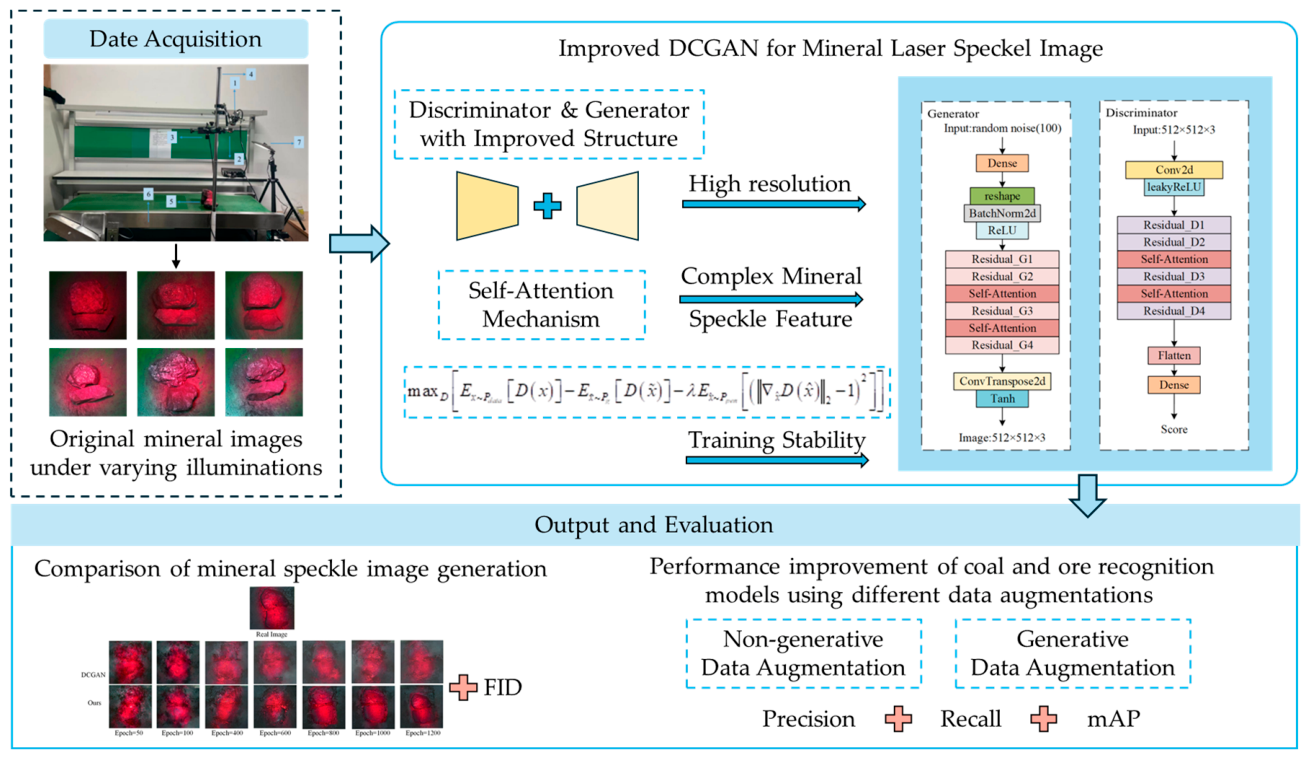
Laser speckle patterns are generated through the interaction between coherent illumination and rough mineral surfaces, resulting in stochastic and high-frequency granular structures. These intrinsic characteristics introduce significant challenges for conventional DCGAN-based speckle synthesis, including insufficient preservation of fine-scale details, unstable adversarial optimization under complex feature distributions, and mode collapse exacerbated by inter-class feature imbalance. Such limitations degrade the fidelity, stability, and diversity of generated samples, thereby reducing the effectiveness of data augmentation. To address these issues, an improved DCGAN framework is proposed for high-resolution coal–gangue laser speckle image generation.
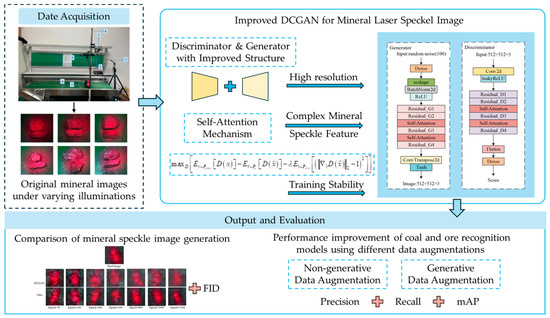
An overview of the proposed framework is presented in Figure 1. The complete pipeline integrates five key stages: (a) acquisition of laser speckle images under varying illumination conditions; (b) construction of a non-generative augmentation baseline using geometric and photometric transformations; (c) generative augmentation through the proposed improved DCGAN for synthesizing high-resolution speckle samples; (d) quantitative evaluation of generation quality using the Fréchet Inception Distance (FID); and (e) validation of augmentation effectiveness through YOLOv5-based coal–gangue recognition, evaluated using precision, recall, and mean Average Precision (mAP).
Figure 1.
Overall workflow of the proposed coal–gangue laser speckle data augmentation method.
3.2. DCGAN
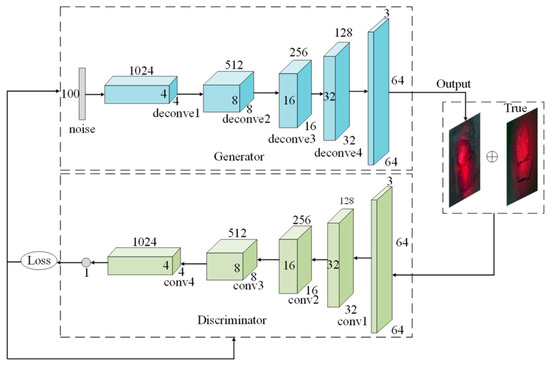
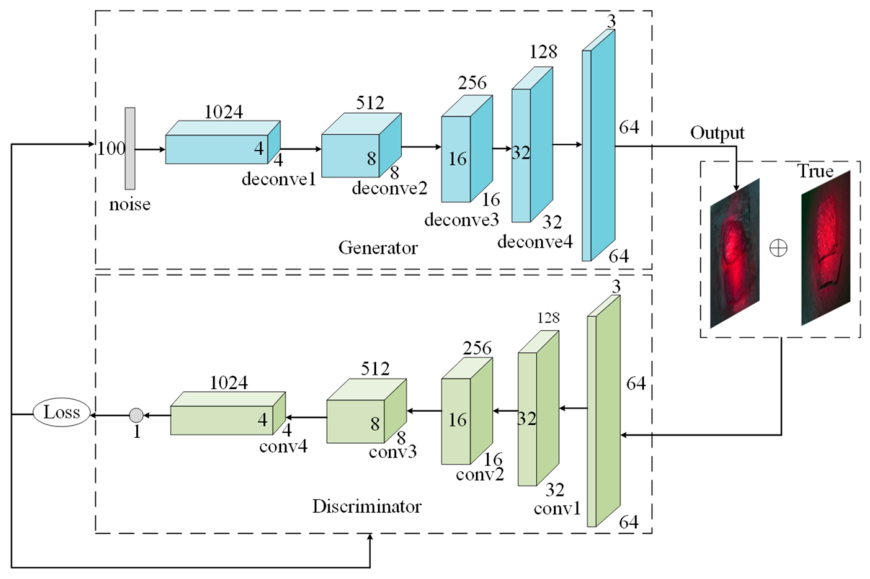
The standard DCGAN is a significant modification of the GAN architecture, as shown in Figure 2. In DCGAN, convolutional layers and batch normalization are introduced into both the Generator and the Discriminator. Additionally, stride convolution and transposed convolution are used in place of traditional pooling layers for upsampling and downsampling. These improvements help stabilize the model’s training process, prevent imbalances in the training of the Generator and the Discriminator, and enhance the quality of the generated samples as well as the convergence speed of the model.
Figure 2.
DCGAN structure.
The input to the Generator is a 100-dimensional random vector. It is first mapped to a 4 × 4 × 1024 feature map through a matrix multiplication, followed by upsampling through four transposed convolutional layers. The image size is progressively increased at each layer, ultimately generating an image. The configuration of each convolutional layer in the Generator is shown in Table 1.
Table 1.
The configuration of each convolutional layer in the generator.
The input to the Discriminator in DCGAN is an image tensor of 64 × 64 × 3. It is processed through convolutional layers for downsampling, with the resolution ultimately reduced to 4 × 4. The final decision, whether the image is real or generated, is made through a Sigmoid function. The configuration of each convolutional layer in the Discriminator is shown in Table 2.
Table 2.
The configuration of each convolutional layer in the discriminator.
3.3. Improved Structure of the Network
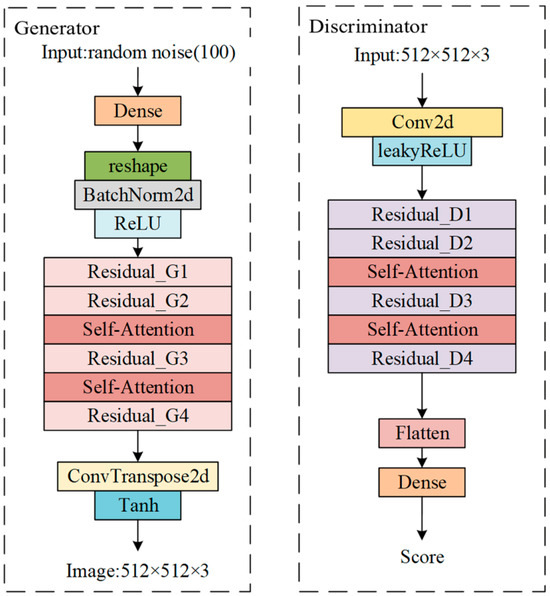
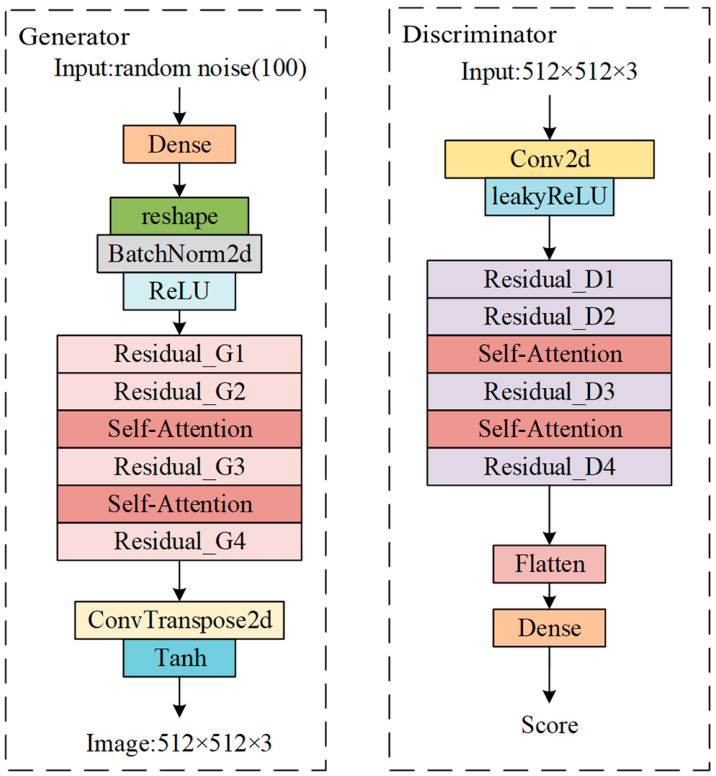
To preserve sufficient image information for downstream detection tasks, the generator output resolution was increased from 64 × 64 to 512 × 512 pixels. Achieving this resolution through direct network deepening requires additional upsampling and downsampling stages, which can aggravate gradient instability during training and consequently degrade synthesis quality. To address this issue, Dense Blocks [37] were incorporated at the generator input and discriminator output. By transforming densely connected feature maps into higher-dimensional representations, these modules enhance the network’s nonlinear modeling capacity and improve its ability to capture complex image feature distributions. The overall architecture of the improved model is illustrated in Figure 3.
Figure 3.
Improved DCGAN structure.
In the improved DCGAN, the generator first maps the input latent vector through a dense projection and reshapes it into a 16 × 16 feature tensor. Four sequential upsampling stages then progressively reconstruct the spatial resolution to 512 × 512 pixels. Conversely, the discriminator receives a 512 × 512 laser speckle image and applies four convolutional downsampling stages to reduce the representation to 16 × 16. The resulting features are flattened and fed into a Dense Block that outputs a scalar score representing the probability of the image being real or generated. As shown in Table 3, high-resolution synthesis is achieved through tensor dimensional expansion rather than additional network depth, thereby improving image quality while maintaining training stability and computational efficiency.
Table 3.
Model structure configuration.
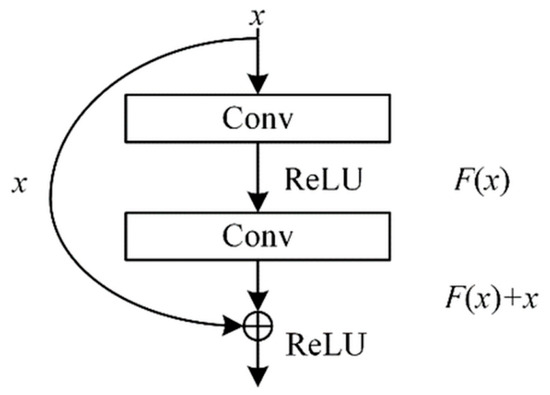
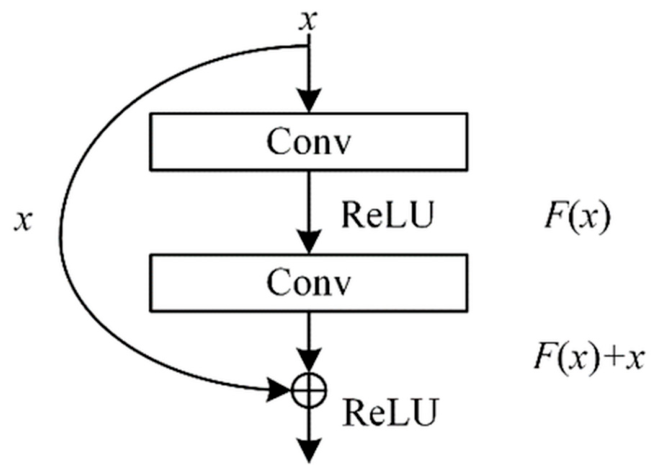
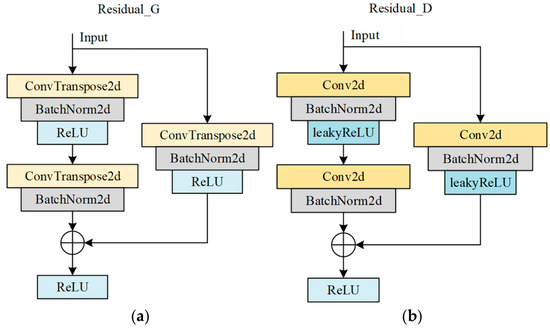
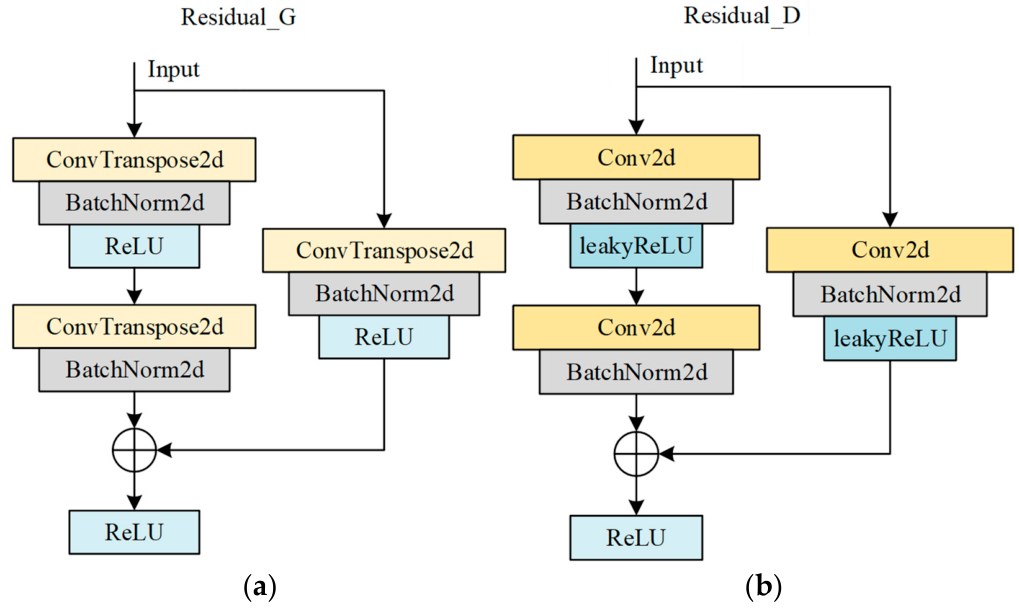
Residual units [38] were further integrated into the sampling modules, as shown in Figure 4. For an input x, convolutional transformations produce F(x), which is combined with the identity mapping through a skip connection to yield F(x) + x. This residual formulation facilitates gradient propagation, strengthens feature reuse, and improves the learning of input–output mappings in deeper architectures. As a result, it enhances convergence stability and mitigates vanishing-gradient effects associated with increased network depth. The incorporation of residual units within the generator and discriminator is illustrated in Figure 5.
Figure 4.
The residual unit structure.
Figure 5.
Residual block structure diagram: (a) generator residual block; (b) discriminator residual block.
3.4. Self-Attention Mechanism [39]
Conventional deep convolutional networks rely on local receptive fields for feature extraction, limiting the modeling of long-range dependencies and global context. This limitation is particularly critical in coal–gangue laser speckle imaging, where multi-target distributions and surface glare demand effective integration of local structures with global spatial dependencies. To address this challenge, a self-attention mechanism was embedded within the improved DCGAN.
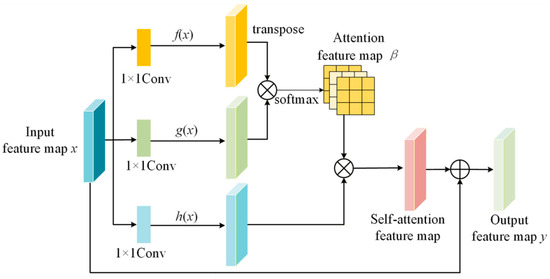
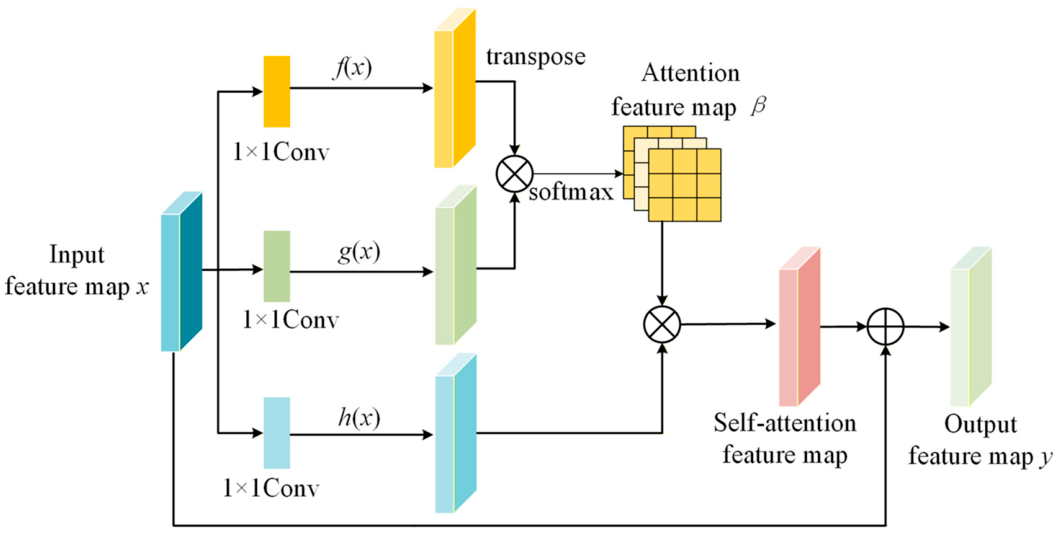
As illustrated in Figure 6, the self-attention module projects the input feature map x into three distinct feature spaces, f(x), g(x), and h(x), using three 1 × 1 convolutional layers. A matrix is then computed from f(x)T g(x), and each row of the resulting matrix is processed through a SoftMax function to produce the attention map β. β is then multiplied by h(x) and further processed through another 1 × 1 convolution to generate the self-attention feature map. The resulting feature map is scaled by a learnable parameter γ and added to the input feature map x to obtain the output feature map y. This mechanism allows the network to initially emphasize local features, while progressively integrating global contextual information as γ is updated during training. By dynamically balancing local and global feature representations, the self-attention module enhances the network’s understanding and expressive capability for capturing global image structures, thereby improving the quality and realism of generated high-resolution mineral laser speckle images.
Figure 6.
Self-attention architecture.
3.5. Loss Function
In conventional DCGANs, the adversarial loss is directly tied to the discriminator’s probabilistic output. In high-resolution image generation, however, the discriminator typically becomes disproportionately strong, causing severe gradient saturation or even complete gradient vanishing in the generator. This issue becomes more pronounced as output resolution increases from 64 × 64 to 512 × 512, intensifying discriminator–generator imbalance and destabilizing training. To address this limitation, the proposed framework adopts Wasserstein GAN with Gradient Penalty (WGAN-GP) [40] as the adversarial objective, as defined in Equation (1).
where x and denote the real sample and the generated sample, respectively; Pdata and Pg denote the real and the generated data distributions, respectively; is an interpolated sample between x and , drawn from the distribution Ppen; and λ represents the gradient penalty coefficient.
By replacing probabilistic discrimination with real-valued critic scoring and introducing a gradient penalty to enforce approximate 1-Lipschitz continuity, WGAN-GP effectively addresses key limitations of conventional GAN objectives. Specifically, it alleviates generator gradient vanishing caused by sigmoid saturation in binary cross-entropy loss and regularizes the critic optimization process to provide smoother and more informative gradients for generator updates. This improvement is particularly important for high-resolution laser speckle image synthesis, where increased spatial resolution amplifies pixel-level discrepancies between real and generated patterns, often causing excessively sharp critic decision boundaries and unstable adversarial training. The gradient-penalty constraint suppresses such discontinuities, thereby reducing training oscillation and mitigating mode collapse. Consequently, the proposed adversarial learning strategy improves optimization stability and enables the generation of mineral laser speckle images with higher fidelity and more accurate fine-scale structural representations.
4. Experimental Setup and Evaluation Metrics
4.1. Data Acquisition and Preprocessing Baselines
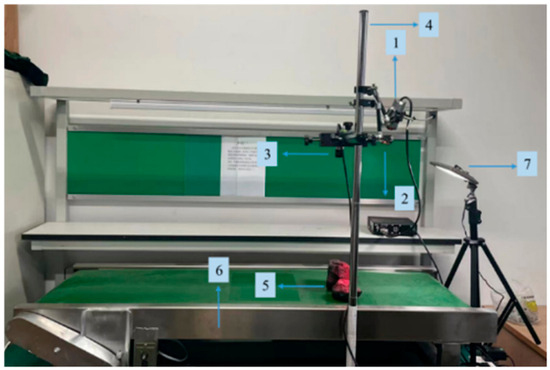
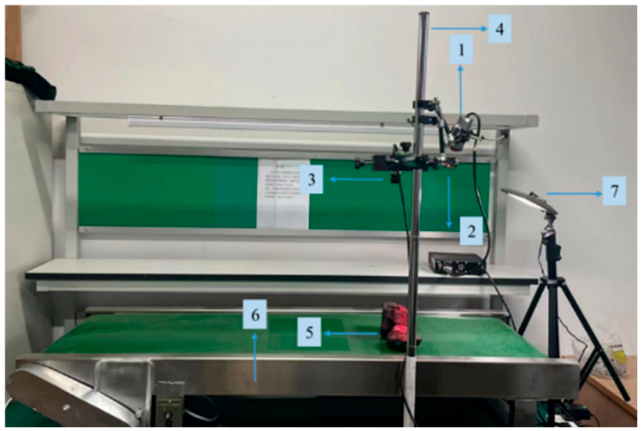
The coal–gangue laser speckle imaging system, designed in accordance with the speckle formation principle, is illustrated in Figure 7. The setup comprises a laser source, a plano-convex lens, a conveyor belt, a sample platform, an industrial camera with imaging optics, and an adjustable LED illuminator. During image acquisition, mineral samples are positioned on the conveyor belt, which serves as the imaging background. The coherent laser beam, focused by the plano-convex lens, illuminates the sample surface, and the resulting speckle patterns are recorded by the industrial camera. An adjustable LED source is used to control ambient illumination, ensuring stable imaging conditions.
Figure 7.
Laser speckle imaging system for coal and gangue. 1—semiconductor laser; 2—convex lens; 3—industrial camera; 4—carrier platform; 5—samples platform; 6—conveyor belt; 7—adjustable LED light source.
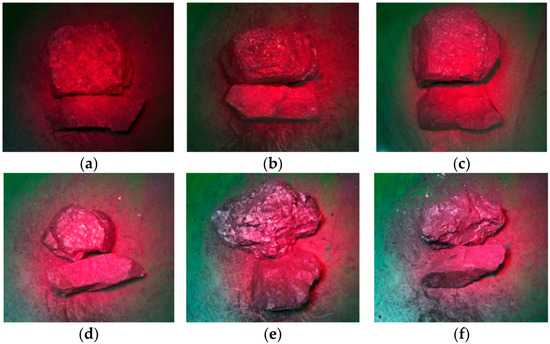
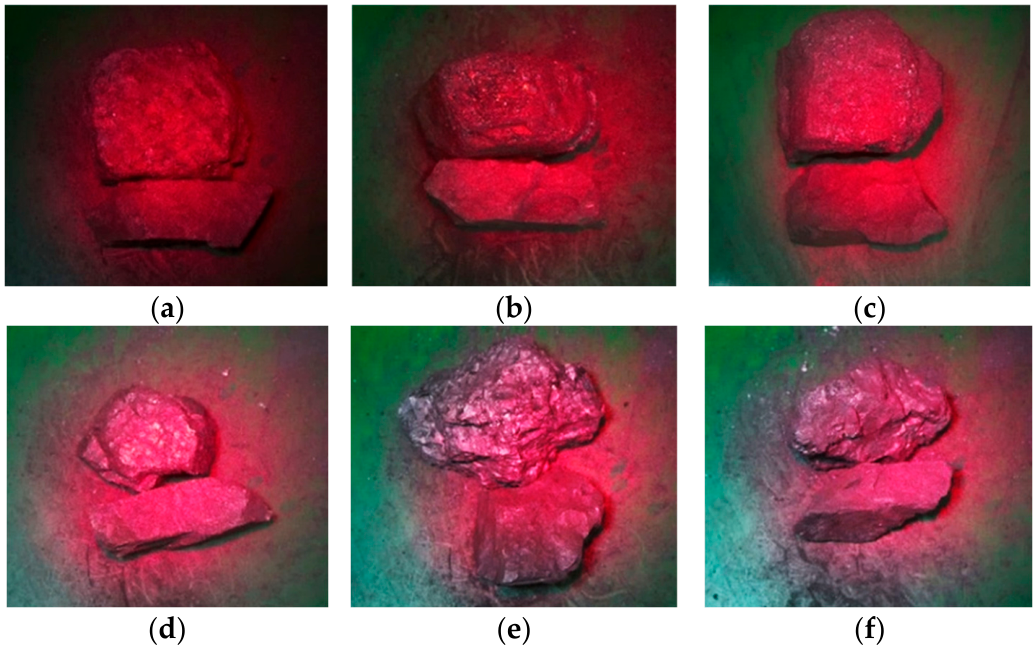
To ensure sufficient variability in the raw dataset, four spatial arrangements of mineral placement were designed: coal in the upper region with gangue in the lower region, the inverse configuration, coal in both regions, and gangue in both regions. To emulate illumination variability in practical inspection environments, images were acquired under six lighting conditions: 140, 295, 450, 610, 770, and 930 lux. A total of 2500 laser speckle images were collected for model training and evaluation, denoted as Dataset A. Representative samples are presented in Figure 8.
Figure 8.
Representative laser speckle images of coal and gangue: (a) 140 lux; (b) 295 lux; (c) 450 lux; (d) 610 lux; (e) 770 lux; (f) 930 lux.
To construct the non-generative comparison group as a baseline, we applied conventional data augmentation operations to the original 2500 images. Following common practices in object detection, we employed CutMix [41] and Mosaic strategies with a stochastic application probability of 0.2. In addition, we performed standard geometric and photometric transformations, including random rotation within [0°, 180°] and random adjustments of brightness and contrast (gamma correction factor γ ∈ [0.5, 1.5]). Adaptive histogram equalization (CLAHE) was also applied to simulate illumination variations. All transformed images were resized to maintain the original 512 × 512 resolution. This process produced a total of 8000 conventionally augmented samples (4000 per class), denoted as Dataset A1.
4.2. Experimental Configuration
The model was trained on a workstation equipped with two NVIDIA GeForce RTX 4090 GPUs (24 GB memory, NVIDIA Corporation, Santa Clara, CA, USA) running the Windows 10 operating system. All network implementations were developed using the PyTorch 2.7 framework. The detailed training hyperparameters are summarized in Table 4.
Table 4.
Training Parameter Settings.
Through empirical evaluation during model training, the gradient penalty coefficient λ was set to 15, which provided a better balance between gradient regularization and Wasserstein distance optimization, resulting in stable convergence and visually realistic mineral image generation.
4.3. Evaluation Metrics
To evaluate the quality and diversity of the generated images, the Fréchet Inception Distance Score (FID) was employed as the assessment metric. FID quantifies the similarity between synthetic and real images by encoding their feature representations using a pretrained Inception network and computing the Fréchet distance between the corresponding feature distributions. A lower FID score indicates that the generated images exhibit higher fidelity and diversity, with a smaller discrepancy from the real data. The FID is computed as follows:
where r denotes the real images; g denotes the generated images; μr and μg represent the mean feature vectors of the real and generated images, respectively; Σr and Σg are the corresponding feature covariance matrices; and tr denotes the trace of the covariance matrix of the feature vectors of the real images.
To evaluate the effectiveness of the augmentation strategy in improving object-detection performance, three key metrics are employed: Precision (P), Recall (R), and mean Average Precision (mAP). Their definitions are given as follows:
where TP denotes the number of correctly detected positive samples, FP denotes the number of incorrectly detected positive samples, FN denotes the number of positive samples that are incorrectly classified as negative, AP (Average Precision) is the area under the precision–recall curve, P(R) denotes the precision as a function of recall, K is the total number of classes, and is the Average Precision for the i-th class.
Precision quantifies the proportion of correctly identified positive samples, whereas Recall measures the model’s ability to retrieve all relevant instances. These metrics provide complementary perspectives on detection performance and are typically subject to a trade-off. To obtain a more comprehensive evaluation, mean Average Precision is adopted as a unified metric that balances Precision and Recall across classes. A higher mAP indicates more consistent and reliable detection performance without sacrificing either metric.
5. Experimental Results and Discussion
5.1. Performance Improvement of the Proposed Model in Mineral Laser Speckle Imaging
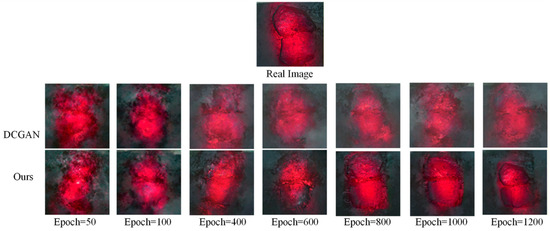
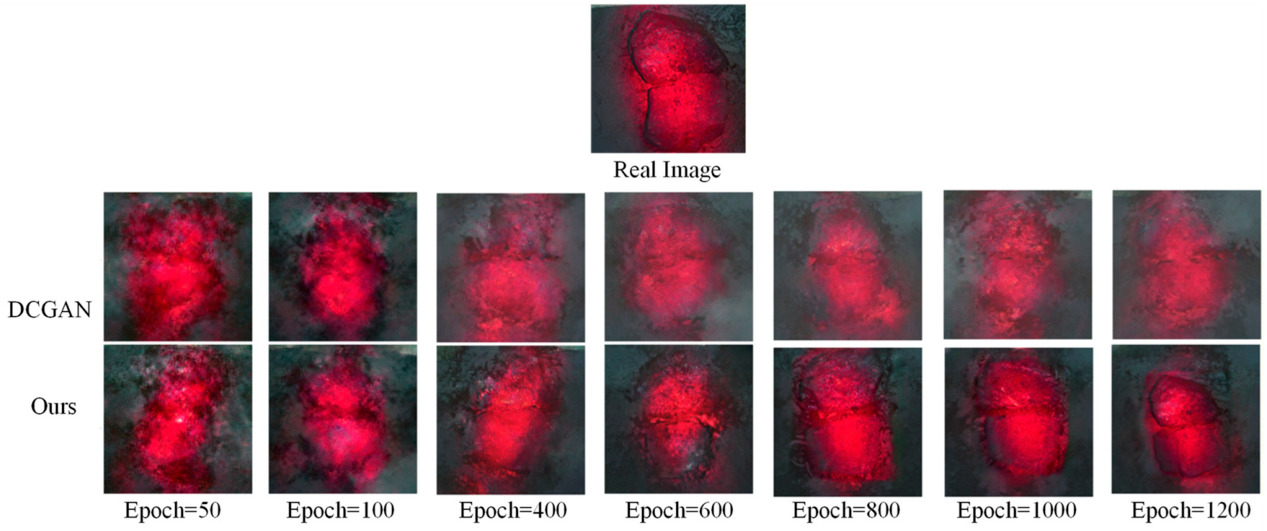
To evaluate generation quality, representative samples corresponding to the spatial configuration of coal in the upper region and gangue in the lower region were selected for comparison. Images synthesized by the original and improved DCGAN were randomly sampled at 50, 100, 400, 600, 800, 1000, and 1200 training epochs, as shown in Figure 9.
Figure 9.
Comparison of generated images at different training epochs before and after model improvement.
In the real samples, the speckle patterns of coal exhibit sharper edges, higher speckle contrast, and a more spatially discrete pixel distribution compared with gangue. Owing to the relatively simple chromatic characteristics of the laser speckle images, both models are able to reproduce the overall color distribution of the real images at early training stages (approximately 50 epochs). However, the generated image boundaries remain severely blurred, and the images produced by the improved DCGAN at this stage contain noticeable noise artifacts.
As training progresses, the sharpness of the generated images improves for both models, but the improved DCGAN demonstrates markedly faster structural convergence. By approximately 600 epochs, clear coal–gangue contours emerge, and the internal speckle structures become increasingly distinct. After 800 epochs, the coal laser speckle images exhibit pronounced bright spots, and the brightness disparity between the speckle patterns of the two minerals are consistently reproduced. In contrast, the original DCGAN continues to generate blurred speckle structures, while chromatic information gradually deteriorates during later training stages. This degradation is likely attributable to gradient vanishing or exploding behavior in the generator during optimization. In contrast, the improved model generates images that more closely adhere to the visual characteristics of the real images, yielding richer chromatic responses, sharper speckle boundaries, and more stable speckle patterns. These observations demonstrate that the improved model is more effective than the original DCGAN in learning the structural details and visual signatures of the mineral laser-speckle images.
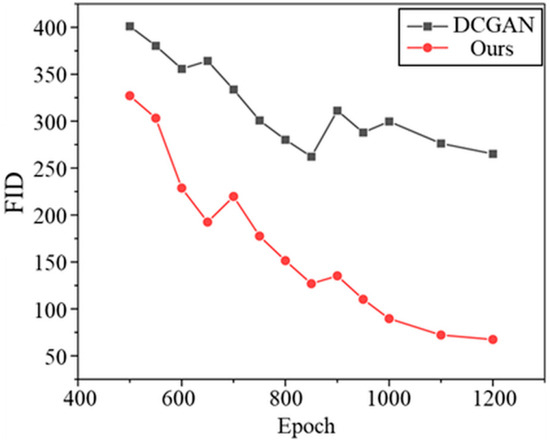
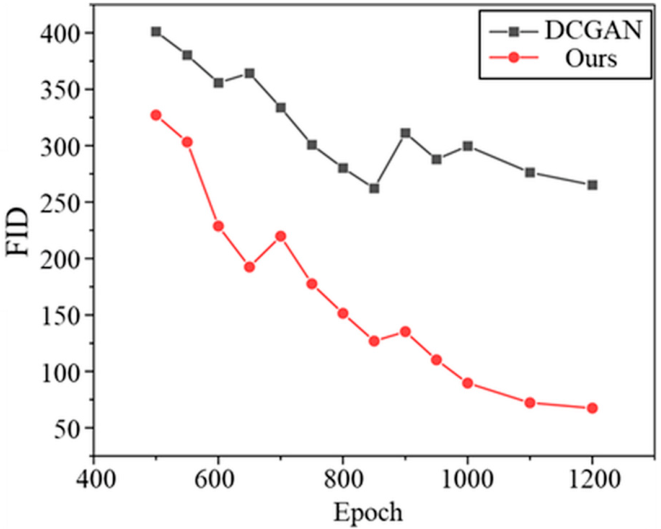
To quantitatively evaluate generative performance and training stability, the FID evolution curves of the original and improved DCGAN models are compared in Figure 10. The original DCGAN exhibits limited improvement during early training (400–600 epochs), with FID decreasing only marginally from ~400 to ~350. After ~800 epochs, the curve shows pronounced oscillations and a slight upward trend, indicating unstable optimization and potential mode collapse or overfitting. In contrast, the improved model demonstrates faster convergence and markedly enhanced stability. Starting from a lower initial FID (~330 at 450 epochs), it achieves a rapid reduction after ~600 epochs, followed by a smooth and near-monotonic decline with minimal variance. The FID converges to approximately 70 at 1200 epochs, substantially outperforming the original DCGAN (~265).
Figure 10.
Evolution of FID scores with training epochs: original vs. improved DCGAN.
To balance training efficiency and convergence behavior, generative performance was evaluated at 1100 epochs. For each model, 1000 generated mineral laser speckle images were randomly sampled, and the FID was computed over five runs, with the mean reported. The improved model achieved a mean FID of 76.32, significantly outperforming the baseline (280.11). This substantial improvement indicates more accurate distribution modeling and higher-quality, more diverse generated samples, demonstrating the effectiveness of the proposed enhancements.
These results confirm that the proposed modifications effectively stabilize adversarial training and improve distribution alignment between generated and real data, enabling more robust feature learning and higher-fidelity synthesis of complex laser speckle patterns.
5.2. Performance Validation of the Proposed Data Augmentation Method for Optimizing Coal and Gangue Recognition Models
(1) Comparison with traditional non-generative data augmentation methods
The proposed laser speckle image augmentation strategy aims to improve mineral classification performance within an object detection framework. To objectively evaluate its effectiveness, comparative experiments were conducted by training YOLOv5 on datasets generated using conventional augmentation methods and the improved DCGAN, respectively. Conventional augmentation dataset A1 is described in Section 4.1 The improved DCGAN generated 4000 mineral laser speckle images per class to construct augmented dataset A2. The detailed dataset composition is summarized in Table 5.
Table 5.
Augmented Dataset Preparation.
Progressively increasing numbers of samples randomly drawn from A1 and A2 were incorporated into the original dataset A to construct a series of enhanced datasets. These datasets were used to train YOLOv5-based mineral laser speckle image detection models [6], enabling a systematic comparative assessment of mineral recognition performance. Each dataset was divided into training, validation, and test subsets at a ratio of 80%, 10%, and 10%, respectively.
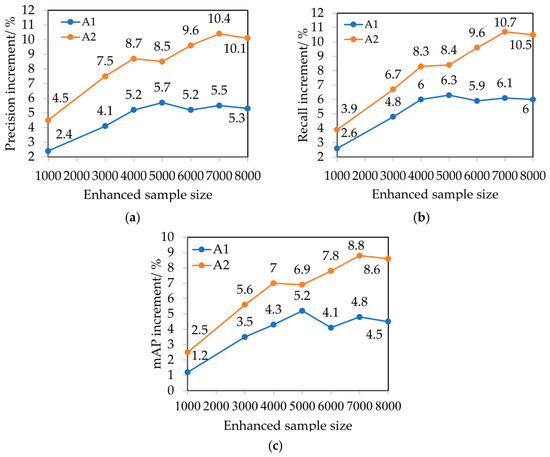
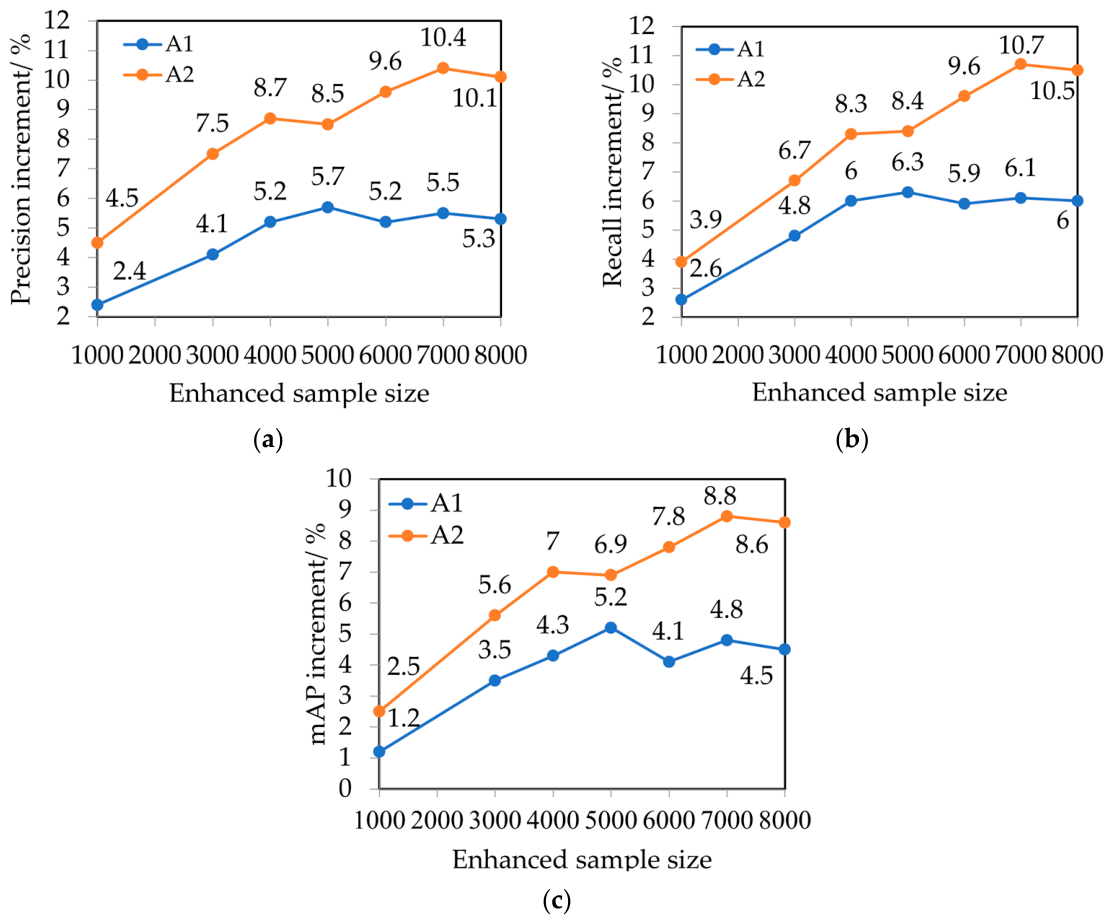
In Table 6, the precision, recall, and mean Average Precision achieved by models trained on datasets with varying numbers of augmented samples are compared. The results demonstrate that both data augmentation strategies lead to substantial improvements in detection performance. With increasing numbers of augmented samples, the coal–gangue detection model trained on conventionally augmented sample exhibits a relatively gradual performance gain, reaching saturation at 5000 samples. Compared with the baseline model trained on the original dataset, precision increases from 88% to 93.7%, recall from 87.9% to 94.2%, and mAP from 90.5% to 95.7%. In contrast, the model trained on improved DCGAN-generated images demonstrates a more rapid improvement. When the number of augmented samples reaches 7000, the detection performance stabilizes, indicating convergence with respect to augmentation scale. At its optimal level, the proposed DCGAN-based augmentation improves precision, recall, and mAP by 4.7%, 4.4%, and 3.6%, respectively, compared with the conventional augmentation.
Table 6.
Comparison of detection results of detection models on different augmented datasets.
Figure 11 compares the increments in precision, recall, and mAP. Compared with the improved DCGAN-based augmentation methods, the recognition model trained on conventionally augmented samples exhibits a slower rate of improvement. Notably, when the number of augmented samples exceeds 3000, the growth rates of all three metrics decrease markedly under the conventional augmentation strategy. This limitation arises because traditional augmentation methods mainly introduce local and relatively simple transformations of the original images, without capturing more complex global feature variations. Consequently, the augmented samples provide limited diversity, restricting the model’s ability to learn discriminative global representations. Moreover, conventional augmentation may introduce information degradation or partial loss. For instance, image rotation can produce incomplete spatial information in certain regions. When the number of augmented samples becomes excessive (e.g., 8000 samples in Figure 11), the accumulated information distortion adversely affects feature learning performance. In contrast, the improved DCGAN incorporates a self-attention mechanism, enabling the generation of samples with enhanced structural diversity. The performance improvement remains stable as the number of augmented samples increases. By sampling random vectors from the latent space, the improved DCGAN produces more diverse and realistic speckle pattern representations. This approach preserves the intrinsic laser speckle characteristics of each mineral class while introducing stochastic variations in feature distribution. Consequently, superior coal–gangue detection performance can be achieved with fewer augmented samples.
Figure 11.
Changes in (a) precision; (b) recall; (c) mAP.
(2) Comparison with generative data augmentation methods
To further validate the effectiveness of the proposed method against existing generative baselines, we conducted comparative experiments with three representative generative models: the original DCGAN, StyleGAN2-ADA [42], and SAGAN [43]. Each model was trained on the same original coal–gangue laser speckle dataset and used to generate 7000 synthetic images. These generated samples were then combined with Dataset A to construct augmented training sets. All YOLOv5 detectors were trained under identical configurations to ensure a fair comparison.
StyleGAN2-ADA was selected because its adaptive discriminator augmentation mechanism is specifically designed for small-scale datasets. SAGAN was included due to its self-attention mechanism, which enables long-range dependency modeling—a capability conceptually related to our proposed attention module. The original DCGAN serves as the baseline to quantify the improvement achieved by our architectural enhancements.
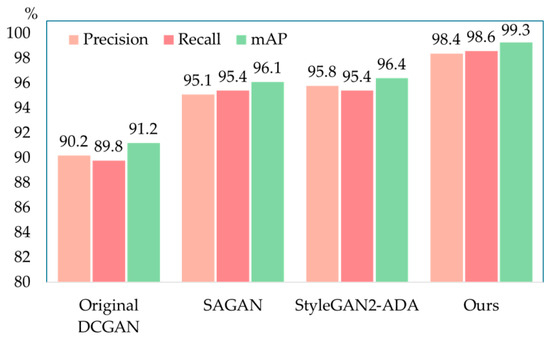
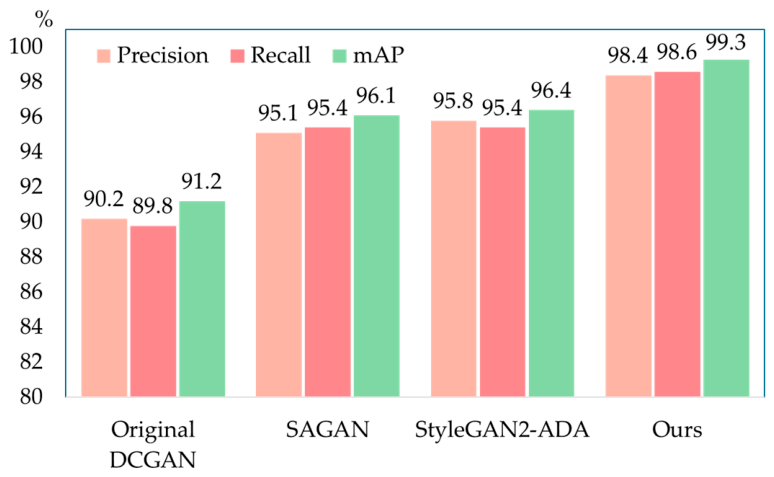
As shown in Figure 12, the proposed method consistently achieves the best performance among all competing approaches across every evaluation metric. The original DCGAN delivers the weakest detection performance because of its limited representational capacity for modeling the complex distribution of high-resolution laser speckle patterns, as discussed in Section 5.1. Although StyleGAN2-ADA and SAGAN significantly outperform the original DCGAN, achieving mAP values of 96.4% and 96.1%, respectively, both exhibit limitations in modeling the fine-scale statistical characteristics of laser speckle images.
Figure 12.
Comparison of detection performance using different GAN-based augmentation methods.
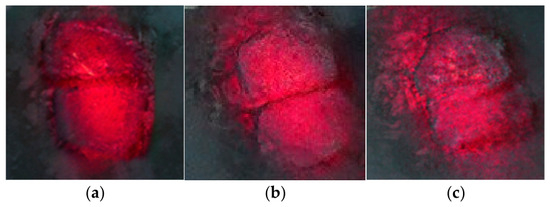
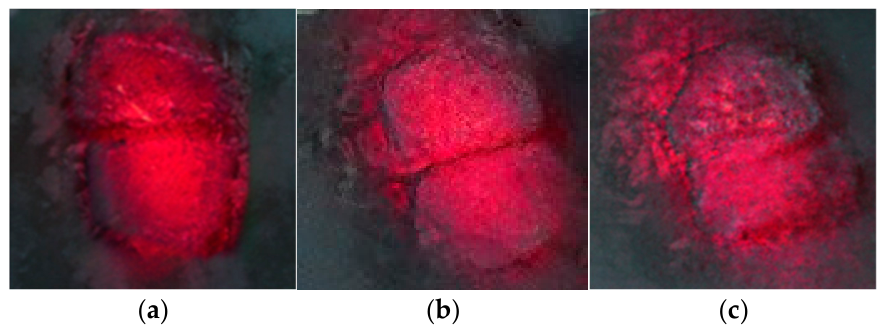
StyleGAN2-ADA combines adaptive discriminator augmentation with hierarchical style modulation to improve image synthesis quality. However, its architecture is primarily designed for natural-image generation, where large-scale semantic structures dominate the image distribution. When applied to laser speckle images containing highly stochastic, periodic, and microscopic texture patterns, this architectural bias may lead to suboptimal modeling of domain-specific texture statistics. Consequently, the generated samples exhibit noticeable ring-like artifacts unrelated to mineral characteristics (Figure 13b), which reduce the preservation of class-discriminative speckle features.
Figure 13.
Comparison of mineral laser speckle images generated by different GANs: (a) ours; (b) StyleGAN2-ADA; (c) SAGAN.
By incorporating self-attention, SAGAN enhances the modeling of long-range spatial dependencies and improves global texture consistency. Nevertheless, the attention mechanism is not explicitly designed to preserve highly localized intensity fluctuations and subtle speckle boundaries that are essential for laser speckle representation under limited training data. Consequently, some synthesized images contain artificial regional boundaries (Figure 13c), indicating compromised local structural fidelity. These synthesis artifacts reduce both sample realism and class consistency, thereby introducing noisy supervisory signals during detector training and ultimately limiting the achievable improvement in detection performance.
Taken together, these findings demonstrate that the proposed DCGAN, specifically tailored for the mineral speckle detection task, produces high-fidelity synthetic samples with superior preservation of class-discriminative speckle characteristics. Consequently, the generated samples provide more effective supervision for detector training, making the proposed approach particularly suitable for data augmentation in small-sample mineral object detection scenarios.
6. Conclusions
To address the challenge of limited coal–gangue laser speckle datasets, this study proposes an improved DCGAN-based augmentation framework for improving mineral recognition under small-sample conditions. By integrating Dense Blocks, residual learning, self-attention-based feature modeling, and WGAN-GP optimization, the proposed method enhances the network’s capability to capture both global speckle distributions and local intensity variations that are essential for mineral laser speckle representation.
Experimental results demonstrate that the proposed model achieves more stable training and superior generation performance compared with the original DCGAN, with the converged FID reduced by 72.75%. Furthermore, comparative experiments with representative generative augmentation methods, including StyleGAN2-ADA and SAGAN, verify the effectiveness of the proposed approach. Although these advanced GAN architectures improve synthetic image generation, they are not specifically designed to model the stochastic texture patterns and fine-scale structural characteristics of mineral laser speckle images. In contrast, the proposed method generates synthetic samples with discriminative speckle characteristics.
The generated images provide more effective training samples for downstream object detection. When applied to YOLOv5-based coal–gangue recognition, the proposed augmentation method achieves the best detection performance among all compared augmentation methods. Compared with traditional enhancement strategies, it improved the precision, recall, and mAP by 4.7%, 4.4%, and 3.6%, respectively. Compared with other generative enhancement strategies, it improved the precision, recall, and mAP by 2.6%, 3.2%, and 2.9%, respectively. These results demonstrate that the proposed framework is effective for enhancing mineral recognition performance under limited-data conditions.
Author Contributions
Conceptualization, H.L. and Y.L.; methodology, H.L. and J.Z.; software, Y.Z.; validation, H.L., L.L. and Z.L.; formal analysis, Y.Z.; investigation, J.Z.; resources, H.L. and Z.L.; data curation, J.Z. and Z.L.; writing—original draft preparation, H.L. and L.L.; writing—review and editing, H.L.; visualization, Z.L.; supervision, M.J.; project administration, H.L. and Y.Z.; funding acquisition, H.L. and Y.L. All authors have read and agreed to the published version of the manuscript.
Funding
This work was supported by the National Natural Science Foundation of China (No. 52575640), Shaanxi Science and Technology Plan Project (NO. 2025JC-YBQN-700), and Key Research and Development Plan Project in Shaanxi Province (No. 2023-YBGY-400).
Data Availability Statement
Data will be made available on request from the corresponding author.
Conflicts of Interest
Ling Ling is employee of Xi’an Zhongke Xiguang Aerospace Technology Group Co., Ltd. The paper reflects the views of the scientist and not the company. The remaining authors declare no conflicts of interest.
References
- 2025 Statistical Review of World Energy. Available online: www.energyinst.org/statistical-review (accessed on 27 March 2026).
- Bp Energy Outlook 2025. Available online: www.bp.com/en/global/corporate/energy-economics/energy-outlook (accessed on 5 April 2026).
- Han, L.; Ren, W.; Wang, B.; He, X.; Ma, L.; Huo, Q.; Wang, J.; Bao, W.; Chang, L. Extraction of SiO2 and Al2O3 from coal gangue activated by supercritical water. Fuel 2019, 253, 1184–1192. [Google Scholar] [CrossRef] [Scilit]
- Zheng, Q.; Zhou, Y.; Liu, X.; Liu, M.; Liao, L.; Lv, G. Environmental hazards and comprehensive utilization of solid waste coal gangue. Prog. Nat. Sci. Mater. Int. 2024, 3, 223–239. [Google Scholar] [CrossRef] [Scilit]
- Li, H.; Wang, Q.; Ling, L.; Lv, Z.; Liu, Y.; Jiao, M. Research on recognition of coal and gangue based on laser speckle images. Sensors 2023, 23, 9113. [Google Scholar] [CrossRef] [Scilit] [PubMed]
- Li, H.; Ling, L.; Zheng, Y.; Yang, H.; Liu, Y.; Jiao, M. A lightweight object detection algorithm for coal and gangue with laser speckle imaging. Opt. Lasers Eng. 2025, 184, 108630. [Google Scholar] [CrossRef] [Scilit]
- Wu, B.; Ji, X.; He, M.; Yang, M.; Zhang, Z.; Chen, Y.; Wang, Y.; Zheng, X. Mineral Identification Based on Multi-Label Image Classification. Minerals 2022, 12, 1338. [Google Scholar] [CrossRef] [Scilit]
- Hao, H.; Jiang, Z.; Ge, S.; Wang, C.; Gu, Q. Siamese Adversarial Network for image classification of heavy mineral grains. Comput. Geosci. 2022, 159, 105016. [Google Scholar] [CrossRef] [Scilit]
- Liu, X.; Aldrich, C. Multivariate image processing in minerals engineering with vision transformers. Miner. Eng. 2024, 208, 108599. [Google Scholar] [CrossRef] [Scilit]
- Back, A.L.; Bédard, L.P.; Maitre, J.; Bouchard, K. From Rocks to Pixels: A Protocol for Reproducible Mineral Imaging and its Applications in Machine Learning. Minerals 2024, 14, 51. [Google Scholar] [CrossRef] [Scilit]
- Külekçi, G.; Hacıefendioğlu, K.; Başağa, H.B. Enhancing mineral processing with deep learning: Automated quartz identification using thin section images. Int. J. Miner. Metall. Mater. 2025, 32, 802–816. [Google Scholar] [CrossRef] [Scilit]
- Sharma, H.; Das, S. A brief study of generative adversarial networks and their applications in image synthesis. Multimed. Tools Appl. 2024, 83, 21551–21581. [Google Scholar] [CrossRef] [Scilit]
- Ranazzi, P.H.; Luo, X.; Sampaio, M.A. Improving the training performance of generative adversarial networks with limited data: Application to the generation of geological models. Comput. Geosci. 2024, 193, 105747. [Google Scholar] [CrossRef] [Scilit]
- Jabbar, A.; Li, X.; Omar, B. A Survey on Generative Adversarial Networks: Variants, Applications, and Training. ACM Comput. Surv. 2022, 54, 1–49. [Google Scholar] [CrossRef] [Scilit]
- Narikawa, R.; Fukatsu, Y.; Wang, Z.; Ogawa, T.; Adachi, Y.; Tanaka, Y.; Ishikawa, S. Generative Adversarial Networks-Based Synthetic Microstructures for Data-Driven Materials Design. Adv. Theory Simul. 2022, 5, 2100470. [Google Scholar] [CrossRef] [Scilit]
- Alqarni, A.; Aljamaan, H. Leveraging Ensemble Learning with Generative Adversarial Networks for Imbalanced Software Defects Prediction. Appl. Sci. 2023, 13, 13319. [Google Scholar] [CrossRef] [Scilit]
- Allahyani, M.; Alsulami, R.; Alwafi, T.; Alafif, T.; Ammar, H.; Sabban, S.; Chen, X. DivGAN: A diversity enforcing generative adversarial network for mode collapse reduction. Artif. Intell. 2023, 317, 103863. [Google Scholar] [CrossRef] [Scilit]
- Lyu, P.; Cheng, Y.; Zhang, M.; Yu, W.; Xia, L.; Liu, C. GPSC-GAN: A Data Enhanced Model for Intelligent Fault Diagnosis. IEEE Trans. Instrum. Meas. 2024, 73, 3532116. [Google Scholar] [CrossRef] [Scilit]
- Zhao, H.; Zhang, Y.; Wu, H.; Pu, J. Study on transfer learning-based cross-spectral speckle image reconstruction method. Phys. Scr. 2024, 99, 056003. [Google Scholar] [CrossRef] [Scilit]
- Kelkar, V.A.; Gotsis, D.S.; Brooks, F.J.; Kc, P.; Myers, K.J.; Zeng, R.P.; Anastasio, M.A. Assessing the Ability of Generative Adversarial Networks to Learn Canonical Medical Image Statistics. IEEE Trans. Med. Imaging 2023, 42, 1799–1808. [Google Scholar] [CrossRef] [Scilit] [PubMed]
- Chen, M.; Ji, X.; Lin, S.; Zeng, Y.; Yu, Y. Image reconstruction of scattered vortex light field based on deep learning. Opt. Laser Technol. 2023, 163, 109347. [Google Scholar] [CrossRef] [Scilit]
- Zhang, Y.; Wu, H.; Zhao, H.; Chen, Y. Reconstructing Images Through Multimode Fibers from the Up-Conversion Speckle Patterns via Deep Learning. IEEE Access 2023, 11, 55561–55568. [Google Scholar] [CrossRef] [Scilit]
- Saha, A.; Maji, S.K. SAR despeckling model extracting dependency pattern over GAN-estimated speckle and restricted gradient-based features. IEEE Trans. Geosci. Remote Sens. 2024, 62, 5221013. [Google Scholar] [CrossRef] [Scilit]
- Khor, H.G.; Ning, G.; Zhang, X.; Liao, H. Ultrasound speckle reduction using wavelet-based generative adversarial network. IEEE J. Biomed. Health Inform. 2022, 26, 3080–3091. [Google Scholar] [CrossRef] [Scilit] [PubMed]
- Zhou, Y.; Yu, K.; Wang, M.; Ma, Y.H.; Peng, Y.Y.; Chen, Z.Y.; Zhu, W.F.; Shi, F.; Chen, X.J. Speckle noise reduction for OCT images based on image style transfer and conditional GAN. IEEE J. Biomed. Health Inform. 2022, 26, 139–150. [Google Scholar] [CrossRef] [Scilit] [PubMed]
- Goodfellow, I.J.; Pouget-Abadie, J.; Mirza, M.; Xu, B.; Warde-Farley, D.; Ozair, S.; Courville, A.; Bengio, Y. Generative Adversarial Nets. In Proceedings of the 27th International Conference on Advances in Neural Information Processing Systems, Montreal, Canada, 8–13 December 2014; MIT Press: Cambridge, MA, USA, 2014. [Google Scholar]
- Mirza, M.; Osindero, S. Conditional generative adversarial nets. arXiv 2014, arXiv:1411.1784. [Google Scholar] [CrossRef] [Scilit]
- Denton, E.L.; Chintala, S.; Szlam, A.; Fergus, R. Deep generative image models using a Laplacian pyramid of adversarial networks. In Proceedings of the 28th International Conference on Advances in Neural Information Processing Systems, Montréal, Canada, 7–12 December 2015; MIT Press: Cambridge, MA, USA, 2015. [Google Scholar]
- Radford, A.; Metz, L.; Chintala, S. Unsupervised representation learning with deep convolutional generative adversarial networks. arXiv 2015, arXiv:1511.06434. [Google Scholar] [CrossRef] [Scilit]
- Zhu, J.Y.; Park, T.; Isola, P.; Efros, A.A. Unpaired image-to-image translation using cycle-consistent adversarial networks. In Proceedings of the IEEE International Conference on Computer Vision (ICCV), Venice, Italy, 22–29 October 2017; IEEE: New York, NY, USA, 2017; pp. 2242–2251. [Google Scholar]
- Brock, A.; Donahue, J.; Simonyan, K. Large scale GAN training for high fidelity natural image synthesis. arXiv 2019, arXiv:1809.11096. [Google Scholar] [CrossRef] [Scilit]
- Leng, Z.; Sun, Y.; Tong, J.; Wang, Z. Vehicle radiation image restoration based on a generative adversarial network. J. Tsinghua Univ. (Sci. Technol.) 2022, 62, 1691–1696. [Google Scholar] [CrossRef]
- Ma, A.; Yu, N.; Zheng, Z.; Zhong, Y.; Zhang, L. A supervised progressive growing generative adversarial network for remote sensing image scene classification. IEEE Trans. Geosci. Remote Sens. 2022, 60, 5618818. [Google Scholar] [CrossRef] [Scilit]
- Kim, J.S.; Hong, J.S.; Kim, S.G.; Park, K.R. Parallel-wise global and local attention vision transformer-based generative adversarial network using fourier transform loss for generating fake iris image. Eng. Appl. Artif. Intell. 2025, 155, 111080. [Google Scholar] [CrossRef] [Scilit]
- Jia, R.; Yan, Y.; Lang, D.; He, D.; Li, K. Compression and reconstruction of flotation foam images based on generative adversarial networks. Miner. Eng. 2023, 202, 108299. [Google Scholar] [CrossRef] [Scilit]
- Zhang, K.; Yang, X.; Xu, L.; Thé, J.; Tan, Z.; Yu, H. Enhancing coal-gangue object detection using GAN-based data augmentation strategy with dual attention mechanism. Energy 2024, 287, 129654. [Google Scholar] [CrossRef] [Scilit]
- Gao, H.; Liu, Z.; Maaten, L.V.D.; Weinberger, K.Q. Densely Connected Convolutional Networks. In Proceedings of the IEEE Conference on Computer Vision and Pattern Recognition, Honolulu, HI, USA, 21–26 July 2017; IEEE: New York, NY, USA, 2017; pp. 2261–2269. [Google Scholar] [CrossRef] [Scilit]
- He, K.; Zhang, X.; Ren, S.; Sun, J. Deep residual learning for image recognition. In Proceedings of the IEEE Conference on Computer Vision and Pattern Recognition, Las Vegas, NV, USA, 27–30 June 2016; IEEE: New York, NY, USA, 2016; pp. 770–778. [Google Scholar] [CrossRef] [Scilit]
- Vaswani, A.; Shazeer, N.; Parmar, N.; Uszkoreit, J.; Jones, L.; Gomez, A.N.; Kaiser, Ł.; Polosukhin, I. Attention is all you need. arXiv 2017, arXiv:1706.03762. [Google Scholar] [CrossRef] [Scilit]
- Gulrajani, I.; Ahmed, F.; Arjovsky, M.; Dumoulin, V.; Courville, A. Improved training of Wasserstein GANs. arXiv 2017, arXiv:1704.00028. [Google Scholar] [CrossRef] [Scilit]
- Yun, S.; Han, D.; Oh, S.J.; Chun, S.; Choe, J.; Yoo, Y. Cutmix: Regularization strategy to train strong classifiers with localizable features. In Proceedings of the IEEE/CVF International Conference on Computer Vision, Seoul, Republic of Korea, 27 October–2 November 2019; IEEE: New York, NY, USA, 2019; pp. 6023–6032. [Google Scholar]
- Karras, T.; Aittala, M.; Hellsten, J.; Jaakko, S.; Timo, L.; Laine, A. Training generative adversarial networks with limited data. arXiv 2020, arXiv:2006.06676. [Google Scholar] [CrossRef] [Scilit]
- Zhang, H.; Goodfellow, I.; Metaxas, D.; Odena, A. Self-Attention Generative Adversarial Networks. arXiv 2018, arXiv:1805.08318. [Google Scholar] [CrossRef] [Scilit]

Disclaimer/Publisher’s Note: The statements, opinions and data contained in all publications are solely those of the individual author(s) and contributor(s) and not of MDPI and/or the editor(s). MDPI and/or the editor(s) disclaim responsibility for any injury to people or property resulting from any ideas, methods, instructions or products referred to in the content. |
© 2026 by the authors. Licensee MDPI, Basel, Switzerland. This article is an open access article distributed under the terms and conditions of the Creative Commons Attribution (CC BY) license.