


Abstract
The severe slagging caused by high-alkali coals restricts the utilization of Xinjiang coal resources in China. This study investigates the mineral composition, geochemical characteristics, modes of occurrence, and controlling factors of alkali and alkaline earth metals in high-alkali coals from the Dananhu Coalfield, Turpan–Hami Basin. The investigated coals are classified as lignite, characterized by low ash yield, extra low sulfur, and medium–high alkali contents. Quartz and kaolinite are dominant, with accessory calcite, K-feldspar, pyrite, gypsum, siderite, celestite, and Ba-bearing celestite. Compared to average Chinese coals, Na, Mg, Ca, and Cl are enriched, with the shallowest No. 3 coal seam showing the highest enrichment. Based on the correlation analysis, K is likely associated with K-bearing aluminosilicates (e.g., K-feldspar and illite), while Ca, Mg, and Na probably exhibit both organic and inorganic affinities. Sequential extraction results indicate that Na is predominantly water-soluble and ion-exchangeable, whereas Ca and Mg are largely ion-exchangeable and HCl-soluble. The abundant cell cavities and oxygen-containing functional groups in lignite provide both binding sites and accommodation space for Ca, Mg, and Na. Despite a continental freshwater depositional setting, tectonic isolation and persistent arid conditions potentially promoted epigenetic enrichment of Na, Mg, and Ca. Closed hydrogeological units formed by tectonic movements restricted leaching and enhanced evaporation, concentrating these elements in the coal seams. Future research should focus on implementing economically feasible dealkalization pretreatment processes for the clean utilization of high-alkali coals.
1. Introduction
Coal remains one of the most pivotal energy resources in the world, playing an important role in power generation, coal gasification, and the steel industry [1,2]. The K, Ca, Na, and Mg, known as part of alkali and alkaline earth metals (AAEMs), carried by coal are of particular interest. Their release during coal utilization frequently induces operational issues, such as boiler slagging and gasifier outlet blockage [3,4,5,6]. This consequently renders their geochemical behavior a research focus for both industrial practitioners and the academic community.
High-alkali coal is widely distributed across China, Turkey, Ukraine, Germany, Australia, and other countries worldwide, and its formation is mainly attributed to marine transgression-influenced peatlands, volcanic clastic input, or the impact of highly mineralized groundwater [7,8,9,10,11]. Coal ash from Victoria, Australia, can contain up to 20.55% Na2O and 6.95% CaO, which is related to marine transgression [7]. The Zhundong Coalfield in the Xinjiang Uygur Autonomous Region, China, stands out as a representative high-alkali coal-producing area with enormous reserves. The Na2O content in the Zhundong coal ash exceeds 2%, with some samples surpassing 10% [12,13]. For the Zhunnan Coalfield in Xinjiang, the average Na2O content in coal ash is 10.91% (max. 13.26%), whereas the average CaO content in coal ash reaches 10.91% (max. 13.28%) [14].
The modes of occurrence of AAEMs govern their migration behavior during coal combustion, pyrolysis, and gasification [12,15,16,17]. Various approaches, including statistics, density and size fractionation, selective leaching techniques, in situ microanalyses, and X-ray powder diffraction (XRD), have been employed to characterize the modes of occurrence of K, Ca, Na, and Mg in low-rank coal [10,15,16,18,19,20,21,22]. A significant proportion of Ca is found in electron microprobe studies of coal macerals of Australian low-rank coal and in Philippi peat (NE Greece) surrounded by carbonate basement, indicating that Ca has an affinity for organic matter [18,23]. Syngenetic and epigenetic mineralization in coal, particularly the formation of carbonates such as calcite, has been extensively documented by Karayiğit and co-workers in Turkish coal basins [24,25]. The Na and Ca in the coals of the Beypazari Basin, Turkey, are mainly attributed to interactions between Ca/Na-rich fluids and volcanic tuffs contained in the coals [26]. Benson classified AAEMs in coal into four types: water-soluble, NH4Ac-soluble, HCl-soluble, and insoluble residues [27]. On this basis, some researchers investigated the occurrence and removal of AAEMs in Chinese high-alkali coal. It was found that Na mainly exists as water-soluble inorganic Na and organic Na, with only a minor proportion present as insoluble phases in the Zhundong coal and its different macerals, suggesting a potential epigenetic origin [12,21,28]. Na and K in Inner Mongolia lignite coals exhibit different occurrence modes, with the former being almost entirely extracted through water, NH4Ac, and HCl, and the latter primarily existing in an insoluble form [29]. Coal washing can remove up to 80% of Na from Sha’erhu coal [30]. The Ca and Mg in Zhundong coals mainly exist as NH4Ac-soluble and HCl-soluble, with K in coal being mainly associated with insoluble residues [12]. In addition, a recent advance in cryo-scanning electron microscopy has revealed that water-soluble NaCl, normally undetectable by conventional SEM due to dehydration effects, can be induced to crystallize as halite upon freezing and thus directly imaged [31].
Previous studies have previously focused on Na in Chinese coals, with special emphasis on the Zhundong Coalfield. These studies covered topics including concentration, distribution, modes of occurrence, and enrichment mechanisms. Although several studies on coal from the Turpan–Hami Basin have focused on the Na content and cleaning characteristics of individual samples, the vertical variations, modes of occurrence in different coal seams, and geological controls of AAEMs in multiple coal seams within specific coal mines remain unexplained. It is unclear how Na, Ca, and Mg can be strongly enriched in coals formed in freshwater environments.
In this paper, we combine geochemical profiling, mineralogy, and sequential extraction to investigate the vertical distribution, modes of occurrence, and possible enrichment mechanisms of K, Ca, Na, Mg in coals from a single borehole in the Dananhu Coalfield exploration area, Xinjiang, China. Our results establish a genetic model linking AAEM enrichment to structural and climatic controls, providing a scientific basis for predicting high-alkali coal distribution and designing dealkalization strategies.
2. Geological Setting
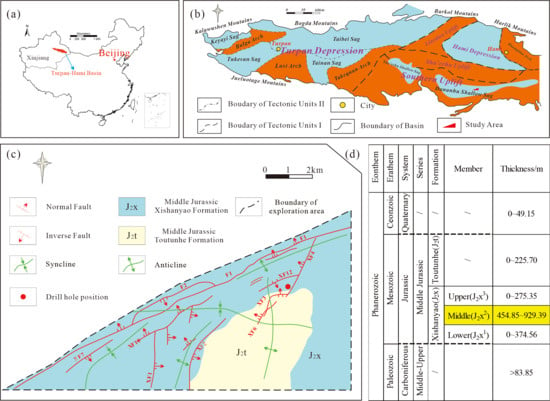
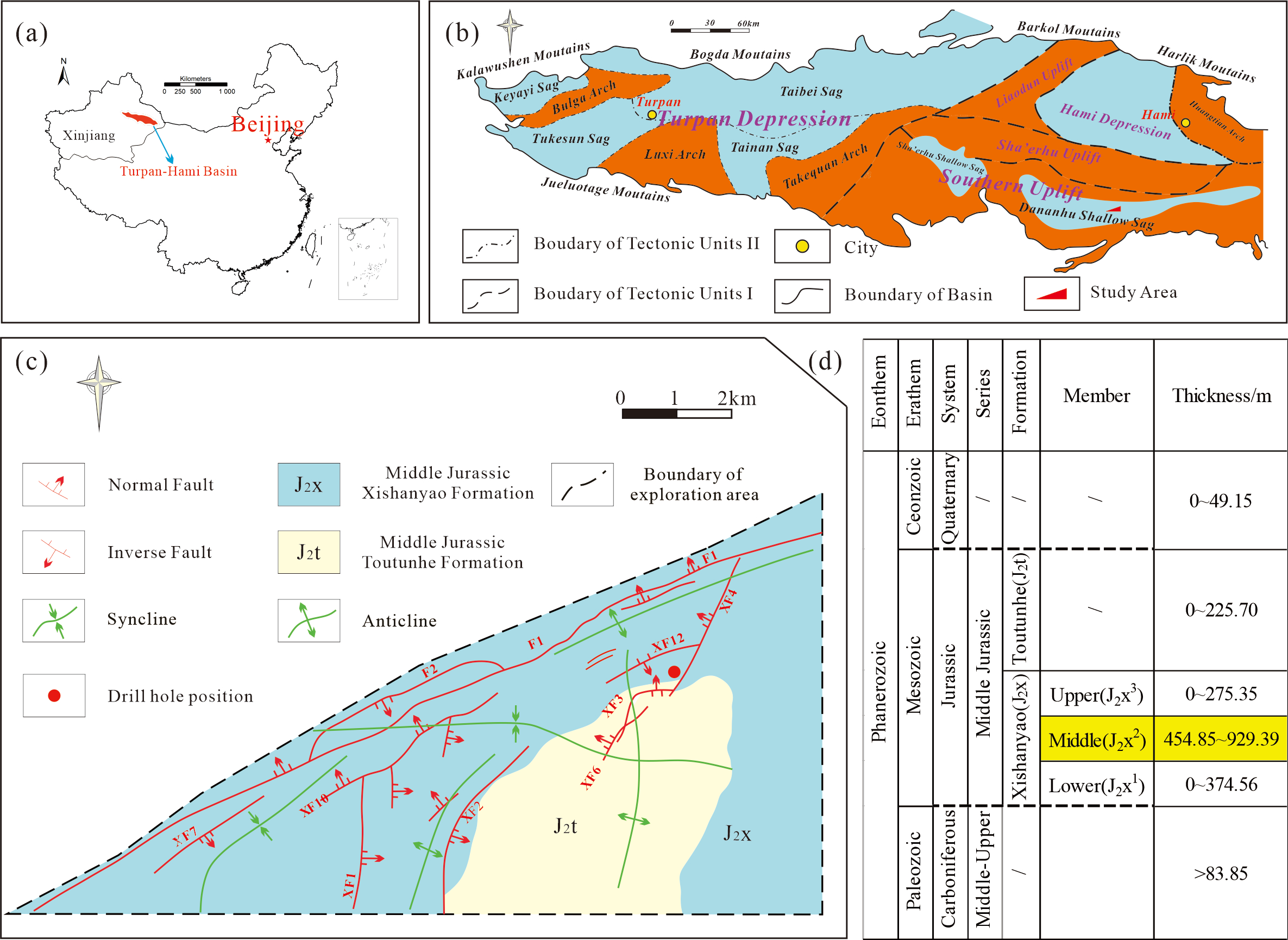
The Turpan–Hami Basin is situated in eastern Xinjiang, China, bounded by the Tarim, Siberian, and Kazakhstan plates (Figure 1a) [31,32]. The topography of the basin is characterized by elevated terrain in the north, reduced elevation in the south, elevated terrain in the east, and reduced elevation in the west. The basin is bordered to the south by the Jueluotage Mountains and to the north by the Tianshan Mountains [33,34,35]. The Turpan–Hami Basin is a syncline with thrust tectonics and can be divided into five Class I tectonic units and several Class II tectonic units. The Class I units are the Turpan Depression, the Liaodun Uplift, the Sha’erhu Uplift, the Southern Uplift, and the Hami Depression (Figure 1b) [35]. The Dananhu Shallow Sag is a secondary sag within the Southern Uplift. The study area is in the eastern part of the shallow sag, southwest of Hami City.
Figure 1.
Geological background of Turpan–Hami Basin and SF1 exploration area: (a) location of Turpan–Hami Basin, Xinjiang, China; (b) regional tectonic setting (redrawn from [32,35]); (c) structural outline map of the study area and location of borehole (internal exploration data); (d) stratigraphic sequence of the study area.
The exploration area exhibits a triangular shape. The coal seams within the area are generally steep in the northeast and southwest, and in the middle of the exploration area, there is a syncline with secondary folds. Most of the faults in the area are NE- and NNE-oriented (Figure 1c). The strata of the study area are, in the order of oldest to newest, middle-upper Carboniferous (C2-3), middle Jurassic Xishanyao Formation (J2x), middle Jurassic Toutunhe Formation (J2t), and the Quaternary strata. The middle Jurassic Xishanyao Formation was deposited directly on top of the Carboniferous strata, with the Sangonghe Formation and the Badaowan Formation lacking (Figure 1d).
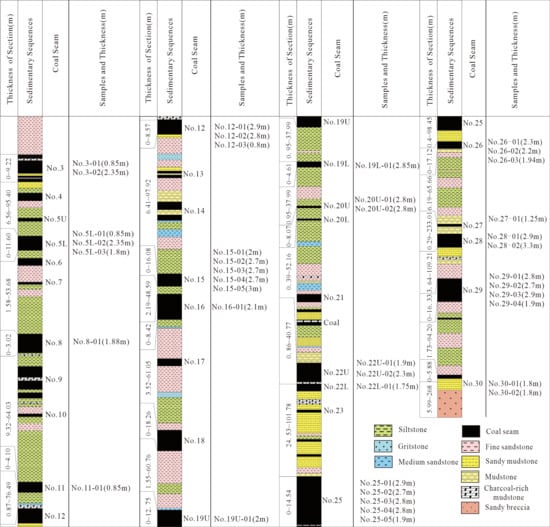
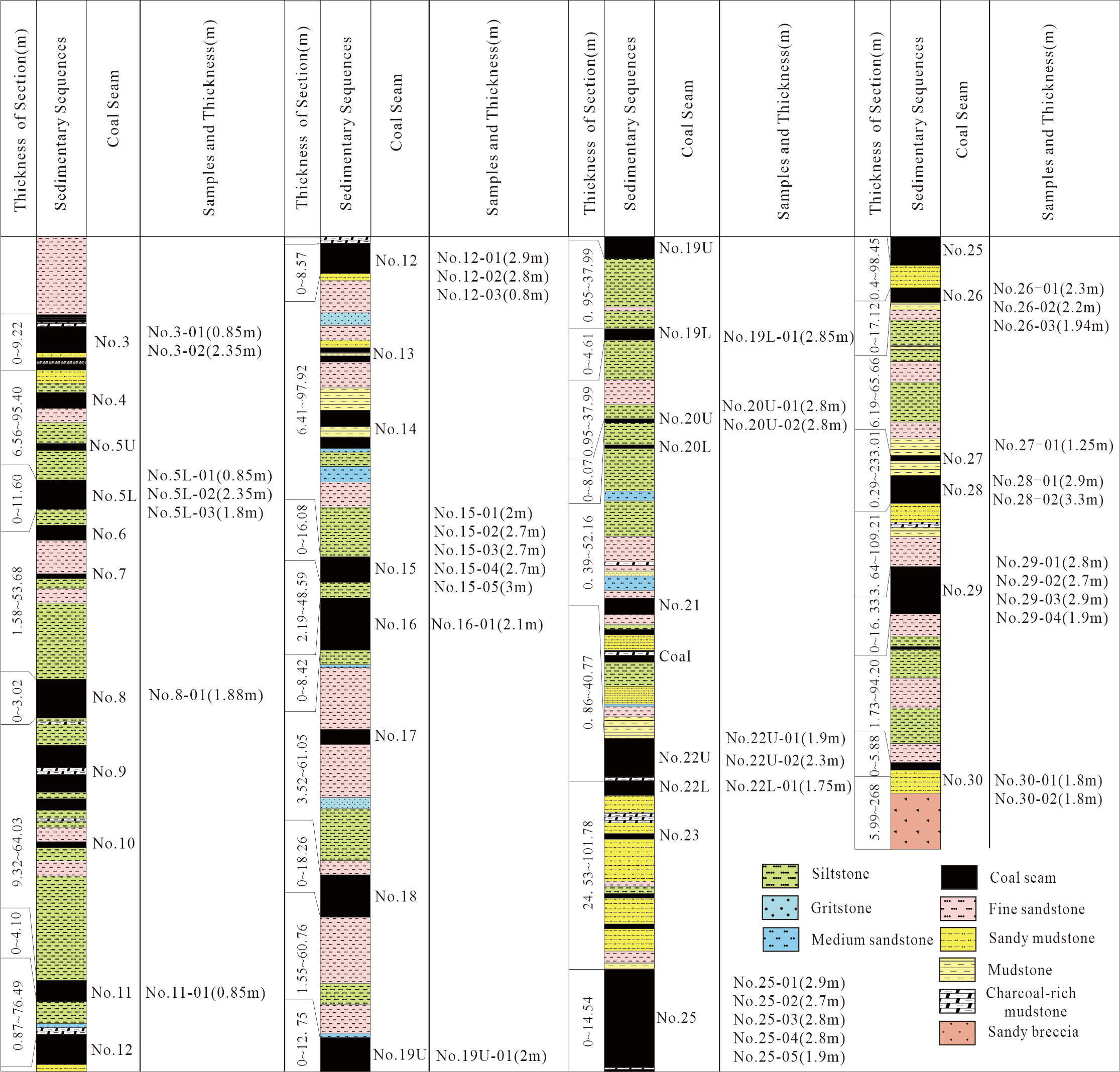
The depositional environment of the Xishanyao Formation in the Dananhu Shallow Sag was an alluvial fan–pre-fan floodplain wetland on the deltaic plain, with multiple coal seams deposited [36,37]. The lithological composition of the middle section of the Xishanyao Formation is characterized by the presence of gray, light gray, dark gray mudstone, siltstone, fine-grained sandstone, carbonaceous mudstone, and coal seams, with a lesser abundance of medium-grained sandstone and glutenite (Figure 2).
Figure 2.
Stratigraphic column of the middle section (yellow part of Figure 1d) of the Xishanyao Formation and sample information. Thickness of Section: the thickness range of this interval in the study area; Samples and Thickness: coal seams sampled and corresponding sample thickness.
The sedimentary evolution and coal accumulation within the Dananhu Shallow Sag were critically controlled by the tectonic activities of its surrounding mountain belts and internal basement uplifts. Therefore, characterizing the composition and uplift history of these tectonic units is essential for understanding the isolated burial history of the study area. The Jueluotage Mountains to the south belong to the Late Paleozoic Island arc fold belt of the Eastern Tianshan, an active continental margin of the Tarim Plate. These mountains functioned as a primary sediment source area. Extending basinward from this orogenic belt, the Liaodun Uplift and Sha’erhu Uplift are basement paleo-uplifts that acted as a key tectonic–geomorphic barrier within the southern Turpan–Hami Basin (Figure 1b). To the north, the Bogda-Harlike Mountains remained as gentle paleo-uplifts during the Early–Middle Jurassic, but experienced intensified uplift from the late Middle Jurassic through the Cretaceous. This tectonic configuration, particularly the Sha’erhu Uplift, impeded sedimentary connectivity between the Dananhu Shallow Sag and the Hami Depression, resulting in a relatively independent sedimentary and burial evolutionary history of the Dananhu Shallow Sag [37,38].
3. Materials and Methods
A series of 44 coal samples belonging to 19 coal seams were collected from a single borehole of the Dananhu Coalfield exploration area (borehole position is shown in Figure 1c). The sampling of coal seams strictly follows lithology boundary constraint and uniform thickness control principles. For thick coal seams (single coal layer thickness > 3 m), stratified sampling was carried out with a single sample thickness of 0.8–2.9 m; thin coal seams (<3 m) were sampled as a whole layer. For each lithological split interval of core, 10 cm thick core segments were separately collected from the top, middle and bottom parts of the interval. The three subsamples were fully homogenized, split down by coning and quartering, and immediately sealed in airtight bags to mitigate oxidation. Each sample label was annotated with its corresponding core interval, and the matching relationship between sample numbers and stratigraphic intervals is presented in Figure 2.
Prior to analysis, the samples were spread in a thin layer and allowed to equilibrate with laboratory atmosphere until a stable weight was attained. Subsequently, the dried samples were thoroughly ground into powder using an agate mortar and preserved for future use. The samples were screened to a size of 18–40 mesh (0.38–0.85 mm) for maceral analysis, <80 mesh (<180 μm) for proximate analysis, <200 mesh (<71 μm) for trace element analysis, and <325 mesh (<44 μm) for X-ray powder diffraction analysis.
The mean random reflectance of huminite/vitrinite (Ro,ran) was determined using a microscope equipped with a spectrophotometer according to ASTM D2798-21 [39]. Before reflectance analysis, the 18–40 mesh (0.38–0.85 mm) coal particles were embedded in a cold-mounting epoxy resin (MDS-003, Midisha, Zhongshan, China; refractive index of approximately 1.50) mixed with curing agents, and then ground and polished for subsequent analysis. The maceral of coals was observed and identified by the oil-immersed microscope according to the ICCP System-1994 (classifications of vitrinite, huminite, liptinite, and inertinite) [40,41,42,43].
The mineralogy of bulk coal samples was determined by X-ray powder diffraction (XRD). XRD analysis was performed on a D8 Advance powder diffractometer with Ni-filtered Cu-Kα radiation and a scintillation detector. The XRD pattern was recorded over a 2θ interval of 10–80°, with a step size of 0.02°. A scanning electron microscope in conjunction with an energy-dispersive X-ray spectrometer (SEM-EDS) was used to study the morphology and microstructure of minerals, and to determine the distribution of some elements in coal samples. SEM observations of coal samples were performed on a Zeiss scanning electron microscope (Carl Zeiss AG, Oberkochen, Germany) at 18 kV and a working distance of 9.6 mm.
Proximate analysis (including the moisture, ash yield, and volatile matter content) was performed following ASTM D3173/D3173M-17a, D3174-12, and D3175-18 [44,45,46], respectively. The total sulfur content (St,d) was determined according to ASTM D4239-18e1 [47]. The transmittance of coal samples was conducted following the Chinese Standard Method GB/T 2566-2010 [48]. The major element oxides (including SiO2, TiO2, Al2O3, Fe2O3, MnO2, MgO, CaO, Na2O, K2O, and P2O5) in coal ash (815 °C) were determined by X-ray fluorescence (XRF) spectrometry [49], and the loss on ignition (LOI) was also determined at this temperature.
The determination of chlorine in coal is based on ASTM D4208-19 [50]. The ion-selective electrode method was used to determine fluorine concentration in samples according to ASTM D5987-96 [51]. Boron in samples was determined by emission spectrometry with vertical electrodes on a meter plane grating spectrograph (WP-1). Inductively coupled plasma optical emission spectroscopy (ICP-OES) was used to determine trace elements (including V, Cr, Co, Ni, Cu, Zn, and Sr) in coal samples. Approximately 50 mg of each coal sample powder (<71 μm) was weighed and digested in a microwave digestion system using a HNO3-HF-H2O2 acid mixture. After complete digestion, the solution was evaporated to near-dryness on a hot plate, re-dissolved in 2% (v/v) dilute HNO3 to a final volume of 25 mL, and then analyzed by ICP-OES. The procedure follows the general principles of EPA Method 3052 (SW-846): Microwave Assisted Acid Digestion of Siliceous and Organically Based Matrices [52]. Trace element concentrations are presented as whole numbers (μg/g) in accordance with the practical quantification limits of the ICP-OES method employed.
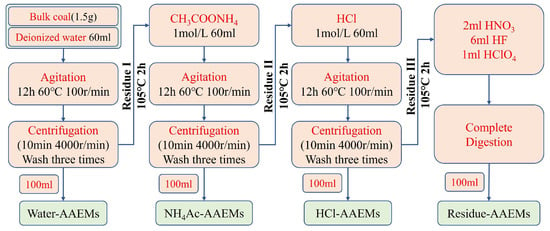
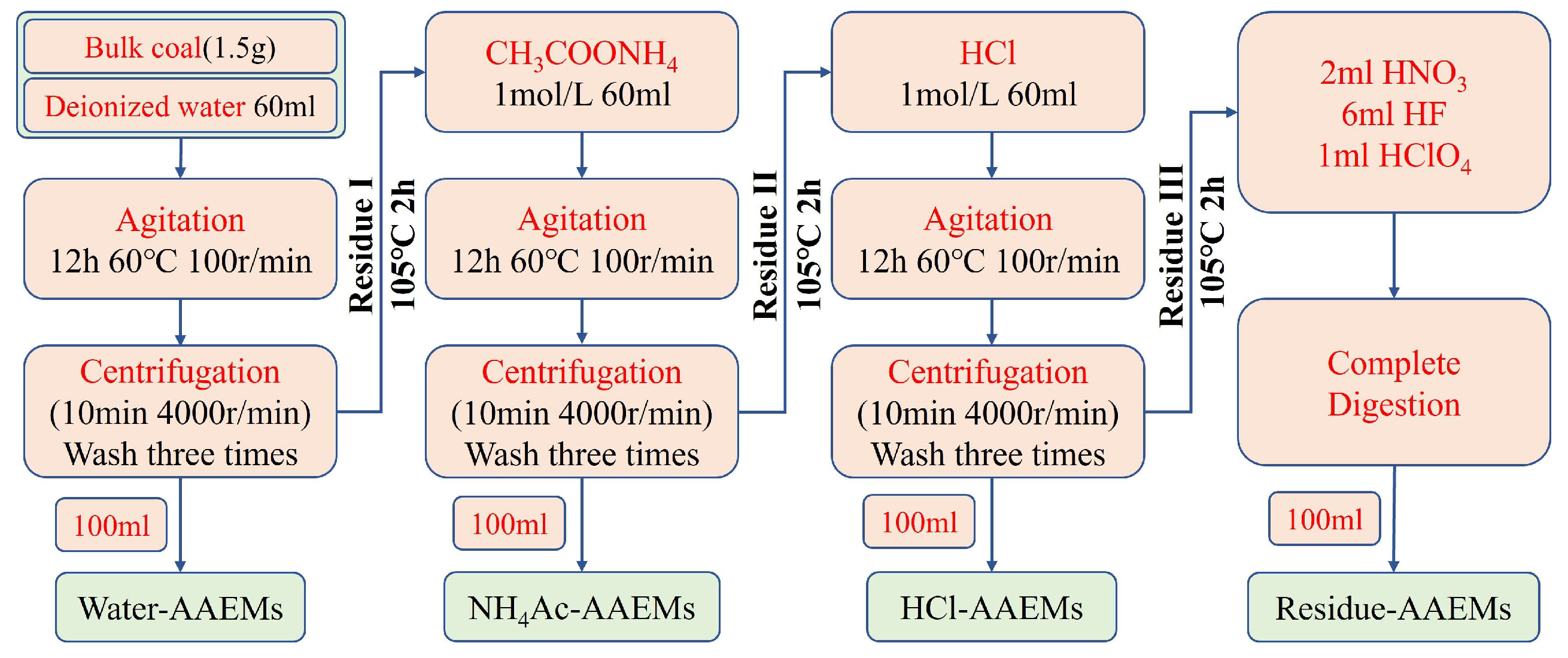
The sequential chemical extraction procedure (SCEP) was used to determine the occurrence modes of K, Ca, Na, and Mg in coal samples by analyzing their contents in different extraction liquid products. In this study, a four-step SCEP was carried out following the previously established methodologies [12,27]. The SCEP analysis was performed on four raw coal powder samples (<71 μm), designated as No. 3-01, No. 8-01, No. 16-01, and No. 25-03, which were collected from four different coal seams, respectively. The forms of AAEMs in the four SCEP products were defined as the following forms: water-soluble, NH4Ac-soluble, HCl-soluble, and insoluble. A detailed flowchart of the procedure is shown in Figure 3. The dried coal samples (1.5 g), ground to <0.18 mm, were extracted in sequence with deionized water (18.2 MΩ·cm at 25 °C, ~0.055 μS/cm), NH4Ac (1 mol/L), HCl (1 mol/L), and mixed digestion acid (HNO3: HF: HClO4 = 2:6:1). To avoid the AAEM ions contained in residues influencing the following extraction, the centrifuged products were washed with 10 mL deionized water and centrifuged three times. Then, all supernatant, including washing solution and centrifuged solution, was placed in a constant volume bottle, with deionized water added to attain a final volume of 100 mL. The residues (I, II, and III) were dried in an oven for two hours (105 °C) to avoid agglomeration that would cause problems in the following extraction. In addition, all four SCEP extracts were diluted to a final volume of 100 mL. Finally, the concentrations of ions in the four products were tested by ICP-OES.
Figure 3.
The flowchart of the four-step sequential chemical extraction procedure.
4. Results
4.1. Minerals in Coals
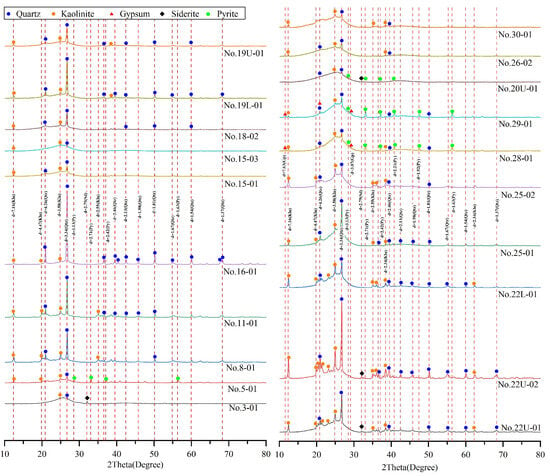
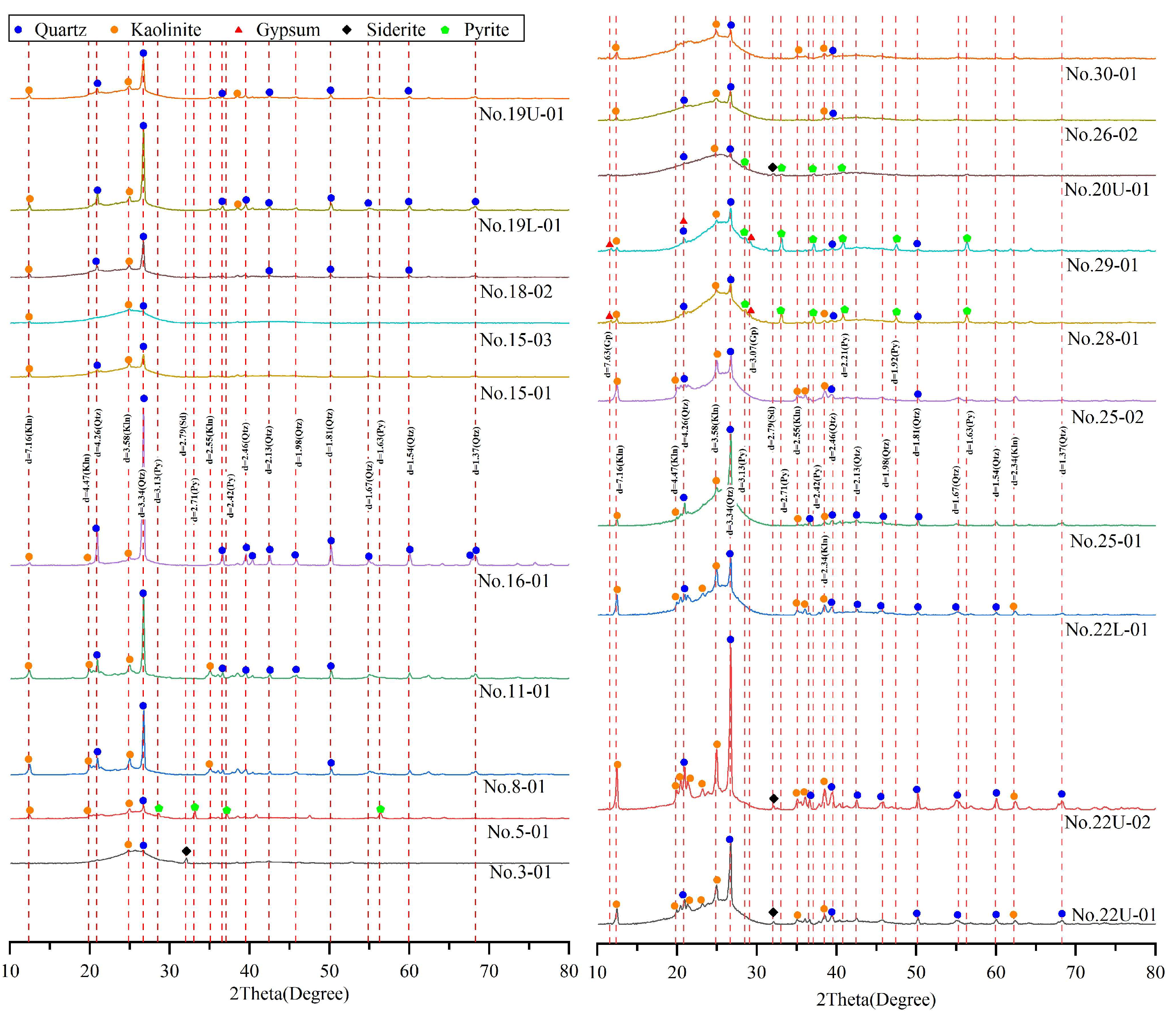
XRD and SEM-EDS analysis was performed on coal samples to characterize their mineral assemblages and crystallinity. The XRD patterns with d-values are plotted in Figure 4, and these analyzed samples cover 19 coal seams (Figure 4). The diffractograms (2θ range: 10°~80°) reveal a consistent dominant presence of quartz (Qz), whereas kaolinite (Kln) is identifiable in most samples. Accessory minerals, including pyrite (Py), gypsum (Gp), and siderite (Sd), varied across different samples. A limitation of the current XRD analysis is the starting angle of 2θ = 10°, which prevents the identification of clay minerals whose characteristic basal reflections typically occur at lower angles, including illite, montmorillonite, and illite/smectite (I/S) mixed-layer clays. Therefore, the presence of these minerals in the studied samples cannot be ruled out based on the obtained data.
Figure 4.
XRD pattern of part of coal samples with d values.
4.1.1. Clay Minerals
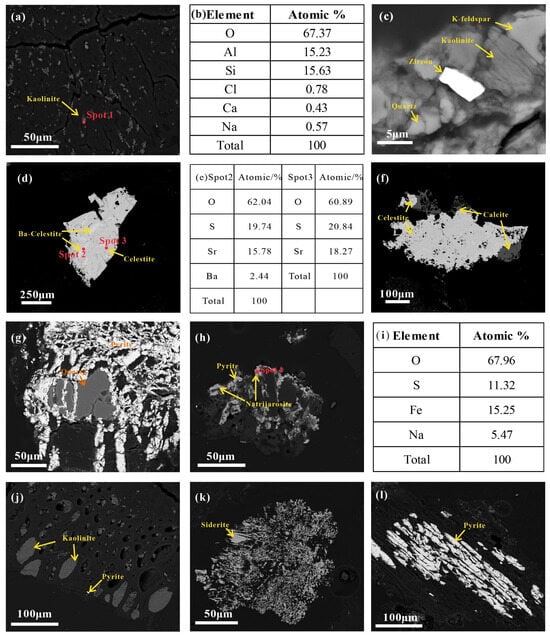
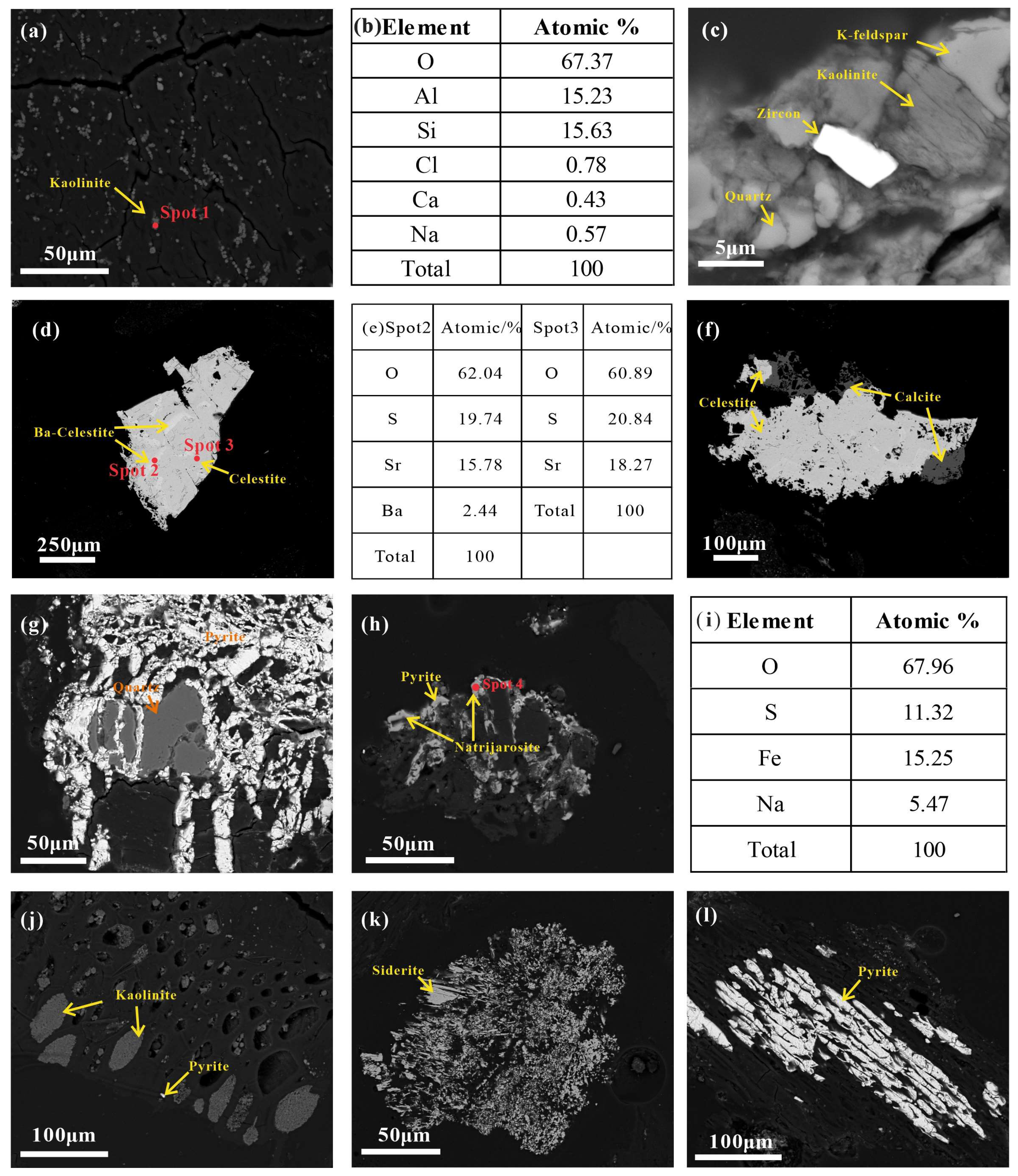
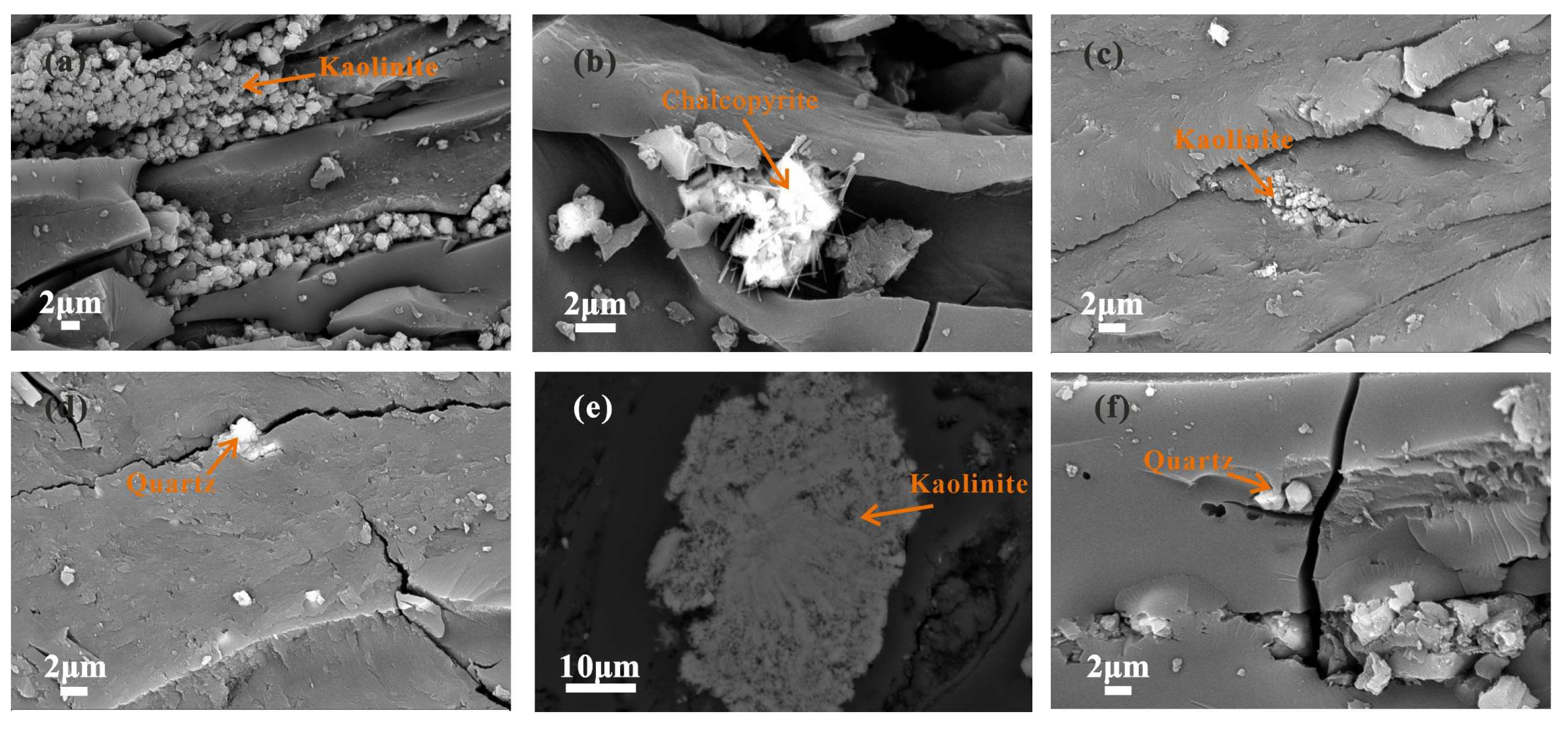
Kaolinite was present in most samples (Figure 4). Three morphological varieties of kaolinite were identified in coal via SEM-EDS. The first type occurred as aggregated particles approximately 2 μm across, which occurred as cell-filling materials (Figure 5a,j, and Figure 6a). The second exhibited a thin-layered structure, tightly intergrown with detrital minerals, such as K-feldspar, zircon, and quartz (Figure 5c). The third kaolinite occurred as radiating aggregates, filling the fracture of organic matter (Figure 6e).
Figure 5.
SEM back-scattering images of minerals in samples. (a) Fracture-filling kaolinite, No. 16-01. (b) Atomic percentage of elements at spot 1. (c) Mineral detrital cement, No. 16-01. (d) Celestite and Ba-bearing celestite (Ba-celestite), No. 16-01. (e) Atomic percentage of element at spot 2 and spot 3. (f) Fracture-filling celestite and calcite, No. 16-01. (g) Fracture-filling pyrite, No. 25-01. (h) Natrojarosite and pyrite, No. 16-01. (i) The EDS data of spot 4. (j) Cell-filling kaolinite, No. 25-02. (k) Fracture-filling siderite, No. 22L-02. (l) Cell-filling pyrite, No. 25-02.
Figure 6.
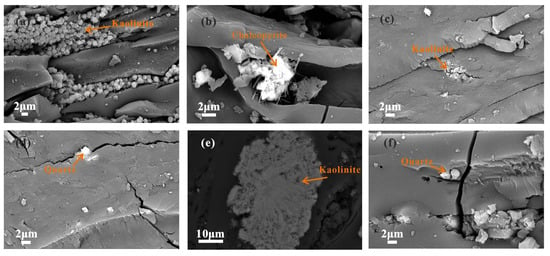
SEM back-scattering images of minerals or organic matter in samples. (a) Cell-filling kaolinite, No. 16-01. (b) Acicular chalcopyrite, No. 18-1. (c) Kaolinite in No. 3-01 coal sample. (d) Quartz embedded within coal organic matter, No. 5-02. (e) Radiating aggregates of kaolinite, No. 25-03. (f) Euhedral quartz crystal, No. 30-01.
4.1.2. Quartz
Quartz was observed in all samples and appeared as sharp, intense diffraction peaks. Samples No. 16-01, No. 25-01, and No. 22L-01 exhibited particularly strong and well-defined peaks, indicating high crystallinity (Figure 4). Quartz occurred as granular particles with moderate rounding, embedded within coal fractures or intergrown with other minerals (Figure 5c,g and Figure 6d). Authigenic quartz was observed as micrometer-scale, subhedral to euhedral crystals (≤2 µm, Figure 6f). These crystals displayed well-defined crystal faces and smooth edges, distinct from the angular morphology of detrital quartz [53].
4.1.3. Accessory Minerals
Pyrite was detected in samples No. 5-01, No. 28-01, and No. 29-01 (Figure 4). Pyrite mainly occurred as cell-filling and fracture-filling phases (Figure 5g–i). Additionally, acicular grains of chalcopyrite were identified (Figure 6b). Gypsum was identified in samples No. 29-01 and No. 28-01. Siderite was observed filling fractures in sample No. 22L-01 (Figure 5k). Calcite, celestite, Ba-celestite, and natrojarosite were also identified within the coal from No. 16-01 coal seams (Figure 5d,f,h). Celestite and Ba-celestite displayed a ~250 μm intergrown aggregate, hosted within a fracture space (Figure 5d). Both minerals exhibited euhedral to subhedral tabular or short prismatic habits, characteristic of orthorhombic sulfate minerals. Notably, celestite occupied the larger area and formed the dominant phase of the aggregate, developing as broad tabular crystals with well-defined crystal faces. Fracture-filling celestite together with calcite indicated the activity of Sr-rich fluids (Figure 5f). The co-occurrence of natrojarosite in association with pyrite suggests the impact of oxidizing events (Figure 5h).
4.2. Coal Chemistry and Maceral Composition
The results of the proximate analysis, total sulfur analysis, fixed carbon, transmittance (PM), and vitrinite random reflectance (Ro,ran) of samples are shown in Table 1. The moisture content on an air-dry basis ranges from 9.87% to 21.10%, with an average of 15.04%. The ash yield on a dry basis ranges from 5.03% to 38.78%, with an average of 14.90%. These coals are classified as low-ash coal according to Chinese Standard Method GB/T 15224.1-2018 [54]. The volatile matter yield on a dry ash-free basis ranges from 38.78% to 51.77%, with an average of 43.47%. The fixed carbon content of coals on a dry basis ranges between 29.53% and 57.71%, with an average of 48.18%. The PM is within the range of 40–74%, with an average of 54.5%. The total sulfur content on a dry basis ranges from 0.13% to 1.52%, with an average of 0.42%, belonging to ultra-low-sulfur coal according to Chinese Standard Method GB/T 15224.2-2021 [55].
Table 1.
Proximate analysis, total sulfur content, fixed carbon content, transmittance, huminite random reflectance (%), and maceral compositions of Dananhu coals (%).
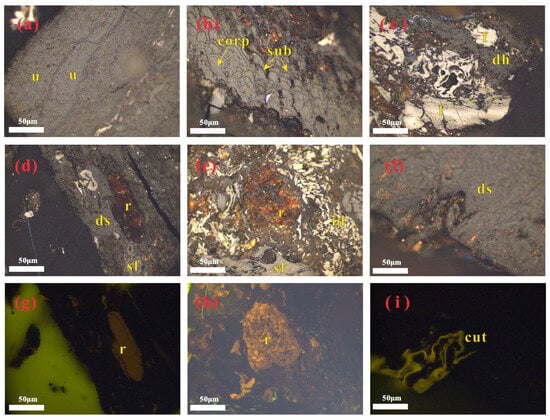
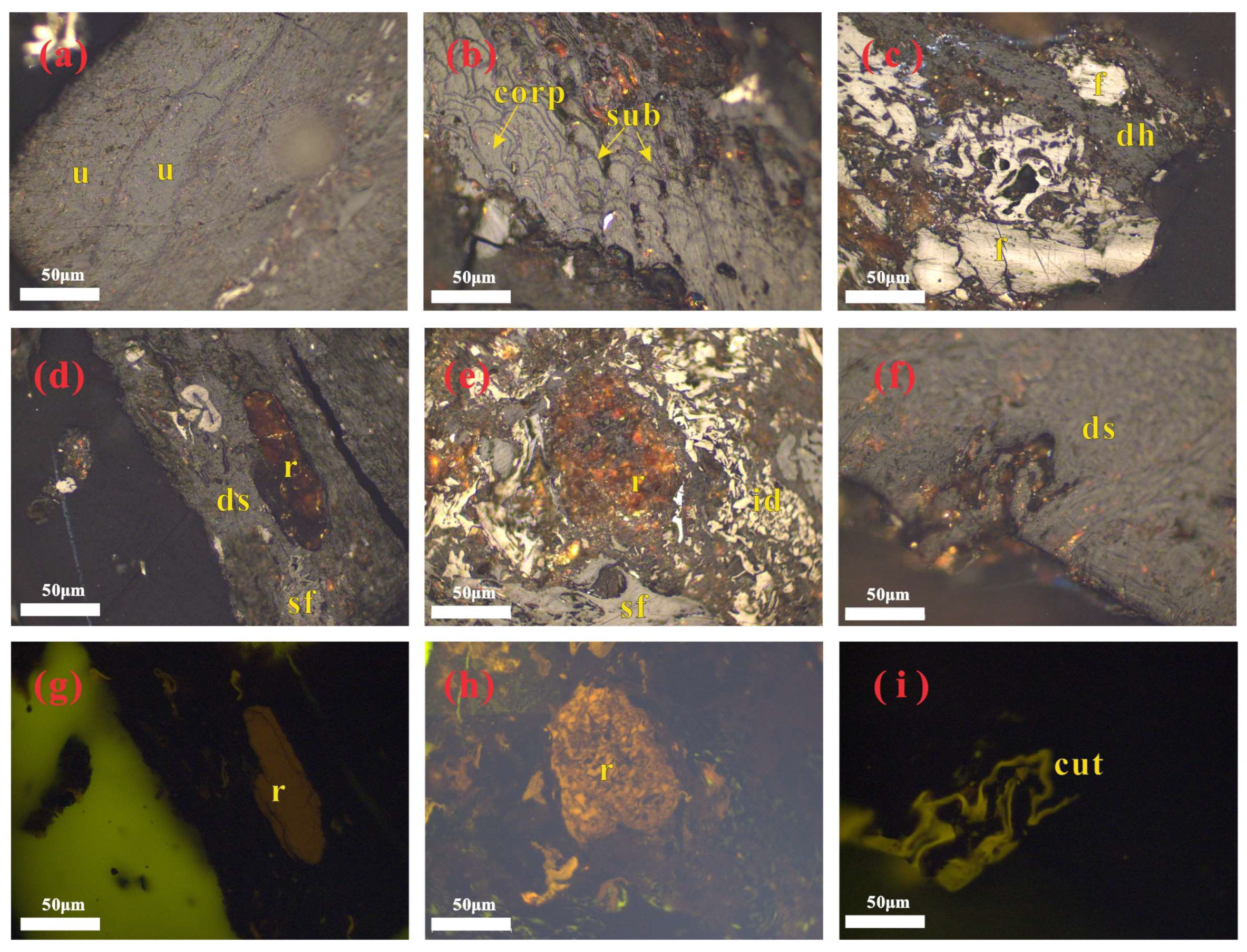
The maceral composition of the Dananhu coal is primarily composed of huminite and inertinite. The highest huminite content is found in sample No. 11-01, while the highest inertinite content is observed in sample No. 22U-01. The average huminite Ro,ran values of individual coal intervals range from 0.34% to 0.39%. All reflectance values are below 0.5%, indicating that the studied coals are low-rank coals and belong to the lignite stage according to BS ISO 11760-2018 [56]. Maceral compositions of samples are shown in Figure 7.
Figure 7.
Maceral compositions of the Dananhu coal samples under oil immersion reflected light (a–f) and reflected fluorescence (g–i). (a) Ulminite (u) in No. 3-01; (b) corpohuminite (corp) and suberinite (sub) in No. 5-02; (c) fusinite (f) and detrohuminite (dh) in No. 5-02; (d–i) densinite (ds), semifusinite (sf), resinite (r), and inertodetrinite (id) in No. 30-01. (d,g), (e,h), and (f,i) are twins.
4.3. Geochemistry
4.3.1. Major Element Oxides in Coal
The contents of major element oxides of coal samples and the corresponding average values for Chinese coals are given in Table 2 [1]. The samples exhibit highly variable LOI values (65.62–95.76%), with a weighted mean of 87.34%. The major element oxides in coal samples on a whole-coal basis are dominated by SiO2 and Al2O3, with an average content of 6.22% and 2.90%, respectively, followed by CaO and Fe2O3, with an average of 1.40% and 0.70%, respectively. For weighted average, contents of major element oxides in the samples, except for MnO2, Na2O, MgO, and CaO, were lower than the corresponding values in Chinese coal. The concentration coefficient (CC, the ratio of element content in investigated coals vs. average content for Chinese coals) was used to evaluate the enrichment of major elements [57]. The average Na2O content is slightly enriched (2 < CC < 5, CC = 4.09). The contents of SiO2, CaO, MgO, K2O, MnO2, and P2O5 are close to the average values for Chinese coals (0.5 < CC < 2). The contents of Al2O3, Fe2O3 and TiO2 are depleted (CC < 0.5).
Table 2.
Loss on ignition (LOI) and major element compositions in Dananhu coals (%, recalculated on an air-dry whole-coal basis).
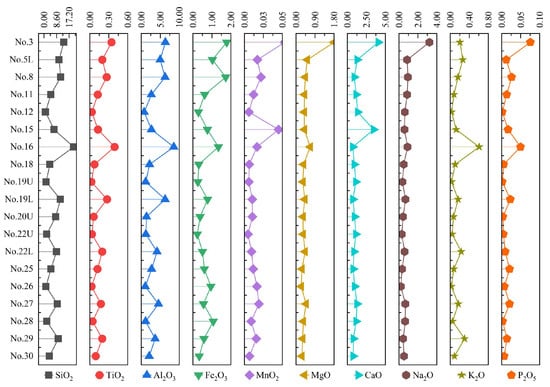
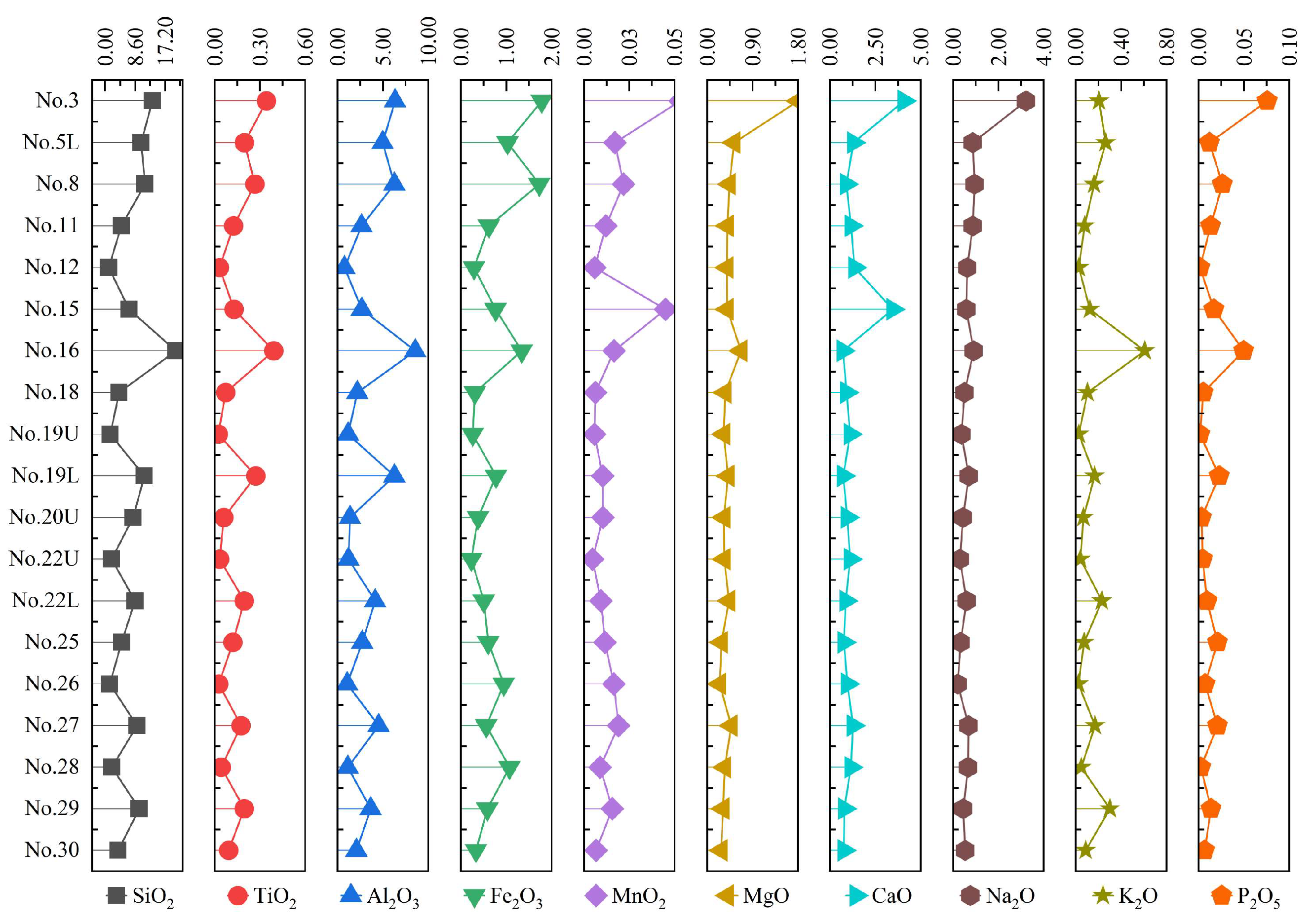
Figure 8 shows pronounced vertical differentiation in the major element oxides among the studied coal seams (based on the weighted mean of the coal seam). SiO2, Al2O3 and TiO2 generally display similar variation trends, with the most distinct enrichment occurring in the No. 16 coal seam and variable increases also observed in the No. 3, No. 8, No. 19L, No. 22L, No. 27, and No. 29 seams. The pattern indicates that these seams were strongly influenced by terrigenous detrital input. The pronounced peak of K2O in the No. 16 seam may be related to K-bearing aluminosilicate minerals. CaO, MgO, and Na2O show relatively minor variations in most seams, but are markedly elevated in the No. 3 seam, indicating the influence of carbonate minerals, Na-bearing minerals, or saline fluids. MnO2 exhibits localized enrichments in the No. 3 and No. 15 seams, which may be associated with Mn-rich carbonate minerals or diagenetic fluid activity.
Figure 8.
Vertical distribution of major element oxides in different coal seams (%, whole-coal basis, weighted mean of each coal seam).
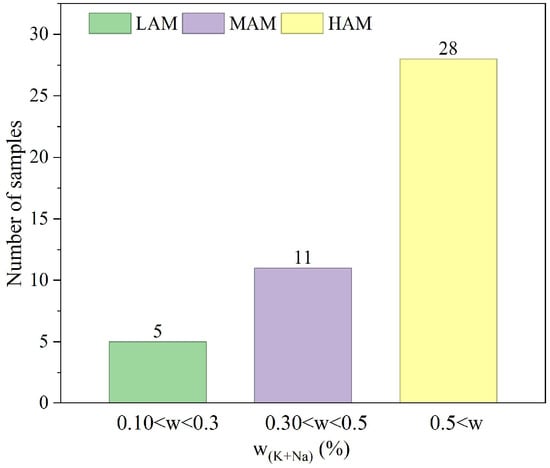
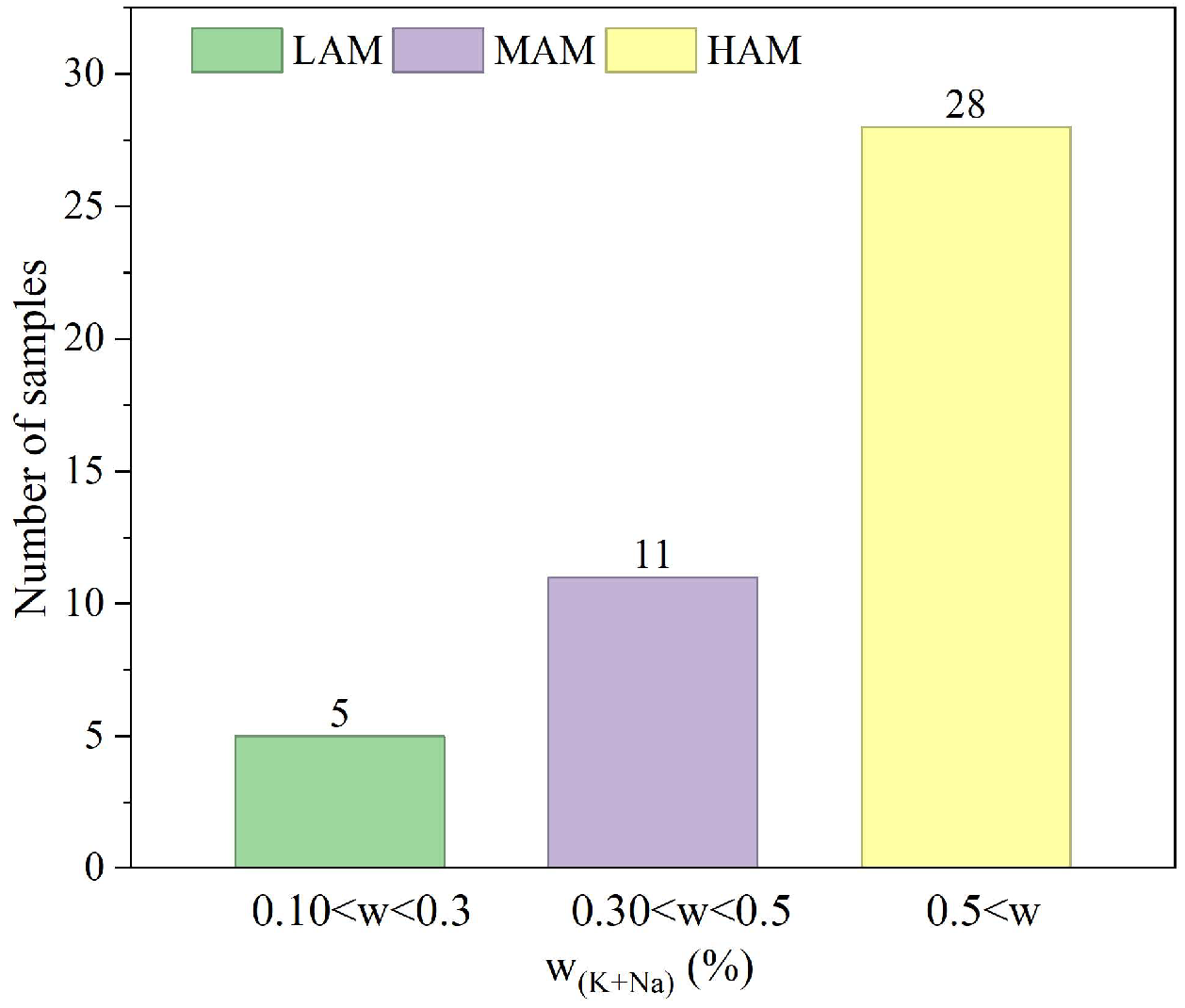
According to Chinese national standard MT/T 1074-2008 (Classification for Alkali Metal (Potassium and Sodium) Content in Coal), coal is classified by the total dry-basis mass fraction of K and Na (w(K + Na)): super low-alkali coal (SLAM) (≤0.10%), low-alkali coal (LAM) (0.10%–0.30%), medium-alkali coal (MAM) (0.30%–0.50%), and high-alkali coal (HAM) (>0.50%, requiring special treatment) [58]. In the study, the total air-dry basis mass fraction of K and Na was used to evaluate the content of alkali metal in coal samples (Figure 9). For the 44 tested coal samples, Na content ranged from 0.11% to 2.68%, K from 0.018% to 0.503%, and total w(K + Na) varied widely (0.128%–2.863%). The average w(K + Na) was 0.595%, exceeding the HAM threshold of 0.50%. Statistically, 63.6% of samples are HAM (>0.50%), 25.0% are MAM (0.30%–0.50%), 11.4% are LAM (0.10%–0.30%), and no SLAM samples exist. The coal samples are generally classified as HAM according to MT/T 1074-2008. Featuring sodium-dominated alkali enrichment and large content variation, they pose risks of slagging, fouling and high-temperature corrosion during combustion, requiring special utilization measures.
Figure 9.
Comprehensive evaluation of alkali metal content in coal samples.
4.3.2. Trace Elements in Coal
The trace element content of samples and the corresponding average trace element content in Chinese coals are shown in Table 3. Chlorine in coals is significantly enriched compared with the value for Chinese coals, with a CC value of 14.10. In contrast, the average contents of B in the coals are depleted with CC < 0.5, and the remaining trace elements are close to the Chinese coals (0.5 < CC < 2). The elements with CC greater than 2.00 include Cu (CC = 2.14) and Zn (CC = 2.12). Coal seam No. 3 is identified as the most prominent anomalous enrichment horizon in the study borehole. Specifically, Cl concentrations range from 7300 to 7440 μg/g, which are 28.6~29.2 times the average value of Chinese coal (255 μg/g). F contents vary between 165 and 538 μg/g, about 3.6~4.1 times that of Chinese coal. In addition, Cu, Zn, and Sr contents are over 5 times than that of Chinese coal. Coal seam No. 3 exhibits higher concentrations of Cl and Sr than the other coal seams. In comparison with the world coal averages compiled by Judovich and Ketris (2009) [59], the trace elements Cl, V, Cu, and Zn in the studied coal samples are enriched.
Table 3.
Average contents of Cl and trace elements (μg/g; on a whole-coal basis).
4.4. Occurrence and Extraction of AAEMs in Coal
4.4.1. Correlation and SEM-EDS Analysis
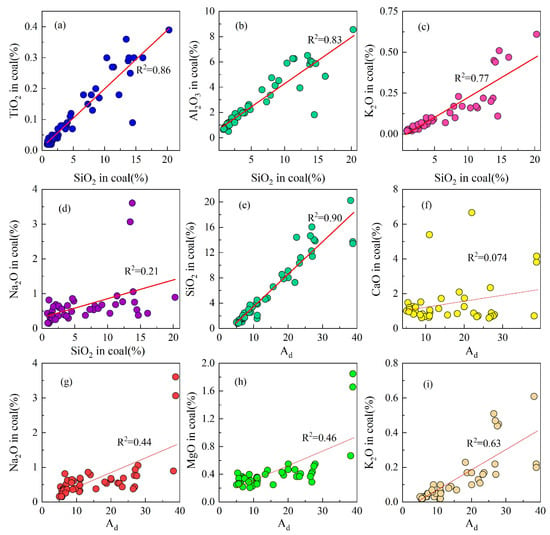
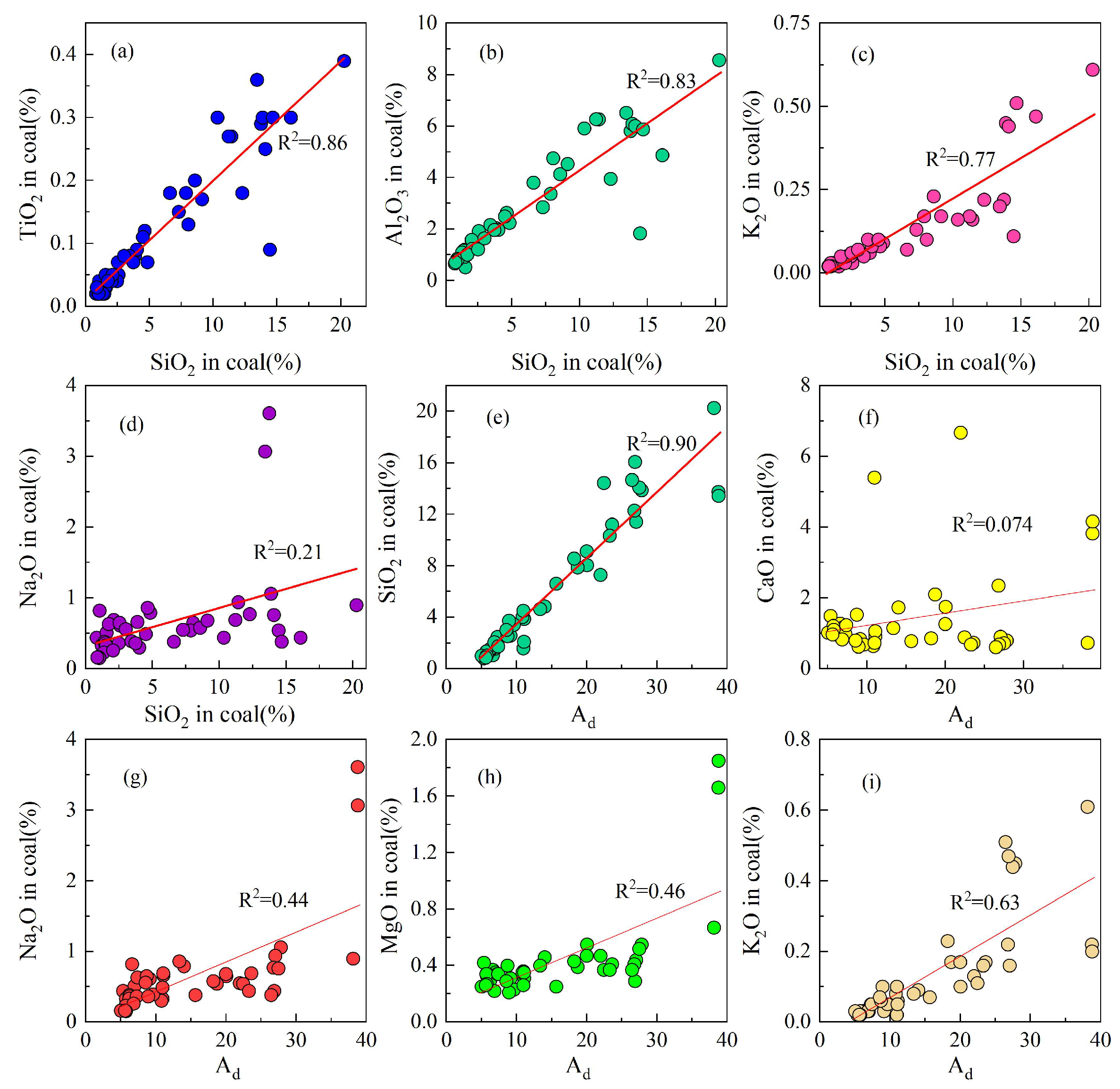
The ash yield of coal indicates its mineral matter content, and a stronger correlation between an element and ash yield reflects greater inorganic affinity. The non-mineral inorganic elements may make up an indispensable portion of the mineral matter in lignite and subbituminous coal, except for the mineral phases [19,60,61]. The relationships between SiO2, other major element oxides, and ash yield were investigated via scatter plots and linear regression analysis (Figure 10).
Figure 10.
Correlations between major element oxides in coal and ash yield. (a) TiO2-SiO2 on coal basis; (b) Al2O3-SiO2 on coal basis; (c) K2O-SiO2 on coal basisl; (d) Na2O-SiO2 on coal basis; (e) SiO2-Ad on coal basis; (f) Ca-Ad on coal basis; (g) Na2O-Ad on coal basis; (h) MgO-Ad on coal basis; (i) K2O-Ad on coal basis.
As shown in Figure 10a–c, SiO2 exhibits strong positive correlations with TiO2 (R2 = 0.86), Al2O3 (R2 = 0.83), and K2O (R2 = 0.77), indicating synchronous enrichment of these elements during deposition. In contrast, Na2O shows a very weak correlation with SiO2 (R2 = 0.21, Figure 10d), suggesting its occurrence is largely decoupled from detrital silica input. Regarding ash yield (Ad), an extremely strong positive correlation is observed between Ad and SiO2 (R2 = 0.90, Figure 10e), confirming that silicate minerals are the primary contributor to coal ash content. Moderate positive correlations are also found between Ad and Na2O (R2 = 0.44, Figure 10g), MgO (R2 = 0.46, Figure 10h), and K2O (R2 = 0.63, Figure 10i), indicating these elements are partially associated with ash-forming minerals. CaO displays no significant correlation with Ad (R2 = 0.074, Figure 10f), reflecting its independent enrichment mechanism.
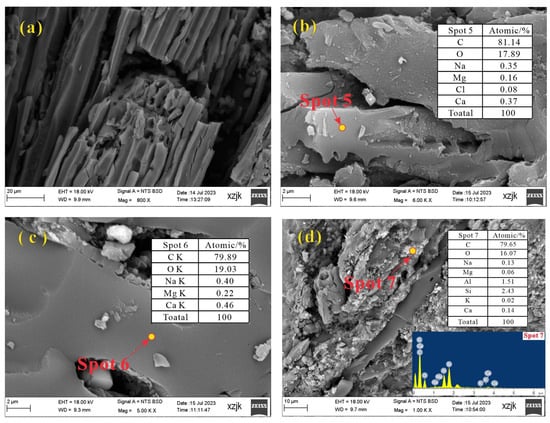
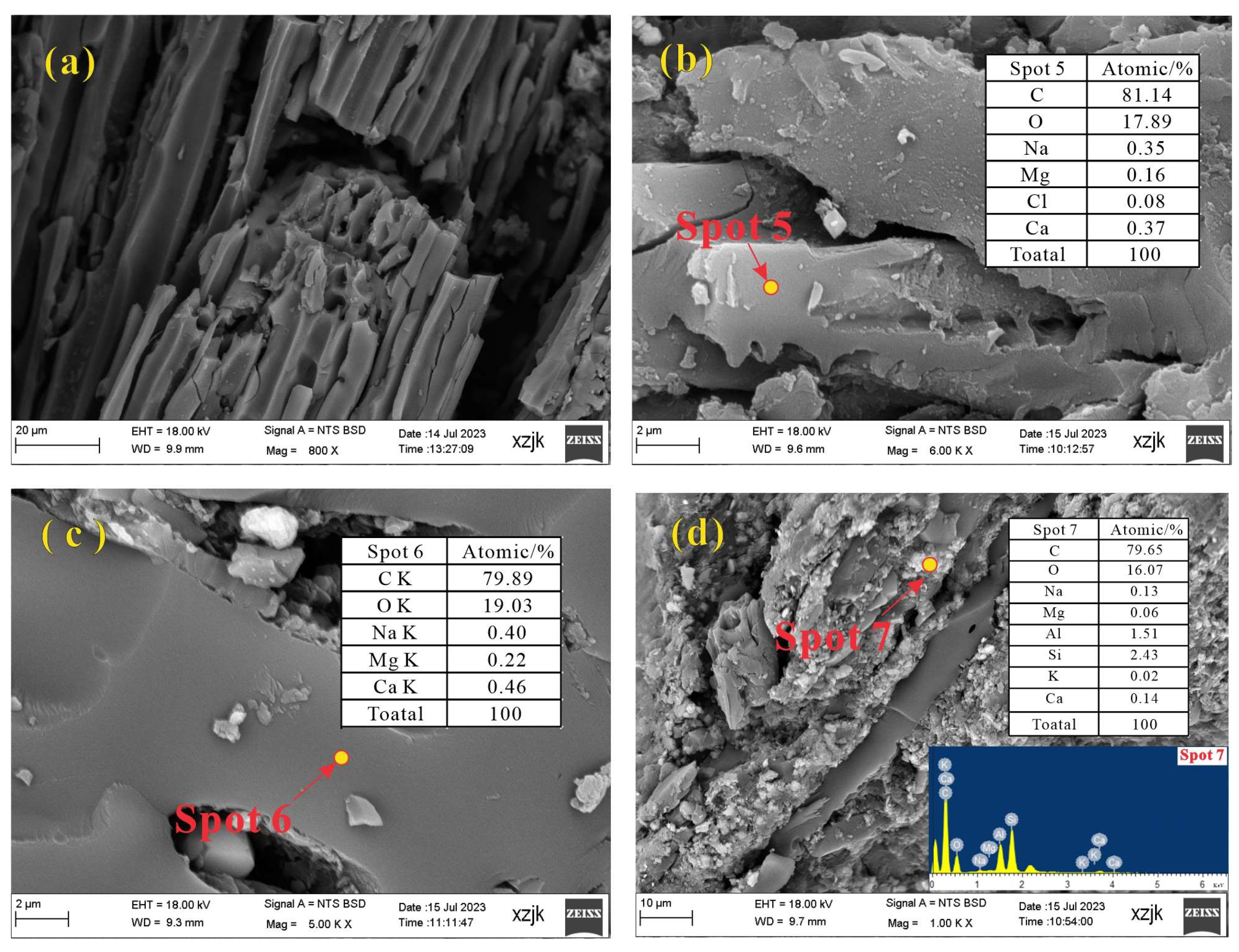
Additionally, the SEM-EDS analysis of raw coal particles is shown in Figure 11. Compared with the homogeneous coal macerals, the fusinite cell cavities provide a larger surface area, which implies greater mineral accommodation space and contact area (Figure 11a). Among the organic components of coal, Na, Mg, and Ca were detected, along with a small amount of Cl, suggesting that these elements may be organically bound or associated with finely dispersed inorganic phases within the coal matrix (Figure 11a,b). In contrast, in the mineral mixture filling the cell cavities (identified as a mixture of clay minerals and quartz based on atomic ratio analysis), 0.02% K was detected, and Na, Mg, and Ca were also found (Figure 11d).
Figure 11.
SEM-EDS analysis of bulk coal (local region of raw coal). (a) the cell cavities of fusinite for raw coal; (b,c) element components of organic matter based on SEM-EDS; (d) element components of minerals based on SEM-EDS.
4.4.2. Sequential Chemical Extraction Procedure
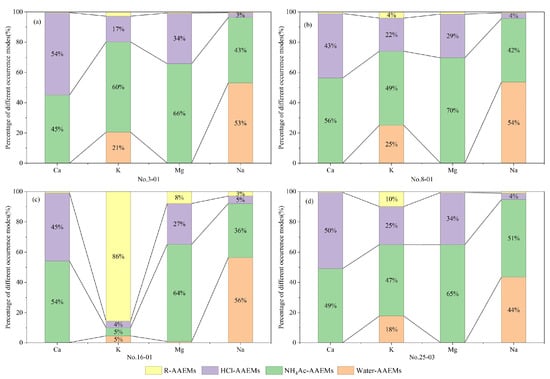
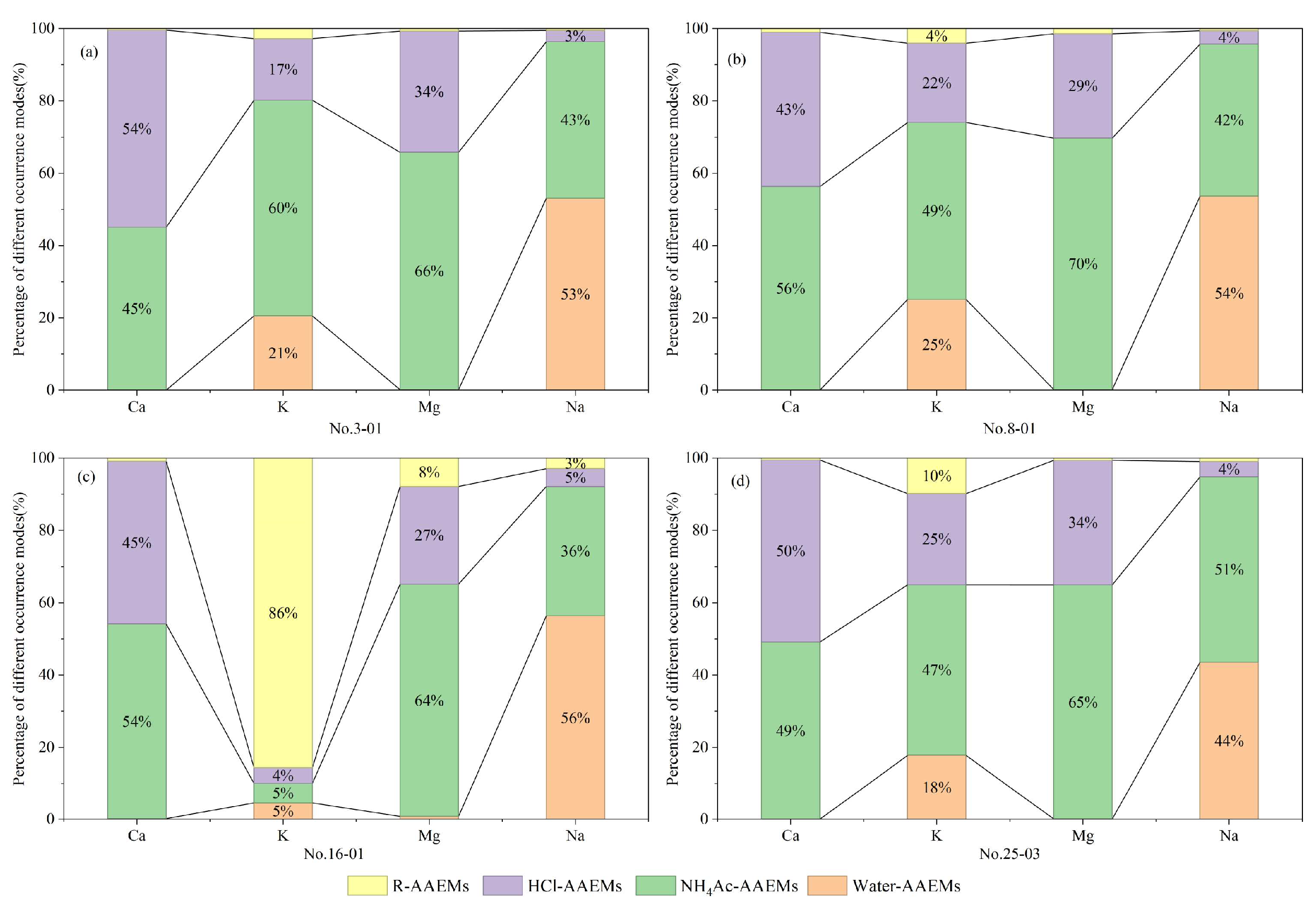
The coal samples from the study area were crushed and subjected to an extraction experiment. The occurrence modes of K, Ca, Na, and Mg in four representative coal samples were characterized by SCEP (Table 4 and Figure 12). SCEP enables the stepwise extraction of alkali and alkaline earth metals (AAEMs) existing in different forms, as elements with varying occurrence states are likely to be released at distinct stages of the process. For example, sodium carbonate dissolves completely in water, whereas calcium carbonate is entirely extracted by hydrochloric acid.
Table 4.
Concentration of AAEMs in SCEP liquid products (mg/L).
Figure 12.
Percentage of different occurrence modes of AAEMs in coal samples. (a) sample No. 3-01; (b) sample No. 8-01; (c) sample No. 16-01; (d) sample No. 25-03.
Ca in coal is predominantly present in NH4Ac-soluble (45%–56%) and HCl-soluble (43%–54%) forms, indicating its association with exchangeable sites and carbonate or sulphate minerals (e.g., calcite or gypsum). K in coal exhibits distinct sample-specific behavior: in No. 16-01, 86% of K is retained in the residual fraction, suggesting an affinity to clay or feldspar minerals (e.g., K-feldspar), while in other samples it is mainly distributed in NH4Ac-soluble (47%–66%) and water-soluble (18%–25%) forms. Mg occurs mostly as NH4Ac-soluble (64%–70%) and HCl-soluble (27%–34%), with negligible water-soluble and residual contributions. Na is characterized by high proportions of water-soluble (44%–56%) and NH4Ac-soluble (36%–51%) forms, reflecting its high mobility and exchangeability. Notably, sample No. 3-01 shows elevated water-soluble K (21%) and exchangeable Mg (66%).
5. Discussion
5.1. Influencing Factors of AAEM Occurrence in Coal
K exhibits a significant positive correlation with silicon and aluminum (Figure 10). In the typical high-alkali coals from Shenhua, Sha’erhu, and Tianchi Coalfields, K predominantly occurs in a silica-aluminate bound state [16]. However, with sample No. 16-01 excluded, K in the other samples is predominantly present in the NH4Ac-soluble form, followed by the HCl-soluble and water-soluble forms in that order. This may be associated with the highest content of SiO2 and Al2O3 in coal. In the coal-bearing strata of low-rank coal, Ca2+ ions in the groundwater tend to bind to carboxyl functional groups in coal, or precipitate from the solution to form minerals such as calcite and gypsum [18,19]. The proportion of Mg present in NH4Ac-soluble forms is higher than that of Ca, suggesting that Mg is probably preferentially bound to organic functional groups rather than occurring in minerals such as carbonates. The occurrence of Mg in coal appears to be like that of Ca, which may be related to their similar electronic layer structure, and may form a stable structure with organic matter or homogeneously exist in Ca-bearing minerals. In low-rank coals, Na is mainly combined with carboxyl groups in organic matter in an ion-exchangeable state or dissolves in pore water [7,13]. This behavior probably arises from the stronger binding affinity of Ca and Mg to organic matter compared with Na+, coupled with the presence of sparingly soluble, stable minerals such as calcite and gypsum [61,62]. The binding strength of AAEM cations to oxygen-containing functional groups (e.g., carboxyl and hydroxyl groups) in coal organic matter is governed by ionic potential, which results in an overall binding strength order of Mg2+ > Ca2+ > K+ > Na+ for these four cations with the organic functional groups in coal [63]. The weak correlations of Na2O, CaO, and Mg with Ad may suggest that these components mainly have an authigenic origin, instead of being derived from terrigenous mineral detrital input.
5.2. Evidence from Mineralogy for AAEM Enrichment
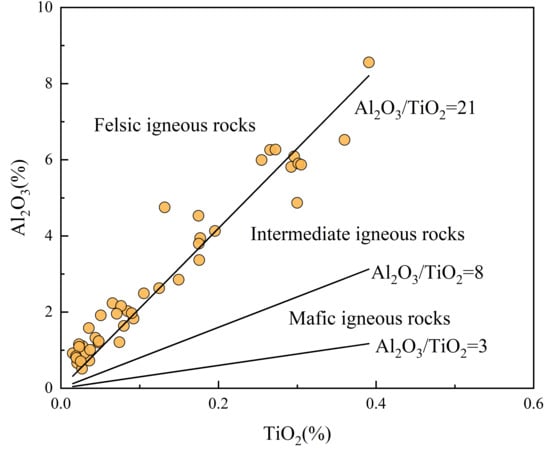
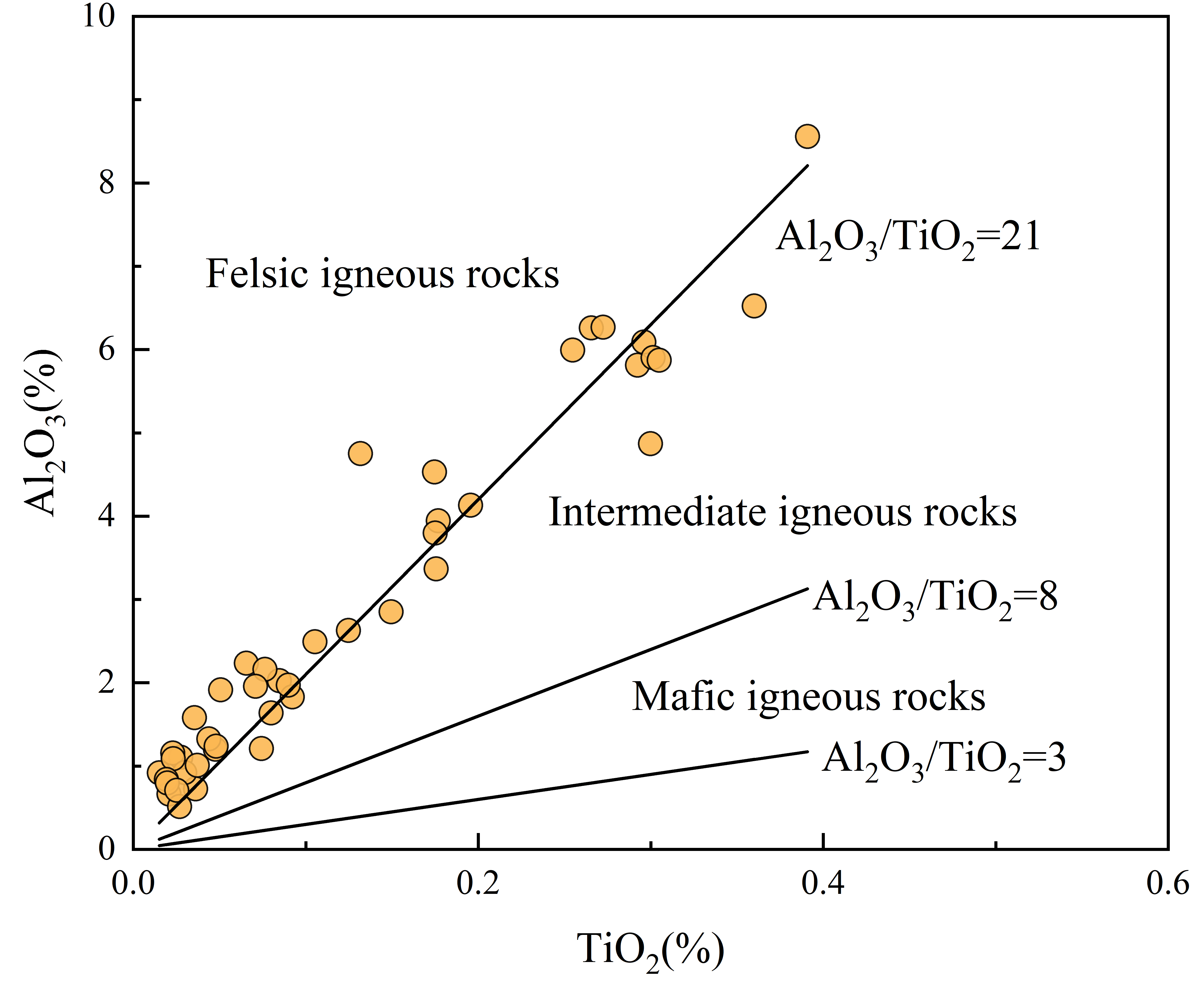
The Al2O3 and TiO2 contents in sedimentary rocks are stable and serve as reliable indicators for determining the source debris [10,34,64]. Typical Al2O3/TiO2 ratios of sediments derived from mafic, intermediate, and felsic igneous rocks are 3–8, 8–21, and 21–70, respectively [65]. The Al2O3/TiO2 ratios in the Dananhu Coalfield range from 12.25 to 61.18%, with an average of 27.61% (Figure 13). This finding suggests that the source rock of the Dananhu Coalfield was likely intermediate-felsic igneous rock. TiO2 and P2O5 exhibit similar secondary enrichments in the No. 16, No. 19L, No. 22L, No. 27, and No. 29 coal seams, coinciding with elevated SiO2 and Al2O3. This covariation suggests a common detrital source for these elements, most likely felsic igneous rocks, with enhanced sediment supply to the basin.
Figure 13.
Scatter diagram of Al2O3-TiO2 [65].
The consistent dominance of quartz and kaolinite implies a stable siliciclastic provenance and prolonged chemical weathering. The well-resolved kaolinite peaks indicate minimal mixed-layer clay minerals, possibly reflecting an acidic, leaching-dominated depositional or diagenetic environment. Both cell-filling and fracture-filling kaolinite are interpreted as authigenic phases precipitated from acidic, leach-dominated diagenetic fluids. Fracture-filling kaolinite records the migration of Si- and Al-rich fluids along structural fractures, further possibly indicating widespread acidic diagenetic conditions during burial (Figure 5a,j and Figure 6e) [53]. K-feldspar intergrown with kaolinite, zircon, and quartz, is of detrital origin (Figure 5c) [35]. However, due to the limited XRD scanning range (starting at 2θ = 10°), the presence of other clay minerals (e.g., illite and illite/smectite mixed-layer clays) cannot be ruled out.
Minor minerals present in certain samples may record signatures of local depositional conditions and fluid–rock interactions. Pyrite mainly occurs as cell-filling and fracture-filling phases, which probably correspond to syngenetic and diagenetic, respectively (Figure 5g–i) [66]. Siderite probably indicates reducing conditions during sedimentation (Figure 5k). Gypsum in coal probably records potential oxidation of sulfide minerals during coal formation or post-depositional alteration. Celestite can be used to describe the degree of evaporation in epicontinental basins [67]. The co-occurrence of celestite and calcite suggests two episodes of distinct fluid activities during coal diagenesis (Figure 5f). This may reveal an evolutionary process from an early stage dominated by carbonate precipitation to a late stage dominated by Sr- and SO42−-rich fluids. Pyrite and siderite probably indicate a reductive, neutral, and weakly alkaline (7 < pH < 7.8) formation environment during deposition and early diagenesis [68]. Ba-celestite and celestite record fluid activity and salinity variations during the late diagenetic stage, possibly revealing the infiltration of Sr- and Ba-rich groundwater during the late diagenetic period. Natrojarosite provides evidence that is consistent with post-depositional oxidative weathering [69]. The occurrence of natrojarosite is strictly confined to fracture surfaces and shows a distinct zonation with unaltered pyrite cores, indicating that it probably formed via infiltration of oxidizing fluids along pre-existing fractures after deep burial.
5.3. Paleoclimate and Paleoenvironment
Element ratios serve as sensitive paleoclimate and paleoenvironment proxies [70,71]. The average Sr/Cu ratio in the coal seams ranges from 0.93 to 21.90, with an average of 6.98, probably suggesting a semi-arid climate during the deposition of the Xishanyao Formation [70,72]. Especially in the No. 12, No. 19U, and No. 22U coal seams, the Sr/Cu ratio shows higher values (Sr/Cu > 15), likely indicating an arid climate; however, the alkali metal content in the corresponding layers does not exhibit enrichment. The enrichments of Ca, Mg, and Na in shallow coal seams appear to have no direct relationship with the arid paleoclimate, but probably rather result from the infiltration of high-salinity surface water. Boron content signals paleo-salinity, with low B contents (<40 µg/g) in the coal seams studied suggesting freshwater sedimentation [73].
Trace element ratios have been utilized to evaluate paleo-redox conditions in sedimentary rocks in several studies [70]. Cu/Zn ratios range from 0.08 to 2.07, with an average of 0.75, probably indicating that the paleo-redox in this area is weakly oxidizing and oxidizing; and V/Cr ratios vary from 1.04 to 8.10, with an average of 4.30, likely pointing to a redox-transitional environment with fluctuating water levels [74,75,76,77]. Shallow subaqueous swamps on alluvial fan–pre-fan floodplain wetlands can steadily develop coal seams. Vitrinite and inertinite characteristics in coals from the Dananhu Coalfield seem to suggest that the paleo-peat swamp was characterized by a weakly reducing-to-oxidizing depositional environment [11]. In this study, the huminite/inertinite (Hum/I) ratios range from 0.41 to 3.11, with an average of 1.29, probably indicating a reduction environment. Hum/I ratios between 1 and 4 are considered to indicate a reducing environment, while ratios between 0.25 and 1 indicate a weakly oxidizing–reducing environment. Coal seams with Hum/I ratios below 1 correspond to those with high Sr/Cu ratios. The Hum/I ratio of the No. 3 coal seam suggests a reducing environment; therefore, the enrichment of alkali metals in this coal seam is probably of epigenetic origin.
5.4. Groundwater Conditions
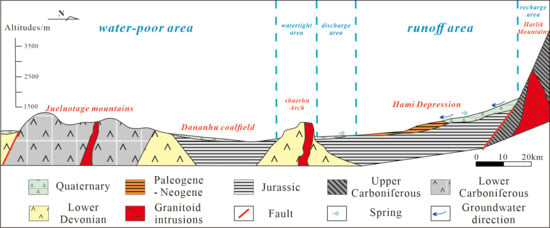
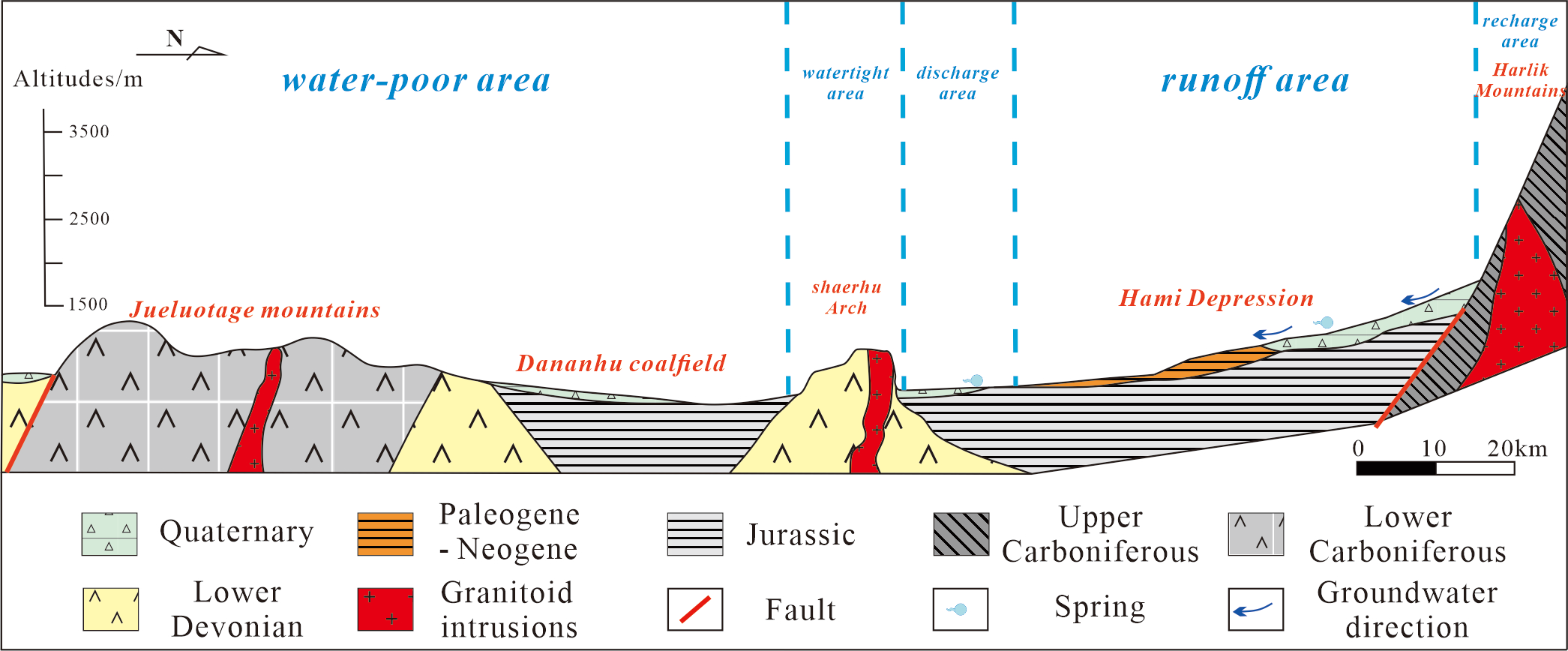
The Cretaceous, Paleogene, and Neogene strata are missing in the Dananhu mining area, with Quaternary loose sediments directly overlying the Toutunhe and Xishanyao Formations. This likely indicates that the Dananhu Sag experienced a regional uplift and subsequent erosion during the late Mesozoic to Cenozoic eras. The Yanshanian Movement is generally considered the primary cause for the absence of the Cretaceous strata, while the Himalayan Movement ultimately appears to have determined the confined hydrogeological framework of the Dananhu Sag, characterized by the uplift of the Jueluotage Mountains in the south and the Sha’erhu Uplift in the north (Figure 14) [78]. The Turpan–Hami Basin exhibits a typical temperate continental arid climate, with an average annual precipitation of approximately 15 mm alongside currently exceptionally high evaporation rates. The Jueluotage Mountains lie within a water-scarce region, whereas the Sha’erhu Uplift to the north is characterized by both water scarcity and limited water availability (see in Figure 1b). These conditions are likely to promote strong evaporation and concentration of surface water and phreatic groundwater [79,80].
Figure 14.
The sketch map of the secondary hydrogeological unit profile in the Hami basin.
Studies on chlorine-enriched coal in the Sha’erhu Coalfield have suggested that its elevated chlorine content probably originated from the evaporation and concentration of atmospheric precipitation, followed by subsequent infiltration into the coal seams [35]. Due to tectonic activities during the Yanshanian and Himalayan Movements, the coal-bearing strata of the Xishanyao Formation in the study area were exposed and eroded. Coupled with faults acting as water-conducting channels, this likely allowed evaporatively concentrated groundwater to infiltrate into the coal-bearing strata. As shown in Table S1, the data of which came from a geological survey report, hydro-chemical analyses indicate that Na+ is the dominant cation in groundwater, followed by Ca2+ and Mg2+. The major anions are Cl− and SO42−. Groundwater in the study area is classified as highly saline based on total dissolved solids. The coal samples investigated are predominantly medium- and high-alkali coals, and the No. 3 seam shows the most significant Na enrichment. This distribution is probably attributed to the evaporation, concentration, and subsequent infiltration of surface water [10,32]. Specifically, limited precipitation probably results in insufficient infiltration kinetic energy, likely leading to the accumulation of Na, Ca, and Mg in shallow coal seams (Figure 7). Conversely, the alkali metal concentrations in deep coal seams are likely controlled by a dynamic water–coal equilibrium related to groundwater ion concentrations. Despite the absence of halite and mirabilite in the XRD and SEM results presented above, the dominance of Na+, Cl−, and SO42− in the water analysis suggests that halite or mirabilite crystals likely exist in certain coal samples.
5.5. Dealkalization of Hami High-Alkali Coal
The occurrence of AAEMs in coal exerts a significant influence on their migration behavior during combustion. Circulating fluidized bed experiments conducted at 950 °C showed that the release rate of Na in Sha’erhu lignite was approximately 24.2%; additionally, fly ash was the only solid-phase ash fraction in which NaCl was detected [9]. The Na in the fly ash of Zhundong coal is dominated by water-soluble and NH4Ac-soluble sodium with NaCl as the primary chemical form [16]. The high proportion of non-mineral inorganic forms of AAEMs in low-rank coal makes them more prone to being released as highly reactive atomic species during coal combustion and gasification than their mineral-bound counterparts [61]. Therefore, pre-combustion alkali removal treatment appears to be necessary for Dananhu coal.
Common alkali removal technologies for high-alkali coal include water washing and leaching, acid leaching removal, maceral separation, directional alkali fixation by thermal pretreatment, and in-furnace alkali capture with additives [7,12,13,21,28,81]. The effects of 0.01 mol/L AcOH and HCl on the removal of sodium in coal from the Zhundong Coalfield were investigated [21]. For Dananhu coal, water washing can remove approximately 50% of sodium, but exhibits a very poor removal effect on calcium and magnesium. After treatment with NH4Ac solution, the removal rates of sodium, calcium and magnesium reach nearly 50%, 65% and 90%, respectively, and a certain removal effect is also achieved for potassium with a relatively low content in the coal.
Although the occurrence modes of AAEMs in Dananhu coal have been clarified, the optimal concentration of dealkalization reagents remains to be further optimized. In addition, the groundwater in the study area is characterized by high salinity, so direct water washing cannot achieve efficient alkali removal. Accordingly, effective dealkalization of Dananhu coal can be realized by first performing desalination pretreatment on groundwater, followed by staged leaching with ammonium acetate and hydrochloric acid.
6. Conclusions
- (1)
- Quartz and kaolinite are the main mineral phases in the coal samples analyzed in this study, with pyrite, chalcopyrite, gypsum, siderite, calcite, celestite, Ba-celestite, and natrojarosite occurring as accessory phases, potentially recording variable groundwater redox conditions, fluid acidity, and water–rock interactions.
- (2)
- The studied lignite is characterized by low-ash yield, high volatile matter, extra low sulfur, and medium–high alkali contents. These coals are enriched in Na and Cl compared with the average concentrations in Chinese coals. In the shallowest No. 3 coal seam, Na, Mg, Ca, Cl, F, Cu, Zn, and Sr are enriched, showing the highest content from a vertical direction.
- (3)
- Potassium is likely to be associated with inorganic aluminosilicate minerals, while Ca, Mg, and Na exhibit both organic and inorganic affinities according to the correlation analysis. Sequential extraction reveals Na is mainly water-soluble and ion-exchangeable, Ca and Mg are largely ion-exchangeable and HCl-soluble. The abundant cell cavities and oxygen-containing functional groups in lignite provide both binding sites and accommodation space for Ca, Mg, and Na. The clean utilization of Dananhu coal can be achieved by using appropriate concentrations of dealkalization reagents (e.g., NH4Ac and HCl).
- (4)
- The Dananhu Coalfield is characterized by continental freshwater sedimentation, and the short-term arid climate during the sedimentary period had a relatively minor impact on the alkali metal content of the coal. However, the closed hydrogeological units formed by tectonic movements (from the Late Paleozoic to the Cenozoic), combined with the modern arid climate and low precipitation, have played a critical role in alkali metal enrichment. On one hand, insufficient infiltration resulted in weak leaching, preventing the removal of alkali metals from the shallow coal seams. On the other hand, evaporative concentration increased the salinity of the groundwater, leading to the elevated background levels of alkali metals observed in the coal samples. The enrichment of alkali metals in the study area is likely of epigenetic origin.
Supplementary Materials
The following supporting information can be downloaded at: https://www.mdpi.com/article/10.3390/min16070730/s1, Table S1: Water chemistry data; Table S2, Element analysis details.
Author Contributions
Conceptualization, W.W. (Wenfeng Wang) and W.W. (Wenlong Wang); methodology, W.W. (Wenlong Wang); software, W.W. (Wenlong Wang); validation, Q.L., P.D. and B.Z.; formal analysis, W.W. (Wenlong Wang); investigation, W.Z. and J.B.; resources, W.Z. and J.B.; data curation, K.C. and W.W. (Wenlong Wang); writing—original draft preparation, W.W. (Wenlong Wang); writing—review and editing, W.W. (Wenfeng Wang) and Q.L.; visualization, B.Z.; supervision, P.D. and W.W. (Wenfeng Wang); project administration, W.W. (Wenfeng Wang); funding acquisition, W.W. (Wenfeng Wang) and Q.L. All authors have read and agreed to the published version of the manuscript.
Funding
This research was funded by the Major Science and Technology Special Project of Xinjiang Uygur Autonomous Region (No. 2022A03014); the National Natural Science Foundation of China (Nos. 42472236, 42402176); the Science and Technology Innovation Project of Shenhua Shendong Electric Power Co., Ltd. (GSKJ-22-57); the Fundamental Research Funds for the Central Universities (No. 2024QN11071); Xinjiang Uygur Autonomous Region Introduction Plan “Tianchi Talent” Project (No. 5105250180k); Innovative and Expanded Talent Program for Intellectual Support to Xinjiang: Jiangsu Province Coal-Based Solid Waste Resource Utilization “Support Group for Xinjiang” (No. [2024]16); Department of Industry and Information Technology of the Xinjiang (No. [2024]4).
Data Availability Statement
The data that support the findings of this study are available from the corresponding author upon reasonable request.
Acknowledgments
We thank the staff of Shenhua Geological Exploration Co., Ltd. (not listed as authors), for their help with sample collection and geological data preparation. We also thank the editors of the journal and the anonymous reviewers for their valuable comments and constructive suggestions, which have greatly contributed to the revision of the manuscript and its potential publication.
Conflicts of Interest
Wei Zhao and Jian Bai are employees of Shenhua Geological Exploration Co., Ltd. The remaining authors declare that the research was conducted in the absence of any commercial or financial relationships that could be construed as a potential conflict of interest.
References
- Dai, S.; Ren, D.; Chou, C.; Finkelman, R.B.; Seredin, V.V.; Zhou, Y. Geochemistry of trace elements in Chinese coals: A review of abundances, genetic types, impacts on human health, and industrial utilization. Int. J. Coal Geol. 2012, 94, 3–21. [Google Scholar] [CrossRef] [Scilit]
- Dai, S.; Finkelman, R.B. Coal as a promising source of critical elements; progress and future prospects. Int. J. Coal Geol. 2018, 186, 155–164. [Google Scholar] [CrossRef] [Scilit]
- Ruan, R.; Tan, H.; Wang, X.; Li, Y.; Li, S.; Hu, Z.; Wei, B.; Yang, T. Characteristics of fine particulate matter formation during combustion of lignite riched in AAEM (alkali and alkaline earth metals) and sulfur. Fuel 2018, 211, 206–213. [Google Scholar] [CrossRef] [Scilit]
- Yu, S.; Zhang, C.; Zhang, X.; Li, X.; Wei, B.; Tan, P.; Fang, Q.; Chen, G.; Xia, J. Release and transformation characteristics of Na/Ca/S compounds of Zhundong coal during combustion/CO2 gasification. J. Energy Inst. 2020, 93, 752–765. [Google Scholar] [CrossRef] [Scilit]
- Zhang, L.; Ito, M.; Sato, A.; Ninomiya, Y. Fate of Alkali Elements during Pyrolysis and Combustion of Chinese Coals. J. Chem. Eng. Jpn. 2003, 36, 759–768. [Google Scholar] [CrossRef] [Scilit]
- Deng, B.; Qiao, L.; Wang, Y.; Mu, X.; Deng, C.; Jin, Z. Study on the effect of inorganic and organic sodium on coal spontaneous combustion. Fuel 2023, 353, 129256. [Google Scholar] [CrossRef] [Scilit]
- Quyn, D.M.; Wu, H.; Li, C. Volatilisation and catalytic effects of alkali and alkaline earth metallic species during the pyrolysis and gasification of Victorian brown coal. Part I. Volatilisation of Na and Cl from a set of NaCl-loaded samples. Fuel 2002, 81, 143–149. [Google Scholar] [CrossRef] [Scilit]
- Jiang, F.; Zhang, S.; Huang, X.; Li, H.; Zhang, Y.; Wang, C. Effect of particle size on sodium distribution and sodium removal by water washing of Zhundong coal. Energy Sources Part A 2019, 41, 129–136. [Google Scholar] [CrossRef] [Scilit]
- Qi, X.; Song, G.; Yang, S.; Yang, Z.; Lyu, Q. Migration and transformation of sodium and chlorine in high-sodium high-chlorine Xinjiang lignite during circulating fluidized bed combustion. J. Energy Inst. 2019, 92, 673–681. [Google Scholar] [CrossRef] [Scilit]
- Wang, Y.; Wang, W.; Wang, W.; Duan, P.; He, X.; Lu, Q. Distribution, Occurrence and Enrichment Causes of Sodium in Middle Jurassic Coal from Zhundong Coalfield, Xinjiang. Minerals 2024, 14, 146. [Google Scholar] [CrossRef] [Scilit]
- Wang, R.; Wang, W.; Lu, Q.; Zhang, J.; Wang, W.; Dong, L. Geochemistry of Middle Jurassic Coals from the Dananhu Mine, Xinjiang: Emphasis on Sediment Source and Control Factors of Critical Metals. Minerals 2024, 14, 767. [Google Scholar] [CrossRef] [Scilit]
- Che, K.; Li, J.; Lu, Q.; Shao, F.; Wang, W.; Wang, W.; He, X. Occurrence of Differences between Alkali and Alkaline Earth Metals (AAEMs), Including Sodium, Potassium, Calcium, and Magnesium, in the Maceral Groups of the Xiheishan Coal, Zhundong Coalfield, Xinjiang, China. Minerals 2024, 14, 525. [Google Scholar] [CrossRef] [Scilit]
- He, X.; Wang, W.; Yang, Y.; Zhou, C.; He, J.; Duan, P.; Lu, Q. Occurrence Relationship between Sodium and Maceral Groups in Subbituminous Coal: A Case Study on Zhundong Coal and Shenfu Coal. Minerals 2023, 13, 122. [Google Scholar] [CrossRef] [Scilit]
- Xu, Y.; Liang, H.; Zhang, N. Mineralogical characteristics and sources of alkali metals in the No. 6 coal seam from the Fukang mining area of the Zhunnan coalfield, Xinjiang province, Northwest China. Energy Explor. Exploit. 2019, 37, 1162–1181. [Google Scholar] [CrossRef] [Scilit]
- Wang, C.; Tang, G.; Sun, R.; Hu, G.; Yuan, M.; Che, D. The correlations of chemical property, alkali metal distribution, and fouling evaluation of Zhundong coal. J. Energy Inst. 2020, 93, 2204–2214. [Google Scholar] [CrossRef] [Scilit]
- Song, W.; Song, G.; Qi, X.; Yang, S.; Lu, Q.; Nowak, W. Speciation and Distribution of Sodium during Zhundong Coal Gasification in a Circulating Fluidized Bed. Energy Fuels 2017, 31, 1889–1895. [Google Scholar] [CrossRef] [Scilit]
- Jia, R.; Liu, J.; Han, Q.; Zhao, S.; Shang, N.; Tang, P.; Zhang, Y. Mineral matter transition in lignite during ashing process: A case study of Early Cretaceous lignite from the Hailar Basin, Inner Mongolia, China. Fuel 2022, 328, 125252. [Google Scholar] [CrossRef] [Scilit]
- Li, Z.; Ward, C.R.; Gurba, L.W. Occurrence of non-mineral inorganic elements in macerals of low-rank coals. Int. J. Coal Geol. 2010, 81, 242–250. [Google Scholar] [CrossRef] [Scilit]
- Li, Z.; Ward, C.R.; Gurba, L.W. Occurrence of non-mineral inorganic elements in low-rank coal macerals as shown by electron microprobe element mapping techniques. Int. J. Coal Geol. 2007, 70, 137–149. [Google Scholar] [CrossRef] [Scilit]
- Finkelman, R.B.; Palmer, C.A.; Wang, P. Quantification of the modes of occurrence of 42 elements in coal. Int. J. Coal Geol. 2018, 185, 138–160. [Google Scholar] [CrossRef] [Scilit]
- Zhuo, X.; Su, J.; Xu, H.; Wang, L.; Wang, W.; Zhang, B.; Ni, Z. Synergistically effective flotation enrichment of vitrinite by Na removal for high-Na high-inertinite low-rank Zhundong coal. J. Clean. Prod. 2023, 428, 139433. [Google Scholar] [CrossRef] [Scilit]
- Liu, J.; Yang, Z.; Yan, X.; Ji, D.; Yang, Y.; Hu, L. Modes of occurrence of highly-elevated trace elements in superhigh-organic-sulfur coals. Fuel 2015, 156, 190–197. [Google Scholar] [CrossRef] [Scilit]
- Kalaitzidis, S.; Christanis, K. Scanning electron microscope studies of the Philippi peat (NE Greece): Initial aspects. Int. J. Coal Geol. 2003, 54, 69–77. [Google Scholar] [CrossRef] [Scilit]
- Karayigit, A.I.; Mastalerz, M.; Oskay, R.G.; Gayer, R.A. Coal petrography, mineralogy, elemental compositions and palaeoenvironmental interpretation of Late Carboniferous coal seams in three wells from the Kozlu coalfield (Zonguldak Basin, NW Turkey). Int. J. Coal Geol. 2018, 187, 54–70. [Google Scholar] [CrossRef] [Scilit]
- Bechtel, A.; Karayigit, A.I.; Bulut, Y.; Mastalerz, M.; Sachsenhofer, R.F. Coal characteristics and biomarker investigations of Dombayova coals of Late Miocene-Pliocene age (Afyonkarahisar-Turkey). Org. Geochem. 2016, 94, 52–67. [Google Scholar] [CrossRef] [Scilit]
- Querol, X.; Whateley, M.K.G.; Fernandez Turiel, J.L.; Tuncali, E. Geological controls on the mineralogy and geochemistry of the Beypazari lignite, central Anatolia, Turkey. Int. J. Coal Geol. 1997, 33, 255–271. [Google Scholar] [CrossRef] [Scilit]
- Benson, S.A.; Holm, P.L. Comparison of inorganic constituents in three low-rank coals. Ind. Eng. Chem. Prod. Res. Dev. 1985, 24, 145–149. [Google Scholar] [CrossRef] [Scilit]
- Zhu, C.; Qu, S.; Zhang, J.; Wang, Y.; Zhang, Y. Distribution, occurrence and leaching dynamic behavior of sodium in Zhundong coal. Fuel 2017, 190, 189–197. [Google Scholar] [CrossRef] [Scilit]
- Wei, X.; Huang, J.; Liu, T.; Fang, Y.; Wang, Y. Transformation of alkali metals during pyrolysis and gasification of a lignite. Energy Fuel 2008, 22, 1840–1844. [Google Scholar] [CrossRef] [Scilit]
- Ma, D.; Jia, S.; Hu, Z.; Wang, X.; Li, L.; Tan, H.; Ur Rahman, Z. Experimental investigation of water washing effect on high-chlorine coal properties. Fuel 2022, 319, 123838. [Google Scholar] [CrossRef] [Scilit]
- Xu, X.; Wang, W.; Lu, Q.; Wang, W.; Zhang, B. Chlorine enrichment mechanisms in coals from the middle Jurassic of Northwestern China: Evidence from Cryo-SEM and geochemical analyses. Int. J. Coal Geol. 2026, 324, 105056. [Google Scholar] [CrossRef] [Scilit]
- Qi, Z.; Sun, F.; Wang, W.; Huang, C.; Liang, K.; Huang, Y.; Shao, L. Mechanisms underlying sodium enrichment in coals in the Dananhu mining area, Turpan-Hami Basin. Coal Geol. Explor. 2025, 53, 183–193. [Google Scholar] [CrossRef]
- Du, L.; Yuan, C.; Li, X.; Zhang, Y.; Huang, Z.; Long, X. Petrogenesis and Geodynamic Implications of the Carboniferous Granitoids in the Dananhu Belt, Eastern Tianshan Orogenic Belt. J. Earth Sci. 2019, 30, 1243–1252. [Google Scholar] [CrossRef] [Scilit]
- Yan, Z.; Wang, J.; Wang, X. Sedimentary Environments and Coal Accumulation of the Middle Xishanyao Formation, Jurassic, in the Western Dananhu Coalfield, Turpan-Hami Basin. Geofluids 2021, 2021, 6034055. [Google Scholar] [CrossRef] [Scilit]
- Xu, X.; Wang, W.; Lu, Q.; Wang, W.; Zhang, B.; Wu, Y.; Li, J.; Che, K.; Shen, Y. Occurrence and Origin of Chlorine in Middle Jurassic High-Cl Coals from the Sha’erhu Area, Turpan–Hami Basin, Northwest China. Minerals 2025, 16, 18. [Google Scholar] [CrossRef] [Scilit]
- Cao, D.; Shao, L.; Zhang, P. Palaeotectonics in the early and middle Jurassic coal-forming periods of the Turpan-Hami basin. J. Palaeogeogr. 1999, 1, 46–52. (In Chinese) [Google Scholar] [CrossRef] [Scilit]
- Wang, Y. Sedimentary Environment and Coal-Accumulating Patterns in Dananhu Coalfield Preliminary Exploration Area, Hami, Xinjiang. Coal Geol. China 2004, 16, 32–33+36. [Google Scholar] [CrossRef]
- Shao, L.; Gao, D.; Luo, Z.; Zhang, P.A. Sequence stratigraphy and palaeogeography of the Lower and Middle Jurassic coalmeasures in Turpan-Hami Basin. J. Palaeogeogr. 2009, 11, 215–224. (In Chinese) [Google Scholar]
- ASTM D2798-21; Standard Test Method for Microscopical Determination of the Vitrinite Reflectance of Coal. ASTM International: West Conshohocken, PA, USA, 2021.
- ICCP. The new vitrinite classification (ICCP System 1994). Fuel 1998, 77, 349–358. [Google Scholar] [CrossRef] [Scilit]
- Sykorová, I.; Pickel, W.; Christanis, K.; Wolf, M.; Taylor, G.H.; Flores, D. Classification of huminite—ICCP system 1994. Int. J. Coal Geol. 2005, 62, 85–106. [Google Scholar] [CrossRef] [Scilit]
- Pickel, W.; Kus, J.; Flores, D.; Kalaitzidis, S.; Christanis, K.; Cardott, B.J.; Misz-Kennan, M.; Rodrigues, S.; Hentschel, A.; Hamor-Vido, M.; et al. Classification of liptinite—ICCP System 1994. Int. J. Coal Geol. 2017, 169, 40–61. [Google Scholar] [CrossRef] [Scilit]
- ICCP. The new inertinite classification (ICCP System 1994). Fuel 2001, 80, 459–471. [Google Scholar] [CrossRef] [Scilit]
- ASTM D3173M-17a; Standard Test Method for Moisture in the Analysis Sample of Coal and Coke. ASTM International: West Conshohocken, PA, USA, 2017.
- ASTM D3174-12(2018) e1; Standard Test Method for Ash in the Analysis Sample of Coal and Coke from Coal. ASTM International: West Conshohocken, PA, USA, 2018.
- ASTM D3175–18; Standard Test Method for Volatile Matter in the Analysis Sample of Coal and Coke. ASTM International: West Conshohocken, PA, USA, 2018.
- ASTM D4239-18e1; Standard Test Method for Sulfur in the Analysis Sample of Coal and Coke Using High-Temperature Tube Furnace Combustion. ASTM International: West Conshohocken, PA, USA, 2018.
- GB/T 2566-2010; Determination of Transmittance for Low Rank Coal. General Administration of Quality Supervision, Inspection and Quarantine of the People’s Republic of China: Beijing, China, 2010. (In Chinese)
- GB/T 37673-2019; Determination of Silicon, Aluminum, Iron, Calcium, Magnesium, Sodium, Potassium, Phosphorus, Titanium, Manganese, Strontium and Barium in Coal Ash—X-Ray Fluorescence Spectrometric Method. General Administration of Quality Supervision, Inspection and Quarantine of the People’s Republic of China: Beijing, China, 2019. (In Chinese)
- ASTM D4208-19; Standard Test Method for Chlorine in Coal. ASTM International: West Conshohocken, PA, USA, 2019.
- ASTM D7359-18a; Standard Test Method for Total Fluorine in Coal and Coke by Pyrohydrolytic Extraction and Ion Selective Electrode or Ion Chromatograph Methods. Annual Book of ASTM Standards. ASTM International: West Conshohocken, PA, USA, 2018.
- Method 3052 (SW-946); Microwave Assisted Acid Digestion of Siliceous and Organically Based Matrices, Revision 0, December 1996, Final Update III to the Third Edition of the Test Methods for Evaluating Solid Waste, Physical/Chemical Methods. Environmental Protection Agency (EPA): Washington, DC, USA, 1996.
- Zhang, B.; Wang, W.; Lu, Q.; Wang, W.; Teng, X.; Chen, L. Mineralogy and elemental geochemistry of Pennsylvanian high-sulfur coals in the Huanghebei Coalfield, Shandong, Northern China: Implications for the enrichment and controlling factors of U. Int. J. Coal Geol. 2025, 309, 104867. [Google Scholar] [CrossRef] [Scilit]
- GB/T 15224.1-2018; Classification of Coal Quality-Part 1: Ash Content. General Administration of Quality Supervision, Inspection and Quarantine of the People’s Republic of China: Beijing, China, 2018. (In Chinese)
- GB/T 15224.2-2021; Coal Quality Grading—Part 2: Sulfur Content. General Administration of Quality Supervision, Inspection and Quarantine of the People’s Republic of China: Beijing, China, 2021. (In Chinese)
- BS ISO 11760-2018; Classification by Rank. International Organization for Standardization (ISO): Geneva, Switzerland, 2018.
- Dai, S.; Seredin, V.V.; Ward, C.R.; Hower, J.C.; Xing, Y.; Zhang, W.; Song, W.; Wang, P. Enrichment of U–Se–Mo–Re–V in coals preserved within marine carbonate successions: Geochemical and mineralogical data from the Late Permian Guiding Coalfield, Guizhou, China. Miner. Depos. 2015, 50, 159–186. [Google Scholar] [CrossRef] [Scilit]
- MT/T 1074-2008; Classification for Alkali Metal (Potassium and Sodium) Content in Coal. China Coal Industry Press: Beijing, China, 2008. (In Chinese)
- Ketris, M.P.; Yudovich, Y.E. Estimations of Clarkes for Carbonaceous biolithes: World averages for trace element contents in black shales and coals. Int. J. Coal Geol. 2009, 78, 135–148. [Google Scholar] [CrossRef] [Scilit]
- Dai, S.; Hower, J.C.; Finkelman, R.B.; Graham, I.T.; French, D.; Ward, C.R.; Eskenazy, G.; Wei, Q.; Zhao, L. Organic associations of non-mineral elements in coal; a review. Int. J. Coal Geol. 2020, 218, 103347. [Google Scholar] [CrossRef] [Scilit]
- Liu, J.; Ward, C.R.; Graham, I.T.; French, D.; Dai, S.; Song, X. Modes of occurrence of non-mineral inorganic elements in lignites from the Mile Basin, Yunnan Province, China. Fuel 2018, 222, 146–155. [Google Scholar] [CrossRef] [Scilit]
- Liu, J.; Dai, S.; Hower, J.C.; Moore, T.A.; Moroeng, O.M.; Nechaev, V.P.; Petrenko, T.I.; French, D.; Graham, I.T.; Song, X. Stable isotopes of organic carbon, palynology, and petrography of a thick low-rank Miocene coal within the Mile Basin, Yunnan Province, China: Implications for palaeoclimate and sedimentary conditions. Org. Geochem. 2020, 149, 104103. [Google Scholar] [CrossRef] [Scilit]
- Wang, X.; Wang, S.; Zhao, Y.; Mu, R.; Shao, Y. Occurrence Modes of AAEMs (Na+ and Ca2+) and the Effect on the Molecular Structures of Zhundong Coal via Quantum Chemistry. ACS Omega 2023, 8, 46528–46539. [Google Scholar] [CrossRef] [Scilit] [PubMed]
- Xie, P.; Hower, J.C.; Nechaev, V.P.; Ju, D.; Liu, X. Lithium and redox-sensitive (Ge, U, Mo, V) element mineralization in the Pennsylvanian coals from the Huangtupo coalfield, Shanxi, northern China: With emphasis on the interaction of infiltrating seawater and exfiltrating groundwater. Fuel 2021, 300, 120948. [Google Scholar] [CrossRef] [Scilit]
- Hayashi, K.I.; Fujisawa, H.; Holland, H.D.; Ohmoto, H. Geochemistry of approximately 1.9 Ga sedimentary rocks from northeastern Labrador, Canada. Geochim. Cosmochim. Acta 1997, 61, 4115–4137. [Google Scholar] [CrossRef] [Scilit] [PubMed]
- Shang, N.; Liu, J.; Han, Q.; Jia, R.; Zhao, S. Mineralogy and geochemistry of the Middle Jurassic coal from the Hexi Mine, Shenfu Mining Area, Ordos Basin: With an emphasis on genetic indications of siderite. Int. J. Coal Geol. 2023, 279, 104384. [Google Scholar] [CrossRef] [Scilit]
- Dill, H.G.; Bechtel, A.; Berner, Z.; Botz, R.; Kus, J.; Heunisch, C.; Hamad, A.M.B.A. The evaporite–coal transition: Chemical, mineralogical and organic composition of the Late Triassic Abu Ruweis Formation, NW Jordan—Reference type of the “Arabian Keuper”. Chem. Geol. 2012, 298–299, 20–40. [Google Scholar] [CrossRef] [Scilit]
- Wei, J.; Wei, Y.; Qin, G.; Ning, S.; Cao, D.; Wang, A. Geochemistry, Mineralogy, and Coal Petrology of No. 4 Coal in Sandaoling Mine, Turpan-Hami Basin, Northwest China: Provenance and Peat Depositional Environment. Minerals 2023, 13, 837. [Google Scholar] [CrossRef] [Scilit]
- Guha, S.; Acharya, S.S.; Panigrahi, M.K. Multiproxy Evidence for Natrojarosite-Natroalunite Solid Solutions in Western Kutch: Jarosite Formation, Preservation, and Martian Implications. J. Geophys. Res. Planets 2026, 131, e2025JE009601. [Google Scholar] [CrossRef] [Scilit]
- Wang, L.; Lv, D.; Hower, J.C.; Zhang, Z.; Raji, M.; Tang, J.; Liu, Y.; Gao, J. Geochemical characteristics and paleoclimate implication of Middle Jurassic coal in the Ordos Basin, China. Ore Geol. Rev. 2022, 144, 104848. [Google Scholar] [CrossRef] [Scilit]
- Chermak, J.A.; Schreiber, M.E. Mineralogy and trace element geochemistry of gas shales in the United States: Environmental implications. Int. J. Coal Geol. 2014, 126, 32–44. [Google Scholar] [CrossRef] [Scilit]
- Eble, C.F.; Greb, S.F.; Williams, D.A.; Hower, J.C.; O’Keefe, J.M.K. Palynology, organic petrology and geochemistry of the Bell coal bed in Western Kentucky, Eastern Interior (Illinois) Basin, USA. Int. J. Coal Geol. 2019, 213, 103264. [Google Scholar] [CrossRef] [Scilit]
- Swaine, D.J. Trace Elements in Coal; Butterworth: Sydney, Australia, 1990; Volume 181, pp. 103–123. [Google Scholar]
- Mei, S. Application of rock chemistry in the study of Presinian sedimentary environment and the source of uranium mineralization in Hunan Province. Hunan Geol. 1988, 7, 25–31. (In Chinese) [Google Scholar]
- Dypvik, H. Geochemical compositions and depositional conditions of Upper Jurassic and Lower Cretaceous Yorkshire clays, England. Geol. Mag. 1984, 121, 489–504. [Google Scholar] [CrossRef] [Scilit]
- Erkoyun, H.; Kadir, S.; Huggett, J. Occurrence and genesis of tonsteins in the Miocene lignite, Tunçbilek Basin, Kütahya, western Turkey. Int. J. Coal Geol. 2019, 202, 46–68. [Google Scholar] [CrossRef] [Scilit]
- Jones, B.; Manning, D.A.C. Comparison of geochemical indices used for the interpretation of palaeoredox conditions in ancient mudstones. Chem. Geol. 1994, 111, 111–129. [Google Scholar] [CrossRef] [Scilit]
- Huang, J. Coalbed Gas System Description and Reserve Parameters Analysis in the Shaerhu Sag of the Tuha Basin. Ph.D. Thesis, China University of Geosciences (Beijing), Beijing, China, 2011. (In Chinese) [Google Scholar]
- Zhao, W.; Yuan, F.; Zeng, X. The Structral Characteristics of Turpan-Hami Basin. Acta Pet. Sin. 1992, 13, 9–18. (In Chinese) [Google Scholar]
- Qin, Y.; Li, Y.; Liu, F.; Hou, K.; Wan, D.; Zhang, C. N and O isotopes and the ore-forming mechanism of nitrate deposits in the Turpan-Hami Basin, Xinjiang, China. Sci. China Earth Sci. 2012, 55, 213–220. [Google Scholar] [CrossRef] [Scilit]
- Takuwa, T.; Naruse, I. Emission control of sodium compounds and their formation mechanisms during coal combustion. Proc. Combust. Inst. 2007, 31, 2863–2870. [Google Scholar] [CrossRef] [Scilit]

Disclaimer/Publisher’s Note: The statements, opinions and data contained in all publications are solely those of the individual author(s) and contributor(s) and not of MDPI and/or the editor(s). MDPI and/or the editor(s) disclaim responsibility for any injury to people or property resulting from any ideas, methods, instructions or products referred to in the content. |
© 2026 by the authors. Licensee MDPI, Basel, Switzerland. This article is an open access article distributed under the terms and conditions of the Creative Commons Attribution (CC BY) license.