Review

Geology, Reserves, Metallurgical Processing and Recycling of Cobalt—A Review

by
Nallely Guadalupe Picazo-Rodríguez
1,
Marleth Roxana Garza Román
2,*,
Francisco Raúl Carrillo Pedroza
3,*,
Ma. de Jesús Soria-Aguilar
3,
Norman Toro
4,
Felipe M. Galleguillos-Madrid
5,
Mauricio Sales-Cruz
6,
Gabriela Baltierra-Costeira
1 and
Damaris Margarita Puente Siller
1
1
Instituto Tecnológico Superior de Monclova, Tecnológico Nacional de México, Monclova 25701, Mexico
2
Facultad de Ciencias Químicas, Universidad Autónoma de Coahuila, Monclova 25280, Mexico
3
Facultad de Metalurgia, Universidad Autónoma de Coahuila, Monclova 25710, Mexico
4
Faculty of Engineering and Architecture, Universidad Arturo Prat, Iquique 1110939, Chile
5
Centro de Desarrollo Energético Antofagasta, Universidad de Antofagasta, Antofagasta 1240000, Chile
6
Departamento de Procesos y Tecnología, Universidad Autónoma Metropolitana—Cuajimalpa, Mexico City 05348, Mexico
*
Authors to whom correspondence should be addressed.
Minerals 2026, 16(7), 729; https://doi.org/10.3390/min16070729
Submission received: 29 April 2026 / Revised: 7 July 2026 / Accepted: 8 July 2026 / Published: 11 July 2026
(This article belongs to the Section Mineral Processing and Extractive Metallurgy)

Abstract

Cobalt has emerged as a strategic critical metal due to its essential role in rechargeable batteries, high-performance alloys, catalysts, and clean energy technologies. However, its supply chain remains heavily dependent on cobalt produced as a by-product of copper and nickel mining and is geographically concentrated, particularly in the Democratic Republic of Congo. This review provides a comprehensive assessment of cobalt geology, mineralogy, global reserves, market trends, primary extraction routes, and emerging secondary recovery strategies. Unlike previous reviews that address these topics separately, this work integrates geological occurrence, mineralogical characteristics, extraction technologies, and resource circularity within a unified framework aimed at evaluating future cobalt supply resilience. The main cobalt-bearing deposit types of sediment-hosted Cu–Co deposits, Ni–Co laterites, and magmatic Ni–Cu–Co sulphide deposits are compared in terms of their mineralogical characteristics and processing requirements. Hydrometallurgy is identified as the dominant industrial route, typically combining high-pressure acid leaching (HPAL) with downstream purification and recovery processes such as solvent extraction and electrowinning (SX–EW). Emphasis is placed on the relationship between ore mineralogy and process selection, as well as on the growing integration of secondary resources, including tailings, slags, and spent batteries, into existing cobalt production chains. Despite promising recovery rates at laboratory scale, challenges remain in impurity control, economic scalability, and integration into established refining infrastructure. This review demonstrates that secondary resources are evolving from supplementary feedstocks to strategically important contributors to cobalt supply. Future supply security will depend on feedstock diversification, more flexible refining systems, improved impurity management, and the implementation of sustainable circular-economy strategies.

1. Introduction

Recent studies have shown that hydrometallurgical processing is the dominant route for cobalt recovery from both primary and secondary resources [1,2,3,4,5,6,7,8]. Advances in leaching, solvent extraction, and electrowinning technologies have significantly enhanced recovery efficiencies and enabled the treatment of a broader range of feedstocks, including lateritic ores, mining residues, and spent batteries [1,2,3,4,5]. Ni–Co laterite deposits have gained increasing strategic importance as high-grade sulphide resources continue to decline [1,2,3,4,5]. Hydrometallurgical operations remain the preferred approach for cobalt extraction and refining owing to their high selectivity, process flexibility, and metallurgical efficiency [6,7]. Nevertheless, global cobalt production is still heavily reliant on Cu–Co deposits within the Central African Copperbelt, especially those located in the Democratic Republic of Congo. This concentration of supply continues to raise concerns regarding the security, sustainability, and long-term resilience of the global cobalt value chain [7,8].
Recent years have witnessed record levels of global cobalt mine and refinery production. This growth has been driven primarily by the Democratic Republic of Congo (DRC), which continues to dominate global cobalt supply and accounts for approximately three-quarters of worldwide mined production. Indonesia ranks as the second-largest producer, although its contribution remains considerably smaller [9]. China has maintained its position as the leading producer of refined cobalt, relying largely on intermediate cobalt products imported from the DRC for downstream processing. At the same time, China remains the world’s largest consumer of cobalt, with demand driven predominantly by the manufacture of lithium-ion batteries. During 2023, numerous initiatives were launched worldwide to increase cobalt recovery from end-of-life lithium-ion batteries. Concurrently, several projects in the United States advanced cobalt processing, refining, and recycling capabilities, supported by federal policies aimed at strengthening domestic critical mineral supply chains [10]. Schmidt et al. reported that nearly all cobalt chemical compounds, including oxides, hydroxides, carbonates, and sulphates, are produced from Cu–Co ores hosted within eroded stratiform sedimentary deposits in the DRC. In contrast, metallic cobalt production is derived mainly from nickel sulphide ores (49%), copper sulphide ores (32%), and nickel laterite deposits, particularly limonitic ores (19%) [11]. Cobalt refining is highly concentrated geographically, with China accounting for approximately 67% of global refined cobalt production, followed by Finland (11%) and Canada (5%) [12,13]. Consequently, more than two-thirds of the world’s refined cobalt is produced in countries where primary cobalt extraction does not occur. Furthermore, less than 10% of global cobalt output is refined in the country where it is mined, highlighting the strong dependence of cobalt supply chains on international trade and imported intermediate products.
From a circular economy perspective, cobalt recovery rates remain relatively low. Approximately 69% of the cobalt contained in manufactured products ultimately ends up in landfills, while only around 22% is recovered through scrap and recycling markets. The remaining fraction is dissipated into secondary waste streams, representing a significant loss of potentially recoverable material [11]. The strategic importance of cobalt stems largely from its outstanding electrochemical properties, particularly when combined with lithium and other metals in energy storage and conversion technologies. As a result, cobalt has been recognised as a critical raw material, playing a pivotal role in meeting growing global energy demands and supporting the transition towards low-carbon energy systems and sustainable electrification pathways [14].
Cobalt is generally regarded as a by-product metal, as its extraction is most associated with the mining of other base metals, particularly copper (approximately 55%) and nickel (around 35%), and, to a lesser extent, arsenic-bearing ores [13,15]. Only a small fraction of global cobalt production originates from primary cobalt deposits, including the Bou Azzer mine in Morocco [16], the historic cobalt mining district of Ontario, Canada, and the Blackbird district in Idaho, USA [15,16]. Historically, primary cobalt production was also reported from the Mount Cobalt mine in Australia [17,18]. Although numerous studies have examined specific aspects of cobalt geology, processing technologies, or recycling strategies, most existing reviews focus on individual segments of the cobalt value chain, such as battery-related demand, laterite processing technologies, or supply risk assessments. Consequently, a comprehensive synthesis that integrates geological occurrence, mineralogical controls, global resource distribution, primary extraction and refining routes, and secondary recovery pathways within a single analytical framework remains limited. This review addresses this gap by providing an integrated perspective that links cobalt geochemistry, deposit mineralogy, resource availability, industrial processing technologies, and emerging circular economy strategies. The review follows the cobalt value chain from geological formation to industrial utilisation and end-of-life recovery. It begins by examining global market trends and demand drivers, followed by a discussion of cobalt geochemistry and mineralogical occurrence. The principal cobalt-bearing deposit types and their global distribution are then analysed in relation to their metallurgical characteristics and processing requirements. Subsequently, the major industrial extraction and refining routes are critically evaluated, alongside emerging recovery strategies from secondary resources. Finally, the review identifies the key technical, economic, and sustainability challenges that will influence the long-term resilience, security, and diversification of the global cobalt supply chain [19].
The principal primary sources of cobalt are copper–cobalt (Cu–Co) deposits and nickel–cobalt (Ni–Co) laterite deposits, in which cobalt is typically recovered as a by-product of copper and nickel production. These resources form the backbone of the global cobalt supply chain and are essential for meeting the rapidly growing demand associated with rechargeable batteries, electric vehicles, and other advanced technologies [7]. Hydrometallurgical processing remains the predominant route for cobalt extraction and recovery, with acid leaching and integrated downstream purification circuits representing the most widely adopted industrial technologies for the efficient recovery of both cobalt and nickel [20,21]. Despite the growing strategic importance of cobalt, significant scientific, technological, environmental, and geopolitical uncertainties continue to surround its supply chain. Key challenges include the long-term availability of economically viable resources, the environmental impacts associated with mining and refining operations, the concentration of production in a limited number of regions, and the sustainability of future supply under increasing demand. Consequently, a comprehensive understanding of cobalt resources, extraction technologies, market dynamics, and recycling opportunities is essential for supporting informed decision-making and the development of more resilient supply chains.
This review provides an integrated assessment of cobalt supply and demand, geological occurrence, primary production routes, and emerging recycling strategies. Emphasis is placed on both conventional and innovative processing technologies capable of improving resource efficiency, reducing environmental impacts, and supporting the transition towards a more sustainable and circular cobalt economy. By bringing together these interconnected aspects, the review offers a comprehensive perspective on the challenges and opportunities that will shape the future of the global cobalt industry.

2. Demand, Supply and the Industrial Importance of Cobalt in Recent Times

2.1. Demand and Supply of Cobalt

Between 2023 and 2024, the global cobalt market experienced strong demand growth, driven predominantly by the battery sector. In 2023, batteries accounted for approximately 73% of global cobalt consumption, with electric vehicles (EVs) contributing around 96% of the annual increase in demand, despite a slowdown in EV sales growth to 33%. Cobalt continues to play a critical role in the dominant lithium-ion battery cathode chemistries used in electric vehicles, portable electronics, and stationary energy storage systems. Although substitution pressures have intensified with the increasing adoption of cobalt-free lithium iron phosphate (LFP) batteries, cobalt-containing chemistries still accounted for approximately 55% of battery demand in 2023 and are expected to retain a significant market share over the medium term [18]. Non-battery applications represented approximately 24% of global cobalt demand, with aerospace superalloys accounting for around 9%. Demand from this sector has been supported by the continued expansion of the aerospace industry, increasing aircraft production, and growing global defence expenditure and military modernisation programmes.
In 2024, global cobalt demand exceeded 200 kt for the first time, with batteries accounting for approximately 76% of total consumption and 94% of annual demand growth. Electric vehicles (EVs) alone represented around 43% of global cobalt demand, highlighting their central role in shaping market dynamics. Despite robust demand growth, cobalt supply expanded at an even faster rate, resulting in a structural market surplus of approximately 36 kt, compared with 25 kt in 2023. This oversupply contributed to cobalt prices reaching their lowest levels in recent years. On the supply side, CMOC further consolidated its market position, producing approximately 114 kt of cobalt from its operations in the Democratic Republic of Congo (DRC) and increasing its global market share to around 31%. The DRC remained the world’s leading cobalt producer, while Indonesia continued to expand production through new high-pressure acid leaching (HPAL) projects, increasing its contribution to approximately 12% of global supply in 2024. Because of persistent oversupply, prices for cobalt hydroxide and cobalt metal declined by approximately 15% and 22%, respectively, despite expectations of strategic stockpiling in China [22].
At the same time, responsible sourcing emerged as a key priority within the cobalt industry, with approximately 82% of refined cobalt production assessed against recognised international sustainability and traceability standards. These evolving supply–demand dynamics continue to shape the automotive, aerospace, and electronics sectors, where supply chain concentration, geopolitical exposure, and price volatility remain significant challenges to long-term supply security and market stability. In 2020, the Democratic Republic of Congo was the world’s largest exporter of cobalt minerals and concentrates, with exports valued at approximately USD 145 million, followed by Austria (USD 6.61 million) and Turkey (USD 2.99 million). During the same period, China was the leading importer, with imports valued at approximately USD 113 million, followed by Morocco (USD 26.2 million) and the United Arab Emirates (USD 8.86 million). These trade flows highlight the strong geographical concentration of cobalt resources and the strategic role of international processing and refining hubs within the global cobalt value chain [23].
In terms of end-use distribution, major producers of cobalt chemicals reported that approximately 42% of total cobalt consumption was directed towards the manufacture of superalloys, particularly for gas turbine and aerospace applications. A further 9% was utilised in the production of cemented carbides, while around 16% was associated with other metallurgical and metallic applications. The remaining 33% was consumed in a range of chemical applications, including batteries, catalysts, pigments, and drying agents. Collectively, these sectors contributed to an estimated global cobalt market value of approximately USD 340 million [24].
Urtubia [25] reported that growing environmental and policy pressures to accelerate the transition towards clean energy have substantially increased the strategic importance of energy-transition metals, particularly cobalt, lithium, and nickel. These metals are essential components of emerging low-carbon technologies, including electric vehicles, battery energy storage systems, and renewable energy infrastructure. In this context, the study examined the interconnectedness of returns and volatility across lithium, cobalt, and nickel markets by analysing spot prices alongside futures contracts traded on three major commodity exchanges. The findings revealed that nickel exhibits the highest degree of return connectedness within the system, although its volatility spillovers remain comparatively limited. In contrast, lithium and cobalt were not identified as major transmitters or recipients of market shocks. Nevertheless, the author emphasised that further research is required to improve the understanding of price transmission mechanisms and volatility spillovers among critical mineral markets, particularly those involving lithium, cobalt, copper, and nickel. This need for further investigation is supported by recent studies on the connectedness and hedging of energy-transition metals [26,27], as well as by Azhgaliyeva et al. [28], who demonstrated that macroeconomic factors, including GDP growth and inflation, can significantly influence both green bond markets and oil price volatility. These findings suggest that critical mineral markets may also be increasingly affected by broader economic and financial dynamics as the global energy transition accelerates.

2.2. Industrial Importance of Cobalt

The widespread use of cobalt is largely attributable to its exceptional physicochemical properties, including (i) ferromagnetism, (ii) high hardness and mechanical strength, (iii) excellent resistance to corrosion and wear, (iv) a high melting point, (v) multiple stable oxidation states, and (vi) favourable electrical conductivity [16]. These intrinsic characteristics enable cobalt-containing materials to perform reliably under demanding mechanical, thermal, and electrochemical conditions, making cobalt an essential component in a wide range of advanced technologies. Historically, cobalt and cobalt-bearing minerals were primarily used for decorative purposes, particularly as pigments in ceramics, glass, paints, and jewellery, owing to their distinctive and stable blue colouration. However, technological and industrial developments have greatly expanded the importance of cobalt beyond these traditional applications. Today, cobalt plays a critical role in the manufacture of high-performance superalloys, permanent magnets, catalysts, and rechargeable batteries. Its significance is particularly evident in high-energy-density lithium-ion batteries used in electric vehicles, portable electronic devices, and renewable energy storage systems, where cobalt contributes to improved energy density, thermal stability, and operational performance.
At present, the chemical industry consumes significant quantities of cobalt in the production of paints, inks, pigments, and a variety of speciality chemicals. This sector also includes the manufacture of drying agents, rubber additives used in tyre production, and catalysts for numerous industrial processes [29]. According to the United States Geological Survey (USGS), the largest proportion of cobalt consumption is associated with the production of superalloys used in high-performance turbine engines and other critical aerospace components. These alloys are valued for their exceptional mechanical strength, oxidation resistance, and stability at elevated temperatures [24]. In addition, cobalt-based magnetic alloys are widely employed in the manufacture of wear-resistant materials, including cemented carbides, diamond cutting tools, hard-facing alloys, and permanent magnets [24]. Darton Commodities Ltd. (London, UK) further reported that cobalt-containing superalloys are indispensable in aerospace and marine applications owing to their ability to maintain structural integrity under severe thermal and mechanical operating conditions. Beyond industrial applications, cobalt also plays an important role in the medical sector. Cobalt-based materials are used in orthopaedic implants and prosthetic devices, while cobalt isotopes have long been employed in tumour detection, radiotherapy treatments, and sterilisation processes. Furthermore, cobalt is an essential constituent of vitamin B12 (cobalamin), which is critical for human health and metabolic function [30].
In the energy sector, cobalt is used predominantly in rechargeable battery technologies. Approximately 50% of global cobalt production is consumed in the manufacture of lithium-ion batteries for portable electronic devices, such as laptops, smartphones, and tablets, as well as for electric mobility applications, including electric bicycles, hybrid vehicles, and battery electric vehicles. Although portable electronic devices require relatively small battery capacities, electric vehicle battery packs operate at the kilowatt-hour scale and therefore consume substantially larger quantities of cobalt per unit. As a result, the rapid expansion of the electric vehicle market has become one of the principal drivers of global cobalt demand. Beyond mobility applications, cobalt-containing materials are increasingly utilised in stationary energy storage systems that support the integration of renewable energy sources into electricity networks. Cobalt-based lithium-ion battery chemistries contribute to high energy density, thermal stability, and long service life, making them attractive for both transportation and grid-scale energy storage applications. According to Kovacheva-Ninova et al. [31], the Democratic Republic of Congo (DRC) remains the world’s dominant source of mined cobalt, accounting for approximately 70% of global production. Except for Morocco, cobalt is produced predominantly as a by-product of copper and nickel mining operations. China is currently the leading producer of refined cobalt, processing large quantities of cobalt intermediates and concentrates imported from the DRC. Consequently, China has also become the world’s largest consumer of cobalt, with more than 80% of its cobalt demand linked directly to the manufacture of rechargeable batteries and related energy storage technologies [31].

3. Cobalt Geochemistry

Cobalt is a transition metal whose geochemical behaviour is strongly influenced by its electronic configuration, ionic radius, and redox versatility. In the periodic table, it is positioned between iron and nickel, elements with which it shares similar physical and chemical properties. This similarity explains its frequent association with both elements in natural geological systems. In nature, cobalt occurs predominantly as the isotope Co59, while Co60 is a radioactive isotope produced artificially for industrial and medical applications. The ionic radii of Co2+ (0.72 Å) and Co3+ (0.63 Å) are sufficiently similar to those of Fe2+ and Ni2+ to permit extensive isomorphic substitution within the crystal lattices of many common rock-forming minerals. This substitution behaviour exerts a fundamental control on the distribution of cobalt within mafic and ultramafic lithologies, where it is commonly incorporated into ferromagnesian minerals during magmatic and metamorphic processes. Cobalt also exhibits pronounced redox sensitivity, which plays a key role in determining its speciation, mobility, and stability in geological environments. When heated in air, metallic cobalt is initially oxidised to Co3O4 and subsequently transforms into CoO at temperatures above 900 °C [32]. This behaviour reflects the capacity of cobalt to exist in multiple oxidation states, a characteristic that similarly governs its geochemical behaviour, mineral associations, and partitioning under natural geological conditions.
Under oxidising conditions, cobalt exhibits a strong affinity for manganese oxides, leading to its preferential enrichment within Mn-rich mineral phases [33]. During the weathering of mafic and ultramafic rocks, cobalt and manganese are commonly retained and concentrated in the upper portions of weathering profiles, whereas nickel is more readily mobilised and transported downward together with magnesium and silica. This geochemical differentiation promotes the development of lateritic deposits and contributes to the formation of cobalt-rich limonitic horizons [33,34]. At a broader scale, this behaviour is reflected in the crustal distribution of cobalt. Although cobalt has an average crustal abundance of approximately 17.3 ppm, making it the 33rd most abundant element in the Earth’s crust [32,33,34,35], it rarely forms concentrated deposits of economic significance. Instead, cobalt is typically dispersed within a variety of mineral phases and is recovered predominantly as a by-product of nickel and copper mining operations. This distribution pattern explains the strategic importance of specific cobalt-bearing resources, particularly Ni–Co laterite deposits and Cu–Co sediment-hosted systems.
Elevated cobalt concentrations are generally associated with mafic and ultramafic igneous rocks, as summarised in Table 1, reflecting cobalt’s strong affinity for ferromagnesian mineral assemblages. The Ni/Co ratio decreases progressively from ultramafic to felsic lithologies because nickel is more readily incorporated into the crystal structures of early-forming magnesium-rich silicates than cobalt. In contrast, the Cu/Co ratio generally increases from ultramafic to felsic rocks, reflecting the distinct geochemical behaviour and partitioning of copper during magmatic differentiation processes [33].
In sedimentary environments, cobalt is mainly concentrated in the clay fraction and commonly exhibits geochemical behaviour like that of iron and manganese [36]. Its concentration varies significantly with lithology, with average cobalt contents of approximately 19 ppm in shales, 0.3 ppm in sandstones, and 0.1 ppm in carbonate rocks [37].
Table 1. World average concentrations of cobalt in some igneous, sedimentary, and metamorphic rocks.
Rock TypeCo Content (ppm)Ni/Co RatioCu/Co RatioReference
Igneous rocks Ultramafic200100.1[38]
Dunite108.621.50.2[39]
Pyroxenite55.28.15.1[39]
Serpentinite115.118.20.7[39]
Mafic453.62.2[38]
Gabbro512.6-[33]
Basalt412.5-[33]
Diabase471.62.3[38]
Intermediate igneous rocks105.53.5[38]
Felsic51.64[38]
Granite470.45.4[38]
Shales 193.62.4[38]
Sandstone0.36.71[38]
Carbonates0.12001[38]
Metamorphic rocks 40--[36]
Quartzite0.3--[36]
Pure cobalt does not occur in nature; instead, it is present as an essential constituent in approximately 66 mineral species, as documented in the RRUFF database of the International Mineralogical Association (IMA), and as a minor or trace component in several hundred additional minerals, particularly those containing nickel, iron, and manganese. This occurrence is reflected in the presence of cobalt at low concentrations within common rock-forming minerals such as olivine, spinel, and chlorite, especially in lateritic and hydrothermal deposits [15]. By comparison, nickel and copper occur as essential constituents in more than 160 and 710 recognised mineral species, respectively [40]. The relative scarcity of cobalt-dominant minerals is largely attributable to the chalcophile and siderophile nature of cobalt. This behaviour arises from the similarity of its ionic charge and ionic radius to those of more abundant mineral-forming elements, particularly iron, nickel, and manganese. Consequently, cobalt is more readily incorporated as a minor or trace constituent within common rock-forming minerals than concentrated in discrete cobalt-bearing mineral phases [13,41].

4. Ontario, Canada, and Morocco

Cobalt-Containing Minerals

The most important primary cobalt ores currently exploited include cobalt sulphides, such as carrollite (Cu(Co,Ni)2S4), cattierite (CoS2), and linnaeite (Co3S4), which constitute the principal sources of cobalt in the Democratic Republic of Congo. Other significant cobalt-bearing minerals include sulpharsenides, particularly cobaltite (CoAsS), which occurs in deposits located in Zambia, Canada, and the United States. Arsenide minerals, including skutterudite, are found in cobalt-bearing deposits in Ontario, Canada and Mo Llorca, and Monchoux et al. suggested the oxidation and weathering of primary cobalt arsenides and sulpharsenides. Less common primary cobalt ores include cobalt selenides, notably trogtalite (CoSe2), which has been identified at the Musonoi mine near Kolwezi (DRC), where it occurs in association with palladium selenides [42,43].
Secondary cobalt minerals are mainly formed through the alteration of primary cobalt-bearing phases by oxidative weathering, hydration, or related supergene processes [28]. Among secondary cobalt minerals, heterogenite is the most widespread and economically important cobalt oxide phase. In primary ore bodies, cobalt is predominantly hosted within sulphide minerals such as carrollite and linnaeite. However, prolonged weathering and supergene alteration processes, particularly within the Central African Copperbelt, have resulted in the development of extensive oxidised zones in which cobalt has been redistributed and concentrated into secondary minerals, notably heterogenite. Consequently, a substantial proportion of the cobalt currently mined in the Democratic Republic of Congo is recovered from oxidised ores, although its ultimate source remains primary sulphide mineralisation [44,45].
Asbolane, a hydrated cobalt–manganese–nickel oxide, is another common cobalt oxide mineral. It is an important cobalt-bearing phase in some lateritic deposits and occurs in the laterite profiles of New Caledonia [46], in the supergene zones of Cu–Co sulphide deposits of the Central African Copperbelt (CAC) [32], and in ferromanganese crusts of the Magellan Seamount Cluster [34,47]. Lithiophorite, a manganese oxide mineral, consists of layers of MnO6 octahedra alternating with sheets of (Li,Al)(OH)6 octahedra. Its crystallographic structure is very similar to that of asbolane, with which it is commonly and intimately associated [46]. Llorca and Monchoux suggested that asbolane and lithiophorite may represent end members of a continuous mineralogical series [46]. Despite its name, which implies lithium as an essential constituent, the chemical composition of lithiophorite is highly variable, and lithium-poor or lithium-free varieties may contain significant concentrations of cobalt [48]. Cobalt-rich lithiophorite is considered an important cobalt host mineral in Western Australian laterites [49], and has also been reported in lateritic deposits of New Caledonia [50], as well as in the weathered Cu–Co sediment-hosted stratiform (SSH) deposits of the CAC [45].
Cobalt carbonates, such as spherocobaltite and kolwezite, may occur either as primary minerals crystallised from carbonate-rich fluids or as secondary phases formed through the weathering and alteration of primary cobalt-bearing minerals. These carbonate minerals are most commonly found within the supergene zones of Cu–Co sulphide deposits, where they form because of near-surface oxidation and secondary enrichment processes [41].
In addition to the cobalt-bearing minerals described above, cobalt can also be recovered from a variety of minerals in which it occurs as a minor or substituent element. These include sulphide minerals such as arsenopyrite, pyrrhotite, pyrite, and pentlandite in magmatic nickel sulphide deposits; iron oxyhydroxides such as goethite, particularly within the limonitic horizons of nickel laterite profiles; clay minerals such as nontronite in lateritic deposits; and carbonate minerals such as malachite and dolomite in sediment-hosted stratiform Cu–Co deposits [33,51].

5. Geology and Cobalt Resources

5.1. Cobalt Geology and Type of Mineral Deposit

Cobalt mineralisation is commonly associated with Cu–Co sulphide and oxide deposits, Ni–Cu magmatic sulphide systems, and Ni–Co laterite deposits. Although the level of geological and mineralogical detail varies across the literature, cobalt has been reported in a wide range of geological settings and deposit types [51,52,53,54,55]. Slack et al. [51] identified eight principal types of terrestrial cobalt deposits. However, this review focuses on the three deposit types that currently account for most of the global cobalt production: (i) sediment-hosted stratiform Cu–Co deposits, (ii) Ni–Co laterite deposits, and (iii) magmatic Ni–Cu–Co sulphide deposits.

5.2. Cu-Co Deposits Hosted in Stratiform Sediments

Cobalt mineralisation in sediment-hosted stratiform (SSH) deposits is predominantly concentrated within the Central African Copperbelt (CAC), which spans the adjoining regions of the Democratic Republic of Congo (DRC) and Zambia and hosts the world’s largest known concentrations of copper and cobalt. Within this major metallogenic province, cobalt mineralisation is associated with siliciclastic and carbonate sedimentary rocks, as well as with mafic volcanic and plutonic units of the Katangan supracrustal succession. These geological units were deposited and subsequently mineralised within a continental rift-related tectonic setting, which played a fundamental role in controlling metal accumulation and ore formation [56].
In Zambia, Cu–Co mineralisation is hosted predominantly within para-autochthonous siliciclastic sedimentary rocks. In contrast, the principal host lithologies in the DRC comprise dolomitic limestones and dolomite-rich shales, where both the host rocks and ore bodies occur within thrust sheets associated with the Lufilian Arc tectonic belt [56,57,58]. These deposits commonly exhibit a well-developed vertical zonation comprising two main zones, with a locally developed intermediate transition zone. The upper zone corresponds to a weathered oxide zone, commonly extending to depths of approximately 70–150 m and dominated by secondary oxide, hydroxide, carbonate, and supergene Co-bearing minerals. A mixed oxide–sulphide transition zone may occur locally between the weathered oxide zone and the deeper primary sulphide zone, reflecting partial supergene alteration of primary sulphide mineralisation. The deeper primary sulphide zone is generally developed at greater depths, where cobalt is hosted predominantly in primary sulphide minerals such as carrollite. The depth, continuity, and thickness of these zones vary depending on local structural, stratigraphic, lithological, and weathering conditions [59].
Intense supergene weathering is particularly characteristic of the DRC, where prolonged meteoric fluid circulation has resulted in significant cobalt enrichment within the upper sections of the weathering profile [13]. Heterogenite is the most abundant cobalt-bearing mineral in the oxidised zones of these deposits [13], whereas at greater depths, cobalt is hosted predominantly within the sulphide mineral carrollite [60]. Although supergene processes can locally enhance cobalt grades in the oxide zone and have historically facilitated the exploitation of near-surface resources, the primary sulphide zone generally constitutes the largest long-term cobalt resource in many sediment-hosted stratiform Cu–Co deposits. Copper grades in these deposits are typically of major economic significance, while cobalt occurs at lower concentrations as a valuable co-product. Despite generally being subordinate to copper, cobalt may become locally enriched in both oxidised and primary sulphide zones because of structural controls, fluid migration, and redox-driven geochemical processes. Although the relative proportions vary between deposits, it is widely recognised that cobalt is initially hosted within primary sulphide minerals, whereas a substantial proportion of the cobalt currently mined in the Democratic Republic of Congo is recovered from oxidised zones generated through supergene alteration. The thickness of the ore bodies varies from a few meters to several tens of meters and is characterized by highly variable cobalt grades. Additionally, lateral metal zonation within the ore bodies results in spatial decoupling of cobalt and copper enrichments, such that high concentrations of both metals do not necessarily coincide [61].
According to Dehaine et al. [20], the typical cobalt grade ranges in the main types of deposits generally vary between 0.05–0.15% Co for Ni–Co laterites, 0.1–0.5% Co for Cu–Co sedimentary deposits, and up to 0.2–1.0% Co in some magmatic Ni–Cu–Co sulphide deposits [20].

5.3. Ni-Co Laterite Deposits

The second most important class of cobalt-bearing deposits comprises Middle- to Late-Tertiary laterites, which form because of intense tropical weathering of bedrock. During this process, some elements are progressively leached, whereas others become enriched through supergene processes [15]. Although these deposits are exploited primarily for nickel, they may also contain economically significant concentrations of cobalt [62]. Nickel–cobalt laterite deposits are commonly classified into three principal types: (i) hydrous silicate deposits, characterised by an upper oxide-rich laterite horizon overlying a saprolite zone enriched in hydrous magnesium–nickel silicates; (ii) clay silicate laterite deposits, in which smectitic clay minerals develop within the middle to upper saprolite; and (iii) limonite deposits, where intensely weathered bedrock is overlain by horizons rich in iron oxyhydroxides. The type of laterite deposit that develops is controlled largely by climatic conditions, weathering intensity, drainage characteristics, and the composition of the parent rock [63]. Cobalt enrichment within lateritic profiles occurs through the chemical and physical alteration of primary sulphide and silicate minerals during prolonged weathering and atmospheric leaching. In laterites developed over mafic and ultramafic igneous rocks, nickel and, frequently, cobalt become preferentially concentrated within the weathered profile, giving rise to economically important Ni–Co laterite deposits [52].
In most Ni–Co laterite systems, nickel is the principal economic commodity, whereas cobalt occurs as a subordinate but strategically valuable co-product. Reported grades for laterite deposits typically range from approximately 0.6 to 2.4 wt.% Ni and 0.01 to 0.15 wt.% Co [64]. These values indicate that nickel concentrations are generally an order of magnitude greater than those of cobalt, particularly within limonite-dominated horizons. Cobalt enrichment is commonly associated with iron oxyhydroxides, especially goethite, as well as manganese-bearing phases concentrated within the upper limonitic zone. In contrast, nickel may be distributed between both the limonite and saprolite horizons, depending on the mineralogical composition of the profile and the prevailing geochemical conditions during laterite formation and evolution.
When lateritic profiles develop over ultramafic rocks, nickel and cobalt concentrations may become enriched by up to an order of magnitude relative to those of the parent bedrock. In general, the thickest laterite horizons and the highest concentrations of nickel, iron, and cobalt occur where the underlying bedrock contains closely spaced fracture and joint networks. These structural features enhance groundwater circulation and promote prolonged fluid–rock interaction, thereby facilitating metal mobilisation, redistribution, and enrichment over time. High-grade laterite deposits commonly exhibit a strong topographic control and are preferentially developed on lower slopes, along plateau margins, and adjacent to terrace boundaries. This spatial distribution reflects the combined influence of groundwater table fluctuations, weathering intensity, and surface erosion processes on laterite development and metal accumulation [65]. The formation of large, economically significant nickel–cobalt laterite deposits requires prolonged geological stability and a dominance of chemical weathering over physical erosion processes, allowing sufficient time for lateritization and metal accumulation [13]. Stratiform Cu–Co sedimentary deposits typically present cobalt grades ranging from 0.1 to 0.5 wt%, although supergene enrichment processes can locally produce higher cobalt grades [20].

5.4. Ni–Cu–Co Sulphide Magmatic Deposits

Magmatic deposits comprise accumulations of nickel, copper, cobalt, and minor platinum-group metals (PGMs) formed through high-temperature magmatic processes [66]. Of particular importance for cobalt are mafic to ultramafic intrusive complexes [52] and ultramafic volcanic sequences, especially komatiitic lava flows, which are recognised as significant hosts of Ni–Cu–Co sulphide mineralisation [67]. These deposits typically occur as conformable layers and lenticular bodies occupying structural or topographic depressions at the base of host magmatic units. Both the ore bodies and their host rocks originate from mantle-derived mafic magmas that assimilated sulphur from the surrounding crust [66]. The external addition of sulphur induced sulphide saturation, leading to the formation of an immiscible sulphide melt which, owing to its higher density relative to the silicate melt, accumulated at the base of magma chambers or within magma conduits [65,67]. Elongated lenticular sulphide bodies and sulphide-matrix breccia veins are generally interpreted as products of subsequent tectonic deformation and sulphide remobilisation [15]. From an economic perspective, nickel is typically the principal commodity in magmatic sulphide deposits, while copper is recovered as a co-product or by-product. Cobalt is generally produced as a minor by-product, although platinum-group elements may constitute either valuable by-products or, in some deposits, the primary economic target [15,67,68]. Magmatic Ni–Cu–Co sulphide deposits typically contain cobalt concentrations ranging from 0.01 to 0.35 wt.%, although higher grades may occur locally. Cobalt is hosted predominantly in sulphide minerals such as cobaltiferous pentlandite, cobaltite ((Co,Fe)AsS), linnaeite (Co3S4), and siegenite ((Ni,Co)3S4). The principal gangue minerals comprise olivine, pyroxenes, plagioclase, and other mafic to ultramafic silicates characteristic of the host lithologies [20].

5.5. Cobalt Mineral Resources and Ore Reserves

Global cobalt reserves and mineral resources (measured + indicated + inferred) are primarily concentrated in a limited number of deposit types, according to assessments reported by the United States Geological Survey (USGS). Although this assessment of terrestrial cobalt resources is periodically updated using publicly available data from mining companies, it is not exhaustive, as cobalt occurs in numerous deposits for which resource estimates have not been publicly reported. Nevertheless, it provides a reliable approximation of the current global distribution of cobalt resources and reserves. Approximately 95% of the world’s terrestrial cobalt resources are hosted within three principal deposit types [51]:
(a)
Sediment-hosted stratiform Cu–Co deposits (~58%), predominantly located in the Democratic Republic of Congo.
(b)
Ni–Co laterite deposits (~29%), mainly distributed across Australia, New Caledonia, and Cuba.
(c)
Magmatic Ni–Cu–PGE–Co sulphide deposits (~9%), occurring in Australia, Canada, Russia, Finland, and the United States.
Based on current estimates of global geological endowment, the inclusion of significant seabed cobalt resources, particularly those associated with ferromanganese nodules and cobalt-rich ferromanganese crusts, would substantially modify this distribution, potentially increasing their contribution to as much as 80% of total global cobalt resources [51].
Estimates of recoverable cobalt tonnage vary considerably depending on methodological assumptions. Published evaluations suggest recoverable amounts ranging from approximately 15.9 Mt Co [40] to 34 Mt Co [55]. This variation reflects differences in the recovery factors applied to each deposit type, as well as contrasting assumptions regarding future technological feasibility, particularly with respect to the exploitation of seabed resources. Higher estimates assume that technological advances will enable the economically viable extraction of cobalt from marine environments [55], whereas lower estimates are based primarily on cobalt resources considered recoverable from terrestrial deposits [53].
Major cobalt-bearing operations and advanced exploration projects are concentrated within the Central African Copperbelt, large laterite provinces, and magmatic Ni–Cu districts, with additional contributions from selected hydrothermal and volcanogenic systems in Australia, Canada, Morocco, and the United States [30,51,53,54,69].

5.6. Secondary Cobalt Resources

Recent fluctuations in cobalt prices have intensified concerns regarding the long-term security and resilience of global cobalt supply. At present, only approximately 10% of worldwide cobalt production originates from primary cobalt deposits, while the vast majority is recovered as a by-product of copper and nickel mining operations. Furthermore, cobalt production remains highly geographically concentrated, with the Democratic Republic of Congo accounting for nearly 70% of global mine output. This strong dependence on by-product production and a limited number of producing regions increases the vulnerability of the cobalt supply chain to market, geopolitical, and operational disruptions [30].
Historically, a proportion of the cobalt produced in the Democratic Republic of Congo (DRC) was exported in relatively refined forms, including cobalt metal. Over the past decade, however, the dominant export product has shifted towards intermediate materials, particularly cobalt hydroxide. This trend reflects the expansion of downstream chemical refining capacity outside the DRC, most notably in China, which has led to a growing reliance on the export of intermediate products for further processing. Cobalt hydroxide is not a final-use product but rather an intermediate material that requires additional processing, typically involving dissolution, purification, and crystallisation stages, before being converted into cobalt sulphate or cobalt metal suitable for battery manufacturing and other industrial applications. At present, the majority of this downstream refining is carried out in countries with well-established hydrometallurgical infrastructure, particularly China. Consequently, while cobalt mining remains highly concentrated in the DRC, much of the final chemical refining and value addition occurs elsewhere within the global cobalt supply chain [10].
Cobalt is widely recognised as a critical and strategic raw material by major international institutions owing to its indispensable role in rechargeable battery technologies, electric mobility, and the global transition towards low-carbon energy systems. As a result, the development of alternative and secondary supply sources has become increasingly important to satisfy rapidly growing demand and enhance supply chain resilience.
In this context, the recycling of metallurgical residues, industrial waste streams, and cobalt-bearing materials represents an increasingly significant secondary source of cobalt. End-of-life batteries are particularly valuable because they contain not only cobalt but also other critical metals, including nickel, manganese, copper, and rare earth elements. Among the various battery technologies, lithium-ion batteries constitute the principal feedstock for metal recovery processes due to their widespread use and high metal content. However, nickel–cadmium (Ni–Cd), nickel–metal hydride (Ni–MH), and nickel–manganese-based battery systems are also regarded as viable secondary sources for cobalt recovery [70].
The recovery of cobalt from waste materials and secondary resources has been extensively investigated using hydrometallurgical routes, particularly leaching and solvent extraction processes. In lithium-ion battery cathode materials, deep eutectic solvents based on choline chloride and organic acids have been employed, achieving Co2+ recovery efficiencies of up to 81% [71]. Similarly, sulphuric acid leaching combined with hydrogen peroxide as a reducing agent has been applied to spent mobile phone batteries, enabling cobalt recoveries between 97% and 99%, with Cyanex 272 used as the extractant in the organic phase [72,73]. Other studies have reported cobalt recovery from lithium-ion battery materials using D2EHPA at 80 °C for 360 min, achieving recovery efficiencies close to 90% (Peeters, Binnemans & Riaño, 2022) [73]. Likewise, leaching systems based on Na2SO4 and NaOH have been coupled with Cyanex 272 extraction at 70 °C, resulting in cobalt extraction efficiencies of up to 98% [74]. Under acidic conditions, cobalt is present predominantly as Co2+ or as dissolved cobalt complexes in solution [73]. For nickel–metal hydride (NiMH) and nickel–cadmium (Ni–Cd) batteries, sulphuric acid leaching followed by extraction with Adogen® 464 has been successfully applied, achieving complete recovery of Co(OH)2 [74,75]. In NiMH battery systems, the use of Cyanex 301 has enabled cobalt recoveries of up to 79.6% under relatively mild operating conditions [69]. Furthermore, the combination of Na2SO4 leaching and D2EHPA extraction has produced cobalt concentrations of up to 3.7 g L−1 in the resulting leach solutions [76].
Overall, the most widely adopted technologies include acidic leaching, leaching assisted by oxidising or reducing agents such as H2O2, and solvent extraction using organophosphorus extractants, including Cyanex 272, D2EHPA, and tertiary amines. These approaches enable the efficient recovery of cobalt from complex secondary feedstocks and are increasingly recognised as key technologies for the valorisation of technological waste streams [77]. Recent reviews have further highlighted that these technologies form part of a broader circular economy strategy for cobalt, in which battery recycling is emerging as a strategic secondary source capable of complementing primary mining and contributing to the long-term security and sustainability of cobalt supply [6,14]. Table 2 summarizes representative case studies reported in the literature that investigate different technological approaches for cobalt recovery from diverse waste streams.
As shown in Table 2, most reported cobalt recovery routes are based on hydrometallurgical processing followed by solvent extraction, highlighting the dominant role of organophosphorus extractants in the treatment of secondary resources. D2EHPA and Cyanex 272 are among the most widely used extractants owing to their cation-exchange extraction mechanism and well-established selectivity behaviour in sulphate media. The superior Co/Ni separation factors achieved with phosphinic acid extractants, such as Cyanex 272, largely explain their preference in processing circuits requiring efficient cobalt–nickel separation. In contrast, phosphoric acid extractants such as D2EHPA generally exhibit lower selectivity and may be more prone to organic phase degradation under prolonged operating conditions. The widespread use of sulphuric acid as the principal leaching reagent reflects its high metal dissolution efficiency, economic viability, and compatibility with downstream solvent extraction processes. Nevertheless, acid consumption and the co-dissolution of impurity elements remain important operational challenges that can affect process performance and operating costs. Overall, the recovery routes summarised in Table 2 represent a compromise between metal recovery efficiency, selectivity, process robustness, and industrial scalability [77].
An increasing number of companies are currently engaged in the recycling of battery waste, collectively processing thousands of tons of spent batteries each year. At an industrial scale, the most widely applied technology for battery recycling is pyrometallurgical processing, which is primarily used to recover critical metals such as cobalt and nickel in the form of metal alloys [6]. The most significant companies operating in this sector are listed in Table 3.

6. Cobalt Processing

6.1. Recovery of Cobalt from Nickel-Cobalt Ores

Nickel and cobalt are commonly co-distributed in both lateritic and sulphide ores, and their recovery pathways differ fundamentally depending on mineralogy and deposit type [66]. Lateritic deposits, formed by the intense tropical weathering of ultramafic rocks, exhibit significant geometallurgical variability that strongly influences processing strategies. In recent decades, hydrometallurgical processing has become the predominant industrial route for the extraction of nickel and cobalt from limonitic laterites, offering greater selectivity and improved environmental performance compared with conventional pyrometallurgical methods [1]. High-pressure acid leaching (HPAL) is currently the most important industrial technology for processing limonitic laterite ores. This process typically operates at temperatures between 240 and 270 °C and pressures of 3.5–5.5 MPa, with sulfuric acid consumption generally ranging from 250 to 500 kg H2SO4 per tonne of dry ore treated, depending on ore mineralogy and gangue composition. Under these conditions, nickel recoveries of 90–97% and cobalt recoveries of 85–95% can be achieved, generating pregnant leach solutions suitable for subsequent purification and metal separation stages [67,68]. Reviews of laterite ore processing have highlighted that HPAL enables high nickel and cobalt recoveries from iron-rich limonitic zones under controlled temperature and pressure conditions using sulfuric acid, producing solutions amenable to downstream purification and separation [1]. The efficiency of HPAL is strongly dependent on ore mineralogy, particularly the distribution of iron hydroxides and manganese-bearing phases, which influence acid consumption, leaching kinetics, and overall reagent balance, under specific geological and economic conditions, such as adequate nickel and cobalt grades, large ore tonnage, favourable mineralogy for metallurgical extraction, competitive processing costs, and market conditions that ensure the economic viability of the operation [1,20,31,64,68].
Alternative hydrometallurgical technologies, such as atmospheric acid leaching and heap leaching, have been applied under specific geological and economic conditions. However, their performance differs from that of high-pressure acid leaching (HPAL) not only in terms of metal recovery and residence time, but also with respect to acid consumption, acid balance, and impurity behaviour. In limonitic ores processed by HPAL, iron, which is typically the dominant constituent, undergoes extensive hydrolysis during leaching and contributes to partial acid regeneration. In contrast, the principal acid-consuming species are generally magnesium, aluminium, and the target metals nickel, cobalt, and manganese [1]. These differences in process chemistry have a direct influence on reagent consumption, operating costs, and overall process efficiency, helping to explain why alternative leaching technologies, despite their lower capital requirements, remain less widely adopted at the industrial scale. Such approaches have been investigated as lower-cost and lower-capital alternatives; however, their commercial implementation remains limited compared with the widespread deployment of HPAL. In contrast, nickel sulphide deposits are typically processed through conventional pyrometallurgical and hydrometallurgical flowsheets involving crushing, grinding, flotation concentration, and matte smelting, followed by downstream refining stages to recover both nickel and cobalt. Hydrometallurgical extraction methods, including pressure leaching and ammonia leaching of mattes or sulphide concentrates, are commonly integrated with solvent extraction circuits to produce high-purity nickel and cobalt products [6].
Recent reviews also emphasize the development of sustainable and innovative processing strategies that aim to reduce environmental impact and increase resource efficiency. These include selective leaching of laterite neutralization sludges under mild conditions, combined solvent extraction and sulphide precipitation pathways, and greener approaches aligned with circular economy principles [2]. However, while such strategies offer promising avenues for future cobalt and nickel recovery enhancements, the current global cobalt supply remains dominated by HPAL and conventional sulphide refining. Emerging techniques (such as electrochemical leaching or biohydrometallurgy) are still primarily at the research or pilot stage and have not yet displaced established industrial methods [3].

6.2. Recovery of Cobalt from Copper-Cobalt Ores

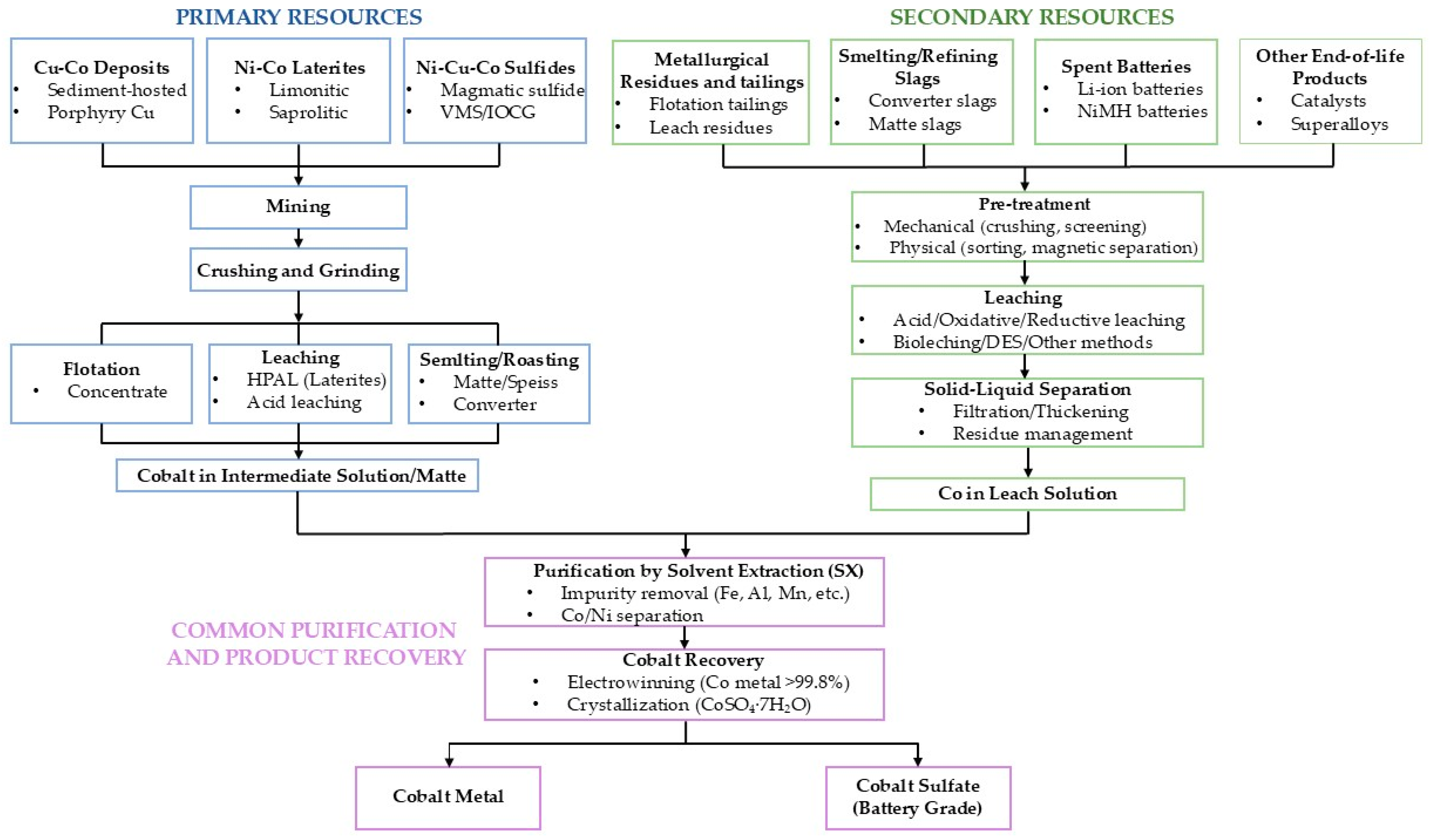
Another major source of cobalt is Cu–Co mineralisation. According to Crundwell et al., the African Copperbelt, located principally within the Democratic Republic of Congo (DRC) and Zambia, constitutes the largest copper-producing province in the world [59]. Nevertheless, cobalt is rarely obtained from primary cobalt mines. Recent system-level assessments indicate that, in 2022, only approximately 1% of global cobalt production originated from primary cobalt operations, whereas around 74% was recovered as a co-product of copper mining and processing and approximately 25% as a by-product of nickel extraction and refining [78]. These figures highlight the strong structural dependence of cobalt supply on the copper and nickel industries. In the DRC, copper and cobalt are processed predominantly through two industrial routes: (i) hydrometallurgical processing, which produces copper cathodes and partially refined cobalt hydroxide (Co(OH)2), and (ii) downstream refining, in which cobalt hydroxide is re-dissolved and further purified through hydrometallurgical and electrochemical processes to produce high-purity cobalt metal [68]. Crundwell et al. reported that economically valuable copper minerals can be broadly classified into two principal groups: sulphides and oxides. The main copper sulphide minerals include chalcopyrite (CuFeS2) and covellite (CuS), whereas oxide ores are represented primarily by carbonates and hydroxides, such as malachite (Cu2CO3(OH)2) and heterogenite (CoO(OH)) [68]. From a regional perspective, copper deposits in Zambia are generally richer in sulphide minerals, while those in the DRC contain a higher proportion of oxide mineralisation. Sulphide ores are typically processed by flotation and subsequent metallurgical treatment, whereas oxide ores are commonly treated through hydrometallurgical routes involving leaching, solvent extraction, and electrowinning. A schematic representation of the principal unit operations involved in cobalt recovery from Cu–Co ores is presented in Figure 1 [68].
As illustrated in Figure 1, Ntakamutshi et al. [79] reported that during the leaching of Cu–Co ores, cobalt is predominantly present in the trivalent state (Co3+). To enhance cobalt recovery, sodium metabisulfite (Na2S2O5) is added as a reducing agent to convert Co3+ to the more soluble Co2+ species. Na2S2O5 is widely regarded as one of the most effective reagents for this purpose; however, its use at high concentrations may adversely affect copper recovery and raise environmental concerns. These effects arise because, during the leaching process, Na2S2O5 reacts with sulfuric acid (H2SO4) to generate sulphur dioxide (SO2), which acts as the reducing species responsible for converting Co3+ to Co2+. Although this reaction improves cobalt solubilization, excess SO2 can be released or remain dissolved in the leach liquor, potentially leading to reduced copper recovery and operational and environmental challenges.
As discussed above, redox potential is a critical parameter governing cobalt dissolution in mixed Cu–Co oxide–sulphide systems. Thermodynamic modelling of the Co–Cu–Fe–SO42−–H2O system demonstrates that cobalt stability is strongly influenced by both pH and Eh conditions. Eh–pH diagrams indicate that, at pH 1.5, Co2+ and CoSO4 are the predominant soluble cobalt species. The analysis further suggests that efficient cobalt dissolution is favoured when the solution potential is maintained below approximately 500 mV, whereas more oxidising conditions tend to restrict cobalt recovery. Speciation modelling at pH 1.5 identifies CoSO4 as the dominant dissolved cobalt species under these conditions. Furthermore, the Fe2+/Fe3+ redox couple plays a fundamental role in controlling the solution potential and enhancing cobalt solubilisation. These findings emphasise the importance of carefully managing redox conditions to maximise cobalt recovery from Copperbelt ores, as supported by both thermodynamic predictions and experimental observations [80].
Following leaching, copper is typically recovered by solvent extraction and electrowinning (SX–EW) to produce high-purity cathodes. Cobalt remains in the raffinate and is subsequently recovered through selective solvent extraction, ion exchange, or precipitation as cobalt hydroxide (Co(OH)2). The efficiency of cobalt recovery at this stage is strongly dependent on impurity management, particularly with respect to iron and manganese, whose redox behaviour significantly influences cobalt speciation and separation during downstream processing. Effective control of these elements is especially important in solvent extraction circuits designed to produce high-purity cobalt products, as inadequate removal of Fe and Mn may result in co-extraction, reduced selectivity, and lower product quality. An additional emerging challenge is the gradual transition towards deeper sulphide mineralisation in many Cu–Co deposits. These ores, which commonly contain chalcopyrite, bornite, and cobalt-bearing sulphides, generally require flotation concentration prior to further processing. Under these conditions, the emphasis shifts from maximising cobalt recovery during hydrometallurgical treatment to enhancing cobalt recovery into flotation concentrates. However, complex mineral assemblages and the presence of carbonate-rich gangue minerals, such as dolomite and magnesite, can adversely affect flotation performance and increase reagent consumption. Consequently, modified flotation strategies, including controlled-potential sulphidisation and selective flotation under mildly acidic conditions, have been investigated to improve copper and cobalt recovery from mixed oxide–sulphide ore systems [31].
Following flotation, cobalt-bearing concentrates are typically subjected to pyrometallurgical treatment or roasting processes to convert sulphide phases into oxide materials suitable for subsequent hydrometallurgical extraction. These oxide intermediates are then leached under acidic conditions to transfer cobalt into solution for downstream recovery. Although matte leaching has been reported historically, contemporary industrial operations predominantly employ integrated roasting–leaching flowsheets or direct hydrometallurgical processing routes, depending on concentrate mineralogy, feed composition, and plant configuration. Overall, cobalt recovery from Cu–Co ores is controlled by a combination of mineralogical occurrence, electrochemical stability, and solution chemistry. Modern process optimisation increasingly focuses on redox control, geometallurgical characterisation, and selective impurity management, rather than solely increasing leaching intensity. This trend reflects the evolving technological and operational requirements of the Copperbelt mining industry and the growing need to efficiently process more complex ore types while maintaining high cobalt recovery and product quality [8,81].

6.3. Recovery of Cobalt Arsenides from Morocco

Although most of the cobalt is produced as a by-product of Cu–Co and Ni ore processing, arsenide-bearing deposits constitute a distinct, albeit comparatively minor, primary source of cobalt. Minerals such as safflorite (CoAs2) and skutterudite (CoAs3) host cobalt within refractory Co–As mineral structures that are less amenable to conventional hydrometallurgical treatment. At present, the Bou Azzer mining district in Morocco remains the only major operation where cobalt is produced primarily from arsenide ores [82]. The processing of arsenide minerals presents significant metallurgical and environmental challenges owing to the stability of Co–As bonds and the potential release of arsenic during oxidative treatment. In this context, Giebner et al. [82] demonstrated that bioleaching using Leptospirillum ferriphilum can enhance cobalt recovery from arsenide-rich mineral assemblages containing loellingite, safflorite, and skutterudite. Complementary work by Johnson et al. [83] further showed that the oxidative bioprocessing of skutterudite promotes cobalt solubilisation while simultaneously facilitating the biomineralisation of scorodite, a stable iron arsenate phase capable of immobilising arsenic. These findings highlight biohydrometallurgical processing as a promising approach for recovering cobalt from refractory arsenide ores while mitigating arsenic-related environmental risks. It should be noted, however, that the high cobalt recovery efficiencies reported at laboratory scale do not necessarily translate into industrial feasibility. Successful large-scale implementation depends on several factors, including reagent consumption, process integration, impurity management, operational reliability, and overall economic viability. Consequently, emerging technologies must be critically assessed against established commercial processes before they can be considered practical industrial alternatives [83].
The recovery of cobalt from primary ores generally involves a sequence of beneficiation, extraction, and refining stages, the selection of which depends strongly on ore mineralogy and cobalt deportment. In this context, a variety of hydrometallurgical systems have been developed to promote controlled cobalt dissolution under different chemical environments. A comparative summary of these approaches is presented in Table 4, highlighting the diversity of lixiviants and operating conditions employed to achieve efficient cobalt solubilisation. For sulphide ores in particular, hydrometallurgical treatment is commonly preceded by mineral beneficiation through froth flotation of crushed or ground ore, followed by smelting and converting to produce a low-iron, metal-rich sulphide matte. This intermediate product is subsequently subjected to chemical treatment to enable the selective recovery of cobalt and associated valuable metals.
Metal dissolution represents only an intermediate stage within the overall cobalt value chain. High-purity cobalt is required for advanced applications such as lithium-ion batteries, superalloys, and catalysts, where stringent impurity specifications must be met. Because cobalt exhibits electrochemical behaviour similar to that of nickel and iron, simple electrorefining is generally insufficient to achieve commercial-grade purity. Consequently, industrial cobalt production relies on multi-stage hydrometallurgical refining circuits that integrate impurity precipitation, solvent extraction (SX), stripping, and final electrowinning processes [59,88]. It is important to distinguish between intermediate products, such as mixed hydroxide precipitates and crude cobalt-bearing solutions, and fully refined commercial cobalt products. Although leaching generates cobalt-rich liquors or concentrates, economic value is only realised after rigorous purification and refining stages capable of meeting the specifications required for battery-grade cobalt salts or high-purity metallic cobalt. Table 5 summarises representative cobalt leaching systems and their associated downstream purification strategies, demonstrating that, despite differences in lixiviant chemistry, industrial practice generally converges towards selective solvent extraction followed by successive refining stages to produce high-purity cobalt products.
Despite the diversity of leaching environments shown in Table 5, solvent extraction remains the dominant industrial strategy for cobalt purification. In sulphate-based circuits, iron and aluminium are commonly removed via precipitation prior to selective Co/Ni separation using organophosphorus extractants such as Cyanex 272 [89]. Multi-stage SX configurations improve selectivity and allow impurity polishing before final product recovery.
In chloride systems derived from lateritic processing, selective extraction of Fe3+ may precede cobalt separation, followed by stripping using hydrochloric acid. Ammoniacal systems stabilize cobalt in solution as amine complexes, requiring further downstream processing for metal recovery [90].
Recycling-based and biohydrometallurgical routes similarly require integration into conventional SX–EW circuits to achieve industrial-grade products [91,92]. Regardless of the upstream extraction route, final purification typically involves electrowinning to produce cobalt metal with purities exceeding 99.8%, or crystallization to obtain battery-grade cobalt sulfate. Consequently, refining strategy and impurity management are decisive factors in determining product quality, process viability, and commercial value.

7. Cobalt Recycling

At present, the mining industry faces significant challenges in aligning its operations with the principles of the circular economy, particularly in the development of sustainable processes capable of reducing environmental impacts and supporting climate change mitigation. The existing literature has introduced and discussed several key concepts, including (i) life cycle assessment, (ii) closed-loop systems, (iii) remanufacturing, (iv) product reuse, and (v) waste management. However, these topics are often addressed in isolation, and comprehensive analyses of their integrated implementation within the mining and metallurgical sectors remain relatively limited [91,92]. Secondary sources of cobalt include (i) spent catalysts, (ii) permanent magnets, (iii) superalloys, (iv) cemented carbides, (v) rechargeable batteries, and (vi) a range of metallurgical by-products and residues [93,94]. In mining and metallurgical operations, tailings and process residues frequently contain significant quantities of cobalt that may be recovered and utilised as alternative sources of this strategic metal. The recovery of cobalt from such materials contributes to waste valorisation, resource efficiency, and the overall sustainability of the extractive industry [95]. In this context, Table 6 summarises representative studies reported in the literature on cobalt recovery from mining and metallurgical residues, highlighting the types of materials processed, the recovery technologies employed, and the recovery efficiencies achieved.
As shown in Table 6, cobalt recovery from metallurgical residues is achieved predominantly through hydrometallurgical routes, particularly acid leaching followed by solution purification and metal separation stages. Although most reported studies focus on solid feedstocks, cobalt recovery strategies are equally applicable to liquid process streams, where solvent extraction has demonstrated high efficiency for the selective separation of cobalt from copper-bearing sulphate solutions [102]. In addition to conventional metallurgical residues, several industrial waste materials containing significant cobalt concentrations have attracted growing attention as potential secondary resources. A representative example is copper converter slag generated during smelting operations, which has been reported to contain approximately 0.7 wt.% Co [103].
Despite the promising recovery efficiencies achieved at laboratory scale, the industrial implementation of cobalt recovery from residues and secondary materials remains challenging. Key limitations include variability in feed composition, complex impurity profiles (e.g., Fe, Cu, Zn, Mn, Al, and organic compounds), additional pre-treatment requirements, and the need to integrate recovery processes into existing refining infrastructure. Consequently, high recovery efficiency alone should not be regarded as a sufficient indicator of industrial viability. From an operational perspective, secondary cobalt streams can be incorporated into established hydrometallurgical circuits, particularly solvent extraction and electrowinning (SX–EW) systems, if impurity levels are adequately controlled and electrolyte stability is maintained. Therefore, recycling and residue valorisation should be considered complementary to primary production, contributing to improved resource efficiency, reduced waste generation, and enhanced supply resilience within an integrated cobalt value chain.

8. Conclusions

Cobalt is a strategic and critical metal whose demand continues to grow owing to its indispensable role in rechargeable batteries, high-performance alloys, catalysts, and clean energy technologies. At present, global cobalt supply depends predominantly on its recovery as a by-product of copper and nickel production and remains highly concentrated geographically, particularly in the Democratic Republic of Congo (DRC). This structural dependence, together with geopolitical, environmental, and ethical concerns, poses significant challenges to the long-term security, stability, and resilience of the global cobalt supply chain.
This review demonstrates that cobalt occurs in a variety of geological settings, principally sediment-hosted Cu–Co deposits, Ni–Co laterites, and magmatic Ni–Cu–Co sulphide systems. Each deposit type exhibits distinct mineralogical and geochemical characteristics that strongly influence beneficiation, extraction, and refining strategies. Conventional processing routes, including flotation, smelting, and hydrometallurgical treatment, remain the foundation of primary cobalt production. However, their efficiency, economic performance, and environmental footprint are closely linked to ore mineralogy, grade, and the composition of associated gangue minerals. A major finding of this review is the increasing importance of secondary cobalt resources, including metallurgical residues, tailings, slags, and end-of-life products such as spent batteries. The literature analysed indicates that hydrometallurgical technologies, particularly leaching coupled with solvent extraction, precipitation, ion exchange, or electrowinning, can achieve high cobalt recovery efficiencies even from low-grade and mineralogically complex feedstocks. These studies collectively demonstrate that secondary resources are becoming a technically viable and strategically important complement to conventional primary cobalt production.
From a sustainability and circular economy perspective, cobalt recovery from secondary sources offers several advantages, including reduced environmental impacts, improved resource efficiency, and mitigation of supply risks associated with primary mining. However, the successful implementation of these approaches requires carefully designed process strategies, including selective leaching systems tailored to complex feed compositions, advanced impurity removal technologies integrated into solvent extraction circuits, and the use of lower-impact reagents such as organic acids and deep eutectic solvents. Furthermore, process integration involving mechanical pre-treatment, controlled leaching, and downstream purification is essential for maximising metal recovery and minimising waste generation. By enabling the efficient treatment of heterogeneous and recycled materials, these strategies contribute directly to feedstock diversification and enhanced supply chain flexibility.
Despite these advances, several challenges remain. Process selectivity, reagent consumption, waste management, and economic scalability continue to limit the widespread industrial implementation of many emerging technologies. Addressing these limitations will require improved geometallurgical characterisation of both primary and secondary resources, optimisation of process parameters based on feed variability, and the development of closed-loop reagent systems capable of reducing environmental impacts. In addition, comprehensive techno-economic analyses and life-cycle assessments are needed to validate the industrial feasibility and sustainability of these technologies. Beyond extraction efficiency alone, the long-term adequacy of current cobalt processing routes will depend on geopolitical stability, feedstock diversification, and technological adaptability. Although mature hydrometallurgical technologies such as solvent extraction–electrowinning (SX–EW) and high-pressure acid leaching (HPAL) remain the dominant industrial processes, the strong geographical concentration of cobalt mining and refining creates structural vulnerabilities within the global supply chain. Future resilience will therefore require a broader diversification of cobalt sources, greater integration of secondary resources, and the development of flexible refining circuits capable of processing increasingly complex ores and recycled materials.
Overall, the evidence reviewed indicates that future cobalt supply will depend increasingly on the complementary contributions of both primary mineral resources and secondary materials derived from recycling and residue valorisation. The integration of circular economy principles into cobalt production and recycling systems will play a pivotal role in enhancing resource efficiency, reducing environmental impacts, and strengthening long-term supply security. Future research should focus on improving cobalt selectivity during separation from associated metals, reducing reagent consumption and operating costs, and developing more sustainable leaching and refining technologies. Attention should be given to the scale-up and industrial validation of emerging approaches, including deep eutectic solvent systems, biohydrometallurgical processes, and integrated recycling technologies. Furthermore, greater emphasis should be placed on the development of adaptable processing routes capable of treating increasingly diverse primary and secondary feedstocks. Addressing these challenges will be essential to ensure a secure, diversified, and sustainable cobalt supply capable of supporting the growing demands of electrification, renewable energy deployment, and the global energy transition.

Author Contributions

N.G.P.-R., M.R.G.R. and F.R.C.P.; validation, M.d.J.S.-A. and D.M.P.S.; formal analysis, N.G.P.-R. and N.T.; investigation, G.B.-C. and M.S.-C.; resources, F.M.G.-M. and N.T.; writing—original draft preparation, M.R.G.R.; writing—review and editing, N.G.P.-R. and F.R.C.P.; visualization, D.M.P.S.; supervision, N.G.P.-R., M.R.G.R. and M.d.J.S.-A.; project administration, G.B.-C. and N.G.P.-R. All authors have read and agreed to the published version of the manuscript.

Funding

This research received no external funding.

Data Availability Statement

Data are available based on reasonable request.

Conflicts of Interest

The authors declare no conflicts of interest.

References

  1. Mamyrbayeva, K.K.; Kuandykova, A.N.; Chepushtanova, T.A.; Merkibayev, Y.S. Review on hydrometallurgical processing technology of lateritic nickel ore for the last 20 years in the world. Non-Ferr. Met. 2024, 56, 13–21. [Google Scholar] [CrossRef]
  2. Wang, W.-W.; Liu, C.; Qin, B.; Liu, Z.-B.; Li, X.-Y.; Li, M.-C.; Liu, G.; Lv, D.; Lu, Y.-D.; Liu, J.; et al. Comprehensive recovery of valuable metals from laterite via neutralization sludge. Sep. Purif. Technol. 2025, 368, 133006. [Google Scholar] [CrossRef]
  3. Repukaiti, R.; Mukhopadhyay, A.; Diaz, L.A.; Stetson, C.C.; Chowdhury, N.A.; Jin, H.; Shi, M. Electrochemical leaching of cobalt from cobaltite: Box–Behnken design and optimization with response surface methodology. ACS Omega 2025, 10, 655–664. [Google Scholar] [PubMed]
  4. Li, J.; Yu, T.; Li, C.; Han, X.; Gao, J. Efficient and selective leaching of nickel and cobalt from nickel laterite ore by a combined atmospheric acid leaching–ferric chloride solution leaching process: Optimization and mechanism. RSC Adv. 2025, 15, 29176–29189. [Google Scholar] [CrossRef] [PubMed]
  5. Gupta, H.; Dhiman, S.; Stam, P.G.; Chaudhary, S.; Murugavel, R.; Shiju, N.R. Sustainable approach to cobalt recycling: Levulinic acid leaching of waste lithium-ion battery cathode materials. Environ. Technol. Innov. 2026, 41, 104675. [Google Scholar] [CrossRef]
  6. Stopić, S.; Fridrih, B. Recovery of cobalt from primary and secondary materials—An overview. Vojnoteh. Glas. 2020, 68, 321–337. [Google Scholar] [CrossRef]
  7. Crundwell, F.K.; du Preez, N.B.; Knights, B.D.H. Production of cobalt from copper–cobalt ores on the African Copperbelt—An overview. Miner. Eng. 2020, 156, 106450. [Google Scholar] [CrossRef]
  8. Gulley, A.L. One hundred years of cobalt production in the Democratic Republic of the Congo. Resour. Policy 2022, 79, 103007. [Google Scholar] [CrossRef]
  9. U.S. Geological Survey. 2023 Minerals Yearbook: Cobalt; U.S. Department of the Interior, U.S. Geological Survey: Reston, VA, USA, 2025.
  10. U.S. Geological Survey. Mineral Commodity Summaries 2024; U.S. Geological Survey: Reston, VA, USA, 2024.
  11. Schmidt, T.; Buchert, M.; Schebek, L. Investigation of the primary production routes of nickel and cobalt products used for Li-ion batteries. Resour. Conserv. Recycl. 2016, 122, 107–122. [Google Scholar] [CrossRef]
  12. Darton Commodities Ltd. Cobalt Market Review; Darton Commodities Ltd.: Guildford, UK, 2020. [Google Scholar]
  13. Hund, K.; La Porta, D.; Fabregas, T.; Laing, T.; Drexhage, J. Minerals for Climate Action: The Mineral Intensity of the Clean Energy Transition; World Bank Group: Washington, DC, USA, 2023. [Google Scholar]
  14. Harper, E.M.; Kavlak, G.; Graedel, T.E. Tracking the metal of the goblins: Cobalt’s cycle of use. Environ. Sci. Technol. 2012, 46, 1079–1086. [Google Scholar] [PubMed]
  15. Smith, C. Always the bridesmaid, never the bride: Cobalt geology and resources. Trans. Inst. Min. Metall. Sect. B Appl. Earth Sci. 2001, 110, 75–80. [Google Scholar] [CrossRef]
  16. Leblanc, M.; Billard, P. Cobalt arsenide orebodies related to an upper Proterozoic ophiolite: Bou Azzer (Morocco). Econ. Geol. 1982, 77, 162–175. [Google Scholar] [CrossRef]
  17. Croxford, N. Cobalt mineralization at Mount Isa, Queensland, Australia, with references to Mount Cobalt. Miner. Depos. 1974, 9, 105–115. [Google Scholar] [CrossRef]
  18. Cobalt Institute. Cobalt Market Report 2023; Cobalt Institute: London, UK, 2024. [Google Scholar]
  19. International Energy Agency. Global Critical Minerals Outlook 2024; International Energy Agency: Paris, France, 2024; Available online: https://www.iea.org/reports/global-critical-minerals-outlook-2024 (accessed on 12 December 2025).
  20. Dehaine, Q.; Tijsseling, L.T.; Glass, H.J.; Törmänen, T.; Butcher, A.R. Geometallurgy of cobalt ores: A review. Miner. Eng. 2021, 160, 106656. [Google Scholar] [CrossRef]
  21. Sun, J.; Xia, H.; Xu, Y.; Zhang, Q.; Zhang, L. Research on the efficient leaching of Co from low-grade cobalt slag enhanced by ultrasonic waves. Sep. Purif. Technol. 2026, 382, 135762. [Google Scholar] [CrossRef]
  22. Cobalt Institute. Cobalt Market Report 2024; Cobalt Institute: London, UK, 2025. [Google Scholar]
  23. Secretaría de Economía. Data México; Secretaría de Economía: Ciudad de México, Mexico, 2024. [Google Scholar]
  24. U.S. Geological Survey. Mineral Commodity Summaries 2022; U.S. Geological Survey: Reston, VA, USA, 2022.
  25. Urtubia, P. Volatility and Dynamic Correlation in Emerging Markets: A Study on Stocks and Commodities with Electromobility Industry. Master’s Thesis, Universidad Complutense de Madrid, Madrid, Spain, 2025. [Google Scholar]
  26. Mikulenka, J. Connectedness and Hedging of Energy Transition Metals: The Case of Lithium, Cobalt and Nickel. Bachelor’s Thesis, Charles University, Prague, Czech Republic, 2025. [Google Scholar]
  27. Bastianin, A.; Casoli, C.; Galeotti, M. The connectedness of energy transition metals. Energy Econ. 2023, 128, 107183. [Google Scholar] [CrossRef]
  28. Azhgaliyeva, D.; Kapsalyamova, Z.; Mishra, R. Oil price shocks and green bonds: An empirical evidence. Energy Econ. 2022, 112, 106108. [Google Scholar] [CrossRef]
  29. Dehaine, Q.; Filippov, L.O.; Filippova, I.V.; Tijsseling, L.T.; Glass, H.J. Novel approach for processing complex carbonate-rich copper–cobalt mixed ores via reverse flotation. Miner. Eng. 2021, 161, 106710. [Google Scholar] [CrossRef]
  30. Darton Commodities Ltd. Darton Cobalt Market Research; Darton Commodities Ltd.: Guildford, UK, 2020. [Google Scholar]
  31. Kovacheva-Ninova, V.; Savov, G.; Vassileva, V.; Vutova, K.; Petrov, E.; Petrov, D. Trends in the development of cobalt production. Electrotech. Electron. 2018, 53, 849–894. [Google Scholar]
  32. Cobalt Development Institute. Cobalt Supply & Demand 2015; Cobalt Development Institute: London, UK, 2015. [Google Scholar]
  33. Donaldson, J.D.; Beyersmann, D. Cobalt and cobalt compounds. In Ullmann’s Encyclopedia of Industrial Chemistry; Wiley-VCH Verlag GmbH & Co. KGaA: Weinheim, Germany, 2005. [Google Scholar]
  34. Young, R.S. The geochemistry of cobalt. Geochim. Cosmochim. Acta 1957, 13, 28–41. [Google Scholar] [CrossRef]
  35. Rudnick, R.L.; Gao, S. Composition of the continental crust. In Treatise on Geochemistry, 2nd ed.; Elsevier: Oxford, UK, 2013; pp. 1–51. [Google Scholar]
  36. Carr, M.H.; Turekian, K.K. The geochemistry of cobalt. Geochim. Cosmochim. Acta 1961, 23, 9–60. [Google Scholar] [CrossRef]
  37. Abaide, E.R.; Anchieta, C.G.; Foletto, V.S.; Reinehr, B.; Nunes, L.F.; Kuhn, R.C. Production of copper and cobalt aluminate spinels and their application as supports for inulinase immobilization. Mater. Res. 2015, 18, 1062–1069. [Google Scholar] [CrossRef]
  38. Krauskopf, K.B.; Bird, D.K. Distribution of the Elements: Introduction to Geochemistry; McGraw-Hill: New York, NY, USA, 1995. [Google Scholar]
  39. Gülaçar, O.F.; Delaloye, M. Geochemistry of nickel, cobalt and copper in alpine-type ultramafic rocks. Chem. Geol. 1976, 17, 269–280. [Google Scholar] [CrossRef]
  40. Lafuente, B.; Downs, R.T.; Yang, H.; Stone, N. The power of databases: The RRUFF project. In Highlights in Mineralogical Crystallography; Armbruster, T., Danisi, R.M., Eds.; De Gruyter: Berlin, Germany, 2015; pp. 1–29. [Google Scholar]
  41. Hazen, R.M.; Hystad, G.; Golden, J.J.; Hummer, D.R.; Liu, C.; Downs, R.T.; Morrison, S.M.; Ralph, J.; Grew, E.S. Cobalt mineral ecology. Am. Miner. 2017, 102, 108–116. [Google Scholar] [CrossRef]
  42. Gauthier, G.; Deliens, M. Cobalt minerals of the Katanga Crescent, Congo. Miner. Rec. 1999, 30, 255–256. [Google Scholar]
  43. Pirard, C.; Hatert, F. The sulfides and selenides of the Musonoï mine, Kolwezi, Katanga, Democratic Republic of Congo. Can. Miner. 2008, 46, 219–231. [Google Scholar] [CrossRef]
  44. Decrée, S.; Pourret, O.; Baele, J.M. Rare earth element fractionation in heterogenite (CoOOH): Implication for cobalt oxidized ore in the Katanga Copperbelt (Democratic Republic of Congo). J. Geochem. Explor. 2015, 159, 290–301. [Google Scholar] [CrossRef]
  45. Vanbrabant, Y.; Burlet, C.; Louis, P. Mineralogical characterization of cobaltic oxides from the Democratic Republic of Congo. In Ni-Co 2013; Springer: Secaucus, NJ, USA, 2013; pp. 243–254. [Google Scholar]
  46. Llorca, S.; Monchoux, P. Supergene cobalt minerals from New Caledonia. Can. Mineral. 1991, 29, 149–161. [Google Scholar]
  47. Glasby, G.P.; Ren, X.; Shi, X.; Pulyaeva, I.A. Co-rich Mn crusts from the Magellan Seamount cluster. Geo-Mar. Lett. 2007, 27, 315–323. [Google Scholar] [CrossRef]
  48. Chukhrov, F.V.; Gorshkov, A.I.; Sivtsov, A.V.; Berezovskaya, V.V. The nature and genesis of lithiophorite. Int. Geol. Rev. 1985, 27, 348–361. [Google Scholar] [CrossRef]
  49. Tindall, G.P.; Muir, D.M. Transformation of iron oxide in nickel laterite processing. In Iron Control and Disposal; Canadian Institute of Mining, Metallurgy and Petroleum: Montreal, QC, Canada, 1996; pp. 249–262. [Google Scholar]
  50. Manceau, A.; Llorca, S.; Calas, G. Crystal chemistry of cobalt and nickel in lithiophorite and asbolane from New Caledonia. Geochim. Cosmochim. Acta 1987, 51, 105–113. [Google Scholar] [CrossRef]
  51. Slack, J.F.; Kimball, B.E.; Shedd, K.B. Cobalt. In Critical Mineral Resources of the United States—Economic and Environmental Geology and Prospects for Future Supply; Schulz, K.J., DeYoung, J.H., Seal, R.R., Bradley, D.C., Eds.; U.S. Geological Survey: Reston, VA, USA, 2017; pp. 1–40. [Google Scholar]
  52. Crockett, R.N.; Chapman, G.R.; Forrest, M.D. International Strategic Minerals Inventory Summary Report—Cobalt; U.S. Geological Survey Circular 930; U.S. Geological Survey: Denver, CO, USA, 1987.
  53. Mudd, G.M.; Weng, Z.; Jowitt, S.M.; Turnbull, I.D.; Graedel, T.E. Quantifying the recoverable resources of by-product metals: The case of cobalt. Ore Geol. Rev. 2013, 55, 87–98. [Google Scholar] [CrossRef]
  54. Petavratzi, C.E.; Gunn, G.; Kresse, C. Commodity Review: Cobalt; British Geological Survey: Nottingham, UK, 2019. [Google Scholar]
  55. Sverdrup, H.U.; Ragnarsdottir, K.V.; Koca, D. Integrated modelling of the global cobalt extraction, supply, price and depletion of extractable resources using the WORLD6 model. Biophys. Econ. Resour. Qual. 2017, 2, 4. [Google Scholar] [CrossRef]
  56. Cailteux, J.L.H.; Kampunzu, A.B.; Lerouge, C.; Kaputo, A.K.; Milesi, J.P. Genesis of sediment-hosted stratiform copper–cobalt deposits, Central African Copperbelt. J. Afr. Earth Sci. 2005, 42, 134–158. [Google Scholar] [CrossRef]
  57. Cailteux, J.L.H.; Kampunzu, A.B.H.; Batumike, M.J. Lithostratigraphic position and petrographic characteristics of R.A.T. (“Roches Argilo-Talqueuses”) subgroup, Neoproterozoic Katangan Belt (Congo). J. Afr. Earth Sci. 2005, 42, 82–94. [Google Scholar] [CrossRef]
  58. Kampunzu, A.B.; Tembo, F.; Matheis, G.; Kapenda, D.; Huntsman-Mapila, P. Geochemistry and tectonic setting of mafic igneous units in the Neoproterozoic Katangan Basin, Central Africa: Implications for Rodinia break-up. Gondwana Res. 2000, 3, 125–153. [Google Scholar] [CrossRef]
  59. Crundwell, F.K.; Moats, M.; Ramachandran, V.; Robinson, T.G.; Davenport, W.G. Production of cobalt from the copper–cobalt ores of the Central African Copperbelt. In Extractive Metallurgy of Nickel, Cobalt and Platinum Group Metals; Elsevier: Oxford, UK, 2011; pp. 377–391. [Google Scholar]
  60. Dewaele, S.; Muchez, P.; Vets, J.; Fernandez-Alonzo, M.; Tack, L. Multiphase origin of the Cu–Co ore deposits in the western part of the Lufilian fold-and-thrust belt, Katanga (Democratic Republic of Congo). J. Afr. Earth Sci. 2006, 46, 455–469. [Google Scholar] [CrossRef]
  61. Guilbert, J.M.; Park, C.F.J. The Geology of Ore Deposits; Waveland Press: Long Grove, IL, USA, 2007. [Google Scholar]
  62. Berger, V.I.; Mosier, D.L.; Bliss, J.D.; Moring, B.C. Sediment-Hosted Gold Deposits of the World: Database and Grade and Tonnage Models; Open-File Report 51; U.S. Geological Survey: Reston, VA, USA, 2014.
  63. Gleeson, S.A.; Butt, C.R.M.; Elias, M. Nickel laterites: A review. SEG Newsl. 2003, 54, 11–18. [Google Scholar]
  64. Marsh, E.E.; Anderson, E.D.; Gray, F. Nickel–cobalt laterites—A deposit model. In Mineral Deposit Models for Resource Assessment; Scientific Investigations Report 2010–5070-H; U.S. Geological Survey: Reston, VA, USA, 2013. [Google Scholar]
  65. Robb, L. Introduction to Ore-Forming Processes; Blackwell Publishing: Oxford, UK, 2005. [Google Scholar]
  66. Naldrett, A.J. World-class Ni–Cu–PGE deposits: Key factors in their genesis. Miner. Depos. 1999, 34, 227–240. [Google Scholar] [CrossRef]
  67. Lesher, C.M.; Keays, R.R. Komatiite-associated Ni–Cu–PGE deposits: Geology, mineralogy, geochemistry and genesis. In The Geology, Geochemistry, Mineralogy and Mineral Beneficiation of the Platinum-Group Elements; Cabri, L.J., Ed.; Canadian Institute of Mining, Metallurgy and Petroleum: Montreal, QC, Canada, 2002; pp. 579–618. [Google Scholar]
  68. Crundwell, F.K.; Moats, M.S.; Ramachandran, V.; Robinson, T.G. Extractive Metallurgy of Nickel, Cobalt and Platinum-Group Metals; Elsevier: Oxford, UK, 2011. [Google Scholar]
  69. Petranikova, M.; Ebin, B.; Tunsu, C. Selective recovery of cobalt from the secondary streams after NiMH batteries processing using Cyanex 301. Waste Manag. 2019, 83, 194–201. [Google Scholar] [CrossRef] [PubMed]
  70. Alvial-Hein, G.; Mahandra, H.; Ghahreman, A. Separation and recovery of cobalt and nickel from end-of-life products via solvent extraction technique: A review. J. Clean. Prod. 2021, 297, 126592. [Google Scholar] [CrossRef]
  71. Peeters, N.; Binnemans, K.; Riaño, S. Solvometallurgical recovery of cobalt from lithium-ion battery cathode materials using deep-eutectic solvents. Green Chem. 2020, 22, 4210–4221. [Google Scholar] [CrossRef]
  72. Quintero-Almanza, D.; Gamiño-Arroyo, Z.; Sánchez-Cadena, L.E.; Gómez-Castro, F.I.; Uribe-Ramírez, A.R.; Aguilera-Alvarado, A.F.; Carmona, L.M.O. Recovery of cobalt from spent lithium-ion mobile phone batteries using liquid–liquid extraction. Batteries 2019, 5, 44. [Google Scholar] [CrossRef]
  73. Peeters, N.; Binnemans, K.; Riaño, S. Recovery of cobalt from lithium-ion battery cathode material by combining solvoleaching and solvent extraction. Green Chem. 2022, 24, 2839–2852. [Google Scholar] [CrossRef]
  74. Liu, F.; Peng, C.; Porvali, A.; Wang, Z.; Wilson, B.P.; Lundström, M. Synergistic recovery of valuable metals from spent nickel–metal hydride batteries and lithium-ion batteries. ACS Sustain. Chem. Eng. 2019, 7, 16103–16111. [Google Scholar] [CrossRef]
  75. Weshahy, A.R.; Sakr, A.K.; Gouda, A.A.; Atia, B.M.; Somaily, H.H.; Hanfi, M.Y.; Sayyed, M.I.; El Sheikh, R.; El-Sheikh, E.M.; Radwan, H.A.; et al. Selective recovery of cadmium, cobalt and nickel from spent Ni–Cd batteries using Adogen® 464 and mesoporous silica derivatives. Int. J. Mol. Sci. 2022, 23, 8677. [Google Scholar] [CrossRef] [PubMed]
  76. Agarwal, V.; Khalid, M.K.; Porvali, A.; Wilson, B.P.; Lundström, M. Recycling of spent NiMH batteries: Integration of battery leach solution into primary Ni production using solvent extraction. Sustain. Mater. Technol. 2019, 22, e00118. [Google Scholar] [CrossRef]
  77. Flett, D.S. Solvent extraction in hydrometallurgy: The role of organophosphorus extractants. J. Organomet. Chem. 2005, 690, 2426–2438. [Google Scholar] [CrossRef]
  78. Ryter, J.; Bhuwalka, K.; Roth, R.; Olivetti, E.; Buarque-Andrade, L.; Frenzel, M.; Shojaeddini, E.; Alonso, E.; Nassar, N. Modeling interconnected minerals markets with multicommodity supply curves: Examining the copper–cobalt–nickel system. Nat. Commun. 2025, 16, 7302. [Google Scholar] [CrossRef] [PubMed]
  79. Ntakamutshi, P.T.; Kime, M.B.; Mwema, M.E.; Ngenda, B.R.; Kaniki, T.A. Agitation and column leaching studies of oxidised copper–cobalt ores under reducing conditions. Miner. Eng. 2017, 111, 47–54. [Google Scholar] [CrossRef]
  80. Mbuya, B.; Fosso-Kankeu, E.; Bongaerts, J.; Mulaba-Bafubiandi, A.F. Thermodynamic investigation on the impact of oxidized copper–cobalt and copper sulfide ores stream mixture toward the dissolution of Cu and Co. J. Sustain. Met. 2025, 11, 1299–1318. [Google Scholar] [CrossRef]
  81. Yao, X.; Fu, C.; Li, S.; Huang, R.; He, J.; Zheng, C.; Liu, S.; Hu, J. Reductant-free cobalt recovery from similar copper–cobalt oxide ores via synergistic reductive-acid leaching. Minerals 2025, 15, 1022. [Google Scholar] [CrossRef]
  82. Giebner, F.; Kaden, L.; Wiche, O.; Tischler, J.; Schopf, S.; Schlömann, M. Bioleaching of cobalt from an arsenidic ore. Miner. Eng. 2019, 131, 73–78. [Google Scholar] [CrossRef]
  83. Johnson, D.B.; Dybowska, A.; Schofield, P.F.; Herrington, R.J.; Smith, S.L.; Santos, A.L. Bioleaching of arsenic-rich cobalt mineral resources, and evidence for concurrent biomineralisation of scorodite during oxidative bio-processing of skutterudite. Hydrometallurgy 2020, 195, 105395. [Google Scholar] [CrossRef]
  84. Nasrullah, Z.; Agyemang, F.; Saddat, M.; LaDouceur, R. Process intensification by resonant vibratory mixing for samarium–cobalt magnet leaching with deep eutectic solvents. Environ. Sci. Adv. 2026, 5, 510–521. [Google Scholar] [CrossRef]
  85. Sharipov, R.; Dagubayeva, A.; Maldybayev, G.; Mohamad Ibrahim, M.N.; Baigenzhenov, O.; Mu, T. Sustainable leaching of nickel and cobalt from asbestos waste using deep eutectic solvents: Kinetic modeling and recovery performance. J. Hazard. Mater. Adv. 2026, 21, 100948. [Google Scholar] [CrossRef]
  86. Wang, J.; Shu, J.; Zhao, H.; Luo, J.; Chen, S.; Yang, H.; Chen, M.; Yang, Y.; Qiu, S. Coupled oxygen-enriched leaching and electrodeposition for recovery of cobalt, nickel and manganese from electrolytic manganese sulfide residue. Sep. Purif. Technol. 2026, 385, 136356. [Google Scholar] [CrossRef]
  87. Wang, Y.; Zhang, Y.; Lv, C.; Wei, G.; Meng, L.; Fu, J.; Yu, Z.; Qu, J. Sustainable ammonia leaching for efficient nickel and cobalt recovery from mixed hydroxide precipitate. J. Environ. Chem. Eng. 2025, 13, 115731. [Google Scholar] [CrossRef]
  88. Wang, G.; Zhao, Y.; Yang, B.; Song, Y. Removal of trace iron from cobalt electro-refining electrolytes using Monophos resin. Hydrometallurgy 2018, 176, 69–72. [Google Scholar] [CrossRef]
  89. Liu, Y.; Lee, M.S. Separation of cobalt and nickel from chloride leach solution of nickel laterite ore by solvent extraction. Geosyst. Eng. 2016, 19, 214–221. [Google Scholar] [CrossRef]
  90. Kumbasar, R.A.; Kasap, S. Selective separation of nickel from cobalt in ammoniacal solutions by emulsion type liquid membranes using 8-hydroxyquinoline (8-HQ) as mobile carrier. Hydrometallurgy 2009, 95, 121–126. [Google Scholar] [CrossRef]
  91. Li, L.; Dunn, J.B.; Zhang, X.X.; Gaines, L.; Chen, R.J.; Wu, F.; Amine, K. Recovery of metals from spent lithium-ion batteries with organic acids as leaching reagents and environmental assessment. J. Power Sources 2013, 233, 180–189. [Google Scholar] [CrossRef]
  92. Brierley, C.L.; Brierley, J.A. Progress in bioleaching: Part B: Applications of microbial processes by the minerals industries. Appl. Microbiol. Biotechnol. 2013, 97, 7543–7552. [Google Scholar] [CrossRef] [PubMed]
  93. Ulusoy, U. Review of the recovery of cobalt from secondary resources. In Critical and Rare Earth Elements: Recovery from Secondary Resources; Pillai, A., Akçıl, A., Eds.; CRC Press: Boca Raton, FL, USA, 2019; pp. 115–153. [Google Scholar]
  94. Lutandula, M.S.; Maloba, B. Recovery of cobalt and copper through reprocessing of tailings from flotation of oxidised ores. J. Environ. Chem. Eng. 2013, 1, 1085–1090. [Google Scholar] [CrossRef]
  95. Zhang, R.; Schippers, A. Stirred-tank bioleaching of copper and cobalt from mine tailings in Chile. Miner. Eng. 2022, 180, 107514. [Google Scholar] [CrossRef]
  96. Oraby, E.; Deng, Z.; Li, H.; Eksteen, J. Selective extraction of nickel and cobalt from disseminated sulfide flotation cleaner tailings using alkaline glycine–ammonia leaching solutions. Miner. Eng. 2023, 204, 108418. [Google Scholar] [CrossRef]
  97. Ahmadi, A.; Khezri, M.; Abdollahzadeh, A.A.; Askari, M. Bioleaching of copper, nickel and cobalt from the low-grade sulfidic tailing of Golgohar Iron Mine, Iran. Hydrometallurgy 2015, 154, 1–8. [Google Scholar] [CrossRef]
  98. Altinkaya, P.; Mäkinen, J.; Kinnunen, P.; Kolehmainen, E.; Haapalainen, M.; Lundström, M. Effect of biological pre-treatment on metal extraction from flotation tailings for chloride leaching. Miner. Eng. 2018, 129, 47–53. [Google Scholar] [CrossRef]
  99. Fattahi, A.; Rashchi, F.; Abkhoshk, E. Reductive leaching of zinc, cobalt and manganese from zinc plant residue. Hydrometallurgy 2016, 161, 185–192. [Google Scholar] [CrossRef]
  100. Safarzadeh, M.S.; Dhawan, N.; Birinci, M.; Moradkhani, D. Reductive leaching of cobalt from zinc plant purification residues. Hydrometallurgy 2011, 106, 51–57. [Google Scholar] [CrossRef]
  101. Li, Q.; Zhang, B.; Min, X.B.; Shen, W.Q. Acid leaching kinetics of zinc plant purification residue. Trans. Nonferrous Met. Soc. China 2013, 23, 2786–2791. [Google Scholar] [CrossRef]
  102. Kongolo, K.; Mwema, M.D.; Banza, A.N.; Gock, E. Cobalt and zinc recovery from copper sulphate solution by solvent extraction. Miner. Eng. 2003, 16, 1371–1374. [Google Scholar] [CrossRef]
  103. Banza, A.N.; Gock, E.; Kongolo, K. Base metals recovery from copper smelter slag by oxidising leaching and solvent extraction. Hydrometallurgy 2002, 67, 63–69. [Google Scholar] [CrossRef]
Figure 1. Unit operations for Co extraction (Adapted from (Crundwell et al. [68]).
Minerals 16 00729 g001
Table 2. Representative case studies on cobalt recovery from waste materials.
Type of WasteLeaching ReagentsExtractantConditions Extracted Cobalt SpeciesExtraction Ref
Cathode materials for lithium-ion batteriesCholine Chloride Citric Acid DESLIX 984/Aliquat 33640 °C, 60 minCo(II)81%[71]
Used Lithium-Ion Batteries from Mobile PhonesSulfuric acid and hydrogen peroxideCyanex 272 dissolved in kerosene75 °C, 90 minCo97–99%[72]
Lithium-ion battery (LIB) Di-(2-ethylhexyl) phosphoric acid (D2EHPA)80 °C, 360 minCo90%[73]
Nickel-metal hydride (NiMH) batteriesNa2SO4 and NaOHCyanex 272 70 °C, 60 minCo98%[74]
Used Ni-Cd BatteriesH2SO4Adogen® 46480 °C, 360 minCo(OH)2100%[75]
Used NiMH Batteries Cyanex 30123 °C, 10 minCo79.60%[76]
Solvent 70 (Statoil)
Used NiMH BatteriesNa2SO4Di-(2-ethylhexyl) phosphoric acid (D2EHPA)50 °C, 15 minCo(II)3.7 g/L [77]
Table 3. Major companies involved in the recycling of spent batteries and recovery of cobalt.
CompanyLocation
UmicoreHoboken, Belgium
Xstrata Nickel Sudbury, Ontario, Canada
AccurecKrefeld, Germany
Inmetco Ellwood City, Pennsylvania, USA
S.N.A.M Viviez, France
Sony-Sumitomo Niihama, Japan
Table 4. Comparative overview of laboratory-based hydrometallurgical leaching systems and cobalt dissolution efficiencies.
Leaching Agent (LA)Concentration of LAMetal
Values
% Co DissolutionConsiderationsReference
H2SO4 and Na2S2O32M (H2SO4) and three times that of Co (Na2S2O5)Co98.52Combined the technique with ultrasound[21]
Levulinic acid/hydrogen peroxide5 mL + 40% hydrogen peroxideCo92Ratio 1:50 and 80 °C[5]
Atmospheric acid leaching-Ferric chloride62–157 g/LCo, Ni90180 °C, 120 min.[4]
DES (choline chloride (ChCl), tetrabutylammonium chloride (TBAC), oxalic acid, urea and ethylene glycol)DESs, namely Reline (choline chloride 1:2 urea), ethaline (choline chloride 1:2 ethylene glycol), oxaline (choline chloride 1:1 oxalic acid) and EG:TBAC (ethylene glycol 2:1 tetrabutylammonium chloride)Co, Sm82–975 h, 90 °C[84]
DES (ethylene glycol and hydroxylamine hydrochlorideEthylene glycol–hydroxylamine hydrochloride DESNi, Co79.6L/S = 4:1, 80 °C, 4 h[85]
Oxygen–enriched leachingOxygen-enriched acidic solutionCo, Ni, Mg98.7S/L = 1:5, 30 °C, pH initial of 5, 80 min.[86]
Ammonium carbonate3 mol/LNi, Co96L/S ratio 5:1, room temperature, stirring 5 h[87]
Table 5. Comparative overview of industrial cobalt processing routes from leaching to final product.
Leaching SystemPrimary PurificationCo SeparationFinal RefiningCommercial ProductReferences
H2SO4Precipitation of Fe(OH)3 and Al(OH)3SX (Cyanex 272)EWCo0[59]
HCl (chloride laterite solution)Selective extraction of Fe3+ using D2EHPA + TBP mixture (pH ≈ 1); precipitation of Al(OH)3 at pH 5–6Selective extraction of Co with Aliquat 336; subsequent purification with Cyanex 301Stripping with HCl followed by electrowinning or precipitationCo0[89]
Ammoniacal (NH3)Selective oxidation of Co2+ → Co(NH3)63+ with H2O2Selective transport of Ni(NH3)62+; Co(NH3)63+ remains in aqueous phasePrecipitation or integration into SX circuitCo retained in ammoniacal solution[90]
Organic Acids (recycling)Filtration of insoluble residue (Co3O4) after leachingCo2+ remains in solution as chelated complexPrecipitation by pH adjustment for metal recoveryCo recovered as soluble salt[91]
BioleachingMicrobial generation of Fe3+ and H2SO4SX/EWEWCo retained in bioleaching solution[92]
SX: Solvent Extraction; EW: Electrowinning.
Table 6. Summary of cobalt recovery techniques and efficiencies reported for mining and metallurgical residues.
Sample Type Cobalt Content Extraction MethodExperimental ConditionsCobalt ExtractionReference
Mine tailings in Chile0.01%Stirred—tank bioleachingMesophilic and moderate thermophilic consortia of bioleaching organisms.
Temperature: 30–42 °C
0.5 mM formic acid.
Shake flasks at 2, 5, 10 or 15% solids load in stirred-tank reactors.
Basal salts medium at pH 2.0.
Elemental sulfur 10 g/L
Leaching time: 13 days.
74%[95]
Secondary cleaner flotation tailing from nickel flotation plant.0.02%Alkaline glycine—ammonia leachingTemperature: 35 and 45 °C
Rolled bottles at 100 rpm and stirred tank at 350 rpm.
pH modifiers: ammonia, NaOH, KOH and Ca(OH)2.
Glycine.
90%[96]
Sulfidic tailing of Iron Mine0.044%BioleachingThermophilic microorganisms.
Stirring rate: 150 rpm.
Temperature: 45 °C
Leaching time: 30 days
Pulp density: 5% (w/v)
Shake flasks at 15% (v/v).
Initial pH: 1.8.
59.5%[97]
Flotation tailings0.04%1. Bioleaching with mixed acidophilic culture.
2. Chemical chloride leaching.
3. Conventional cyanide leaching.
1. Mixed acidophilic culture.
Solid concentration 5, 7.5, 10 and 12.5% (w/v).
Temperature: 32 °C
Stirring rate: 300 rpm.
Time leaching: 11–15 days.
Experimental pH: 1.8.
Aeration: Flow rate of 3 L/min.
2. Copper (II) chloride dihydrate: 30 g/L Cu2+.
Sodium chloride: 250 g/L
Time leaching: 24 h, or 72 h (without Cu2+).
Experimental pH: 1.8, or 1.0 (without Cu2+).
Temperature: 95 °C
Solid: liquid ratio: 1:3.
Stirring rate: 950 rpm.
Oxygen purging: 1200 LN/min.
3. Time leaching: 72 h.
Sodium cyanide initial concentration: 2 g/L.
Experimental pH: 11.0
Temperature: 22 °C
Solid concentration: 25%.
Air feed: 500 mL/min
Stirring rate: 400 rpm.
1. 60%
2. 80%
3. Remained in the leach residue.
[98]
Zinc plant residue0.55%Leaching1. Selective leaching of zinc.
2. Reductive leaching:
1 M sulfuric acid in presence of citric acid (30 or 60%).
Solid: liquid ratio: 0.02–0.1 g/ML.
Temperature: 75–95 °C
Leaching time: 45–75 min.
3. Sulfide precipitation:
1M sodium sulfide.
Precipitated at pH 3 for cobalt.
1. 2.0%
2. 96.43%
3. 95.15%
[99]
Zinc plant purification residues0.98%Reductive leachingTemperature: 25, 50, 75, 85 °C
Sulfuric acid concentration: 0.5, 1.0, 1.5, 2.0 M
Particle size: −75 + 53, −106 + 75, −150 + 106, −180 + 150 µm.
Stirring speed: 200, 400, 600, 800, 1000 rpm.
Phenol: 2 5, 10, 15% (weight of phenol per 100 g of residue).
97%[100]
Zinc plant purification residue4.5%Acid leachingStirring speed: 400 rpm.
Sulfuric acid concentration: 50, 75, 100, 120, 150 g/L.
Temperature: 25, 40, 55, 70 °C
Particle size: 75–80, 80–109, 109–150 µm.
99.8%[101]
Disclaimer/Publisher’s Note: The statements, opinions and data contained in all publications are solely those of the individual author(s) and contributor(s) and not of MDPI and/or the editor(s). MDPI and/or the editor(s) disclaim responsibility for any injury to people or property resulting from any ideas, methods, instructions or products referred to in the content.