


Abstract
The interaction between mantle plumes and the lithospheric mantle is critical for understanding the genesis of flood basalts. The Emeishan Large Igneous Province (ELIP), composed predominantly of basalts with minor picritic rocks and radiating mafic dyke swarms, offers an exceptional natural laboratory for studying this process. In this contribution, we present geochemical and Sr-Nd-Hf-Pb isotopic data for high-Ti basalts from Weng’an, at the easternmost margin of the ELIP. These basalts (TiO2 > 2.8 wt.%, Ti/Y > 500) are enriched in large ion lithophile elements (LILEs: Ba, Th, U) and slightly depleted in high field strength elements (HFSEs: Nb, Ta, Zr, Hf, Y). They exhibit initial (87Sr/86Sr)t ratios of 0.70594–0.70697, εNd(t) of +1.2 to +1.8, εHf(t) of +1.1 to +1.9, and (206Pb/204Pb)t of 18.11–18.51. Their geochemical signatures resemble those of other high-Ti ELIP basalts and ocean island basalts (OIB) but are distinct from those of depleted mantle sources. Trace element patterns and Pb–Pb isotope systematics indicate derivation from a garnet + spinel lherzolite source linked to the Emeishan mantle plume, with ~8–10% input from sub-continental lithospheric mantle (SCLM) metasomatized by slab-derived fluids during ascent. These results provide direct evidence for heterogeneous SCLM contributions to plume-derived magmas and highlight the role of lithospheric heterogeneity in shaping the composition of LIP magmatism.
1. Introduction
The Emeishan Large Igneous Province (ELIP) is located on the western margin of the Yangtze Craton [1] (Figure 1a). The ELIP offers an exceptional natural laboratory for investigating the genetic relationship between mantle plume activity and flood basalt volcanism. It also hosts significant Fe-Ti oxide and Cu-Ni-PGE (i.e., platinum-group elements) sulfide deposits [2,3,4,5,6,7]. The ELIP comprises diverse mafic and felsic lithologies, including continental flood basalts, mafic intrusions, picritic basalts, trachytes, and rhyolites [5,8,9,10], providing critical insights into eruption timing, magmatic evolution, and mantle source characteristics. Geochronological studies indicate that the ELIP formed at ~260 Ma [9,11,12,13,14], coincident with the end-Guadalupian mass extinction event (~256–259 Ma; [13,15,16]).
Figure 1.
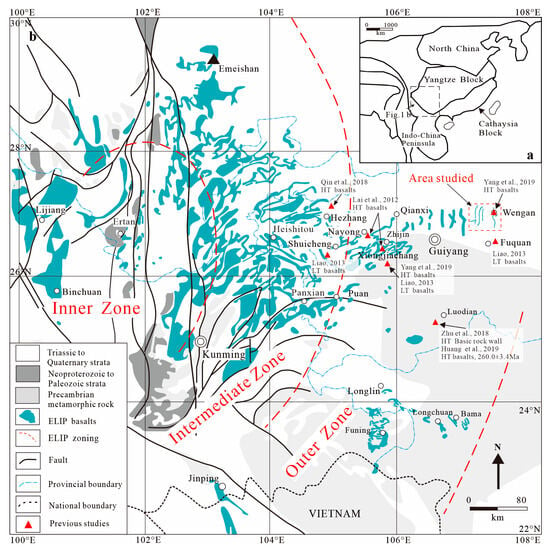
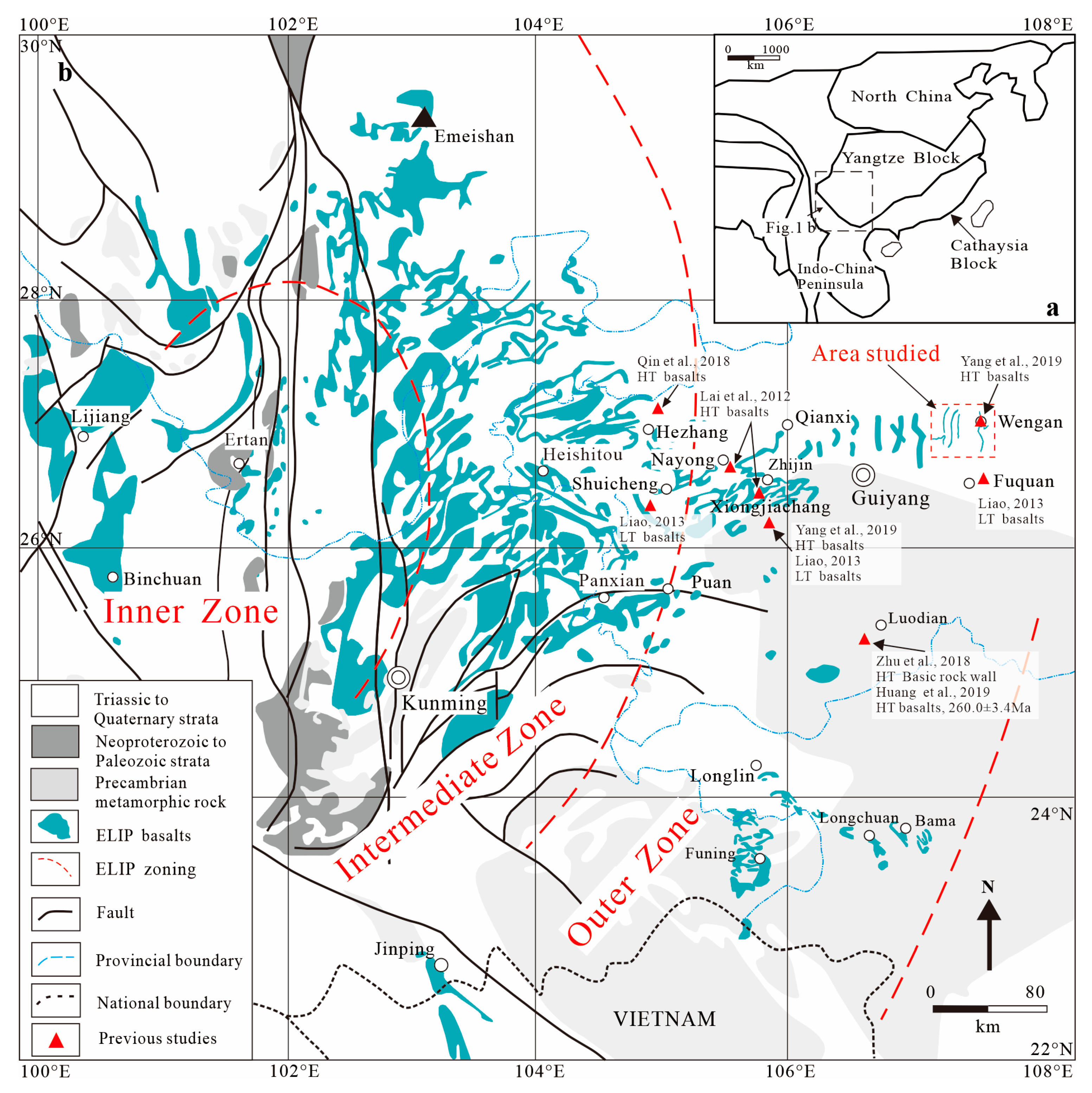
(a) Schematic map showing the location of the Emeishan Large Igneous Province and (b) distribution of the Emeishan basalts (modified after [17]).
Xu et al. (2001) [17] first proposed the Ti/Y = 500 threshold to divide Emeishan lavas into LT (Ti/Y < 500) and HT (Ti/Y > 500) suites. Integrated geochemical and stratigraphic studies further delineate the ELIP into inner, intermediate, and outer zones (Figure 1b) [16,18,19,20]. The inner and intermediate zones are dominated by thick low-Ti basalt sequences, whereas the outer zone comprises thin high-Ti basalts [5,20,21,22,23,24,25]. The eastern Guizhou region, located in the eastern part of the ELIP, hosts abundant mafic rocks [8,22,26,27,28], including basalts and diabase dikes from Zhijin–Nayong, Shuicheng, Xiongjiachang, Fuquan, Pu’an, and Hezhang. LA-ICP-MS and CA-TIMS zircon/titanite U-Pb dating yield ages of 260–249 Ma for these rocks [26,29,30], consistent with the main ELIP magmatic episode. These basalts provide crucial material for investigating the source characteristics of marginal magmatism and the extent of interaction between plume-derived magmas and the SCLM. Nevertheless, the petrogenesis of high-Ti basalts in the outer zone (Guizhou and Guangxi regions) remains debated. Most studies support a mantle plume origin [8,22,26,31,32], but the role of the SCLM is still controversial. Some authors propose mixing between plume-derived melts and the SCLM [8,26,29,30], whereas others advocate low-degree melting of SCLM enriched by plume activity [22,30].
Investigating the Weng’an basalts provides insights into the relationship between outer-margin basalts and the Emeishan mantle plume, while offering new constraints on the contribution and proportion of the SCLM to the genesis of Guizhou basalts. This study focuses on the outermost ELIP basalts in Weng’an, Guizhou. By integrating petrography, major and trace element geochemistry, and Sr-Nd-Hf-Pb isotopes, and by comparing with basalts from other Guizhou regions, we characterize their petrological assemblages, petrogenesis, and the interplay between the Emeishan mantle plume and SCLM.
2. Geological Background and Petrology
The ELIP spans Yunnan, Guizhou, and Sichuan, with minor exposures in western Guangxi and northern Vietnam (Figure 1b). In the eastern ELIP (Guizhou Province), the Permian basalts unconformably overlie the Lower Permian Maokou Formation limestone [8,22,33,34]. These volcanic rocks display a distinct wedge-shaped geometry, thickening towards the west and thinning towards the east. The thickness decreases from over 1200 m in the western region to only several tens of meters at the eastern margin, where they eventually pinch out [16].
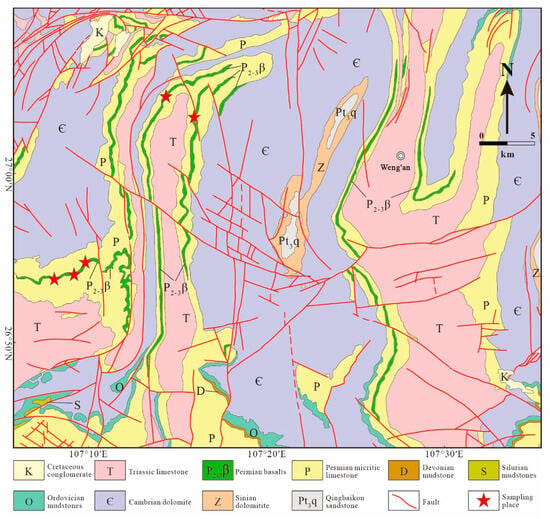
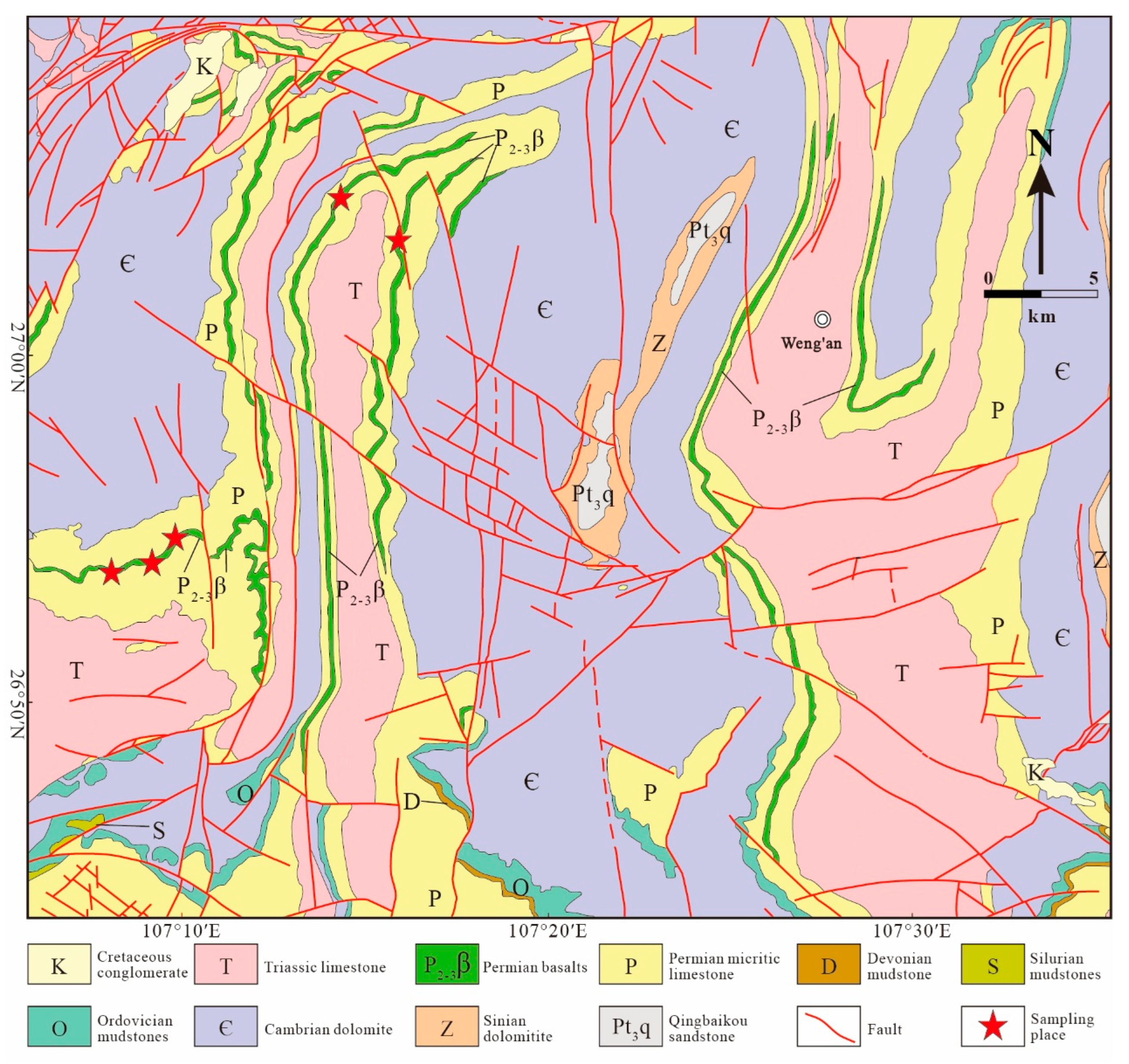
The study area lies in western Weng’an County, within the ELIP’s outer zone. Exposed strata range from the Sinian Dengying Formation to the Cretaceous, with Carboniferous and Jurassic units absent (Figure 2). Sinian–Cambrian rocks consist of NE-trending medium- to thick-bedded dolomite and silty banded limestone. Permian strata form NNE–N–S belts and lack the Lower Series; Middle-Upper Permian units (Liangshan, Qixia, Maokou, Emeishan basalt, Longtan, Changxing, Heshan, and Dalong) are well preserved. Lithologies are uniform: grayish-yellow layered mudstone and gray to dark gray thick- to massive-bedded bioclastic micritic limestone and bioclastic mud-microcrystalline limestone.
Figure 2.
Weng’an basalt distribution and sample collection location map (modified after [34]).
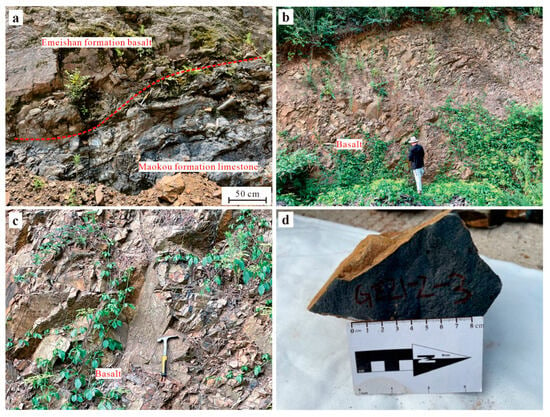
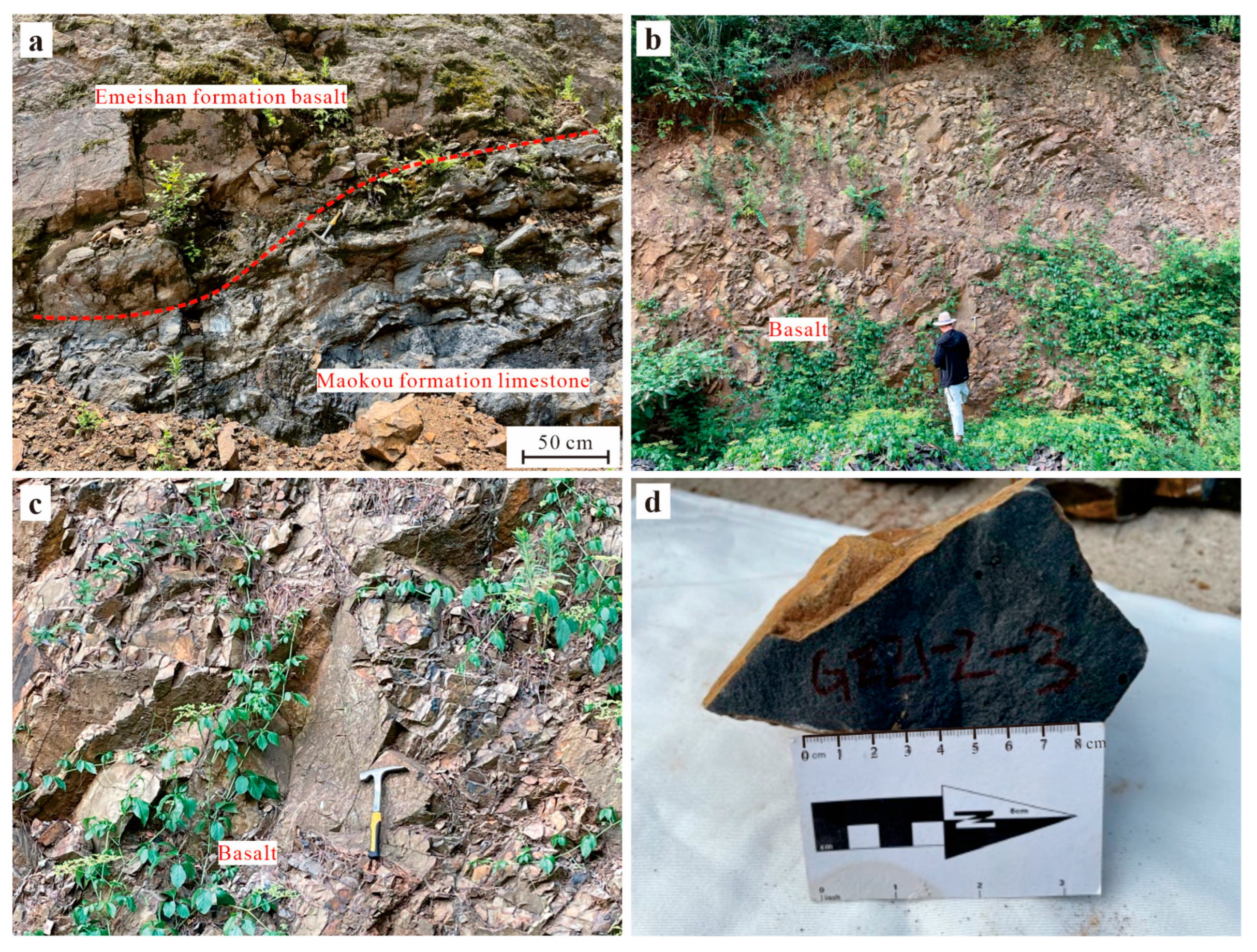
In the study area, Emeishan basalts are black, gray–black, gray–green, or blue–black massive tholeiites, locally amygdaloidal. Six discontinuous N–S-trending basalt outcrop belts aligned with regional structural axes are recognized [34]: one along the northern limb of the Longgang synclinorium (17.38 km); two on the western and one on the eastern limb of the Wenggong syncline (18.20 km, 29.61 km, 19.36 km); and one each on the western and eastern limbs of the Weng’an syncline (31.84 km, 13.92 km). Stratigraphically, the Emeishan basalts overlie the Middle Permian Maokou Limestone Formation and are in turn overlain by the late Permian Heshan and Longtan sedimentary Formations (Figure 3a–c).
Figure 3.
Field photos of Weng’an basalts (a–c), hand specimen (d) and typical microstructure photos (c,d).
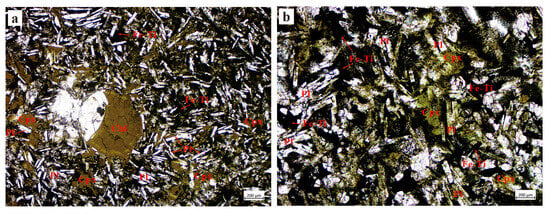
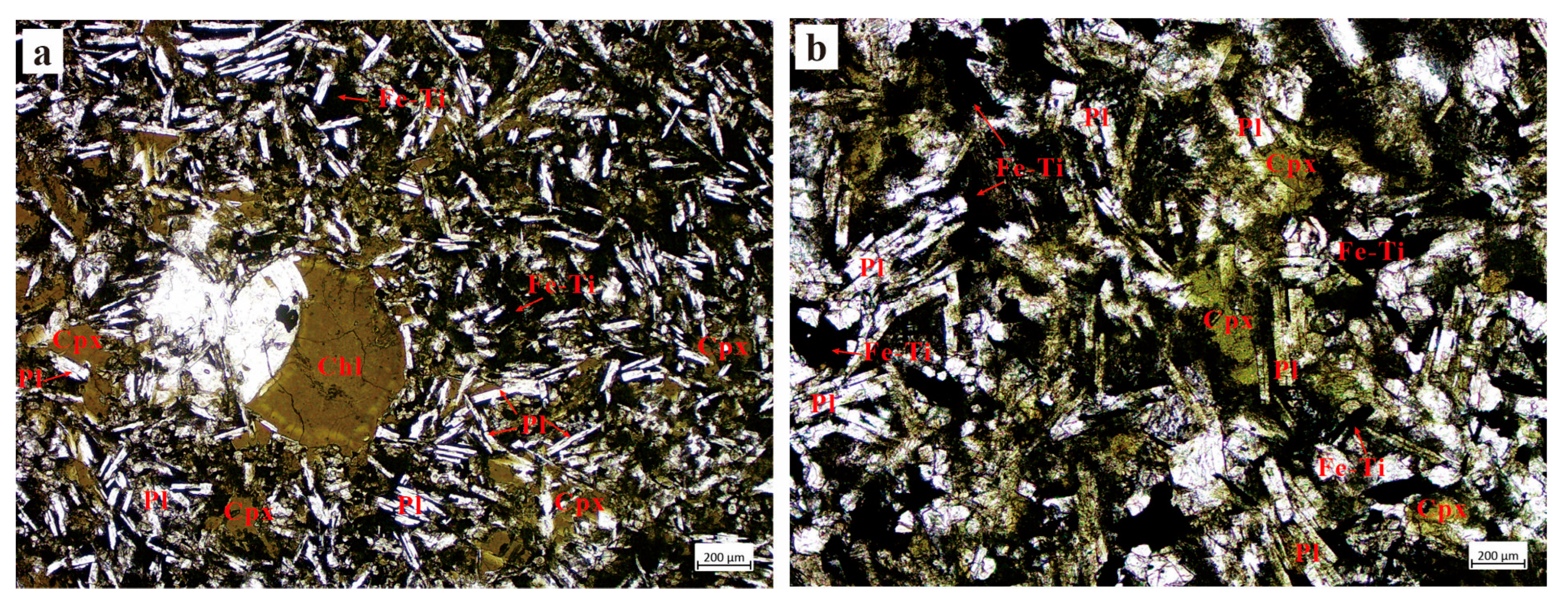
Eleven fresh basalt samples were collected from lava flows in Weng’an County. Hand specimens are gray-black and massive (Figure 3d). Petrographically, the basalts are composed mainly of plagioclase (65–70 vol.%), clinopyroxene (10–15 vol.%), and opaque minerals (3–5 vol.%), with olivine absent. Sparse plagioclase and clinopyroxene phenocrysts, up to 0.5 mm in length, are embedded in a microcrystalline to fine-grained groundmass consisting of plagioclase, clinopyroxene, and Fe–Ti oxides (Figure 4a,b). The groundmass displays a typical intergranular–intersertal texture. Plagioclase, the dominant mineral phase, occurs mainly as microlitic to fine-grained laths (<0.1 mm), whereas clinopyroxene is present as fine- to medium-grained anhedral crystals, some of which show weak chloritization.
Figure 4.
Photomicrographs of Weng’an basalts (a,b). Cpx: clinopyroxene; Pl: plagioclase; Chl: chlorite; Fe-Ti: Fe-Ti oxides.
3. Analytical Methods
All whole-rock major and trace element, and Sr-Nd-Hf-Pb isotopic analyses were conducted at the Guangxi Key Laboratory of Hidden Metal Mineral Exploration, Guilin University of Technology. Fresh samples were crushed, and altered rinds, weathered surfaces, and veins were removed by hand. Cleaned fragments were leached in 4 N HCl for 30 min, dried, then ground to <200 mesh powder. Loss on ignition (LOI) was measured after heating at 1000 °C for 2 h. For XRF analysis, ~0.5 g of ignited powder was fused with 6 g Li2B4O7 and 0.2 g NH4Br in a Pt-Au crucible at 1200 °C for 10 min. Glass disks were analyzed on a Rigaku ZSX Primus II XRF (Rigaku Corporation, Tokyo, Japan). Calibration used certified reference materials (CRMs); concentrations were calculated from X-ray intensities. Accuracy and precision were monitored using W-2 and GSR-2: RSDs ≤ 2% for major oxides and ≤5% for trace elements. Full methods follow Zhang et al. [35] and Liu et al. [36].
For trace elements, ~40 mg of powder was digested in 1 mL HNO3 + 2 mL HF at 110 °C for 24 h, then re-dissolved and heated at 190 °C for 48 h in a Parr bomb. After evaporation, the residue was redissolved in 4 mL 25% HNO3 and heated at 150 °C for 4 h. The solution was diluted 2000× with 2% HNO3 and analyzed by Agilent 7500cx ICP-MS (Agilent Technologies, Santa Clara, CA, USA). Rh and Re corrected for drift; calibration used BHVO-2, BCR-2, and GSR-3. RSDs were <3%; biases were within ±5%. Sr-Nd-Hf-Pb isotope work was done in a Class 1000 clean lab. Blanks were <100 pg for Sr, Nd, Hf and <5 pg for Pb. Samples (50–100 mg) were digested in inverse aqua regia, then HF–HNO3–HCl to dissolve refractory phases. Sr and Pb were separated together on Sr Spec® resin: preconditioned with 7 N HCl and 0.3% HNO3 + 0.03% HF; loaded in 2 N HNO3; matrix eluted with graded HNO3; Sr collected in 0.3% HNO3; Pb in 7 N HCl. Nd was purified via AG50W-X8 and Ln Spec® (TrisKem International, Bruz, France) chromatography using HCl gradients. Hf was isolated on UTEVA® + LN® resins, eluted in 0.3 N HCl + 0.05 N HF after Zr/Ti removal with 3% H2O2-HF.
Isotope ratios were determined using a Thermo Scientific Neptune Plus multi-collector inductively coupled plasma mass spectrometer (MC-ICP-MS, Thermo Fisher Scientific, Waltham, MA, USA). Instrumental mass discrimination was corrected using standard-sample bracketing (SSB) combined with exponential mass bias correction. Instrument stability and performance were monitored using certified reference materials: NBS 987 for Sr, JNdi-1 for Nd, Alfa14374 for Hf, and NBS 981 for Pb. Internal normalization for mass fractionation was applied using 87Sr/86Sr = 0.1194 for Sr and 143Nd/144Nd = 0.7219 for Nd. Pb isotope ratios were corrected using an instrumental mass fractionation factor of 0.1% amu−1 based on repeated analyses of the NBS 981 standard.
Long-term reproducibility was monitored by repeated analyses of international standards during sample runs, yielding the following results: 87Sr/86Sr = 0.710282 ± 0.000010 (N = 12; 2σ) for NBS 987, 143Nd/144Nd = 0.512098 ± 0.000005 (N = 12; 2σ) for JNdi-1, 176Hf/177Hf = 0.282219 ± 0.000005 (N = 10; 2σ) for Alfa14374. The USGS rock reference material BCR-2 was processed as an unknown sample to monitor the entire analytical procedure (n = 4). The measured values are: 87Sr/86Sr = 0.705061 ± 9, 143Nd/144Nd = 0.512614 ± 6, 176Hf/177Hf = 0.282853 ± 5, 206Pb/204Pb = 18.744 ± 1, 207Pb/206Pb = 15.618 ± 1, 208Pb/206Pb = 38.706 ± 3 (2σ, n = 8).
All results are within the recommended uncertainties of the GeoREM reference database (https://georem.earth/), confirming high precision and accuracy of the isotopic data presented in this study.
4. Results
4.1. Major and Trace Element Characteristics
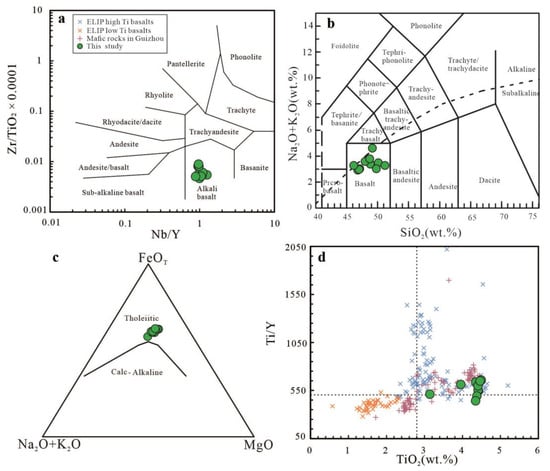
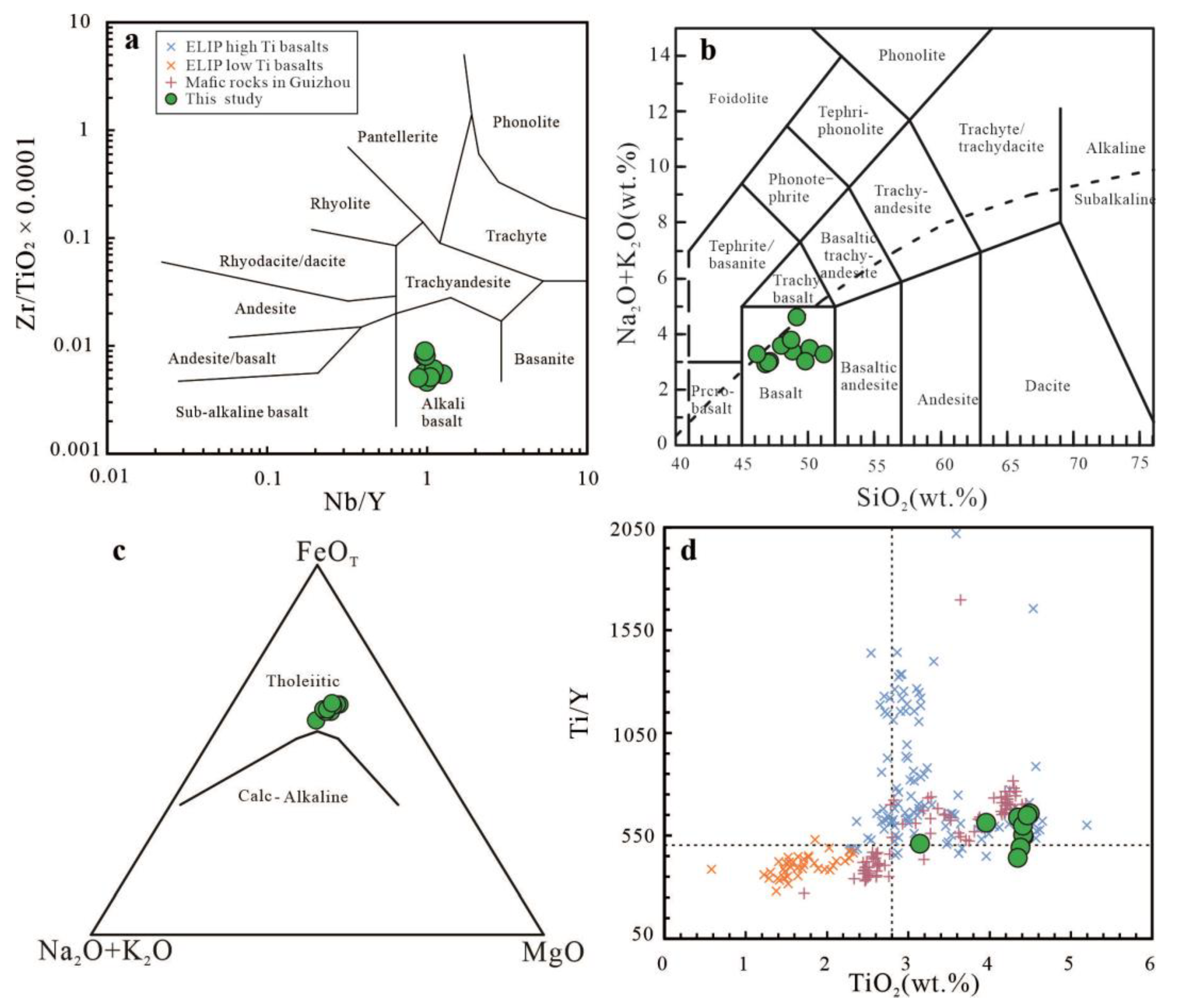
Eleven fresh basalt samples were analyzed (Table 1). The Weng’an basalts exhibit low SiO2 (45.91–50.81 wt.%) and Al2O3 (12.83–13.46 wt.%), but high MgO (4.28–5.16 wt.%), Na2O (2.05–3.97 wt.%) and TiO2 (3.12–4.49 wt.%). In the Nb/Y vs. Zr/TiO2 × 0.0001 diagram, they plot within the alkali basalt field (Figure 5a). However, most basalt samples are silica-saturated and fall in the subalkaline basalt field in the TAS diagram (Figure 5b), and the AFM discrimination (Figure 5c) confirms that these basalts exhibit typical tholeiitic affinities. As shown in Figure 5d, the Ti/Y ratios exceed 500 in nine of the eleven analyzed samples, ranging from 471 to 630 with a mean value of ~550 (Table 1). Meanwhile, their TiO2 concentrations (3.12–4.49 wt.%) plot adjacent to the boundary of the documented high-Ti basalt domain of the ELIP.
Table 1.
Analysis results of major elements (wt.%) and trace elements (ppm) of Weng’an basalts.
Figure 5.
(a) Nb/Y vs. Zr/TiO2 × 0.0001 diagram (, modified after [37]), (b) SiO2 vs. Na2O + K2O (TAS) diagram (modified after [38]), (c) Na2O +K2O vs. FeOT vs. MgO (AFM) diagram (modified after [39]) and (d) TiO2 vs. Ti/Y diagram (modified after [12]). ELIP high Ti basalt data source: [17,22,23,24,40]; ELIP low Ti basalt data source: [17,24]; Guizhou mafic rock data source: [22,26,27,28,30,33].
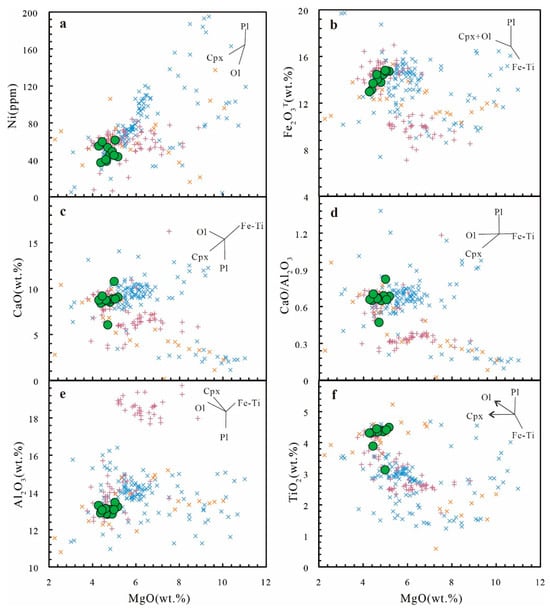
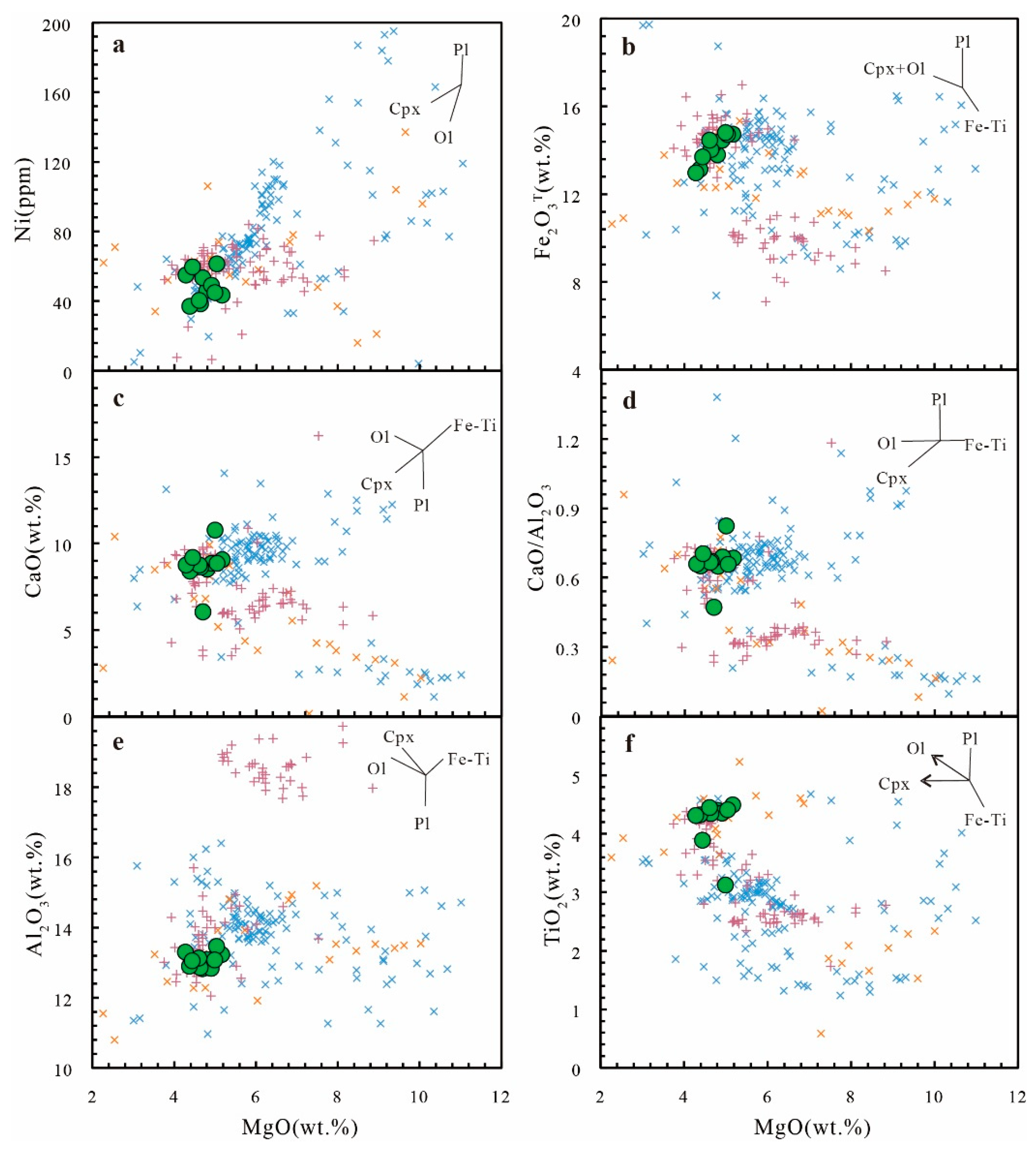
The Harker diagram presents variations in Ni (ppm), Fe2O3T(wt.%), CaO (wt.%), CaO/Al2O3, Al2O3 (wt.%), and TiO2 (wt.%) against MgO (wt.%) as the differentiation index (Figure 6a–e). In the Weng’an basalts, Ni (Figure 6a), CaO (Figure 6c), CaO/Al2O3 ratio (Figure 6d) and Al2O3 (Figure 6e) all show very weak positive correlations with MgO. In contrast, MgO exhibits a strong positive correlation with Fe2O3T (Figure 6b), while its correlation with TiO2 is weakly negative (Figure 6e).
Figure 6.
Harker diagram of (a) MgO vs. Ni, (b) MgO vs. Fe2O3T, (c) MgO vs. CaO, (d) MgO vs. CaO/Al2O3, (e) MgO vs. Al2O3 and (f) MgO vs. TiO2 for the Weng’an basalts. The data sources and data symbols are the same as in Figure 5.
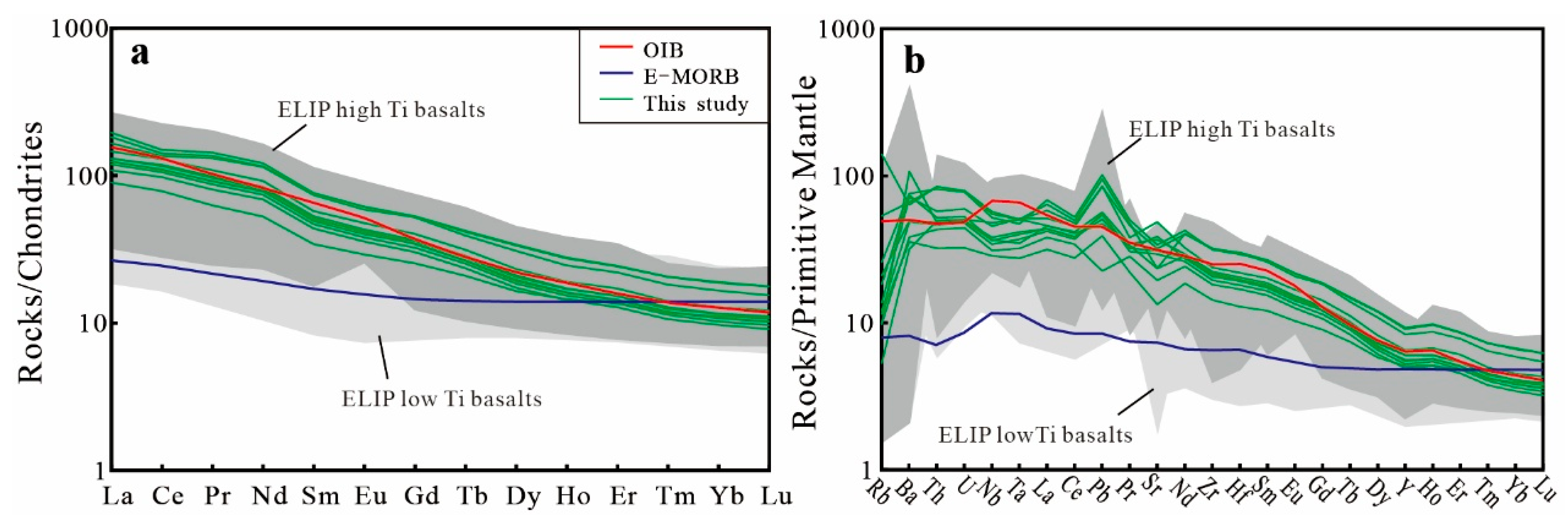
Chondrite-normalized REE patterns show marked LREE enrichment relative to HREE [(La/Yb)N = 8.0–11.8, (La/Sm)N = 2.2–2.6, δEu(δEu = EuN/[SmN × GdN]1/2) = 0.9–1.1], similar to OIB (Figure 7a). The primitive mantle-normalized incompatible element spider diagram reveals enrichment in Ba and LILE (Th, U), with slight HFSE depletion (Nb = 20.1–40.3 ppm, Ta = 1.12–2.07 ppm, Zr = 158–355 ppm, Y = 21.9–41.4 ppm; Figure 7b). Their Nb/La (0.79–1.08) and Th/Ta (2.03–3.56, mean 2.79) ratios approximate primitive mantle values (Nb/La = 1, Th/Ta = 2.3; [41,42]). The slightly lower Nb/La compared to OIB is attributed to weak slab-fluid metasomatism in the lithospheric mantle source. Ce/Pb (12.7–21.5) and Nb/U (23.8–32.2), deviating from typical MORB/OIB mantle values, are controlled by crust/SCLM material input featured by a positive Pb anomaly, which proves lithospheric component addition.
Figure 7.
Chondrite-normalized REE patterns (a) and primitive mantle-normalized trace element patterns (b) for the basalt from Weng’an. The chondrites, primitive mantle, OIB and E-MORB values are reported by [43]; the data sources for the Emeishan high-Ti and low-Ti basalts are the same as in Figure 4.
Although fractional crystallization of olivine and Fe-Ti oxides has lowered MgO contents and may have slightly modified absolute TiO2 concentrations, the consistently high Ti/Y ratios and characteristic OIB-like incompatible element patterns securely classify the Weng’an basalts within the high-Ti suite of the ELIP. The minor deviations in Ti/Y and HFSEs from inner-zone high-Ti basalts are interpreted as resulting from a higher degree of fractional crystallization and enhanced SCLM input in the outer zone. Therefore, following Xu et al. [17], we classified them as high-Ti basalts.
4.2. Sr-Nd-Hf-Pb Isotopic Characteristics
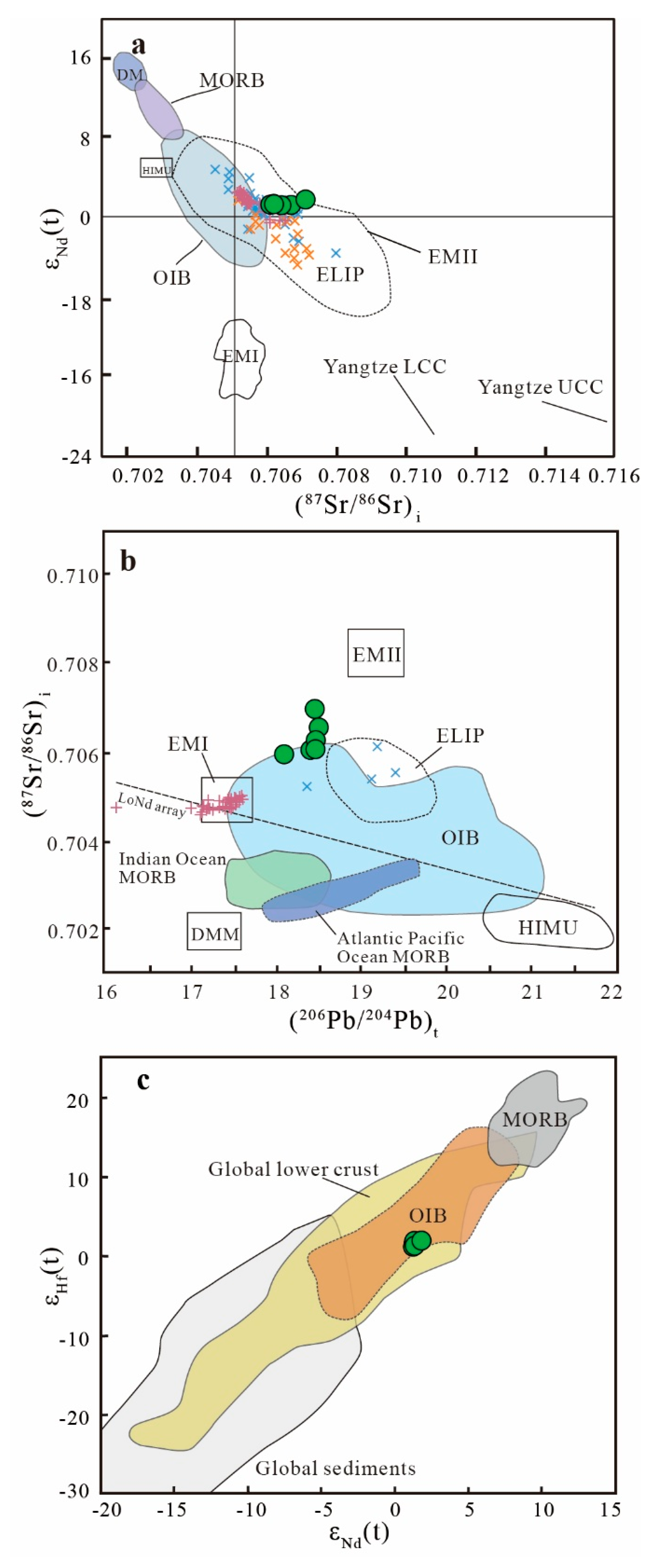
Isotopic data, corrected to 260 Ma, are presented in Table 2. The Weng’an basalts display narrow ranges: initial 87Sr/86Sr = 0.70594–0.70697, 143Nd/144Nd = 0.51237–0.51240, εNd(t) = +1.2 to +1.8, 176Hf/177Hf = 0.28265–0.28268, εHf(t) = +1.1 to +1.9, 206Pb/204Pb = 18.11–18.51, 207Pb/204Pb = 15.58–15.60, and 208Pb/204Pb = 38.31–38.72. They exhibit DUPAL-type Pb isotopic signatures (Δ7/4 = 8.8–11.5, Δ8/4 = 59.2–70.6; [44]).
Table 2.
Sr-Nd-Hf-Pb isotope analysis results of Weng’an basalts.
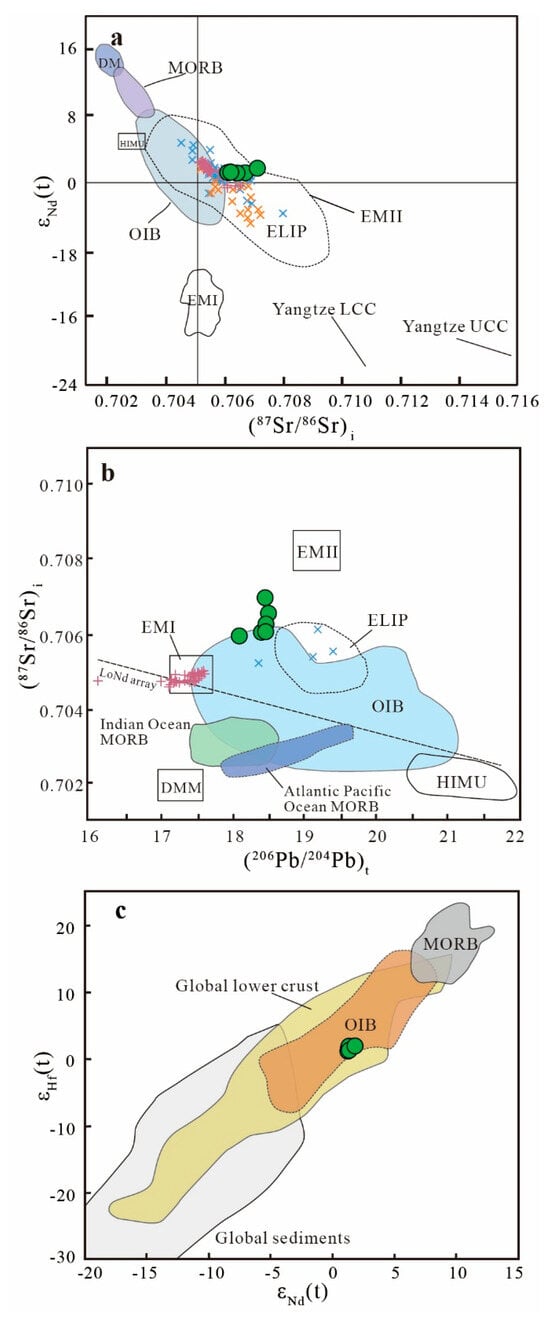
In the 87Sr/86Sr vs. εNd(t) diagram (Figure 8a), Weng’an basalts plot near the OIB field, overlapping with ELIP high-Ti basalts and Guizhou mafic rocks, distinct from depleted mantle (DM). In the 206Pb/204Pb vs. 87Sr/86Sr diagram (Figure 8b), they fall between EMI and EMII. In the εNd(t) vs. εHf(t) diagram (Figure 8c), they plot within the OIB field.
Figure 8.
(87Sr/86Sr)i vs. εNd(t) diagram of Weng’an basalt ((a), modified after [45]), (206Pb/204Pb)t vs. (87Sr/86Sr)i diagram ((b), modified from [21]) and εNd(t) vs. εHf(t) diagram (c) Mantle components fields are from [46]; data sources and data symbols are the same as in Figure 4.
5. Discussion
5.1. Fractional Crystallization and Crustal Contamination
Compared to primitive mantle-derived magmas (MgO > 9 wt.%, Cr > 1000 ppm; [47]), the Weng’an basalts have lower MgO (4.28–5.16 wt.%) and Cr (23.4–55.7 ppm), indicating evolved compositions. Weak positive correlations between Ni, CaO, CaO/Al2O3 and MgO suggest limited clinopyroxene fractionation, whereas the positive Al2O3–MgO correlation and weak Sr negative anomalies reflect plagioclase fractionation (Figure 6). Positive TiO2-MgO and Fe2O3T-MgO correlations are consistent with Fe–Ti oxide crystallization, as observed petrographically.
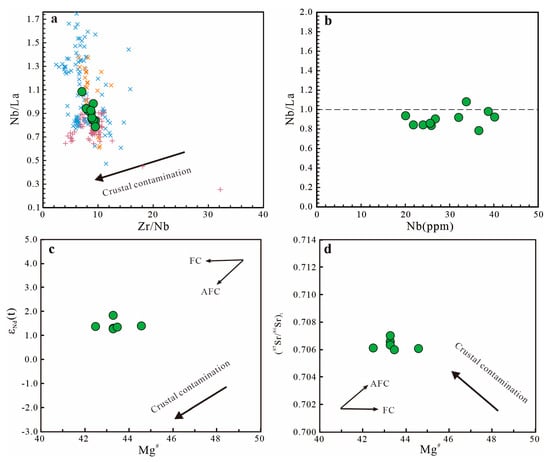
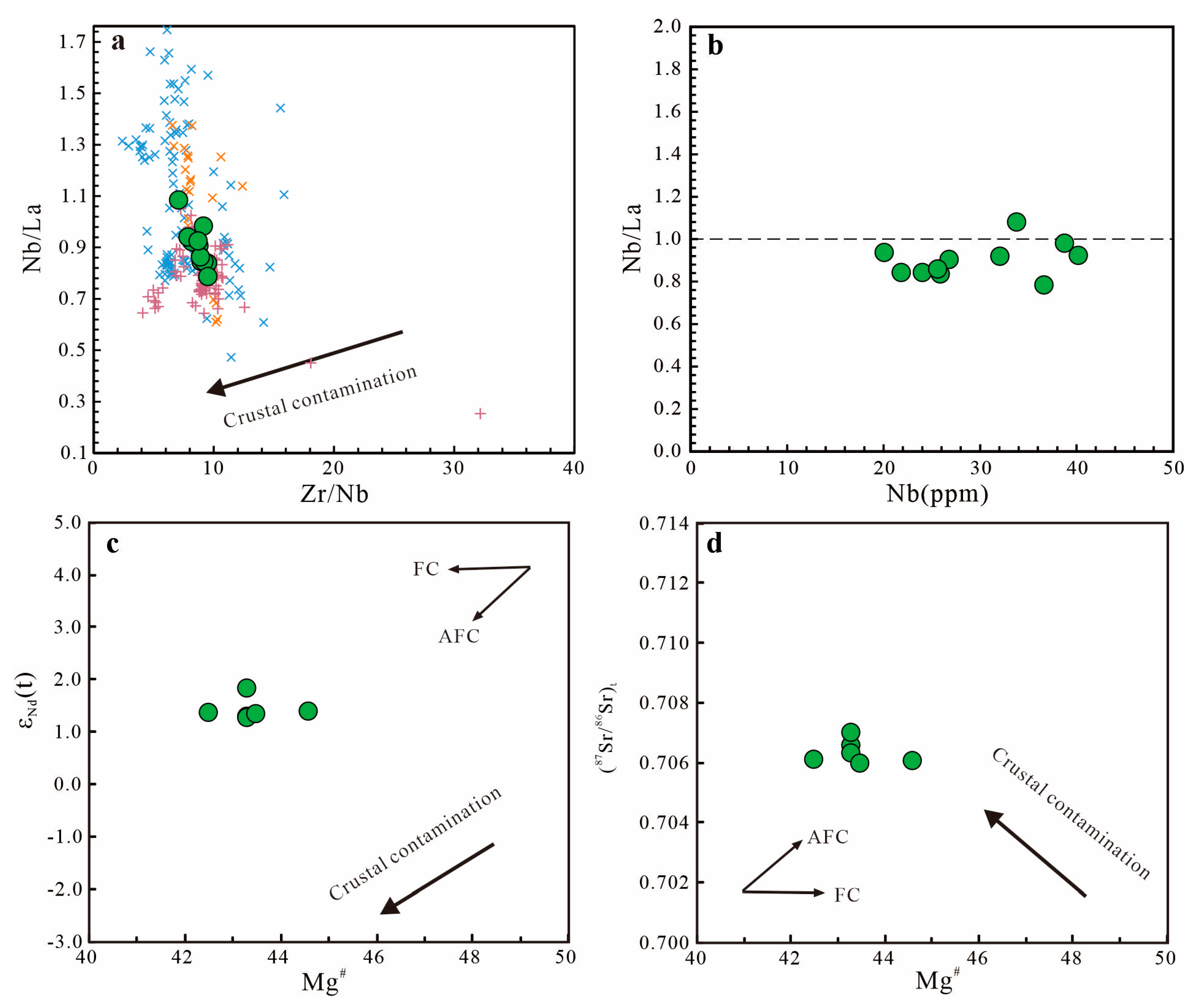
The Th/Ta ratios of the Weng’an basalts (2.03–3.56, mean 2.79) are close to primitive mantle values (~2.3; [41]) and significantly lower than upper-crustal values (>10), implying minimal crustal contamination. Their stable Nb/La ratios (Figure 9a,b), along with elevated Mg# and narrowly constrained εNd(t) and initial 87Sr/86Sr values across the Mg# range (Figure 9c,d), strongly argue against significant crustal contamination. The isotopic homogeneity further supports a primary mantle-derived source, modified by subduction-related metasomatism rather than assimilation of upper-crustal material.
Figure 9.
(a) Zr/Nb vs. Nb/La diagram, ((b) Nb vs. Nb/La diagram (modified by Xia et al. [48]), (c) Mg# vs. 87Sr/86Sr(t), and (d) Mg# vs. εNd(t) for Weng’an basalts. The data sources and data symbols are the same as in Figure 5.
5.2. Petrogenesis and Source Characteristics
Previous studies have demonstrated that the mafic rocks in the Guizhou region represent products of outer-zone magmatism associated with the ELIP [8,27,40,45]. The Weng’an basalts exhibit enrichment in LILE and LREE (Figure 5a,b), coupled with low initial 87Sr/86Sr ratios and high εNd(t) values (Figure 7a)—isotopic signatures analogous to ELIP high-Ti basalts. These features suggest a shared mantle source. However, subtle depletions in Nb, Ta, Zr, and Hf relative to ELIP high-Ti basalts (Figure 7b) indicate potential contributions from enriched components, such as lithospheric mantle or subduction-related materials.
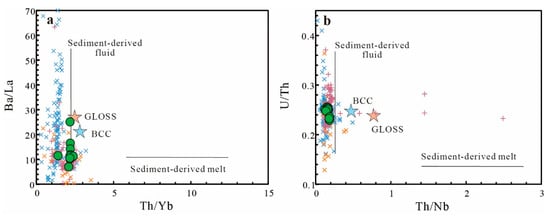
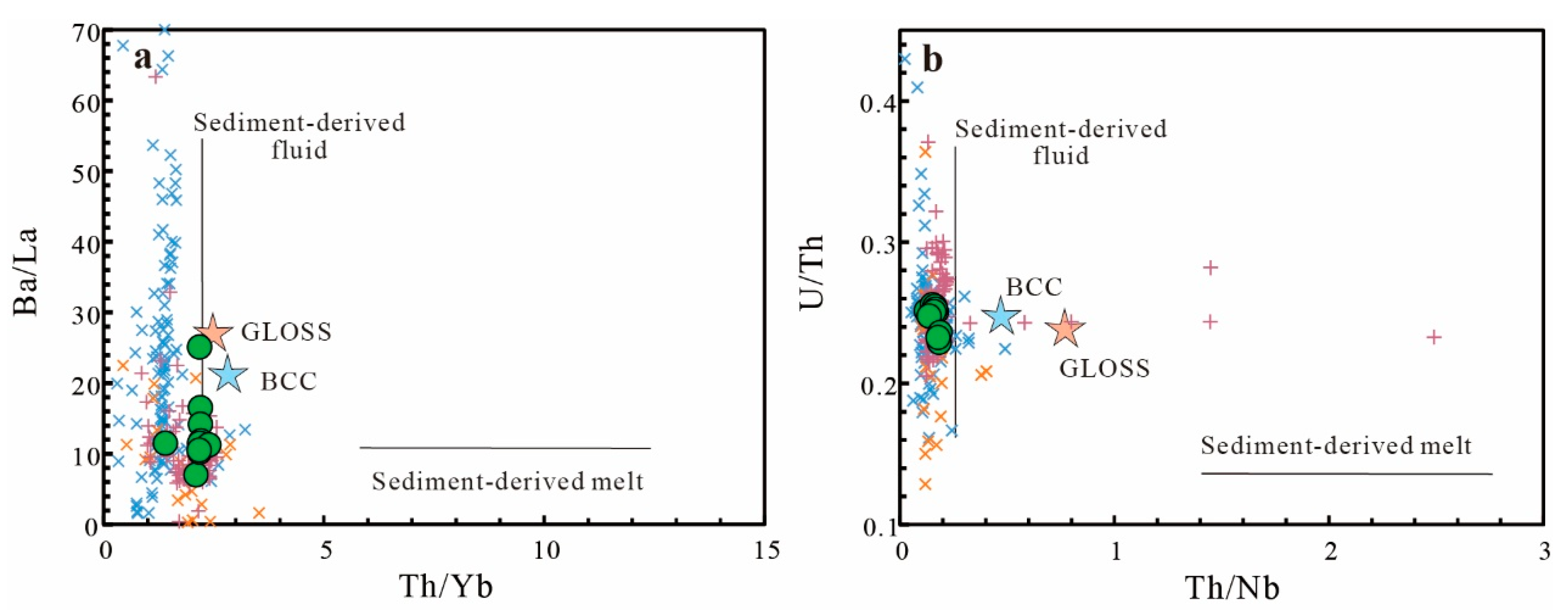
Slab fluids represent the primary Pb source, whereas enrichment in immobile elements (e.g., Th, Nd, Nb, Yb, Y) characterizes melts derived from oceanic crust sediments and igneous rocks [49]. Elevated Th and LREE abundances, together with high Th/Ce ratios, are diagnostic of oceanic sediment-derived melts, whereas oceanic igneous melts typically display lower Th/La, Th/Nb, and Th/Yb ratios [49,50]. The Weng’an high-Ti basalts show elevated Th/Sm (0.53–0.63), Th/Ce (0.06–0.09), and Th/Yb (1.42–2.22) ratios, implying subducted sediment input into their source. Furthermore, the invariant Th/Yb and Th/Nb ratios with respect to Ba/La and U/Th (Figure 10a,b) reflect slab fluid signatures, consistent with previous reports of subduction-modified mantle sources for ELIP basalts [19,51,52,53]. Collectively, these observations indicate that the source of the Weng’an basalts underwent slab fluid metasomatism.
Figure 10.
Th/Yb vs. Ba/La diagram (a) and Th/Nb vs. U/Th diagram (b) of Weng’an basalt. The global subduction sediments (GLOSS) and bulk continental crust (BCC) data are derived from [54]. The data sources and data symbols are the same as in Figure 5.
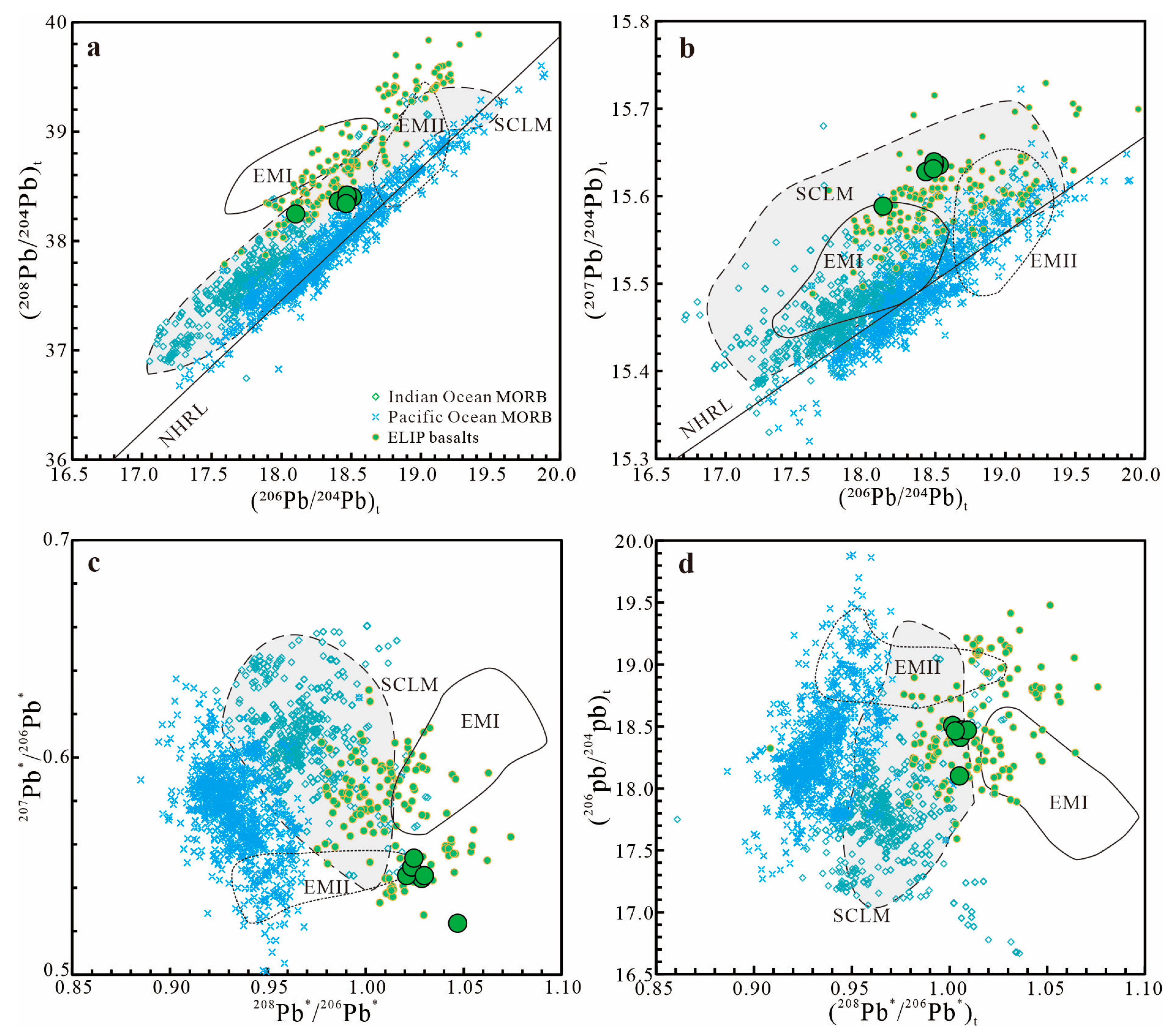
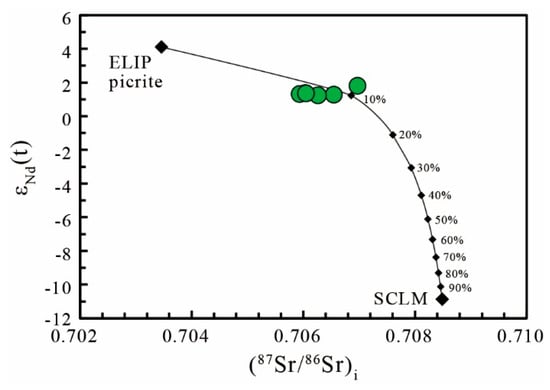
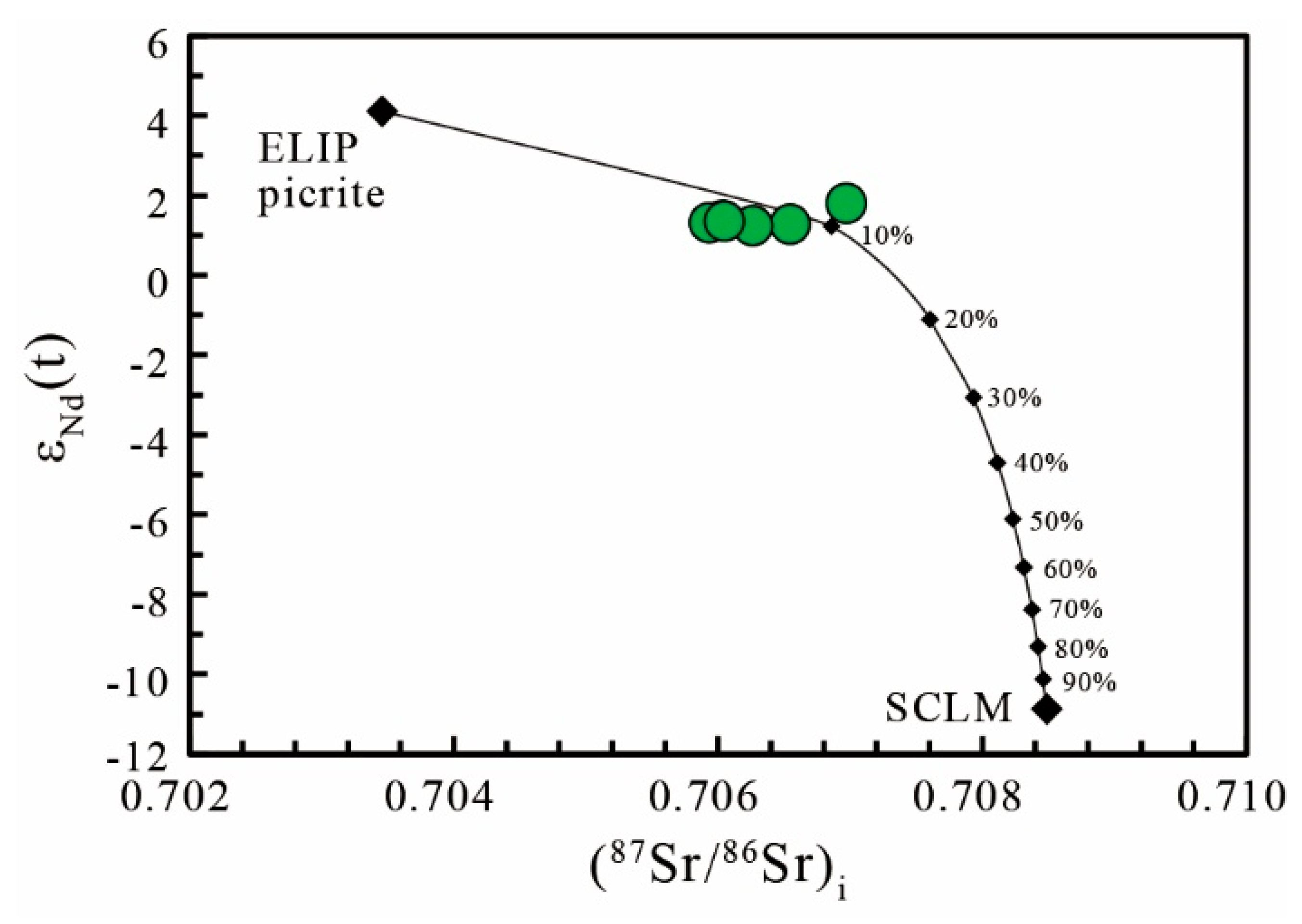
Weaver. 1991 [40] identified three OIB-enriched end-members based on source characteristics: HIMU (recycled dehydrated oceanic crust with Ta-Nb-rich residues), EMI (HIMU mixed with minor deep-sea sediments, enriched in Ba), and EMII (HIMU with minor terrigenous sediments). Geochemically, mantle plume-derived melts typically display OIB-like signatures with moderately radiogenic Pb isotopic compositions, low radiogenic 87Sr/86Sr, and high positive εNd(t) values near the HIMU end-members. In contrast, metasomatized subcontinental lithospheric mantle (SCLM) is distinguished by more radiogenic Pb isotopic ratios, elevated 87Sr/86Sr, and low εNd(t) values, plotting between the EMI and EMII end-members, as a result of long-term modification by subduction fluids and melts [55]. In Pb-isotope space, the Weng’an basalts plot within the overlapping field of SCLM and Emeishan basalts, between the EMI and EMII end-members, suggesting SCLM contribution to their source (Figure 11a–d). Thus, the Weng’an basalts likely originated from an EMI–EMII mantle source contaminated with sediments, with mixing of SCLM during ascent. To quantify the SCLM contribution, we applied a binary mixing model using initial (87Sr/86Sr)i and εNd(t) values. Picritic magmas represent parental melts for flood basalts; therefore, ELIP picrites (Sr = 28.75 ppm, (87Sr/86Sr)i = 0.70356, Nd = 9.56 ppm, εNd(t) = 4.10; [56]) were selected as the mantle plume end-member. The SCLM end-member (metasomatized, with enriched Nd isotopic composition) was defined as Sr = 541 ppm, (87Sr/86Sr)i = 0.70849, Nd = 20.5 ppm, εNd(t) = −10.87 [18]. Published Sr-Nd data of Emeishan outer-zone basalts in Guizhou Province [8] show that high-Ti basalts have initial (87Sr/86Sr)i ranging from 0.70425 to 0.70595 and εNd (t) of +0.4~+3.6 (local data from Shuicheng, Luodian, and western Guangxi adjacent to southern Guizhou). Our minimum (87Sr/86Sr)i = 0.7059 falls exactly within the regional range, which is markedly higher than typical mantle-plume OIB (~0.7030) and represents a highly radiogenic Sr signature rather than a primitive plume composition. Two factors account for the elevated Sr ratios of our evolved basalts: (1) contamination from enriched ancient SCLM metasomatized by pre-Permian subduction fluids, analogous to HT2 basalts in Ethiopia [55]; and (2) minor upper crustal contamination during magma ascent plus post-eruption low-temperature alteration in Guizhou outcrops. Therefore, the elevated Sr signature is consistent with regional ELIP geochemical features rather than a pure mantle plume origin. Meanwhile, the modeling result indicates that the Weng’an magmas formed by mixing 8–10% SCLM melt with Emeishan plume-derived melts (Figure 12). It should be noted that not all SCLM domains yield high Sr isotope ratios; the radiogenic signature observed here is specific to the metasomatized lithospheric mantle beneath the eastern Yangtze Block, which records a long history of subduction modification.
Figure 11.
(a) (206Pb/204Pb)t vs. (208Pb/204Pb)t diagram, (b) (206Pb/204Pb)t vs. (207Pb/204Pb)t diagram, (c) 208Pb*/206Pb* vs. 207Pb*/206Pb* diagram and (d) (208Pb*/206Pb*)t vs. (206Pb/204Pb)t diagram of Weng’an basalt. SCLM, Pacific and Indian Ocean MORB, EMI, EMII data are derived from the PetDB database (http://www.earthchem.org), Emeishan basalt data from the Georoc database (http://georoc.mpch-mainz.gwdg.de/georoc/Entry.html, accessed on 15 March 2026); Northern Hemisphere Reference Line (NHRL) from [44].
Figure 12.
(87Sr/86Sr)i and εNd(t) constitute a binary simple mixed model. The Emeishan mantle plume: Sr = 28.75 ppm, (87Sr/86Sr)i = 0.70356, Nd = 9.56 ppm, εNd(t) = 4.10 ([56]); SCLM: Sr = 541 ppm, (87Sr/86Sr)i = 0.70849, Nd = 20.5 ppm, εNd(t) = −10.87 ([18]); symbols are the same as in Figure 4.
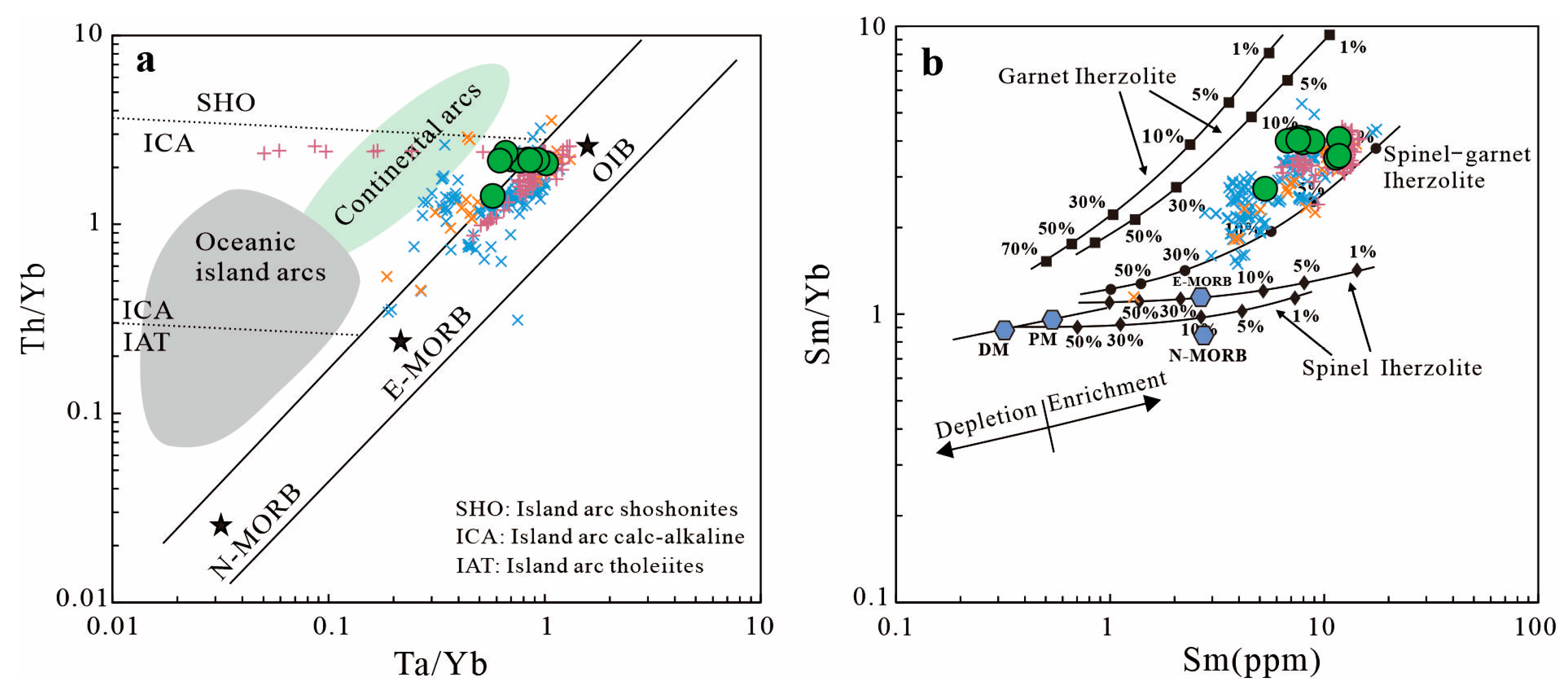
Elemental ratios (Th/Yb, Nb/Yb, TiO2/Yb) remain relatively constant during partial melting and fractional crystallization, and thus effectively trace mantle sources. Thorium is fluid-immobile, making Th/Yb a robust proxy for source enrichment or depletion [57]. In the Ta/Yb–Th/Yb diagram, the Weng’an basalts plot within the OIB field, overlapping with ELIP and Guizhou mafic rocks, confirming a shared mantle source (Figure 13a). The degree of partial melting correlates with initial melting depth [58,59]; ELIP high-Ti basalts are interpreted to result from low-degree melting of garnet lherzolite [7,24,45,60]. REE patterns and Sm/Yb ratios are minimally affected by fractional crystallization and constrain melting degree and source enrichment [20,61,62]. In the Sm–Sm/Yb diagram, the Weng’an basalts plot between the melting curves of garnet + spinel lherzolite and garnet lherzolite, indicating a transitional source lithology and 5–15% partial melting (Figure 13b), followed by variable fractional crystallization to produce the high-Ti melts.
In summary, the Weng’an basalts share geochemical affinities with ELIP high-Ti basalts but exhibit subtle Nb-Ta-Zr-Hf depletions indicative of lithospheric mantle or subducted material involvement. Pb-isotope systematics reveal an EMI–EMII source with SCLM mixing and sediment contamination, supported by high Th/Sm, Th/Ce, and Th/Yb ratios as well as enriched εNd(t) values reflecting slab fluid modification. Sm–Sm/Yb modeling indicates a transitional source from garnet + spinel lherzolite to garnet lherzolite with 5–15% partial melting. We propose that the Weng’an basalts formed through low-degree melting of the Emeishan plume mantle, subsequently mixed with 8–10% subduction-metasomatized SCLM melt. This interpretation is further supported by the recent work of Li et al. [63], who documented the internal anatomy of the Emeishan mantle plume head and recognized radial fingering structures and small plumelets developed at the plume margin. Such marginal plumelets facilitated enhanced interaction between plume melts and the overlying heterogeneous lithospheric mantle, consistent with the geochemical and isotopic characteristics observed in the Weng’an high-Ti basalts.
Figure 13.
(a) Ta/Yb vs. Th/Yb diagram (, modified after [57]) and (b) Sm vs. Sm/Yb diagram (modified after [64]) of Weng’an basalts. The data sources and data symbols are the same as in Figure 4.
5.3. Heterogeneous Lithospheric Mantle Contamination
Geochemical variations among ELIP basalts have generated considerable debate regarding their petrogenesis, particularly concerning the origin of high-Ti and low-Ti basaltic suites. Extensive research has identified heterogeneous mantle sources [2,11,18,20,24,25,65,66,67], variable lithospheric thickness, crustal contamination, and melting parameters (pressure and degree of partial melting; [12,17,18,21,22,24,29,60,68,69,70,71]), as well as magma mixing processes [29], as the primary controls on the compositional dichotomy between high-Ti and low-Ti basalts.
Previous studies have documented substantial geochemical variability among mafic rocks in Guizhou Province. Hezhang basalts and southern Guizhou mafic dikes are enriched in LILEs (Rb, Ba, Th, U) but depleted in HFSEs (Nb, Ta, Zr, Yb; [27,30]). Conversely, Zhijin and Nayong basalts exhibit HFSE (Nb, Ta) enrichment [22], whereas Shuicheng, Xiongjiachang, and Fuquan basalts show Ta enrichment coupled with Rb depletion [8]. These regional variations extend to isotopic signatures: Shuicheng, Xiongjiachang, and Fuquan basalts display low Sr and high Nd isotopic compositions ((87Sr/86Sr)i = 0.70459–0.70503, εNd(t) = +1.3 to +2.7; [33]), whereas Weng’an and Xiongjiachang basalts analyzed by Yang and Liu (2019) [28] exhibit elevated Sr and depleted Nd signatures ((87Sr/86Sr)i = 0.70571–0.70648, εNd(t) = +0.8 to +1.2). Furthermore, distinct enriched mantle components are identified regionally: an EMI-type source for Shuicheng–Xiongjiachang–Fuquan [8] versus an EMII-type source for Zhijin–Nayong [22]. Critically, these basalts underwent comparable fractional crystallization (predominantly plagioclase with minor clinopyroxene) and show negligible to minimal crustal contamination. Consequently, this geochemical diversity fundamentally reflects source heterogeneity rather than differentiation processes. The relative isotopic homogeneity of plume-derived magmas implies that regional magmatism involved variable interaction with heterogeneous SCLM. Analogous scenarios are documented within the ELIP inner zone: Xu et al. [66] demonstrated high-Ti magma generation from SCLM-contaminated plume sources, while He et al. [68] proposed that low-Ti basalts formed through mixing of voluminous hot plume melts with minor SCLM melts.
The South China Block has experienced multiple Proterozoic-Phanerozoic tectonothermal events that potentially modified its lithospheric mantle. Li et al. [72] identified four episodes of inherited zircons in Beisi Formation dacites from Pingxiang, southwestern Guangxi, corresponding to: (1) Neoproterozoic subduction-accretion-rifting-reaccretion of the South China Ocean between the Yangtze and Cathaysia blocks; (2) Nanhuan rifting of the amalgamated Yangtze-Cathaysia Block; (3) Early Paleozoic Caledonian orogeny; and (4) Paleotethyan ocean closure. These data confirm recurrent lithospheric modification. During subduction, incompatible element- and water-rich sediments are incorporated into the SCLM [73], inducing metasomatic enrichment that manifests as low εNd(t) values. Additionally, SCLM subjected to melt extraction exhibits low Sm/Nd ratios and elevated Nd concentrations, evolving toward low 143Nd/144Nd ratios (εNd(t) < 0) over time. Subsequent metasomatism can generate Rb/Sr, Sm/Nd, and Lu/Hf ratios comparable to those of crustal lithologies [74]. Guizhou Province lies at the junction between the Yangtze Block and the South China Fold Belt, where the SCLM likely records the effects of these multiphase tectonic events, resulting in pronounced compositional heterogeneity. Numerous studies confirm SCLM involvement in Guizhou high-Ti and low-Ti mafic magmatism [8,22,26,29,30], representing a plausible mechanism for the observed geochemical diversity.
Recent studies have revealed that the Emeishan plume head has an asymmetric, fingering structure, and small plumelets were formed at the periphery, which controlled the magma origin and eruption in the outer zone of the ELIP [63]. Our interpretation is consistent with the new model proposed by [63], who documented radial fingering structures of the Emeishan plume head allowed small plumelets to be trapped beneath the thinned lithosphere in the outer zone, resulting in distinctive magma compositions through plume–lithosphere interaction. The geochemical and isotopic signatures of the Weng’an basalts thus record the fingerprint of such marginal plumelets and their interaction with the heterogeneous subcontinental lithospheric mantle.
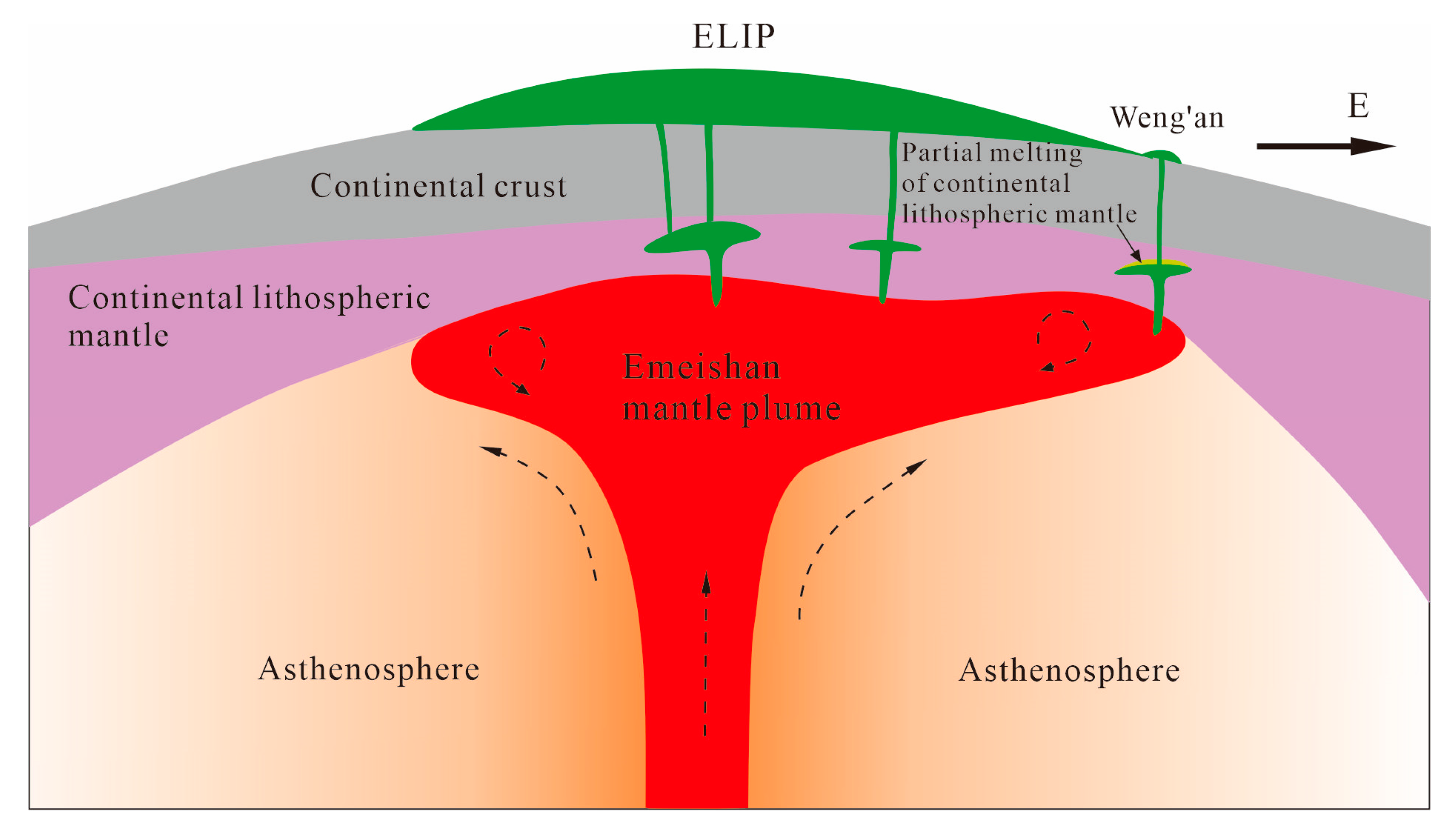
As previously established, the Weng’an basalts originated from mixing between the Emeishan plume and SCLM-derived melts. The plume end-member resembles OIB sources, which may contain enriched recycled oceanic crustal components. Given that Sm is more concentrated in oceanic crust and sediments than in enriched mantle, incorporation of such materials elevates the source Sm/Nd ratio, generating radiogenic Nd isotopic compositions over time [73]. Integrating regional geological constraints, we propose the following petrogenetic model shown in Figure 14. The study area occupies the eastern margin of the ELIP (Figure 1), where stratigraphic and geophysical data indicate thickened lithosphere [16,20]. During the Middle–Late Permian, the ascent of the Emeishan mantle plume triggered partial melting of the heterogeneous Yangtze Block SCLM. Mixing between plume-derived and SCLM-derived melts subsequently produced the parental magmas of the Weng’an high-Ti basalts.
Figure 14.
Genetic model for the Weng’an high-Ti basalt and related Emeishan mantle plume (modified after [22]).
5.4. Comparison with Other LIPs
The Emeishan LIP is not unique in showing a spatial partitioning between low-Ti and high-Ti basalts. Similar patterns have been documented in the Ethiopian LIP [74,75,76,77] and the Parana–Etendeka LIP [78,79,80,81,82,83,84], and a range of petrogenetic interpretations have been presented for each province.
In the Ethiopian LIP, basaltic lavas are zonally arranged: the inner zone (near the inferred plume axis) is characterized by very high-Ti transitional basalts and picrites (HT2) with higher Nb/La ratios and positive εNd(t), the middle zone by high-Ti tholeiitic basalts (HT1) enriched in incompatible elements and characterized by intermediate εNd(t) and 87Sr/86Sr, and the outer zone is dominated by low-Ti tholeiitic basalts (LT) with lower Nb/La ratios and εNd(t), but higher 87Sr/86Sr [75,76]. This zonation has been attributed to variable degrees of partial melting of the plume head and increasing contribution from metasomatized SCLM toward the periphery [74,75,76]. The Weng’an high-Ti basalts share many of these geochemical features with the HT1 series of the Ethiopian LIP, including intermediate TiO2 contents (3.12–4.49 wt.%), elevated LILE and LREE, negative Nb–Ta anomalies, and EMI–EMII-like Pb isotopes, suggesting a similar petrogenetic model: low-degree melting of the plume head followed by 8–10% mixing with SCLM melts.
The Parana–Etendeka LIP exhibits a more complex pattern. High-Ti basalts (e.g., Urubici, Pitanga, Paranapanema) are not strictly confined to the outer zone; instead, they occur in several distinct geographic provinces and are linked to specific enriched mantle sources (EMI, EMII, or mixtures) that are interpreted to have been inherited from ancient subduction-modified lithosphere [82]. Low-Ti basalts (Gramado, Esmeralda) are generally more contaminated by the upper crust and require higher degrees of partial melting [81,85]. Importantly, some high-Ti basalts in Paraná-Etendeka (e.g., Urubici) are considered to be direct low-degree melts of a heterogeneous OIB-type plume with only minor SCLM contribution [82], in contrast to the Weng’an basalts, which require a measurable SCLM component.
What explains these inter-LIP differences? The “inverse” zonation (high-Ti outside, low-Ti inside) observed in both Emeishan and Ethiopia, but not in Paraná-Etendeka, likely reflects the following controlling factors. (1) Lithospheric thickness and thermal structure: A thinner lithosphere at the margin promotes lower-degree melting of the plume and allows more time for magma–lithosphere interaction. (2) Pre-existing SCLM heterogeneity: The Yangtze Craton has experienced multiple Proterozoic–Paleozoic subduction events that metasomatized its lithospheric mantle, creating high−87Sr/86Sr, low-εNd(t) domains that are preferentially sampled in the outer zone. (3) Plume head geometry: Recent geophysical and geochemical studies suggest that the Emeishan plume head is asymmetric and likely develops radial fingering structures and small plumelets at its periphery [63]. These inferred plumelets facilitate enhanced interaction between plume-derived melts and the overlying heterogeneous SCLM, resulting in the geochemical signatures observed in Weng’an. The lack of well-developed marginal plumelets in Paraná-Etendeka may explain why its high-Ti basalts are not systematically associated with SCLM mixing.
Thus, while all three LIPs share the fundamental process of plume–lithosphere interaction, the specific expression of HT/LT zonation is controlled by regional lithospheric architecture, pre-existing mantle enrichment, and the detailed dynamics of the plume head. The Weng’an basalts provide a clear example of how outer-zone magmatism can record the geochemical fingerprint of inferred marginal plumelets interacting with a metasomatized SCLM.
6. Conclusions
- The Weng’an basalts are massive tholeiites without olivine, dominated by plagioclase and clinopyroxene with minor Fe–Ti oxides, and show an intergranular–intersertal texture. These rocks are high-Ti basalts (TiO2 > 2.8 wt.%, Ti/Y > 500), sharing major and trace element as well as Sr-Nd-Hf-Pb isotopic characteristics with ELIP high-Ti basalts, confirming their genetic affinity with the Emeishan mantle plume.
- The Weng’an basalts were derived from garnet + spinel lherzolite source rocks that underwent 5–15% partial melting. The magmas experienced fractional crystallization of plagioclase, Fe–Ti oxides, and minor clinopyroxene, with limited crustal contamination.
- The Weng’an basalts formed by mixing Emeishan plume-derived melts with ~8–10% SCLM components that had been metasomatized by slab fluids. The heterogeneous SCLM reflects multiple tectono-thermal events in the South China Block.
Author Contributions
Conceptualization, B.-H.W. and Y.L.; Methodology, B.-H.W., Y.L. and X.-J.L.; software, G.-D.H.; validation, L.X., Z.-L.L., X.-Z.J. and X.L.; formal analysis, B.-H.W. and Y.L.; investigation, X.-J.L., W.-M.H. and G.-D.H.; resources, X.-J.L. and Z.-L.L.; data curation, J.-H.L.; writing—original draft preparation, B.-H.W., Y.L. and Z.-L.L.; writing—review and editing, L.X. and X.-J.L.; visualization, B.-H.W., Y.L., Z.-L.L. and X.-J.L.; supervision, L.X. and X.-J.L.; project administration, Z.-L.L. and X.-J.L.; funding acquisition, X.-J.L. All authors have read and agreed to the published version of the manuscript.
Funding
This work was funded by the Natural Science Foundation of China (Grants 42473063), Guangxi Science and Technology Program (Grants Guike LT2600640017), the Seventh Guangxi Zhuang Autonomous Region Bagui Scholars Program (to Liu Xi-Jun) and Guilin University of Technology Scientific Research Startup Fund Project (to Li Zheng-Lin).
Data Availability Statement
The original contributions presented in this study are included in the article. Further inquiries can be directed to the corresponding author.
Conflicts of Interest
The authors declare no conflicts of interest.
References
- Xu, Y.G.; He, B.; Luo, Z.Y.; Liu, H.Q. Progress and prospect of research on large igneous provinces and mantle plumes in China. Bull. Mineral. Petrol. Geochem. 2013, 32, 25–39, (In Chinese with English Abstract). [Google Scholar] [CrossRef] [Scilit]
- Ali, J.R.; Thompson, G.M.; Zhou, M.F.; Song, X.Y. Emeishan large igneous province, SW China. Lithos 2005, 79, 475–489. [Google Scholar] [CrossRef] [Scilit]
- Chung, S.L.; Jahn, B.M. Plume-Lithosphere interaction in generation of the Emeishan flood basalts at the permian-triassic boundary. Geology 1995, 23, 889–892. [Google Scholar]
- Hou, T.; Zhang, Z.C.; Pirajno, F. A new metallogenic model of the Panzhihua giant V-Ti-iron oxide deposit (Emeishan Large Igneous Province) based on high-Mg olivine-bearing wehrlite and new field evidence. Int. Geol. Rev. 2012, 54, 1721–1745. [Google Scholar] [CrossRef] [Scilit]
- Shellnutt, J.G. The Emeishan large igneous province: A synthesis. Geosci. Front. 2014, 5, 369–394. [Google Scholar] [CrossRef] [Scilit]
- Zhang, Z.C.; Hou, T.; Cheng, Z.G. Metallogenic effects of large igneous provinces. Acta Geol. Sin. 2022, 96, 131–154, (In Chinese with English Abstract). [Google Scholar]
- Zhao, B.; Liu, X.J.; Li, Z.L.; Shi, Y.; Zhao, C.; Qin, X.Z. Sr-Nd-Hf isotopic and platinum group element characteristics of Maxiong diabase in western Guangxi: Implications for magmatic evolution and sulfide mineralization. Acta Petrol. Sin. 2022, 38, 2848–2864, (In Chinese with English Abstract). [Google Scholar]
- Liao, B.L.; Zhang, Z.C.; Kou, C.H.; Li, H.B. Geochemical characteristics and source of Permian sodic trachybasalts in Shuicheng, Guizhou. Acta Petrol. Sin. 2012, 28, 1238–1250, (In Chinese with English Abstract). [Google Scholar]
- Zhong, H.; Campbell, I.H.; Zhu, W.-G.; Allen, C.M.; Hu, R.-Z.; Xie, L.-W.; He, D.-F. Timing and source constraints on the relationship between mafic and felsic intrusions in the Emeishan large igneous province. Geochim. Cosmochim. Acta 2011, 75, 1374–1395. [Google Scholar] [CrossRef] [Scilit]
- Huang, H.; Du, Y.-S.; Yang, J.-H.; Zhou, L.; Hu, L.-S.; Huang, H.-W.; Huang, Z.-Q. Origin of Permian basalts and clastic rocks in Napo, Southwest China: Implications for the erosion and eruption of the Emeishan large igneous province. Lithos 2014, 208–209, 324–338. [Google Scholar] [CrossRef] [Scilit]
- Huang, H.; Cawood, P.A.; Hou, M.-C.; Xiong, F.-H.; Ni, S.-J.; Deng, M.; Zhong, H.-T.; Yang, C.-C. Zircon U-Pb age, trace element, and Hf isotopic constrains on the origin and evolution of the Emeishan Large Igneous Province. Gondwana Res. 2022, 105, 535–550. [Google Scholar] [CrossRef] [Scilit]
- Shellnutt, J.G.; Jahn, B.M. Origin of Late Permian Emeishan basaltic rocks from the Panxi region (SW China): Implications for the Ti-classification and spatial-compositional distribution of the Emeishan flood basalts. J. Volcanol. Geotherm. Res. 2011, 199, 85–95. [Google Scholar] [CrossRef] [Scilit]
- Zhou, M.-F.; Malpas, J.; Song, X.Y.; Robinson, P.T.; Sun, M.; Kennedy, A.K.; Lesher, C.M.; Keays, R.R. A temporal link between the Emeishan large igneous province (SW China) and the end-Guadalupian mass extinction. Earth Planet. Sci. Lett. 2002, 196, 113–122. [Google Scholar] [CrossRef] [Scilit]
- Zou, H.; Hu, C.-H.; Santosh, M.; Chen, H.-F.; Huang, C.-C.; Chen, X.-W.; Li, H.-K.; Jin, X.; Yu, L.-M.; Li, M. Crust-derived felsic magmatism in the Emeishan large igneous Province: New evidence from zircon U-Pb-Hf-O isotope from the Yangtze Block, China. Geosci. Front. 2022, 13, 101369. [Google Scholar] [CrossRef] [Scilit]
- Bagherpour, B.; Bucher, H.; Schneebeli-Hermann, E.; Vennemann, T.; Chiaradia, M.; Shen, S.-z. Early Late Permian coupled carbon and strontium isotope chemostratigraphy from South China: Extended Emeishan volcanism? Gondwana Res. 2018, 58, 58–70. [Google Scholar] [CrossRef] [Scilit]
- He, B.; Xu, Y.-G.; Chung, S.L.; Xiao, L.; Wang, Y. Sedimentary evidence for a rapid, kilometer-scale crustal doming prior to the eruption of the Emeishan flood basalts. Earth Planet. Sci. Lett. 2003, 213, 391–405. [Google Scholar] [CrossRef] [Scilit]
- Xu, Y.-G.; Chung, S.L.; Jahn, B.M.; Wu, G.Y. Petrologic and geochemical constraints on the petrogenesis of Permian-Triassic Emeishan flood basalts in southwestern China. Lithos 2001, 58, 145–168. [Google Scholar]
- Song, X.-Y.; Qi, H.-W.; Robinson, P.T.; Zhou, M.-F.; Cao, Z.-M.; Chen, L.-M. Melting of the subcontinental lithospheric mantle by the Emeishan mantle plume; evidence from the basal alkaline basalts in Dongchuan, Yunnan, Southwestern China. Lithos 2008, 100, 93–111. [Google Scholar] [CrossRef] [Scilit]
- Song, X.-Y.; Zhou, M.F.; Hou, Z.Q.; Cao, Z.M.; Wang, Y.L.; Li, Y.G. Geochemical constraints on the mantle source of the upper permian Emeishan continental flood basalts, southwestern China. Int. Geol. Rev. 2001, 43, 213–225. [Google Scholar] [CrossRef] [Scilit]
- Xu, Y.-G.; He, B.; Chung, S.L.; Menzies, M.A.; Frey, F.A. Geologic, geochemical, and geophysical consequences of plume involvement in the Emeishan flood-basalt province. Geology 2004, 32, 917–920. [Google Scholar] [CrossRef] [Scilit]
- Fan, W.M.; Zhang, C.H.; Wang, Y.J.; Guo, F.; Peng, T.P. Geochronology and geochemistry of Permian basalts in western Guangxi Province, Southwest China: Evidence for plume-litho sphere interaction. Lithos 2008, 102, 218–236. [Google Scholar]
- Lai, S.C.; Qin, J.F.; Li, Y.F.; Li, S.Z.; Santosh, M. Permian high Ti/Y basalts from the eastern part of the Emeishan Large Igneous Province, southwestern China: Petrogenesis and tectonic implications. J. Asian Earth Sci. 2012, 47, 216–230. [Google Scholar] [CrossRef] [Scilit]
- Liu, X.J.; Liang, Q.D.; Li, Z.L.; Castillo, P.R.; Shi, Y.; Xu, J.F.; Huang, X.L.; Liao, S.; Huang, W.L.; Wu, W.N. Origin of Permian extremely high Ti/Y mafic lavas and dykes from Western Guangxi, SW China: Implications for the Emeishan mantle plume magmatism. J. Asian Earth Sci. 2017, 141, 97–111. [Google Scholar] [CrossRef] [Scilit]
- Xiao, L.; Xu, Y.G.; Mei, H.J.; Zheng, Y.F.; He, B.; Pirajno, F. Distinct mantle sources of low-Ti and high-Ti basalts from the western Emeishan large igneous province, SW China: Implications for plume-lithosphere interaction. Earth Planet. Sci. Lett. 2004, 228, 525–546. [Google Scholar]
- Xu, Y.G.; Zhong, S.L. Emeishan Large Igneous Province: Evidence for mantle plume activity and its melting conditions. Geochimica 2001, 30, 1–9, (In Chinese with English Abstract). [Google Scholar]
- Ji, X.Z.; Chen, Q.; Cheng, Z.G.; Wang, Q.; Ma, K.Z.; Liu, X. Chronology, geochemistry and genesis of the Pu’an basalt series in the eastern Emeishan Large Igneous Province. Acta Petrol. Mineral. 2021, 40, 363–382, (In Chinese with English Abstract). [Google Scholar]
- Qin, Y.; Yang, Q.J.; Sun, M.X.; Fu, W. Geological and geochemical characteristics of basalts in Hezhang area, Guizhou and their response to Emeishan basalts. J. Guilin Univ. Technol. 2018, 38, 1–13, (In Chinese with English Abstract). [Google Scholar]
- Yang, C.; Liu, S.-A. Zinc Isotope Constraints on Recycled Oceanic Crust in the Mantle Sources of the Emeishan Large Igneous Province. J. Geophys. Res.-Solid Earth 2019, 124, 12537–12555. [Google Scholar] [CrossRef] [Scilit]
- Huang, Y.; He, C.; Chen, N.-S.; Xia, B. Diabase Sills in the Outer Zone of the Emeishan Large Igneous Province, Southwest China: Petrogenesis and Tectonic Implications. J. Earth Sci. 2019, 30, 739–753. [Google Scholar] [CrossRef] [Scilit]
- Zhu, M.J.; Tian, Y.Z.; Nie, A.G.; Zhang, H.; Yang, H.S. Petrology, geochemistry, SHRIMP zircon U-Pb geochronology and geological significance of basic dykes in southern Guizhou. Earth Sci. 2018, 43, 1333–1349, (In Chinese with English Abstract). [Google Scholar]
- Chen, X.F.; Liu, X.J.; Xu, J.F.; Shi, Y.; Li, Z.L.; Liang, Q.D.; Huang, W.L.; Liao, S.; Wu, W.N. Geochemistry of mafic rocks in Napo, western Guangxi: Evidence for the interaction between the Emeishan mantle plume and Paleo-Tethys subduction. Geotecton. Metallog. 2016, 40, 531–548, (In Chinese with English Abstract). [Google Scholar]
- Ding, S.S.; Liu, L.; Liu, X.J.; Wang, B.H.; Li, Z.L.; Hu, R.G.; Pan, L.Z.; Dai, Y.; Liao, S. Geochemical characteristics of mafic rocks in Longchuan, western Guangxi: Products of low-degree melting of mantle source region caused by the Emeishan mantle plume. J. Guilin Univ. Technol. 2019, 39, 567–574, (In Chinese with English Abstract). [Google Scholar]
- Liao, B.L. Study of Petrology and Geochemistry of the Permian Alkaline Basalts in Guizhou Province. Ph.D. Thesis, China University of Geosciences, Beijing, China, 2013; p. 77. [Google Scholar]
- Meng, F.C.; Tian, Y.L.; Kerr, A.C.; Wang, W.; Wu, Z.P.; Xu, Q.; Du, Q.; Zhou, Y.Q.; Liu, J.Q. Geochemistry and petrogenesis of Late Permian basalts from the Sichuan Basin, SW China: Implications for the geodynamics of the Emeishan mantle plume. J. Asian Earth Sci. 2023, 241, 105477. [Google Scholar] [CrossRef] [Scilit]
- Zhang, Z.; Liu, X.; Xiao, W.; Xu, J.-F.; Shi, Y.; Gong, X.; Hu, R.; Liu, P.; Song, Y.; Xiao, Y.; et al. Geochemistry and Sr-Nd-Hf-Pb isotope systematics of late Carboniferous sanukitoids in northern West Junggar, NW China: Implications for initiation of ridge-subduction. Gondwana Res. 2021, 99, 204–218. [Google Scholar] [CrossRef] [Scilit]
- Liu, P.D.; Liu, X.J.; Xiao, W.J.; Zhang, Z.G.; Xiao, Y.; Song, Y.J.; Wu, H. Multiple ridge subduction processes in the southern Altaids: Implications from clinopyroxene chemistry and Sr-Nd-Hf isotopes of late carboniferous Nb-enriched, magnesian diorite-andesites in West Junggar, NW China. Chem. Geol. 2023, 635, 121600. [Google Scholar] [CrossRef] [Scilit]
- Winchester, J.A.; Floyd, P.A. Geochemical discrimination of different magma series and their differentiation products using immobile elements. Chem. Geol. 1977, 20, 325–343. [Google Scholar] [CrossRef] [Scilit]
- Le Bas, M.J.; Le Maitre, R.W.; Streckeisen, A.; Zanettin, B. A Chemical Classification of Volcanic Rocks Based on the Total Alkali-Silica Diagram. J. Petrol. 1986, 27, 745–750. [Google Scholar] [CrossRef] [Scilit]
- Irvine, W.R.A.; Baragar. A Guide to the Chemical Classification of the Common Volcanic Rocks. Can. J. Earth Sci. 1971, 8, 523–548. [Google Scholar] [CrossRef] [Scilit]
- Lin, H.; Wu, X.K.; Qin, H.F.; Li, C.M.; Li, Y.K.; Su, H.M.; Holwell, D.A.; Zhang, D.Y. Contribution from ancient subducted slab to the Emeishan Large Igneous Province: Constraints from the petrogenesis of mafic intrusions in the western Guangxi area, South China. Lithos 2023, 446–447, 107131. [Google Scholar]
- Condie, K.C. Chemical composition and evolution of the upper continental crust—Contrasting results from surface samples and shales. Chem. Geol. 1993, 104, 1–37. [Google Scholar] [CrossRef] [Scilit]
- Weaver, B.L. The origin of ocean island basalt end-member compositions—Trace-element and isotopic constraints. Earth Planet. Sci. Lett. 1991, 104, 381–397. [Google Scholar] [CrossRef] [Scilit]
- Sun, S.-S.; McDonough, W.F. Chemical and isotopic systematics of oceanic basalts: Implications for mantle composition and processes. Geol. Soc. Lond. Spec. Publ. 1989, 42, 313–345. [Google Scholar] [CrossRef] [Scilit]
- Hart, S.R. A large-scale isotope anomaly in the Southern Hemisphere mantle. Nature 1984, 5971, 753–757. [Google Scholar] [CrossRef] [Scilit]
- Qi, L.; Zhou, M.-F. Platinum-group elemental and Sr-Nd-Os isotopic geochemistry of Permian Emeishan flood basalts in Guizhou Province, SW China. Chem. Geol. 2008, 248, 83–103. [Google Scholar] [CrossRef] [Scilit]
- White, W.M. Sources of oceanic basalts: Radiogenic isotopic evidence. Geology 1985, 13, 115–118. [Google Scholar] [CrossRef] [Scilit]
- Gill, R. Igneous Rocks and Processes: A Practical Guide; Wiley-Blackwell: Oxford, UK, 2010; 428p. [Google Scholar]
- Xia, L. The geochemical criteria to distinguish continental basalts from arc related ones. Earth-Sci. Rev. 2014, 139, 195–212. [Google Scholar] [CrossRef] [Scilit]
- Class, C.; Miller, D.M.; Goldstein, S.L.; Langmuir, C.H. Distinguishing melt and fluid subduction components in Umnak Volcanics, Aleutian Arc. Geochem. Geophys. Geosyst. 2000, 1, 1004. [Google Scholar] [CrossRef] [Scilit]
- Hawkesworth, C.J.; Turner, S.P.; McDermott, F.; Peate, D.W.; vanCalsteren, P. U-Th isotopes in arc magmas: Implications for element transfer from the subducted crust. Science 1997, 276, 551–555. [Google Scholar] [CrossRef] [Scilit] [PubMed]
- Hu, L.S.; Cawood, P.A.; Du, Y.S.; Zhu, D.C.; Lai, Z.Q.; Wang, Q.; Yang, J. OIB-type mafic-ultramafic rocks in South Guangxi, South China: A record of interaction between Paleo-Tethys subduction and Emeishan large Igneous Province. Lithos 2024, 468–469, 107497. [Google Scholar]
- Liu, X.J.; Xu, J.F.; Castillo, P.R.; Xiao, W.J.; Shi, Y.; Feng, Z.H.; Guo, L. The Dupal isotopic anomaly in the southern Paleo-Asian Ocean: Nd–Pb isotope evidence from ophiolites in Northwest China. Lithos 2014, 189, 185–200. [Google Scholar] [CrossRef] [Scilit]
- Wen, Y.Q.; Liu, X.J.; Li, Z.L.; Xu, J.-f.; Wang, B.H.; Ding, S.S.; Hu, R.G.; Pan, L.Z.; Dai, Y. Tectonic attributes and mantle features of Youjiang basin: Evidence from Pingxiang mafic rock geochemistry and Sr-Nd isotope. J. Guilin Univ. Technol. 2019, 39, 839–846, (In Chinese with English Abstract). [Google Scholar]
- Plank, T.; Langmuir, C.H. The chemical composition of subducting sediment and its consequences for the crust and mantle. Chem. Geol. 1998, 145, 325–394. [Google Scholar] [CrossRef] [Scilit]
- Furman, T.; Nelson, W.R.; Elkins-Tanton, L.T. Evolution of the East African rift: Drip magmatism, lithospheric thinning and mafic volcanism. Geochim. Cosmochim. Acta 2016, 185, 418–434. [Google Scholar] [CrossRef] [Scilit]
- Zhang, Z.C.; Mahoney, J.J.; Wang, F.S.; Zhao, L.; Ai, Y.; Yang, T.Z. Geochemistry of picrites and associated basalts in the western Emeishan Large Igneous Province: Evidence for melting of the mantle plume head. Acta Petrol. Sin. 2006, 22, 1538–1552, (In Chinese with English Abstract). [Google Scholar]
- Pearce, J.A.; Peate, D.W. Tectonic implications of the composition of volcanic arc magmas. Annu. Rev. Earth Planet. Sci. 1995, 23, 251–285. [Google Scholar] [CrossRef]
- Aldanmaz, E.; Pearce, J.A.; Thirlwall, M.F.; Mitchell, J.G. Petrogenetic evolution of late Cenozoic, post-collision volcanism in western Anatolia, Turkey. J. Volcanol. Geotherm. Res. 2000, 102, 67–95. [Google Scholar] [CrossRef] [Scilit]
- DePaolo, D.J.; Daley, E.E. Neodymium isotopes in basalts of the southwest basin and range and lithospheric thinning during continental extension. Chem. Geol. 2000, 169, 157–185. [Google Scholar] [CrossRef] [Scilit]
- Wang, C.Y.; Zhou, M.-F.; Qi, L. Permian flood basalts and mafic intrusions in the Jinping (SW China) Song Da (northern Vietnam) district: Mantle sources, crustal contamination and sulfide segregation. Chem. Geol. 2007, 243, 317–343. [Google Scholar] [CrossRef] [Scilit]
- Hellebrand, E.; Snow, J.E.; Hoppe, P.; Hofmann, A.W. Garnet-field melting and late-stage refertilization in ‘residual’ abyssal peridotites from the Central Indian Ridge. J. Petrol. 2002, 43, 2305–2338. [Google Scholar] [CrossRef] [Scilit]
- Pearce, J.A.; Kempton, P.D.; Nowell, G.M.; Noble, S.R. Hf-Nd element and isotope perspective on the nature and provenance of mantle and subduction components in Western Pacific arc-basin systems. J. Petrol. 1999, 40, 1579–1611. [Google Scholar] [CrossRef]
- Li, H.B.; Zhang, Z.C.; Liu, R.; Reichow, M.K.; Zhu, J.; Ernst, R.; Santosh, M.; Wang, W.; Li, C.Q.; Li, B.T. Anatomy of the Emeishan Mantle Plume Head: Insights From New Geochronologic, Geochemical, and Geologic Data. Geochem. Geophys. Geosyst. 2024, 25, e2024GC011635. [Google Scholar] [CrossRef] [Scilit]
- Pearce, J.A. Trace Element Characteristics of Lavas from Destructive Plate Boundaries. In Andesi-tes: Orogenic Andesites and Related Rocks; Thorpe, R.S., Ed.; Wiley: New York, NY, USA, 1982. [Google Scholar]
- Wang, C.Y.; Zhou, M.-F.; Qi, L. Chalcophile element geochemistry and petrogenesis of high-Ti and low-Ti magmas in the Permian Emeishan large igneous province, SW China. Contrib. Mineral. Petrol. 2011, 161, 237–254. [Google Scholar]
- Xu, J.-F.; Suzuki, K.; Xu, Y.-G.; Mei, H.-J.; Li, J. Os, Pb, and Nd isotope geochemistry of the Permian Emeishan continental flood basalts: Insights into the source of a large igneous province. Geochim. Cosmochim. Acta 2007, 71, 2104–2119. [Google Scholar] [CrossRef] [Scilit]
- Yi, D.; Zhao, J.; Li, C.H.; Peng, X.H. Crustal Contaminations Responsible for the Petrogenesis of Basalts from the Emeishan Large Igneous Province, NW China: New Evidence from Ba Isotopes. J. Earth Sci. 2022, 33, 109–120. [Google Scholar] [CrossRef] [Scilit]
- He, Q.; Xiao, L.; Balta, B.; Gao, R.; Chen, J. Variety and complexity of the Late-Permian Emeishan basalts: Reappraisal of plume-lithosphere interaction processes. Lithos 2010, 119, 91–107. [Google Scholar] [CrossRef] [Scilit]
- Li, J.; Zhong, H.; Zhu, W.G.; Bai, Z.J.; Hu, W.J. Elemental and Sr-Nd isotopic geochemistry of Permian Emeishan flood basalts in Zhaotong, Yunnan Province, SW China. Int. J. Earth Sci. 2017, 106, 617–630. [Google Scholar]
- Tian, Y.L.; Li, Y.; Meng, F.C.; Zhao, L.K.; Wu, Z.P.; Du, Q. Study on petrogenesis and spatial differences of Emeishan Large Igneous Province: Based on geochemical data analysis and simulation of high-Ti basalts in the whole region. Acta Petrol. Mineral. 2021, 40, 687–703, (In Chinese with English Abstract). [Google Scholar]
- Zhang, L.; Ren, Z.-Y.; Handler, M.R.; Wu, Y.-D.; Zhang, L.; Qian, S.-P.; Xia, X.-P.; Yang, Q.; Xu, Y.-G. The origins of high-Ti and low-Ti magmas in large igneous provinces, insights from melt inclusion trace elements and Sr-Pb isotopes in the Emeishan large Igneous Province. Lithos 2019, 344, 122–133. [Google Scholar]
- Li, Z.L.; Liu, X.J.; Xiao, W.J.; Bao, H.Y.; Shi, Y.; Liu, L.; Liao, S.; Qin, X.Z. Chronology, geochemistry and Hf isotopes of volcanic rocks in Pingxiang, southwestern Guangxi: Implications for the final northward subduction event of the Paleo-Tethys Ocean. J. Geomech. 2019, 25, 932–946, (In Chinese with English Abstract). [Google Scholar]
- Hofmann, A.W. Mantle geochemistry: The message from oceanic volcanism. Nature 1997, 385, 219–229. [Google Scholar] [CrossRef] [Scilit]
- Li, J.; Xu, J.F.; He, B.; Xu, Y.G.; Dong, Y.H. Os-Sr-Nd isotopic geochemistry of Permian picrites in the Muli area, southeastern Tibetan Plateau. Acta Petrol. Sin. 2008, 24, 337–347, (In Chinese with English Abstract). [Google Scholar]
- Barrat, J.A.; Fourcade, S.; Jahn, B.M.; Cheminée, J.L.; Capdevila, R. Isotope (Sr, Nd, Pb, O) and trace-element geochemistry of volcanics from the Erta’Ale range (Ethiopia). J. Volcanol. Geotherm. Res. 1998, 80, 85–100. [Google Scholar]
- Beccaluva, L.; Bianchini, G.; Natali, C.; Siena, F. Continental Flood Basalts and Mantle Plumes: A Case Study of the Northern Ethiopian Plateau. J. Petrol. 2009, 50, 1377–1403. [Google Scholar] [CrossRef] [Scilit]
- Rooney, T.O.; Krans, S.R.; Mège, D.; Arnaud, N.; Korme, T.; Kappelman, J.; Yirgu, G. Constraining the Magmatic Plumbing System in a Zoned Continental Flood Basalt Province. Geochem. Geophys. Geosyst. 2018, 19, 3917–3944. [Google Scholar] [CrossRef] [Scilit]
- Simões, M.S.; Lima, E.F.; Rossetti, L.M.M.; Sommer, C.A. The low-Ti high-temperature dacitic volcanism of the southern Paraná-Etendeka LIP: Geochemistry, implications for trans-Atlantic correlations and comparison with other Phanerozoic LIPs. Lithos 2019, 342–343, 187–205. [Google Scholar] [CrossRef] [Scilit]
- Simões, M.; Sarmento, C.; Sommer, C.; Lima, E.; Rossetti, L.; Koester, E. Petrogenesis of low-Ti dolerite sills from Paraná- Etendeka LIP in Cerro do Coronel region, southernmost Brazil. Int. Geol. Rev. 2023, 65, 1745–1764. [Google Scholar]
- Peate, D.W.; Hawkesworth, C.J.; Mantovani, M.S.M. Chemical stratigraphy of the Paraná lavas (South America): Classification of magma types and their spatial distribution. Bull. Volcanol. 1992, 55, 119–139. [Google Scholar] [CrossRef] [Scilit]
- Rossetti, L.M.M.; Hole, M.J.; de Lima, E.F.; Simões, M.S.; Millett, J.M.; Rossetti, M.M.M. Magmatic evolution of Low-Ti lavas in the southern Paraná-Etendeka Large Igneous Province. Lithos 2021, 400–401, 106359. [Google Scholar] [CrossRef] [Scilit]
- Peate, D.W.; Hawkesworth, C.J.; Mantovani, M.M.S.; Rogers, N.W.; Turner, S.P. Petrogenesis and Stratigraphy of the High-Ti/Y Urubici Magma Type in the Paraná Flood Basalt Province and Implications for the Nature of ‘Dupal’-Type Mantle in the South Atlantic Region. J. Petrol. 1999, 40, 451–473. [Google Scholar] [CrossRef]
- Loureiro, G.d.A.M.; Florisbal, L.M.; Louro, V.; Fontoura, G.M. The Paraná Etendeka Magmatic Province high-Ti Urubici-Khumib plumbing system: Integrated hints from geophysical and geochemical data. J. Geodyn. 2025, 166, 102123. [Google Scholar] [CrossRef] [Scilit]
- Carvas, K.Z.; Marques, L.S.; Vasconcelos, P.M.; Ubide, T. Tracking the Transition From a Gondwana LIP to the South Atlantic Ocean With Geochronological and Geochemical Indicators. J. Geophys. Res. Solid Earth 2023, 128, e2022JB025816. [Google Scholar] [CrossRef] [Scilit]
- Barreto, C.J.S.; Lafon, J.M.; de Lima, E.F.; Sommer, C.A. Geochemical and Sr–Nd–Pb isotopic insight into the low-Ti basalts from southern Paraná Igneous Province, Brazil: The role of crustal contamination. Int. Geol. Rev. 2016, 58, 1324–1349. [Google Scholar] [CrossRef] [Scilit]

Disclaimer/Publisher’s Note: The statements, opinions and data contained in all publications are solely those of the individual author(s) and contributor(s) and not of MDPI and/or the editor(s). MDPI and/or the editor(s) disclaim responsibility for any injury to people or property resulting from any ideas, methods, instructions or products referred to in the content. |
© 2026 by the authors. Licensee MDPI, Basel, Switzerland. This article is an open access article distributed under the terms and conditions of the Creative Commons Attribution (CC BY) license.