


Abstract
This study explores the interfacial interactions between a novel collector, S-[2-(hydroxyamino)-2-oxoethyl]-O-octyl-dithiocarbonate ester (EHAOX), and bastnaesite mineral surfaces during selective flotation. Compared to conventional octylhydroxamic acid (OHA), EHAOX demonstrated superior recovery, achieving an over 40% absolute increase in recovery compared to octylhydroxamic acid (OHA) at the same collector concentration (1 × 10⁻⁵ mol/L) and pH 8.0, and selectivity for bastnaesite, attributed to its optimized hydrophobicity (supported by CLogP calculations). Mechanistic studies via zeta potential, UV/vis spectroscopy, and FTIR revealed the formation of a complex composite via chemisorption between EHAOX and Ce3+ sites on the bastnaesite surface, with coordination occurring through the sulfur (N-C(=S)) and oxygen (-C(=O)N-OH) functional groups. This selective adsorption minimized EHAOX’s affinity for calcite, highlighting its potential for tailoring composite mineral separation processes. The findings advance the design of functionalized collectors for rare-earth mineral enrichment, with implications for composite material processing in resource recovery.
1. Introduction
Rare earth elements (REEs) play an irreplaceable role in high-technology industries due to their unique physicochemical properties in the high-technology industries field for their unique physicochemical properties, and the demand for rare earth around the world is increasing [1,2]. Bastnaesite [(Ce,La)CO3F] primarily consists of Ce and La subgroups or lighter REEs [3]. Froth flotation is a key method for separating rare earth elements (REEs) from associated gangue minerals [4,5,6]. However, issues such as poor collector selectivity, low-grade concentrates, and inefficient REE recovery continue to impede industrial progress [7,8], limiting broader development in the sector [9,10,11].
Major bastnaesite reserves are located at Bayan Obo in Inner Mongolia, China, and Mountain Pass in California, USA, etc. [12,13]. The flotation of bastnaesite primarily utilizes fatty acids, phosphoric acids, and hydroxamates as collectors [14,15,16]. However, the fatty acids have long hydrophobic carbon chains and exhibit strong hydrophobization, while the carboxylic group possesses a moderate affinity to Ca/Mg ions, which renders their incompetent flotation selectivity in the separation of bastnaesite from Ca/Mg minerals [17,18]. The results show poor selectivity for bastnaesite flotation [19,20], while Phosphate/phosphonate demonstrates better flotation efficacy for bastnaesite than fatty acids [21,22]. Phosphate/phosphonate surfactants can chemisorb onto rare-earth minerals (REE minerals) surfaces to form the (P)O-REE bonds [23,24,25]. However, their preferred pH values for flotation beneficiation of REE minerals are generally lower than 5.0 [23,24,25]. Hydroxamic acids demonstrate strong selectivity for bastnaesite, attributed to the formation of stable five-membered chelate rings with cerium via the C(=O)NHOH functional group [26,27,28]. Nevertheless, their application is limited by higher costs compared to conventional fatty acid collectors, and sometimes they blend with other collectors, such as REE minerals flotation [29,30].
In summary, the common collectors for bastnaesite (fatty acids, phosphonic acids, and hydroxamic acids) coordinate with surface Ce3+ via oxygen-containing groups, while their hydrophobic tails facilitate bubble attachment.
Dithiocarbonate ester surfactants, commonly used in sulfide ore flotation [31,32], have also shown efficacy in the beneficiation of oxide minerals [33,34,35,36]. This prompted the hypothesis that incorporating dithiocarbamate ester groups into hydroxyl oxime acid molecules could enhance their affinity for metal sites on bastnaesite surfaces, thereby improving recovery [37,38].
It was hypothesized that the reaction occurred through the group between the S atom of the N-C(=S) and the O atom of -C(=O)N-OH in EHAOX, producing complexes, strengthening the interaction between EHAOX and bastnaesite interface, leading to EHAOX’s excellent collecting properties towards bastnaesite.
While the production cost of EHAOX is slightly higher than that of traditional hydroxamic acids, its flotation performance is significantly superior. EHAOX is non-toxic because xanthate esters and traditional hydroxamic acid are not only non-toxic but also have the effect of reducing toxicity [39,40,41]. Furthermore, the reagent’s synthesis process is straightforward, and the methanol solvent used can be effectively recovered.
The objectives of this work are: (1) to evaluate the flotation performance of EHAOX on bastnaesite and calcite; (2) to compare EHAOX with OHA in terms of hydrophobicity (CLogP) and recovery; and (3) to elucidate the adsorption mechanism using zeta potential, UV-Vis, and FTIR [42,43,44].
2. Materials and Methods
2.1. Materials
Bastnaesite specimens were obtained from JCC (Jiangxi Copper Corporation) Rare Earth Metals Co., Ltd., located in Mianning, Sichuan, China, whereas calcite was sourced from a local mineral supplier. The bastnaesite and calcite samples were hand-ground using an agate mortar and pestle to avoid metallic contamination. Agate was selected for its chemical inertness, which minimizes surface alteration compared to steel or ceramic grinding media. The bastnaesite sample had a purity of >95% as determined by XRD and XRF analysis (Table 1). The calcite sample purity was >98%. The samples were crushed, hand-sorted to remove visible impurities, and then dry-ground using an agate mortar and pestle. The ground products were sieved to obtain the desired size fractions.
Table 1.
Element content of bastnaesite and calcite samples analyzed by XRF (wt.%).
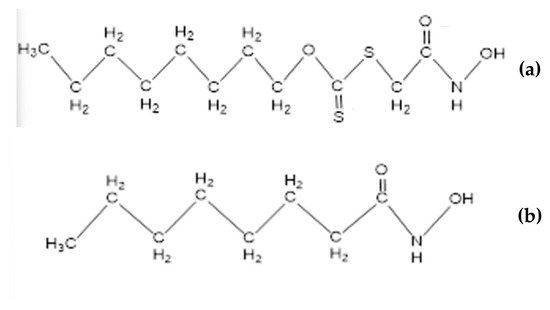
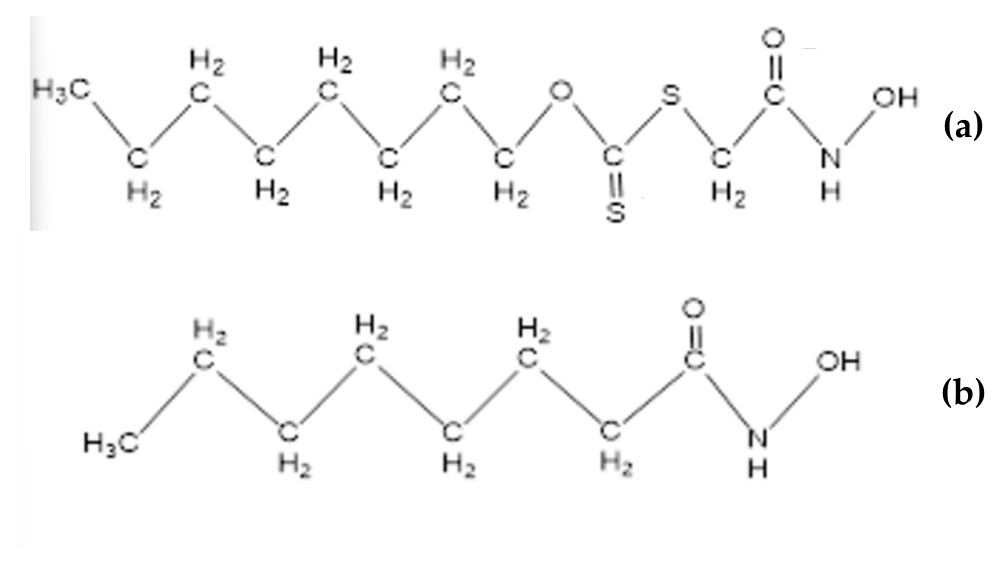
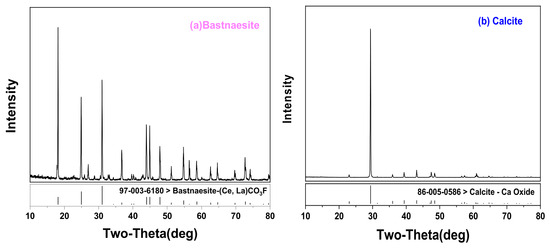
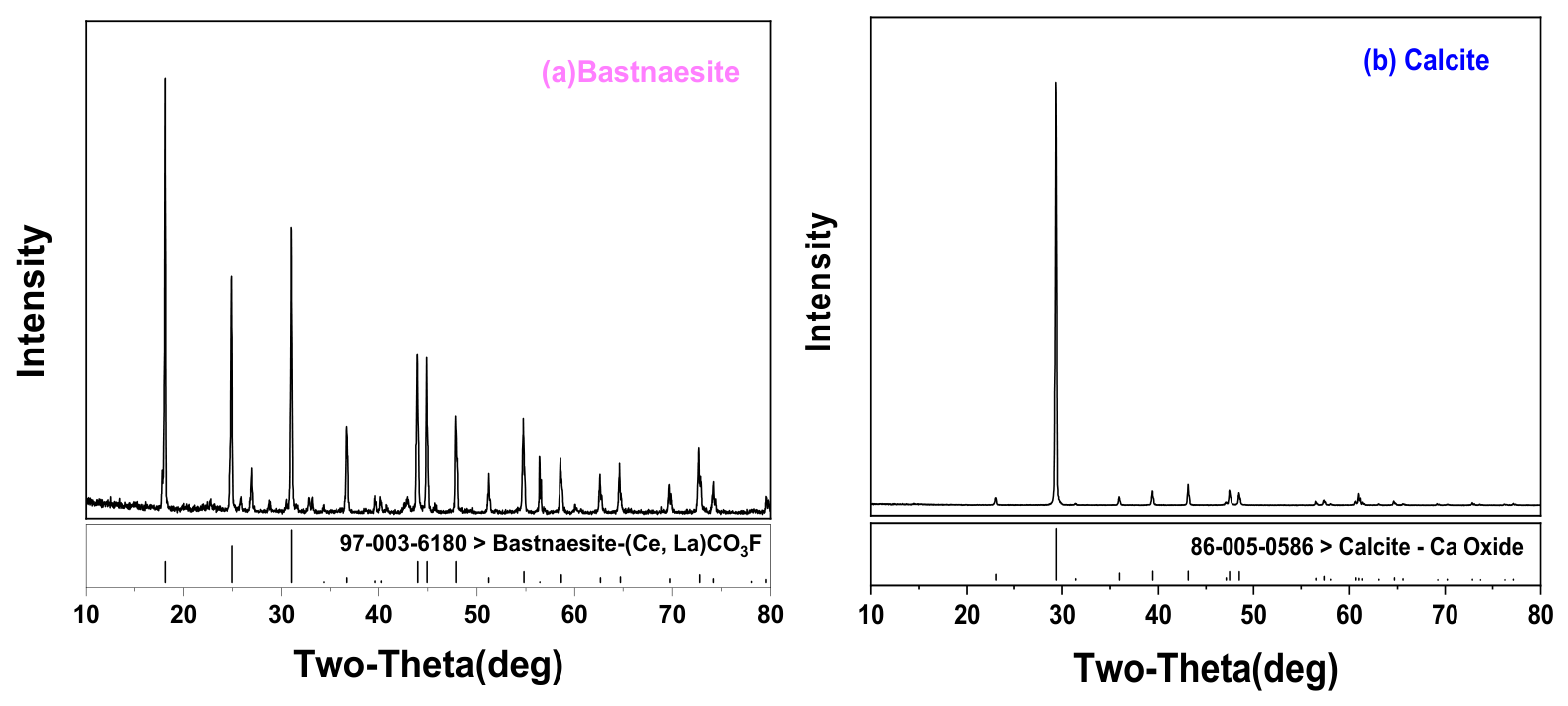
Figure 1 illustrates the molecular structure of EHAOX [45]. The phase composition and elemental analysis of both bastnaesite and calcite, as determined by X-ray diffraction (XRD) and X-ray fluorescence (XRF) [46]. The phase purity of the bastnaesite and calcite samples was confirmed by X-ray diffraction (XRD), as shown in Figure 2. The chemical compositions determined by X-ray fluorescence (XRF) are summarized in Table 1. For micro-flotation experiments, bastnaesite particles with a size fraction of −37 μm and calcite particles within the −74 + 37 μm range were utilized. In contrast, bastnaesite samples with particle sizes below 5 μm and −37 μm were employed for zeta potential measurements, ion interaction studies, and Fourier-transform infrared spectroscopy (FTIR), respectively. The use of different particle size fractions was necessitated by the specific requirements of each analytical technique: fine particles (<5 μm) are required for stable suspension in zeta potential measurements and for maximizing surface area in FTIR analysis, whereas slightly coarser particles (−37 μm for bastnaesite and −74 + 37 μm for calcite) were used in flotation tests to minimize mechanical entrainment while maintaining adequate liberation. Nevertheless, we acknowledge that entrainment of fine particles may contribute to flotation recovery to some extent, and future studies will employ entrainment correction methods to address this limitation. The bastnaesite sample used in this study is representative of the typical ore from the Bayan Obo deposit (Inner Mongolia, China), which contains bastnaesite as the primary rare earth mineral along with calcite, barite, and fluorite as gangue. The purity and composition of the hand-picked samples are consistent with those used in industrial beneficiation processes.
Figure 1.
Molecular structures of EHAOX (a) and OHA (b) with the numbered atoms.
Figure 2.
The XRD spectra of bastnaesite (a) and calcite (b).
2.2. Flotation Tests
The micro-flotations for bastnaesite and calcite were performed by the modified diagram with an improved Hallimond tube, the volume of which was 220 mL according to our previous paper [47,48,49,50].
In each test, 2.0 g of bastnaesite or calcite was dispersed in 150 mL of deionized water. pH regulators (HCl or NaOH), the collector EHAOX and OHA, and the frother methyl isobutyl carbinol (MIBC) were sequentially added. The suspension volume was then adjusted to 220 mL by adding water to achieve the desired reagent concentrations. Flotation was conducted under continuous stirring with nitrogen gas introduced at a flow rate of 200 mL/min. Froth products generated within the first 3 min were collected, filtered, dried, and weighed to determine the flotation recovery [51]. All flotation experiments were performed in triplicate under identical conditions. The reported recoveries represent the mean ± standard deviation (SD) of three independent measurements. For artificially mixed minerals (mass of bastnaesite: calcite = 1:1) tests, the recovery was calculated based on the grades of the froth products [52].
2.3. CLogP Computation
The octanol–water partition coefficient (CLogP), estimated through quantum chemical calculations, serves as a key molecular descriptor in Quantitative Structure–Activity Relationship (QSAR) modeling for predicting the hydrophobicity of organic compounds, including flotation reagents [53,54,55]. As a thermodynamically derived parameter, CLogP reflects the equilibrium distribution of a molecule between hydrophobic (octanol) and hydrophilic (aqueous) phases, thereby indicating its affinity for nonpolar environments. In the context of flotation chemistry, a higher CLogP value suggests enhanced hydrophobic character, which is generally correlated with increased adsorption onto mineral surfaces and improved bubble attachment efficiency, critical factors influencing collector performance. In this study, the CLogP values of EHAOX and OHA were calculated using ChemBioDraw Ultra 14.0, following the fragment-based method implemented in the software.
2.4. UV-Vis Spectroscopy
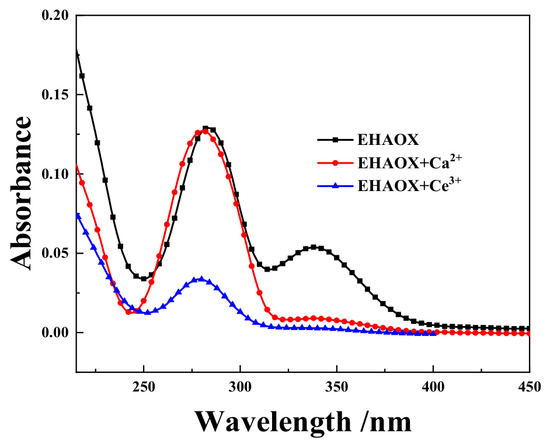
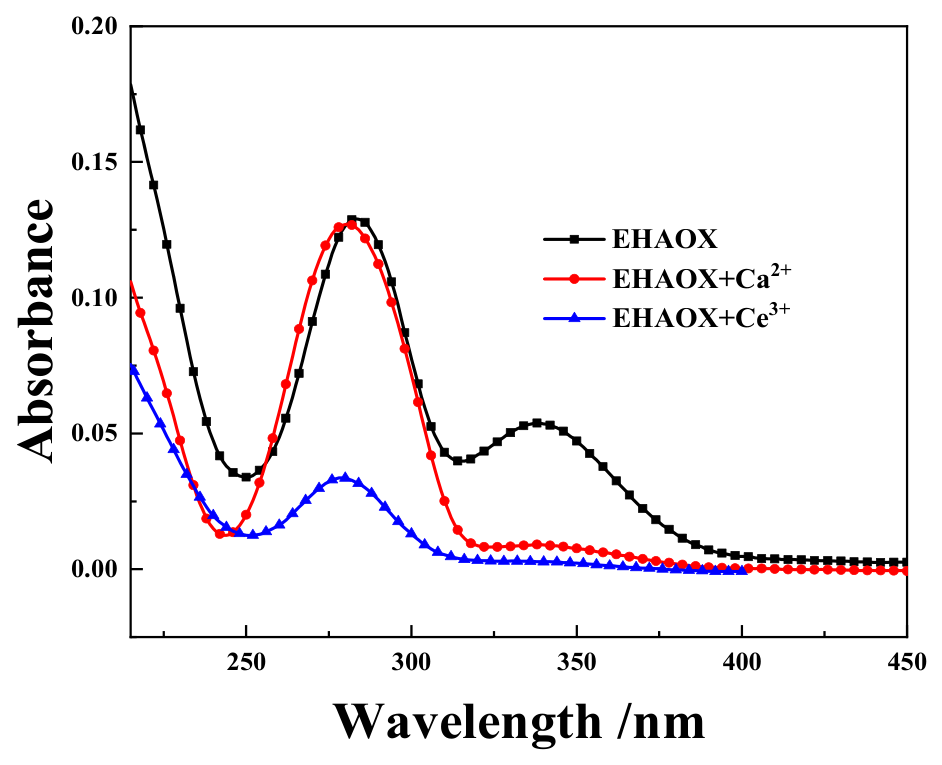
To further elucidate the selectivity of EHAOX, its interactions with Ce3+ and Ca2+ ions in solution were examined using UV/Vis spectroscopy. Spectral measurements were performed over the wavelength range of 200–490 nm using a UV-1750 spectrophotometer (Shimadzu Co., Ltd., Kyoto, Japan). The absorption spectra of a 5 × 10⁻⁵ mol/L EHAOX solution and equimolar mixtures containing 1 × 10⁻⁴ mol/L EHAOX and 1 × 10⁻⁴ mol/L of either Ce3+ or Ca2+ were recorded under identical volume conditions. Shifts in the absorption peaks and changes in intensity were analyzed to assess complex formation and the strength of EHAOX–metal-ion interactions [56]. The pH of each solution was measured before and after mixing (Table 2). All UV-Vis measurements were conducted at room temperature (298 ± 1 K) without additional pH adjustment to avoid buffer interference.
Table 2.
Changes in pH values before and after interaction of EHAOX with metal ions (Ce3+ and Ca2+). Values are mean ± SD (n = 3).
2.5. Zeta Potential Measurement
Zeta potential measurements of bastnaesite, both in the absence and presence of EHAOX, were conducted using a ZetaPlus instrument (Brookhaven Instruments Corporation, Holtsville, New York, USA). A 1 × 10⁻² mol/L KCl solution was employed as the supporting electrolyte, and all tests were performed at 298 ± 1 K [57,58]. For each measurement, 50 mg of bastnaesite particles were dispersed in 50 mL of EHAOX solution, with the pH pre-adjusted to the desired value using dilute KOH or HCl. The suspension was agitated for 5 min prior to analysis. Preliminary kinetic experiments indicated that the zeta potential reached a stable value within 5 min of conditioning with EHAOX, suggesting that adsorption equilibrium was achieved under the experimental conditions. Although bastnaesite and calcite are semi-soluble minerals, the short conditioning time and ambient temperature minimize the impact of dissolution on surface charge measurements. Zeta potential values were obtained as the average of eight independent measurements, with variability within ±10 mV. Zeta potential was measured over the pH range of 6–12. Values were obtained as the average of eight independent measurements, with the standard deviation typically within ±5 mV (variability within ±10 mV was considered acceptable based on instrument specifications).
2.6. FTIR Spectra
Fourier Transform Infrared (FTIR) spectra were acquired using a Nicolet FTIR-740 spectrometer (Madison, Wisconsin, USA) over a wavenumber range of 500–4000 cm−1, employing the KBr pellet method [59]. For sample preparation, 0.5 g of bastnaesite particles (particle size <5 μm) was suspended in 50 mL of 1 × 10⁻⁴ mol/L EHAOX solution. The pH was adjusted to 8.0 ± 0.1 using dilute KOH or HCl and maintained throughout the conditioning period. This pH was selected because it corresponds to the optimal flotation pH identified in micro-flotation experiments (Figure 3a). The suspension was stirred for 4 h at 298 ± 1 K to ensure sufficient time for adsorption. The pH was re-checked after stirring and readjusted if necessary to prevent reagent desorption due to pH drift. Afterward, the solids were filtered, thoroughly rinsed with deionized water, and dried under vacuum at 298 ± 1 K for five days to ensure complete removal of physically adsorbed water and residual solvent, which could otherwise interfere with the FTIR spectra. The resulting dried samples were subsequently used for FTIR analysis.
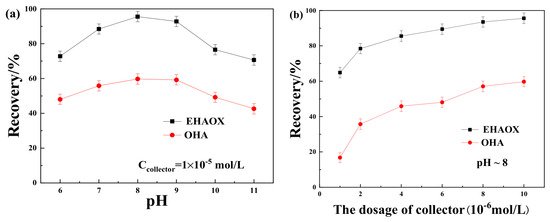
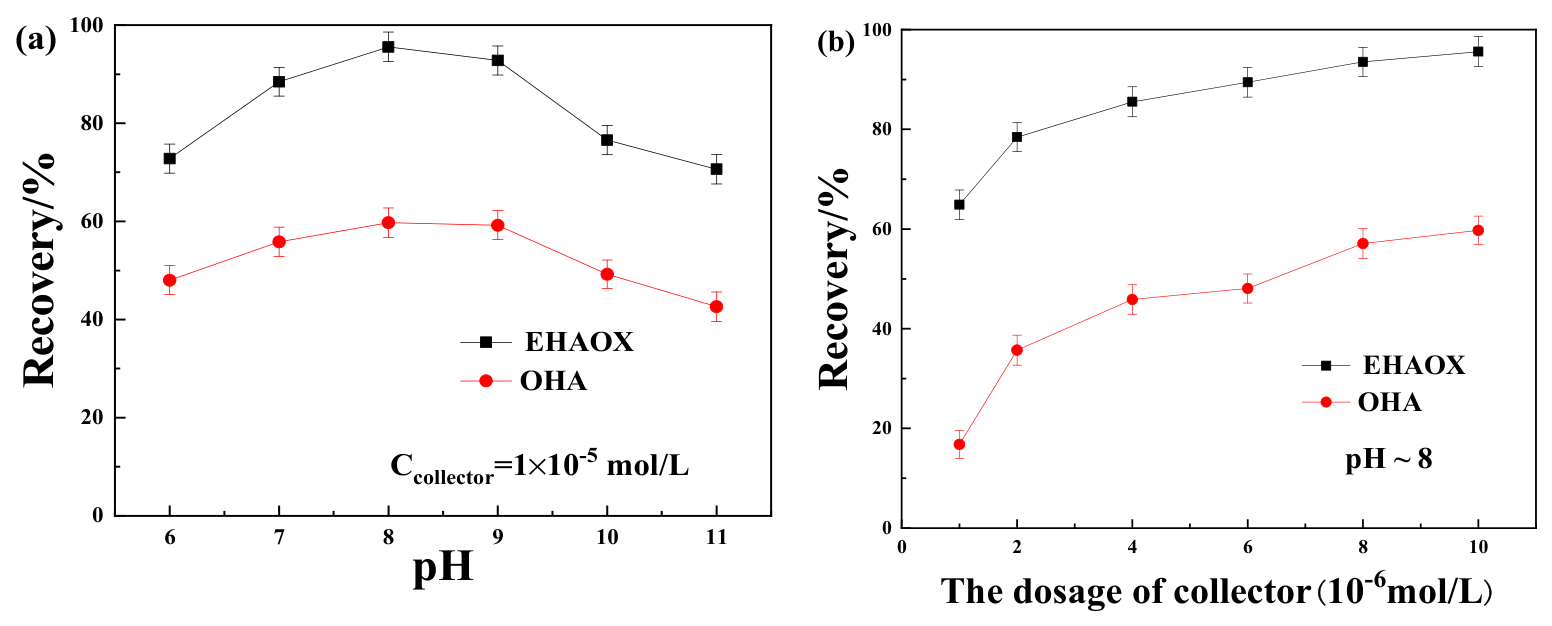
Figure 3.
Flotation recovery of bastnaesite under different (a) pH and (b) initial concentration of EHAOX and OHA.
3. Results and Discussion
3.1. Micro-Flotation Results
The flotation behavior of pure bastnaesite as a function of pH and collector concentration is presented in Figure 3. As shown in Figure 3a, both hydroxamic acid-based collectors—EHAOX and OHA—exhibited optimal flotation performance in the pH range of 7.0–9.0. At a concentration of 1 × 10⁻⁵ mol/L, EHAOX achieved a flotation recovery exceeding (95.2% ± 1.8%), whereas OHA resulted in a recovery of approximately 59% ± 2.1%. Figure 3b demonstrates that increasing the initial collector concentration significantly enhanced bastnaesite recovery, particularly for EHAOX. Recovery with EHAOX increased rapidly at lower concentrations and plateaued beyond 8 × 10⁻⁶ mol/L, reaching 94%. In contrast, OHA at the same concentration yielded only 57% recovery.
These results clearly indicate the superior flotation performance of EHAOX compared to OHA. This difference is likely attributable to their contrasting hydrophobicities, as reflected by their octanol–water partition coefficients (CLogP): 3.05 for EHAOX and 1.58 for OHA. Additionally, EHAOX contains bifunctional groups that may enhance its interaction with surface metal sites (e.g., Ce3+) on bastnaesite, thereby improving adsorption and hydrophobic coverage. Collectively, these factors contribute to EHAOX’s enhanced collecting ability and flotation efficiency [60].
3.2. Flotation of Artificially Mixed Minerals
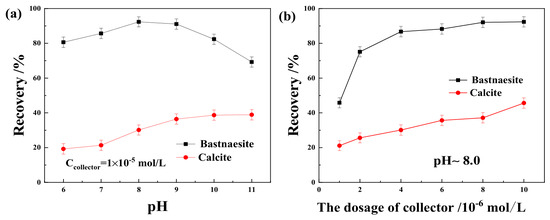
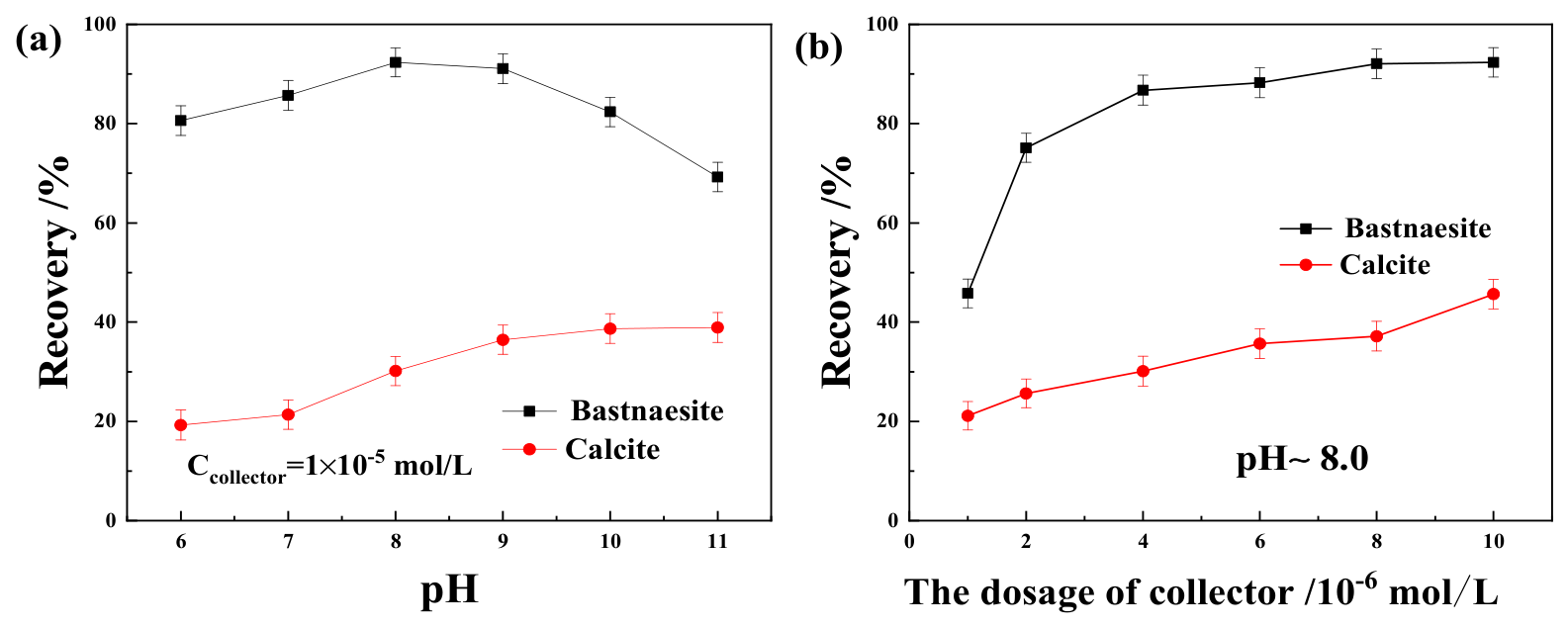
As demonstrated by the micro-flotation results in Figure 3, EHAOX exhibited significantly superior collecting performance for bastnaesite compared to OHA. To further evaluate its separation efficiency in artificial mixed mineral systems, additional flotation experiments were conducted, with the results presented in Figure 4a,b. As shown in Figure 4a, bastnaesite recovery increased sharply as the pH rose from 6.0 to 8.0, reaching an optimal range, and then gradually declined as the pH increased from 9.0 to 11.0. Figure 4b illustrates the effect of collector dosage on flotation selectivity. Bastnaesite recovery improved with increasing initial EHAOX concentration, approaching a maximum of approximately 92% at 8 × 10⁻⁶ mol/L. In contrast, under the same conditions, calcite recovery was limited to 37%, indicating a reasonable selectivity of EHAOX for bastnaesite over calcite. However, further optimization (e.g., depressant addition) may be required to reduce calcite recovery for industrial applications.
Figure 4.
Flotation separation of artificially mixed minerals (bastnaesite and calcite) as a function of (a) pH and (b) initial EHAOX concentration.
These findings confirm EHAOX’s strong selectivity and effectiveness in the flotation of bastnaesite from calcite, and the underlying mechanisms responsible for this behavior will be discussed in subsequent sections.
3.3. Ultraviolet/Visible Spectrum of EHAOX with or Without Metal Ions
Figure 5 illustrates that a marked decrease in absorbance occurred following the interaction of EHAOX with Ce3+ ions, whereas only a slight change was observed in the presence of Ca2+ ions. This indicates a stronger complexation between EHAOX and Ce3+. Corresponding pH values of the solutions containing Ce3+ and Ca2+ during their interaction with EHAOX are listed in Table 2. The observed pH reduction may be attributed to the pronounced hydrolysis behavior of Ce3+ and Ca2+ ions, wherein these metal cations react with water molecules to form metal aqua complexes, releasing hydronium ions (H3O+, or protons) and thereby lowering the pH.
Figure 5.
UV/vis spectra of EHAOX in the absence and presence of metal ions.
In particular, the pH of the Ce3+ solution decreased significantly upon addition of EHAOX, suggesting that the interaction involved a proton-releasing chemical reaction. This behavior supports the formation of stable EHAOX–Ce3+ complexes. The UV/Vis spectral data further corroborate a stronger binding affinity of EHAOX toward Ce3+ compared to Ca2+, consistent with the enhanced flotation recovery observed for bastnaesite. It is noteworthy that during UV measurements, 1.0 × 10⁻⁴ mol/L solutions of Ce3+ and Ca2+ were tested under identical conditions for direct comparison.
Overall, these results provide key insights into the selective interaction of EHAOX with Ce3+ over Ca2+, which underpins its superior flotation selectivity. The subsequent sections will delve into the adsorption mechanism of EHAOX on the bastnaesite mineral surface.
As shown in Figure 5, the UV/Vis spectrum of pure EHAOX exhibits two characteristic absorption bands at approximately 280 nm and 340 nm. The band at 280 nm is attributed to the π→π* transition of the C=S group in the dithiocarbonate ester moiety, while the band at 340 nm is assigned to the n→π* transition of the C=O group in the hydroxamic acid functionality. These assignments are consistent with previously reported spectra for analogous dithiocarbonate and hydroxamic acid compounds [61].
Upon addition of Ce3+ ions, the absorption band at 340 nm nearly disappeared, accompanied by a hypsochromic shift of the 280 nm band. This indicates strong coordination between the carbonyl oxygen of the hydroxamic acid group and Ce3+, forming a stable five-membered chelate ring. In contrast, the addition of Ca2+ resulted in only a slight decrease in the 340 nm band intensity, suggesting a much weaker interaction. The near-complete quenching of the 340 nm band in the presence of Ce3+ confirms the selective chemisorption of EHAOX onto Ce3+ sites, which aligns with the superior flotation recovery observed for bastnaesite compared to calcite [62].
The formation of the EHAOX-Ce3+ complex is likely driven by the chelate effect, where the bidentate coordination through both the hydroxamic oxygen and the dithiocarbonate sulfur atoms results in a stable five-membered ring structure. The significant pH drop from 5.93 to 4.32 upon complexation (Table 2) indicates the release of protons, consistent with the deprotonation of the hydroxamic acid group (-C(=O)NHOH→-C(=O)NO−) upon metal coordination.
The near-complete quenching of the 340 nm band indicates that the carbonyl oxygen of the hydroxamic group is the primary coordination site for Ce3+. The complexation reaction can be represented as:
EHAOX (in solution) + Ce3+ ⇌ [EHAOX-Ce]2+ + H+
The release of protons, evidenced by the pH drop from 5.93 to 4.32 (Table 2), confirms the deprotonation of the hydroxamic acid group upon chelation. The formation constant (log K) for analogous Ce3+-hydroxamate complexes is typically on the order of 8–10, suggesting a thermodynamically favorable reaction.
3.4. Zeta Potential Results
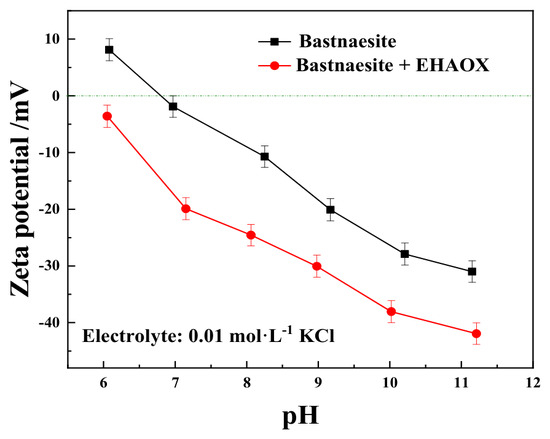
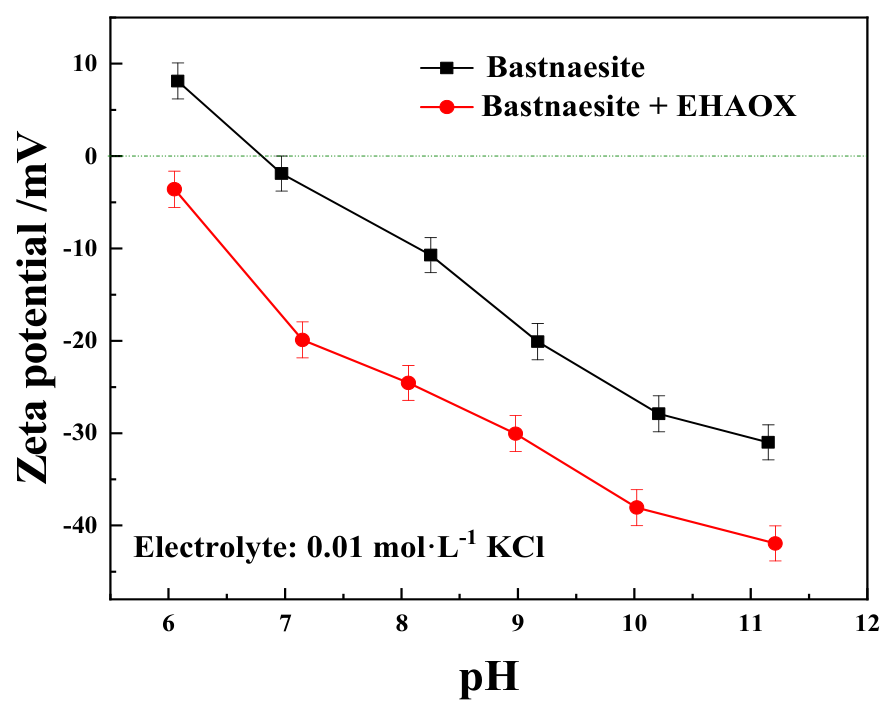
Figure 6 presents the zeta potential of bastnaesite particles as a function of pH, both in the absence and presence of EHAOX at a concentration of 1 × 10⁻⁴ mol/L [46]. In the absence of EHAOX, the zeta potential decreases progressively with increasing pH, with the isoelectric point (IEP) occurring at approximately pH 7.0, in agreement with previous reports [62,63,64]. Upon the addition of EHAOX, the zeta potential of bastnaesite shifts markedly toward more negative values across the entire pH range, indicating a significant increase in surface negativity. This shift suggests that EHAOX adsorbs onto the bastnaesite surface, rendering it more negative across the entire pH range. The increased negative charge may result from the chemisorption of anionic EHAOX species or the formation of negatively charged surface complexes. However, zeta potential measurements alone cannot identify the specific surface sites (e.g., Ce3+, La3+, or Fe3+) involved in the interaction. The observed shift is consistent with the adsorption of the collector onto the mineral surface, but does not provide direct evidence for preferential interaction with “positively charged sites”.
Figure 6.
Zeta potentials on the bastnaesite surface as a function of pH before and after treatment with EHAOX.
3.5. FTIR-Spectrum
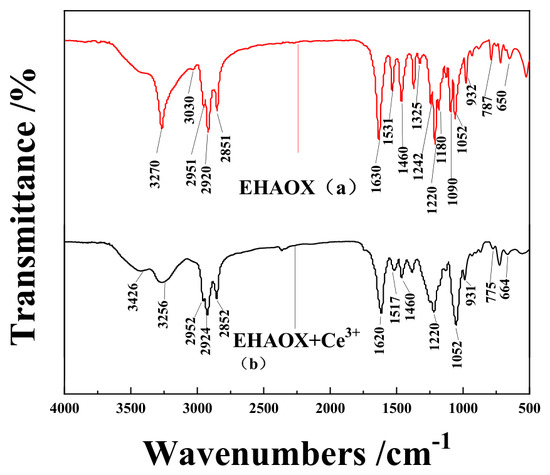
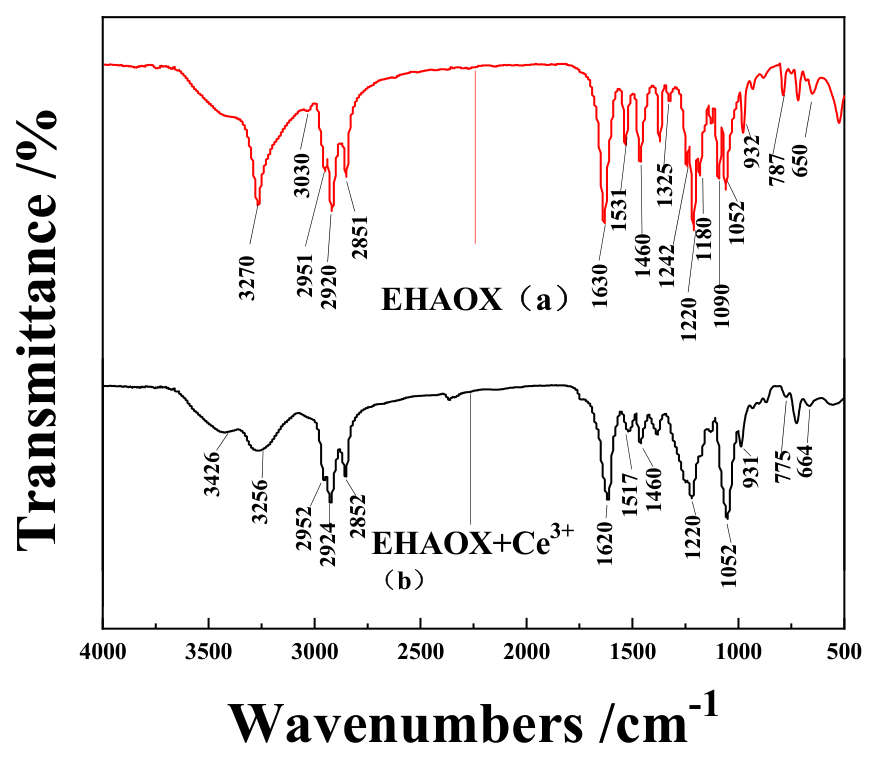
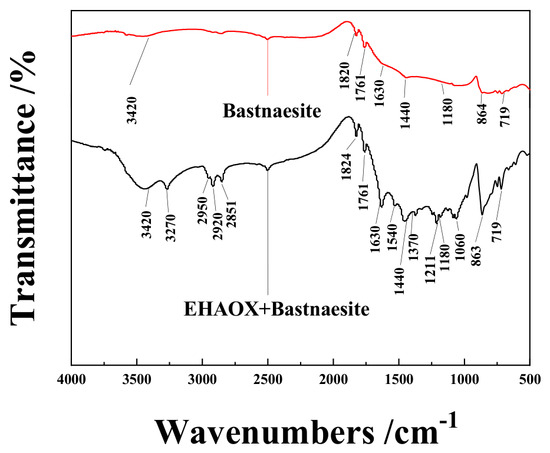
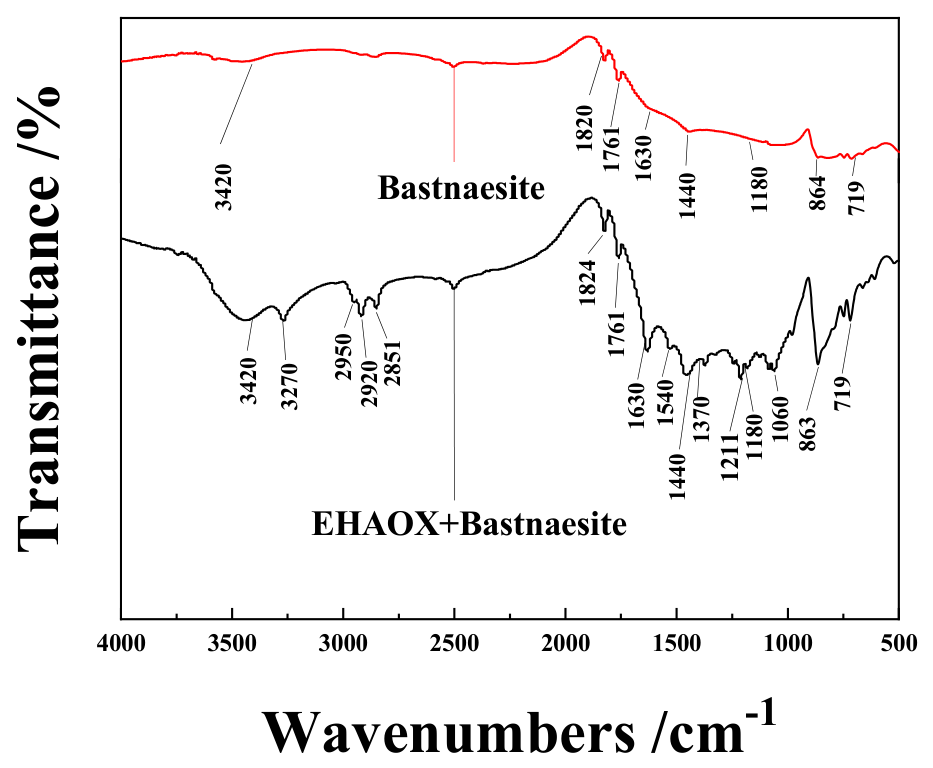
The infrared spectra of EHAOX [45], EHAOX-Ce3+ precipitate, bastnaesite [46], and DEPHA-treated bastnaesite were shown in Figure 7 and Figure 8, respectively.
Figure 7.
FTIR spectra of (a) pure EHAOX and (b) EHAOX-Ce3+ precipitate. Key absorption bands: 3030 cm−1 (O-H stretch of hydroxamic acid), 1630 cm−1 (C=O stretch), 1531 cm−1 (C-N stretch), 1090 cm−1 (C=S stretch). The disappearance of the 3030 cm−1 and 1090 cm−1 bands and the shift of the 1630 cm−1 band to 1620 cm−1 upon Ce3+ complexation indicate chemisorption through both the hydroxamic oxygen and dithiocarbonate sulfur atoms.
Figure 8.
FTIR spectra of bastnaesite before and after treatment with EHAOX. New peaks at 2950, 2920, and 2851 cm−1 correspond to the asymmetric and symmetric C-H stretching vibrations of the octyl chain in EHAOX. The peaks at 3270 cm−1 (N-H stretch) and 1540 cm−1 (C-N stretch) further confirm the adsorption of EHAOX onto the bastnaesite surface.
In Figure 7, the infrared spectra of EHAOX indicated that the absorption peak of around 3030 cm−1 was assigned to the O-H group, and 1630 cm−1 was assigned to the C=O group [64,65,66,67]. While the peak at 3030 cm−1 disappeared in the EHAOX-Ce3+ precipitate, the peak at 1630 cm−1 shifted by 10 cm−1 to a lower wavenumber (1620 cm−1) [68,69,70]. The absorption peak of about 1531 cm−1 was assigned to the C-N stretching vibration of EHAOX emerging in the EHAOX-Ce3+ precipitate [71,72], and the peak at around 1090 cm−1, assigned to the peak of C=S of EHAOX, disappeared in the EHAOX-Ce3+ composite precipitate [73,74,75].
The results of spectra in Figure 8 elucidated that the treated bastnaesite with EHAOX, the absorption peaks at around 2950, 2920, and 2851 cm−1 were assigned to -CH2- and -CH3 groups of EHAOX emerging on the bastnaesite particle surfaces. Notably, the peak N-H (3270 cm−1) and C-N (1540 cm−1) groups of EHAOX are emerging on the bastnaesite particle surfaces.
4. Conclusions
In this study, the flotation performance and hydrophobic interaction mechanism of EHAOX with bastnaesite were systematically evaluated using micro-flotation tests, ion interaction analysis, zeta potential measurements, and FTIR spectroscopy. Based on the experimental findings, the following conclusions were drawn:
- CLogP calculations indicated that EHAOX possesses greater hydrophobicity than OHA, aligning with the over 40% flotation recovery increase by EHAOX. Flotation of artificially mixed minerals confirmed this finding.
- Zeta potential measurements suggested a strong interaction between bastnaesite and EHAOX.
- FTIR analysis indicated that EHAOX chemisorbs onto bastnaesite surfaces, with evidence of coordination involving the C=S and C-N(=S)-S-C functional groups. The interaction with Ce3+ was confirmed through analysis of the EHAOX-Ce3+ precipitate. However, the potential contribution of other surface cations (e.g., La3+, Fe3+) to collector adsorption warrants further investigation using surface-sensitive techniques such as XPS.
Overall, EHAOX was shown to be an efficient and selective collector for bastnaesite flotation. While the present study is limited to laboratory-scale experiments, the promising performance of EHAOX suggests its potential for practical application. Further evaluation in pilot-scale trials is warranted to assess its feasibility in industrial settings.
Author Contributions
Y.G. and H.F. contributed to conceptualization; W.S. finished the methodology; J.L. and Z.L. and T.L. were responsible for data curation; H.F. wrote the original draft; Y.Z., H.T. and T.W. helped with reviewing and editing. All authors have read and agreed to the published version of the manuscript.
Funding
This research was funded by the National Natural Science Foundation of China (grant number 52564038) and the Inner Mongolia Autonomous Region Natural Science Foundation (grant numbers 2024QN05021, 2024MS04008, 2025LHMS04023).
Data Availability Statement
The data presented in this study are available on request from the corresponding author due to the internal policy.
Acknowledgments
The authors feel thankful to the National Natural Science Foundation of China and the Inner Mongolia Autonomous Region Natural Science Foundation.
Conflicts of Interest
The authors declare no conflict of interest.
References
- Massari, S.; Ruberti, M. Rare earth elements as critical raw materials: Focus on international markets and future strategies. Resour. Policy 2013, 38, 36–43. [Google Scholar] [CrossRef] [Scilit]
- Balaram, V. Rare earth elements: A review of applications, occurrence, exploration, analysis, recycling, and environmental impact. Geosci. Front. 2019, 10, 1285–1303. [Google Scholar] [CrossRef] [Scilit]
- Bulatovic, S.M. Flotation of REO Minerals Handbook of Flotation Reagents: Chemistry, Theory and Practice: Flotation of Gold, PGM and Oxide Minerals, 1st ed.; Elsevier Science: Amsterdam, The Netherlands, 2010; pp. 151–173. [Google Scholar]
- Zhang, Z.; Jiang, L.; Guo, W.; Yang, J.; Liu, D.; Chi, R. Impact of Metal Ions on Collector’s Performance in Bastnaesite Flotation. Min. Metall. Explor. 2025, 42, 1199–1215. [Google Scholar]
- Jordens, A.; Marion, C.; Grammatikopoulos, T.; Hart, B.; Waters, K.E. Beneficiation of the Nechalacho rare earth deposit: Flotation response using benzohydroxamic acid. Miner. Eng. 2016, 99, 158–169. [Google Scholar] [CrossRef] [Scilit]
- Liu, W.; Wang, X.; Miller, J.D. Collector chemistry for bastnaesite flotation—Recent developments. Miner. Process. Extr. Metall. Rev. 2019, 40, 370–379. [Google Scholar] [CrossRef] [Scilit]
- Cao, S.; Cao, Y.; Liao, Y.; Ma, Z. Depression mechanism of strontium ions in bastnaesite flotation with salicylhydroxamic acid as collector. Minerals 2018, 8, 66. [Google Scholar] [CrossRef] [Scilit]
- Marion, C.; Li, R.; Waters, K.E. A review of reagents applied to rare-earth mineral flotation. Adv. Colloid Interface Sci. 2020, 279, 102142. [Google Scholar] [CrossRef] [Scilit]
- Wang, Z.; Wu, H.; Yang, J.; Tang, Z.; Luo, L.; Shu, K.; Xu, Y.; Xu, L. Selective flotation separation of bastnaesite of from calcite using xanthan gum as a depressant. Appl. Surf. Sci. 2020, 512, 145714. [Google Scholar] [CrossRef] [Scilit]
- Liu, J.; Wu, J.; Wang, N.N.; Tian, F.S.; Li, J. Surface reconstruction of BiSI nanorods for superb photocatalytic Cr(VI) reduction under near-infrared light irradiation. Chem. Eng. J. 2022, 435, 135152. [Google Scholar] [CrossRef] [Scilit]
- Zhang, R.; Li, Y.; Yan, J.; Zeng, J.; Liu, Y.; Zhang, M.; Liu, P.; Huang, X.; Zhang, E.; Cheng, K.; et al. Surface modification of PVDF membranes with quaternized chitosan for selective separation of negatively charged polysaccharides—Exemplified with heparin. J. Environ. Chem. Eng. 2023, 11, 110666. [Google Scholar] [CrossRef] [Scilit]
- Jordens, A.; Cheng, Y.P.; Waters, K.E. A review of the beneficiation of rare earth element bearing minerals. Miner. Eng. 2013, 41, 97–114. [Google Scholar] [CrossRef] [Scilit]
- Chehreh Chelgani, S.; Hart, B.; Xia, L.A. TOF-SIMS surface chemical analytical study of rare earth element minerals from micro-flotation tests products. Miner. Eng. 2013, 45, 32–40. [Google Scholar] [CrossRef] [Scilit]
- Liu, C.; Xu, L.; Deng, J.; Tian, J.; Wang, D.; Xue, K. A review of flotation reagents for bastnäsite-(Ce) rare earth ore. Adv. Colloid Interface Sci. 2023, 321, 103029. [Google Scholar] [CrossRef] [Scilit] [PubMed]
- Nakhaei, F.; Corchado-Albelo, J.; Alagha, L.; Moats, M.; Munoz-Garcia, N. Progress, challenges, and perspectives of critical elements recovery from sulfide tailings. Sep. Purif. Technol. 2025, 354, 128973. [Google Scholar] [CrossRef] [Scilit]
- Pradip; Fuerstenau, D. Adsorption of hydroxamate collectors on semisoluble minerals Part II: Effect of temperature on adsorption. Colloids Surf. 1985, 15, 137–146. [Google Scholar] [CrossRef]
- Filippova, I.V.; Filippov, L.O.; Lafhaj, Z.; Barres, O.; Fornasiero, D. Effect of calcium minerals reactivity on fatty acids adsorption and flotation. Colloid Surf. A Physicochem. Eng. Asp. 2018, 545, 157–166. [Google Scholar] [CrossRef] [Scilit]
- Wang, Z.; Wu, H.; Xu, Y.; Shu, K.; Fang, S.; Xu, L. The effect of dissolved calcite species on the flotation of bastnaesite using sodium oleate. Miner. Eng. 2020, 145, 106095. [Google Scholar] [CrossRef] [Scilit]
- Ren, J.; Lu, S.; Song, S.; Niu, J. A new collector for rare earth mineral flotation. Miner. Eng. 1997, 10, 1395–1404. [Google Scholar] [CrossRef] [Scilit]
- Zhou, G.; Luo, J. Mechanism of flotation using citric acid for separating monazite from bastnaesite. Nonferrous Met. 1989, 41, 33–40. [Google Scholar]
- Zhou, G.; Luo, J. Mechanism of flotation using mono-alkyl ester phosphoric acid for bastnaesite. J. Chin. Rare Earth Soc. 1990, 8, 261–264. [Google Scholar]
- Espiritu, E.R.L.; Naseri, S.; Waters, K.E. Surface chemistry and flotation behavior of dolomite, monazite and bastnäsite in the presence of benzohydroxamate, sodium oleate and phosphoric acid ester collectors. Colloids Surf. A Physicochem. Eng. Asp. 2018, 546, 254–265. [Google Scholar] [CrossRef] [Scilit]
- Zhang, Z.; Jiang, L.; Guo, W.; Yang, J.; Liu, D.; Chi, R. Flotation behavior and adsorption mechanism of 2-hydroxy-3-naphthyl hydroxamic acid on bastnaesite surface. J. Rare Earths 2024, 43, 1084–1090. [Google Scholar] [CrossRef] [Scilit]
- Liu, W.; McDonald, L.W.; Wang, X.; Miller, J.D. Bastnaesite flotation chemistry issues associated with alkyl phosphate collectors. Miner. Eng. 2018, 127, 286–295. [Google Scholar] [CrossRef] [Scilit]
- Liu, W.; Wang, X.; Xu, H.; Miller, J. Lauryl phosphate adsorption in the flotation of Bastnaesite, (Ce,La)FCO3. J. Colloid Interface Sci. 2017, 490, 825–833. [Google Scholar] [CrossRef] [Scilit] [PubMed]
- Espiritu, E.; da Silva, G.; Azizi, D.; Larachi, F.; Waters, K. Flotation behavior and electronic simulations of rare earth minerals in the presence of dolomite supernatant using sodium oleate collector. J. Rare Earths 2018, 37, 101–112. [Google Scholar] [CrossRef] [Scilit]
- Lu, Y.; Wang, S.; Zhong, H. Optimization of conventional hydroxamic acid for cassiterite flotation: Application of structural modification under principle of isomerism. Miner. Eng. 2021, 167, 106901. [Google Scholar] [CrossRef] [Scilit]
- Liu, W.; Wang, X.; Wang, Z.; Miller, J. Flotation chemistry features in bastnaesite flotation with potassium lauryl phosphate. Miner. Eng. 2016, 85, 17–22. [Google Scholar] [CrossRef] [Scilit]
- Xu, Y.; Xu, L.; Wu, H.; Wang, Z.; Shu, K.; Fang, S.; Zhang, Z. Flotation and co-adsorption of mixed collectors octanohydroxamic acid/sodium oleate on bastnaesite. J. Alloys Compd. 2019, 7, 152948. [Google Scholar] [CrossRef] [Scilit]
- Mustafa, S.; Hamid, A.; Naeem, A. Xanthate adsorption studies on chalcopyrite Ore. Int. J. Miner. Process. 2004, 74, 317–325. [Google Scholar] [CrossRef] [Scilit]
- Nagaraj, D.R.; Farinato, R.S. Evolution of flotation chemistry and chemicals: A century of innovations and the lingering challenges. Miner. Eng. 2016, 96–97, 2–14. [Google Scholar] [CrossRef] [Scilit]
- Liu, G.; Qiu, Z.; Wang, J.; Liu, Q.; Xiao, J.; Zeng, H.; Zhong, H.; Xu, Z. Study of Nisopropoxypropyl-N’-ethoxycarbonyl thiourea adsorption on chalcopyrite using in situ SECM, ToF-SIMS and XPS. J. Colloid Interface Sci. 2015, 437, 42–49. [Google Scholar] [CrossRef] [Scilit]
- Huang, Y.; Liu, G.; Liu, J.; Yang, X.; Zhang, Z. Thiadiazole-thione surfactants:Preparation, flotation performance and adsorption mechanism to malachite. J. Ind. Eng. Chem. 2018, 67, 99–108. [Google Scholar] [CrossRef] [Scilit]
- Geboes, B.; Baert, K.; Hubin, A.; Breugelmans, T. Investigation of the adsorption mechanism of heterocyclic molecules on copper using potentiodynamic ORPEIS and in-situ ramans pectroscopy. Electrochim. Acta 2015, 156, 308–315. [Google Scholar] [CrossRef] [Scilit]
- Blajiev, O.L.; Breugelmans, T.; Pintelon, R.; Terryn, H.; Hubin, A. Potentiodynamic EIS investigation of the 2-methyl-5-mercapto-1,3,4-thiadiazole adsorption on copper. Electrochim. Acta 2008, 53, 7451–7459. [Google Scholar] [CrossRef] [Scilit]
- Matsumoto, F.; Ozaki, M.; Inatomi, Y.; Paulson, S.C.; Oyama, N. Studies on the Adsorption Behavior of 2,5-Dimercapto-1,3,4-thiadiazole and 2-Mercapto-5-methyl-1,3,4-thiadiazole at Gold and Copper Electrode Surfaces. Langmuir 1999, 15, 857–865. [Google Scholar] [CrossRef] [Scilit]
- Gudasi, K.; Patil, M.; Vadavi, R.; Shenoy, R.; Patil, S. Transition metal complexes with a new tridentate ligand, 5-[6-(5-mercapto-1,3,4-oxadiazol-2-yl) pyridin-2-yl]-1,3,4- oxadiazole-2-thiol. J. Serbian Chem. Soc. 2007, 72, 357–366. [Google Scholar] [CrossRef] [Scilit]
- Zhang, Y.Y.; Zhou, C.H. Synthesis and activities of naphthalimide azoles as a new type of antibacterial and antifungal agents. Bioorg. Med. Chem. Lett. 2011, 21, 4349–4352. [Google Scholar] [CrossRef] [Scilit]
- Khokhar, J.Y.; Tyndale, R.F. Intracerebroventricularly and Systemically Delivered Inhibitor of Brain CYP2B (C8-Xanthate), Even Following Chlorpyrifos Exposure, Reduces Chlorpyrifos Activation and Toxicity in Male Rats. Toxicol. Sci. Off. J. Soc. Toxicol. 2014, 140, 49–60. [Google Scholar] [CrossRef] [Scilit] [PubMed]
- Pang, W.; Yao, J.; Knudsen, T.Š.; Cao, Y.; Liu, B.; Li, H.; Li, M.; Zhu, J. Degradation of three typical hydroxamic acids collectors via UVA-B activated H2O2 and persulfate: Kinetics, transformation pathway, DFT calculation and toxicity evaluation. Chem. Eng. J. 2023, 451, 138639. [Google Scholar] [CrossRef] [Scilit]
- Xiao, H.; Xu, F.; Chen, J.; Hao, Y.; Guo, Y.; Zhu, C.; Luo, S.; Jiang, B. Electrogenerated oxychlorides induced overlooked negative effects on electro-oxidation wastewater treatment in terms of over-evaluated COD removal efficiency and biotoxicity. J. Hazard. Mater. 2023, 456, 131667. [Google Scholar] [CrossRef] [Scilit]
- Dong, S.H. Multi class SVM algorithm with active learning for network traffic classification. Expert Syst. Appl. 2021, 176, 114885. [Google Scholar] [CrossRef] [Scilit]
- Dong, S.H.; Sarem, M.U. DDoS Attack Detection Method Based on Improved KNN With the Degree of DDoS Attack in Software-Defined Networks. IEEE Access 2020, 8, 5039–5048. [Google Scholar] [CrossRef] [Scilit]
- Dong, S.H.; Xia, Y.U.; Kamruzzaman, J.O. Quantum Particle Swarm Optimization for Task Offloading in Mobile Edge Computing. IEEE Trans. Ind. Inform. 2023, 19, 9113–9122. [Google Scholar] [CrossRef] [Scilit]
- Liu, S.; Xie, L.; Liu, G.; Zhong, H.; Wang, Y.; Zeng, H. Hetero-difunctional Reagent with Superior Flotation Performance to Chalcopyrite and the Associated Surface Interaction Mechanism. Langmuir 2019, 35, 4353–4363. [Google Scholar] [CrossRef] [Scilit] [PubMed]
- Fan, H.; Gao, Y.; Dou, K.; Sun, W. An investigation into the selective flotation of bastnaesite using the innovative collector HABTC: A comprehensive examination of the underlying mechanism. Miner. Eng. 2023, 204, 108397. [Google Scholar] [CrossRef] [Scilit]
- Liu, S.; Zhong, H.; Liu, G.; Xu, Z. Cu(I)/Cu(II) mixed-valence surface complexes of S-[(2-hydroxyamino)-2-oxoethyl]-N,N-dibutyldithiocarbamate: Hydrophobic mechanism to malachite flotation. J. Colloid Interf. Sci. 2018, 512, 701–712. [Google Scholar] [CrossRef] [Scilit]
- Liu, G.; Xiao, J.; Liu, J.; Qu, X.; Liu, Q.; Zeng, H.; Yang, X.; Xie, L.; Zhong, H.; Liu, Q.; et al. In situ probing the self-assembly of 3-hexyl-4-amino-1, 2, 4-triazole-5-thione on chalcopyrite surface. Colloids Surf. A Physicochem. Eng. Asp. 2016, 511, 285–293. [Google Scholar] [CrossRef] [Scilit]
- Liu, G.; Huang, Y.; Qu, X.; Xiao, J.; Yang, X.; Xu, Z. Understanding the hydrophobic mechanism of 3-hexyl-4-amino-1, 2, 4-triazole-5-thione to malachite by ToF-SIMS, XPS, FTIR, contact angle, zeta potential and micro-flotation. Colloids Surf. A Physicochem. Eng. Asp. 2016, 503, 34–42. [Google Scholar] [CrossRef] [Scilit]
- Fan, H.; Qin, J.; Liu, J.; Liu, G.; Yang, X. Investigation into the flotation of malachite, calcite and quartz with three phosphate surfactants. J. Mater. Res. Technol. 2019, 8, 5140–5148. [Google Scholar] [CrossRef] [Scilit]
- Huang, K.; Huang, X.; Jia, Y.; Wang, S.; Cao, Z.; Zhong, H. A novel surfactant styryl phosphonate mono-iso-octyl ester with improved adsorption capacity and hydrophobicity for cassiterite flotation. Miner. Eng. 2019, 142, 105895. [Google Scholar] [CrossRef] [Scilit]
- Qiu, W.-X.; Si, Z.-Z.; Mou, D.-S.; Dai, C.-Q.; Li, J.-T.; Liu, W. Data-driven vector degenerate and nondegenerate solitons of coupled nonlocal nonlinear Schrödinger equation via improved PINN algorithm. Nonlinear Dyn. 2024, 113, 4063–4076. [Google Scholar] [CrossRef] [Scilit]
- Natarajan, R.; Nirdosh, I. Application of topochemical, topostructural, physicochemical and geometrical parameters to model the flotation efficiencies of Narylhydroxamic acids. Int. J. Miner. Process. 2003, 71, 113–129. [Google Scholar] [CrossRef] [Scilit]
- Sun, H.; Wang, S.; Fei, L.; Cao, Z.; Zhong, H.; Ma, X. The selective flotation separation of rhodochrosite against quartz and calcite with dicarboxylic amino acidbased surfactants as a novel collector. Miner. Eng. 2022, 182, 107559. [Google Scholar] [CrossRef] [Scilit]
- Yu, X.; Zhang, R.; Zeng, Y.; Cheng, C.; Huang, Z.; Wang, J.; He, G.; Wang, H. The effect and mechanism of cinnamic hydroxamic acid as a collector in flotation separation of malachite and calcite. Miner. Eng. 2021, 164, 106847. [Google Scholar] [CrossRef] [Scilit]
- Fan, H.L.; Tan, W.; Liu, G.Y. 1-Hydroxydodecylidene-1,1-diphosphonic acid flotation of bastnasite: Performance and mechanism. Colloids Surf. A Physicochem. Eng. Asp. 2021, 609, 125623. [Google Scholar] [CrossRef] [Scilit]
- Qin, J.; Liu, G.; Fan, H.; Tan, W. The hydrophobic mechanism of di(2-ethylhexyl) phosphoric acid to hemimorpite flotation. Colloids Surf. A Physicochem. Eng. Asp. 2018, 545, 68–77. [Google Scholar] [CrossRef] [Scilit]
- Fuerstenau, D.W.; Pradip. Zeta potentials in the flotation of oxide and silicate minerals. Adv. Colloid Interface Sci. 2005, 114–115, 9–26. [Google Scholar] [CrossRef] [Scilit] [PubMed]
- Fan, H.; Yang, X.; Qi, J.; Liu, G.; Qin, J. A comparative investigation into floatability of bastnaesite with three di/trialkyl phosphate surfactants. J. Rare Earths 2021, 39, 1442–1449. [Google Scholar] [CrossRef] [Scilit]
- Chen, Y.; Zhang, G. New parameters identification of Proton exchange membrane fuel cell stacks based on an improved version of African vulture optimization algorithm. Energy Rep. 2022, 8, 3030–3040. [Google Scholar] [CrossRef] [Scilit]
- Fan, H.; Yang, D.; Gao, Y.; Wang, T.; Li, J.; Sun, W.; Zhang, Z.; Hong, J. A novel surfactant S-[(2-hydroxyamino)-2-oxoethyl]-N,N-dibutyldithiocarbamate with flotation performance and hydrophobicity to cassiterite. Sep. Purif. Technol. 2025, 374, 133592. [Google Scholar] [CrossRef] [Scilit]
- Hu, H.X.; Liao, Z.H.; Zheng, Y.; Liu, Y. Enlightenment on rare earth industry development from it’s market retrospect. Nonferrous Met. Sci. Eng. 2016, 7, 147–156. [Google Scholar] [CrossRef]
- Jordens, A.; Marion, C.; Kuzmina, O.; Waters, K.E. Surface chemistry considerations in the flotation of bastnäsite. Miner. Eng. 2014, 66, 119–129. [Google Scholar] [CrossRef] [Scilit]
- Owens, C.; Nash, G.; Hadler, K.; Fitzpatrick, R.; Anderson, C.; Wall, F. Zeta potentials of the rare earth element fluorcarbonate minerals focusing on bastnäsite and parisite. Adv. Colloid Interface Sci. 2018, 256, 152–162. [Google Scholar] [CrossRef] [Scilit]
- Deng, L.; Zhao, G.; Zhong, H.; Wang, S.; Liu, G. Investigation on the selectivity of N-((hydroxyamino)-alkyl) alkylamide surfactants for scheelite/calcite flotation separation. J. Ind. Eng. Chem. 2016, 33, 131–141. [Google Scholar] [CrossRef] [Scilit]
- Jia, Y.; Huang, X.; Huang, K.; Wang, S.; Cao, Z.; Zhong, H. Synthesis, flotation performance and adsorption mechanism of 3-(ethylamino)-N-phenyl-3-thioxopropanamide onto galena/sphalerite surfaces. J. Ind. Eng. Chem. 2019, 77, 416–425. [Google Scholar] [CrossRef] [Scilit]
- Hope, G.A.; Woods, R.; Buckley, A.N.; White, J.M.; McLean, J. Spectroscopic characterisation of n-octanohydroxamic acid and potassium hydrogen noctanohydroxamate. Inorganica Chim. Acta 2010, 363, 935–943. [Google Scholar] [CrossRef] [Scilit]
- Hope, G.A.; Woods, R.; Parker, G.K.; Buckley, A.N.; McLean, J. Spectroscopic characterisation of copper acetohydroxamate and copper noctanohydroxamate. Inorganica Chim. Acta 2010, 365, 65–70. [Google Scholar] [CrossRef] [Scilit]
- Deng, L.; Wang, S.; Zhong, H.; Liu, G. A novel surfactant 2-amino-6-decanamidohexanoic acid: Flotation performance and adsorption mechanism to diaspore. Miner. Eng. 2016, 93, 16–23. [Google Scholar] [CrossRef] [Scilit]
- Xu, H.; Zhong, H.; Wang, S.; Niu, Y.; Liu, G. Synthesis of 2-ethyl-2-hexenal oxime and its flotation performance for copper ore. Miner. Eng. 2014, 66–68, 173–180. [Google Scholar] [CrossRef] [Scilit]
- Alexander, S.; Eastoe, J.; Lord, A.M.; Guittard, F.; Barron, A.R. Branched hydrocarbon low surface energy materials for superhydrophobic nanoparticle derived surfaces. ACS Appl. Mater. Interfaces 2016, 8, 660–666. [Google Scholar] [CrossRef] [Scilit]
- Ota, H.; Akai, T.; Namita, H.; Yamaguchi, S.; Nomura, M. XAFS and TOF-SIMS analysis of SEI layers on electrodes. J. Power Sources 2003, 119–121, 567–571. [Google Scholar] [CrossRef] [Scilit]
- Ma, X.; Hu, Y.; Zhong, H.; Wang, S.; Liu, G.; Zhao, G. A novel surfactant S-benzoyl-N, N-diethyldithiocarbamate synthesis and its flotation performance to galena. Appl. Surf. Sci. 2016, 365, 342–351. [Google Scholar] [CrossRef] [Scilit]
- Xiao, J.; Liu, G.; Zhong, H.; Huang, Y.; Cao, Z. The flotation behavior and adsorption mechanism of O-isopropyl-S-[2-(hydroxyimino) propyl] dithiocarbonate ester to chalcopyrite. Int. J. Miner. Process. 2017, 71, 38–46. [Google Scholar] [CrossRef] [Scilit]
- Guerrini, L.; Garcia-Ramos, J.V.; Domingo, C.; Sanchez-Cortes, S. Functionalization of Ag nanoparticles with dithiocarbamate calixarene as an effective supramolecular host for the surface-enhanced raman scattering detection of polycyclic aromatic hydrocarbons. Langmuir ACS J. Surf. Colloids 2006, 22, 10924–10926. [Google Scholar] [CrossRef] [Scilit] [PubMed]

Disclaimer/Publisher’s Note: The statements, opinions and data contained in all publications are solely those of the individual author(s) and contributor(s) and not of MDPI and/or the editor(s). MDPI and/or the editor(s) disclaim responsibility for any injury to people or property resulting from any ideas, methods, instructions or products referred to in the content. |
© 2026 by the authors. Licensee MDPI, Basel, Switzerland. This article is an open access article distributed under the terms and conditions of the Creative Commons Attribution (CC BY) license.