Review

Time-Space-Quantity-Energy Coupling in Intelligent Caving Mines: A Review of Ore-Flow Control and Mining-Processing Coordination


School of Resources and Safety Engineering, Central South University, Changsha 410083, China
*
Author to whom correspondence should be addressed.
Minerals 2026, 16(6), 583; https://doi.org/10.3390/min16060583
Submission received: 7 May 2026 / Revised: 18 May 2026 / Accepted: 25 May 2026 / Published: 28 May 2026
(This article belongs to the Topic New Advances in Mining Technology, 2nd Edition)

Abstract

Intelligent caving mining requires not only equipment automation, but also the coordinated regulation of production timing, spatial structure, ore output, ore-flow quality, and energy consumption across the mining-processing chain. In caving mines, the state of broken ore flow, drawpoint activation, fragmentation distribution, dilution, ore loss, and ore-waste mixing affects not only underground production stability, but also downstream mineral processing performance, including feed-grade stability, particle-size distribution, pre-concentration potential, and the energy consumption of crushing, grinding, and separation. However, existing studies remain fragmented, with insufficient integration among production scheduling, spatial configuration, ore-flow and ore-output control, mineral-processing-oriented feed quality, and energy efficiency. To address this gap, this review systematically examines the time-space-quantity-energy collaborative feedback framework for intelligent caving mines. The four dimensions are defined as production timing, structural space, ore output and ore-flow quality and energy-consumption constraints, respectively. Recent advances are summarized in production rhythm analysis, spatial modeling, ore-flow and ore-output characterization, fragmentation recognition, energy monitoring and evaluation, digital-twin support, and intelligent control methods. On this basis, this review further reveals the coupling mechanisms by which time organization shapes spatial utilization, spatial structures constrain ore output and ore-flow quality, ore-output and ore-quality fluctuations affect energy-consumption evolution, and energy feedback reshapes production scheduling and spatial allocation. Key challenges are identified in multi-source data integration, mechanism modeling, evaluation methodology, and closed-loop execution. Future research directions are proposed toward digital twin-enabled, data-driven, mineral-processing-oriented, and human-machine collaborative regulation. Compared with existing reviews that discuss intelligent mining technologies, digital-twin architectures, ore-flow control, or underground production planning separately, this review clarifies their shared regulatory logic within a time-space-quantity-energy coupling framework oriented toward mining and processing. Overall, the unified time-space-quantity-energy framework provides a theoretical basis for transforming caving mines from isolated underground production optimization toward intelligent, efficient, low-energy, and mineral-processing-responsive collaborative operation.

1. Introduction

Caving mining has become one of the most important mining methods for underground metal mines, especially for large-scale deep mining, owing to its high production capacity, low unit cost, and strong adaptability to large low-grade ore bodies [1,2]. Compared with cut-and-fill mining, shrinkage stoping, and other mining methods, caving mining makes full use of natural or induced caving potential while also introducing stronger dynamic uncertainty and system complexity into the production process [3]. The activation sequence of drawpoints, stope spatial structure, ore-flow evolution, haulage routes, equipment coordination, and auxiliary-system operation are mutually coupled. As a result, intelligent caving mining is not merely a problem of automating individual equipment; rather, it is a system-level regulation problem involving the whole production process, multiple scales, and multiple objectives [4].
For a long time, research on caving mining has mainly focused on draw theory, structural-parameter design, dilution and ore-loss control, ore-flow simulation, and recovery improvement, forming a relatively solid theoretical and engineering foundation [5,6]. In recent years, advances in underground communication, autonomous driving, real-time positioning, digital twins, edge computing, and intelligent optimization algorithms have promoted the transition of caving production organization from experience-based management and static planning toward dynamic sensing and real-time decision-making [7]. However, two prominent limitations remain in the existing research. First, research topics are often divided by process or specialty, and ore-output scheduling, spatial organization, ore-flow characterization, and energy-consumption analysis still lack a unified perspective. Second, evaluation objectives still mainly focus on single indicators such as production, efficiency, or energy consumption, and the coupling mechanisms and feedback pathways among multidimensional production elements have not been fully revealed [8].
In terms of production essence, the intelligent ore-drawing process in caving mines can be regarded as a complex dynamic system jointly shaped by time organization, spatial layout, ore-output variation, and energy-consumption evolution [2,3]. In this framework, time reflects operating rhythm, shift organization, and process connection; space reflects the structural relationships among drawpoints, production zones, stopes, and haulage systems; ore output refers specifically to ore-drawing quantity and its spatiotemporal allocation, serving as a concentrated representation of ore-flow state and production performance; and energy reflects energy consumption and energy-efficiency levels in ore drawing, haulage, ventilation, and auxiliary systems [5]. These four dimensions are not independent. Instead, they continuously constrain and feedback on one another during production advancement, jointly determining the efficiency, stability, and greenness of caving mine operation [6].
On this basis, this review focuses on the collaborative feedback and regulation of time-space-quantity-energy in intelligent caving mines. It reviews domestic and international research progress from five perspectives: conceptual connotation, coupling mechanism, regulation methods, technical support, and future development. The review addresses three key questions: what functions the four dimensions perform in the caving production system; through which pathways they form collaborative feedback relationships; and what limitations still exist in current intelligent regulation methods for supporting multidimensional collaboration. To enhance the focus of the review, priority is given to studies directly related to caving mining, underground production scheduling, ore-flow control, spatial modeling, energy-efficiency optimization, and digital-twin-based regulation. The literature on general underground mining, ventilation energy saving, intelligent sensing, and industrial intelligence is selectively introduced to support the construction and justification of the time-space-ore output-energy framework.
This review was conducted as a structured narrative review rather than a meta-analysis or a strictly PRISMA-based systematic review. The objective was to synthesize research related to caving-mine production organization, ore-flow control, mining-processing coordination, and energy-efficient intelligent regulation, and then to organize these studies within the proposed time-space-quantity-energy framework.
The literature search was performed using Web of Science, Scopus, ScienceDirect, SpringerLink, MDPI, Google Scholar, and CNKI. The main search terms included “caving mining”, “block caving”, “panel caving”, “sublevel caving”, “ore flow”, “draw control”, “drawpoint interaction”, “dilution control”, “ore loss”, “fragmentation”, “mine production scheduling”, “underground mine digital twin”, “mine energy efficiency”, “ventilation on demand”, “sensor-based ore sorting”, and “mining-processing coordination”. The main publication period considered was 2015–2026, while several classical studies on caving mechanics, ore-flow theory, and draw control were also included where necessary.
The inclusion criteria were as follows: publications directly related to caving mining, underground mine scheduling, ore-flow and draw control, dilution and ore-loss management, fragmentation recognition, mineral-processing-oriented feed quality, energy-efficiency optimization, digital twins, and intelligent decision-making in mining systems. The exclusion criteria included studies focusing only on open-pit mining, studies without clear relevance to underground production control or caving operations, duplicated publications, and purely algorithmic studies without mining-engineering interpretation. Finally, 104 publications were included and cited in this review.
Because the purpose of this review is to construct an integrated conceptual and engineering framework rather than to perform statistical meta-analysis, quantitative bibliometric analysis was not conducted. Instead, the selected publications were classified thematically to support structured synthesis, as shown in Table 1.
Table 2 summarizes representative studies related to the overall framework and intelligent enabling technologies for caving mines. Overall, existing studies provide important foundations for mining-method evolution, digital twins, real-time mining, equipment automation, and intelligent decision-making. However, most of them still focus on a single technical route or local application scenario, and the unified logic among time organization, spatial configuration, ore-output response, and energy-consumption constraints remains insufficiently developed.
These studies indicate that research on intelligent caving mines has gradually expanded from individual equipment or single methods toward system-level research involving the full process, all scenarios, and multi-source data integration. Nevertheless, existing studies still provide limited answers to how multidimensional production elements are coupled, how they feed back on one another, and how they can be jointly incorporated into regulation models. This gap is the main motivation for proposing the time-space-ore output-energy collaborative feedback framework in this review.
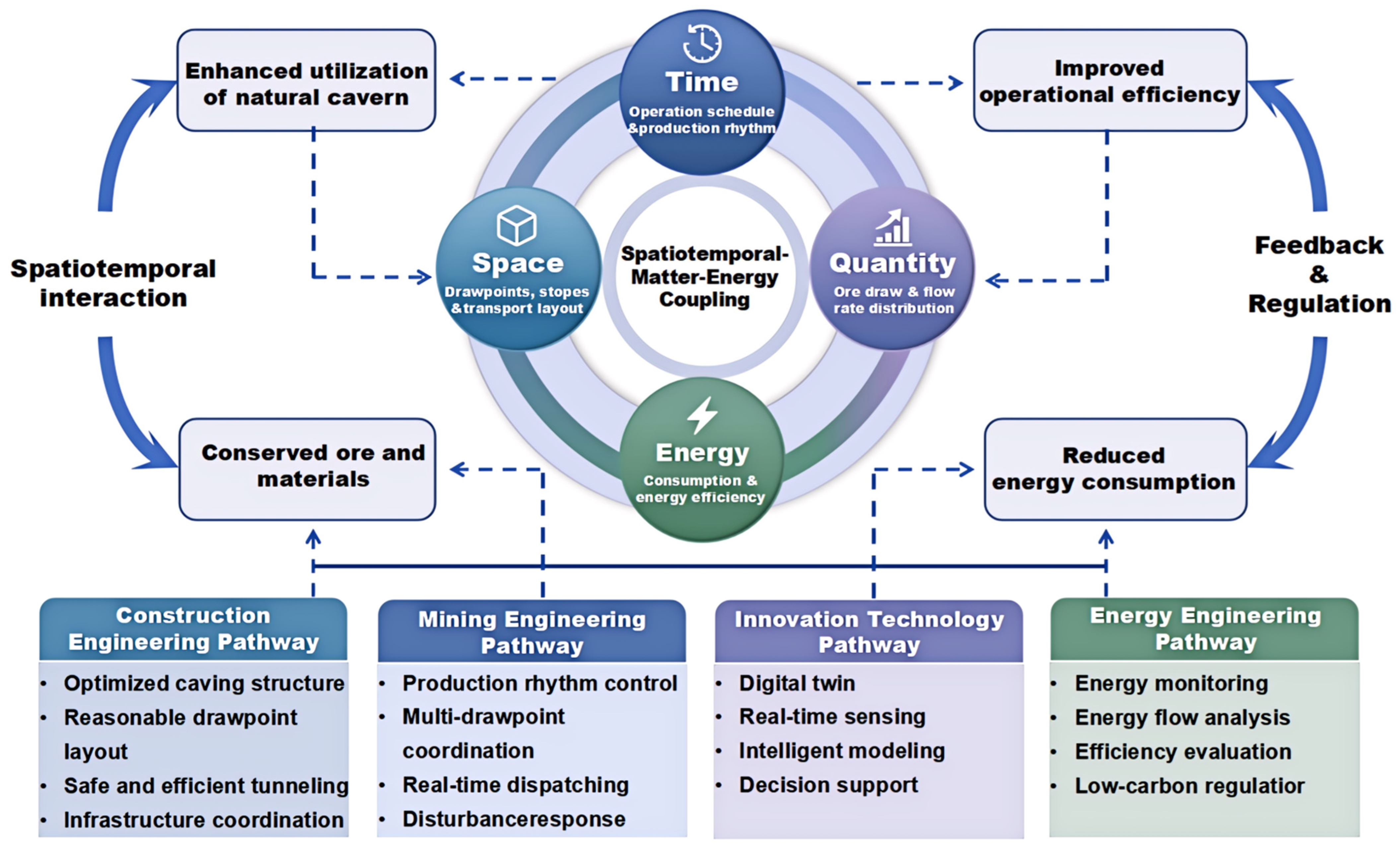
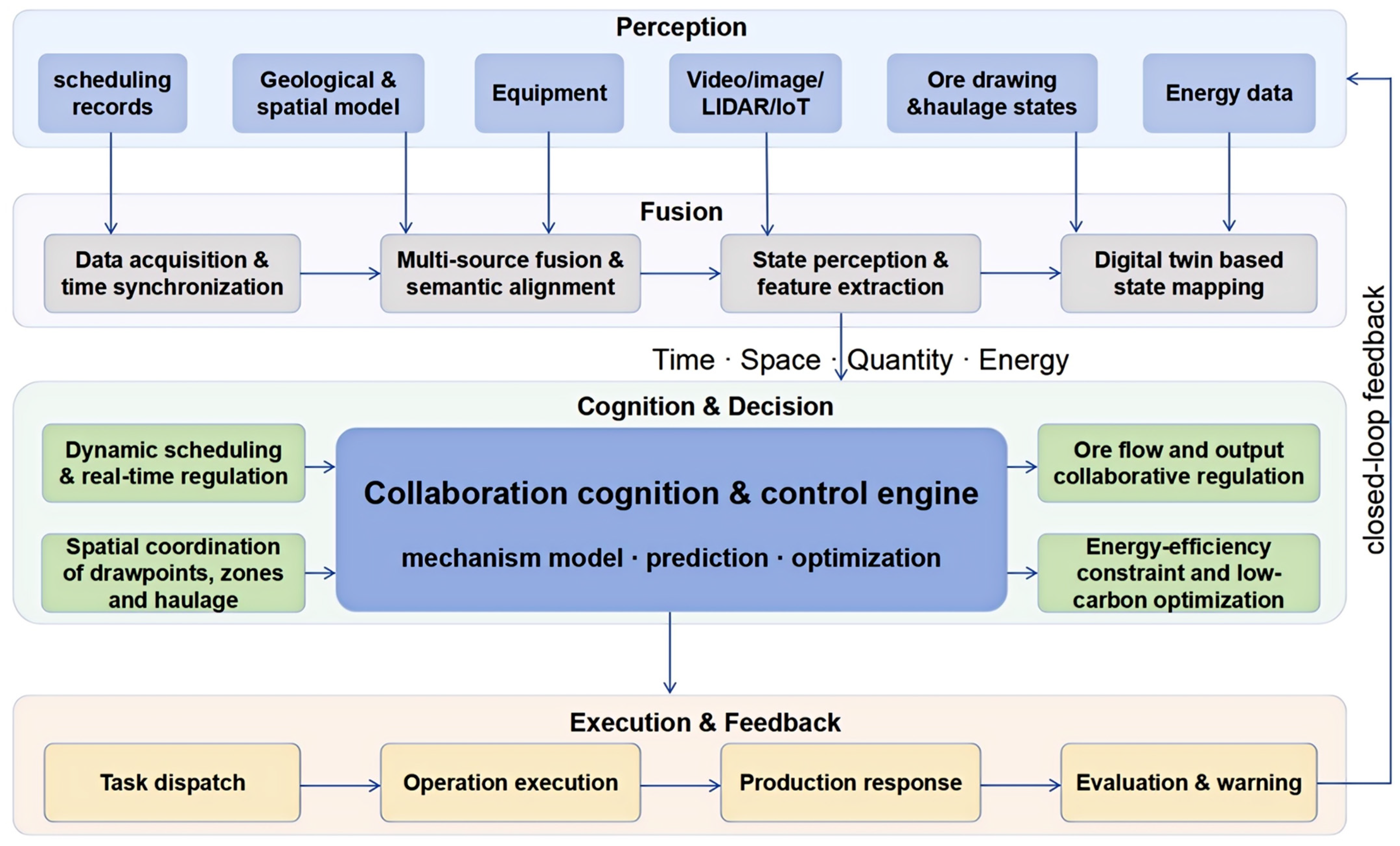
Therefore, the main contribution of this review is not to repeat isolated advances in intelligent mining, digital twins, ore-flow control, or underground production planning, but to organize them into a time-space-quantity-energy coupling logic for caving mines. By linking production rhythm, spatial configuration, ore-flow output and quality, and energy-efficiency constraints, this review clarifies how existing studies can be connected to support mining-processing coordination, closed-loop regulation, and future field implementation. This perspective helps move current research from technology-by-technology descriptions toward a framework for system-level intelligent regulation.The overall framework of the review is summarized in Figure 1.

2. Conceptual Connotation and Theoretical Framework of Time-Space-Ore Output-Energy in Caving Mines

Caving mine production systems are characterized by typical complexity, dynamics, and multi-scale coupling [1]. Compared with general underground mining methods, caving mining relies on the continuous caving and redistribution of ore and rock under mining disturbance, leading to stronger nonlinear relationships among ore flow, stope evolution, operational organization, and system load [2]. Its production process is not a simple serial chain of mining, loading, and haulage, but a complex system that continuously evolves under the joint effects of temporal advancement, spatial reconstruction, output fluctuation, and energy-consumption variation [6]. Therefore, analytical paradigms based on a single link, indicator, or process are insufficient for explaining the key contradictions in intelligent caving mine operation [7].
From the perspective of production essence, intelligent ore drawing in caving mines concerns not only whether a certain type of equipment is automatically controlled, but also whether different processes, spatial units, and temporal scales can operate collaboratively [2,3]. Especially in the context of deep mining, large-scale continuous production, and green low-carbon development, mine operation objectives have shifted from simply pursuing total production or reducing individual costs toward the integrated pursuit of stable ore output, balanced organization, efficient operation, and low-energy production [4]. In this context, summarizing the caving production system as a four-dimensional time-space-ore output-energy coupling framework has clear theoretical significance and engineering value [5].
The time-space-ore output-energy framework is not a simple parallel listing of production elements, but a unified analytical perspective for dynamic production organization in caving mines [6]. Time emphasizes the organization mode and evolutionary rhythm of production activities along the time axis; space emphasizes the spatial layout and structural relationships of drawpoints, stopes, production zones, haulage systems, and auxiliary systems; ore output refers specifically to the ore quantity and its spatiotemporal allocation, representing production performance and ore-flow output; and energy refers specifically to energy consumption and energy efficiency associated with the whole ore-drawing process, serving as an important constraint for green mining and system efficiency boundaries [7]. These four dimensions correspond to different aspects of caving mine operation and continuously form coupling, feedback, and coordination during production [8].
To avoid ambiguity among closely related production terms, the terminology used in this review is further clarified in Table 3. In the title and framework, “quantity” is used as a framework-level term. In the detailed technical discussion, “ore output” refers to the tonnage or production-rate expression of quantity, whereas “ore-flow quality” and “feed quality” describe the material-state and downstream-processing implications of the caving output.

2.1. Time: The Temporal Dimension of Dynamic Production Organization in Caving Mines

In caving mines, the temporal dimension first appears as the time sequence and rhythm structure of the production process, including shift organization, operating cycles, equipment start-stop timing, process connection, and stope-advance sequence [11]. Unlike planning under static conditions, the temporal dimension of caving mines is highly dynamic and sensitive to disturbances [12]. On the one hand, ore drawing, loading, haulage, unloading, hoisting, and auxiliary-system operation have clear precedence relationships. On the other hand, random factors such as equipment failure, local congestion, abnormal ore flow, and ore-pass fluctuation continuously disrupt the original rhythm, making time organization highly uncertain [13].
Theoretically, the temporal dimension is not simply calendar time or operation duration, but a mechanism for allocating production resources across different time scales [14]. For caving mines, it can be divided into at least three levels. The first is the short-time scale, reflected in equipment operating cycles, haulage cycle time, and drawpoint-switching timing. The second is the shift scale, reflected in shift production organization, task allocation, and process coordination. The third is the stage scale, reflected in stope advancement, zone activation, and production replacement [15]. These scales are not isolated but nested: efficiency fluctuations at the short-time scale may accumulate into shift-output differences, while scheduling deviations at the shift scale may affect stage-level stope organization and long-term capacity release [16].
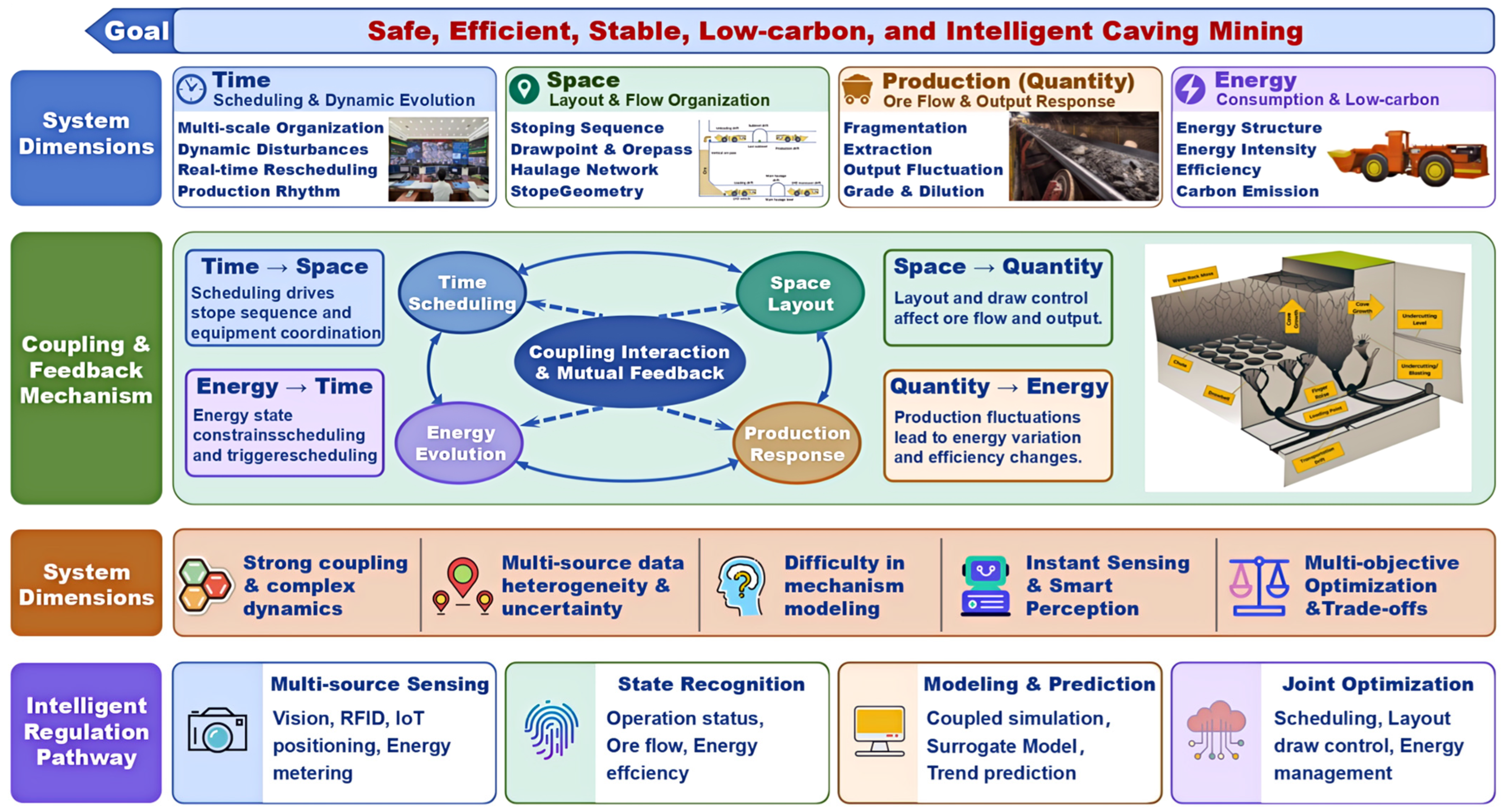
More importantly, the temporal dimension of caving mines has a distinct rhythmic characteristic [11]. Rhythm does not merely mean how fast ore is drawn, but refers to balanced process connection and load allocation along the time axis [12]. If the rhythm is unbalanced, even a temporary increase in production during a certain period may cause haulage congestion, ore-pass fluctuation, peak equipment load, and downstream process imbalance, eventually reducing overall system efficiency [17]. Therefore, from an intelligent-mining perspective, the core of time is not simply to shorten operation time or pursue instantaneous high production, but to achieve operational balance, disturbance buffering, and dynamic response through refined time organization.The multi-scale rhythm-control logic is illustrated in Figure 2.

2.2. Space: The Spatial Dimension of Collaborative Operation in Caving Mines

The spatial dimension of caving mines contains more complex implications than conventional production organization [18]. It includes geological and stope-related spaces, such as orebody geometry, stope structure, drawpoint distribution, and zone boundaries, as well as engineering-system spaces, such as ore passes, ramps, haulage drifts, and ventilation networks [19]. Space is not merely a collection of geometric locations; it is a concentrated expression of the structural and functional relationships among operating units in the production system [20].
The fundamental reason why caving mines require special emphasis on space is that their ore-drawing process is highly dependent on spatial structural conditions [21]. Drawpoint layout determines ore-flow extraction pathways and compensation characteristics; stope structural parameters affect caving behavior and ore-flow migration; zone division determines ore-drawing task distribution and local load balance; and haulage-route organization directly affects equipment travel distance, operating time, and energy consumption [22]. Spatial organization, therefore, serves as the physical carrier of the caving production system and as the basic scenario for multi-process coordination and multi-resource allocation [23].
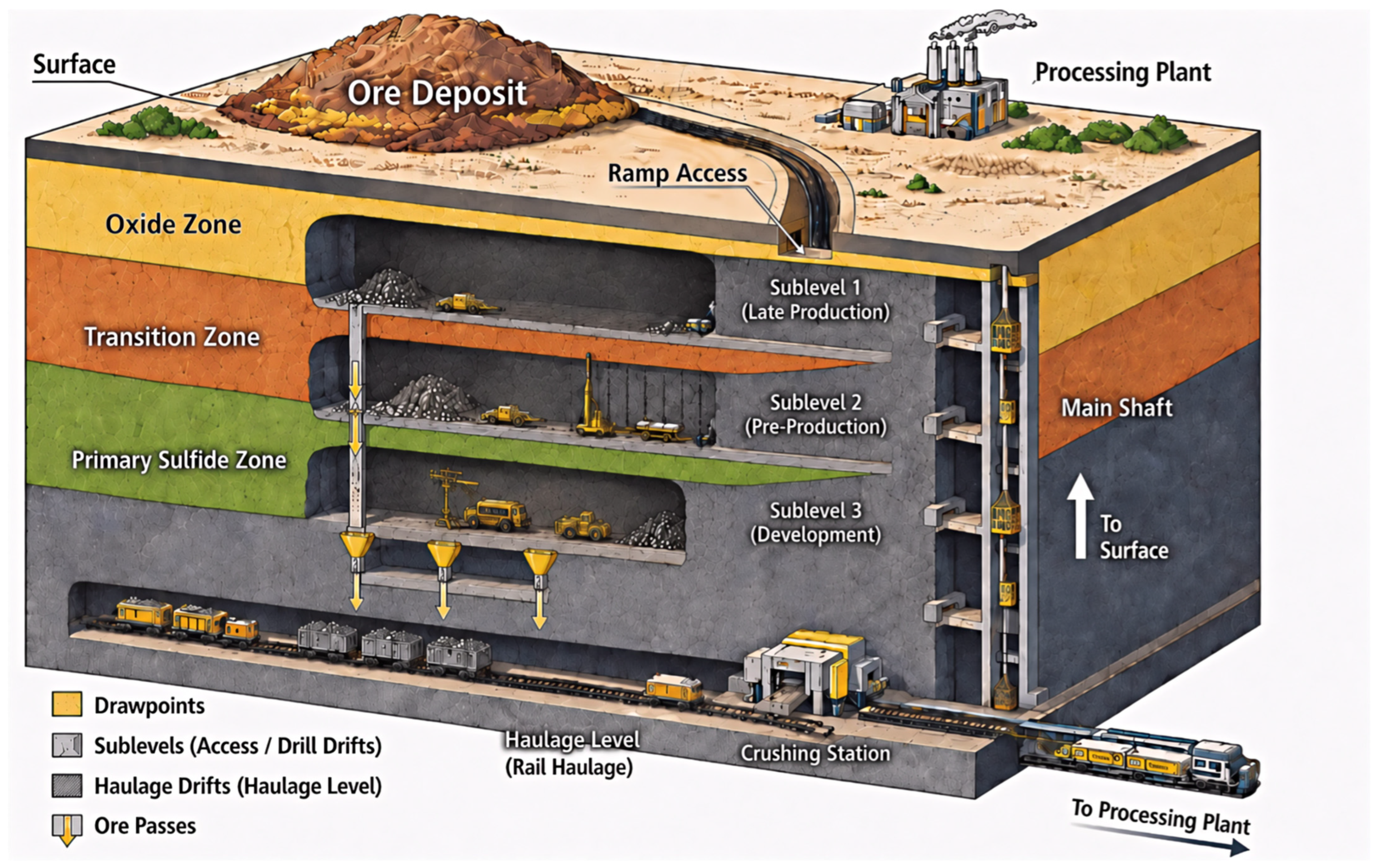
Under intelligent conditions, the meaning of the spatial dimension is further expanded [2]. Traditional spatial organization mainly served design and layout purposes. With the support of digital twins, real-time positioning, and three-dimensional visualization, space begins to support dynamic sensing and online decision-making [6]. In other words, space is no longer a static background, but a dynamic production element that can be sensed, calculated, and optimized [7]. Drawpoints, equipment, personnel, ore passes, and ventilation facilities can all be continuously mapped into the same spatial framework, enabling spatial organization to shift from post-event description to process control [19]. The spatial organization of the relevant operating units is shown in Figure 3.

2.3. Ore Output: The Core Representation Dimension of Production Performance in Caving Mines

In this review, ore output refers specifically to the quantity of ore drawn rather than to a general physical quantity [24]. This definition has a clear mining-engineering orientation. For caving mines, ore output is both the most direct production result and a key variable connecting stope conditions, ore-flow state, equipment organization, and management objectives [25]. It reflects the actual output capacity of stopes and drawpoints and is also jointly affected by time arrangement, spatial layout, draw-control strategy, and equipment coordination.
In terms of representation, ore output has three attributes [26,27]. First, it is a production-target attribute, because output directly reflects the completion of mine production tasks. Second, it is a system-state attribute, because its fluctuation often reflects ore-flow compensation conditions, local draw intensity, and haulage-organization efficiency. Third, it is a control-object attribute, because dynamically adjusting ore output across different drawpoints, zones, and shifts can support integrated optimization among recovery, dilution, ore-pass balance, and equipment load [28].
Compared with general underground mining, ore-output issues in caving mines show stronger spatiotemporal coupling [25]. The output capacity of different drawpoints is unstable across time periods and is often affected by fragment size, compensation conditions, draw sequence, haulage conditions, and stope replacement [26]. Therefore, research on ore output should not remain at the level of total-quantity statistics, but should further focus on spatiotemporal distribution, dynamic fluctuation, collaborative allocation, and optimal organization under multiple objectives and constraints [29]. In other words, under intelligent conditions, research on ore output should shift from result statistics to process control.
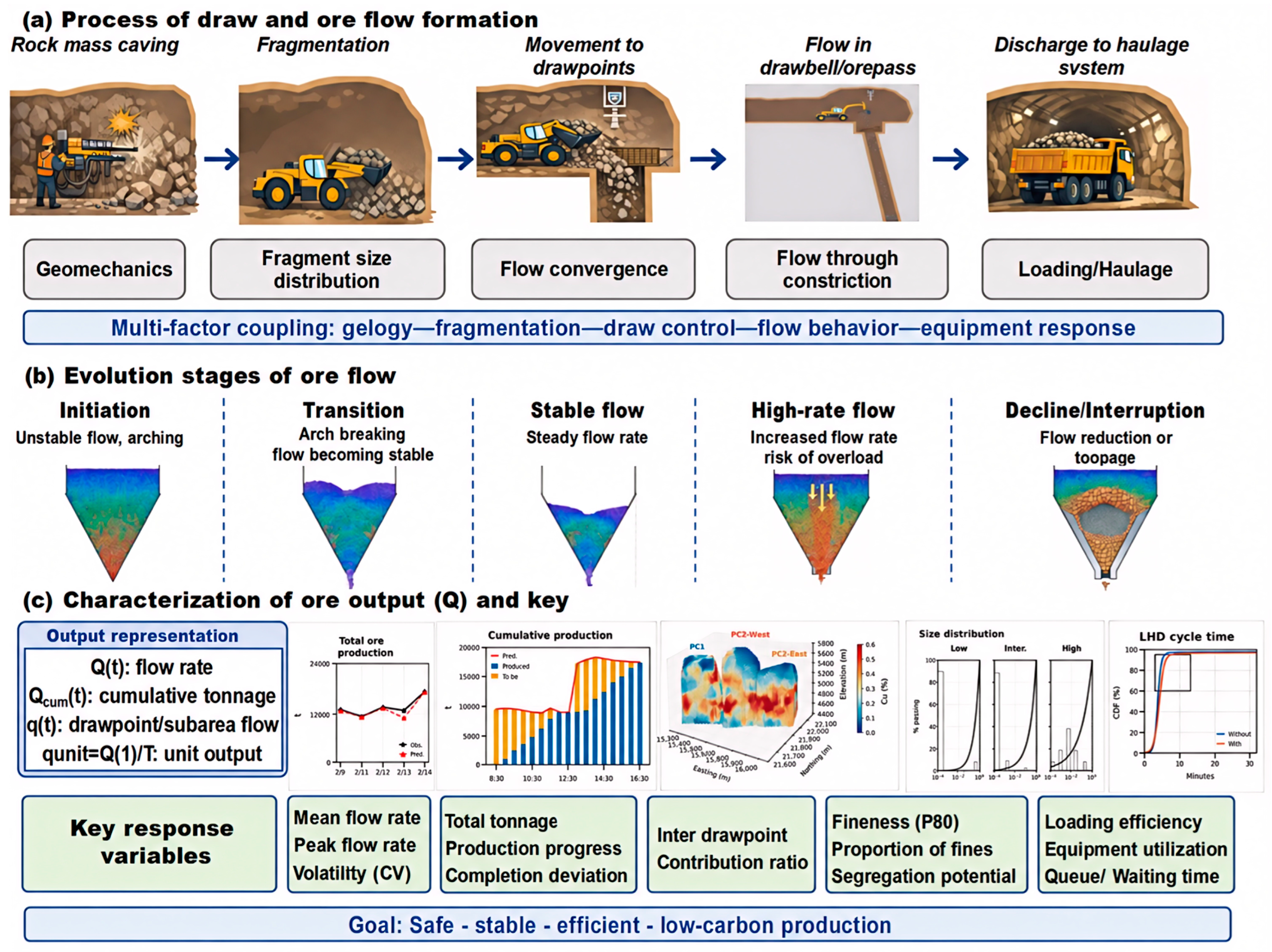
The relationships among ore-output characterization, ore-flow evolution, and control objects are shown in Figure 4.

2.4. Energy: The Constraint Dimension of Green Operation and Efficiency Boundaries in Caving Mines

In this review, energy refers specifically to energy consumption closely related to the ore-drawing process in caving mines rather than to energy in a broad physical sense [30,31]. It is extracted as a core dimension because, under the background of intelligent and green-mine development, energy consumption is no longer merely an auxiliary cost variable but an important constraint that determines the operation mode and efficiency boundary of the mining system [32].
Energy consumption in caving mines has multi-process, multi-level, and strongly coupled characteristics [33]. Loading, haulage, hoisting, crushing, ventilation, and auxiliary equipment all contribute to energy demand, among which haulage and ventilation usually account for a large proportion [34]. Compared with the coarse indicator of total energy consumption, intelligent mines place greater emphasis on fine-grained indicators such as specific energy consumption per tonne of ore, process-specific energy consumption, regional energy consumption, and peak-valley energy consumption [35]. This is because an increase in total energy consumption does not necessarily mean low efficiency; under certain conditions, if output increases significantly, specific energy consumption may decrease. Therefore, the core of the energy dimension is not absolute low consumption, but comprehensive energy efficiency relative to output, route organization, and operational rhythm.
Furthermore, energy consumption is not a passive result of production organization, but an active constraint that can reshape production organization [30]. High-energy operating conditions may indicate unreasonable haulage routes, excessive concentration of operations in certain time periods, equipment mismatch, or poor ventilation organization, thereby forcing the system to optimize time arrangements and spatial configuration [36]. In other words, in a high-level intelligent mine, energy should not be treated as an item calculated only after production; it should be incorporated into scheduling and control models in advance as an important decision boundary [37].
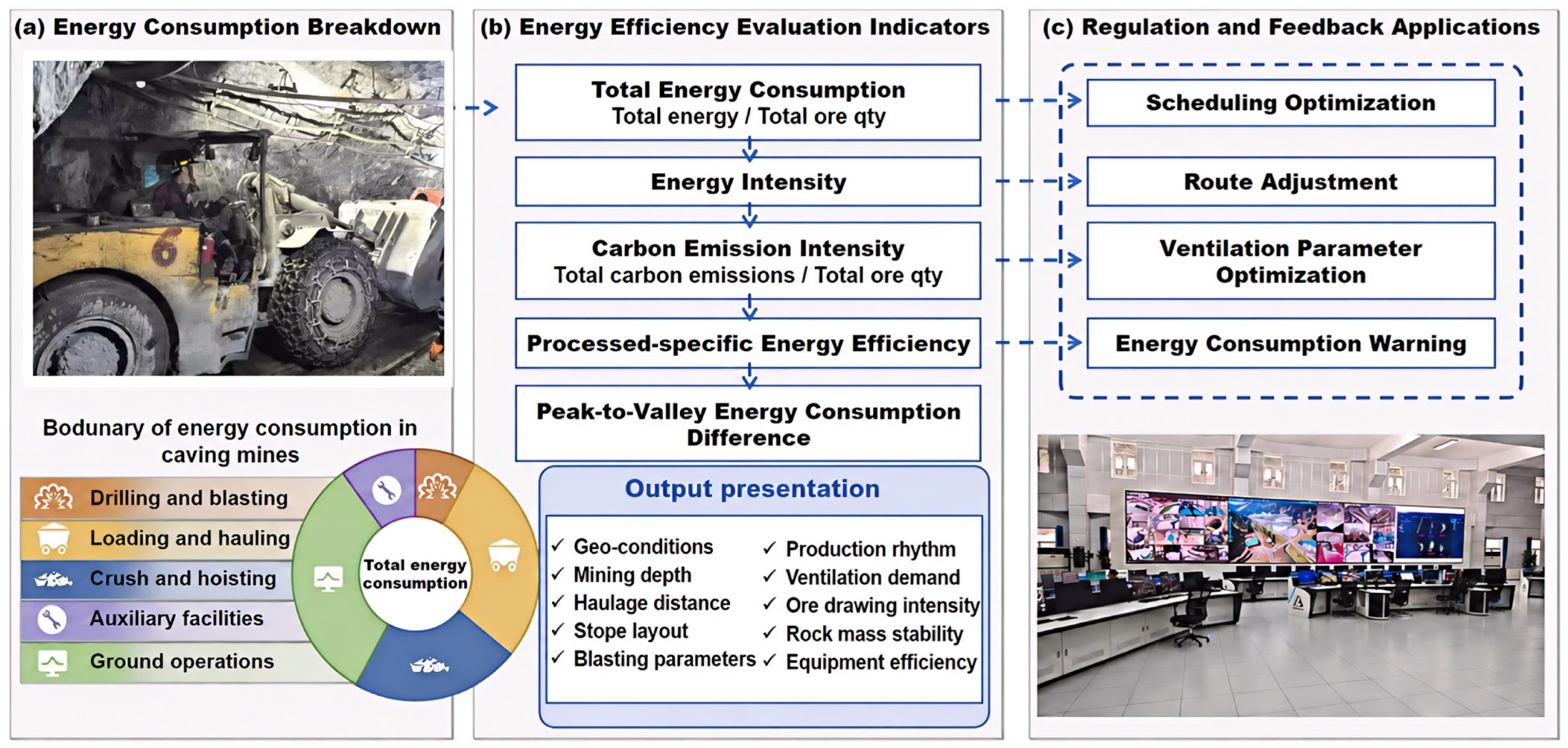
As shown in Figure 5, the energy-consumption composition diagram characterizes the differentiated distribution of total energy consumption among different production links in caving mines and highlights the contributions of loading-haulage, ventilation, crushing/hoisting, drilling-blasting, and auxiliary systems. Its purpose is not only to show energy-consumption proportions, but also to identify high-energy-consuming links and inefficient operating scenarios, thereby providing object boundaries for subsequent specific energy evaluation, process energy-efficiency diagnosis, and energy-saving regulation.
From the perspective of the indicator system, the total energy consumption of a caving mine can be expressed as:
E = Σ E i
where E is the total energy consumption of the mining system during the statistical period, and Ei is the energy consumption of the i-th operation link. Based on the relationship between total energy consumption and output, the specific energy consumption per tonne of ore can be further defined as:
e u = E / Q
where eu is the specific energy consumption per tonne of ore, and Q is the ore output during the same period. This indicator directly reflects the energy consumed to produce 1 t of ore and is a core indicator for evaluating the green operation level and overall efficiency of a caving mine.
To further characterize low-carbon operation, the carbon-emission intensity per tonne of ore can be introduced:
c u = C / Q
where cu is the carbon-emission intensity per tonne of ore, and C is the total carbon emission during the statistical period. Meanwhile, to identify local energy-efficiency differences among different processes, a process-specific energy-efficiency indicator can be defined as:
g i = Q i / E i
where Qi is the effective output of the i-th operation link, and Ei is the corresponding energy consumption. This indicator helps identify inefficient links in subsystems such as haulage, ventilation, and hoisting, and provides a basis for process optimization. In addition, to characterize the influence of production rhythm and load fluctuation on energy efficiency, the peak-valley energy-consumption difference can be used:
Δ E = E p e a k E v a l l e y
where ΔE is the peak-valley energy-consumption difference, and Epeak and Evalley denote the energy-consumption levels during peak and valley periods, respectively. This indicator reflects the balance of energy-consumption distribution and provides feedback signals for off-peak scheduling, route correction, and ventilation on demand. Accordingly, the three components shown in Figure 5, energy-consumption composition, indicator evaluation, and regulation feedback, jointly form an energy-efficiency analysis and closed-loop regulation logic for intelligent operation in caving mines.
To make the energy dimension more operational, Table 4 summarizes quantitative energy-efficiency indicators that can be connected with scheduling, spatial allocation, ore-output control, and downstream processing. These indicators allow energy consumption to be used not only for post-event accounting, but also as a feedback signal for intelligent regulation.

2.5. Collaborative Feedback Mechanism of Time-Space-Ore Output-Energy

The four dimensions can form a unified framework because they are not independent of one another; rather, they form collaborative feedback relationships involving mutual constraint, transmission, and correction during caving production [38,39]. This section summarizes the main interaction pathways at the framework level, while Section 3 further analyzes the underlying mechanisms.
First, bidirectional coupling exists between the temporal and spatial dimensions [11]. The stope-advance sequence, zone-activation timing, and shift arrangement change the utilization state of spatial units. Conversely, drawpoint distribution, route structure, and ore-pass location determine the feasibility and efficiency boundary of time organization [19]. Unreasonable time organization can cause spatial-resource idleness or local congestion, while unreasonable spatial configuration can lead to inefficient time utilization and broken process connections [21].
Second, a structural constraint relationship exists between the spatial dimension and the ore-output dimension [25]. Drawpoint location, spacing, stope structure, and zone division directly affect ore-flow migration and compensation conditions, thereby determining the output potential and balance of different spatial locations [26]. Unreasonable spatial organization often manifests as local over-drawing, under-drawing, or uneven ore-output distribution [40].
Third, a process coupling relationship exists between the temporal dimension and the ore-output dimension [12]. Under the same stope and equipment conditions, different shift organization modes and operating rhythms can produce different ore-output curves [14]. Ore output is not simply determined by spatial conditions, but is a dynamic result formed under the continuous influence of time scheduling [24].
Finally, an efficiency-boundary relationship exists between ore output and energy consumption [30]. At the total-quantity level, increased ore output is usually accompanied by increased energy consumption. At the efficiency level, however, route optimization, load balancing, and improved time organization may reduce the specific energy consumption per tonne of ore [33]. Therefore, the key issue in the ore output-energy relationship is not whether the two change synchronously, but how to achieve coordinated optimization between output and energy efficiency [41].
Furthermore, the energy dimension can feed back to time and space organization [34]. When certain time periods or areas show abnormally high energy consumption, the system needs to adjust shift strategies, route schemes, or operating-area allocation [36]. This means that energy is not a terminal variable but a feedback signal embedded in closed-loop control [42].
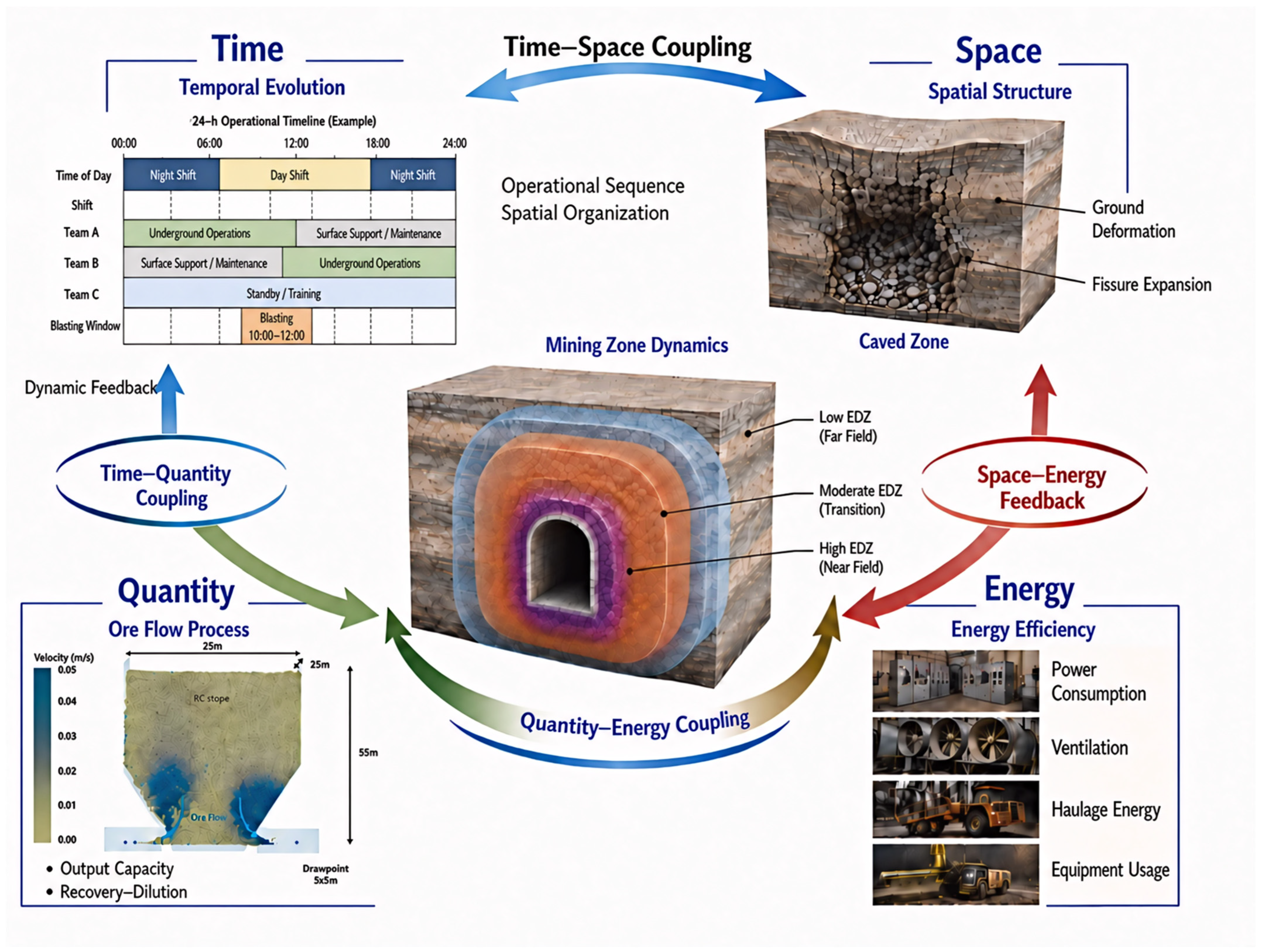
Thus, intelligent operation in caving mines can be summarized as a continuously evolving closed-loop system: time scheduling shapes spatial utilization, spatial organization affects ore-output distribution, ore-output variation drives energy-consumption evolution, and energy constraints in turn correct time organization and spatial configuration [2,6]. The cyclic feedback among the four dimensions constitutes the theoretical core of the concept of collaborative feedback. The coupling network and main interaction pathways are summarized in Figure 6.

2.6. Theoretical Framework for Intelligent Ore Drawing in Caving Mines

Incorporating caving mine production into the time-space-ore output-energy framework has at least three implications.
First, it provides a theoretical perspective with stronger explanatory power than traditional single-factor analysis [1,25]. Previous studies on caving mining have often discussed draw management, ore-flow behavior, haulage scheduling, or energy optimization separately. This framework helps integrate these seemingly scattered issues into a unified system logic [9].
Second, it provides a clearer object boundary for intelligent mining research [6,7]. True intelligence is not simply the addition of sensors or the automation of equipment, but the establishment of a unified perception, cognition, and regulation mechanism around time, space, output, and energy efficiency [10].
Third, it lays a theoretical foundation for subsequent studies on regulation methods [11]. Dynamic scheduling, drawpoint coordination, route optimization, and specific energy-consumption control can all be regarded as local issues within the four-dimensional coupling system [30]. Only by understanding these issues within a unified framework can research move further toward multi-objective collaborative optimization and closed-loop intelligent control [43].
In summary, the time-space-ore output-energy framework for caving mines is not a conceptual assemblage, but a systematic generalization of the essence of intelligent ore drawing. It clarifies what the research object is and provides a theoretical starting point for how to sense, model, and regulate it. On this basis, further analysis of the coupling mechanisms among the four dimensions is a prerequisite for reviewing regulation methods and proposing future directions.

3. Collaborative Feedback Mechanisms of Time-Space-Ore Output-Energy in Caving Mines

The caving mine production system is not a mechanical superposition of isolated factors such as time arrangement, spatial layout, ore-output control, and energy-consumption variation. Instead, it is a complex dynamic system that evolves continuously under the joint effects of mining disturbance, ore-flow evolution, equipment operation, and production organization [1,25]. Compared with general underground mining methods, caving mining features rapid stope-structure evolution, discrete drawpoint distribution, complex ore-flow compensation processes, and strong coupling between haulage and ventilation systems, making interactions among different production dimensions more prominent. Under intelligent conditions in particular, the production system is no longer merely the execution object of a static plan, but a dynamic network that can be sensed, calculated, and regulated. Time, space, ore output, and energy, therefore, constitute four core dimensions for explaining its operation laws [1,2,6,38,41].
From a systems-science perspective, collaborative feedback has at least two meanings. First, the relationships among different dimensions are not unidirectional causal chains, but continuous bidirectional interactions and cyclic feedback. Second, these feedback relationships are not local phenomena; they run through production organization, ore-flow control, haulage coordination, and energy-efficiency evolution [2]. The temporal dimension determines operating rhythm and organizational boundaries; the spatial dimension determines the structural carrier and pathway conditions of production activities; the ore-output dimension reflects production output and system-state changes; and the energy dimension forms the efficiency constraint and green-operation boundary [5]. The coupled evolution of these dimensions jointly determines the overall performance and stability of the caving production system [6].
Accordingly, this section analyzes the collaborative feedback mechanisms of time-space-ore output-energy in caving mines from five aspects: time-space coupling, space-ore output coupling, time-ore output coupling, ore output-energy coupling, and time/space-energy feedback. Their overall operation logic is then summarized [38,39,40,41].

3.1. Time-Space Coupling: Mutual Shaping of Operational Sequence and Spatial Organization

The coupling between time and space is one of the most fundamental and decisive collaborative relationships in the caving production system [11]. At first glance, time organization is mainly reflected in shift arrangement, stope-advance sequence, operation-window division, and haulage-period configuration, whereas spatial organization is mainly reflected in drawpoint distribution, zone division, stope geometry, ore-pass layout, and haulage-route structure [12]. In actual production, however, the two are not independent. Time arrangements can only be implemented in specific spatial scenarios, and spatial structures can only be activated and used through specific operational sequences [19].
This coupling is first reflected in the way stope-advance sequences shape the utilization state of space [18]. Different stopes, zones, and drawpoints are not activated simultaneously, but are gradually brought into operation according to a certain sequence as production advances [19]. The stope-advance sequence determines which spatial units become active at a given time, which haulage routes carry the main load, and which ore passes or transfer links become bottlenecks [20]. In this sense, the temporal dimension continuously changes the utilization pattern of the mine spatial system through decisions on when to activate, switch, and replace operating areas, making space a dynamic production scenario reconstructed by the operational sequence rather than a static background.
Conversely, the spatial dimension imposes significant constraints on time organization [13]. Whether drawpoints are evenly distributed, operating faces are concentrated, haulage routes are smooth, and ore-pass locations are reasonable directly affects the feasibility and execution efficiency of operational sequences [21]. If the spatial layout is unreasonable, even a well-designed time plan may be fragmented in execution because of excessive equipment travel distance, frequent local traffic conflicts, and high stope-switching costs, eventually resulting in low time utilization and poor process connection [22]. Therefore, time organization is not an abstract schedule detached from spatial conditions, but a process configuration embedded in spatial structure.
Time-space coupling also has an evident nested-scale characteristic [7]. At the short-time scale, equipment operating cycles, route occupation, and local intersection conflicts determine the instantaneous availability of local spatial units. At the shift scale, load allocation across operating areas and the traffic efficiency of haulage lines determine the stage-level utilization of spatial resources. Over longer production scales, stope replacement, zone rotation, and orebody-advance sequence reshape the spatial organization of the entire mine [19]. Therefore, time and space are not simply related as plan and place, but form a multi-scale, continuously co-evolving coupling system [23].
From the perspective of high-level intelligent ore drawing, the theoretical significance of time-space coupling lies in revealing that the production efficiency of caving mines does not simply depend on scheduling optimization in a given period or improvement of a local space. Instead, it depends on whether structural matching, rhythm coordination, and dynamic adaptation are achieved between operational sequences and spatial carriers [2,6]. This understanding provides a basis for multi-stope coordinated scheduling, dynamic route optimization, and digital-twin-driven operating-area coordination [44,45].

3.2. Space-Ore Output Coupling: Constraints of Spatial Structure on Output Capacity

The relationship between space and ore output is a part of caving mine mechanism research that most strongly reflects the characteristics of the mining method [25]. The core of caving production is not simply how much ore is extracted from underground, but how reasonable draw organization and extraction control can achieve integrated optimization among ore output, recovery, dilution, and ore-flow stability under given spatial structural conditions [26]. In this process, the constraints imposed by spatial structure on ore output are not external additions, but internal mechanisms that determine the boundary of output capacity [27].
First, the spatial distribution of drawpoints directly determines the formation conditions of ore output [25,26,40,46]. The locations, spacing, and combinations of drawpoints alter ore-flow compensation pathways and extraction-zone development, thereby affecting the output potential and sustained production capacity of different drawpoints [47]. When drawpoints are too closely spaced, extraction zones may overlap, local ore-flow disturbance may intensify, and compensation may become uneven. When drawpoints are too sparse, some areas may be under-extracted, residual resources may increase, and spatial utilization efficiency may decline [25,26,27]. Therefore, ore output is not a freely assignable control result, but a structural variable strongly constrained by drawpoint spatial distribution.
Second, stope geometry and zone structure determine the balance of output allocation [25]. A caving stope is not a single homogeneous space, but a complex structure with different boundary conditions, geometric scales, and ore-rock occurrence characteristics [26]. Differences in stope geometry affect ore-flow migration pathways, extraction-zone expansion directions, and compensation conditions in different spatial units, leading to different output capacities and stability levels across areas [48]. Unreasonable zone organization often causes excessive local draw intensity while suppressing output in other areas, resulting in local dilution, increased losses, and uneven ore output.
Third, space-ore output coupling also reflects the unity of static structure and dynamic flow [24]. The spatial dimension provides the structural boundary of the draw system, whereas the ore-output dimension reflects the dynamic output of ore flow within that structure [26]. In other words, space is not merely a geometric entity, but the physical field in which ore-flow movement, extraction-zone evolution, and output generation occur [49]. Regulating ore output is essentially an intervention in the dynamic ore-flow process under the constraints of existing spatial structure. Therefore, if the spatial basis is ignored and draw tasks are simply allocated according to production targets, the control strategy may depart from actual stope conditions and fail to achieve stable and effective implementation.
At a deeper level, space-ore output coupling reveals a basic fact of caving production: output capacity is not homogeneously distributed, but spatially uneven, structurally dependent, and dynamically variable [25]. This means that high-level intelligent ore drawing should not treat ore output as a uniformly adjustable planning variable, but as a spatiotemporal response variable jointly formed by spatial conditions, ore-flow state, and management strategy [50]. This understanding provides important theoretical support for multi-drawpoint coordinated ore-drawing models, dynamic stope zoning strategies, and output-optimization methods oriented toward ore-flow characteristics.

3.3. Time-Oriented Output Coupling: Effects of Operating Rhythm on Output Balance

In caving mines, ore output is not a static quota, but a dynamic result formed as operations proceed over time [11,12]. Therefore, the relationship between time and ore output should not be understood simply as how much work is completed in a certain period, but as how operating rhythm shapes output curves, affects production fluctuations, and determines system balance and sustainability [14].
On the one hand, operational sequence directly affects the way output capacity is released per unit time [11]. Shift organization determines when equipment enters high-load operation, drawpoint-switching timing determines when a local extraction zone is strengthened or buffered, and haulage rhythm determines whether ore can be transferred from the stope to downstream links in time [13]. When these time arrangements are coordinated, ore output can remain relatively continuous, stable, and predictable. When the sequence is unbalanced, short-term peaks, stage interruptions, or local backlogs may occur, leading to significant output fluctuations [14]. Thus, time is not merely a background variable describing when production occurs, but a mechanism variable that directly shapes output formation.
On the other hand, the influence of time organization on ore output has cumulative and amplifying effects [14]. A local interruption, haulage bottleneck, or equipment-switching mistake in a caving mine may not immediately cause a significant decrease in total output. However, if such deviations accumulate across multiple short-time scales, they can evolve into unstable shift output, enlarged ore-pass fluctuations, and imbalanced operating-area loads [15]. Especially under continuous ore drawing, small deviations in operating rhythm may be amplified along the draw-loading-haulage-unloading chain and eventually affect overall output balance [51]. Therefore, time-ore output coupling has a clear dynamic transmission characteristic.
In addition, the temporal dimension affects the quality of ore output through rhythm-balancing mechanisms [12]. High-level production organization does not mean maximizing production in certain periods, but forming a relatively balanced output rhythm across shifts, stopes, and operating areas [17]. If local high production is pursued without rhythm balance, peak equipment loads, haulage shocks, ore-pass fluctuations, and mismatches with downstream processing systems may occur [52]. The result is not genuine capacity improvement, but intensified output fluctuation and reduced system efficiency.
Theoretically, the core issue of time-ore output coupling is that ore output is not an independent discrete result at each moment, but a time-series process variable controlled by continuous operating rhythm [5]. Therefore, research on ore output should not remain at the level of shift or daily statistics, but should further examine time dependence, rhythm continuity, and fluctuation transmission during output formation [14]. This provides a theoretical basis for introducing short-interval control, rolling scheduling, and time-series-based output prediction.

3.4. Ore Output-Energy Coupling: Output Improvement and Efficiency Boundaries

The relationship between ore output and energy consumption is a core issue that caving mines must address when shifting from a high-production orientation to a high-efficiency and low-energy orientation [30]. Traditional production management often assumes that production growth and efficiency improvement are consistent, but this relationship does not necessarily hold in complex underground mining systems [31]. Especially under caving conditions, ore-output variation simultaneously affects loading loads, haulage frequency, auxiliary-system operating intensity, and ventilation demand, making the ore output-energy relationship highly nonlinear [33].
First, total-quantity relationships and efficiency relationships should be distinguished [33]. From the total-quantity perspective, increased ore output usually means more equipment input, higher haulage frequency, and greater auxiliary-system load, so total energy consumption often rises. From the efficiency perspective, however, when equipment matching is more reasonable, route organization is better, and operating rhythm is more balanced, specific energy consumption per tonne of ore may decrease [34]. In other words, high production is not necessarily inefficient, and low consumption is not necessarily efficient; the key is whether output growth is based on organizational optimization and system coordination [41].
Second, ore output-energy coupling reflects the coexistence of scale effects and congestion effects [33]. Within a certain range, as ore output increases, fixed auxiliary energy consumption is shared by a larger production volume, and the system may show scale effects, reducing specific energy consumption per tonne. However, when output further approaches the system capacity boundary, traffic congestion, equipment waiting, route conflicts, and peak loads become significantly aggravated, and the system may show congestion effects, causing specific energy consumption to rise again [36]. Therefore, an optimal efficiency range usually exists between output and energy consumption, and this range is closely related to equipment configuration, route structure, and time organization [53].
Third, ore output-energy coupling also reflects the existence of a system efficiency boundary [30]. Caving mines cannot improve overall benefits indefinitely by increasing ore output. When production targets exceed spatial carrying capacity, haulage capacity, or ventilation-support capacity, energy consumption may rise rapidly while system stability declines [54]. Therefore, the key issue in the ore output-energy relationship is not to find an abstract minimum-energy point or maximum-output point, but to identify the optimal efficiency boundary that the system can maintain under given spatial and temporal organization conditions.
At a deeper level, ore output-energy coupling means that energy consumption should not be treated as an auxiliary accounting item after production completion, but as an endogenous constraint in the process of output organization [30]. Only by directly incorporating energy consumption into ore-output control and scheduling models can the paradigm truly shift from completing production tasks to optimizing output efficiency [35]. This understanding provides an important basis for constructing multi-objective optimization models centered on specific energy consumption per tonne, regional energy efficiency, and whole-process comprehensive efficiency [55].

3.5. Time-Energy and Space-Energy Feedback: Internal Shaping of Energy Efficiency by Production Organization

The relationship between the energy dimension and the temporal and spatial dimensions is not a simple mapping of results, but a bidirectional coupling relationship with clear feedback attributes [34]. Traditional views often regard energy consumption as a statistical result after production activities, assuming that its variation mainly depends on equipment quantity and operating duration [36]. In caving mines, however, energy consumption is deeply embedded in operating time structures and spatial route organization. It is influenced by them and in turn reshapes their optimization direction [37].
At the temporal level, operating rhythm determines the distribution pattern of energy consumption [31]. When production activities are excessively concentrated in certain periods, simultaneous high-load equipment operation, superimposed haulage frequency, and increased auxiliary-system loads often create peak energy consumption and reduce overall energy efficiency [36]. In contrast, reasonable off-peak scheduling, balanced time allocation, and short-interval control can reduce peak loads and improve energy utilization efficiency without significantly reducing output [53]. Therefore, time organization affects not only how much energy is consumed, but also the temporal structure in which energy consumption occurs.
At the spatial level, spatial structure determines the pathways through which energy consumption is formed [21]. The distance between drawpoints and ore passes, the tortuosity of haulage routes, the degree of dispersion or concentration of operating areas, and the organization of ventilation networks all change equipment travel distance, waiting time, and system resistance, thereby affecting energy consumption [22]. More reasonable spatial configuration usually leads to shorter routes, fewer intersections, weaker local blockage, and lower energy consumption per unit output [33]. Thus, spatial optimization is itself an important component of energy-efficiency optimization and should not be separated from energy-consumption issues.
More importantly, energy consumption has a clear reverse constraint effect on time and space [30]. Persistently high energy consumption in certain periods may indicate peak aggregation and unbalanced time allocation, while persistently high energy consumption in certain areas or routes may indicate defects in spatial structure or organization [36]. In other words, energy consumption is not only a result variable, but also a feedback signal that reveals problems in time and space organization [56]. Once introduced into decision-making models, the system can reverse-adjust shift arrangements, equipment dispatching, and operating-area distribution to reduce invalid energy use, suppress peak loads, and optimize route utilization.
Therefore, the theoretical significance of time-energy and space-energy relationships lies in revealing that energy efficiency is not an isolated technical indicator, but a comprehensive reflection of the rationality of production organization [35,55]. Treating energy consumption as a feedback signal and embedding it into the regulation chain is an important sign of the transition of caving mines from experience-based organization to intelligent collaborative control [56].

3.6. System Understanding of Collaborative Feedback Mechanisms

The above analysis shows that time, space, ore output, and energy in caving mines do not form simple pairwise influences or local couplings, but constitute a multidimensional feedback network that evolves continuously and cyclically [2,6]. The basic logic can be summarized as follows: time scheduling determines the rhythm of production activities, spatial organization determines the structural scenario of operations, ore-output variation reflects system operation states and production responses, and energy-consumption evolution characterizes efficiency boundaries and green constraints. During production advancement, the four dimensions continuously interact, correct one another, and jointly shape the mine operation trajectory [38].
This feedback relationship has at least three system characteristics.
First, it is dynamic [11]. The relationships among the four dimensions are not static, but evolve continuously with stope advancement, equipment-state changes, draw-organization adjustments, and external disturbances [14]. Any change in one dimension may affect the others through transmission chains and form new coupling relationships under new system states [30].
Second, it is hierarchical [19]. Collaborative feedback does not occur at a single scale only, but exists simultaneously at the equipment, process, shift, stope, and system levels [25]. A local time delay may evolve into shift-output fluctuation, local spatial congestion may evolve into higher system-wide energy consumption, and local output imbalance may force broader organizational adjustment [33].
Third, it is closed-loop [2]. Caving mines do not operate along a one-way plan-execution-result chain, but continuously evolve through an organization-response-feedback-reorganization cycle [7]. Any of the four dimensions—time, space, ore output, and energy—is both the result of the previous stage and the condition for the next stage [57]. This closed-loop characteristic means that intelligent control cannot remain at the level of post-event analysis or one-time optimization; it must establish continuous regulation mechanisms oriented toward real-time sensing, online computation, and dynamic correction.
In this sense, the core value of the time-space-ore output-energy collaborative feedback mechanism lies not only in explaining existing production phenomena in caving mines, but also in providing a unified theoretical basis for subsequent regulation research [2,3]. Technical routes such as dynamic scheduling, multi-drawpoint coordination, front-loaded energy constraints, and digital-twin-based closed-loop simulation essentially serve the same objective: achieving stable ore output, spatial coordination, and energy-efficiency optimization under multidimensional constraints [6].
In summary, the essence of intelligent operation in caving mines is not the local improvement of a single production element, but the establishment of continuous coordination, mutual feedback, and dynamic balance among time organization, spatial configuration, ore-output control, and energy-consumption constraints [57]. Only by understanding its operation mechanism at the system level can caving mines move from single-dimensional optimization to multidimensional coordination and from experience-based management to closed-loop intelligent control [58].

3.7. Evidence-Based Engineering Cases of Time-Space-Quantity-Energy Coupling

To further connect the theoretical framework with operating caving mines, two documented engineering cases are introduced to show how spatial layout, draw control, ore-flow quality, production rhythm, and energy-related operational burden interact in real production conditions. These cases do not provide a full quantitative validation of the proposed framework, but they offer engineering evidence for the main coupling pathways discussed above.
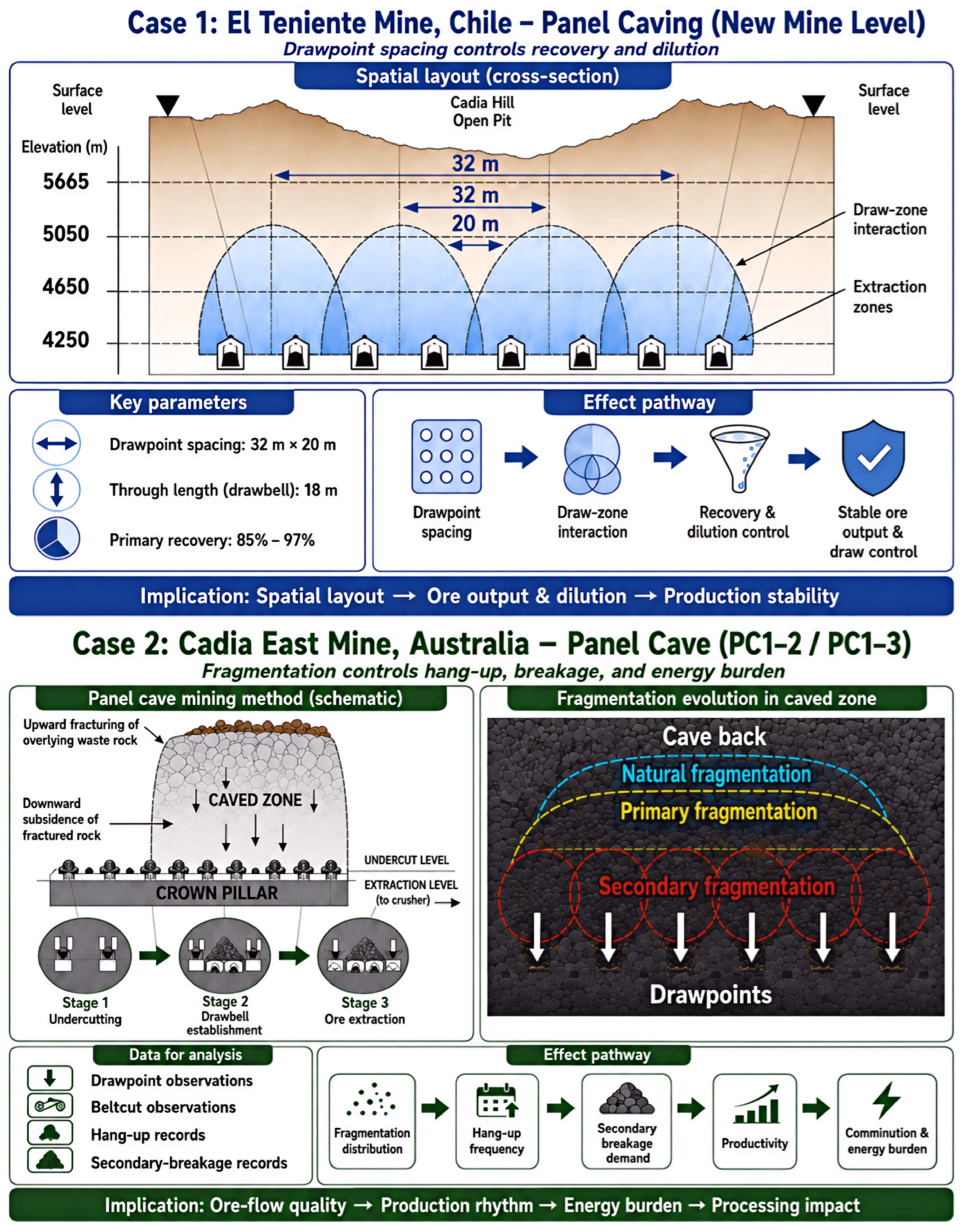
The first case is the El Teniente Mine in Chile. In the drawpoint-spacing study for the New Mine Level, Castro et al. analyzed panel-caving drawpoint spacing based on the interaction of adjacent draw zones [27]. Their study reported that drawpoint spacing affects the height of interaction between adjacent flow zones, recovery potential, dilution entry, equipment requirements, and development costs. For the New Mine Level, a drawpoint spacing of 32 m × 20 m with an 18 m drawbell/through length was proposed, and the estimated primary recovery varied from approximately 85% to 97% depending on the spacing configuration [27]. This case shows that the spatial dimension is not only a geometric design issue; it directly constrains ore-output potential, recovery, dilution control, and the feasibility of draw-control strategies.
The second case is the Cadia East Mine in Australia. Fuenzalida et al. conducted a back analysis and forecast of cave fragmentation using historical drawpoint observations, beltcut observations, hang-up records, and secondary-breakage records [46]. Their study showed that fragmentation affects caving performance through its influence on productivity, hang-up frequency, secondary-breakage events, fines-related inrush risk, dilution entry, and resource recovery [46]. From the time-space-quantity-energy perspective, fragmentation evolution changes ore-flow quality and loading stability, while hang-ups and secondary breakage further influence production rhythm, equipment availability, and downstream crushing/grinding burden.
Together, the El Teniente and Cadia East cases indicate two complementary coupling pathways. The El Teniente case highlights a space-to-quantity pathway, in which drawpoint layout and draw-zone interaction control recovery, dilution, and draw feasibility. The Cadia East case highlights a material-state-to-time-and-energy pathway, in which fragmentation and hang-ups affect operating continuity, secondary breakage, productivity, and comminution burden. These examples demonstrate that intelligent caving-mine regulation should not optimize draw tonnage alone, but should coordinate spatial layout, draw sequence, ore-flow quality, production rhythm, and energy-related processing burden.
As illustrated in Figure 7, the two cases reveal complementary engineering pathways. The El Teniente case highlights the spatial-layout pathway, in which drawpoint spacing determines adjacent draw-zone interaction and further affects recovery, dilution, and draw-control feasibility. The Cadia East case highlights the material-state pathway, in which fragmentation evolution affects hang-ups, secondary-breakage demand, productivity, and downstream comminution burden. Together, these cases indicate that intelligent caving-mine regulation should not optimize draw tonnage alone, but should coordinate spatial layout, draw sequence, ore-flow quality, production rhythm, and energy-related processing burden. The overall mechanism model is further summarized in Figure 8.

4. Research Progress on Time-Space-Ore Output-Energy Regulation in Intelligent Caving Mines

With the continuous expansion of caving-mine production scale and increasing production-system complexity, traditional regulation modes based on static plans, manual experience, and single-link optimization can no longer meet the requirements of efficient, stable, and low-energy operation [2,4]. In recent years, intelligent mining research has gradually shifted from equipment automation and local parameter optimization toward integrated perception, cognition, decision-making, and execution across the full process [6]. Developments in machine vision, multimodal sensing, digital twins, and intelligent optimization methods have provided new technical support for multidimensional time-space-ore output-energy collaborative regulation in caving mines [44,59,60,61].
Compared with general underground mines, caving mines have stronger dynamic disturbance characteristics during production [43]. Key states such as drawpoint condition, ore-flow form, fragmentation distribution, ore-rock mixing, haulage-route occupation, equipment operating behavior, and energy-consumption fluctuation all vary continuously as operations proceed and are significantly coupled with one another [30,33]. Traditional regulation methods are mostly based on offline statistics and local empirical judgment, and therefore often fail to capture state evolution and its influence on system operation in time [62]. The key to intelligent regulation is therefore not the simple addition of sensing devices, but the transformation of field states into interpretable, computable, and executable regulation variables.
From the perspective of technological evolution, research on time-space-ore output-energy regulation in caving mines is developing three characteristics: a shift from single-parameter optimization to multidimensional joint state sensing; a shift from static rule-based control to event-driven and rolling-update control; and a shift from result monitoring to closed-loop regulation that integrates recognition, explanation, and decision-making [7,59]. Accordingly, the following subsections review current progress from the perspectives of time, space, ore output, energy, and intelligent judgment loops [57].
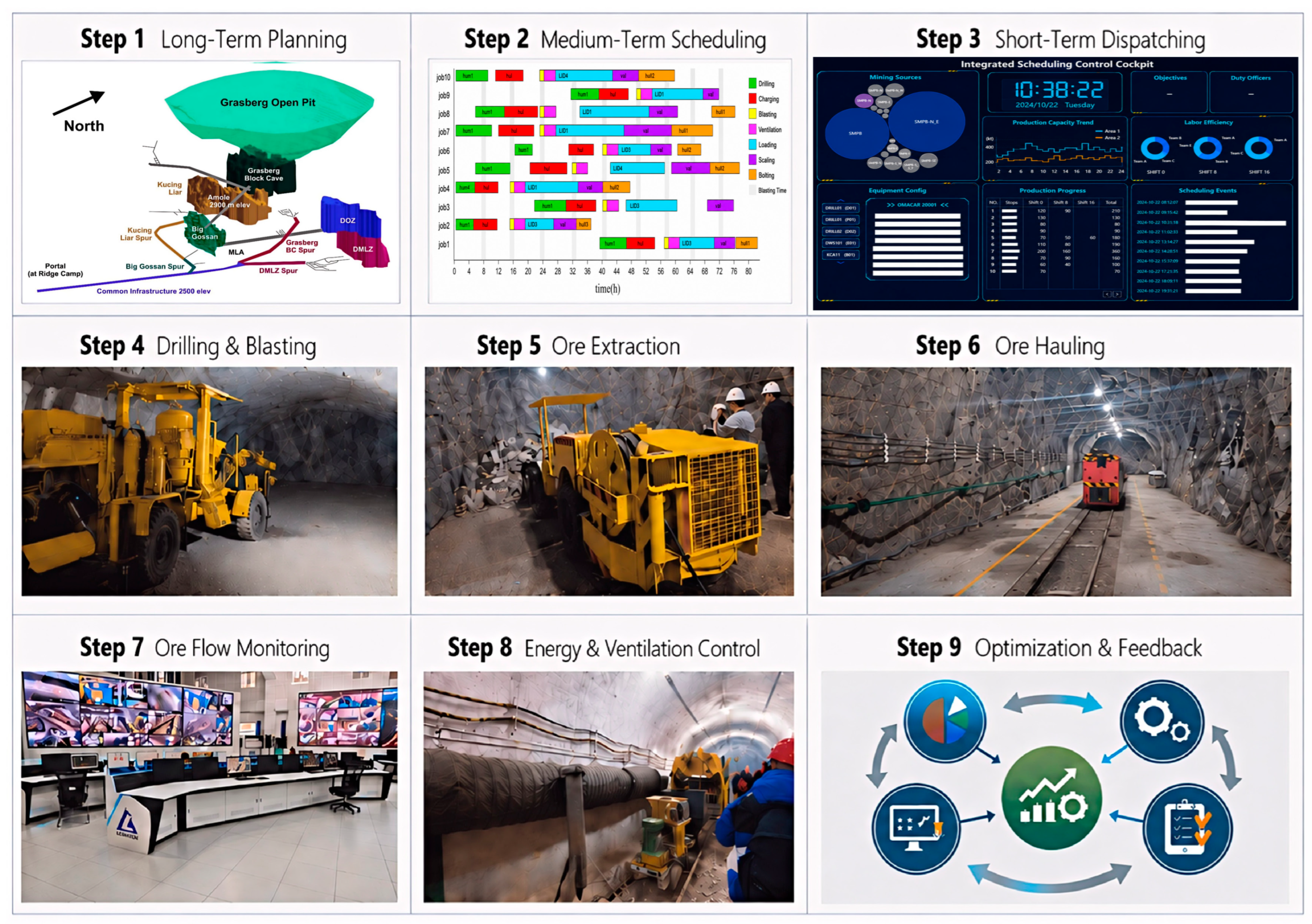
In the research trajectory of regulation, the temporal and spatial dimensions are two foundational dimensions of dynamic organization in caving mines. To highlight the technical routes of relevant studies and their relevance to the framework proposed in this review, Table 5 summarizes representative work on time scheduling, short-interval control, spatial positioning, traffic organization, and digital-twin-based scenario modeling. Overall, these studies provide an organizational basis for subsequent ore-output and energy regulation, but cross-dimensional coupling and real-time closed-loop implementation still require further strengthening. The technical architecture is shown in Figure 9.

4.1. Dynamic Scheduling and Short-Interval Control for the Temporal Dimension

Temporal regulation is the foundation of production organization in caving mines. Its core is to achieve continuity, balance, and correctability of ore-output rhythm through shift arrangement, equipment start-stop control, process connection, short-interval control, and rescheduling under disturbances [11,12]. Traditional time scheduling relies mainly on static daily plans and manual corrections and is applicable under relatively stable conditions. In caving mines, however, equipment failures, haulage conflicts, ore-pass fluctuations, and abnormal ore-output events occur frequently, and fixed plans often fail to adapt to changing field states in time [13,14]. Therefore, short-term scheduling methods based on robust optimization, constraint programming, machine learning, and reinforcement learning have become an important direction [44,63,64].
Dynamic scheduling studies increasingly emphasize elevating the temporal dimension from a planning variable to a control variable [15]. The key is no longer simply specifying what should be done and when, but continuously correcting the most reasonable operating rhythm for the current stage according to real-time states [16]. Short-interval control plays an important role in this process: it divides operations into smaller time windows and continuously updates equipment states, task execution, and local disturbance information to rollingly correct ore-output rhythm, equipment tasks, and process connections, thereby reducing the cumulative impact of abnormal events on overall production rhythm [17].
The introduction of visual recognition gives temporal regulation stronger, real-time and event-driven characteristics. Fixed underground cameras, vehicle-mounted vision systems, and video streams from operating areas can be used to recognize underground personnel, equipment, vehicles, and abnormal visual states under low-illumination and complex-background conditions [65,66]. When combined with positioning data and equipment logs, these visual events can be further transformed into trigger signals for scheduling systems [67]. In addition, joint analysis of video, positioning data, and equipment logs can extract time-series features such as loading time, waiting time, operating cycle, and key-node occupation time, forming finer-grained production rhythm profiles and supporting short-interval control [66,68,69,70,71,72].
Overall, research on the temporal dimension has gradually moved from static shift scheduling toward rolling scheduling and event-driven control. Nevertheless, two limitations remain. First, most studies still focus on time optimization for a single piece of equipment or a single process and lack system-level rhythm control involving multiple stopes, zones, and haulage units. Second, the interface between visual-recognition results and scheduling models remains weak, and identified abnormal events have not yet been widely transformed into structured scheduling variables [11,12]. Future research should strengthen short-interval control based on visual event streams, whole-process coordinated rolling scheduling frameworks, and integrated control methods linking time with space, ore output, and energy consumption [43,44,63,64,73].

4.2. Operating-Area Coordination and Route Optimization for the Spatial Dimension

Spatial regulation mainly involves drawpoint activation sequence, coordinated ore drawing among zones, haulage-route organization, ore-pass utilization, and operating-area linkage [18,19]. The spatial organization of caving mines has clear dynamic and multi-unit coupling characteristics: drawpoints are not independent, zones are not simply parallel, and haulage routes, passing points, ore passes, and transfer systems jointly form a complex spatial network [20]. Traditional spatial optimization mainly focuses on reasonable drawpoint layout and shortest haulage routes, whereas spatial efficiency in actual production often depends on operating-space occupation, local congestion, route-conflict intensity, and operating-area availability [21,74,75,76].
Therefore, the focus of spatial regulation is shifting from static layout optimization to dynamic spatial organization control [6]. The development of digital twins, three-dimensional visualization, and high-precision positioning provides technical support for this transition [7]. Based on three-dimensional spatial models and underground-space digital twin modeling methods, drawpoints, stopes, haulage routes, ore passes, and equipment positions can be mapped into a unified spatial framework and updated continuously as production advances [22,77]. Thus, spatial models are no longer merely design and display tools, but dynamic carriers that support route inference, operating-area coordination, and conflict prediction [23,75,77].
On this basis, machine vision and point-cloud sensing further enhance the real-time nature of spatial regulation [62]. Underground video streams, vehicle-mounted cameras, laser scanning, and mobile sensing systems can continuously identify states such as muck accumulation around drawpoints, muck-pile occlusion, drift obstacles, vehicle-meeting risks, local congestion, and operating-area boundary changes, thereby judging whether space remains reachable, usable, and coordinable [66]. Compared with optimization based only on static drawings or historical routes, spatial regulation based on field sensing is closer to actual operating conditions [76,78,79,80,81,82,83,84,85].
In addition, research on the spatial dimension is moving from route optimization toward joint task-route optimization [19]. In caving mines, drawpoint activation, zone task allocation, haulage routes, and ore-pass connection are inherently coupled issues [21]. Optimizing only one route or operating area may create new congestion or load transfer in other spatial units [22]. Therefore, future spatial regulation should incorporate drawpoint combinations, operating-area switching, route organization, and node-handling capacity into a unified model and construct a spatial collaborative-control framework under dynamic occupation constraints [45].
Overall, research on the spatial dimension has moved from static geometric optimization toward run-time spatial collaboration, but further development is still needed. First, an integrated spatial decision expression for drawpoints, zones, haulage, and ore passes should be established. Second, visual recognition should be deeply integrated with digital-twin spatial models. Third, spatial-state recognition results should be directly connected to time-scheduling and ore-output control models so that the spatial dimension becomes a true online regulation object [6,7,23]. Future work should further integrate digital-twin spatial models, visual recognition, and joint task-route optimization to promote the transition of spatial regulation from static design to run-time reconstruction [45,75,77].

4.3. Dynamic Ore Drawing and Ore-Flow Collaborative Control for the Ore-Output Dimension

Ore-output regulation is the core of intelligent production in caving mines because ore output is both a direct production target and a comprehensive reflection of ore-flow state, draw-organization efficiency, and system handling capacity [24,59]. Existing studies mainly focus on draw-intensity optimization, multi-drawpoint coordinated ore drawing, ore-pass balance control, dilution and loss reduction, and grade-stability management. Compared with traditional experience-based draw control, dynamic ore-drawing methods based on ore-flow simulation, production-data analysis, and optimization algorithms have significantly improved the refinement of ore-output control [25,26]. Meanwhile, research on load-haul-dump (LHD) loading, sensor-based ore sorting, fragmentation recognition, and spectral identification also provides a technical basis for shifting ore-output control from experience-based drawing to dynamic control based on material-state identification [86,87,88,89,90,91,92].
To strengthen the mining-engineering basis of ore-flow control, Table 6 summarizes the classical caving problems that should be transformed into measurable and controllable variables in intelligent regulation.
At a deeper level, however, ore output is not merely a tonnage indicator to be allocated, but a dynamic process variable jointly affected by ore-flow behavior, spatial conditions, equipment capacity, and energy boundaries [26,28]. In other words, regulation of the ore-output dimension must answer not only how much ore should be drawn, but also under what state, by what method, and whether the system can handle it [29]. Therefore, production optimization based solely on quota allocation is insufficient for high-level intelligent control in caving mines [40].
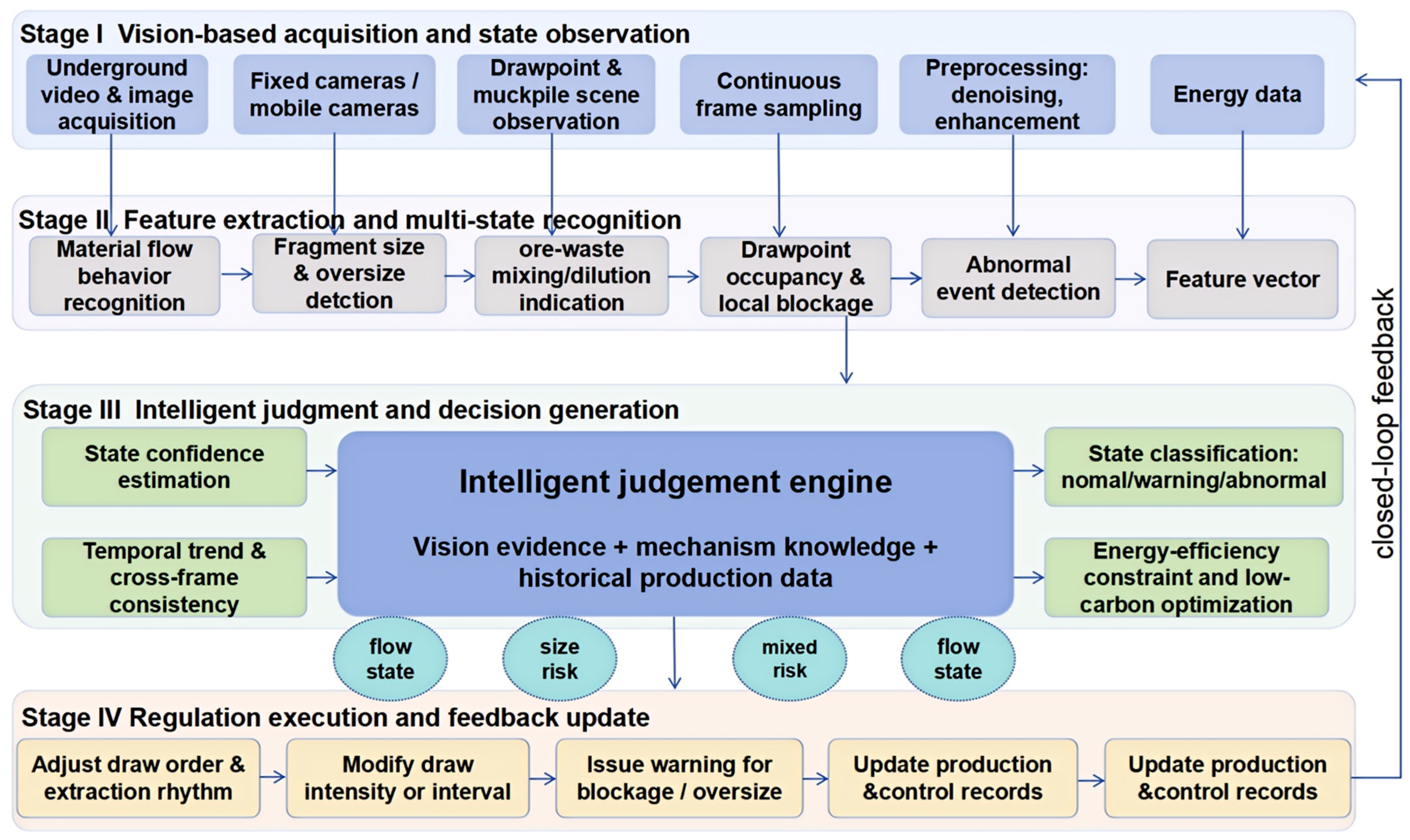
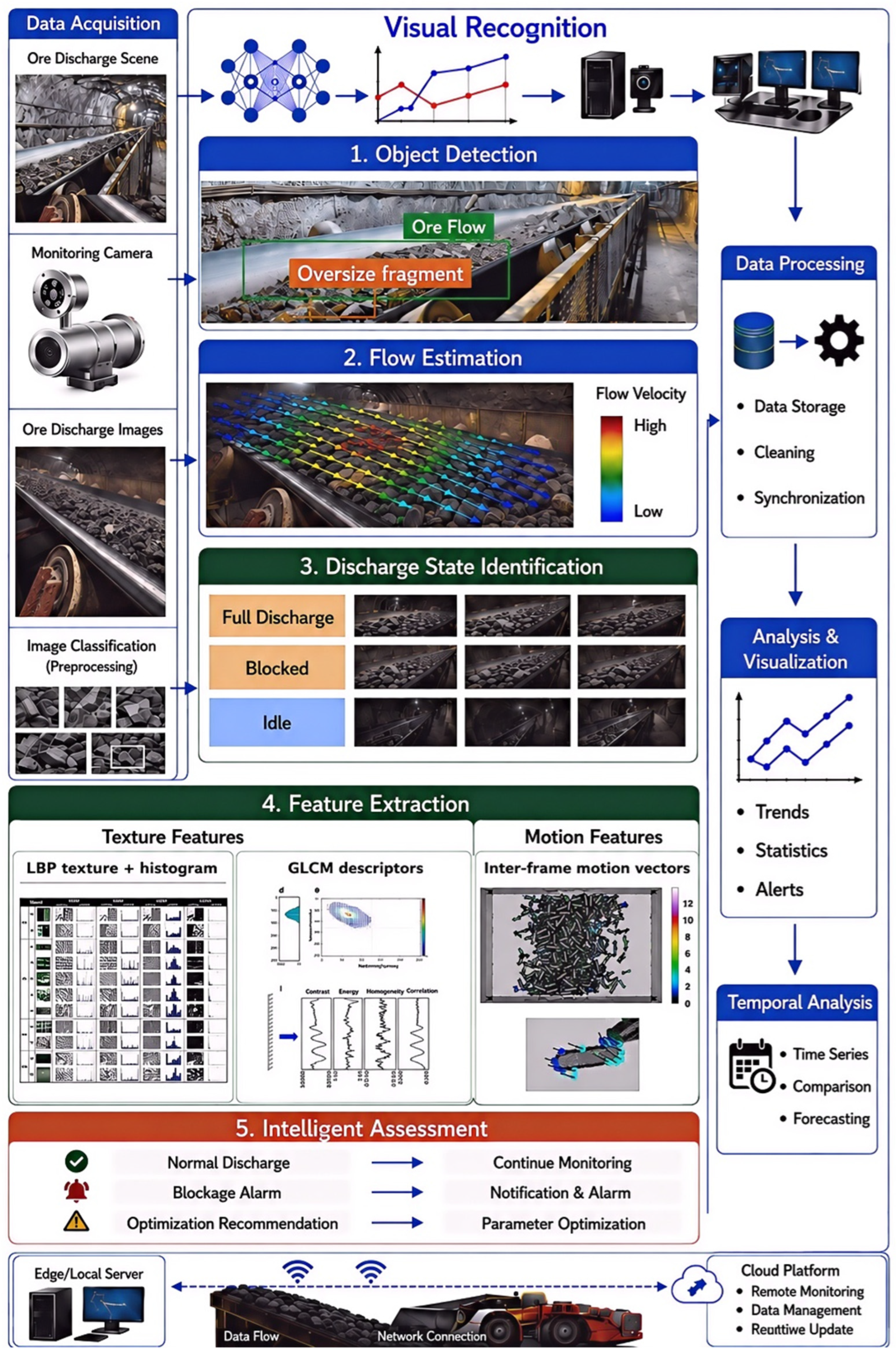
Visual recognition provides a new entry point for ore-output regulation, particularly in muck-pile detection, autonomous LHD bucket loading, fragmentation recognition, mineral image segmentation, and ore-rock state identification [47,71,78]. Drawpoint material flow, ore fragmentation, ore-rock mixing, and local drawpoint state have strong visual features and can be continuously identified through video, images, and point clouds [78]. Material-flow behavior recognition can identify continuous flow, biased flow, interrupted flow, blockage signs, and abnormal fluctuations, thereby transforming video monitoring into ore-output control signals [93]. Fragmentation recognition can assess oversize risk and particle-size changes, supporting draw-intensity adjustment and blockage warning. Ore-rock mixing recognition helps move dilution control forward to the online-judgment stage rather than relying entirely on post-event sampling. By linking long-term visual features with ore-output records, visual-flow-output mapping models for different drawpoints can also be constructed, providing finer state profiles for multi-drawpoint coordinated control [87,89,90,91,92].
More importantly, future regulation of ore output should not rely solely on visual recognition itself, but should integrate visual recognition with ore-flow mechanism models [25]. Ore-flow mechanism models can explain extraction-zone development, compensation laws, and multi-drawpoint interactions, but they often remain at the offline-analysis stage. Visual and production-data models can reflect current material-flow states and fragmentation changes, but may lack sufficient mechanistic interpretability [26]. High-level dynamic ore-output control should connect the two: mechanism models explain why a certain material-flow and output response occurs, visual recognition identifies the current state, and the two jointly support how the draw sequence and intensity should be adjusted next [25,49,77,88,90].
Therefore, research on the ore-output dimension is shifting from traditional production allocation toward dynamic ore-drawing control that integrates visual recognition, ore-flow mechanisms, and online control [28,59]. Future priorities include establishing mapping relationships between material-flow state recognition and ore-output control, coupling multi-drawpoint coordinated-control models with ore-pass, haulage, and energy constraints, and forming a unified framework of state sensing, mechanism explanation, and dynamic regulation [40,87,89,90,91,92]. The workflow is summarized in Figure 10.

4.4. Mining-Processing Coordination Through Feed-Quality Indicators

The mining-processing connection should be expressed through indicators that can transmit underground ore-flow changes to processing performance. In caving mines, unstable draw control may cause fluctuations in feed grade, dilution ratio, particle-size distribution, ore hardness, and ore-waste mixing. These variations are transmitted to crushing, grinding, sorting, and separation processes, thereby affecting throughput stability, recovery, specific comminution energy, and reagent or water consumption. Therefore, intelligent ore-flow control should not only pursue stable tonnage, but also aim to provide a more stable and predictable feed stream for mineral processing. The corresponding feed-quality indicators are summarized in Table 7.

4.5. Energy-Efficiency Constraints and Intelligent Regulation for the Energy Dimension

Against the background of green mining and low-carbon extraction, energy consumption has gradually shifted from a traditional post-event accounting indicator to an explicit constraint in production organization [30,31]. Existing studies mainly focus on ventilation-network optimization, digital-twin-based ventilation modeling, energy saving in haulage systems, equipment-operation strategy optimization, and peak-valley load regulation, and have achieved many results in unit-level energy saving and local energy-efficiency improvement [32,94]. However, for caving mines, energy consumption is not an independent result variable detached from production organization, but a process variable continuously coupled with ore-output rhythm, spatial organization, equipment operating behavior, and local conflicts [33]. Therefore, energy regulation needs to move from single-link energy saving toward comprehensive energy-efficiency optimization for the production system [95,96,97].
This means that energy-oriented regulation should not remain at the level of total energy-consumption control or energy saving for individual equipment; it should further focus on specific energy consumption per tonne of ore, regional energy efficiency, time-period energy efficiency, and behavioral energy efficiency [34,35]. For example, under the same total output, specific energy consumption may vary significantly under different route organizations and operating rhythms [36]. Detours, local queues, long idling periods, frequent yielding, and concentrated peak loads are often important causes of reduced system energy efficiency [37]. Therefore, compared with merely counting total energy consumption, it is more valuable to evaluate specific output energy efficiency and optimize process energy efficiency based on operating-state recognition [95,97].
In this process, visual recognition and multimodal diagnosis play important roles [53]. By combining video with equipment logs, inefficient operating patterns such as vehicle idling, loading delays, route detours, local congestion, and abnormal equipment stops can be identified and correlated with energy-consumption data such as current, electricity use, operating duration, and ventilation load, thereby further explaining why energy consumption is high [55]. As a result, energy consumption is no longer merely a terminal statistical result, but a feedback variable that inversely indicates unbalanced time rhythm, intensified spatial conflicts, and equipment mismatch [56,95,98,99,100].
Furthermore, energy-efficiency regulation should expand from unit-level energy saving to system-level collaborative energy saving [30]. In caving mines, haulage, ventilation, loading, and ore-pass connection are not independent energy-consuming links, but jointly affect comprehensive energy efficiency within a unified production organization [35]. Future research should focus on constructing multidimensional optimization models centered on specific energy consumption per tonne of ore and whole-process energy efficiency, and incorporating visual-recognition results into energy-efficiency diagnosis and feedback control, so that energy becomes an effective constraint and real-time feedback signal in the time-space-ore output-energy collaborative regulation chain [36,95,96,97].
Compared with the temporal and spatial dimensions, ore-output, ore-flow, and energy regulation are more directly related to production performance and green constraints. To highlight the relevant research trajectory, Table 8 summarizes representative studies on ore-flow simulation, draw control, ventilation energy saving, energy-efficiency optimization, and production-energy coordination. Overall, current research has gradually shifted from single-process analysis toward integrated optimization that considers production, structure, and energy efficiency, but integrated methods for real-time state recognition and closed-loop regulation remain relatively insufficient.
Table 8 indicates that research on ore output and energy has gradually moved from mechanism analysis and local optimization toward integrated studies combining scheduling, sensing, and low-carbon objectives. This provides direct support for the subsequent construction of a digital-twin-driven closed-loop intelligent regulation framework.

4.6. Closed-Loop Regulation for Intelligent Judgment: From Anomaly Recognition to Regulation Decision Generation

The key to high-level intelligent regulation in caving mines is not simply improving visual-recognition accuracy, but building an intelligent judgment loop that integrates visual recognition, multimodal fusion, mechanism explanation, and decision generation [43,67,101]. In other words, true intelligence is not merely seeing anomalies, but being able to judge what they mean, associate them with ore-flow or production-organization mechanisms, and generate the next control scheme [57,62]. Recent developments in industrial anomaly detection, multimodal large language models, foundation models, and process-industry foundation models show that recognition, explanation, and decision-making are becoming increasingly coupled, providing new technical conditions for intelligent judgment loops in mines [58,67,100,102,103].
Functionally, intelligent judgment contains at least three levels [43]. The first is perceptual judgment, which uses video, images, positioning, sensors, and equipment logs to identify draw anomalies, drift congestion, abnormal equipment posture, personnel-safety compliance, abnormal operating-area occupation, and signs of energy-efficiency anomalies [67,104]. The second is mechanism-level judgment, which maps these anomalies to production mechanism explanations such as ore-flow variation, rhythm imbalance, spatial conflict, insufficient handling capacity, or energy-efficiency deviation [57]. The third is decision-level judgment, which generates executable regulation suggestions based on the current state, such as adjusting drawpoint sequence, correcting draw intensity, switching haulage routes, reorganizing operating areas, or implementing energy-efficiency correction strategies [68,69,70,71,72,98,99,100,103].
On this basis, the combination of digital twins, multimodal models, and knowledge rules is becoming an important implementation pathway for closed-loop regulation [7]. Visual and multimodal models extract state information from complex scenarios; knowledge bases and mechanism models transform states into interpretable mining language; digital twins conduct online simulations of alternative control strategies; and scheduling and execution systems apply the final scheme to the field [59]. Compared with purely end-to-end automatic decision-making, this model-knowledge-simulation-execution approach better suits the high-risk, strongly disturbed, and highly uncertain operation characteristics of caving mines [58,77].
However, field implementation still faces several engineering barriers. Underground visual recognition, digital twins, and multimodal sensing can be disturbed by dust, water mist, insufficient illumination, equipment occlusion, unstable wireless communication, sensor drift or failure, limited labeled datasets, and data-security constraints. Practical deployment, therefore, requires robust image enhancement and de-dusting preprocessing, multisensor redundancy, edge-cloud collaborative computing, sensor-health diagnosis, semi-supervised or self-supervised domain adaptation, continuous field dataset construction, and human-in-the-loop validation. For high-risk control actions, staged field testing, cybersecurity protection, and fail-safe execution rules should be established before closed-loop decisions are directly connected to production equipment.
Moreover, closed-loop intelligent regulation does not mean completely removing human involvement [57]. In complex mining environments, expert experience remains irreplaceable in anomaly-state judgment, strategy implementability assessment, and risk-tolerance boundary determination [58]. Therefore, a more realistic closed-loop form is human-machine collaboration: models rapidly identify and simulate states, the system generates candidate control strategies, experts review and modify them, execution systems implement the strategies and return feedback, and the front-end models and rule systems are continuously corrected [61].
In summary, the frontier of time-space-ore output-energy regulation in caving mines is evolving from a collection of local optimization technologies into a system theory centered on state recognition, mechanism explanation, scheme simulation, and closed-loop execution [2,6]. Only by placing time, space, ore output, and energy within a unified recognition-explanation-decision-feedback framework can intelligent caving-mine regulation truly move from experience-based management toward efficient, low-energy, and stable operation [57,59]. The digital twin-supported assessment framework is shown in Figure 11.

5. Conclusions and Prospects

The production process of caving mines is characterized by pronounced dynamics, spatial discreteness, ore-flow uncertainty, ore-output fluctuation, ore-quality variation, and energy-consumption coupling. Intelligent operation is no longer a matter of single-equipment automation or local process optimization, but a complex system issue involving the coordinated interaction of time organization, spatial configuration, ore-output control, ore-flow quality management, and energy-consumption constraints. More importantly, the regulation of caving mines should not be limited to underground production efficiency alone. Because broken ore flow, fragmentation distribution, dilution, ore loss, and ore-waste mixing directly affect downstream crushing, grinding, ore sorting, separation processes, and feed-grade stability, intelligent caving mine regulation should be regarded as an important upstream component of mineral-processing-oriented production control. This review summarizes and synthesizes studies on time-space-quantity-energy collaborative feedback and regulation in intelligent caving mines, and presents the following main contributions and insights.
(1)
This review constructs a time-space-quantity-energy collaborative analytical framework for caving mines and clarifies its connection with mineral-processing-oriented ore-flow control. The temporal dimension corresponds to production rhythm and scheduling logic; the spatial dimension corresponds to the structural relationships among drawpoints, stopes, ore passes, and haulage systems; the quantity dimension refers not only to the amount of ore drawn, but also to ore-flow state, fragmentation characteristics, dilution, ore loss, and feed-quality stability; and the energy dimension corresponds to the efficiency boundary and green constraint of system operation. This framework integrates draw management, ore-flow evolution, dilution and ore-loss control, haulage organization, feed-quality regulation, and energy-efficiency constraints into a unified analytical logic, providing an integrated perspective for understanding the connection between caving mine production and downstream mineral processing performance.
(2)
This review summarizes the collaborative feedback mechanisms among time, space, ore output, ore-flow quality, and energy consumption. It clarifies the shaping effect of time organization on spatial utilization, the constraint effect of spatial structure on ore-output formation and ore-flow quality, the influence of ore-output and ore-quality fluctuations on energy-consumption evolution, and the reverse correction effect of energy feedback on time scheduling and spatial configuration. These mechanisms indicate that the quality and stability of ore supplied to mineral processing are jointly controlled by drawpoint layout, draw sequence, ore-flow behavior, fragmentation, dilution evolution, equipment coordination, and energy-efficiency constraints. Therefore, the key to intelligent caving mine operation lies not in single-dimensional optimization, but in establishing a systematic relationship of continuous coupling, dynamic feedback, and cyclic correction among multidimensional elements.
(3)
This review systematically examines research progress in dynamic scheduling, spatial modeling, ore-flow control, fragmentation recognition, energy-efficiency optimization, digital twins, and intelligent judgment. The results show that current research is gradually shifting from experience-based production organization and local optimization toward multi-source sensing, rolling decision-making, and closed-loop regulation. In particular, machine vision, multimodal sensing, ore-flow simulation, sensor-based ore identification, and digital-twin modeling provide new opportunities for linking underground caving production with mineral processing requirements, such as stabilizing feed grade, achieving suitable particle-size distribution, reducing dilution, and decreasing downstream processing energy consumption. However, cross-dimensional data integration, mechanism-data fusion, the mapping from state-recognition results to regulation variables, and field-level closed-loop execution remain weak links.
(4)
This review further identifies key future directions. Future studies should strengthen unified representation and collaborative computation of time, space, ore output, ore quality, and energy data to support dynamic scheduling, ore-flow control, and feed-quality optimization. Four-dimensional coupling mechanisms and dynamic evolution laws should be explored to develop interpretable and transferable system models. A comprehensive evaluation system should also be established, covering production performance, dilution and ore loss, fragmentation, feed-grade stability, ore-waste discrimination, processing adaptability, energy consumption, peak load, and carbon intensity. Moreover, visual recognition, multimodal sensing, digital twins, rolling optimization, and intelligent decision-making should be integrated to enhance online perception and real-time control. Human-machine collaborative closed-loop control should be further developed by combining foundation models, industrial intelligence, mining knowledge, and mineral processing requirements.
The following limitations should also be acknowledged. Publicly available field datasets from operating caving mines remain limited, which restricts direct quantitative comparison among different mines. In addition, the coupling relationships among time organization, spatial structure, ore-flow quality, and energy consumption are strongly mine-specific and may vary with orebody geometry, draw strategy, equipment configuration, and processing flowsheet. Future work should therefore emphasize field-data-driven validation, transferable coupling models, and continuous datasets that connect underground draw control with downstream feed quality and comminution energy.
Overall, within the time-space-quantity-energy framework, this review unifies production organization, spatial structure, ore-flow output, mineral-processing-oriented feed quality, and energy-consumption constraints in intelligent caving mines. Compared with studies that focus only on underground production scheduling, equipment automation, or isolated energy-saving methods, this review emphasizes that caving mine regulation should serve both mining efficiency and downstream mineral processing performance. The proposed framework can help promote caving mine research from process separation and single-objective optimization toward multidimensional collaborative regulation across the entire mining-processing chain, production space, and mine life cycle.
In the future, with the continuous development of multi-source sensing, digital twins, intelligent optimization, ore-flow monitoring, sensor-based ore identification, and closed-loop control technologies, caving mines are expected to gradually form a new collaborative regulation mode covering the whole process, full production space, and entire life cycle. It should be emphasized that the engineering implementation of the time-space-quantity-energy framework still depends on high-quality field data, interpretable models, reliable execution systems, and human-machine collaboration mechanisms. In addition, strengthening the coupling between underground caving production and mineral processing indicators, such as feed grade, liberation-related fragmentation characteristics, dilution, ore-sorting performance, and processing energy consumption, will be essential for achieving intelligent and sustainable mineral resource extraction.

Author Contributions

Conceptualization, F.Y. and H.W.; methodology, J.C.; software, J.C. and J.W.; validation, F.Y., J.C. and H.W.; formal analysis, J.C.; investigation, J.C., J.W. and F.H.; resources, H.W. and G.L.; writing—original draft preparation, J.C.; writing—review and editing, F.Y., J.C. and H.W.; visualization, J.C. and D.S.; supervision, H.W.; project administration, H.W.; funding acquisition, F.Y. All authors have read and agreed to the published version of the manuscript.

Funding

This study was supported by the Deep Earth Probe and Mineral Resources Exploration—National Science and Technology Major Project (No. 2025ZD1010902) and the National Natural Science Foundation of China (Nos. 52474280 and 52104108).

Data Availability Statement

No new data were created or analyzed in this study. Data sharing is not applicable to this article.

Conflicts of Interest

The authors declare no conflict of interest.

References

  1. Melati, S.; Wattimena, R.K.; Sahara, D.P.; Syafrizal Simangunsong, G.M.; Hidayat, W.; Riyanto, E.; Felisia, R.R.S. Block Caving Mining Method: Transformation and Its Potency in Indonesia. Energies 2023, 16, 9. [Google Scholar] [CrossRef]
  2. Nobahar, P.; Xu, C.; Dowd, P.; Shirani Faradonbeh, R. Exploring Digital Twin Systems in Mining Operations: A Review. Green Smart Min. Eng. 2024, 1, 474–492. [Google Scholar] [CrossRef]
  3. Anvari, K.; Benndorf, J. Real Time Mining—A Review of Developments Within the Last Decade. Mining 2025, 5, 38. [Google Scholar] [CrossRef]
  4. Long, M.; Schafrik, S.; Kolapo, P.; Agioutantis, Z.; Sottile, J. Equipment and Operations Automation in Mining: A Review. Machines 2024, 12, 713. [Google Scholar] [CrossRef]
  5. Chimunhu, P.; Topal, E.; Ajak, A.D.; Asad, W. A review of machine learning applications for underground mine planning and scheduling. Resour. Policy 2022, 77, 102693. [Google Scholar] [CrossRef]
  6. Qu, J.; Kizil, M.S.; Yahyaei, M.; Knights, P.F. Digital Twins in the Minerals Industry—A Comprehensive Review. Min. Technol. 2023, 132, 267–289. [Google Scholar] [CrossRef]
  7. Cacciuttolo, C.; Atencio, E.; Komarizadehasl, S.; Lozano-Galant, J.A. Development of an Advanced Multi-Layer Digital Twin Conceptual Framework for Underground Mining. Sensors 2025, 25, 6650. [Google Scholar] [CrossRef]
  8. Obosu, M.; Frimpong, S. Advances in automation and robotics: The state of the emerging future mining industry. J. Saf. Sustain. 2025, 2, 181–194. [Google Scholar] [CrossRef]
  9. Du, H.; Chan, L.; Tong, J.; Raad, R.; Naghdy, F.; Guo, Q.; Yu, Y.; Islam, M.R.; Tubbal, F.; Ros, M.; et al. Industrial Progress of Robotic Automation in Mining Applications: A Survey. Min. Metall. Explor. 2025, 42, 537–556. [Google Scholar] [CrossRef]
  10. Kolapo, P.; Ogunsola, N.O.; Komolafe, K.; Omole, D.D. Envisioning Human-Machine Relationship Towards Sustainable Mining Automation. Mining 2025, 5, 5. [Google Scholar] [CrossRef]
  11. Wang, H.; Zhang, X.; Yuan, H.; Wu, Z.; Zhou, M. A Lean Scheduling Framework for Underground Mines Based on Short Interval Control. Sustainability 2023, 15, 9195. [Google Scholar] [CrossRef]
  12. Tu, S.; Jia, M.; Wang, L.; Feng, S.; Huang, S. A Dynamic Scheduling Model for Underground Metal Mines under Equipment Failure Conditions. Sustainability 2023, 15, 7306. [Google Scholar] [CrossRef]
  13. Li, N.; Wu, Y.; Ye, H.; Wang, L.; Wang, Q.; Jia, M. Scheduling Optimization of Underground Mine Trackless Transportation Based on Improved Estimation of Distribution Algorithm. Expert Syst. Appl. 2024, 245, 123025. [Google Scholar] [CrossRef]
  14. Wan, M.; Li, H.; Wang, H.; Hou, J. Scheduling Optimization of Electric Rubber-Tired Vehicles in Underground Coal Mines Based on Constraint Programming. Sensors 2025, 25, 3435. [Google Scholar] [CrossRef] [PubMed]
  15. Chimunhu, P.; Topal, E.; Asad, M.W.A.; Shirani Faradonbeh, R.; Ajak, A.D. Production Scheduling Optimisation Using Mixed Integer Programming with Machine Learning Dilution Prediction Capabilities for Underground Open Stoping Operations. Mach. Learn. Appl. 2025, 22, 100776. [Google Scholar] [CrossRef]
  16. Chimunhu, P.; Topal, E.; Asad, M.W.A.; Shirani Faradonbeh, R.; Ajak, A.D. The future of underground mine planning in the era of machine learning: Opportunities for engineering robustness and flexibility. Min. Technol. 2024, 133, 331–347. [Google Scholar] [CrossRef]
  17. Carelos Andrade, L.; Dimitrakopoulos, R. Integrated Stochastic Underground Mine Planning with Long-Term Stockpiling: Method and Impacts of Using High-Order Sequential Simulations. Minerals 2024, 14, 123. [Google Scholar] [CrossRef]
  18. Nonguin, P.; Frimpong, S.; Madria, S. Predicting Miner Localization in Underground Mine Emergencies Using a Hybrid CNN-LSTM Model with Data from Delay-Tolerant Network Databases. Appl. Sci. 2025, 15, 9133. [Google Scholar] [CrossRef]
  19. Baek, J.; Park, J.; Cho, S.; Lee, C. 3D Global Localization in the Underground Mine Environment Using Mobile LiDAR Mapping. Sensors 2022, 22, 2873. [Google Scholar] [CrossRef] [PubMed]
  20. Halilović, D.; Gligorić, M.; Gligorić, Z.; Pamučar, D. An Underground Mine Ore Pass System Optimization via Fuzzy 0–1 Linear Programming with Novel Torricelli–Simpson Ranking Function. Mathematics 2023, 11, 2914. [Google Scholar] [CrossRef]
  21. Miao, W.; Zhao, X. Traffic Congestion Scheduling for Underground Mine Transportation Systems. Appl. Sci. 2024, 14, 9862. [Google Scholar] [CrossRef]
  22. Essien, E.; Frimpong, S. Enhancing Autonomous Truck Navigation in Underground Mining with 3D Detection Systems. Drones 2025, 9, 433. [Google Scholar] [CrossRef]
  23. Bertoni, A.; Machchhar, R.J.; Larsson, T.; Frank, B. Digital Twins of Operational Scenarios in Mining for Design of Customized Product-Service Systems Solutions. Procedia CIRP 2022, 109, 532–537. [Google Scholar] [CrossRef]
  24. Dai, B.; Zhao, X.; Zhu, Z.; Tao, G.; Yin, G. Feasibility of Broken Ore Flow Simulation in Block Caving Mining Method Using Attribute Stochastic Medium Theory. Minerals 2022, 12, 576. [Google Scholar] [CrossRef]
  25. Castro, R.; Valdés, C.; Gómez, R.; Skrzypkowski, K.; Zagórski, K. Design Parameters Affecting Rill Swell Events for Block Caving Mines. Appl. Sci. 2024, 14, 8545. [Google Scholar] [CrossRef]
  26. Gómez, R.; San Martin, C.; Castro, R. An Integrates Cellular Automata Model Improves the Accuracy of Secondary Fragmentation Prediction. Appl. Sci. 2025, 15, 5425. [Google Scholar] [CrossRef]
  27. Castro, R.L.; Vargas, R.; de la Huerta, F. Determination of Drawpoint Spacing in Panel Caving: A Case Study at the El Teniente Mine. J. S. Afr. Inst. Min. Metall. 2012, 112, 871–876. [Google Scholar]
  28. Koch, L.A.; Ladinig, T. Critical Issues of Ore Flow for the Raise Caving Method. Berg-Und Hüttenmännische Monatshefte 2023, 168, 281–286. [Google Scholar] [CrossRef]
  29. Xu, S.; Qu, F.; Li, Y.; Wang, Y.; Ji, Y. Surrounding Rock Deformation Control of Ore-Drawing Roadway Under Cyclic Ore-Drawing Disturbance. Appl. Sci. 2025, 15, 9804. [Google Scholar] [CrossRef]
  30. Saleem, H.A. Energy Consumption Reduction in Underground Mine Ventilation System: An Integrated Approach Using Mathematical and Machine Learning Models Toward Sustainable Mining. Sustainability 2025, 17, 1038. [Google Scholar] [CrossRef]
  31. Ihsan, A.; Widodo, N.P.; Cheng, J.; Wang, E. Ventilation on Demand in Underground Mines Using Neuro-Fuzzy Models: Modeling and Laboratory-Scale Experimental Validation. Eng. Appl. Artif. Intell. 2024, 133, 108048. [Google Scholar] [CrossRef]
  32. Semin, M.; Kormshchikov, D. Application of Artificial Intelligence in Mine Ventilation: A Brief Review. Front. Artif. Intell. 2024, 7, 1402555. [Google Scholar] [CrossRef] [PubMed]
  33. Sun, Q.; Wang, Y. Optimization of Airflow Distribution in Mine Ventilation Networks Using the MOBWO Algorithm. Processes 2025, 13, 2193. [Google Scholar] [CrossRef]
  34. Yang, X.; Li, H. Digital Twin-Driven Deep Learning Prediction and Adaptive Control for Coal Mine Ventilation Systems. Sci. Rep. 2026, 16, 940. [Google Scholar] [CrossRef] [PubMed]
  35. Wen, L.; Zhong, D.; Bi, L.; Wang, L.; Liu, Y. Optimization Method of Mine Ventilation Network Regulation Based on Mixed-Integer Nonlinear Programming. Mathematics 2024, 12, 2632. [Google Scholar] [CrossRef]
  36. Gu, B.; Kan, Z. Optimization of mine ventilation energy consumption based on improved dung beetle algorithm. Sci. Rep. 2025, 15, 37582. [Google Scholar] [CrossRef]
  37. Chinyadza, C.R.; Risso, N.; Aramayo, A.; Momayez, M. Integrating Artificial Intelligence into Ventilation on Demand. Sensors 2026, 26, 1042. [Google Scholar] [CrossRef]
  38. Furtado e Faria, M.; Dimitrakopoulos, R.; Lopes Pinto, C.L. Integrated Stochastic Optimization of Stope Design and Long-Term Underground Mine Production Scheduling. Resour. Policy 2022, 78, 102918. [Google Scholar] [CrossRef]
  39. Ayaburi, J.; Swift, A.; Newman, A.M.; Morris, A. A Hard-Rock Mining Company Optimizes Schedules for Strategic Decision Making. Inf. J. Appl. Anal. 2026, 56, 274–290. [Google Scholar] [CrossRef]
  40. Meng, X.; Long, T.; Shi, X.; Wang, L.; Zhu, Z.; Tao, G. A new insert drawing technique for controlling ore loss and dilution during sublevel caving. Sci. Rep. 2025, 15, 23104. [Google Scholar] [CrossRef]
  41. Ullah, G.M.W.; Nehring, M.; Kizil, M.; Knights, P. A Multi-Objective Model for Economic and Carbon Emission Optimisation in Sublevel Stoping Operations. Mining 2025, 5, 76. [Google Scholar] [CrossRef]
  42. Nordqvist, A.; Quinteiro, C. Preliminary Results from Tests Using SLC with 40 and 50 m Sublevel Heights. In MassMin 2024: Proceedings of the International Conference & Exhibition on Mass Mining, Luleå, Sweden, 17–19 September 2024; Luleå University of Technology: Luleå, Sweden, 2024. [Google Scholar]
  43. Khadim, U.; Mourshed, M.; Khandokar, F.; Debnath, N.; Ahsan, M. Computer Vision Techniques for Collision Detection and Avoidance in Underground Mines: A Comprehensive Review. Sensors 2023, 23, 4294. [Google Scholar]
  44. Li, N.; Ding, Y.; Dai, B.; Wang, L.; Chang, J.; Ye, H.; Wang, Q. Deep reinforcement learning framework for the underground mine short-term production scheduling problem. Swarm Evol. Comput. 2026, 100, 102229. [Google Scholar] [CrossRef]
  45. Kou, Z.; Wang, G.; Deng, H.; Huang, Z.; Yan, X. Dynamic scheduling strategy of mine auxiliary transportation robot based on digital twin. J. China Coal Soc. 2026, 51, 826–840. [Google Scholar]
  46. Fuenzalida, M.; Orrego, C.; Ghazvinian, E. Back Analysis and Forecast of Cave Fragmentation at Cadia East Mine. In MassMin 2024: Proceedings of the International Conference & Exhibition on Mass Mining, Luleå, Sweden, 17–19 September 2024; Johansson, D., Schunnesson, H., Eds.; Luleå University of Technology: Luleå, Sweden, 2024; pp. 679–691. [Google Scholar]
  47. Okada, N.; Nozaki, H.; Nakamura, S.; Manjate, E.P.A.; Gebretsadik, A.; Ohtomo, Y.; Arima, T.; Kawamura, Y. Optimizing multi-spectral ore sorting incorporating wavelength selection utilizing neighborhood component analysis for effective arsenic mineral detection. Sci. Rep. 2024, 14, 11544. [Google Scholar] [CrossRef] [PubMed]
  48. Abdolmaleki, M.; Ghadernejad, S. Automated Hyperspectral Ore-Waste Discrimination for a Gold Mine: Comparative Study of Data-Driven and Knowledge-Based Approaches in Laboratory and Field Environments. Minerals 2025, 15, 741. [Google Scholar] [CrossRef]
  49. Ling, W.; Zhu, Z.; Feng, X.; Wang, L.; Wang, W.; Li, Z.; Qiu, J. Procedure Design and Reliability Analysis for Prediction of Surface Subsidence of a Metal Mine Induced by Block Caving Method—A Case Study of Pulang Copper Mine in China. Minerals 2024, 14, 1011. [Google Scholar] [CrossRef]
  50. Liu, D.; Zhao, X.; Fan, W. A small object detection algorithm for mine environment. Eng. Appl. Artif. Intell. 2025, 153, 110936. [Google Scholar] [CrossRef]
  51. Yang, X.; Huang, Z.; Liu, Z.; Chen, Z. Transportation Scheduling Algorithm for Underground Mines Based on Sparrow Search Algorithm Optimized Genetic Algorithm. In Proceedings of the Eighth International Conference on Traffic Engineering and Transportation System (ICTETS 2024), Dalian, China, 20–22 September 2024; SPIE: Bellingham, WA, USA, 2024; Volume 13421, p. 1342128. [Google Scholar]
  52. Fowler, M.; Choudhury, A. Motor vehicle crashes and seat belt compliance among law enforcement officers: A systematic literature review. J. Saf. Sustain. 2025, 2, 11–21. [Google Scholar] [CrossRef]
  53. Prince; Hati, A.S.; Kumar, P. An adaptive neural fuzzy interface structure optimisation for prediction of energy consumption and airflow of a ventilation system. Appl. Energy 2023, 337, 120879. [Google Scholar] [CrossRef]
  54. Kurnia, J.C.; Sasmito, A.P.; Mujumdar, A.S. Energy Saving Strategies for Ventilation Systems in Underground Mines. SN Appl. Sci. 2025, 7, 189. [Google Scholar]
  55. Huang, X.; Liu, Y. Research and Design of Intelligent Mine Ventilation Construction Architecture. Int. J. Low-Carbon Technol. 2022, 17, 1232–1238. [Google Scholar] [CrossRef]
  56. Yang, S.; Zhang, X.; Liang, J.; Xu, N.; Mei, S. Research on Intelligent Control of Regional Air Volume Based on Machine Learning. Processes 2023, 11, 3296. [Google Scholar] [CrossRef]
  57. Zhao, S.; Liu, S.; Jiang, Y.; Zhao, B.; Lv, Y.; Zhang, J.; Wang, L.; Zhong, R.Y. Industrial Foundation Models (IFMs) for intelligent manufacturing: A systematic review. J. Manuf. Syst. 2025, 82, 420–448. [Google Scholar] [CrossRef]
  58. Ren, L.; Wang, H.; Wang, Y.; Huang, K.; Wang, L.; Li, B. Foundation Models for the Process Industry: Challenges and Opportunities. Engineering 2025, 52, 53–59. [Google Scholar] [CrossRef]
  59. Silva, L.Z.; Ayres da Silva, A.L.M. Strategic Approaches to Define the Production Rate in Conceptual Projects of Critical Raw Materials. Resources 2025, 14, 11. [Google Scholar] [CrossRef]
  60. Bernaola-Serrano, A.; Gómez-de-Gabriel, J.M.; Aguayo, F.; Rubio, J.A. The Road to the Mine of the Future: Autonomous Collaborative Mining. Mining 2025, 5, 25. [Google Scholar] [CrossRef]
  61. Chen, L.; Xie, Y.; He, Y.; Ai, Y.; Tian, B.; Li, L.; Ge, S.; Wang, F.-Y. Autonomous Mining through Cooperative Driving and Parallel Intelligence. Nat. Rev. Electr. Eng. 2024, 1, 562–578. [Google Scholar]
  62. Ben Ammar, M.; Mendoza, A.; Belkhir, N.; Manzanera, A.; Franchi, G. Foundation models and Transformers for anomaly detection: A survey. Inf. Fusion 2026, 126, 103517. [Google Scholar] [CrossRef]
  63. Aalian, Y.; Gamache, M.; Pesant, G. Short-term underground mine planning with uncertain activity durations using constraint programming. J. Sched. 2024, 27, 423–439. [Google Scholar] [CrossRef]
  64. Ait Ben Hamou, K.; Jarir, Z.; Elfirdoussi, S. Using Machine Learning for Production Scheduling: A Structured Review. Comput. Ind. Eng. 2025, 198, 110855. [Google Scholar]
  65. Jin, H.; Ren, S.; Li, S.; Liu, W. Research on mine personnel target detection method based on improved YOLOv8. Measurement 2025, 245, 116624. [Google Scholar] [CrossRef]
  66. Cai, Y.; Li, S.; Kong, X.; Rong, Z.; He, D. Fracture evolution from micropore changes to macro failure of coal samples with static-dynamic loads based on dislocation and energy theory. Phys. Chem. Earth Parts A/B/C 2025, 141, 104068. [Google Scholar] [CrossRef]
  67. Ren, J.; Tang, T.; Jia, H.; Xu, Z.; Fayek, H.M.; Li, X.; Ma, S.; Xu, X.; Xia, F. Foundation Models for Anomaly Detection: Vision and Challenges. AI Mag. 2025, 46, e70045. [Google Scholar] [CrossRef]
  68. Kong, X.; He, D.; Liu, X.; Wang, E.; Li, S.; Liu, T.; Ji, P.; Deng, D.; Yang, S. Strain characteristics and energy dissipation laws of gas-bearing coal during impact fracture process. Energy 2022, 242, 123028. [Google Scholar] [CrossRef]
  69. Guo, H.; Lu, K.; Zhan, S.; Li, J.; Wu, Z. Target Detection in Underground Mines Based on Low-Light Image Enhancement. Digital 2026, 6, 13. [Google Scholar] [CrossRef]
  70. Huang, C.; Huang, H. CGALS-YOLO: Vision-Based Sensing for Protective Equipment Wearing Compliance Detection in Underground Environments. Sensors 2026, 26, 1646. [Google Scholar] [CrossRef]
  71. Liu, Y.; Wang, X.; Zhang, Z.; Deng, F. Deep learning in image segmentation for mineral production: A review. Comput. Geosci. 2023, 180, 105455. [Google Scholar] [CrossRef]
  72. Zhou, F.; Zou, J.; Xue, R.; Yu, M.; Wang, X.; Xue, W.; Yao, S. Enhancing Object Detection in Underground Mines: UCM-Net and Self-Supervised Pre-Training. Sensors 2025, 25, 2103. [Google Scholar] [CrossRef] [PubMed]
  73. Subbiah, A.; Subburaj, S.; Muthukrishnan, S.; Pandey, S.; Anand, P. Mitigating road risks in the oil & gas industry: A comprehensive approach through journey risk management plans. J. Saf. Sustain. 2025, 2, 127–133. [Google Scholar] [CrossRef]
  74. Noriega, R.; Boisvert, J. Optimization of Underground Mining Production Layouts under Geological Uncertainty. Eng. Appl. Artif. Intell. 2025, 139, 109521. [Google Scholar] [CrossRef]
  75. Cheng, X.; Wang, C.; Liang, F.; Wang, H.; Yu, X.B. A Preliminary Investigation on Enabling Digital Twin Technology for Underground Infrastructure Operations and Maintenance. AI Civ. Eng. 2024, 3, 4. [Google Scholar] [CrossRef]
  76. Bi, X.; Weng, C.; Tong, P.; Tian, W.; Xiong, L. Dual-Sampling Feature Fusion for Three-Dimensional Object Detection from Multi-Modal Sensors. Eng. Appl. Artif. Intell. 2025, 145, 110019. [Google Scholar]
  77. Gu, J.; Zhou, J.; Li, C.Q. Metaheuristic-optimized least squares boosting model for longitudinal settlement prediction in EPB shield construction. Tunn. Undergr. Space Technol. 2026, 169, 107326. [Google Scholar] [CrossRef]
  78. Hennen, E.; Pekarski, A.; Storoschewich, V.; Clausen, E. Stereo Vision-Based Underground Muck Pile Detection for Autonomous LHD Bucket Loading. Sensors 2025, 25, 5241. [Google Scholar] [CrossRef]
  79. Tejada Peralta, A.F.P.; Bakzadeh, R.; Siahidouzazar, S.; Roghanchi, P. Automated Object Detection and Change Quantification in Underground Mines Using LiDAR Point Clouds and 360° Image Processing. Appl. Sci. 2026, 16, 2337. [Google Scholar] [CrossRef]
  80. Sun, Y.; Zhang, L.; Liu, J.; Xu, Y.; Li, X. Autonomous Driving of Trackless Transport Vehicles in Underground Mines. Sensors 2025, 25, 3819. [Google Scholar] [CrossRef] [PubMed]
  81. Dai, Y.; Cui, Y.; Pu, J.; Yang, G.; Yang, D.; Wang, S.; Li, L.; Liu, S.; Si, L.; Liu, Z.; et al. Multi-Sensor Fusion Pose Perception for Underground Mining Equipment in Complex Environments. Inf. Fusion 2025, 118, 102894. [Google Scholar]
  82. Wang, J.; Wang, L.; Peng, P.; Jiang, Y.; Wu, J.; Liu, Y. Efficient and Accurate Mapping Method of Underground Metal Mines Based on Solid-State LiDAR and IMU. Measurement 2023, 220, 113366. [Google Scholar]
  83. Luo, Y.; Hu, Q.; Wang, L.; Cheng, Y.; Li, S. Reconfigurable intelligent surface in underground mines radio localization: A review. Measurement 2025, 251, 117312. [Google Scholar] [CrossRef]
  84. Kim, H.; Choi, Y. 3D Location Estimation and Tunnel Mapping of Autonomous Driving Robots through 3D Point Cloud Registration on Underground Mine Rampways. Undergr. Space 2025, 22, 1–20. [Google Scholar] [CrossRef]
  85. Liu, H.; Zhang, Z.; Liu, H.; Yang, J.; Benndorf, J.; Wang, X.; Dong, J.; Lin, Z.; Chen, G. GhostPointNet: A Deep Learning-Based Method for Ghost Noise Detection in Underground Mine Point Clouds. Eng. Appl. Artif. Intell. 2025, 150, 110221. [Google Scholar]
  86. Aligholi, S.; Khajavi, R.; Khandelwal, M.; Jahed Armaghani, D. Mineral Texture Identification Using Local Binary Patterns Equipped with a Classification and Recognition Updating System (CARUS). Sustainability 2022, 14, 11291. [Google Scholar] [CrossRef]
  87. Wang, W.; Yu, C.; Zhang, T.; Chen, F.; Liu, Y.; Liu, Y.; Wu, Z. Oversized Ore Segmentation Using SAM-Enhanced U-Net with Self-Supervised Pre-Training and Semi-Supervised Self-Training. Expert Syst. Appl. 2025, 285, 127980. [Google Scholar] [CrossRef]
  88. Cardenas, D.; Loncomilla, P.; Inostroza, F.; Parra-Tsunekawa, I.; Ruiz-del Solar, J. Autonomous detection and loading of ore piles with load-haul-dump machines in Room & Pillar mines. J. Field Robot. 2023, 40, 1424–1443. [Google Scholar]
  89. Santos, E.G.; de Brum, I.A.S.; Ambrós, W.M. Techniques of Pre-Concentration by Sensor-Based Sorting and Froth Flotation Concentration Applied to Sulfide Ores—A Review. Minerals 2025, 15, 350. [Google Scholar] [CrossRef]
  90. Salas, R.; Leiva, F.; Ruiz-del-Solar, J. Autonomous loading of ore piles with Load-Haul-Dump machines using deep reinforcement learning. Expert Syst. Appl. 2025, 264, 125770. [Google Scholar] [CrossRef]
  91. Li, Q.; Wang, W.; Xie, S.; Zhang, D. Oversized Ore Detection Using Rotated CCAD-YOLOv3 and Ellipse Fitting. Expert Syst. Appl. 2024, 255, 124545. [Google Scholar] [CrossRef]
  92. Wang, Y.; Lei, J.; Li, L.; Lu, Z.; Xu, L.; Zhao, S. Vision-Based Detection of Large Coal Fragments in Fully Mechanized Mining Faces. Sensors 2026, 26, 1167. [Google Scholar] [CrossRef]
  93. Puzyrev, D.; Fischer, D.; Harth, K.; Trittel, T.; Cruz Hidalgo, R.; Falcon, E.; Noirhomme, M.; Opsomer, E.; Vandewalle, N.; Garrabos, Y.; et al. Visual Analysis of Density and Velocity Profiles in Dense 3D Granular Gases. Sci. Rep. 2021, 11, 10621. [Google Scholar] [CrossRef]
  94. Cao, P.; Liu, J.; Wang, H.; Wang, Y.; Liu, X.; Wang, D. Uncertainty Analysis of Digital Twin Model of Mine Ventilation System. Sci. Rep. 2024, 14, 26558. [Google Scholar] [CrossRef]
  95. Chatterjee, A.; Zhang, L.; Xia, X. Optimization of Mine Ventilation Fan Speeds according to Ventilation on Demand and Time of Use Tariff. Appl. Energy 2015, 146, 65–73. [Google Scholar] [CrossRef]
  96. Semin, M.A.; Grishin, E.L.; Levin, L.Y.; Zaitsev, A.V. Automated Ventilation Control in Mines: Challenges, State of the Art, Areas for Improvement. J. Min. Inst. 2020, 246, 623–632. [Google Scholar] [CrossRef]
  97. Wang, J.; Xiao, J.; Xue, Y.; Wen, L.; Shi, D. Optimization of Airflow Distribution in Mine Ventilation Networks Using the Modified Sooty Tern Optimization Algorithm. Min. Metall. Explor. 2024, 41, 239–257. [Google Scholar] [CrossRef]
  98. Mooroogen, R.; Ayomoh, M.K. Use of Machine Learning to Detect Dangerous Levels in Mining Ventilation Systems. Eng. Proc. 2025, 118, 80. [Google Scholar]
  99. Ni, J.; Yang, S.; Liu, Y. Data Cleaning Model of Mine Wind Speed Sensors Based on LOF-GMM and SGAIN. Appl. Sci. 2025, 15, 1801. [Google Scholar] [CrossRef]
  100. Li, Q.; Ji, Y.; Sun, L.; Zhang, N.; Yang, T. Anomaly Detection for Industrial Time Series in Process Industry Using Informed Machine Learning with Graph Attention Networks. Comput. Ind. 2026, 176, 104445. [Google Scholar] [CrossRef]
  101. Li, S.; Wong, K.W.; Wang, G.; Duong, T.-T. A Systematic Review of Multi-Modal Large Language Models on Domain-Specific Applications. Artif. Intell. Rev. 2025, 58, 383. [Google Scholar] [CrossRef]
  102. Wang, J.; Wang, Z.; Wen, C.; Liu, W.; Liu, X.; Wang, D. Industrial Anomaly Detection Based on Improved Diffusion Model: A Review. Cogn. Comput. 2025, 17, 165. [Google Scholar] [CrossRef]
  103. Jiang, X.; Li, J.; Deng, H.; Liu, Y.; Gao, B.-B.; Zhou, Y.; Li, J.; Wang, C.; Zheng, F. MMAD: A Comprehensive Benchmark for Multimodal Large Language Models in Industrial Anomaly Detection. In Proceedings of the International Conference on Learning Representations, Singapore, 24–28 April 2025. [Google Scholar]
  104. Kong, X.; Li, X.; Liu, T.; He, D.; Zhang, Z.; Muhammad, A. Precursor signal identification of coal rupture based on deformation heterogeneity and acoustic emission in time and frequency domain. Phys. Chem. Earth Parts A/B/C 2026, 144, 104436. [Google Scholar] [CrossRef]
Figure 1. Overall framework of the review on time-space-ore output-energy collaborative feedback and regulation in caving mines [1].
Minerals 16 00583 g001
Figure 2. Multi-scale production organization and rhythm control in the time dimension of caving mines [1,11].
Minerals 16 00583 g002
Figure 3. Spatial organization of drawpoints, production zones, stopes and haulage system.
Minerals 16 00583 g003
Figure 4. Relationships among ore output characterization, ore flow evolution and control objects in caving mines. Arrows indicate the direction of ore-flow evolution; colors distinguish different functional modules.
Minerals 16 00583 g004
Figure 5. Energy consumption composition and specific energy efficiency evaluation index system in caving mines.
Minerals 16 00583 g005
Figure 6. Coupling network and interaction pathways of time-space-ore output-energy collaborative feedback.
Minerals 16 00583 g006
Figure 7. Evidence-based engineering cases supporting time-space-quantity-energy coupling in caving mines [27,46]. Arrows and lines indicate the main coupling pathways, and colors distinguish the two engineering case pathways.
Minerals 16 00583 g007
Figure 8. Mechanism model of time-space-ore output-energy collaborative feedback in caving mines [28].
Minerals 16 00583 g008
Figure 9. Technical architecture of multi-source perception and intelligent regulation in caving mines.
Minerals 16 00583 g009
Figure 10. Workflow of vision-based ore drawing state perception and intelligent judgment.
Minerals 16 00583 g010
Figure 11. Digital twin-supported visual recognition and intelligent assessment framework for ore-drawing state regulation in caving mines [86,91,93]. Blue arrows denote the direction of data/information flow and processing sequence, whereas the dashed blue arrow indicates network communication among field equipment, the edge/local server, and the cloud platform. In the flow-estimation module, warm and cool colors represent relatively high and low ore-flow velocities, respectively. Other colors are used to distinguish functional modules and discharge-state categories.
Minerals 16 00583 g011
Table 1. The literature search strategy and thematic classification used in this review.
CategorySearch Focus/Main TopicsRole in This Review
Caving mining and ore-flow mechanicsBlock caving, panel caving, sublevel caving, draw control, drawpoint interaction, extraction zone, dilution, ore loss, fragmentationProvides the mining-engineering basis for ore-flow and ore-output regulation.
Time organization and schedulingShort-interval control, dynamic scheduling, shift rhythm, equipment cycles, drawpoint switching, disturbance responseSupports analysis of production rhythm and temporal feedback.
Spatial modeling and haulage coordinationDrawpoint layout, stopes, ore passes, haulage drifts, traffic organization, digital-twin spatial modelingSupports analysis of spatial constraints, route coordination, and operating-area linkage.
Ore output and feed-quality controlOre-output allocation, ore-flow quality, dilution ratio, fragmentation distribution, ore-waste mixing, feed-grade stabilityLinks caving production with mineral-processing-oriented feed control.
Energy efficiency and low-carbon operationHaulage, hoisting, ventilation, crushing/grinding energy, kWh/t, peak load, carbon intensityDefines energy as a feedback variable and efficiency boundary.
Intelligent sensing and closed-loop decision-makingMachine vision, multimodal sensing, anomaly detection, digital twins, foundation models, human-machine collaborationSupports online perception, mechanism explanation, and closed-loop regulation.
Table 2. Representative studies related to the overall framework and intelligent enabling technologies for caving mines.
Reference
Research Direction
Main ContentRepresentative Method/TechnologyRelevance and Limitation to This Review
[1] Melati et al. (2023)
Caving mining method
Reviews the transformation and variants of block caving mining methodsMining method reviewDefines the mining-method background, but does not address cross-dimensional regulation.
[2] Nobahar et al. (2024)
Digital twin in mining
Reviews digital twin systems in mining operationsDigital twin frameworkSupports virtual-real mapping and data integration; application to caving-specific draw control remains limited.
[3] Anvari and Benndorf (2025)
Real-time mining
Summarizes recent developments in real-time miningReal-time mining conceptProvides real-time mining concepts, but requires further adaptation to caving production processes.
[4] Long et al. (2024)
Mining automation
Reviews equipment and operations automation in miningAutomation technologiesSummarizes automation technologies; mainly supports implementation rather than coupling mechanism analysis.
[5] Chimunhu et al. (2022)
Machine learning in planning and scheduling
Reviews machine learning (ML) applications in underground mine planning and schedulingMachine learning (ML)Supports intelligent scheduling and decision-making; links with ore-flow and energy constraints remain insufficient.
[6] Qu et al. (2023)
Digital twins in minerals industry
Comprehensive review of digital twins in the minerals industryDigital twin technologiesProvides a digital-twin basis for multi-source data integration and system-level virtual mapping.
[7] Cacciuttolo et al. (2025)
Underground mining digital twin
Proposes an advanced multi-layer digital twin framework for underground miningMulti-layer digital twinSupports underground closed-loop regulation; caving-specific ore-output and energy feedback require further development.
[8] Obosu et al. (2025)
Intelligent mining systems
Reviews automation and robotics in miningIntelligent systems and roboticsProvides enabling technologies for intelligent mining, but caving-specific mechanisms are not the main focus.
[9] Du et al. (2025)
Robotic automation
Summarizes industrial progress of robotic automation in miningRobotic automationSupports intelligent execution in mining operations; integration with production-control logic remains limited.
[10] Kolapo et al. (2025)
Human-machine collaboration
Discusses human-machine relationships in sustainable mining automationHuman-machine interactionHighlights human-machine collaboration, which is important for high-risk closed-loop regulation.
Table 3. Definitions of key production-related terms used in this review.
TermDefinition in This ReviewRecommended Use in the Manuscript
QuantityA framework-level term covering both the amount of ore drawn and the material-response characteristics related to ore flow and feed stability.Used when discussing the overall time-space-quantity-energy framework.
Ore outputThe amount or production rate of ore drawn from drawpoints, stopes, zones, or shifts.Used for tonnage, production rate, output allocation, and scheduling analysis.
Ore-flow qualityThe state and quality attributes of broken ore flow, including dilution, ore loss, fragmentation, hang-ups, uneven flow, and ore-waste mixing.Used when discussing caving-specific ore-flow control and material-state identification.
Feed qualityThe quality of material supplied to mineral processing, including feed grade, grade variability, particle-size distribution, ore hardness, dilution ratio, and ore-waste discrimination accuracy.Used in the mining-processing coordination context.
Production performanceA comprehensive evaluation of output, stability, recovery, dilution, equipment efficiency, energy consumption, and downstream adaptability.Used for integrated system-level assessment.
Table 4. Quantitative energy-efficiency indicators for intelligent caving mines.
IndicatorTypical Unit/ExpressionFunction in Intelligent Regulation
Total energy consumptionkWh or MJMeasures total system energy demand during a statistical period.
Specific energy consumptionkWh/t oreEvaluates energy consumed per tonne of ore and supports output-energy coordination.
Haulage energy consumptionkWh/t or kWh/shiftReflects route length, vehicle dispatching, congestion, and waiting time.
Hoisting energy consumptionkWh/tEvaluates shaft or hoisting-system efficiency under different output levels.
Ventilation energy consumptionkWh/t or kWh/(m3/s)Supports ventilation-on-demand and regional airflow-energy optimization.
Crushing and grinding energykWh/t feedLinks fragmentation and feed quality with downstream comminution performance.
Peak-load ratio/peak-valley difference% or kWhIdentifies concentrated high-load periods and supports off-peak scheduling.
Carbon intensitykg CO2-eq/t oreEvaluates low-carbon operation and supports carbon-aware scheduling.
Table 5. Representative studies related to time and space regulation in underground and caving mines.
Reference
Research Direction
Main ContentRepresentative Method/TechnologyRelevance and Limitation to This Review
[11] Wang et al. (2023)
Short-interval control
Proposes a lean scheduling framework for underground mines based on short-interval controlLean schedulingSupports production rhythm control, but mainly focuses on time organization.
[12] Tu et al. (2023)
Dynamic scheduling
Develops a dynamic scheduling model under equipment failure conditionsDynamic scheduling modelSupports disturbance-aware scheduling; coupling with space, output, and energy remains limited.
[13] Li et al. (2024)
Trackless transportation scheduling
Optimizes underground mine transportation schedulingOptimization algorithmSupports haulage-time coordination and transport scheduling.
[14] Wan et al. (2025)
Electric vehicle scheduling
Optimizes electric vehicle scheduling under charging and time-window constraintsScheduling optimizationSupports time-constrained transport organization under electric equipment constraints.
[15] Chimunhu et al. (2025)
Production scheduling
Studies production scheduling optimization in dynamic underground environmentsMixed-integer programmingSupports rolling scheduling in complex underground systems; caving-specific ore-flow constraints need further integration.
[18] Nonguin et al. (2025)
Underground localization
Predicts miner localization in mine emergencies using artificial intelligence (AI)Artificial intelligence (AI)Supports dynamic spatial perception, especially under abnormal or emergency conditions.
[19] Baek et al. (2022)
Underground localization
Studies 3D global localization using mobile LiDAR mappingMobile LiDAR mappingSupports spatial positioning and dynamic mapping for underground operations.
[21] Miao et al. (2024)
Traffic congestion scheduling
Focuses on congestion scheduling for underground transportation systemsTransportation schedulingSupports path coordination and traffic conflict control in haulage systems.
[22] Essien et al. (2025)
Autonomous navigation
Reviews 3D detection systems for autonomous truck navigation in underground mines3D detection systemsSupports spatial sensing and route planning for autonomous transport.
[23] Bertoni et al. (2022)
Operational digital twin
Studies digital twins of operational scsenarios in miningDigital twin of operationsSupports dynamic space-use modeling and operational scenario simulation.
Table 6. Classical ore-flow engineering problems and their roles in intelligent caving-mine control.
Engineering IssueEffect on Caving ProductionLink with Intelligent Control
Drawpoint interactionChanges extraction-zone overlap, compensation behavior, and local draw balance.Optimizes drawpoint combination, draw sequence, and regional draw intensity.
Draw ellipsoid/extraction zoneControls the boundary of ore-rock movement and the spatial source of drawn material.Supports ore-flow simulation, digital-twin updating, and extraction-zone prediction.
Dilution entryIntroduces waste rock into the drawn material and reduces feed grade stability.Defines dilution thresholds and draw-termination or draw-adjustment rules.
Ore lossIndicates under-drawing, dead zones, or insufficient spatial utilization.Supports recovery-oriented draw control and zone-switching decisions.
Fragmentation distributionAffects flowability, LHD loading, hang-up risk, and downstream crushing/grinding energy.Links image-based fragmentation recognition with secondary breakage and comminution-energy prediction.
Hang-ups/blockageInterrupts continuous ore flow and increases operational disturbance.Triggers anomaly warning, secondary breakage, or draw-sequence correction.
Uneven flowCauses local over-drawing, under-drawing, unstable output, and ore-pass imbalance.Supports multi-drawpoint coordinated drawing and flow-state monitoring.
Ore-waste mixingLeads to grade fluctuation and unstable mineral-processing feed.Connects ore-waste recognition, pre-concentration, and feed-quality control.
Table 7. Ore-flow and feed-quality indicators linking caving production with mineral processing.
IndicatorMining MeaningProcessing Relevance
Feed-grade variabilityReflects temporal and spatial fluctuation of ore grade caused by draw control and ore-waste mixing.Affects recovery, separation stability, and reagent control.
Dilution ratioMeasures waste-rock mixing into the drawn ore.Reduces head grade and increases unnecessary processing load.
Ore-loss rateRepresents recoverable ore remaining in the caving zone or dead-flow region.Affects resource recovery and economic performance.
Particle-size classes/P80/oversize ratioDescribes fragmentation distribution and large-fragment risk.Controls crushing demand, grinding load, and throughput stability.
Ore hardness/grindabilityReflects resistance to crushing and grinding.Determines specific comminution energy and product-size control.
Ore-waste discrimination accuracyEvaluates recognition or sorting reliability for mixed material.Supports pre-concentration and feed-grade stabilization.
Specific comminution energyEnergy consumed in crushing and grinding per tonne of feed.Connects caving fragmentation control with processing energy efficiency.
Feed stability indexComposite indicator of grade, particle size, dilution, and material-type fluctuation.Supports stable plant operation and mining-processing coordination.
Table 8. Representative studies related to ore output, ore flow, and energy regulation in caving mines.
Reference
Research Direction
Main ContentRepresentative Method/TechnologyRelevance and Limitation to This Review
[24] Dai et al. (2022)
Ore flow simulation
Studies broken ore flow simulation in block caving miningAttribute stochastic medium theorySupports ore-flow characterization in the “ore output” dimension.
[59] Silva and Ayres da Silva (2025)
Production rate definition
Discusses strategies to define production rate in conceptual projectsProduction-rate analysisSupports production-rate organization but has limited coupling with spatial and energy constraints.
[25] Castro et al. (2024)
Draw control mechanism
Analyzes design parameters affecting rill swell events in block cavingParameter analysisSupports mechanism understanding of draw behavior in caving systems.
[26] Gómez et al. (2025)
Fine material prediction
Improves fine material prediction in block cavingCellular automata modelSupports ore-flow evolution analysis and fine-material migration prediction.
[30] Saleem et al. (2025)
Ventilation energy reduction
Studies energy consumption reduction in underground mine ventilation systemsEnergy-saving ventilationSupports the “energy” dimension, especially ventilation energy reduction.
[31] Ihsan et al. (2024)
Ventilation on demand
Validates ventilation on demand using neuro-fuzzy modelsNeuro-fuzzy modelSupports intelligent ventilation regulation and demand-based airflow control.
[33] Sun et al. (2025)
Airflow optimization
Optimizes airflow distribution under energy-saving constraintsAirflow optimizationSupports coupled airflow-energy regulation under energy-saving constraints.
[34] Yang and Li (2026)
Digital twin ventilation control
Develops digital twin-driven prediction and adaptive control for mine ventilationDigital twin + deep learningSupports closed-loop energy regulation through digital twin and predictive control.
[40] Meng et al. (2025)
Ore loss and dilution control
Proposes a new insert drawing technique for sublevel cavingDrawing techniqueSupports output quality control and ore loss/dilution reduction.
[41] Ullah et al. (2025)
Economic-carbon scheduling
Develops a multi-objective model for economic and carbon reduction in underground schedulingMulti-objective optimizationLinks production scheduling with economic and carbon-reduction objectives.
[46] Fuenzalida et al. (2024)
Fines migration
Quantifies fines migration in block caving miningExperimental/quantification studySupports ore-flow evolution and material migration analysis.
Disclaimer/Publisher’s Note: The statements, opinions and data contained in all publications are solely those of the individual author(s) and contributor(s) and not of MDPI and/or the editor(s). MDPI and/or the editor(s) disclaim responsibility for any injury to people or property resulting from any ideas, methods, instructions or products referred to in the content.