


Abstract
The Huoyanshan Cu-Zn volcanogenic massive sulfide (VMS) deposit, located in the North Qilian Orogenic Belt, China, is of significant economic importance. This study provides new constraints on the ore-forming processes through high-resolution in situ trace element and sulfur isotope analyses of pyrite and sphalerite using LA-(MC)-ICP-MS. Petrographic and geochemical investigations identified three distinct generations of pyrite (Py l to Py III). Early-stage Py I and Py II are characterized by high trace element contents (Au, As, Bi, Cu, Pb), elevated Co/Ni ratios (>1–10), and enriched δ34S values (+4.98‰ to +7.47‰). These signatures indicate precipitation from high-temperature, reduced magmatic–hydrothermal fluids influenced by thermochemical sulfate reduction (TSR). Late-stage Py IIl exhibits markedly lower Co/Ni ratios (<0.1) and lighter δ34S values (+3.72‰ to 3.89‰). This geochemical shift reflects a transition toward a cooler, more oxidized environment driven by the incursion and mixing of ambient seawater as the hydrothermal system waned. Trace element geochemistry of sphalerite reveals an average crystallization temperature of 265.8 °C (derived from the “GGIMFis” geothermometer), consistent with fluid inclusion data and representing a thermal “snapshot” of the waning hydrothermal stage. Systematic discriminant analysis using Ga/In, Ge/In, and Co-Ni-As systematics further confirms a strong magmatic–hydrothermal affiliation.
1. Introduction
Volcanogenic massive sulfide (VMS) deposits are a significant source of base metals (e.g., Cu, Zn, Pb) and precious metals (e.g., Au, Ag), primarily originating from hydrothermal processes linked to submarine volcanic activity. In addition, some critical metals (e.g., Sn, Co, Ni, In, Ga, Re, and Te) may occur in the VMS deposits [1,2,3]. These deposits are commonly stratiform and are found in various tectonic settings, such as modern mid-ocean ridges, ancient oceanic arc-back, arc-systems, and continental rift environments [4,5,6]. Their formation entails the movement of metal-enriched fluids propelled by magmatic heat, leading to the precipitation of sulfide minerals upon interaction with seawater [7,8,9,10]. Understanding the genesis of VMS deposits is crucial not only for mineral exploration but also for elucidating Earth’s geodynamic history and the interaction between hydrothermal systems and marine ecosystems.
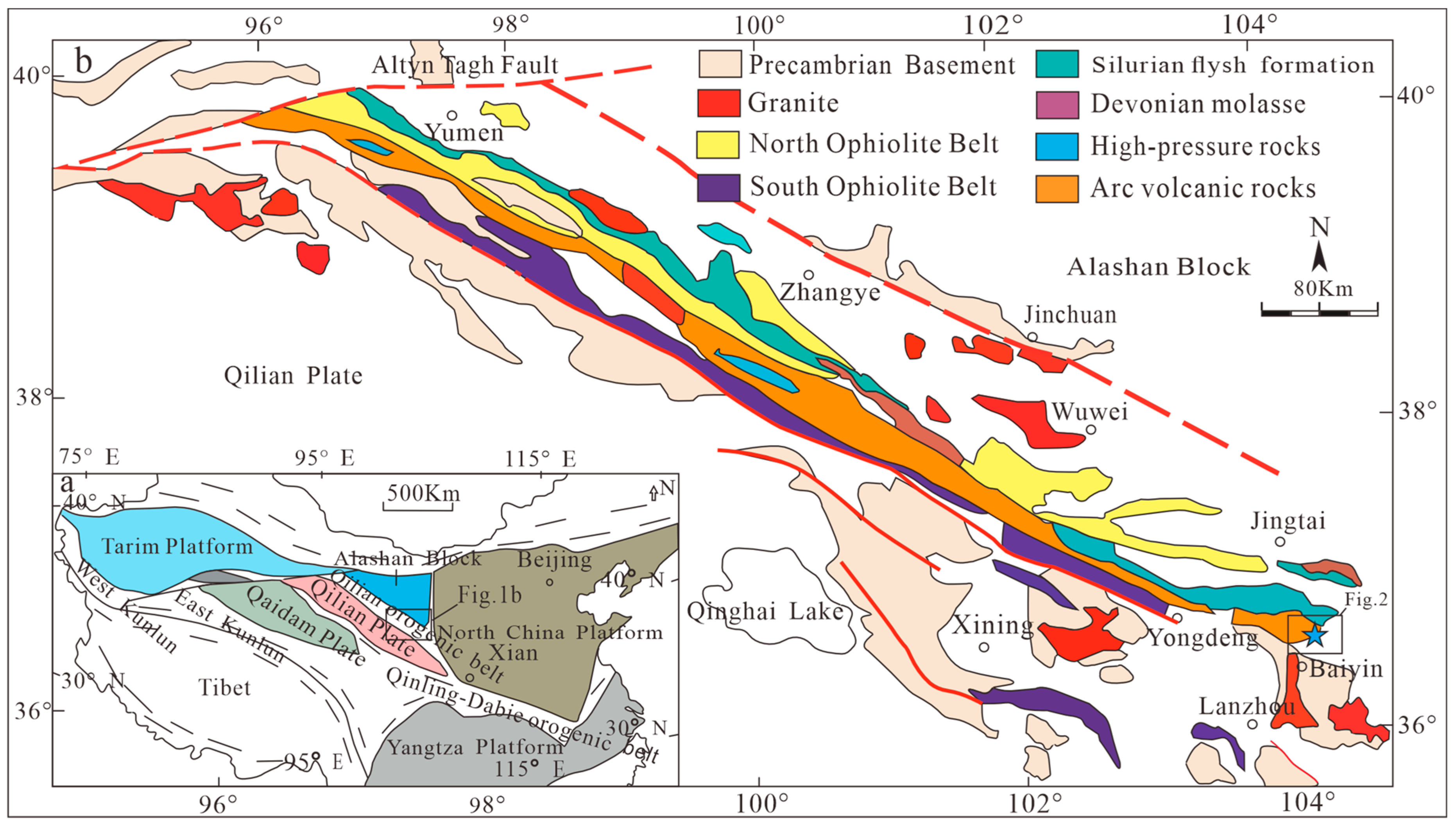
The North Qilian orogenic belt in Western China is a significant VMS metallogenic. The orogenic belt links the Alxa Block with the Qaidam Block, while being separated from the Tarim Basin to the west and the northern China Craton to the east (Figure 1a). The northwestern sector of the Qilian Orogenic Belt is offset by the Altyn Tagh Fault, the largest left-lateral strike-slip fault in western China (Figure 1b). This orogenic belt hosts numerous polymetallic deposits genetically linked to Paleozoic oceanic subduction and subsequent continental collision [11,12,13,14]. The Huoyanshan Cu-Zn deposit is a large volcanic-hosted massive sulfide (VMS) deposit within the Baiyinchang ore field. The Cu, Zn, Pb and Ag resources are 0.251 Mt, 0.013 Mt, 0.001 Mt and 5 t respectively [15]. Numerous studies have investigated its chronology [16,17], fluid inclusions [18,19], and Geochemistry of volcanic rocks [20,21]. However, the Huoyanshan deposit remains poorly constrained at the micro-scale, and key aspects of its ore-forming fluid evolution and metal precipitation mechanisms are still not fully resolved. Specifically, three critical questions require further investigation: (1) the specific enrichment mechanisms of economically critical metals; (2) the precise sources of ore-forming materials—whether they were derived primarily from magmatic fluids or involved significant contributions from seawater and/or wall–rock interactions; and (3) the genetic classification of the deposit. The application and development of in situ microzoning techniques has made mineral geochemistry of sulfides a proxy for a more detailed understanding of the nature and evolution of mineralized systems [10,22]. Pyrite, chalcopyrite and sphalerite are the most important sulfides in each metallogenic stage of Huoyanshan deposit, which can be used to reveal important physicochemical information before and after mineralization.
Figure 1.
(a) Schematic map of the major tectonic units of China, after [13,15]. (b) Geological map of the North Qilian Orogen, after [13,15].
In recent years, the in situ elemental and isotopic characteristics of sulfides have become key means to define the physicochemical conditions of ore-forming fluids, and thus to reconstruct the original ore-forming hydrothermal system [9,10,18]. Pyrite and sphalerite are ubiquitous sulfide minerals in volcanogenic massive sulfide (VMS) deposits. Although their ideal chemical formulas are FeS2 and ZnS, respectively, natural specimens typically host a wide range of trace elements [22,23]. Pyrite commonly incorporates Co, Ni, Cu, Zn, As, Au, Ag, Sb, Se, Te, Pb, and Bi, whereas sphalerite often contains Fe, Cu, Cd, Hg, Mn, As, In, Se, Ga, Ge, and Ag, among others [3,22,24,25,26,27,28]. These trace elements can be incorporated into the crystal structure via atomic substitution or occur as nano- to micro-scale inclusions [29,30]. Certain elements such as Pb, Bi, and Cu may exist in both forms within sphalerite [22,23]. The trace element composition of pyrite and sphalerite is strongly influenced by hydrothermal conditions, including temperature, pressure, pH, and oxygen fugacity [25]. Consequently, trace element concentrations can reveal temporal changes in fluid composition and help elucidate metal precipitation and enrichment mechanisms during ore formation. When combined with in situ sulfur isotope analysis of mineral assemblages, trace element data provide a powerful tool for reconstructing the evolution of VMS hydrothermal systems [10,31,32,33]. Such integrated approaches offer critical insights into mineralization processes and contribute significantly to genetic models of VMS deposits.
2. Geological Setting and Ore Geology
2.1. Geological Setting
The North Qilian Orogenic Belt, situated on the northeastern margin of the Qinghai–Xizang Plateau, represents a typical Caledonian orogenic belt. It is bounded by the Alxa Block to the north, the Qaidam Block to the south, and the Tarim Block to the west, separated by the Altun Fault (Figure 1a,b) [34,35,36,37]. This belt extends in an NW–SE direction for approximately 1200 km, with a width of about 300 km [38]. It comprises, from south to north, an Early Paleozoic mid-ocean ridge ophiolite belt, a central island arc volcanic belt, and a northern SSZ-type ophiolite belt (Figure 1b) [13,39]. The structural architecture of the North Qilian Orogenic Belt is complex and diverse, characterized mainly by two phases of faulting: an early NW striking system and a later NE to NNE striking system. A well-developed trench–arc–basin system is present, with various tectonic units—including island arcs, subduction complexes, and oceanic crustal fragments—distributed systematically from north to south [21]. The belt records the northward subduction and eventual closure of the North Qilian Ocean lithosphere between 520 and 440 Ma [13], and has been identified as a Paleozoic oceanic suture zone related to a branch of the North Qilian Ocean and the Proto-Tethys Ocean [40]. During the middle–late Cambrian, extensive basaltic volcanism in an intracontinental rift setting supplied essential metals for Cu-polymetallic mineralization. Subsequently, intense Middle Ordovician submarine volcanism associated with subduction–collision processes generated abundant ore-forming hydrothermal fluids and coeval fault systems, creating favorable geological conditions for volcanogenic massive sulfide (VMS) deposits [41,42].
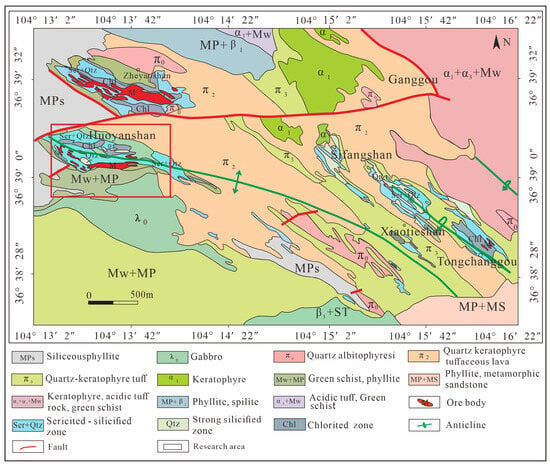
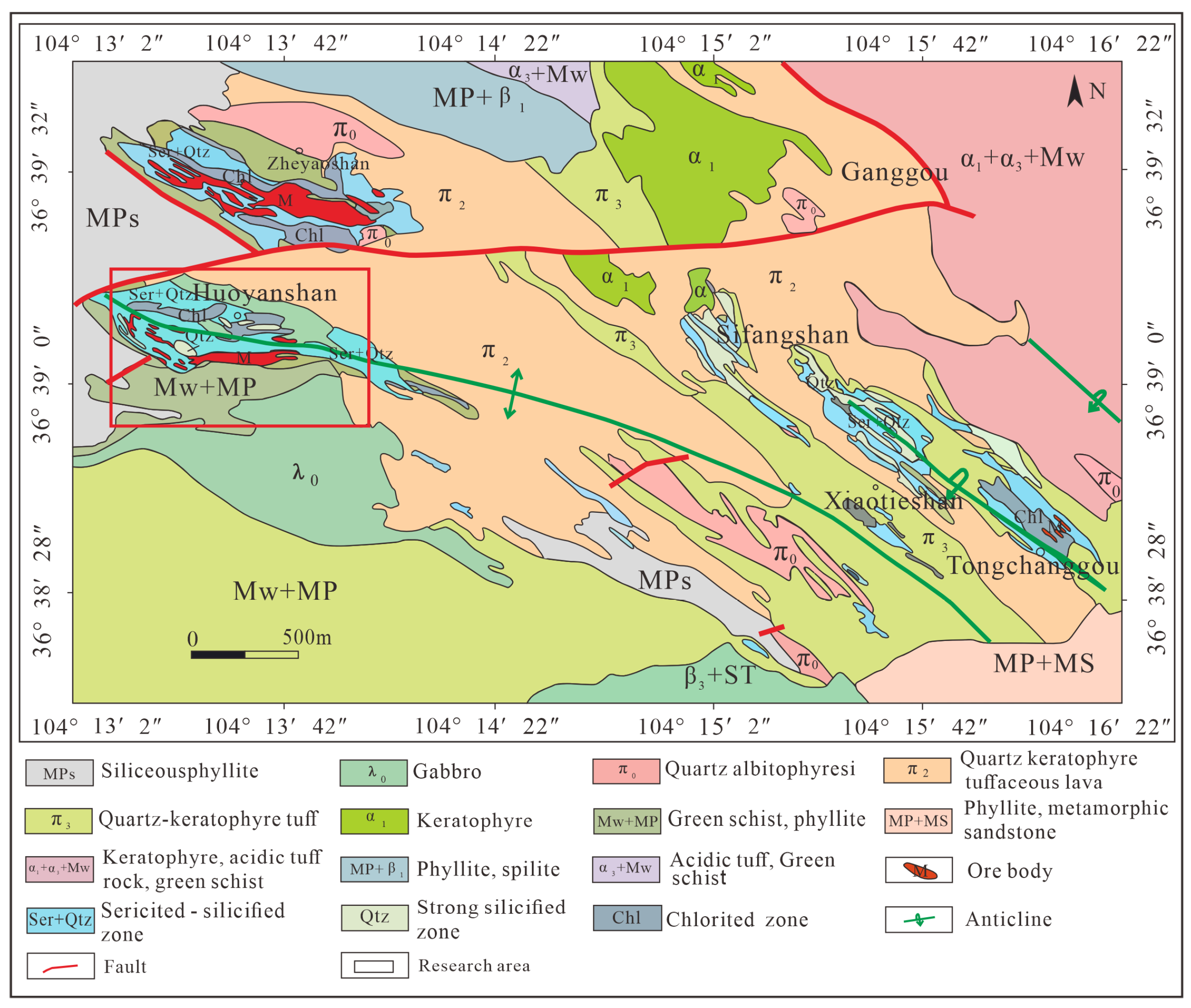
The predominant strata in the Baiyinchang orefield comprise the Cambrian Heicigou Formation, Xiangmaoshan Formation, and Ordovician Baiyin Group [43]. This region exhibits a sequence of Cambrian–Ordovician submarine volcanic eruptive sedimentary rocks, encompassing bimodal volcanic and sedimentary rock formations. Predominantly Middle Cambrian volcanic rocks shape a substantial volcanic dome within the ore field, primarily consisting of medium acid quartz keratophyre and keratophyre, with medium basic volcanic rocks surrounding it. Intrusive rocks in the region can be categorized into three types: (1) quartz diorite porphyry intrusions as rock stocks and dikes within acidic volcanic rocks; (2) diorite situated south of the Zheyaoshan deposit and sporadically at the Xiaotieshan deposit; and (3) back-arc granite mainly found at the Xiaotieshan deposit, interspersed with ore bodies [15]. The sedimentary strata in the area are relatively simple, with tuffaceous phyllite from the second to third cycles being the predominant lithology. Acting as the ore-bearing horizon of Baiyinchang type deposits, intermediate-acid volcanic rocks host five significant Cu polymetallic industrial deposits at various structural positions of the Baiyinchang volcanic dome. Notably, the NEE F1 fault, a larger fault, serves as a crucial structure controlling both rocks and ore in the area (Figure 2) [43].
Figure 2.
Geological map of the Baiyinchang ore field, after [15].
2.2. Ore Geology
Huoyanshan deposit is one of the large-scale VMS deposits in North Qilian orogenic belt, with average ore grades of 1.3% Cu, 1.4% Zn, 0.5% Pb, 0.79 g/t Au and 9.28 g/t Ag [15]. The ore-bearing strata of the Huoyanshan deposit are quartz keratophyre tuff (Figure 1b). The ore belt spans approximately 1400 m in length from east to west and 300 m in width. The general orientation is NWW in the east, transitioning to NNW in the west, with a steep dip towards the SW [44]. There are 221 ore bodies, Cu, Pb and Zn reserves of about 265,000 tons. The grade of ore bodies is generally rich in the east and poor in the west. The eastern orebodies are thick, concentrated and steep, and are mostly characterized by lenticular aggregates. The western ore bodies are thinner in horizon, multi-branched and complex in shape, and are mostly vein-like [44]. Generally, the orebodies are thicker in the upper and middle parts, and have a tendency for branching and pinching out to the deep upper and lower plates.
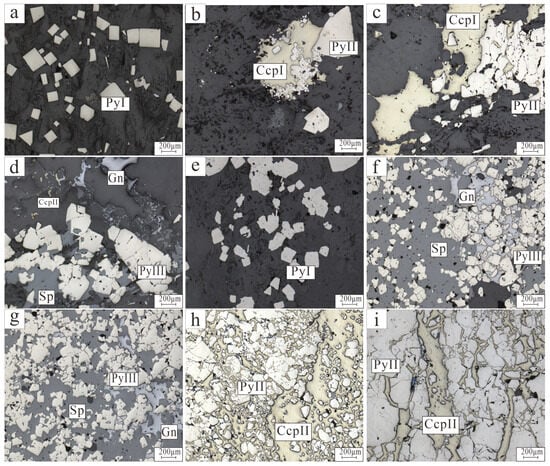
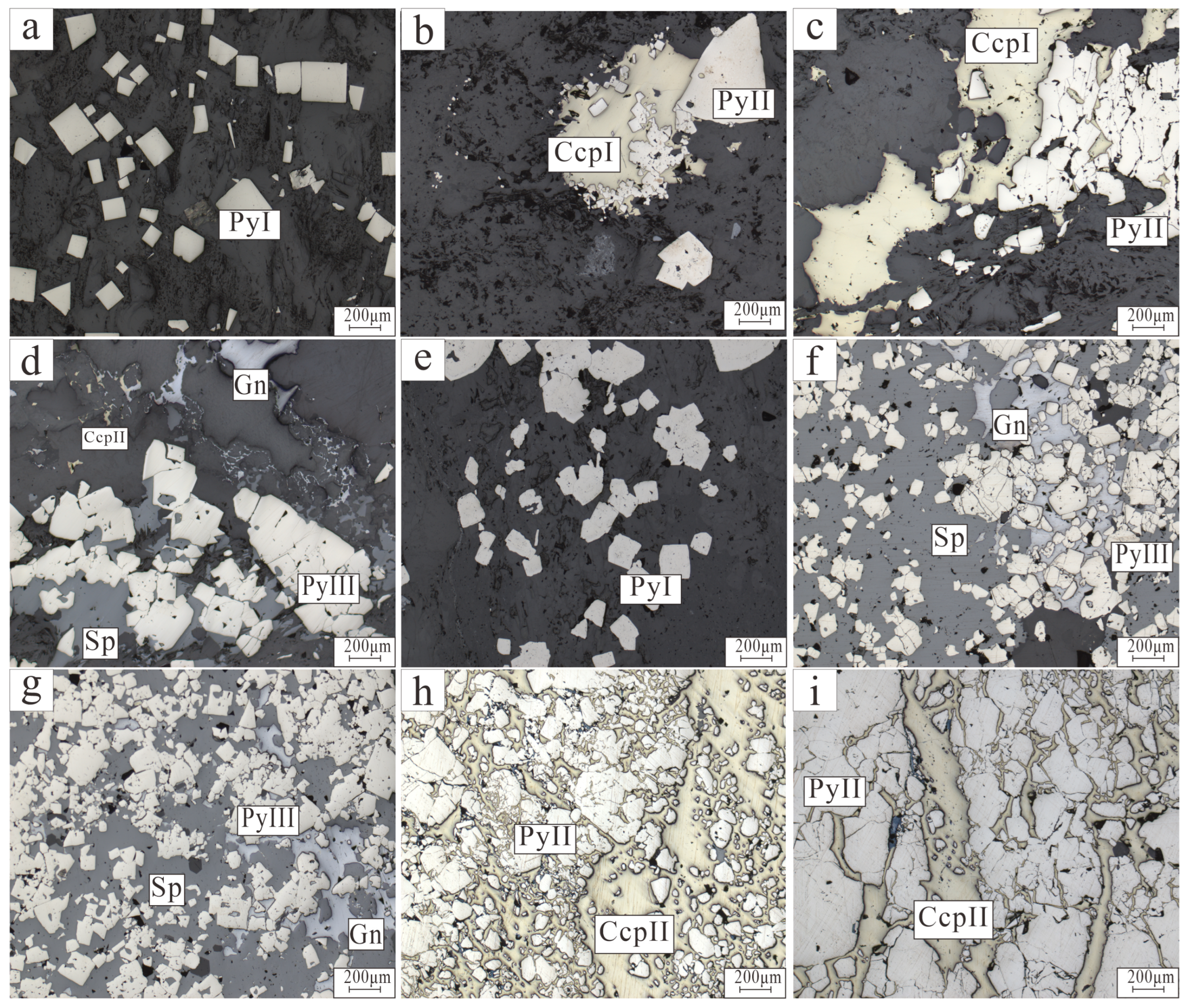
The ore textures of the Huoyanshan deposit are dominated by massive, disseminated, and vein-type structures. The metallic mineral assemblage principally consists of pyrite, chalcopyrite, sphalerite, and galena, with associated minerals such as pyrrhotite and bornite also present (Figure 3). Gangue minerals are predominantly quartz, sericite, chlorite, and calcite. Petrographic observations reveal that the ore exhibits a variety of textures, including euhedral to subhedral granular texture (Figure 3a), common rim texture (Figure 3b), brecciated texture (Figure 3c), inclusion texture (Figure 3c,d), and intergrowth texture (Figure 3g–i). Although chemical etching was not performed, distinct generations of minerals were rigorously recognized. Based on detailed petrographic observations (including cross-cutting relationships, overgrowths, and co-crystallizing mineral assemblages), and corroborated by systematic trace element variations observed during LA-ICP-MS profiling, pyrite can be categorized into three distinct types: (1) euhedral granular pyrite (Py I; Figure 3a,e); (2) pyrite coexisting with chalcopyrite (Py II; Figure 3b,c,h,i); and (3) pyrite associated with sphalerite and galena (Py III; Figure 3d,f,g).
Figure 3.
Photomicrographs showing sulfide textures and paragenetic relationships in the Huoyanshan deposit. (a) Fine-grained, euhedral Type I pyrite; (b) Type II pyrite exhibiting smooth mutual boundaries with chalcopyrite; (c) Type II pyrite being replaced by chalcopyrite; (d) Type III pyrite replaced by an assemblage of chalcopyrite, sphalerite, and galena; (e) Fine-grained, euhedral Type I pyrite; (f) Type III pyrite replaced by sphalerite and galena; (g) Type III pyrite replaced by sphalerite and galena; (h) Chalcopyrite filling fractures and replacing Type III pyrite along micro-cracks; (i) Chalcopyrite filling fractures and replacing Type II pyrite along micro-cracks. Mineral abbreviations: Py: pyrite; Ccp: chalcopyrite; Sp: sphalerite; Gn: galena.
These microtextural relationships collectively define a two-stage temporal sequence for the principal sulfide precipitation. The early stage is characterized by high-temperature mineral assemblages, predominantly euhedral Py I, followed by the co-crystallization of Py II and early chalcopyrite (Ccp I) (Figure 3a–c). The late stage records a cooler environment influenced by seawater mixing, characterized by the precipitation of sphalerite, galena, late-stage Py III, and late chalcopyrite (Ccp II), which frequently cross-cut or replace the earlier sulfides (Figure 3d,f–i).
3. Samples and Analytical Methods
3.1. Samples
Samples were collected from the underground tunnel (elevation 1655~1741 m) in Huoyanshan deposit, including typical massive sulfide ore, quartz-sulfide vein ore, chalcopyrite-rich sulfide ore, altered wall rock and mineralized wall rock. These samples were collected from different locations, aiming to collect samples at different stages and different spatial locations as much as possible.
3.2. LA-ICP-MS Trace Element Analysis
Trace element analysis of sulfides, specifically pyrite and sphalerite, was carried out on thin sections using laser ablation inductively coupled plasma mass spectrometry (LA-ICP-MS) at Nanjing FocuMS Technology Co., Ltd., Nanjing, China. The instrumentation consisted of a Teledyne Cetac Technologies Analyte Excite laser ablation system coupled with an Agilent Technologies 7700x quadrupole ICP-MS (Santa Clara, CA, USA). A 193 nm ArF excimer laser, homogenized through a series of beam delivery optics, was directed onto the sulfide surfaces with a fluence set at 3.0 J/cm2. Each analytical run included a 15-s background measurement, followed by 40 s of ablation using a 40 μm spot diameter at a repetition rate of 5 Hz. To avoid polyatomic mass interferences, the following specific isotopes were monitored during the analysis: 34S, 55Mn, 57Fe, 59Co, 60Ni, 65Cu, 66Zn, 75As, 77Se, 109Ag, 115In, 118Sn, 121Sb, 125Te, 197Au, 208Pb, and 209Bi. Helium was employed as the carrier gas at a flow rate of 370 mL/min to effectively transport the ablated material from the cell, subsequently mixed with argon (approximately 1.15 L/min) via a T-connector prior to introduction into the ICP torch. Calibration was performed externally using the USGS pressed polymetal sulfide pellet MASS-1 and the synthetic basaltic glass GSE-1G. Off-line data processing was carried out using ICPMSDataCal (Ver. 9.5) software, applying a 100% normalization strategy without internal standard correction [45].
3.3. LA-MC-ICP-MS Sulfur Isotopes Analysis
Sulfur isotope analysis of sulfide minerals (pyrite, sphalerite, and chalcopyrite) was carried out in situ using a Neptune Plus multi-collector inductively coupled plasma mass spectrometer (MC-ICP-MS) manufactured by Thermo Fisher Scientific, Bremen, Germany. This instrument was fitted with a Geolas HD excimer ArF laser ablation system from Coherent, Göttingen, Germany. The analyses were performed at Wuhan Sample Solution Analytical Technology Co., Ltd., Wuhan, China. Helium was employed as the carrier gas within the ablation cell, subsequently mixed with argon (as makeup gas) downstream of the cell. A relatively large spot diameter of 44 μm and a slow pulse frequency of 2 Hz were selected in order to mitigate the down-hole fractionation effect [46]. The laser energy density was maintained consistently at approximately 5 J/cm2.
Instrumental mass fractionation was corrected using the standard-sample bracketing (SSB) method. To account for potential matrix effects, matrix-matched reference materials were utilized: pyrite standard PPP-1 and chalcopyrite standard GBW07268 [46] were applied for correcting isotope analyses of natural pyrite and chalcopyrite, respectively [46]. The accuracy of this calibration approach was verified through repeated analyses of in-house reference materials, including pyrrhotite SP-Po-01 (δ34Sv-CDT = 1.4 ± 0.4‰) and chalcopyrite SP-CP-01 (δ34Sv-CDT = 5.45 ± 0.3‰), which were treated as unknown samples during the measurement sessions. All data reduction for sulfur isotope ratios obtained by MC-ICP-MS was performed using the “Iso-Compass” (Ver. 1.0) software package [47].
4. Results
4.1. Trace Element Compositions
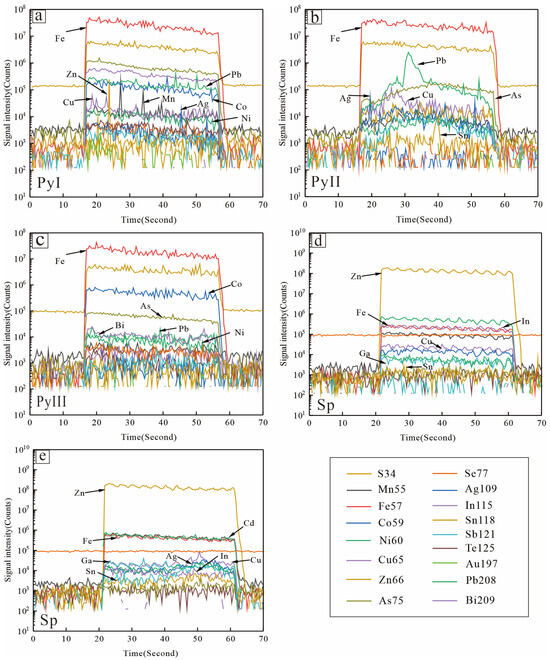
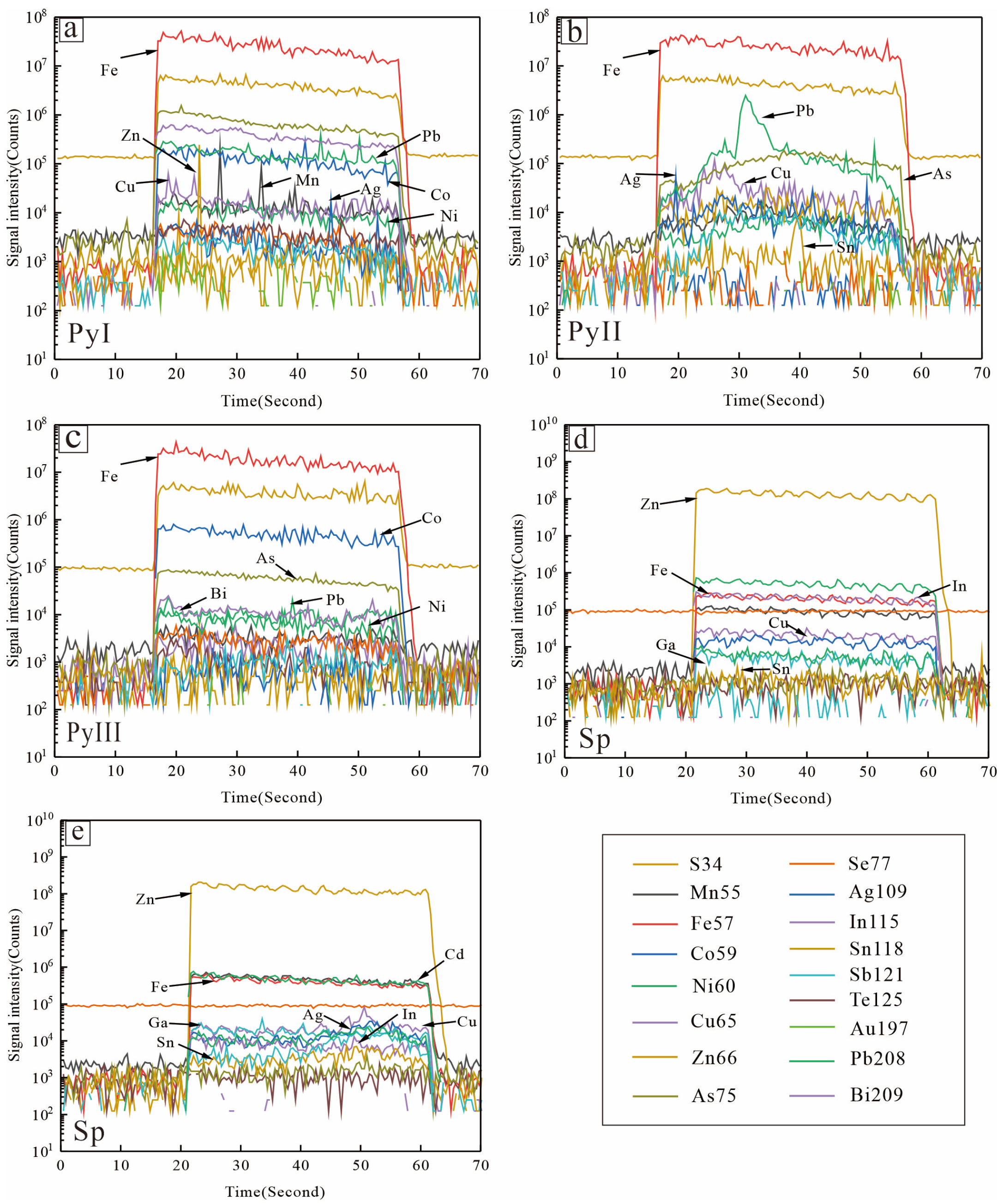
The in situ trace element compositions of pyrite and sphalerite exhibit systematic variations. To ensure analytical accuracy, inclusion-free grains were selectively targeted during analysis. Representative time-resolved depth profiles, which illustrate the distribution and homogeneity of the analyzed elements, are provided in Figure 4.
Figure 4.
Representative time-resolved LA-ICP-MS profiles in Huoyanshan deposit. (a) Py I; (b) Py II; (c) Py III; (d,e) Sp.
4.1.1. Pyrite Trace Element Compositions
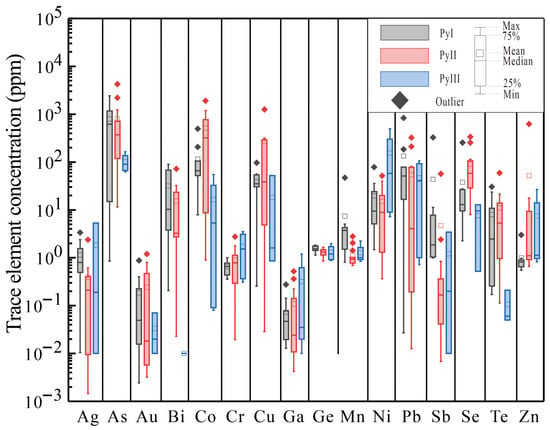
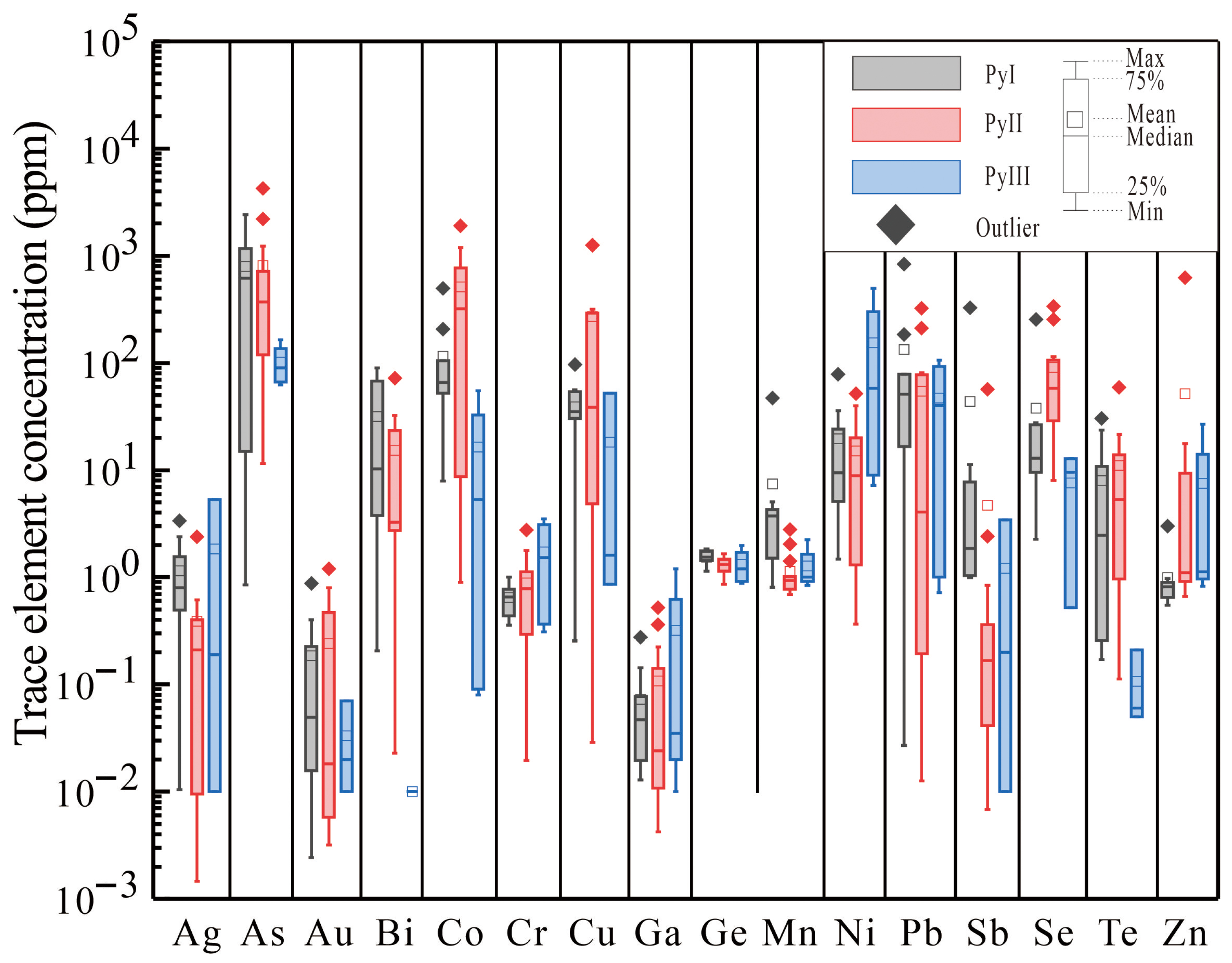
In situ trace element compositions of pyrite, as determined by laser ablation–inductively coupled plasma-mass spectrometry (LA-ICP-MS), are presented in Table 1 and illustrated in Figure 5. A representative LA-ICP-MS time-resolved ablation profile is provided in Figure 4. The analytical results reveal systematic variations in trace element concentrations among three generations of pyrite (Py I, Py II, and Py III). Ore-forming elements including Au, As, Bi, Cu, Pb, Sb, Se, and Te are generally present at low concentrations in Py I, become significantly enriched in Py II, and are relatively depleted in Py III. In contrast, elements such as Ag, Cr, Ga, and Ge exhibit a progressive depletion from Py I to Py III. Conversely, Co, Zn, and Mn display lower abundances in Py I and Py II but are markedly elevated in Py III. Ni is low in Py I and shows a gradual increase from Py II to Py III. These compositional variations likely reflect evolving physicochemical conditions during hydrothermal mineralization, suggesting changes in fluid source, precipitation mechanisms, or redox environment over the paragenetic sequence.
Table 1.
LA-ICP-MS trace element analysis results of pyrite from the Huoyanshan deposit (Element Concentration Unit: ppm).
Figure 5.
Box and whisker plots of the trace element contents of three types of pyrite from the Huoyanshan deposit.
4.1.2. Sphalerite Trace Element Compositions
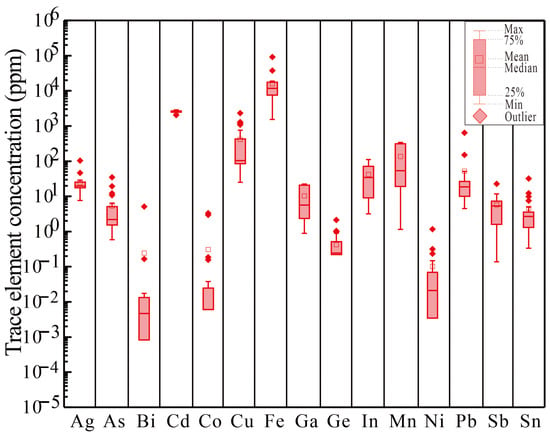
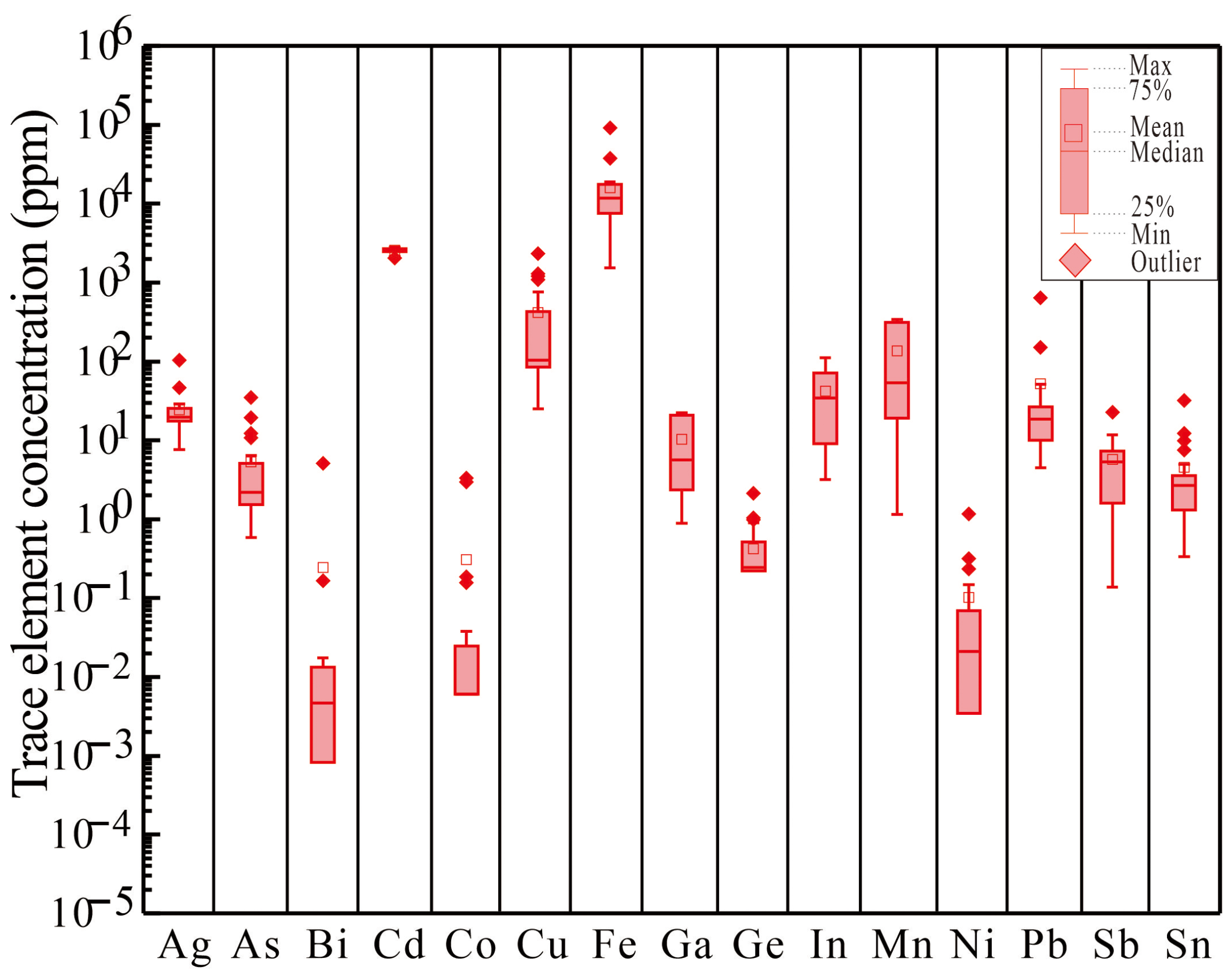
In situ trace element compositions of sphalerite, as determined by laser ablation–inductively coupled plasma-mass spectrometry (LA-ICP-MS), are presented in Table 2 and illustrated in Figure 6. A representative LA-ICP-MS time-resolved ablation profile is provided in Figure 4. Compositional analysis of Huoyanshan deposit sphalerite reveals Zn and S contents ranging from 55.43–70.94 wt.% (avg. 68.51) and 27.67–35.20 wt.% (avg. 29.5), respectively. The mineral is notably enriched in several trace elements, including Fe (0.15–9.09 wt.%, avg. 1.58 wt.%), Cd (2057.11–2819.31 ppm, avg. 2555.47 ppm), Cu (25.13–2332.44 ppm, avg. 416.90 ppm), Mn (1.14–342.51 ppm, avg. 137.09 ppm), In (3.17–111.62 ppm, avg. 42.24 ppm), and Ag (7.62–104.39 ppm, avg. 24.25 ppm). Moderately elevated concentrations are also observed for Ga (0.89–22.43 ppm, avg. 10.38 ppm), Sb (0.14–22.75 ppm, avg. 5.76 ppm), and Sn (0.33–32.11 ppm, avg. 4.56 ppm). In contrast, elements such as Co, Ni, and Bi occur in relatively low abundances.
Table 2.
LA-ICP-MS trace element analysis results of sphalerite from the Huoyanshan deposit (Element Concentration Unit: ppm).
Figure 6.
Box and whisker plots of the trace element contents of sphalerite from the Huoyanshan deposit.
4.2. S Isotopic Compositions
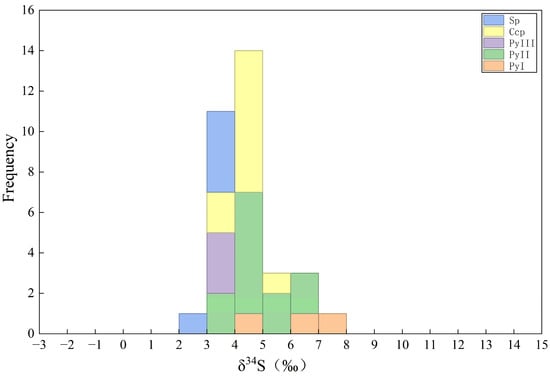
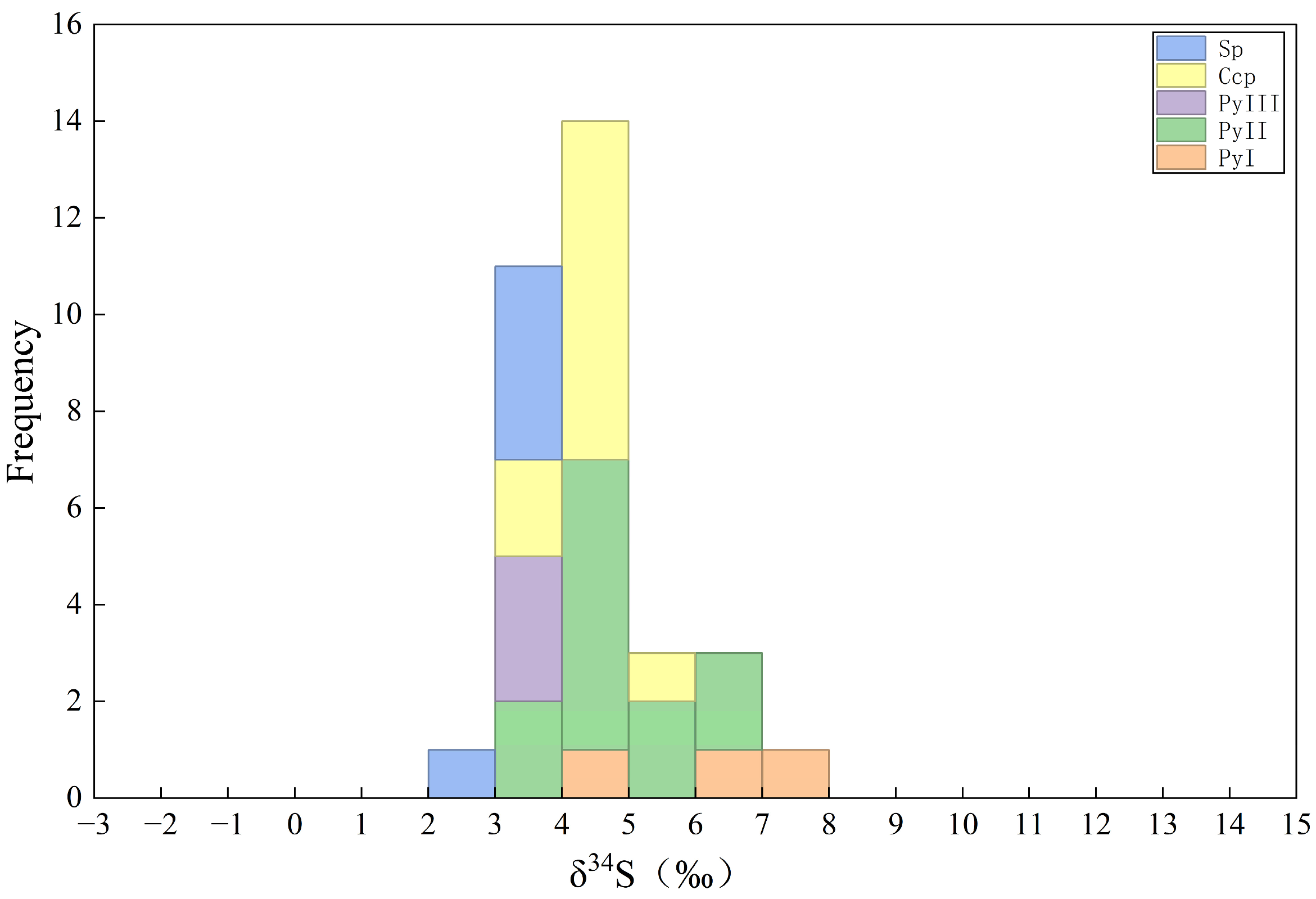
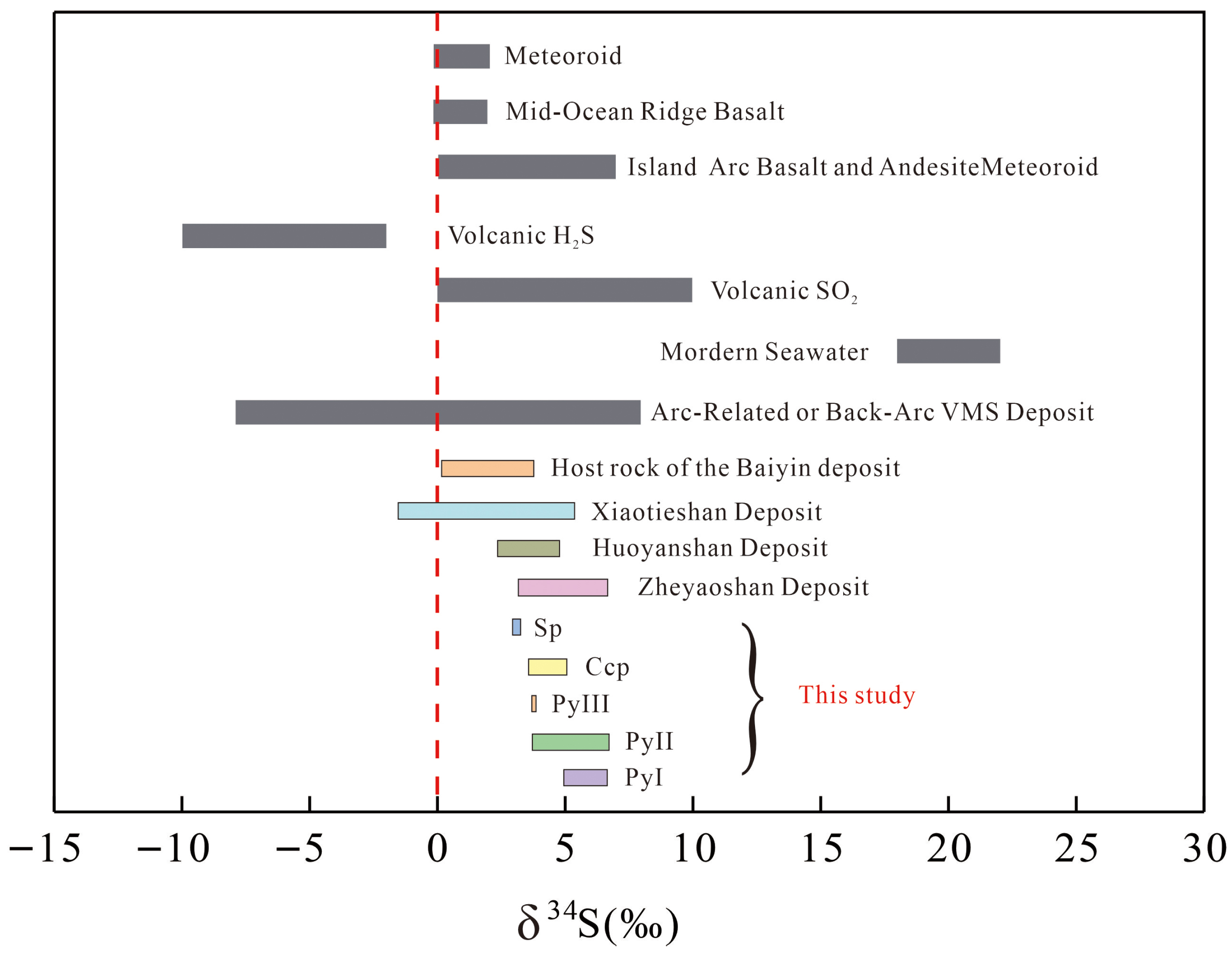
The sulfur isotopic compositions (δ34S) of sulfide minerals from the Huoyanshan deposit, including pyrite (n = 18), chalcopyrite (n = 10), and sphalerite (n = 5), were systematically analyzed. The results are summarized in Table 3 and illustrated in Figure 7. The δ34SV-CDT values range from 3.72 to 7.47‰ (avg. 4.93‰) for pyrite, 3.60 to 5.09‰ (avg. 4.40‰) for chalcopyrite, and 2.98 to 3.28‰ (avg. 3.15‰) for sphalerite. Notably, the average δ34S value of chalcopyrite (4.40‰) is heavier than that of sphalerite (3.15‰). In a hydrothermal system at isotopic equilibrium, sphalerite should be enriched in δ34S relative to chalcopyrite. This reversed isotopic fractionation indicates that the coexisting sulfides did not attain isotopic equilibrium. This disequilibrium was likely caused by rapid mineral precipitation or the rapid mixing of magmatic–hydrothermal fluids with cooler ambient seawater.
Table 3.
S isotope composition of sulfides in Huoyanshan deposit.
Figure 7.
Histogram of δ34S values for sulfides from the Huoyanshan deposit.
5. Discussion
5.1. Occurrence and Substitution Mechanisms of Trace Elements in Pyrite and Sphalerite
In pyrite studies, trace element geochemistry is commonly employed to decipher the formation environments and origins of pyrite [48]. As shown in the LA-ICP-MS depth profiles of three representative pyrite samples, elements such as Co, Ni, and As display stable and flat signals (Figure 4a–c), reflecting their homogeneous distribution within the pyrite structure [49]. These elements are incorporated into the pyrite lattice primarily through isomorphic substitution [50]. In particular, Ni and Co replace Fe2+ according to the coupled substitution mechanism: 2Fe2+ ↔ Co2+ + Ni2+.
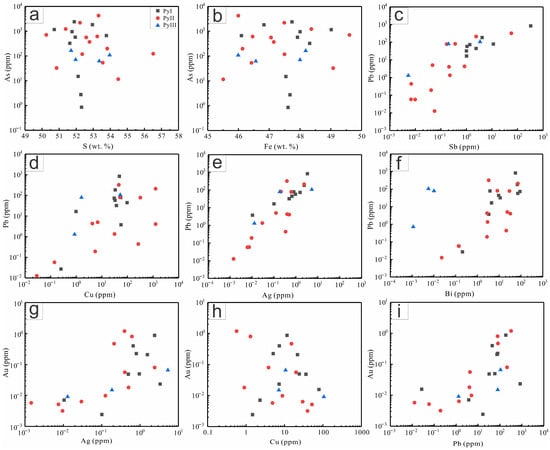
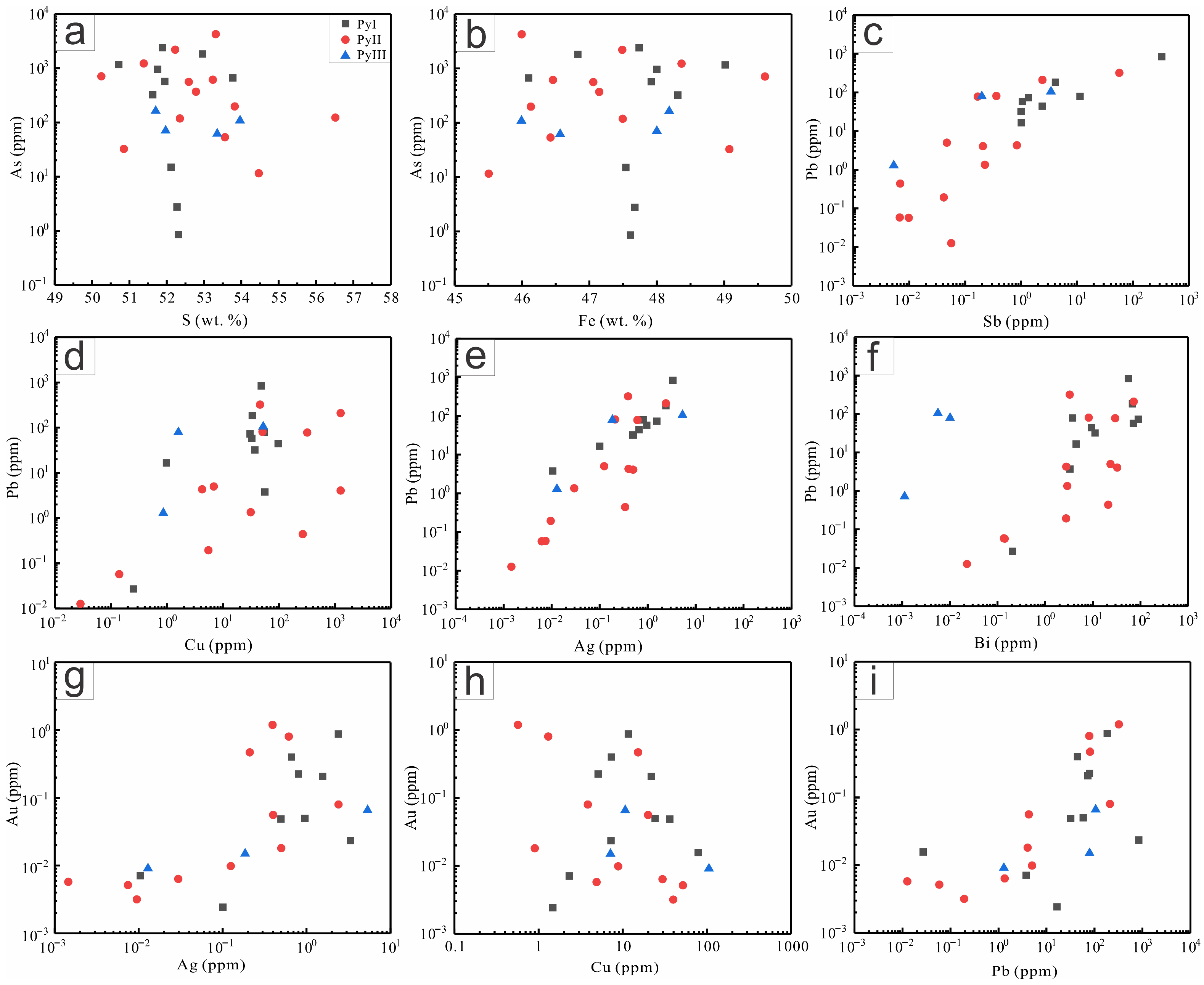
A pronounced negative correlation between As and S2− is observed, in contrast to a weak correlation between As and Fe2+ (Figure 8a,b), suggesting that As replaces S in the crystal lattice via an isomorphic mechanism [51,52]. This geochemical behavior implies that pyrite crystallized under reducing conditions [25,53]. Therefore, Co, Ni, and As likely occur in pyrite in isomorphic form, although the presence of nanoscale mineral inclusions hosting these elements cannot be entirely ruled out [53].
Figure 8.
Binary plots of (a) As vs. S, (b) As vs. Fe, (c) Pb vs. Sb, (d) Pb vs. Cu, (e) Pb vs. Ag, (f) Pb vs. Bi, (g) Au vs. Ag, (h) Au vs. Cu, (i) Au vs. Pb in three types of pyrite from the Huoyanshan deposit.
Due to its large ionic radius, Pb2+ is unlikely to be incorporated into the pyrite lattice via isomorphic substitution. Thermodynamic studies further indicate that Pb has a stronger tendency to precipitate as discrete sulfide minerals in aqueous solutions compared to iron [52,54,55,56]. LA-ICP-MS trace element analysis reveals characteristic spectral peaks associated with Pb–Bi mineral inclusions (Figure 4b). It should be noted that while the transient peaks for Pb are highly prominent and easily identifiable in representative time-resolved profiles (e.g., Figure 4b), the corresponding Bi signals are often significantly weaker due to their low absolute concentrations, occasionally falling near the background detection limits. Consequently, Bi is not explicitly labeled in the representative visual profile to avoid misinterpreting near-background noise. Nevertheless, the quantitative data (Table 1) and the robust positive correlation between Pb and Bi globally across the dataset (Figure 8f) consistently support their co-occurrence in these micro-inclusions. In addition, Pb exhibits strong positive correlations with Sb, Cu, Ag, and Bi (Figure 8c–f), which—combined with petrographic observations (Figure 3d,f,g)—collectively demonstrate that lead predominantly occurs in pyrite as nanoscale mineral inclusions [57,58]. Similarly, Au shows positive correlations with Ag, Cu, and Pb (Figure 8g–i), indicating that gold is also mainly present in the form of mineral inclusions within pyrite.
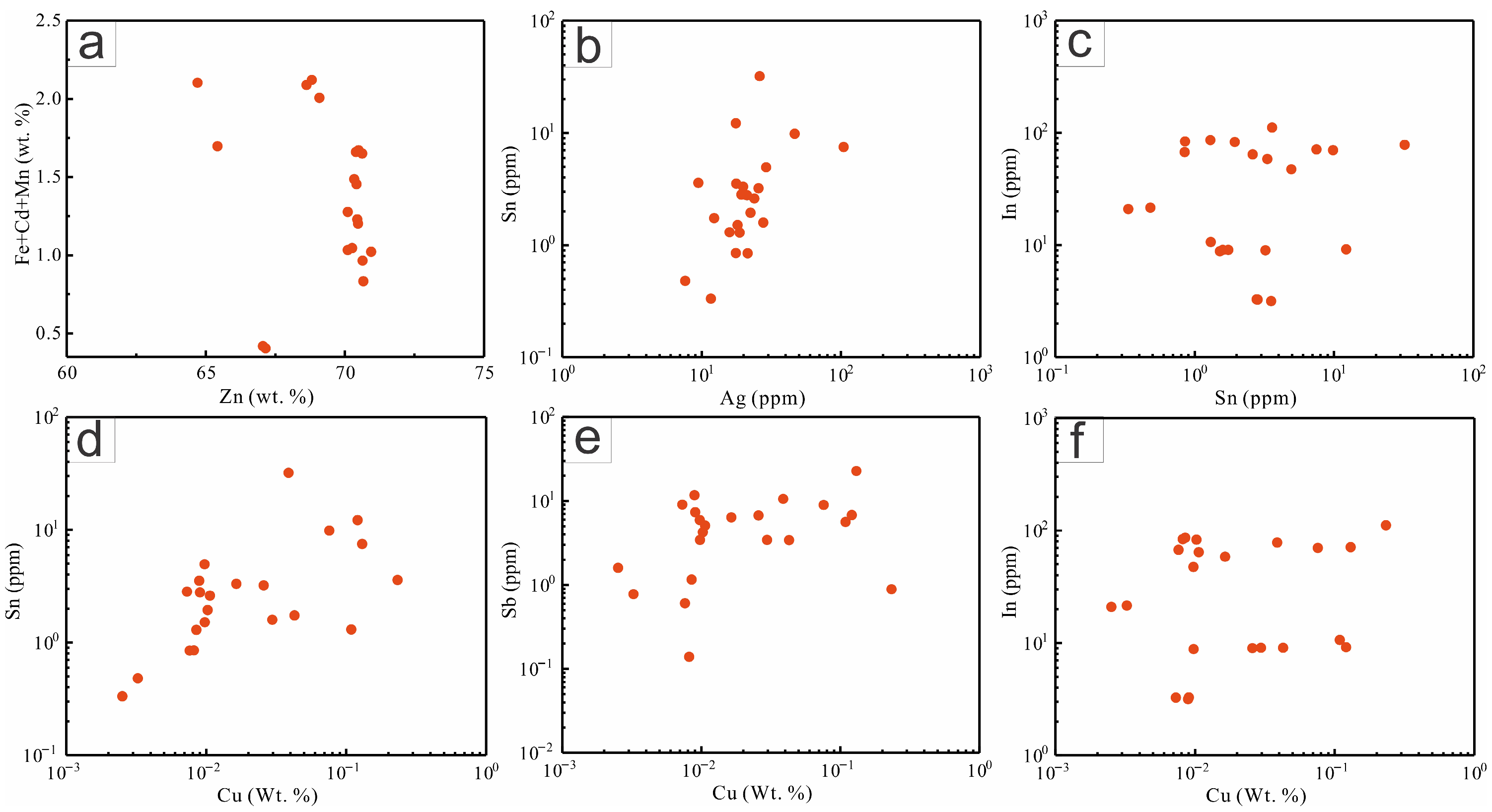
In the Huoyanshan deposit, LA-ICP-MS time-resolved spectra reveal that elements such as Fe, Mn, Cd, In, and Ga in sphalerite display profiles approximately parallel to that of Zn. This suggests their incorporation into the mineral structure either through isomorphic substitution or as homogeneously distributed nanoparticles. In contrast, elements including Cu, Ge, Sn, and Pb exhibit anomalous spectral curves (e.g., peaks or troughs; Figure 4d,e), indicating a dual mode of occurrence: partial isomorphism alongside micro-mineral inclusions. Previous studies on trace element substitution in sphalerite have demonstrated that divalent cations (e.g., Fe, Mn, Cd), due to their similar ionic radii to Zn2+, can directly replace Zn in the crystal lattice [3,22,23,29,56,59]. This mechanism is consistent with our data: the combination of a significant negative correlation between the (Fe + Mn + Cd) sum and Zn (Figure 9a) and the smooth, flat time-resolved profiles of these elements supports the occurrence of a direct substitution mechanism (Fe2+, Mn2+, Cd2+) ↔ Zn2+ in the deposit.
Figure 9.
Binary plots of (a) Fe + Cd + Mn vs. Zn, (b) Sb vs. Ag, (c) In vs. Sn, (d) Sb vs. Cu, (e) Sb vs. Cu, (f) In vs. Cu in sphalerite from the Huoyanshan deposit.
Furthermore, the extent of iron incorporation into the sphalerite lattice is known to be influenced by temperature, sulfur and/or oxygen fugacity during mineral formation [60,61,62]. Consequently, the high Fe content observed in some sphalerite samples from Huoyanshan suggests mineralization likely occurred under conditions of relatively low sulfur and/or oxygen fugacity, or at elevated temperatures [63,64].
Sphalerite from the Huoyanshan deposit exhibits a notably high Cu content. LA-ICPMS time-resolved spectra reveal two distinct ablation patterns for Cu (Figure 4): (1) a relatively smooth profile, indicative of Cu in solid solution within the sphalerite lattice; and (2) profiles featuring sharp, intermittent peaks, signaling the presence of micron-scale chalcopyrite inclusions—a texture commonly referred to as “chalcopyrite disease” [65]. While such physical interference can introduce statistical ‘noise’ in geochemical interpretations, these effects were rigorously addressed during our data processing. The significantly higher concentration of Cu compared to Ag in our samples suggests that Cu+ serves as the primary monovalent cation facilitating coupled substitutions. The positive correlations of Cu with Sb3+ and Sn4+ (Figure 9d,e) indicate that Cu enters the sphalerite lattice via the substitution mechanisms: 2Zn2+ ↔ Cu+ + Sb3+ and 3Zn2+ ↔ 2Cu+ + Sn4+. Furthermore, a significant positive correlation between Cu and In (Figure 9f) confirms the well-established 2Zn2+ ↔ Cu+ + In3+ substitution [66]. The correlation observed between In and Sn (Figure 9c) further suggests the potential operation of more complex mechanisms, such as 3Zn2+ ↔ In3+ + Sn2+ + (Cu, Ag) + or 4Zn2+ ↔ In3+ + Sn4+ + (Cu, Ag) + + □ [22,23].
To ensure the accuracy of the trace element data and the subsequent geothermometry, all LA-ICP-MS time-resolved spectra were carefully inspected. Analytical segments exhibiting sharp, intermittent Cu and Fe spikes—characteristic of chalcopyrite inclusions—were strictly excluded during off-line data reduction. Only the stable plateau signals representing the elements held within the sphalerite crystal lattice were integrated. Consequently, the high Fe and Cu concentrations discussed in the following sections reflect the true lattice-bound composition of the sphalerite, rather than contamination from mineral inclusions.
5.2. Mineralization Temperature
Trace element concentrations in sphalerite (e.g., Fe, Mn, Ga, Ge, In) are highly sensitive to formation temperature, making it an effective geothermometer [23,29,61,67]. While conventional methods relying solely on FeS content have certain limitations [68,69], recent multivariate approaches, such as the trace element-based “GGIMFis” geothermometer developed by Frenzel et al. [23], provide a robust alternative for constraining mineralization temperatures.
In this study, the crystallization temperatures of sphalerite were determined using the “GGIMFis” geothermometer developed by Frenzel et al. [23]. This trace-element-based thermometer calculates temperature (T) using the principal component (PC 1′), which is derived from the concentrations of Ga, Ge, Fe, Mn, and In. The specific equations are as follows:
where CGa, CGe, CMn and CIn are trace element concentrations in ppm, and CFe is the iron concentration in wt.%. Applying these equations to the trace element data presented in Table 2, the calculated temperatures range from 225 °C to 301.6 °C (avg. 265.8 °C). These values are in close agreement with fluid inclusion homogenization temperatures (ca. 265 °C) previously reported for the same deposit by the Gansu Nonferrous Geological Survey Bureau [43], effectively constraining the thermodynamic regime of the mineralization system during its waning stage. Since the analyzed sphalerite is intimately intergrown with Py III and galena (Figure 3d,f,g), this average temperature specifically represents a thermal “snapshot” of the waning hydrothermal system. The medium-to-low temperature regime captures the cooling trajectory from the initial high-temperature core (>300 °C) associated with early-stage mineralizing fluids. The transition from high-temperature Py I and II to the 265.8 °C environment of sphalerite and Py III reflects the typical spatial and temporal evolution of VMS hydrothermal upflow zones.
5.3. Origin of Sulfur
Volcanic massive sulfide (VMS) deposits originate from prolonged and complex interactions between seawater-derived hydrothermal fluids and the crust [4,8,70,71,72,73,74,75,76]. Extensive research indicates that the sulfur in these hydrothermal mineralization systems is primarily derived from three principal sources: (1) leaching of sulfur-bearing components from the surrounding coeval felsic volcanism [77]; (2) magmatic sulfur contributions [78,79,80]; and (3) reduction of coeval seawater sulfate via thermochemical sulfate reduction (TSR) or bacterial sulfate reduction (BSR) [7,9,81].
A minor presence of barite and gypsum, along with other silicate minerals, is observed in the Huoyanshan deposit. This suggests the probable involvement of seawater sulfate during the early stages of mineralization. However, the δ34S values of sulfides analyzed in this study exhibit a high degree of homogeneity and are characterized by a tightly clustered distribution (Figure 7). According to the model established by Ohmoto [82], under conditions where large-scale sulfate precipitation is absent and the fluid maintains a low oxygen fugacity (fO2), the δ34S values of resultant sulfides can closely approximate the δ34S composition of the total sulfur in the hydrothermal fluid.
During the early-to-middle stages of mineralization, pyrite (Py I and Py II) exhibits relatively enriched δ34S values ranging from +4.98‰ to +7.47‰. These values are consistent with the δ34S ranges documented for many Paleozoic volcanic-hosted massive sulfide (VMS) deposits [7]. Although sulfides precipitated from pristine magmatic–hydrothermal fluids are commonly characterized by lighter S isotopes (approaching 0 ± 3‰) [83], the enriched δ34S values of Py I and Py II (+4.98‰ to +7.47‰) observed in the Huoyanshan deposit represent a significant positive isotopic shift. This enrichment is interpreted to reflect the dominant influence of thermochemical sulfate reduction (TSR) [7,77]. High-temperature magmatic fluids, which are supported by the elevated Co/Ni ratios, likely interacted with infiltrated Paleozoic seawater, promoting the reduction of isotopically heavy marine sulfate to H2S [82,84]. The incorporation of this reduced, heavy sulfur into the hydrothermal system overprinted the original magmatic signature, thereby reconciling the enriched sulfur isotopes with the magmatic-hydrothermal origin of the deposit.
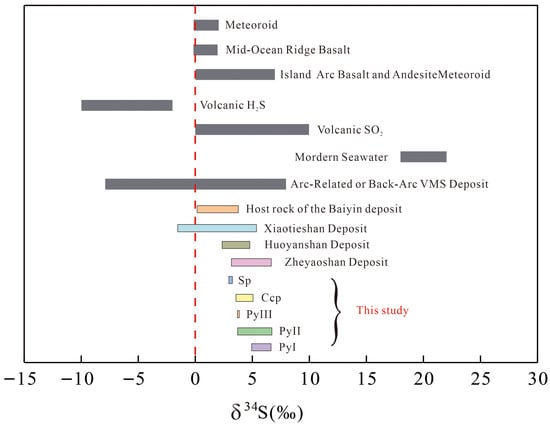
The late-stage pyrite (Py III) records a marked geochemical shift, characterized by a decrease in δ34S values to approximately +3.72‰ to +3.89‰ and a pronounced drop in the Co/Ni ratio to below 0.1. This synchronous isotopic and elemental shift reflects an increase in oxygen fugacity (fO2) and cooling of the fluid, driven by the collapse of the hydrothermal plume and the incursion of oxygenated seawater [82,85]. Although the dataset for Py III is limited, the consistent clustering of these values near the host rocks composition (+3.68‰; Figure 10) implies that, while oxidation can drive fractionation towards lighter values [82], the sulfur budget became increasingly dominated by the recycling of sulfur from the volcanic wall-rock sequence as the direct magmatic input waned [51,86]. Furthermore, as noted in Section 4.2, the sulfur isotopic disequilibrium observed between chalcopyrite (δ34S avg. 4.40‰) and sphalerite (δ34S avg. 3.15‰) strongly corroborates the multi-stage nature of the Huoyanshan deposit. Chalcopyrite, primarily associated with the Py II stage, reflects the earlier, isotopically enriched magmatic–hydrothermal fluid modified by TSR. In contrast, sphalerite co-precipitated with Py III during the waning stage, capturing the isotopic shift towards lighter values caused by the progressive incursion and mixing of oxidized seawater.
Figure 10.
Sulfur isotopic compositions of Huoyanshan deposit (base map for the potential source area and the data for other deposits were compiled from previous studies [43,87,88,89,90]).
5.4. Ore Genesis
The trace element composition of sulfide minerals acts as a sensitive archive of mineralization conditions, capturing the complex interplay between crystallization temperature, fluid source, and precipitation mechanism. Therefore, systematic geochemical analysis of sulfides, particularly pyrite, provides a powerful diagnostic tool for discriminating between distinct genetic deposit types and for reconstructing the temporal evolution of hydrothermal systems [28].
Within the pyrite lattice, cobalt and nickel are incorporated primarily via isomorphous substitution for iron. The partitioning of these elements is strongly temperature-dependent: Co is preferentially incorporated into pyrite at elevated temperatures, whereas Ni exhibits limited temperature sensitivity or may even be slightly enriched in lower-temperature fluids [84]. Consequently, the Co/Ni ratio in pyrite is widely employed as a sensitive discriminant for deposit genesis [29,91]. Typically, pyrite formed from high-temperature hydrothermal fluids in volcanogenic massive sulfide (VMS) systems displays Co/Ni ratios between 5 and 100, in contrast to sedimentary or diagenetic pyrite, which generally yields ratios below 1 [53].
Based on integrated in situ trace element and sulfur isotope data, together with the multivariate geochemical discrimination presented in Figure 11, the Huoyanshan deposit is interpreted to have formed in a dynamic magmatic–hydrothermal system that underwent two distinct evolutionary stages. During the early high-temperature core stage (>300 °C), metal-rich, reduced fluids driven by magmatic heat ascended and precipitated pyrite (Py I and Py II). This stage is represented by the precipitation of Py I and Py II, which exhibit euhedral to subhedral textures and smooth mutual boundaries with chalcopyrite, suggesting primary crystallization from the ore-forming fluid rather than later metamorphic recrystallization (Figure 3a–c). These pyrites plot above the 1:1 line in Figure 11b and exhibit elevated Co/Ni ratios, and consistently fall within the magmatic-hydrothermal fields in Figure 11c,d, supporting a magmatic fluid source [5,84]. Their relatively heavy δ34S values (+4.98‰ to +7.47‰) reflect thermochemical sulfate reduction (TSR) of entrained Paleozoic seawater sulfate by high-temperature magmatic fluids, introducing isotopically heavy sulfur into the system [7,77]. As the hydrothermal system waned, the late stage was characterized by progressive seawater ingress [92]. Cool, oxidized seawater infiltrated the fluid conduits, leading to mixing and increased oxygen fugacity (fO2) [51,82]. Py III displays a pronounced shift toward the Ni-enriched domain in Figure 11b,d, with Co/Ni ratios (<0.1) approaching those of sedimentary pyrite. This coupled isotopic and elemental shift records fluid cooling, oxidation, and seawater mixing during the final stage of mineralization. It should be noted, however, that the trace element dataset for Py III is currently limited (n = 4). While the observed geochemical shift is consistent with late-stage seawater incursion and cooling, these interpretations regarding the final mineralization phase should be treated with caution. Further analytical work with a larger sample size of Py III is required to fully validate this evolutionary model.
This evolutionary path—from a magmatically dominated, high-temperature core to a seawater-inundated, cooler margin—is a diagnostic feature of classical VMS systems worldwide [4,8]. From a spatial and exploration perspective, although our current sampling was primarily restricted to specific underground elevations (1655~1741 m), the observed geochemical transition offers potential vectoring tools for future mineral exploration. The high Co/Ni ratios and enriched heavy trace elements in early-stage pyrite (Py I and Py II) can serve as a robust proxy for proximity to the high-temperature upflow zones or vent cores of the VMS system. Conversely, the lower Co/Ni ratios and specific trace element signatures in late-stage sulfides reflect peripheral or cooler environments. Recognizing these micro-scale trace element patterns can thus aid in vectoring towards hidden high-grade ore bodies in the deeper parts or margins of the Baiyinchang ore field. Therefore, based on the integrated evidence from early-stage pyrite and sphalerite geochemistry, the Huoyanshan deposit is classified as a magmatic–hydrothermal-type VMS deposit.
Further genetic constraints can be derived from the ratios of As/Ag and Sb/Bi. According to Augustin et al. [93], diagenetic pyrite is characterized by low As/Ag and medium Sb/Bi, magmatic pyrite by low values in both ratios, and hydrothermal pyrite by high As/Ag and medium Sb/Bi. When plotted on a binary As/Ag–Sb/Bi diagram (Figure 11c) and a Co–Ni–As ternary diagram (Figure 11d), both early (Py I) and late (Py II) generations of Huoyanshan pyrite predominantly fall within the magmatic–hydrothermal field. This consistent signature further corroborates a magmatic–hydrothermal origin for the pyrite mineralization in the deposit.
Figure 11.
Discriminant diagrams for the Huoyanshan deposit. (a) Plot of lnGa vs. lnIn in sphalerite (Base map after [94]); (b) Co vs. Ni diagram for pyrite; (c) As/Ag vs. Sb/Bi diagram (Base map after [93]); (d) Co-Ni-As ternary diagram for pyrite (Base map after [95]).
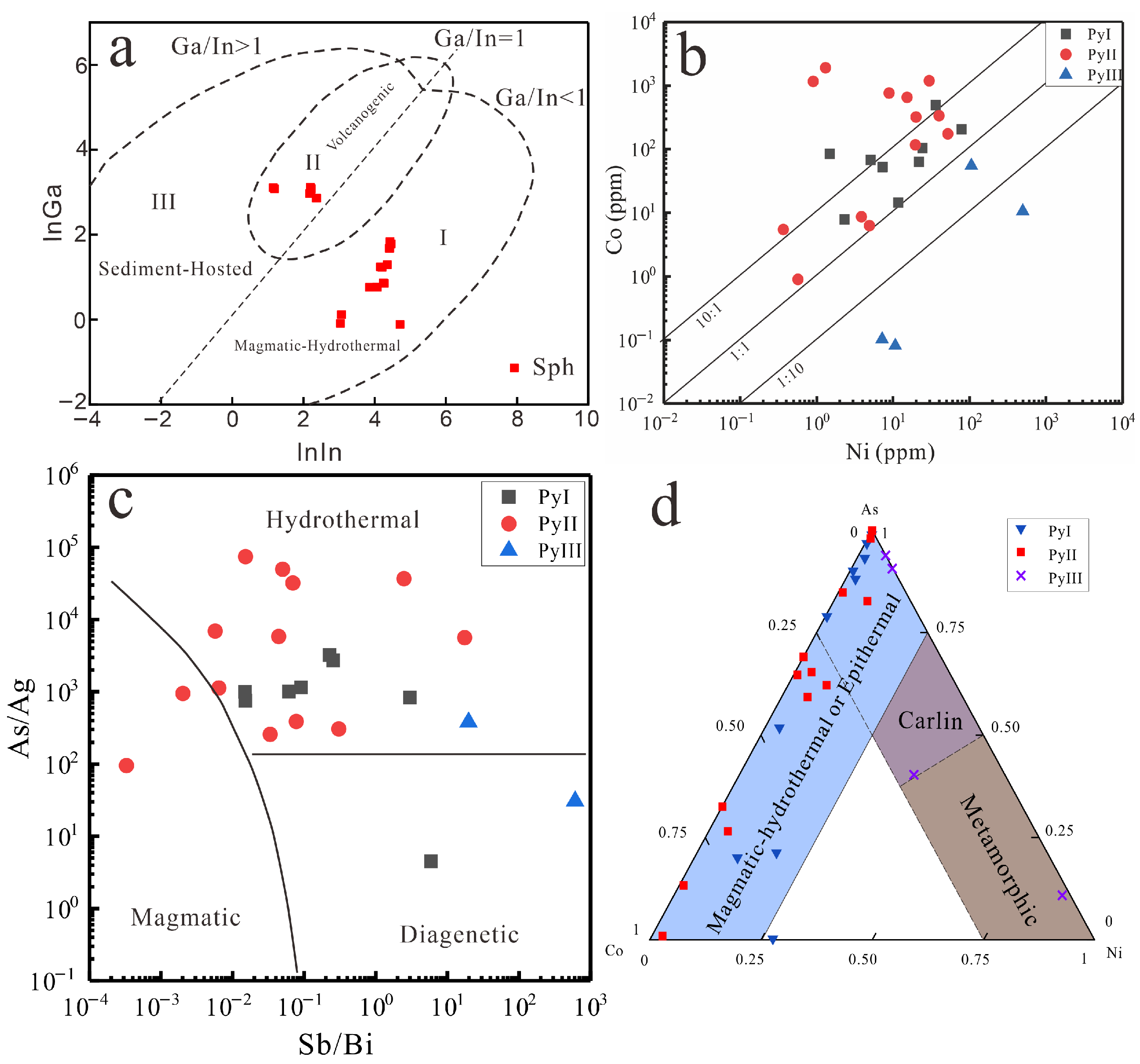
The Ga/In and Ge/In ratios in sphalerite serve as sensitive geochemical indicators for discriminating deposit genesis, particularly in identifying magmatic–hydrothermal affiliations. Typically, sphalerite from magmatic–hydrothermal systems is characterized by Ga/In < 1 and Ge/In < 0.1, whereas sphalerite from sedimentary or stratiform deposits commonly exhibits both ratios greater than 10 [29,92]. In the Huoyanshan deposit, sphalerite displays Ga/In ratios ranging from −8 to 7.05 (avg. 1.63) and Ge/In ratios from 0.1 to 0.23 (avg. 0.04). Notably, the average values of both ratios fall within the range indicative of a magmatic–hydrothermal origin. This interpretation is further supported by a sphalerite trace element discrimination diagram (Figure 11a), in which all analytical data plot within the fields for volcanic-associated and magmatic–hydrothermal deposit types. Collectively, these lines of evidence strongly suggest that the Huoyanshan deposit is genetically linked to magmatic–hydrothermal activity.
6. Conclusions
Based on comprehensive fieldwork, petrographic studies, and in situ LA-(MC)-ICP-MS analysis of sulfide minerals from the Huoyanshan Cu-Zn polymetallic deposit, the following conclusions can be drawn:
(1) In pyrite, trace elements such as Co, Ni, and As are hosted primarily by isomorphic substitution within the crystal lattice. Pb and Bi occur predominantly as micro-to-nano-scale mineral inclusions; notably, Bi signals are visually subdued in time-resolved profiles due to their low absolute concentrations. In sphalerite, Fe, Mn, and Cd enter the lattice via direct substitution for Zn, while Cu incorporation is achieved through coupled substitution with elements such as Sb, Sn, and In (e.g., 2Zn2+ ↔ Cu+ + In3+).
(2) Trace element compositions in sphalerite indicate formation in a medium-to-low-temperature environment. Application of the “GGIMFis” geothermometer yields crystallization temperatures ranging from 225 °C to 301.6 °C (avg. 265.8 °C), which is consistent with fluid inclusion homogenization data. This temperature regime specifically captures a thermal “snapshot” of the waning hydrothermal system during the precipitation of late-stage sulfides.
(3) The mineralization evolved through two distinct geochemical stages characterized by a lack of sulfur isotopic equilibrium, strongly supporting the multi-stage nature of the deposit. Early High-Temperature Stage: This stage was dominated by high-temperature (>300 °C), reduced magmatic–hydrothermal fluids. It precipitated Py I and Py II, characterized by high Co/Ni ratios (>1). Their enriched δ34S signatures (+4.98‰ to +7.47‰) reflect the reduction of entrained Paleozoic seawater sulfate via thermochemical sulfate reduction (TSR) by the ascending magmatic fluids, which modified the original magmatic sulfur isotopic signature. Late Seawater-Influenced Stage: Following the fracturing of the primary hydraulic seal, the incursion of cold, oxygenated seawater led to the precipitation of Py III and sphalerite. This stage is marked by sediment-like Co/Ni ratios (<0.1) and lighter sulfur isotopic compositions, reflecting the oxidative mixing of residual hydrothermal fluids with seawater. The observed isotopic reversal (δ34Spy > δ34Sccp > δ34Ssp) confirms this disequilibrium and distinct paragenetic shift.
(4) Integrated trace element diagnostic ratios (Co/Ni in pyrite; Ga/In and Ge/In in sphalerite) and sulfur isotopes definitively classify Huoyanshan as a typical magmatic–hydrothermal VMS deposit genetically linked to Ordovician submarine volcanism. Importantly, the observed micro-scale transition from a high-temperature, Co/Ni-enriched magmatic core to a cooler, seawater-mixed margin provides a robust geochemical vectoring tool. Recognizing these temporal and spatial trace element patterns can significantly aid in vectoring towards hidden high-temperature upflow zones or vent centers in the Baiyinchang ore field.
Author Contributions
Writing—original draft, Z.Z. and X.G.; Funding acquisition, P.H. and X.G.; Investigation, Z.Z.; Methodology, P.H.; Supervision, P.H.; Data curation, Z.Z., Z.W. and B.M.; Validation, P.H., Z.Z. and B.M.; All authors have read and agreed to the published version of the manuscript.
Funding
This research was funded by the following projects: National Key Research and Development Program (No. 2022YFC2903305-05), Key Laboratory of Western Mineral Resources of Gansu Province (No. 2025055), and Gansu Provincial Bureau of Nonferrous Metal Geological Exploration (No. YSJG2024-06).
Data Availability Statement
Data are contained within the article.
Acknowledgments
The authors gratefully acknowledge the financial support from the funding agencies listed in the Funding section. We also extend our gratitude to the anonymous reviewers for their constructive comments.
Conflicts of Interest
The authors declare no conflicts of interest.
References
- Soltani Dehnavi, A.; McFarlane, C.R.M.; Lentz, D.R.; Walker, J.A. Assessment of Pyrite Composition by LA-ICP-MS Techniques from Massive Sulfide Deposits of the Bathurst Mining Camp, Canada: From Textural and Chemical Evolution to Its Application as a Vectoring Tool for the Exploration of VMS Deposits. Ore Geol. Rev. 2018, 92, 656–671. [Google Scholar] [CrossRef] [Scilit]
- Basori, M.B.I.; Gilbert, S.; Large, R.R.; Zaw, K. Textures and Trace Element Composition of Pyrite from the Bukit Botol Volcanic-Hosted Massive Sulphide Deposit, Peninsular Malaysia. J. Asian Earth Sci. 2018, 158, 173–185. [Google Scholar] [CrossRef] [Scilit]
- Bauer, M.E.; Burisch, M.; Ostendorf, J.; Krause, J.; Frenzel, M.; Seifert, T.; Gutzmer, J. Trace Element Geochemistry of Sphalerite in Contrasting Hydrothermal Fluid Systems of the Freiberg District, Germany: Insights from LA-ICP-MS Analysis, near-Infrared Light Microthermometry of Sphalerite-Hosted Fluid Inclusions, and Sulfur Isotope Geochemistry. Miner. Depos. 2019, 54, 237–262. [Google Scholar] [CrossRef] [Scilit]
- Franklin, J.; Gibson, H.; Jonasson, I.; Galley, A. Volcanogenic Massive Sulfide Deposits. In Economic Geology 100th Anniversary Volume; Society of Economic Geologists, Incorporated: Littleton, CO, USA, 2005; pp. 523–560. [Google Scholar]
- Hannington, M.D. Volcanogenic Massive Sulfide Deposits. In Treatise on Geochemistry, 2nd ed.; Elsevier: Amsterdam, The Netherlands, 2014; Volume 13, pp. 463–488. [Google Scholar] [CrossRef] [Scilit]
- Hannington, M. VMS and SEDEX Deposits. In Encyclopedia of Geology, 2nd ed.; Academic Press: Cambridge, MA, USA, 2021; pp. 867–876. [Google Scholar] [CrossRef] [Scilit]
- Huston, D.L. Stable Isotopes and Their Significance for Understanding the Genesis of Volcanic-Hosted Massive Sulfide Deposits: A Review. In Volcanic Associated Massive Sulfide Deposits: Processes and Examples in Modern and Ancient Settings; Barrie, C.T., Hannington, M.D., Eds.; Society of Economic Geologists: Littleton, CO, USA, 1997; Volume 8, pp. 185–222. [Google Scholar]
- Galley, A.; Hannington, M.D.; Jonasson, I. Volcanogenic Massive Sulphide Deposits, in Mineral Deposits of Canada: A Synthesis of Major Deposit Types. Earth Sci. Sect. 2007, 8, 141–162. [Google Scholar]
- Cloutier, J.; Piercey, S.J.; Layne, G.; Heslop, J.; Hussey, A.; Piercey, G. Styles, Textural Evolution, and Sulfur Isotope Systematics of Cu-Rich Sulfides from the Cambrian Whalesback Volcanogenic Massive Sulfide Deposit, Central Newfoundland, Canada. Econ. Geol. 2015, 110, 1215–1234. [Google Scholar] [CrossRef] [Scilit]
- Sun, C.; Yang, X.; Zhang, H.; Ji, W.; Chen, B.; Dong, Z.; Faisal, M.; Xi, D. Tracing the Formation and Modification of the Keketale VMS-Type Pb-Zn Deposit, Altai Mountains: Insights from Ore Deposit Geology, Geochronology, and Magnetite Geochemistry. Ore Geol. Rev. 2022, 144, 104852. [Google Scholar] [CrossRef] [Scilit]
- Zhang, Q.; Chen, Y.; Zhou, D.; Qian, Q.; Jia, X.; Han, S. Geochemical Characteristics and Genesis of Dachadaban Ophiolite in North Qilian Area. Sci. China Ser. Earth Sci. 1998, 41, 277–281. [Google Scholar] [CrossRef] [Scilit]
- Xiao, W.; Windley, B.F.; Yong, Y.; Yan, Z.; Yuan, C.; Liu, C.; Li, J. Early Paleozoic to Devonian Multiple-Accretionary Model for the Qilian Shan, NW China. J. Asian Earth Sci. 2009, 35, 323–333. [Google Scholar] [CrossRef] [Scilit]
- Song, S.; Niu, Y.; Su, L.; Xia, X. Tectonics of the North Qilian Orogen, NW China. Gondwana Res. 2013, 23, 1378–1401. [Google Scholar] [CrossRef] [Scilit]
- Xu, H.; Sun, X.; Xiao, K.; Suo, S.; Huang, X.; Liu, S.; Zheng, M. Classification of Volcanogenic Massive Sulfide Deposits in North Qilian, China: Evidenced from Lithostratigraphy and Geodynamic Setting. Ore Geol. Rev. 2024, 173, 106228. [Google Scholar] [CrossRef] [Scilit]
- Dong, K.; Chen, S.; Graham, I.; Zhao, J.; Fu, P.; Xu, Y.; Tian, G.; Qin, W.; Chen, J. Geochemical Behavior during Mineralization and Alteration Events in the Baiyinchang Volcanic-Hosted Massive Sulfide Deposits, Gansu Province, China. Ore Geol. Rev. 2017, 91, 559–572. [Google Scholar] [CrossRef] [Scilit]
- He, S.; Wang, H.; Chen, J.; Xu, X.; Zhang, H. A LA-ICP-MS U-Pb Chronological Study of Zircons from Meta-Acidic Volcanicsin Baiyin Orefield Gansu Province: New Evidence for Metallogenicage of Baiyin Type Massive Sulfide Deposits. Miner. Depos. 2006, 25, 401–411, (In Chinese with English abstract). [Google Scholar] [CrossRef]
- Hou, Z.; Li, Y.; Zhang, Q.; Qu, X. End-Members and Mixing of Fluids in Submarine Hydrothermal System: Evidence from Fluid Inclusions in the Baiyinchang and Gacun VMS Deposits. Acta Petrol. Sin. 2003, 19, 221–234, (In Chinese with English abstract). [Google Scholar]
- Peng, L. A Preliminary Study of Melting Experiment on the Volcanic Rocks-Karatophyres of the Pyrite Cu-Bearing Deposit of Baiyinchang in Gansu Province China. Acta Petrol. Mineral. 1983, 2, 99–101, (In Chinese with English abstract). [Google Scholar]
- Hou, Z.; Zaw, K.; Rona, P.; Li, Y.; Qu, X.; Song, S.; Peng, L.; Huang, J. Geology, Fluid Inclusions, and Oxygen Isotope Geochemistry of the Baiyinchang Pipe-Style Volcanic-Hosted Massive Sulfide Cu Deposit in Gansu Province, Northwestern China. Econ. Geol. 2008, 103, 269–292. [Google Scholar]
- Song, X.; Zhang, J.; Xu, Q.; Cao, Y. Geochemistry of Minor Elements and Rare Earth Elements of the Baiyinchang Cu Polymetallic Ore Field, Gansu Province. Miner. Depos. 1993, 12, 308–317, (In Chinese with English abstract). [Google Scholar] [CrossRef]
- Dong, K.; Chen, S.-Y.; Graham, I.; Zhao, J.-N.; Tian, G.-L.; Qin, W.; Guo, K.-F.; Chen, J.-L. Petrogenesis and Geodynamic Evolution of Ordovician Volcanics from the Baiyinchang Volcanic-Hosted Massive Sulphide District, Gansu Province, China. Lithos 2018, 314–315, 562–578. [Google Scholar] [CrossRef] [Scilit]
- Belissont, R.; Boiron, M.-C.; Luais, B.; Cathelineau, M. LA-ICP-MS Analyses of Minor and Trace Elements and Bulk Ge Isotopes in Zoned Ge-Rich Sphalerites from the Noailhac—Saint-Salvy Deposit (France): Insights into Incorporation Mechanisms and Ore Deposition Processes. Geochim. Cosmochim. Acta 2014, 126, 518–540. [Google Scholar] [CrossRef] [Scilit]
- Frenzel, M.; Hirsch, T.; Gutzmer, J. Gallium, Germanium, Indium, and Other Trace and Minor Elements in Sphalerite as a Function of Deposit Type—A Meta-Analysis. Ore Geol. Rev. 2016, 76, 52–78. [Google Scholar] [CrossRef] [Scilit]
- Reich, M.; Kesler, S.E.; Utsunomiya, S.; Palenik, C.S.; Chryssoulis, S.L.; Ewing, R.C. Solubility of Gold in Arsenian Pyrite. Geochim. Cosmochim. Acta 2005, 69, 2781–2796. [Google Scholar] [CrossRef] [Scilit]
- Deditius, A.P.; Utsunomiya, S.; Ewing, R.C.; Chryssoulis, S.L.; Venter, D.; Kesler, S.E. Decoupled Geochemical Behavior of As and Cu in Hydrothermal Systems. Geology 2009, 37, 707–710. [Google Scholar] [CrossRef] [Scilit]
- Cave, B.; Perkins, W.; Lilly, R. Linking Uplift and Mineralisation at the Mount Novit Zn-Pb-Ag Deposit, Northern Australia: Evidence from Geology, U–Pb Geochronology and Sphalerite Geochemistry. Geosci. Front. 2022, 13, 101347. [Google Scholar] [CrossRef] [Scilit]
- Frenzel, M.; Voudouris, P.; Cook, N.J.; Ciobanu, C.L.; Gilbert, S.; Wade, B.P. Evolution of a Hydrothermal Ore-Forming System Recorded by Sulfide Mineral Chemistry: A Case Study from the Plaka Pb–Zn–Ag Deposit, Lavrion, Greece. Miner. Depos. 2022, 57, 417–438. [Google Scholar] [CrossRef] [Scilit]
- Yang, Y.; Zhang, H.; Yang, X.; Sun, C.; Ren, G.; Li, Y.; Chen, B.; Jin, M.; Zhao, X.; Zhou, N. Evolution of the Hydrothermal Ore-Forming System of Ashele VMS-Type Cu-Zn Deposit in Xinjiang, NW China: Insights from Mineralogy and Geochemistry of Sulfides. Ore Geol. Rev. 2024, 167, 105977. [Google Scholar] [CrossRef] [Scilit]
- Cook, N.J.; Ciobanu, C.L.; Pring, A.; Skinner, W.; Shimizu, M.; Danyushevsky, L.; Saini-Eidukat, B.; Melcher, F. Trace and Minor Elements in Sphalerite: A LA-ICPMS Study. Geochim. Cosmochim. Acta 2009, 73, 4761–4791. [Google Scholar] [CrossRef] [Scilit]
- Deditius, A.P.; Utsunomiya, S.; Reich, M.; Kesler, S.E.; Ewing, R.C.; Hough, R.; Walshe, J. Trace Metal Nanoparticles in Pyrite. Ore Geol. Rev. 2011, 42, 32–46. [Google Scholar] [CrossRef] [Scilit]
- Genna, D.; Gaboury, D. Deciphering the Hydrothermal Evolution of a VMS System by LA-ICP-MS Using Trace Elements in Pyrite: An Example from the Bracemac-McLeod Deposits, Abitibi, Canada, and Implications for Exploration. Econ. Geol. 2015, 110, 2087–2108. [Google Scholar] [CrossRef] [Scilit]
- Keith, M.; Häckel, F.; Haase, K.M.; Schwarz-Schampera, U.; Klemd, R. Trace Element Systematics of Pyrite from Submarine Hydrothermal Vents. Ore Geol. Rev. 2016, 72, 728–745. [Google Scholar] [CrossRef] [Scilit]
- Martin, A.J.; McDonald, I.; Jamieson, J.W.; Jenkin, G.R.T.; McFall, K.A.; Piercey, G.; MacLeod, C.J.; Layne, G.D. Mineral-Scale Variation in the Trace Metal and Sulfur Isotope Composition of Pyrite: Implications for Metal and Sulfur Sources in Mafic VMS Deposits. Miner. Depos. 2022, 57, 911–933. [Google Scholar] [CrossRef] [Scilit]
- Xu, Z.Q.; Yang, J.; Li, H.; Yao, J.X. The Early Palaeozoic Terrene Framework and the Formation of the High-Pressure (HP) and Ultra-High Pressure (UHP) Metamorphic Belts at the Central Orogenic Belt (COB). Acta Geol. Sin. 2006, 80, 1793–1806. [Google Scholar]
- Dong, Y.; Santosh, M. Tectonic Architecture and Multiple Orogeny of the Qinling Orogenic Belt, Central China. Gondwana Res. 2016, 29, 1–40. [Google Scholar] [CrossRef] [Scilit]
- Yu, L.; Xiao, A.; Wu, L.; Tian, Y.; Rittner, M.; Lou, Q.; Pan, X. Provenance Evolution of the Jurassic Northern Qaidam Basin (West China) and Its Geological Implications: Evidence from Detrital Zircon Geochronology. Int. J. Earth Sci. 2017, 106, 2713–2726. [Google Scholar] [CrossRef] [Scilit]
- Yu, S.; Peng, Y.; Zhang, J.; Li, S.; Santosh, M.; Li, Y.; Liu, Y.; Gao, X.; Ji, W.; Lv, P.; et al. Tectono-Thermal Evolution of the Qilian Orogenic System: Tracing the Subduction, Accretion and Closure of the Proto-Tethys Ocean. Earth-Sci. Rev. 2021, 215, 103547. [Google Scholar] [CrossRef] [Scilit]
- Shao, Y.; Tan, H.; Peng, G.; Zhang, J.; Chen, J.; Chen, Q.; Zhang, Y. Geology, Fluid Inclusions and Stable Isotopes of the Xialiugou Polymetallic Deposit in North Qilian, Northwest China: Constraints on Its Metallogenesis. Minerals 2019, 9, 478. [Google Scholar] [CrossRef] [Scilit]
- Xia, X.; Song, S.; Niu, Y. Tholeiite–Boninite Terrane in the North Qilian Suture Zone: Implications for Subduction Initiation and Back-Arc Basin Development. Chem. Geol. 2012, 328, 259–277. [Google Scholar] [CrossRef] [Scilit]
- Zhao, G.; Wang, Y.; Huang, B.; Dong, Y.; Li, S.; Zhang, G.; Yu, S. Geological Reconstructions of the East Asian Blocks: From the Breakup of Rodinia to the Assembly of Pangea. Earth-Sci. Rev. 2018, 186, 262–286. [Google Scholar] [CrossRef] [Scilit]
- Xia, L.; Xia, Z.; Xu, X. Magmagenesis of Ordovician Back-Arc Basins in the North Qilian Mountains. Geol. China 2003, 30, 48–60. [Google Scholar]
- Dou, X.; Guo, X.; Zhou, H.; Wang, Q.; Gou, R.; Guo, D. Geochemical Field Characteristics and Information Extraction of the Baiyinchang Copper Polymetallic OreField in Gansu Province. Geol. Explor. 2022, 58, 1139–1153. [Google Scholar]
- Guo, X.; Dai, S.; Han, F.; Gou, R.; Wang, Q.; Li, Z. Research Progress on Genesis and Metallogenic Model of Baiyinchang Cu Polymetallic Ore District in Gansu: A Review. Miner. Depos. 2025, 44, 432–456. [Google Scholar] [CrossRef]
- Liu, J.; Guan, L.; Ma, Z. Study on the Geological Characteristics and Ore Genesis of the Huoyan Mountain-Zheyao Mountain Copper Deposit in Baiyin, Gansu Province. World Nonferrous Met. 2016, 72–73, (In Chinese with English abstract). [Google Scholar]
- Liu, Y.; Hu, Z.; Gao, S.; Günther, D.; Xu, J.; Gao, C.; Chen, H. In Situ Analysis of Major and Trace Elements of Anhydrous Minerals by LA-ICP-MS without Applying an Internal Standard. Chem. Geol. 2008, 257, 34–43. [Google Scholar] [CrossRef] [Scilit]
- Fu, J.; Hu, Z.; Zhang, W.; Yang, L.; Liu, Y.; Li, M.; Zong, K.; Gao, S.; Hu, S. In Situ Sulfur Isotopes (δ34S and δ33S) Analyses in Sulfides and Elemental Sulfur Using High Sensitivity Cones Combined with the Addition of Nitrogen by Laser Ablation MC-ICP-MS. Anal. Chim. Acta 2016, 911, 14–26. [Google Scholar] [CrossRef] [Scilit]
- Zhang, W.; Hu, Z.; Liu, Y. Iso-Compass: New Freeware Software for Isotopic Data Reduction of LA-MC-ICP-MS. J. Anal. At. Spectrom. 2020, 35, 1087–1096. [Google Scholar] [CrossRef] [Scilit]
- Steadman, J.A.; Large, R.R.; Olin, P.H.; Danyushevsky, L.V.; Meffre, S.; Huston, D.; Fabris, A.; Lisitsin, V.; Wells, T. Pyrite Trace Element Behavior in Magmatic-Hydrothermal Environments: An LA-ICPMS Imaging Study. Ore Geol. Rev. 2021, 128, 103878. [Google Scholar] [CrossRef] [Scilit]
- Belousov, I.; Large, R.R.; Meffre, S.; Danyushevsky, L.V.; Steadman, J.; Beardsmore, T. Pyrite Compositions from VHMS and Orogenic Au Deposits in the Yilgarn Craton, Western Australia: Implications for Gold and Copper Exploration. Ore Geol. Rev. 2016, 79, 474–499. [Google Scholar] [CrossRef] [Scilit]
- Tribovillard, N.; Algeo, T.J.; Lyons, T.; Riboulleau, A. Trace Metals as Paleoredox and Paleoproductivity Proxies: An Update. Chem. Geol. 2006, 232, 12–32. [Google Scholar] [CrossRef] [Scilit]
- Maslennikov, V.V.; Maslennikova, S.P.; Large, R.R.; Danyushevsky, L.V. Study of Trace Element Zonation in Vent Chimneys from the Silurian Yaman-Kasy Volcanic-Hosted Massive Sulfide Deposit (Southern Urals, Russia) Using Laser Ablation-Inductively Coupled Plasma Mass Spectrometry (LA-ICPMS). Econ. Geol. 2009, 104, 1111–1141. [Google Scholar] [CrossRef] [Scilit]
- Koglin, N.; Frimmel, H.E.; Lawrie Minter, W.E.; Brätz, H. Trace-Element Characteristics of Different Pyrite Types in Mesoarchaean to Palaeoproterozoic Placer Deposits. Miner. Depos. 2010, 45, 259–280. [Google Scholar] [CrossRef] [Scilit]
- Gregory, D.D.; Large, R.R.; Halpin, J.A.; Baturina, E.L.; Lyons, T.W.; Wu, S.; Danyushevsky, L.; Sack, P.J.; Chappaz, A.; Maslennikov, V.V.; et al. Trace Element Content of Sedimentary Pyrite in Black Shales. Econ. Geol. 2015, 110, 1389–1410. [Google Scholar] [CrossRef] [Scilit]
- Huerta-Diaz, M.A.; Morse, J.W. Pyritization of Trace Metals in Anoxic Marine Sediments. Geochim. Cosmochim. Acta 1992, 56, 2681–2702. [Google Scholar] [CrossRef] [Scilit]
- Morse, J.W.; Luther, G.W. Chemical Influences on Trace Metal-Sulfide Interactions in Anoxic Sediments. Geochim. Cosmochim. Acta 1999, 63, 3373–3378. [Google Scholar] [CrossRef] [Scilit]
- Tang, M.-Y.; Han, S.-J.; Cao, C.-G.; Guo, R.-Q.; Chen, Y.-C.; Yuan, Y.-R.; Yuan, J.-X.; Han, J.-J.; Zhao, S.-G. Ore-Forming Processes of the Ketelegaole Cu-W Polymetallic Deposit, East Kunlun Orogenic Belt, China: Constraints from Textures, Trace Elements, and Sulfur Isotopes of Pyrite, Pyrrhotite and Sphalerite. Ore Geol. Rev. 2025, 186, 106900. [Google Scholar] [CrossRef] [Scilit]
- Román, N.; Reich, M.; Leisen, M.; Morata, D.; Barra, F.; Deditius, A.P. Geochemical and Micro-Textural Fingerprints of Boiling in Pyrite. Geochim. Cosmochim. Acta 2019, 246, 60–85. [Google Scholar] [CrossRef] [Scilit]
- Kampmann, T.C.; Jansson, N.F.; Stephens, M.B.; Olin, P.H.; Gilbert, S.; Wanhainen, C. Syn-Tectonic Sulphide Remobilization and Trace Element Redistribution at the Falun Pyritic Zn-Pb-Cu-(Au-Ag) Sulphide Deposit, Bergslagen, Sweden. Ore Geol. Rev. 2018, 96, 48–71. [Google Scholar] [CrossRef] [Scilit]
- Bonnet, J.; Mosser-Ruck, R.; Caumon, M.-C.; Rouer, O.; Andre-Mayer, A.-S.; Cauzid, J.; Peiffert, C. Trace Element Distribution (Cu, Ga, Ge, Cd, and Fe) in Sphalerite from the Tennessee Mvt Deposits, Usa, By Combined Empa, La-Icp-Ms, Raman Spectroscopy, and Crystallography. Can. Mineral. 2016, 54, 1261–1284. [Google Scholar] [CrossRef] [Scilit]
- Hutchison, M.N.; Scott, S.D. Experimental Calibration of the Sphalerite Cosmobarometer. Geochim. Cosmochim. Acta 1983, 47, 101–108. [Google Scholar] [CrossRef] [Scilit]
- Kelley, K.D.; Leach, D.L.; Johnson, C.A.; Clark, J.L.; Fayek, M.; Slack, J.F.; Anderson, V.M.; Ayuso, R.A.; Ridley, W.I. Textural, Compositional, and Sulfur Isotope Variations of Sulfide Minerals in the Red Dog Zn-Pb-Ag Deposits, Brooks Range, Alaska: Implications for Ore Formation. Econ. Geol. 2004, 99, 1509–1532. [Google Scholar] [CrossRef]
- Keith, M.; Haase, K.M.; Schwarz-Schampera, U.; Klemd, R.; Petersen, S.; Bach, W. Effects of Temperature, Sulfur, and Oxygen Fugacity on the Composition of Sphalerite from Submarine Hydrothermal Vents. Geology 2014, 42, 699–702. [Google Scholar] [CrossRef] [Scilit]
- Zhuang, L.; Song, Y.; Liu, Y.; Fard, M.; Hou, Z. Major and Trace Elements and Sulfur Isotopes in Two Stages of Sphalerite from the World-Class Angouran Zn–Pb Deposit, Iran: Implications for Mineralization Conditions and Type. Ore Geol. Rev. 2019, 109, 184–200. [Google Scholar] [CrossRef] [Scilit]
- Zhou, C.; Yang, Z.; Sun, H.; Koua, K.A.D.; Lyu, C. LA-ICP-MS Trace Element Analysis of Sphalerite and Pyrite from the Beishan Pb-Zn Ore District, South China: Implications for Ore Genesis. Ore Geol. Rev. 2022, 150, 105128. [Google Scholar] [CrossRef] [Scilit]
- Zhao, Y.; Chen, S.; Tian, H.; Zhao, J.; Tong, X.; Chen, X. Trace Element and S Isotope Characterization of Sulfides from Skarn Cu Ore in the Laochang Sn-Cu Deposit, Gejiu District, Yunnan, China: Implications for the Ore-Forming Process. Ore Geol. Rev. 2021, 134, 104155. [Google Scholar] [CrossRef] [Scilit]
- Lin, Y.; Cook, N.J.; Ciobanu, C.L.; Liu, Y.; Zhang, Q.; Liu, T.; Gao, W.; Yang, Y.; Danyushevskiy, L. Trace and Minor Elements in Sphalerite from Base Metal Deposits in South China: A LA-ICPMS Study. Ore Geol. Rev. 2011, 39, 188–217. [Google Scholar] [CrossRef] [Scilit]
- Li, Z.; Ye, L.; Hu, Y.; Wei, C.; Huang, Z.; Yang, Y.; Danyushevsky, L. Trace Elements in Sulfides from the Maozu Pb-Zn Deposit, Yunnan Province, China: Implications for Trace-Element Incorporation Mechanisms and Ore Genesis. Am. Mineral. 2020, 105, 1734–1751. [Google Scholar] [CrossRef] [Scilit]
- Scott, S.D.; Barnes, H.L. Sphalerite Geothermometry and Geobarometry. Econ. Geol. 1971, 66, 653–669. [Google Scholar] [CrossRef] [Scilit]
- Wang, Y.; Yang, X.; Feng, X.; Zhang, H.; Liu, S.; Wang, F. Sulfur Isotope and Trace Element Geochemistry of Sulfides from the Unique Yaojialing Zn-Au-Cu Deposit, Lower Yangtze River Metallogenic Belt, China: Implications for Ore-Forming Process and Exploration. J. Geochem. Explor. 2024, 262, 107477. [Google Scholar] [CrossRef] [Scilit]
- Luo, K.; Cugerone, A.; Zhou, M.-F.; Zhou, J.-X.; Sun, G.-T.; Xu, J.; He, K.-J.; Lu, M.-D. Germanium Enrichment in Sphalerite with Acicular and Euhedral Textures: An Example from the Zhulingou Carbonate-Hosted Zn(-Ge) Deposit, South China. Miner. Depos. 2022, 57, 1343–1365. [Google Scholar] [CrossRef] [Scilit]
- Mishra, B.P.; Pati, P.; Dora, M.L.; Baswani, S.R.; Meshram, T.; Shareef, M.; Pattanayak, R.S.; Suryavanshi, H.; Mishra, M.; Raza, M.A. Trace-Element Systematics and Isotopic Characteristics of Sphalerite-Pyrite from Volcanogenic Massive Sulfide Deposits of Betul Belt, Central Indian Tectonic Zone: Insight of Ore Genesis to Exploration. Ore Geol. Rev. 2021, 134, 104149. [Google Scholar] [CrossRef] [Scilit]
- Bailie, R.; Gutzmer, J. Age and Primary Architecture of the Copperton Zn-Cu VMS Deposit, Northern Cape Province, South Africa. Ore Geol. Rev. 2011, 39, 164–179. [Google Scholar] [CrossRef] [Scilit]
- Caruso, S.; Fiorentini, M.L.; Barnes, S.J.; LaFlamme, C.K.; Martin, L.A.J. Microchemical and Sulfur Isotope Constraints on the Magmatic and Hydrothermal Evolution of the Black Swan Succession, Western Australia. Miner. Depos. 2020, 55, 535–553. [Google Scholar] [CrossRef] [Scilit]
- Yang, C.; Geng, X.; Yang, F.; Li, Q. Metallogeny of the Sarsuk Polymetallic Au Deposit in the Ashele Basin, Altay Orogenic Belt, Xinjiang, NW China: Constraints from Mineralogy, Fluid Inclusions, and He–Ar Isotopes. Ore Geol. Rev. 2018, 100, 77–98. [Google Scholar] [CrossRef] [Scilit]
- Yang, F.; Zhang, B.; Yang, C.; Li, Q.; Wang, Y. Geology and Geochronology of the Volcanogenic Massive Sulphide Polymetallic Deposits in Altay Orogenic Belt, Xinjiang, Northwest China: Examples from the Kelan Basin. Int. Geol. Rev. 2021, 63, 1199–1214. [Google Scholar] [CrossRef] [Scilit]
- Zhang, W.; Zhang, X.; Liu, G.; Guo, X. Magmatic-Seawater Interaction in the Keyinbulake Zn-Cu Deposit (NW China): Insight from Sulfide S Isotope and Trace Elements. Ore Geol. Rev. 2026, 188, 107027. [Google Scholar] [CrossRef] [Scilit]
- Seal, R.R. II Sulfur Isotope Geochemistry of Sulfide Minerals. Rev. Mineral. Geochem. 2006, 61, 633–677. [Google Scholar] [CrossRef] [Scilit]
- Rye, R.O. The Evolution of Magmatic Fluids in the Epithermal Environment; the Stable Isotope Perspective. Econ. Geol. 1993, 88, 733–752. [Google Scholar] [CrossRef] [Scilit]
- Herzig, P.M.; Hannington, M.D.; Arribas, A., Jr. Sulfur Isotopic Composition of Hydrothermal Precipitates from the Lau Back-Arc: Implications for Magmatic Contributions to Seafloor Hydrothermal Systems. Miner. Depos. 1998, 33, 226–237. [Google Scholar] [CrossRef] [Scilit]
- McDermott, J.M.; Ono, S.; Tivey, M.K.; Seewald, J.S.; Shanks, W.C.; Solow, A.R. Identification of Sulfur Sources and Isotopic Equilibria in Submarine Hot-Springs Using Multiple Sulfur Isotopes. Geochim. Cosmochim. Acta 2015, 160, 169–187. [Google Scholar] [CrossRef] [Scilit]
- Gill, S.B.; Piercey, S.J.; Layne, G.D.; Piercey, G. Sulphur and Lead Isotope Geochemistry of Sulphide Minerals from the Zn-Pb-Cu-Ag-Au Lemarchant Volcanogenic Massive Sulphide (VMS) Deposit, Newfoundland, Canada. Ore Geol. Rev. 2019, 104, 422–435. [Google Scholar] [CrossRef] [Scilit]
- Ohmoto, H. Systematics of Sulfur and Carbon Isotopes in Hydrothermal Ore Deposits. Econ. Geol. 1972, 67, 551–578. [Google Scholar] [CrossRef] [Scilit]
- Ohmoto, H. Stable Isotope Geochemistry of Ore Deposits. Rev. Mineral. Geochem. 1986, 16, 491–559. [Google Scholar]
- Bajwah, Z.U.; Seccombe, P.K.; Offler, R. Trace Element Distribution, Co:Ni Ratios and Genesis of the Big Cadia Iron-Copper Deposit, New South Wales, Australia. Miner. Depos. 1987, 22, 292–300. [Google Scholar] [CrossRef] [Scilit]
- Ohmoto, H.; Lasaga, A.C. Kinetics of Reactions between Aqueous Sulfates and Sulfides in Hydrothermal Systems. Geochim. Cosmochim. Acta 1982, 46, 1727–1745. [Google Scholar] [CrossRef] [Scilit]
- Large, R.R.; Gemmell, J.B.; Paulick, H.; Huston, D.L. The Alteration Box Plot: A Simple Approach to Understanding the Relationship between Alteration Mineralogy and Lithogeochemistry Associated with Volcanic-Hosted Massive Sulfide Deposits. Econ. Geol. 2001, 96, 957–971. [Google Scholar] [CrossRef] [Scilit]
- Bian, Q. Geological Structure and Metallogenic Model of Baiyinchang Mining Area; Seismological Press: Beijing, China, 1989. [Google Scholar]
- Peng, L.; Ren, Y.; Li, Z. Metallogenic Model of Baiyinchang Copper-Polymetallic Deposit, Gansu Province; Geological Publishing House: Beijing, China, 1995. [Google Scholar]
- Hoefs, J. Stable Isotope Geochemistry; Springer Textbooks in Earth Sciences, Geography and Environment; Springer International Publishing: Berlin/Heidelberg, Germany, 2021. [Google Scholar]
- Wang, X. Sulfur and Lead Isotope Geochemical Study of the Baiyinchang Copper Orefield, Gansu Province. Northwest. Geol. 1999, 32, 18–23. [Google Scholar]
- Large, R.R.; Maslennikov, V.V.; Robert, F.; Danyushevsky, L.V.; Chang, Z. Multistage Sedimentary and Metamorphic Origin of Pyrite and Gold in the Giant Sukhoi Log Deposit, Lena Gold Province, Russia. Econ. Geol. 2007, 102, 1233–1267. [Google Scholar] [CrossRef] [Scilit]
- Huston, D.L.; Sie, S.H.; Suter, G.F.; Cooke, D.R.; Both, R.A. Trace Elements in Sulfide Minerals from Eastern Australian Volcanic-Hosted Massive Sulfide Deposits; Part I, Proton Microprobe Analyses of Pyrite, Chalcopyrite, and Sphalerite, and Part II, Selenium Levels in Pyrite; Comparison with Delta 34 S Values and Implications for the Source of Sulfur in Volcanogenic Hydrothermal Systems. Econ. Geol. 1995, 90, 1167–1196. [Google Scholar] [CrossRef] [Scilit]
- Augustin, J.; Gaboury, D. Multi-Stage and Multi-Sourced Fluid and Gold in the Formation of Orogenic Gold Deposits in the World-Class Mana District of Burkina Faso—Revealed by LA-ICP-MS Analysis of Pyrites and Arsenopyrites. Ore Geol. Rev. 2019, 104, 495–521. [Google Scholar] [CrossRef] [Scilit]
- Zhang, Q. Discrimination of Genetic Types of Pb-Zn Deposits Using Trace Element Diagrams of Galena and Sphalerite. Geol. Geochem. 1987, 9, 64–66, (In Chinese with English abstract). [Google Scholar]
- Li, H.; Li, G. Compositional Characteristics of Pyrite Ore Formed in the Main Metallogenic Period of Various Types of Hydrothermal Gold Deposits. Earth Sci. Front. 2019, 26, 202–210, (In Chinese with English abstract). [Google Scholar] [CrossRef]

Disclaimer/Publisher’s Note: The statements, opinions and data contained in all publications are solely those of the individual author(s) and contributor(s) and not of MDPI and/or the editor(s). MDPI and/or the editor(s) disclaim responsibility for any injury to people or property resulting from any ideas, methods, instructions or products referred to in the content. |
© 2026 by the authors. Licensee MDPI, Basel, Switzerland. This article is an open access article distributed under the terms and conditions of the Creative Commons Attribution (CC BY) license.