
Article

Inevitable Ion Influence and Mechanism of Action on the Flotation Behavior of Bastnaesite in BHA/OHA Combined Collector System

School of Minerals Processing and Bioengineering, Central South University, Changsha 410083, China
*
Author to whom correspondence should be addressed.
Minerals 2026, 16(4), 419; https://doi.org/10.3390/min16040419
Submission received: 23 March 2026 / Revised: 9 April 2026 / Accepted: 16 April 2026 / Published: 19 April 2026
(This article belongs to the Special Issue Advances in Process Mineralogy)

Abstract

The concentration of inevitable ionic species in regenerated water significantly alters the flotation characteristics of rare earth minerals, thereby hindering the effective extraction of bastnaesite. Therefore, it is of great significance to study the influence and mechanism of inevitable ions on the flotation of bastnaesite. This paper systematically investigated the effects of Ca2+, Mg2+, and Fe3+ on the flotation behavior of bastnaesite using a BHA/OHA combined collector system and studied the mechanism of action using contact angle testing, Raman spectroscopy, and Visual MINTEQ solution chemistry calculations. The results showed that the BHA/OHA combined collector had good collecting performance for bastnaesite, while Ca2+, Mg2+, and Fe3+ all had varying degrees of inhibitory effects on its flotation, with the order of influence being Fe3+ > Mg2+ > Ca2+. Contact angle tests showed that the presence of inevitable ions weakened the effect of the combined collector on improving the hydrophobicity of the bastnaesite surface. Raman spectroscopy results indicated that inevitable ions interfered with the adsorption of the combined collector on the mineral surface, with Fe3+ having the most significant effect. Solution chemistry analysis further demonstrated that Ca2+ and Mg2+ have been the primary ions influencing flotation because of their interactions with the mineral surface and collector molecules, but not Fe3+, which is mainly adsorbed on the mineral surface in the form of hydrolyzed species, thereby inhibiting the reagent adsorption and enhancing the surface hydrophilicity. Based on this, this paper revealed the differentiated interference mechanisms of different inevitable ions on the flotation of bastnaesite, and applied the relevant insights to guide the recovery of rare earth resources in molybdenum tailings, providing a theoretical basis and new research ideas for the flotation control of bastnaesite and the efficient utilization of rare earth resources under complex backwater conditions.

1. Introduction

The rare earth metals (REE) are widely utilized in key industries like permanent magnet materials, clean energy, electronic information and defense industries due to their high magnetic, luminescent, catalytic and electrochemical characteristics [1,2]. They are therefore generally regarded as key mineral resources of strategic significance [1,3,4,5]. Among the many rare earth minerals, bastnaesite is one of the most important light rare earth minerals and an important source of light rare earth elements such as La and Ce in industry [6,7]. With the rapid development of new energy and high-end manufacturing industries, the demand for rare earth resources continues to grow, and the efficient development of bastnaesite resources has become an important research direction in the field of rare earth beneficiation [8,9].
Bastnaesite is often fine-grained and closely relates to calcium-carrying gangue minerals like calcite, fluorite, and barite which makes its beneficiation extremely difficult. Current research generally believes that flotation is still the most effective and commonly used enrichment method [10,11,12]. Research on bastnaesite flotation mainly focuses on the selection of collectors and the regulation of mineral surface chemistry. Hydroxamic acid collectors have received widespread attention due to their strong coordination ability with rare earth active sites [13]. In recent years, compound collector systems have been shown to improve the collecting performance and selectivity of bastnaesite. For example, mixed hydroxamic acid systems and novel dihydroxamic acid surfactants have shown good separation effects [12,14,15,16,17].
However, in actual flotation systems, the dissolution of recycled water and semi-soluble minerals such as calcite, fluorite, and dolomite continuously releases inevitable ions such as Ca2+, Mg2+, and Fe3+ into the pulp, which significantly alter the interfacial reaction behavior of bastnaesite [18,19]. The previous studies have shown that the hydrophobicity of bastnaesite can be reduced by dissolved mineral constituents through competitive adsorption, surface deposition, hydrolysis product coverage, and changes in the working state of collectors, thereby reducing its flotation recovery [20,21]. Specifically, the impact of metal ions like Ca2+ and Fe3+ is likely to increase with higher pH and ionic form. Finally, more complex interactions between solution chemistry and surface chemistry in the flotation system are likely to occur [22,23].
Therefore, the systematic explanation of the impact and process of inevitable ions on the flotation of bastnaesite has a significant meaning in improving the water-reuse conditions, stabilizing reagent formulations as well as the recovery performance of rare earth resources. Although existing studies have reported the effects of some dissolved ions or dissolved components derived from gangue minerals on the flotation of bastnaesite, systematic research on the interference patterns of Ca2+, Mg2+, and Fe3+ in the Benzylhydroxamic acid (BHA)/Octyl hydroxamic acid (OHA) combined collector system is still limited. Based on this, bastnaesite was chosen as the target mineral in this study. The behavior of three inevitable ions on flotation was systematically studied in different regimes of pH values and ion concentration. With the combination of measurements of contact angles, Raman spectroscopy and Visual MINTEQ solution chemistry calculations, the mechanism of action of inevitable ions on the combined collector performance was clarified. A model of the interference of the inevitable ions in the bastnaesite flotation system was later suggested and the model was used in a closed-circuit rare earth enrichment experiment with molybdenum flotation tailings, thus having a theoretical basis for recovering the rare earth resources in molybdenum tailings.
Therefore, the role of inevitable ions in bastnaesite flotation needs to be elucidated to enhance the reuse of water, reagent stability, and efficient recovery of the rare earth resources. Despite the negative impact of inevitable ions on the flotation of bastnaesite that has been reported [24,25], the selective interference effect of Ca2+, Mg2+, and Fe3+ in a BHA/OHA combined collector flotation system has not been fully comprehended. To be more precise, it remains unknown why these ions possess different inhibitory strengths and how the effects are controlled by aqueous speciation and interfacial interactions at various pH conditions. The target mineral in this research was bastnaesite and the influence of Ca2+, Mg2+ and Fe3+ on the flotation behavior was systematically studied as a system of pH and ion concentration. The various pathways of interference of these inevitable ions were elucidated through a synthesis of flotation, contact angle, Raman spectroscopy, and Visual MINTEQ calculations. The work complements the literature in that it systematically and mechanistically compares representative inevitable ions in a combined hydroxamic acid collector system, as well as further correlates the mechanistic insight in the closed-circuit recovery of rare earths in molybdenum flotation tailings.

2. Experimental Section

2.1. Materials

The ore used in the experiment was obtained in the Songjiagou Village, Shaanxi Province, China. Before the flotation test, samples were chosen systematically to undergo mineralogical analysis. The actual ore was crushed, ground and sieved in −2 mm mesh, mixed thoroughly and bagged to store, and the product was ready to undergo further flotation experiments. Representative samples and flotation products were prepared using the traditional conical stacking-quartering method. BHA (C7H7NO2) was purchased from Hubei Wanye Pharmaceutical Co., Ltd., Wuhan, China. OHA (C8H17NO2) was purchased from Cool Chemical Technology Co., Ltd., Beijing, China. Sodium silicate was purchased from Sinopharm Chemical Reagent Co., Ltd., Shanghai, China. And terpilenol was purchased from Xilong Scientific Co., Ltd., Guangzhou, China. During the flotation separation process, a BHA/OHA combination was used as the rare earth mineral collector, sodium silicate as the depressant and terpilenol as the frother.

2.2. ICP

A total of 0.1000 g of molybdenum tailings sample (200 mesh) was weighed and digested on a hot plate using a mixed acid digestion system of HNO3–HF–HClO4 to ensure complete decomposition of the sample. Following digestion, the solution was heated up until it became nearly dry to eliminate surplus acids. The mixture was subsequently dissolved in 2 mL 50% HNO3 and diluted in 50 mL of deionized water. Inductively coupled plasma optical emission spectroscopy (ICP-OES) was also employed to assay the contents of La and Ce in the sample with La and Ce chosen as the analytical lines of 333.749 and 418.660 nm, respectively, and the analysis of the sample conducted using the external standard method. Analytical quality control was ensured by the analysis of certified reference materials and spike-recovery tests [26], which were used to verify the accuracy and matrix recovery of the ICP-OES measurements.

2.3. XRF

Molybdenum tailings samples were dried at 105 °C and ground to below 200 mesh. A total of 4.0 g of the sample was accurately weighed and placed in a mold, edged with boric acid, and pressed under 30 t pressure for 30 s to form a circular sample with a diameter of 32 mm. The samples were analyzed using a PANalytical Axios X-ray fluorescence spectrometer (PANalytical B.V., Almelo, The Netherlands). The instrument was equipped with a rhodium target X-ray tube, operating at 60 kV and 50 mA. The content of each element was determined by establishing a standard working curve, and the matrix effect was corrected using the theoretical α coefficient method. Quality control of the testing process was implemented through analysis of national standard materials and repeated measurements to ensure the accuracy and precision of the results.

2.4. XRD

A suitable amount of the molybdenum tailings sample was ground to below 200 mesh, and a smooth-surfaced sample was prepared using the back pressure method. Phase analysis of the sample was performed using an X-ray diffractometer (D8 Advance, Bruker AXS GmbH, Karlsruhe, Germany). The test conditions were: Cu target Kα radiation (λ = 0.15406 nm), tube voltage of 40 kV, tube current of 30 mA, scanning range of 5°–80° (2θ), step size of 0.02°, and scanning speed of 5°/min.

2.5. SEM

Field emission scanning electron microscopy (FE-SEM, Mira3, Tescan, Czech Republic, Brno, Czech Republic) was used to analyze the surface morphology and microstructure of the samples at accelerating voltages of 5.0 kV and 30 kV. The lower accelerating voltage was primarily used to acquire information about the sample surface morphology, while the higher accelerating voltage was beneficial for observing the microstructural features. Simultaneously, energy dispersive spectroscopy (EDS) was used to characterize the elemental composition and distribution of the samples to aid in the analysis of phase composition and micro-region chemical characteristics.

2.6. Contact Angle Test

The contact angle test was conducted on a JY-82C contact angle meter (Chengde, China). The contact angle of the bastnaesite surface before and after reagent treatment and the application of inevitable ions was measured at pH = 9. During the measurement, a drop of ultrapure water was placed on the bastnaesite surface, and the measurement value was recorded after the water droplet stabilized. Three measurements were taken under the same conditions, and the average value was used as the final result. Error bars represented the standard deviation of three independent measurements.

2.7. Laser Emission Raman Spectroscopy

Approximately 10–20 mg of the sample was ground to less than 200 mesh and smeared on a glass surface. The confocal micro Raman spectrometer (Renishaw inVia, Wotton-under-Edge, UK) was used to improve the accuracy of phase identification. A semiconductor laser with a wavelength of 532 nm was used to excite the sample, and the laser power was kept at 1 to 5 mW to avoid thermal degradation of the sample. The spectral acquisition spectrum was 100–2000 cm−1, the time was varied between 10 and 30 s, and 2–3 scans were taken one after another. The obtained spectra were corrected and denoised using the supplied program and characteristic peaks were matched against the RRUFF database and the available literature to identify the mineral phase composition of the sample.

2.8. Visual MINTEQ Calculation

The specifics of simulating ion speciation in an aqueous solution were performed using the Visual MINTEQ 3.1 geochemical equilibrium software. It is a software whose calculation is based on a thermodynamic equilibrium constant database that computes the activity and concentration of each species at a given set of conditions by solving a collection of chemical equilibrium equations. The current experiment took place at a temperature of 25 °C, and pH (7–11) was the major manipulated variable; additional variables included the total concentration of inevitable ions, ionic strength and the composition of the background electrolyte. The Davies equation was used to correct the activities and a suitable thermodynamic database was chosen. The relative contents and dominant forms of each ion under each pH condition were determined using simulations.

2.9. Flotation Experiments

Flotation experiments were carried out in a XFD-type 1.5 L single-cell laboratory flotation machine (Jilin Province Prospecting Machinery Factory, Changchun, China) with a fixed main shaft speed of 1680 r/min. In each experiment, 500 g of actual mineral sample was weighed and put in a 1.5 L flotation cell, and 1.0 L of water was added to prepare slurry. After conditioning with the reagents in the prescribed order for 3 min, flotation was conducted for 4 min. During this period, the froth was manually scraped at regular intervals, and all froth products collected over the 4 min flotation period were combined as the final concentrate. The remaining pulp was collected as tailings. Both the concentrate and tailings were filtered, dried, weighed, and assayed, and the flotation recovery was then calculated from the product grades and yields.

3. Results

3.1. Technological Mineralogy Analysis on Ore Samples

To determine the ore properties of the molybdenum tailings, this paper conducted a systematic process mineralogy study. Through ICP, XRD, mineral composition analysis, and actual ore particle size classification, the types, contents, compositional characteristics, and particle size distribution patterns of the main minerals in the ore were clarified. Based on this, the results of the process mineralogy study could provide an important basis for the subsequent development of rare earth beneficiation processes.

3.1.1. Ore Composition and Character

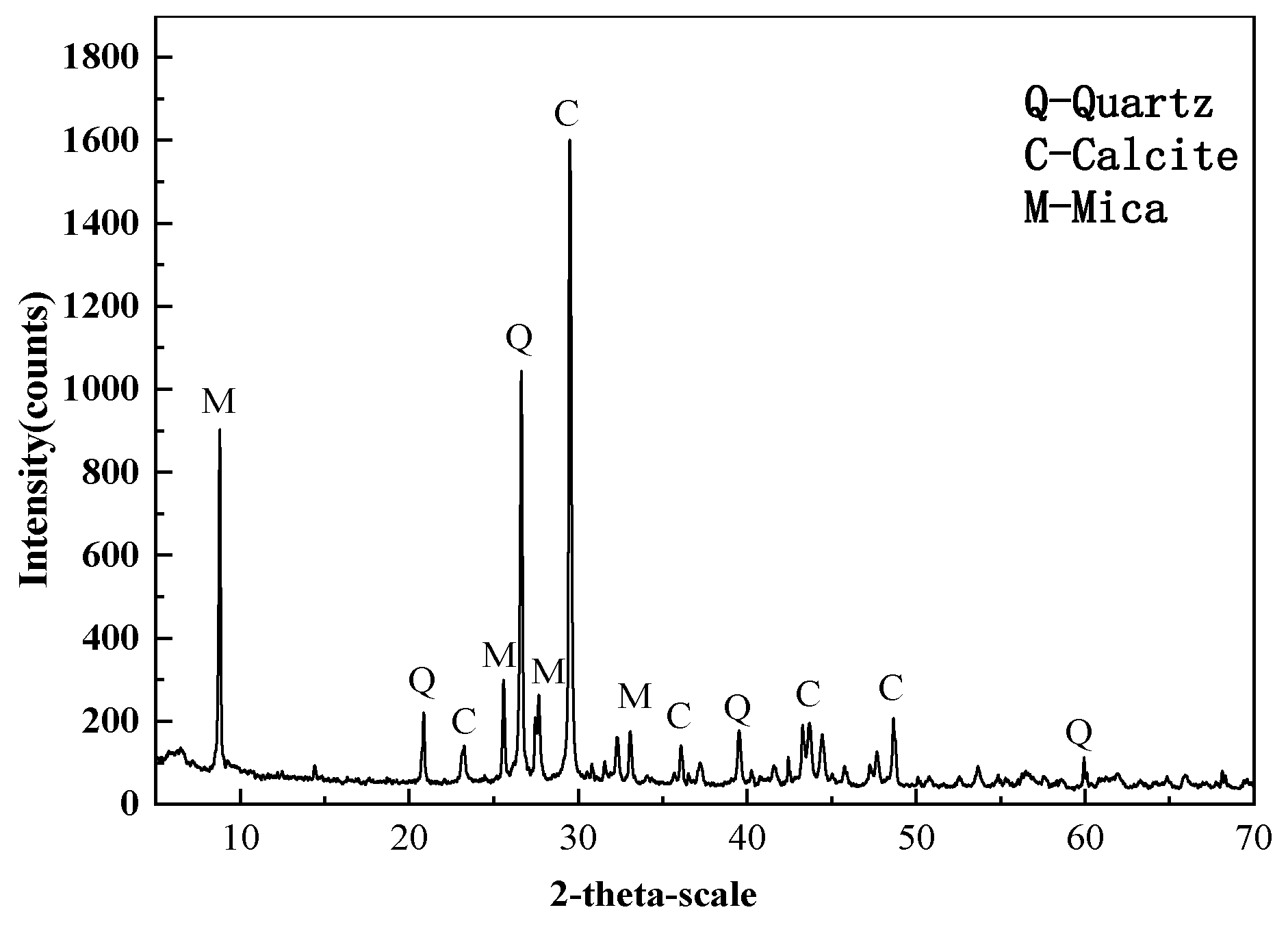
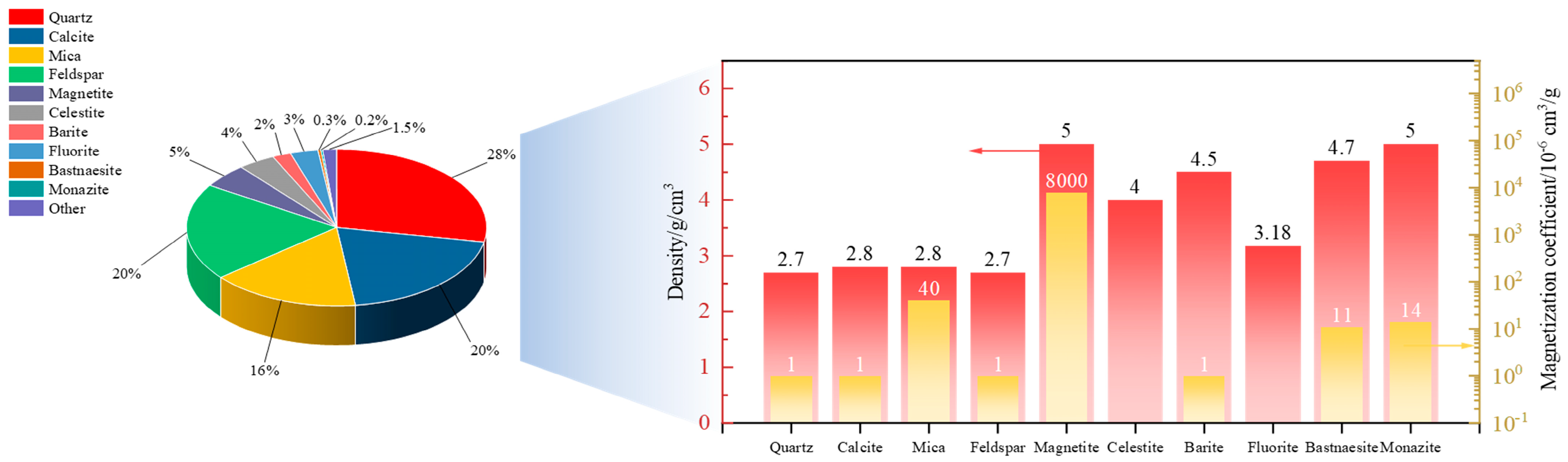
The results of the multi-element chemical analysis of the ore are shown in Table 1. The rare earth element content was analyzed by ICP. The XRD results are shown in Figure 1. The mineral composition and content of the actual ore are shown in Figure 2.
Analytical data revealed the relative abundance of the REE that were found in the molybdenum tailings, where lanthanum (La) and cerium (Ce) made up the greatest percentage concentrations at 0.063 and 0.097, respectively. The amount of total oxides of rare earth (REO) was 0.23%. This meant that the total rare earth grade was below the grade needed in the industry. Mineralogical and compositional studies demonstrated that the REE in the ore were mainly bastnaesite and monazite, which made the ore a mixed-type light rare earth deposit. The ICP results in Table 1 show that the Ca content in the molybdenum tailings was relatively high, reaching 7.160%, indicating the presence of a significant amount of calcite and fluorite. The Fe content was relatively high at 1.681%, and combined with mineral composition analysis, it was known that the original ore contains a certain amount of magnetite. Figure 1 and Figure 2 show that the gangue minerals in the ore mainly include feldspar, fluorite, quartz, mica, and calcite, while also containing small amounts of celestite and barite. To explain the distribution properties of REEs in relation to the different particle sizes, the molybdenum tailings were sampled and sorted out using sieves with 0.15 mm, 0.074 mm and 0.038 mm mesh sizes. The yield and rare earth grade of each fraction were then obtained. The results are shown in Table 2.
As shown in Table 2, the particle size distribution of molybdenum tailings exhibited a “hammer-shaped” pattern. The coarse-grained +0.15 mm size had a yield of 20.38%, while the medium-grained −0.15 mm to +0.074 mm size had a relatively low yield of only 12.65%. The REE grades in these two sizes were quite similar, at 0.14% and 0.19% respectively, with a cumulative REE distribution rate of 48.17%. The fine-grained −0.074 mm to +0.038 mm size had the highest yield in molybdenum tailings at 41.49%, with a REE grade of 0.26% but a REE distribution rate of only 12.87%. In contrast, the ultrafine −0.038 mm size had the highest REE grade at 0.46%, with a REE distribution rate of 38.96%. This result indicated that during the initial grinding process of molybdenum ore beneficiation, some easily grindable gangue minerals were already finely ground, and the rare earth minerals associated with them were further liberated, even resulting in over-grinding. Based on this, the fineness of grinding has to be sensibly controlled in later processes of rare earth beneficiation to counteract the negative influence of excessive grinding on the recovery of rare earth.

3.1.2. Scanning Electron Microscopy Analysis

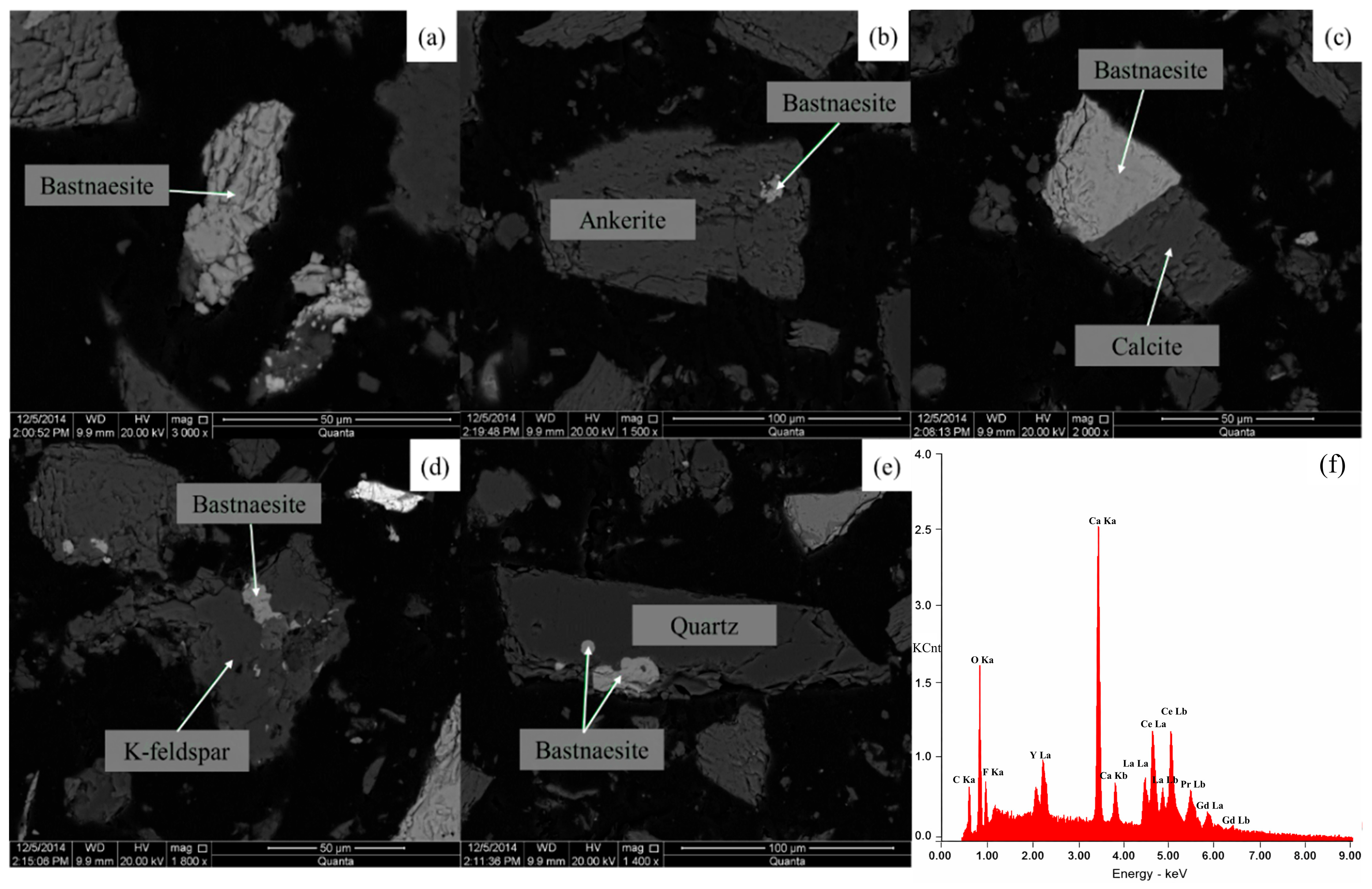
After clarifying the chemical composition, mineral composition, and particle size distribution characteristics of the molybdenum tailings, scanning electron microscopy (SEM) and energy dispersive spectroscopy (EDS) analyses were performed on the samples to further investigate the occurrence state, morphological characteristics, and intercalation relationship of rare earth minerals with gangue minerals (Figure 3), to provide a more direct mineralogical basis for the formulation of subsequent grinding and beneficiation processes.
The mineral analysis by the use of EDS revealed the presence of a wide range of REE in the mineral matrix as follows: Ce 24.71, Ca 17.28, C 5.30, O 16.22, F 3.90, Y 3.86, La 10.68, Pr 2.80, Nd 14.24, and Gd 1.01. According to this elemental structure, the sample was mainly bastnaesite. It was observed under SEM that the rare earth minerals were mainly anhedral and dotted and had a small subhedral component. The related gangue minerals were dolomites, calcite, potassium feldspar and quartz. Close intergrowth association and a low degree of liberation were witnessed in the rare earth and gangue minerals. Therefore, an appropriate degree of further grinding was required to improve the liberation of rare earth minerals. However, the grinding intensity should be carefully controlled to avoid excessive gangue overgrinding.

3.2. Influence of the Inevitable Ions in the Process of Flotation

Past studies have determined that the BHA/OHA combined collector had selective affinity towards bastnaesite and was useful in isolating it in the presence of other gangue minerals like calcite and quartz. Given the unavoidable presence of various dissolved ions in actual production systems, which may interfere with the effectiveness of the combined collector, this paper further investigated the impact of these inevitable ions on the BHA/OHA combined collection behavior of bastnaesite.
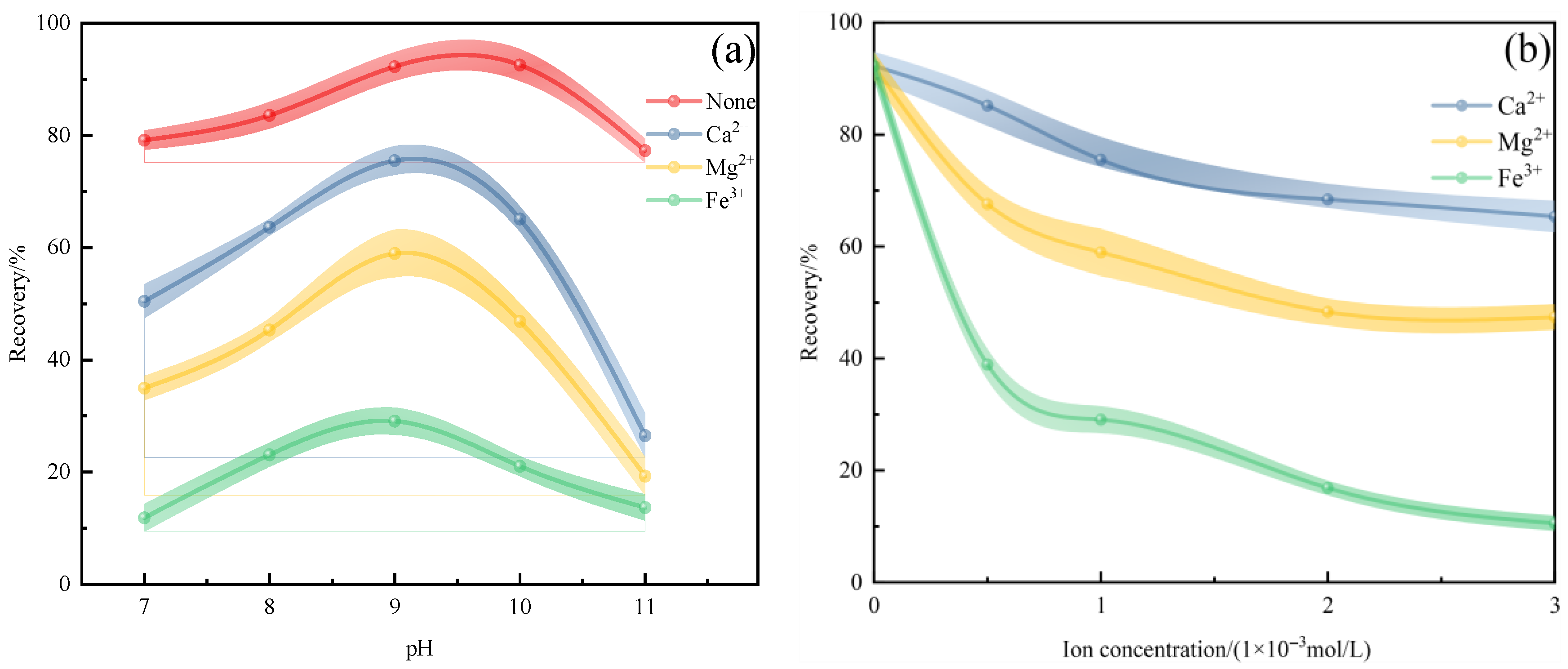
As shown in Figure 4a, under conditions without interference from impurity ions, the BHA/OHA combined collector exhibited good collecting performance for bastnaesite, with the flotation recovery rate remaining above 80% within the pH range of 7–10. After the addition of inevitable ions, Ca2+, Mg2+, and Fe3+ all had varying degrees of inhibitory effects on the recovery of bastnaesite by the combined collector, and the order of influence is Fe3+ > Mg2+ > Ca2+. The degree of interference from the three inevitable ions differed significantly under different pH conditions. Of the ionic species investigated, Mg2+ exhibited an inhibitory effect of considerable strength at neutral conditions, with a flotation recovery of approximately 30%. With a rise in pH to 10, the interference of Mg2+ was less, and the rate of recovery improved significantly, but the situation changed again as the pH was raised to 11, after which a drop in the rate of recovery was observed. On the other hand, Fe3+ had the strongest inhibitory properties towards bastnaesite flotation, where the recovery rate was always lower than 30% throughout the pH spectrum.
As shown in Figure 4b, with the increase in inevitable ion concentration, the recovery efficiency of the combined collector for bastnaesite continuously decreased, and the magnitude of the decrease followed the same pattern: Fe3+ > Mg2+ > Ca2+. Fe3+ had the strongest negative impact on the flotation recovery rate. When its concentration increased to 3 × 10⁻³ mol/L, the recovery rate of bastnaesite was only about 10%. The recovery rates of bastnaesite stabilized at about 70% and 50%, respectively, when the concentration of Ca2+ and Mg2+ were both increased to 3 × 10⁻³ mol/L. Overall, the inevitable ions, including Ca2+, Mg2+, and Fe3+, which are typically found in operational systems, cause significant interference with the flotation of bastnaesite when using the BHA/OHA combined collector, with Fe3+ having the most significant interference. Therefore, it is necessary to further investigate their mechanisms of action to provide a theoretical basis for optimizing rare earth flotation conditions in actual slurry systems.

3.3. Effects of Inevitable Ions in Mineral Surface Character

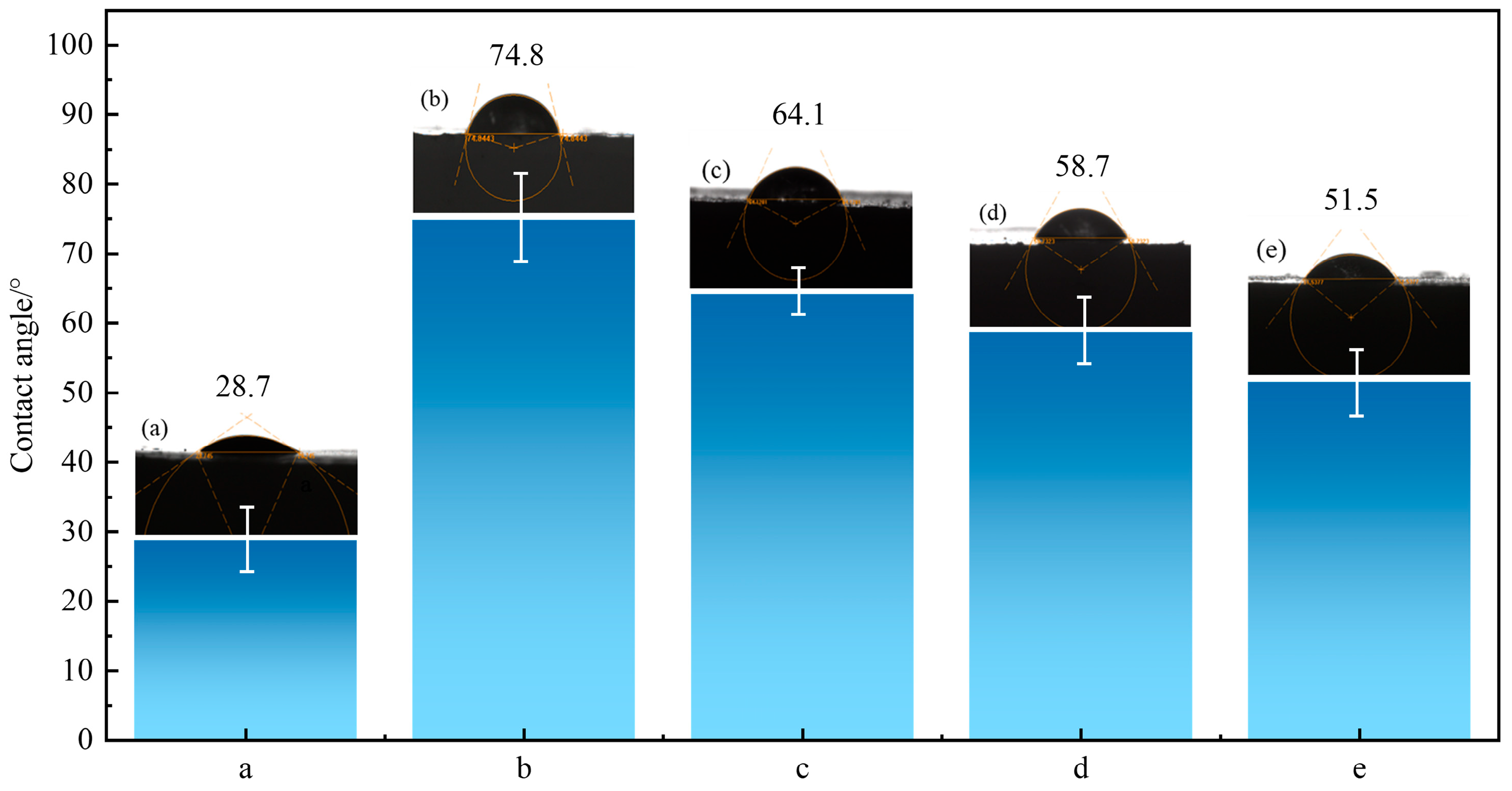
To assess the effect of inevitable ions on the wettability of bastnaesite surface, contact angle tests were conducted at pH = 9, and the results are shown in Figure 5. As shown in Figure 5a, the contact angle of bastnaesite without reagent treatment was only 28.7°, indicating that its surface was highly hydrophilic and had poor natural floatability [27,28]. As shown in Figure 5b, after treatment with the BHA/OHA combined collectors, the hydrophobicity of the bastnaesite surface was significantly enhanced, and the contact angle increased from 28.7° to 74.8°. This result indicated that the combined collector can effectively improve the wettability of the bastnaesite surface [29]. Existing research indicated that hydroxamic acid collectors could undergo chemisorption by forming stable chelate structures with rare earth active sites on the surface of bastnaesite, and these chelate structures were generally considered to exist in the form of five-membered rings [30,31]. Simultaneously, the hydrophobic hydrocarbon chains in the collector molecules were directionally distributed on the mineral surface, thereby reducing surface hydrophilicity and increasing hydrophobicity [32,33]. Compared to conditions without inevitable ions, the contact angles of bastnaesite treated with the combined collectors significantly decreased in the presence of inevitable ions. Specifically, the contact angles decreased to 64.1°, 58.7°, and 51.5° after treatment with Ca2+, Mg2+, and Fe3+, respectively. This indicated that the three inevitable ions weakened the effect of the combined collectors on improving the hydrophobicity of the bastnaesite surface, with the negative impact following the order Fe3+ > Mg2+ > Ca2+. This trend is consistent with the results of the flotation experiments, suggesting that the presence of inevitable ions is a significant reason for the decline in the collecting performance of the combined collectors.

3.4. Raman Analysis

To further elucidate the influence mechanism of inevitable ions on the adsorption behavior of the BHA/OHA combined collector on the surface of bastnaesite, Raman spectroscopy analysis was performed on bastnaesite samples treated under different conditions, based on flotation experiments and contact angle tests. By comparing the changes in characteristic peaks on the mineral surface under the individual action of the combined collector and in the presence of Ca2+, Mg2+, and Fe3+, the influence of inevitable ions on the adsorption state of the collector and the functional group environment of the mineral surface can be further determined.
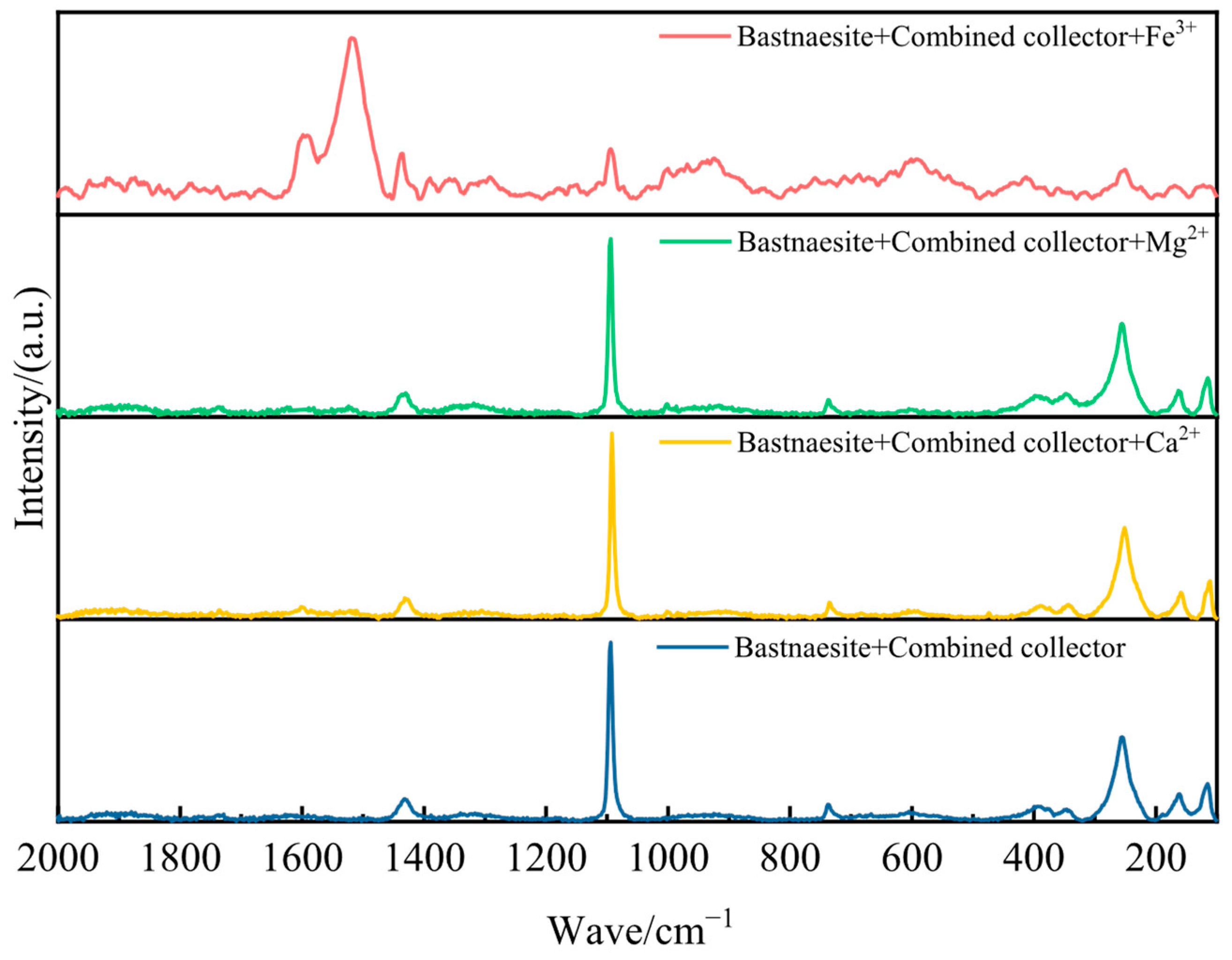
As shown in Figure 6, following the exposure of the bastnaesite to BHA/OHA combined collector, the Raman spectrum of bastnaesite had a few characteristic bands with a strong one at approximately 1085 cm−1, a weaker one at approximately 1430 cm−1, and specific features in the low-wavenumber region at about 260–300 cm−1 and 140–180 cm−1. The band at approximately 1085 cm−1 could be attributed to the symmetric stretching vibration of CO3 in bastnaesite, and the band at approximately 1430 cm−1 could be attributed to the carbonate-related vibrational environment [34,35,36]. It represented the effects of adsorbed collector species on the mineral surface. The post-collector treatment variations in these characteristic bands reflect that the BHA/OHA mixed collector reacted with the surface active sites of rare earths and altered the interfacial chemical environment of bastnaesite.
The major Raman bands of bastnaesite treated with the combined collector in the presence of Ca2+ and Mg2+ ions were kept in broadly similar positions, especially the strong band at 1085 cm−1 and the low-wavenumber bands below 400 cm−1, suggesting that the overall structural framework of the surface was not essentially changed. However, there were certain differences in the intensity of the peaks, particularly those in the areas of 1085 cm−1, 250–300 cm−1 and 140–180 cm−1. These findings indicated that Ca2+ and Mg2+ predominantly destabilized or disrupted the adsorption state of the combined collector as opposed to creating an entirely different species on the surface. This is in line with the competitive reactions of Ca2+ and Mg2+ with mineral active sites and thus minimized the effective coverage of the combined collector on bastnaesite.
In comparison, spectral changes were found to be much stronger in the system containing Fe3+. Specifically, the spectrum had clearly increased characteristics at the 1450–1600 cm−1 area, and the strong characteristic band at the 1085 cm−1 area was significantly weakened compared to the Ca2+- and Mg2+-containing systems. In the meantime, the low-wavenumber characteristic became less pronounced below 400 cm−1. These data showed that Fe3+ produced a significantly greater modification of the surface chemical environment of bastnaesite compared to Ca2+ and Mg2+. Together with the solution chemistry analysis, the behavior could be explained by the hydrolysis of Fe3+ and adsorption or deposition of hydrolyzed iron species on the bastnaesite surface that blocked surface active sites, prevented collector adsorption and enhanced surface hydrophilicity.

3.5. Solution Chemical Analysis

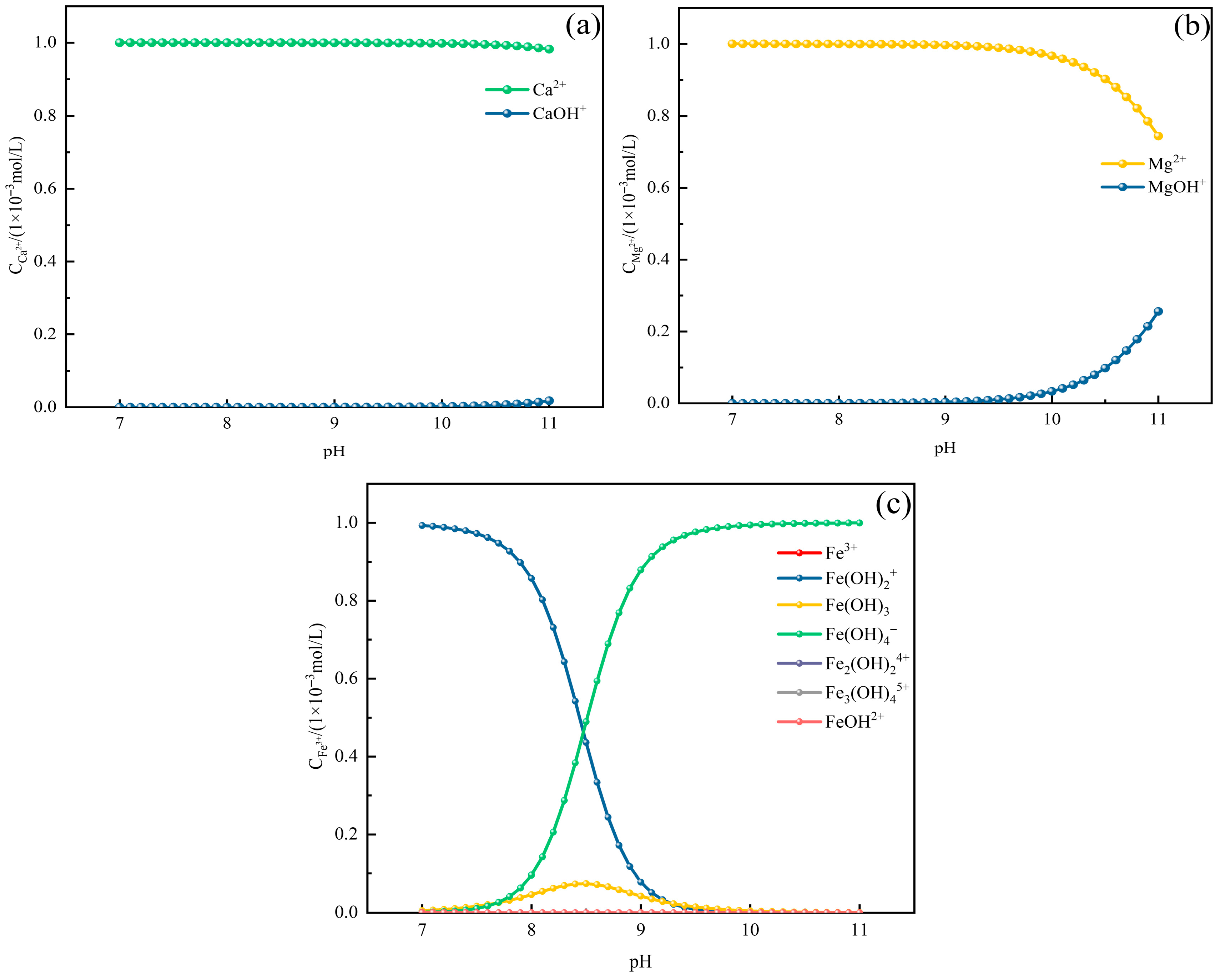
To further clarify the existence state and possible modes of action of inevitable ions in the pulp system, and thus elucidate their influence mechanism on the flotation of bastnaesite using the BHA/OHA combined collector, the possible forms of Ca2+, Mg2+ and Fe3+ in aqueous solutions at different pH values were calculated using Visual MINTEQ 3.1 software under the conditions of ion concentration of 1 × 10⁻³ mol/L and room temperature.
As shown in Figure 7a, Ca2+ existed primarily as Ca2+ within the pH range of 7–10 and does not undergo hydrolysis to produce CaOH+. When pH > 10, trace amounts of Ca2+ hydrolyze to form CaOH+. Figure 7b shows the ion distribution pattern of Mg2+ under different pH conditions: within the pH range of 7–8, it existed primarily as Mg2+. When the pH was between 8 and 9.5, trace amounts of Mg2+ hydrolyzed to MgOH+, but the vast majority still existed as Mg2+. When pH > 9.5, Mg2+ began to undergo rapid hydrolysis, and the proportion of MgOH+ continuously increased, resulting in Mg2+ existing in the solution in both Mg2+ and MgOH+ ion forms. Therefore, it could be inferred that at pH = 9, the factor affecting the flotation of bastnaesite was not the hydrolysis products of calcium and magnesium ions in the solution, but rather the reaction of Ca2+ or Mg2+ with the mineral surface or combined collectors, which inhibited the flotation of bastnaesite. Figure 7c shows that in a neutral environment, Fe3+ was completely hydrolyzed to exist as Fe(OH)2+. When the pH was in the range of 7 to 9.5, Fe(OH)2+ began to precipitate rapidly and was converted into Fe(OH)3 colloid and Fe(OH)4. Within this range, Fe3+ in the solution mainly existed in the form of Fe(OH)2+ and Fe(OH)4, with a small amount existing in the form of Fe(OH)3 colloid. Combined with Raman spectroscopy data, at pH = 9, Fe3+ mainly existed as Fe(OH)4 in the form of electrostatic adsorption, covering the surface of bastnaesite and hindering the adsorption of reagents on the mineral surface. Moreover, Fe(OH)4 had a large number of hydroxyl groups, which increased the hydrophilicity of the mineral surface, thus affecting the rapid decrease in flotation recovery, consistent with the flotation law.

3.6. Discussion

The combined results of flotation experiments, contact angle tests, Raman spectroscopy analysis, and solution chemistry calculations showed that the three inevitable ions Ca2+, Mg2+, and Fe3+ negatively impact the flotation of bastnaesite using the BHA/OHA combined collector, but the intensity of their effects differs significantly, generally showing Fe3+ > Mg2+ > Ca2+. This variation was strongly connected with the specific aqueous species and interfacial interaction routes of the three ions being floated. Ca2+ and Mg2+ had the greatest inhibitory effect on collector adsorption due to competitive binding with surface active sites and collector molecules, while Fe3+ displayed the greatest inhibitory effect due to the increased propensity of its hydrolyzed species to adsorb or deposit on the bastnaesite surface and create a hydrophilic covering layer. The present study was further distinguished in comparison to other works, which reported mostly the overall negative effects of inevitable ions, but the present study further separated the differentiated interference actions of representative inevitable ions within a BHA/OHA combined collector system.
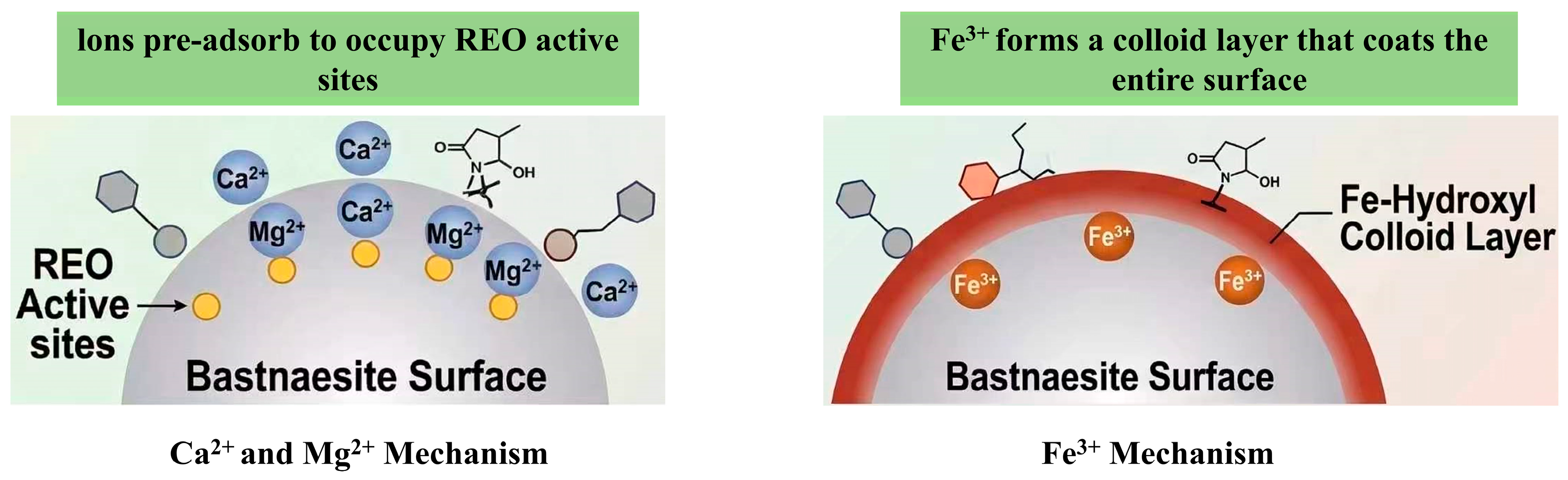
These results indicated that inevitable ions reduced the collecting ability of the combined collector for bastnaesite through a combination effect of “surface competitive adsorption—active site occupation—hydrolysis product capping.” To more intuitively illustrate its action path and influence mechanism, this paper further drew a schematic diagram of the mechanism of the combined collector flotation of bastnaesite affected by inevitable ions as shown in Figure 8.

3.7. Rare Earth Mineral Flotation Recovery Test in Molybdenum Tailings

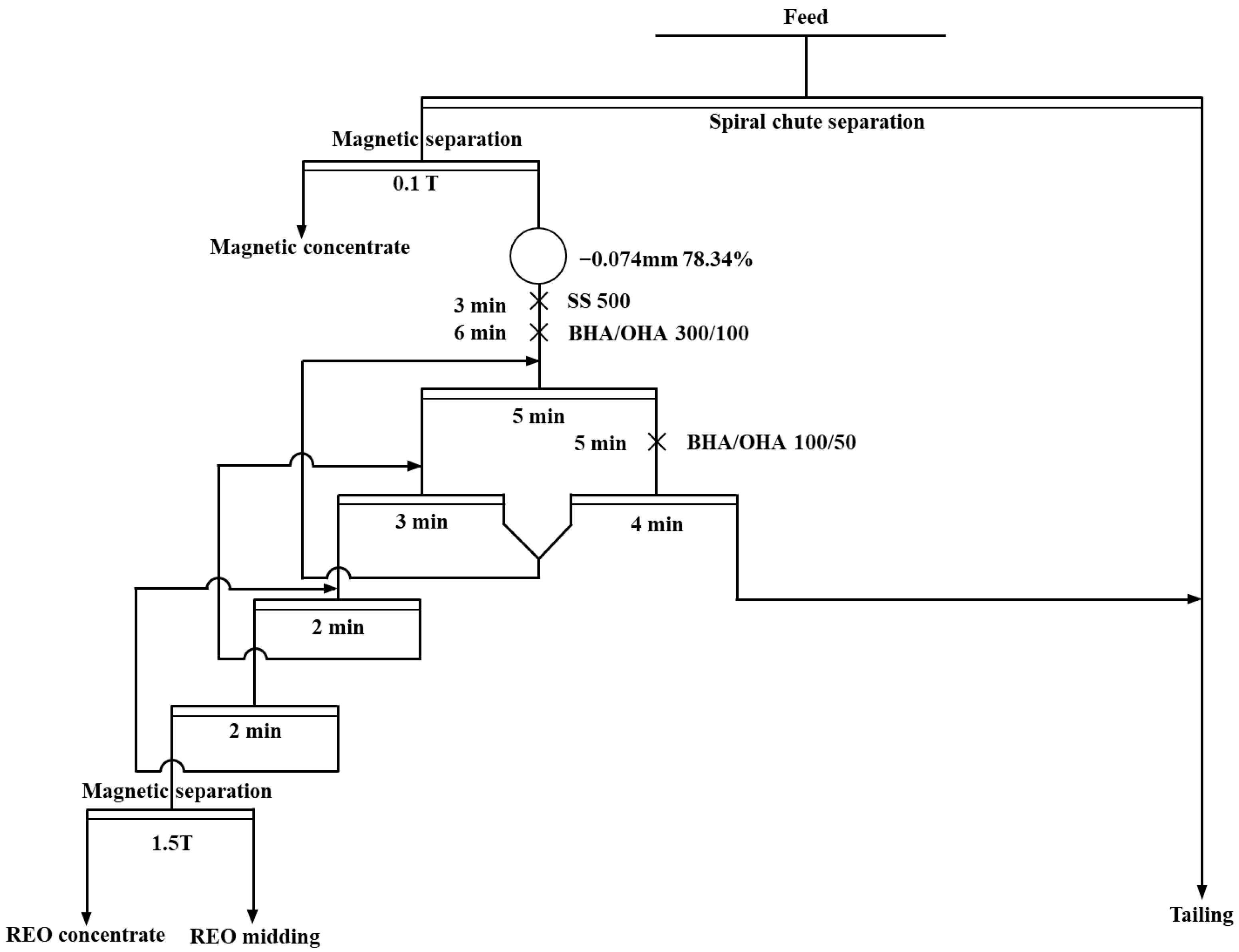
Based on the ore composition characteristics of molybdenum tailings and the distribution and liberation characteristics of rare earth minerals in the ore, this paper isolated minerals containing iron in a weak magnetic field of 0.1 T to enhance the enrichment and washability of the rare earth minerals in the sample. This measure was especially necessary since the results of microflotation and surface analysis proved that Fe3+ had the most significant inhibitory effect compared to the other investigated inevitable ions. It was advantageous to reduce the impact of iron-bearing components before flotation to reduce the formation of hydrolyzed iron species and its negative surface-covering impact on bastnaesite.
Based on determining the optimal flotation reagent system and flotation process, a closed-circuit test was finally conducted using a combined “roughing, scavenging, and cleaning” rare earth flotation–strong magnetic field process. The closed-circuit test process and reagent system are shown in Figure 9.
As shown in Table 3, the closed-circuit test demonstrated that, with sodium silicate as the depressant and BHA/OHA as the mixed collector, a rare earth concentrate with a REO grade of 24.95% and a recovery of 57.44% was obtained. In addition, a secondary rare earth concentrate assaying 10.01% REO with a recovery of 12.69% was also produced. These products were achieved through the combined process of spiral tailings rejection, weak magnetic separation for iron removal, a single roughing and a single scavenging three-stage rare earth flotation, and strong magnetic separation, resulting in an overall rare earth recovery of 70.13%.
The closed-circuit test was conducted using sodium silicate as the depressant and BHA/OHA as the combined collector. A rare earth concentrate with a recovery of 57.44% and REO grade of 24.95% was obtained. Secondly, there was also a secondary rare earth concentrate with 10.01% REO with a recovery of 12.69%. These products were realized by having a combination of spiral tailings rejection, weak magnetic separation to remove iron, a single roughing and a single scavenging three-stage rare earth flotation, and a strong magnetic separation, which resulted in a total of 70.13% of rare earth recovery.
The REO grade in the original molybdenum flotation tailings was only 0.23%. After treatment by the proposed process, the REO grade of the rare earth concentrate increased to 24.95%, corresponding to an enrichment ratio of over 108. This result is consistent with the feasibility reported in previous rare earth flotation studies on complex ores and tailings, and demonstrates that the proposed flowsheet is effective for the recovery and upgrading of rare earth minerals from molybdenum flotation tailings [37].

4. Conclusions

This study focused on the recovery of bastnaesite from molybdenum tailings. An in-depth analysis of the process mineralogy of the actual ore, the flotation behavior of pure minerals, the process of mandatory ion interference, and the recovery performance in the actual ore experiments was conducted.
The results clarify the effects of Ca2+, Mg2+, and Fe3+ on bastnaesite flotation in the BHA/OHA system and provide a basis for the proposed recovery process. The main conclusions are as follows.
(1)
Mineralogical examination of the actual ore showed that the molybdenum tailings were of low REO grade with bastnaesite and monazite as the major rare earth minerals. The bastnaesite was therefore chosen as the main target to recover. The rare earth minerals were closely intertwined with gangue minerals like dolomite, calcite and quartz minerals with a low level of liberation. Also, enrichment and over-grinding became apparent in the fine-grained portion, highlighting the complex and refractory character of the tailings as a rare earth source.
(2)
Flotation tests on bastnaesite showed that the BHA/OHA mixed collector had good collecting performance and was able to achieve high recovery under suitable pH conditions. Bastnaesite flotation was inhibited by Ca2+, Mg2+, and Fe3+, and the strength of inhibition was Fe3+ > Mg2+ > Ca2+. This ranking indicated that the concentration of inevitable ions may significantly reduce the efficiency of the collector.
(3)
Contact angle measurements, Raman spectroscopy, and solution chemistry analysis showed that inevitable ions weakened the adsorption of the mixed collector on the bastnaesite surface and reduced the surface hydrophobicity of the mineral. Ca2+ and Mg2+ mainly disrupt flotation by reacting with the mineral surface or collector molecules, whereas Fe3+ can more readily adsorb or precipitate onto the mineral surface as hydroxides, thus inhibiting reagent adsorption and increasing mineral surface hydrophilicity.
(4)
Based on the process mineralogical characteristics and the interference behavior of inevitable ions, the molybdenum tailings were treated using a combined flowsheet consisting of spiral tailings rejection, weak magnetic separation for iron removal, roughing and scavenging rare earth flotation, and strong magnetic separation. They achieved a rare earth concentrate with an REO grade of 24.95% and recovery of 57.44% corresponding to a total rare earth recovery of 70.13%. These results indicated that the proposed process had good potential for the recovery of rare earth resources from tailings.

Author Contributions

Conceptualization, Y.X. and X.T.; methodology, H.J. and R.J.; validation, R.J.; formal analysis, Y.X.; investigation, H.J. and R.J.; resources, H.J.; data curation, X.T.; writing—original draft preparation, Y.X.; writing—review and editing, Y.W.; visualization, X.T.; supervision, X.T.; project administration, H.J.; funding acquisition, H.J. and Y.W. All authors have read and agreed to the published version of the manuscript.

Funding

This research project was supported by the National Natural Science Foundation of China (No. 52174273, 52574341).

Data Availability Statement

Data will be made available on request.

Conflicts of Interest

The authors declare no conflicts of interest.

References

  1. Balaram, V. Rare earth elements: A review of applications, occurrence, exploration, analysis, recycling, and environmental impact. Geosci. Front. 2019, 10, 1285–1303. [Google Scholar] [CrossRef]
  2. Chai, S.-S.; Zhang, W.-B.; Yang, J.-L.; Zhang, L.; Theint, M.M.; Zhang, X.-L.; Guo, S.-B.; Zhou, X.; Ma, X.-J. Sustainability applications of rare earths from metallurgy, magnetism, catalysis, luminescence to future electrochemical pseudocapacitance energy storage. RSC Sustain. 2023, 1, 38–71. [Google Scholar] [CrossRef]
  3. Shuai, Z.; Zhu, Y.; Gao, P.; Han, Y. Rare earth elements resources and beneficiation: A review. Miner. Eng. 2024, 218, 109011. [Google Scholar] [CrossRef]
  4. Liang, B.; Gu, J.; Zeng, X.; Yuan, W.; Rao, M.; Xiao, B.; Hu, H. A Review of the Occurrence and Recovery of Rare Earth Elements from Electronic Waste. Molecules 2024, 29, 4624. [Google Scholar] [CrossRef]
  5. Depraiter, L.; Goutte, S. The role and challenges of rare earths in the energy transition. Resour. Policy 2023, 86, 104137. [Google Scholar] [CrossRef]
  6. Jordens, A.; Cheng, Y.P.; Waters, K.E. A review of the beneficiation of rare earth element bearing minerals. Miner. Eng. 2013, 41, 97–114. [Google Scholar] [CrossRef]
  7. Cen, P.; Bian, X.; Liu, Z.; Gu, M.; Wu, W.; Li, B. Extraction of rare earths from bastnaesite concentrates: A critical review and perspective for the future. Miner. Eng. 2021, 171, 107081. [Google Scholar] [CrossRef]
  8. McNulty, T.; Hazen, N.; Park, S. Processing the ores of rare-earth elements. MRS Bull. 2022, 47, 258–266. [Google Scholar] [CrossRef]
  9. Kim, J.; Choi, J.; Lee, S. A Review of Rare Earth Elements Recovery from Bastnaesite Ore: From Beneficiation to Metallurgical Processing. J. Sustain. Metall. 2025, 11, 773–798. [Google Scholar] [CrossRef]
  10. Yang, X.; Satur, J.V.; Sanematsu, K.; Laukkanen, J.; Saastamoinen, T. Beneficiation studies of a complex REE ore. Miner. Eng. 2015, 71, 55–64. [Google Scholar] [CrossRef]
  11. Guo, Z.; Tian, M.; Qian, G.; Zhou, Y.; Gao, Z.; Sun, W. Flotation separation of bastnaesite and fluorite using styrylphosphonic acid and cinnamohydroxamic acid as collectors. J. Mol. Liq. 2022, 362, 119766. [Google Scholar] [CrossRef]
  12. Zhou, H.; Liu, S.; Yi, H.; Song, S.; Jia, F. Flotation of bastnaesite by mixed collectors and adsorption mechanism. Chem. Phys. Lett. 2023, 830, 140793. [Google Scholar] [CrossRef]
  13. Liu, C.; Xu, L.; Deng, J.; Tian, J.; Wang, D.; Xue, K.; Zhang, X.; Wang, Y.; Fang, J.; Liu, J. A review of flotation reagents for bastnäsite-(Ce) rare earth ore. Adv. Colloid Interface Sci. 2023, 321, 103029. [Google Scholar] [CrossRef]
  14. Duan, H.; Liu, W.; Wang, X.; Gu, X.; Sun, W.; Peng, X.; Yue, H. Investigation on flotation separation of bastnaesite from calcite and barite with a novel surfactant: Octylamino-bis-(butanohydroxamic acid). Sep. Purif. Technol. 2021, 256, 117792. [Google Scholar] [CrossRef]
  15. Liu, M.; Wu, X.; Li, G.; Liu, C.; Ma, Z.; Guo, Y.; Tian, J.; Wang, D.; Shu, K.; Wang, Z.; et al. Selective adsorption mechanism of a novel hydroxamic acid containing a thioether group collector for flotation separation of bastnaesite from calcite. Chem. Eng. Sci. 2025, 312, 121667. [Google Scholar] [CrossRef]
  16. Yu, X.; Zhang, R.; Yang, S.; Liu, C.; He, G.; Wang, H.; Wang, J. A novel decanedioic hydroxamic acid collector for the flotation separation of bastnäsite from calcite. Miner. Eng. 2020, 151, 106306. [Google Scholar] [CrossRef]
  17. Bai, R.; Liu, S.; Zhang, J.; Liu, G. Exploring the efficient flotation separation of bastnaesite from calcite using a novel bisthiother-bishydroxamic acid collector and the underlying mechanism. Surf. Interfaces 2026, 80, 108351. [Google Scholar] [CrossRef]
  18. Cao, S.; Cao, Y.; Ma, Z.; Liao, Y. Metal Ion Release in Bastnaesite Flotation System and Implications for Flotation. Minerals 2018, 8, 203. [Google Scholar] [CrossRef]
  19. Xu, L.; Wang, Z.; Shu, K.; Wu, H.; Hu, Y. Surface chemistry considerations of gangue dissolved species in the bastnaesite flotation system. Fundam. Res. 2022, 2, 748–756. [Google Scholar] [CrossRef]
  20. Espiritu, E.R.L.; da Silva, G.R.; Azizi, D.; Larachi, F.; Waters, K.E. The effect of dissolved mineral species on bastnäsite, monazite and dolomite flotation using benzohydroxamate collector. Colloids Surf. A Physicochem. Eng. Asp. 2018, 539, 319–334. [Google Scholar] [CrossRef]
  21. Zhu, X.; Lin, Y.; Huang, Y.; Zhu, Y.; Shi, C.; Wang, W. Adsorption of ferric ions on the surface of bastnaesite and its significance in flotation. Miner. Eng. 2020, 158, 106588. [Google Scholar] [CrossRef]
  22. Muhoza, E.; Zhang, W.; Hassan Amini, S. Systematic investigation on bastnaesite flotation in the presence of dissolved calcium ions using organic acids as chelating agents. Miner. Eng. 2024, 218, 108977. [Google Scholar] [CrossRef]
  23. Douglas, I.; Mohanty, M. The role of dissolved metal ions in rare earth mineral flotation: A review. J. Rare Earths 2025. [Google Scholar] [CrossRef]
  24. Cao, Z.; Cheng, Z.; Wang, J.; Cao, Y. Synergistic depression mechanism of Ca2+ ions and sodium silicate on bastnaesite flotation. J. Rare Earths 2022, 40, 988–995. [Google Scholar] [CrossRef]
  25. Espiritu, E.R.L.; da Silva, G.R.; Azizi, D.; Larachi, F.; Waters, K.E. Flotation behavior and electronic simulations of rare earth minerals in the presence of dolomite supernatant using sodium oleate collector. J. Rare Earths 2019, 37, 101–112. [Google Scholar] [CrossRef]
  26. Støving, C.; Jensen, H.; Gammelgaard, B.; Stürup, S. Development and validation of an ICP-OES method for quantitation of elemental impurities in tablets according to coming US pharmacopeia chapters. J. Pharm. Biomed. Anal. 2013, 84, 209–214. [Google Scholar] [CrossRef]
  27. Cao, S.; Cao, Y.; Liao, Y.; Ma, Z. Depression Mechanism of Strontium Ions in Bastnaesite Flotation with Salicylhydroxamic Acid as Collector. Minerals 2018, 8, 66. [Google Scholar] [CrossRef]
  28. Liu, W.; Wang, X.; Xu, H.; Miller, J.D. Physical chemistry considerations in the selective flotation of bastnaesite with lauryl phosphate. Metall. Process. 2017, 34, 116–124. [Google Scholar] [CrossRef]
  29. Zhang, X.; Du, H.; Wang, X.; Miller, J.D. Surface chemistry aspects of bastnaesite flotation with octyl hydroxamate. Int. J. Miner. Process. 2014, 133, 29–38. [Google Scholar] [CrossRef]
  30. Yu, J.; Liu, S.; Cheng, C.; Xiong, S.; Liu, G. The effect mechanism of calcite or quartz particles towards bastnaesite flotation with octyl hydroxamic acid. Chem. Eng. Sci. 2023, 268, 118391. [Google Scholar] [CrossRef]
  31. Wang, Y.; Wang, D.; Xu, L.; Xue, K.; Zhang, X.; Shi, X.; Liu, C.; Meng, J. Synthesis and utilization of a novel oleate hydroxamic acid collector for the flotation separation of bastnaesite from barite. Miner. Eng. 2023, 204, 108405. [Google Scholar] [CrossRef]
  32. Cao, S.; Cao, Y.; Ma, Z.; Liao, Y.; Zhang, X. Structural and electronic properties of bastnaesite and implications for surface reactions in flotation. J. Rare Earths 2020, 38, 332–338. [Google Scholar] [CrossRef]
  33. Sarvaramini, A.; Azizi, D.; Larachi, F. Hydroxamic acid interactions with solvated cerium hydroxides in the flotation of monazite and bastnäsite—Experiments and DFT study. Appl. Surf. Sci. 2016, 387, 986–995. [Google Scholar] [CrossRef]
  34. Frost, R.L.; Dickfos, M.J. Raman spectroscopy of halogen-containing carbonates. J. Raman Spectrosc. 2007, 38, 1516–1522. [Google Scholar] [CrossRef]
  35. Hong, W.; He, S.; Huang, S.; Wang, Y.; Hou, H.; Zhu, X. A Raman spectral studies of rare-earth (REE) fluoro-carbonate minerals. Guang Pu Xue Yu Guang Pu Fen Xi 1999, 19, 546–549. [Google Scholar]
  36. Frost, R.L.; López, A.; Scholz, R.; Xi, Y.; Belotti, F.M. Infrared and Raman spectroscopic characterization of the carbonate mineral huanghoite—And in comparison with selected rare earth carbonates. J. Mol. Struct. 2013, 1051, 221–225. [Google Scholar] [CrossRef]
  37. Abaka-Wood, G.B.; Addai-Mensah, J.; Skinner, W. A study of selective flotation recovery of rare earth oxides from hematite and quartz using hydroxamic acid as a collector. Adv. Powder Technol. 2018, 29, 1886–1899. [Google Scholar] [CrossRef]
Figure 1. X-ray diffraction analysis results of actual ore.
Minerals 16 00419 g001
Figure 2. Raw material composition and content of the ore.
Minerals 16 00419 g002
Figure 3. SEM images and EDS energy dispersive spectroscopy analysis of rare earth minerals in molybdenum tailings: (ae) intergrowth relationship between bastnaesite and different gangue minerals; (f) EDS energy dispersive spectroscopy of bastnaesite.
Minerals 16 00419 g003
Figure 4. Effects of inevitable ions on the flotation behavior of bastnaesite using the BHA/OHA combined collector: (a) effect of inevitable ions on the recovery rate of bastnaesite under different pH conditions; (b) changes in the recovery rate of bastnaesite under different unavoidable ion concentrations. The shaded areas represent the standard deviation of repeated experiments.
Minerals 16 00419 g004
Figure 5. Changes in contact angle on the surface of bastnaesite under the influence of inevitable ions: (a) without reagents; (b) after treatment with the BHA/OHA combined collector; (c) after treatment with the combined collector in the presence of Ca2+; (d) after treatment with the combined collector in the presence of Mg2+; (e) after treatment with the combined collector in the presence of Fe3+.
Minerals 16 00419 g005
Figure 6. Raman spectra of bastnaesite after interaction with a combined collector under different inevitable ion conditions.
Minerals 16 00419 g006
Figure 7. Inevitable ion solution chemical calculation in different pH environment: (a) Ca2+; (b) Mg2+; (c) Fe3+.
Minerals 16 00419 g007
Figure 8. Schematic illustration of the mechanism by which inevitable ions influence the action of the BHA/OHA combined collector during bastnaesite flotation.
Minerals 16 00419 g008
Figure 9. The whole closed-circuit floatation process of the actual ore.
Minerals 16 00419 g009
Table 1. Chemical composition of the ore (mass fraction)/%.
ElementTiTFeSrFLaCeREOPbSiCaAlKMgBa
Content/%0.3651.681 1.742 0.2230.063 0.0970.230.26422.3407.1607.1053.4061.8290.939
Table 2. Contents and rare earth grades of various particles of actual ore.
Size/mmYield/%Cumulative Yield/%REO Grade/%REO Distribution Rate/%
+0.1520.3840.380.1424.54
−0.15 + 0.07412.6569.030.1923.63
−0.074 + 0.03841.4980.520.2612.87
−0.03825.48100.000.4638.96
Total100.00100.000.23100.00
Table 3. The whole closed-circuit flotation results of the actual ore.
ProductsYield/%Grade/%Recovery/%
FeREOFeREO
Magnetic concentrate2.2950.530.1171.510.84
REO concentrate0.696.1324.952.6157.44
REO middling0.385.8910.011.3812.69
Tailing96.640.410.0924.4929.02
Feed100.001.620.30100.00100.00
Disclaimer/Publisher’s Note: The statements, opinions and data contained in all publications are solely those of the individual author(s) and contributor(s) and not of MDPI and/or the editor(s). MDPI and/or the editor(s) disclaim responsibility for any injury to people or property resulting from any ideas, methods, instructions or products referred to in the content.