


Abstract
The large volumes of fine flotation tailings constitute a persistent challenge for the conventional treatment of minerals due to their wide particle size distribution and their low metal contents. In this work, the potential of passive inertial microfluidics for the selective redistribution of mineral particles from actual copper flotation tailings is studied. A suspension of tailings was treated in a rectangular microfluidic channel in a laminar regime, without an external magnetic field or sheath flux. The solid fractions obtained were characterized in terms of particle size distribution, phase composition and element content. The microfluidic treatment induced a systematic distribution of the particles between the output fractions. The central fraction was enriched with coarser particles, the median particle size increasing from about 15 µm in the feed to about 20 µm, and had high concentrations of Cu, Fe, Ag and Zn, with enrichment factors reaching 2.0 to 2.7 depending on the element. On the other hand, the lateral fraction was mainly composed of finer particles (D50 ≈ 13 µm) and depleted in metalliferous phases. The elemental mass balance confirmed that the observed enrichment results from selective redistribution rather than from a loss of material. These results indicate that the separation of the particles cannot be explained solely by size effects and are consistent with a preferential migration of the denser and metal-rich particles towards stable inertial focusing trajectories.
1. Introduction
The increase in the volume of flotation tailings constitutes a persistent global trend, linked to the intensification of mining operations and the processing of increasingly complex and lower-grade ores. As a result, a significant fraction of non-ferrous and precious metals is systematically transferred to fine tailings, mainly for particles smaller than 50 µm. Recent studies on the recovery of fine copper sulfides have emphasized that these losses are not accidental, but structurally linked to the physics of fine particle flotation and the incomplete release of minerals [1,2,3].
For these fine particles, the effectiveness of conventional physical enrichment methods decreases sharply. In flotation systems, the probability of collision and adhesion between the particles and the bubbles decreases with the size of the particles, while the effects of entrainment and coating by the sludge become predominant, which leads to a low selectivity and a reduction in recovery [2,3]. The use of micro- and nanobubbles partially improves the capture of fine particles, but the overall performance remains limited by hydrodynamic and interfacial factors [4,5]. Hybrid approaches, such as selective flocculation–flotation and particle size separation flotation, have been proposed to overcome these constraints. However, technical and economic analyses indicate that they do not make it possible to completely eliminate the losses in the flows of tailings with large particle size [6,7]. Experimental studies also confirm that even the most advanced flotation technologies leave a significant fraction of copper minerals with a size of less than 20–40 µm unrecovered [7].
It is important to note that fine tailings are not uniformly depleted of recoverable elements. Detailed mineralogical and process studies have shown that appreciable amounts of chalcopyrite, bornite and secondary copper phases, released or partially released, persist in the flotation tailings, in particular because of their extremely fine particle size [8]. Case studies on Cu-Au and polymetallic residues demonstrate that the fine fractions contain heterogeneous mixtures of silicates, composite aggregates and metalliferous inclusions, which induces a strongly nonlinear relationship between the particle size and the metal content [9,10]. Automated mineralogical characterization and machine vision techniques also reveal that particle texture, intergrowth structure and phase associations often influence the response to flotation more than size alone [11,12]. The economic evaluations of the reprocessing of tailings confirm that these fine fractions can still constitute technically and economically viable secondary resources [13,14,15].
Under these conditions, prefractioning methods, capable of separating fine particles according to a combination of physical properties without grinding or additional chemical modification, are becoming increasingly interesting. However, most conventional separation devices, designed for macro- and mesoscopic regimes, lose selectivity in the <50 µm range, where laminar hydrodynamics and particle–fluid interactions predominate. As a result, the contrasts in density and shape are only partially expressed, and selective separation becomes ineffective.
In this context, microfluidic systems represent an alternative physical platform particularly adapted to the manipulation of particles in laminar flow. It has been demonstrated that inertial microfluidics without a sheath generates stable focusing trajectories of the particles, governed by the inertial lift forces and the secondary charge flows [16]. The advances made in terms of geometry and scaling of the channels have made it possible to significantly increase the throughput while preserving the precision of the separation [17,18]. Exhaustive reviews demonstrate that passive microfluidic strategies, such as inertial focusing, pinch flow fractionation (PFF) and deterministic lateral displacement (DLD), allow for reproducible fractionation of micrometric particles without an external field [19,20,21,22,23]. Fundamental studies have also clarified how particle migration depends on the balance between Dean’s lift and drag forces in curved microchannels, and how trajectories can be predicted from hydrodynamic parameters [24,25]. Other microfluidic modalities, in particular, hybrid acoustic and inertial devices, expand the range of separation accessible to particles with more varied properties [26,27,28].
Although most of the first developments were carried out on model suspensions, recent work has been directly interested in mineral systems. Liu et al. have shown that inertial microfluidics in curved channels allows for size-dependent separation of fine mineral particles with measurable efficiency, even for solids with non-neutral buoyancy [29]. It has been demonstrated that the density contrasts typical of mineral particles significantly influence the transverse migration and the focusing positions at equilibrium, thus allowing for a combined size–density discrimination [30]. These results indicate that microfluidic fractionation can exploit not only the size of the particles, but also their effective density and their hydrodynamic response, which is directly linked to the mineralogical composition.
However, the application of microfluidics to copper flotation tailings remains insufficiently explored. Most of the available studies focus on model particles with a narrow particle size distribution and do not take into account the complex phase assemblies characteristic of industrial residues. In addition, the reported analyses are often limited to spatial or particle size redistribution, without establishing the elementary mass balance or quantifying the enrichment factors. Therefore, the technological potential of microfluidic fractionation for the recovery of metals from residues cannot yet be reliably evaluated.
The present study fills this gap by demonstrating the selective redistribution of mineral particles resulting from finely dispersed copper flotation tailings during their passage through a microfluidic channel. The originality of this work lies in an integrated approach combining particle size analysis, phase characterization and elementary mass balance to quantify the distribution of metals between fractions. The separation behavior is interpreted through the effective trajectories of the particles, governed by combined physical properties rather than by the size of the particles alone, thus establishing a direct link between hydrodynamic migration and metallurgical recovery.
2. Materials and Methods
2.1. Materials
The object of the study consisted of flotation tailings from the enrichment of copper ores at the Balkhash enrichment plant (central Kazakhstan). The starting material was taken in the form of a representative sample of about 1 kg, dried at 60 °C, and homogenized using the cone and quartering method to ensure representativeness without mechanical grinding or additional particle size modification.
For the analysis, portions of 0.5 g were taken from this averaged sample. Digestion was carried out by the acid route using an HNO3–HCl–HF mixture in closed Teflon containers, followed by the removal of fluorides and the filling of the solutions to the specified volume with distilled water. The solutions obtained were analyzed by ICP-OES. In order to improve reproducibility, the analysis was carried out in three copies. The final elementary contents have been calculated as arithmetic averages.
2.2. Microfluidic Device and Experimental Setup
Microfluidic separation experiments were carried out using a passive inertial microfluidic device made of polydimethylsiloxane by standard soft lithography and irreversibly bonded to a glass substrate after treatment with oxygen plasma. The device included a single input, a rectilinear microchannel with a rectangular cross section and two outputs located at the end of the channel. The microchannel had a width of 400 µm, a height of 100 µm and a total length of 50 mm, i.e., an aspect ratio (width/height) of 4. The hydraulic diameter of the channel was about 160 µm. This geometry has been chosen to guarantee a laminar flow while allowing for the inertial migration of micrometric particles [31,32]. Suspensions of flotation tailings were prepared by dispersing the solid material in distilled water at a fixed concentration of 0.1% by weight. The suspension concentration corresponds to a very low solid volume fraction (≈4 × 10⁻⁴), ensuring negligible particle–particle interactions and allowing for the intrinsic hydrodynamic behaviour of particles in the microfluidic channel to be investigated.
Before microfluidic treatment, the suspensions were subjected to ultrasonication for 5 min in an ultrasonic bath (KQ-300DE, Kunshan Ultrasonic Instruments Co., Shanghai, China) operating at a frequency of 40 kHz and a power of 300 W, to disperse weakly bound agglomerates and obtain a homogeneous suspension. The suspension was introduced into the microfluidic device using a syringe pump operating at a constant volume flow rate of 1.5 mL·min−1.
At the outlet of the channel, the flow of particles was divided into two solid fractions corresponding to the central and lateral flow paths. These fractions were collected separately in previously weighed containers. After separation, the suspensions collected were filtered, dried at 60 °C, and weighed in order to determine the mass yield. The mass balance was evaluated by normalizing the total mass of the fractions collected with respect to the initial feed mass.
2.3. Particle Size Distribution, Zeta Potential, Phase Composition, and Elemental Enrichment Analysis
Particle size distributions of the feed material and the microfluidic fractions were determined by laser diffraction granulometry (Mastersizer 2000E, Malvern, Malvern, Worcestershire, UK) using distilled water as the dispersing medium. Measurements were performed in wet mode after ultrasonication to disrupt weakly bound agglomerates. Zeta potential measurements were carried out using a Zetasizer Nano ZS (Malvern Instruments, Malvern, UK). The measurements were performed in distilled water at room temperature.
The particle size data were reported as cumulative distributions, and the characteristic diameters D10, D50, and D90 were used for quantitative comparison between the feed and the separated fractions. Phase composition of the feed and collected fractions was analyzed by X-ray diffraction (XRD) using Cu Kα radiation (DW-27 Mini, Dandong/DFMC, Dandong, China). Elemental concentrations of the feed and separated fractions were determined by ICP-OES (PerkinElmer Optima 8000, PerkinElmer, Waltham, MA, USA) following acid digestion, as described in Section 2.1. Elemental mass balances were constructed by normalizing the elemental content of the feed material to 100%. The distribution of individual elements between the microfluidic fractions was calculated using the measured mass recoveries and corresponding elemental concentrations.
3. Results and Discussion
3.1. Composition of the Feed Flotation Tailings
The elemental composition of the starting material is presented in Table 1.
Table 1.
The elemental composition of the flotation tailings.
The elemental composition indicates that the starting material mainly consists of a silicate matrix containing small amounts of iron phases and traces of sulfides. The copper content of 0.34% by weight corresponds to that of the typical fine flotation tailings after industrial treatment. The particle size and the phase composition of the starting material are analyzed in more detail and compared with the microfluidic fractions in the following sections.
3.2. Particle Size and Phase Redistribution During Microfluidic Processing
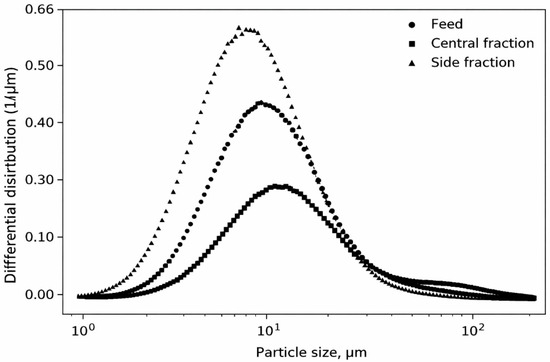
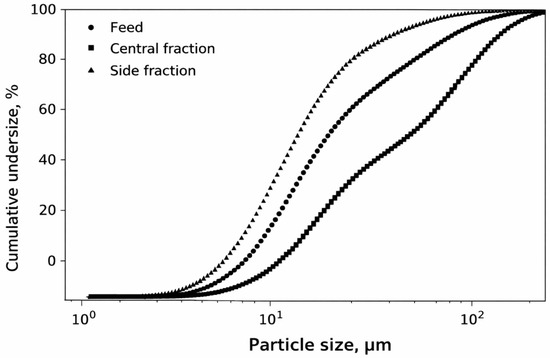
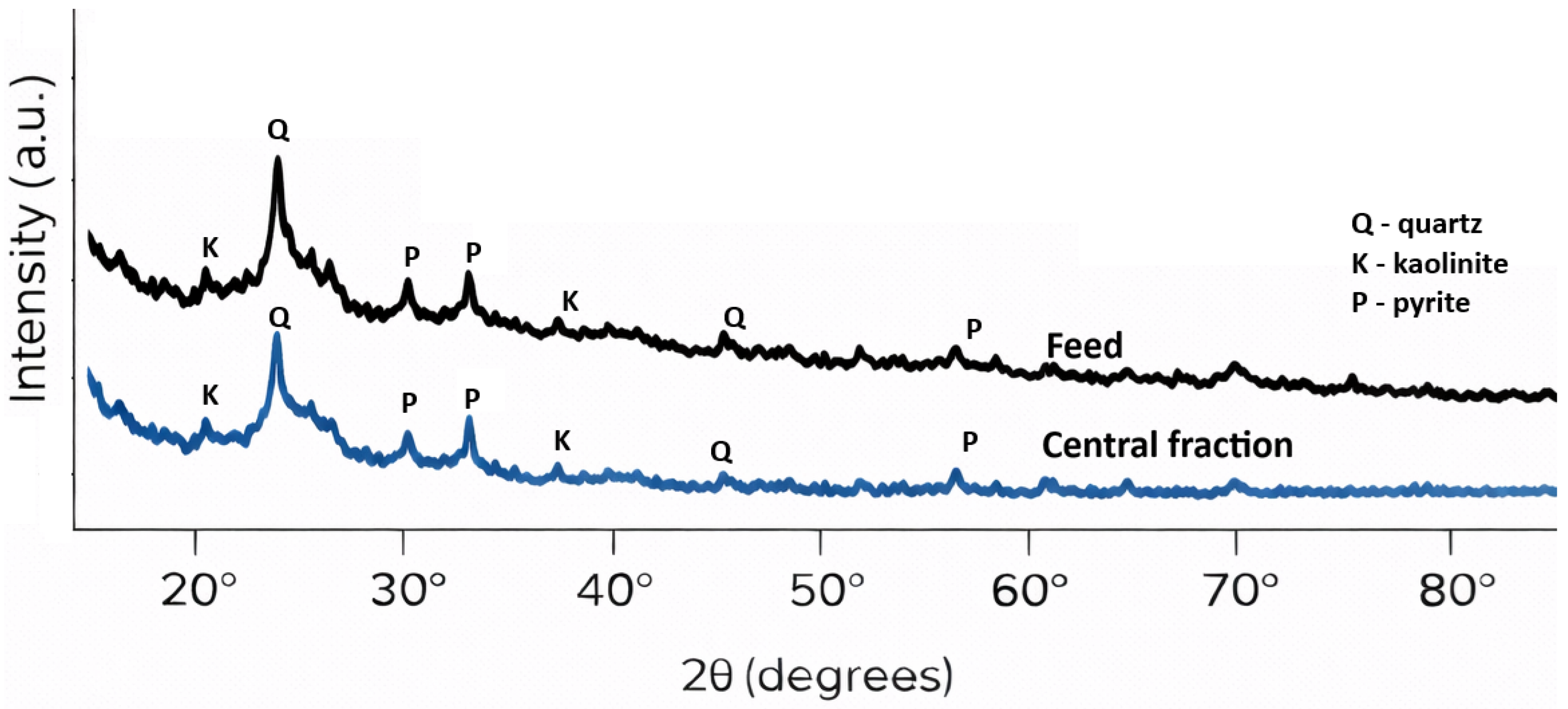
The influence of the microfluidic treatment on the populations of particles is illustrated by the particle size distributions and the X-ray diffraction diagrams presented in Figure 1, Figure 2 and Figure 3.
Figure 1.
Differential particle size distributions of the feed, central fraction, and side fraction obtained after microfluidic processing.
Figure 2.
Cumulative undersize particle size distributions corresponding to the differential PSDs shown in Figure 1.
Figure 3.
XRD patterns of the feed material and central microfluidic fraction.
The differential particle size distributions illustrated in Figure 3 indicate that the feed material has a wide unimodal distribution, with a maximum around 10–15 µm and a coarse distribution tail extending beyond 100 µm.
Following microfluidic processing, the central fraction is systematically shifted toward larger particle sizes, whereas the side fraction is enriched in finer particles relative to the feed. These trends are further quantified by the cumulative undersize distributions in Figure 2.
The median particle size (D50) increases from about 15 µm for the feed to about 20 µm for the central fraction, while the lateral fraction is characterized by a lower D50 of about 13 µm. The differences are more marked in the range of coarse particles: the D90 value exceeds 100 µm for the central fraction, against approximately 80 µm for the feed, while the lateral fraction has a markedly reduced D90 of approximately 40 to 45 µm. Despite these variations, a significant overlap between all the distributions is observed in the size range from 5 to 50 µm, suggesting that particle size alone may not fully explain the separation.
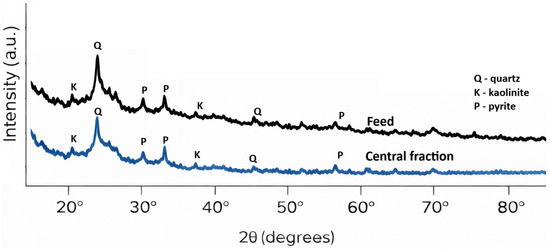
The X-ray diffraction diagrams of the feed material and of the central microfluidic fraction are presented in Figure 3.
The X-ray diffraction (XRD) diagrams of the feed material and of the central microfluidic fraction are presented in Figure 3. The feed material consists mainly of a silicate matrix, quartz being the majority phase, as evidenced by the strong reflection at 2θ ≈ 26.6° and the additional peaks at ≈20.9°, 36.5° and 50.1°. Kaolinite is identified by reflections at 2θ ≈ 12.3°, 24.8° and 38.5°, indicating the presence of fine phases of aluminosilicates. Weak pyrite reflections are observed at 2θ ≈ 28.5°, 33.1° and 57.4°. The central fraction has the same phase composition, confirming that the microfluidic treatment does not induce phase transformations. No peak shifts or systematic changes in peak width were observed in the XRD patterns, indicating the absence of detectable structural or microstructural modifications.
3.3. Elemental Mass Balance and Enrichment in Microfluidic Fractions
The elementary mass balance was established by normalizing the mass of the feed material to 100%. The microfluidic treatment generated two solid products, the central and lateral fractions, which together represent the total recovered mass. The elementary distributions were calculated from the mass yields and elementary concentrations measured for each fraction. The consistency of the mass balance was evaluated by comparing the sum of the elementary masses of the fractions with those of the feed material. Only the solid phases were taken into account in the balance sheet. The central and lateral fractions represent respectively 17% and 83% of the total mass of solid.
As shown in Table 2, Cu is preferably concentrated in the central fraction, despite its relatively low mass yield.
Table 2.
Elemental composition of the central and side microfluidic fractions.
On the other hand, Si and Al are enriched in the lateral fraction, which reflects the redistribution of the dominant silicate matrix.
Table 3 summarizes the mass distribution of the particles according to the particle size classes selected for the feed material and the microfluidic fractions, according to the particle size distribution data.
Table 3.
Size-class mass distribution derived from PSD.
The particle size of the feed is very variable, ranging from less than 5 µm to more than 100 µm. The central fraction is characterized by a higher proportion of particles from 20 to 100 µm, while the lateral fraction contains a greater proportion of particles smaller than 10 µm.
Table 4 shows the elementary composition of the feed, classified by particle size class.
Table 4.
Elemental composition of the feed by size class.
As shown in Table 4, the concentrations of Cu, Zn and Fe systematically increase with the size of the particles, reaching their maximum values for the coarsest particles (>20 µm). On the other hand, the Si content decreases progressively with the increase in the size of the particles, which reflects the dilution of the silicate matrix in the coarsest fractions. This trend in composition as a function of size indicates a preferential association of the metalliferous phases with the coarsest populations of particles, while the finest particle size classes are dominated by a silicate-rich material having relatively low metal contents.
Table 5 shows the contribution of each particle size class to the total Cu content of the feed.
Table 5.
Contribution of size classes to total copper content in the feed.
Although the finest particle size fractions (<10 µm) represent a significant part of the total mass, their contribution to the total copper content remains limited. On the other hand, particles of 20 to 100 µm contribute mainly to the total copper content, despite a smaller fraction of the total mass. This reflects the combined effect of an increased copper concentration and a sufficient mass share within these size classes.
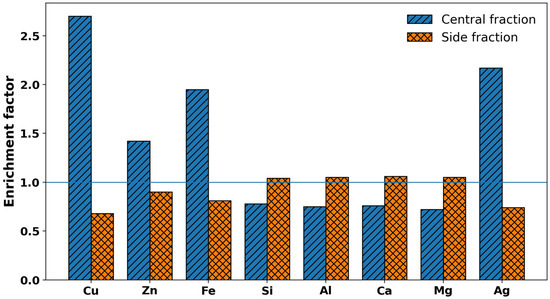
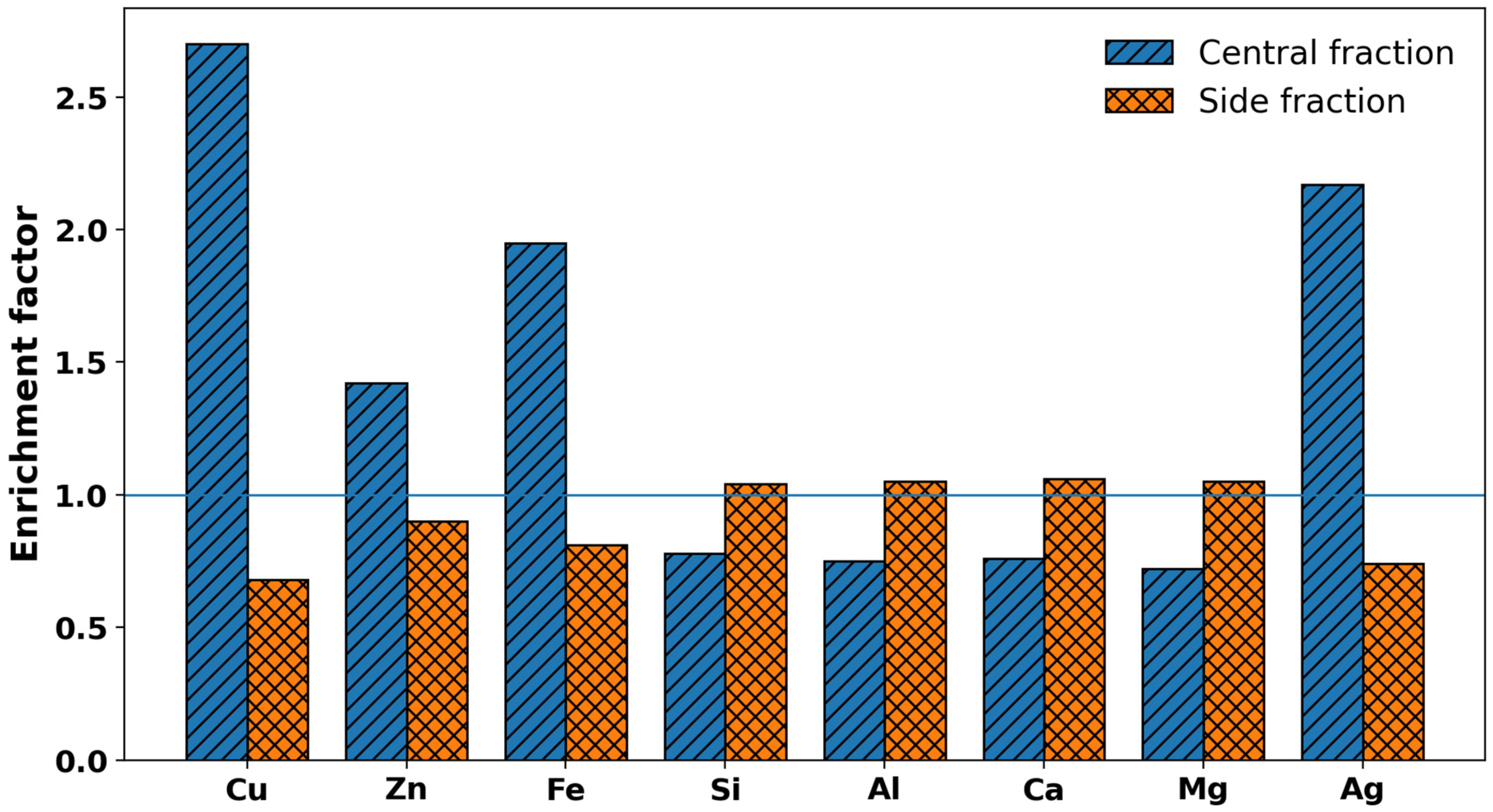
Figure 4 shows the enrichment factors (EF = Cfraction/Cfeed, where Cfraction and Cfeed are the metal concentration in the considered fraction and the feed, respectively) for the major and trace elements in the central and lateral microfluidic fractions.
Figure 4.
Enrichment factors for major and trace elements in the central and side microfluidic fractions.
The central fraction has a marked enrichment in Cu (EF ≈ 2.7) and in Ag (EF ≈ 2.2), accompanied by a moderate enrichment in Fe (EF ≈ 2.0) and in Zn (EF ≈ 1.4). On the other hand, the elements mainly associated with the silicate matrix (Si, Al, Ca, Mg) are systematically depleted in the central fraction, with EF values below unity. The lateral fraction shows the opposite trend, being slightly enriched in Si, Al, Ca and Mg (EF ≈ 1.04–1.06), while remaining depleted in Cu, Fe, Zn and Ag. This complementary behavior confirms an efficient distribution of the elements between the two microfluidic outlets and demonstrates that the phases containing metals are preferentially concentrated in the central fraction. The enrichment trends observed in Figure 4 are consistent with the particle size redistribution illustrated in Figure 1 and Figure 2, as well as with the size-dependent composition trends summarized in Table 4 and Table 5. This indicates that the preferential recovery of copper and associated metals is closely linked to their association with the coarsest particles.
The combined analysis of the mass balance, the particle size and the elemental enrichment demonstrates that the microfluidic treatment induces a coupled redistribution of the size and the chemical composition of the particles. The preferential concentration of Cu, Ag, Fe and Zn in the central fraction results from the selective fractionation of the coarser particles containing metals, while the lateral fraction is dominated by fine particles rich in silicates. However, the observed enrichment cannot be explained solely by the effects of the particle size, since a significant overlap persists between the particle size distributions. In the following section, the role of particle trajectories is examined in detail in order to elucidate how surface properties influence particle migration and exit selectivity, beyond inertial effects alone.
3.4. Surface-Related Effects and Particle Trajectories in Microfluidic Separation
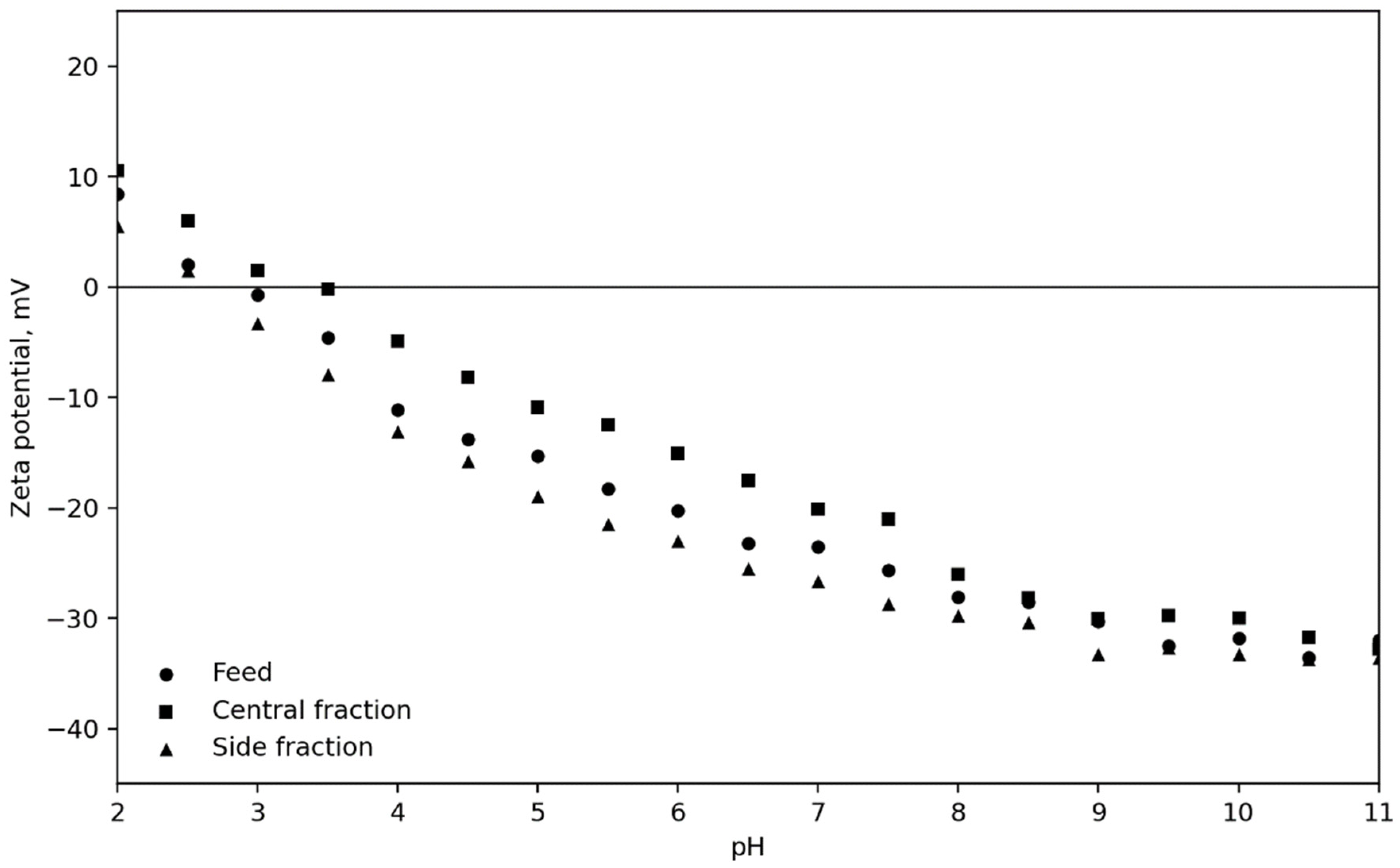
The surface charge properties of the feed material and the microfluidic fractions were evaluated by measuring the zeta potential as a function of pH, as shown in Figure 5.
Figure 5.
Zeta potential as a function of pH for the feed material and the central and side microfluidic fractions.
For all the samples, the zeta potential decreases monotonically with the increase in the pH, passing from weakly positive values in an acidic medium to strongly negative values in neutral and alkaline medium.
The feed material has an almost neutral surface charge at pH ≈ 3, followed by a gradual decrease towards negative values, reaching approximately −30 to −32 mV at pH 9–11. This behavior is characteristic of predominantly silicate systems and is consistent with the mineralogical composition of the feed material.
The central fraction systematically presents less negative (or more positive) zeta potential values over the entire studied pH range, compared to the feed material. Its isoelectric point is shifted towards slightly higher pHs, and its zeta potential remains 3 to 6 mV higher than that of the feed material in neutral and alkaline media. On the other hand, the lateral fraction has more negative zeta potential values, in particular at pH > 5, where the difference with respect to the central fraction reaches approximately 5 to 8 mV. Although the absolute differences in zeta potential between the fractions are moderate, their systematic nature indicates that the microfluidic treatment induces a partial separation of the particles with distinct surface charge characteristics. These differences are consistent with the observed redistribution of the mineral phases and the elemental composition and suggest that surface effects contribute to the selective distribution of particles between the central and lateral outlets.
It should be noted that the zeta potential measurements were performed on a heterogeneous mineral mixture. Therefore, the measured values represent an averaged electrokinetic response of the particles and are likely dominated by the mineral phases with the largest specific surface area. Thus, the obtained zeta potential values should be considered as indicative of the overall electrokinetic behaviour of the suspension.
3.5. Inferred Particle Trajectories in the Microfluidic Channel
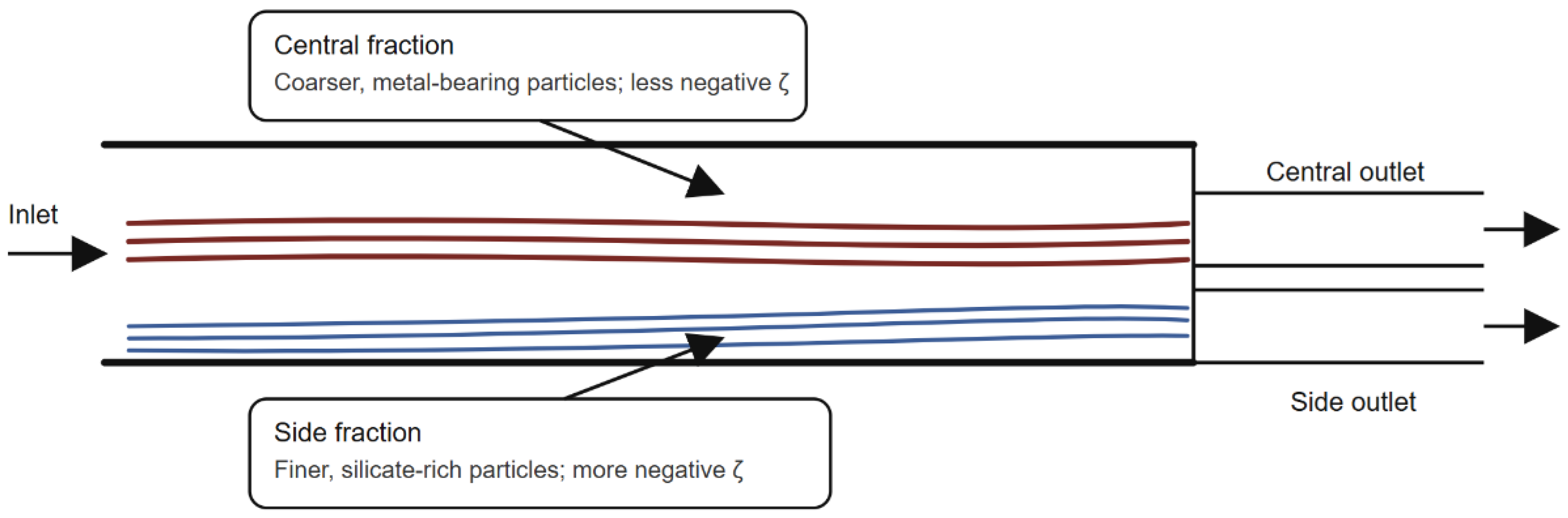
Although the individual trajectories of the particles have not been visualized directly in the present study, the experimentally observed redistribution of the particle size, their elementary composition and their surface charge makes it possible to reconstitute the characteristic migration paths of the particles within the microfluidic channel. A conceptual diagram of the deduced trajectories is presented in Figure 6.
Figure 6.
Conceptual schematic of inferred particle trajectories in the microfluidic channel.
The particles collected in the central fraction are characterized by a systematically larger size and a higher metal content. The median particle size (D50) goes from about 15 µm in the feed to about 20 µm in the central fraction, while the D90 exceeds 100 µm, against about 80 µm for the feed. At the same time, this fraction has a high enrichment in Cu (EF ≈ 2.7), Ag (EF ≈ 2.2), Fe (EF ≈ 2.0) and Zn (EF ≈ 1.4), which indicates a preferential recovery of the particles containing metals.
On the other hand, the lateral fraction is dominated by finer particles, with a D50 of about 13 µm and a D90 limited to about 40–45 µm, and is depleted of Cu and associated metals (EF < 1). These particle size characteristics suggest that the particles leaving through the lateral outlet follow trajectories shifted towards regions of lower inertial focusing, which is consistent with their reduced size and mass.
It is important to note that the observed distribution cannot be attributed solely to the particle size. A significant overlap in the particle size distributions of the feed, central and lateral fractions persists in the range from 5 to 50 µm, where both outlets receive large populations of particles. This overlap indicates that additional physicochemical factors contribute to the differentiation of trajectories within the microfluidic channel.
Surface load measurements shed additional light on this behavior. Over the entire pH range studied, the particles of the central fraction have zeta potential values systematically 3 to 6 mV lower than those of the feed fraction, while the lateral fraction has more negative values, with differences reaching 5 to 8 mV compared to the central fraction at pH > 5. Although of moderate amplitude, these differences are sufficient to influence the interactions near the walls and the hydrodynamic lift forces in confined microfluidic geometries. The available data suggest that the particles recovered at the central outlet likely follow trajectories oriented towards the center of the channel, possibly due to the combined influence of higher inertia, higher effective density, and reduced electrostatic repulsion from the channel walls. In addition to mineral density, the effective density of particles may also depend on their internal porosity and morphology. Although these parameters were not measured in the present study, differences in porosity and particle shape between silicate and sulfide particles could potentially influence their migration within the microfluidic channel.
Conversely, the finer and more negatively charged particles are more likely to be displaced laterally towards the lateral exit, where surface interactions become predominant.
3.6. Coupled Role of Particle Size and Surface Properties
The separation behavior observed in the microfluidic channel results from the combined influence of the particle size and their surface properties, and not from the size effects alone. The particle size controls the inertial response to the laminar flow field, while the surface charge governs the particle–wall interactions and lateral migration.
As shown in Figure 1 and Figure 2, the central fraction is enriched with coarser particles (D50 ≈ 20 µm; D90 > 100 µm), while the lateral fraction mainly contains finer particles (D50 ≈ 13 µm; D90 ≈ 40–45 µm). The larger particles therefore preferably remain in the central flow zone and are directed towards the central outlet.
In parallel, the potential measurements ζ (Figure 5) indicate systematic differences in surface charge between the two fractions. The central fraction has less negative potentials ζ of about 3 to 6 mV compared to the power supply, while the lateral fraction displays more negative values of about 5 to 8 mV. These differences are consistent with the enrichment in metalliferous phases of the central fraction and the predominance of particles rich in silicates in the lateral fraction.
The combined effect of the increase in the size of the particles and the reduction in the surface charge favors the retention of the metalliferous particles in the central current lines, while the finer and more negatively charged particles undergo an increased lateral displacement towards the walls and are collected preferentially at the lateral outlet.
These observations explain the elemental enrichment trends described in Section 3.3, where Cu, Ag and Fe are preferentially concentrated in the central fraction, while Si, Al, Ca and Mg are enriched in the lateral fraction. The results demonstrate that the microfluidic separation works according to a synergistic size–surface mechanism, allowing for a selective preconcentration of the metalliferous particles resulting from complex flotation tailings.
Particle separation in a microfluidic channel is determined by the combined effects of inertial hydrodynamic forces, differences in effective density, and the electrokinetic properties of particles. Under conditions of stable laminar flow, particle trajectories are shaped by inertial uplift forces, velocity gradients, and interactions with the channel walls. Larger and denser particles have greater inertia and tend to migrate toward stable focusing trajectories in the central region of the channel, while smaller particles with lower effective density are more easily deflected toward the peripheral zones of the flow. For small particles, electrostatic interactions with the channel surface can play an additional role.
Thus, the redistribution of particles between the central and lateral fractions is determined by inertial–hydrodynamic focusing in the laminar flow of a microchannel. Unlike traditional hydraulic classification, where separation occurs primarily through gravitational settling in turbulent flows, in a microfluidic system, particle trajectories are determined by inertial migration within the confined geometry of the channel.
4. Conclusions
This work shows that inertial microfluidic treatment can be used as a selective physical preconcentration step for the flotation tailings. Despite the low initial copper content of the feed (≈0.34% by weight), the microfluidic separation produces a distinct fraction enriched in metals, representing only ~17% of the total mass of solids. In this fraction, Cu and Ag are concentrated by a factor of about 2.5 to 3 and about 2, respectively. Simultaneously, the complementary fraction is depleted of base and precious metals and enriched with elements associated with silicates. This separation cannot be explained by the size of the particles alone. Although the fraction enriched in metals is shifted towards larger particles (D50 ≈ 20 µm against ≈ 15 µm in the feed), a significant overlap of the particle size distributions persists. The systematic differences in surface charge between the fractions, with the metal-rich particles having less negative potentials ζ, indicate that particle–wall interactions and surface effects contribute to the selection of the trajectory in the microfluidic channel, in addition to inertial mechanisms.
From an applied point of view, the results suggest that microfluidic devices can serve as a preconcentration step with low energy consumption and without reagents for fine technogenic materials, in particular when precious metals are preferentially associated with coarser or denser particle populations.
Author Contributions
Conceptualization, R.N.; methodology, L.B., O.T. and L.M.; validation, A.B., O.T. and K.K.; formal analysis, O.T., L.B., L.M. and K.K.; investigation, O.T., L.B., L.M. and A.B.; resources, R.N.; data curation, L.B., K.K. and L.M.; writing—original draft preparation, K.K., L.B. and L.M.; writing—review and editing, A.B. and R.N.; visualization, A.B. and L.M.; supervision, R.N.; project administration, R.N.; funding acquisition, R.N. All authors have read and agreed to the published version of the manuscript.
Funding
This research was funded by the Science Committee of the Ministry of Science and Higher Education of the Republic of Kazakhstan (Grant no. BR28712667).
Data Availability Statement
The data supporting the results can be made available from the corresponding author upon request.
Conflicts of Interest
The authors declare no conflicts of interest.
References
- Bilal, M.; Park, I.; Hornn, V.; Ito, M.; Hassan, F.U.; Jeon, S.; Hiroyoshi, N. The challenges and prospects of recovering fine copper sulfides from tailings using different flotation techniques: A review. Minerals 2022, 12, 586. [Google Scholar] [CrossRef] [Scilit]
- Flavarjani, M.H.G.; Sobouti, A.; Rezai, B.; Ahmadi, A. A review of fine particle flotation: Mechanistic insights and advances. Miner. Eng. 2025, 234, 109685. [Google Scholar] [CrossRef] [Scilit]
- Yang, X.; Liu, Q.; Zhou, B.; Li, Z.; Xing, Y.; Gui, X. Research prospects of fine particle flotation collision theory: Integration and transcendence of energetics and collision mechanics paradigms. Miner. Eng. 2026, 236, 109928. [Google Scholar] [CrossRef] [Scilit]
- Chang, Z.; Niu, S.; Shen, Z.; Zou, L.; Wang, H. Latest advances and progress in the microbubble flotation of fine minerals: Microbubble preparation, equipment, and applications. Int. J. Miner. Metall. Mater. 2023, 30, 1244–1260. [Google Scholar] [CrossRef] [Scilit]
- Cotrina-Teatino, M.A.; Marquina-Araujo, J.J.; Contreras-Valverde, J.S.; Valdivieso-Saavedra, M.A. Nanobubbles and the flotation process in mineral recovery: A bibliometric and systematic literature analysis covering the period 2005–2024. Miner. Eng. 2025, 227, 109310. [Google Scholar] [CrossRef] [Scilit]
- Ng, W.S.; Thomas, C.A.; Forbes, E.; Verster, I.; Franks, G.V. Identifying opportunities for the selective flocculation-flotation of fine valuable minerals: A techno-economic analysis. Miner. Eng. 2026, 235, 109884. [Google Scholar] [CrossRef] [Scilit]
- Dadzie, R.A.; Zanin, M.; Skinner, W.; Asamoah, R.; Addai-Mensah, J.; Abaka-Wood, G.B. Enhanced Size-Split Flotation of Sulphide Tailings: Mechanical, HydroFloat™, REFLUX™ Flotation Benchmarking. Chem. Eng. Res. Des. 2026, 227, 35–45. [Google Scholar] [CrossRef] [Scilit]
- Zhang, X.L.; Kou, J.; Sun, C.B.; Zhang, R.Y.; Su, M.; Li, S.F. Mineralogical characterization of copper sulfide tailings using automated mineral liberation analysis: A case study of the Chambishi Copper Mine tailings. Int. J. Miner. Metall. Mater. 2021, 28, 944–955. [Google Scholar] [CrossRef] [Scilit]
- Trifunović, V.; Avramović, L.; Božić, D.; Jonović, M.; Šabaz, D.; Bugarin, D. Flotation Tailings from Cu-Au Mining (Bor, Serbia) as a Potential Secondary Raw Material for Valuable Metals Recovery. Minerals 2024, 14, 905. [Google Scholar] [CrossRef] [Scilit]
- Habibi, Z.; Cook, N.J.; Ehrig, K.; Ciobanu, C.L.; Campo-Rodriguez, Y.T.; King, S.A. Minor and Trace Elements in Copper Tailings: A Mineralogical and Geometallurgical Approach to Identify and Evaluate New Opportunities. Minerals 2025, 15, 1018. [Google Scholar] [CrossRef] [Scilit]
- Koh, E.J.; Amini, E.; Spier, C.A.; McLachlan, G.J.; Xie, W.; Beaton, N. A mineralogy characterisation technique for copper ore in flotation pulp using deep learning machine vision with optical microscopy. Miner. Eng. 2024, 205, 108481. [Google Scholar] [CrossRef] [Scilit]
- Chamlal, H.; Elghali, A.; Ait Khouia, Y.; Taha, Y.; El Fels, A.E.A.; Attalir, N.; Anbi, A.; Benzaazoua, M. Floatability prediction of copper ore using particle complexity and textural features. Miner. Eng. 2025, 230, 109406. [Google Scholar] [CrossRef] [Scilit]
- Drobe, M.; Haubrich, F.; Gajardo, M.; Marbler, H. Processing tests, adjusted cost models and the economies of reprocessing copper mine tailings in Chile. Metals 2021, 11, 103. [Google Scholar] [CrossRef] [Scilit]
- Kursunoglu, S. A Review on the Recovery of Critical Metals from Mine and Mineral Processing Tailings: Recent Advances. J. Sustain. Metall. 2025, 11, 2023–2050. [Google Scholar] [CrossRef] [Scilit]
- Guo, X.; Chang, J.; Li, D.; Qin, H.; Wei, Y.; Qiao, J.; Zhang, L. Research Progress on Comprehensive Recovery and Utilization of Gold-Bearing Tailings in China: A Review. JOM 2025, 77, 3275–3294. [Google Scholar] [CrossRef] [Scilit]
- Peng, T.; Qiang, J.; Yuan, S. Sheathless inertial particle focusing methods within microfluidic devices: A review. Front. Bioeng. Biotechnol. 2024, 11, 1331968. [Google Scholar] [CrossRef] [Scilit] [PubMed]
- Tanriverdi, S.; Cruz, J.; Habibi, S.; Amini, K.; Costa, M.; Lundell, F.; Mårtensson, G.; Brandt, L.; Tammisola, O.; Russom, A. Elasto-inertial focusing and particle migration in high aspect ratio microchannels for high-throughput separation. Microsyst. Nanoeng. 2024, 10, 87. [Google Scholar] [CrossRef] [Scilit]
- Norouzy, N.; Nikdoost, A.; Rezai, P. Parallelization of Curved Inertial Microfluidic Channels to Increase the Throughput of Simultaneous Microparticle Separation and Washing. Micromachines 2024, 15, 1228. [Google Scholar] [CrossRef] [Scilit] [PubMed]
- Zhou, T.; Zhang, T.; Yalikun, Y.; Hosokawa, Y.; Cui, Q.; Tian, G.; Feng, S.; Li, M. Particle separation by passive microfluidics and their downstream assays. Sens. Actuators B Chem. 2025, 450, 139295. [Google Scholar] [CrossRef] [Scilit]
- Ashrafizadeh, S.N.; Zare, M.; Khatibi, M. A comprehensive review of pinch flow fractionation in microfluidics: From principles to practical applications. Chem. Eng. Process.-Process Intensif. 2025, 208, 110087. [Google Scholar] [CrossRef] [Scilit]
- Cui, Q.; Tian, G.; Zhou, T.; Shen, Y.; Feng, S.; Li, M.; Hosokawa, Y.; Yalikun, Y.; Zhang, T. Design advances in pinched flow fractionation for enhanced particle separation in microfluidics. Lab Chip 2025, 25, 4290–4308. [Google Scholar] [CrossRef] [Scilit]
- Salafi, T.; Zhang, Y.; Zhang, Y. A review on deterministic lateral displacement for particle separation and detection. Nano-Micro Lett. 2019, 11, 77. [Google Scholar] [CrossRef] [Scilit]
- Zhbanov, A.; Lee, Y.S.; Yang, S. Current status and further development of deterministic lateral displacement for micro-particle separation. Micro Nano Syst. Lett. 2023, 11, 11. [Google Scholar] [CrossRef] [Scilit]
- Ying, Y.; Lin, Y. Inertial focusing and separation of particles in similar curved channels. Sci. Rep. 2019, 9, 16575. [Google Scholar] [CrossRef] [Scilit] [PubMed]
- Harding, B.; Stokes, Y.M. Inertial focusing of spherical particles in curved microfluidic ducts at moderate Dean numbers. J. Fluid Mech. 2023, 957, A17. [Google Scholar] [CrossRef] [Scilit]
- Amani, A.; Shamloo, A.; Vatani, P.; Ebrahimi, S. Particles focusing and separation by a novel inertial microfluidic device: Divergent serpentine microchannel. Ind. Eng. Chem. Res. 2022, 61, 14324–14333. [Google Scholar] [CrossRef] [Scilit]
- Yin, P.; Lin, Y.; Jiang, M.; Jiang, X.; Fang, X.; Huang, M.; Zhang, B.; Ma, F. Vibration technology-based droplet microfluidic devices for biomedical applications. Sens. Diagn. 2025, 5, 270–304. [Google Scholar] [CrossRef] [Scilit]
- Shiri, F.; Feng, H.; Gale, B.K. Passive and active microfluidic separation methods. Part. Sep. Tech. 2022, 449–484. [Google Scholar] [CrossRef] [Scilit]
- Liu, X.; Li, J.; Zhang, W.; Wang, Y.; Min, X.; Yang, Z.; Shi, M.; Wang, Q.; Yan, X.; Chai, L. Size-based separation of fine mineral particles using inertial microfluidics: A case of jarosite and anglesite. Chem. Eng. J. 2024, 500, 157509. [Google Scholar] [CrossRef] [Scilit]
- Li, J.; Yang, Z.; Zhang, W.; Hu, W.; Wang, Y.; Wu, J.; Zhu, D.; Wang, Q.; Shi, M.; Yan, X.; et al. Inertial migration of fine mineral particles in a curved microfluidic channel: Demystifying the role of non-neutrally buoyant particles. Sep. Purif. Technol. 2024, 334, 126026. [Google Scholar] [CrossRef] [Scilit]
- Di Carlo, D.; Irimia, D.; Tompkins, R.G.; Toner, M. Continuous inertial focusing, ordering, and separation of particles in microchannels. Proc. Natl. Acad. Sci. USA 2007, 104, 18892–18897. [Google Scholar] [CrossRef] [Scilit] [PubMed]
- Su, J.; Chen, X.; Hu, G. Inertial migrations of cylindrical particles in rectangular microchannels: Variations of equilibrium positions and equivalent diameters. Phys. Fluids 2018, 30, 032007. [Google Scholar] [CrossRef] [Scilit]

Disclaimer/Publisher’s Note: The statements, opinions and data contained in all publications are solely those of the individual author(s) and contributor(s) and not of MDPI and/or the editor(s). MDPI and/or the editor(s) disclaim responsibility for any injury to people or property resulting from any ideas, methods, instructions or products referred to in the content. |
© 2026 by the authors. Licensee MDPI, Basel, Switzerland. This article is an open access article distributed under the terms and conditions of the Creative Commons Attribution (CC BY) license.