


Abstract
Rare earth elements (REEs) play a critical role in provenance tracing and the environmental reconstruction of the Earth. However, systematic investigations into the geochemical behavior and fractionation mechanisms of REEs during halite crystallization in brine–salt systems remain limited. This study reports new trace element and REE data for Late Cretaceous halites from the Thakhek Basin, Laos. Ratios of Sr/Ba, Sr/Cu, and V/Cr indicate a marine origin for the halites, which formed under hot climatic and oscillating oxidizing–anoxic redox conditions. Both primary and secondary halites display uniform Post-Archean Australian Shale (PAAS)-normalized REE distribution patterns, characterized by relative enrichment in medium rare earth elements (MREE) and depletion in light (LREE) and heavy rare earth elements (HREE). Similar REE patterns are also observed in halites from other modern and ancient, continental and marine salt basins worldwide. These observations suggest that the influences of parent brine composition and external provenance supplies on REE fractionation are negligible, given the consistent source, salinity, and redox conditions recorded in these halites. Accordingly, REE fractionation in halite was largely controlled by crystallographic effects, with aqueous MREE preferentially incorporated into halite crystals during deposition. In addition, the relatively lower Zr/Hf ratios in secondary halites compared to primary halites further validate the utility of the Zr/Hf ratio for distinguishing authigenic halite from salt modified by diagenesis, weathering, dissolution, or recrystallization. While our results establish a fundamental REE distribution pattern for halite, further research is needed to better constrain the underlying fractionation mechanisms of REEs in evaporite minerals within brine–salt systems.
1. Introduction
Rare earth elements (lanthanides plus yttrium, hereafter REEs) exhibit similar physicochemical properties and predictable geochemical behavior [1,2]. Consequently, they are widely regarded as sensitive tracers for tracking environmental changes and reconstructing associated geological processes [3,4]. Over recent decades, advances in theoretical research and analytical techniques have significantly advanced our understanding of REE behavior and fractionation dynamics across diverse geological systems, including magmatic reservoirs [5,6,7], natural aqueous environments [8,9,10,11] and sedimentary basins [12,13,14].
Evaporites are salt rocks precipitated from saturated surface or near-surface brines under hydrological conditions driven by solar evaporation [15]. As one of the most widespread sedimentary rock types on Earth, evaporites serve as critical archives of paleoenvironmental conditions. The partitioning mechanisms of REEs in evaporitic minerals are therefore particularly significant for deciphering the provenance and evolutionary pathways of both modern and ancient brine systems [16,17,18]. Previous investigations have made substantial progress in elucidating REE behavior in salt minerals during precipitation from brine, particularly in the context of modern salt lakes and laboratory experiments [18,19,20,21,22,23]. However, significant gaps remain in our characterization of REE behavior in ancient salt basins, hindering a comprehensive understanding of salt mineral crystallization processes and the underlying evolution of ancient brines [18,19,20,21,22,23,24,25,26,27].
To address this critical limitation, we present a systematic geochemical investigation of mid-Cretaceous halites from the ZK2893 core in the Thakhek Basin, Laos. By integrating trace element analyses, REE distribution patterns, and Zr–Hf partitioning characteristics, this study aims to: (1) reconstruct the sedimentary environment of halite deposition and (2) evaluate the factors controlling REE behavior in halite during both primary precipitation and diagenetic processes within the brine system. Our results supplement the knowledge of the REE distribution pattern of halite in general and promote our understanding of the underlying REE fractionation mechanism in brine–salt systems.
2. Geological Setting
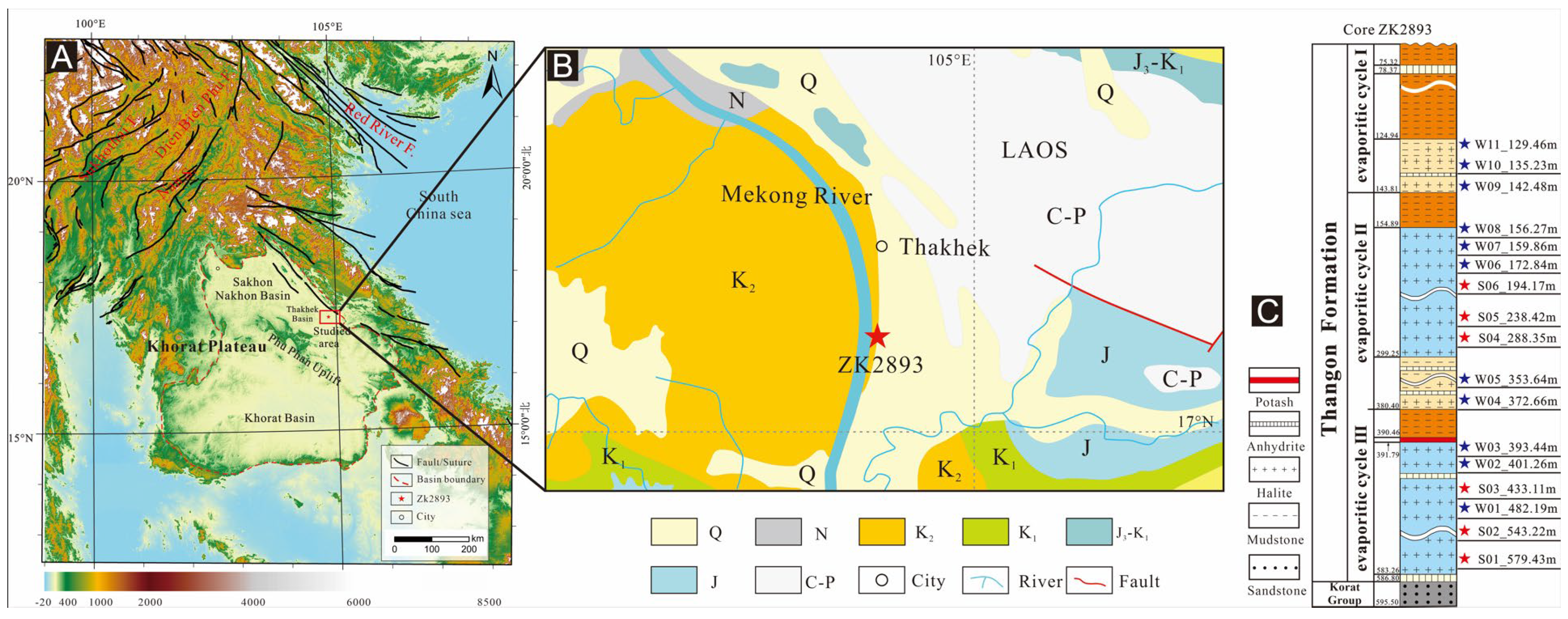
The Khorat Plateau is situated in eastern northern Thailand and central Laos. Tectonically, it belongs to the Indochina Block, bounded to the west by the Nan Uttaradit Suture, Sukhothai Arc, and Sibumasu Terranes, and to the north by the Song Ma Suture and the South China Terrane [28,29]. The Mesozoic–Cenozoic sedimentary filling of Khorat Plateau is associated with the evolution of the Tethys Ocean [28,30,31,32]. The resulting reactivity of the surrounding deep, large-scale faults facilitated stable subsidence and continuous deposition within the Khorat Plateau Basin [33,34,35]. Subsequent tectonic activity during the early Paleocene led to the formation of the NW–SE-trending Phu Phan Anticlinorium, which divided the Khorat Plateau into the Sakon Nakhon Basin to the north and the Khorat Basin to the south (Figure 1A) [36,37].
The Jurassic to early Cenozoic strata in Khorat Plateau prevailed throughout the Indochina Block, characterized by nonmarine red beds with an accumulated thickness of up to 5 km [38]. Coeval and well-correlated sediments are also extensively developed in the Simao, Chuxiong and Sichuan Basin in southwestern China and mainly consist of fluvial and lacustrine deposits [39,40,41,42]. These observations imply that these basins may have been connected in the past, despite the fact that the associated sediment linkage is still not well-understood [39,43].
The lower Cretaceous Khorat Group in Laos is mainly composed of continental red beds of fluvial sediments [44,45]. The Thangon Formation in Laos is the stratigraphic equivalent of the Mahasarakhan Formation in Thailand. It unconformably overlies the Khorat Group and is typified by thick marine evaporite sequences and potash deposits [38]. Dating using palynology, isotopy and paleomagnetism suggested a late early Cretaceous to early late Cretaceous age of these evaporite sediments (Albian–Cenomanian), with potash formation of 92–63.5 Ma [45,46,47,48,49,50]. The Thangon Formation develops three distinct evaporite cycles, mainly composed of halite, with potassium–magnesium salt minerals in the upper part of the lower cycle.
Figure 1.
Simplified geology of the study area (A,B) and petrology and samples of core ZK2893 (C) modified from [32,44,50].
3. Materials and Methods
3.1. Materials
The core ZK2893 is from the Thakhek mining area that is located at the northeastern margin of the Sakon Nakhon Basin (Figure 1B). It uncovered about 595.40 m sediments, including the 8.6 m sandstone beds of the Nam Noy Formation of the Khorat Group at the bottom, the 529.5 m evaporite series of Thangon Formation at the middle and 0.8 m of Quaternary unconsolidated clastic sediments at the top, respectively. Three distinct evaporitic cycles of the Thangon Formation have been observed in this core and each cycle mainly comprised the lower evaporites unit and the upper clastic unit. The detailed petrology of the evaporites of ZK2893 has been reported by Zhang et al. [50]. Cycle I included a pure clastic unit of red and greenish mudstone in the upper part and grayish anhydrite in the lower part; cycle II comprised a red mudstone and halite unit that both had interbedded anhydrite; and cycle III was characterized by a clastic unit of red mudstone, interbedded with halite and salt unit of halite, with an anhydrite layer at the base and potash layer at the upper part. This kind of vertical variation implied a trend of upward freshening in the overall evaporite series and frequent oscillations of the environmental conditions within each evaporitic cycle.
In total, 11 samples of halite with different stratigraphic depth from core ZK2893 were collected (Figure 1C). Among these, 6 samples (S1–S6) representing the primary origin of halite were collected from the lower evaporite cycles, with a gray or white color and mm-scale cumulate or cm-scale chevron crystal with cloud fluid inclusion bands. The remaining 11 samples of transparent halite (W1–W11) were collected from the upper evaporite cycles. They were clear and included mud and a few small bands of fluid inclusions, suggesting a diagenetic origin formed by the filling of dissolution cavities by halite cements and the displacive growth of new halite crystals [51,52].
3.2. Experimental Methods
Trace element and REEs measurements were carried out at the Nuclear Industry Geological Research Institute in Beijing, China, using a Nu Plasma MC-ICP-MS system for trace element determination. To ensure the reliability of measurements, sensitivity variations were monitored using internal standards (84Sr, 115In, 147Sm, 169Tm, and 187Re), while certified reference materials (W2a-1, BIR-1, BHVO-2, and JCP-1) were used as calibrants to verify the accuracy of elemental concentrations. All elements exhibited analytical precision with average relative standard deviations (RSDs) below 3%.
For halite sample preparation, ethanol-assisted grinding was employed to pulverize the crystals into a fine powder, which effectively eliminated the residual brine contamination from intercrystalline boundaries and fluid inclusions [53]. Subsequent processing involved dissolving 3 g of salt in 1 L of 5% HNO3 (pH ≈ 2), followed by a 1:2 dilution to prevent salt recrystallization prior to storage in acid-washed polyethylene containers. Aliquots (10 mL) were then transferred to plastic vials for compositional characterization.
The Zr, Hf, and REE extraction protocol was adapted from the methodology described by Raso et al. [54], with minor modifications: each 1 L sample was spiked with 1% FeCl3 solution, followed by the controlled addition of 25% NH4OH to adjust the pH to 8.0–8.5, thereby facilitating the precipitation of Fe(OH)3 as an adsorption substrate for the target elements. To optimize phase separation, the suspension was continuously agitated in sealed flasks for 48–72 h before filtration. Recovery efficiency exceeding 95% was confirmed by quantifying the Fe concentration.
The collected precipitate was membrane-filtered and subsequently dissolved in 3 M HCl, with a final dilution to 1 M concentration for analysis, using an Agilent 7500 series quadrupole ICP-MS (Manufactured by Agilent Technologies, Inc., Santa Clara, CA, USA.) under external calibration mode. Contamination control measures were implemented throughout the process, including: (1) conducting all manipulations in laminar flow clean benches; (2) pre-cleaning sampling apparatus with high-purity reagents (Baker Ultrex II®); and (3) systematically decontaminating plasticware with a 1:10 hot HNO3 solution prior to contact with aqueous samples.
The REE contents of the studied halite samples were normalized to Post-Archean Australian Shale (PAAS), as reported by Taylor and McLennan [55]. Rare earth elements are categorized into light rare earth elements (LREE: La, Ce, Pr, Nd, Sm), middle rare earth elements (MREE: Eu, Gd, Tb, Dy), and heavy rare earth elements (HREE: Ho, Er, Tm, Yb, Lu) [56]. δEu defines the Eu anomaly relative to adjacent elements after PAAS normalization and was calculated using the following equation: δREEn = 2 × REEn/(REEn−1 + REEn+1), where δREEn is the anomaly of the selected REE and REEn−1 and REEn+1 represent the REEs one position before and after the target element in the REE sequence, respectively [57]. Generally, δREEn > 1 indicates a positive anomaly, while δREEn < 1 indicates a negative anomaly.
4. Results
Table 1.
Trace element composition of halite from core ZK2893, Laos (unit/ppm).
Table 2.
REE concentration of halite from core ZK2893, Laos (unit/ppb).
Overall, the studied halite samples have trace element concentrations in the ppm range, whereas REE concentrations are in the ppb range. The Sr, Ba, V, and Cr contents of the halite samples range from 500 to 891 ppm, 1.520 to 5.370 ppm, 0.843 to 4.920 ppm, and 0.525 to 1.530 ppm, respectively (Table 1).
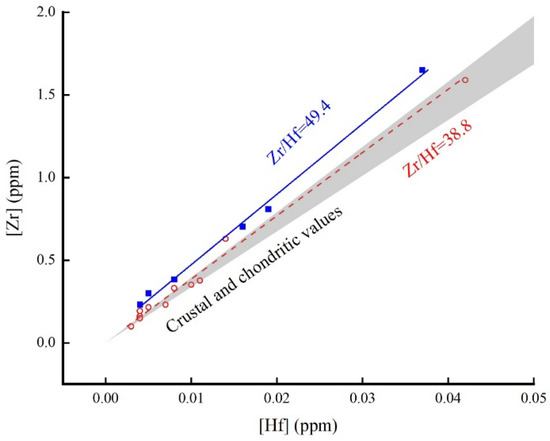
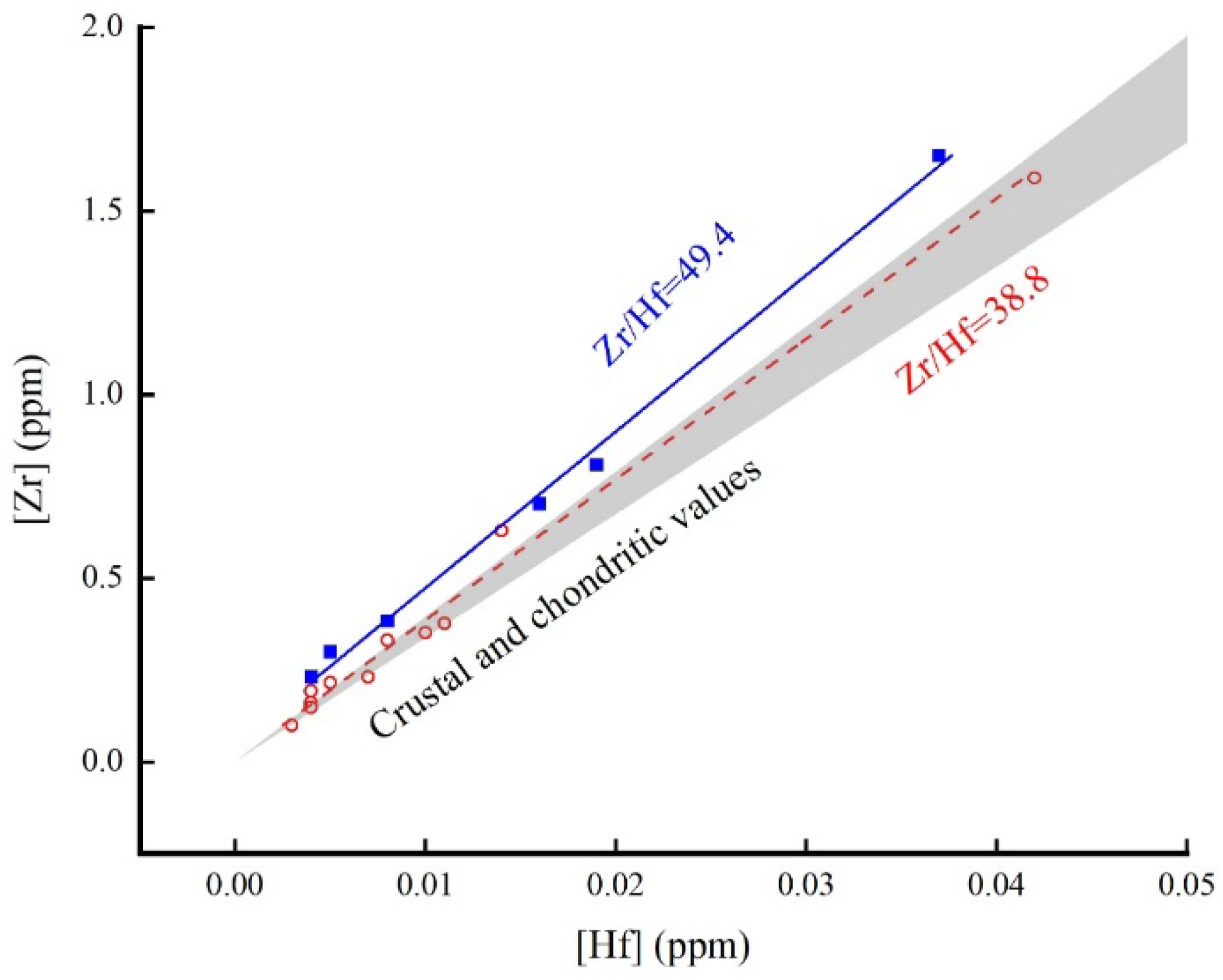
For the primary halites (S1–S6) collected from the lower evaporite cycles of Core ZK2893, the total REE (ΣREE) content ranges from 0.225 to 1.997 ppm, with an average of 1.049 ppm. The Zr and Hf contents range from 0.231 to 1.650 ppm and 0.004 to 0.037 ppm, respectively, with average values of 0.679 ppm and 0.015 ppm. The calculated Zr/Hf ratios vary from 42.53 to 59.80, with an average of 49.40. The δEu values range from 1.01 to 2.05, with an average of 1.38.
In contrast, for the diagenetic halites (W1–W11) collected from the upper evaporite cycles of Core ZK2893, the ΣREE content ranges from 0.190 to 2.837 ppm, with an average of 0.811 ppm. The Zr and Hf contents range from 0.099 to 1.590 ppm and 0.003 to 0.042 ppm, respectively, with average values of 0.393 ppm and 0.010 ppm. The calculated Zr/Hf ratios range from 33.00 to 48.25, with an average of 38.88. The δEu values vary from 0.76 to 7.06, with an average of 1.85 (Table 2).
5. Discussion
5.1. Paleoenvironmental Conditions of Halites
Trace elements serve as robust geochemical proxies for reconstructing paleoenvironmental conditions such as salinity fluctuations, redox dynamics and diagenetic processes [58,59,60]. The Sr/Ba ratio generally increases with the evaporative concentration and salinity, as Ba2+ is prone to adsorption onto clay minerals or organic matter [61,62,63]. Sediment with Sr/Ba > 1.0 is thought to be formed in brackish sea water [64]. The studied halite samples exhibit Sr/Ba ratios substantially exceeding 1.0 (mean = 230.85), indicating marine-derived saline brines. This interpretation aligns with previous Sr-S-B isotopic evidence (87Sr/86Sr, δ34S, δ11B) and the Br content analyses from coeval evaporites in the Korat Plateau Basin [65,66,67]. The Sr/Cu ratio of the studied halite samples have an average value of 185.17, implying a dry–hot climate condition [68]. These findings are consistent with homogenization temperature data (30–50 °C) from halite fluid inclusions in core ZK2893 [69], further supporting a high-temperature paleoenvironment during the formation of the halites. The V/Cr ratio is a reliable indicator for analyzing the redox conditions, as V tends to accumulate in sediments under anoxic conditions [70,71]. Sediments with V/Cr < 2.00 are usually formed in an oxygen-containing environment, whereas V/Cr > 2 in an anoxic condition [58]. The obtained V/Cr of most halite samples is <2.00, but with a range of 0.10~3.65, suggesting a fluctuating oxidizing–anoxic environment during halite formation. The evolution of δD and δ18O of halite [65,69] and the fluctuation of the halite Br/Cl ratio [72] also pointed out that redox environment fluctuations are caused by the water column stratification and basin hydrology, due to multiple concentration–dilution cycles that are associated with frequent sea-level oscillations.
5.2. REEs Distribution Patterns of Halite
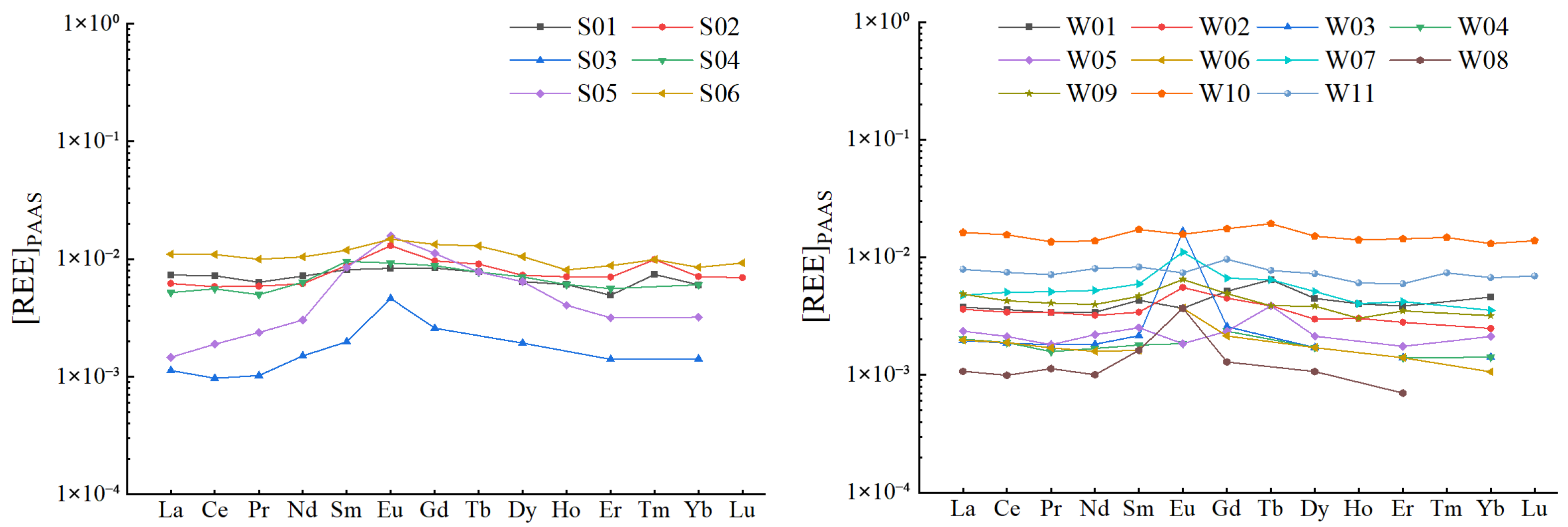
Both primary and secondary halite samples in lower and upper evaporite cycles display consistent PAAS-normalized REE profiles, characterized by middle REE (MREE) enrichment and light/heavy REE (LREE/HREE) depletion (Figure 2).
Figure 2.
PAAS-normalized REE distribution patterns of halite from core ZK2893.
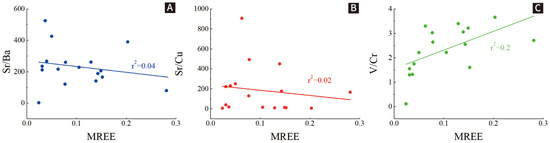
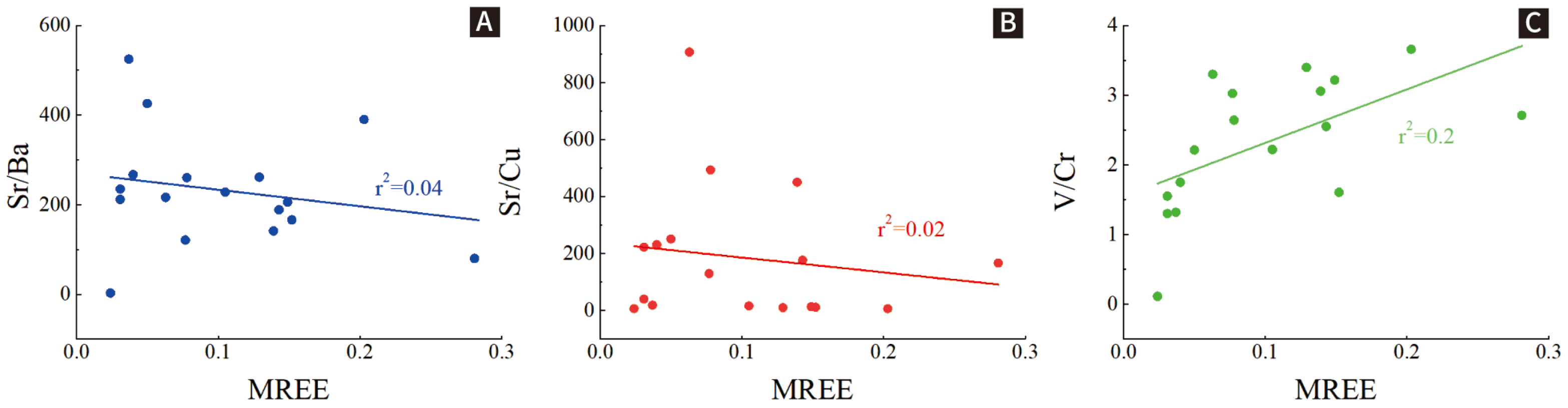
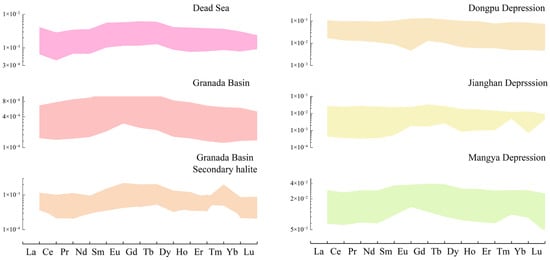
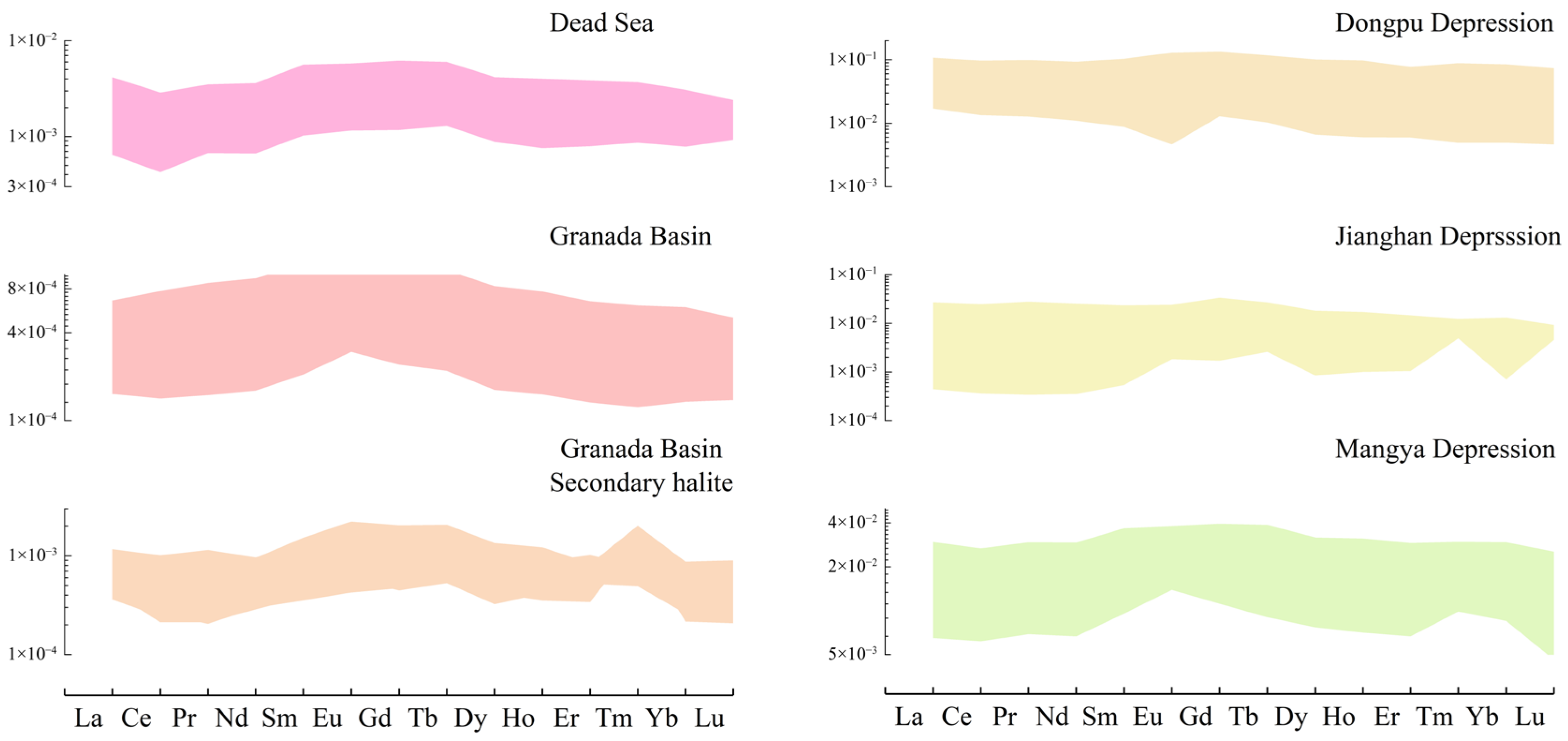
Generally, the REE distribution pattern is associated with multiple geological conditions, such as parent water, redox, salinity and the water–rock interaction of diagenesis [63,73,74]. The absence of significant correlations between MREE abundance and Sr/Ba, Sr/Cu, V/Cr ratios (Figure 3) minimize the potential influences of the salinity, climate, and redox conditions on REE fractionation. In addition, MREE enrichment can be influenced by the mixing of fluids with inherited high MREE contents [75,76], or by the weathering of surrounding minerals with high MREE abundances (e.g., phosphate minerals) [77,78]. To further explore these possibilities, the REE data of halite from other locations—including the modern Dead Sea, the Miocene Granada Basin (Spain), and the Eocene Dongpu Depression, Jianghan Depression, and Mangya Depression (China)—were collected for a comprehensive comparison of their distribution patterns. As shown in Figure 4, halite samples from all studied sites exhibit a similar MREE-enriched distribution pattern, despite significant differences in their geological backgrounds and sedimentary environments. These observations suggest that under natural conditions, halite displays a consistent PAAS-normalized REE distribution pattern, and the parent brine composition, as well as related provenance supplies from the surrounding area, are not the primary controlling factors of this pattern.
Figure 3.
Different trace elemental ratios’ relationship with middle rare earth elements (MREE). (A) Sr/Ba vs. MREE, (B) Sr/Cu vs. MREE, and (C) V/Cr vs. MREE.
Figure 4.
The distribution patterns of PAAS-normalized REE in halite from the Dead Sea, the Granada Basin, and the Dongpu, Jianghan, and Mangya Depressions.
In addition, the REE distribution pattern is related to the crystal structure, ionic radius, and mineral adsorption [1]. The radii of lanthanide ions gradually decrease: a phenomenon known as lanthanide contraction. The ionic radius of Na+ is 0.95 Å, which is close to that of MREE (III) (0.91–0.96 Å). This similarity may lead to MREE being more likely to enter the mineral lattice during halite crystallization.
In addition, surface complexation plays a role in REE fractionation [18,79,80]. This fractionation behavior is caused by the different binding abilities of REE complexes with mineral surface ligands [81,82]. During halite formation, MREE can preferentially complex on the halite surface, and this process is related to surface–REE binding via an inner-sphere mechanism [18].
5.3. Paleoenvironmental Implication of Zr/Hf Ratio and δEu of Halite
Zr and Hf have a chemical affinity, similar ion radii, the same charge, and similar geochemical behavior [83]. Censi et al. [18] proposed that dissolution and recrystallization can have a significant impact on the Zr/Hf of halite, with a higher Zr/Hf ratio of secondary halite than that of primary halite. This phenomenon of Zr and Hf fractionation is also observed in core ZK2983 (Figure 5). The fractionation of Zr and Hf in halite is hypothesized to be associated with the preferential binding of the Zr and Hf complexes on the crystal surface and in the aqueous phase [18,20]. Across a broad range of pH values in the aqueous phase, Zr and Hf predominantly form complexes with hydroxyl groups, resulting in the species [Zr(OH)4]0 and [Hf(OH)5]− [84]. Unlike the neutral [Zr(OH)4]0, the charged [Hf(OH)5]− tends to concentrate more Hf on the halite surface. During dissolution and recrystallization, a greater proportion of Hf may be lost, relative to Zr, thereby yielding a higher Zr/Hf ratio in secondary halite compared to primary halite.
Figure 5.
The Zr and Hf concentration measured in halite and the linear trend depicted by these analyses (blue line: Zr/Hf ratio of secondary halite; red line: Zr/Hf ratio of primary halite; and gray area: range of Zr/Hf values in upper crust and chondritic meteorites).
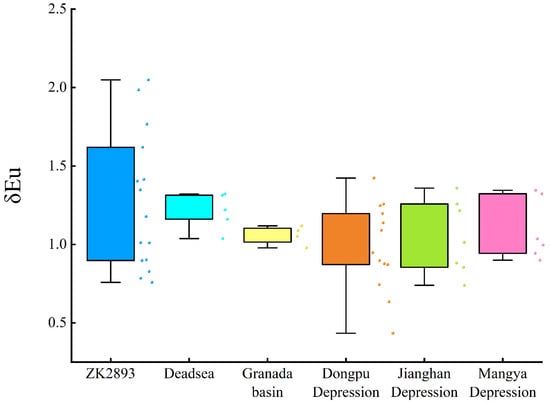
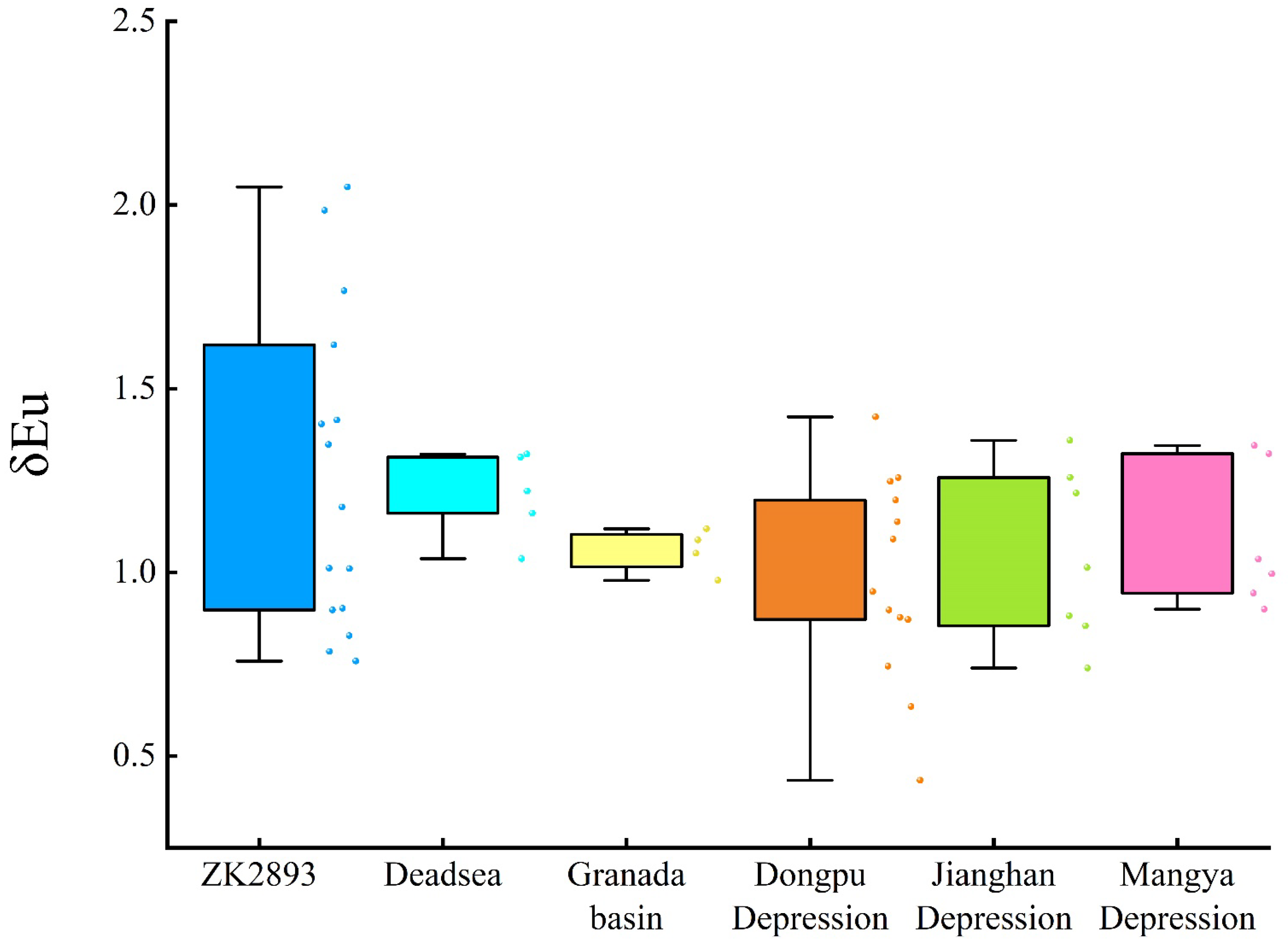
Eu anomalies are a crucial geochemical parameter that are commonly utilized to reflect the redox environment and the provenance of sedimentary materials [85]. These anomalies exhibit distinct characteristics in halite from different ages and regions (Figure 6). For instance, the Dead Sea and Granada Basin display relatively small ranges of δEu variation with positive values, whereas the Thakhek Basin, Dongpu Depression, Jianghan Depression, and Mangya Depression exhibit larger δEu ranges, encompassing both positive and negative values. Notably, high Eu anomalies are observed in the Thakhek Basin, Dongpu Depression, and Jianghan Depression.
Figure 6.
The distribution range of Eu anomalies in Thakhek Basin, Dead Sea, Granada Basin, and Dongpu, Jianghan, and Mangya Depressions.
The primary factors contributing to Eu anomalies are twofold: the redox conditions during formation and the crystal chemistry of minerals [85,86]. Eu typically exhibits positive anomalies under reducing conditions [8], yet V/Cr ratios and δEu have no relevance (Figure 6). This suggests that the redox conditions may not be the dominant factor influencing Eu anomalies in halite, such as those observed in core ZK2893. Eu anomalies predominantly induced by redox processes are most pronounced within magmatic and hydrothermal systems at elevated temperatures, whereas the influence of surface environments exhibiting minor thermal fluctuations is generally considered to be negligible.
In the Dead Sea halite samples, positive Eu anomalies are attributed to crystal chemistry effects, where Eu2+ substitutes for Na+ in the rock salt lattice (2Na+ = Eu2+ + ⨀, with two Na+ replaced by one Eu2+ and lattice vacancies, while six distinct spatial configurations in the lattice provide stable energy values for the substitution reaction) [20]. This mechanism effectively explains the limited and consistently positive δEu variations observed in the Dead Sea and Granada Basin halite. Thus, the crystal chemistry of halite is a significant factor in positive Eu anomalies.
However, crystal chemistry alone cannot account for the abnormally high Eu anomalies observed in the Thakhek Basin and Dongpu Depression. We hypothesize that these anomalies are related to hydrothermal activities. Hydrothermal fluids are known to exhibit pronounced positive δEu anomalies [10], and hydrothermal fluid metasomatism or mixing can elevate mineral δEu values [77,79,85]. Previous studies indicate that the Thakhek Basin and Dongpu Depression developed rift basins during the synsedimentary period of halite [35,69,87,88,89], suggesting that hydrothermal fluids may have modified these high Eu anomalies.
Negative δEu values observed in halite samples may be linked to continental weathering. Weathering of acidic magmatic rocks can induce negative Eu anomalies in sediments [85], and the negative anomalies in halite could be influenced by the weathering of granites. The Thakhek Basin, Jianghan Depression and Dongpu Depression are extensively surrounded by granitic rocks [87,90], which may serve as the source of these negative Eu anomalies.
In summary, Eu anomalies in halite from different regions exhibit distinct ranges and are likely associated with crystal chemistry effects and complex sources. Both hydrothermal activities and continental weathering may significantly influence Eu anomalies in halite.
6. Conclusions
This study elucidates the geochemical behavior of REEs, Zr and Hf and the related control factors during halite formed in the Late Cretaceous halite Thakhek Basin, Laos. The systemic analysis of environmental proxies from the trace element ratio and REEs pattern of halite allow us to draw the following conclusions.
- (1)
- The Late Cretaceous halite of the Thangon Formation in Laos formed from marine-derived brines under hyperarid and high-temperature conditions, with fluctuating oscillating redox environments.
- (2)
- Both primary and secondary halite in the studied core show the consistent distribution pattern of REEs normalized to PAAS that are characterized by MREE enrichment and LREE/HREE depletion.
- (3)
- Uniform REE distribution patterns are also observed in other modern and ancient basins in continental and marine environments, suggesting that the crystal growth effects overprint the parent brine and provenance supplies during the REE fractionation of halites precipitated under natural conditions.
- (4)
- Zr/Hf ratio of halite could serve as a robust diagenetic tracer, as demonstrated in previous research [18,91].
This manuscript presents a new case for a broader comparison of the geochemical behaviors of REEs in halites formed under different background conditions. The highlighted crystallographic effects on the uniform distribution pattern of REEs in halite will provide valuable insights into the migration and enrichment of rare earth elements during the formation of other evaporite salts. However, the mechanisms underlying the fractionation of trace and REE remain poorly understood, and enhancing research on the trace element linkages between the parent water, source areas, and crystallizing minerals is crucial for brine–salt systems. Additionally, the Zr/Hf ratio is validated as a reliable diagenetic tracer. Further experimental calibration is required to establish it as a quantitative proxy for post-depositional processes to improve paleoenvironmental reconstructions.
Author Contributions
J.S., conceptualization, investigation, writing—original draft preparation; H.Y., conceptualization, investigation, writing—original draft preparation; X.Z., formal analysis, validation, software; H.Z., conceptualization, methodology, writing—review and editing. All authors have read and agreed to the published version of the manuscript.
Funding
This research was funded by the Major Science and Technology Projects of Xinjiang, Xinjiang Uygur Autonomous Region Science and Technology Department, China (2022A03009-2) and the Scientific and Technical project, SDIC Xin Jiang Luobupo Potash Co., Ltd., China (CG-2024-HX-S006).
Data Availability Statement
The original contributions presented in this study are included in the article. Further inquiries can be directed to the corresponding author.
Acknowledgments
The authors thank the editors and reviewers for their insightful comments and suggestions regarding this manuscript.
Conflicts of Interest
The authors declare no conflicts of interest.
References
- Bau, M. Controls on the fractionation of isovalent trace elements in magmatic and aqueous systems: Evidence from Y/Ho, Zr/Hf, and lanthanide tetrad effect. Contrib. Miner. Pet. 1996, 123, 323–333. [Google Scholar] [CrossRef] [Scilit]
- Monecke, T.; Kempe, U.; Monecke, J.; Sala, M.; Wolf, D. Tetrad effect in rare earth element distribution patterns: A method of quantification with application to rock and mineral samples from granite-related rare metal deposits. Geochim. Cosmochim. Acta 2002, 66, 1185–1196. [Google Scholar] [CrossRef] [Scilit]
- Ogawa, Y.; Shikazono, N.; Ishiyama, D.; Sato, H.; Mizuta, T.; Nakano, T. Mechanisms for anhydrite and gypsum formation in the Kuroko massive sulfide-sulfate deposits, north Japan. Miner. Depos. 2007, 42, 219–233. [Google Scholar] [CrossRef] [Scilit]
- Dutrizac, J.E. The behaviour of the rare earth elements during gypsum (CaSO4·2H2O) precipitation. Hydrometallurgy 2017, 174, 38–46. [Google Scholar] [CrossRef] [Scilit]
- Wood, B.J.; Blundy, J.D. Trace Element Partitioning: The Influences of Ionic Radius, Cation Charge, Pressure, and Temperature, Treatise on Geochemistry, 2nd ed.; Elsevier: Amsterdam, The Netherlands, 2014; pp. 421–448. [Google Scholar]
- Carrasco-Godoy, C.; Campbell, I.H. Application of Onuma and lattice strain derived methods to calculate missing REE and Ce and Eu anomalies in magmatic zircons. Contrib. Miner. Pet. 2023, 178, 42. [Google Scholar] [CrossRef] [Scilit]
- Zhang, J.; Zhou, X.; Liu, X.; Guo, X.; Suliman, L.; Fang, L.; Wang, Y. Analysis of Gas Migration Characteristics and Release Measures in the Surrounding Rock of Tunnel in Magmatic Rock Gas Reservoir Zone. Rock Mech. Rock Eng. 2025, 58, 10717–10740. [Google Scholar] [CrossRef] [Scilit]
- Bau, M.; Dulski, P. Comparative Study of Ytrium and Rare-Earth Elements Behaviors in Fluorine-Rich Hydrothermal Fluids. Contrib. Miner. Pet. 1995, 119, 213–223. [Google Scholar] [CrossRef]
- Johannesson, K.H.; Tang, J.W.; Daniels, J.M.; Bounds, W.J.; Burdige, D.J. Rare earth element concentrations and speciation in organic-rich blackwaters of the Great Dismal Swamp, Virginia, USA. Chem. Geol. 2004, 209, 271–294. [Google Scholar] [CrossRef] [Scilit]
- Mclennan, S.M.; Taylor, S.R. Geology, Geochemistry and Natural Abundances; American Cancer Society: Atlanta, GA, USA, 2011. [Google Scholar]
- Lafreniere, M.C.; Lapierre, J.F.; Ponton, D.E.; Guillemette, F.; Amyot, M. Rare earth elements (REEs) behavior in a large river across a geological and anthropogenic gradient. Geochim. Cosmochim. Acta 2023, 353, 129–141. [Google Scholar] [CrossRef] [Scilit]
- Rönnback, P.; Åström, M.; Gustafsson, J.P. Comparison of the behaviour of rare earth elements in surface waters, overburden groundwaters and bedrock groundwaters in two granitoidic settings, Eastern Sweden. Appl. Geochem. 2008, 23, 1862–1880. [Google Scholar] [CrossRef] [Scilit]
- Junqueira, T.P.; Harrison, A.L.; Leybourne, M.I.; Vriens, B. Rare earth element patterns in sediments from the Great Lakes basin. Appl. Geochem. 2024, 176, 106218. [Google Scholar] [CrossRef] [Scilit]
- Wang, S.; Wang, Z.; Gao, S.; Zhang, X.; Zeng, J.; Wu, Q. Rare earth elements in lake sediments record historic environmental influences from anthropogenic activities. Ecol. Indic. 2024, 159, 111680. [Google Scholar] [CrossRef] [Scilit]
- Warren, J.K. Evaporites: Sediments, Resources and Hydrocarbons; Springer: Berlin/Heidelberg, Germany, 2010. [Google Scholar]
- Vengosh, A.; Gieskes, J.; Mahn, C. New evidence for the origin of hypersaline pore f luids in the Mediterranean basin. Chem. Geol. 2000, 163, 287–298. [Google Scholar] [CrossRef] [Scilit]
- Boschetti, T.; Toscani, L.; Shouakar-Stash, O.; Iacumin, P.; Venturelli, G.; Mucchino, C.; Frape, S.K. Salt waters of the northern apennine foredeep basin (Italy): Origin and evolution. Aq. Geochem. 2011, 17, 71–108. [Google Scholar] [CrossRef] [Scilit]
- Censi, P.; Inguaggiato, C.; Chiavetta, S.; Schembri, C.; Sposito, F.; Censi, V.; Zuddas, P. The behaviour of zirconium, hafnium and rare earth elements during the crystallisation of halite and other salt minerals. Chem. Geol. 2017, 453, 80–91. [Google Scholar] [CrossRef] [Scilit]
- Censi, P.; Saiano, F.; Zuddas, P.; Nicosia, A.; Mazzola, S.; Raso, M. Authigenic phase formation and microbial activity control Zr, Hf, and rare earth element distributions in deep-sea brine sediments. Biogeosciences 2014, 11, 1125–1136. [Google Scholar] [CrossRef] [Scilit]
- Censi, P.; Sirota, I.; Zuddas, P.; Lensky, N.G.; Merli, M.; Saiano, F.; Piazzese, D.; Sposito, F.; Venturelli, M. Trace element fractionation through halite crystallisation: Geochemical mechanisms and environmental implications. Sci. Total Environ. 2020, 723, 137926. [Google Scholar] [CrossRef] [Scilit] [PubMed]
- Censi, P.; Sirota, I.; Zuddas, P.; Lensky, N.G.; Crouvi, O.; Cangemi, M.; Piazzese, D. Rare earths release from dissolving atmospheric dust and their accumulation into crystallising halite: The Dead Sea example. Sci. Total Environ. 2023, 875, 162682. [Google Scholar] [CrossRef] [Scilit]
- Inguaggiato, C.; Iñiguez, E.; Peiffer, L.; Kretzschmar, T.G.; Brusca, L.; Mora-Amador, R.; Mora-Amador, R.; Ramirez, C.F.; Bellomo, S.; González, G.; et al. REE fractionation during the gypsum crystallization in hyperacid sulphate-rich brine: The Poás Volcano crater lake (Costa Rica) exploited as laboratory. Gondwana Res. 2018, 59, 87–96. [Google Scholar] [CrossRef] [Scilit]
- Inguaggiato, C.; García, M.Á.; Maldonado, L.F.; Peiffer, L.; Pappaterra, S.; Brusca, L. Precipitation of secondary minerals in acid sulphate-chloride waters traced by major, minor and rare earth elements in waters: The case of Puracé volcano (Colombia). J. Volcanol. Geotherm. Res. 2020, 407, 107106. [Google Scholar] [CrossRef] [Scilit]
- Guichard, F.; Church, T.M.; Treuil, M.; Jaffrezic, H. Rare earths in barites: Distribution and effects on aqueous partitioning. Geochim. Cosmochim. Acta 1979, 43, 983–997. [Google Scholar] [CrossRef] [Scilit]
- Humphris, S.E.; Bach, W. OntheSrisotope andREEcompositionsof anhydrites from the TAG seafloor hydrothermal system. Geochim. Cosmochim. Acta 2005, 69, 1511–1525. [Google Scholar] [CrossRef] [Scilit]
- Li, C.; Guo, P.; Liu, C. Deposition models for the widespread Eocene bedded halite in China and their implications for hydrocarbon potential of salt-associated mudstones. Mar. Pet. Geol. 2021, 130, 105132. [Google Scholar] [CrossRef] [Scilit]
- Di, J.; Ding, X. Complexation of REE in hydrothermal fluids and its significance on REE mineralization. Minerals 2024, 14, 531. [Google Scholar] [CrossRef] [Scilit]
- Sone, M.; Metcalfe, I. Parallel Tethyan sutures in mainland Southeast Asia: New insights for Palaeo-Tethys closure and implications for the Indosinian orogeny. Comptes Rendus Geosci. 2008, 340, 166–179. [Google Scholar] [CrossRef] [Scilit]
- Metcalfe, I. Tectonic framework and Phanerozoic evolution of Sundaland. Gondwana Res. 2011, 19, 3–21. [Google Scholar] [CrossRef] [Scilit]
- Morley, C.K. Combined escape tectonics and subduction rollback–back arc extension: A model for the evolution of Tertiary rift basins in Thailand, Malaysia and Laos. J. Geol. Soc. 2001, 158, 461–474. [Google Scholar] [CrossRef] [Scilit]
- Morley, C.K.; Woganan, N.; Sankumarn, N.; Hoon, T.B.; Alief, A.; Simmons, M.D. Late Oligocene-Recent stress evolution in rift basins of northern and central Thailand: Implications for escape tectonics. Tectonophysics 2001, 334, 115–150. [Google Scholar] [CrossRef] [Scilit]
- Metcalfe, I. Gondwana dispersion and Asian accretion: Tectonic and palaeogeographic evolution of eastern Tethys. J. Asian Earth Sci. 2013, 66, 1–33. [Google Scholar] [CrossRef] [Scilit]
- Kornsawan, A.; Morley, C.K. The origin and evolution of complex transfer zones (graben shifts) in conjugate fault systems around the Funan Field, Pattani Basin, Gulf of Thailand. J. Struct. Geol. 2002, 24, 435–449. [Google Scholar] [CrossRef] [Scilit]
- Akciz, S.O.; Burchfiel, B.C.; Crowley, J.L.; Yin, J.; Chen, L. Geometry, kinematics, and regional significance of the Chong Shan shear zone, Eastern Himalayan Syntaxis, Yunnan, China. Geosphere 2008, 4, 292–314. [Google Scholar] [CrossRef] [Scilit]
- Yan, M.D.; Zhang, D.W.; Li, M.H. Research progress and new views on the potash deposits in the Simao and Khorat Basins. Earth Sci. Front. 2021, 28, 010–028. [Google Scholar]
- Cooper, M.A.; Herbert, R.; Hill, G.S. The structural evolution of Triassic intermontane basins in northeastern Thailand. In International Symposium on Intermontane Basins: Geology and Resources; Chiang Mai University: Chiang Mai, Thailand, 1989; pp. 231–242. [Google Scholar]
- Mouret, C. Geologic History of Northeastern Thailand since the Carboniferous Relations with Indochina and Carboniferous to Early Cenozoic Evolution Model. In Proceedings of the International Symposium on Stratigraphic correlation of Southeast Asia, Bangkok, Thailand, 15–20 November 1994. [Google Scholar]
- El Tabakh, M.; Utha-Aroon, C.; Schreiber, B.C. Sedimentology of the Cretaceous Maha Sarakham evaporites in the Khorat Plateau of northeastern Thailand. Sediment. Geol. 1999, 123, 31–62. [Google Scholar] [CrossRef] [Scilit]
- Morley, C.K. Late Cretaceous–early Palaeogene tectonic development of SE Asia. Earth-Sci. Rev. 2012, 115, 37–75. [Google Scholar] [CrossRef] [Scilit]
- Wang, L.; Liu, C.; Gao, X.; Zhang, H. Provenance and paleogeography of the Late Cretaceous Mengyejing Formation, Simao Basin, southeastern Tibetan Plateau: Whole-rock geochemistry, U–Pb geochronology, and Hf isotopic constraints. Sediment. Geol. 2014, 304, 44–58. [Google Scholar] [CrossRef] [Scilit]
- Wang, Y.; Wang, L.; Wei, Y.; Shen, L.; Chen, K.; Yu, X.; Liu, C. Provenance and paleogeography of the Mesozoic strata in the Muang Xai Basin, northern Laos: Petrology, whole-rock geochemistry, and U–Pb geochronology constraints. Int. J. Earth Sci. 2017, 106, 1409–1427. [Google Scholar] [CrossRef] [Scilit]
- Deng, B.; Chew, D.; Jiang, L.; Mark, C.; Cogné, N.; Wang, Z.; Liu, S. Heavy mineral analysis and detrital U-Pb ages of the intracontinental Paleo-Yangzte basin: Implications for a transcontinental source-to-sink system during Late Cretaceous time. Bulletin 2018, 130, 2087–2109. [Google Scholar] [CrossRef] [Scilit]
- Wang, M.F.; Jiao, Y.Q.; Wang, Z.H.; Yang, Q.; Yang, S.K. Restoration of Medieval Salinity in Sedimentary Environment: A Case Study of Water Xigou Group Mudstone in the Southwest Margin of Tuha Basin. Xinjiang Pet. Geol. 2005, 26, 4. [Google Scholar]
- Lovatt-Smith, P.F.; Stokes, R.B.; Bristow, C.; Carter, A. Mid-Cretaceous Inversion in the Northern Khorat Plateau of Lao PDR and Thailand. In Tectonic Evolution of Southeast Asia; Hall, R., Blundell, D., Eds.; The Geological Society: London, UK, 1996; pp. 233–247. [Google Scholar]
- Sha, J.G.; Meesook, A.; Nguyen, X.K. Non marine Cretaceous bivalve biostratigraphy of Thailand, Southern Lao PDR and central Vietnam. J. Stratigr. 2012, 36, 382–399. [Google Scholar]
- Pisuth-Arnond, V.; Chiba, H.; Yamuang, S. A Preliminary Sulphur and Oxygen Isotope Study of the Maha Sarakham Evaporitic Anhydrite from the Bamnet Narong Area of Northeastern Thailand. Bull. Geol. Soc. Malays. 1986, 19, 209–233. [Google Scholar]
- Racey, A. Mesozoic red bed sequences from SE Asia and the significance of the Khorat Group of NE Thailand. Geol. Soc. Lond. Spéc. Publ. 2009, 315, 41–67. [Google Scholar] [CrossRef] [Scilit]
- Qin, Z.J. Sporo-pollen Assemblages of the Late Cretaceous Nong Bok Formation in Khammouane, Laos, and Their Environmental Significance for Salt Formation. Acta Geosci. Sin. 2013, 34, 638–642. [Google Scholar]
- Hansen, B.T.; Wemmer, K.; Pawlig, S.; Klaus, J.; Putthapiban, P. Isotopic evidence for a Late Cretaceous age of the potash and rock salt deposit at Bamnet Narong, NE Thailand. In Proceedings of the Symposium on the Geology of Thailand, Bangkok, Thailand, 26–31 August 2002; pp. 26–31. [Google Scholar]
- Zhang, D.W.; Yan, M.D.; Fang, X.; Yang, Y.; Zhang, T.; Zan, J.; Zhang, W.; Liu, C.; Yang, Q. Magnetostratigraphic study of the potash-bearing strata from drilling core ZK2893 in the Sakhon Nakhon Basin, eastern Khorat Plateau. Palaeogeogr. Palaeoclimatol. Palaeoecol. 2018, 489, 40–51. [Google Scholar] [CrossRef] [Scilit]
- Lowenstein, T.K.; Spencer, R.J.; Zhang, P.X. Origin of ancient potash evaporites: Clues from the modern nonmarine Qaidam Basin of western China. Science 1989, 245, 1090–1092. [Google Scholar] [CrossRef] [Scilit] [PubMed]
- Lowenstein, T.K.; Li, J.; Brown, C.B. Paleotemperatures from fluid inclusions in halite: Method verification and a 100,000 year paleotemperature record, Death Valley, CA. Chem. Geol. 1998, 150, 223–245. [Google Scholar] [CrossRef] [Scilit]
- Moretto, R. Observations on the incorporation of trace elements in halite of Oligocene salt beds, Bourg-en-Bresse Basin, France. Geochim. Cosmochim. Acta 1988, 52, 2809–2814. [Google Scholar] [CrossRef] [Scilit]
- Raso, M.; Censi, P.; Saiano, F. Simultaneous determinations of zirconium, hafnium, yttrium and lanthanides in seawater according to a co-precipitation technique onto iron-hydroxide. Talanta 2013, 116, 1085–1090. [Google Scholar] [CrossRef] [Scilit]
- Taylor, S.R.; McLennan, S.M.; Armstrong, R.L.; Tarney, J. The Composition and Evolution of the Continental Crust: Rare Earth Element Evidence from Sedimentary Rocks [and Discussion]. Philos. Trans. R. Soc. Lond. Ser. A Math. Phys. Sci. 1981, 301, 381–399. [Google Scholar] [CrossRef] [Scilit]
- Bau, M. Rare-earth element mobility during hydrothermal and metamorphic fluid-rock interaction and the significance of the oxidation state of europium. Chem. Geol. 1991, 93, 219–230. [Google Scholar] [CrossRef] [Scilit]
- Alibo, D.S.; Nozaki, Y. Rare earth elements in seawater: Particle association, shale-normalization, and Ce oxidation. Geochim. Cosmochim. Acta 1999, 63, 363–372. [Google Scholar] [CrossRef] [Scilit]
- Jones, B.L.; Manning, D.A. Comparison of geochemical indices used for the interpretation of palaeoredox conditions in ancient mudstones. Chem. Geol. 1994, 111, 111–129. [Google Scholar] [CrossRef] [Scilit]
- Tribovillard, N.; Algeo, T.J.; Lyons, T.W.; Riboulleau, A. Trace metals as paleoredox and paleoproductivity proxies: An update. Chem. Geol. 2006, 232, 12–32. [Google Scholar] [CrossRef] [Scilit]
- Zhang, Z.B.; Zhu, Z.; Wang, W.; Xu, Y.; Li, L. Geochemical Characteristics and Formation Environment of Mesozoic and Cenozoic Evaporative Rocks in Lanping Basin, Western Yunnan. J. Jilin Univ. (Earth Sci. Ed.) 2019, 49, 24. [Google Scholar]
- Wang, S.F.; Dong, D.Z.; Wang, Y.M.; Huan, J.L.; Pu, B.L. Elemental Geochemical Discriminating Index of Organic Matter Shale Sedimentary Environment in the Southern Silurian Group of Sichuan Basin. Mar. Orig. Pet. Geol. 2005, 19, 8. [Google Scholar]
- Xu, J. Analysis of Ancient Salinity During the Deposition of Carboniferous Mudstone in Tarim Basin. Acta Sedimentol. Sin. 2010, 28, 509–517. [Google Scholar]
- Wang, A.; Wang, Z.; Liu, J.; Xu, N.; Li, H. The Sr/Ba ratio response to salinity in clastic sediments of the Yangtze River Delta. Chem. Geol. 2021, 559, 119923. [Google Scholar] [CrossRef] [Scilit]
- Wang, Z.G.; Yu, X.Y.; Zhao, Z.H. Geochemistry of Rare Earth Elements; Science Press: Beijing, China, 1989; pp. 1–535. (In Chinese) [Google Scholar]
- Qin, Z.; Li, Q.; Zhang, X.; Fan, Q.; Wang, J.; Du, Y.; Ma, Y.; Wei, H.; Yuan, Q.; Shan, F. Origin and recharge model of the Late Cretaceous evaporites in the Khorat Plateau. Ore Geol. Rev. 2020, 116, 103226. [Google Scholar] [CrossRef] [Scilit]
- Zhang, X.Y.; Tan, H.B.; Zhang, W.J.; Tang, Q.L.; Li, W.X. Stable Isotopic Composition of Hydration Water in Carnallite of Late Cretaceous Potash Deposits on Khorat Plateau. Acta Geol. Sin.-Engl. Ed. 2014, 88, 1588–1590. [Google Scholar] [CrossRef] [Scilit] [PubMed]
- Zhang, Y.X.; Zeng, L.; Li, Z.W.; Wang, C.S.; Zhang, K.J.; Yang, W.G.; Guo, T.L. Late permian–triassic siliciclastic provenance, palaeogeography, and crustal growth of the songpan terrane, eastern tibetan plateau: Evidence from u–pb ages, trace elements, and hf isotopes of detrital zircons. Int. Geol. Rev. 2015, 57, 159–181. [Google Scholar] [CrossRef] [Scilit]
- Liu, G.; Zhou, D. Application of microelements analysis in identifying sedimentary environment—Taking Qianjiang Formation in the Jianghan Basin as an example. Pet. Geol. Exp. 2007, 29, 307–310. [Google Scholar]
- Zhang, H.; Liu, C.; Zhao, Y.; Mischke, S.; Fang, X.; Ding, T. Quantitative temperature records of mid Cretaceous hothouse: Evidence from halite fluid inclusions. Palaeogeogr. Palaeoclimatol. Palaeoecol. 2015, 437, 33–41. [Google Scholar] [CrossRef] [Scilit]
- Shaw, T.J.; Gieskes, J.; Jahnke, R.A. Early diagenesis in differing depositional environments: The response of transition metals in pore water. Geochim. Cosmochim. Acta 1990, 54, 1233–1246. [Google Scholar] [CrossRef] [Scilit]
- Jin, C.; Liao, Z.; Lash, G.G. High-frequency redox variation across the Ordovician–Silurian transition, South China. Palaeogeogr. Palaeoclim. Palaeoecol. 2021, 566, 110218. [Google Scholar] [CrossRef] [Scilit]
- Sun, S.; Li, M.; Yan, M.; Fang, X.; Zhang, G.; Liu, X.; Zhang, Z. Bromine content and Br/Cl molar ratio of halite in a core from Laos: Implications for origin and environmental changes. Carbonates Evaporites 2019, 34, 1107–1115. [Google Scholar] [CrossRef] [Scilit]
- Morgan, J.W.; Wandless, G.A. Rare earth element distribution in some hydrothermal minerals: Evidence for crystallographic control. Geochim. Cosmochim. Acta 1980, 44, 973–980. [Google Scholar] [CrossRef] [Scilit]
- Macrae, N.D.; Nesbitt, H.W.; Kronberg, B.I. Development of a positive Eu anomaly during diagenesis. Earth Planet. Sci. Lett. 1992, 109, 585–591. [Google Scholar] [CrossRef] [Scilit]
- Migdisov, A.; Williams-Jones, A.E.; Brugger, J.; Caporuscio, F.A. Hydrothermal transport, deposition, and fractionation of the REE: Experimental data and thermodynamic calculations. Chem. Geol. 2016, 439, 13–42. [Google Scholar] [CrossRef] [Scilit]
- Lara, M.C.; Buss, H.L.; Pett-Ridge, J.C. The effects of lithology on trace element and REE behavior during tropical weathering. Chem. Geol. 2018, 500, 88–102. [Google Scholar] [CrossRef] [Scilit]
- Steinmann, M.; Stille, P.; Mengel, K.; Kiefel, B. Trace element and isotopic evidence for REE migration and fractionation in salts next to a basalt dyke. Appl. Geochem. 2001, 16, 351–361. [Google Scholar] [CrossRef] [Scilit]
- Toulkeridis, T.; Podwojewski, P.; Clauer, N. Tracing the source of gypsum in New Caledonian soils by REE contents and SSr isotopic compositions. Chem. Geol. 1998, 145, 61–71. [Google Scholar] [CrossRef] [Scilit]
- Playà, E.; Cendón, D.I.; Travé, A.; Chivas, A.R.; García, A. Non-marine evaporites with both inherited marine and continental signatures: The Gulf of Carpentaria, Australia, at ~70 ka. Sediment. Geol. 2007, 201, 267–285. [Google Scholar] [CrossRef] [Scilit]
- Grawunder, A.; Raabe, D.; Lonschinski, M.; Merten, D.; Büchel, G. Rare earth elements in Permian salts and brines, Thuringia, Germany. Chem. Der Erde-Geochem. 2017, 77, 633–636. [Google Scholar] [CrossRef] [Scilit]
- Byrne, R.H.; Li, B. Comparative complexation behavior of the rare earths. Geochim. Cosmochim. Acta 1995, 59, 4575–4589. [Google Scholar] [CrossRef] [Scilit]
- Tang, J.; Johannesson, K.H. Adsorption of rare earth elements onto Carrizo sand: Experimental investigations and modeling with surface complexation. Geochim. Cosmochim. Acta 2005, 69, 5247–5261. [Google Scholar] [CrossRef] [Scilit]
- Zuddas, P.; Inguaggiato, C.; Censi, P.; D’alessandro, W. Zr-Hf fractionation during water-rock interaction. Procedia Earth Planet. Sci. 2017, 17, 670–673. [Google Scholar] [CrossRef] [Scilit]
- Byrne, R.H. Inorganic speciation of dissolved elements in seawater: The influence of pH on concentration ratios. Geochem. Trans. 2002, 3, 11. [Google Scholar] [CrossRef]
- Zheng, F.S.; Song, G.X. Application of Eu anomaly in Geology. Acta Pet. Sin. 2023, 39, 2832–2856. [Google Scholar] [CrossRef] [Scilit]
- Chase, J.W.; Schnetzler, C.C.; Czamanske, G.K.; Winchester, J.W. The lanthanum, europium, and dysprosium contents of two tektites. J. Geophys. Res. 1963, 68, 577–579. [Google Scholar] [CrossRef] [Scilit]
- Wang, C.; Wang, J.; Liu, L.; Liu, D.; Shen, L.; Yu, X.; Yan, K. Genesis of salt deposits in the Jiangling Sag, Jianghan Basin, China: Constraints from H, O, and C isotopes and fluid inclusions of evaporites. Ore Geol. Rev. 2024, 166, 105949. [Google Scholar] [CrossRef] [Scilit]
- Zhang, X.Y.; Ma, H.Z.; Tan, H.B.; Gao, D.L.; Li, B.K.; Wang, M.X.; Tang, Q.L.; Yuan, X.L. Preliminary studies of on geochemistry and post-depositional change of Dong Tai potash deposit in Laos. Miner. Depos. 2010, 29, 713–721. [Google Scholar]
- Zhang, Y.X.; Shi, H.J.; Wei, X.; Gao, Z.F.; Zhou, Y.S.; Liu, M.L. Hydrogeochemistry of Oilfield Brines from Dongpu Depression and Its Indicating Significance. J. Xi’an Shiyou Univ. (Nat. Sci. Ed.) 2024, 39, 10–20. [Google Scholar]
- Carter, A.P.; Steve, J.M. Combined detrital-zircon fission-track and U-Pb dating: A new approach to understanding hinterland evolution. Geology 1999, 27, 235–238. [Google Scholar] [CrossRef] [Scilit]
- Censi, P.; Raso, M.; Saiano, F.; Zuddas, P.; Oliveri, E. Zr/Hf ratio and REE behaviour: A coupled indication of lithogenic input in marginal basins and deep-sea brines. Deep Sea Res. Part II Top. Stud. Oceanogr. 2019, 164, 216–223. [Google Scholar] [CrossRef] [Scilit]

Disclaimer/Publisher’s Note: The statements, opinions and data contained in all publications are solely those of the individual author(s) and contributor(s) and not of MDPI and/or the editor(s). MDPI and/or the editor(s) disclaim responsibility for any injury to people or property resulting from any ideas, methods, instructions or products referred to in the content. |
© 2026 by the authors. Licensee MDPI, Basel, Switzerland. This article is an open access article distributed under the terms and conditions of the Creative Commons Attribution (CC BY) license.