


Abstract
Tailings backfilling (TB) is widely recognized as an environmentally friendly and engineering safe technique to enhance mining efficiency. However, the heterogeneous particle distribution in TB slurry, also-named the segregation phenomenon, can significantly affect the mechanical strength of the backfill, especially under high goaf conditions. Therefore, elucidating the spatial distribution characteristics of particles during high-goaf filling has become a crucial research focus for improving the mechanical behavior of tailings backfill. A systematic experimental investigation was conducted in this study, incorporating the similarity principle, to analyze the migration behavior of backfill slurry particles and to clarify how the different backfill heights influence the spatial distribution of fine, medium, and coarse particles. The results indicate a clear vertical variation in PSD. Based on statistical analysis of samples collected from different backfill height experiments, coarse particle content increased progressively from the upper to lower layers (median: 16.2%, 23.6%, and 25.0%), while medium-sized particles remained relatively stable (37.0%, 37.3%, 37.0%). Fine particles dominated overall but decreased with layers (45.6%, 38.8%, 38.3%). Coarse particles tended to settle downward due to gravitational forces, whereas fine particles migrated upward. The distribution of medium-sized particles remained largely homogeneous. Fine and coarse particles were subjected to opposing driving forces. Meanwhile, particles maintained an approximately symmetrical distribution in the horizontal direction. Moreover, when the backfill height exceeded 800 mm, a notable intensification of stratification occurred, indicating a strong height-dependent transition in segregation behavior. In contrast, in the horizontal direction, the PSD showed no clear dependence on backfill height. These findings provide new insights into the mechanisms of particle segregation within backfill materials, offering a theoretical foundation and experimental support for optimizing PSD within the backfill body and elucidating the collapse mechanisms of high goafs.
1. Introduction
Metal mineral resources, classified as strategic minerals, have played a crucial role in the development of national economies and technology [1,2,3,4]. However, mining activities generally result in many legacy problems, such as large and high goafs, tailings wastes, and ground subsidence [5,6,7]. Tailings backfilling (TB), involving using mining wastes to fill goafs, not only enables solving waste accumulation, but also control the underground pressure. Therefore, TB has gained widespread adoption in underground mines [8]. Mechanical properties, as an important performance characteristic of tailings slurry, are influenced by many factors such as added materials and environmental conditions [9,10,11,12,13,14,15]. However, when these extrinsic conditions are specific, the particle size distribution (PSD) of aggregates for intrinsic factors has an important effect on mechanical properties.
Many researchers have investigated the influence of aggregate PSD on backfill performance. For example, according to Tebogo Mashifana et al. [16], laboratory investigations on granulated blast furnace slag-modified gold tailings with different mix ratios revealed that specimens with finer PSD exhibited higher strength. Conversely, other studies have suggested that an appropriate proportion of coarse aggregates can help establish a more stable skeleton structure that enhances strength [17,18]. Moreover, coarse aggregates reduce slurry viscosity, enhance flowability, and suppress the excessive segregation of fine particles and water [19,20,21,22,23]. Therefore, a well-designed particle gradation that balances the properties of different particle sizes is essential. Li et al. found that PSD during mixing changes in both radial and axial directions [24]. Liu et al. examined the spatially stratified heterogeneity of cemented paste backfill during pipeline transportation, revealing that the PSD of recycled aggregates affects the spatial distribution [25]. Although considerable progress has been achieved in understanding particle behavior during the preparation, mixing, and pipeline flow stages, what is more critical is the aggregate PSD in the final deposited form within goaf.
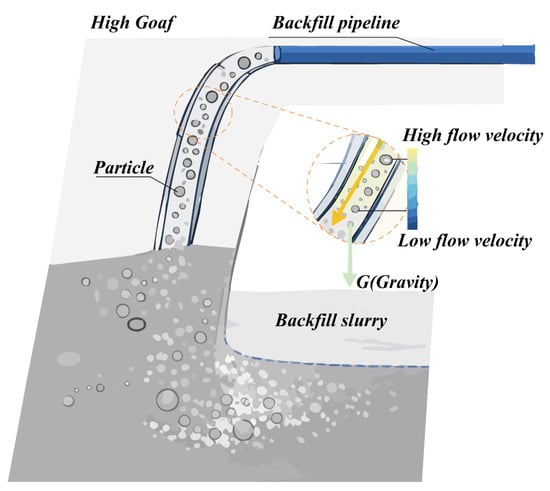
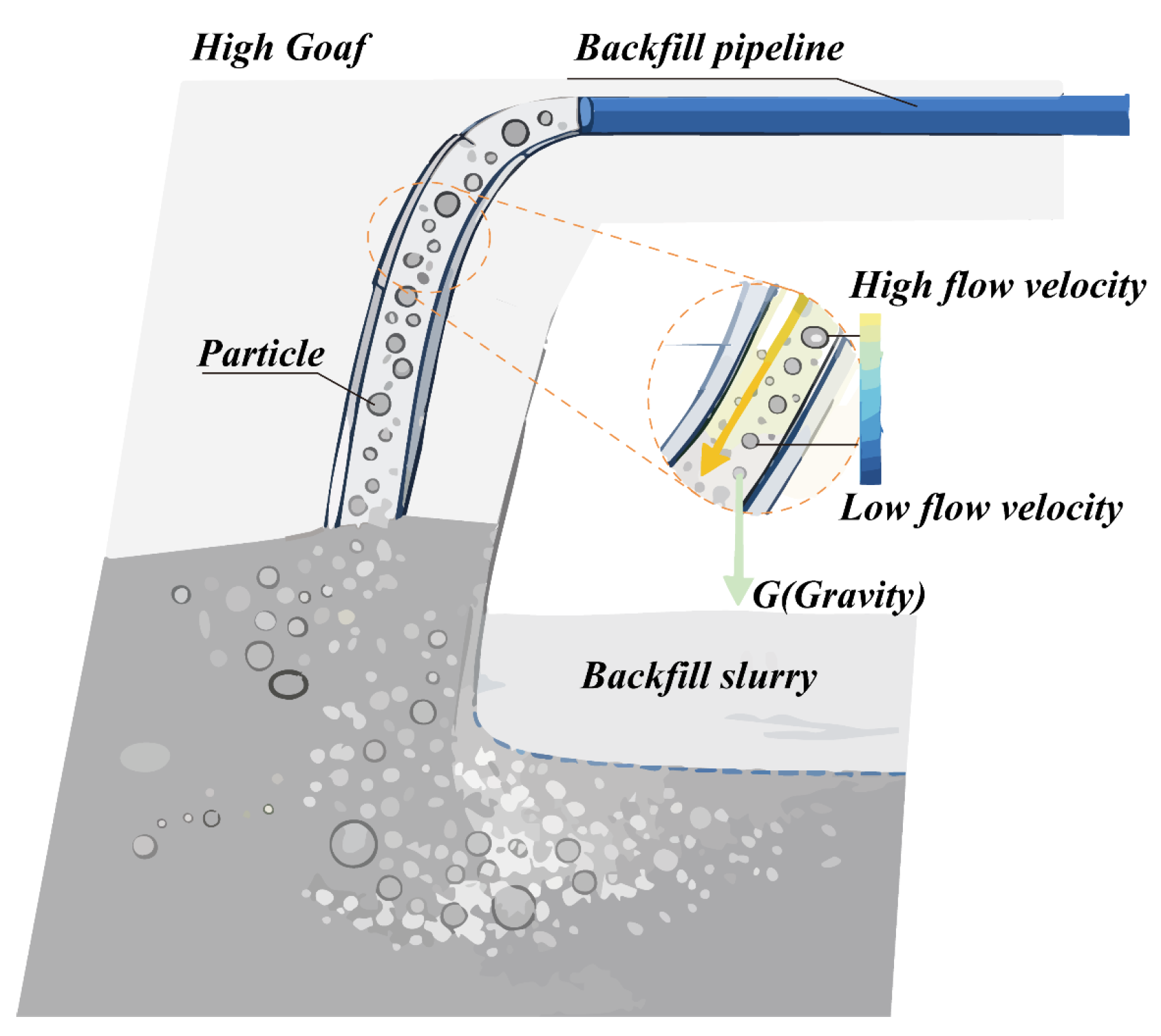
Compared with the aforementioned research topics, the deposition behavior of tailings particles within the goaf and their resulting spatial distribution exert a more significant influence on the performance of the backfill material [26,27,28]. Prior to solidification, particles within the filling slurry undergo migration driven by gravity and flow velocity difference, as illustrated in Figure 1, which inevitably causes particle segregation and a heterogeneous spatial PSD of aggregates in the goafs [29,30,31]. As a result, the effective strength of the hardened backfill under in situ conditions is frequently inferior to that obtained in laboratory tests [5,32,33]. Meanwhile, during the filling into high-stage goafs, the change in distribution of aggregate size is often exacerbated by significant differences in gravitational potential and pressure [34,35]. Additionally, supplementary factors during the backfilling process, including slurry drop height, goaf geometry, and particle morphology, can further intensify the stratification and segregation of the backfill slurry [36,37,38,39]. This is one of the key reasons why TB technology is more likely to fail as the goafs get higher. Therefore, investigating the aggregate distribution of tailings slurry during the dropping filling process into high-stage goafs is crucial for controlling slurry mass.
Figure 1.
Schematic diagram of forces acting on particles in the slurry during free-fall backfilling into high-stage goaf.
Therefore, to address the failure of backfill materials caused by variations in aggregate spatial distribution during the free fall of backfill slurry in high-stage goafs, this study investigates the spatial PSD characteristics of the slurry under vertical free-fall conditions at different backfill heights. A laboratory-scale backfilling system was designed based on the similarity principle, with the slurry flow rate determined through kinematic similarity. The PSD of the backfill slurry was measured using a laser particle size analyzer to examine the spatial distribution of aggregates within the goaf physical model. The findings are expected to provide new insights into the mechanisms of stratification and segregation that occur during the backfilling process, offering a theoretical basis for optimizing high-stage backfilling operations.
2. Materials and Methods
2.1. Raw Materials
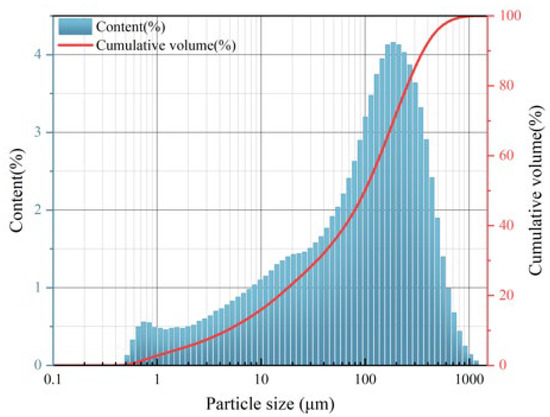
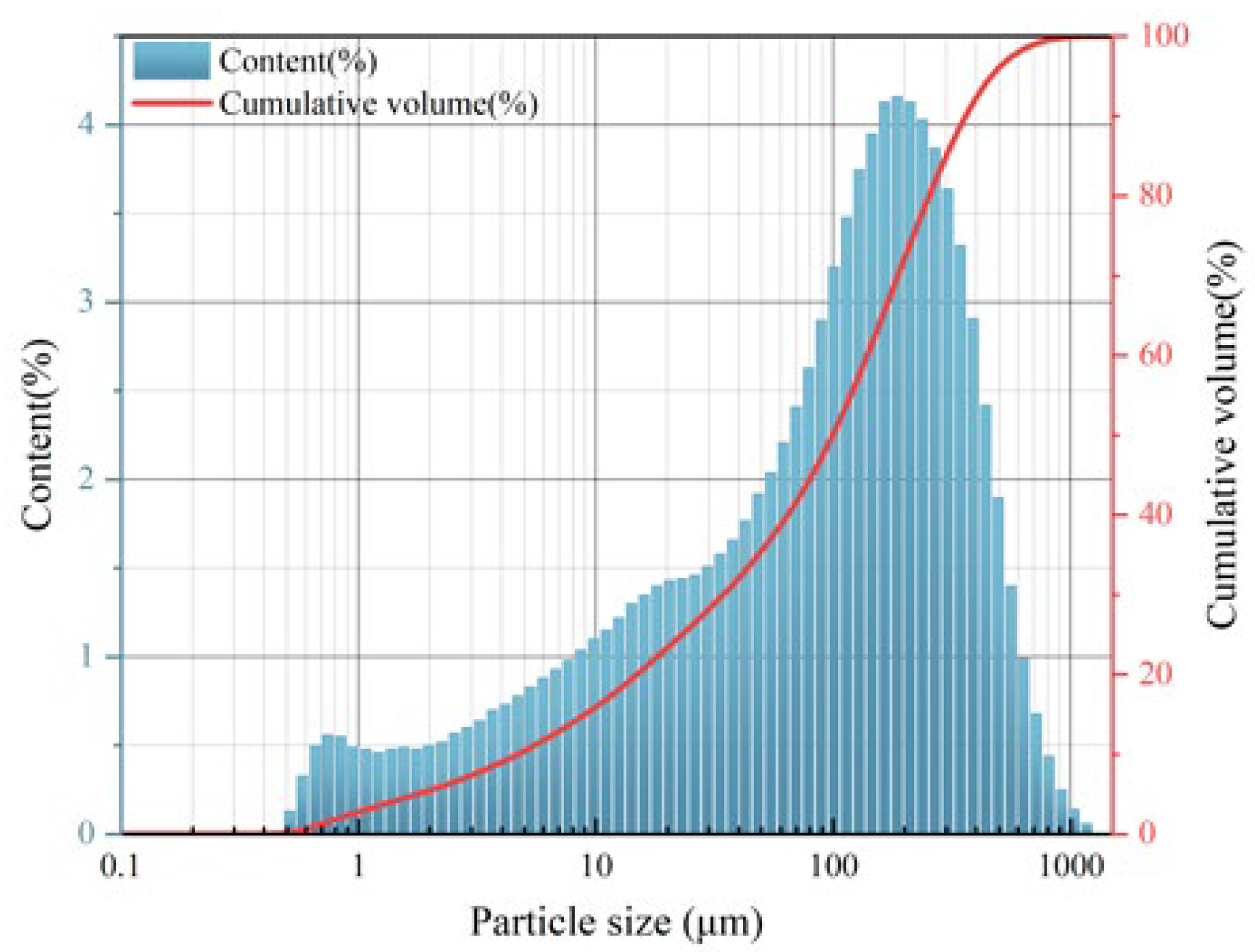
The raw materials utilized in this study consisted of tailings and water. To eliminate the influence of cement hydration and reveal the intrinsic effect of PSD, a non-cemented tailings backfill was adopted [40,41,42]. The tailings were received from the discharge outlet of the concentrator at the Dongguashan Copper Mine, located in Anhui Province, China. The PSD of the tailings, as shown in Figure 2, exhibits a distinct bimodal pattern, with fine particles concentrated in the 0.5–1 µm range and coarse particles in the 100–200 µm range, where relatively coarse particles originate from incompletely ground mineral fragments and fine particles are produced through intensive grinding and classification. This wide gradation indicates a strong tendency for segregation. PSD measurements were performed using a laser particle size analyzer (BT-9300ST, Bettersize, Changsha, China), with a measurement error of less than 1%.
Figure 2.
Grain size distribution of the experimental tailings.
The physical and chemical properties of the tailings are presented in Table 1 and Table 2. The coefficient of uniformity (Cu) is 29.7 and the coefficient of curvature (Cc) is 1.82, indicating a continuously graded material with a broad size distribution. This supports the observed potential for segregation and provides favorable conditions for investigating separation behavior. The overall particle size ranged from 0.15 to 1500 µm. Quantitatively, 43.14% of the particles was smaller than 75 µm (fine particles), 36.41% was within the 75–250 µm range (medium particles), and 20.45% fell between 250 and 1500 µm (coarse particles). According to the classification standard DZ/T 0371-2021 [43] (Classification of Solid Mineral Tailings), the tailings were identified as sandy silty tailings.
Table 1.
Physical properties of tailings (units of %).
Table 2.
Tailings chemical composition.
2.2. Similar Backfilling Systems
Due to the challenges of sampling, poor control over experimental variables, high operational costs, and safety constraints associated with field experiments, this study applied the similarity principle to design a laboratory-scale system that simulates the backfilling process in underground goafs [33]. Indoor similar simulation experiments were grounded in similarity theory, allowing for the construction of a physical experimental device based on the analogous characteristics of the phenomena under investigation.
2.2.1. Design for Similar Goaf Physical Model
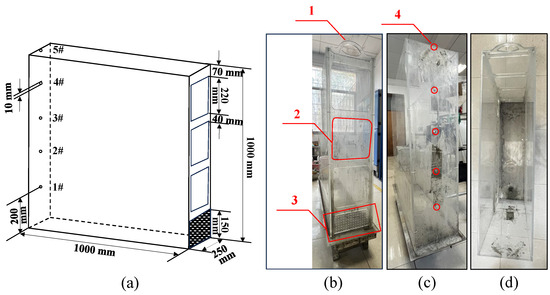
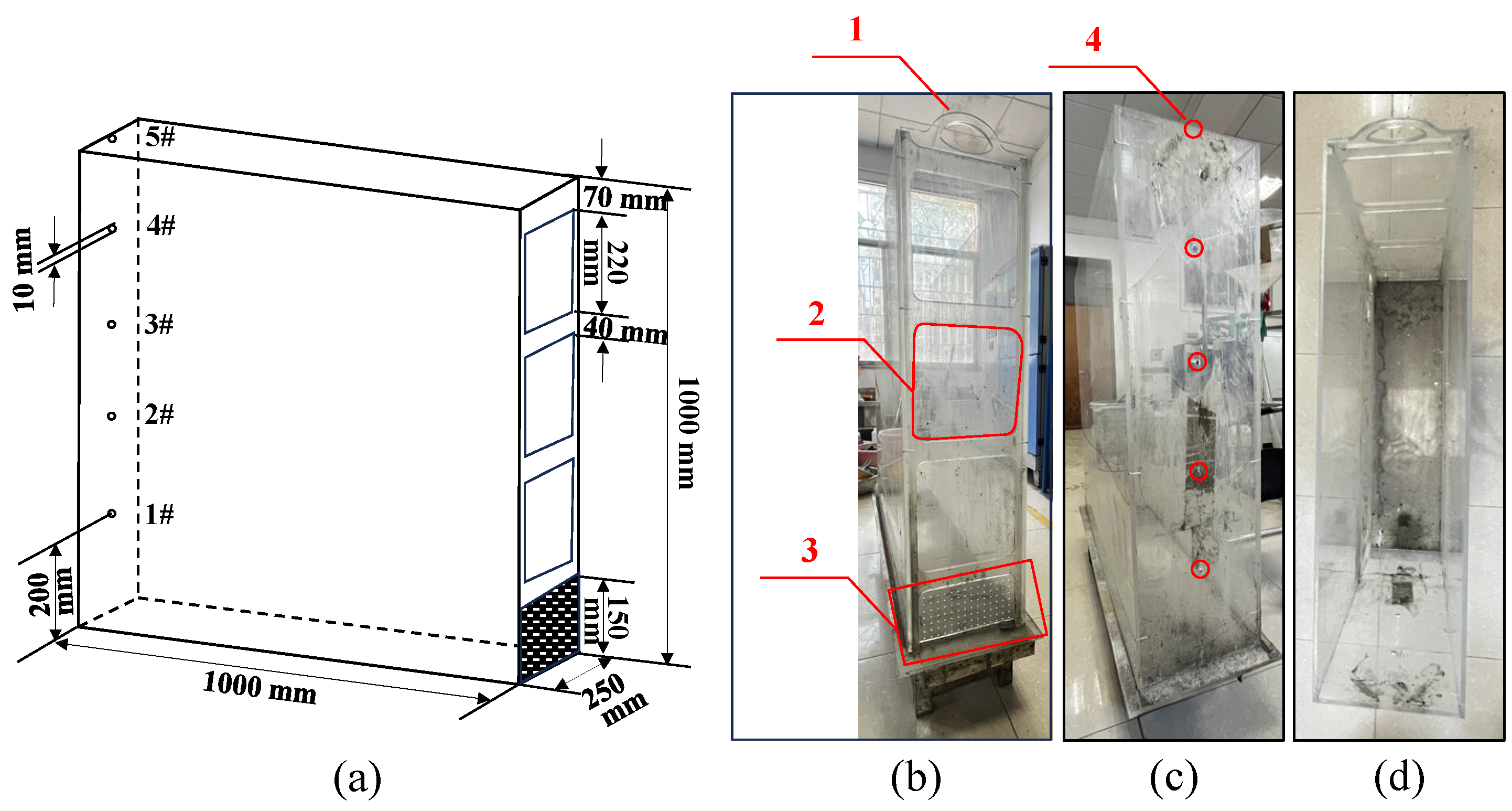
Figure 3 illustrates the schematic diagram of a similar experimental device for the goafs, constructed from 10 mm thick transparent acrylic plates. Assuming the dimensions of the backfilling goafs were 60 m in length, 15 m in width, and 60 m in height, with a geometric similarity constant of 60, the design dimensions for the similar experimental device were 1000 mm in length, 250 mm in width, and 1000 mm in height, as detailed in Figure 3a. Figure 3b presents the right side view of the experimental device, which includes a detachable side panel for easy sampling. There were three rounded square discharge outlets, each measuring 220 mm by 220 mm, on the right side for clearing the slurry [44]. Additionally, a super-dense filter, measuring 250 mm in width and 150 mm in height, was installed to prevent fine particles from being washed out and affecting the experimental results. The left side of the experimental device, as depicted in Figure 3c, featured five slurry inlets with a diameter of 10 mm, spaced 200 mm apart in height, and numbered from bottom to top as #1, #2, #3, #4, and #5. To facilitate clear observation of the slurry flow state, the top of the model was open, as shown in Figure 3d.
Figure 3.
Schematic diagram of the similar goaf physical model. (a) Schematic diagram of the relevant parameters of the similar goaf physical model; (b) Diagram of the model drainage system; (c) Diagram of the model backfilling hole; (d) Upper opening of the model. (1—Removable Plate; 2—Slurry Outlet; 3—Water Filter; 4—Slurry Import).
2.2.2. Design for Similar Goaf Physical System
A peristaltic pump and silicone pipes were used to simulate the mining pumping equipment and the conveying pipeline.
Besides adhering to geometric similarity criteria, the design of the similar backfilling conveyor system must also comply with motion and dynamic similarity criteria [45]. The motion similarity criterion requires that the motion parameters of the experimental model align with those of the actual industrial working face, such as acceleration and speed, in a consistent proportionality, as represented by Equation (1):
where is the kinematic scaling factor and is the velocity. The symbol subscript m is a similar model parameter, and the same is true for the latter. The flow velocity of slurry in actual industrial working faces typically ranges from 1.5 to 3 m/s. With set to 4, the flow velocity for the similar model is 0.375 to 0.75 m/s.
The dynamic similarity criterion states that the dynamic variables at corresponding points in the experimental flow field and the actual industrial working face should maintain the same proportional constant. The Reynolds number serves as the dimensionless criterion for similarity, as expressed in Equation (2):
where is the Reynolds number, is the pipeline main liquid flow inertia force, and is the wall viscous shear. Pipeline main liquid flow inertia and wall viscous shear are expressed in Equations (3) and (4):
In Equation (3), m is the mass of the slurry, and is the acceleration of the slurry flow in the pipeline. In Equation (4), is the viscous shear, and is the shear area. The constraints are Equations (5) and (6), respectively.
where is the density of the filling slurry, A is the cross-sectional area of the hose, is the length of the hose, is the average flow rate of the slurry, µ is the coefficient of dynamic viscosity, is the wetted perimeter, and δ is the thickness of the liquid layer on the wall of the hose. Simplification leads to Equations (7) and (8):
The ratio of the main fluid’s inertial force to the viscous shear force at the filling pipe wall is given by Equation (9):
Setting the Reynolds number equal for dynamic similarity results in the simplified form in Equation (10):
Since the materials used in the simulation experiment are the same as those in the original mine, we derive Equation (11):
Given an actual filling pipeline length of 500 m and a diameter of 300 mm, along with silicone pipes measuring 4 m in length, Equation (11) indicates that the pipe inner diameter should be 9.5 mm. Therefore, the pipe #73 was selected. The Chuangrui YZ35-13 (longer, Shanghai, China) model peristaltic pump was selected, and its speed was set to a range of 160–165 rpm. A detailed comparison of the experimental parameters and those used in industrial practice is provided in Table 3.
Table 3.
Comparison of industrial parameters and simulation model parameters.
2.3. Experimental Procedure and Sampling Methods
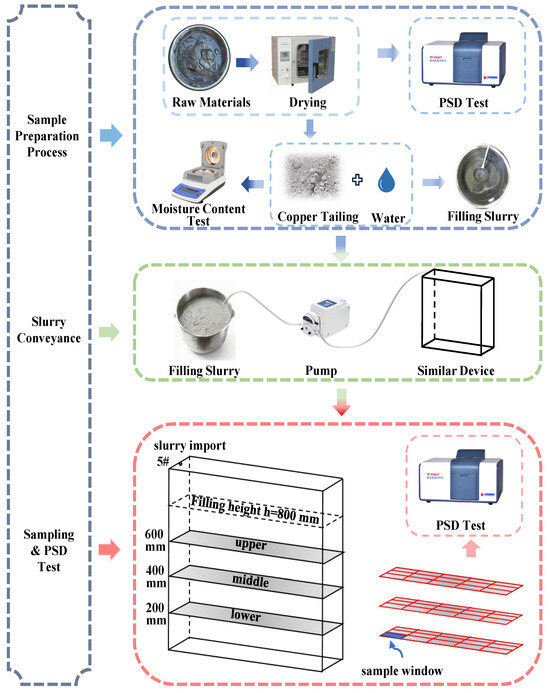
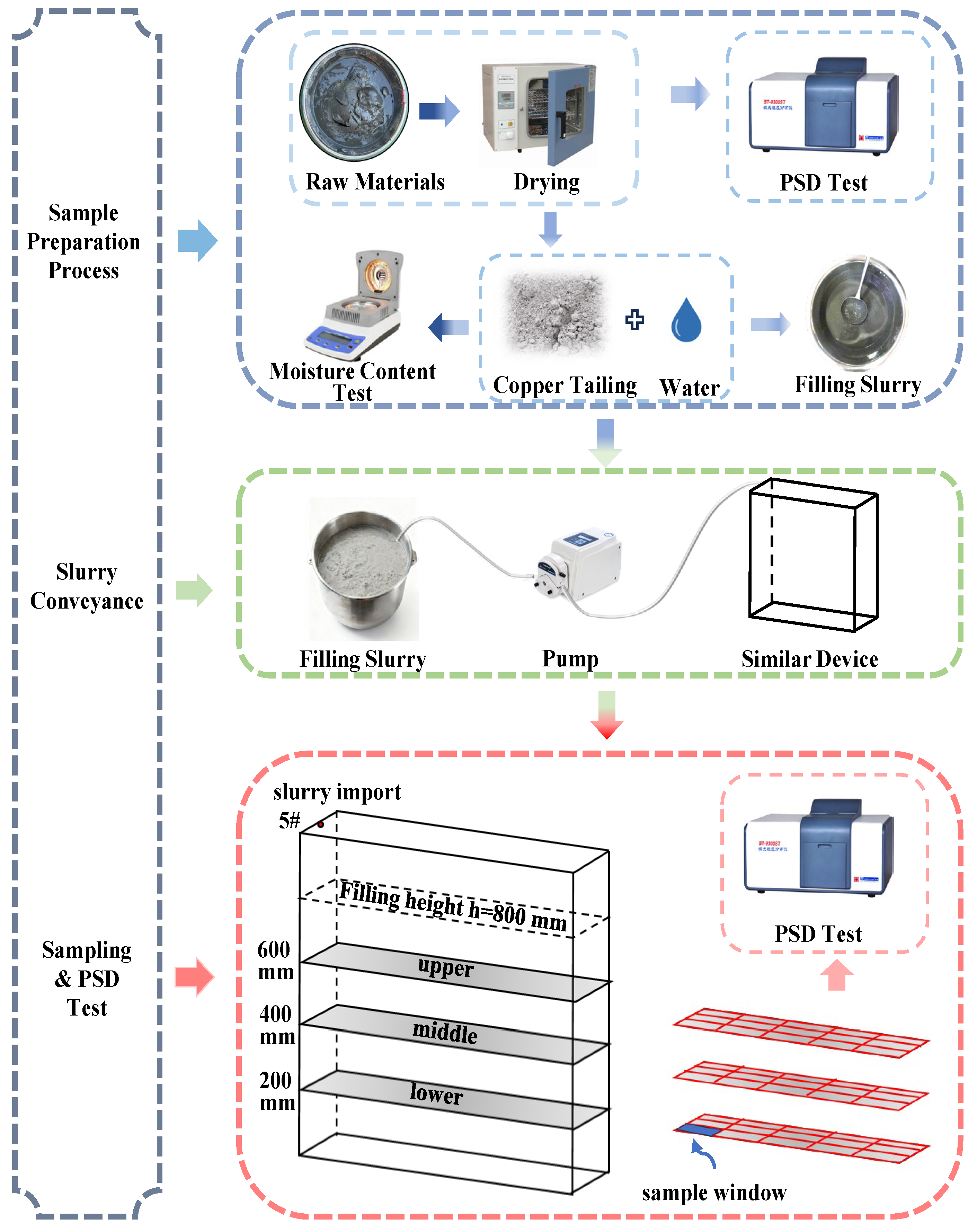
In this study, a fixed slurry concentration of 74% was maintained throughout all experiments. Due to the different slurry volumes required for the various backfilling heights, the amounts of dry tailings and water varied accordingly. The corresponding dry tailings masses were 72.04, 105.55, 164.27, 214.80, and 261.62 kg, while the associated water additions were 8.69, 35.08, 57.71, 75.46, and 91.92 kg, respectively, and used to prepare the backfill mixtures for the imports #1 to #5. The experimental procedure comprised three main stages: sample preparation, backfill slurry conveying, and sampling and testing, as illustrated in Figure 4. It should be noted that cement hydration was not considered in this experiment. In practical backfilling operations, cement hydration generates chemical bonds between particles, which may accelerate particle consolidation and reduce their migration capacity within the flowing slurry. Therefore, this study focused on particle migration in a non-cementitious system.
Figure 4.
Experimental flowchart.
The raw tailings (initial concentration < 25%) were oven-dried and subsequently tested for PSD and moisture content. Based on the measured moisture content, an appropriate amount of water was added to prepare a homogeneous backfill slurry with a concentration of 74%. Slurry conveyance was carried out through silicone pipes securely connected between the mixing tank and the slurry inlet of the similar physical model, ensuring continuous and stable injection throughout the experiment. During the test, the slurry in the mixing tank was maintained under constant agitation to prevent segregation or sedimentation before entering the model.
The sampling process commenced when the backfill height reached 80% of the grout inlet height. Samples of the backfill slurry within the similar model were collected from three distinct layers: upper, middle, and lower. Sampling heights for each layer were set at 3/4, 1/2, and 1/4 of the total fill height, respectively. Taking slurry import #5 as an example, with a backfill height h of 800 mm, the corresponding heights for the upper, middle, and lower layers were H = 600 mm, 400 mm, and 200 mm. Samples from each layer were collected through rectangular sampling windows, each with a horizontal length of 200 mm and vertical widths of 83.5 mm, 83 mm, and 83.5 mm, respectively. Fifteen rectangular sampling windows were set up per layer. All collected samples were subsequently analyzed for PSD.
2.4. Data Processing
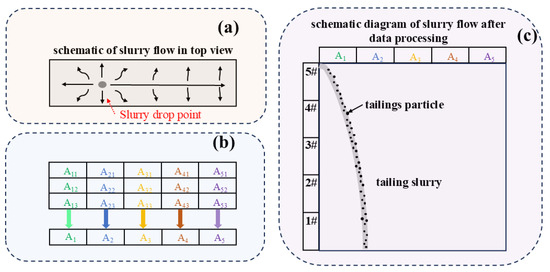
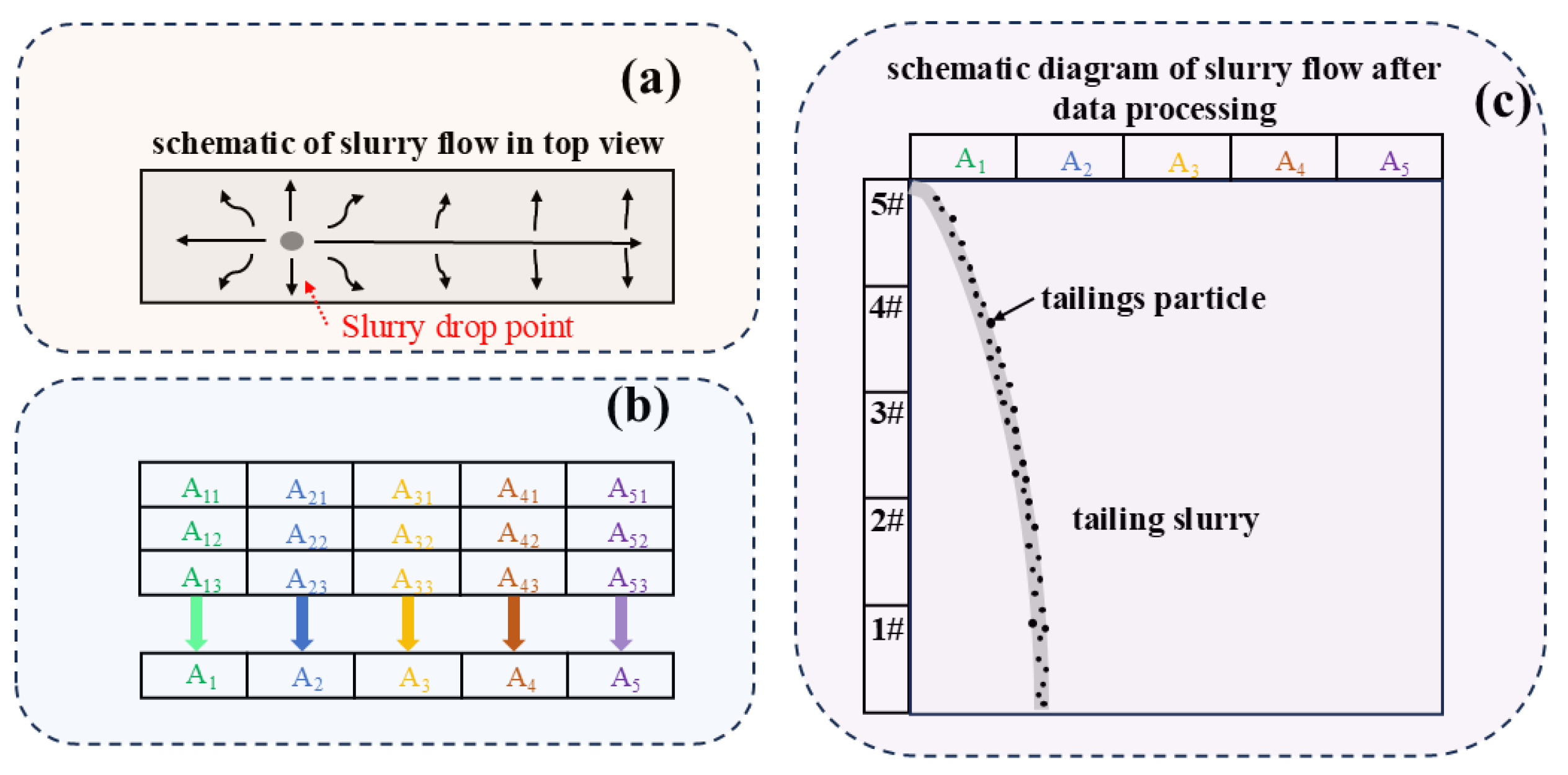
The top view of the slurry flow is illustrated in Figure 5a, where the slurry radiates outward from a single drop point, exhibiting vertically symmetrical diffusion along the upper and lower sides. In Figure 5b, each rectangular sampling window in the top view is denoted as Ax-y, where x represents the horizontal position and y represents the vertical position. Assuming a vertically symmetrical flow direction, the particle distribution pattern is considered consistent on both sides. This study focused exclusively on the spatial PSD of the slurry in the horizontal and vertical directions. Accordingly, the data obtained from the central and lateral regions of each sampling layer were averaged, as described by the data processing Equation (12):
where C is the particle content (%) of each particle size of the slurry measured at the sampling areas.
Figure 5.
Schematic diagram of data processing. (a) Top view of slurry flow; (b) Data processing diagram in the horizontal direction; (c) Front view of slurry flow.
After data processing, the schematic diagram of the slurry flow is shown in Figure 5c, where the gray curve represents the slurry flow trajectory, and the black dots indicate the tailings particles. In this analysis, only the horizontal factors (Ax) and the vertical sampling factors (upper, middle, lower layers) are considered, together with different vertical filling heights (#1, #2, #3, #4, and #5).
3. Results and Discussions
3.1. Overall Vertical PSD
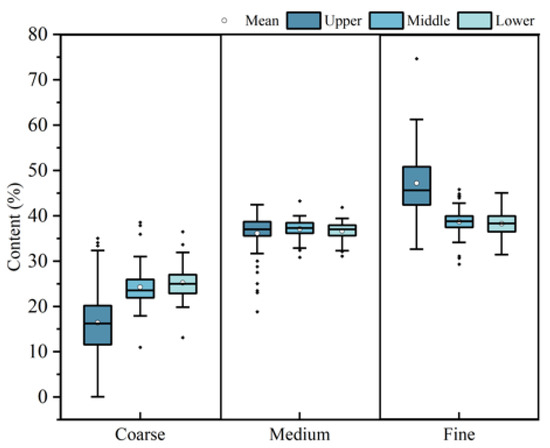
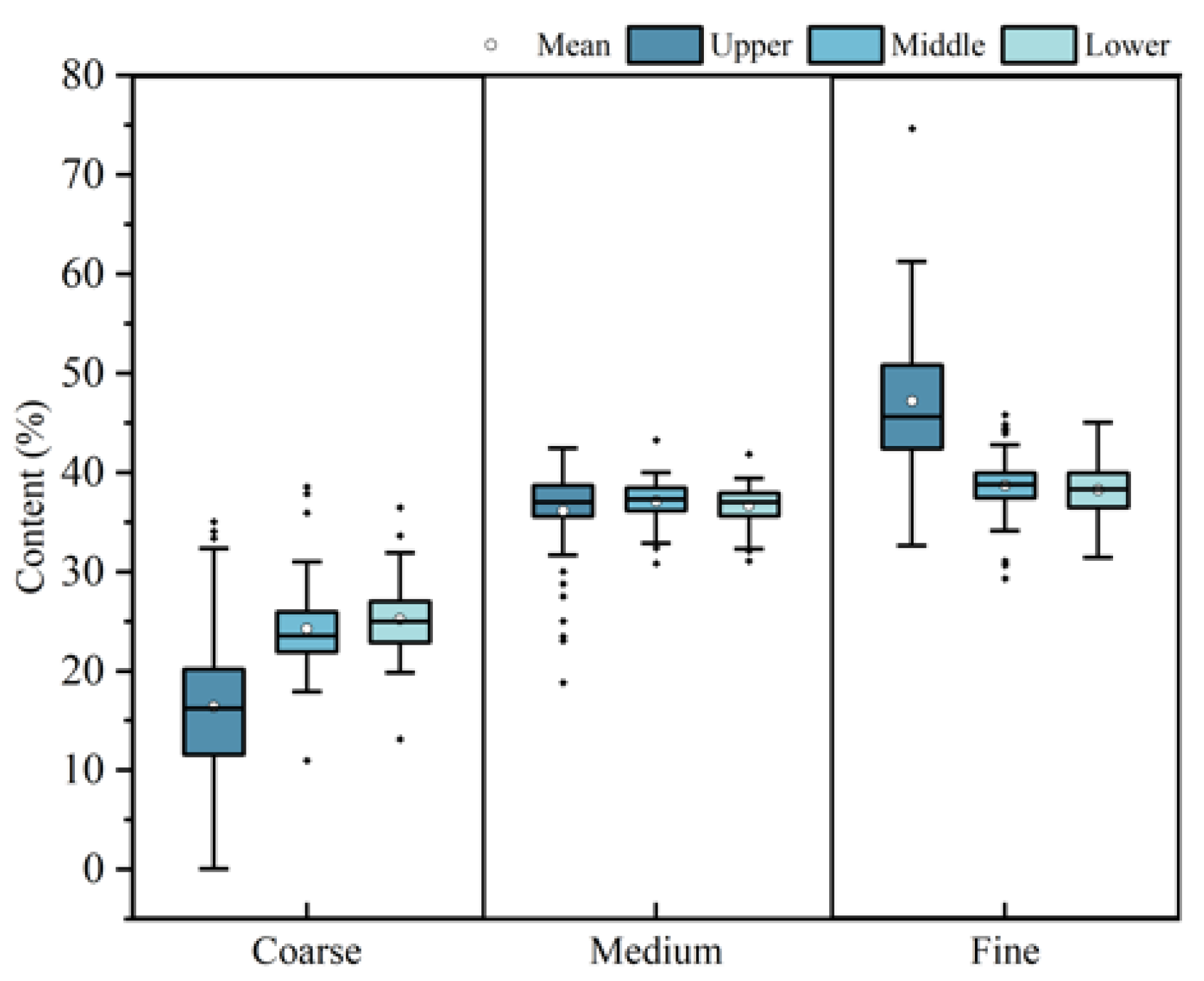
Figure 6 illustrates the distribution of different particle types in the vertical sampling direction (upper, middle, and lower layers) of the backfill slurry, excluding the backfill height factor. The data show that coarse particles exhibited the lowest overall distribution content, with median values of 16.2%, 23.6%, and 25.0% in the upper, middle, and lower layers, respectively. Medium-sized particles followed, showing median values of 37.0%, 37.3%, and 37.0%. Fine particles displayed the highest overall distribution, with corresponding median values of 45.6%, 38.8%, and 38.3%. Overall, this distribution pattern aligns well with the original PSD of the slurry. Notably, the proportion of medium-sized particles was slightly higher across all layers compared to the original slurry, which may be attributed to particle shearing and fragmentation during transportation, resulting in a reduction in coarse particle size. The absence of evident particle stratification or segregation throughout the backfilling and conveying processes further confirms that the slurry preparation achieved a high degree of uniformity. Overall, the backfill slurry maintained good homogeneity during both flow and deposition.
Figure 6.
Vertical particle distribution.
Coarse particles exhibited the lowest distribution content in the upper layer, being 7.4% and 8.8% lower than those in the middle and lower layers, respectively. Although the distribution of coarse particles in the middle layer was slightly lower than in the lower layer, both exceeded the original tailings slurry values. This pattern indicates a predominant accumulation of coarse particles in the middle and lower layers, reflecting a clear downward migration tendency. Such behavior may be attributed to the stronger gravitational influence on coarse particles, which, due to their larger volume and mass, experience weaker shear forces and are less likely to be entrained by the fluid. Consequently, their pronounced settling tendency results in greater concentration within the middle and lower layers.
Medium-sized particles exhibited similar distribution across the upper, middle, and lower layers, indicating an approximately uniform dispersion throughout the slurry.
Fine particles had the highest distribution in the upper layer, surpassing the original values of the slurry. In contrast, the distribution of fine particles in the middle and lower layers was lower than the original values, indicating a tendency for fine particles to rise vertically. This behavior is likely due to smaller particles being less affected by gravity and more influenced by buoyancy, resulting in slower settling. Additionally, high-viscosity fluids better support fine particles, further hindering their downward movement and keeping them predominantly in the upper layer of the slurry.
Overall, coarse particles settle downward, fine particles rise, and medium particles remain uniformly dispersed, resulting in stratified segregation within the backfill that weakens its structural stability.
3.2. Characteristics of PSD in Vertical Direction for Different Backfill Heights
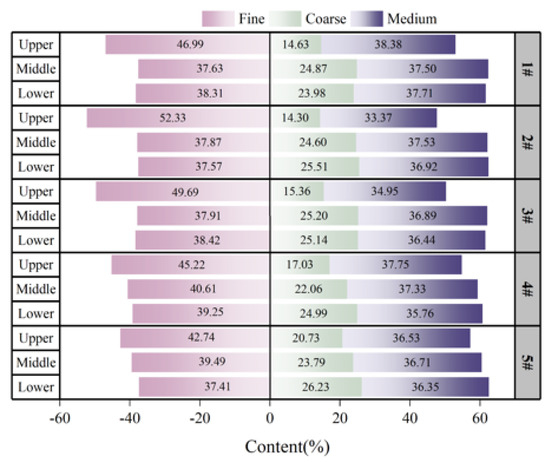
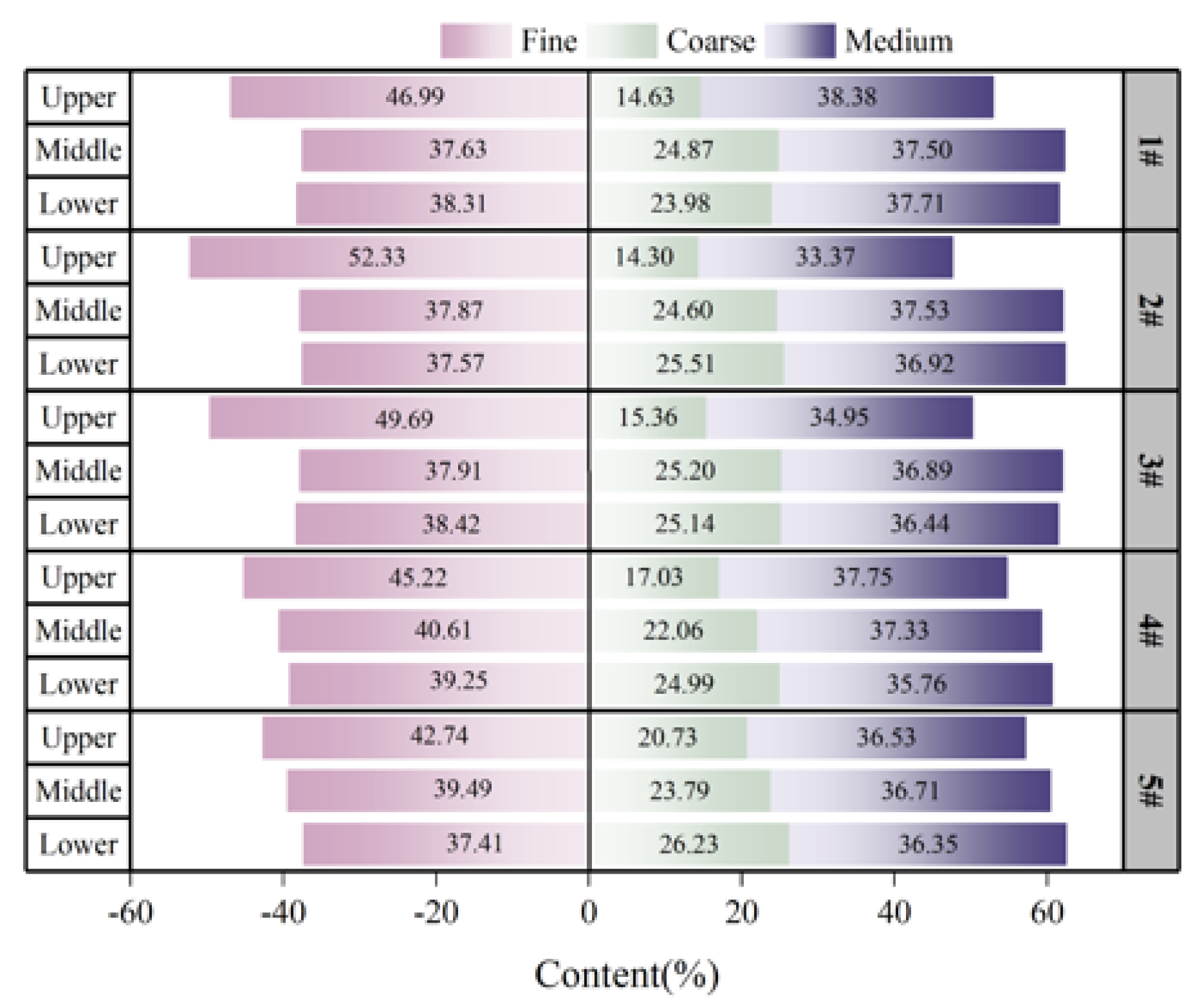
The degree of segregation and the spatial PSD of the backfill slurry vary with backfill height, where greater differences in PSD indicate more pronounced segregation within the backfill body. Figure 7 presents the variations in the vertical PSD of the backfill slurry (upper, middle, and lower layers) at different filling heights (#1, #2, #3, #4, and #5). As shown in Figure 7, the particle distribution patterns at different backfill heights were consistent with the overall vertical distribution trend, further validating the reliability of the PSD discussed in the previous section.
Figure 7.
PSD for different backfill heights in the vertical direction.
From Figure 7, it is evident that at backfill heights of #4 and #5, the distribution patterns of all particle types across the upper, middle, and lower layers were identical. In contrast, under backfill heights of #1, #2, and #3, the particle distribution patterns remain consistent throughout the layers. This observation suggests that in the similar physical model, when the backfill height exceeds 800 mm, corresponding to an actual goaf height of more than 36 m, the vertical PSD of the backfill slurry begins to change. Compared with backfill heights #1–#3, the PSD in the middle and lower layers were relatively uniform. In contrast, distinct interlayer differences emerged at backfill heights #4 and #5.
This phenomenon may be attributed to the excessive backfill heights above 800 mm (#4 and #5) in the similar physical model, which may alter the flow regime of the backfill slurry. Such changes influence the trajectories and residence times of particles, resulting in distinct PSD at different backfill heights. Notably, coarse particles exhibited a distribution trend opposite to that of fine particles, indicating that the two particle types are subjected to opposing effects in the vertical direction.
3.3. Overall Horizontal PSD
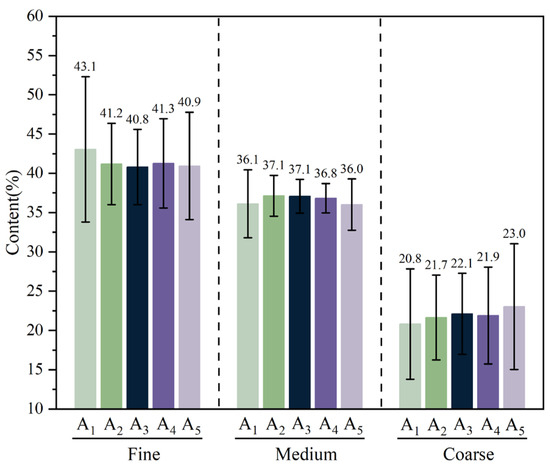
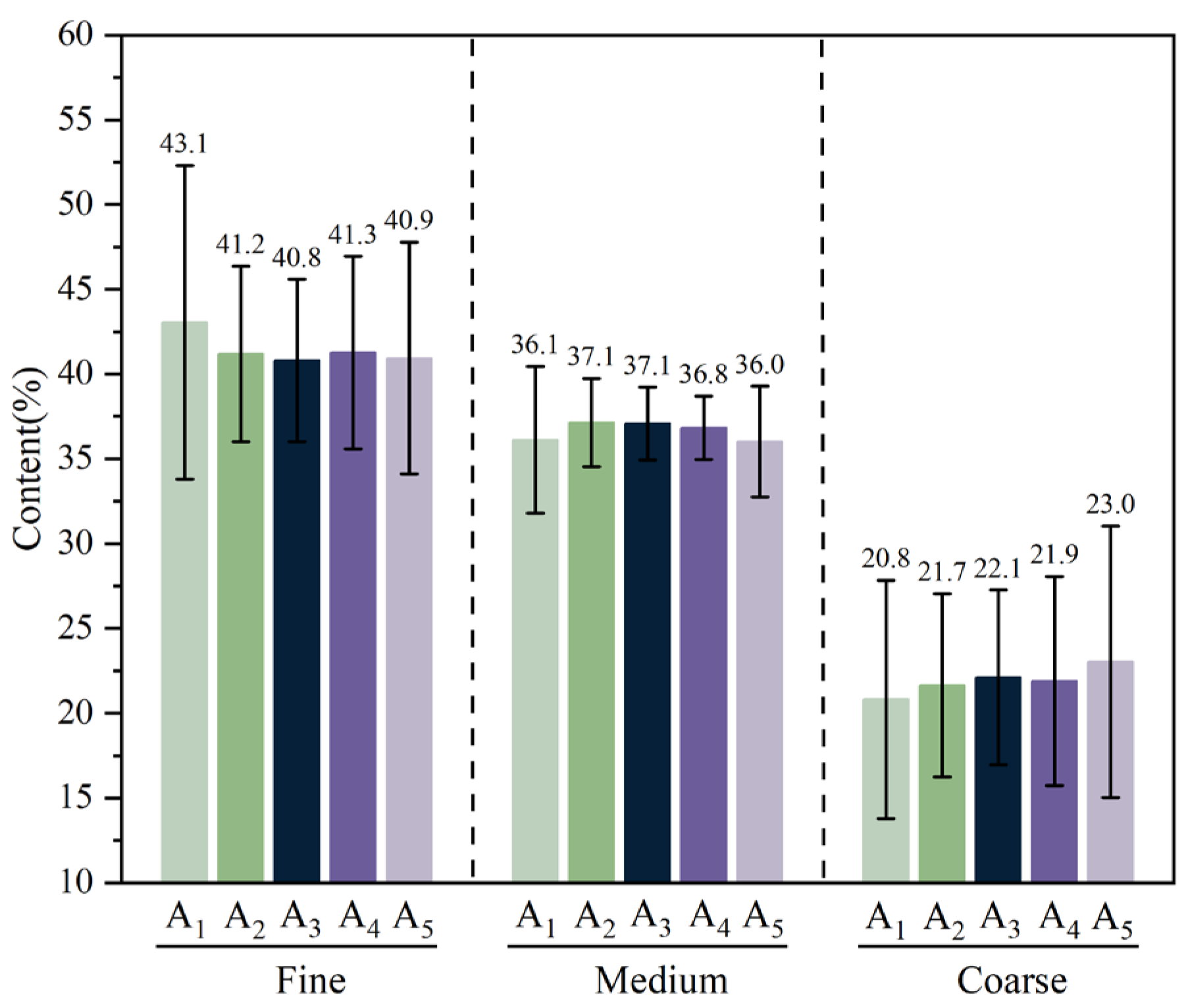
Figure 8 illustrates the horizontal variations in the PSD of the backfill slurry (A1, A2, A3, A4, A5), disregarding the influence of backfill height. From the figure, it can be observed that fine particles exhibited the highest content at the horizontal position A1, located at the leftmost side of the model. In contrast, the fine particle content showed little variation across the horizontal positions A2, A3, A4, A5. This suggests that fine particles tend to migrate toward position A1, where they accumulate. This behavior may be attributed to lower mass, which makes them less influenced by gravity but more responsive to fluid disturbances. During the backfilling process, fine particles are more easily entrained by eddies or displaced by collisions with coarse particles, causing them to concentrate in the edge region of the model.
Figure 8.
Overall horizontal PSD.
The content of medium-sized particles at horizontal positions A1, A2, A3, A4, andA5 were 36.1%, 37.1%, 37.1%, 36.8%, and 36.0%, respectively. Compared with the original tailings slurry, the content of medium-sized particles remained nearly constant, showing a relatively uniform distribution across all horizontal positions. This observation suggests that medium particles display a uniform distribution along the horizontal direction, similar to their vertical distribution pattern. Such uniformity can be attributed to the density of medium particles being comparable to that of the carrier fluid, which facilitates their suspension and promotes frequent inter-particle collisions. The combined effects of collision-induced dispersion and turbulent mixing ultimately result in the observed random distribution of medium particles.
The contents of coarse particles at horizontal positions of A3, A4, andA5 were 22.1%, 21.9%, and 23%, respectively. The particle content at these positions exceeded that at A1 and A2. Moreover, the content was higher at A3 and A5. This suggests that coarse particles migrate toward A5, with accumulation occurring at A3. This phenomenon may be attributed to the forward flow of the backfill slurry, where coarse particles, due to their greater mass, experience stronger inertial forces and are thus carried further by the fluid, resulting in the highest content distribution at A5. At the A3 position, which is closer to the point of discharge of the backfill slurry, the flow dynamics are maximized, and particle disturbance is greatest. Consequently, under the combined influence of inertial force, gravity, and resistance, coarse particles become trapped at the A3 position.
3.4. PSD in the Horizontal Direction at Different Backfill Heights
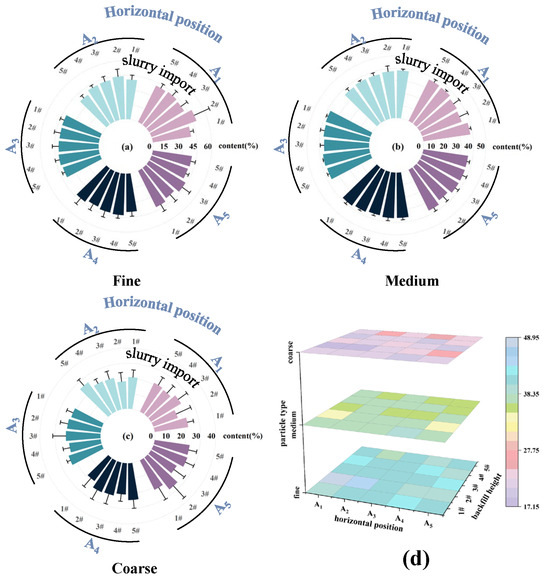
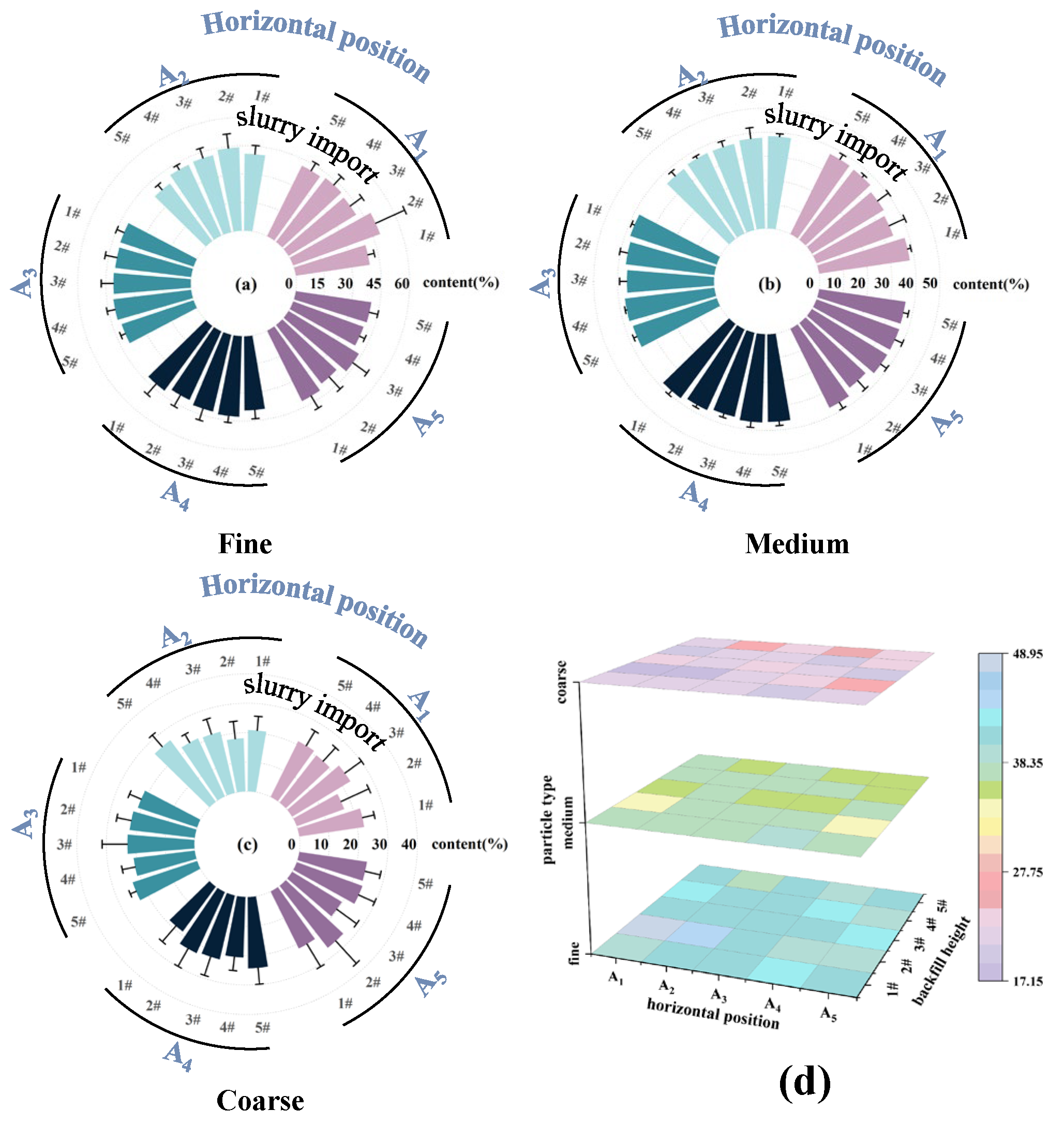
Figure 9 presents the horizontal distribution of fine, medium, and coarse particles at different backfill heights across the sampling positions A1–A5. Figure 9 illustrates the horizontal distribution of different particle types at various backfill heights. As shown in Figure 9a, the fine particle content at position A3 remained approximately consistent across different backfill heights. This consistency is likely attributed to its proximity to the slurry drop point, where local turbulence is strongest and mixing is most effective. At a backfill height of #2, fine particles were more concentrated at positions A1 and A2, whereas their content decreased at A3 and A4. It is speculated that the small drop height of the slurry resulted in limited flow disturbance. When the backfill height increased to #5, the fine particle content remained uniformly low across all horizontal positions. This may result from the intense turbulence generated at higher drop heights, where fine particles are driven upward by impact forces and migrate to the uppermost position rather than being retained within the sampled layer.
Figure 9.
PSD in the horizontal direction at different backfill heights. (a) Distribution of fine particles at different horizontal positions and heights; (b) Distribution of medium-sized particles at different horizontal positions and heights; (c) Distribution of coarse particles at different horizontal positions and heights; (d) Overall particle distribution at different horizontal positions and heights.
As shown in Figure 9b, the distribution of medium-sized particles at different backfill heights showed minimal variation in particle content across horizontal sampling positions. The relatively stable distribution of medium-sized particles may be attributed to a balance between gravitational settling and hydrodynamic forces. At this particle size range, the gravitational driving force is partially counteracted by fluid drag and buoyancy, resulting in a comparatively stable spatial distribution. This further confirms the reliability of the data analysis regarding the overall horizontal distribution of particles. Slight variations were observed at backfill heights #2 and #3, whereas the distributions at heights #1, #4, and #5 remained nearly identical. This may be attributed to the influence of backfill height.
Figure 9c illustrates the horizontal distribution of coarse particles at different backfill heights. The coarse particle content at position A3 remained nearly constant across various backfill heights, compared with other horizontal positions. Under a backfill height of #2, the coarse particles showed relatively higher content at positions A4 and A5, whereas a relatively lower content was observed at positions A1 and A2. Observations reveal that the coarse particle content at positions A1 and A5 exhibited opposite trends across all backfill heights, whereas positions A2 and A4 displayed a similarly inverse relationship. This indicates that fine and coarse particles exhibit opposite spatial distribution patterns within the backfill slurry, driven by opposing influencing factors. Moreover, a symmetrical distribution pattern was also observed along the horizontal direction. Detailed horizontal distribution of particles at the backfill heights is presented in Figure 9d.
3.5. Implications of Spatial PSD Heterogeneity for the Structural Stability of Backfill
In related projects conducted by this group, cave-ins in the mined-out area still occurred after backfilling. Based on this experiment and rheological principles, the main causes of the cave-ins were particle segregation resulting in insufficient backfill height (backfill failing to reach the roof) and uneven spatial strength distribution.
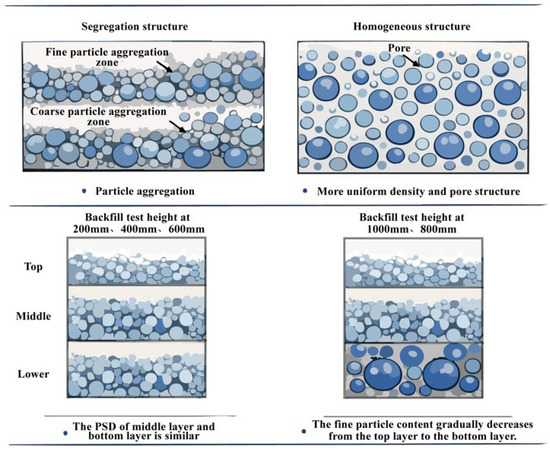
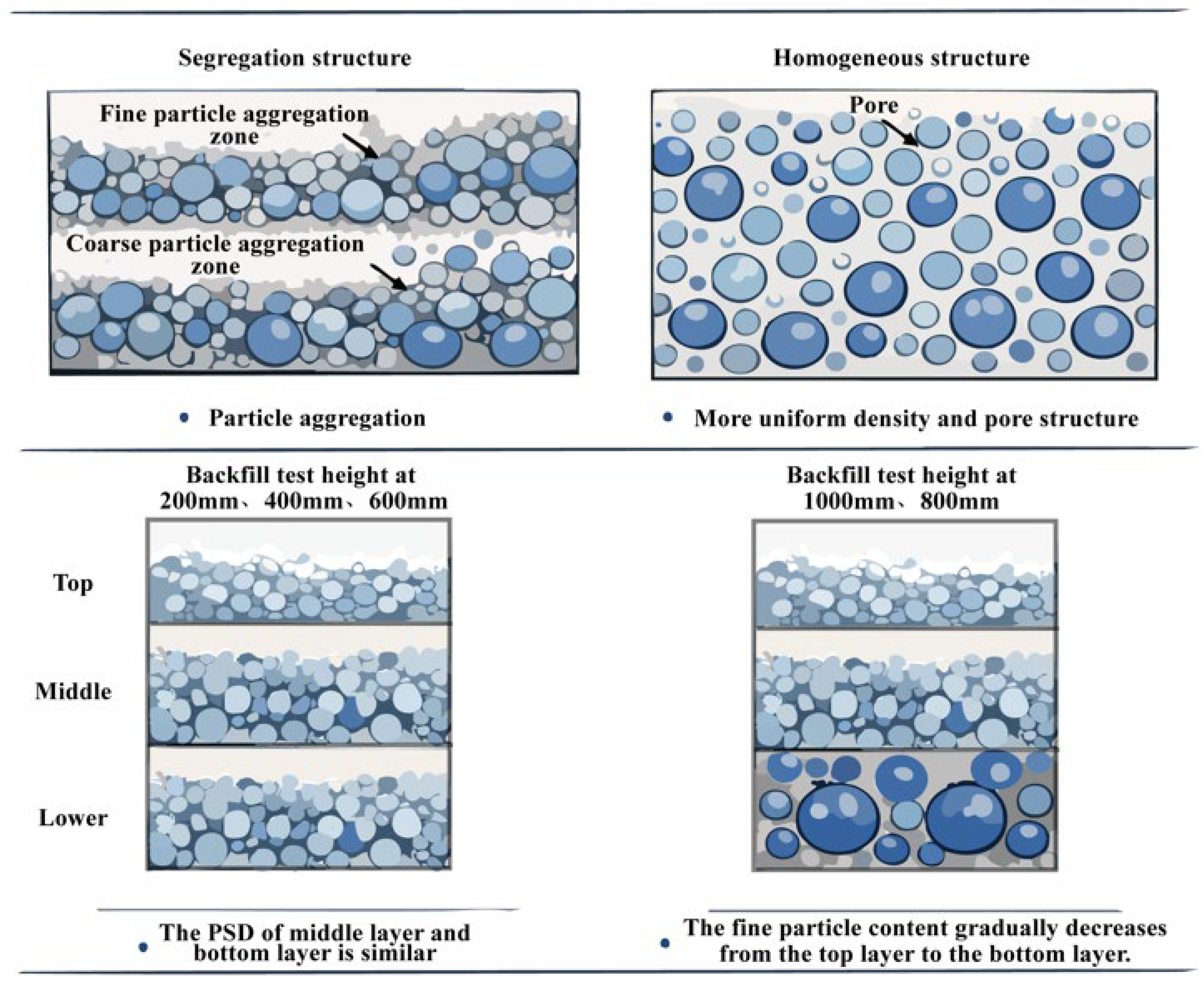
Particle segregation within the backfilling slurry leads to a non-uniform PSD, which directly affects the internal structure and mechanical properties of the backfill body. Such spatial heterogeneity may further affect the stability of backfilled goafs [46,47]. The PSD behavior of the backfill slurry is governed by particle settling and hydrodynamic interactions during the deposition process. As shown in Figure 10, in ordinary backfill slurry, gravity drives coarse particles to settle at the bottom, while fine particles migrate to and accumulate in the upper layer. Meanwhile, medium-sized particles remain suspended within the interior of the backfill. The preferential settling of coarse particles toward the bottom may contribute to the formation of a load-bearing particle skeleton, which could potentially enhance the strength of the backfill foundation. However, this particle segregation may also result in an uneven distribution of strength within the backfill structure. Furthermore, the degree of particle segregation is closely related to the backfill height. At relatively low backfill heights (e.g., 200–600 mm), the particle settling distance is limited, and the PSD within the backfill remains relatively uniform, with only moderate segregation observed between the upper and middle layers. However, when the backfill height increases to 800–1000 mm, the particle settling path becomes significantly longer, allowing coarse particles to migrate more effectively toward the bottom while fine particles accumulate in the upper regions. This results in a more pronounced vertical stratification of the PSD.
Figure 10.
Particle size distribution comparison between segregated and homogeneous slurry backfill.
The stratified particle distribution can result in spatial variations in packing density and pore structure within the backfill mass, which may lead to heterogeneous mechanical properties [48]. In contrast, the homogeneous slurry had a more uniform PSD, with the density and pore structure of each localized region being consistent with the overall slurry. This uniformity contributes to a more stable strength development and broader applicability of backfill body.
Seepage of the backfill slurry reduces the strength of the backfill body, and when the compressive stress on the roof of the goafs exceeds the tensile resistance, roof collapse occurs [49]. Compared with segregated slurry, homogeneous slurry with a more uniform PSD exhibits negligible seepage, low water permeability, and a denser microstructure, resulting in improved stability and higher compressive strength.
The rheological behavior of the backfill slurry can also contribute to roof collapse. Ordinary cemented backfill slurry behaves as a Bingham fluid, exhibiting a shear-thinning response in which the apparent viscosity decreases as the shear rate increases [50]. Under strong shear, such as during high-drop backfilling in large goafs, the slurry becomes excessively thinned, resulting in higher fluidity but reduced structural stability and strength [51]. In contrast, homogeneous slurry exhibits higher yield stress and stronger particle cohesion, maintaining its structural integrity even under significant shear.
4. Conclusions
In this study, a quantitative model of a high goaf was established based on similarity criteria. The PSD of tailings in different zones within the model was measured using laser particle size analysis to characterize the spatial distribution of the backfill slurry under varying backfilling heights. The flow mechanism of slurry particles during the backfilling process was analyzed. In combination with practical engineering applications, the potential implications of particle segregation for the structural stability of backfilled high goafs are discussed. The main conclusions of this study are as follows:
- (1)
- Based on the similarity principle, including scale, kinematic, and dynamic similarity criteria, a physical model of a high goaf was established. This model effectively simulates the actual field backfilling process and facilitates the acquisition of experimental data.
- (2)
- The similarity model experiments demonstrate that the PSD within each sampling zone remained consistent with the initial slurry composition, confirming that excellent uniformity is achieved during slurry preparation and delivery. The analysis revealed clear vertical stratification of the backfill material: coarse particles predominantly accumulate at the bottom layer due to settling, fine particles migrate upward and concentrate near the top, while medium-sized particles exhibit a relatively uniform and random distribution throughout the backfilling space. When the backfill height increases to #4 and #5 (corresponding to an actual height of ≥36 m), the slurry particle distribution characteristics undergo a noticeable change.
- (3)
- Fine particles exhibit strong sensitivity to turbulence during migration, resulting in a tendency to move toward the peripheral regions. At a backfill height of #2, fine particles show increased accumulation at horizontal positions A1 and A2. However, when the backfill height increases to #5, the fine-particle content becomes lower than that in the original slurry, suggesting that fine particles are likely driven toward the uppermost region beyond the sampled layer. Medium-sized particles maintain a relatively uniform and random distribution along the horizontal direction across all backfill heights. In contrast, coarse particles show pronounced enrichment at both central and peripheral positions, featuring a nearly symmetrical spatial distribution. Overall, an opposite distribution trend is observed between fine and coarse particle groups, reflecting the combined effects of gravity, inertia, and flow-induced disturbance on particle segregation behavior.
- (4)
- Uneven slurry PSD can increase the risk of collapse in goafs, whereas a more homogeneous slurry contributes to enhanced backfill strength. This finding provides important guidance for the further development and optimization of paste backfilling technology.
This similarity test revealed a general pattern in the spatial PSD of the backfill slurry, which helps deepen the understanding of strength development in cemented backfill and highlights the importance of slurry homogeneity. However, there are still certain limitations in this study, particularly the lack of consideration for the physicochemical effects associated with cement hydration. Therefore, future research should focus on two main aspects. First, it is necessary to further investigate cement hydration and the influence of other addition on slurry particle migration, in order to clarify how cementitious materials contribute to the strength development of the backfill. Second, targeted improvements in testing methods are required to enhance measurement accuracy and reveal the meso-structural mechanisms governing strength evolution in cemented backfill.
Author Contributions
Conceptualization, Q.Z. and C.C.; methodology, Q.C. and C.C.; software, P.Z.; validation, D.W., Q.C. and C.C.; formal analysis, C.C.; investigation, B.L.; resources, Q.Z.; data curation, P.Z.; writing—original draft preparation, C.C., P.Z., Q.Z. and D.W.; writing—review and editing, C.C., Q.C. and B.L.; visualization, C.C.; supervision, Q.Z.; project administration, Q.Z.; funding acquisition, Q.C. and Q.Z. All authors have read and agreed to the published version of the manuscript.
Funding
This research was funded by the Deep Earth Probe and Mineral Resources Exploration—National Science and Technology Major Project (No.2025ZD1011000), and the National Natural Science Foundation of China (52522404).
Data Availability Statement
The raw data supporting the conclusions of this article will be made available by the authors upon request.
Conflicts of Interest
The authors declare no conflicts of interest.
References
- Wang, Y.; Chen, Q.; Dai, B.; Wang, D. Guidance and review: Advancing mining technology for enhanced production and supply of strategic minerals in China. Green Smart Min. Eng. 2024, 1, 2–11. [Google Scholar] [CrossRef] [Scilit]
- Yu, S.; Duan, H.; Cheng, J. An evaluation of the supply risk for China’s strategic metallic mineral resources. Resour. Policy 2021, 70, 101891. [Google Scholar] [CrossRef] [Scilit]
- Yan, W.; Wang, Z.; Cao, H.; Zhang, Y.; Sun, Z. Criticality assessment of metal resources in China. iScience 2021, 24, 102524. [Google Scholar] [CrossRef] [Scilit]
- Wu, A.; Wang, Y.; Ruan, Z.; Xiao, B.; Wang, J.; Wang, L. Key theory and technology of cemented paste backfill for green mining of metal mines. Green Smart Min. Eng. 2024, 1, 27–39. [Google Scholar] [CrossRef] [Scilit]
- Chen, Q.; Zhang, Q.; Fourie, A.; Chen, X.; Qi, C. Experimental investigation on the strength characteristics of cement paste backfill in a similar stope model and its mechanism. Constr. Build. Mater. 2017, 154, 34–43. [Google Scholar] [CrossRef] [Scilit]
- Zhao, X.; Fourie, A.; Qi, C. Mechanics and safety issues in tailing-based backfill: A review. Int. J. Miner. Metall. Mater. 2020, 27, 1165–1178. [Google Scholar] [CrossRef] [Scilit]
- Xiong, Y.; Kong, D.; Song, G.; Li, J.; Qin, Z. Damage and control of mining surface deformation: Research status, hot spots and trends. Deep Resour. Eng. 2025, 2, 100203. [Google Scholar] [CrossRef] [Scilit]
- Behera, S.K.; Mishra, D.P.; Singh, P.; Mishra, K.; Mandal, S.K.; Ghosh, C.N.; Kumar, R.; Mandal, P.K. Utilization of mill tailings, fly ash and slag as mine paste backfill material: Review and future perspective. Constr. Build. Mater. 2021, 309, 125120. [Google Scholar] [CrossRef] [Scilit]
- Koohestani, B.; Khodadadi Darban, A.; Mokhtari, P. A comparison between the influence of superplasticizer and organosilanes on different properties of cemented paste backfill. Constr. Build. Mater. 2018, 173, 180–188. [Google Scholar] [CrossRef] [Scilit]
- Fall, M.; Célestin, J.C.; Pokharel, M.; Touré, M. A contribution to understanding the effects of curing temperature on the mechanical properties of mine cemented tailings backfill. Eng. Geol. 2010, 114, 397–413. [Google Scholar] [CrossRef] [Scilit]
- Yang, W.; Shi, Z.; Zhang, G.; Wen, J. Study on the thermal load of building exterior walls with aerogel slurry insulation under microclimate conditions. Energy Built Environ. 2025, 6, 631–644. [Google Scholar] [CrossRef] [Scilit]
- Xu, W.; Cao, P.; Tian, M. Strength development and microstructure evolution of cemented tailings backfill containing different binder types and contents. Minerals 2018, 8, 167. [Google Scholar] [CrossRef] [Scilit]
- Haruna, S.; Fall, M. Time- and temperature-dependent rheological properties of cemented paste backfill that contains superplasticizer. Powder Technol. 2020, 360, 731–740. [Google Scholar] [CrossRef] [Scilit]
- Yao, J.; Qiao, D.; Yang, T.; Wang, J.; Cheng, H. Intelligent cemented paste backfill-strength design framework: Interpretable machine learning and mix-proportion optimization. Green Smart Min. Eng. 2025, 2, 233–245. [Google Scholar]
- Na, Q.; Chen, Q.; Wu, A. Precise and non-destructive approach for identifying the real concentration based on cured cemented paste backfill using hyperspectral imaging. Int. J. Miner. Metall. Mater. 2026, 33, 116–128. [Google Scholar] [CrossRef] [Scilit]
- Mashifana, T.; Sithole, T. Clean production of sustainable backfill material from waste gold tailings and slag. J. Clean. Prod. 2021, 308, 127357. [Google Scholar] [CrossRef] [Scilit]
- Yin, S.; Zhou, Y.; Wang, L.; Pan, J.; Kou, Y. Setting, bleeding, and hardening strength properties of coarse aggregate backfill slurry. Case Stud. Constr. Mater. 2022, 17, e01667. [Google Scholar] [CrossRef] [Scilit]
- Yilmaz, E.; Belem, T.; Benzaazoua, M. Specimen size effect on strength behavior of cemented paste backfills subjected to different placement conditions. Eng. Geol. 2015, 185, 52–62. [Google Scholar] [CrossRef] [Scilit]
- Yin, S.; Yan, Z. The effect of coarse aggregate on the bleeding and mechanical properties of cemented paste backfill. J. Cent. South Univ. 2023, 30, 555–567. [Google Scholar] [CrossRef] [Scilit]
- Chen, X.; Zhang, Y.; Ge, P. Research on the calculation method of concrete compressive strength based on volume content of recycled coarse aggregate and fine aggregate. J. Asian Archit. Build. Eng. 2024, 23, 204–219. [Google Scholar] [CrossRef] [Scilit]
- Ran, X.; Ou, W.; Li, P. Strength compatibility and optimization of grout and coarse aggregate in two-stage ultra-high performance concrete. J. Build. Eng. 2025, 106, 112623. [Google Scholar] [CrossRef] [Scilit]
- Hou, Y.; Yin, S.; Wang, L.; Yang, K.; Yu, X.; Kou, P.; Wang, Y. Influence of mixing time and coarse aggregate content on the flowability, setting time, and mechanical properties of cemented backfill. Constr. Build. Mater. 2024, 449, 138513. [Google Scholar] [CrossRef] [Scilit]
- Lv, Y.; Zhang, J.; Han, W.; Su, M.; He, X.; Peng, H. Bond strength model between steel rebar and ultrahigh performance concrete containing coarse aggregates. Constr. Build. Mater. 2024, 421, 135710. [Google Scholar] [CrossRef] [Scilit]
- Li, P.; Su, J.; Gao, P.; Wu, X.; Li, J. Analysis of aggregate particle migration properties during compaction process of asphalt mixture. Constr. Build. Mater. 2019, 197, 42–49. [Google Scholar] [CrossRef] [Scilit]
- Liu, H.; Zhang, J.; Zhou, N.; Guo, Y.; Li, B.; Yan, H.; Deng, X. Investigation of spatial stratified heterogeneity of cemented paste backfill characteristics in construction demolition waste recycled aggregates. J. Clean. Prod. 2020, 249, 119332. [Google Scholar] [CrossRef] [Scilit]
- Tian, S.; Zhao, Y.; Gong, Y.; Wang, G. Experimental study on tailings deposition distribution pattern and sedimentation characteristics. ACS Omega 2024, 9, 19428–19439. [Google Scholar] [CrossRef] [Scilit]
- Li, Z.; Guo, L.; Zhao, Y.; Peng, X.; Kyegyenbai, K. A Particle Size Distribution Model for Tailings in Mine Backfill. Metals 2022, 12, 594. [Google Scholar] [CrossRef] [Scilit]
- Li, Z.; Wang, J.; She, Z.; Gu, J.; Lu, H.; Wang, S.; He, X.; Yue, Z. Tailings particle size effects on pollution and ecological remediation: A case study of an iron tailings reservoir. J. Hazard. Mater. 2024, 476, 135024. [Google Scholar] [CrossRef] [Scilit]
- Chen, Q.; Zhou, H.; Wang, Y.; Li, X.; Zhang, Q. Resistance loss in cemented paste backfill pipelines: Effect of inlet velocity, particle mass concentration, and particle size. Materials 2022, 15, 3339. [Google Scholar] [CrossRef] [Scilit]
- Pieczyńska-Kozłowska, J.; Vessia, G. Spatially variable soils affecting geotechnical strip foundation design. J. Rock Mech. Geotech. Eng. 2022, 14, 886–895. [Google Scholar] [CrossRef] [Scilit]
- Dong, H.; Abdul Aziz, N.; Zulhaidi Mohd Shafri, H.; Arifin Bin Ahmad, K. Computational fluid dynamics study on cemented paste backfill slurry: Review. Constr. Build. Mater. 2023, 369, 130558. [Google Scholar] [CrossRef] [Scilit]
- Zhang, B.; Li, K.; Zhang, S.; Hu, Y.; Han, B. Strength prediction and application of cemented paste backfill based on machine learning and strength correction. Heliyon 2022, 8, e10338. [Google Scholar] [CrossRef] [Scilit]
- Wang, Y.; Wang, Z.; Wu, A.; Wang, L.; Na, Q.; Cao, C.; Yang, G. Experimental research and numerical simulation of the multi-field performance of cemented paste backfill: Review and future perspectives. Int. J. Miner. Metall. Mater. 2023, 30, 193–208. [Google Scholar] [CrossRef] [Scilit]
- Yin, S.; Shao, Y.; Wu, A.; Wang, H.; Liu, X.; Wang, Y. A systematic review of paste technology in metal mines for cleaner production in China. J. Clean. Prod. 2020, 247, 119590. [Google Scholar] [CrossRef] [Scilit]
- Wang, L.; Cheng, L.; Yin, S.; Yan, Z.; Zhang, X. Multiphase slurry flow regimes and its pipeline transportation of underground backfill in metal mine: Mini review. Constr. Build. Mater. 2023, 402, 133014. [Google Scholar] [CrossRef] [Scilit]
- Zhao, X.; Bai, J.; Fu, H.; Wang, G.; Wang, X.; Liu, S.; Wang, R.; Liu, H. Optimising gangue-containing backfill strength in gob-side entry retaining: From particle distribution morphology to release parameters. Case Stud. Constr. Mater. 2025, 23, e05338. [Google Scholar] [CrossRef] [Scilit]
- Jacob, N.; Wanjari, S.; Patel, A. Effects of particle shape and size on strength and durability of recycled concrete aggregates: An experimental and statistical approach. Constr. Build. Mater. 2025, 483, 141718. [Google Scholar] [CrossRef] [Scilit]
- Zhong, R.; Pan, M.; Wu, H.; Cheng, Z.; Liu, J.; Wang, J.; Yao, Y.; Ma, H. Effect of coarse aggregate on the stability and mechanical performance of ultra-high performance concrete (UHPC). Compos. Part B Eng. 2025, 297, 112210. [Google Scholar] [CrossRef] [Scilit]
- Wang, Y.; Na, Q.; Zhang, L. Monitoring of in-situ properties for cemented tailings backfill that under drainage condition. Constr. Build. Mater. 2022, 356, 129254. [Google Scholar] [CrossRef] [Scilit]
- Vishalakshi, K.P.; Revathi, V.; Sivamurthy Reddy, S. Effect of type of coarse aggregate on the strength properties and fracture energy of normal and high strength concrete. Eng. Fract. Mech. 2018, 194, 52–60. [Google Scholar] [CrossRef] [Scilit]
- Bullard, J.W.; Jennings, H.M.; Livingston, R.A.; Nonat, A.; Scherer, G.W.; Schweitzer, J.S.; Scrivener, K.L.; Thomas, J.J. Mechanisms of cement hydration. Cem. Concr. Res. 2011, 41, 1208–1223. [Google Scholar] [CrossRef] [Scilit]
- Jing, P.; Song, X.; Zhang, J.; Nowamooz, H. A review of hydro-mechanical coupling behaviour of cement-treated materials. Constr. Build. Mater. 2022, 322, 126446. [Google Scholar] [CrossRef] [Scilit]
- DZ/T 0371-2021; Classification of Tailings for Solid Mineral Resources. National Technical Committee for Standardization of Natural Resources and Territorial Spatial Planning: Beijing, China, 2021.
- Zwart, S. Scale modelling in engineering: Froude’s case. In Philosophy of Technology and Engineering Sciences; North-Holland: Amsterdam, The Netherlands, 2009; pp. 759–798. [Google Scholar]
- Guo, G.; Zha, J.; Miao, X.; Wang, Q.; Zhang, X. Similar material and numerical simulation of strata movement laws with long wall fully mechanized gangue backfilling. Procedia Earth Planet. Sci. 2009, 1, 1089–1094. [Google Scholar] [CrossRef] [Scilit]
- Wu, A.; Wang, L.; Ruan, Z.; Wang, J.; Wang, S.; Guo, R.; Xu, J.; Bai, L. Impact of aggregate segregation on mechanical property and failure mechanism of cemented coarse aggregate backfill. Int. J. Miner. Metall. Mater. 2025, 32, 2376–2390. [Google Scholar] [CrossRef] [Scilit]
- Wang, S.; Li, Y.; Yang, R.; Xu, B.; Lu, B. Rheological behavior with time dependence and fresh slurry liquidity of cemented aeolian sand backfill based on response surface method. Constr. Build. Mater. 2023, 371, 130768. [Google Scholar] [CrossRef] [Scilit]
- Chen, G.; Yao, N.; Ye, Y.; Fu, F.; Hu, N.; Zhang, Z. Study on the settlement and delamination mechanism and acoustic emission characteristics of mixed aggregate cemented backfill. Constr. Build. Mater. 2023, 408, 133635. [Google Scholar] [CrossRef] [Scilit]
- Liu, J.; Sui, W. Determination of mechanical and microstructure properties of paste backfills to avoid to overburden failure. J. Clean. Prod. 2023, 388, 135926. [Google Scholar] [CrossRef] [Scilit]
- Beris, A.N.; Tsamopoulos, J.A.; Armstrong, R.C.; Brown, R.A. Creeping motion of a sphere through a bingham plastic. J. Fluid Mech. 1985, 158, 219–244. [Google Scholar] [CrossRef] [Scilit]
- Wu, A.; Ruan, Z.; Wang, J. Rheological behavior of paste in metal mines. Int. J. Miner. Metall. Mater. 2022, 29, 717–726. [Google Scholar] [CrossRef] [Scilit]

Disclaimer/Publisher’s Note: The statements, opinions and data contained in all publications are solely those of the individual author(s) and contributor(s) and not of MDPI and/or the editor(s). MDPI and/or the editor(s) disclaim responsibility for any injury to people or property resulting from any ideas, methods, instructions or products referred to in the content. |
© 2026 by the authors. Licensee MDPI, Basel, Switzerland. This article is an open access article distributed under the terms and conditions of the Creative Commons Attribution (CC BY) license.