1. Introduction
The Jiaodong gold-mineralized area, located on the southeastern edge of the North China Craton (NCC), represents one of China’s most prolific gold-enriched regions [
1,
2,
3]. In recent years, significant advances in deep prospecting have led to the discovery of gold deposits in areas that were previously considered prospecting blind zones. These new findings challenge traditional exploration models and offer fresh perspectives for understanding the regional metallogenic systems associated with “Jiaodong-type” gold deposits [
4,
5]. The Moshan gold deposit, located on the western side of the Muping–Rushan ore concentration area, is hosted within the Late Jurassic granite (Queshan granite). With a proven gold reserve of 15 tons, it stands as a typical medium-sized gold deposit [
5,
6]. Its discovery fundamentally alters the traditional view that the Queshan granite exhibits “very few gold occurrences and low metallogenic potential”.
Research on gold deposits within the Muping–Rushan ore concentration area has predominantly focused on those hosted by the Kunyushan granite. These studies have extensively examined various aspects, including ore mineral characteristics, metallogenic stage division, wall-rock alteration patterns, ore-forming fluid properties, metallogenic material sources, diagenetic and metallogenic chronology, gold precipitation mechanisms, and deposit genesis. While previous studies have extensively characterized deposits in the Kunyushan granite, the highly debated nature of their ore-forming fluids underscores the need to investigate distinct, previously overlooked magmatic systems within the same regional framework. For instance, Chen et al. (2017) observed sulfur deficiencies and slight iron enrichment in pyrite from the Rushan gold deposit across various metallogenic stages, the S/Fe atomic ratio of pyrite ranges from 1.86 to 1.95, and the degree of Fe enrichment is approximately +0.19%–+0.43% relative to the theoretical Fe content (46.55%) of standard pyrite [
7]. Mills et al. (2015) proposed that the content of invisible gold in Rushan pyrite is controlled by arsenic (As) content in the hydrothermal system [
8], whereas the study by Sai et al. (2020) indicated that pyrite from this deposit is not enriched in As [
9]. Recent studies indicate that tellurium (Te) incorporation in pyrite enhances gold enrichment and mineralization. Independent investigations of deposits such as Tangjiagou, Denggezhuang, Jinniushan, Yinggezhuang, and Jinqingding revealed significant differences in the major and trace element compositions of genetically distinct pyrite types. These studies further established that invisible gold primarily occurs as elemental nano-particulate gold (Au
0) within pyrite [
10]. Cheng et al. (2025) subsequently clarified that gold in the Rushan, Denggezhuang, and Yinggezhuang deposits predominantly exists in the following two forms: visible independent gold minerals closely associated with pyrite, and solid solution gold (Au
+) and nano-gold (Au
0) residing in mineral lattices or lattice defects [
11]. In contrast, research on the Moshan gold deposit is extremely limited, with only preliminary discussions on deposit geological characteristics, prospecting potential, and metallogenic stages having been conducted [
5,
6,
12]. Other scientific issues, such as its metallogenic age, mineral composition, source of materials, and genetic mechanism, have not been systematically investigated, and its genetic relationship with other regional gold deposits remains unclear.
As the most widely distributed metal sulfide in hydrothermal gold deposits, pyrite is not only a crucial carrier of gold and various trace elements, but its physicochemical properties also consistently record changes in geological conditions during the metallogenic process [
13,
14,
15]. This makes it an ideal indicator mineral for constraining deposit genesis and reconstructing metallogenic processes [
13,
14,
15]. Pyrite in the Jiaodong gold-mineralized area is closely associated with gold mineralization in both time and space. Conducting refined and systematic research on it is therefore of great significance for advancing regional metallogenic theory and guiding prospecting practice. Laser ablation inductively coupled plasma mass spectrometry (LA-ICP-MS) and electron probe microanalysis (EPMA) are core technologies for micro-area analysis and complement each other effectively. LA-ICP-MS enables simultaneous in situ analysis of sulfur isotopes and trace elements with low detection limits, while EPMA offers a wide elemental analysis range, minimal sample damage, and high resolution, allowing for accurate characterization of element spatial distribution patterns [
14,
16].
This study selects pyrite from the Moshan gold deposit as its primary research object. Metallogenic stages are delineated through optical mineralogy. Combined with EPMA and LA-ICP-MS technologies, the trace element and sulfur isotope compositions of pyrite are analyzed. The occurrence state of gold, pyrite genesis, metallogenic material sources, and the deposit’s genetic mechanism are investigated in depth. The aims are to elevate the research level of gold deposits within the Queshan granite, clarify their genetic relationship with regional gold deposits, and provide a theoretical basis and technical reference for the prospecting and exploration of similar gold deposits in this area.
2. Regional Geological Setting
The Jiaodong gold-mineralized area occupies a distinctive tectonic setting on the southeastern margin of the North China Craton. Bounded by the Tan-Lu fault zone to the west and adjacent to the Sulu ultrahigh-pressure metamorphic belt to the southeast, this region experienced significant Mesozoic Pacific Plate subduction, resulting in a unique tectonic-magmatic-metallogenic system [
1,
10,
17,
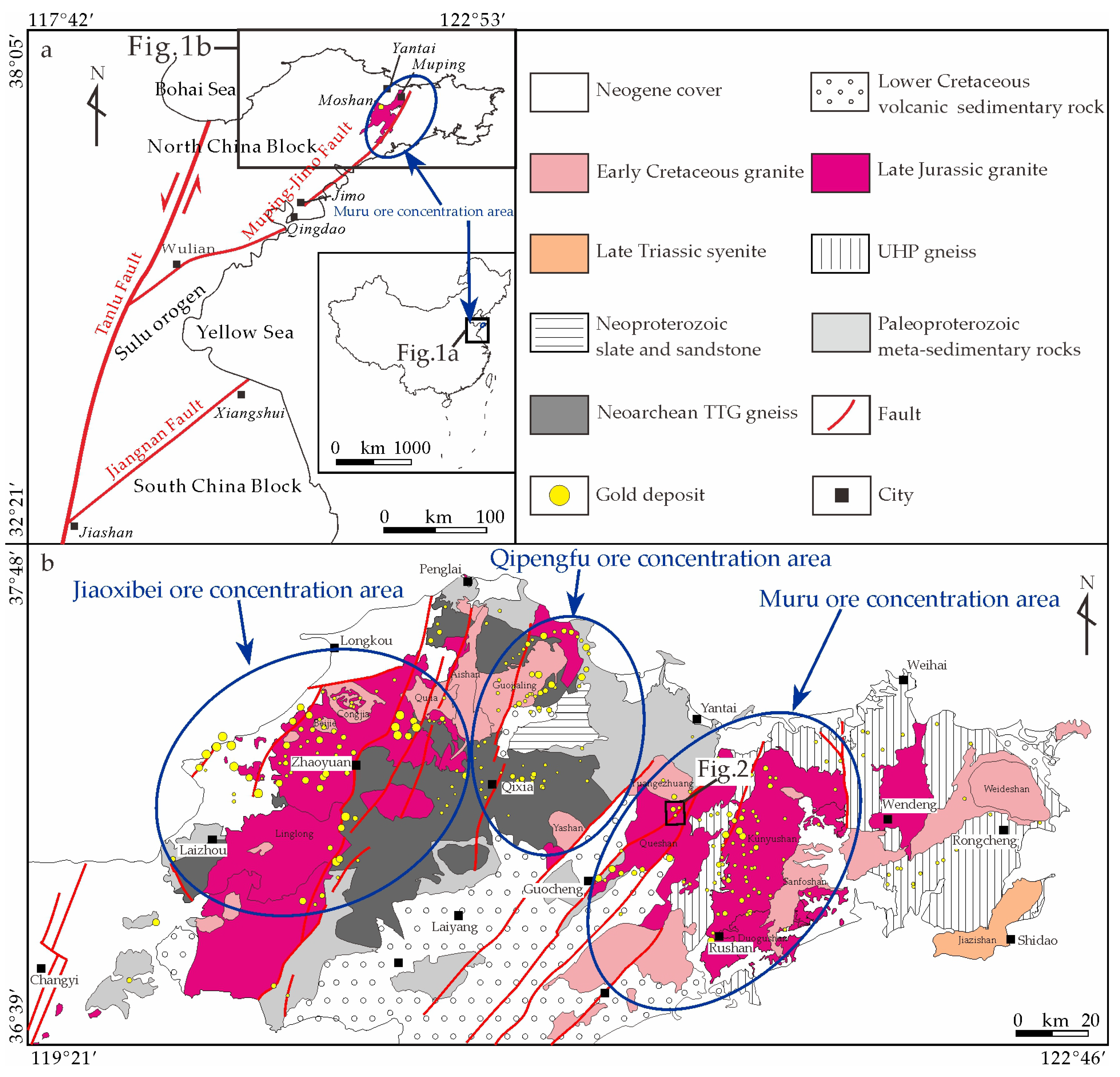
18]. Regionally, the gold mineralization pattern comprises the following three major ore concentration areas from west to east (
Figure 1a): Jiaoxibei (Zhaoyuan–Laizhou), Qipengfu (Qixia–Penglai–Fushan), and Muru (Muping–Rushan). Among them, the Muru ore concentration area is the output area of the Moshan gold deposit, the research area of this paper (
Figure 1b). The Jiaodong Peninsula is tectonically divided by the Wulian–Yantai fault zone into the Jiaobei terrane (NW) and the Sulu terrane (SE). These terranes exhibit significant differences in basement lithology, magmatic activity, and tectonic evolution, collectively controlling the spatial distribution of regional gold deposits [
11,
19,
20].
The Jiaobei terrane is the main enrichment area of gold deposits in Jiaodong gold-mineralized area, exposing a large area of Precambrian metamorphic basement, which constitutes a potential source of regional metallogenic materials. The basement rock sequence is rich, mainly including Neoarchean TTG (tonalite-trondhjemite-granodiorite) gneiss, Paleoproterozoic meta-sedimentary rocks, and Neoproterozoic slate and sandstone, etc. (
Figure 1b) [
21,
22]. In addition to the ancient basement, Mesozoic granite is widely developed in the Jiaobei terrane, forming the main body of regional magmatic activities. According to the formation age, it can be divided into the following three stages: Late Jurassic granite (Linglong granite, Queshan granite), Early Cretaceous early-stage granodiorite (Guojialing granodiorite), and Early Cretaceous late-stage granite (Aishan granite) [
23,
24,
25,
26,
27]. Among them, the Late Jurassic Queshan granite is the direct host rock of the Moshan gold deposit, and its formation and evolution process have a key controlling significance for the metallogenesis of the deposit.
The Sulu terrane is mainly composed of high-grade metamorphic rocks and Mesozoic magmatic rocks, with ultrahigh-pressure gneiss as the main body, accompanied by Lower Cretaceous volcanic-sedimentary rock series and multiple stages of Mesozoic magmatic rocks. The Mesozoic granite in this area can be divided into the following two stages: Late Jurassic (Kunyushan granite, Wendeng granite) and Early Cretaceous (Sanfoshan granite, Weideshan granite) [
26,
28]. Among them, the periphery of the Kunyushan granite is the main occurrence area of known gold deposits in the Muping–Rushan ore concentration area. In addition, intermediate-basic dykes such as diorite porphyrite and lamprophyre are developed in both terranes. These dykes vary in scale, generally 10–500 m in length and 1–10 m in width, and their occurrences are mostly consistent with regional auriferous quartz veins [
29,
30].
Regional structures are dominated by NE-NNE trending faults (
Figure 1b), which are the core elements controlling the spatial distribution of gold deposits in Jiaodong. Among them, the Sanshandao fault, Jiaojia fault, Zhaoyuan–Pingdu fault, Qixia fault, Xilin–Douya fault, and Muping–Jimo fault constitute six major trunk ore-controlling fault zones [
28,
31,
32]. Most gold deposits occur along these faults and their subsidiary structures [
33]. The Moshan deposit exemplifies this system, being controlled by a secondary branch of the Muping–Jimo fault—highlighting the regional pattern of trunk faults controlling mineralization and secondary faults hosting ore. The above-mentioned trunk faults have experienced multiple stages of activities, forming wide fracture zones and alteration zones, while secondary and sub-secondary faults form a network of channels, which not only provide paths for the long-distance migration of ore-bearing hydrothermal fluids but also provide key ore-hosting spaces for hydrothermal unloading and the precipitation and enrichment of gold and sulfides in areas where tectonic activities weaken and P-T (temperature-pressure) conditions change sharply, ultimately forming Jiaodong gold-mineralized area.
3. Ore Deposit Geology
The Moshan gold deposit is situated within the Queshan granite, located on the western flank of the Muru ore concentration area. The local geology is characterized by relatively simple stratigraphy but intense tectonic and magmatic activity, which has created favorable conditions for mineralization [
5,
6,
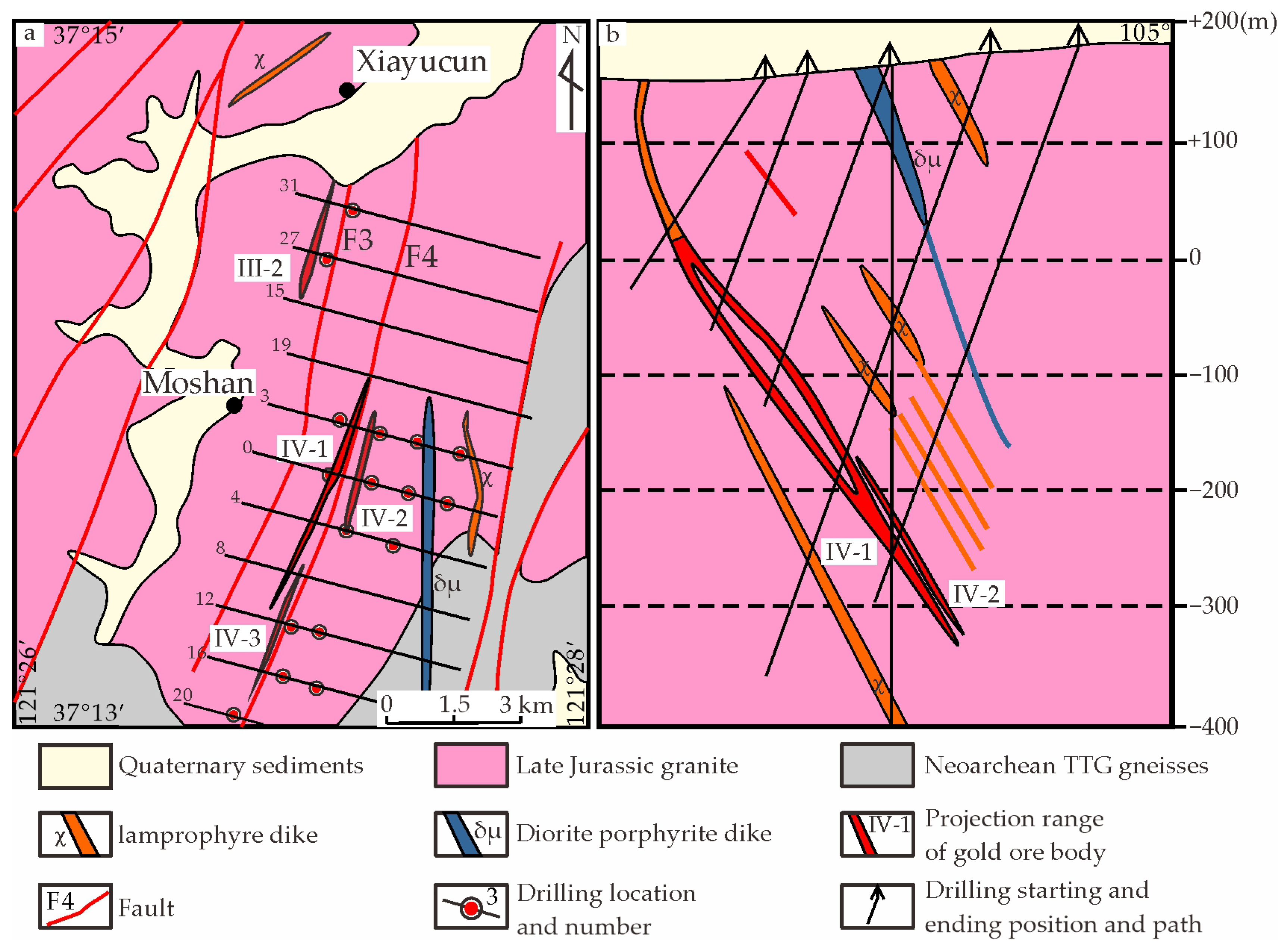
12]. Excluding Quaternary alluvial and pluvial deposits, the dominant stratigraphic unit is Neoarchean TTG gneiss, occurring as xenoliths within the granite, with minor lenses of lamprophyre and diorite porphyrite dike (
Figure 2a). The strata strike 35–55° with a NW dip (60–70° dip angle). Structural features are dominated by five major NNE-NE trending fault systems, with the F4 fault being the primary ore-controlling structure, controlling the development of the No. IV main orebody [
5,
6]. Located centrally within the mining area, F4 has a surface exposure of >1200 m long, striking about 15° with a SE dip (42–85° dip angle,
Figure 2a). The fault plane exhibits smooth, gently undulating geometry along strike and dip, displaying alteration features (e.g., silicification) and minor silicified quartz veins [
5,
6]. The magmatic rocks are mainly Queshan granite, which is weakly gneissic, fine-medium-grained garnet-bearing monzogranite. The rock is grayish white to light reddish, with a medium-grained structure and a weakly gneissic-massive structure. The dykes mainly include lamprophyre, diorite porphyrite, and granodiorite dykes (
Figure 2a).
Fifteen gold orebodies have been delineated in the Moshan gold deposit, among which one main orebody (IV-1) and three secondary orebodies (IV-2, IV-3, and III-2) have economic significance, with a cumulative proven gold metal reserve of 15 tons [
5,
6,
34]. The gold resource of the IV-1 main orebody accounts for 67.07% of the total resource of the deposit. The orebody is vein-shaped, with local swelling and contraction phenomena [
34]. Lithology is mainly pyrite-sericitized granitic cataclasite intercalated with quartz veins, and the occurrence is consistent with the F4 fault, with a general strike of 15° (
Figure 2b). The length delineated by drilling data is 570 m. The thickness of the orebody ranges from 0.24 to 6.02 m, with an average thickness of 1.84 m, and the gold grade ranges from 1.03 to 83.29 ppm, with an average grade of 10.23 ppm [
34]. The IV-2 orebody is located in the hanging wall of the IV-1 orebody, and their occurrences are also relatively consistent (
Figure 2b). The thickness of the orebody is 0.62–4.81 m, with an average thickness of 1.75 m, and the gold grade ranges from 1.02 to 112.98 ppm, with an average grade of 12.53 ppm [
34]. The IV-3 orebody is hosted in the southern section of the F4 fault, showing a vein shape, and its occurrence is consistent with the fault occurrence (
Figure 2a). The thickness of the orebody is 0.37–5.14 m, with an average thickness of 1.39 m, and the gold grade ranges from 1.00 to 11.09 ppm, with an average grade of 2.74 ppm [
34]. The III-2 orebody is hosted in the northern section of the F3 fault (
Figure 2a), and the lithology of the orebody is mainly pyrite-sericitized granitic cataclasite and pyrite–sericite schist, showing a vein shape. The thickness of the orebody is 0.68–1.97 m, with an average thickness of 1.47 m, and the gold grade ranges from 1.94 to 24.62 ppm, with an average grade of 11.66 ppm [
34].
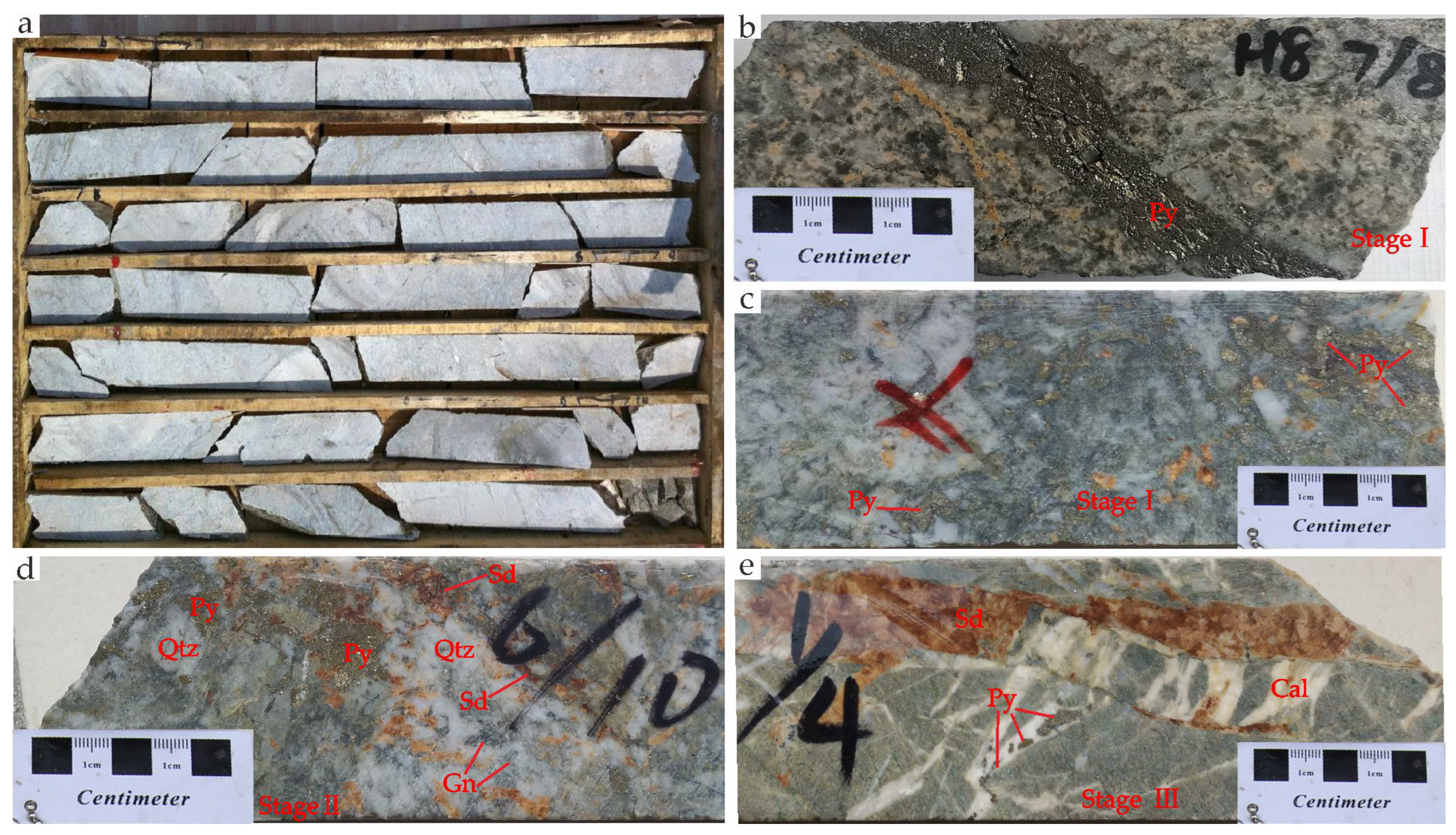
Ore minerals are dominated by sulfides, primarily pyrite, with minor marcasite, chalcopyrite, galena, and sphalerite (
Figure 3). Gangue minerals include quartz, sericite, and calcite.
Based on mineral assemblages, paragenetic relationships, cross-cutting textures, and previous studies, three metallogenic stages are defined. ① Auriferous quartz-coarse-grained pyrite stage (Stage I), with the mineral assemblage including quartz, pyrite, native gold, and sericite. At this stage, quartz and pyrite form a symbiotic edge structure. Pyrite is well-crystallized, generally coarse-grained, mostly euhedral, massive, and occasionally galena and sphalerite fill along fractures, which is a secondary metallogenic stage of gold. ② Auriferous quartz–pyrite–polymetallic sulfide stage (Stage II), the mineral assemblage includes pyrite, marcasite, galena, sphalerite, and quartz, which is the formation stage of polymetallic sulfides and the main metallogenic stage of gold. ③ Pyrite–carbonate stage (Stage III), the mineral assemblage includes calcite, pyrite, siderite, and quartz. No gold precipitation occurred at this stage. Calcite occurs as subhedral granular forms, quartz as subhedral crystalline granular forms, and siderite as veinlet-like, which is the late metallogenic stage.
4. Sampling and Analytical Methods
Studied samples were collected from drill hole 3ZK2 on exploration line 3, spanning depths from −95 to −113 m within the Moshan deposit’s IV-1 orebody. Pyrite samples from different stages were prepared as polished sections for ore microscopy and petrographic observation. For analytical measurements, pyrite grains with clear grain boundaries, no obvious cracks or inclusions, and no significant surface alteration or mineral replacement were selected. These grains represent the typical textures of each metallogenic stage (euhedral crystal for Stage I, anhedral granular for Stage II and III) to ensure the representativeness of the analytical data.
Both polarizing microscope and electron microprobe (EPMA) analysis were conducted in the Key Laboratory of Gold Mineralization Processes and Resource Utilization, Ministry of Natural Resources, China. The microscope model is Axio Scope A1, with objectives of 2.5×, 5×, 10×, 20×, 50×, and an eyepiece of 10×. The observation methods are transmitted light and reflected light. The electron microprobe model is JEOL JXA-8230. The accelerating voltage used for wavelength dispersive spectrometry is 15 kV, the current is 2 × 10⁻⁸ A, and the beam diameter is 1 μm. The standard samples used are Canadian Astimex series standards as follows: pyrite (S, Fe), galena (Pb), sphalerite (Zn), cinnabar (Hg), stibnite (Sb), bismuth selenide (Bi, Se), cuprite (Cu), arsenopyrite (As), pentlandite (Ni), gold (Au), silver (Ag) and cobalt (Co). Counting times were 20 s for peak and 10 s for background for all analyzed elements, with 30 s for Au, Ag, and Co. For spot analyses, they were performed point by point from one end to the other along the pyrite cross-section. Element mapping was carried out for Ag, Au, As, Fe, and S in representative areas. The laboratory environment temperature was 22 °C, and the humidity is 30%. Under the above analytical conditions, the detection limits (wt%) were as follows: S 0.015, Fe 0.01, Pb 0.02, Zn 0.02, Hg 0.03, Sb 0.03, Bi 0.02, Se 0.02, Cu 0.03, As 0.03, Ni 0.04, Co 0.03, Te 0.03, Au 0.03, and Ag 0.03.
In situ sulfur isotope determination of pyrite was performed in the State Key Laboratory of Geological Processes and Mineral Resources, China University of Geosciences (Wuhan). For this purpose, we used a laser ablation-multi-collector inductively coupled plasma mass spectrometry (LA-MC-ICP-MS) instrument. The laser ablation system is Resolution S-155, and the MC-ICP-MS is a Nu Plasma II. During laser ablation, helium is used as carrier gas and argon as compensation gas to adjust the sensitivity. The two are mixed through a T-junction before entering the ICP. The laser wavelength is 193 nm, the beam size is 33 μm, the pulse frequency is 10 Hz, and the energy density is 3–5 mJ/cm
2. During the analyses, blank collection is performed for 30 s first, and then continuous ablation collection of the sample is performed for 40 s. The standard-sample cross method was used for the determination and correction of sample δ
34S values, which represent the relative difference between the
34S/
32S isotopic ratio of a sample and that of the Canyon Diablo Troilite (CDT) standard, expressed in per mil (‰) according to the formula: δ
34S (‰) = [(
34S/
32S)
sample/(
34S/
32S)
CDT − 1] × 1000. The standard samples used are USGS NBS-127 sphalerite and laboratory internal pyrite WS-1, with an analytical precision of ±0.5‰. Analytical protocol follows Liu et al. (2018) [
35].
5. Results
5.1. Pyrite Microtextural Characteristics
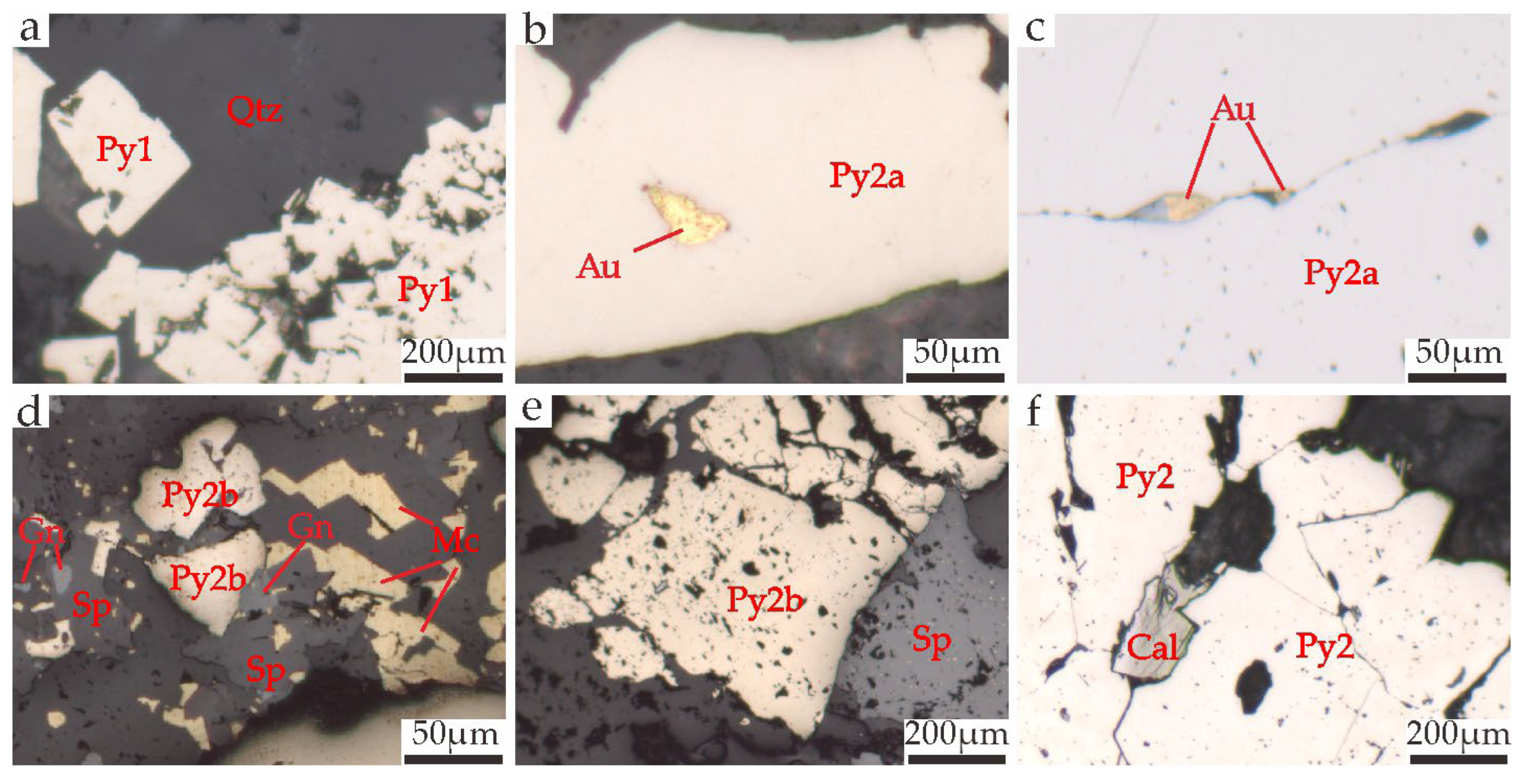
Microscopic analysis reveals that pyrite in the Moshan gold deposit predominantly displays cataclastic and euhedral–subhedral textures. Both rounded and cubic pyrite morphologies are developed, with associated sulfides including galena and sphalerite in symbiotic association (
Figure 4). Pyrite from stage I is a cubic euhedral crystal (Py1), with clear grain boundaries and few internal fractures (
Figure 4a). Pyrite from stage II includes cubic euhedral crystals (Py1) and irregular anhedral granular (Py2). According to the cleanliness of the mineral surface, the irregular anhedral granular pyrite (Py2) can be further divided into Py2a type with a relatively smooth and flat surface (
Figure 4b,c), and Py2b type with more surface pits (
Figure 4d,e). Visible gold is mainly filled inside Py2a type pyrite in the form of inclusions or developed along pyrite grain fractures. Pyrite from stage III is mainly irregular, anhedral granular (Py2) (
Figure 4f).
5.2. Electron Probe Microanalysis Results of Pyrite
A total of 24 electron probe microanalyses (EPMA) were performed on pyrite from the Moshan gold deposit (
Table 1).
For stage I (
Table 1), eight points were performed for cubic euhedral pyrite (Py1). The contents of ω(Fe), ω(S), and ω(As) are 46.237%–46.535%, 52.378%–53.577%, and 0.083%–0.386%, with average values of 46.397%, 52.926%, and 0.211% respectively; it contains a small amount of Co, Ni, Pb, Bi and Au, 0.034%–0.080%, 0.040%–0.169%, 0.025%–0.167%, 0.042%–0.170%, and 0.031%–0.039% respectively; and it also contains trace amounts of Cu, Zn, Ti, and Ag.
For stage II (
Table 1), eight points were carried out for anhedral granular pyrite (Py2). The contents of ω(Fe), ω(S), and ω(As) are 46.251%–47.331%, 52.144%–53.027%, and 0.090%–0.658%, with average values of 46.713%, 52.686%, and 0.397% respectively; it contains a small amount of Co, Ni, Bi and Au, 0.047%–0.220%, 0.053%–0.177%, 0.090%–0.280%, and 0.030%–0.058% respectively; and it contains trace amounts of Pb, Cu, Zn, Ti, and Ag.
For stage III (
Table 1), eight points were analyzed for anhedral granular pyrite (Py2). The contents of ω(Fe), ω(S), and ω(As) are 46.145%–46.311%, 52.003%–52.895%, and 0.030%–0.155%, with average values of 46.247%, 52.466%, and 0.082% respectively; it contains a small amount of Co, Ni and Pb, 0.048%–0.181%, 0.040%–0.113%, and 0.045%–0.163% respectively; and it contains trace amounts of Pb, Cu, Zn, Ti, Au, and Ag.
5.3. Element Mapping Analysis Results of Pyrite
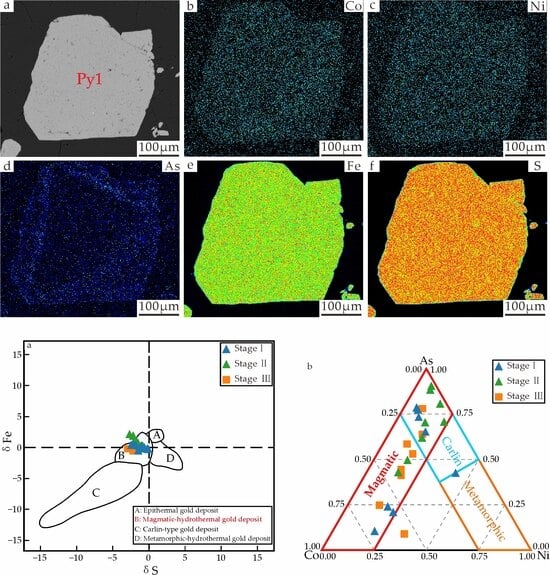
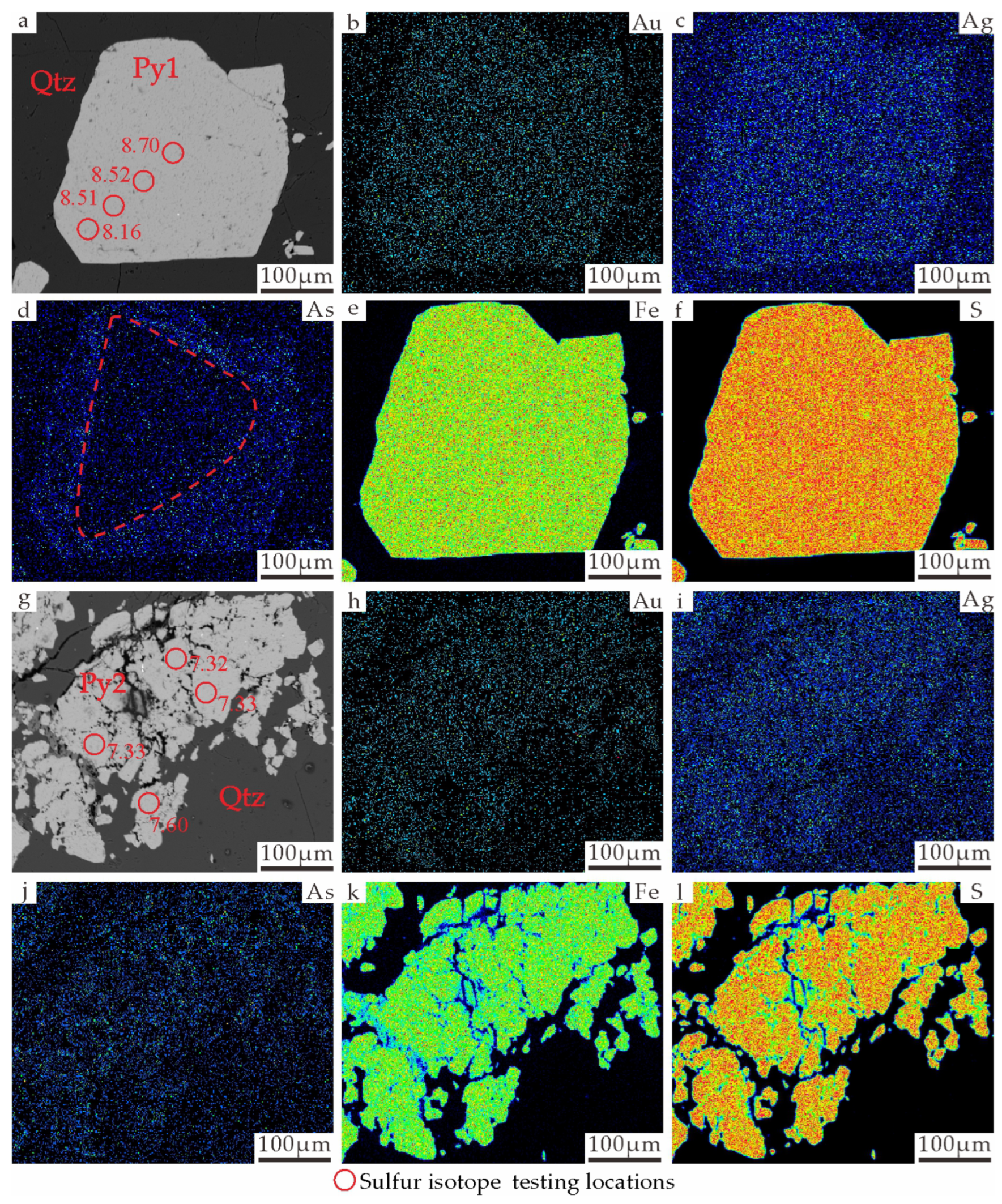
Electron probe element mapping was performed on two representative pyrite samples to characterize internal textures and spatial distributions of Ag, Au, As, Fe, and S (
Figure 5).
Au and Ag elements show weak signals and uniform distribution, with no obvious high-brightness enrichment areas (
Figure 5b,c,h,i). The As elemental mapping results show that in the pyrite (Py1) from the auriferous quartz-coarse-grained pyrite stage, the As has a large tone contrast between the core and the edge of the crystal (
Figure 5d). The tones of the Fe and S elemental maps are basically consistent, and there is no obvious difference in Fe and S contents in pyrite of each metallogenic stage (
Figure 5e,f,k,l), and no obvious enrichment or depletion patches, indicating that the pyrite crystal structure is relatively complete.
5.4. In Situ Sulfur Isotope Composition of Pyrite
A total of 30 in situ sulfur isotope results of pyrite were obtained in this study, and the detailed composition results are shown in
Table 2. Overall, the δ
34S values of pyrite have a narrow variation range (7.11‰–9.40‰), with an average value of 8.00‰, all highly homogeneous and exhibit positive δ
34S values relative to the V-CDT standard [
36,
37,
38], showing high sulfur homogenization and slight enrichment of δ
34S.
6. Discussion
6.1. Gold Occurrence State in Pyrite
Microscopic observation and electron probe mapping analysis results show that the occurrence forms of gold in the Moshan gold deposit are diverse (
Figure 4), including visible inclusion gold (filled inside Py2a type pyrite), fracture gold (distributed along pyrite grain fractures), and widely distributed invisible gold [
39,
40]. The occurrence states of invisible gold in pyrite are mainly divided into the following two types: one is nano-particle gold existing as Au
0, and the other is solid solution gold (or lattice gold) incorporated into the pyrite lattice as Au
+ [
40,
41,
42,
43,
44]. The discrimination between the two is of great significance for revealing the migration and precipitation mechanism of gold [
43,
44]. Since Py2a-type pyrite is identified as the main ore-bearing mineral formed in the main metallogenic stage, the inclusion of visible gold within it indicates that gold precipitation was synchronous with the crystallization of Py2a-type pyrite, rather than a product of later superimposed alteration [
41,
43]. This synchronous relationship further confirms that the gold-bearing fluid was closely associated with the formation of Py2a-type pyrite, and the precipitation of gold was triggered by changes in physicochemical conditions during the crystallization of pyrite. In contrast, the visible fracture gold distributed along pyrite grain fractures reflects the late-stage modification process of the deposit after the formation of Py2a-type pyrite. The formation of pyrite fractures is usually related to regional tectonic activities or post-metallogenic fluid movement; the migration of late-stage hydrothermal fluid along these fractures led to the secondary precipitation of gold, forming fracture gold [
8,
16]. This phenomenon indicates that the Moshan gold deposit experienced multi-stage metallogenic activities, and the late-stage tectonic movement and fluid activity further enriched the gold mineralization, which is an important supplement to the main metallogenic process.
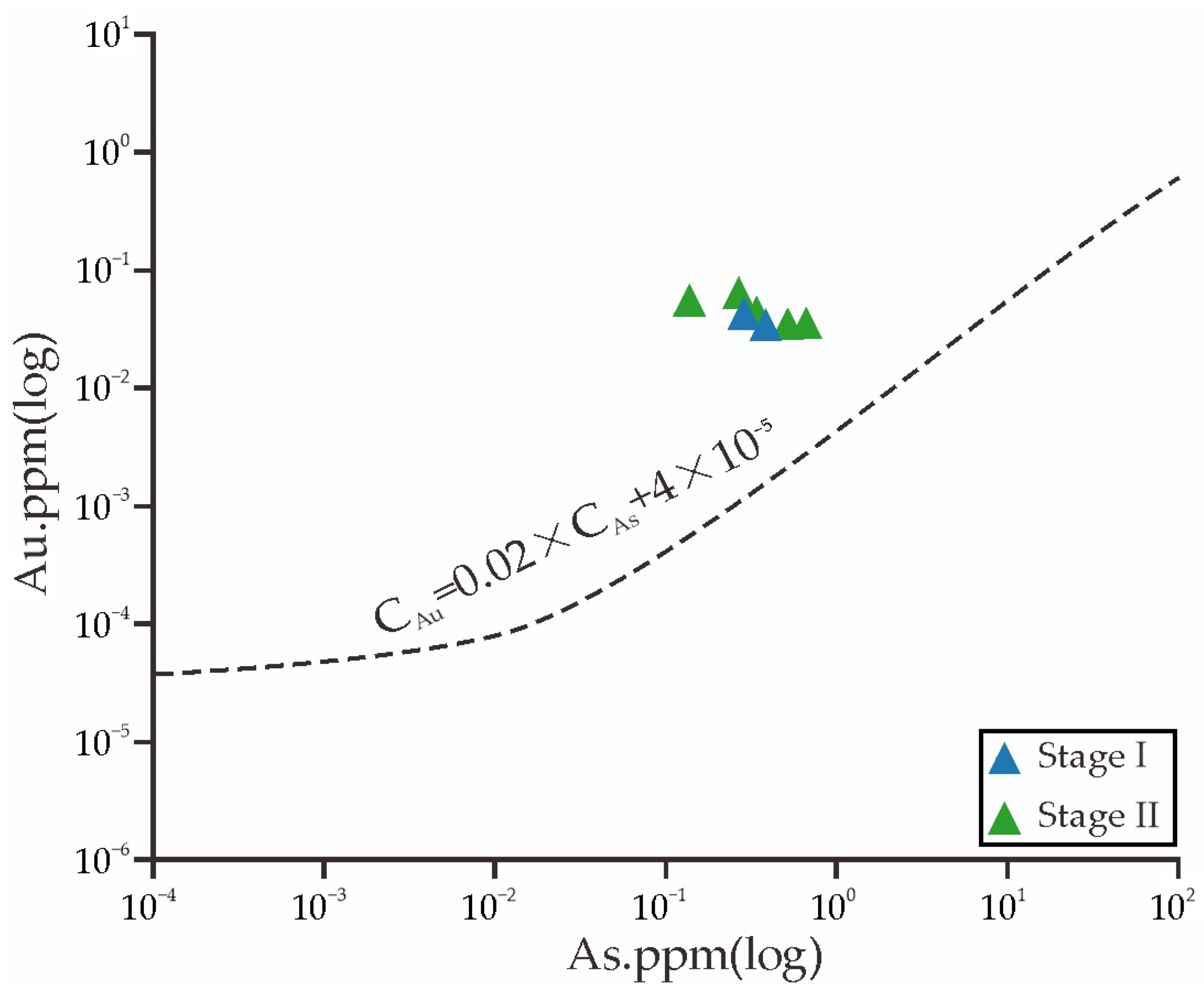
Previous systematic studies on arsenian pyrite in typical American Carlin-type gold deposits proposed a wedge-shaped relationship model for Au-As distribution, that is, the occurrence state of invisible gold can be effectively distinguished by the limiting line equation C
Au = 0.02 × C
As + 4 × 10
−5 (where C
Au and C
As are the mass concentrations of gold and arsenic in arsenian pyrite, respectively) [
40]. When data points fall above the boundary line, the invisible gold primarily exists as nano-particle gold (Au
0); when data points fall below the boundary line, it primarily exists as lattice gold/solid solution gold (Au
+) [
40,
41]. Given that stage III represents the late metallogenic stage with no gold precipitation, its trace Au concentrations are uniformly below the detection limit (
Table 1). Therefore, the data from metallogenic stages I and II are incorporated into the wedge-shaped correlation model of Au-As distribution for analysis (
Figure 6). The results show that all data points are concentrated in the “Au
0 nano-particle gold” area above the solubility line, and far away from the limiting line, indicating that the occurrence state of invisible gold in the Moshan gold deposit is mainly nano-particle gold. In addition, electron probe mapping shows that Au is uniformly distributed with weak signals (
Figure 5), without obvious high-brightness enrichment areas, which also confirms that invisible gold is uniformly dispersed in pyrite in the form of nano-particles, rather than forming independent minerals through large-scale concentrated enrichment [
45,
46].
6.2. Genesis of Gold-Bearing Pyrite
Having established that gold synchronously precipitated with specific pyrite types (Py2a), understanding the geochemical genesis of this host pyrite is critical for tracing the ore-forming environment. The major element composition of pyrite (especially S, Fe contents, and their ratio) is an important typomorphic feature, reflecting its formation environment and genetic type. The mass fraction of major and trace elements in geological samples refers to the ratio of the mass of a given element to the total mass of the sample. It is conventionally expressed in weight percent (wt%) for major elements and parts per million (ppm, μg/g) for trace elements, and is widely used to characterize elemental abundances and geochemical signatures [
47,
48]. The atomic abundances of Fe and S in pyrite, as well as the deviation degree of their mass fractions, can be calculated based on the measured Fe and S contents. The theoretical composition of standard pyrite is ω(Fe) = 46.55%, ω(S) = 53.45%, and the S/Fe atomic ratio is 2.0 (chemical formula FeS
2) [
49]. Due to factors such as isomorphous substitution of trace elements and changes in fluid properties during the metallogenic process, the S and Fe contents of pyrite in natural gold deposits often deviate from the theoretical values. According to the S/Fe atomic ratio, it can be divided into sulfur-deficient type (S/Fe < 2) and iron-deficient type (S/Fe > 2) [
49,
50]. Among them, sulfur-deficient pyrite is mostly related to hydrothermal activities, while the iron-deficient type is common in sedimentary or metamorphic environments [
49].
To accurately characterize the deviation degree of major elements in pyrite from the Moshan gold deposit relative to their theoretical contents, the δFe and δS typomorphic parameters are employed in this study [
11,
51,
52,
53]. These parameters quantitatively reflect the extent to which the measured Fe and S contents depart from the stoichiometric composition of ideal pyrite (FeS
2). The δFe and δS values are calculated using the following formulas [
51,
52,
53], where ω(Fe) and ω(S) represent the measured mass fractions of Fe and S in pyrite, respectively:
A positive δFe value indicates Fe enrichment relative to ideal pyrite, whereas a negative value indicates Fe depletion. Similarly, a positive δS value denotes S enrichment, and a negative value denotes S depletion [
52,
53]. These parameters have been widely used as important typomorphic indices to constrain the physicochemical conditions, crystallization processes, and metallogenic implications of pyrite in hydrothermal ore deposits [
52,
53]. The average ω(Fe) of pyrite from the Moshan gold deposit is 46.452%, the average ω(S) is 52.693%, the S/Fe atomic ratio ranges from 1.919 to 2.017, with an average of 1.976, and the chemical formula can be expressed as FeS
1.919–FeS
2.017 (average FeS
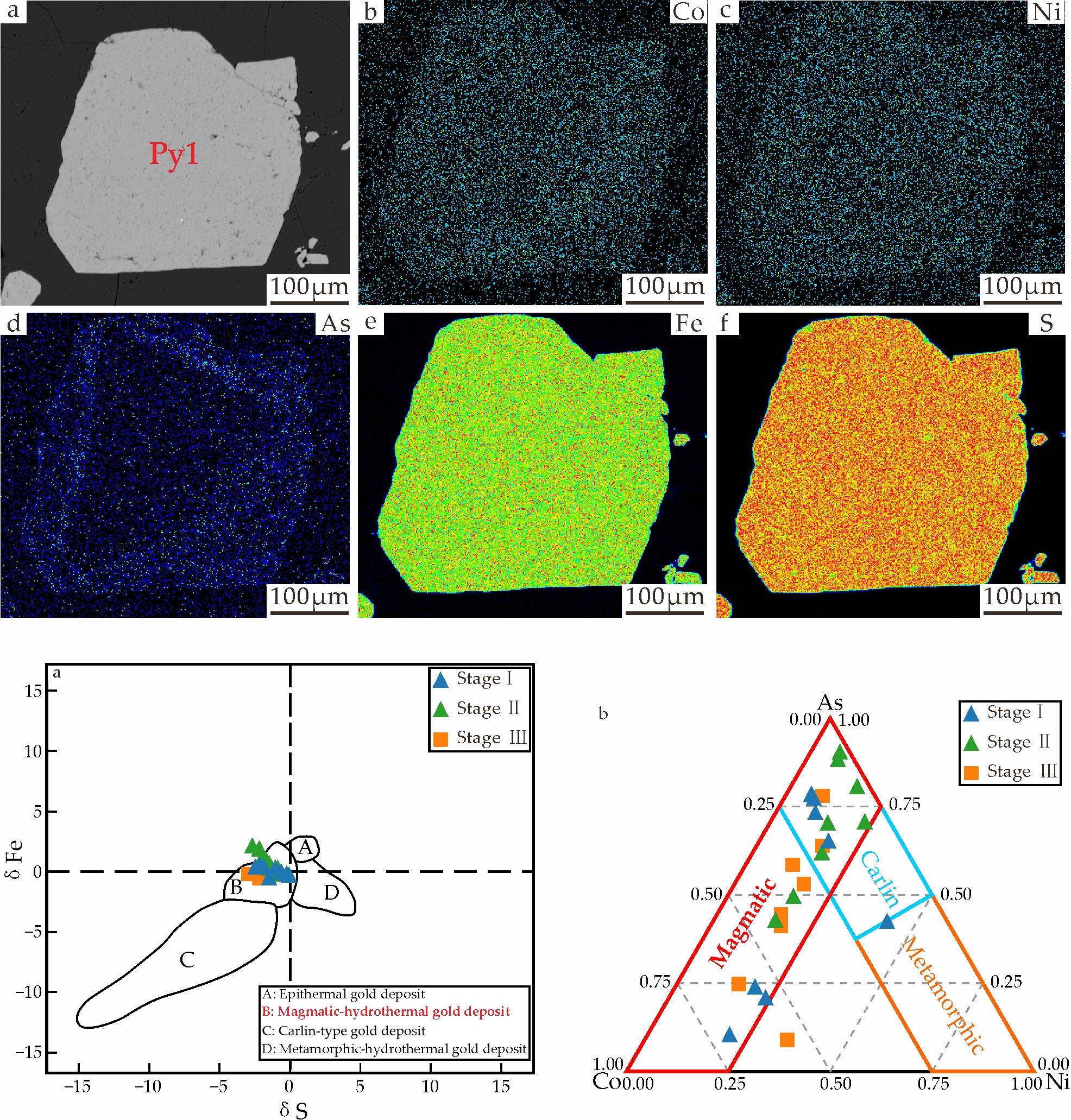
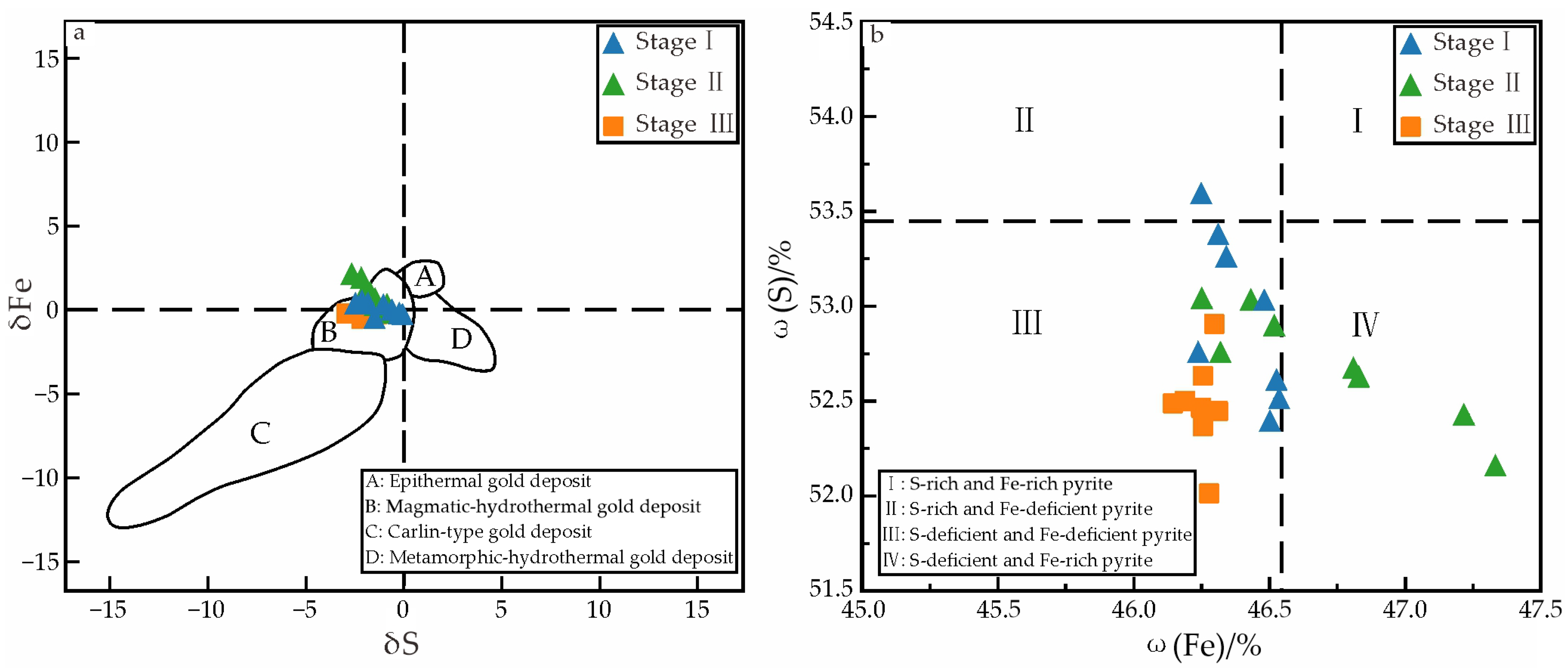
1.976), showing an overall slight sulfur deficiency (S/Fe < 2). The δFe-δS plotting results (
Table 3,
Figure 7a) show that most of the data points fall into the magmatic-hydrothermal gold deposit area. The S-Fe content distribution diagram (
Figure 7b) shows that pyrite points are mainly concentrated in the S-deficient and Fe-deficient area of the III quadrant, and a small number of points are distributed in the II and IV quadrants, and the points are relatively scattered, indicating that the physical and chemical conditions of the hydrothermal system fluctuated during the metallogenic process, leading to certain differences in the S and Fe contents of pyrite, but the overall main feature is slight deficiency.
A comparative analysis of the major element characteristics of pyrite from genetically distinct gold deposits reveals the following features: pyrite from magmatic-hydrothermal gold deposits generally exhibits slight depletion in S and Fe, with average contents of ω(S) = 52.66% and ω(Fe) = 45.90% [
52]. In contrast, pyrite from metamorphic-hydrothermal gold deposits shows Fe enrichment coupled with S depletion, averaging ω(S) = 52.72% and ω(Fe) = 46.76% [
52]. Pyrite from Carlin-type gold deposits displays marked depletion in both S and Fe, with average values of ω(S) = 51.03% and ω(Fe) = 44.86% [
52]. The S/Fe atomic ratio of syngenetic sedimentary pyrite typically exceeds two, whereas a ratio below two indicates a hydrothermal origin [
54,
55]. The sulfur and iron contents, along with the atomic S/Fe ratio of pyrite from the Moshan gold deposit, align closely with those characteristic of magmatic-hydrothermal gold deposits. This consistency supports a magmatic-hydrothermal genetic affinity for the pyrite in this deposit.
In addition, Py1 type pyrite from stage I is a cubic euhedral crystal with high crystallization degree and few internal fractures, and the S and Fe contents are relatively close to the theoretical values, reflecting that it was formed in a relatively stable hydrothermal environment, while Py2 type pyrite (including Py2a and Py2b) from stage II is irregular anhedral granular, with large fluctuations in S and Fe contents, and the contents of metallogenic elements such as As and Au are significantly higher than those of Py1 type, indicating that the hydrothermal system underwent intense material exchange and changes in physical and chemical conditions during the main metallogenic stage, which may be related to hydrothermal mixing or decompression boiling caused by tectonic activities. The S and Fe contents of Py2 type pyrite from stage III further decreased, and the As and Au contents significantly decreased, indicating that the metallogenic capacity of the hydrothermal system had been greatly weakened at this time, and gold precipitation basically stopped.
6.3. Source of Ore-Forming Material
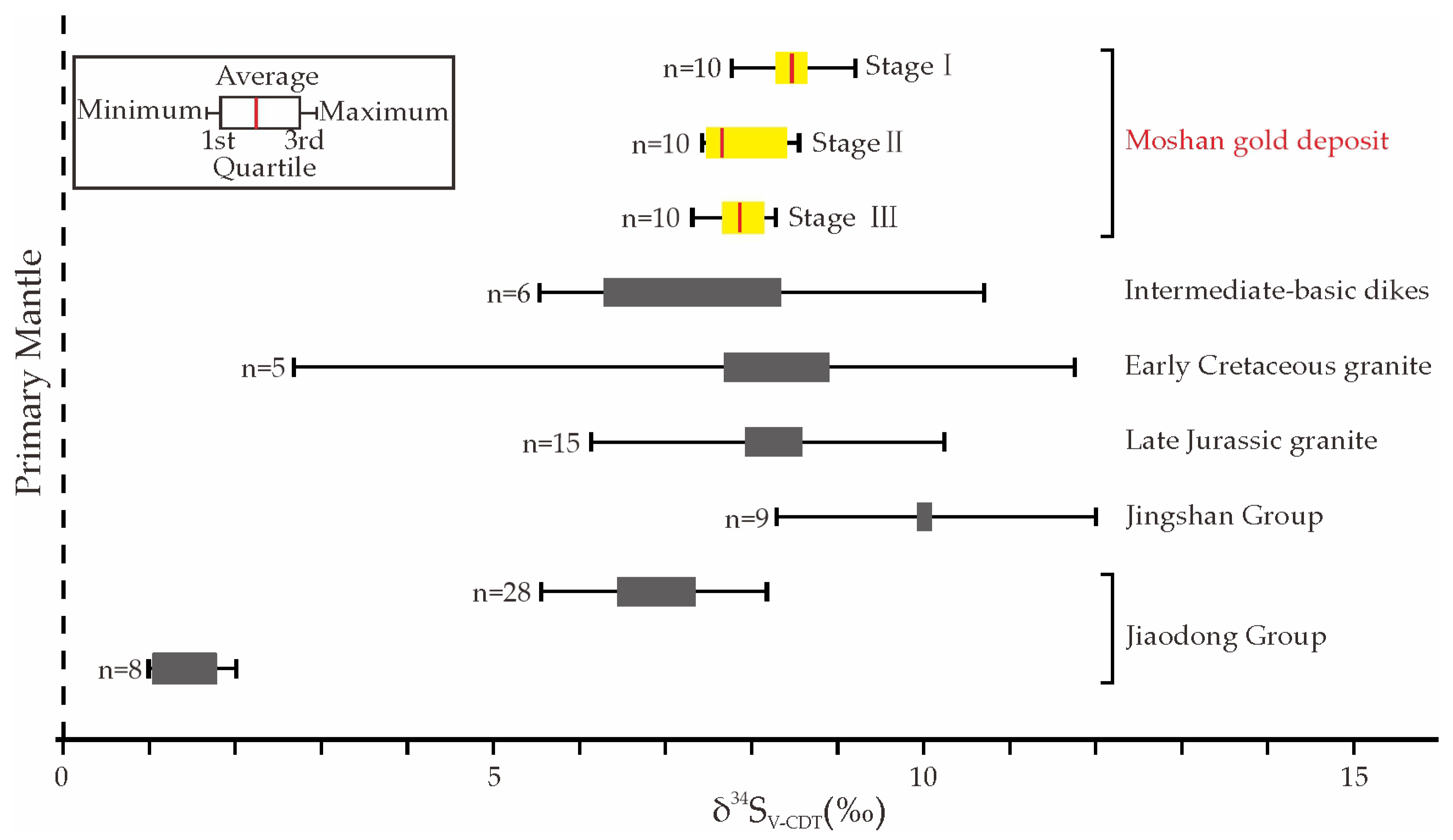
The S/Fe stoichiometry and typomorphic parameters strongly indicate a magmatic-hydrothermal affinity for the Moshan pyrite. To further constrain the specific origin of these magmatic fluids, in situ sulfur isotopic compositions were evaluated. Sulfur isotope is an effective tracer for determining the source of metallogenic materials. LA-MC-ICP-MS in situ sulfur isotope analysis shows that the δ34S values of pyrite from the Moshan gold deposit are concentrated in +7.11‰ to +9.40‰, with an average value of +8.00‰. The δ34S values of the three metallogenic stages are not significantly different, showing a narrow range distribution and positive high δ34S value characteristics, and high sulfur homogenization, indicating that the sulfur in the ore-forming fluid has a relatively single source and is not strongly disturbed by multi-source sulfur mixing.
Comparing the sulfur isotope compositions of major geological units in the Jiaodong gold-mineralized area (
Figure 8), the δ
34S value distribution range of pyrite from the Moshan gold deposit is highly consistent with that of Late Jurassic granite, but there is a certain difference from that of Paleoproterozoic metamorphic basement rocks (such as Jiaodong Group) (the δ
34S values of basement rocks are mostly lower than 5‰) [
56,
57,
58,
59]. This indicates that the sulfur in the ore-forming fluid is mainly derived from Mesozoic granite magmatic hydrothermal fluids, rather than the direct contribution of basement metamorphic rocks. At the same time, the δ
34S value is slightly higher than that of typical mantle sulfur (δ
34S values concentrated in 0–3‰) [
47,
60,
61], which may reflect that the magma was contaminated by a small amount of crustal materials during the evolution process, or the magmatic hydrothermal fluid had weak isotope exchange with the wall rock, but the main source of sulfur was not changed.
While the occurrence of visible gold reveals the multi-stage nature of the deposit’s metallogenic process, the geochemical composition of pyrite provides further constraints on the nature of the ore-forming fluids. The concentrations of base metals such as Cu, Zn, and Pb are generally low (mostly <0.1 wt%, though Pb occasionally slightly exceeds this), indicating that the ore-forming fluid had a low affinity for these elements. Conversely, volatile trace elements like Bi are slightly enriched in stage II pyrite (i.e., Py2a-type pyrite, the main ore-forming stage). This suggests that during the primary mineralization period, the hydrothermal system was enriched in volatile components and underwent intense material exchange, creating conditions highly favorable for gold precipitation.
The trace element signature of pyrite also offers crucial insights into the material source. Co and Ni are sensitive indicators of magmatic activity, and their concentrations and ratios are routinely used to trace metal provenance [
59,
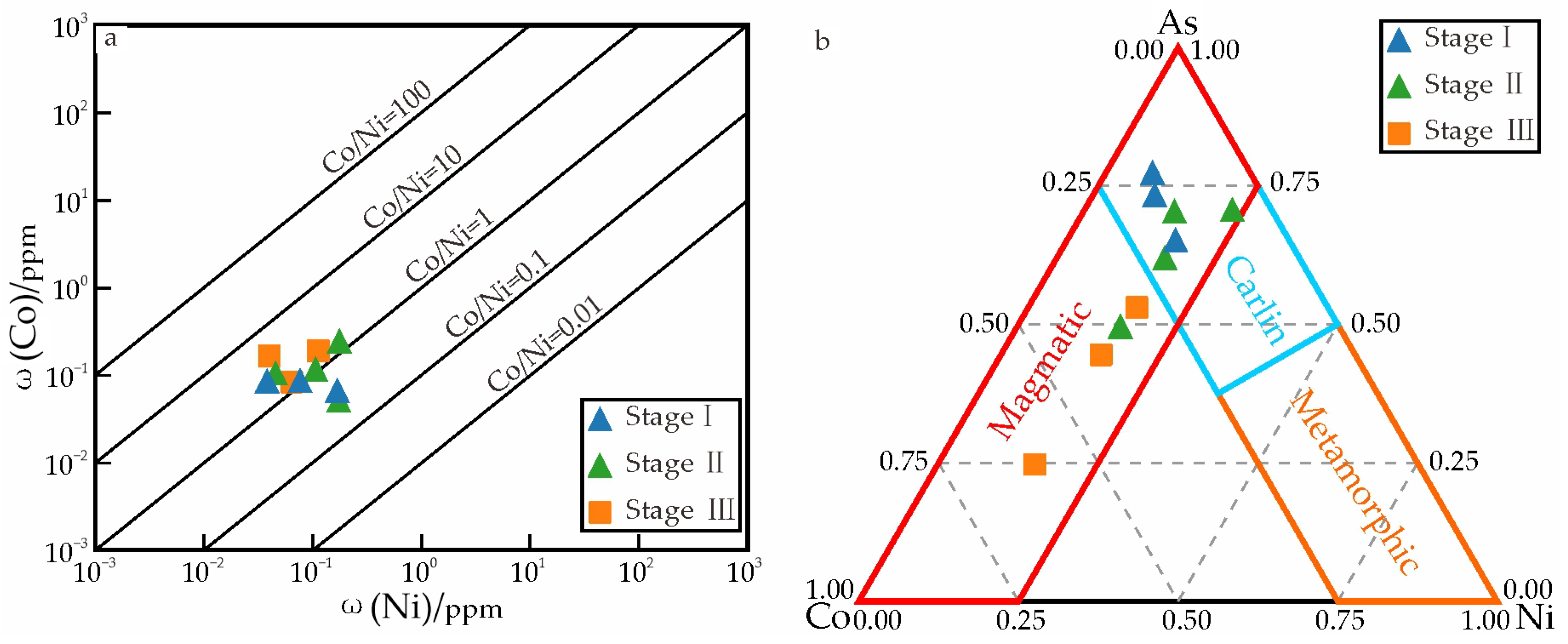
65]. The Co/Ni ratios of pyrite from the Moshan gold deposit are mostly close to one (
Table 1,
Figure 9a), which aligns with the magmatic origin signature (Co/Ni ≈ 1). In contrast, sedimentary pyrite typically has Co/Ni ratios < 1, while hydrothermal pyrite shows a wide range (1.17–5) [
65,
66,
67,
68,
69]. Additionally, the As content in pyrite from the main metallogenic stage is significantly elevated (averaging 0.397 wt%). As a typical indicator element for magmatic-hydrothermal activity, the enrichment of As is generally associated with the accumulation of volatile components during magma evolution [
70,
71,
72]. Finally, the Co-Ni-As ternary plot (
Table 4,
Figure 9b) illustrates that most pyrite samples fall within the magmatic gold deposit fields, reinforcing the conclusion that the metallogenic materials were primarily derived from a magmatic-hydrothermal system.
6.4. Metallogenic Depth
Beyond fluid sources, the physicochemical conditions—specifically the depth of mineralization—play a vital role in controlling the intense precipitation of gold and volatile elements observed in stage II. Metallogenic depth is an important parameter of ore-forming conditions, which directly affects the physical and chemical properties of ore-forming fluids (such as temperature, pressure, density, etc.) and the migration and precipitation mechanism of gold and has important guiding significance for prospecting and exploration. Previous studies have shown that the Fe/(S + As) value in pyrite has a significant correlation with the deposit formation depth (correlation coefficient about 0.87), among which the above ratios of pyrite in hypabyssal, mesothermal, and epithermal environments are 0.846, 0.863, and 0.926, respectively [
73,
74]. The essence of this correlation is that the oxygen fugacity and sulfur fugacity of the hydrothermal system are different under different depth environments, leading to different degrees of isomorphous substitution of As in pyrite, thereby affecting the Fe/(S + As) value [
74].
By calculating the Fe/(S + As) value of pyrite from the Moshan gold deposit, the results show that it ranges from 0.864 to 0.905, with an average value of 0.880, which is between the critical values of mesothermal and epithermal environments, indicating that the metallogenic depth of the Moshan gold deposit is a mesothermal-epithermal environment. The mesothermal-epithermal metallogenic depth characteristics of the Moshan gold deposit may be related to the regional tectonic evolution stage. In the late Mesozoic, the Jiaodong area was in an extensional tectonic environment, and crustal uplift was significant, leading to a relatively shallow metallogenic depth [
75,
76]. At the same time, the relatively shallow metallogenic depth may also be one of the important reasons for the high gold grade of the Moshan gold deposit (average grade 10.23 ppm), because the decompression boiling of the hydrothermal system is more intense in the shallow environment, which is conducive to the rapid precipitation and enrichment of gold [
77].
6.5. Metallogenic Mechanism
The Moshan gold deposit is controlled by the secondary branch structure (F4 fault) of the Muping–Jimo fault zone. As one of the six major trunk ore-controlling faults in the region, the Muping–Jimo fault has experienced multiple stages of activity, providing key channels and ore-hosting spaces for the migration and unloading of ore-bearing hydrothermal fluids. The Queshan granite, as the direct host rock, was formed by partial melting of the crust caused by the subduction of the Pacific Plate [
78,
79]. During the magma evolution process, a large amount of gold and other metallogenic elements were accumulated, forming an ore-rich magmatic hydrothermal system.
In terms of deposit genetic type, the δFe-δS typomorphic parameters, S/Fe ratio, Co/Ni ratio, and Co-Ni-As ternary system plotting of pyrite all show that the deposit has magmatic-hydrothermal genesis characteristics. At the same time, the metallogenic depth is mesothermal-epithermal, and there is a gold precipitation mechanism caused by decompression boiling, which has certain similarities with some characteristics of epithermal gold deposits. However, the sulfur isotope composition, trace element characteristics, and mineral assemblage of pyrite (without epithermal characteristic minerals such as adularia and alunite) are significantly different from those of typical epithermal gold deposits [
77,
80]. Therefore, the genetic type of the Moshan gold deposit should be defined as a magmatic-hydrothermal gold deposit, and its metallogenic process is jointly controlled by magmatic hydrothermal activities and tectonic activities, belonging to a tectonic-magmatic-hydrothermal composite gold deposit.
In summary, the genetic model of the Moshan gold deposit can be briefly outlined as follows: during the Late Mesozoic, the subduction of the Pacific Plate triggered the partial melting of the regional crust, forming the Queshan granite, which acts as the main host rock [
78,
79]. During the continuous evolution and crystallization of the magma, a large amount of volatile components and ore-forming elements (such as Au and As) accumulated, exsolving an ore-rich magmatic-hydrothermal fluid [
70,
71,
72]. Concurrently, the Muping–Jimo fault zone experienced multi-stage activities; its derived secondary faults (such as the F4 fault) provided not only core channels for the long-distance migration of the fluids but also critical spaces for orebody emplacement [
5,
6]. As the deep, high-temperature ore-bearing hydrothermal fluid migrated along the fault zone to a mid-shallow environment, the extensional tectonic setting caused a sudden pressure drop, triggering intense decompression boiling [
75,
76,
77]. This abrupt change in physicochemical conditions destabilized the complexes in the hydrothermal fluid, leading to the massive precipitation and rapid enrichment of gold (primarily as nano-particulate Au
0) and pyrite-dominated sulfides within favorable fault fractures [
40,
41]. Ultimately, this process formed a composite gold deposit jointly controlled by tectonic, magmatic, and hydrothermal processes.
7. Conclusions
Based on the systematic investigation of mineralogy, trace elements, and in situ sulfur isotopes of pyrite from the Moshan gold deposit, the main conclusions are as follows:
Gold in the ores exhibits multiple forms of occurrence, primarily including visible inclusion gold, fracture gold, and widely distributed invisible gold. The quantitative relationship model of the Au-As system confirms that the invisible gold predominantly exists as nano-particulate gold (Au0) within the pyrite. Major element analysis indicates that the pyrite generally displays a slight sulfur deficiency, with an average S/Fe atomic ratio of 1.976.
The δFe-δS typomorphic parameters of the pyrite, the Co/Ni ratio approaching one, and the projection of the Co-Ni-As ternary system all consistently point to a magmatic-hydrothermal origin for the deposit. The in situ sulfur isotopes show a narrow distribution and high homogeneity. This indicates that the ore-forming materials (especially sulfur) are predominantly derived from magmatic-hydrothermal fluids associated with the Mesozoic Queshan granite.
The Fe/(S + As) values in the pyrite (averaging 0.878) effectively constrain the physicochemical state of the fluid, indicating that the Moshan gold deposit formed in a mesothermal-epithermal depth environment. Integrating the ore-controlling factors and metallogenic mechanisms, the formation of this deposit is jointly controlled by tectonic and magmatic-hydrothermal activities, classifying it genetically as a tectonic-magmatic-hydrothermal composite gold deposit.
Author Contributions
Conceptualization, F.Z. and J.T.; methodology, J.T.; investigation, F.Z., Z.L., T.T., P.G., B.L. and Y.Q.; resources, Z.L.; data curation, F.Z., T.T., P.G., Y.Q. and P.Z.; writing—original draft preparation, F.Z., Z.L., T.T., P.G. and B.L.; writing—review and editing, F.Z., H.L. and J.T.; project administration, J.T.; funding acquisition, J.T. All authors have read and agreed to the published version of the manuscript.
Funding
This study was financially supported by the Shandong Provincial Natural Science Foundation, China (No. ZR2025QC426), the Open Fund of Shandong Engineering Research Center of Underground Resources and Environment High Precision Detection/Shandong Engineering Research Center of Underground Resources and Environment High Precision Detection (No. KY2025005), and the Doctoral Research Foundation of Shandong Jianzhu University (No. X21005Z).
Data Availability Statement
All data are contained within the article.
Conflicts of Interest
The authors declare no conflicts of interest.
References
- Deng, J.; Wang, Q.F.; Zhang, L.; Xue, S.C.; Liu, X.F.; Yang, L.; Yang, L.Q.; Qiu, K.F.; Liang, Y.Y. Metallogenetic model of Jiaodong-type gold deposits, eastern China. Sci. China Earth Sci. 2023, 66, 2287–2310. [Google Scholar] [CrossRef] [Scilit]
- Groves, D.I.; Santosh, M.; Deng, J.; Wang, Q.F.; Yang, L.Q.; Zhang, L. A holistic model for the origin of orogenic gold deposits and its implications for exploration. Miner. Depos. 2020, 55, 275–292. [Google Scholar] [CrossRef] [Scilit]
- Yang, L.Q.; Deng, J.; Yang, W.; Xie, D.; Wang, L.; Qiu, K.F.; Li, D.P. Jiaodong-Type Gold Deposit. Acta Petrol. Sin. 2024, 40, 1691–1711, (In Chinese with English Abstract). [Google Scholar] [CrossRef] [Scilit]
- Song, M.C.; Wang, L.; Song, Y.X.; Li, J.; Wang, B.; Wei, X.F.; Zhang, J.J.; Song, G.Z. Geometry and origin of supergiant gold deposits in the Jiaodong gold province, eastern China. J. Asian Earth Sci. 2023, 254, 105744. [Google Scholar] [CrossRef] [Scilit]
- Xu, Z.H.; Wang, F.J.; Zhou, M.L.; Bai, Y.N.; Zhao, C.L.; Hu, B.Q. Study on the Mineralogical Characteristics of Main Metallic Minerals and Ore Genesis of Moshan Gold Deposit in Eastern Shandong. Gold. Sci. Technol. 2017, 25, 28–37, (In Chinese with English Abstract). [Google Scholar] [CrossRef]
- Wei, X.F.; Guo, H.J.; Wang, S.S.; Sun, L.L. Study on Metallogenic Regularity and Ore Prospecting Potentiality of Moshan Gold Deposit in Muping Area of Yantai City. Shandong Land Resour. 2015, 31, 13–18, (In Chinese with English Abstract). [Google Scholar]
- Chen, B.H. Gold Mineralization Geochemistry in Muping-Rushan Gold Belt, Jiaodong Peninsula, China; China University of Geoscience: Beijing, China, 2017. [Google Scholar]
- Mills, S.E.; Tomkins, A.G.; Weinberg, R.F.; Fan, H.R. Implications of pyrite geochemistry for gold mineralisation and remobilisation in the Jiaodong gold district, northeast China. Ore Geol. Rev. 2015, 71, 150–168. [Google Scholar] [CrossRef] [Scilit]
- Sai, S.X.; Qiu, K.F. Ore-forming processes of the Rushan gold deposit, Jiaodong: Fluid immiscibility induced by episodic fluid pressure fluctuations. Acta Petrol. Sin. 2020, 36, 1547–1566, (In Chinese with English Abstract). [Google Scholar] [CrossRef] [Scilit]
- He, J.T.; Li, J.J.; Shi, G.Y.; Wang, C.G.; Man, R.H. Genetic mineralogy and geological significance of pyrites from the Muping-Rushan Gold Belt, Jiaodong Peninsula. Geoscience 2025, 39, 667–680, (In Chinese with English Abstract). [Google Scholar] [CrossRef]
- Cheng, N.N.; Ma, Y.M.; Kang, Y.X.; Hou, Q.L.; Shi, M.Y.; Pan, J.N.; Li, J.B. Element composition characteristics and geological significance of gold-bearing pyrite in Muping-Rushan metallogenic belt, Jiaodong. Miner. Depos. 2025, 44, 159–182, (In Chinese with English Abstract). [Google Scholar] [CrossRef]
- Li, A.M.; Mu, X.C.; Zhang, Q.B.; Guo, H.J.; Chen, H.; Sun, Y.L. Geological Characteristics and Ore Prospecting Direction of Moshan Gold Deposit in Muping County of Shandong Province. Shandong Land Resour. 2015, 31, 1–4, (In Chinese with English Abstract). [Google Scholar]
- Cao, G.S.; Zhang, Y.; Chen, H.Y. Trace elements in pyrite from orogenic gold deposits: Implications for metallogenic mechanism. Acta Petrol. Sin. 2023, 39, 2330–2346, (In Chinese with English Abstract). [Google Scholar] [CrossRef] [Scilit]
- Zhang, H.Y.; Zhao, Q.Q.; Zhao, G.; Hong, J.X.; Liu, J.J.; Zhai, D.G. In situ LA-ICP-MS trace element analysis of pyrite and its application in study of Au deposit. Miner. Depos. 2022, 41, 1182–1199, (In Chinese with English Abstract). [Google Scholar] [CrossRef]
- Zhou, L.L.; Zeng, Q.D.; Sun, G.T.; Duan, X.X.; Bonnetti, C.; Biegler, T.; Long, D.G.F.; Kamber, B. Laser Ablation-Inductively Coupled Plasma Mass Spectrometry (LA-ICP-MS) elemental mapping and its applications in ore geology. Acta Petrol. Sin. 2019, 35, 1964–1978, (In Chinese with English Abstract). [Google Scholar] [CrossRef] [Scilit]
- Yang, L.Q.; Deng, J.; Wang, Z.L.; Guo, L.N.; Zhao, H. Relationships Between Gold and Pyrite at the Xincheng Gold Deposit, Jiaodong Peninsula, China: Implications for Gold Source and Deposition in a Brittle Epizonal Environment. Econ. Geol. 2016, 111, 105–126. [Google Scholar] [CrossRef] [Scilit]
- Yu, G.P.; Xu, T.; Ai, Y.S.; Chen, L.; Yang, J.H. Significance of crustal extension and magmatism to gold deposits beneath Jiaodong Peninsula, eastern North China Craton: Seismic evidence from receiver function imaging with a dense array. Tectonophysics 2020, 789, 228532. [Google Scholar] [CrossRef] [Scilit]
- Zheng, Y.F.; Zhao, Z.F.; Chen, R.X. Ultrahigh-pressure metamorphic rocks in the Dabie–Sulu orogenic belt: Compositional inheritance and metamorphic modification. Geol. Soc. Lond. Spec. Publ. 2019, 474, 89–132. [Google Scholar] [CrossRef] [Scilit]
- Fan, H.R.; Lan, T.G.; Li, X.H.; Santosh, M.; Yang, K.F.; Hu, F.F.; Feng, K.; Hu, H.L.; Peng, H.W.; Zhang, Y.W. Conditions and Processes Leading to Large-Scale Gold Deposition in the Jiaodong Province, Eastern China. Sci. China Earth Sci. 2021, 64, 1504–1523. [Google Scholar] [CrossRef] [Scilit]
- Wei, Y.J.; Yang, L.Q.; Qiu, K.F.; Wang, S.R.; Ren, F.; Dai, Z.H.; Li, D.P.; Shan, W.; Li, Z.S.; Wang, J.H.; et al. Geology, mineralogy and pyrite trace elements constraints on gold mineralization mechanism at the giant Dayingezhuang gold deposit, Jiaodong Peninsula, China. Ore Geol. Rev. 2022, 148, 104992. [Google Scholar] [CrossRef] [Scilit]
- Tang, J.; Zheng, Y.F.; Wu, Y.B.; Gong, B.; Liu, X. Geochronology and geochemistry of metamorphic rocks in the Jiaobei terrane: Constraints on its tectonic affinity in the Sulu orogen. Precambrian Res. 2007, 152, 48–82. [Google Scholar] [CrossRef] [Scilit]
- Tang, J.; Zheng, Y.F.; Wu, Y.B.; Gong, B.; Zha, X.P.; Liu, X.M. Zircon U–Pb age and geochemical constraints on the tectonic affinity of the Jiaodong terrane in the Sulu orogen, China. Precambrian Res. 2008, 161, 389–418. [Google Scholar] [CrossRef] [Scilit]
- Miao, L.C.; Luo, Z.K.; Guan, K.; Huang, J.Z. The implication of the SHRIMP U-Pb age in zircon to the petrogenesis of the Linglong granite, East Shangdong Province. Acta Petrol. Sin. 1998, 14, 198–206. (In Chinese) [Google Scholar]
- Yang, K.F.; Fan, H.R.; Santosh, M.; Hu, F.F.; Wilde, S.A.; Lan, T.G.; Lu, L.N.; Liu, Y.S. Reactivation of the Archean lower crust: Implications for zircon geochronology, elemental and Sr-Nd-Hf isotopic geochemistry of late Mesozoic granitoids from northwestern Jiaodong Terrane, the North China Craton. Lithos 2012, 146, 112–127. [Google Scholar] [CrossRef] [Scilit]
- Wang, L.G.; Qiu, Y.M.; McNaughton, N.J.; Groves, D.I.; Luo, Z.K.; Huang, J.H.; Miao, L.C.; Liu, Y.K. Constraints on crustal evolution and gold metallogeny in the Northwestern Jiaodong Peninsula, China, from SHRIMP U–Pb zircon studies of granitoids. Ore Geol. Rev. 1998, 13, 275–291. [Google Scholar] [CrossRef] [Scilit]
- Yang, J.H.; Chu, M.F.; Liu, W.; Zhai, M.G. Geochemistry and petrogenesis of Guojialing granodiorites from the northwestern Jiaodong Peninsula, eastern China. Acta Petrol. Sin. 2003, 19, 692–700. (In Chinese) [Google Scholar]
- Goss, S.C.; Wilde, S.A.; Wu, F.Y.; Yang, J.H. The age, isotopic signature and significance of the youngest Mesozoic granitoids in the Jiaodong Terrane, Shandong Province, North China Craton. Lithos 2010, 120, 309–326. [Google Scholar] [CrossRef] [Scilit]
- Song, M.C.; Lin, S.Y.; Yang, L.Q.; Song, Y.X.; Ding, Z.J.; Li, J.; Li, S.Y.; Zhou, M.L. Metallogenic model of Jiaodong Peninsula gold deposits. Miner. Depos. 2020, 39, 215–236. [Google Scholar]
- Cai, Y.C.; Fan, H.R.; Santosh, M.; Liu, X.; Hu, F.F.; Yang, K.F.; Lan, T.G.; Yang, Y.H.; Liu, Y.S. Evolution of the lithospheric mantle beneath the southeastern North China Craton: Constraints from mafic dikes in the Jiaobei terrain. Gondwana Res. 2013, 24, 601–621. [Google Scholar] [CrossRef] [Scilit]
- Yang, J.H.; Chung, S.L.; Zhai, M.G.; Zhou, X.H. Geochemical and Sr–Nd–Pb isotopic compositions of mafic dikes from the Jiaodong Peninsula, China: Evidence for vein-plus-peridotite melting in the lithospheric mantle. Lithos 2004, 73, 145–160. [Google Scholar] [CrossRef] [Scilit]
- Fan, Y.C. Origins of Ore-Forming Materials and the Metallogenic Model of Gold Deposits in the Jiaoxibei Area; Jilin University: Changchun, China, 2022. [Google Scholar]
- Cheng, N.N.; Hou, Q.L.; Shi, M.Y.; He, M.; Liu, Q.; Yan, F.C.; Liu, H.W. New Insight into the Genetic Mechanism of Shear Zone Type Gold Deposits from Muping-Rushan Metallogenic Belt (Jiaodong Peninsula of Eastern China). Minerals 2019, 9, 775. [Google Scholar] [CrossRef] [Scilit]
- Song, M.C.; Song, Y.X.; Ding, Z.Z.; Li, S.Y. Jiaodong Gold Deposits:Essential Characteristics and Major Controversy. Gold. Sci. Technol. 2018, 26, 406–422, (In Chinese with English Abstract). [Google Scholar]
- Wang, Y.P.; Zhang, H.F.; Zhang, W.; Yu, X.W.; Wang, J.H.; Guo, Y.; Zhu, P.G.; Li, F.H.; Wang, L.G.; Peng, G.F. Prospecting Report of Gold Mine in Moshan Mining Area, Muping, Yantai City, Shandong Province; Shandong Institute of Geological Survey: Jinan, China, 2023; pp. 1–36. [Google Scholar]
- Liu, G.Q.; Zhao, K.D.; Jiang, S.Y.; Chen, W. In-situ sulfur isotope and trace element analysis of pyrite from the Xiwang uranium ore deposit in South China: Implication for ore genesis. J. Geochem. Explor. 2018, 195, 49–65. [Google Scholar] [CrossRef] [Scilit]
- Krouse, H.R.; Coplen, T.B. Reporting of relative sulfur isotope-ratio data. Pure Appl. Chem. 1997, 69, 293–295. [Google Scholar] [CrossRef] [Scilit]
- Coplen, T.B. Guidelines and recommended terms for expression of stable-isotope-ratio and gas-ratio measurement results. Rapid Commun. Mass Spectrom. 2011, 25, 2538–2560. [Google Scholar] [CrossRef] [Scilit]
- Brand, W.A.; Coplen, T.B.; Vogl, J.; Rosner, M.; Prohaska, T. Assessment of international reference materials for isotope-ratio analysis (IUPAC Technical Report). Pure Appl. Chem. 2014, 86, 425–467. [Google Scholar] [CrossRef] [Scilit]
- Fougerouse, D.; Micklethwaite, S.; Tomkins, A.G.; Mei, Y.; Kilburn, M.; Guagliardo, P.; Fisher, L.A.; Halfpenny, A.; Gee, M.; Paterson, D. Gold remobilisation and formation of high grade ore shoots driven by dissolution-reprecipitation replacement and Ni substitution into auriferous arsenopyrite. Geochim. Cosmochim. Acta 2016, 178, 143–159. [Google Scholar] [CrossRef] [Scilit]
- Reich, M.; Kesler, S.E.; Utsunomiya, S.; Palenik, C.S.; Chryssoulis, S.L.; Ewing, R.C. Solubility of gold in arsenian pyrite. Geochim. Cosmochim. Acta 2005, 69, 2781–2796. [Google Scholar] [CrossRef] [Scilit]
- Deditius, A.P.; Reich, M.; Kesler, S.E.; Utsunomiya, S.; Chryssoulis, S.L.; Walshe, J.; Ewing, R.C. The coupled geochemistry of Au and As in pyrite from hydrothermal ore deposits. Geochim. Cosmochim. Acta 2014, 140, 644–670. [Google Scholar] [CrossRef] [Scilit]
- Filimonova, O.N.; Tagirov, B.R.; Trigub, A.L.; Nickolsky, M.S.; Vikentyev, I.V. The state of Au and As in pyrite studied by X-ray absorption spectroscopy of natural minerals and synthetic phases. Ore Geol. Rev. 2020, 121, 103475. [Google Scholar] [CrossRef] [Scilit]
- Zhang, H.; Cai, Y.F.; Sha, G.; Brugger, J.; Pring, A.; Ni, P.; Qian, G.J.; Luo, Z.J.; Zhang, Y.; Tan, W.H. Effects of arsenic on the distribution and mode of occurrence of gold during fluid-pyrite interaction: A case study of pyrite from the Qiucun gold deposit, China. Am. Mineral. 2021, 107, 914–929. [Google Scholar] [CrossRef] [Scilit]
- Zhang, B.; Li, N.; Chen, Y.J. Occurrence state of goldin hydrothermal deposits and related research method. Earth Sci. Front. 2018, 25, 251–265, (In Chinese with English Abstract). [Google Scholar]
- Fleet, M.E.; Mumin, A.H. Gold-bearing arsenian pyrite and marcasite and arsenopyrite from Carlin Trend gold deposits and laboratory synthesis. Am. Mineral. 1997, 82, 182–193. [Google Scholar] [CrossRef] [Scilit]
- Ehrig, K.; Ciobanu, C.L.; Verdugo-Ihl, M.R.; Dmitrijeva, M.; Cook, N.J.; Slattery, A. Lifting the cloak of invisibility: Gold in pyrite from the Olympic Dam Cu-U-Au-Ag deposit, South Australia. Am. Mineral. 2023, 108, 259–276. [Google Scholar] [CrossRef] [Scilit]
- Rollinson, H.R. Using Geochemical Data: Evaluation, Presentation, Interpretation; Routledge: London, UK, 1993; pp. 120–121. [Google Scholar]
- McDonough, W.F. Chapter 1—The Composition of the Earth. In International Geophysics; Teisseyre, R., Majewski, E., Eds.; Academic Press: Cambridge, MA, USA, 2001; Volume 76, pp. 3–23. [Google Scholar]
- Abraitis, P.K.; Pattrick, R.A.D.; Vaughan, D.J. Variations in the compositional, textural and electrical properties of natural pyrite: A review. Int. J. Miner. Process. 2004, 74, 41–59. [Google Scholar] [CrossRef] [Scilit]
- Doyle, F.M.; Mirza, A.H. Electrochemical oxidation of pyrite samples with known composition and electrical properties. Electrochem. Proc. 1996, 96, 203–214. [Google Scholar]
- Fiechter, S.; Birkholz, M.; Hartmann, A.; Dulski, P.; Giersig, M.; Tributsch, H.; Tilley, R.J.D. The microstructure and stoichiometry of pyrite FeS2−X. J. Mater. Res. 1992, 7, 1829–1838. [Google Scholar] [CrossRef] [Scilit]
- Yan, Y.T.; Li, S.R.; Zhang, N.; Jiang, L.; Jia, B.J.; Li, B.K.; Yan, L.N. Composition typomorphic characteristics and statistics analysis of metallogenic pyrite in gold deposits of different genetic types. Gold 2012, 33, 11–16, (In Chinese with English Abstract). [Google Scholar]
- Li, H.L.; Li, G.M. Compositional characteristics of pyrite ore formed in the main metallogenic period of various types of hydrothermal gold deposits. Earth Sci. Front. 2019, 26, 202–210, (In Chinese with English Abstract). [Google Scholar]
- Xu, G.F.; Shao, J.L. The characteristics of pyrite and its practical significance. Geoscience 1980, 26, 541–546, (In Chinese with English Abstract). [Google Scholar]
- Li, W.Z.; Yuan, G.L.; Song, S.C.; Xie, H.L.; Song, W.G.; Gong, Z.Y.; Ma, Y.S.; An, S.T. Geological Characteristics and Electron Probe Analysis of Sulfides in the Xialiugou Cu-Pb-Zn Deposit of Qinghai Province. Geol. Explor. 2019, 55, 447–460, (In Chinese with English Abstract). [Google Scholar]
- Zhang, Z.R.; Cheng, S.Z. Superlarge gold deposit exploration perspective in Jiaolai Basin of Jiaodong gold metallogenetic domain. Geochimica 1999, 28, 203–212, (In Chinese with English Abstract). [Google Scholar]
- Li, Z.L.; Yang, M.Z. The Geology-Geochemistry of Gold Deposits in Jiaodong Region; Tianjin Science and Technology Press: Tianjin, China, 1993. [Google Scholar]
- Wang, Y.W.; Zhu, F.S.; Gong, R.T. Tectonic isotope geochemistry—Further study on sulphur isotope of Jiaodong Gold Concentration Area. Gold 2002, 23, 1–16. (In Chinese) [Google Scholar]
- Xu, J.F. The Age and Petrological Characteristics of the Kunyushan Rock. Shandong Geol. Intell. 1986, 2, 24–37, (In Chinese with English Abstract). [Google Scholar]
- Chaussidon, M.; Albarède, F.; Sheppard, S.M.F. Sulphur isotope variations in the mantle from ion microprobe analyses of micro-sulphide inclusions. Earth Planet. Sci. Lett. 1989, 92, 144–156. [Google Scholar] [CrossRef] [Scilit]
- Ohmoto, H. Systematics of Sulfur and Carbon Isotopes in Hydrothermal Ore Deposits. Econ. Geol. 1972, 67, 551–578. [Google Scholar] [CrossRef] [Scilit]
- Huang, D.Y. Sulfur isotope studies of the metallogenic series of gold deposits in Jiaodong area. Miner. Depos. 1994, 13, 75–86. (In Chinese) [Google Scholar]
- Deng, J.; Wang, C.M.; Bagas, L.; Carranza, E.J.M.; Lu, Y.J. Cretaceous–Cenozoic tectonic history of the Jiaojia Fault and gold mineralization in the Jiaodong Peninsula, China: Constraints from zircon U–Pb, illite K–Ar, and apatite fission track thermochronometry. Miner. Depos. 2015, 50, 987–1006. [Google Scholar] [CrossRef] [Scilit]
- Yang, M.Z. The Geochemistry of Wallrock Alteration Zone of Gold Deposits—As Exemplified by Jiaodong Gold Deposits; Geology Press: Beijing, China, 1998. [Google Scholar]
- Bajwah, Z.U.; Seccombe, P.K.; Offler, R. Trace element distribution, Co:Ni ratios and genesis of the big cadia iron-copper deposit, new south wales, australia. Miner. Depos. 1987, 22, 292–300. [Google Scholar] [CrossRef] [Scilit]
- Bralia, A.; Sabatini, G.; Troja, F. A revaluation of the Co/Ni ratio in pyrite as geochemical tool in ore genesis problems. Miner. Depos. 1979, 14, 353–374. [Google Scholar] [CrossRef] [Scilit]
- Gregory, D.D.; Large, R.R.; Halpin, J.A.; Baturina, E.L.; Lyons, T.W.; Wu, S.; Danyushevsky, L.; Sack, P.J.; Chappaz, A.; Maslennikov, V.V.; et al. Trace Element Content of Sedimentary Pyrite in Black Shales. Econ. Geol. 2015, 110, 1389–1410. [Google Scholar] [CrossRef] [Scilit]
- Adam, M.M.A.; Lv, X.B.; Rahman, A.A.A.; Stern, R.J.; Abdalrhman, A.A.A.; Ullah, Z. In-situ sulfur isotope and trace element compositions of pyrite from the Neoproterozoic Haweit gold deposit, NE Sudan: Implications for the origin and source of the sulfur. Ore Geol. Rev. 2020, 120, 103405. [Google Scholar] [CrossRef] [Scilit]
- Bierlein, F.P.; Reynolds, N.; Arne, D.; Bargmann, C.; McKeag, S.; Bullen, W.; Al-Athbah, H.; McKnight, S.; Maas, R. Petrogenesis of a Neoproterozoic magmatic arc hosting porphyry Cu-Au mineralization at Jebel Ohier in the Gebeit Terrane, NE Sudan. Ore Geol. Rev. J. Compr. Stud. Ore Genes. Ore Explor. 2016, 79, 133–154. [Google Scholar] [CrossRef] [Scilit]
- Hedenquist, J.W.; Lowenstern, J.B. The role of magmas in the formation of hydrothermal ore deposits. Nature 1994, 370, 519–527. [Google Scholar] [CrossRef] [Scilit]
- Sillitoe, R.H. Porphyry Copper Systems. Econ. Geol. 2010, 105, 3–43. [Google Scholar] [CrossRef] [Scilit]
- Liu, Y.; Yang, Z.M.; Brzozowski, M.J.; Hao, H.D.; Sun, J.G.; Zhang, Y. Magma fO2 and Volatiles in the Sub-Economic Ermi Porphyry Cu System in Northeastern China: Implications for Porphyry Cu Fertility. J. Petrol. 2025, 66, egaf038. [Google Scholar] [CrossRef] [Scilit]
- Zhou, X.W.; Li, S.R.; Lu, L.; Li, J.J.; Wang, J.Z. Study of Pyrite Typomorphic Characteristics of Wulong Quartz-Vein-Type Gold Deposit in Dandong, Liaoning Province, China. Geoscience 2005, 19, 231–238, (In Chinese with English Abstract). [Google Scholar]
- Zhou, X.W.; Li, S.R.; Lu, L.; Lin, W.B. Research on the Composition Typomorphism of Pyrite from Longkeng Gold-Silver Mineralization District in Wuyi, Zhejiang Province, China. Bull. Mineral. Petrol. Geochem. 2005, 24, 317–326, (In Chinese with English Abstract). [Google Scholar]
- Song, M.C. The main achievements and key theory and methods of deep-seated prospecting in the Jiaodong gold concentration area, Shandong Province. Geol. Bull. China 2015, 34, 1758–1771, (In Chinese with English Abstract). [Google Scholar]
- Zhang, W.; Hu, Z.C.; Yang, L.; Liu, Y.S.; Zong, K.Q.; Xu, H.J.; Chen, H.H.; Gao, S.; Xu, L. Improved Inter-calibration of Faraday Cup and Ion Counting for In Situ Pb Isotope Measurements Using LA-MC-ICP-MS: Application to the Study of the Origin of the Fangshan Pluton, North China. Geostand. Geoanal. Res. 2015, 39, 467–487. [Google Scholar] [CrossRef] [Scilit]
- Simmons, S.F.; White, N.C.; John, D.A. Geological characteristics of epithermal precious and base metal deposits. In 100th Anniversary Volume; Society of Economic Geologists: Littleton, CO, USA, 2005; pp. 485–522. [Google Scholar] [CrossRef] [Scilit]
- Dang, Z.C.; Li, J.J.; Fu, C.; Tian, J.P.; He, J.T.; Sun, Z.B.; Tang, W.L.; Zhang, P.P. Petrogenesis and geodynamic setting of the Late Jurassic Queshan adakitic granite, Jiaodong Peninsula, southeastern North China Craton: Zircon U-Pb geochronological, geochemical, and Lu-Hf isotopic evidence. Geol. J. 2022, 57, 1891–1911. [Google Scholar] [CrossRef] [Scilit]
- Wang, B.; Zhou, J.B.; Ding, Z.J.; Wilde, S.A.; Song, M.C.; Zhao, T.Q.; Bao, Z.Y. Late Mesozoic magmatism and gold metallogeny of the Jiaodong Peninsula, China: A response to the destruction of the North China Craton. Geol. Soc. Am. Bull. 2024, 136, 1395–1412. [Google Scholar] [CrossRef] [Scilit]
- Large, R.R.; Danyushevsky, L.; Hollit, C.; Maslennikov, V.; Meffre, S.; Gilbert, S.; Bull, S.; Scott, R.; Emsbo, P.; Thomas, H.; et al. Gold and Trace Element Zonation in Pyrite Using a Laser Imaging Technique: Implications for the Timing of Gold in Orogenic and Carlin-Style Sediment-Hosted Deposits. Econ. Geol. 2009, 104, 635–668. [Google Scholar] [CrossRef] [Scilit]
Figure 1.
Regional distribution and simplified geological map of the Jiaodong Peninsula (modified after [
10,
12]). (
a) The tectonic division for the Jiaodong Peninsula between the North China Craton and the Sulu orogen along the Tan-Lu Fault, (
b) simplified geology in the Jiaodong Peninsula.
Figure 1.
Regional distribution and simplified geological map of the Jiaodong Peninsula (modified after [
10,
12]). (
a) The tectonic division for the Jiaodong Peninsula between the North China Craton and the Sulu orogen along the Tan-Lu Fault, (
b) simplified geology in the Jiaodong Peninsula.
Figure 2.
Geological map of the Moshan gold deposit (
a) and the exploration line profile of the deposit (
b) (modified after [
12]).
Figure 2.
Geological map of the Moshan gold deposit (
a) and the exploration line profile of the deposit (
b) (modified after [
12]).
Figure 3.
Drill Core Rock of ore minerals and structural combination (f-k). (a) Gold ore. (b) Core sample of silicified granite with coarse-grained pyrite veins (Stage I). (c) Core sample of pyrite–sericite altered rock (Stage I). (d) Core sample with quartz–pyrite–polymetallic sulfide veins (Stage II). (e) Core sample with pyrite–carbonate veins (Sd, Cal) (Stage III). Abbreviations: Qtz: quartz, Py: pyrite, Gn: galena, Sd: siderite, Cal: calcite.
Figure 3.
Drill Core Rock of ore minerals and structural combination (f-k). (a) Gold ore. (b) Core sample of silicified granite with coarse-grained pyrite veins (Stage I). (c) Core sample of pyrite–sericite altered rock (Stage I). (d) Core sample with quartz–pyrite–polymetallic sulfide veins (Stage II). (e) Core sample with pyrite–carbonate veins (Sd, Cal) (Stage III). Abbreviations: Qtz: quartz, Py: pyrite, Gn: galena, Sd: siderite, Cal: calcite.
Figure 4.
Reflected light photomicrography of ore minerals and structural combination. (a) Euhedral pyrite crystals (Py1) formed during stage I. (b) Irregular anhedral granular pyrite (Py2a) developed in stage II, with smooth surfaces and enclosed gold. (c) Irregular anhedral granular pyrite (Py2a) developed in stage II, with smooth surfaces and gold in fracture. (d) Relatively fractured subhedral-anhedral pyrite (Py2b), with various sulfides such as Mc, Gn and Sp developed around it (stage II). (e) Py2b-type pyrite shows cataclastic texture, with numerous surface pits, with Sp developed at the margins (stage II). (f) Anhedral pyrite (Py2) in stage III, with Cal grains developed in the fractures. Abbreviations: Qtz: quartz, Au: gold, Py: pyrite, Gn: galena, Sp: sphalerite, Mc: marcasite, Cal: calcite.
Figure 4.
Reflected light photomicrography of ore minerals and structural combination. (a) Euhedral pyrite crystals (Py1) formed during stage I. (b) Irregular anhedral granular pyrite (Py2a) developed in stage II, with smooth surfaces and enclosed gold. (c) Irregular anhedral granular pyrite (Py2a) developed in stage II, with smooth surfaces and gold in fracture. (d) Relatively fractured subhedral-anhedral pyrite (Py2b), with various sulfides such as Mc, Gn and Sp developed around it (stage II). (e) Py2b-type pyrite shows cataclastic texture, with numerous surface pits, with Sp developed at the margins (stage II). (f) Anhedral pyrite (Py2) in stage III, with Cal grains developed in the fractures. Abbreviations: Qtz: quartz, Au: gold, Py: pyrite, Gn: galena, Sp: sphalerite, Mc: marcasite, Cal: calcite.
Figure 5.
Element mapping by EPMA of the pyrites from Moshan gold deposit. Abbreviations: Py: pyrite, Qtz: quartz.
Figure 5.
Element mapping by EPMA of the pyrites from Moshan gold deposit. Abbreviations: Py: pyrite, Qtz: quartz.
Figure 6.
Au-As diagram of the pyrites from Moshan gold deposit (modified from [
40]).
Figure 6.
Au-As diagram of the pyrites from Moshan gold deposit (modified from [
40]).
Figure 7.
δFe-δS characteristics of pyrites from the Moshan gold deposit (a) and the correlation between contents of S and Fe (b).
Figure 7.
δFe-δS characteristics of pyrites from the Moshan gold deposit (a) and the correlation between contents of S and Fe (b).
Figure 8.
The sulfur isotope compositions of pyrite from Moshan gold deposit as well as those of other geological units in Jiaodong. The intermediate-basic dikes complex δ
34S data from [
62]. The Early Cretaceous granitic complex δ
34S data from [
58]. The Late Jurassic granitic complex δ
34S data from [
58,
63]. The Jingshan group δ
34S data from [
56]. The Jiaodong group δ
34S data from [
57,
58,
59,
64].
Figure 8.
The sulfur isotope compositions of pyrite from Moshan gold deposit as well as those of other geological units in Jiaodong. The intermediate-basic dikes complex δ
34S data from [
62]. The Early Cretaceous granitic complex δ
34S data from [
58]. The Late Jurassic granitic complex δ
34S data from [
58,
63]. The Jingshan group δ
34S data from [
56]. The Jiaodong group δ
34S data from [
57,
58,
59,
64].
Figure 9.
Co-Ni ratio diagram (a) and Co-Ni-As ternary system (b) of pyrite in Moshan gold deposit.
Figure 9.
Co-Ni ratio diagram (a) and Co-Ni-As ternary system (b) of pyrite in Moshan gold deposit.
Table 1.
EMPA data of pyrite from the Moshan gold deposit.
Table 1.
EMPA data of pyrite from the Moshan gold deposit.
| Stage | Sample Number | ω(B)/% |
|---|
| Co | Ni | Cu | Zn | Pb | As | Au | Ag | Bi | Fe | S | Total |
|---|
| I | MS24-32-1 | b.d.l. | b.d.l. | b.d.l. | b.d.l. | b.d.l. | b.d.l. | b.d.l. | n.d. | b.d.l. | 46.237 | 52.741 | 98.978 |
| MS24-32-2 | 0.034 | b.d.l. | b.d.l. | b.d.l. | 0.025 | b.d.l. | b.d.l. | b.d.l. | 0.070 | 46.311 | 53.362 | 99.802 |
| MS24-32-3 | 0.059 | 0.169 | 0.044 | b.d.l. | 0.091 | 0.167 | b.d.l. | b.d.l. | 0.170 | 46.481 | 53.014 | 100.195 |
| MS24-32-4 | 0.078 | 0.040 | b.d.l. | n.d. | 0.157 | 0.386 | 0.031 | b.d.l. | 0.077 | 46.501 | 52.378 | 99.648 |
| MS24-32-5 | b.d.l. | b.d.l. | b.d.l. | 0.022 | 0.026 | 0.132 | b.d.l. | b.d.l. | 0.042 | 46.524 | 52.595 | 99.341 |
| MS24-32-6 | 0.080 | 0.077 | b.d.l. | b.d.l. | 0.167 | 0.287 | 0.039 | 0.002 | 0.075 | 46.535 | 52.497 | 99.759 |
| MS24-32-7 | 0.034 | b.d.l. | b.d.l. | 0.028 | b.d.l. | b.d.l. | b.d.l. | b.d.l. | 0.060 | 46.248 | 53.577 | 99.947 |
| MS24-32-8 | b.d.l. | b.d.l. | b.d.l. | b.d.l. | b.d.l. | 0.083 | b.d.l. | b.d.l. | 0.050 | 46.341 | 53.243 | 99.717 |
| II | MS24-34-1 | b.d.l. | 0.053 | b.d.l. | b.d.l. | 0.038 | 0.658 | 0.033 | b.d.l. | 0.130 | 46.517 | 52.881 | 100.310 |
| MS24-34-2 | b.d.l. | b.d.l. | b.d.l. | b.d.l. | 0.027 | 0.337 | 0.040 | b.d.l. | 0.180 | 46.829 | 52.608 | 100.021 |
| MS24-34-3 | 0.095 | 0.046 | b.d.l. | 0.021 | 0.031 | 0.137 | 0.050 | b.d.l. | 0.110 | 47.331 | 52.144 | 99.965 |
| MS24-34-4 | b.d.l. | 0.056 | b.d.l. | 0.030 | 0.037 | 0.272 | 0.058 | 0.002 | 0.110 | 47.215 | 52.411 | 100.191 |
| MS24-34-5 | 0.047 | 0.173 | 0.056 | 0.057 | 0.031 | 0.522 | 0.030 | 0.003 | 0.100 | 46.430 | 53.021 | 100.470 |
| MS24-34-6 | 0.089 | b.d.l. | b.d.l. | b.d.l. | 0.030 | 0.090 | b.d.l. | 0.002 | 0.090 | 46.810 | 52.657 | 99.768 |
| MS24-34-7 | 0.115 | 0.107 | b.d.l. | 0.071 | 0.083 | 0.519 | b.d.l. | 0.002 | 0.280 | 46.251 | 53.027 | 100.455 |
| MS24-34-8 | 0.220 | 0.177 | 0.081 | 0.079 | 0.044 | 0.638 | b.d.l. | b.d.l. | 0.093 | 46.319 | 52.740 | 100.391 |
| III | MS24-35-1 | 0.181 | 0.113 | 0.033 | 0.076 | 0.045 | 0.030 | b.d.l. | b.d.l. | 0.230 | 46.248 | 52.454 | 99.415 |
| MS24-35-2 | b.d.l. | b.d.l. | b.d.l. | 0.032 | b.d.l. | b.d.l. | n.d. | b.d.l. | 0.540 | 46.255 | 52.356 | 99.183 |
| MS24-35-3 | 0.159 | 0.040 | b.d.l. | 0.089 | 0.029 | 0.066 | b.d.l. | b.d.l. | 0.120 | 46.311 | 52.436 | 99.250 |
| MS24-35-4 | 0.048 | b.d.l. | b.d.l. | 0.031 | 0.080 | 0.047 | b.d.l. | b.d.l. | 0.130 | 46.278 | 52.003 | 98.617 |
| MS24-35-5 | 0.082 | b.d.l. | 0.092 | 0.024 | 0.028 | b.d.l. | n.d. | b.d.l. | 0.180 | 46.255 | 52.622 | 99.283 |
| MS24-35-6 | 0.060 | b.d.l. | b.d.l. | 0.027 | 0.074 | b.d.l. | n.d. | b.d.l. | 0.100 | 46.297 | 52.895 | 99.453 |
| MS24-35-7 | b.d.l. | b.d.l. | b.d.l. | b.d.l. | 0.163 | 0.113 | b.d.l. | b.d.l. | 0.077 | 46.189 | 52.489 | 99.031 |
| MS24-35-8 | 0.080 | 0.065 | 0.042 | 0.053 | 0.133 | 0.155 | b.d.l. | b.d.l. | 0.050 | 46.145 | 52.476 | 99.199 |
Table 2.
Sulfur isotope analysis results of pyrite in different mineralization stages.
Table 2.
Sulfur isotope analysis results of pyrite in different mineralization stages.
| Stage | Sample Number | δ34SV-CDT (‰) | Stage | Sample Number | δ34SV-CDT (‰) |
|---|
| I | MS24-32-1 | 8.43 | II | MS24-34-6 | 7.60 |
| MS24-32-2 | 8.30 | MS24-34-7 | 7.33 |
| MS24-32-3 | 8.51 | MS24-34-8 | 8.51 |
| MS24-32-4 | 9.40 | MS24-34-9 | 8.42 |
| MS24-32-5 | 7.66 | MS24-34-10 | 8.61 |
| MS24-32-6 | 8.78 | III | MS24-35-1 | 7.97 |
| MS24-32-7 | 8.16 | MS24-35-2 | 8.12 |
| MS24-32-8 | 8.51 | MS24-35-3 | 7.58 |
| MS24-32-9 | 8.52 | MS24-35-4 | 7.55 |
| MS24-32-10 | 8.70 | MS24-35-5 | 8.00 |
| II | MS24-34-1 | 7.33 | MS24-35-6 | 7.55 |
| MS24-34-2 | 7.32 | MS24-35-7 | 7.36 |
| MS24-34-3 | 7.25 | MS24-35-8 | 8.10 |
| MS24-34-4 | 7.57 | MS24-35-9 | 7.11 |
| MS24-34-5 | 7.49 | MS24-35-10 | 8.28 |
Table 3.
Fe, S content and δFe-δS characteristics of pyrites from the Moshan gold deposits.
Table 3.
Fe, S content and δFe-δS characteristics of pyrites from the Moshan gold deposits.
| Component | Data Style | Stage I | Stage II | Stage III |
|---|
| ω(Fe)/% | Minimum | 46.237 | 46.251 | 46.145 |
| Maximum | 46.535 | 47.331 | 46.311 |
| Average | 46.397 | 46.713 | 46.247 |
| ω(S)/% | Minimum | 52.378 | 52.144 | 52.003 |
| Maximum | 53.577 | 53.027 | 52.895 |
| Average | 52.926 | 52.686 | 52.466 |
| δFe | Minimum | −0.672 | −0.642 | −0.870 |
| Maximum | −0.032 | 1.678 | −0.513 |
| Average | −0.328 | 0.350 | −0.650 |
| δS | Minimum | −2.006 | −2.443 | −2.707 |
| Maximum | 0.238 | −0.791 | −1.038 |
| Average | −0.981 | −1.429 | −1.840 |
Table 4.
Values of ω(Fe)/ω(S + As) in pyrite at different stages.
Table 4.
Values of ω(Fe)/ω(S + As) in pyrite at different stages.
| Stage | Average |
|---|
| ω(Fe)/% | ω(S)/% | ω(As)/% | ω(Fe)/ω(S + As) |
|---|
| I | 46.397 | 52.926 | 0.211 | 0.878 |
| II | 46.713 | 52.686 | 0.397 | 0.880 |
| III | 46.247 | 52.466 | 0.082 | 0.881 |
| Disclaimer/Publisher’s Note: The statements, opinions and data contained in all publications are solely those of the individual author(s) and contributor(s) and not of MDPI and/or the editor(s). MDPI and/or the editor(s) disclaim responsibility for any injury to people or property resulting from any ideas, methods, instructions or products referred to in the content. |



 and
and