Review

Platinum Group Element Mineralization in Mongolia: Geological Setting, Occurrences, and Exploration Potential


1
Department of Geology, Saint Mary’s University, Halifax, NS B3H 3C3, Canada
2
Geoscience Centre, Mongolian University of Science and Technology, Baga Toiruu 34, Ulaanbaatar 14191, Mongolia
3
Institute of Geology, Mongolian Academy of Science, Ulaanbaatar 13330, Mongolia
*
Author to whom correspondence should be addressed.
Minerals 2026, 16(3), 317; https://doi.org/10.3390/min16030317
Submission received: 12 December 2025 / Revised: 9 March 2026 / Accepted: 11 March 2026 / Published: 18 March 2026
(This article belongs to the Special Issue Critical Metal Minerals, 2nd Edition)

Abstract

Platinum group elements (PGE) are six rare highly siderophile metals which have similar chemical characteristics and occur together in mineral deposits: platinum (Pt), palladium (Pd), rhodium (Rh), ruthenium (Ru), iridium (Ir) and osmium (Os). In nature, they tend to exist in a metallic state or bond with sulfur and arsenic and occur as trace accessory minerals predominantly in mafic and ultramafic rocks. High industrial demand together with their scarcity in crustal rocks has been reflected in their inclusion in 2025 US Government’s List of Critical Minerals, European Union’s List of Critical Raw Materials and Mongolian List of 11 Critical Minerals. Although Mongolia is not currently a producer, it hosts four types of potentially economic PGE deposits: (1) Podiform chromitites associated with ophiolites; (2) Ni-Cu-PGE sulfide mineralization of rift-related mafic–ultramafic intrusions; (3) Alaskan–Uralian type arc related zoned mafic–ultramafic intrusions; and (4) Placers. Particularly promising are Permian Ni-Cu-PGE sulfide bearing mafic–ultramafic intrusions of the Khangai large igneous province which bear resemblance to mineralized Permian intrusions in Russia (e.g., Norilsk-Talnakh) and N.W. China (e.g., Kalatongke; Tarim basin). In addition, sub-economic ophiolite-hosted PGE mineralization can be extracted as a by-product during chromite mining. There is also the potential for PGE recovery as a by-product in existing gold placer operations in areas hosting ophiolitic massifs and Alaskan–Uralian type intrusions. Mongolia is a promising frontier for PGE exploration and mining.

1. Introduction

Platinum group elements (PGE) are six closely related elements which exhibit similar chemical characteristics and typically occur together in mineral deposits: platinum (Pt), palladium (Pd), rhodium (Rh), ruthenium (Ru), iridium (Ir) and osmium (Os). They are rare, highly siderophile metals that play critical roles in industry. Their unique catalytic, physical, and chemical properties make them indispensable in applications ranging from automotive catalytic converters (Pt for diesel engines and Pd for gasoline vehicles) and electronics to renewable energy technologies and jewelry.
In nature, PGE occur dominantly in base-metal sulfide minerals, such as pyrrhotite, chalcopyrite and pentlandite and PGE-bearing accessory minerals, which form a wide variety of alloys with one another or with other metals such as iron [1]. The PGE are very rare in the continental crust. The abundances of Pt and Pd in the crust are ~5 ppb each, while Ir, Rh and Ru are at about 1 ppb each. They are, however, more abundant in ultramafic rocks, which commonly contain ~10–20 ppb each Pt and Pd [2]. PGE are usually subdivided into two groups based upon their geochemical behavior [3]: the iridium group (IPGE) consisting of Os, Ir and Ru and the palladium group (PPGE) composed of Pt, Pd and Rh. The IPGE are generally more refractory and siderophile, showing a strong affinity for metallic iron while PPGE are more chalcophile, tending to concentrate in sulfides.
Because of their scarcity in the Earth’s crust and growing industrial demand, PGE have become essential commodities. Their strategic importance has been reflected in their inclusion in the 2025 US Government’s List of Critical Minerals and European Union’s List of Critical Raw Materials. The Mongolian government recently listed PGE as one of its 11 critical minerals essential for the long-term economic development of the country. To secure the supply of these critical metals, PGE have received renewed attention [3,4,5] including extensive exploration activities. However, geological information on some of the promising PGE mineralization sites is not available or difficult to obtain. This applies also to Mongolia, which is situated at the middle of the Central Asian Orogenic Belt (CAOB) and hosts a diverse geological framework that is highly prospective for a wide range of mineral deposits, including PGE [6,7,8,9]. PGE mineralization in Mongolia was investigated during the 1970s–1990s. The join Mongolian Russian geological expedition undertook a reconnaissance investigation of ultramafic and mafic rocks and associated mineralization, which led to the discovery of PGE mineralization at the Naran ophiolitic complex, e.g., Refs. [10,11,12]. More recently, several case studies have focused on layered mafic–ultramafic intrusions [13,14,15] and on Au–PGE placers [16,17,18,19,20]. Compared to the summary of Mongolian PGE occurrences by Altanzul and Gerel [21], this updated review focusses on the most promising PGE mineralization sites with suggestions for future exploration and/or exploitation activities. Platinum and palladium are also found as traces in association with Mongolia’s huge copper and molybdenum deposits, such as Erdenetiun-Obo [22,23]. However, these are not considered here.
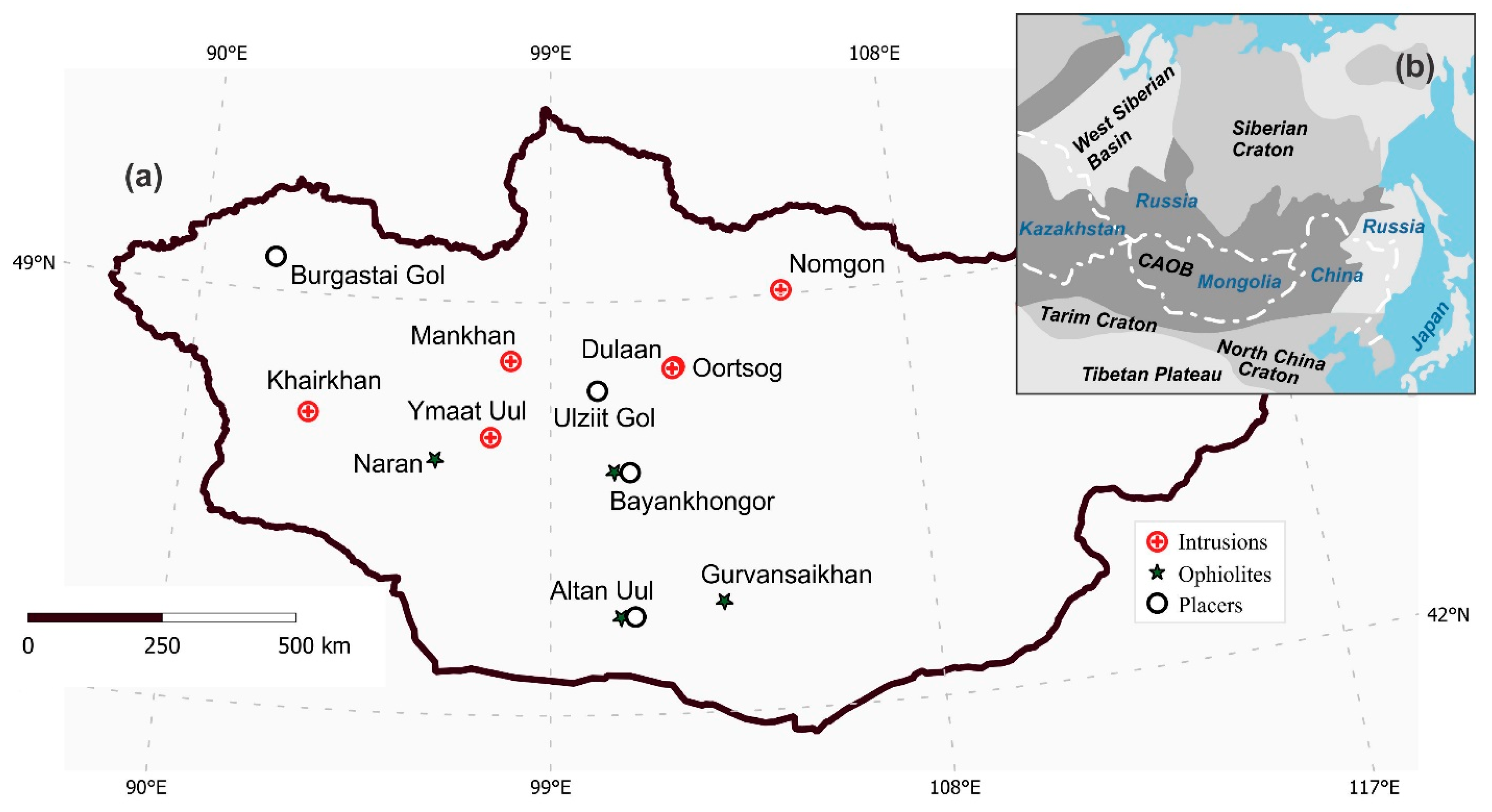
The purpose of this review is to report on promising PGE occurrences/mineralization sites of Mongolia (Figure 1), particularly on their geological, geochemical and mineralogical characteristics. The synthesis presents an updated classification of deposit types, their critical mineral context, regional correlations and suggestions for their exploration and exploitation. Four associations hosting PGE mineralization have been recognized: 1. Chromitites associated with ophiolites, 2. Rift-related continental layered mafic–ultramafic intrusions; 3. Alaskan–Uralian type (A-U type) arc-related zoned mafic–ultramafic intrusions; and 4. Placers. Among these, the rift-related intrusions from the Khangai Highlands of northern and central Mongolia are particularly promising for mineral exploration and exploitation. They are “high confidence” exploration targets. Key mineralized massifs are Oortsog, Dulaan, Nomgon, Yamaat Uul and Mankhan. PGE mineralization associated with chromitites and placers are sub-economic but could become economically important as by-products during mining of chromitites and gold placer operations, respectively.

2. Geological Setting of Mongolia

Mongolia (Figure 1) lies within the CAOB, one of the world’s largest Phanerozoic accretionary orogenic systems, formed during the late Neoproterozoic to early Mesozoic through subduction-related processes, accompanied by extensive juvenile crustal growth [7,24,25]. CAOB is situated between the Siberian craton to the north and the Tarim and North China cratons to the south and stretches from the Urals through Altai-Sayan, Mongolia and Transbaikalia to the Sea of Okhotsk. The Mongolian segment of the CAOB comprises Precambrian microcontinental blocks (Tuva-Mongol, Zavkhan-Baidrag, Central Mongolia, and South Gobi) surrounded by Neoproterozoic–Paleozoic island arcs, ophiolites, and accretionary wedges, amalgamated into a composite collage of terranes, e.g., Refs. [7,24,25]. Permian/Mesozoic–Cenozoic evolution involved closure of the Paleo-Asian and Mongol–Okhotsk oceans, Permian collisions that shaped the Mongolian Orocline, and subsequent intracontinental deformation. CAOB hosts diverse metallogenic systems, including porphyry Cu–Mo–Au, orogenic gold, ophiolites, carbonatites, skarns, rare-metal pegmatites, and mineralized mafic–ultramafic intrusions, e.g., Refs. [6,8]. Although Mongolia is not currently a producer, PGE mineralization in ophiolitic chromitites, mafic–ultramafic intrusions and placers indicate a significant mineralization potential (Figure 1).

3. Ophiolite Complexes

Mongolia hosts several prominent ophiolite complexes that record the progression of subduction and accretionary events. Ophiolites hosting PGE-bearing chromitites are of Proterozoic to Paleozoic age. Most of these ophiolites are associated with supra-subduction zone and boninitic melts (high-Mg and low-Ti) that result from a high degree of partial melting and contain irregular lenticular bodies of podiform chromitites in the mantle peridotite and the mantle-transition zone. The principal mineral of podiform chromitite is chromite accompanied by minor olivine, pyroxene, serpentine, magnetite, clinopyroxene, plagioclase, and locally with PGE minerals. Many high-Cr chromitites (containing at least 40 wt.% Cr2O3) are enriched in PGE, particularly in IPGE which form discrete minerals like laurite (RuS2) and alloys (Ir-Ru-Os) typically enclosed in chromite as minute crystals. Some ophiolite complexes are also enriched in Pt and Pd. PPGE minerals are commonly concentrated in the interstitial silicate matrix or associated with base-metal sulfides. They tend to concentrate on higher stratigraphic levels unlike IPGE minerals. The ophiolites with chromitites are locally associated with placers containing PGE minerals. Among more than 20 occurrences of ophiolites with chromitite seams described by Altanzul and Gerel [21], four promising examples of ophiolite-hosted chromitites with PGE mineralization are described below.

3.1. Naran Ophiolite

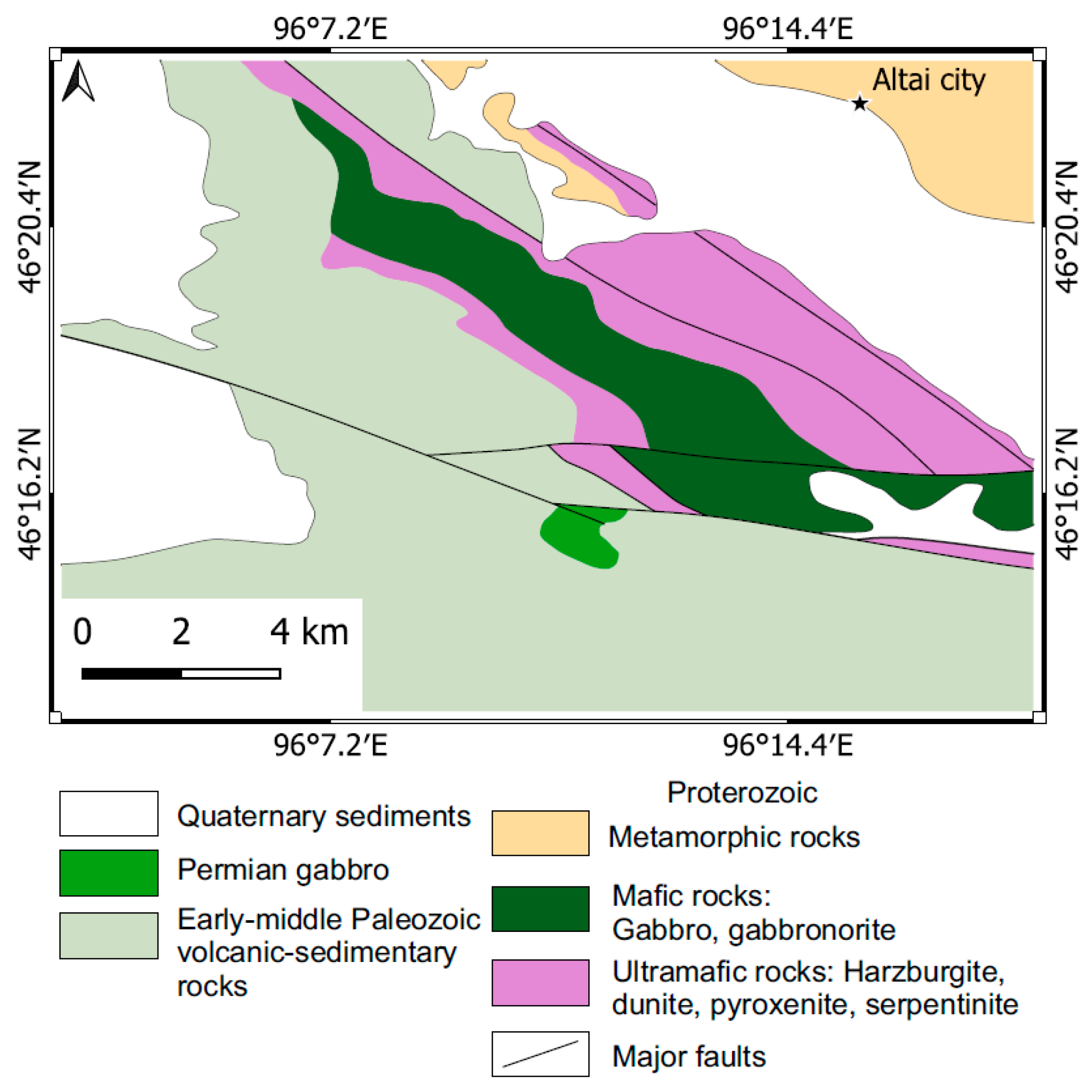
The Naran ophiolite massif (Figure 2) occurs in the lower part of the Ediacaran Kantaishir ophiolitic belt (~570 Ma old) in Western Mongolia. The body, formed in an incipient oceanic island arc environment, is composed of ultramafic rocks (~4 km thick) intruded by hornblende gabbro [26]. Multi-stage metamorphic processes recorded in the Naran massif are typical of a mantle wedge. The crustal section includes a sheeted dyke complex and volcanic units with pillow lavas. The presence of boninite-type high-Mg andesites and podiform chromitite indicate its origin from a highly depleted mantle source during the early stages of subduction. Ultramafic rocks include refractory harzburgites and dunites, which host well-preserved chromitite horizons with PGE mineralization. Chromitites are composed (on average) of ~70 vol.% chromite (with high [Cr/(Cr + Al)] > 0.8), 25 vol.% olivine, 3 vol.% amphibole, 1–2 vol.% magnetite and accessory minerals including pyrite, pyrrhotite, native gold and PGE minerals [27]. Chromitite layers contain rutheniridosmine (Ir-Ru-Os alloys) along with laurite and irarsite (IrAsS) [16]. Geochemically, the chromitites are high in Ru (up to 600 ppb) and Os (up to 500 ppb) [28], typical of supra-subduction zone (SSZ) ophiolites, e.g., Ref. [29]. Pt is present as an admixture in the IPGE-rich alloys (Table 1).
The Naran body contains two distinct types of PGE mineralization, the main type comprises IPGE associated with chromitites of ultramafic rocks while the second includes minerals of the PPGE group, which are associated with the mafic rocks. In the gabbroic rocks, PPGE are hosted mainly by awaruite (Ni3Fe alloy) [30]. Among the Mongolian ophiolites, the Naran complex is particularly a promising target for platinum exploration as it hosts chromitites with very high PGE (>1 ppm) [28]. Total PGE contents of several chromitite layers exceed 1 ppm placing them among very PGE-rich ophiolitic chromitites worldwide, e.g., Refs. [31,32,33,34]. Placer deposits derived from these ophiolites contain Os–Ir–Ru and Pt–Fe alloys [21].

3.2. Bayankhongor Ophiolite

The Bayankhongor ophiolite zone (Figure 1) is one of the largest ophiolite complexes in Mongolia, extending approximately 300 km in length and up to 20 km in width, e.g., Refs. [25,29]. It marks a major suture zone formed by the closure of a Neoproterozoic oceanic rift basin and subsequent collision of tectonic blocks. This Neoproterozoic complex comprises a well-preserved tectonic assemblage of oceanic lithosphere components, including serpentinite mélange, pillow basalts, gabbros, and variably serpentinized peridotites. Ultramafic units host seams of podiform chromitites containing platinum-group minerals, dominantly IPGE alloys and sperrylite (PtAs2), as well as ruthenium-bearing sulfide phases [30]. Several nearby gold placers namely Ulziit Gol contain PGE minerals probably sourced from the Bayankhongor ophiolite [20,21].

3.3. Altan Uul Ophiolite

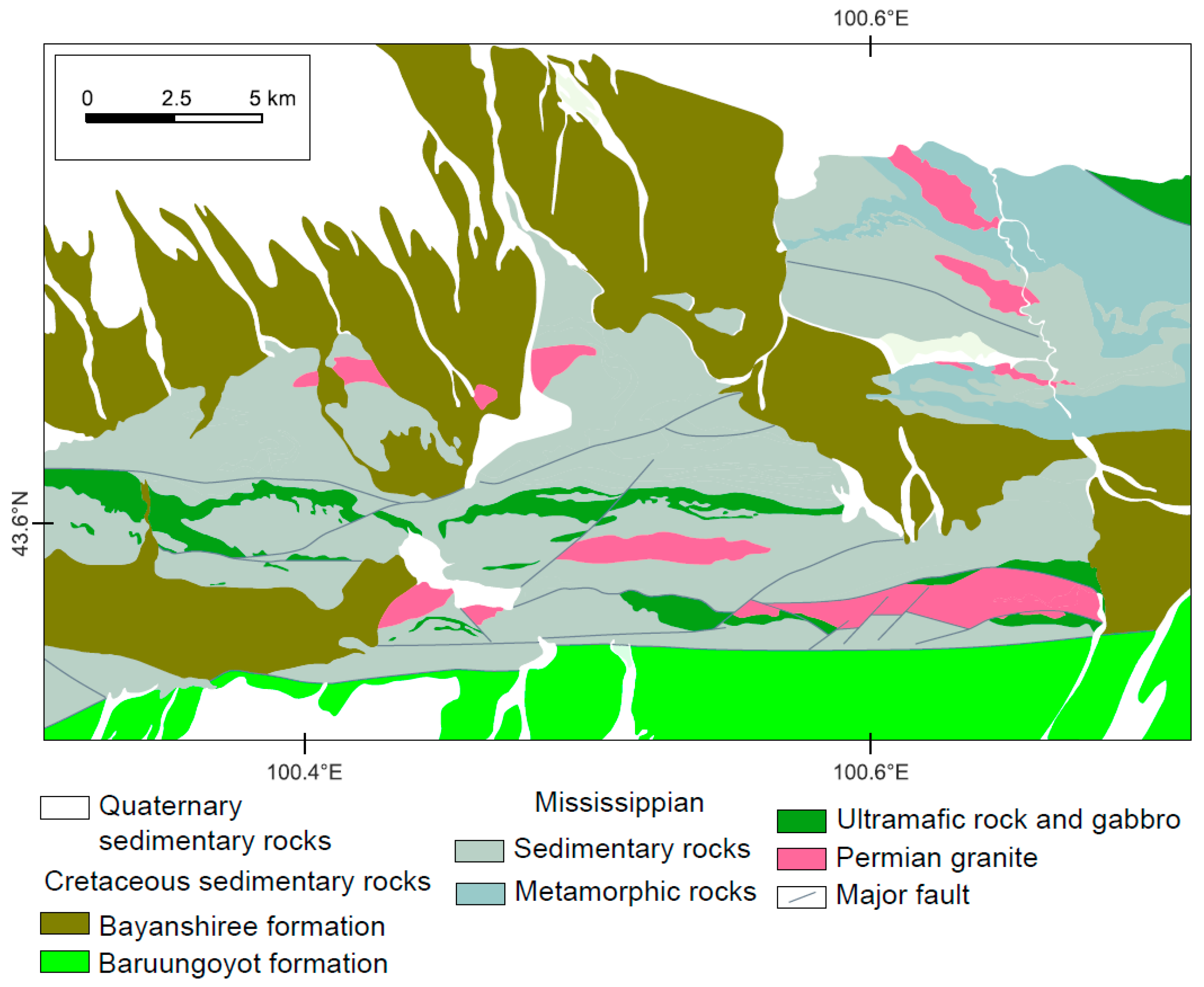
The Altan Uul ophiolite (Figure 3), which is located within the Trans-Altai zone of southern Mongolia, forms a part of a Carboniferous ophiolite belt marking a major suture zone within the CAOB. The ophiolite was interpreted as a relic of a back-arc basin which was uplifted along the Cenozoic Gobi-Tien Shan fault system. The ophiolitic bodies which comprise pillow basalts, cumulate gabbros, peridotites, serpentinites, and jasperoids, are structurally divided into at least three discrete thrust slices [35]. Tectonically deformed ultramafic rocks host podiform chromitites which contain PGE occurring as IPGE alloys, laurite and sperrylite. Mineralization of the Altan Uul ophiolite is similar to that of the Naran ophiolite. This ophiolite also provided material for nearby PGE-bearing placers [16,30,36].

3.4. Gurvansaikhan Ridge Ophiolite

The Gurvansaikhan Ridge ophiolite (Figure 1) crops out as a belt up to ~25 km long and ~2.5 km wide, hosted within sedimentary-volcanic sequences. The Cambrian ophiolite consists of a wide range of ultramafic and mafic rocks. The rocks yielded U–Pb zircon ages of 520–511 Ma [37]. Ultramafic rocks host podiform chromitites containing grains of PGE phases mainly IPGE alloys and also laurite (RuS2) and erlichmanite (OsS2). Pt contents in IPGE alloys range from 6 to 12 wt.% [30].

4. Rift-Related Layered Mafic–Ultramafic Intrusions

Rift-related mafic–ultramafic layered intrusions are important hosts of Ni-Cu-PGE mineralization, e.g., Refs. [38,39,40]. In fact, PGE mineralization in these intrusions constitutes about 94%–95% of the world’s PGE reserves. Unlike ophiolites which contain mainly IPGE, these deposits are a major source of PPGE. In the Khangai Highlands (Uplands) of northern and central Mongolia there are several promising Permian (~250–280 Ma) small to medium-size layered mafic–ultramafic intrusions which are a part of the continental Khangai magmatic province [13,14,15] and which show similarities to many worldwide intrusions which host significant Ni-Cu-PGE mineralization [13,41]. The province has also been called the Khangai Large Igneous Province (LIP) [15,42,43] and was related to a mantle plume [43,44] although the existence of the plume has been under discussion [45]. Alternative to a plume model, the Khangai massifs are related to the closure of the Paleo-Asian Ocean when the tectonic regime changed from compression (subduction-related continental margin) to post-collisional extension (possibly intraplate plume setting).
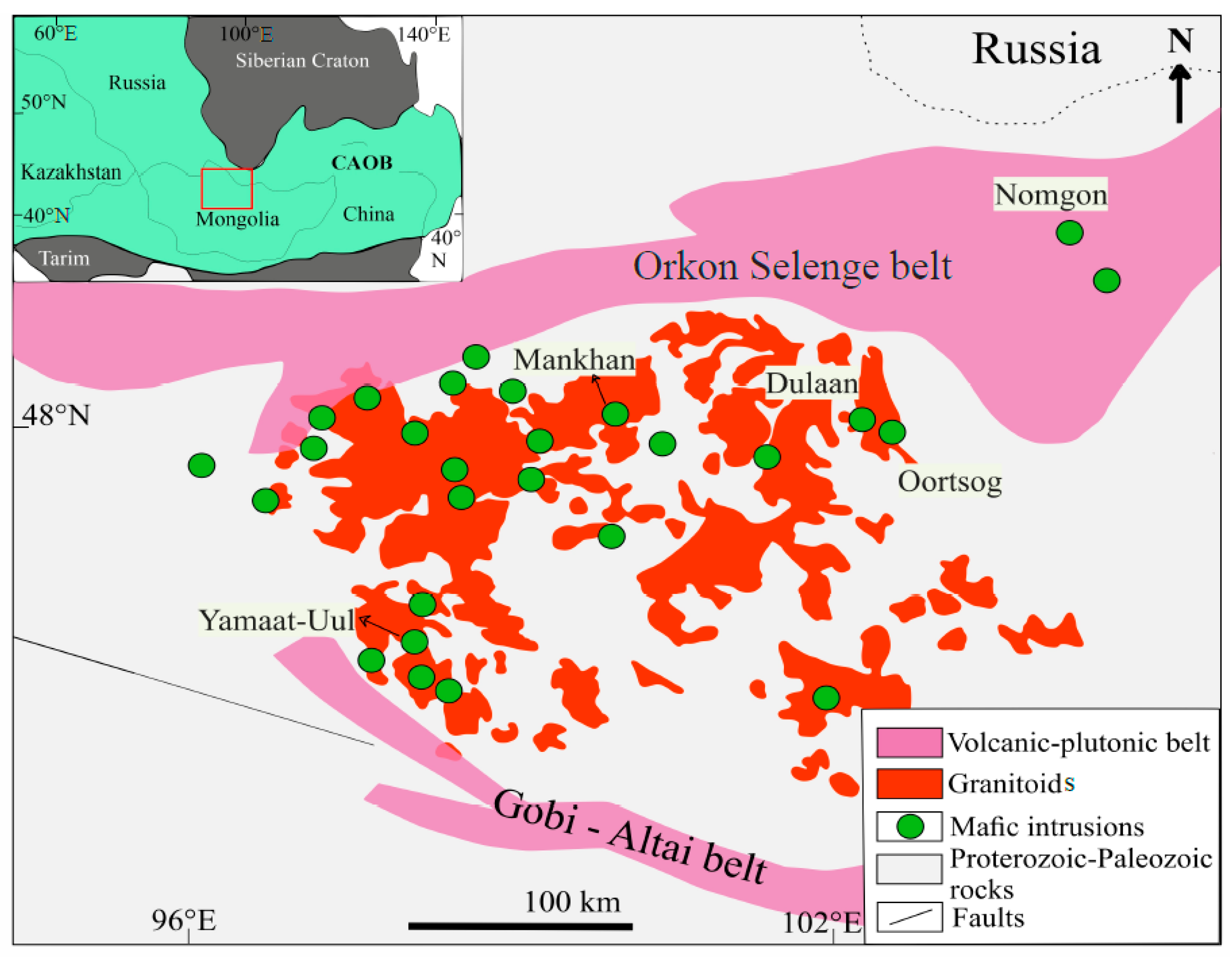
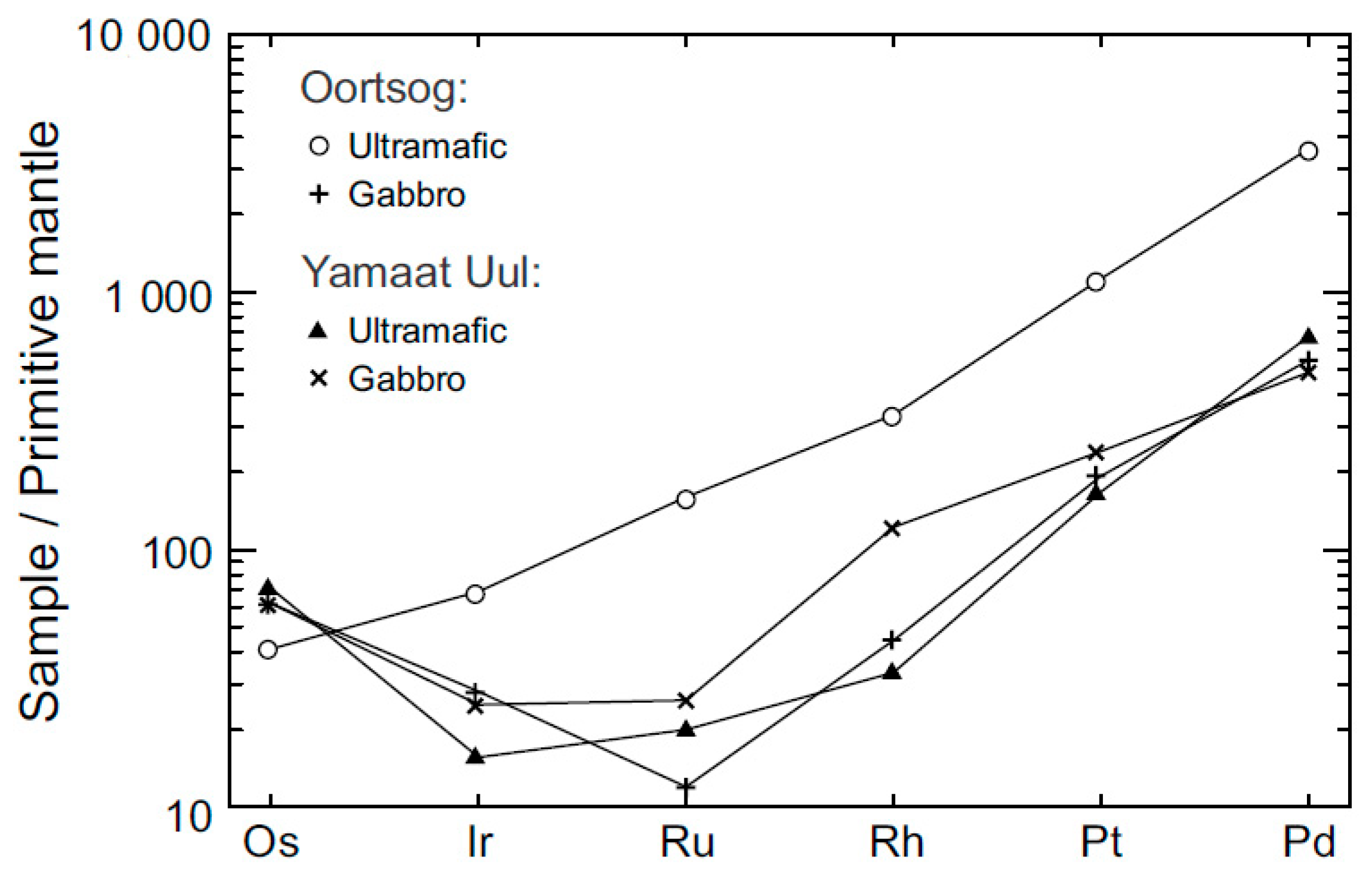
Unlike many LIPs, the Khangai LIP is composed mainly of granitic rocks with only subordinate amounts of mafic and ultramafic rocks (Figure 4). It has been speculated that these mafic rocks represent the early intrusive phases of the massive Khangai batholith. The layered mafic intrusions of the Khangai province are mostly small, with surface areas frequently <10 km2 although the Yamaat intrusion is larger. The intrusions are composed of gabbroic rocks with minor proportions of ultramafic rocks occurring at the base of the layered sequences. They frequently display well-developed cumulate layering that reflects fractionation trends of tholeiitic mantle-derived magmas [3,46] ranging from ultramafic rocks (peridotite) to leucocratic gabbros. The intrusions host sulfide mineralization composed of pyrrhotite, pentlandite and chalcopyrite and range from disseminated to stratiform ores. Their PGE mineralization is characterized by PPGE > IPGE (Table 1). Ultramafic cumulates frequently contain the bulk of PPGE (Figure 5). The ratio of Pt to Pd is not constant. Differences in Pd/Pt ratios between intrusions suggest variations in magma evolution and sulfur saturation [14]. Mineralized Permian complexes (Figure 4) in the Khangai LIP include Oortsog, Dulaan, Nomgon, Yamaat Uul and Mankhan intrusions, which are promising exploration targets for economic PGE–Cu–Ni mineralization [13,14]. There are other mineralized but poorly documented intrusions.

4.1. Oortsog Intrusion

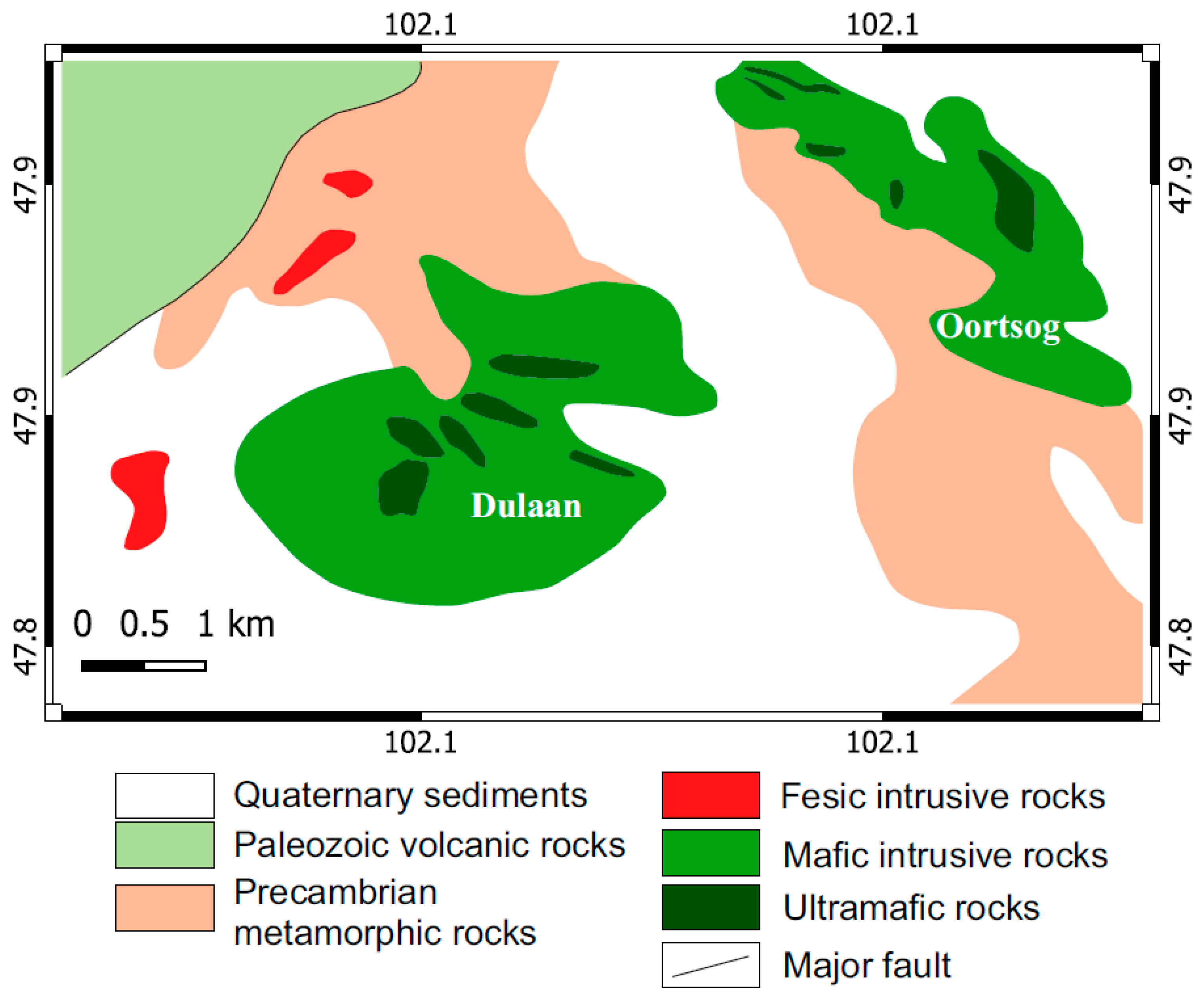
The Oortsog intrusion (Figure 4) is a layered mafic–ultramafic complex with PGE-Cu-Ni mineralization [10,13,14,46,47], outcropping over an area of about 2.5 km2. It is composed of two major intrusive phases (Figure 6). The first phase comprises rhythmically layered peridotite–troctolite–gabbro sequences, recording systematic upward fractionation from olivine-rich to plagioclase-rich cumulates. The second phase consists of massive, more evolved amphibole-bearing gabbro that intrudes and crosscuts the earlier cumulates. The intrusion was tectonically overturned, with its original base now at the top. U–Pb zircon dating constrains magmatism to 278 ± 2.5 Ma for the early phase and 272 ± 2 Ma for the later phase [47]. Differences in Nd isotopic characteristics [46,47] suggests that the rocks of both pulses of the intrusion were derived from distinct mantle sources. The first phase has positive ɛNdt indicating derivation from a depleted mantle source while the second phase has negative ɛNdt implying they were sourced from an enriched mantle with higher contents of incompatible elements and/or significant interaction with the Precambrian continental crust. Geochemical indicators like a Cu/Zr ratio > 1 and rounded sulfide inclusions in olivine suggest that sulfide saturation occurred early in the magmatic evolution.
Magmatic sulfide mineralization including PGE (Figure 5) is mostly concentrated in the lower ultramafic units. The ore consists mainly of pyrrhotite; pentlandite and chalcopyrite are present in subordinate amounts. Accessory PGE are dominated by sperrylite and isoferroplatinum, along with minor Pd-Bi-Te phases [14]. Rocks have higher Pt/Pd ratios than some other intrusions of the province, e.g., Nomgon. This likely reflects differences in the timing of sulfur saturation and the pathways of PGE fractionation [13,14,46]. The intrusion is considered to be the least fractionated of the group. Its Ni/Cu ratios (1.8–3.8) are consistent with economic Ni-Cu deposits found in northwest China (e.g., Tarim basin and Kalatongke deposit).

4.2. Dulaan Intrusion

The Dulaan pluton (Figure 4 and Figure 6), about 4 km2 in area, is hosted by Neoproterozoic–early Paleozoic metamorphic rocks and is cut by several granite dikes [10]. Zircon U–Pb dating of the intrusion yielded an age of 270 Ma [48]. The intrusion is dominated by olivine gabbro with minor gabbronorite and altered ultramafic cumulates such as plagioclase-bearing lherzolite and websterite. Olivine and clinopyroxene contain sulfide inclusions of pyrrhotite, pentlandite, and chalcopyrite, indicating early sulfide saturation [13,14], a critical precursor for forming economic PGE-Ni-Cu mineralization. Ni/Cu ratios in sulfide-bearing rocks (1.5–3.5) are similar to those in other Khangai intrusions. The relatively high Cu/Zr > 1 indicates the presence of cumulus sulfides. The Dulaan intrusion shows relative enrichment in PPGE over IPGE. Platinum content is generally ~100–500 ppb, locally even higher in sulfide-bearing zones. Palladium ranges from 200 to 800 ppb and is commonly the most abundant PGE, while Rh is 10–50 ppb. Osmium, Ir, and Ru are usually ≤10–50 ppb [13,14]. The PPGE-rich characteristics suggest sulfide segregation with preferential partitioning of Pd–Pt into sulfides [14].

4.3. Nomgon Intrusion

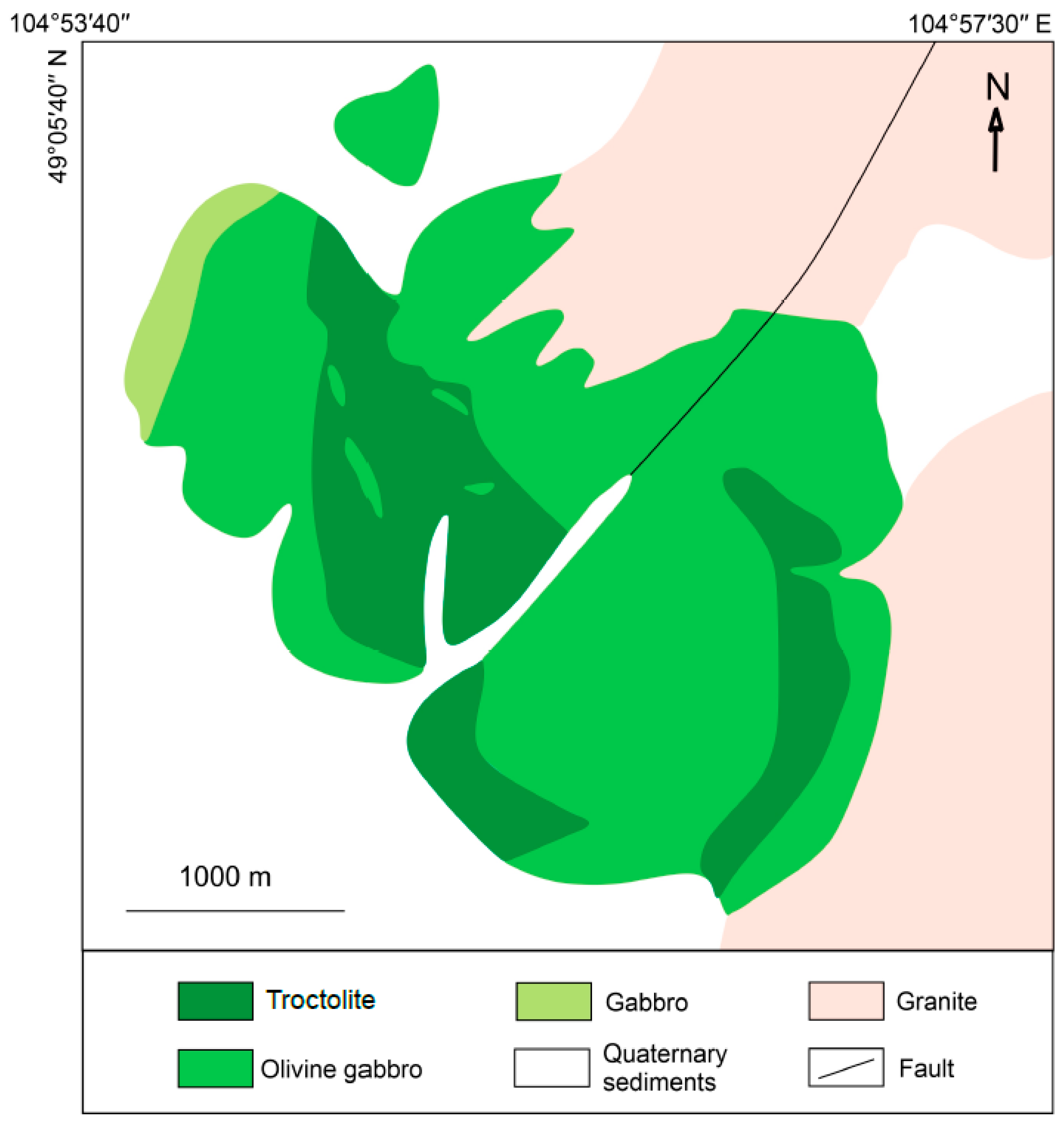
The Nomgon intrusion (Figure 7) is an elongated body about 3.8 km long and 2.5 km wide emplaced at the periphery of the Khangai Highlands [13,18,46]. SHRIMP U–Pb zircon dating yields an age of 255 ± 3 Ma [46]. The Nomgon intrusion is a differentiated layered complex made up of troctolite, olivine gabbro, and gabbro, with local occurrences of anorthosite and norite [18]. The intrusion displays well-developed cumulate textures, rhythmic layering, and gradual upward transitions from olivine-rich to plagioclase-rich lithologies, consistent with prolonged fractional crystallization [13]. The Nomgon intrusion hosts disseminated and veinlet-style Cu–Ni sulfide mineralization, with bornite and chalcopyrite as dominant ore minerals suggesting crystallization from a Cu-rich basaltic magma. The associated PGE assemblage is Pd-rich. Sulfide-bearing zones contain ~70–190 ppb Pt and ~130–540 ppb Pd [14]. PGE mineralization includes sperrylite along with Au-, Ag-, and Sb-bearing phases [11,14]. Sulfide-rich zones occur mainly in evolved gabbroic sections, indicating that late-stage liquid segregation played a key role in ore concentration [13]. In some parts of the intrusions, outside of the sulfide zones, gabbroic rocks have also elevated concentrations of Pt (36–100 ppb) and Pd (10–280 ppb Pd) [13,14]. Compared to other Khangai mafic intrusions, the Nomgon body is highly fractionated with very low Ni/Cu ratio (0.03–0.07) accompanied by high Cu and PPGE but depleted in Ni. Unlike other intrusions of the province that are tholeiitic, the Nomgon intrusion was likely derived from a calc-alkaline parental magma that was enriched in Cu and PPGE but depleted in Ni.

4.4. Yamaat Uul Intrusion

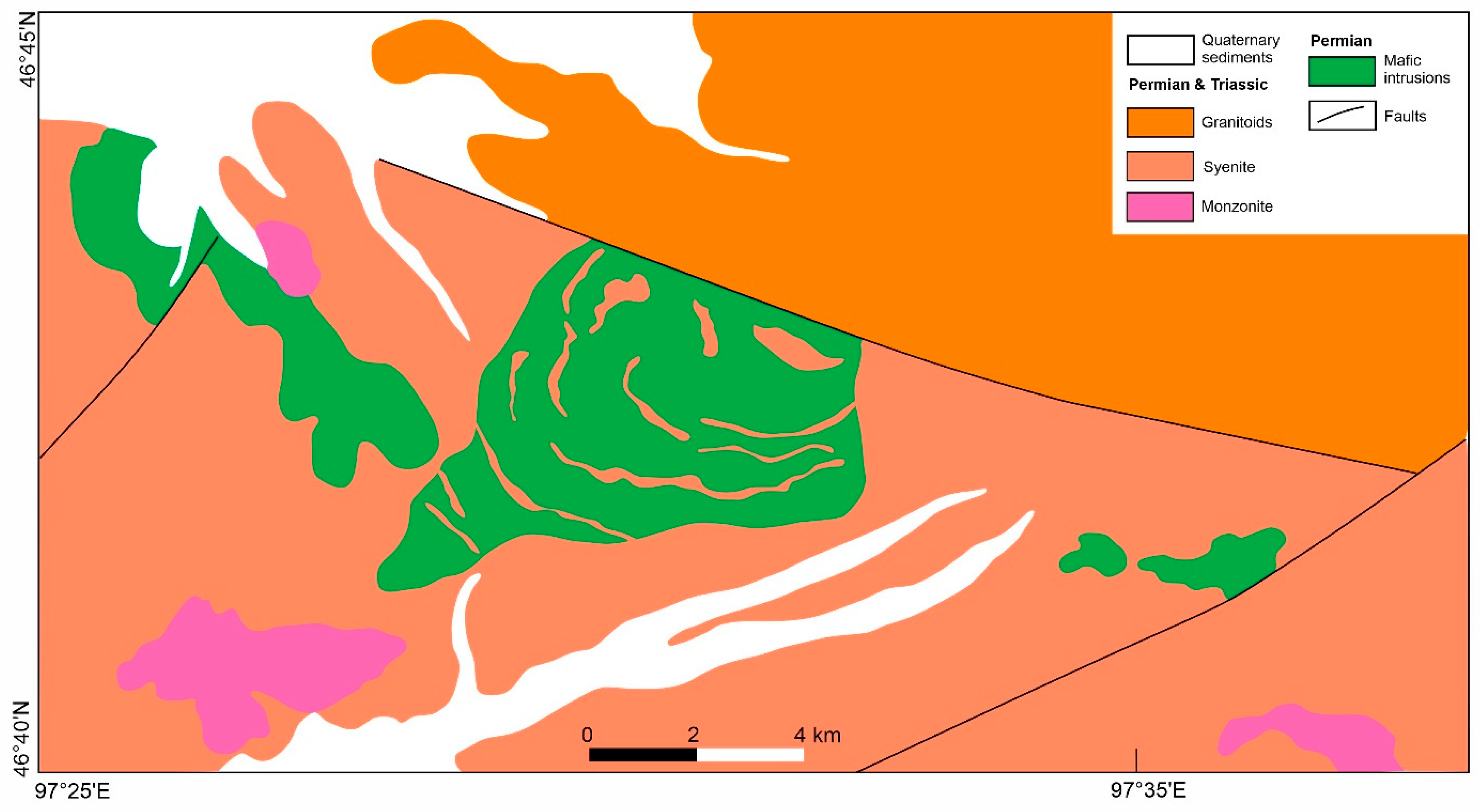
The Yamaat Uul mafic complex (Figure 8) is one of larger intrusions of the Khangai LIP. The complex is divided into three parts: northwestern, central and southeastern. It is a lopolith comprising two intrusive phases [15]. The first phase consists of plagioclase cumulates and olivine–pyroxene cumulates, while the second phase is composed of monzogabbro enriched in incompatible elements compared to the first phase [15]. The first phase has higher contents of Cu-Ni sulfides and associated PGE while the second one has higher concentrations of incompatible elements. Zircon U–Pb dating indicates a late Permian age of 262.6 ± 3.1 Ma for the first phase and 255.8 ± 2.9 Ma for the second phase [15]. The Yamaat Uul intrusion hosts Cu-Ni mineralization similar to other Permian PGE–Cu–Ni mafic–ultramafic intrusions of the Khangai LIP [14]. Mineralization is characterized by disseminated and schlieren (droplets) sulfides. PGE mineralization is genetically linked to the Cu-Ni sulfide content which includes pyrrhotite, chalcopyrite and pentlandite, the primary host for Ni, and contains PGE. The most common PGE mineral is sperrylite, which together with other PGE minerals is found in sulfide-bearing zones.

4.5. Mankhan Intrusion

The Mankhan intrusion (Figure 4) is one of the smaller layered mafic intrusions of the province. The massif is composed of gabbro and gabbronorite. Compared to the Oortsog and Dulaan massifs, the Mankhan intrusion has higher contents of alkalis (up to ~3.1 wt.%). It shows “intermediate” geochemical signatures between the Ni-Pt-rich (Oortsog) and the Cu-Pd-rich (Nomgon), i.e., transitional between Pt- to Pd-phases. Sulfides are disseminated and occur as inclusions in early silicates and as interstitial grains, locally concentrated in structural traps. The intrusion contains sulfide mineralization of bornite-cubanite-chalcopyrite similar to that of the Nomgon intrusion. The main PGE minerals are sperrylite and isoferroplatinum (Table 1). The massif is considered to have high ore potential for PGE, Cu and Ni.

5. Alaskan–Uralian Type Mafic–Ultramafic Intrusions

A-U type mafic–ultramafic intrusions host the primary PGE and gold deposits but are also a source for placer deposits derived from these primary sources. These complexes occur in Western Mongolia. They show a concentrically zone distribution, ranging from a dunite core through shells of wehrlite, clinopyroxenite, and hornblendite to a gabbroic rim [49]. Most of the PGE mineralization occurs in the dunite core, where mineralization is associated with chromite pods and schlieren. A-U type intrusions are enriched in platinum typically forming Pt-Fe alloys (such as isoferroplatinum Pt3Fe) which often contain inclusions of Os-Ir-Ru alloys. The core may also host PGE-sulfide and sulfarsenide assemblages, e.g., irarsite and sperrylite. Mineralization mostly formed during the early stages of magmatic evolution. Some intrusions also contain late-stage magmatic sulfides enriched in Ni, Cu, Pd and Pt accompanied by gold hosted in clinopyroxenite, hornblendite and gabbro units. However, the intrusions are not primary sources for standalone gold deposits.
These intrusions, which are significant primary and secondary sources of PGE, are characteristic of island arc magmatism of convergent margin settings [50,51,52]. Their trace element patterns show a distinct “arc” signature characterized by depletion of high-field strength elements, particularly Nb, Ta, Zr, and Hf. They can be distinguished from layered mafic–ultramafic intrusions by Ni/Cu ratios. In layered mafic–ultramafic intrusions, the ratio typically ranges from 0.8 to 2.5, while the A-U type intrusions have Ni/Cu ratio typically significantly higher. Unlike ophiolitic PGE-bearing complexes, ultramafic rocks of the A-U type intrusions generally lack orthopyroxene, and their spinel/chromite has high Ti (unlike spinel from ophiolites which is high either in Cr or Al) reflecting high oxygen fugacity. The deposits are often low-tonnage but are known as the source of prominent placer platinum deposits containing Pt-Fe alloys (Table 1).
The A-U type intrusions occur in the Lake Zone of western Mongolia and some of them contain PGE mineralization, e.g., Ref. [51]. A prominent complex containing PGE mineralization is the Khairkhan Massif [51] although there are other similar intrusions such as the Khyargas Nuur peridotite-gabbro complex and Ureg Nuur volcano–plutonic complex [53]. Similar intrusions, which host PGE mineralization, occur in northwestern China [52], including the prominent Wuxing complex and in neighboring parts of Russia.

Khairkhan Massif

The Khairkhan massif (Figure 1), located in the central Lake Zone of western Mongolia, is a lenticular body about 18 km long and 5 km wide. This Middle Cambrian layered and zoned intrusion, emplaced in an island arc setting (suprasubduction, syn-collisional setting) [51]. Dunite, troctolite and olivine gabbro form the central part of the massif whereas non-olivine gabbro and amphibole gabbro occur along the margins. The rocks were derived from a high-alumina, low-Ti magma source. The massif hosts four mineralized horizons which are 3–5 m thick and extend for up to 4 km. The horizons contain sulfide mineralization (chalcopyrite and pyrrhotite) with elevated PGE (up to 0.3 ppm) and gold (up to 0.5 ppm). The PGE show enrichment of PPGE over IPGE, and of Pd over Pt. The ore-bearing horizons exhibit vertical zonation with regard to the relative abundance of metals. Lower horizons are richer in Pt and Pd whereas the upper horizons are richer in Au. Primary sulfide mineralization includes chalcopyrite, pyrrhotite and pentlandite. PGE phases occur as minute inclusions within the sulfides. The considerable size of the complex and the continuity of the ore-bearing horizons suggest the potential for significant reserves of PGE and gold.

6. Placers

Worldwide, placer deposits of PGE have been exploited for decades and were the main source of PGE in the past. At the end of the 20th century, about half of all platinum production in neighboring Russia, a major PGE producer, was derived from placer deposits. Presently, the placers account only for a minor part of global PGE production [54,55]. Mongolia hosts several promising placer deposits containing PGE-bearing minerals derived by the erosion and weathering of mafic–ultramafic complexes of two distinct types: ophiolites and the A-U type mafic–ultramafic intrusions [16,17,19,20,21]. These placers typically occur in alluvial and fluvial sediments, where hydrodynamic sorting concentrates heavy PGE-bearing minerals as grains or nuggets. PGE minerals also were identified in gold placer deposits. PGE minerals in the placer deposits provide clues about the rocks from which they are derived. In Mongolia, the placer PGE assemblages which show relative enrichment of IPGE over PPGE [21], are consistent with derivation from chromitites. In fact, there is a spatial association of IPGE-rich placers with chromitite-bearing ophiolite complexes. PGE minerals often display poorly rounded shapes, indicating a short transport distance from their primary source. The other placer type which is typically found in western Mongolia is characterized by the presence of isoferroplatinum with inclusions of cooperite (PtS) and bowieite (Rh2S3). This placer type was derived from the A-U type intrusions. Although the Mongolian PGE placer deposits have not yet been exploited commercially, they have significant economic potential if they are also exploited gold. Some PGE placers found in gold-bearing systems are described below.

6.1. Ulziit Gol Placer

The Ulziit Gol is a river in a prominent gold district and hosts significant alluvial gold deposits (Figure 1). These alluvial deposits also contain PGE and other heavy minerals [17,21] from the nearby Bayankhongor ophiolite belt. In addition to gold, the heavy mineral assemblage contains chromite, magnetite, and ilmenite, indicating derivation from ophiolitic bodies. The PGE-bearing phases are mainly alloys, comparable to those in ophiolite-hosted podiform chromitites. They are dominated by IPGE-rich phases [51]. Pt–Fe alloys are also present, likely reflecting secondary PGE re-mobilization [51]. The deposits are predominantly alluvial and terrace placers formed by the accumulation of gold from gold-bearing quartz veins and PGE minerals from chromitites. The area is historically famous for both ancient and modern mining. Recently, the area has seen a resurgence in activity, ranging from large-scale industrial operation to artisanal mining.

6.2. Burgastai Gol and Iljgiin Gol Placers

These are significant gold–platinum alluvial placers at Burgustai Gol (Figure 1) and the neighboring Iljgiin Gol rivers in western Mongolia (Mongolian Altai) which host heavy minerals characteristic of an A-U type PGE mineral assemblage [30]. PGE minerals occurring as nuggets include isoferroplatinum (Pt3Fe), cooperite, laurite–erlichmanite (RuS2–OsS2) and irarsite–hollingworthite (IrAsS–RhAsS) alongside native gold [19]. At the Iijgen Gol, PGE minerals are 0.1 to 0.5 mm in size and well-rounded as opposed to Burgastain Gol where the grains are subangular. The PGE mineralization was probably derived from the Cambrian Ureg Nuur volcano–plutonic picrite complex, an A-U type intrusion. Both these placer deposits can be classified as platinum-bearing gold placers.

6.3. Bayankhongor Placer

Bayankhongor placer is located within a prominent gold belt in southcentral Mongolia. The deposit is primarily gold-bearing but its proximity to the Bayankhongor ophiolite complex makes it an important area for potential exploitation of PGE as by-products. Weathering of the Bayankhongor ophiolitic complex (Figure 1) contributed to a placer deposit containing in addition to gold, also chromite and PGE-bearing minerals particularly IPGE alloys, sperrylite, and Pt–Fe alloys [21].

6.4. Altan Uul Placer

PGE-bearing minerals are concentrated at the base of conglomerates of the Cretaceous Baynshiree Formation, making a paleo-placer deposit genetically related to underlying PGE mineralization in the Altan Uul ultramafic ophiolitic rocks (Figure 3) [17,21]. The placers contain up to 100 ppb Pt, 2–5 ppb Pd, 2 ppb Rh, 100 ppb Ir, and 5 ppb Ru, along with elevated Ni ~1500 ppm, Co ~500 ppm, and Cr ~3000 ppm [16]. The placer PGE assemblages contain mainly Os–Ir–Ru alloys which occur as grains or as nuggets within the conglomerates. Other heavy minerals also include platinum arsenides and sulfides.

7. Discussion

In addition to placers, the PGE mineralization in Mongolia occurs as three distinct types, which differ in tectonic settings, host rocks, typical ore minerals, typical PGE signature (IPGE vs. PPGE), key exploration controls (Table 2).

7.1. Ophiolites

PGE in ophiolites occur in podiform chromitites, which form irregular, lens-shaped bodies (typically 0.X-3 m thick) in the ultramafic rocks mostly harzburgites and dunites. Chromitites show pronounced relative enrichment in IPGE over PPGE, consistent with the origin of podiform chromitites in SSZ mantle [32,34,56]. Enrichment of IPGE is characteristic of residual mantle rocks as they were depleted in PPGE because these elements were removed during partial melting, leaving behind refractory IPGE. Although Mongolian chromitites, particularly from the Naran massif are relatively rich in PGE (~1 ppm), platinum minerals mostly form minute crystals trapped within chromite, making extraction difficult. Ophiolitic chromitites also contain mostly less valuable IPGE as compared to PPGE. These PGE deposits are sub-economic. However, they could be viable as by-products during the mining of podiform chromitite. Podiform deposits could be a source of chromium, essential for producing ferrochrome used in the production of stainless steel (~25% of the world’s production of Cr is from the podiform deposits). The Mongolian ophiolite complexes are not well-known. They lack key exploration data such as the size, shape and composition of the chromitite bodies, host rock lithology and structural and deformation data. They also need geophysical surveys (gravity/magnetic) to map dense chromitite bodies which typically range from 0.0004 to 1 Mt.

7.2. Rift-Related Layered Mafic–Ultramafic Intrusions

PGE mineralization of the Khangai Highlands (Uplands) is associated with several layered mafic–ultramafic massifs that are part of a Late Permian magmatic event (~256–263 Ma). The massifs appear to be controlled by deep-seated fault networks, specifically the Khangai Fault system which acted as conduits for metal-rich magmas during the Late Permian. In these intrusions, PGE are intimately associated with Cu-Ni sulfides, primarily chalcopyrite, pentlandite and pyrrhotite [11,13,14]. Mineralization is closely related to magmatic processes and the evolution of sulfide melts within layered intrusions. The style of sulfide mineralization is disseminated and schlieren (droplet-like). The composition of the PGE mineralization changes with the degree of magmatic differentiation although it is composed dominantly of PPGE. The less-fractionated Oortsog massif is relatively richer in Pt minerals and nickel, while the more-fractionated Nomgon and Yamaat massifs are enriched on Pd minerals and copper [13,14].
Recent geochemical studies documented the “fertility” of the Permian mafic–ultramafic massifs for PGE [15]. Isotopic studies confirmed crustal contamination which is considered to be the primary mechanism that triggers sulfide saturations and sulfide immiscibility, leading the metals (Ni, Cu and PGE) to drop out of the silicate magma and form a separate sulfide melt, which then settles to form an ore body [57]. Geochemical ratios can be used to identify high grade PGE horizons: Cu/Pd and Cu/Zr are primary geochemical indicators used to identify the timing of sulfide saturation and the formation of PGE -rich horizons. The Cu/Pd ratio is a sensitive indicator of whether a magma has segregated sulfide liquids while the Cu/Zr ratio is used to determine if magma has reached sulfide saturation [57].
These massifs are considered to have high-potential for magmatic PGE-Cu-Ni deposits due to evidence of sulfide saturation in the parent magmas. Khangai province has been compared to the Siberian Traps (Norilsk-style deposits) and to the deposits in NW China (e.g., large Ni-Cu-PGE Kalatongke deposit) as all these provinces share the same magmatic origin and timing. Available data for the Khangai province indicates a significant potential for the discovery of economically viable deposits [11,13,14,18].

7.3. Alaskan–Uralian Type Intrusions

A-U type intrusions have historically been the primary global source of platinum placer deposits. The placer deposits were formed by the erosion of these concentrically zoned mafic–ultramafic bodies where a dunite core is surrounded by shells of clinopyroxenite and gabbro [49,50,52]. In the intrusions, PGE are mainly concentrated in chromitite pods and schlieren within the dunite core of the intrusions. These intrusions also concentrate gold in the outer zone or a cluster of related rocks. Gold could also be derived from peripheral quartz veins related to late-stage magmatic fluids. In some districts including western Mongolia, these intrusions can produce distinct platinum–gold deposits or placers. The association of these complexes with gold-PGE placers suggests a high potential for discovering primary A-U type deposits.
Exploration for A-U type intrusions in Mongolia should focus on locating concentrically zoned, mafic–ultramafic bodies that contain copper, nickel and PGE mineralization [49,50]. Since these intrusions are commonly circular and dense, a multidisciplinary approach combining geophysics, remote sensing and geochemistry is appropriate. The intrusions typically produce distinct anomalies due to their composition and geometry (shape).
Geochemical exploration should concentrate on the dunite core and associated chromitite lenses which typically contain the highest PGE concentrations [50]. Mineralized zones exhibit a characteristic “M-shaped” pattern on primitive mantle-normalized PGE diagrams, distinguished by positive anomalies in Pt and Ir separated by a trough at Ru. Geochemical exploration vectors such as Cu/Pd and Cu/Pt can be used to identify the PGE-rich zones. Low values of these ratios signal PGE enrichment. Likewise, if the chilled margins of the intrusion are not depleted in PGE relative to Ni and Cu, the intrusion can be considered to have high potential.

7.4. Placers

PGE placer deposits used to be the world’s dominant source, but currently they yield only a fraction of the global PGE production. The most important type of these placers are alluvial placers. PGE minerals settle in stream beds and natural traps due to its high specific gravity and chemical stability under surface conditions [54,55]. Nugget size and mechanical features (like crystal facets) decrease with distance from the source. Their facets or poorly rounded shapes in placers often indicate a short distance of transport from the primary source rocks. Distinctive features found on the PGE minerals are often destroyed during long-distance transport (over ~10 km).
In Mongolia, PGE in placer deposits were derived either from podiform chromitites or from A-U type intrusions, more specifically from a dunite core of the intrusions. Distinct compositions of the PGE minerals help identify their source. A predominance of IPGE alloys (Ru-Os-Ir alloys) and laurite is characteristic of an ophiolitic chromitite source whereas the Pt-Fe alloys (like isoferroplatinum) imply the PGE minerals were likely derived from A-U type deposits.
There is no commercially significant “PGE only” placer deposit in Mongolia. However, promising PGE placer deposits are those which occur in the gold-bearing alluvial systems. There is a high potential for PGE recovery as a by-product of gold placers in regions containing PGE-hosting ophiolites or A-U type intrusions. In western Mongolia, there is a platinum-bearing gold placer genetically linked to the Ureg Nuur volcano–plutonic picritic complex, which is classified as an A-U type intrusion [53]. However, in Mongolian placers, gold mostly originates from mesothermal quartz veins. In many areas modern gold mining focusses on Quaternary alluvial and terrace placers. In areas with ophiolites and A-U type intrusions, attention should be paid to the potential presence of PGE minerals among the heavy minerals of the gold placers. Promising platinum placer deposits are those which occur in gold-bearing alluvial systems.

8. Conclusions

The Mongolian part of CAOB hosts ophiolitic and mafic–ultramafic complexes with favorable conditions for PGE mineralization. Rift-related layered mafic–ultramafic intrusions with Ni-Cu sulfide mineralization contain significant PGE concentrations. These Permian intrusions of the Khangai LIP are economically very promising. They bear resemblance to Permian intrusions in Russia (e.g., Norilsk-Talnakh) and N.W. China (e.g.,Tarim basin; Kalatongke deposit) which host prominent Ni-Cu-PGE deposits. Ophiolite-hosted podiform chromitites contain sub-economic IPGE mineralization. PGE could become economically important as by-products during the mining of podiform chromitites. Podiform deposits are a source of chromium, essential for producing ferrochrome. A-U type intrusions which have been identified as a source for PGE and gold in some placer deposits. Mongolia has numerous gold placer deposits but no economically important “pure PGE” placer deposits. There is the potential for PGE to be by-product in existing gold placer operations in western Mongolia which hosts ophiolitic complexes and A-U type intrusions. Although PGE in Mongolia are not yet an economic resource, several layered mafic–ultramafic intrusions possess significant economic potential. With rising demand for PGE, geologically largely unexplored Mongolia represents a promising frontier for future PGE exploration.

Funding

This research received no external funding.

Data Availability Statement

No new data are used in this work.

Acknowledgments

We thank B. Tuvshinjargal and Randy Corney for technical assistance.

Conflicts of Interest

The authors declare no conflicts of interest.

References

  1. Cabri, L.J. (Ed.) The platinum-group minerals. In Geology, Geochemistry, Mineralogy, Mineral Beneficiation of the Platinum Group Elements; Canadian Institute of Mining, Metallurgy, Special Paper; Canadian Institute of Mining, Metallurgy and Petroleum: Westmount, QC, Canada, 2002; Volume 54, pp. 13–129. [Google Scholar]
  2. Gunn, G.; Benhama, A. Platinum. In Commodity Profiles; British Geological Survey: Keyworth, UK, 2009; 31p. [Google Scholar]
  3. Barnes, S.-J.; Naldrett, A.J.; Gorton, M.P. The origin of the fractionation of platinum-group elements in terrestrial magmas. Chem. Geol. 1985, 53, 303–323. [Google Scholar] [CrossRef] [Scilit]
  4. Mungall, J.E.; Naldrett, A.J. Ore deposits of Platinum-Group elements. Elements 2008, 4, 253–258. [Google Scholar] [CrossRef] [Scilit]
  5. Zhang, S.; He, X.; Ding, Y.; Shi, Z.; Wu, B. Supply and demand of platinum group metals and strategies for sustainable management. Renew. Sustain. Energy Rev. 2024, 204, 114821. [Google Scholar] [CrossRef] [Scilit]
  6. Yakubchuk, A.S. Architecture and mineral deposit settings of the Altaid orogenic collage: A revised model. J. Asian Earth Sci. 2004, 23, 761–779. [Google Scholar] [CrossRef] [Scilit]
  7. Windley, B.F.; Alexeiev, D.; Xiao, W.; Kroner, A.; Badarch, G. Tectonic models for accretion of the Central Asian Orogenic Belt. J. Geol. Soc. 2007, 164, 31–47. [Google Scholar] [CrossRef] [Scilit]
  8. Dejidmaa, G.; Bujinkham, B.; Evihuu, A.; Enkhtuya, B.; Ganbaatar, T.; Moenkh-Erdene, N.; Oyuntuya, N. Distribution Map of Deposits and Occurrences in Mongolia (at the Scale 1:1,000,000); Geological Information Center: Ulaanbaatar, Mongolia, 2001.
  9. Gerel, O.; Pirajno, F.; Batkhishig, B.; Dostal, J. Mineral Resources of Mongolia; Springer: Berlin/Heidelberg, Germany, 2021; 461p. [Google Scholar]
  10. Izokh, A.E.; Polyakov, G.V.; Krivenko, A.P. The Gabbro Formation of Western Mongolia; Nauka: Novosibirsk, Russia, 1990; 269p. (In Russian) [Google Scholar]
  11. Izokh, A.E.; Polyakov, G.V.; Anoshin, G.N.; Golovanova, N.P. Geochemistry of platinum metals, gold and silver in the Nomgon troctolite-anorthosite-gabbro massif (MPR). Geokhimiya 1991, 10, 114–117. [Google Scholar]
  12. Agafonov, L.V.; Khmelnikova, O.S. Native elements in the Ulaakhiid massif (MPR). Geol. Geophys. 1991, 1, 128–132. (In Russian) [Google Scholar]
  13. Mao, Y.J.; Dash, B.; Qin, K.Z.; Bujinlkham, B.; Tang, D.M. Comparisons among the Oortsog, Dulaan and Nomgon mafic-ultramafic intrusions in central Mongolia and Ni-Cu deposits in NW China: Implications for economic Ni-Cu-PGE ore exploration in central Mongolia. Russ. Geol. Geophys. 2018, 59, 1–18. [Google Scholar] [CrossRef] [Scilit]
  14. Shapovalova, M.; Tolstykh, N.; Shelepaev, R.; Kalugin, V. PGE-Cu-Ni mineralization of mafic-ultramafic massifs of the Khangai Upland, Western Mongolia. Minerals 2020, 10, 942. [Google Scholar] [CrossRef] [Scilit]
  15. Shelepaev, R.; Shapovalova, M.; Egorova, V.; Shelepov, Y.; Oyunchimeg, T.U.; Tolstykh, N. Petrology and age of the Yamaat Uul mafic complex, Khangai Mountains, Western Mongolia. Minerals 2023, 13, 833. [Google Scholar] [CrossRef] [Scilit]
  16. Sharkhuukhen, D.; Gerel, O. Platinum-group minerals in chromitites of the Naran ophiolite massif, western Mongolia. Proc. Mong. Acad. Sci. USA 2001, 41, 54–65, (In Russian with English Abstract). [Google Scholar]
  17. Altanzul, B.; Kitakaze, A. Mineralogical characteristics of platinum group minerals from some gold placer deposits, Mongolia. Mong. Geosci. 2007, 31, 57–66. [Google Scholar]
  18. Izokh, A.E.; Mayorova, O.N.; Lavrentiev, Y.G. Minerals of the platinum metals in the Nomgon troctolite–anorthozite–gabbro intrusive massif (Mongolia). Russ. Geol. Geophys. 1992, 33, 104–110. [Google Scholar] [CrossRef] [Scilit]
  19. Oyunchimeg, T.; Izokh, A.E.; Vishnevsky, A.V.; Kalugin, V.M. Isoferroplatinum mineral assemblage from the Burgastain Gol placer (Western Mongolia). Russ. Geol. Geophys. 2009, 50, 863–872. [Google Scholar] [CrossRef] [Scilit]
  20. Dandar, S.; Kempe, U.; Wolf, D.; Baast, G. Pt mineralization of Ulaanbulag gold placer in Bayankhongor zone. Geol. Issues 2002, 5, 154–156. [Google Scholar]
  21. Altanzul, B.; Gerel, O. Platinum Group Elements Mineralization. In Mineral Resources of Mongolia; Gerel, O., Pirajno, F., Batkhishig, B., Dostal, J., Eds.; Springer: Berlin/Heidelberg, Germany, 2021; pp. 281–315. [Google Scholar]
  22. Sotnikov, V.I.; Berzina, A.N.; Economou-Elipoulos, M.; Eliopoulos, D.G. Palladium, platinum and gold distribution in porphyry Cu ± Mo deposits of Russia and Mongolia. Ore Geol. Rev. 2001, 18, 95–111. [Google Scholar] [CrossRef] [Scilit]
  23. Berzina, A.N.; Korobeinikov, A.F. Rhenium and precious metals (Pt, Pd, and Au) abundances in porphyry Cu-Mo deposits of Central Asian Mobile Belt. Acta Petrol. Sin. 2007, 23, 1957–1972. [Google Scholar]
  24. Sengör, A.M.C.; Sunal, G.; Natolin, B.A.; van der Voo, R. The Altaids: A review of twenty-five years of knowledge accumulation. Earth-Sci. Rev. 2022, 228, 104013. [Google Scholar] [CrossRef] [Scilit]
  25. Badarch, G.; Cunningham, D.W.; Windley, B.F. A new terrane subdivision for Mongolia: Implications for the Phanerozoic crustal growth of Central Asia. J. Asian Earth Sci. 2002, 21, 87–110. [Google Scholar] [CrossRef] [Scilit]
  26. Agafonov, L.V.; Lesnov, P.F.; Pinus, G.V. Alpinotype Hyperbasites of Mongolia; Nauka: Moscow, Russia, 1984; 200p. (In Russian) [Google Scholar]
  27. Matsumoto, I.; Tomurtogoo, O. Petrological Characteristics of the Hantaishir Ophiolite Complex, Altai Region, Mongolia: Coexistence of Podiform Chromitite and Boninite. Gondwana Res. 2003, 6, 161–169. [Google Scholar] [CrossRef] [Scilit]
  28. Agafonov, L.V.; Lesnov, F.P. Platinoids in websterites from the Naran massif of mafic and ultramafic rocks (Western Mongolia). Russ. Geol. Geophys. 1997, 38, 1979–1984. [Google Scholar]
  29. Jian, P.; Kröner, A.; Windley, B.F.; Shi, Y.; Zhang, W.; Zhang, F.; Miao, L.; Tomurhuu, D.; Liu, D.Y. Zircon ages of the Bayankhongor ophiolite mélange and associated rocks: Time constraints on Neoproterozoic to Cambrian accretionary and collisional orogenesis in Central Mongolia. Precambrian Res. 2010, 177, 162–180. [Google Scholar] [CrossRef] [Scilit]
  30. Agafonov, L.V.; Lkhamsuren, J.; Kuzhuget, K.S.; Oidup, C.K. Platinum Group Elements Mineralization of Ultramafic-Mafic Rocks in Mongolia and Tuva; MUST: Ulaanbaatar, Mongolia, 2005; 224p. (In Russian)
  31. Ahmed, A.H.; Arai, S. Unexpectedly high-PGE chromitite from the mantle section of the northern Oman ophiolite and its tectonic implications. Contrib. Mineral. Petrol. 2002, 143, 263–278. [Google Scholar] [CrossRef] [Scilit]
  32. Yurichev, A.; Chernyshov, I. Platinum-group minerals in chromitites of ophiolite complexes: Compositional variations and formation conditions. Geol. Ore Depos. 2020, 62, 427–440. [Google Scholar]
  33. Zaccarini, F.; Pushkarev, E.V.; Garuti, G. Platinum-group minerals in chromitites from the Uktus Uralian-Alaskan-type intrusion, Central Urals, Russia. Can. Mineral. 2007, 45, 435–452. [Google Scholar]
  34. Zaccarini, F.; Garuti, G.; Economou-Eliopoulos, M.; Proenza, J.A. Platinum-group minerals in ophiolitic chromitites: A review of their composition and origin. Ore Geol. Rev. 2020, 117, 103290. [Google Scholar]
  35. Rippington, S.J.; Cunningham, W.D.; Tomurtogoo, O.; Windley, B.F. The geology and structure of the Bayankhongor Ophiolite Zone, Central Mongolia: Implications for the evolution of the Central Asian Orogenic Belt. J. Geol. Soc. 2008, 165, 313–326. [Google Scholar]
  36. Gerel, O.; Sahrhuuhen, D.; Badarch, G. PGE-Au occurrence in Altan Uul-Tamgat in South Gobi, Mongolia. In Mineral Deposits at the Beginning of the 21st Century; Piestrzynski, A., Ed.; Balkema: Leiden, The Netherlands, 2002; pp. 1105–1108. [Google Scholar]
  37. Zhu, M.; Smith, M.A.; Miao, L.; Dong, M.; Zhang, F.; Sanchir, D.; Ganbat, A.; Liu, C.; Luo, Y.; Li, S. Ophiolites in the Central Asian Orogenic Belt record Cambrian subduction initiation processes. Commun. Earth Environ. 2024, 5, 753. [Google Scholar] [CrossRef] [Scilit]
  38. Naldrett, A.J. Magmatic Sulfide Deposits: Geology, Geochemistry and Exploration; Springer: Berlin/Heidelberg, Germany, 2004; 727p. [Google Scholar]
  39. Lu, Y.; Lesher, C.M.; Deng, J. Geochemistry and genesis of magmatic Ni–Cu–(PGE) and PGE–(Cu)–(Ni) deposits in China. Ore Geol. Rev. 2019, 107, 863–887. [Google Scholar] [CrossRef] [Scilit]
  40. Distler, V.V.; Yudovskaya, M.A.; Kunilov, V.E.; Sidorov, E.G. Platinum-group elements in ores from the Noril’sk–Talnakh deposits. Geochem. Int. 2002, 40, 891–906. [Google Scholar]
  41. Song, X.Y.; Wang, Y.S.; Chen, L.M. Magmatic Ni-Cu-(PGE) deposits in magma plumbing systems: Features, formation and exploration. Geosci. Front. 2011, 2, 375–384. [Google Scholar] [CrossRef] [Scilit]
  42. McDonough, W.F.; Sun, S.S. The composition of the Earth. Chem. Geol. 1995, 120, 229–253. [Google Scholar] [CrossRef] [Scilit]
  43. Yarmolyuk, V.V.; Kovalenko, V.I. Deep geodynamics and mantle plumes: Their role in the formation of the Central Asian orogenic belt. Petrology 2003, 11, 504–531. [Google Scholar]
  44. Yarmolyuk, V.V.; Kozlovsky, A.M.; Travin, A.V.; Kirnozova, T.I.; Fugzan, M.M.; Kozakov, I.K.; Plotkina, Y.V.; Eenjin, G.; Oyunchimeg, T.; Sviridova, O.E. Duration and geodynamic nature of giant Central Asian batholiths: Geological and geochronological studies of the Khangai batholith. Stratigr. Geol. Correl. 2019, 27, 73–94. [Google Scholar] [CrossRef] [Scilit]
  45. Donskaya, T.V.; Gladkochub, D.P.; Mazukabzov, A.M.; Ivanov, A.V. Late Paleozoic—Mesozoic subduction-related magmatism at the southern margin of the Siberian continent and the 150 million-year history of the Mongol-Okhotsk Ocean. J. Asian Earth Sci. 2013, 62, 79–97. [Google Scholar] [CrossRef] [Scilit]
  46. Shapovalova, M.O.; Shelepaev, R.A.; Turkina, O.M.; Vesnin, V.S.; Izokh, A.E.; Tolstykh, N.D. Sources of magmas of Permian gabbros of the Khangai Mountains (Western Mongolia). Russ. Geol. Geophys. 2024, 65, 1412–1437. [Google Scholar] [CrossRef] [Scilit]
  47. Shapovalova, M.O.; Tolstykh, N.D.; Shelepaev, R.A.; Tsibizov, L.V. The Oortsog peridotite-troctolite-gabbro intrusion, Western Mongolia: New petrological and geochronological constraints. Russ. Geol. Geophys. 2019, 60, 845–861. [Google Scholar] [CrossRef] [Scilit]
  48. Shelepaev, R.A.; Egorova, V.V.; Izokh, A.E.; Vishnevsky, A.V.; Shelepov, Y.Y.; Rudnev, S.N. Permian gabbroid intrusions of the Khangai highlands (Western Mongolia). Isotope dating of geological processes: New results, approaches and prospects. In Proceedings of the VI Russia Conference on Isotope Geochronology; Sprinter: St. Petersburg, Russia, 2015; pp. 337–338. (In Russian) [Google Scholar]
  49. Himmelberg, G.R.; Loney, R.A. Characteristics and Petrogenesis of Alaskan-Type Ultramafic-Mafic Intrusions, Southeastern Alaska; U.S. Geological Survey Professional Paper 1564; US Government Printing Office: Washington, DC, USA, 1995; 47p.
  50. Johan, Z. Alaskan-type complexes and their platinum group element mineralization. In Geology, Geochemistry, Mineralogy, Mineral Beneficiation of the Platinum Group Elements; Canadian Institute of Mining, Metallurgy, Special Paper; Cabri, L.J., Ed.; Canadian Institute of Mining, Metallurgy and Petroleum: Westmount, QC, Canada, 2002; Volume 54, pp. 669–719. [Google Scholar]
  51. Izokh, A.E.; Vishnevskiy, A.V.; Shelepaev, R.A.; Polyakov, G.V.; Gertner, I.F.; Vrublevskii, V.V.; Kurumshieva, K.R. The Khairkhan dunite–troctolite–gabbro massif–Example of syncollision Middle Cambrian mafic intrusion. IOP Conf. Ser. Earth Environ. Sci. 2019, 319, 012009. [Google Scholar] [CrossRef] [Scilit]
  52. Han, Y.S.; Santosh, M.; Samuel, V.O. The Fangmayu Alaskan-type ultramafic intrusion: Implication for Paleoproterozoic assembly of the North China Craton. Precambrian Res. 2018, 315, 201–221. [Google Scholar] [CrossRef] [Scilit]
  53. Izokh, A.E.; Vishnevskii, A.V.; Polyakov, G.V.; Kalugin, V.M.; Oyunchimeg, T.; Shelepaev, R.A.; Egorova, V.V. The Ureg Nuur Pt-bearing volcanoplutonic picrite-basalt association in the Mongolian Altay as evidence for a Cambrian-Ordovician Large Igneous Province. Russ. Geol. Geophys. 2010, 51, 521–533. [Google Scholar] [CrossRef] [Scilit]
  54. Oberthür, T. The Fate of Platinum-Group Minerals in the Exogenic Environment-From Sulfide Ores via Oxidized Ores into Placers: Case Studies Bushveld Complex, South Africa, and Great Dyke, Zimbabwe. Minerals 2018, 8, 581. [Google Scholar] [CrossRef] [Scilit]
  55. Cabri, L.J.; Oberthur, T.; Keays, R.R. Origin and depositional history of platinum-group minerals in placers—A critical review of facts and fiction. Ore Geol. Rev. 2022, 144, 104733. [Google Scholar] [CrossRef] [Scilit]
  56. Hutchinson, R.W.; Shcheka, S.A.; Distler, V.V. Platinum-group elements in ophiolitic and other ultramafic rocks: Distribution and metallogenic potential. Geol. Ore Depos. 1999, 41, 189–206. [Google Scholar]
  57. Barnes, S.J. Lithogeochemistry in Exploration for Intrusion-Hosted Magmatic Ni–Cu–Co Deposits. Geochem. Exploration. Environ. Anal. 2023, 23, geochem2022-025. [Google Scholar]
Figure 1. (a) Map of Mongolia showing the sites of significant PGE mineralization in ophiolites, mafic–ultramafic igneous complexes and placers; and (b) Inset map is geologic sketch map of northeastern Asia including Mongolia.
Minerals 16 00317 g001
Figure 2. Geologic map of the Naran ophiolitic complex (modified after [16]). The complex includes mafic and ultramafic intrusive rocks.
Minerals 16 00317 g002
Figure 3. Geologic map of the Altan Uul ophiolite (modified after [21]). The ophiolite complex contains ultramafic rocks and gabbro.
Minerals 16 00317 g003
Figure 4. Geologic sketch map of a part of the Khangai large igneous province in north-central Mongolia showing the location of the Permian mafic intrusions (modified after [15]). Inset map shows the location of the area within the CAOB. Nomgon, Mankhan, Dulaan, Oortsog and Yamaat-Uul intrusions host Ni-Cu-PGE mineralization. Some of the other mafic intrusions are potentially mineralized and the targets for exploration.
Minerals 16 00317 g004
Figure 5. Primitive mantle-normalized PGE abundances of mafic–ultramafic massifs of the Khangai magmatic province. Oortsog: ultramafic cumulate-intrusive phase 1 (o); gabbro-intrusive phase 2 (+); Yamaat Uul: ultramafic cumulate-intrusive phase 1 (∆); gabbro-intrusive phase 2 (x). PGE data are from [14]. Normalizing values are after McDonough and Sun [42]. The plot displays typical relative enrichment of PPGE compared to IPGE in layered tholeiitic mafic–ultramafic intrusions (as opposed to those of ophiolitic podiform chromitites). It also shows that in some of the intrusions a bulk of PGE is hosted in the ultramafic rocks while in others mafic and ultramafic rocks contain about the same concentrations of PGE.
Minerals 16 00317 g005
Figure 6. Geologic map of the Oortsog and Dulaan intrusions. Modified after [13].
Minerals 16 00317 g006
Figure 7. Geologic map of the Nomgon intrusion. Modified after [13].
Minerals 16 00317 g007
Figure 8. Geologic map of the Yamaat Uul intrusion. Modified after [15].
Minerals 16 00317 g008
Table 1. Main primary PGE minerals in Mongolia.
Geodynamic SettingMineral GroupMain Primary PGE Minerals
OphiolitesSulfidesLaurite ((Ru,Os)S2); Erlichmanite (OsS2)
AlloysOs–Ir–Ru alloys
SulfarsenidesIrarsite (IrAsS); Hollingworthite (RhAsS)
Rift-related intrusionsTellurides, arsenides, and bismuthidesSperrylite (PtAs2); Cooperite (PtS); Braggite ((Pt,Pd)S); Merenskyite ((Pd,Pt)(Te,Bi)2)
A-U-type intrusionsPt–Fe alloysIsoferroplatinum (Pt3Fe)
Sulfides and arsenidesLaurite ((Ru,Os)S2); Erlichmanite (OsS2); Sperrylite (PtAs2)
Table 2. PGE mineralization in Mongolia.
Tectonic SettingHost RocksOre MineralsPGE SignatureExploration Control
1. OphiolitesChromititesLaurite, alloysIPGE > PPGEChromitite seams
2. Continental rift intrusionsTholeiitic
Mafic rocks
Ni-Cu sulphidesPPGE > IPGEBasal sulfide accumulations Structural traps
3. Arc intrusionsUltramafic rocksPt-Fe alloysPPGE > IPGEZonal massifs
Structural traps
4. PlacerClastic sedimentsIPGE nuggets Heavy minerals Placer traps
Disclaimer/Publisher’s Note: The statements, opinions and data contained in all publications are solely those of the individual author(s) and contributor(s) and not of MDPI and/or the editor(s). MDPI and/or the editor(s) disclaim responsibility for any injury to people or property resulting from any ideas, methods, instructions or products referred to in the content.