


Abstract
Efficient recovery of critical metals from complex polymetallic ores relies on clarifying their mineralogical occurrence. A Cd-Ag-rich Pb-Zn ore from southwestern China was investigated via a multi-scale process mineralogy approach integrating reflected-light microscopy, TIMA and LA-ICP-MS. Systematic analysis was conducted on ore texture, mineral liberation characteristics, and the occurrence and distribution of Ag and Cd. The ore is a medium–low grade Pb-Zn deposit (Pb 0.81%, Zn 4.33%) with economically recoverable associated Cd (0.066%) and Ag (5.04 ppm), dominated by sphalerite (7.74%), galena (1.39%), pyrite (3.92%), quartz (47.80%) and calcite (18.66%). TIMA analysis revealed poor liberation of sphalerite and galena, with fully liberated particles accounting for <30%. LA-ICP-MS results showed that Cd is highly enriched in sphalerite (average 5982 ppm, 98%) mainly in isomorphous form, while Ag is dispersed in pyrite (average 178 ppm, 56%), galena (average 227 ppm, 25%) and sphalerite (average 31 ppm, 19%), also primarily as isomorphs; partial Cd in pyrite occurs as micro-inclusions. The multi-scale mineralogical data provide a scientific basis for resource utilization, indicating the necessity of fine grinding and differentiated recovery strategies: “zinc depression followed by lead flotation” for Pb-Zn recovery, the establishment of a comprehensive Ag recovery system with Pb-Zn-Fe as carriers for Ag recovery, and “Zn-carried Cd” flotation for Cd recovery. This study verifies the effectiveness of combined TIMA and LA-ICP-MS in elucidating critical metal occurrence, and provides a mineralogy-based process design for the sustainable processing of such complex ores.
1. Introduction
With the profound transformation of the global demand structure for mineral resources, critical metals have become a focal point of global competition and research owing to their irreplaceable roles in strategic emerging industries such as next-generation information technology, new energy, and high-end equipment manufacturing [1,2]. Cadmium (Cd) and silver (Ag), as important dispersed and precious metals, play key roles in photovoltaic cells, new energy storage systems, the electronics industry, and advanced alloys [3,4,5]. Lead–zinc deposits are commonly associated with abundant critical metals such as Cd and Ag, endowing them with extremely high comprehensive recovery value and strategic significance [6,7]. However, the modes of occurrence of these critical metals in ores are complex and highly heterogeneous, and their efficient recovery largely depends on a refined understanding of the process mineralogical characteristics of the ores, particularly the textural features, liberation behavior of the target minerals, and the microscopic occurrence mechanisms of the critical elements.
Process mineralogy research constitutes the foundation for mineral resource evaluation, beneficiation process optimization, and comprehensive resource utilization [8]. Although traditional approaches (e.g., optical microscopy and chemical phase analysis) can provide macroscopic information on mineral composition and elemental distribution, they are limited in resolving micron- to nano-scale mineral associations, elemental occurrence forms, and the identification of carrier minerals [9,10]. In recent years, integrated characterization techniques based on automated mineral analysis systems (such as TIMA) and laser ablation inductively coupled plasma mass spectrometry (LA-ICP-MS) have provided powerful tools for multi-scale, in situ, and quantitative process mineralogical studies [9,10,11,12]. These techniques enable integrated interpretation from macroscopic textures to microscopic elemental partitioning, offering a novel technical pathway for investigating the occurrence mechanisms of complex associated resources.
At present, studies on the occurrence mechanisms of critical metals in cadmium- and silver-rich lead–zinc ores have mostly focused on Cd enrichment in single minerals (e.g., sphalerite) or the occurrence of Ag in galena, lacking a systematic, multidimensional process mineralogical characterization spanning “mineral composition–textural features–liberation behavior–elemental occurrence.” In particular, for ore types co-enriched in Cd and Ag, the partitioning behavior, substitution mechanisms, and potential impacts on the beneficiation performance of these elements in different sulfides (such as sphalerite, galena, and pyrite) remain to be elucidated through advanced micro-area analytical techniques.
Accordingly, this study selected a representative cadmium- and silver-rich lead–zinc ore from southwestern China as the research object. By integrating reflected-light microscopy, TIMA automated mineral analysis, and LA-ICP-MS in situ micro-area analysis within a multi-scale process mineralogical framework, the study aims to systematically determine the grain size distribution, mineral associations, and liberation characteristics of the major valuable minerals (sphalerite and galena), with a particular focus on the concentration distributions, carrier minerals, and micro-scale occurrence states (isomorphous substitution or micro-inclusions) of the critical elements Ag and Cd. The results are intended to elucidate the enrichment patterns of critical metals in this type of ore and the mineralogical factors constraining their beneficiation recovery, thereby providing a solid mineralogical basis and theoretical support for the green and efficient comprehensive utilization of such polymetallic resources. This work holds important scientific significance and practical value for enhancing the security of associated critical metal resources in China.
2. Samples and Methods
2.1. Sample Preparation
A total of 150 kg of lead–zinc ore samples was collected from ore bodies exposed in the pit. First, representative hand specimens were selected and prepared as one laser-polished section for reflected-light microscopy and LA-ICP-MS analysis.
Subsequently, the remaining samples were crushed to 5–10 mm using a jaw crusher, followed by further crushing to below 2 mm with a roll crusher. The crushed ore was thoroughly homogenized, and bulk test samples were obtained via grid sampling. Each bulk sample was then split into smaller subsamples for analysis using the coning and quartering method.
The grinding fineness of the lead–zinc ore was set at approximately 75% passing 74 μm. This fineness ensures effective liberation of valuable minerals while avoiding over-grinding and slime formation, meeting the conventional requirements of mineral processing. A portion of the sample ground to this fineness was embedded in resin and prepared as one polished block for TIMA analysis. Conducting process mineralogical studies at this grinding fineness ensures that the samples are sufficiently representative of the processing conditions, providing key mineralogical parameters for optimizing the mineral processing flowsheet.
2.2. Analytical Methods
2.2.1. Chemical Multi-Element Analysis
Ore subsamples were sent to the Analytical Testing Center of Yunnan Nonferrous Geological Bureau for multi-element analysis, following the corresponding procedures of Chinese national technical standards for different elements (or their oxides). Environmental parameters were strictly controlled (20 °C, 50% relative humidity) to minimize the effects of temperature and humidity fluctuations on test results, ensuring data reproducibility and reliability.
2.2.2. Reflected-Light Panoramic Scanning
Reflected-light panoramic scanning was conducted at Guangzhou Tuoyan Testing Technology Co., Ltd. (Guangzhou, China), using a self-developed automated petrographic microscopic analysis system (MICRO SIGHT, Version 1.0) to acquire full reflected-light images of polished sections and generate digitized slides. The system was equipped with a 5-megapixel triggerable CMOS camera (45 μm × 3.45 μm), a high-eyepoint wide-field flat-field eyepiece (PL 10×/25 mm, adjustable diopter), and a flat-field metallographic objective lens (100×).
2.2.3. TIMA Automated Mineral Analysis
TIMA analysis was performed with a TESCAN TIMA3 X GHM system (Czech Republic) at Guangzhou Tuoyan Testing Technology Co., Ltd. (Guangzhou, China). The system integrates a TESCAN MIRA 3 SEM and nine detectors (four EDAX Element 30 high-throughput silicon drift EDS), enabling rapid acquisition of mineral species, abundance, intergrowth and elemental occurrence information. Data were collected in dot mapping mode (1200 X-ray counts per point, 3 μm BSE pixel spacing, 9 μm EDS dot spacing) under high-vacuum conditions (25 kV accelerating voltage, 9 nA beam current, 15 mm working distance). Beam current and BSE signal intensity were calibrated via platinum Faraday cup, and EDS signals via Mn standard. TIMA software (Version 3.0) automatically compiled, matched and fitted BSE/EDS data, and identified mineral phases through phase segmentation algorithms combined with spectral database matching.
2.2.4. LA-ICP-MS In Situ Micro-Area Analysis
LA-ICP-MS analyses were carried out at Guangzhou Tuoyan Testing Technology Co., Ltd. (Guangzhou, China), using a 193 nm ArF excimer laser ablation system (RESOlution SE, USA) coupled with an iCAP Q quadrupole ICP-MS (Thermo Fisher Scientific, USA). The homogenized deep-ultraviolet laser beam was focused on the sample surface, with an energy density of 4.5 J/cm2 for sulfides and 10 J/cm2 for quartz. For each analysis, 20 s background signal was collected prior to 45 s ablation (38 μm spot size, 6 Hz repetition rate). Trace element concentrations in minerals were determined via multiple external standard calibrations (no internal standard) using NIST 610, NIST 612, BHVO-2G and BCR-G glass reference materials. Offline data processing (signal selection, sensitivity drift correction, concentration calculation) was completed using ICPMSDataCal software (Version 9.5).
3. Results
3.1. Elemental Concentrations
The results of the chemical multi-element analysis of the samples are shown in Table 1. The ore contains 0.81% Pb and 4.33% Zn, classifying it as a medium- to low-grade lead–zinc deposit. The ore exhibits relatively high contents of SiO2 (58.20%), CaO (10.82%), and Al2O3 (5.24%), and relatively low levels of total Fe (2.46%), K2O (1.19%), MgO (0.54%), and Na2O (0.46%). Among the associated elements, Ag and Cd contents are 5.04 ppm and 0.066%, respectively, indicating significant potential for comprehensive recovery. Other elements, including Cu (0.01%), As (0.01%), Sb (3.66 ppm), Ga (5.98 ppm), Ge (1.18 ppm), Bi (16.00 ppm), and Au (0.019 ppm), occur at relatively low concentrations.
Table 1.
Chemical multi-element analysis results of the samples.
3.2. Phase Composition
The mineralogical analysis results of Pb and Zn in the ore are shown in Table 2. Lead in the ore occurs primarily as galena, accounting for 82.90% of the total Pb distribution. Zinc occurs mainly as sphalerite, accounting for 94.90% of the total Zn distribution.
Table 2.
Results of phase analysis for Pb and Zn (%).
3.3. Ore Textures
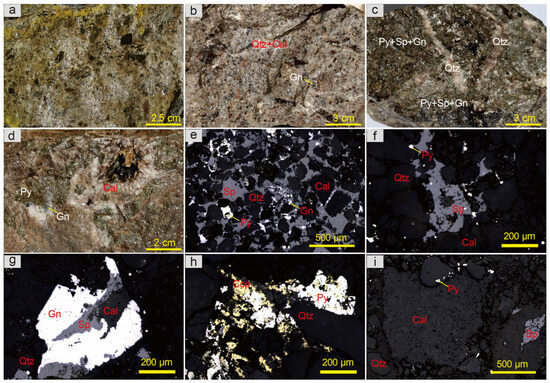
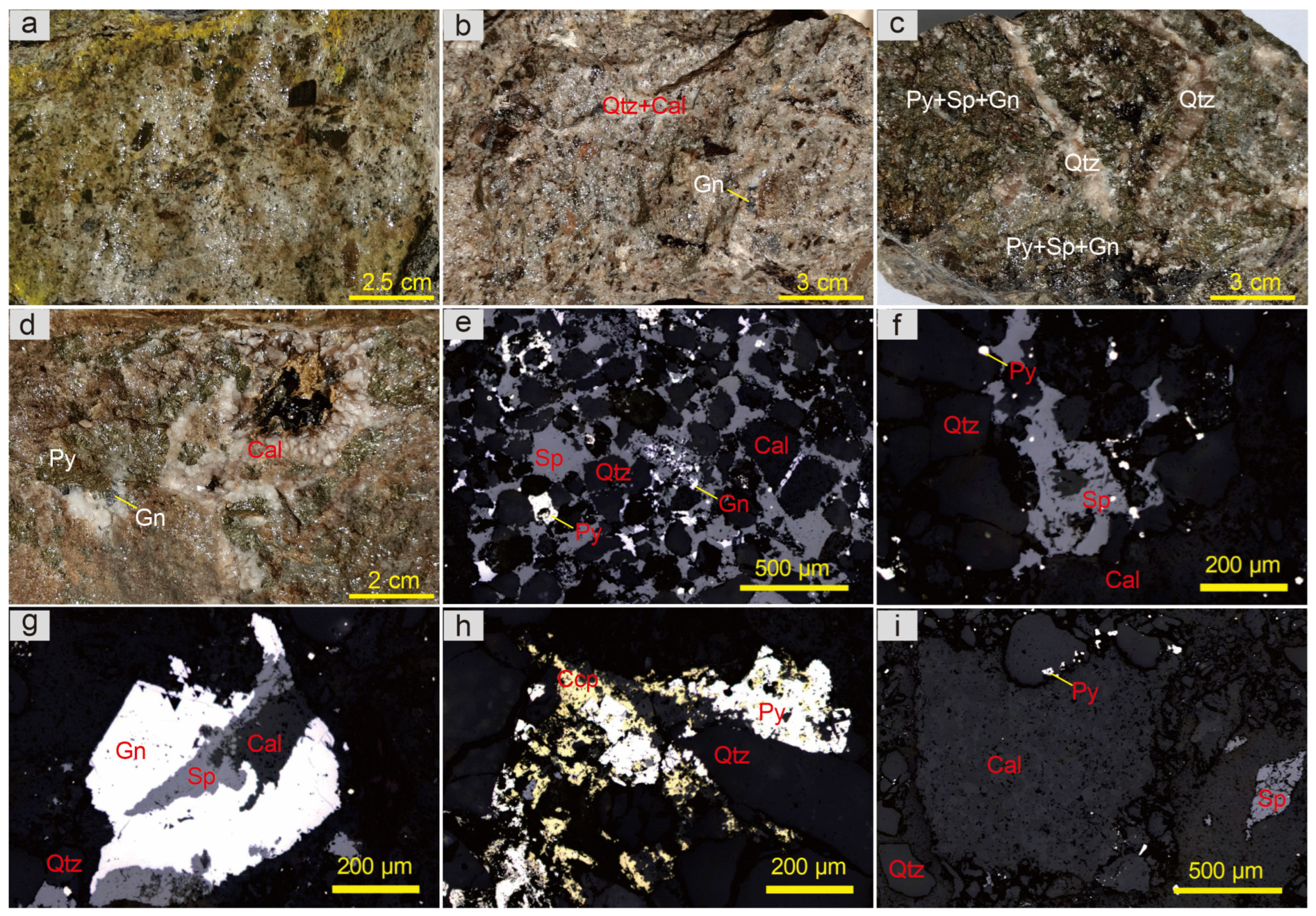
Observations of the hand specimens and reflected-light microscopy indicate that the major metallic minerals in the ore include sphalerite, galena, and pyrite, whereas the gangue minerals are dominated by quartz and calcite (Figure 1). The ore exhibits brecciated, disseminated, vein-type, vuggy, and mottled textures. The structural features of the ore include subhedral–anhedral textures, inclusion textures, cataclastic textures, euhedral textures, and replacement textures (Figure 1).
Figure 1.
Textural and structural characteristics of the ore. (a) Brecciated texture; (b) disseminated texture; (c) vein-type texture; (d) vuggy texture; (e) sphalerite associated with quartz, calcite, galena, pyrite, and other minerals; (f) subhedral–anhedral sphalerite containing fine-grained inclusions of quartz, pyrite, and other minerals; (g) subhedral galena developed with triangular etch pits, associated with quartz, sphalerite, calcite, and other minerals; (h) pyrite associated with chalcopyrite, quartz, and other minerals; (i) coarse-grained calcite. Mineral abbreviations: Py—pyrite; Ccp—chalcopyrite; Chl—chlorite; Qtz—quartz; Ms—muscovite.
3.4. Mineral Composition and Dissemination Characteristics
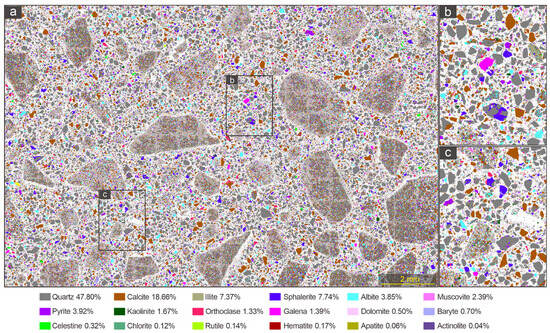
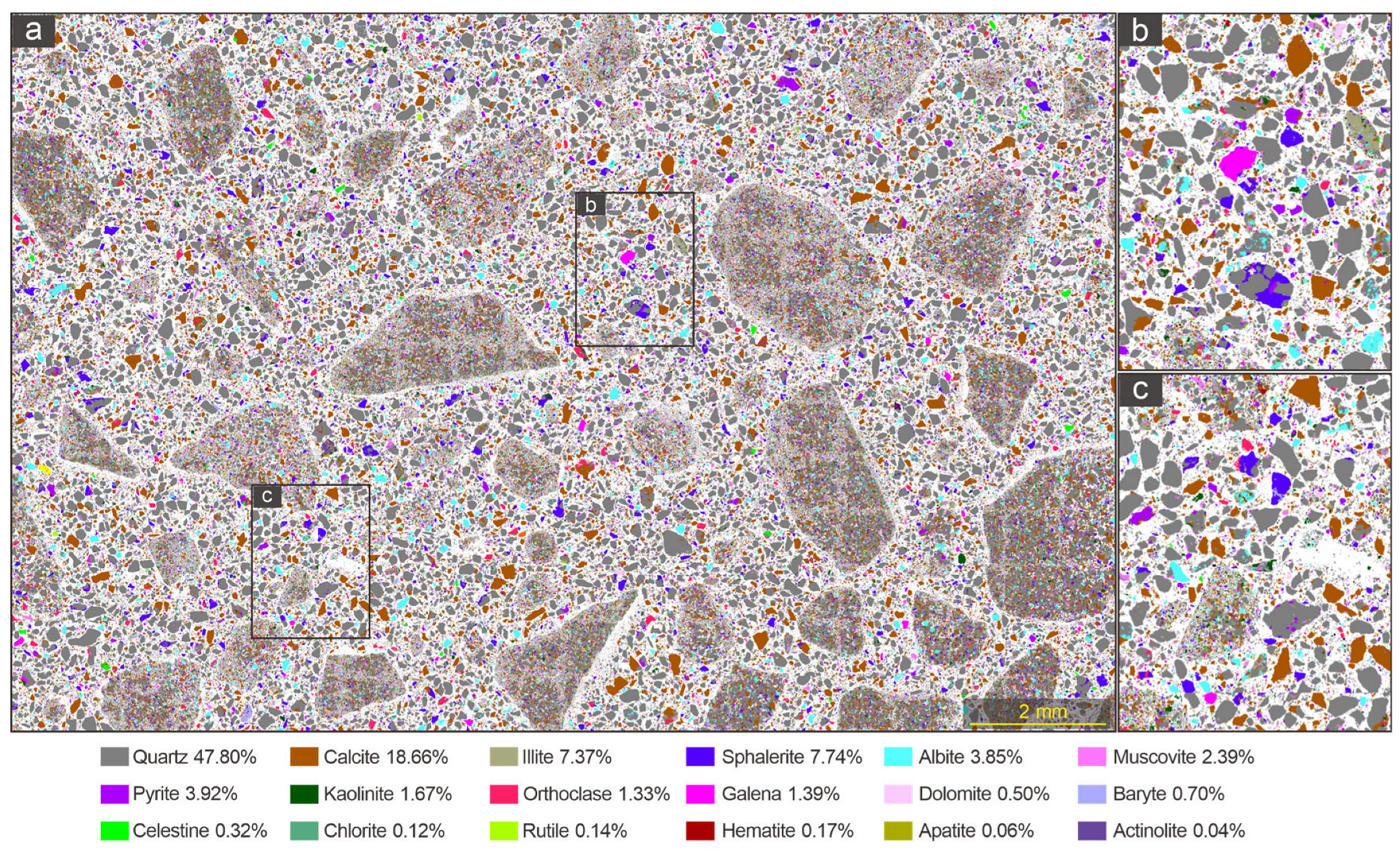
The mineral mass percentage composition of the run-of-mine ore powder sample determined by TIMA analysis is shown in Figure 2. The most abundant minerals in the ore are quartz and calcite, with contents of 47.80% and 18.66%, respectively, followed by sphalerite (7.74%) and illite (7.37%). The ore also contains appreciable amounts of pyrite (3.92%), albite (3.85%), muscovite (2.39%), kaolinite (1.67%), galena (1.39%), and orthoclase (1.33%). In addition, minor amounts (0.10%–1.00%) of barite, dolomite, celestite, hematite/magnetite, rutile, and chlorite are present, as well as trace amounts (<0.10%) of apatite, actinolite, tourmaline, chalcopyrite, zircon, smithsonite, and other minerals.
Figure 2.
Major mineral composition of the run-of-mine ore powder determined by TIMA analysis. (a) Panoramic view; (b,c) Enlarged views of local areas.
Sphalerite (ZnS) is the principal ore mineral, accounting for approximately 7.74% by mass (Figure 2). The color of sphalerite is commonly influenced by its Fe content, appearing light yellow to colorless at low Fe levels and dark brown to black at high Fe contents (>10%). In this ore, sphalerite is predominantly brownish yellow, indicating the presence of a certain amount of Fe. Sphalerite mainly occurs as subhedral–anhedral granular grains, with a dominant grain size ranging from 0.05 to 1 mm (Figure 1). It is primarily intergrown with quartz, and secondarily with calcite, galena, pyrite, and other minerals. Sphalerite grains commonly contain abundant fine inclusions of gangue minerals (such as quartz and calcite) and metallic minerals (such as pyrite and galena).
Galena (PbS) is a subordinate ore mineral, accounting for approximately 1.39% by mass (Figure 2). Galena typically exhibits a strong metallic luster, with a lead-gray to steel-gray color and a grayish-black streak, and has a low hardness (Mohs hardness of 2.5). Microscopic observations show that galena commonly occurs as subhedral granular grains, with well-developed triangular etch pits, and a grain size mainly ranging from 0.05 to 0.5 mm. It is closely intergrown with quartz, sphalerite, and calcite (Figure 1).
Pyrite (FeS2) is one of the major metallic minerals, with a mass percentage of approximately 3.92% (Figure 2). Pyrite typically occurs as light brass-yellow cubic or pyritohedral crystals, exhibiting a metallic luster, a hardness of 6–6.5, no cleavage, brittle behavior, and a greenish-black streak. Parallel striations are commonly observed on crystal faces in hand specimens, and a sulfurous odor is released upon striking. In this ore, pyrite mainly occurs with grain sizes ranging from 0.01 to 0.3 mm, commonly as euhedral–subhedral granular aggregates or as fine-grained disseminations within quartz, calcite, sphalerite, and other minerals (Figure 1). In addition, pyrite is frequently associated with chalcopyrite and sphalerite.
Quartz (SiO2) is one of the principal gangue minerals, accounting for approximately 47.80% by mass (Figure 2). Quartz is characterized by high hardness (Mohs hardness of 7), vitreous luster, and conchoidal fracture, forming a sharp contrast with carbonate minerals such as calcite. Microscopic observations show that quartz commonly occurs as anhedral granular grains with clean surfaces, with grain sizes mainly ranging from 0.02 to 0.3 mm, and is closely intergrown with sphalerite and other minerals (Figure 1).
Calcite (CaCO3) is another major gangue mineral, with a mass percentage of approximately 18.66% (Figure 2). Microscopic observations indicate that calcite crystals are well developed, exhibiting three sets of perfect rhombohedral cleavage, with well-developed surface porosity. The grain size of calcite mainly ranges from 0.1 to 2.0 mm. Calcite is closely intergrown with quartz, sphalerite, and other minerals, and commonly contains fine-grained inclusions of pyrite, sphalerite, and other minerals within the crystals (Figure 1).
3.5. In Situ Micro-Area Trace Element Composition of Minerals
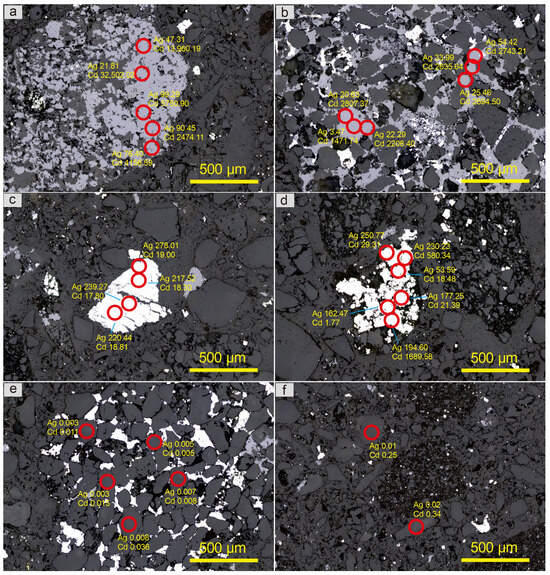
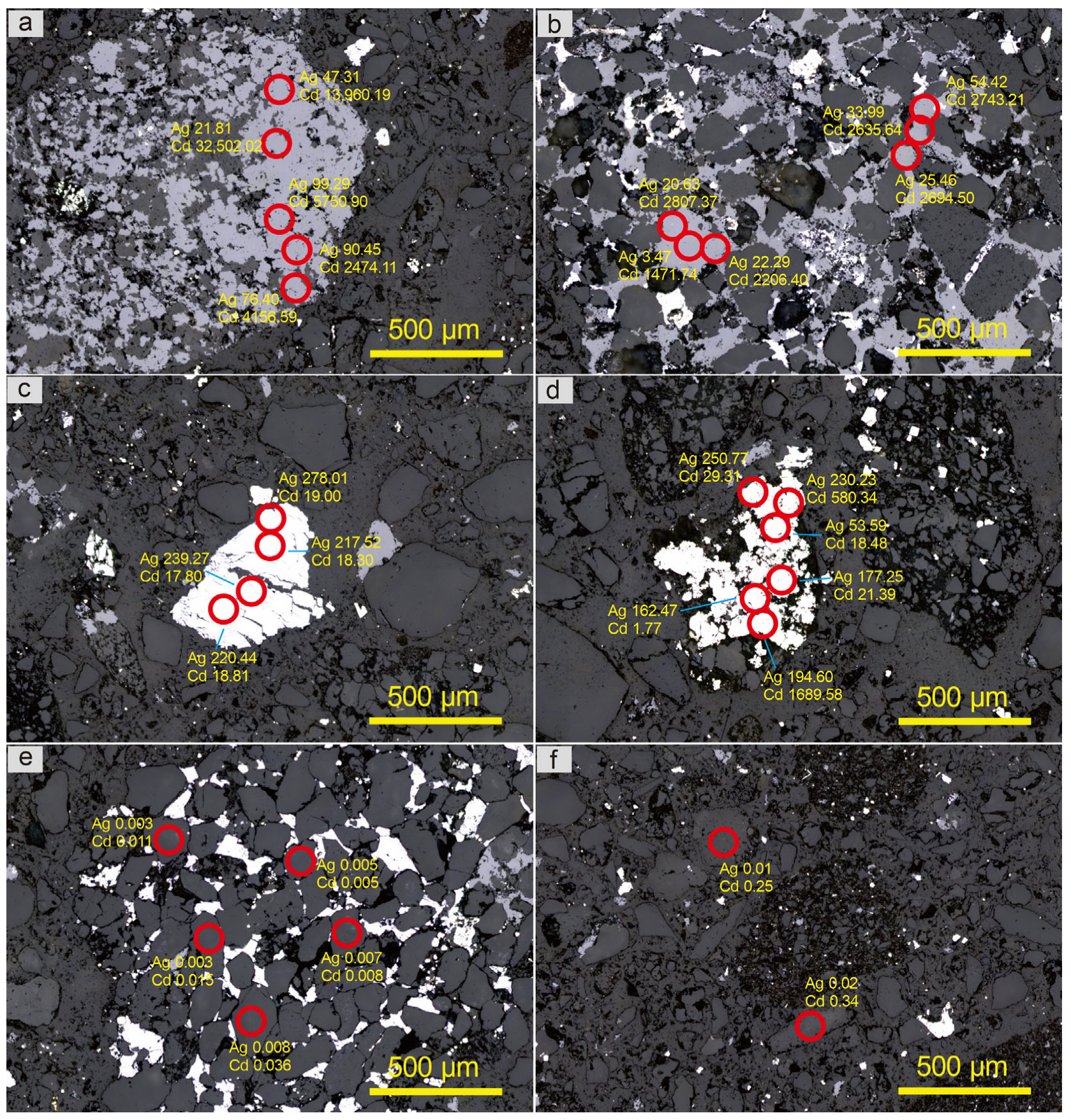
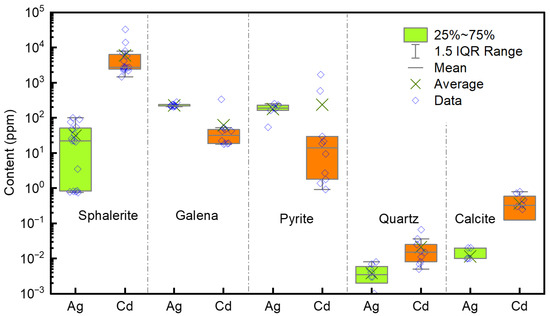
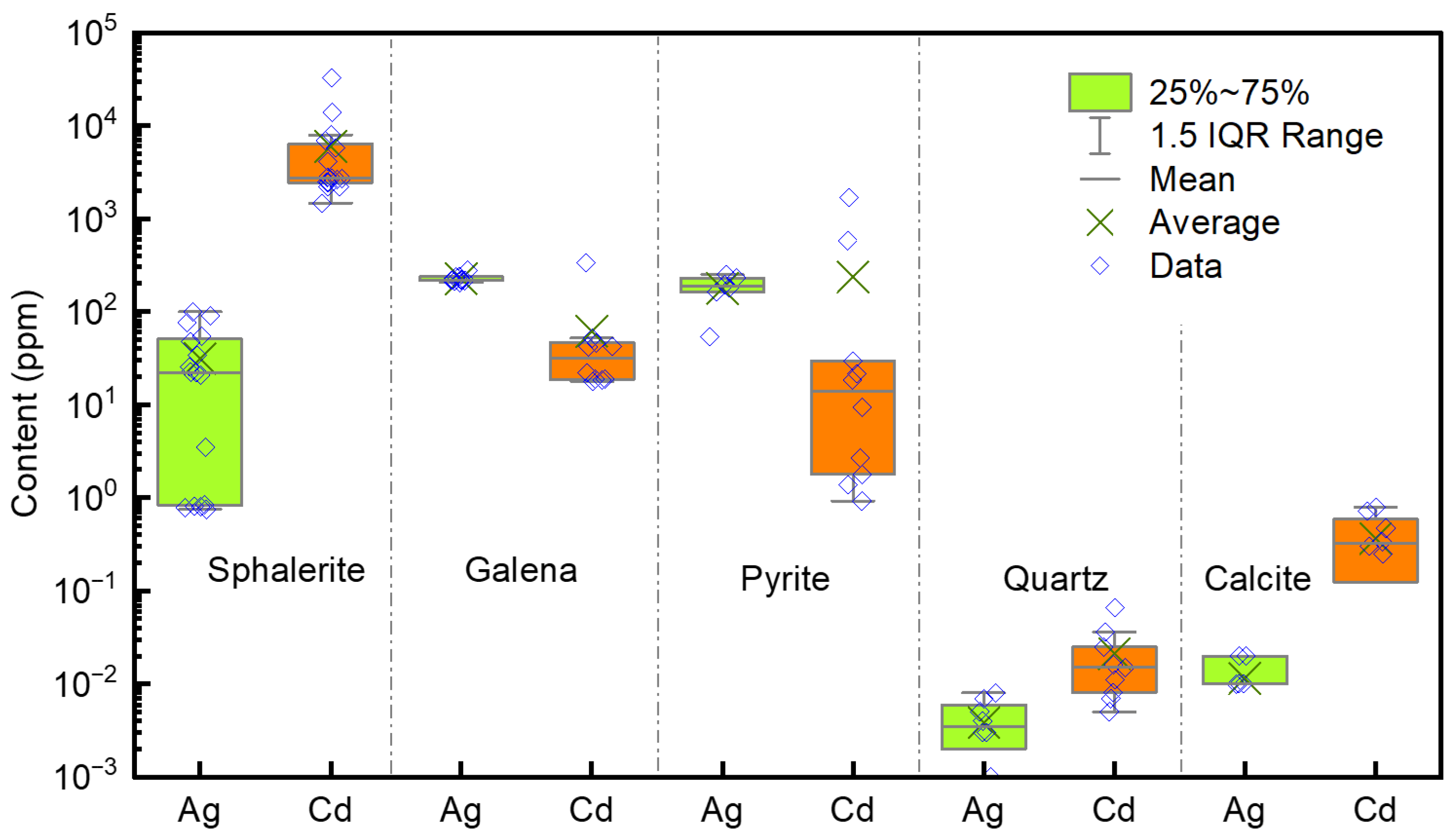
LA-ICP-MS in situ micro-area trace element analyses were conducted on the major minerals, including quartz, calcite, sphalerite, pyrite, and galena. Representative LA-ICP-MS in situ analytical spots and the corresponding Ag and Cd contents are shown in Figure 3. A comparative display of the Ag and Cd contents among the different minerals is presented in Figure 4.
Figure 3.
Representative LA-ICP-MS in situ trace element analytical spots of major minerals and their Ag and Cd contents (ppm). (a,b) Sphalerite; (c) galena; (d) pyrite; (e) quartz; (f) calcite.
Figure 4.
Results of in situ trace element analysis of minerals. IQR—interquartile range.
The results show that the Ag content in sphalerite ranges from 0.75 to 99.29 ppm, with an average of 31.22 ppm, while the Cd content ranges from 1471.74 to 32,502.02 ppm, with an average of 5982.00 ppm. In galena, the Ag content ranges from 206.34 to 278.01 ppm, with an average of 226.86 ppm, and the Cd content ranges from 17.80 to 337.66 ppm, with an average of 61.56 ppm. In pyrite, the detected Ag content ranges from 53.59 to 250.77 ppm, with an average of 178.15 ppm, whereas the Cd content ranges from 0.92 to 1689.58 ppm, with an average of 235.52 ppm. Quartz contains very low Ag contents ranging from 0.001 to 0.008 ppm, with an average of 0.004 ppm, and Cd contents ranging from 0.01 to 0.07 ppm, with an average of 0.02 ppm. Calcite also shows extremely low Ag contents ranging from 0.01 to 0.02 ppm, with an average of 0.01 ppm, and Cd contents ranging from 0.25 to 0.80 ppm, with an average of 0.48 ppm.
These results indicate that Ag in the ore is mainly hosted by galena, followed by pyrite and sphalerite, whereas quartz and calcite contain negligible amounts of Ag. Cadmium is predominantly hosted by sphalerite, with much lower Cd contents in pyrite and galena, and extremely low contents in quartz and calcite. Based on the mineral mass proportions and their average Ag and Cd contents, the estimated distribution ratios of Ag among the major minerals are pyrite (55.60%), galena (25.11%), and sphalerite (19.24%), whereas the distribution ratios of Cd are sphalerite (97.85%) and pyrite (1.95%) (Table 3).
Table 3.
Content and distribution of Ag and Cd in major minerals.
3.6. Mineral Liberation Characteristics of the Ore
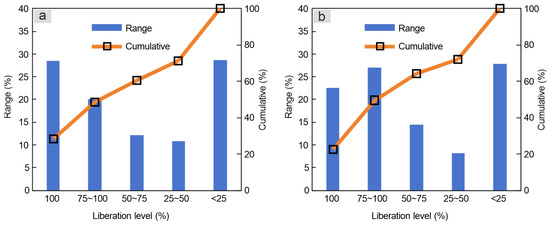
At the current grinding fineness, the liberation characteristics of sphalerite are shown in Figure 5a. Fully liberated particles (100%) account for only 28.40%, representing one of the main liberation forms. Particles within the 75%–100% liberation interval (three-quarter liberated to fully liberated) account for 20.06%, and together these two categories comprise 48.46%. Particles in the 50%–75% interval (half liberated to three-quarter liberated) account for 12.19%, those in the 25%–50% interval (quarter liberated to half liberated) account for 10.75%, and particles in the <25% interval (unliberated to quarter liberated) represent a relatively large proportion of 28.60%. These results indicate that a considerable number of sphalerite particles remain unliberated, and the overall degree of liberation is moderate.
Figure 5.
Liberation characteristics of sphalerite (a) and galena (b) determined by TIMA analysis.
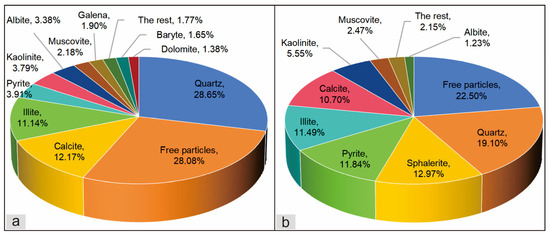
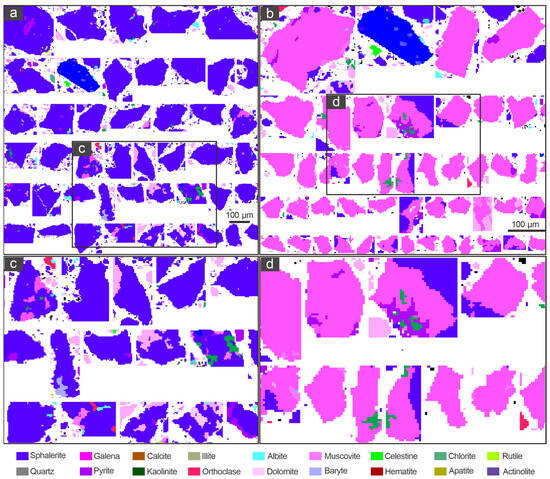
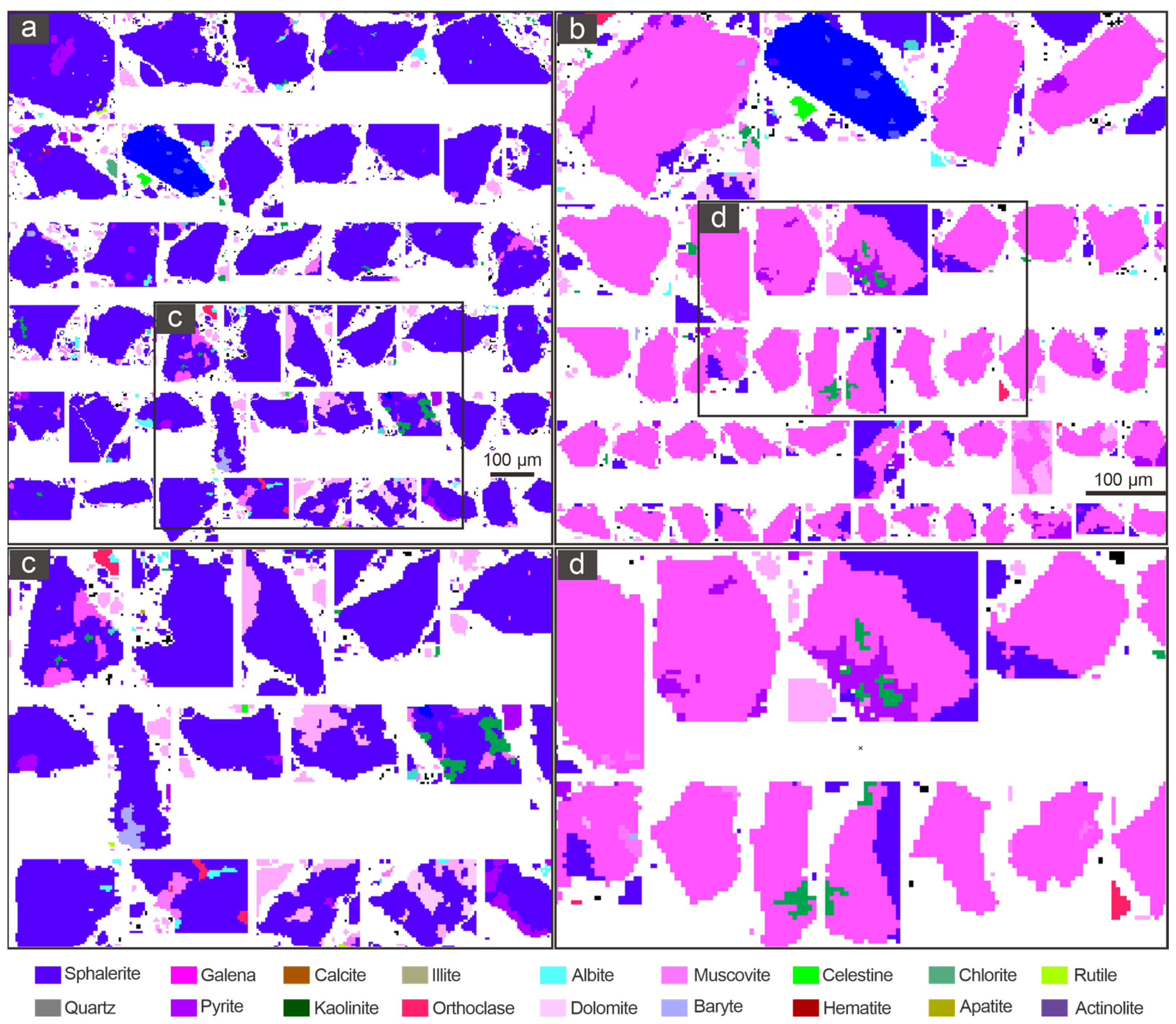
Further TIMA statistics show that free sphalerite particles account for 28.08%, while the unliberated particles are mainly intergrown with quartz (28.65%), calcite (12.17%), illite (11.14%), and other minerals (Figure 6a). This is consistent with the sphalerite particle characteristics revealed by TIMA images (Figure 7a).
Figure 6.
Intergrowth degrees of sphalerite (a) and galena (b) with other minerals Determined by TIMA analysis.
Figure 7.
TIMA-derived particle characteristics of sphalerite (a,c) and galena (b,d).
The liberation characteristics of galena are shown in Figure 5b. Fully liberated particles (100%) account for only 22.50%, while particles in the 75%–100% interval (three-quarter liberated to fully liberated) account for 27.05%; together, these two categories make up 49.54%. Particles in the 50%–75% interval account for 14.49%, those in the 25%–50% interval account for 8.14%, and particles in the <25% interval account for a relatively high proportion of 27.82%. These results indicate that a substantial number of galena particles remain unliberated, and the overall liberation degree is also moderate.
Further TIMA statistics indicate that free galena particles account for 22.50%, whereas the unliberated particles are mainly intergrown with quartz (19.10%), sphalerite (12.97%), pyrite (11.84%), illite (11.49%), calcite (10.70%), kaolinite (5.55%), and other minerals (Figure 6a). This observation is consistent with the galena particle characteristics revealed by the TIMA images (Figure 7a).
4. Discussion
4.1. Occurrence States of Silver and Cadmium
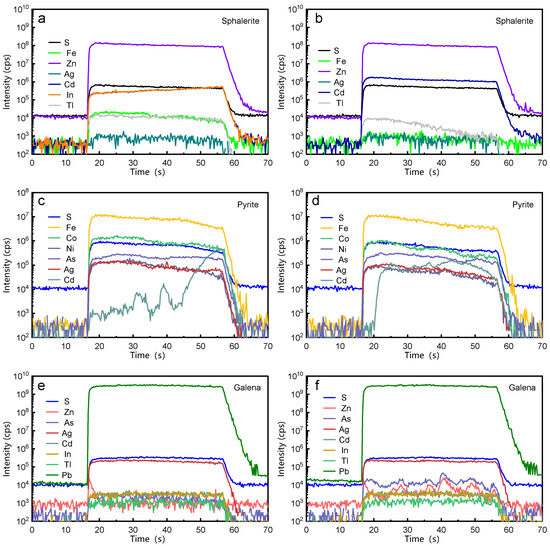
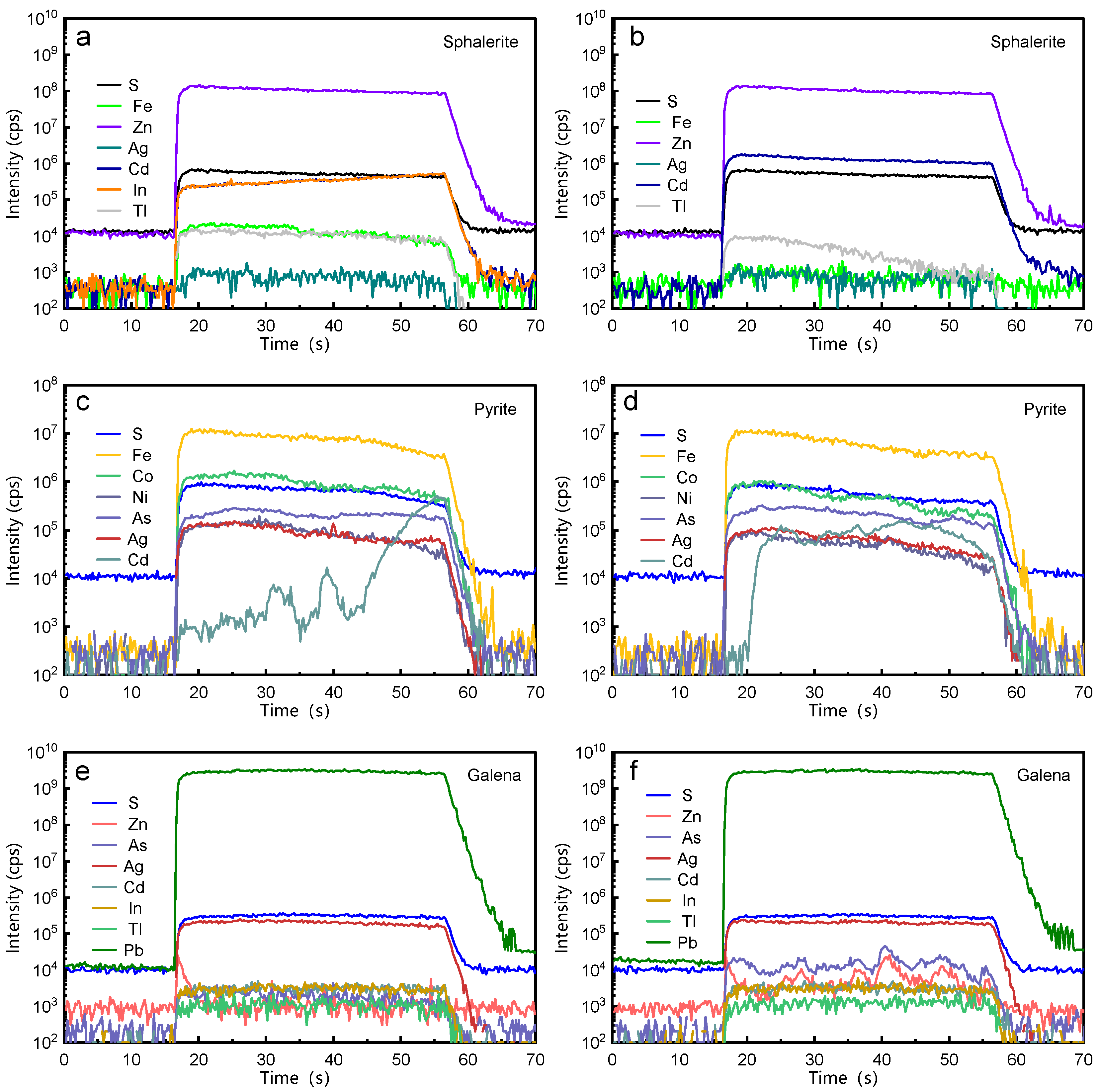
The occurrence forms of elements in minerals can be inferred from the spatial variations in elemental concentrations along the laser ablation path obtained by LA-ICP-MS analyses [11,12,13,14,15]. If trace elements enter the crystal lattice of pyrite in the form of isomorphous substitution, their time-resolved ablation profiles will display smooth curves without sharp spike-like signals, indicating a homogeneous distribution of these elements within the analyzed area. In contrast, irregular time-resolved profiles suggest that the elements occur in minerals as micro-scale mineral inclusions.
Time-resolved ablation profiles of trace element analyses obtained by LA-ICP-MS (Figure 8) show that the Ag and Cd signals in sphalerite and galena are smooth, indicating that Ag and Cd occur predominantly in these minerals in the form of isomorphous substitution. In pyrite, the Ag signal is also smooth; however, the Cd signal at some analytical spots exhibits sharp spike-like fluctuations, suggesting that Ag occurs in pyrite mainly as isomorphous substitution, whereas Cd occurs not only in isomorphous form but also partly as micro-scale mineral inclusions.
Figure 8.
Time-resolved LA-ICP–MS depth profiles of trace elements in major sulfide. (a,b) Sphalerite; (c,d) pyrite; (e,f) galena.
Silver (Ag), as a precious metal, is readily incorporated into sulfide crystal lattices during hydrothermal mineralization. Owing to crystal-chemical constraints, different sulfide minerals exhibit markedly different capacities for hosting Ag: galena is the principal carrier, whereas sphalerite and pyrite usually serve only as secondary or minor enrichment sites. This is consistent with the results of the present study. Because of the relatively large differences in ionic radii between Ag+ (1.44 Å) and Pb2+ (1.18 Å), Zn2+ (0.74 Å), and Fe2+ (0.78 Å), direct substitution of Ag+ for Pb2+/Zn2+/Fe2+ is unlikely. Previous studies have shown that the common coupled substitution mechanism in galena is Ag+ + (Bi, Sb)3+ ↔ 2Pb2+ [16,17]. In sphalerite, substitution of Ag+ for Zn2+ requires the involvement of other cations (Cu+/In3+/Fe3+/Sn4+) to compensate for volume and charge imbalance [18,19]. In pyrite, As3+ and Ag+ may jointly substitute for Fe2+, following the mechanism Ag+ + As3+ ⇌ 2Fe2+ [20,21].
Zinc blende (sphalerite) is the principal host mineral for the dispersed element cadmium (Cd) [22,23]. Under specific enrichment conditions, the Cd content in individual grains or localized domains can reach as high as 37.93% [24]. Consequently, some lead–zinc deposits commonly co- or by-produce significant Cd resources; for example, the Niujiaotang Pb–Zn ore field is associated with more than 5300 t of Cd at grades of 0.04%–1.43% [25,26,27,28]. Previous studies have shown that Cd is mainly incorporated into sphalerite through isomorphous substitution, although the substituting cations vary significantly at different stages of mineralization [29,30]. At higher temperatures, Fe2+ is relatively abundant in the ore-forming fluids and exhibits higher mobility, under which conditions Cd2+ preferentially substitutes for Fe2+ in the crystal lattice. With decreasing temperature, Cd2+ begins to preferentially substitute for Zn2+.
4.2. Implications for Comprehensive Resource Recovery and Utilization
Based on the mineral intergrowth characteristics of the ore, the liberation behavior of the main recoverable minerals, and the distribution patterns of the key metals Ag and Cd described above, this study provides clear scientific guidance and specific optimization pathways for the comprehensive utilization of resources in Cd-rich Ag–Pb–Zn ores from the perspective of process mineralogy, as discussed below.
4.2.1. Recovery of Lead and Zinc Resources
Based on the Analysis of Mineral Intergrowth Characteristics
The main target minerals for recovery in the ore, sphalerite and galena, mainly occur as subhedral–anhedral granular aggregates and are closely intergrown with major gangue minerals such as quartz and calcite. In addition, they commonly contain fine-grained gangue or metallic mineral inclusions within individual grains (Figure 1 and Figure 7). These textural characteristics will directly affect the quality of the lead and zinc concentrates obtained in subsequent beneficiation processes. Such complex intergrowth relationships determine the fundamental strategies for grinding and separation, as follows:
(1) Fine grinding is required. Sphalerite (mainly 0.05–1 mm) and galena (mainly 0.05–0.5 mm) in the ore are finely disseminated. To achieve sufficient liberation of valuable minerals, fine grinding is necessary [31]. Even at a grinding fineness of approximately 75% passing 74 μm, a large proportion of ore minerals remains unliberated.
(2) The separation flowsheet must be targeted. During flotation separation of lead and zinc minerals, a preferential flotation flowsheet of “zinc depression and lead flotation” can be adopted. In addition, considering the close association between sphalerite and galena (Figure 6b), a rational reagent regime is required, especially with respect to the selection of sphalerite depressants and the control of the flotation environment, to avoid excessive mutual contamination of lead and zinc in the lead concentrate, thereby ensuring the grade and recovery of both lead and zinc concentrates.
Based on Liberation Degree Analysis
Quantitative TIMA analysis indicates that, under the current grinding conditions, the complete liberation degrees of both sphalerite and galena are less than 30%, and approximately 28%–30% of the particles exhibit liberation degrees lower than 25% (Figure 5). This is highly consistent with statistical results showing that both minerals are mainly intergrown with gangue minerals such as quartz, calcite, and illite (Figure 6). The current liberation characteristics reveal both the bottlenecks and improvement directions for enhancing lead and zinc recoveries:
(1) Incomplete liberation is the key bottleneck limiting recovery. A large number of unliberated composite particles, especially those intergrown with relatively low-density silicate and carbonate gangue minerals, are prone to being lost to tailings during flotation due to differences in floatability or physical entrainment, directly resulting in decreased recoveries of lead and zinc.
(2) Optimization of the grinding process is beneficial for improving lead and zinc recoveries. Through systematic grinding fineness tests, the optimal particle-size threshold that can significantly increase the liberation degree of sphalerite and galena (particularly the proportion of completely liberated particles) should be identified, thereby providing a fundamental basis for subsequent efficient flotation.
4.2.2. Recovery of Silver and Cadmium Resources
The recovery of silver (Ag) resources can consider establishing a comprehensive Ag recovery system with Pb-Zn-Fe as carriers. As shown by the above analyses, Ag in the ore is mainly hosted in galena, followed by pyrite and sphalerite. Therefore, improving the recovery of lead and zinc is an effective way to enhance Ag recovery. Considering that 55.60% of silver is hosted in pyrite, further recovery of pyrite from lead–zinc flotation tailings could be considered to improve the overall recovery of silver resources. It should be noted that during lead–zinc flotation, the use of the traditional depressant lime under high-alkalinity conditions suppresses sulfide minerals and simultaneously inhibits Ag-bearing minerals. Therefore, low-alkalinity processes, pulp potential control, and related techniques may be adopted to further improve Ag recovery [32].
The recovery of cadmium (Cd) can follow the core strategy of “recovering Cd with Zn.” As indicated by the above analyses, Cd is highly enriched in sphalerite (distribution rate of 98%) and mainly occurs in an isomorphic form. This mode of occurrence determines that Cd recovery is entirely dependent on Zn recovery. Any process optimization that improves the grade and recovery of the zinc concentrate will directly and proportionally enhance Cd recovery. Therefore, one of the main objectives of the flotation process is to maximize the enrichment of sphalerite and minimize Zn (and Cd) losses caused by insufficient liberation of sphalerite or low separation efficiency. Accordingly, during sphalerite flotation, emphasis should be placed on optimizing the flotation flowsheet and the synergistic use of high-efficiency collectors and activators, so as to maximize the grade and recovery of sphalerite and ultimately achieve effective recovery of Cd resources.
5. Conclusions
This study elucidated the mineralogical characteristics and critical metal occurrence mechanisms of a Cd-Ag-rich Pb-Zn ore in southwestern China via a multi-scale process mineralogy approach combining reflected-light microscopy, TIMA, and LA-ICP-MS. The key conclusions are as follows:
(1) The ore is a medium–low grade Pb-Zn deposit with sphalerite (7.74%), galena (1.39%), pyrite (3.92%), quartz (47.80%) and calcite (18.66%) as the dominant minerals; the associated Ag (5.04 ppm) and Cd (0.066%) have considerable economic potential for comprehensive recovery.
(2) Ag is primarily hosted in galena, followed by pyrite and sphalerite, while Cd is highly enriched in sphalerite; Ag in the three sulfides and Cd in sphalerite/galena occur mainly as isomorphs, with partial Cd in pyrite existing as micro-inclusions.
(3) Sphalerite and galena are fine-grained and closely intergrown with gangue minerals; at the tested grinding fineness, their fully liberated particles account for <30%, and the large proportion of unliberated composite particles is the core mineralogical bottleneck restricting beneficiation recovery and associated element retention.
(4) Maximizing the resource value of this ore requires grinding fineness optimization to enhance valuable mineral liberation, a “Zn-carried Cd” strategy for efficient Cd recovery, and the construction of a comprehensive Ag recovery system with Pb-Zn-Fe as carriers; this necessitates shifting beneficiation design from a major metal-oriented to a key metal-coordinated recovery-oriented approach.
The multi-scale characterization workflow (macroscopic texture → mineral assemblage statistics → in situ micro-area elemental analysis) enables the accurate identification of metal distribution and occurrence, and provides direct evidence for linking mineral liberation behavior with elemental recovery potential, setting a reference for process mineralogy studies of similar complex ores.
Author Contributions
Conceptualization, X.Z. and Y.C.; Methodology, X.Z., Y.L. (Yang Liu) and H.L.; Formal Analysis, Y.L. (Yang Liu) and H.L.; Investigation, X.Z., Y.C., C.C., Y.L. (Yongfeng Lu), Y.W., S.X., J.M. and Q.N.; Resources, X.Z. and X.N.; Data Curation, L.Z., J.D., G.S. and J.T.; Writing—Original Draft, X.Z.; Writing—Review and Editing, Y.C. and Y.L. (Yang Liu); Supervision, Y.C.; Project Administration, Y.C.; Funding Acquisition, Y.C. All authors have read and agreed to the published version of the manuscript.
Funding
This research was financially supported by the National Natural Science Foundation of China (Grant No. 42372103), the Yunnan Fundamental Research Project (Grant No. 202401AT070047), and the Kunming Metallurgy College Doctoral Research Start-up Foundation (Grant No. Xxrcxm202401).
Data Availability Statement
The original contributions presented in this study are included in the article. Further inquiries can be directed to the corresponding author.
Acknowledgments
We would like to acknowledge Wei Zhicong from Kunming University of Science and Technology for his guidance on this research. We also thank the four anonymous reviewers for their constructive comments and suggestions, which have greatly improved the quality of this manuscript.
Conflicts of Interest
The authors declare no conflicts of interest.
References
- Richert, M.; Łebkowski, P. Development of automotive industry trends and demand for critical raw materials worldwide. J. Entrep. Sustain. Issues 2025, 12, 325–360. [Google Scholar] [CrossRef] [Scilit]
- Balaram, V.; Santosh, M. Critical metal deposits in terrestrial and oceanic environments and the global energy transition. Habitable Planet 2025, 1, 86–107. [Google Scholar] [CrossRef] [Scilit]
- Liang, Y.Y.; Liu, L.L.; He, K.B.; Huang, F.; Gomez, M.; Li, J.H. Supply of Key Metals for China’s New Energy Industries under the Carbon Peaking and Carbon Neutrality Goals. Strateg. Study CAE 2024, 26, 131–141. [Google Scholar]
- Pan, Z.S.; Zhang, Z.Z.; Che, D.; Zhang, T.; Zhang, L.Y.; Yang, W. Characteristics and demand analysis of silver resources in China under the background of new energy. Geol. China 2024, 51, 1554–1569. [Google Scholar]
- Yu, Y.; Wang, D.H.; Yu, F.; Wang, W.; Liu, S.B.; Li, D.X.; Jiang, B.; Huang, F.; Wang, Y.; Wang, C.H.; et al. Current status in the exploration, development, and utilization of cadmium resources in China. China Min. Mag. 2024, 33, 51–56. [Google Scholar]
- Li, K.X.; Leng, C.B.; Ren, Z.; Liu, F.; Xv, D.R.; Ye, L.; Luo, T.Y. Progresses of researches on the dispersed elements associated with lead-zinc deposits. Acta Mineral. Sin. 2021, 41, 225–233. [Google Scholar] [CrossRef]
- Zhou, J.X.; Zheng, Y.; Li, Y.J.; Ulrich, T.; Zhou, L.L. Mineralization of Zn-Pb-Ag and associated critical metals: An introduction. Ore Geol. Rev. 2024, 174, 106328. [Google Scholar] [CrossRef] [Scilit]
- Xiao, Y.W. Process Mineralogy in the Context of Intelligence and Greening: Challenges and Future Directions. Nonferr. Met. (Min. Process. Sect.) 2026, 28–36. [Google Scholar] [CrossRef]
- Zhang, T.; Song, W.L.; Chen, Q.; Yang, J.K.; Hu, Y.; Huang, J.; Xv, D.N.; Xv, Y.T. Application of Automated Quantitative Mineral Analysis System in Process Mineralogy of Low-grade Copper Slag. Rock Min. Anal. 2023, 42, 748–759. [Google Scholar] [CrossRef]
- Ma, C.L.; Jing, X.H.; Jia, L.Q.; Li, H.; Wang, A.G. Application of Mineral Automatic Quantitative Analysis System in the Petrology and Mineralogy Analysis of Aluminiferous Rock Series: Taking Taiyuan Formation in the Longdong area as an example. Acta Sedimentol. Sin. 2025, 43, 500–512. [Google Scholar] [CrossRef]
- Wu, J.J.; Dai, H.X.; Cheng, Y.; Xu, S.H.; Qi, N.; Wen, Y.M.; Lu, P. LA-ICP-MS Trace Element Geochemistry of Sphalerite and Metallogenic Constraints: A Case Study from Nanmushu Zn–Pb Deposit in the Mayuan District, Shaanxi Province, China. Minerals 2023, 13, 793. [Google Scholar] [CrossRef] [Scilit]
- Cheng, Y.; Wang, H.P.; Zhou, J.X.; Wen, Y.M.; Luo, K.; Hu, J.; Chuan, M.S.; Jian, L. Geochemical characteristics and indicative significance of typical hydrothermal minerals from the newly discovered cobalt ore spot in Wuding, Yunnan Province, China. Acta Petrol. Sin. 2025, 41, 2616–2630. [Google Scholar] [CrossRef] [Scilit]
- He, Y.; Zhou, G.M.; Zhong, H.; Cheng, Y.; Yue, Z.P.; Liu, H.S.; Zhou, J.X. Enrichment characteristics and its geological significance of dispersed elements within sulfide minerals from the VI ore belt in the Maoping Pb-Zn deposit, Yunnan Province, China. Acta Petrol. Sin. 2023, 39, 2985–3001. [Google Scholar] [CrossRef] [Scilit]
- Cheng, Y.; Zhou, J.X.; Sun, G.T.; Huang, Z.L. The enrichment characteristics of germanium and its geological significance in the Banbianjie Ge-Zn deposit, Guizhou. Acta Petrol. Sin. 2024, 40, 43–59. [Google Scholar] [CrossRef] [Scilit]
- Cheng, Y.; Wang, H.P.; Zhou, J.X.; Zhou, Y.; Luo, K.; Chuan, M.S.; Yang, Z.M.; Jian, L. Mineral Composition and Cobalt Occurrence of High-grade Cobalt Ore Occurrence in the Central Yunnan. Geotecton. Metallog. 2025, 1–14. [Google Scholar] [CrossRef]
- George, L.; Cook, N.J.; Ciobanu, C.L.; Wade, B.P. Trace and minor elements in galena: A reconnaissance LA-ICP-MS study. Am. Mineral. 2015, 100, 548–569. [Google Scholar] [CrossRef] [Scilit]
- Jia, Z.C.; Ren, T.; Huang, J.G.; Guan, S.J. The occurrence state of Ag in the Nandangchang Ag-polymetallic deposit in the southeastern Yunnan. Acta Mineral. Sin. 2024, 44, 825–834. [Google Scholar] [CrossRef] [Scilit]
- Pring, A.; Wade, B.; Mcfadden, A.; Lenehan, C.E.; Cook, C.E. Coupled substitutions of minor and trace elements in Co-existing sphalerite and wurtzite. Minerals 2020, 10, 147. [Google Scholar] [CrossRef] [Scilit]
- Li, S.H.; Wu, G.; Li, Z.X.; Yi, H.N.; Lv, X.; Dou, H.B.; Song, L.; Fang, M.Y. Trace element compositions of sphalerite from the 1118Highland silver polymetallic deposit in the southern Great Xing’an Range: Constraints on the ore deposit genesis. Earth Sci. Front. 2024, 1–28. [Google Scholar] [CrossRef]
- Wright, J.; Lentz, D.R.; Rossiter, S.; Garland, P. Analysis of Au-Ag mineralization in the caribou base-metal VMS deposit, new brunswick; examination of micro-scale inter- and intra-sulphide distribution and its relation to geometallurgy. Minerals 2016, 6, 113. [Google Scholar] [CrossRef] [Scilit]
- Tardani, D.; Reich, M.; Deditius, A.P.; Chryssoulis, S.; Sanchez-Alfaro, P.; Wrage, J.; Poberts, M.P. Copper–arsenic decoupling in an active geothermal system: A link between pyrite and fluid composition. Geochim. Cosmochim. Acta 2017, 204, 179–204. [Google Scholar] [CrossRef] [Scilit]
- Cui, M.; Cheng, Y. The geochemical characteristics of trace elements contained insphalerite from Daliang zinc mine in Niujiaotang lead-zinc ore field in Guizhou Province and its geological significance. Ind. Min. Process. 2022, 51, 37–45. [Google Scholar] [CrossRef]
- Cui, M.; Hu, Y.Z.; Cheng, Y.; Xv, S.H.; Li, P.H.; Yi, S.C.; Fang, H.J. LA-ICP-MS trace element analysis of sphalerite in the Baisong Pb-Zn depositat Eastern Guizhou and its geological significance. Geochimica 2023, 52, 625–636. [Google Scholar] [CrossRef]
- Liu, T.G.; Zhang, Q.; Ye, L.; Shao, S.X. Discovery of the complete isomorphous series of ZnS-CdS in nature and its preliminary study. Geol. China 2004, 31, 40–45. [Google Scholar]
- Cheng, Y.; Cui, M.; Xu, S.H.; Lu, P.; Nie, Q.; Liu, C.; Wen, Y.M.; Wu, W.; Jian, L. Trace element geochemical characteristics of sphalerite from the Daliang zinc deposit in Duyun City of Guizhou Province and their indicative significance. Geol. Explor. 2022, 58, 0465–0474. [Google Scholar]
- Cheng, Y. In situ S-Pb isotopic geochemical characteristics of sulfides in the Qingshui-tang zinc deposit in the eastern Guizhou and their geological significances. Acta Mineral. Sin. 2025, 45, 773–785. [Google Scholar]
- Cheng, Y.; Hu, Y.Z.; Zhou, J.X.; Guan, S.J.; Xu, S.H.; Cui, M.; Zhang, J.L.; Tian, X.L.; Zhou, L.; Liu, Z.N.; et al. Genetic link between Mississippi Valley-type (MVT) Pb–Zn mineralization and hydrocarbon accumulation in the Niujiaotang ore field, SW China. Ore Geol. Rev. 2024, 165, 105929. [Google Scholar] [CrossRef] [Scilit]
- Cheng, Y.; Zhou, J.X.; Hu, Y.Z.; Xu, S.H.; Shi, S.B.; Wen, Y.M.; Nie, Q.; Zhou, Y.; Luo, K.; Tan, X.L.; et al. The biomarker signatures in the Niujiaotang sulfide ore field: Exploring the role of organic matter in ore formation. Mar. Pet. Geol. 2026, 183, 107616. [Google Scholar] [CrossRef] [Scilit]
- Shao, P.; Shi, D.F.; Zi, F. Study on Selective Replacement Characteristics of Fe and Zn by Cd in Sphalerite. J. Hunan Univ. Sci. Technol. (Nat. Sci. Ed.) 2020, 35, 27–32. [Google Scholar] [CrossRef]
- Yuan, X.; Wu, Y.; Duan, D.F.; Zhu, J.; Ouyang, H.G.; Cao, L.; Zhou, B. Trace (dispersed) elements in sphalerite from the giant Huoshaoyun lead-zinc deposit, Xinjiang and their geo-logical implications. Geol. Explor. 2022, 58, 545–560. [Google Scholar]
- Runge, K.C.; Frausto, J.J.; Lisso, M.M.; Jokovic, V.; Yahyaei, M. Importance of considering classification and liberation when optimising comminution and flotation. Miner. Eng. 2024, 209, 108612. [Google Scholar] [CrossRef] [Scilit]
- Gao, Z.Y.; Jin, X.; Xie, F.; Yang, L.; Xu, S.H.; Sun, W.; Feng, Z.T.; Zhang, W.J. Green and selective flotation separation of complex sulfide minerals via pH-controlled interfacial reactions using a thione collector. Sep. Purif. Technol. 2025, 363, 132125. [Google Scholar] [CrossRef] [Scilit]

Disclaimer/Publisher’s Note: The statements, opinions and data contained in all publications are solely those of the individual author(s) and contributor(s) and not of MDPI and/or the editor(s). MDPI and/or the editor(s) disclaim responsibility for any injury to people or property resulting from any ideas, methods, instructions or products referred to in the content. |
© 2026 by the authors. Licensee MDPI, Basel, Switzerland. This article is an open access article distributed under the terms and conditions of the Creative Commons Attribution (CC BY) license.