


Abstract
The Neoproterozoic Paraguay Belt (western Brazil), formed by the Brasiliano/Pan-African Orogenic Cycle during Western Gondwana amalgamation, hosts tens of gold occurrences and deposits. This review provides new insights into the metallogeny and tectonics of the Paraguay Belt Gold Province, based on previous and new data on stratigraphy, structural geology, metamorphism, hydrothermal alteration, and gold grades. The mineralizations correspond to turbidite-hosted orogenic gold systems, with quartz veins cutting metasedimentary rocks with minor metavolcanics. A six-phase tectonic–metallogenic evolution model is proposed. The early stages correspond to glaciolacustrine deposition in a rift that evolved into a passive margin and then into a foreland basin, with glaciomarine sediments. Late sedimentation corresponds to glacial-to-post-glacial shallow marine units in the foreland. The orogeny progressed with cratonic collisions, resulting in three deformation (two compressional and one extensional) and three metamorphic (regional, dynamic, and contact) phases. The Au mineralization results from metamorphic fluids that transported metals from the metasedimentary pile and deposited them in reactive rocks (rich in magnetite or organic carbon). Gold occurs in sulfide-rich (pyrite and galena) veins and hydrothermal alteration zones. The metallotects and structural controls highlighted here are useful tools for prospecting gold in the Paraguay Belt and similar geological terranes.
1. Introduction
Orogenic gold deposits account for a major part of the global reserves and production of this metal [1]. They are formed in collisional tectonic settings, by aqueous–carbonic hydrothermal fluids mostly of metamorphic origin, circulating in major regional structures [2,3]. Also referred to as mesothermal and lode gold, orogenic deposits are the predominant gold ores in metamorphic belts, being hosted by quartz veins associated with varying mineral assemblages and hydrothermal halos [4,5]. These ores can reach high grades and, both fresh and weathered, have been historically exploited by many societies, including Brazil, since colonial times [1,6].
Brazil’s history is closely linked to gold production, with the period from 1750 to 1820 called the Gold Cycle by Brazilian historians. This time was marked by colonial exploitation fueled and supported by gold (and later, diamond) mining [7]. The Central–Western region of Brazil was colonized by non-indigenous people during this cycle, through the eighteenth century [8]. The occupation of Mato Grosso state, in this region, was set by gold explorers who first discovered gold placers and lodes in the following century [9]. According to the Brazilian National Agency of Mining (ANM) and historical sources, Mato Grosso has produced about 70 tons of gold since colonial times and currently accounts for roughly 14% of the current national production [6,10,11].
Orogenic gold systems predominate in Brazil [6], with the most prominent gold provinces of the country being either classified as orogenic, as those in São Francisco Craton and in Tocantins Province [12,13,14,15], or porphyry–epithermal systems, as in Tapajós and Juruena Mineral Provinces in the Amazonian Craton [16]. The first gold deposits discovered in Mato Grosso are in the Paraguay Belt, part of the Tocantins Province [17,18]. This province is a Neoproterozoic tectonic feature formed by the collision of cratons in the Brasiliano/Pan-African Orogenic Cycle (Figure 1a), in the context of the western Gondwana amalgamation (Figure 1b; [19,20]). The Paraguay Belt orogenic gold deposits are hosted by quartz veins that cut deformed Neoproterozoic glaciolacustrine/glaciomarine meta-volcanosedimentary sequences ([12,18,21]). These rocks have been interpreted as deposited in the rift-passive margin [12,22,23], rift-ocean [24,25], passive margin-active margin-foreland [26], and rift-passive margin-foreland [27], during the Brasiliano/Pan-African Orogenic Cycle.
Figure 1.
(a) Simplified map of the main tectonic domains of South America (domains from [28] and Paraguay Belt limits from [27]). (b) Paleocontinent reconstruction of the northern Paraguay Belt in the Western Gondwana context (modified from [12,19,29]). (c) SRTM Hillshade image of the northern Paraguay Belt, with the limits between the inner and outer zones, as well as the foreland covers. (d) Simplified geological map of the northern Paraguay Belt (after [24,30]). (e) Geological map of the Baixada Cuiabana Gold subprovince (modified from [22]), showing the Cangas-Poconé (CP) and Cuiabá-Várzea Grande (CVG) gold districts. AMZ: Amazonian Craton; CNG-SF: Congo-São Francisco Craton; AA: Arequipa-Antofala Block; PP: Paranapanema Block; RAP: Rio Apa Block; TBL: Transbrasiliano Lineament; WAF: West Africa Craton.
Although many researchers have examined various features across multiple deposits and occurrences, such as stratigraphy, structural geology, geochronology, and metallogeny, an integrative analysis of these data is still needed. The available models focus solely on one of these aspects and often lack crucial elements, including geochemical traps, the timing of mineralization, and the sources of metals. In this sense, this paper aims to constrain the geological features that produced the gold mineralizations of the northern Paraguay Belt. We present a broad review that integrates the distinct approaches of previous works with new geological, petrographic, mineralogical (X-ray diffractometry), and lithogeochemical (gold grades) data. The unpublished data comprises non-systematic fieldwork related to many research and undergraduate thesis projects, while the review provides access to Portuguese-language manuscripts that are rarely available to international readers. Our descriptions focus both on deeply studied metallotects (stratigraphy, structural geology, metamorphism) and those that are poorly addressed so far (hydrothermal alteration, gold source). This review is intended to summarize the area in the shortest possible way, serving both as an introduction to the area and as an update of prior knowledge for those familiar with these gold mineralizations.
The results are presented from southwest to northeast, comprising three areas in the northern Paraguay Belt (Mato Grosso state): Cangas-Poconé district (CP), Cuiabá-Várzea Grande district (CVG), and Nova Xavantina subprovince (NX). The CP and CVG districts are part of the Baixada Cuiabana subprovince (BC) and share similar stratigraphy and spatial continuity. Instead of presenting a historical recording approach, this work emphasizes our understanding of features that range from descriptive (lithotypes, hydrothermal alteration) to interpretative (tectonic and metallogenic processes). While discussing our view, we explore previous data by pinpointing the most relevant and providing a historical overview with Supplementary Tables S1–S3. The discussion presents fundamental aspects of the tectonics and metallogeny of the northern Paraguay Belt gold mineralizations, while emphasizing the new insights from our research.
Our work presents models that summarize a Neoproterozoic-Cambrian regional metallogenic event that bordered the southeast margin of the Amazonian Craton. This review also highlights gaps, as previous works have focused on a single deposit or a few deposits, lacking a comprehensive view of each subprovince and of the whole. Besides advancing in metallogeny and tectonics, this paper brings a new description of hydrothermal alteration and ore zones, supported by an extensive review of previous data on stratigraphy, structural geology, geochronology, and metallogenic features. These findings have direct outcomes for mineral exploration in this region and similar terranes. Our contributions extend beyond Brazil’s central–western region by describing the correlation between tectonics and metallogeny of a Precambrian orogenic gold province.
2. Regional Tectonic and Metallogenic Setting
The Tocantins Province is an orogenic system formed by the collision of the Amazonian and São Congo-Francisco cratons, as well as Paranapanema and Rio Apa blocks, between ~750 and 550 Ma, during Western Gondwana amalgamation (Figure 1b; [17,19,28,31,32,33]). It comprises three orogenic belts: Brasília, Araguaia, and Paraguay belts [32]. The Brasília and Araguaia orogens consist of Archean to Mesoproterozoic reworked basement terranes and Neoproterozoic deformed metavolcanosedimentary sequences deposited in passive margins and oceanic basins [32,34]. The Brasília Belt evolved from circa 900 to 600 Ma, including the Goiás Magmatic Arc, a composite arc terrane built in three episodes (~900, ~800, and ~635 Ma; [34,35]).
The Paraguay Belt, the westernmost part of the Tocantins Province, is almost entirely composed of metasedimentary rocks, except for the Nova Xavantina region, where metavolcanic rocks occur [24,30,36,37]. It has been divided into three zones (Figure 1c; [17,38]): Inner (southeast/east/south, dominated by glacio-lacustrine siliciclastic rocks), Outer (north/northweast, mixed siliciclastic and carbonate rocks), and Foreland covers (northwest, dominant carbonate rocks). The Paraguay Belt is mostly NE–SW-oriented (Figure 1c), aligned with the Transbrasiliano Lineament [28,32], a transcontinental thousand-kilometer-long transcurrent shear feature that marks the Brasiliano Orogeny at the end of the Neoproterozoic.
The gold deposits and occurrences of the Paraguay Belt Gold Province are found in the northern part of the Inner Zone (Figure 1d), in Mato Grosso state. This is the largest exposed area of the belt, with its southern counterpart covered mainly by Phanerozoic covers [17,24,26,32]. The gold mineralizations are hosted by fine-grained meta-sedimentary rocks of Neoproterozoic age, the Cuiabá Group, and lithotypes of the Nova Xavantina Metavolcano–Sedimentary Complex [12,18,23,24,30,36,37,39,40,41].
The São Vicente Granite is a large (437 km2 area) regional intrusive–extrusive system formed by biotite and biotite–muscovite syenogranites that intrude the upper portion of the Cuiabá Group and associated rhyolites, aplites, and microgranites [42,43,44]. The São Vicente rocks present a mixed mantle–crust petrogenetic signature and minor deformation evidence, indicating a post-collisional emplacement (decompression or within-plate [43,44]). In contact with Cuiabá Group metatillites, this intrusion produced the Ranchão Pb–Zn sulfide deposit, in a meso-epithermal context [45]. Additionally, during fieldwork, we observed sphalerite–pyrite occurrences and boxworks in late facies of the São Vicente Granite, as well as in its hornfels aureola. There is also a minor carbonatite complex, Planalto da Serra, that intrudes the Cuiabá Group rock. It is composed of glimmerites, nelsonites, and olivine carbonatites and has been interpreted as emplaced in a Neoproterozoic rift (Rio dos Cavalos Rift; [46]).
Besides gold ores, other mineral resources are found in the Paraguay Belt. The most prominent are iron and manganese deposits in the southern foreland covers, in Corumbá (Mato Grosso do Sul state; [47]). Additionally, these covers contain iron phosphate occurrences in Mirassol D’Oeste [48]. Additional phosphate occurrences were documented in the Outer Zone, in both northern and southern extensions [49]. Also, the Inner Zone hosts a small graphite deposit at the base of the Cuiabá Group [50].
The rocks of the Baixada Cuiabana subprovince have been interpreted as a record of Neoproterozoic glaciations, with dominant glacio-lacustrine and glacio-marine sedimentation [22,23,31,38,51]. The metavolcanic rocks in Nova Xavantina were interpreted as oceanic crust [19,24,25] or continental volcanism [37]. The stratigraphy and patterns of detrital ages (younger maximum deposition ages in the top) have led several researchers to interpret the Paraguay Belt as part of a Neoproterozoic rift system that evolved into a passive margin [22,23,33], a passive margin that evolved into a convergent margin and then into a foreland basin [26], and a rift-passive margin–foreland basin system [27].
3. Lithostratigraphic Units, Metamorphism, and Geochronology
3.1. Baixada Cuiabana Subprovince
The Baixada Cuiabana is a regional depression formed by the erosion of the Cuiabá Group, which hosts the first known gold deposits in Mato Grosso state [9]. Here, these mineralizations are divided into the Cangas–Poconé (southwest) and Cuiabá–Várzea Grande (northeast) districts. Many authors have addressed the lithostratigraphic framework of the metasedimentary rocks of the Baixada Cuiabana since the 1960s (Figure 2a) [22,23,30,31,38,40,41,52]. Throughout the evolution of knowledge, units were separated by lithological features [30], depositional environments [31,38], unconformities [23], and stratigraphic sequences [22]. The most cited classifications are those of Luz et al. [30], adopted in maps by the Geological Survey of Brazil (Figure 1d), and of Tokashiki and Saes [23], which predominates in academic research. The latter was expanded and updated by Beal et al. [22], the one we adopt in this work (Figure 1e, Table 1). In their proposal, there are three formations (from base to top): Campina de Pedra (with Água Vermelha and Chumbo members), Acorizal (with Pindaival, Cangas, and Engenho members), and Coxipó (with Pai Joaquim, Marzagão, and Guia members added to the Mata Mata Unit).
Table 1.
Lithotypes and environment of the stratigraphic units adopted in this work for the Baixada Cuiabana [22] and Nova Xavantina [36,37] gold subprovinces.
The base of the Cuiabá Group, the Campina de Pedra Formation, crops out in the southwestern portion of the Paraguay Belt Gold Province, northwest of the Cangas–Poconé district, and has been interpreted as a register of a lacustrine environment (Figure 3a; [53]). It starts with the Água Vermelha Member, mapped in the center of the plunging Bento Gomes Anticline, and comprises light-gray, yellow, and red phyllites [22,53]. The outer zones of the structure host the Chumbo Member, composed of metasandstone and carbonaceous phyllites, calcitic marble lenses, and lithic and arkose metasandstones [22].
The Acorizal Formation includes lithotypes deposited in a glacio-lacustrine environment [22,23]. Although previous authors refer to the predominant rocks of this unit as metadiamacitites, we called them metatillites, since they display clear evidence of glacial deposition, such as dropstones and “flat iron” pebbles (Figure 4a,b). These rocks are mapped in the western and northwestern sectors of the Paraguay Belt Inner Zone, in the outer parts of the plunging anticline, with the Campina de Pedra Formation, and in the inner portions of synclines formed with the Coxipó Formation (Figure 1d; [22,23,31]). At its base, the Acorizal Formation is represented by the Pindaival Member. This unit comprises metapelites, phyllites, metasandstones, metarhythmites, and metaconglomerates with fine-to-coarse-grained matrix, including the last records of the glaciolacustrine deposition [22].
Figure 2.
The evolution of lithostratigraphy in the Baixada Cuiabana ((a), modified from [23], based on [30,31,40,41,51,52], also including [22]) and Nova Xavantina subprovinces ((b), based on stratigraphies proposed by [21,24,36,37,54,55,56]). The proposals adopted here are marked in bold.
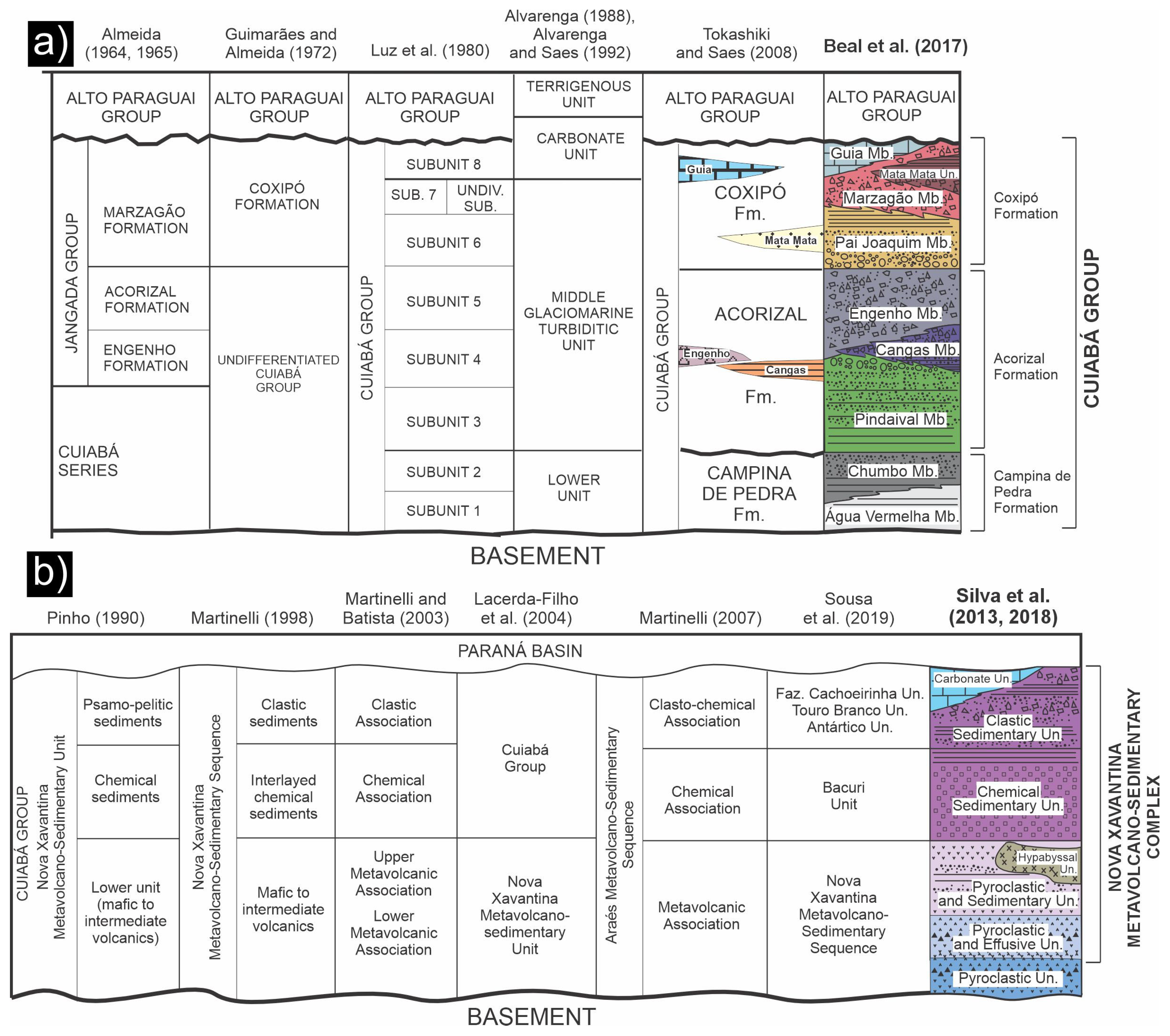
There are transition layers, formed by the interdigitation between metasedimentary lithotypes from the Pindaival and Engenho members. This unit comprises upward coarsening metasandstone to metaconglomerate layers with massive metatillites. These rocks grade to metasandstones, metapelites, sand-clay metarhythmites with decametric dropstones, laminated metatillites, BIFs, and calcareous metapelite layers [22]. The Engenho Member, on top of the Acorizal Formation, comprises red to purple massive metatillites, locally laminated, with metric-scale dropstones (Figure 4a). The Cangas Member occurs solely in the southeast side of the NE–SW-oriented Cangas-Poconé Lineament, a regional shearing structure [22,57]. It is considered to be between the Pindaival and Engenho Members, possibly correlated with the transition layers. The Cangas Member is the host of gold mineralizations in the CP district. It is composed of laminated metatilles (Figure 4b–d), metarhythmites (Figure 4f) with dropstones, carbonaceous phyllites (Figure 4g), with subordinate metapelites, metasandstones, metaconglomerates, and BIFs [23].
The Coxipó Formation, the top unit of the Cuiabá Group, is mostly represented by its basal units, the Pai Joaquim and Marzagão members [22], which host the gold mineralizations in the Cuiabá-Várzea Grande gold district (Figure 3b; [9]). Based on Migliorini’s map [58] and Beal et al.’s stratigraphy [22], de Paula Garcia and Bonfim [9] expanded and reinterpreted the geological mapping of the CVG district (Figure 3b). Here, the description of the mapped units is further detailed.
The Pai Joaquim Member comprises three facies [9] of coarse- to fine-grained metasedimentary rocks. The sand-conglomerate facies is composed of fining-upward layers of oligomictic metaconglomerates with fine-to-coarse-grained matrix, with subordinate metarkose and metasandstones. The silt–clay facies includes light-green, gray, yellow, and red sericitic phyllites (Figure 4h,i), carbonaceous phyllites, and stratified metapelites (Figure 4j,k). In the NE sector of the CVG district, the quartz sandstone facies is represented by massive, light-yellow, pink, and red metasandstones and quartzites, with subordinate metapelites.
The Marzagão Member includes tillite-associated rocks, divided into two facies. The sand–matrix tillite facies is composed of pink and green metatillites with sandy matrix, boulders (Figure 4e), faceted clasts, and, locally, olistoliths, with subordinate metasandstone (Figure 4l). The clay–matrix tillite facies comprises green and grey metatillites with clayey matrix, flat iron pebbles, and associated metapelites and metarhythmites.
The Mata Mata Unit occurs in contact with the São Vicente Granite, and towards the south and northeast, in the Mato Grosso do Sul state, and the Nova Xavantina regions, respectively [22,23,24,30]. This unit is composed of massive metaquartz sandstones, metapelites, and metatillites. The carbonate-dominant Guia Member is restricted to a small area to the north of the CVG district, where it is mapped surrounded by rocks of the Mata Mata Unit [23]. The marine deposited lithologies include calcitic marble, metarhythmites, massive and laminated metasandstones, and metapelites [22].
The Cuiabá Group rocks are deformed and metamorphosed in greenschist facies, within the biotite and chlorite zones [12,17,24,59]. We observed that most of the rocks exhibit evidence of incipient metamorphism, preserving primary sedimentary structures and minerals (such as clay minerals). Greenschist conditions are locally reached in higher-strain zones, usually close to regional shear zones. This first regional metamorphism (M1) is superposed by dynamic (M2) and contact metamorphism (M3) phases. The effects of M2 are widespread, highly mistaken by M1, and include the development of mylonitic, pressure shadow, and porphyroclastic textures associated with asymmetric porphyroblasts. We mapped the contact metamorphism M3, which only occurs close to the São Vicente Granite (Mata Mata Unit), reaching out to pyroxene hornfels conditions (with cordierite and sillimanite in paragenesis) that grade to albite–epidote hornfels facies (albite, chlorite, epidote) in outer areolas.
Detrital zircon U-Pb ages of Cuiabá Group rocks have consistently been showing Archean (as old as ca. 2.8 Ga in CVG and 3.0 in the southern part), Paleo, and Mesoproterozoic (from 2.375 to 1.002 Ga), interpreted as cratonic sources (Table S1 [26,43,44,46,50,60,61,62,63,64,65,66,67], Figure 5a [26,33,60,61,62]). The maximum deposition ages (MDA) are younger in the southern portion of the belt, in Mato Grosso do Sul (MS) state (545 Ma [61]; 494 Ma [26]; 492 Ma [60]), than in the Baixada Cuiabana area (716 Ma [62]; 798 Ma in CP and 654 Ma in CVG [33]). Whole rock Sm-Nd TDM ages are Paleo to Mesoproterozoic, both in the northern (1800–1600 Ma [33]) and southern (1720–1390 Ma [26]) sectors of the Paraguay Belt.
Figure 3.
Detailed maps of the producing regions of the Paraguay Belt Gold Province. (a) Map of the Cangas-Poconé district (after Ganzer and Figueiredo [53]). (b) Map of the Cuiabá-Várzea Grande district (after de Paula Garcia and Bonfim [9], modified and expanded from Migliorini [58]). (c) Map of the Nova Xavantina subprovince (after Silva et al. [36]).
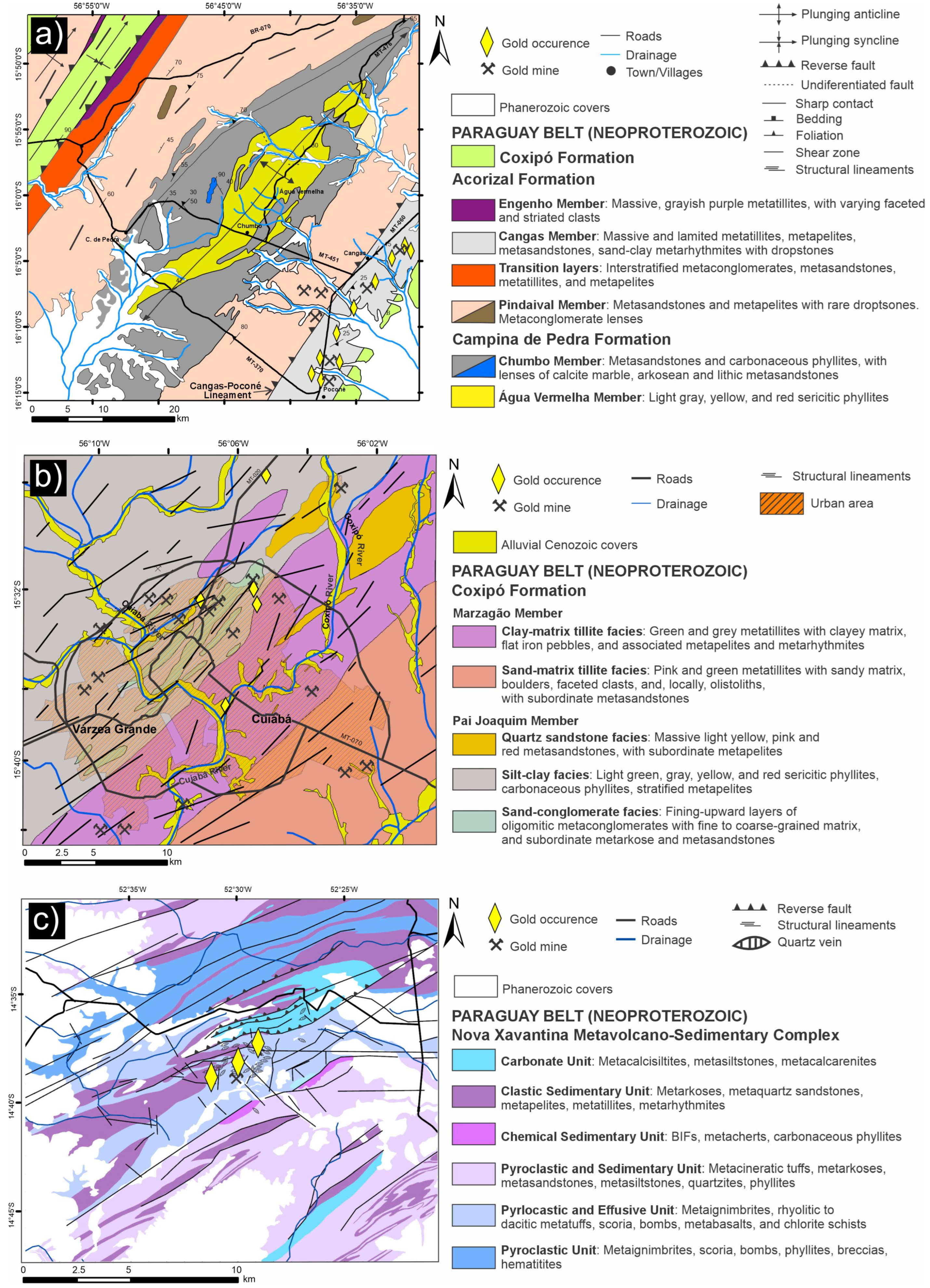
Figure 4.
Cuiabá Group lithotypes in the Baixada Cuiabana subprovince, seen in outcrops and drill cores (a–c,e–g,i–l), as well as in thin sections (d,h). (a) Engenho Member metatillite with metric dropstones; (b) Cangas Member metatillite with S0//S1 and asymmetric quartz porphyroclast, showing reverse-sinistral movement; (c) Sericitized Marzagão Member metatillite, with S0 cut by S1; (d) microscopic features of the Marzagão Member metatillite (cross-polarized light). (e) Marzagão Member metatillite with metric dropstone cut by chlorite veinlets; (f) sand–clay metarhythmite (Cangas Member); (g) Cangas Member carbonaceous phyllite; (h) Detail of silicified Pai Joaquim Member phyllite (plane-polarized light); (i) phyllite in sharp contact with metasandstone; (j) metapelite with bedding marked by alternating organic matter and clay mineral-rich layers; (k) phyllite with sericite and hematite and S/C foliation; (l) metasiltstone with S0//S1. CM: clay minerals; Qtz: quartz; Ser: sericite.
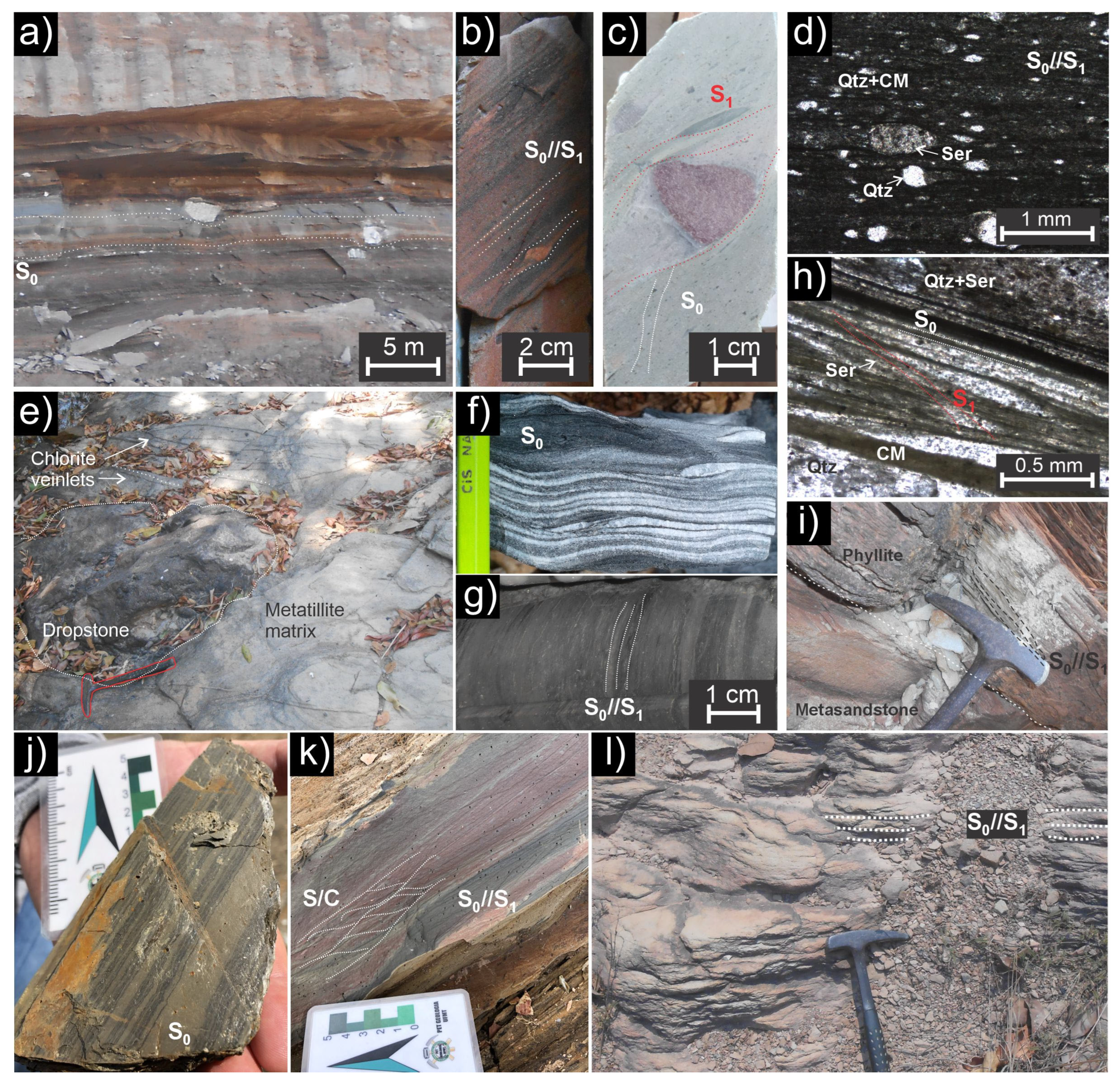
Figure 5.
Summary of geochronological data from the Paraguay Belt Inner Zone. (a) U-Pb detrital zircon ages from Cuiabá Group rocks (modified from [60], with data from [26,33,61,62]). (b) U-Pb detrital zircon ages from Nova Xavantina subprovince rocks (modified from [27]). (c) A summary of geochronological data of units from the Paraguay Belt Inner Zone (complete list of references in Table S1).
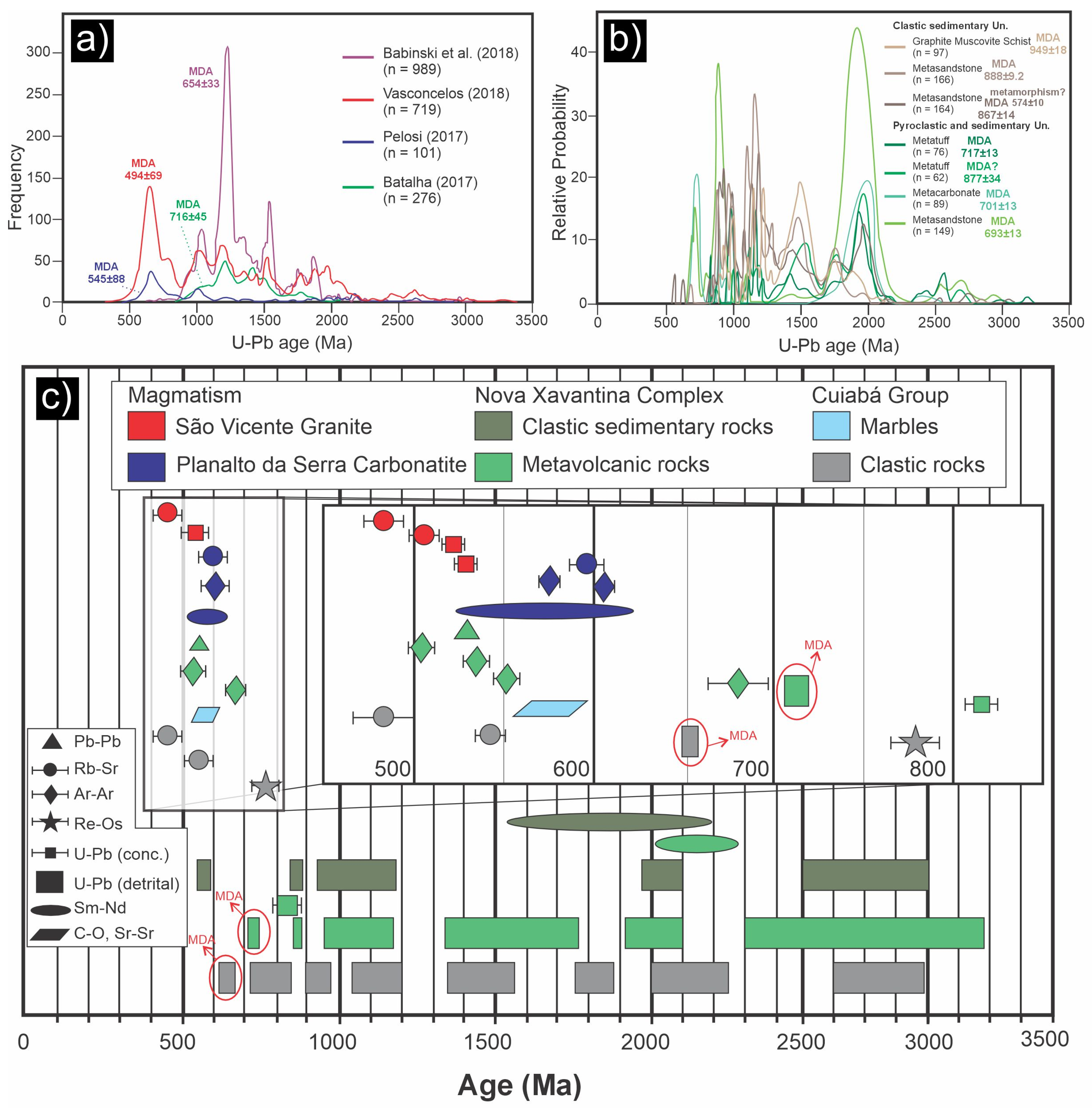
Graphite-rich phyllites of the Campina de Pedra Formation were dated via Re-Os whole-rock analysis at 784 ± 8 Ma, considered the depositional age of this Cuiabá Group basal lithostratigraphic unit (Figure 5c; [50]). The minimum ages are interpreted to mark the Brasiliano cycle deformation and metamorphism and the intrusion of the São Vicente Granite at 528 ± 4, 521 ± 8, 518 ± 4, and 504 ± 9 Ma [33,43,44,63,64]. Early geochronological research estimated the final orogenic stage at 547 ± 5 to 481 ± 19 Ma, based on whole-rock Rb-Sr analyses of Cuiabá Group phyllites [65]. The Planalto da Serra Carbonatite is dated from 576.4 ± 2.3 to 607.7 ± 3.7 Ma based on Ar-Ar in phlogopite of glimmerite, 598 ± 9.6 Ma based on Rb-Sr in calcite (carbonate facies carbonatite), and 570 ± 52 Ma (whole-rock Sm-Nd in glimmerites; [46]).
3.2. Nova Xavantina Subprovince
Although initially attributed to the Cuiabá Group [21,24], the presence of metavolcanic rocks in the Nova Xavantina subprovince has led to different stratigraphic interpretations of the area (Figure 2b; [21,36,37,54,55,56,68]). Here, we adopt a mix of mapping projects by the Geological Survey of Brazil [36,37]. We consider seven lithostratigraphic units: Pyroclastic, Pyroclastic and Effusive, Pyroclastic and Sedimentary, Hypabyssal, Clastic Sedimentary, Chemical Sedimentary, and Carbonate (Table 1). While Silva et al. [36] initially separated Pyroclastic from Pyroclastic and Effusive units (Figure 3c), they later considered them as the same unit and included the intrusions as the distinct Hypabyssal Unit [37]. Additionally, our stratigraphy recognizes the presence of metatillites in both the Pyroclastic and Sedimentary and the Clastic Sedimentary units, based on drill core descriptions.
The basal Pyroclastic Unit comprises metaignimbrites, scoria, bombs, phyllites, breccias, and hematitites [36]. The Pyroclastic and Effusive Unit is composed of rhyolitic to dacitic metatuffs, scoria, bombs, metabasalts, and chlorite schists [37]. Metabasalts present marked foliation with stretched amygdules (Figure 6a,d). Where it occurs associated with carbonaceous phyllites, it is the main host of gold ore. The Pyroclastic and Sedimentary Unit includes metacineratic tuffs, metarkoses, metasandstones, metasiltstones, quartzites, metatillites, and phyllites.
Figure 6.
Drill-core photos (a–c,f,h,j,k) and photomicrographs ((d,e,g,i), cross-polarized light) of Nova Xavantina subprovince lithotypes. (a) Foliated metabasalt with stretched amygdales. (b) Gabbro cut by quartz and magnetite veinlets. (c) Graphite phyllite progressively replaced by pervasive silicification. (d) Foliated metabasalt with stretched amygdales filled with metamorphic chlorite. (e) Sericite and quartz-altered graphite phyllite. (f) Foliated metatillite. (g) Pyrite veinlet cutting sericite–quartz matrix in metatillite. (h) Hematite-rich metarhythmite. (i) Detail of layering in hematite-rich metarhythmite. (j) Laminated fine to medium-grained metasandstone. (k) Folded S0//S1 and late S2 foliation developed in phyllite. Chl: chlorite; CM: clay minerals; Gr: graphite; Hem: hematite; Mag: magnetite; OM: organic matter; Py: pyrite; Qtz: quartz; RF: rock fragment; Ser: sericite.
The intrusive rocks, metagabbros (foliated or massive), are part of the Hipoabyssal Unit (Figure 6b). The Chemical Sedimentary Unit is composed of BIFs, metacherts, and carbonaceous phyllites. Carbonaceous phyllites are rich in graphite (Figure 6c), quartz, and sericite (Figure 6e) and make contact with metavolcanics in mineralized zones. The Clastic Sedimentary Unit comprises metarkoses, metaquartz sandstones, metapelites, metatillites (Figure 6f,g), and metarhythmites. Due to its hematite-rich layers and well-defined layering (Figure 6h), metarhythmites are often mistaken for iron formations. However, these rocks exhibit clastic features, such as round grains and coarsening upward (Figure 6g). Metaquartz sandstones are common on the top of the unit, showing alteranance between fine and coarse quartz grains (Figure 6j). The final register is marked by the Carbonate Unit, which comprises metacalcisiltites, metasiltstones, and metacalcarenites. The rocks in the NX subprovince are highly deformed, with S0 parallelized to S1 foliation and both cut by S2 crenulation cleavage (Figure 6k). These lithotypes were subjected to green schist metamorphism, with chlorite, epidote, and sericite in metavolcanics and metasedimentary rocks. Local dynamic metamorphism occurs in shear zones, marked by mylonitic texture.
Detrital zircon ages show an even older source than those from the Cuiabá Group (ca. 3.2 Ga), which spans the Paleo and Mesoproterozoic (2.38 to 1.18 Ga) for metatuffs, metasandstones, and metacarbonate (Figure 5b; [27]). The age of 822 ± 9 has been interpreted as the age of the metatuff magmatism [69]. Younger, Neoproterozoic ages of the metacarbonate (MDA of 701 ± 13 Ma) and metasandstone (MDA of 693 ± 13 Ma) were detected when compared with metavolcanics (MDAs of 877 ± 34 to 717 ± 13 Ma) and glaciomarine (clastic sedimentary) rocks (MDAs between ca. 950 and 865 Ma). These data have been interpreted as a change in a continental, cratonic supply for a foreland regime in the Neoproterozoic [27].
The Sm-Nd TDM ages obtained from both metasedimentary rocks (2180–1500 Ma) and metatuffs (2270–2130 Ma) are older than those of the Cuiabá Group rocks [26,27]. Ar-Ar ages of basic metavolcanic rocks span 684 ± 12 (interpreted as magmatism), 531.3 ± 0.5–553.7 ± 0.6 (metamorphism), and 504 ± 12 (hydrothermalism; [19,25]). These results are consistent with the Pb-Pb in sulfide intercept age of 531 Ma, corresponding to metamorphism [19].
4. Structural Geology
The structural evolution of the Baixada Cuiabana subprovince and associated gold mineralization has been addressed by numerous authors (Table S2 [12,30,37,57,59,70,71,72,73,74,75,76,77,78]). From works focused solely on structural geology to metallogeny, tectonics, basic mapping, and stratigraphy, many models were presented to explain the structural framework of the northern Paraguay Belt. In general, these models can be divided into two major groups, differing in the number of deformation phases: three [12,57,70,71,72] or four [59,73,74,75,76,78]. In this work, we align with the authors who consider three deformation phases: the first two compressive and the last extensional (Table 2). Our structural framework also considers the NX subprovince [37,77].
Table 2.
Characteristics of the three deformation phases considered for the Paraguay Belt.
The deformation structures in the Cuiabá Group developed over primary structures. These rocks often preserve sedimentary S0 structures. Lamination and compositional and/or granulometric layering are the most common primary structures, marked by alternance between organic matter and clay-rich layers (metapelites), quartz and clay minerals (metarhythmites), or fine- to medium-grained quartz (metasandstones). Also, fining and coarsening upward structures are observed in coarse-grained facies (such as metaconglomerates and metagraywackes). Locally, ripple marks and cross-bedding are preserved. In metatillites, the laminated matrix is disturbed by dropstones and faceted pebbles, which serve as a record of their glacial deposition.
The early deformation is marked by D1 tight, asymmetric to recumbent folds with an NE–SW axis, as well as associated anticlines and plunging synclines, with the main dip towards NW in the CVG district and NX subprovince (vergence towards the SE). These folds are associated with S1 axial-plane foliation, which cuts S0 (Figure 7a) at a low angle in the limbs but becomes perpendicular as it approaches the hinge lines (Figure 7c). Transpressive sinistral F1 shear zones are related to the D1 phase, forming S-C-C’ foliation locally. The Cangas–Poconé Lineament thrust is the most metallogenically important shear zone of this stage, since it hosts all the gold deposits known in the CP district. In fact, this lineament corresponds to a zone with multiple NE–SW-oriented thrusts and shearing structures marking the contact between the Cangas and Pindaival members (Acorizal Group). The Cangas–Poconé Lineament is marked by SE-verging S1 folds and F1 shear zones (dipping to NW) transposed by NW-verging D2 folds and faults [57]. In D1, early usually folded or boudinaged NE–SW-oriented V1 veins occur parallel to S0. In late D1, the main ENE–WSW mineralized quartz vein in NX was emplaced in a ductile shear zone.
Figure 7.
Structures of the Baixada Cuiabana subprovince. (a) Oblique S0 bedding and S1 foliation in metapelites, with quartz and albite alteration. (b) Crenulated S0//S1, and S2 filled with hematite. (c) Folded S0, with S1 and S2 foliations, added to an F3 fault, V1 and V3 veins (Salinas Mine, Cangas-Poconé district). A croquis with structures is presented at the bottom left. (d) Folded S0//S1 cut by S2 foliation, F3 fault, V3 vein, and quartz pocket (Casa de Pedra Mine, Cuiabá-Várzea Grande district).
The D2 phase is marked by a progressive compressional deformation following D1. This phase is characterized by open to gentle folds with an NE–SW, NW–SE, or E–W axis and crenulation. The S2 foliation is marked by a crenulation cleavage with general vergence towards SE. Additionally, transcurrent sinistral shear zones are observed (Figure 7b). The NE–SW-oriented, straight V2 veins correspond to this phase.
The last phase, D3, is marked by normal and extensional NW–SE, NE–SW, and N–S faults and shear zones. No foliation or folds are observed in this phase. The late NW–SE straight V3 veins are the main ore hosts in the Baixada Cuiabana subprovince (Figure 7d). They also occur in NX but merely remobilize sulfides and gold locally.
Based on the structures observed and previous inferences, we present a three-phase model to explain the deformation evolution of the Paraguay Belt Gold Deposits (Figure 8). The first phase (Figure 8a), D1, is represented by ductile structures formed in a transpressional NW–SE regime with SE vergence. During the second phase (Figure 8b), D2, ductile–brittle structures were nucleated over D1 folds, ductile shear zones, and S1 foliation. The transposition was carried out at different scales, thereby reducing the occurrence of interference patterns. The main D2 vergence is to SE in CVG and NX, while the CP sequences also display transport to the opposite direction (NW and SE). At last, the brittle D3 phase is marked by extensional efforts in a Riedel-like pattern according to NE–SW opening (Figure 8c), forming normal faults and fractures. Veins are formed in every phase, with the V1 being the main ore in NX and the V3 in the BC subprovince. In the late D3 phase, sulfide and gold remobilizations occur as veinlets and disseminations in the CP district, and as veinlets in the CVG district and the NX subprovince.
Figure 8.
Proposed schematic model of the deformation evolution of the Paraguay Belt Gold Province. (a) D1 transpressional, ductile phase with main vergence to SE. (b) D2 transpressional, ductile-brittle phase with main vergence to SE in Cuiabá-Várzea Grande and Nova-Xavantina, and to NW in Cangas-Poconé district. (c) Late extensional D3 phase, with main opening in NE–SW.
5. The Paraguay Belt Gold Deposits
The gold occurrences and deposits of the northern Paraguay Belt are distributed across three regions, from southwest to northeast: Cangas-Poconé (CP), Cuiabá-Várzea Grande (CVG), and Nova Xavantina (NX). The first two are in a closer context, as part of the geomorphological–socioeconomic region of the Baixada Cuiabana (BC). Historically, the three producer districts have produced more than 50 tons of gold since the eighteenth century. The Baixada Cuiabana was designated a gold province [22,71] and later renamed the Cuiabá–Poconé province [12]. However, here they are considered to constitute a subprovince comprising two districts (CP and CVG). Together with the Nova Xavantina subprovince, they form the Paraguay Belt Gold Province. To be part of the same metallogenic province, a mining district must meet some requirements [79]: to have a coherent age, metallotects, and tectonics, to belong to the same event, and have formed by the same metallogenic event (as presented further in the discussion topic). Even within the same province, it is natural that these areas will have distinct features, reflecting variations in geological environments.
The classification proposed and the features presented here are based on extensive fieldwork on occurrences and gold deposits, added to regional mapping in selected regions and previous work descriptions (Table S3 [12,21,54,55,57,72,73,75,77,80,81,82]). The differences in descriptions compared to previous authors can be explained by the level of exposure, the availability of drill cores, and the overall focus of the research. Based on regional and genetic groupings, the most prominent characteristics of each district are highlighted (Table 3).
Table 3.
Summary of geological and metallogenic features of each district and subprovince of the Paraguay Belt Gold Province.
In addition to being separated by geographic distance, the BC and NX subprovinces are in different mining production scenarios. In BC, both CP and CVG districts display numerous mines and production sites. These operations are mostly related to semi-mechanized and industrial mines, with some artisanal mines (“garimpos”). In contrast, in the NX subprovince, production is carried out at one mine by the NX Gold/Ero Brasil Xavantina company, which operates underground on an industrial scale and is oriented to the international, exchange-based market. The three regions remain of interest to mining exploration projects.
5.1. Cangas–Poconé District
The Au deposits and occurrences in CP are located in a zone about 7 km wide and 45 km long along the Cangas–Poconé Lineament, comprising the municipalities of Poconé and Nossa Senhora do Livramento (northeast). This is the most prolific gold producer among the three areas. According to tax data from Brazil’s National Agency of Mining (ANM), the CP district’s production was estimated at about 2.1 tons of gold in 2024, bringing the total to ~14.8 tons from 2020 to 2024 [10,11].
The gold mineralizations in the Cangas–Poconé district are hosted by metasedimentary rocks from the Acorizal Formation (mainly Cangas Member [83]). Each semi-mechanized mine is about 200 to 500 m wide, and industrial mines can reach up to 1,4 km. Their pits are commonly NW-oriented, reflecting a structural control associated with the V3 veins (the main ore hosts). Five types of gold mineralizations are described in the CP district (in order of gold grades): (i)V3 veins in carbonaceous phyllites, tillites, and metasandstones; (ii) disseminated sulfides and sulfide veins in altered metarhythmites and phyllites; (iii) hydrothermal alteration zones in phyllites (sericite and albite-rich); (iv) V2 veins in carbonaceous phyllites; (v) V1 veins in carbonaceous phyllites. The veins in the BC subprovince are referred to as “costelão”, “travessão”, and “filão” by artisanal miners.
V1 veins are folded and parallel to S0 or S0//S1, which are cut by straight V2 veins (Figure 9a). These two vein groups host a low to medium grade (V1 = 0.43–0.47 g/t, V2 = 0.40–5.10 g/t), which are related to pyrite, magnetite, and hematite concentrations. The main ore is the V3-vein family (1.10–11.05 g/t, up to 100), which is late and cuts mainly deformed carbonaceous phyllite layers. Less commonly, these veins are mineralized by cutting metatillites and metasandstones. The V3 veins are straight, with a medium dip angle to subvertical and sharp to curved contacts. They are about 0.10 to 0.80 m thick and may reach 120 m in length. The mineralized V3 veins, besides quartz, are composed of pyrite, magnetite, hematite, and locally chalcopyrite.
Figure 9.
Outcrop, drill core, and hand specimen photos (a–j), and photomicrographs (k–m) of hydrothermally altered and mineralized lithotypes from the Cangas–Poconé district. (a) Folded and boudinaged quartz V1 vein in carbonaceous phyllite, cut by thin V2 vein; (b) V1 vein cut by V3 vein with associated albite and sericite alteration; (c) silicified metarhythmite with granite dropstone; (d) V3 vein with pyrite cutting silicified phyllites; (e) albite concentration in V3 vein; (f) stratified metasandstone with disseminated pyrite and boxworks; (g) disseminated pyrite ore developed in S2 of silicified phyllite; (h) pyrite veinlet cutting silicified phyllite; (i) disseminated pyrite developed within S0//S1 of sericitized and silicified metapelite; (j) visible gold in weathered V3 ore; (k) chlorite alteration in sericitized silicified phyllite (plane-polarized light); (l) carbonate and sericite alteration in deformed metarhythmite (cross-polarized light); (m) two generations of magnetite and one of euhedrical pyrite (reflected, non-polarized light). Ab: albite; BW: boxworks; Cal: calcite; Chl: chlorite; CM: clay minerals; IOH: iron oxides and hydroxides; Mag: magnetite; Py: pyrite; Qtz: quartz; Ser: sericite.
V3 veins are associated with hydrothermal alteration zones (Figure 9b) that host gold ore (0.09–8.14 g/t). The main alterations are silicification and sericitization, with local carbonatization, sericitization, and chloritization, which are better developed in phyllites and metapelites and, secondarily, in metatillites. Besides local silicification, metasandstones are hardly affected by hydrothermal alterations. Previous authors describe hydrothermal alteration in the Baixada Cuiabana subprovince with potassic feldspar [12,84], which occurs only as local substitution of albite. Also, some researchers link iron and manganese oxides to hydrothermal alteration [78]. Actually, these oxides are weathering products.
Sericitization and silicification are usually pervasive in ~0.3 to 1.5 m-thick halos with diffuse contacts from V3 veins (Figure 9c) or S2 foliation. Albitization can be pervasive in up to ~1 m-thick halos, as veinlets or inside the veins (Figure 9e). Chlorite (Figure 9k) and carbonate alteration usually occur as disseminations in sericite alteration zones proximal to quartz veins. The alteration is more intense where there is superimposition of structures, such as S1 and S2 foliations (Figure 9l), or foliations and shear zones.
Pyrite is the main ore mineral and occurs mainly in V3 veins (Figure 9d). Also, there are pyrite disseminations and boxworks in altered phyllites, metatillites, and local metasandstones (Figure 9f). While phyllite-hosted mineralizations are common and spread throughout most of the Cangas–Poconé Lineament, the metandstone-hosted gold ore was exploited mainly in the northeastern part of the subprovince (Quilombo Mata Cavalo).
Disseminated pyrite in sericitized and silicified metapelites (Figure 9g) and metarhythmites (Figure 9i) comprises a secondary ore with grades of 1.28–25.15 g/t of Au [72]. Under the microscope, it is noticeable that these sulfides developed between two generations of magnetite, replacing and being replaced by them (Figure 9m). Pyrite veinlets are found locally, cutting silicified phyllites (Figure 9h). Visible gold may appear, mainly in weathered veins rich in secondary minerals, such as iron oxides and hydroxides, and clay minerals (Figure 9j).
5.2. Cuiabá–Várzea Grande District
The gold deposits and occurrences of the Cuiabá–Várzea Grande district (CVG) are situated within a perimeter of approximately 140 km, an irregular ellipsoidal area with a 40 km N–S axis and a 55 km E–W axis, encompassing these cities’ urban and rural areas, as well as additional occurrences in Santo Antônio do Leverger. Each mine is about 50–250 m wide, while the Casa de Pedra mining complex is about 2 km long. Including the capital city metropolitan area, the CVG district has historically been known for its gold production, accounting for ~0.86 tons in 2024 and ~2.3 tons from 2020 to 2024 [10,11].
Deformed metasedimentary rocks of the Coxipó Formation (Pai Joaquim and Marzagão members) host the gold mineralizations of the CVG district, including phyllites, fine-grained metasandstones, metasiltstones, and metatillites. As observed in the CP district, the main gold ore is found in the V3 veins, while alteration halos and later veins host secondary ore. The gold mineralizations in the CVG district can be summarized as follows: (i) V3 veins in phyllites and metasandstones; (ii) disseminated sulfides in albite alteration zones; (iii) hydrothermal alteration zones in phyllites and metasandstones (sericite and albite-rich); (iv) V1 veins in metasandstones and phyllites; (v) V2 veins in metasandstones and phyllites.
Additionally, late thin veins that cut V3 are locally documented with gold grades. However, it remains unclear whether these late veins represent a late mineralization stage or merely local remobilization near veins formed in earlier stages. The overall geometry and orientation of the CVG veins are similar to those described in the CP district. NE–SW-oriented V1 veins are folded and boudinaged, which are cut by NE–SW V2 straight veins and both by NW–SE V3 veins (Figure 10a). The main ore, V3 veins usually host sulfides (mainly pyrite, with associated galena and chalcopyrite), which are often oxidized, resulting in hematite and goethite (Figure 10b) and, locally, visible gold. These veins display Au grades from 0.499 to 5.615 g/t when cutting hydrothermally altered phyllites.
Figure 10.
Outcrop and hand-specimen photos (a–k) and photomicrographs ((l,m), cross-polarized light) of the variety of hydrothermal alteration and mineralization styles observed in the Cuiabá–Várzea Grande district. (a) Cutting and structural relationships among V1, V2, and V3 veins emplaced in metasandstone and metapelites; (b) V1 folded vein cutting metasandstone and being cut by oxidized sulfide-rich V3 vein; (c) chlorite alteration in contact with quartz vein (V3); (d) regional chlorite veinlets cutting metatillite matrix; (e) albite and sericite alteration zones developed over phyllites; (f) detail of hydrothermal albite cutting sericite phyllite; (g) pervasive sericite alteration replacing early hydrothermal albite and quartz; (h) pervasive sericite alteration with diffuse contacts replacing carbonaceous phyllite; (i) disseminated carbonate alteration in metasiltstone; (j) disseminated pyrite in sericitized phyllite; (k) cubic pyrite crystals disseminated in albite and sericite alteration zones; (l) alteration zone with quartz and albite, replaced by sericite; (m) pervasive sericite replacing matrix and clasts in metatillite. Ab: albite; Cal: calcite; Chl: chlorite; CP: carbonaceous phyllite; Py: pyrite; Qtz: quartz; Ser: sericite.
Mineralized veins cutting metasandstones are more frequent in the CVG district compared to the western extension of the Baixada Cuiabana subprovince. These metasandstone-hosted occurrences are exploited by artisanal miners, while most of the industrial mines focus on ores hosted by fine-grained metamorphic rocks. Hydrothermal alteration is recognized in the country rocks, with thin green chlorite pockets in direct contact with the quartz veins (Figure 10c). Chloritization also occurs regionally, as veinlets cutting metamorphosed tillite and pelite layers (Figure 10d). As happens with sericite, there are two types of chlorite (metamorphic and sedimentary). The metamorphic minerals are inside S0 and S1 planes, with sharp contacts, while hydrothermal halo sericite and chlorite exhibit diffuse and irregular contacts in veins and pockets, replacing metasedimentary minerals (Figure 10h,m).
Sericite alteration is commonly paired with albitization and locally with quartz (diffractograms in Figures S1–S5), resulting in combined alteration halos ranging from centimeters to tens of meters (Figure 10e–g). Albite and sericite occur pervasively and replace the metasedimentary rocks’ matrix and clasts (Figure 10l,m). These sericite–albite–(quartz) alteration halos are directly associated with the gold ore zones and host ore minerals themselves. Phyllites, metasiltites, and metasandstones affected by sericite (0.014–1.655 g/t of Au) and albite (1.222–2.931 g/t of Au, weathered) alteration halos host centimetric cubic pyritic crystals (Figure 10j,k). In addition, late ferrocalcite–siderite disseminations are described over unaltered or sericitized fine-grained rocks (Figure 10i).
5.3. Nova Xavantina Subprovince
Although the number and area of gold occurrences are far less expressive than in the Baixada Cuiabana, the Nova Xavantina subprovince hosts the most well-structured industrial mine in the Paraguay Belt Gold Province. Besides this deposit, a few gold occurrences and tens of non-mineralized quartz veins are known in the area. The Nova Xavantina gold mine exploits an ENE–WSW-oriented quartz vein with an associated alteration zone developed over metabasalts and carbonaceous (graphite-bearing) phyllites. The ore zone is about 500 m wide, with unknown extension, and 590 m deep (from about 430 to −150 m). Based on estimates derived from tax data, the NX subprovince accounted for approximately 6.6 tons of gold between 2020 and 2024, including 1.82 tons in 2024 [10,11].
Besides the presence of bimodal metavolcanic units, the NX mineralization differs from the BC subprovince in fundamental structural aspects. Firstly, the overall structure is ENE–WSW in the NX subprovince, while in Baixada Cuiabana, mineralized veins are mostly NE–SW. Also, regarding the timing of these vein emplacements, which is late-deformation, associated with late D3 brittle deformation (faults and fractures) in the BC subprovince. In contrast, gold-bearing veins in NX are syn-compressional, associated with late folding (D1) in a ductile–brittle regime. Therefore, in this subprovince, the gold ore is found in the (i) V1 thick lode, in contact between metabasalt and carbonaceous phyllite; (ii) alteration zones in metabasalts and carbonaceous phyllite; (iii) late V3 veins, cutting and remobilizing from the main lode; and (iv) other rocks, such as BIFs and altered metasedimentary rocks, to a lesser extent.
The main deposit (the NX Gold mine) is 18 km northwest of the Nova Xavantina urban area. The ore is exploited on a metric-scale quartz–graphite vein developed during ductile transpressive shearing and folding (Figure 11a). The main vein is cut by late thin, extensional veins that may remobilize gold. Hydrothermal alteration zones in the host and country rocks are recognized, rich in graphite, chlorite, sericite, hematite, albite, and quartz. Some of these minerals also occur in metamorphic parageneses, but with frankly distinct petrographic features. While the metamorphic graphite is subhedral to euhedral and occurs in masses, hydrothermal graphite is found in veinlets and pervasive zones as anhedral grains (Figure 11b; diffractogram in Figure S6). The graphite pervasive alteration zones cut carbonaceous phyllites and metavolcanic rocks, while veinlets spread over metarhythmites, metasandstones, and metatillites.
Figure 11.
Macroscopic (a–e,i,j) and thin-section photos (f–h) with different hydrothermal alteration and mineralization styles from Nova Xavantina subprovince. (a) Main mineralized quartz vein with associated graphitization, emplaced in the transpressive shear zone with drag folds, observed in underground mine; (b) graphite stringers cutting metasandstone; (c) hydrothermal breccia cutting metabasalt; (d) sericite alteration cutting pervasive albite, quartz, and graphite alteration; (e) calcite-filled hydrothermal breccia developed over carbonaceous phyllite; (f) deformed, hematite-chlorite altered metabasalt; (g) hydrothermal breccia under the microscope (plane-polarized light); (h) albite alteration zone cut by sericite veinlet (crossed-polarized light); (i) detail of sulfides in mineralized quartz vein with graphite; (j) euhedral, hexagonal centimetric quartz crystals with cubic galena. Ab: albite; Bio: biotite; Cal: calcite; Chl: chlorite; Gal: galena; Gr: graphite; Hem: hematite; Py: pyrite; Qtz: quartz; Ser: sericite.
Similarly, metamorphic chlorite and sericite form the matrix of metavolcanic and metasedimentary rocks but are interpreted as hydrothermal when pervasive replacement and breccia zones are present, commonly associated with hematite and calcite (Figure 11c). Chloritized metabasalts often are magnetite-rich. Additionally, hydrothermal chlorite may cut the metabasalt fabric, filling vesicles or replacing amygdules’ minerals (Figure 11f). Pink hydrothermal albite is found in outer halos, associated with quartz and sericite overprinting metasedimentary rocks (Figure 11d). These minerals replace the metamorphic parageneses pervasively with irregular contacts (Figure 11g,h). Late calcite veinlets, stockworks, and breccia occur in different lithotypes (Figure 11e).
The NX mine auriferous ore is associated with sulfides in the main quartz load: pyrite, galena, pyrrhotite, and chalcopyrite (Figure 11i,j). Galena is the most important indicator of Au grades. Although free gold was described in past artisanal mines [21], it is rare and millimetric in the NX mine. Besides the main load, metabasalts, and carbonaceous phyllites, gold mineralizations were described in other lithotypes (such as BIFs and other metavolcanics; [21,54,81,85]). Additionally, ore minerals and Au grades were detected in hydrothermal alteration zones. Pyrite and galena sulfur isotope analysis indicated coherent magmatic signatures (δ34S from −1.1 to +0.9 ‰; [19]).
5.4. Fluid Inclusions
A few researchers have addressed the evolution of fluid inclusions in the Paraguay Belt Gold deposits. Pioneer studies were conducted in the Baixada Cuiabana quartz veins [18] and then in the Nova Xavantina subprovince [54,85]. A decade later, veins from different artisanal mines in both Cangas–Poconé and Baixada Cuiabana districts, added to the São Vicente Granite, were analyzed [12]. These data were compiled and compared in Table 4 and Figure 12.
Table 4.
Summary of fluid inclusion data obtained in quartz veins from the Paraguay Belt gold deposits and occurrences, with data from Alvarenga et al. [18], Barboza [12], and Martinelli [85]. Secondary inclusions reported by Barboza [12] were not considered. The data from the São Vicente Granite includes the four described groups.
Figure 12.
Fluid inclusion microthermometric data from Paraguay Belt gold-hosting quartz veins. (a) Ice-melting temperature versus homogenization temperature plot of aqueous inclusions with samples from Cangas, Abdala (Cangas–Poconé district), and Casa de Pedra (Cuiabá–Várzea Grande district), added to São Vicente Granite. Data from [12]. (b) Salinity versus homogenization temperature plot with samples from the three mining areas. Data from [12] (Cangas, Abdala e Casa de Pedra), [18] (Casa de Pedra e Jangada), and [54,85] (Nova Xavantina). Fields from [86]. CP: Cangas–Poconé district; CVG: Cuiabá–Várzea Grande.
While quartz veins from non-mineralized areas (Jangada and BR-070) are aqueous or have nitrogen-methane phases, the Casa de Pedra gold deposit displays aqueous and aqueo-carbonic fluid inclusions [18]. Aqueo-carbonic fluids are found mainly in late, mineralized V3 veins [12]. Data obtained by Alvarenga et al. [18] indicate lower homogenization temperatures (100–240 °C) with varying salinity (0.67–17.0 wt.% NaCleq) for aqueous inclusions. The authors reported N2–CH4 inclusions in quartz veins at the BR-070 federal highway (113–126 °C). The CO2–H2O veins yielded higher homogenization temperatures at this site (280–360 in folded and 260–410 °C in perpendicular veins) and in the Casa de Pedra mine (240–420 in folded and 260–400 °C in perpendicular veins).
The fluid inclusion studies conducted by Barboza [12] in this mine, plus the Abdala and Cangas mines (in the CP district), yielded higher homogenization temperatures and a narrower salinity range. The early, folded V1 veins are associated with salinities from 2.0 to 7.0 wt.% NaCleq and temperatures between 220 and 260 °C in the CVG district. In the Cangas mine, these veins have lower salinities (2.1–3.0 wt.% NaCleq) and higher temperatures (340–360 °C). The late V3 veins, main gold ore hosts, 340–360 °C). The late V3 veins, main gold ore hosts, are close to these temperatures in the three analyzed deposits: 280–320 °C in the Casa de Pedra mine (2–3.9 wt.% NaCleq); 280–354 °C in the Abdala mine (3.2–7.0 wt.% NaCleq); and 320–340 °C in the Cangas mine (3.0–5.8 wt.% NaCleq). The pseudosecondary inclusions in all the veins yielded lower temperatures (160–280 °C) than the primary ones.
The inclusions of auriferous veins were compared with those in veins of the São Vicente Granite [12]. The NW–SE-oriented veins have starkly distinct fluid compositions, distinguished from the ore-hosting veins by the lower ice-melting temperatures of the aqueous inclusions (Figure 12a). Hence, the aqueous inclusions of the granite’s veins present much higher salinities (6.59–46.6 wt.% NaCleq), compared to the gold-rich quartz veins. Additionally, the granite veins display higher homogenization temperatures for H2O–CO2 inclusions (297–450 °C).
Fluid inclusion studies carried out by Martinelli [54,85] showed a similar temperature behavior in the Nova Xavantina subprovince. The author identified aqueo-carbonic and aqueous inclusions in the ENE–WSW vein system, with higher homogenization temperatures of H2O–CO2 inclusions (300–347 °C). The aqueous inclusions yielded slightly lower homogenization temperatures in barren veins (215–258 °C) in comparison with ore-hosting veins (274–287 °C). The author also describes N2–CH4 phases associated with H2O–CO2 inclusions.
In the homogenization temperature versus salinity plot (after [86]), most of the data from these deposits, including all the Paraguay Belt gold subprovinces, are associated with lode gold deposits (Figure 12b). Pseudosecondary inclusions in Casa de Pedra and Abdala (in the northern BC subprovince) are similar to epithermal systems, possibly indicating later, colder fluids.
6. Discussion
6.1. Stratigraphic and Tectonic Evolution
Despite focusing on different areas and different subjects, many researchers have been agreeing on some basic points regarding the tectonic evolution of the northern Paraguay Belt and its gold mineralizations ([12,17,19,22,23,31,38,59,70] and others): (i) these rocks correspond to a metasedimentary sequence, with metavolcanics restricted to the Nova Xavantina region; (ii) they were deposited in a Neoproterozoic glaciolacustrine to glaciomarine setting; (iii) their deformation results from an continental collision related to the Brasiliano/Pan African orogenic cycle. The tectonic setting has been interpreted as a system composed of rift-passive margin [12,22,23], rift-ocean [24,25], passive margin-active margin-foreland [26], and rift-passive margin-foreland [27]. Also, different approaches were made to correlate the Cuiabá Group (in the Baixada Cuiabana subprovince) with the lithotypes of the Nova Xavantina subprovince [21,24,27,68].
Here, we present a chronostratigraphic chart intended to correlate the metamorphosed supracrustal rocks of the northern Paraguay Belt, based on stratigraphic, geochronological, and gold metallogeny data (Figure 13). Our model goes beyond, accounting for sea-level variations and their correlations with global glaciations. This approach provides more robust constraints on the tectono-metallogenic evolution of the Paraguay Belt and its gold deposits.
Figure 13.
Chronostratigraphic chart with ages, ore hosts, inferred sea level changes, and global glaciations. The time span of glaciations according to [87,88]. CP: Cangas–Poconé district; CVG: Cuiabá–Várzea Grande district; NX: Nova Xavantina subprovince.
The older units are to the west (Campina de Pedra and Acorizal formations), in the Cangas–Poconé district. The Campina de Pedra Formation and the overlying Pindaival Member (Acorizal Formation) show evidence of a rift-controlled, lacustrine deposition [22,23]. Beal et al. [22] interpreted these units as a basal sequence of fine-grained rocks (including carbonaceous rocks) deposited by decantation, and the coarser units as turbiditic flows. The grain size increasing from Água Vermelha and Chumbo members to the Pindaival Member is a response to the progressive filling of the rift basin. The Acorizal and Coxipó Formations were interpreted by Tokashiki and Saes [23] as deposited in a glaciomarine setting developed over a passive margin. However, according to Beal et al. [22], these units correspond to different stratigraphic sequences. The intermediate sequence, represented by the Cangas and Engenho members, was deposited in a glaciolacustrine environment. Following it, the upper sequence (Coxipó Formation) formed in a glaciomarine environment in progressive retraction (Pai Joaquim, Marzagão, and Mata Mata members) until depositing post-glacial carbonate–pelite facies (Guia Member [22]).
The southern portion of the belt and the NX subprovince have been correlated to the undivided unit [12,23,24,70], which corresponds to the top Mata Mata Unit [22]. Due to its spatial extent, we considered it the Mata Mata Member rather than a unit. While this member comprises metatillites, metasandstones, and metapelites, these rocks are present in two formations of the Cuiabá Group and more than one member, so they are not reliable for this correlation. Yet, even disregarding the metavolcanics, there are more lithotypes in the NX subprovince than in the Mata Mata Member (e.g., carbonaceous phyllites, carbonates, BIFs, and rhythmites). Some of these sedimentary members may correlate with the upper parts of the Cuiabá Group, such as the Carbonate Unit and the Guia Member.
Considering stratigraphic and geochronological data, it is more plausible that the NX subprovince records the rift opening, with the main magmatism in its late stages, followed by passive margin and foreland deposition. The younger age of metatuff (717 Ma) is close to the older Ar-Ar age in Basalt (684 ± 12 Ma; [25]), while the older TDA (877 Ma) is in the same range as the age of 822 ± 9 Ma, previously suggested for the acid metavolcanics [69]. The older Tonian volcanics may have extruded in parallel with the deposition of the Campinas de Pedra Formation, while the main volcanism is recorded in the Cryogenian, simultaneously with the Pindaival Member sedimentation (late rift). This scenario suggests that the rift opened first in the western part of the province, in the CP district, and then spread towards the south (Mato Grosso do Sul state), and the east/northeast (CVG district and NX subprovince).
Maximum depositional ages of the Cuiabá Group are younger in the southern (591–602 Ma; [26,27,61]) than in the northern part (932 Ma [62]; 652 Ma [33]). In the Nova Xavantina region, detrital zircon ages from the clastic sedimentary rocks display an older MDA (949 Ma in schist and 888–867 Ma in metasandstones) than the metavolcanics (877–717 Ma) and their associated sedimentary rocks (701 Ma from metacarbonate and 693 Ma in metasandstone) [27]. The deposition age of the Cuiabá Group, estimated by Re-Os dating in graphitic phyllite, is 784 ± 8 Ma [50], while its minimum deposition age in the northern part has been considered to be about 652 Ma [33].
The carbonate deposition was interpreted to have developed in the late Neoproterozoic (590–550 Ma; [67]), while the carbonates from Nova Xavantina have an MDA of 701 ± 13 Ma [27]. In this case, we can infer that both subbasins underwent the three sedimentation episodes, with the NX subprovince starting later. They correspond to two volcano–sedimentary cycles, followed by a late QPC (quartzite–pelite–carbonate) unit. The early deposition (glaciolacustrine) period spans from ~800 to 650 Ma, the second (glaciomarine) period spans from ~717 to 650 Ma, and the final (glaciomarine to shallow marine) period spans from ~590 to 550 Ma. Detrital zircons from the lower units of the Cuiabá Group (Campina de Pedra and Acorizal Formation) have mostly Mesoproterozoic or older ages, while the upper unit (Coxipó Formation) points to Neoproterozoic sources [33,60,62]. A similar situation, in the upper units of the NX subprovince and in the southern part of the belt [26,27,61], was interpreted as a rift basin with cratonic sources followed by a foreland setting [27]
These data point to a rift-passive margin–foreland system with three depositional cycles, developed in glaciolacustrine, glaciomarine, and marine environments from the Tonian to the Ediacaran. The rift’s early stages correspond to the Campina de Pedra Formation in the BC subprovince, which corresponds to the highstand system tract, and local metatuff occurrences in the NX subprovince. The main rift stage is marked by bimodal metavolcanics of the Nova Xavantina Complex and associated chemical and clastic metasedimentary rocks. These metavolcanic rocks have been interpreted as oceanic [19,24,25] or calderas [37]. Although the preservation of a caldera in highly deformed supracrustal rocks is improbable, the evidence (e.g., ignimbrites) points to subaerial volcanism rather than oceanic magmatism in the Paraguay Belt. Additionally, the bimodal nature of the NX magmatism, associated with within-plate and MORB/island-arc signatures [37], points to continental magmatism in a closing rift that evolved into a foreland basin. This setting is possibly explained by a rift that evolved to a passive margin linked to the ocean, without generating (or generating a little) oceanic crust. The glacial deposition of the Cryogenian Acorizal Formation marks this stage, a record of progressively lower base level in falling stage systems and lowstand tracts. The late, post-glacial cycle is registered by a highstand system tract with carbonate–sandstone–pelite deposition (Guia Formation) in the Ediacaran.
The sea level was lower during glaciations, since ice melting raised the base level in the following periods. The Sturtian glaciation (716–660 Ma [87]) is represented by Acorizal Formation tillites (Cangas and Engenho Members). The Coxipó Formation is here interpreted as a full transgressive cycle between two highstand system tracts during the Cryogenian and Ediacaran. These sequences mark a shift in the tectonic regime, from rift to foreland basin, with flysch, turbidites, tillites, and deep-seated sediments in a glaciomarine environment. The Marinoan glaciation (649–635 Ma [87]) was probably felt later in the Paraguay Belt, in the lower Marzagão Member, while the Gaskiers (579–589 Ma [88]) may correspond to its upper tillite and Mata Mata Member. Nevertheless, these age estimates here may be imprecise, as they are based on detrital dating.
The late highstand system tract deposition corresponds to the QPC sediments of the Guia Member, here correlated with the upper carbonate unit of the Nova Xavantina Complex. This Ediacaran clastic–carbonate sedimentation follows the Planalto da Serra Carbonatite magmatism (576.4 ± 2.3–607.7 ± 3.7 Ma [46]), indicating a local extension in a closing foreland basin. The sedimentary rocks with associated volcanics were deformed and metamorphosed during the Brasiliano/Pan-African Orogenic Cycle (late Edicaran–Cambrian) in two transpressional stages (see “4. Structural Geology” and Figure 8). The NE–SW and ENE–WSW orientations of these structures align with the Transbrasiliano Lineament, a continental structural feature that marks the amalgamation of the South American Platform [32]. The São Vicente Granite intruded the northern Paraguay Belt in this late- to post-collisional setting [42,43,64].
Based on the inferences on the Paraguay Belt geological history, we propose a six-stage tectonic-metallogenic evolutionary model (Figure 14):
Figure 14.
A six-phase tectonic-metallogenic model with possible correlations between the two gold subprovinces (Baixada Cuiabana and Nova Xavantina) of the northern Paraguay Belt. (a) Tonian-Cryogenian glaciolacustrine deposition in continental rift basin (Campina de Pedra and Acorizal formations) with associated magmatism (Nova Xavantina Complex); (b) Cryogenian–Ediacaran glaciomarine deposition in passive margin (Pai Joaquim and Marzagão members); (c) late Cryogenian–Ediacaran glacial and post-glacial (carbonate) deposition in foreland basin (Mata Mata and Guia members) following local carbonatite magmatism; (d) early continental collision, D1 deformation phase, and regional metamorphism (M1). Main ore in Nova Xavantina; (e) late Ediacaran continental collision, D2 deformation phase, and dynamic metamorphism (M2); (f) orogenic collapse (Ediacaran–Cambrian), São Vicente Granite magmatism and associated contact metamorphism (M3), main mineralized V3 veins filling extensional faults in Cangas–Poconé and Cuiabá–Várzea Grande districts. CP: Cangas–Poconé district; CVG: Cuiabá–Várzea Grande district; MS: Mato Grosso do Sul state (southern Paraguay Belt); NX: Nova Xavantina subprovince.
- (1)
- Glaciolacustrine sedimentation (Campina de Pedra and Acorizal formations) in a rift basin developed from about 800 to 650 Ma (MDA of 798 Ma in the CP district) with continental volcanism in the NX subprovince (Figure 14a). Early local volcanism is reported between circa 830 and 820 Ma. The main magmatism occurred between 717 and 652 Ma, with corresponding sedimentation between 700 and 690 in the NX subprovince, about 650 Ma in the BC subprovince, and ca. 600–590 Ma in the southern Paraguay Belt.
- (2)
- Glaciomarine sedimentation (~650–590 Ma) in a passive margin (Figure 14b), corresponding to the Pai Joaquim and Marzagão members of the Coxipó Formation.
- (3)
- Glacial (Mata Mata Member) to post-glacial carbonate–sandstone–pelite deposition (Guia Member) developed in the foreland basin (~590–550 Ma), in a shallow marine environment following local carbonatite magmatism (Figure 14c). This tectonic shift results from the approximation of the Goiás Magmatic Arc, produced by cratonic collisions during the Brasiliano Orogenic Cycle.
- (4)
- Early continental collision (~540–520 Ma) with a D1 deformation phase (regional folds), main metamorphism (M1), and NX gold mineralization (Figure 14d). The regional M1 metamorphism reaches greenschist facies conditions mainly in the east (NX subprovince), with predominant incipient metamorphism in the Baixada Cuiabana subprovince. The regional metamorphism (M1) ages are estimated at 574 Ma (U-Pb in zircon rims [27]) to 553–531 Ma (Ar-Ar and Pb-Pb, NX subprovince [19,25]).
- (5)
- Late continental collision (~520–500 Ma) with regional refolding and ductile shear zones of the D2 stage, with associated M2 dynamic metamorphism (Figure 14e). Contact M3 metamorphism, reaching pyroxene–hornfels conditions, occurs in response to the intrusion of the São Vicente Granite (528 Ma [44] and 504 Ma [43], U-Pb; and 483 Ma, Rb-Sr [66]). Cuiabá Group Rb-Sr ages vary from 547 to 481 Ma [65], and late U-Pb ages are as young as 490 Ma [60]. Given that the São Vicente Granite shows late deformation, the 480 Ma age for the late Cuiabá Group metamorphism by Rb-Sr is reasonable. Hydrothermalism at 504 Ma is registered in the NX metabasalts (Ar-Ar [19])
- (6)
- Orogenic collapse, extensional deformation (D3 phase) with quartz veins hosting gold mineralization (~500–480 Ma; Figure 14f). Late metamorphism of the Cuiabá Group was still processing and releasing fluids to the mineralizing system, resulting in the main gold ore of the BC subprovince.
Deformation and metamorphism probably began first in the NX region, which reached higher temperatures, and then extended into the BC area. While the Cuiabá Group was in its late stages, Nova Xavantina had already metamorphosed. Possibly, late D1 fluids acted during the Cuiabá Group early D1 stage, forming V1 veins and early pyrite and magnetite [72]. Nova Xavantina reached higher temperatures due to rising mantle (evidenced by the magmatism), while the Cuiabá Group required the late stage to release more fluids from deep metamorphism, concomitant with mixed mantle-crustal (São Vicente) magmatism, which is not correlated with the gold mineralization. Considering that the rocks in the NX started depositing after and were metamorphosed before the BC subprovince, it is reasonable to conclude that the NX sub-basin had a shorter life.
6.2. Gold Metallogeny and Prospecting
Despite all their uniqueness, the Paraguay Belt gold deposits and occurrences present striking features [18,21,70,72,75,85], which have been associated with Orogenic Gold deposits [1,2,4]: (i) hosted by quartz veins; (ii) clear structural control; (iii) host and country rocks are low-grade metamorphosed; (iv) collisional tectonic setting; (v) protagonism of metamorphic fluids. Additionally, the Paraguay Belt Gold Province mineralizations display characteristics of turbidite-hosted orogenic deposits, such as pre-orogenic organic carbon (non-carbonate), sulfide-rich interlayers, and being hosted by turbidites [89]. These sedimentary units are represented by carbonaceous metapelites and metarhythmites that act as host or country rocks of the quartz veins in the Paraguay Belt.
The mineralization styles of the three gold-producing areas of the Paraguay Belt subprovince are summarized by the conceptual models of Figure 15. The gold-bearing quartz veins are late (V3), emplaced mainly in NW–SE extensional brittle structures in both the CP (Figure 15a) and CVG (Figure 15b) districts, and are a predominant feature in the BC subprovince. In contrast, the NX subprovince ore is found in ENE–WSW syn to late-folding lodes (V1), emplaced in ductile to ductile–brittle shear zones. Regarding the host rock, all deposits are associated primarily with metamorphosed carbonaceous pelites. However, these rocks are associated with other lithologies that serve as secondary ore hosts and differ across regions: metarhythmites, metatillites, and local metasandstones in the CP district, metasandstones in the CVG district, and metavolcanics (mainly mafics) in the NX subprovince. In the NX region, metamorphism reaches higher temperatures, with greenschist parageneses far more common than in the BC subprovince, in which incipient metamorphism predominates. In each of the three areas, gold ore is stratigraphically controlled, reflecting deep deposition in glaciolacustrine environments [18,22,23,24,59,83,85]. In the CP district, for instance, gold occurrences are restricted to the Cangas Member and are virtually absent in older folded units that crop out towards the northwest.
Figure 15.
Proposed conceptual models for the mineralizations in the three areas of the Paraguay Belt Gold Province. (a) Cangas–Poconé district: I—ore associated with veins and alteration zones; II—disseminated pyrite in silicified metarhythmites. (b) Cuiabá–Várzea Grande district: I—ore associated with veins and alteration zones of Cuiabá; II—ore associated with veins and alteration zones of Várzea Grande. (c) Nova Xavantina subprovince: I—ore associated with veins and graphite alteration zone; II—alteration zones in country rocks. In the sections, the scale is not proportional to the mineralization zones, while it fits the geology and landscape. In contrast, the inserts are proportional to the veins and alteration zones and not proportional to the size of the ore minerals. Au: native gold; Cal: calcite; Ccp: chalcopyrite; Gal: galena; Hem: hematite; Mag: magnetite; Po: pyrrhotite; Py: pyrite; Qtz: quartz; Ser: sericite; Sph: sphalerite.
The hydrothermal alteration zones display unique features in each area. Although CP and CVG share silicification, albitization, and sericitization as the main alteration types, in the CP district, silicification is more directly linked to pyrite disseminations associated with magnetite and gold mineralization. In this western sector, sericitization and albitization are of secondary importance, and quartz-altered zones are exploited in the metarhythmites [72]. Disseminated pyrite is equally described in the alteration zones of the CVG district. Though silicification is common, sericitization and albitization more often host sulfide disseminations in the eastern sector of the BC subprovince. Both in terms of vein and alteration zone thickness, the gold mineralizations in the western part of the CVG (Várzea Grande city) are in smaller dimensions than those in the eastern sector (Cuiabá city). In our conceptual model, we represent this difference in scale. However, it does not mean that larger mineralized zones are absent in the western margin of the Cuiabá River. Instead, the most common forms of occurrence in each portion are emphasized. In response to a more fertile geochemical environment caused by volcanism, the NX subprovince exhibits distinct hydrothermal alteration styles and ore mineralogy. The auriferous vein is associated with hydrothermal graphite, Fe–Pb–Zn–Cu sulfides, and magnetite, with galena being the most important gold indicator. Outer alteration halos include pervasive and breccia chlorite, hematite, sericite, albite, and quartz, with disseminated magnetite.
The described metallotects are effective exploration guides for mineralizations in the Paraguay Belt Gold Province. Structural, lithological, and hydrothermal alteration features are common ore controls in orogenic gold deposits [2,4,5]. Sericite–albite–(quartz) alteration halos are the most important geochemical guides in the CVG district, while quartz–sericite has a closer link with the gold ore in the CP district. In these areas (BC subprovince), the silicified country rocks, along with the associated metasandstones, yield pronounced oriented hills, resulting in clear physiographic control that is easily detectable by remote sensing and fieldwork. In the NX subprovince, graphitization and chloritization are more prominent, making the physiographic control less representative. Geophysical surveys may be useful for identifying alteration zones (gamma-ray spectrometry), deep structures (magnetometric and electromagnetic methods), and sulfide-rich zones (electric methods). In addition to serving as prospective guides, alteration zones exhibit marginal gold grades that can be used as low-grade ore for blending. Also, they point to exploitable grades in the old and recent tailings, especially in artisanal mines, where recovery rates are/were lower.
Despite some variations, the fluid inclusion studies revealed quite similar hydrothermal systems across the three mining areas. They were formed by low- to medium-temperature (reaching low greenschist facies) aqueous to aqueo-carbonic fluids of low salinity [12,18,54,85]. These fluids are frankly distinct from those of the São Vicente Granite (higher salinity and mean temperatures), reinforcing the absence of a magmatic contribution to the Paraguay Belt hydrothermal systems. The inclusions of mineralized quartz veins are compatible with metamorphic fluids and lode-gold systems ([86]; Figure 12b). Fluids in CVG are colder than in CP and NX, even superimposing with epithermal deposits, possibly because it was a shallower system, which was progressively uplifted. This would explain the thicker alteration halos, especially towards the east.
Higher fluid temperatures in the NX subprovince may be associated with a locally hotter geothermal gradient, driven by uplifted mantle, which is consistent with magmatically active rifted margins [90]. Also, Nova Xavantina mineralized during the compressional phase D1, while Baixada Cuiabana ore-forming processes were more relevant in the late D3 stage. This is likely due to the region’s higher geothermal gradient, caused by volcanism, which also served as a secondary source of metals. Also, their structural evolution could be diachronic, with D1 in Nova Xavantina younger than D1 in Baixada, but contemporary to D3. In this sense, while NX was compressing and releasing mineralizing fluids, BC was opening. Alternatively, the early gold mineralization event in the NX can be linked to the metamorphic conditions that were first reached there, due to its hotter geothermal gradient. In contrast, the BC subprovince would require a more evolved orogenic stage, when the metasedimentary pile was sufficiently buried to release metal-rich fluids.
Although volcanics are often cited as the main metal sources in orogenic gold systems, research conducted by Pitcairn et al. [91] on deposits hosted by metamorphosed supracrustal sequences suggests that metasedimentary rocks are more important in this role. The authors concluded that volcanic units are more refractory to dehydration, making sedimentary rocks the most natural candidates for releasing fluids and metals (including gold). However, the metavolcanics are likely to have contributed metals in the NX subprovince, resulting in greater amounts of lead, copper, and zinc sulfides. The near-zero values of sulfur isotope ratios support this observation, as they indicate a magmatic source [19]. The fluid characteristics of the Paraguay Belt Gold Province corroborate the presence of strictly metamorphic fluids from the metasedimentary pile, which carried Au as bisulfide complexes [12,53,72].
Beyond the structures, geochemical traps are crucial. Disseminated metamorphic magnetite has been recognized as a potential trap for sulfide and gold precipitation in the CP district [23,72]. We also emphasize the role of carbon-rich metasedimentary units, a common feature in turbidite-hosted orogenic gold deposits [89]. With dark colors and common graphite disseminations, phyllites, metapelites, and metatillites contain organic matter as a relevant chemical trap for gold precipitation, evidenced by N2–CH4 fluid inclusions [2,5,89], which are present in both subprovinces [18,54,85]. The direct link between these lithotypes and Au mineralizations throughout the province provides strong evidence for this chemical trap.
7. Conclusions
The review presented here integrates stratigraphy, geochronology, structural geology, metamorphism, and hydrothermal alteration, providing new insights into regional correlations, tectonics, and metallogeny and their outcomes for mineral exploration. This approach provides a holistic understanding of tectonic and metallogenic processes, going beyond previous studies that focused on specific regions or gold occurrences. The available information allows us to include the studied deposits in a single Neoproterozoic province, the Paraguay Belt Gold Province, which is composed of two subprovinces: Baixada Cuiabana, in the west, and Noxa Xavantina, in the east. The westernmost subprovince comprises two districts (Cangas–Poconé and Cuiabá–Várzea Grande), with their own particularities.
The six-phase integrated tectonic-metallogenic model proposed here summarizes the evolution of the Paraguay Belt gold mineralizations. The supracrustal rocks of the Cuiabá Group and the Nova Xavantina Complex were deposited in glaciolacustrine and glaciomarine environments within a rift that evolved into a passive margin from the Tonian to the Cryogenian. The passive margin was converted into a foreland during a late glacial period, followed by post-glacial deposition (Ediacaran), resulting in glacial to shallow-marine sediments. The sequence stratigraphy approach presented here indicates three sequences correlated with regional tectonic changes and sea level variations, as well as with global glaciations. The volcano–sedimentary units were deformed by the continuous approximation of the São Francisco–Congo and Paranapanema cratons and the Rio Apa Block during the Brasiliano Orogenic Cycle at the end of the Neoproterozoic. Three deformation (two compressional and one extensional) and three metamorphic phases (regional, dynamic, and contact) affected these lithotypes.
The gold-bearing quartz veins were emplaced during late ductile folding in the NX (D1) subprovince and late extensional faulting in the BC subprovince (D3), as a result of the release of metamorphic fluids. A higher geothermal gradient led to early metallogenic processes, as well as to hotter hydrothermal fluids and metamorphic parageneses in the NX subprovince. Gold and other metals were likely derived from the release of metamorphic fluids, primarily from the metasedimentary rocks. Magnetite-rich and carbonaceous fine-grained metasedimentary strata favored sulfide and gold precipitation due to their high chemical reactivity. We demonstrate that the mineralizations are associated with hydrothermal alteration zones, with relevant gold grades and minerals that are also present in early metamorphic parageneses (sericite, chlorite, graphite). Our consolidated perspective reveals the fundamental metallotects (structural, lithological) and mineralization controls (physiographic, hydrothermal alteration) of a Neoproterozoic turbidite-hosted orogenic gold system, with implications for this province and similar geological environments.
Supplementary Materials
The following supporting information can be downloaded at: https://www.mdpi.com/article/10.3390/min16030246/s1. Figures S1–S6: Representative diffractograms of hydrothermal minerals. Table S1: Geochronological data obtained in Paraguay Belt lithotypes [26,43,44,46,50,60,61,62,63,64,65,66,67]; Table S2: Structural characteristics of the Paraguay Belt according to previous authors [12,30,37,57,59,70,71,72,73,74,75,76,77,78]; Table S3: Metallogenic features of the studied gold occurrences and deposits [12,21,54,55,57,72,73,75,77,80,81,82].
Author Contributions
Conceptualization, P.M.d.P.G.; methodology, P.M.d.P.G.; supervision, P.M.d.P.G.; validation, P.M.d.P.G., M.C.G., C.d.C.T.; formal analysis, P.M.d.P.G., W.G.S., W.V.C.S., V.G.M.d.A.; investigation, P.M.d.P.G., W.G.S.; resources, P.M.d.P.G.; data curation, P.M.d.P.G., M.C.G., C.d.C.T.; visualization, P.M.d.P.G., W.G.S., W.V.C.S., C.d.C.T., V.G.M.d.A.; writing—original draft, P.M.d.P.G.; writing—review and editing, P.M.d.P.G., W.G.S., W.V.C.S., M.C.G., C.d.C.T., V.G.M.d.A. All authors have read and agreed to the published version of the manuscript.
Funding
This research received no external funding.
Data Availability Statement
No new data were created or analyzed in this study.
Acknowledgments
The authors are thankful for all the companies and professionals who gave access to the gold deposits and occurrences: Mineração Aricá, Polimix Metais, Salinas Gold, EroGold, Geologist Vicente from Nova Xavantina, Garimpeiros do Coxipó do Ouro, Garimpeiros do Quilombo Mata Cavalo, Garimpo Chapéu do Sol (Juarez), Bruno R. Vasconcelos, Jonas Gimenez, and Adão Roduí. We appreciate the support provided by the LAMUTA lab staff (Kamilla B. Amorim and technician Rafaella de D. Corrêa) and by Mateus Kayan R. Ribeiro, regarding the diffractometry analyses. The authors thank Vinicius Beal for the material sent. To all the (then) students (now geologists) who have contributed to this work in some sense. The authors acknowledge the excellent work done by four anonymous reviewers and the handling editors.
Conflicts of Interest
The authors declare no conflicts of interest.
Abbreviations
The following abbreviations are used in this manuscript:
| BC | Baixada Cuiabana subprovince |
| NX | Nova Xavantina subprovince |
| CP | Cangas–Poconé district |
| CVG | Cuiabá–Várzea Grande district |
References
- Goldfarb, R.J.; Groves, D.I.; Gardoll, S. Orogenic Gold and Geologic Time: A Global Synthesis. Ore Geol. Rev. 2001, 18, 1–75. [Google Scholar] [CrossRef] [Scilit]
- Goldfarb, R.J.; Groves, D.I. Orogenic Gold: Common or Evolving Fluid and Metal Sources through Time. Lithos 2015, 233, 2–26. [Google Scholar] [CrossRef] [Scilit]
- Groves, D.I.; Goldfarb, R.J.; Santosh, M. The Conjunction of Factors That Lead to Formation of Giant Gold Provinces and Deposits in Non-Arc Settings. Geosci. Front. 2016, 7, 303–314. [Google Scholar] [CrossRef] [Scilit]
- Groves, D.I.; Goldfarb, R.J.; Gebre-Mariam, M.; Hagemann, S.G.; Robert, F. Orogenic Gold Deposits: A Proposed Classification in the Context of Their Crustal Distribution and Relationship to Other Gold Deposit Types. Ore Geol. Rev. 1998, 13, 7–27. [Google Scholar] [CrossRef] [Scilit]
- Groves, D.I.; Goldfarb, R.J.; Robert, F.; Hart, C.J.R. Gold Deposits in Metamorphic Belts: Overview of Current Understanding, Outstanding Problems, Future Research, and Exploration Significance. Econ. Geol. 2003, 98, 1–29. [Google Scholar] [CrossRef] [Scilit]
- Costa, M.A.D.; Rios, F.J. The Gold Mining Industry in Brazil: A Historical Overview. Ore Geol. Rev. 2022, 148, 105005. [Google Scholar] [CrossRef] [Scilit]
- Prado Júnior, C. Formação Do Brasil Contemporâneo: Colônia, 6th ed.; Editora Brasiliense: Brasília, Brazil, 1961. [Google Scholar]
- Ribeiro, D. O Povo Brasileiro: A Formação e o Sentido Do Brasil, 3rd ed.; Global Editora e Distribuidora Ltda: São Paulo, Brazil, 2015. [Google Scholar]
- de Paula Garcia, P.M.; Bonfim, C.S. A mineração e os limites geográficos na colonização de Cuiabá e Mato Grosso. Terrae Didat. 2022, 18, e022029. [Google Scholar] [CrossRef] [Scilit]
- Agência Nacional de Mineração (ANM) Observatório Da CFEM. Available online: https://www.gov.br/pt-br/servicos/consultar-dados-sobre-cfem-observatorio-da-cfem (accessed on 21 January 2026).
- Agência Nacional de Mineração (ANM) CFEM—Arrecadação Por Substância a Partir de 2004. Available online: https://sistemas.anm.gov.br/arrecadacao/extra/relatorios/arrecadacao_cfem_substancia.aspx (accessed on 21 January 2026).
- Barboza, E.S. Gênese e Controle Estrutural Das Mineralizações Auríferas Do Grupo Cuiabá, Na Província Cuiabá-Poconé, Centro Sul Do Estado de Mato Grosso. Ph.D. Thesis, Universidade do Estado do Rio de Janeiro (UERJ), Rio de Janeiro, Brazil, 2008. [Google Scholar]
- Oliver, N.H.S.; Thomson, B.; Freitas-Silva, F.H.; Holcombe, R.J.; Rusk, B.; Almeida, B.S.; Faure, K.; Davidson, G.R.; Esper, E.L.; Guimarães, P.J.; et al. Local and Regional Mass Transfer During Thrusting, Veining, and Boudinage in the Genesis of the Giant Shale-Hosted Paracatu Gold Deposit, Minas Gerais, Brazil. Econ. Geol. 2015, 110, 1803–1834. [Google Scholar] [CrossRef] [Scilit]
- Baltazar, O.F.; Lobato, L.M. Structural Evolution of the Rio Das Velhas Greenstone Belt, Quadrilátero Ferrífero, Brazil: Influence of Proterozoic Orogenies on Its Western Archean Gold Deposits. Minerals 2020, 10, 983. [Google Scholar] [CrossRef] [Scilit]
- Teixeira, J.B.G.; Misi, A.; Da Glória Da Silva, M. Supercontinent Evolution and the Proterozoic Metallogeny of South America. Gondwana Res. 2007, 11, 346–361. [Google Scholar] [CrossRef] [Scilit]
- Juliani, C.; Rodrigues De Assis, R.; Virgínia Soares Monteiro, L.; Marcello Dias Fernandes, C.; Eduardo Zimmermann Da Silva Martins, J.; Ricardo Costa E Costa, J. Gold in Paleoproterozoic (2.1 to 1.77 Ga) Continental Magmatic Arcs at the Tapajós and Juruena Mineral Provinces (Amazonian Craton, Brazil): A New Frontier for the Exploration of Epithermal–Porphyry and Related Deposits. Minerals 2021, 11, 714. [Google Scholar] [CrossRef] [Scilit]
- Almeida, F.F.M. Província Tocantins—Setor Sudoeste. In O Pré-Cambriano do Brasil; Almeida, F.F.M., Hasui, Y., Eds.; Edgard Blücher: São Paulo, Brazil, 1984; pp. 265–281. [Google Scholar]
- Alvarenga, C.J.S.; Cathelineau, M.; Dubessy, J. Chronology and Orientation of N2-CH4, CO2-H20, and H20-Rich Fluid-Inclusion Trails in Intrametamorphic Quartz Veins from the Cuiabá Gold District, Brazil. Mineral. Mag. 1990, 54, 245–255. [Google Scholar] [CrossRef] [Scilit]
- Geraldes, M.C.; Tassinari, C.C.G.; Babinski, M.; Martinelli, C.D.; Iyer, S.S.; Barboza, E.S.; Pinho, F.E.C.; Onoe, A.T. Isotopic Evidence for the Late Brasiliano (500–550 Ma) Ore-Forming Mineralization of the Araés Gold Deposit, Brazil. Int. Geol. Rev. 2008, 50, 177–190. [Google Scholar] [CrossRef] [Scilit]
- McGee, B.; Collins, A.S.; Trindade, R.I.F.; Payne, J. Age and Provenance of the Cryogenian to Cambrian Passive Margin to Foreland Basin Sequence of the Northern Paraguay Belt, Brazil. Geol. Soc. Am. Bull. 2015, 127, 76–86. [Google Scholar] [CrossRef] [Scilit]
- Pinho, F.E.C. Estudo Das Rochas Encaixantes e Veios Mineralizados a Ouro Do Grupo Cuiabá Na Região Denominada Garimpo Do Araés, Nova Xavantina—Estado de Mato Grosso. Master’s Thesis, Universidade Federal do Rio Grande do Sul (UFRGS), Porto Alegre, Brazil, 1990. [Google Scholar]
- Beal, V.; Saes, G.S.; Paz, J.D.S. Evolução Tectonossedimentar Do Grupo Cuiabá: Relação Entre Tectônica e Glaciação No Final Do Neoproterozóico Na Região Central Do Brasil; Novas Edições Acadêmicas: Beau Bassin, Mauritius, 2017. [Google Scholar]
- Tokashiki, C.D.C.; Saes, G.S. Revisão estratigrafica e faciologia do Grupo Cuiabá no alinhamento Cangas-Poconé, baixada Cuiabana, Mato Grosso. RBG 2008, 38, 661–675. [Google Scholar] [CrossRef] [Scilit]
- Lacerda Filho, J.V.; Abreu Filho, W.; Valente, C.R.; Oliveira, C.C.; Albuquerque, M.C.; Lopes, R.C.; Rizzotto, G.J.; Jesus, J.D.A.; Quadros, M.L.E.S.; Oliveira, C.C.; et al. Geologia e Recursos Minerais de Mato Grosso; CPRM: Cuiabá, Brazil, 2004. [Google Scholar]
- Geraldes, M.C.; Santos, A.C.; Santos, W.H.; Tassinari, C. 40Ar/39Ar Cooling Ages of the Paraguay Belt in the Nova Xavantina Region (MT): Tectonic Implications for Western Gondwana Collage. Anuário Inst. Geociências—UFRJ 2018, 41, 351–362. [Google Scholar] [CrossRef] [Scilit]
- Vasconcelos, B.R. Proveniência Sedimentar Do Grupo Cuiabá Na Faixa Paraguai Meridional. Ph.D. Thesis, Universidade de Brasília (UnB), Brasília, Brazil, 2018. [Google Scholar]
- Frugis, G.L. Sedimentary Provenance of the Inner Segments of the Paraguay Belt: Paleogeographic Domains from a Distal Passive Margin? Ph.D. Thesis, Universidade de São Paulo (USP), São Paulo, Brazil, 2022. [Google Scholar]
- Casquet, C.; Rapela, C.W.; Pankhurst, R.J.; Baldo, E.G.; Galindo, C.; Fanning, C.M.; Dahlquist, J.A.; Saavedra, J. A History of Proterozoic Terranes in Southern South America: From Rodinia to Gondwana. Geosci. Front. 2012, 3, 137–145. [Google Scholar] [CrossRef] [Scilit]
- Brito Neves, B.B. Main Stages of the Development of the Sedimentary Basins of South America and Their Relationship with the Tectonics of Supercontinents. Gondwana Res. 2002, 5, 175–196. [Google Scholar] [CrossRef] [Scilit]
- Luz, J.S.; Oliveira, A.M.; Souza, J.O.; Motta, J.F.M.; Tanno, L.C.; Souza, N.B.; Abreu Filho, W. Projeto Coxipó (Relatório Final); CPRM: Goiânia, Brazil, 1980. [Google Scholar]
- Alvarenga, C.J.S. Turbiditos e a Glaciação Do Final Do Proterozóico Superior No Cinturão Paraguai, Mato Grosso. Rev. Bras. Geociências 1988, 18, 323–327. [Google Scholar] [CrossRef] [Scilit]
- Hasui, Y. Sistema Orogênico Tocantins. In Geologia do Brasil; Hasui, Y., Dal Ré Carneiro, C., Almeida, F.F.M., Bartorelli, A., Eds.; Beca: São Paulo, Brazil, 2012; pp. 289–325. [Google Scholar]
- Babinski, M.; McGee, B.; Tokashiki, C.d.C.; Tassinari, C.C.G.; Saes, G.S.; Pinho, F.E.C. Comparing Two Arms of an Orogenic Belt during Gondwana Amalgamation: Age and Provenance of the Cuiabá Group, Northern Paraguay Belt, Brazil. J. S. Am. Earth Sci. 2018, 85, 6–42. [Google Scholar] [CrossRef] [Scilit]
- Pimentel, M.M. The Tectonic Evolution of the Neoproterozoic Brasília Belt, Central Brazil: A Geochronological and Isotopic Approach. Braz. J. Geol. 2016, 46, 67–82. [Google Scholar] [CrossRef] [Scilit]
- Matteini, M.; Junges, S.L.; Dantas, E.L.; Pimentel, M.M.; Bühn, B. In Situ Zircon U–Pb and Lu–Hf Isotope Systematic on Magmatic Rocks: Insights on the Crustal Evolution of the Neoproterozoic Goiás Magmatic Arc, Brasília Belt, Central Brazil. Gondwana Res. 2010, 17, 1–12. [Google Scholar] [CrossRef] [Scilit]
- Silva, M.F.; Santos, D.R.V.; Souza, J.O. Folha SB.22-Y-B-IV—Nova Xavantina. Geological Map (Scale 1:100,000); CPRM: Goiânbia, Brazil, 2013. [Google Scholar]
- Silva, M.F.; Santos, D.R.V.; Souza, J.O. Geologia e Recursos Minerais Das Folhas Nova Xavantina SD.22-Y-B-IV e Placa Nativa SD.22-Y-A-VI; CPRM: Goiânia, Brazil, 2018. [Google Scholar]
- Alvarenga, C.J.S.; Saes, G.S. Estratigrafia e Sedimentologia do Proterozóico Médio e Superior da Região Sudeste do Cráton Amazônico. Rev. Bras. Geociências 1992, 22, 493–499. [Google Scholar] [CrossRef] [Scilit]
- Almeida, F.F.M. Contribuição à Geologia dos Estados de Goiás e Mato Grosso. In Notas preliminares da Divisão de Geologia e Mineralogia; DNPM: Rio de Janeiro, Brazil, 1948. [Google Scholar]
- Almeida, F.F.M. Geologia do Centro-Oeste Mato-Grossense; Boletim da Divisão de Geologia e Mineralogia; DNPM: Rio de Janeiro, Brazil, 1964. [Google Scholar]
- Almeida, F.F.M. Geossinclíneo Paraguai. In Proceedings of the 1ª Semana de Debates Geológicos; Centro Acadêmico de Estudos Geológicos da Universidade Federal do Rio Grande do Sul: Porto Alegre, Brazil, 1965; pp. 87–101. [Google Scholar]
- Godoy, A.M.; Ruiz, A.S.; Manzano, J.C.; Araújo-Ruiz, L.M.B. Os Granitóides Brasilianos da Faixa de Dobramentos Paraguai, MS e MT. Geol. USP Sér. Científica 2007, 7, 29–44. [Google Scholar] [CrossRef] [Scilit]
- Godoy, A.M.; Pinho, F.E.C.; Manzano, J.C.; Araújo, M.B.A.; Silva, J.S.; Figueiredo, M. Estudos Isotópicos das Rochas Granitóides Neoproterozóicas da Faixa de Dobramento Paraguai. Rev. Bras. Geociências 2010, 40, 380–391. [Google Scholar] [CrossRef] [Scilit]
- Trivelli, G.B.; Pierosan, R.; Ruiz, A.S. Geologia e Petrologia Do Granito São Vicente Na Região Do Parque Estadual Águas Quentes, Estado de Mato Grosso, Brasil. Geol. USP Sér. Científica 2017, 17, 29. [Google Scholar] [CrossRef] [Scilit]
- Souza, H.R.S.E.; Garcia, P.M.D.P.; Barboza, E.D.S.; Pinho, F.E.C. Tipologia Das Mineralizações e Química Mineral Do Depósito de Pb-(Zn) Ranchão, Zona Interna Da Faixa Paraguai, Mato Grosso, Brasil. Geol. USP Sér. Científica 2021, 21, 125–145. [Google Scholar] [CrossRef] [Scilit]
- De Min, A.; Hendriks, B.; Slejko, F.; Comin-Chiaramonti, P.; Girardi, V.; Ruberti, E.; Gomes, C.B.; Neder, R.D.; Pinho, F.C. Age of Ultramafic High-K Rocks from Planalto Da Serra (Mato Grosso, Brazil). J. S. Am. Earth Sci. 2013, 41, 57–64. [Google Scholar] [CrossRef] [Scilit]
- Freitas, B.T.; Rudnitzki, I.D.; Morais, L.; Campos, M.D.R.; Almeida, R.P.; Warren, L.V.; Boggiani, P.C.; Caetano-Filho, S.; Bedoya-Rueda, C.; Babinski, M.; et al. Cryogenian Glaciostatic and Eustatic Fluctuations and Massive Marinoan-Related Deposition of Fe and Mn in the Urucum District, Brazil. Geology 2021, 49, 1478–1483. [Google Scholar] [CrossRef] [Scilit]
- AAbreu Filho, W.; Borges, F.R.; Abram, M.B. Projeto Fosfato Brasil—Estado de Mato Grosso: Áreas Araras/Serra do Caeté e Planalto da Serra; Insumos Minerais Para Agricultura: Goiânia, Brazil, 2011. [Google Scholar]
- Rosa, A.S. Depósitos de Fosfato Sedimentar, Uma Análise Estratigráfica Da Formação Bocaina, Fazenda Ressaca-MS versus Grupo Araras, Fazenda Serra Azul-MT. Master’s Thesis, Universidade Federal de Mato Grosso (UFMT), Cuiabá, Brazil, 2008. [Google Scholar]
- Manoel, T.N.; Selby, D.; Galvez, M.E.; Leite, J.A.D.; Figueiredo, L.N. A Pre-Sturtian Depositional Age of the Lower Paraguay Belt, Western Brazil, and Its Relationship to Western Gondwana Magmatism. Gondwana Res. 2021, 89, 238–246. [Google Scholar] [CrossRef] [Scilit]
- Alvarenga, C.J.S.; Trompette, R. Glacially Influenced Sedimentation in the Later Proterozoic of the Paraguay Belt (Mato Grosso, Brazil). Palaeogeogr. Palaeoclimatol. Palaeoecol. 1992, 92, 85–105. [Google Scholar] [CrossRef] [Scilit]
- Guimarães, G.; Almeida, F.F.M. Projeto Cuiabá (Relatório Final); DNPM: Rio de Janeiro, Brazil, 1972. [Google Scholar]
- Ganzer, D.J.; Figueiredo, L.N. Análise Estratigráfica e Contribuição Ao Conhecimento Dos Fluidos Associados Ao Grupo Cuiabá Na Baixada Cuiabana, Faixa Paraguai Norte, Mato Grosso. Bachelor’s Thesis, Universidade Federal de Mato Grosso (UFMT), Cuiabá, Brazil, 2015. [Google Scholar]
- Martinelli, C.D. Gold-Bearing and Barren Veins of the Nova Xavantina Region, Mato Grosso State, Central Brazil: A Comparative Fluid Inclusion Study. In Proceedings of the Anais; SBG: Belo Horizonte, Brazil, 1998; p. 173. [Google Scholar]
- Martinelli, C.D.; Batista, J.J. Revisão Estratigráfica do Extremo Leste do Estado do Mato Grosso—Brasil. In Proceedings of the Anais; SBG: Porto Velho, Brazil, 2007; pp. 309–311. [Google Scholar]
- Sousa, M.F.; Silva, C.H.D.; Dantas da Costa, A.C. Evolução geológica do Domínio Interno da Faixa Paraguai na região de Nova Xavantina, keste de Mato Grosso. Geosciences 2020, 38, 837–851. [Google Scholar] [CrossRef] [Scilit]
- Vasconcelos, B.R.; Ruiz, A.S.; Matos, J.B.D. Polyphase Deformation and Metamorphism of the Cuiabá Group in the Poconé Region (MT), Paraguay Fold and Thrust Belt: Kinematic and Tectonic Implications. Braz. J. Geol. 2015, 45, 51–63. [Google Scholar] [CrossRef] [Scilit]
- Migliorini, R.B. Hidrogeologia Em Meio Urbano. Região de Cuiabá e Várzea Grande-MT. Ph.D. Thesis, Universidade de São Paulo (USP), São Paulo, Brazil, 2000. [Google Scholar]
- Alvarenga, C.J.S.; Trompette, R. Evolução Tectônica Brasiliana da Faixa Paraguai: A estruturação da região de Cuiabá. Rev. Bras. Geociências 1993, 23, 18–30. [Google Scholar] [CrossRef] [Scilit]
- Fonseca, C.A.R. Análise Estrutural e Geocronologia U-Pb do Grupo Cuiabá na Baixada Cuiabana: Implicações para a Evolução da Faixa Paraguai. Master’s Thesis, Universidade Federal de Mato Grosso (UFMT), Cuiabá, Brazil, 2020. [Google Scholar]
- Pelosi, G.F.F. Age, Provenance and Tectonic Setting from Southern Portion of the Cuiabá Group: Implications for the Evolution of the Paraguai Belt. Master’s Thesis, Universidade Federal de Mato Grosso (UFMT), Cuiabá, Brazil, 2017. [Google Scholar]
- Batalha, R.S. Estudo de Minerais Pesados, Análise Morfológica e Datação U-Pb por ICPMS-LA de Zircão Detrítico—Proveniência dos Metasedimentos do Grupo Cuiabá, Faixa Paraguai Norte-MT. Master’s Thesis, Universidade Federal de Mato Grosso (UFMT), Cuiabá, Brazil, 2017. [Google Scholar]
- McGee, B.; Collins, A.S.; Trindade, R.I.F. G’day Gondwana—The Final Accretion of a Supercontinent: U–Pb Ages from the Post-Orogenic São Vicente Granite, Northern Paraguay Belt, Brazil. Gondwana Res. 2012, 21, 316–322. [Google Scholar] [CrossRef] [Scilit]
- Ferreira, C.O. A Extensão do Arco Magmático de Goiás ao longo do Lineamento Transbrasiliano: Estudo Baseado na Aplicação dos Métdos U-Pb e Lu-Hf por LA-MC-IPC-MS. Master’s Thesis, Universidade de Brasília (UnB), Brasília, Brazil, 2009. [Google Scholar]
- Barros, A.M.; Silva, R.H.; Cardoso, O.R.F.A.; Freire, F.A.; Souza Júnior, J.J.; Rivetti, M.; Silva da Luz, D.; Palmeira, R.C.B.; Tassinari, C.C.G. Geologia. In Projeto RadamBrasil: Levantamento dos Recursos Nautrais, Folha SD.21-Cuiabá; Ministério de Minas de Energia: Rio de Janeiro, Brazil, 1982; Volume 1, pp. 25–192. [Google Scholar]
- Almeida, F.F.M.; Mantovani, M.S.M. Geologia e Geocronologia Do Granito de São Vicente, Mato Grosso. An. Da Acad. Bras. De Ciências 1975, 47, 451–458. [Google Scholar]
- Pinho, F.E.C.; Sial, A.N.; Figueiredo, M.F. Contribution to the Neoproterozoic C- and O-Isotopic Record: Carbonate Rocks from the Paraguay Belt, Mato Grosso, Brazil. In Proceedings of the Short Papers; SSAGI: Salvador, Brazil, 2003; pp. 386–389. [Google Scholar]
- Martinelli, C.D. Estratigrafia Da Sequência Metavulcanosedimentar Dos Araés: Grupo Cuiabá? In Proceedings of the Anais; SBG: Cuiabá, 2003; pp. 124–126. [Google Scholar]
- Dantas, E.L.; Armstrong, R.; Pimentel, M.M.; Fuck, R.; Martinelli, C.D.; Silva, M.F.; Laux, J.H. 800 Ma Rifting in the Paraguay Belt, Central Brazil: U-Pb SHRIMP Age and Implications for a Connection with Avalonian Peri-Gondwana Terranes. In Proceedings of the 2007 GSA Denver Annual Meeting; Geological Society of America: Denver, CO, USA, 2007. [Google Scholar]
- Barboza, E.D.S.; Santos, A.C.D.; Fernandes, C.J.; Geraldes, M.C. Paraguay Belt lithostratigraphic and tectonic characterization: Implications in the evolution of the orogen (Mato Grosso-Brazil). J. Sediment. Environ. 2018, 3, 54–73. [Google Scholar] [CrossRef] [Scilit]
- Costa, B.D.S.; Silva, C.H.D.; Costa, A.C.D.D. Structural Characterization of the Internal Domain of Paraguai Belt, in the Cangas Region, South Central Portion of Mato Grosso, Brazil. Braz. J. Geol. 2015, 45, 35–49. [Google Scholar] [CrossRef] [Scilit]
- Silva, W.G.; Borges, C.L.A.; de Paula Garcia, P.M.; Vasconcelos, B.R. Geologia e mineralização dos depósitos auríferos Adão Roduí e Jonas Gimenez no Lineamento Cangas-Poconé, Faixa Paraguai, centro-sul do estado de Mato Grosso. Anuário Inst. Geociências 2020, 43, 97–110. [Google Scholar] [CrossRef] [Scilit]
- Soares, M.A. Geologia e Controle Estrutural das Mineralizações Auríferas na Fazenda Santa Clara, Distrito Aurífero de Poconé-MT. Bachelor’s Thesis, Universidade Federal de Mato Grosso (UFMT), Cuiabá, Brazil, 2019. [Google Scholar]
- Mota, W.P.S.; Alencar, R.A.G. Análise Estrutural Comparativa dos Depósitos Fazenda Ajuricaba (Lineamento Praia Grande-Salinas) e Mineração Juara (Lineamento Cangas-Poconé), Porção Interna da Faixa Paraguai, Mato Grosso. Bachelor’s Thesis, Universidade Federal de Mato Grosso (UFMT), Cuiabá, Brazil, 2017. [Google Scholar]
- Silva, C.H.; Simões, L.S.A.; Ruiz, A.S. Caracterização Estrutural Dos Veios de Quartzo Auríferos Da Região de Cuiabá (MT). Rev. Bras. Geociências 2002, 32, 407–418. [Google Scholar] [CrossRef] [Scilit]
- Lopes, F.M.; Souza, H.R.S. Mapeamento Litoestrutural do Depósito Aurífero Casa de Pedra-MT, Porção Interna da Faixa Paraguai. Bachelor’s Thesis, Universidade Federal de Mato Grosso (UFMT), Cuiabá, Brazil, 2015. [Google Scholar]
- Silva, M.F.D.; Dantas, E.L.; Vidotti, R.M. Shortening History of the Neoproterozoic Oroclinal Bending in Paraguay Belt, Central Brazil, Based on Structural Interpretation of Field Work and High Resolution Aerogeophysical Data. J. S. Am. Earth Sci. 2021, 107, 103043. [Google Scholar] [CrossRef] [Scilit]
- Barboza, E.D.S.; Geraldes, M.C.; Pinho, F.E.C.; Fernandes, C.J.; Silva, C.H.D. Structural, stratigraphic and metallogenetic aspects of the Paraguay Fold and Thrust Belt: Implications for gold mineralization and collage of the Gondwana. Geosciences 2020, 39, 279–296. [Google Scholar] [CrossRef] [Scilit]
- Misi, A.; Teixeira, J.B.G. Mapa Metalogenético Digital Do Estado Da Bahia—Nota Explicativa; CBPM: Salvador, Brazil, 2008. [Google Scholar]
- Rodriguez, P.C.; Soares, L.M.; Viana, B.H.C.; Bergmann, P.R. Mineral Resource and Mineral Reserve Estimate of the NX Gold Mine, Nova Xavantina; GE21 Consultoria Mineral: Vancouver, BC, Canada, 2021; p. 179. [Google Scholar]
- Pinho, F.E.C.; Pinho, M.A.S.B. Geoquímica Do Depósito de Ouro de Nova Xavantina-Leste Do Estado de Mato Grosso. In Anais do XXXVI Congresso Brasileiro de Geologia; SBG: Natal, Brazil, 1990; pp. 1316–1328. [Google Scholar]
- Martinelli, C.D.; Batista, J.J. Os sulfetos associados ao ouro no garimpo dos Araés, Nova Xavantina-MT. In Proceedings of the Anais; SBG: São Paulo, Brazil, 1992; p. 243. [Google Scholar]
- Batalha, R.D.S.; Barboza, E.D.S.; Humberto, C.; Tokashiki, C.D.C.; Pinho, F.E.C.; Geraldes, M.C. Lithostratigraphic control of the Cangas-Poconé Lineament auriferous deposits (Paraguay Belt): Implications for regional exploration. J. Sed. Env. 2019, 4, 501–517. [Google Scholar] [CrossRef] [Scilit]
- Alvarenga, C.J.S.; Gaspar, J.C. Veios albíticos e potássicos no Grupo Cuiabá. In Boletim de Resumos Expandidos do 37º Congresso Brasileiro de Geologia; SBG: São Paulo, Brazil, 1992; Volume 2, pp. 52–53. [Google Scholar]
- Martinelli, C.D. Petrografia, Estrutural e Fluidos da Mineralização Aurífera dos Araés-Nova Xavantina-MT. Ph.D. Thesis, Universidade Estadual Paulista (UNESP), Rio Claro, Brazil, 1998. [Google Scholar]
- Wilkinson, J.J. Fluid Inclusions in Hydrothermal Ore Deposits. Lithos 2001, 55, 229–272. [Google Scholar] [CrossRef] [Scilit]
- Wang, D.; Zhu, X.-K.; Zhao, N.; Yan, B.; Li, X.-H.; Shi, F.; Zhang, F. Timing of the Termination of Sturtian Glaciation: SIMS U-Pb Zircon Dating from South China. J. Asian Earth Sci. 2019, 177, 287–294. [Google Scholar] [CrossRef] [Scilit]
- Calver, C.R.; Cumming, G.V.; Halverson, G.P.; Crowley, J.L.; Roberts, N.J.; Schmitz, M. High-Resolution U-Pb Dating of the Croles Hill Diamictite, Tasmania: Near-Synchroneity of Widely Separated Mid-Ediacaran Glacial Deposits. Precambrian Res. 2026, 432, 107958. [Google Scholar] [CrossRef] [Scilit]
- Berge, J. Paleoproterozoic, Turbidite-Hosted, Gold Deposits of the Ashanti Gold Belt (Ghana, West Africa): Comparative Analysis of Turbidite-Hosted Gold Deposits and an Updated Genetic Model. Ore Geol. Rev. 2011, 39, 91–100. [Google Scholar] [CrossRef] [Scilit]
- Yang, P.; Pérez-Gussinyé, M.; Liu, S.; García-Pintado, J.; RaghuRam, G. Interactions between Syn-Rift Magmatism and Tectonic Extension at Intermediate Rifted Margins. Earth Planet. Sci. Lett. 2025, 671, 119682. [Google Scholar] [CrossRef] [Scilit]
- Pitcairn, I.K.; Craw, D.; Teagle, D.A.H. Metabasalts as Sources of Metals in Orogenic Gold Deposits. Miner. Deposita 2015, 50, 373–390. [Google Scholar] [CrossRef] [Scilit]
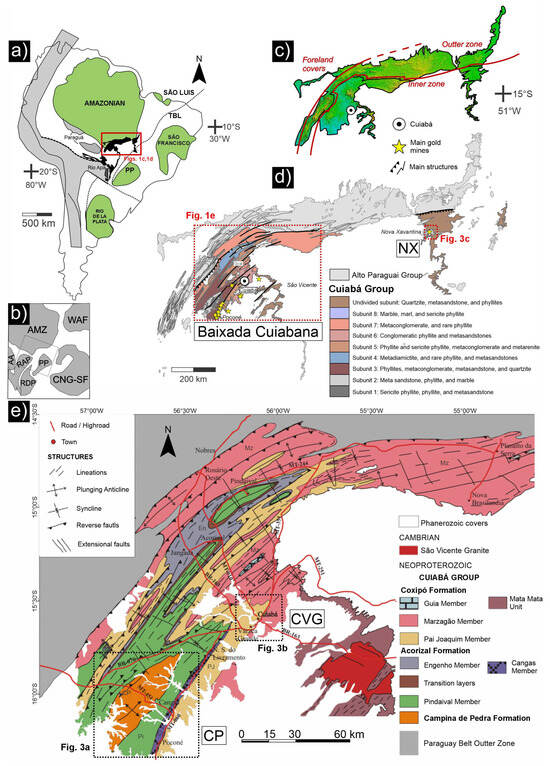
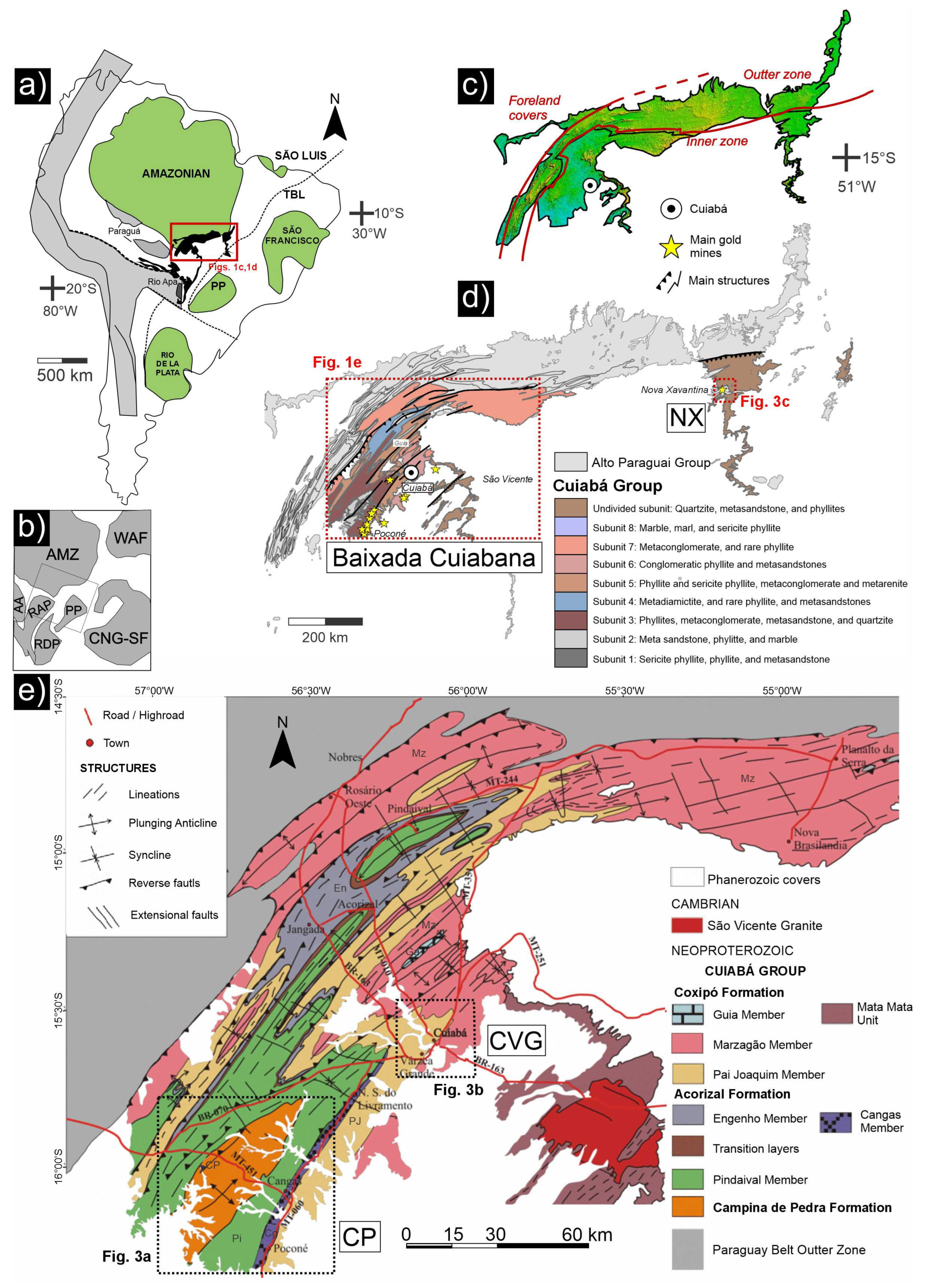
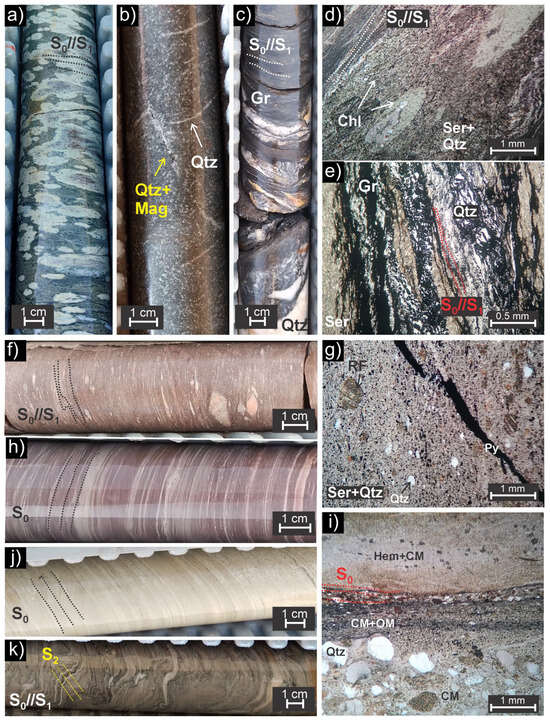
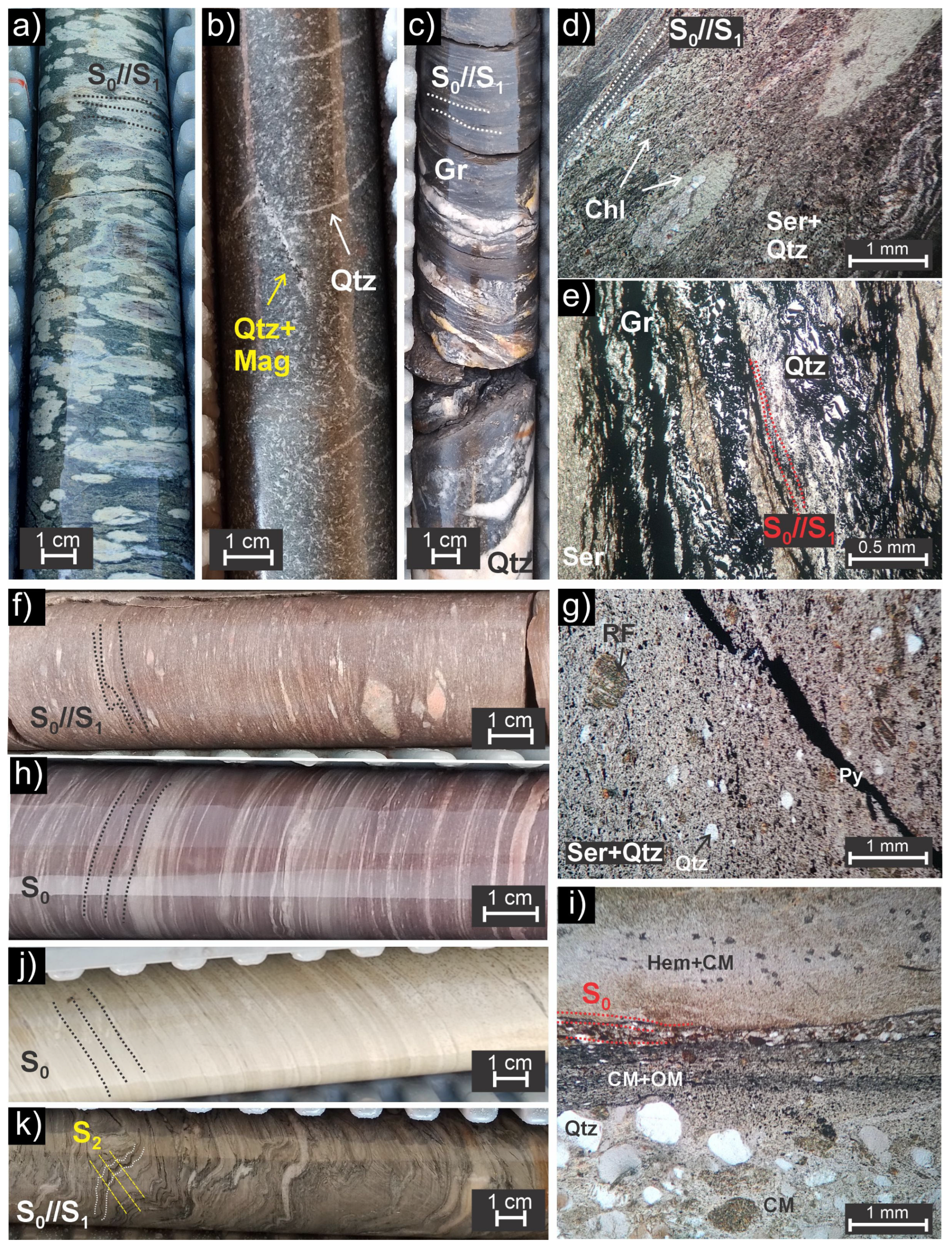
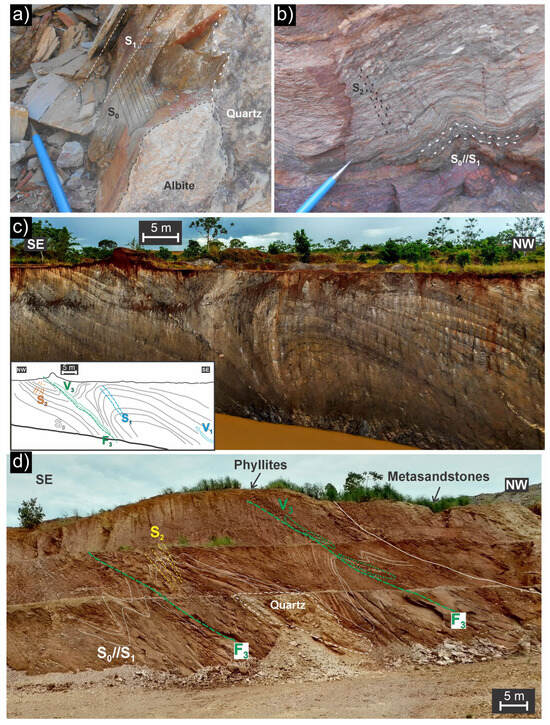
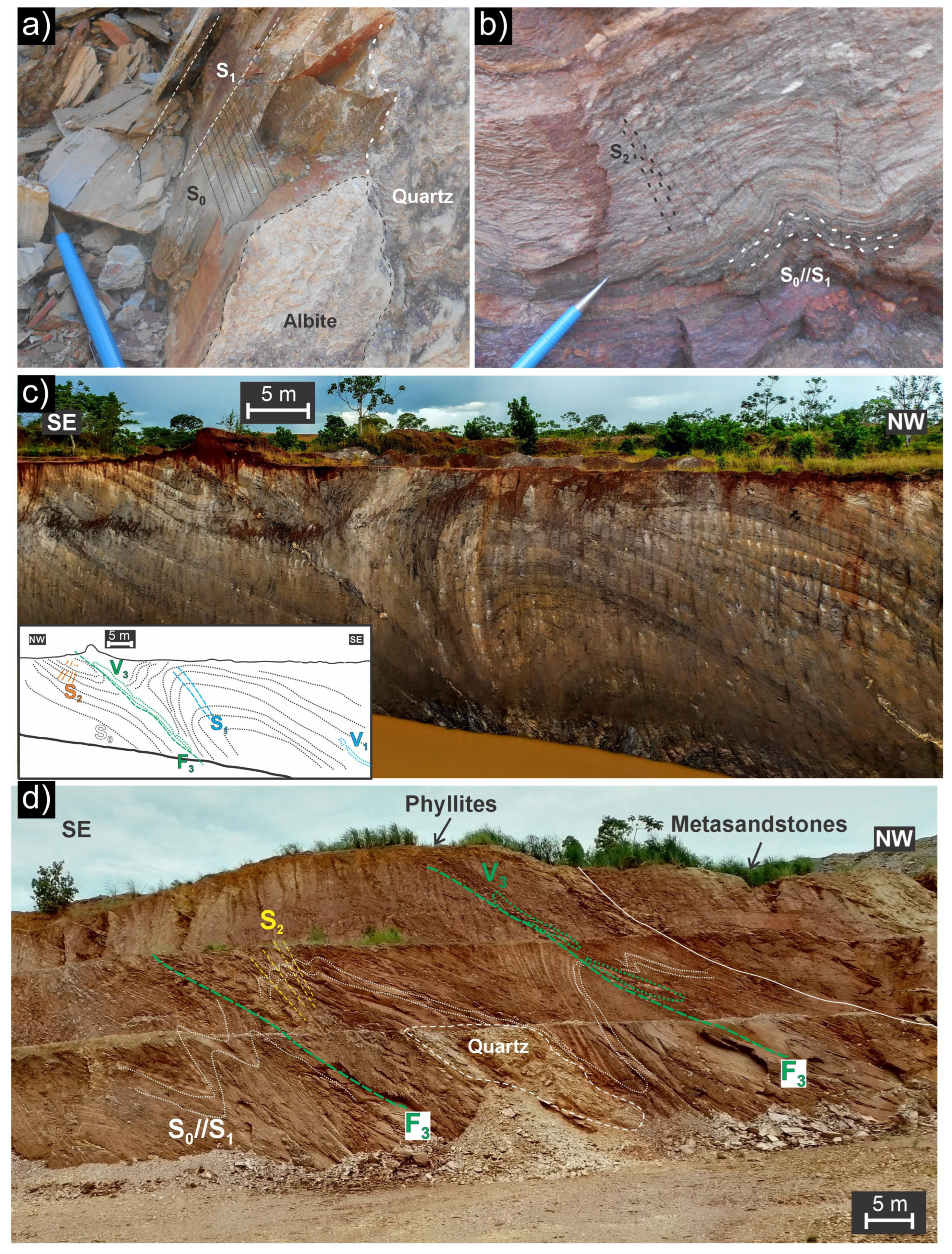
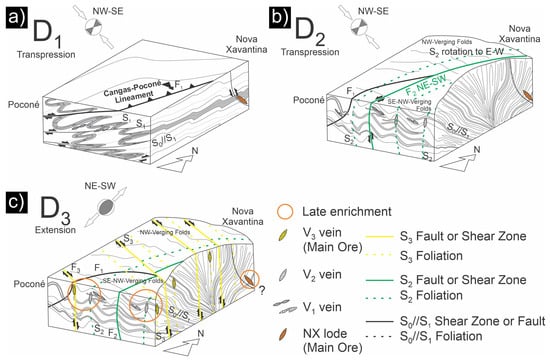
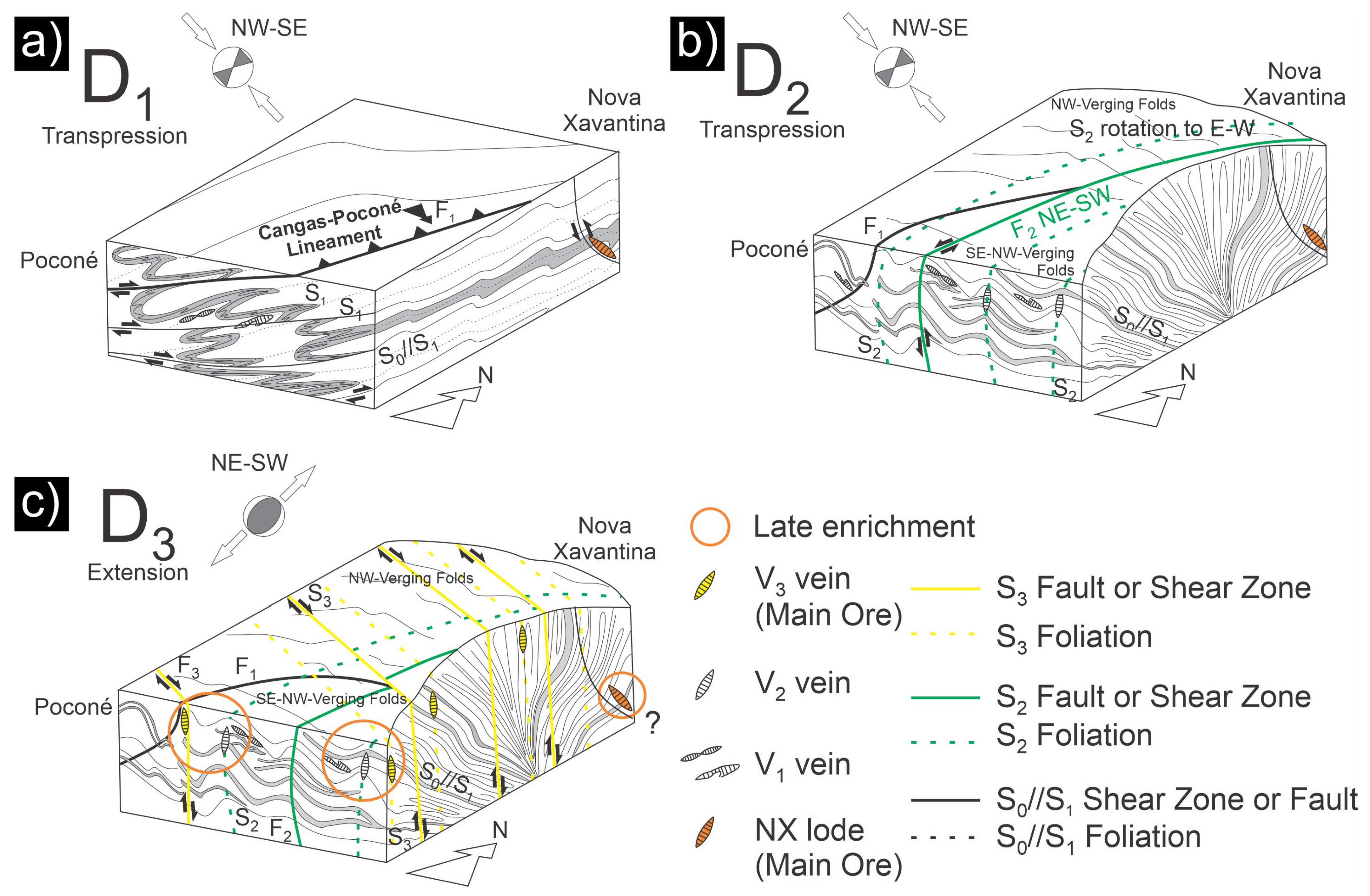
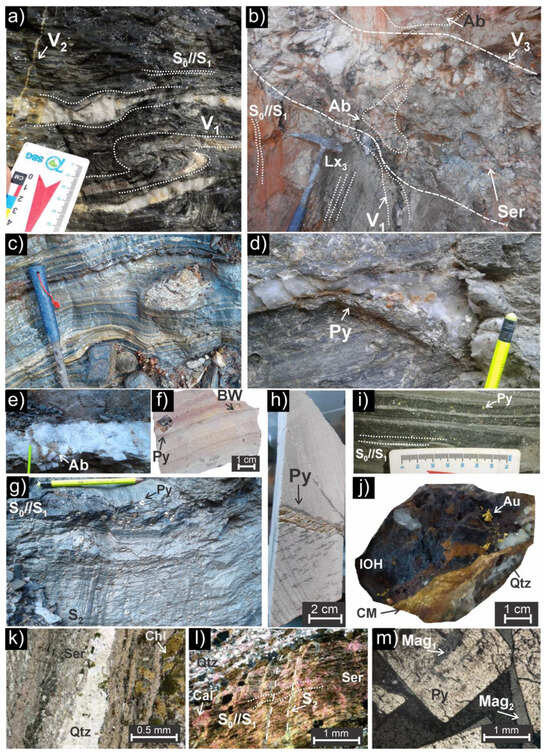
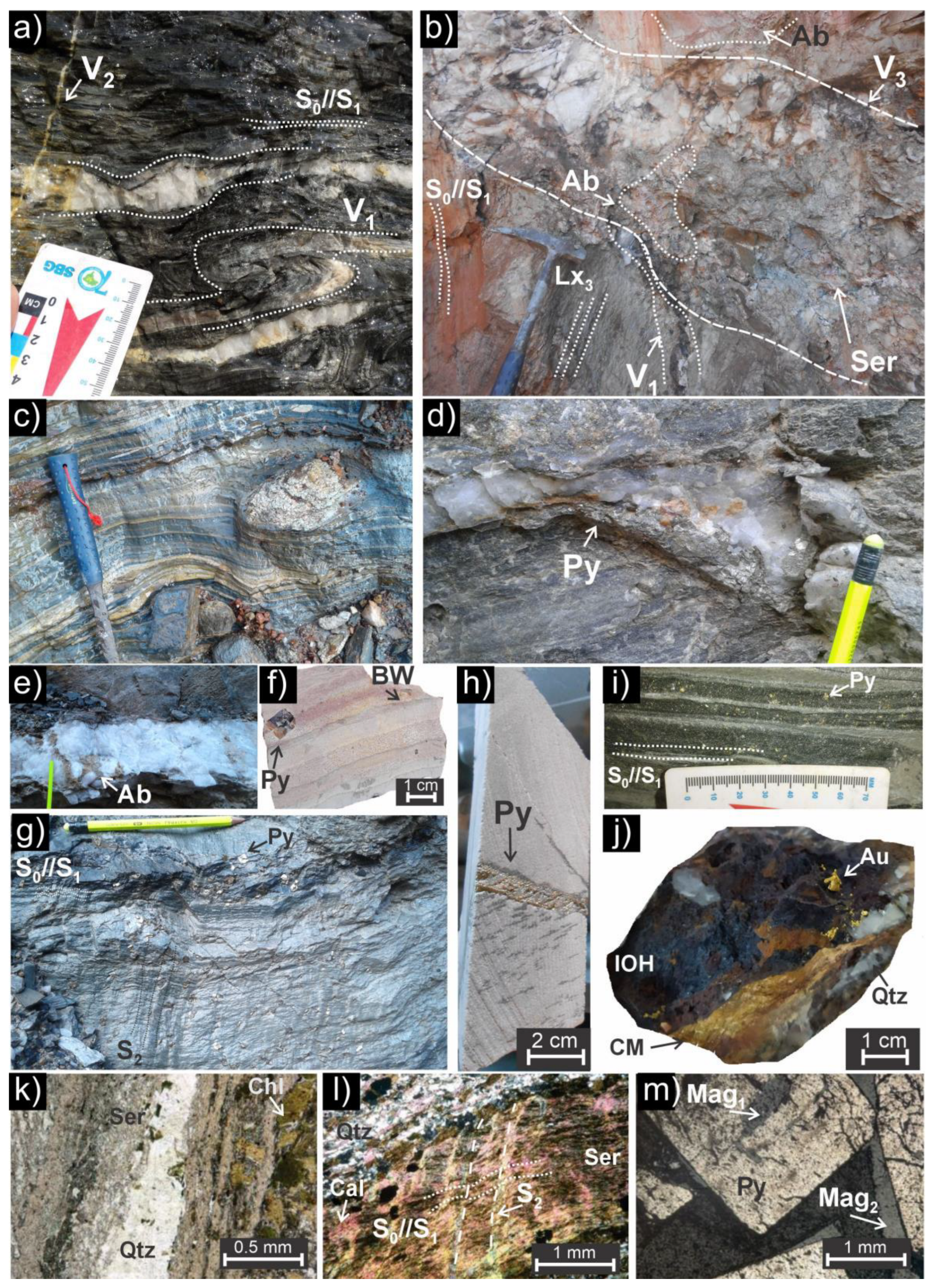
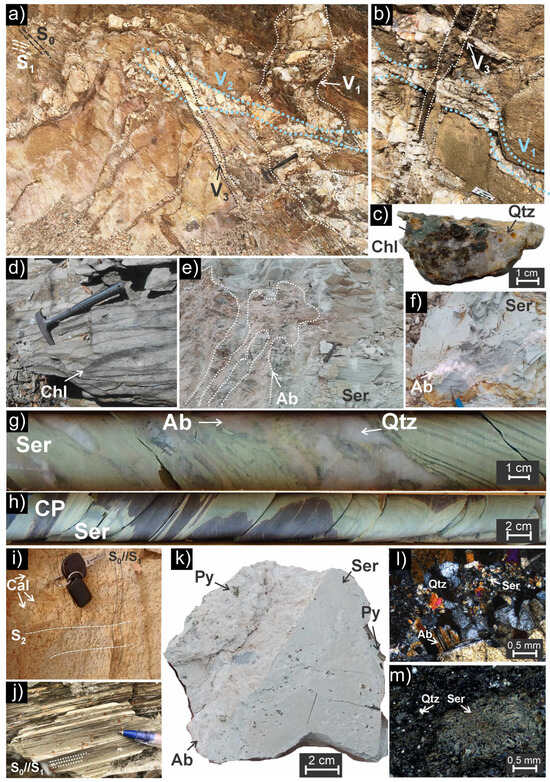
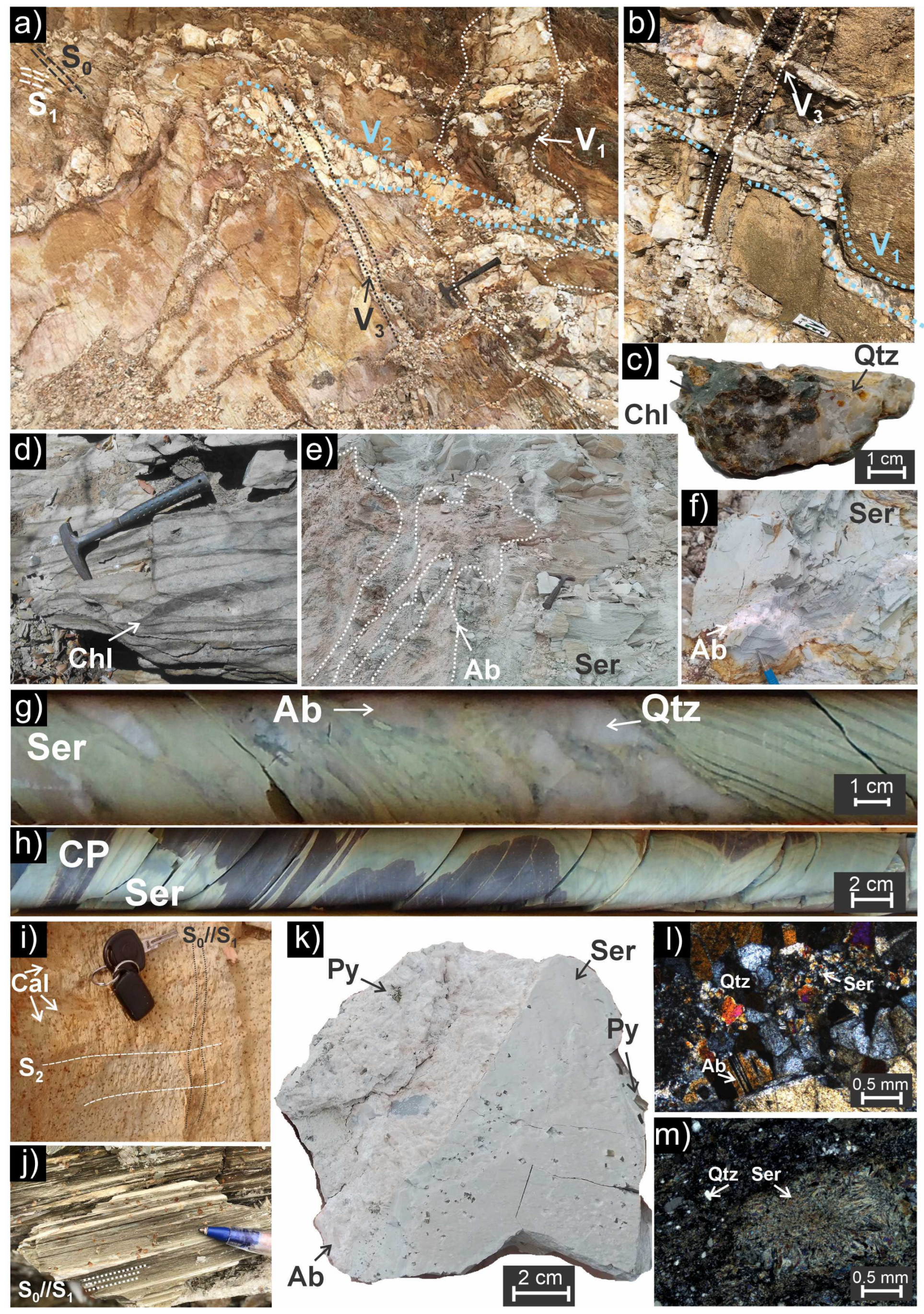
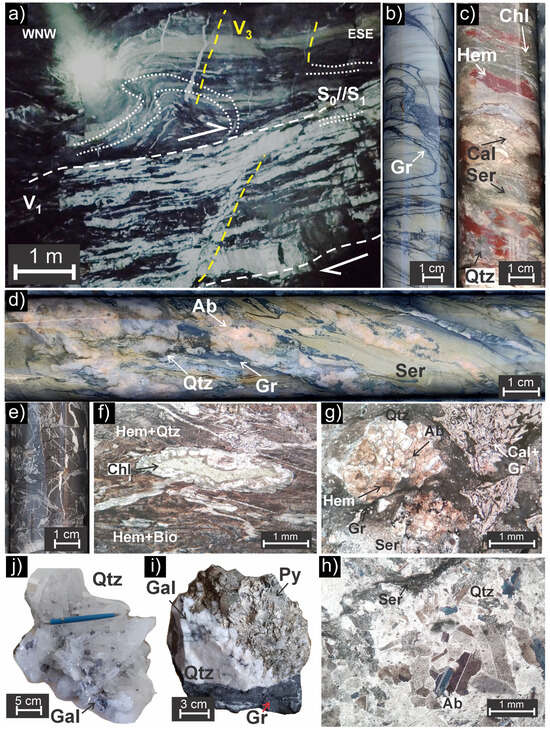
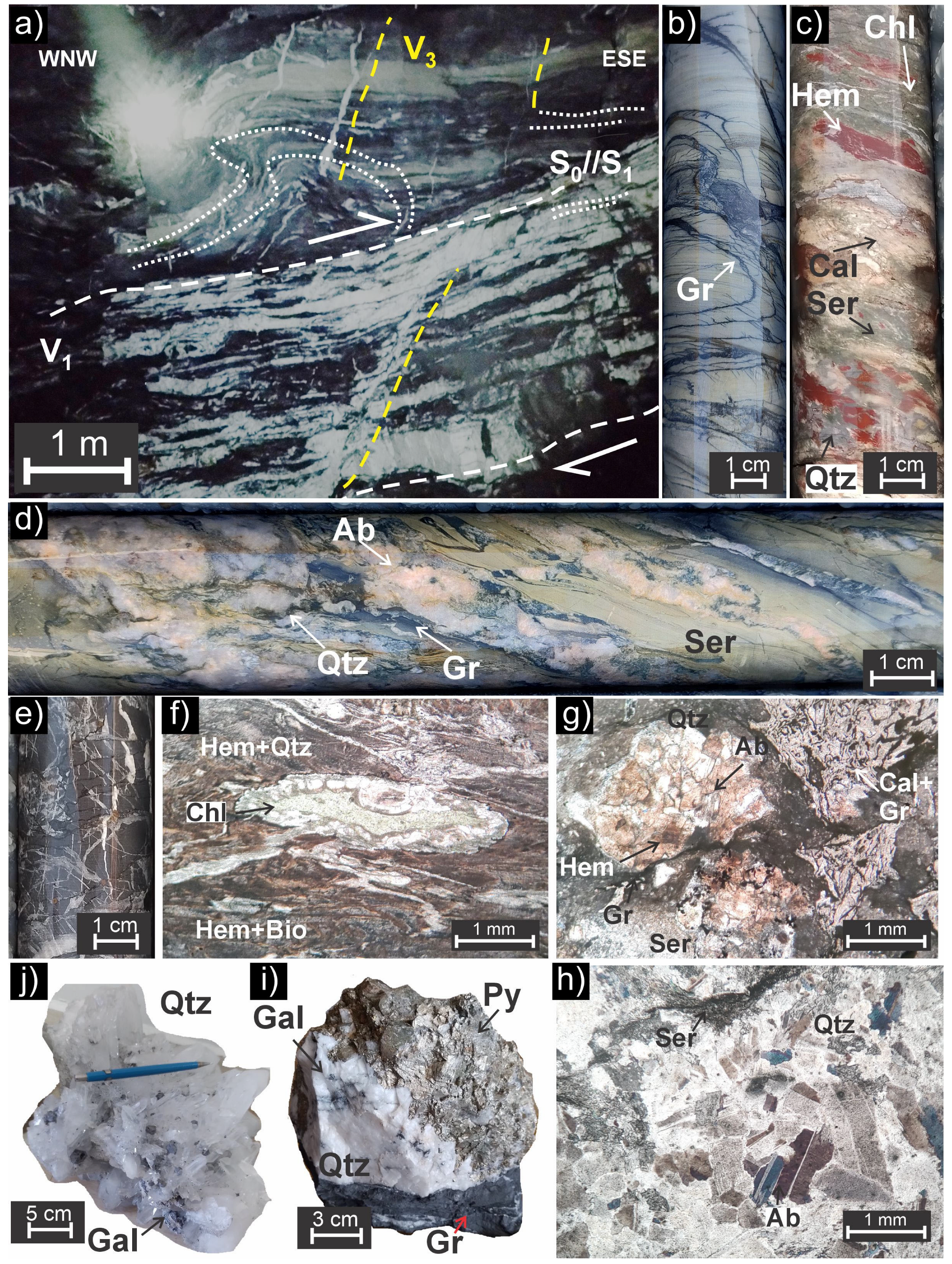
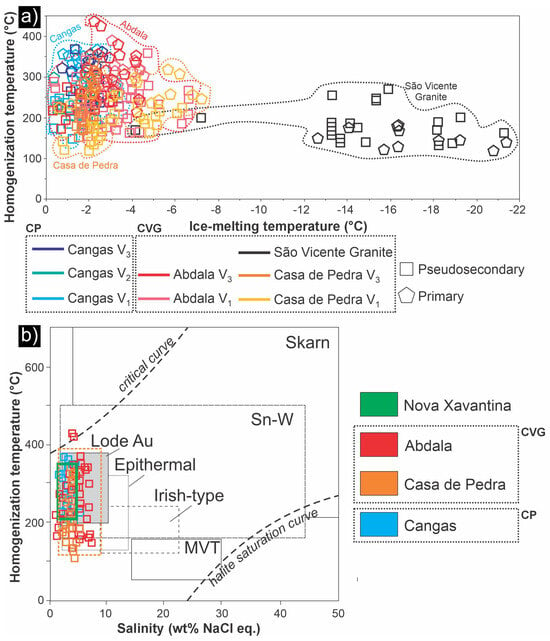
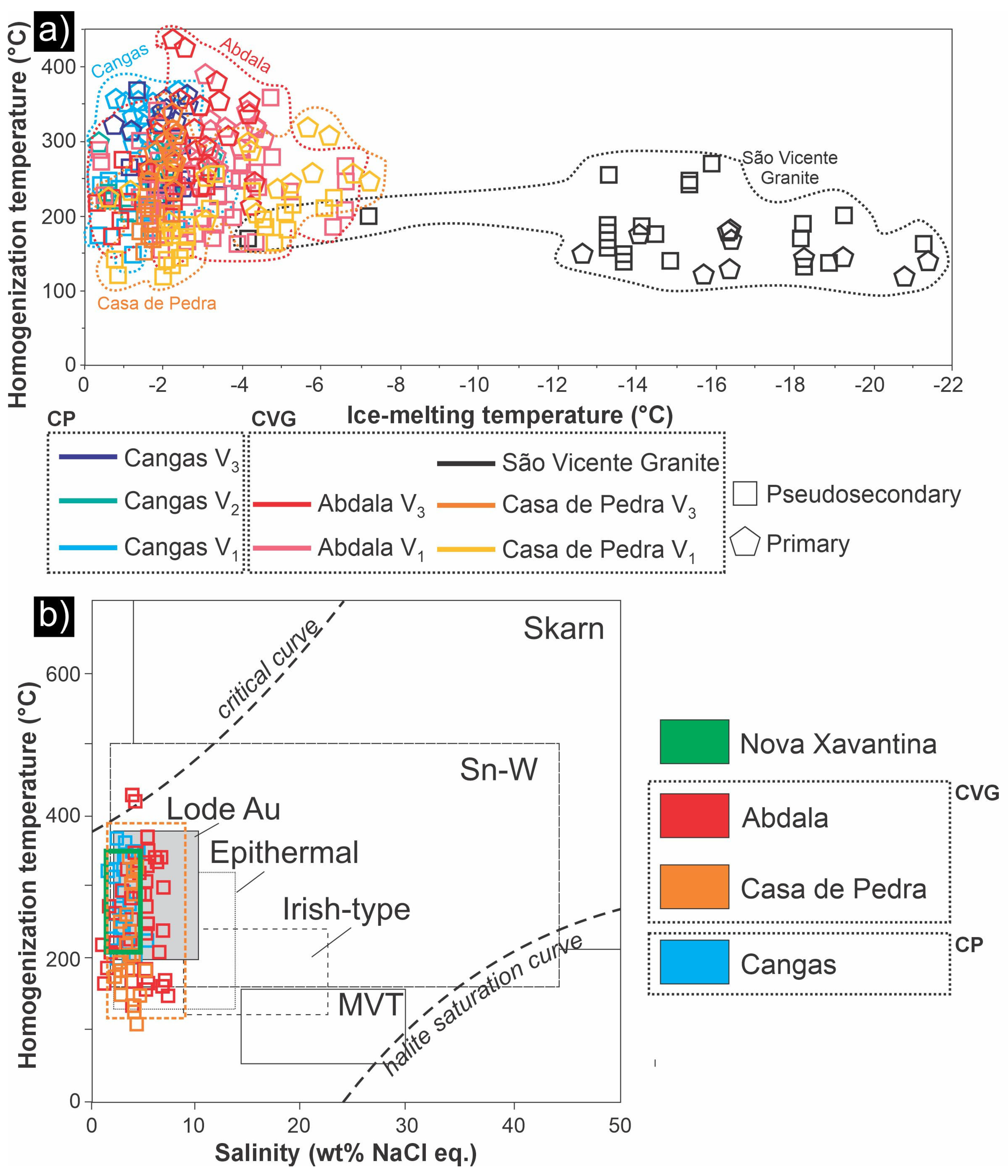
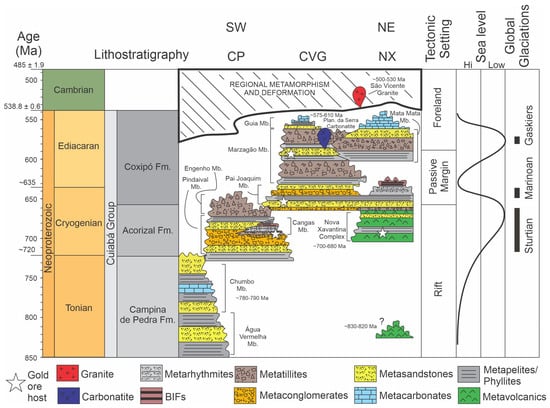
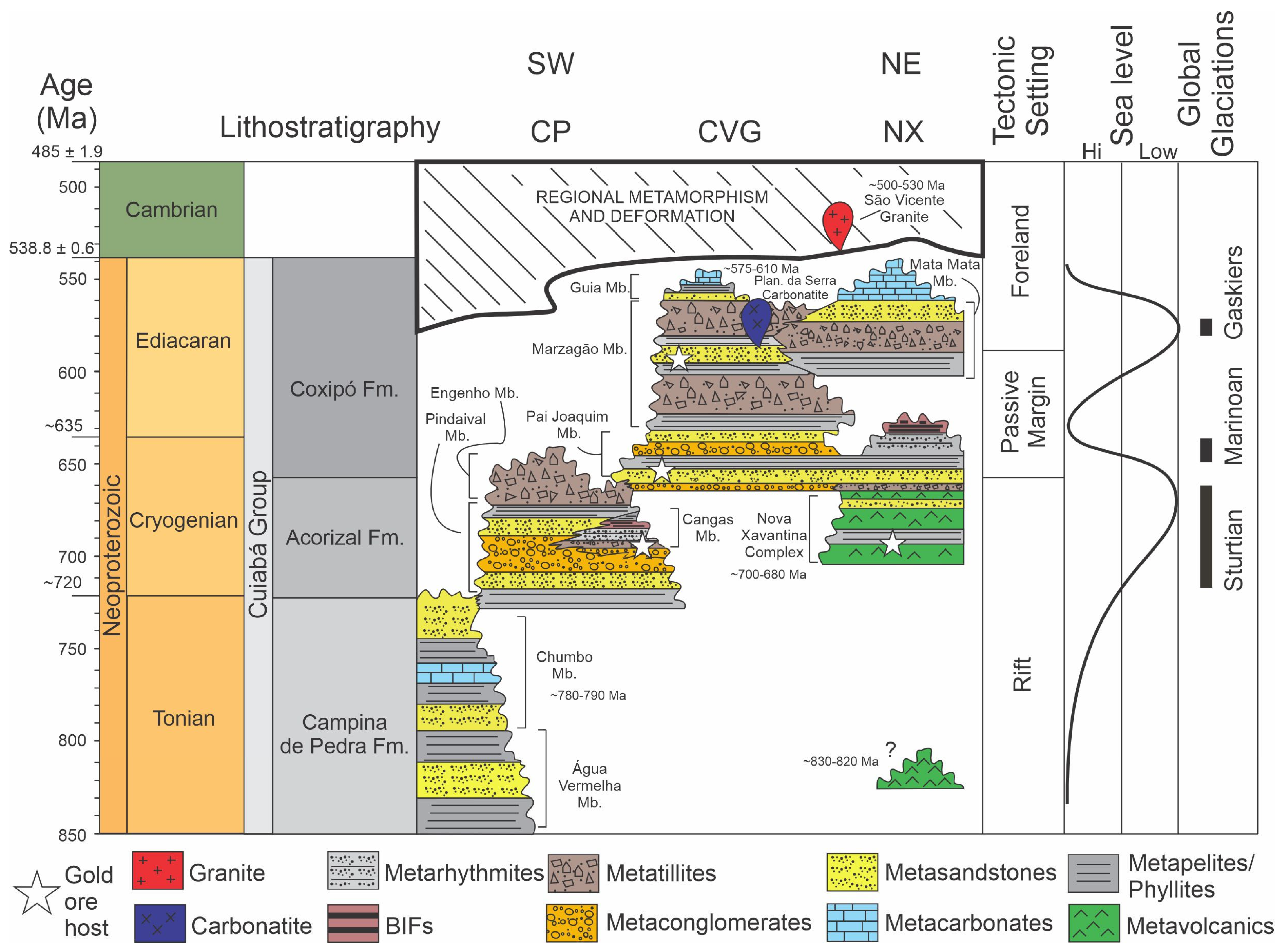
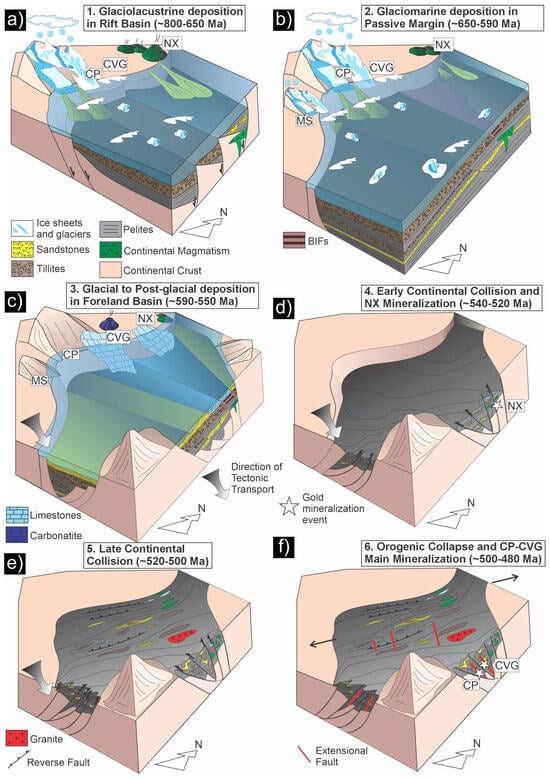
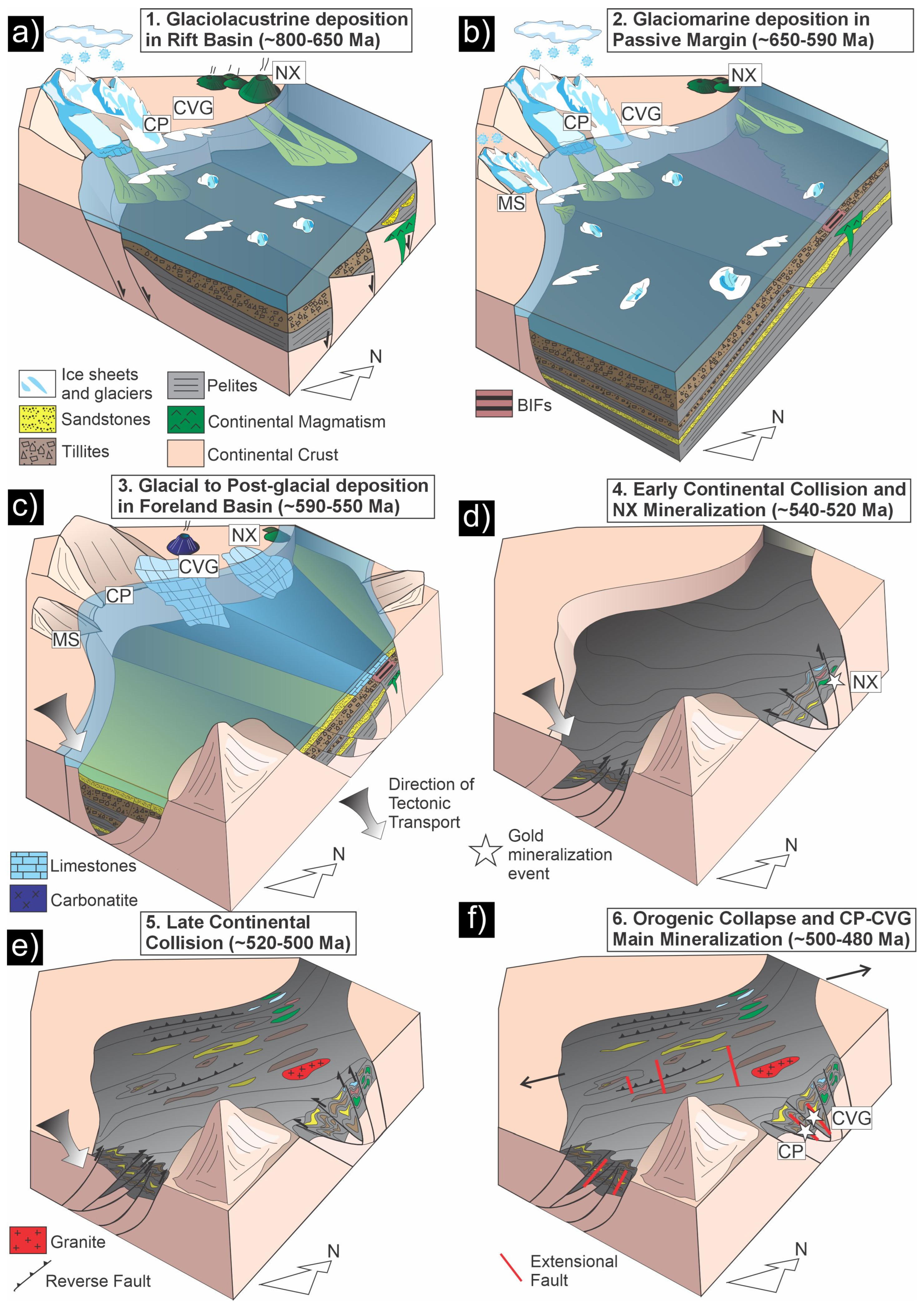
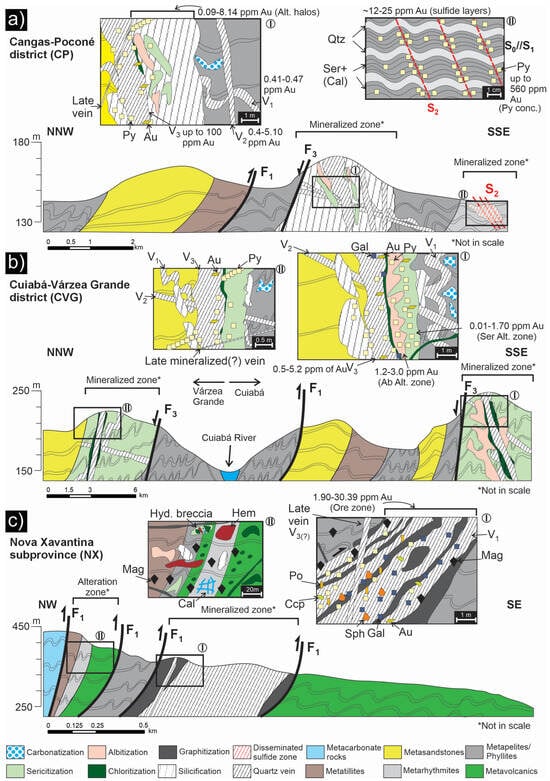
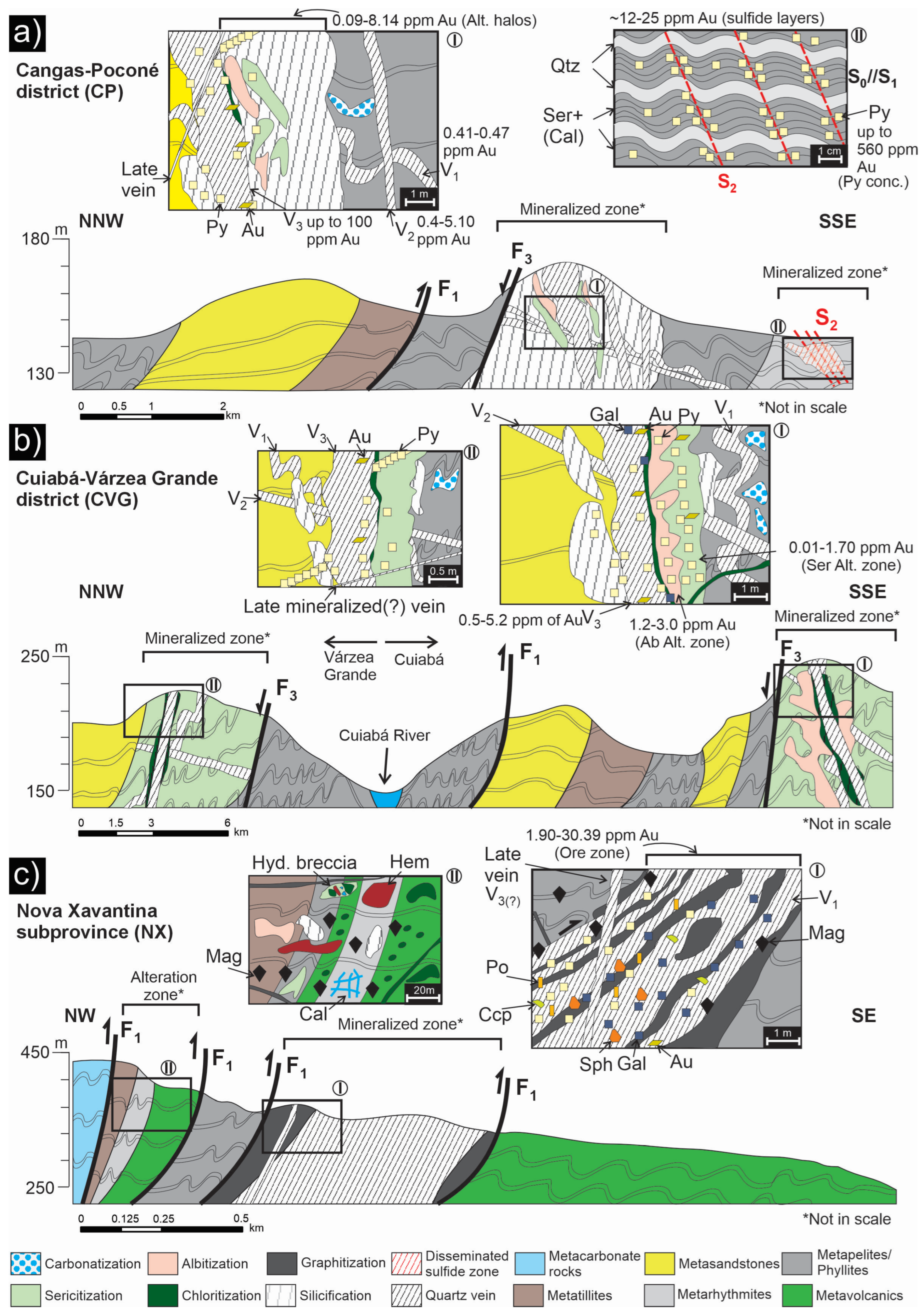

Disclaimer/Publisher’s Note: The statements, opinions and data contained in all publications are solely those of the individual author(s) and contributor(s) and not of MDPI and/or the editor(s). MDPI and/or the editor(s) disclaim responsibility for any injury to people or property resulting from any ideas, methods, instructions or products referred to in the content. |
© 2026 by the authors. Licensee MDPI, Basel, Switzerland. This article is an open access article distributed under the terms and conditions of the Creative Commons Attribution (CC BY) license.