Sustainable Manufacturing and Recycling of Lithium-Ion Batteries: Circular Economy Pathways for Critical Minerals

 ,
,  , ,
, , 
Abstract
1. Introduction
2. Materials and Methods
2.1. Goal and Scope of the Study
2.1.1. Functional Unit
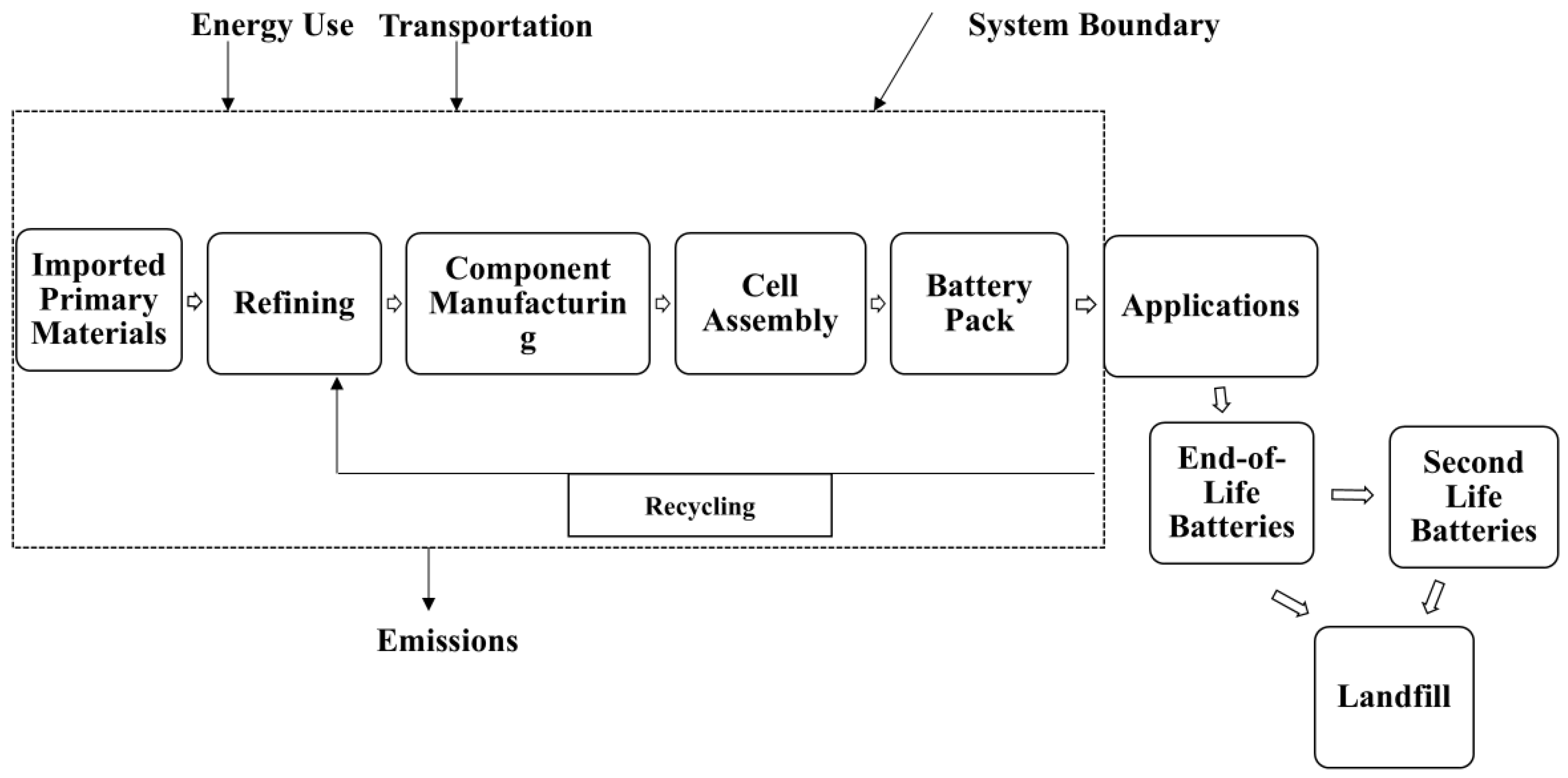
2.1.2. System Boundary
2.2. Key Inventory Inputs
3. Results and Discussion
3.1. Emissions from NMC532 and LFP Cathode Active Material Production
3.2. Emissions from the Cell, Module and Pack Components for NMP532 and LFP
3.3. Validation with Previous Studies
3.4. Emission Potential of Recycled Materials for NMC532 and LFP Batteries Manufacturing
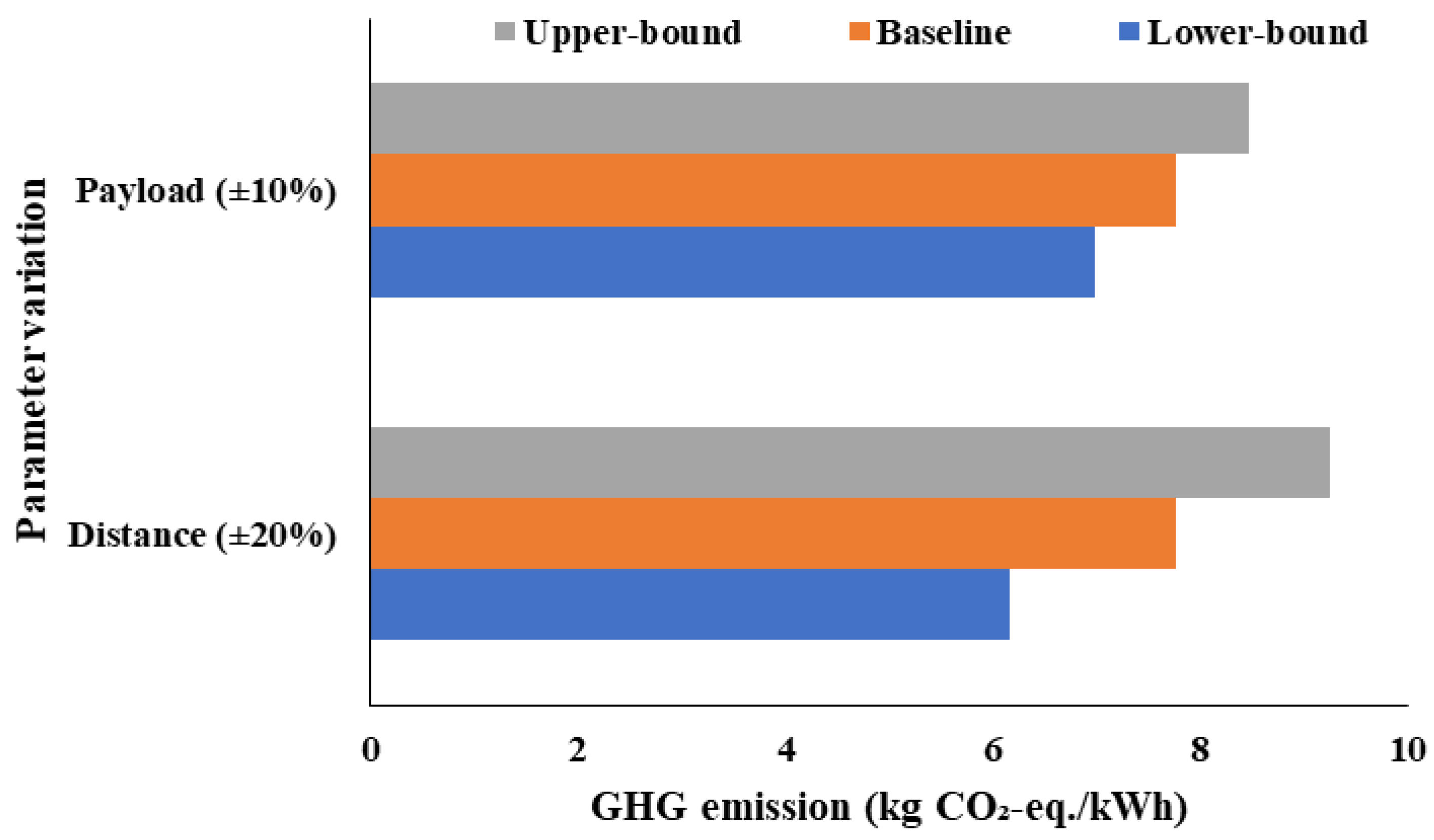
3.5. Transportation Sensitivity Analysis
3.6. India-Specific Factors: Coal Grid, PLI Policy, Informal Recycling, and Chemistry Strategies
4. Limitations of This Study
5. Conclusions
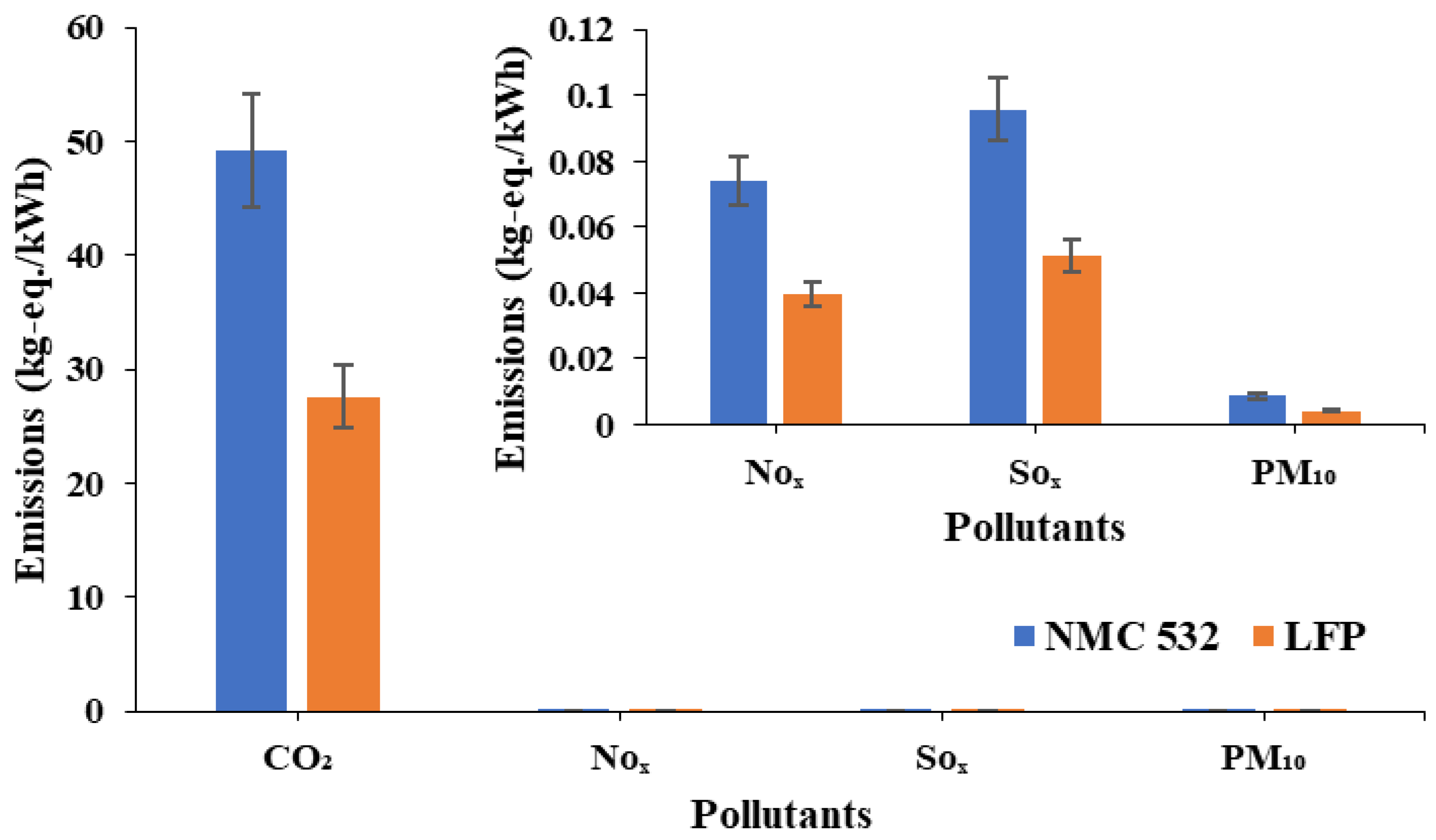
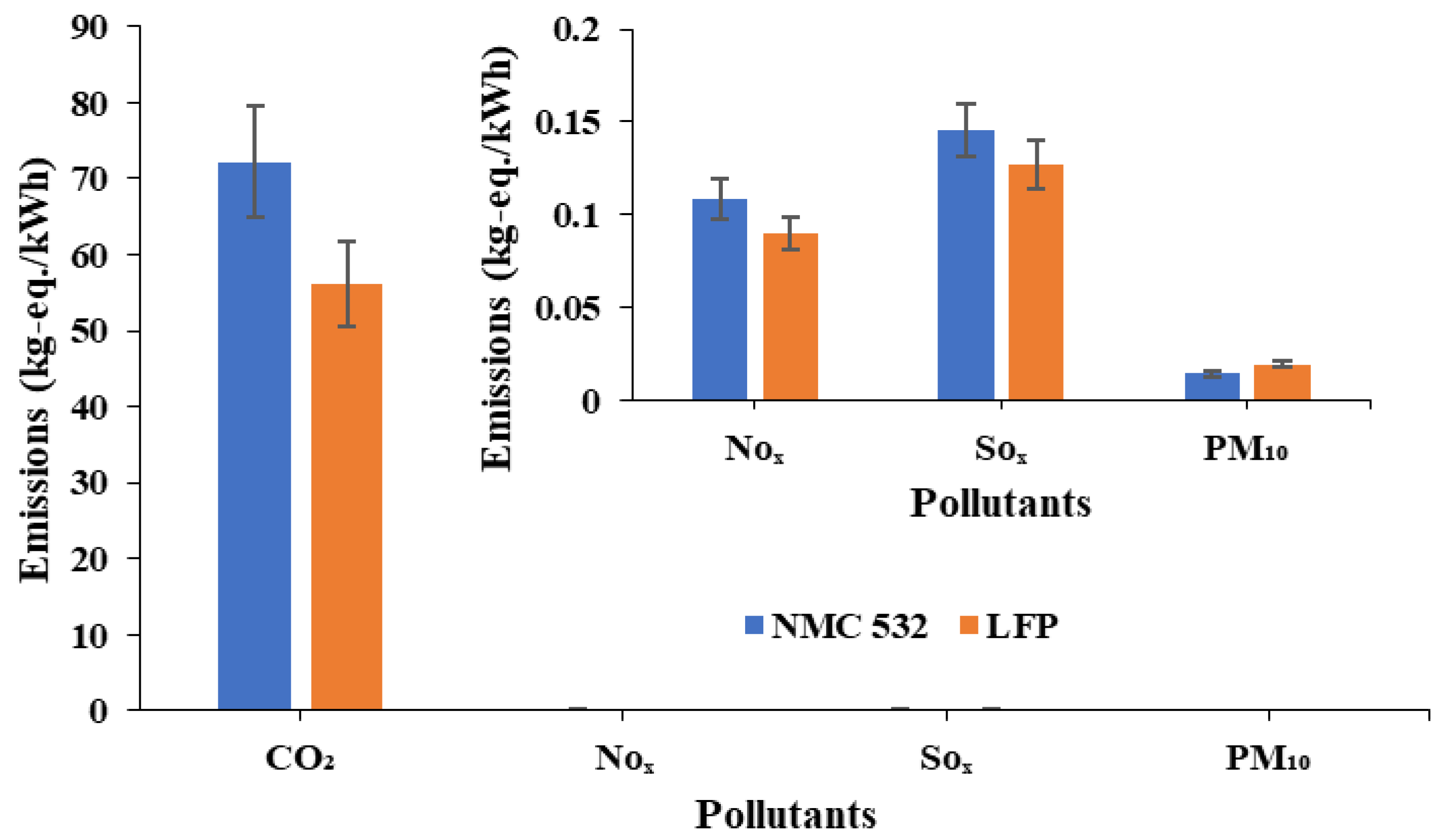
- The chemical composition of batteries has a significant impact on their environmental performance. NMC 532 batteries have consistently greater emissions than LFP across all metrics (CO2, NOx, SOx, and PM10), principally due to the energy-intensive manufacturing of nickel and cobalt sulphate precursors.
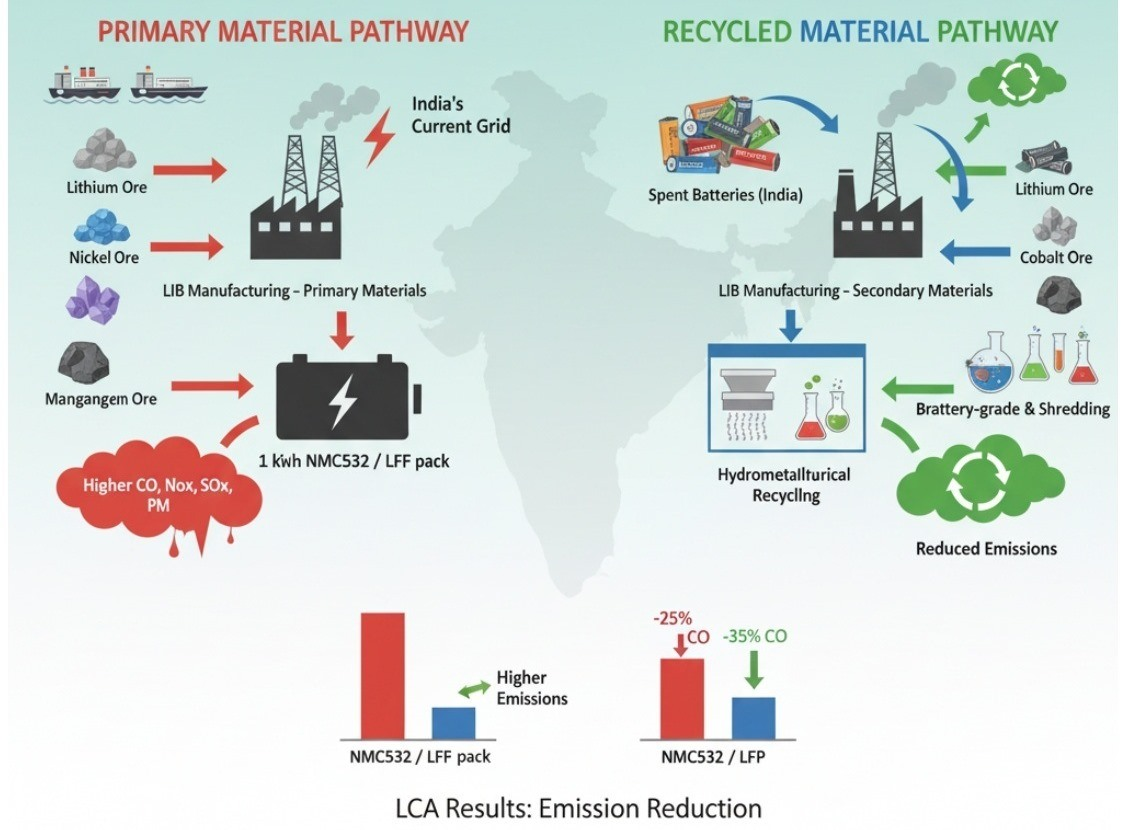
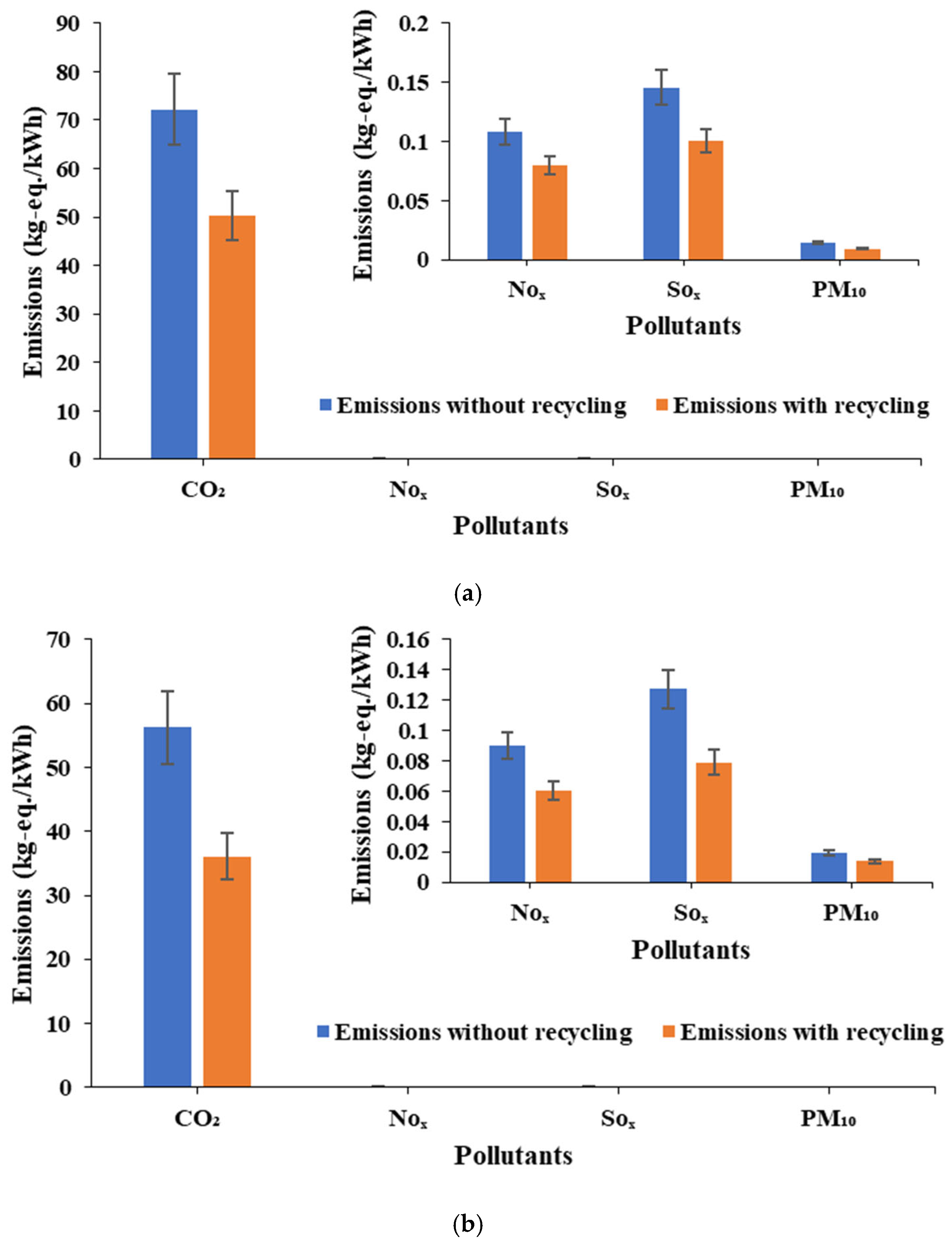
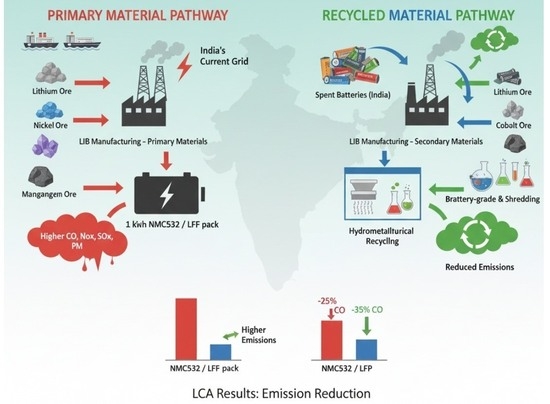
- This study reveals that NMC 532 has higher emissions (72 kg CO2-eq/kWh) than LFP (56 kg CO2-eq/kWh), amplified by India’s coal-dominated electricity grid mix, but recycling reduces the burden by 30% for NMC 532 and 36% for LFP.
- CAM production is a dominant source of environmental impact.
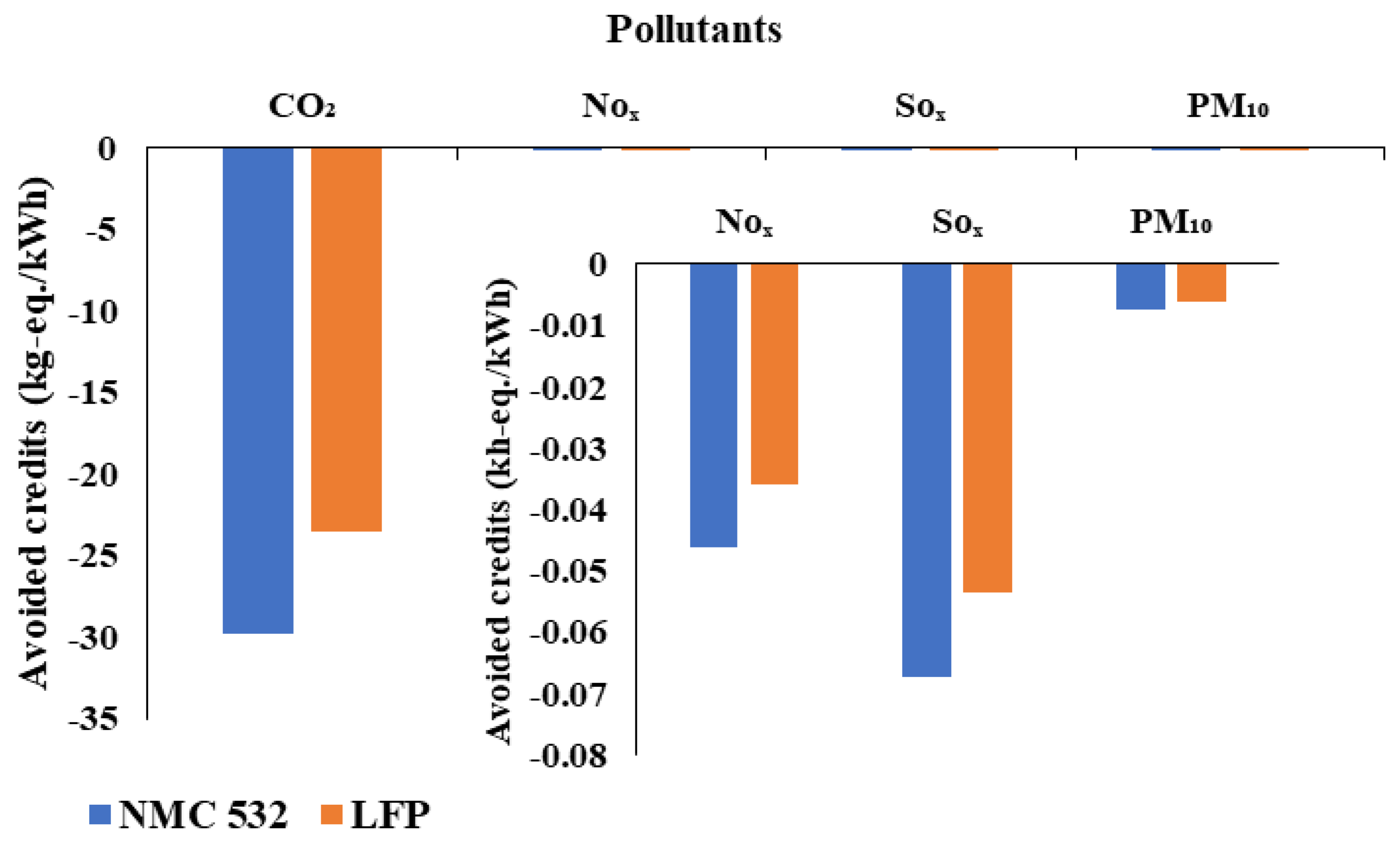
- The avoided emission credits is 30 kg CO2-equation/kWh for NMC 532 and 23 kg CO2-equation/kWh for LFP.
- NMC 532 has a stronger mitigation potential since it avoids carbon-intensive nickel, cobalt, and manganese refining, as well as the long-distance international transit of battery-grade ingredients.
- PLI-supported formal hydrometallurgy counters informal recycling pollution, enabling circularity for critical minerals amid 128 GWh EoL waste by 2030.
- Although this study models hydrometallurgical recycling as the representative pathway for India, future research should conduct a full techno-environmental comparison of pyrometallurgical, hydrometallurgical, and direct regeneration technologies using India-specific industrial inventory data to support optimal technology selection under evolving electricity decarbonization scenarios.
Author Contributions
Funding
Data Availability Statement
Conflicts of Interest
References
- PIB. India Is Committed to Achieve the Net Zero Emissions Target by 2070; Ministry of Science & Technology: New Delhi, India, 2023. Available online: https://www.pib.gov.in/PressReleaseIframePage.aspx?PRID=1961797®=3&lang=2#:~:text=The%20Panchamrit%20action%20plan%20is%20a%20five%2Dpronged,2030%20*%20**Net%2Dzero%20emissions**%20Achieve%20by%202070 (accessed on 25 September 2025).
- Lithium-Ion Battery Manufacturing in India: Revisiting Missing Links. Available online: https://wri-india.org/perspectives/lithium-ion-battery-manufacturing-india-revisiting-missing-links (accessed on 25 September 2025).
- Charging Ahead: Transforming India’s Lithium-ion Battery Recycling Ecosystem USD 3.5 Billion Opportunity at Stake. Available online: https://www.communicationstoday.co.in/wp-content/uploads/2025/07/Report-launch-by-ICEA-Accenture-on-%E2%80%98Charging-Ahead_Transforming-Indias-LiB-Recycling-Ecosystem.pdf (accessed on 28 September 2025).
- Lithium-Sourcing Roadmap for India. Strategies to Secure a Robust and Responsible Battery Supply Chain; IISD REPORT. Available online: https://www.iisd.org/system/files/2023-09/india-lithium-sourcing-roadmap.pdf (accessed on 10 August 2025).
- Kala, S.; Mishra, A. Battery recycling opportunity and challenges in India. Mater. Today Proc. 2021, 46, 1543–1556. [Google Scholar] [CrossRef]
- Verma, S.; Paul, A.R.; Haque, N. Selected Environmental Impact Indicators Assessment of Wind Energy in India Using a Life Cycle Assessment. Energies 2022, 15, 3944. [Google Scholar] [CrossRef]
- Singh, D.; Paul, A.R.; Samad, A.; Haque, N. Life cycle environmental impact assessment of the “Sindhuja-I” wave energy converter. Proc. Inst. Mech. Eng. Part M J. Eng. Marit. Environ. 2025, 239, 687–699. [Google Scholar] [CrossRef]
- Gupta, A.; Paul, A.R.; Haque, N. Life cycle assessment of carbon capture and storage in saline aquifers for coal-fired power generation: An Indian scenario. Greenh. Gases Sci. Technol. 2023, 13, 81–98. [Google Scholar] [CrossRef]
- Kumar, A.; Gupta, A.; Verma, S.; Paul, A.R.; Jain, A.; Haque, N. Life cycle assessment based environmental footprint of a battery recycling process. In Intelligent Manufacturing and Energy Sustainability: Proceedings of ICIMES 2021; Springer: Singapore, 2022; pp. 115–123. [Google Scholar]
- Joshi, A.; Gupta, A.; Verma, S.; Paul, A.R.; Jain, A.; Haque, N. Life cycle based greenhouse gas footprint assessment of a smartphone. IOP Conf. Ser. Earth Environ. Sci. 2021, 795, 012028. [Google Scholar] [CrossRef]
- Ellingsen, L.A.W.; Majeau-Bettez, G.; Singh, B.; Srivastava, A.K.; Valøen, L.O.; Strømman, A.H. Life cycle assessment of a lithium-ion battery vehicle pack. J. Ind. Ecol. 2014, 18, 113–124. [Google Scholar] [CrossRef]
- Zackrisson, M.; Fransson, K.; Hildenbrand, J.; Lampic, G.; O’Dwyer, C. Life cycle assessment of lithium-air battery cells. J. Clean. Prod. 2016, 135, 299–311. [Google Scholar] [CrossRef]
- Ellingsen, L.A.W.; Hung, C.R.; Strømman, A.H. Identifying key assumptions and differences in life cycle assessment studies of lithium-ion traction batteries with focus on greenhouse gas emissions. Transp. Res. Part D Transp. Environ. 2017, 55, 82–90. [Google Scholar] [CrossRef]
- Deng, Y.; Ma, L.; Li, T.; Li, J.; Yuan, C. Life cycle assessment of silicon-nanotube-based lithium ion battery for electric vehicles. ACS Sustain. Chem. Eng. 2018, 7, 599–610. [Google Scholar] [CrossRef]
- Ioakimidis, C.S.; Murillo-Marrodán, A.; Bagheri, A.; Thomas, D.; Genikomsakis, K.N. Life cycle assessment of a lithium iron phosphate (LFP) electric vehicle battery in second life application scenarios. Sustainability 2019, 11, 2527. [Google Scholar] [CrossRef]
- Aichberger, C.; Jungmeier, G. Environmental life cycle impacts of automotive batteries based on a literature review. Energies 2020, 13, 6345. [Google Scholar] [CrossRef]
- Kallitsis, E.; Korre, A.; Kelsall, G.; Kupfersberger, M.; Nie, Z. Environmental life cycle assessment of the production in China of lithium-ion batteries with nickel-cobalt-manganese cathodes utilising novel electrode chemistries. J. Clean. Prod. 2020, 254, 120067. [Google Scholar] [CrossRef]
- Sun, X.; Luo, X.; Zhang, Z.; Meng, F.; Yang, J. Life cycle assessment of lithium nickel cobalt manganese oxide (NCM) batteries for electric passenger vehicles. J. Clean. Prod. 2020, 273, 123006. [Google Scholar] [CrossRef]
- Yuan, C.; Cao, H.; Shen, K.; Deng, Y.; Zeng, D.; Dong, Y.; Hauschild, M. Water-based manufacturing of lithium ion battery for life cycle impact mitigation. CIRP Ann. 2021, 70, 25–28. [Google Scholar] [CrossRef]
- Zhao, E.; Walker, P.D.; Surawski, N.C.; Bennett, N.S. Assessing the life cycle cumulative energy demand and greenhouse gas emissions of lithium-ion batteries. J. Energy Storage 2021, 43, 103193. [Google Scholar] [CrossRef]
- Rajaeifar, M.A.; Raugei, M.; Steubing, B.; Hartwell, A.; Anderson, P.A.; Heidrich, O. Life cycle assessment of lithium-ion battery recycling using pyrometallurgical technologies. J. Ind. Ecol. 2021, 25, 1560–1571. [Google Scholar] [CrossRef]
- Yang, Y.; Lan, L.; Hao, Z.; Zhao, J.; Luo, G.; Fu, P.; Chen, Y. Life cycle prediction assessment of battery electrical vehicles with special focus on different lithium-ion power batteries in China. Energies 2022, 15, 5321. [Google Scholar] [CrossRef]
- Wang, Y.; Tang, B.; Shen, M.; Wu, Y.; Qu, S.; Hu, Y.; Feng, Y. Environmental impact assessment of second life and recycling for LiFePO4 power batteries in China. J. Environ. Manag. 2022, 314, 115083. [Google Scholar] [CrossRef]
- Castro, F.D.; Mehner, E.; Cutaia, L.; Vaccari, M. Life cycle assessment of an innovative lithium-ion battery recycling route: A feasibility study. J. Clean. Prod. 2022, 368, 133130. [Google Scholar] [CrossRef]
- Tao, Y.; Wang, Z.; Wu, B.; Tang, Y.; Evans, S. Environmental life cycle assessment of recycling technologies for ternary lithium-ion batteries. J. Clean. Prod. 2023, 389, 136008. [Google Scholar] [CrossRef]
- Shen, K.; Yuan, C.; Hauschild, M. Direct recycling of lithium ion batteries from electric vehicles for closed-loop life cycle impact mitigation. CIRP Ann. 2023, 72, 13–16. [Google Scholar] [CrossRef]
- Hemmati, M.; Bayati, N.; Ebel, T. Life Cycle Assessment and Costing of Large-Scale Battery Energy Storage Integration in Lombok’s Power Grid. Batteries 2024, 10, 295. [Google Scholar] [CrossRef]
- Kobayashi, T.; Kondo, H.; Sasaki, T. Life cycle assessment integrating the effects of recycling and reuse for battery circulation. J. Power Sources 2024, 624, 235544. [Google Scholar] [CrossRef]
- Manjong, N.B.; Usai, L.; Orangi, S.; Clos, D.P.; Strømman, A.H. Exploring raw material contributions to the greenhouse gas emissions of lithium-ion battery production. J. Energy Storage 2024, 100, 113566. [Google Scholar] [CrossRef]
- Narimani-Qurtlar, A.; Sayyah, A.; Pakseresht, S.; Mostafaei, J.; Akbulut, H.; Cetinkaya, T.; Asghari, E.; Niaei, A. Investigating the environmental impacts of lithium-oxygen battery cathode production: A comprehensive assessment of the effects associated with oxygen cathode manufacturing. J. Clean. Prod. 2024, 482, 144199. [Google Scholar] [CrossRef]
- Zhu, J.; Li, S.; Li, T.; Zhu, A.; Shao, Y.; Yang, Z.; Chen, L.; Li, X. Environmental impact analysis of potassium-ion batteries based on the life cycle assessment: A comparison with lithium iron phosphate batteries. J. Clean. Prod. 2024, 483, 144298. [Google Scholar] [CrossRef]
- Tas, G.; Klemettinen, A.; Serna-Guerrero, R. Circular And Sustainable: Evaluating Lithium-Ion Battery Recycling using a Combined Statistical Entropy and Life Cycle Assessment Methodology. ChemSusChem 2024, 17, e202400376. [Google Scholar] [CrossRef]
- Ali, A.R.; Bartie, N.; Husmann, J.; Cerdas, F.; Schröder, D.; Herrmann, C. Simulation-based life cycle assessment of secondary materials from recycling of lithium-ion batteries. Resour. Conserv. Recycl. 2024, 202, 107384. [Google Scholar] [CrossRef]
- Clemente, M.; Maharjan, P.; Salazar, M.; Hofman, T. Meta-analysis of Life Cycle Assessments for Li-Ion Batteries Production Emissions. arXiv 2025, arXiv:2506.05531. [Google Scholar] [CrossRef]
- Almahri, R.; An, H. Evaluating economic and environmental viability of recycling lithium-ion battery for electric vehicles in the middle east: A case study in the UAE. Humanit. Soc. Sci. Commun. 2025, 12, 508. [Google Scholar] [CrossRef]
- Chen, H.; Yang, Y.; Dong, Z. The effect of product design on recycling efficiency of lithium-ion batteries through structural equation modeling and life cycle assessment. Sci. Rep. 2025, 15, 12352. [Google Scholar] [CrossRef]
- Pang, D.; Wang, H.; Zeng, Y.; Han, X.; Zheng, Y. Sustainable Recycling of Lithium-Ion Battery Cathodes: Life Cycle Assessment, Technologies, and Economic Insights. Nanomaterials 2025, 15, 1283. [Google Scholar] [CrossRef]
- Gaalich, I.; Driouech, I.; Hayagan, N.; Aymonier, C.; Sonnemann, G.; Olchowka, J.; Philippot, G.; Loubet, P. Life cycle assessment of an innovative process assisted by pressurized CO2 for direct recycling of lithium-ion battery positive electrode production scraps. ACS Sustain. Chem. Eng. 2025, 13, 4717–4728. [Google Scholar] [CrossRef]
- Chen, L.; Peng, F.; Bieryt, K.; Tian, X.; Liu, Y. From mining to recycling: Identifying carbon mitigation pathways across the full life cycle of China’s lithium-ion battery industry. J. Clean. Prod. 2025, 518, 145876. [Google Scholar] [CrossRef]
- Maruti, B.M. Product lifecycle analysis and assessment of lithium-ion battery for prioritizing the factors of effective 5R: Case study. J. Energy Storage 2025, 120, 116469. [Google Scholar] [CrossRef]
- Hanna, F.; Somers, C.; Anctil, A. Life cycle assessment of lithium-ion battery recycling: Evaluating the impact of recycling methods and location. Environ. Sci. Technol. 2025, 59, 14432–14443. [Google Scholar] [CrossRef]
- Kar, U.; Fahimi, A.; Suponik, T.; Kaya, M.; Chu, P. Comparison of different pretreatment processes for lithium-ion battery recycling from a life cycle assessment perspective. J. Environ. Manag. 2025, 392, 126798. [Google Scholar] [CrossRef]
- Zhang, L.; Hu, G.; Mu, X.; Wu, Y.; Wang, H. Sustainable recovery: Life cycle assessment for lithium-ion battery recycling. J. Environ. Manag. 2025, 395, 127879. [Google Scholar] [CrossRef]
- Gutsch, M.; Leker, J. Costs, carbon footprint, and environmental impacts of lithium-ion batteries–From cathode active material synthesis to cell manufacturing and recycling. Appl. Energy 2024, 353, 122132. [Google Scholar] [CrossRef]
- Das, J. Comparative life cycle GHG emission analysis of conventional and electric vehicles in India. Environ. Dev. Sustain. 2022, 24, 13294–13333. [Google Scholar] [CrossRef]
- Singhal, A.; Arora, P.; Kumar, A.; Jain, H.; Sharma, A.K.; Bhosale, A.C.; Singh, R.; Saini, S.K.; Rakshit, D.; Parihar, A.K.S.; et al. Integrated life cycle assessment and techno-economic analysis of grid-scale energy storage alternatives for India. Sustain. Prod. Consum. 2025, 54, 404–422. [Google Scholar] [CrossRef]
- Abhiraman, V.J.; Khandelwal, N.; Krishnaiah, R.; Behera, S.K.; Kumar, A. Comparative life cycle assessment of lithium iron phosphate and nickel manganese cobalt batteries for electric vehicles: An Indian perspective. Energy Sustain. Dev. 2025, 89, 101837. [Google Scholar] [CrossRef]
- ISO 14040; Environmental Management—Life Cycle Assessment—Principles and Framework. International Standard Organization: Geneva, Switzerland, 2006.
- ISO 14041; Environmental Management—Life Cycle Assessment—Goal and Scope Definition and Inventory Analysis. International Standard Organization: Geneva, Switzerland, 1998.
- ISO 14042; Environmental Management—Life Cycle Assessment—Life Cycle Impact Assessment. International Standard Organization: Geneva, Switzerland, 2000.
- ISO 14043; Environmental Management—Life Cycle Assessment—Life Cycle Interpretation. International Standard Organization: Geneva, Switzerland, 2000.
- ISO 14044; Environmental Management—Life Cycle Assessment—Requirements and Guidelines. International Standard Organization: Geneva, Switzerland, 2006.
- Dunn, J.B.; Gaines, L.; Barnes, M.; Sullivan, J.L.; Wang, M. Material and Energy Flows in the Materials Production, Assembly, and End-of-Life Stages of the Automotive Lithium-Ion Battery Life Cycle; No. ANL/ESD/12-3 Rev.; Argonne National Laboratory (ANL): Argonne, IL, USA, 2013. [Google Scholar]
- Dai, Q.; Kelly, J.C.; Dunn, J.; Benavides, P.T. Update of Bill-of-Materials and Cathode Materials Production for Lithium-Ion Batteries in the GREET Model; Argonne National Laboratory: Argonne, IL, USA, 2018. [Google Scholar]
- Dai, Q.; Dunn, J.; Kelly, J.C.; Elgowainy, A. Update of Life Cycle Analysis of Lithium-Ion Batteries in the GREET Model; Argonne National Laboratory: Argonne, IL, USA, 2017. [Google Scholar]
- Dunn, J.B.; James, C.; Gaines, L.; Gallagher, K.; Dai, Q.; Kelly, J.C. Material and Energy Flows in the Production of Cathode and Anode Materials for Lithium ion Batteries; No. ANL/ESD-14/10 Rev.; Argonne National Laboratory (ANL): Argonne, IL, USA, 2015. [Google Scholar]
- Winjobi, O.; Dai, Q.; Kelly, J.C. Update of Bill-of-Materials and Cathode Chemistry Addition for Lithium-Ion Batteries in GREET 2020; Argonne National Laboratory: Argonne, IL, USA, 2020. [Google Scholar]
- Patil, V.; Sarma, U.; Verma, B.; Madabattula, G. Life Cycle Assessment of Lithium-Ion Battery Manufacturing in India: Impact of Electricity Mix, Location and Source of Raw Materials. 2025. Available online: https://ssrn.com/abstract=5914285 (accessed on 15 February 2026).





| Life Cycle Stage | Primary Material Pathway | Recycled Material Pathway |
|---|---|---|
| Raw material extraction | Excluded (no mining in India) | Excluded |
| Material refining | Included (imported battery-grade materials) | Included (recycling and purification) |
| Transportation | Included (average) | Included |
| Cell manufacturing | Included | Included |
| Module and pack assembly | Included | Included |
| Use phase | Excluded | Excluded |
| End-of-life | Excluded | Recycling considered as input |
| Infrastructure | Excluded | Excluded |
| NMC532 Precursor Production | LFP Cathode Material Production | ||
|---|---|---|---|
| Material inputs | kg/kWh Battery pack | Material inputs | kg/kWh Battery pack |
| NiSO4 | 1.4071 | Li2CO3 | 0.4749 |
| CoSO4 | 0.8008 | Iron oxide | 1.0118 |
| MnSO4 | 0.5674 | Diammonium phosphate | 1.7345 |
| NaOH (100%) | 1.4428 | Energy consumption | MJ/kWh Battery pack |
| NH4OH (100%) | 0.2010 | Natural gas | 20.4 |
| Water consumption | L/kWh Battery pack | Electricity | 64.6 |
| Water | 1.0346 | ||
| Energy consumption | MJ/kWh Battery pack | ||
| Natural gas | 66.0497 | ||
| NMC532 Cathode material Production via Calcination | |||
| Material inputs | kg/kWh Battery pack | ||
| NMC532 Precursor | 1.6211 | ||
| Li2CO3 | 0.6536 | ||
| Energy consumption | MJ/kWh Battery pack | ||
| Electricity | 39.2201 | ||
| Non-combustion process emissions | kg/kWh Battery pack | ||
| CO2 | 0.3577 | ||
| Components | Quantity (kg/kWh Battery Pack) | |
|---|---|---|
| NMC 532 | LFP | |
| Material input | ||
| Cell components | ||
| Cathode | 1.7154 | 2.0649 |
| Anode (Graphite) | 0.8792 | 1.0544 |
| Carbon black | 0.0357 | 0.0431 |
| Binder (PVDF) | 0.0537 | 0.0646 |
| Copper | 0.3112 | 0.4660 |
| Aluminium | 0.1754 | 0.2620 |
| Electrolyte: LiPF6 | 0.0585 | 0.1024 |
| Ethylene Carbonate | 0.1633 | 0.2860 |
| Dimethyl Carbonate | 0.1633 | 0.2860 |
| Plastic: Polypropylene | 0.0351 | 0.0458 |
| Polyethylene | 0.0079 | 0.0102 |
| Polyethylene Terephthalate | 0.0082 | 0.0116 |
| Module components | ||
| Copper | 0.0059 | 0.0068 |
| Aluminium | 0.1666 | 0.2285 |
| Plastic: Polyethylene | 0.0018 | 0.0018 |
| Insulation | 0.0016 | 0.0017 |
| Electronic part | 0.0159 | 0.0159 |
| Pack components | ||
| Copper | 0.0013 | 0.0014 |
| Aluminium | 0.4293 | 0.5152 |
| Steel | 0.0259 | 0.0384 |
| Insulation | 0.0137 | 0.0164 |
| Coolant | 0.1204 | 0.1550 |
| Electronic part | 0.0598 | 0.0637 |
| Input | NMC 532 | LFP | Unit |
|---|---|---|---|
| Nitrogen | 0.2225 | 0.2872 | kg |
| Lime | 0.1424 | 0.2009 | kg |
| Diesel | 2.6702 | 3.4440 | MJ |
| Natural gas | 8.9008 | 11.4800 | MJ |
| Electricity | 0.8900 | 1.1480 | MJ |
| Process water | 1.6843 | 2.1726 | L |
| Output | |||
| Black mass | 2.8347 | 3.5129 | kg |
| Aluminium | 0.3026 | 0.4305 | kg |
| Copper | 0.4005 | 0.5740 | kg |
| Steel | 0.1780 | 0.2066 | kg |
| Flue dust | 0.0045 | 0.0057 | kg |
| Solid waste | 0.6542 | 0.9012 | kg |
| Waste water | 1.6866 | 2.1755 | kg |
| Input | NMC 532 | LFP | Unit |
|---|---|---|---|
| Sulfuric Acid | 4.3739 | 0.70258 | kg |
| Hydrogen Peroxide | 0.3033 | - | kg |
| Sodium Hydroxide | 2.8602 | - | kg |
| Soda Ash | 0.9411 | 0.7588 | kg |
| Lime | 0.0016 | 0.0021 | kg |
| Water | 21.4609 | 26.5955 | L |
| Diesel | 1.70082 | 2.1077 | MJ |
| Natural gas | 5.4653 | 5.6347 | MJ |
| Electricity | 2.5512 | 3.1616 | MJ |
| Output | |||
| Lithium Carbonate (crude) | 0.6435 | 0.5199 | kg |
| Co2+ in product | 0.2069 | - | kg |
| Ni2+ in product | 0.5159 | - | kg |
| Mn2+ in product | 0.2891 | - | kg |
| Graphite | 0.9241 | 1.0152 | kg |
| Solid Waste | 0.6775 | 2.0515 | kg |
| Wastewater | 29.0925 | 27.9135 | kg |
| Literature Review | kg CO2-eq/kWh |
|---|---|
| Present study | 72.22 for NMC532 and 56.2 for LFP |
| Ellingsen et al. (2017) [13] | 38–356 |
| Aichberger and Jungmeier (2020) [16] | 120 |
| Zhao et al. (2021) [20] | 187.26 |
| Manjong et al. (2024) [29] Patil et al. (2025) [58] | 27–155 95.49 (coal-powered); 76.27 (electricity mix) |
| Chemistry | Key Challenges | Decarbonization Strategy | Feasibility (India Context) | Expected Outcome |
|---|---|---|---|---|
| NMC 532 | High Ni/Co energy use; complex recovery | Prioritise hydrometallurgy (95% metal recovery); PLI funded closed loop with imports | Medium: Emerging (Lohum/Attero scale); leverage 100 GWh manufacturing target; | 30% emission cut; Ni and Co security |
| LFP | Simpler but Li focused; reuse potential | Extend reuse; low temperature hydrometallurgy; pair with rooftop solar | High: lower tech barrier; aligns PLI for stationary storage | 36% cut; faster via reuse |
Disclaimer/Publisher’s Note: The statements, opinions and data contained in all publications are solely those of the individual author(s) and contributor(s) and not of MDPI and/or the editor(s). MDPI and/or the editor(s) disclaim responsibility for any injury to people or property resulting from any ideas, methods, instructions or products referred to in the content. |
© 2026 by the authors. Licensee MDPI, Basel, Switzerland. This article is an open access article distributed under the terms and conditions of the Creative Commons Attribution (CC BY) license.
Share and Cite
Verma, S.; Singh, P.; Paul, A.R.; Rakshit, S.; Bruckard, W.; Haque, N. Sustainable Manufacturing and Recycling of Lithium-Ion Batteries: Circular Economy Pathways for Critical Minerals. Minerals 2026, 16, 247. https://doi.org/10.3390/min16030247
Verma S, Singh P, Paul AR, Rakshit S, Bruckard W, Haque N. Sustainable Manufacturing and Recycling of Lithium-Ion Batteries: Circular Economy Pathways for Critical Minerals. Minerals. 2026; 16(3):247. https://doi.org/10.3390/min16030247
Chicago/Turabian StyleVerma, Shalini, Pushpender Singh, Akshoy Ranjan Paul, Soumyadipta Rakshit, Warren Bruckard, and Nawshad Haque. 2026. "Sustainable Manufacturing and Recycling of Lithium-Ion Batteries: Circular Economy Pathways for Critical Minerals" Minerals 16, no. 3: 247. https://doi.org/10.3390/min16030247
APA StyleVerma, S., Singh, P., Paul, A. R., Rakshit, S., Bruckard, W., & Haque, N. (2026). Sustainable Manufacturing and Recycling of Lithium-Ion Batteries: Circular Economy Pathways for Critical Minerals. Minerals, 16(3), 247. https://doi.org/10.3390/min16030247