


Abstract
The stratigraphic evolution of low-latitude carbonate platforms, highly sensitive to sea-level changes, is often poorly constrained due to limited core data and discontinuous depositional records. This study elucidates the evolution of the Meiji Atoll, a representative low-latitude platform in the southern South China Sea (SCS), since the late Miocene, using the reef-penetrating core (Well NK1) from Nansha Island. By integrating facies analysis, sequence stratigraphy, and geochemical proxies, we identified two third-order sequences (SQ1 and SQ2), each comprising transgressive (TST) and highstand (HST) systems tracts. Geochemical data indicate that TSTs were associated with enhanced upwelling and nutrient availability, fostering algal productivity, while HSTs were marked by subaerial exposure. The overall retrogradational stacking pattern of the atoll reflects a dominant control by long-term sea-level rise, superimposed by eustatic fluctuations. Our findings confirm that eustatic sea-level variations were a primary factor controlling the stratigraphic architecture and development of Cenozoic low-latitude carbonate systems.
1. Introduction
Shallow-water carbonate platforms have been widespread in tropical and subtropical oceans since the Cenozoic [1,2,3,4]. The Oligocene to Miocene period, in particular, witnessed the extensive formation of isolated platforms and marginal sea reef systems in regions such as the western Pacific [5,6], the Tethyan margins [7,8], the Maldives Atoll [9,10,11], the Bahama platform [12,13,14,15,16], the Caribbean Sea [12,17,18,19] and the Indo-Australian area [20,21]. The growth and architecture of these carbonate systems are predominantly controlled by tectonic subsidence, sea-level fluctuations, regional oceanographic conditions, and climatic influences that regulate temperature, hydrology, and carbonate-producing biota [22,23,24]. Under relatively stable tectonic settings, sea-level changes become the primary factor governing accommodation space and the stacking patterns of sedimentary sequences, exerting fundamental control on the evolution of carbonate platforms [24,25,26,27,28]. Concurrently, ocean current dynamics regulate nutrient supply, leading to variations in bioclastic assemblages and primary productivity [29]. Consequently, carbonate successions commonly record high-frequency hiatuses and abrupt facies shifts, making them critical archives for reconstructing paleo-sea levels and paleoclimatic conditions. However, a detailed understanding of the sedimentary and geochemical responses of tropical, low-latitude isolated platforms to high-frequency Cenozoic sea-level oscillations remains limited, largely due to the scarcity of high-resolution stratigraphic and geochemical records.
The South China Sea (SCS) hosts one of the most extensive carbonate platforms in the West Pacific. From the late Eocene to the Miocene, the southern SCS was characterized by an extensional tectonic regime along a passive continental margin. This setting, later influenced by subduction processes and the drift of continental blocks, facilitated the development of numerous thick Cenozoic sedimentary basins and widespread carbonate platforms [19,30,31,32,33,34,35,36,37,38,39]. The Meiji Atoll, with its prolonged history of reef growth in the southern SCS, provides an exceptional natural laboratory for reconstructing multiscale sea-level changes and reef response mechanisms since the late Miocene. Previous integrated studies, employing chronostratigraphic, sedimentological, geochemical, and geophysical data, have identified multiple sedimentary sequences and periodic sea-level fluctuations in this region [40,41,42,43,44]. Recent numerical simulations have further elucidated reef evolutionary processes from the Pliocene to the present, highlighting the combined effects of subsidence, sea-level change, and carbonate production on atoll morphology and stratigraphic architecture [45]. Despite these advances, the detailed stratigraphic and geochemical responses of isolated carbonate platforms since the late Miocene remain poorly constrained. This knowledge gap largely reflects the reliance of earlier studies on seismic stratigraphy or surface reef cores, which provide limited temporal resolution, together with the scarcity of continuous drilling records from the southern SCS [43,46].
To address these limitations, this study investigates the evolutionary history of the Meiji Atoll based on high-resolution core samples from Well NK1. Although previous studies using seismic, micropalaeontological, and geochemical data have identified Neogene sequence units and highlighted the sensitivity of SCS carbonate platforms to sea-level fluctuations [43,47,48,49], high-resolution records from isolated atolls remain scarce. The continuous NK1 core provides an opportunity to reconstruct stratigraphic and geochemical variations in detail through integrated sedimentological observations, geochemical analyses, and isotope dating. We systematically identify third- and fourth-order sedimentary sequences and establish a robust sequence stratigraphic framework for the study area. These results yield novel high-resolution constraints on carbonate platform evolution since the late Miocene and have broader implications for understanding the dynamics of low-latitude carbonate platforms in the western Pacific and comparable settings worldwide.
2. Geological Setting
The SCS is a Cenozoic marginal sea formed through multi-stage rifting and seafloor spreading associated with the interaction between the Eurasian, Indian-Australian, and Philippine Sea plates [50]. The Nansha Islands, located on the southern margin of the SCS, represent a rifted continental fragment that separated from the South China Block during the Eocene in response to the subduction of the proto-South China Sea beneath the Borneo-Palawan margin [34,51,52]. Seafloor spreading in the SCS occurred mainly from the late Oligocene to early Miocene, involving ridge jumps and basin opening that shifted the Dangerous Grounds southward into tropical latitudes favorable for carbonate platform development [34,50]. As a result, widespread shallow-water carbonate platforms and isolated reef systems developed on structural highs across the Nansha Islands from the late Oligocene onward [43,52,53].
Meiji Atoll is an isolated coral atoll located in the northeastern Dangerous Grounds and is built upon a Triassic volcanic basement composed mainly of dacitic to basaltic rocks [54,55]. The atoll consists of a ring-shaped reef flat enclosing a semi-enclosed lagoon connected to the open ocean by several tidal channels, with modern lagoon water depths of approximately 25–30 m [56,57]. The NK1 core penetrates this long-lived reef complex and recovers a continuous succession of Miocene to Quaternary reef carbonates, including extensive limestone and dolostone intervals formed under variable depositional and diagenetic conditions [54]. Previous studies have documented multiple subaerial exposure surfaces, stratigraphic discontinuities, and facies shifts within the NK1 core, reflecting the combined influence of regional tectonics, long-term subsidence, and sea-level fluctuations since the Neogene [43,53,57]. These characteristics make Meiji Atoll an important archive for investigating the evolution of isolated carbonate platforms in the southern SCS and their response to sea-level and environmental changes on geological timescales [43,57].
3. Material and Methods
3.1. Materials
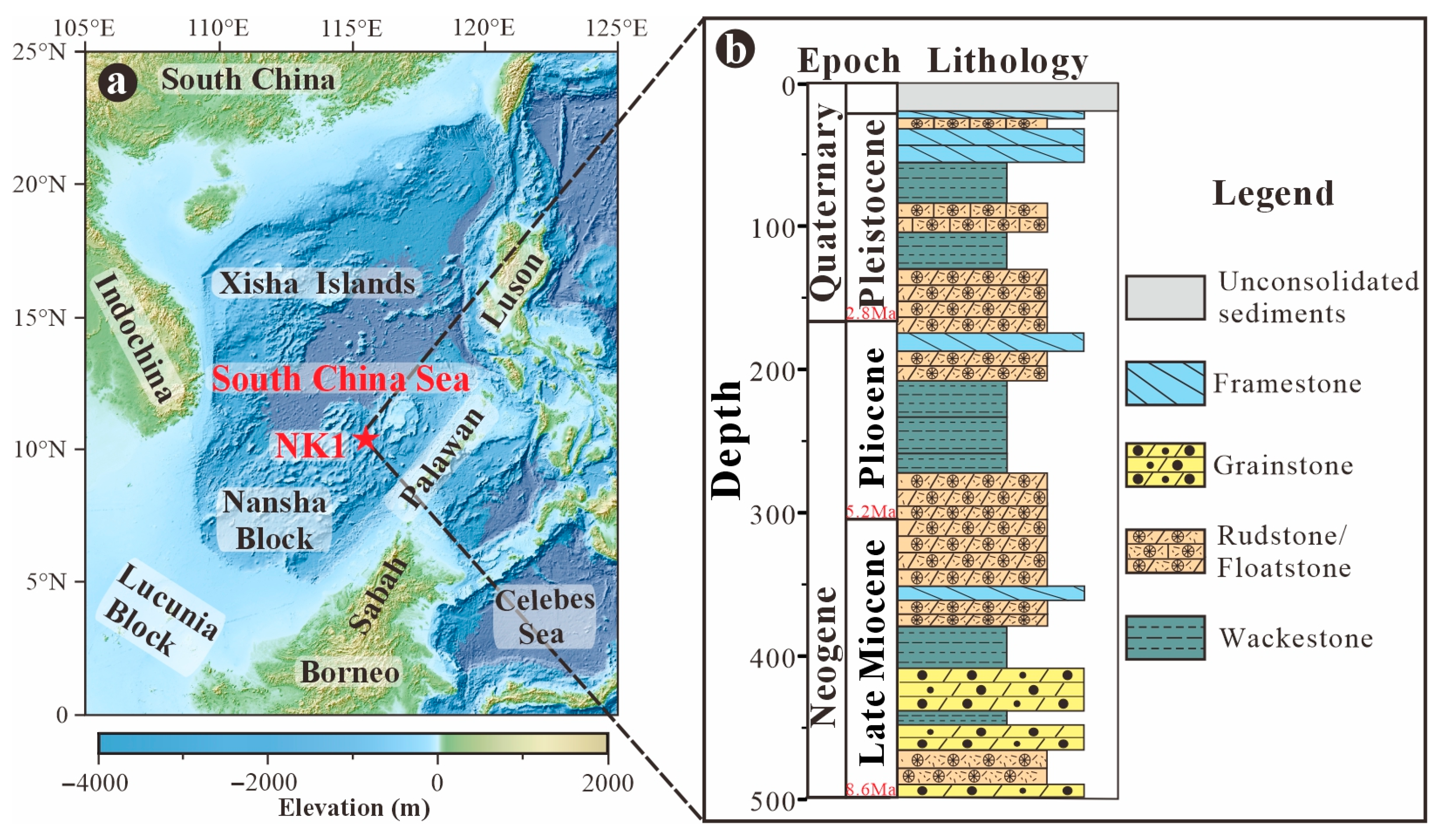
This study is based on the analysis of core samples from Well NK1, drilled at Meiji Reef in the southern SCS (Figure 1a,b), with a total depth of 2020.2 m. The upper interval (5.1–997.7 m) comprises a reef carbonate succession with a high core recovery rate of up to 92%. The study is focused on the upper 500 m of Well NK1 (Figure 1b). A total of 100 samples were analyzed for 87/86Sr isotopes to establish the chronostratigraphic framework. In addition, 48 bulk carbonate samples were selected for major and trace element analysis to capture key facies transitions. The lithological characteristics of the sampled intervals are summarized in Supplementary Table S1. Mineralogical data obtained from Liu (2022) [58] based on X-ray diffraction (XRD) analyses were also incorporated to support interpretations of depositional facies and diagenetic features.
Figure 1.
Location and stratigraphic characteristics of Meiji Atoll. (a) Regional location of NK1 in the southern SCS. Bathymetric data are derived from GMT [59] and based on the 30 arc-second global Earth Relief grid. (b) Generalized stratigraphic column of Well NK1. The lithological and chronological framework is modified from previous studies [43,44,54].
3.2. Methods
3.2.1. Facies and Stratigraphic Analysis
To ensure the selection of carbonate samples preserving primary seawater geochemical signatures, samples were carefully collected from intervals lacking visible weathering surfaces and obvious diagenetic alteration features. Lithofacies and diagenetic environments were identified through detailed core observations and petrographic examination under a transmitted-light polarizing microscope. Thin sections were analyzed for petrographic and facies characterization following standard microfacies classification schemes [60]. Based on detailed core observations and thin-section analyses, the upper 500 m of Well NK1 records the development of a reef carbonate succession within an isolated atoll system. The succession is composed of grainstone, floatstone/rudstone, wackestone, and framestone (Figure 1b, Figure 2 and Figure 3), following the classification schemes of Dunham (1962) and Embry and Klovan (1971) [61,62]. Stratigraphic sequences, as well as the delineation of transgressive systems tracts (TST) and highstand systems tracts (HST), were established according to classical sequence stratigraphic principles by integrating gamma-ray (GR) log patterns with vertical facies successions [63,64].
Figure 2.
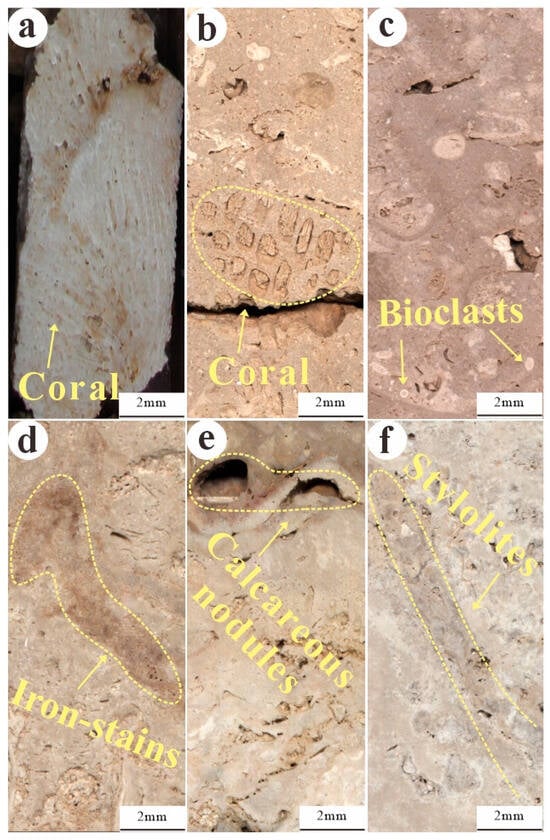
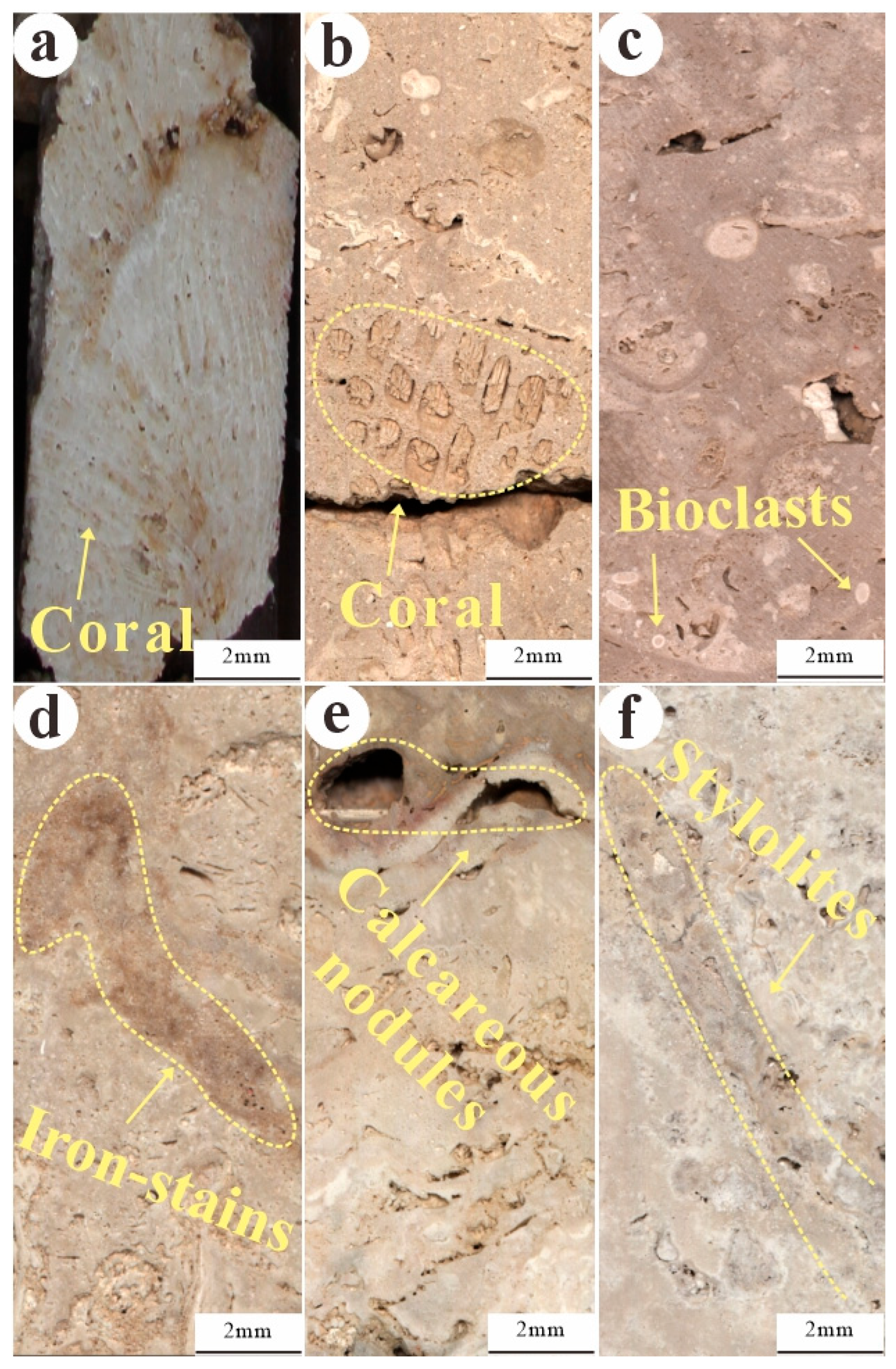
Typical hand specimen photos of core samples from NK1 Well. (a) Coral framestone, 39.6 m; (b) Coral skeleton dolostone, 357 m; (c) Bioclastic grainstone with a large amount of bioclasts, 432.5 m; (d) Iron stains in wackestone, exposed surface, 85.6 m; (e) Subaerial exposure surface characterized by well-developed calcareous nodules and dissolution vugs, 128 m; (f) Subaerial exposure surface/unconformity surface, with reef limestone overlying reef dolostone; a stylolite contact is developed at the interface, 120 m.
Figure 3.
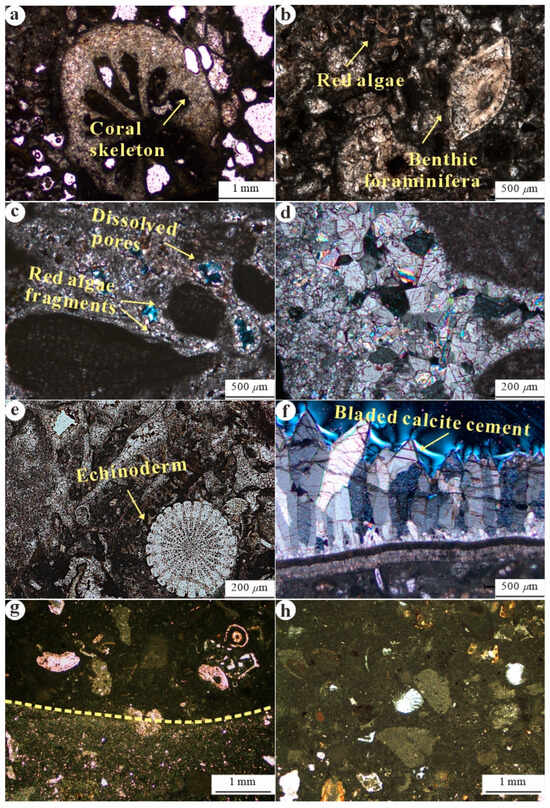
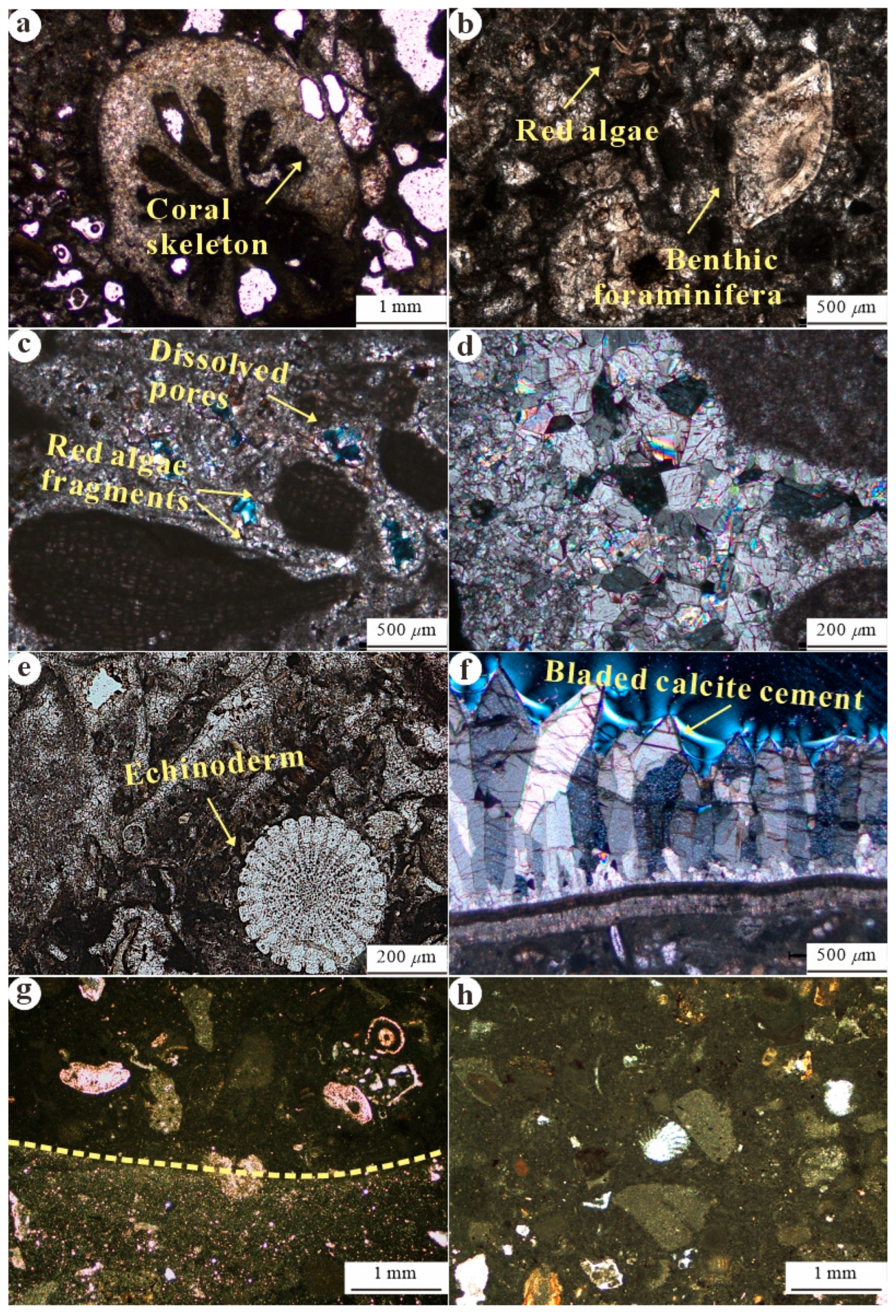
Typical microscope photos of core samples from Well NK1. (a) Coral skeleton limestone, with some coral fragments/skeleton, 69.5 m; (b) Floatstone, containing benthic foraminifera and red algae, 101.27 m; (c) Bioclastic wackestone, with red algae fragments, showing micritic textures and dissolution pores; dolomite crystals with subhedral-anhedral shapes are regularly distributed along the pore margins, 311.03 m under cross-polarized light; (d) Dolo-wackestone, filled with cloudy core and clear rim structure crystalline dolomite; wavy extinction appears in the dolomite crystals under rotation, 390.73 m under cross-polarized light; (e) Floatstone/rudstone with sea urchin filled by sparry calcite or micrite; (f) Bladed calcite cement, NK1 well, 46.07 m; (g) The upper part is floatstone, and the lower part is wackestone, 157.01 m; (h) Floatstone bioclast assemblage is dominated by coral-derived fragments, benthic foraminifera, and echinoderm debris, 157.01 m.
3.2.2. Geochemical Measurements
Prior to geochemical analysis, all samples were powdered to a grain size of less than 74 µm (200 mesh, ASTM) using an agate mortar to ensure sample homogeneity. The chronostratigraphic framework of core NK1 was established using 87Sr/86Sr isotope stratigraphy and U-Pb dating, as described in our previous studies [53,54,65]. All 87Sr/86Sr data and the resulting chronology are presented in Supplementary Table S2 and Figure S1, respectively [54].
Major elements were measured on an X-ray fluorescence (XRF) spectrometer (ARL Perform X4200 model, Thermo Fisher, Waltham, MA, USA) on fused glass beads. Trace elements and rare earth elements (REEs) were measured by an inductively coupled plasma-mass spectrometer (ICP-MS, Thermo Scientific-iCAP Qc, Waltham, MA, USA).
Carbon and oxygen isotope ratios (δ13C and δ18O) were measured using a Thermo Fisher MAT-253 isotope ratio mass spectrometer coupled with an automated Kiel IV carbonate device. Powdered subsamples were reacted with phosphoric acid (H3PO4) at 70 °C against release CO2 for isotopic analysis [66]. Isotopic values were calibrated to the Vienna Pee Dee Belemnite (VPDB) scale using the NBS-18 international standard (δ18O = −23.2 ‰ VPDB). Analytical precision for δ18O measurements was better than ±0.08‰ (1σ) [67].
4. Results
4.1. Lithology and Facies Association
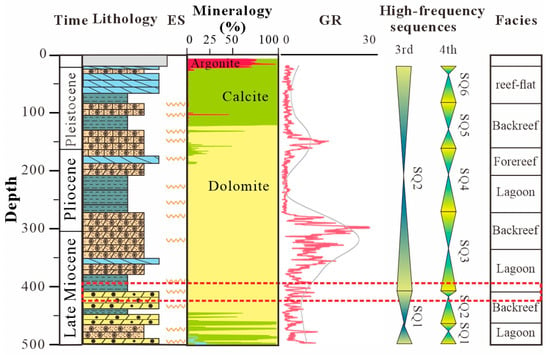
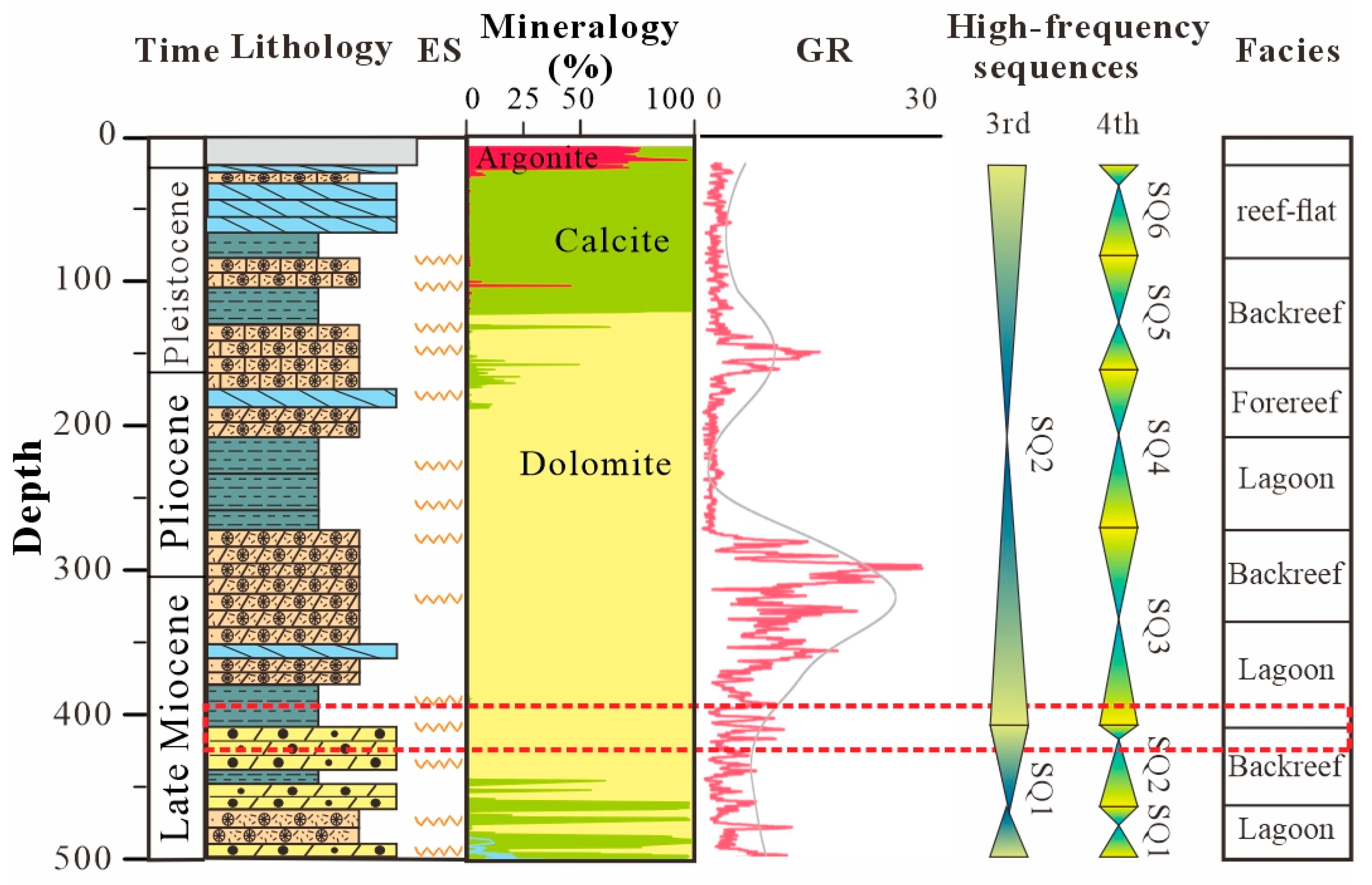
Mineralogical data indicate that the interval between 120 and 500 m is dominated by dolostone, whereas the upper section (0–120 m) consists primarily of limestone (Figure 4) [59]. In addition, 14 stratigraphic intervals exhibiting features related to subaerial exposure were identified within the succession (Figure 2c–f). Based on core observations and thin-section analyses, four main carbonate lithologies and facies associations were identified in the studied interval (Figure 1b).
Figure 4.
Sequence stratigraphic framework of Well NK1, showing lithology (see Figure 1 for legend), sample selection point (SS), sedimentary facies, mineralogical compositions, GR profile [44], third- and fourth-order sequences, and exposed surfaces (ES). Red dashed lines mark the sequence boundary interval between third-order SQ1 and SQ2 sequences. TST: Transgressive System Tract. HST: Highstand System Tract.
4.1.1. Lithofacies
Coral framestone consists of in situ coral skeletons forming rigid framework structures (Figure 2a and Figure 3a). The coral frameworks are commonly well preserved, with skeletal architectures clearly recognizable. Interstitial spaces between coral skeletons are variably filled with micrite or sparry calcite cement.
Bioclastic floatstone/rudstone is composed of abundant coarse skeletal fragments embedded within a micritic matrix (Figure 2b and Figure 3b,e). Skeletal components mainly include coral-derived debris, benthic foraminifera, and echinoderms. Grains are commonly poorly sorted and show variable degrees of fragmentation, and although locally grain-supported textures occur, a continuous rigid framework is absent.
Bioclastic grainstone is characterized by grain-supported textures composed predominantly of skeletal grains and bioclasts (Figure 2c), with little to no micritic matrix. Grains are generally well sorted and rounded, and intergranular pore spaces are commonly occluded by sparry calcite cement. Bioclastic components include fragments of corals, algae, and benthic foraminifera.
Wackestone is characterized by mud-supported textures with dispersed skeletal grains (Figure 2d and Figure 3c,d). Skeletal components mainly include red algal fragments and benthic foraminifera, which are generally well preserved. Dissolution pores and dolomite crystals locally occur along pore margins or within the micritic matrix, and large benthic foraminifera with low species diversity are commonly present together with coralline algae dominated by Aethesolithon and Lithophyllum. Granular and laminated red algal fragments may locally constitute a substantial proportion of the components and are embedded within the micritic matrix.
4.1.2. Facies Association
Reef Margin Facies Association
The reef margin facies association comprises reef-flat microfacies and reef-crest microfacies and is mainly composed of coral framestone, locally associated with red algal bindstone (Figure 2a,b,f). Coral skeletons commonly form rigid framework structures, with interstitial spaces variably filled by micrite or sparry calcite cement. Fossil assemblages include abundant coralline algae, together with benthic and planktonic foraminifera. Multiple stratigraphic intervals within this facies association show distinct changes in color, texture, and fossil preservation, reflecting repeated exposure-related features (Figure 2d–f and Figure 3c–f). In Well NK1, this facies association is mainly developed in the upper part of the succession, between approximately 35 and 75 m depth (Figure 4), where coral-derived components are particularly abundant.
The dominance of coral framestone and red algal bindstone forming rigid frameworks indicates deposition within reef-flat to reef-crest settings along the platform margin. Fossil assemblages and comparison with modern reef analogues from the Xisha Islands suggest shallow-water conditions, with water depths generally not exceeding ~40 m [34,48,68]. The repeated occurrence of exposure-related features reflects episodic subaerial exposure associated with relative sea-level fluctuations.
Backreef Facies Association
The backreef facies association is characterized by floatstone/rudstone textures, with subordinate and locally developed peloidal grainstones and wackestones. Bioclasts are dominated by abundant coral–algal fragments (including Amphiroa, Corallina, and Jania) (Figure 2b,f). Bioclastic components are commonly fragmented and embedded within a micritic matrix (Figure 3h). Rigid framework structures, such as red algal bindstone or small-scale coral framestone assemblages, are generally absent [57].
The abundance of bioclasts and the lack of a rigid framework indicate moderate to low energy conditions landward of the reef margin facies associations. This facies association is interpreted as a backreef to bioclastic shoal environments.
Lagoonal Facies Association
The lagoonal facies association in Well NK1 comprised restricted lagoon and open lagoon microfacies [60]. The restricted lagoon microfacies is dominated by fine-grained peloidal wackestone. Individual tests generally range from 2 to 5 mm, with some specimens reaching up to 1.5 cm. Although fragmented tests are occasionally observed, benthic foraminifera typically account for more than 60% of the total assemblage.
Granular and laminated red algal fragments are abundant, embedded within a micritic matrix. Minor bioclasts (approximately 5%–10%) include corals, echinoderms, coccolithophores, bivalves, and planktonic foraminifera [43,69]. In contrast, the open lagoon microfacies is characterized by better-sorted bioclastic sediments dominated by red and green algae, bryozoans, and gastropods, with grains commonly well rounded (Figure 2c).
The restricted lagoon microfacies reflects deposition under relatively low-energy and semi-restricted circulation conditions, whereas the open lagoon microfacies indicates enhanced water exchange and higher hydrodynamic energy within the lagoon.
Forereef Facies Association
The forereef facies association is dominated by micrite-rich floatstone and wackestone lithologies (Figure 2b). Bioclasts include coral fragments, red algae, and benthic foraminifera, which are commonly well preserved within a micritic matrix. This facies association occurs in framestone-dominated intervals and is commonly associated with finer-grained carbonate sediments.
The dominance of micrite-rich lithologies and dispersed, well-preserved bioclasts suggests deposition in forereef settings developed seaward of the reef-flat and reef-crest zones. Well-preserved bioclasts, including coral fragments, red algae, and benthic foraminifera, are common. The sedimentological characteristics indicate relatively low-energy hydrodynamic conditions.
4.2. Stratigraphic Sequences
Based on an integrated analysis of lithofacies variations, gamma-ray (GR) log trends, sedimentary facies, and identified exposure surfaces, two third-order sequences (SQ1 and SQ2), each comprising transgressive and highstand systems tracts, and six fourth-order sequences were recognized in Well NK1 (Figure 4). Lowstand systems tracts (LST) are not clearly preserved between HSTs and the overlying TSTs, suggesting that these intervals are mainly represented by exposure-related unconformities, potentially reflecting erosion and non-deposition during periods of extremely reduced accommodation. To better resolve the temporal evolution within SQ2, its HST was further subdivided into intervals before and after approximately 2.6 Ma. This subdivision is constrained by Sr isotope ages (Table S2), which indicate that the horizon at around 200 m depth corresponds to this temporal boundary.
A preliminary chronostratigraphic framework has been established for the upper 500 m of Well NK1 [54]. The sequence boundary between third-order sequences SQ1 and SQ2 is identified at a sharp lithological shift from coarse-grained grainstone (or rudstone/floatstone) to finer-grained wackestone (Figure 3g–h and Figure 4). This shift is accompanied by an upward-increasing GR trend and a facies change from high-energy shoal deposits to more open-marine settings, indicating reduced hydrodynamic energy and increased accommodation space. Such vertical facies successions are widely recognized as diagnostic criteria for identifying transgressive surfaces on carbonate platforms [34,48,63]. The TSTs of the third-order sequences are mainly characterized by fine-grained rudstone/floatstone and thin-bedded wackestone with abundant algal bindings. In contrast, the HSTs are dominated by interfingering backreef and forereef facies associations.
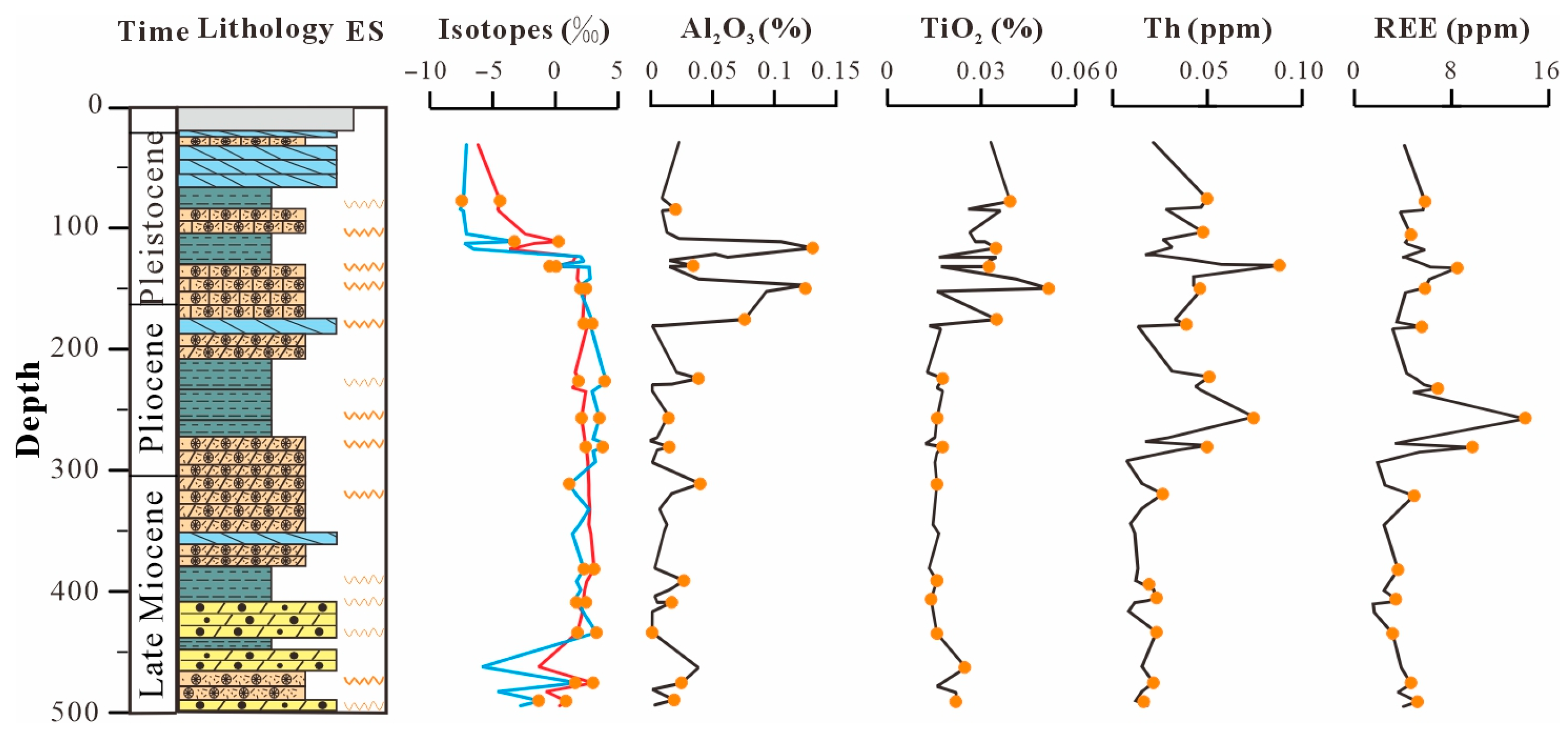
Within the third-order sequence framework, multiple high-frequency fourth-order sequence boundaries were further delineated (Figure 4). These fourth-order sequences are defined based on relative stratigraphic relationships, including facies stacking patterns and exposure surfaces. Although no direct astronomical tuning is applied, their inferred temporal scales are broadly consistent with orbital-scale sea-level fluctuations [44]. Each fourth-order sequence typically shows an upward facies transition from restricted lagoon microfacies or backreef facies associations to more open-marine settings. These facies stacking patterns are consistent with a corresponding shift in the GR log signature from high-amplitude, serrated patterns to low-amplitude, box-shaped patterns. Exposure surfaces, commonly associated with enhanced terrigenous element inputs, are frequently observed at the tops of these fourth-order sequences (Figure 4 and Figure 5).
Figure 5.
Vertical distribution of geochemical compositions in Well NK1. The red line in the isotopic profile represents δ13C, and the blue line represents δ18O in Well NK1. The area near the orange sampling points represents Exposure Surfaces (ESs); the thick lines represent the main exposed surfaces, while the thin lines represent the secondary exposed surfaces (see Figure 1 for lithology legend).
The delineation of third- and fourth-order system tracts in Well NK1 was therefore based on an integrated set of criteria, including lithological shifts, gamma-ray log trends, facies stacking patterns, and the identification of exposure surfaces. These criteria follow established sequence stratigraphic principles and provide direct evidence for the subdivision in TSTs and HSTs (Figure 4 and Figure 5) [63,64].
4.3. Geochemical Characteristics
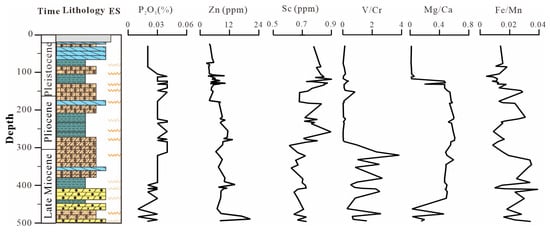
The geochemical composition of the samples from Well NK1 is summarized in Figure 6 and Supplementary Table S1. Stable isotope analyses show that carbon isotopes (δ13C) range from −6.1 ‰ to 3.2 ‰, with an average value of 1.1 ‰. Oxygen isotopes (δ18O) vary from −7.5 ‰ to 4.1 ‰, averaging 0.5 ‰ (Figure 5). Based on replicate analyses, the external precision of carbon and oxygen isotope measurements is better than ±0.05 ‰ (1σ) [67]. Trace element concentrations exhibit substantial variability, with thorium (Th) and scandium (Sc) contents ranging from 0.005 to 0.079 ppm and 0.575 to 0.868 ppm, respectively. To account for potential carbonate dilution effects, trace element concentrations were normalized to Post-Archean Australian Shale (PAAS).
Figure 6.
Vertical distribution of element contents in Well NK1 (see Figure 1 for lithology legend).
Strontium (Sr) concentrations are relatively high, ranging from 408.1 to 913.6 ppm, with a mean value of 661.7 ppm. Zinc (Zn) concentrations are generally between 5 and 10 ppm. Total REE concentrations vary from 1.5 to 14.1 ppm, with an average of 4.6 ppm. Several elemental ratios provide insights into depositional and diagenetic conditions. The Fe/Mn ratio exhibits a wide range from 169.4 to 1576.8, whereas the Mg/Ca ratio varies between 0.008 and 0.598. The V/Cr ratios show substantial variability, ranging from 0.03 to 3.86. P2O5 contents are relatively low, ranging from 0.01% to 0.04%. Analytical quality control was ensured through the analysis of duplicate samples and certified carbonate standards. The analytical precision for major and trace element analyses, including REEs, is high, with average standard deviations of less than 5% [54].
5. Discussion
5.1. Diagenesis and Terrigenous Input Assessment
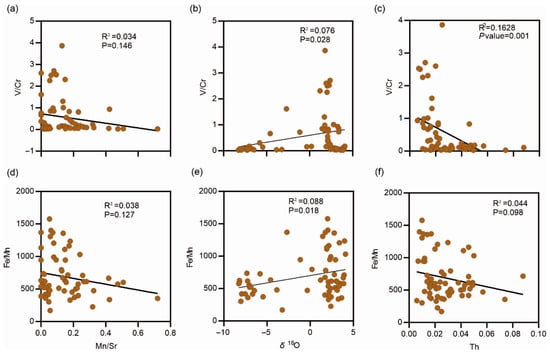
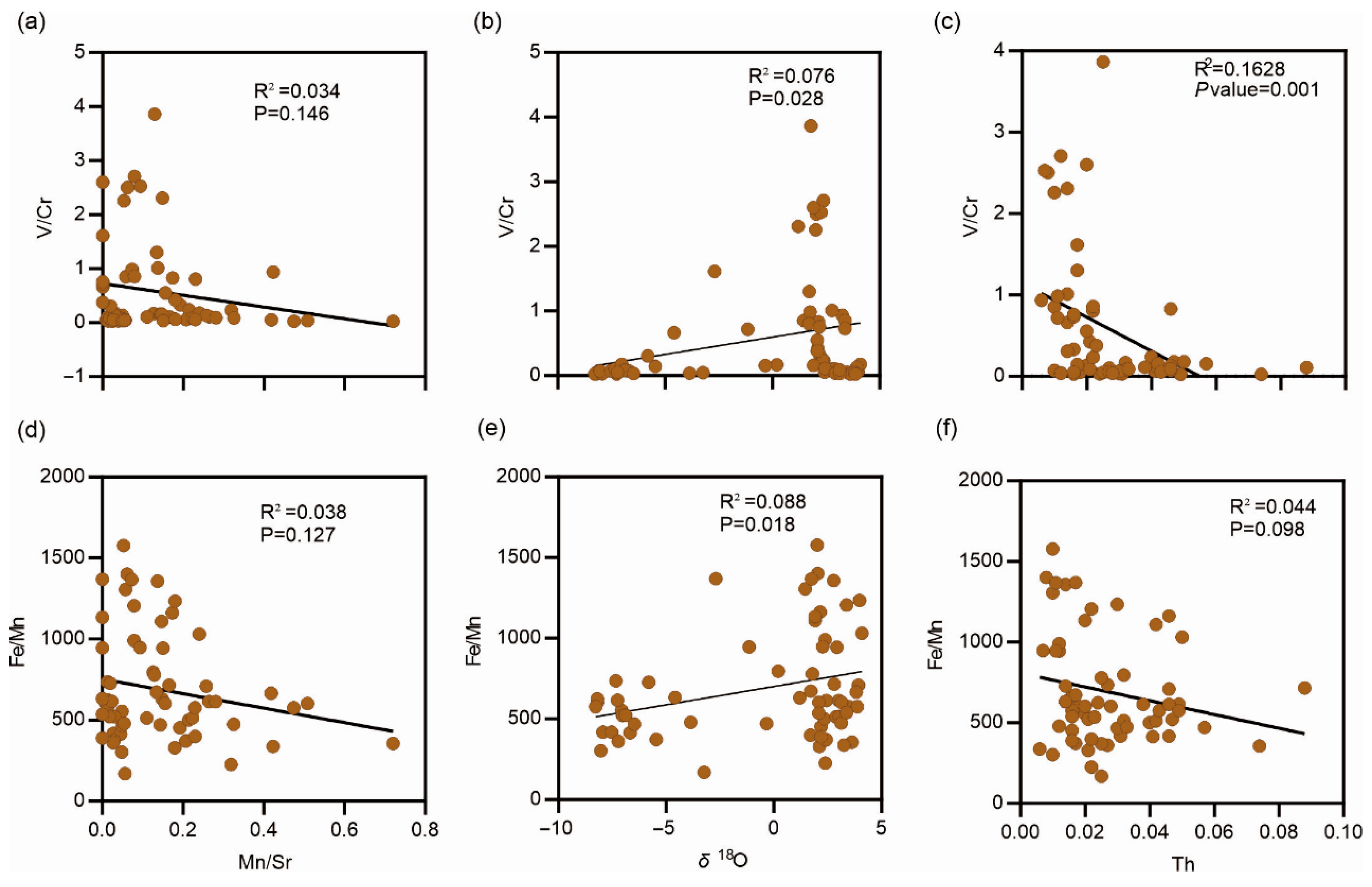
Prior to interpreting redox conditions using redox-sensitive elements, it is essential to evaluate the potential influences of non-authigenic factors, particularly diagenetic alteration and detrital input. In Well NK1, V/Cr and Fe/Mn ratios show very low coefficients of determination (R2 mostly < 0.1; Figure 7) compared with proxies for detrital input (Th) and diagenesis (Mn/Sr, δ18O). These weak correlations indicate that the redox-sensitive elements were minimally affected by terrigenous input and diagenetic processes [70,71,72]. Moreover, average Sc and Th concentrations in the NK1 samples are significantly lower than typical upper continental crustal values (Sc = 14.90 ppm, Th = 2.30 ppm) [30,31,32], and are also lower than those reported from siliciclastic-rich successions in the northern SCS [34,36,73]. This suggests that the sedimentary environment of Well NK1 was characterized by relatively open-marine conditions with limited terrigenous influence. Therefore, although minor detrital contributions cannot be entirely excluded, the overall impact of terrestrial input and diagenetic alteration on the geochemical proxies is considered negligible. Accordingly, the NK1 record is interpreted to reliably preserve primary paleo-oceanic signals.
Figure 7.
V/Cr (upper plots) and Fe/Mn (lower plots) values versus Mn/Sr, δ18O, Th. (a) V/Cr vs. Mn/Sr; (b) V/Cr vs. δ18O; (c) V/Cr vs. Th; (d) Fe/Mn vs. Mn/Sr; (e) Fe/Mn vs. δ18O; (f) Fe/Mn vs. Th.
The degree of diagenetic alteration can be effectively assessed using Sr content, Mn/Sr ratios, and δ18O values [74,75,76]. Diagenetic processes typically result in decreased Sr/Na ratios and elevated Fe/Mn contents [77,78,79]. δ18O is particularly sensitive to diagenesis; δ18O compositions can be easily reset through interaction with diagenetic fluids, commonly leading to more depleted signatures [80,81]. In general, Mn/Sr ratios below 2 and δ18O values higher than −10 ‰ are considered indicative of samples that have not experienced significant diagenetic alteration [82,83,84]. In this study, Mn/Sr ratios are consistently below the diagenetic threshold of 0.8 (Figure 7), indicating that diagenesis has not substantially modified the reef carbonates. Accordingly, the geochemical proxies derived from these samples can be reliably used to infer original seawater characteristics.
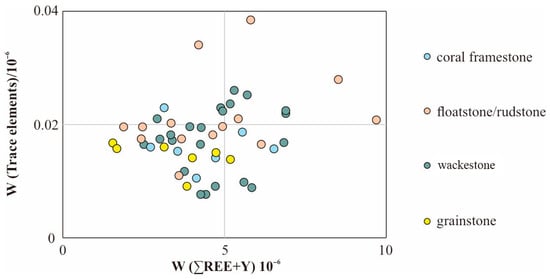
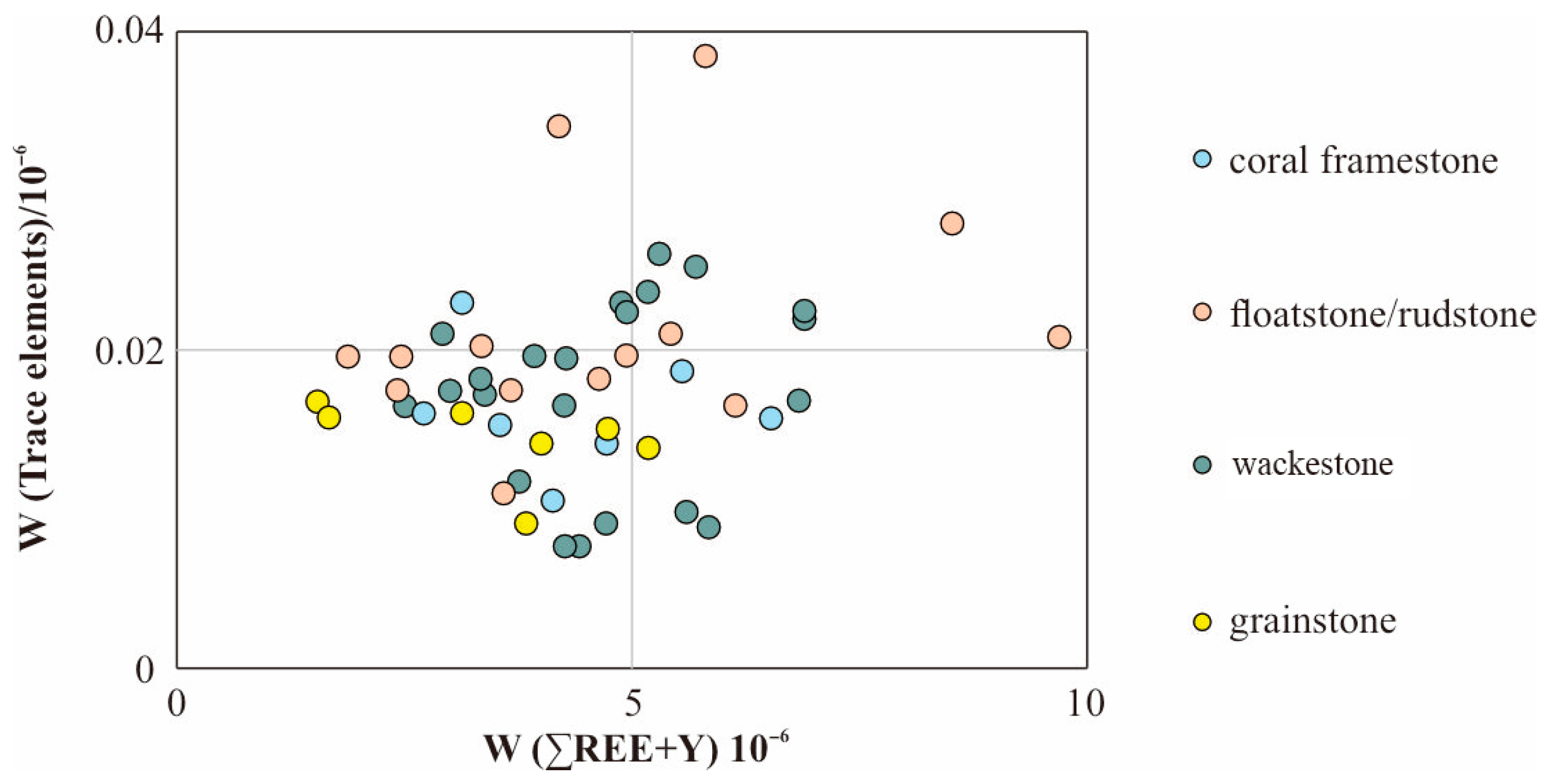
Further evidence for minimal contamination is provided by the REE data. The average total REE concentration (∑REE = 4.65 ppm) in Well NK1 is markedly lower than typical values in terrigenous materials (generally >100 ppm) [85], indicating negligible detrital input [77]. Additionally, Fe-Mn oxides display very weak correlations with REE concentrations (Figure 8), suggesting that these oxides exert minimal control on total REE abundances. Nevertheless, lithological variability in coarse-grained facies (e.g., floatstone/rudstone, grainstone) may introduce uncertainties in trace element concentrations, which should be considered when interpreting facies-specific geochemical patterns. Although the interval between 120 and 500 m is dominated by dolostone, these samples exhibit similarly low Mn/Sr ratios, relatively stable δ18O values, and weak correlations between redox-sensitive elements and diagenetic or detrital indicators (Figure 7), suggesting that primary seawater geochemical signatures are largely preserved.
Figure 8.
Trace elements and elemental ratio variations among lithofacies types in the Meiji Atoll. Relationship between the contents of REE and trace elements (Fe and Mn) in the reef carbonate in Well NK1.
5.2. Paleo-Environment Reconstruction of TST and HST
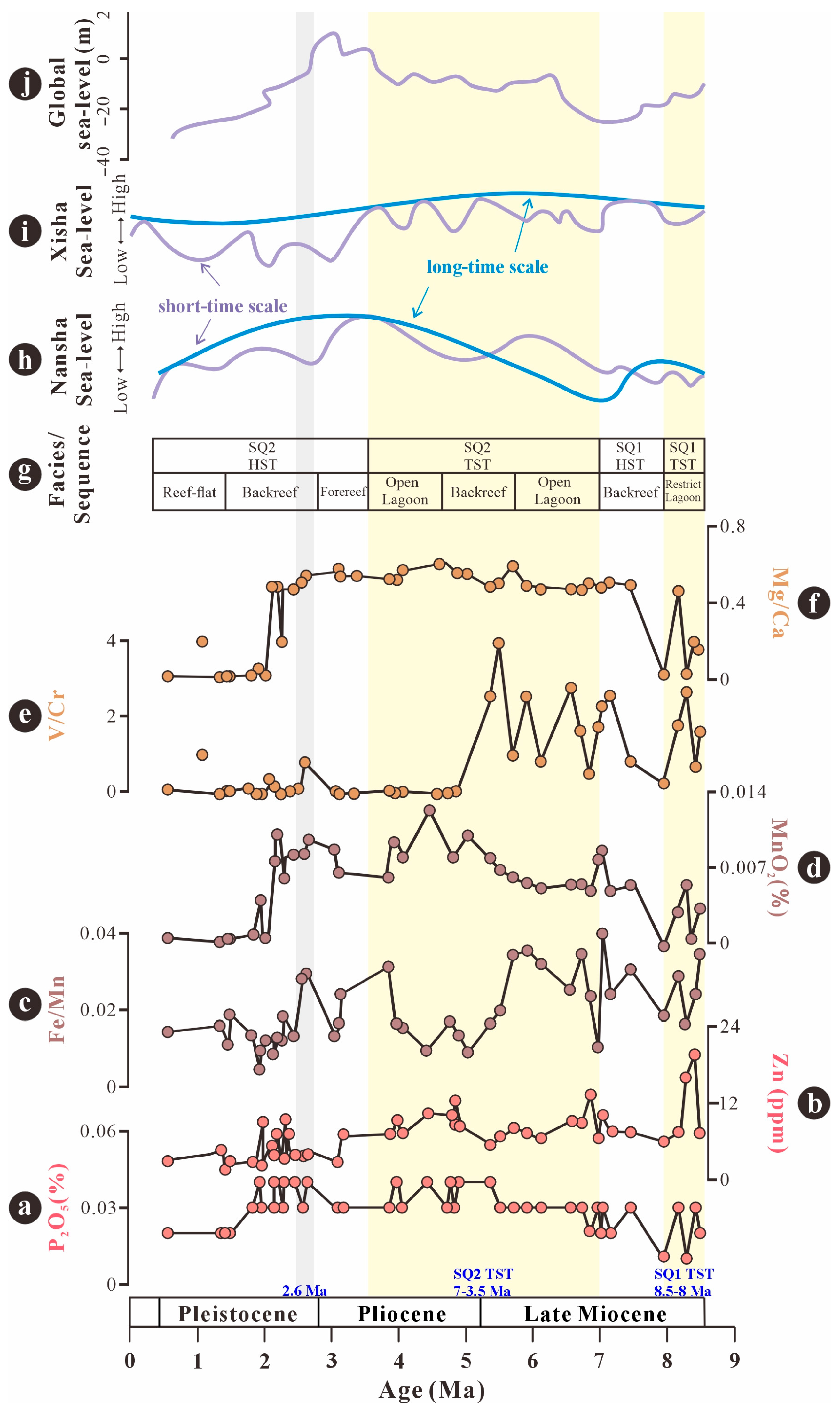
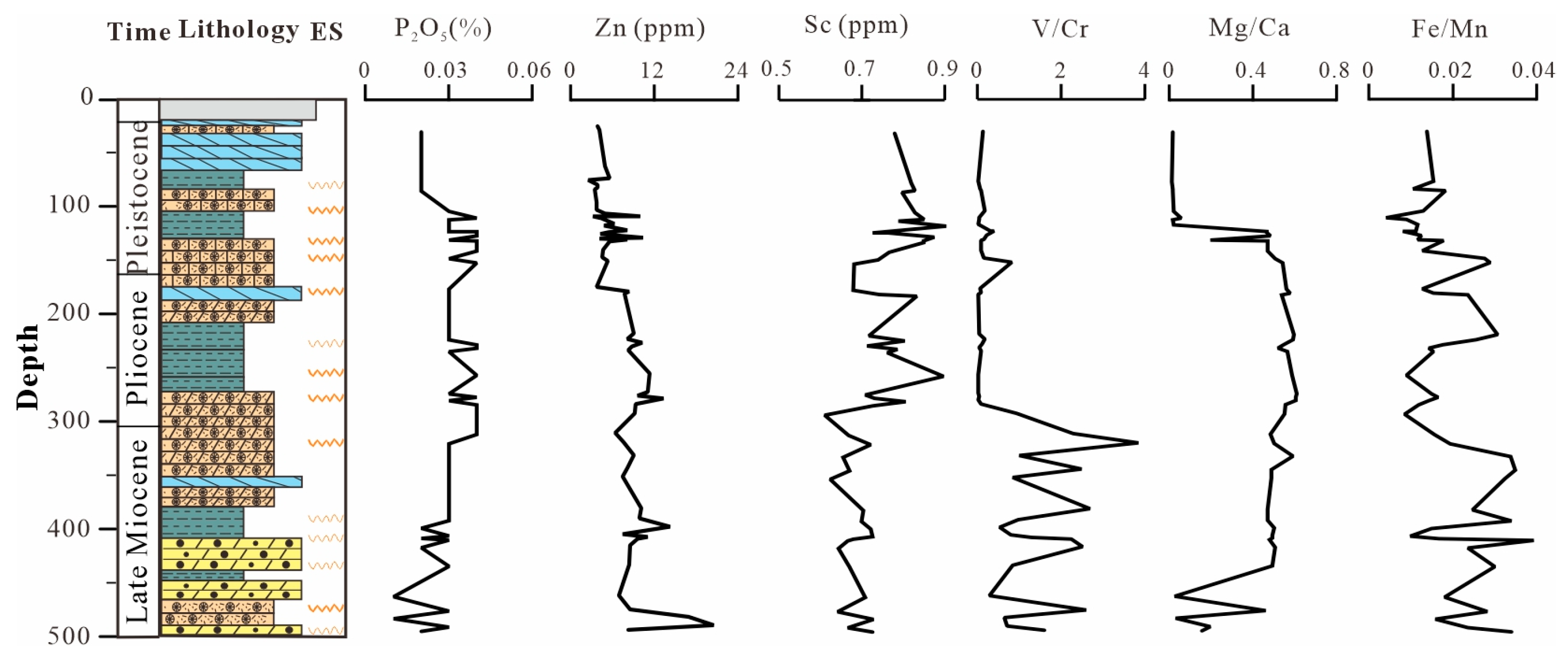
Geochemical records from different system tracts in Well NK1 provide detailed insights into paleoenvironmental changes during the development of the TST and HST of the third-order sequences SQ1 and SQ2 (Table S3). The TST of SQ1 and SQ2 formed during the early to Miocene (8.5–8 Ma) and the late Miocene to early Pliocene (7–3.5 Ma), respectively. This stratigraphic framework follows the third-order sequence division proposed by Liu (2022) [45] and is constrained by Sr isotope ages and U-Pb dating (Table S2; Figure S1). TST intervals are characterized by elevated P2O5 and Zn concentrations (Figure 9a,b), suggesting enhanced marine productivity driven by intensified upwelling of nutrient-rich waters [86,87]. Rising sea levels during transgression probably facilitated the delivery of nutrients into the photic zone, thereby promoting algal growth and organic matter accumulation [88,89]. The isolated nature of the NK1 platform, together with minimal terrigenous influence, favored the preservation of open-marine geochemical signals [46,90]. In terms of broader oceanographic controls, long-term global cooling since the Pleistocene has induced a general trend of sea-level fall accompanied by high-frequency oscillations [91,92]. These oscillations enhanced accommodation space and promoted episodic reef development, while persistently warm tropical conditions and sustained nutrient supply associated with upwelling supported steady successive growth [93]. The TST intervals also exhibit elevated Mn concentrations and low Fe/Mn ratios (Figure 9c,d), consistent with suboxic to anoxic conditions linked to organic-rich deposition. In addition, relatively high V/Cr ratios in the lower parts of SQ1 and SQ2 (Figure 9e) further support the presence of oxygen-depleted bottom waters during these periods [94,95].
In contrast, the HST intervals are marked by decreasing V/Cr ratios and fluctuating Fe/Mn values, suggesting a transition towards more restricted water circulation and relatively oxygenated depositional environments. Persistently elevated Mg/Ca ratios between 8.6 Ma and 2 Ma (Figure 9f) likely reflect widespread dolomitization processes. A commonly invoked mechanism for dolomitization in SCS island carbonates involves exposure and evaporative reflux during high-frequency sea-level oscillations [56,96,97,98]. Besides, alternative origins, including burial-related dolomitization and seepage reflux, remain under debate [34,36]. Elevated Fe/Mn ratios proximal to exposure surfaces may reflect meteoric diagenetic alteration, a typical feature of subaerially exposed carbonate successions [99,100]. At the same time, a progressive decrease in Mn concentrations towards the top of SQ2 (Figure 9d) suggests deposition under increasingly humid climatic conditions, consistent with enhanced meteoric flushing and weathering input. These geochemical patterns imply a paleoclimatic transition from warm–arid conditions during SQ1 deposition to warm–humid conditions during SQ2, with oscillations potentially linked to glacial–interglacial variability in the tropical Pacific [101,102].
Figure 9.
Multi-proxy records of geochemical indicators and sea-level changes from the NK1 well in the southern SCS since the late Miocene. Elemental geochemical profiles including (a) P2O5; (b) Zn; (c) Fe/Mn; (d) MnO2; (e) V/Cr; (f) Mg/Ca, (g) sedimentary facies with third-order sequence stratigraphy; (h) reconstructed NK1 long-term trend [103]; (i) regional sea-level curves from Xisha [33]; and (j) the global sea-level curve [92]. Light yellow shaded areas indicate transgressive systems tracts (TST) of third-order sequences SQ1 and SQ2. The gray bar marks the 2.6 Ma boundary, corresponding to a depth of 200 m in Well NK1, as constrained by Sr isotope stratigraphy [54].
5.3. Controls on Sedimentary Sequences by Sea-Level Changes
Carbonate platform architecture is highly sensitive to relative sea-level fluctuations [63,64,81], which exert fundamental control over sedimentary facies distribution, accommodation space, geochemical conditions, and diagenetic processes. The evolution of the Meiji Reef system in the southern SCS since the late Miocene provides a representative example of how multi-scale sea-level variations govern the development of carbonate platform sequences (Figure 9 and Figure 10).
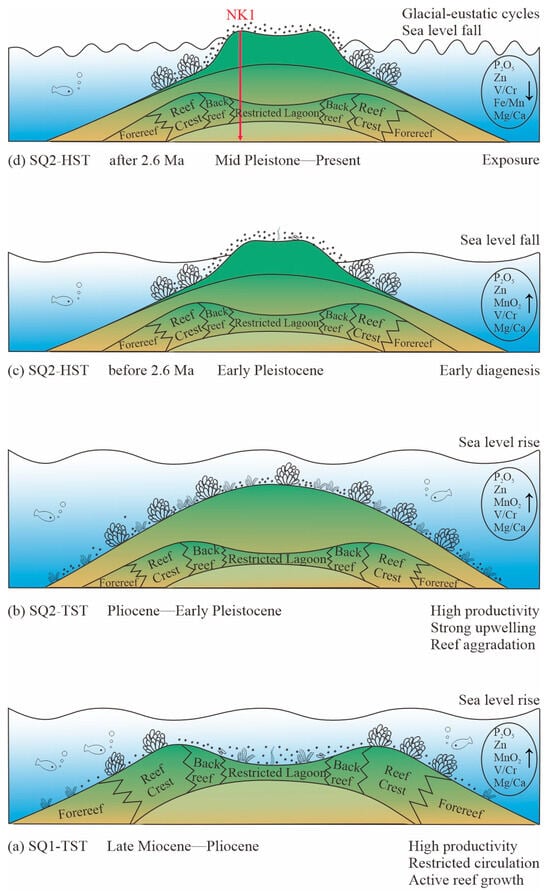
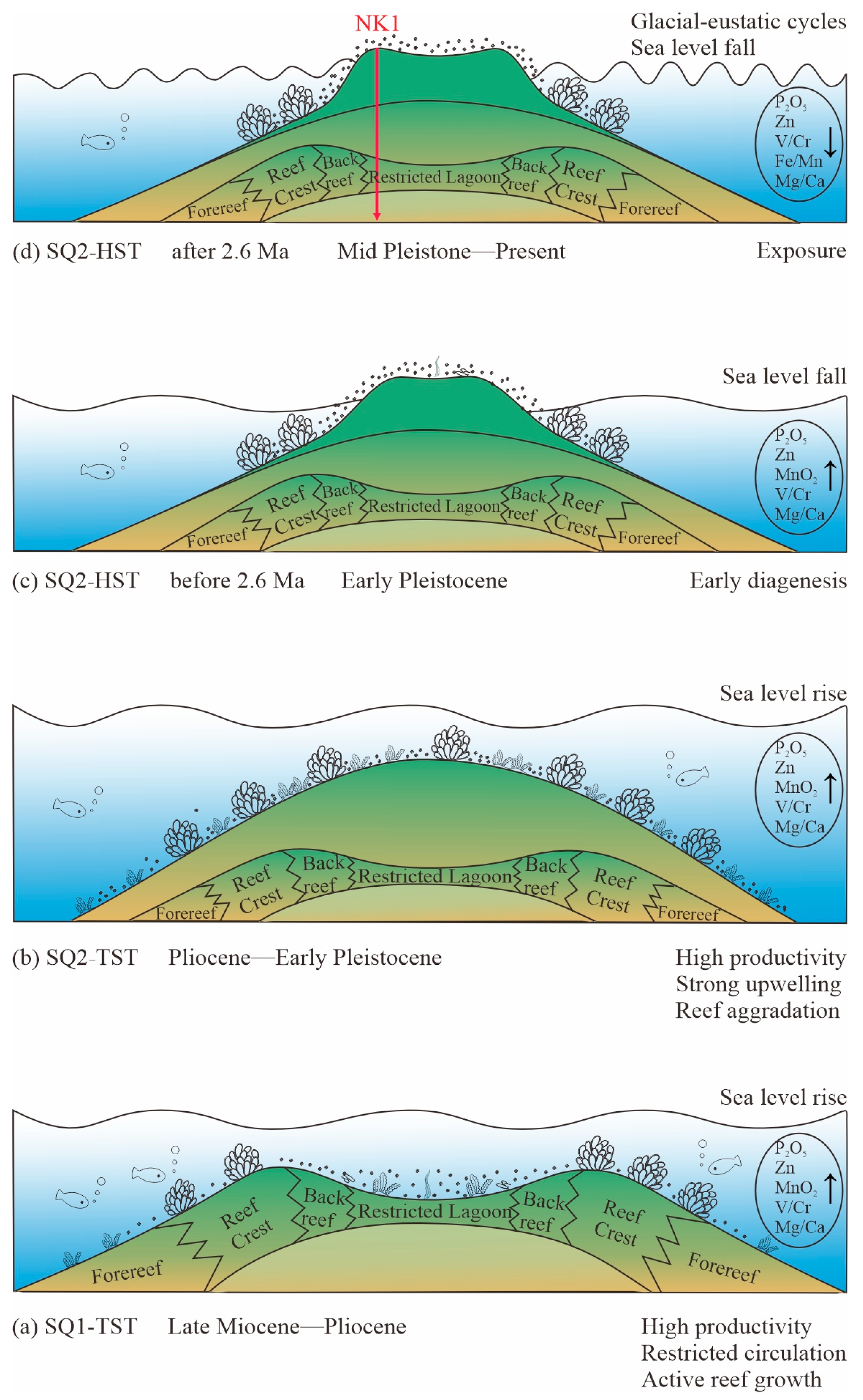
Figure 10.
Depositional model of reef evolution and associated facies in Well NK1 since the late Miocene. (a) SQ1-TST (late Miocene–Pliocene): During the initial transgression and basin subsidence, a complete reef system developed, comprising forereef facies association, reef crest, backreef, backreef facies association, and restricted lagoon microfacies, accompanied by active seawater circulation. (b) SQ2-TST (Pliocene–early Pleistocene): Continued sea-level rise and extensive reef growth, with sea level reaching its maximum, dominated by forereef and fine-grained sediments. (c) SQ2-HST before 2.6 Ma (early Pleistocene): Sea-level fall reduced accommodation space, promoting early diagenetic processes. (d) SQ2-HST after 2.6 Ma (mid-Pleistocene–present): Repeated glacial–eustatic sea-level fluctuations led to subaerial exposure, enhanced meteoric diagenesis, and reduced nutrient input.
At the third-order sequence scale, long-term global sea-level rise since the Late Miocene has increased accommodation space and promoted retrogradational stacking patterns during the TST. This is reflected by an upward-deepening trend, with a transition from restricted lagoon microfacies and backreef facies associations in SQ1 to open lagoon microfacies, forereef facies associations, and reef-flat facies associations in SQ2. Geochemically, TST intervals are characterized by elevated P2O5 and Zn concentrations (Figure 9), reflecting intensified upwelling and enhanced nutrient availability that supported high biological productivity and sustained reef growth (Figure 10a,b). In contrast, the HST of SQ2 (Mid-Pleistocene to present) is characterized by progressively reduced accommodation space and increasingly restricted water circulation (Figure 10c). These environmental changes are supported by geochemical indicators, including elevated Fe/Mn and V/Cr ratios, which point to more confined depositional conditions.
Superimposed on these longer-term trends, short-term sea-level oscillations resulted in repeated subaerial exposure, leading to the formation of small-scale sequence boundaries and early diagenetic overprints. Sea-level change therefore acted as the primary control on the stratigraphic evolution of the Meiji atoll across multiple temporal scales. Long-term sea-level rise promoted platform aggradation, increased accommodation space, and facilitated the development of nutrient-enriched transgressive deposits. The interaction of sea-level fluctuations at different scales generated a complex stratigraphic architecture characterized by the alternation of transgressive and highstand systems tracts (Figure 4, Figure 9 and Figure 10). This multi-scale evolutionary framework provides a valuable case study for understanding Cenozoic carbonate platform development in low-latitude passive margin settings [33,36,37,38,43,104].
5.4. Sedimentary Sequences of Miocene Carbonate Platforms in the SCS
The results from the Meiji Atoll enhance our understanding of reef evolution in response to late Miocene–Pleistocene sea-level fluctuations on low-latitude isolated carbonate platforms. The two third-order sequences identified at Meiji Atoll exhibit strong similarities to Miocene carbonate platforms in Central Luconia [93,105,106] and southern Palawan [51], reflecting comparable responses to sea-level change and sequence architectures that are consistent with global eustatic trends [92].
The SQ1-TST (8.5–8.0 Ma) at Meiji Atoll, representing the initial transgressive phase, correlates with seismic unit 3 in Central Luconia (9.5–8.8 Ma), which likewise records reef development during rising sea levels. This interval also corresponds to the onset of upper Tabon Limestone deposition in Palawan [51,93,105,107], collectively indicating regionally widespread reef growth associated with sea-level rise. The subsequent SQ1-HST (8.0–7.0 Ma), characterized by sea-level fall, meteoric alteration, and reduced accommodation space, corresponds to the transition between units 3 and 4 in Luconia (8.8–8.6 Ma), which is similarly marked by extensive karstification associated with highstand conditions [105,107].
The SQ2-TST (7.0–3.5 Ma) correlates well with seismic Unit 4 in Central Luconia, which records a backstepping-dominated phase of reef development preceding final platform drowning. During this interval, the Tabon Limestone in Palawan aggraded westward, reflecting a comparable increase in accommodation space and progradational stacking patterns [51].
A critical turning point occurred at about 2.6 Ma, coinciding with the onset of large-amplitude glacio-eustatic oscillations, which led to divergent evolutionary pathways among SCS carbonate platforms [45]. During the early HST part of the SQ2 sequence (3.5–2.6 Ma), Meiji Atoll experienced relatively stable and sustained carbonate accumulation under open-marine conditions with minimal siliciclastic input (Figure 9c) [105], in contrast to the near-drowning of the Central Luconia platform [93]. The enhanced siliciclastic influx into Central Luconia during the late Pliocene to early Pleistocene is interpreted to have originated from uplifted hinterlands in northern Borneo, including western Sarawak and the adjacent Rajang Fold-Thrust Belt [15]. The upper part of the HST of the SQ2 sequence records a phase of relative sea-level fall driven by glacial-interglacial cycles initiated at 2.6 Ma. By this time, carbonate production in Luconia and Palawan had largely ceased [15,51], whereas Meiji Atoll preserved a prolonged record of post-Miocene reef evolution under fluctuating sea-level conditions [45].
In summary, the Meiji Atoll record demonstrates that carbonate platform development was primarily governed by global sea-level dynamics, with additional modulation by regional tectonic and sedimentary processes. Beyond its local significance, the established stratigraphic framework shows strong correlations with platforms in Central Luconia and southern Palawan, placing the evolution of Meiji Atoll within the broader context of Cenozoic carbonate platform development in the SCS. These findings not only enhance our understanding of carbonate platform dynamics, sea-level controls, and basin-scale stratigraphy, but also provide valuable implications for paleoenvironmental reconstruction and hydrocarbon exploration.
6. Conclusions
This study reconstructs the evolutionary history of the Meiji Atoll in the southern SCS since the late Miocene through an integrated approach combining sedimentological, sequence stratigraphic, and geochemical analyses. Four principal facies associations—lagoonal, backreef, reef-flat, and reef crest—were identified, together with two third-order and six fourth-order depositional sequences. The results demonstrate that high-frequency sequence architecture was predominantly governed by multi-scale sea-level fluctuations. Long-term transgression promoted platform aggradation, whereas short-term sea-level oscillations induced repeated subaerial exposure and associated early diagenetic processes. Since the Pleistocene, high-frequency sea-level changes, coupled with enhanced nutrient supply and persistently warm-water conditions, have favored the continued development of reef carbonate systems on isolated platforms. Overall, this study highlights the dominant role of sea-level fluctuations in controlling sedimentary environments on low-latitude carbonate platforms and provides new insights into Cenozoic reef evolution.
Supplementary Materials
The following supporting information can be downloaded at https://www.mdpi.com/article/10.3390/min16020205/s1, Figure S1: Stratigraphic variation of lithology, age, isotope composition (Red line represents δ13C, blue line represents δ18O), and Y/Ho ratios in the Well NK1; Table S1: Major and trace element data in the Well NK1; Table S2: 87Sr/86Sr results and age ranges in the Well NK1; Table S3: Geochemical trends and environmental significance of sequence tracts in the Meiji Atoll.
Author Contributions
Y.L., W.X. and Y.Z. (Yuru Zhao) discussed the initial idea and framework of the manuscript. Y.Z. (Yunfeng Zhang), G.L., J.M.W. and W.Y. contributed to the review and final version. All authors have read and agreed to the published version of the manuscript.
Funding
This work was funded by the National Key Research and Development Program of China (2021-06) and the National Natural Science Foundation of China (42376079; 42494882).
Data Availability Statement
The original contributions presented in the study are included in the Supplementary Material. Further inquiries can be directed to the corresponding authors.
Conflicts of Interest
The authors declare that the research was conducted in the absence of any commercial or financial relationships that could be construed as a potential conflict of interest.
References
- Tucker, M.E.; Wright, V.P. Dolomites and Dolomitization Models. In Carbonate Sedimentology; Blackwell Science Ltd.: West Susses, UK, 1990; pp. 365–400. [Google Scholar]
- Schlager, W. Fractal nature of stratigraphic sequences. Geology 2004, 32, 185–188. [Google Scholar] [CrossRef] [Scilit]
- Gischler, E.; Camoin, G. Quaternary reef response to sea-level and environmental change in the western Atlantic. Sedimentology 2014, 62, 429–465. [Google Scholar] [CrossRef] [Scilit]
- Tomassetti, L.; Benedetti, A.; Brandano, M. Middle Eocene seagrass facies from Apennine carbonate platforms (Italy). Sediment. Geol. 2016, 335, 136–149. [Google Scholar] [CrossRef] [Scilit]
- Tournadour, E.; Jorry, S.J.; Etienne, S.; Collot, J.; Patriat, M.; BouDagher-Fadel, M.K.; Fournier, F.; Pelletier, B.; Le Roy, P.; Jouet, G.; et al. Neogene to Quaternary evolution of carbonate and mixed carbonate-siliciclastic systems along New Caledonia’s eastern margin (SW Pacific). Mar. Geol. 2021, 438, 106524. [Google Scholar] [CrossRef] [Scilit]
- Maurizot, P.; Cabioch, G.; Fournier, F.; Leonide, P.; Sebih, S.; Rouillard, P.; Montaggioni, L.; Collot, J.; Martin-Garin, B.; Chaproniere, G.; et al. Post-obduction carbonate system development in New Caledonia (Népoui, Lower Miocene). Sediment. Geol. 2016, 331, 42–62. [Google Scholar] [CrossRef] [Scilit]
- Del Viscio, G.; Frijia, G.; Posenato, R.; Singh, P.; Lehrmann, D.J.; Payne, J.L.; Al-Ramadan, K.; Struck, U.; Jochum, K.P.; Morsilli, M.; et al. Proliferation of Chondrodonta as a proxy of environmental instability at the onset of OAE1a: Insights from shallow-water limestones of the Apulia Carbonate Platform. Sedimentology 2021, 68, 3191–3227. [Google Scholar] [CrossRef] [Scilit]
- Basilone, L.; Bernardini, S.; Grassa, F.; Sulli, A.; Nieto, L.M.; Abbassi, A.; Jovane, L. Paleo-redox conditions during the demise of a carbonate platform in the Tethyan ocean: Evidence from phosphatized and metals (Mn and Fe) rich hardgrounds. Mar. Pet. Geol. 2024, 170, 107121. [Google Scholar] [CrossRef] [Scilit]
- Betzler, C.; Lindhorst, S.; Lüdmann, T.; Weiss, B.; Wunsch, M.; Braga, J.C. The leaking bucket of a Maldives atoll: Implications for the understanding of carbonate platform drowning. Mar. Geol. 2015, 366, 16–33. [Google Scholar] [CrossRef] [Scilit]
- Bialik, O.M.; Reolid, J.; Betzler, C.; Eberli, G.P.; Waldmann, N.D. Source shifts to periplatform deposits during the early to middle Miocene in response to climatic and oceanographic forcing, Maldives, western Indian Ocean. Palaeogeogr. Palaeoclimatol. Palaeoecol. 2020, 559, 109969. [Google Scholar] [CrossRef] [Scilit]
- Reolid, J.; Betzler, C.; Lüdmann, T. The record of Oligocene—Middle Miocene paleoenvironmental changes in a carbonate platform (IODP Exp. 359, Maldives, Indian Ocean). Mar. Geol. 2019, 412, 199–216. [Google Scholar] [CrossRef] [Scilit]
- Wang, R.; Jones, B.; Yu, K. Island dolostones: Genesis by time-transgressive or event dolomitization. Sediment. Geol. 2019, 390, 15–30. [Google Scholar] [CrossRef] [Scilit]
- Dawans, J.M.; Swart, P.K. Textural and geochemical alternations in Late Cenozoic Bahamian dolomites. Sedimentology 1998, 35, 385–403. [Google Scholar] [CrossRef] [Scilit]
- Swart, P.K.; Melim, L.A. The origin of dolomites in tertiary sediments from the margin of Great Bahama bank. J. Sediment. Res. 2000, 70, 738–748. [Google Scholar] [CrossRef] [Scilit]
- Vahrenkamp, V.C. Miocene carbonates of the Luconia province, offshore Sarawak: Implications for regional geology and reservoir properties from Strontium-isotope stratigraphy. Bull. Geol. Soc. Malays 1998, 42, 1–13. [Google Scholar] [CrossRef] [Scilit]
- Vahrenkamp, V.C.; Swart, P.K. Late Cenozoic Dolomites of the Bahamas: Metastable Analogues for the Genesis of Ancient Platform Dolomites. In Dolomites; Purser, B., Tucker, M., Zenger, D., Eds.; SEPM (Society for Sedimentary Geology): Tulsa, OK, USA, 1994; pp. 133–153. [Google Scholar]
- Brian, J.; Robert, W.L. Temporal evolution of tertiary dolostones on Grand Cayman as determined by 87Sr/86Sr. J. Sediment. Res. 2003, 73, 187–205. [Google Scholar] [CrossRef] [Scilit]
- Pleydell, S.M.; Jones, B. Dolomitization of the Oligocene-Miocene Bluff Formation on Grand Cayman, British West Indies. Can. J. Earth Sci. 2003, 27, 1098–1110. [Google Scholar] [CrossRef] [Scilit]
- Wang, R.; Yu, K.; Jones, B.; Jiang, W.; Xu, S.; Fan, T.; Zhang, Y. Dolomitization micro-conditions constraint on dolomite stoichiometry: A case study from the Miocene Huangliu Formation, Xisha Islands, South China Sea. Mar. Pet. Geol. 2021, 133, 105286. [Google Scholar] [CrossRef] [Scilit]
- Betzler, C.; Lindhorst, S.; Reijmer, J.J.G.; Braga, J.C.; Lüdmann, T.; Bialik, O.M.; Reolid, J.; Geßner, A.L.; Hainbucher, D.; Bissessur, D. Carbonate platform drowning caught in the act: The sedimentology of Saya de Malha Bank (Indian Ocean). Sedimentology 2022, 70, 78–99. [Google Scholar] [CrossRef] [Scilit]
- McCaffrey, J.C.; Wallace, M.W.; Gallagher, S.J. A Cenozoic Great Barrier Reef on Australia’s North West shelf. Global Planet. Change 2020, 184, 103048. [Google Scholar] [CrossRef] [Scilit]
- Wilson, M.E.J. Global and regional influences on equatorial shallow-marine carbonates during the Cenozoic. Palaeogeogr. Palaeoclimatol. Palaeoecol. 2008, 265, 262–274. [Google Scholar] [CrossRef] [Scilit]
- Vail, P.R.; Mitchum, R.M.; Thompson, S. Seismic Stratigraphy and Global Changes of Sea Level, Part 3: Relative Changes of Sea Level from Coastal Onlap 1. In Seismic Stratigraphy—Applications to Hydrocarbon Exploration; American Association of Petroleum Geologists: Tulsa, OK, USA, 1977. [Google Scholar]
- Haq, B.U.; Hardenbol, J.; Vail, P.R. Chronology of Fluctuating Sea Levels Since the Triassic. Science 1987, 235, 1156–1167. [Google Scholar] [CrossRef] [Scilit]
- Pomar, L. Ecological control of sedimentary accommodation: Evolution from a carbonate ramp to rimmed shelf, Upper Miocene, Balearic Islands. Palaeogeogr. Palaeoclimatol. Palaeoecol. 2001, 144, 249–272. [Google Scholar] [CrossRef] [Scilit]
- Pomar, L.; Bassant, P.; Brandano, M.; Ruchonnet, C.; Janson, X. Impact of carbonate producing biota on platform architecture: Insights from Miocene examples of the Mediterranean region. Earth-Sci. Rev. 2012, 113, 186–211. [Google Scholar] [CrossRef] [Scilit]
- Wilson, J.L. Carbonate Facies in Geologic History; Springer: New York, NY, USA, 1975; p. 474. [Google Scholar]
- Zhao, Y.; Gao, D.; Hu, M.; Zheng, C.; Li, J.; Xie, W. Controls of paleoclimate and sea−level changes on the high−frequency sequence of shallow−water carbonates: A case study of the Longwangmiao Formation in the central Sichuan Basin. Geol. China 2022, 51, 577–591. (In Chinese) [Google Scholar]
- Reijmer, J.J.G. Marine carbonate factories: Review and update. Sedimentology 2021, 68, 1729–1796. [Google Scholar] [CrossRef] [Scilit]
- Taylor, B.; Hayes, D. Origin and History of the South China Sea Basin. In The Tectonic and Geologic Evolution of Southeast Asian Seas and Islands: Part 2; American Geophysic Union: Washington, DC, USA, 1983; Volume 27, pp. 23–56. [Google Scholar]
- Clift, P.; Lin, J. Preferential mantle lithospheric extension under the South China margin. Mar. Pet. Geol. 2001, 18, 929–945. [Google Scholar] [CrossRef] [Scilit]
- Li, C.; Song, T. Magnetic recording of the Cenozoic oceanic crustal accretion and evolution of the South China Sea basin. Chin. Sci. Bull. 2012, 57, 3165–3181. [Google Scholar] [CrossRef] [Scilit]
- Shao, L.; Cui, Y.; Qiao, P.; Zhang, D.; Liu, X.; Zhang, C. Sea-level changes and carbonate platform evolution of the Xisha Islands (South China Sea) since the Early Miocene. Palaeogeogr. Palaeoclimatol. Palaeoecol. 2017, 485, 504–516. [Google Scholar] [CrossRef] [Scilit]
- Wu, F.; Xie, X.; Zhu, Y.; Chen, B.; Shang, Z. Sequence stratigraphy of the Late Oligocene carbonate system on the Xisha Islands in the South China Sea. Int. J. Earth Sci. 2021, 110, 1611–1629. [Google Scholar] [CrossRef] [Scilit]
- Meng, M. Study of the Foraminiferal Distribution in the Xisha Islands: Implications for Paleoenvironment Evolution Since the 20 Ma. Ph.D. Thesis, Guangxi University, Nanning, China, 2022. [Google Scholar]
- Wang, R.; Yu, K.; Jones, B.; Wang, Y.; Zhao, J.; Feng, Y.; Bian, L.; Xu, S.; Fan, T.; Jiang, W.; et al. Evolution and development of Miocene “island dolostones” on Xisha Islands, South China Sea. Mar. Geol. 2018, 406, 142–158. [Google Scholar] [CrossRef] [Scilit]
- Jiang, W.; Yu, K.; Fan, T.; Xu, S.; Wang, R.; Zhang, Y.; Yue, Y.; Zhao, J.-x.; Feng, Y.-x.; Wei, C.; et al. Coral reef carbonate record of the Pliocene-Pleistocene climate transition from an atoll in the South China Sea. Mar. Geol. 2019, 411, 88–97. [Google Scholar] [CrossRef] [Scilit]
- Meng, M.; Yu, K.; Hallock, P.; Qin, G.; Jiang, W.; Fan, T. Foraminifera indicate Neogene evolution of Yongle Atoll from Xisha Islands in the South China Sea. Palaeogeogr. Palaeoclimatol. Palaeoecol. 2022, 602, 111163. [Google Scholar] [CrossRef] [Scilit]
- Yang, Y.; Yu, K.; Wang, R.; Fan, T.; Jiang, W.; Xu, S.; Li, Y.; Zhao, J. 87Sr/86Sr of coral reef carbonate strata as an indicator of global sea level fall: Evidence from a 928.75-m-long core in the South China Sea. Mar. Geol. 2022, 445, 106758. [Google Scholar] [CrossRef] [Scilit]
- Yu, K.; Zhao, J.; Wang, P.; Shi, Q.; Meng, Q.; Collerson, K.D.; Liu, T. High-precision TIMS U-series and AMS 14C dating of a coral reef lagoon sediment core from southern South China Sea. Quat. Sci. Rev. 2006, 25, 2420–2430. [Google Scholar] [CrossRef] [Scilit]
- Sun, Z.; Zhao, Z.; Zhou, D.; Yang, S.; Lin, H.; Chen, G. The Stratigraphy and the Sequence Achitecture of the Basins in Nansha Region. Earth Sci. 2011, 36, 798–806. (In Chinese) [Google Scholar]
- Zhang, J.; Wu, Z.; Shen, Z.; Dong, C.; Wang, C.; Zhao, Y. Seismic evidence for the crustal deformation and kinematic evolution of the Nansha Block, South China Sea. J. Asian Earth Sci. 2020, 203, 104536. [Google Scholar] [CrossRef] [Scilit]
- Su, X.; Xiang, R.; Yi, L.; Zhang, Y.; Qin, G.; Yan, W. Neogene carbonate platform development in the southern South China Sea: Evidence from calcareous microfossils. Palaeogeogr. Palaeoclimatol. Palaeoecol. 2024, 640, 112093. [Google Scholar] [CrossRef] [Scilit]
- Rao, S.; Li, G.; Zhu, X.; Yan, W. Neogene sedimentary evolution of biogenic reefs on an isolated volcanic cone in the southern South China Sea. Palaeogeogr. Palaeoclimatol. Palaeoecol. 2025, 662, 112784. [Google Scholar] [CrossRef] [Scilit]
- Liu, J.; Webster, J.M.; Salles, T.; Wang, S.; Ma, Y.; Xu, W.; Li, G.; Yan, W. The formation of atolls: New insights from numerical simulations. J. Geophys. Res. Earth Surf. 2022, 127, e2022JF006812. [Google Scholar] [CrossRef] [Scilit]
- Chen, W.; Wu, S.; Wang, D.; Betzler, C.; Ma, Y. Stratigraphic evolution and drowning steps of a submerged isolated carbonate platform in the northern South China Sea. Front. Mar. Sci. 2023, 10, 1200788. [Google Scholar] [CrossRef] [Scilit]
- Liu, Y.; Wu, S.; Li, X.; Chen, W.; Han, X.; Yang, C.; Qin, Y.; Huang, X.; Yang, Z.; Sun, J.; et al. Seismic stratigraphy and development of a modern isolated carbonate platform (Xuande Atoll) in the South China Sea. Front. Earth Sci. 2023, 10, 1042371. [Google Scholar] [CrossRef] [Scilit]
- Wu, F.; Xie, X.; Coletti, G.; Zhu, Y.; Chen, B.; Shang, Z. Coralline algal and foraminiferal records of the Pliocene paleoclimatic conditions and water-depth changes in the northern South China Sea. Mar. Pet. Geol. 2023, 153, 106276. [Google Scholar] [CrossRef] [Scilit]
- Zhou, M.; Wu, F.; Xie, X.; Yan, W. Genesis and controlling factors of Cenozoic dolostones in the South China Sea: A case study from core Nanke-1 in the Nansha Islands. Mar. Geophys. Res. 2023, 44, 19. [Google Scholar] [CrossRef] [Scilit]
- Sibuet, J.-C.; Yeh, Y.-C.; Lee, C.-S. Geodynamics of the South China Sea. Tectonophysics 2016, 692, 98–119. [Google Scholar] [CrossRef] [Scilit]
- Steuer, S.; Franke, D.; Meresse, F.; Savva, D.; Pubellier, M.; Auxietr, J.-L. Time Constraints on the Evolution of Southern and Central Palawan Island from Correlation of Miocene Limestone Formations. J. Asian Earth Sci. 2013, 76, 412–427. [Google Scholar] [CrossRef] [Scilit]
- Steuer, S.; Franke, D.; Meresse, F.; Savva, D.; Pubellier, M.; Auxietre, J.-L. Oligocene–Miocene carbonates and their role for constraining the rifting and collision history of the Dangerous Grounds, South China Sea. Mar. Pet. Geol. 2014, 58, 644–657. [Google Scholar] [CrossRef] [Scilit]
- Yi, L.; Deng, C.; Yan, W.; Wu, H.; Zhang, C.; Xu, W.; Su, X.; He, H.; Guo, Z. Neogene–quaternary magnetostratigraphy of the biogenic reef sequence of core NK–1 in Nansha Qundao, South China Sea. Sci. Bull. 2021, 66, 200–203. [Google Scholar] [CrossRef] [Scilit]
- Li, G.; Xu, W.; Luo, Y.; Liu, J.; Zhao, J.; Feng, Y.; Cheng, J.; Sun, Z.; Xiang, R.; Xu, M.; et al. Strontium isotope stratigraphy and LA-ICP-MS U-Pb carbonate age constraints on the Cenozoic tectonic evolution of the southern South China Sea. GSA Bull. 2023, 135, 271–285. [Google Scholar] [CrossRef] [Scilit]
- Miao, X.; Huang, X.; Yan, W.; Yang, F.; Zhang, W.; Cai, Y.; Yu, Y.; He, P. Late Triassic dacites from Well NK-1 in the Nansha Block: Constraints on the Mesozoic tectonic evolution of the southern South China Sea margin. Lithos 2021, 398–399, 106337. [Google Scholar] [CrossRef] [Scilit]
- Guo, Y.; Deng, W.; Liu, X.; Kong, K.; Yan, W.; Wei, G. Clumped isotope geochemistry of island carbonates in the South China Sea: Implications for early diagenesis and dolomitization. Mar. Geol. 2021, 437, 106513. [Google Scholar] [CrossRef] [Scilit]
- Wu, F.; Xie, X.; Yan, W.; Zhu, Y.; Chen, B.; Chen, J.; Zhou, M. Quaternary evolution of the Meiji Atoll (Mischief Reef) in the southern South China Sea. Palaeogeogr. Palaeoclimatol. Palaeoecol. 2024, 634, 111912. [Google Scholar] [CrossRef] [Scilit]
- Liu, J.; Cao, L.; Xu, W.; Li, G.; Xiang, R.; Su, X.; Luo, Y.; Cheng, J.; Xu, X.; Zhao, Z.; et al. Formation and development of coral reefs in the South China Sea. Palaeogeogr. Palaeoclimatol. Palaeoecol. 2022, 594, 110957. [Google Scholar] [CrossRef] [Scilit]
- Wessel, P.; Smith, W.H.F.; Scharroo, R.; Luis, J.; Wobbe, F. Generic Mapping Tools: Improved Version Released. Eos Trans. Am. Geophys. Union 2013, 94, 409–410. [Google Scholar] [CrossRef] [Scilit]
- Flügel, E. Microfacies of Carbonate Rocks: Analysis, Interpretation, and Application; Springer: Berlin/Heidelberg, Germany, 2010; Volume 976. [Google Scholar]
- Dunham, R.J. Classification of Carbonate Rocks According to Depositional Texture. In Classification of Carbonate Rocks—A Symposium; American Association of Petroleum Geologists: Tulsa, OK, USA, 1962. [Google Scholar]
- Embry, A.; Klovan, E. A late Devonian reef tract on northeastern Banks Island. Bull. Can. Pet. Geol. Search Dropdown Menu 1971, 19, 730–781. [Google Scholar]
- Catuneanu, O. Priciples of Sequence Stratigraphy; Elsevier: Amsterdam, The Netherlands, 2006. [Google Scholar]
- Emery, D.; Myers, K. Sequence Stratigraphy; Wiley: London, UK, 1996. [Google Scholar]
- Luo, Y.; Li, G.; Xu, W.; Liu, J.; Cheng, J.; Zhao, J.; Yan, W. The effect of diagenesis on rare earth element geochemistry of the Quaternary carbonates at an isolated coral atoll in the South China Sea. Sediment. Geol. 2021, 420, 105933. [Google Scholar] [CrossRef] [Scilit]
- Han, T.; Yu, K.; Yan, H.; Deng, W.; Liu, Y.; Xu, S.; Tao, S.; Zhang, H.; Wang, S. Links between the coral δ13C record of primary productivity variations in the northern South China Sea and the East Asian winter monsoon. Geophys. Res. Lett. 2019, 46, 14586–14594. [Google Scholar] [CrossRef] [Scilit]
- Tao, S.; Liu, K.; Yan, H.; Meng, M.; Yu, K.; Shi, Q.; Zhang, H. The history of the El Niño-Southern oscillation and sea surface salinity during 1376–15 CE reconstructed by Porites coral δ18O from Huangyan Island, South China Sea. Global Planet. Change 2024, 243, 104622. [Google Scholar] [CrossRef] [Scilit]
- Li, Y.; Liu, X.; Chen, W.; Yi, L. Magnetic Properties and Initiation of Biogenic Reefs in Xisha Islands, South China Sea, at the Oligo–Miocene Boundary. J. Mar. Sci. Eng. 2021, 9, 1031. [Google Scholar] [CrossRef] [Scilit]
- Wu, F.; Zhu, Y. Quaternary subsidence history of Xisha Islands (northern South China Sea): Evidences from the reef-bank system. Mar. Pet. Geol. 2022, 144, 105843. [Google Scholar] [CrossRef] [Scilit]
- Kump, L. Interpreting carbon-isotope excursions: Strangelove oceans. Geology 1991, 19, 299–302. [Google Scholar] [CrossRef] [Scilit]
- Cole, D.B.; Zhang, S.; Planavsky, N.J. A new estimate of detrital redox-sensitive metal concentrations and variability in fluxes to marine sediments. Geochim. Cosmochim. Acta 2017, 215, 337–353. [Google Scholar] [CrossRef] [Scilit]
- Liu, S.; Chen, H.; Su, M.; Luo, K.; Wu, J.; Gao, Y.; Meng, Z.; Rodrigues, S.; Duarte, D.; Ng, Z.L.; et al. South China Sea records Late Miocene reorganization of western Pacific deep circulation. Nat. Commun. 2024, 15, 10228. [Google Scholar] [CrossRef] [Scilit]
- Fan, T.; Yu, K.; Zhao, J.; Jiang, W.; Xu, S.; Zhang, Y.; Wang, R.; Wang, Y.; Feng, Y.; Bian, L.; et al. Strontium isotope stratigraphy and paleomagnetic age constraints on the evolution history of coral reef islands, northern South China Sea. Geol. Soc. Am. Bull. 2019, 132, 803–816. [Google Scholar] [CrossRef] [Scilit]
- Brand, U.; Veizer, J. Chemical Diagenesis of a Multicomponent Carbonate System-1: Trace Elements. J. Sedim. Res. 1980, 50, 1219–1236. [Google Scholar]
- Brand, U.; Veizer, J. Diagenesis multicomponent carbonate system: 2, Stable Isotopes. J. Sedim. Res. 1981, 51, 987–997. [Google Scholar]
- Bruckschen, P.; Bruhn, F.; Veizer, J.; Buhl, D. 87Sr/86Sr isotopic evolution of Lower Carboniferous seawater: Dinantian of western Europe. Sediment. Geol. 1995, 100, 63–81. [Google Scholar] [CrossRef] [Scilit]
- Banner, J.L.; Hanson, G.N. Calculation of simultaneous isotopic and trace element variations during water-rock interaction with applications to carbonate diagenesis. Geochim. Cosmochim. Acta 1990, 54, 3123–3137. [Google Scholar] [CrossRef] [Scilit]
- Rimstidt, J.D.; Balog, A.; Webb, J. Distribution of trace elements between carbonate minerals and aqueous solutions. Geochim. Cosmochim. Acta 1998, 62, 1851–1863. [Google Scholar] [CrossRef] [Scilit]
- Zhou, H.; Gao, D.; Huang, L.; Zhu, G.; Zhang, T.; Liu, J.; Zhai, X.; Xiong, R.; Wang, S.; Zhang, Y. Characteristics and genesis of dolomite in the lower Cambrian Xiaoerbulake Formation of the western Tarim Basin, China. Front. Earth Sci. 2023, 10, 1075941. [Google Scholar] [CrossRef] [Scilit]
- Kaufman, A.J.; Knoll, A.H. Neoproterozoic variations in the C⁃isotopic composition of seawater stratigraphic and biogeochemical implications. Precambrian Res. 1995, 73, 27–49. [Google Scholar] [CrossRef] [Scilit]
- Zhao, Y.; Gao, D.; Ngia, N.R.; Hu, M.; Zhao, S. Influence of sea-level changes and dolomitization on the formation of high-quality reservoirs in the Cambrian Longwangmiao Formation, central Sichuan basin. J. Pet. Explor. Prod. Technol. 2025, 15, 99. [Google Scholar] [CrossRef] [Scilit]
- Kaufman, A.J.; Knoll, A.H.; Awramik, S.M. Biostratigraphic and chemostratigraphic correlation of Neoproterozoic sedimentary successions: Upper Tindir Group, northwestern Canada, as a test case. Geology 1992, 20, 181. [Google Scholar] [CrossRef] [Scilit] [PubMed]
- Derry, L.A.; Brasier, M.D.; Corfield, R.M.; Rozanov, A.Y.; Zhuravlev, A.Y. Sr and C isotopes in Lower Cambrian carbonates from the Siberian craton: A paleoenvironmental record during the ‘Cambrian explosion’. Earth Planet. Sci. Lett. 1994, 128, 671–681. [Google Scholar] [CrossRef] [Scilit]
- Charreau, J.; Kent-Corson, M.L.; Barrier, L.; Augier, R.; Ritts, B.D.; Chen, Y.; France-Lannord, C.; Guilmette, C. A high-resolution stable isotopic record from the Junggar Basin (NW China): Implications for the paleotopographic evolution of the Tianshan Mountains. Earth Planet. Sci. Lett. 2012, 341–344, 158–169. [Google Scholar] [CrossRef] [Scilit]
- Nothdurft, L.D.; Webb, G.E.; Kamber, B.S. Rare earth element geochemistry of Late Devonian reefal carbonates, Canning Basin, Western Australia: Confirmation of a seawater REE proxy in ancient limestones. Geochim. Cosmochim. Acta 2004, 68, 263–283. [Google Scholar] [CrossRef] [Scilit]
- Rodriguez-Ruano, V.; Toth, L.T.; Enochs, I.C.; Randall, C.J.; Aronson, R.B. Upwelling, climate change, and the shifting geography of coral reef development. Sci. Rep. 2023, 13, 1770. [Google Scholar] [CrossRef] [Scilit]
- Saltzman, M.R. Phosphorus, nitrogen, and the redox evolution of the Paleozoic oceans. Geology 2005, 33, 573–576. [Google Scholar] [CrossRef] [Scilit]
- Jin, C.; Liao, Z.; Tang, Y. Sea-level changes control organic matter accumulation in the Longmaxi shales of southeastern Chongqing, China. Mar. Pet. Geol. 2020, 119, 104478. [Google Scholar] [CrossRef] [Scilit]
- Gao, D.; Wang, M.; Tao, Y.; Huang, L.; Sun, C.; Huang, X.; Wu, J. Control of sea level changes on high-frequency sequence and sedimentary evolution of Lianglitage Formation in the Tazhong Area. Geol. China 2022, 49, 1936–1950. (In Chinese) [Google Scholar]
- Wu, S.; Chen, W.; Huang, X.; Liu, G.; Li, X.; Betzler, C. Facies model on the modern isolated carbonate platform in the Xisha Archipelago, South China Sea. Mar. Geol. 2020, 425, 106203. [Google Scholar] [CrossRef] [Scilit]
- Tian, J.; Zhao, Q.; Wang, P.; Li, Q.; Cheng, X. Astronomically modulated Neogene sediment records from the South China Sea. Paleoceanography 2008, 23, 1–20. [Google Scholar] [CrossRef] [Scilit]
- Miller, K.G.; Browning, J.V.; Schmelz, W.J.; Kopp, R.E.; Mountain, G.S.; Wright, J.D. Cenozoic sea-level and cryospheric evolution from deep-sea geochemical and continental margin records. Sci. Adv. 2020, 6, eaaz1346. [Google Scholar] [CrossRef] [Scilit]
- Makhankova, A.; Sautter, B.; Mathew, M.; Menier, D.; Poppelreiter, M. Seismic stratigraphy and sedimentology of a Miocene carbonate platform in Luconia, South China Sea. Geol. J. 2020, 56, 1–17. [Google Scholar] [CrossRef] [Scilit]
- Algeo, T.J.; Liu, J. A reassessment of elemental proxies for paleoredox analysis. Chem. Geol. 2020, 540, 119549. [Google Scholar] [CrossRef] [Scilit]
- Tribovillard, N.; Algeo, T.J.; Lyons, T.; Riboulleau, A. Trace metals as paleoredox and paleoproductivity proxies: An update. Chem. Geol. 2006, 232, 12–32. [Google Scholar] [CrossRef] [Scilit]
- Luo, Y.; Li, G.; Zhang, X.; Xu, W.; Zhu, X.; Zhou, W.; Huang, H.; Yan, W.; Zhong, F. Multistage Diagenetic Fluid Shaping Miocene Island Dolostones on One Isolated Atoll in the South China Sea: Insights from LA-ICP-MS U–Pb Dating and Geochemical Characterization. Minerals 2024, 14, 157. [Google Scholar] [CrossRef] [Scilit]
- Di, P.; Li, N.; Gong, S.; Peckmann, J.; Wang, S.; Chen, D.; Yan, W. Carbonate-associated sulfate as an archive of sulfur and oxygen stable isotope composition of seawater sulfate: Evidence from reef carbonate rocks of the southern South China Sea. Chem. Geol. 2023, 638, 121699. [Google Scholar] [CrossRef] [Scilit]
- Jia, Y.; Wu, H.; Yan, W.; Zhang, C.; Hu, B.; Zhang, J.; Tian, L.; Deng, C. Rare earth element geochemistry of reef carbonates in the South China Sea since the Miocene: Insights into paleoclimatic significance. J. Asian Earth Sci. 2024, 265, 106094. [Google Scholar] [CrossRef] [Scilit]
- Scopelliti, G.; Russo, V. Petrographic and geochemical characterization of the Middle-Upper Jurassic Fe–Mn crusts and mineralizations from Monte Inici (north-western Sicily): Genetic implications. Int. J. Earth Sci. 2021, 110, 559–582. [Google Scholar] [CrossRef] [Scilit]
- Swart, P.K. The geochemistry of carbonate diagenesis: The past, present and future. Sedimentology 2015, 62, 1233–1304. [Google Scholar] [CrossRef] [Scilit]
- Clemens, S.C.; Holbourn, A.; Kubota, Y.; Lee, K.E.; Liu, Z.; Chen, G.; Nelson, A.; Fox-Kemper, B. Precession-band variance missing from East Asian monsoon runoff. Nat. Commun. 2018, 9, 3364. [Google Scholar] [CrossRef] [Scilit] [PubMed]
- Wang, P.; Clemens, S.; Beaufort, L.; Braconnot, P.; Ganssen, G.; Jian, Z.; Kershaw, P.; Sarnthein, M. Evolution and variability of the Asian monsoon system: State of the art and outstanding issues. Quat. Sci. Rev. 2005, 24, 595–629. [Google Scholar] [CrossRef] [Scilit]
- Zhang, Y. Foraminiferal Ecology, Biostratigraphy and Paleoenvironmental Implications of Reef Deposits in the South China Sea; Chinese Academy of Sciences: Beijing, China, 2020. [Google Scholar]
- Wu, F.; Xie, X.; Zhu, Y.; Coletti, G.; Betzler, C.; Cui, Y.; Bai, H.; Chen, B.; Shang, Z. Early development of carbonate platform (Xisha Islands) in the northern South China Sea. Mar. Geol. 2021, 441, 106629. [Google Scholar] [CrossRef] [Scilit]
- Ali, S.H.; Poppelreiter, M.C.; Saw, B.B.; Shah, M.M.; Bashir, Y. Facies, diagenesis and secondary porosity of a Miocene reefal platform of Central Luconia, Malaysia. Carbonates Evaporites 2021, 36, 44. [Google Scholar] [CrossRef] [Scilit]
- Jiménez, G.; Latiff, A.H.A.; Ben Habel, W.; Poppelreiter, M. Effective application of geological process modeling for unravelling carbonate build-up complexity: A case study from the EX-Carbonate build-up in central Luconia Province, Malaysia. Mar. Pet. Geol. 2024, 170, 107117. [Google Scholar] [CrossRef] [Scilit]
- Zampetti, V.; Schlager, W.; van Konijnenburg, J.-H.; Everts, A.-J. Architecture and growth history of a Miocene carbonate platform from 3D seismic reflection data; Luconia province, offshore Sarawak, Malaysia. Mar. Pet. Geol. 2004, 21, 517–534. [Google Scholar] [CrossRef] [Scilit]
Disclaimer/Publisher’s Note: The statements, opinions and data contained in all publications are solely those of the individual author(s) and contributor(s) and not of MDPI and/or the editor(s). MDPI and/or the editor(s) disclaim responsibility for any injury to people or property resulting from any ideas, methods, instructions or products referred to in the content. |
© 2026 by the authors. Licensee MDPI, Basel, Switzerland. This article is an open access article distributed under the terms and conditions of the Creative Commons Attribution (CC BY) license.