


Abstract
Deep and ultra-deep carbonate reservoirs in the Ediacaran Dengying Formation of the central Sichuan Basin are important targets for natural gas exploration. Although previous studies have documented depositional and diagenetic controls on Dengying reservoir development, the formation mechanisms and reservoir effects of tectonic breccia remain insufficiently constrained. This study integrates core and thin-section observations, FMI logs, petrophysical measurements, fluid-inclusion microthermometry, carbon and oxygen isotopes, and U–Pb dating of saddle dolomite cement to clarify how tectonic breccia formed and how it modified the dolostone reservoir quality. The results indicate that tight laminated dolomicrite was fragmented within a strike-slip fault-damage-zone system during Late Caledonian weak compression and localized transtension, forming 1–5 cm angular to sub-angular clasts and an inter-breccia fracture-pore framework. The U–Pb dating (ca. 440 ± 17 Ma) roughly ties saddle dolomite cementation to the brecciation driven by Late Caledonian localized stretching. Brecciation created the early fracture-pore system, whereas saddle dolomite cementation produced the strongest early pore-loss effect and later fillings further reduced the residual pore space. Later calcite cementation, bitumen–sulfide filling, and open fractures are interpreted as reservoir-modification stages inferred from cross-cutting relationships, the burial history, and regional geochronological constraints rather than direct dating. These data indicate that effective fracture-pore reservoirs were preserved locally, where the early breccia framework remained partly open or was later reconnected by open fractures. This study clarifies how fault-related brecciation, staged cementation and filling, and late fracture preservation jointly controlled the preservation of the deeply buried carbonate reservoir quality.
1. Introduction
Deep to ultra-deep carbonate reservoirs are increasingly important exploration targets because large volumes of hydrocarbon resources are stored in deeply buried marine carbonate successions [1,2,3,4]. In this context, reservoir formation is generally co-controlled by sedimentary facies, early diagenetic modification, burial processes, dolomitization, cementation, and tectonic deformation [5,6,7,8,9,10,11,12]. Under such deep and ancient burial conditions, reservoir formation is governed by coupled geological factors: primary deposition provides the foundational pore framework [8,9], while subsequent dolomitization, epigenetic karstification, and hydrothermal alteration create secondary pores or vugs [5,10,12]. Tectonic fractures further integrate isolated pores, whereas mineral cementation and bitumen occlusion variably reduce the reservoir performance [7,13,14,15,16].
The Dengying Formation gas reservoir in the Gaoshiti–Moxi region, central Sichuan Basin, represents a classic ultra-deep gas reservoir (>4500 m) with proven natural gas reserves of 7 × 10¹¹ m3 [17]. The reservoir lithologies are dominated by thrombolitic, stromatolitic and other microbial dolostones, mainly developing low-porosity and ultra-low-permeability reservoirs [18]. Previous studies of the Ediacaran Dengying Formation in the Sichuan Basin have documented regional strike-slip fault systems and hydrothermal processes, emphasizing that microbial mound-shoal facies, karstification, and other complex diagenetic processes are key controls for reservoir development [6,7,8,9,11,13,19,20,21,22,23].
Tight dolomicrite is usually regarded as a tight or low-quality reservoir facies, but it can be modified under suitable tectonic conditions. Under compressive, extensional, or shear stress, it may undergo brittle fragmentation to form tectonic breccias that topically occur within fault zones and related damage zones [13,24,25]. Brecciation may create inter-breccia pores and fracture networks, but these same structures can also become conduits and sites for hydrothermal cementation and later pore occlusion [15,16,26,27]. Therefore, tectonic breccias record brittle deformation, fluid migration, and reservoir modification in carbonate successions. Nevertheless, the formation conditions of tectonic breccias in tight dolomicrites of the Dengying Formation in the central Sichuan Basin, the timing of breccia-related cementation, and the mechanism by which residual fracture-pore reservoirs are preserved after multi-stage filling remain unclear. These strata have experienced polycyclic tectonic modification from the Caledonian to later basin-forming stages [3,19,20,28], providing a suitable natural case for addressing the above scientific issues.
In this study, core observations and a microscopic thin-section analysis were used to characterize multistage fractures and related cements or fillings, and to establish their relative timing. Fluid-inclusion microthermometry, carbon and oxygen isotopes, LA-ICP-MS U-Pb geochronology, a borehole profile and tectonic profiles were integrated to constrain the fluid sources, cementation timing, and structural controls. The ultimate objective was to clarify the development mechanism of tectonic breccia and associated dolostone reservoirs under deep to ultra-deep buried and tectonic modification.
2. Geological Setting
2.1. Tectonic Background
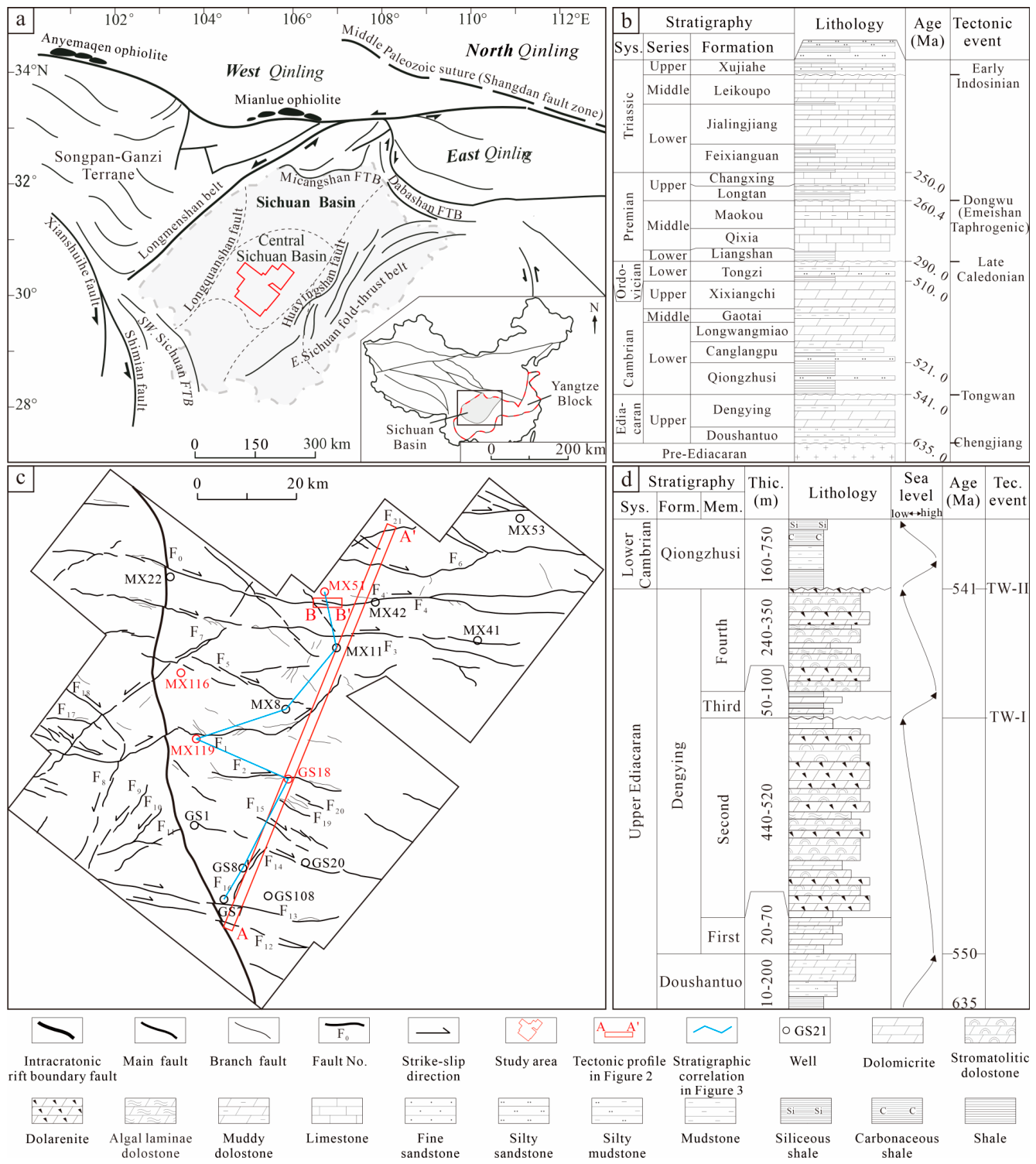
The Sichuan Basin is a multicycle petroliferous basin developed on a Precambrian crystalline basement in the northwestern Yangtze Block (Figure 1a,b). Since the Neoproterozoic, the basin has undergone multistage development and modification during two major extension–convergence cycles [3,28,29]. The Yangtze–Caledonian cycle was controlled by the opening and closure of the Proto-Tethys Ocean. During the early Nanhua period, NE-trending rift basins developed. From the middle Ediacaran to the Ordovician, the basin evolved into an intracratonic sag and formed the Deyang–Anyue intracratonic rift and related boundary faults, such as F0 (Figure 1c) [19]. Later compression and orogenesis related to the Duyun Movement transformed the central Sichuan Basin into a synsedimentary uplift system. This process caused uplift, weak compression, and erosion in the central Sichuan Basin area (Figure 1b,d and Figure 2a) [13,28,30]. The Hercynian–Himalayan cycle was driven by the opening of the Paleo-Tethys Ocean. From the Devonian to the Early Permian, rift systems such as the Longmenshan rift developed. From the Middle Permian to the Middle Triassic, the basin shifted to cratonic subsidence. Subsequent Indosinian and Himalayan compression drove its evolution into an intracontinental foreland basin from the Late Triassic to the Cenozoic. Under this stress regime, pre-existing cracked-gas reservoirs derived from crude oil were commonly adjusted and reworked [29,30]. Together, these cycles record a complete evolution from extensional rifting to cratonic subsidence and compressional orogenesis, controlled by plate breakup and convergence [28,29].
Figure 1.
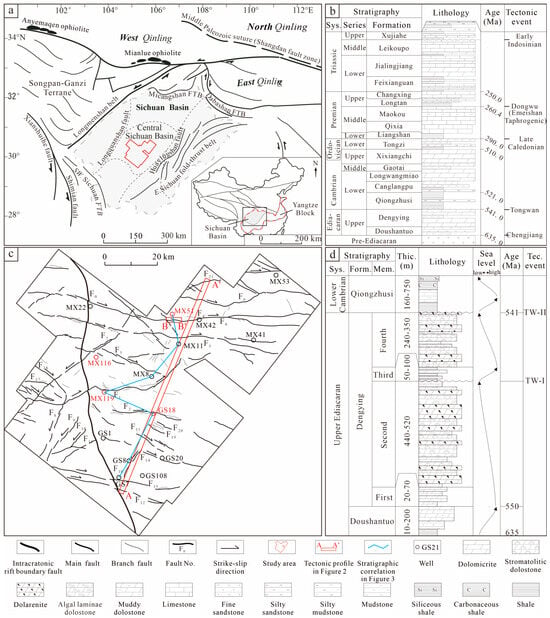
Simplified geological map and stratigraphic column of the Sichuan Basin and GM region. (a) Simplified tectonic map of the Sichuan Basin and adjacent regions, modified from [31]. Inset shows main tectonic elements of China. (b) Simplified stratigraphic column from Pre-Ediacaran to Triassic in the Sichuan Basin. (c,d) Spatial fault distribution at the top of the Dengying Formation (c) and its stratigraphic column (d) in the GM region, central Sichuan Basin. Figure (c) is modified from [19]. FTB—fold-thrust belt; Sys.—system; Form.—formation; Mem.—member; Thic.—thickness; Tec. event—tectonic event; First, Second, Third and Fourth—first, second, third and fourth members of the Dengying Formation, respectively. TW-I and TW-II—episodes I and II of the Tongwan tectonic event, respectively.
Figure 2.
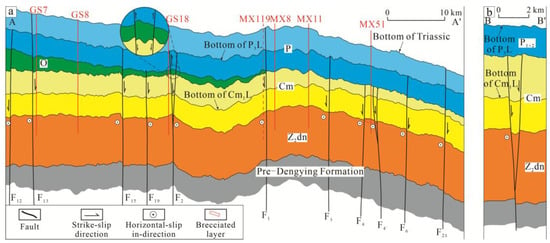
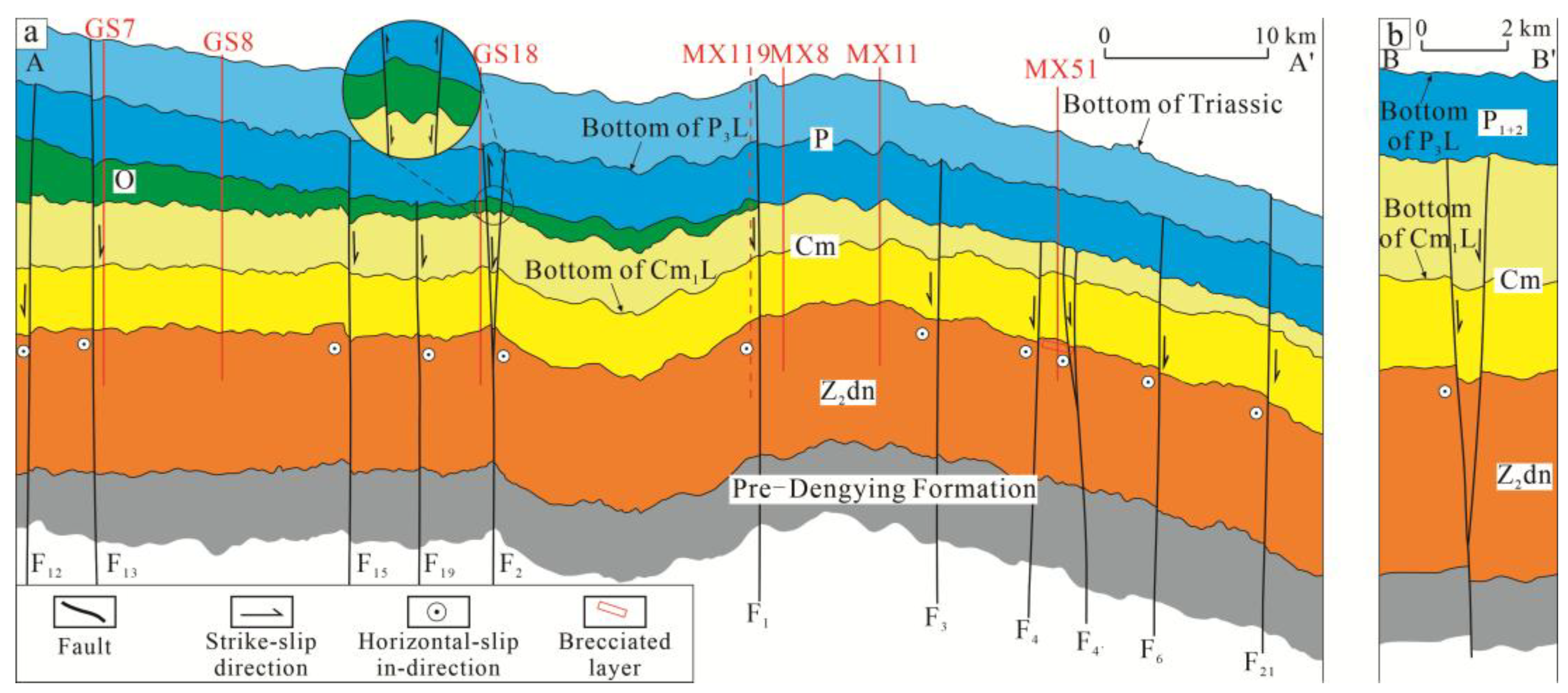
Interpretation of tectonic profiles (a,b) in the GM region, modified from [19]. Z2dn—Upper Ediacaran Dengying Formation; Cm—Cambrian; Cm1L—Lower Cambrian Longwangmiao Formation; O—Ordovician; P1+2L—Lower and Middle Permian; P3L—Upper Permian Longtan Formation.
The study area was the Gaoshiti–Moxi region of the central Sichuan Basin paleo-uplift, between the Huayingshan and Longquanshan faults (Figure 1a). The Ediacaran Dengying Formation is cut by well-developed NW–SE and near E–W strike-slip fault systems (Figure 1c). Two regional unconformities formed during two episodic uplifts of the Tongwan Movement in the Dengying Formation (Figure 1d) [3]. The tectonic evolution most relevant to this study includes: the early intracratonic sag stage, the Late Caledonian uplift and deformation, and the later reactivation of pre-existing inherited faults [19,31,32].
2.2. Stratigraphic and Sedimentary Background
The Late Ediacaran Dengying Formation in the study area is 750–1040 m thick. It overlies the sandstone and dolomitic mudstone of the Doushantuo Formation and is unconformably overlain by mudstone and shale of the Cambrian Qiongzhusi Formation. During the deposition of the Late Ediacaran Dengying Formation, the study area was dominated by shallow-water carbonate platform deposition [33]. Based on the algae content and rock texture, the Ediacaran Dengying Formation can be divided into four members [7].
The first member (20–70 m thick) is characterized by platform-facies dolomicrite intercalated with microbial dolostone and dolarenite. The second member (440–520 m thick) is dominated by mound-shoal facies adjacent to platform facies and consists mainly of microbial dolostone, with local dolarenite and dolomicrite. The third member (50–100 m thick) records transgressive mixed-platform deposition, mainly of mudstone, shale, muddy siltstone, and sandy dolostone. The fourth member (240–350 m thick) has a depositional setting similar to that of the second member and consists of microbial dolostone, dolomicrite, brecciated dolostone, and dolarenite (Figure 1d) [9,33]. Spatially, the lateral continuity of the Dengying Formation weakens from southwest to northeast along the Deyang–Anyue intracratonic sag [8]. The formation also thins toward the southwestern margin. There, the third and fourth members are completely eroded and the second member is partly eroded, resulting in direct contact between the second member and Cambrian strata.
3. Samples and Methods
3.1. Petrology and Reservoir Physical Properties
Systematic core observations and a statistical analysis of brecciated intervals in the fourth member of the Dengying Formation were used to characterize the types, occurrence, and scale of tectonic breccias in the study area. Core samples were prepared as standard thin sections and rock slabs for petrographic observation and U-Pb dating. Standard thin sections were prepared by vacuum-pressure injection of blue epoxy resin into rock pores, followed by consolidation and grinding to a thickness of 0.03 mm. The thin sections were then partly stained with alizarin red-S solution and examined under an Olympus BX53 polarizing microscope (Olympus, Tokyo, Japan). The observations were conducted at the Reservoir Rock-Fluid Laboratory, Southwest Petroleum University, to identify mineral types and modes of occurrence.
A cathodoluminescence (CL) analysis was conducted on 0.05 mm thick thin sections using a CL8200 MK5 microscope (Cambridge Image Technology Ltd., Hatfield, UK). This instrument was operated at an accelerating voltage of 220 kV and a vacuum of 0.003 mBar, with an exposure time of 10 s.
Fifteen cylindrical core plugs, each 2.5 cm in diameter and 3–5 cm long, were selected for helium porosity and gas permeability measurements to evaluate the petrophysical response of brecciated intervals. The plugs were taken from intact intervals without visible open fractures, and the drilling direction was perpendicular to the core axis. Fourteen plugs were obtained from tectonically brecciated sections in borehole MX51, and one plug was obtained from borehole MX119. The porosity and permeability were measured with a CMS-300 Core Measurement System (Core Laboratories Inc., Houston, TX, USA) at the National Experimental Teaching Center for Oil and Gas Geology and Exploration, Southwest Petroleum University. Well-log data were also statistically analyzed for three brecciated intervals in borehole MX51.
3.2. Fluorescence and Fluid Inclusion
A fluorescence analysis and fluid-inclusion microthermometry were conducted on 100 μm thick doubly polished thin sections to constrain hydrocarbon-bearing inclusions and cement-precipitation temperatures. A Linkam THMSG geological 600 heating–freezing stage (Linkam Scientific Instruments, Redhill, UK) mounted on a Nikon E400 microscope (Nikon Instruments Inc., Melville, NY, USA) equipped with an 8 mm long-working-distance objective was used for these measurements. The stage operated over a temperature range of −196 to 600 °C, with a thermal stability of ±0.1 °C. The heating and cooling rates were programmed between 0.1 and 150 °C/min. Hydrocarbon fluid inclusions (HCIs) were identified from their fluorescence characteristics under ultraviolet excitation (330–380 nm), using a Lucia microspectrofluorometer (Laboratory Imaging s.r.o., Prague, Czech Republic) with a beam spot size of ≤2 μm. Salinities of aqueous inclusions are reported as wt.% NaCl equivalent (wt.% NaCl eq.) based on final ice melting [34]. When Tm,ice dropped below the eutectic point (−21.2 °C, equivalent to >23.3 wt.% NaCl eq.), higher salinities were derived via the extrapolation of the ice + liquid + vapor curve after Bodnar (1933) [34,35].
3.3. Carbon and Oxygen Isotopes
In situ high-precision laser ablation isotope analyses were conducted on cements in the brecciated dolomicrite. Samples were prepared as 0.01 mm thick, single-side-polished thin sections placed between two glass slides without epoxy resin injection. Under high-vacuum conditions (<3 × 10⁻² Pa), microscale pyrolysis was conducted using a laser ablation system with a 20 μm beam spot. The released gases were cryogenically purified with liquid nitrogen, and the resulting CO2 was analyzed via an Elementar IsoPrime GC5 mass spectrometer (Elementar Analysensysteme GmbH, Langenselbold, Germany). The isotopic results were calibrated against the V-PDB standard, with fractionation calibrations applied following the Fairchild and Spiro (1987) model [36]. Calibration using the NBS-19 standard revealed that the analytical precision (1σ) for both the δ13C and δ18O measurements was better than ±0.1‰.
3.4. Chronological Analysis of Carbonate Minerals
As a high-precision geochronological technique, laser ablation-inductively coupled plasma-mass spectrometry (LA-ICP-MS) in situ U-Pb dating has been widely applied to measure high and variable U/Pb ratios in carbonate minerals at the micro-scale [7,37]. In this study, saddle dolomite U-Pb dating was conducted at the CNPC Key Laboratory of Carbonate Reservoir to directly constrain the timing of early inter-breccia cementation. The samples consisted of approximately 5 mm thick slabs of brecciated dolomicrite that were polished on one side and resin-mounted to maintain surface integrity. Petrographic characterization and sample preparation were conducted at the Petrology and Mineralogy Laboratory of the CNPC Hangzhou Research Institute of Geology to confirm the paragenetic relationship between the host minerals and the hydrocarbon inclusions. The analyses were performed using an LA-ICP-MS system comprising a Thermo Scientific iCAP Q mass spectrometer (resolution >300) (Thermo Fisher Scientific, Waltham, MA, USA) coupled with a New Wave Research UP193-FX excimer laser (New Wave Research, Inc., Fremont, CA, USA). The laser was operated at a wavelength of 193 nm, a spot diameter of 2–5 μm, an energy density of 3 J/cm2, and a repetition rate of 10 Hz. The NIST612 glass standard was used for instrumental calibration, and the Iolite 3.6 software was used to monitor isotopic signals (238U, 206Pb, 207Pb, 208Pb) [38]. Age calculations were conducted using Isoplot 3.0 [39], with the final ages reported at a 2σ uncertainty [40].
4. Results
4.1. Petrology
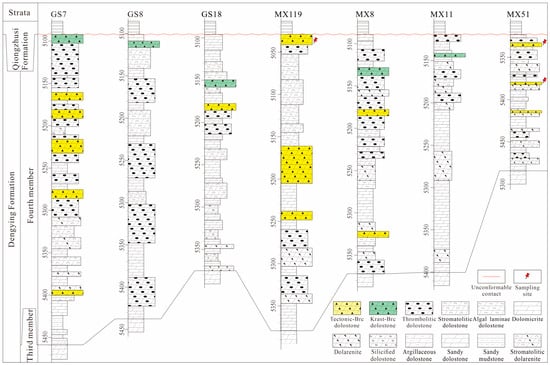
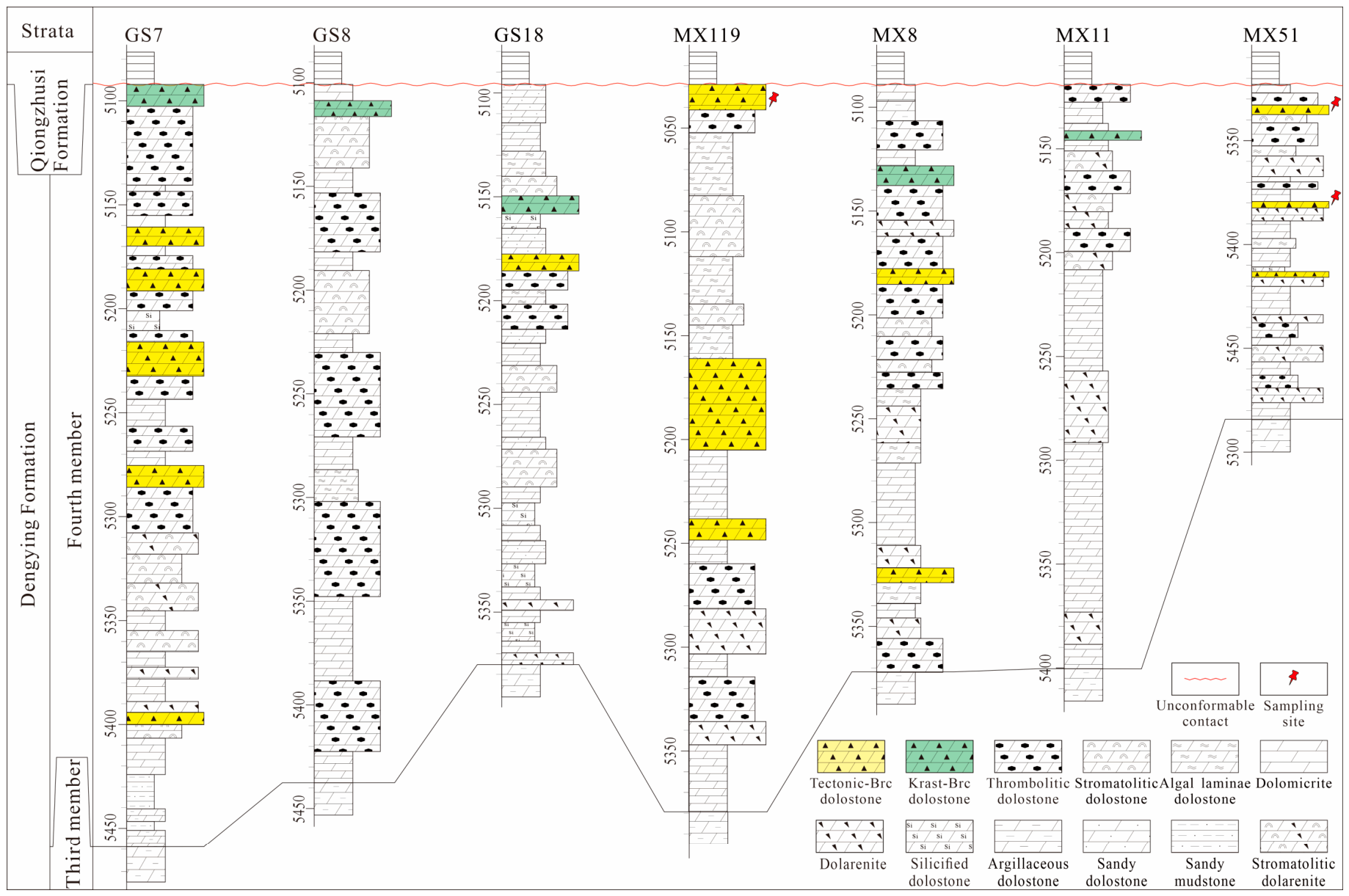
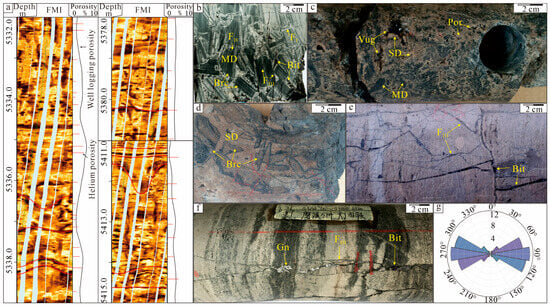
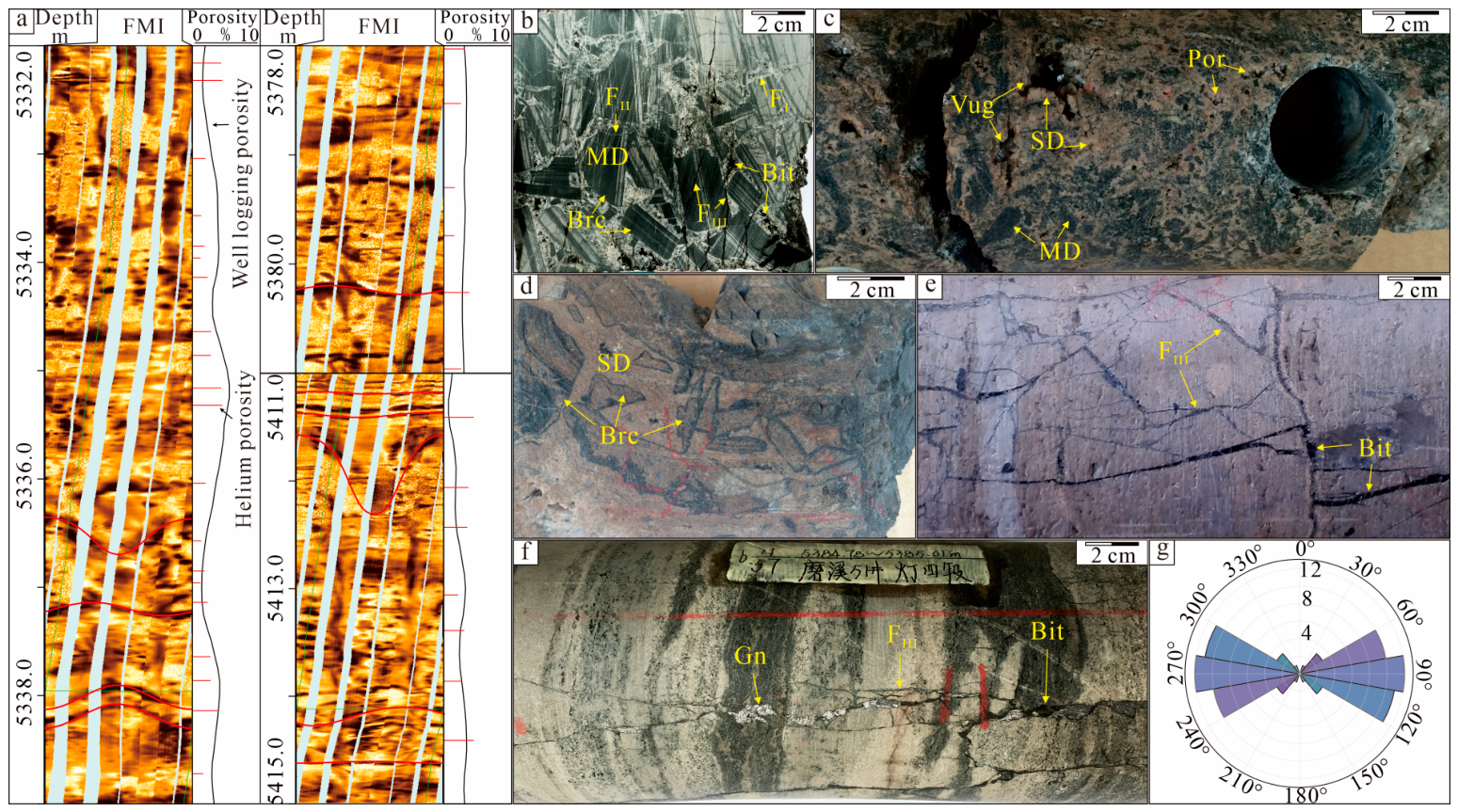
Core observations from 12 boreholes, with a cumulative core length of more than 300 m, showed that tectonically brecciated dolostones accounted for 16.8% of the observed Dengying Formation intervals. In borehole MX51, three typical tectonically brecciated dolostone intervals occurred between 5335.00 m and 5424.40 m. These intervals had a cumulative thickness of 14.0 m, accounting for 15.7% of the 89.4 m core interval (Figure 3). The Formation MicroImager (FMI) logs displayed chaotic, mottled responses and well-developed bedding-parallel, oblique, and high-angle tectonic fractures (Figure 4a).
Figure 4.
Formation MicroImager (FMI) logs of brecciated core sections in borehole MX51 and photographs of tectonic breccia from the fourth member of the Dengying Formation in the GM region. (a) FMI logs, well logs and helium porosities of brecciated sections in MX51. (b) Tectonic breccias (Brc) within laminated matrix dolomicrite (MD) and with fractures (FI, FII, and FIII) partly filled by cements and bitumen (Bit), MX51, 5334.64 m. (c) Tectonic breccias with residual pores and vugs partially cemented by sparry saddle dolomite (SD), MX119, 5040.43 m. (d) Tectonic breccias with inter-breccia saddle dolomite cement, GS108, 5250.69 m. (e,f) Tectonic breccias with network fractures, MX116, 5204.23 m (e), and high-angle fractures filled with galena (Gn) or bitumen (Bit), MX51, 5384.78 m (f). (g) Probability distribution rose diagram of breccia clast angles from panel (b) (n = 41).
Tectonically brecciated dolostones are composed mainly of angular to sub-angular clasts, variably filled fractures, and inter-breccia pores and vugs. The clasts are generally angular to sub-angular, 1–5 cm in size and commonly show rotation (Figure 4b–f). A statistical analysis of the breccia clast angles from the core image showed a range of 60–120°, with a dominant concentration near 90° (Figure 4b,g). Inter-breccia spaces are partly to completely filled by light-gray hydrothermal minerals and black bitumen, although residual pores and vugs are locally preserved (Figure 4b–d).
Three cement- or bitumen-filled fracture stages can be recognized: brecciation-related fractures (FI), fractures that cut breccia clasts and earlier cements (FII), and bitumen-filled fractures (FIII). Bitumen and galena also occur locally in high-angle and network fractures (Figure 4b,e,f).
Macroscopically, the brecciated dolostone contains dark-gray sub-angular dolomicrite clasts surrounded by light-gray cement and bitumen (Figure 4b). The brecciated host rock is dolomicrite with regular alternations of dark algal-rich and light algal-poor laminae of a variable thickness.
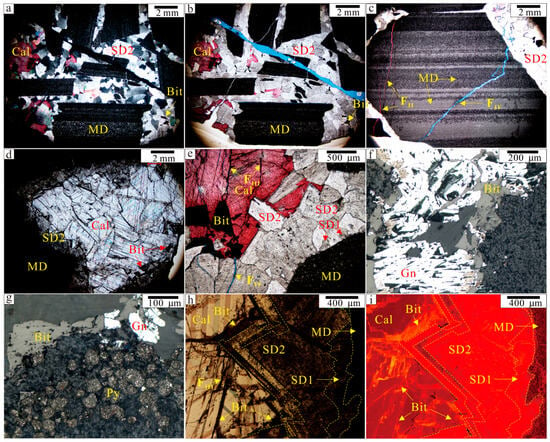
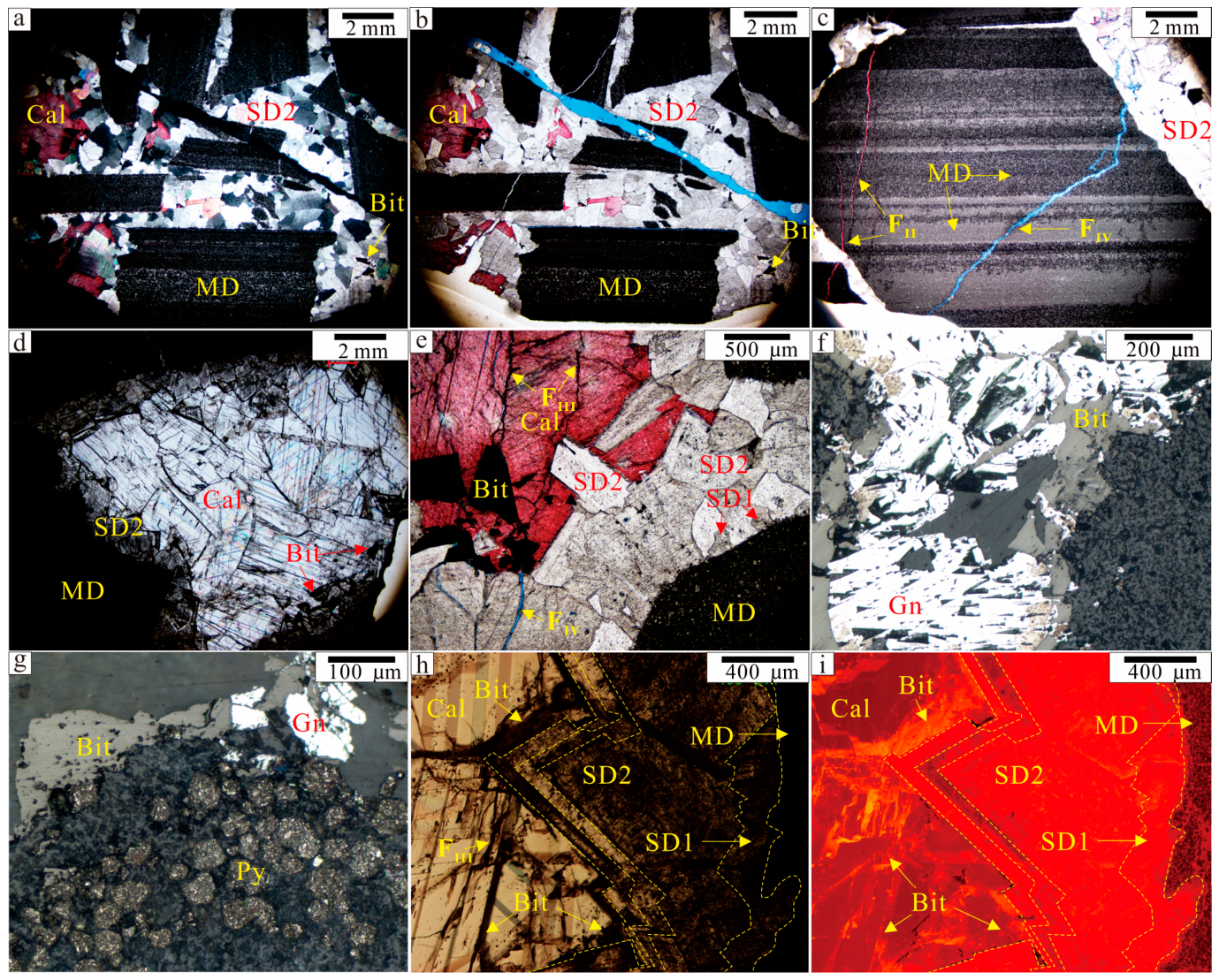
Microscopically, four stages of tectonic fractures (including the above three tectonic fracture events and late-stage open fractures), alongside associated saddle dolomite and calcite cementation as well as bitumen infilling, recorded a complete tectonic-diagenetic process. Inter-breccia spaces were filled with fine-crystalline (100–250 μm) and coarse-crystalline (500–1000 μm) saddle dolomite (SD1 and SD2). These saddle crystals generally exhibited wavy distinct extinction. Coarse-crystalline (>500 μm) calcite (Cal) showed well-defined twinning lamellae and stained red with Alizarin Red-S. Bitumen was also present, and residual pores were locally preserved (Figure 5a–d). Core and thin-section analyses identified four stages of tectonic fractures (Figure 4b–f and Figure 5b,c,e). First-stage fractures (FI) were related to brecciation and local fracturing, with inter-breccia spaces and fractures partly filled with SD1 and SD2. Second-stage fractures (FII) were calcite-filled, and calcite locally infilled residual inter-breccia pores. Third-stage fractures (FIII) contained bitumen and galena, with minor granular pyrite and bitumen occurring in intercrystalline spaces and along calcite cleavage planes. Fourth-stage fractures (FIV) remained open.
Figure 5.
Petrography of mosaic brecciated dolomicrite in the fourth member of the Late Ediacaran Dengying Formation, borehole MX51. (a,b) Mosaic breccia with dolomicrite matrix (MD), coarse-crystalline euhedral to sub-euhedral saddle dolomite (SD2), bitumen (Bit), and calcite (Cal) stained red. (c–e) Laminated MD clasts surrounded by fine-crystalline saddle dolomite (SD1), SD2, Cal, and Bit with colored twinning lamellae, intersected by Cal-filled fractures (FII), Bit-filled fractures (FIII), and open fractures (FIV). (f,g) FIII filled with galena (Gn) and Bit, with granular pyrite (Py) dispersed along the fractures. (h,i) Paragenetic sequence with MD, SD1, SD2 and Cal. Core samples were collected from two depths: 5334.64 m (thin sections (a–e,h,i)) and 5384.78 m (thin sections (f,g)).
A petrographic analysis of representative brecciated dolomicrite samples showed that early-stage tectonic fracturing (FI) created the main inter-breccia spaces and fracture networks (Figure 4b and Figure 5a–c). Subsequent fracturing events (FII to FIV) crosscut earlier structures, but generated limited new pore space. Among the cements, saddle dolomite was the predominant pore-filling mineral, occupying the bulk of the early fracture-pore space, whereas late-stage calcite and bitumen occurred as localized infillings, leaving a limited amount of residual effective porosity.
4.2. Characteristics of Cathodoluminescence and Fluorescence
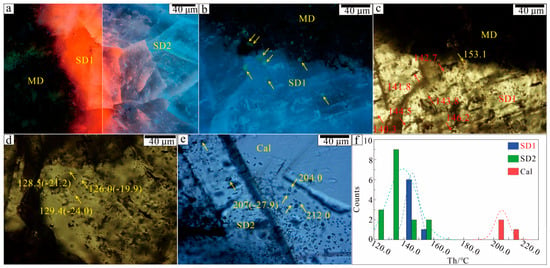
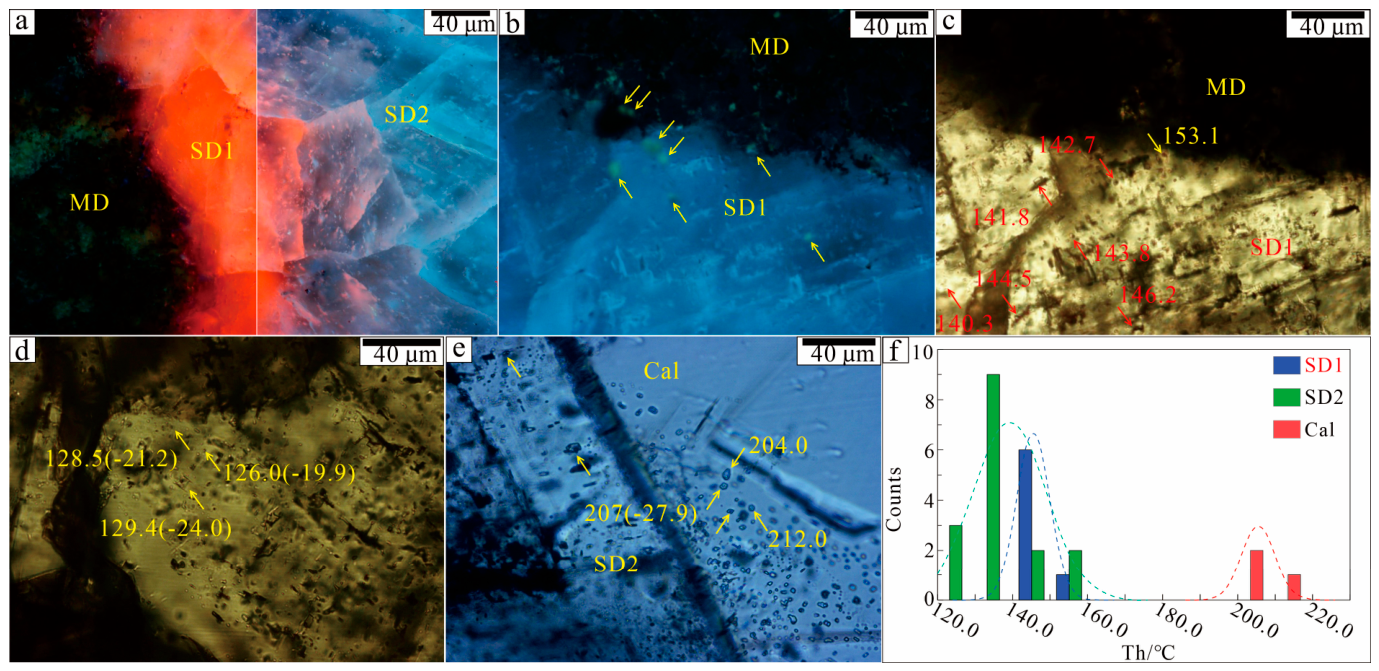
Under cathodoluminescence (CL), the brecciated matrix showed a weak red luminescence, whereas saddle dolomite exhibited intense red emissions with prominent red to dark-red growth zoning. Calcite cement displayed distinct CL patterns: intact crystal domains showed weak red luminescence, whereas domains with abundant microfractures and bitumen contamination showed bright orange-red luminescence (Figure 5g,h). Under fluorescence microscopy, the matrix, fine-crystalline saddle dolomite, and coarse-crystalline saddle dolomite showed weak yellow-green, orange-yellow, and ice-blue fluorescence, respectively. Measurable fluid inclusions in fine-crystalline saddle dolomite cement displayed yellow-green fluorescence (Figure 6a,b).
Figure 6.
Fluorescence analysis (FL) and homogenization-temperature (Th) distribution of inter-breccia cements: fine-crystalline saddle dolomite (SD1), coarse-crystalline saddle dolomite (SD2), and calcite (Cal). Core from borehole MX51, fourth member, 5334.64 m. (a) FL of the dolomicritic matrix (MD), SD1 and SD2, showing a shift from orange-red in SD1 to ice-blue in SD2. (b) Ice-blue FL of saddle dolomite with yellow-green FL fluid inclusions. (c) Th values of fluid inclusions in fine-crystalline saddle dolomite. (d) Th values of fluid inclusions in coarse-crystalline saddle dolomite. (e) Th values of fluid inclusions in calcite. (f) Frequency and normal distribution of Th values for fluid inclusions in SD1, SD2 and Cal. Note: ThCal > ThSD1 ≥ ThSD2, Th—homogeneous temperature.
4.3. Porosity and Permeability
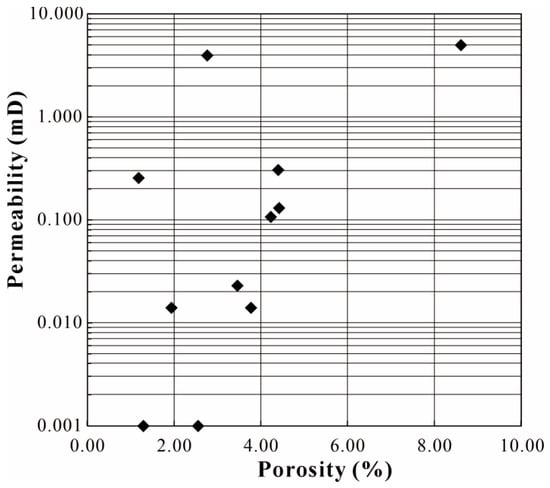
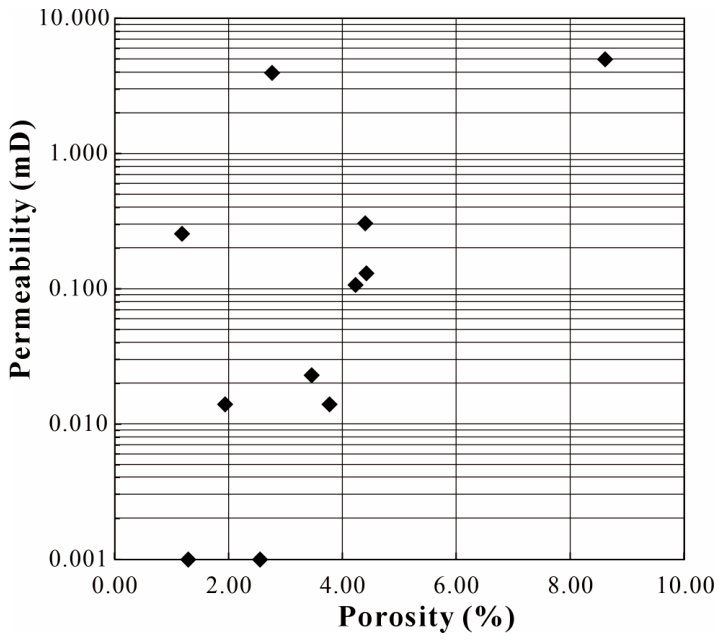
Plug samples from borehole MX51 yielded helium porosities of 1.18%–4.42% (mean: 2.88%). The permeability ranged from 0.001 mD to 3.940 mD (mean: 0.479 mD) (Table 1 and Figure 7). The average log-derived porosities for these intervals in MX51 were 3.70%, 3.07%, and 2.47%, consistent with the helium porosity measurements. At 5334.64 m in MX51, one brecciated dolomicrite sample had a helium porosity of 2.76% and a permeability of 3.940 mD (Figure 4b). In borehole MX119, a tectonically brecciated dolostone sample from the fourth member of the Dengying Formation occurred at 5040.43 m. This sample reached 8.61% porosity and 4.990 mD permeability (Table 1 and Figure 4c).
Table 1.
Helium porosity and permeability of tectonically brecciated dolostones in the fourth member of the Dengying Formation, GM region.
Figure 7.
Porosity versus permeability plot with data from plugs of tectonically brecciated dolostone from the Dengying Formation in the GM region.
4.4. Fluid Inclusion Analysis
This study focused on primary aqueous inclusions within these cements. Petrographic observations showed abundant liquid–vapor two-phase inclusions in the clear-rim growth zones of saddle dolomite (SD2), within crystals, and along crystal boundaries in both SD1 and Cal. Their petrographic characteristics and microthermometric data are summarized in Table 2 and Figure 6c–f. Some inclusions did not yield complete microthermometric datasets because of their small size or metastable behavior.
Table 2.
Microthermometric results of fluid inclusions in multi-stage cements (data from borehole MX51, fourth member, 5334.64 m).
At room temperature, these inclusions were mainly square, equant, rectangular, or negative-crystal-shaped, with diameters of 2.4–8.5 μm and vapor–liquid ratios of 5%–17% (Figure 6c–e). These characteristics are generally consistent with primary inclusions. In total, 27 reliable microthermometric measurements were obtained from SD1, SD2, and Cal cements (Table 2). The primary aqueous inclusions in SD1 had Th values of 140.3–153.1 °C (mean: 144.6 ± 4.2 °C). The inclusions in SD2 yielded Th values of 126.9–156.8 °C (mean: 137.7 ± 9.0 °C), with salinities of 22.31–27.72 wt.% NaCl eq. (mean: 25.60 wt.% NaCl eq.). Late-stage Cal recorded the highest temperatures, with Th values of 204.0–212.0 °C (mean: 207.7 ± 4.0 °C) and a salinity of 27.35 wt.% NaCl eq. (Table 2).
4.5. Carbon and Oxygen Isotope Compositions
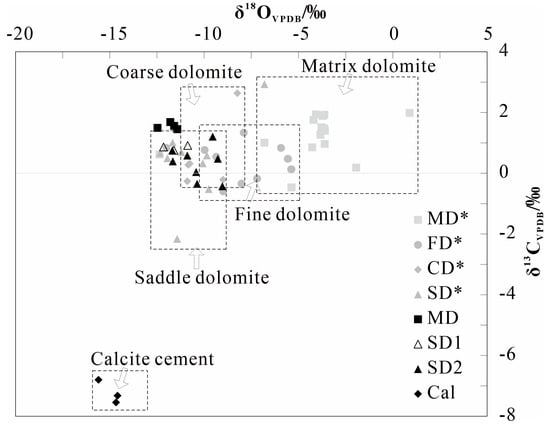
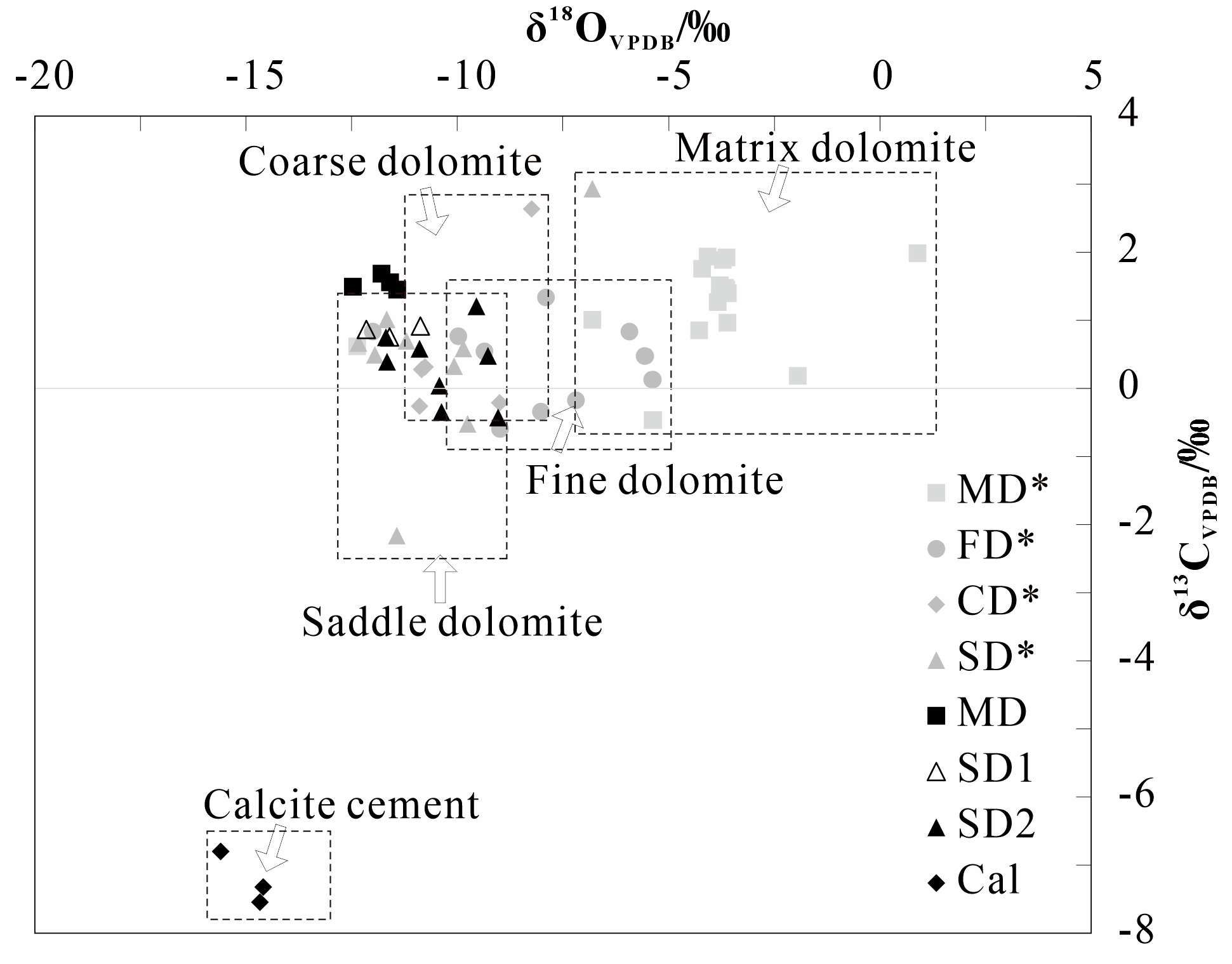
The δ13CVPDB and δ18OVPDB values of matrix dolomicrite and cements from Dengying Formation brecciated dolostone are presented in Table 3 and Figure 8. Matrix dolomicrite (MD) had δ13CVPDB values of 1.44‰–1.68‰ (mean: 1.54‰) and δ18OVPDB values of −12.48‰ to −11.42‰ (mean: −11.82‰). Fine-crystalline saddle dolomite (SD1) had δ13CVPDB values of 0.75−0.92‰ (mean: 0.84‰) and δ18OVPDB values of −12.15‰ to −10.87‰ (mean: −11.54‰). Coarse-crystalline saddle dolomite (SD2) had δ13CVPDB values of −0.44‰ to 1.21‰ (mean: 0.33‰) and δ18OVPDB values of −11.79‰ to −9.03‰ (mean: −10.36‰). Twinned calcite (Cal) had δ13CVPDB values of −7.56‰ to −6.81‰ (mean: −7.23‰) and δ18OVPDB values of −15.60‰ to −14.59‰ (mean: −14.96‰).
Table 3.
Stable carbon and oxygen isotopes of the Dengying Formation, GM region, central Sichuan Basin (all data from borehole MX51, fourth member, 5334.64 m).
Figure 8.
δ13CVPDB vs. δ18OVPDB of minerals in the brecciated dolostone, fourth member of the Dengying Formation, central Sichuan Basin. Gray data with “*” are cited from [7,11,13]. MD—matrix dolomicrite; FD—fine dolomite; CD—coarse dolomite; SD—saddle dolomite; SD1—fine-crystalline saddle dolomite; SD2—coarse-crystalline saddle dolomite; Cal—calcite; Th—homogeneous temperature.
4.6. U-Pb Dating of Saddle Dolomite
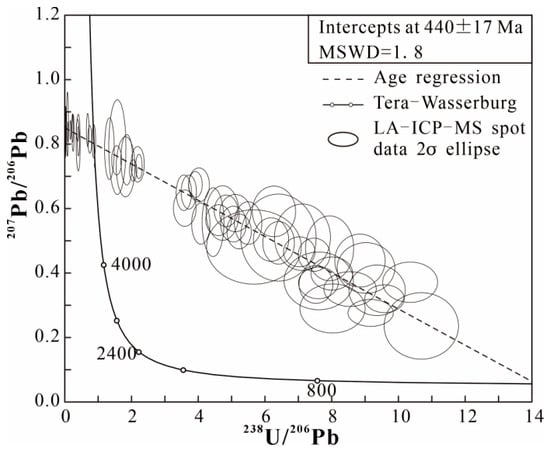
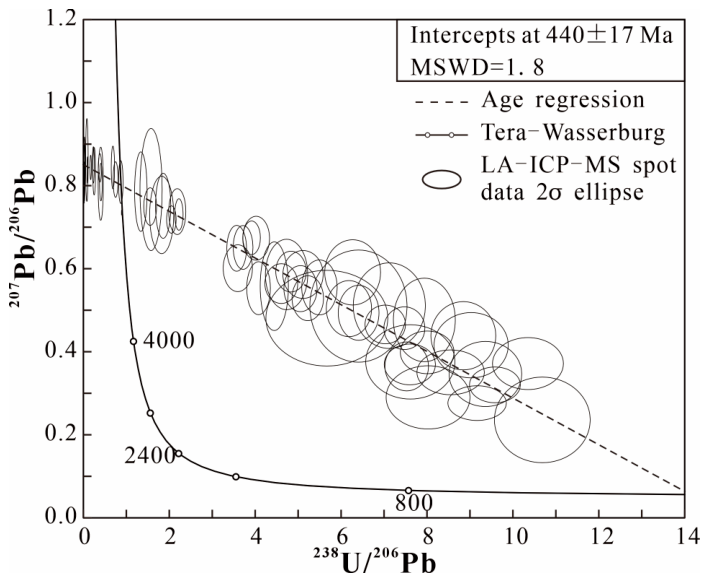
The U-Pb dating of saddle dolomite targeted virgin zones between breccia clasts that were not overprinted by later calcite or bitumen. A total of 67 analyses were collected, of which nine were excluded because the signal intensities approached or fell below the instrument limit of detection (LOD). The remaining 58 valid analyses yielded a crystallization age of 440 ± 17 Ma (MSWD = 1.8) (Figure 9).
Figure 9.
Tera–Wasserburg Concordia plots of inter-breccia saddle dolomite cement, showing 238U/206Pb versus 207U/206Pb.
5. Discussion
5.1. Formation Mechanism of Tectonic Breccia
5.1.1. Brecciation Mechanism and Tectonic Dynamic
The tectonic breccia in the study area was interpreted to have formed in a strike-slip fault-damage-zone system. Paleozoic strike-slip faults are high-angle, steeply dipping structures, and many EW- to NW-trending fault segments form right-lateral negative-flower structures in the Cambrian and Dengying strata (Figure 1c and Figure 2a,b). Driven by weak tectonic compression and localized transtension during the Late Caledonian stage (Figure 10) [28], pre-existing faults underwent reactivation, giving rise to secondary transtensional fractures and damage zones. Basement-penetrating transtensional faults functioned as both gathering sites for hydrothermal fluids and pivotal conduits for their upward migration [13,16]. Breccia intervals preferentially concentrated near faults and damage zones rather than displaying laterally continuous strata-bound geometries (Figure 3) [15,25], demonstrating that fault-related stress release served as the primary mechanism governing breccia localization.
The brecciation mechanism can be explained as brittle fragmentation assisted by early hydrothermal fluid flow. The precursor, laminated dolomicrite, was deposited in a restricted platform setting, such as dolomitic tidal flats or lagoons, and early dolomitization produced a tight, but mechanically brittle, fabric (Figure 4b, Figure 5a–c and Figure 11a) [33]. When differential stress was concentrated along fault-related weak zones, the rock fragmented into angular to sub-angular clasts with limited displacement (Figure 4f and Figure 11b). These low-displacement mosaic fabrics are more consistent with in situ fault-related brittle failure than with depositional brecciation or collapse reworking. The U-Pb geochronology of carbonate cements filling fault-fracture networks provides vital evidence on the timing of brittle faulting events [14,37]. Overpressured hydrothermal fluids may have assisted fragmentation, followed by the rapid precipitation of saddle dolomite cement in newly generated inter-breccia spaces [16]. The U–Pb geochronology constrains its cementation timing to ca. 440 ± 17 Ma, which is roughly correlated to brecciation under the localized stretching regimes during the Late Caledonian stage (Figure 9).
5.1.2. Fluid–Rock Interaction and Multistage Diagenesis
Petrographic relationships, in combination with carbon and oxygen isotope data and the U-Pb isotopic age, revealed a complete tectonic-diagenetic sequence of four stages of tectonic fractures and three associated stages of hydrothermal mineral cementation or bitumen infilling. FI brecciation converted tight bedded dolostones into fragmented breccia textures and created a fracture-pore system. Subsequently, these early fractures and inter-breccia pores and vugs were cemented to varying degrees by saddle dolomite (Figure 4b–f and Figure 5). The later FII, FIII, and FIV stages further modified the early brecciated reservoir, but their timing is inferred from cross-cutting structural relationships, mineral paragenetic assemblages, burial history, and published regional geochronological data rather than direct dating [7,20,21,22,23,41,42].
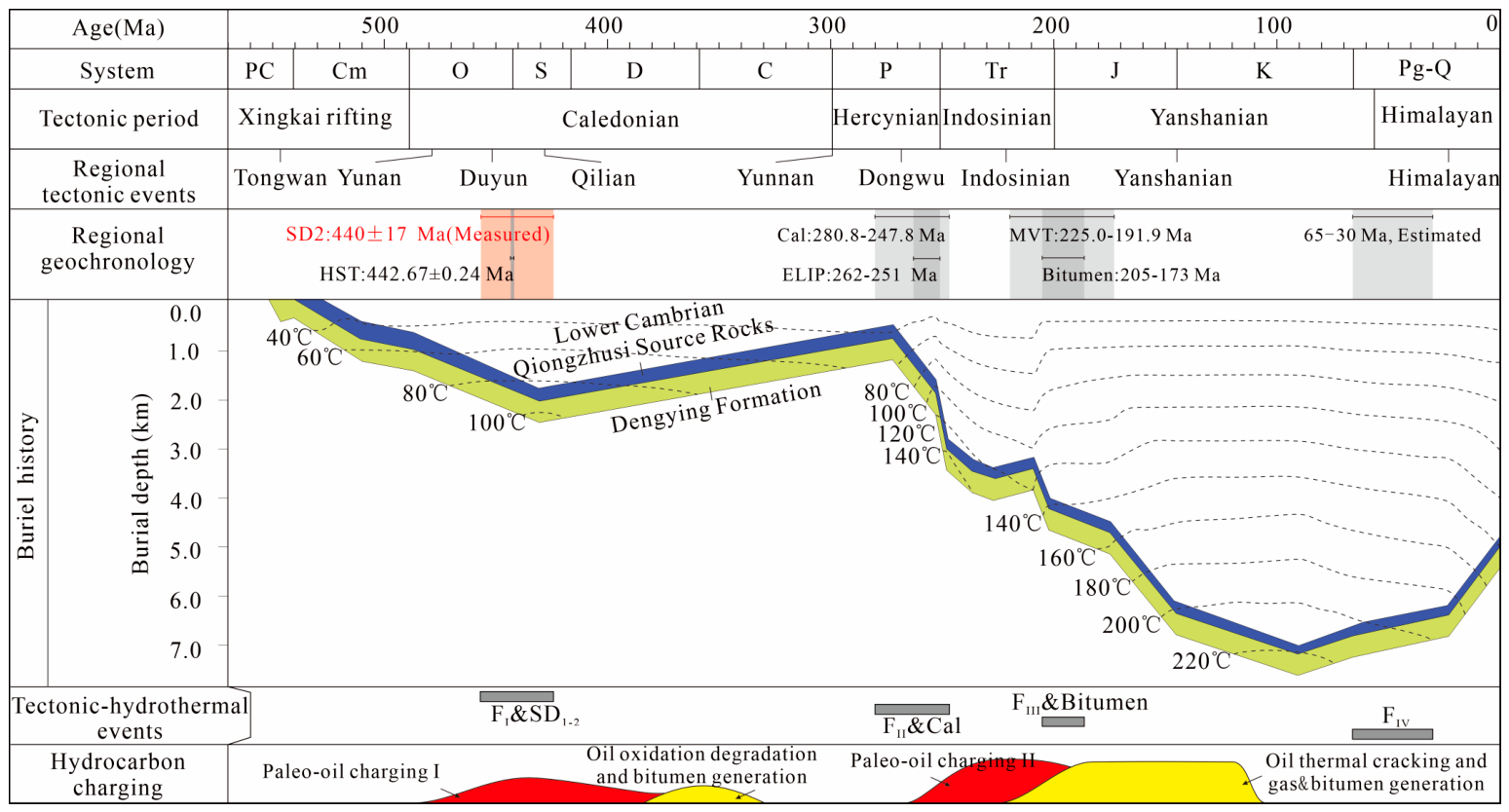
Saddle dolomite cementation had a dual reservoir effect. It recorded the early hydrothermal fluid activity and linked breccia-related cementation to the Late Caledonian event, but it also strongly occluded the brecciation-related fracture-pore system (Figure 4b–d, Figure 5a–c and Figure 11c). Continuity in petrographic, isotopic, and fluid-inclusion characteristics between SD1 and SD2 suggests precipitation from a single evolving hydrothermal fluid system (Figure 5e and Figure 6a–d,f) [16]. Integrated regional burial history analyses revealed that the Dengying Formation was buried at depths of 2–3 km during the Late Caledonian stage (440 ± 17 Ma), corresponding to a normal background thermal state of about 100 °C (Figure 10). In contrast, fluid inclusions entrapped within saddle dolomite (SD1 and SD2) displayed mean homogenization temperatures of 144.6 °C and 137.7 °C, respectively (Figure 6b–d,f). This distinct thermal anomaly, exceeding background burial temperatures by 40–50 °C, provides compelling evidence for a deep hydrothermal origin of the saddle dolomite [43]. This hydrothermal genesis is further supported by the geochemical and crystallographic lines of evidence: first, the δ18OVPDB values of saddle dolomite were relatively negative (<−9‰), falling well within the typical isotopic domain of hydrothermal dolomites [13]; second, its non-planar crystal habit demonstrates that the precipitation temperature surpassed the roughening transition threshold for dolomite growth [16,44]. Furthermore, the high NaCl-equivalent values of SD2 fluid inclusions reinforce the saline nature of the parental fluid. Collectively, these features demonstrate that saddle dolomite precipitated from hot, saline, hydrothermal fluids that migrated upward along fault-related conduits during deep burial [13,16,45].
Figure 10.
Burial history of the Dengying Formation in the GM region (modified from [46]). Geochronological data in black font are cited from [20,21,22,23,41,42,47], and hydrocarbon charging data are cited from [22]. HST—Top of Hirnantian stage; ELIP—Emeishan large igneous province; PC—Precambrian; Cm—Cambrian; O—Ordovician; S—Silurian; D—Devonian; C—Carboniferous; P—Permian; Tr—Triassic; J—Jurassic; K—Cretaceous; Pg—Paleogene; Q—Quaternary.
Hydrocarbon-bearing inclusions and bitumen rims indicate that organic matter or early hydrocarbon fluids participated in the diagenetic system (Figure 4d and Figure 6b), as characterized by a medium-to-low-maturity yellow-green fluorescence [40]. Matrix dolomicrite has an average δ13CVPDB value of 1.54‰. Its δ18OVPDB values are lower than those of typical Late Ediacaran seawater [48], which further indicates strong burial or hydrothermal modification rather than the preservation of a purely primary seawater signal (Figure 8).
Calcite-filled FII fractures cross-cut earlier breccia fabrics and locally occupied residual pores (Figure 11d), indicating that Ca-rich fluids entered an already brecciated and partly cemented system. Their high homogenization temperatures, saline fluid inclusions, and non-luminescent cathodoluminescence response are consistent with relatively high-temperature, reducing fluids. The precipitation temperatures and low δ18OVPDB values of calcite are consistent with calculated chlorite temperatures from the Permian Emeishan Basalt, which average approximately 208.0 °C [32]. The relatively negative δ13CVPDB values of calcite are compatible with a mixed carbon source involving host carbonate, organic carbon, and deep-seated fluids. However, these values alone are insufficient to establish direct mantle involvement. The transition from transtensional to weakly transpressional deformation at the end of the Middle Permian, together with the reactivation of pre-existing faults near the Emeishan taphrogenic event (Figure 10), supports a possible, but not exclusive, deep thermal influence on the FII stage [7,20,21,32,49]. In contrast, bright CL in bitumen-rich fractures indicates tectonic opening, late-stage diagenetic fluid charging and the redistribution of chemical components (Figure 5h,i) [50].
Figure 11.
Diagenetic evolution of the Dengying Formation brecciated dolomicrite. (a) Laminated dolomicrite diagram. (b) Brecciation by first-stage fractures (FI) with upwelling hydrothermal fluids. (c) Saddle dolomite (SD) filling inter-breccia spaces. (d) Calcite infilling in second-stage fractures (FII) and residual pores. (e) Bitumen in third-stage fractures (FIII) and residual pores. (f) Formation of open fourth-stage fractures (FIV).
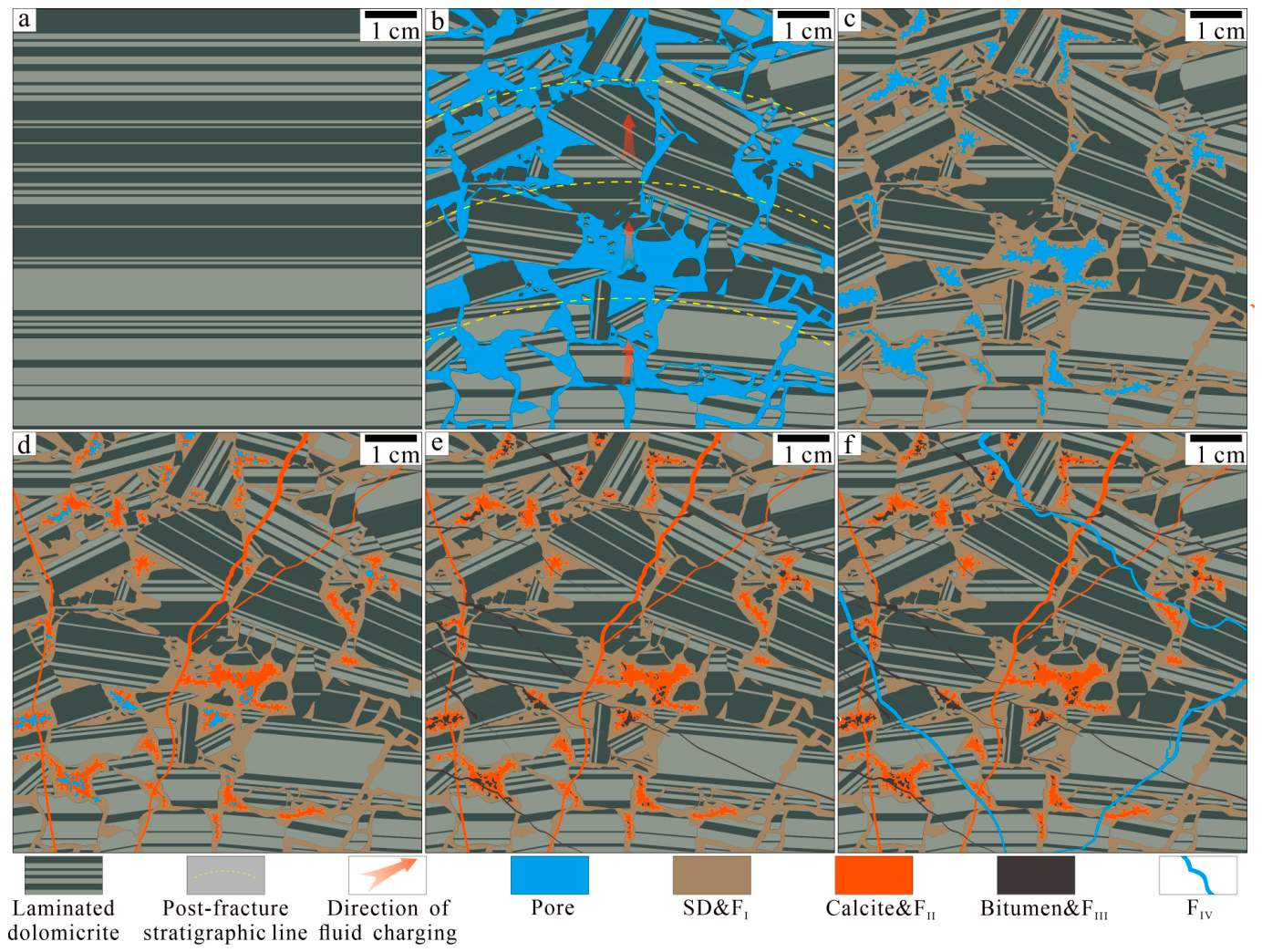
Bitumen- and galena-bearing FIII fractures record hydrocarbon-related and metallogenic modification after calcite cementation (Figure 4e,f, Figure 5f,g and Figure 11e). Meanwhile, bitumen infilling indicates that residual inter-breccia pores and FIII fractures served as local storage sites for paleo-oil reservoirs, with the fractures additionally functioning as migration conduits. Published Re-Os and regional mineralization ages from the central Sichuan Basin support a tentative Late Triassic to Jurassic timing for this infilling stage [22,23,42,46]. FIV open fractures may be related to Himalayan structural adjustment [21], but this interpretation remains speculative because direct chronological constraints are unavailable. From a reservoir perspective, their importance lies mainly in connectivity: where FIV fractures remained open, they could reconnect residual inter-breccia pores and vugs that survived earlier cementation and filling (Figure 11f).
5.2. Reservoir Controls and Exploration Implications
The final breccia-related reservoir quality depends on the balance between early tectonic pore-fracture creation and later mineral and hydrocarbon-related pore occlusion [13,15,16]. The fracture-pore systems created by tectonic brecciation show marked variations in their mineral type and cementation intensity. Saddle dolomite produced the strongest early pore-loss effect, and later calcite, bitumen, galena, and sulfide fillings further reduced the residual pore space. The intensity of saddle dolomite cementation varies markedly among different fault zones, resulting in a pronounced heterogeneity in the preserved residual porosity. Specifically, the brecciated interval in borehole MX51 experienced multistage tectonic deformation and mineral precipitation, recording a complete diagenetic sequence while retaining residual inter-breccia pores and fracture porosity (Figure 4b). In borehole MX119, the brecciated interval was only locally cemented by saddle dolomite and lacked significant late-stage infilling, thereby preserving comparatively more inter-breccia pore space (Figure 4c)—a case that illustrates the conditional constructive contribution of FI brecciation to the reservoir quality. Conversely, the inter-breccia space in the brecciated interval of borehole GS108 was almost completely occluded by saddle dolomite (Figure 4d). Such disparities are likely driven by localized Late Caledonian stretching and later tectonic reactivation, leading to distinct tectonic overprinting and hydrothermal fluid behaviors along different fault zones. Ultimately, storage in the brecciated reservoirs is mainly provided by residual inter-breccia pores and late open fractures. The spatial occurrence of brecciated dolostone reservoirs is therefore linked to breccia zones that preferentially develop near faults and associated damage zones, with limited lateral continuity (Figure 2 and Figure 3).
This genetic model accounts for the prevailing low-porosity and low-permeability characteristics of the tectonically brecciated dolostone reservoirs in the study area, as well as the localized preservation of relatively higher-porosity and higher-permeability intervals (Figure 7). Additionally, tight carbonate facies can form from local breccia-related reservoir intervals where tectonic brecciation creates pore space and later diagenetic modification does not fully occlude it. Consequently, hydrocarbon exploration should target fault-controlled domains where brecciation was sufficient to create pore space, and late cementation and hydrocarbon-related filling did not completely seal the system. Fault-controlled domains are favorable targets only where the constructive effects of brecciation exceed the destructive effects of cementation and filling.
6. Conclusions
This study elucidates the tectonic dynamics, fluid–rock interactions, and reservoir quality controls of the Dengying Formation brecciated dolostones in the central Sichuan Basin:
(1) Dengying Formation tectonic breccias formed within a strike-slip fault-damage-zone system. These faults are steeply dipping and exhibit localized transtensional characteristics. During the Late Caledonian stage, localized transtension reactivated the pre-existing faults, forming secondary stretching fractures and damage zones. These basement-penetrating extensional faults likely served as fluid-focusing sites and conduits for hydrothermal upwelling. Driven by tectonic stress release and probably assisted by overpressured fluids, tight dolostones underwent in situ brittle fragmentation. This process generated low-displacement angular clasts and non-stratabound mosaic breccias.
(2) A comprehensive evolution comprising four tectonic fracturing episodes (FI–FIV) and three associated infilling phases was established. Overpressured hydrothermal fluids may have assisted early FI brecciation, followed by the rapid precipitation of saddle dolomite cement. The carbonate U–Pb geochronology (ca. 440 ± 17 Ma) directly constrains early saddle dolomite cementation; brecciation is linked to the Late Caledonian event through structural position, cement relationships, and the regional tectonic framework. The fluid inclusions in saddle dolomite display mean homogenization temperatures of 137.7–144.6 °C (40–50 °C above background burial temperatures), low δ18OVPDB values (<−9‰), and non-planar crystal habits, confirming precipitation from hot, saline hydrothermal fluids. Later calcite, bitumen-sulfide fillings, and open fractures are interpreted as reservoir-modification stages, with timing inferred from cross-cutting relationships, the burial history, and regional geochronological studies.
(3) The reservoir performance depends on the balance between early tectonic fracture-pore generation and later diagenetic occlusion. FI brecciation created the initial fracture-pore framework, but the preservation of effective porosity and permeability depended on the degree of later cementation and filling. Saddle dolomite cementation exerted the primary control on porosity loss, displaying a marked heterogeneity along different fault zones (e.g., pore preservation in borehole MX119 vs. complete occlusion in GS108). Later calcite cements and bitumen–sulfide fillings occluded fractures and residual inter-breccia pores to varying degrees. Residual inter-breccia pores and late open FIV fractures constitute effective storage space only where they remain connected. Deep exploration should target fault-controlled domains where tectonic brecciation created connected pore space and late cementation remained incomplete.
Author Contributions
Conceptualization, C.Z., X.L. and M.F.; methodology, C.Z., X.L. and M.F.; software, C.Z.; validation, X.L. and M.F.; formal analysis, C.Z.; investigation, C.Z., X.W., M.X., S.J., Y.Z., P.L. and Y.L.; resources, X.L., M.F., X.W., M.X., S.J., Y.Z., P.L. and Y.L.; data curation, C.Z., M.X. and S.J.; writing—original draft preparation, C.Z.; writing—review and editing, C.Z., X.L. and M.F.; visualization, C.Z. and S.J.; supervision, X.L. and M.F.; project administration, X.L. and M.F. All authors have read and agreed to the published version of the manuscript.
Funding
This research received no external funding.
Data Availability Statement
All data are contained within the article.
Acknowledgments
Special thanks are extended to Guansen Liu, who graduated from Southwest Petroleum University, for organizing the original data for the research.
Conflicts of Interest
Maolong Xia, Song Jia, Yi Zhu, Pengyi Lv and Yong Li were employed by PetroChina Southwest Oil & Gas Field Company. The authors declare that they have no known competing financial interests or personal relationships that could have appeared to influence the work reported in this paper.
References
- Zou, C.; Du, J.; Xu, C.; Wang, Z.; Zhang, B.; Wei, G.; Wang, T.; Yao, G.; Deng, S.; Liu, J.; et al. Formation, Distribution, Resource Potential, and Discovery of Sinian–Cambrian Giant Gas Field, Sichuan Basin, SW China. Pet. Explor. Dev. 2014, 41, 306–325. [Google Scholar] [CrossRef] [Scilit]
- Grotzinger, J.; Al-Rawahi, Z. Depositional Facies and Platform Architecture of Microbialite-Dominated Carbonate Reservoirs, Ediacaran–Cambrian Ara Group, Sultanate of Oman. AAPG Bull. 2014, 98, 1453–1494. [Google Scholar] [CrossRef] [Scilit]
- Liu, S.; Yang, Y.; Deng, B.; Zhong, Y.; Wen, L.; Sun, W.; Li, Z.; Jansa, L.; Li, J.; Song, J.; et al. Tectonic Evolution of the Sichuan Basin, Southwest China. Earth Sci. Rev. 2021, 213, 103470. [Google Scholar] [CrossRef] [Scilit]
- Shen, A.; Hu, A.; Qiao, Z.; Zheng, J.; She, M.; Pan, L. Development and Preservation Mechanism of Deep and Ultra-Deep Carbonate Reservoirs. Sci. China Earth Sci. 2024, 67, 3367–3385. [Google Scholar] [CrossRef] [Scilit]
- Longman, M.W. Carbonate Diagenetic Textures from Nearsurface Diagenetic Environments. AAPG Bull. 1980, 64, 461–487. [Google Scholar] [CrossRef] [Scilit]
- Cui, H.; Xiao, S.; Cai, Y.; Peek, S.; Plummer, R.E.; Kaufman, A.J. Sedimentology and Chemostratigraphy of the Terminal Ediacaran Dengying Formation at the Gaojiashan Section, South China. Geol. Mag. 2019, 156, 1924–1948. [Google Scholar] [CrossRef] [Scilit] [PubMed]
- Su, A.; Chen, H.; Feng, Y.; Zhao, J.; Wang, Z.; Hu, M.; Jiang, H.; Duc Nguyen, A. In Situ U-Pb Dating and Geochemical Characterization of Multi-Stage Dolomite Cementation in the Ediacaran Dengying Formation, Central Sichuan Basin, China: Constraints on Diagenetic, Hydrothermal and Paleo-Oil Filling Events. Precambrian Res. 2022, 368, 106481. [Google Scholar] [CrossRef] [Scilit]
- Li, Y.; Zhang, B.; Zhou, G.; Tang, R.; Long, H.; Li, C.; Chen, X.; Chen, D.; Liu, X.; Zhang, C.; et al. Lithofacies and Diagenetic Controls on Thrombolitic Dolomite Reservoir Development from the Precambrian Dengying Formation in the Central Sichuan Basin, SW China. Front. Earth Sci. 2024, 12, 1407400. [Google Scholar] [CrossRef] [Scilit]
- Song, J.; Liu, S.; Li, Z.; Luo, P.; Yang, D.; Sun, W.; Peng, H.; Yu, Y. Characteristics and Controlling Factors of Microbial Carbonate Reservoirs in the Upper Sinian Dengying Formation in the Sichuan Basin, China. Oil Gas. Geol. 2017, 38, 741–752, (In Chinese with English Abstract). [Google Scholar] [CrossRef]
- Jin, M.; Tan, X.; Tong, M.; Zeng, W.; Liu, H.; Zhong, B.; Liu, Q.; Lian, C.; Zhou, X.; Xu, H.; et al. Karst Paleogeomorphology of the Fourth Member of Sinian Dengying Formation in Gaoshiti-Moxi Area, Sichuan Basin, SW China: Restoration and Geological Significance. Pet. Explor. Dev. 2017, 44, 58–68. [Google Scholar] [CrossRef] [Scilit]
- Gu, Y.; Zhou, L.; Jiang, Y.; Jiang, C.; Luo, M.; Zhu, X. A Model of Hydrothermal Dolomite Reservoir Facies in Precambrian Dolomite, Central Sichuan Basin, SW China and Its Geochemical Characteristics. Acta Geol. Sin. (Engl. Ed.) 2019, 93, 130–145. [Google Scholar] [CrossRef] [Scilit]
- Jiang, L.; Worden, R.H.; Cai, C.F.; Shen, A.; Crowley, S.F. Diagenesis of an Evaporite-Related Carbonate Reser-voir in Deeply Buried Cambrian Strata, Tarim Basin, Northwest China. AAPG Bull. 2018, 102, 77–102. [Google Scholar] [CrossRef] [Scilit]
- Feng, M.; Wu, P.; Qiang, Z.; Liu, X.; Duan, Y.; Xia, M. Hydrothermal Dolomite Reservoir in the Precambrian Dengying Formation of Central Sichuan Basin, Southwestern China. Mar. Pet. Geol. 2017, 82, 206–219. [Google Scholar] [CrossRef] [Scilit]
- Celestino, M.A.L.; Miranda, T.S.; Mariano, G.; Alencar, M.L.; Buckman, J.; Roberts, N.M.W.; Barbosa, J.A.; Neumann, V.H.M.L.; Braz Souza, J.A.; Roemers-Oliveira, E. Structural Control and Geochronology of Cretaceous Carbonate Breccia Pipes, Crato Formation, Araripe Basin, NE Brazil. Mar. Pet. Geol. 2021, 132, 105190. [Google Scholar] [CrossRef] [Scilit]
- Katz, D.A.; Eberli, G.P.; Swart, P.K.; Smith, L.B. Tectonic-Hydrothermal Brecciation Associated with Calcite Precipitation and Permeability Destruction in Mississippian Carbonate Reservoirs, Montana and Wyoming. AAPG Bull. 2006, 90, 1803–1841. [Google Scholar] [CrossRef] [Scilit]
- Davies, G.R.; Smith, L.B., Jr. Structurally Controlled Hydrothermal Dolomite Reservoir Facies: An Overview. AAPG Bull. 2006, 90, 1641–1690. [Google Scholar] [CrossRef] [Scilit]
- Yang, W.; Wei, G.; Xie, W.; Jin, H.; Zeng, F.; Su, N.; Sun, A.; Ma, S.; Shen, J.; Wu, S. Hydrocarbon Accumulation and Exploration Prospect of Mound-Shoal Complexes on the Platform Margin of the Fourth Member of Sinian Dengying Formation in the East of Mianzhu-Changning Intracratonic Rift, Sichuan Basin, SW China. Pet. Explor. Dev. 2020, 47, 1262–1274. [Google Scholar] [CrossRef] [Scilit]
- Wang, L.; He, Y.; Peng, X.; Deng, H.; Liu, Y.; Xu, W. Pore Structure Characteristics of an Ultradeep Carbonate Gas Reservoir and Their Effects on Gas Storage and Percolation Capacities in the Deng IV Member, Gaoshi-ti-Moxi Area, Sichuan Basin, SW China. Mar. Pet. Geol. 2020, 111, 44–65. [Google Scholar] [CrossRef] [Scilit]
- Ma, D.; Wang, Z.; Duan, S.; Gao, J.; Jiang, Q.; Jiang, H.; Zeng, F.; Lu, W. Strike-Slip Faults and Their Significance for Hydrocarbon Accumulation in Gaoshiti–Moxi Area, Sichuan Basin, SW China. Pet. Explor. Dev. 2018, 45, 851–861. [Google Scholar] [CrossRef] [Scilit]
- Ma, B.; Liang, H.; Wu, G.; Tang, Q.; Tian, W.; Zhang, C.; Yang, S.; Zhong, Y.; Zhang, X.; Zhang, Z. Formation and Evolution of the Strike-Slip Faults in the Central Sichuan Basin, SW China. Pet. Explor. Dev. 2023, 50, 373–387. [Google Scholar] [CrossRef] [Scilit]
- Lu, X.; Gui, L.; Wang, Z.; Liu, S.; Liu, Q.; Fan, J.; Chen, W.; Ma, X.; Jiang, H.; Fu, X.; et al. Activity Time of Strike-Slip Faults and Their Controlling Effects on Hydrocarbon Accumulation in Central Sichuan Basin: Evidence from U–Pb Dating and Fluid Inclusions of Cements in Fault Zone. Acta Pet. Sin. 2024, 45, 642–658, (In Chinese with English Abstract). [Google Scholar] [CrossRef]
- Shen, C.; Ge, X.; Bai, X. Re–Os Geochronology Constraints on the Neoproterozoic–Cambrian Hydrocarbon Accumulation in the Sichuan Basin. Earth Sci. 2019, 44, 713–726, (In Chinese with English Abstract). [Google Scholar] [CrossRef] [Scilit]
- Liu, Q.; Lu, X.; Fan, J.; Liu, S.; Ma, X.; Dai, B.; Gui, L.; Chen, W. Evidence and Controlling Factors of Thermochemical Sulfate Reduction in the Sinian Gas Reservoirs, Sichuan Basin. Nat. Gas. Geosci. 2022, 33, 929–943, (In Chinese with English Abstract). Available online: http://www.nggs.ac.cn/CN/10.11764/j.issn.1672-1926.2022.02.002 (accessed on 1 June 2026).
- Neuendorf, K.K.E.; Institute, A.G. Glossary of Geology; Springer Science & Business Media: Berlin/Heidelberg, Germany, 2005. [Google Scholar]
- Shukla, M.K.; Sharma, A. A Brief Review on Breccia: It’s Contrasting Origin and Diagnostic Signatures. Solid Earth Sci. 2018, 3, 50–59. [Google Scholar] [CrossRef] [Scilit]
- Jébrak, M. Hydrothermal Breccias in Vein-Type Ore Deposits: A Review of Mechanisms, Morphology and Size Distribution. Ore Geol. Rev. 1997, 12, 111–134. [Google Scholar] [CrossRef] [Scilit]
- Sibson, R.H. Fluid Involvement in Normal Faulting. J. Geodyn. 2000, 29, 469–499. [Google Scholar] [CrossRef] [Scilit]
- He, Z.; Jin, Z.; Li, S.; Bai, G.; Lv, X.; Guo, J.; Gao, J.; Yin, J.; Li, Y.; Zheng, D. Prototypes, Modifications, and Hydrocarbon Enrichment Variations in Basins Influenced by Tethyan Evolution: A Comparative Analysis of the Persian Gulf Basin and the Sichuan Basin. Sci. China Earth Sci. 2023, 66, 2871–2897. [Google Scholar] [CrossRef] [Scilit]
- Shi, S.; Yang, W.; Zhou, G.; Jiang, H.; Meng, H.; Wu, S.; Zhang, Y.; Lu, W.; Bai, Z. Impact of Tethyan Domain Evolution on the Formation of Petroleum Systems in the Sichuan Super Basin, SW China. Pet. Explor. Dev. 2024, 51, 1183–1201. [Google Scholar] [CrossRef] [Scilit]
- Wei, G.; Shen, P.; Yang, W.; Zhang, J.; Jiao, G.; Xie, W.; Xie, Z. Formation Conditions and Exploration Prospects of Sinian Large Gas Fields, Sichuan Basin. Pet. Explor. Dev. 2013, 40, 139–149. [Google Scholar] [CrossRef] [Scilit]
- Meng, Q.-R.; Wang, E.; Hu, J. Mesozoic Sedimentary Evolution of the Northwest Sichuan Basin: Implication for Continued Clockwise Rotation of the South China Block. Bull. Geol. Soc. Am. 2005, 117, 396–410. [Google Scholar] [CrossRef] [Scilit]
- Zhang, C.; Liu, X.; Wu, X.; Tan, C.; Feng, M.; Zhuo, Y.; Zheng, J. Episodic Fluid Charging and Mixing Triggers Calcite-Bearing Agates in the Permian Emeishan Basalt, SW China. Int. Geol. Rev. 2025, 67, 606–624. [Google Scholar] [CrossRef] [Scilit]
- Jin, M.; Tan, X.; Li, B.; Zhu, X.; Zeng, W.; Lian, C. Genesis of Dolomite in the Sinian Dengying Formation in the Sichuan Basin. Acta Sedimentol. Sin. 2019, 37, 443–454, (In Chinese with English Abstract). [Google Scholar] [CrossRef]
- Bodnar, R.J. Revised Equation and Table for Determining the Freezing Point Depression of H2O-Nacl Solutions. Geochim. Et. Cosmochim. Acta 1993, 57, 683–684. [Google Scholar] [CrossRef] [Scilit]
- Kučera, J.; Muchez, P.; Slobodník, M.; Prochaska, W. Geochemistry of Highly Saline Fluids in Siliciclastic Sequences: Genetic Implications for Post-Variscan Fluid Flow in the Moravosilesian Palaeozoic of the Czech Republic. Int. J. Earth Sci. 2010, 99, 269–284. [Google Scholar] [CrossRef] [Scilit]
- Fairchild, I.J.; Spiro, B. Petrological and Isotopic Implications of Some Contrasting Late Precambrian Carbonates, NE Spitsbergen. Sedimentology 1987, 34, 973–989. [Google Scholar] [CrossRef] [Scilit]
- Roberts, N.M.W.; Walker, R.J. U-Pb Geochronology of Calcite-Mineralized Faults: Absolute Timing of Rift-Related Fault Events on the Northeast Atlantic Margin. Geology 2016, 44, 531–534. [Google Scholar] [CrossRef] [Scilit]
- Paton, C.; Hellstrom, J.; Paul, B.; Woodhead, J.; Hergt, J. Iolite: Freeware for the Visualisation and Processing of Mass Spectrometric Data. J. Anal. At. Spectrom. 2011, 26, 2508–2518. [Google Scholar] [CrossRef] [Scilit]
- Ludwig, K.R. (Ed.) User’s Manual for Isoplot 3.00: A Geochronological Toolkit for Microsoft Excel; Special publication/Berkeley Geochronology Center: Berkeley CA, USA, 2003. [Google Scholar]
- Shen, A.; Zhao, W.; Hu, A.; Wang, H.; Liang, F.; Wang, Y. The Dating and Temperature Measurement Technologies for Carbonate Minerals and Their Application in Hydrocarbon Accumulation Research in the Paleo-Uplift in Central Sichuan Basin, SW China. Pet. Explor. Dev. 2021, 48, 555–568. [Google Scholar] [CrossRef] [Scilit]
- Zhu, B.; Guo, Z.; Zhang, S.; Ukstins, I.; Du, W.; Liu, R. What Triggered the Early-Stage Eruption of the Emeishan Large Igneous Province? Geol. Soc. Am. Bull. 2019, 131, 1837–1856. [Google Scholar] [CrossRef] [Scilit]
- Wu, Y.; Zhang, C.; Mao, J.; Ouyang, H.; Sun, J. The Genetic Relationship between Hydrocarbon Systems and Mississippi Valley-Type Zn–Pb Deposits along the SW Margin of Sichuan Basin, China. Int. Geol. Rev. 2013, 5, 941–957. [Google Scholar] [CrossRef] [Scilit]
- White, D.E. Thermal Waters of Volcanic Origin. GSA Bull. 1957, 68, 1637–1658. [Google Scholar] [CrossRef] [Scilit]
- Sunagawa, I. Nucleation, Growth and Dissolution of Crystals during Sedimentogenesis and Diagenesis. In Diagenesis, IV; Wolf, K.H., Chilingarian, G.V., Eds.; Developments in Sedimentology; Elsevier: Amsterdam, The Netherlands, 1994; Chapter 2; Volume 51, pp. 19–47. [Google Scholar]
- Allan, J.R.; Wiggins, W.D. Dolomite Reservoirs: Geochemical Techniques for Evaluating Origin and Distribution; American Association of Petroleum Geologists: Tulsa, Oklahoma, 1993. [Google Scholar]
- Su, A.; Chen, H.; Feng, Y.; Wang, Z.; Jiang, H.; Zhao, J. Tracking Multiple Paleo Oil Charges in the Precambrian Dolomite Reservoirs of the Central Sichuan Basin, China. Mar. Pet. Geol. 2023, 156, 106423. [Google Scholar] [CrossRef] [Scilit]
- Ling, M.-X.; Zhan, R.-B.; Wang, G.-X.; Wang, Y.; Amelin, Y.; Tang, P.; Liu, J.-B.; Jin, J.; Huang, B.; Wu, R.-C.; et al. An Extremely Brief End Ordovician Mass Extinction Linked to Abrupt Onset of Glaciation. Solid Earth Sci. 2019, 4, 190–198. [Google Scholar] [CrossRef] [Scilit]
- Zempolich, W.G.; Wilkinson, B.H.; Lohmann, K.C. Diagenesis of Late Proterozoic Carbonates: The Beck Spring Dolomite of Eastern California. J. Sediment. Res. 1988, 58, 656–672. [Google Scholar] [CrossRef] [Scilit]
- Xu, J.; Xia, X.; Wang, Q.; Spencer, C.J.; He, B.; Lai, C.-K. Low-δ18O A-Type Granites in SW China: Evidence for the Interaction between the Subducted Paleotethyan Slab and the Emeishan Mantle Plume. Geol. Soc. Am. Bull. 2021, 134, 81–93. [Google Scholar] [CrossRef] [Scilit]
- Frank, J.R.; Carpenter, A.B.; Oglesby, T.W. Cathodoluminescence and Composition of Calcite Cement in the Taum Sauk Limestone (Upper Cambrian), Southeast Missouri. J. Sediment. Res. 1982, 52, 631–638. [Google Scholar] [CrossRef] [Scilit]

Disclaimer/Publisher’s Note: The statements, opinions and data contained in all publications are solely those of the individual author(s) and contributor(s) and not of MDPI and/or the editor(s). MDPI and/or the editor(s) disclaim responsibility for any injury to people or property resulting from any ideas, methods, instructions or products referred to in the content. |
© 2026 by the authors. Licensee MDPI, Basel, Switzerland. This article is an open access article distributed under the terms and conditions of the Creative Commons Attribution (CC BY) license.