


Abstract
Uranium occurrence and gangue mineralogy govern the choice of leaching process for sandstone-hosted uranium deposits. This study evaluates CO2 + O2 leaching of calcite-rich uranium ore from the Bayinqinggeli deposit in the northern Ordos Basin using mineralogical characterization, thin-section and agitated leaching experiments, and PHREEQC modeling. The dominant U–Si-bearing phase is interpreted as coffinite, although its mineralogical identification remains provisional in the absence of phase-specific structural and oxidation-state analyses. Thin-section observations revealed pronounced dissolution of exposed calcite and coffinite grains, but only minor surface corrosion of pyrite. Agitated leaching tests showed that increasing bicarbonate concentration improved uranium recovery, with diminishing gains above approximately 2 g/L. Calcite dissolution supplied bicarbonate, but equilibrium calculations indicated that the amount dissolved within a single pore-water volume was small relative to the calcite inventory. Thus, bicarbonate generation does not necessarily imply extensive liberation of encapsulated uranium minerals or a substantial increase in aquifer permeability. Pyrite oxidation may promote carbonate dissolution through acid generation, while also consuming oxygen and potentially producing pore-clogging precipitates. The results support further evaluation of CO2 + O2 recovery for this deposit. A modeled initial CO2 dosage of 5 g/L produces approximately 2 g/L bicarbonate, and maintaining pressure in the surface processing circuit may limit CO2 loss and calcite precipitation. These operating suggestions require validation under field flow and recirculation conditions.
1. Introduction
Expanding nuclear power generation requires a reliable uranium supply. Large sandstone-hosted uranium deposits discovered in the Yili, Turpan–Hami, Ordos, Erlian, and Songliao basins have increased the importance of this deposit type in China. However, laboratory tests on ores hosted by the Zhiluo Formation in the northern Ordos Basin have often yielded limited uranium recovery. Understanding the mineralogical and geochemical controls on this behavior is therefore important for improving recovery from these resources.
Sandstone-hosted uranium deposits are commonly exploited by in situ recovery (ISR), also termed in situ leaching. A lixiviant is injected into the ore-bearing aquifer to dissolve uranium, and the uranium-bearing solution is pumped to the surface for recovery, commonly by ion-exchange resin. The solution is then replenished with reagents and reinjected. Common lixiviants include sulfuric acid, CO2 + O2, and alkaline carbonate or bicarbonate solutions, such as NH4HCO3 or Na2CO3 + NaHCO3 [1].
Ore mineralogy, uranium occurrence, and groundwater chemistry determine the suitability of an ISR process. Uraninite, including its massive variety pitchblende, coffinite, and brannerite are important uranium-bearing minerals. Their relative leachability depends on solution chemistry, temperature, and mineral texture; in many comparative studies, uraninite is more readily leached than coffinite, whereas brannerite is more refractory [1,2,3,4,5,6,7]. The dissolution of uraninite has been investigated extensively under different redox and carbonate conditions [8,9,10,11,12,13,14]. Coffinite dissolution in acidic media is also well documented [3,4,15]. Nevertheless, data for coffinite-bearing natural core materials remain limited, particularly where gangue reactions and mineral encapsulation affect leaching under CO2 + O2 conditions.
Mineral accessibility is also important. Uranium-bearing grains exposed at detrital grain boundaries can contact the lixiviant directly, whereas encapsulation can restrict dissolution and lower recovery [16]. At the Crownpoint deposit in New Mexico, uranium minerals enclosed by carbonaceous material are difficult to access under alkaline conditions [17]. Because this material shows limited dissolution under such conditions, it can restrict contact between uranium minerals and the lixiviant. Uranium-mineral texture also varies among deposits: relatively large aggregates occur at Hailijin, whereas nanoscale, more uniformly distributed aggregates occur along detrital grain margins at Zhenyuan [16,18]. Such differences affect the reactive surface exposed to the solution. Whether CO2-driven dissolution can sufficiently expose uranium minerals enclosed by calcite remains an important question for carbonate-rich ores.
Gangue minerals affect reagent consumption, solution chemistry, and pore connectivity. Carbonates consume acid and may cause sulfate precipitation during sulfuric acid leaching. Under CO2-bearing conditions, calcite dissolution supplies bicarbonate and can modify pore structure [19,20]. Recent studies also emphasize coupled mineral-reaction and pore-structure changes during uranium leaching. However, observations from acid leaching or open-flow systems cannot be transferred directly to CO2 + O2 ISR, where recirculation and the approach to mineral–solution equilibrium may limit further dissolution.
Pyrite can consume oxygen and generate acidity during oxidation. In calcite-bearing ore, this acidity can promote calcite dissolution and bicarbonate production, although Fe(III) precipitates and gypsum may reduce pore connectivity [21,22]. Uranyl sorption and reduction at sulfide surfaces have also been documented [23]; this mechanism should be distinguished from reduction by dissolved Fe(II), which is unlikely to persist in an oxygen-rich bulk solution. Clay mobilization and secondary precipitates may further impede flow [18,24]. Reported anion effects are strongly dependent on the leaching medium. For example, experiments on synthetic uraninite in acidic, iron-bearing solutions found little influence of chloride or bromide, a concentration-dependent fluoride effect, and enhanced dissolution in the presence of nitrate [25]. These findings do not directly establish anion effects in CO2 + O2 leaching.
This study investigates calcite-rich uranium ore from the Bayinqinggeli deposit in the northern Ordos Basin, China. Mineralogical and chemical analyses were used to characterize uranium occurrence and its relationship with gangue minerals. Thin-section experiments documented changes in mineral morphology, and agitated tests evaluated uranium recovery under different leaching conditions. PHREEQC calculations explored CO2–calcite–groundwater equilibria at different CO2 pressures and dosages. The study focuses on the roles of mineral accessibility and gangue reactions in uranium recovery and on the limits of extrapolating laboratory and equilibrium results to field-scale ISR.
2. Geological and Hydrogeological Setting
The Bayinqinggeli deposit lies in the northern Ordos Basin. Two main ore bodies occur in sandstone of the lower member of the Middle Jurassic Zhiluo Formation. Uranium grades range from 0.0242 to 0.1926 wt%, averaging 0.0731 wt%. The ore-bearing aquifer is bounded by mudstone and siltstone aquitards and is 40–60 m thick, with an average thickness of approximately 55.6 m. Local low-permeability interbeds are generally 0.2–2 m thick. Groundwater is predominantly of the Cl–HCO3–Na type, with total dissolved solids of 0.94–1.96 g/L and bicarbonate concentrations of 0.1–0.3 g/L. Hydraulic conductivity varies from approximately 0.1 to 1 m/d.
3. Materials and Methods
Core samples from different boreholes were collected for mineralogical characterization and leaching tests. Thin sections were examined by optical microscopy and scanning electron microscopy (SEM). SEM analyses used a Zeiss Sigma 0380 (Zeiss, Oberkochen, Germany) at the State Key Laboratory of Earthquake Dynamics, China Earthquake Administration, and a Nova NanoSEM 450 (ThermoFisher, Wilmington, DE, USA) at the Beijing Research Institute of Uranium Geology. The accelerating voltage was 15 kV, and the working distance was 5–10 mm. Energy-dispersive X-ray spectroscopy (EDS) and electron-probe microanalysis (EPMA) results were used to assess the composition of uranium-bearing grains. X-ray diffraction (XRD) analyses used a PANalytical X’Pert PRO diffractometer (Malvern Panalytical, Malvern, UK) operated at 40 kV and 40 mA over a 5–70° scan range. Whole-rock major-element compositions were measured using a Rigaku ZSX Primus II wavelength-dispersive X-ray fluorescence (XRF) spectrometer (Rigaku Corporation, Tokyo, Japan).
For dissolved uranium analysis, leachate samples were filtered through 0.45 μm membranes and acidified with nitric acid to pH < 2. A 0.01 mL aliquot was diluted to 10 mL, giving a dilution factor of 1000, and analyzed by inductively coupled plasma mass spectrometry (ICP-MS). The analytical error for dissolved uranium was within 10%. Bicarbonate concentrations in the solution were determined by titration, with an analytical error within 5%. Under heated, sealed, oxygen-free conditions, tetravalent uranium [U(IV)] in the ore remained insoluble in carbonate solution, whereas hexavalent uranium [U(VI)] reacted with carbonate to form soluble uranyl carbonate complexes and entered the solution. For U(VI) determination, U(VI) was reduced with titanium(III) in a phosphoric acid medium. Excess titanium(III) was oxidized with sodium nitrite, residual sodium nitrite was decomposed with urea, and the solution was titrated with a standard ammonium vanadate solution using an indicator to identify the endpoint. The analytical error for U(VI) was within 10%. The leaching recovery in the stirring experiments was calculated as follows:
where (R) is the leaching recovery, () is the uranium concentration in the leachate, (V) is the leachate volume, () is the uranium content of the ore, and (m) is the mass of the ore.
Before leaching, selected uranium-bearing grains, pyrite, and calcite were located by SEM using adjacent refractory minerals, such as quartz and feldspar, as reference features. Each thin section was placed in a pressure reactor containing 500 mL of distilled water. CO2 was introduced at 0.4 MPa for 4 h, followed by O2 at 2 MPa for the remainder of the seven-day experiment. Temperature and stirring speed were maintained at 20 °C and 70 rpm, respectively. The sections were then rinsed with distilled water and re-examined by SEM at the same locations.
Pressurization was used to increase gas availability during CO2 + O2 leaching. The 2 MPa O2 condition in the thin-section test was selected to examine mineral dissolution under an elevated oxygen supply; it differs from the 1 MPa O2 condition used in the agitated ore tests. The stirring speed of 70 rpm was selected because faster stirring displaced the thin sections and risked damaging them. This speed was also used in the agitated tests for consistency. The experiments were not designed to establish mass-transfer-independent dissolution kinetics.
For the acidic thin-section test, sections were immersed in 500 mL of distilled-water-based solution containing 15 g/L H2SO4 and 1 g/L KMnO4. The test was conducted at atmospheric pressure, 20 °C, and 70 rpm for 48 h. The sections were subsequently rinsed with distilled water and examined by SEM. Because the acidic and CO2 + O2 tests differed in oxidant, pressure, and duration, their final dissolution textures were compared qualitatively; they were not used to calculate or rank intrinsic mineral dissolution rates.
Ore from different boreholes was disaggregated to its natural grain size, homogenized, and divided using a riffle splitter. Portions for the acid-consumption tests were adjusted by weighing to 50.0 ± 0.1 g. For the acid-consumption test, 50 g of ore was mixed with 100 mL of distilled water in a 200 mL beaker. Sulfuric acid with a reported concentration of 1 g/mL was added dropwise while pH was monitored. Acid addition ended when pH no longer rebounded after an addition.
For alkaline agitated leaching, 50 g of ore was mixed with 250 mL of ore-zone groundwater in a 500 mL conical flask. Hydrogen peroxide of the mass of 30% was added at a reported dosage of 1 g/L, and NH4HCO3 was added to obtain the prescribed bicarbonate concentrations. The tests were conducted at atmospheric pressure, 20 °C, and 70 rpm for 48 h. An additional test at 1.5 g/L bicarbonate was continued to five days.
For CO2-only leaching, 160 g of ore and 800 mL of ore-zone groundwater were placed in a 1 L reactor. CO2 was introduced at 0.6 MPa, and the slurry was stirred at 70 rpm and 20 °C for six days. In the CO2 + O2 tests, the same ore and solution masses were used. The O2 pressure was 1 MPa, and the CO2 pressure was either 0.6 or 1 MPa. The gases were introduced alternately, and the slurries were stirred at 70 rpm and 20 °C. The last sampling times were 21 days for 0.6 MPa CO2 and 19.5 days for 1 MPa CO2.
All agitated leaching tests used a liquid-to-solid ratio of 5:1. Temperature, stirring speed, and the source of the leaching water were held constant, whereas reagent chemistry, gas pressure, and test duration differed as specified above. Accordingly, comparisons among leaching systems describe recovery under the tested conditions and do not isolate the effect of a single variable. Uranium recovery is expressed as a percentage of the initial uranium inventory, rather than as a mineral mass fraction.
PHREEQC 3 was used to explore CO2–calcite–groundwater equilibria. The initial groundwater was represented by 0.415 g/L NaHCO3, equivalent to approximately 0.3 g/L bicarbonate. Quartz, feldspars, clay minerals, ilmenite, apatite, and pyrite were excluded from the simplified model because they showed little or no visible dissolution during the short thin-section tests. This simplification does not imply that these minerals are unreactive over an ISR operating cycle. The calculations address equilibrium solution chemistry and calcite dissolution; they do not simulate reaction kinetics, transport, or changes in permeability.
4. Results
4.1. Ore Texture and Mineralogical Composition
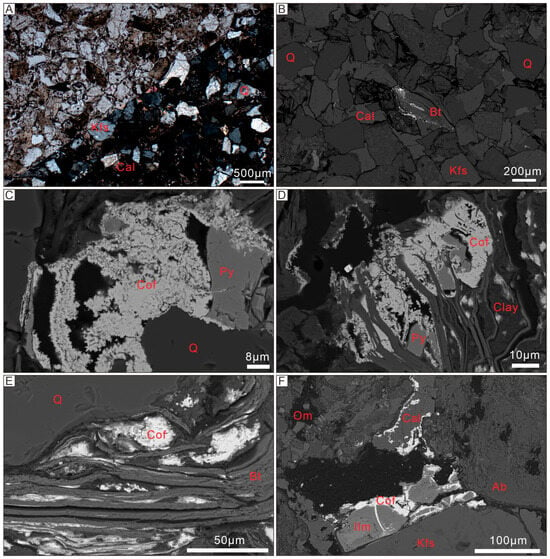
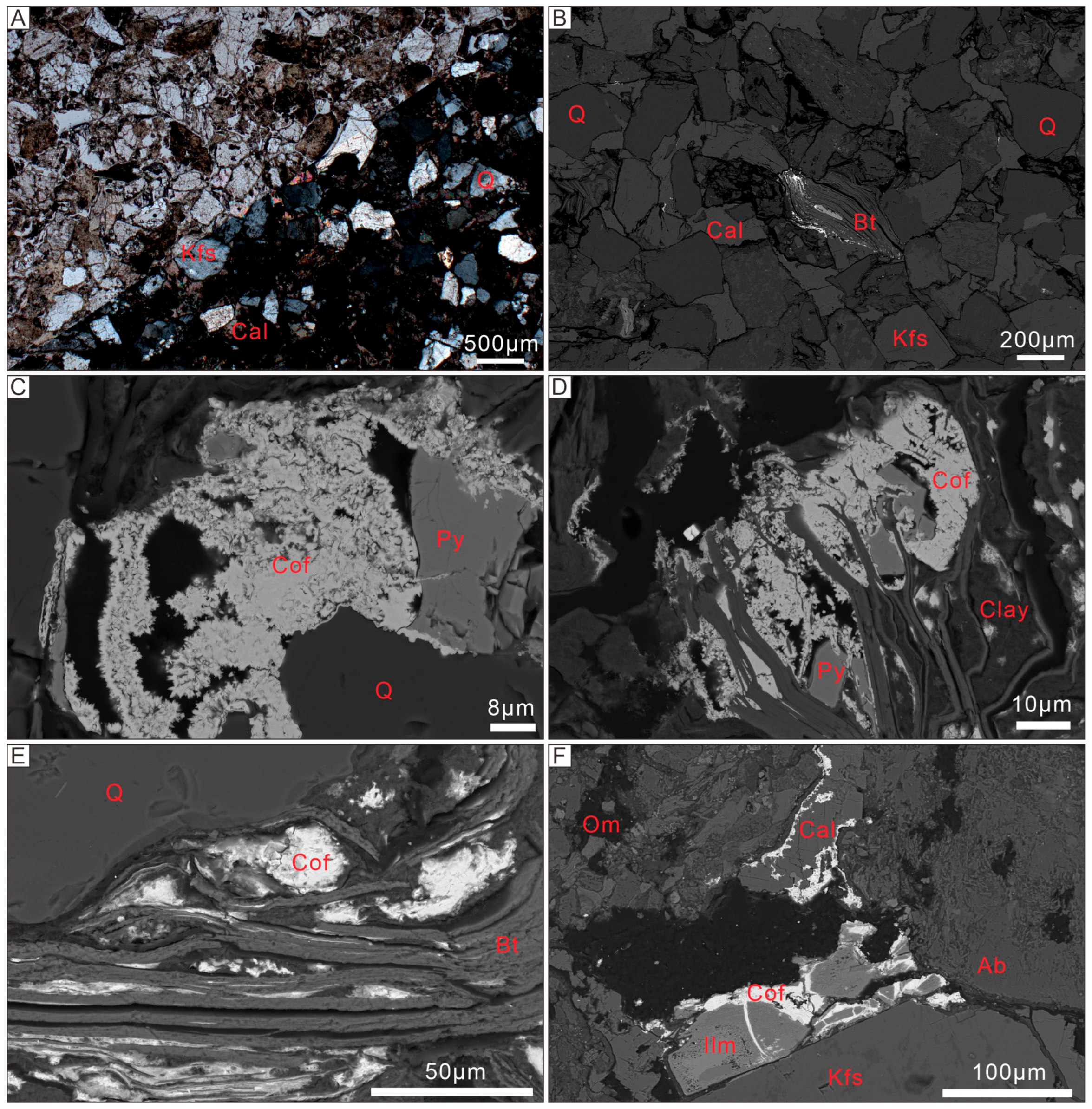
The ore consists mainly of gray to gray-green, medium- to coarse-grained feldspathic sandstone and feldspathic quartz sandstone. Detrital grains, including quartz, feldspar, and rock fragments, constitute approximately 65 wt%, whereas interstitial materials constitute approximately 35 wt%. The latter comprise calcite, clay minerals, and minor organic matter and pyrite (Figure 1A,B and Figure 2A). Detrital grains are commonly about 500 μm across and have subangular to subrounded outlines. Grain contacts are predominantly point contacts, with minor line contacts. The matrix contains clay minerals and minor fine-grained quartz and feldspar, and calcite is the principal cement. Grain-supported textures and pore-filling cementation predominate, although matrix-supported textures occur locally.
Figure 1.
Ore textures and mineral associations. (A,B) Quartz and feldspar detrital grains with calcite occupying intergranular pores and acting as cement. (C–F) Uranium-bearing grains interpreted as coffinite along the margins of quartz, pyrite, biotite, and ilmenite. Abbreviations: Q, quartz; Kfs, K-feldspar; Ab, albite; Cal, calcite; Cof, grains interpreted as coffinite; Py, pyrite; Bt, biotite; Ilm, ilmenite; Om, organic matter.
Figure 2.
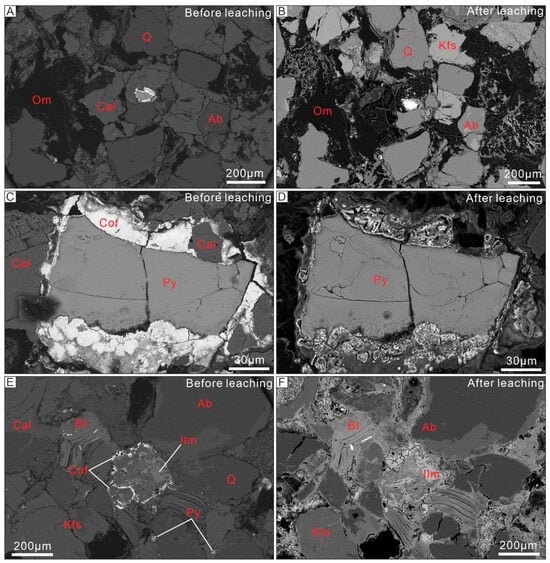
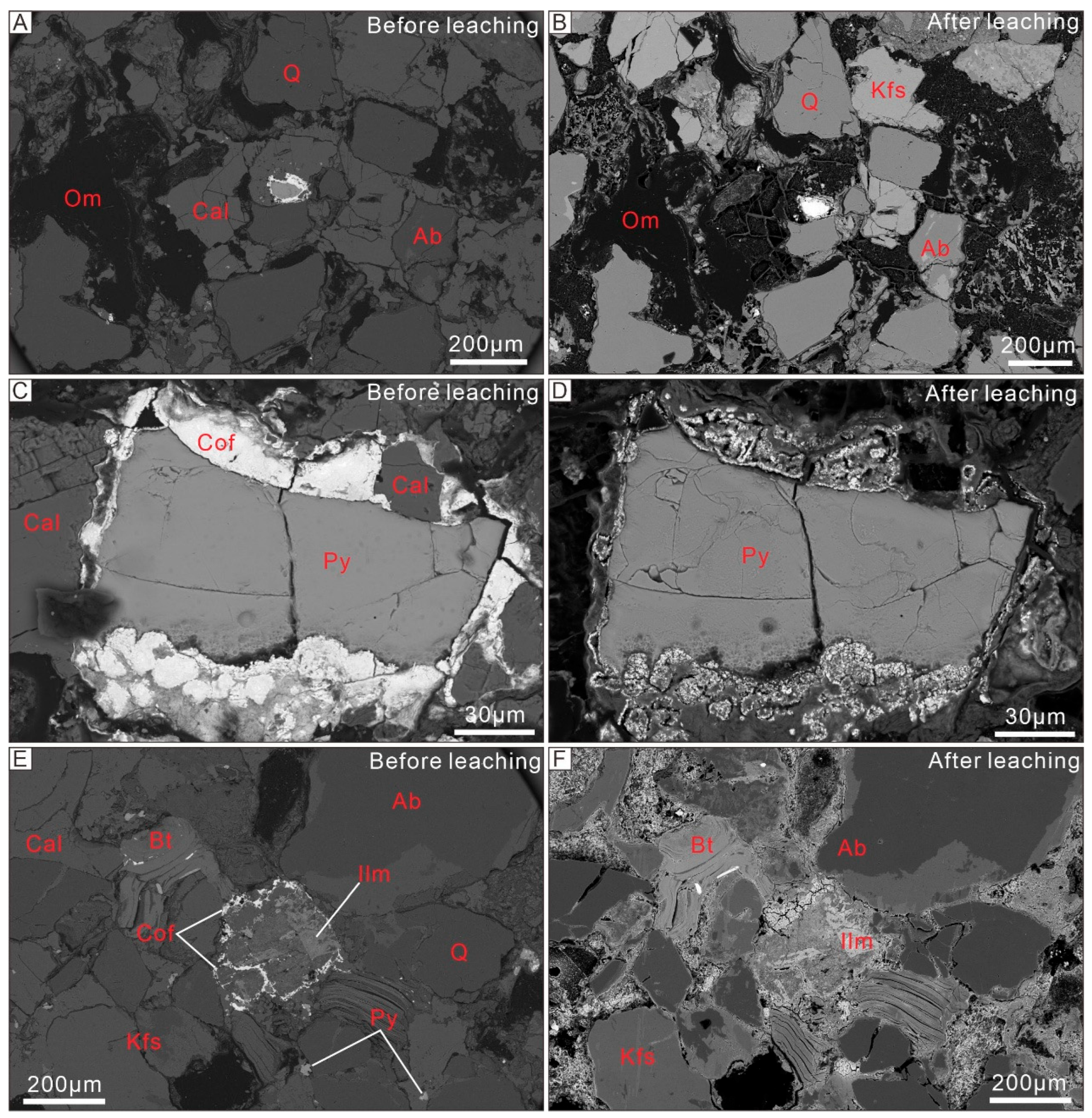
Mineral textures before and after thin-section leaching. (A–D) CO2 + O2 test: exposed calcite was completely removed in the observed fields, uranium-bearing grains interpreted as coffinite were strongly dissolved, and pyrite surfaces developed minor pits and steps. (E,F) Acidic test with 15 g/L H2SO4 and 1 g/L KMnO4: calcite, uranium-bearing grains, and pyrite were removed from the examined locations; some biotite showed wider cleavage openings. The images support qualitative comparisons of dissolution textures, not quantitative dissolution-rate estimates. Abbreviations: Q, quartz; Kfs, K-feldspar; Ab, albite; Cal, calcite; Cof, grains interpreted as coffinite; Py, pyrite; Bt, biotite; Ilm, ilmenite; Om, organic matter.
XRD analyses identify quartz, K-feldspar, plagioclase, calcite or dolomite, and clay minerals as the main constituents (Table 1 and Table S1). Quartz ranges from 31.7 to 46.3 wt%, and total clay minerals range from 14.1 to 27.6 wt% (Table S1). Calcite ranges from 10.4 to 29.7 wt% in the six calcite-bearing samples; the remaining sample contains 2.9 wt% dolomite. The clay fraction is dominated by smectite and mixed-layer chlorite–smectite, with minor kaolinite, illite, and chlorite (Table S1). Whole-rock XRF results show SiO2 contents of 52.0–70.5 wt%, Al2O3 contents of 9.3–12.7 wt%, and CaO contents of 0.8–15.2 wt%. Loss on ignition ranges from 6.0 to 14.7 wt% (Table 2).
Table 1.
Mineral abundances determined by XRD.
Table 2.
Whole-rock major-element compositions determined by XRF.
4.2. Uranium Occurrence
SEM–EDS and EPMA observations indicate that uranium occurs mainly in U–Si-bearing grains interpreted as coffinite. Minor grains were tentatively assigned to uranothorite, Ti-bearing uranium phases, and pitchblende. The reported average composition of the coffinite-like grains is 60.94 wt% UO2, 18.44 wt% SiO2, 1.72 wt% CaO, and 2.32 wt% Y2O3, with minor Fe, Al, Mg, Na, and K.
The coffinite grains are predominantly anhedral, with colloform or flaky morphologies. Rare euhedral grains are columnar or acicular and less than approximately 1 μm across. They occur on anhedral aggregates or directly on detrital grain surfaces. Anhedral grains occupy detrital grain margins, dissolution pores, and fractures, and are associated with pyrite and ilmenite (Figure 1C–F). Some pyrite grains have uranium-bearing rims, with irregular boundaries between the core and rim. Uranium-bearing grains also occur along calcite and biotite margins and cleavage openings. Bulk uranium speciation was reported to comprise approximately 50% U(IV) and 50% U(VI) (Table S2). This bulk result does not assign oxidation states to individual grains.
4.3. Dissolution Features in Thin-Section Leaching Tests
After seven days of CO2 + O2 leaching, quartz, K-feldspar, plagioclase, biotite, clay minerals, and ilmenite showed no clear dissolution features in the examined areas (Figure 2A–D). Pyrite surfaces developed small pits and steps, whereas exposed calcite was completely removed in the observed fields. Uranium-bearing grains interpreted as coffinite showed pronounced dissolution, although small remnants persisted. No systematic differences in visible dissolution were resolved among the examined grain morphologies or occurrence sites.
After 48 h in the acidic solution, calcite, coffinite, and pyrite were no longer visible at the examined locations. Quartz, feldspars, rutile, and apatite showed no clear dissolution features, whereas some biotite displayed wider cleavage openings (Figure 2E,F). These before-and-after images document differences in the final extent of visible dissolution.
4.4. Agitated Leaching Behavior
The acid-consumption test produced abundant bubbles during the initial additions, consistent with reaction of sulfuric acid with carbonate minerals. Calcium sulfate precipitates formed, and the slurry developed a paste-like consistency by the endpoint. These observations indicate substantial acid demand and a risk of sulfate precipitation.
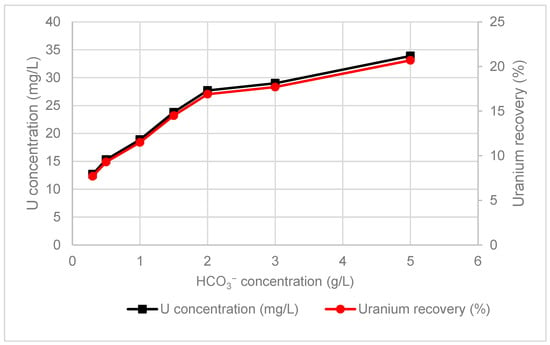
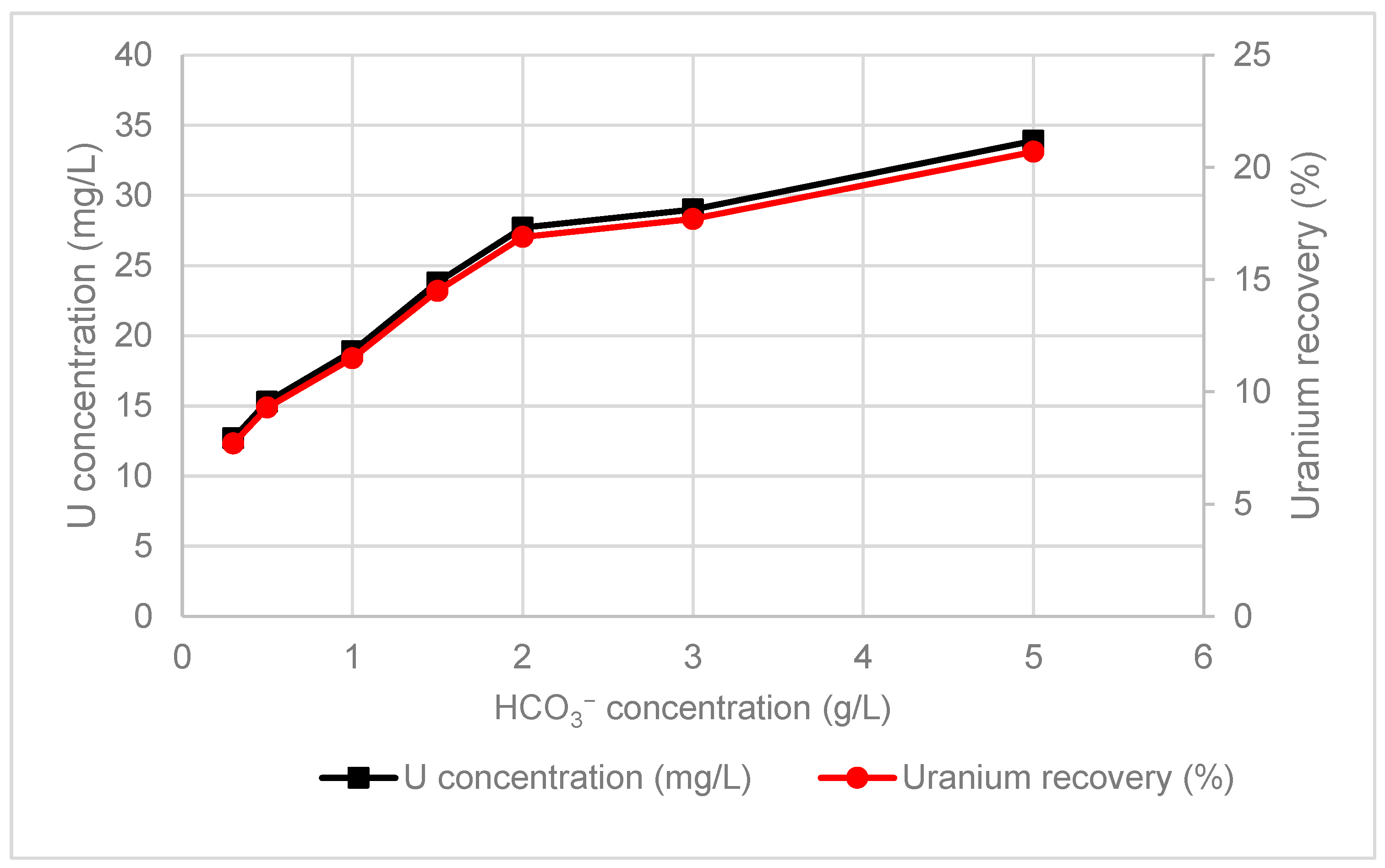
In the 48 h alkaline tests, dissolved uranium increased from 12.7 to 33.9 mg/L as bicarbonate concentration increased from 0.3 to 5 g/L, and uranium recovery increased from 7.7% to 20.7% (Figure 3 and Table S3). The gains were greater below approximately 2 g/L bicarbonate and diminished at higher concentrations. In a separate extended test at 1.5 g/L bicarbonate, dissolved uranium increased from 23.8 mg/L at 48 h to 31.7 mg/L at five days, while recovery increased from 14.5% to 19.1% (Table S4).
Figure 3.
Dissolved uranium concentration and uranium recovery after 48 h at different bicarbonate concentrations. The alkaline tests used NH4HCO3 and hydrogen peroxide at a reported dosage of 1 g/L, at atmospheric pressure, 20 °C, and 70 rpm.
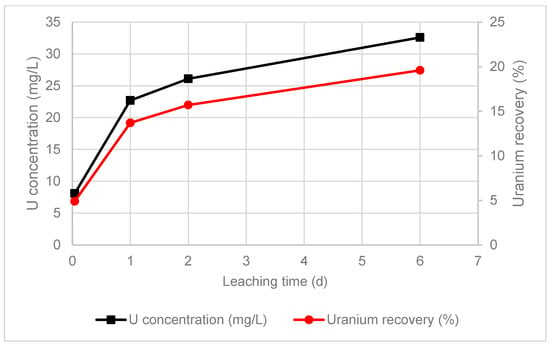
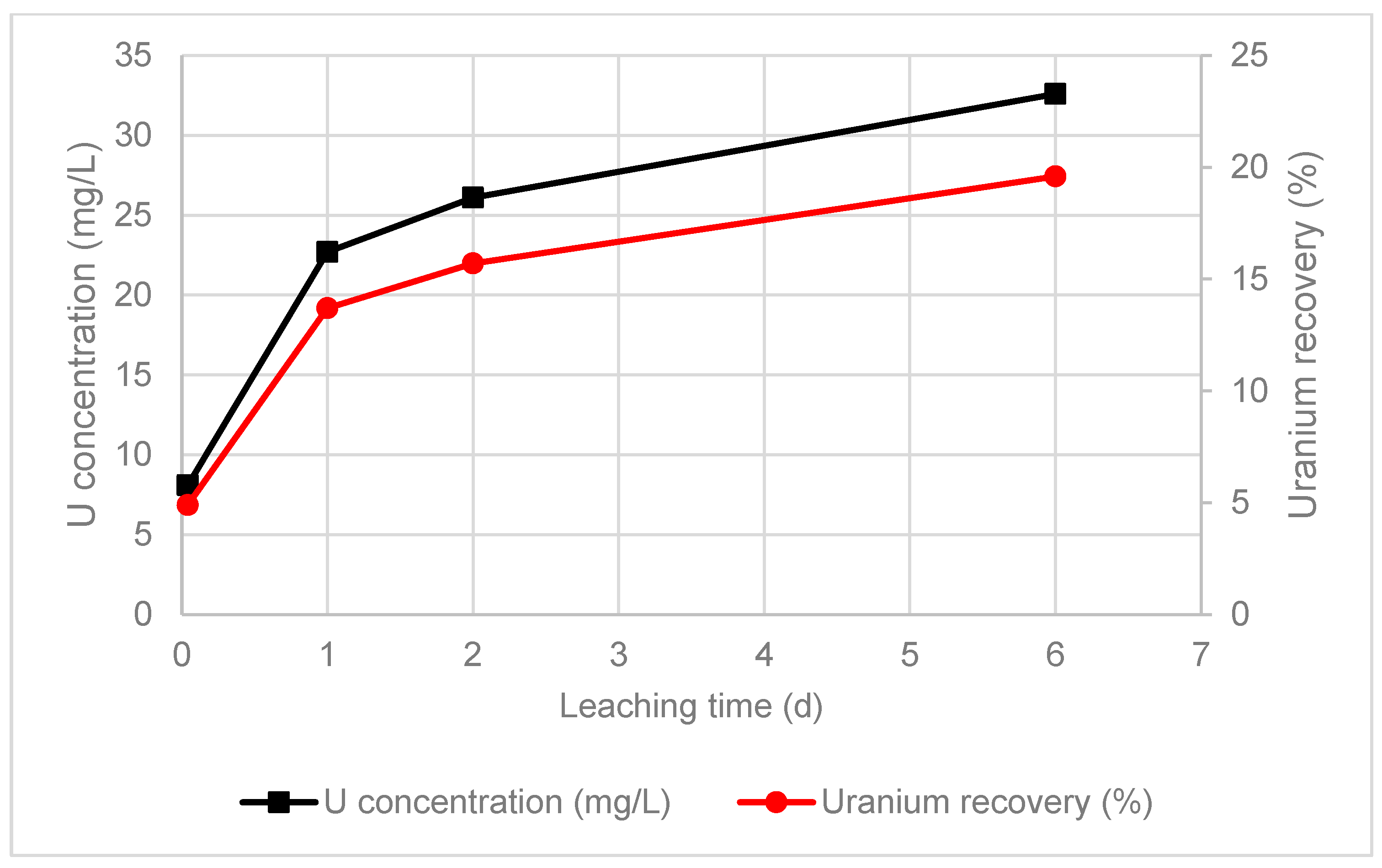
During CO2-only leaching at 0.6 MPa, dissolved uranium increased from 22.7 mg/L on day 1 to 32.6 mg/L on day 6 (Figure 4 and Table S5). The corresponding recoveries were 13.7% and 19.6%. Bicarbonate concentrations were reported as 1.70 and 2.79 g/L at these two times, respectively (Table S5).
Figure 4.
Dissolved uranium concentration and uranium recovery during leaching with CO2 alone at 0.6 MPa, 20 °C, and 70 rpm.
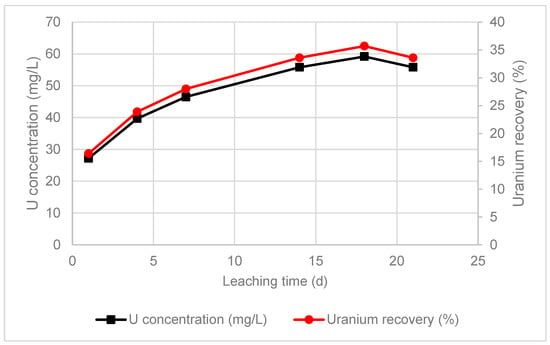
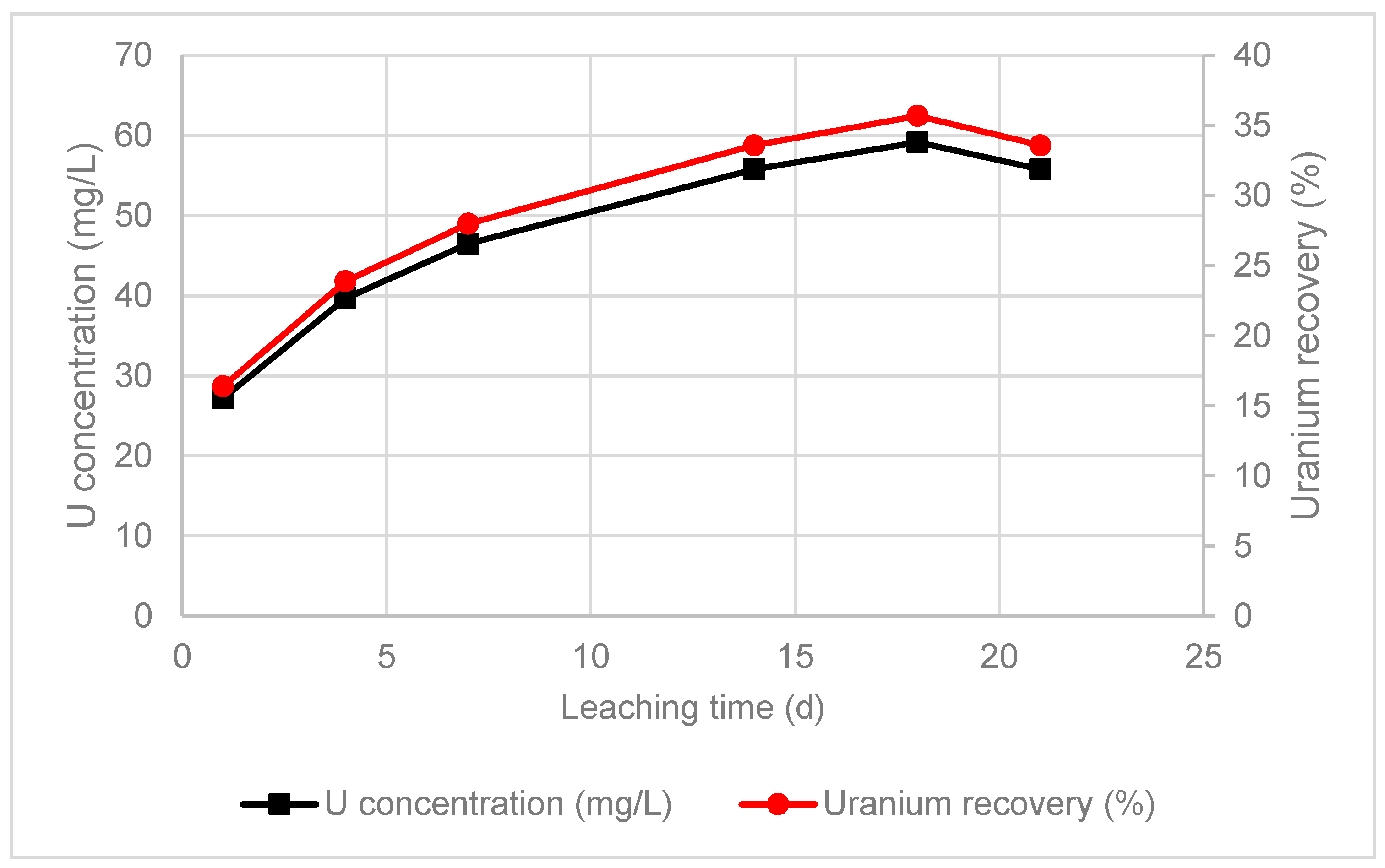
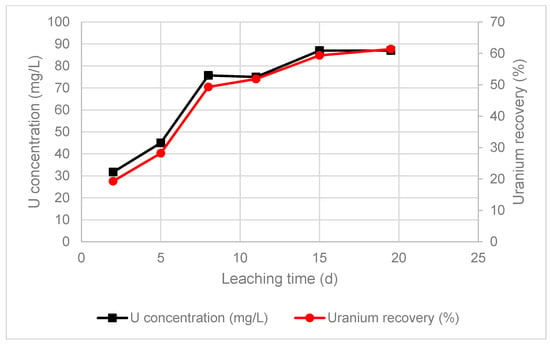
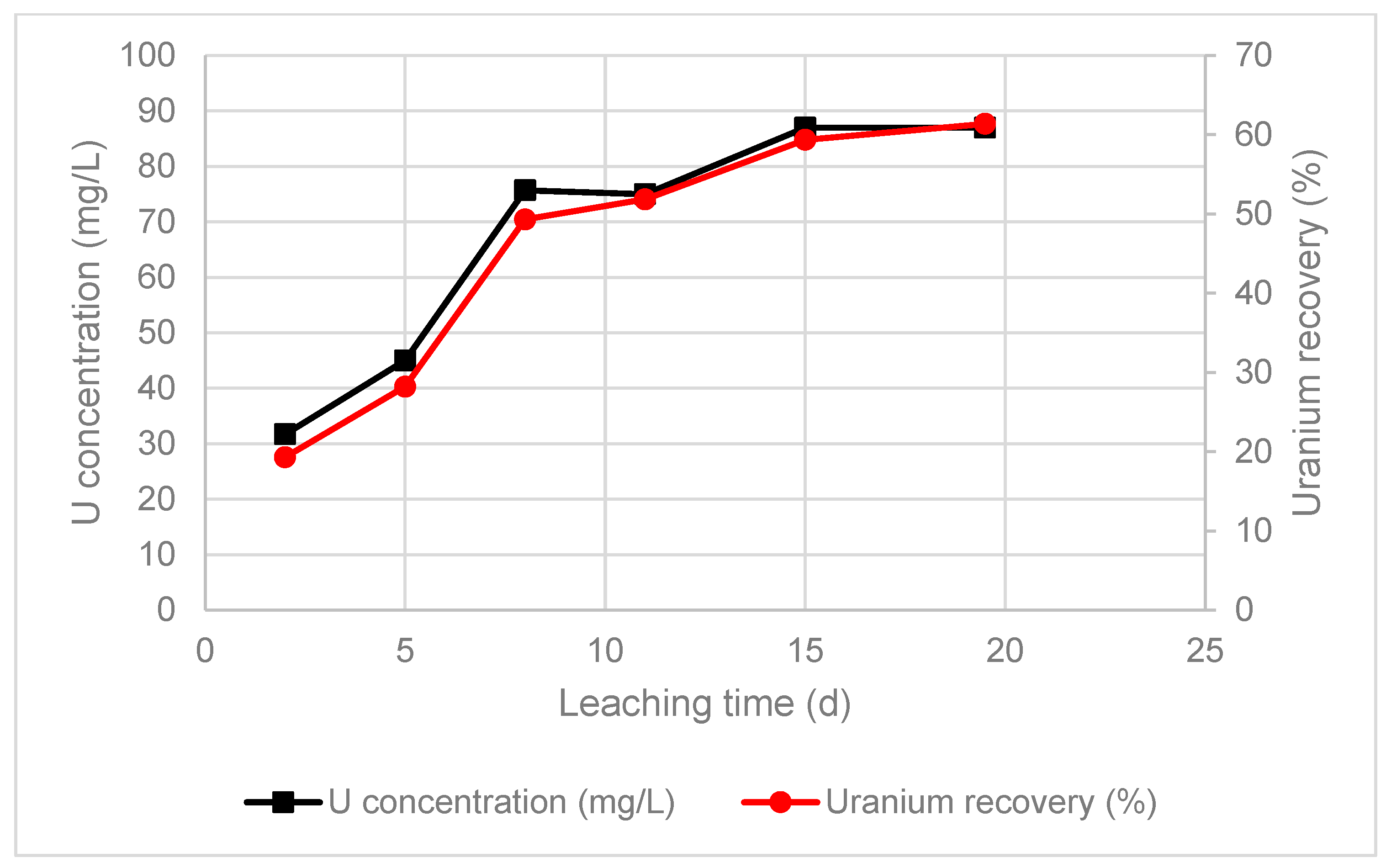
Under 0.6 MPa CO2 and 1 MPa O2, dissolved uranium and recovery increased rapidly during the initial stage, followed by smaller changes after day 7 (Figure 5, Table S6). At 1 MPa CO2 and 1 MPa O2, dissolved uranium reached 75.7 mg/L and recovery reached 49.3% on day 8 (Figure 6 and Table S6).
Figure 5.
Dissolved uranium concentration and uranium recovery during leaching at 0.6 MPa CO2 and 1 MPa O2, 20 °C, and 70 rpm.
Figure 6.
Dissolved uranium concentration and uranium recovery during leaching at 1 MPa CO2 and 1 MPa O2, 20 °C, and 70 rpm.
4.5. CO2-Calcite-Groundwater Interactions
In simulations without calcite, increasing CO2 pressure from 0.1 to 1 MPa left bicarbonate concentrations close to the initial value of 0.3 g/L. Most additional dissolved carbon occurred as molecular CO2 (Table 3). When calcite was included, the amount dissolved increased from 0.96 to 2.63 g per liter of water, and bicarbonate increased from 1.47 to 3.50 g/L over the same pressure range (Table 4). The mass-concentration ratio of dissolved CO2 to bicarbonate also increased, indicating that bicarbonate production rose less rapidly than dissolved CO2 concentration.
Table 3.
Modeled pH, bicarbonate concentration, and dissolved CO2 concentration at CO2–groundwater equilibrium under different CO2 pressures.
Table 4.
Modeled pH, calcite dissolution, calcium concentration, bicarbonate concentration, and dissolved CO2 concentration at CO2–calcite–groundwater equilibrium under different CO2 pressures. Calcite dissolution is expressed per liter of water.
A second set of calculations considered CO2 additions of 2–50 g/L under an assumed reservoir pressure of approximately 5 MPa. As dosage increased, modeled equilibrium pH decreased from 6.1 to 5.2, calcite dissolution increased from 0.88 to 3.98 g/L, and bicarbonate concentration increased from 1.32 to 5.14 g/L (Table 5). The proportion of added CO2 remaining as dissolved molecular CO2 increased from 0.83 to 0.94. Thus, increasing dosage produced progressively smaller bicarbonate gains per unit of added CO2.
Table 5.
Modeled equilibrium chemistry and calcite dissolution at different CO2 dosages, expressed per liter of water. The final column is the mass of dissolved molecular CO2 divided by the mass of added CO2; it is not a CO2/bicarbonate ratio.
5. Discussion
5.1. Uranium Occurrence and Uranium Leaching Behavior
The predominance of U–Si-bearing grains and their association with detrital grain surfaces support a coffinite interpretation. Similar EDS compositions among anhedral and rare euhedral grains suggest a broadly consistent dominant phase. Coffinite is an important uranium source mineral whose acid dissolution has been investigated experimentally [3,4,15,26]. The disappearance of the coffinite grains from the examined locations in our acidic test is consistent with dissolution in an acidic oxidizing medium. Pronounced dissolution of exposed coffinite grains in the CO2 + O2 thin-section test demonstrates that these grains can react under the tested conditions.
In the alkaline tests, increasing bicarbonate concentration improved uranium recovery, but gains diminished above approximately 2 g/L. This observation suggests that bicarbonate availability alone did not control recovery over the tested range. Mineral accessibility, oxidation, and solution pH may also have contributed. The thin-section tests and simplified groundwater model do not establish the bicarbonate concentration at the reacting grain surfaces, because the thin-section tests used distilled water and contained reactive calcite. The model results therefore cannot be used to infer a bicarbonate threshold for coffinite dissolution.
Higher uranium recovery was observed in the agitated test with the higher CO2 pressure. Increased calcite dissolution, greater exposure of encapsulated uranium-bearing grains, and changes in pH are possible explanations. Their individual contributions were not measured, and changing CO2 pressure changes several aspects of solution chemistry simultaneously.
5.2. Leaching Behavior of Gangue Minerals and Its Potential Influence on Uranium Leaching
The acidic and CO2 + O2 thin-section tests both produced substantial dissolution of the exposed coffinite grains. Gangue reactions are therefore central to process selection [27,28]. Calcite is abundant in the studied ore samples, although its distribution is heterogeneous across the deposit. The calcite-bearing samples contain 10.4–29.7 wt% calcite (Table 1), whereas a deposit-scale mean of 5.69 wt% is used in the inventory calculations below. During sulfuric acid leaching, calcite consumes acid and may promote calcium sulfate precipitation. The acid-consumption test produced abundant precipitates and a paste-like slurry, indicating potential reagent-consumption and plugging problems. These observations favor consideration of CO2 + O2 leaching, but they do not alone establish its field-scale economic or technical performance.
Calcite encapsulates some coffinite grains, restricting their contact with the lixiviant. Its dissolution under CO2-bearing conditions can expose these grains while supplying bicarbonate (Figure 2 and Table 4 and Table 5). Extensive cement dissolution could, however, release fine-grained quartz, feldspar, and clay from the pore network. Mobilized fines may migrate and accumulate downstream, reducing permeability. Loss of calcite cement may also weaken the rock. These possible effects require evaluation alongside the potential benefit of improved mineral exposure.
The simplified PHREEQC calculations illustrate the role of calcite in bicarbonate generation. Without calcite, increasing CO2 pressure from 0.1 to 1 MPa leaves bicarbonate close to 0.3 g/L (Table 3). With calcite present, the corresponding concentrations are 1.47–3.50 g/L (Table 4). These results show how calcite can supply ligands during CO2 + O2 ISR. The approximately 2 g/L bicarbonate level used below is a practical target informed by the diminishing gains in Figure 3, rather than a universal requirement for uranium dissolution.
The importance of the modeled calcite dissolution can be assessed by comparison with the solid inventory. Using a sandstone bulk density of 2 kg/L and porosity of 25%, 1 kg of ore contains approximately 0.125 L of pore water. At modeled calcite dissolution concentrations of 0.96–2.63 g/L, this water volume can dissolve approximately 0.120–0.329 g of calcite. Relative to an assumed inventory of 56.9 g calcite per kilogram of ore, this corresponds to about 0.21%–0.58% of the calcite. Even the 3.98 g/L value in the highest-dosage calculation corresponds to approximately 0.498 g, or 0.87% of that inventory, per pore-water volume.
This calculation describes the capacity of a single pore-water volume at equilibrium, not cumulative dissolution throughout mining. Repeated circulation, changing solution composition, and flow-path heterogeneity can change the total mass dissolved. Consequently, the calculation does not prove that CO2 addition cannot alter permeability or expose encapsulated uranium over time. It does show why bicarbonate generation should not automatically be equated with extensive bulk-cement removal. Predicting permeability changes requires flow-through experiments or reactive-transport modeling.
Calcite dissolution is also likely to vary spatially. As an end-member scenario, if injected water approaches calcite equilibrium close to an injection well, its capacity to dissolve additional calcite downstream will decrease. Repeated delivery of undersaturated water could concentrate cement removal near the inlet, potentially exposing uranium-bearing grains while releasing fines or weakening the rock. The dimensions of such a zone depend on reaction rates, cumulative pore volumes, flow geometry, and mineral distribution. The present equilibrium calculations do not determine a dissolution radius or the distance over which complete cement removal would occur.
Pressure changes may influence CO2 loss and calcite precipitation. In the reported pressure-drop scenario, water moved from an assumed 5 MPa near injection to 3 MPa near extraction. The model indicated calcite precipitation only above a CO2 dosage of approximately 48 g/L; this threshold is specific to the assumed composition and gas-phase constraints. Reported field dosages of up to 2 g/L are well below this modeled value. A larger pressure decrease in the surface processing circuit may nevertheless allow CO2 to escape and promote calcite precipitation. Such precipitation could obstruct pipelines or filters and coat ion-exchange resin. The prediction should be checked using complete groundwater chemistry and verified gas-equilibrium boundary conditions.
For the modeled groundwater, adding 5 g/L CO2 produces approximately 1.98 g/L bicarbonate (Table 5). This provides a candidate initial dosage for field evaluation, rather than a demonstrated optimum. The reported injection pressure is generally 0.5–0.8 MPa, but the ability to maintain CO2 in solution depends on the pressure convention, temperature, and gas composition. Maintaining approximately 0.2–0.3 MPa in the surface processing circuit may help limit degassing and calcite precipitation; this proposed range should be verified against the actual operating conditions and groundwater chemistry.
Pyrite developed only minor surface corrosion during the seven-day CO2 + O2 thin-section experiment. Its long-term contribution may nevertheless be important over a mining cycle. Pyrite oxidation consumes oxygen and generates acidity. In calcite-bearing ore, the acidity can be buffered by calcite dissolution, thereby increasing bicarbonate availability. In an oxygen-rich solution, dissolved Fe(II) is expected to oxidize to Fe(III), which may form poorly crystalline Fe(III) hydroxides or oxyhydroxides; sulfate may also contribute to gypsum precipitation [21,22]. These solids and any mobilized fines could impair flow. Surface-mediated uranyl reduction on sulfides is a separate possible process [23] and should not be assumed to dominate in the oxygenated bulk solution.
Pyrite oxidation could therefore contribute to bicarbonate generation while increasing oxygen demand and precipitation risk. Its importance depends on pyrite abundance, oxidation extent, acid–carbonate reaction stoichiometry, and transport. The present observations do not quantify its long-term bicarbonate contribution or justify a specified reduction in subsequent CO2 addition. Likewise, the contrasting surface textures of pyrite and uranium-bearing grains do not establish their relative dissolution rates. Local acid generation near associated grains is a plausible mechanism for enhanced uranium release, but remains to be tested.
6. Conclusions
The dominant U–Si-bearing phase in the Bayinqinggeli ore is provisionally interpreted as coffinite. Exposed grains showed pronounced dissolution in CO2 + O2 thin-section tests. Their mineralogical identity and phase-specific oxidation states remain incompletely resolved, and the observed textures do not establish intrinsic dissolution-rate differences among minerals.
Calcite dissolution supplies bicarbonate and may expose encapsulated uranium-bearing grains. In the simplified equilibrium calculations, the mass dissolved per pore-water volume is small relative to the calcite inventory. This constrains the interpretation of individual equilibrium states, but does not quantify cumulative cement removal or permeability changes during recirculating ISR.
A CO2 dosage of 5 g/L produces approximately 2 g/L bicarbonate in the modeled system and is a candidate initial condition for field testing. Maintaining pressure in the surface circuit may reduce CO2 loss and calcite precipitation. Pyrite oxidation may supply acidity for carbonate dissolution, but also consumes oxygen and can promote secondary precipitation. These coupled effects require field or reactive-transport validation before operating recommendations can be finalized.
Supplementary Materials
The following supporting information can be downloaded at https://www.mdpi.com/article/10.3390/min16100995/s1. Table S1. Clay mineral composition of the ore samples (%). Table S2. Chemical composition of the original ore used in the leaching experiments. Table S3. Leachate pH, uranium concentration, and uranium recovery at different bicarbonate concentrations with hydrogen peroxide (reported dosage: 1 g/L; reagent concentration: 30%). Table S4. Results of the bicarbonate leaching kinetics test. Table S5. Changes in bicarbonate concentration, uranium concentration, and uranium recovery during leaching at 0.6 MPa CO2. Table S6. Changes in bicarbonate concentration, uranium concentration, and uranium recovery during CO2 + O2 leaching at CO2 pressures of 0.6 and 1.0 MPa.
Author Contributions
Conceptualization, C.H. and L.Z.; methodology, C.H. and Y.T.; validation, C.H.; formal analysis, C.H.; investigation, C.H. and W.C.; resources, Z.D. and W.C.; data curation, C.H.; writing—original draft preparation, C.H.; writing—review and editing, C.H.; visualization, C.H.; supervision, C.H.; project administration, C.H.; funding acquisition, C.H. and W.L. All authors have read and agreed to the published version of the manuscript.
Funding
This research was funded by the National Key Laboratory of Uranium Resources Exploration-Mining and Nuclear Remote Sensing (grant NKLUR-WDZC-2024-HHYY-03) and China National Nuclear Corporation (grants CNNC-JCYJ 202689 and CNNC-JCYJ-202332).
Data Availability Statement
Data is contained within the article or Supplementary Material.
Acknowledgments
The authors thank Liumin Deng of the Beijing Research Institute of Uranium Geology for assistance with SEM analysis.
Conflicts of Interest
All authors are employees of Beijing Research Institute of Chemical Engineering and Metallurgy, CNNC. The paper reflects the views of the scientists and not the company.
Abbreviations
Q: quartz; Ab: albite; Kfs: K-feldspar; Py: pyrite; Cal: calcite; Bt: biotite; Cof: coffinite; Ilm: ilmenite.
References
- Li, G.; Yao, J. A review of in situ leaching (ISL) for uranium mining. Mining 2024, 4, 120–148. [Google Scholar] [CrossRef] [Scilit]
- Shilov, V.P.; Yusov, A.B.; Peretrukhin, V.F.; Delegard, C.H.; Gogolev, A.V.; Fedosseev, A.M.; Kazansky, L.P. Oxidation of U(IV) by atmospheric oxygen in pH 1.5–7.4 aqueous solutions. J. Alloys Compd. 2007, 444, 333–338. [Google Scholar] [CrossRef] [Scilit]
- Reynolds, H.S.; Tardio, J.; Bhargava, S.K. Dissolution studies of synthetic coffinite. In Proceedings of the Chemeca 2011: Engineering a Better World, New South Wales, Australia, 18–21 September 2011. [Google Scholar]
- Reynolds, H.S.; Ram, R.; Pownceby, M.I.; Yang, Y.; Chen, M.; Tardio, J.; Jones, J.; Bhargava, S.K. Kinetics of uranium extraction from coffinite—A comparison with other common uranium minerals. Trans. Nonferrous Met. Soc. China 2018, 28, 2135–2142. [Google Scholar] [CrossRef] [Scilit]
- Charalambous, F.A.; Ram, R.; McMaster, S.; Pownceby, M.I.; Tardio, J.; Bhargava, S.K. Leaching behaviour of natural and heat-treated brannerite-containing uranium ores in sulphate solutions with iron(III). Miner. Eng. 2014, 57, 25–35. [Google Scholar] [CrossRef] [Scilit]
- Gilligan, R.; Nikoloski, A.N. The extraction of uranium from brannerite—A literature review. Miner. Eng. 2015, 71, 34–48. [Google Scholar] [CrossRef] [Scilit]
- Gilligan, R.; Nikoloski, A.N. Leaching of brannerite in the ferric sulphate system—Part 1: Kinetics and reaction mechanisms. Hydrometallurgy 2015, 156, 71–80. [Google Scholar] [CrossRef] [Scilit][Green Version]
- Eary, L.E.; Cathles, L.M. A kinetic model of UO2 dissolution in acid, H2O2 solutions that includes uranium peroxide hydrate precipitation. Metall. Trans. B 1983, 14, 325–334. [Google Scholar] [CrossRef] [Scilit]
- Bruno, J.; Casas, I.; Puigdomènech, I. The kinetics of dissolution of UO2 under reducing conditions and the influence of an oxidized surface layer (UO2+x): Application of a continuous flow-through reactor. Geochim. Cosmochim. Acta 1991, 55, 647–658. [Google Scholar] [CrossRef] [Scilit]
- Casas, I.; de Pablo, J.; Giménez, J.; Torrero, M.E.; Bruno, J.; Cera, E.; Finch, R.J.; Ewing, R.C. The role of pe, pH, and carbonate on the solubility of UO2 and uraninite under nominally reducing conditions. Geochim. Cosmochim. Acta 1998, 62, 2223–2231. [Google Scholar] [CrossRef] [Scilit]
- Pierce, E.M.; Icenhower, J.P.; Serne, R.J.; Catalano, J.G. Experimental determination of UO2(cr) dissolution kinetics: Effects of solution saturation state and pH. J. Nucl. Mater. 2005, 345, 206–218. [Google Scholar] [CrossRef] [Scilit]
- Ram, R.; Charalambous, F.; Tardio, J.; Bhargava, S. An investigation on the effects of Fe (FeIII, FeII) and oxidation reduction potential on the dissolution of synthetic uraninite (UO2). Hydrometallurgy 2011, 109, 125–130. [Google Scholar] [CrossRef] [Scilit]
- Bhargava, S.K.; Ram, R.; Pownceby, M.; Grocott, S.; Ring, B.; Tardio, J.; Jones, L. A review of acid leaching of uraninite. Hydrometallurgy 2015, 151, 10–24. [Google Scholar] [CrossRef] [Scilit]
- Avasarala, S.; Torres, C.; Ali, A.-M.S.; Thomson, B.M.; Spilde, M.N.; Peterson, E.J.; Artyushkova, K.; Dobrica, E.; Lezama-Pacheco, J.S.; Cerrato, J.M. Effect of bicarbonate and oxidizing conditions on U(IV) and U(VI) reactivity in mineralized deposits of New Mexico. Chem. Geol. 2019, 524, 345–355. [Google Scholar] [CrossRef] [Scilit] [PubMed]
- Szenknect, S.; Mesbah, A.; Cordara, T.; Clavier, N.; Brau, H.-P.; Le Goff, X.; Poinssot, C.; Ewing, R.C.; Dacheux, N. First experimental determination of the solubility constant of coffinite. Geochim. Cosmochim. Acta 2016, 181, 36–53. [Google Scholar] [CrossRef] [Scilit]
- Hou, C.; Chen, S.; Zhang, Y.; Liu, Z.; Xie, X.; Deng, J.; Zou, Y.; Liao, W. Mineralogical characteristics and leaching behavior of sandstone-hosted uranium ore: Implications for in situ recovery in the Zhenyuan deposit, SW Ordos Basin, China. Minerals 2026, 16, 340. [Google Scholar] [CrossRef] [Scilit]
- Vogt, T.C.; Strom, E.T.; Johnson, W.F.; Venuto, P.B. In-situ leaching of Crownpoint, New Mexico, uranium ore. III. Laboratory study of strong leaching systems: Sodium hypochlorite. Soc. Pet. Eng. J. 1985, 25, 875–880. [Google Scholar] [CrossRef] [Scilit]
- Hou, C.; Weng, H.; Liao, W.; Zhao, L. Leaching behavior and clogging mechanisms of the Hailijin sandstone-type uranium deposit, Songliao Basin, China. Ore Geol. Rev. 2026, 195, 107386. [Google Scholar] [CrossRef] [Scilit]
- Luquot, L.; Gouze, P. Experimental determination of porosity and permeability changes induced by injection of CO2 into carbonate rocks. Chem. Geol. 2009, 265, 148–159. [Google Scholar] [CrossRef] [Scilit]
- Hu, M.; Niu, Q.; Yuan, W.; Wang, W.; Chang, J.; Du, Z.; Wang, Q.; Zheng, Y.; Shangguan, S.; Qi, X.; et al. Evolution characteristic and mechanism of microstructure, hydraulic and mechanical behaviors of sandstone treated by acid-rock reaction: Application of in-situ leaching of uranium deposits. J. Hydrol. 2024, 643, 131948. [Google Scholar] [CrossRef] [Scilit]
- Wang, P.; Tan, K.; Li, Y.; Liu, Z.; Li, C.; Tan, W.; Tian, Y.; Huang, W. Effect of pyrite on the leaching kinetics of pitchblende in the process of acid in situ leaching of uranium. Minerals 2022, 12, 570. [Google Scholar] [CrossRef] [Scilit]
- Fan, Y.; Song, H.; Wang, Z.; Gan, N.; Zhang, C.; Zhao, B.; Xu, Z.; Tan, Y. The behavior of pyrite during in-situ leaching of uranium by CO2 + O2: A case study of the Qianjiadian uranium deposit in the Songliao Basin, northeastern China. Ore Geol. Rev. 2024, 169, 106085. [Google Scholar] [CrossRef] [Scilit]
- Wersin, P.; Hochella, M.F.; Persson, P.; Redden, G.; Leckie, J.O.; Harris, D.W. Interaction between aqueous uranium(VI) and sulfide minerals: Spectroscopic evidence for sorption and reduction. Geochim. Cosmochim. Acta 1994, 58, 2829–2843. [Google Scholar] [CrossRef] [Scilit]
- Ram, R.; Charalambous, F.A.; McMaster, S.; Pownceby, M.I.; Tardio, J.; Bhargava, S.K. An investigation on the dissolution of natural uraninite ores. Miner. Eng. 2013, 51, 83–92. [Google Scholar] [CrossRef] [Scilit]
- Ram, R.; Charalambous, F.; McMaster, S.; Tardio, J.; Bhargava, S. An investigation on the effects of several anions on the dissolution of synthetic uraninite (UO2). Hydrometallurgy 2013, 136, 93–104. [Google Scholar] [CrossRef] [Scilit]
- Reynolds, H. Synthesis, Characterisation and Dissolution Studies of the Uranium Mineral Coffinite. Ph.D. Thesis, RMIT University, Melbourne, Australia, 2013. [Google Scholar]
- Wang, S.; Lian, M.; Ding, D.; He, G.; Fu, H. Evolution of pore structure and reactive transport parameters during acid leaching of sandstone uranium ore. Hydrometallurgy 2024, 226, 106301. [Google Scholar] [CrossRef] [Scilit]
- Zhou, Y.; Zhang, C.; Wang, J.; Zhang, X.; Ren, X.; Han, Z.; Liu, Z.; He, G. In situ acidic leaching behavior and clogging mitigation strategies for sandstone-hosted uranium deposits in Inner Mongolian Basin, China. Minerals 2026, 16, 898. [Google Scholar] [CrossRef] [Scilit]

Disclaimer/Publisher’s Note: The statements, opinions and data contained in all publications are solely those of the individual author(s) and contributor(s) and not of MDPI and/or the editor(s). MDPI and/or the editor(s) disclaim responsibility for any injury to people or property resulting from any ideas, methods, instructions or products referred to in the content. |
© 2026 by the authors. Licensee MDPI, Basel, Switzerland. This article is an open access article distributed under the terms and conditions of the Creative Commons Attribution (CC BY) license.