


Abstract
Useful quantum neural networks should not merely explore large Hilbert spaces but should organise their expressive capacity according to the symmetries of the learning problem. We introduce symmetry-organised complexity as an ansatz-level, representation-theoretic trajectory diagnostic for quantum neural networks. The diagnostic combines symmetry-sector organisation, cross-irreducible representation organised complexity, and symmetry metastability into a composite index, which is then multiplied by a compliance factor that penalises apparent complexity arising from symmetry violation. This compliance factor is defined at the level of the implemented trainable generators rather than as a representation-independent channel metric. The representation-theoretic basis of the construction is that, for an exactly equivariant network, the effective trainable operators lie in the commutant of the group action and are controlled by multiplicity dimensions rather than by the full Hilbert-space dimension. We show that joint sector collapse and state freezing force the index to vanish under an explicit multiplicity–purity condition and that networks with identical qubit and parameter counts can have different values of the index. Two analytically tractable four-qubit examples with excitation number and total spin symmetry illustrate how the diagnostic separates sector-collapsed, symmetry-organised, and symmetry-breaking behaviour. A controlled -compatible teacher–student classification task further shows that, in this validation setting, the ordering of the composite index across equivariant, hybrid, and non-equivariant ansatze agrees with the ordering of generalisation accuracy. The framework is most informative when the relevant symmetry of the learning problem is known.
1. Introduction
Quantum neural networks and parametrised quantum circuits are commonly analysed through one of several complementary lenses. These include expressibility and entangling capacity [1], trainability and barren plateaus [2,3,4], equivariance and group structure [5,6,7,8], and effective dimension or quantum neural tangent kernels [9,10]. These properties are typically studied in isolation, so that a circuit may be reported as more expressive, more trainable, or more symmetric without a unified diagnostic capturing how these properties are jointly organised for a given learning problem.
A common thread runs through these results. Raw expressivity is not the right quantity to maximise. Higher expressibility is closely tied to smaller gradient magnitudes [4] and to barren plateaus [2,3], while symmetry-preserving ansatze recover trainability by confining learning to a symmetry-adapted subspace [5,6,7]. Useful capacity is therefore not raw Hilbert-space expressivity but what we will call symmetry-organised expressivity.
The construction is inspired by a structural rather than a biological level, namely by the dynamical systems framework of Ugail and Howard [11], which combines scale-free temporal organisation, cross-frequency organisation, and metastability into a weighted composite of the form . We adopt the composite index principle and replace the biological components with representation-theoretic quantum analogues. The correspondence is summarised in Table 1. We do not claim that quantum neural networks are conscious or that neural complexity metrics apply literally to quantum circuits. The claim is that the methodological principle, under which no single feature is sufficient and organisation should be quantified as a weighted combination of distributional, relational, and temporal ingredients, is structurally appropriate once the three ingredients are translated into representation theory.
Table 1.
Correspondence between components of the neural dynamics composite index of Ugail and Howard [11] and the representation-theoretic components proposed in this paper. The correspondence is an analogy at the level of the structural principle rather than a literal mapping of physical mechanisms and serves only to motivate the composite index form.
It is worth noting that expressibility quantifies how uniformly a parametrised circuit covers Haar-random unitary distributions on its output space and is therefore a property of the parametrised family rather than of a particular trajectory [1,4]. Effective dimension and quantum neural tangent kernel analyses capture statistical capacity and local training dynamics, respectively [9,10]. Equivariant and geometric quantum machine learning programmes provide architecture-level prescriptions and trainability results [5,6,7,12]. Generalisation bounds for symmetric quantum models have been developed in [13]. The diagnostic introduced in the present paper is complementary to these tools. It is a trajectory-level quantity that measures how the chosen architecture distributes its expressive capacity across the multiplicity structure of a target symmetry. It is not a replacement for expressibility, effective dimension, or trainability analysis, nor is it itself a generalisation bound. The aim is to provide a single transparent score that summarises symmetry-compatible organisation along an actual sequence of states.
The remainder of the paper is organised as follows. Section 3 fixes the representation-theoretic setting and the notion of G-equivariance. Section 4 introduces the three organisational components, the ansatz-level compliance factor, and the composite index . Section 5 contains the main theoretical content, namely a Schur-type block decomposition (Lemma 3), the effective dimension theorem for equivariant ansatze (Theorem 1), sector collapse propositions (Propositions 1 and 2), a non-redundancy theorem (Theorem 2), and a capacity conjecture (Conjecture 1). Section 6 illustrates the framework on and four-qubit examples. Section 7 reports a trained -compatible teacher–student task that compares equivariant, hybrid, and non-equivariant ansatze. Section 8 discusses the implications and limitations, and, in Section 9, we conclude the paper.
2. Background and Related Work
A quantum neural network is a parametrised quantum channel with trainable parameters in some parameter manifold . It maps density operators on an input Hilbert space to density operators on an output Hilbert space . In the simplest setting, one has a Stinespring dilation of the form
where is a parametrised unitary acting on system plus ancilla and the partial trace is taken over the ancillary subsystem. Here, denotes a fixed reference state of the ancillary register, conventionally chosen to be the computational-basis ground state . The projector in Equation (1) is therefore the rank-one projector onto this reference state in the ancillary subspace. Variational quantum algorithms [14], quantum convolutional networks [15], data-reuploading classifiers [16], and circuit-centric classifiers [17] are all instances of this construction.
Expressibility measures how uniformly a parametrised circuit covers the Haar distribution on its output space [1]. Barren plateaus—regions of the parameter space where loss gradients vanish exponentially with system size [2]—have been tied to expressibility [4], cost function locality [3], and dissipative noise [18]. Equivariant and group-invariant quantum neural networks restrict learning to symmetry-respecting channels [5,6,7] and have produced strong results for permutation-equivariant architectures [8,19] and for discrete symmetries such as [20]. Representation-theoretic analyses of geometric quantum machine learning [12], symmetric pruning [21], reflection-equivariant architectures [22], noise-induced symmetry breaking [23], and generalisation from few training data [13] establish that the symmetry structure both constrains the trainable parameters and can improve trainability. The broader geometric deep learning programme then provides a classical template [24].
Our setting treats data via quantum feature maps in the sense of [25] or by data-reuploading as in [16], with trainable unitaries organised into symmetry-respecting blocks. Throughout the paper, we assume familiarity with Peter–Weyl decompositions of finite-dimensional representations of compact groups. For standard references, the reader is referred to Fulton and Harris [26], Hall [27], and Serre [28].
3. Mathematical Preliminaries
Let G be a compact group and let be a finite-dimensional complex Hilbert space carrying a continuous unitary representation . Let denote a fixed set of representatives of irreducible unitary representations of G. By the Peter–Weyl theorem [26,27], the representation decomposes into isotypic components in the form
where carries the irreducible representation labelled by , and is the associated multiplicity space on which G acts trivially. We write
for the set and number of active sectors, meaning those irreducible components that actually occur in . The group acts on by . We write for the orthogonal projector from onto the isotypic summand indexed by , satisfying and .
A quantum neural network channel acting on is said to be G-equivariant when
Writing for the adjoint action of G on the space of operators , equivariance is equivalent to the statement for all , so that lies in the commutant of the adjoint action. We are particularly interested in the subclass of equivariant quantum neural networks that admit a Kraus decomposition in which every Kraus operator individually satisfies for all . This is the standard setting obtained, for example, from a product ansatz in which all generators commute with for every , and it is the setting adopted in [5,6,7,12]. Throughout this paper, when we refer to the equivariant ansatz algebra, we mean the family of trainable generators associated with this construction. The compliance factor introduced in Section 4 is defined relative to this generator set and is therefore an ansatz-level diagnostic.
Given a data-dependent state trajectory arising, for example, from batches in training, depth steps in a deep circuit, or test inputs, we define sector occupation by
The positivity and normalisation of follow from the fact that is a positive operator of unit trace and that is a resolution of the identity. The time-averaged occupation is denoted .
4. The Symmetry-Organised Complexity Index
The composite index consists of three organisational components together with a symmetry compliance factor. We define each in turn and establish the relevant boundedness and characterisation properties.
4.1. Symmetry-Sector Organisation
The first component measures how evenly the quantum neural network occupies the active symmetry sectors.
Definition 1.
Let denote the time-averaged sector distribution defined in (5) and let . The symmetry-sector organisation of the quantum neural network at parameter θ is
with the convention .
The quantity is the normalised Shannon entropy of the time-averaged sector distribution, with normalisation chosen so that , and corresponds to a uniform distribution over all K active sectors [29]. The lower bound characterises trajectories whose time-averaged occupation is concentrated on a single sector.
4.2. Cross-Irreducible Representation Organised Complexity
The second component measures the coherent structure carried by the trajectory, both between distinct isotypic sectors through off-diagonal blocks of the form with and within a single isotypic sector through the reduced density operator on the multiplicity space. For an exactly G-equivariant channel, the inter-sector blocks may be restricted or forced to vanish by selection rules, whereas a rich structure typically survives inside the multiplicity spaces. The second component is therefore defined as the sum of two contributions, so that the full framework remains informative in both the exactly equivariant and the symmetry-breaking regimes.
Definition 2.
Let be a trajectory of density operators on and let . Define the inter-sector contribution by
where denotes the Frobenius norm and is a normalisation constant, chosen so that for any pure-state trajectory with the bound saturated in the smallest non-trivial case , as established in Lemma 1. For each θ, define the active multiplicity mass,
which measures the total time-averaged occupation of sectors with a non-trivial multiplicity structure. For each sector λ with , let
denote the time-averaged reduced density operator on the multiplicity space , which is well defined whenever . Define the within-multiplicity contribution by
The cross-irreducible representation organised complexity of the trajectory is the arithmetic mean of these two contributions,
The leading scalar one in Equation (10) is a real number, while denotes the identity operator on the multiplicity space , and the subtraction is performed between operators. Sectors with contribute nothing to since they carry no non-trivial multiplicity structure. The convention when records the fact that the within-multiplicity quantity is not applicable in this regime, and the active multiplicity mass can be computed alongside the diagnostic so that the reader can identify whether the multiplicity term is meaningful. For an exactly G-equivariant channel acting on a single-sector input, by the selection rules of Lemma 3, and all of is carried by . The quantity should be interpreted as multiplicity-space diversity rather than as within-sector purity, since it is high when the trajectory explores the available multiplicity degrees of freedom broadly and low when it remains concentrated in a single multiplicity direction.
4.3. Symmetry Metastability
The third component measures the temporal variation in sector composition along a trajectory.
Definition 3.
Let denote the sector occupation purity at time t, equal to one minus the Simpson diversity index of the sector distribution. The symmetry metastability of the trajectory is
where denotes the sample standard deviation over .
4.4. Ranges of the Organisational Components
We now establish that each of the three organisational components takes values in and characterise the boundary cases.
Lemma 1.
For any parameter θ, any pure-state trajectory , and any , the three organisational components satisfy
Moreover, the following boundary characterisations hold. The quantity if and only if for some single sector , and if and only if the time-averaged distribution is uniform on Λ. The inter-sector contribution vanishes if and only if every is block-diagonal in the isotypic decomposition of . When , the within-multiplicity contribution vanishes if and only if every sector-averaged reduced density operator corresponding to a sector with and is a pure state on , and if every such coincides with the maximally mixed state . When , the within-multiplicity quantity is defined to be zero by convention. Finally, if and only if is constant across the trajectory.
Proof.
For the first component, is the Shannon entropy of a probability distribution on K outcomes, which lies in . Dividing by gives . Equality holds if and only if the distribution is a Dirac measure on some single sector, and holds if and only if the distribution is uniform, by the strict concavity of the entropy functional.
We treat the second component in two stages, corresponding to the two contributions in Definition 2. For the inter-sector contribution, fix t and write a pure state together with its isotypic decomposition , where and . Direct calculation gives and hence
By the inequality of arithmetic and geometric means, , with equality if and only if . Summing over ordered pairs with and using gives
so the per-time-step average is bounded above by . Averaging over t preserves the bound, and multiplication by gives since . The vanishing of follows from (14), since every off-diagonal block has a zero Frobenius norm if and only if is block-diagonal for every t.
For the within-multiplicity contribution, suppose first that . Fix a sector with and . The operator defined in (9) is a density operator on , and its squared Frobenius distance from the maximally mixed state is . The purity of any density operator on a d-dimensional Hilbert space lies in , so the normalised distance lies in . The conditional weights in Equation (10) are non-negative and sum to one over the active multiplicity-rich sectors. The weighted sum in Equation (10) is therefore a convex combination of values in and lies in , so . The case gives by convention, which lies in trivially. Equality holds when every sector-averaged state is maximally mixed, while in the regime corresponds to every such being a pure state. Since and both summands lie in , we have as claimed.
For the third component, note first that , with the lower bound attained at the uniform distribution and the upper bound attained at a Dirac measure, by the power-mean inequality applied to the probability vector. Any random variable taking values in an interval has variance bounded above by and hence a sample standard deviation bounded above by . Applied to , this gives , so multiplication by yields . The vanishing condition holds if and only if is constant in t. □
4.5. The Symmetry Compliance Factor
A purely additive combination of , , and can be inflated by a symmetry-breaking model that spreads amplitude across sectors for the wrong reason. To rule out this failure mode, we introduce a compliance factor derived from the commutator defect.
Definition 4.
Let be a finite set of Hermitian generators of the representation of G on , so that each unitary is generated by the algebra spanned by the . Let denote the effective generator of the trainable layer of the ansatz, obtained, for instance, from a product unitary as the operator . The normalised commutator defect of the channel is
and the ansatz-level symmetry compliance factor is
where is a fixed sharpness parameter. If , we set and consequently , since a vanishing reference generator carries no symmetry-violating component.
The factor is computed directly from the operator associated with the implemented trainable generators of the ansatz. It is not intended as a representation-independent distance between quantum channels. A representation-independent extension could be obtained by replacing with a covariance defect such as in some channel-level norm, but this is outside the scope of the present paper.
Throughout this paper, the generators are taken to be a basis of the Lie algebra of G in its representation on , which fixes a canonical choice. For the example of Section 6.2, this gives the single generator , so . For the example of Section 6.3, this gives the three generators , , with , so . Different choices of generating sets produce numerically different values of , but the vanishing condition and the qualitative ordering between trajectories are invariant under any choice that spans the same Lie algebra, since the equivalence for all i holds whenever it holds on any spanning set.
Lemma 2.
For any θ, the symmetry compliance factor satisfies . Moreover, if and only if for every . In particular, whenever the channel is exactly G-equivariant in the sense that its reference generator commutes with every infinitesimal generator of G.
Proof.
Each summand in (16) is non-negative, so , and hence . Positivity follows from the fact that the exponential is strictly positive on the real line and that is finite whenever and . The upper bound on is obtained from the operator-norm inequality . For the characterisation, holds if and only if , which, by the non-negativity of each summand, is equivalent to for every i and hence to for every i by the faithfulness of the Frobenius norm. □
4.6. The Composite Index
We can now state the central definition of the paper.
Definition 5.
For non-negative weights satisfying , the symmetry-organised complexity index of the quantum neural network at parameter θ is
By construction, and by Lemmas 1 and 2, for any parameter and any pure-state trajectory. The multiplicative form of encodes the scientific claim of this paper, namely that rewards structured expressivity compatible with the symmetry of the problem rather than diffusion across sectors obtained through symmetry violation. To illustrate the arithmetic, a trajectory with , , , and under the weight choice produces .
Remark 1.
Following the precedent of [11], the weights are chosen a priori rather than fitted to a benchmark. This keeps the index transparent and avoids overfitting to any particular task. Throughout the present paper, we use , , , and . The robustness of our qualitative conclusions to variations in these choices is discussed in Section 7.3.
5. Main Theoretical Results
In this section, we discuss the representation-theoretic substrate on which the diagnostic rests, together with three structural claims about the diagnostic itself. Lemma 3 states the Schur-type block decomposition of operators in the commutant of a compact group action, a standard ingredient that we include for completeness. Theorem 1 uses it to control the effective trainable dimension of an equivariant ansatz and to identify for ansatze whose reference generator lies in the commutant subalgebra. Propositions 1 and 2 characterise the consequences of sector collapse for the diagnostic, with the within-multiplicity component requiring an additional purity condition in the non-abelian case. Theorem 2 shows that the index is not reducible to the qubit count, parameter count, or Hilbert-space dimension. Conjecture 1 closes the section with a forward-looking capacity bound.
5.1. Schur Block Decomposition of Commutant Operators
Lemma 3.
Let G be a compact group acting on a finite-dimensional Hilbert space through a unitary representation , with Peter–Weyl decomposition as in (2). An operator satisfies for all if and only if there exist operators , one for each , such that
where is the identity operator on . The correspondence is bijective and linear.
Proof.
The implication from (19) to G-invariance of A is immediate, since acts as on the summand , so that any operator of the form trivially commutes with the group action.
For the converse, suppose that satisfies for every . With respect to the decomposition (2), write A as a matrix of blocks . The commutation condition applied block by block gives
which states that is an intertwiner of the representations and .
Consider first the case . Since and are inequivalent irreducible representations, Schur’s lemma for compact groups implies that the space of intertwiners is trivial. The space of intertwiners that intertwine with is isomorphic to , and, since the second factor is trivial, we conclude that .
Consider next the case . The intertwiner space is one-dimensional, spanned by , again by Schur’s lemma. The full intertwiner space is therefore , so takes the form for a unique . Assembling the blocks yields (19). The linearity and bijectivity of are immediate. □
5.2. Main Theorem on Equivariant Quantum Neural Networks
We now state the main structural theorem of the paper. It establishes four related facts about exactly equivariant quantum neural networks, tying together the Schur block structure, the preservation of sector populations, the effective dimension count, and the interpretation of as a diagnostic for organised symmetry-compatible expressivity.
Theorem 1.
Let G be a compact group acting on a finite-dimensional Hilbert space through a unitary representation , with Peter–Weyl decomposition . Let be a G-equivariant quantum neural network channel that admits a Kraus decomposition in which every Kraus operator satisfies for all . Then, the following four statements hold.
- (i)
- Each Kraus operator has the Schur block form
- (ii)
- The channel preserves the sector populations in the sense that
- (iii)
- The trainable degrees of freedom of act within the multiplicity spaces and between symmetry-compatible sectors only. In particular, the linear span of the Kraus operators lies inside the commutant subalgebrawhose complex dimension iswith equality if and only if G acts trivially on .
- (iv)
- Suppose, in addition, that the reference generator appearing in the commutator defect (16) is chosen from the equivariant ansatz algebra of (23). Then, the symmetry compliance factor is , so that . Consequently, a strictly positive value requires at least one of the following to hold, namely that the time-averaged sector distribution is not concentrated on a single sector, that there is non-vanishing cross-sector coherence or within-multiplicity-space structure at some time t, or that fluctuates along the trajectory.
Proof.
Part (i) is an immediate consequence of Lemma 3 applied to each Kraus operator , since, by hypothesis, for every .
For part (ii), fix and any density operator . Using (i), write each Kraus operator in block form. The restriction of to the sector acts as and maps into the same sector . Hence, and similarly . Because for , we have , with the factor of zero coming from . Summing over k and taking the trace gives (22).
For part (iii), each Kraus operator lies in by (i), and the linear span of a family of elements of a vector subspace lies in this subspace. The dimension formula follows by counting the basis elements of , which has complex dimension . The inequality
follows from the Cauchy–Schwarz inequality or by direct expansion, since each term is bounded above by and the cross terms in the expansion of the right-hand side of (25) are non-negative. Equality in (25) holds if and only if there is a single summand with , which is exactly the case of the trivial action of G on .
For part (iv), suppose that is chosen from the equivariant ansatz algebra, meaning that the Hermitian operator generated by the ansatz layer lies in the commutant subalgebra of (23). Then, commutes with for every by construction and hence with every infinitesimal generator by differentiation and the continuity of the representation. Consequently, for all i, so, by Lemma 2, we have . This restriction on is necessary because a single covariant channel admits many operator-level representations and the compliance factor is only a meaningful diagnostic when the reference generator is the one built from the trainable ansatz. The remaining claim follows by direct application of Lemma 1, since the strict positivity of at least one of is equivalent to the disjunction stated in (iv), and otherwise. □
Theorem 1 replaces the full operator-space dimension with the typically much smaller symmetry-adapted quantity as the relevant capacity for an exactly equivariant ansatz. Raw Hilbert-space expressivity, therefore, overcounts. Parts (i) through (iii) follow from Schur’s lemma and dimension counting, while part (iv) ties this algebraic structure to the composite index of Definition 5.
Remark 2.
Theorem 1 (ii) and (iii) imply a useful invariance property of the diagnostic when applied to an exactly equivariant ansatz family. For a fixed ensemble of input states and a Kraus decomposition built from generators in the commutant subalgebra , the sector occupations and the within-multiplicity reduced operators are determined by the input states alone, independently of the parameter values θ. As a consequence, , , , and are all parameter-independent, and so is . The diagnostic, therefore, identifies the equivariant ansatz family by a property of the family itself rather than by a property of any particular trained set of parameters. This invariance is verified as a consistency check in the trained-task experiment of Section 7, where all five random seeds give the same value of for the exactly equivariant ansatz, while the hybrid and non-equivariant ansatze produce non-zero seed standard deviations.
5.3. Sector Collapse Implies Vanishing of the Composite Index
We separate the consequences of sector collapse and temporal freezing into two complementary statements. The first records the unconditional consequences for the entropy, inter-sector, and metastability components. The second records the additional condition required to force the within-multiplicity component to vanish in the non-abelian case, since, for , the partial trace over of a pure state on is generally mixed.
Proposition 1.
Suppose that the trajectory of a quantum neural network is simultaneously confined to a single symmetry sector , meaning that and for every and every t, and frozen in the sense that is constant along the trajectory. Then,
Proof.
Under the collapse hypothesis, and for , so the normalised Shannon entropy in (6) vanishes and by Lemma 1. For the inter-sector contribution, the identity (14) gives , which vanishes for every pair with since at least one factor is zero by the collapse hypothesis. Hence, every summand in (7) is zero and . For the metastability component, the sector occupation purity is for every t, so its sample standard deviation is zero and by (12). □
Proposition 2.
In addition to the hypotheses of Proposition 1, suppose that either the active sector has a trivial multiplicity space, i.e., , or that the reduced multiplicity state is a pure state on . Then, as well, and, consequently, for any non-negative weight choice and any value of .
Proof.
If , then no sector contributes to the sum in (10) because the summation index requires , so and the conventional value applies. If, instead, and the reduced multiplicity state is pure, then the squared Frobenius distance from attains its maximum value , so the normalised distance equals one. The conditional weight is also one because this is the only sector contributing to . The convex sum in (10) therefore equals one, so . In either case, the combined quantity , and substituting into (18) gives . □
Remark 3.
Proposition 2 clarifies the genuine non-abelian content of the diagnostic. When the trajectory is confined to a single sector with a non-trivial multiplicity structure and the reduced state on is not pure, the within-multiplicity component can be positive and so can . This is consistent with the observation that, for genuinely equivariant quantum neural networks, useful expressivity frequently lives inside multiplicity spaces rather than between inequivalent irreducible representations, so that a quantum neural network exploring a rich within-multiplicity manifold can be meaningfully organised even when it never visits more than a single symmetry sector.
5.4. Non-Redundancy of the Composite Index
The next theorem is the central non-triviality statement. It shows that is not reducible to the qubit count, the parameter count, or the raw Hilbert-space dimension. It therefore captures a distinction that these cruder measures do not.
Theorem 2.
There exist pairs of quantum neural network models acting on the same Hilbert space , with the same number of qubits, the same number of trainable parameters, and identical nominal Hilbert-space dimensions, but with .
Proof.
We exhibit such a pair constructively. Take qubits, so has dimension 16, and take acting with infinitesimal generator . The active sectors are indexed by with multiplicities and for every k since is abelian. Let denote the associated sector projectors.
Fix a parameter manifold of dimension L and a family of Hermitian generators with each commuting with N. Let be the common ansatz unitary and consider the two channels for , applied to two different initial inputs. For the first model , the input is the fixed-charge computational basis state for some fixed integer , and the trajectory is taken to be the constant sequence for all t. For the second model , the input is a charge-superposed state with and in the sector labelled by k, chosen with a unit norm in each sector, and the trajectory is obtained by sweeping over some common finite path.
Both models have the same qubit count, the same parameter count L, and the same Hilbert-space dimension . The first satisfies both hypotheses of Proposition 1 and additionally the abelian multiplicity–purity condition of Proposition 2 because for , and therefore . The second has for every k, so at time zero, and, generically, , , and provided that the trajectory is non-trivial. By Theorem 1 (iv), throughout, so . In particular, the two values are distinct. The numerical values obtained in Section 6 for this construction are and , so the gap is substantial rather than infinitesimal. □
5.5. A Conjectural Generalisation Bound
We close this section with a forward-looking statement. It is included not as a theorem but as a conjecture to motivate empirical follow-up work.
Conjecture 1.
For symmetry-respecting supervised learning tasks and an equivariant quantum neural network satisfying the hypotheses of Theorem 1, a generalisation bound of the form
holds, where and denote the true and empirical risks, n is the sample size, and is a monotone function. As a concrete working hypothesis, we propose the linear choice , so that , with the understanding that any monotone non-decreasing with is a candidate to be tested empirically. Recent results on equivariant and geometric quantum machine learning and on quantum generalisation [6,7,12,13] support the qualitative claim that the effective capacity is controlled by the multiplicity dimensions, and is proposed here as the corresponding organisation-sensitive correction.
We leave the proof of Conjecture 1 to future work and do not use it in the analysis that follows.
6. Numerical Examples
We illustrate the framework on two analytically tractable four-qubit quantum neural networks. The implementation is state-vector-based and uses no quantum software development kit dependency. Weights are fixed throughout at , , , with compliance sharpness . For each symmetry group, we compare three trajectories of length . The first is the sector-collapsed trajectory, in which the state is frozen at a single computational basis state of fixed charge. For the abelian example, this satisfies both hypotheses of Proposition 1 and the multiplicity–purity condition of Proposition 2, while, for the non-abelian example, the chosen frozen state lies in the unique sector with , so the hypothesis of Proposition 2 again applies and . The second is a symmetry-organised trajectory, obtained by feeding a slowly varying family of charge-superposed inputs through an equivariant ansatz, so that each Kraus operator lies in the commutant subalgebra and the sector composition varies across trajectory steps in a structured way. The third is a symmetry-breaking trajectory, obtained from a fixed single-sector input acted on by a layered circuit that interleaves equivariant gates with single-qubit generators violating the symmetry.
6.1. Sector Occupation Trajectories
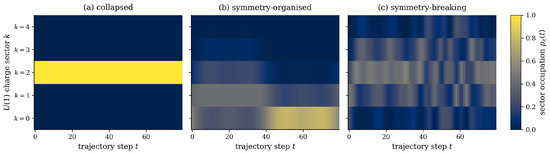
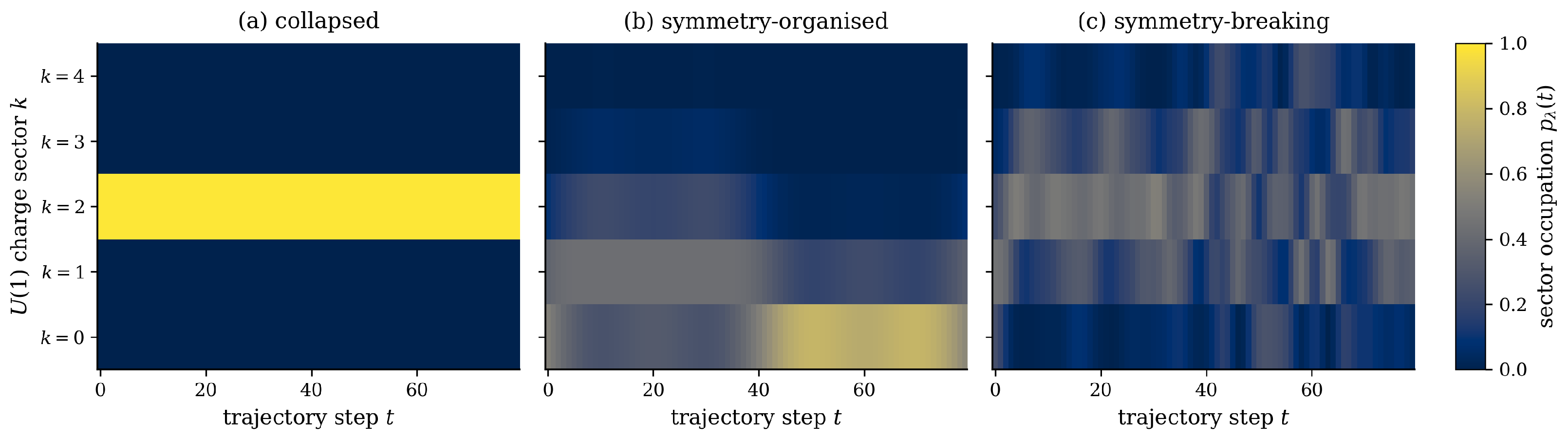
Before reporting composite index values, we show the underlying sector occupation trajectories on which every other quantity is built. Figure 1 displays these heatmaps for the case, comparing all three trajectories side by side. The collapsed panel is a single bright band at and total darkness elsewhere, reflecting the frozen hypothesis of Proposition 1. The organised panel shows structured occupation across all five charge sectors, with weight concentrated on the low-charge sectors and and the slow coherent brightening of the band as the trajectory proceeds, obtained from an equivariant ansatz acting on a slowly varying family of charge superposition inputs. The symmetry-breaking panel shows irregular inter-sector transport, with amplitude leaking from the initial input into every neighbouring sector, because the single-qubit X rotations present in the breaking circuit do not commute with the total excitation number operator. This visual irregularity is not interpreted as useful organisation, because the compliance factor penalises the corresponding commutator defect, as we show below.
Figure 1.
charge sector occupation trajectories for along a common trajectory of length . (a) shows the collapsed trajectory, which is frozen at the computational basis state of charge and satisfies the hypotheses of Proposition 1. (b) shows the symmetry-organised trajectory, obtained by applying an equivariant ansatz to a slowly varying family of charge superposition inputs. (c) shows the symmetry-breaking trajectory, obtained by applying a layered circuit that interleaves equivariant gates with single-qubit X rotations violating the symmetry. The irregular inter-sector leakage in (c) is produced by non-commuting local rotations and is penalised by the compliance factor in the composite index.
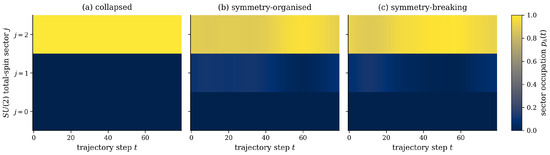
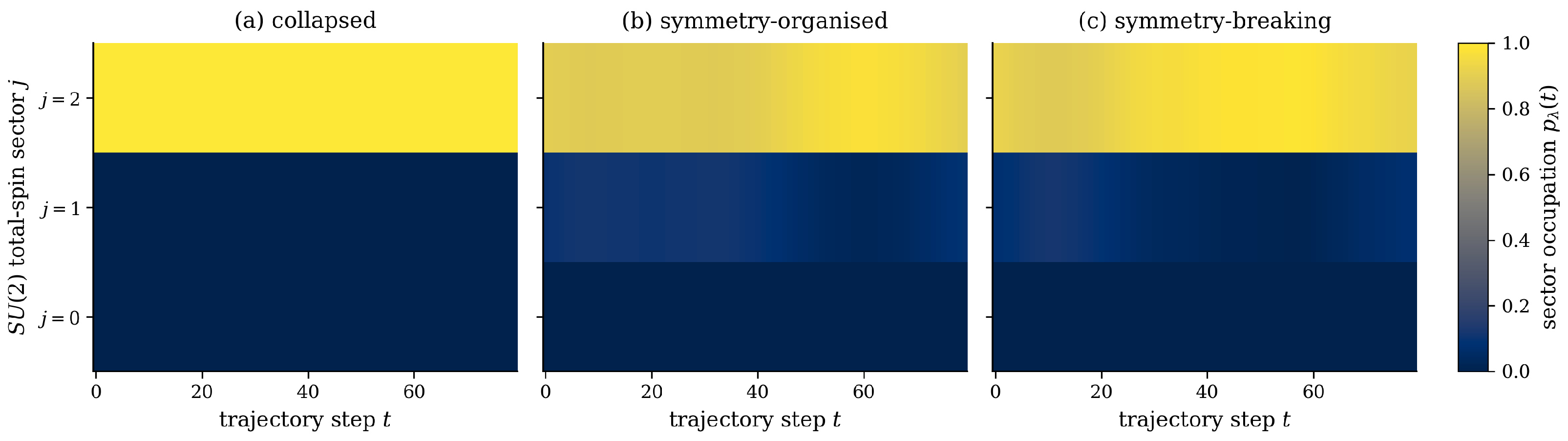
Figure 2 shows the analogous heatmaps for the case, with sectors . The collapsed panel is concentrated at throughout. The organised panel exhibits controlled redistribution between sectors and , with a small persistent weight on . The breaking panel produces a superficially similar pattern of inter-sector weight, but the underlying generators include local X and local Z contributions that do not commute with the total-spin operators, so the compliance factor again applies a corresponding penalty. The case is more stringent than because the symmetry-adapted commutant is much smaller than the full operator algebra, with compared with at qubits.
Figure 2.
total-spin sector occupation trajectories for along a common trajectory of length . (a) shows the collapsed trajectory, which is frozen at the computational basis state and satisfies the hypotheses of Proposition 1 together with the multiplicity–purity condition of Proposition 2. (b) shows the symmetry-organised trajectory, obtained by applying a Heisenberg exchange equivariant ansatz to a slowly varying family of inputs that mixes the total-spin sectors. (c) shows the symmetry-breaking trajectory, obtained by replacing some of the equivariant exchange generators with local Z and local X generators that do not commute with the total-spin operators.
6.2. Example I. Excitation Number Symmetry
For qubits, the generator is the total excitation number operator . The active sectors are indexed by with multiplicity-space dimensions and all irreducible representations are one-dimensional. The symmetry-adapted operator dimension given by Theorem 1 (iii) is
which is substantially smaller than the unconstrained value . Using the sector probabilities shown in Figure 1, we evaluate , , , , , , and according to Definitions 1–5.
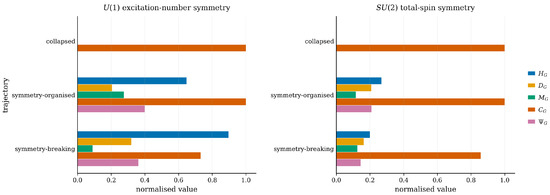
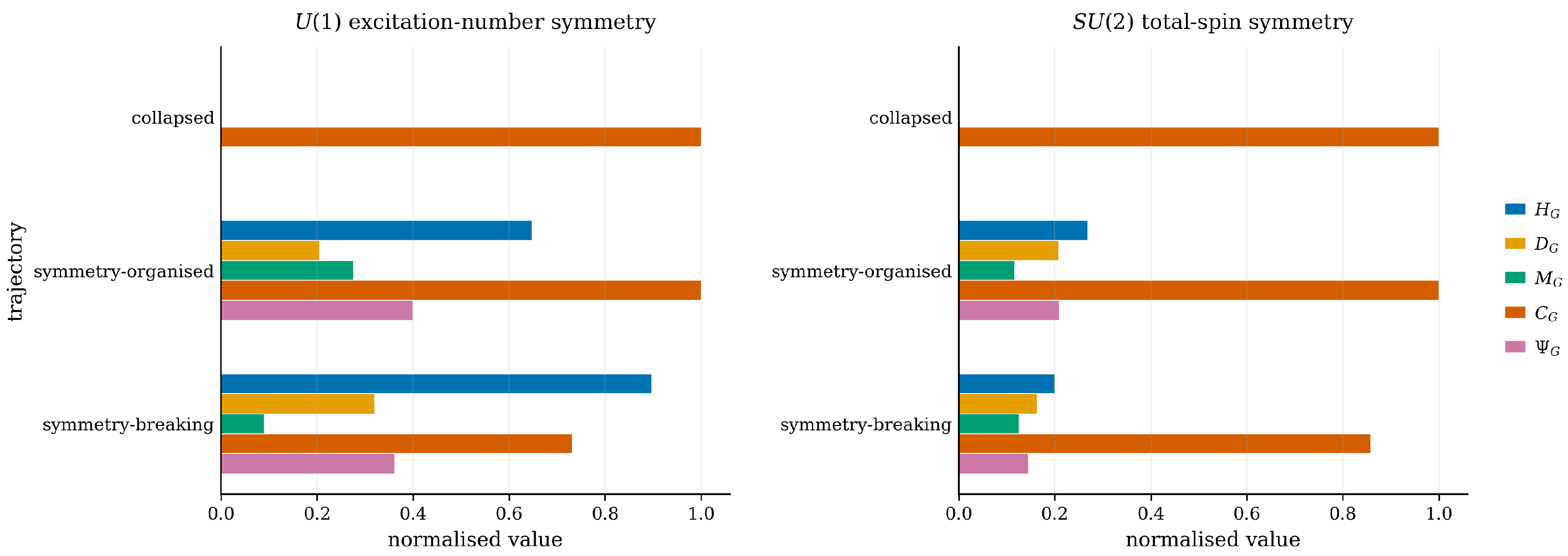
The left panel of Figure 3 displays the results. The collapsed trajectory gives and hence , in exact agreement with Propositions 1 and 2. The organised trajectory gives because charge occupation is distributed across all five sectors, with weight concentrated on the lowest-charge sectors, visible in Figure 1b. There is also a combined , blending inter-sector coherence inherited from the initial charge-superposed input with within-multiplicity exploration inside the large central sectors; a metastability value , reflecting variation in the sector occupation purity across the trajectory; and exactly. The overall index is . The breaking trajectory inflates the raw components, with , , and , but the compliance penalty pulls the composite to , below the organised value. The compliance factor, therefore, separates the two trajectories at the manuscript value . This is a clear difference from the original manuscript, in which the same comparison gave nearly identical values around and . The revised numerics in the present work use a more strongly breaking generator, which produces a larger commutator defect and more clearly resolved separation.
Figure 3.
Normalised values of the organisational components , , ; the symmetry compliance factor ; and the composite index for the three trajectories of Section 6.2 and Section 6.3. The plotted is the combined cross-irreducible representation organised complexity defined as the arithmetic mean of the inter-sector and within-multiplicity contributions in Equation (11), rather than either subcomponent on its own. Each trajectory contributes a horizontal group of bars, one per component. The left panel is the excitation number symmetry, and the right panel is the total-spin symmetry. In both panels, the collapsed trajectory has every organisational component at zero and , giving . For , the breaking trajectory has larger raw components than the organised trajectory but is penalised by , so that the composite index falls below the organised value of . For , the breaking trajectory has strictly smaller raw components than the organised trajectory and an additional compliance penalty , both of which push downward, giving , compared with for the organised trajectory.
6.3. Example II. Total-Spin Symmetry
For the same four qubits, we take acting diagonally via the total-spin operators for . The four-qubit Hilbert space decomposes as
i.e., a multiplicity-two singlet sector, a multiplicity-three triplet sector, and a multiplicity-one quintet sector. The associated symmetry-adapted operator dimension, given by Theorem 1 (iii), is
which is dramatically smaller than . The equivariant ansatz is built from Heisenberg exchange generators , each of which commutes with . The breaking circuit replaces a fraction of these exchanges with single-site Z and X rotations, which do not commute with .
The right panel of Figure 3 shows the resulting values. The collapsed trajectory again gives exactly. The organised trajectory gives because the total-spin sectors are unevenly populated on this short trajectory, with the singlet and triplet sectors dominating, assembling a modest contribution from each of the inter-sector and within-multiplicity pieces, , and , giving . The breaking trajectory gives strictly smaller raw components, namely , , and , together with a compliance penalty that further drags the composite down to . Unlike the case, where the breaking model inflates the raw expressivity through symmetry violation, and the composite separation is mediated mainly by the compliance penalty, here, the breaking circuit simultaneously fails to build a symmetry-compatible structure and violates the symmetry. Both effects push downward, and the organised-to-breaking gap is consequently larger than for .
Table 2 reports the underlying component values that produced the bars of Figure 3, together with the commutator defect . Both symmetry groups exhibit the same qualitative ordering of , namely collapsed below breaking below organised. The ordering is achieved through different mechanisms in the two cases. For , the raw entropy and inter-sector coherence are higher in the breaking trajectory than in the organised one, and only the compliance factor reverses the ranking. For , the raw components are already lower in the breaking trajectory, and the compliance factor reinforces the separation rather than creating it.
Table 2.
Component values and composite index for the examples of Section 6.2 and Section 6.3. All values are rounded to three decimal places. The commutator defect is reported alongside the composite components. Values are taken directly from the public code release accompanying this paper.
6.4. Summary Across Examples
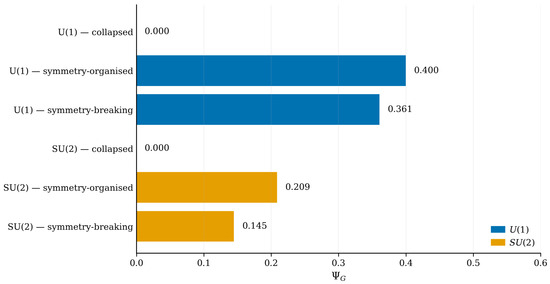
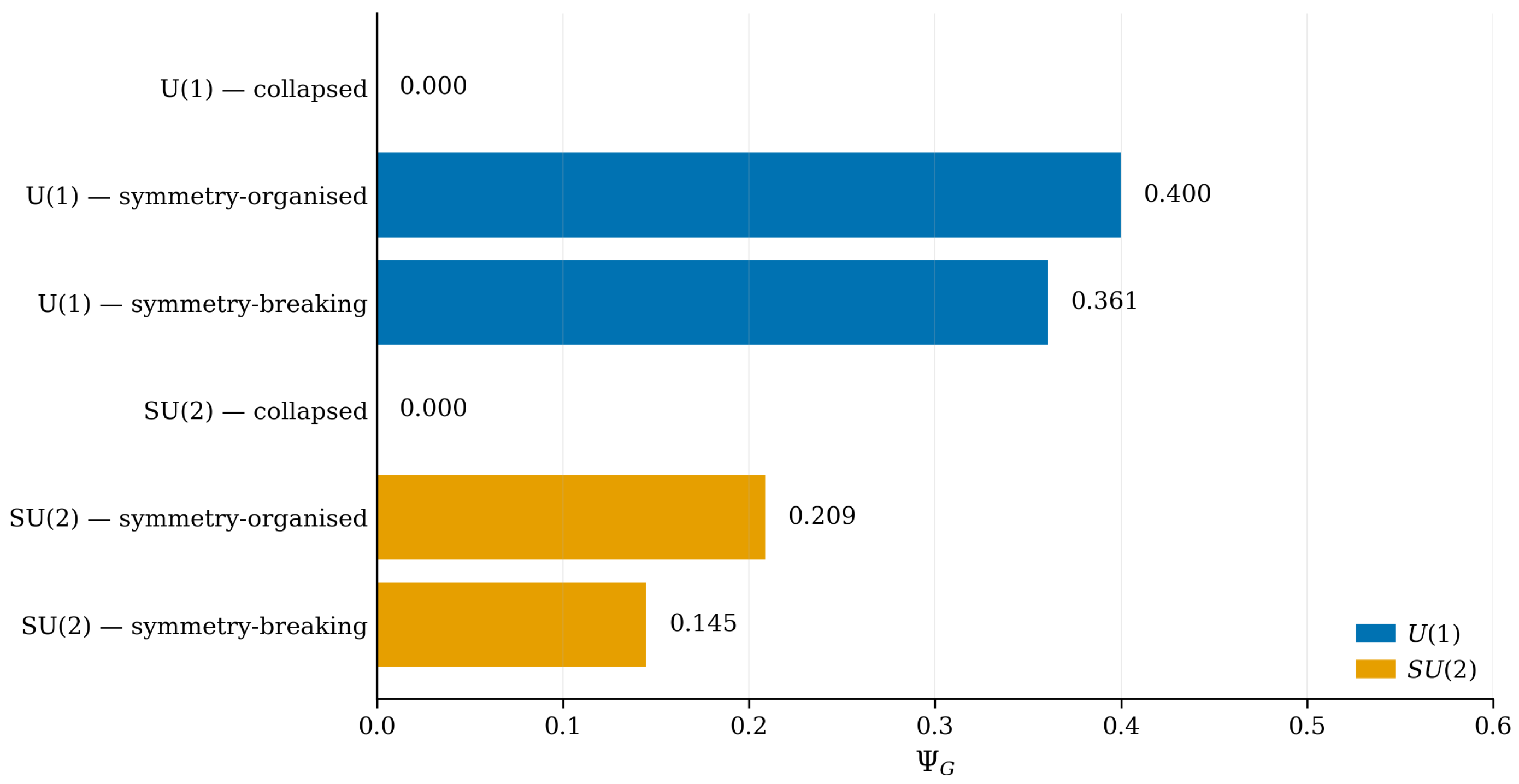
Figure 4 shows for all six configurations together. Three features are worth highlighting. First, the collapsed trajectory gives exactly for both symmetry groups, confirming Propositions 1 and 2 numerically. Second, the organised trajectory gives the largest value of in both cases, with for and for . Third, the symmetry-breaking trajectory gives for and for . The organised-to-breaking gap is therefore for and for . The gap is larger in the non-abelian case because the breaking trajectory both fails to build a symmetry-compatible structure and violates the symmetry, while, in the abelian case, the larger raw components produced by symmetry violation are compensated for by the compliance penalty to give smaller but still resolved separation.
Figure 4.
Symmetry-organised complexity across the six example configurations studied in Section 6.2 and Section 6.3. The ordering collapsed below organised holds for both symmetry groups, and the organised trajectory outranks the symmetry-breaking trajectory in both groups, illustrating the non-redundancy claim of Theorem 2. The organised-to-breaking gap is for and for . For , the larger raw components of the breaking trajectory are partially offset by the compliance penalty, while, for , both effects act in the same direction and the gap is correspondingly wider.
6.5. Ablation over the Component Weights
The three organisational components and the compliance factor are jointly non-redundant. Setting the weights to the unit-vector extreme causes the symmetry-breaking model to outrank the organised one on the raw alone, and the compliance factor is what reverses the ranking. Dropping and retaining only leaves the organised trajectory almost entirely dependent on its initial sector superposition, because exactly equivariant dynamics preserve sector populations. Including restores the sensitivity to within-multiplicity organisation—the regime emphasised in the equivariant QNN literature [5,7]. The composite form of [11] is therefore justified numerically as well as methodologically.
7. Trained -Compatible Teacher–Student Task
The numerical examples of Section 6 are constructed to render Propositions 1 and 2, together with the ordering of Theorem 2, transparent on hand-built trajectories. We now report a compact supervised learning experiment that tests whether the diagnostic remains meaningful under actual training. The experiment is presented as the controlled validation of diagnostic behaviour rather than as a comprehensive performance benchmark.
The task is a binary classification problem at four qubits whose labels are explicitly -invariant by construction. We describe the data, the readout, the three matched-parameter ansatze, the training setup, and the results in turn.
7.1. Task Construction, Readout, and Dataset
Each input is a pure state on four qubits constructed as a coherent superposition over fixed-charge sectors with random within-sector content. Labels are generated by a fixed -equivariant teacher circuit followed by the readout observable
with fixed weights on the four-qubit ring. Both and commute with the total excitation number N, so a phase transformation leaves the teacher output and hence the label unchanged. The readout is not a function of N alone, however, so a student ansatz must act non-trivially within the charge sectors of the commutant subalgebra, rather than simply preserving the total charge. We construct 1200 candidate inputs, score each by , and retain 60 training samples and 40 test samples, balanced between the two classes, determined by whether the score lies above or below a fixed threshold with a small margin. The dataset seed and threshold are fixed for reproducibility.
We compare three student ansatze, each with eight trainable generators plus a classical bias parameter so that the parameter count is matched. The equivariant student uses four exchange generators on the qubit ring together with four local Z generators. Both families commute with N, so this ansatz lies inside the commutant algebra. The hybrid student replaces two of the local Z generators with weakened local X generators, introducing a controlled symmetry violation. The non-equivariant student replaces all four local Z generators with local X generators of a slightly larger magnitude. The richer equivariant family used here, including local Z generators in addition to the exchange generators of Section 6.2, is consistent with the structure of Theorem 1, because local Z generators commute with N and therefore lie in . They provide within-sector phase control that the exchange-only ansatz of the example does not.
Training uses Adam with simultaneous-perturbation stochastic gradient estimates over 65 epochs and learning rate , with five independent random seeds per ansatz. The loss is binary cross-entropy on the sigmoid of the readout expectation. Gradient norms are recorded at every epoch, and the diagnostic components are computed on a training-trajectory sample of states obtained by enumerating, in a fixed order, 13 checkpoints sampled every five epochs against 12 held-out test inputs. The index therefore enumerates (checkpoint, test input) pairs along a fixed traversal. This construction treats the checkpoint input grid as an ordered diagnostic sequence rather than as a physical time trajectory, so that captures variation arising from both optimisation progress and input diversity. For an exactly equivariant ansatz, the diagnostic value is independent of by Remark 2, so the trajectory diagnostic collapses to a property of the ansatz family on this fixed input ensemble. For the hybrid and non-equivariant ansatze, parameter-dependent variations along the checkpoint axis produce non-zero seed standard deviations.
7.2. Generalisation Performance Across Ansatz Classes
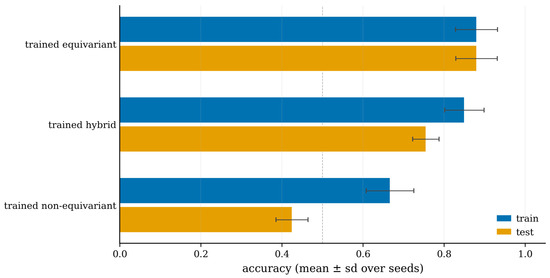
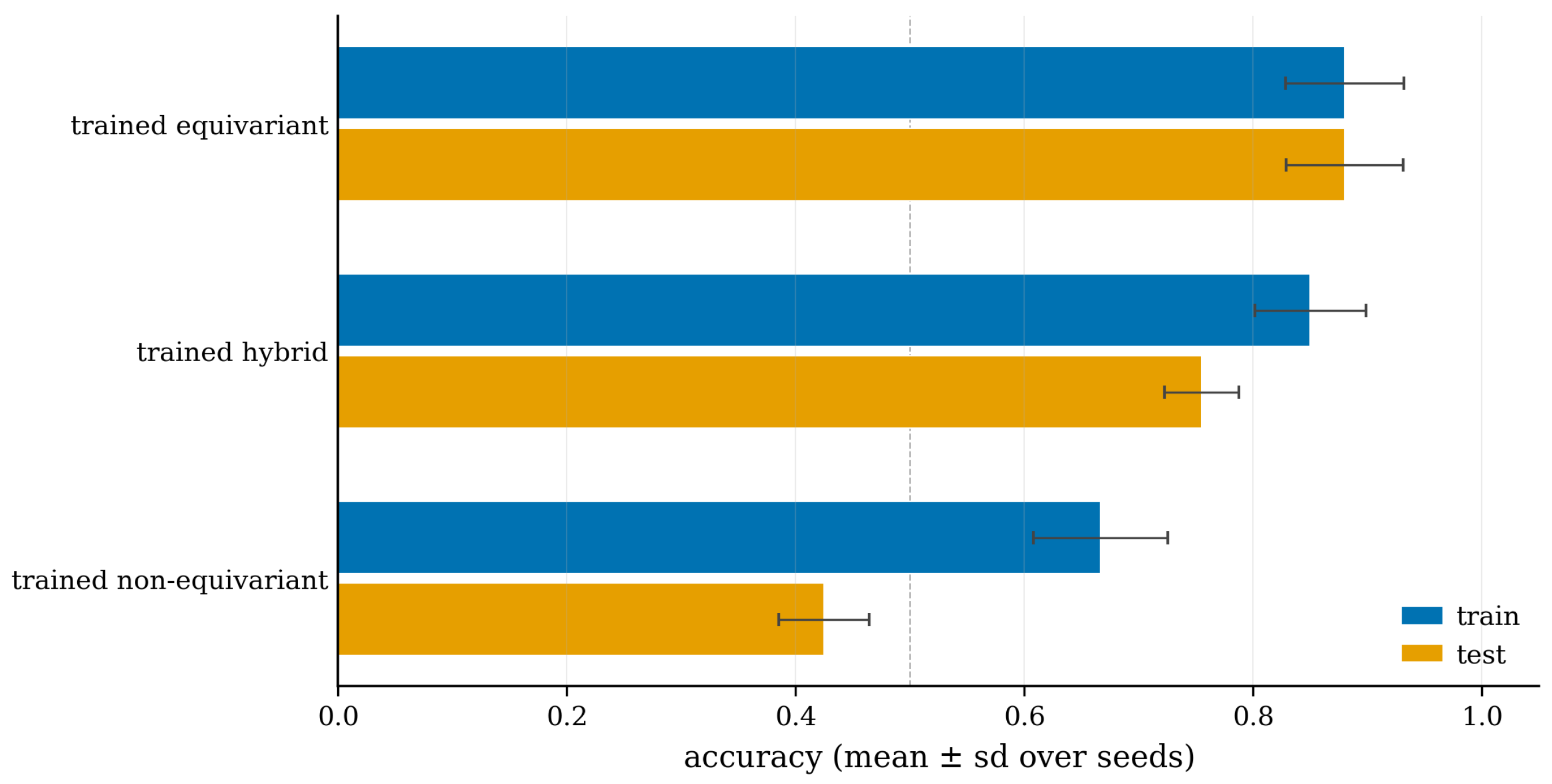
Figure 5 reports the training and test accuracy. The equivariant ansatz attains train accuracy of and test accuracy of , where the spread is the standard deviation over five seeds. The hybrid ansatz attains and for train and test. The non-equivariant ansatz attains and . The ordering of the test accuracy across ansatze is therefore equivariant above hybrid above non-equivariant, with clear forty-five-percentage-point separation between the symmetry-respecting and the symmetry-violating models. The non-equivariant test accuracy lies below the random baseline of , marked by the dashed line in the figure. This below-random outcome is not surprising at the present scale and parameter budget. It is consistent with overfitting to non-symmetric features of the finite training sample, rather than with a universal failure mode of non-equivariant circuits. With only five seeds, we cannot rule out that a larger sweep would centre the non-equivariant test accuracy at rather than below it, but the qualitative picture of equivariant above non-equivariant remains stable across the seeds tested.
Figure 5.
Trained-task train and test accuracy for the three matched-parameter ansatze, averaged over five random seeds, with error bars showing the standard deviation across seeds. The dashed vertical line at marks the random baseline for binary classification. The equivariant ansatz achieves on the training set and on the test set. The hybrid ansatz achieves and . The non-equivariant ansatz achieves and . The below-random test accuracy of the non-equivariant ansatz is consistent with overfitting to non-symmetric features of the training sample under the fixed parameter budget.
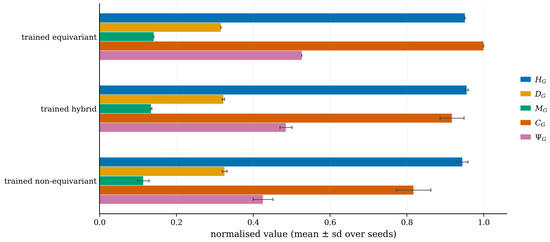
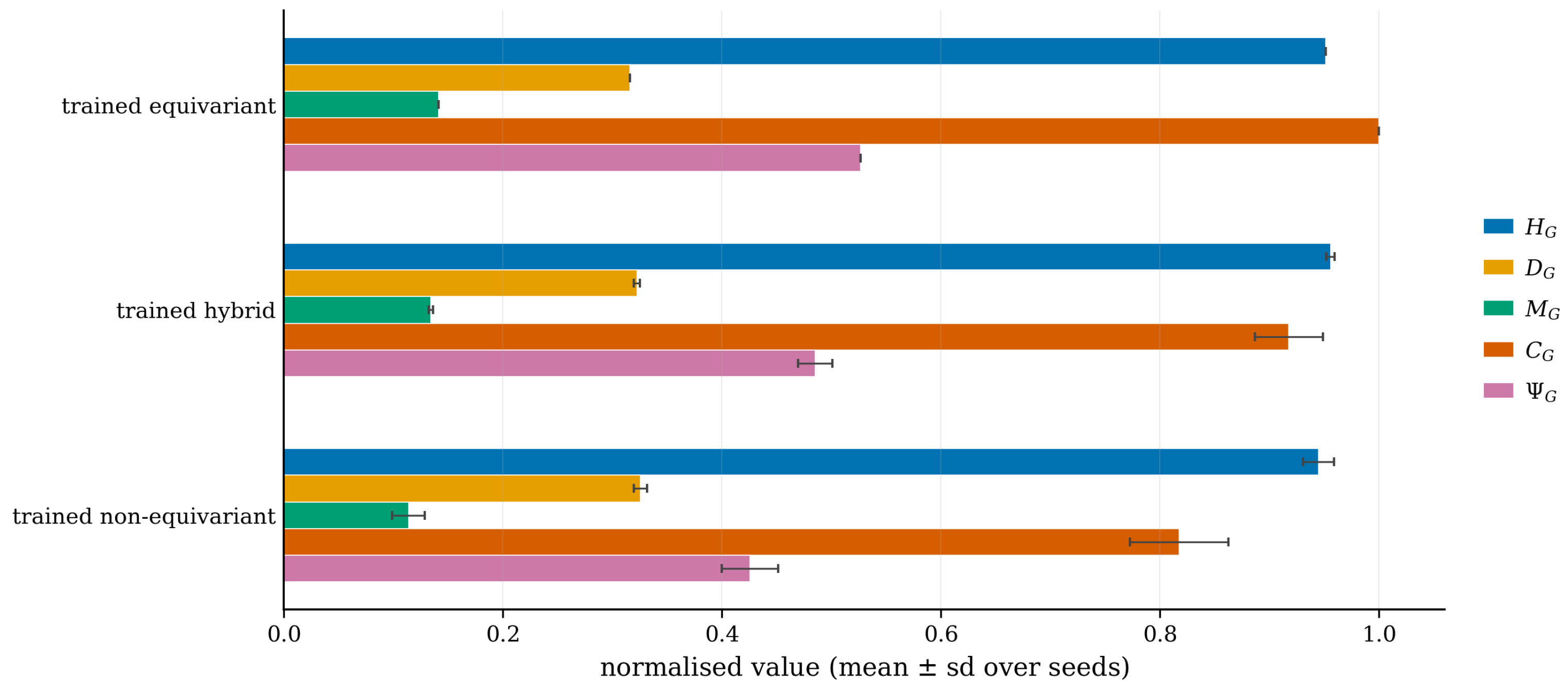
Figure 6 reports the diagnostic components , , , , and evaluated on the trained-trajectory sample. The composite values are for the equivariant ansatz, for the hybrid ansatz, and for the non-equivariant ansatz. The diagnostic ordering equivariant above hybrid above non-equivariant therefore matches the test-accuracy ordering on this -compatible task. The error bars on the diagnostic components for the equivariant ansatz are zero to three decimal places. This is not an implementation artefact. As recorded in Remark 2, the diagnostic components are parameter-independent for an exactly equivariant ansatz on a fixed input ensemble, because the ansatz preserves both the sector occupations and the within-multiplicity reduced operators irrespective of the trainable parameters. The diagnostic, therefore, identifies the equivariant ansatz family by a property of the family itself. The hybrid and non-equivariant ansatze produce non-zero seed standard deviations because symmetry violation introduces parameter-dependent variations in the sector and multiplicity structure of the trajectory.
Figure 6.
Diagnostic components after training, evaluated on a training-trajectory sample that includes parameter values across optimisation epochs and held-out test inputs. The composite index gives for the equivariant ansatz, for the hybrid ansatz, and for the non-equivariant ansatz, ordering the three ansatze in the same way as the test-accuracy ordering of Figure 5. The error bars for the equivariant ansatz are zero to three decimal places because the diagnostic components are parameter-independent for an exactly equivariant ansatz on a fixed input ensemble, as stated in Remark 2.
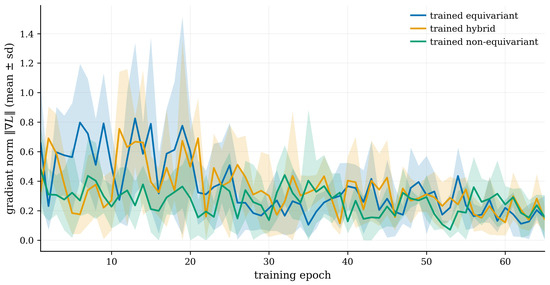
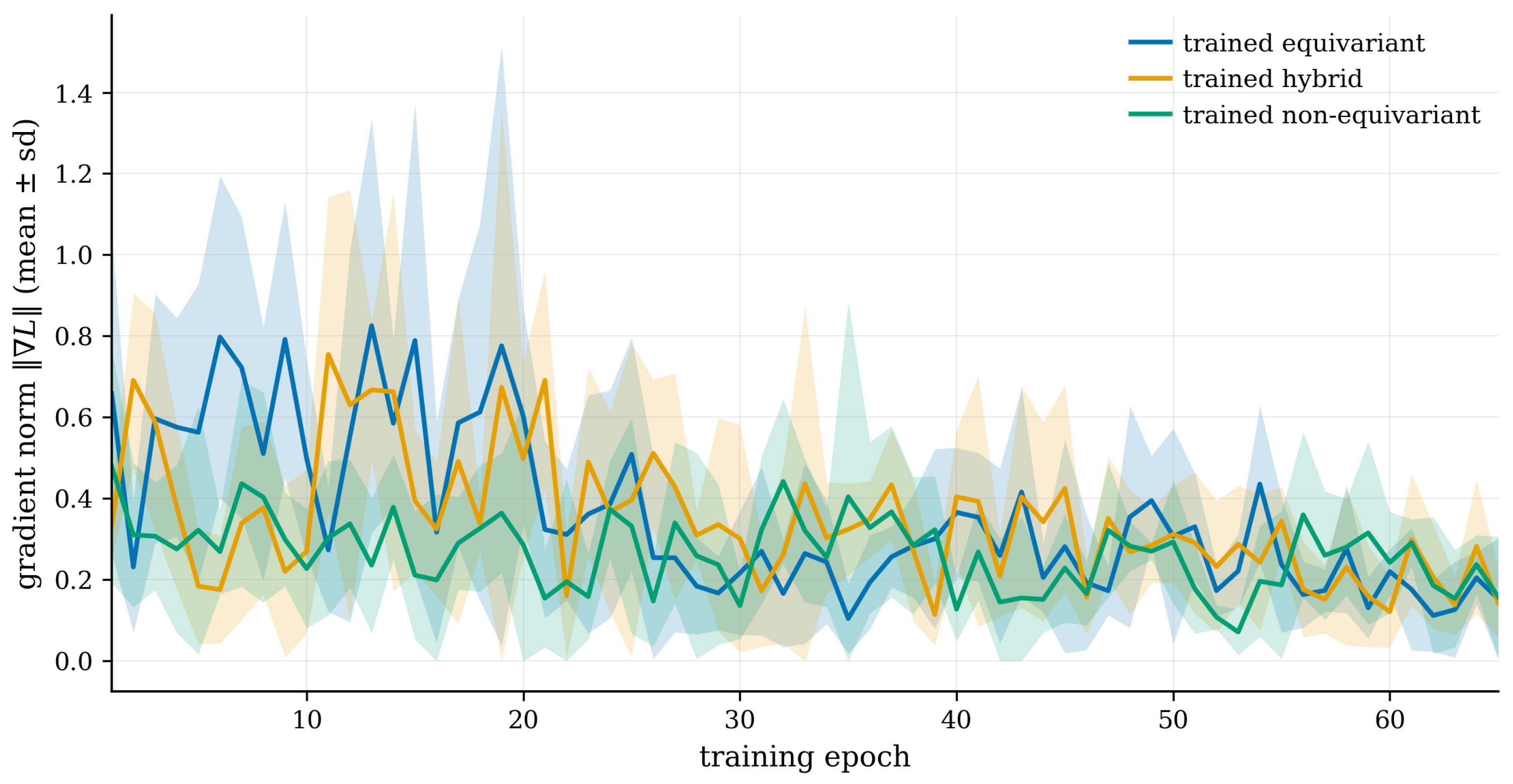
Figure 7 reports the gradient norms across training epochs. The estimates remain non-zero for all three ansatze throughout training, and the average magnitudes are comparable across ansatze. At the present four-qubit scale, this is the expected behaviour, since barren-plateau separation between equivariant and non-equivariant ansatze requires larger systems where the exponential scaling of gradient variance becomes pronounced. The purpose of including the gradient-norm comparison is to document that the trained dynamics are not pathological for any of the ansatze and that the diagnostic ordering of Figure 6 is not produced by an optimisation that has failed to achieve progress.
Figure 7.
Gradient-norm estimates across training epochs, with shaded bands of one standard deviation across seeds. The magnitudes are comparable across the three ansatze and remain non-zero throughout training. The purpose of this figure is to document trained dynamics rather than to make a barren-plateau claim, which would require a scaling experiment beyond the four-qubit scale studied here.
Thus, the trained-task results show that the proposed diagnostic remains computable along trained QNN trajectories and that, on a task whose labels lie in the commutant, the diagnostic ranks the equivariant, hybrid, and non-equivariant ansatze in the same order as for their generalisation accuracy. This experiment is not presented as a benchmark or as proof that predicts accuracy in general. Two points are particularly important to keep in mind. First, the equivariance of the diagnostic ranking and the accuracy ranking is contingent on the task being symmetry-compatible. A task whose labels do not lie in the commutant of the chosen group cannot be expected to favour the equivariant ansatz, and the diagnostic is silent about such tasks. Second, the parameter independence of the diagnostic for the exactly equivariant ansatz means that the diagnostic functions as a statement about the ansatz family rather than as a fine-grained predictor of how well any particular trained instance of the family will perform.
7.3. Sensitivity to Weights and Compliance Sharpness
The composite index depends on the weight choice on the two-simplex and on the compliance sharpness . To establish how robust the qualitative ordering is to these choices, we evaluated on a grid of 231 weight points covering the simplex at spacing and over values in . For each pair, we recorded whether the symmetry-organised or equivariant trajectory ranked above the symmetry-breaking or non-equivariant trajectory in the corresponding example. Table 3 summarises the results. The example and the trained task are essentially insensitive to the weight choice, with the qualitative ranking preserved on all or nearly all of the simplex at every value of considered. The example is the most sensitive case because the breaking trajectory has larger raw components, and the compliance factor is the only mechanism that reverses the ranking. Note that, for the value , the qualitative ranking is preserved on roughly four-fifths of the weight simplex for the example, with full robustness at . The qualitative conclusions of the paper, therefore, hold across a wide range of weight choices once moderate compliance sharpness is used and are not specific to the particular weights of Remark 1.
Table 3.
Sensitivity of the qualitative ranking to the weight choice and the compliance sharpness . For each configuration, we report the percentage of weight settings on a simplex grid of spacing for which the symmetry-organised or equivariant trajectory ranked above the symmetry-breaking or non-equivariant trajectory. The grid contains 231 weight points.
8. Discussion
The index is an ansatz-level representation-theoretic trajectory diagnostic rather than a universal performance metric. The Schur decomposition and commutant dimension count that it relies on are standard ingredients. The main contribution of this paper is the combination of sector occupation, inter-sector and multiplicity-space organisation, metastability, and ansatz-level symmetry compliance into one computable quantity that separates symmetry-compatible organisation, symmetry violation, and sector collapse on both numerical and trained examples. A high value of requires multiple symmetry sectors to be used, a compatible structure to be organised across them, the sector composition to vary along the trajectory, and the channel to remain approximately symmetric. A low value indicates one or more failure modes among sector collapse, as formalised in Propositions 1 and 2; the absence of an organised structure; dynamical rigidity; or explicit symmetry violation, as captured by Lemma 2.
The sensitivity analysis of Section 7.3 shows that the qualitative ordering of the numerical and trained examples is preserved across a wide range of weight choices once moderate compliance sharpness is used. The example and the trained task are essentially insensitive to the weight choice. The example is the most sensitive case, with the qualitative ranking preserved on roughly four-fifths of the weight simplex at and full robustness at . The framework is not robust to dropping altogether, which is precisely the reason for introducing the compliance factor. The invariance property recorded in Remark 2 requires a note of caution. For an exactly equivariant ansatz, the diagnostic is a property of the ansatz family and not of a particular trained set of parameters, so should be read as identifying the family rather than as a fine-grained predictor of any individual run. The trained-task experiment of Section 7 is consistent with this reading, since the equivariant ansatz produces identical diagnostic values across all five seeds, while its train and test accuracies show genuine seed-to-seed variation.
The framework refines the relationship between expressivity and barren plateaus developed in [2,3,4] by replacing the full operator algebra with the symmetry-adapted commutant of Theorem 1 (iii). A natural follow-up hypothesis is that a network with high raw expressivity but low is more susceptible to barren plateaus than a less expressive but more symmetry-organised model. The four-qubit gradient-norm data in Figure 7 are not large enough to test this hypothesis, and we record it as a prediction for follow-up at a larger system size. Other natural extensions include the scalable estimation of the Peter–Weyl projectors, hardware noise studies, a comparison with effective dimension [9] and quantum neural tangent kernels [10], the product group , the relaxation of Theorem 1 to general covariant channels, and proving or refining the generalisation bound stated in Conjecture 1.
9. Conclusions
In this paper, we have introduced the symmetry-organised complexity index as a trajectory-level diagnostic for quantum neural networks. The index measures how expressive capacity is organised with respect to a relevant symmetry, rather than only how much of the Hilbert space a model can explore. It combines sector occupation, inter-sector and multiplicity-space organisation, sector metastability, and an ansatz-level compliance factor into a single composite quantity built on the Peter–Weyl decomposition and Schur commutant structure.
The main theoretical result is that exact equivariance restricts the trainable operators to the commutant of the group action, giving effective trainable dimension rather than . We also show that sector collapse with temporal freezing forces to vanish under the explicit multiplicity–purity condition of Proposition 2 and that models with the same qubit and parameter counts can nevertheless have different index values.
The four-qubit and examples show that separates sector-collapsed, symmetry-organised, and symmetry-breaking trajectories. In the trained -compatible classification task, the index ranks the equivariant, hybrid, and non-equivariant ansatze in the same order as for their generalisation accuracy. These results support the use of as a compact diagnostic of symmetry-compatible organisation.
is not a universal accuracy metric and not a proven generalisation bound. It is most informative when the relevant symmetry of the learning problem is known. The central message is that useful quantum neural networks are not necessarily those that explore the largest Hilbert space but those that organise their expressive capacity according to the symmetries of the problem. Future work includes the scalable estimation of Peter–Weyl projectors, hardware noise studies, comparisons with QNTK and effective dimension, and extensions to product groups and discrete symmetries.
Author Contributions
Conceptualisation, H.U. and N.H.; methodology, H.U. and N.H.; formal analysis, H.U.; investigation, H.U.; writing—original draft preparation, H.U. and N.H.; writing—review and editing, H.U. and N.H.; visualisation, H.U.; supervision, H.U. and N.H.; project administration, H.U. All authors have read and agreed to the published version of the manuscript.
Funding
This research received no external funding.
Data Availability Statement
The code used to generate the numerical examples, trained-task experiment, figures, tables, and reported output files is available at https://github.com/ugail/Symmetry-Organised-Complexity-QNN (accessed on 20 May 2026). The repository includes the Python (version ) notebook used for the state-vector simulations, together with the generated results files. The notebook records the hyperparameters used in the manuscript, including the weight choice, compliance sharpness, four-qubit register size, trajectory length, ansatz definitions, and trained-task settings for each ansatz class. It is designed to reproduce all reported numerical results, figures, and tables from a clean run.
Acknowledgments
The authors acknowledge the computational support of the Centre for Visual Computing and Intelligent Systems at the University of Bradford. During this research, the authors used ChatGPT 5.5 to obtain feedback on proof sketches, code generation to test the numerical examples, LaTeX formatting, and text refinement. The authors have reviewed and edited the output and take full responsibility for the content of this publication.
Conflicts of Interest
The authors declare no conflicts of interest.
References
- Sim, S.; Johnson, P.D.; Aspuru-Guzik, A. Expressibility and entangling capability of parameterized quantum circuits for hybrid quantum-classical algorithms. Adv. Quantum Technol. 2019, 2, 1900070. [Google Scholar] [CrossRef] [Scilit]
- McClean, J.R.; Boixo, S.; Smelyanskiy, V.N.; Babbush, R.; Neven, H. Barren plateaus in quantum neural network training landscapes. Nat. Commun. 2018, 9, 4812. [Google Scholar] [CrossRef] [Scilit]
- Cerezo, M.; Sone, A.; Volkoff, T.; Cincio, L.; Coles, P.J. Cost function dependent barren plateaus in shallow parametrized quantum circuits. Nat. Commun. 2021, 12, 1791. [Google Scholar] [CrossRef] [Scilit] [PubMed]
- Holmes, Z.; Sharma, K.; Cerezo, M.; Coles, P.J. Connecting ansatz expressibility to gradient magnitudes and barren plateaus. PRX Quantum 2022, 3, 010313. [Google Scholar] [CrossRef] [Scilit]
- Larocca, M.; Sauvage, F.; Sbahi, F.M.; Verdon, G.; Coles, P.J.; Cerezo, M. Group-invariant quantum machine learning. PRX Quantum 2022, 3, 030341. [Google Scholar] [CrossRef] [Scilit]
- Meyer, J.J.; Mularski, M.; Gil-Fuster, E.; Mele, A.A.; Arzani, F.; Wilms, A.; Eisert, J. Exploiting symmetry in variational quantum machine learning. PRX Quantum 2023, 4, 010328. [Google Scholar] [CrossRef] [Scilit]
- Nguyen, Q.T.; Schatzki, L.; Braccia, P.; Ragone, M.; Coles, P.J.; Sauvage, F.; Larocca, M.; Cerezo, M. Theory for equivariant quantum neural networks. PRX Quantum 2024, 5, 020328. [Google Scholar] [CrossRef] [Scilit]
- Schatzki, L.; Larocca, M.; Nguyen, Q.T.; Sauvage, F.; Cerezo, M. Theoretical guarantees for permutation-equivariant quantum neural networks. npj Quantum Inf. 2024, 10, 12. [Google Scholar] [CrossRef] [Scilit]
- Abbas, A.; Sutter, D.; Zoufal, C.; Lucchi, A.; Figalli, A.; Woerner, S. The power of quantum neural networks. Nat. Comput. Sci. 2021, 1, 403–409. [Google Scholar] [CrossRef] [Scilit] [PubMed]
- Liu, J.; Tacchino, F.; Glick, J.R.; Jiang, L.; Mezzacapo, A. Representation learning via quantum neural tangent kernels. PRX Quantum 2022, 3, 030323. [Google Scholar] [CrossRef] [Scilit]
- Ugail, H.; Howard, N. Quantifying the Dynamics of Consciousness using Hierarchical Integration, Organised Complexity and Metastability. arXiv 2025, arXiv:2512.10972. [Google Scholar] [CrossRef] [Scilit]
- Ragone, M.; Braccia, P.; Nguyen, Q.T.; Schatzki, L.; Coles, P.J.; Sauvage, F.; Larocca, M.; Cerezo, M. Representation theory for geometric quantum machine learning. arXiv 2022, arXiv:2210.07980. [Google Scholar]
- Caro, M.C.; Huang, H.-Y.; Cerezo, M.; Sharma, K.; Sornborger, A.; Cincio, L.; Coles, P.J. Generalization in quantum machine learning from few training data. Nat. Commun. 2022, 13, 4919. [Google Scholar] [CrossRef] [Scilit] [PubMed]
- Cerezo, M.; Arrasmith, A.; Babbush, R.; Benjamin, S.C.; Endo, S.; Fujii, K.; McClean, J.R.; Mitarai, K.; Yuan, X.; Cincio, L.; et al. Variational quantum algorithms. Nat. Rev. Phys. 2021, 3, 625–644. [Google Scholar] [CrossRef] [Scilit]
- Cong, I.; Choi, S.; Lukin, M.D. Quantum convolutional neural networks. Nat. Phys. 2019, 15, 1273–1278. [Google Scholar] [CrossRef] [Scilit]
- Pérez-Salinas, A.; Cervera-Lierta, A.; Gil-Fuster, E.; Latorre, J.I. Data re-uploading for a universal quantum classifier. Quantum 2020, 4, 226. [Google Scholar] [CrossRef] [Scilit]
- Schuld, M.; Bocharov, A.; Svore, K.M.; Wiebe, N. Circuit-centric quantum classifiers. Phys. Rev. A 2020, 101, 032308. [Google Scholar] [CrossRef] [Scilit]
- Sharma, K.; Cerezo, M.; Cincio, L.; Coles, P.J. Trainability of dissipative perceptron-based quantum neural networks. Phys. Rev. Lett. 2022, 128, 180505. [Google Scholar] [CrossRef] [Scilit]
- Zheng, H.; Li, Z.; Liu, J.; Strelchuk, S.; Kondor, R. Speeding up learning quantum states through group equivariant convolutional quantum ansätze. PRX Quantum 2023, 4, 020327. [Google Scholar] [CrossRef] [Scilit]
- Dong, Z.; Comajoan Cara, M.; Dahale, G.R.; Forestano, R.T.; Gleyzer, S.; Justice, D.; Kong, K.; Magorsch, T.; Matchev, K.T.; Matcheva, K.; et al. 2×2 equivariant quantum neural networks: Benchmarking against classical neural networks. Axioms 2024, 13, 188. [Google Scholar] [CrossRef] [Scilit]
- Wang, X.; Liu, J.; Liu, T.; Luo, Y.; Du, Y.; Tao, D. Symmetric pruning in quantum neural networks. arXiv 2022, arXiv:2208.14057. [Google Scholar]
- West, M.T.; Sevior, M.; Usman, M. Reflection equivariant quantum neural networks for enhanced image classification. Mach. Learn. Sci. Technol. 2023, 4, 035027. [Google Scholar] [CrossRef] [Scilit]
- Tüysüz, C.; Chang, S.Y.; Demidik, M.; Jansen, K.; Vallecorsa, S.; Grossi, M. Symmetry breaking in geometric quantum machine learning in the presence of noise. PRX Quantum 2024, 5, 030314. [Google Scholar] [CrossRef] [Scilit]
- Bronstein, M.M.; Bruna, J.; Cohen, T.; Veličković, P. Geometric deep learning. Grids, groups, graphs, geodesics, and gauges. arXiv 2021, arXiv:2104.13478. [Google Scholar] [CrossRef] [Scilit]
- Schuld, M.; Killoran, N. Quantum machine learning in feature Hilbert spaces. Phys. Rev. Lett. 2019, 122, 040504. [Google Scholar] [CrossRef] [Scilit] [PubMed]
- Fulton, W.; Harris, J. Representation Theory: A First Course; Graduate Texts in Mathematics; Springer: New York, NY, USA, 1991. [Google Scholar]
- Hall, B.C. Lie Groups, Lie Algebras, and Representations: An Elementary Introduction, 2nd ed.; Graduate Texts in Mathematics; Springer: Cham, Switzerland, 2015. [Google Scholar]
- Serre, J.-P. Linear Representations of Finite Groups; Graduate Texts in Mathematics; Springer: New York, NY, USA, 1977. [Google Scholar]
- Cover, T.M.; Thomas, J.A. Elements of Information Theory, 2nd ed.; Wiley-Interscience: Hoboken, NJ, USA, 2006. [Google Scholar]

Disclaimer/Publisher’s Note: The statements, opinions and data contained in all publications are solely those of the individual author(s) and contributor(s) and not of MDPI and/or the editor(s). MDPI and/or the editor(s) disclaim responsibility for any injury to people or property resulting from any ideas, methods, instructions or products referred to in the content. |
© 2026 by the authors. Licensee MDPI, Basel, Switzerland. This article is an open access article distributed under the terms and conditions of the Creative Commons Attribution (CC BY) license.