


Abstract
The increasing number of end-of-life (EOL) products has raised new challenges for sustainable manufacturing, especially when recycling efficiency, structural modularity and worker well-being must be considered simultaneously. From the perspective of symmetry and asymmetry in mechanical product design, this study proposes a Design for human-centric Modular Recycling (DFHMR) approach to improve EOL product recycling while reducing ergonomic risks in disassembly operations. In the proposed framework, functional similarity, structural correspondence and spatial association among components are used to characterize symmetry-oriented modular relationships, whereas asymmetric factors such as disassembly difficulty, carbon emissions, recycling profit and worker-related ergonomic risks are incorporated to describe the heterogeneity of practical recycling processes. A multi-objective optimization model is developed to maximize green disassembly performance and intra-module relevance while minimizing inter-module coupling and human-factor risks. To solve the constrained modular design problem, an enhanced social engineering optimizer (SEO) is introduced to balance global exploration and local exploitation. A turbo reducer case study is conducted to validate the proposed model, and comparative experiments with several multi-objective optimization algorithms demonstrate the effectiveness and robustness of the enhanced SEO. The results indicate that the DFHMR framework can provide decision-makers with a set of balanced modular recycling schemes, offering a practical reference for symmetry-oriented, sustainable and human-centered mechanical design under Industry 5.0.
1. Introduction
The development of human-centered and sustainable manufacturing systems has emerged as a significant trend in industrial development with the rise of Industry 5.0 [1]. Industry 4.0, while altering the role of humans in the operating system, much like previous generations of industrial systems, overlooks the negative impacts of the Human Factor on individual employees, production organizations, and society as a whole [2]. The primary issue with Industry 4.0 lies in its overemphasis on technological iteration and its increasing neglect of the human factor’s impact on production [3,4,5]. I5.0 aims to address this shortcoming by establishing a sustainable, human-centered, and resilient industrial system [6,7].
The term ‘Ergonomics’ originated with Polish naturalist Jastrzebowski in 1857 [8]. In a 1949 publication, Murrell independently coined and formally introduced the term ‘Ergonomics’. The International Ergonomics Association (IEA, 2000) defines HF/E as ‘the science concerned with the interactions between humans and other elements of a system, and the profession that applies theories, principles, data, and methods of design to optimize human well-being and overall system performance’ [9]. Therefore, HF/E advocates for a comprehensive, human-centric approach to system design that considers organizational, developmental, ecological, and environmental aspects, as well as other factors critical to global socioeconomic growth and well-being. Over the past few decades, studies have demonstrated a link between the well-being of workers and the performance of production systems. Many researchers have conducted research on Ergonomics in industry. Rinaldi et al. [10] proposed a labor scheduling method that combines worker skills and ergonomic constraints to address the challenge of worker assignment in shop-floor systems. Battini et al. [11] propose an integrated planning approach for reducing ergonomic risks in the workplace by balancing and feeding parts through the assembly line. Abdous et al. [12] introduced a fatigue criterion in manufacturing assembly lines to assess worker fatigue and balance efficiency and Ergonomics. Arkouli et al. [13] use Axiomatic Design principles to integrate human factor assessment early in the operational design phase and redesign manufacturing tasks to enhance operator well-being. Lin et al. [14] established explicit Ergonomics-based criteria for product sustainability assessment and employed a fuzzy Delphi method to validate the importance of identified HF/E factors. Botti et al. [15] developed a tool for effective and efficient assembly line design that integrates Ergonomics and lean manufacturing principles into hybrid assembly lines.
The rapid development of the manufacturing industry has imposed a considerable burden on the environment [16]. Rapid product upgrades have shortened the life cycle of existing products. The number of EOL products worldwide has shown a rapid growth trend in recent years, especially obsolete mobile phones, computers, and automobiles. How to handle EOL products more effectively is an area that demands immediate attention. Currently, common treatment methods for EOL products include upgrading, remanufacturing, reuse, recycling, and disposal [13]. Recycling, in particular, plays a crucial role in achieving sustainable product use, as it reduces the demand for primary mineral resources and mitigates environmental pollution caused by improper disposal [17]. This is well demonstrated in the recycling of EOL vehicles [18], especially for electric vehicle batteries. Design for Modularity (DFM) is the better approach in EOL product recycling that meets sustainable manufacturing. Through DFM, EOL product parts can be organized into modular groups for disposal, reducing unnecessary disassembly. When DFM and recycling in line with sustainable manufacturing are integrated, the negative environmental impact of EOL products can be reduced or eliminated, facilitating product upgrades, maintenance, utilization, and remanufacturing at the end of the product life cycle [19]. Gershenson [20] introduced modularity of EOL parts in mechanical design. Smith and Yen [21] use the concepts of atomic theory to modularize products according to green constraints. Wei et al. [22] and Inoue et al. [23] suggested incorporating recycling into DFM, considering the possibility of parts being recycled at the end of their useful life or reused in subsequent product clusters or upstream products. Kim and Moon [24] propose a new integrated design methodology for additively manufactured parts, introducing a single-part complexity index to simultaneously measure the complexity of parts and interfaces. This methodology integrates parts at the end of their service life to account for maintenance and product recycling by extending modularity identification. Ko [25] uses a green modular approach in product design to reduce environmental impact and improve product disassembly, thereby increasing the added value of product recycling. Tseng et al. [26] attempted to balance DFM and Green Design from three perspectives: connection strength, cost-effectiveness, and environmental protection. These studies demonstrate that effective DFM implementation can optimize the product life cycle and make it more compatible with green design.
Industry 5.0 explores a human-centered vision, and in contrast to Industry 4.0 [27], it places new demands on the future of manufacturing to place workers’ well-being at the forefront of the production process. This shift enables the industry to achieve societal goals beyond employment and growth, positioning it as a cornerstone of social stability and prosperity. Given the considerable annual increase in the number of EOL cars, even when the same model of parts, such as the engine, is utilized, variations may occur. Consequently, most EOL car disassembly lines remain manual-based, machine-assisted systems for product disassembly and recycling. DFM provides a fresh perspective on EOL product recycling, and through the integration of DFM and green design, the environmental impact of the recycling process can be mitigated. Furthermore, incorporating worker impact into the DFM process facilitates human–machine collaboration during part disassembly, ensuring that high-impact tasks are performed by robotic arms and similar devices. This approach minimizes health risks for workers and maintains their well-being. From a symmetry-oriented design perspective, modular recycling can be regarded as a process of identifying and grouping components with similar or corresponding attributes. Such symmetry is not restricted to geometric regularity, but can also be reflected in functional similarity, structural correspondence, spatial proximity and material compatibility among components. Components with stronger symmetric relationships are more likely to be assigned to the same module, thereby improving modular consistency and reducing unnecessary disassembly operations. However, EOL product recycling is also affected by asymmetric factors, including different disassembly difficulties, carbon emissions, recycling profits and ergonomic risks. Therefore, the modular recycling problem involves not only the identification of symmetric component relationships, but also the coordination of asymmetric operational constraints.
Although many researchers have investigated ergonomics in manufacturing systems, most studies have focused on improving production efficiency, while insufficient attention has been paid to reducing ergonomic risks from the worker’s perspective. Existing DFM studies mainly emphasize customization, logistics and supply chain configuration, whereas relatively few studies focus on sustainable recycling and human factor engineering. More importantly, the symmetry and asymmetry embedded in modular recycling have not been fully discussed. Functional similarity, structural correspondence and spatial association among components can support symmetry-oriented module formation, while practical recycling processes are constrained by asymmetric factors such as disassembly difficulty, environmental impact, recycling profit and worker-related risks. The limited studies that explore both DFM and Ergonomics primarily focus on architecture. We believe it is crucial to integrate human-centric considerations into the future development of sustainable manufacturing. Therefore, we propose the modular recycling problem from an Ergonomics perspective and define it as the ‘Design for human-centric Modular Recycling’ (DFHMR) problem. Building on the DFHMR problem, we expand the traditional DFM framework by integrating Green Disassembly and HF/E considerations for EOL products. We propose an innovative approach that combines sustainable manufacturing with Ergonomic risk assessment in modular recycling.
According to the ‘No Free Lunch Theorem’ [28] no single algorithm exists that can solve all optimization problems. Different algorithms have their own advantages and disadvantages, which must be adapted and improved based on the specific optimization problem to enhance their effectiveness in solving specific problems. For the DFM problem, Gu [29] firstly used the genetic algorithm for optimization. Tseng et al. [30] proposed an improved grouped genetic algorithm for better solution search. Ji et al. [31] introduced a joint leader–follower optimization model to leverage technology system modularity within a consistent framework. To prevent the premature selection of non-optimal solutions, Wei et al. [22] proposed a particle swarm algorithm based on an improved non-dominated sorting genetic algorithm and an improved Pareto archival particle swarm algorithm. Zhang et al. [32] proposed an improved community detection algorithm for modular partitioning of complex mechanical products.
Starting from the goal of achieving human-centric and sustainable manufacturing and attempting to integrate Ergonomics into DFMR problem, the strengths of our study are:
- A symmetry-oriented DFHMR framework is proposed for EOL product recycling, in which functional similarity, structural correspondence and spatial association are used to characterize symmetric modular relationships among components.
- Asymmetric recycling factors, including disassembly difficulty, carbon emissions, recycling profit and ergonomic risks, are incorporated into the modular design process to better reflect practical disassembly conditions.
- A multi-objective optimization model is developed to balance green disassembly performance, intra-module relevance, inter-module coupling and human-factor risks.
- An enhanced SEO algorithm is designed to solve the proposed DFHMR problem, and a turbo reducer case study is used to verify the applicability and effectiveness of the proposed method.
The structure of the remainder of the paper is organized as follows. Section 2 introduces the proposed DFHMR problem, discusses the associated factors, and constructs the corresponding mathematical model. Section 3 outlines the SEO and its implementation steps. Section 4 validates the model and evaluates the performance of SEO using examples. Finally, Section 5 concludes the paper and offers directions for future research.
2. Proposed DFHMR
We first present the DFHMR problem (Section 2.1), then illustrate the factors associated with the DFHMR problem (Section 2.2), and finally develop a multi-objective optimization framework to formulate the proposed SMDLB (Section 2.3).
2.1. DFHMR Concept
With Industry 5.0 emphasizing human-centered manufacturing systems, human factor engineering has attracted increasing attention in the design and management of recycling processes. In this study, the DFHMR problem is proposed by extending the traditional Design for Modular Recycling framework with ergonomic risk considerations.
From the perspective of symmetry-oriented mechanical design, EOL product components may exhibit symmetric relationships in terms of function, structure, spatial position and material attributes. Components with similar functions or corresponding structures usually show higher modular consistency and are more suitable to be grouped into the same recycling module. Such symmetry-oriented relationships can help reduce unnecessary disassembly operations and improve the efficiency of modular recycling.
However, practical EOL product recycling is not determined only by symmetric component relationships. Different components may involve asymmetric disassembly difficulty, carbon emissions, recycling profit and ergonomic risks. These asymmetric factors directly affect the feasibility and human-centered performance of recycling schemes. Therefore, the proposed DFHMR framework treats modular recycling as a symmetry–asymmetry balancing problem, in which symmetric component relationships are used to support module formation, while asymmetric operational risks are incorporated to improve the practicality of the final design.
2.2. Formulations
To facilitate the understanding of the proposed problem, the symbols in the proposed optimization model are shown below:
| Indices: | |
| m | DFHMD’s Task Sequence, m = 1,2,…, M |
| n | EOL Product Parts Sequence, n = 1,2,…, N |
| Parameters: | |
| M | Number of module groups |
| N | Number of parts |
| rk | Ease of disassembly |
| rf | Functional Correlation |
| lk | Link Relevance |
| rs | Structural relevance |
| ie | Carbon footprint |
| im | Recovery Profit |
| hi | Human factors engineering index |
| Gfunction,p | Functional factors for part p, p∈n |
| Jstructure,p | Structure factor for part p, p∈n |
| Ep | Carbon emission factor for part p, p∈n |
| Mp | Recovery profit factor for part p, p∈n |
| Ebase | Total carbon emissions from dismantling and recycling |
| Pbase | Total energy consumption in the dismantling and recycling process |
| ep | percentage by weight of part p |
| Pdis,p | Energy consumption of dismantled part p, p∈n |
| Mrecycle,p | Profit from dismantled part p, p∈n |
| Cdisassembly,p | Factory cost of disassembled part p |
| Clabour,p | Labor costs for dismantling part p |
| PSI | Risk level of psychological stress for workers |
| WRI | Risk level for twisted wrists for workers |
| RRI | Repetitive Injury Rating for Workers |
| SRI | Standing Risk Rating for workers |
| WL | Workload of the mandate for workers |
| WC | Complexity of the mandate |
| WE | Quality of the working environment |
| PR | Body temperature and heart rate of workers |
| WP | Score for the wrist at work |
| FA | Score for forearms at work |
| UA | Score for upper arm at work |
| SH | Score for torso at work |
| NE | Score for neck at work |
| LO | Score for load at work |
| FA | Mission frequency |
| UA | Duration of the mission |
| SH | Recovery time for workers after missions |
| NE | Energy consumption of workers performing tasks |
| LO | Assessed value of working posture |
| ST | Length of continuous standing of workers performing tasks |
| SP | Assessment of the standing position of workers performing tasks |
| SG | Ground type of workstation |
| SS | Types of shoes for workers |
| Decision variables: | |
| x | Solutions for Modular design |
The proposed DFHMR problem model is supported by the following assumptions:
Disassembly is selected as the approach for EOL product recycling in this study. Differences in recycling methods solely influence the formulation and have no effect on the results.
The disassembly line in the model processes identical parts to reduce tooling adjustments and worker workload caused by part variations. EOL products are structurally intact and compatible with standard recycling procedures. Each part is assigned to a single module and is not shared across multiple module groups.
Data involving Ergonomics were obtained from co-operating companies. The age limit for dismantling line workers is 24–40 years and they are all trained for their respective positions.
In estimating recycling expenses, dismantling costs are derived from company-provided data, and dismantling costs across different dismantling lines and companies [33] exhibit significant variation.
We have used carbon emissions as an indicator for evaluating the environmental effects of the recycling process. However, other pollutants could also be selected, as this illustrates the methodological framework.
We classified workers’ risks in conducting EOL product recycling, with reference to previous studies, into the Psychological Stress Index (), Wrist Risk Index (), Repetitive Risk Index (), and Standing Risk Index ().
Equation (1) represents the psychological risk index. For this indicator, we need to collect relevant data. Quantification of an individual’s psychological responses can be achieved through a variety of methods, particularly in the assessment of stress at work. Data can be collected using self-report questionnaires, psychological tests, and physiological measurements. In the assessment of the worker’s psychology at work, we consider the worker’s body temperature and heart rate [34], the amount of work performed [35], the environmental factors (noise, temperature, lighting and so on) [36] and the complexity of the task (which involves consideration of the worker’s skills) [37]. For worker psychological pressure, we need to normalize obtained data to follow-up calculation in as uniform a way as Equation (5). Based on the value of we usually categorize workers’ psychological stress at work into three levels, they are low stress , medium stress , and high stress .
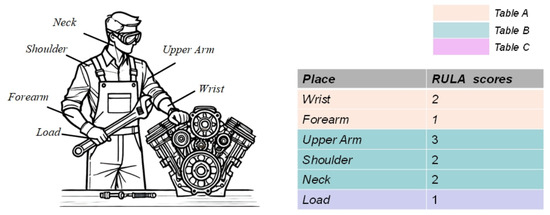
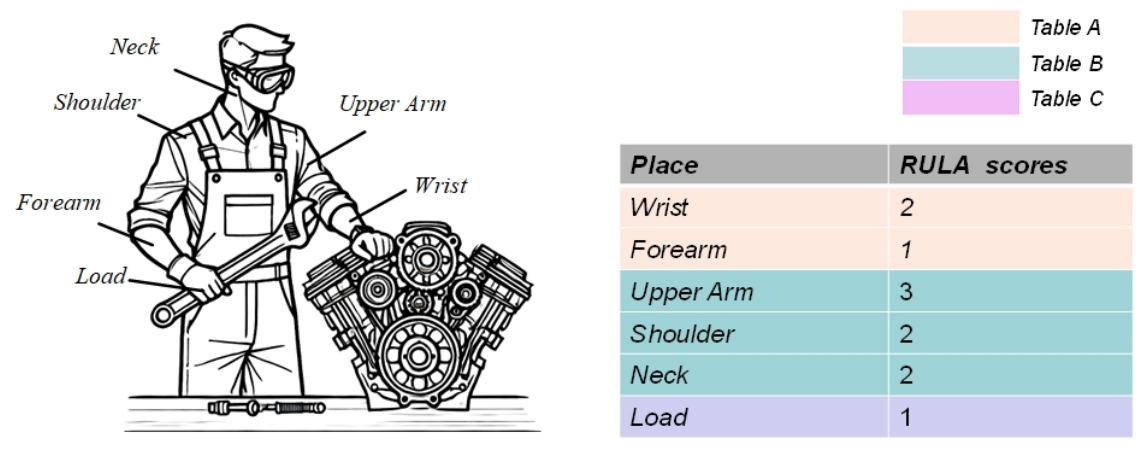
Equation (2) demonstrates the risk of wrist distortion. In human factor engineering, defining a risk level for wrist twisting in workers involves a detailed analysis of wrist use and activity patterns, and the identification of factors that may lead to acute or chronic injuries. It usually involves risk identification and risk assessment, with commonly used assessment methods such as rapid entire body assessment (REBA) [38] and Rapid Upper Limb Assessment (RULA) [39]. RULA is a tool used to assess the risks that may result from upper limb posture at work. This assessment tool is particularly useful for jobs that require frequent or prolonged use of the hands and arms. As shown in Figure 1, the assessment needs to start with categorizing and scoring the worker’s posture at work, with the upper limb posture divided into five areas: wrist, forearm, upper arm, shoulder and neck, each posture is given a range of scores, with the scores usually is calculated into a score of 1 (low) to 7 (high), with higher scores indicating a higher risk for that posture. It is usually divided into two assessment scales, placing postural assessments for the forearms and wrists in one group, while the other group holds assessment data for the upper arms, shoulders and neck. Of course, in order for this data to provide a more complete representation of the risk of wrist twisting faced by workers at work, consideration of the load of the movement and the repetitiveness of the movement should also be included [40,41,42,43], which are issues that need to be taken into account in actual factories, and which increase the risk level of wrist twisting.
Figure 1.
Evaluation of the wrist risk index.
Equation (3) represents the repetitive risk level. This is one of the more important indicators in human factors engineering, where the repetitive movements of workers in the disassembly line can cause injury to the body through prolonged fatigue [44,45]. Here we have selected task frequency, task duration, force required and posture as the evaluation criteria. Similarly, the risk index of the parts disassembly maneuver is classified into three categories, low risk (, medium risk and high risk .
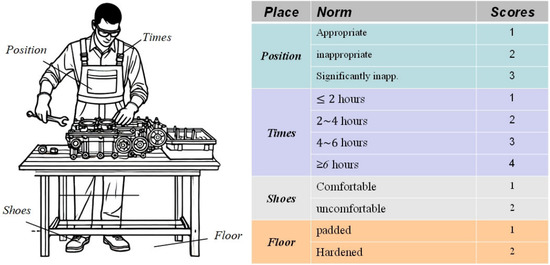
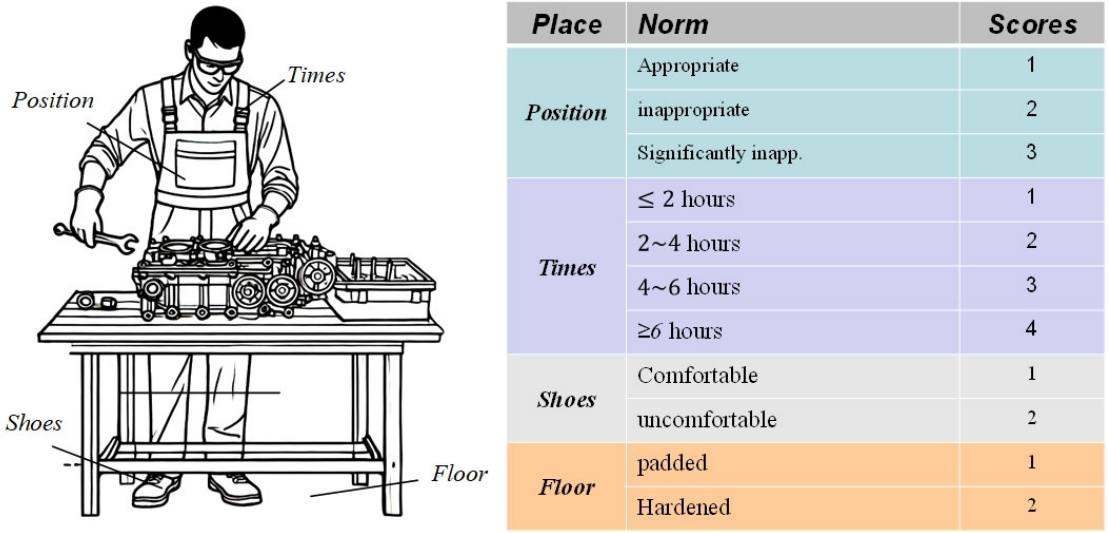
Equation (4) represents the standing risk level [46]. It assesses the physical impact of factors such as the market for workers’ standing on dismantling lines. The methodology used is similar to RULA, as shown in Figure 2. We selected standing time, work task posture [47], floor [48] and shoe type [49] as criteria for the assessment, where work task posture refers to the worker’s standing position and whether they need to move, turn or carry parts frequently.
Figure 2.
Assessment of standing risk.
Equation (5) represents the normalization of the original data obtained to facilitate subsequent calculations. The weights of the components (, , and will be derived through Analytic Hierarchy Process (AHP) [50,51].
Equation (6) is to evaluate the function of the parts in the EOL product, usually in the DFM problem [19]; we divide the parts with the same or similar function into a module group. Equation (7) is to evaluate the structure and space of the parts, so as to evaluate the disassembly of the parts, which is an important index in modular disassembly, and it reflects the difficulty of disassembling the parts. Among them, is to evaluate the spatial location of the part, is used to evaluate the structure of the part, which will affect the disassembly of the EOL product. and are the degree of influence of the space and structure of the specified EOL product, which satisfies + = 1. Equations (6) and (7) are used to quantify the symmetry-oriented relationships among components. In the proposed DFHMR framework, functional similarity reflects whether two components play similar roles in the product system, while structural and spatial associations indicate whether the components have corresponding physical or positional relationships. Higher values of these indicators imply stronger symmetric modular relationships and greater suitability for grouping the components into the same recycling module. Equation (10) is the evaluation of carbon emissions in disassembly and recycling, as in Equation (9), we consider the total carbon emissions and average energy consumption of the product disassembly and recycling, so as to quantify a reasonable carbon emission index. Equation (12) is the profit of dismantling and recycling, it is based on Equation (11), where the symbols , and stand for the recovery profit, disassembly cost and labor cost of part , respectively. Unlike functional and structural similarity, carbon emissions, recycling profit and ergonomic risks are regarded as asymmetric factors in the recycling process. These factors vary among different components and disassembly operations, and therefore reflect the heterogeneity of practical EOL product recycling. Incorporating these asymmetric factors allows the proposed model to avoid forming modules based only on structural or functional similarity, thereby improving the engineering feasibility of the modular recycling scheme. Equations (13) and (14) are the processing of our proposed factors into elements that can be applied inside the design matrix, where the weights are also obtained by applying the AHP method.
2.3. Proposed Multi-Objective Model
We transformed the above assessment factors into design matrices applied to the DFHMR problem mathematical model as the disassembly matrix (DM) and the human factor engineering matrix (HM).
In our DFHMR problem, it is important to consider both the green disassembly of the EOL product (), the inter-module correlation of the components (), and the HF/E risks faced by the workers during the disassembly process (). The solution of DFHMR is a typical constrained multi-objective optimization problem. Its mathematical description is as follows:
S.t.
Equations (18) and (19) demonstrate that the objective function established in this study aims to maximize the disassembly efficiency of EOL products and reduce the correlation degree between module groups. Specifically, Equation (18) realizes the green disassembly of products by considering indicators such as energy consumption and material recovery rate. Heuristic algorithms are adopted to balance the conflicts among various indicators related to green disassembly, so as to finally obtain schemes with excellent green disassembly performance. Combined with the principles of circular economy as well as the material properties and structural characteristics of EOL products, Equation (19) can reasonably allocate components. Moreover, Equation (19) is used to characterize the human factors and ergonomics risks faced by operators during disassembly operations. The DFHMR algorithm is applied to complete rational module grouping and select schemes with low operational risks for workers, which can effectively minimize the operational risks of staff and improve their working comfort.
3. Proposed Algorithm
In this section, we will present an improved multi-objective algorithm SEO (Section 3.1) based on the DFHMR problem and describe the main steps of SEO, in particular the feasible solution (Section 3.2), the training of the solution (Section 3.3), the attack (Section 3.4) and the validation (Section 3.5). Finally, the basic flow of the improved SEO is given.
3.1. Multi-Objective SEO
The social engineering optimizer is a meta-heuristic algorithm proposed by modeling the effects of behavior on people in sociology as a basis [16,52]. It has been applied to multi-objective optimization problems.
3.2. Generating Feasible Solution
The SEO is predicated on modeling social engineering. Its methodology for generating feasible solutions is as follows:
Step 1: Generating empty module groups according to the constraints of the parts. All elements within the module group are set to 0.
Step 2: According to the disassembly matrix and the human factor engineering matrix, the parts designed into the product are initially divided.
Step 3: Repeating the above steps until there are parts in all module groups and no duplicate parts.
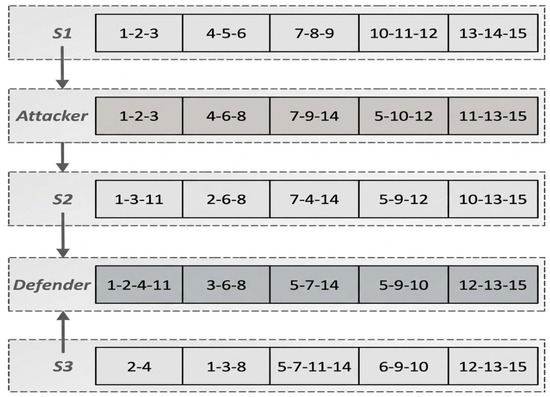
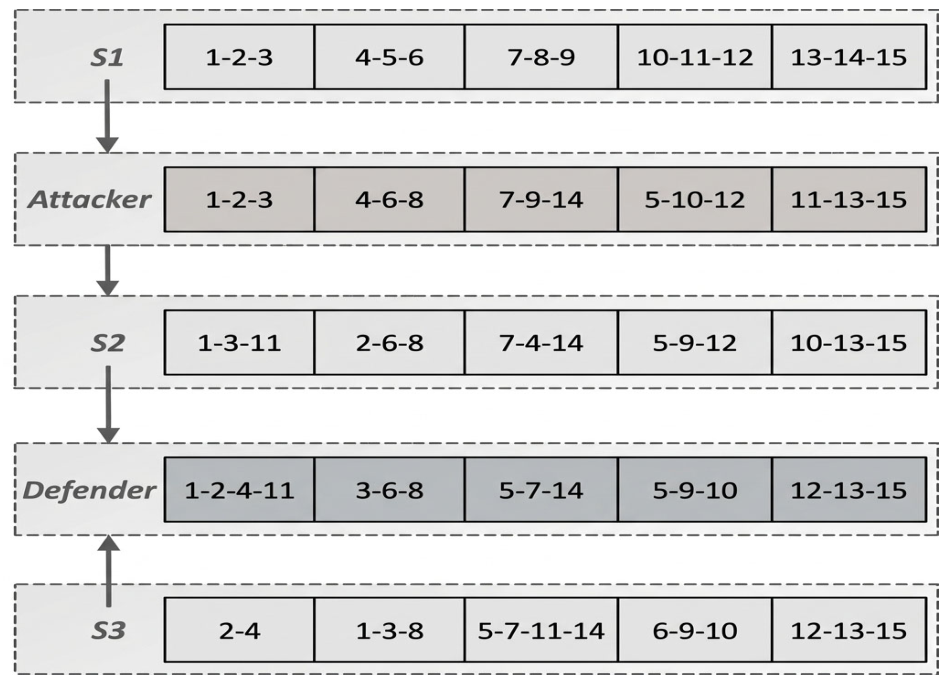
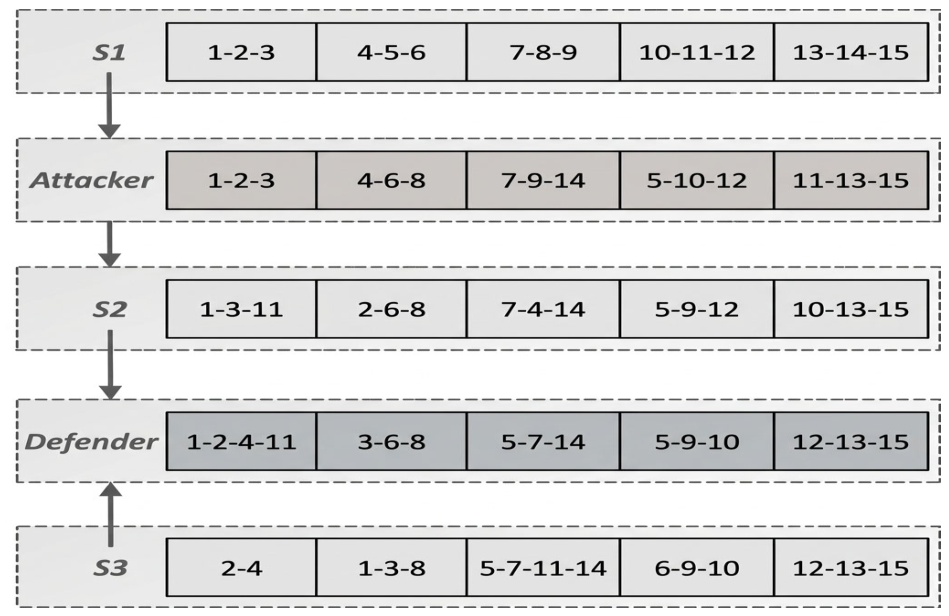
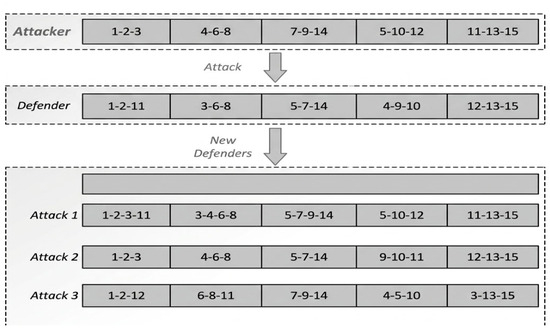
Step 4: Generating three groups of module division schemes, sorting them by fitness, taking the one with moderate fitness as the basic sequence and generating two new groups of module division schemes, which are feasible solutions [16], where the one with better fitness in the new module division scheme is the attacker, and the other is the defender, as in Figure 3.
Figure 3.
Initial solution generation.
3.3. Training and Retraining
Training the initial defender is an effective way to improve the adaptation; as shown in Figure 4, we set the sequence of module division to and pre-set two random integers and between 1 and . In defender, we swap the parts in this position, randomly, into other module groups, and if the optimal solution in the new solution is better than that of the defender, then we let it become the defender instead. By retraining this several times, we end up with defenders whose adaptations are more in line with our requirements.
Figure 4.
Training and retraining of solution.
3.4. Simulated Attack
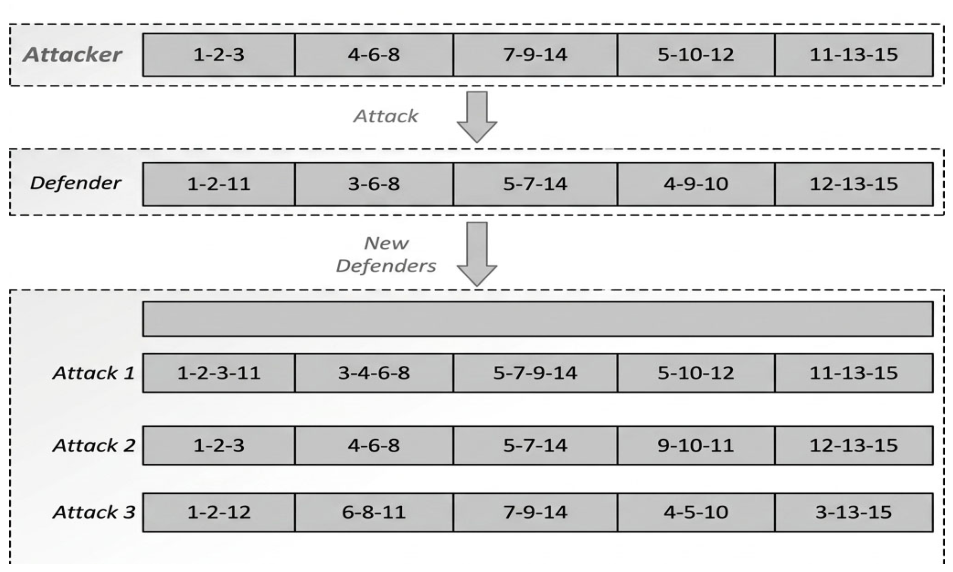
This step operates by randomly selecting one of the three attacks within the three attacks as shown in the Figure 5. Let be the number of attacks. After each attack, the adaptation of the new defender is evaluated and compared with the old defender, and then the one with better adaptation is chosen as the defender. If the defender’s adaptation is better than the attacker’s, the identities of the two are swapped. Only one parameter is used in the attack operation as an input variable during the search. When the attack lasts for times, the attack stops and a new defender is generated. The above steps are repeated until the maximum number of iterations is reached or the algorithm stops.
Figure 5.
Simulated sociological attack.
3.5. Verification Sequence
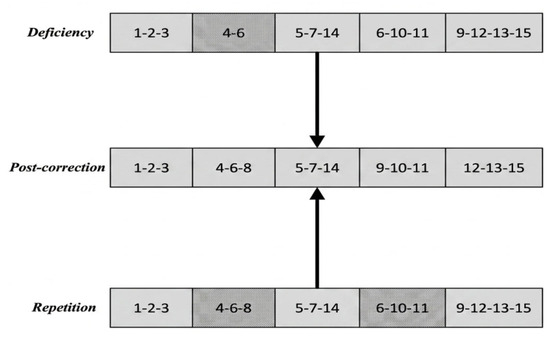
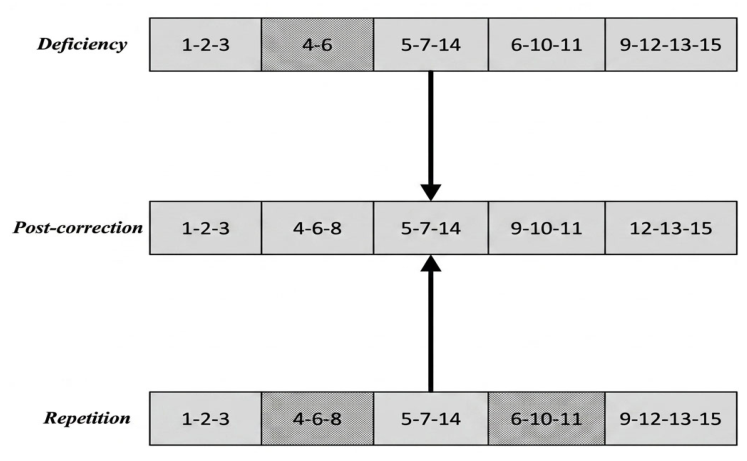
New defenders generated through the above steps need to be validated to ensure the accuracy of the parts in their module sets. As shown in Figure 6, validation is performed from the first module group in the sequence to ensure that there are no duplicate parts in each group. And after validating all of the individual module groups, we validate the overall scheme to make sure that there are no missing parts or one part is in more than one module group. If there are any missing or duplicated cases, we make corrections as shown to get the final defender.
Figure 6.
Verification sequence of solution.
3.6. Algorithmic Process
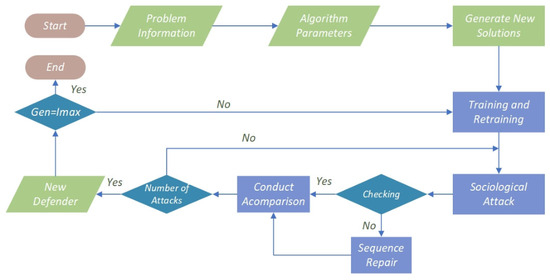
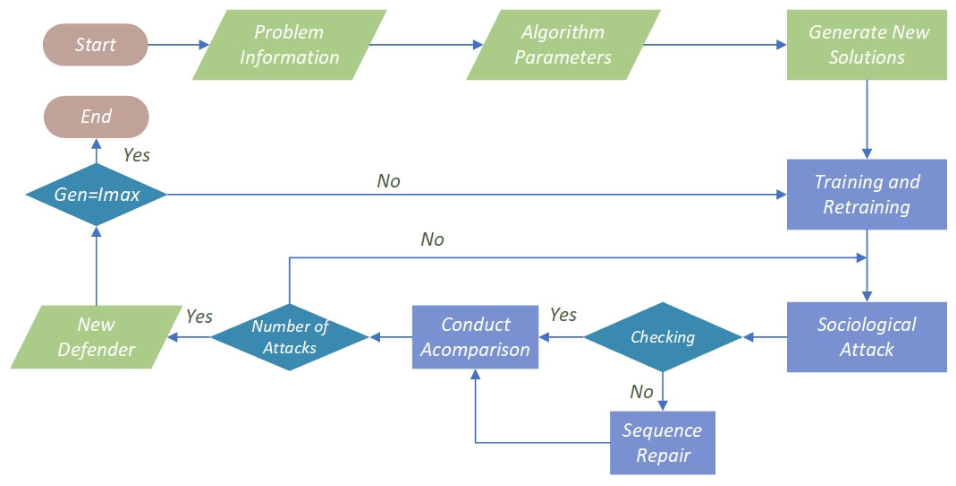
The algorithmic process for improved SEO is as Figure 7:
Figure 7.
Flowchart of the algorithm.
Step 1: Input problem information, , , task information of DFHMR.
Step 2: Set the algorithm parameters: number of attacks , maximum number of iterations, in training rate, and attack parameters.
Step 3: Set the number of iterations to generate the initial attackers and defenders.
Step 4: Train and retrain the defender to generate new solutions and select the optimal one as the defender.
Step 5: Set the number of attacks , randomly select one of the four attack methods to generate a new defender, and replace the original defender if the new defender is better adapted.
Step 6: Check the completeness and divisibility of the module group sequence and correct the sequence.
Step 7: Determine whether the defender is better than the attacker, if so, the defender becomes the new attacker, otherwise no change is made.
Step 8: Judge whether the number of attacks reaches the upper limit value, if so, stop the attack and the algorithm goes to Step 9; otherwise, go to Step 6.
Step 9: Generate a new defender.
Step 10: Judge the algorithm termination condition. If or satisfies the preset termination conditions, the algorithm terminates and outputs the attacker; otherwise, go to Step 4.
4. Application to Instance
In this section, to verify the accuracy and applicability of the proposed model, we select a common automotive turbo reducer as an example (Section 4.1). After that, we compare the enhanced SEO with other state-of-the-art algorithms to evaluate its effectiveness (Section 4.2).
4.1. Example Verification
We have selected its primary components to illustrate the DFHMR problem. Table 1 provides detailed information regarding these components along with their corresponding identification numbers.
Table 1.
The main component parts of the Worm Wheel reducer.
For the Ergonomics data processing, we conducted observations of the actual working postures of disassembly line workers in our partner factories, supplemented by questionnaires and other relevant methods. This allowed us to establish a preliminary dataset that supports our model. Specifically, for components related to the turbo reducer, we integrated assessments from both disassembly line workers and experts in automotive structures to derive an initial score. Following normalization procedures, we obtained raw data suitable for addressing the DFHMR problem.
Similarly, the evaluation of component weights was informed by insights from both disassembly experts and disassembly line workers. We determined the corresponding weights of each component using the AHP. Finally, we obtain the and as follows:
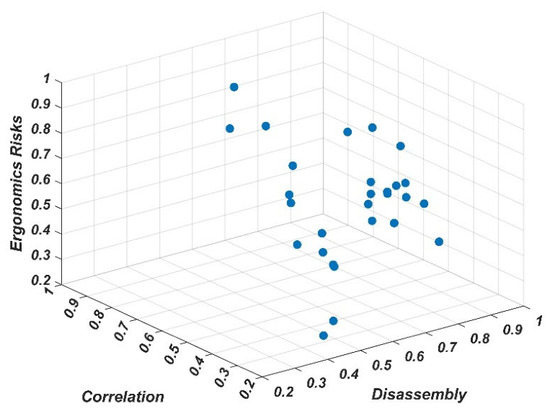
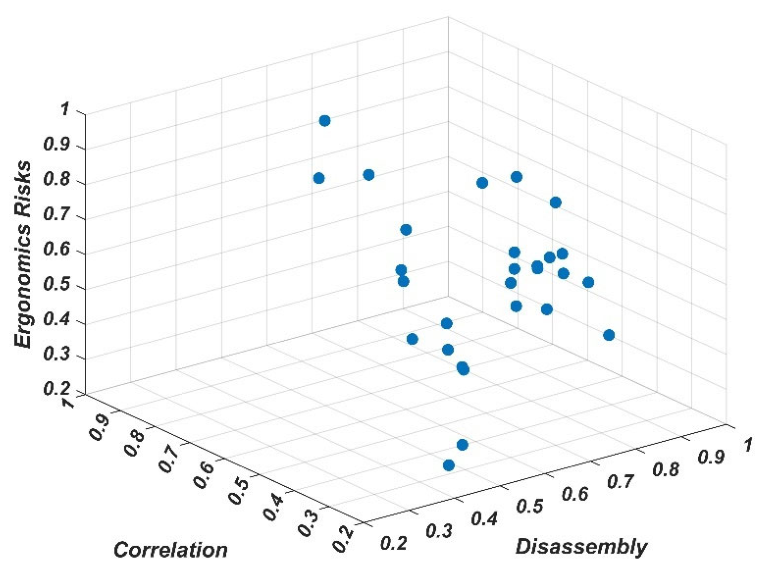
According to the aforementioned formula, we apply the enhanced SEO approach to address the DFHMR problem. All numerical simulations are performed on a laptop with Intel (R) Core (TM) Ultra 5 125H, 24GB RAM, Windows 11 system and MATLAB R2023a. The correlation parameter is set based on the maximum number of iterations and the number of attacks. The final results are illustrated in the Pareto front presented in Figure 8, while the accompanying table displays a selection of DFHMR outcomes that demonstrate superior performance.
Figure 8.
Strength-proven pareto frontiers.
The obtained modular recycling schemes reflect different balances between symmetric component relationships and asymmetric recycling factors. Components grouped within the same module generally show stronger functional similarity, structural correspondence or spatial association, which indicates higher symmetry-oriented intra-module relevance. However, due to differences in disassembly difficulty, ergo-nomic exposure, carbon emissions and recycling profit, the optimal scheme cannot be determined only by component similarity. This explains why some solutions with bet-ter intra-module relevance may not achieve the lowest human-factor risk or the best green disassembly performance. These observations highlight the inherent conflicts among the objectives: enhancing intra-module relevance can increase handling complexity and ergonomic exposure, while minimizing human-factor risk may reduce the achievable green disassembly or component relevance. Such conflicts necessitate a careful evaluation of trade-offs for practical engineering selection.
In addition, analysis of the results in Table 2 reveals that there exist mutually re-strictive conflicts among the three optimization objectives. For instance, in Solution 3, minimal human factor engineering risk is achieved; however, the green detachability and relevance of its components do not meet the desired outcomes. This suggests a trade-off between reducing risk and compromising on detachability and relevance. Conversely, Solution 6 performs well in terms of relevance but falls short compared to Solution 1 in reducing ergonomic risk, deviating from our original human-centered manufacturing system. Additionally, it underperforms in green detachability, which constrains its desirability as a viable option. This comparison clearly demonstrates that no single solution can simultaneously optimize all objectives, and each choice reflects a compromise among conflicting goals. Decision-makers must consider which objectives are prioritized according to operational or sustainability requirements. Solution 2 excels in green disassembly and achieves superior disassembly and recycling results, aligning with our sustainable manufacturing requirements. However, a detailed analysis reveals that the overall recycling cost for this option is higher than expected. This indicates that to fully realize green dismantling for sustainable manufacturing, continuous improvements in dismantling technology and cost reduction are necessary. This also illustrates that performance gains in one objective (e.g., green disassembly) may entail increased cost or complexity in others, emphasizing the need for a holistic evaluation of modular schemes. Notably, while Solution 5 demonstrates better performance in disassembly and relevance, these two factors do not always exhibit a positive correlation, as evidenced by Solution 4. The analysis of these scenarios underscores the complex interplay among the three objectives. Overall, the proposed solution set provides a structured decision space that captures the trade-offs between ergonomic risk, green disassembly, and module relevance. By visualizing these conflicts and compromises, decision-makers can select the scheme that best balances operational efficiency, sustainability, and human-centered safety. Given the uncertainties in the actual recycling process, careful evaluation of the product’s green disassembly, module relevance, and worker risk is essential, referencing our proposed modular design indicators to achieve an optimal solution.
Table 2.
Results of DFHMR.
4.2. Algorithm Validation
Comparison of algorithms is an effective way of evaluating improved algorithms for the proposed problem. We perform algorithmic comparisons using the traditional Non-dominated Sorting Genetic Algorithm II (NSGA-II) [53] and Niched Immune Clone Algorithm II (NICA-II) [54], as well as Multi-Objective Particle Swarm Optimization (MOPSO) [55] and Artificial Fish Swarm Algorithm (AFSA)[56], which are widely used in solving multi-objective problems to evaluate the effectiveness of enhanced SEO. All algorithms were processed on a computer with Intel(R) Core (TM) Ultra 5 125H CPU and 24GB RAM.
In this study, the detailed parameter settings for all algorithms were standardized to ensure a fair comparison. Specifically, the population size for each algorithm was set to 50, and the maximum number of iterations was fixed at 100. The termination criterion for each algorithm was defined either by reaching the maximum iterations or achieving a negligible improvement in the Pareto front (improvement threshold = 10−6) over five consecutive iterations. For NSGA-II, standard crossover and mutation probabilities of 0.9 and 0.1 were applied, respectively. For MOPSO, inertia weight was set to 0.5–0.9 with cognitive and social coefficients both equal to 1.5. AFSA utilized a visual range of 3, step size of 2, and crowding factor of 0.5, while NICA-II followed the cloning and mutation parameters recommended [54]. These parameter settings ensure consistent conditions for all algorithms, enabling an accurate evaluation of the enhanced SEO’s performance across NPS, GD, HV, and RT metrics.
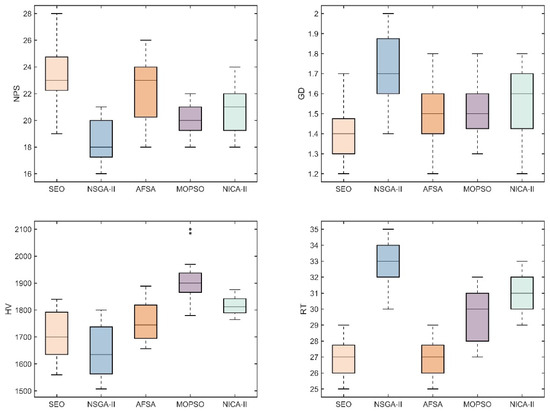
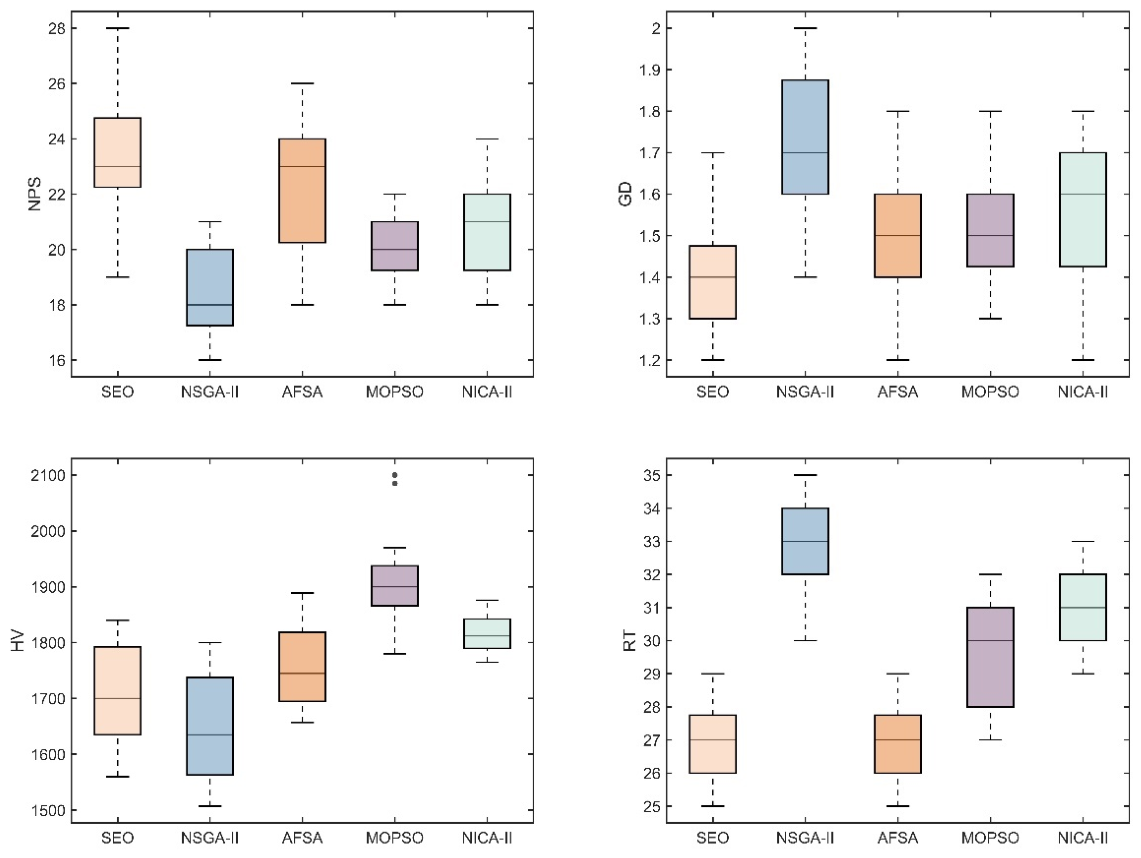
To evaluate the efficiency of different algorithms, several metrics are commonly employed: Number of Pareto-Optimal Solutions (NPS), Generational Distance (GD), Hypervolume (HV), and Runtime (RT). NPS measures the total number of non-dominated solutions an algorithm can identify. A higher NPS indicates that the algorithm can find more non-dominated solutions when addressing multi-objective optimization problems, thereby reflecting its computational efficiency. GD is a metric employed to assess the performance of multi-objective optimization algorithms. GD quantifies the distance between the set of approximate solutions produced by the algorithm and the set of true Pareto-optimal solutions. A smaller GD indicates that the set of solutions generated by the algorithm is closer to the true Pareto-optimal solutions, thereby reflecting better performance of the algorithm. HV quantifies the volume of the feasible domain occupied by the Pareto-optimal solution set relative to a reference point, providing a comprehensive measure of the solution set’s spatial performance. Larger HV values indicate that the algorithm has found a Pareto front covering a greater target space, thus demonstrating superior performance. RT refers to the time required for the algorithm to complete its task, which is influenced by the size of the input data and the computing platform used. When comparing algorithms under identical data and platform conditions, RT can be used to evaluate their computational efficiency. It is important to highlight that NPS and HV are performance metrics where higher values indicate superior performance, whereas IGD and RT are metrics where lower values signify better outcomes. To mitigate the inherent randomness associated with multi-objective optimization algorithms, each algorithm was executed 15 times, and the mean value was calculated as presented in the table. Additionally, Figure 9 employs a box-and-line plot to visually demonstrate the variations among different metrics across the various algorithms.
Figure 9.
Comparison of the algorithms based on box line plots for case study.
The analysis of the accuracy and robustness of the methods is facilitated by the utilization of both the metrics in Figure 9 and Table 3. The proposed SEO algorithm demonstrates superior performance in terms of NPS, achieving a median value of approximately 22.67, which is higher than that of NSGA-II (18.60), AFSA (21.33), MOPSO (20.27), and NICA-II (20.87), as also visually confirmed in the NPS box plot. This indicates that SEO consistently identifies solutions closer to the true Pareto front, maintaining high precision across multiple runs and showing lower variability compared to other algorithms. In terms of GD, SEO achieves the lowest median value of 1.37, demonstrating robustness in minimizing Generational Distance and preserving solution diversity. The GD box plot shows a tighter interquartile range for SEO, indicating less variability and higher reliability across different runs. This performance advantage can be attributed to SEO’s adaptive exploration–exploitation balance, which effectively prevents premature convergence and ensures broader coverage of the solution space. Regard HV, SEO obtains a median value of 1720, reflecting its ability to achieve a well-spread Pareto front that captures the trade-offs among multiple objectives. While MOPSO and NICA-II have slightly higher HV values in some runs, the SEO box plot demonstrates fewer outliers and more consistent performance, indicating balanced optimization across objectives On RT, both SEO and AFSA demonstrate clear superiority, achieving computation times of 27, which are faster than NSGA-II (33), MOPSO (30), and NICA-II (31). The RT box plot confirms this observation, showing that SEO maintains consistently low computation time across multiple trials. The efficiency of SEO can be attributed to its simplified adaptive search mechanism, which reduces unnecessary evaluations while efficiently guiding the population toward high-quality solutions. Overall, the combination of Table 3 metrics and box plots highlights that SEO not only improves solution quality in terms of NPS, GD, and HV but also ensures competitive computational efficiency. The visual comparison via box plots further underscores SEO’s stability, reliability, and robustness, making it particularly suitable for practical applications in multi-objective modular disassembly optimization.
Table 3.
Comparison of the algorithms based on multi-objective metrics.
5. Conclusions and Prospect
This study proposes a symmetry-oriented DFHMR approach to enhance EOL product recycling while reducing ergonomic risks in disassembly operations. Different from traditional modular design methods that mainly focus on functional or structural grouping, the proposed framework interprets modular recycling as a symmetry–asymmetry balancing problem. Functional similarity, structural correspondence, and spatial association are used to support symmetry-oriented module formation, while asymmetric factors such as disassembly difficulty, carbon emissions, recycling profit, and ergonomic risks are incorporated to improve the practicality of the recycling scheme.
In addition, to address the multi-objective conflicts inherent in the DFHMR framework, we propose an enhanced SEO algorithm. A comparative analysis with other multi-objective optimization algorithms illustrates the efficacy of the enhanced SEO in addressing this problem.
Although this study contributes by proposing new EOL product recovery methods and an improved SEO algorithm, there remain several limitations and avenues for further in-depth research. In particular, the current model assumes static disassembly sequences and simplified human factors, which may not fully capture dynamic operational conditions or complex ergonomic interactions. Future work could incorporate dynamic disassembly processes, more detailed ergonomic constraints, and stochastic variations in worker behavior and system uncertainties, which would further enhance the realism and applicability of the proposed framework.
Furthermore, with the ongoing advancements in Industry 5.0, human–machine collaboration is poised to significantly transform industrial practices, offering substantial improvements in work efficiency, reduced workloads, and minimized risks of work-related injuries and illnesses. The integration of Industry 5.0 concepts provides a promising path towards sustainable human-centered manufacturing and will support the practical implementation of the DFHMR approach for EOL products [57,58,59]. Overall, the proposed method provides a useful reference for symmetry-oriented, sustainable, and human-centered mechanical design, while highlighting the potential for future improvements that address dynamic operations, ergonomic complexity, and stochastic uncertainties under the vision of Industry 5.0.
Author Contributions
Conceptualization, H.S.; methodology, H.S.; software, H.S.; validation, J.P., G.T., H.Z. and H.H.; formal analysis, J.P. and H.Z.; investigation, J.P., H.Z. and H.H.; resources, G.T.; data curation, J.P. and H.H.; writing—original draft preparation, H.S.; writing—review and editing, H.S.; visualization, H.H.; supervision, G.T.; project administration, G.T.; funding acquisition, G.T. All authors have read and agreed to the published version of the manuscript.
Funding
This research received no external funding.
Data Availability Statement
The data presented in this study are available on request from the corresponding author.
Acknowledgments
The authors thank Beijing University of Civil Engineering and Architecture for their support of the study.
Conflicts of Interest
The authors declare no conflicts of interest.
References
- Fraga-Lamas, P.; Fernández-Caramés, T.M.; da Cruz, A.M.R.; Lopes, S.I. An Overview of Blockchain for Industry 5.0: Towards Human-Centric, Sustainable and Resilient Applications. IEEE Access 2024, 12, 116162–116201. [Google Scholar] [CrossRef] [Scilit]
- Neumann, W.P.; Winkelhaus, S.; Grosse, E.H.; Glock, C.H. Industry 4.0 and the human factor—A systems framework and analysis methodology for successful development. Int. J. Prod. Econ. 2021, 233, 107992. [Google Scholar] [CrossRef] [Scilit]
- Kadir, B.A.; Broberg, O.; da Conceiçao, C.S. Current research and future perspectives on human factors and ergonomics in Industry 4.0. Comput. Ind. Eng. 2019, 137, 106004. [Google Scholar] [CrossRef] [Scilit]
- de Miranda, S.S.F.; Aguayo-González, F.; Salguero-Gómez, J.; Avila-Gutiérrez, M.J. Life Cycle Engineering 4.0: A Proposal to Conceive Manufacturing Systems for Industry 4.0 Centred on the Human Factor (DfHFinI4.0). Appl. Sci. 2020, 10, 4442. [Google Scholar] [CrossRef] [Scilit]
- Ahmed, S.; Irshad, L.; Demirel, H.O. Prototyping Human-Centered Products in the Age of Industry 4.0. J. Mech. Des. 2021, 143, 071102. [Google Scholar] [CrossRef] [Scilit]
- Grosse, E.H.; Sgarbossa, F.; Berlin, C.; Neumann, W.P. Human-centric production and logistics system design and management: Transitioning from Industry 4.0 to Industry 5.0. Int. J. Prod. Res. 2023, 61, 7749–7759. [Google Scholar] [CrossRef] [Scilit]
- Grabowska, S.; Saniuk, S.; Gajdzik, B. Industry 5.0: Improving humanization and sustainability of Industry 4.0. Scientometrics 2022, 127, 3117–3144. [Google Scholar] [CrossRef] [Scilit]
- Karwowski, W. The discipline of ergonomics and human factors. In Handbook of Human Factors and Ergonomics; Wiley: Hoboken, NJ, USA, 2006; pp. 1–31. [Google Scholar]
- Karwowski, W. Ergonomics and human factors: The paradigms for science, engineering, design, technology and management of human-compatible systems. Ergonomics 2005, 48, 436–463. [Google Scholar] [CrossRef] [Scilit] [PubMed]
- Rinaldi, M.; Fera, M.; Bottani, E.; Grosse, E.H. Workforce scheduling incorporating worker skills and ergonomic constraints. Comput. Ind. Eng. 2022, 168, 108107. [Google Scholar] [CrossRef] [Scilit]
- Battini, D.; Calzavara, M.; Otto, A.; Sgarbossa, F. Preventing ergonomic risks with integrated planning on assembly line balancing and parts feeding. Int. J. Prod. Res. 2017, 55, 7452–7472. [Google Scholar] [CrossRef] [Scilit]
- Abdous, M.-A.; Delorme, X.; Battini, D.; Sgarbossa, F.; Berger-Douce, S. Multi-objective optimization of assembly lines with workers fatigue consideration. IFAC-Pap. 2018, 51, 698–703. [Google Scholar] [CrossRef] [Scilit]
- Akino, K.; Kinoshita, Y.; Yamada, S.; Yamada, T. Upgrade-remanufacturing decision method of EOL products using bi-objective optimization for GHG saving rate and profit. J. Adv. Mech. Des. Syst. Manuf. 2024, 18, JAMDSM0094. [Google Scholar] [CrossRef] [Scilit]
- Lin, C.J.; Belis, T.T.; Kuo, T.C. Ergonomics-Based Factors or Criteria for the Evaluation of Sustainable Product Manufacturing. Sustainability 2019, 11, 4955. [Google Scholar] [CrossRef] [Scilit]
- Botti, L.; Mora, C.; Regattieri, A. Integrating ergonomics and lean manufacturing principles in a hybrid assembly line. Comput. Ind. Eng. 2017, 111, 481–491. [Google Scholar] [CrossRef] [Scilit]
- Tian, G.; Zhang, C.; Fathollahi-Fard, A.M.; Li, Z.; Zhang, C.; Jiang, Z. An enhanced social engineering optimizer for solving an energy-efficient disassembly line balancing problem based on bucket brigades and cloud theory. IEEE Trans. Ind. Inform. 2022, 19, 7148–7159. [Google Scholar] [CrossRef] [Scilit]
- Wu, S.B.; Kaden, N.; Dröder, K. A Systematic Review on Lithium-Ion Battery Disassembly Processes for Efficient Recycling. Batteries 2023, 9, 297. [Google Scholar] [CrossRef] [Scilit]
- Li, H.L.; Wang, Y.M.; Fan, F.Y.; Yu, H.J.; Chu, J.W. Sustainable Plant Layout Design for End of Life Vehicle Recycling and Disassembly Industry Based on SLP Method, a Typical Case in China. IEEE Access 2021, 9, 81913–81925. [Google Scholar] [CrossRef] [Scilit]
- Tian, G.; Sheng, H.; Zhang, L.; Zhang, H.; Fathollahi-Fard, A.M.; Zhang, X.; Feng, Y. Enhancing end-of-life product recyclability through modular design and social engineering optimiser. Int. J. Prod. Res. 2024, 1–19. [Google Scholar] [CrossRef] [Scilit]
- Gershenson, J. LT: Green Modularity: Ecology and Product Retirement; USA National Science Foundation: Alexandria, VA, USA, 1997.
- Smith, S.; Yen, C.-C. Green product design through product modularization using atomic theory. Robot. Comput.-Integr. Manuf. 2010, 26, 790–798. [Google Scholar] [CrossRef] [Scilit]
- Wei, W.; Fan, W.; Li, Z. Multi-objective optimization and evaluation method of modular product configuration design scheme. Int. J. Adv. Manuf. Technol. 2014, 75, 1527–1536. [Google Scholar] [CrossRef] [Scilit]
- Inoue, M.; Yamada, S.; Miyajima, S.; Ishii, K.; Hasebe, R.; Aoyama, K.; Yamada, T.; Bracke, S. A modular design strategy considering sustainability and supplier selection. J. Adv. Mech. Des. Syst. Manuf. 2020, 14, JAMDSM0023. [Google Scholar] [CrossRef] [Scilit]
- Kim, S.; Moon, S.K. A Part Consolidation Design Method for Additive Manufacturing based on Product Disassembly Complexity. Appl. Sci. 2020, 10, 1100. [Google Scholar] [CrossRef] [Scilit]
- Ko, Y.-T. Modeling an innovative green design method for sustainable products. Sustainability 2020, 12, 3351. [Google Scholar] [CrossRef] [Scilit]
- Tseng, H.-E.; Chang, C.-C.; Lee, S.-C.; Li, T.-H. A multi-objective grouping genetic algorithm for modular design. Proc. Inst. Mech. Eng. Part B J. Eng. Manuf. 2023, 237, 377–391. [Google Scholar] [CrossRef] [Scilit]
- Leng, J.; Zhu, X.; Huang, Z.; Li, X.; Zheng, P.; Zhou, X.; Mourtzis, D.; Wang, B.; Qi, Q.; Shao, H. Unlocking the power of industrial artificial intelligence towards Industry 5.0: Insights, pathways, and challenges. J. Manuf. Syst. 2024, 73, 349–363. [Google Scholar] [CrossRef] [Scilit]
- Wolpert, D.H.; Macready, W.G. No free lunch theorems for optimization. IEEE Trans. Evol. Comput. 1997, 1, 67–82. [Google Scholar] [CrossRef] [Scilit]
- Gu, P.; Hashemian, M.; Sosale, S.; Rivin, E. An integrated modular design methodology for life-cycle engineering. CIRP Ann. 1997, 46, 71–74. [Google Scholar] [CrossRef] [Scilit]
- Tseng, H.-E.; Chang, C.-C.; Li, J.-D. Modular design to support green life-cycle engineering. Expert Syst. Appl. 2008, 34, 2524–2537. [Google Scholar] [CrossRef] [Scilit]
- Ji, Y.; Jiao, R.J.; Chen, L.; Wu, C. Green modular design for material efficiency: A leader–follower joint optimization model. J. Clean. Prod. 2013, 41, 187–201. [Google Scholar] [CrossRef] [Scilit]
- Zhang, N.; Yang, Y.; Zheng, Y.J.; Su, J.F. Module partition of complex mechanical products based on weighted complex networks. J. Intell. Manuf. 2019, 30, 1973–1998. [Google Scholar] [CrossRef] [Scilit]
- Irie, H.; Yamada, T. Decision support model for economical material carbon recovery and reduction by connecting supplier and disassembly part selections. J. Adv. Mech. Des. Syst. Manuf. 2020, 14, JAMDSM0024. [Google Scholar] [CrossRef] [Scilit]
- Keyserling, W.M.; Brouwer, M.; Silverstein, B.A. A checklist for evaluating ergonomic risk factors resulting from awkward postures of the legs, trunk and neck. Int. J. Ind. Ergon. 1992, 9, 283–301. [Google Scholar] [CrossRef] [Scilit]
- Ziaei, M.; Choobineh, A.; Abdoli-Eramaki, M.; Ghaem, H.; Jaberi, O. Psychological and physical job demands, decision latitude, and work-related social support among Iranian waste collectors. Waste Manag. 2019, 95, 377–387. [Google Scholar] [CrossRef] [Scilit] [PubMed]
- Parsons, K.C. Environmental ergonomics: A review of principles, methods and models. Appl. Ergon. 2000, 31, 581–594. [Google Scholar] [CrossRef] [Scilit]
- Maldonado, A.; García, J.L.; Alvarado, A.; Balderrama, C.O. A hierarchical fuzzy axiomatic design methodology for ergonomic compatibility evaluation of advanced manufacturing technology. Int. J. Adv. Manuf. Technol. 2013, 66, 171–186. [Google Scholar] [CrossRef] [Scilit]
- Hignett, S.; McAtamney, L. Rapid entire body assessment (REBA). Appl. Ergon. 2000, 31, 201–205. [Google Scholar] [CrossRef] [Scilit]
- McAtamney, L.; Corlett, N. Rapid upper limb assessment (RULA). In Handbook of Human Factors and Ergonomics Methods; CRC Press: Boca Raton, FL, USA, 2004; pp. 86–96. [Google Scholar]
- Leclerc, A.; Landre, M.-F.; Chastang, J.-F.; Niedhammer, I.; Roquelaure, Y. Study Group on Repetitive Work. Upper-limb disorders in repetitive work. Scand. J. Work. Environ. Health 2001, 27, 268–278. [Google Scholar] [CrossRef] [Scilit]
- Xiao, G.; Lei, L.; Dempsey, P.G.; Lu, B.; Liang, Y. Isometric muscle strength and anthropometric characteristics of a Chinese sample. Int. J. Ind. Ergon. 2005, 35, 674–679. [Google Scholar] [CrossRef] [Scilit]
- Aublet-Cuvelier, A.; Aptel, M.; Weber, H. The dynamic course of musculoskeletal disorders in an assembly line factory. Int. Arch. Occup. Environ. Health 2006, 79, 578–584. [Google Scholar] [CrossRef] [Scilit] [PubMed]
- Senjaya, W.F.; Yahya, B.N.; Lee, S.L. Sensor-Based Motion Tracking System Evaluation for RULA in Assembly Task. Sensors 2022, 22, 8869. [Google Scholar] [CrossRef] [Scilit]
- Roodbandi, A.S.J.; Feyzi, V.; Foroozanfar, Z.; Rahimimoghadam, S. The correlation between ART and OCRA methods used for posture assessment of repetitive tasks. Med. Del. Lav. 2021, 112, 370–376. [Google Scholar] [CrossRef] [Scilit] [PubMed]
- Rahman, M.N.A.; Hui, U.J.; Haq, R.H.A.; Hassan, M.F.; Arifin, A.M.T.; Yunos, M.Z.; Adzila, S. Assessment of Repetitive Tasks Among Workers in Mould Making Manufacturing Industry. Adv. Sci. Lett. 2017, 23, 4405–4409. [Google Scholar] [CrossRef] [Scilit]
- Capodaglio, E.M. Occupational risk and prolonged standing work in apparel sales assistants. Int. J. Ind. Ergon. 2017, 60, 53–59. [Google Scholar] [CrossRef] [Scilit]
- Zhang, Y.B.; Wu, X.; Gao, J.Q.; Chen, J.W.; Xv, X. Simulation and Ergonomic Evaluation of Welders’ Standing Posture Using Jack Software. Int. J. Environ. Res. Public Health 2019, 16, 4354. [Google Scholar] [CrossRef] [Scilit]
- Cham, R.; Redfern, M.S. Effect of flooring on standing comfort and fatigue. Hum. Factors 2001, 43, 381–391. [Google Scholar] [CrossRef] [Scilit]
- Mousavi, E.; Zamanian, Z.; Hadadi, M.; Sobhani, S. Investigating the effect of custom-made insoles and exercises on lower limb and back discomfort in assembly-line workers in a rubber tire factory: A randomized controlled trial. Hum. Factors Ergon. Manuf. Serv. Ind. 2019, 29, 478–484. [Google Scholar] [CrossRef] [Scilit]
- Saaty, T.L. Decision making with the analytic hierarchy process. Int. J. Serv. Sci. 2008, 1, 83–98. [Google Scholar] [CrossRef] [Scilit]
- Adem, A.; Çakit, E.; Dagdeviren, M. A fuzzy decision-making approach to analyze the design principles for green ergonomics. Neural Comput. Appl. 2022, 34, 1373–1384. [Google Scholar] [CrossRef] [Scilit]
- Fathollahi-Fard, A.M.; Hajiaghaei-Keshteli, M.; Tavakkoli-Moghaddam, R. The social engineering optimizer (SEO). Eng. Appl. Artif. Intell. 2018, 72, 267–293. [Google Scholar] [CrossRef] [Scilit]
- Deb, K.; Pratap, A.; Agarwal, S.; Meyarivan, T. A fast and elitist multiobjective genetic algorithm: NSGA-II. IEEE Trans. Evol. Comput. 2002, 6, 182–197. [Google Scholar] [CrossRef] [Scilit]
- Coello, C.A.C.; Cortés, N.C. Solving multiobjective optimization problems using an artificial immune system. Genet. Program. Evolvable Mach. 2005, 6, 163–190. [Google Scholar] [CrossRef] [Scilit]
- Coello, C.A.C.; Pulido, G.T.; Lechuga, M.S. Handling multiple objectives with particle swarm optimization. IEEE Trans. Evol. Comput. 2004, 8, 256–279. [Google Scholar] [CrossRef] [Scilit]
- Li, X.-L. An optimizing method based on autonomous animats: Fish-swarm algorithm. Syst. Eng.-Theory Pract. 2002, 22, 32–38. [Google Scholar]
- Yin, T.; Wang, Y.; Cai, S.; Zhang, Y.; Long, J. Unified modeling and multi-objective optimization for disassembly line balancing with distinct station configurations. Mathematics 2024, 12, 2734. [Google Scholar] [CrossRef] [Scilit]
- He, J.; Chu, F.; Anjos, M.F.; Dolgui, A. Multi-objective disassembly line balancing and related supply chain management problems under uncertainty: Review and future trends. Int. J. Prod. Econ. 2024, 272, 109257. [Google Scholar] [CrossRef] [Scilit]
- Asif, M.E.; Rastegarpanah, A. Robotic disassembly for end-of-life products focusing on task and motion planning: A comprehensive survey. J. Manuf. Syst. 2024, 77, 483–524. [Google Scholar] [CrossRef] [Scilit]

Disclaimer/Publisher’s Note: The statements, opinions and data contained in all publications are solely those of the individual author(s) and contributor(s) and not of MDPI and/or the editor(s). MDPI and/or the editor(s) disclaim responsibility for any injury to people or property resulting from any ideas, methods, instructions or products referred to in the content. |
© 2026 by the authors. Licensee MDPI, Basel, Switzerland. This article is an open access article distributed under the terms and conditions of the Creative Commons Attribution (CC BY) license.