


Abstract
The continuous expansion of wind farms and the escalating demand for automated operation and maintenance have established the efficient and accurate performance of intelligent inspection systems for switching stations as a critical factor for ensuring power facility safety and stability. However, the intelligent inspection trolleys deployed in such settings are frequently hampered by suboptimal instrument detection accuracy and limited robustness, attributable primarily to environmental interference from fog, variable lighting conditions, or image noise. This paper proposes a multi-module-integrated real-time object detection model, termed HDC-RTDETR (HSAN + DBlockC3 + CGAFusion + RT-DETR). The model is grounded in the intelligent inspection principle of “clear visibility precedes efficient inspection”, with the primary objective of enabling reliable instrument identification under the influence of fog, changing lighting conditions or image noise. Specifically, building upon the RT-DETR architecture, we introduce three targeted enhancements: (1) the HSAN module adaptively fuses grayscale, edge, and color features to improve robustness against composite degradations (e.g., fog, illumination variations, noise) by enhancing target responses while suppressing background clutter; (2) DBlockC3 captures and integrates multi-scale contextual information, refining the discrimination of fine-grained instrument details under complex lighting; and (3) the CGAFusion module strengthens hierarchical feature integration within the encoder, effectively mitigating fog-induced blurring effects. Experimental validation on a Custom Dataset demonstrates that the proposed model achieves a mAP@50 of 95.566% (representing an improvement of 3.390 percentage points) and a precision of 90.557% (an increase of 11.20 percentage points). Furthermore, on an Industrial Instrument Needle Dataset, it attains a mAP@50 of 98.130% (+2.242%) and a precision of 95.130% (+4.269%). In addition, we validated its edge deployment capabilities on the Jetson AGX Orin, achieving real-time inference at 16.5 FPS, which meets the near-real-time video streaming processing requirements of many application scenarios. These results confirm that the HDC-RTDETR model exhibits superior detection performance and environmental adaptability in complex industrial scenarios, thereby establishing a high-confidence localization foundation for subsequent instrument reading extraction tasks.
1. Introduction
The rapid expansion of wind power installed capacity, coupled with its extensive geographical distribution, has rendered the operational reliability of wind farm switching stations—pivotal nodes in power grid dispatching and equipment condition monitoring [1]—a subject of considerable scholarly attention. However, given that the inspection methodology of critical instrumentation directly influences fault detection timeliness and overall grid stability, it is noteworthy that essential devices such as ammeters, voltmeters, and temperature gauges within these stations are no longer reliant upon manual inspection [2]; instead, they are inspected via automated robotic platforms. Although such intelligent inspection systems confer automation advantages, their detection accuracy is frequently compromised under adverse environmental conditions, including fog, fluctuating illumination, and image noise. Consequently, the development of robust, high-accuracy instrument recognition algorithms capable of operating under these challenging scenarios has emerged as a paramount technical challenge necessitating resolution to ensure the secure and stable operation of wind farms.
As a primary platform for modern operation and maintenance systems, the intelligent inspection trolley has undergone substantial technological advancement and been successfully deployed across diverse domains, including industrial inspection [3], security surveillance [4], mining [5], and traffic perception [6]. Leveraging this cross-sectoral progress, such platforms have recently been introduced into wind farm operation and maintenance. The intelligent inspection of wind farms is gradually becoming a key task for ensuring the safety and stability of power infrastructure, especially in the context of the industry’s shift towards unmanned and automated operation. The core operational logic of these systems in wind farm settings adheres to a “clear acquisition precedes efficient inspection” paradigm: the vision subsystem must first achieve precise localization of instrumentation under adverse environmental conditions—referred to as instrument detection—thereby furnishing high-confidence spatial priors for subsequent Numerical Value Recognition. However, the inspection systems deployed in real wind farm environments often encounter challenges such as fog, changes in lighting, and image noise under harsh weather conditions, which significantly reduce the performance of existing visual detection models. These environmental disturbances lead to missed detections or false alarms, undermining the reliability of automated inspections and restricting the practical deployment of unmanned systems. In recent years, deep learning-based object detection methods have exhibited considerable potential in industrial vision tasks [7,8,9]. Current mainstream detectors can be taxonomically divided into two-stage architectures (e.g., Faster R-CNN [10]) and single-stage architectures (e.g., the YOLO family [11] and DETR [12]). Although two-stage methods typically achieve superior detection accuracy, they entail high computational overhead and slow inference, rendering them ill-suited for real-time operational constraints. Conversely, single-stage detectors offer marked inference efficiency; however, they often suffer from insufficient robustness when confronted with target variations and cluttered backgrounds—limitations that are particularly critical in wind farm environments characterized by fog, fluctuating illumination, and complex scenery.
RT-DETR, a contemporary single-stage object detector, achieves a favorable trade-off between accuracy and efficiency on generic object detection benchmarks. This performance is largely attributable to its end-to-end detection paradigm and an efficient hybrid encoder architecture. However, in specific industrial scenarios such as wind farm switching stations, the vision module in real detection often faces challenges such as fog, changing lighting conditions and image noise, which leads to significantly degraded performance in feature fusion, multi-scale perception and image enhancement, and requires targeted optimization.
To address the aforementioned challenges, this paper proposes an enhanced RT-DETR model for wind farm facility recognition, incorporating three complementary technical innovations:
- (1)
- HSAN for adverse-condition robustness: We integrated a Hierarchical Spatial Attention Network (HSAN) [13] to improve model robustness under adverse environmental conditions. This module adaptively fuses multi-level features—including intensity, edge, and color information—thereby enhancing discriminative target representations while suppressing background interference induced by fog, illumination variation, and image noise.
- (2)
- Illumination-adaptive feature extraction: To ensure robust performance under varying lighting conditions, we adopted the differential block convolutional layer C3 (DBlockC3) proposed in [14]. This module captures global contextual information and enables the model to learn illumination-invariant instrument features, effectively mitigating the adverse effects of shadows and uneven lighting.
- (3)
- CGAFusion for coupled fog-lighting degradation: To overcome feature blurring caused by the coupled effects of uneven fog and illumination distribution, we replaced conventional multi-level fusion strategies with a newly proposed fusion module, CGAFusion [13]. The module jointly applies channel and spatial attention, allowing the model to evaluate feature importance from multiple perspectives and adaptively determine integration strategies. This design effectively suppresses feature deformation under varying fog thickness and ambient illumination, thereby further enhancing recognition robustness in poor lighting conditions.
The main contributions of this paper are summarized as follows: First, it proposes a novel framework based on the CGAFusion network, HSAN module, DBlockC3 module, and RT-DETR model. Second, it provides a single-stage solution capable of identifying various instrumentation devices—including ammeters, voltmeters, and temperature sensors—within wind power substation equipment. The paper is structured as follows: Section 2 reviews relevant research on analog instrument analysis and comprehension; Section 3 elaborates on the theoretical foundation and implementation of the proposed method; Section 4 details the test platform and evaluation metrics; Section 5 presents experimental validation and analysis; Section 6 summarizes the research findings and outlines future work directions.
2. Related Works
Accurate identification of electrical equipment such as ammeters, voltmeters, and thermometers within wind power substations is crucial for establishing equipment health monitoring and early warning mechanisms. However, numerous challenges exist in practical maintenance scenarios, including atmospheric haze, varying lighting conditions, and image noise, which often cause detection failures. Existing recognition systems struggle to simultaneously meet the dual requirements of high precision and robustness in real-world scenarios due to high false alarm rates or poor recognition accuracy.
With the advent and evolution of DL, AMR accuracy can be further improved due to its feature extraction capability, which offers robust methods to detect objects in adverse visual scenes [15,16,17]. Current detection architectures are predominantly categorized into two types used in state-of-the-art meter detection algorithms: a two-stage detector like Faster R-CNN provides high accuracy, but is computationally expensive to run and has low speed; on the other hand, one-stage models such as YOLO series [18] and recent RT-DETR [6] have a fast inference speed because of its simplicity, making it applicable in real-time applications. However, when applied to real-world applications under various environments they tend to show severe degradation of their performances.
In applications related to computer vision, foggy conditions reduce the clarity and visual quality of images because fog introduces distortions, thereby lowering contrast, altering color properties, and causing the loss of texture or details, which can have a negative impact on the behavior of feature extraction models [19]. The scattering and absorption of light by particles in the air change the color appearance of objects in the scene and make edges and textures blurry [20]. Moreover, further irregular lighting conditions (overexposure, underexposure, uneven light intensity) and image noise caused by camera sensors pose significant challenges for real-world object recognition applications [21]. This situation requires the provision of powerful computational methods for industrial applications, such as in fuel cell systems, where parameter perturbations and complex operating conditions require advanced optimization and control strategies [22,23]. The single-stage detector has significantly higher inference efficiency compared to two-stage methods and is more suitable for edge deployment.
For one-stage detectors, which are favored for real-time applications, researchers have proposed various enhancement strategies. Li et al. [24] proposed the IA-YOLO model, based on YOLOv3. The front end integrates a differentiable image processing module based on AOD-Net, which can dynamically adjust the dehazing intensity according to the fog concentration and conduct end-to-end training. It has been verified for effectiveness on datasets such as RTTS (real foggy conditions) and VOC-Fog. Its advantages lie in achieving global optimization from image restoration to detection; however, the enhancement module may introduce unnecessary noise to the detector, and its generalization ability for other weather disturbances such as rain and snow is limited. This module dynamically adjusts defogging intensity based on fog concentration, and the whole model adopts an end-to-end integrated training strategy, ensuring consistency from image restoration to target recognition. To cope with a wider range of extreme weather disturbances, Ding Y et al. [25] designed the SDNIA-YOLO model. Based on the IA-YOLO model, this model incorporates neural style transfer technology to synthesize various weather data, enabling the front-end neural image adaptive module to learn the mapping from multiple degraded weather conditions (fog, rain, snow) to clear images. It has achieved significant performance improvements on real harsh weather datasets such as RTTS and ExDark. The advantage is that it is data-driven and does not rely on specific physical models, and it has preliminary adaptability to various extreme weather conditions. However, the drawback is that the weather conditions simulated in the style transfer still may have a gap from the real and complex environment. Wang et al. [26] constructed the SRC-YOLO model, which is an improvement based on YOLOv4-tiny for maritime foggy environments. It incorporates a convolutional block attention module to enhance the target-related features. The study used a self-built dataset containing different fog concentrations of marine targets for training and evaluation. The advantage is that the detection accuracy for specific scenarios (maritime) is high; the disadvantage is that the model architecture is relatively lightweight but may sacrifice the detection ability for multi-scale targets, and the preprocessing method (such as the SSR algorithm) may not be applicable to other weather types. Sun et al. [27] proposed the RTDETR-MARD model, which is based on RT-DETR and incorporates a multi-scale adaptive real-time detection framework specifically for the detection of floating garbage in aquatic environments. The advantage is that it has been optimized for interference from the water surface background; the drawback is that its application scenarios are relatively specific and it has not been verified for its robustness on more widely used general adverse weather datasets.
For both one-stage and two-stage detectors, attention mechanisms have been widely adopted as a general tool to enhance feature representation under degraded conditions. Such approaches stem from fundamental innovations in attention mechanisms, such as SENet proposed by Liu et al. [28], which adaptively calibrates features through the “squeeze–excitation” operation across channels, providing a universal solution for feature enhancement in low-quality images. The advantage is that it is plug-and-play, which can effectively enhance the feature discrimination ability of the backbone network. The disadvantage is that as a general module, it lacks targeted optimization for specific degradation patterns caused by extreme weather. Furthermore, other studies have also provided significant technical support for visual perception in complex environments. For instance, the patented technology proposed by Beijing University of Posts and Telecommunications [29] combines the Retinex theory with the atmospheric scattering model for preprocessing, and employs residual connection networks to enhance the model’s robustness in low-light and foggy environments. Ren et al. [30] proposed a framework that enables the dehazing and detection tasks to share underlying features, and achieves end-to-end training through joint loss, thereby achieving collaborative optimization at the feature level. These efforts provide important technical foundations, but they are usually part of an overall solution, and their independent effectiveness as well as the possibility of integration with the most advanced detectors still require further exploration.
Despite considerable advancements in real-time object detection, the robustness of existing models remains insufficient for complex industrial contexts such as wind farm inspection. Performance consistently deteriorates under adverse environmental conditions, including haze, pronounced lighting variations, and sensor noise [1]. With the application of Transformer architectures in computer vision, object detection models have adopted a novel paradigm [2], with DETR-based approaches being representative. These approaches eliminate the need for manually designed anchor boxes and complex post-processing steps like non-maximum suppression (NMS), achieving end-to-end set prediction through bipartite matching loss. However, it is important to note that although DETR-based architectures do not require predefined anchor boxes, the dataset still needs to provide object annotations in the form of bounding boxes, which are used as ground-truth labels during training. This offers a natural advantage for detecting object groups with large size variations. The RT-DETR model [2], with its flexible hybrid encoder and efficient dynamic head design, achieves an optimal balance between accuracy and inference speed. This makes it a suitable and strong baseline framework for real-time applications like asset health management in wind farms.
Although the standard RT-DETR framework offers high computational efficiency, it lacks dedicated mechanisms to explicitly address the severe image degradation commonly encountered in outdoor wind farm environments. To address these challenges, this paper proposes an improved detection network—HDC-RT-DETR. Built upon the RT-DETR framework, this network integrates three dedicated modules designed to tackle these challenges: Content-Guided Attention Fusion (CGAFusion), Multi-Level Differential Convolution (DBlockC3), and HSAN. This approach effectively mitigates common disturbances such as haze, lighting variations, and device noise, though it also increases the model’s data requirements. Through edge deployment experiments, we demonstrate that despite the increase in parameters, the HDC-RTDETR model can still reliably meet the near-real-time video stream processing requirements of many application scenarios on embedded devices. This indicates that the model enhances detection accuracy in complex environments without sacrificing real-time performance during on-site deployment. This characteristic holds significant practical implications for unmanned inspections of wind farms: it enables image analysis to be performed directly on wind turbine terminals or nearby edge nodes, eliminating the need to rely on high-speed networks to transmit massive amounts of data to the cloud. Consequently, it significantly reduces bandwidth pressure and response latency in remote monitoring, providing a viable technical foundation for building low-cost, large-scale intelligent monitoring systems for wind farms.
3. Methods
This section first introduces the baseline model, followed by a detailed elaboration of the proposed HDC-RTDETR model and its three key improvements.
3.1. RT-DETR Model
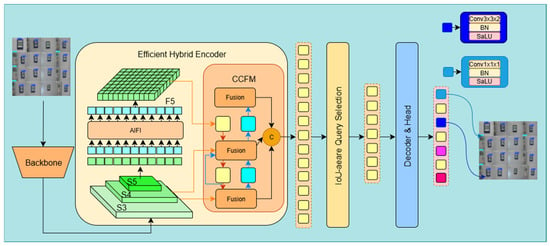
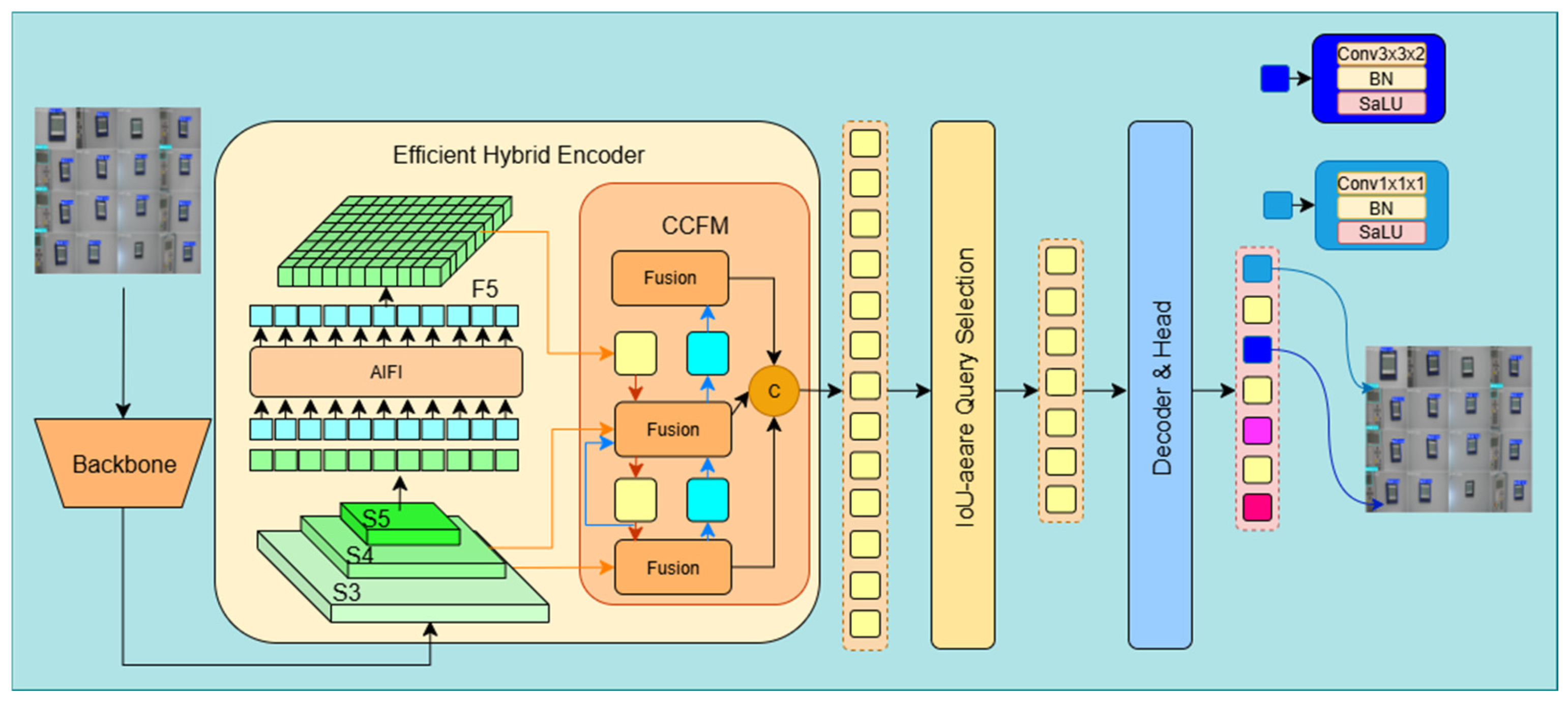
RT-DETR is the first end-to-end target detection model developed by Baidu’s research team that can run in real time. It breaks through the bottleneck of traditional detection frameworks: on the one hand, it avoids the inference delay similar to the YOLO series due to its reliance on NMS (non-maximal suppression); on the other hand, it also improves the problem of the original DETR model’s slow convergence and high computational cost. Together, these improvements achieve a balanced increase in detection accuracy and inference speed. The core architecture of the model consists of three key components: a backbone network, an efficient hybrid encoder, and a Transformer decoder with an auxiliary prediction header. First, the backbone network (usually built based on convolutional, pooling and ResNet modules) performs feature extraction on the input 640 × 640 image, and outputs three layers of feature maps ranging from shallow to deep, with sizes of 80 × 80, 40 × 40, and 20 × 20, respectively. Subsequently, the hybrid encoder processes the deepest layer of the feature maps through the Attention–Interface–Feature–Interaction-Based (AIFI) module; then, the deepest layer of the feature maps integrates feature information from different scales using the cross-scale feature fusion module (CCFM). In this process, the model employs a query selection strategy that minimizes uncertainty to obtain feature representations that are more conducive to accurate classification and localization. Finally, the decoder directly outputs predicted bounding boxes and category labels based on these features to complete the end-to-end detection process.
Currently, RT-DETR is available in several versions ranging from lightweight to high-performance, including L, R18, R34, R50, R101, and X variants. In view of the complexity and variability of the instrumentation detection scenarios and the fact that they are often faced with model deployment resource constraints, the RT-DETR-L variant with smaller parameter sizes was finally selected as the base network for subsequent optimization, taking into account the resource constraints of the deployment environment. Its overall architecture is shown in Figure 1.
Figure 1.
RT-DETR schematic diagram.
3.2. HDC-RTDETR Model
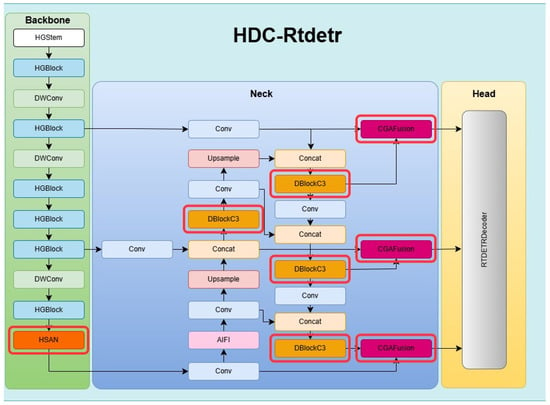
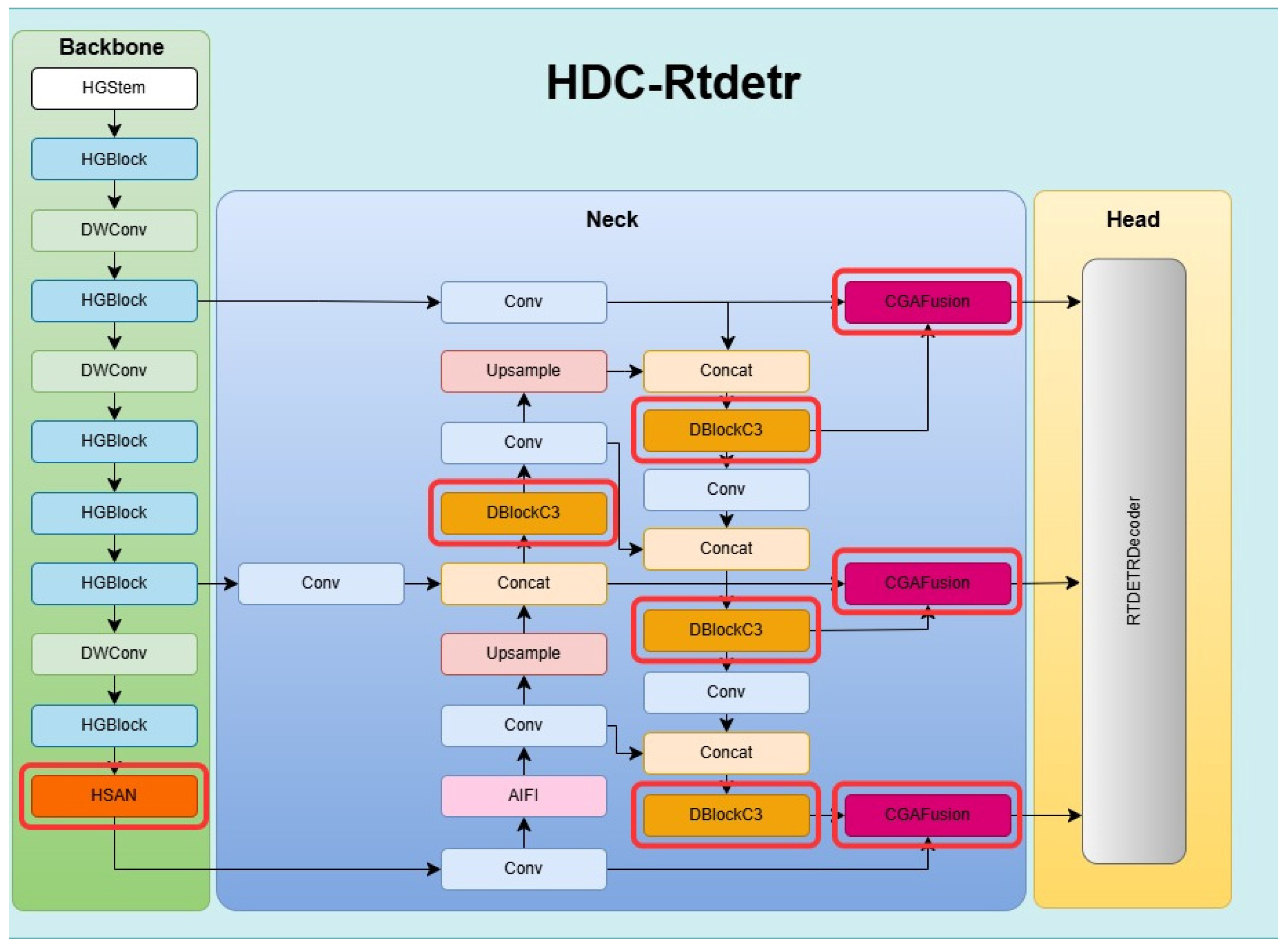
To establish a robust real-time detection system capable of handling diverse and complex environmental conditions, we adopt the Real-Time Detection Transformer (RT-DETR) as our foundational framework. Our enhancements are systematically integrated into its three core components—the backbone, neck, and head—as illustrated in Figure 2. Each modification is designed to be lightweight, preserving the efficient inference capabilities of RT-DETR while significantly boosting its robustness and accuracy in scenarios involving noise, illumination changes, and atmospheric interference. The following section provides a detailed explanation of the embedding methods for each module.
Figure 2.
HDC-RTDETR model structure.
To mitigate the impact of image noise, we introduce the HSAN module as a feature optimization stage within the backbone network. As depicted in Figure 2, HSAN is positioned at the terminal stage of the backbone, receiving the final feature maps from the preceding ‘HGBlock’ layers. This strategic placement allows it to refine the most semantically rich features before they are passed to the neck. The integration is non-destructive; instead of replacing existing blocks, HSAN acts as an adaptive filter appended to the backbone’s output. It leverages group convolution and a joint channel–spatial attention mechanism to suppress noise and enhance salient object features, thereby providing a cleaner and more discriminative feature representation for all subsequent processing steps in the neck and head.
To address the issue of feature degradation under varying lighting conditions (such as low light or overexposure), we introduce the DBlockC3 module. This module is not integrated into the main network but is instead incorporated into the neck feature pyramid network. Specifically, as shown in Figure 2, ‘DBlockC3’ replaces the RepC3 module in one of the upsampling paths of the neck. It is inserted after the ‘Conv’ layer and before the ‘Concat’ operation. This positioning enables it to process and stabilize the features intended for multi-scale fusion. ‘DBlockC3’ incorporates multi-scale convolutional kernels to simulate feature responses under varying lighting conditions. By optimizing the residual paths within this module, the model can adaptively enhance details in underexposed regions or suppress redundant information in overexposed regions, thereby ensuring the robustness of features passed to the head feature layer and enabling it to adapt to changes in lighting.
To overcome feature blurring and contrast degradation caused by atmospheric interference like fog, we design and integrate the CGAFusion module. This module is specifically integrated into the feature fusion stage of the detection head. As illustrated in Figure 2, ‘CGAFusion’ takes the place of a standard feature fusion operation, receiving multi-scale feature maps from the neck. Its function is to dynamically recalibrate and fuse these features. Based on a channel-guided attention mechanism, ‘CGAFusion’ accurately focuses on context information that has been attenuated by fog. It dynamically fuses and restores the clarity and discriminative power of these features, effectively improving the detection performance in blurred or low-contrast scenes.
In summary, our approach involves surgically inserting three novel, lightweight modules into the existing RT-DETR pipeline: HSAN at the backbone’s exit for input denoising, DBlockC3 within the neck’s upsampling path for illumination-robust feature extraction, and CGAFusion in the head’s feature merging stage for deblurring and context enhancement. This hierarchical and targeted integration allows each module to address a specific degradation factor precisely where its impact is most needed, creating a cohesive and robust system without disrupting the efficiency of the original architecture.
3.3. HSAN
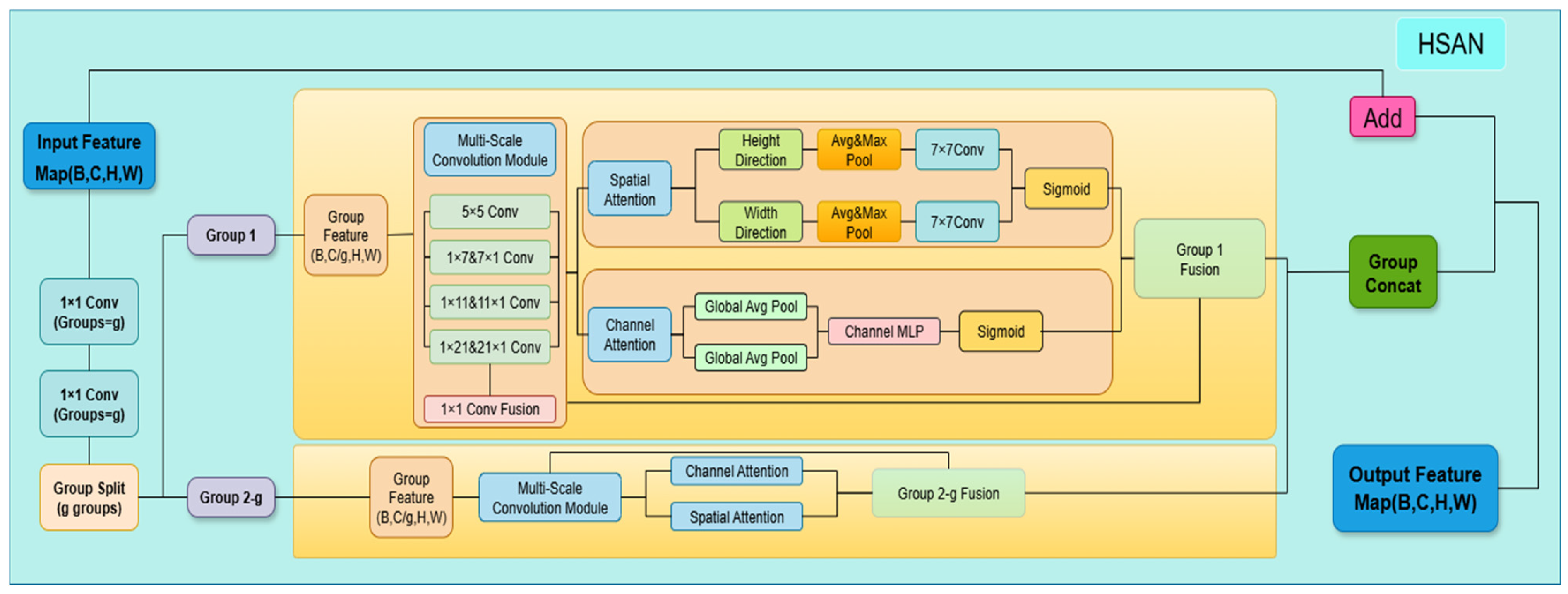
In the practical scenarios of wind farm switching station operation and maintenance, the visual perception system often faces the serious impact of multi-source image noise such as sensor noise, electromagnetic interference and signal transmission distortion. Due to the lack of endogenous robustness to noise interference, traditional detection models are very prone to false detection or localization bias under the condition that the features are confused or weakened. In this paper, we introduce the HSAN, which is not a simple denoising preprocessing superposition, but aims to construct an adaptive enhancement module with the ability of “sensing–screening–reconstruction”, so that it can focus on the key target features in the noisy degraded image directly, and suppress the noise-induced artifacts and feature distortions.
The core logic of its design lies in the implementation of a fine-grained divide-and-conquer management for feature maps. Instead of the primary pixel space decomposition described in the original paper, the module starts from the depth feature dimension, and firstly projects the feature stream to multiple heterogeneous subspaces by 1 × 1 convolution and Group Split mechanism, which theoretically alleviates the computational redundancy and empowers the model to capture weak signals at different channel scales. Subsequently, the multi-scale convolutional paths built within the module form the technical high ground of HSAN. By introducing a combination of 5 × 5 standard convolution and asymmetric strip convolution of different sizes, such as 1 × 7, 1 × 11, and up to 1 × 21, the mechanism can accurately reconstruct the geometrical contours of instrument dials and the edge cues of pointers, effectively avoiding the feature loss caused by the restricted receptive field of the traditional fixed convolution kernel.
In particular, the HSAN module accomplishes dynamic recalibration of the feature response by integrating the dual spatial and channel attention mechanisms. The spatial branch anchors high-confidence instrument localization points through a dual pooling operation (Avg&Max Pool), while the channel branch suppresses noise-contaminated redundant information through an adaptive learning mechanism, which is essentially a powerful filtering of such complex industrial background interference. This closed-loop design of “preprocessing optimization–feature enhancement” (as shown in Figure 3) results in a substantial increase in the robustness of the model under low-visibility conditions. The experimental data strongly support this logic: after integrating the HSAN module, the model’s mAP@50 on Custom Dataset is significantly improved, which fully proves that the deep optimization of fuzzy features through the mixed-scale attention mechanism is an inevitable technical choice for the accurate recognition of industrial instruments in complex scenarios.
Figure 3.
HSAN module structure.
3.4. DBlockC3
In the wind farm instrumentation inspection task, the target size has significant diversity; features from small pointers to large dials need to be accurately recognized, which puts forward high requirements on the multi-scale perception ability of the feature extraction network. At the same time, the light conditions inside the wind turbine nacelle are complex and variable, with shadows, local bright light (such as direct sunlight) and insufficient lighting at night, which requires the model to have strong light robustness. The backbone network of the traditional RT-DETR model has obvious deficiencies in dealing with extreme scale changes and light intensity fluctuations: its fixed-structure convolutional module struggles to capture the fine structure of small targets and the overall contour of large targets, and it lacks the ability to adaptively adjust to the light-induced feature attenuation or oversaturation phenomenon.
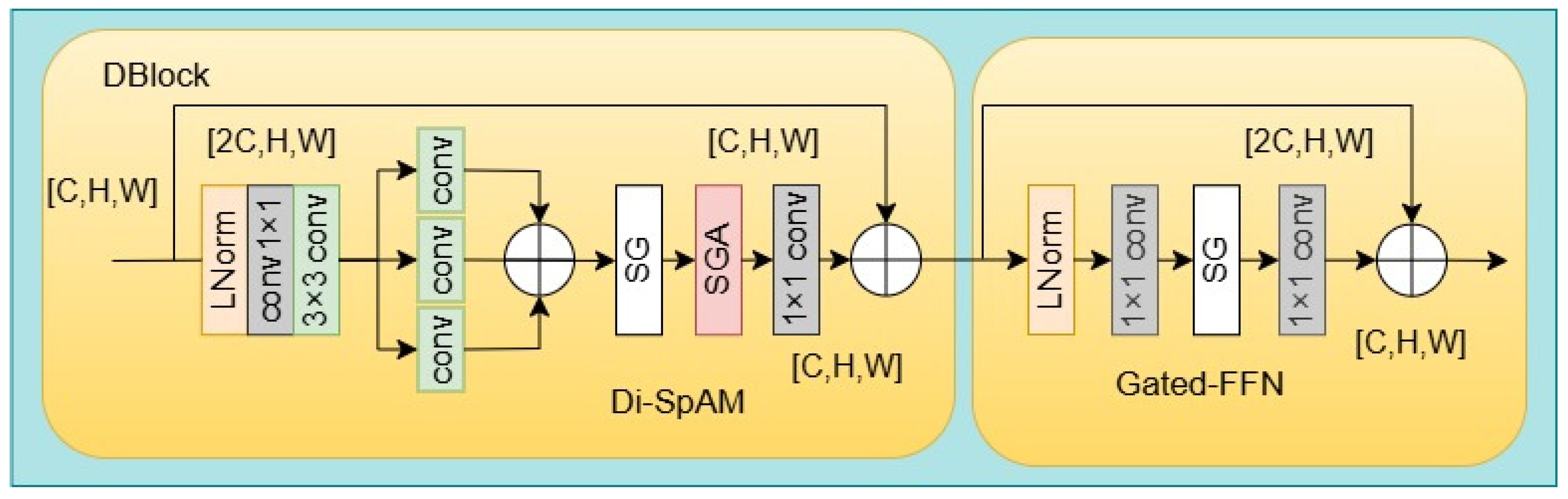
In order to overcome the above limitations, this paper proposes the DBlockC3 module, which constructs a differentiated receptive field through a multi-core parallel convolutional structure to achieve more efficient and robust multi-scale feature extraction. The module adopts three parallel convolutional pathways, using three different sizes of convolutional kernels, 3 × 3, 5 × 5 and 7 × 7. Among them, the 3 × 3 convolution focuses on local subtle features and textures, which helps to maintain detail resolution under low-light conditions; the 5 × 5 convolution balances the sensory field and computational effort, and is able to fuse the contextual information of a slightly larger area to alleviate the discontinuity of features caused by local shadows or reflections; and the 7 × 7 convolution covers a much larger area, which can help to capture the global structure of the large-scale instrument and provide stable contour information in the case of uneven overall light distribution.
Let the input feature map be , and the output of each pathway can be expressed as
where BatchNorm denotes batch normalization and ReLU is the activation function. To integrate the multi-scale information, 1 × 1 convolution is used to channelize and fuse the three-way features:
where is the final output feature of the module. This structure significantly enhances the model’s ability to adapt to scale differences without significantly increasing the computational load, and especially improves the sensitivity of target detection and the structural integrity of large targets, so as to comprehensively optimize the recognition performance of the instrument in the wind farm environment. The overall architecture is shown in Figure 4.
Figure 4.
DBlockC3 module structure.
3.5. CGAFusion
In the inspection process of intelligent inspection trolley, the accuracy of meter recognition is crucial for equipment state assessment and fault warning. Especially in foggy environments, the effective fusion of the low-level features extracted by the encoder and the high-level features becomes a key link that affects the performance of meter recognition. Low-level features contain rich local details and texture information, constituting the “micro-foundation” of the recognition task under blurred vision conditions; high-level features carry semantic information about the instrument category and overall structure, and can provide “macro-guidance” in the fog interference. Ideally, the two should complement each other; however, the traditional feature fusion method struggles to clearly distinguish the instrument target from the background under fog coverage, and is susceptible to an uneven fog concentration, visibility fluctuations and other interferences, which leads to the masking of the key features or the distortion of the semantic information, and thus restricts the overall performance of the recognition model in the low-visibility environment.
To address the above problems, this paper introduces the CGAFusion module, which takes “content guidance” as the core mechanism to realize more discriminative feature fusion. The module first generates a rough attention graph based on the output of low-level features and high-level features from the backbone network:
where AvgPool is the average pooling operation, is the Sigmoid activation function, and is a 3 × 3 convolutional layer. This step initially focuses on potential instrumented regions.
Further, to cope with the variability of instrument features in different channels, this module introduces a channel-level refinement mechanism. A Spatial Importance Map (SIM) is generated for the cth channel:
where is the cth channel of the low-level features for element-by-element multiplication and is a 1 × 1 convolutional layer.
Finally, the low-level and high-level features are fused by adaptive weighting:
where is the attention weight of integrating all channels and is the fused features. This mechanism can effectively highlight the instrument-related features and inhibit the fog interference, so as to alleviate the feature conflict problem caused by the mismatch of sensory fields in the traditional method, and improve the recognition accuracy and robustness of the model under the influence of fog.
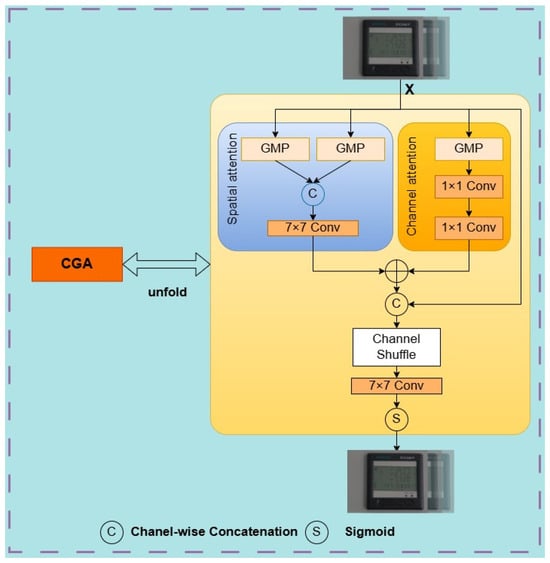
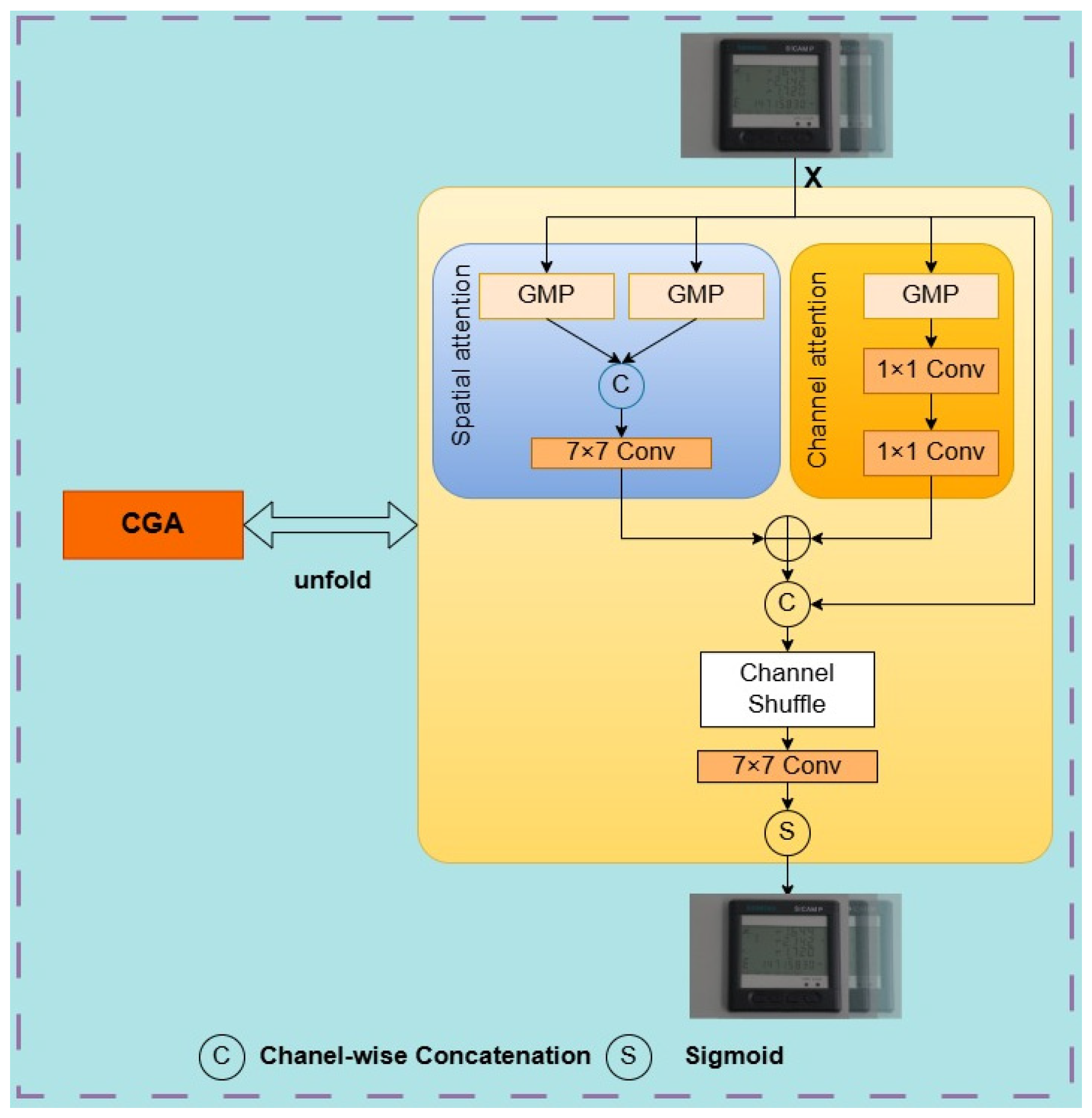
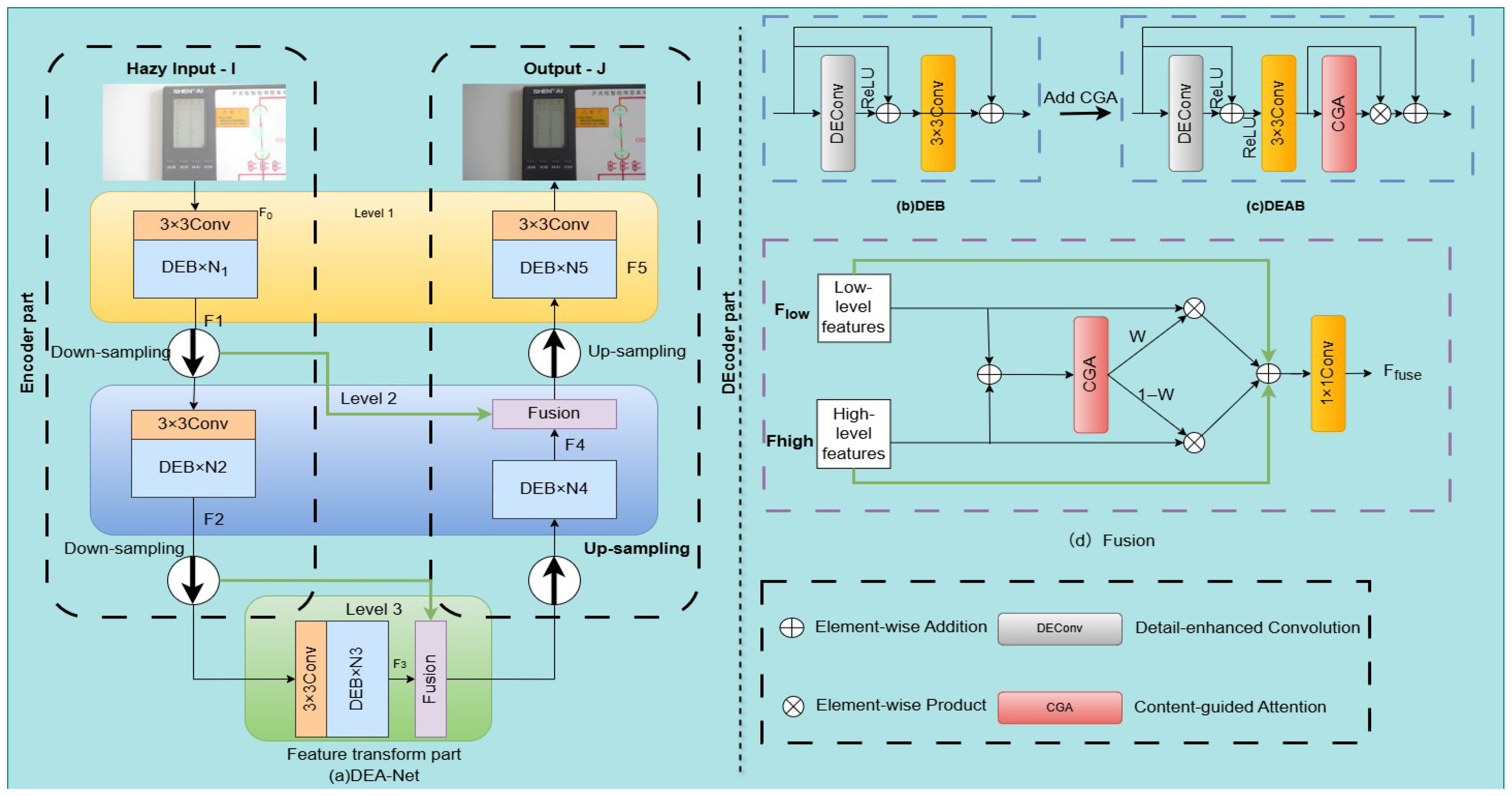
Details of the CGA-based hybrid fusion scheme are shown in Figure 5. The core part is shown in Figure 6, where we chose to use CGA to compute the spatial weights of the feature modulation. The low-level features from the encoder part and the corresponding high-level features are input to the CGA to compute the weights, which are then combined using a weighted summation method. We also add input features through jump connections to alleviate the gradient vanishing problem and simplify the learning process. Finally, the fused features are projected with 1 × 1 convolutional layers to obtain the final features (Ffuse). The CGA is a coarse-to-refinement process: a coarse version of the SIMs is first generated, and then refined for each channel guided by the input features.
Figure 5.
CGA module structure.
Figure 6.
CGAFusion module structure. The overall architecture of our proposed detail-enhanced attention network (DEA-Net), which is a three-level encoder-decoder-like architecture. DEANet contains three parts: encoder part, feature transform part, and decoder part. We deploy detail-enhanced attention blocks (DEABs) in the feature transform part, and deploy detail-enhanced blocks (DEBs) in rest parts.
4. Experiment Setup
4.1. Datasets
The performance of the model directly determines its practical effect in real scenes. In order to objectively assess the accuracy and generalization ability of the proposed method, the model needs to conduct experimental validation on a dataset to examine its comprehensive detection performance under the influence of fog, changes in lighting conditions, and image noise. The performance of deep neural networks is closely related to the quality, size and diversity of the training data.
Based on the workflow logic of the intelligent inspection trolley, which captures instruments first and extracts numerical values later, this study focuses on constructing a dataset for instrument detection and categorization, with the aim of providing high-precision localization information for the subsequent numerical value reading module. Specifically, this study adopts the combination of a self-constructed Custom Dataset and public dataset for verification. As shown in Table 1.
Table 1.
Number of dataset categories.
This customized dataset was captured over two days in the switch station of the 35 kV wind farm located on Heifeng Mountain in Linge County, Inner Mongolia Autonomous Region, using a Sony a6400 camera (Sony Corporation purchased in Hohhot, Inner Mongolia, China), under various weather and lighting conditions (sunny and cloudy days, noon and dusk). The dataset consists of 6050 images and covers three widely used instruments in the wind power plant: ammeters, voltmeters, and thermometers. Since multiple instruments often appear in the same image, the exact number of images for each category cannot be provided; however, the total number of labeled instances (bounding boxes) is 1624 ammeters, 5129 voltmeters, and 2073 thermometers. These images were captured from different angles, distances, and lighting conditions to enhance diversity. To improve the model’s robustness in harsh environments, data augmentation was performed using Python scripts, including dark channel prior simulation for fog, exposure adjustment, and Gaussian noise addition. All annotations were completed using the LabelMe tool to ensure consistency of bounding boxes and category labels. The dataset was divided into a 70% training set, a 20% validation set, and a 10% test set. Once approved, this dataset will be made public to facilitate reproducibility of the results.
In addition, an “Industrial instrument dataset” was introduced as a supplementary validation source. This publicly available dataset [please provide applicable references or links if available] contains 1848 images of industrial instruments, including ammeters, voltmeters, and thermometers, with a category distribution of 1448 ammeters, 1011 voltmeters, and 455 thermometers. This dataset was chosen because it provides images similar to fog, exposure adjustment, and Gaussian noise, and serves as a supplementary benchmark for evaluating the generalization ability of our model in different industrial environments but for the same problem. The dataset was divided into a 70% training set, a 20% validation set, and a 10% test set.
4.2. Experimental Environment
The experiments were conducted on a server. The hardware configuration includes an NVIDIA GeForce RTX 4090 graphics card (24 GB VRAM) with an Intel(R) Xeon(R) Gold 6430 processor, 24 GB of system RAM, and a 30 GB system drive (SSD/HDD). The software environment consisted of the Ubuntu 22.04 operating system; the programming language is Python 3.10, and the deep learning framework is PyTorch 2.1.0 with CUDA 12.1 to support GPU-accelerated computation. The specific software and hardware are shown in Table 2 and the corresponding software parameters are provided in Table 3.
Table 2.
Software and hardware configuration table.
Table 3.
Parameter settings.
The model training strategy and hyperparameter configuration critically influence convergence, generalization ability and final performance. Improper hyperparameter settings can easily lead to unstable optimization process or degradation of generalization ability, which in turn affects the effectiveness of the subsequent numerical reading module. In this experiment, 150 epochs are carried out for all models to ensure that the parameters converge sufficiently. The optimization algorithm adopts AdamW; the initial learning rate is set to 0.0001 and scheduled to decay to 0.01 using a cosine annealing strategy; the batch size is set to 8. In order to adapt to the computational constraints of the vehicle end of the inspection trolley and while maintaining accuracy, the resolution of the input image is fixed to 640 × 640 in the process of training, as shown in Table 3.
4.3. Evaluation Metrics
To evaluate overall performance for an object detector, we use four metrics to give a complete assessment on its quality. The accuracy of detected objects is measured by dividing true positives (TP), i.e., the number of correctly predicted positive examples, over false positives (FP), i.e., incorrectly predicted positive examples:
Detection Recall (recall): This metric quantifies how well a model is able to detect every target instance and it is given as TP over FN plus TP:
Average precision (AP) is proposed to eliminate these threshold restrictions, which calculates how stable our models are at different recall ranges through integration: we draw an area under the P-R curve based on a set of P-R pairs, and then calculate its area, which is a concise measure of the accuracy for various recall values:
Multi-class Detection: For multi-class detectors we report mean average precision (mAP), which is defined as an average value of the average precision over classes:
where N is the number of different categories (object classes) that need to be detected, and the metric function is widely used by common benchmarks such as COCO; it serves a two-fold purpose of measuring how well our model can identify common classes and how good is it at detecting uncommon ones as well. This yields a score between 0 and 1 that provides a neutral measure for how well the model in general detects objects.
This general evaluation metric can be calculated on several layers; accuracy and F1-score provide fine-grained information, average precision (AP) evaluates the varying detection ability on each class, and mAP provides an overall assessment for multiple-class object detection. These values are useful both as a guide on how the models could be improved, and as a contribution in the field of object detection techniques.
5. Experimental Results and Analysis
In the experimental section, we comprehensively evaluated and analyzed the proposed method. The experiments primarily relied on two datasets: the Custom Dataset and the Industrial Instrument Needle Dataset. We designed and executed multiple experiments, including method comparisons, ablation studies, generalization capability tests, and edge deployment validation. Except for the edge deployment experiments in Section 5.4, which did not utilize a specific dataset, all other experiments used the two aforementioned datasets.
5.1. Comparison Experiment
To validate the superiority of the HDC-RTDETR model in instrument needle detection, we compared it against several existing representative object detectors on both the Custom Dataset and the Industrial Instrument Needle Dataset. These detectors included YOLOv3n, YOLOv5n, YOLOv6n, YOLOv8, YOLOv9, YOLOv10, YOLOv11, and the RT-DETR series.
Table 4 shows the comparison trends on the Custom Dataset compared to multiple object detection methods including YOLOv3, YOLOv5, YOLOv8, YOLOv9, YOLOv11, RT-DETR-L, RT-DETR-X, RT-DETR-R50, and RT-DETR-R101.
Table 4.
Comparative experiments of different models on custom datasets.
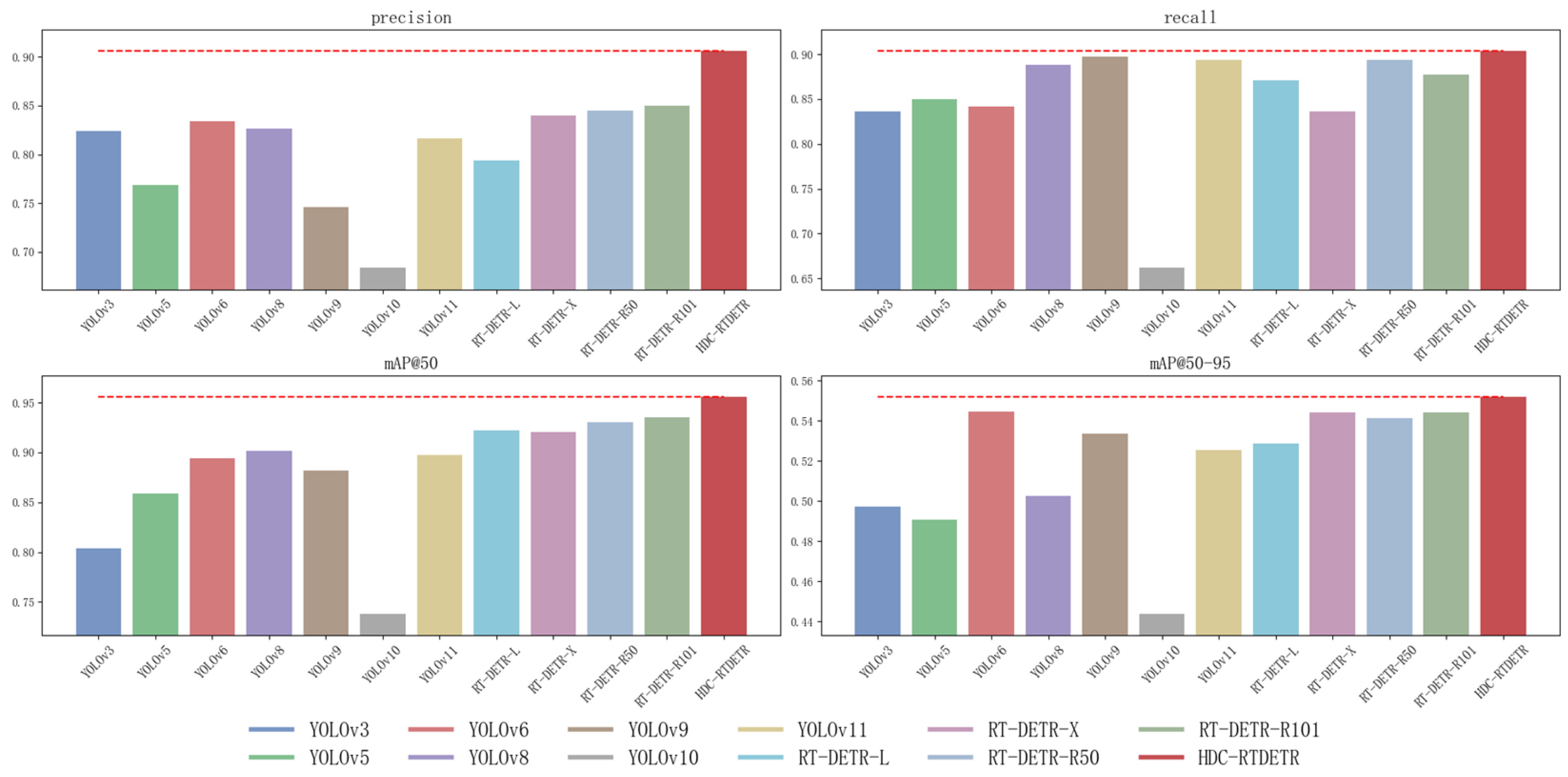
The HDC-RTDETR model achieved the best performance across all four evaluation metrics, with a precision of 90.557%, recall of 90.339%, and mAP@50-95 of 55.186%. Its model size is 65 MB, demonstrating excellent performance improvement, and the slight increase in data volume is acceptable.
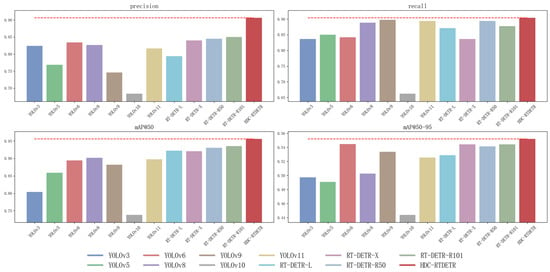
Figure 7 more intuitively demonstrates that HDC-RTDETR (labeled as HDC-RTDETR in the figure) significantly outperforms other comparison models across all metrics in the Custom Dataset.
Figure 7.
Comparison of HDC-RTDETR models under custom dataset.
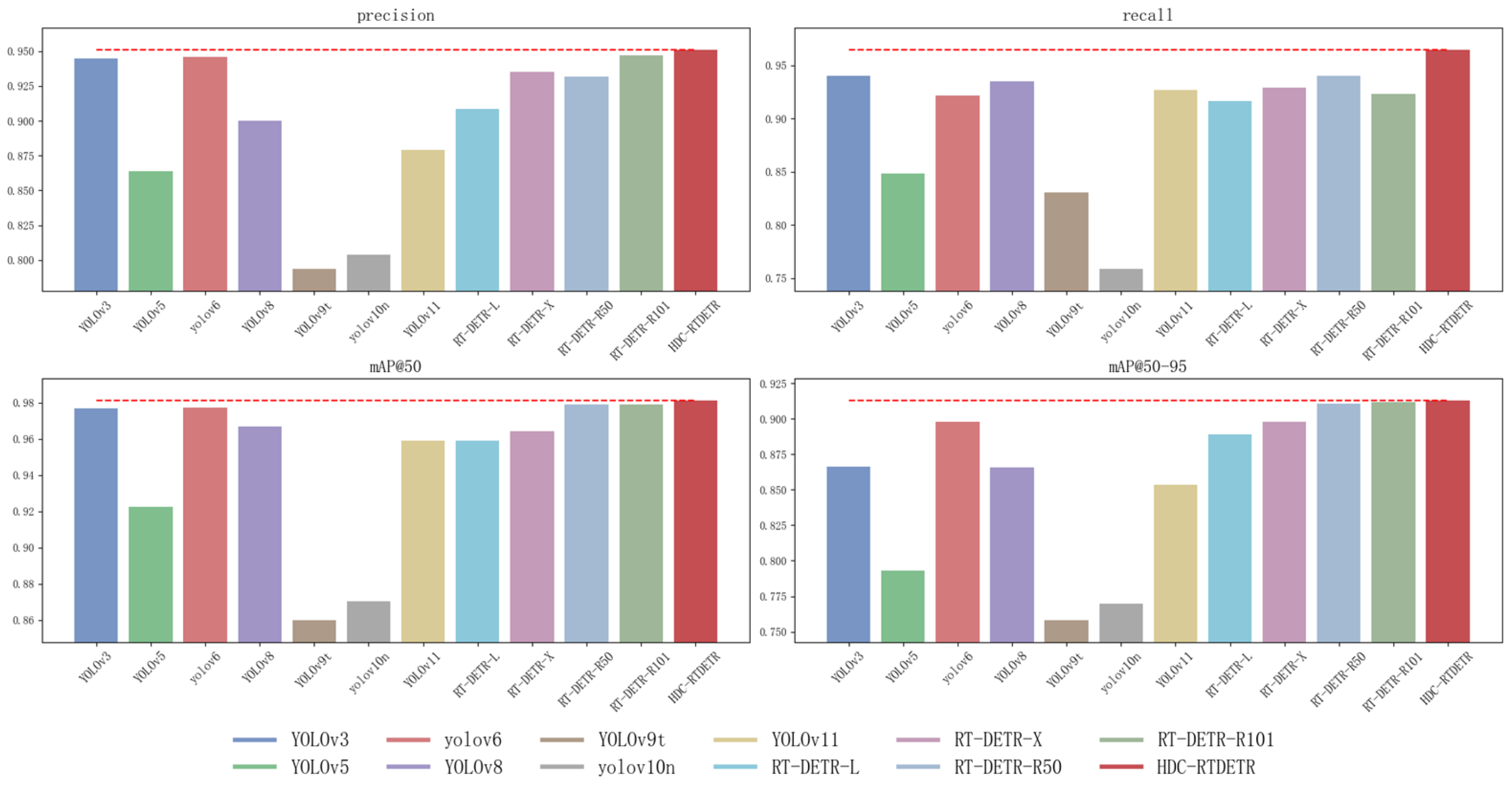
Table 5 shows that on the Industrial Instrument Needle Dataset, compared with multiple object detection models including YOLOv3, YOLOv5, YOLOv8, YOLOv9, YOLOv10, YOLOv11, RT-DETR-L, RT-DETR-X, RT-DETR-R50, and RT-DETR-R101, all four metrics show significant improvements. HDC-RTDETR achieved breakthrough progress on this dataset, with accuracy reaching 95.130%, recall improving to 96.482%, mAP@50 significantly increasing to 98.130%, and mAP@50-95 reaching 91.284%.
Table 5.
Comparative experiments of different models on the Industrial Instrument Needle Dataset.
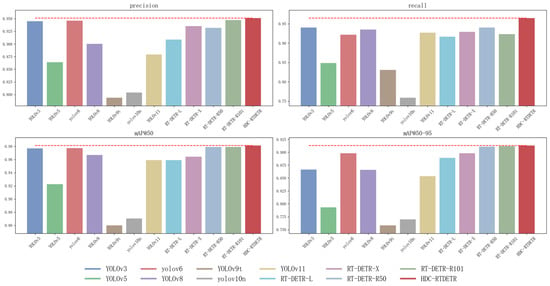
Consistent with the findings on the Custom Dataset, HDC-RTDETR also comprehensively outperformed other models on the Industrial Instrument Needle Dataset. Figure 8 demonstrates its outstanding performance across all metrics, particularly achieving scores close to or reaching 0.98 on mAP@0.50 and mAP@0.50-0.95, making it the top performer among all models.
Figure 8.
Comparison of models for the Industrial Instrument Needle Dataset.
In this work, we have systematically compared different object detection architectures for the industry use case and observed that classical YOLO networks, e.g., YOLOv3, YOLOv4, YOLOv5, YOLOv6, YOLOv7, YOLOv8, YOLOv9c, YOLOv10, and YOLOv11, have unsatisfactory robustness and mean average precision at an IoU threshold of 0.5 (mAP@50) in some extreme weather scenarios such as fog with dynamic lighting conditions and optical distortions, which makes it hard to satisfy high-precision requirements.
On the other hand, a series of RT-DETR models including RT-DETR-L, RT-DETR-X, RT-DETR-R50 and RT-DETR-R101 simplify the detection process by proposing novel queries and global attentions, to provide improved targeting accuracy, as well as increased mission capability. However, such Transformer models still have difficulties in balancing accuracy and inference efficiency, particularly when they are applied in complex industrial contexts.
Experimental results demonstrate that our proposed HDC-RTDETR model performs best among all models evaluated for the Industrial Instrument Needle Dataset, with encouraging scores, and achieved precision and recall values of 95.130% and 96.482% respectively. The mAP@50 is about 98.130% and the mAP@50-95 is about 91.284%. This proves that our approach effectively reduces performance drop on tough cases. Our design requires modest storage (around 65 MB); it is also computationally efficient, even though we were able to achieve significant improvement in the recognition accuracy. It is an alternative, more robust and efficient method of automatic industrial meter reading.
5.2. Ablation Experiment
We conducted extensive ablation studies for the proposed improved HDC-RTDETR model on these two datasets with different configurations and compared the performance results, as shown below. The comparison results of the Custom Dataset can be found in Table 6, whereas comparable results for the Industrial Instrument Needle Dataset are listed in Table 7. Further, in order to rigorously study the contribution of each individual modified component towards functionality and their transferability, we conducted a total of five parallel ablations on the public Custom Dataset.
Table 6.
Custom Dataset ablation experiment data comparison table.
Table 7.
Comparison of ablation experiment data for the Industrial Instrument Needle Dataset.
To analyze how much each component contributes to the model, we vary them individually and test them on HDC-RTDETR. E.g., for the Custom Dataset (Table 6), we can observe the following:
Baseline Experiment: In this baseline setting, we do not modify the original RT-DETR model and obtain a performance with an mAP@50 of 0.9218, serving as a baseline measure of effectiveness to which later comparisons are made.
Experiment II (CGAFusion): When integrating with CGAFusion in this experimental setting, we find that our proposed content-aware attention fusion module can also improve the network’s performances for foggy images by increasing the values of mAP@50 and mAP@50-95 by 1.074% and 1.164%, respectively. Our novel module learns the weights based on fog intensity, thus better extracting the important features and improving detection confidence under adverse weather conditions.
Experiment III setting (with DBlockC3): Using multi-scale convolutions helped to improve results, with increases of 1.284% for mAP@50 and 1.149% for mAP@50-95. The feature extraction unit employs multiple different sizes of convolution kernels simultaneously (i.e., 3 × 3, 5 × 5, and 7 × 7) to construct a variety of receptive fields, substantially enhancing the robustness of the model against changes in scale, and a more stable response for features on instruments with uneven lighting.
Experiment IV (with HSAN Module): The module Hybrid Scale Attention Normalization achieved the highest improvement in its own, and improved the mAP@50-95 value by about 2.172 percentage points. Our new module is based on group convolutions, which are used in conjunction with an inter-scale attention fusion mechanism for adaptive suppression of visual noise and object regions, thus enhancing the feature discrimination ability.
Experiment V (Implementation of Full Models): This experiment implements our three modules to form the complete HDC-RTDETR model. From Table 3, we observe that the full model has achieved a 3.390% increase in mAP@50 as well as an 11.20% boost in precision. The above findings verify that there are synergistic contributions from different components in our model; namely, HSAN first extracts and transforms features, and then DBlockC3 can enhance the multi-level feature expression ability and CGAFusion realizes adaptive fusion according to the contents, which jointly improves the model’s generalization capability in severe degradation scenarios.
To evaluate the generalization ability of these modules, we conduct five ablations that have exactly same structure on the Industrial Instrument Needle Dataset and show the results in Table 7.
We conducted several experiments to evaluate each improved component in the Industrial Instrument Needle Dataset, as described in detail and analyzed as follows:
Baseline Experiment: We firstly conducted some experiments in the simple RT-DETR-L architecture, and obtained a baseline AP50 of 0.95888, which became a baseline from which to build upon in all further modules.
Experiment II (CGAFusion): By adding the proposed module into the backbone, we obtain an increase of 1.074% in mAP@50. The key idea is to fuse features from different scales with self-attention guided by content information. Especially for poor weather conditions like fog, it greatly enhances detection and maintenance of critical regions of interest (ROIs) over instrumentation panels, which effectively reduces image deformation and loss-of-contrast problems, and, at the same time, improved robustness of the system in degraded operating environments.
Experiment III (with DBlockC3): The feature extraction module DBlockC3, which can extract multi-scale information, improves the mAP@50 by 1.284%. This proves that the design mechanism based on multi-branch parallel convolution has advantages, which enables multiple fields of view. In harsh conditions such as high-intensity lights, low light and varying lighting conditions, the proposed architecture is capable of capturing both local features and global context information, generating stronger features, and therefore becomes less sensitive to image illumination changes. It also generalizes well.
Experiment IV (Add HSAN): We add the proposed HSAN block to the baseline and further improve the mAP@50 by about 1.333%. This result proves that in case of severe visual noises, the multiple convolutions in a block along with the intra-attention and inter-attention help to filter out the noises as well as enhance the relevant features. As a result, it enhances the feature learning level of signals with respect to noise ratio and provides more discriminative features as inputs in head pose recognition.
Experiment V (All Specialized Modules for Final HDC-RTDETR): The last experiment was conducted by applying all three modules, resulting in the final HDC-RTDETR model. Its results were as follows: 0.98130 and 0.95130 on mAP@50 and precision, respectively, with a significant increase of 2.242% and 4%, respectively, and at the same time achieving better performances in terms of each metric.
CGAFusion + DBlockC3 + HSAN performs well when the three blocks complement each other: DBlockC3 handles illumination change, CGAFusion is used to alleviate the degradation of images caused by haze and HSAN is applied to suppress noise, which forms a “denoising (denoise)–refinement (refine)–attentive (attention)” pipeline from coarse to fine sequentially. This design significantly increases the robustness of features as well as the recognition rate of this network under adverse situations. In particular, it shows excellent precision value, which reflects the fact that it can significantly reduce false positives under an actual industrial application environment and thus meets a high availability requirement of operation use cases. The proposed approach can be used as an effective, interpretable model to perform reliable image classification when the input data are affected by different confounding sources.
To provide a detailed analysis on the advantages/disadvantages and feasibility for real-world application with various augmentation strategies, a total of 10 ablation experiments were conducted in an ordered manner in this paper, which can effectively verify the contribution of each optimization module one by one.
5.3. Generalization Experiment
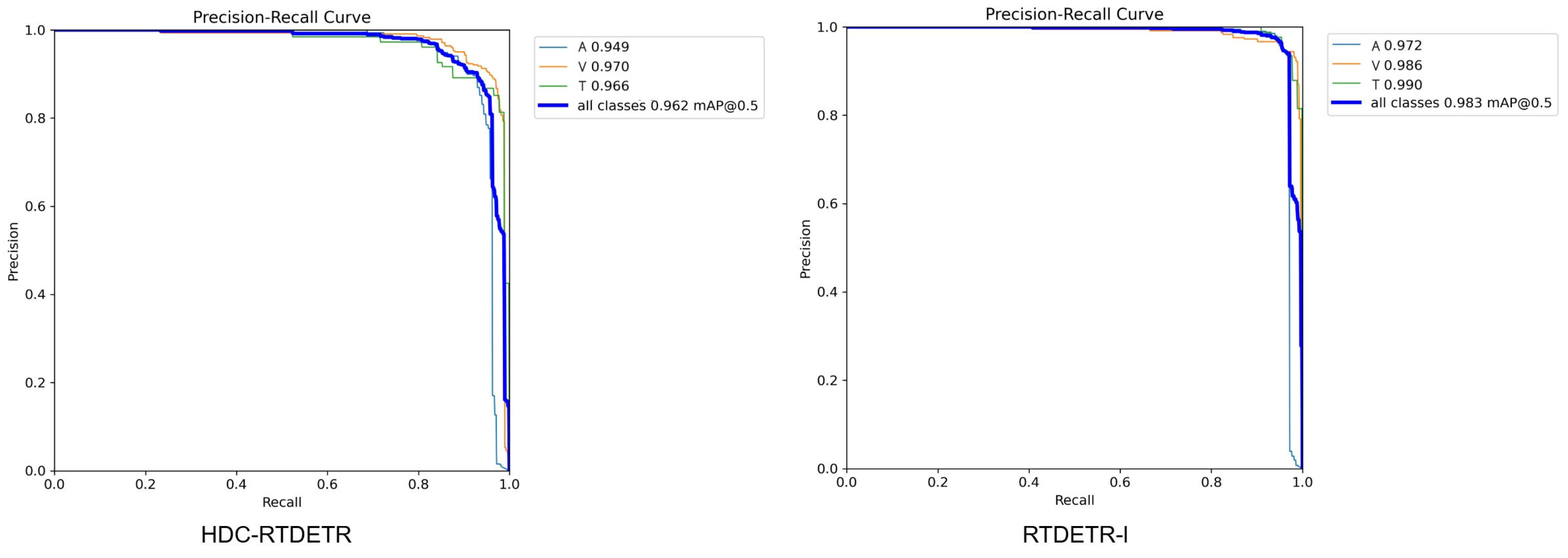
Extensive experiments are conducted with our Custom Dataset as well as the Industrial Instrument Needle Dataset. We compare precision–recall curves of the baseline model and HDC-RTDETR in the Custom Dataset below.
As shown in Figure 9, the P-R curve of the Custom Dataset generalization experiment demonstrates that HDC-RTDETR achieves a 4.1% overall improvement in mAP compared to the baseline model, indicating superior generalization capabilities. Furthermore, HDC-RTDETR exhibits significant performance gains across all three categories, with the most notable improvement observed in the “V” category, reaching 5.6%.
Figure 9.
Comparison of self-built PR_curve datasets (Note: A denotes ammeters, V denotes voltmeters, T denotes thermometers).
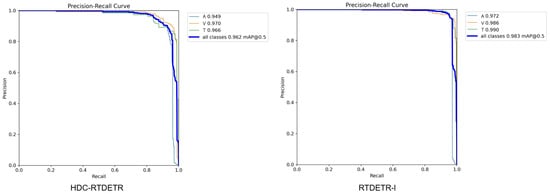
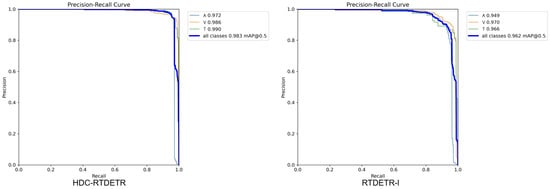
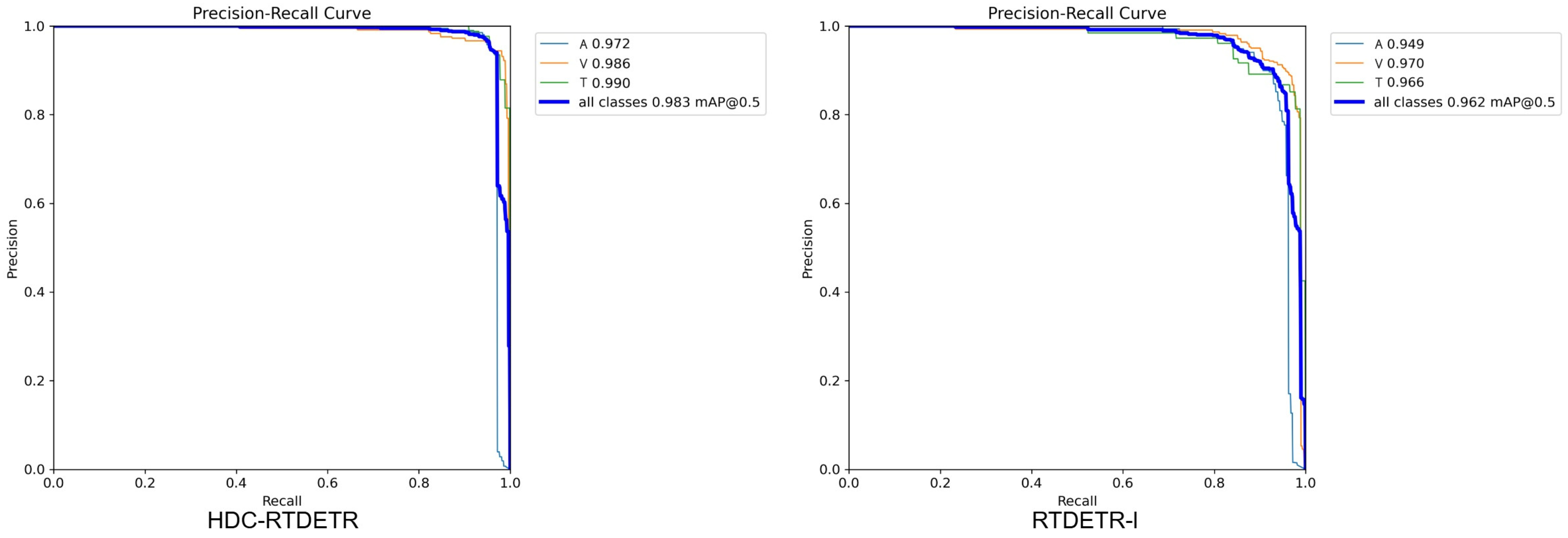
According to the P-R curve from the generalization experiment on the Industrial Instrument Needle Dataset in Figure 10, HDC-RTDETR achieves a 1.7% overall mAP improvement over the baseline model, demonstrating stronger generalization capabilities on this dataset. Furthermore, HDC-RTDETR shows performance gains across all three categories, with the most significant improvement of 2.4% observed in the “T” category. This result further validates the effectiveness of the model improvement strategy in enhancing cross-dataset generalization capabilities.
Figure 10.
PR_curve comparison chart for the Industrial Instrument Needle Dataset. (Note: A denotes ammeters, V denotes voltmeters, T denotes thermometers).
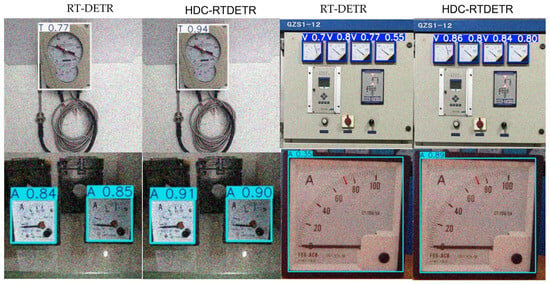
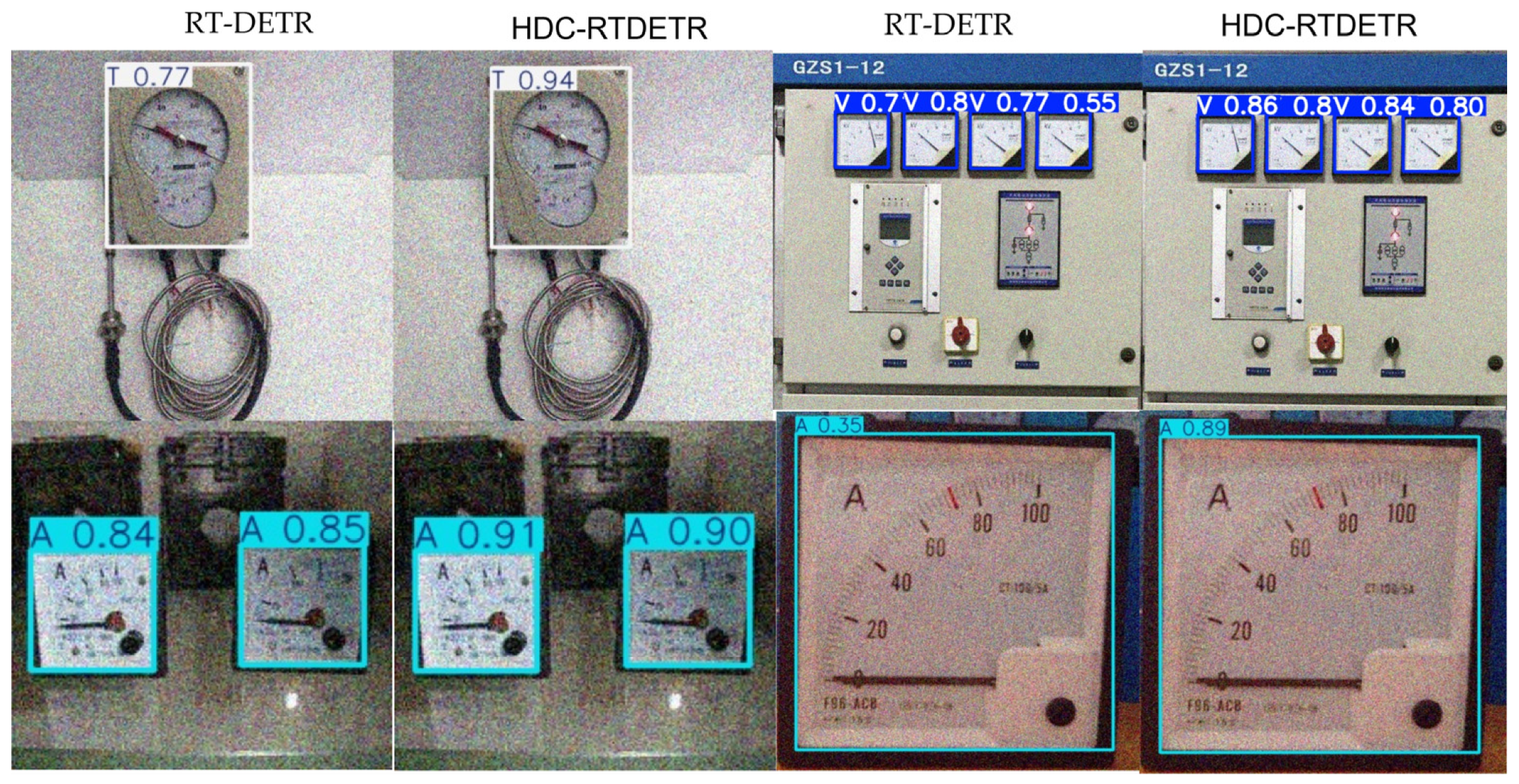
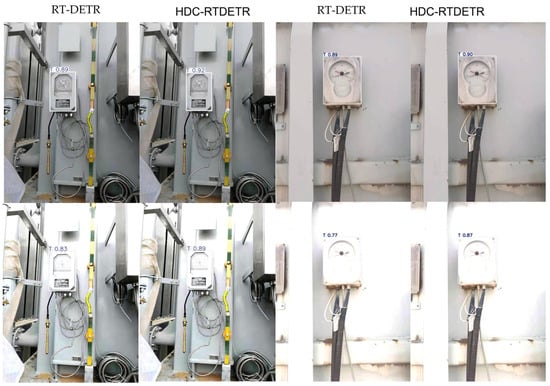
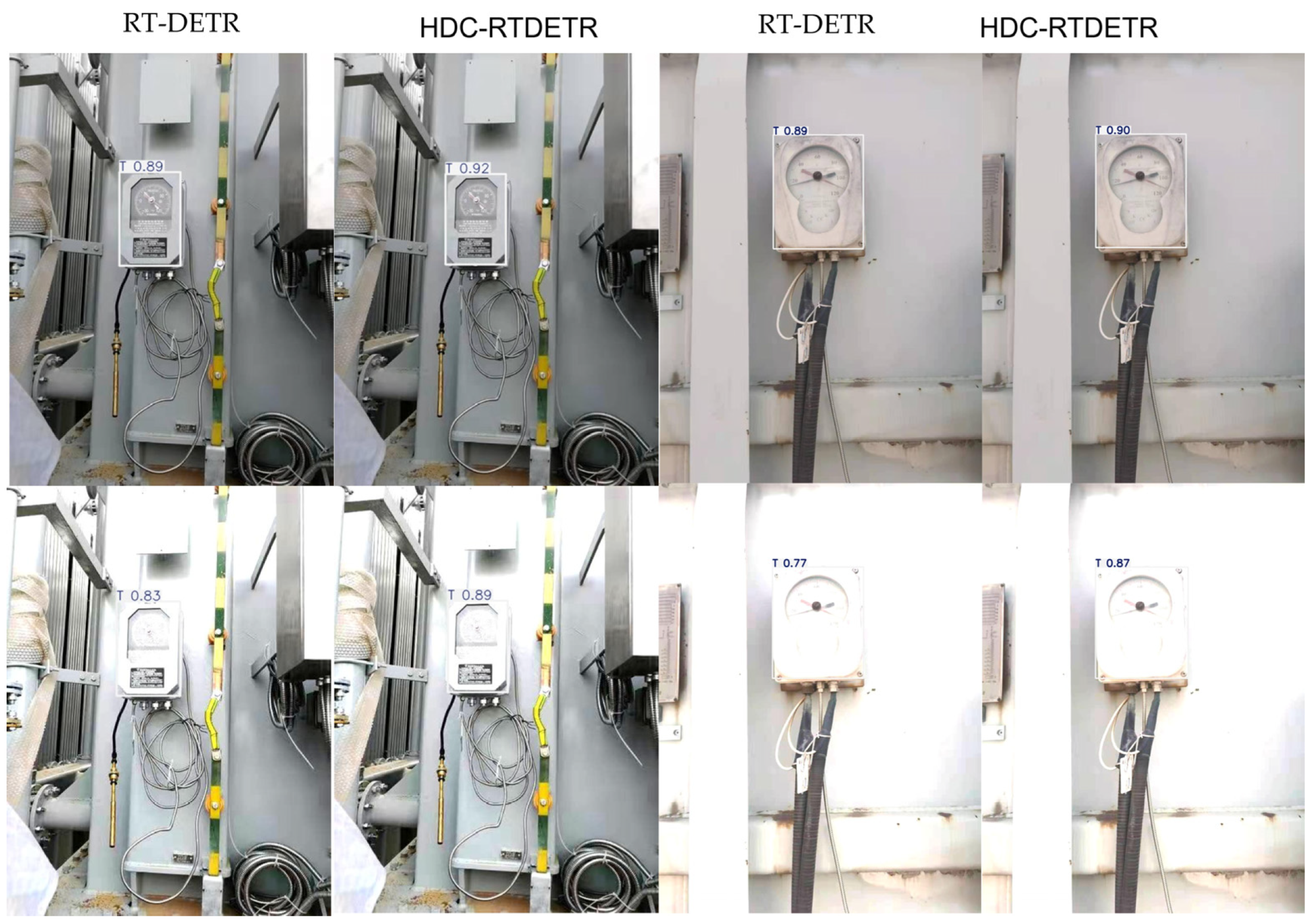
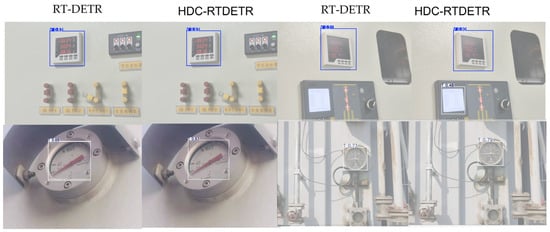
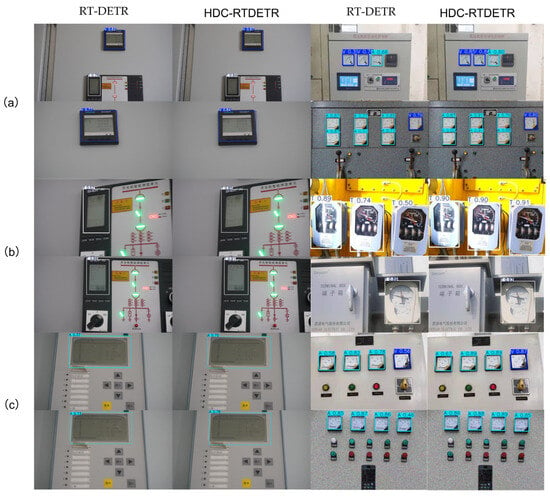
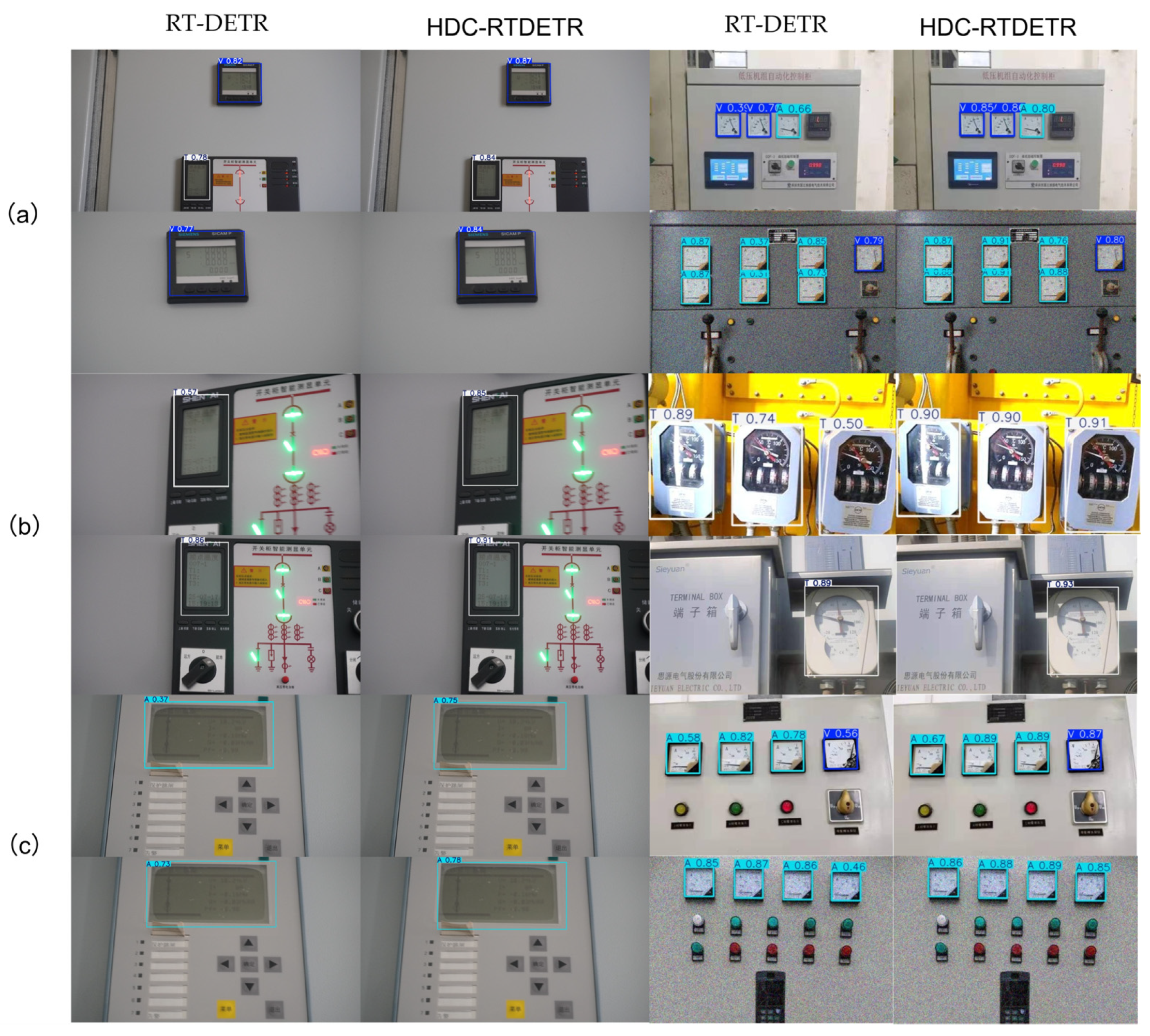
We also compared the actual detection results between HDC-RTDETR and the baseline model, as detailed in Figure 11, Figure 12, Figure 13 and Figure 14. The results show that while the original RT-DETR model can detect typical defects in wind turbine instruments, such as low confidence and missed detections, the proposed HDC-RTDETR model demonstrates higher detection accuracy in the instrument defect identification task. This model enhances feature discrimination capabilities by introducing a Content-Guided Attention Fusion (CGAFusion) module, improves multi-scale feature extraction through the differentiated convolutional module DBlockC3, and integrates a Hybrid Spatial Attention Network (HSAN) for adaptive enhancement of degraded images.
Figure 11.
Comparison of training results for image quality experiments with complex backgrounds (where V represents voltmeter, A represents ammeter, T represents thermometer, and the numbers on the right side of the letters indicate the confidence level).
Figure 12.
Comparison of inference results from light condition experiments (where V represents voltmeter, A represents ammeter, T represents thermometer, and the numbers on the right side of the letters indicate the confidence level).
Figure 13.
Comparison of fog experiment inference results (where V represents voltmeter, T represents thermometer, and the numbers on the right side of the letters indicate the confidence level).
Figure 14.
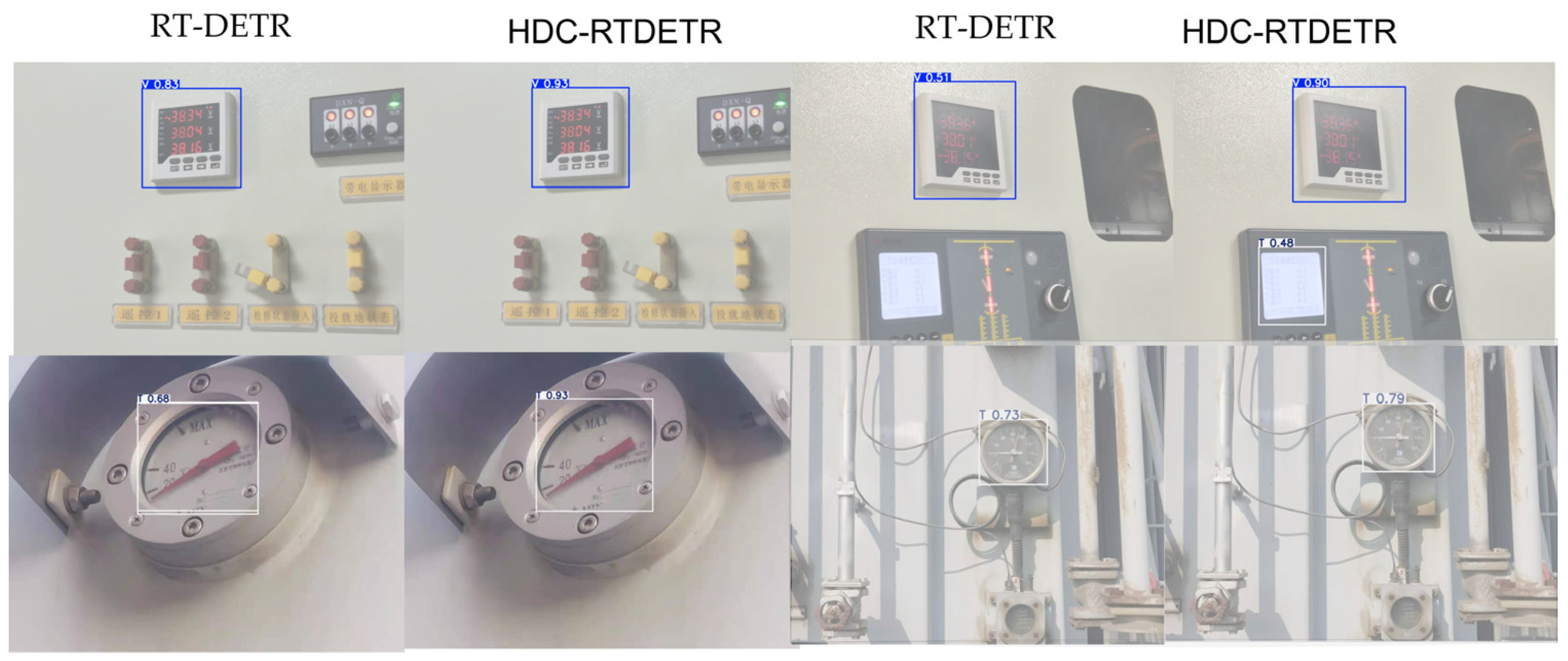
Comparison of experimental inference results (in the figure, (a), (b), and (c) respectively represent the voltage meter type, the thermometer type, and the current meter type, showing the detection effects of each type of instrument, where V represents voltmeter, A represents ammeter, T represents thermometer, and the numbers on the right side of the letters indicate the confidence level).
Figure 11 shows that in heavy-interference scenarios, the performance metrics of the improved HDC-RTDETR model are all higher than those of the original RT-DETR model, which is basically consistent with the expected results, which illustrates the robustness to noise of our new scheme.
In Figure 12, we present the qualitative comparison of RT-DETR and our improved HDC-RTDETR on detection accuracy with different illumination conditions. From the experimental result, it is shown that our proposed method performs better than RT-DETR as expected, especially when we focus on the fact that the latter is more robust in varying lighting conditions.
Figure 13’s qualitative results show that the enhanced HDC-RTDETR has better robustness under heavy fog conditions, where the enhancement module can compensate for image degradation caused by dense fog, therefore contributing to the improvement of mission reliability under harsh conditions.
As shown in Figure 14, the robustness of the proposed HDC-RTDETR is demonstrated on the three instrument recognition tasks. This architecture upgrade makes our model more confident in predicting results and hence results in improved performance for real world tasks.
5.4. Edge Deployment Experiment
To translate such improvements to a real-world production setting, it is important for the model architectures to be well suited for deployment on an edge device. In this paper we evaluate the performance of the improved RT-DETR-L design running on a Jetson AGX Orin device, on top of the aforementioned Edge-Node system, i.e., an ordinary edge computing platform, in order to practically evaluate how it works with low resources. The selected hardware platform offers the best compromise in terms of processing power, power consumption and system integration, making it an ideal candidate to be deployed on mobile platforms such as autonomous inspection robots.
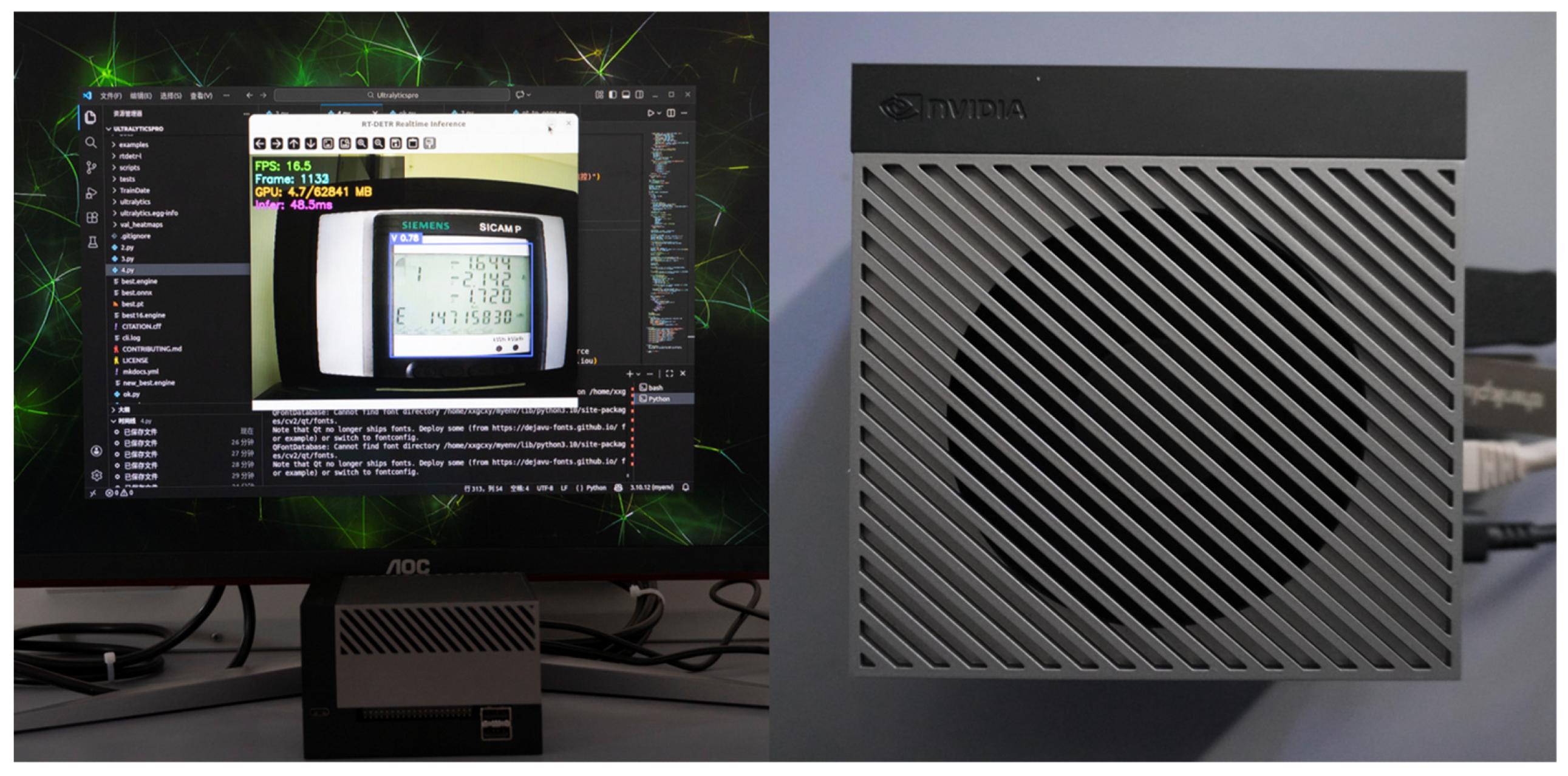
The test on the performance during deployment gave good results, but in executing hard meter reading tasks whilst simulating bad weather conditions such as haze and changes of light, the inference rate is about 16.5 FPS on the Jetson AGX Orin and can satisfy the requirement of processing video stream in almost real time in a lot of application scenarios (Figure 15). Note that this superior performance is achieved without compromising on either accuracy or efficiency (which can be achieved via post training quantization, etc.). The size of the parameter file for this neural network dropped down to about 4.7 megabytes and it required very little graphics processing unit memory at runtime. Together these optimizations prove that our model can achieve consistent and accurate detection with a low computing budget.
Figure 15.
Real-time deployment of the model on an NVIDIA Jetson AGX Orin.
This shows that the proposed HDC-RTDETR-L can be applied to actual situations, such as a wind power plant substation, as well as providing a baseline for other edge computing-based computer vision tasks. This simplicity in the design of our system as well as its optimization for production use are an important step toward applying experimental work into real-world applications, well suited to satisfy both real-time constraints and reliability demands that are imposed by industry applications.
6. Conclusions and Outlook
This paper presents HDC-RTDETR, an end-to-end Transformer-based detector tailored for industrial instrument recognition under adverse environmental conditions. The core contribution lies in a cascaded ‘filtering–refining–focusing’ architecture that progressively enhances feature representations. Specifically, the HSAN module first suppresses irrelevant background noise via adaptive feature preprocessing. Subsequently, the DBlockC3 block applies heterogeneous convolutions to capture multi-scale instrument appearances. Finally, the CGAFusion block integrates salient features through a lightweight feed-forward pass. Ablation studies confirm that each component contributes to the overall robustness, with the full cascade achieving state-of-the-art performance on foggy and low-illumination instrument datasets. Experimental results demonstrate that this method exhibits superior overall performance on both self-built and public datasets. Particularly when parameter variations are minimal, it outperforms larger baseline models while maintaining good computational speed. In industrial meter reading detection applications, both accuracy and recall exceed 95%, meeting the high availability standards required for practical implementation.
Therefore, HDC-RTDETR not only provides a highly robust solution for intelligent inspection of wind farm switchyards, but its modular design philosophy also offers a transferable technical approach for other industrial vision tasks facing similarly harsh environments, such as equipment condition monitoring. It is worth noting that the proposed method is expected to generalize to other industrial scenarios—such as substations, manufacturing plants, or outdoor pipelines—as well as to various types of instruments, provided that the target domain shares similar environmental challenges (e.g., low visibility, variable lighting) and that domain-specific data can be obtained for fine-tuning. However, this study has certain limitations. For example, the proposed method was primarily validated on datasets collected under foggy and low-light conditions, and its performance under other severe weather phenomena, such as heavy rain or instrument icing, remains to be investigated. Furthermore, although the model achieves a good balance between accuracy and speed, its computational overhead may still be prohibitive for deployment on edge devices with extremely limited resources. Future work will focus on extending this method to video sequence analysis to leverage temporal information for improved robustness, and on exploring the interpretability of its decision-making process to enhance trust in safety-critical applications. Furthermore, efforts will be directed toward model compression and lightweight design to enable broader deployment in real-time industrial scenarios.
Author Contributions
Conceptualization, W.S.; data curation, W.S. and Y.C.; formal analysis, Y.J.; validation, W.S. and Y.J.; writing—original draft preparation, W.S.; visualization, X.J.; supervision, X.J.; project administration, X.J. All authors have read and agreed to the published version of the manuscript.
Funding
The author sincerely expresses gratitude to the Innovation and Entrepreneurship Training Program for College Students in Inner Mongolia Autonomous Region (Project No.: S202510128014).
Data Availability Statement
The original contributions presented in this study are included in the article. Further inquiries can be directed to the corresponding author.
Conflicts of Interest
The authors declare no conflicts of interest.
References
- Jia, K.; Yang, X.; Peng, Z. Design of an integrated network order system for main distribution network considering power dispatch efficiency. Energy Inform. 2024, 7, 69. [Google Scholar] [CrossRef] [Scilit]
- Dimitrova, M.; Aminzadeh, A.; Meiabadi, M.S.; Karganroudi, S.S.; Taheri, H.; Ibrahim, H. A survey on non-destructive smart inspection of wind turbine blades based on industry 4.0 strategy. Appl. Mech. 2022, 3, 1299–1326. [Google Scholar] [CrossRef] [Scilit]
- Lin, M.; Lin, D.; Yue, P.; Chi, W.; Ma, X.; Huang, Y. Research on the Key Technology of Multi-sensor Fusion Environment Perception Based on Unmanned Patrol Vehicle. In International Conference on Advances in Construction Machinery and Vehicle Engineering; Springer Nature: Singapore, 2024; pp. 1329–1343. [Google Scholar]
- Jaber, A.; Sattarpanah Karganroudi, S.; Meiabadi, M.S.; Aminzadeh, A.; Ibrahim, H.; Adda, M.; Taheri, H. On smart geometric non-destructive evaluation: Inspection methods, overview, and challenges. Materials 2022, 15, 7187. [Google Scholar] [CrossRef] [Scilit] [PubMed]
- Wu, X.; Cao, X.; Ding, W.; Wang, P.; Yang, X.; Zhang, Y. Scheme evaluation method of coal gangue sorting robot system with time-varying multi-scenario based on deep learning. Sci. Rep. 2024, 14, 28063. [Google Scholar] [CrossRef] [Scilit]
- Ponnusamy, M.; Alagarsamy, A. Traffic monitoring in smart cities using internet of things assisted robotics. Mater. Today Proc. 2023, 81, 290–294. [Google Scholar] [CrossRef] [Scilit]
- Kou, L.; Li, Y.; Zhang, F.; Gong, X.; Hu, Y.; Yuan, Q.; Ke, W. Review on monitoring, operation and maintenance of smart offshore wind farms. Sensors 2022, 22, 2822. [Google Scholar] [CrossRef] [Scilit]
- Wang, Z.; Guo, Y.; Wang, H. Review on monitoring and operation-maintenance technology of far-reaching sea smart wind farms. J. Mar. Sci. Eng. 2022, 10, 820. [Google Scholar] [CrossRef] [Scilit]
- Kang, S.; Hu, Z.; Liu, L.; Zhang, K.; Cao, Z. Object detection YOLO algorithms and their industrial applications: Overview and comparative analysis. Electronics 2025, 14, 1104. [Google Scholar] [CrossRef] [Scilit]
- Girshick, R. Fast r-cnn. In Proceedings of the IEEE International Conference on Computer Vision, Santiago, Chile, 7–13 December 2015; pp. 1440–1448. [Google Scholar]
- Redmon, J.; Divvala, S.; Girshick, R.; Farhadi, A. You only look once: Unified, real-time object detection. In Proceedings of the IEEE Conference on Computer Vision and Pattern Recognition, Las Vegas, NV, USA, 27–30 June 2016; pp. 779–788. [Google Scholar]
- Carion, N.; Massa, F.; Synnaeve, G.; Usunier, N.; Kirillov, A.; Zagoruyko, S. End-to-end object detection with transformers. In European Conference on Computer Vision; Springer International Publishing: Cham, Switzerland, 2020; pp. 213–229. [Google Scholar]
- Zhu, T.; Li, L.; Yang, J.; Zhao, S.; Liu, H.; Qian, J. Multimodal sentiment analysis with image-text interaction network. IEEE Trans. Multimed. 2022, 25, 3375–3385. [Google Scholar] [CrossRef] [Scilit]
- Chen, Y.; Sun, H.; Tian, L.; Yang, Y.; Wang, S.; Wang, T. Detecting infrared UAVs on edge devices through lightweight instance segmentation. PLoS ONE 2025, 20, E0330074. [Google Scholar]
- Gu, Y.; Ren, C.; Chen, Q.; Bai, H.; Huang, Z.; Zou, L. A Conditionally Parameterized Feature Fusion U-Net for Building Change Detection. Sustainability 2024, 16, 9232. [Google Scholar] [CrossRef] [Scilit]
- Chen, L.; Zang, Z.; Huang, T.; Li, Z. Marine fish object detection based on YOLOv5 and attention mechanism. In 2022 IEEE Smartworld, Ubiquitous Intelligence & Computing, Scalable Computing & Communications, Digital Twin, Privacy Computing, Metaverse, Autonomous & Trusted Vehicles (SmartWorld/UIC/ScalCom/DigitalTwin/PriComp/Meta); IEEE: New York, NY, USA, 2022; pp. 1252–1258. [Google Scholar]
- Hou, L.; Wang, S.; Sun, X.; Mao, G. A pointer meter reading recognition method based on YOLOX and semantic segmentation technology. Measurement 2023, 218, 113241. [Google Scholar] [CrossRef] [Scilit]
- Feng, J.; Shen, W.Z. Modelling wind for wind farm layout optimization using joint distribution of wind speed and wind direction. Energies 2015, 8, 3075–3092. [Google Scholar] [CrossRef] [Scilit]
- Srivastava, L.; Yadav, D.K.; Kumar, A. Pothole Detection using Enhanced Compact Convolutional Transformer and YOLOv11 model. In Proceedings of the 2025 IEEE International Conference on Intelligent Signal Processing and Effective Communication Technologies (IN-SPECT), Gwalior, India, 7–8 November 2025; pp. 1–6. [Google Scholar] [CrossRef] [Scilit]
- Guo, L.; Song, J.; Li, X.; Huang, H.; Du, J.; Sheng, G. Single image haze removal using dark channel prior and adaptive transmission rate. In Proceedings of the 2018 2nd International Conference on Computer Science and Intelligent Communication (CSIC 2018), Xi’an, China, 16–17 August 2018; pp. 16–17. [Google Scholar]
- De Dravo, V.W.; Hardeberg, J.Y. Stress for dehazing. In 2015 Colour and Visual Computing Symposium (CVCS); IEEE: New York, NY, USA, 2015; pp. 1–6. [Google Scholar]
- Wang, Y.; Wang, Y. Fuzzy Q-learning-based energy management for fuel cell mobile robot considering multi-scenario parameter. Int. J. Hydrogen Energy 2025, 169, 150786. [Google Scholar] [CrossRef] [Scilit]
- Wang, Y.; Wang, Y. Interval adaptive multi-objective optimization of the proton exchange membrane fuel cell system considering parameter perturbation. Eng. Appl. Artif. Intell. 2026, 165, 113496. [Google Scholar] [CrossRef] [Scilit]
- Xie, Y.; Xie, Y.; Chen, L.; Li, C.; Qu, Y. Object detection in real-world hazy scene. J. Comput. Aided Des. Comput. Graph. 2021, 33, 733–745. [Google Scholar]
- Hu, M.; Li, Y.; Fan, J.; Jing, B. Joint semantic deep learning algorithm for object detection under foggy road conditions. Mathematics 2022, 10, 4526. [Google Scholar] [CrossRef] [Scilit]
- Liu, B.; Jin, J.; Zhang, Y.; Sun, C. WRRT-DETR: Weather-robust RT-DETR for drone-view object detection in adverse weather. Drones 2025, 9, 369. [Google Scholar] [CrossRef] [Scilit]
- Sun, B.; Tang, H.; Gao, L.; Bi, K.; Wen, J. RTDETR-MARD: A Multi-Scale Adaptive Real-Time Framework for Floating Waste Detection in Aquatic Environments. J. Mar. Sci. Eng. 2025, 13, 996. [Google Scholar]
- Zhang, Y.; Ge, H.; Lin, Q.; Zhang, M.; Sun, Q. Research of maritime object detection method in foggy environment based on improved model SRC-YOLO. Sensors 2022, 22, 7786. [Google Scholar] [CrossRef] [Scilit]
- Liu, Z.; Sun, C.; Wang, X. DST-DETR: Image Dehazing RT-DETR for safety helmet detection in foggy weather. Sensors 2024, 24, 4628. [Google Scholar] [CrossRef] [Scilit]
- Kim, H.; Tyagi, S.; Tiwari, N. A Review on Fog Removal with Its Techniques and Types. Int. J. Smart Bus. Technol. 2015, 3, 39–48. [Google Scholar] [CrossRef] [Scilit]

Disclaimer/Publisher’s Note: The statements, opinions and data contained in all publications are solely those of the individual author(s) and contributor(s) and not of MDPI and/or the editor(s). MDPI and/or the editor(s) disclaim responsibility for any injury to people or property resulting from any ideas, methods, instructions or products referred to in the content. |
© 2026 by the authors. Licensee MDPI, Basel, Switzerland. This article is an open access article distributed under the terms and conditions of the Creative Commons Attribution (CC BY) license.