


Abstract
This paper investigates the consensus problem for a class of uncertain nonlinear multi-agent systems (MASs) subject to external disturbances with unknown control directions (UCDs). A novel control scheme integrating Nussbaum-type gain is proposed to actively compensate for UCDs, while fuzzy logic systems (FLSs) are embedded in a feed-forward compensator to approximate unknown nonlinear dynamics, thereby achieving global stability. The proposed distributed control laws ensure global asymptotic convergence for both first- and second-order MASs through Lyapunov stability analysis. By implementing a strategic reparameterization technique, this scheme systematically reduces computational complexity, requiring each agent to adapt only a minimal parameter set. Moreover, the framework is extended to address complex formation control tasks. Comprehensive simulations validate the efficacy of the theoretical findings.
1. Introduction
There exist numerous interesting collective behaviors in nature, such as fish schooling, ant foraging, and bird flocking. These behaviors share a common characteristic in that a group consists of multiple individuals, each possessing relatively simple functionalities. By exploiting only local information and cooperating with neighboring individuals, complex collective tasks can be accomplished. Inspired by such phenomena, the concept of an agent was first introduced by Minsky [1]. An agent is defined as an autonomous entity equipped with sensing, storage, computation, and communication capabilities. A multi-agent system (MAS) comprises multiple agents that interact with one another through local information exchange to collaboratively accomplish specific tasks [2]. Owing to their advantages of low operational cost, strong robustness, high efficiency, and high fault tolerance, MASs have attracted increasing attention in recent years [3,4,5]. Along with the ongoing development of distributed intelligence, MASs have become a prominent research topic in the field of control, exhibiting significant theoretical importance and broad application potential.
Coordinated control constitutes one of the fundamental research topics in MASs and can generally be categorized into centralized and distributed control frameworks. Although centralized control has been extensively studied and applied in engineering practice, it often suffers from high computational complexity and poor scalability. More critically, the failure of the center coordinator may lead to the collapse of the entire system. In contrast, distributed control relies solely on local information exchange, such that the malfunction of an individual agent affects only its neighboring agents rather than the whole system. As a result, distributed control is regarded as a more practical and reliable paradigm for large-scale MASs. Consensus control represents a cornerstone problem in distributed coordinated control of MASs. The consensus problem focuses on designing distributed controllers based on local interactions, under which all agents asymptotically reach an identical state or trajectory [4,5,6,7,8,9]. Owing to its fundamental role, consensus theory has found extensive applications in various cooperative control scenarios, including satellite attitude coordination [10], unmanned aerial vehicle (UAV) formation control [11], and multi-robot aggregation [12]. Over the past few years, the consensus problem has attracted significant interest in MASs, and a large number of theoretical and application-oriented results have been reported [13,14,15,16,17,18].
From the perspective of control directions, consensus problems in MASs can be broadly classified into two categories: known control directions (KCDs) and unknown control directions (UCDs). In MASs with UCDs, the sign of the control gain associated with the control input is unknown, which fundamentally distinguishes them from MASs with KCDs. Such unknown control directions may arise from actuator faults, unmodeled actuator dynamics, parameter uncertainties, or inaccurate system identification and are commonly encountered in practical engineering systems. Since MASs with KCDs can be regarded as a special case of MASs with UCDs, the investigation of MASs with UCDs is more general. However, the presence of UCDs poses substantial challenges to controller design, as conventional adaptive or consensus control schemes typically rely on the known sign of the control gain and may fail to guarantee stability when this assumption is violated. This observation also constitutes the main motivation of this paper.
In recent years, consensus control of MASs with UCDs has attracted considerable attention, and numerous significant results have been presented in prior studies. Specifically, consensus problems of first- and second-order linearly parameterized MASs subject to UCDs were investigated in ref. [19,20,21] by employing Nussbaum-type gain techniques. For high-order MASs with UCDs, adaptive backstepping-based approaches were developed in [22,23,24]. Furthermore, consensus control of nonlinear MASs subject to non-identical partially UCDs and bounded modeling uncertainties was studied in [25,26,27]. Overall, the above works mainly focused on deterministic nonlinear MASs or linearly parameterized uncertain MASs with UCDs.
In many practical applications, however, the system dynamics are often subject to multiple sources of uncertainty, including unknown nonlinear functions, external disturbances, and unmodeled dynamics. These uncertainties significantly complicate the consensus control problem, especially when combined with unknown control directions. To cope with such difficulties, adaptive fuzzy logic systems (FLSs) and neural networks (NNs)-based control methods have been introduced, leading to a series of significant advances. In particular, Nussbaum-type gains combined with NNs approximation techniques were utilized in [28,29] to address consensus problems for uncertain nonlinear MASs subject to unknown state-dependent control gains. Leader–follower coordination in uncertain affine nonlinear MASs subject to UCDs was studied in [30,31] using FLSs-based approaches. Moreover, consensus problems for uncertain non-affine and affine nonlinear MASs with UCDs were addressed via backstepping techniques in ref. [32]. Ref. [33] investigates the learning consensus control and formation control for uncertain parameterized nonlinear MASs with heterogeneous partially UCDs.
Despite these encouraging results, most existing studies only guarantee semi-global consensus, which requires the initial states of all agents to lie within a prescribed compact set. Such restrictive conditions may be difficult to satisfy in real-world applications operating in uncertain environments, such as cooperative exploration, reconnaissance, and coordinated operation of multiple UAVs. Therefore, the development of effective global consensus controllers for uncertain nonlinear MASs with UCDs remains a challenging and practically important problem.
The main challenges in addressing this problem lie in the following aspects. First, the presence of unknown control directions implies that the control gain associated with each agent’s input channel has an unknown sign, which invalidates a fundamental assumption underlying most classical consensus and adaptive control schemes. Without appropriate treatment, this uncertainty may cause the control input to amplify, rather than attenuate, the consensus error, potentially leading to instability. Second, the agents are subject to unknown nonlinear dynamics and external disturbances, which precludes the direct application of model-based consensus control methods. Moreover, these uncertainties enter the closed-loop dynamics in a nonlinear and coupled manner, significantly complicating the Lyapunov stability analysis. Third, achieving global consensus is intrinsically difficult, since most existing results for uncertain nonlinear MASs with UCDs are limited to semi-global convergence. Removing the dependence on prescribed compact initial sets requires guaranteeing the boundedness and convergence of all closed-loop signals for arbitrary initial conditions.
Based on the above discussion, this work focuses on solving the global consensus problem for first-order and second-order uncertain nonlinear MASs subject to UCDs and external disturbances by employing FLSs. The primary contributions are listed below.
(1) For uncertain nonlinear MASs subject to UCDs, existing feedback compensation methods employing FLSs or NNs can typically guarantee semi-global consensus. This paper introduces the FLSs-based approach to approximate the uncertain nonlinear dynamics, while a Nussbaum-type gain mechanism is incorporated to effectively compensate for UCDs.
(2) By employing Lyapunov stability analysis, we rigorously prove that the proposed adaptive distributed control protocol ensures global asymptotic consensus in both first- and second-order MASs. Moreover, this paper employs a reparameterization technique, which requires estimating only the upper bound of the fuzzy weight parameter norm for each agent, thereby significantly reducing the computational complexity without compromising the global consensus performance.
(3) Furthermore, the proposed global fuzzy consensus control framework is applied to formation control problems of first- and second-order uncertain nonlinear MASs subject to UCDs, which demonstrates its flexibility and applicability.
The following sections of the paper are organized as follows. Section 2 introduces the preliminaries. Section 3 develops the main global consensus results. Section 4 extends the proposed framework to formation control problems, followed by simulation results in Section 5 to verify the proposed methods. The conclusions are drawn in Section 6.
Notations: is the absolute value of a real number, and is the Euclidean norm (for vector or matrix). The shorthand represents a diagonal matrix with diagonal elements . Matrix indicates that Q is negative definite. represents the maximum eigenvalue of matrix H. is a symbolic function. .
2. Preliminaries
Consider an undirected graph , where is the vertices set, and denotes the edges set. The corresponding weighted adjacency matrix of is given by , where if nodes and are connected, and otherwise; all diagonal elements satisfy (i.e., no self-loops). The neighbors of node are collected in the set . The Laplacian matrix L is defined as , with and . The graph is connected if a path exists between every pair of distinct nodes.
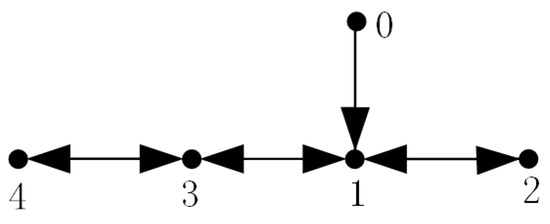
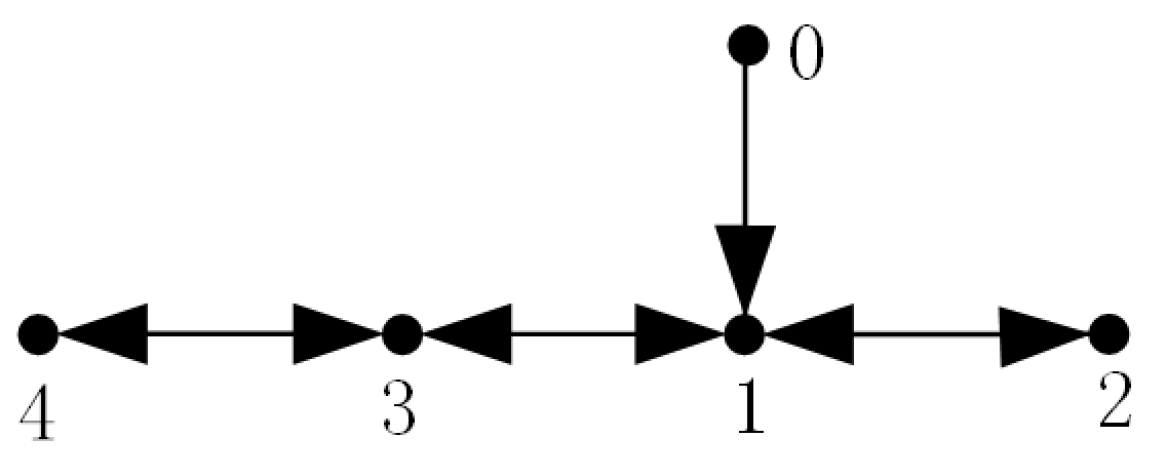
Consider a leader-following MAS with an augmented graph . Let the leader be denoted as node , and define the vertex set as . The edges from leader to followers are directed, with connection weights . Here, indicates that follower i has access to the leader’s information; otherwise, . Define , and is a symmetric matrix associated with graph . Figure 1 illustrates an example of the communication topology , with node 0 representing the leader, and others represent followers. This topology will also be used in the simulations in Section 5.
Figure 1.
Communication graph .
Remark 1.
In this paper, the undirected communication graph refers specifically to the interaction topology among the follower agents, while the information exchange between the leader and the followers is inherently directed and is modeled via pinning terms. The main results of this paper are established under the assumption that the follower communication topology is fixed and undirected. This assumption is crucial for the subsequent stability analysis, since the Laplacian matrix associated with an undirected graph is symmetric and positive semidefinite. For general directed or directed switching communication topologies, the Laplacian matrix is typically nonsymmetric, and the analytical framework adopted in this paper is no longer directly applicable. Extending the present results to such cases would require the introduction of additional graph-theoretic tools and new Lyapunov function constructions, which will be considered in future work.
Lemma 1
([26]). For a connected graph , the associated matrix H satisfies .
Lemma 2
(Barbalat’s Lemma [25]). If the converges, with uniformly continuous, then .
Lemma 3
([26]). For any and , the following inequality holds:
where .
Lemma 4
(Nussbaum Lemma [34]). Consider smooth functions and on the interval , where . Suppose that the condition below holds:
where is a Nussbaum-type function, with , ; and are constants; and all have the same sign. Then, , and are all bounded on .
3. Consensus Control of Uncertain Nonlinear MASs with Unknown Control Directions
3.1. First-Order Uncertain Nonlinear MASs
Consider the first-order leader-following MAS, where each follower i is governed by the following dynamics:
where represents the follower i’s state, and is the corresponding control input; the term denotes an uncertain nonlinear function, while stands for an external disturbance, which is assumed to be bounded as , with being an unknown constant; have the same unknown sign, and with .
The assumption imposed on is standard in the literature on Nussbaum-type adaptive control and ensures that a unified compensation mechanism can be constructed. In practice, such bounds are typically available or can be conservatively estimated based on actuator characteristics, physical constraints, or prior system identification results, even when the exact values and signs of the control gains are unknown. If the bounds and were completely unknown, the subsequent Lyapunov-based analysis would no longer be directly applicable, and additional adaptive mechanisms or robustness tools would be required.
The dynamics of the leader are characterized by
where is the leader’s state, and is an unknown nonlinear function.
The consensus errors for MASs (1)–(2) are described as
The control objective is to design for each agent such that , as .
Assumption 1.
For each follower i, the unknown nonlinear function is Lipschitz continuous.
Assumption 2.
For the leader agent, the following conditions are assumed to hold: (i) the leader’s state remains bounded, that is, there exists a constant such that ; (ii) there exists a continuous function such that .
Remark 2.
Since the leader functions as a command generator, Assumption 2 (i) is reasonable and practically justified. Moreover, there exists the constant such that , according to Assumption 2 (ii), where .
FLSs are typically employed as feedback compensators to approximate the unknown nonlinearities , and such approaches generally guarantee only semi-global consensus for the resulting MASs in the previous works. To overcome this limitation, we reformulate as follows:
where .
According to Assumption 1, we have the following inequality:
The uncertain function in (4) is approximated using an FLSs as a compensator:
where denotes the fuzzy weight vector; represents the fuzzy basis function vector; and represents the approximation error, which satisfies for unknown constant . Moreover, is bounded since the vector function is continuous on the compact set . That is, there exists a positive constant such that .
The neighborhood consensus error associated with follower i is defined by
Then, the expression can be written in matrix form as
where , , and .
Substituting (4) and (6) into (1), we have
Taking the derivative of Equation (8) leads to
where .
The controller for follower i is designed as follows:
where is a Nussbaum-type function defined as in Lemma 4; represents a control gain that varies over time; and and provide online estimates for the unknown parameters and , respectively, with , .
The design of adaptive parameters , , and is
where , , and are constants.
In the proposed control framework, FLSs are not implemented as explicit online fuzzy inference modules. Rather, they are introduced as function approximation tools for the analysis phase, where unknown nonlinearities are approximated by linearly parameterized forms. Specifically, the unknown dynamics are expressed as (6), which facilitates the derivation of Lyapunov-based stability results by bounding the nonlinearities in terms of . FLSs serve as analytical devices to enable global consensus results and do not require real-time fuzzy inference during implementation. The control laws are expressed in terms of consensus errors, adaptive variables, and Nussbaum-type terms, without requiring the explicit computation of fuzzy outputs.
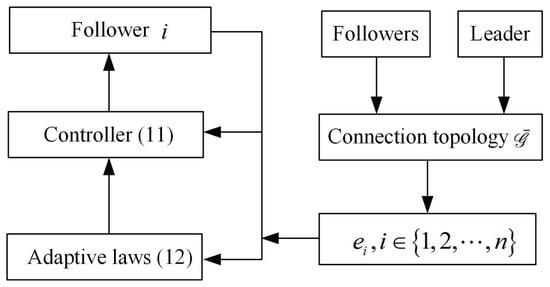
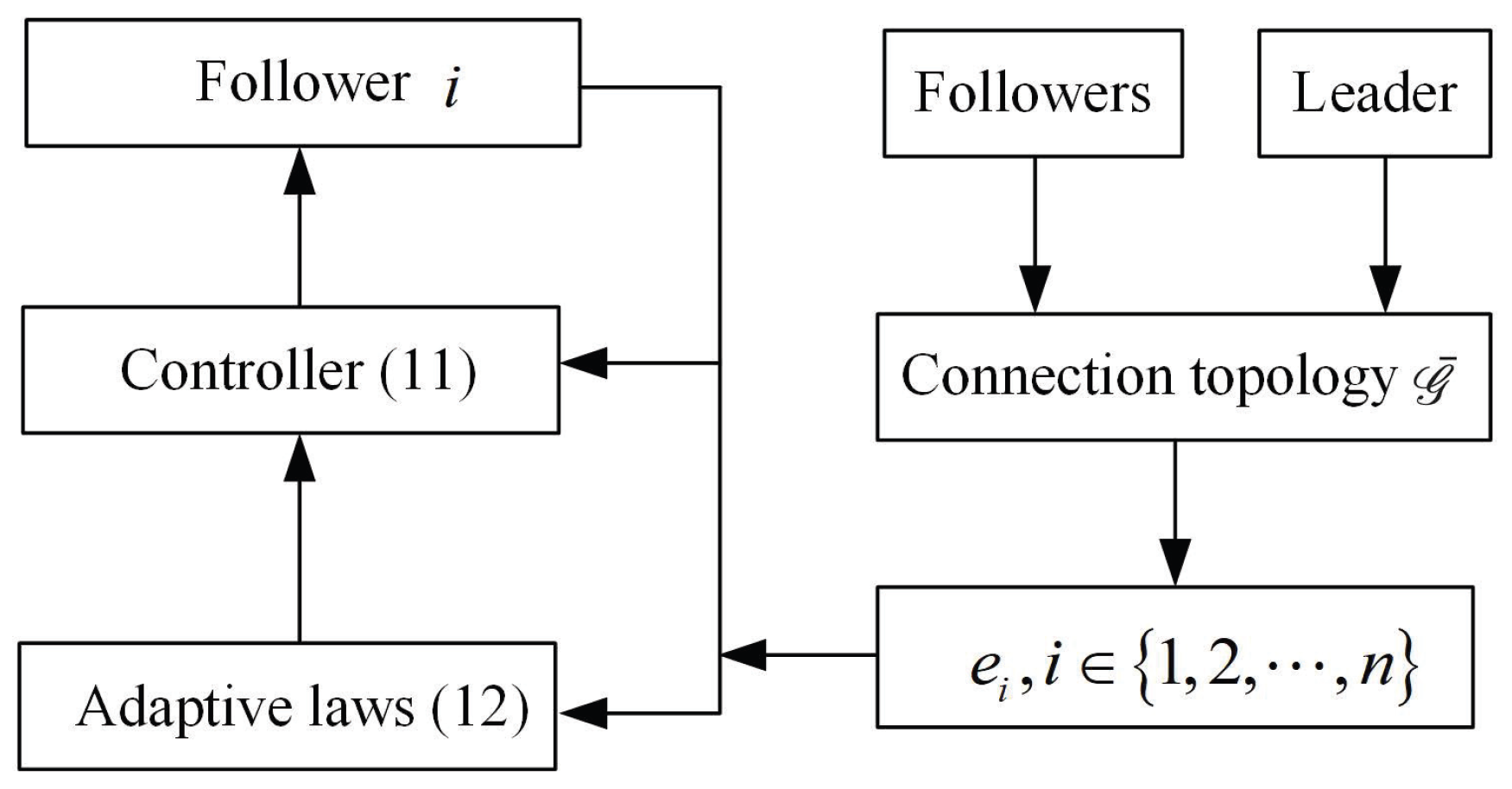
The structure of the adaptive control scheme is depicted in Figure 2. Especially, note that satisfies Assumption 3.
Figure 2.
Schematic of distributed control scheme.
Assumption 3.
is a continuous function satisfying , and .
Remark 3.
In the controller (11), is a prescribed parameter varying over time. To facilitate the Lyapunov-based analysis, we impose the following growth constraint for , formalized as Assumption 3. This assumption can be satisfied by a wide range of common functions, such as , . It is worth noting that the specific growth rate of does not affect the asymptotic convergence property of the closed-loop system but mainly influences the transient behavior and convergence speed. In general, a faster growth rate of leads to faster convergence of the consensus errors at the expense of a larger control effort, whereas a slower growth rate results in smoother transients with reduced control amplitudes. Therefore, provides a degree of design flexibility that allows a trade-off between the convergence speed and control effort, while the global stability results remain valid for any function satisfying Assumption 3.
Theorem 1.
Assume the augmented graph is connected. If the parameter ℏ satisfies
then under the control protocol (11) with adaptive laws (12), MASs (1)–(2) achieve the global asymptotical consensus.
Proof.
Consider the Lyapunov candidate function:
where , ; the constant will be determined later.
Since the follower communication graph is undirected and connected, and at least one follower is pinned to the leader, the augmented Laplacian matrix H is symmetric positive definite. Consequently, exists and is also symmetric positive definite, which guarantees that V is positive definite with respect to the consensus error e.
Taking the derivative with respect to time of , we have
According to (9)–(11), it follows that
where . Applying Young’s inequality , the following result can be yielded:
Moreover, utilizing (5) and Assumption 1 and 2, we obtain
where .
Substituting Equations (12) and (16) into (14), we get
Choosing sufficiently large such that , one can derive
where the first inequality applies Lemma 3.
When both sides of (18) are integrated from 0 to t, we obtain
From Assumption 3, we have . Hence, the constant exists such that . Substituting this into (19) yields
Let , and . From Lemma 4, , and are all bounded on . Furthermore, from (19), is integrable on . Applying Lemma 2 gives , . Finally, from (8), it follows that . □
Remark 4.
The global consensus result established in this paper is obtained under several boundedness-related assumptions, including global Lipschitz-type properties of the unknown nonlinearities and the boundedness of the leader’s state and dynamics on compact sets. These assumptions do not imply that the system is required to operate over an arbitrarily unbounded state space. Instead, they ensure that convergence and stability are guaranteed for all admissible initial conditions within physically meaningful operating regions. In practical systems, such bounds are commonly available or can be conservatively estimated due to physical constraints, actuator limitations, safety requirements, or mission specifications. For example, the compact sets and can be determined based on known operating envelopes of agents and reference trajectories or obtained from prior system knowledge and design specifications. It should be noted that if the leader’s state or system nonlinearities were allowed to grow without bound, the current Lyapunov-based analysis would no longer be applicable. Relaxing these boundedness assumptions would require fundamentally different analytical tools, which remains an open topic for future research.
3.2. Second-Order Uncertain Nonlinear MASs
This subsection addresses the global consensus problem for second-order unknown MASs with UCDs. The follower i’s dynamics are expressed as
where denote the position, velocity and control input of the i-th follower, respectively; the function is an unknown nonlinear term, and stands for the external disturbance, which is bounded by , with being an unknown constant; have unknown identical signs, and .
The leader’s dynamics is characterized by
where denote the leader’s position and velocity, respectively; is an unknown nonlinear term.
The following represents the consensus errors for follower i of MASs (20)–(21):
The purpose of this subsection is to construct the controller for each agent such that and , as .
Assumption 4.
The unknown nonlinear function associated with each follower i is Lipschitz continuous, with a constant such that .
Assumption 5.
For the leader, an unknown positive constant exists such that , , where .
Remark 5.
To illustrate the practical relevance of the considered system model (20) and the rationality of Assumption 4, we consider the simple pendulum system, given by
where is the bob mass; is the rod length; is the angular displacement; denotes the viscous friction factor, and g represents the gravitational acceleration. By setting the parameters to and defining the state variables as , the above simple pendulum can be converted to system (20) with It follows that
This confirms that Assumption 4 is satisfied, thereby demonstrating its practical significance. Notably, the Lipschitz constant in Assumption 4 can be taken an unknown positive constant, which does not impede the subsequent analysis.
Similar to (6), we rewrite the unknown function as
where .
According to Assumption 4, we have
FLSs are employed as a compensator to approximate the unknown function in (23) as follows:
where the approximation error satisfies , with being an unknown constant. is bounded, since the vector function is continuous on the compact set . That is, there exists a constant such that .
Define the neighborhood consensus error for follower i as
From the definition above, the error vector is formulated as
where , , , , and .
The filtered error for each follower agent i is given by
Then, we have
where .
The controller for the follower i is designed as follows:
where is a Nussbaum-type function defined as in Lemma 4; is the control gain varying over time; satisfies Assumption 3; and and provide online estimate for the unknown parameters and , respectively, with , .
The design of the adaptive parameters , , , and is
Theorem 2.
Suppose that the augmented graph is connected. If the parameter ℏ satisfies
then under the controller (32) with parameter adaptive laws (33), the second-order MASs (20)–(21) can achieve global asymptotical consensus.
Proof.
Consider the Lyapunov candidate function:
where , ; and are the positive constants to be determined later.
The derivative of is
According to (30)–(32), we can obtain
where . Applying , we have
Since the graph is connected (), from (24) and (27), we have
where , , and .
Therefore, we can derive
By substituting (33) and (39) into (35), we can obtain
where , , ; and are constants.
When both sides of (40) are integrated from 0 to t, one can obtain
Similar to the analysis in Theorem 1, a constant exists such that . Consequently, we obtain
Let and . Then, by Lemma 4, V, and are bounded on . Furthermore, (41) implies that the term is integrable on . Applying Lemma 2 therefore yields
Finally, from (24), it follows that
□
Remark 6.
The controller (32) is designed using an adaptive approach, as detailed in the proof of Theorem 2. Firstly, an intermediate variable is introduced (32) (see (36) of Theorem 2), and then, the controller (32) is constructed based on For estimation parameters , , and in , the adaptive learning laws are designed based on the adaptive method by constructing the quadratic form of parameter estimation errors (see (34)).
Remark 7.
As shown in the proof of Theorem 2, the parameter is designed by , and exists. The matrices and are composite matrices constructed using the sign function . Consequently, the elements and within the matrices and are limited. For example, consider the case of (with two followers and one leader). All possible configurations for are presented below:
Note that we can always select a sufficiently large constant such that holds for all the cases. This ensures the matrix is negative definite.
4. Formation Control of Uncertain Nonlinear MASs with Unknown Control Directions
4.1. First-Order Uncertain Nonlinear MASs
This subsection addresses the formation control of the first-order MASs. For each follower i, define the position tracking error as
where is the reference state of follower i with respect to the leader. Accordingly, the formation disagreement error can be written as
The objective is to construct the control protocol such that each follower maintains the desired distance from the leader, i.e.,
Finally, the distributed formation error for follower i is defined as
Theorem 3.
Assume that the undirected graph is connected. If the parameter ℏ satisfies
then under the the control protocol (45) with parameter adaptive laws (46), the first-order MASs (1)–(2) can achieve global asymptotical formation, i.e.,
Proof.
The proof follows steps analogous to those in the proof of Theorem 1; so, it is omitted for conciseness. □
4.2. Second-Order Uncertain Nonlinear MASs
In this subsection, we investigate the leader-following formation control problem for second-order MASs. To be specific, the system achieves formation control if the followers converge to the desired formation while reaching velocity consensus with the leader.
For each follower i, define the formation position error as
where represents the desired relative position to the leader. The corresponding formation tracking errors are expressed as
The control objective is to design the controller such that
which is equivalent to
Following the same construction as in Section 3.2, we define the local neighborhood formation errors
and
Theorem 4.
Assume that augmented graph is connected. If the parameter ℏ satisfies
then under the the controller (51) with the parameter updated laws (52), the second-order MASs (20)–(21) can achieve global asymptotical formation, i.e.,
Proof.
The proof follows steps analogous to those in the proof of Theorem 2 and is therefore omitted for brevity. □
Remark 8.
Most existing works using FLSs for uncertain nonlinear MASs [28,29,30,31,32,35,36,37,38] primarily achieve semi-global consensus and require the followers’ initial states to lie within a prescribed compact set. Such a requirement introduces an a priori restriction on the admissible initial conditions and may limit the practical applicability in scenarios with large uncertainties or poorly known initial states. In contrast, the global consensus result established in this paper does not impose any explicit compact-set constraint on the followers’ initial states. Boundedness and convergence can be guaranteed for all admissible initial conditions satisfying the stated assumptions, rather than only for those lying in a pre-specified compact region. In order to overcome the obstacles, we employ FLSs as feed-forward compensators (see (6) or (25)) to approximate the uncertain dynamics, utilizing the leader’s signal directly rather than feedback signals. This design removes the restrictive requirement on initial conditions and, consequently, enables the establishment of global consensus results.
Remark 9.
A notable limitation in many existing adaptive control schemes using FLSs or NNs for the consensus of unknown MASs (e.g., [29,36,37]) is the reliance on numerous neurons or fuzzy rules to obtain satisfactory approximation accuracy. This inevitably leads to high online computational complexity. To circumvent this issue, the proposed method significantly reduces the computational burden by estimating only a single composite parameter, , for each agent i, , rather than updating the entire weight vector . This strategy markedly decreases the number of adaptive parameters and associated online computations.
5. Simulations
Consider the topology in Figure 1, with the corresponding Laplacian matrix given by
Example 1.
Consensus control of first-order MASs.
Consider a first-order MAS, where the evolution of the i-th follower’s dynamics is governed by
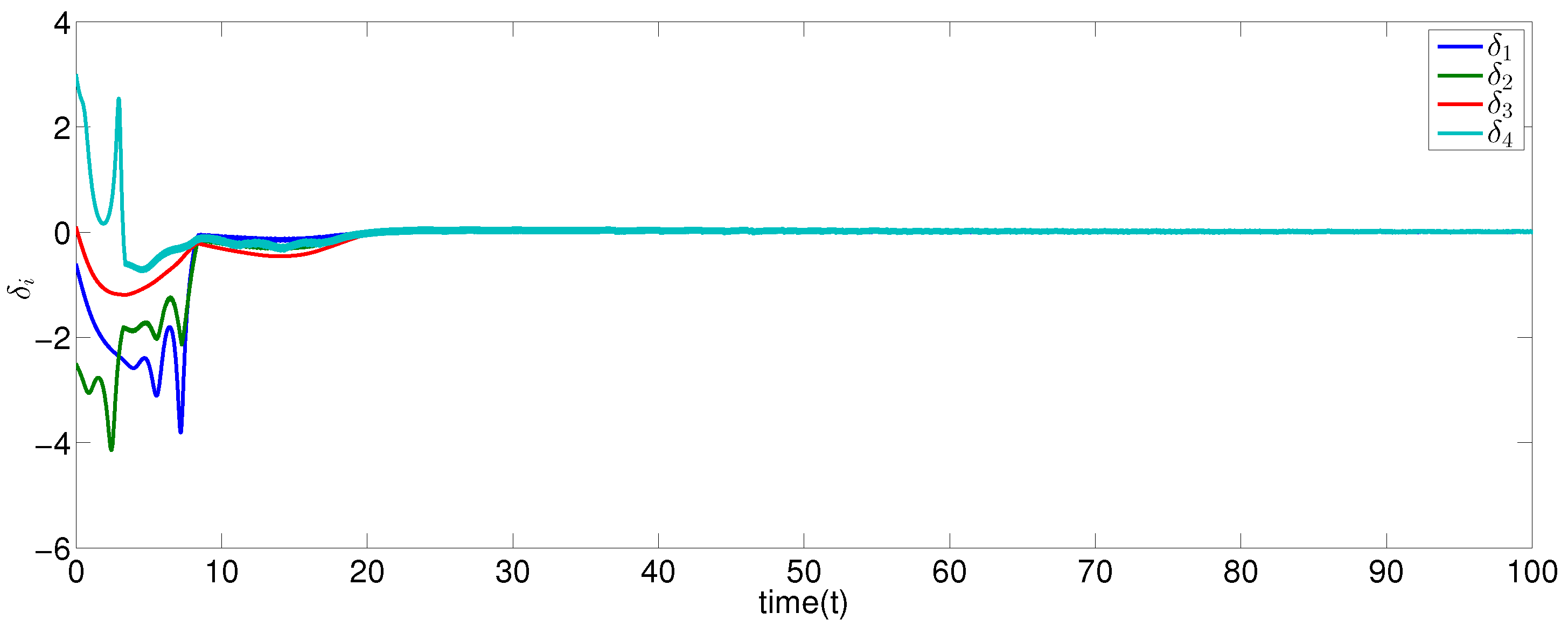
where is a random disturbance uniformly distributed on . The leader’s dynamics are . We choose , , , and for all agents, and . The initial consitions are and . According to the condition in Theorem 1, the Nussbaum gain parameter ℏ must satisfy . Thus, we choose .
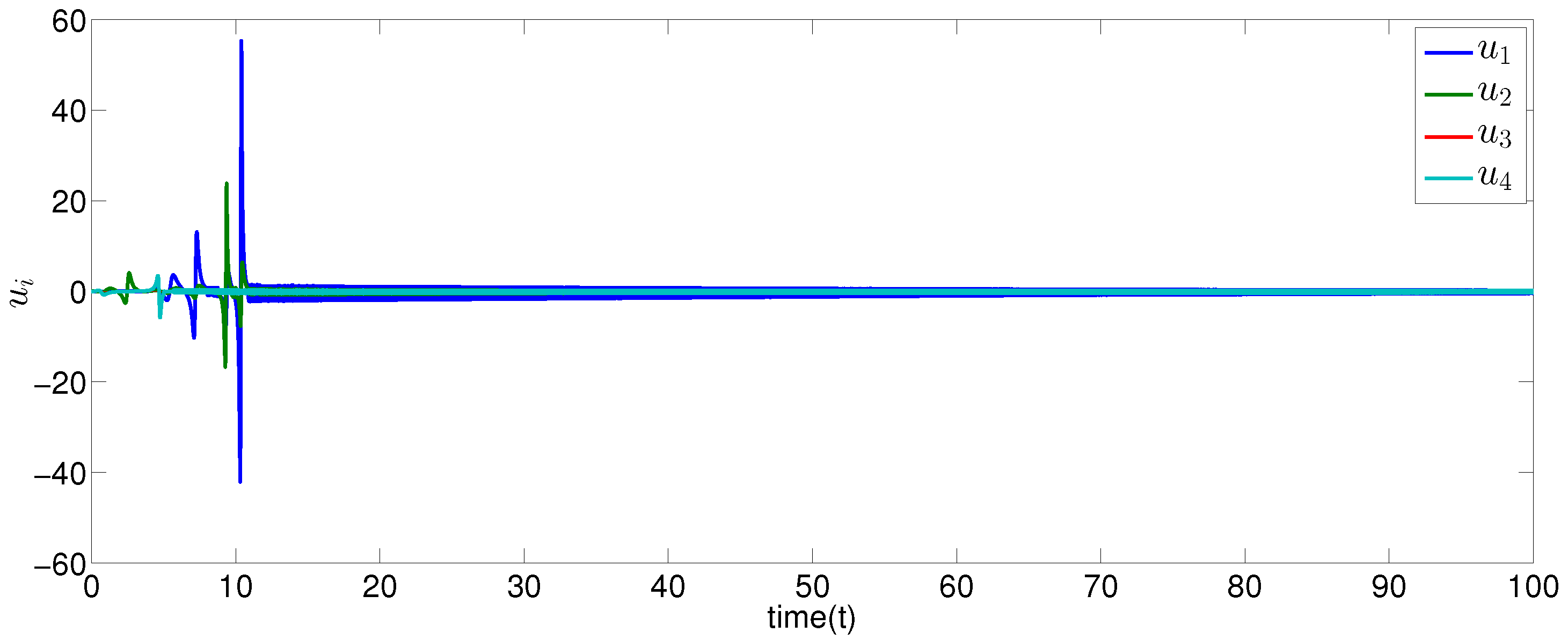
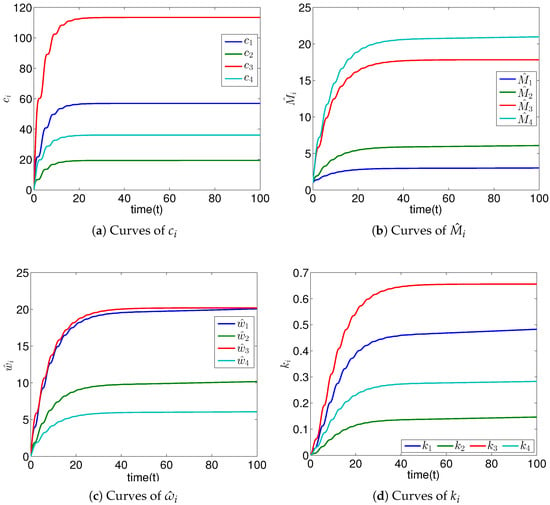
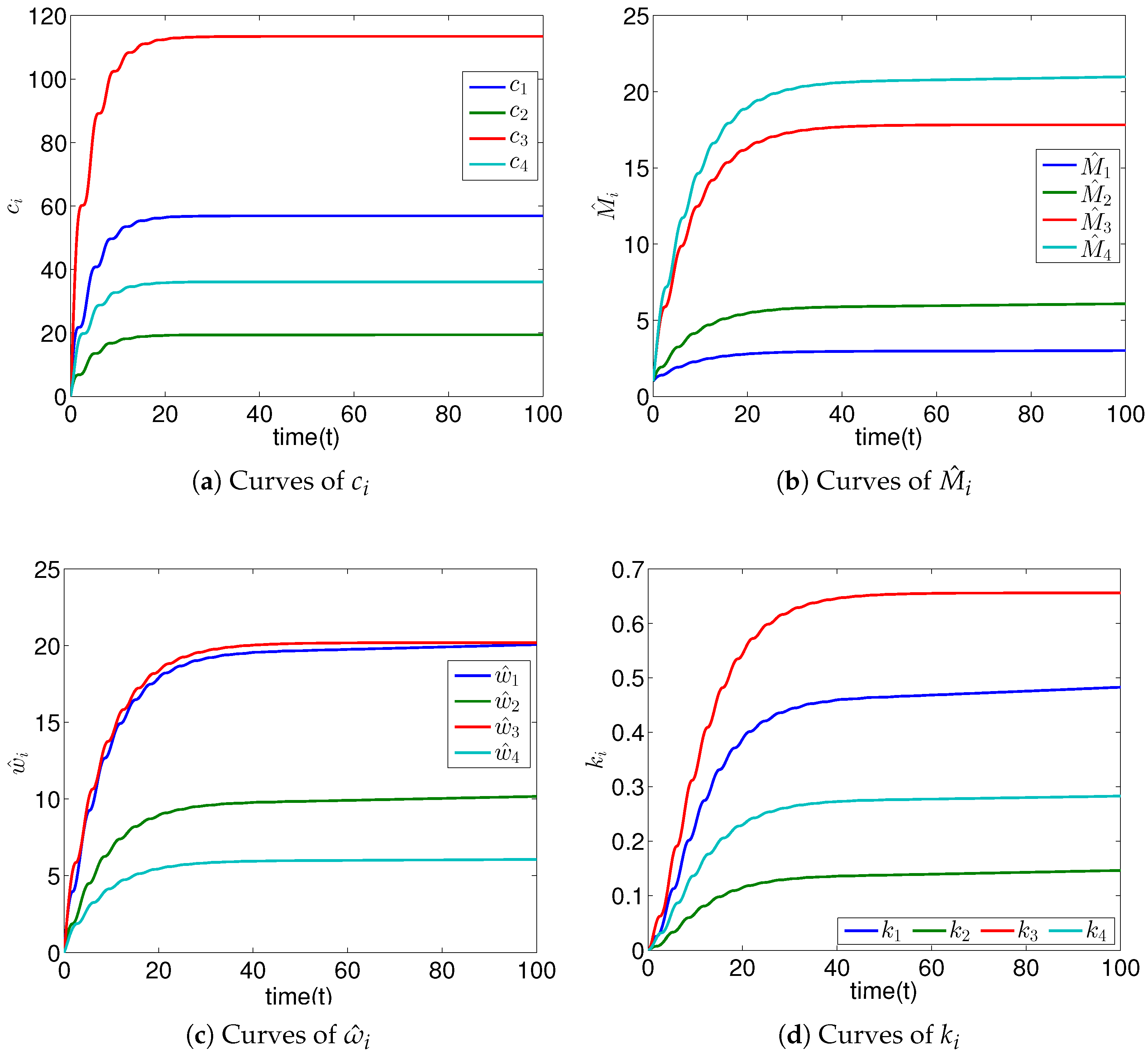
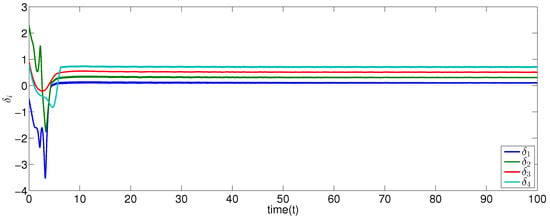
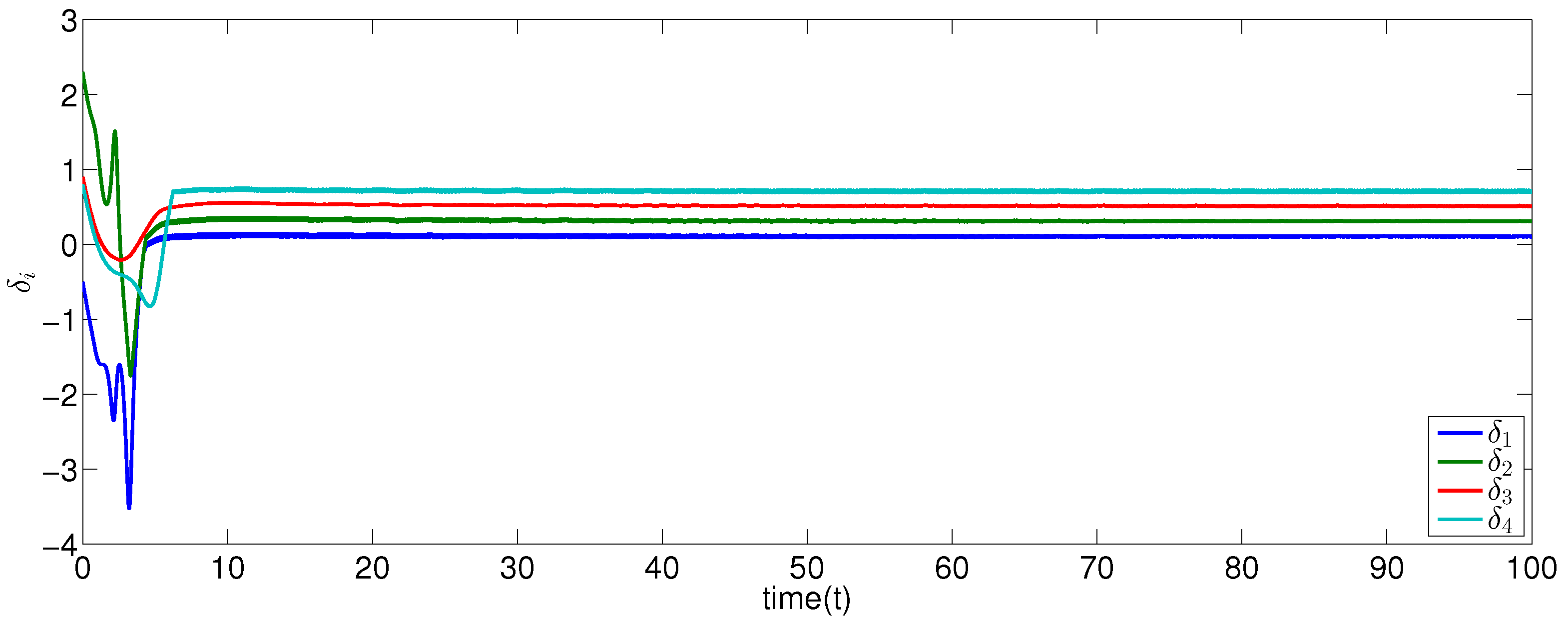
By substituting (11) into (53), the simulation results are presented in Figure 3, Figure 4 and Figure 5. As shown in Figure 3, the consensus error for each follower converges to 0 asymptotically, confirming the global consensus result stated in Theorem 1. As shown in Figure 4 and Figure 5, the control inputs and the adaptive parameters , , and remain bounded, verifying the stability and implementability of the proposed adaptive scheme.
Figure 3.
Consensus errors of the followers.
Figure 4.
Control inputs of the followers for system (53).
Figure 5.
Evolution of adaptive parameters for system (53).
Example 2.
Consensus control of second-order MASs.
To further validate the proposed control scheme for second-order systems, we consider the networked pendulum systems. The evolution of the i-th pendulum is governed by ref. [36]
where , , and denote different physical parameters (see Remark 5). Defining the state variables as and , we have
where , , and .
The leader’s dynamics are governed by
Choose , , , , , , , , , , , , , , , and . The initial conditions of the four followers and the leader are , and . Following the condition in Theorem 2, the Nussbaum gain parameter is chosen as , which satisfies
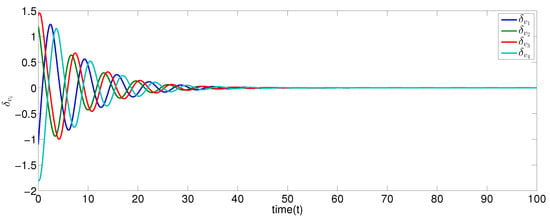
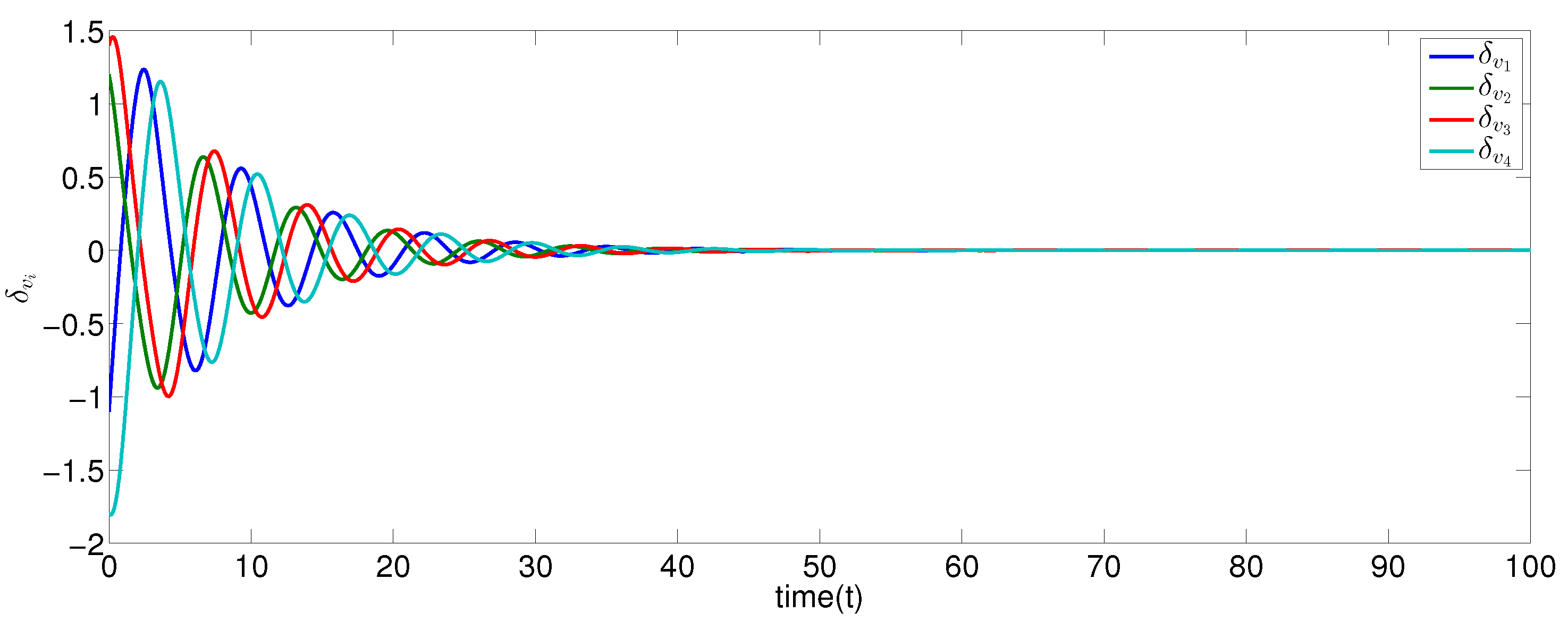
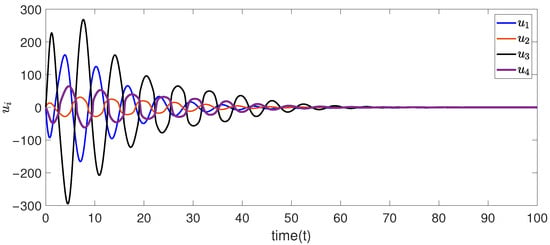
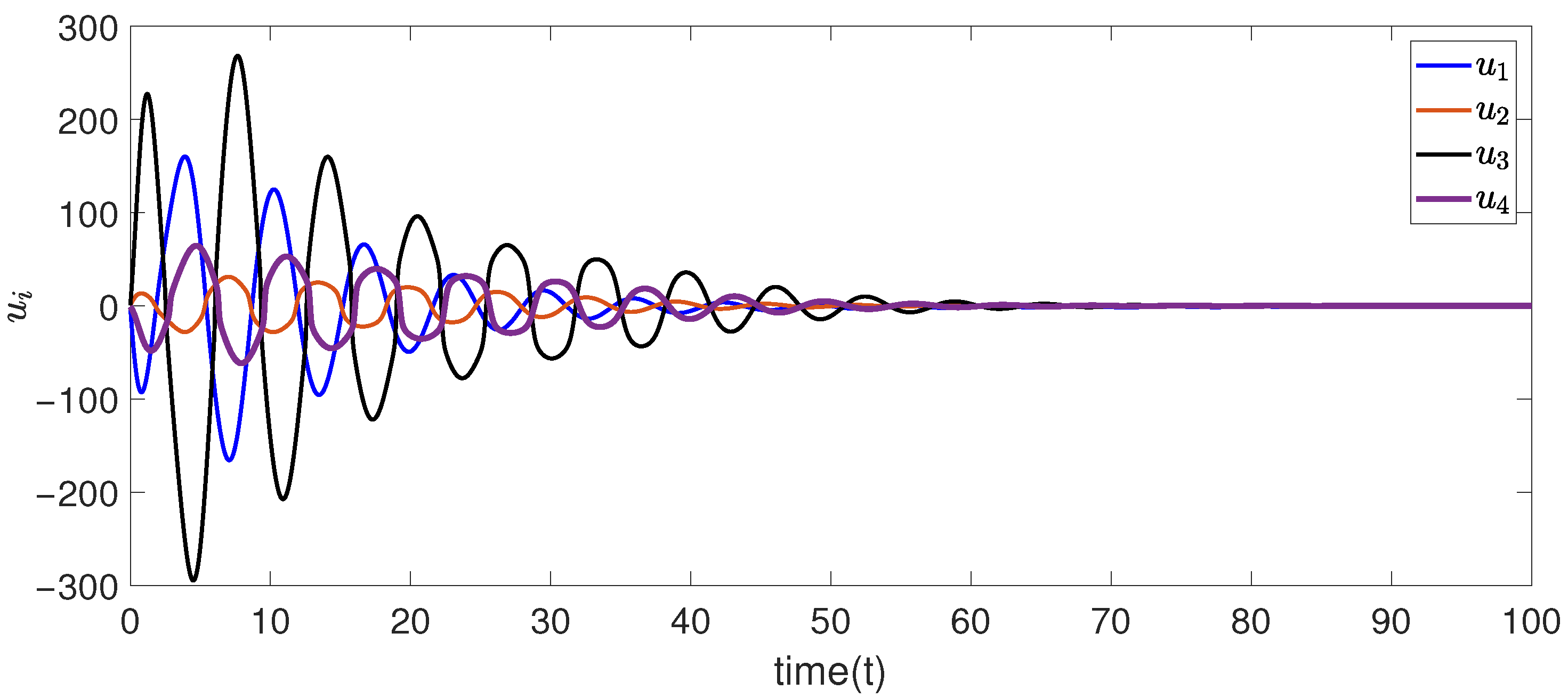
Applying the control law (32) to system (56) yields the results shown in Figure 6, Figure 7, Figure 8 and Figure 9. Figure 6 and Figure 7 depict the position and velocity consensus errors, respectively. Both errors converge to zero, visually confirming that each follower achieves consensus with the leader, as stated in Theorem 2. Figure 8 and Figure 9 show the time histories of the control inputs and the adaptive parameters , , and . All signals remain bounded, demonstrating the stability and practical feasibility of the proposed adaptive controller.
Figure 6.
Consensus errors of the followers.
Figure 7.
Consensus errors of the followers.
Figure 8.
Control inputs of the followers for system (55).
Figure 9.
Evolution of adaptive parameters for system (55).
Example 3.
Formation control of first-order MASs.
Consider a leader-following formation control problem with four followers. The evolution of follower i’s dynamics is
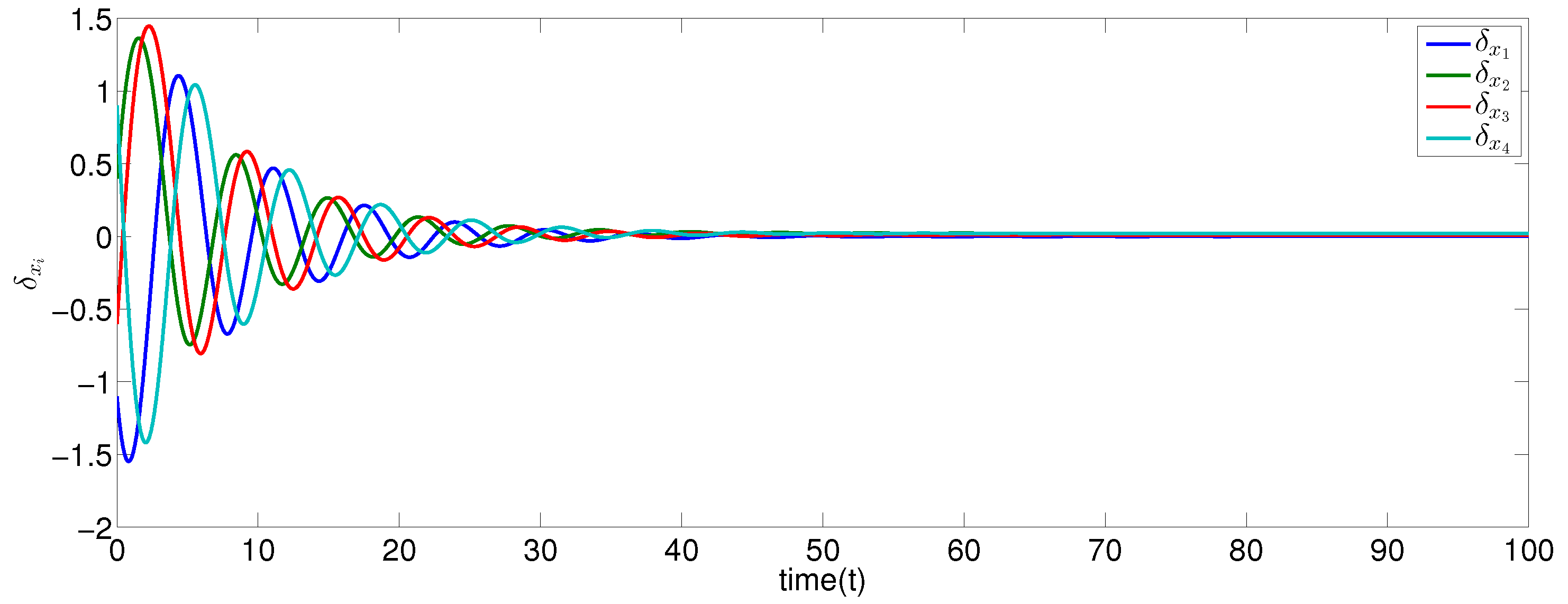
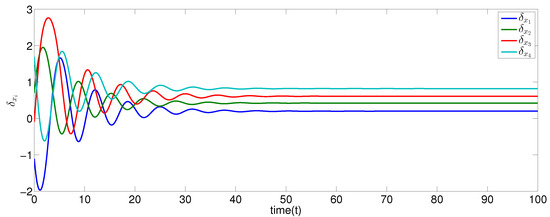
and the leader’s dynamics are given by . We choose , , , , , , , , , , , , , , , , , and . The initial conditions are and . Applying the formation controller (45) yields the results shown in Figure 10, which depicts the formation tracking error. It is clear that each error converges asymptotically to its prescribed , confirming that the desired formation is achieved. This result visually validates the global formation convergence property established in Theorem 3.
Figure 10.
Formation tracking errors of the followers.
Example 4.
Formation control of second-order MASs.
Consider a leader-following formation control problem with four second-order followers. The dynamics of follower i are given by
where , ; represents the bounded random external disturbances satisfying . The evolution of the leader’s dynamics is
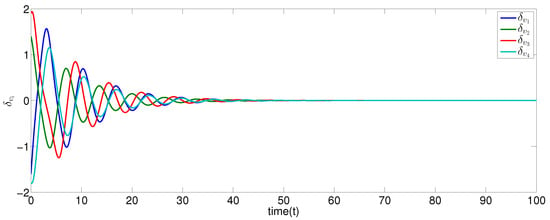
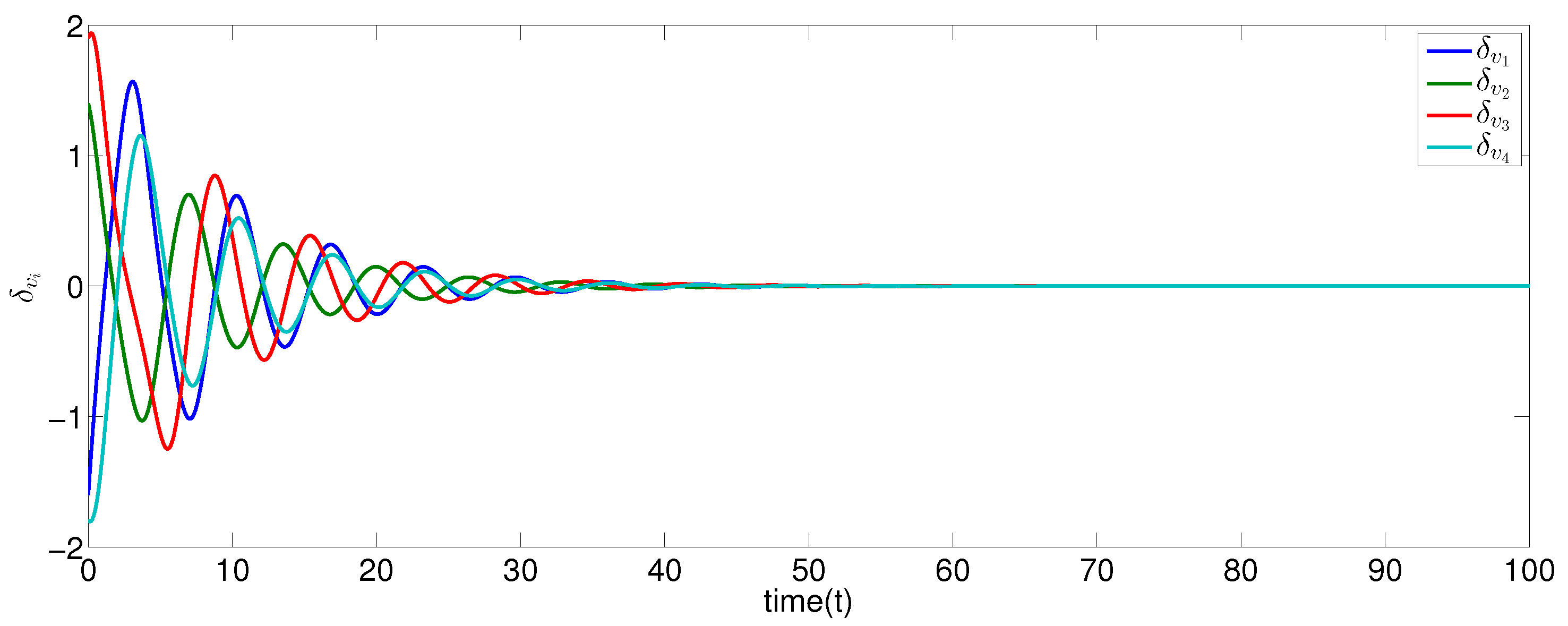
We choose , , , , , , , , , , , , , , , , , , , , and . The initial conditions are , and . Applying the formation controller (51) yields the results shown in Figure 11 and Figure 12. Figure 11 shows the position formation error , and Figure 12 shows the velocity consensus error . Both errors converge to zero asymptotically, demonstrating that each followers align with the desired formation and reach velocity consensus with the leader. These results provide a clear numerical validation of the global formation convergence result established in Theorem 4.
Figure 11.
Position errors of the followers.
Figure 12.
Velocity errors of the followers.
Remark 10.
The controller parameters , , and in (11)–(12) (or (32)–(33)) are theoretically required only to be positive constants. Although the controller parameters , , and are theoretically required only to be positive constants, their specific values in simulations are typically determined through trial and error to achieve satisfactory practical performance.
6. Conclusions
This paper investigates the consensus problem for a class of uncertain nonlinear MASs with external disturbances and UCDs. By incorporating a Nussbaum-type gain mechanism, the proposed distributed control framework effectively overcomes the challenges induced by UCDs. Furthermore, FLSs are employed as feed-forward compensators to approximate the unknown nonlinear dynamics, leading to guaranteed global asymptotic stability. Rigorous Lyapunov-based analysis demonstrates that the proposed control laws ensure global asymptotic consensus for both first- and second-order MASs. A reparameterization strategy is introduced to substantially reduce the computational complexity, enabling each agent to adapt only a minimal number of parameters without sacrificing control performance. The framework is further extended to address formation control problems. Numerical simulations validate the theoretical findings and illustrate the proposed approach’s effectiveness.
It should be noted that the obtained results are established under several assumptions, including a fixed undirected follower communication topology, bounded disturbances, and known bounds on the control coefficients associated with UCDs. These assumptions are common in the related literature and reflect typical operating conditions in many practical applications; however, they also indicate the current scope of the proposed method. Future research will broaden the scope to include MASs with communication delays, dynamics topologies, and more general classes of uncertainties.
Author Contributions
Conceptualization, J.X. and Y.W.; methodology, J.X.; software, J.X. and J.S.; validation, J.X. and J.S.; formal analysis, J.X.; investigation, J.X.; resources, J.X.; data curation, J.X.; writing—original draft preparation, J.X. and Y.W.; writing—review and editing, J.X. and Y.W.; visualization, J.X.; supervision, J.X.; project administration, J.X.; funding acquisition, J.X. All authors have read and agreed to the published version of the manuscript.
Funding
This work was supported in part by the Joint Funds of the Zhejiang Provincial Natural Science Foundation of China under Grant LHZY24A010005 and in part by the China Postdoctoral Science Foundation under Grants 2024MD754039 and 2023T160501.
Data Availability Statement
The original contributions presented in this study are included in the article. Further inquiries can be directed to the corresponding author.
Conflicts of Interest
The authors declare no conflicts of interest.
References
- Minsky, M. Society of Mind; Simon and Schuster: New York, NY, USA, 1988. [Google Scholar]
- Ren, W.; Beard, R.W. Distributed Consensus in Multi-Vehicle Cooperative Control: Theory and Applications; Springer: London, UK, 2008. [Google Scholar]
- Li, Y.; Tong, S. Bumpless transfer distributed adaptive backstepping control of nonlinear multi-agent systems with circular filtering under DoS attacks. Automatica 2023, 157, 111250. [Google Scholar] [CrossRef] [Scilit]
- Du, Z.; Xie, X.; Qu, Z.; Hu, Y.; Stojanovic, V. Dynamic event-triggered consensus control for interval type-2 fuzzy multi-agent systems. IEEE Trans. Circuits Syst. I Regul. Pap. 2024, 71, 3857–3866. [Google Scholar] [CrossRef] [Scilit]
- Wang, H.; Han, Q.L. Designing proportional-integral consensus protocols for second-order multi-agent systems using delayed and memorized state information. IEEE/CAA J. Autom. Sin. 2024, 11, 878–892. [Google Scholar] [CrossRef] [Scilit]
- Li, X.; Tang, Y.; Karimi, H.R. Consensus of multi-agent systems via fully distributed event-triggered control. Automatica 2020, 116, 108898. [Google Scholar] [CrossRef] [Scilit]
- Zuo, Z.; Ke, R.; Han, Q.L. Fully distributed adaptive practical fixed-time consensus protocols for multi-agent systems. Automatica 2023, 157, 111248. [Google Scholar] [CrossRef] [Scilit]
- Yu, Z.; Liu, Z.; Zhang, Y.; Qu, Y.; Su, C.Y. Distributed Finite-Time Fault-Tolerant Containment Control for Multiple Unmanned Aerial Vehicles. IEEE Trans. Neural Netw. Learn. Syst. 2020, 31, 2077–2091. [Google Scholar] [CrossRef] [Scilit] [PubMed]
- Lin, Y.; Guo, D.; Zhang, J.; Chen, Z.; Yang, B. A Unified Framework for Multilingual Speech Recognition in Air Traffic Control Systems. IEEE Trans. Neural Netw. Learn. Syst. 2021, 32, 3608–3620. [Google Scholar] [CrossRef] [Scilit]
- Zhuang, M.; Tan, L.; Song, S. Fixed-time attitude coordination control for spacecraft with external disturbance. ISA Trans. 2021, 114, 150–170. [Google Scholar] [CrossRef] [Scilit]
- Yu, Y.; Guo, J.; Ahn, C.K.; Xiang, Z. Neural Adaptive Distributed Formation Control of Nonlinear Multi-UAVs With Unmodeled Dynamics. IEEE Trans. Neural Netw. Learn. Syst. 2022, 34, 9555–9561. [Google Scholar] [CrossRef] [Scilit] [PubMed]
- Gao, G.; Mei, Y.; Xin, B.; Jia, Y.H.; Browne, W.N. Automated Coordination Strategy Design Using Genetic Programming for Dynamic Multipoint Dynamic Aggregation. IEEE Trans. Cybern. 2021, 52, 13521–13535. [Google Scholar] [CrossRef] [Scilit] [PubMed]
- Chen, J.; Li, J.; Yuan, X. Distributed fuzzy adaptive consensus for high-order multi-agent systems with an imprecise communication topology structure. Fuzzy Sets Syst. 2021, 402, 1–15. [Google Scholar] [CrossRef] [Scilit]
- Chen, J.; Li, J.; Guo, Y.; Li, J. Consensus control of mixed-order nonlinear multi-agent systems: Framework and case study. IEEE Trans. Cybern. 2021, 52, 13073–13082. [Google Scholar] [CrossRef] [Scilit]
- Ma, T.; Yu, T.; Huang, J.; Yang, X.; Gu, Z. Adaptive odd impulsive consensus of multi-agent systems via comparison system method. Nonlinear Anal. Hybrid Syst. 2020, 35, 100824. [Google Scholar] [CrossRef] [Scilit]
- Bhattacharyya, S.; Patra, S. Positive consensus of multi-agent systems with hierarchical control protocol. Automatica 2022, 139, 110191. [Google Scholar] [CrossRef] [Scilit]
- Ni, J.; Song, Y.; Huang, X.; Wang, Y. Leader–follower consensus control with hierarchical prescribed performance for nonlinear multi-agent systems under reversing actuator faults. Automatica 2025, 177, 112332. [Google Scholar] [CrossRef] [Scilit]
- Long, S.; Huang, W.; Wang, J.; Liu, J.; Gu, Y.; Wang, Z. A fixed-time consensus control with prescribed performance for multi-agent systems under full-state constraints. IEEE Trans. Autom. Sci. Eng. 2024, 22, 6398–6407. [Google Scholar] [CrossRef] [Scilit]
- Cai, X.; Wang, C.; Wang, G.; Liang, D. Distributed consensus control for second-order nonlinear multi-agent systems with unknown control directions and position constraints. Neurocomputing 2018, 306, 61–67. [Google Scholar] [CrossRef] [Scilit]
- Su, Y. Cooperative Global Output Regulation of Second-Order Nonlinear Multi-Agent Systems with Unknown Control Direction. IEEE Trans. Autom. Control 2015, 60, 3275–3280. [Google Scholar] [CrossRef] [Scilit]
- Li, G.; Ren, C.E.; Chen, C.P.; Shi, Z. Adaptive iterative learning consensus control for second-order multi-agent systems with unknown control gains. Neurocomputing 2020, 393, 15–26. [Google Scholar] [CrossRef] [Scilit]
- Fan, D.; Zhang, X.; Liu, S.; Chen, X. Distributed control for output-constrained nonlinear multi-agent systems with completely unknown non-identical control directions. J. Frankl. Inst. 2021, 358, 8270–8287. [Google Scholar] [CrossRef] [Scilit]
- Yu, J.; Dong, X.; Li, Q.; Ren, Z. Time-varying formation tracking for high-order multi-agent systems with switching topologies and a leader of bounded unknown input. J. Frankl. Inst. 2018, 355, 2808–2825. [Google Scholar] [CrossRef] [Scilit]
- Ao, W.; Huang, J.; Xue, F. Adaptive leaderless consensus control of a class of strict-feedback nonlinear multi-agent systems with unknown control directions: A non-Nussbaum function based approach. J. Frankl. Inst. 2020, 357, 12180–12196. [Google Scholar] [CrossRef] [Scilit]
- Chen, J.; Li, J.; Zhang, R.; Wei, C. Distributed fuzzy consensus of uncertain topology structure multi-agent systems with non-identical partially unknown control directions. Appl. Math. Comput. 2019, 362, 124581. [Google Scholar] [CrossRef] [Scilit]
- Yang, N.; Li, J.; He, C. Completely distributed neuro-learning consensus with position constraints and partially unknown control directions. Neurocomputing 2020, 418, 251–262. [Google Scholar] [CrossRef] [Scilit]
- Wang, G. Distributed control of higher-order nonlinear multi-agent systems with unknown non-identical control directions under general directed graphs. Automatica 2019, 110, 108559. [Google Scholar] [CrossRef] [Scilit]
- Rezaei, M.H.; Kabiri, M.; Menhaj, M.B. Adaptive consensus for high-order unknown nonlinear multi-agent systems with unknown control directions and switching topologies. Inf. Sci. 2018, 459, 224–237. [Google Scholar] [CrossRef] [Scilit]
- Shi, P.; Shen, Q. Cooperative Control of Multi-Agent Systems with Unknown State-Dependent Controlling Effects. IEEE Trans. Autom. Sci. Eng. 2015, 12, 827–834. [Google Scholar] [CrossRef] [Scilit]
- Ren, C.E.; Chen, C.L.P.; Du, T.; Guan, Y. Fuzzy Adaptive Leader-Following Consensus Control for Nonlinear Multi-Agent Systems with Unknown Control Directions. Int. J. Fuzzy Syst. 2019, 21, 2066–2076. [Google Scholar] [CrossRef] [Scilit]
- Liu, G.; Zhou, Q.; Zhang, Y.; Liang, H. Fuzzy tracking control for nonlinear multi-agent systems with actuator faults and unknown control directions. Fuzzy Sets Syst. 2020, 385, 81–97. [Google Scholar] [CrossRef] [Scilit]
- Ren, C.E.; Fu, Q.; Zhang, J.; Zhao, J. Adaptive event-triggered control for nonlinear multi-agent systems with unknown control directions and actuator failures. Nonlinear Dyn. 2021, 105, 1657–1672. [Google Scholar] [CrossRef] [Scilit]
- Chen, J.; Li, J.; Chen, W.; Zhang, S.; Zhang, J. Iterative learning control for nonlinear uncertain parameterized multi-agent systems with non-identical partially unknown control directions. IEEE Trans. Netw. Sci. Eng. 2024, 11, 3358–3369. [Google Scholar] [CrossRef] [Scilit]
- Chen, W.; Li, X.; Ren, W.; Wen, C. Adaptive Consensus of Multi-Agent Systems With Unknown Identical Control Directions Based on A Novel Nussbaum-Type Function. IEEE Trans. Autom. Control 2014, 59, 1887–1892. [Google Scholar] [CrossRef] [Scilit]
- Shahvali, M.; Shojaei, K. Distributed adaptive neural control of nonlinear multi-agent systems with unknown control directions. Nonlinear Dyn. 2016, 83, 2213–2228. [Google Scholar] [CrossRef] [Scilit]
- Wei, W.; Dan, W.; Peng, Z.; Li, T. Prescribed Performance Consensus of Uncertain Nonlinear Strict-Feedback Systems With Unknown Control Directions. IEEE Trans. Syst. Man Cybern. Syst. 2016, 46, 1279–1286. [Google Scholar]
- Wang, G.; Wang, C.; Li, L.; Zhang, Z. Designing distributed consensus protocols for second-order nonlinear multi-agents with unknown control directions under directed graphs. J. Frankl. Inst. 2017, 354, 571–592. [Google Scholar] [CrossRef] [Scilit]
- Liu, G.; Zhao, L.; Yu, J. Adaptive Finite-Time Consensus Tracking for Nonstrict Feedback Nonlinear Multi-Agent Systems with Unknown Control Directions. IEEE Access 2019, 7, 155262–155269. [Google Scholar] [CrossRef] [Scilit]
Disclaimer/Publisher’s Note: The statements, opinions and data contained in all publications are solely those of the individual author(s) and contributor(s) and not of MDPI and/or the editor(s). MDPI and/or the editor(s) disclaim responsibility for any injury to people or property resulting from any ideas, methods, instructions or products referred to in the content. |
© 2026 by the authors. Licensee MDPI, Basel, Switzerland. This article is an open access article distributed under the terms and conditions of the Creative Commons Attribution (CC BY) license.