


Abstract
The Sylvester-type equation has applications in many fields, such as control theory, scientific computing, and signal processing. However, research on the Sylvester-type equation over dual quaternions remains limited. In this paper, using generalized inverses and matrix rank, we provide necessary and sufficient conditions for the solvability of the dual quaternion matrix equation . When the solvability conditions are satisfied, the general expression of the solution is derived. Subsequently, a numerical example is presented to verify the obtained results. Finally, based on these results, an application in color image encryption and decryption is provided.
1. Introduction
In 1843, Hamilton proposed the concept of quaternion [1]. After more than a hundred years of development, quaternions have been widely used in many fields, including color face recognition, aerospace, system control, robotics, and artificial intelligence [2,3,4,5,6]. A set of quaternions is denoted by as follows:
where denotes the field of real numbers. It follows that is a non-commutative division ring. With the advancement of research, some scholars have provided different ideas for the development of quaternions [7,8,9,10,11,12]. Beyond its theoretical foundations, recent work has demonstrated that quaternions offer a powerful tool for optimizing and solving models [13]. Furthermore, advances in quaternion matrix calculations point to its broader applicability in emerging domains [14]. In addition, solving quaternion matrix equations is an important issue in many fields, such as scientific computing and engineering applications. Nevertheless, in terms of technological development, quaternions still leave room for improvement. The introduction of dual quaternions broadened the scope of quaternion research [15]. Following its proposal, many fields have experienced new developments.
Dual quaternions offer a unified mathematical representation for both the rotation and translation components of 3D rigid body motion, making them indispensable in numerous areas of mathematics and physics [16,17,18,19,20,21,22,23]. Notably, dual quaternion matrix equations have emerged as a critical area of study due to their wide-ranging applications. They not only generalize classical matrix equations but also provide a robust framework for solving complex problems in fields such as robotics, computer graphics, and control theory. Given their theoretical significance and practical relevance, the investigation of dual quaternion matrix equations has attracted considerable attention from scholars, with an extensive research scope [24,25,26,27].
Among the various matrix equations, the Sylvester and Sylvester-type equations stand out as a fundamental and important class. They have been applied in many fields, such as system design [28], control theory [29], sensitivity analysis [30], and data transmission [31]. For this reason, they have attracted the attention of many scholars. Early fundamental research on matrix equations was carried out in real and complex fields. The Sylvester-type matrix equation
was studied by Roth [32] over polynomial integer rings, while Baksalary and Kalamany [33] focused on its solvability and the structure of its general solutions; then, He [34] made further investigations into matrix Equation (1). As research progresses, the investigations on Sylvester-type matrix equations have been extended to and over the last few decades [35,36]. Scholars have extensively studied generalized Sylvester equations and various extended matrix systems. They have systematically investigated solvability criteria, general solutions, and constrained solutions, such as Hermitian and positive definite solutions. These studies have employed the generalized inverse, the matrix rank method, and iterative algorithms. They have further enriched the theoretical connotation of non-commutative matrix equations [37,38,39,40,41,42,43]. For dual quaternion matrix equations, Xie and Wang [44] derived the solvability conditions for matrix Equation (1), and presented the general form of its solution under solvable conditions. This result is of considerable importance to the study of matrix equations. Furthermore, for the dual quaternion matrix equation
Li and Wang [45] investigated both this equation and another symmetric counterpart. Subsequent research has been further expanded to bilateral coupled equations and constrained solution problems, but most research objects are limited to simple structures of one or two variables [43,45,46,47]. In particular, these two papers focus on iterative numerical algorithms [48] and -Hermitian structural constraints [49], respectively. They investigate restricted solutions of equations with a single variable over quaternions. They can be regarded as extensions and complements in two directions: structural constraints on solutions and numerical methods. Overall, research on dual quaternion matrix equations with multiple unknown matrices is still relatively scarce and the relevant theoretical achievements need to be further supplemented and perfected.
Motivated by the studies of the above equations and based on Equations (1) and (2), in this paper, we study a class of matrix Equation (3) over dual quaternions.
We adopt the Moore–Penrose inverse and rank equalities for matrices to investigate the solvability conditions for Equation (3) and, when it is solvable, present its general solutions.
The structure of this paper is organized as follows: Section 2 is devoted to several key definitions and lemmas. In Section 3, the main theorems concerning the dual quaternion matrix Equation (3) are formally established. In Section 4, a numerical example is given to validate the main results. Their application to color image encryption and decryption is discussed in Section 5. Finally, Section 6 provides a concise summary of the paper.
2. Preliminaries
In this section, we introduce some fundamental definitions and properties of quaternions and dual quaternions, and present several lemmas that are useful for solving equations.
In this paper, all matrices over is denoted by . For any , denotes the rank of A. In general, stands for the Moore–Penrose inverse of , which is defined as the solution of
Moreover, and are two projectors associated with A. I and 0 denote the identity matrix and zero matrix with appropriate sizes. Here and throughout, denotes the set of all integers from p to q. After introducing the notations and symbols adopted in this paper, we proceed to present some definitions and lemmas required in the subsequent sections.
Definition 1
([50]). Let . We say y is a dual quaternion if y has the form
where ϵ is the infinitesimal unit satisfying . Here, and are called the real part and the dual part of y, respectively.
The set of dual quaternions is denoted by
Now, we introduce the definition of dual quaternion matrix. Let . X is said to be a dual quaternion matrix if X has the form ; the set of dual quaternion matrices is denoted by
For , we have if and ; furthermore,
Definition 2
([51]). Let A, B, and C be arbitrary matrices over with appropriate dimensions. Then, the following equalities hold:
- (i)
- .
- (ii)
- , .
- (iii)
- , .
Definition 3
([52]). Suppose that , , and . Then, the quaternion matrix equation is consistent if and only if
In this case, the general solution can be expressed as
where are arbitrary matrices with appropriate sizes.
Definition 4
([33]). Let and be matrices of suitable sizes. Then, the Sylvester-type Equation is solvable if and only if
In this case, the general solution to the equation can be expressed as
where and are arbitrary matrices with appropriate sizes.
Next, we discuss the quaternion matrix equation . We present equivalent conditions for its solvability. For clarity and precision of exposition, the block matrix is denoted as .
Definition 5
([53]). Let , , and . Set
Then, the following three statements are equivalent.
- (i)
- The quaternion matrix equation is consistent.
- (ii)
- , , .
- (iii)
- In this case, the general solution to the equation can be expressed aswhere are arbitrary matrices over with appropriate sizes.
Definition 6
([54]). Assume that , , , , and . Then, the following statements hold.
- (i)
- .
3. Main Results
In this section, we first establish the necessary and sufficient conditions for the solvability of the dual quaternion matrix Equation (3). We then provide their general solution expressions under the condition of solvability.
We briefly explain its content so that readers can clearly understand the theorem below. The theorem presents the main result of this paper, namely the necessary and sufficient conditions for the solvability of the matrix equation over dual quaternions. When these conditions are satisfied, the general solution of the equation is given. Since the notation involved in the equation is somewhat complicated, we arrange the theorem as follows. We first introduce the symbols and algebraic expressions needed in the proof. Then we present the equivalent conditions for solvability and the form of the general solution when the equation is solvable. After these basic results, we provide the proof of the theorem. The proof establishes the equivalence of the three conditions and derives the general solution.
Theorem 1.
Let , , , , . Denote
Then, the following statements are equivalent.
(ii)
(iii)
In this case, the general solution X, Y and Z of Equation (3) can be expressed as , , , where
with arbitrary .
Proof.
The entire proof process consists of two steps: first, we prove that (i) ⇔ (ii) and derive the expression for the general solution; then, prove that (ii) ⇔ (iii).
We assume that Equation (3) is solvable with solutions , and , which can be expressed as
Substituting these expressions into Equation (3), we obtain that the dual quaternion matrix Equation (3) is equivalent to the following system of quaternion matrix equations:
Next, we prove (i) ⇔ (ii), and illustrate the general solution of (9) with the form of (8). We decompose the system (9) into the following equations:
and
By manipulating Equation (10), we obtain
From Definition 4, we conclude that (12) is consistent if and only if the following condition holds:
which is equivalent to
In this case, the general solution to (10) can be written as
Substituting (14) into (11) and simplifying, we apply several of the above lemmas. We obtain
By Definition 5, we conclude that (15) is consistent if and only if
In this case, the general solution of (15) can be written as
So far, we have proved the equivalence of (i) and (ii) in the theorem and obtained part of the general solution. In a similar way, we can obtain the following general solutions.
On this basis, we can obtain the following results after some simple calculations.
where are arbitrary matrices over with appropriate dimensions.
In summary, we have proven the equivalence of (i) and (ii). Additionally, we have derived the expression for the general solution. Finally, we prove the equivalence between (ii) and (iii). According to Definition 6, it can be verified that (4) ⇔ (6).
Now, we turn to prove that (5) ⇔ (7). We take the particular solution as follows:
It is straightforward to verify that , and form a particular solution to the quaternion matrix equation . Now, applying Definition 6, we obtain
□
4. Numerical Example
Section 3 introduces Theorem 1 and presents the general solutions for Equation (3) when it is solvable. In this section, based on Theorem 1, we provide Algorithm 1 to solve Equation (3) and perform extensive numerical experiments to validate the error.
| Algorithm 1 Solving Equation (3) over dual quaternions |
|
Next, we present an example to validate the effectiveness of Algorithm 1. We first give some specific coefficient matrices. Then we apply Theorem 1 to check whether the equation satisfies the solvability conditions. If the conditions are satisfied, we use Matlab R2023b to obtain the simplified general solutions. After that, we choose some random matrices to obtain a particular solution. Finally, we compute the error from these data. This error is used to evaluate the effectiveness of our algorithm and theorem.
Example 1.
Given dual quaternion matrices , , and , as
Then we examine the solvability of Equation (3). By computing with M, N, T, P, Q, , , , and in Theorem 1, it can be calculated that
In this case, Equation (3) is consistent. Using Matlab R2023b along with Algorithm 1, the general solution can be expressed as follows:
For the sake of conciseness, the numerical values of are not enumerated here. Specifically, if we select a set of random matrices and , a specific solution of Equation (3) is
Therefore, we obtain
The Frobenius norm is sensitive to every element of the matrix, so any modification may change its value. Since we naturally desire a more accurate reflection of the error, the Frobenius norm is adopted for error computation.
To make our numerical example more convincing and avoid accidental results. Additionally, we randomly generated 10,000 different sets of and —all resulting errors were less than . Hence, Theorem 1 is effective in solving the dual quaternion matrix Equation (3) within the allowed error range.
5. Applications
In this section, we propose an image encryption and decryption scheme based on matrix Equation (3). This scheme is successfully validated through examples. A quaternion matrix can represent a single color image. In contrast, a dual quaternion matrix contains two quaternion matrices and can represent two color images simultaneously. This capability makes dual quaternion matrices more attractive in the field of image processing. In the proof of Theorem 1, Equation (3) is shown to be equivalent to system (9). Therefore, our encryption and decryption procedures are carried out according to the system (9), as shown in Figure 1.
Figure 1.
Encryption and decryption scheme.
Now, we describe the general framework for encryption and decryption. In matrix system (9), two equations involve six variables. To facilitate encryption and decryption procedures with enhanced smoothness and efficiency, we impose conditions , , . Another purpose of this approach is to ensure that the decrypted solution remains sufficiently simple. This simplification facilitates subsequent operations. The encryption process is as follows. Two original images are first converted to matrices. In addition, we treat the image represented by as the key image. Figure 1 is composed of the following components. , , , , , , and are encryption matrices, which are also known as coefficient matrices. and denote two original images, while is a key image. These images are encrypted using the formulas presented in Figure 1, which yields two encrypted images and . At this point, the encryption process is complete. For decryption, we apply Theorem 1 and use the key image to obtain the transformed matrices from the original images. Then, we convert these matrices back into the original images. The decryption process is complete. The encryption matrices are publicly accessible. However, only the receiver has the key image. Therefore, only the receiver can restore the original images from their encrypted counterparts. Detailed encryption and decryption processes are provided by Algorithm 2 and Algorithm 3, respectively.
| Algorithm 2 Encryption Process |
|
| Algorithm 3 Decryption Process |
|
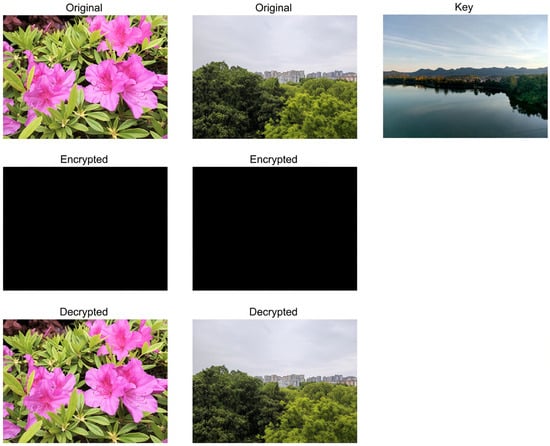
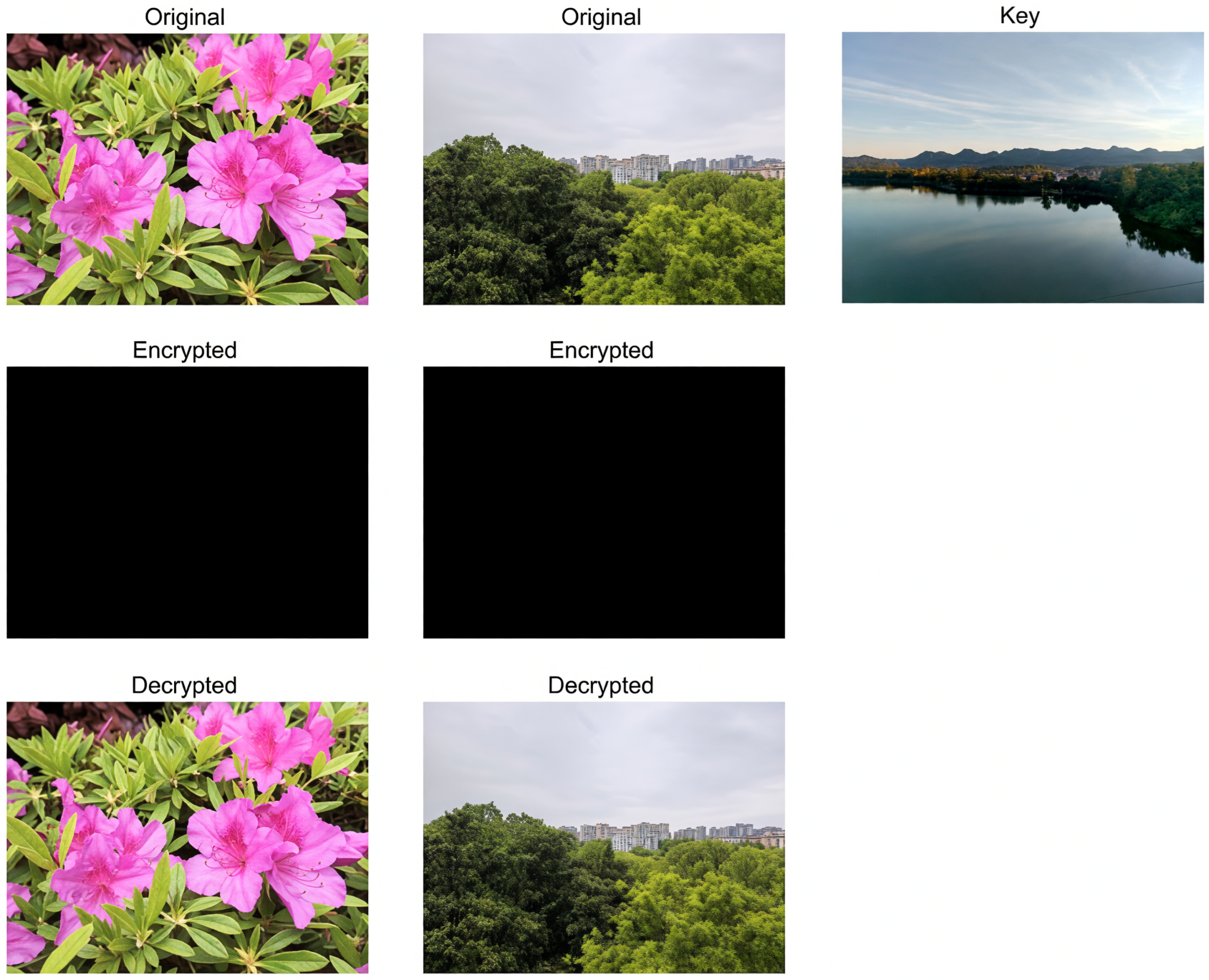
To illustrate the encryption and decryption process more intuitively, we applied Algorithms 2 and 3 to two original images and one key image. The resulting images are shown in Figure 2. To evaluate performance, we compute the Structural Similarity Index (SSIM), the Feature Similarity Index (FSIM), and the Peak Signal-to-Noise Ratio (PSNR). The results are recorded in Table 1.
Figure 2.
Encryption and decryption result display.
Table 1.
SSIM, FSIM and PSNR.
As shown in Table 1, both the SSIM and FSIM values are equal to 1. This indicates perfect decryption with negligible information loss. In addition, PSNR values consistently exceed 42, which shows outstanding image quality and a high degree of similarity to the original images. These results confirm the feasibility of the proposed scheme.
6. Conclusions
In this paper, we derive the necessary and sufficient conditions for the solvability of the dual quaternion matrix Equation (3) by adopting the methods of generalized inverses and matrix rank equalities. We also present general solutions when the equation is solvable. Then, we provide a numerical example to verify the theoretical results. Finally, the application to color image encryption and decryption demonstrates that the model characterized in Figure 1 achieves satisfactory performance. Future work may involve further investigation of matrix equations over commutative quaternions.
Author Contributions
Methodology, C.L. and Q.-W.W.; Software, C.L.; Investigation, Q.-W.W.; Writing—original draft, C.L.; Writing—review and editing, Q.-W.W.; Supervision, Q.-W.W.; Funding acquisition, Q.-W.W. All authors have read and agreed to the published version of the manuscript.
Funding
This research is supported by the National Natural Science Foundation of China (grant number 12371023).
Data Availability Statement
Data are contained within the article.
Conflicts of Interest
The authors declare no conflicts of interest.
References
- Hamilton, W.R. Lectures on Quaternions; Hodges and Smith: Dublin, Ireland, 1853. [Google Scholar]
- Zou, C.; Kou, K.I.; Wang, Y. Quarernion collaborative and sparse representation with application to color face recognition. IEEE Trans. Image Process. 2016, 25, 3287–3302. [Google Scholar] [CrossRef] [Scilit] [PubMed]
- Qi, L.; Luo, Z.; Wang, Q.-W.; Zhang, X. Quaternion Matrix Optimization: Motivation and Analysis. J. Optim. Theory Appl. 2022, 193, 621–648. [Google Scholar] [CrossRef] [Scilit]
- Pang, D.; Pu, Y.; Liu, K.; Jiang, W. Controllability of Nonlinear Quaternion-Valued Systems with Input-Delay. Qual. Theory Dyn. Syst. 2024, 23, 240. [Google Scholar] [CrossRef] [Scilit]
- McCarthy, J.M. Quaternions in kinematics. Mech. Mach. Theory 2025, 209, 105949. [Google Scholar] [CrossRef] [Scilit]
- Zhou, H.; Zhong, P. Orthogonal and spherical quaternion features for weakly supervised learning with label confidence optimization. Appl. Intell. 2025, 55, 697. [Google Scholar] [CrossRef] [Scilit]
- Han, S.; Song, C. H-representation method for the least squares symmetric solutions of the reduced biquaternion matrix equation and its application in color image restoration. Numer. Algorithms 2026, 101, 1537–1566. [Google Scholar] [CrossRef] [Scilit]
- He, Z.-H.; Wang, X.-X.; Zhao, Y.-F. Eigenvalues of Quaternion Tensors with Applications to Color Video Processing. J. Sci. Comput. 2023, 94, 1. [Google Scholar] [CrossRef] [Scilit]
- Liu, W.; Kou, K.I.; Miao, J.; Cai, Z. Quaternion Scalar and Vector Norm Decomposition: Quaternion PCA for Color Face Recognition. IEEE Trans. Image Process. 2023, 32, 446–457. [Google Scholar] [CrossRef] [Scilit] [PubMed]
- Li, T.; Wang, Q.-W. QQMR: A structure preserving quaternion quasi-minimal residual method. Math. Comput. 2026, 95, 867–896. [Google Scholar] [CrossRef] [Scilit]
- Zhang, X.; Song, C.; Vasil’ev, V.I.; Wang, G. Structure Preserving Quaternion Biconjugate Residual Algorithm with Application. J. Sci. Comput. 2025, 104, 32. [Google Scholar] [CrossRef] [Scilit]
- Wang, Q.; Xie, L.; Gao, Z. A Survey on the Classical Matrix Equation AXB=C with Applications. Preprints 2025, 13, 450. [Google Scholar] [CrossRef] [Scilit]
- Chen, X.; Cui, C.; Han, D.; Qi, L. Non-convex Pose Graph Optimization in SLAM via Proximal Linearized Riemannian ADMM. J. Optim. Theory Appl. 2025, 206, 78. [Google Scholar] [CrossRef] [Scilit]
- Yu, C.-E.; Liu, X.; Zhang, Y. A New Complex Structure-Preserving Method for QSVD. J. Sci. Comput. 2024, 99, 37. [Google Scholar] [CrossRef] [Scilit]
- Clifford, M.A. Preliminary sketch of biquaternions. Proc. Lond. Math. Soc. 1897, 1, 381–395. [Google Scholar] [CrossRef] [Scilit]
- Yaqub, Z.D.; Schröcker, H.-P. Rational motions of minimal quaternionic degree with prescribed plane trajectories. J. Comput. Appl. Math. 2026, 474, 116949. [Google Scholar] [CrossRef] [Scilit]
- Brambley, G.; Kim, J. Unit dual quaternion-based pose optimisation for visual runway observations. IET Cyber-Syst. Robot. 2020, 2, 181–189. [Google Scholar] [CrossRef] [Scilit]
- Cheng, J.; Kim, J.; Jiang, Z.; Che, W. Dual quaternion-based graph SLAM. Robot. Auton. Syst. 2016, 77, 15–24. [Google Scholar] [CrossRef] [Scilit]
- Wang, X.; Yu, C.; Lin, Z. A dual quaternion solution to attitude and position control for rigid body coordination. IEEE Trans. Robot. 2012, 28, 1162–1170. [Google Scholar] [CrossRef] [Scilit]
- Gao, Z.-H.; Wang, Q.-W.; Xie, L.-M. A novel Moore–Penrose inverse to dual quaternion matrices with applications. Appl. Math. Lett. 2026, 172, 109727. [Google Scholar] [CrossRef] [Scilit]
- Zhong, J.; Zhong, P. A Mirsky-Type Unitarily Invariant Norm Inequality for Dual Quaternion Matrices and Its Applications. Symmetry 2025, 17, 1355. [Google Scholar] [CrossRef] [Scilit]
- Qi, L.; Cui, C. Eigenvalues of dual Hermitian matrices with application in formation control. SIAM J. Matrix Anal. Appl. 2024, 45, 2135–2154. [Google Scholar] [CrossRef] [Scilit]
- Qi, L.; Cui, C. Dual Markov chain and dual number matrices with nonnegative standard parts. Commun. Appl. Math. Comput. 2025, 7, 2442–2461. [Google Scholar] [CrossRef] [Scilit]
- Xie, L.-M.; Wang, Q.-W. Some novel results on a classical system of matrix equations over the dual quaternion algebra. Filomat 2025, 39, 1477–1490. [Google Scholar] [CrossRef] [Scilit]
- Tu, Q.; Song, G.; Dong, C.; Liu, Q. Dual quaternion matrix formulation for robust 3D point cloud registration. Appl. Math. Lett. 2026, 175, 109853. [Google Scholar] [CrossRef] [Scilit]
- Zhang, M.; Li, Y.; Wang, T.; Sun, J. QR decomposition of dual quaternion matrix and blind watermarking scheme. Numer. Algorithms 2025, 99, 1763–1790. [Google Scholar] [CrossRef] [Scilit]
- Wang, T.; Li, Y.; Zhang, M.; Wei, M.; Guo, W. A fast construction algorithm for compact singular value decomposition of dual quaternion matrix and its application. Numer. Algorithms 2026, 101, 1073–1096. [Google Scholar] [CrossRef] [Scilit]
- Syrmos, V.L.; Lewis, F.L. Coupled and constrained Sylvester equations in system design. Circuits Syst. Signal Process. 1994, 13, 66–94. [Google Scholar] [CrossRef] [Scilit]
- Shahzad, A.; Jones, B.L.; Kerrigan, E.C.; Constantinides, G.A. An efficient algorithm for the solution of a coupled sylvester equation appearing in descriptor systems. Automatica 2011, 47, 24–48. [Google Scholar] [CrossRef] [Scilit]
- Barraud, A.; Lesecq, S.; Christov, N. From sensitivity analysis to random floating point arithmetics—Application to Sylvester equations. In Numerical Analysis and Its Applications; Lecture Notes in Computer Science; Springer: Berlin/Heidelberg, Germany, 2001; Volume 1988, pp. 35–41. [Google Scholar] [CrossRef] [Scilit]
- He, Z.; Qin, W.; Tian, J.; Wang, X.; Zhang, Y. A new Sylvester-type quaternion matrix equation model for color image data transmission. Comput. Appl. Math. 2024, 43, 227. [Google Scholar] [CrossRef] [Scilit]
- Roth, W.E. The equations AX - YB = C and AX - XB = C in matrices. Proc. Am. Math. Soc. 1952, 3, 392–396. [Google Scholar] [CrossRef] [Scilit]
- Baksalary, J.; Kala, R. The matrix equations AX - YB = C. Linear Algebra Its Appl. 1979, 25, 41–43. [Google Scholar] [CrossRef] [Scilit]
- He, Z.-H. Some new results on a system of Sylvester-type quaternion matrix equations. Linear Multilinear Algebra 2021, 69, 3069–3091. [Google Scholar] [CrossRef] [Scilit]
- Wang, Q.; Gao, J. A Comprehensive Review on the Generalized Sylvester Equation AX − YB = C. Symmetry 2025, 17, 1686. [Google Scholar] [CrossRef] [Scilit]
- Wang, Q.; Gao, J. A Review on Solving Sylvester-Type Equations. Symmetry 2026, 18, 984. [Google Scholar] [CrossRef] [Scilit]
- Rehman, A.; Kyrchei, I. Hermitian solution to constraint system of generalized Sylvester quaternion matrix equations. Arab. J. Math. 2024, 13, 595–610. [Google Scholar] [CrossRef] [Scilit]
- Wang, Q.-W.; Rehman, A.; He, Z.-H.; Zhang, Y. Constraint generalized Sylvester matrix equations. Automatica 2016, 69, 60–64. [Google Scholar] [CrossRef] [Scilit]
- Mehany, M.S.; Wang, Q.-W.; Gao, J. Solvability conditions and the general solution to a system of quaternion tensor equations with applications. Comp. Appl. Math. 2026, 45, 198. [Google Scholar] [CrossRef] [Scilit]
- Wang, H.; Jin, X.; Huang, J. On Roth-type solvability criteria for generalized Sylvester matrix and operator equations. Adv. Oper. Theory 2025, 10, 64. [Google Scholar] [CrossRef] [Scilit]
- Şimşek, S. Least-Squares Solutions of Generalized Sylvester-Type Quaternion Matrix Equations. Adv. Appl. Clifford Algebr. 2023, 33, 28. [Google Scholar] [CrossRef] [Scilit]
- Voet, Y. Preconditioning Techniques for Generalized Sylvester Matrix Equations. Numer. Linear Algebra Appl. 2025, 32, e70020, Correction in Numer. Linear Algebra Appl. 2025, 32, e70032. https://doi.org/10.1002/nla.70020. [Google Scholar] [CrossRef] [Scilit]
- Wang, X.; Li, W.-W.; Mao, L.-Z. On positive-definite and skew-Hermitian splitting iteration methods for continuous Sylvester equation AX + XB = C. Comput. Math. Appl. 2013, 66, 2352–2361. [Google Scholar] [CrossRef] [Scilit]
- Xie, L.-M.; Wang, Q.-W.; He, Z.-H. The generalized hand-eye calibration matrix equation AX-YB=C over dual quaternions. Comp. Appl. Math. 2025, 44, 137. [Google Scholar] [CrossRef] [Scilit]
- Li, Y.-F.; Wang, Q.-W.; Gao, Z.-H. The solvability and general solutions to two dual quaternion matrix equations with applications. Int. J. Comput. Math. 2026, 103, 898–920. [Google Scholar] [CrossRef] [Scilit]
- Wang, Q.-W.; Gao, Z.-H.; Gao, J.-L. A Comprehensive Review on Solving the System of Equations AX = C and XB = D. Symmetry 2025, 17, 625. [Google Scholar] [CrossRef] [Scilit]
- Wang, Q.-W.; Gao, Z.-H.; Li, Y.-F. An Overview of Methods for Solving the System of Equations A1XB1 = C1 and A2XB2 = C2. Symmetry 2025, 17, 1307. [Google Scholar] [CrossRef] [Scilit]
- Mehany, M.S.; Halawa, H.R.; Rizkalla, R.R.; Bayoumi, A.M.E. Numerical algorithms for solving two-sided k-conjugate quaternion matrix equation with Hermitian R -conjugate solution. Int. J. Comput. Math. Comput. Syst. Theory 2026, 1–22. [Google Scholar] [CrossRef] [Scilit]
- Mehany, M.S. An Analysis to Some Systems of Matrix Equations with ϕ-Hermitian Solutions for Some Nonstandard Involution ϕ Over the Real Quaternion Algebra. Iran. J. Sci. 2025, 49, 795. [Google Scholar] [CrossRef] [Scilit]
- Qi, L.; Ling, C.; Yan, H. Dual quaternions and dual quaternion vectors. Commun. Appl. Math. Comput. 2022, 4, 1494–1508. [Google Scholar] [CrossRef] [Scilit]
- Wang, Q.-W.; Li, C.-K. Ranks and the least-norm of the general solution to a system of quaternion matrix equations. Linear Algebra Appl. 2009, 430, 1626–1640. [Google Scholar] [CrossRef] [Scilit]
- He, Z.-H.; Wang, Q.-W. The general solutions to some systems of matrix equations. Linear Multilinear Algebra 2015, 63, 2017–2032. [Google Scholar] [CrossRef] [Scilit]
- Xie, M.; Wang, Q.-W. The reducible solution to a quaternion tensor equation. Front. Math. China 2020, 15, 1047–1070. [Google Scholar] [CrossRef] [Scilit]
- Matsaglia, G.; Styan, G.P.H. Equalities and inequalities for ranks of matrices. Linear Multilinear Algebra 1974, 2, 269–292. [Google Scholar] [CrossRef] [Scilit]



Disclaimer/Publisher’s Note: The statements, opinions and data contained in all publications are solely those of the individual author(s) and contributor(s) and not of MDPI and/or the editor(s). MDPI and/or the editor(s) disclaim responsibility for any injury to people or property resulting from any ideas, methods, instructions or products referred to in the content. |
© 2026 by the authors. Licensee MDPI, Basel, Switzerland. This article is an open access article distributed under the terms and conditions of the Creative Commons Attribution (CC BY) license.