


Abstract
Recommender systems are widely used in e-commerce to alleviate information overload, yet the nonlinear decision mechanisms of neural recommenders make it difficult to verify whether an identified feature is genuinely responsible for a recommendation. To address this problem, this study proposes a counterfactual-empowered causal analysis and trustworthiness verification framework that operates on interpretable semantic attributes extracted from review text. DeepSeek is used as a constrained semantic annotator to extract aspect–opinion–sentiment triplets from Amazon Cell Phones and Accessories reviews, thereby constructing an explicit semantic intervention space. A symmetric multilayer perceptron (MLP) is trained as the recommendation predictor and is kept fixed during verification; the verifier assumes gradient access with respect to the semantic input representation but does not update the predictor parameters. Three mechanisms are introduced to improve counterfactual verification: (1) AdamW optimization with cosine-annealing scheduling for stable continuous perturbation search; (2) a gradient-guided greedy strategy that maps continuous perturbations to discrete human-understandable semantic attributes; and (3) Elastic Net regularization that jointly constrains explanation sparsity and perturbation magnitude. Experiments on the processed Amazon Cell Phones and Accessories dataset show that the proposed components improve Precision, Probability of Necessity (PN), Probability of Sufficiency (PS), and Feature Necessity Score (FNS) relative to the evaluated optimization and ablation variants. These results indicate that semantic counterfactual intervention provides a practical post-hoc mechanism for assessing whether recommendation rationales are causally effective rather than merely correlated with model outputs.
1. Introduction
With the rapid development of artificial intelligence, information retrieval, and e-commerce technologies, recommender systems have become indispensable components of online shopping platforms, media services, and personalized information systems. By learning user preferences and item characteristics from large-scale interaction data, modern deep recommender systems can substantially improve ranking accuracy and personalization. However, increasing model complexity also makes recommendation mechanisms more nonlinear and opaque, raising concerns about interpretability, robustness, fairness, reliability, and overall trustworthiness [1,2,3,4,5,6,7]. In e-commerce scenarios, where recommendations can directly influence purchasing decisions and user trust, it is therefore insufficient to know only whether a model predicts accurately; it is also necessary to understand and verify which factors genuinely drive an individual recommendation result.
Existing explainable recommender systems attempt to improve transparency through feature attribution, textual explanation, attention analysis, graph-based reasoning, knowledge-enhanced modeling, and model-agnostic explanation [3,4,5,6,7]. These approaches can reveal potentially influential information and provide human-readable rationales, but an important distinction remains between correlation and causation. A feature with a high attribution or attention score may still fail to alter the recommendation outcome when it is actually intervened upon. Consequently, explanation mechanisms that only describe associations cannot fully verify whether the reported factors are genuinely responsible for a recommendation decision. This limitation motivates a stronger verification perspective in which the effect of a candidate explanatory factor is tested through explicit intervention rather than inferred solely from correlation.
Counterfactual explanation provides a natural basis for such verification because it asks a decision-oriented question: what minimal change to the input would alter the model output? CountER formulated counterfactual explanation generation for recommendation as an optimization problem, and subsequent studies investigated neural, review-based, general-framework, robust, and optimization-based counterfactual explanations [8,9,10,11,12,13]. These works demonstrate that counterfactual reasoning can provide more verifiable evidence than purely descriptive explanations because the validity of an explanation can be evaluated through prediction reversal, necessity, sufficiency, and intervention strength. Nevertheless, existing methods still face two practical limitations for recommendation verification: some operate in latent representation spaces whose dimensions lack explicit semantics, while others optimize continuous numerical perturbations that cannot be directly translated into discrete and human-understandable product attributes.
Causal recommendation research offers a complementary perspective. Existing studies employ causal embedding, model-agnostic counterfactual reasoning, causal intervention, and counterfactual user-sequence synthesis to reduce popularity bias, disentangle genuine preference from spurious correlation, or improve recommendation learning [14,15,16,17]. These studies demonstrate the importance of causal reasoning for trustworthy recommendation. However, most causal recommendation approaches are designed to modify, debias, or retrain the recommendation model itself. Comparatively less attention has been paid to post-hoc causal verification of an already-generated recommendation produced by a fixed predictor, particularly when the verification variables are explicit semantic factors that can be directly understood by users or system developers.
Large language models provide a promising way to construct such an explicit semantic intervention space. Recent studies have explored LLMs for recommendation representation, collaborative filtering, explainable recommendation, generative recommendation, chain-of-thought reasoning, and knowledge-enhanced semantic modeling [18,19,20,21,22,23,24,25]. These developments show that LLMs can transform unstructured textual information into semantically meaningful representations and can expose product- or preference-related concepts that are difficult to obtain from conventional latent embeddings. In this study, the LLM is not used as the recommender itself. Instead, DeepSeek is employed as a constrained semantic annotator that converts review text into structured aspect–opinion–sentiment triplets under a predefined attribute whitelist. This design grounds each intervention dimension in an explicit product concept, such as battery, screen, design, look, price, sound, or speed.
At the same time, trustworthy semantic verification requires more than semantic extraction alone. Recent studies on trustworthy AI, explainable recommendation, gradient-guided explanation, multi-objective optimization, robustness, knowledge-enhanced explanation, sparsity-aware counterfactual generation, and explanation stability emphasize that high-quality explanations should be not only interpretable but also compact, stable, faithful, and resistant to unnecessary perturbations [26,27,28,29,30,31,32,33,34,35]. These requirements are particularly important for recommendation counterfactuals, because an explanation that flips a prediction by modifying many unstable semantic dimensions may be technically valid but practically uninformative. Therefore, semantic counterfactual verification requires a coordinated mechanism that can search efficiently, preserve semantic interpretability, and control multiple explanation-quality objectives.
Despite recent progress, three technical gaps remain. First, counterfactual optimization in a semantic intervention space can be unstable or inefficient when the recommendation decision boundary is highly nonlinear, making the search sensitive to learning-rate selection and optimization trajectories. Second, continuous perturbation values produced by gradient-based optimization cannot be directly interpreted as discrete semantic explanations, creating a gap between numerical search and human-understandable recommendation factors. Third, optimizing only for prediction change can lead to redundant or unstable interventions, whereas a trustworthy explanation should simultaneously consider causal effectiveness, sparsity, robustness, and perturbation stability. These three gaps directly motivate the design of the proposed framework.
To address these limitations, this paper proposes a Counterfactual-Empowered Causal Analysis and Trustworthiness Verification framework for recommendation results. The framework first constructs an explicit semantic intervention space from review text using constrained DeepSeek-based extraction. A symmetric multilayer perceptron then serves as the fixed recommendation predictor. During verification, the predictor parameters remain unchanged, while gradients with respect to the semantic input representation are available to guide the counterfactual search. On this basis, continuous perturbations are optimized adaptively, candidate semantic dimensions are mapped from the continuous space to discrete attributes through gradient-guided search and greedy verification, and multi-objective regularization is used to balance causal effectiveness, sparsity, and perturbation stability. The methodological contribution therefore lies in the coordinated verification mechanism rather than in the isolated use of any individual optimizer or regularizer. The main contributions of this study are summarized as follows.
- (1)
- An adaptive counterfactual optimization strategy based on AdamW and cosine annealing scheduling is developed to improve the stability and convergence efficiency of semantic intervention searching.
- (2)
- A gradient-guided hybrid semantic search mechanism is introduced to bridge continuous optimization spaces and discrete semantic attributes, enabling meaningful causal explanation generation.
- (3)
- An Elastic Net-based multi-objective regularization strategy is designed to jointly optimize explanation sparsity, robustness, and causal effectiveness.
The three contributions will be detailed in Section 2.4.2, Section 2.4.3, and Section 2.4.4, respectively. The rest of this paper is organized as follows. Section 2 presents the proposed methods, including adaptive counterfactual optimization, gradient-guided hybrid semantic search, and elastic net-based multi-objective regularization. Section 3 reports experimental settings and evaluation results. Section 4 discusses the effectiveness, advantages, and limitations of the proposed framework. Finally, Section 5 concludes this study and presents future research directions.
2. Materials and Methods
2.1. Problem Definition and Verification Setting
Let a trained recommendation predictor map a user representation and an item representation to a recommendation probability. The objective of this study is not to retrain or redesign the deployed predictor, but to verify whether a small set of interpretable semantic attributes can causally influence its output through counterfactual intervention. In other words, the verification task asks whether modifying selected semantic factors is sufficient to change the recommendation decision and whether removing those factors eliminates the decision.
The recommendation model is kept fixed throughout the verification stage. The proposed procedure does not update its architecture or learned parameters. However, the current implementation obtains gradients with respect to the semantic input representation through PyTorch 2.5.1 automatic differentiation. Therefore, the verification setting should be understood as post-hoc and architecture-agnostic with gradient access to a fixed predictor, rather than as a strict query-only black-box explanation setting.
In this study, recommendation trustworthiness verification is formulated as a counterfactual causal analysis problem. Given a user–item pair (,), the recommendation model produces a prediction score:
where denotes the predicted recommendation score, and represent user and item representations, respectively, and represents the recommendation model parameterized by .
Different from explanation methods that primarily report feature importance or descriptive rationales, the proposed framework evaluates the effect of explicit semantic interventions. It therefore addresses the following question:
Which interpretable semantic attributes can change the recommendation decision when intervened upon, and do the selected attributes provide necessary, sufficient, sparse, and stable evidence for verifying that decision?
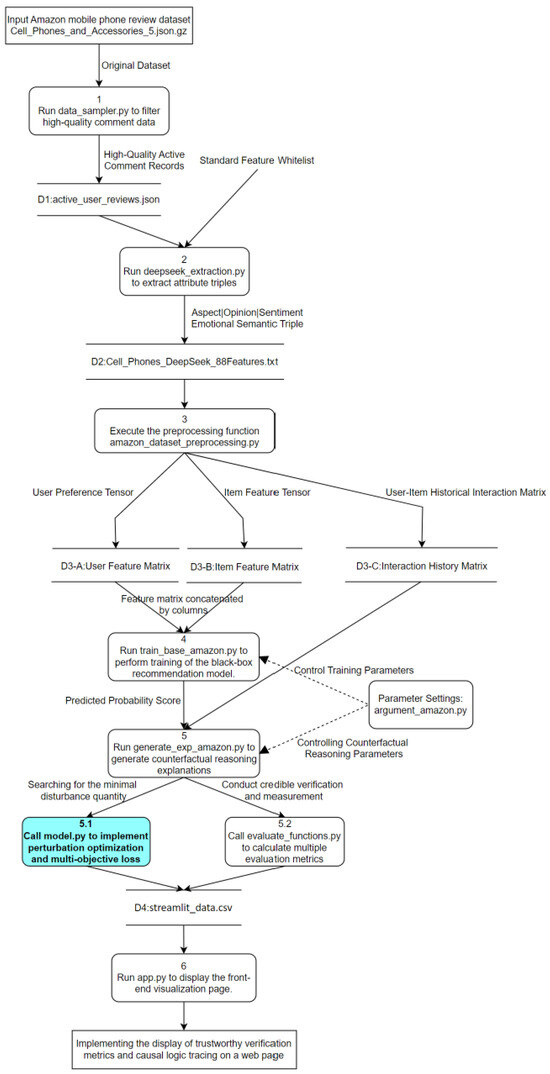
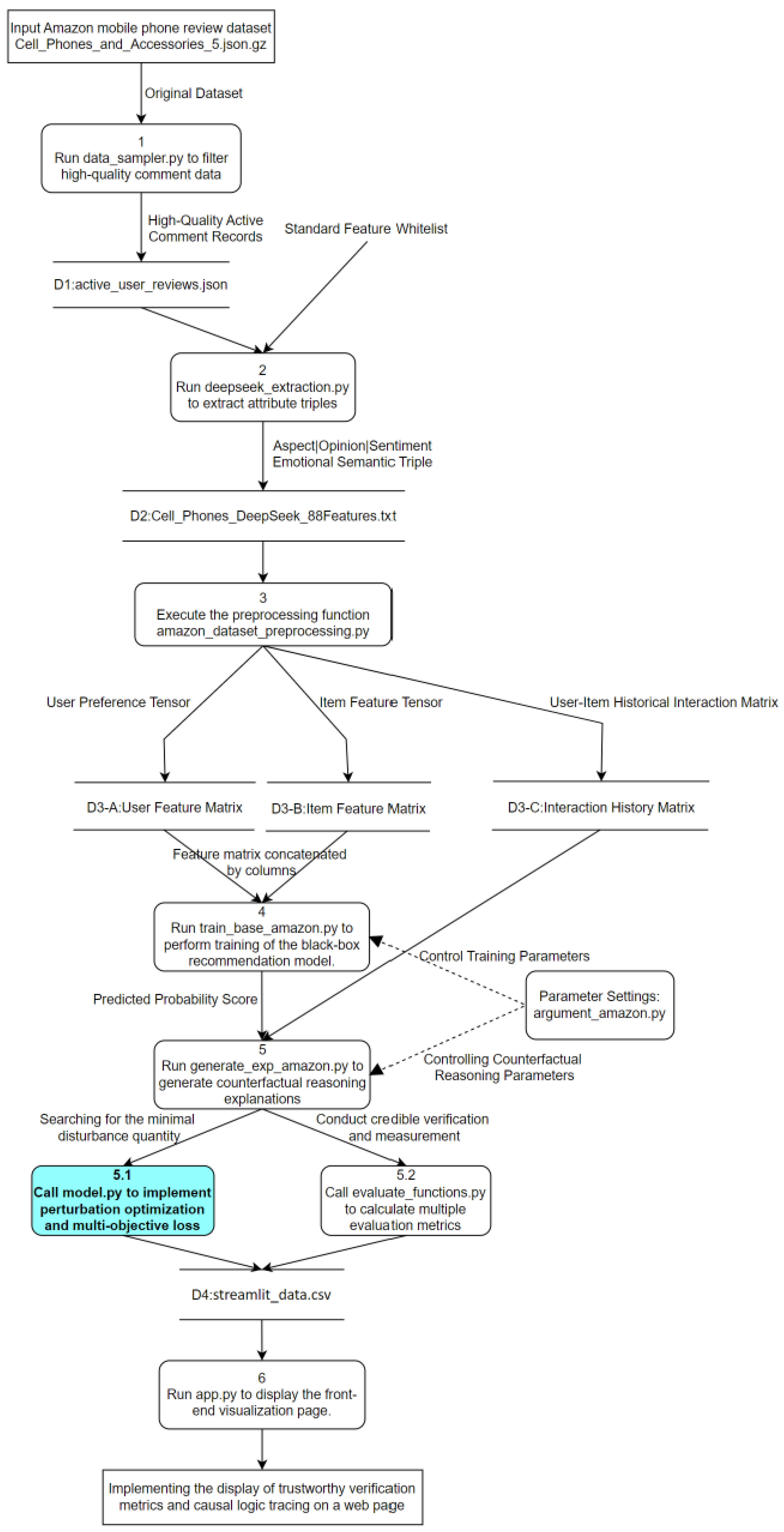
To answer this question, the framework integrates constrained LLM-based semantic extraction, a fixed neural recommendation predictor, counterfactual optimization, continuous-to-discrete semantic search, and causal evaluation. The overall workflow is shown in Figure 1 and contains four main components:
Figure 1.
Overall workflow of the proposed counterfactual-empowered causal analysis and trustworthiness verification framework. The review preprocessing stage should be read as active-user filtering followed by DeepSeek-based semantic extraction and whitelist validation.
- (1)
- LLM-based semantic causal attribute construction;
- (2)
- Fixed recommendation prediction modeling;
- (3)
- Counterfactual optimization and semantic attribute search;
- (4)
- Trustworthiness verification based on causal evaluation metrics.
2.2. Fixed Recommendation Model
Symmetric MLP Architecture
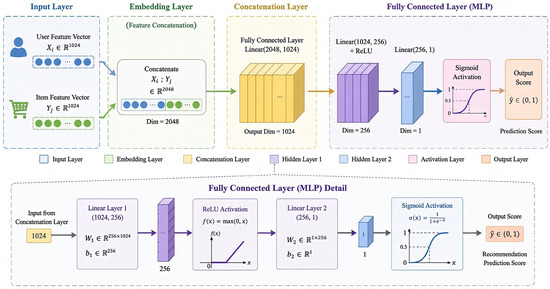
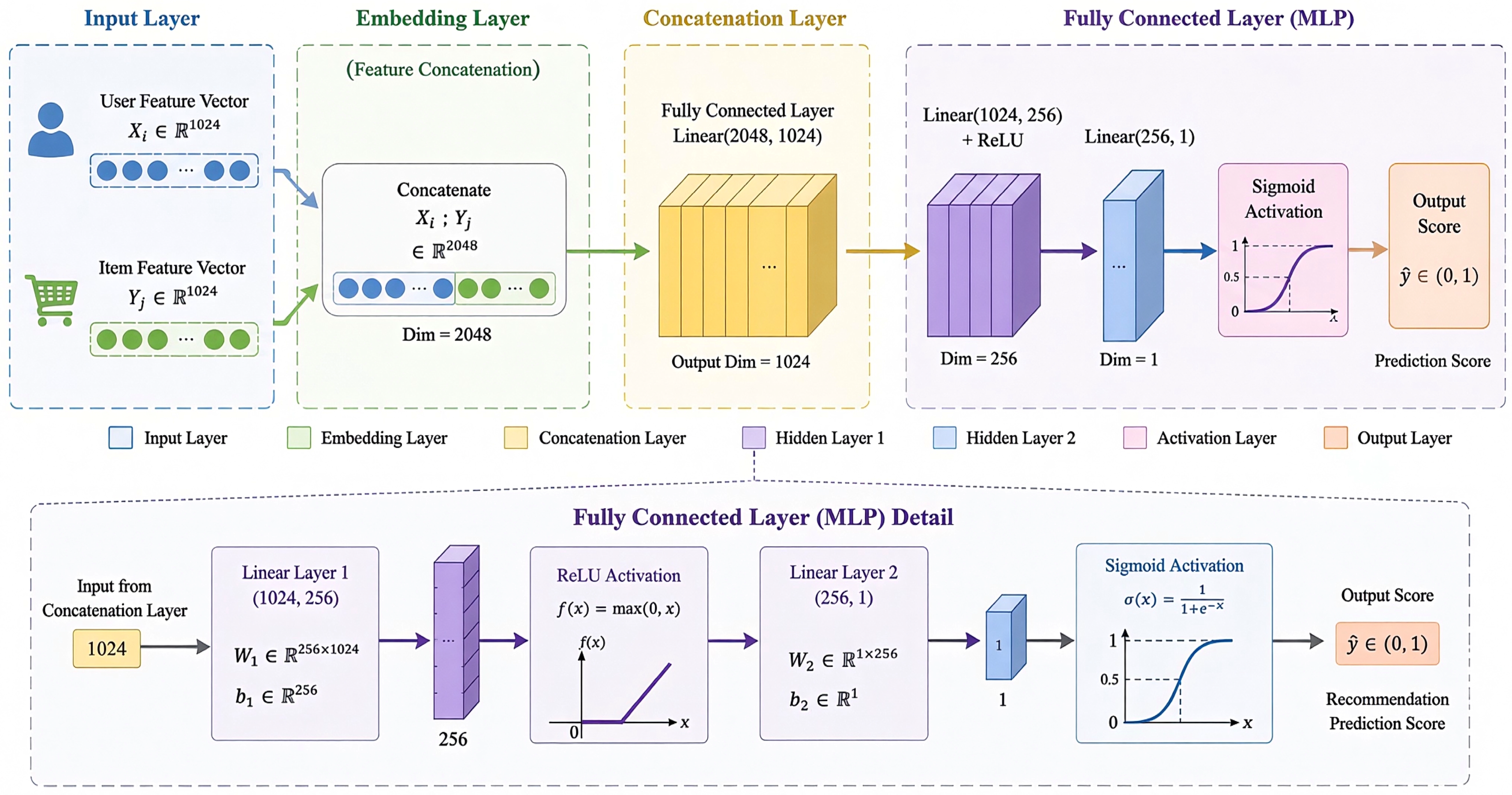
A multilayer perceptron is trained as the recommendation predictor whose outputs are subsequently verified. Figure 2 illustrates the predictor architecture. The predictor contains four components:
Figure 2.
Architecture of the black-box recommendation model based on multilayer perceptron.
- (1)
- Input representation layer;
- (2)
- Feature fusion layer;
- (3)
- Multilayer perceptron (MLP) prediction layer;
- (4)
- Output probability layer.
The predictor adopts a symmetric MLP design in which user and item representations are processed through structurally identical transformation branches before feature fusion. The purpose of this symmetry is to provide balanced representation capacity for the two interaction sides rather than to impose a causal assumption. After branch-wise transformation, the representations are concatenated and passed through fully connected layers to model nonlinear user–item interactions. In the current implementation, the fused vector is mapped through layers of 1024 and 256 hidden units with ReLU activation, followed by a one-dimensional sigmoid output.
The input layer receives user and item representations. The user feature vector describes user preference characteristics, while the item feature vector represents item-related information, following the common representation learning paradigm in neural recommendation models.
To capture user–item interaction information, the two feature vectors are concatenated:
where denotes vector concatenation.
The fused representation is then processed by multiple fully connected layers. The hidden representation of each layer is calculated as:
where and represent the weight matrix and bias vector of the -th layer, respectively, and represents the nonlinear activation function.
Finally, the recommendation probability is obtained through the output layer:
where represents the final hidden representation.
After training, all predictor parameters are frozen. Counterfactual verification modifies only the semantic item representation and observes the corresponding change in the recommendation probability. Gradients with respect to the semantic input are available to the verifier and are used for optimization and candidate ranking; no predictor parameter is updated during this process.
2.3. LLM-Based Semantic Attribute Construction
2.3.1. Motivation
Latent recommendation representations are effective for prediction but individual dimensions usually lack explicit meanings. Performing counterfactual intervention directly in such a space may therefore produce numerically effective perturbations that cannot be translated into understandable recommendation factors. To construct an intervention space with explicit semantics, this study derives structured product attributes from user review text.
DeepSeek-V4 is used only as a semantic annotation module rather than as the recommendation model. Its output is constrained by a predefined attribute whitelist so that the extracted attributes can be aligned with fixed feature dimensions used by the downstream recommendation and counterfactual modules.
This design makes each candidate intervention dimension human-interpretable. For the Cell Phones and Accessories domain, the vocabulary contains explicit product concepts such as battery, screen, design, look, price, sound, and speed. Domain-specific lexical variants are mapped to the closest whitelist category before the semantic representation is constructed.
2.3.2. Active-User Filtering and Semantic Validation
The raw Amazon Cell Phones and Accessories data are first reduced by an active-user screening procedure. The preprocessing script scans the first 200,000 raw review records and retains users who have at least five reviews within the scanned subset. These retained raw reviews are then submitted to the semantic extraction stage. After DeepSeek annotation, only triplets whose aspects belong to the predefined attribute dictionary are preserved. Records without any valid semantic triplets are discarded. A subsequent sparsity filter removes semantic attributes that occur only once in the extracted data, while the user threshold at this stage is one valid semantic interaction. Thus, the initial five-review threshold is an activity filter on the raw subset, whereas the final semantic dataset may contain fewer than five retained semantic records for an individual user.
2.3.3. Prompt-Constrained DeepSeek Extraction
For each retained review, DeepSeek is prompted to extract triplets in the format aspect|opinion|sentiment. The aspect must be selected from a predefined whitelist, and out-of-vocabulary expressions are mapped to the closest semantic category. The sentiment value is restricted to +1 or −1. The prompt also specifies deterministic lexical mappings, for example, mapping case/cover/protection/build-related expressions to design, battery-life/charge-related expressions to battery, screen/display/touch-related expressions to screen, and analogous mappings for look, price, sound, and speed. Introductory or explanatory text is forbidden so that the output can be parsed automatically. The exact DeepSeek model/version should be reported in the final manuscript asDeepSeek-V4.
2.3.4. Semantic Attribute Representation
Given the review information associated with an item: .
The LLM extracts high-level semantic attributes:
where represents the set of semantic attributes extracted from user reviews.
The extracted attributes are transformed into an interpretable semantic representation:
where denotes the -th semantic attribute.
Each retained semantic dimension therefore corresponds to an explicit attribute in the fixed vocabulary. This representation serves two purposes: it provides a stable input space for the recommendation predictor and, more importantly, defines the variables on which counterfactual interventions are performed. The LLM is not used during recommendation prediction after the semantic representation has been constructed.
2.4. Counterfactual-Empowered Causal Verification Framework
After constructing the semantic intervention space, the verification problem becomes a two-stage search problem: first, identify a continuous perturbation direction that can cross the predictor decision boundary, and then convert that perturbation into a small set of valid discrete semantic attributes. The framework therefore separates optimization variables from the final explanation set instead of treating a continuous perturbation as a semantic explanation by itself.
The framework evaluates recommendation factors through hypothetical intervention and prediction recalculation. It contains three coupled stages:
- (1)
- Adaptive counterfactual optimization;
- (2)
- Gradient-guided hybrid semantic search;
- (3)
- Multi-objective causal regularization.
2.4.1. Counterfactual Intervention Formulation
Let the original semantic item representation be perturbed by a continuous intervention vector. The continuous representation is used only during optimization and is later mapped to a discrete set of semantic attributes:
where represents the counterfactual semantic representation and denotes the semantic perturbation vector.
The purpose of counterfactual analysis is to identify a small number of semantic attributes whose modification can lead to a change in recommendation prediction. Therefore, the generated intervention should satisfy two requirements, shown as follows.
- (1)
- It should effectively influence the recommendation outcome;
- (2)
- It should contain as few modified attributes as possible.
Because each perturbation dimension is aligned with a predefined semantic attribute, the optimized direction can be traced back to a meaningful product factor. However, the magnitude of a continuous perturbation is not itself reported as the final explanation; candidate dimensions must pass the discrete search and verification procedure described in Section 2.4.3.
2.4.2. Adaptive Counterfactual Optimization
Directly searching over all discrete attribute subsets is combinatorial, while purely random continuous search can be unstable around nonlinear decision boundaries. We therefore first optimize a continuous perturbation vector and use the result to restrict the subsequent discrete search.
To improve optimization efficiency, this study introduces an adaptive counterfactual optimization strategy based on AdamW optimizer and cosine annealing learning-rate scheduling.
The perturbation is initialized at zero and optimized for at most T = 500 steps. At each iteration, the counterfactual objective is evaluated, gradients with respect to the perturbation are obtained through automatic differentiation, and AdamW updates the perturbation while cosine annealing adjusts the learning rate from the initial value of 0.5. The predictor parameters remain frozen throughout this procedure.
The update process is formulated as:
where represents the learning rate, and and denote the estimated first and second moments, respectively.
The combination of AdamW and cosine annealing allows relatively large exploratory steps early in the search and progressively finer updates later. Weight decay is set to 0.01 in the counterfactual optimization experiments. The procedure is summarized in Algorithm 1. The computational cost of Algorithm 1 is dominated by iterative forward and backward propagation, as analyzed in Section 2.4.5.
| Algorithm 1. Adaptive Counterfactual Optimization |
| Input: fixed predictor f_theta; user representation u; semantic item vector s; maximum steps T = 500; initial learning rate eta_0 = 0.5; weight decay = 0.01; counterfactual-loss parameters. |
| Output: optimized continuous perturbation delta* and corresponding counterfactual score. |
| Procedure: |
| 1: Initialize delta_0 = 0 and record the original recommendation score. |
| 2: For t = 1, …, T do: construct the continuous counterfactual representation s_t = s+delta_t. |
| 3: Evaluate the prediction-change objective together with the active regularization terms. |
| 4: Compute gradients with respect to delta_t through automatic differentiation; keep predictor parameters frozen. |
| 5: Update delta_t using AdamW. |
| 6: Update the learning rate using cosine annealing. |
| 7: Retain the best perturbation satisfying the counterfactual objective. |
| 8: Stop when the maximum number of steps is reached or the implemented counterfactual stopping criterion is satisfied. |
2.4.3. Gradient-Guided Hybrid Semantic Search
Continuous optimization identifies promising directions but does not by itself determine which discrete attributes should be reported. A direct thresholding rule may retain multiple redundant dimensions, whereas selecting only the largest gradient dimensions may omit combinations that are jointly necessary.
The proposed hybrid search therefore combines candidate extraction, gradient sensitivity ranking, and greedy causal verification. In the current implementation, the candidate threshold is −0.01, the fallback candidate number is 5, and at most the top 5 explanation attributes are retained for the principal search configuration.
For each semantic attribute , its influence on recommendation prediction is measured through gradient sensitivity:
where represents the importance score of the -th semantic attribute.
Gradient sensitivity is used only to rank already-semantic dimensions; it is not used as a semantic representation. Attributes with larger absolute influence are prioritized as candidates, after which greedy prediction recalculation tests whether each candidate is required. The search consists of three steps:
- (1)
- Calculate attribute-level gradient importance;
- (2)
- Rank candidate semantic attributes;
- (3)
- Greedily add/remove ranked candidates and recalculate the recommendation score until the target counterfactual condition is reached or no further removable attribute remains.
This division of labor is central to the method: gradient information improves search efficiency, while greedy verification provides the discrete causal check that removes unnecessary attributes. Algorithm 2 summarizes the procedure. The worst-case complexity of the candidate-ranking and greedy-verification process is analyzed in Section 2.4.5.
| Algorithm 2. Gradient-guided Hybrid Semantic Search |
| Input: optimized perturbation delta*; semantic attribute set A; fixed predictor f_theta; candidate threshold = −0.01; fallback top-N = 5; maximum explanation size K = 5. |
| Output: verified discrete semantic explanation set E*. |
| Procedure: |
| 1: Extract candidate dimensions from delta* using the candidate threshold; if too few candidates remain, use the fallback top-N rule. |
| 2: Compute input-gradient sensitivity for the candidate semantic attributes. |
| 3: Rank candidates by gradient-guided influence. |
| 4: Initialize the discrete candidate explanation from the highest-ranked attributes subject to the maximum explanation size. |
| 5: Greedily remove or add attributes and recalculate the recommendation score. |
| 6: Retain an attribute only when its removal/addition affects satisfaction of the counterfactual target. |
| 7: Return the smallest verified explanation obtained by the implemented search. |
2.4.4. Elastic Net-Based Multi-Objective Regularization
Prediction flipping alone is an insufficient objective because a large or dense perturbation may change the recommendation without yielding a concise and stable explanation. The final optimization objective therefore augments the causal prediction-change term with L1 and L2 penalties.
The final optimization objective is defined as:
where represents the counterfactual objective, encourages sparse attribute modification, and improves optimization stability.
The L1 term encourages sparse intervention dimensions, whereas the L2 term constrains perturbation magnitude and reduces unstable large changes. In the current implementation, the pairwise-loss coefficient is 15,000, the L1 coefficient is 1 × 10⁻⁵, and the L2 weight used in the Elastic Net experiment is 1.0.
The combined objective therefore favors interventions that satisfy the counterfactual target while remaining compact and numerically stable. Algorithm 3 summarizes the regularized explanation optimization. The additional element-wise regularization cost is linear in the semantic dimension and is included in the overall complexity analysis in Section 2.4.5.
| Algorithm 3. Elastic Net-based Explanation Optimization |
| Input: counterfactual loss L_cf; perturbation delta; pairwise coefficient lambda=15,000; L1 coefficient gamma = 1 × 10⁻⁵; L2 weight = 1.0. |
| Output: regularized perturbation and final verified semantic explanation. |
| Procedure: |
| 1: Compute the counterfactual prediction-change loss. |
| 2: Add the L1 penalty to encourage sparse semantic intervention dimensions. |
| 3: Add the L2 penalty to constrain perturbation magnitude. |
| 4: Optimize the weighted multi-objective loss jointly with the continuous counterfactual search. |
| 5: Apply the discrete gradient-guided greedy verification procedure and return the final explanation set. |
2.4.5. Computational Complexity
The computational cost of the proposed framework mainly arises from three stages: continuous counterfactual optimization, gradient-guided semantic candidate ranking, and discrete greedy verification. Let denote the number of semantic attributes, the maximum number of counterfactual optimization iterations, the number of candidate semantic attributes retained for discrete verification, the computational cost of one forward pass through the fixed recommendation predictor, and the cost of one backward pass.
During adaptive counterfactual optimization, each iteration requires one forward evaluation of the recommendation score and one backward operation to obtain gradients with respect to the semantic perturbation vector. Therefore, the computational complexity of this stage is .
In the implemented recommendation predictor, the concatenated user–item semantic representation is processed by an MLP with hidden dimensions of 1024 and 256. Therefore, the cost of one forward pass can be approximated as .
Since the hidden-layer dimensions are fixed in our implementation, the forward-pass cost grows approximately linearly with the semantic dimension .
After continuous optimization, the semantic attributes are ranked according to their gradient sensitivity. Sorting the attribute scores requires .
The ranked semantic candidates are subsequently evaluated through greedy causal verification. In the worst case, each candidate may be tested against multiple intermediate explanation sets. Therefore, for retained candidate attributes, the worst-case number of verification operations is , resulting in a computational cost of .
In practice, the greedy search terminates once the counterfactual condition is satisfied, and therefore the actual number of candidate evaluations is typically lower than this worst-case upper bound.
The Elastic Net regularization terms are calculated element-wise over the -dimensional perturbation vector, resulting in an additional complexity of per optimization iteration. This cost is dominated by the forward and backward propagation of the recommendation predictor.
Combining the above stages, the overall worst-case computational complexity of the proposed framework is approximately . The dominant computational cost is the iterative gradient-based counterfactual optimization. The proposed gradient-guided candidate ranking reduces the discrete search space before greedy verification, thereby avoiding exhaustive enumeration of all possible semantic attribute subsets.
3. Experimental Results
3.1. Experimental Setup
3.1.1. Dataset and Preprocessing
Experiments are conducted on the Amazon Cell Phones and Accessories review dataset. Because the semantic extraction stage requires LLM processing, the preprocessing script first scans 200,000 raw review records. Users with fewer than five raw reviews within this scanned subset are removed to reduce the influence of extremely inactive users. The retained review texts are then processed by DeepSeek using the constrained aspect–opinion–sentiment prompt described in Section 2.3.
After semantic extraction, aspects not contained in the predefined whitelist are discarded, and records without any valid semantic triplets are removed. The subsequent semantic sparsity filter uses user_thresh = 1 and feature_thresh = 1; because the implementation retains features only when their occurrence count is greater than feature_thresh, attributes occurring only once are removed. The processed semantic dataset contains 7231 users, 5086 items, and 14,890 valid review-based interaction records. These records are used to construct user-attention and item-quality matrices for the recommendation predictor.
Valid user–item interactions are ordered chronologically using the original Amazon review timestamps. For each user, the latest valid interaction is reserved as the positive test interaction (test_length = 1 and val_length = 0), while earlier valid interactions are used for training. During evaluation, 100 non-interacted items are sampled as negatives for each user. The trained predictor is then frozen, and only the semantic item perturbation is optimized during counterfactual verification.
3.1.2. Implementation Details
All compared variants use the same processed dataset, chronological split, fixed recommendation predictor, and evaluation protocol. The base recommendation model is trained for 100 epochs with a learning rate of 0.002, batch size of 128, and weight decay of 1 × 10⁻⁵. For counterfactual optimization, the principal configuration uses AdamW with cosine annealing, an initial learning rate of 0.5, 500 optimization steps, and weight decay of 0.01. The pairwise-loss coefficient lambda is 15,000 and the L1 coefficient gamma is 1 × 10⁻⁵. For the hybrid search experiments, the candidate threshold is −0.01, fallback top-N is 5, maximum explanation size is 5, and target gap is 0.35. The Elastic Net experiment uses an L2 weight of 1.0. A fixed random seed is used for reproducibility.
- (1)
- Base-model learning rate: 0.002; counterfactual-search initial learning rate: 0.5;
- (2)
- Base-model training epochs: 100; maximum counterfactual iterations: 500;
- (3)
- Counterfactual-search weight decay: 0.01; batch size: 128; recommendation list length: 5;
- (4)
- Current counterfactual evaluation subset: 2000 users.
The experimental pipeline is configured to maximize reproducibility. A fixed random seed is used for preprocessing, negative sampling, model training, and counterfactual evaluation. All compared variants share the same processed dataset, chronological train–test protocol, fixed recommendation predictor, hyperparameters unrelated to the evaluated component, and evaluation subset of 2000 users. Therefore, differences among the reported variants arise from the specific algorithmic component being evaluated rather than from changes in data partitioning or experimental configuration. Because the reported experiments follow a deterministic single-run protocol, the results are interpreted as controlled comparative evidence rather than statistical significance estimates.
3.1.3. Evaluation Metrics
Four evaluation metrics are adopted to measure the quality of generated counterfactual explanations:
Precision evaluates whether the generated explanation attributes are consistent with the semantic attributes that users actually care about. It is calculated as follows.
where is an indicator function, denotes the number of user–item explanation pairs, represents the number of candidate attributes, is the generated explanation attribute, and denotes the user-preferred attribute.
Probability of Necessity (PN) measures whether removing the identified causal attributes can effectively change the recommendation result. It is defined as follows.
where represents the user set, denotes the original recommendation list of user , represents the counterfactual recommendation list, and indicates whether removing the generated explanation attributes changes the recommendation result.
Probability of Sufficiency (PS) evaluates whether the selected explanation attributes alone are sufficient to preserve the recommendation decision. It is calculated as follows.
where indicates whether the selected explanation attributes are sufficient to maintain the original recommendation outcome.
Feature Necessity Score (FNS) combines PN and PS using harmonic averaging to comprehensively evaluate the causal reliability of explanations.
Higher values of all metrics indicate more trustworthy, causal, and effective counterfactual explanations.
3.2. Evaluation of Adaptive Counterfactual Optimization Strategy
To verify the effectiveness of the proposed AdamW-based adaptive optimization strategy with cosine annealing learning rate scheduling, different optimization algorithms are compared, including:
- (1)
- SGD;
- (2)
- AdaGrad;
- (3)
- RMSProp;
- (4)
- Adam;
- (5)
- AdamW;
- (6)
- AdamW + Cosine Annealing.
The experimental results demonstrate that the optimization strategy has an impact on counterfactual search quality.
The experimental results demonstrate that the choice of optimization strategy has a clear impact on counterfactual search quality under the controlled evaluation setting. As shown in Table 1, AdamW with cosine annealing achieves the highest overall values among the evaluated optimization variants, including a Precision of 0.9795 and an FNS of 0.7661. Because all variants are evaluated using the same predictor, test users, initialization protocol, and fixed random seed, the observed performance differences can be attributed to the optimization strategy under the specified experimental configuration. These results are therefore interpreted as controlled comparative evidence rather than statistical significance.
Table 1.
Comparison of different optimization strategies.
Furthermore, introducing cosine annealing further improves the optimization process. The dynamic learning rate allows the algorithm to perform broader exploration in the early stage and gradually refine the perturbation direction during later iterations, resulting in more stable convergence.
3.3. Evaluation of Hybrid Continuous-Discrete Search Strategy
Although gradient-based optimization can obtain effective continuous perturbation directions, directly converting continuous perturbations into discrete semantic explanations may introduce redundant attributes.
To address this problem, the proposed Gradient-guided Hybrid Semantic Search strategy combines gradient sensitivity ranking with offline greedy search.
In this experiment, the AdamW + Cosine optimization strategy is fixed, and only the discretization method is changed to evaluate the influence of different attribute selection strategies. The comparison methods include:
- (1)
- Threshold All;
- (2)
- Gradient + Greedy.
The comparison of different discretization strategies results are shown in Table 2.
Table 2.
Comparison of different discretization strategies.
Both discretization strategies obtain the same Precision because they start from the same successful semantic candidate pool and identify recommendation-related attributes at the same attribute-matching rate. However, Gradient + Greedy obtains higher PN, PS, and FNS values.
The difference is explained by the greedy verification stage: instead of retaining all threshold-selected candidates, the method repeatedly removes candidate attributes and recalculates the recommendation score. Attributes whose removal does not affect the counterfactual condition are treated as redundant. Consequently, Precision can remain unchanged while necessity, sufficiency, and the harmonic FNS improve.
To further analyze the contribution of each component, an additional ablation experiment is conducted. The ablation study of gradient-guided hybrid search results are shown in Table 3.
Table 3.
Ablation study of Gradient-guided Hybrid Search.
The results verify that gradient guidance provides accurate candidate ranking, while greedy search further eliminates unnecessary attributes. Combining both components achieves the best explanation quality.
3.4. Evaluation of Elastic Net Multi-Objective Regularization
To investigate the effectiveness of the proposed Elastic Net constrained multi-objective optimization strategy, four variants are compared as follows.
- (1)
- Causal Only;
- (2)
- Causal + L1;
- (3)
- Causal + L2;
- (4)
- Causal + L1 + L2.
The AdamW + Cosine optimization strategy and Gradient + Greedy search strategy are fixed, and only the regularization constraint is modified. The ablation study of elastic net regularization results are presented in Table 4.
Table 4.
Ablation study of Elastic Net regularization.
The results demonstrate that each regularization component contributes differently. The Causal Only method can successfully push recommendation scores below the decision boundary but suffers from redundant and unstable perturbations.
Adding L1 regularization improves explanation sparsity by suppressing unnecessary attribute changes.
Adding L2 regularization constrains perturbation magnitude and improves stability.
However, neither L1 nor L2 alone can simultaneously optimize sparsity and robustness.
The proposed Elastic Net strategy combines L1 and L2 constraints, achieving the best balance between recommendation flipping capability, perturbation stability, and explanation compactness.
3.5. Overall Experimental Analysis
The experimental results demonstrate that the proposed LLM-driven trustworthy recommendation verification framework effectively improves the reliability of counterfactual explanations. The main findings can be summarized as follows.
- (1)
- Adaptive optimization improvement.
The AdamW optimizer combined with cosine annealing learning rate scheduling significantly improves counterfactual search stability and achieves the highest comprehensive evaluation score.
- (2)
- Hybrid search effectiveness.
The Gradient + Greedy strategy successfully bridges the gap between continuous optimization space and discrete semantic attributes, generating more concise and causally meaningful explanations.
- (3)
- Multi-objective regularization effectiveness.
The Elastic Net constraint effectively balances explanation sparsity and perturbation stability, producing more trustworthy recommendation explanations.
Overall, the component-wise experiments provide controlled evidence for the three methodological contributions under the same dataset, predictor, and evaluation protocol. AdamW with cosine annealing improves the optimization behavior relative to the evaluated alternatives; Gradient + Greedy improves the causal necessity and sufficiency of the discrete semantic explanations; and the combined L1-L2 regularization achieves the strongest overall performance among the tested regularization variants. Because the purpose of these experiments is mechanism-level validation, the conclusions of this study are restricted to the current Amazon Cell Phones and Accessories setting. Cross-domain generalization and statistical variability across independent runs are not claimed in the present study.
4. Discussion
4.1. Effectiveness of Semantic Intervention Representation
The semantic representation is a prerequisite for interpretable intervention because each candidate dimension is aligned with an explicit review-derived attribute. In contrast, a latent embedding dimension may be predictive but cannot normally be interpreted as a concrete product factor. The proposed representation therefore improves the semantic traceability of the counterfactual search.
Traditional recommendation models generally rely on latent embeddings to represent users and items. Although these representations are effective for prediction, the semantic meanings of individual dimensions are usually difficult to interpret. Consequently, directly applying counterfactual analysis in latent spaces may generate feature perturbations that are difficult to understand from a user perspective.
DeepSeek is used as a constrained information extractor rather than as a recommendation generator. The whitelist and lexical mapping rules reduce output-format variability and align synonymous expressions with a fixed semantic vocabulary. This connection between review language and intervention variables is what allows the final explanation to be expressed in terms such as battery, screen, price, or sound instead of latent coordinates.
The observed Precision values indicate that the generated explanations frequently overlap with the semantic attributes present in the held-out review evidence. However, Precision alone does not establish causal reliability; this is why PN and PS are jointly analyzed to determine whether changing or retaining the selected attributes affects the recommendation outcome.
Furthermore, the semantic causal attribute space enables counterfactual explanations to answer not only “which features are important”, but also “which semantic factors would change the recommendation decision if modified”. This property improves the interpretability and practical usability of recommendation explanations.
These findings are consistent with recent studies on LLM-enhanced recommendation systems, which demonstrate that large language models provide strong capabilities in extracting high-level semantic knowledge from textual information.
4.2. Advantages of Counterfactual Causal Verification
Unlike traditional explainable recommendation approaches that mainly focus on generating descriptive explanations, the proposed framework introduces counterfactual reasoning to verify the causal influence of recommendation factors.
Existing explanation methods often identify important features based on correlation or attention weights. However, such importance estimation does not necessarily indicate causal contribution. Previous studies have also pointed out that feature importance or attention-based explanations may reveal correlations rather than true causal relationships between input factors and model predictions. A feature with high attention weight may not change the recommendation outcome when modified.
The proposed framework addresses this problem by constructing counterfactual scenarios and evaluating recommendation changes under semantic interventions. Counterfactual explanation methods have been widely explored to identify influential factors by observing prediction changes under hypothetical interventions. For example, CountER formulated counterfactual explanation generation as an optimization problem, while neural counterfactual explanation methods further investigated decision boundaries of black-box recommenders. Through this process, the framework identifies attributes that are truly responsible for recommendation decisions.
The improvements in PN and PS demonstrate that the generated explanations contain stronger causal necessity and sufficiency. Specifically, higher PN indicates that removing identified attributes can effectively influence recommendation outcomes, while higher PS demonstrates that selected attributes contain sufficient information to reproduce recommendation decisions.
The integration of adaptive optimization, gradient-guided semantic search, and sparse causal regularization further improves the reliability of generated explanations.
4.3. Comparison with Existing Explainable Recommendation Methods
Existing explainable recommendation studies can generally be divided into three categories, as follows.
- (1)
- Feature attribution-based methods;
- (2)
- Text generation-based explanation methods;
- (3)
- Counterfactual explanation methods.
Feature attribution approaches attempt to identify important input factors but usually rely on correlation analysis rather than explicit causal verification. Text generation-based approaches can provide human-readable explanations by leveraging textual information and natural language generation techniques; however, they cannot always guarantee whether the generated explanations faithfully reflect the actual decision mechanism of recommendation models.
Counterfactual explanation methods provide a stronger causal interpretation by analyzing prediction changes under hypothetical interventions. However, most existing approaches perform optimization in latent representation spaces or focus primarily on generating prediction-changing explanations, which limits semantic interpretability and practical verification.
The proposed framework combines the advantages of semantic representation learning and counterfactual causal reasoning. Compared with CountER [9], the proposed method introduces an explicit semantic intervention space through LLM-based attribute extraction. Therefore, generated counterfactual explanations correspond to meaningful attributes rather than abstract feature dimensions.
Compared with causal recommendation approaches, which mainly focus on bias elimination, causal preference modeling, or sequential recommendation improvement, the proposed framework emphasizes post-hoc verification of recommendation decisions. This makes it applicable to existing black-box recommendation systems without requiring modification of internal architectures.
Accordingly, the framework should be viewed as a post-hoc verification procedure for a fixed predictor under gradient access. Its practical value is that the predictor itself does not need to be retrained or structurally modified, while the explanation variables remain semantically interpretable.
4.4. Limitations and Future Directions
Although the current results are promising, the framework has several limitations that directly follow from its design and experimental setting.
First, semantic extraction depends on the quality and consistency of the selected LLM, prompt, whitelist, and domain-specific mapping rules. Missing, incorrectly mapped, or overly coarse attributes can propagate directly into the intervention space. The current prompt constrains DeepSeek output strongly, but systematic comparison across LLM versions and prompt variants has not yet been performed.
Second, the current semantic vocabulary and evaluation are focused on the Amazon Cell Phones and Accessories domain. The objective of the present experiments is controlled mechanism-level verification rather than cross-domain benchmarking. Therefore, the current results should not be interpreted as evidence of universal cross-domain generalizability. Applying the framework to other domains would require adapting the semantic whitelist and lexical mappings, which will be investigated in future work.
Third, the proposed verification procedure introduces additional computational overhead because counterfactual explanations are generated through iterative forward–backward optimization followed by discrete greedy verification. As analyzed in Section 2.4.5, the dominant cost is associated with the TT-step gradient-based optimization process. Although gradient-guided candidate ranking reduces the subsequent discrete search space, the computational cost may still become substantial when the framework is applied to very large-scale recommendation systems or to a large number of user–item pairs simultaneously. Future work will therefore investigate more efficient gradient approximation, parallel counterfactual generation, and early-stopping strategies.
Finally, the counterfactual evaluation is conducted on 2000 users using a deterministic protocol with fixed random seeds. This design ensures that the reported comparisons are reproducible under the specified configuration and prevents random changes in data splitting or sampling from confounding the component-wise comparisons. However, deterministic reproducibility does not replace uncertainty estimation from multiple independent runs. Therefore, the present study does not make claims of statistical significance; repeated-run uncertainty analysis and cross-domain evaluation remain directions for future work.
5. Conclusions
This study proposed a counterfactual-empowered causal analysis and trustworthiness verification framework for recommendation results, with the aim of identifying whether interpretable semantic attributes genuinely contribute to an individual recommendation outcome. The framework operates on review-derived semantic variables rather than relying solely on latent representations and verifies recommendation decisions through explicit counterfactual intervention.
First, an adaptive counterfactual optimization strategy based on AdamW and cosine annealing scheduling was developed to improve the stability and convergence efficiency of semantic intervention searching. By combining adaptive parameter updating with a gradually adjusted learning rate, the proposed strategy enables the perturbation process to move more steadily toward effective counterfactual regions. The optimizer comparison experiments show that the AdamW-plus-cosine configuration achieves the strongest overall performance among the tested optimization variants, indicating that adaptive optimization and dynamic learning-rate adjustment are beneficial for stable counterfactual search.
Second, a gradient-guided hybrid semantic search mechanism was introduced to bridge the gap between continuous optimization spaces and discrete human-understandable semantic attributes. In the proposed framework, gradient sensitivity is used only to rank the influence of semantic dimensions that have already been constructed from review information, rather than being treated as the semantic explanation itself. The ranked candidates are subsequently verified through greedy recommendation-score recalculation to remove redundant attributes and retain more causally relevant interventions. The experimental results show that this mechanism improves PN, PS, and FNS compared with alternative discretization strategies, demonstrating its effectiveness in generating more concise and causally meaningful semantic explanations.
Third, an Elastic Net-based multi-objective regularization strategy was designed to jointly optimize explanation sparsity, robustness, and causal effectiveness. By combining the counterfactual objective with L1- and L2-based regularization, the proposed strategy simultaneously encourages sparse semantic interventions and constrains excessive perturbation magnitude while preserving the ability to change the recommendation decision. The corresponding ablation results show that the combined L1–L2 formulation achieves better overall counterfactual verification performance than the causal objective alone or either regularization term used individually, supporting the effectiveness of jointly considering sparsity and stability during explanation generation.
Overall, the results indicate that the proposed framework provides a structured approach for verifying recommendation outcomes through interpretable semantic interventions. Nevertheless, the current study still depends on the quality of LLM-based semantic extraction, a predefined domain-specific semantic vocabulary, and gradient access to the fixed recommendation predictor. In addition, iterative counterfactual optimization and greedy verification introduce additional computational overhead. Future work will focus on more robust semantic extraction, more efficient or gradient-free verification, larger-scale and cross-domain evaluation, multimodal recommendation scenarios, and human-centered assessment of explanation usefulness.
Author Contributions
Conceptualization, J.W. and J.L.; Methodology, L.L.; Software, L.L.; Validation, L.L. and J.W.; Formal Analysis, J.W., J.L., B.L., C.Z. and K.L.; Investigation, L.L. and J.W.; Resources, L.L. and J.W.; Data Curation, L.L.; Writing—Original Draft, L.L.; Writing—Review & Editing, L.L., J.W., J.L., B.L., C.Z. and K.L.; Supervision, J.W., J.L. and B.L.; Project Administration, J.W.; Funding Acquisition, J.W., J.L., B.L., C.Z. and K.L. All authors have read and agreed to the published version of the manuscript.
Funding
This work is supported by the Northeast Electric Power University doctoral research start-up fund 12087.
Data Availability Statement
The data presented in this study are openly available in https://doi.org/10.1145/3459637.3482420.
Acknowledgments
Thanks to the School of Computer Science and Technology at Anhui University for their assistance.
Conflicts of Interest
Author Cunlong Zheng was employed by State Grid Jilin Electric Power Co., Ltd. and author Kai Li was employed by State Grid Siping Electric Power Supply Company. The remaining authors declare that the research was conducted in the absence of any commercial or financial relationships that could be construed as a potential conflict of interest.
References
- Ge, Y.; Liu, S.; Fu, Z.; Tan, J.; Li, Z.; Xu, S.; Li, Y.; Xian, Y.; Zhang, Y. A Survey on Trustworthy Recommender Systems. ACM Trans. Recomm. Syst. 2024, 3, 1–68. [Google Scholar] [CrossRef] [Scilit]
- Dong, M.; Yuan, F.; Yao, L.; Wang, X.; Xu, X.; Zhu, L. A survey for trust-aware recommender systems: A deep learning perspective. Knowl. Based Syst. 2022, 249, 108954. [Google Scholar] [CrossRef] [Scilit]
- Jin, D.; Wang, L.; Zhang, H.; Zheng, Y.; Ding, W.; Xia, F.; Pan, S. A survey on fairness-aware recommender systems. Inf. Fusion 2023, 100, 101906. [Google Scholar] [CrossRef] [Scilit]
- Lin, Y.; Liu, Y.; Lin, F.; Zou, L.; Wu, P.; Zeng, W.; Chen, H.; Miao, C. A Survey on Reinforcement Learning for Recommender Systems. IEEE Trans. Neural Netw. Learn. Syst. 2024, 35, 13164–13184. [Google Scholar] [CrossRef] [Scilit] [PubMed]
- Liu, H.; Guo, Y.; Yin, J.; Gao, Z.; Nie, L. Review Polarity-Wise Recommender. IEEE Trans. Neural Netw. Learn. Syst. 2023, 34, 10039–10050. [Google Scholar] [CrossRef] [Scilit] [PubMed]
- Lyu, Z.; Wu, Y.; Lai, J.; Yang, M.; Li, C.; Zhou, W. Knowledge Enhanced Graph Neural Networks for Explainable Recommendation. IEEE Trans. Knowl. Data Eng. 2023, 35, 4954–4968. [Google Scholar] [CrossRef] [Scilit]
- Zhu, L.; Xu, Y.; Li, J.; Guan, W.; Cheng, Z. Explainable Discrete Collaborative Filtering. IEEE Trans. Knowl. Data Eng. 2023, 35, 6901–6915. [Google Scholar] [CrossRef] [Scilit]
- Markchom, T.; Liang, H.; Ferryman, J. Scalable and explainable visually-aware recommender systems. Knowl. Based Syst. 2023, 263, 110258. [Google Scholar] [CrossRef] [Scilit]
- Tan, J.; Xu, S.; Ge, Y.; Li, Y.; Chen, X.; Zhang, Y. Counterfactual Explainable Recommendation. In Proceedings of the 30th ACM International Conference on Information & Knowledge Management, Queensland, Australia, 1–5 November 2021; pp. 1784–1793. [Google Scholar]
- Wei, Y.; Qu, X.; Wang, X.; Ma, Y.; Nie, L.; Chua, T.-S. Rule-Guided Counterfactual Explainable Recommendation. IEEE Trans. Knowl. Data Eng. 2024, 36, 2179–2190. [Google Scholar] [CrossRef] [Scilit]
- Yu, D.; Li, Q.; Wang, X.; Li, Q.; Xu, G. Counterfactual Explainable Conversational Recommendation. IEEE Trans. Knowl. Data Eng. 2024, 36, 2388–2400. [Google Scholar] [CrossRef] [Scilit]
- Guo, Y.; Cai, F.; Pan, Z.; Shao, T.; Chen, H.; Zhang, X. A counterfactual explanation method based on modified group influence function for recommendation. Complex Intell. Syst. 2024, 10, 7631–7643. [Google Scholar] [CrossRef] [Scilit]
- Zhang, Y.; Feng, F.; He, X.; Wei, T.; Song, C.; Ling, G.; Zhang, Y. Causal Intervention for Leveraging Popularity Bias in Recommendation. In Proceedings of the 44th International ACM SIGIR Conference on Research and Development in Information Retrieval, Virtual, 11–15 July 2021; pp. 11–20. [Google Scholar]
- Zhang, S.; Yao, D.; Zhao, Z.; Chua, T.-S.; Wu, F. CauseRec: Counterfactual User Sequence Synthesis for Sequential Recommendation. In Proceedings of the 44th International ACM SIGIR Conference on Research and Development in Information Retrieval, Virtual, 11–15 July 2021; pp. 367–377. [Google Scholar]
- Chen, J.; Dong, H.; Qiu, Y.; He, X.; Xin, X.; Chen, L.; Lin, G.; Yang, K. AutoDebias: Learning to Debias for Recommendation. In Proceedings of the 44th International ACM SIGIR Conference on Research and Development in Information Retrieval, Virtual, 11–15 July 2021; pp. 21–30. [Google Scholar]
- Zhang, X.; Jia, H.; Su, H.; Wang, W.; Xu, J.; Wen, J.-R. Counterfactual Reward Modification for Streaming Recommendation with Delayed Feedback. In Proceedings of the 44th International ACM SIGIR Conference on Research and Development in Information Retrieval, Virtual, 11–15 July 2021; pp. 41–50. [Google Scholar]
- Luo, H.; Zhuang, F.; Xie, R.; Zhu, H.; Wang, D.; An, Z.; Xu, Y. A survey on causal inference for recommendation. Innov. 2024, 5, 100590. [Google Scholar] [CrossRef] [Scilit] [PubMed]
- Guidotti, R. Counterfactual explanations and how to find them: Literature review and benchmarking. Data Min. Knowl. Discov. 2024, 38, 2770–2824. [Google Scholar] [CrossRef] [Scilit]
- Chou, Y.-L.; Moreira, C.; Bruza, P.; Ouyang, C.; Jorge, J. Counterfactuals and causability in explainable artificial intelligence: Theory, algorithms, and applications. Inf. Fusion 2022, 81, 59–83. [Google Scholar] [CrossRef] [Scilit]
- Del Ser, J.; Barredo-Arrieta, A.; Díaz-Rodríguez, N.; Herrera, F.; Saranti, A.; Holzinger, A. On generating trustworthy counterfactual explanations. Inf. Sci. 2024, 655, 119898. [Google Scholar] [CrossRef] [Scilit]
- Zhang, S.; Chen, X.; Wen, S.; Li, Z. Density-based reliable and robust explainer for counterfactual explanation. Expert Syst. Appl. 2023, 226, 120214. [Google Scholar] [CrossRef] [Scilit]
- Duong, T.D.; Li, Q.; Xu, G. Causality-based counterfactual explanation for classification models. Knowl. Based Syst. 2024, 300, 112200. [Google Scholar] [CrossRef] [Scilit]
- Wu, L.; Zheng, Z.; Qiu, Z.; Wang, H.; Gu, H.; Shen, T.; Qin, C.; Zhu, C.; Zhu, H.; Liu, Q.; et al. A survey on large language models for recommendation. World Wide Web 2024, 27, 60. [Google Scholar] [CrossRef] [Scilit]
- Wei, W.; Ren, X.; Tang, J.; Wang, Q.; Su, L.; Cheng, S.; Wang, J.; Yin, D.; Huang, C. LLMRec: Large Language Models with Graph Augmentation for Recommendation. In Proceedings of the 17th ACM International Conference on Web Search and Data Mining, Mérida, Mexico, 4–8 March 2024. [Google Scholar]
- Tan, J.; Xu, S.; Hua, W.; Ge, Y.; Li, Z.; Zhang, Y. IDGenRec: LLM-RecSys Alignment with Textual ID Learning. In Proceedings of the 47th International ACM SIGIR Conference on Research and Development in Information Retrieval, Washington, DC, USA, 14–18 July 2024; pp. 355–364. [Google Scholar]
- Lin, X.; Wang, W.; Li, Y.; Yang, S.; Feng, F.; Wei, Y.; Chua, T.-S. Data-efficient Fine-tuning for LLM-based Recommendation. In Proceedings of the 47th International ACM SIGIR Conference on Research and Development in Information Retrieval, Washington, DC, USA, 14–18 July 2024; pp. 365–374. [Google Scholar]
- Zhang, A.; Chen, Y.; Sheng, L.; Wang, X.; Chua, T.-S. On Generative Agents in Recommendation. In Proceedings of the 47th International ACM SIGIR Conference on Research and Development in Information Retrieval, Washington, DC, USA, 14–18 July 2024; pp. 1807–1817. [Google Scholar]
- Zhao, Y.; Wu, J.; Wang, X.; Tang, W.; Wang, D.; de Rijke, M. Let Me Do It For You: Towards LLM-Empowered Recommendation via Tool Learning. In Proceedings of the 47th International ACM SIGIR Conference on Research and Development in Information Retrieval, Washington, DC, USA, 14–18 July 2024. [Google Scholar]
- Wang, Z.; Yu, Y.; Zheng, W.; Ma, W.; Zhang, M. MACRec: A Multi-Agent Collaboration Framework for Recommendation. In Proceedings of the 47th International ACM SIGIR Conference on Research and Development in Information Retrieval, Washington, DC, USA, 14–18 July 2024; pp. 2760–2764. [Google Scholar]
- Lin, X.; Wang, W.; Li, Y.; Feng, F.; Ng, S.-K.; Chua, T.-S. Bridging Items and Language: A Transition Paradigm for Large Language Model-Based Recommendation. In Proceedings of the 30th ACM SIGKDD Conference on Knowledge Discovery and Data Mining, Barcelona, Spain, 25–29 August 2024; pp. 1816–1826. [Google Scholar]
- Lei, Y.; Lian, J.; Yao, J.; Huang, X.; Lian, D.; Xie, X. RecExplainer: Aligning Large Language Models for Explaining Recommendation Models. In Proceedings of the 30th ACM SIGKDD Conference on Knowledge Discovery and Data Mining, Barcelona, Spain, 25–29 August 2024; pp. 1530–1541. [Google Scholar]
- Wu, J.; Chang, C.-C.; Yu, T.; He, Z.; Wang, J.; Hou, Y.; McAuley, J. CoRAL: Collaborative Retrieval-Augmented Large Language Models Improve Long-tail Recommendation. In Proceedings of the 30th ACM SIGKDD Conference on Knowledge Discovery and Data Mining, Barcelona, Spain, 25–29 August 2024. [Google Scholar]
- Bao, K.; Zhang, J.; Lin, X.; Zhang, Y.; Wang, W.; Feng, F. Large Language Models for Recommendation: Past, Present, and Future. In Proceedings of the 47th International ACM SIGIR Conference on Research and Development in Information Retrieval, Washington, DC, USA, 14–18 July 2024; pp. 2993–2996. [Google Scholar]
- Paz-Ruza, J.; Alonso-Betanzos, A.; Guijarro-Berdiñas, B.; Cancela, B.; Eiras-Franco, C. Sustainable transparency on recommender systems: Bayesian ranking of images for explainability. Inf. Fusion 2024, 111, 102497. [Google Scholar] [CrossRef] [Scilit]
- Xu, H.; Bao, J.; Lin, Q.; Hou, L.; Chen, F. Disentangling User Cognitive Intent with Causal Reasoning for Knowledge-Enhanced Recommendation. Cogn. Comput. 2024, 16, 3391–3404. [Google Scholar] [CrossRef] [Scilit]

Disclaimer/Publisher’s Note: The statements, opinions and data contained in all publications are solely those of the individual author(s) and contributor(s) and not of MDPI and/or the editor(s). MDPI and/or the editor(s) disclaim responsibility for any injury to people or property resulting from any ideas, methods, instructions or products referred to in the content. |
© 2026 by the authors. Licensee MDPI, Basel, Switzerland. This article is an open access article distributed under the terms and conditions of the Creative Commons Attribution (CC BY) license.