


Abstract
This manuscript investigates the adaptive dual synchronization of fractional-order chaotic systems governed by the Caputo–Fabrizio operator, in the presence of multiple disturbances and indeterminate arguments. The systems under consideration are subject to various disturbances, including external perturbations and nonlinear uncertainties, whose upper bounds are unknown. First, a useful Caputo–Fabrizio fractional differential inequality is proposed, facilitating the efficient construction of an appropriate Lyapunov function. Furthermore, an effective sliding mode controller along with adaptive parameter laws is developed to regulate the fractional-order (hyper) chaotic systems. Finally, two numerical examples are presented to demonstrate the accuracy and effectiveness of the proposed method. These examples illustrate that the proposed control strategy is also applicable to both chaotic and hyperchaotic systems.
1. Introduction
The concept of chaos is not unfamiliar to most people, as chaos is widely present in various micro and macro systems of the world we live in. Especially for most nonlinear systems, their chaotic behavior is non-periodic, disordered and difficult to predict and imagine. The most famous example can be traced back to the butterfly effect discovered by scientist Lorenz while studying atmospheric science. This term can be roughly explained as a butterfly flapping its wings in Brazil, which may lead to a tornado in Texas, USA, in two weeks [1,2]. From this, it can be seen that small changes in the atmospheric system may cause incalculable results. It is precisely because of the common characteristics of chaotic systems that many interdisciplinary fields have emerged, such as chaos mathematics and chaos economics. This phenomenon has attracted widespread attention from mathematicians and researchers, especially in the domain of control and synchronization of (hyper)chaotic systems. Since Pecora first introduced the concept of synchronization in 1990 [3], a large number of excellent synchronization methods have been proposed so far, of which some worth mentioning include projective synchronization [4,5], pulse synchronization [6], sliding mode synchronization [7], feedback synchronization [8], neural networks synchronization [9], anti-synchronization [10], drive-response synchronization [11,12,13], and so on.
In recent years, with the advancement of technology and the improvement of computing power, fractional calculus has gradually attracted people’s attention. Since this concept was mentioned by mathematician Leibniz more than 300 years ago [14,15], research on fractional calculus seems to have never stopped. The logical and interesting theoretical research has led to a large number of excellent definitions of fractional calculus, which mainly include Riemann–Liouville, Caputo, Grünwald-Letnikov fractional calculus [16], Caputo–Fabrizio fractional calculus [17], etc. The unique genetic characteristics and memory effects of non-integer order operators have been favored by investigators from various fields and widely applied in the synchronization and control research of (hyper)chaotic systems, resulting in a large number of innovative achievements with research significance. The scaling function is employed to fractional-order chaotic systems and achieves cascade synchronization of functions [18]. The pole assignment approach is used for a nonlinear fractional-order complex chaotic system with a state observer, and combined with stability theorem, the results of complex correction projection synchronization are obtained [19]. The synchronization issue of fractional-order financial systems was discussed using coupled the synchronization operation [20]. Simultaneously, the authors considered the synchronization matter of non-integer complex systems with unsuspected arguments [21]; this is more realistic than the study in Ref. [19]. On the basis of [21], the authors extend adaptive synchronization to situations with time delays in Ref. [22], and improve the shortcomings of the same order and single control method in Ref. [21]. External disturbances are applied to non-integer order chaotic systems with unidentified control gains, achieving parallel adaptive fuzzy control [23]. Although the innovations of the above articles are commendable, it must be mentioned that they all consider synchronization between single systems, which is very dangerous for information encryption and secure communication. Therefore, many researchers have shifted their attention to the synchronization topic of multiple fractional chaotic systems. The inversion technique is used to analyze the combined synchronization problem of a type of three coupled non-integer order chaotic systems with hyperbolic sine functions [24]. The combination synchronization problem between three different types of non-integer order chaotic systems is considered [25]. Li et al. expand the research of [25] by incorporating the case of multiple switches into the combined synchronization of non-integer order chaotic systems, which means that synchronization between different state vectors of the main and slave systems has become a reality [26]. On this basis, the authors in Ref. [27] considered a more detailed case, using the sliding mode control technique to investigate the multi-switch combination synchronization between non-integer chaotic systems with indefinite arguments and multiple outside perturbations, which brings the research in this field to a climax. Adaptive sliding mode and nonlinear control techniques are utilized to explore the composite anti-synchronization problem between four systems [28]. Twelve fractional-order chaotic systems are applied to study five-compound combination anti-synchronization, and the control of the system has randomness. Compared with [28], the study in [29] is very general. The author studied the synchronization problem between two main systems and two slave systems with various constructions using a scaling matrix [30]. Considering the disadvantage that the convergence of error system occurs in infinite time, the author studied the combined synchronization problem in limited time in the presence of multiple external disturbances, and the system parameters they considered were completely unknown, effectively improving this drawback [31]. Although Liu et al. further controls the synchronization time on the basis of combination–combination synchronization, and realizes composed–composed synchronization of multiple main and slave systems within a fixed time, the unknown parameter is not included in their work [32].
In recent years, a fresh synchronization method has emerged that does not rely on the highly coupled relationship between multiple scaling matrices to achieve synchronization between multiple chaotic systems, known as double synchronization. This undoubtedly reduces the complexity of theoretical analysis and calculation. There are several high-quality articles worth mentioning in this field, and Ref. [33] may be one of the most representative works. The author achieved dual synchronization of four chaotic systems for the first time. Projective dual synchronization of four chaotic systems is achieved in [34]. Function projection dual synchronization between hyper chaotic systems with completely unsuspected arguments is considered [35]. Nonlinear control methods are used to study the dual phase and anti-dual phase synchronization of fractional-order chaotic systems with uncertainty [36]. Othman et al. studied the dual synchronization and inverse problems of integer systems under unknown arguments in [37,38], respectively. The adaptive dual synchronization subject of fractional-order chaotic systems with undefined parameters is investigated in [39], which means that dual synchronization research has achieved certain research results in the domain of fractional order. However, in practical applications, considering that the existence of disturbances is crucial as small changes in external disturbances can have a significant impact on the future state of chaotic systems, it is regrettable that this was not considered in [39]. It is worth mentioning that although traditional Caputo fractional calculus exhibits unique memory and genetic effects that classical derivatives do not possess; according to its definition, singularity inevitably occurs at , which has certain defects and limitations in simulating and modeling real systems. Caputo–Fabrizio fractional calculus overcomes this drawback well, so this definition is theoretically more suitable for describing nonlinear systems than Caputo fractional and classical derivatives. For example, in references [40,41,42,43,44], Owolabi and other scientists have pioneered the use of Caputo–Fabrizio fractional derivatives in the dynamic behavior of fractional mappings, evolutionary dynamics of cross reaction-diffusion equations, dissipative dynamical systems of partial differential equations, and other fields. They have developed a series of efficient numerical algorithms for fractional partial differential equations and applied them to solve some cutting-edge problems, achieving a large number of excellent research results and making outstanding contributions in this field. But as far as we know, there are very few studies on chaotic systems under Caputo–Fabrizio fractional derivatives. Interested readers can refer to [45,46,47,48,49]. In these studies, almost no article uses a reasonable controller and Lyapunov stability theorem to discuss the synchronization problem of non-integer order chaotic systems. Therefore, research in this field is very scarce.
Based on the comparative analysis of existing research and inspired by [39], we consider the issue of adaptive dual synchronization between multiple fractional chaotic systems under the Caputo–Fabrizio derivative with multiple disturbances, the parameters of the chaotic system are completely uncertain, disturbances comprise nonlinear indefinite functions and external destabilization, compared with the available studies, and the primary innovations of our article are list as below:
- (i)
- The research in this article was conducted under the Caputo–Fabrizio fractional derivative. There have been a few studies on the synchronization problem of chaotic systems under this definition of calculus. And the useful fractional differential inequality under the Caputo–Fabrizio derivative is proposed which helps to quickly construct reasonable Lyapunov functions.
- (ii)
- On the basics of Ref. [39], the external disturbances and nonlinear indefinite terms are combined into the topic of dual synchronization of fractional chaotic system, and suitable uncertain parameter adaptive laws and sliding mode controllers were constructed to reach synchronization of the considered systems.
- (iii)
- Two numerical examples testify the availability of our technique for chaotic even hyperchaotic systems. This further proves that the sliding mode controller and parameter adaptive law we designed earlier are effective, as they can enable the system under consideration to reach a synchronization state within a certain period of time. It also indicates that the controller we designed has strong stability and anti-interference ability, enhancing the security of secure communication. In the same time, we demonstrate the practical applicability of our approach through two numerical examples, showing how the proposed dual synchronization scheme can effectively synchronize multiple chaotic systems despite multiple disturbances. The ability to simultaneously synchronize four chaotic systems while handling unknown parameters and disturbances opens new possibilities for advanced chaotic encryption schemes, where multiple chaotic sources can be combined to generate more complex, unpredictable pseudo-random sequences. This significantly enhances the security level of chaotic communication systems compared to traditional single-system approaches.
- (iv)
- This research is conducted under the Caputo–Fabrizio fractional derivative, which offers significant advantages over traditional definitions by providing a more accurate description of memory and hereditary properties in complex physical systems without the singularity issue. Unlike most existing works that focus on theoretical aspects, our work pioneers the application of this operator to dual synchronization problems, bridging the gap between advanced fractional calculus theory and practical engineering applications. The proposed CF-based synchronization scheme provides a solid theoretical foundation for developing more secure and reliable chaotic communication systems.
The remaining part of the article is displayed as below. Several essential definitions and theorems are presented as the basics of the whole paper in Section 2. In Section 3, the systems and the topic descriptions are discussed. In Section 4, the sliding mode controller and the parameter updating laws are provided. After that, some simulated cases are revealed to certify the significance of our approach. In Section 6, the ultimate consequence is proofed.
2. Preliminaries
Before we begin to propose our models, we present the concept of the Caputo–Fabrizio operator and some properties which will be used in this paper.
Definition 1
([17]). If we have and , then the mathematics expression of Caputo–Fabrizio calculus is defined as:
where the expression is named normalization function which meets the property that . Indeed, if f is not in , such as , the mathematics expression will be reformulated as
Definition 2
([17]). It is worth to notice that if we take , where , we can deduce that ; therefore, Equation (1) will be replaced by
where the is also named as normalization function and we have .
Definition 3
([50]). If we take that , the Caputo–Fabrizio fractional integral of a function f is considered as
Remark 1.
According to reference [50], the fractional integral under the Caputo–Fabrizio sense of a function f is equivalent to the average of f and its integral of one, which implies that
We can infer an explicit expression of , where .
Definition 4
([50]). Consequently, on the basis of Remark 1, we can redefine the Caputo–Fabrizio derivative as follows:
Now we will provide the mathematical expression and proof process of fractional differential inequality under the Caputo–Fabrizio derivative, which plays a key role in constructing a reasonable and simple Lyapunov function.
Theorem 1.
If is a continuous and differentiable function, then the following comparison expression is true:
where and .
Proof.
To prove that expression (7) is valid, the amount proves that
Taking advantage of Definition 1, the following relation is obvious:
Subtracting Equation (10) from Equation (9), proving that Equation (8) holds is equivalent to proving the validity of the following inequality:
Let us introduce an auxiliary variable , and then we can get that . Therefore, our objective is to demonstrate the correctness of the following equation:
On account of , the problem is converted to proving the following expression:
The following is defined:
i.e.,
However, , then the first term in the above equation is equal to 0. Hence, Equation (15) can be simplified as
The Equation (16) is logically clearly. It means Theorem 1 is true. □
Corollary 1.
In the situation that , Theorem 1 still holds. It means that for , , one has
Proof.
The process of proof is immediate and straightforward. One just needs to decompose Equation (17) into a sum of inner products, and employing Theorem 1 can reach the result. □
Definition 5
([51]). If a function is continuous, satisfying that and absolutely increasing, then it is named to belong to class-K.
Theorem 2
([51]). It is assumed that is the equilibrium point for the following non-autonomous fractional nonlinear system:
where , , . Supposing there are three class-K functions , and a Lyapunov function , such that
then the fractional-order nonlinear system (18) is called asymptotically stable.
Lemma 1
([32]). For the real variables , the following inequality is undisputed:
3. Chaotic Systems and Problem Description
According to the definition of dual synchronization of fractional-order chaotic systems, one pair of chaotic systems is deemed to the drive system, and the response system is also composed of two chaotic systems. For convenience and simplicity, is replaced by in the rest part of this manuscript. The drive systems are demonstrated as
where , are the state variables of the drive systems; and are functional matrices; and are unknown parameter column vectors; and are differentiable nonlinear continues functions; and are nonlinear uncertainties; and and are the external turbulence. is identified as the non-integer order. The systems (22) and (23) can be written in vector form as follows:
where , , , , , and .
The response systems are described as
where , are the state variables of the response systems; and are functional matrices; and are unknown parameter column vectors; and are differentiable nonlinear continues functions; and are nonlinear uncertainties; and are the external disturbances; are the controllers to be designed; and is identified as the fractional order. The systems (25) and (26) can be written in vector form as below:
where the state variable is , , , , , and .
Definition 6.
Remark 2.
The dual synchronization error component can be indicated as
Remark 3.
The dual synchronization between four fractional chaotic systems will be transformed into complete synchronization between two fractional chaotic systems if and .
Remark 4.
The dual synchronization of fractional-order chaotic systems can be redefined as
i.e.,
Remark 5.
The error system can be formulated as
In practical applications, because initial values have a significant impact on nonlinear dynamical systems and even small external disturbances can cause considerable changes in system trajectories, it is reasonable to assume that uncertain disturbances are bounded. This assumption brings the theory closer to reality and makes it easier for readers to understand.
Assumption 1.
It is assumed that there are appropriate constants , such that
namely, all external disturbances have bounded norms.
Assumption 2.
The constants , and the parameter column vectors are all indeterminate. The unknown parameters adaptive laws will be constructed to verify them in the following section.
4. Dual Synchronization of Fractional-Order Chaotic Systems
It follows from Remark 5, system (24) and system (27) that the error dynamic system can be reformulated as the below form:
The sliding mode control has the characteristic of driving nonlinear systems from the initial state to a predetermined and reasonable sliding mode surface, and the state vector of system will remain on the corresponding sliding mode surface in the subsequent times. The design process of a sliding mode controller can be divided into three steps: (1) a suitable sliding mode surface is constructed; (2) a controller should be designed to drive the system state onto the sliding mode surface; (3) the system asymptotically converges to 0 on the sliding mode surface.
The non-singular terminal sliding mode surface is constructed as
where is a positive constant. Its fractional-order derivative is expressed as
The following equalities should be met when the nonlinear system is driven onto the pre-designed sliding mode surface:
Consequently,
Theorem 3.
If both Assumptions 1 and 2 hold, the state variables of the error dynamic system will reach the predetermined sliding mode surface when we design the sliding mode controller and adaptive law of unknown parameters as follows:
and
where represent the estimated value of , respectively. The errors between the estimate and the true value are defined as follows: , , are modification parameters, and the symbol stands for the sign function.
Proof.
Substituting Equation (39) into Equation (34), the error system (34) can be reformed as
The Lyapunov function is chosen as
The -order derivative of the Lyapunov function can be expressed as
Substituting Equations (35), (40) and (41) into Equation (43), we can get
Making use of Lemma 1, Assumption 1 and the fact that , , , , , , , we will obtain the following:
Motivated by Theorem 2, it is obvious that the considered error dynamic system can arrive at the preconstructed sliding surface with the help of the controller (39). □
Theorem 4.
Proof.
The Lyapunov function is taken as
The -order derivative is explained as
Thus, the dynamic error system is asymptotically stable under the sliding mode dynamics. Then we can say that . According to the Lyapunov stability Theorem 2, the drive system and response system will achieve dual synchronization via the adaptive controller (39) and the adaptive updating laws (40). □
Remark 6.
Corollary 2.
Assuming the outside disturbances and the nonlinear uncertainties are all equal to 0, then the drive system (24) will realize asymptotically dual synchronization with the response system (27) if the controller and parameter renewing laws are provided as follows:
with the parameter adaptive renewing rules:
We did not use sliding mode surface here, which has already been taken into consideration in Ref. [39] (it should be mentioned that the definition of fractional calculus used here is different from [39]). As a result, the proof will not be presented here. And the numerical simulate results will be exhibited in the next section.
5. Numerical Simulation
Since our theoretical derivation is based on general n-dimensional fractional-order chaotic systems, we will take common fractional-chaotic systems (such as fractional Lorenz, Chen, Lü chaotic system) as examples in Section 5 to demonstrate the rationality and generality of the proposed method. All simulations are based on the Matlab 2018a on a DELL personal computer with the following configuration: an Intel Core i5-8250U, 1.60 GHz with 4 GB of RAM. The numerical algorithm is the predictor-corrector scheme under Caputo–Fabrizio fractional calculus [52].
In the following, we give the fractional difference method for the fractional differential equation involving Caputo–Fabrizio as follows:
with the initial condition , where is the ceil of .
By discretizing the equation for uniform grid , , the predictor-corrector scheme is give as follows [52]:
and the predictor formula can be determined by the fractional Adams-Bashforth method
where
and is the decimal part of . In Ref. [52], they give a general convergence result and the error analysis that
where and are given in the Lemma 1 of Ref. [52]. In the following, we will use this predictor-corrector scheme to give the numerical simulation of the synchronization for the chaotic (hyperchaotic) systems.
5.1. Adaptive Dual Synchronization of Chaotic Systems
The fractional-order Lorenz and Chen chaotic systems with nonlinear uncertainties and external disturbances are set as drive systems:
where are state variables, and are the uncertain parameters to be confirmed. The drive system is written in column vector form as follows:
where
The uncertain items and external disturbances are selected as follows:
The fractional-order Chen and Lü chaotic systems with nonlinear uncertainties and external disturbances are set as response systems:
where are state variables, and are the uncertain parameters to be confirmed. The response system is written in column vector form as follows:
where
The uncertain items and external disturbances are selected as follows:
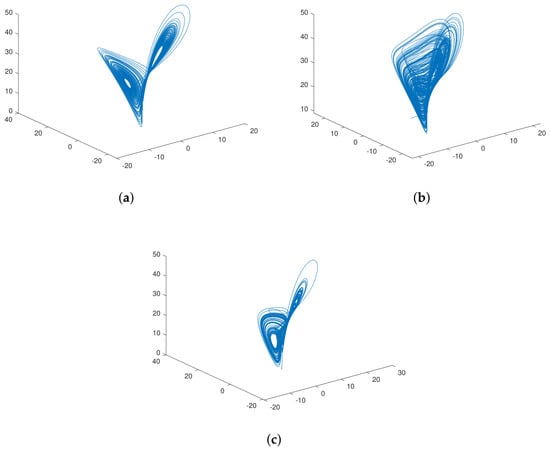
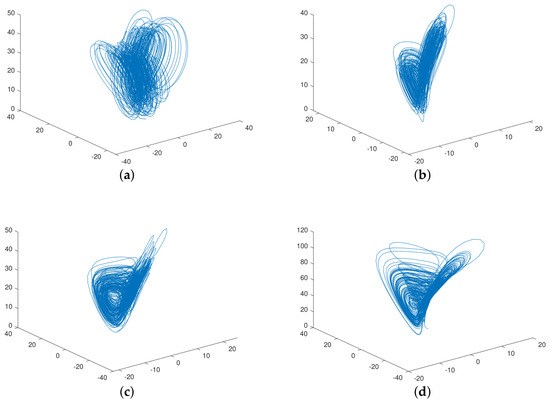
If the external disturbances and nonlinear functions are all regarded as 0, and we choose the arguments, which are , , , , , , , , , , , [53]. The initial values are advised as , using the predictor-corrector scheme under Caputo–Fabrizio fractional calculus and , we will get the chaotic attractor of the fractional chaotic Lorenz, Chen and Lü systems in Figure 1.
Figure 1.
The 3D chaotic attractor of fractional chaotic Lorenz, Chen, Lü system from (a–c), respectively.
Subtracting Equation (50) from Equation (54), the error system can be expressed as
It follows from Equations (39) and (40) that the controllers are defined as
and the parameter renewing rules are defined as
Substituting Equation (59) into Equation (58), the error system has the below form:
Theorem 5.
Proof.
It follows from Equation (33) that are positive constants. Consequently, we have , and taking advantage of the truth that and Assumption 1, one can deduce that
It follows from Theorems 3 and 4 that the error system can be driven onto the sliding model surface and the drive system (50) will realize asymptotically dual synchronization with the response system (54) within a certain time under the sliding model controller (59) and the renewing rules (60). □
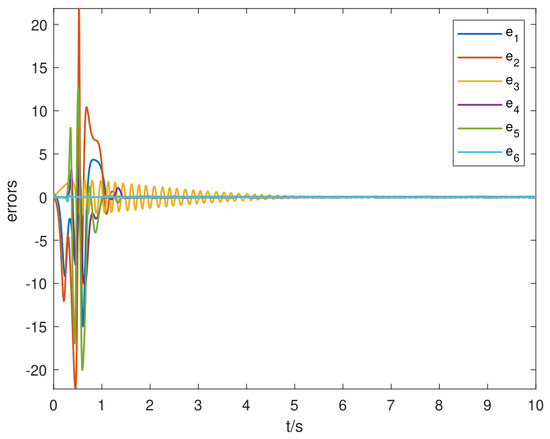
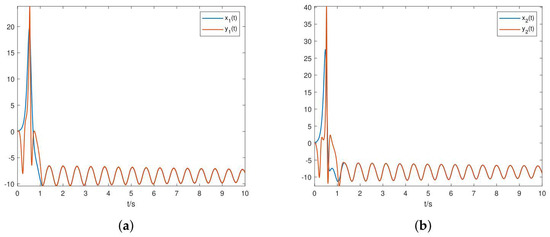
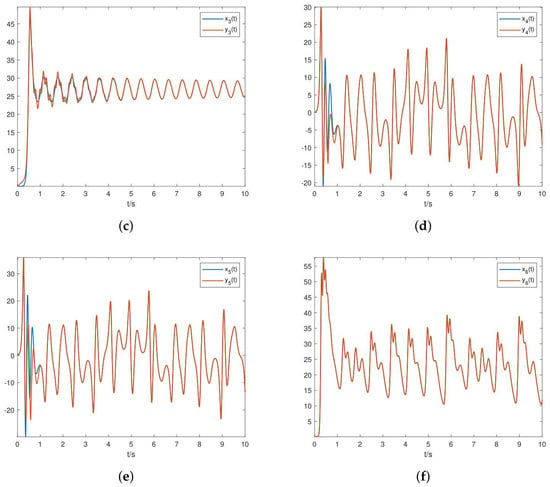
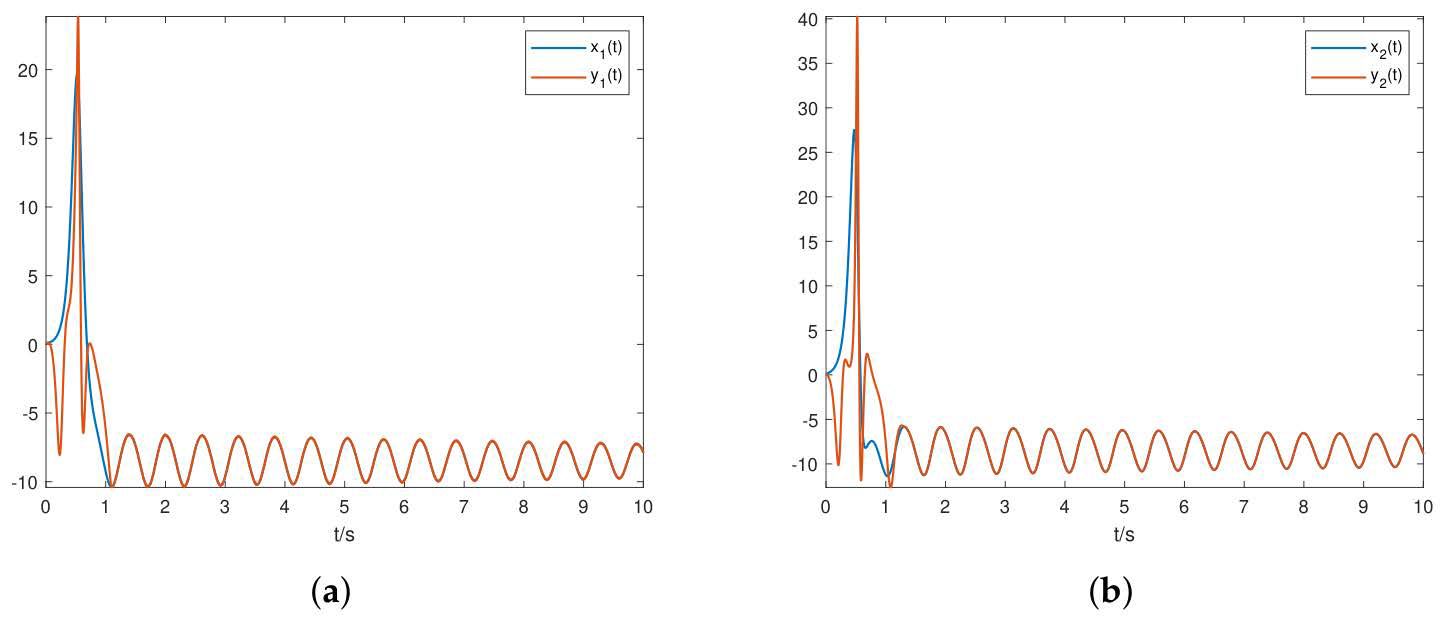
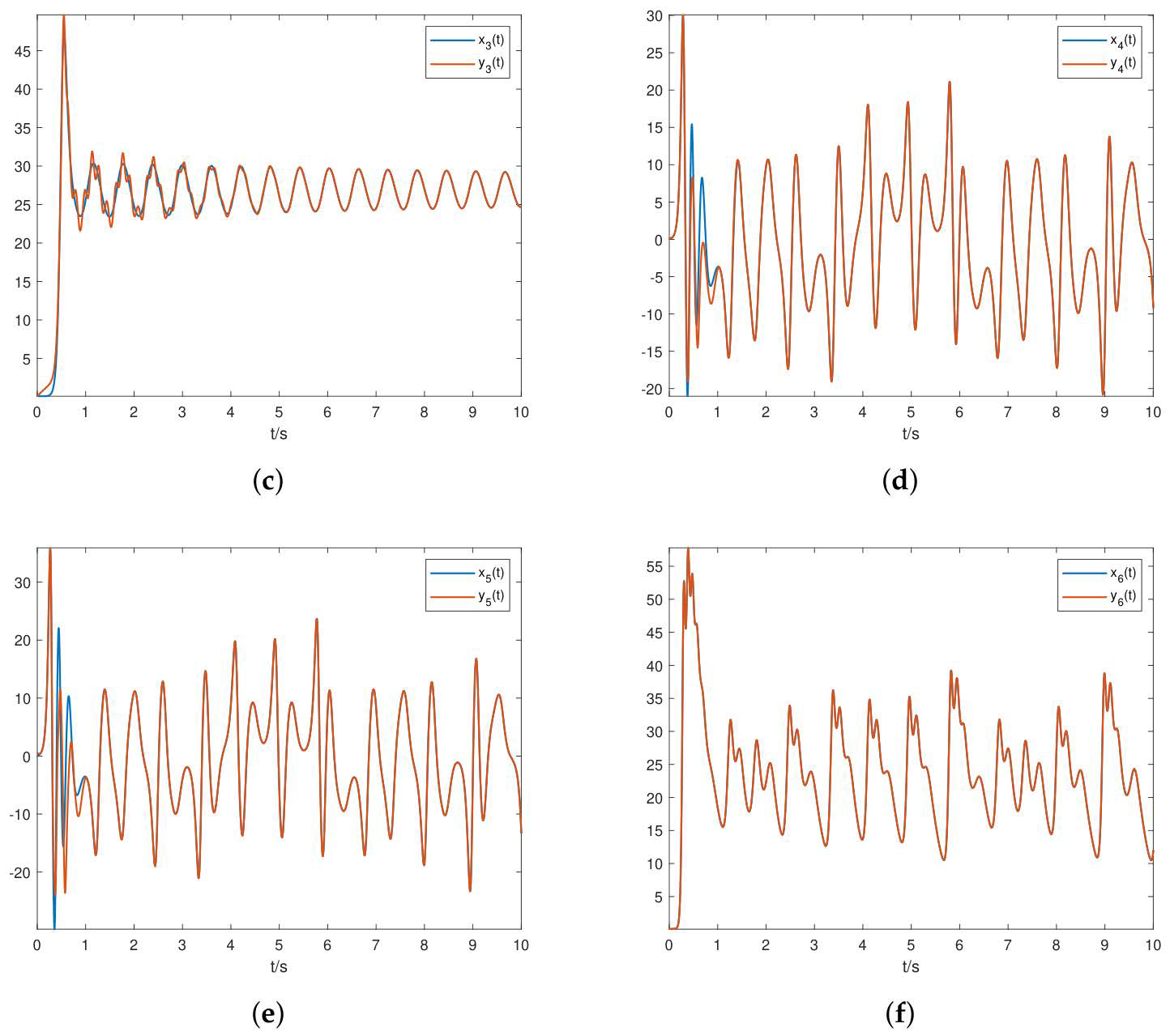
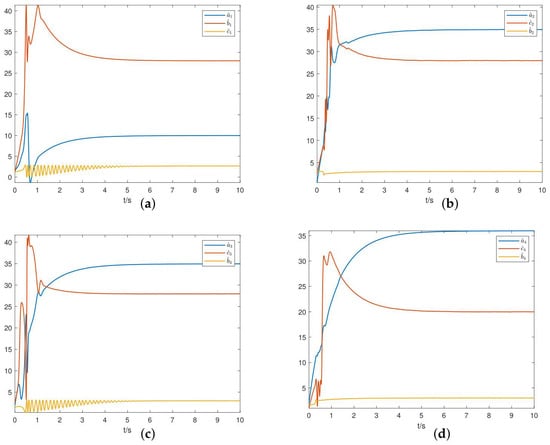
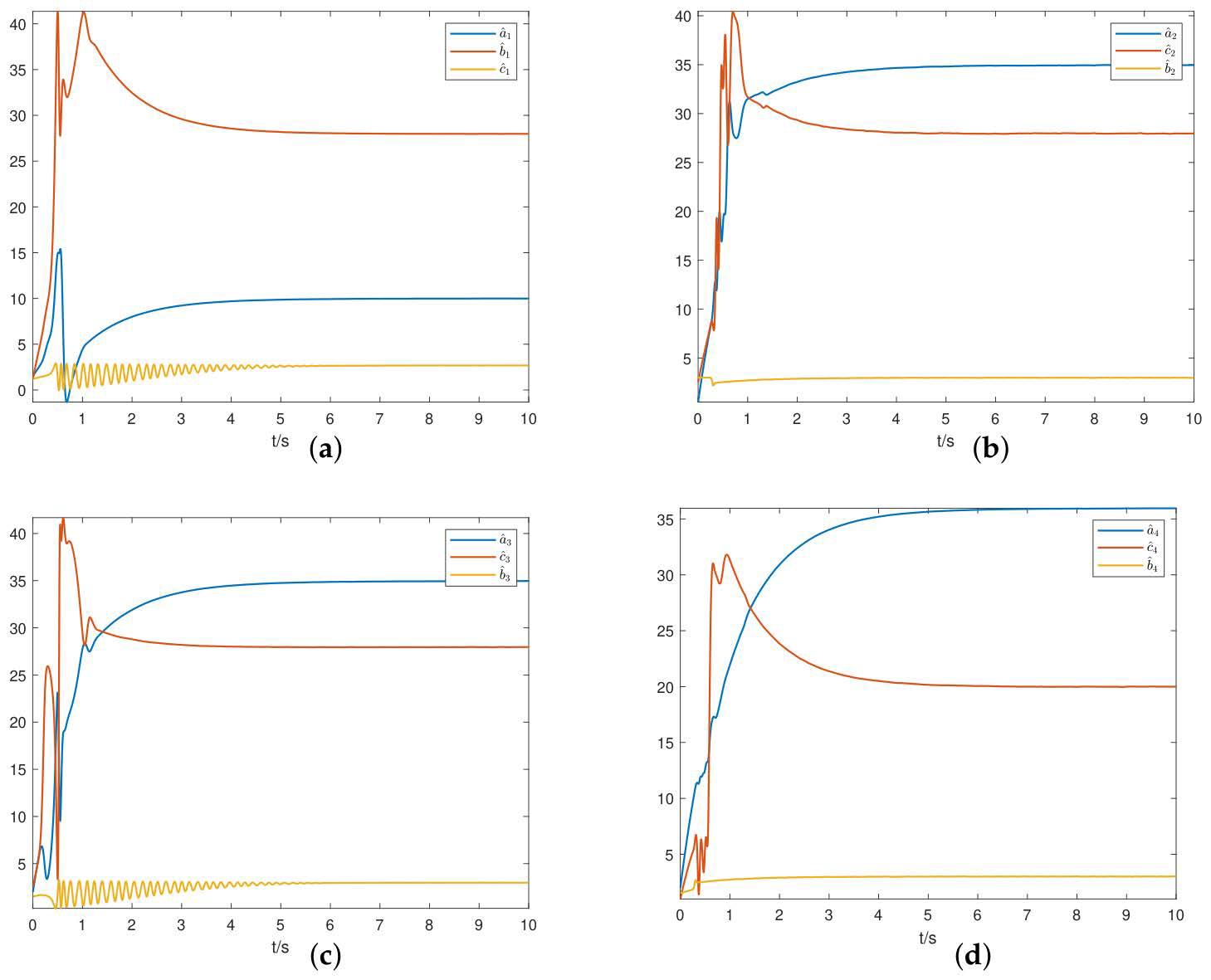
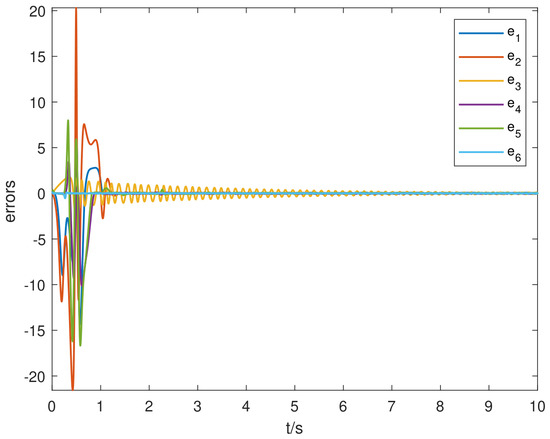
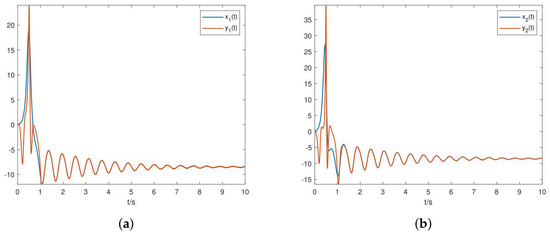
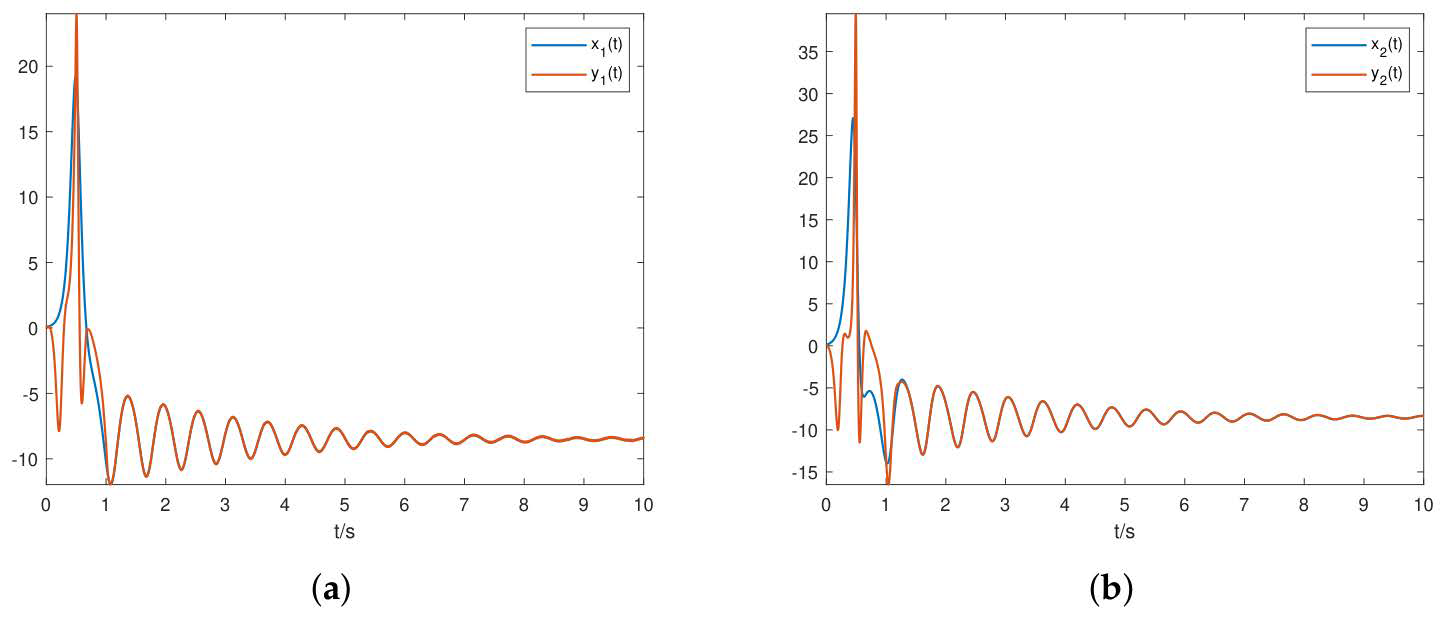
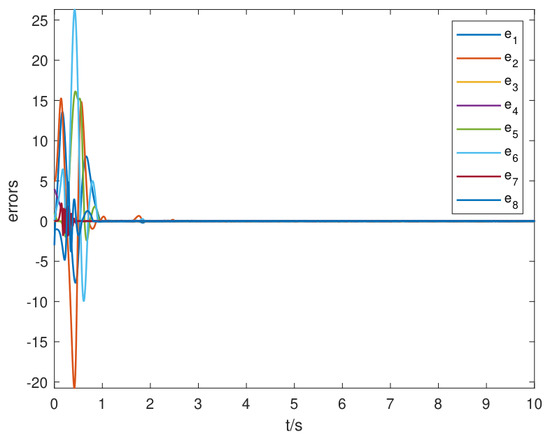
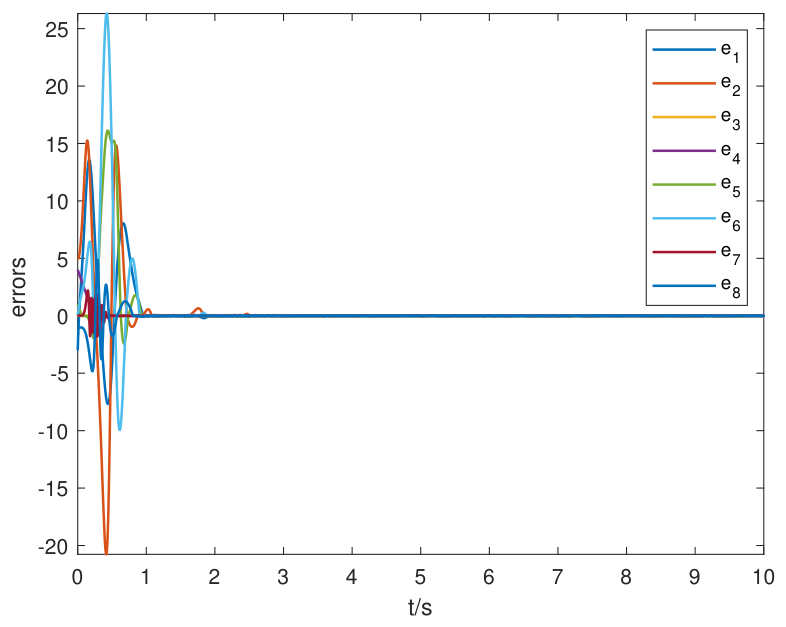
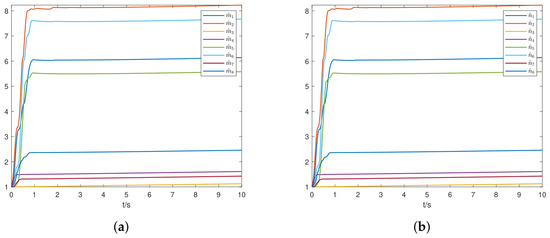
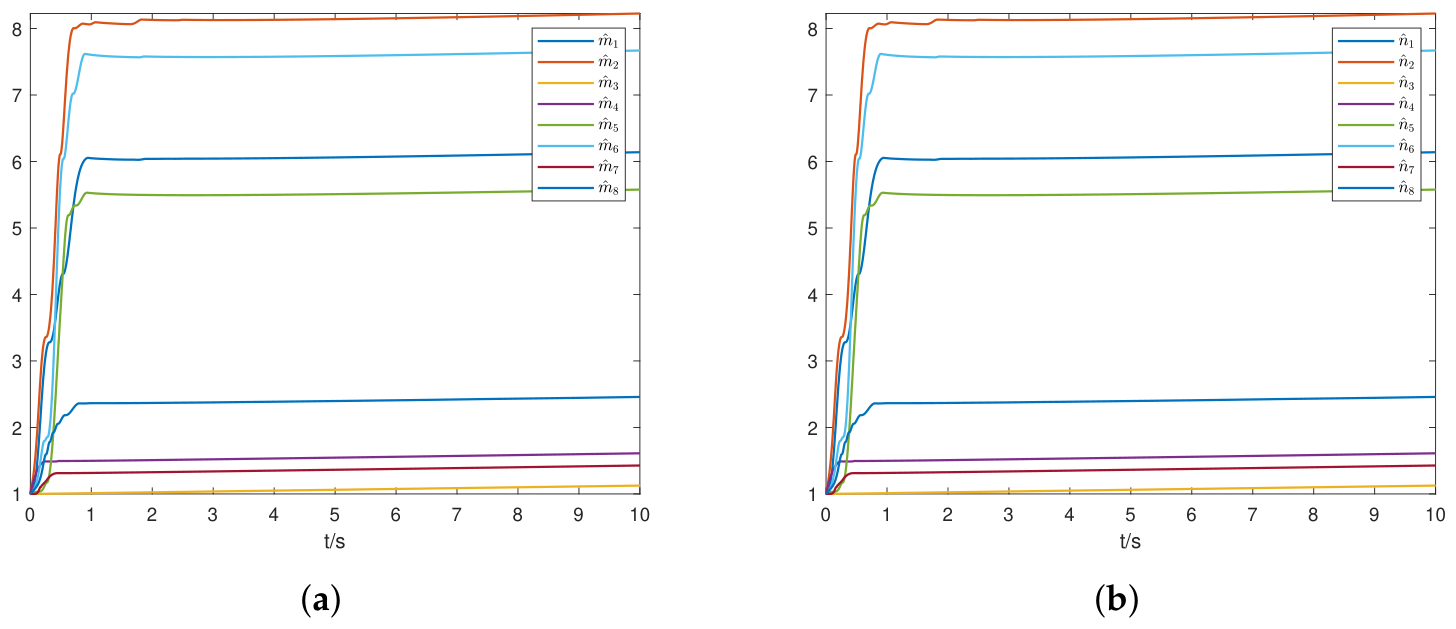
In the numerical simulation, we choose the times of iterations as 3000 and the step size as 0.003, , and the initial conditions of the drive system (50) and the response system (54) are set as and , respectively. The constants , and the initial conditions of the uncertain parameters are picked as , , , , the initial value of the upper bound of the random disturbance is chosen as , and the modification parameters are chosen as . The state trajectories of the error variables are drawn in Figure 2, the synchronization trajectories of the state variables of the drive system (50) and the response system (54) are drawn in Figure 3, the state trajectories of the estimated value , of the unknown parameters are drawn in Figure 4, and the state trajectories of the upper bound , of the nonlinear uncertainties and the external disturbances are drawn in Figure 5. When the fractional-order parameter , we adopt the same initial conditions, the state trajectory of the error variables are drawn in Figure 6, the synchronization trajectories of the state variables of the drive system (50) and the response system (54) are drawn in Figure 7. All the simulated plots demonstrated that the error variables can converge to zero finally. While we chose some different fractional-order and initial conditions, all simulation results demonstrate the correctness of methods and validity of the sliding mode controller and the parameter renewing rules which are proved in this paper.
Figure 2.
The dual synchronization error trajectories , vary with t for .
Figure 5.
The estimated value of the upper bound of and , for .
Figure 6.
The dual synchronization error trajectories , vary with t for .
5.2. Adaptive Dual Synchronization of Hyperchaotic Systems
In the following, the numerical simulation of the adaptive dual synchronization of hyperchaotic systems is given. The fundamental criterion differentiating a fractional-order chaotic system from a fractional-order hyperchaotic system is the number of positive Lyapunov exponents (LEs) in its spectrum: one positive LE for chaos and two or more positive LEs for hyperchaos. This is the widely accepted definitional boundary supported by the literature on nonlinear dynamics and fractional calculus. The fractional-order Lorenz and Chen hyperchaotic systems with nonlinear uncertainties and external disturbances are set as drive systems:
where are state variables, and are the uncertain parameters to be confirmed. The drive system is written in column vector form as follows:
where
and the uncertain items and external disturbances are selected as follows:
The fractional-order Lü and Liu hyperchaotic systems with outer disturbances and nonlinear undefined functions are set as response systems:
where are state variables, and are the uncertain parameters to be confirmed. The response system is written in column vector form as follows:
where
and the uncertain items and external disturbances are selected as
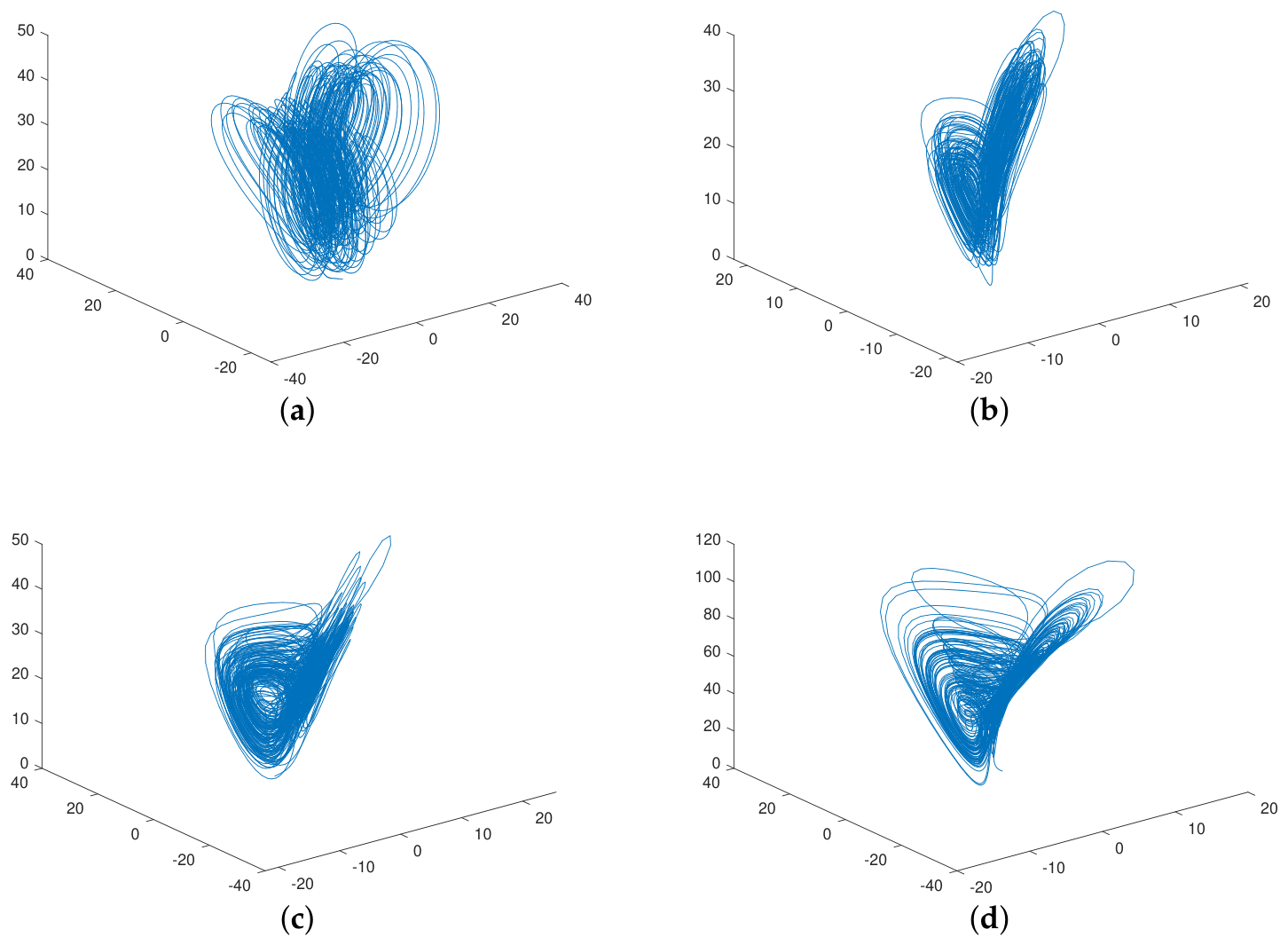
If the external disturbances and nonlinear uncertain functions are all regarded as 0, we choose the parameters as follows: , , , , , , , , , , , , , , , , , [31] and . The initial values are installed as . By the predictor-corrector scheme with , we will get the hyperchaotic attractor of the fractional hyperchaotic Lorenz, Chen, Lü and Liu systems in Figure 8.
Figure 8.
The 3D chaotic attractor of fractional hyperchaotic Lorenz, Chen, Lü, Liu system from (a–d), respectively.
Subtracting Equation (65) from (69), the error system can be expressed as
It follows from (39) and (40) that the controllers are defined as
and the parameters updating laws are defined as
Theorem 6.
Proof.
The Lyapunov function is given as
The -order derivative of (77) can be expressed as
Taking consideration of Lemma 1, one will have
It follows from Equation (33) that are positive constants; consequently, we have , and taking advantage of the truth that and Assumption 1, one can deduce that
With the help of Theorems 3 and 4, we can say that the error system can be driven onto the sliding model surface and the drive system (65) will realize asymptotically dual synchronization with the response system (69) within a certain time under the sliding mode controller (74) and the renewing rules (75). □
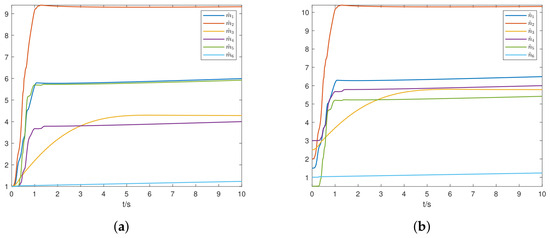
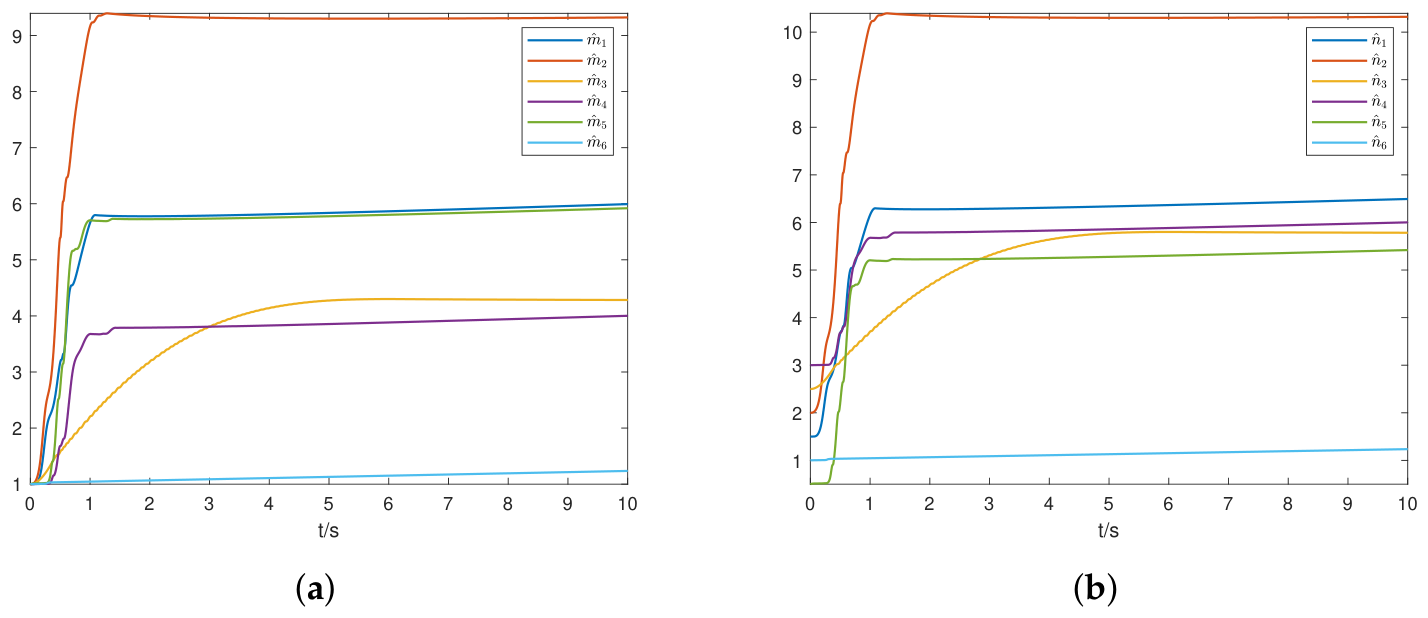
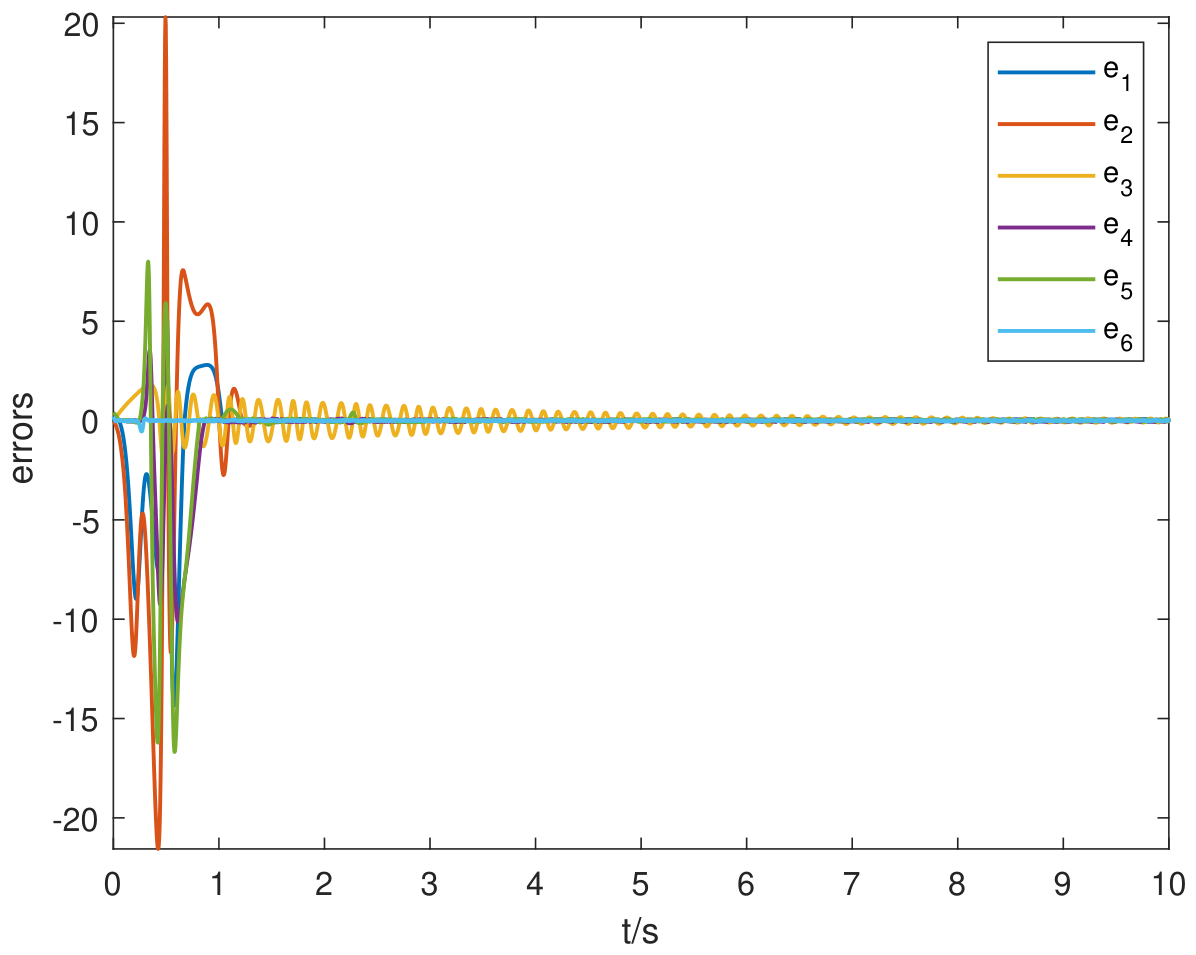
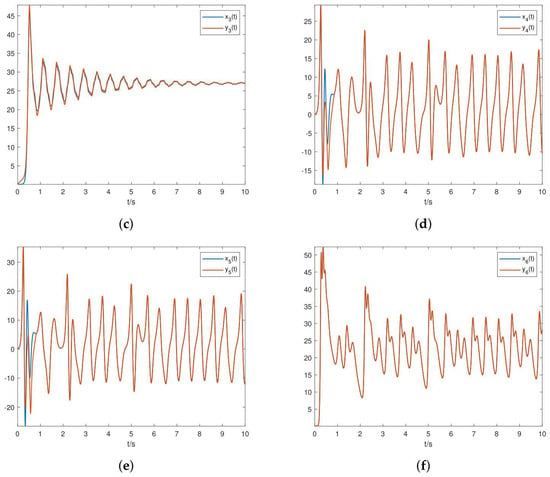
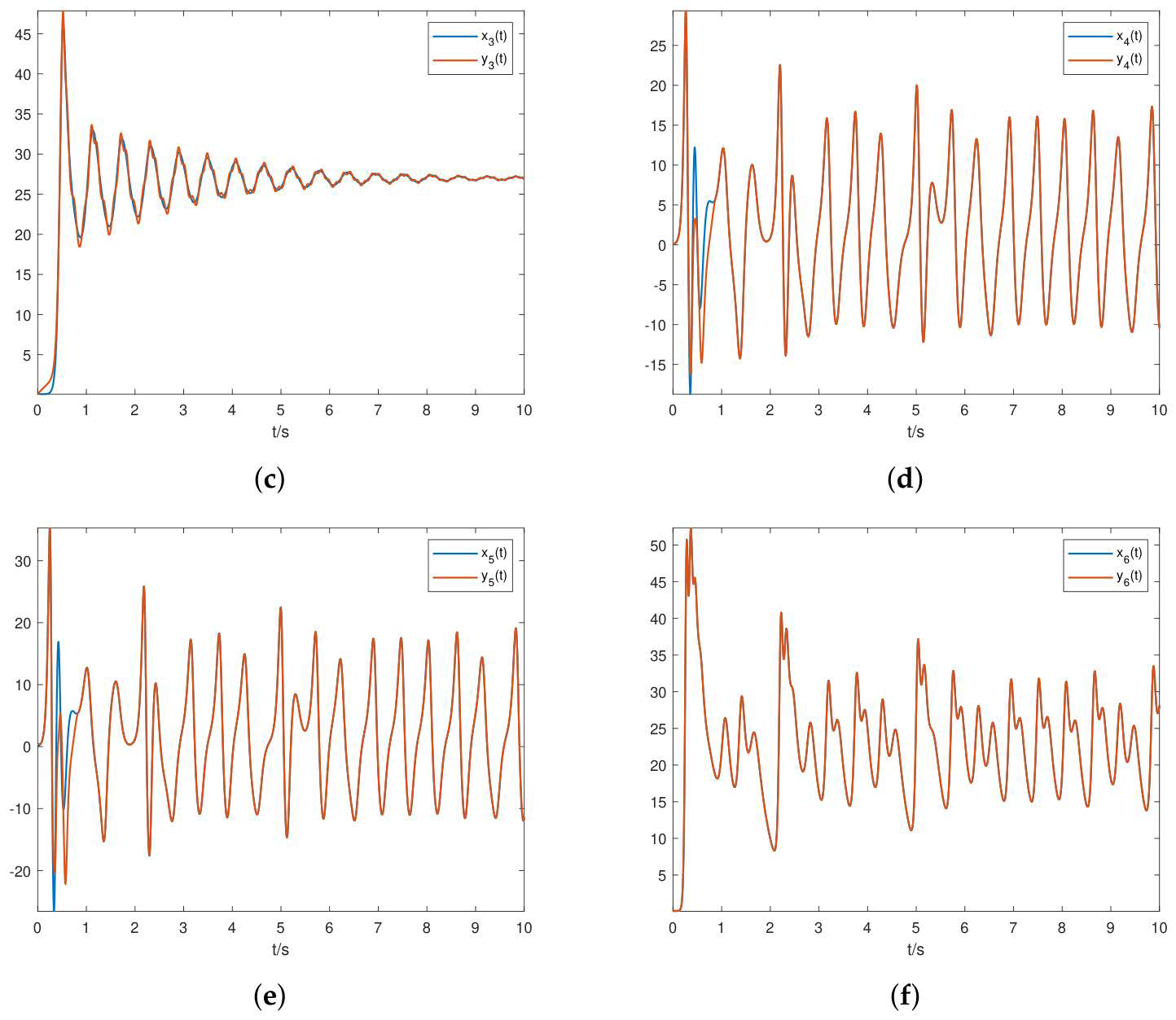
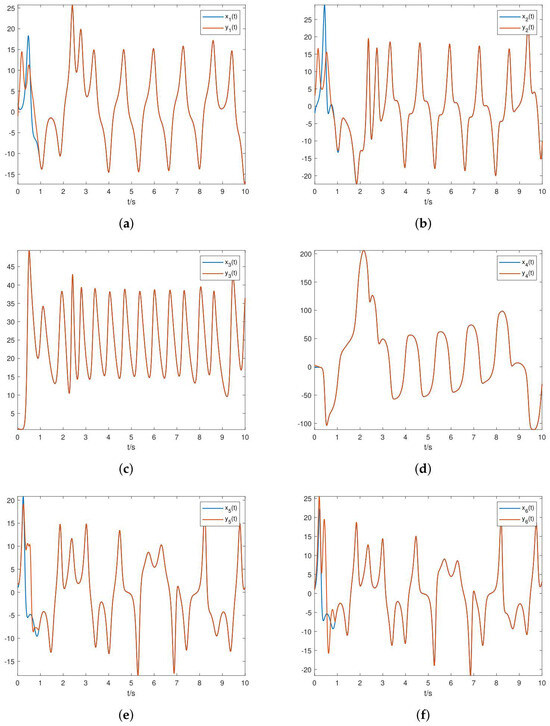
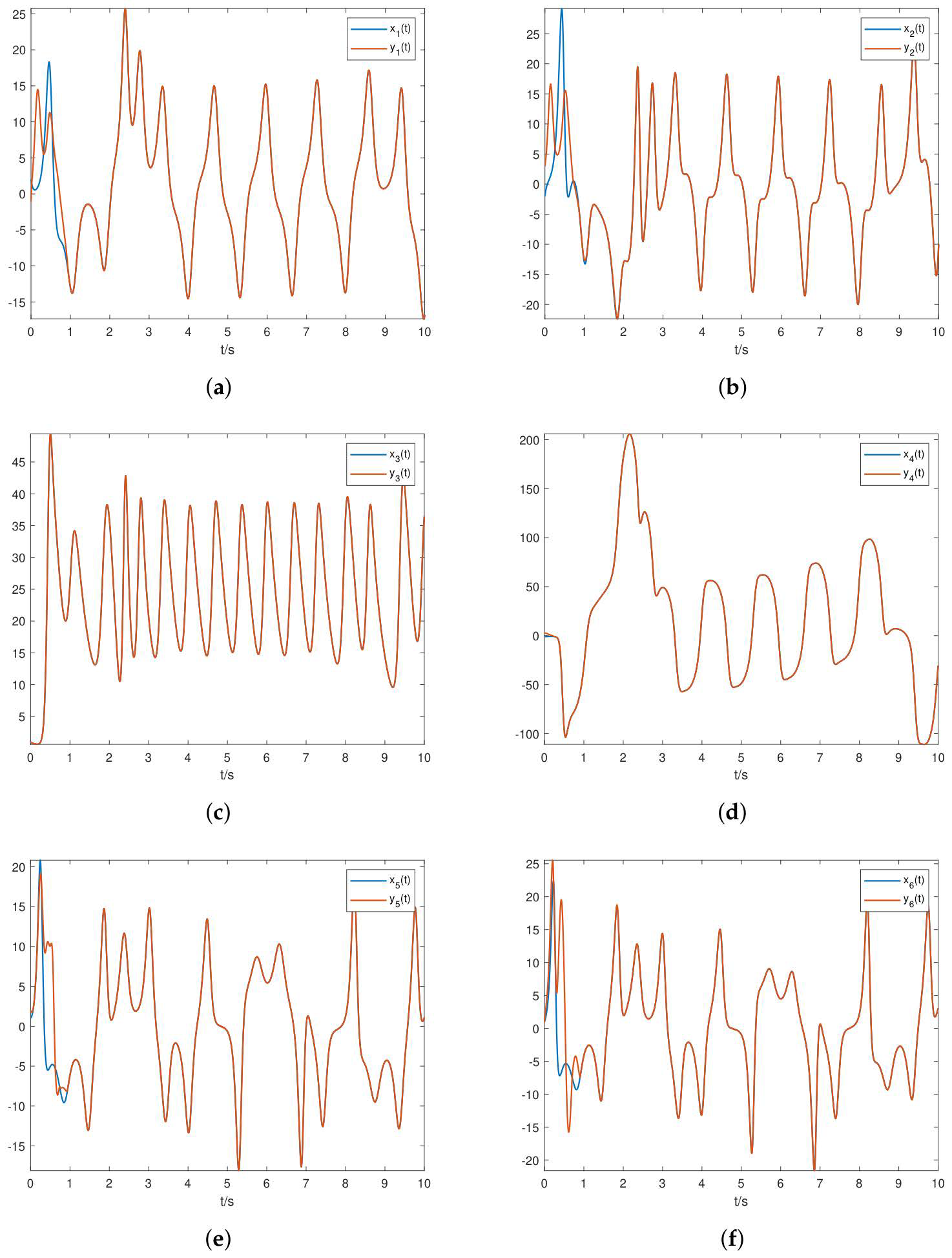
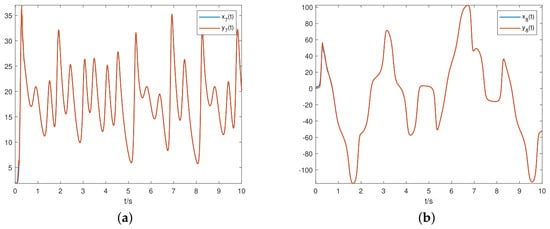
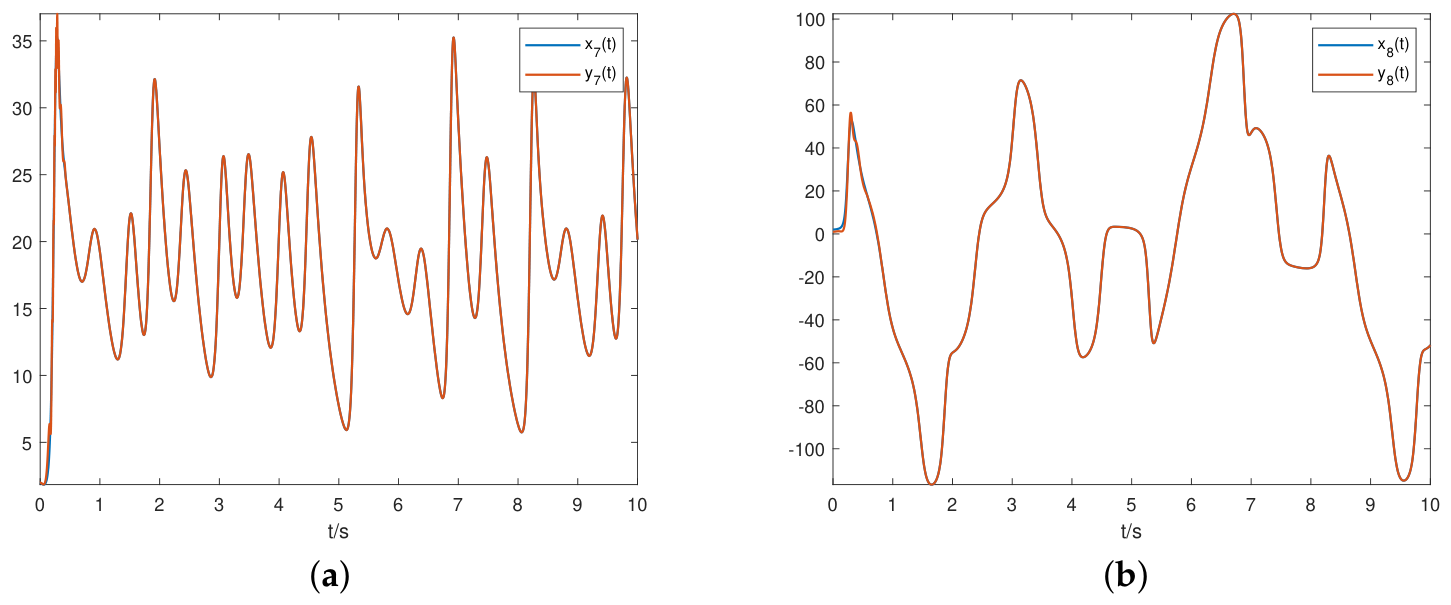
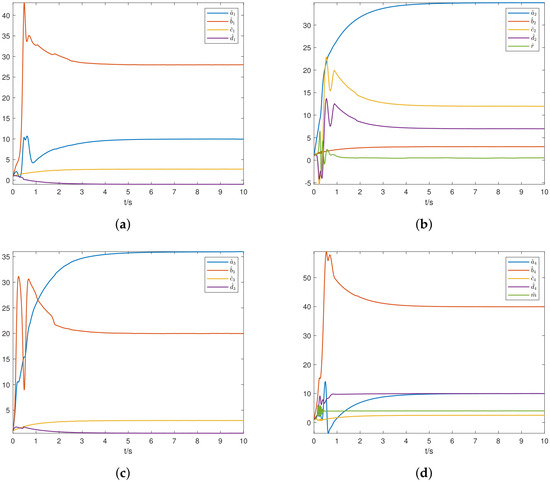
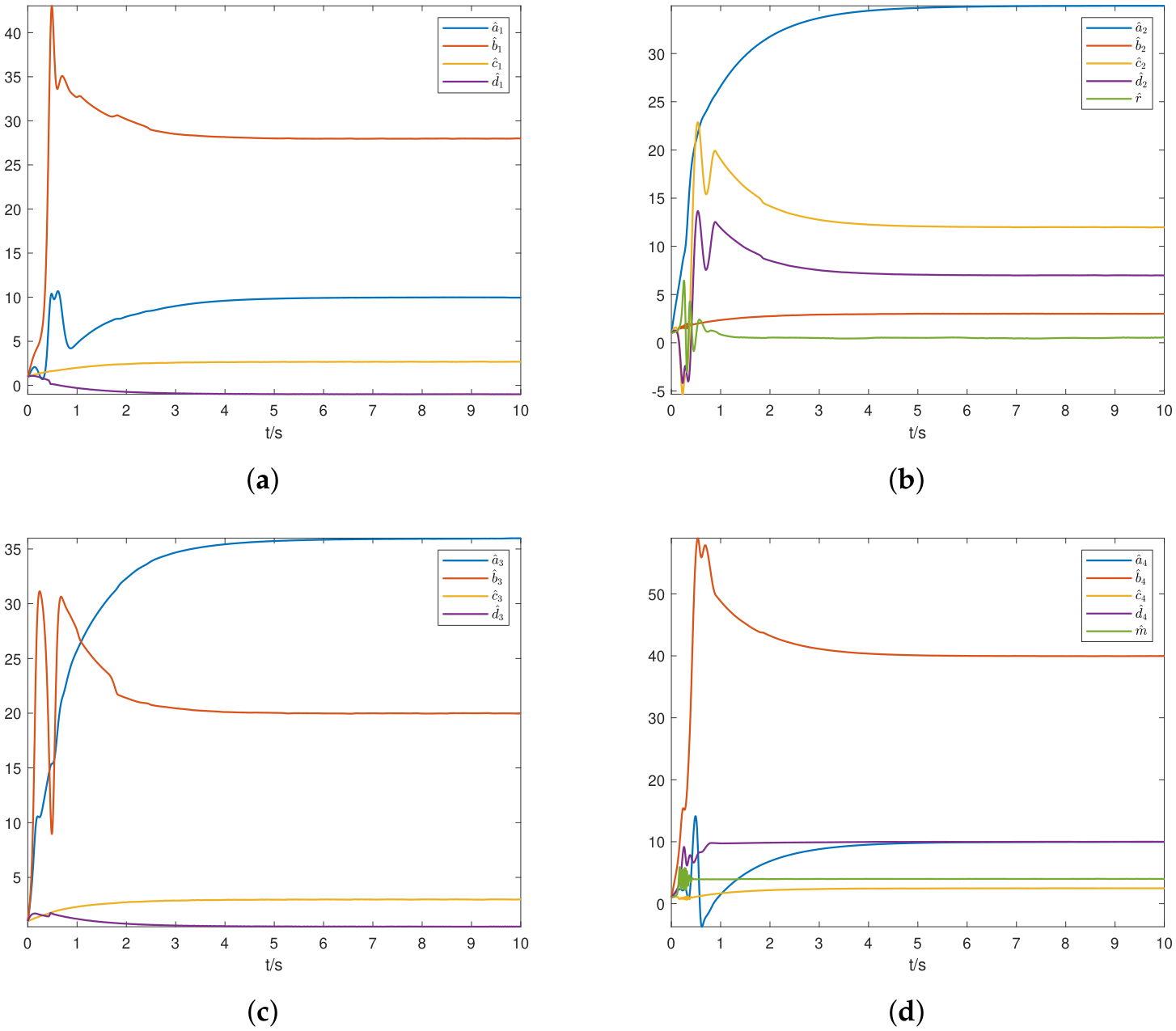
In the numerical simulation, we choose the times of iterations as 5000 and step size as 0.002, , and the initial conditions of the drive system (65) and the response system (69) are set as and , respectively. The constants , and the initial conditions of the uncertain parameters are chosen as , , , , , , . The initial value of the upper bound of the random disturbance is chosen as , . The state trajectories of error are drawn in Figure 9. The trajectories of the state variables of the drive system (65) and the response system (69) are drawn in Figure 10 and Figure 11. The state trajectories of the estimated value , of the unknown parameters are drawn in Figure 12, and the state trajectories of the upper bound , of the nonlinear uncertainties and the external disturbances are drawn in Figure 13. All the simulated plots demonstrated that the error can reach zero finally. While we chose some different fractional-order and initial conditions, all simulation results demonstrate the correctness of methods and validity of the sliding mode controller and the parameter renewing rules which are proved in this paper.
Figure 9.
The dual synchronization error trajectories , vary with t.
Figure 13.
The estimated value of the upper bound of and , .
6. Conclusions
In this manuscript, we have investigated the adaptive dual synchronization of fractional chaotic systems under the Caputo–Fabrizio operator. The study contributes to the existing literature by applying the Caputo–Fabrizio derivative—which has been less explored in the context of chaotic system synchronization—to the dual synchronization problem. A key feature of our approach is the integration of nonlinear uncertainties and external disturbances into the fractional dual synchronization framework. Based on sliding mode control technology, we have proposed a controller and adaptive laws designed to synchronize the drive and response systems, along with estimators for the upper bounds of disturbances and unknown parameters. The effectiveness of the proposed method is illustrated through two numerical examples, which show that the error dynamics can be driven to zero asymptotically. It should be emphasized that the current results establish asymptotic synchronization over infinite time; finite-time convergence is not addressed in this work and remains a direction for future investigation.
Several theoretical limitations should be acknowledged. First, the stability analysis relies on Assumption 1, which requires bounded disturbances and uncertainties, a standard condition in sliding mode control, yet one that may not hold in all practical scenarios. Second, the proposed scheme achieves only asymptotic synchronization as , rather than finite-time convergence, which may limit its applicability in time-critical tasks. Third, the theoretical framework is developed specifically for the Caputo–Fabrizio derivative; its extension to other fractional definitions is not addressed and would require additional analysis.
From a methodological standpoint, the controller involves several design parameters without a systematic tuning guideline; performance may vary with parameter choices and suboptimal tuning could lead to slow convergence or chattering. Additionally, the integral-type adaptive laws for disturbance bounds, while bounded in theory, may exhibit transient overshoot that temporarily degrades synchronization accuracy. Finally, the predictor-corrector numerical scheme, though accurate, incurs increasing computational costs with system dimension and simulation duration, potentially limiting its use in high-dimensional or real-time applications.
The proposed method applies to a broad class of fractional-order chaotic and hyperchaotic systems that can be written in the canonical form (24)–(27), including the Lorenz, Chen, Lü, and Liu families considered in our examples. However, it is not directly suitable for systems with state-dependent input gains, unknown or time-varying fractional orders, or unbounded disturbances. Moreover, while potential secure communication applications are discussed, a full implementation and security analysis are not provided and remain important future work.
In future research, we plan to extend our current asymptotic synchronization scheme to finite-time or fixed-time synchronization frameworks, which would provide faster convergence rates crucial for real-time applications. More importantly, we will implement our adaptive dual synchronization scheme in practical secure communication systems, including the following:
(i) Image encryption systems: Applying the synchronized multi-channel chaotic signals to generate encryption keys for image encryption, where the dual synchronization scheme can simultaneously encrypt different image components or multiple images with enhanced security.
(ii) Circuit realization: Implementing our control scheme using analog circuits or FPGA platforms, demonstrating the feasibility of our theoretical approach in hardware environments.
Author Contributions
T.L. and Y.Z. proposed the main the idea and prepared the manuscript initially. Y.W. gave the numerical simulation of this paper. S.S. revised the English grammar of this paper. All authors have read and agreed to the published version of the manuscript.
Funding
This work is partly supported by Hainan Provincial Natural Science Foundation of China (Grant No. 126MS0136) and the Talent Research Startup Foundation of Hainan Normal University (Grant No. HSZK-KYQD-202613, HSZK-KYQD-202502).
Data Availability Statement
The data used to support the findings of this study are available from the corresponding author upon request.
Conflicts of Interest
The authors declare that they have no competing interests.
References
- Katsanikas, M.; Agaoglou, M.; Montoya, F.G. Introduction to special issue: Chaos indicators, phase space and chemical reaction dynamics. Phys. D Nonlinear Phenom. 2022, 439, 133385. [Google Scholar] [CrossRef] [Scilit]
- Huang, W.; Yang, X.S. Chaos in the periodically parametrically excited lorenz system. Int. J. Bifurc. Chaos 2021, 31, 2130024. [Google Scholar] [CrossRef] [Scilit]
- Pecora, L.M.; Carroll, T.L. Synchronization in chaotic systems. Phys. Rev. Lett. 1990, 64, 821. [Google Scholar] [CrossRef] [Scilit]
- Ren, L.; Zhang, G.S. Adaptive projective synchronization for a class of switched chaotic systems. Math. Methods Appl. Sci. 2019, 42, 6192–6204. [Google Scholar] [CrossRef] [Scilit]
- Shukla, V.K.; Joshi, M.C.; Rajchakit, G.; Nápoles Valdes, J.E.; Mishra, P.K. Matrix projective synchronization and mechanical analysis of unified chaotic system. Math. Methods Appl. Sci. 2024, 47, 6666–6682. [Google Scholar] [CrossRef] [Scilit]
- Yan, D.W.; Ji’e, M.; Wang, L.D.; Duan, S.K. A novel memristor-based chaotic system with line equilibria and its complex dynamics. Mod. Phys. Lett. B 2021, 35, 2150495. [Google Scholar] [CrossRef] [Scilit]
- Modiri, A.; Mobayen, S. Adaptive terminal sliding mode control scheme for synchronization of fractional-order uncertain chaotic systems. ISA Trans. 2020, 105, 33–50. [Google Scholar] [CrossRef] [Scilit]
- Wang, Y.; Tong, D.B.; Chen, Q.Y.; Zhou, W.N. Exponential synchronization of chaotic systems with stochastic perturbations via quantized feedback control. Circuits Syst. Signal Process. 2020, 39, 474–491. [Google Scholar] [CrossRef] [Scilit]
- Ma, T.D.; Zhang, J.M.; Xiong, Z.L.; Zhang, Z.L. Impulsive synchronization of delayed chaotic neural networks with actuator saturation. IEEE Access 2020, 8, 208214–208220. [Google Scholar] [CrossRef] [Scilit]
- Ren, L.; Peng, C.C. Adaptive coexistence of synchronization and anti-synchronization for a class of switched chaotic systems. Processes 2023, 11, 530. [Google Scholar] [CrossRef] [Scilit]
- Huang, Y.Y.; Huang, H.J.; Huang, Y.C.; Wang, Y.H.; Yu, F.; Yu, B.E. Drive–response asymptotic shape synchronization for a class of two-dimensional chaotic systems and its application in image encryption. Phys. D Nonlinear Phenom. 2024, 463, 134162. [Google Scholar] [CrossRef] [Scilit]
- Liu, H.; Chi, J.; Li, Z.Y.; Zeng, Z.G.; Lü, J.H. Parameter identification of memristor-based chaotic systems via the drive-response synchronization method. IEEE Trans. Circuits Syst. II Express Briefs 2020, 68, 2082–2086. [Google Scholar] [CrossRef] [Scilit]
- Fekan, M.; Sathiyaraj, T.; Wang, J.R. Synchronization of butterfly fractional order chaotic system. Mathematics 2020, 8, 446. [Google Scholar] [CrossRef] [Scilit]
- Feng, X.; Sutton, M. A new theory of fractional differential calculus. Anal. Appl. 2021, 19, 715–750. [Google Scholar] [CrossRef] [Scilit]
- Arora, S.; Mathur, T.; Agarwal, S.; Tiwari, K.; Gupta, P. Applications of fractional calculus in computer vision: A survey. Neurocomputing 2022, 489, 407–428. [Google Scholar] [CrossRef] [Scilit]
- Podlubny, I. Fractional Differential Equations; Academic Press: New York, NY, USA, 1999. [Google Scholar]
- Caputo, M.; Fabrizio, M. A new definition of fractional derivative without singular kernel. Prog. Fract. Differ. Appl. 2015, 1, 73–85. [Google Scholar]
- An, H.L.; Feng, D.L.; Sun, L.; Zhu, H.X. The fractional-order unified chaotic system: A general cascade synchronization method and application. AIMS Math. 2020, 5, 4345–4356. [Google Scholar] [CrossRef] [Scilit]
- Li, Z.H.; Xia, T.S.; Jiang, C.M. Synchronization of fractional-order complex chaotic systems based on observers. Entropy 2019, 21, 481. [Google Scholar] [CrossRef] [Scilit]
- Cao, Y. Chaotic synchronization based on fractional order calculus financial system. Chaos Solitons Fractals 2020, 130, 109410. [Google Scholar] [CrossRef] [Scilit]
- Zhang, R.X.; Liu, Y.L.; Yang, S.P. Adaptive synchronization of fractional-order complex chaotic system with unknown complex parameters. Entropy 2019, 21, 207. [Google Scholar] [CrossRef] [Scilit]
- Padron, J.P.; Perez, J.P.; Diaz, J.J.P.; Astengo-Noguez, C. Time-delay fractional variable order adaptive synchronization and anti-synchronization between Chen and Lorenz chaotic systems using fractional order PID control. Fractal Fract. 2022, 7, 4. [Google Scholar] [CrossRef] [Scilit]
- Xu, J.; Li, N.; Zhang, X.L.; Qin, X.L. Fuzzy synchronization control for fractional-order chaotic systems with different structures. Front. Phys. 2020, 8, 155. [Google Scholar] [CrossRef] [Scilit]
- Kingni, S.T.; Pone, J.R.M.; Kuiate, G.F.; Phan, A.T. Coexistence of attractors in integer-and fractional-order three-dimensional autonomous systems with hyperbolic sine nonlinearity: Analysis, circuit design and combination synchronisation. Pramana 2019, 93, 1–11. [Google Scholar] [CrossRef] [Scilit]
- Li, B.; Zhou, X.B.; Wang, Y. Combination synchronization of three different fractional-order delayed chaotic systems. Complexity 2019, 2019, 1–9. [Google Scholar] [CrossRef] [Scilit]
- Li, B.; Wang, Y.; Zhou, X.B. Multi-switching combination synchronization of three fractional-order delayed systems. Appl. Sci. 2019, 9, 4348. [Google Scholar] [CrossRef] [Scilit]
- Pan, W.Q.; Li, T.Z.; Wang, Y. The multi-switching sliding mode combination synchronization of fractional order non-identical chaotic system with stochastic disturbances and unknown parameters. Fractal Fract. 2022, 6, 102. [Google Scholar] [CrossRef] [Scilit]
- Jahanzaib, L.S.; Trikha, P.; Baleanu, D. Analysis and application using quad compound combination anti-synchronization on novel fractional-order chaotic system. Arab. J. Sci. Eng. 2021, 46, 1729–1742. [Google Scholar] [CrossRef] [Scilit]
- Mahmoud, E.E.; Trikha, P.; Jahanzaib, L.S.; Eshmawi, A.; Matoog, R.T. Chaos control and Penta-compound combination anti-synchronization on a novel fractional chaotic system with analysis and application. Results Phys. 2021, 24, 104130. [Google Scholar] [CrossRef] [Scilit]
- Sajid, M.; Chaudhary, H.; Allahem, A.; Kaushik, S. Chaos controllability in fractional-order systems via active dual combination-combination hybrid synchronization strategy. Fractal Fract. 2022, 6, 717. [Google Scholar] [CrossRef] [Scilit]
- Pan, W.Q.; Li, T.Z.; Sajid, M.; Ali, S.; Pu, L.P. Parameter identification and the finite-time combination-combination synchronization of fractional-order chaotic systems with different structures under multiple stochastic disturbances. Mathematics 2022, 10, 712. [Google Scholar] [CrossRef] [Scilit]
- Liu, D.H.; Li, T.Z.; He, X.L. Fixed-time multi-switch combined-combined synchronization of fractional-order chaotic systems with uncertainties and external disturbances. Fractal Fract. 2023, 7, 281. [Google Scholar] [CrossRef] [Scilit]
- Liu, Y.; Davis, P. Dual synchronization of chaos. Phys. Rev. E 2000, 61, R2176. [Google Scholar] [CrossRef] [Scilit]
- Zhang, Q.; Xiao, J.; Zhang, X.Q.; Cao, D.Y. Dual projective synchronization between integer-order and fractional-order chaotic systems. Optik 2017, 141, 90–98. [Google Scholar] [CrossRef] [Scilit]
- Othman, A.A.; Noorani, M.S.M.; Al-sawalha, M.M. Function projective dual synchronization with uncertain parameters of hyperchaotic systems. Int. J. Syst. Dyn. Appl. 2017, 6, 1–16. [Google Scholar] [CrossRef] [Scilit]
- Yadav, V.K.; Kumar, R.; Leung, A.Y.T.; Das, S. Dual phase and dual anti-phase synchronization of fractional order chaotic systems in real and complex variables with uncertainties. Chin. J. Phys. 2019, 57, 282–308. [Google Scholar] [CrossRef] [Scilit]
- Othman, A.A.; Noorani, M.S.M.; Al-Sawalha, M.M. Adaptive dual synchronization of chaotic and hyperchaotic systems with fully uncertain parameters. Optik 2016, 127, 7852–7864. [Google Scholar] [CrossRef] [Scilit]
- Othman, A.A.; Noorani, M.S.M.; Al-sawalha, M.M. Adaptive dual anti-synchronization of chaotic systems with fully uncertain parameters. Optik 2016, 127, 10478–10489. [Google Scholar] [CrossRef] [Scilit]
- Liu, D.H.; Li, T.Z.; Wang, Y. Adaptive dual synchronization of fractional-order chaotic system with uncertain parameters. Mathematics 2022, 10, 470. [Google Scholar] [CrossRef] [Scilit]
- Avalos-Ruiz, L.F.; Gomez-Aguilar, J.F.; Atangana, A.; Owolabi, K.M. On the dynamics of fractional maps with power-law, exponential decay and Mittag-Leffler memory. Chaos Solitons Fractals 2019, 127, 364–388. [Google Scholar] [CrossRef] [Scilit]
- Owolabi, K.M. Analysis and numerical simulation of cross reaction–diffusion systems with the Caputo-Fabrizio and Riesz operators. Numer. Methods Partial Differ. Equ. 2023, 39, 1915–1937. [Google Scholar] [CrossRef] [Scilit]
- Owolabi, K.M. Computational analysis of different pseudoplatystoma species patterns the Caputo-Fabrizio derivative. Chaos Solitons Fractals 2021, 144, 110675. [Google Scholar] [CrossRef] [Scilit]
- Owolabi, K.M. Computational techniques for highly oscillatory and chaotic wave problems with fractional-order operator. Eur. Phys. J. Plus 2020, 135, 864. [Google Scholar] [CrossRef] [Scilit]
- Atangana, A.; Akgül, A.; Owolabi, K.M. Analysis of fractal fractional differential equations. Alex. Eng. J. 2020, 59, 1117–1134. [Google Scholar] [CrossRef] [Scilit]
- Al-Khedhairi, A. Dynamical analysis and chaos synchronization of a fractional-order novel financial model based on Caputo-Fabrizio derivative. Eur. Phys. J. Plus 2019, 134, 532. [Google Scholar] [CrossRef] [Scilit]
- Abro, K.A.; Yildirim, A. An analytic and mathematical synchronization of micropolar nanofluid by Caputo-Fabrizio approach. Sci. Iran. 2019, 26, 3917–3927. [Google Scholar]
- Wang, H.; Jahanshahi, H.; Wang, M.K.; Bekiros, S.; Liu, J.P.; Aly, A.A. A Caputo-Fabrizio fractional-order model of HIV/AIDS with a treatment compartment: Sensitivity analysis and optimal control strategies. Entropy 2021, 23, 610. [Google Scholar] [CrossRef] [Scilit]
- Dlamini, A.; Goufo, E.F.D.; Khumalo, M. On the Caputo-Fabrizio fractal fractional representation for the Lorenz chaotic system. AIMS Math. 2021, 6, 12395–12421. [Google Scholar] [CrossRef] [Scilit]
- Zhong, W.Y.; Wang, L.F.; Abdeljawad, T. Separation and stability of solutions to nonlinear systems involving Caputo-Fabrizio derivatives. Adv. Differ. Equ. 2020, 2020, 1–15. [Google Scholar] [CrossRef] [Scilit]
- Losada, J.; Nieto, J.J. Properties of a new fractional derivative without singular kernel. Prog. Fract. Differ. Appl. 2015, 1, 87–92. [Google Scholar]
- Salahshour, S.; Ahmadian, A.; Salimi, M.; Pansera, B.A.; Ferrara, M. A new Lyapunov stability analysis of fractional-order systems with nonsingular kernel derivative. Alex. Eng. J. 2020, 59, 2985–2990. [Google Scholar] [CrossRef] [Scilit]
- Toh, Y.T.; Phang, C.; Loh, J.R. New predicto-corrector scheme for solving nonlinear differential equations with Caputo-Fabrizio operator. Math. Methods Appl. Sci. 2019, 42, 175–185. [Google Scholar] [CrossRef] [Scilit]
- Petras, I. Fractional-Order Nonlinear Systems: Modeling, Analysis and Simulation; Springer Science & Business Media: Berlin/Heidelberg, Germany, 2011. [Google Scholar]
Disclaimer/Publisher’s Note: The statements, opinions and data contained in all publications are solely those of the individual author(s) and contributor(s) and not of MDPI and/or the editor(s). MDPI and/or the editor(s) disclaim responsibility for any injury to people or property resulting from any ideas, methods, instructions or products referred to in the content. |
© 2026 by the authors. Licensee MDPI, Basel, Switzerland. This article is an open access article distributed under the terms and conditions of the Creative Commons Attribution (CC BY) license.