


Abstract
During orbital service, precision aerospace equipment is frequently subjected to harsh vibration environments that can significantly affect reliability and service life. Consequently, the development of effective vibration isolation technologies has become a crucial aspect of aerospace structural design. In this study, random vibration theory and frequency-domain analysis methods were employed to investigate the dynamic response characteristics of a symmetrical frustum-shaped metal rubber (FSMR) isolation device under complex operating conditions. The influence of metal rubber density, spring stiffness, and input vibration level on its isolation performance was systematically examined. This work presents the first systematic experimental investigation into the nonlinear dependencies of the performance of a symmetrical frustum-shaped metal rubber isolator on multiple parameters (density, stiffness, excitation level) under random vibration. The test results show that under identical excitation conditions, the device achieves optimal damping ratio and isolation efficiency (59.71%) when the metal rubber density is 2.0 g/cm3. A moderate increase in spring stiffness reduces the resonance peak and improves stability, with a stiffness of 100 kN/m exhibiting the best overall performance. In addition, higher input vibration levels markedly elevate the acceleration response and the resonant peak amplification factor of the isolator, demonstrating that high-intensity excitation magnifies the vibration response and degrades the isolation efficiency.
1. Introduction
Precision aerospace equipment is widely deployed in defense, communication, navigation, remote sensing, and deep-space exploration [1,2]. During the launch and orbital phases, it is exposed to severe multi-source vibration and shock environments arising from rocket engine transient thrust, stage separation shocks, fuel combustion, and flywheel operation [3,4]. These excitation sources can readily induce structural resonance, leading to optical axis deviation, image blurring, or even failure of star-borne precision optical instruments, thereby undermining satellite reliability and operational lifespan [5,6]. Thus, developing high-performance isolation devices capable of withstanding extreme conditions is essential for enhancing the dynamic environmental adaptability of satellites and their payload systems.
In recent years, extensive research on satellite-borne vibration isolation technologies has resulted in diverse structural and material solutions. For instance, the SoftRide and ShockRing systems of CSA effectively suppress low- and high-frequency vibrations, respectively [7,8]. Other studies have introduced isolation platforms based on active control strategies and parallel mechanisms [9,10]. Zhang et al. developed magnetorheological and viscous damping isolation structures that demonstrate high performance [11]. Additionally, the damping elements and piezoelectric actuator configurations proposed by Pan et al. [12,13] have expanded both the effective frequency band and integration potential of isolation devices. However, internal satellite equipment continues to remain susceptible to vibration interference, particularly under high-intensity broadband random excitation, where conventional isolation approaches face limitations in multi-directional performance and environmental adaptability [14,15]. Conventional passive isolation methods often struggle to balance low-frequency resonance suppression with high-frequency isolation efficiency when dealing with broadband, high-level random vibration, and their performance lacks sufficient adaptability to variations in environmental and excitation conditions [16]. More recently, metamaterials, metal rubber composites, and shape-memory alloys have been explored to improve isolation efficiency [17,18,19]. Lee and Liang enhanced multi-directional isolation through fluid damping and Stewart-platform-based configurations [20,21]. Nevertheless, many active isolation schemes remain hindered by electromagnetic interference and temperature fluctuations, restricting their long-term orbital reliability.
Metal rubber (MR), a porous metallic material combining high structural strength with rubber-like elasticity, exhibits excellent temperature resistance, corrosion tolerance, and damping properties, making it well-suited for harsh aerospace environments [22,23,24]. Its mechanical behavior is strongly dependent on parameters such as wire diameter, material density, and winding process, and it displays pronounced nonlinearity and hysteresis [25]. Prior studies have elucidated its energy dissipation and deformation mechanisms through micro-constitutive models, series/parallel stiffness theory, and dynamic modeling approaches [26]. In engineering practice, MR has been applied in aerospace isolators, buffer actuators, and multi-directional isolation platforms, substantially improving system adaptability under broadband vibration and shock [27]. It has also shown potential applications in ship pipeline isolation, noise reduction, and sealing/filtration systems [28,29,30]. However, accurately capturing and predicting its dynamic response under complex conditions like random vibration remains a challenge, necessitating advanced constitutive models that bridge structural parameters and macroscopic performance. Recent efforts, such as those by Fu et al. who correlated lay-up manufacturing parameters with hysteresis and optimized dynamic models using intelligent algorithms [31,32], have provided valuable methodologies for such characterization.
This study addresses the existing limitations of isolation technologies under random vibration and complex working conditions by proposing a frustum-shaped metal rubber (FSMR) isolation device and systematically investigating its dynamic characteristics and isolation mechanism. The influence of metal rubber density, structural stiffness, and vibration level on the device’s dynamic response and isolation efficiency is evaluated through a combined framework of theoretical modeling and experimental validation, providing a scientific basis and data reference for the design and optimization of aerospace-grade isolation structures.
2. Structural Design of FSMRI and Fabrication of FSMR
2.1. Structural Design of the FSMRI
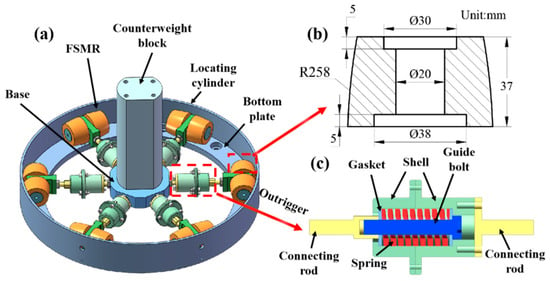
To ensure the operational safety of aerospace precision equipment, a vibration isolator incorporating frustum-shaped metal rubber elements was designed. Its side profile features an arc shape, a design that ensures a smoother variation in cross-section along the axial height. During installation, the curved sidewall contacts the outer cylindrical wall, resulting in a more conforming fit between the two surfaces.
The reduced thickness at both ends of the frustum-shaped metal rubber is designed so that, under severe impact, major deformation and potential failure are confined to the end regions. Meanwhile, the thicker central portion retains effective vibration isolation and cushioning capabilities, thereby preventing overall structural failure. Furthermore, the arced side profile effectively avoids stress concentration within the structure, enhancing its stability and service life. The base supports a counterweight block, acting as the mounting platform for the precision equipment, as shown in Figure 1a. The base is suspended by six vibration-damping units uniformly arranged along the circumference. The design of six support legs was primarily based on aerospace design principles of a statically determinate and stable configuration (similarly to a Stewart platform [33]), uniform load distribution, and multi-directional support [27].
Figure 1.
Schematic diagram of the FSMRI: (a) three-dimensional structure diagram, (b) structure of the FSMR, and (c) vibration isolation legs.
Each unit consists of a spring paired with a metal rubber element. Figure 1b illustrates the structural dimensions of the metal rubber component, while Figure 1c presents the configuration of the spring-damping assembly. This symmetrical configuration itself offers significant advantages in achieving spatial compactness and controllable multi-directional stiffness.
Compared to existing isolation designs, the symmetrical frustum-shaped metal rubber (FSMR) isolator proposed in this study demonstrates distinctive comprehensive advantages. In contrast to traditional passive isolators (such as rubber pads), it leverages the inherent nonlinear hysteretic damping of metal rubber to achieve superior attenuation characteristics across a broad frequency range, particularly in the high-frequency band. Moreover, its all-metal structure grants it exceptional environmental adaptability (resistance to high/low temperatures and aging). When compared to more complex solutions like active or quasi-zero-stiffness (QZS) isolation systems, the FSMR isolator maintains high performance while offering the inherent reliability of a purely passive system, requiring no external energy supply and remaining insensitive to environmental interference. Additionally, its symmetrical frustum configuration allows for flexible tuning of multi-directional stiffness and damping characteristics through parameter design (e.g., density and stiffness), thereby providing an efficient, compact, and reliable solution for spacecraft isolation design tailored to specific random vibration environments.
2.2. Fabrication of the FSMR
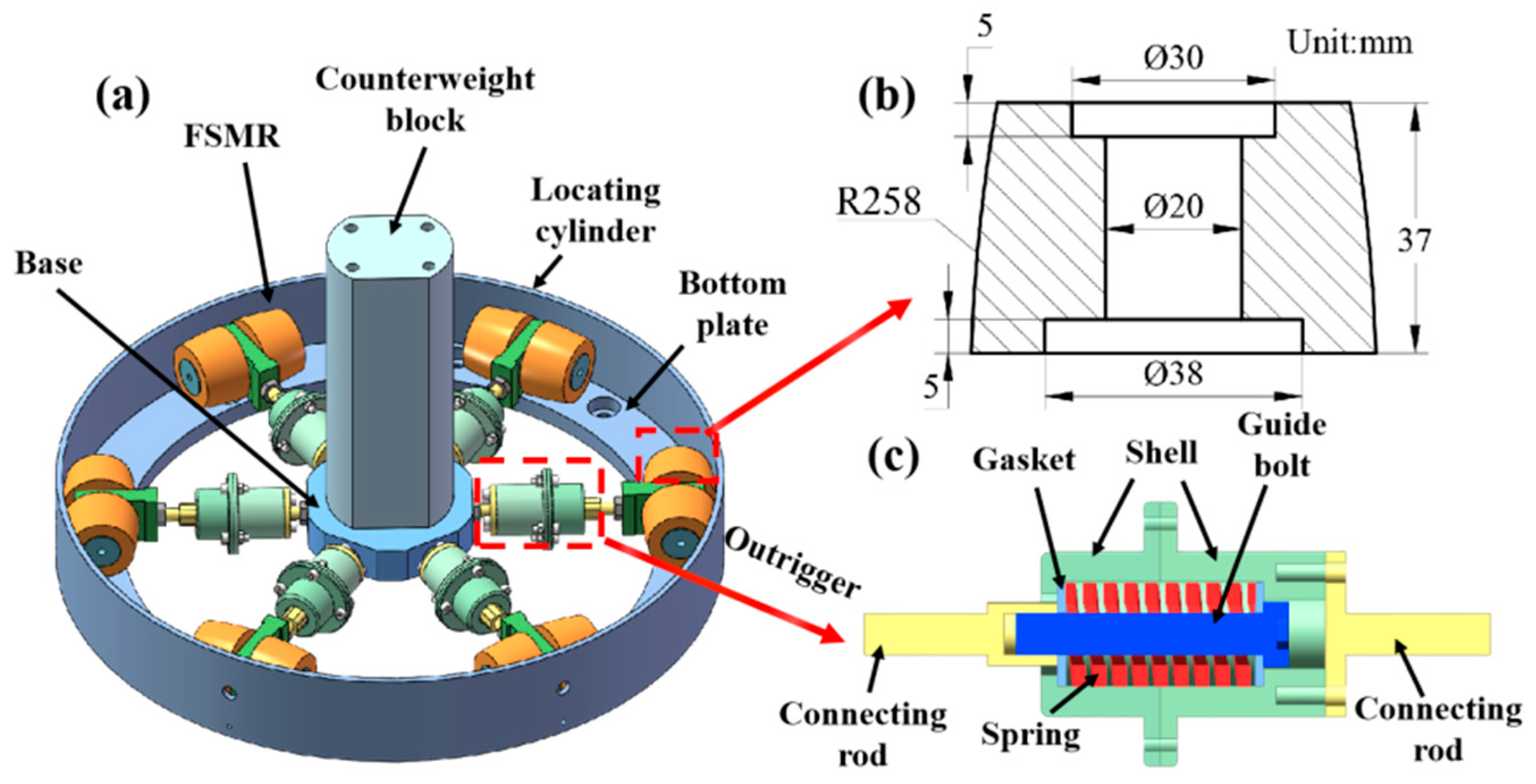
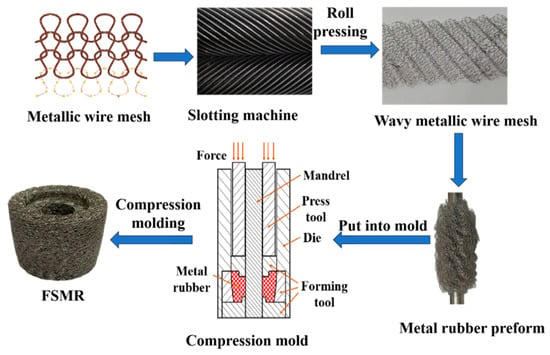
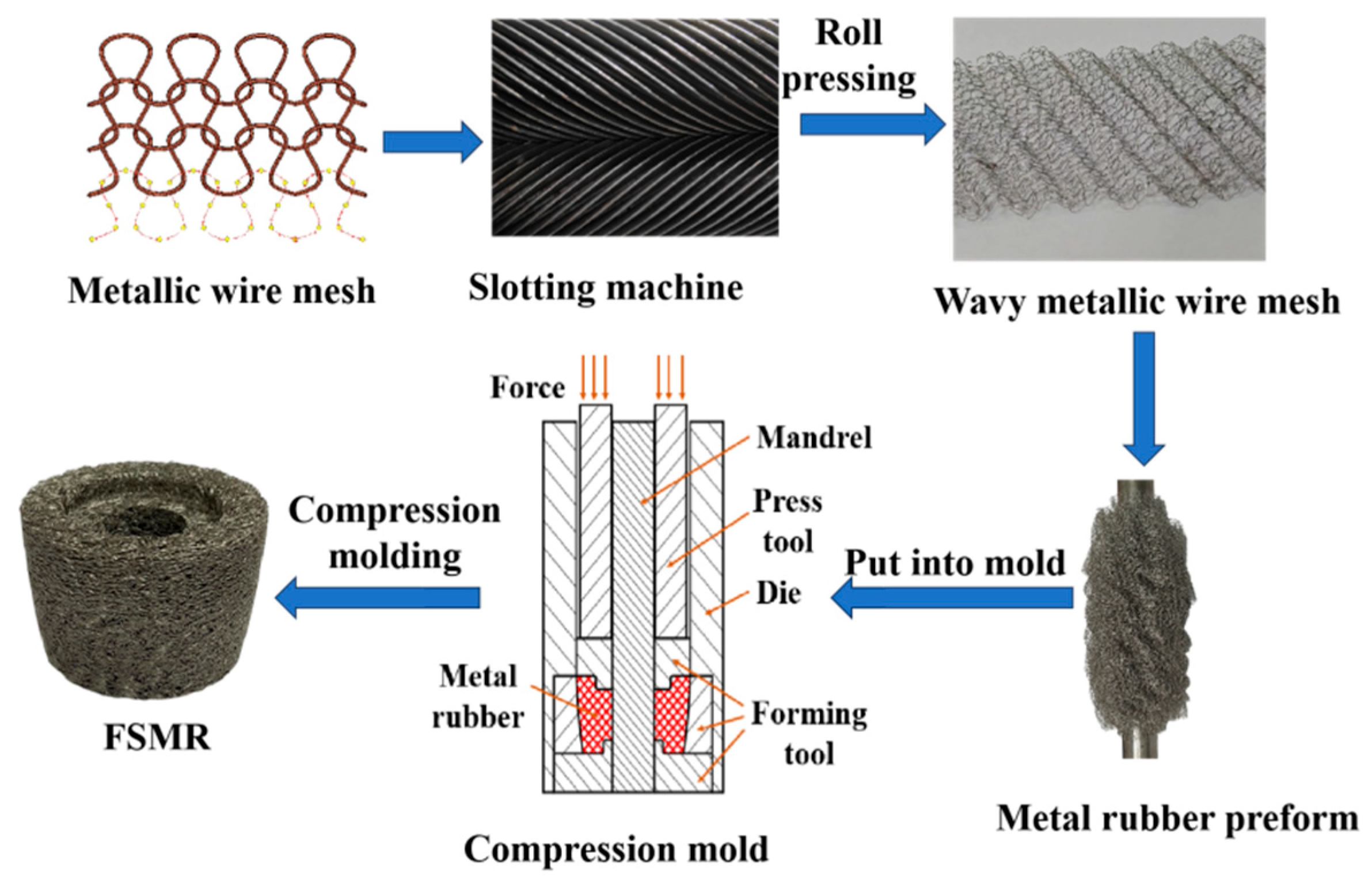
The metal rubber focused on in this study is a porous metallic damping material suitable for extreme aerospace environments (featuring resistance to high and low temperatures, anti-aging properties, and long service life), and its selection is driven by clear engineering relevance. Building on this, its stiffness and damping characteristics can be actively regulated through strategies such as compounding with shape memory alloys or incorporating graded structural designs. This will be a direction for future research. Figure 2 illustrates the FSMR’s compression molding process. A wire mesh material is first rolled using a grooving machine to create corrugated patterns. These patterns help increase the contact area between layers, ensuring tight bonding and reducing delamination, thereby improving the metal rubber’s overall mechanical performance and reliability. Subsequently, a specific mass of the woven mesh is wound onto the mandrel of a mold at a specific angle for compression molding.
Figure 2.
Fabrication of the FSMR.
3. Methodologies
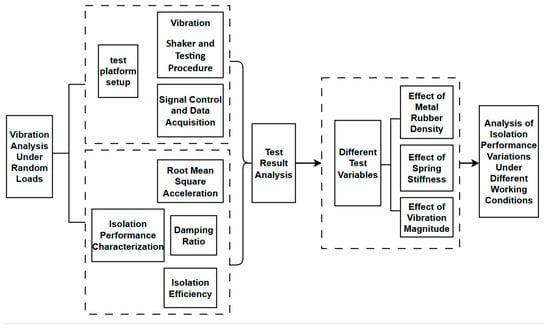
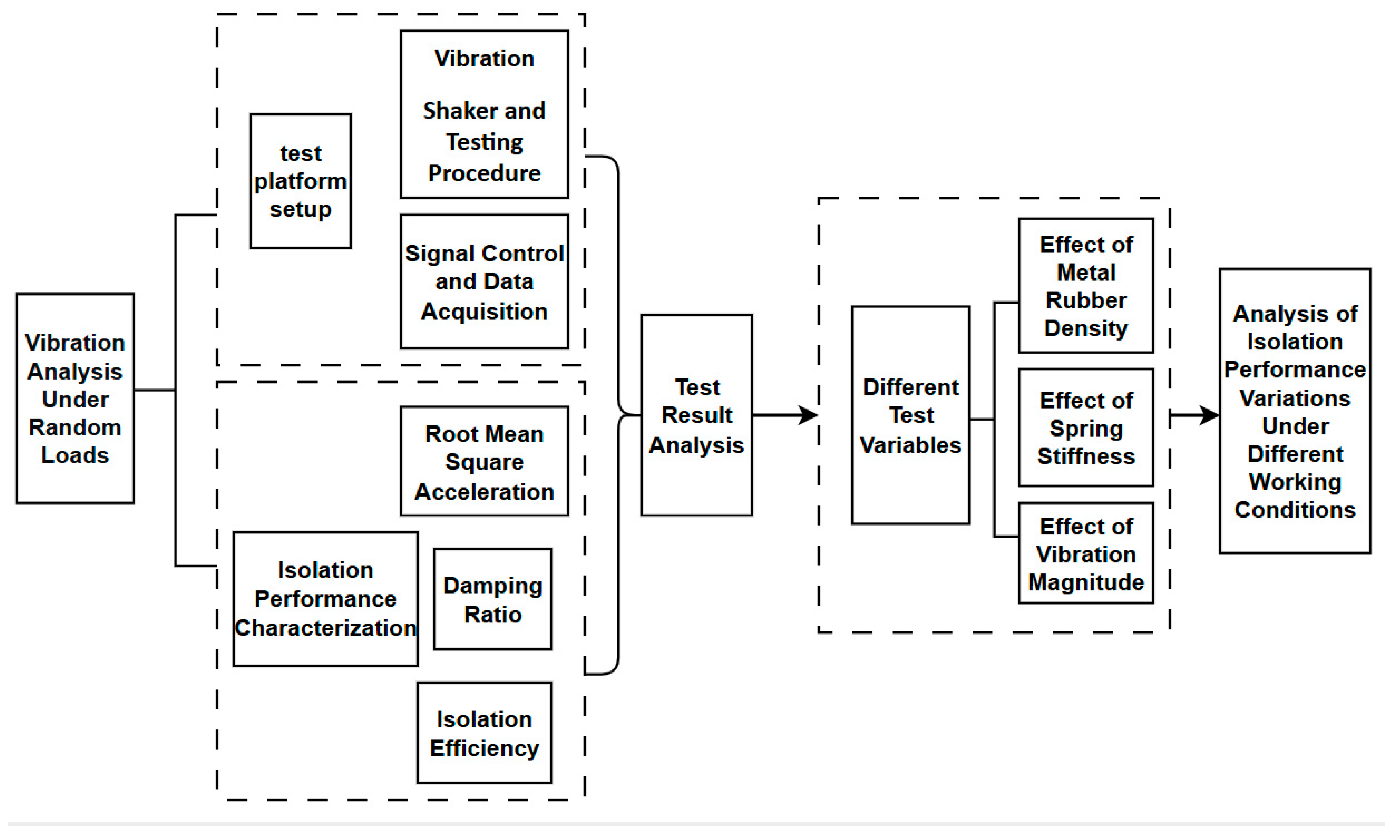
To systematically investigate the dynamic characteristics of the proposed frustum-shaped metal rubber isolator (FSMRI) under random vibration, this study follows a coherent methodology integrating theoretical analysis with experimental validation. The overall research framework, summarized in Figure 3, proceeds through four main phases: (1) Design and Fabrication of the isolator structure and its metal rubber components; (2) Theoretical Modeling and Definition of the system dynamics, random vibration analysis methods, and performance metrics; (3) Experimental Setup and Testing under controlled random excitation with parameter variations; and (4) Performance Evaluation and Analysis of the parameter sensitivity and isolation mechanisms. The following sections elaborate on the specific theories, models, and procedures corresponding to each phase.
Figure 3.
Flowchart of the methodology for investigating the FSMRI under random vibration.
3.1. Random Process Analysis
In random vibration analysis, when the process is stationary (i.e., its statistical properties remain invariant over time), the superposition of independent random excitations leads the system response to approximate a normal distribution according to the central limit theorem. The mathematical expectation of a stationary vibration process can be expressed as follows:
where is a constant value. x(t) is the input excitation. Although the instantaneous value of the random signal x(t) is uncertain, its overall characteristics can be described via parameters such as the mathematical expectation E[x(t)] and variance σ2 = E[x(t)2] from the normal distribution. The random excitation signal is applied to the isolation device. It is typically assumed to be a zero-mean process: .
Its statistical characteristics also require the use of the autocorrelation function to describe the correlation between different time intervals within the same process:
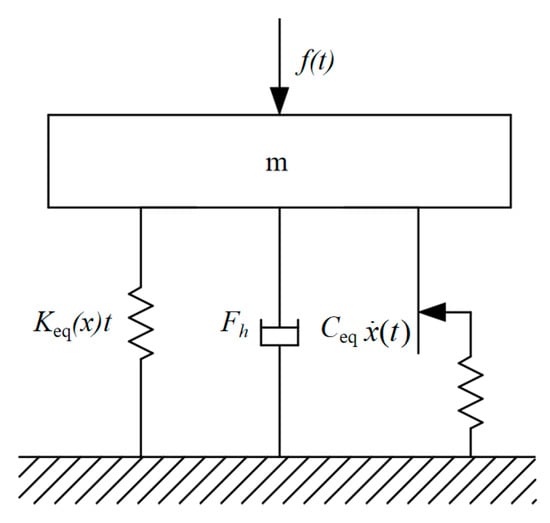
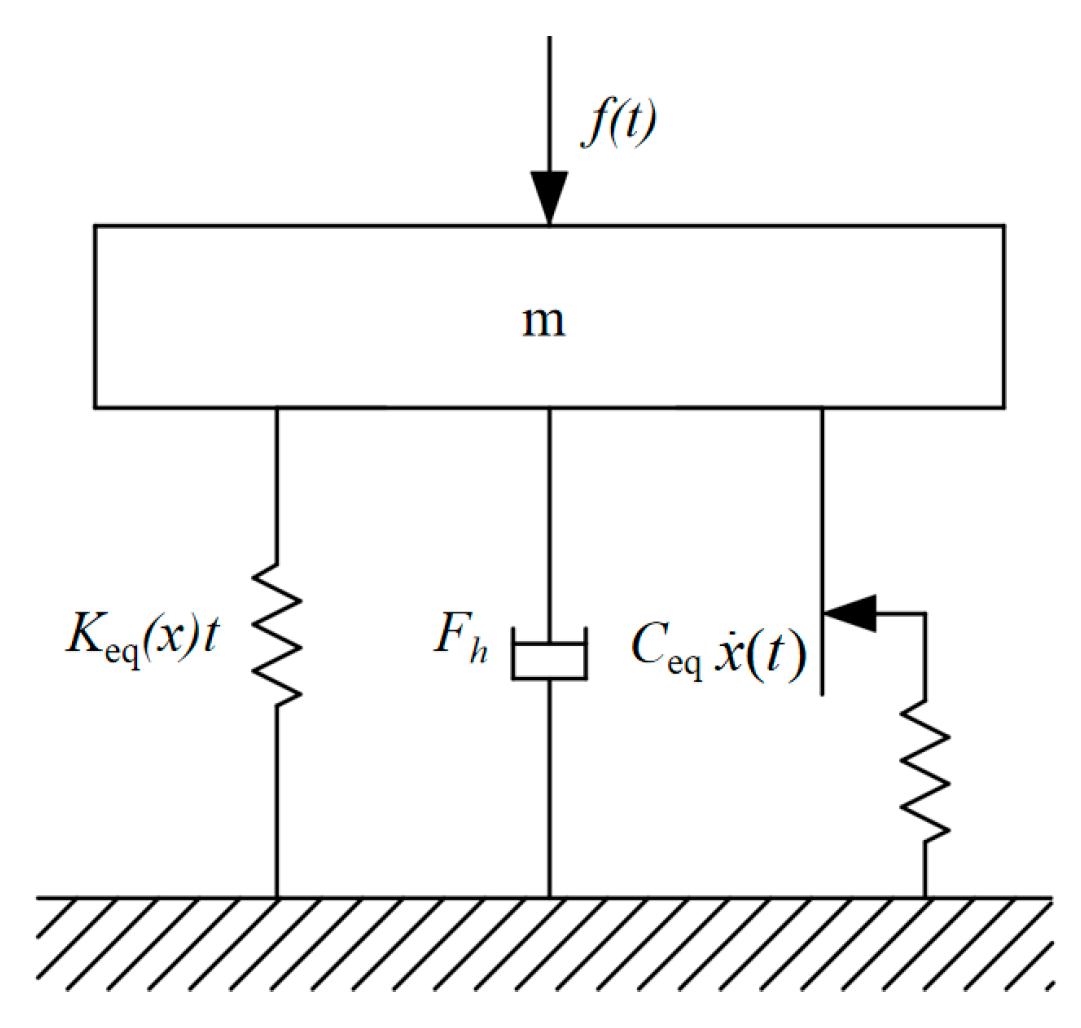
To theoretically analyze the dynamic characteristics of the system, the symmetrical frustum-shaped metal rubber isolator (FSMRI) is simplified as a single-degree-of-freedom system along its primary vibration direction, as shown in Figure 4. The system consists of an equivalent mass m, an equivalent linear stiffness keq (comprising the spring stiffness ks and the equivalent linear stiffness component kmr of the metal rubber), and a force Fh representing the nonlinear hysteretic damping of the metal rubber. Its equation of motion can be expressed as:
where x(t) is the relative displacement response of the system, and f(t) is the external random excitation. The equivalent stiffness is given by keq = ks + kmr, and the equivalent viscous damping coefficient ceq is used to approximately characterize other linear damping mechanisms in the system apart from hysteretic damping (e.g., structural damping, air damping). The nonlinear hysteretic force of the metal rubber can be described by smooth hysteresis models such as the Bouc–Wen model, whose differential form is as follows:
Figure 4.
Simplified dynamic model of the FSMRI.
Here, the parameter α controls the scale of the hysteresis loop, while β and γ govern its shape and degree of nonlinearity. ωn represents the equivalent natural frequency of the system, and ζ is the linear damping ratio. Due to the pronounced amplitude-dependent behavior of the metal rubber, the equivalent parameters mentioned above—particularly kmr and the hysteresis force parameters—are not constants but functions of the excitation level X.
It should be noted that this is precisely the core nonlinear characteristic of the metal rubber isolator. In a complete model identification procedure, these parameters could be inversely identified from experimentally measured frequency response functions, such as the resonant frequency fr and the half-power bandwidth Δf. However, the primary objective of this study is not to accomplish this complex parameter identification process. Instead, based on this modeling framework, systematic random vibration experiments are conducted to directly characterize and analyze the influence of key design parameters (density, stiffness) and excitation conditions on the system’s macroscopic dynamic responses, such as the Power Spectral Density (PSD), overall Root Mean Square acceleration (Grms), and isolation efficiency.
3.2. Power Spectral Density Estimation
In random vibration analysis, the power spectral density (PSD) is a key statistical measure describing the frequency distribution characteristics of a random signal [34,35]. Standard PSD analysis is essentially a linear systems tool. In this study, PSD is applied primarily to describe and compare the overall energy distribution and transmission characteristics of the system under random excitation within the frequency-domain framework commonly used in engineering, serving as an effective and standardized performance assessment method. According to the Wiener–Khinchin theorem, the PSD is mathematically defined on the basis of the autocorrelation function, and the two can be interconverted via the Fourier transform:
3.3. Test Platform
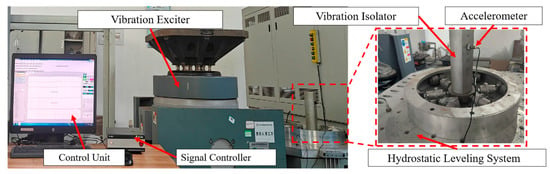
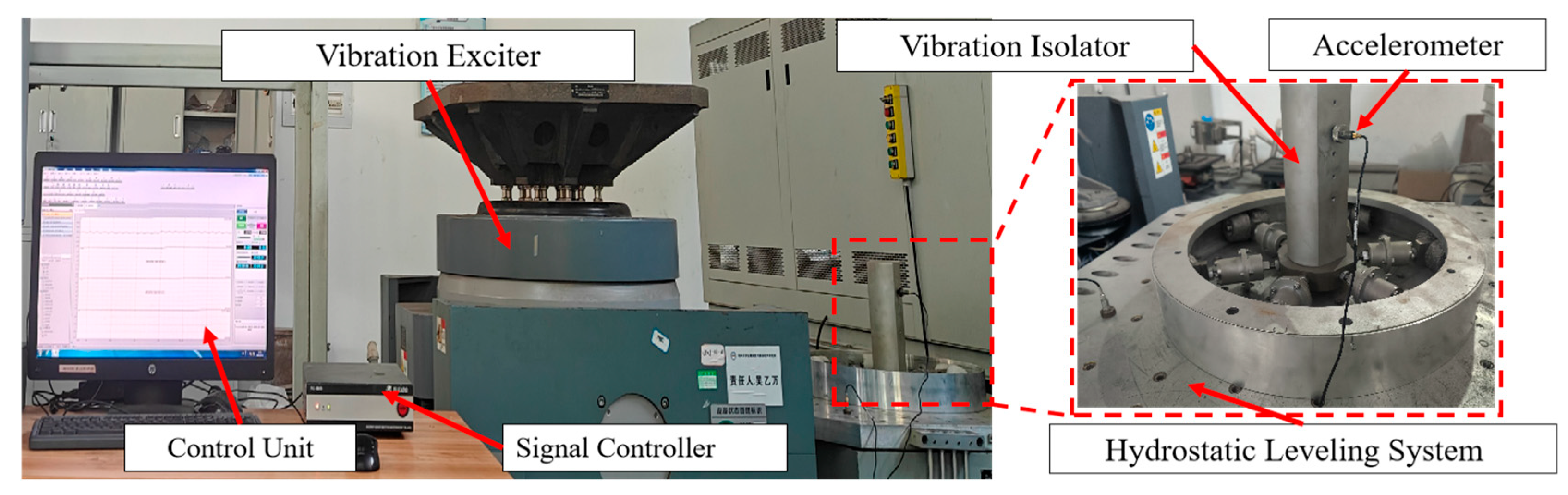
To evaluate the random vibration behavior of the isolation device in the horizontal direction, a random vibration test platform was established, as shown in Figure 5. During the test, the sensors convert the measured acceleration into electrical signals and transmit them to the signal controller. The controller returns the processed signals to the control computer, where software routines perform data processing and real-time analysis. The vibration response is then displayed on the computer interface as both waveform plots and numerical values, enabling evaluation of the isolation device’s performance.
Figure 5.
The random vibration test platform.
The experimental frequency range (5–600 Hz) covers the typical vibration environment during the satellite launch phase. ICP-type piezoelectric accelerometers (Model: PCB 352C33: Manufacturer: PCB Piezotronics; Depew, OK, USA) were used in the experiment. These sensors have a measurement range of ±50 g, a linearity of ±5%, and a frequency response range of 0.5 Hz to 3000 Hz, which fully covers the frequency band required for the test. All sensors were calibrated using a standard vibration exciter prior to testing. The vibration signals were acquired by a 24-bit high dynamic range data acquisition system (Model: NI PXIe-4499, National Instruments, Austin, TX, USA). The sampling rate of the acquisition system was set to 5120 Hz, which meets the Nyquist sampling theorem requirements for the highest analysis frequency (600 Hz) and provides sufficient margin to prevent aliasing.
3.4. Characterization Methods for Random Vibration Characteristics
(1) Overall root mean square acceleration
The overall root-mean-square acceleration (Grms) is an important indicator for quantifying random vibration intensity and is defined as the square root of the mean square value of the acceleration signal over a given time interval [33]. It is calculated as follows:
where A(t) is the time-varying acceleration signal, and T denotes the monitoring duration. This expression represents the average energy of the acceleration signal. The Grms value serves as an indicator of average vibration energy, which is crucial for assessing long-term fatigue effects. As this study focuses on the attenuation performance of the isolator under steady-state random vibration, Grms and PSD are adopted as the core evaluation metrics.
(2) Damping Ratio
In a random vibration environment, the damping ratio of the isolation device can be obtained from the PSD curve. When the device is subjected to random excitation, a distinct peak appears in the response PSD at the resonance frequency. Higher damping performance leads to a broader resonance bandwidth and a lower peak amplitude. The damping characteristics of the device can be characterized using the half-power bandwidth method based on the Power Spectral Density (PSD) curve. This method involves identifying the frequency difference between the half-power points on the PSD curve (i.e., where the power drops to half of the peak value, corresponding to a −3 dB decrease in amplitude), and then calculating the damping ratio ξ in relation to the natural frequency at the peak. The calculation formula is as follows:
where f1 and f2 represent the left and right frequencies, respectively, at which the power spectral density drops to half of its peak value. The half-power bandwidth method can effectively analyze the power spectral density characteristics of random vibration responses and thereby characterize the energy dissipation capability of the isolation device under random vibration conditions.
(3) Isolation Efficiency and Resonant Peak Amplification Factor
Isolation efficiency is defined as the percentage of vibration energy attenuated by the device and serves as a key indicator for evaluating performance in random vibration tests. The isolation efficiency η and the resonant peak amplification factor Q are calculated as follows:
where Irms and Orms are the input and output acceleration RMS values, respectively. An η value closer to 1 indicates better isolation performance. R(f) and E(f) are the response and excitation spectral curves, respectively.
4. Results and Discussion
4.1. Random Vibration Response Characteristics
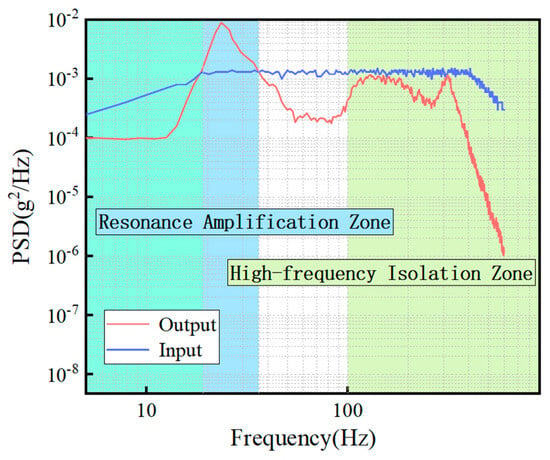
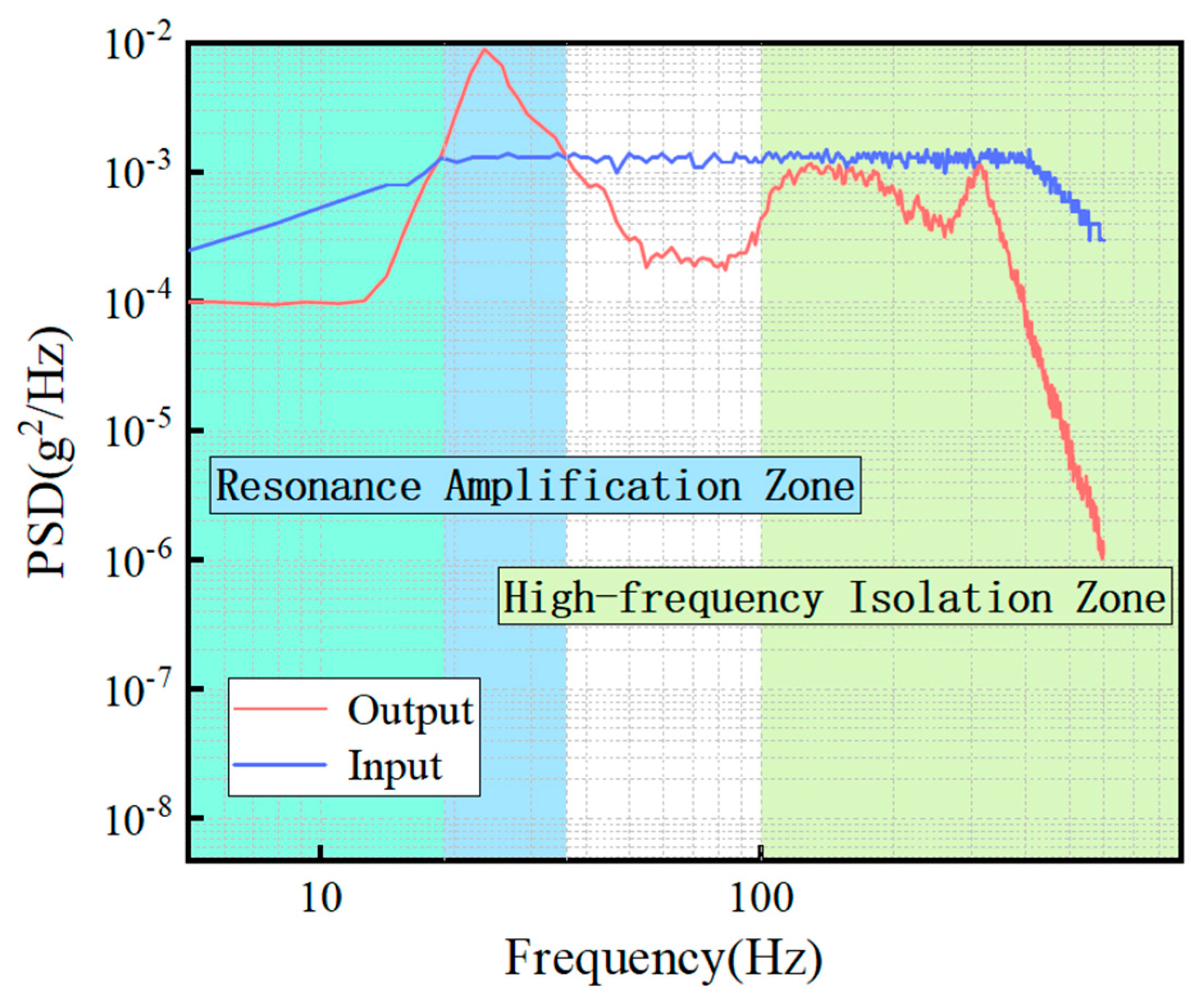
This section analyzes the FSMRI’s dynamic response to broadband random excitation under baseline conditions. A conical metal rubber element (density 2.0 g/cm3) was tested with a satellite launch random vibration profile (Table 1) to identify transmission characteristics and vibration response features. The PSD curves in Figure 6 show significant changes in shape and amplitude after the signal passes through the FSMRI, reflecting its isolation behavior. As the frequency increases, a sharp resonance peak appears in the output PSD at about 25 Hz. The magnitude of this peak exceeds the input PSD by nearly an order of magnitude, indicating that this frequency corresponds to the first-order equivalent natural frequency of the isolation system. The narrow bandwidth and steep rise of the peak reflect relatively low damping at this resonance. This amplification arises from the accumulation of energy from broadband excitation around the natural frequency, producing a pronounced structural response. For satellite-borne precision equipment, this region represents a high-risk frequency band that must be controlled through careful parameter design. At higher frequencies (about 30 Hz to 150 Hz), the output PSD shows a rapid decay, with amplitudes significantly lower than those of the input, demonstrating excellent isolation efficiency. This behavior agrees with high-frequency isolation theory, where excitation frequencies well above the natural frequency are effectively attenuated through elastic support and damping dissipation. Unlike the smooth decay characteristic of a purely linear isolator, the high-frequency output PSD here exhibits minor fluctuations and “burrs,” suggesting the action of nonlinear damping mechanisms, such as dry friction, micro-collision, and slip among the internal metal wire meshes. These nonlinearities are inherent to metal rubber and distinguish its dynamic performance from that of conventional linear isolation elements.
Table 1.
Target PSD profile information.
Figure 6.
Comparison of input and output PSD curves.
In summary, the FSMRI exhibits three operational regions under random excitation: the low-frequency transmission zone, the resonance amplification zone, and the high-frequency isolation zone. The amplitude and location of the resonance peak, the decay gradient in the high-frequency band, and the nonlinear oscillatory features collectively determine the system’s isolation performance. These macroscopic behaviors are strongly governed by the structural parameters of the device. The following section provides a quantitative sensitivity analysis of three key parameters—metal rubber density, spring stiffness, and input vibration level—to support optimization of the isolation performance.
4.2. Sensitivity Analysis of Critical Parameters on Isolation Performance
4.2.1. Effect of Metal Rubber Density on Isolation Performance
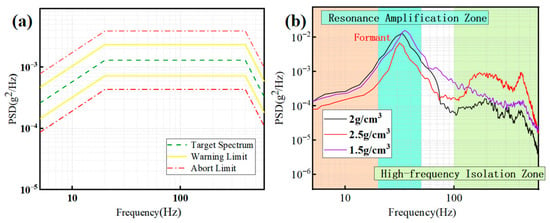
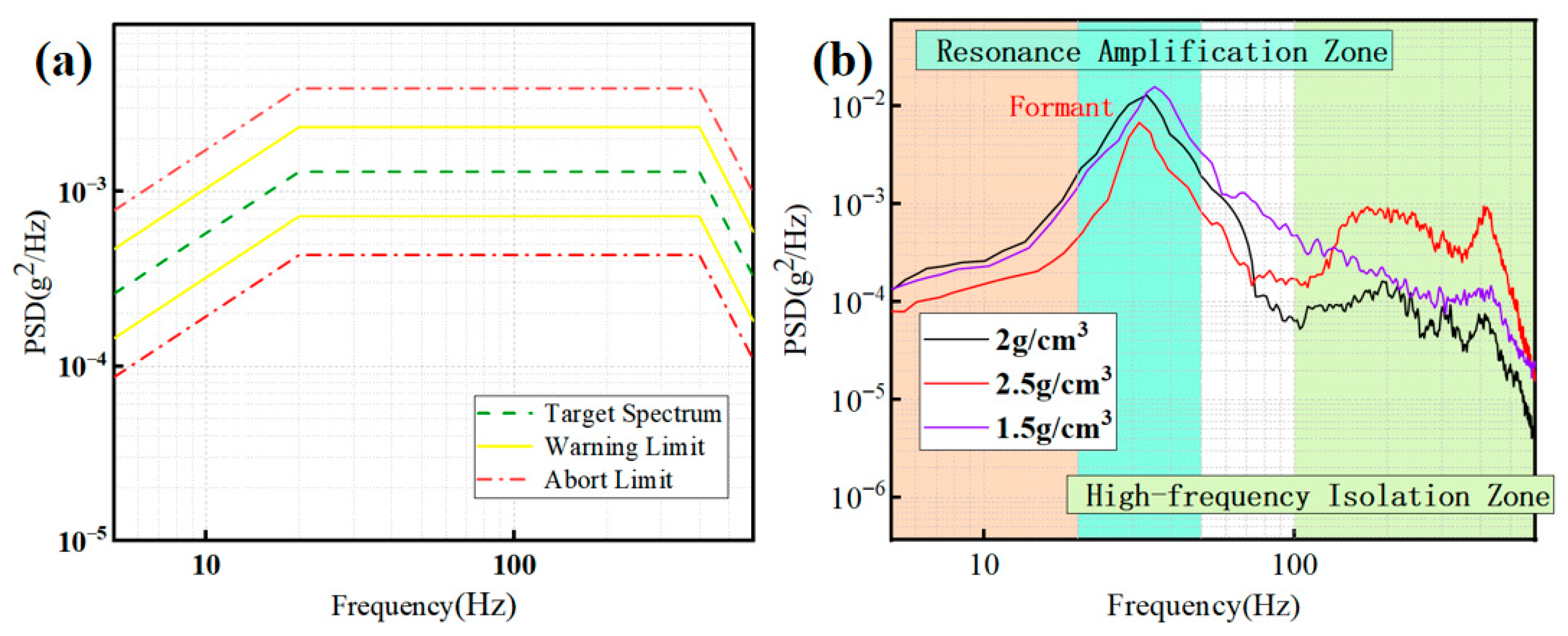
To investigate the influence of metal rubber density on random vibration characteristics, tests were performed using densities of 1.5, 2.0, and 2.5 g/cm3. In this study, the selected density range of the metal rubber and the spring stiffness range were determined based on material fabrication feasibility, preliminary experimental results, and common engineering requirements. During these tests, the isolation legs contained no springs. Warning and abort limits were defined in the target spectrum to prevent excessive acceleration, as shown in Figure 7a. Figure 7b shows the isolation device’s response for all three densities, highlighting differences in resonant peak, high-frequency attenuation, and overall vibration. Density influences damping, amplification, and isolation efficiency, as detailed in Table 2. The 1.5 g/cm3 MR has the largest peak, indicating strong resonance. At 2.5 g/cm3 the peak amplitude is lower and the curve smoother, showing resonance suppression with higher density. In the high-frequency range, the 2.0 g/cm3 MR has the lowest response, indicating the greatest dissipation of high-frequency vibration energy.
Figure 7.
(a) Target acceleration PSD profile. (b) Random vibration response curves at different densities.
Table 2.
Random vibration characterization parameters at different densities.
However, excessively high density decreases the overall damping capacity. Low-density MR has larger pores and a looser internal structure, which allows greater frictional slip between wire contacts under load, enhancing energy dissipation. In contrast, high-density MR contains more wire contacts, but its compact structure restricts the slip range, reducing energy dissipation and lowering the damping ratio. The amplification factor declines with increasing density because higher density enhances structural rigidity, limiting displacement response under random excitation and thereby reducing the resonant amplitude. The highest isolation efficiency (59.71%) occurs at a density of 2.0 g/cm3, whereas the isolation efficiencies for 1.5 g/cm3 and 2.5 g/cm3 are 45.76% and 52.35%, respectively. These results indicate that MR density strongly influences isolation performance. At low densities, the stiffness is reduced, enabling more effective low-frequency vibration absorption, but a larger amplification factor leads to high peak amplitudes. At high densities, the resonance peak is suppressed, but the damping ratio is reduced, weakening high-frequency attenuation. The intermediate density of 2.0 g/cm3 achieves the optimal balance between damping and rigidity.
4.2.2. Effect of Spring Stiffness on Isolation Performance
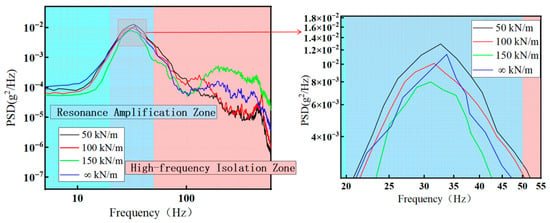
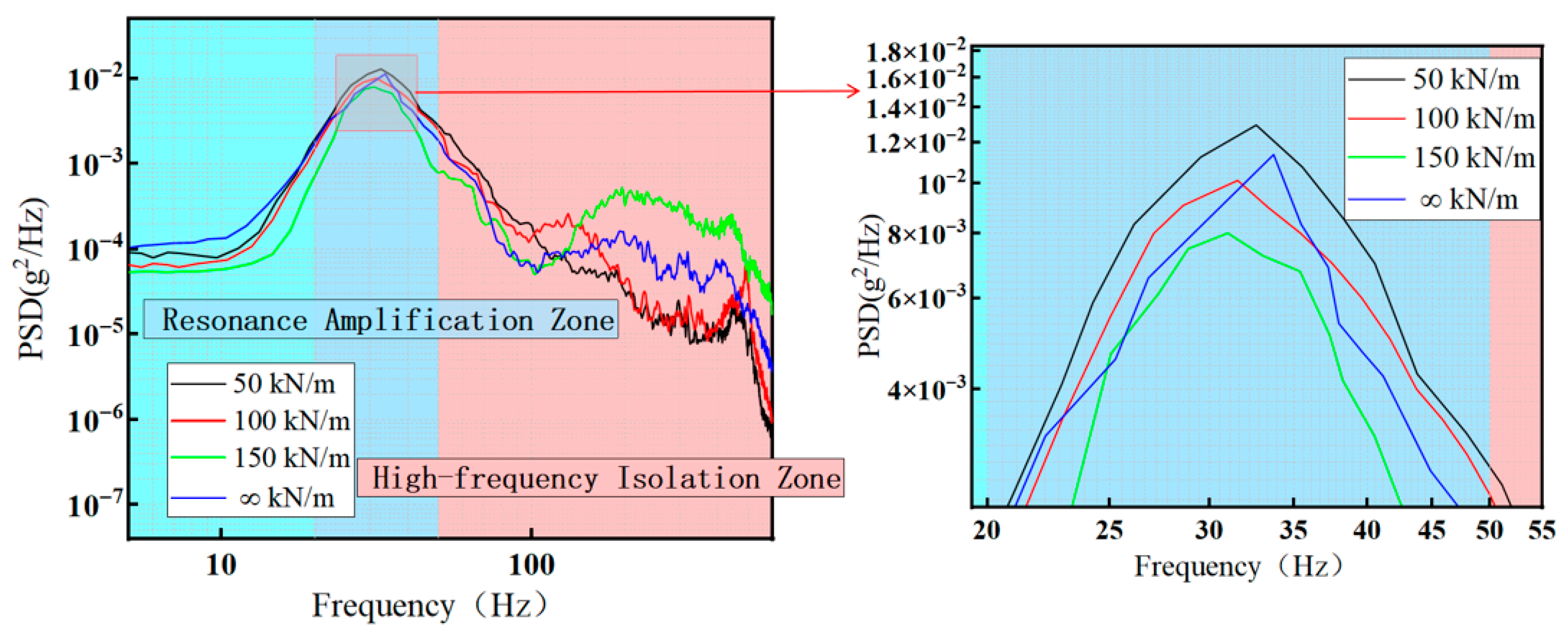
As a primary structural element, the springs, when combined with the MR component, influence both the stiffness and the damping behavior of the isolator. Tests were conducted using spring stiffness values of 50, 100, and 150 kN/m, along with a reference case without a spring (equivalent to infinite stiffness, denoted ∞ kN/m). Figure 8 shows that the resonance peak gradually shifts toward lower frequencies as the spring stiffness increases from 50 to 150 kN/m, indicating a decrease in the effective natural frequency. This behavior suggests the presence of swing-induced instability effects that create a nonlinear relationship between overall stiffness and natural frequency. The peak amplitude also decreases with increasing stiffness, implying that higher stiffness suppresses the resonance response and enhances dynamic stability. However, when the stiffness approaches infinity (rigid support), the resonance amplitude increases due to the absence of elastic buffering, which intensifies resonance amplification and reduces isolation effectiveness. Table 3 indicates only minor fluctuations in the input RMS. The output RMS first decreases and then slightly increases with stiffness. It decreases from 50 to 100 kN/m, reflecting improved vibration attenuation, but increases slightly at 150 kN/m, implying a reduction in isolation performance when stiffness becomes excessively high. With rigid support (∞), the RMS further increases, illustrating limited isolation capability.
Figure 8.
Random vibration response curves under different spring stiffness values.
Table 3.
Random vibration characterization parameters under different spring stiffness values.
The damping ratio shows a negative correlation with spring stiffness because the primary energy dissipation arises from the MR component through inter-wire friction and slip. As stiffness increases, the vibration period shortens and the spring absorbs more deformation, reducing the actual deformation occurring in the MR element, thereby lowering the equivalent damping. The amplification factor is highest at 50 kN/m, decreases with increasing stiffness as resonance is more effectively restrained, and increases again under rigid support conditions, indicating a strong resonance response that becomes difficult to attenuate. Isolation efficiency is highest at 100 and 150 kN/m. When stiffness is too low (50 kN/m) or excessively high (∞), isolation capability deteriorates. Low stiffness leads to large resonance amplitudes, whereas overly high stiffness limits low-frequency attenuation.
4.2.3. Effect of Vibration Level on Isolation Performance
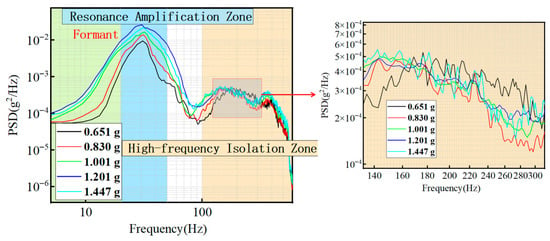
The preceding analysis clarified that structural parameters such as density and stiffness play a dominant role in shaping system performance. However, for nonlinear isolation elements like metal rubber, the dynamic characteristics are also highly sensitive to the external excitation level. To further evaluate the adaptability of the FSMRI in the complex aerospace vibration environment, this section examines the influence of the input vibration level—quantified by the overall RMS acceleration (Grms)—on its dynamic response. Tests were carried out using the optimized configuration (density 2.0 g/cm3 and spring stiffness 150 kN/m). By progressively increasing the input level, response data were collected at five discrete levels ranging from 0.651 g to 1.447 g. Figure 9 illustrates the random vibration response curves under different excitation levels. The most direct observation is that the overall vibration response level increases significantly with the input Grms. The output acceleration PSD curves shift upward across the entire frequency band, and the response Grms increases monotonically from 0.243 g to 0.721 g, which is consistent with the basic physical principle that a stronger excitation produces a stronger structural response. More importantly, the resonance behavior exhibits clear amplitude dependence. The resonance peak amplitude increases markedly as the input level rises. This amplitude dependence directly reflects the nonlinearity of metal rubber; in contrast, a linear isolation system would exhibit an input-independent transmissibility peak. The pronounced peak growth indicates a “softening” characteristic in the equivalent stiffness of the FSMRI. As the vibration amplitude increases, more internal contact points in the metal rubber transition from a locked state to a sliding state, reducing the rate of restoring force development and thus lowering the equivalent stiffness.
Figure 9.
Random vibration response curves under different RMS input levels.
The “spikes” or minor irregular fluctuations observed in the PSD curve within the high-frequency range (e.g., >100 Hz) are characteristic features of the nonlinear damping mechanism inherent to metal rubber materials. This phenomenon primarily arises from the micro-discontinuous behavior of its internal porous wire-mesh structure under dynamic loading. These “spikes” are not measurement noise but rather direct evidence of the nonlinear energy dissipation mechanism of metal rubber. In contrast to the smooth attenuation curves typical of traditional linear damping materials, this behavior reflects the ability of metal rubber to dissipate energy through multi-mode friction across a broad frequency range, thereby contributing to enhanced attenuation efficiency for high-frequency vibrations.
According to the natural frequency expression of a single-degree-of-freedom system, a decrease in stiffness theoretically causes a downward shift in natural frequency. However, the frequency shift remains smaller than the resolution of the measurement band and is therefore not clearly observed. At the same time, to balance the increased input energy, the system produces a larger resonance amplitude, leading to the pronounced elevation of the peak. The amplification factor in Table 4 rises sharply from 5.655 to 11.711, clearly demonstrating a significantly heightened risk of resonance at high excitation levels. Under low vibration levels, the excitation energy is limited, sufficient only to overcome the static friction at the weakest internal contact points within the metal rubber, causing microscopic slip and energy dissipation. At this stage, the number of active frictional interfaces participating in energy dissipation is limited, resulting in a relatively low equivalent damping ratio. As the vibration level intensifies, the increased excitation energy becomes adequate to activate a greater number of stronger internal frictional interfaces to undergo relative slip. A larger quantity of metal wires performs work against friction, converting mechanical energy into heat and dissipating it, which macroscopically manifests as the continuous increase in the damping ratio. This characteristic of amplitude-dependent damping is the core feature that distinguishes metal rubber from traditional viscous damping materials. Despite the increasing damping ratio, the system’s isolation efficiency consistently decreases from 62.76% to 50.21%. This phenomenon reveals the existence of a competition between energy input and dissipation within the system under high-level random vibration.
Table 4.
Random vibration characterization parameters under different RMS input levels.
Although the enhanced damping dissipates more energy, the rate of increase in the total input energy surpasses the rate of increase in energy dissipated by the damping. The sharp amplification of the resonance peak is the dominant factor leading to this outcome. Within the resonance region, the drastically amplified response contributes significant kinetic and potential energy. Although this energy is ultimately consumed by the damping, its substantial amplitude directly leads to a notable increase in the output response Grms. In other words, the enhanced damping is insufficient to fully “suppress” the amplified resonance response caused by nonlinear softening. Consequently, the proportion of the total output vibration energy (response Grms) relative to the total input energy increases, manifesting as a decrease in isolation efficiency.
Table 4 also reveals an insightful trend: as the input level increases, the damping ratio monotonically increases from 0.227 to 0.321. This is not contradictory to the simultaneous rise in resonance amplitude; instead, it reflects the nonlinear dry-friction damping mechanism of metal rubber. Under low excitation levels, only the weakest internal frictional contacts slip, and the number of active energy-dissipation interfaces is limited, resulting in a low equivalent damping ratio. As the excitation level rises, more frictional interfaces are activated and forced into relative motion. A larger volume of metal wires performs work against friction, dissipating more mechanical energy as heat, which manifests macroscopically as a higher damping ratio. This amplitude-dependent damping is a distinguishing trait of metal rubber compared with traditional viscous damping materials.
Despite the increasing damping ratio, the isolation efficiency decreases from 62.76% to 50.21%, revealing a competition between input energy and dissipation efficiency under high-level random vibration. Although damping increases, the rate at which input energy grows exceeds the rate of energy dissipation. The sharply amplified resonance peak dominates the output energy content: within the resonance band, the large-amplitude oscillation substantially increases the output Grms. Thus, even though the damping mechanism becomes more active, it cannot fully counteract the rapidly growing resonance response caused by nonlinear softening, leading to a decline in isolation efficiency.
5. Conclusions
This study systematically revealed the influence mechanisms of key parameters on the dynamic response of a frustum-shaped metal rubber isolator under random vibration. The relationships between isolation performance and metal rubber density, spring stiffness, and input vibration level were analyzed, providing a theoretical and empirical basis for performance optimization. The main conclusions are as follows:
(1) Metal rubber density involves a trade-off between rigidity and damping. Higher density enhances structural stiffness, suppressing the resonance peak and improving high-frequency attenuation, but it concurrently restricts inter-wire micro-slip, thereby reducing the damping ratio. An optimal density of 2.0 g/cm3 was identified, achieving a balance with an isolation efficiency of 59.71%.
(2) Spring stiffness significantly influences the resonance characteristics. Increasing stiffness effectively lowers the resonance amplitude and improves isolation efficiency. However, excessively high stiffness (approaching rigid support) diminishes elastic buffering, which can paradoxically intensify the resonant response and degrade overall isolation performance, indicating an optimal range exists.
(3) The system’s nonlinear behavior becomes significant at high input vibration levels. As the level increases, resonance amplification intensifies and isolation efficiency declines. This highlights the amplitude-dependent behavior of the isolator: while it performs well under moderate excitation, its effectiveness is constrained under high-intensity vibration due to combined nonlinear stiffness softening and damping saturation.
The “parameter–performance” correlation established in this study provides a quantifiable selection basis for aerospace random vibration isolation design, and the nonlinear mechanisms revealed lay an experimental foundation for the subsequent development of intelligent adaptive isolation systems.
Author Contributions
Y.X.: Conceptualization, Investigation, Writing—original draft. J.G.: Formal analysis; J.L.: Data curation; H.W.: Resources; X.X.: Investigation, Project administration, Supervision, Writing—review & editing. All authors have read and agreed to the published version of the manuscript.
Funding
The authors gratefully acknowledge the financial support by the National Natural Science Foundation of China (Grant No. 12272094), and the Natural Science Foundation of Fujian Province of China (Grant No. 2024J01244).
Data Availability Statement
The original contributions presented in this study are included in the article. Further inquiries can be directed to the corresponding author.
Acknowledgments
The authors would like to express many thanks to Senior Engineer Yizhu Guo of China Academy of Space Technology for his valuable comments and motivating discussions.
Conflicts of Interest
The authors declare no potential conflicts of interest with respect to the research, authorship, and/or publication of this article.
References
- Flannigan, L.; Yoell, L.; Xu, C. Mid-wave and long-wave infrared transmitters and detectors for optical satellite communications—A review. J. Opt. 2022, 24, 043002. [Google Scholar] [CrossRef] [Scilit]
- Li, R.; Zheng, S.; Wang, E.; Chen, J.; Feng, S.; Wang, D.; Dai, L. Advances in BeiDou Navigation Satellite System (BDS) and satellite navigation augmentation technologies. Satell. Navig. 2020, 1, 12. [Google Scholar] [CrossRef] [Scilit]
- Cui, Y.; Yao, X.; Chen, X.; Liang, G.; Zhao, S.; Li, L.; Ma, H.; Pan, C.; Wang, B.; Guo, X.; et al. On-orbit calibration techniques for optical payloads onboard remote-sensing satellites. Rev. Sci. Instrum. 2021, 92, 104501. [Google Scholar] [CrossRef] [Scilit]
- Manushyna, D.; Hülsebrock, M.; Kuisl, A.; Vivo, A.D.E.; Heloret, P.; Atzrodt, H.; Rapp, S. Application of vibroacoustic metamaterials for structural vibration reduction in space structures. Mech. Res. Commun. 2023, 129, 104090. [Google Scholar] [CrossRef] [Scilit]
- Li, W.; Yuan, L.; Zheng, R.; Wu, Y.; Sui, J.; Zhong, J. Micro-vibration suppression methods and key technologies for high-precision space optical instruments. Acta Astronaut. 2021, 180, 417–428. [Google Scholar] [CrossRef] [Scilit]
- Liu, C.; Jing, X.; Daley, S.; Li, F. Recent advances in micro-vibration isolation. Mech. Syst. Signal Process. 2015, 56, 55–80. [Google Scholar] [CrossRef] [Scilit]
- Chowdhury, S.; Adhikari, S. Frictional energy harvesting vibration absorbers. Mech. Res. Commun. 2025, 149, 104539. [Google Scholar] [CrossRef] [Scilit]
- Johnson, C.; Wilke, P.; Darling, K. Multi-axis whole-spacecraft vibration isolation for small launch vehicles. Proc. SPIE Smart Struct. Mater. 2001, 4331, 153–161. [Google Scholar]
- Chi, W.; Cao, D.; Huang, W. Design of active whole-spacecraft vibration isolation based on voice-coil motor. Proc. SPIE Smart Struct. Mater. 2014, 9061, 1041–1047. [Google Scholar]
- Wang, Y.; Miao, Z.; Yin, X. Research on multi-dimensional vibration isolation control system based on a parallel mechanism. In Proceedings of the 2017 IEEE International Conference on Information and Automation, Takamatsu, Japan, 6–9 August 2017; pp. 1115–1120. [Google Scholar]
- Roy-Layinde, T.O.; Omoteso, K.A.; Laoye, J.A.; Diala, U.H. Vibrational resonance in nonlinear vibration isolation systems. Mech. Res. Commun. 2025, 148, 104470. [Google Scholar] [CrossRef] [Scilit]
- Li, M.; Fang, B.; Wang, L.; Huang, W. Whole-spacecraft active vibration isolation using piezoelectric stack actuators. In Proceedings of the 2010 3rd International Symposium on Systems and Control in Aeronautics and Astronautics, Harbin, China, 8–10 June 2010; pp. 1356–1360. [Google Scholar]
- Tang, J.; Cao, D.; Qin, Z.; Chen, D. A VCM-based novel whole-spacecraft vibration isolation device: Simulation and experiment. J. Vibroeng. 2018, 20, 1035–1050. [Google Scholar] [CrossRef] [Scilit]
- Kamesh, D.; Pandiyan, R.; Ghosal, A. Modeling, design and analysis of low frequency platform for attenuating micro-vibration in spacecraft. J. Sound Vib. 2010, 329, 3431–3450. [Google Scholar] [CrossRef] [Scilit]
- Wang, F.; Zheng, S.; Huang, C.; Yan, J.; He, Z.; Yu, H.; Liao, J. Research and application of vibration isolation platform based on nonlinear vibration isolation system. J. Sens. 2023, 2023, 9967142. [Google Scholar] [CrossRef] [Scilit]
- Wang, A.; Wang, S.; Wang, G.; Ma, G. Hierarchical Control for Microgravity Vibration Isolation System: Collision Avoidance and Execution Enhancement. IEEE Trans. Aerosp. Electron. Syst. 2024, 60, 11. [Google Scholar] [CrossRef] [Scilit]
- Chen, N.; Yang, Z.; Yang, T.; Shen, Y.; Tian, W.; Xu, Y. Design of low-frequency circular metastructure isolators with high-load-bearing capacity. Chin. J. Aeronaut. 2024, 37, 207–220. [Google Scholar] [CrossRef] [Scilit]
- Luo, H.; Fan, C.; Li, Y.; Liu, G.; Yu, C. Design and experiment of micro-vibration isolation system for optical satellite. Eur. J. Mech.-A/Solids 2023, 97, 104833. [Google Scholar] [CrossRef] [Scilit]
- Kwon, S.; Jo, M.; Oh, H. Experimental validation of fly-wheel passive launch and on-orbit vibration isolation system by using a superelastic SMA mesh washer isolator. Int. J. Aerosp. Eng. 2017, 2017, 5496053. [Google Scholar] [CrossRef] [Scilit]
- Chen, S.; Xuan, M.; Xin, J.; Liu, Y.; Gu, S.; Li, J.; Zhang, L. Design and experiment of dual micro-vibration isolation system for optical satellite flywheel. Int. J. Mech. Sci. 2020, 179, 105592. [Google Scholar] [CrossRef] [Scilit]
- Lee, D.; Park, G.; Han, J. Experimental study on on-orbit and launch environment vibration isolation performance of a vibration isolator using bellows and viscous fluid. Aerosp. Sci. Technol. 2015, 45, 1–9. [Google Scholar] [CrossRef] [Scilit]
- Liu, G.; Wang, X.; Guo, Z.; Zhang, Y. Experimental study on shock isolation of metal rubber-disc spring composite shock absorber under different shock excitation. J. Phys. Conf. Ser. 2024, 2720, 12042. [Google Scholar] [CrossRef] [Scilit]
- Gao, J.; Dang, S.; Liu, Y.; Li, J. Effect of wire properties on mechanical compression and fatigue properties of metal-rubber. Mater. Today Commun. 2025, 44, 112147. [Google Scholar] [CrossRef] [Scilit]
- Lai, F.; Gao, G.; Hao, X.; Hu, A.; Xue, X.; Bai, H.; Fu, L. Research on performance degradation patterns of metal rubber components under the coupling of static compression and full immersion corrosive environment. Mater. Today Commun. 2024, 39, 109107. [Google Scholar] [CrossRef] [Scilit]
- Zou, Y.; Xiong, C.; Yin, J.; Cui, K.; Zhu, X.; Deng, H.; Song, S. Experimental and constitutive model study on dynamic mechanical behavior of Metal Rubber under high-speed impact loading. Shock. Vib. 2021, 2021, 8845375. [Google Scholar] [CrossRef] [Scilit]
- Zheng, X.; Wang, W.; Wu, Y.; Bai, H. Study of the dynamic model and vibration performance of pot-shaped metal rubber. Materials 2022, 15, 5878. [Google Scholar] [CrossRef] [Scilit]
- Liu, J.; Liu, X.; Wang, H.; Ye, Z.; Xue, X. Structural design and vibro-mechanical characterization analysis of variable cross-sectional metal rubber isolator. Symmetry 2025, 17, 382. [Google Scholar] [CrossRef] [Scilit]
- Zhang, C.; Ao, H.; Jiang, H.; Zhou, N. Investigations on start-up performances of novel hybrid metal rubber-bump foil bearings. Tribol. Int. 2021, 154, 106751. [Google Scholar] [CrossRef] [Scilit]
- Soleimanian, S.; Petrone, G.; Franco, F.; De Rosa, S. Semi-active vibro-acoustic control of vehicle transmission systems using a metal rubber-based isolator. Appl. Acoust. 2024, 217, 109861. [Google Scholar] [CrossRef] [Scilit]
- Zhao, Y.; Yan, H.; Dong, S.; Jiang, T.; Jiang, H. Experimental research on the friction and leakage of the metal rubber seal for reciprocating motion. Proc. Inst. Mech. Eng. Part J 2022, 236, 2221–2231. [Google Scholar] [CrossRef] [Scilit]
- Fu, H.; Song, J.; Wang, Y.; Zhu, J.; Chen, J. Hysteresis constitutive model of metal rubber based on the lay-up manufacturing method. Mech. Syst. Signal Process. 2025, 239, 13300. [Google Scholar] [CrossRef] [Scilit]
- Fu, H.; Tao, Y.; Wang, Y.; Zou, L.; Mao, Y. Optimization on hysteresis dynamic model of metal rubber material based on dry friction damping term. J. Mech. Eng. Sci. 2022, 236, 1674–1684. [Google Scholar] [CrossRef] [Scilit]
- Haider, C.; Senoner, D.; Sinn, A.; Husanović, A.; Friedl, B.; Schitter, G. Hybrid reluctance-actuated Stewart platform for high-precision position control. Precis. Eng. 2026, 98, 27–36. [Google Scholar] [CrossRef] [Scilit]
- Yang, B.; Huang, Y.; Li, Z.; Hu, X. Management of post-stroke depression (PSD) by electroencephalography for effective rehabilitation. Eng. Regen. 2023, 4, 44–54. [Google Scholar] [CrossRef] [Scilit]
- Bouchama, R.; Bouhalais, M.L.; Cherfia, A. Surface roughness and tool wear monitoring in turning processes through vibration analysis using PSD and GRMS. Int. J. Adv. Manuf. Technol. 2024, 130, 3537–3552. [Google Scholar] [CrossRef] [Scilit]

Disclaimer/Publisher’s Note: The statements, opinions and data contained in all publications are solely those of the individual author(s) and contributor(s) and not of MDPI and/or the editor(s). MDPI and/or the editor(s) disclaim responsibility for any injury to people or property resulting from any ideas, methods, instructions or products referred to in the content. |
© 2026 by the authors. Licensee MDPI, Basel, Switzerland. This article is an open access article distributed under the terms and conditions of the Creative Commons Attribution (CC BY) license.