1. Introduction
Virtual waiting time is among the most crucial performance characteristics of a queueing model. For a particular time t, it is defined as the time a job would spend in a queue, should it arrive at t. For a few reasons, it is even a more important characteristic than the celebrated queue length.
Namely, it gives precise information about the state of the system at t, in terms of the amount of work already planned at t to be carried out. Interestingly, the bare queue length does not provide such precise information. If at time t the queue length is q, while the expected service time of a job is s, then a naive expectation is that the waiting time of a job arriving at t should be roughly , on average. However, it is known that such an intuition is wrong, and the waiting time of such a job can be, on average, many times more than .
One of the factors that can cause this effect is a large service time variance. Namely, when choosing an arbitrary t, it is more likely that t belongs to an exceptionally long service interval, rather than to a typical one, simply because it is much longer than a typical interval. Hence, service of the job already receiving service at t can take much longer than s, making the total waiting time much longer than . This effect is well understood and described in renewal theory.
However, there are more factors that can deeply influence the waiting time. As we will see here, one of the conditions that may lead to an expected waiting time much longer than is a positive correlation of job sizes, which induces a positive correlation of service times. This can happen even if the service time variance is relatively small. Another feature of queueing systems that may severely affect the waiting time is active management. In its basic form, active management is carried out by randomly denying service to arriving jobs, with the probability growing as the queue expands.
Hence, in this paper we examine the virtual waiting time in a queueing model that incorporates both these features: active management and correlation of service times. We start with the transient case, for which we derive the distribution tail, the probability density, and the expected virtual waiting time at any t. Then, taking the limit , we obtain the probability density and expected virtual waiting time in the stationary case. These theoretical results are partnered with numerical examples, in which we show the influence of various system parameters on transient and stationary waiting times. Especially interesting is the comparison of the case of positively correlated service times with the symmetric case of negatively correlated service times (i.e., having exactly the same strength, but opposite sign). We also compare the effect of symmetric weak and strong active management on transient and stationary waiting times, and evaluate the impact of initial conditions. In addition to waiting times, queue lengths are also calculated, to allow a comparison between the two characteristics.
The primary motivation for studying a model with active management and correlated job sizes is computer networking. Specifically, the Internet Engineering Task Force recommends using active management for packet queues in Internet routers [
1]. Its main purpose is to reduce the waiting time of packets in routers’ queues. Besides that, active management has some other positive effects, such as desynchronization of TCP control algorithms, leading to better usage of physical link capacities, and improvement of fairness of bandwidth allocation between flows contributing to aggregated traffic. Moreover, successive packets in TCP/IP traffic often have correlated sizes, which leads to analogous correlation of their service/transmission times through output links.
However, computer networking is not the only area where we can find active management and correlated job sizes. In fact, both of these features are quite common in queues in everyday life. Specifically, in everyday life we can often observe that people opt out of joining a queue of some sort with the probability rising as the queue grows. The mathematical model for this phenomenon is the very same as for deletion of packets in a router with probability growing with buffer occupancy. Then, service times of people or other objects in queues can be correlated on account of some external circumstances. In a logistics company, an extended trip time of a truck on a particular route becomes more likely to happen after a previous such incident, because both of them may arise from the same reason, e.g., snowfall and bad road conditions, and so on.
The queueing model considered here, incorporating active management and correlated service times, is as broad as possible. Specifically, the successive service times are modeled by a Markovian service process (MSP). It is known to be able to mimic an arbitrary distribution of service times and, at once, arbitrary correlation between successive service times. The active management function , which relates the packet/job rejection probability to the queue length, is general, i.e., it may be of any form. Finally, the packet/job interarrival time may also assume an arbitrary form.
To sum up, the paper consists of the following original contributions:
theorem on distribution tail of the virtual waiting time at arbitrary t—Theorem 1;
theorem on density of the virtual waiting time at arbitrary t—Corollary 1;
theorem on stationary density of the virtual waiting time—Corollary 2;
theorem on expected virtual waiting time at arbitrary t—Theorem 2;
theorem on stationary expected virtual waiting time—Corollary 3;
numeric examples revealing the effects on virtual waiting times of symmetric positive and negative correlation of service times, weak and strong active management, and initial conditions.
This paper’s later sections are arranged as outlined below. In
Section 2, the relevant earlier literature is described.
Section 3 presents in full detail the model under analysis. In
Section 4, the actual derivations begin. Namely, the distribution tail of the virtual waiting time at arbitrary
t is derived first, followed by the transient and stationary density. In
Section 5, the expected virtual waiting time at arbitrary
t is obtained, followed by its stationary counterpart. Then, in
Section 6, numeric calculations are provided. Specifically, in
Section 6.1, the effect of symmetric weak and strong active management on the transient and stationary waiting time is demonstrated and accompanied by calculations of queue length distributions. In
Section 6.2, the influence of initial conditions on the progression of the waiting time is illustrated. In
Section 6.3, the impact of a symmetric negative correlation of the same strength but opposite sign is depicted and discussed. Lastly,
Section 7 consolidates this paper’s closing statements.
2. Related Work
From what the author knows, the findings reported here are fully original. No earlier mathematical research has addressed the virtual waiting time in a queue with active management and correlated service times.
Each of these two crucial system features has had its effect studied in isolation, instead of being combined. However, correlation of service may indirectly influence the operation of active management, by influencing queue lengths. Hence, the combined effect of the two features may be far from any simple combination of separate effects of each of them.
As for active management, here it is assumed that the packet/job drop probability is directly related to buffer occupancy through function
. Such an approach was initially put forward for Internet routers in [
2] with a linear management function
. After that, many other management functions were studied, e.g., exponential [
3,
4], trigonometric [
5], polynomial [
6,
7], Gaussian [
8], beta [
9], mixed [
10,
11,
12,
13], and others [
14].
In these strictly networking-oriented studies, computer simulation was the main tool of performance evaluation. More formal, mathematical investigations of queueing models with management function
are to be found, e.g., in [
15,
16,
17,
18,
19,
20,
21].
Moreover, in the networking literature we can find work on active management in which the packet drop probability is not directly related to buffer occupancy, e.g., [
22,
23,
24,
25,
26,
27,
28,
29,
30,
31,
32,
33,
34]. In these propositions, the packet drop probability is calculated using algorithms based on fuzzy logic [
22,
23,
24], control theory [
25,
26,
27,
28], machine learning [
29,
30,
31,
32], and other approaches [
33,
34].
Now, it should be emphasized that none of the mentioned work on active management [
2,
3,
4,
5,
6,
7,
8,
9,
10,
11,
12,
13,
14,
15,
16,
17,
18,
19,
20,
21,
22,
23,
24,
25,
26,
27,
28,
29,
30,
31,
32,
33,
34] encompasses a mathematical model of correlated packet/job service times.
Modelling of correlated service times has a separate literature, in which only passive queue management is considered. The most popular approach is exploiting the Markovian service process [
35], to model successive, correlated service intervals. The popularity of this approach is due to three crucial features of the MSP. First, it is able to mimic an arbitrary service time distribution. Second, it can mimic an arbitrary strength of correlation between successive service times. Third, it is mathematically workable.
Queues with the MSP service times are studied, e.g., in [
35,
36,
37,
38,
39,
40,
41,
42,
43]. These studies differ with respect to the performance characteristic investigated, buffer capacity, batch structure, and other details. Specifically, in [
35,
36,
37,
39,
43], the queue length is investigated. The waiting time is analyzed in [
35,
38,
40,
41], the idle period is analyzed in [
39], whereas the busy period is analyzed in [
39,
41]. An infinite buffer is postulated in [
35,
36,
37,
38,
39,
40,
43], while its finite version is used in [
35,
41,
42]. Additionally, batch arrivals are allowed in the models of [
39,
40,
41], whereas batch services appear in [
36,
42,
43].
Nevertheless, in none of the works [
35,
36,
37,
38,
39,
40,
41,
42,
43] was active management incorporated into the queueing system.
Basing on the presented state of the art, the rationale for this paper has three key components. Firstly, as argued in the introduction, the virtual waiting time is an important characteristic, which provides information on the system performance not present in the bare queue length. Secondly, the features of the analyzed model are deeply motivated not only by computer networking, but also by real-life queueing systems. Finally, and crucially, it is interesting to see the combined effect of active management and correlated service times on the waiting time. It is known that both of these features severely impact the performance of the queueing model. However, when both of them are present simultaneously, their combined impact cannot be simply added up. This is because one of them influences the other, altering its operation. Namely, correlated service times influence queue lengths, which are taken as inputs of active management. Therefore, correlated service times alter the operation of active management.
3. Queueing Model
We assume that jobs/packets arrive at a queueing system of capacity K jobs, which includes a buffering space for jobs and a service position. The jobs are queued up according to arrival time. The queue is drained from the head, one job at a time, by some service process (e.g., transmission in networking).
The system implements active management, relying on the buffer occupancy. Namely, an arriving job/packet can be rejected on arrival, i.e., blocked access to the buffer, with probability , where the argument n stands for the queue size at the arrival time of this job. The function may take any form for , but for it must hold that , because a job cannot enter the buffer when it is full.
Job interarrival times are i.i.d. random variates, with the distribution function , of a general form.
Jobs sizes can be correlated, which causes correlation of service times. Correlated service times are modeled via an MSP [
35]. To parameterize an MSP, we have to give the number of service phases,
M, and two matrices of size
:
and
, for which the sum
establishes an infinitesimal generator for a Markov chain on the phase space
. Additionally,
has to be negative on its diagonal and elsewhere nonnegative;
has to be nonnegative.
The MSP evolves in time as described hereafter. If at time t a job is being served and the service phase is u, then shortly after, i.e., at , the service phase may change to v with probability and the service goes on, or the service phase may change to v with probability and the service is completed, which means that the job may leave the system. If after that there is a job in the buffer, the evolution of the MSP carries on in the same manner. However, if the buffer is empty, the service phase freezes—it remains unaltered until the next successful arrival of a job. When this happens, the MSP reassumes the evolution as described above.
Active management only controls effective arrivals and does not affect the associated MSP.
The expected service time is
, where
whereas
denotes the stationary vector for generator
L. Two consecutive service times have the following coefficient of correlation:
where
By and , we represent the queue length and service phase at time t, respectively. We follow a convention that includes the job in service, if applicable. Similarly, the argument n of active management function includes the job in service and K includes the service position.
Moreover, in the derivations, we will be using two more characteristics of the MSP: and . Specifically, stands for probability that n services are completed in and the service phase is v at the n-th service completion time, assuming and . Then, stands for the probability that n services are completed in and , assuming and .
By
, we denote job acceptance probability:
Without affecting generality, we let correspond to the arrival epoch if and the earliest job after arrives according to the distribution if .
When dealing with an MSP, there are two main choices regarding what can happen with the service phase when the system becomes empty. Namely, the service phase can be frozen during an idle period and used unaltered at the next arrival time, or it can be reset according to some arbitrary discrete distribution. In the majority of papers, the former approach is taken, including works [
35,
37,
38,
39,
40,
41,
42,
43]. The latter approach is taken, as the sole choice, only in [
36], while in [
37,
38] the latter is considered as an optional scheme. In this paper, we use the most popular setting with the frozen service phase.
4. Tail of Distribution and Density
Let denote the virtual waiting time at t. Namely, is the time a job would spend in a queue before entering the service, should it arrive at t.
Let
denote the distribution tail of
under initial conditions
,
, i.e.,
where
and
.
The following analytical approach will be exploited hereafter.
First, we will design a system of integral equations of the Volterra type for by varying and . This will be accomplished using the law of total probability.
Second, the Laplace transform will be applied to all of these equations, converting convolution integrals into products of transforms of . The resulting system will become linear and will be solved using standard linear algebra.
Third, to obtain the transform of the density of the virtual waiting time at t, the Leibniz integral rule will be applied, together with some well-known properties of the MSP.
Fourth, to obtain the stationary density of the virtual waiting time, the Final Value Theorem will be exploited.
Finally, in numerical examples, the results expressed as Laplace transforms will be inverted to the time domain by utilizing a transform inversion method.
First, assume that
,
. We have the following:
Equation (
6) is derived by employing the law of total probability regarding the joint distribution of the earliest arrival time
y, the number of services performed by
y, the service phase at
y, and the acceptance/rejection of the first arrival. Specifically, with probability
, the earliest arrival happens at
y, the buffer is flushed completely by
y, the service phase when this happens is
k, and the first incoming job is accepted. In such a case, at time
y, we have
, which is handled by the initial component of (
6). The second component differs from the first only in that the earliest arrival is rejected. Hence, we have
starting from time
y.
In the third component of (
6), with probability
, the earliest arrival happens at
y,
jobs are completed by
y, the service phase at time
y is
k, and the first incoming job is accepted. In such a case, at time
y, we have
. Note that
l cannot be 0 in this case, because the earliest arrival cannot be accepted when the buffer is full. The fourth component differs from the third in that the earliest arrival is rejected. Therefore, now it can be
and we have
, starting from time
y.
In the fifth component of (
6), with probability
the earliest arrival occurs after
t,
l jobs are completed by
t, and the service phase at time
t is
k. Hence, we simply have the following:
Assuming
and
, we obtain the following equation for
:
which is designed by employing the law of total probability regarding the joint distribution of the earliest arrival time
y and accpetance/rejection of the first arrival. Namely, with probability
, the earliest arrival is at
y and it is accepted, so we have
at time
y, whereas with probability
, the earliest arrival is at
y and it is rejected, so we have
at
y. If the earliest arrival occurs after
t, then we have
for every
. Therefore, the component corresponding to such a case vanishes.
Now, assume
and
, where
. We have the following:
In general, Equation (
9) is derived similarly to (
6). The crucial difference is in the third components of (
9) and (
6). Specifically, in the third component of (
9) it is permitted that no job is completed by time
y and a new job is allowed to enter the buffer at
y. This is possible now because it is presumed that the buffer is not completely filled at the beginning. In (
6), it was prohibited, because the earliest arrival could not be accepted when the buffer was full at the beginning.
Noticing that all integrals in system (
6), (
8), and (
9) are of a convolution type, a natural way to solve this system is via the Laplace transform, which converts convolutions of functions into products of their transforms.
Specifically, denoting
from (
6), we obtain the following:
where
Similarly, from (
8), we obtain the following:
with
whereas (
9) yields the following:
It is more convenient to rewrite Equations (
11), (
15) and (
17) using vectors and matrices. We will consequently use the convention that non-bold letters denote scalars, bold lowercase letters denote column vectors, and bold uppercase letters denote square matrices.
Now, denoting
from (
11), we have the following:
with
where
Then, (
15) yields the following:
while from (
17), we obtain the following:
As we see, system (
19), (
25) and (
26) is linear with respect to
. Accordingly, it can be solved with the help of standard linear algebra. The outcome can be given in a concatenated vector
of length
:
Specifically, moving all unknown
to left-hand sides of (
19), (
25) and (
26), while the remaining known coefficients are moved to the right-hand sides, we may achieve the final result:
Theorem 1. Tail of distribution of the virtual waiting time at t has the following transform:whereandwhile0andIdenote the zero matrix and identity matrices, respectively, each of dimension . Now, we can turn to derivation of the probability density at
t, i.e.,
When dealing with the density , we have to remember that it may be defective, i.e., it may not integrate to 1. Indeed, when the buffer contains nothing, the virtual waiting time is 0, so has an atom at . Its size equals and can be computed from Theorem 1.
Bearing this in mind, we can obtain the transform of the virtual waiting time density. First, we define the following:
and
Using the Leibniz integral rule, we then have the following:
where
is given in Theorem 1. Therefore, to obtain
from (
36) and Theorem 1, we ought to calculate first the derivative of
with respect to
x, i.e.,
with
Combining (
22) with the well-known properties of the MSP, i.e.,
we obtain the following:
which completes the derivations.
Corollary 1. The probability density of the virtual waiting time at t has the following transform:where is given in Theorem 1, while is given in (37) and (41). Finally, the stationary density of the virtual waiting time is defined as follows:
This can be easily obtained by applying Corollary 1 and the FVT theorem on the Laplace transform. After that, we obtain the following:
Corollary 2. The stationary probability density of the virtual waiting time is as follows:where indicates the initial element of a vector. It is important to point out that all the results obtained in the current section can be easily exploited to obtain numeric values of the virtual waiting time.
Specifically, the matrices
,
,
needed in the theorems can be obtained via the uniformization method, which is a well-known approach (see [
44]). A formula for
is available, e.g., in [
45] (see formula (41) of [
45]). Lastly, the results of Theorem 1 and Corollary 1, expressed as Laplace transforms, can be inverted with ease to the time domain, by utilizing one of the methods for the transform inversion.
5. Expected Value
Let
denote the expected virtual waiting time at
t under initial conditions
,
, i.e.,
where
and
.
First, assume
,
. We have the following:
Equation (
46) can be justified like (
6), except for the last part, in which with probability
, the earliest arrival occurs after
t,
l jobs are completed by
t, and the service phase at
t is
k. Hence, we have the following:
Assuming
and
yields the following:
which can be justified exactly as (
8). Assuming
and
, we obtain the following:
It has the same form as (
46), except for the third component of (
49), in which
, for the same reason as explained below in Equation (
9).
Denoting
from (
46), (
48) and (
49), we obtain the following:
and
respectively, where
As previously, system (
52), (
53) and (
54) can be solved using linear algebra and the outcome may be presented using a concatenated vector:
After that, we acquire the final result as summarized hereafter.
Theorem 2. The expected virtual waiting time at t has the following transform:where is shown in Theorem 1, while is presented in (55). Lastly, the stationary counterpart of
, defined as
can be easily derived by applying Theorem 2 and the FVT theorem on the Laplace transform. We obtain the following:
Corollary 3. The stationary expected virtual waiting time is as follows: Finally, note that each proven theorem and corollary requires the inversion of a matrix of size
. The time complexity of this operation is of order
if one of the classic methods is used. Modern techniques enable a reduction in this complexity to
(
) [
46]. In practice, when using
Mathematica software (version 14), on a modern PC, it takes a few seconds to invert a matrix of size 5000 × 5000.
6. Numeric Examples
We will begin numeric examples with the following MSP matrices:
Matrices (
62) and (
63) were generated to provide the expected service time of 1.0, while the correlation coefficient between two service times is 0.3. Therefore, it is a positive correlation of moderate strength. The standard deviation of the service time is 1.8. Matrices (
62) and (
63) will be used in
Section 6.1 and
Section 6.2. In
Section 6.3, new matrices providing a symmetric negative correlation will be exploited.
Two active management functions will be employed in all examples,
(weak) and
(strong), as follows:
Functions
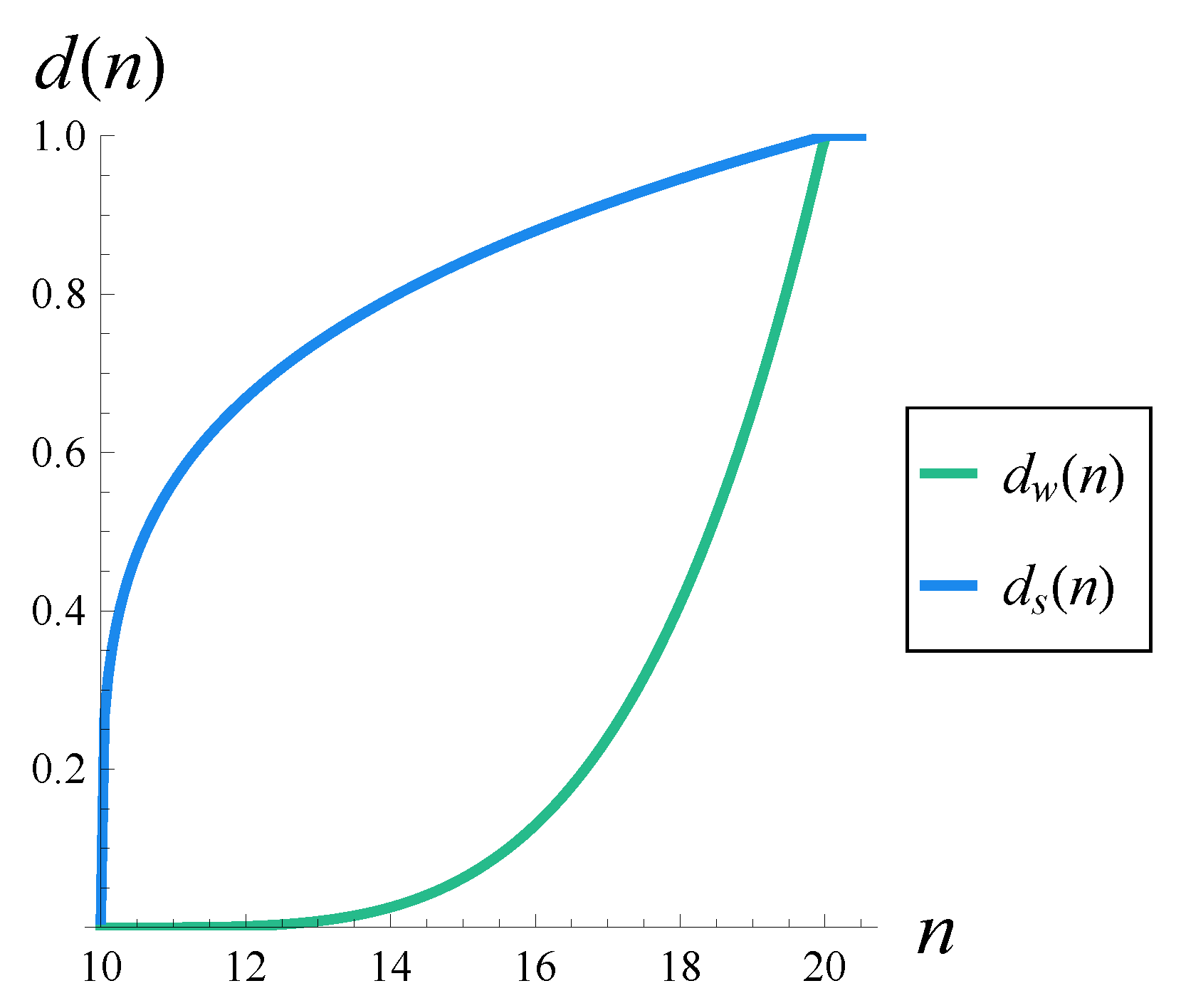
and
are depicted in
Figure 1 over their operating interval, [10, 20]. As we see, they have a symmetric form. Furthermore,
is much stronger than
, i.e., it drops job/packets with much higher probabilities.
Finally, the interarrival distribution function in all examples will be as follows:
This gives the arrival rate of 1.0 and the interarrival time standard deviation of 1.5, which is moderate, but clearly far from Poisson arrivals.
6.1. Effect of Active Management
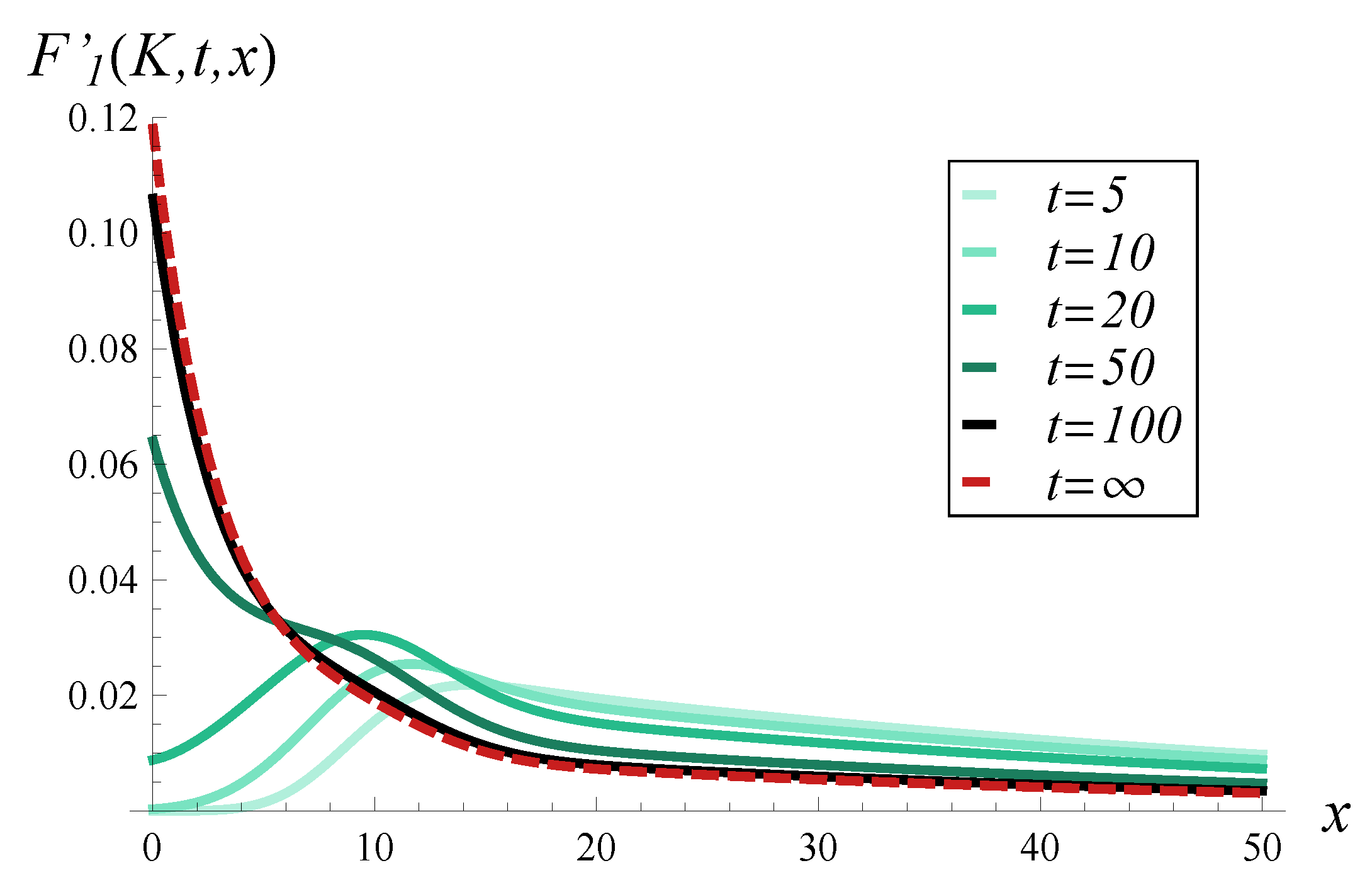
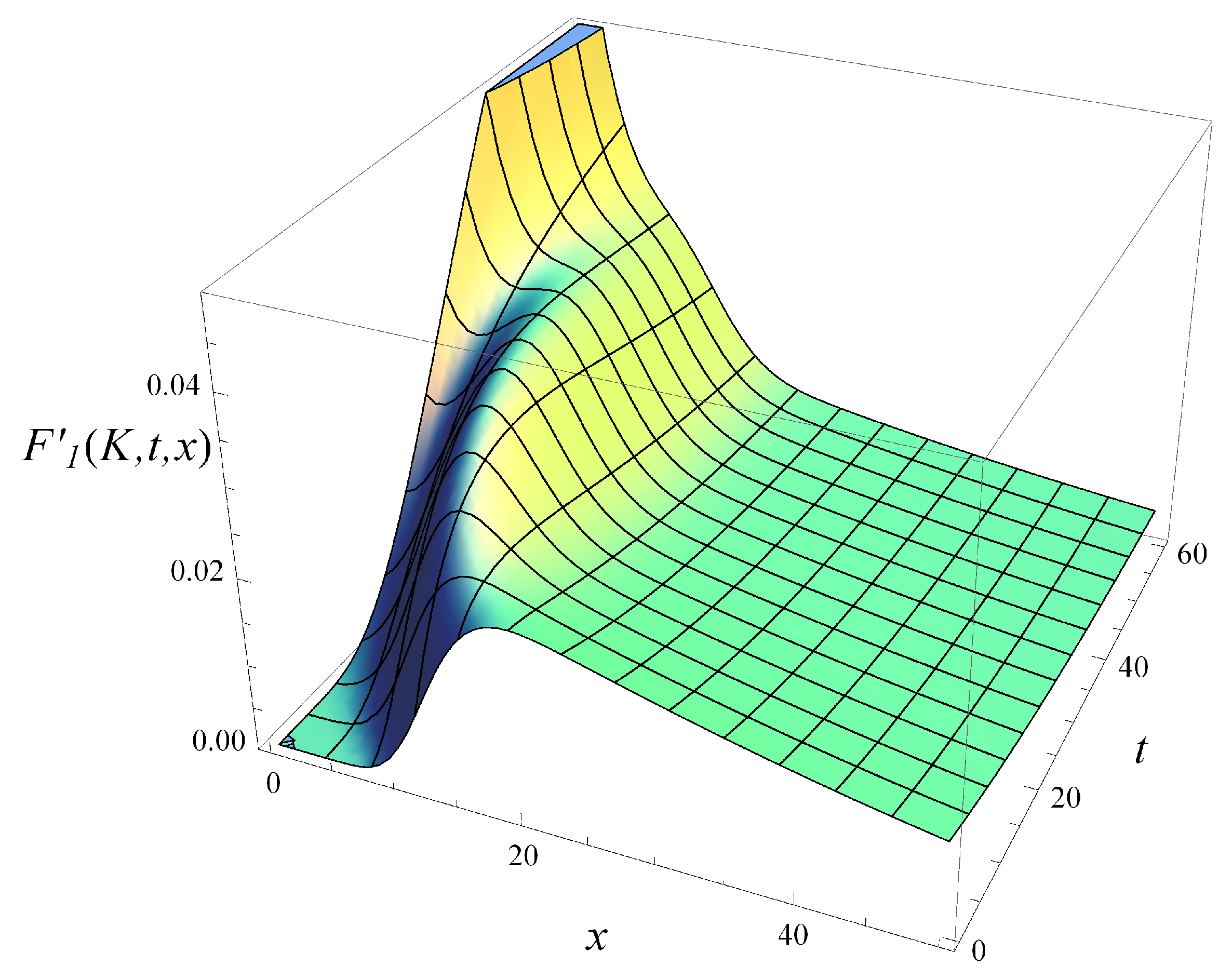
In
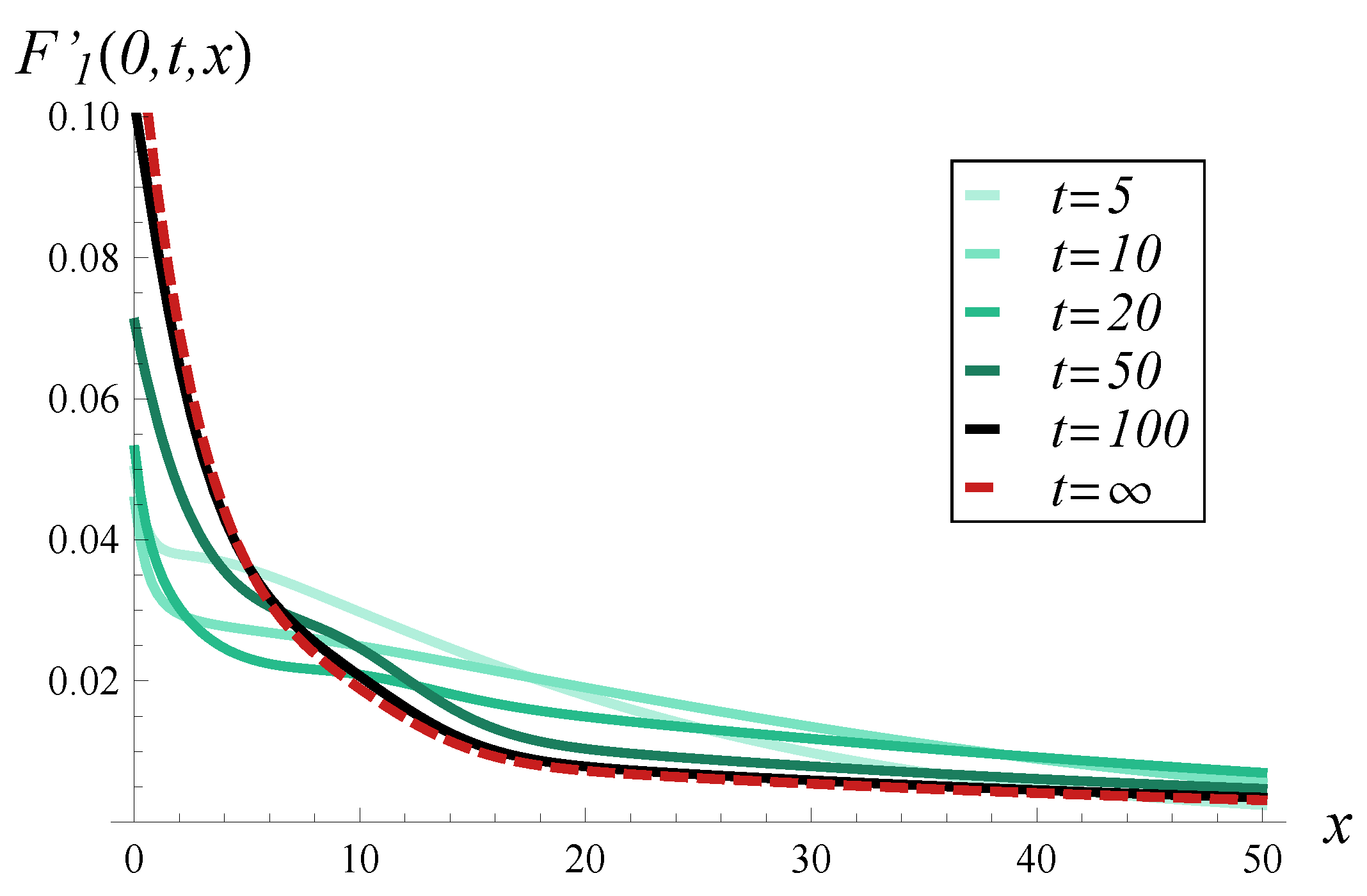
Figure 2, the virtual waiting time density is presented at specific moments in time for the weak management function
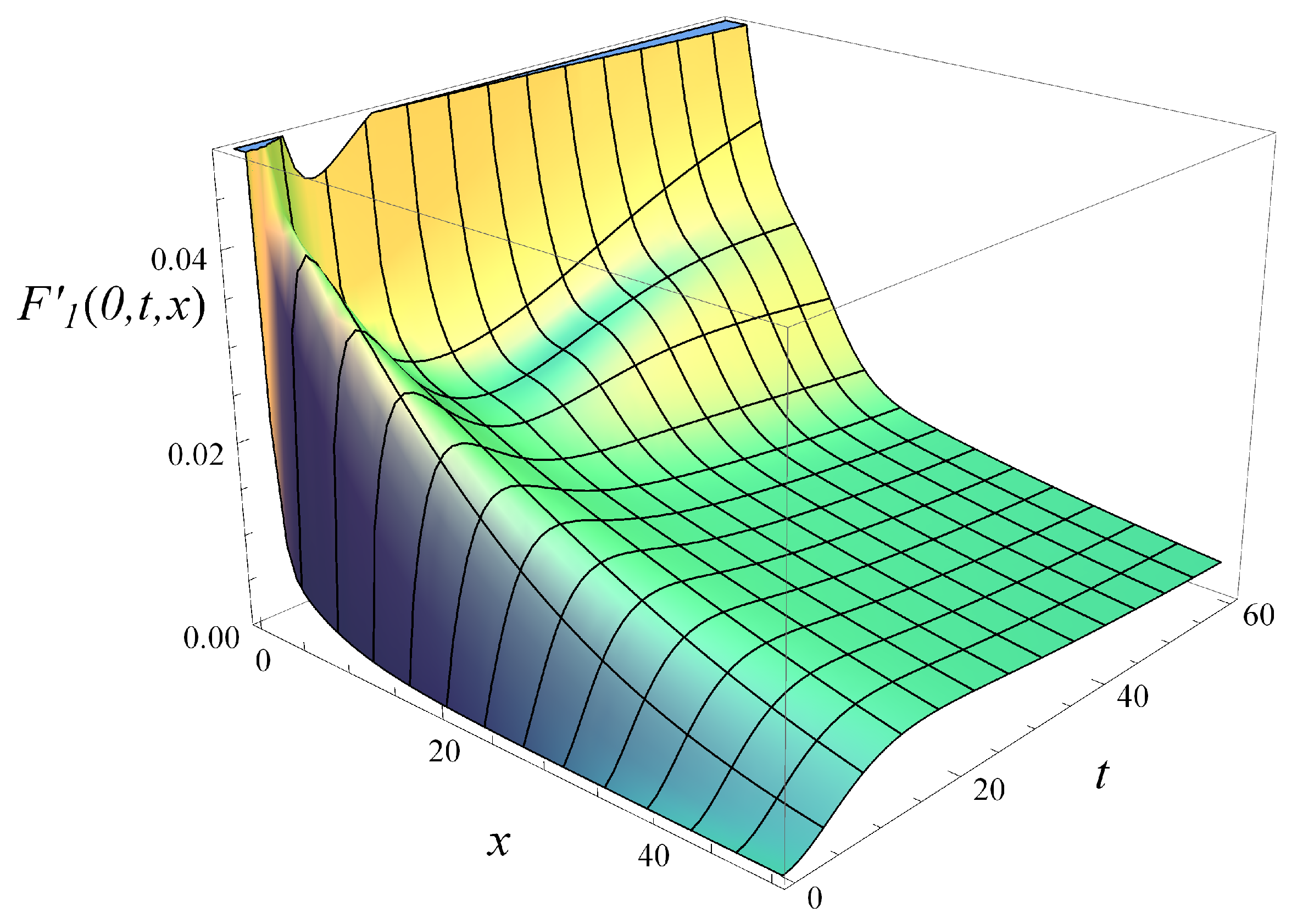
. In
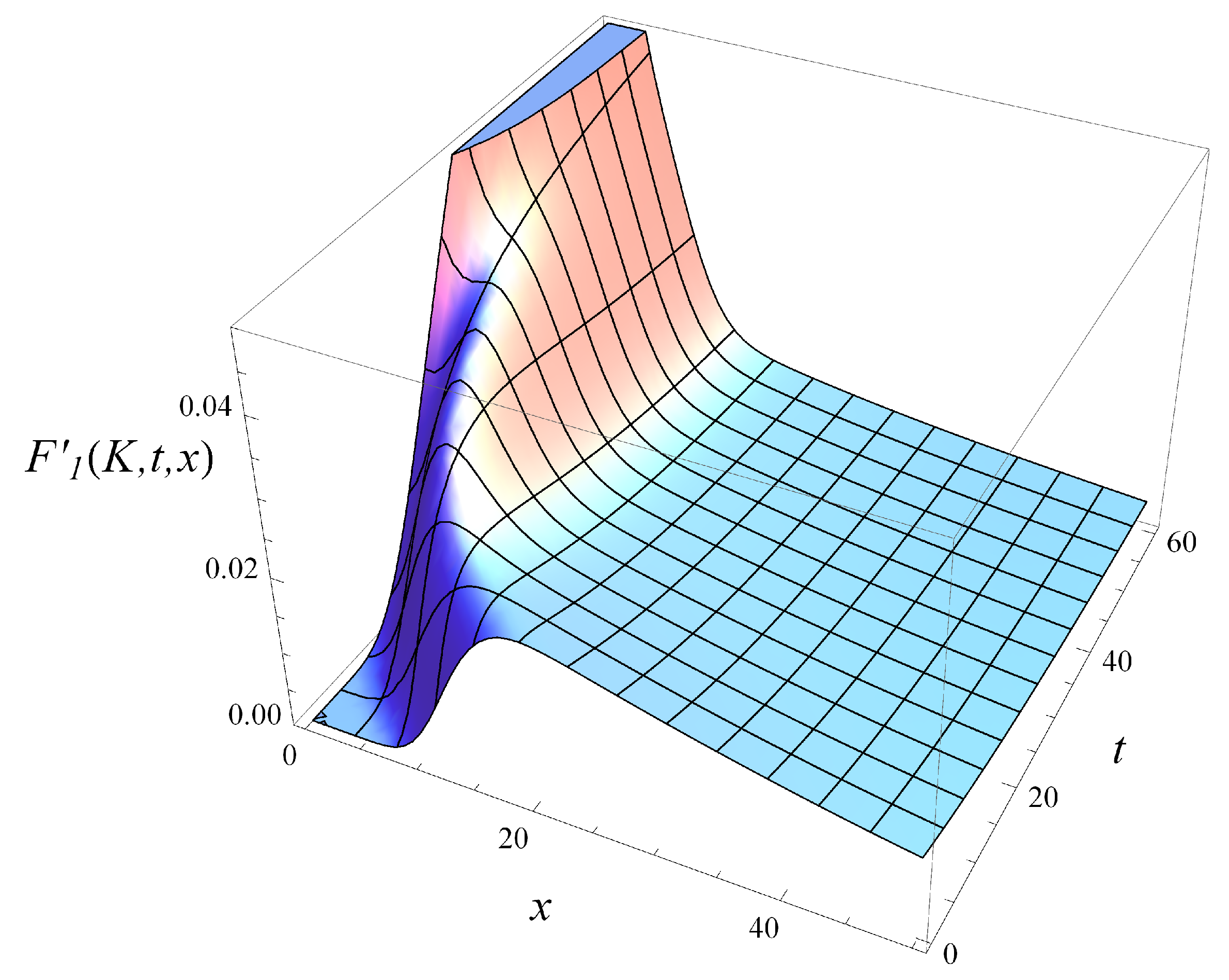
Figure 3, the continuous evolution of this density in the time interval
is depicted for the same weak management. An empty buffer is assumed when the system begins operating.
As we see in
Figure 2 and
Figure 3, in the early, transient stage of operation, the density of the virtual waiting time varies significantly. Then, it stabilizes at about
(see
Figure 2). After that, the density seems to be very close to the stationary one (red dashed line in
Figure 2).
It is striking that the distribution tail of the virtual waiting time is rather heavy in
Figure 2 and
Figure 3, for every considered
t. Namely, at
, the density is still far above 0. This is significant and rather counterintuitive, taking into consideration that the maximum allowed queue length is 20, while the expected service time is 1.0.
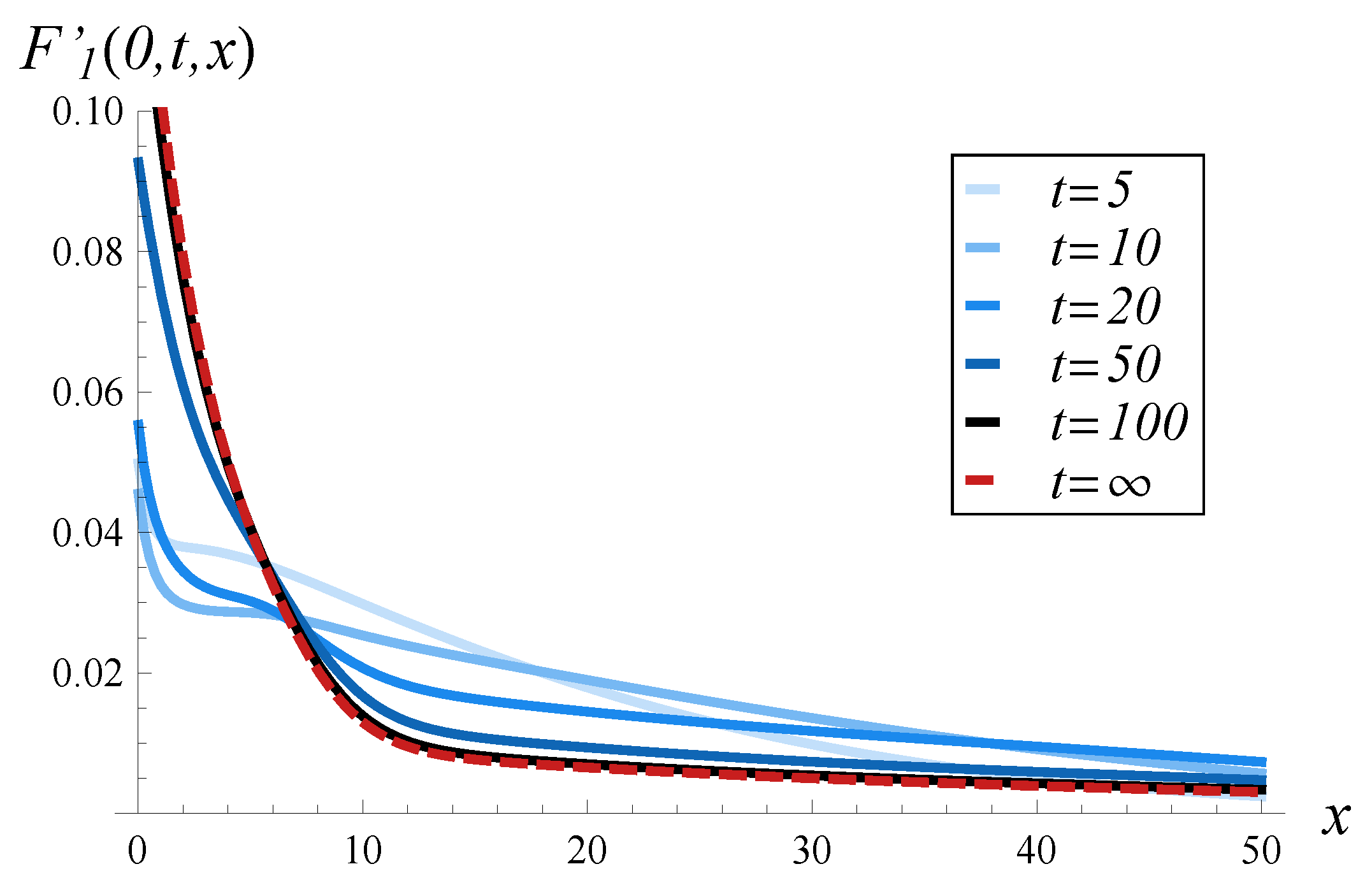
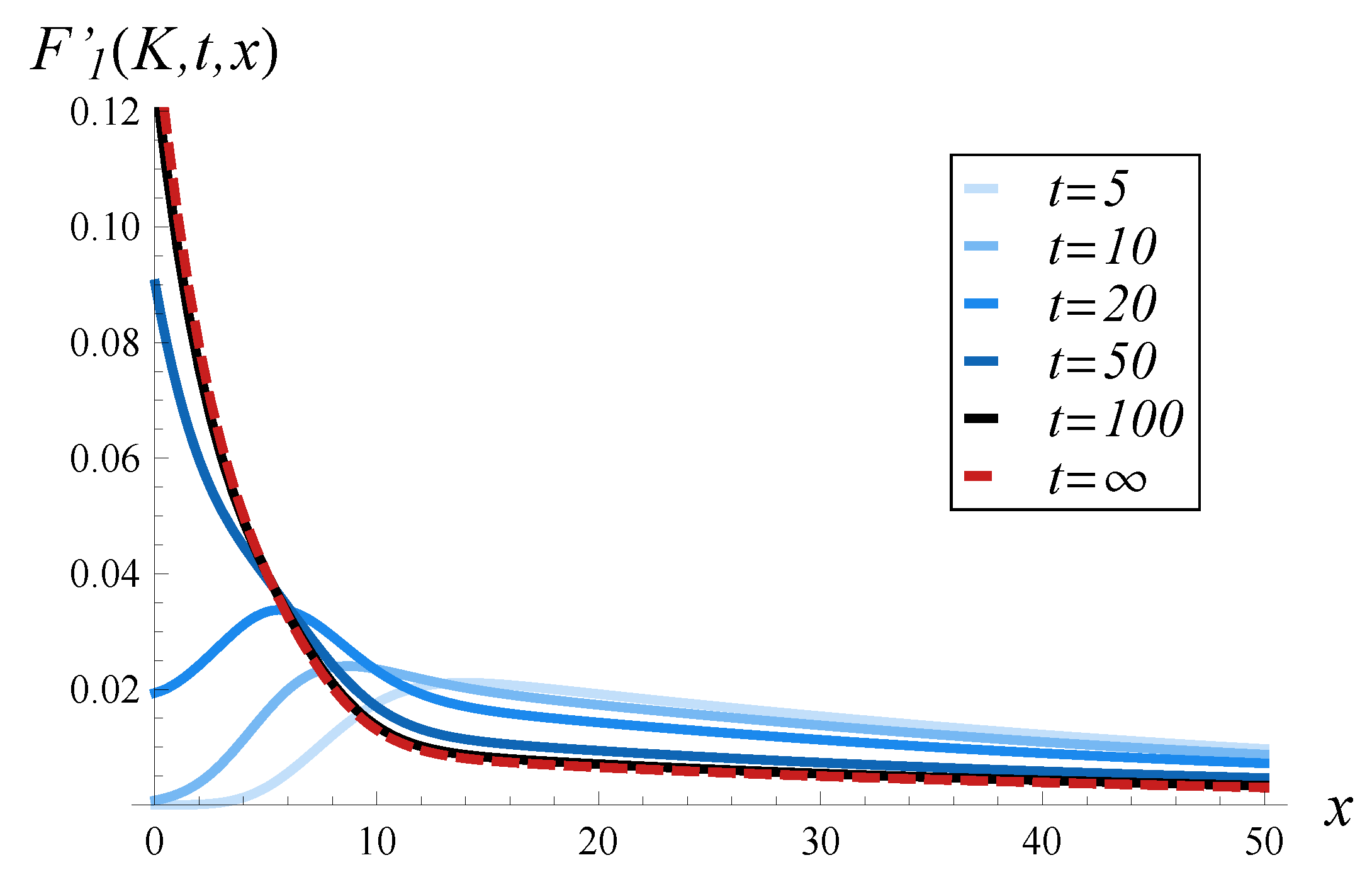
In
Figure 4, the virtual waiting time density is shown at specific points in time for the strong management function
. In
Figure 5, the continuous evolution of this density in the time interval
is depicted for the same strong management.
Naturally,
Figure 4 should be compared with
Figure 2, while
Figure 5 should be compared with
Figure 3. In this way, we can compare the impact of strong versus weak management.
It is remarkable how little difference the application of strong versus weak management makes to the density of the virtual waiting time. Namely,
Figure 4 is quite similar to
Figure 2, while
Figure 5 is similar to
Figure 3. All the shapes are similar; the convergence time to the stationary density is about the same.
At this moment, it may be interesting to check what the impact of weak versus strong active management on the queue size distribution is. Is it also that modest? Denote the (transient) queue length distribution as
and its expected value as
In
Figure 6 and
Figure 7, the queue length distribution vs. time is shown, for weak and strong management functions, respectively. These figures were obtained using a formula for the queue length distribution, which was proven in [
45].
We see a much more considerable effect of active management on the shape of distribution of the queue length than on the shape of distribution of the virtual waiting time. Namely,
Figure 6 differs from
Figure 7 much more than
Figure 5 differs from
Figure 3. It seems that in the case of positive correlation, the impact of active management on queue length distribution is significantly greater than on the virtual waiting time density.
Now, we can shift to observations of the expected virtual waiting times and queue lengths, rather than their full distributions.
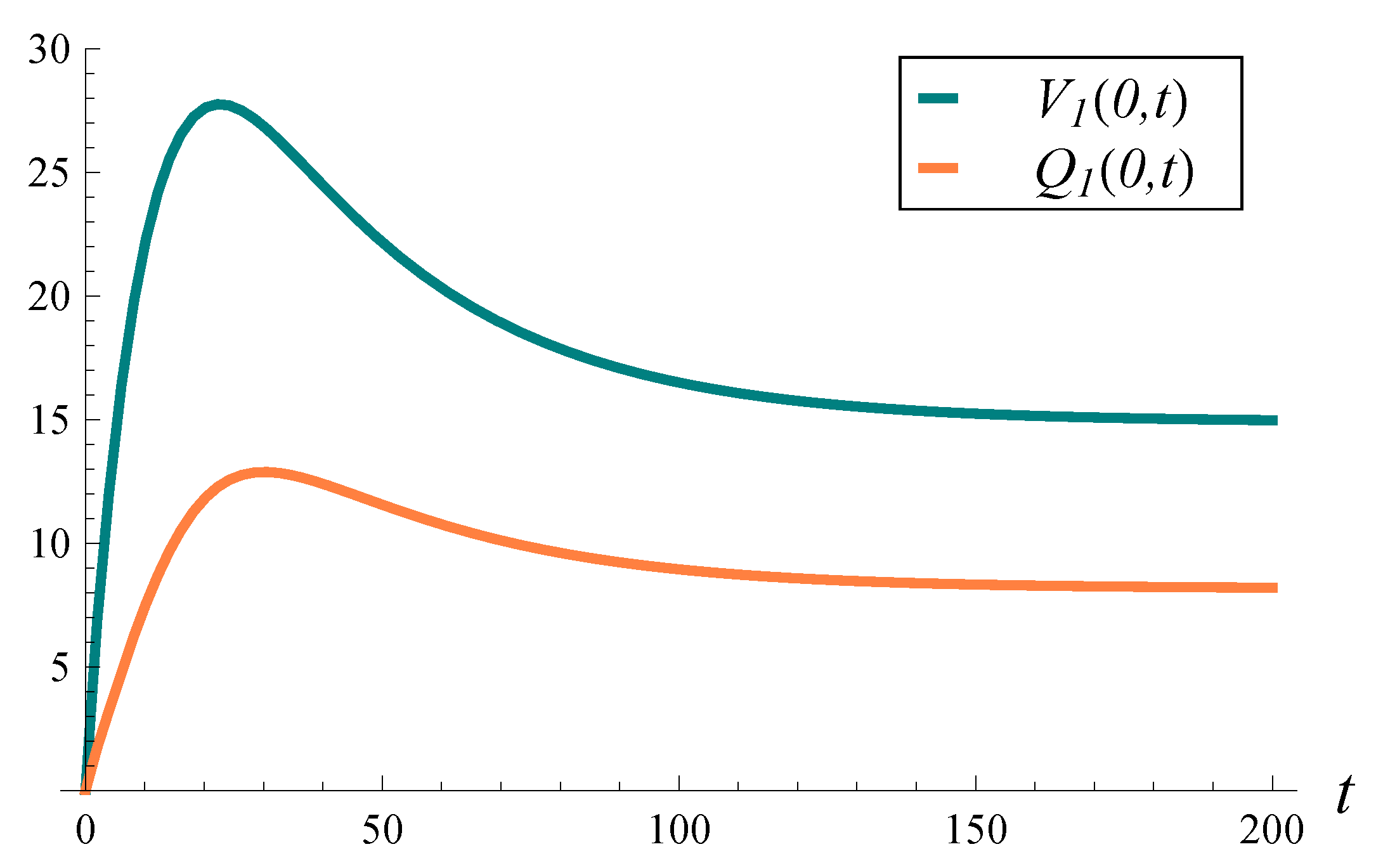
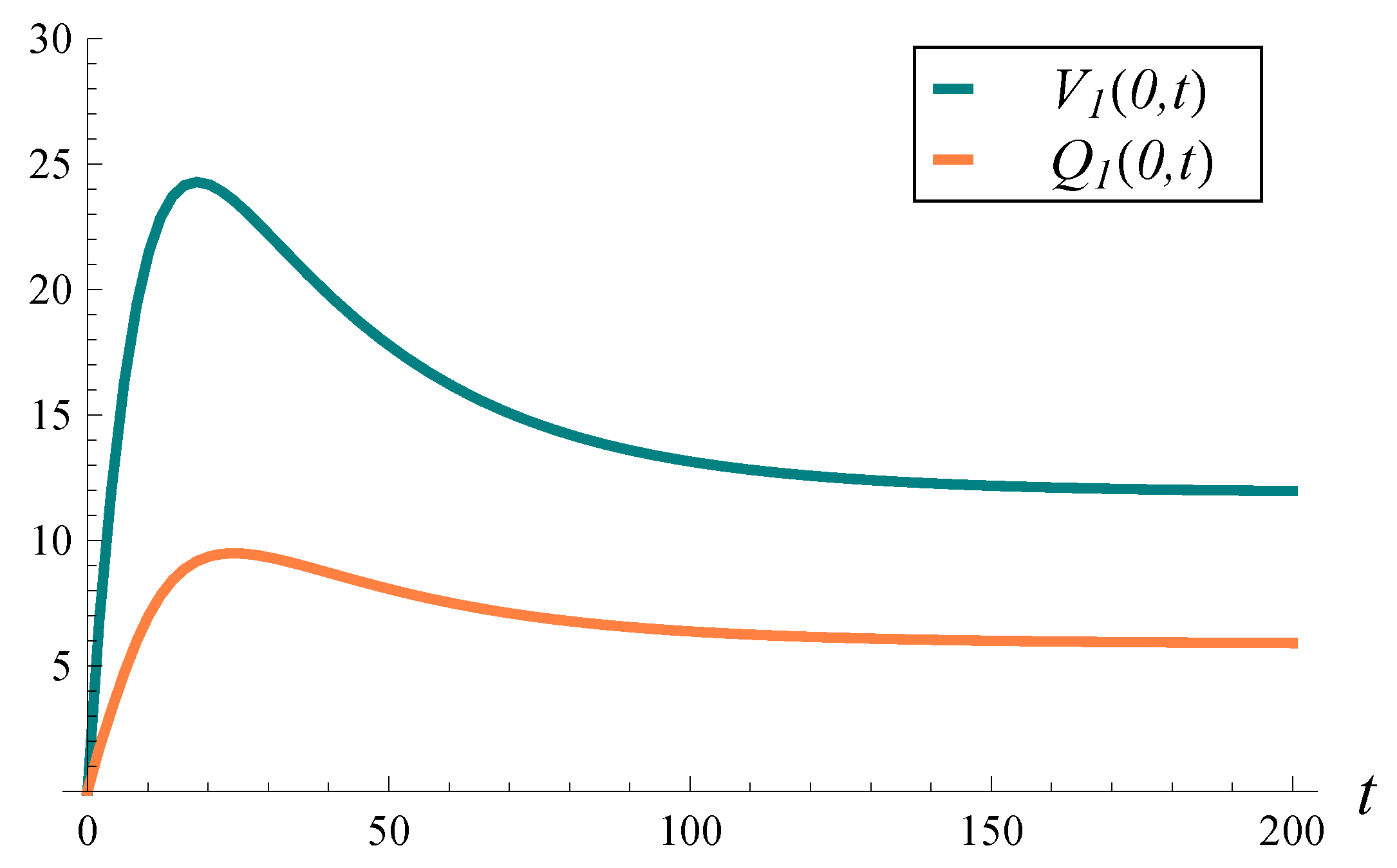
Specifically, in
Figure 8, the evolution of the expected virtual waiting time, accompanied by the expected queue length, is depicted for weak active management. Similarly, in
Figure 9, the evolution for strong active management is shown.
It is noteworthy that in both
Figure 8 and
Figure 9, for practically every
t, the expected virtual waiting time is about twice as large as the expected queue length. Considering that the expected service time is 1.0, a naive expectation would be that both lines, orange and green, are near each other. Apparently, this is not the outcome—the virtual waiting time is much longer than could have been anticipated. Furthermore, this effect does not depend on the management function, i.e., it is equally profound in
Figure 8 and in
Figure 9. As we shall observe later, this effect depends strongly on the service time correlation.
Concerning the time of convergence to the stationary expected value, we see in
Figure 8 and
Figure 9 that it is similar for both the virtual waiting time and the expected queue length, and for both strong and weak management functions.
When comparing the influence of strong versus weak active management on the expected virtual waiting time (i.e., when comparing the green lines in
Figure 8 and
Figure 9), we see that the much stronger
has only a moderately stronger impact than
. For instance, the stationary value of the expected virtual waiting time is 14.9 in the case of
, while it is 12.0 in the case of
. In other words, the reduction in the virtual waiting time is about 19% when strong management, rather than weak management, is applied.
6.2. Effect of Initial Conditions
In this section, we will check what effect on the virtual waiting time is caused by the situation in which the buffer is full when the system starts its operation.
Specifically, in
Figure 10, the virtual waiting time density is presented at specific points in time for the weak management function
. In
Figure 11, the continuous evolution of this density in the time interval
is depicted for the same weak management. A full buffer is assumed at
.
Figure 10 should be compared with
Figure 2, and
Figure 11 with
Figure 3. As one could expect, shortly after the system starts, there is a great difference between the distributions of the virtual waiting time for
and
. However, relatively quickly, say at
, the difference becomes minor, while the total time of convergence to the stationary distribution is practically the same in
Figure 10 and
Figure 2.
In
Figure 12, the virtual waiting time density is shown at specific points in time for the strong management function
, while in
Figure 5 the continuous evolution of this density in time is shown for the same management.
As we see,
Figure 12 differs greatly from
Figure 4 due to different initial buffer occupancies, at least for
t up to 50. Similarly,
Figure 13 differs greatly from
Figure 5.
Conversely, when we compare
Figure 12 with
Figure 10 and
Figure 13 with
Figure 11, we can conclude that the strength of active management is much less impactful than the initial buffer occupancy.
6.3. Effect of Symmetric, Negative Correlation
In the previous calculations, the service was parameterized by (
62) and (
63), inducing the expected service time of 1.0, the correlation between consecutive services of 0.3, and the service time standard deviation of 1.8.
In this section, we shall exploit the following service matrices:
Parameterization (
69) and (
70) are designed in such a way that the expected service time and the standard deviation are unaltered, i.e., equal to 1.0 and 1.8, respectively. However, (
69) and (
70) induce a symmetric negative correlation coefficient of consecutive services equal to −0.3.
In
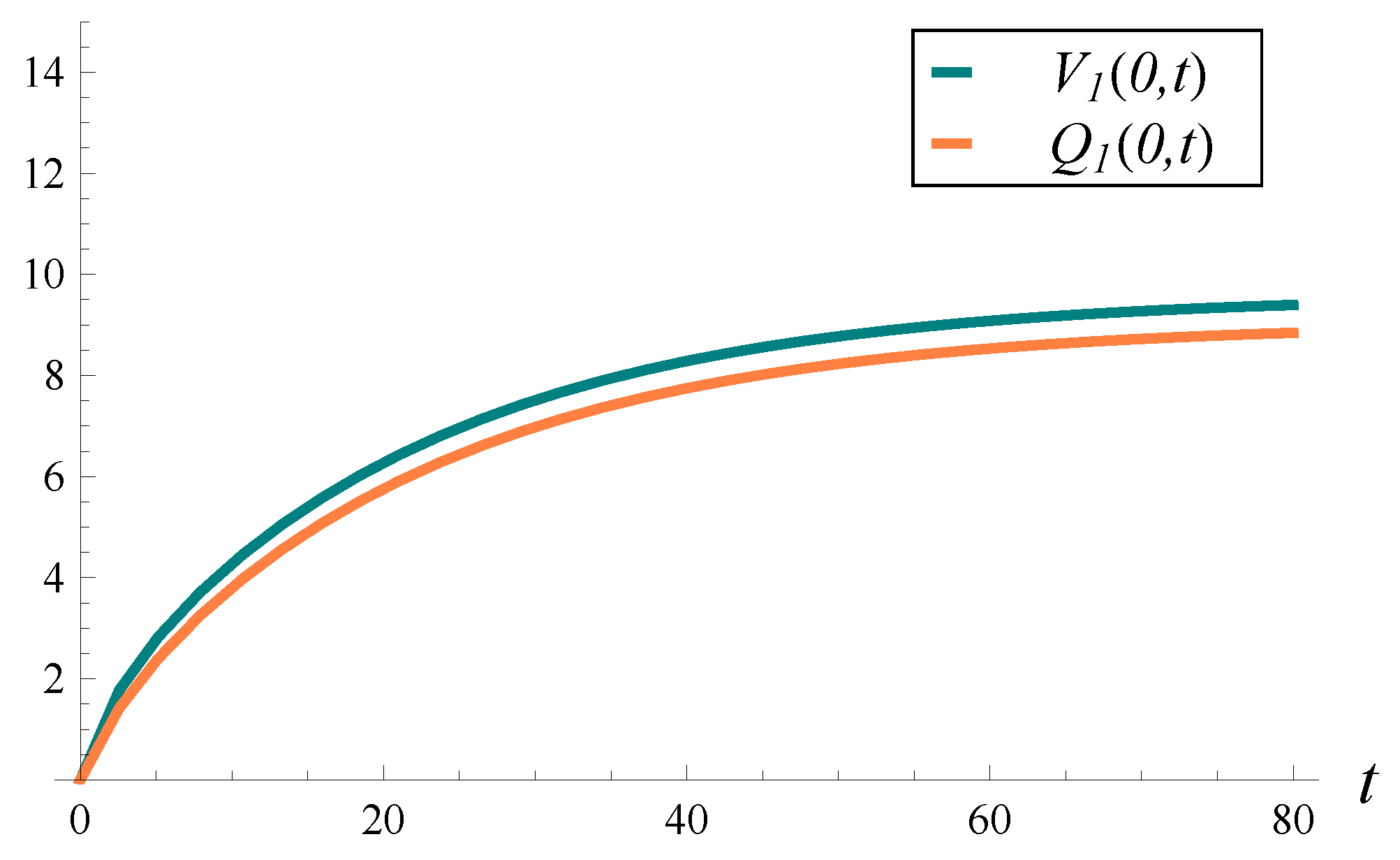
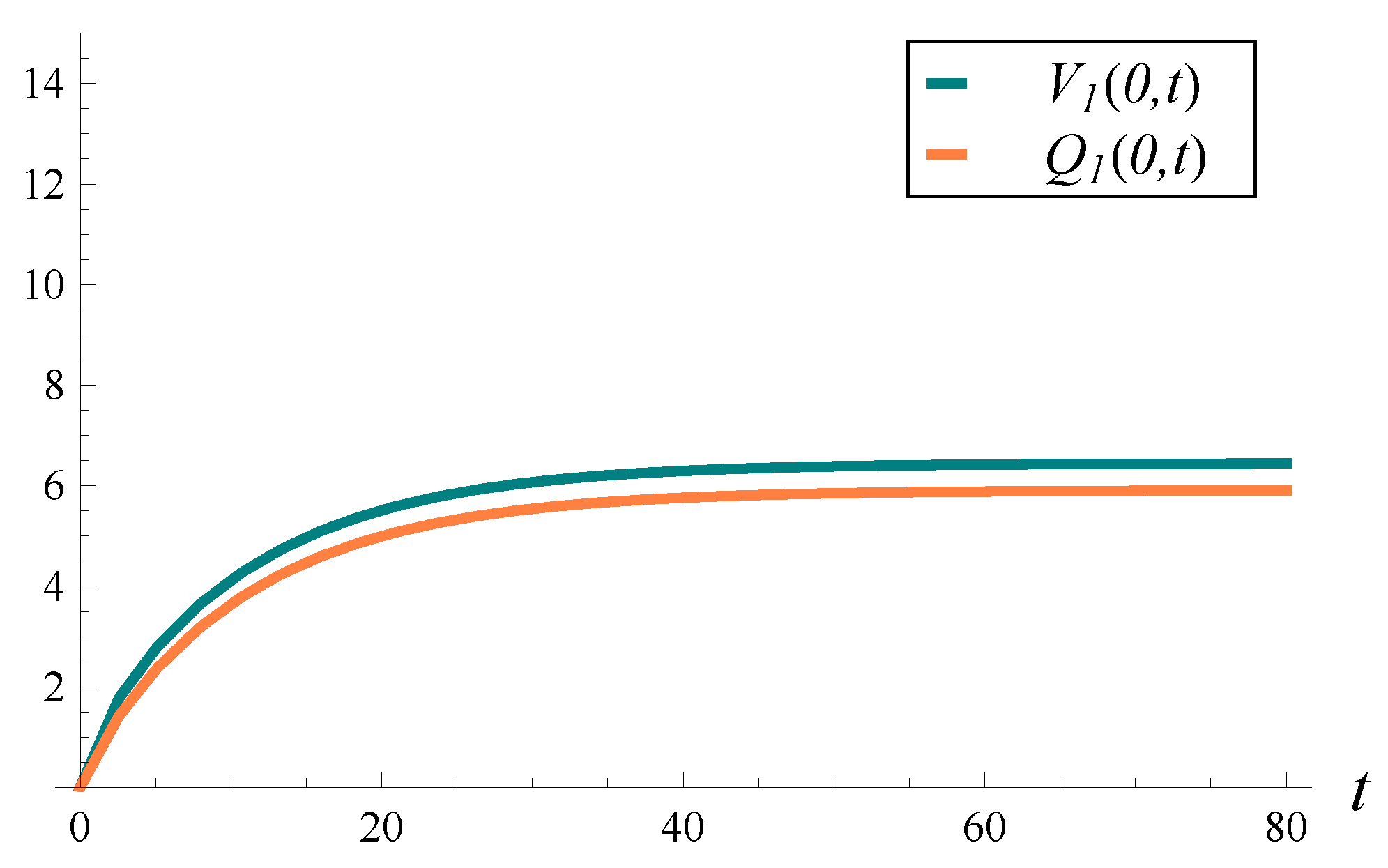
Figure 14, the evolution of the expected virtual waiting time and queue length is depicted for weak active management. Similarly, in
Figure 15, the evolution for strong active management is shown. Both figures are obtained for a negative correlation of
.
Figure 14 ought to be compared with
Figure 8, while
Figure 15 ought to be compated with
Figure 9. In both cases, the difference is profound. Namely, in
Figure 14 and
Figure 15, the expected virtual waiting times and expected queue lengths are very near each other, whereas in
Figure 8 and
Figure 9 they differ by a factor of about 2. This can be attributed mainly to the correlation, because in all
Figure 8,
Figure 9,
Figure 14 and
Figure 15, the expected service time is the same and its standard deviation is the same as well.
Negative correlation has one more effect, which is visible in
Figure 15. Specifically, stabilization at the stationary value is achieved at about
, which is much sooner than in all the other considered scenarios. This effect is observed only for a combination of negative correlation
and strong active management,
. It is not present in
Figure 14, where the negative correlation is combined with weak management.
7. Conclusions
In this study, formulae for the distribution tail, probability density, and expected virtual waiting time at any t have been obtained for a queue with active management and correlated job sizes that induce correlated service times. Additionally, the density and the expected virtual waiting time in the stationary case were found. The MSP was used as a model for correlated service times.
Theoretical results were partnered with numerical results, in which the impact of the symmetric positive and negative correlation of service times and the impact of weak and strong active management on transient and stationary waiting times were demonstrated and discussed. Additionally, the effect of such model parameters on the queue length was compared with their effect on the waiting time.
Given these numeric results, we observed that under a positive correlation, the effect of active management on virtual waiting time densities is much smaller than its effect on queue length distributions.
Then, we observed a surprisingly large expected virtual waiting time, about twice greater than the product of the expected service time and queue length. This effect was present for both weak and strong management functions when the correlation was positive, but vanished when a symmetric negative correlation was applied. In the case of negative correlation, the expected virtual waiting time was close to the product of the expected service time and queue length, no matter what active management function was used. A combination of negative correlation and strong management made the convergence to the stationary regime much faster than in any other situation.
We also checked the effect of the initial condition with a full buffer on the virtual waiting time. In the short term, this had a great effect on the density of the virtual waiting time. However, it did not impact the convergence time to the stationary distribution.