


Abstract
We consider the Banach space , which is a symmetric Banach space, and prove the existence and approximation of numerical solutions for a broad class of third-order BVPs. Our approach is based on an integral operator that is constructed using Green’s function. The Banach contraction principle (BCP) is applied to guarantee a unique solution to our problem. Moreover, in order to find the value of the numerical solution, this new operator is embedded within the three-step Noor iterative scheme; we named this new iterative scheme the Noor–Green iterative scheme. We provide a convergence theorem for the proposed scheme by employing suitable restrictions on the parameters involved in the problem and in the scheme. The results of the stability of our scheme are also reported. It is worth mentioning that unlike the concept of stability in the classical sense, our result for stability is based on the concept of weak stability. In order to support our findings, we carried out various numerical experiments using different third-order BVPs. Finally, we report on the application of our iterative scheme to solve a class of fractional BVPs in the same symmetric Banach space. Our results are essentially new in the present literature and extend several of the results found in the current literature.
MSC:
47H09; 47H10; 65L10
1. Introduction
Let denote a Banach space and S a selfmap of B. In this case, we call S a Banach contraction of B if for any pair of elements, , it is possible to select a constant in with
Any point, namely, satisfies the condition is called a fixed point of S. For the equation , is called a fixed-point problem. The selfmap S is called nonexpansive on B if (1) holds for . It is well-known that a sought solution of a linear or a nonlinear problem can be expressed as a fixed point of a certain self map in a Banach space. A distance function, d, on space S is said to be symmetric if for all . A space with a symmetric distance function is called a symmetric space. It is well-known that Banach spaces and metric spaces are symmetric, but pseudo-metric spaces are not symmetric [1]. In 1922, Banach [2] suggested the existence and uniqueness of fixed points for contractions in Banach spaces and obtained an application for a class of integral equations. Banach [2] also proved that the unique fixed point of a contraction map can be approximated by using the one-step Picard [3] approximation scheme. However, when S is nonexpansive, then the S has a fixed point under certain restrictions (see, e.g., Browder [4] and Gohde [5]), but the Picard approximations may not converge to a fixed point. Therefore, in 1953, Mann [6] suggested a new two-step iterative scheme. After this, Ishikawa [7] provided for the first time a two-step iterative scheme for a certain class of nonlinear mappings. On the other hand, the speed of convergence of one-step and two-step iterative schemes is often very slow and unstable. Thus, in 2000, Noor [8] constructed a very general three-step iterative scheme that contains Picard, Mann, and Ishikawa iterative schemes as special cases. The Noor iterative scheme reads as follows:
where . When and , the Noor iterative scheme (2) reduces to a Picard iterative scheme [3]. When , the Noor iterative scheme (2) reduces to a Mann iterative scheme [6]. When , the Noor iterative scheme (2) reduces to an Ishikawa iterative scheme [7]. The Noor iterative scheme is extensively used for finding fixed-point problems, but it is not studied for finding the sought solutions of boundary value problems. The purpose of this paper is to modify the Noor iterative scheme to be used for finding the numerical solutions of a broad class of third-order boundary value problems.
Boundary value problems (BVPs) play a very basic role in modeling different real-world phenomena; however, calculating the exact solutions for these BVPs using analytical approaches is not always possible (see, e.g., [9,10], and others). If an exact solution is not possible for a certain class of BVPs, one always requests a numerical solution up to desirable decimals of accuracy. Often, the classes of third-order BVPs are important and arise naturally in various fields of analysis and engineering. More specifically, the application of third-order BPVs can be found in rocket motion in space, the flow of thin films, heat problems, studying flow under the effect of gravity, flow networking in the field of biology, and so on. More applications of third-order BVPs can be found in the papers of Awoyemi [11], Awoyemi and Idowu [12], and others). On the other hand, Lu and Cui [13] studied the existence of solutions for the following class of third-order BVPs:
subjected to the boundary conditions (BCs):
where .
For more details on the existence of solutions to third-order BVPs, we refer the reader to [14,15,16,17] and others. In the recent literature, various numerical procedures are carried out by authors for approximating the numerical solutions to third-order BVPs (see, e.g., Awoyemi [11], Awoyemi and Idowu [12], Bhrawy and Abd-Elhameed [18], and others).
On the other hand, using the technique of embedding Green’s function within fixed-point iterations is studied in [19]. Abushammala et al. [20] suggested a Mann-Green scheme by embedding a Green function into the Mann iterative scheme [6] to obtain numerical solutions to a broad class of third-order BVPs and proved that this new approach is highly accurate, corresponding to the classical approaches mentioned above. Similarly, Khuri and Louhichi [21] introduced an Ishikawa-Green iterative approach by embedding a Green function into the Ishikawa [7] iterative scheme for numerical solutions to third-order BVPs and improved the main results of Abushammala et al. [20]. In this paper, we introduce a Noor–Green iterative approach for numerical solutions to third-order BVPs and compare this scheme to two other iterative schemes. We also prove that our new approach is stable and suggest highly accurate numerical solutions for almost all the values of the parameters. In this way, we improve many of the classical results in the literature.
2. Green’s Function for Third-Order BVPs
In this paper, we consider the following third-order BVP:
with the BCs:
Here, , L is linear, whereas f is nonlinear; are real constants, and either or . The existence of a solution to problems (5) and (6) is established under various assumptions (see, e.g., [22,23,24] and others). Following [21,24], we approach the existence and approximation of the solution for this problem under the Green functions approach as follows.
The Green’s function for equation takes the following form:
where are constant and are to be found using the properties of Green’s function listed below, and is the set of a linearly independent set of solutions for .
Green’s function properties: We now list the following properties of the Green functions.
- ()
- Green’s function G satisfies the following BCs:
- ()
- At , the function G is always continuous, that is,
- ()
- At , the function is also always continuous, that is,
- ()
- At , the function admits a discontinuous jump, that is,
3. Noor–Green Iterative Scheme
In this section, we propose the so-called Noor–Green iterative scheme for third-order BVPs. We first consider the nonlinear differential function as follows:
Here, L stands for the linear term, whereas N stands for the nonlinear term, and the function f may be linear or nonlinear. Now, if is the particular solution for (12), then we denote this here simply as a. In this case, we assume that is a Green function of the linear term L. Eventually, we set
Accordingly, by using (11)–(13), we have
Consequently, we obtain
Hence, when using the operator W given in (14) in the Noor iteration (2), we get
It follows that
The formula in (16) is the general Noor iterative scheme. For the initial guess in this case, we must choose a function that satisfies and the given BCs. In order to prove its convergence, we will impose a certain restriction on the sequence .
4. Convergence Result
Here, we give the convergence and stability results of our Noor–Green iterative scheme. We also suggest some examples and numerically prove the convergence of the scheme. We also compare the numerical results with the Mann-Green and Ishikawa-Green iterative schemes. It has been shown that our novel Noor–Green iterative approach provides highly accurate results when compared to the corresponding Mann-Green and Ishikawa-Green iterative schemes.
In order to do this, we consider the following BVP:
with the BCs:
In this case, Green’s function becomes:
The adjoint value of Green’s function above is denoted by and reads as follows:
When applying the Noor–Green iterative scheme, we get
Now, set the self map in the Banach space as follows:
Hence, (19) becomes the following:
This scheme (21) is the general Noor iterative scheme, which is based on Green’s function. From now on, we will call the modified Noor iteration (21) the Noor–Green iterative scheme. Here, we give our main convergence result. This theorem also provides a criterion for the existence of a unique solution.
Theorem 1.
Proof.
In order to complete the proof, we put , and it follows that is a -contraction. In the view of Banach [2], there exists a unique fixed point for , namely, , which is the unique solution to problems (17) and (18).
We want to prove that the Noor–Green iterative scheme converges to . For this,
Moreover,
Hence,
Accordingly, we obtain
Inductively, we obtain
Finally, we know that formula holds for any choice of . Hence, when using this fact with (22), one obtains
If it is supposed that and lie in , we infer from (23) that
Accordingly, converges to the unique fixed point of which is the unique solution to problems (17) and (18). □
5. Weak -Stability
The concept of stability in terms of iterative schemes pertains to their capacity to consistently and dependably yield results when applied iteratively to a problem. This notion is explored in detail by Osilike [25], along with related discussions in references like [26,27]. A well-behaved iteration, characterized as stable, should not exhibit undue sensitivity to minor alterations in the input data or initial conditions. Put differently, it should generate solutions that steadily converge towards a consistent outcome as the number of iterations increases, as opposed to veering off course or displaying erratic oscillations. Stability holds significant importance in various computational procedures, including the resolution of differential equations, optimization challenges, or numerical simulations. It plays a pivotal role in guaranteeing the precision and predictability of outcomes, thereby ensuring the successful and reliable execution of computational tasks. This section intends to introduce a theorem concerning the stability of the iterative method being examined. The idea of stability in fixed-point iterations finds its origins in the pioneering research conducted by Urabe [28], which established the initial groundwork. Expanding upon Urabe’s contributions, Harder and Hicks [29] formulated a precise mathematical definition for stability. In order to fully grasp the ensuing discussion in this study, it is crucial to revisit certain fundamental concepts, which will be succinctly summarized below.
Definition 1
([29]). Assume that S is a self map in a Banach space, B, and is a sequence of iterations produced by the following iterative formula:
Here, Λ is a function that is connected to the mapping S and the iterative sequence . In this case, when the sequence converges in a strong sense to a fixed point, namely, of S, then is regarded as a stable sequence if
where is any given arbitrary sequence that is obtained from some of the elements of B.
We now consider the definition of equivalent sequences in the setting of Banach spaces.
Definition 2
([30]). The iterative sequences and are said to be equivalent to each other if and only if
Differing from the idea of arbitrary sequences, Timis [31] introduced the notion of equivalent sequences as a basis for establishing a fresh mathematical definition of stability. This novel type of stability is denoted as “- stability," and its precise definition is outlined below.
Definition 3
([31]). For an iterative sequence, namely , which is iteratively produced from (24), if it is convergent to a fixed point, , of a selfmap, S, in a Banach space, B, it is said to be weak -stable if for any equivalent sequence: of , one obtains
Now, we are in the position to prove that our new Noor–Green iterative scheme (21) is weak stable.
Theorem 2.
Suppose that B, , and are defined the same as is given in Theorem 1. In this case, the convergence of the sequence of the Noor–Green iterative scheme is weak –stable with respect to .
Proof.
Let us take an equivalent sequence: of , so we have . Now, we assume that
where and .
Since every stable iterative scheme is weak -stable but the converse is not true in general. So, the following corollary is a consequence of our Theorem 2.
Corollary 1.
Suppose that B, , and are defined the same as is given in Theorem 1. In this case, the convergence of the sequence of the Noor–Green iterative scheme is stable with respect to .
6. Numerical Examples
The main purpose of this section is to suggest some examples of third-order BVPs. We then prove the convergence of our novel Noor–Green iterative scheme along with some other iterative schemes. We show the high accuracy of our novel scheme under various sets of parameters.
First, we consider the following BVP.
Example 1.
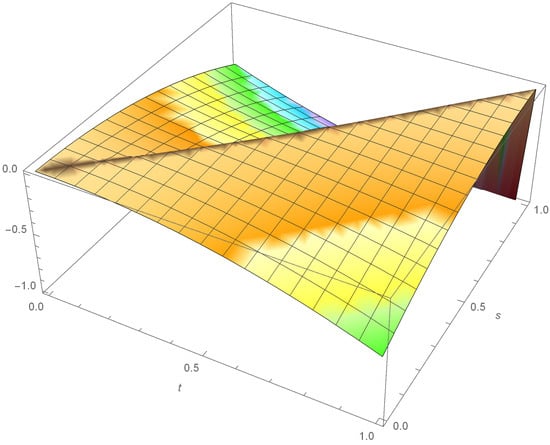
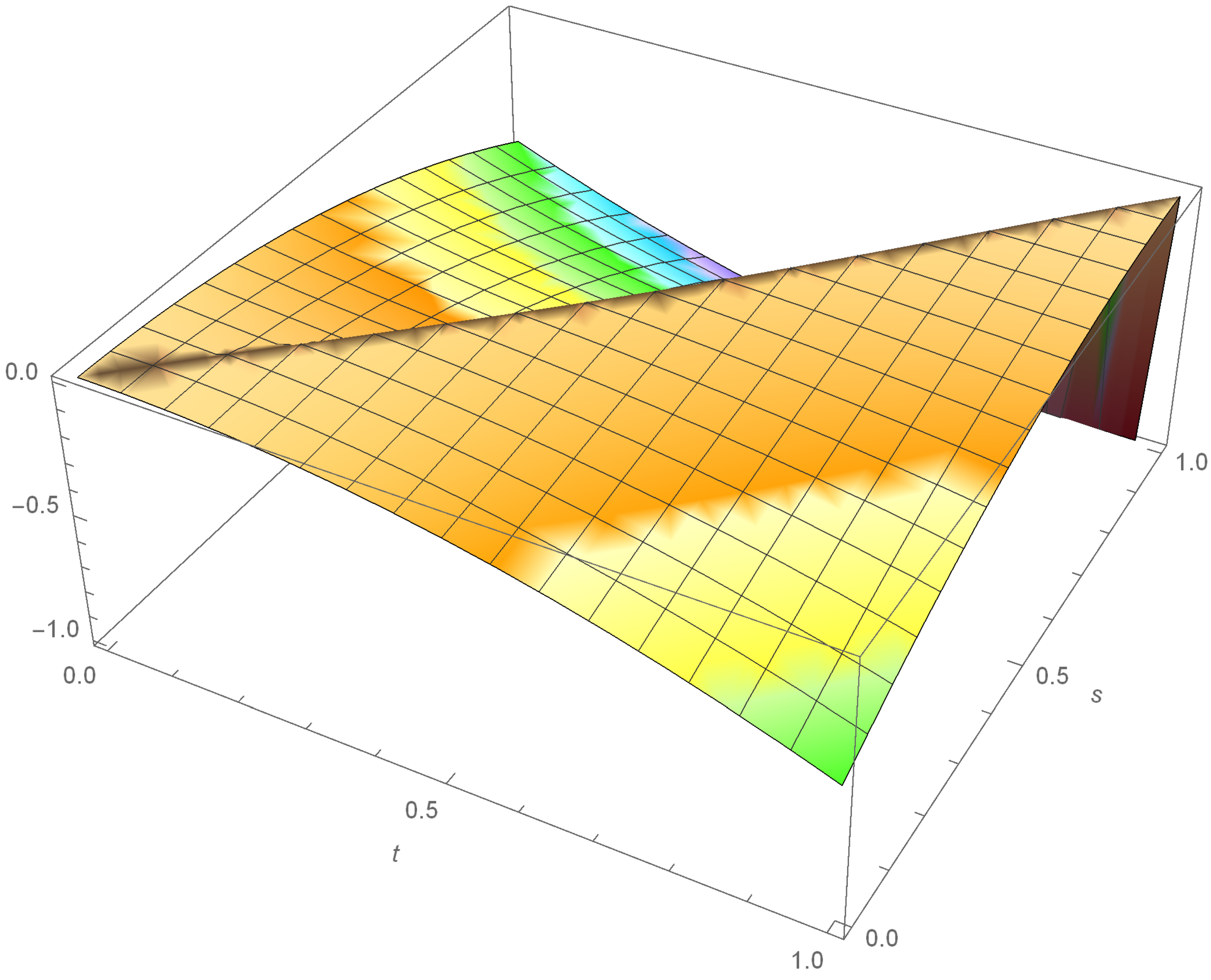
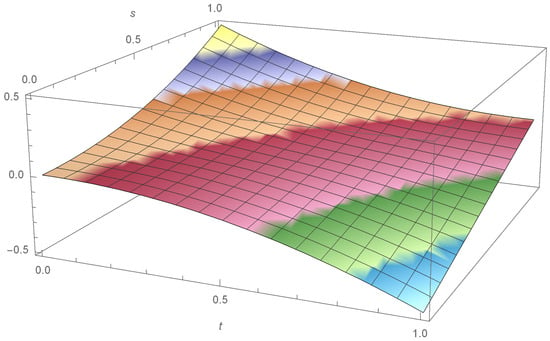
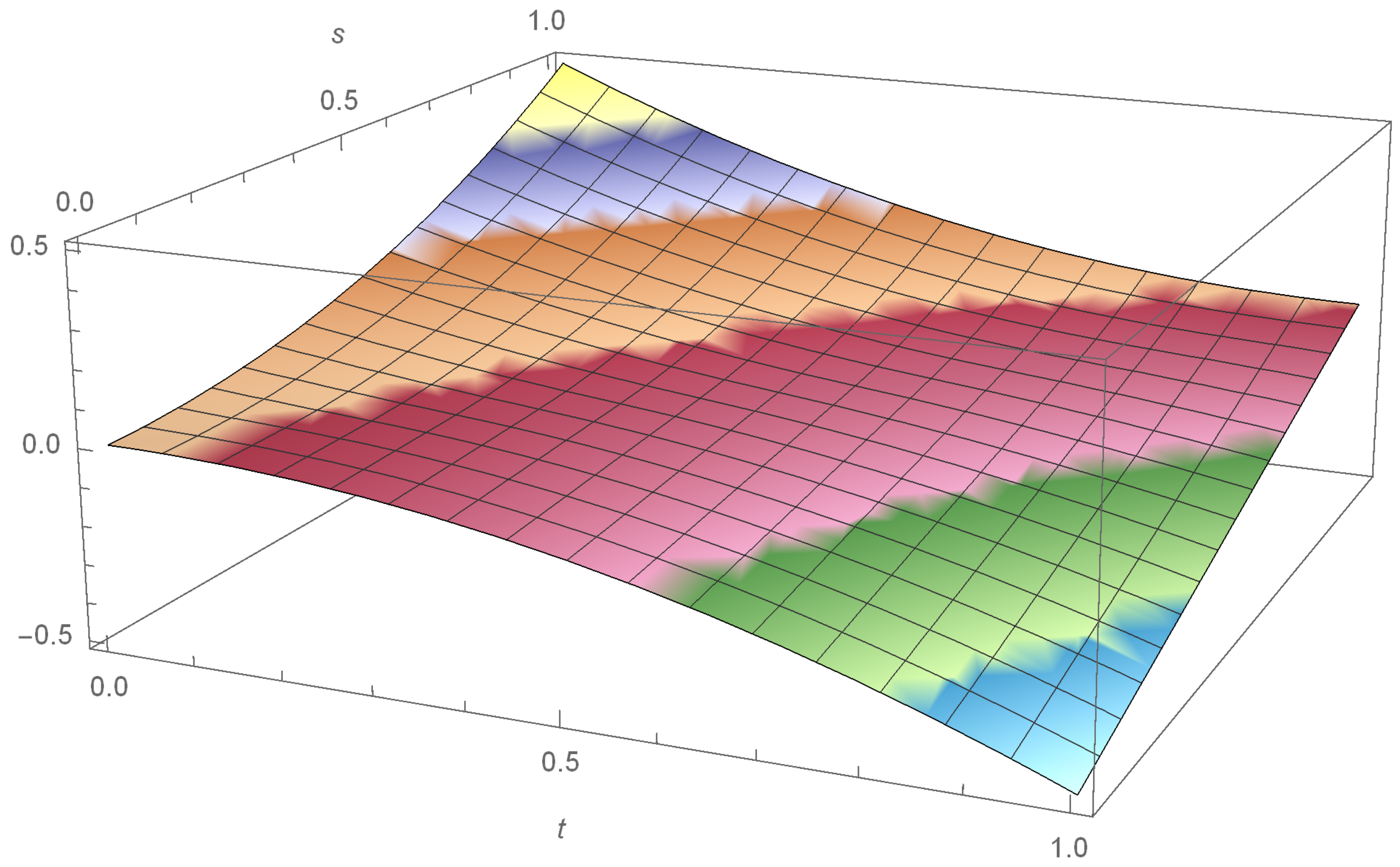
Now, we choose . The plot of Green’s function involved in our scheme (30) is given in Figure 1. The numerical results in this case are given in Table 1 and Table 2.
Figure 1.
Plot of the Green function involved in our scheme (30).
Table 1.
Convergence of Noor–Green iteration with the numerical solution.
Table 2.
Convergence of Noor–Green iteration with the numerical solution.
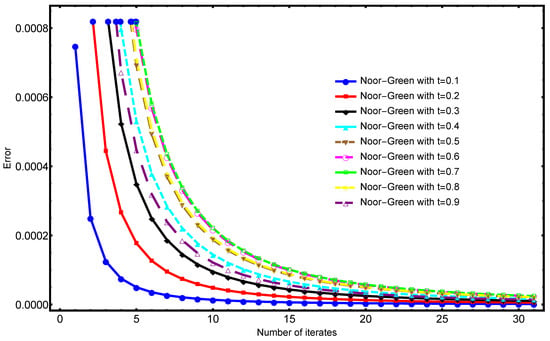
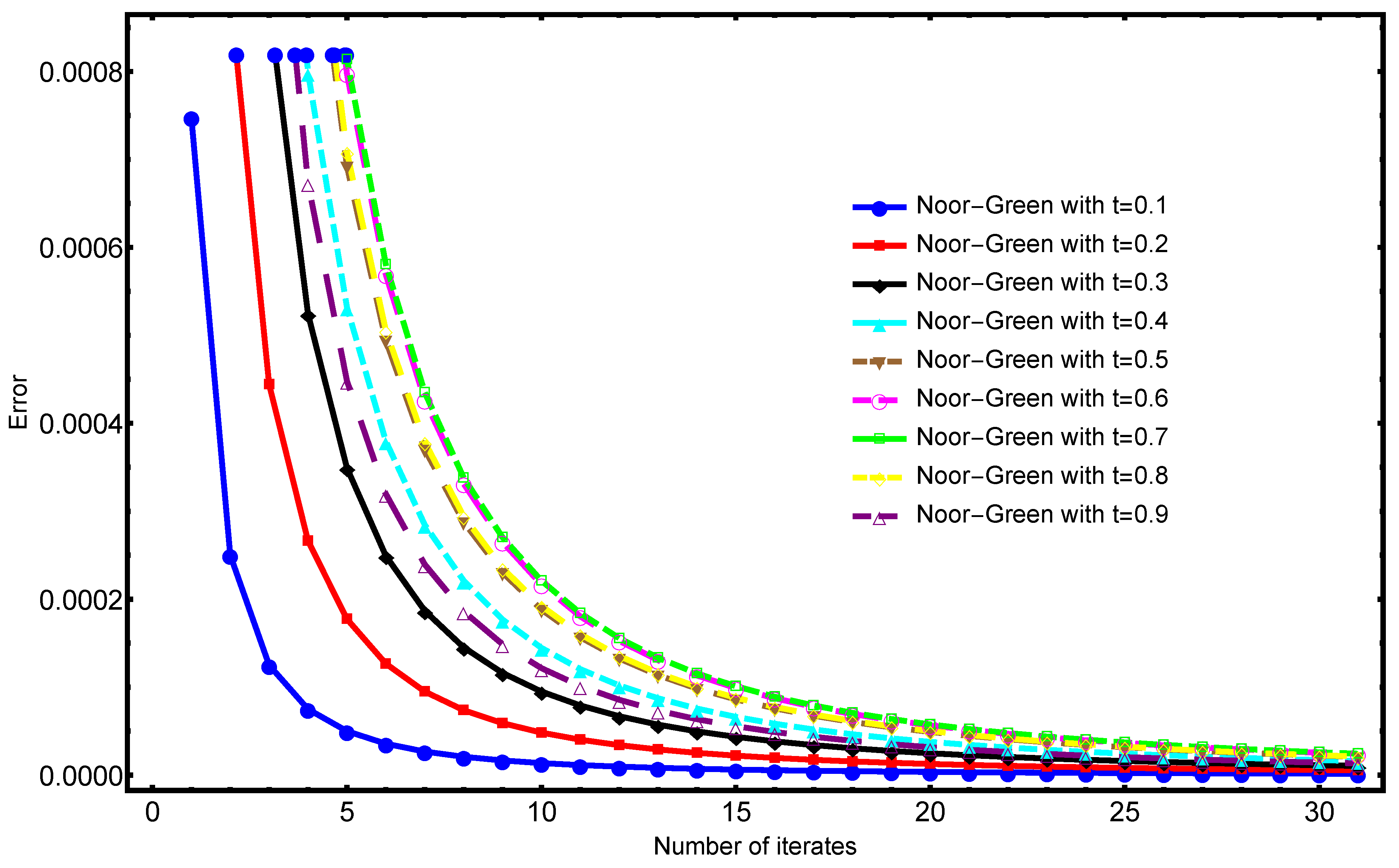
Suppose Error . Now, we choose and obtain the behavior of the convergence of the Noor–Green iterative scheme, as shown in Figure 2.
Figure 2.
Behavior of Noor–Green iteration for various choices of t.
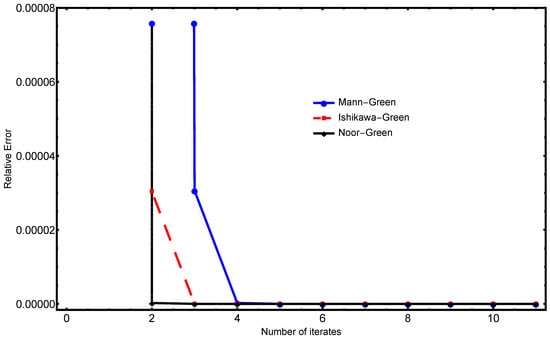
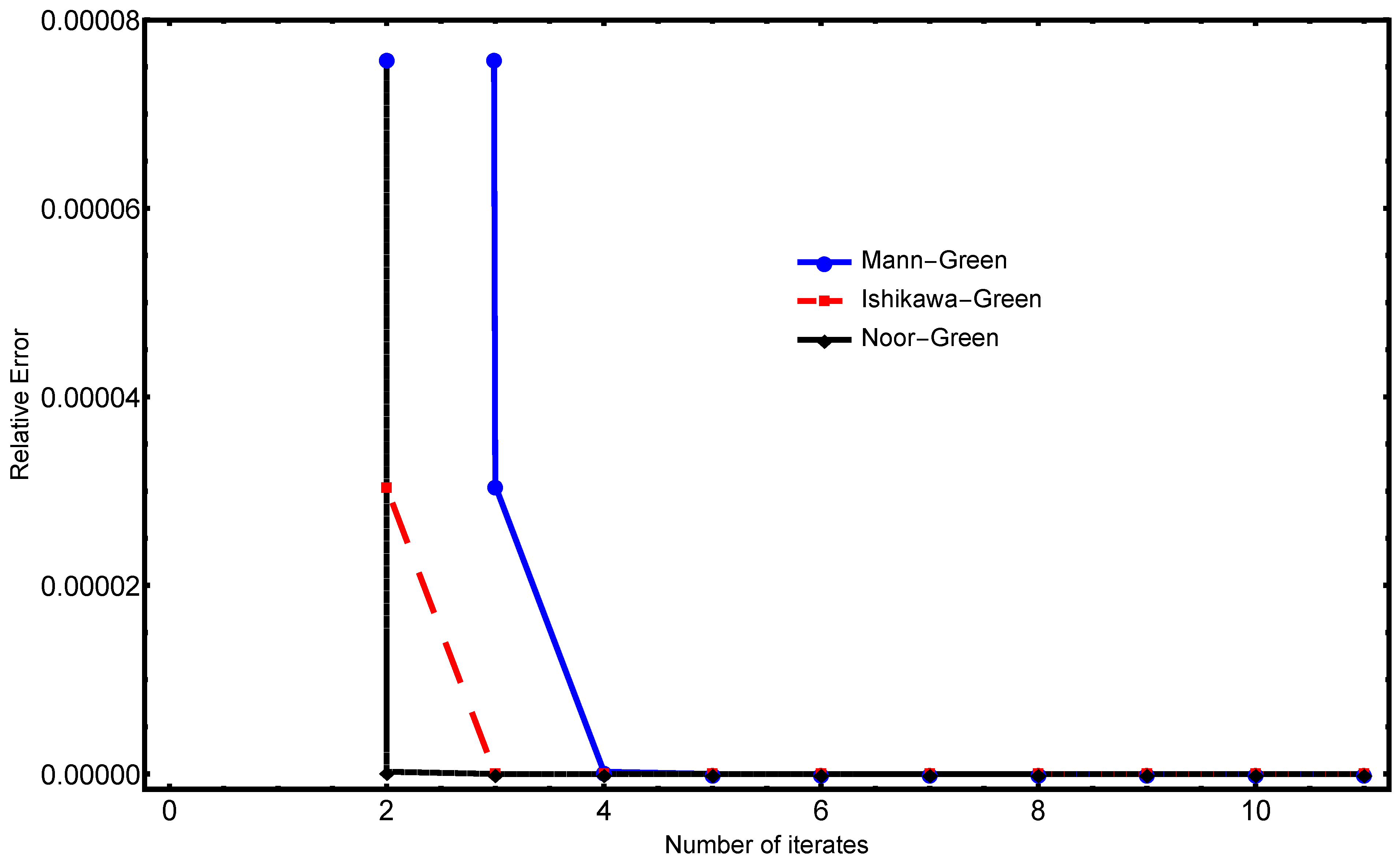
Now, set . We compared our scheme to other schemes. We choose . For only two iterations, the relative error in Table 3 shows that our Noor–Green iterative approach is more accurate in this case than the Mann-Green and Ishikawa-Green iterative approaches. The convergence behavior of this is given in Figure 3.
Table 3.
Error comparison between different iterations.
Figure 3.
Behavior of different iterations for .
We now consider another example, as follows.
Example 2.
Figure 4.
Plot of the Green function involved in our scheme (33).
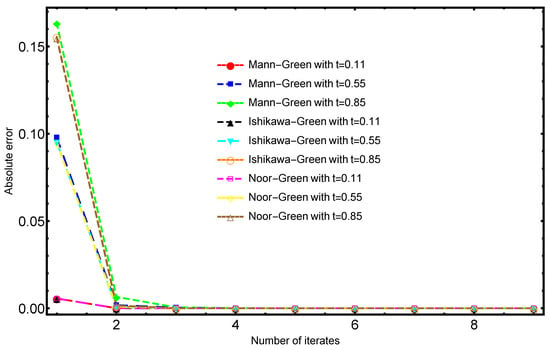
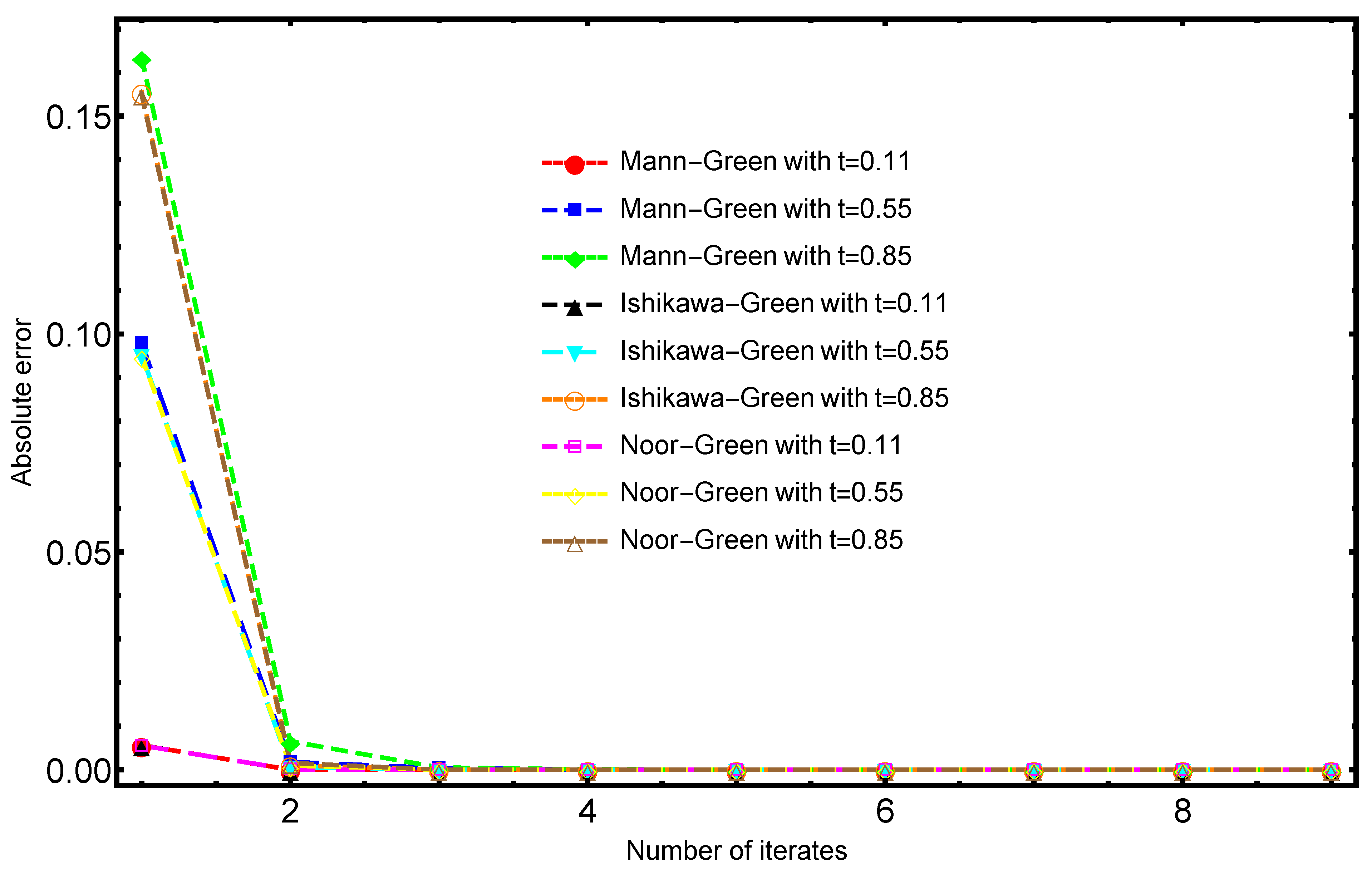
In the previous example, we compared our scheme to the other iterative schemes in the literature by using the relative error concept. Now, we take and list the comparison of absolute errors between our iterative scheme and other iterative schemes (Table 4). This shows that our new scheme has a rapid rate of convergence in the class of third-order BVPs.
Table 4.
Absolute error between different iterations (33).
Based on the absolute errors in Table 4, we have shown that our new iterative scheme converges faster to the solution when compared to the other iterative schemes in the literature. Next, by using the concept of Absolute error, we compare our new iterative scheme with other iterative schemes graphically in Figure 5.
Figure 5.
Behavior of different iterations based on Green’s function, e.g., (33).
7. Application
Fractional boundary value problems (FBVPs) represent a powerful extension of classical BVPs, incorporating non-integer order derivatives and offering a more accurate description of complex phenomena with memory and long-range dependencies. Unlike the classical notion of integer-order derivatives, which provides the instantaneous changes, FBVPs employ fractional-order derivatives that capture intricate dynamics, making them particularly relevant in various fields like physics, biology, finance, and engineering. These equations have the potential to model anomalous diffusion, viscoelasticity, and other intricate behaviors that cannot be adequately captured by integer-order counterparts. The study of FDEs has witnessed significant growth, with researchers developing novel analytical and numerical techniques to solve them, making them a vital tool for understanding the intricacies of real-world processes.
We consider the following BVPs in terms of fractional order:
with the BCs
Here, the number t is in , the real number is in , the derivative is defined in terms of Caputo, called the fractional derivative of order , and f is a function on .
Now, we consider the Banach space . In this case, the Green function with regard to our problems (34) and (35) is given by the following formula:
We now consider mapping in the Banach space as follows:
In this case, our Noor–Green iterative scheme becomes
We now give the proof of our final result.
Theorem 3.
Proof.
In order to complete the proof, we consider any and in such that
Consequently, we obtain
Hence, is a Banach contraction, and so the sequence of the Noor–Green iterative scheme converges to the unique fixed point of and, hence, to the unique solution of problems (34) and (35). This completes our proof. □
8. Conclusions and Open Problem
The following new outcomes were obtained from this research.
- ()
- The elementary three-step iterative scheme due to Noor [8] was modified based on Green’s function to obtain numerical solutions to third-order BVPs.
- ()
- We imposed possible mild conditions on the parameters of the scalars in our scheme and obtained a strong convergence result.
- ()
- Since the Noor iterative scheme [8] includes Mann [6] and Ishikawa [7] iterative schemes as special cases, our results improve the classical results of the Mann-Green and Ishikawa-Green iterative schemes to the more general context of the Noor–Green iterative scheme.
- ()
- We checked the high accuracy of the proposed Noor–Green iterative scheme by using two different numerical examples.
- ()
- The graph and tables in the paper support our theoretical findings.
- ()
- An application was obtained for new iterations in the class of FBVPs.
Now, we include an interesting open problem.
Open problem: Can we extend the results of this paper to the setting of PDEs?
Author Contributions
Conceptualization, J.A. and M.A.; Methodology, J.A. and A.H.; Software, J.A. and M.A.; Validation, A.H. and M.A.; Investigation, J.A., A.H. and H.A.S.; Writing—original draft, J.A. and M.A.; Writing—review and editing, J.A. and H.A.S.; Supervision, M.A.; Funding acquisition, H.A.S. All authors have read and agreed to the published version of the manuscript.
Funding
This research received no external funding.
Data Availability Statement
Data sets generated during the current study are available from the corresponding author on reasonable request.
Acknowledgments
The authors are thankful to King Abdulaziz University and Deanship of Scientific research for their financial support.
Conflicts of Interest
The authors declare no conflict of interest.
References
- Secelean, N.A.; Mathew, S.; Wardowski, D. New fixed point results in quasi-metric spaces and applications in fractals theory. Adv. Differ. Equ. 2019, 2019, 177. [Google Scholar] [CrossRef] [Scilit]
- Banach, S. Sur les operations dans les ensembles abstraits et leur application aux equations integrales. Fund. Math. 1922, 3, 133–181. [Google Scholar] [CrossRef] [Scilit]
- Picard, E.M. Memorie sur la theorie des equations aux derivees partielles et la methode des approximation ssuccessives. J. Math. Pure Appl. 1890, 6, 145–210. [Google Scholar]
- Browder, F.E. Nonexpansive nonlinear operators in a Banach space. Proc. Natl. Acad. Sci. USA 1965, 54, 1041–1044. [Google Scholar] [CrossRef] [Scilit]
- Gohde, D. Zum Prinzip der Kontraktiven Abbildung. Math. Nachr. 1965, 30, 251–258. [Google Scholar] [CrossRef] [Scilit]
- Mann, W.R. Mean value methods in iteration. Proc. Am. Math. Soc. 1953, 4, 506–510. [Google Scholar] [CrossRef]
- Ishikawa, S. Fixed points by a new iteration method. Proc. Am. Math. Soc. 1974, 44, 147–150. [Google Scholar] [CrossRef]
- Noor, M.A. New approximation schemes for general variational inequalities. J. Math. Anal. Appl. 2000, 251, 217–229. [Google Scholar] [CrossRef] [Scilit]
- Parvizi, M.; Khodadadian, A.; Eslahchi, M.R. Analysis of Ciarlet-Raviart mixed finite element methods for solving damped Boussinesq equation. J. Comput. Appl. Math. 2020, 379, 112818. [Google Scholar] [CrossRef] [Scilit]
- Khodadadian, A.; Parvizi, M.; Heitzinger, C. An adaptive multilevel Monte Carlo algorithm for the stochastic drift-diffusion-Poisson system. Comput. Methods Appl. Mech. Eng. 2020, 368, 113163. [Google Scholar] [CrossRef] [Scilit]
- Awoyemi, D.O. A p-stable linear multistep method for solving general third order ordinary differential equations. Int. J. Comput. Math. 2003, 80, 985–991. [Google Scholar] [CrossRef] [Scilit]
- Awoyemi, D.O.; Idowu, M.O. A class of hybrid collocation methods for third order ordinary differential equations. Int. J. Comput. Math. 2005, 82, 1287–1293. [Google Scholar] [CrossRef] [Scilit]
- Lu, X.; Cui, M. Existence and numerical method for nonlinear third-order boundary value problem in the reproducing kernel space. Bound. Value Probl. 2010, 9, 459754. [Google Scholar] [CrossRef] [Scilit]
- Pei, M.; Chang, S.K. Existence and uniqueness of solutions for third order nonlinear boundary value problems. J. Math. Anal. Appl. 2007, 327, 23–35. [Google Scholar] [CrossRef] [Scilit]
- Feng, Y. Solution and positive solution of a semilinear third order equation. J. Appl. Math. Comput. 2009, 29, 153–161. [Google Scholar] [CrossRef] [Scilit]
- Feng, Y.; Liu, S. Solvability of a third order two-point boundary value problem. Appl. Math. Lett. 2005, 18, 1034–1040. [Google Scholar] [CrossRef] [Scilit]
- Grossinho, M.R.; Minhos, F.M. Existence result for some third order separated boundary value problems. Nonlinear Anal. Theory Methods Appl. 2001, 4, 2407–2418. [Google Scholar] [CrossRef] [Scilit]
- Bhrawy, A.H.; Abd-Elhameed, W.M. New algorithm for the numerical solutions of nonlinear third order differential equations using jacobi-gauss collocation method. Math. Probl. Eng. 2011, 14, 837218. [Google Scholar] [CrossRef] [Scilit]
- Khuri, S.A.; Sayfy, A. Variational iteration method: Green’s functions and fixed point iterations perspective. Appl. Math. Lett. 2014, 32, 24–34. [Google Scholar] [CrossRef] [Scilit]
- Abushammala, M.; Khuri, S.A.; Sayfy, A. novel fixed point iteration method for the solution of third order boundary value problems. App. Math. Comput. 2015, 271, 131–141. [Google Scholar] [CrossRef] [Scilit]
- Khuri, S.A.; Louhichi, I. A new fixed point iteration method for nonlinear third-order BVPs. Int. J. Comput. Math. 2021, 2021, 2220–2232. [Google Scholar] [CrossRef] [Scilit]
- Soedel, W. Vibrations of Shells and Plates; CRC Press: Boca Raton, FL, USA, 2004. [Google Scholar]
- Agarwal, R.P. Existence, uniqueness and iterative methods for third-order boundary value problems. J. Comput. Appl. Math. 1987, 17, 271–289. [Google Scholar] [CrossRef] [Scilit]
- Akgun, F.A.; Rasulov, Z. A new iteration method for the solution of third-order BVP via Green’s function. Demonstratio Mathematica 2021, 54, 425–435. [Google Scholar] [CrossRef] [Scilit]
- Osilike, M.O. Stability of the Mann and Ishikawa Iteration procedures for ϕ-strong pseudocontractions and nonlinear equations of the ϕ-strongly accretive type. J. Math. Anal. Appl. 1998, 227, 319–334. [Google Scholar] [CrossRef] [Scilit]
- Sahin, A. Some new results of M-iteration process in hyperbolic spaces. Carpathian J. Math. 2019, 35, 221–232. [Google Scholar] [CrossRef] [Scilit]
- Sahin, A. Some results of the Picard-Krasnoselskii hybrid iterative process. Filomat 2019, 33, 359–365. [Google Scholar] [CrossRef] [Scilit]
- Urabe, M. Convergence of numerical iteration in solution of equations. J. Sci. Hiroshima Univ. A 1956, 19, 479–489. [Google Scholar] [CrossRef] [Scilit]
- Harder, A.M.; Hicks, T.L. Stability results for fixed point iteration procedures. Math. Jpn. 1988, 33, 693–706. [Google Scholar]
- Cardinali, T.; Rubbioni, P. A generalization of the Caristi fixed point theorem in metric spaces. Fixed Point Theory 2010, 11, 3–10. [Google Scholar]
- Timis, I. On the weak stability of Picard iteration for some contractive type mappings. Annal. Uni. Craiova Math. Comput. Sci. Ser. 2010, 37, 106–114. [Google Scholar]

Disclaimer/Publisher’s Note: The statements, opinions and data contained in all publications are solely those of the individual author(s) and contributor(s) and not of MDPI and/or the editor(s). MDPI and/or the editor(s) disclaim responsibility for any injury to people or property resulting from any ideas, methods, instructions or products referred to in the content. |
© 2023 by the authors. Licensee MDPI, Basel, Switzerland. This article is an open access article distributed under the terms and conditions of the Creative Commons Attribution (CC BY) license (https://creativecommons.org/licenses/by/4.0/).