


Abstract
Permutation is a natural phenomenon useful for understanding and explaining the structural and functional behavior of objects or concepts. The mathematical formulation of permutation behavior can be readily achieved by permutation polynomials. Permutation polynomials are constructed by suitably modifying linearized polynomials and associated affine polynomials with the help of additive characters, multiplicative characters, and special types of Trace functions for the polynomials in one and more than one indeterminates. The permutation properties of the obtained polynomials are verified using the AGW criterion.
1. Introduction
Some usual and natural processes such as ordering and re-ordering, arrangements, and derangements make a remarkable difference in many real-life situations. Various scientific developments require a sensible study of combinatorial designs involving permutations and combinations, which lead to a special branch of mathematics. Over the last 50 years, the theory of finite fields has been a widely discussed branch of algebra due to its diverse application in coding theory, cryptography, and various number-theoretic and combinatorial aspects. Starting from the 17th century, the subject has taken its own part in mathematical concepts, including theoretical, computational, scientific, and technical interests. Eminent mathematicians like Fermat, Euler, Lagrange, and Legendre contributed to the structure theory of finite prime fields. Carl Friedrich Gauss and Evariste Galois worked independently in making the classical general theory of finite fields, which exposed remarkably to the emergence of discrete mathematics and modern number theory as serious algebraic serious disciplines.
Investigation and various applications of finite fields require the theoretic study of polynomials over finite fields as an important tool. It is possible to express any non-constant polynomial over a finite field as a product of all irreducible polynomials. It is required to devise some algorithms which are reasonably efficient for the actual computation of irreducible factors of any polynomial of the positive degree over a finite fields. Beyond the concern of finite fields, the factorization of polynomials is also useful in many algebraic and number-theoretic computational problems in one or the other way.
It is possible to represent any function mapped from a finite field to itself by a polynomial over a finite field. Thus, finite fields are polynomially complete. It is obviously natural to expect the permutation of a finite set of elements in combinatorial study or any such studies in discrete mathematics. The advantage of finite fields over other finite sets is due to the scope of the algebraic study of permutation of elements, which can be achieved through polynomial permutations. Hermite started the initial study of permutation polynomials over finite prime fields and the concept has been continuously explored by many researchers in recent years, including the construction of permutation polynomials and application of permutation polynomials to finite projective geometry or various such mathematical concepts as well as cryptographic applications of permutation polynomials. The most important step was taken by Zieves [1] and his lemma became a powerful tool to construct many old and new kinds of permutation polynomials.
2. Preliminary
A polynomial is called a permutation polynomial over the finite field if the associated polynomial with it is a mapping from to is a bijection. A polynomial p in n variables, is symmetric if for any permutation , . In [2] Wan proved that if is exceptional over , then is a permutation polynomial over by way of p-adic lifting lemma and Newton’s formula about symmetric polynomials. Let be a polynomial of degree n such that and let be the th elementary symmetric polynomial of values , that is,
By studying elementary symmetric polynomials, Turnwald [3] proved a theorem giving nine characterizations of permutation polynomials. He also gave a very simple and elementary proof of Wan’s theorem ([2], Theorem 2.1) based on an elementary symmetric polynomial. Ensuring that a given polynomial is a permutation polynomial, there are several criteria with rather complicated conditions to satisfy. In [4], the additive character is used to prove is permutation polynomial over . In [5] complete permutation polynomials are constructed in four classes using additive character. In [6] evaluated class of the Weil sum using additive character. By applying some known results as in [7] and AGW Criterion [8], we have obtained several new types of permutation polynomials using the existence of almost one solution of for any .
In [9,10,11,12,13], Yaun and Zeng investigated permutation polynomials in the form with different cases of m and s. Similarly in [10,14,15], Yaun and Zha developed polynomials which are over the field . Jose et al. in [16] considered permutation polynomials with Carlitz rank 2 and developed a sharp lower bound for the weight of any PP polynomials. In [17] Vadiraja et al. investigated permutation polynomials over finite rings with respect to the sequences they generate. The sequences generated by various permutation polynomials are tested for randomness using well-known statistical methods. In [18] Sartaj et al. discussed c-differential uniformity and boomerang uniformity using additive characters of two classes of permutation polynomials. We have been inspired by [6] the method they have used and additive characters and its property to find Weil sum.
For , let be a ring of polynomial in n-indeterminates over . In [19], they constructed permutation polynomial of n-indeterminates using additive and multiplicative characters over a finite ring. In [20], they discussed the relationship between planar functions and a permutation polynomial in n-indeterminates. Permutation polynomials have many applications in cryptography [21,22,23,24,25] coding theory [26,27,28] and combinatorial designs [29]. Permutations polynomials can be used as public-key cryptosystem, Rajesh et al. [30] proposed little dragon two cryptosystems by using permutation polynomials as a public key cryptosystem. In [23], Rajesh et al. proposed an efficient multivariate encryption scheme with the help of a group of permutation polynomials over finite fields, proposed cryptosystem was secure against usual known attacks on existing multivariate public-key cryptosystems. Khachatrian et al. [25] developed a new public-key encryption system based on permutation polynomials using permutation polynomials as a public polynomial for encryption.
In this paper, we have considered additive characters, multiplicative characters, Jacobi sum, and AGW Criterion to construct a new kind of permutation polynomials in one and more than one indeterminates and also proved affine polynomial is not a planar function. Quadratic forms have a major role to play in theory and methods of optimization. The criterion, recently discovered by Akbary et al. [8] (AGW) is a simple and effective method that establishes the permutation property of a mapping through a commutative diagram. The main proofs in this paper completely depend on AGW Criterion and existence of at most one solution for the equation for each , where . To have completeness in this section we discuss some of the results related to them. As a prerequisite to understanding and developing the theory, we need the existing definitions and results, which are listed here. In the following section, we made use of these concepts as tools for our work.
Lemma 1
([31]). The necessary and sufficient condition for a polynomial to be a permutation of is any one of the following four conditions;
- 1.
- is surjective
- 2.
- is injective
- 3.
- The equation has a solution in for each
- 4.
- For each , the equation has a unique solution in .
Lemma 2
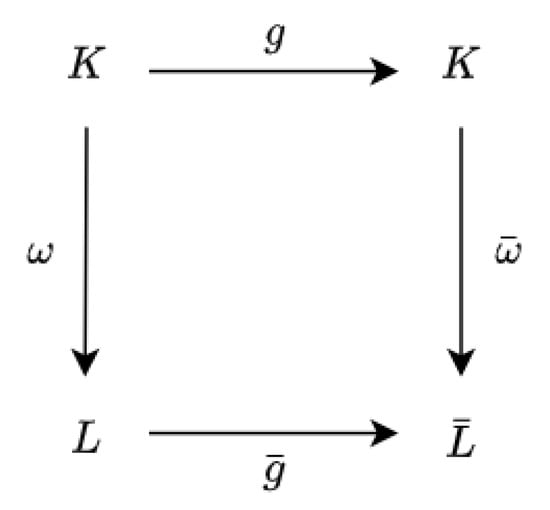
(The AGW Criterion: [8]). If the maps g, , ω and such that , , , and with and both ω and surjective, where K, L and be finite sets with [Figure 1]. Then, the following statements are equivalent:
Figure 1.
Given statement is symbolized using the diagram.
- 1.
- g is a bijection from K to K.
- 2.
- is a bijection from L to and g is injective on for each .
The major proofs in this work are based on the AGW Criterion, which simplifies the challenge of proving permutation polynomials over to that of proving permutation polynomials over its subfield .
Trace functions are widely used in different types of concepts over finite fields. For properties of trace one can refer [31].
Definition 1
([31]). The trace over for any is defined as .
We use the following definition defined in [32].
Definition 2
([32]). Let with coefficients then .
Definition 3
([31]). The character function defined on additive group of is known as canonical additive character of .
Definition 4
([31]). The function with for all is known as additive character of .
By setting, in above definition we get trivial additive character , such that for all .
Definition 5
([31]). A polynomial with the coefficients in an extension field of the field represented as
is known as linearized polynomial over .
Definition 6
([31]). A polynomial in the form where is a linearized polynomial over and , is an affine polynomial over .
Definition 7
([33]). If for every , the function is a permutation of , then is known as a planar function.
The number of solutions of a polynomial function and properties of additive characters are interrelated to observe the permutation behavior of polynomials. We state the following results from [31], which we readily used in our work.
Theorem 1
([31]). A mapping is a permutation polynomial if and only if for every
Theorem 2
([31]). If χ is a non-trivial additive character of the finite field then .
Remark 1
([31]). For any
is the number of solutions of in .
Some of the required definitions and theorems to construct permutation polynomial in n-indeterminates are listed below.
Definition 8
([31]). A polynomial over is known as a permutation polynomial in n indeterminates, if for each , the equation has solutions in .
Definition 9
([31]). Let be a fixed primitive element. The function for each , is a multiplicative character of with
is a trivial multiplicative character if for all .
Definition 10
([31]). When q is odd, the quadratic character of is a real valued function η on with
Definition 11
([31]). The function υ on is integer valued function if for and .
Lemma 3
([31]). For any finite field we have
and for any ,
where the sum is over all with .
Definition 12
([31]). Let be k multiplicative characters of . Then the sum
with the summation extended over all tuples of elements of satisfying , is called a Jacobi sum in .
Definition 13
([31]). The homogeneous polynomial of degree 2, or the zero polynomial is a quadratic form in n indeterminates over if,
Theorem 3
([31]). Every quadratic form over , q odd, is equivalent to a diagonal quadratic form.
3. Construction of Permutation Polynomials Using Additive Character
In this section we construct the polynomials of the type and . We prove these two type of polynomials are permutation polynomials based on the additive character over .
Theorem 4.
The affine polynomial is a permutation polynomial over the finite field of characteristic p.
Proof.
It is enough to prove that has atmost one solution in . We make use of additive character over and where is a polynomial over .
Put for all , by the property of implies that is an additive character of . Thus,
From the above Remark 1,
Hence has atmost one solution in . □
Example 1.
is a permutation polynomial overwithqeven.
Proposition 1.
Let be a finite field of characteristic 2 and be an affine polynomial over . For and , the polynomial is a permutation polynomial over if and only if for all ,
Proof.
If is a linearised polynomial then is an affine polynomial over for any and . Hence, .
By Theorem 1 is a permutation polynomial if and only if for all .
Combining these facts together we can write,
which completes the proof. □
Thus the affine polynomial over is a good candidate to be a permutation polynomial. But using the Definition 7, we observe that the same function is not a planar function, which is shown in the following result.
Theorem 5.
An affine polynomial over is not planar function over .
Proof.
The function is planar if permutes for all . Here we need to show that does not permute
In fact,
As is a field of characteristic p, this expression reduces to
which is a constant, which shows that cannot be a permutation of the field. □
Reis and Wang [32] defined as shown in Definition 2 with the help of a polynomial using Trace function. Here we construct another type of permutation polynomial with the help of .
Theorem 6.
Let where , and with and . Then is a permutation polynomial if for all .
Proof.
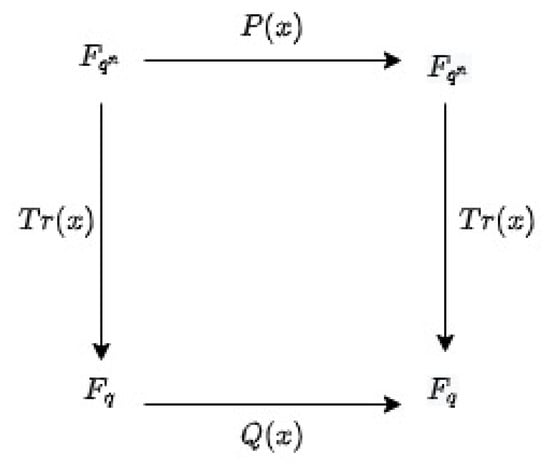
By AGW Criterion is a permutation polynomial over if and only if is a permutation polynomial over . The given statement is symbolized using the diagram Figure 2.
Figure 2.
Theorem is symbolized using the diagram.
From the Theorem 1 for each ,
This sum is zero if , which completes the proof. □
Corollary 1.
Let and m be an odd positive integer such that , where is of degree m and with . If for all then is a permutation polynomial over .
Proof.
By taking in the previous theorem, reduces to , for each . By AGW Criterion is permutation polynomial if and only if is permutation polynomial. Here being a polynomial will be bijective when m is odd. □
4. Permutation Polynomials in -Indeterminates
In this section, we construct permutation polynomials in n-indeterminates using multiplicative character, Jacobi sum, and quadratic form-related properties.
Theorem 7.
Let be a finite field of characteristic p. Let be a quadratic form over , with n indeterminates and odd q. Then is a permutation polynomial over if at least one of the coefficients of the corresponding diagonal quadratic form is zero.
Proof.
Being a quadratic form is always equivalent to the diagonal quadratic form . Thus it is enough to show that has exactly solutions for each .
Using trivial multiplicative character and quadratic character , with , the number of solutions of can be computed as
If n is even and ,
so that
If n is odd and ,
so that
In both of the above cases if is zero, the number of solutions will be for each .
When ,
and hence the number of solutions will be . □
Corollary 2.
For odd q, the quadratic form f over is permutation polynomial over if .
Proof.
Let be a quadratic form over . It is equivalent to for .
With we obtain,
If then and hence, . □
Theorem 8.
Let be a finite field with q even. For odd n
is a permutation polynomial over .
Proof.
It is enough to show that
has solutions over for each .
is if and if . These two cases can be combined as . So we have, . And by using the property of diagonal quadratic form,
. Hence from the Equation (6),
□
Theorem 9.
For odd n and even q, the quadratic form
is a permutation polynomial over .
Proof.
It is enough to show that
has solutions over for each .
Let f be a quadratic form equivalent to
Suitable non-singular linear substitution for indeterminates will be the same in the cases of either some being zero or all being zero.
Without loss of generality assuming , the non singular linear substitution will be
Hence by assigning arbitrary values to and the corresponding value of ,
□
The following result is to prove that is not a planar function using nontrivial additive character of .
Theorem 10.
Let be a finite field with q even. For odd n
is not a planar function over .
Proof.
Let .
Then for ,
which is a constant. This shows that cannot be a planar function. □
5. Conclusions
Permutation of finite field elements is a useful property that increases the richness of finite fields. The construction of such polynomials has become a major part of research in recent years. We contributed a notable work of construction of Permutation polynomials using additive characters, multiplicative characters, and Trace functions for the polynomials in one and more than one indeterminates. The AGW criterion is effectively used to understand the permutation behavior of the constructed polynomials. Linearised polynomials and associated affine polynomials can be suitably modified to form permutation polynomials. The construction of planar functions may also be an interesting work using a similar method in the future.
Author Contributions
Conceptualization, V.G.R.B. and V.J.; methodology, V.G.R.B.; validation, V.G.R.B., V.J., and P.P.; formal analysis, V.J.; writing original draft preparation, V.J.; writing review and editing, V.G.R.B. and P.P.; visualization, P.P.; supervision, V.G.R.B. All authors have read and agreed to the published version of the manuscript.
Funding
The APC was funded by Manipal Academy of Higher Education, Manipal, India.
Institutional Review Board Statement
Not applicable.
Informed Consent Statement
Not applicable.
Data Availability Statement
Not applicable.
Acknowledgments
The authors would like to thank the editor and referees for their valuable comments and suggestions, which improved the quality of this article. The corresponding author acknowledges the Manipal Institute of Technology (MIT), Manipal Academy of Higher Education, India, for their kind encouragement. The first author is grateful to UGC-CSIR Grant Commission for their support through Grant N0.201610069412 and the Manipal Academy of Higher Education for their kind encouragement and support. The second author acknowledges the Manipal Institute of Technology Bengaluru, Manipal Academy of Higher Education, India, for their kind encouragement.
Conflicts of Interest
The authors declare no conflict of interest.
References
- Zieve, M. On some permutation polynomials over of the form . Proc. Am. Math. Soc. 2009, 137, 2209–2216. [Google Scholar] [CrossRef] [Scilit]
- Wan, D. A p-adic lifting lemma and its application to permutation polynomials. Recall 1993, 1, 1. [Google Scholar]
- Turnwald, G. A new criterion for permutation polynomials. Finite Fields Their Appl. 1995, 1, 64–82. [Google Scholar] [CrossRef] [Scilit]
- Charpin, P.; Kyureghyan, G.M. On a Class of Permutation Polynomials over Fq2. In Proceedings of the International Conference on Sequences and Their Applications, Lexington, KY, USA, 14–18 September 2008; pp. 368–376. [Google Scholar]
- Wu, G.; Li, N.; Helleseth, T.; Zhang, Y. Some classes of monomial complete permutation polynomials over finite fields of characteristic two. Finite Fields Their Appl. 2014, 28, 148–165. [Google Scholar] [CrossRef] [Scilit]
- Coulter, R.S. On the evaluation of a class of Weil sums in characteristic 2. N. Zeal. J. Math 1999, 28, 171–184. [Google Scholar]
- Kyureghyan, G.; Zieve, M. Permutation polynomials of the form X+ γTr (Xk). In Contemporary Developments in Finite Fields and Applications; World Scientific: Singapore, 2016; pp. 178–194. [Google Scholar]
- Akbary, A.; Ghioca, D.; Wang, Q. On constructing permutations of finite fields. Finite Fields Their Appl. 2011, 17, 51–67. [Google Scholar] [CrossRef] [Scilit]
- Yuan, J.; Ding, C. Four classes of permutation polynomials of F2m. Finite Fields Their Appl. 2007, 13, 869–876. [Google Scholar] [CrossRef] [Scilit]
- Yuan, J.; Ding, C.; Wang, H.; Pieprzyk, J. Permutation polynomials of the form (xp − x + δ)s + L(x). Finite Fields Their Appl. 2008, 14, 482–493. [Google Scholar] [CrossRef] [Scilit]
- Zeng, X.; Zhu, X.; Hu, L. Two new permutation polynomials with the form (xp − x + δ)s + L(x). Appl. Algebra Eng. Commun. Comput. 2010, 21, 145–150. [Google Scholar] [CrossRef] [Scilit]
- Yuan, P.; Ding, C. Permutation polynomials over finite fields from a powerful lemma. Finite Fields Their Appl. 2011, 17, 560–574. [Google Scholar] [CrossRef] [Scilit]
- Tu, Z.; Zeng, X.; Jiang, Y. Two classes of permutation polynomials having the form (x2m + x + δ)s + x. Finite Fields Their Appl. 2015, 31, 12–24. [Google Scholar] [CrossRef] [Scilit]
- Yuan, P.; Ding, C. Further results on permutation polynomials over finite fields. Finite Fields Their Appl. 2014, 27, 88–103. [Google Scholar] [CrossRef] [Scilit]
- Zha, Z.; Hu, L. Some classes of permutation polynomials of the form (xpm − x + δ)s + x over Fp2m. Finite Fields Their Appl. 2016, 40, 150–162. [Google Scholar] [CrossRef] [Scilit]
- Oliveira, J.A.; Martínez, F.B. Permutation polynomials with Carlitz rank 2. Discret. Math. 2021, 344, 112155. [Google Scholar] [CrossRef] [Scilit]
- Vadiraja Bhatta, G.; Shankar, B.; Mishra, V.N.; Poojary, P. Sequences of numbers via permutation polynomials over some finite rings. Proyecciones 2020, 39, 1295–1313. [Google Scholar] [CrossRef] [Scilit]
- Hasan, S.U.; Pal, M.; Stănică, P. The c-differential uniformity and boomerang uniformity of two classes of permutation polynomials. IEEE Trans. Inf. Theory 2021, 68, 679–691. [Google Scholar] [CrossRef] [Scilit]
- Shaofang, H. Additive characters and orthogonal systems of polynomials in several indeterminates over residue class rings. Chin. Sci. Bull. 1998, 43, 275–277. [Google Scholar] [CrossRef] [Scilit]
- Nakagawa, N. On polynomial families in n indeterminates over finite prime fields coming from planar functions. In Finite Fields with Applications to Coding Theory, Cryptography and Related Areas; Springer: Berlin/Heidelberg, Germany, 2002; pp. 251–262. [Google Scholar]
- Rivest, R.L.; Shamir, A.; Adleman, L. A method for obtaining digital signatures and public-key cryptosystems. Commun. ACM 1978, 21, 120–126. [Google Scholar] [CrossRef] [Scilit]
- Singh, R.P.; Sarma, B.; Saikia, A. Public key cryptography using permutation p-polynomials over finite fields. Cryptol. Eprint Arch. 2009, 2009, 208. [Google Scholar]
- Singh, R.P.; Sarma, B.K.; Saikia, A. A public key cryptosystem using a group of permutation polynomials. Tatra Mt. Math. Publ. 2020, 77, 139–162. [Google Scholar] [CrossRef] [Scilit]
- Singh, R.P.; Saikia, A.; Sarma, B. Poly-dragon: An efficient multivariate public key cryptosystem. J. Math. Cryptol. 2011, 4, 349–364. [Google Scholar] [CrossRef] [Scilit]
- Khachatrian, G.; Kyureghyan, M. Permutation polynomials and a new public-key encryption. Discret. Appl. Math. 2017, 216, 622–626. [Google Scholar] [CrossRef] [Scilit]
- Ding, C.; Zhou, Z. Binary cyclic codes from explicit polynomials over GF (2m). Discret. Math. 2014, 321, 76–89. [Google Scholar] [CrossRef] [Scilit]
- Ding, C. Cyclic codes from some monomials and trinomials. SIAM J. Discret. Math. 2013, 27, 1977–1994. [Google Scholar] [CrossRef] [Scilit]
- Laigle-Chapuy, Y. Permutation polynomials and applications to coding theory. Finite Fields Their Appl. 2007, 13, 58–70. [Google Scholar] [CrossRef] [Scilit]
- Ding, C.; Yuan, J. A family of skew Hadamard difference sets. J. Comb. Theory Ser. A 2006, 113, 1526–1535. [Google Scholar] [CrossRef] [Scilit]
- Singh, R.P.; Saikia, A.; Sarma, B. Little dragon two: An efficient multivariate public key cryptosystem. arXiv 2010, arXiv:1005.5028. [Google Scholar] [CrossRef] [Scilit]
- Lidl, R.; Niederreiter, H. Finite Fields; Number 20; Cambridge University Press: Cambridge, UK, 1997. [Google Scholar]
- Reis, L.; Wang, Q. Permutation polynomials from a linearized decomposition. arXiv 2021, arXiv:2104.13234. [Google Scholar]
- Dembowski, P.; Ostrom, T.G. Planes of ordern with collineation groups of ordern 2. Math. Z. 1968, 103, 239–258. [Google Scholar] [CrossRef] [Scilit]
Publisher’s Note: MDPI stays neutral with regard to jurisdictional claims in published maps and institutional affiliations. |
© 2022 by the authors. Licensee MDPI, Basel, Switzerland. This article is an open access article distributed under the terms and conditions of the Creative Commons Attribution (CC BY) license (https://creativecommons.org/licenses/by/4.0/).