


Abstract
How can public authorities make ecological resources governable and economically actionable without reducing nature to an ordinary commodity? This study examines ecological product value realization (EPVR) in China through 58 official domestic cases. Constructivist grounded-theory coding, Gioia-style data structuring, cross-batch mapping, documentary triangulation, and coding-consistency checks identify five recurrent and interdependent governance functions: institutional recognition, value articulation, governed market construction, collaborative mobilization, and public-value recirculation. These functions are empirically recursive rather than sequential. Recognition constitutes ecological resources and rights as governable objects; articulation makes plural ecological contributions communicable; market construction creates bounded conditions for exchange; collaborative mobilization assembles implementation capacity; and recirculation links captured value to ecological reinvestment, community benefit, and accountability. Cross-batch comparison provides qualified evidence that later demonstration repertoires increasingly incorporate multi-resource portfolio governance. The study contributes to land governance and public policy by conceptualizing EPVR as governed value translation. The framework further distinguishes value realization from value capture and public value creation: making ecological value actionable or generating financial returns does not by itself establish public value unless ecological integrity, distributive legitimacy, and accountability are secured. A public-policy architecture is one in which ecological markets are institutionally constructed and remain subject to ecological, distributive, and accountability constraints. Public value is treated as the normative outcome criterion, while recirculation is a feedback function that can connect value capture to that criterion.
1. Introduction
Governments increasingly seek to reconcile land-based development with ecological integrity. The Sustainable Development Goals, the Kunming-Montreal Global Biodiversity Framework, ecosystem accounting, and expanding nature–finance initiatives all reflect a shift in public policy. Ecosystems are no longer treated only as residual constraints on economic activity, but as foundations of welfare, resilience, biodiversity security, and intergenerational justice. Yet the central governance problem is not simply whether nature has value. It is how public authorities make ecological value administratively visible, legally actionable, financially credible, and socially legitimate without collapsing diverse ecological functions into narrow financial claims. Ecosystem-service assessment and natural-capital accounting have improved the representation of ecological conditions in planning and evaluation, but implementation remains difficult when rights are fragmented, beneficiaries are diffuse, ecological thresholds are uncertain, and public organizations lack integrated routines for converting valuation evidence into authoritative decisions [1,2,3].
China’s ecological product value realization (EPVR) initiative offers a strategically revealing land-governance setting for this problem. EPVR encompasses institutional, economic, and organizational arrangements through which ecological resources and ecosystem functions are converted into ecological, economic, social, and cultural benefits while maintaining ecosystem integrity. In practice, EPVR operates through natural-resource inventories, property-right clarification, territorial planning, ecological restoration, compensation, carbon and quota transactions, public platforms, green finance, ecological industrialization, and benefit-sharing arrangements. Recent research has mapped the conceptual development of EPVR, examined rural spatial ecological products and rural revitalization, and evaluated conversion efficiency and perceived implementation effectiveness [4,5,6,7,8]. This scholarship demonstrates rapid maturation of the field, but it also leaves unresolved how policy instruments are coordinated, how authority is distributed among actors, and how measured or captured value becomes publicly legitimate rather than merely monetized.
This study contains 58 domestic cases released in six batches between 2021 and 2026, spanning forests, wetlands, farmland, lakes, grasslands, mineral sites, coastal ecosystems, national parks, cultural landscapes, and urban ecological spaces. The cases encompass ecological restoration, ecological compensation, forest ecological banks, land-ticket and forest-coverage quota trading, water funds, blue-carbon transactions, ecological tourism, green finance, and multi-element natural-resource asset packages. Because these cases were selected for demonstration and diffusion, they are neither random observations nor independent evaluations. Their evidentiary value lies in documenting governmental problem definitions, institutional arrangements, instrument configurations, actor roles, and pathways that public authorities present as exemplary. This design choice is central to the study, as the analysis seeks to explain the architecture of officially codified governance, not to infer population prevalence or causal policy effects from success-story documents.
Three tensions motivate this study. The first is a valuation-realization tension. Measuring the contribution of a wetland, forest, watershed, or cultural landscape does not itself create enforceable incentives, fiscal commitments, transaction rules, or stewardship responsibilities. The second is a market-ecology tension. Market-like devices can reveal demand and mobilize capital, but they can also encourage commodification, speculative valuation, and ecological simplification when exchange rules are detached from ecological constraints. The third is an asset-public-value tension. Asset packaging and finance may increase administrative and economic usability, yet public legitimacy depends on who captures returns, whether ecological obligations remain enforceable, and whether communities participate meaningfully in benefit allocation. These tensions are especially acute in land governance because ecological functions are spatially embedded, rights are institutionally layered, and development gains may be capitalized faster than ecological or distributional risks become visible.
The study therefore asks “How are ecological resources configured as governable public-policy objects, and what recurring governance functions connect value realization to public-value claims?” It develops the concept of governed value translation. The term denotes the public-governance work through which ecological resources are institutionally recognized, their plural values articulated, bounded exchange arrangements constructed, implementation capacity collaboratively mobilized, and captured value connected to ecological and community returns. The five elements are treated as recurrent governance functions rather than causally proven mechanisms. They are analytically distinguishable but empirically interdependent and recursive. Public value is the normative criterion used to evaluate the direction of translation; public-value recirculation is a distributional and accountability function within the architecture, not the outcome itself.
The study makes three contributions. First, it extends public-value governance to ecological asset and land governance by specifying ecological integrity, distributive legitimacy, and accountable reinvestment as constitutive dimensions of public value rather than optional co-benefits [9,10]. Second, it advances policy-mix research by showing how authority, information, fiscal and financial resources, market devices, organizational platforms, and accountability instruments perform distinct but complementary functions in constructing ecological markets [11,12]. Third, it sharpens the evaluative logic of EPVR by distinguishing value realization, value capture, and public value creation. Ecological value may become measurable, exchangeable, or financially appropriable without generating public value. Public value requires an additional institutional connection between value capture and ecological integrity, distributive legitimacy, accountable stewardship, and collective benefit. This distinction moves EPVR scholarship beyond resource-to-asset-to-capital narratives toward a governance-centered assessment of what ecological value realization ultimately produces and for whom. The cross-batch claim is deliberately modest: later batches contain more explicit portfolio-bundling designs, but this indicates an evolution in officially promoted design repertoires, not that later projects are more effective. Land is central to this argument because ecological value is produced through spatial relationships among ecosystems, tenure regimes, settlements, infrastructure, and administrative jurisdictions. Governing ecological value is therefore simultaneously a problem of valuation, territorial authority, land rights, market design, and public accountability.
2. Literature Review
2.1. From Valuation to Value Translation
Ecosystem-services scholarship established that land, water, forests, wetlands, and cultural landscapes generate benefits that conventional markets and accounts often omit. Natural-capital and ecosystem-accounting approaches subsequently translated ecosystem extent, condition, and service flows into information usable in planning and evaluation. Land research now increasingly integrates ecosystem-service values into spatial planning and examines mismatches between ecological supply and social demand [2,13]. These developments are essential because ecological contributions that remain invisible to administrative and budgetary systems are easily displaced by more readily monetized land uses.
Visibility, however, is not equivalent to governability. An account may estimate flood regulation, carbon sequestration, or landscape amenity without specifying who is authorized to act, who bears opportunity costs, how rights and responsibilities are allocated, or how ecological thresholds constrain development. Research on the organizational uptake of ecosystem services identifies terminological ambiguity, fragmented responsibilities, and tensions between state and market logics as persistent barriers [1]. Policy-capacity scholarship similarly distinguishes analytical capacity from operational and political capacity: credible knowledge matters only when it is connected to authority, implementation routines, coordination, and legitimacy [14]. From a public-administration perspective, therefore, the relevant question is not whether ecological value can be measured, but how measurement becomes embedded in decision rules and accountable institutional arrangements.
This distinction is particularly important for EPVR. Value articulation through gross ecosystem product (GEP) accounts, carbon measurement, certification, appraisal, branding, or traceability can make ecological contributions communicable across agencies and markets, but articulation remains only one governance function. Institutionally recognized rights and boundaries determine the object to which value is attached; compensation and transaction rules determine whether articulated value changes behavior; and monitoring and benefit-sharing rules shape whether value capture supports stewardship and collective welfare. Governed value translation thus begins at the gap between representation and organized action.
Property rights further complicate this translation because ecological value rarely corresponds neatly to a single parcel, owner, or jurisdiction. Watershed regulation, biodiversity connectivity, landscape amenities, and carbon storage are produced across boundaries, whereas legal claims and fiscal responsibilities are often parcelized. Clarification of rights can reduce transaction uncertainty, yet it may also redistribute authority or marginalize customary and relational claims that are difficult to formalize. In the present framework, institutional recognition therefore includes not only ownership registration but also the designation of ecological constraints, stewardship obligations, and responsible public authorities. Recognition is public-value oriented only when it makes responsibilities as visible as potential benefits.
2.2. State-Created Markets and Policy Mixes
Markets are institutional accomplishments rather than neutral arenas populated by pre-existing commodities. They depend on classifications, property rights, measurement devices, authorization, and enforcement [15]. Ecological markets make this institutional dependence unusually visible. A carbon sink, land-development quota, wetland credit, or bundled resource right becomes exchangeable only after an authority defines the relevant unit, identifies eligible actors, specifies obligations, and establishes monitoring. Strategic state capacity is therefore not merely a background condition for environmental markets; in many settings it is constitutive of their existence [16]. The term state-created market is used here in this precise sense. Public authority helps constitute the object, demand, eligibility, and safeguards of exchange rather than simply correcting a market after it has formed.
Policy-mix scholarship provides the second theoretical bridge. Complex policy problems are rarely governed by a single instrument, they are addressed through configurations whose interaction, sequencing, and maintenance matter as much as the properties of individual tools [11,12,17]. EPVR simultaneously confronts public-good characteristics, fragmented rights, weak or absent demand, information deficits, fiscal constraints, ecological uncertainty, and distributional conflict. Regulatory tools establish ecological red lines, zoning, and quotas; informational tools articulate value; fiscal and financial tools compensate protectors or absorb risk; market devices enable exchange and investment; organizational platforms coordinate actors; and accountability instruments verify ecological conditions and benefit sharing. An isolated instrument is structurally incomplete. Valuation without decision rules may remain symbolic, compensation without conditionality may become fiscal dependence, and markets without ecological constraints may facilitate rent capture.
Public-value and collaborative-governance research clarifies the normative and organizational dimensions of these mixes. Public value concerns legitimacy, equity, accountability, trust, and collective welfare rather than revenue or administrative efficiency alone [9,10]. Collaborative arrangements can mobilize knowledge and capacity across agencies, firms, communities, and civil society, but collaboration is not inherently equitable or effective. Platform research shows that organizational design and leadership can shape environmental performance [18,19,20], while recent work on environmental governance platforms demonstrates that sponsor objectives and local implementation may diverge because of information asymmetry and competing preferences [21]. For EPVR, this implies that platforms and partnerships contribute to public value only when authority, community voice, risk allocation, and ecological obligations remain visible and enforceable.
These studies also establish discriminant boundaries among the five functions developed below. Institutional recognition concerns ontology and authority: what resource or right becomes an authoritative governance object, who holds claims, and which constraints apply. Value articulation concerns representation and commensuration: how ecological functions are expressed through metrics, certificates, prices, or narratives. Governed market construction concerns exchange architecture: how demand, tradable units, platforms, eligibility, and transaction conditions are constituted. Collaborative mobilization concerns actor capacity: how finance, knowledge, implementation resources, and legitimacy are assembled. Public-value recirculation concerns distribution and feedback: how captured returns are linked to stewardship, community benefit, monitoring, and accountability. The functions may co-occur, but they answer different governance questions.
Governed market construction and collaborative mobilization can nevertheless be functionally coupled without becoming conceptually identical. Market construction specifies the rules, units, eligibility conditions, and exchange infrastructure that constitute a bounded arena of allocation, whereas mobilization supplies the finance, knowledge, organizational capacity, and social authorization required to make that arena operate. Their co-occurrence can be instrumental when platforms provide delivery infrastructure for publicly constituted markets, legitimating when participation introduces local knowledge and voice into exchange design, or tension-laden when efficiency, investment closure, or administrative control compresses community bargaining space. The analytical implication is conditional complementarity: coupling strengthens governance only when authority, actor roles, bargaining rights, risk allocation, and monitoring remain explicit; otherwise, the same platform can expand transaction capacity while diffusing accountability [18,19,20,21].
Policy mixes also evolve over time. Instruments may be layered onto existing arrangements, recalibrated after implementation problems, or combined across policy domains. Such layering can expand capacity, but it can also generate contradictions among conservation, fiscal, and development objectives. More instruments are therefore not necessarily better. The analytical task is to determine whether tools perform complementary functions, whether responsibilities remain traceable, and whether accountability travels across the full arrangement. This perspective is particularly relevant to later EPVR cases that bundle heterogeneous natural-resource rights into integrated asset packages.
2.3. EPVR Research and Governance Gaps
Research on EPVR has moved rapidly from conceptual clarification toward empirical analysis of pathways, drivers, and policy effects. Recent reviews identify ecological valuation, ecological compensation, industrialization, property-right transactions, and government-market collaboration as major research domains while continuing to note conceptual ambiguity and weak standardization of measurement [7]. Empirical studies have examined spatial value expression, rural revitalization, digital finance, and perceived implementation effectiveness [4,5,6,8]. Other work has analyzed landscape sustainability and institutional change [22,23,24], configurational drivers of ecological-product realization [25], strategic interactions among governments, firms, and consumers [26], and the effects of ecological compensation, EPVR policies, and government advocacy on conversion efficiency and carbon outcomes [27,28,29]. Recent soil- and water-conservation research further emphasizes circular governance-transformation-reinvestment pathways [30].
The literature reinforces this shift toward configurational and multidimensional analysis. A fuzzy-set qualitative comparative analysis of 43 official forest cases identifies multiple combinations of capital, institutional, and market conditions associated with high-level value realization rather than a single dominant driver [31]. A 147-city study of forest ecological products distinguishes use-value realization from exchange-value realization and shows that ecological supply capacity and value-capture capacity do not necessarily develop in parallel [32]. These studies are important because they move beyond single indicators and linear pathways. At the same time, they also make a governance question more visible “If different combinations can generate value capture, what institutional architecture determines whether that capture remains ecologically bounded, distributively legitimate, and publicly accountable?”
Three limitations therefore remain. First, much of the literature is outcome- or pathway-centered. Studies estimate conversion efficiency, environmental effects, financing effects, stakeholder equilibria, or configurational sufficiency, but commonly treat the institutional architecture linking rights clarification, valuation, exchange, collaboration, and benefit distribution as a background condition rather than the object of explanation. Second, many analyses focus on a single instrument, sector, locality, or intervention. This makes it difficult to determine whether ecological compensation, carbon trading, forest banks, water funds, ecological industrialization, and multi-resource asset packages perform comparable governance functions despite their substantive differences. Third, the distinction among value realization, value capture, and public value creation remains underdeveloped. Revenue, asset appreciation, or higher conversion efficiency may indicate value capture, but they do not establish ecological integrity, fair distribution, or accountable reinvestment.
This study addresses those limitations by shifting the question from which pathway realizes ecological value to how ecological value is made governable, exchangeable, and publicly legitimate. Governed value translation is proposed as a middle-range framework composed of five analytically distinct but empirically interdependent functions. The contribution is not that these functions causally produce superior outcomes. Rather, they identify recurrent governance-design patterns through which public authorities constitute ecological objects, assemble policy mixes, create bounded markets, mobilize implementation capacity, and connect captured value to ecological and distributive safeguards. The framework also separates public-value recirculation from public value itself, as recirculation is a feedback function, whereas public value is the normative outcome criterion defined by ecological integrity, distributive legitimacy, and accountability. This distinction moves EPVR research beyond resource-to-asset-to-capital narratives toward a public-administration explanation of how ecological markets are created, disciplined, and evaluated.
3. Materials and Methods
3.1. Case Selection and Data Sources
The empirical archive consists of 58 domestic EPVR cases released in six batches between 2021 and 2026. Because public authorities selected the cases to showcase transferable practices, the archive is a purposive policy corpus rather than a representative sample of all EPVR initiatives. This distinction structures the entire research design. The cases are analyzed as governance documents that reveal officially codified problem definitions, policy instruments, actor configurations, and models of transferability; they are not treated as independent evaluations of policy effectiveness. The domestic case composition, batch structure, and analytical role of each batch are reported in Table S1 of the Supplementary Materials. The 6 international cases, drawn from the United States, the United Kingdom, Germany, and Australia, are retained only as sensitizing contrasts. Their legal, property-right, administrative, and market contexts differ substantially from those of China. They are therefore excluded from domestic frequency counts, cross-batch comparisons, and theoretical-saturation judgments.
Each domestic case was entered into a structured inventory containing batch, location, resource type, policy problem, instrument portfolio, participating actors, officially reported value-realization pathway, source excerpts, first-order codes, second-order themes, governance-function codes, and analytic memos. For descriptive comparison, the 58 cases were also assigned to one of six mutually exclusive case types: multi-resource or territorial integration; water, wetland, or coastal ecosystems; land or mineral restoration; forest or carbon; agriculture or cultural landscapes; and protected areas or other cases. These categories are descriptive devices rather than assumptions of within-group homogeneity.
Official cases are vulnerable to both selection bias and reporting bias. To reduce dependence on a single narrative source, documentary triangulation was conducted for analytically important anchor cases. Separately issued public records—including transaction announcements, local implementation documents, natural-resource or forestry agency reports, government notices, and platform disclosures—were used to cross-check institutional design features in the Futian mangrove blue-carbon transaction, Chongqing forest-coverage trading, Luxian land-forest bundling, Lichuan mine-land supply, Jiujiang multi-resource allocation, Nanping’s forest ecological bank, Qingshan Village’s water fund, and Dongzhou Island’s integrated resource package. Table S2 reports the source type, design element cross-checked, and inference limit for each anchor case. This triangulation supports the existence and institutional architecture of the selected arrangements where corroborating records are available; it does not establish ecological additionality, household welfare effects, or causal effectiveness.
The archive is thus treated neither as neutral factual reporting nor as mere promotional rhetoric. Official cases simultaneously describe practice and perform policy diffusion. They foreground selected problems, identify legitimate actors, emphasize particular outcomes, and present specific arrangements as replicable. The analysis exploits this dual character by asking what institutional work the cases make visible and which designs are repeatedly promoted, while maintaining explicit caution about outcome claims. This evidentiary calibration allows theory building about officially codified governance design without converting success narratives into causal evidence.
Epistemologically, this design is a positive-case, state-curated repertoire analysis. Its inferential target is not the universe of EPVR projects but the institutional vocabulary and design forms that public authorities choose to codify and diffuse as exemplary. The five functions therefore have repertoire validity within the official demonstration archive: they identify recurrent features of a state-endorsed policy repertoire, not exhaustive regularities, causal necessities, or sufficient conditions for EPVR success. Practices excluded from demonstration—failed transactions, stalled projects, unresolved tenure conflicts, community resistance, fiscal stress, or ecological underperformance—may reveal breakdowns or counter-logics that the present corpus cannot recover. Testing the framework beyond the official archive requires purposive negative-case sampling, non-demonstration projects, independent ecological and fiscal evaluations, implementation records, and accounts from households, communities, firms, and frontline officials.
3.2. Coding and Analytical Procedure
The analysis combines constructivist grounded theory, Gioia-style data structuring, and abductive comparison [33,34]. Open coding identified action-oriented practices such as clarifying ownership, registering ecological resources, measuring carbon sinks, creating quota-based demand, bundling heterogeneous rights, establishing transaction platforms, pooling finance, distributing benefits, and reinvesting returns. Focused coding grouped recurrent practices by policy function. Axial coding compared governance conditions, institutional actions, actor configurations, and claimed value-realization pathways, and selective coding integrated the categories around the core concept of governed value translation.
Two members of the author team conducted the formal coding and review. The coding followed a two-stage audit. First, all 58 domestic cases were coded using explicit inclusion, exclusion, and discriminant rules for the five governance functions (Table S3). Second, a stratified subset of information-rich cases was examined in greater depth, preserving Chinese source excerpts, first-order codes, second-order themes, function assignments, and final decisions as an audit trail (Table S4). Because the framework concerns interdependent governance functions rather than mutually exclusive case labels, a case could legitimately receive more than one function code.
Coding consistency was assessed through independent double coding of a common subsample using the finalized scheme. Agreement was satisfactory, with Cohen’s κ = 0.80 and Krippendorff’s α = 0.82; category-specific coefficients ranged from 0.77 to 0.82 for κ and from 0.79 to 0.83 for α. Remaining disagreements were resolved through consensus discussion, and ambiguous category boundaries were refined before consolidation of the final matrix. The reliability procedure and claim-calibration rules are summarized in Table S5. These coefficients indicate coding consistency; they do not validate the substantive effectiveness of the governance arrangements identified.
3.3. Analytical Rigor and Validation
Analytical rigor depended on explicit minimum-evidence rules. Institutional recognition required evidence of rights clarification, resource boundaries, registration, inventories, zoning, or planning rules. Value articulation required metrics, appraisals, certificates, accounts, brands, or traceability devices that rendered ecological contributions administratively or economically communicable. Governed market construction required public definition of demand, tradable units, platforms, asset packages, eligibility, or transaction conditions. Collaborative mobilization required identifiable contributions from multiple actors in finance, expertise, operational capacity, representation, or legitimacy. Public-value recirculation required an explicit connection between captured value and ecological reinvestment, community benefit, monitoring, disclosure, or public accountability. The positive and negative coding boundaries are reported in Table S3.
Descriptive frequencies were used as audit devices, not as tests of effect size or causal importance. For each batch, the analysis reports the number and percentage of cases containing each governance function, the mean number of named instruments, and the number of explicit multi-resource portfolio bundles. Table 1 reports the batch distributions, and Table S6 compares the five functions across descriptive case types. Higher frequency means only that an explicit design feature appears in more official documents; it does not imply that the feature is more effective, more important, or more prevalent in the population of EPVR projects.
Table 1.
Distribution of governance-function features across the 58 domestic cases.
Theoretical saturation was assessed conservatively through sequential comparison. Batches 1–2 generated the initial governance categories; Batches 3–4 refined value articulation, certification, ecological finance, and collaborative properties; and Batches 5–6 introduced more complex resource bundling and portfolio governance. Later cases elaborated the existing framework without requiring an additional aggregate function. Saturation therefore refers to conceptual stabilization within this bounded policy corpus, not exhaustion of all possible EPVR practices. Rival interpretations were also retained rather than coded away, their observable implications are summarized in Table S7.
4. Results
4.1. Governance Functions and Distribution
The coding identifies five recurrent governance functions whose discriminant boundaries are summarized in Table 2. The distinction is functional rather than temporal. Institutional recognition establishes what exists as an authoritative object of governance; value articulation represents why and how that object is valuable; governed market construction constitutes exchange conditions; collaborative mobilization assembles implementation capacity; and public-value recirculation connects captured value to stewardship and collective benefit. One case may display several functions, but each code requires different documentary evidence. The full coding questions and negative boundaries are reported in Table S3.
Table 2.
Discriminant boundaries of the five governance functions.
The functions are not equally present across the corpus and are not treated as necessary or sufficient conditions. Across the 58 domestic cases, institutional recognition appears in 48 cases (82.8%), collaborative mobilization in 40 (69.0%), value articulation in 35 (60.3%), governed market construction in 33 (56.9%), and public-value recirculation in 20 (34.5%). These frequencies describe the official design repertoire rather than causal importance. Their batch-level distribution is reported in Table 1. The pattern supports a configurational interpretation, as cases enter through restoration, compensation, valuation, industrial development, or market design, and only some documents explicitly couple all five functions.
The case-type distribution reinforces this conclusion (Table S6). Forest and carbon cases show especially dense combinations of recognition, articulation, and market construction because registries, measurement, and exchange rules are integral to the policy object. Water, wetland, and coastal cases rely more heavily on collaborative mobilization and public or quasi-public arrangements because beneficiaries and ecological effects are spatially diffuse. Land and mineral-restoration cases foreground planning, restoration obligations, and the reallocation of development opportunities. The five-function framework therefore provides a common vocabulary for comparison without implying a single universal recipe.
4.2. Institutional Recognition and Value Articulation
Institutional recognition is the governance function through which ecological resources become authoritative and actionable objects. Many cases begin with fragmented forest plots, cross-boundary wetlands, abandoned mines, dispersed rural land, or resources governed by separate agencies and rights regimes. Surveys, ownership clarification, registration, zoning, territorial planning, land reserve, and unified asset inventories transform these conditions into objects that can be protected, appraised, combined, compensated, or exchanged. Dongzhou Island, for example, coordinates natural, cultural, and tourism resources through cross-departmental boundary setting and asset investigation. Luxian’s land-forest package similarly depends on identifying collective forest-management rights and construction-land-use rights before those rights can be bundled. Recognition is therefore not administrative housekeeping, and it defines claims, responsibilities, ecological constraints, and the public authority competent to act.
Value articulation is analytically distinct. It makes ecological contributions communicable across administrative, technical, fiscal, financial, and market domains. The cases use GEP accounts, carbon measurement, appraisals, ecological-product catalogues, certificates, quality tracing, and place branding. The Futian mangrove blue-carbon case is illustrative, as investigation and monitoring, natural-resource registration, carbon-sink measurement, base-price assessment, transaction arrangements, and financial support were connected into a chain through which a previously diffuse ecological contribution became inspectable and exchangeable. The significance is not simply that a price was assigned. Multiple devices translated ecological information into a form that different organizations could recognize and act upon (coding chains are in Table S4).
The distinction between recognition and articulation is consequential for land governance. A resource may be recognized without being monetized, as when boundaries and obligations are clarified for conservation. Conversely, ecological services may be valued without becoming governable if no authoritative rights holder, budget rule, compensation mechanism, or transaction pathway exists. Governed value translation requires a connection between these functions, but it does not collapse them. This distinction also guards against a common normative error, as greater legibility is not automatically greater public value. Recognition and articulation can privilege what is administratively measurable unless ecological limits, plural values, and distributional claims remain explicit.
4.3. Market Construction, Mobilization, and Recirculation
Governed market construction is the first operational function. Many ecological benefits have diffused beneficiaries, weak excludability, and no spontaneous buyer. Public authorities therefore create bounded exchange by defining ecological targets, tradable units, eligibility, registries, transaction platforms, appraisal standards, and contractual obligations. Chongqing’s forest-coverage system converted an administrative assessment target into an interjurisdictional trading object by defining differentiated targets and permitting transactions under public rules. Land-ticket arrangements similarly construct exchange by linking restoration outputs to development obligations. In later cases, public agencies also bundle heterogeneous resource rights into integrated packages that would be too fragmented or institutionally disconnected to attract investment separately. These markets are state-created in a precise institutional sense, as public rules constitute the object, demand, eligibility, and safeguards of exchange rather than merely regulating transactions after the fact.
Collaborative mobilization assembles the capacities required to operate these arrangements. Government departments coordinate authority; state-owned platforms aggregate rights and finance; village collectives organize participation; firms invest and operate projects; universities and professional organizations provide measurement and appraisal; and financial institutions design credit, guarantees, or funds. Qingshan Village’s water fund illustrates this function by pooling governmental, philanthropic, community, and industrial resources around water-source protection and green livelihoods. Collaboration is coded only where actors contribute identifiable resources or authority, not merely where a document lists stakeholders. Table S4 provides representative evidence chains for Qingshan Village and other anchor cases.
Collaboration nevertheless creates governance risks. Interorganizational and public–private arrangements can obscure responsibility, weaken community bargaining power, or prioritize visible investment over ecological performance. The recent environmental-governance literature shows that platform sponsors and local implementers may pursue different priorities even within formally coordinated systems [21]. The EPVR cases make a similar accountability problem visible. As the number of actors and instruments increases, responsibility for ecological thresholds, fiscal risk, monitoring, and benefit distribution can become harder to trace. Collaborative capacity therefore needs counterweights in disclosure, risk allocation, ecological conditions, and community voice.
Where collaborative mobilization and governed market construction co-occur, the relationship is best understood as conditional functional coupling rather than category overlap. Instrumentally, a public or hybrid platform can integrate registries, contracting, finance, technical appraisal, and interagency coordination so that an administratively constituted market becomes operational. Legitimatingly, participation by collectives, communities, NGOs, or professional bodies can contribute local knowledge and social authorization to exchange rules. Yet the coupling can also be tension-laden: the same platform that lowers transaction costs may centralize agenda control, prioritize rapid investment closure, or weaken the bargaining position of actors whose ecological or livelihood claims are difficult to monetize. Co-occurrence therefore improves governance capacity only when market authority and mobilized capacity remain accompanied by transparent role differentiation, meaningful bargaining rights, explicit risk allocation, and enforceable monitoring [18,19,20,21].
Public-value recirculation is the distributional and feedback function. It is coded where documents explicitly connect revenue, compensation, land-value uplift, carbon income, or asset returns to restoration, monitoring, collective income, employment, public services, or community benefit. In Luxian, the official design links the land-forest asset package to ecological obligations, village collective gains, farmer benefits, and a protection-use-benefit-feedback-reinvestment cycle. Similar arrangements include conservation funds, collective dividends, ecological employment, and compensation rules. Recirculation does not establish that public value was actually achieved; it identifies an institutional pathway through which value capture is designed or claimed to support public-value criteria.
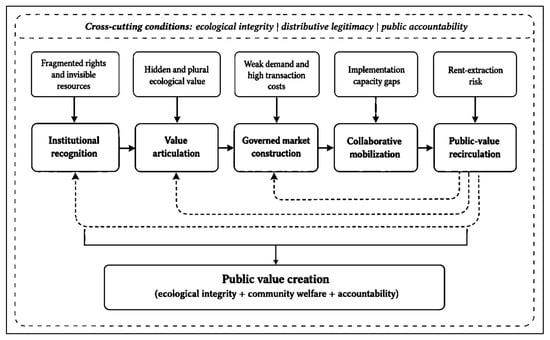
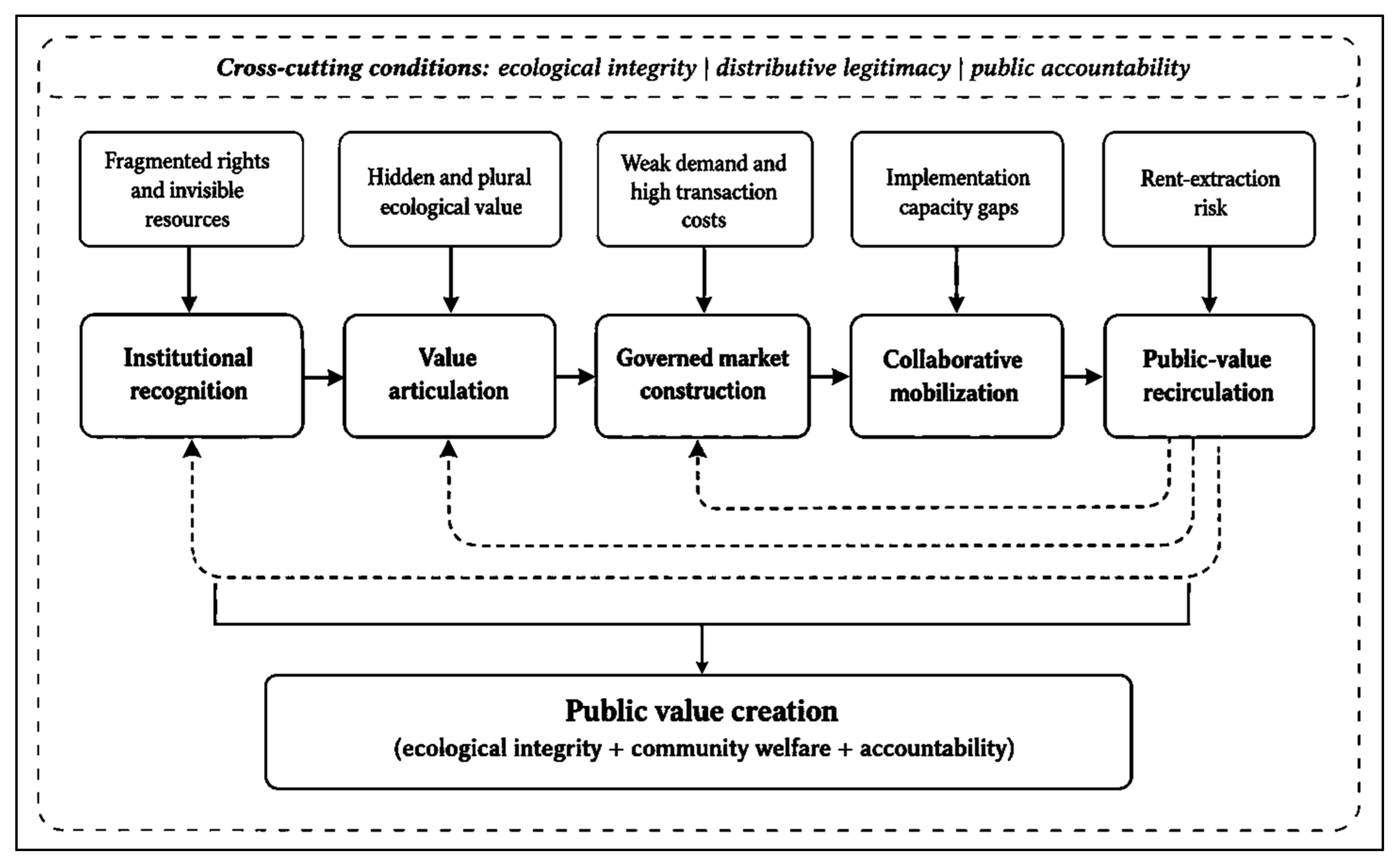
This distinction resolves the apparent circularity between public value and recirculation. Public value is an evaluative outcome concept defined here by ecological integrity, distributive legitimacy, and accountable collective benefit. Recirculation is one governance function that may contribute to those outcomes by feeding returns into stewardship and welfare. Because reinvestment and benefit sharing can alter resources, incentives, legitimacy, and future participation, recirculation also feeds back into subsequent recognition, valuation, and market design. Figure 1 therefore depicts governed value translation as a recursive architecture rather than a one-way pipeline.
Figure 1.
Recursive governance architecture of governed value translation. Note: Solid arrows indicate recurrent functional linkages among adjacent governance functions and do not imply a temporal, causal, or mandatory sequence. Dashed arrows indicate recursive feedback from public-value recirculation to renewed institutional recognition, value articulation, and market design. The functions may be entered from different points, co-occur, and be revisited iteratively. The outer boundary represents the cross-cutting constraints of ecological integrity, distributive legitimacy, and public accountability.
4.4. Cross-Batch Evolution and Rival Explanations
Cross-batch comparison reveals a qualified evolution in the repertoire selected for national demonstration. Batches 1–2 emphasize restoration, ecological compensation, ecological banks, land tickets, forest-coverage trading, and ecological industry. Batches 3–4 add more carbon, water-fund, certification, national-park, land-consolidation, and collaborative arrangements. Batches 5–6 contain the clearest expansion of integrated natural-resource asset packages and full-chain transaction designs.
Two indicators make the portfolio-governance claim empirically traceable. First, explicit multi-resource portfolio bundles rise from zero in Batch 1 to three in Batch 5 and six in Batch 6. Second, the mean number of named instruments rises to 6.4 in Batch 5 and 6.2 in Batch 6, compared with 4.2–5.1 in Batches 1–4. At the function level, Batch 6 combines universal recognition (100.0%) with high rates of value articulation (81.8%) and governed market construction (81.8%). These patterns are consistent with an official shift from isolated pathway experimentation toward more integrated asset configuration. They do not demonstrate that portfolio designs outperform simpler arrangements.
The distribution also prevents an overly linear account. Institutional recognition appears at high levels in both early and late batches; collaborative mobilization peaks in Batch 4 rather than Batch 6; and public-value recirculation is highest in Batch 1 and does not increase monotonically. Later portfolio governance therefore layers new configurations onto existing approaches rather than replacing them. This is better understood as repertoire expansion, institutional layering, and policy learning than as a progression toward a single superior model [35,36]. The result is theoretically important because it locates change in the architecture of policy design—the number and interdependence of rights, instruments, and actors—rather than in an assumed hierarchy of policy stages.
Case-type differences further qualify the temporal pattern (Table S6). Multi-resource and territorial cases are especially likely to combine recognition, market construction, and collaboration because they must coordinate heterogeneous rights and agencies. Water, wetland, and coastal cases more often rely on collective financing, compensation, and monitoring because ecological effects and beneficiaries’ cross property boundaries. Land and mineral-restoration cases foreground spatial planning, rehabilitation obligations, and value capture from renewed land uses, while forest and carbon cases depend heavily on registries, measurement, standards, and finance. The relative prominence of each governance function is therefore conditioned by resource characteristics, tenure arrangements, ecological uncertainty, and the feasible source of demand.
The cross-type distribution suggests a resource-governance contingency rather than a sectoral hierarchy. Forest and carbon cases (n = 6) display recognition, articulation, and market construction in all cases, a pattern consistent with policy objects that can be standardized through registries, measurement protocols, certificates, and relatively discrete tradable units. Water, wetland, and coastal cases (n = 18) display collaborative mobilization more often (72.2%) than governed market construction (38.9%), which is consistent with diffuse beneficiaries, hydrological interdependence, cross-boundary externalities, and weaker excludability that raise collective-action and monitoring requirements. Land and mineral-restoration cases (n = 5) combine high market construction (80.0%) with recirculation (60.0%), reflecting clearer spatial rights, restoration liabilities, and opportunities to connect redevelopment value to rehabilitation obligations. Multi-resource and territorial cases (n = 24) show substantial collaboration (66.7%) but much lower explicit recirculation (16.7%), suggesting a potential governance lag in which asset aggregation and cross-agency coordination develop faster than transparent benefit-sharing and reinvestment rules. Because several case-type cells are small and the corpus is purposive, these are theoretically informed interpretations rather than statistical tests. They generate a contingency proposition for future research: the functional mix should vary systematically with ecological fungibility, excludability, tenure clarity, spatial spillovers, and the distribution of beneficiaries.
Rival interpretations remain plausible and are treated as part of the analysis rather than as residual limitations. A pure-marketization account explains transactions and prices but cannot fully explain why many exchanges appear only after public authorities define rights, create obligations, establish platforms, and impose ecological conditions. A payment-for-ecosystem-services account explains compensation but does not cover land restoration, ecological industrialization, quota systems, or multi-resource asset packages. Local developmentalism captures incentives for tourism, land-value uplift, and visible investment, but it under-specifies cases in which benefit sharing, ecological restrictions, and reinvestment are explicitly built into project design. Ecological modernization captures innovation but gives less analytical weight to property-right construction and distributional accountability. Table S7 states these rival explanations and the evidence that future research would need to discriminate among them more decisively.
The same comparison reveals four endogenous risks. First, valuation can become symbolic when accounts are disconnected from authority, budgets, or enforceable obligations. Second, market construction can encourage commodification or speculative claims where ecological thresholds and verification are weak. Third, portfolio bundling may reduce transaction costs while obscuring cross-subsidies, fiscal exposure, and responsibility across resource components. Fourth, collaboration can diffuse accountability or marginalize communities with weaker bargaining power. These risks explain why the outer boundary of Figure 1 is defined by ecological integrity, distributive legitimacy, and accountability. The framework is not a model of automatic success; it is an architecture for identifying where value translation can fail.
5. Discussion
5.1. Governed Value Translation
The central theoretical contribution is to recast EPVR as governed value translation. Existing resource-to-asset-to-capital narratives identify an important conversion logic but under-specify the public work that makes conversion possible. Ecological resources do not enter markets as pre-given commodities. They must be constituted through rights, classifications, planning rules, measurement devices, transaction arrangements, organizational capacity, and distributional safeguards. The five functions identified here provide a vocabulary for that institutional work while avoiding the stronger claim that official demonstration documents prove causal effectiveness.
This formulation also reconnects EPVR to land governance. Land-based ecological value is inseparable from tenure, spatial planning, restoration obligations, infrastructure, jurisdictional boundaries, and spatially uneven benefits. Recent research shows that value realization is associated with spatial production, planning integration, conversion efficiency, and perceived social and ecological outcomes [2,4,6,8]. Governed value translation explains how these domains become linked. Institutional recognition establishes authoritative objects and responsibilities; value articulation makes ecological contributions portable across decision arenas; market construction constitutes bounded exchange; collaboration assembles capacity; and recirculation specifies how value capture is connected back to place-based stewardship and welfare.
The framework extends public-value governance beyond service delivery and program management. Public managers in EPVR do not merely regulate private exchange or administer compensation. They configure assets, authorize market objects, organize platforms, coordinate public and private capabilities, and make distributional choices. The state is therefore neither only a regulator correcting market failure nor only an owner seeking returns from natural assets. It is a market constructor whose legitimacy depends on retaining responsibility for ecological integrity and collective benefit. This responsibility becomes more demanding as ecological finance, tradable claims, and portfolio packages become more complex.
The distinction among value realization, value capture, and public value creation is consequently central (Table 3). Value realization occurs when ecological contributions become actionable, compensable, financeable, or exchangeable. Value capture occurs when specific actors obtain revenue, asset appreciation, or rents from that translation. Public value requires a further normative judgment about ecological integrity, distribution, accountability, and stewardship. A project can therefore realize and capture value without creating public value. This distinction prevents revenue or transaction volume from becoming an implicit proxy for policy success.
Table 3.
Distinguishing value realization, value capture, and public value creation.
Governed value translation complements rather than displaces adjacent theories. Ecosystem-service research explains what ecological contributions are valuable; market-construction theory explains how exchange becomes institutionally possible; policy-mix research explains instrument interdependence; collaborative-governance research explains how distributed capacity is organized; and public-value governance supplies an evaluative standard for legitimacy and collective benefit. The contribution is to integrate these insights around a specific public-policy problem “How governments make ecological value actionable while remaining accountable for what market construction redistributes, excludes, or places at risk”.
5.2. Policy Mixes and Public-Value Safeguards
The findings imply that the design problem is not whether to use markets or government, but how to allocate governance functions across instruments. The supplementary instrument matrix (Table S8) shows that regulatory tools primarily define ecological boundaries and bounded demand; informational tools articulate value; fiscal and financial tools compensate protectors and absorb risk; market tools enable exchange and investment; organizational tools mobilize capacity; and accountability tools connect implementation to monitoring and recirculation. Policy coherence depends on functional complementarity rather than the number of instruments assembled.
Five design principles follow. First, rights, boundaries, ecological baselines, and responsible authorities should be specified before finance or exchange is promoted. Registries and spatial plans should identify not only what may be used, but also non-negotiable ecological constraints and stewardship duties. Second, valuation should be decision-linked. GEP accounts, carbon measurements, and appraisals should identify the budget, compensation, planning, procurement, or transaction decision they inform; otherwise, they risk becoming symbolic reports detached from implementation.
Third, market creation should be conditional. Quotas, platforms, carbon transactions, land-related development rights, and bundled assets require monitoring protocols, verification standards, restoration duties, disclosure, and exit or correction rules. Transaction value should not be treated as the principal performance indicator. Fourth, collaborative platforms should make authority and bargaining rights visible. Contracts and governing arrangements should identify who bears ecological and financial risk, how communities participate, which actor monitors compliance, and how disputes are resolved. Recent evidence on environmental governance platforms suggests that delegated implementation can diverge from sponsor objectives when preferences and information are unevenly distributed [21]; EPVR therefore requires accountability that follows delegation.
Fifth, recirculation should be designed ex ante rather than inferred ex post from successful revenue generation. Benefit-sharing formulas, conservation funds, collective dividends, ecological employment, community compensation, and reinvestment obligations should be embedded in project rules before value is captured. This principle is particularly important for land-value uplift and multi-resource portfolios because the party that captures appreciation may not be the party that bears conservation restrictions or long-term stewardship costs.
For land and natural-resource agencies, these principles imply a staged but revisable decision protocol: establish administrative legibility; articulate ecological and social values; determine whether regulation, public provision, compensation, or bounded exchange is appropriate; assemble implementation capacity; and define monitoring, distribution, and recirculation before authorizing transactions. Not every ecological function requires a market. Where beneficiaries are diffuse, monitoring costs are high, ecological thresholds are uncertain, or distributive risks are substantial, long-term public compensation or direct regulation may be preferable to tradable claims. The public-policy objective is therefore not maximum marketization, but institutionally appropriate value translation.
5.3. Scope Conditions and Future Research
The framework is context bounded. China’s EPVR system relies on comparatively strong administrative capacity, extensive territorial-planning authority, public and collective tenure arrangements, state-owned or state-supported platforms, and the ability to create quota, compensation, or procurement demand. These conditions differ from weak-state, highly privatized, or predominantly market-led settings. Governed value translation should therefore travel as a set of comparative questions rather than as an institutional template. In other contexts, recognition may be performed by courts, indigenous institutions, watershed organizations, or private standards; articulation may rely on voluntary certification rather than public accounting; and recirculation may be negotiated contractually rather than mandated administratively. Recent research on government-led ecosystem-service marketization in China likewise shows that market development depends on configurations of governmental capacity, pressure, and incentives rather than on a single institutional driver [37].
Portability is therefore functional rather than institutional. At the highest level, the five functions express generic governance imperatives: authoritative recognition of the ecological object and its claims, representation of plural value, legitimate construction of allocation or exchange rules, mobilization of implementation capacity, and distributional-accountability feedback. What varies across governance systems are the institutional carriers. Recognition may be supplied by courts, cadastral systems, Indigenous or customary institutions, conservation easements, or private standards; articulation by public accounts, scientific standards, certification, or negotiated valuation; market construction by statutory quotas, voluntary exchanges, procurement, collective contracts, or watershed agreements; mobilization by public agencies, cooperatives, NGOs, intermediaries, or private finance; and recirculation by taxes, trust funds, benefit-sharing contracts, community protocols, or negotiated covenants. The framework should therefore be compared across settings at the level of governance problems and functions, while treating legal authority, organizational form, and market mechanism as context-dependent implementations rather than universal institutional templates.
The most important empirical limitation is source selection. Official demonstration cases are selected on claimed success and may omit abandoned projects, conflict, opportunity costs, biodiversity loss, debt exposure, displacement, or unequal distribution. Documentary triangulation verifies selected institutional and transaction details (Table S2) but cannot eliminate this selection problem. Likewise, coding reliability demonstrates consistent application of the coding scheme, not the validity of official outcome claims. The frequency matrix maps the content of an official policy repertoire; it does not estimate the prevalence or effect of the five functions across the population of EPVR initiatives. The framework can therefore be falsified or extended only by evidence deliberately outside the success-case selection mechanism, especially failed or contested projects, independent audits, grassroots accounts, and longitudinal implementation records.
A second limitation concerns temporal inference. The cross-batch pattern supports a descriptive claim that later national demonstration repertoires contain more explicit multi-resource bundling and denser instrument packages. It does not establish policy learning in a causal sense, nor does it show that portfolio governance produces superior ecological or social outcomes. Later portfolios may create genuine complementarities by coordinating rights and restoration, but they may also increase financial opacity, administrative complexity, and dependence on land-related value appreciation. Longitudinal project data are needed to distinguish durable institutional learning from changes in demonstration priorities.
Future research should therefore combine the present design analysis with implementation and outcome evidence. Comparative fieldwork could examine how rights clarification changes bargaining power; interviews and process tracing could test whether platforms actually coordinate authority; transaction and fiscal records could identify who captures rents and bears’ risk; and ecological monitoring could assess additionality and rebound effects. Quasi-experimental designs can evaluate specific policy instruments where credible counterfactuals exist, while configurational methods can test whether different combinations of the five functions are associated with independently verified outcomes. International comparison should focus on functional equivalence rather than institutional resemblance “Who performs recognition, articulation, market construction, mobilization, and recirculation when the state is less central?”
These priorities also have implications for performance management. Governments often favor visible indicators such as transaction value, investment attracted, restored area, tourist revenue, or certified carbon. Such indicators are useful but incomplete. A public-value-oriented performance system should combine process indicators—rights clarity, participation, disclosure, verification, and responsibility—with ecological condition indicators and distributional indicators. It should distinguish gross financial value from net public benefit after restoration costs, fiscal risk, opportunity costs, and community compensation. It should also preserve the possibility of policy correction or reversal when monitoring reveals ecological harm. Accountability thereby becomes an operational component of ecological value governance rather than a general principle appended to success narratives.
6. Conclusions
This study develops a grounded framework of governed value translation from 58 domestic EPVR demonstration cases in China. The evidence identifies five recurrent governance functions, including institutional recognition, value articulation, governed market construction, collaborative mobilization, and public-value recirculation. The functions are analytically distinct, empirically overlapping, and recursively connected. Together, they describe how public authorities make ecological resources governable, constitute bounded exchange, mobilize implementation capacity, and connect value capture to public-value claims.
The study deliberately limits its causal claim. Official success narratives cannot demonstrate that these functions improve ecosystems, household welfare, or legitimacy. They reveal the institutional architecture that Chinese authorities present as exemplary and transferable. Within that bounded target, the cross-batch mapping provides credible descriptive evidence that later demonstration repertoires increasingly include multi-resource portfolio governance, while also showing that collaboration and recirculation do not follow a simple linear trend.
The policy implication is not that ecological resources should be more fully marketized. It is that any attempt to mobilize ecological value must preserve public responsibility. Rights and ecological constraints should precede exchange; valuation should be linked to decisions; markets should remain bounded by verification and restoration obligations; collaboration should make authority and community voice visible; and benefit sharing and reinvestment should be designed before value is captured. Governed value translation therefore identifies both the public work that makes ecological markets possible and the accountability conditions under which those markets may contribute to ecological integrity and collective welfare.
Supplementary Materials
The following supporting information can be downloaded at https://www.mdpi.com/article/10.3390/land15091605/s1.
Author Contributions
Conceptualization, H.L. and L.M.; methodology, H.L.; formal analysis, C.H. and H.L.; writing—original draft preparation, C.H. and H.L.; writing—review and editing, H.L. and L.M. All authors have read and agreed to the published version of the manuscript.
Funding
This research was funded by the National Social Science Fund of China, grant number 23BGL318 and the Natural Science Foundation of Shandong Province, grant number ZR2025MS672.
Data Availability Statement
The data that support the findings of this study are available from the corresponding author upon reasonable request.
Acknowledgments
During the preparation of this study, the authors used GenAI for the purposes of copyediting, language improvement, and translation. The authors have reviewed and edited the output and take full responsibility for the content of this publication.
Conflicts of Interest
The authors declare no conflicts of interest.
References
- Blouin, D.; Bissonnette, J.-F.; Goyette, J.-O.; Cimon-Morin, J.; Mendes, P.; Torchio, G.M.; Gosselin-Tapp, J.; Poulin, M. Ecosystem services concept: Challenges to its integration in government organizations. Ecosyst. Serv. 2025, 71, 101691. [Google Scholar] [CrossRef] [Scilit]
- Fan, S.; Yan, M.; Yu, L.; Chen, B.; Zhang, L. Integrating ecosystem service supply–demand and ecological risk assessment for urban planning: A case study in Beijing, China. Ecol. Indic. 2024, 161, 111950. [Google Scholar] [CrossRef] [Scilit]
- Pascual, U.; Balvanera, P.; Anderson, C.B.; Chaplin-Kramer, R.; Christie, M.; González-Jiménez, D.; Martin, A.; Raymond, C.M.; Termansen, M.; Vatn, A.; et al. Diverse values of nature for sustainability. Nature 2023, 620, 813–823. [Google Scholar] [CrossRef] [Scilit] [PubMed]
- Hu, W.; Gu, Z.; Xiong, K.; Lu, Y.; Li, Z.; Zhang, M.; You, L.; Ruan, H. A review of value realization and rural revitalization of eco-products: Insights for agroforestry ecosystem in karst desertification control. Land 2024, 13, 1888. [Google Scholar] [CrossRef] [Scilit]
- Yin, J.; Zhao, L. The value expression and driving factors of rural spatial ecological products: A case study of B&Bs in Jiangsu and Zhejiang Provinces, China. Land 2024, 13, 270. [Google Scholar] [CrossRef] [Scilit]
- Deng, W.; Liu, Y.; Li, S. Enhancing the conversion efficiency of ecological product value through digital finance: Measurement and mechanism analysis. Land 2025, 14, 2024. [Google Scholar] [CrossRef] [Scilit]
- Liu, J.; Su, X.; Liu, Y.; Shui, W. A review of research on progress in the theory and practice of eco-product value realization. Land 2024, 13, 316. [Google Scholar] [CrossRef] [Scilit]
- Lei, S.; Gao, X.; Qiao, Q.; Han, Y.; Huang, J.; Zhang, W. Evaluation of perceived effectiveness in ecological products value realisation: A case study of the Beijing–Tianjin–Hebei region. Land 2025, 14, 2269. [Google Scholar] [CrossRef] [Scilit]
- Bryson, J.M.; Crosby, B.C.; Bloomberg, L. Public value governance: Moving beyond traditional public administration and the new public management. Public Adm. Rev. 2014, 74, 445–456. [Google Scholar] [CrossRef] [Scilit]
- Thabit, S.; Sancino, A.; Mora, L. Strategic public value(s) governance: A systematic literature review and framework for analysis. Public Adm. Rev. 2025, 85, 885–906. [Google Scholar] [CrossRef] [Scilit]
- Vince, J.; Fudge, M.; Fullbrook, L.; Haward, M. Understanding policy integration through an integrative capacity framework. Policy Soc. 2024, 43, 381–395. [Google Scholar] [CrossRef] [Scilit]
- Capano, G.; Lepori, B. Designing policies that could work: Understanding the interaction between policy design spaces and organizational responses in public sector. Policy Sci. 2024, 57, 53–82. [Google Scholar] [CrossRef] [Scilit]
- Zhao, X.; Xu, Y.; Pu, J.; Tao, J.; Chen, Y.; Huang, P.; Shi, X.; Ran, Y.; Gu, Z. Achieving the supply-demand balance of ecosystem services through zoning regulation based on land use thresholds. Land Use Policy 2024, 139, 107056. [Google Scholar] [CrossRef] [Scilit]
- Wu, X.; Ramesh, M.; Howlett, M. Policy capacity: A conceptual framework for understanding policy competences and capabilities. Policy Soc. 2015, 34, 165–171. [Google Scholar] [CrossRef] [Scilit]
- Fligstein, N. The Architecture of Markets: An Economic Sociology of Twenty-First-Century Capitalist Societies; Princeton University Press: Princeton, NJ, USA, 2001. [Google Scholar]
- Meckling, J.; Nahm, J. Strategic state capacity: How states counter opposition to climate policy. Comp. Political Stud. 2022, 55, 493–523. [Google Scholar] [CrossRef] [Scilit]
- Juntunen, J.K.; Shakeel, S.R. Contextualizing policy mixes—A configurational study on rapid transitions. Res. Policy 2026, 55, 105359. [Google Scholar] [CrossRef] [Scilit]
- Bodin, Ö. Collaborative environmental governance: Achieving collective action in social-ecological systems. Science 2017, 357, eaan1114. [Google Scholar] [CrossRef] [Scilit] [PubMed]
- Flye, M.E.; Sponarski, C.C.; McGreavy, B.; Zydlewski, J.D. Leading the charge: A qualitative case-study of leadership conditions in collaborative environmental governance structures. J. Environ. Manag. 2023, 348, 119203. [Google Scholar] [CrossRef] [Scilit] [PubMed]
- Bell, E.; Scott, T.A. Common institutional design, divergent results: A comparative case study of collaborative governance platforms for regional water planning. Environ. Sci. Policy 2020, 111, 63–73. [Google Scholar] [CrossRef] [Scilit]
- Zufall, E.; Scott, T.A.; Lubell, M.; Méndez-Barrientos, L.E. Do governance platforms achieve the aims of the platform sponsor? Principal-agent tension in environmental governance reforms. J. Public Adm. Res. Theory 2025, 35, 292–308. [Google Scholar] [CrossRef] [Scilit]
- Chen, Q.; Li, Z.; Xie, H.; Wu, M.; Pan, Y.; Luo, S. How can ecological product value realization contribute to landscape sustainability? Landsc. Ecol. 2024, 39, 15. [Google Scholar] [CrossRef] [Scilit]
- Zhang, Q.; Shen, X.; Shen, C.; Chen, Y.; Su, B.; Yin, Q.; Zhou, S. Integration of land ecological consolidation and ecosystem product value realization: A case from the Yangtze riverside industrial park in Changzhou, China. J. Environ. Manag. 2024, 353, 120120. [Google Scholar] [CrossRef] [Scilit] [PubMed]
- Liu, S.; Dong, Y.; Liu, H.; Wang, F.; Yu, L. Review of valuation of forest ecosystem services and realization approaches in China. Land 2023, 12, 1102. [Google Scholar] [CrossRef] [Scilit]
- Sun, Y.; Zhao, J.; Qiao, Q.; Lin, Z.; Zhang, W. Unlocking the value of nature: A deep dive into China’s ecological product realization and its driving mechanisms. Forests 2025, 16, 37. [Google Scholar] [CrossRef] [Scilit]
- Dong, J.; Chen, J.; Zhang, Y.; Cong, L.; Dean, D.L.; Wu, Q. Examining the value realization of ecological agricultural products in China: A tripartite evolutionary game analysis. J. Environ. Manag. 2025, 374, 124134. [Google Scholar] [CrossRef] [Scilit] [PubMed]
- Deng, W.; Liu, Y.; Li, S.; Liu, C.; Wei, G. Promoting the realization of ecological product value through ecological compensation: Empirical evidence from the transfer payments for China’s National Key Ecological Function Zones. Habitat Int. 2025, 166, 103621. [Google Scholar] [CrossRef] [Scilit]
- Liu, Z.; Lai, Y.; Wang, H.; Cui, Q.; Yao, L. Has the realization of ecological product value diminished carbon emission intensity? Evidence from Chinese counties. Environ. Res. 2025, 285, 122615. [Google Scholar] [CrossRef] [Scilit] [PubMed]
- Jin, M.; Liu, K.-D.; Wu, S.; Lou, J. Government advocacy for ecological value reshapes the environmental Kuznets curve: Evidence from China’s ecosystem product value realization. Econ. Anal. Policy 2026, 90, 1484–1503. [Google Scholar] [CrossRef] [Scilit]
- Liu, W.; Li, Y. Full-chain collaboration: Mechanism and path innovation for value realization of soil and water conservation ecological products. Pol. J. Environ. Stud. 2026. advance online publication. [Google Scholar] [CrossRef] [Scilit]
- Zhu, X.; Wang, W.; Shi, Q.; Zhao, F.; Zheng, Z. Driving mechanisms of forest ecological product value realization using fsQCA analysis of 43 cases in China. Sci. Rep. 2026. advance online publication. [Google Scholar] [CrossRef] [Scilit] [PubMed]
- Jiang, W.; Hu, Z.; He, C. A dual-dimensional evaluation of forest ecological product value realization mechanisms in China: Entropy-weighted TOPSIS analysis of 147 prefecture-level cities. Forests 2026, 17, 799. [Google Scholar] [CrossRef] [Scilit]
- Charmaz, K. Constructing Grounded Theory, 2nd ed.; SAGE: London, UK, 2014. [Google Scholar]
- Gioia, D.A.; Corley, K.G.; Hamilton, A.L. Seeking qualitative rigor in inductive research: Notes on the Gioia methodology. Organ. Res. Methods 2013, 16, 15–31. [Google Scholar] [CrossRef] [Scilit]
- Daugbjerg, C.; Bazzan, G. Mixed policy feedback and evolution of environmental regulation: Analysing instrument recalibration and layering in Danish nitrogen policy. J. Environ. Policy Plan. 2024, 26, 104–116. [Google Scholar] [CrossRef] [Scilit]
- Domorenok, E.; Zito, A.R. Engines of learning? Policy instruments, cities and climate governance. Policy Sci. 2021, 54, 507–528. [Google Scholar] [CrossRef] [Scilit]
- Xu, Z.; Hu, H.; Tan, R. Reconsidering ecosystem services marketization: Subnational government behaviour and motivation in China. Ecosyst. Serv. 2026, 80, 101870. [Google Scholar] [CrossRef] [Scilit]

Disclaimer/Publisher’s Note: The statements, opinions and data contained in all publications are solely those of the individual author(s) and contributor(s) and not of MDPI and/or the editor(s). MDPI and/or the editor(s) disclaim responsibility for any injury to people or property resulting from any ideas, methods, instructions or products referred to in the content. |
© 2026 by the authors. Licensee MDPI, Basel, Switzerland. This article is an open access article distributed under the terms and conditions of the Creative Commons Attribution (CC BY) license.