


Abstract
Resource-based cities, constrained by resource dependence and economic restructuring, exhibit high sensitivity and vulnerability when responding to external shocks. Enhancing human settlement resilience can strengthen the capacity of urban systems to withstand external pressures, maintain stability, and promote the well-being of residents and sustainable urban development. However, the differentiation patterns and obstacle factor identification across urban types at different development stages still require further investigation. This study constructs an evaluation index system based on five subsystems: natural, human, living, social, and support systems. The evolution of the human settlement resilience of resource-based cities in Northern China from 2012 to 2022 was analyzed using the entropy method and the Analytic Hierarchy Process (AHP), kernel density estimation, and the obstacle degree model. We further compare resilience differentiation characteristics of four types of cities, growing, mature, declining, and regenerating, while conducting a scientific diagnosis of the factors that hinder resilience enhancement. The results show that: (1) Human settlement resilience in resource-based cities exhibits phased characteristics. Regenerating cities demonstrate the highest level of resilience, followed by growing, mature, and declining cities. All city types show an upward trend in human settlement resilience across different stages, with an overall increase of 25%, although their development trends showed noticeable differentiation. Regenerating cities experienced relatively rapid improvement, accompanied by a narrowing gap in inter-city disparities, while declining cities also demonstrated an overall upward development trend. Mature cities exhibited relatively gradual improvements in resilience, while growth-type cities exhibited differences in their rates of increase. (2) At the criterion level, social resilience is the core obstacle for growing, mature, and regenerating cities, while in declining cities, the core obstacle shifts from social to living resilience. The obstacle degree of social resilience was nearly above 30% for all four city types in both 2012 and 2017, and remained above 20% in 2022. At the indicator level, water resource abundance, urbanization level, and economic development level are the major barriers to resilience improvement, with dominant factors differing significantly among city types. The study results provide insights for the development of resource-based cities in China and offer references for similar cities in industrialized countries.
1. Introduction
In the context of accelerated global urbanization, the continuous expansion of urban space has been accompanied by increasing challenges, including climate change, frequent natural disasters, intensified heat island effects, ecological degradation, and insufficient infrastructure. The United Nations Department of Economic and Social Affairs (2022) predicts that by 2050, approximately 68% of the global population will reside in urban areas [1], which will further intensify pressures on urban human settlements. The quality of the human settlement is directly associated with residents’ life satisfaction and sense of well-being. A high-quality life depends on a high-quality human settlement [2]. In this context, the deepening of resilience theory has highlighted the importance of building resilient cities. The United Nations’ New Urban Agenda emphasizes enhancing urban capacity to resist and recover from shocks in social, economic, and environmental dimensions. In 2024, China issued the Opinions on Advancing the Development of New Urban Infrastructure to Build Resilient Cities, which further clarified phased goals for the development of resilient cities. Consequently, an increasing number of scholars have focused on urban human settlement resilience to enhance cities’ capacity to respond to risks and ensure residents’ quality of life.
Urban human settlements refer to key indicators reflecting the economic and social health of a region or country [3]. Research in this field is often grounded in Doxiadis’ theory of Ekistics [4] and Wu Liangyong’s human settlement science [5], which together provide a comprehensive theoretical foundation for extensive empirical studies worldwide. Existing research has explored the interactions between human settlements and economic growth [6], urbanization [7], human activities [8], public health [9], and fiscal support mechanisms [10]. Meanwhile, scholars have evaluated human settlement quality [11,12,13], spatial adaptability [14,15], suitability [16,17], and vulnerability [18,19] from multiple perspectives, while identifying key influencing factors [20]. In addition, previous studies have examined the impacts of human settlements on biodiversity [21] and emphasized the critical role of climate change in sustainable human settlement development [22]. Despite these advances, several limitations remain. Existing studies exhibit pronounced spatial imbalances, with limited attention paid to regional heterogeneity. In practice, cities vary considerably in their capacity to from external disturbances, and the resilience of the human settlements not only reflects the system’s ability to cope with shocks but also closely relates to the well-being of residents and sustainable urban development [23].
Resilience was first introduced into ecological research by Holling and is generally defined as the capacity of a system to withstand and recover from sudden or unpredictable disturbances while maintaining its normal functioning [24]. With the deepening of theoretical exploration, resilience has been extended to urban studies and widely applied. The United Nations Sustainable Development Goals, the Global Commission on the Economy and Climate, and the Intergovernmental Panel on Climate Change all emphasize the importance of enhancing urban resilience for global sustainability [25]. Current research on urban resilience has largely focused on evolutionary characteristics [26,27], driving mechanisms [28], and multidimensional assessments of ecological resilience [29], ecosystem resilience [30], social resilience [31], and economic resilience [32]. As a core capacity that enables cities to respond to complex risks and disturbances, scientific evaluation of urban resilience contributes to effective disaster and risk management, including responses to floods [23], tsunamis [33], and urban shrinkage [34]. Moreover, it helps mitigate economic and ecological losses associated with extreme events and supports the achievement of sustainable development goals. Nevertheless, existing studies still lack a systematic focus on specific city types, and examining regions with typical development patterns can provide more targeted, regionally appropriate guidance.
Applying resilience theory to human settlements has further expanded the conceptual scope of resilience research. Human settlement resilience (HSR) refers to the capacity of human settlement systems to withstand natural disasters or social crises and to recover from such disturbances, reflecting the level of human settlement development and its potential for sustainable development [35]. Existing research has primarily concentrated on rural areas, individual cities, or urban agglomerations. For instance, Wang et al. constructed an evaluation system based on Wu Liangyong’s framework to assess rural settlement resilience and analyze its evolutionary characteristics. Liu et al. [36], drawing on social–ecological systems theory, developed a resilience framework for rural human settlements and examined resilience levels and subsystem interactions from the perspectives of resources, actors, and governance. Peng et al. applied resilient city theory to construct a comprehensive evaluation index system for urban human settlement resilience and analyzed the spatiotemporal evolution of resilience in the Yangtze River Delta region [37]. In addition, some existing studies have also begun to focus on the human settlement resilience of resource-based cities. For example, Jiang et al. [38], systematically analyzed the spatiotemporal evolution of settlement resilience in resource-based cities of the Yellow River Basin and identified obstacle factors limiting resilience improvement. Although this study provides valuable theoretical insights and practical implications, it cannot fully capture the differentiated development characteristics of resource-based cities across regions, and the typicality and uniqueness of such cities warrant further investigation.
Resource-based cities, formed and developed through large-scale extraction and processing of natural resources, are numerous, widely distributed, and historically significant in China, providing essential raw materials for economic growth [39]. However, these cities commonly face challenges such as resource depletion, mono-industrial structures, spatial fragmentation, and declining resident well-being [40]. In recent years, environmental problems have become increasingly prominent, regional industrial imbalances have intensified, and investment attractiveness has declined, hindering economic development and conflicting with national sustainable development strategies [41]. Globally, industrialized countries have increasingly emphasized ecological protection and high-quality development of resource-based cities. Compared with other city types, resource-based cities confront more severe environmental pressures, which significantly hinder their sustainable development.
As an important national energy production base and heavy industrial concentration area, the Northern China region has experienced ecological damage such as land subsidence and water pollution due to intensive resource extraction, severely impacting residents’ quality of life and the sustainable development of cities. In 2013, the State Council of China issued the “National Plan for Sustainable Development of Resource-Based Cities (2013–2022)”, which clarified classification criteria and differentiated development pathways for resource-based cities at the national level, marking a transition toward policy-driven governance. However, studies examining the geographic heterogeneity and dynamic evolution of human settlement resilience remain relatively limited, particularly with regard to different types of resource-based cities. Existing research mainly focused on the overall evolutionary characteristics of urban resilience or human settlement quality, while the dynamic evolution patterns of human settlement resilience across different types of resource-based cities still require further investigation. Therefore, this study focuses on 20 resource-based cities in Northern China, integrating resilience theory into human settlement research. The study divides urban settlements into five subsystems that include natural, human, living, social, and support components, and constructs a resilience evaluation system. Using the entropy weight method and the Analytic Hierarchy Process (AHP), kernel density estimation, and an obstacle degree model, it analyzes the spatiotemporal evolution of human settlement resilience from 2012 to 2022 and diagnoses the key obstacle factors limiting resilience improvement, providing guidance for human settlement construction and high-quality development in Northern China’s resource-based cities.
2. Study Area, Research Methods, and Data Sources
2.1. Study Area
Northern China (34°34′–53°23′ N, 87°12′–126°04′ E) is located in northern part of the country and includes Beijing, Tianjin, Hebei Province, Shanxi Province, and the Inner Mongolia Autonomous Region. The terrain is dominated by plains, plateaus, and mountains, with elevations that are higher in the northwest and lower in the southeast. The region is mainly characterized by a temperate monsoon climate, with cold winters and hot summers, distinct seasons, and abundant light and heat resources, and is frequently windy. It is endowed with abundant natural resources, including coal, iron ore, petroleum, and natural gas. In particular, Shanxi Province is well known for its coal resources, while Inner Mongolia possesses significant rare earth reserves. However, the region also faces challenges such as resource shortages and environmental pollution. Traditional heavy industries still play an important role in the regional economy, but with the advancement of economic transformation, emerging industries have developed rapidly.
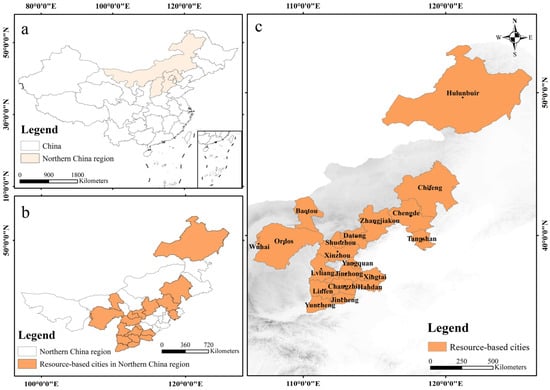
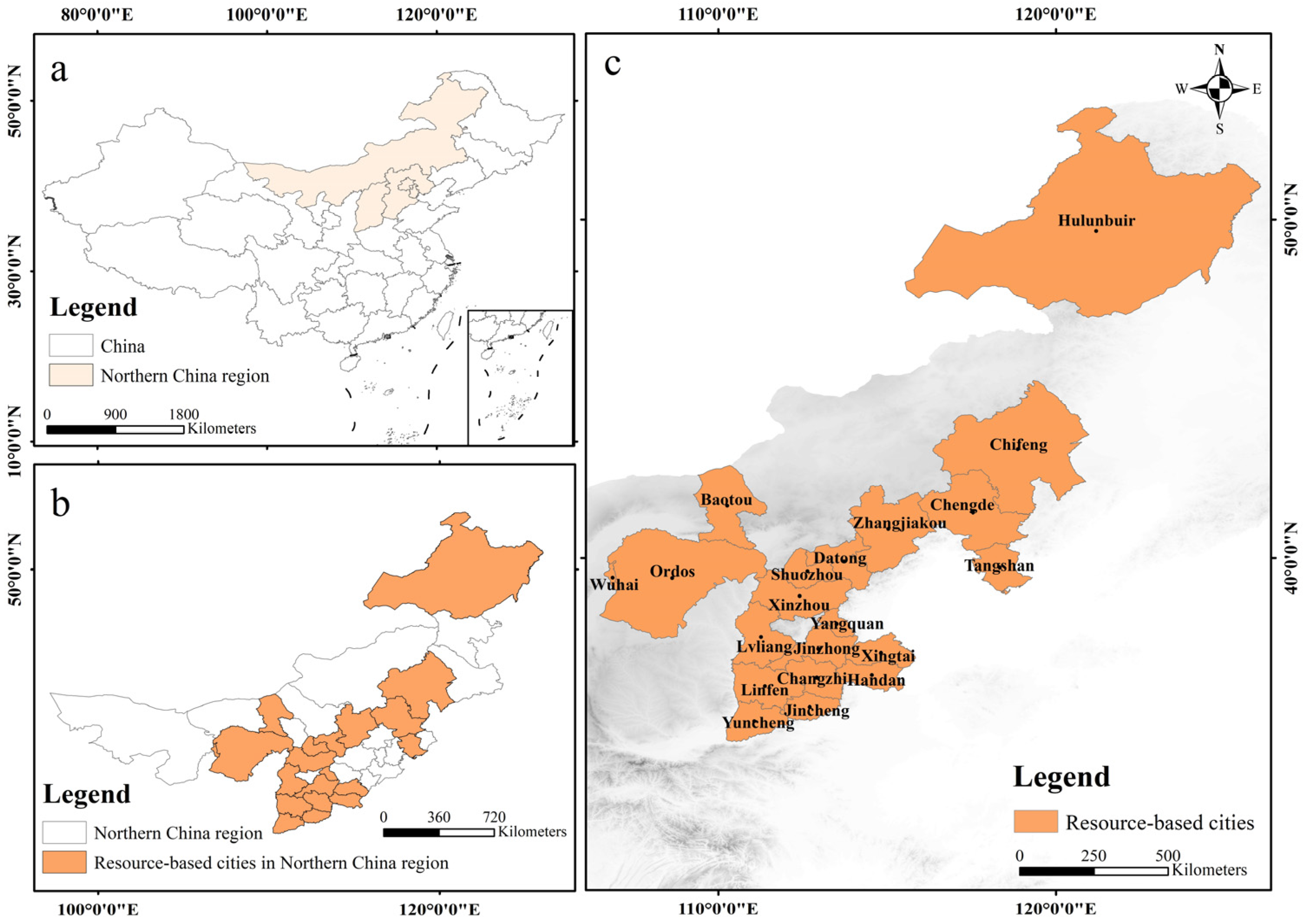
According to the National Plan for Sustainable Development of Resource-Based Cities (2013–2020) issued by the State Council of China, there are 20 resource-based cities in Northern China, including Zhangjiakou, Chengde, Tangshan, Xingtai, Handan, Datong, Yangquan, Changzhi, Jincheng, Shuozhou, Jinzhong, Yuncheng, Xinzhou, Linfen, Lüliang, Baotou, Wuhai, Chifeng, Ordos, and Hulunbuir. Among these cities, three are classified as growing cities, fourteen as mature cities, one as a declining city (Wuhai), and two as regenerating resource-based cities. The spatial distribution of the study area is shown in Figure 1.
Figure 1.
Location of the study area. (a) Location of Northern China; (b) Distribution of resource-based cities in Northern China; (c) Detailed map of the resource-based cities.
2.2. Research Methods
2.2.1. Measurement of Human Settlement Resilience
- (1)
- Construction of the Indicator System
Based on Wu Liangyong’s theoretical framework of human settlement science, this study constructs a criteria layer framework consisting of five subsystems, natural, human, living, social, and support, with reference to related studies [37,38,42,43,44]. Guided by resilience theory, specific indicators are then selected according to their conceptual relevance and positive or negative attributes. Finally, considering data availability and the regional characteristics of Northern China, the indicator layers are determined to establish a comprehensive evaluation index system for measuring the human settlement resilience of resource-based cities in Northern China (Table A1).
The natural system serves as the foundation of human settlement environments, encompassing natural and ecological conditions and maintaining the stable balance among subsystems [5]. Based on the connotation of the natural system and relevant literature, indicators related to water resources, climate, and pollutants were selected to characterize natural resilience. The human system emphasizes a people-centered perspective, in which individual needs and behaviors constitute the internal driving force of human settlement development, while humans are also the residents of the human settlement environment and the bearers of natural disasters and systemic risks [38]. Accordingly, urban population density, sex ratio, the proportion of employees in resource-based industries, and the number of students enrolled in regular higher education institutions per 10,000 people were selected to represent human resilience. The living system is an important subsystem reflecting the development quality of the human settlement environment, covering both living spaces and supporting infrastructure required for human habitation [5]. Therefore, indicators such as built-up area, residential land area, and Per capita park green space area were selected to characterize living resilience. The social system constitutes key support for the human settlement environment and involves multiple dimensions, including economic development, income and expenditure levels, employment conditions, and technological progress [38]. Based on this, per capita GDP, per capita disposable income of urban residents, and R&D expenditure as a percentage of fiscal expenditure were selected to represent social resilience. The support system provides fundamental guarantees for human settlement, including various types of infrastructure, and plays a crucial role in maintaining the stability and coordination of the overall human settlement environment [5]. Therefore, indicators such as internet users per 10,000 population, per capita urban road area, and per capita daily domestic water consumption were selected to characterize supporting resilience.
- (2)
- Indicator normalization processing
Due to differences in the dimensions and magnitudes of the indicators, the range normalization method was employed to process the original indicator values. The formula is as follows [42]:
In the formula: aij is the original index value of human settlement environment resilience, amax is the maximum value in the index, amin is the minimum value in the index, n represents the number of indicators, Aij is the normalized index value, bmax is the maximum value in the difference between the original index value and the average value, and bmin is the minimum value in the difference between the original index value and the average value.
- (3)
- Measurement of Human Settlement Resilience Level
The entropy method was used to obtain objective weights of the indicators, while the Analytic Hierarchy Process (AHP) was employed to derive subjective weights. In this study, the comprehensive weight of each indicator was first calculated as the average of the weights obtained from the entropy method and AHP. Subsequently, based on these weights, the human settlement resilience level of resource-based cities was calculated [20].
2.2.2. Dynamic Evolution of Resilience
Kernel density estimation (KDE) is a non-parametric method used to estimate the probability density function of a random variable by constructing a continuous density curve. It effectively characterizes the distributional features of a variable, including its location, shape, and dispersion [29]. This study employs three-dimensional kernel density estimation to analyze the spatial distribution characteristics of human settlement resilience in resource-based cities across Northern China, subsequently examining its dynamic evolution trends. The calculation formula is as follows [45]:
where the kernel function K(·) also serves as a weighting function, where N denotes the sample size and h represents the smoothing parameter (bandwidth).
2.2.3. Identification of Obstacle Factors
The obstacle degree model can identify key factors that restrict the development of a system, which is helpful for analyzing the major obstacle factors affecting human settlement resilience. Referring to related studies [46], this study constructs an obstacle degree model of human settlement resilience to explore the main obstacle factors influencing resilience improvement.
where Pj represents the obstacle degree of a single indicator to the resilience of the human settlement system, Zj denotes the standardized value of the indicator calculated using the range normalization method, m = 27, and Vj indicates the obstacle degree of each subsystem to the resilience of the human settlement system.
2.3. Data Resources
Based on data availability and completeness, this study utilizes social statistical, meteorological, and other related datasets from 2012 to 2022. Social statistical data are obtained from the “China City Statistical Yearbook (2013–2023)”, the China Urban Construction Statistical Yearbook, and statistical yearbooks of relevant provinces and cities. Missing data are supplemented using the linear interpolation method. Meteorological data, including temperature and precipitation, are obtained from the National Meteorological Science Data Center.
3. Results
3.1. Temporal Evolution Characteristics of Resilience
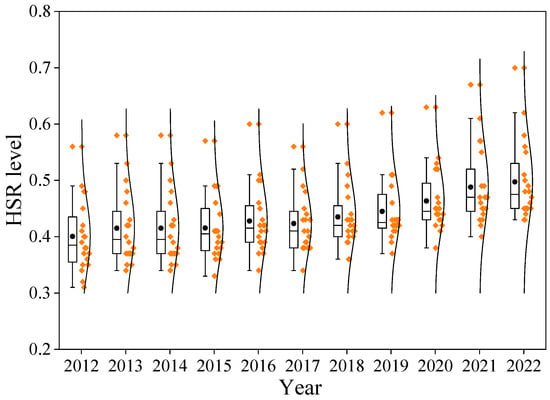
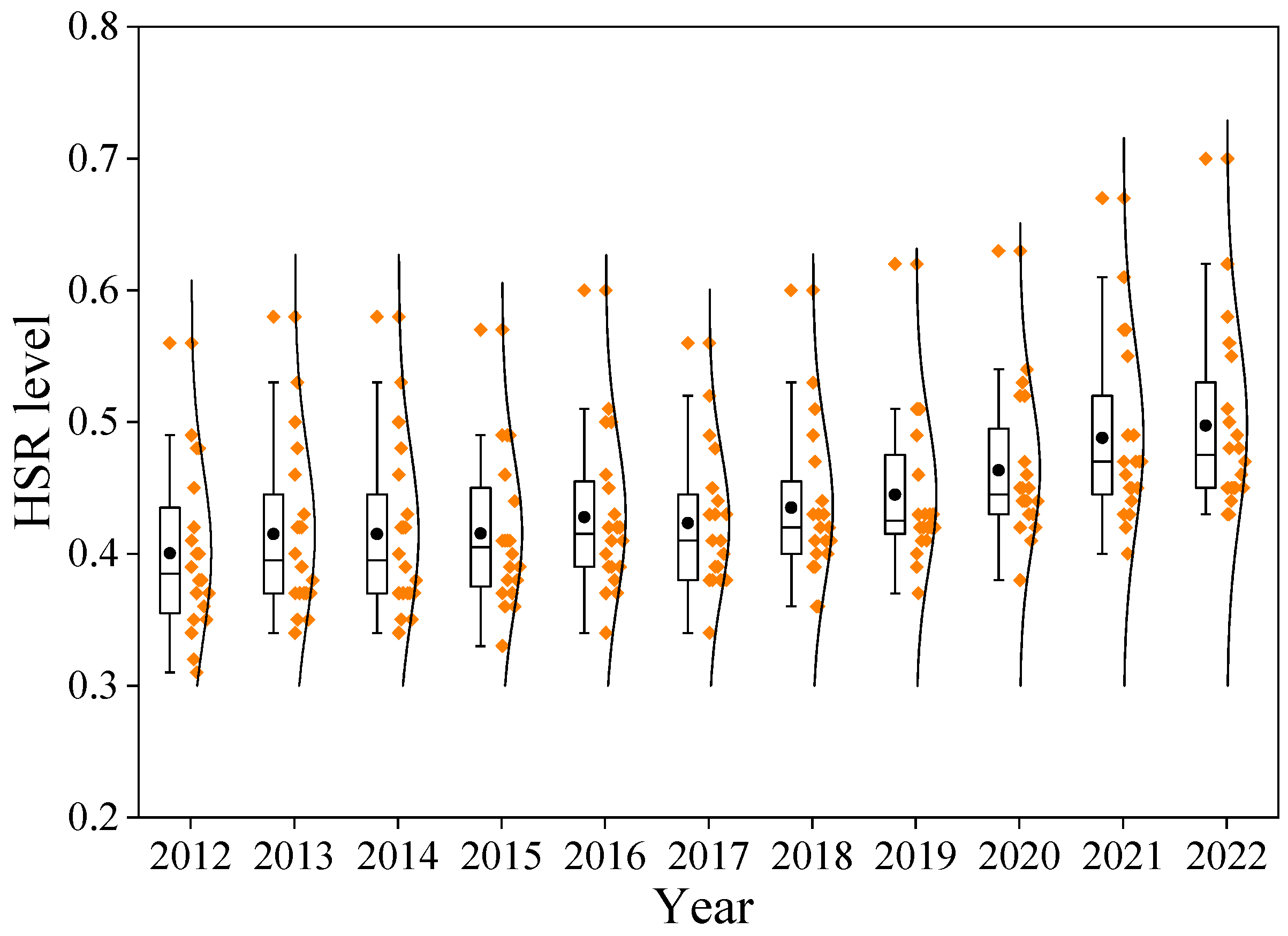
This study analyzes the temporal evolution characteristics of human settlement resilience in resource-based cities in Northern China. As shown in Figure 2, the 20 spatial units generally exhibit a clustered box distribution, indicating that the resilience levels of most resource-based cities remain within a similar range. However, several cities display relatively large dispersion, suggesting notable variations in resilience among some cities. From 2012 to 2022, the overall level of human settlement resilience in resource-based cities in Northern China has increased. Meanwhile, the absolute differences in resilience levels among cities have widened, indicating that the imbalance in the development of human settlement resilience across resource-based cities within the region has become more pronounced.
Figure 2.
Box Plot of human settlement resilience(HSR) in resource-based cities in Northern China from 2012 to 2022. Note: The black dots represent the mean values; the orange dots represent the sample data.
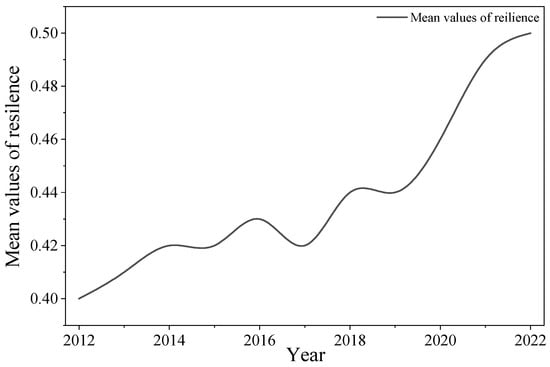
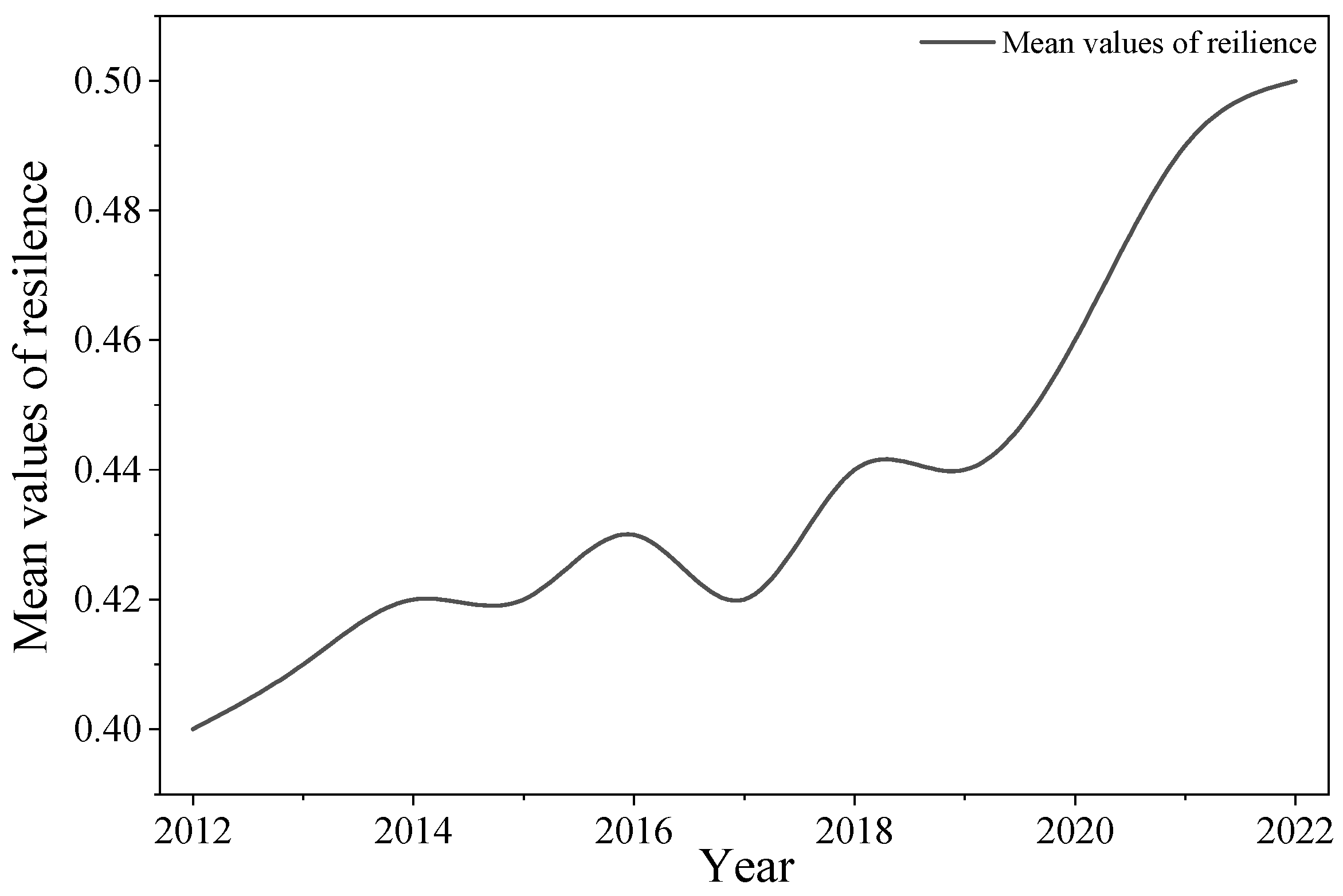
Figure 3 further shows that the resilience of resource-based cities in Northern China exhibited a continuous upward trend from 2012 to 2022, with an overall increase of 25%, indicating a significant improvement during the study period. From a stage perspective, the average resilience value increased from 0.40 to 0.43 between 2012 and 2016, representing 7.50% growth. Among these, urban residents’ per capita disposable income, average wages of employees, and the number of internet users per 10,000 people all increased by more than 80%, thereby contributing to an improvement in resilience levels. From 2016 to 2019, the average value rose from 0.43 to 0.44, with an increase of 2.33%. During this period, the average wage of employees, the number of internet users per 10,000 people, and per capita urban consumption levels all increased by more than 45%. From 2019 to 2022, the growth rate of resilience accelerated significantly, with the mean value increasing from 0.44 to 0.50, representing an increase of 13.64%. Among these, per capita GDP, water resource availability per unit area, and average wages of employees all increased by more than 47%. Most indicators continued to improve, leading to the highest growth rate across the three periods. This indicates that the construction of human settlement resilience in resource-based cities in Northern China has entered a critical stage of quality improvement and efficiency enhancement.
Figure 3.
The temporal changes in the resilience of the human settlement in resource-based cities in Northern China from 2012 to 2022.
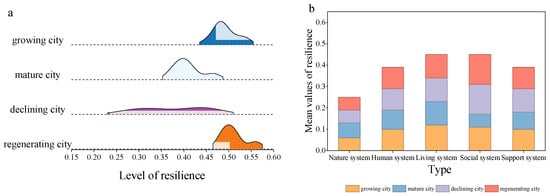
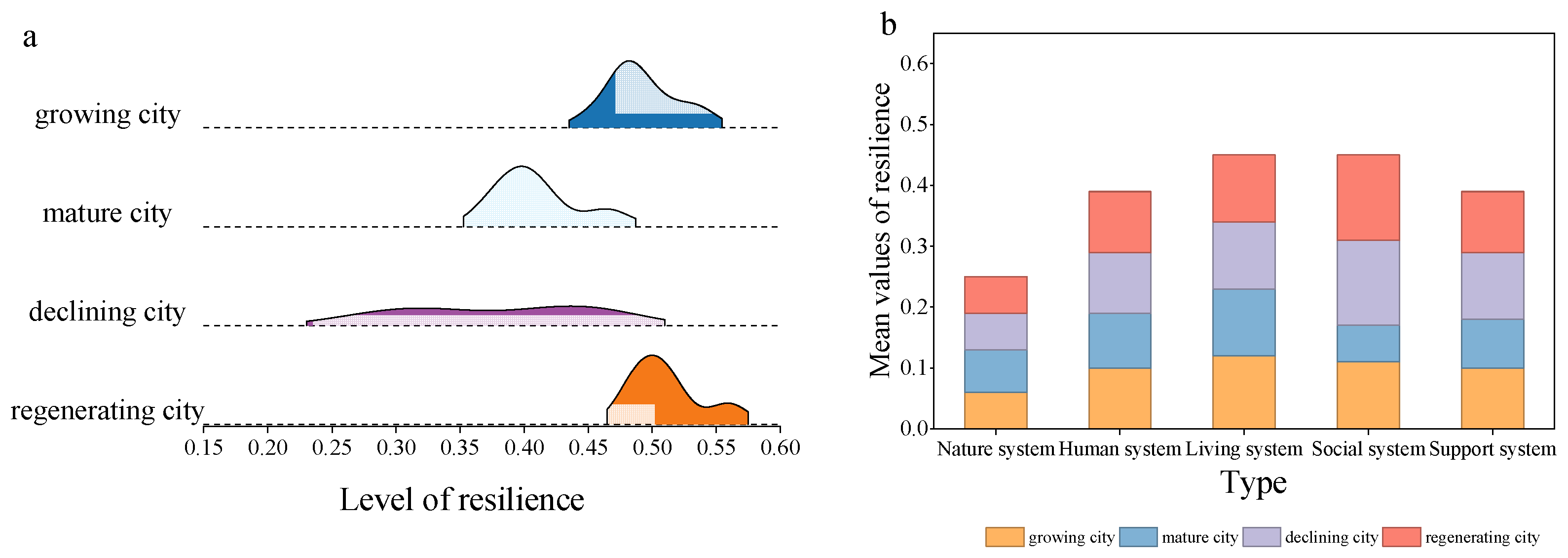
The human settlement resilience characteristics of the four types of resource-based cities in Northern China from 2012 to 2022 show significant differences (Figure 4a). Regenerating cities exhibit the highest mean resilience (0.51), followed by growing cities (0.49), mature cities (0.41), and declining cities (0.38). The peak of the resilience distribution for growing cities is relatively high and steep, with the curve shifted to the right, indicating a relatively high resilience level and a concentrated distribution of resilience values. In contrast, mature cities have a lower and flatter peak, reflecting lower resilience levels and relatively small differences among cities. Declining cities show the lowest peak and the widest span of the density curve, suggesting lower resilience levels and greater variability compared to the other three city types. Regenerating cities exhibit the highest peak and a right-shifted curve, indicating a high resilience level but also substantial differences in resilience among individual cities.
Figure 4.
Changes in human settlement resilience of different types of cities in Northern China from 2012 to 2022. (a) Mean value of human settlement resilience of different types of cities in Northern China from 2012 to 2022; (b) Subsystem indices of human settlement resilience of different types of cities in Northern China from 2012 to 2022.
3.2. Dynamic Evolution Characteristics of Resilience Levels
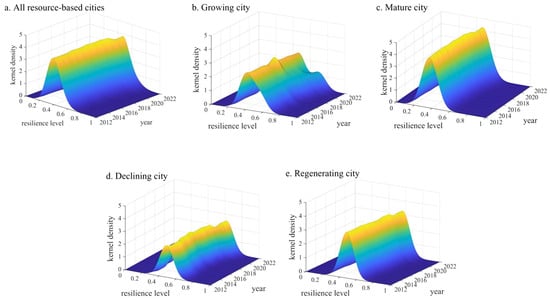
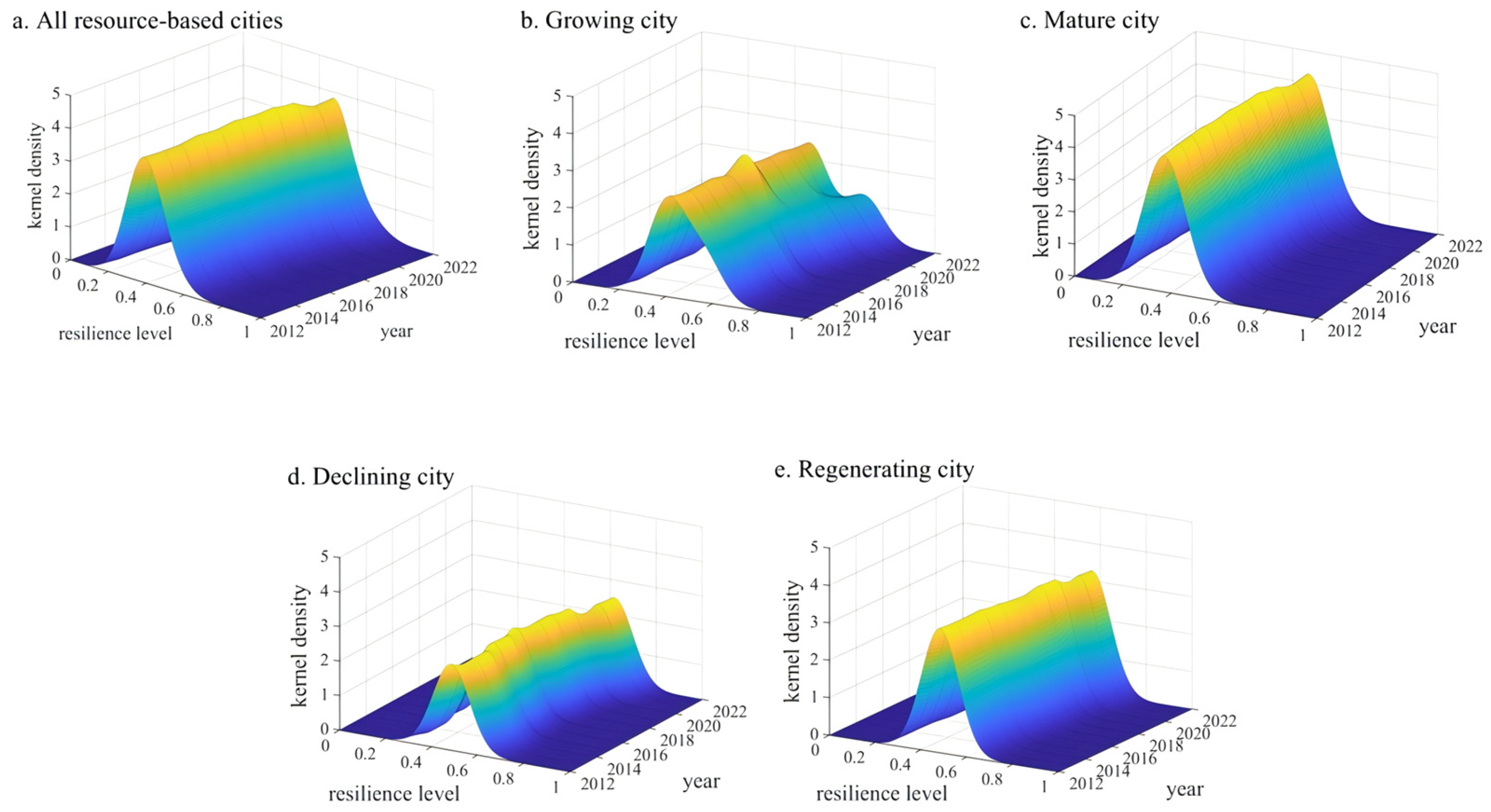
The dynamic evolution characteristics of human settlement resilience in resource-based cities of Northern China were analyzed using three-dimensional kernel density estimation. Overall (Figure 5a), the main peak of the kernel density curve increased and shifted to the right from 2012 to 2022, indicating a general upward trend in human settlement resilience. This result further confirms the conclusions obtained from the temporal analysis above.
Figure 5.
Three-dimensional kernel density map of human settlement resilience in resource-based cities in Northern China from 2012 to 2022. (a) Three-dimensional kernel density changes in human settlement resilience in all resource-based cities from 2012 to 2022; (b) Three-dimensional kernel density changes in human settlement resilience in growing city from 2012 to 2022; (c) Three-dimensional kernel density changes in human settlement resilience in mature city from 2012 to 2022; (d) Three-dimensional kernel density changes in human settlement resilience in declining city from 2012 to 2022; (e) Three-dimensional kernel density changes in human settlement resilience in regenerating city from 2012 to 2022.
Specifically, the main peaks of all four types of cities exhibit a rightward shift, indicating an overall improvement in human settlement resilience across different city types. For growing cities (Figure 5b), the peak height increases and a right-skewed tail appears, suggesting that disparities in resilience changes among cities emerged during the process of improvement. For mature cities (Figure 5c), the peak height shows a slight increase, indicating a gradual improvement in human settlement resilience. Declining cities (Figure 5d), which are relatively few in number, also exhibit a slight increase in peak height, suggesting an overall upward trend in resilience levels. For regenerating cities (Figure 5e), the peak height increases and the distribution curve becomes narrower, indicating a relatively rapid improvement in human settlement resilience.
3.3. Spatial Differentiation Characteristics of Resilience
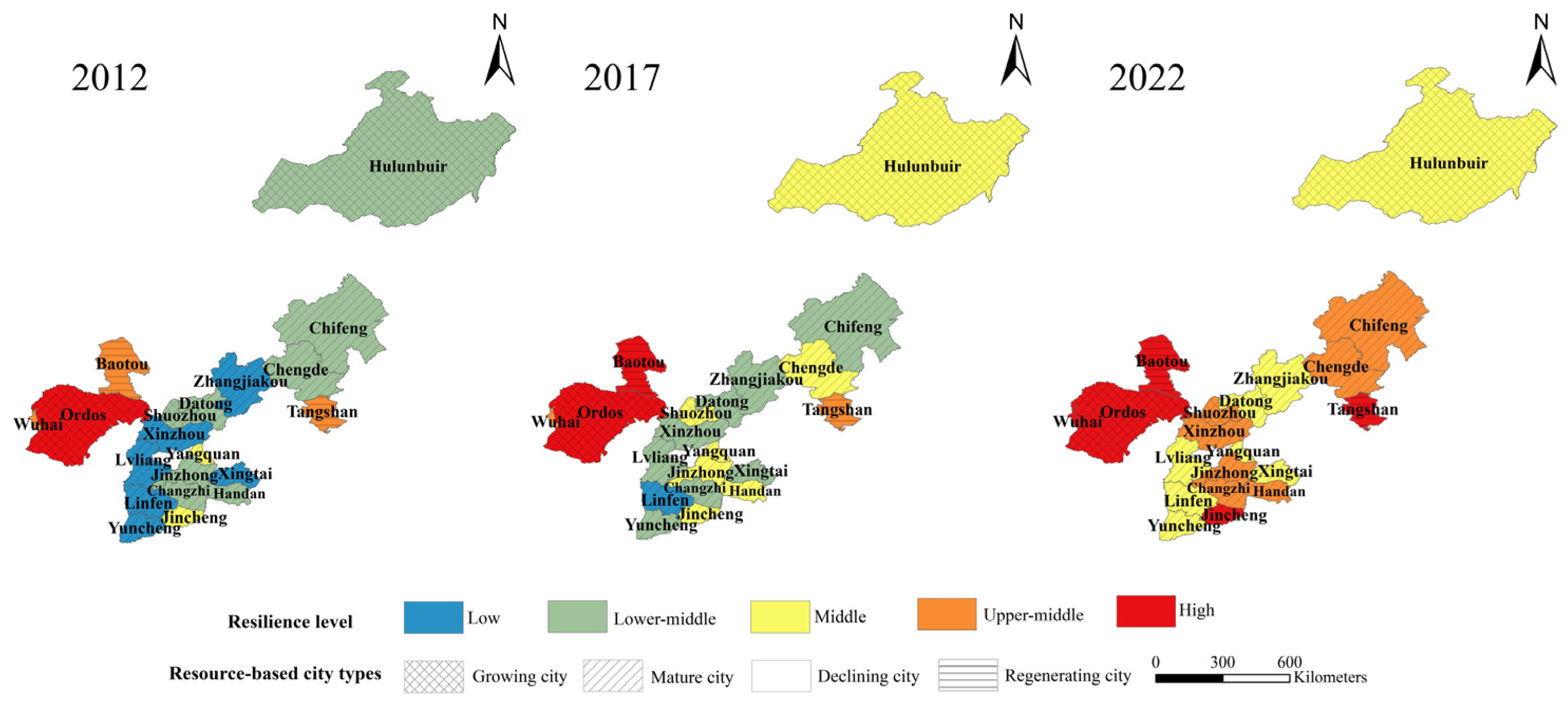
To reveal the spatial pattern of high and low resilience levels, the natural breaks method was applied to divide resilience values into five categories: low [0.21, 0.26], lower-middle [0.31, 0.36], middle [0.37, 0.41], upper-middle [0.42, 0.52], and high [0.53, 0.70].
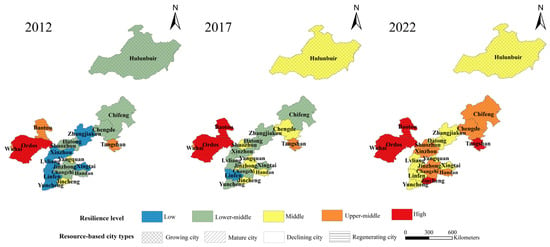
Significant spatial differences exist in the resilience levels of resource-based cities in Northern China (Figure 6). In 2012, lower-middle areas dominated the spatial distribution of resilience. The low and lower-middle areas were mostly concentrated in growing and mature cities, whereas the middle and upper-middle areas were spatially scattered, with the upper-middle areas primarily appearing in regenerating cities. High-value areas were limited to a single growing city, Ordos. From 2012 to 2017, human settlement resilience was mainly concentrated in the lower-middle and middle ranges, indicating overall improvement in resilience. Growing cities such as Hulunbuir and Shuozhou improved from lower-middle to middle level, while Ordos shifted from high to upper-middle level. Mature cities such as Zhangjiakou and Xinzhou evolved from low to lower-middle level. The declining city of Wuhai remained at the upper-middle level, while the regenerating city of Baotou shifted from the upper-middle value range to the high-value range. From 2017 to 2022, resilience levels further shifted toward middle-value areas and upper-middle area, forming contiguous distributions including both growing and mature cities. Low and lower-middle areas disappeared, while upper-middle areas were distributed in mature cities, and high-value areas were observed in mature, declining, and regenerating cities.
Figure 6.
Spatial distribution of human settlement resilience in resource-based cities in Northern China.
The human settlement resilience levels of resource-based cities in Northern China all showed varying degrees of increase (Table 1). At the three time points of 2012, 2017, and 2022, the low-value areas continuously decreased; the lower-middle areas decreased significantly in 2022, while the middle and high-value ranges continued to increase. The upper-middle value range first declined and then rose. In 2012, the low-middle areas were the most numerous, totaling eight, followed by lower-middle areas; middle areas accounted for two, upper-middle areas for three, and high-value areas were limited to one. In 2017, the number of cities in the low-value range decreased significantly, while those in the middle and high-value ranges increased, and the number of cities in the upper-middle value range declined. In 2022, there were no cities in the low-value or lower-middle value ranges; the middle category became the most prevalent, followed by upper-middle areas, and high-value areas increased.
Table 1.
Spatial evolution of the human settlement resilience in resource-based cities in Northern China during 2012, 2017, and 2022.
3.4. Analysis of Obstacle Factors to Human Settlement Resilience in Resource-Based Cities
3.4.1. Analysis of Obstacle Levels at the Criteria Layer
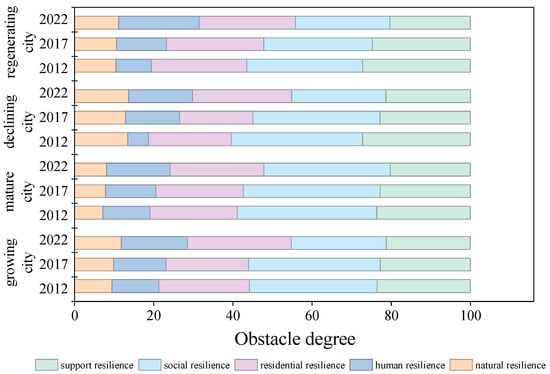
Based on the obstacle degree model, the criteria layer obstacle degrees of human settlement resilience in different resource-based cities in Northern China were calculated (Figure 7). Social resilience is the core obstacle to the human settlement resilience of all types of resource-based cities in Northern China, while economic development remains an important limiting factor. Specifically, in 2012, social resilience dominated the resilience obstacles for all four city categories. Among them, mature cities exhibited the highest obstacle degree (35.26%), followed by growing cities (32.28%) and declining cities (33.16%), while regenerating cities had a relatively lower value (29.22%), but all remained above 29%. Meanwhile, the obstacle degrees of support resilience and living resilience were maintained above 20% and 18%, respectively, whereas the obstacle degrees of human and natural resilience were relatively low. In 2017, social resilience remained the main obstacle to the development of all city types. Growing cities (33.31%) and mature cities (34.57%) still had high social resilience obstacle degrees, while declining cities (32.14%) and regenerating cities (27.43%) showed a notable decrease. At the same time, the obstacle degrees of living and support resilience declined, while those of natural and human resilience remained relatively low. In 2022, the obstacle degree of social resilience decreased significantly in most cities. It declined to 24.01%, 23.78%, and 23.87% in growing, declining, and regenerating cities, respectively, with residential resilience becoming the main constraint in these three city types. However, in mature cities, social resilience (31.96%) remained the dominant obstacle factor.
Figure 7.
Barrier of degree of human settlement resilience in different types of resource-based cities in Northern China from 2012 to 2022 (%).
Analyzed by city type, different resource-based cities show distinct patterns in the improvement of human settlement resilience. In growing cities, such as Shuozhou, the obstacle degree of social resilience declined substantially during the study period. Economic growth promoted infrastructure development and improvements in social security systems, thereby gradually reducing the constraining effect of social resilience on urban development. In mature cities, social resilience continued to exert long-term constraints on resilience improvement, particularly by imposing considerable pressure on industrial restructuring and public service provision. Nevertheless, its obstacle effect gradually weakened over time, and the overall development trend remained positive. In contrast, for declining cities, social resilience remained the core obstacle in 2012 and 2017, as these cities were still in the stage of resource depletion or early transformation, facing challenges such as sluggish economic growth, tight employment opportunities, and reduced household incomes. By 2022, living resilience became the primary obstacle subsystem in declining cities, reflecting their entry into a deepening transformation stage, with issues such as aging residential areas and deteriorating infrastructure becoming increasingly prominent. In regenerating cities, the obstacle degree of social resilience also decreased significantly. Efforts in industrial adjustment and the cultivation of emerging industries contributed to the promotion of sustainable urban development.
3.4.2. Analysis of Obstacle Factors at the Indicator Layer
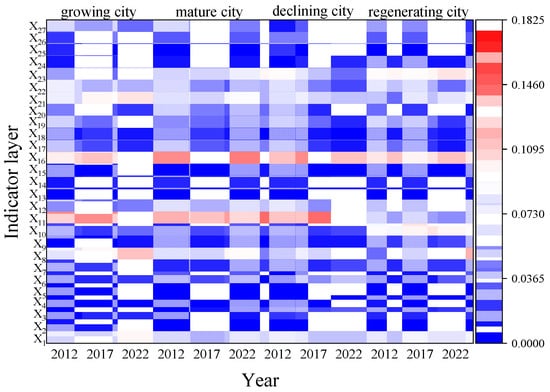
To accurately identify the main factors constraining the human settlement resilience of resource-based cities in Northern China, this study calculated the obstacle levels of each indicator based on the obstacle degree model and plotted heatmaps of indicator-layer obstacle degrees for the four types of resource-based cities in 2012, 2017, and 2022 (Figure 8). In the figure, the closer the color of an indicator block is to red, the higher its obstacle level; the closer it is to purple, the lower the obstacle level. Overall, per capita GDP (X16), built-up area (X11), water resources per unit area (X1), per capita urban road area (X23), proportion of employees in resource-based industries (X8) and R&D expenditure as a percentage of fiscal expenditure (X21) are the key obstacle factors restricting the improvement of human settlement resilience across the four types of cities.
Figure 8.
Heat map of the obstacle degree of the human settlement resilience indicator layer in resource-based cities in Northern China from 2012 to 2022.
Per capita GDP (X16) remained at a relatively high obstacle level over the long term, while R&D expenditure as a percentage of fiscal expenditure (X21) continuously increased, rising from 6.42% in 2012 to 8.80% in 2022, making social resilience a persistent constraint on the enhancement of human settlement resilience in resource-based cities. Although its obstacle degree slightly decreased from 12.53% in 2012 to 12.48% in 2022, the overall level remained high, exerting a continuous limiting effect. The obstacle degree of support resilience was also relatively high, reflecting its connection to infrastructure provision capacity. The obstacle degree of per capita urban road area (X23) decreased slightly from 7.71% to 7.41%, showing little change. Notably, in 2022, living resilience became the core obstacle for growing, declining and regenerating cities, mainly due to the marked increase in the obstacle degree of built-up area (X11), which rose from 10.29% to 11.40%, highlighting its constraining role. In contrast, the obstacle degrees of natural and human resilience were relatively lower overall but showed an upward trend. Specifically, the obstacle degree of water resources per unit area (X1) increased from 6.44% to 7.41%, and proportion of employees in resource-based industries (X8) rose noticeably from 6.42% to 10.05%, indicating strengthened limiting effects.
From the perspective of city type differences, the dominant effects of the main obstacle factors also exhibit clear heterogeneity among different types of cities. Among them, per capita GDP (X16) imposed the most pronounced constraining effect on mature-type cities, reflecting that the economic development level remains a major barrier to resilience improvement. For declining cities, built-up area (X11) became the primary obstacle, indicating challenges related to inefficient spatial expansion and functional aging. Water resources per unit area (X1), proportion of employees in resource-based industries (X8) and R&D expenditure as a percentage of fiscal expenditure (X21) were particularly constraining for growing cities, suggesting that under rapid urbanization and industrialization, the availability of water resources, accumulation of human capital and R&D intensity became key bottlenecks limiting high-quality development. For regenerating cities, per capita urban road area (X23) exhibited the highest obstacle degree, likely reflecting the inability of infrastructure to effectively meet functional demands during the transformation process.
4. Discussion
4.1. Analysis of Stage Differences and Influencing Mechanisms of Human Settlement Resilience in Resource-Based Cities
The evolution of resource-based cities exhibits distinct phased characteristics. The human settlement resilience of resource-based cities in Northern China follows the pattern of “regenerating > growing > mature >declining.” Although this ranking differs from that reported by Jiang et al. [38] for resource-based cities in the Yellow River Basin, both studies consistently indicate that regenerating cities exhibit the highest resilience. This is mainly attributable to their reduced dependence on resource extraction, the gradual shift in pillar industries toward non-resource sectors such as services [47], and generally higher subsystem indices. Growing cities display relatively high resilience in living, social, and support systems, but urban construction still requires improvement. Declining cities show relatively high resilience in social and support systems. Due to long-term resource exploitation, these cities have entered a decline phase, necessitating remediation of historical mining issues, strengthening environmental governance, and actively promoting science and technology innovation industries. Mature cities exhibit high resilience in natural and living systems but low resilience in other subsystems. Enhancing their resilience hinges on upgrading traditional resource industries, cultivating alternative industries, and promoting industrial diversification [48] (Figure 4b). Related studies on urban expansion intensity [49], comprehensive green development levels [50], and environmental risk levels [51] also support the phased evolution of resource-based cities. Resource-based cities differ in resource exploitation and socioeconomic development, requiring tailored policies to break traditional development patterns and strengthen resilience.
The growth rate of human settlement resilience varies significantly across different periods. Since the implementation of the 2013 Plan, resource-based city transformation has been effectively promoted [49]. From 2012 to 2016, the improvement in human settlement resilience was relatively slow. Policy efforts have clearly defined the development direction of resource-based cities, and improvements in residents’ income levels and urban basic service capacity have strengthened social and support resilience. However, as resource-based cities in Northern China remain dominated by heavy industries such as coal and steel, investment in ecological restoration and infrastructure remains relatively limited. Although the benefits of policy implementation have begun to emerge, the overall increase in resilience remains modest. From 2016 to 2019, human settlement resilience exhibited fluctuations. On the one hand, with the gradual advancement of industrial restructuring, employees’ wages and residents’ consumption levels increased, further strengthening social and supporting resilience. On the other hand, under the guidance of the 13th Five-Year Plan, measures such as clean coal production and steel industry restructuring were progressively implemented, leading to improvements in urban environmental governance capacity and enhancing cities’ ability to cope with pressures on human settlements. From 2019 to 2022, the growth rate of human settlement resilience further accelerated. The state increased special financial support for ecological restoration in resource-based cities, including initiatives such as ecological protection and high-quality development in the Yellow River Basin, governance of coal mining subsidence areas, and community governance initiatives, all of which contributed to environmental improvement. Meanwhile, improvements in residents’ quality of life, growth in per capita GDP, and enhanced water resource availability have strengthened both natural and social resilience. The proposal of the “dual carbon” goals also facilitated the accelerated spatial and industrial restructuring of energy-based cities such as Datong and Ordos. Collectively, these multiple factors jointly promoted the improvement of resilience levels.
The improvement in resilience in resource-based cities is constrained by multiple factors. Among these, unit-area water resources (X1), and built-up area (X11) as two obstacle factors are consistent with the findings of Jiang et al. [38], further confirming their critical role in limiting the development of resource-based cities and also validating the influence of the intensity of science and technology innovation investment on their development. Northern China’s per capita water resources are approximately 335 m3, far below the international severe water scarcity threshold (1000 m3 per person) and unevenly distributed, exacerbating regional water stress. Limitations in built-up areas constrain urban spatial expansion and infrastructure development. Moreover, the infrastructure in resource-based cities often primarily serves resource extraction and processing industries, with resident needs frequently overlooked. Notably, per capita GDP (X16) exhibits the highest obstacle degree, consistent with Chun et al. [52], who identified economic level as the greatest obstacle to green development in coal resource-based cities. Their study also indicates the influence of resource dependence on economic development. These findings further highlight the critical role of economic development level in enhancing the resilience of resource-based cities. Similarly, per capita urban road area (X23) aligns with the obstacles identified by Zhou et al. [53], indicating the importance of road infrastructure for urban development. However, roads in resource-based cities are predominantly designed for resource transportation, resulting in insufficient support for resident mobility. Additionally, resource extraction causes ground subsidence and geological deformation, increasing the difficulty and cost of road construction and maintenance.
4.2. Recommendations for Enhancing Urban Resilience
In response to the significant regional differences in human settlement resilience, it is necessary to accelerate regional integration, promote interaction and collaboration between resource-based cities and between resource-based and non-resource-based cities, and leverage the advantageous geographic location near the Beijing–Tianjin–Hebei region to drive regional development, undertake relevant industrial transfers, integrate into the regional industrial division of labor, and facilitate industrial upgrading.
To reduce the impact of key obstacle factors on human settlement resilience, several measures are proposed. First, economic development levels, as a constraint on primary enhancing resilience, should accelerate industrial restructuring and transformation while promoting coordinated regional development. Based on the existing resource advantages and industrial foundations, new industries should be cultivated and developed to gradually reduce dependence on resources. Meanwhile, infrastructure construction such as 5G networks and big data centers should be accelerated to promote urban digital transformation and enhance the social system’s capacity to respond to external shocks. Second, urbanization level is an important obstacle factor and should be addressed by promoting urban renewal and optimizing spatial structure and functional layout. Priority should be given to the renovation of aging urban areas, systematic upgrading of old pipelines for water supply, drainage, electricity, gas, and heating, improving the operational efficiency of urban infrastructure, and enhancing the stability and carrying capacity of urban systems under risk shocks. Third, given that water scarcity is a critical limiting factor, water resource allocation should be rationally planned. In Northern China, where water resources are relatively scarce and industrial water demand is high, water resource management should be optimized to ensure adequate supply for urban residents and ecological needs. Fourth, transportation accessibility plays a significant role in resilience improvement. Strengthening transport network infrastructure, optimizing transportation systems through digital technologies, and developing an integrated multi-level transport network can enhance urban carrying capacity and risk response capability. Fifth, resource dependence is also an important obstacle factor. Reducing reliance on resource-based industries is a core objective in the transformation of resource-based cities. It is imperative to accelerate the decoupling from resource dependence, promote the coordinated development of energy and the environment, and advance the upgrading and transformation of the socio-economic structure [49]. Finally, it is necessary to increase investment in scientific and technological R&D, promote breakthroughs in key core technologies, and actively attract high-level innovative talent, so as to provide strong support for the transformation and development of resource-based cities.
4.3. Limitations and Future Directions
By integrating human settlement and resilience theories, this study examined the spatiotemporal evolution of human settlement resilience in 20 resource-based cities in Northern China and identified key factors constraining resilience, providing a reference for policy-making. Nevertheless, several limitations remain. First, this study only includes 20 resource-based cities, resulting in a limited sample size and an uneven distribution among the four city types. In addition, differences in regional characteristics, resource endowments, and development conditions may limit the full identification of interaction and linkage mechanisms among different resource-based cities. Second, due to data constraints, the analysis focused on internal urban structure and development conditions, without considering external influences such as international economic policies or geopolitical factors. Third, the data used in this study only extend to 2022 and do not incorporate the most recent changes. Nevertheless, the data from 2012 to 2022 can still systematically reflect the stage-specific evolutionary patterns and major constraining factors of human settlement resilience in resource-based cities. Future research should include a more representative sample of cities, refine the human settlement resilience indicator framework by incorporating both external shocks and internal response mechanisms, and extend its application to more comprehensive contexts to better identify the key obstacles to improving human settlement resilience. In addition, future studies could further investigate the dynamic evolution and driving mechanisms of human settlement resilience in resource-based cities by integrating the latest statistical data and updated classifications of resource-based city types.
5. Conclusions
This study constructs an evaluation index system for urban human settlement resilience based on five dimensions. It employs multiple methodologies to analyze the spatiotemporal evolution of human settlement resilience in resource-based cities across Northern China, while utilizing an obstacle degree model to identify factors hindering resilience levels. The main conclusions are as follows:
- (1)
- During the study period, the overall level of human settlement resilience in resource-based cities in Northern China showed an increasing trend, with a total growth of 25%. From the perspective of spatial differentiation characteristics, the resilience grades improved, with a significant reduction in low and lower-middle value areas and a marked increase in middle, upper-middle, and high value areas. This indicates that resource-based cities have generally evolved from low to middle–high resilience levels, and that the stability and adaptability of regional human settlement systems have improved. However, regional development imbalances still persist. Meanwhile, the resilience levels of resource-based cities exhibited stage-specific characteristics and differentiated evolutionary paths. Regenerating cities experienced relatively rapid improvement and a reduction in inter-city disparities, with continuous enhancement of system adaptability and self-regulation capacity. Growing cities showed varying resilience improvement rates due to differences in resource endowment, developmental foundation, and urbanization processes. In mature cities, resilience primarily improved steadily, with overall changes being relatively moderate. Declining cities are in a stage of slow improvement, with relatively insufficient driving forces for resilience enhancement.
- (2)
- At the level of obstacle analysis, from the criterion layer perspective, social resilience is the core obstacle subsystem affecting human settlement resilience across all types of resource-based cities in North China. Although its obstacle degree has shown a declining trend, it has remained at a relatively high level over the long term. Among them, social resilience consistently remained the core obstacle in mature cities, whereas the primary obstacle in growing, declining, and regenerating cities shifted from social resilience in 2012 and 2017 to living resilience in 2022. This transition reflects that, with economic and social development, factors such as infrastructure improvement and the enhancement of residential environments have become key determinants affecting resilience improvement. At the indicator level, water resource abundance, resource dependence, economic development level, urbanization rate, transportation accessibility, and R&D intensity are the main obstacle factors affecting the improvement of resilience levels. Moreover, the dominant roles of these key obstacle factors vary significantly across different types of cities. Specifically, economic development level exerted the strongest constraining effect on mature cities; urbanization level became the primary obstacle to resilience improvement in declining cities; water resource abundance, resource dependence, and R&D intensity posed relatively greater constraints on growing cities; whereas transportation convenience had a more pronounced influence on regenerating cities.
Author Contributions
Conceptualization, K.D., M.X., and P.C.; methodology, K.D.; software, K.D., M.Z.; validation, K.D., M.Z.; formal analysis, K.D., M.X., and P.C.; investigation, K.D.; resources, K.D., P.C.; data curation, K.D.; writing—original draft preparation, K.D.; writing—review and editing, M.X., Y.L., and P.C.; visualization, Y.L., Z.W.; supervision, M.X., Y.L.; project administration, M.X.; funding acquisition, Z.W. All authors have read and agreed to the published version of the manuscript.
Funding
This research was funded by [National Natural Science Foundation of China] grant number [42207530].
Data Availability Statement
Data are contained within the article.
Conflicts of Interest
The authors declare no conflicts of interest.
Appendix A
Table A1.
Comprehensive evaluation indicator system of human settlement resilience in resource-based cities in Northern China.
References
- Ma, M.; Tang, J. Nonlinear Impact and Spatial Effect of Tourism Urbanization on Human Settlement Environment: Evidence from the Yellow River Basin, China. J. Clean. Prod. 2023, 428, 139432. [Google Scholar] [CrossRef] [Scilit]
- Wu, L.Y. High Quality Development of Human Settlements and Modernization of Urban and Rural Governance. Hum. Settl. 2019, 4, 3–5. [Google Scholar]
- Song, R.; Li, X. Urban Human Settlement Vulnerability Evolution and Mechanisms: The Case of Anhui Province, China. Land 2023, 12, 994. [Google Scholar] [CrossRef] [Scilit]
- Doxiadis, C.A. An Introduction to the Science of Human Settlements-Ekistics; Hutchinson of London: London, UK, 1968. [Google Scholar]
- Wu, L.Y. Introduction to Sciences of Human Settlements; China Architecture & Building Press: Beijing, China, 2001. [Google Scholar]
- Hasan, S.; Wang, X.; Khoo, Y.B.; Foliente, G. Accessibility and Socio-Economic Development of Human Settlements. PLoS ONE 2017, 12, e0179620. [Google Scholar] [CrossRef] [Scilit]
- Yang, Y.; Xie, A.; Zhou, X.; Cheng, K. Research on the Evolution and Driving Factors of the Coupling Relationship among Tourism Industry, Urbanization and Human Settlements of the Urban Agglomeration in the Middle Reaches of the Yangtze River. PLoS ONE 2024, 19, e0311384. [Google Scholar] [CrossRef] [Scilit]
- Zhang, S.; Lei, J.; Zhang, X.; Fan, L.; Duan, Z. Urban Human Settlement Quality Refined Assessment and Its Spatial Relationship with Human Activity Intensity in Arid Area: A Case Study of Urumqi, China. Habitat Int. 2025, 161, 103422. [Google Scholar] [CrossRef] [Scilit]
- Mathee, A.; Moyes, J.; Mkhencele, T.; Kleynhans, J.; Language, B.; Piketh, S.; Moroe, E.; Wafawanaka, F.; Martinson, N.; McMorrow, M.; et al. Housing Quality in a Rural and an Urban Settlement in South Africa. Int. J. Environ. Res. Public Health 2021, 18, 2240. [Google Scholar] [CrossRef] [Scilit]
- Yan, W.; Peng, B.; Wei, G.; Wan, A. Is There Coupling Effect between Financial Support and Improvement of Human Settlement? A Case Study of the Middle and Lower Regions of the Yangtze River, China. Sustainability 2021, 13, 8131. [Google Scholar] [CrossRef] [Scilit]
- Bastani, M.; Hashemi, S.; Khairabadi, O.; Khavarian-Garmsir, A.R. Assessing the Resilience of Informal Urban Settlements against Earthquakes: A Case Study of Mashhad, Iran. Nat. Hazards 2024, 120, 4507–4526. [Google Scholar] [CrossRef] [Scilit]
- Jin, S.; Zhao, D.; Bao, B. Dynamic Evaluation and Obstacle Factor Diagnosis of Rural Human Settlements Quality in the Dabie Mountains Old Revolutionary Base Area under the Background of Rural Revitalization. Habitat Int. 2025, 156, 103256. [Google Scholar] [CrossRef] [Scilit]
- Qin, Y.; Wang, L.; Yu, M.; Meng, X.; Fan, Y.; Huang, Z.; Luo, E.; Pijanowski, B. The Spatio-Temporal Evolution and Transformation Mode of Human Settlement Quality from the Perspective of “production-Living-Ecological” Spaces—A Case Study of Jilin Province. Habitat Int. 2024, 145, 103021. [Google Scholar] [CrossRef] [Scilit]
- Li, H.; Wang, Y.; Chen, W.; Li, H.; Tian, Y.; Chen, R. Adaptability Evaluation of Human Settlements in Chengdu Based on ArcGIS. Sustainability 2024, 16, 1989. [Google Scholar] [CrossRef] [Scilit]
- Yang, X.; Wang, C.; Chen, X. Research framework and prospects for the adaptability of human settlement space in natural tourist destinations. J. Nat. Resour. 2025, 40, 2195. [Google Scholar] [CrossRef] [Scilit]
- Liu, H.; Li, X.; Guan, Y.; Li, S.; Sun, H. Comprehensive Evaluation and Analysis of Human Settlements’ Suitability in the Yangtze River Delta Based on Multi-Source Data. Int. J. Environ. Res. Public Health 2023, 20, 1354. [Google Scholar] [CrossRef] [Scilit] [PubMed]
- Xiao, L.; Xiang, J.; Liu, X.; Zhao, L.; Li, Y.; Chen, S. Unveiling Scale Effects in Human Settlement Environment Suitability through a Novel Multi-Factor Weighting Approach. Sci. Rep. 2026, 16, 6952. [Google Scholar] [CrossRef] [Scilit] [PubMed]
- Xu, L.; Yang, X.; Chen, D.; Sornette, D.; Prishchepov, A.V.; Ding, S.; Pang, W.; Suryanto Pribadi, K.; Di, B.; Wang, X. Global Coastal Human Settlement Retreat Driven by Vulnerability to Coastal Climate Hazards. Nat. Clim. Change 2025, 15, 1060–1070. [Google Scholar] [CrossRef] [Scilit]
- Chen, Q.; Zhang, K.; Zhang, G.; Zhang, M. Vulnerability Assessment on Human Settlement Environment of Coastal Towns with Entire-Array-Polygon Method: Evidence from Ninghai, China. Environ. Dev. Sustain. 2024, 27, 13191–13214. [Google Scholar] [CrossRef] [Scilit]
- Chen, X.; Rong, F.; Li, S. Driving Force–Pressure–State–Impact–Response-Based Evaluation of Rural Human Settlements’ Resilience and Their Influencing Factors: Evidence from Guangdong, China. Sustainability 2024, 16, 813. [Google Scholar] [CrossRef] [Scilit]
- Hayes, W.M.; O’Shea, B.J.; Pierre, M.A.; Wilson, A.; Bicknell, J.E. Bird Communities across Different Levels of Human Settlement: A Comparative Analysis from Two Northern Amazonian Ecoregions. Sci. Total Environ. 2023, 903, 166535. [Google Scholar] [CrossRef] [Scilit]
- Kumar, A.; Kumar, R.; Sharma, P.; Huang, Y. Editorial: Climate Change Vulnerability, Adaptation, and Human Settlements. Front. Environ. Sci. 2025, 13, 1654854. [Google Scholar] [CrossRef] [Scilit]
- Yang, F.; Xiong, S.; Ou, J.; Zhao, Z.; Lei, T. Human Settlement Resilience Zoning and Optimizing Strategies for River-Network Cities under Flood Risk Management Objectives: Taking Yueyang City as an Example. Sustainability 2022, 14, 9595. [Google Scholar] [CrossRef] [Scilit]
- Holling, C.S. Understanding the Complexity of Economic, Ecological, and Social Systems. Ecosystems 2001, 4, 390–405. [Google Scholar] [CrossRef] [Scilit]
- Almulhim, A.I.; Cobbinah, P.B. Dammam Metropolitan Area: Advancing the Pursuit of Urban Resilience. Habitat Int. 2025, 163, 103499. [Google Scholar] [CrossRef] [Scilit]
- Wang, C.; Dai, R.; Chen, J.; Shen, Y.; Ji, M. Research on the evolution law and promotion pathway of rural human settlements system resilience: A case study of Western Chongqing, a national pilot area for urban-rural integration. J. Nat. Resour. 2022, 37, 645. [Google Scholar] [CrossRef] [Scilit]
- Yao, J.; Chen, G.; Yao, B.; Wu, J. Urban Resilience Assessment Matrix Considering Spatiotemporal Processes: Model Proposal and Application. Sustain. Cities Soc. 2025, 135, 106988. [Google Scholar] [CrossRef] [Scilit]
- Ran, D.; Hu, Q.; Zhang, Z. Spatial–Temporal Evolution, Impact Mechanisms, and Reclamation Potential of Rural Human Settlements in China. Land 2024, 13, 430. [Google Scholar] [CrossRef] [Scilit]
- Zhou, X.; Wang, H.; Duan, Z.; Zhou, G. Exploring the Impacts of Urbanization on Ecological Resilience from a Spatiotemporal Heterogeneity Perspective: Evidence from 254 Cities in China. Environ. Dev. Sustain. 2024, 26, 1–20. [Google Scholar] [CrossRef] [Scilit]
- Zhang, C.; Zhou, Y.; Yin, S. Interaction Mechanisms of Urban Ecosystem Resilience Based on Pressure-State-Response Framework: A Case Study of the Yangtze River Delta. Ecol. Indic. 2024, 166, 112263. [Google Scholar] [CrossRef] [Scilit]
- Gu, T.; Zhao, H.; Yue, L.; Guo, J.; Cui, Q.; Tang, J.; Gong, Z.; Zhao, P. Attribution Analysis of Urban Social Resilience Differences under Rainstorm Disaster Impact: Insights from Interpretable Spatial Machine Learning Framework. Sustain. Cities Soc. 2025, 118, 106029. [Google Scholar] [CrossRef] [Scilit]
- Du, R.; Liu, K.; Zhao, D.; Fang, Q. Urban Amenity and Urban Economic Resilience: Evidence from China. Front. Public Health 2024, 12, 1392908. [Google Scholar] [CrossRef] [Scilit]
- Villagra, P.; Herrmann, M.G.; Quintana, C.; Sepúlveda, R.D. Community Resilience to Tsunamis along the Southeastern Pacific: A Multivariate Approach Incorporating Physical, Environmental, and Social Indicators. Nat. Hazards 2017, 88, 1087–1111. [Google Scholar] [CrossRef] [Scilit]
- Jin, Y.; Liu, Y.; Zhou, G.; Sun, H.; Wu, H. How Does Urban Shrinkage Influence Urban Resilience? Empirical Evidence from Northeast China. Habitat Int. 2026, 167, 103646. [Google Scholar] [CrossRef] [Scilit]
- Wang, Z.; Xu, X.; Zhang, J. Spatial Spillover and Threshold Effect of Green Development Efficiency on Urban Human Settlement Resilience in Yangtze River Delta Urban Agglomeration. PLoS ONE 2023, 18, e0292230. [Google Scholar] [CrossRef] [Scilit]
- Liu, R.; Zhang, L.; Tang, Y.; Jiang, Y. Understanding and Evaluating the Resilience of Rural Human Settlements with a Social-Ecological System Framework: The Case of Chongqing Municipality, China. Land Use Policy 2024, 136, 106966. [Google Scholar] [CrossRef] [Scilit]
- Peng, K.; Xu, C.; He, X. Spatiotemporal Evolution Characteristics of Urban Human Settlement Resilience in Yangtze River Delta. Econ. Geogr. 2023, 43, 74–84. [Google Scholar] [CrossRef]
- Jiang, H.; Zheng, S.; Yang, Q.; Jiang, D.; Yu, J. Change of human settlement resilience and its obstacle degree in resource-based cities in the Yellow River Basin. Resour. Sci. 2024, 46, 2047–2063. [Google Scholar] [CrossRef] [Scilit]
- Qian, Q.; Luo, S. The Dilemma of Land Green Use Efficiency in Resource-Based Cities: A Perspective Based on Digital Transformation. Front. Environ. Sci. 2024, 12, 1339928. [Google Scholar] [CrossRef] [Scilit]
- Liu, Y.; Guo, Y.; Xiao, X.; Fu, R. Classification of economic transformation capability of resource—Based cities and transformation rule from the perspective of resilience. J. Arid Land Resour. Environ. 2023, 37, 48–56. [Google Scholar] [CrossRef]
- Lei, Y.; Chen, Y.; Zhang, L.; Lu, Y. Examining the Coupling Relationship between Industrial Upgrading and Eco-Environmental System in Resource-Based Cities in China. Front. Public Health 2025, 13, 1527306. [Google Scholar] [CrossRef] [Scilit]
- Li, X.; Liu, K.; Tian, S.; Guan, Y.; Liu, H. Evaluation of urban human settlements resilience based on DPSIR model: A case study of the yangtze river delta urban systems. Hum. Geogr. 2022, 37, 54–62. [Google Scholar] [CrossRef]
- Zhong, Y.; Zha, H.Y.; Wu, Z.P. Research on the Quality Evaluation and Spatial Differentiation of Human Settlement Environment in the Changsha-Zhuzhou-Xiangtan Urban Agglomeration. Res. Soil. Water Conserv. 2024, 31, 365–375. [Google Scholar] [CrossRef]
- Yu, X.; Chen, H. Study on Coupling Coordination of the Human Settlement Environment and Tourism Industry in the Yellow River Basin. Front. Environ. Sci. 2022, 10, 1016839. [Google Scholar] [CrossRef] [Scilit]
- Guo, Q.; Teng, X. Coupling and Interaction of Ecological Civilization Subsystems in the Pearl River Delta: A “Production-Living-Ecological” Systems Perspective. Ecol. Model. 2026, 515, 111512. [Google Scholar] [CrossRef] [Scilit]
- Li, X.; Gao, M.; Li, H.; Hou, X.; Tian, S.; Yang, J.; Zhang, X. Spatio-Temporal Evolution and Obstacle Diagnosis of Human Settlements Based on the “Production-Living-Ecological” Functions. Sci. Rep. 2024, 14, 31022. [Google Scholar] [CrossRef] [Scilit]
- Li, Q.; Zeng, F.; Liu, S.; Yang, M.; Xu, F. The Effects of China’s Sustainable Development Policy for Resource-Based Cities on Local Industrial Transformation. Resour. Policy 2021, 71, 101940. [Google Scholar] [CrossRef] [Scilit]
- Sun, H.; Ma, L.; Jin, F.; Huang, Y. Path Dependence or Path Creation of Mature Resource-Based Cities: A New Firm Entry Perspective. J. Geogr. Sci. 2024, 34, 499–526. [Google Scholar] [CrossRef] [Scilit]
- He, T.; Song, H.; Chen, W. Recognizing the Transformation Characteristics of Resource-Based Cities Using Night-Time Light Remote Sensing Data: Evidence from 126 Cities in China. Resour. Policy 2023, 85, 104013. [Google Scholar] [CrossRef] [Scilit]
- Long, R.; Li, H.; Wu, M.; Li, W. Dynamic Evaluation of the Green Development Level of China’s Coal-Resource-Based Cities Using the TOPSIS Method. Resour. Policy 2021, 74, 102415. [Google Scholar] [CrossRef] [Scilit]
- Huang, S.; Ge, J. Are There Heterogeneities in Environmental Risks among Different Types of Resource-Based Cities in China? Assessment Based on Environmental Risk Field Approach. Int. J. Disaster Risk Reduct. 2024, 113, 104810. [Google Scholar] [CrossRef] [Scilit]
- Chun, Y.; Zhang, J.; Han, Y. Green Development Level Assessment and Obstacle Analysis of China’s Coal-Resource-Based Regions. Heliyon 2023, 9, e22495. [Google Scholar] [CrossRef] [Scilit]
- Zhou, Y.; Zhang, Z.; Yu, W.; Chen, X.; Jiang, W.; Xu, Y. Evaluation and Obstacle Factorsof the Green Development Level of China’s Oil and Gas Resource-Based CitiesBased on DPSIR-TOPSIS Model. Pol. J. Environ. Stud. 2025, 34, 1481–1493. [Google Scholar] [CrossRef] [Scilit]

Disclaimer/Publisher’s Note: The statements, opinions and data contained in all publications are solely those of the individual author(s) and contributor(s) and not of MDPI and/or the editor(s). MDPI and/or the editor(s) disclaim responsibility for any injury to people or property resulting from any ideas, methods, instructions or products referred to in the content. |
© 2026 by the authors. Licensee MDPI, Basel, Switzerland. This article is an open access article distributed under the terms and conditions of the Creative Commons Attribution (CC BY) license.