


Abstract
Experiencing the forest landscape in its natural state is one of the factors that positively affect people, especially younger generations exposed to stress. The study assessed the impact of listening to nature sounds and observing forest landscapes on the mood and well-being of young adults exposed to a real forest environment. The experiment consisted of two sessions, allowing us to compare the regenerative effects of observing the forest with full engagement of the senses of sight and hearing, and by listening exclusively to the sounds of nature (birdsong, rustling leaves). The relaxation benefits were compared using psychological tests, including the Positive and Negative Affect Schedule (PANAS), Profile of Mood States (POMS), Restorative Outcome Scale (ROS), and Subjective Vitality Scale (SVS), administered before and after each exposure. The study involved 31 volunteers from Warsaw, the Polish capital (17 women and 14 men, with an average age of 25). A significant improvement in mood (as measured by the POMS) was observed, particularly through a reduction in Anger and Confusion. Both sessions (with and without a blindfold) significantly reduced negative affect (PANAS Negative) and increased restorative outcomes (ROS). However, no significant differences were found between full immersion (sight and hearing) and auditory-only exposure, suggesting that the acoustic layer of the forest environment plays a dominant role in the short-term psychological regeneration of young adults. In summary, these results suggest that both forms of exposure to nature have a relaxing effect on humans. However, full immersion, which involves being in the forest and viewing it, combined with listening to the sounds of nature, provides by far the most benefits for improving the well-being and mood of forest visitors.
1. Introduction
One of the most visible global changes in the world is the ongoing urbanisation of space. With more than 80% of Europe’s population expected to reside in urban areas by 2030, cities play a crucial role in promoting and protecting health and well-being [1]. Urbanisation has brought many benefits to city dwellers, such as increased prosperity and improved social services (education, administration, health, etc.), but it also leads to many adverse phenomena, such as the disappearance of green areas in cities and their suburban areas, increased recreational pressure on existing green areas (parks and forests), and noise pollution. In recent years, there has been increasing talk of the phenomenon of nature deficit, but biophobia is also becoming a worrying phenomenon in many countries, causing nature to be perceived as an object, an area that arouses anxiety, fear, and psychological discomfort, which in turn intensifies the separation of humans from nature [2,3]. With technological and civilizational progress, people are gradually becoming increasingly detached from the natural world, which has very negative consequences for their health, but can also lead to apathy towards the degradation of natural ecosystems and hostility towards nature. Restoring nature to our lives is so important that it forms the core of the title of one of the key documents outlining the framework for European Union policy, namely the Biodiversity Strategy for 2030 [4]. The first pages of this document state that nature is as important for people’s physical well-being and mental health as it is for society’s ability to cope with global changes, health threats, and disasters. The new EU Forest Strategy 2030 also includes provisions stating that nature, especially forests and other wooded areas [5], is essential for the health and well-being of all Europeans. They are places where people can connect with nature and enhance their physical and mental well-being. This is why it is so important to protect forest ecosystems and recognize the therapeutic potential of forests, which will strengthen understanding of their protection and allow people to use forests more consciously. The scientific evidence to date indicates that there is a wealth of evidence supporting the positive impact of contact with nature on both physical and mental health. Contact with forests effectively combats chronic stress and attention fatigue, contributing to the restoration and maintenance of mental health [6,7,8]. Studies by Hartig et al. [9], Korpela et al. [10], Pasanen et al. [11], and Jung et al. [12] showed that people’s moods and positive feelings increase in natural areas. Bielinis et al. [13] and Jung et al. [12] proved that negative emotions were generally lower in the forest than in the city. It has also been proven that contact with nature can improve attention functions in children with ADHD [14,15] and increase self-discipline in children without a diagnosis [16]. Exposure to green spaces has also been shown to reduce neural activity in the prefrontal cortex and alleviate symptoms of depression [17]. There is a link between visiting forests and beneficial immune responses, including the expression of anti-cancer proteins [18]. The psychological benefits of contact with nature, particularly forests, are driven by sensory experiences [19,20,21]. In perceptual terms, a forest is a set of visual (physiognomic, scenic), acoustic and olfactory stimuli that create specific impressions and aesthetic qualities. These impressions result from the relationship between individual elements of the environment and their reception (perception) by the observer. A study by Zhong et al. [21] showed that the number of senses engaged during forest experiences ranged from 1 (39% of respondents) to 6 (9% of respondents), with the most commonly reported senses being sight (86% of surveyed tourists), hearing (36%), and smell (41%). In this study, well-being was correlated with the number of senses engaged. However, survey studies in which participants report a subjective sense of well-being are one thing, while studies in environmental psychology that use standardized tools—such as psychological tests—to examine the impact of the type of immersion in a natural environment on people’s well-being and mood are quite another. The need for research on the role of the senses in providing health benefits stems, among other things, from the fact that existing findings in this area do not allow for a clear answer to the question of whether various stimuli—such as visual and auditory ones—act only synergistically or perhaps independently of one another to affect stress reduction and improving mood. Some researchers [22,23] believe that human well-being is related to the aesthetics of space, and they emphasise the importance of scenic qualities of the landscape for increasing visitor preference. The results of [24,25] show that people highly value experiencing nature and beautiful landscapes during outdoor activities. We have known for quite some time that the visual appearance of a forest is important because people experience the environment visually, and aesthetics is the most fundamental dimension of human-landscape interaction [22,25]. In recent years, there has been a growing number of studies [26] demonstrating that natural acoustic stimuli can be just as effective as visual stimuli in regulating emotions. The field of soundscape has been developing dynamically for over a decade. Soundscape specialists studying the impact of sounds on people argue that natural sounds contribute to health and regenerative effects [27] although they affect people in different ways [28]. For example, the sound of water had the most significant effect on the heart rate and breathing rate of the subjects and the sounds of insects more often evoked feelings of comfort and excitement, while the sounds of birds more often aroused curiosity [28]. Natural sounds such as birdsong, the sound of wind and water, and leaves are relatively easy to access in everyday life, and awareness of their importance as a source of relaxation is steadily increasing [29]. Exposure to natural sounds evokes feelings of relaxation and calm [26,30,31,32], which has been confirmed both in psychological studies and through the analysis of physiological processes [26,33]. However, there are few studies [34] that compare the restorative effects of full immersion in a forest landscape with those of limited immersion with the forest view blocked. There is a lack of controlled experiments conducted in a real forest environment under strict audiovisual conditions. In this context, our research is innovative and necessary because it allows us to better understand the role of the senses in the process of spatial perception. Such comparative research can also provide information useful for the development of forest therapy programs and the promotion of forest bathing, as well as for creating better conditions in urban spaces, offices, schools, and hospitals, where full contact with the forest is impossible. Taking into account the above-mentioned aspects, the purpose of our research was to examine whether the level of health benefits resulting from contact with nature depends on the level of immersion and sensory engagement.
We have adopted three hypotheses:
H1.
Both visual-auditory and purely auditory exposure significantly reduce the negative impact of stress on people’s well-being and mood.
H2.
Full multisensory immersion (visual-auditory) will provide significantly better restorative effects than isolated auditory stimulation.
H3.
The restorative effect of nature sounds, particularly birdsong, is sufficient to induce mental regeneration even without visual contact with the landscape.
2. Materials and Methods
2.1. The Theoretical Framework of the Work
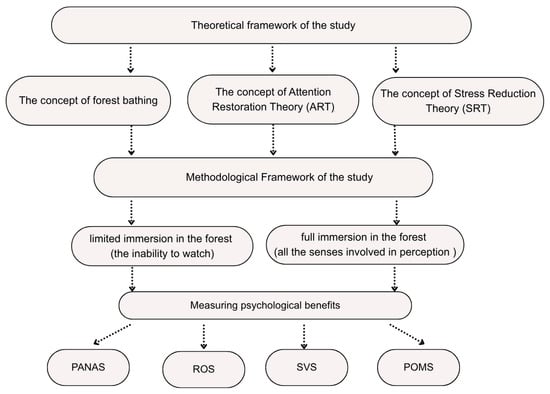
The study was designed as a single-group study with repeated measurements within the same group of subjects. The theoretical framework for this work, on the one hand, is Wilson’s concept of biophilia [35,36], which suggests that humans have an innate tendency to connect with other forms of life and nature. According to this theory, contact with nature is not only pleasant but also essential for mental and physical health. The second theoretical concept is the Attention Restorative Theory, formulated in 1989 by Rachel and Stephan Kaplan. This concept posits that humans have two types of attention: focused (effortful) attention, which is used on a daily basis, and involuntary (effortless) attention, associated with so-called soft fascination [25]. Contact with nature, fascination, admiration, and delight in the observed landscape lead to a decrease in focused attention, associated with mental effort, and an increase in involuntary attention, which in turn promotes relaxation and stress relief, enabling us to effectively combat stress and fatigue. Finally, the third foundation of our research is the Stress Reduction Theory published by Roger Ulrich in 1991 [37], which assumes that contact with nature, even to a small extent (e.g., viewing nature through a window), triggers an automatic and positive emotional response that reduces stress levels. Figure 1 graphically presents the methodology used to obtain information, from theoretical perspectives to methodological strategies.
Figure 1.
Block diagram of the methodology.
This study was ethically reviewed and approved by the Ethical Review Board of the Warsaw University of Life Sciences (No 18/RKE/2025/U). All procedures performed in this study were conducted in accordance with the ethical standards of the Polish Committee of Ethics in Science and with the 1964 Helsinki Declaration and its later amendments.
2.2. Study Sample
A total of 31 individuals participated, including 17 women and 14 men aged 23–27. The participants were students of the Warsaw University of Life Sciences, majoring in agriculture and spatial management, who responded to the invitation to participate in the study. They did not receive any bonus or remuneration for participating in the study. They entered the study consciously and voluntarily. They were familiarised with the procedure of the experiment and informed about complete anonymity and the rules applicable during the experiment (no use of mobile phones, consumption of energy drinks, smoking, or conversations between participants). Participants used pseudonyms.
2.3. Research Location
The survey was conducted on 21 May 2025 in the Kabaty Forest, the largest city forest in Warsaw, which spans more than 900 hectares.
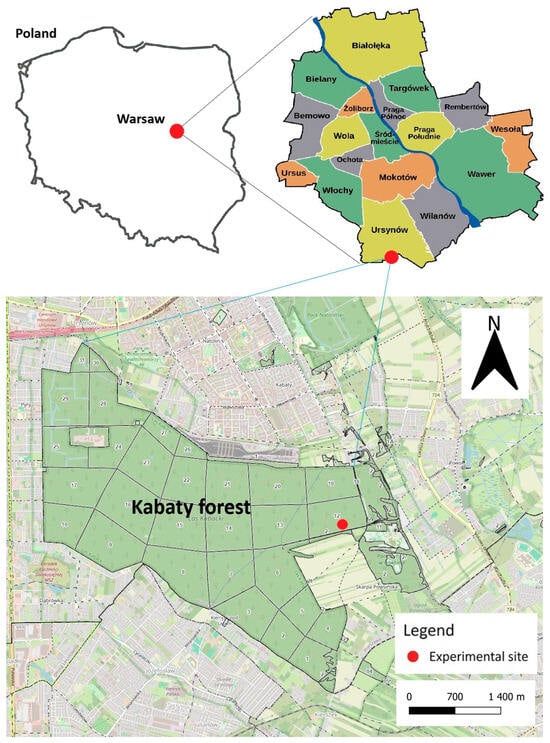
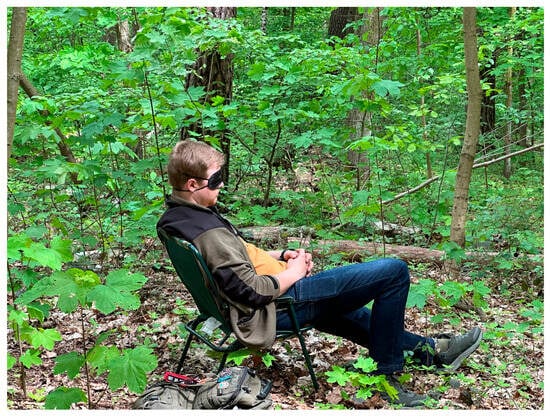
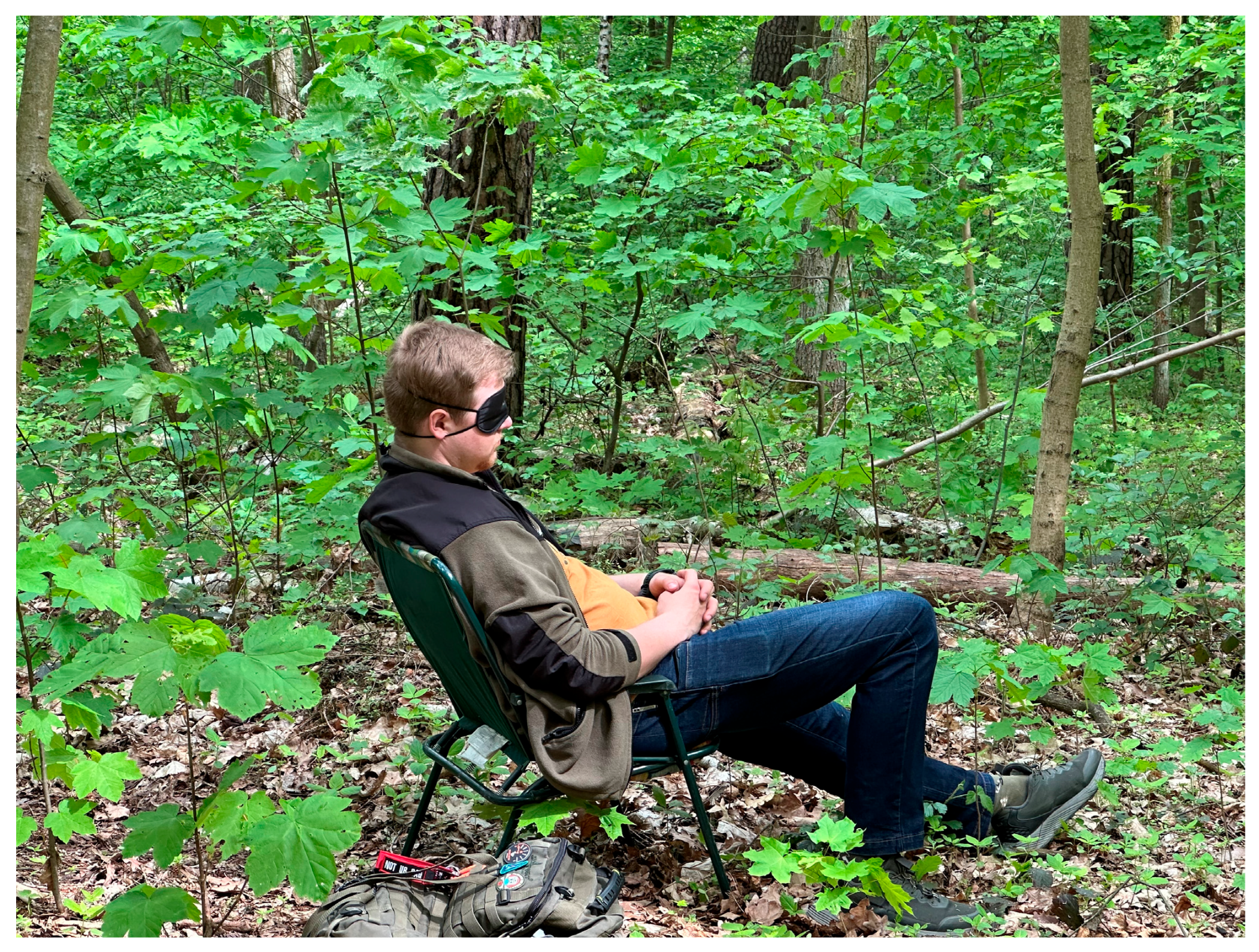
To provide a clear visual context of the experimental environment, the precise location of the exposure sessions is marked with a red dot on the map of Kabaty Forest (Figure 2). Additionally, Figure 3 shows a photograph of the forest landscape as the participants experienced it directly in a sitting position during a session with limited vision.
Figure 2.
Location of the research.
Figure 3.
Participant in the experiment during a period of limited viewing ability.
The area is easily accessible by underground and regular city buses. It is used intensively for recreational, leisure, and educational purposes. It is mainly used by residents of the southern districts of Warsaw. It is also a nature reserve, the largest in the entire Mazovia province. The complex includes the Warsaw Municipal Forests Forest Education Centre, numerous walking and cycling trails, and a clearing with bonfire sites and recreational shelters. In accordance with the law (Nature Conservation Act) [38], walking and cycling are only permitted on designated trails within the reserve. Kabacki Forest is a mixed forest, dominated by oak trees with an average age of 64 years, accompanied by pine, birch, and larch. The undergrowth contains hornbeam, oak, and linden. Species mixing is grouped, and stand density is moderate. The habitat type of the forest is a fresh forest. The meteorological data in effect at the time of the experiment were determined using data from the nearest meteorological station—the Meteo Station of Warsaw Okęcie Airport located at an altitude of 110 m above sea level (location: 52°10′53″ N, 20°52′13″ E). The average daily temperature was 15.0 °C (maximum 23.4 °C, minimum 6.7 °C), the relative humidity was 58%, light or moderate cloud cover was 3.0 (on the okta scale), the atmospheric pressure was 1010.2 hPa, and the wind speed was up to 7.3 m/s. Noise and sunlight levels were controlled during the experiment. Sound and light levels were also measured with an iPhone 16 Pro Max using the LUX Light Meter FREE and Sound Level Analyzer Lite 7.0 applications. Similar applications have been used in other studies [39,40], and they meet standards comparable to those of professional laboratory equipment for sound analysis. Sound and light were measured at each exposure point before, twice during, and immediately after completing the psychological test questionnaire. The average sound level measured with the sound level meter ranged from 37.4 to 52.1 dB. The mean light intensities in the forest ranged from 1790 to 2305 lx. The location of the experiment was carefully chosen due to the relatively low pressure of visitors, and the distance from the recreation clearing and the education centre ensured silence and the absence of anthropogenic sounds.
2.4. Data Collection
2.4.1. Measurement Tools
Four different psychological questionnaires were used in this research experiment. The first was the Positive and Negative Affect Schedule (PANAS), originally developed by Watson et al. [41], which measures two dimensions of emotional affect: positive and negative. This questionnaire consists of 20 items rated on a 5-point Likert scale. The experiment also utilized the Restorative Outcome Scale (ROS), which measures the regenerative effect of the forest environment, and the Subjective Vitality Scale (SVS). In both cases, the Polish versions utilizing a 7-point Likert scale were used, following established protocols in environmental psychology studies within the Polish population [42]. Another psychological test used in the study was the Profile of Mood States (POMS), originally developed by McNair et al. [43], which is a frequently used questionnaire designed to measure six different mood states: tension, depression, anger, fatigue, confusion, and vigour. This study utilized the Polish version, comprising 65 adjectives that describe mood on a 4-point Likert scale. All these questionnaires are characterized by moderate (Cronbach’s α = 0.716) to high (Cronbach’s α = 0.931) internal consistency in the investigated young Polish adult population, demonstrating their suitability for use in this study.
2.4.2. Research Procedure
The study was carried out using a cross-over design to mitigate potential carry-over effects, and the entire group of 31 participants was randomly divided into two smaller groups: Group A, consisting of 15 people (8 women and 7 men), and Group B, consisting of 16 people (9 women and 7 men). For both groups, the initial meeting point was located at the entrance to the Kabacki Forest near the public bus stop. Upon arrival, all group members were briefed on the exact procedure and duration of the experiment, and they were then asked to complete the first set of psychological questionnaires to assess their baseline status (Pre-Test). After entering the forest, the groups were directed to the designated experimental site, and this transition served as a stabilization phase allowing urban stimuli to subside. Upon arrival at the site, participants were provided with black, unisex polyester blindfolds, which were brand new and factory-sealed. Participants sat approximately 5 m apart on folding camping chairs along the path, facing the forest. Group A first participated in the forest stimulation without the use of sight, wearing the blindfolds and remaining inactive for an exposure time of 15 min. Afterward, they were asked to remove their blindfolds and complete the psychological questionnaires again. Following a short break, Group A participants sat and gazed at the forest for another 15 min utilizing all available senses, after which they completed the questionnaires once more. The second group of volunteers (Group B) arrived at the study site at 1:00 PM. The procedure for Group B remained identical, except the order of environmental exposure was reversed according to the cross-over design; these participants first observed the forest landscape with all their available senses for 15 min, filled out the questionnaires, and only then wore the blindfolds for the 15-min limited sensory exposure before completing the final psychological assessment. All instructions and testing procedures were delivered by the same researcher to maintain absolute consistency across all experimental trials.
2.5. Statistical Analysis
All data were coded in Microsoft Excel (Microsoft, Redmond, WA, USA), where mean values and standard deviations (SDs) were calculated. Further statistical analysis was performed using STATISTICA version 13.3 (TIBCO Software Inc., Palo Alto, CA, USA). Data normality was checked with the Shapiro–Wilk test [44], which is recognized as the most powerful and appropriate test for normality in small-to-moderate sample sizes (N < 50). The results confirmed a normal distribution, justifying the use of parametric statistical procedures.
To verify the experimental design, a two-step analysis was conducted. First, an independent samples t-test [45] was used to compare the starting (baseline) scores of Group A and Group B (afternoon). This test is appropriate because it compares the means of two independent, unrelated groups to determine if initial variance exists, seeing if the time of day affected the participants’ initial mood and ensuring baseline homogeneity. Second, a mixed-design ANOVA [46] was used to check for any “order effect” or “carry-over effect” between the two sessions, as this analysis allows for the simultaneous evaluation of both between-subjects and within-subjects factors to confirm that the crossover sequence did not bias the results. A paired t-test [45] was used to compare measurements before and after each exposure, which is the ideal parametric method to evaluate changes within the same subjects measured twice under different conditions. A one-way ANOVA with repeated measures [46] was then used to evaluate the emotional benefits of each session, as it effectively accounts for the correlated nature of repeated measures on the same subjects across multiple experimental conditions. This was followed by Tukey’s HSD post hoc tests [47] to safely identify specific, significant pairwise differences while strictly controlling for Type I error inflation due to multiple comparisons. In all analyses, results with p < 0.05 were considered statistically significant. The internal consistency of the scales was measured using Cronbach’s alpha [48] (Table 1), which provides a standardized metric to verify the reliability and inter-item correlation of the psychometric tools within the study sample. The PANAS Negative and ROSs showed high consistency (0.886 and 0.869), while the SVS showed good consistency (0.788).
Table 1.
Cronbach’s α values for the tests included.
The Total Mood Disturbance (TMD) index was calculated by summing the scores of the negative subscales (Tension, Anger, Depression, Fatigue, Confusion) and subtracting the score of the positive subscale (Vigor).
To justify pooling the data and ensure that demographic factors did not confound the environmental effects, a two-way mixed ANOVA was conducted with Gender (Men vs. Women) as a between-subject factor and Exposure Variant as a within-subject factor.
3. Results
Before evaluating the impact of forest exposure, a preliminary analysis was performed to ensure the validity of the experimental design. An independent samples t-test showed no significant differences in baseline (pre-exposure) scores between Group A and Group B (afternoon) across all psychological scales (p > 0.05). This indicates that the time of day did not significantly influence the participants’ initial psychological state. Additionally, the mixed-design ANOVA revealed no significant interaction between the order of exposure and the restorative outcomes (p > 0.05). This confirms that the 15-min interval was sufficient and that the sequence of sessions did not create a “carry-over effect” that would bias the results.
Furthermore, the exploratory analysis focusing on gender differences revealed no significant main effect of Gender across all psychological scales (e.g., PANAS Positive: F(1,29) = 0.34, p = 0.56; PANAS Negative: F(1,29) = 0.81, p = 0.38; ROS: F(1,29) = 1.12, p = 0.30; POMS TMD: F(1,29) = 0.55, p = 0.46). No significant interaction between Gender and Exposure Variant was detected (p > 0.05 for all interactions). Consequently, because neither the group sequence, arrival time, nor gender introduced significant variance into the baseline or operational scores, the data were pooled to increase statistical power and treated as a single merged sample for all subsequent primary analyses.
3.1. PANAS
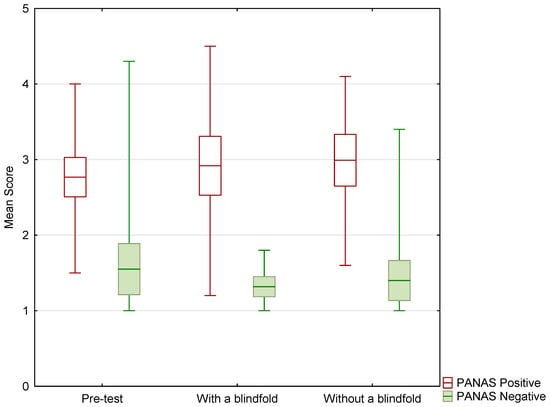
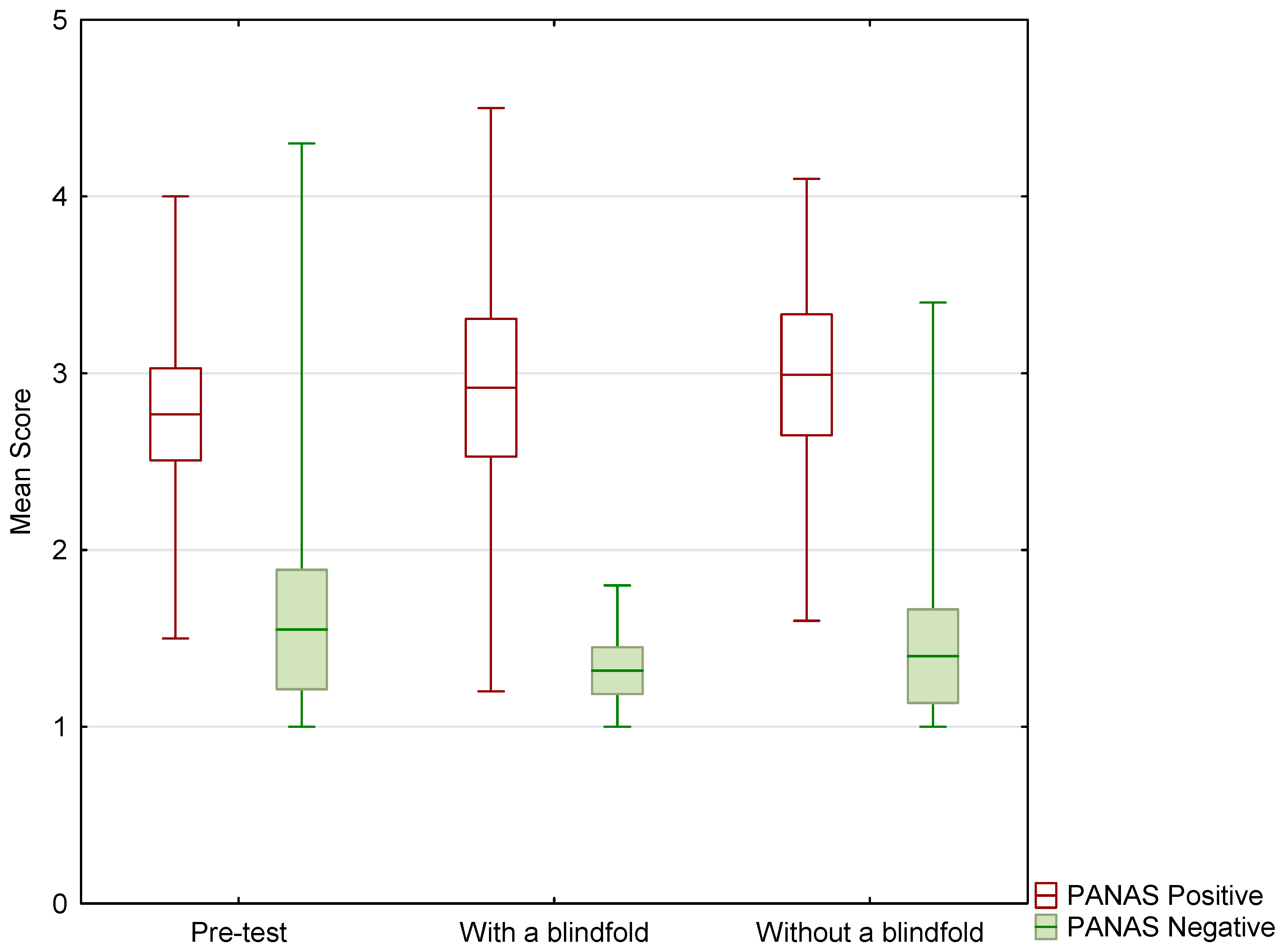
The descriptive statistics and results of the comparative analysis for the PANAS scale are summarized in Table 2. The overall repeated measures ANOVA did not show a significant main effect of the session type on positive affect (F = 0.50, p = 0.61) or negative affect (F = 0.89, p = 0.42), likely due to high inter-individual variability in baseline emotional states. However, planned post hoc comparisons (Tukey’s HSD) revealed localized significant changes. For PANAS Negative, a statistically significant reduction in negative emotions was observed after the auditory-only session (with eyes closed) compared to the baseline (Mean difference = 0.23, p < 0.05). The full immersion session (visual-auditory) also resulted in a numerical decrease in negative affect (Mean = 1.40), though it was less pronounced than the auditory-only condition (Mean = 1.32). For PANAS Positive, although the full immersion session reached the highest mean score (2.99 ± 0.77), the differences relative to the baseline (2.77 ± 0.59) did not reach the threshold for statistical significance in the post hoc analysis (p > 0.05). These results suggest that while forest exposure tended to reduce negative states, its impact on inducing positive affect was more subtle and varied among participants.
Table 2.
Mean values, standard deviations (SDs), and 95% confidence intervals (CIs) of PANAS scores across exposure variants, including ANOVA test statistics (F-ratio, p-value) and effect sizes (η2).
The average values of changes in psychological well-being, as determined using the PANAS (ΔPA, ΔNA), along with their uncertainties (95% confidence level), are presented in Figure 4 for the analyzed immersion variants.
Figure 4.
Average magnitudes of favourable changes in psychological well-being determined with PANAS. The box-and-whisker plot displays the mean (horizontal line), the 95% Confidence Interval (box), and the total range of responses (whiskers) across experimental conditions.
3.2. ROS and SVS
The descriptive statistics and results of the comparative analysis for ROS and SVS are summarized in Table 3.
Table 3.
Mean values, standard deviations (SDs), and 95% confidence intervals (CIs) of ROS and SVS scores across exposure variants, including ANOVA test statistics (F-ratio, p-value) and effect sizes (η2).
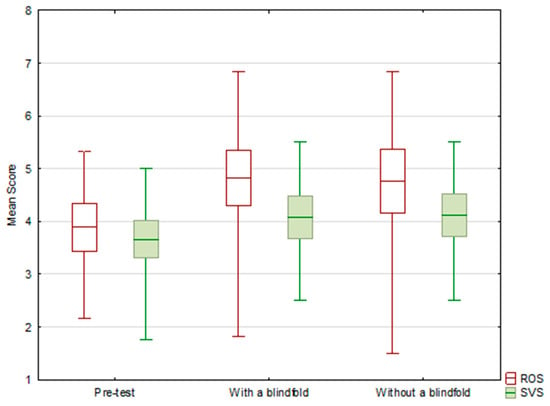
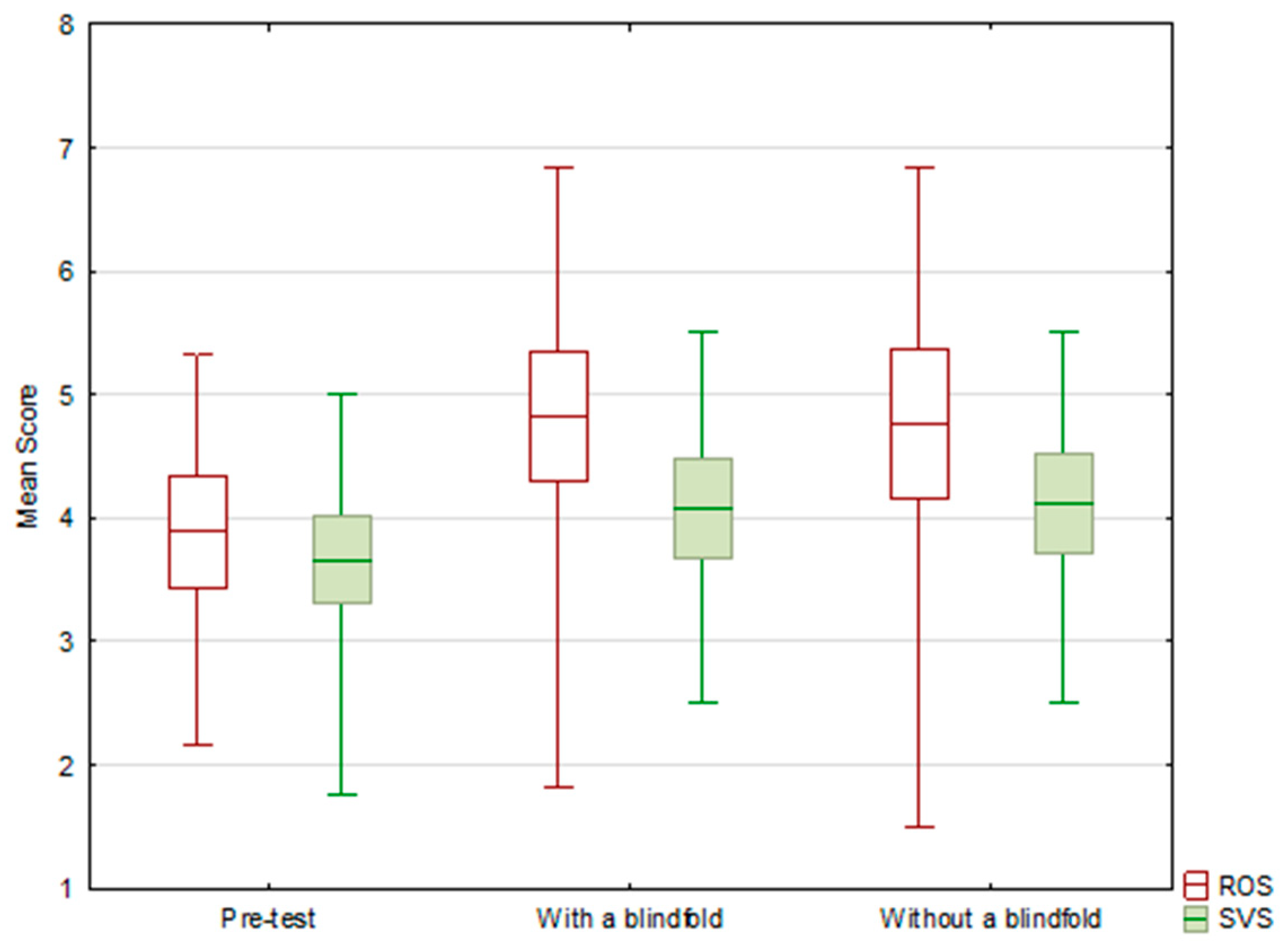
The repeated measures ANOVA revealed a statistically significant effect of forest exposure on perceived restoration (ROS: F = 4.11, p = 0.02). The effect size was large (η2 = 0.29), indicating a robust impact of the intervention. Post hoc comparisons showed that restorative feelings increased significantly from the pre-test (Mean = 3.89 ± 1.03) to both the auditory-only session with a blindfold (Mean = 4.82 ± 1.19) and the visual-auditory session (Mean = 4.76 ± 1.37).
Regarding subjective vitality (SVS), although a large effect size was observed (η2 = 0.21), the overall model did not reach statistical significance (F = 1.84, p = 0.17). Mean scores showed a numerical upward trend from the pre-test (3.66 ± 0.80) to the auditory (4.08 ± 0.91) and visual-auditory (4.11 ± 0.91) conditions, suggesting a positive but statistically non-significant direction of change in vitality.
The mean values of changes in mental well-being, determined using the ROS and SVS, along with their uncertainties (95% confidence level), are presented in Figure 5 for the analyzed immersion variants.
Figure 5.
Average magnitudes of changes in psychological well-being determined with ROS and SVS. The box-and-whisker plot displays the mean (horizontal line), the 95% Confidence Interval (box), and the total range of responses (whiskers) across the analyzed immersion variants.
3.3. POMS
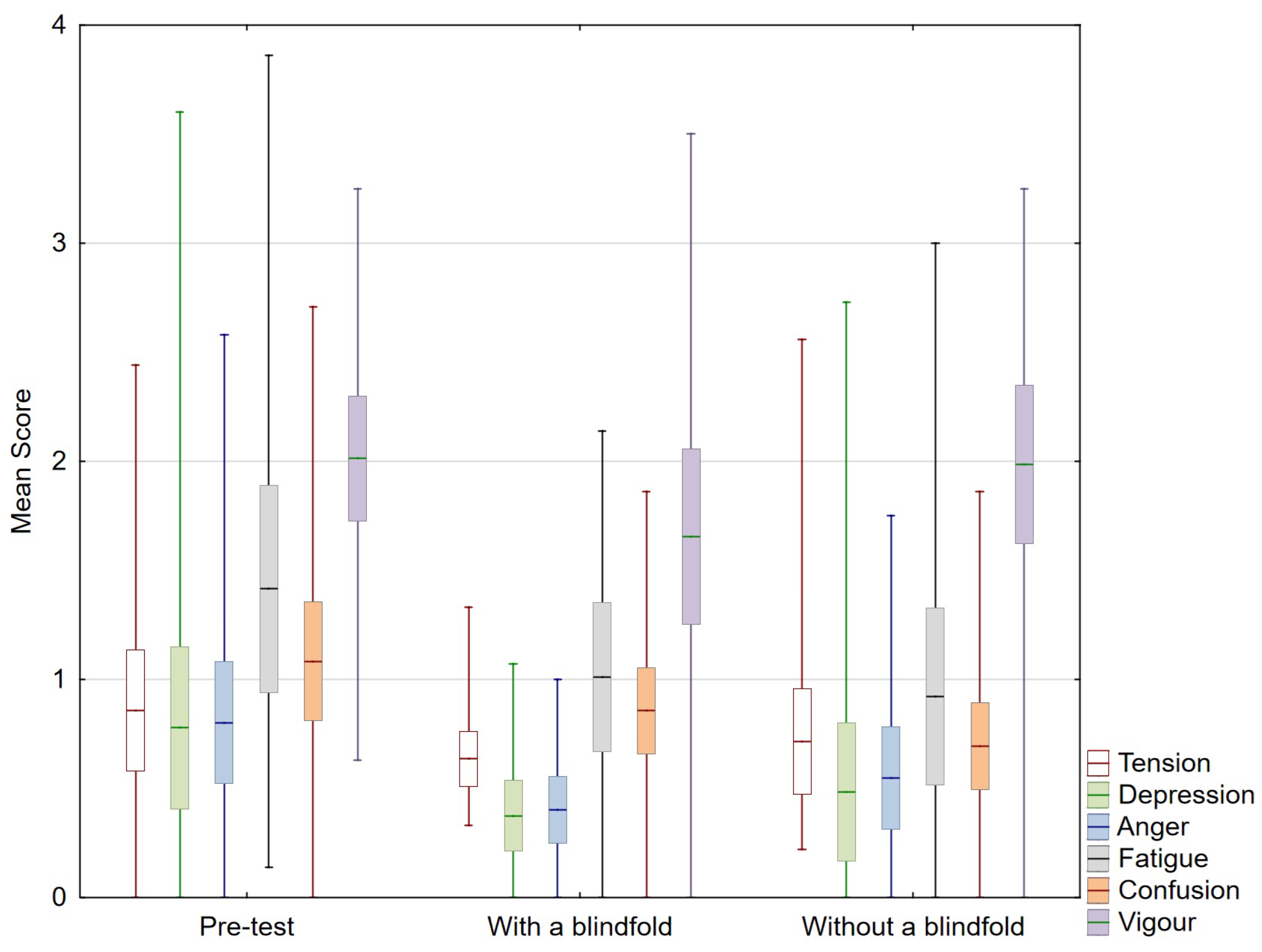
The analysis of the Profile of Mood States (Table 4) revealed statistically significant improvements in two emotional dimensions: Anger (F = 3.39, p = 0.04, η2 = 0.19) and Confusion (F = 3.22, p = 0.05, η2 = 0.18). Both subscales showed a large effect size, indicating a substantial impact of the forest environment on reducing these negative states.
Table 4.
Mean values, standard deviations (SDs), and 95% confidence intervals (CIs) of POMS scores across exposure variants, including ANOVA test statistics (F-ratio, p-value) and effect sizes (η2).
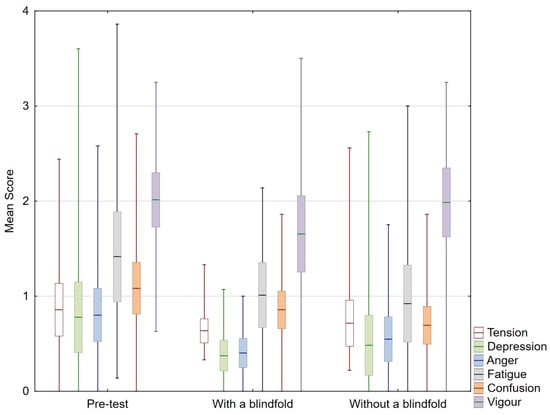
For the Anger subscale, the most pronounced reduction was observed in the auditory-only session with a blindfold (Mean = 0.40 ± 0.35), which differed significantly from the baseline (Mean = 0.80 ± 0.63, p < 0.05). Similarly, Confusion scores decreased significantly, reaching the lowest values in the visual-auditory condition (Mean = 0.70 ± 0.45).
Although the Total Mood Disturbance (TMD) decreased numerically by approximately 50% (from 29.05 to 14.450), this change was not statistically significant (p = 0.18, η2 = 0.11) due to the exceptionally high baseline variance (SD = 34.73). Other dimensions, including Tension, Depression, and Fatigue, exhibited positive numerical trends but did not reach the significance threshold.
The mean values of changes in psychological state, determined using the POMS subscales, along with their uncertainties (95% confidence intervals), are presented in Figure 6 for the analyzed immersion variants.
Figure 6.
Average magnitudes of changes in psychological well-being determined with POMS scales. The box-and-whisker plot displays the mean (horizontal line), the 95% Confidence Interval (box), and the total range of responses (whiskers) across the analyzed immersion variants.
4. Discussion
There is a growing global awareness of the significant link between health and the natural environment [49]. The aim of the experiment was to identify mental health benefits measured by improved mood, increased vitality and overall well-being. The results obtained indicate that forest environments support mental health, as documented by many renowned researchers [17,50,51,52]. We have found that both natural auditory and visual stimuli are important in addressing stress and low mood. They show a positive descriptive trend in improving mood, regulating mood disorders, and enhancing psychological well-being in a forest environment, which aligns with the general direction of the first hypothesis. Weng et al. [53] also reached similar conclusions.
In this article, unlike in our previous works, we did not focus on the characteristics of space or the recognition of the therapeutic values of forest landscapes [54,55], or the relationship between the type of physical activity and the level of regenerative benefits resulting from contact with nature [40,54,56]. An innovative approach in this study is based on a better understanding of the role of the senses in the process of landscape perception and obtaining regenerative benefits. The results show that full immersion in the forest landscape compared to exposure based solely on listening to nature (without the opportunity to view the landscape) leads to a descriptive improvement in the well-being and mood of forest visitors. Thus, the second hypothesis was partially supported by observed directional tendencies, although the main effect of session type in the global ANOVA framework did not reach full statistical significance for all dimensions. The results of this experiment show that full immersion in the forest landscape leads to a numerical upward trend in positive feelings (PANAS positive) and subjectively perceived vitality (SVS) compared to exposure based mainly on listening to the sounds of nature. The TMD index, which summarises the overall mood in the POMS test and is calculated from the results of six subjective scales (Tension, Anger, Vigour, Depression, Fatigue, Confusion) had a lower value in the case of full immersion, indicating a pattern toward a better, more balanced mood, though this overall reduction remained statistically non-significant (p > 0.05) due to high baseline variance. Full immersion in the forest is associated with benefits because it simultaneously regulates the nervous system, reduces metabolic stress, strengthens the immune system, and reconnects people with the environment to which they are biologically adapted. Multisensory experiences lead to greater relaxation and stress relief because, according to ART theory, they result in a decrease in focused attention. Thanks to full immersion in the forest environment, the human brain can shift from the sympathetic nervous system—which triggers the “fight or flight” response, preparing the body for action, physical exertion, or stress—to the parasympathetic mode, which supports regeneration and rest.
The results obtained indicate that potential regenerative benefits can be expected in the environment even without visual perception of the forest, just by listening to the sounds of nature (hypothesis 3). Horiuchi et al. [34] also came to similar conclusions. Interestingly, we have demonstrated that greater activation of the sense of hearing, achieved by blocking the ability to view the landscape, can serve as a valuable tool to address negative feelings and low mood, as indicated by the specific localized post hoc differences in PANAS results and the non-significant descriptive shifts in the POMS subscales: Tension, Depression, and Anger. While our study was based exclusively on self-reported psychological questionnaires, the cited physiological literature offers plausible theoretical frameworks for our observations. These mechanisms should be viewed as potential explanatory pathways rather than effects directly measured in our experimental cohort. To better understand why this occurs, we must refer to the results of neurophysiological research. It turns out that closing the eyes promotes relaxation because it limits the flow of visual stimuli, mainly visual, which enhances alpha wave activity and inhibits perceptual activity [57]. An increase in alpha waves is considered a marker of the brain’s resting state and is associated with the inhibition of perceptual processes and the synchronization of neural activity in areas of the association cortex [58]. In addition, an increase in alpha wave activity with eyes closed correlates with increased activity of the default mode network (DMN) in most people, which is responsible for emotional calming, internal processing, and emotional self-regulation. In an EEG-fMRI study, Bowman et al. [59] showed that alpha wave power is closely related to DMN activity in the medial prefrontal cortex and cingulate gyrus. Such synchronization promotes calmness, reflectiveness, and mental relaxation. It is not without reason that relaxation and hypnotic techniques are performed with closed eyes. Research by Leo et al. [60] demonstrated that closing the eyes increases parasympathetic activity, resulting in calmness, a decrease in heart rate, lower blood pressure, and reduced anxiety. This phenomenon can be measured by heart rate variability (HRV) modulation, a parameter of autonomic balance. Jung et al. [61] proved that as the power of alpha [and theta] waves increases, HVR activity increases simultaneously, reflecting the neurophysiological cooperation between the brain and autonomic activity to regulate the resting state. Both high HVR and alpha wave dominance contribute to better emotion regulation, as confirmed by studies by Zaccaro et al. [62] and Lin et al. [63]. HVR biofeedback training increased emotional resilience and accelerated the return to balance after episodes of anger, which was described as an increase in parasympathetic control and a reduction in excessive sympathetic activity. This means that higher HVR not only reflects a state of relaxation but also enables the effective suppression of tension and negative emotions [63] and is associated with the reduction in depression and anxiety [62]. Our research has shown that listening to nature sounds significantly reduced scores on the negative emotion subscale of the POMS (T, D, A) and increased scores on the positive emotion subscale. Similar conclusions were reached by Ochiai et al. [64]. Beyond statistical significance, the large effect sizes observed in our study—specifically for perceived restoration (ROS, η2 = 0.29), Anger reduction (η2 = 0.19), and Confusion alleviation (η2 = 0.18)—demonstrate a profound practical relevance for real-world health promotion and stress-management interventions. In contemporary urban societies, where individuals are continuously exposed to attention exhaustion and anthropogenic noise, finding accessible micro-interventions is crucial. The substantial magnitude of emotional stabilization achieved through just 15 min of auditory exposure (with eyes covered) proves that the forest soundscape possesses an intrinsic therapeutic value. In practical terms, this implies that for individuals trapped in office spaces, high-stress school environments, or healthcare facilities where full visual access to nature is physically impossible, high-quality natural auditory tools can serve as a viable, low-cost, and immediate anti-stress intervention. The scale of anger and confusion mitigation observed here suggests that acoustic green exercises are powerful enough to restore emotional equilibrium and cognitive clarity in a very short timeframe. We have also provided further evidence confirming the therapeutic and relaxing properties of birdsong.
We conducted the study during the middle of the day, in good weather with minimal wind, and the main sounds recorded by users were those of forest birds. Along with the sound of flowing water, birdsong is considered particularly restorative in urban parks [65]. Zhu et al. [66] also highlighted the benefits of incorporating natural sounds, such as birdsong and the sound of flowing water, into forest environments to improve health. Hammond et al. [67] demonstrated that daily encounters with birds were associated with a lasting improvement in mental well-being not only in healthy individuals but also in those diagnosed with depression. Research on the impact of birdsong on human mental functioning has been conducted on a larger scale since the beginning of the 21st century. Ratcliffe et al. [68] showed that birdsong and bird sounds were the most frequently cited type of nature sounds conducive to subjectively perceived stress reduction and attention regeneration. At the same time, the study noted that not all bird sounds have this effect. The perceived beneficial effect of these stimuli was based on three main dimensions: affective ratings, cognitive ratings, and the individual’s relationship with nature, with the acoustic, aesthetic, and associative properties of bird sounds also playing an important role. Ratcliffe et al. [68] expanded on these observations by showing that the perceived restorative potential (PRP) of bird sounds can be predicted based on their acoustic and aesthetic characteristics. Strobbe et al. [69] compared the effects of urban soundscapes (traffic noise) and birdsong and demonstrated that exposure to birdsong leads to a significant reduction in anxiety and paranoia, while traffic noise is associated with an increase in depressive symptoms. Clinically, it is important to note that the reduction in depression severity was observed only with a high diversity of birdsong, while the reduction in paranoia—with a medium effect size—was clearly demonstrated for the first time in a scientific study under experimental conditions. These results suggest the potential use of natural sound stimuli as a supportive environmental intervention in reducing anxiety and paranoid symptoms. In this context, it is worth highlighting the first attempts to use contact with wild bird species and listening to birdsong in a clinical population of people with serious mental disorders such as schizophrenia [70].
The results of the research presented in this article are of practical importance because they demonstrate that exposure to nature can involve a wide range of interactions, from multisensory ones to those in which fewer senses are activated. Each of these interventions guarantees a certain level of mental health benefits. Promoting healthy, restorative built and natural environments requires integrated sound landscape research that comprehensively assesses the sound environment and its interactions with other sensory perceptions [71]. Recognizing the sensory experiences reported by forest visitors is a crucial step in designing effective nature-based therapies. Forest bathing (Shinrin-yoku) refers to the practice of consciously engaging in multisensory, immersive experiences in forests and other natural environments in order to achieve health and well-being benefits [72,73]. Forest bathing is based on stimulating all the senses—sight, hearing, smell, taste, and touch—by observing diverse landscapes, listening to birdsong and the sound of flowing water, smelling the scent of wood and fresh air, and feeling the textures of bark, tree leaves, and other natural elements. It turns out, however, that the sounds of nature alone have a notable effect on relaxation, which is a useful tip for tour operators, forest bathing guides promoting the therapeutic benefits of the forest, and anyone looking for ways to reduce stress and improve their mental health. Most people now live in urbanized areas and are exposed to noise on a daily basis, which increases stress, causes disorders, and exacerbates negative moods (anxiety, confusion, anger). Noise is an unwanted, harmful sound that is primarily anthropogenic in nature, and its presence, intensity, and/or frequency can be a significant source of distraction and stress [74].
The awareness that the sounds of nature can be beneficial in combating stress and negative emotions is important not only from the perspective of developing forest therapy programs and practices based on engagement with nature, but also for the design and arrangement of public spaces, both open and built-up areas. This information is relevant to agencies that manage parks and forests, promote forest conservation and their social functions, and administer healthcare facilities. In the short term, these findings highlight the potential of acoustic interventions for people with limited access to nature. The sounds of nature can be incorporated into urban spaces, offices, and hospitals, where direct contact with the forest is not possible. The sounds of nature, such as birdsong or the sound of the wind, are readily available resources in everyday life. Modern people are increasingly aware of their desire to enjoy the sounds of nature; hence, the importance of these sounds as a source of relaxation is also growing.
We are aware that our study, despite its broad scope and innovative approach to assessing the impact of nature sounds and observing the forest landscape during exposure to the real forest environment on the mood and well-being of young adults, has several limitations. Certainly, the study sample is relatively small. Nevertheless, several previous studies have shown that even smaller sample sizes (12–15 people) were sufficient to draw meaningful conclusions [34,39,75,76,77]. The exposure time was also not extended; it lasted 15 min. To achieve a lasting restorative effect, people need at least two hours of contact with nature in any form each week, as demonstrated by a meta-analysis conducted by White et al. [78]. In contrast, many experimental studies on nature contact, similar to our research, included only single sessions lasting a mere 15 min [34,40,78,79,80]. In future studies, it would also be worthwhile to consider an extended exposure time. Furthermore, it is difficult to generalise the results because the participants were only students from one university (WULS) aged 23–27. In the future, more extensive studies should be conducted, taking into account a broader range of participant characteristics. At the same time, it is crucial to emphasize that while these descriptive and localized positive tendencies highlight the value of nature immersion, the lack of widespread statistical significance (p > 0.05) across global models indicates that short-term, 15-min interventions operate within subtle psychological thresholds that warrant cautious interpretation.
5. Limitation
Despite the innovative insights regarding sensory immersion in a real forest environment, several limitations must be acknowledged. First, the study was conducted with a relatively small sample size consisting of 31 participants. While this cohort size aligns with comparable exploratory experiments in environmental psychology and forest bathing literature, it may nonetheless constrain the overall statistical power and limit the external validity of our findings. Consequently, the lack of statistically significant changes in certain complex dimensions, such as Total Mood Disturbance (TMD) or individual PANAS Positive scores, might be partly attributed to this limited sample size and high inter-individual variance.
Second, our sample focused exclusively on a homogenous demographic group of young adults (university students with a mean age of 25). The psychological and neurophysiological benefits derived from full sensory immersion versus auditory-only exposure may fundamentally differ across other demographic strata. For instance, older adults or individuals suffering from clinical levels of stress, anxiety, or depression might exhibit different visual and acoustic perception thresholds. Therefore, future research should replicate this experimental design using larger, more diverse, and representative populations to fully generalize these restorative benefits across broader social and clinical cohorts.
Due to the limited sample size and homogeneous student cohort, our findings should be interpreted as preliminary insights rather than universally generalizable results.
6. Conclusions
The research results show that contact with the forest environment presents a highly positive, descriptive trend toward improving the mood and well-being of young adults. Full sensory stimulation (visual and auditory) leads to a numerical upward trend in positive feelings and vitality. On the other hand, a shorter sensory experience (based mainly on listening to the sounds of nature) demonstrated a positive descriptive capacity to address negative feelings and reduce anxiety.
The information obtained suggests that both forms of exposure can be considered useful short-term options for improving the mental well-being of young people exposed to urban stress, with full immersion showing subtle directional advantages. However, a rigorous methodological evaluation of the overall empirical matrix demonstrates that the vast majority of these measured changes did not achieve global statistical significance (p > 0.05). Therefore, these results must be interpreted strictly as non-significant directional trends rather than definitive therapeutic effects. This absence of robust primary significance indicates that a brief, 15-min nature intervention operates within highly subtle psychological thresholds, particularly when applied to a healthy, relatively unstressed cohort exhibiting high baseline stability. Consequently, these findings outline important boundary conditions for environmental restoration and highlight clear directions for future research, which should implement longer exposure intervals, larger sample sizes, and incorporate highly fatigued urban or clinical populations to further clarify these sensory dynamics.
Author Contributions
Conceptualization, E.J., M.W. and S.M.; methodology, E.J., M.W., S.M. and K.C.; software, K.C. and P.J.; validation, E.J. and K.K.; formal analysis, K.C. and P.J.; investigation, M.W., S.M. and Z.S.; resources, Z.S. and E.J.; writing—original draft preparation, E.J. and K.K.; writing—review and editing, M.W. and K.C.; visualization, P.J. and K.K. All authors have read and agreed to the published version of the manuscript.
Funding
This research received no external funding.
Institutional Review Board Statement
Ethical Review Board of the Warsaw University of Life Sciences (No. 18/RKE/2025/U).
Data Availability Statement
The data presented in this study are available on request from the first author.
Conflicts of Interest
The authors declare no conflict of interest.
References
- World Health Organization. Environment and Health for European Cities in the 21st Century: Making a Difference. 2017. Available online: https://www.who.int/europe/publications/i/item/9789289052900 (accessed on 12 December 2025).
- Patuano, A. Biophobia and Urban Restorativeness. Sustainability 2020, 12, 4312. [Google Scholar] [CrossRef] [Scilit]
- Soga, M.; Evans, M.J. Biophobia: What it is, how it works and why it matters. People Nat. 2024, 6, 922–931. [Google Scholar] [CrossRef] [Scilit]
- European Commission. EU Biodiversity Strategy for 2030: Bringing Nature Back into Our Lives. 2020. Available online: https://environment.ec.europa.eu/strategy/biodiversity-strategy-2030_en (accessed on 4 January 2026).
- European Commission: Directorate-General for Agriculture and Rural Development. New EU Forest Strategy for 2030, 2021b. COM/2021/572 Final. EUR-Lex. Available online: https://eur-lex.europa.eu/legal-content/EN/TXT/HTML/?uri=CELEX:52021DC0572 (accessed on 4 January 2026).
- Beil, K.; Hanes, D. The influence of urban natural and built environments on physiological and psychological measures of stress--a pilot study. Int. J. Environ. Res. Public Health 2013, 10, 1250–1267. [Google Scholar] [CrossRef] [Scilit] [PubMed] [PubMed Central]
- White, M.P.; Alcock, I.; Wheeler, B.W.; Depledge, M.H. Would you be happier living in a greener urban area? A fixed-effects analysis of panel data. Psychol. Sci. 2013, 24, 920–928. [Google Scholar] [CrossRef] [Scilit] [PubMed]
- Tyrväinen, L.; Ojala, A.; Korpela, K.; Lanki, T.; Tsunetsugu, Y.; Kagawa, T. The influence of urban green environments on stress relief measures: A field experiment. J. Environ. Psychol. 2014, 38, 1–9. [Google Scholar] [CrossRef] [Scilit]
- Hartig, T.; Evans, G.W.; Jamner, L.D.; Davis, D.S.; Gärling, T. Tracking restoration in natural and urban field settings. J. Environ. Psychol. 2003, 23, 109–123. [Google Scholar] [CrossRef] [Scilit]
- Korpela, K.; Ylén, M.; Tyrväinen, L.; Silvennoinen, H. Determinants of restorative experiences in everyday favourite places. Health Place 2008, 14, 636–652. [Google Scholar] [PubMed]
- Pasanen, T.P.; Ojala, A.; Tyrväinen, L.; Korpela, K.M. Restoration, well-being, and everyday physical activity in indoor, built outdoor and natural outdoor settings. J. Environ. Psychol. 2018, 59, 85–93. [Google Scholar] [CrossRef] [Scilit]
- Jung, W.H.; Woo, J.M.; Ryu, J.S. Effect of a forest therapy programme and the forest environment on female workers’ stress. Urban For. Urban Green. 2015, 14, 274–281. [Google Scholar] [CrossRef] [Scilit]
- Bielinis, E.; Takayama, N.; Boiko, S.; Omelan, A.; Bielinis, L. The effect of winter forest bathing on psychological relaxation of young Polish adults. Urban For. Urban Green. 2018, 29, 276–283. [Google Scholar] [CrossRef] [Scilit]
- Taylor, A.F.; Kuo, F.E. Children with attention deficits concentrate better after walk in the park. J. Atten. Disord. 2009, 12, 402–409. [Google Scholar] [CrossRef] [Scilit] [PubMed]
- Amoly, E.; Dadvand, P.; Forns, J.; López-Vicente, M.; Basagaña, X.; Julvez, J.; Alvarez-Pedrerol, M.; Nieuwenhuijsen, M.J.; Sunyer, J. Green and blue spaces and behavioral development in Barcelona schoolchildren: The BREATHE project. Environ. Health Perspect. 2014, 122, 1351–1358. [Google Scholar] [CrossRef] [Scilit] [PubMed]
- Taylor, A.F.; Kuo, F.E.; Sullivan, W.C. Views of Nature and Self-Discipline: Evidence from Inner City Children. J. Environ. Psychol. 2002, 22, 49–63. [Google Scholar] [CrossRef] [Scilit]
- Bratman, G.N.; Hamilton, J.P.; Hahn, K.S.; Daily, G.C.; Gross, J.J. Nature experience reduces rumination and subgenual prefrontal cortex activation. Proc. Natl. Acad. Sci. USA 2015, 112, 8567–8572. [Google Scholar] [CrossRef] [Scilit] [PubMed]
- Li, Q.; Morimoto, K.; Kobayashi, M.; Inagaki, H.; Katsumata, M.; Hirata, Y.; Hirata, K.; Shimizu, T.; Li, Y.J.; Wakayama, Y.; et al. A forest bathing trip increases human natural killer activity and expression of anti-cancer proteins in female subjects. J. Biol. Regul. Homeost. Agents 2008, 22, 45–55. [Google Scholar] [PubMed]
- Buckley, R.C.; Zhang, J.B.; Underdahl, S.; Cooper, M.A.; Sclippa, K.; Brough, P.; Chauvenet, A.L.M. Nature-based mental health: Research and implementation agenda. Lancet Planet. Health 2024, 8, e528–e529. [Google Scholar] [CrossRef] [Scilit] [PubMed]
- Bratman, G.N.; Bembibre, C.; Daily, G.C.; Doty, R.L.; Hummel, T.; Jacobs, L.F.; Kahn, P.H., Jr.; Lashus, C.; Majid, A.; Miller, J.D.; et al. Nature and human well-being: The olfactory pathway. Sci. Adv. 2024, 10, eadn3028. [Google Scholar] [CrossRef] [Scilit] [PubMed]
- Zhong, L.; Campbell, C.; Buckley, R.C.; Zhu, D.; Yu, H.; Chauvenet, A.L.M.; Cooper, M.A. Senses, emotions and wellbeing in forest recreation and tourism. Tour. Recreat. Res. 2024, 50, 688–700. [Google Scholar] [CrossRef] [Scilit]
- Ravenscroft, N. Tales from the Tracks: Discourses of Constraint in the Use of Mixed Cycle and Walking Routes: Discourses of Constraint in the Use of Mixed Cycle and Walking Routes. Int. Rev. Sociol. Sport 2004, 39, 27–44. [Google Scholar] [CrossRef] [Scilit]
- Reynolds, K.D.; Wolch, J.; Byrne, J.; Chou, C.P.; Feng, G.; Weaver, S.; Jerrett, M. Trail characteristics as correlates of urban trail use. Am. J. Health Promot. 2007, 21, 335–345. [Google Scholar] [CrossRef] [Scilit] [PubMed]
- Zeidenitz, C.; Mosler, H.J.; Hunziker, M. Outdoor recreation: From analysing motivations to furthering ecologically responsible behaviour. For. Snow Landsc. Res. 2007, 81, 175–190. [Google Scholar]
- Kaplan, R.; Kaplan, S. The Experience of Nature: A Psychological Perspective; Cambridge University Press: Cambridge, UK, 1989. [Google Scholar]
- Jo, H.; Song, C.; Ikei, H.; Enomoto, S.; Kobayashi, H.; Miyazaki, Y. Physiological and Psychological Effects of Forest and Urban Sounds Using High-Resolution Sound Sources. Int. J. Environ. Res. Public Health 2019, 16, 2649. [Google Scholar] [CrossRef] [Scilit] [PubMed]
- Hong, P.; Schmid, B.; De Laender, F.; Eisenhauer, N.; Zhang, X.; Chen, H.; Craven, D.; De Boeck, H.J.; Hautier, Y.; Petchey, O.L.; et al. Biodiversity promotes ecosystem functioning despite environmental change. Ecol. Lett. 2022, 25, 555–569. [Google Scholar] [CrossRef] [Scilit] [PubMed]
- Wang, A.; Melton, A.E.; Soltis, D.E.; Soltis, P.S. Potential distributional shifts in North America of allelopathic invasive plant species under climate change models. Plant Divers. 2022, 44, 11–19. [Google Scholar] [PubMed]
- Song, Y.; Fan, B.; Wang, C.; Yu, H. Meta-analysis of the effects of physical activity on executive function in children and adolescents with attention deficit hyperactivity disorder. PLoS ONE 2023, 18, e0289732. [Google Scholar] [CrossRef] [Scilit] [PubMed]
- Largo-Wight, E.; Chen, W.W.; Dodd, V.; Weiler, R. Healthy workplaces: The effects of nature contact at work on employee stress and health. Public Health Rep. 2011, 126, 124–130. [Google Scholar] [CrossRef] [Scilit] [PubMed]
- Franco, L.S.; Shanahan, D.F.; Fuller, R.A. A review of the benefits of nature experiences: More than meets the eye. Int. J. Environ. Res. Public Health 2017, 14, 864. [Google Scholar] [CrossRef] [Scilit] [PubMed]
- Ratcliffe, E.; Gatersleben, B.; Sowden, P.T. Bird sounds and their contributions to perceived attention restoration and stress recovery. J. Environ. Psychol. 2013, 36, 221–228. [Google Scholar] [CrossRef] [Scilit]
- Song, A.M.; Temby, O.; Kim, D.; Cisneros, A.S.; Hickey, G.M. Measuring, mapping and quantifying the effects of trust and informal communication on transboundary collaboration in the Great Lakes fisheries policy network. Glob. Environ. Change 2019, 54, 6–18. [Google Scholar] [CrossRef] [Scilit]
- Horiuchi, M.; Endo, J.; Takayama, N.; Murase, K.; Nishiyama, N.; Saito, H.; Fujiwara, A. Impact of viewing vs. not viewing a real forest on physiological and psychological responses in the same setting. Int. J. Environ. Res. Public Health 2014, 11, 10883–10901. [Google Scholar] [CrossRef] [Scilit] [PubMed]
- Krčmářová, J. EO Wilson’s Concept of Biophilia and the Environmental Movement in the USA. Klaudyán Internet J. Hist. Geogr. Environ. Hist. 2009, 6, 4–17. [Google Scholar]
- Simaika, J.P.; Samways, M.J. Biophilia as a Universal Ethic for Conserving Biodiversity. Conserv. Biol. 2010, 24, 903–906. [Google Scholar] [CrossRef] [Scilit] [PubMed]
- Ulrich, R.S.; Simons, R.F.; Losito, B.D.; Fiorito, E.; Miles, M.A.; Zelson, M. Stress recovery during exposure to natural and urban environments. J. Environ. Psychol. 1991, 11, 201–230. [Google Scholar] [CrossRef] [Scilit]
- The Act on the Conservation of Nature and Natural Resources (Dz. U. z 2026 r. poz. 13). Available online: https://isap.sejm.gov.pl/isap.nsf/download.xsp/WDU20260000013/O/D20260013.pdf (accessed on 8 January 2026).
- Tsunetsugu, Y.; Park, B.-J.; Miyazaki, Y. Trends in Research Related to “Shinrin-Yoku” (Taking in the Forest Atmosphere or Forest Bathing) in Japan. Environ. Health Prev. Med. 2010, 15, 27–37. [Google Scholar] [PubMed]
- Janeczko, E.; Czyżyk, K.; Korcz, N.; Woźnicka, M.; Bielinis, E. The Psychological Effects and Benefits of Using Green Spaces in the City: A Field Experiment with Young Polish Adults. Forests 2023, 14, 497. [Google Scholar] [CrossRef] [Scilit]
- Watson, D.; Clark, L.A.; Tellegen, A. Development and validation of brief measures of positive and negative affect: The PANAS scales. J. Pers. Soc. Psychol. 1988, 54, 1063–1070. [Google Scholar] [CrossRef] [Scilit] [PubMed]
- Bielinis, E.; Jaroszewska, A.; Łukowski, A.; Takayama, N. The effects of a short winter exposure in a suburban forest on urban residents’ positive and negative affect, restorative outcomes, and subjective vitality. Urban For. Urban Green. 2021, 65, 127361. [Google Scholar]
- McNair, D.M.; Lorr, M.; Droppleman, L.F. Manual for the Profile of Mood States (POMS); Educational and Industrial Testing Service: San Diego, CA, USA, 1971. [Google Scholar]
- Shapiro, S.S.; Wilk, M.B. An analysis of variance test for normality (complete samples). Biometrika 1965, 52, 591–611. [Google Scholar] [CrossRef] [Scilit]
- Student. The probable error of a mean. Biometrika 1908, 6, 1–25. [Google Scholar] [CrossRef]
- Fisher, R.A. Statistical Methods for Research Workers; Oliver and Boyd: Edinburgh, UK, 1925. [Google Scholar]
- Tukey, J.W. Comparing individual means in the analysis of variance. Biometrics 1949, 5, 99–114. [Google Scholar] [CrossRef] [Scilit]
- Cronbach, L.J. Coefficient alpha and the internal structure of tests. Psychometrika 1951, 16, 297–334. [Google Scholar] [CrossRef] [Scilit]
- Tsutsumi, M.; Nogaki, H.; Shimizu, Y.; Stone, T.E.; Kobayashi, T. Individual reactions to viewing preferredvideo representations of the natural environment: A comparison of mental and physical reactions. Jpn. J. Nurs. Sci. 2017, 14, 3–12. [Google Scholar] [CrossRef] [Scilit] [PubMed]
- Abbott, K.W.; Genschel, P.; Snidal, D.; Zangl, B. (Eds.) International Organizations as Orchestrators; Cambridge University Press: Cambridge, UK, 2015. [Google Scholar]
- Ohly, H.; White, M.P.; Wheeler, B.W.; Bethel, A.; Ukoumunne, O.C.; Nikolaou, V.; Garside, R. Attention Restoration Theory: A systematic review of the attention restoration potential of exposure to natural environments. J. Toxicol. Environ. Health B Crit. Rev. 2016, 19, 305–343. [Google Scholar] [CrossRef] [Scilit] [PubMed]
- Van Hedger, S.C.; Nusbaum, H.C.; Clohisy, L.; Jaeggi, S.M.; Buschkuehl, M.; Berman, M.G. Of cricket chirps and car horns: The effect of nature sounds on cognitive performance. Psychon. Bull. Rev. 2019, 26, 522–530. [Google Scholar] [CrossRef] [Scilit] [PubMed]
- Weng, Y.; Zhu, Y.; Ma, S.; Li, K.; Chen, Q.; Wang, M.; Dong, J. Quantitative Analysis of Physiological and Psychological Impacts of Visual and Auditory Elements in Wuyishan National Park Using Eye-Tracking. Forests 2024, 15, 1210. [Google Scholar] [CrossRef] [Scilit]
- Janeczko, E.; Czyżyk, K.; Woźnicka, M.; Wiśniewska, A. The Impact of Open Forest Habitats on Psychological Well-Being. Sustainability 2025, 17, 6233. [Google Scholar] [CrossRef] [Scilit]
- Janeczko, E.; Bielinis, E.; Tiarasari, U.; Woźnicka, M.; Kędziora, W.; Przygodzki, S.; Janeczko, K. How Dead Wood in the Forest Decreases Relaxation? The Effects of Viewing of Dead Wood in the Forest Environment on Psychological Responses of Young Adults. Forests 2021, 12, 871. [Google Scholar] [CrossRef] [Scilit]
- Janeczko, E.; Bielinis, E.; Wójcik, R.; Woźnicka, M.; Kędziora, W.; Łukowski, A.; Elsadek, M.; Szyc, K.; Janeczko, K. When Urban Environment Is Restorative: The Effect of Walking in Suburbs and Forests on Psychological and Physiological Relaxation of Young Polish Adults. Forests 2020, 11, 591. [Google Scholar] [CrossRef] [Scilit]
- Petro, N.M.; Ott, L.R.; Penhale, S.H.; Rempe, M.P.; Embury, C.M.; Picci, G.; Wang, Y.-P.; Stephen, J.M.; Calhoun, V.D.; Wilson, T.W. Eyes-closed versus eyes-open differences in spontaneous neural dynamics during development. NeuroImage 2022, 258, 119337. [Google Scholar] [CrossRef] [Scilit] [PubMed]
- Rezayat, E.; Clark, K.; Dehaqani, M.A.; Noudoost, B. Dependence of Working Memory on Coordinated Activity Across Brain Areas. Front. Syst. Neurosci. 2022, 15, 787316. [Google Scholar] [CrossRef] [Scilit] [PubMed] [PubMed Central]
- Bowman, L.C.; Dodell-Feder, D.; Saxe, R.; Sabbagh, M.A. Continuity in the neural system supporting children’s theory of mind development: Longitudinal links between task-independent EEG and task-dependent fMRI. Dev. Cogn. Neurosci. 2019, 40, 100705. [Google Scholar] [CrossRef] [Scilit] [PubMed] [PubMed Central]
- Leo, D.G.; Trevisan, C.; Ravelli, A.; Lobban, T.C.A.; Lane, D.A. AFFIRMO Study investigators. Key needs, quality performance indicators and outcomes for patients with atrial fibrillation and multimorbidity: The AFFIRMO study. PLoS ONE 2024, 19, e0310106. [Google Scholar] [CrossRef] [Scilit] [PubMed] [PubMed Central]
- Jung, M.; Lee, M. The Effect of a Mindfulness-Based Education Program on Brain Waves and the Autonomic Nervous System in University Students. Healthcare 2021, 9, 1606. [Google Scholar] [CrossRef] [Scilit] [PubMed]
- Zaccaro, A.; Piarulli, A.; Laurino, M.; Garbella, E.; Menicucci, D.; Neri, B.; Gemignani, A. How Breath-Control Can Change Your Life: A Systematic Review on Psycho-Physiological Correlates of Slow Breathing. Front. Hum. Neurosci. 2018, 12, 353. [Google Scholar] [CrossRef] [Scilit] [PubMed] [PubMed Central]
- Lin, L.; Li, T.; Sun, M.; Liang, Q.; Ma, Y.; Wang, F.; Duan, J.; Sun, Z. Global association between atmospheric particulate matter and obesity: A systematic review and meta-analysis. Environ. Res. 2022, 209, 112785. [Google Scholar] [CrossRef] [Scilit] [PubMed]
- Ochiai, H.; Ikei, H.; Jo, H.; Ohishi, M.; Miyazaki, Y. Relaxation Effect of Nature Sound Exposure on Gambling Disorder Patients: A Crossover Study. J. Integr. Complement. Med. 2023, 29, 518–525. [Google Scholar] [CrossRef] [Scilit] [PubMed]
- Liu, J.; Guo, X.; Hong, X.; Zhang, X. The Impact of Individual Factors on Perceived Soundscape Restorativeness in Urban Parks. Chin. Landsc. Archit. 2022, 38, 40–45. [Google Scholar]
- Zhu, Y.; Huang, N.; Weng, Y.; Tong, H.; Wang, X.; Chen, J.; Liu, J.; Chen, Z.; Dong, J.; Wang, M. Does Soundscape Perception Affect Health Benefits, as Mediated by Restorative Perception? Forests 2023, 14, 1798. [Google Scholar] [CrossRef] [Scilit]
- Hammoud, R.; Tognin, S.; Burgess, L.; Bergou, N.; Smythe, M.; Gibbons, J.; Davidson, N.; Afifi, A.; Bakolis, I.; Mechelli, A. Smartphone-based ecological momentary assessment reveals mental health benefits of birdlife. Sci. Rep. 2022, 12, 17589. [Google Scholar] [CrossRef] [Scilit] [PubMed]
- Ratcliffe, E.; Gatersleben, B.; Sowden, P.T. Predicting the perceived restorative potential of bird sounds through acoustics and aesthetics. Environ. Behav. 2018, 52, 371–400. [Google Scholar] [CrossRef] [Scilit]
- Stobbe, E.; Sundermann, J.; Ascone, L.; Kühn, S. Birdsongs alleviate anxiety and paranoia in healthy participants. Sci. Rep. 2022, 12, 16414. [Google Scholar] [CrossRef] [Scilit] [PubMed]
- Murawiec, S.; Łukiańska, M.; Barganowski, J. The impact of therapeutic ornithology on mental well-being in psychiatric long-term care and psychiatric day clinic patients: A quantitative and qualitative study. Pers. Psychiatry 2025, 4, 52–70. [Google Scholar] [CrossRef] [Scilit]
- Aletta, F.; Kang, J. Promoting healthy and supportive acoustic environments: Going beyond the quietness. Int. J. Environ. Res. Public Health 2019, 16, 4988. [Google Scholar] [CrossRef] [Scilit] [PubMed]
- Clifford, M.A. Your Guide to Forest Bathing: Experience the Healing Power of Nature; Conari Press: Newburyport, MA, USA, 2018. [Google Scholar]
- Li, Q. Forest Bathing: How Trees Can Help You Find Health and Happiness; Viking: New York, NY, USA, 2018. [Google Scholar]
- Simkin, J.; Ojala, A.; Tyrväinen, L. The Perceived Restorativeness of Differently Managed Forests and Its Association with Forest Qualities and Individual Variables: A Field Experiment. Int. J. Environ. Res. Public Health 2021, 18, 422. [Google Scholar] [CrossRef] [Scilit] [PubMed]
- Park, B.J.; Tsunetsugu, Y.; Kasetani, T.; Hirano, H.; Kagawa, T.; Sato, M.; Miyazaki, Y. Physiological effects of Shinrin-yoku (taking in the atmosphere of the forest)—Using salivary cortisol and cerebral activity as indicators. J. Physiol. Anthropol. 2007, 26, 123–128. [Google Scholar] [CrossRef] [Scilit] [PubMed]
- Lee, J.; Park, B.J.; Tsunetsugu, Y.; Ohira, T.; Kagawa, T.; Miyazaki, Y. Effect of forest bathing on physiological and psychological responses in young Japanese male subjects. Public Health 2011, 125, 93–100. [Google Scholar] [CrossRef] [Scilit] [PubMed]
- An, B.Y.; Wang, D.; Liu, X.J.; Guan, H.M.; Wei, H.X.; Ren, Z.B. The effect of environmental factors in urban forests on blood pressure and heart rate in university students. J. For. Res. 2019, 24, 27–344. [Google Scholar] [CrossRef] [Scilit]
- White, M.P.; Alcock, I.; Grellier, J.; Wheeler, B.W.; Hartig, T.; Warber, S.L.; Bone, A.; Depledge, M.H.; Fleming, L.E. Spending at least 120 minutes a week in nature is associated with good health and wellbeing. Sci. Rep. 2019, 9, 7730. [Google Scholar] [CrossRef] [Scilit] [PubMed] [PubMed Central]
- Mazzoleni, E.; Donelli, D.; Zabini, F.; Meneguzzo, F.; Antonelli, M. Forest Therapy Research in Europe: A Scoping Review of the Scientific Literature. Forests 2024, 15, 848. [Google Scholar] [CrossRef] [Scilit]
- Bielinis, E.; Korcz, N.; Janeczko, E. Exposure to Waste Might Decrease Relaxation: The Effects of Viewing an Open Dump in a Forest Environment on the Psychological Response of Healthy Young Adults. Forests 2024, 15, 1302. [Google Scholar] [CrossRef] [Scilit]

Disclaimer/Publisher’s Note: The statements, opinions and data contained in all publications are solely those of the individual author(s) and contributor(s) and not of MDPI and/or the editor(s). MDPI and/or the editor(s) disclaim responsibility for any injury to people or property resulting from any ideas, methods, instructions or products referred to in the content. |
© 2026 by the authors. Licensee MDPI, Basel, Switzerland. This article is an open access article distributed under the terms and conditions of the Creative Commons Attribution (CC BY) license.