


Abstract
Subsidence is the lowering of the ground surface caused by both natural processes, such as geological and tectonic dynamics, and anthropogenic activities related to land and resource use. Identifying and monitoring this phenomenon is essential for several reasons, including ensuring public safety, supporting the sustainable management of subsurface resources, and mitigating potential economic impacts. This study investigates ground deformation in an underexplored sector of the Calabria Region (Southern Italy), namely the Sant’Eufemia Plain. To this end, long-term Sentinel-1 datasets were processed using multi-temporal Synthetic Aperture Radar Interferometry techniques. Significant subsidence, reaching locally up to −17 mm/yr, was detected in the industrial area of San Pietro Lametino. Historical SAR datasets (ERS, ENVISAT) and optical imagery were used to reconstruct the long-term evolution of deformation since the 1990s. Satellite observations were integrated with rainfall records, piezometric data, and geotechnical modelling. A spatially distributed comparison between groundwater level variations and InSAR-derived deformation, supported by local time-series analysis, highlights weak and inconsistent correlations, indicating that groundwater fluctuations alone do not linearly control subsidence. The results suggest that subsidence is primarily associated with long-term consolidation processes affecting highly compressible Holocene deposits, likely enhanced by anthropogenic loading, while groundwater variations may contribute by modifying effective stress conditions within the subsoil. The relative contribution of these processes remains unquantified, highlighting the need for coupled hydro-mechanical investigations.
1. Introduction
Subsidence refers to the vertical downward movement of the Earth’s surface, irrespective of its cause, spatial extent, or duration. Land subsidence can result from a variety of natural and anthropogenic processes, including sediment compaction, the exploitation of natural resources (e.g., mining and hydrocarbon extraction), permafrost degradation, peatland burning, groundwater withdrawal, and urbanization [1].
Within the Italian territory, which is affected by frequent landslides, earthquakes, and volcanic activity, subsidence processes further increase the level of hydrogeological hazard. Therefore, the identification and mitigation of the risks associated with this phenomenon are of fundamental importance for protecting human safety and infrastructures. Measures to mitigate the risks associated with subsidence primarily include appropriate urban planning, regulation of extraction activities, and sustainable water resource management. With regard to its identification, satellite-based technologies for monitoring and analysing subsidence represent a key non-structural strategy. In particular, during the past three decades the effectiveness of synthetic aperture radar (SAR) interferometry techniques for the analysis of ground deformation has been demonstrated by numerous studies investigating several hazardous phenomena such as seismic events, gravitational mass movements or eruptive processes (e.g., [2,3,4,5,6,7]). The advantages of these methods include the capability to monitor surface displacements over large areas with millimetric accuracy and at regular intervals determined by the satellite revisit time. Moreover, the availability of historical SAR archives enables the reconstruction of the temporal evolution of ground movements in a given area. Several studies based on these techniques have identified subsidence phenomena in different areas of Italy (e.g., [8,9,10,11,12,13,14]), attributing the observed deformation to the combined effects of geological conditions and anthropogenic activities, including groundwater withdrawal, natural sediment compaction, and consolidation processes within compressible deposits (e.g., [15,16,17]). In addition, services based on such technologies that allow users to visualize ground deformation at the continental scale are now available, such as the European Ground Motion Service. However, these products cannot replace detailed analyses carried out at the local scale, which remain essential to ensure full control over processing parameters and to achieve high accuracy in the final results. This aspect, together with the continuous availability of new satellite acquisitions, the increasing sophistication of algorithms developed for data processing, and the lack of previous subsidence investigations in the focused area, provided the motivation for the present study.
This contribution aims to investigate ground deformation in a poorly studied sector of Calabria Region (Southern Italy), specifically within the Sant’Eufemia Plain, which hosts the Lamezia Terme international airport. To achieve this objective, a multidisciplinary approach was adopted, including the processing of Sentinel-1 SAR data using Multi-Temporal Synthetic Aperture Radar Interferometry (MT-InSAR) techniques. The study integrates long-term multi-mission SAR observations (ERS, Envisat, Sentinel-1; 1993–2024) with a simplified geotechnical modelling approach to quantitatively evaluate consolidation processes and compare them with observed deformation rates. The obtained findings confirm the strong capability of MT-InSAR techniques for ground deformation analysis and demonstrate how their synergy with ground-based observations can improve the understanding of the mechanisms driving the displacements detected by satellite measurements. Building on this, a hypothesis-driven approach was adopted to investigate the dominant subsidence mechanisms, testing three working hypotheses: (i) primary consolidation induced by loading associated with industrial expansion, (ii) secondary consolidation within compressible Holocene deposits, and (iii) groundwater-related stress changes potentially contributing to deformation through variations in effective stress. Therefore, the study contributes not only to the characterization of subsidence in a previously unexplored coastal basin, but also to the interpretation of the mechanisms controlling deformation, providing a framework for evaluating the relative contribution of primary consolidation, secondary consolidation, and groundwater-related processes.
2. Geological Framework
The Calabrian Arc (CA) is a fault-bounded continental fragment within the Western Mediterranean orogen, located at the junction between the east–west-trending Sicilian Maghrebides to the south and the northwest–southeast-trending Southern Apennines to the north. The origin of the Calabrian Arc is linked to the episodic Neogene rollback of a northwest-dipping subduction zone, which led to the opening of back-arc basins in the western Mediterranean [18,19].
During the Neogene–Quaternary, back-arc extension was driven by the progressive eastward migration of the CA and intense thrusting within the Apennine chain [18,19]. The migration of the Arc was accommodated by northwest- and west-northwest-trending strike-slip fault systems, which dissected the CA in correspondence with the Catanzaro and Siderno Basins and favoured the development of intra-arc basins such as the Crati and Mesima Basins [20,21].
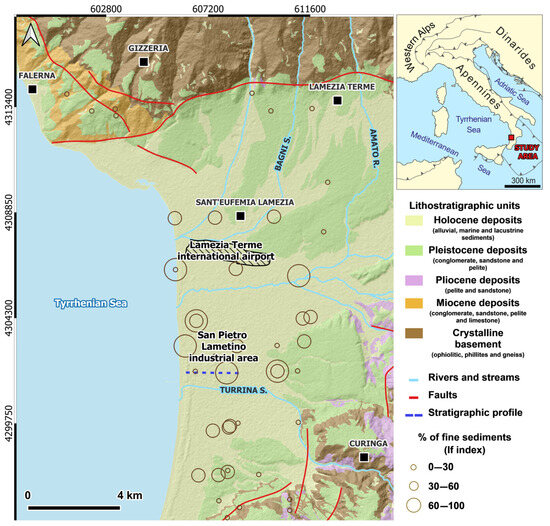
A regional uplift affected the CA starting in the late Early Pleistocene [22], although localized subsidence is currently observed, for instance in the Sibari Plain and Crati Valley [8,9]. The Sant’Eufemia Plain (SEP), the focus area of this study (Figure 1), lies along the western margin of the Catanzaro Trough (or Catanzaro Graben), a tectonic depression bounded by the Soverato–Lamezia strike-slip fault zone to the south and the Catanzaro–Amantea fault zone to the north [21].
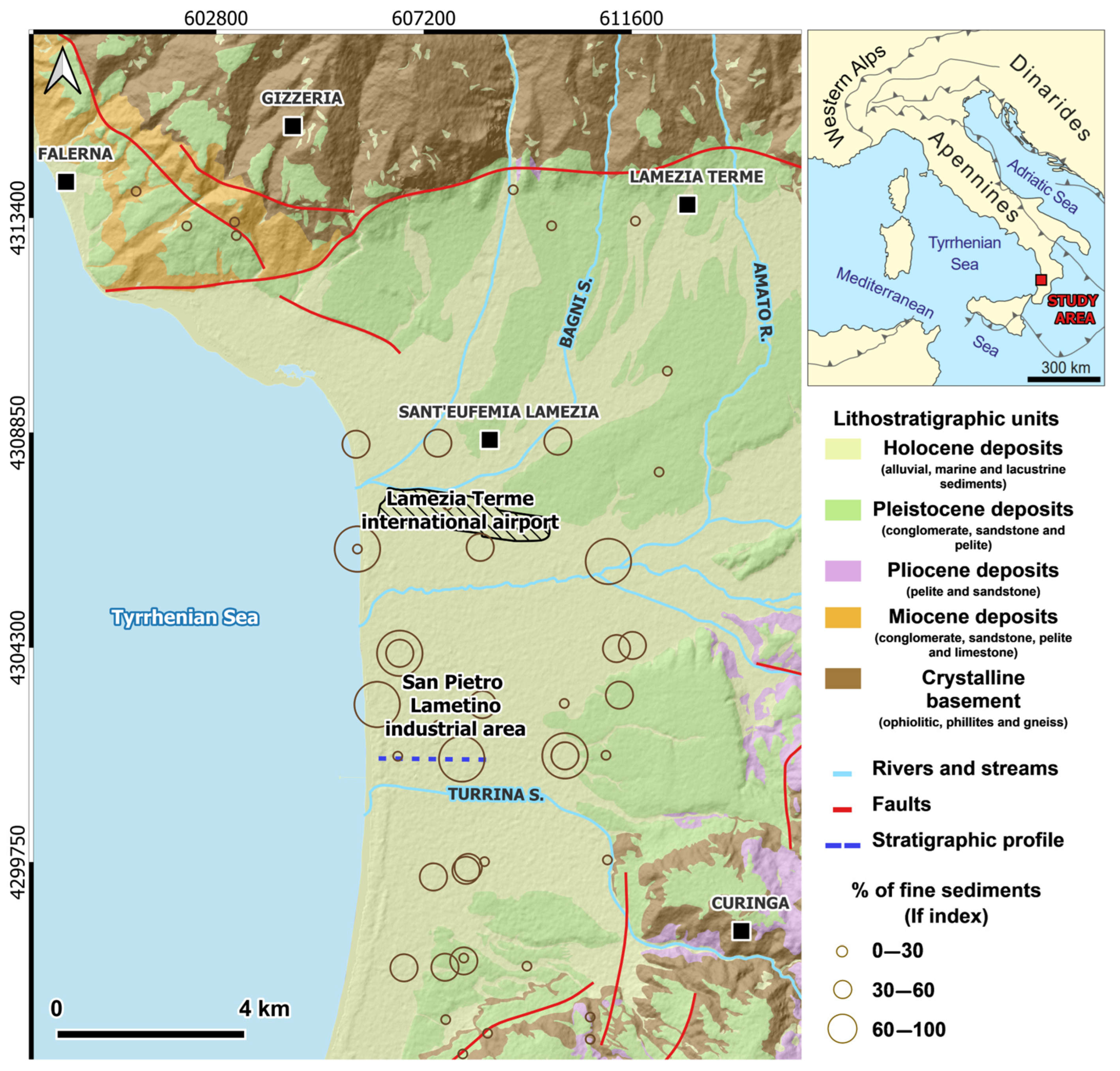
Figure 1.
Simplified geological map of the Sant’Eufemia Plain; the fault traces are reported from ITHACA database [23]. In the map are reported the profile of the stratigraphic section shown in Section 4.3 (dashed blue line) and also the percentage of fine-grained sediments (If index) for each analysed borehole available in the area (see details in Section 4.3).
The Catanzaro Trough is filled by an upper Miocene succession of terrigenous and evaporitic deposits [24,25], overlain by Plio–Pleistocene sediments deposited within a tectonically confined strait [26]. Instead, the SEP consists of upper Miocene–Quaternary deposits overlying an igneous–metamorphic basement. These deposits comprise terrigenous, evaporitic, and carbonate units, grading upward into a marine succession of clays, sands, sandstones, and conglomerates. Offshore exploration wells (ViDEPI project—https://www.videpi.com/videpi/videpi.asp—accessed on 8 May 2026) indicate sedimentary thicknesses of up to about 1500 m.
The northern margin of the SEP is defined by the Feroleto–Santa Eufemia fault, composed of several discontinuous E–W and ESE–WNW fault segments, which are considered responsible for the northernmost major earthquake (Me = 7) of 28 March 1783 [27]. Faulting present in a Pliocene unit and probably extending to the shallow subsurface in Quaternary sediments is recognized in the Bagni stream close to the Caronte geothermal spring [28].
Along this margin, ophiolite-bearing rocks of the Paleozoic Bagni Unit (slates and metapelites) and the Gimigliano Unit [29,30,31] crop out, together with the orthogneisses of the Castagna Unit and Mesozoic carbonate complexes. The latter have been interpreted as a tectonic window of the Apennine chain [31]. The northern sector is also characterized by extensive alluvial fans and widespread landslides [32,33].
The southern boundary of the plain is marked by the northwestern Serre Massif, composed of Hercynian migmatitic paragneisses (upper nappe) and medium- to low-grade metamorphic rocks representing the intermediate and lower nappes of the Calabrian Arc ([34] and references therein).
Some studies [35,36,37] reconstructed the landscape evolution of the Sant’Eufemia Plain in the last 8300 years combining pollen and archaeological data within a defined paleoenvironmental and chronostratigraphic context. In the early Holocene (ca. 8300–6900 cal yr BP), eustatic rise dominated over tectonic uplift, resulting in shoreline ingression and aggradation. From ca. 6900 to 2800 cal yr BP, reduced sea-level rise and high sediment input caused coastal progradation under weak subsidence. Between ca. 2800 and 1400 cal yr BP, enhanced subsidence led to the formation of marshy and floodplain environments behind the barrier. After ca. 1400 cal yr BP, the Sant’Eufemia Plain remained largely stable.
3. Materials and Methods
3.1. InSAR Data, Processing, and Accuracy Assessment
Ground deformation in the study area was investigated using Sentinel-1 (S1) satellite imagery. By applying a well-established Multi-Temporal Synthetic Aperture Radar Interferometry (MT-InSAR) algorithm to stacks of S1 SAR data, precise measurements of ground displacement were obtained for the selected area.
For this research, the acquired S1 datasets were processed using EarthConsole (EC—https://ui-ppro.earthconsole.eu/—accessed on 8 May 2026), a powerful online service funded by the European Space Agency. EarthConsole offers an on-demand processing service specifically tailored for MT-InSAR applications, based on the Parallel Small Baseline Subset (P-SBAS) processing chain, a widely recognized algorithm for estimating surface deformation from SAR images. This approach, which evolves from the traditional SBAS algorithm [38], leverages the phase information contained in multiple SAR images acquired at different times to measure subtle changes in the distance between the sensor and the ground, which is indicative of ground movement [39,40,41].
The Single Look Complex (SLC) images under consideration exhibit a substantial footprint of approximately 250 km by 230 km, facilitating the monitoring of large areas. SLC data comprise both amplitude and phase information, which are fundamental for interferometric processing. Through a series of steps, the P-SBAS algorithm generates a network of interferograms, representing the phase differences between pairs of SAR images. Acquisition pairs were identified in accordance with constraints imposed on the normal and temporal baselines [42]. During the coregistration phase, a multilooking operation was employed to mitigate decorrelation noise effects. This spatial averaging increased the pixel size from approximately 5 m × 20 m to roughly 90 m × 90 m. A total of 104 and 129 SAR images were used for the ascending and descending geometries, respectively, generating 584 and 743 interferograms. The displacement products are referenced to user-defined stable points located in highly coherent areas (ascending: Lon 16.513717, Lat 39.628491; descending: Lon 16.522039, Lat 39.639937-WGS84 geographic coordinate system, decimal degrees; EPSG:4326). A coherence threshold of 0.8 was applied in both cases to consider only highly reliable measurement points. To reduce interferometric noise, Goldstein filtering was applied. Phase unwrapping was carried out using an extended version of the Minimum Cost Flow algorithm [40], while the atmospheric phase component was estimated and mitigated through double filtering in the spatial and temporal domains.
The EarthConsole service provides Line of Sight (LoS) displacement rates, commonly known as average velocities, and the corresponding displacement time series as primary outputs of the P-SBAS processing chain. These velocities quantify the ground movement along the LoS direction, exhibiting sensitivity to both vertical and horizontal components of motion, contingent upon the satellite’s viewing geometry. Displacement time series chronicle the evolution of ground deformation over time and provide insights into the temporal characteristics of surface movement, facilitating the identification of trends, seasonal variations, and abrupt displacements potentially associated with hazardous geological phenomena. Finally, the availability of both ascending and descending tracks for a given area enables the computation of the horizontal (East–West) and vertical components of displacement during the overlapping period [43].
MT-InSAR techniques have been demonstrated to yield optimal ground motion measurement accuracies, typically on the order of 1–2 mm/yr in velocity and 5–8 mm in displacement [44,45]. These values are achievable under ideal conditions, specifically when processing extensive SAR datasets acquired over highly coherent regions characterized by limited ground motion rates, subdued topography, and minimal atmospheric and ionospheric influences [44]. In our case, the standard deviation of the mean ground velocity results in 1.73 mm/yr for the vertical component and 1.37 mm/yr for the East–West component, both of which fall within the typical uncertainty range.
For the validation of interferometric products, direct ground-based measurements (e.g., levelling and Global Navigation Satellite System data) represent one of the most reliable references. In the absence of such data, as in this study, validation of displacement time series and mean ground velocities is typically achieved through cross-comparison with independent datasets derived from different sensors or alternative processing approaches. Therefore, here, we validated our P-SBAS results for both ascending and descending tracks by comparison with other products, elaborated using different processing techniques and considering various relative orbit tracks.
Specifically, we utilized the recently introduced ground deformation products developed under the Copernicus Land Monitoring Service, namely the European Ground Motion Service (EGMS—https://egms.land.copernicus.eu/—accessed on 8 May 2026). The EGMS datasets are produced by a private consortium and undergo regional accuracy validations against numerous permanent geodetic stations and other localized ground truth data. For this study, we employed the Basic products, for which the associated Root Mean Square Error (RMSE) against the deformation model is confirmed to be less than 5 mm for each ground displacement measurement [46].
Moreover, the results obtained from the P-SBAS approach, specifically for ascending passes, underwent a rigorous accuracy assessment process. This validation was carried out using an independent dataset, which was generated through a distinct MT-InSAR technique known as Enhanced-Persistent Scatterers (E-PS).
The E-PS approach represents an advanced iteration of the conventional Persistent Scatterers (PS) method, initially introduced by [47]. Its development has been significantly influenced by pioneering work published by [48,49]. This sophisticated technique has been seamlessly integrated into the SARscape® software (6.1.0) suite, a widely recognized platform for SAR data processing. A key innovation of the E-PS approach lies in its ability to jointly leverage two distinct types of radar scatterers: point scatterers and distributed scatterers. Point scatterers are characterized by their exceptional temporal stability of the backscattered radar signal, meaning their radar response remains consistent over time, making them ideal for precise deformation measurements. In contrast, distributed scatterers refer to neighbouring resolution cells that exhibit similar electromagnetic properties, often representing areas with more heterogeneous ground cover. By intelligently exploiting both types of scatterers, the E-PS approach achieves a significant improvement in the overall measurement quality. It accomplishes this by spatially averaging the data over statistically homogeneous areas. This process effectively increases the signal-to-noise ratio, which is crucial for distinguishing genuine ground deformation signals from background noise. Importantly, this spatial averaging is meticulously performed without compromising the accurate identification of coherent point-wise scatterers. The net result is a substantial growth in the spatial density of overall measurement points, providing a more comprehensive and detailed picture of ground deformation across the studied area. This enhanced spatial density is particularly valuable for accurately mapping subtle deformation patterns and identifying areas of localized instability.
Table 1 displays the main features of the datasets used for the retrieval of ground deformation information and for the outcome’s validation.
Table 1.
Here are presented the main features of the different datasets considered for both the evaluation of the displacement in the area and for validation purposes.
3.2. Piezometric and Pluviometric Data
Several piezometric datasets were analysed to reconstruct the temporal evolution of groundwater level variations in the study area. In particular, data up to 2020 were derived from bibliographic and cartographic sources: (i) 1974 data from [50]; (ii) 1985, 1998, and 2011 data from [51]; and (iii) 2020s data from the ISPRA L.464/84 database (https://legge464webgis.isprambiente.it/, accessed on 8 May 2026). Subsequently, 2022 and 2024 piezometric data were obtained through in situ measurements. The pluviometric data come from the ARPACAL database (www.cfd.calabria.it—accessed on 8 May 2026).
3.3. Stratigraphic and Geotechnical Data
The late quaternary stratigraphic architecture of the plains was investigated using different borehole databases: (i) [50]; (ii) ISPRA L.464/84; (iii) bibliographic sources [35,36,37]; (iv) geotechnical drilling (courtesy of local geologists). The resulting stratigraphic model integrates multiple borehole datasets, ensuring a representative reconstruction of the subsurface architecture across the study area.
Based on the resulting stratigraphic model, settlements induced by the load of an idealized industrial structure were estimated using the classical one-dimensional consolidation theory by Terzaghi, implemented through the Geostru Loadcap software (2025). This approach was adopted to quantify the time-dependent primary consolidation response of the compressible stratigraphic sequence. Since Terzaghi’s framework does not account for long-term creep effects, secondary compression was evaluated separately through a simplified first-order approach based on the coefficient of secondary compression (Cα), derived from site-specific oedometer data and literature relationships for organic soils. In particular, geotechnical parameters were derived from laboratory tests where available and complemented by literature values for comparable deposits, ensuring internal consistency of the model. This combined approach allowed distinguishing between primary consolidation and secondary compression contributions to the total settlement.
4. Results and Discussion
4.1. InSAR-Derived Findings
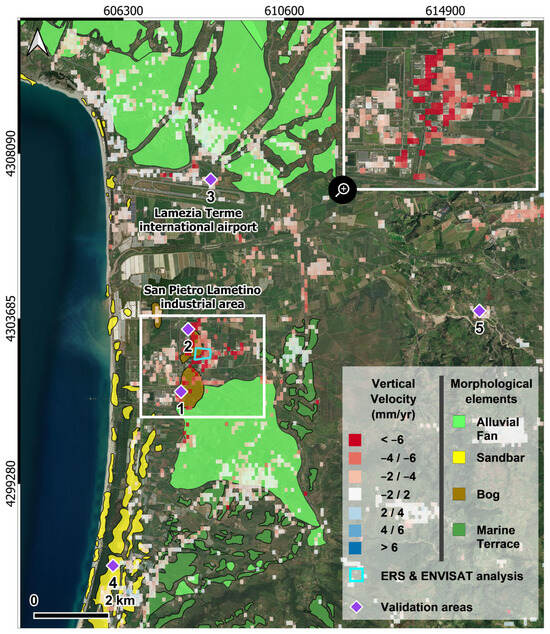
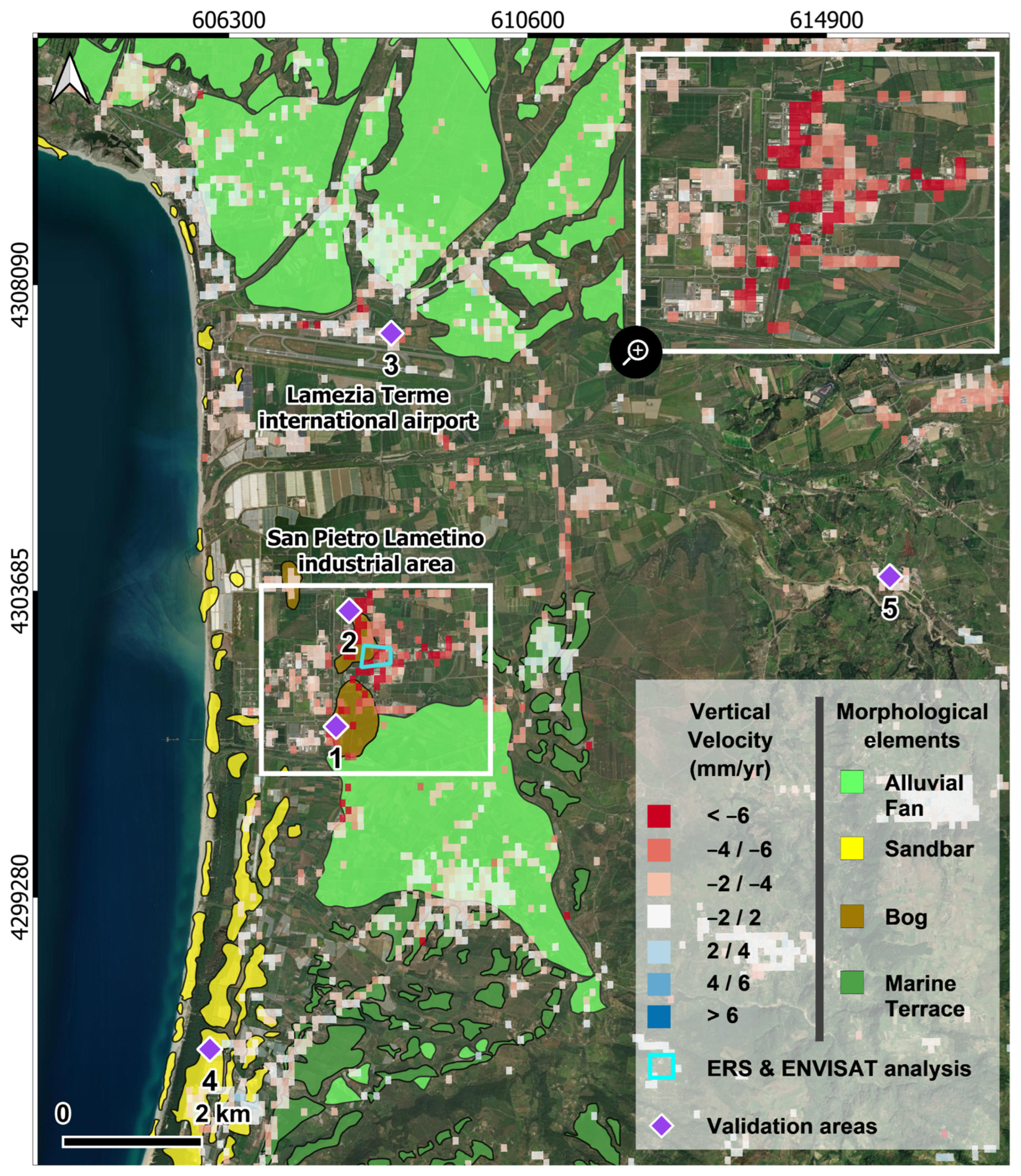
Figure 2 shows the vertical displacement map over the Sant’Eufemia Plain obtained using the P-SBAS approach. P-SBAS results show that within the whole processed area, the only zone affected by non-negligible vertical movements (i.e., negative values in Figure 2) is the industrial area of San Pietro Lametino, about 3 km South of the Lamezia Terme international airport (enlarged inset in Figure 2). The average subsidence rates measured in the entire industrial area during recent years, derived from the combination of the ascending and descending results, are around −5 mm/yr, but in localised areas, rates of up to −17 mm/yr have been recorded. Here it is interesting to note that the Quaternary morphological elements (from [35]) highlight the presence of bogs, i.e., a type of wetland ecosystem characterized by wet, spongy, poorly drained peat-rich soil. With regard to the East–West movements derived from the LoS displacement decomposition, the results did not reveal any notable patterns or rates; therefore, the implications for interpreting deformation mechanisms are considered negligible.
Figure 2.
P-SBAS vertical displacement map containing the Quaternary morphological elements of the area. Purple diamonds indicate the location of areas used for the cross-comparisons between InSAR techniques and the light-blue polygon depicts the portion of the industrial area where the historical analysis of displacements recorded by ERS and ENVISAT satellites was performed.
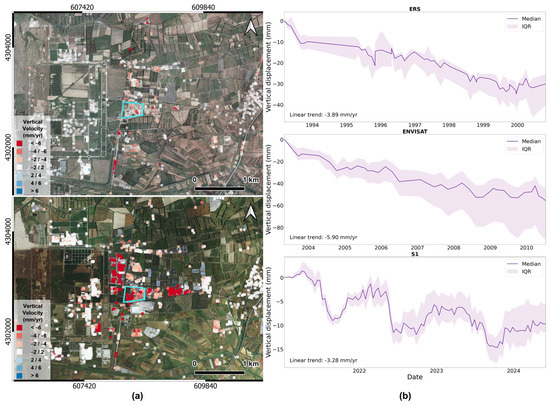
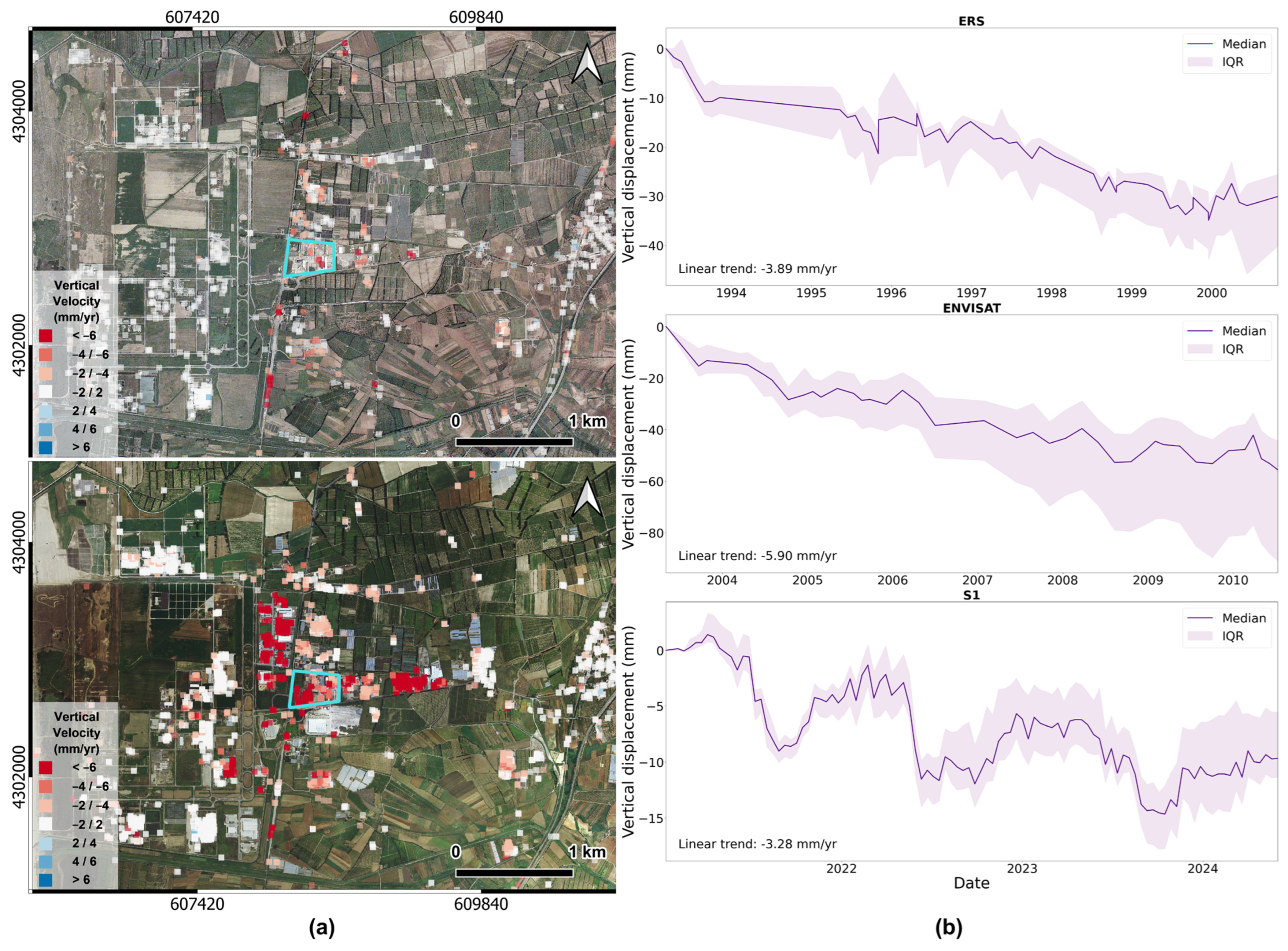
A spatio-temporal analysis of displacements measured during historical ERS and ENVISAT space missions was conducted to investigate the historical ground movements in the present-day industrial area and the potential causes of displacement over time (Figure 3). Raw interferometric products were obtained from the database generated through the Italian extraordinary remote sensing plan (from www.gn.mase.gov.it—accessed on 8 May 2026). Specifically, displacements recorded by the ERS satellite along the descending LoS from 13 April 1993, to 27 October 2000, and ENVISAT displacements along the ascending LoS from 4 May 2003, to 11 July 2010, were analysed. Given that only a single orbit is available for each satellite and assuming negligible horizontal motion (an assumption supported by the Sentinel-1 P-SBAS processing), the ERS and ENVISAT LoS displacement measurements were converted to vertical displacement to ensure geometric comparability. This was achieved by dividing the LoS displacement values by the cosine of the radar wave incidence angle [52,53,54]. Negative displacement values in Figure 3a, which indicate subsidence movements, are observed in areas where historical orthophotos in the background (from www.gn.mase.gov.it—accessed on 8 May 2026) reveal the presence of new industrial buildings and/or infrastructures. More precisely, the upper panel of Figure 3a presents the orthophoto acquired in the year 2000, superimposed with the vertical displacement rates measured during the period of ERS satellite activity. Conversely, the lower panel of Figure 3a displays the orthophoto acquired in the year 2012, overlapped by the mean vertical velocity recorded during the ENVISAT mission. To evaluate deformation trends over time, the area exhibiting measurable movements since 1993, specifically the portion within the light-blue border in Figure 2 and Figure 3a, was selected, and the ERS and ENVISAT time series were plotted (Figure 3b). The median vertical displacement rate of the ERS satellite is approximately −4 mm/yr and exhibits a nearly linear progression. Instead, the ENVISAT satellite shows a higher median vertical displacement rate of approximately −6 mm/yr. The latter observation is attributable to industrial expansion in the area, which undoubtedly took place between 2000 and 2008, as also evidenced by the orthophotos shown in Figure A1, which accelerated the compaction and consolidation of the underlying soils. Finally, to illustrate displacement evolution in more recent years, vertical time series from the same area, obtained through the application of the P-SBAS technique to Sentinel-1 data, were plotted. These series indicate a median displacement rate of approximately −3 mm/yr. However, the observed trend displays significant fluctuations, likely related to seasonal variations in groundwater levels, as previously noted in other studies (e.g., [55]).
Figure 3.
(a) Upper panel depicts the vertical velocity derived from ERS satellite data overlapped to the orthophoto of the area taken in 2000 (from www.gn.mase.gov.it—accessed on 8 May 2026). The lower panel shows the vertical velocity obtained from ENVISAT satellite data overlapped to the orthophoto of the area taken in 2012 (from www.gn.mase.gov.it—accessed on 8 May 2026). (b) Vertical displacement time series plotted inside the light-blue border visible in panel (a) for ERS, ENVISAT and Sentinel-1 datasets. The solid line represents the median value, while the shaded area indicates the interquartile range (IQR), which contains 50% of the data.
We validated the P-SBAS results using the cross-comparison approach, exploiting the availability for the same area of EGMS products (both ascending and descending tracks) and an additional outcome obtained through the processing of the ascending S1 dataset with the E-PS technique (see Section 3 for details).
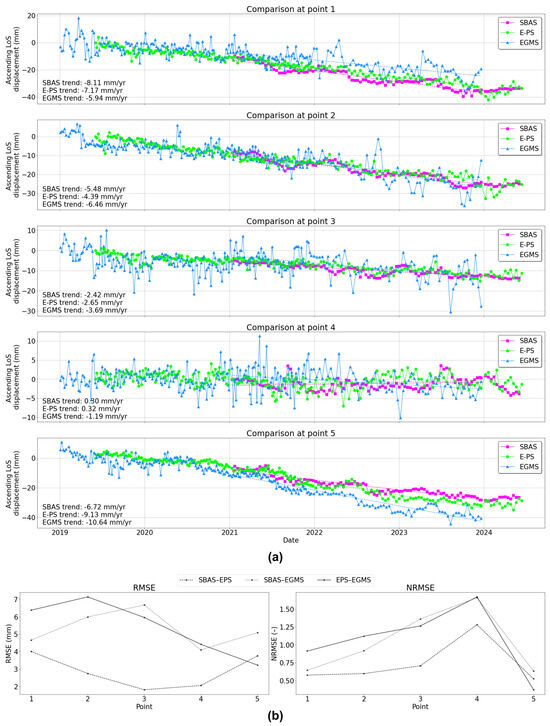
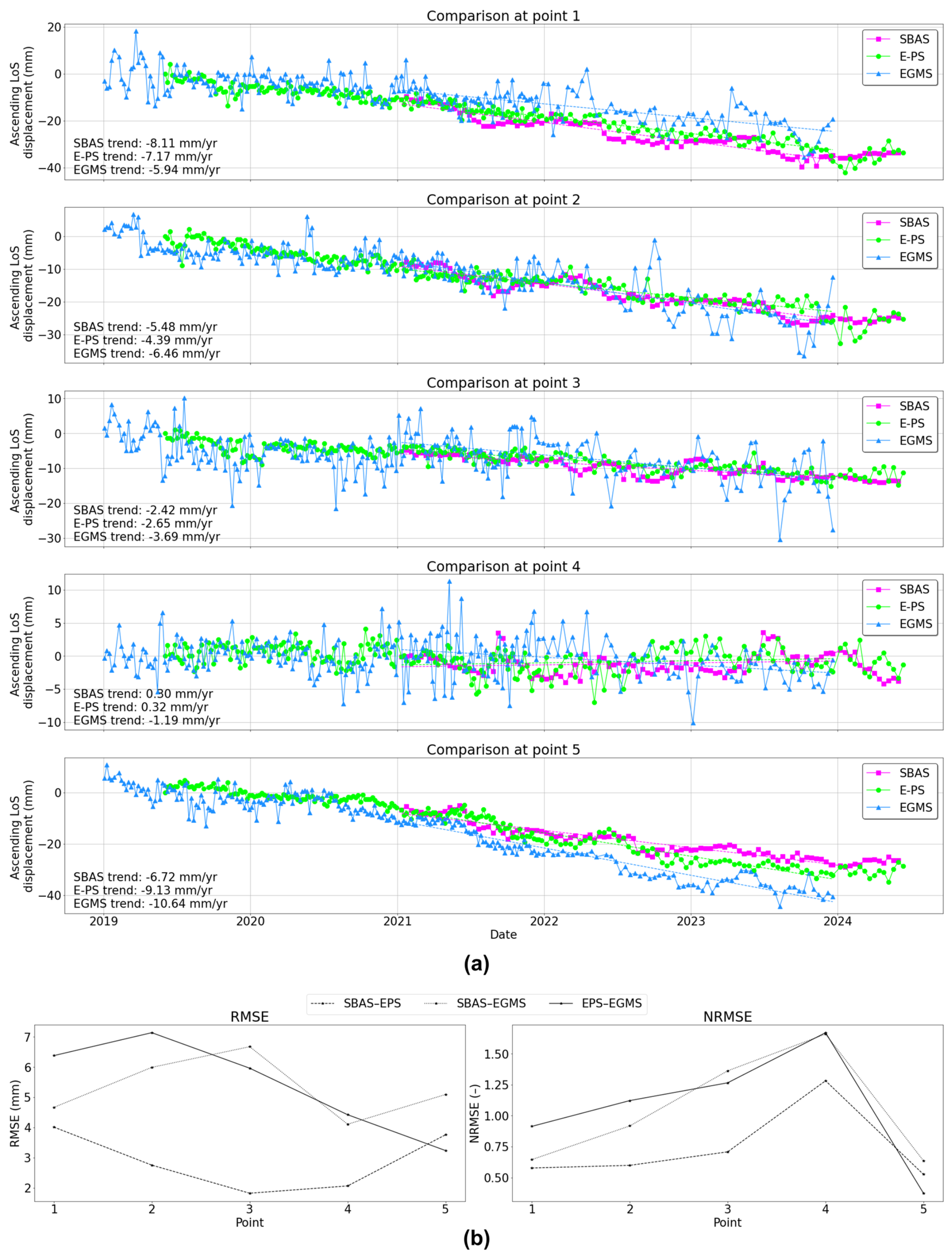
Figure 4a shows the displacement time series (TS) plotted over the 5 areas distinguished by purple diamonds in Figure 2. P-SBAS, E-PS, and EGMS results correspond to magenta, green, and blue TS, respectively. The comparative graphs show good agreement in both the long-term trends and the average displacement rates calculated over the overlapping period of the different datasets. The variability in interferometric noise observed in the long displacement time series, as evidenced by the dispersion of the values (e.g., higher for EGMS results), as well as the slight differences in oscillation amplitudes, are likely attributable to: (i) different final spatial resolution, (ii) diverse choices of parameters in the processing workflow and (iii) different algorithms employed for the ground motion recording. RMSE and normalized RMSE (NRMSE) were used to quantify the agreement between P-SBAS, E-PS, and EGMS displacement time series (Figure 4b). All datasets were interpolated onto a common time grid, and then aligned by removing the initial offset, enabling comparison of temporal deformation patterns. RMSE was computed as the root mean square of the differences between paired series, while NRMSE was obtained by normalizing RMSE with the standard deviation of the combined dataset, providing a dimensionless measure of relative discrepancy.
Figure 4.
(a) Cross-comparison between InSAR techniques for the ascending S1 dataset, carried out by analysing displacement time series. (b) Quantification of errors associated with comparisons of paired time series by calculating the RMSE and its value normalised by the standard deviation of the combined datasets (i.e., NRMSE).
Finally, Figure A2 shows the displacement time series (magenta TS for P-SBAS and blue TS for EGMS products) obtained from descending data, for the same 5 areas considered for the comparison made along the ascending orbit (purple diamonds in Figure 2). Also in this case comparative graphs show good agreement in both long-term trends and average displacement rates calculated over the overlapping period of the different datasets. The quantification of errors associated with time series comparisons is shown directly in the figure, alongside the linear trend calculated for each dataset.
4.2. Piezometric and Pluviometric Findings
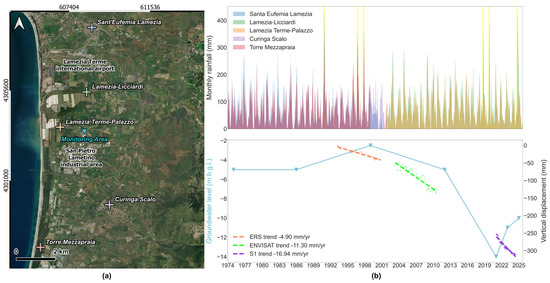
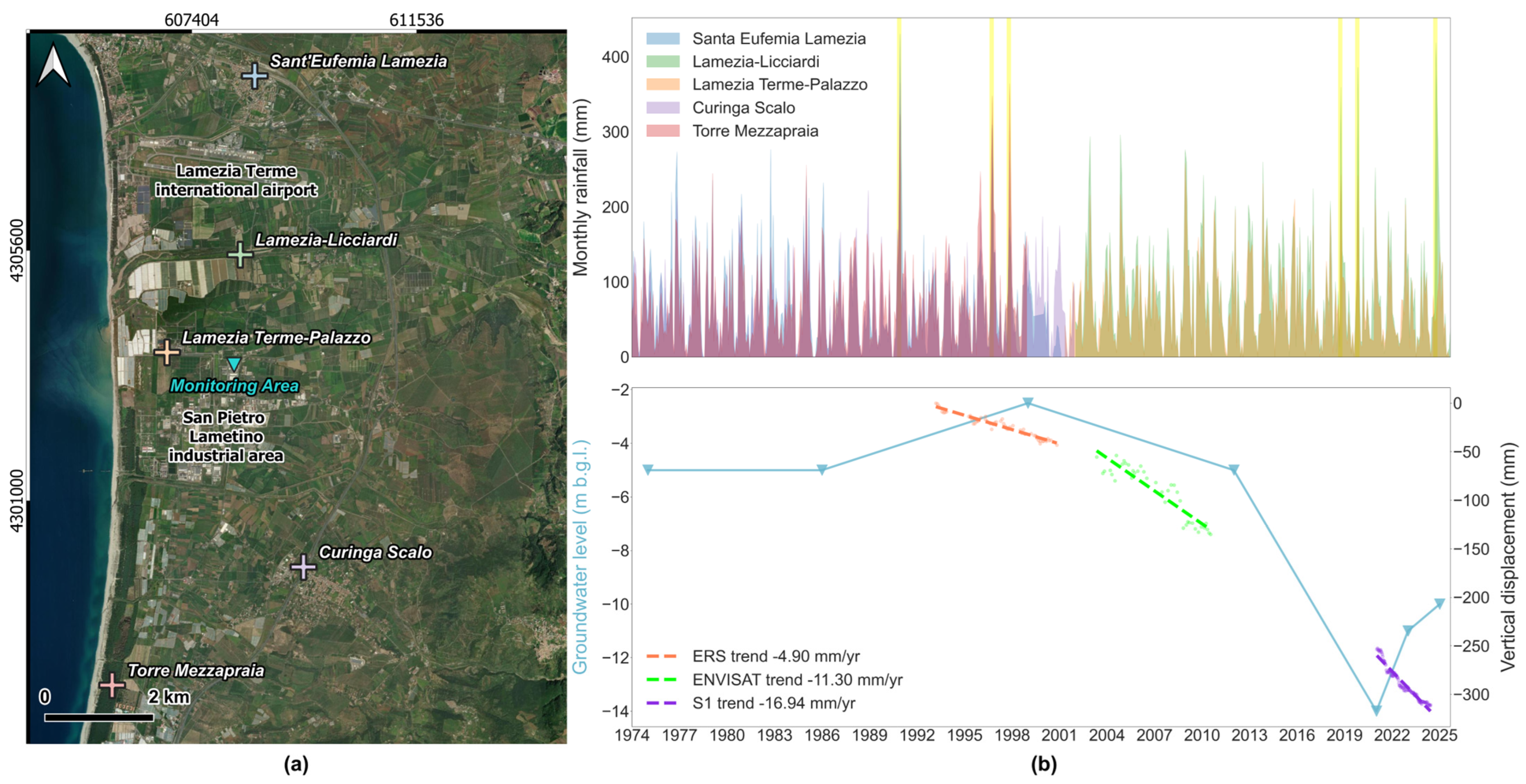
A joint analysis of historical rainfall and groundwater level data collected in the study area was conducted and supplemented with the vertical ground deformations assessment derived from ERS, ENVISAT and Sentinel-1 sensors. Historical rainfall measurements were obtained from the five pluviometric stations, whose locations are indicated by coloured crosses in Figure 5a. Historical groundwater level data from 1974 to 2020 were derived from literature ([51] and ISPRA L.464/84 database). Subsequently, until 2024, piezometric measurements were collected at a monitoring site (i.e., a 10 m deep well) located in the northern part of the San Pietro Lametino industrial area (blue triangle in Figure 5a).
Figure 5.
(a) Location of the groundwater monitoring area (blue triangle) and pluviometric stations (coloured crosses) within the SEP. (b) Combined analysis of historical rainfall (upper panel) and groundwater level data versus vertical displacements derived from ERS, ENVISAT and Sentinel-1 data (lower panel).
Regarding the correlation between rainfall and water levels, the analysis in Figure 5b shows mainly that (i) following periods of heavy rainfall, i.e., vertical yellow bands (in the upper panel) corresponding to monthly rainfall exceeding 30 cm, there is a slight recovery of the groundwater level (see lower panel); (ii) the decrease in the water level in the period 1998–2011, visible in the lower panel, coincides with the period of intense industrialization outlined by the 2012 orthophoto (Figure 3 and Figure A1).
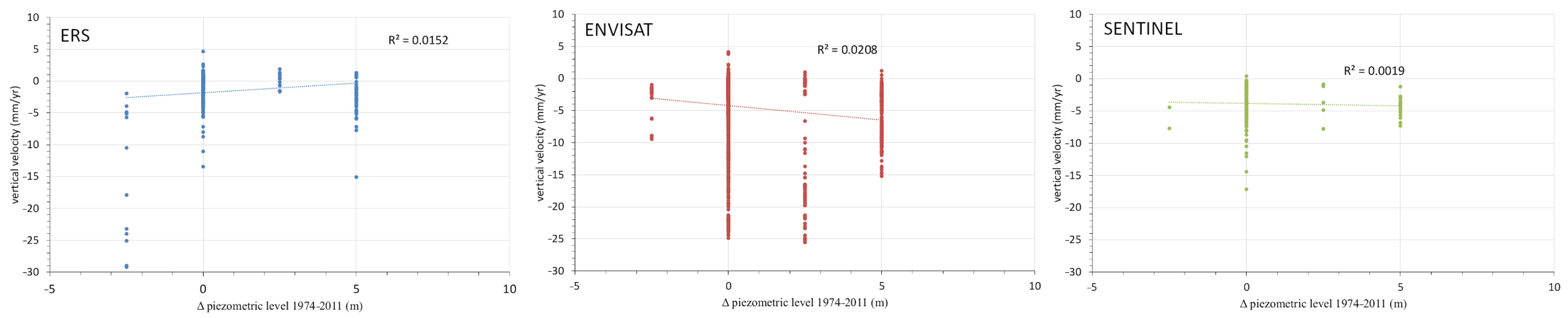
On the other hand, regarding the correlation between water level and measured displacements, first a spatially distributed quantitative analysis was carried out by comparing InSAR-derived vertical velocities (ERS, ENVISAT, Sentinel-1) with the corresponding groundwater level values obtained from historical piezometric data [51] (Figure A3). Despite this point-by-point approach, the results show weak and spatially variable correlations (R2 ranging between 0.0019 and 0.0208), suggesting that groundwater fluctuations alone are insufficient to explain the observed subsidence patterns.
Secondly, a detailed comparison between InSAR time series and water level was carried out at the monitoring site identified by the blue triangle in Figure 5a, where groundwater levels are available for the period 1974–2024. The groundwater time series highlights a non-monotonic evolution (see lower panel of Figure 5b), characterized by relatively stable conditions until the late 1990s, followed by a moderate decline and a more pronounced drawdown after 2011, reaching maximum depths of approximately −14 m b.g.l. around 2020. A partial recovery is observed in the most recent years (2020–2024), although groundwater levels remain deeper than historical conditions.
Consistent with the spatial analysis, this point-based comparison does not show a clear linear correspondence between groundwater level variations and InSAR-derived deformation rates (lower panel of Figure 5b). The multi-temporal InSAR analysis indicates persistent subsidence throughout all observation periods, with progressively increasing deformation rates over time. Mean velocities derived from the ERS, ENVISAT, and Sentinel-1 datasets are approximately −5 mm/yr (1993–2000), −11 mm/yr (2003–2010), and −17 mm/yr (2021–2024), respectively.
The acceleration of subsidence over time partially overlaps with the long-term groundwater decline observed after the late 1990s and particularly after 2011. However, despite this general correspondence, the temporal evolution of groundwater levels and deformation rates does not show a direct linear relationship. In particular, groundwater fluctuations are characterized by alternating decline and partial recovery phases, whereas subsidence exhibits a more persistent and cumulative behaviour.
This decrease in the hydraulic head, associated with groundwater withdrawal and reduced recharge, can lead to an increase in effective stress within the porous medium, potentially inducing consolidation processes affecting both aquifer units (Holocene mainly sandy deposits) and low-permeability aquitards (Holocene fine-grained deposits) [56]. Such processes have been widely documented in several regions worldwide, including the North China Plain [57], the Central Valley of California [58], and the Po Plain in Italy [59], where groundwater depletion has been identified as a primary driver of land subsidence. However, previous studies have also shown that the relationship between groundwater level variations and surface deformation is often non-linear and time-dependent, with possible temporal decoupling between pore pressure changes and ground response due to delayed consolidation and residual compaction effects (e.g., [60,61,62]). Overall, the behaviour observed in the study area is therefore more consistent with the combined effects of long-term consolidation processes and groundwater-related stress changes, rather than with a simple direct response to short-term piezometric fluctuations. This interpretation is consistent with observations from other sedimentary basins, where subsidence persists or accelerates even during periods of groundwater stabilization or partial recovery (e.g., [63,64]). Therefore, the coexistence of groundwater fluctuations and persistent subsidence suggests that aquifer-system compaction may represent one of the contributing factors to ground lowering, rather than its sole controlling mechanism.
In relation to the hypotheses formulated in the Section 1, the results of the piezometric analysis and the comparison with InSAR data do not fully support hypothesis (iii), which assumes a direct and linear relationship between groundwater level variations and subsidence. Although the long-term groundwater decline may contribute to the increase in effective stress within the subsoil, the weak correlations and the temporal complexity of deformation trends indicate that groundwater-related processes likely interact with consolidation mechanisms affecting the highly compressible Holocene deposits.
4.3. Stratigraphic and Geotechnical Findings
We analysed the stratigraphic data of at least 50 boreholes from different sources ([35,36,37,50]; private geotechnical drilling). First of all, we divided the late Quaternary deposits into three main litho-technical units: (i) late Pleistocene coarse-grained sedimentary unit; (ii) Holocene fine-grained deposits, with peat intercalations, linked to marshy and floodplain environments and (iii) Holocene mainly sandy deposits related to the coastal progradation.
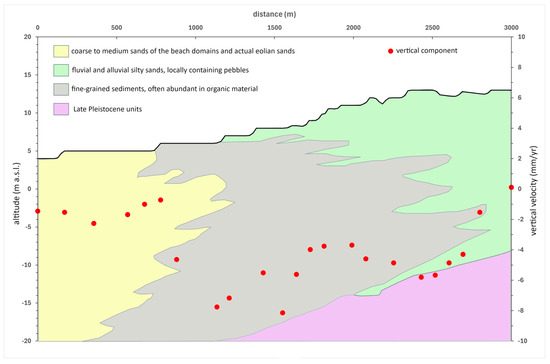
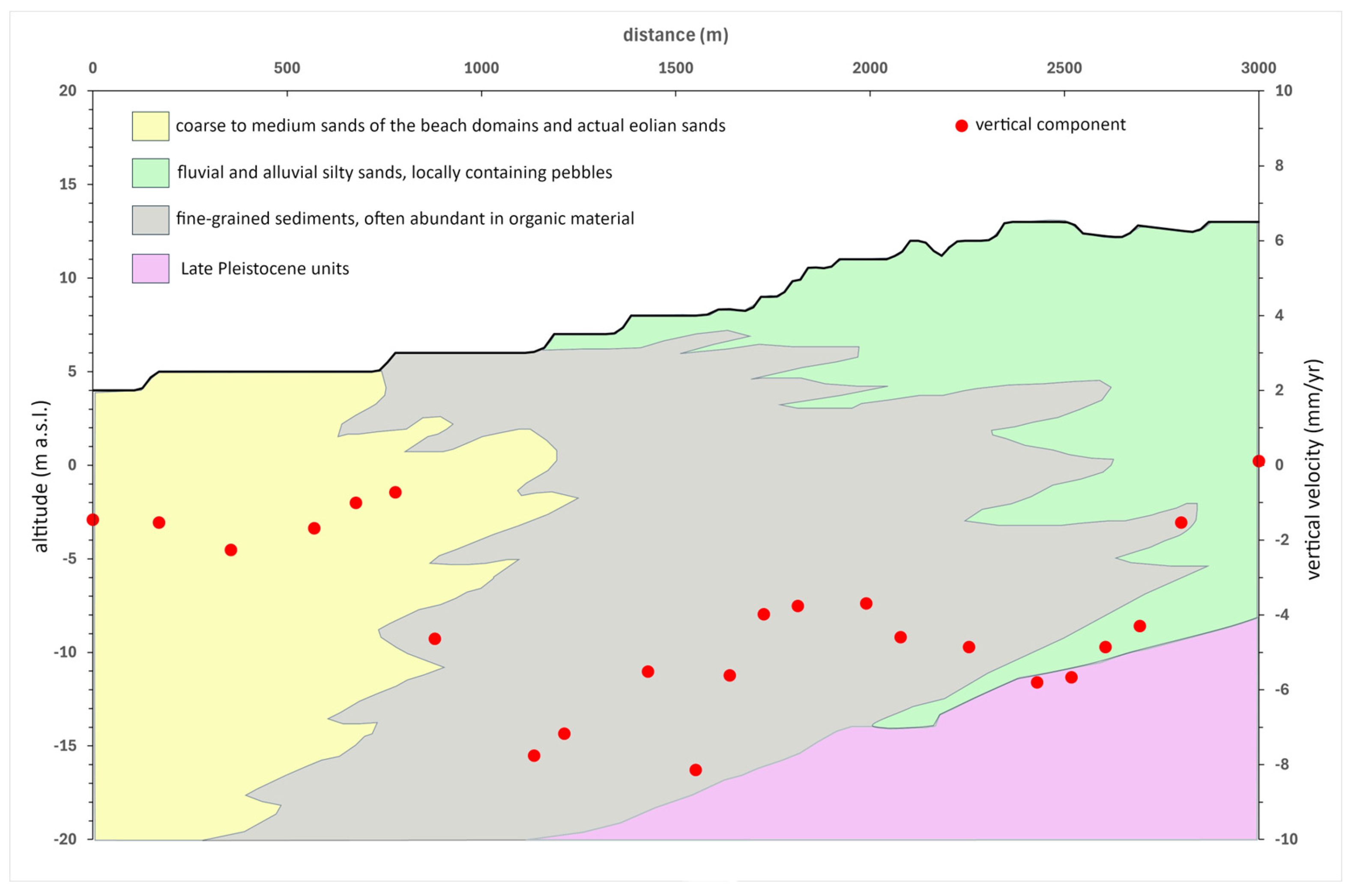
Using some of the analysed boreholes, we constructed a W-E Holocene stratigraphic section, close to the San Pietro Lametino industrial area, showing the maximum thickness of the fine-grained sediments in the middle sector. We plotted the P-SBAS vertical velocity values along the section, observing the highest values in correspondence with the fine-grained deposits which represent an area occupied during the Holocene by a marshy and floodplain environment (Figure 6).
Figure 6.
Cross-section with the projection of the Sentinel-1 vertical velocity showing subsidence in correspondence of the marshy-floodplain deposits.
Thereafter, according to [65], we computed the fine-grained index “If” for each borehole. This index expresses the relative thickness of fine-grained sediments in each borehole, calculated as the percentage ratio between the total thickness of silt- and clay-rich layers and the overall thickness of late Quaternary sediments. The area with higher “If” (>60%) is located between the airport and the San Pietro Lametino industrial area, which represents the Holocene floodplain of the Amato River (Figure 1).
Our outcomes show that the spatial variability of subsidence is correlated with the lateral distribution of sedimentary facies within Holocene deposits, as observed in other Holocene deltaic plains worldwide (e.g., [66,67,68]).
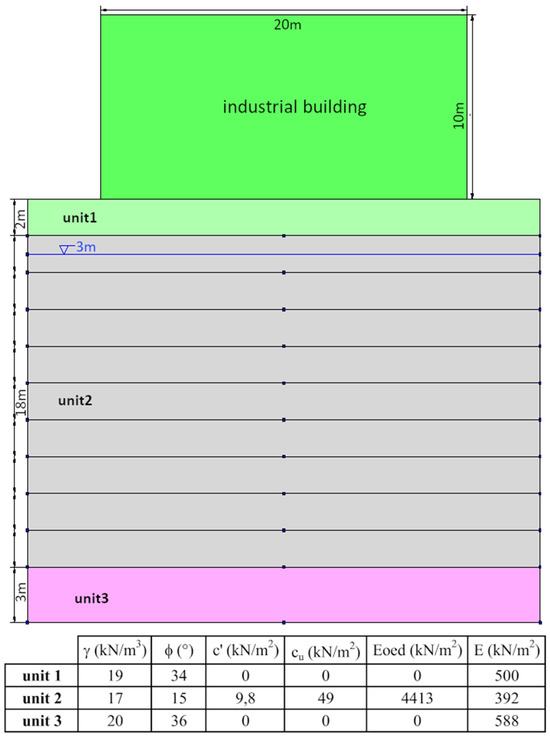
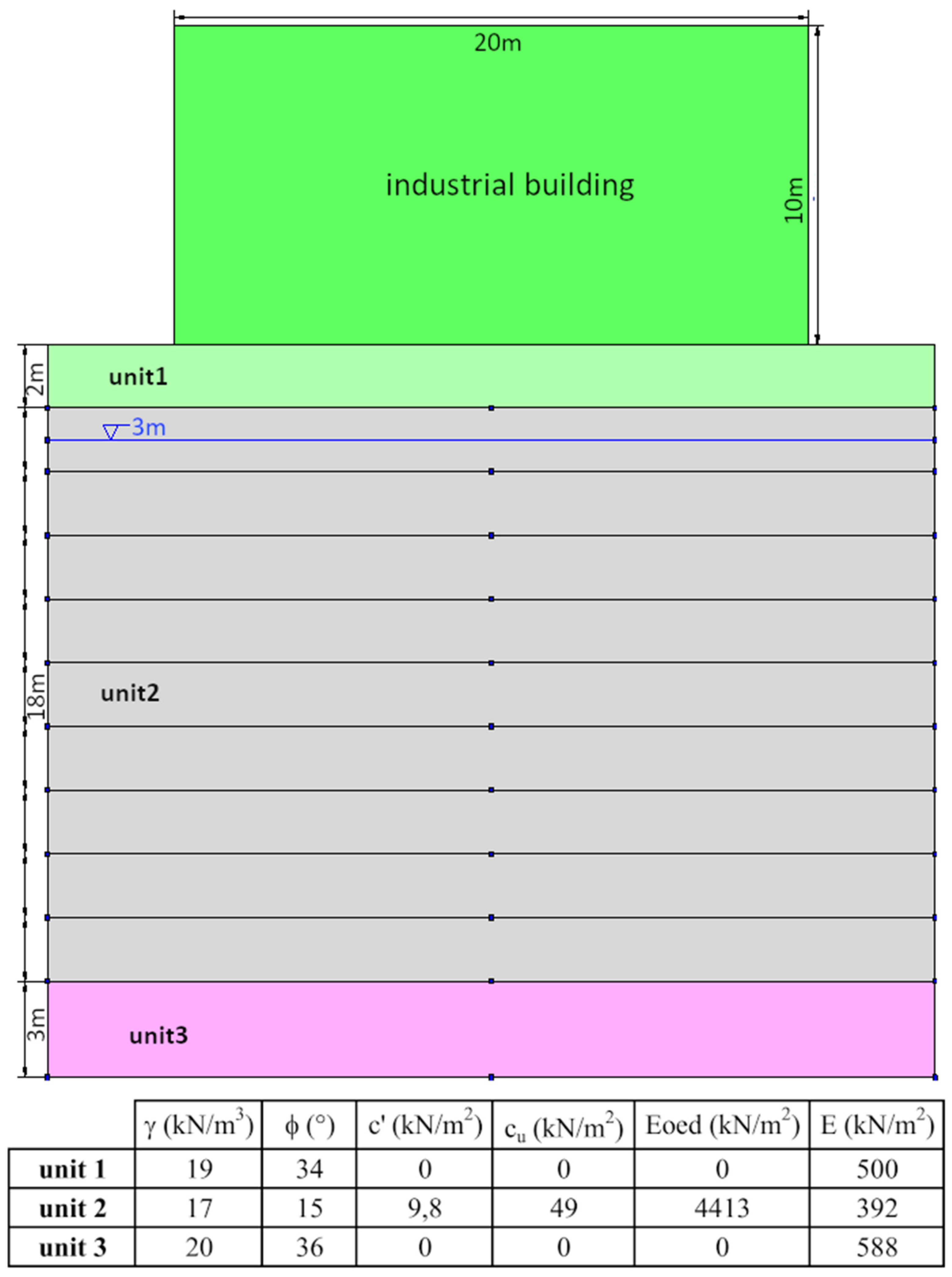
In correspondence of the San Pietro Lametino industrial area, the subsidence rate induced by an industrial loading was evaluated through a simplified geotechnical model based on Terzaghi’s classical one-dimensional consolidation theory, adopted to estimate the time-dependent primary consolidation response of the compressible stratigraphic sequence. The geotechnical model was reconstructed using available borehole data and groundwater table measurements (Figure 7). The stratigraphic framework was derived from multiple boreholes, while geotechnical parameters were constrained by laboratory data from representative samples and literature ranges.
Figure 7.
Simplified geotechnical model (γ = specific weight; Φ = friction angle; c’ = cohesion; cu = undrained cohesion; Eoed = oedometric modulus; E = elastic modulus). The geotechnical parameters reported in the model are derived from site-specific laboratory data when available (notably for unit 2), and complemented with literature values for comparable materials.
The geotechnical model includes three main litho-geotechnical units represented, from the ground level, by: (i) 2 m-thick Holocene sandy deposits; (ii) 18 m-thick Holocene fine-grained deposits, with peat intercalations; (iii) 3 m-thick late Pleistocene coarse-grained sediments. An industrial building with a 20 × 20 m ground plan, height of 10 m, and a specific weight of 24 kN/m3 was considered.
We evaluated the time-dependent consolidation for a period of 15 years and observed a total consolidation of ~10 cm which involves all the 3 units. The total consolidation includes primary (short period) and secondary consolidation processes [69]. The primary consolidation occurred in all the 3 units with small values: 0.05, 0.25 and 0.18 cm respectively. The secondary consolidation is instead characterized by a value of ~9.4 cm, corresponding to average deformation rates on the order of several mm/yr. These values are comparable with the InSAR-derived deformation rates observed during the ERS period, although the more recent ENVISAT and Sentinel-1 measurements (Figure 5) indicate a progressive acceleration of subsidence not fully reproduced by the simplified geotechnical model. The secondary consolidation is almost fully in the surface sector of unit 2 (3 m of depth). Future load increases could induce compaction of the deeper clay layers.
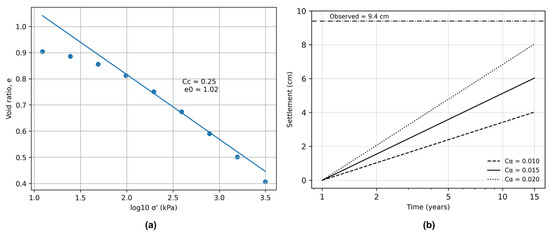
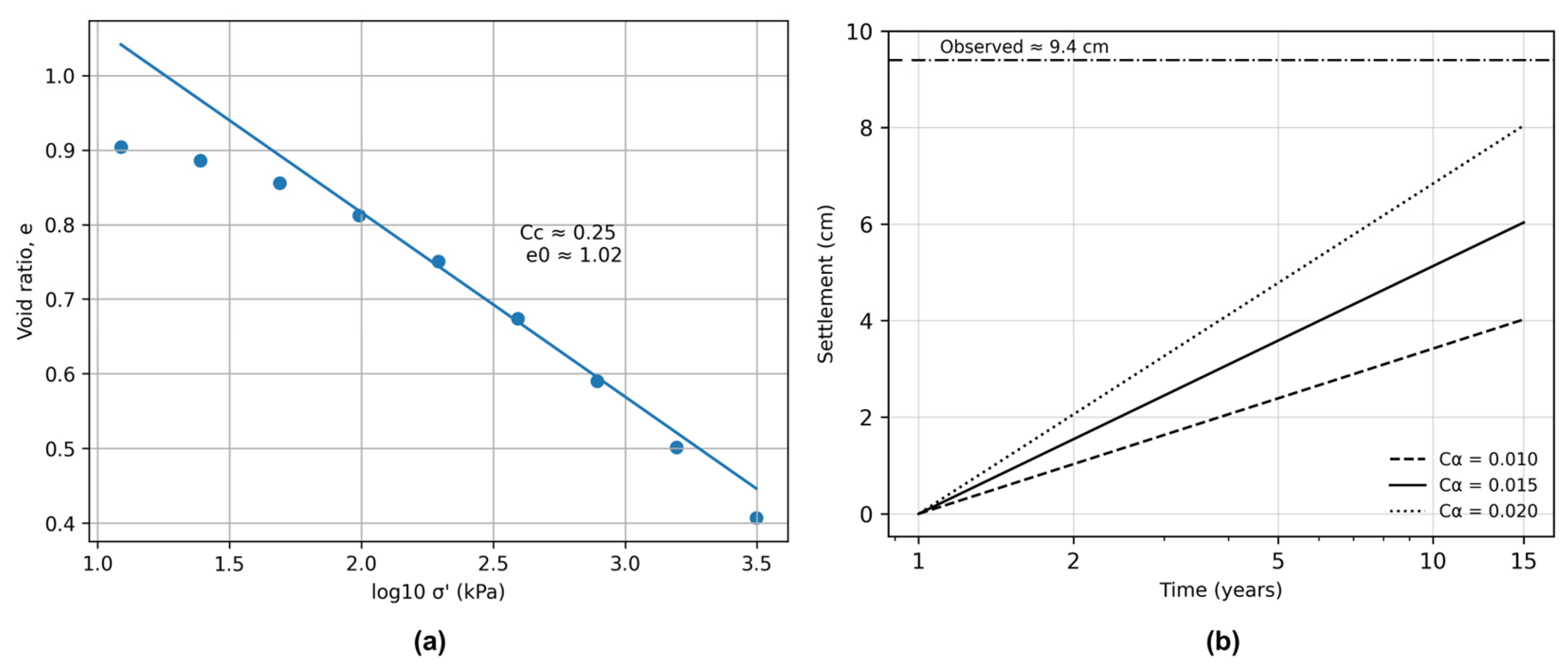
Although Terzaghi’s framework was used to estimate the primary consolidation component, the dominance of long-term deformation by secondary compression is supported both by the settlement partitioning and by independent laboratory-based considerations. In particular, representative oedometer data from the study area (Figure 8a) indicate a relatively high compressibility for the fine-grained/organic deposits, with a compression index of Cc ≈ 0.25 and an initial void ratio e0 ≈ 1.02. Based on the well-established empirical relationship between the coefficient of secondary compression and the compression index for organic soils (Cα/Cc ≈ 0.04–0.08; [70,71]), plausible values of Cα fall in the range 0.01–0.02. This range is consistent with published values for peat-bearing deposits, despite their known variability. A first-order estimate of secondary settlement was therefore derived as:
assuming an effective creeping thickness H = 3 m within the upper portion of unit 2 and a 15-year time interval. The resulting predicted settlements (Figure 8b) are on the order of several centimeters (≈5–9 cm, depending on the adopted Cα value), supporting the interpretation that secondary compression contributes significantly to the long-term deformation observed by InSAR. Although simplified, this estimate captures the expected order of magnitude of settlement and supports the interpretation of secondary compression as the major component of the observed subsidence.
Ss = (H·Cα/(1 + e0))·ln(t2/t1)
Figure 8.
(a) Oedometer compression curve, highlighting the primary compression behaviour (Cc ≈ 0.25, e0 ≈ 1.02) of the most compressible fine-grained/organic layer. (b) First-order estimate of secondary settlement over 15 years based on empirical Cα values for organic soils (0.01–0.02), showing consistency with the inferred long-term settlement (~9.4 cm).
These results indicate that SAR data effectively capture long-term ground deformation affecting the industrial area. Its expansion therefore contributes to subsidence by increasing surface loading on highly compressible Holocene deposits, as also observed in rapidly urbanizing deltaic environments such as the Mekong Delta and the Jakarta metropolitan area [64,72].
The geotechnical model presented above evaluates the consolidation induced by surface loading under the assumption of constant groundwater conditions and does not explicitly incorporate temporal variations in pore pressure. However, groundwater data available for the period 1974–2024 indicate significant fluctuations, with a pronounced drawdown occurring after 2011, reaching depths of approximately −14 m b.g.l., followed by a partial recovery in recent years. These variations imply changes in effective stress within the compressible stratigraphic sequence, which may have contributed to the overall consolidation process. As already discussed in Section 4.2, the comparison between groundwater level variations and InSAR-derived deformation shows that subsidence persists across all observation periods, including during phases of groundwater recovery, and that no clear linear relationship exists between groundwater fluctuations and deformation rates. This suggests that groundwater variations may act as a preconditioning factor, influencing the stress state of the subsoil rather than directly controlling the observed deformation rates.
Therefore, while the geotechnical model captures the component of subsidence associated with load-induced consolidation, it does not fully explain the progressive increase in deformation rates observed in the multi-temporal InSAR datasets.
In relation to the hypotheses formulated in the Section 1, the modelling results indicate that primary consolidation (hypothesis i) plays a negligible role compared with the total deformation, whereas secondary consolidation processes affecting highly compressible Holocene deposits (hypothesis ii) represent a major contribution to subsidence. At the same time, the temporal evolution of groundwater levels suggests that groundwater-related stress changes may also contribute to deformation, although their effect cannot be quantitatively separated within the current modelling framework. The observed subsidence is therefore interpreted as the result of interacting hydro-mechanical processes whose relative contributions remain uncertain.
5. Conclusions
In this study, Sentinel-1 SAR ascending and descending images acquired between 2021 and 2024 were processed using the P-SBAS service available on ESA’s funded EarthConsole online platform. The P-SBAS results were then validated using EGMS datasets and, for the ascending track, the accuracy assessment was also performed using an independent dataset generated by means of the E-PS technique.
The interferometric analysis identifies the industrial zone of San Pietro Lametino as an area undergoing significant subsidence, with average rates of approximately −5 mm/yr and locally reaching up to −17 mm/yr. In contrast, in the area surrounding Lamezia Terme international airport, only a few localised subsidence points are observed, mainly in car parks and material storage areas, while the runway remains stable and the average vertical deformation rate across the airport area is approximately −1.5 mm/yr. Unlike the industrial zone, the airport lies outside the area characterised by Holocene peaty deposits and is instead located near alluvial fans composed of coarse-grained materials. This highlights the strong influence of stratigraphy and geological setting on the spatial distribution of the observed deformation.
Analysis of historical satellite data acquired by the ERS and ENVISAT missions indicates that the subsidence phenomenon in the industrial area has been occurring since at least 1993. In addition, historical orthophotos reveal a clear spatial and temporal correspondence between the expansion of industrial development and increasing rates of ground subsidence. The multi-temporal analysis of the northern sector of the San Pietro Lametino industrial area reveals a progressive increase in deformation rates over time, from approximately −5 mm/yr during the ERS period (1993–2000), to −11 mm/yr during the ENVISAT period (2003–2010), and reaching −17 mm/yr during the Sentinel-1 period (2021–2024). These findings suggest that the load associated with new constructions and industrial development has influenced the observed ground motion, potentially inducing secondary consolidation processes within the underlying highly compressible Holocene peaty soils. This interpretation is also supported by stratigraphic and geotechnical analyses. The superposition of vertical velocity data on a subsoil cross-section reconstructed from approximately 50 boreholes highlights higher subsidence rates within facies composed of fine-grained, organic-rich sediments. Geotechnical modelling suggests that the subsidence rates measured by satellite correspond to secondary consolidation processes within compressible Holocene deposits. However, the model explicitly accounts only for load-induced consolidation and does not include temporal variations in groundwater levels.
Groundwater data (1974–2024), including observations from the last 15 years, show significant fluctuations, with a pronounced drawdown after 2011 followed by partial recovery. Spatially distributed comparisons between groundwater level variations and InSAR-derived deformation, as well as point-based temporal analyses, reveal weak and inconsistent correlations, suggesting that groundwater fluctuations alone do not directly control subsidence rates. Nevertheless, the progressive acceleration of deformation partially overlaps with the long-term groundwater decline observed after the late 1990s, indicating that groundwater depletion may contribute to increased effective stress and the persistence of consolidation processes over time. Therefore, while groundwater level variations likely contribute to changes in effective stress conditions within the subsoil, their role is interpreted as a preconditioning factor rather than a directly quantifiable driver within the current modelling framework. The relative contributions of load-induced consolidation and groundwater-related processes to the observed subsidence remain unquantified, representing a limitation of this study.
In summary, the hypothesis-driven framework adopted in this study enabled evaluation of the relative role of different subsidence mechanisms. The results indicate that secondary consolidation within compressible Holocene deposits is the dominant process, while groundwater-related stress changes likely contribute to the observed deformation by modifying effective stress conditions within the subsoil. In contrast, primary consolidation appears to play a minor role over the investigated time interval.
The results confirm the importance of integrated monitoring of groundwater levels, land deformation, and sediment compressibility to better identify the triggering and predisposing causes for subsidence.
Future research will focus on refining the understanding of the ongoing subsidence processes through a dedicated geognostic investigation campaign, including the acquisition of in situ geotechnical parameters and continuous groundwater level monitoring. Coupled hydro-mechanical models will also be developed to better constrain the controls exerted by hydro-mechanical processes on ground deformation.
Author Contributions
Conceptualization, G.C., L.B. and C.T.; methodology, G.C., L.B. and C.T.; software, G.C., L.B. and C.T.; validation, G.C., L.B. and C.T.; formal analysis, G.C., L.B., C.T., A.F. and R.D.; investigation, G.C., L.B., A.F. and C.T.; resources, R.D.; data curation, G.C., L.B. and A.F.; writing—original draft preparation, L.B.; writing—review and editing, G.C., C.T., A.F. and R.D.; visualization, G.C., L.B. and A.F.; supervision, C.T.; project administration, G.C. and L.B.; funding acquisition, R.D. All authors have read and agreed to the published version of the manuscript.
Funding
This research was funded by the funds of the CARG—Project—Geological Map of Italy 1:50,000, within the framework of the DiBEST–ISPRA Agreement for the completion of the official Geological Map of Italy, Geological Sheet No. 574 “Lamezia Terme”, Scient. Resp. Prof Rocco Dominici, CUP: H53C23001570005.
Data Availability Statement
The P-SBAS results presented in this study are available on request from the corresponding author. Sentinel-1 raw data can be found in the Alaska Satellite Facility catalog (https://search.asf.alaska.edu—accessed on 8 May 2026). ERS and ENVISAT interferometric products are available in the database generated through the Italian extraordinary remote sensing plan (www.gn.mase.gov.it—accessed on 8 May 2026). The open-source in situ datasets are directly cited in the main text. Data relating to groundwater abstraction by wells can be retrieved from the databases of the Calabria Region and ISPRA (Law 464/84) at the following links: https://www.regione.calabria.it/; https://legge464webgis.isprambiente.it/—accessed on 8 May 2026.
Acknowledgments
This publication has been prepared using European Union’s Copernicus Land Monitoring Service information; https://doi.org/10.2909/cc459e76-a40f-4b8e-9a66-6da4acbbf239. Geotechnical drilling is courtesy of Geol. Fabio Isabella.
Conflicts of Interest
The authors declare no conflicts of interest. The funders had no role in the design of the study; in the collection, analyses, or interpretation of data; in the writing of the manuscript; or in the decision to publish the results.
Abbreviations
The following abbreviations are used in this manuscript:
| SEP | Sant’Eufemia Plain |
| SAR | Synthetic Aperture Radar |
| CA | Calabrian Arc |
| cal yr BP | calibrated years Before Present |
| SLC | Single Look Complex |
| MT-InSAR | Multi-Temporal Synthetic Aperture Radar Interferometry |
| LoS | Line of Sight |
| P-SBAS | Parallel Small Baseline Subset |
| EGMS | European Ground Motion Service |
| RMSE | Root Mean Square Error |
| EC | EarthConsole |
| E-PS | Enhanced-Persistent Scatterers |
Appendix A
Figure A1.
Multi-temporal aerial photos of the San Pietro Lametino industrial area: 1988–1989 owned by the Ministry of Environment and Energy Security (from www.gn.mase.gov.it—accessed on 8 May 2026); 2000 from the Flight IT2000 (Costa) realized by the CGR (General Aerial Survey Company); 2008 from the Flight for the Regional Technical Map; 2012 from www.gn.mase.gov.it. The light-blue border refers to the portion considered for the historical analysis of the displacements time series shown in Figure 3. The aerial photos from 2000 and 2012 have been overlaid with the vertical ERS and ENVISAT displacements, respectively. For further details, please refer to Section 4.1 and Figure 3 of the main text.
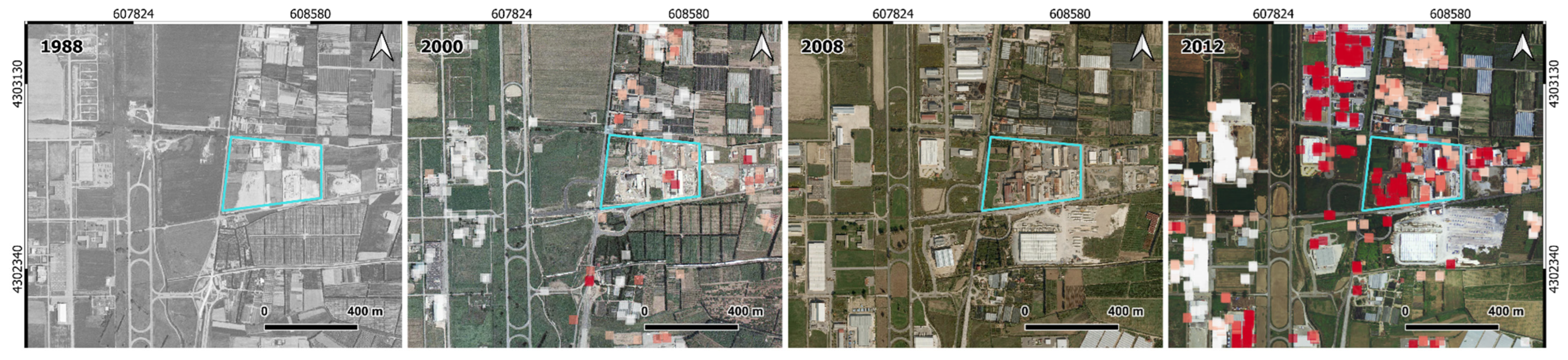
Figure A2.
Cross-comparison between P-SBAS and EGMS InSAR techniques for the descending Sentinel-1 dataset, performed considering long displacement time series.
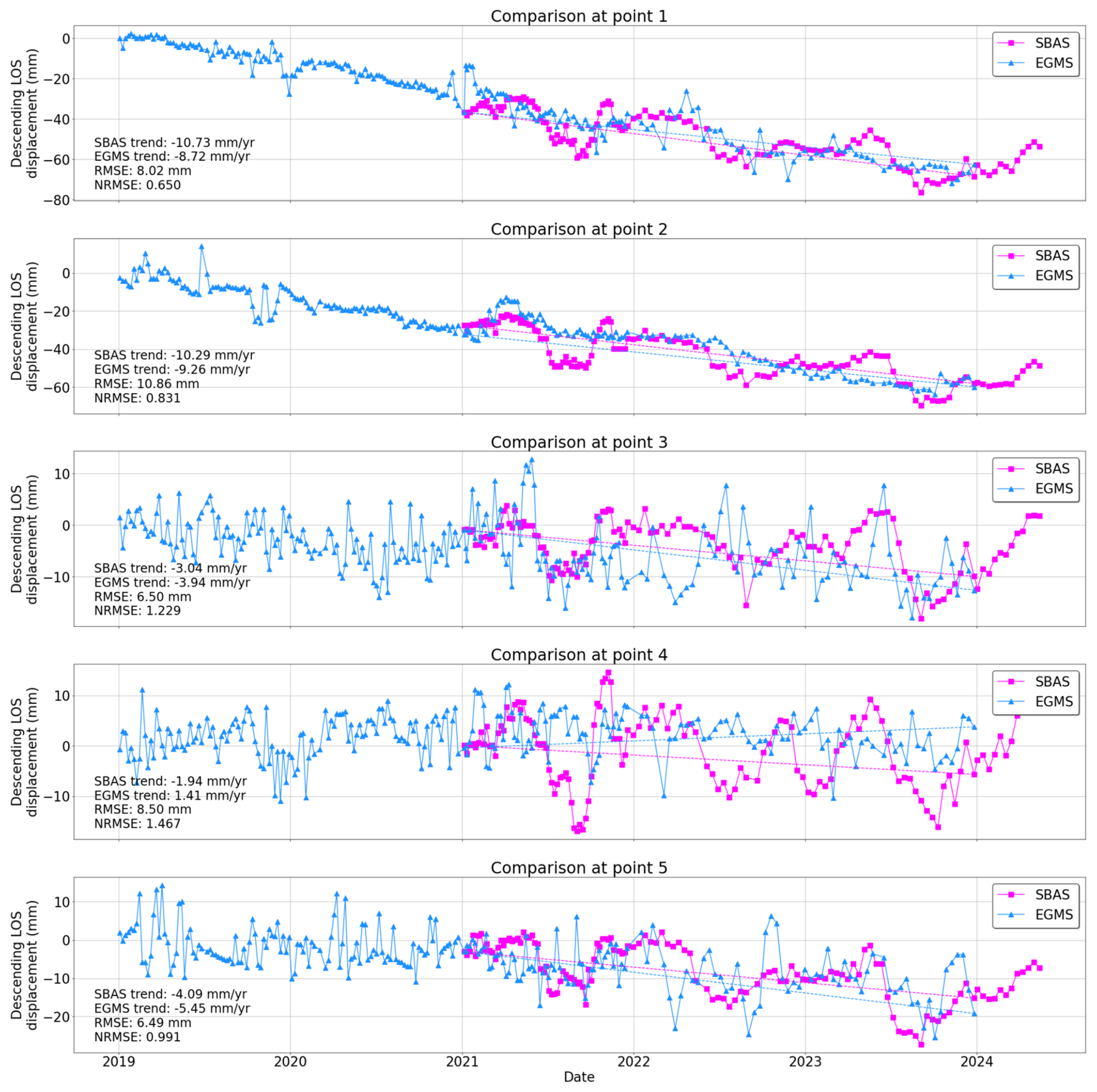
Figure A3.
Scatter plots comparing groundwater level variations (Δ1974–2011) and InSAR-derived vertical velocities for different datasets: ERS, Envisat and Sentinel-1. Linear regression lines and R-squared value (R2) highlight weak and inconsistent relationships across datasets. Groundwater level values are derived from spatial interpolation of piezometric contours based on the work of [51].
References
- Huning, L.S.; Love, C.A.; Anjileli, H.; Vahedifard, F.; Zhao, Y.; Chaffe, P.L.; Cooper, K.; Alborzi, A.; Pleitez, E.; Martinez, A.; et al. Global land subsidence: Impact of climate extremes and human activities. Rev. Geophys. 2024, 62, e2023RG000817. [Google Scholar] [CrossRef]
- Li, S.; Xu, W.; Li, Z. Review of the SBAS InSAR Time-series algorithms, applications, and challenges. Geod. Geodyn. 2022, 13, 114–126. [Google Scholar]
- Corsa, B.; Barba-Sevilla, M.; Tiampo, K.; Meertens, C. Integration of DInSAR Time Series and GNSS Data for Continuous Volcanic Deformation Monitoring and Eruption Early Warning Applications. Remote Sens. 2022, 14, 784. [Google Scholar] [CrossRef]
- Pino, N.A.; Carlino, S.; Beccaro, L.; De Martino, P. Aseismic creep, coseismic slip, and postseismic relaxation on faults in Volcanic areas: The case of Ischia Island. Remote Sens. 2023, 15, 1791. [Google Scholar]
- Beccaro, L.; Albano, M.; Tolomei, C.; Spinetti, C.; Pezzo, G.; Palano, M.; Chiarabba, C. Insights into post-emplacement lava flow dynamics at Mt. Etna volcano from 2016 to 2021 by synthetic aperture radar and multispectral satellite data. Front. Earth Sci. 2023, 11, 1211450. [Google Scholar] [CrossRef]
- Beccaro, L.; Bignami, C.; Zanon, V.; Silva, R. Ground displacement assessment on Pico Volcano, Azores, by multitemporal InSAR data. J. Appl. Remote Sens. 2023, 17, 032402. [Google Scholar]
- Gianardi, R.; Bisson, M.; Beccaro, L.; De Ritis, R.; Sepe, V.; Colini, L.; Tolomei, C.; Cocchi, L.; Spinetti, C. High-resolution susceptibility mapping of seismically induced landslides on Ischia island: The 2017 earthquake case study. AIMS Geosci. 2024, 10, 573–597. [Google Scholar] [CrossRef]
- Cianflone, G.; Tolomei, C.; Brunori, C.A.; Dominici, R. InSAR Time Series Analysis of Natural and Anthropogenic Coastal Plain Subsidence: The Case of Sibari (Southern Italy). Remote Sens. 2015, 7, 16004–16023. [Google Scholar] [CrossRef]
- Cianflone, G.; Tolomei, C.; Brunori, C.A.; Monna, S.; Dominici, R. Landslides and subsidence assessment in the Crati Valley (Southern Italy) using InSAR data. Geosciences 2018, 8, 67. [Google Scholar] [CrossRef]
- Cigna, F.; Tapete, D. Sentinel-1 Big Data Processing with P-SBAS InSAR in the Geohazards Exploitation Platform: An Experiment on Coastal Land Subsidence and Landslides in Italy. Remote Sens. 2021, 13, 885. [Google Scholar] [CrossRef]
- Fabris, M.; Battaglia, M.; Chen, X.; Menin, A.; Monego, M.; Floris, M. An Integrated InSAR and GNSS Approach to Monitor Land Subsidence in the Po River Delta (Italy). Remote Sens. 2022, 14, 5578. [Google Scholar] [CrossRef]
- Lenardón Sánchez, M.; Farías, C.A.; Cigna, F. Multi-Decadal Land Subsidence Risk Assessment at Major Italian Cities by Integrating PSInSAR with Urban Vulnerability. Land 2024, 13, 2103. [Google Scholar] [CrossRef]
- Medici, C.; Del Soldato, M.; Fibbi, G.; Bini, L.; Confuorto, P.; Mannori, G.; Mucci, A.; Pellegrineschi, V.; Bianchini, S.; Raspini, F.; et al. InSAR data for detection and modelling of overexploitation-induced subsidence: Application in the industrial area of Prato (Italy). Sci. Rep. 2024, 14, 17950. [Google Scholar] [CrossRef]
- Bitelli, G.; Ferretti, A.; Giannico, C.; Giorgini, E.; Lambertini, A.; Marcaccio, M.; Mazzei, M.; Vittuari, L. Subsidence monitoring in Emilia-Romagna Region (Italy) from 2016 to 2021: From InSAR and GNSS integration to data analysis. Remote Sens. 2025, 17, 947. [Google Scholar] [CrossRef]
- Bozzano, F.; Esposito, C.; Franchi, S.; Mazzanti, P.; Perissin, D.; Rocca, A.; Romano, E. Understanding the subsidence process of a quaternary plain by combining geological and hydrogeological modelling with satellite InSAR data: The Acque Albule Plain case study. Remote Sens. Environ. 2015, 168, 219–238. [Google Scholar] [CrossRef]
- Solari, L.; Del Soldato, M.; Bianchini, S.; Ciampalini, A.; Ezquerro, P.; Montalti, R.; Raspini, F.; Moretti, S. From ERS 1/2 to Sentinel-1: Subsidence monitoring in Italy in the last two decades. Front. Earth Sci. 2018, 6, 149. [Google Scholar] [CrossRef]
- Verberne, M.; Teatini, P.; Koster, K.; Fokker, P.; Zoccarato, C. An integral approach using InSAR and data assimilation to disentangle and quantify multi-depth driven subsidence causes in the Ravenna coastland, Northern Italy. Geomech. Energy Environ. 2025, 43, 100710. [Google Scholar]
- Malinverno, A.; Ryan, W.B.F. Extension in Tyrrhenian Sea & shortening in the Apennines as result of arc migration driven by sinking of the lithosphere. Tectonics 1986, 5, 227–254. [Google Scholar]
- Gueguen, E.; Doglioni, C.; Fernandez, M. On the Post-25 Ma Geodynamic Evolution of the Western Mediterranean. Tectonophysics 1998, 298, 259–269. [Google Scholar] [CrossRef]
- Knott, S.D.; Turco, E. Late Cenozoic Kinematics of the Calabrian Arc, Southern Italy. Tectonics 1991, 10, 1164–1172. [Google Scholar] [CrossRef]
- Van Dijk, J.P.; Bello, M.; Brancaleoni, G.P.; Cantarella, G.; Costa, V.; Frixa, A.; Golfetto, F.; Merlini, S.; Riva, M.; Torricelli, S.; et al. A Regional Structural Model for the Northern Sector of the Calabrian Arc (Southern Italy). Tectonophysics 2000, 324, 267–320. [Google Scholar] [CrossRef]
- Westaway, R. Quaternary uplift of southern Italy. J. Geophys. Res. 1992, 98, 21741–21772. [Google Scholar] [CrossRef]
- ITHACA Working Group. ITHACA (ITaly HAzard from CApable Faulting), A Database of Active Capable Faults of the Italian Territory, Version December 2019; ISPRA Geological Survey of Italy: Rome, Italy, 2019. [Google Scholar]
- Cianflone, G.; Dominici, R. Stratigrafia fisica della successione sedimentaria Miocenica del settore Nord-Orientale della Stretta di Catanzaro (Calabria Centro-Orientale). Rend. Online Soc. Geol. Ital. 2011, 17, 63–69. [Google Scholar] [CrossRef]
- Cianflone, G.; Dominici, R.; Sonnino, M. Studio preliminare delle facies evaporitiche e carbonatiche del Messiniano della Stretta di Catanzaro (Calabria Centrale). Rend. Online Soc. Geol. Ital. 2012, 21, 71–73. [Google Scholar]
- Longhitano, S.G.; Chiarella, D.; Muto, F. Three-Dimensional to Two-Dimensional Cross-Strata Transition in the Lower Pleistocene Catanzaro Tidal Strait Transgressive Succession (Southern Italy). Sedimentology 2014, 61, 2136–2171. [Google Scholar] [CrossRef]
- Galli, P.; Bosi, V. Paleoseismology along the Cittanova fault: Implications for seismotectonics and earthquake recurrence in Calabria (southern Italy). J. Geophys. Res. Solid Earth 2002, 107, ETG 1-1–ETG 1-19. [Google Scholar] [CrossRef]
- Punzo, M.; Cianflone, G.; Cavuoto, G.; De Rosa, R.; Dominici, R.; Gallo, P.; Lirer, F.; Pelosi, N.; Di Fiore, V. Active and Passive Seismic Methods to Explore Areas of Active Faulting. The Case of Lamezia Terme (Calabria, Southern Italy). J. Appl. Geophys. 2021, 188, 104316. [Google Scholar] [CrossRef]
- Vespasiano, G.; Cianflone, G.; Cannata, C.B.; Apollaro, C.; Dominici, R.; Rosa, R.D. Analysis of Groundwater Pollution in the Sant’Eufemia Plain (Calabria—South Italy). Ital. J. Eng. Geol. Environ. 2016, 16, 5–15. [Google Scholar] [CrossRef]
- Barilaro, F.; Di Capua, A.; Cianflone, G.; Turano, G.; Robertelli, G.; Brutto, F.; Ciccone, G.; Foti, A.; Festa, V.; Dominici, R. Volcano–Sedimentary Processes on an Ancient Oceanic Seafloor: Insights from the Gimigliano Metaophiolite Succession (Calabria, Southern Italy). Minerals 2025, 15, 552. [Google Scholar] [CrossRef]
- Amodio-Morelli, L.; Bonardi, G.; Colonna, V.; Dietrich, D.; Giunta, G.; Ippolito, F.; Liguori, V.; Lorenzoni, S.; Paglionico, A.; Perrone, V.; et al. L’arco Calabro-Peloritano nell’orogene Appenninico-Maghrebide. Mem. Soc. Geol. Ital. 1976, 17, 1–60. [Google Scholar]
- Gullà, G.; Antronico, L.; Sorriso-Valvo, M.; Tansi, C. Proposta metodologica per la valutazione di indicatori di pericolo e rischio da frana a scala intermedia: L’area della Stretta di Catanzaro (Calabria, Italia). Geol. Romana 2005, 38, 97–121. [Google Scholar]
- Cianflone, G.; Larosa, S.; Beccaro, L.; Viscomi, A.; Tolomei, C.; Chiodo, G.; La Pietra, T.; Leonetti, S.; Mollica, L.; Pellegrino, A.; et al. A revised landslide inventory of the Calabria Region (Italy). J. Maps 2025, 21, 2421292. [Google Scholar] [CrossRef]
- Langone, A.; Gueguen, E.; Prosser, G.; Caggianelli, A.; Rottura, A. The Curinga-Girifalco Fault Zone (Northern Serre, Calabria) and Its Significance within the Alpine Tectonic Evolution of the Western Mediterranean. J. Geodyn. 2006, 42, 140–158. [Google Scholar] [CrossRef]
- Russo Ermolli, E.; Ruello, M.R.; Cicala, L.; Di Lorenzo, H.D.; Molisso, F.; Pacciarelli, M. An 8300-yr record of environmental and cultural changes in the Sant’Eufemia Plain (Calabria, Italy). Quat. Int. 2018, 483, 39–56. [Google Scholar] [CrossRef]
- Ruello, M.R.; Cinque, A.; Di Donato, V.; Molisso, F.; Terrasi, F.; Russo Ermolli, E. Interplay between sea level rise and tectonics in the Holocene evolution of the St. Eufemia Plain (Calabria, Italy). J. Coast Conserv. 2017, 21, 903–915. [Google Scholar] [CrossRef]
- Di Lorenzo, H.D.; Di Donato, V.; Molisso, F.; Lubritto, C.; Russo Ermolli, E. A high-resolution record of landscape changes and land use over the last 5000 years in western Calabria (S. Eufemia Gulf, southern Tyrrhenian Sea, Italy). Holocene 2023, 33, 1045–1059. [Google Scholar] [CrossRef]
- Berardino, P.; Fornaro, G.; Lanari, R.; Sansosti, E. A new algorithm for surface deformation monitoring based on small baseline differential SAR interferograms. IEEE Trans. Geosci. Remote Sens. 2003, 40, 2375–2383. [Google Scholar] [CrossRef]
- Zinno, I.; Casu, F.; De Luca, C.; Elefante, S.; Lanari, R.; Manunta, M. A cloud computing solution for the efficient implementation of the P-SBAS DInSAR approach. IEEE J. Sel. Top. Appl. Earth Obs. Remote Sens. 2016, 541, 802–817. [Google Scholar] [CrossRef]
- Manunta, M.; De Luca, C.; Zinno, I.; Casu, F.; Manzo, M.; Bonano, M.; Fusco, A.; Pepe, A.; Onorato, G.; Berardino, P.; et al. The Parallel SBAS Approach for Sentinel-1 Interferometric Wide Swath Deformation Time-Series Genera-546 tion: Algorithm Description and Products Quality Assessment. IEEE Trans. Geosci. Remote Sens. 2019, 57, 6259–6281. [Google Scholar] [CrossRef]
- Imperatore, P.; Pepe, A.; Sansosti, E. High Performance Computing in Satellite SAR Interferometry: A Critical Perspective. Remote Sens. 2021, 13, 4756. [Google Scholar] [CrossRef]
- De Luca, C.; Cuccu, R.; Elefante, S.; Zinno, I.; Manunta, M.; Casola, V.; Rivolta, G.; Lanari, R.; Casu, F. An on-demand web tool for the unsupervised retrieval of earth’s surface deformation from SAR data: The P-SBAS service within the ESA G-POD environment. Remote Sens. 2015, 7, 15630–15650. [Google Scholar] [CrossRef]
- Dalla Via, G.; Crosetto, M.; Crippa, B. Resolving vertical and east-west horizontal motion from differential interferometric synthetic aperture radar: The L’Aquila earthquake. J. Geophys. Res. Solid Earth 2012, 117. [Google Scholar] [CrossRef]
- Crosetto, M.; Monserrat, O.; Cuevas-González, M.; Devanthéry, N.; Crippa, B. Persistent scatterer interferometry: A review. ISPRS J. Photogramm. Remote Sens. 2016, 115, 78–89. [Google Scholar] [CrossRef]
- Cigna, F.; Esquivel Ramírez, R.; Tapete, D. Accuracy of Sentinel-1 PSI and SBAS InSAR Displacement Velocities against GNSS and Geodetic Leveling Monitoring Data. Remote Sens. 2021, 13, 4800. [Google Scholar] [CrossRef]
- Quality Control Report 2020–2024 Dataset, Version 1.0; European Environment Agency: Copenhagen, Denmark, 2026. Available online: https://land.copernicus.eu/en/products/european-ground-motion-service?tab=documentation (accessed on 8 May 2026).
- Ferretti, A.; Prati, C.; Rocca, F. Permanent scatterers in SAR interferometry. IEEE Trans. Geosci. Remote Sens. 2001, 39, 8–20. [Google Scholar] [CrossRef]
- Ferretti, A.; Fumagalli, A.; Novali, F.; Prati, C.; Rocca, F.; Rucci, A. A new algorithm for processing interferometric data-stacks: SqueeSAR. IEEE Trans. Geosci. Remote Sens. 2011, 49, 3460–3470. [Google Scholar] [CrossRef]
- Fornaro, G.; Verde, S.; Reale, D.; Pauciullo, A. CAESAR: An approach based on covariance matrix decomposition to improve multibaseline–multitemporal interferometric SAR processing. IEEE Trans. Geosci. Remote Sens. 2014, 53, 2050–2065. [Google Scholar] [CrossRef]
- Casmez (Cassa Speciale per Il Mezzogiorno). Progetto Speciale 26; CMP: Roma, Italy, 1987. [Google Scholar]
- Cuiuli, E. Contribution to the knowledge of hydrogeological characteristics of plain S. Eufemia Lamezia (Calabria)—First results. Rend. Online Soc. Geol. It. 2012, 21, 856–859. [Google Scholar]
- Pepe, A.; Bonano, M.; Zhao, Q.; Yang, T.; Wang, H. The use of C-/X-band time-gapped SAR data and geotechnical models for the study of Shanghai’s ocean-reclaimed lands through the SBAS-DInSAR technique. Remote Sens. 2016, 8, 911. [Google Scholar] [CrossRef]
- Floris, M.; Fontana, A.; Tessari, G.; Mulè, M. Subsidence zonation through satellite interferometry in coastal plain environments of NE Italy: A possible tool for geological and geomorphological mapping in urban areas. Remote Sens. 2019, 11, 165. [Google Scholar] [CrossRef]
- Ren, H.; Feng, X. Calculating vertical deformation using a single InSAR pair based on singular value decomposition in mining areas. Int. J. Appl. Earth Obs. Geoinf. 2020, 92, 102115. [Google Scholar] [CrossRef]
- Beccaro, L.; Cianflone, G.; Tolomei, C. Insar-based detection of subsidence affecting infrastructures and urban areas in Emilia-Romagna Region (Italy). Geosciences 2023, 13, 138. [Google Scholar] [CrossRef]
- Galloway, D.L.; Burbey, T.J. Regional land subsidence accompanying groundwater extraction. Hydrogeol. J. 2011, 19, 1459–1486. [Google Scholar] [CrossRef]
- Zhang, X.; Hu, J.; Motagh, M.; Li, M.; Wang, Y.; Yang, Q.; Su, G.; Wang, H. Groundwater volume loss and land subsidence in the North China Plain investigated using wide-area InSAR surveying and mechanical modeling. Remote Sens. Environ. 2026, 333, 115164. [Google Scholar] [CrossRef]
- Sneed, M.; Brandt, J.T.; Solt, M. Land Subsidence Along the Delta-Mendota Canal in the Northern Part of the San Joaquin Valley, California 2003-10; U.S. Geological Survey Scientific Investigations Report 2013-5142; US Geological Survey: Reston, VA, USA, 2013; Report: X, 86 p.; 2 Appendices. [Google Scholar] [CrossRef]
- Teatini, P.; Tosi, L.; Strozzi, T. Quantitative evidence that compaction of Holocene sediments drives the present land subsidence of the Po Delta, Italy. J. Geophys. Res. 2011, 116, B08407. [Google Scholar] [CrossRef]
- Poland, J.F. Guidebook to Studies of Land Subsidence Due to Ground-Water Withdrawal; UNESCO: Paris, France, 1984. [Google Scholar]
- Hoffmann, J.; Zebker, H.A.; Galloway, D.L.; Amelung, F. Seasonal subsidence and rebound in Las Vegas Valley, Nevada, observed by InSAR. Water Resour. Res. 2001, 37, 1551–1566. [Google Scholar]
- Gambolati, G.; Teatini, P. Geomechanics of subsurface water withdrawal and injection. Water Resour. Res. 2015, 51, 3922–3955. [Google Scholar] [CrossRef]
- Galloway, D.L.; Jones, D.R.; Ingebritsen, S.E. (Eds.) Land Subsidence in the United States; USGS Circular 1182; U.S. Geological Survey: Reston, VA, USA, 1999. [Google Scholar]
- Chaussard, E.; Amelung, F.; Abidin, H.; Hong, S.-H. Sinking Cities in Indonesia: ALOS PALSAR Detects Rapid Subsidence Due to Groundwater and Gas Extraction. Remote Sens. Environ. 2013, 128, 150–161. [Google Scholar] [CrossRef]
- Cianflone, G.; Vespasiano, G.; Tolomei, C.; De Rosa, R.; Dominici, R.; Apollaro, C.; Walraevens, K.; Polemio, M. Different Ground Subsidence Contributions Revealed by Integrated Discussion of Sentinel-1 Datasets, Well Discharge, Stratigraphical and Geomorphological Data: The Case of the Gioia Tauro Coastal Plain (Southern Italy). Sustainability 2022, 14, 2926. [Google Scholar] [CrossRef]
- Törnqvist, T.; Wallace, D.; Storms, J.; Wallinga, J.; Van Dam, R.L.; Blaauw, M.; Derksen, M.S.; Klerks, C.J.W.; Meijneken, C.; Snijders, E.M.A. Mississippi Delta subsidence primarily caused by compaction of Holocene strata. Nat. Geosci. 2008, 1, 173–176. [Google Scholar] [CrossRef]
- Nooren, K.; Cohen, K.M.; Nienhuis, J.H.; Hoek, W.Z. Late Holocene Differential Subsidence and Relative Sea Level Rise in the Tabasco Delta, Mexico. Proc. Int. Assoc. Hydrol. Sci. 2020, 382, 149–153. [Google Scholar] [CrossRef]
- Buffardi, C.; Barbato, R.; Vigliotti, M.; Mandolini, A.; Ruberti, D. The Holocene Evolution of the Volturno Coastal Plain (Northern Campania, Southern Italy): Implications for the Understanding of Subsidence Patterns. Water 2021, 13, 2692. [Google Scholar] [CrossRef]
- Terzaghi, K. Theoretical Soil Mechanics; Wiley: New York, NY, USA, 1943. [Google Scholar]
- Mesri, G.; Godlewski, P.M. Time-and stress-compressibility interrelationship. J. Geotech. Eng. Div. 1977, 103, 417–430. [Google Scholar] [CrossRef]
- Mesri, G.; Stark, T.D.; Ajlouni, M.A.; Chen, C.S. Secondary compression of peat with or without surcharging. J. Geotech. Geoenvironmental Eng. 1997, 123, 411–421. [Google Scholar] [CrossRef]
- Minderhoud, P.S.J.; Erkens, G.; Pham, V.H.; Bui, V.T.; Erban, L.; Kooi, H.; Stouthamer, E. Impacts of 25 Years of Groundwater Extraction on Subsidence in the Mekong Delta, Vietnam. Environ. Res. Lett. 2017, 12, 064006. [Google Scholar] [CrossRef]

Disclaimer/Publisher’s Note: The statements, opinions and data contained in all publications are solely those of the individual author(s) and contributor(s) and not of MDPI and/or the editor(s). MDPI and/or the editor(s) disclaim responsibility for any injury to people or property resulting from any ideas, methods, instructions or products referred to in the content. |
© 2026 by the authors. Licensee MDPI, Basel, Switzerland. This article is an open access article distributed under the terms and conditions of the Creative Commons Attribution (CC BY) license.