


Abstract
Contemporary planning systems are increasingly exposed to pressures for accelerated decision-making, while remaining bound to legally rigid and procedurally formalized frameworks. In this context, phased planning has emerged in Serbia as a mechanism for structuring the preparation and adoption of planning documents. However, its role as a land-use governance instrument remains conceptually underdefined and unevenly operationalized in practice. This paper examines how phased planning is interpreted and implemented within the Serbian statutory planning system through a qualitative comparative analysis of two planning processes in Belgrade. The selected cases represent two distinct procedural models: amendment-based phasing through successive modifications of a single planning document, and document-based phasing in which phases are adopted as separate but interrelated plans. The analysis focuses on key governance dimensions relevant to land-use planning, including integration of planning scales, coordination among institutional actors, procedural transparency, and the risk of fragmentation across planning phases. The findings indicate that while phased planning can introduce a degree of procedural flexibility, it also tends to reproduce or intensify coordination gaps and information asymmetries in legally rigid systems. The paper contributes to a better understanding of how phased planning operates as a governance mechanism in land-use planning and identifies conditions under which it may support—or constrain—coherent spatial development.
1. Introduction
Contemporary socio-economic dynamics—marked by accelerated decision-making, market-driven development pressures, and multi-actor negotiation—have intensified the tension between the need for rapid spatial interventions and the inherently time-consuming nature of statutory urban planning. In legally formalized planning systems, this tension often results in ad hoc adjustments and fragmented responses rather than systematic adaptation of planning instruments.
In response to these challenges, contemporary spatial and urban planning increasingly operates within complex governance environments involving multiple actors, institutions, and decision-making arenas. In highly institutionalized planning systems, formal procedures provide stability and legal certainty, but may also limit the capacity of planning frameworks to respond to rapidly changing socio-economic conditions and complex development dynamics. Planning theory therefore highlights the importance of collaborative, adaptive, and governance-oriented approaches capable of coordinating diverse institutional interests and operating under conditions of uncertainty [1,2,3].
In this context, planning increasingly operates under conditions of uncertainty and institutional complexity, which requires planning systems capable of integrating long-term strategic thinking with flexible governance arrangements [4].
In Serbia, this mismatch is particularly visible in urban planning practice, where planning documents are expected to support long-term public objectives while simultaneously responding to short-term development initiatives. The coexistence of legally rigid procedures and increasingly dynamic market expectations places additional pressure on planners and planning institutions.
As a partial response to these pressures, the 2023 amendments to the Law on Planning and Construction introduced the possibility of phased preparation and adoption of planning documents. However, the concept of “phasing” has not been clearly defined within the legal framework, nor supported by methodological guidance, opening space for diverging interpretations and inconsistent applications in practice.
Although international research discusses adaptive, incremental and modular approaches to planning, there is comparatively limited insight into how phasing operates in planning systems characterized by legal rigidity, procedural formalization and institutional fragmentation—features typical of many post-socialist contexts. In Serbia, the novelty of the 2023 legal change and the absence of professional consensus create a clear research gap regarding how phasing is interpreted, operationalized and implemented in real planning procedures, and how it affects governance dynamics within statutory planning systems.
Against this background, examining how phasing operates in practice becomes particularly important for understanding its governance implications within statutory planning systems.
The aim of this paper is to examine how phased preparation and adoption is applied in Serbian planning practice through two Belgrade case studies that represent contrasting operational models of phasing: (1) amendment-based phasing through successive plan supplements, and (2) document-based phasing where each phase is adopted as a separate planning document within a broader network. The analysis is guided by the following research questions: (1) How is “phasing” interpreted and translated into procedural and methodological steps in different planning contexts? (2) What key challenges emerge for coherence, coordination among actors, and transparency across phases? (3) How does phasing interact with the legally rigid structure of planning documents and public participation procedures?
In this sense, the paper contributes conceptually and empirically to the understanding of phased planning as a land-use governance instrument within legally formalized planning systems.
The analysis indicates that phasing can increase procedural flexibility and support “simultaneous” consideration of strategic and detailed planning layers, but it also amplifies risks of fragmentation, information asymmetry between phases, coordination overload among institutions, and reduced meaningful public engagement when early-stage participation is limited to only the first phase.
By empirically examining two contrasting models of phased planning operating within the same legal and institutional framework, this study contributes to the understanding of phasing as a governance instrument rather than merely a procedural adjustment.
In this study, phased planning is defined as a planning governance arrangement in which the preparation, adoption, or amendment of planning documents is intentionally structured into sequential stages that redistribute decision-making authority, information availability, and participation opportunities over time.
Within this framework, the paper distinguishes two operational forms of phasing: amendment-based phasing and document-based phasing.
This study contributes to the planning governance literature in three ways. First, it conceptualizes phased planning not merely as a technical sequencing of planning documents but as a governance arrangement that reshapes institutional coordination, information flows, and participation opportunities within statutory planning systems. Second, the paper introduces an analytical distinction between two forms of phasing: amendment-based phasing and document-based phasing, demonstrating how these models generate different governance dynamics despite operating within the same legal framework. Third, through a comparative analysis of two planning processes in Belgrade, the study provides empirical evidence on how phased planning restructures procedural relationships between planning instruments, implementation pressures, and stakeholder engagement. By framing phasing as a governance mechanism rather than a purely procedural technique, the paper advances current discussions on adaptive and incremental planning in legally formalized planning systems.
2. Theoretical and Institutional Background
This section situates the analysis within the broader body of international research on adaptive, incremental, and phased approaches to planning, while also outlining the institutional and legislative context of spatial and urban planning in Serbia. The aim is not only to provide background, but also to clarify how phased planning may be understood as a distinct procedural and governance mechanism within legally formalized planning systems. By combining international literature with the Serbian planning context, the section establishes the conceptual basis for examining how phased planning is interpreted and implemented in practice.
2.1. Adaptive, Incremental, and Phased Approaches to Planning
The tension between accelerated socio-economic dynamics and the comparatively slow pace of statutory planning has been widely discussed in international planning literature. Policy reports and planning guidelines have repeatedly noted that comprehensive plans may become outdated before implementation, which has contributed to growing interest in more flexible planning approaches capable of responding to changing conditions while remaining institutionally feasible [5]. Within this perspective, adaptive planning is increasingly understood as an approach that creates conditions for urban transformation while allowing planning systems to adjust to evolving circumstances rather than prescribing fully predetermined spatial outcomes [3]. This perspective is closely related to broader debates on planning governance, which emphasize the need to manage uncertainty, institutional complexity, and multi-actor decision-making within contemporary spatial planning systems [2,6].
Strategic spatial planning literature further emphasizes that contemporary planning systems must operate under conditions of uncertainty, institutional fragmentation, and evolving policy agendas, requiring more flexible and strategic approaches to spatial governance [7].
Within this broader field, adaptive and incremental planning have been particularly influential. These approaches advocate a shift away from rigid, one-off interventions towards processes that allow continuous adjustment of planning decisions as new information, actors, and uncertainties emerge. In such perspectives, cities are understood as complex and evolving systems, and adaptability is treated as a core planning objective rather than a predefined end state [3].
In this context, phased planning can be understood as a governance mechanism that redistributes decision-making authority, information availability, and participation opportunities across sequential stages of the planning process.
Empirical studies have further examined how flexibility can be introduced into otherwise rigid regulatory systems. One important line of research points to frequent amendments as a mechanism through which planning documents evolve in response to changing development pressures [8]. Other studies highlight the institutional conditions under which adaptive planning can function effectively, stressing governance capacity, coordination mechanisms, and the maintenance of long-term strategic coherence, as illustrated by adaptive planning experiments such as the Oude Dokken redevelopment in Ghent [9].
Similar issues are also addressed in transport and infrastructure planning, where large-scale investments are especially exposed to uncertainty. International research demonstrates how phased implementation, scenario-based decision-making, and dynamic adaptive strategies are used to manage long-term risks and align infrastructure development with changing socio-economic and environmental conditions [10,11]. In the context of urban rail and metro systems, phasing is shown to be not only a technical or financial necessity, but also an important governance dimension shaping the relationship between network development, land use, and urban form [12].
Taken together, this literature provides an important starting point, but it does not fully resolve the conceptual status of phased planning. Adaptive and incremental planning generally refer to broader logics of flexibility and adjustment, while phased planning operates more specifically through the procedural sequencing of planning preparation, adoption, and implementation. For the purposes of this paper, phased planning is therefore understood as a mechanism through which planning decisions are organized across a sequence of interconnected phases, each involving different levels of detail, decision-making scope, and institutional coordination. In this sense, phasing is not treated merely as a technical staging device, but as a governance arrangement that affects how land-use decisions are structured, coordinated, and legitimized over time.
2.2. Phased Planning as a Land-Use Governance Question
Understanding phased planning requires moving beyond its formal procedural appearance and considering its implications for land-use governance. In planning terms, governance refers to the ways in which multiple actors, institutions, procedures, and bodies of knowledge interact in the production and implementation of spatial decisions. From this perspective, phasing matters not only because it divides planning into stages, but because it may reshape relations between strategic and detailed planning, alter coordination demands, and influence the timing and transparency of decision-making.
This is particularly relevant in legally rigid planning systems. While procedural sequencing may increase flexibility by allowing decisions to be distributed over time, it may also produce fragmentation, asymmetry of information between phases, and uneven opportunities for institutional or public engagement. Phased planning therefore needs to be examined not simply as an administrative innovation, but as a specific way of governing land-use change under conditions of legal formality and institutional complexity.
National planning systems are embedded within broader institutional and legal frameworks that shape the way planning instruments are formulated, interpreted, and implemented in practice. Comparative research on European spatial planning systems shows that legal traditions, institutional arrangements, and governance cultures significantly influence how planning flexibility and adaptability are introduced into otherwise formalized planning procedures [13].
Within this broader theoretical perspective, phased planning can be interpreted as a procedural mechanism through which formal planning systems attempt to introduce adaptability within highly regulated institutional environments. Its governance relevance lies in the fact that it redistributes decisions, information, and coordination requirements across time, rather than simply dividing planning work into administrative stages.
2.3. National Planning Context in Serbia
The Serbian planning system is characterized by a strong legal and procedural formalization, with clearly defined types of planning documents, hierarchical relationships between them, and prescribed stages of preparation, public participation and adoption. The Law on Planning and Construction represents the central legal framework regulating spatial and urban planning, defining both the scope and procedural rigidity of planning instruments [14].
Over the past decade, successive amendments to the Law have sought to respond to changing development pressures and governance conditions, primarily by accelerating procedures and expanding the scope of planning instruments. A significant shift occurred with the 2023 amendments, which formally introduced the possibility of phased preparation and adoption of planning documents [14]. While this change aimed to increase procedural flexibility and enable more responsive planning practice, neither the Law nor the accompanying by-laws provided a clear definition of what constitutes a “phase” or how phasing should be methodologically structured within the planning process.
National strategic documents, such as the National Strategy for Sustainable and Integrated Urban Development of Serbia until 2030, emphasize the need for integrated, coordinated and sustainable spatial development, as well as improved alignment between planning and implementation [15]. However, these strategic objectives are often difficult to operationalize within a planning system characterized by rigid procedures and limited mechanisms for adaptive adjustment.
Existing national research and professional analyses point to persistent challenges in Serbian planning practice, including fragmentation of planning documentation, the increasing influence of short-term development initiatives, and a growing negotiation-based decision-making environment that reshapes the role of planners and public institutions. Within this context, the recent introduction of phasing represents both an opportunity for increased procedural flexibility and a source of new uncertainties, particularly in the absence of a shared methodological understanding and institutional safeguards to maintain coherence across planning stages.
2.4. Research Gap
Although international literature provides important insights into adaptive, incremental, and phased approaches to planning, there is still limited conceptual and empirical clarity regarding how phased planning operates within statutory planning systems marked by strong legal formalization. Existing studies more often address flexibility as a general planning principle or focus on implementation under uncertainty, while less attention has been given to phasing as a distinct procedural and governance mechanism within land-use planning.
This gap is particularly visible in post-socialist and transitional contexts, where planning systems combine formal procedural rigidity with growing development pressures and institutional fragmentation. In such settings, it remains insufficiently explored how phased planning affects the integration of planning scales, institutional coordination, procedural transparency, and coherence across successive planning stages. It is precisely this gap that the present paper addresses through the comparative analysis of two planning processes in Belgrade.
Consequently, there remains limited empirical evidence on how phased planning operates as a governance mechanism within legally formalized land-use planning systems and how different procedural models influence coordination, transparency and coherence across planning phases.
3. Methodology
3.1. Research Design
This research is designed as a qualitative comparative case study focusing on the role of phased planning as a land-use governance instrument within a legally formalized planning system. The study adopts a document-based analytical approach, complemented by a reflexive consideration of professional context, in order to examine how planning phases are structured, interpreted, and operationalized in practice.
The analysis focuses on planning documentation formally adopted within the Serbian statutory planning system under the Law on Planning and Construction. In particular, the study examines planning documents that explicitly apply phased preparation and adoption procedures.
Rather than aiming at statistical generalization, the research follows an analytical generalization logic, seeking to identify governance patterns and procedural dynamics that may be relevant for similar planning contexts characterized by strong legal frameworks and institutional complexity.
The two cases were selected as examples of applications of phased planning within the Serbian planning system.
3.2. Case Selection
Two planning processes from the territory of Belgrade were selected as case studies. The selection was guided by the following criteria:
- Relevance: both cases explicitly apply phased approaches within the Serbian planning system;
- Comparability: both operate under the same legal and institutional framework;
- Contrast: the cases represent two distinct procedural models of phasing;
- Analytical value: each case allows insight into different governance implications of phased planning.
The first case represents amendment-based phasing, where planning development occurs through successive modifications of a single planning document. The second case represents document-based phasing, where each phase is adopted as a separate planning document within a broader planning framework.
This contrast enables a structured comparison of how different procedural configurations of phasing affect land-use governance.
The selected cases can be considered strategic cases for theory-oriented comparison because they represent two structurally different institutional interpretations of phasing within the same national planning system, making them analytically suitable for comparative examination of governance implications.
3.3. Data Sources and Unit of Analysis
The analysis is based on a systematic review of planning documentation, including:
- Officially adopted planning documents;
- Decisions on plan preparation and amendments;
- Planning reports and explanatory texts;
- Graphic annexes and spatial representations;
- Applicable legal and regulatory frameworks governing planning procedures.
The unit of analysis is defined as the planning phase as a procedural and governance entity, understood through its role in decision-making, coordination, and information flow within the overall planning process.
The analysis therefore focuses on formally adopted planning documents, official planning reports, procedural documentation, and publicly available materials related to each planning phase, which together provide a consistent basis for reconstructing the procedural structure and governance dynamics of phased planning.
3.4. Analytical Framework and Procedure
The analysis follows a structured, qualitative multi-step procedure:
- Document collection and systematization for each case;
- Within-case analysis, focusing on the structure and sequence of planning phases;
- Coding of documents according to predefined analytical dimensions;
- Cross-case comparison of governance patterns;
- Synthesis of findings in relation to land-use governance.
The analytical framework is organized around four key dimensions relevant to land-use planning:
- Integration of planning scales (strategic vs. detailed levels);
- Institutional coordination (roles, interactions, and dependencies among actors);
- Procedural transparency and information flow (availability and timing of information across phases);
- Fragmentation and continuity (coherence between planning phases and documents).
These dimensions are used as a sensitizing framework, developed iteratively through engagement with the literature, the institutional context, and the empirical material. The framework does not predetermine findings but provides a structured lens for comparative analysis.
The analysis followed a structured document analysis procedure. Planning documents, amendment decisions, procedural reports, and public review materials were systematically reviewed for each case. Evidence was extracted and organized according to four analytical dimensions: procedural sequencing, institutional coordination, information distribution, and public participation.
To increase analytical transparency, the document analysis followed a structured qualitative coding procedure. Relevant sections of planning documentation were reviewed and coded according to the predefined analytical dimensions introduced in the methodological framework. The coding process focused on identifying procedural arrangements related to the sequencing of planning phases, institutional coordination mechanisms, distribution of planning information across phases, and opportunities for public participation.
Evidence from each document was first analyzed within individual case studies and subsequently compared across cases in order to identify recurring governance patterns and differences between amendment-based and document-based phasing models. This stepwise procedure enabled the systematic interpretation of documentary evidence while maintaining comparability between the two planning processes.
3.5. Researcher Positionality and Limitations
The interpretation of planning processes is informed by the authors’ professional experience within the Serbian planning system. This positionality enables a deeper understanding of procedural logic and institutional context. However, to mitigate potential bias, all analytical claims are grounded in documented evidence and cross-case comparison, rather than in experiential knowledge alone.
The study is limited by its reliance on document-based data and the absence of additional empirical sources such as interviews or stakeholder records. Consequently, findings related to governance dynamics and participation are interpreted primarily through procedural and institutional evidence. The results should therefore be understood as context-specific and analytically transferable, rather than universally generalizable.
3.6. Analytical Framework for Comparative Case Analysis
To operationalize the analytical framework, the key dimensions identified in the methodology are translated into a set of comparable procedural characteristics used for the analysis of the two case studies. These characteristics enable a structured comparison of how phased planning is implemented across different procedural models, with a focus on integration of planning levels, coordination mechanisms, information flows, fragmentation risks and the relationship between procedural rigidity and adaptability.
While the study relies primarily on document-based analysis, this approach is appropriate for examining formal planning procedures and governance arrangements embedded in statutory planning documentation.
The resulting analytical matrix (Table 1) serves as a guiding framework for the case study analysis presented in the following section.
Table 1.
Analytical framework: procedural characteristics of phased planning in selected cases.
4. Case Studies
In international practice, phased approaches are frequently applied to large and complex planning documents, particularly when they concern extensive urban areas or major infrastructure systems. Experiences from cities that introduce step-wise implementation of strategic and regulatory plans show that phasing can facilitate continuous updating of planning solutions, but also generates coordination challenges between successive documents and levels of elaboration [5,10].
In this light, the following case studies from Belgrade illustrate how phasing is operationalised within the Serbian planning system in two different contexts: a general regulation plan for the entire construction area of the city, and a complex plan for urban rail systems.
These are the Plan of general regulation for the construction area in the seat of the local self-government unit—the city of Belgrade (units I–XIX) (hereinafter: PGR Belgrade) [16] and the Plan of general regulation for the railway systems in Belgrade with elements of detailed elaboration (hereinafter: PGR of Rail Systems) [17,18,19,20], two extremely important planning documents for the development of the city of Belgrade.
The two cases are analyzed through the analytical framework defined in the methodology section, focusing on integration of planning levels, coordination, information asymmetry, fragmentation risks, and the relationship between procedural rigidity and dynamic planning needs.
A comparison of the two cases reveals two distinct institutional logics of phased planning: (1) incremental modification of a single planning document through successive amendments, and (2) sequential adoption of interconnected planning documents forming a phased planning structure.
The following case studies illustrate how phased planning operates in practice through two distinct procedural models identified within the Serbian planning system.
4.1. Phasing in the Case of the PGR Belgrade
PGR Belgrade was prepared and adopted in 2016 through the standard and previously established procedure for this type of planning document. Phasing was subsequently introduced through the process of amendments, which became a continuous mechanism for updating the provisions and methods of implementation in accordance with spatial, sociological, economic, and environmental trends in the development of Belgrade.
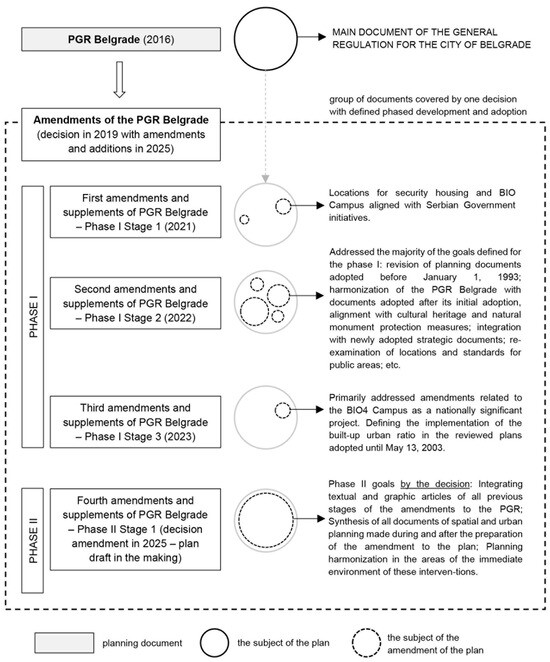
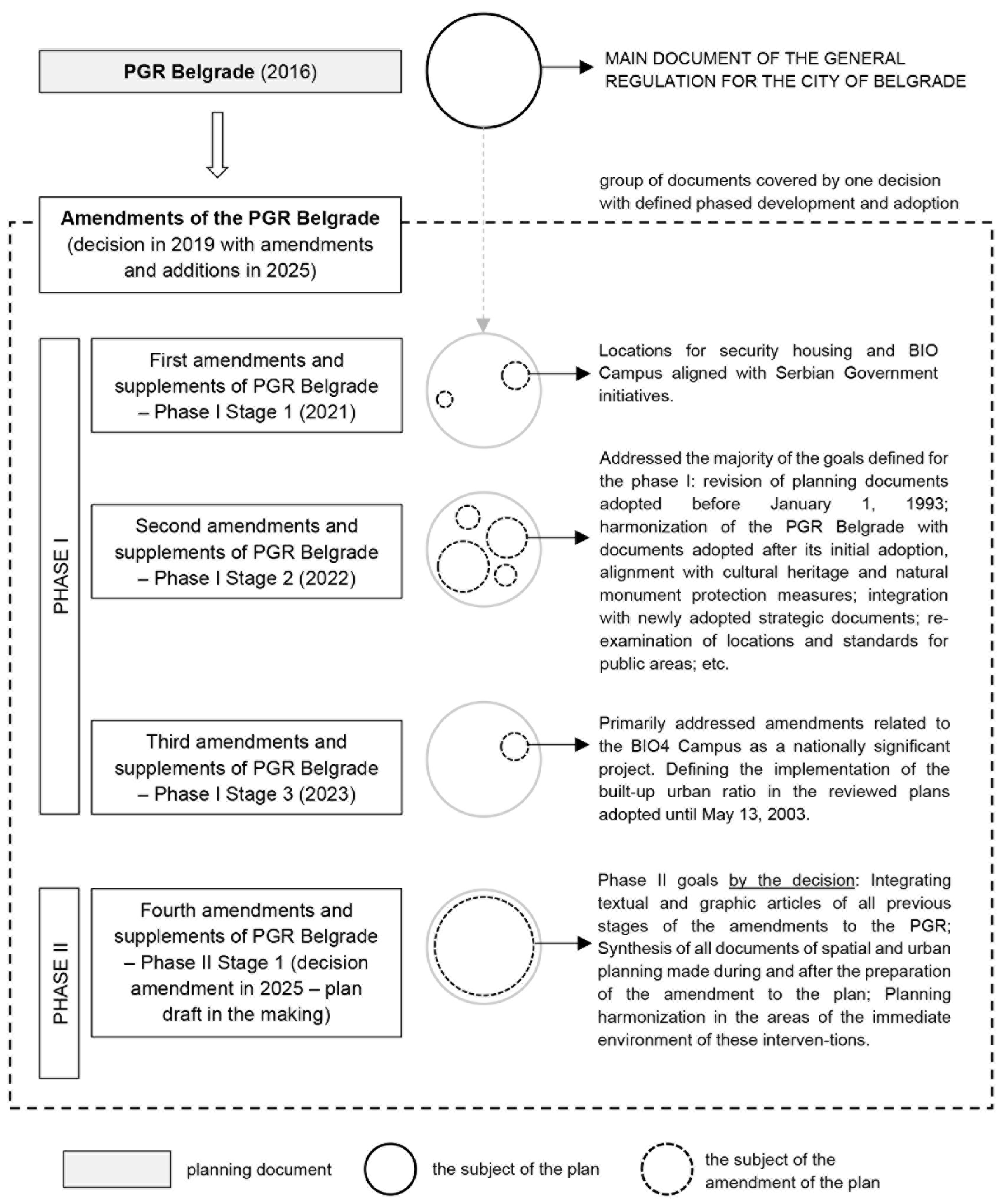
The procedural logic of amendment-based phasing in the PGR Belgrade case is summarized in Figure 1, which illustrates how successive amendments are organized within a single planning document through stages that gradually reshape the original regulatory framework.
Figure 1.
Content based procedural structure of phasing in the PGR Belgrade (amendment-based phasing).
Procedural Logic of Phasing
The dynamic timeline of phased amendments to the PGR Belgrade began with the adoption of the Decision on the Preparation of Amendments to the Plan of general regulation for the construction area in the seat of the local self-government unit—the city of Belgrade (units I–XIX) [21]. This decision anticipated the introduction of phasing as a formal model, consistent with the amendments to the Law on Planning and Construction from 2023. It established the possibility of phased adoption of amendments to the plan with the aim of enabling continuous planning, monitoring, and adjustment of the plan’s implementation, as well as the definition of guidelines for its realization.
The Decision on the Preparation of Amendments of the PGR Belgrade defines the goals of making changes and additions as a whole, as well as the goals of making the first phase of changes and additions, while the possibility is left that the scope and content of the following phases will be defined later in cooperation with the Chief Town Planner of the City of Belgrade, the Belgrade Land Development Public Agency, the Planning Commission of the City of Belgrade Assembly, as well as the holder of the plan, i.e., the Secretariat for Urbanism and Construction Affairs of the City of Belgrade. The planning basis for the development of all phases of amendments and additions is the Master Plan of Belgrade [22], which defines the construction area and within which the general purpose of the surfaces is given, i.e., the predominant uses in a certain spatial scope are determined.
Up to the time of writing this paper, three amendments to the PGR Belgrade have been adopted, all as part of the first phase: Phase I—Stage 1 (2021) [23], Phase I—Stage 2 (2022) [24], and Phase I—Stage 3 (2023) [25]. The early public review, phase established according to Law of planning and construction, was conducted during the preparation of the first stage, but it also included certain elements defined as part of the objectives of the entire first phase, which were later incorporated into planning solutions through the following stages, primarily in the second stage.
The following are defined through the adopted stages of Belgrade’s PGR (Table 2):
Table 2.
PGR of the city of Belgrade—Timeline and structure.
- Phase I—Stage 1 defined the location for housing construction for security forces of the Republic of Serbia and the location for the BIO Campus, cluster of higher education institutions with complementary facilities, in line with initiatives of the Government of the Republic of Serbia.
- Phase I—Stage 2 addressed the majority of the goals defined for the first phase, including: revision of planning documents adopted before 1 January 1993, and the definition of implementation mechanisms in their territory; harmonization of the PGR Belgrade with documents adopted after its initial adoption in 2016; alignment with cultural heritage and natural monument protection measures; integration with newly adopted strategic documents (such as the Development Strategy of Belgrade 2021 [26], the SMART Transport Infrastructure Master Plan 2021/2027/2033, amendments to the Regional Spatial Plan of Belgrade [27], and the National Strategy for Sustainable and Integrated Urban Development of Serbia until 2030 [15]; re-examination of locations and standards for public areas, i.e., public services and complexes, in accordance with the requirements of the competent institutions at the city level and the competent ministries; corrections of observed technical errors in the rules of arrangement and construction, compatibility of surface uses, etc.,; and clarification of definitions.
- Phase I—Stage 3 was initiated in line with initiatives by the Office of the Chief Urban Planner, the Government of the Republic of Serbia, and the Municipality of Savski Venac, primarily addressing amendments related to the BIO4 Campus as a nationally significant project. A second objective was related to defining the implementation of the built-up urban ratio in the reviewed plans adopted until 13 May 2003, which represents a technical guideline.
The timeline presented in Table 2 clearly illustrates that phasing in this case does not operate through formally distinct planning phases, but rather through successive amendments grouped within a single phase and implemented across multiple stages. This procedural structure reflects a model of incremental adaptation within a formally continuous planning document, where phasing emerges as a practical rather than strictly defined methodological construct.
Through these procedures, PGR Belgrade introduced the concept of phasing by adopting amendments and supplements as successive segments of the same plan originally adopted in 2016. Although all adopted changes belong to the first phase, the phasing model was applied in stages, with goals defined for one unit of work being realized across three segments. This procedure does not differ significantly from the standard planning process, except in the case of a single early public review for all stages of the first phase. In this context, challenges may arise in communication during the preparation and public display of draft plans, as well as from the time gap between the early public review—which included elements later implemented in all three stages—and the drafting of subsequent stages, with possible deviations from the original elaboration.
As of January 2025, the preparation of the second phase of the amendments to the PGR Belgrade (Phase II—Stage 1) was started. Preparation of the new phase Amendments to the Plan was based on the decision made by the Assembly of the City of Belgrade [28] at the initiative of the Belgrade Land Development Public Agency. Since it is a new phase, the development of the plan includes the preparation of the Study for Early Public Review. The following needs were observed for the development of the PGR Belgrade Phase II—Stage 1: Integrating textual and graphic articles of all previous stages of the changes and amendments to the General Regulation; synthesis of all documents of spatial and urban planning made during and after the preparation and phase of the amendment to the plan; Planning harmonization in the areas of the immediate environment of these interventions. The goals of the Plan are as follows: Planning harmonization and review of the purpose, urban indicators and parameters in the immediate environment of plans, where the consequence of the integration of planning solutions from the issued plans, at the locations of which is implementation in accordance with the development programs and priorities of the city; Analyzes of the mentioned locations from the aspect of traffic, infrastructure equipities and social standards institutions; Defining the implementation method (direct application of the construction rules or compulsory preparation of detailed regulation plan) and harmonization with the conditions of policies of public authority; Correction of observed technical errors in the rules of arranging and construction and amendments to the glossary.
From the perspective of the analytical framework, this case demonstrates that amendment-based phasing enables gradual integration of planning solutions, but introduces challenges related to temporal gaps between stages, increasing coordination demands, and potential inconsistencies between early public review and later adopted solutions. These characteristics highlight the tension between procedural continuity and evolving planning content.
4.2. Phasing in the Case of the PGR of Rail Systems in Belgrade
The PGR of Rail Systems in Belgrade with elements of detailed elaboration represents a complex planning document whose primary goal is to define the spatial development of rail systems, their interconnection, and integration into the urban fabric.
Belgrade foresees three rail systems—railway, metro, and tram—which function as separate yet mutually interconnected units.
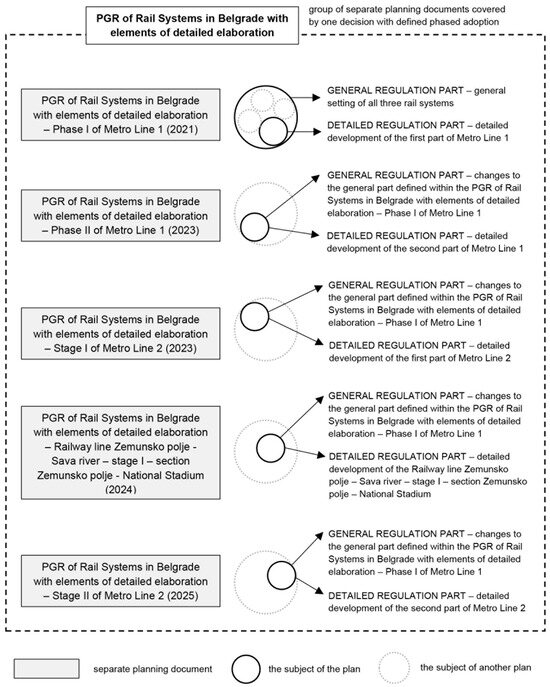
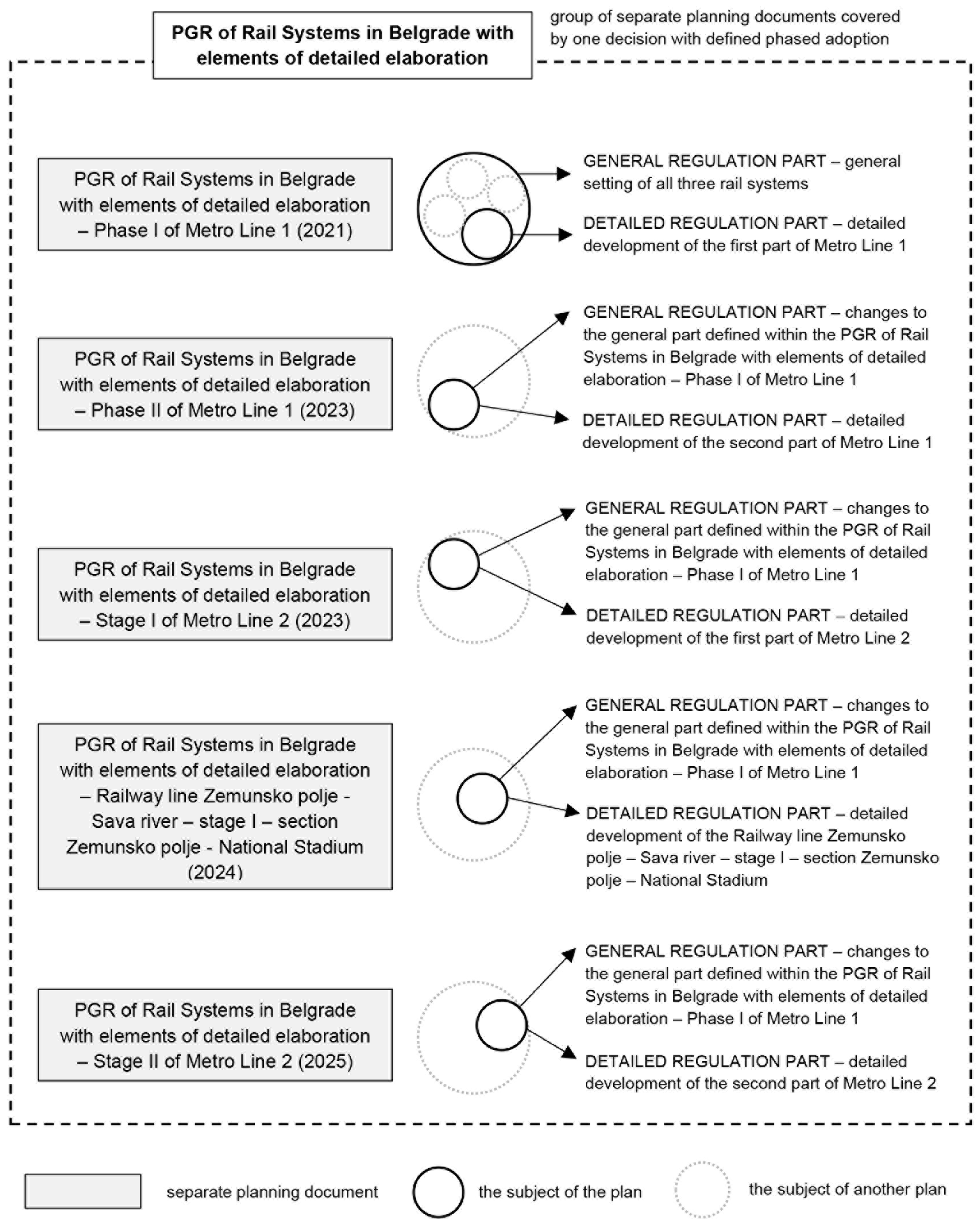
In contrast to the amendment-based model presented above, the procedural structure of document-based phasing in the PGR of Rail Systems is illustrated in Figure 2, highlighting how successive phases are adopted as separate but interconnected planning documents.
Figure 2.
Content based procedural structure of phasing in the PGR of Rail Systems in Belgrade (document-based phasing).
Procedural Model and Structure of Phases
Rail systems represent an outstanding example of the theme of a planning document that requires simultaneous consideration on a strategic and detailed level. At the same time, they are characterized by rigidity in implementation and significant financial investments, which make them highly dependent on market, political, and socio-economic dynamics. The rigidity of these systems also necessitates a complex relationship between planning and design. Given that the network is both extensive and intricate, it is impossible to elaborate the entire system at the conceptual level and assess it in parallel at both levels. Consequently, an additional challenge arises in evaluating the system’s components with varying levels of determinacy.
The methodology of preparation and adoption of this Plan was structured so that each phase represents a separate planning document, while the Plan of general regulation for the railway systems in Belgrade with elements of detailed elaboration is conceived as their aggregate, as defined by the official decision to prepare the plan (Table 3) [29].
Table 3.
Urban planning of rail systems in Belgrade (railway, metro, and tram)—Timeline and structure.
As shown in Table 3, phasing in this case is explicitly structured through a sequence of separate planning documents, each representing a distinct phase within a broader system. Unlike the previous case, phasing is not an emergent property of amendments, but a predefined procedural model in which each phase combines elements of general and detailed planning.
The initial step in planning was to establish the system at a strategic level, integrating existing elements of rail infrastructure with development tendencies that had evolved over past decades. In this case, the general framework was prepared in parallel with the conceptual design of the first section of the metro system’s Line 1, which was prioritized in terms of development dynamics. Accordingly, the first plan prepared under the aforementioned decision was the Plan of general regulation for the railway systems in Belgrade with elements of detailed elaboration for Phase I of the first metro line [17]. This planning document consists of two parts: the first establishes the general framework, defining the network of all three rail systems within the territory covered by Master Plan of Belgrade, while the second part elaborates in detail the specific section that was the subject of the plan. Thus, this planning document has the broadest territorial scope, covering the entire system, and serves as the planning basis for all subsequent phases. In addition to its role as a planning basis, it also established a methodological template according to which all subsequent phases are prepared. In this way, each phase—each planning document adopted under the same decision—consists of two segments: a general part, which defines its relation to the general framework established in the first phase (essentially formulating amendments and supplements), and a detailed part, which elaborates the specific section in detail and prescribes regulatory and building rules subject to direct application. The territorial scope of each subsequent plan is defined by the boundary of the section under elaboration, which simultaneously represents the amendment zone of the first phase’s general framework. Up to the time of writing this paper, five phases have been adopted under the PGR of Rail Systems—four concerning the metro system and one concerning the railway system. Such a phased, network-based approach to planning rail and metro systems is consistent with international evidence that urban rail infrastructures are typically developed through step-wise, long-term decision-making processes under conditions of uncertainty, with strong feedbacks between network configuration, urban development and land use [10,12].
The challenges in drafting such a complex planning document, from the standpoint of the processor, are numerous and stem both from the subject matter of the plan and from the form of the system, which may be described as a “network of planning documents.”
Regarding the subject matter, the greatest challenge is the integral consideration of three distinct yet closely interrelated systems, which, in addition to overlapping, influence the entire dense urban fabric. Also, a constant simultaneous review of the general setting of the complete system and elements of the detailed development of the route in question is necessary.
From the point of view of forms, the challenges of different types occur when establishing a system through the development of the first planning document, i.e., first phase and through the development of all subsequent phases, i.e., their fit into the set system.
In the first case, a system needs to be formed sufficiently determined, that each subsequent phase has its clear place in it, while on the other hand, sufficient flexibility should be left to various changes that will inevitably happen in the dynamics of modern context under contemporary planning conditions. In the second case, the challenge is to develop a plan that functions as part of an interconnected network.
This process also introduces new practices built upon the existing structure and form of planning documents. One challenge lies in drafting plans based on conceptual designs produced by other actors, requiring adequate forms of collaboration, communication, and coordination within highly interdependent processes.
Since the process is based on a single official decision to prepare the planning document, the early public review is conducted only for the first phase, in which the general framework of the system was established. For all subsequent phases, the process proceeds directly to the preparation of the Draft Plan, which brings significant challenges considering the scale and scope of changes introduced at the detailed level of individual sections. In addition to communication with the so-called “Public authority holders” which needs to be familiar with changes in relation to the Study for Early Public Insight (the Early Public Review)—communication with citizens becomes a key aspect. This applies both to directly affected residents, whose situation may change with modifications to alignments during the planning process, and to Belgrade’s citizens more broadly, given the importance of rail systems for the functioning of the city as a whole. Public review, as the stage at which most citizens become familiar with the plan, comes at a point when solutions—particularly in the case of such rigid systems—are already defined to the extent that discussion about strategic settings and general elements are no longer possible, leaving only details open for comment.
This raises a broader question regarding the timing and forms of citizen participation in planning processes characterized by high technical complexity and procedural rigidity. In such contexts, participation is often structurally constrained, as key strategic decisions tend to be established in early phases, while later stages allow only limited engagement focused on technical details. The volume and nature of objections submitted during the public review process further indicate that existing participation mechanisms may not provide sufficient opportunities for meaningful dialogue at earlier stages of decision-making. This suggests the need for a more iterative and continuous model of participation, better aligned with the temporal structure of phased planning processes. This is further reflected in the procedural structure of the planning process, where public engagement is effectively shifted from strategic decision-making stages to phases where key parameters have already been established. As a result, the role of public participation becomes primarily reactive, focusing on technical adjustments rather than influencing core planning decisions.
Ultimately, this type of planning document, complex both in subject and in form, inevitably brings equally complex implementation challenges and a difficult relationship with existing planning documentation. Considering that the plan covers the entire Master Plan of Belgrade territory, it overlaps with a large number of planning documents at different levels—surface, underground, and aboveground—introducing an entirely new set of challenges. As a general regulation plan, the PGR of Rail Systems is based on the Master Plan, but in addition to repealing certain plans, it introduces a wide range of amendments and supplements to numerous other planning documents. Each new phase adopted complicates the situation further, increasing the need for a synthetic overview that would allow clear insight into all elements and changes defined through these documents. Without this, from the perspective of implementers of planning documents in the broadest sense, the presentation of the set system becomes more challenging.
Within the analytical framework, this case highlights a different set of governance challenges. While the model provides clearer differentiation of phases and allows simultaneous consideration of strategic and detailed levels, it introduces higher risks of fragmentation, increased coordination complexity, and significant information asymmetry between phases, particularly in relation to public participation and evolving technical inputs.
5. Discussion
This section discusses the key governance challenges identified through the comparative analysis of the two case studies, summarized in Table 4, focusing on how different models of phased preparation and adoption of planning documents operate within the same legal and institutional framework. The discussion revisits the research questions presented in the introduction and interprets the empirical findings in relation to the governance implications of phased planning. Taken together, the two cases reveal two distinct governance logics of phased planning: one based on incremental modification of a single planning document, and another based on the creation of a structured sequence of interconnected planning documents. By comparing amendment-based and document-based phasing, the discussion highlights their implications for planning coherence, coordination among actors, transparency and governance (Table 4). These findings therefore extend theoretical discussions on adaptive and governance-oriented planning by demonstrating that procedural flexibility alone does not produce adaptive outcomes; rather, the institutional configuration of planning phases plays a critical role in shaping governance dynamics within formalized planning systems.
Table 4.
Comparative overview of governance challenges in phased planning.
In this respect, the amendment-based phasing applied in the PGR Belgrade case resonates with international discussions on how frequent amendments can be used as a mechanism to introduce flexibility into otherwise rigid regulatory planning systems [8].
The comparative analysis of the two case studies demonstrates that phasing functions as a double-edged instrument within the Serbian planning system. While it introduces procedural flexibility and enables “simultaneous” consideration of strategic and detailed planning layers, it also exposes and, in some cases, amplifies existing structural limitations related to coordination, coherence and governance.
These findings contribute to broader debates on adaptive and governance-oriented planning by demonstrating that procedural flexibility alone does not guarantee adaptive outcomes; rather, the institutional organization of planning phases plays a decisive role in shaping governance dynamics.
5.1. Integration of General and Detailed Planning Levels
The comparative analysis indicates that the integration of general and detailed planning levels represents a central challenge in both cases, although it manifests in different ways depending on the applied phasing model. This finding directly relates to broader discussions in international literature, where phased and adaptive planning approaches are understood as mechanisms for reconciling strategic orientation with context-specific detailing under conditions of uncertainty.
In the case of amendment-based phasing applied in the PGR Belgrade, the general planning framework remains formally stable, while detailed solutions are introduced gradually through successive amendments. However, temporal gaps between stages, as illustrated in Table 2, complicate the maintenance of coherence between strategic objectives and detailed regulatory provisions. Over time, this may result in a partial decoupling of originally defined planning intentions and subsequently implemented solutions.
In contrast, the PGR of Rail Systems embeds the integration of general and detailed levels directly into the structure of each phase. Each planning document simultaneously revises the general system configuration and elaborates a specific section in detail. As indicated in Table 3, this approach enables closer alignment between strategic and operational considerations, but requires continuous methodological consistency across phases in order to avoid contradictions within the evolving system.
From a governance perspective, both models demonstrate that phasing does not resolve the challenge of multi-level integration, but rather redistributes it within the planning process—either temporally, through successive amendments, or structurally, across multiple planning documents. This confirms that the effectiveness of phased planning depends not only on procedural flexibility, but also on the capacity to maintain coherence between planning levels over time.
5.2. Coordination Among Actors Across Planning Phases
Phased planning intensifies coordination demands in both cases, albeit with different dynamics. This issue is widely recognized in international research, where adaptive and phased planning approaches are associated with increased interdependence among actors and a growing need for continuous institutional alignment across planning stages.
In the amendment-based model, coordination requirements increase progressively as amendments accumulate and involve a growing number of institutional actors, including city-level authorities, sectoral institutions and national stakeholders. As suggested by the sequence of amendments presented in Table 2, this incremental expansion of actors and decision points may place additional pressure on coordination mechanisms that were not originally designed for prolonged, multi-stage processes. In such conditions, coordination may shift from a structured procedural requirement towards a more negotiation-based practice.
This dynamic is visible in the sequence of amendments adopted within the PGR Belgrade framework. As shown in Table 2, successive stages of amendments were initiated by different institutional actors and addressed distinct planning issues, ranging from strategic development initiatives such as the BIO Campus to technical adjustments of planning standards and implementation mechanisms. This accumulation of objectives within the same planning document increased the need for coordination among multiple city-level institutions and national authorities, while also expanding the scope of planning adjustments introduced over time.
In the rail systems case, coordination among actors is structurally embedded from the outset, reflecting the complexity of infrastructure planning and the involvement of designers, operators and sectoral authorities. As indicated in Table 3, each phase requires alignment not only with previously adopted planning documents, but also with evolving technical inputs and design solutions. While this model anticipates high coordination demands, it also increases dependency on effective inter-institutional communication and continuity across phases.
From a governance perspective, both models demonstrate that phasing transforms coordination from a one-time procedural requirement into a continuous and cumulative process. While this may enhance responsiveness and allow for iterative adjustment, it also raises the risk of coordination overload, particularly in institutional contexts where formal mechanisms for cross-phase alignment remain underdeveloped.
5.3. Information Asymmetry Between Successive Phases
Information asymmetry between planning phases emerges as a critical issue in both models of phased planning. This phenomenon is increasingly recognized in the literature on adaptive and incremental planning, where the distribution of information across time and actors may influence both the transparency and the perceived legitimacy of planning processes. As illustrated in Table 4 and supported by the case study evidence, this asymmetry is not only a result of technical complexity, but also of the temporal sequencing of decision-making and participation across phases.
In the PGR Belgrade case, information asymmetry is particularly evident in the relationship between early public review and subsequent stages of implementation. As previously described, elements presented during the early public review were incorporated into planning solutions only in later stages, as reflected in the phased structure shown in Table 2. This temporal gap creates a disconnect between the moment of public engagement and the actual adoption of planning decisions, potentially leading to misunderstandings regarding the scope and content of implemented solutions.
This procedural structure has direct implications for public participation. Because the early public review was conducted only during the preparation of the first stage, while planning solutions continued to evolve through later stages of amendments, the opportunity for stakeholders and citizens to comment on subsequent changes remained limited. As a result, participation was formally present but temporally concentrated at the beginning of the process, while later planning decisions were introduced primarily through technical amendments rather than through renewed participatory debate.
In the PGR of Rail Systems case, information asymmetry arises from the continuous introduction of new technical inputs and design revisions that must be aligned with previously adopted phases. As indicated in Table 3, each subsequent planning document builds upon and partially modifies earlier decisions, while the opportunity to revisit broader strategic assumptions remains limited. This creates a situation in which different actors operate with uneven levels of information regarding the overall system configuration and its evolution.
From a governance perspective, information asymmetry represents not only a technical issue, but also a structural characteristic of phased planning processes. In both cases, phasing redistributes knowledge across time, creating differentiated access to information between early and later stages, as well as between institutional actors and the public. This condition may reduce the effectiveness of participation mechanisms and affect trust in planning institutions, particularly when key decisions are perceived as being made outside the stages in which participation is formally enabled.
These findings suggest that addressing information asymmetry should be considered a central methodological requirement in phased planning, requiring clearer rules for information continuity, iterative communication, and the alignment of participation mechanisms with the actual timing of decision-making processes.
5.4. Risks of Fragmentation and Loss of Coherence
Both phasing models entail risks of fragmentation and loss of coherence, although these risks emerge through different procedural mechanisms. In the context of international research, fragmentation is often associated with adaptive and incremental planning approaches, particularly when flexibility is introduced without sufficient mechanisms for maintaining continuity and integration across planning stages.
In the amendment-based phasing model, as observed in the PGR Belgrade case, fragmentation develops gradually through the accumulation of successive amendments. While the formal continuity of a single planning document is preserved, the internal structure and logic of the plan may become increasingly difficult to interpret over time. As illustrated in Table 2, multiple stages within a single phase introduce layers of changes that are not always fully consolidated, which may obscure the relationship between original planning intentions and subsequent modifications. This condition complicates both the implementation and the everyday use of the plan by practitioners and institutions. This temporal misalignment is not only a procedural issue but also a governance concern, as it may lead to situations in which planning decisions are effectively shaped in stages that are no longer open to public scrutiny. In this sense, the concentration of early public review within the initial stage creates a structural gap between participation and decision-making, particularly when key elements are implemented in later stages without renewed public engagement.
In the document-based phasing model, fragmentation arises through a different logic. As demonstrated in Table 3, the planning system evolves as a network of interrelated documents, each representing a specific phase and territorial segment. While this approach allows for targeted elaboration and phased development, it simultaneously produces a dispersed structure of planning knowledge, where coherence depends on the ability to interpret relationships between multiple documents. In the absence of systematic synthesis mechanisms, this may lead to difficulties in understanding the overall system and its regulatory implications.
From a governance perspective, fragmentation in phased planning should not be understood solely as a by-product of complexity, but as a structural risk inherent to the redistribution of planning decisions across time and documents. In both models, the challenge lies in maintaining a coherent planning narrative despite the incremental and multi-stage nature of decision-making processes.
The findings indicate that effective phased planning requires explicit mechanisms for consolidation and synthesis, including updated integrated representations of planning solutions, clear cross-referencing between phases, and tools that enable users to reconstruct the evolution of planning decisions over time.
5.5. Legal Rigidity and Dynamic Planning Needs
Finally, the analysis highlights a persistent misalignment between legally rigid procedures and dynamic planning needs in both cases. This tension represents a central issue in contemporary planning systems and is widely discussed in international literature, where formalized regulatory frameworks are often seen as insufficiently responsive to rapidly changing socio-economic conditions.
In the amendment-based phasing model, procedural rigidity remains embedded in the legally prescribed structure of planning documents, despite the introduction of flexibility through successive amendments. As demonstrated in the PGR Belgrade case, phasing operates within fixed procedural boundaries that limit the extent to which planning decisions can be revisited or restructured. While amendments allow for incremental adaptation, they do not fundamentally alter the linear logic of the planning process.
In the document-based phasing model, this misalignment becomes even more pronounced. Although the structure of multiple planning documents introduces a form of procedural flexibility, the legal framework continues to define strict stages of preparation and adoption. As observed in the PGR of Rail Systems case, opportunities for revisiting strategic decisions are largely confined to the initial phase, while subsequent phases proceed under conditions where key parameters are already established. This creates a situation in which flexibility is front-loaded, while later stages are characterized by reduced capacity for substantive change.
From a governance perspective, these findings suggest that phased planning does not eliminate the tension between rigidity and adaptability, but rather reorganizes it within the planning process. Flexibility is introduced selectively, often without corresponding adjustments to participation mechanisms, institutional coordination, or decision-making structures.
This indicates that the effectiveness of phased planning depends not only on the formal introduction of phasing as a procedural option, but also on the development of supporting institutional and methodological frameworks capable of aligning procedural structures with the dynamic nature of planning processes.
More broadly, the findings indicate that the governance implications of phased planning depend less on the formal existence of phasing itself and more on how phases are institutionally structured, coordinated, and integrated within the broader planning system. In legally formalized planning environments such as Serbia, the introduction of phasing may therefore simultaneously increase procedural flexibility while exposing structural limitations related to coordination capacity, institutional transparency, and the integration of planning scales. These findings suggest that the effectiveness of phased planning as a governance instrument depends on the existence of clear methodological guidance and mechanisms that ensure coherence across successive planning phases.
6. Conclusions
This study examined the recently introduced practice of phased preparation and adoption of planning documents in Serbia through a comparative analysis of two planning documents from Belgrade that represent contrasting operational models of phasing. By focusing on amendment-based and document-based phasing within the same legal and institutional framework, the study provided insight into how phasing is interpreted and implemented in planning practice, and what methodological and governance challenges arise across different planning contexts. By empirically examining how phased planning operates within a legally formalized planning system, this study contributes to the understanding of how procedural innovations interact with institutional planning frameworks and governance capacity.
The findings demonstrate that phasing can enhance procedural flexibility and enable the simultaneous consideration of strategic and detailed planning levels. At the same time, the analysis shows that, in legally rigid and procedurally formalized planning systems, phasing may intensify existing challenges related to coordination among actors, information asymmetry between planning stages, fragmentation of planning documentation and limited opportunities for meaningful public participation beyond the initial phase.
More broadly, the paper shows that phased planning should not be understood merely as a technical or procedural adjustment, but as a governance mechanism that redistributes decision-making, information and responsibility across time and institutional actors. In this sense, phasing does not resolve the inherent tension between procedural rigidity and the need for adaptability, but reorganizes it within the planning process, producing new configurations of flexibility and constraint.
By documenting these dynamics, the paper contributes to international debates on adaptive and phased planning by providing empirical evidence from a post-socialist planning system, where institutional capacity, procedural rigidity and governance arrangements strongly condition the effects of flexibility-oriented planning instruments. The Serbian case demonstrates that the introduction of phasing alone is insufficient to ensure adaptive planning outcomes unless accompanied by clearer methodological definitions, coordination mechanisms and tools for maintaining coherence across planning phases.
From a governance and sustainability perspective, the findings highlight the importance of aligning procedural flexibility with transparency, accountability and inclusiveness in planning processes. Phasing should therefore be understood not merely as a technical or procedural adjustment, but as a governance challenge that requires institutional support and clear rules to safeguard long-term spatial development objectives while responding to dynamic development pressures. Addressing issues such as information asymmetry, coordination overload and fragmentation requires not only formal procedural adjustments, but also the development of supporting institutional practices capable of ensuring continuity and clarity across planning stages. From a practical perspective, the findings suggest that phased planning may offer important advantages in planning contexts characterized by institutional complexity and long-term infrastructure development processes. However, its effectiveness depends on the existence of clear procedural rules, transparency between planning stages, and strong coordination between planning authorities and implementing institutions. Future improvements of phased planning frameworks could therefore focus on strengthening methodological guidance for phasing, ensuring procedural coherence between phases, and improving early-stage public participation in large-scale planning processes.
This study has several limitations that should be acknowledged. First, the analysis is based on two case studies from a single national planning system, which limits the direct generalizability of the findings to other institutional contexts. Second, the focus of the study is on procedural, methodological and governance aspects of phased planning, rather than on the substantive quality or outcomes of planning solutions. Third, the analysis relies on documentary sources and professional experience, without incorporating perspectives of other actors involved in the planning process. Nevertheless, the analytical insights derived from these cases may be relevant for other legally formalized planning systems where procedural flexibility is introduced without a fully articulated methodological framework.
While the findings are based on two cases within the Serbian planning system, they offer analytically relevant insights for other legally formalized planning systems where procedural flexibility is introduced without a fully defined methodological framework.
Future research could further explore how phased planning operates across different institutional contexts, particularly in other post-socialist and legally formalized planning systems. In addition, empirical studies focusing on the perspectives of planners, decision-makers and implementers could provide deeper insight into how phasing shapes planning practice and implementation. Particular attention should also be given to the relationship between phasing and public participation, especially in large-scale infrastructure planning, where early-stage engagement remains critical for ensuring meaningful and inclusive planning processes.
From a policy and planning perspective, the results suggest that introducing phased planning into legally formalized planning systems requires more than a formal legal provision. Effective implementation depends on the development of methodological guidance that clarifies the structure of planning phases, ensures continuity of information between phases, and maintains meaningful opportunities for institutional and public engagement throughout the planning process. Without such safeguards, phased planning may unintentionally reinforce fragmentation and coordination challenges rather than supporting more adaptive and responsive spatial governance. In this sense, phased planning should be understood not merely as a procedural innovation, but as a governance arrangement whose effectiveness ultimately depends on the institutional capacity to maintain coherence, transparency and coordination across successive planning stages.
Author Contributions
Conceptualization, M.L. and M.H.A.; methodology, M.L., M.H.A. and N.D.H.; validation, M.L., M.H.A. and N.D.H.; formal analysis, M.L. and M.H.A.; investigation, M.L. and M.H.A.; resources, M.L. and M.H.A.; data curation, M.L. and M.H.A.; writing—original draft preparation, M.L. and M.H.A.; writing— M.L. and M.H.A.; visualization, M.L.; supervision, M.L.; project administration, M.L.; funding acquisition, M.L. and N.D.H. All authors have read and agreed to the published version of the manuscript.
Funding
Funding for the implementation of the research presented in this paper was provided by the Ministry of Science, Technological Development and Innovation of the Republic of Serbia, registration number: 451-03-33/2026-03/200006.
Data Availability Statement
The data presented in this study are available from the corresponding author upon reasonable request.
Acknowledgments
This research is part of Institute of Architecture and Urban & Spatial Planning of Serbia’s projects: “Perspectives for Sustainable Spatial Development of Serbia” and “Development of new methodological frameworks and information systems for establishing sustainable and resilient cities in Serbia”.
Conflicts of Interest
The authors declare no conflicts of interest.
References
- Healey, P. Collaborative Planning: Shaping Places in Fragmented Societies; UBC Press: Vancouver, BC, Canada, 1997. [Google Scholar]
- Innes, J.E.; Booher, D.E. Planning with Complexity: An Introduction to Collaborative Rationality for Public Policy; Routledge: Abingdon, UK, 2010. [Google Scholar]
- Rauws, W.; De Roo, G. Adaptive planning: Generating conditions for urban adaptability. Lessons from Dutch organic development strategies. Environ. Plan. B Plan. Des. 2016, 43, 1052–1074. [Google Scholar] [CrossRef] [Scilit]
- Davoudi, S.; Crawford, J.; Mehmood, A. Planning for Climate Change: Strategies for Mitigation and Adaptation for Spatial Planners; Earthscan: London, UK, 2009. [Google Scholar]
- Available online: https://www.local2030.org/library/67/Urban-Planning-for-City-Leaders.pdf (accessed on 23 March 2026).
- Hartman, S.; De Roo, G. Towards managing nonlinear regional development trajectories. Environ. Plan. C Gov. Policy 2013, 31, 556–570. [Google Scholar] [CrossRef] [Scilit]
- Albrechts, L. Strategic (spatial) planning reexamined. Environ. Plan. B Plan. Des. 2004, 31, 743–758. [Google Scholar] [CrossRef] [Scilit]
- Feiertag, P.; Schoppengerd, J. Flexibility in planning through frequent amendments. The practice of land use planning in Germany. Plan. Pract. Res. 2022, 38, 105–122. [Google Scholar] [CrossRef] [Scilit]
- Hoefkens, S.; Machiels, T. Adaptive planning in regulatory planning systems: Balancing rigidity and adaptability in Oude Dokken, Ghent. Plan. Pract. Res. 2025, 40, 758–779. [Google Scholar] [CrossRef] [Scilit]
- Wall, T.A.; Walker, W.E.; Marchau, V.A.; Bertolini, L. Dynamic adaptive approach to transportation-infrastructure planning for climate change: San-Francisco-Bay-Area case study. J. Infrastruct. Syst. 2015, 21, 05015004. [Google Scholar] [CrossRef] [Scilit]
- Ariza-Álvarez, A.; Soria-Lara, A.J.; Aguilera-Benavente, F. Planning Adaptive Strategies for Urban Transport and Land Use using Scenario-Building. Transp. Res. Procedia 2022, 60, 274–281. [Google Scholar] [CrossRef] [Scilit]
- Lin, D.; Broere, W.; Cui, J. Metro systems and urban development: Impacts and implications. Tunn. Undergr. Space Technol. 2022, 125, 104509. [Google Scholar] [CrossRef] [Scilit]
- Reimer, M.; Getimis, P.; Blotevogel, H.H. (Eds.) Spatial Planning Systems and Practices in Europe: A Comparative Perspective on Continuity and Changes; Routledge: New York, NY, USA, 2014. [Google Scholar]
- The Law on Planning and Construction. In Official Gazette of the Republic of Serbia (No. 72/2009, 81/2009, 64/2010—Decision of the CC, 24/2011, 121/2012, 42/2013—Decision of the CC, 50/2013—Decision of the CC, 98/2013—Decision of the CC, 132/2014, 145/2014, 83/2018, 31/2019, 37/2019-Other Act, 9/2020, 52/2021, 62/2023, 47/2025); PE “Official Gazette”: Belgrade, Serbia, 2009.
- National Strategy for Sustainable and Integrated Urban Development of Serbia until 2030. In Official Gazette of the Republic of Serbia (No. 47/2019); PE “Official Gazette”: Belgrade, Serbia, 2019.
- Plan of general regulation for the construction area in the seat of the local self-government unit—The city of Belgrade (units I–XIX). In Official Gazette of the City of Belgrade (No. 20/2016, 97/2016, 69/2017, 97/2017, 72/2021, 27/2022, 45/2023, 66/2023 and 91/2023); The Secretariat for Information of the City of Belgrade: Belgrade, Serbia, 2016.
- Plan of general regulation for the railway systems in Belgrade with elements of detailed elaboration of phase I of the first line of the Metro System. In Official Gazette of the City of Belgrade (No. 102/2021); The Secretariat for Information of the City of Belgrade: Belgrade, Serbia, 2021.
- Plan of general regulation for the railway systems in Belgrade with elements of detailed elaboration of phase II of the first line of the Metro System. In Official Gazette of the City of Belgrade (No. 6/2023); The Secretariat for Information of the City of Belgrade: Belgrade, Serbia, 2023.
- Plan of general regulation for the railway systems in Belgrade with elements of detailed elaboration of the second line of the Metro System—I stage. In Official Gazette of the City of Belgrade (No. 105/2023); The Secretariat for Information of the City of Belgrade: Belgrade, Serbia, 2023.
- Plan of general regulation for the railway systems in Belgrade with elements of detailed elaboration of the railway line from Zemunsko polje to the Sava River—Stage I—Section Zemunsko polje—National Stadium. In Official Gazette of the City of Belgrade (No. 11/2024); The Secretariat for Information of the City of Belgrade: Belgrade, Serbia, 2024.
- Decision on the Preparation of Amendments to the Plan of general regulation for the construction area in the seat of the local self-government unit—The city of Belgrade (units I–XIX). In Official Gazette of the City of Belgrade (No. 74/2019); The Secretariat for Information of the City of Belgrade: Belgrade, Serbia, 2019.
- Master Plan of Belgrade. In Official Gazette of the City of Belgrade (No. 11/2016); The Secretariat for Information of the City of Belgrade: Belgrade, Serbia, 2016.
- Amendments to the Plan of general regulation for the construction area in the seat of the local self-government unit—The city of Belgrade (units I–XIX) (Phase I—Stage 1). In Official Gazette of the City of Belgrade (No. 72/2021); The Secretariat for Information of the City of Belgrade: Belgrade, Serbia, 2021.
- Amendments to the Plan of general regulation for the construction area in the seat of the local self-government unit—The city of Belgrade (units I–XIX) (Phase I—Stage 2). In Official Gazette of the City of Belgrade (No. 27/2022); The Secretariat for Information of the City of Belgrade: Belgrade, Serbia, 2022.
- Amendments to the Plan of general regulation for the construction area in the seat of the local self-government unit—The city of Belgrade (units I–XIX) (Phase I—Stage 3). In Official Gazette of the City of Belgrade (No. 91/2023); The Secretariat for Information of the City of Belgrade: Belgrade: Serbia, 2023.
- Development Strategy of Belgrade 2021. In Official Gazette of the City of Belgrade (No. 47/2017); The Secretariat for Information of the City of Belgrade: Belgrade: Serbia, 2017.
- Amendments to the Regional Spatial Plan of the Administrative Area of the City of Belgrade. In Official Gazette of the City of Belgrade (No. 86/2018); The Secretariat for Information of the City of Belgrade: Belgrade, Serbia, 2018.
- Decision on the Amendments of the Decision on the Preparation of Amendments to the Plan of general regulation for the construction area in the seat of the local self-government unit—The city of Belgrade (units I–XIX). In Official Gazette of the City of Belgrade (No. 30/2025); The Secretariat for Information of the City of Belgrade: Belgrade, Serbia, 2025.
- Decision on the Preparation of the Plan of general regulation for the railway systems in Belgrade with elements of detailed elaboration. In Official Gazette of the City of Belgrade (No. 56/2018, 40/2021, 66/2023, 83/2024 and 109/2025); The Secretariat for Information of the City of Belgrade: Belgrade, Serbia, 2018.

Disclaimer/Publisher’s Note: The statements, opinions and data contained in all publications are solely those of the individual author(s) and contributor(s) and not of MDPI and/or the editor(s). MDPI and/or the editor(s) disclaim responsibility for any injury to people or property resulting from any ideas, methods, instructions or products referred to in the content. |
© 2026 by the authors. Licensee MDPI, Basel, Switzerland. This article is an open access article distributed under the terms and conditions of the Creative Commons Attribution (CC BY) license.