Identification of Obstacles and Optimization Pathways for Sustainable Tourism in Southern Xinjiang: A Deep Learning Approach Based on GRU Sentiment Analysis


Abstract
1. Introduction
1.1. Research Background and Significance
1.2. Research Questions and Objectives
1.3. Research Innovations
2. Literature Review
2.1. Sentiment Analysis Based on Lexicons and Rules
2.2. Machine Learning-Based Sentiment Analysis
2.3. Deep Learning-Based Sentiment Analysis
2.4. Theoretical Evolution of Sustainable Tourism Evaluation and UGC Application
2.5. Research Review
3. Research Methods
3.1. Data Source and Collection
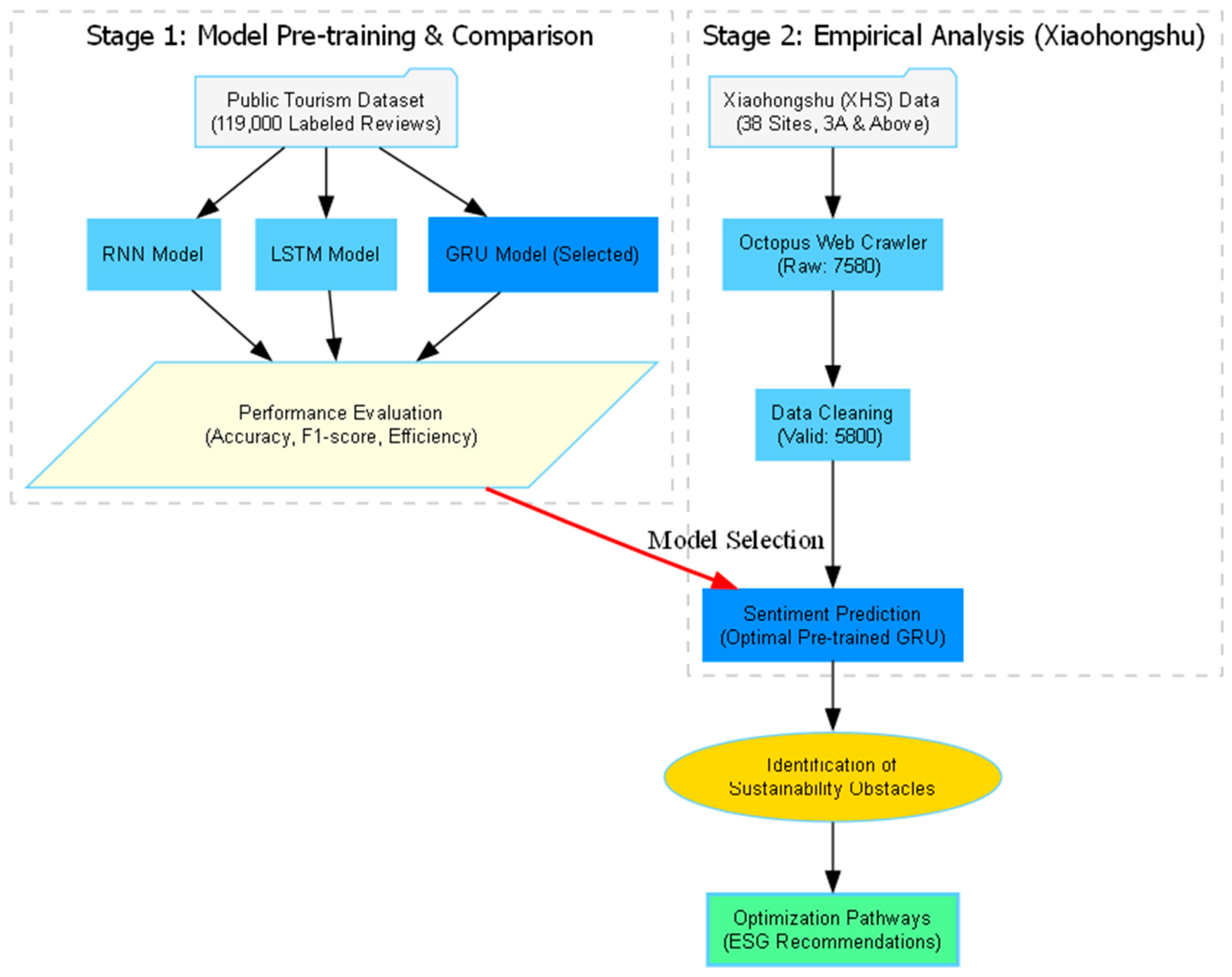
3.2. Model Training Logic
- (1)
- Stage 1: Comparative Pre-Training. All three models (RNN, LSTM, and GRU) were first trained on a large-scale, publicly available annotated dataset containing 119,000 tourism-related reviews. This stage enabled the models to learn complex semantic features and universal emotional patterns. Performance metrics, including Accuracy and F1-score, were used to evaluate their classification capabilities.
- (2)
- Stage 2: Optimal Model Application. Based on the comparative results, the GRU model was selected as the final classifier due to its superior computational efficiency and its ability to achieve high accuracy with fewer parameters compared with LSTM. The pre-trained GRU was then applied to the 5800 site-specific samples from Southern Xinjiang to extract sustainability “obstacles” (negative sentiments).

3.3. Sentiment Analysis Model Construction
3.3.1. Text Preprocessing and Vectorization
3.3.2. Deep Learning Model Selection and Architecture
3.3.3. Model Training and Hyperparameter Configuration
3.4. Evaluation Metrics
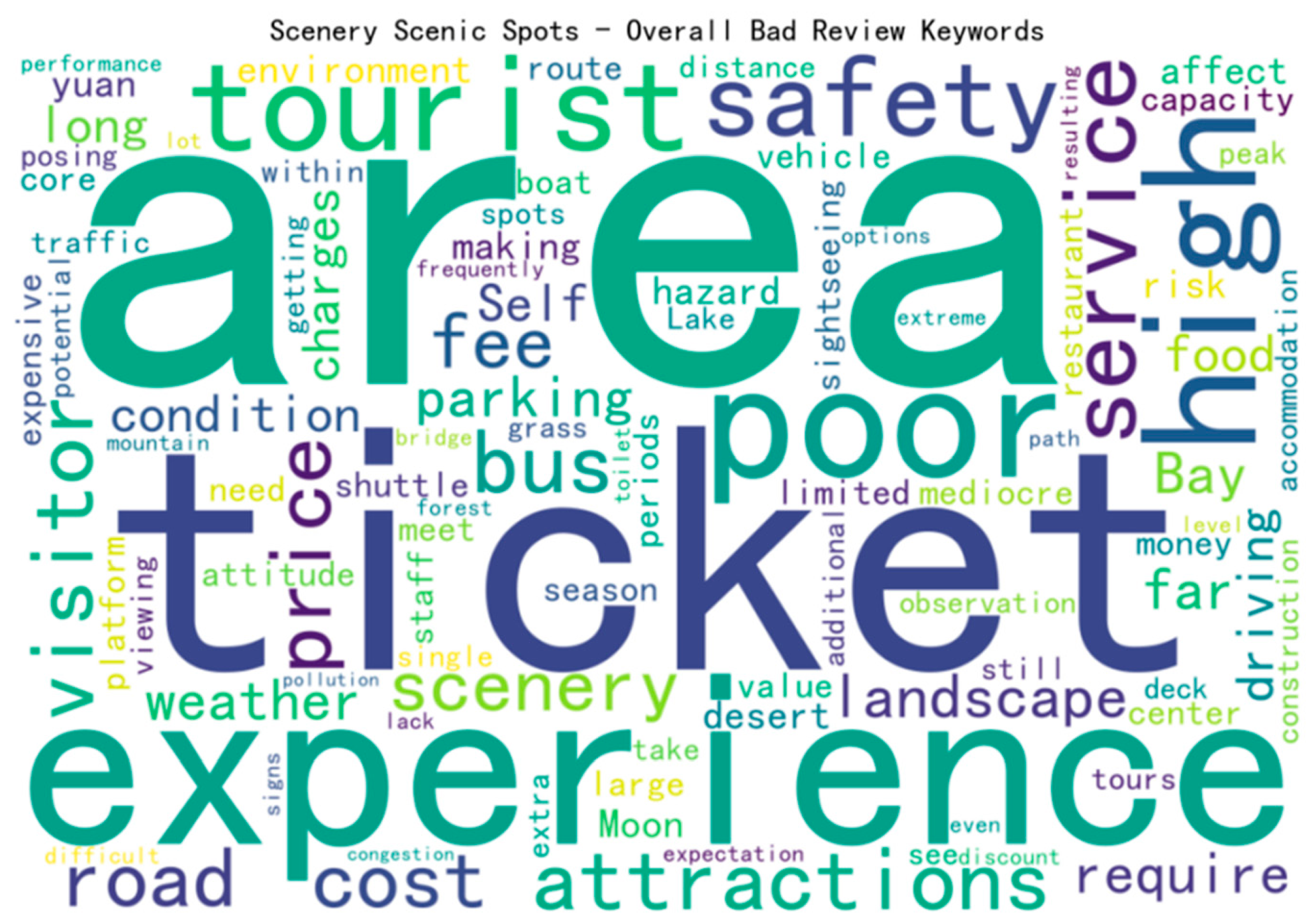
4. Results Analysis (Model Comparison, Negative Review Keyword Cloud)
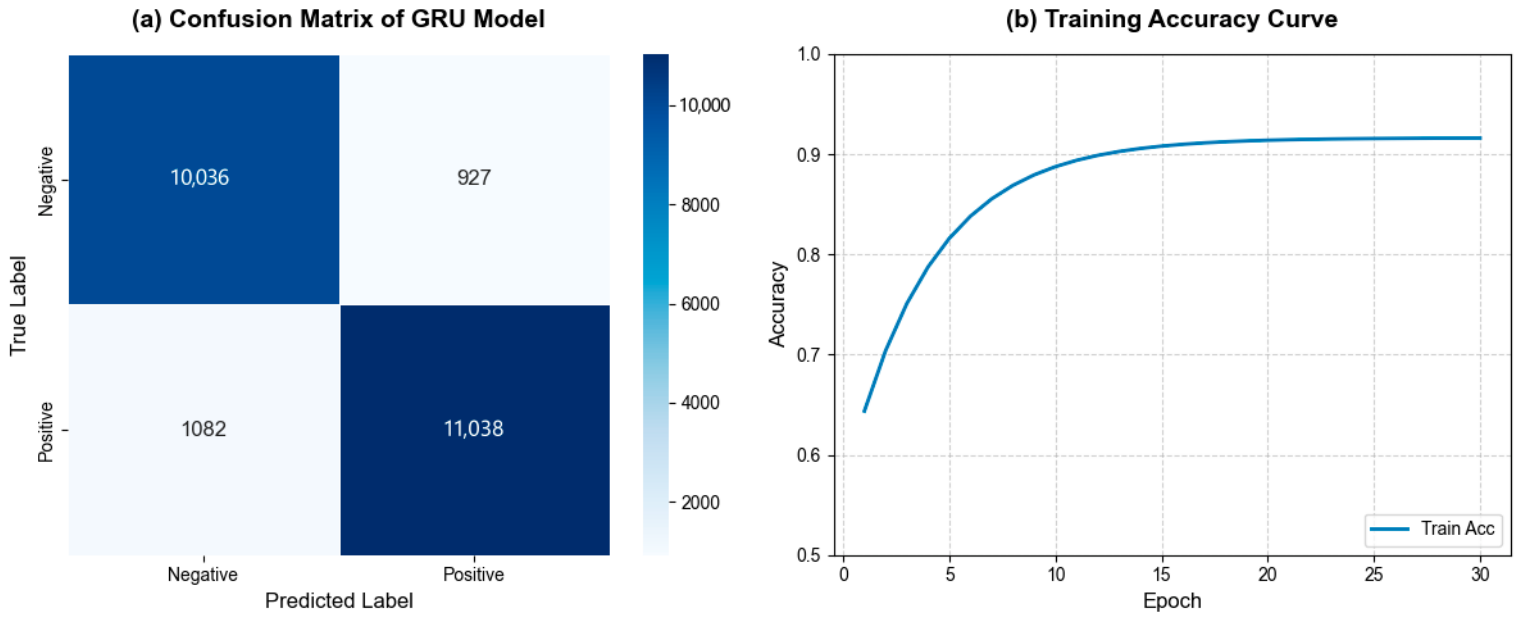
4.1. Performance Evaluation and Model Selection

4.2. Sentiment Analysis Results of Southern Xinjiang Scenic Areas
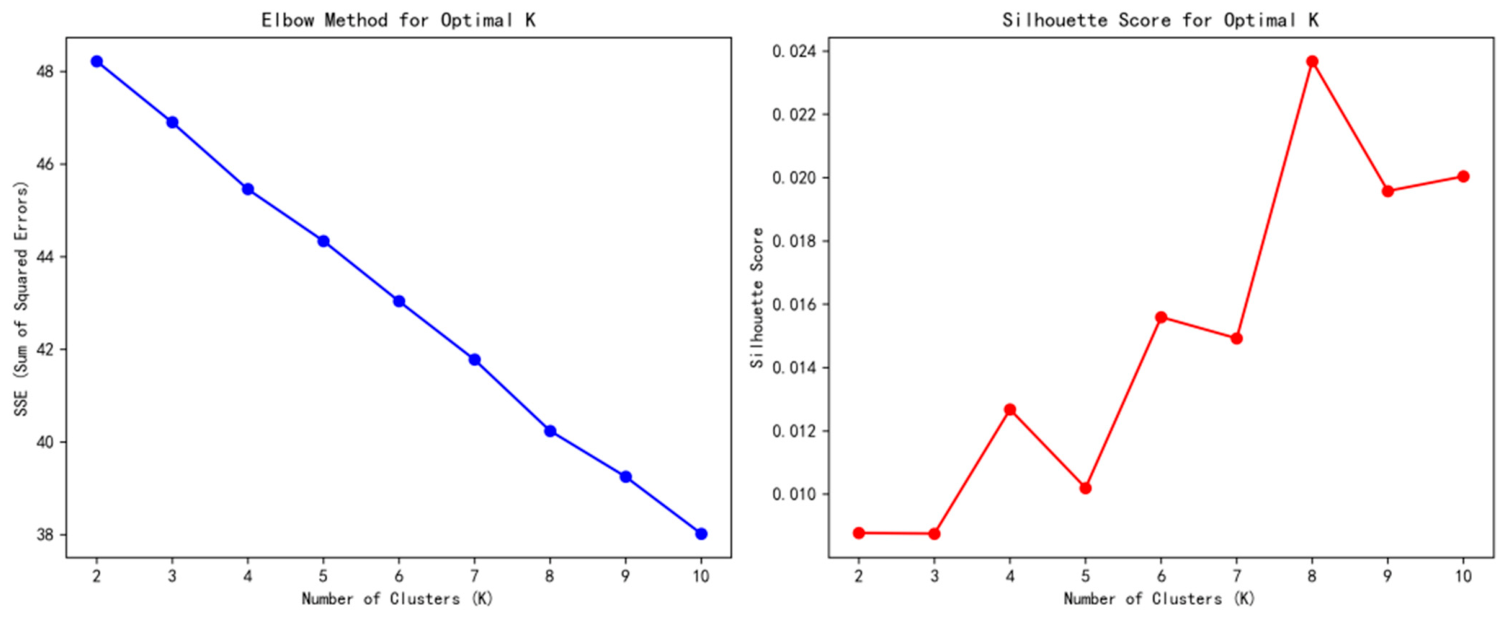
4.3. Diagnosis of Sustainability Obstacles via K-Means Clustering
4.3.1. Natural Landscapes: Ecological Vulnerability and Operational Inefficiency


| Cluster ID | Number of Reviews | Proportion | Core Keywords | Typical Review Examples | Representative Case Sites |
|---|---|---|---|---|---|
| 0 | 4 | 3.54% | lake, actual, far, propaganda, swan, compared, landscape | The actual landscape is far from the propaganda and expectation. | Bayanbulak Scenic Area, Moon Bay |
| 1 | 6 | 5.31% | service, safe, consumption, attitude, mobile, signal, staff, projects, good, commercialization | The mobile phone signal is very poor, and the attitude of the service staff is also very perfunctory. | Taklimakan n39, Moon Bay |
| 2 | 12 | 10.62% | weather, extreme, toilets, scorpions, snakes, wild, animals | The photographing of some natural landscapes depends on the weather. | Bayanbulak Scenic Area, Taklimakan n39 |
| 3 | 18 | 15.93% | high, cost, charges, food, prices, performance, dining, tickets | The accommodation price in the town is high and the condition is average. | Bayanbulak Scenic Area, Longhu Tourist Area |
| 4 | 10 | 8.85% | poor, environment, accommodation, sanitation, experience, conditions, swarm | The road conditions are poor. Accommodation is very expensive and the environment is poor. | Dawakun Desert Tourism Area, Polong Primitive Forest Scenic Area |
| 5 | 12 | 10.62% | ticket, bus, core, moon, bay, shuttle, attractions, making, interval | Some tourists missed the core attractions because they didn’t check the ticket availability in advance. | Bayanbulak Scenic Area, Moon Bay |
| 6 | 5 | 4.42% | construction, dust, storage, standards, repair | Some restaurants in the scenic spot have poor hygiene, with disorganized storage of ingredients. | Bayanbulak Scenic Area, Parklek Scenic Area |
| 7 | 22 | 19.47% | desert, up, route, experience, overall, large, over, area | The time of the scenic transport is long. The scenery and experience items did not meet expectations. | Moon Bay, Taklimakan n39 |
| 8 | 9 | 7.96% | safety, hazard, potential, mountain, signs, rest, frequently, water | There are potential safety hazards in some projects. The fees of some water sports are not transparent. | Bayanbulak Scenic Area, Baisha Mountain Desert Scenic Area |
| 9 | 15 | 13.27% | parking, capacity, attractions, traffic, road, peak, hot | Congestion often occurs during the peak season of the scenic spot. The environmental pollution is serious due to the littering of some tourists. | Bosten Lake Scenic Area, Moon Bay |
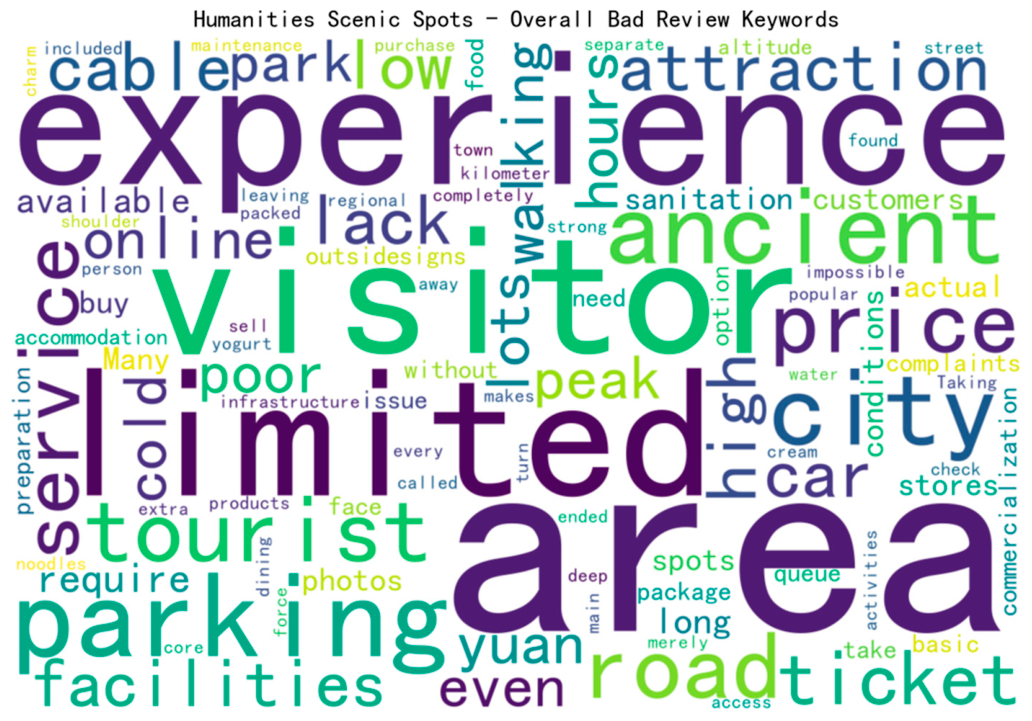
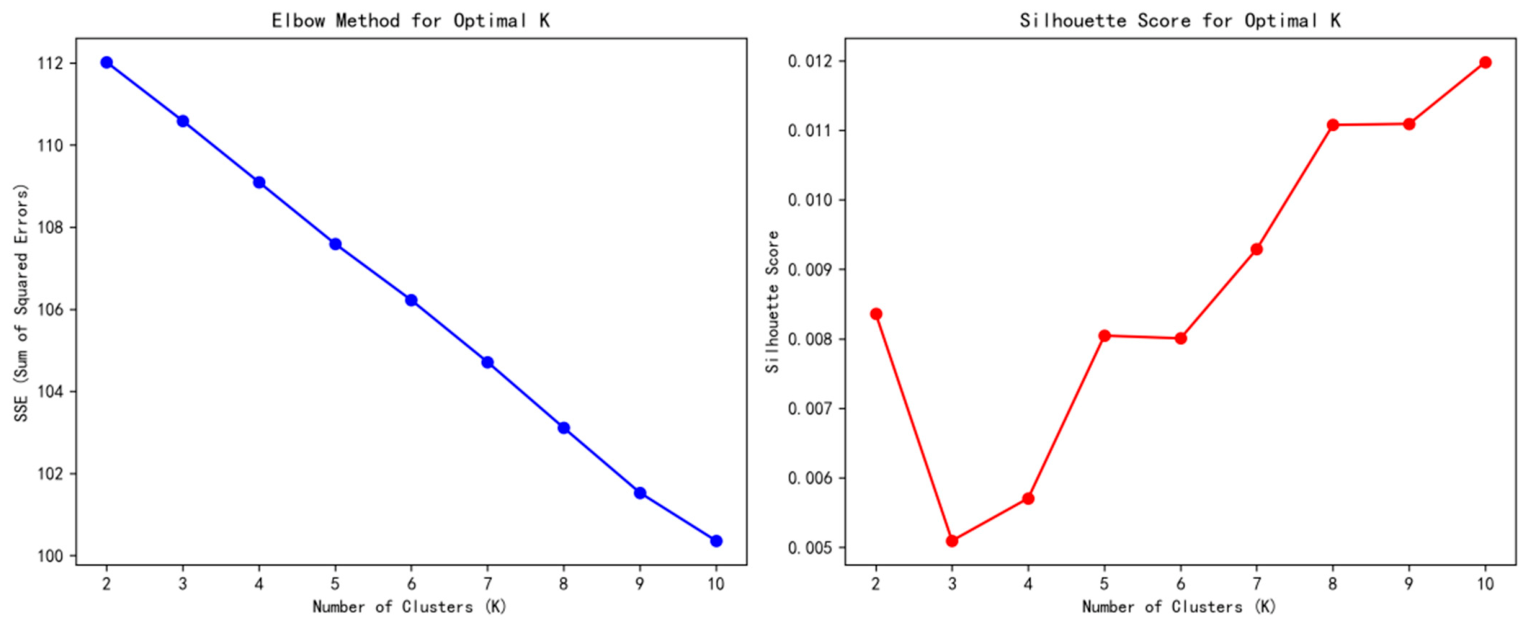
4.3.2. Cultural Landscapes: Erosion of Authenticity and Over-Commercialization


| Cluster ID | Number of Reviews | Proportion | Core Keywords | Typical Review Examples | Representative Case Sites |
|---|---|---|---|---|---|
| 0 | 10 | 19.23% | spots, customers, check, conditions, prices, food, products | Some regional stores suffer from severe homogenization, with their products and dining services lacking distinctive features. | Ancient City of Kashgar |
| 1 | 5 | 9.62% | parking, capacity, peak, sparse, hours, limited, traffic | Parking during peak hours is extremely difficult, with all nearby parking lots fully occupied. | Ancient City of Kashgar, Daliyaboyi Scenic Area |
| 2 | 10 | 19.23% | high, experience, cost, facilities, changes, supporting, perfect | there are many tourists posing for photos to attract customers, which ruins the experience. | Ancient City of Kashgar, Yecheng County Xitiya Mysterious City Scenic Area |
| 3 | 3 | 5.77% | buy, sell, same, price, force, shoulder, if, cold | Some merchants force buyers to buy and sell. Travel photography agencies are full of tricks. | Ancient City of Kashgar, Yecheng County Xitiya Mysterious City Scenic Area |
| 4 | 6 | 11.54% | commercialization, available, serious, visitors, hotline, reservation, developed | The commercialization is serious. The scenic area offers limited dining options. | Kunlun Sacred Land in Celer County, Daliyaboyi Scenic Area |
| 5 | 9 | 17.31% | ancient, city, walking, even, drink, yogurt, taking, completely | The ancient city has become overly commercialized, with souvenir shops lining every street, completely erasing its original cultural charm. | Ancient City of Kashgar |
| 6 | 3 | 5.77% | preparation, sickness, altitude, easily, lead, altitudes, diurnal, cylinders, required | Significant diurnal temperature variation requires attention to the preparation of cold-weather clothing. | Kunlun Sacred Land in Celer County, Daliyaboyi Scenic Area |
| 7 | 6 | 11.54% | poor, sanitation, road, toilets, long, traffic, conditions, queues | The ancient city has infrastructure issues, poor sanitation. The interior maintenance of the old building is poor, raising safety concerns. | Ancient City of Kashgar, Yecheng County Xitiya Mysterious City Scenic Area |
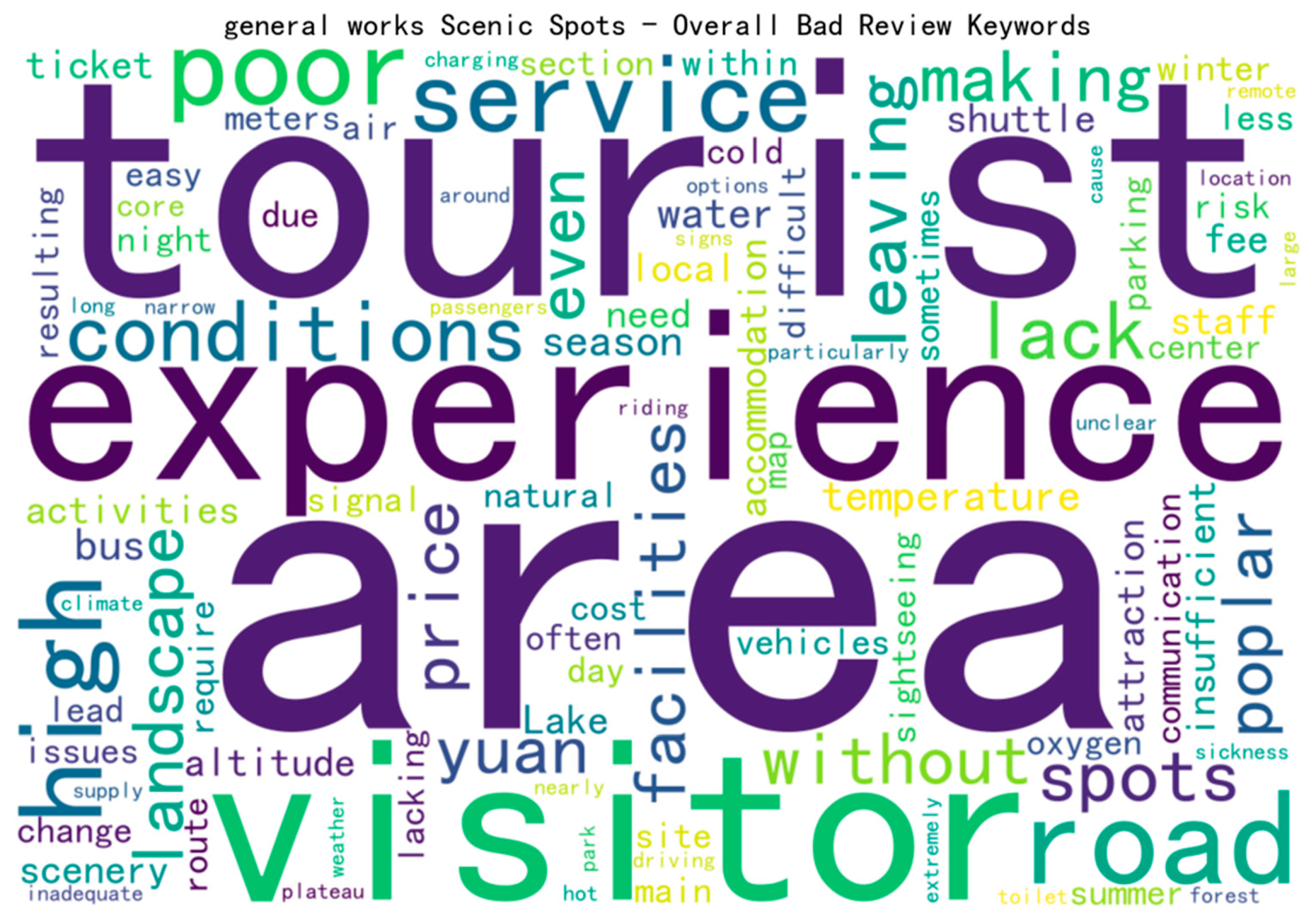
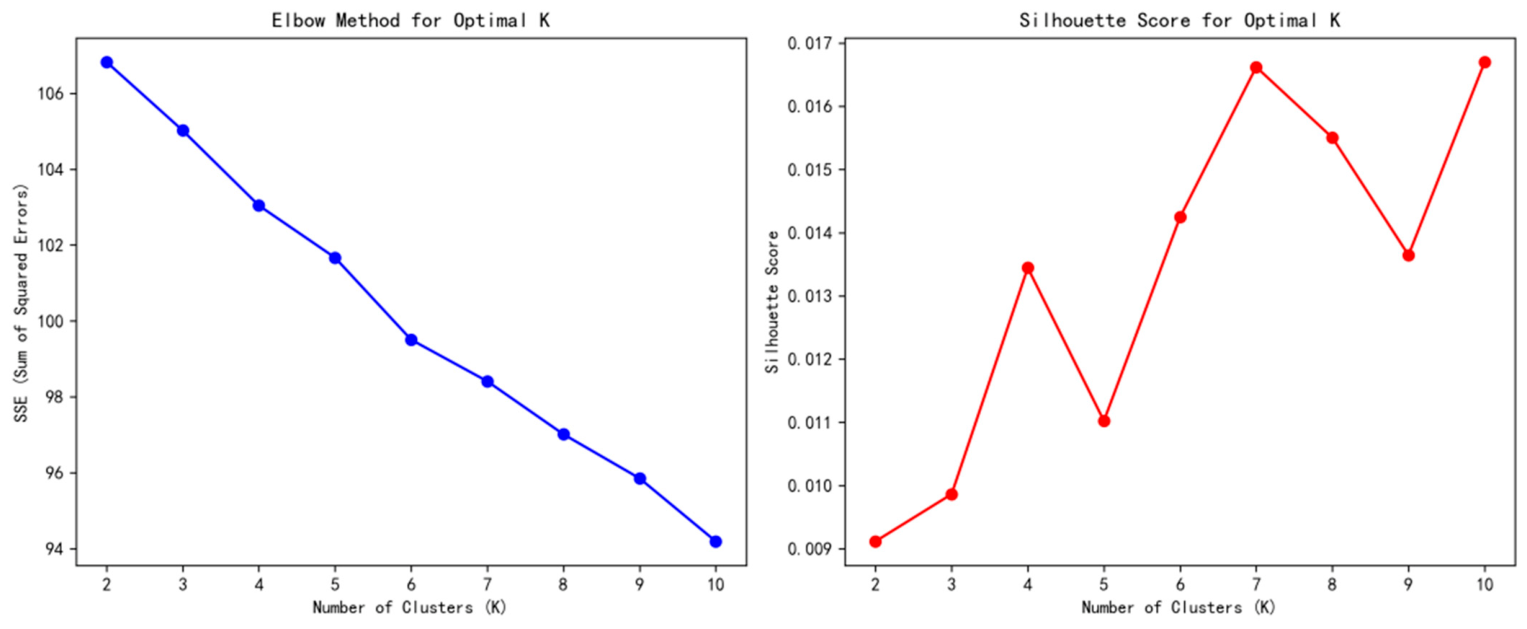
4.3.3. Comprehensive Landscapes: Integrated Governance Bottlenecks


| Cluster ID | Number of Reviews | Proportion | Core Keywords | Typical Review Examples | Representative Case Sites |
|---|---|---|---|---|---|
| 0 | 7 | 5.93% | leaving, options, extremely, navigation, noodles, Terrifying, mosquitoes | Some homestays have air conditioning that barely works. Driving yourself can lead to tricky road conditions and navigation failures. | 139 Poplar Secret Realm Highway, Pamir Tourism Area |
| 1 | 18 | 15.25% | poor, high, price, accommodation, hygiene, facilities, summer, conditions | Winter temperatures are low, while summer is hot with intense sunlight, resulting in high road surface temperatures. | 139 Poplar Secret Realm Highway, Zepu Poplar Scenic Area |
| 2 | 4 | 3.39% | service, tourists, center, practice, photography, charging, regard | The aerial photography service of the observation deck has a hidden practice. The shuttle bus service operates irregularly. | Robu Village Scenic Area, Tomur Grand Canyon |
| 3 | 20 | 16.95% | area, long, road, supply, tourists, narrow, risk, clear | The reservoir in the scenic area was once polluted, which affected the impression of tourists. | Bachu Red Sea Scenic Area, Tomur Grand Canyon |
| 4 | 10 | 8.47% | scenery, natural, photography, reach, way, less, along, transfers | The photography and lighting of the scenic spot are not beautiful. The natural scenery is not particularly impressive, and the overall experience is average. | Bachu Red Sea Scenic Area, Zepu Poplar Scenic Area |
| 5 | 10 | 8.47% | local, tourist, spots, visitors, yuan, popular, photos, like, require | In less-visited spots finding restrooms can be tricky. The sightseeing bus in Kashgar Ancient Town has a scam. | Zepu Poplar Scenic Area, Pamir Tourism Area |
| 6 | 12 | 10.17% | experience, insufficien, affects, strong, site, waste, made, maintenance | The scenic spot has domestic waste, which affects the experience. Extreme weather conditions have caused heavy sandstorms on the roads. | Bachu Red Sea Scenic Area, 139 Poplar Secret Realm Highway |
| 7 | 11 | 9.32% | sections, unclear, lack, signal, making, gravel, spots, roads | Some areas have no signal, making communication difficult. Some areas are closed for construction. | 139 Poplar Secret Realm Highway, Robu Village Scenic Area |
| 8 | 12 | 10.17% | only, making, nearly, without, just, heart, easily | Contradiction between Actual Landscape and Internet Rumor. The altitude rises abruptly from 1289 m to over 4000 m, which can easily trigger acute altitude sickness. | Pamir Tourism Area, 139 Poplar Secret Realm Highway |
| 9 | 14 | 11.86% | landscape, activities, lacking, main, core, experience, park | The landscape is rather plain and lacks the visual impact one might expect. The fees are not clearly defined. | Tomur Grand Canyon, Bachu Red Sea Scenic Area, Zepu Poplar Scenic Area |
5. Discussion and Management Implications
5.1. Dialogue Between Research Findings and Existing Literature
5.1.1. Model Performance: Consistency and Extension of NLP Sentiment Analysis Literature
5.1.2. Obstacle Heterogeneity: Consistency and Breakthrough in Sustainable Tourism Research
5.1.3. ESG Framework: Complementarity of Border Tourism Governance Research
5.2. Theoretical Contributions
5.3. Practical and Policy Implications Under the ESG Framework
5.3.1. Targeted Strategies for Natural Landscape Destinations
5.3.2. Targeted Strategies for Cultural Destinations
5.3.3. Targeted Strategies for Comprehensive Destinations
5.3.4. Macro Governance Recommendations for Regional Authorities
6. Conclusions and Outlook
6.1. Core Findings and Theoretical Contributions
6.2. Practical and Political Implications
6.3. Limitations and Future Research Directions
Author Contributions
Funding
Data Availability Statement
Conflicts of Interest
References
- Ku, S.; Samsurijan, M.S. Advancing Sustainable Development Through Urban Tourism: A Reflective Analysis of SDG 8.9 and 17 in Nanyang City, China. Sustainability 2025, 17, 9533. [Google Scholar] [CrossRef]
- Manotungvorapun, N.; Gerdsri, N. Roadmap Toward Sustainable Tourism Development: An Evidence- and Knowledge-Based Approach from Thailand. Sustainability 2025, 17, 6028. [Google Scholar] [CrossRef]
- Camilleri, M.A. Environmental, Social and Governance (ESG) Factors for Sustainable Tourism Development: The Way Forward Toward Destination Resilience and Growth. Bus. Strateg. Environ. 2026, 35, 4057–4082. [Google Scholar] [CrossRef]
- Uslu, F.; Yayla, O.; Guven, Y.; Ergun, G.S.; Demir, E.; Erol, S.; Yıldırım, M.N.; Keles, H.; Gozen, E. The Perception of Cultural Authenticity, Destination Attachment, and Support for Cultural Heritage Tourism Development by Local People: The Moderator Role of Cultural Sustainability. Sustainability 2023, 15, 15794. [Google Scholar] [CrossRef]
- Zhang, L.; Wang, S.; Liu, B. Deep learning for sentiment analysis: A survey. WIREs Data Min. Knowl. Discov. 2018, 8, e1253. [Google Scholar] [CrossRef]
- Tan, X.; Cai, Y.; Xu, J.; Leung, H.-F.; Chen, W.; Li, Q. Improving aspect-based sentiment analysis via aligning aspect embedding. Neurocomputing 2020, 383, 336–347. [Google Scholar] [CrossRef]
- Ma, C.; Osherenko, A.; Prendinger, H.; Ishizuka, M. A chat system based on emotion estimation from text and embodied conversational messengers. In Proceedings of the 2005 International Conference on Active Media Technology, Kagawa, Japan, 19–21 May 2005. [Google Scholar]
- Yang, M.; Zhu, D.; Chow, K.-P. A topic model for building fine-grained domain-specific emotion lexicon. In Proceedings of the 52nd Annual Meeting of the Association for Computational Linguistics, Baltimore, MD, USA, 23–25 June 2014. [Google Scholar]
- Hu, H.; Wei, Y.; Zhou, Y. Product-harm crisis intelligent warning system design based on fine-grained sentiment analysis of automobile complaints. Complex Intell. Syst. 2023, 9, 2313–2320. [Google Scholar] [CrossRef]
- Luo, J.; Huang, S.; Wang, R. A fine-grained sentiment analysis of online guest reviews of economy hotels in China. J. Hosp. Mark. Manag. 2021, 30, 71–95. [Google Scholar] [CrossRef]
- Jia, K.; Li, Z. Chinese Micro-Blog Sentiment Classification Based on Emotion Dictionary and Semantic Rules. In Proceedings of the 2020 International Conference on Computer Information and Big Data Applications (CIBDA), Guiyang, China, 17–19 April 2020. [Google Scholar]
- Li, Z.; Dong, T. Exploring the Mental Health Benefits of Urban Green Spaces Through Social Media Big Data: A Case Study of the Changsha–Zhuzhou–Xiangtan Urban Agglomeration. Sustainability 2025, 17, 3465. [Google Scholar] [CrossRef]
- Ainapure, B.S.; Pise, R.N.; Reddy, P.; Appasani, B.; Srinivasulu, A.; Khan, M.S.; Bizon, N. Sentiment Analysis of COVID-19 Tweets Using Deep Learning and Lexicon-Based Approaches. Sustainability 2023, 15, 2573. [Google Scholar] [CrossRef]
- Kauffmann, E.; Peral, J.; Gil, D.; Ferrández, A.; Sellers, R.; Mora, H. Managing Marketing Decision-Making with Sentiment Analysis: An Evaluation of the Main Product Features Using Text Data Mining. Sustainability 2019, 11, 4235. [Google Scholar] [CrossRef]
- Jiang, L.; Yu, M.; Zhou, M.; Liu, X.; Zhao, T. Target-dependent twitter sentiment classification. In Proceedings of the 49th Annual Meeting of the Association for Computational Linguistics: Human Language Technologies, Portland, OR, USA, 19–24 June 2011. [Google Scholar]
- Guo, X.; Zhang, G.; Wang, S.; Chen, Q. Multi-way matching based fine-grained sentiment analysis for user reviews. Neural Comput. Appl. 2020, 32, 5409–5423. [Google Scholar] [CrossRef]
- Sharma, A.; Dey, S. A comparative study of feature selection and machine learning techniques for sentiment analysis. In Proceedings of the 2012 ACM Research in Applied Computation Symposium, San Antonio, TX, USA, 23–26 October 2012; Association for Computing Machinery: New York, NY, USA, 2012. [Google Scholar]
- Boiy, E.; Moens, M.-F. A machine learning approach to sentiment analysis in multilingual Web texts. Inf. Retr. 2009, 12, 526–558. [Google Scholar] [CrossRef]
- Luo, Y.; Xu, X. Predicting the Helpfulness of Online Restaurant Reviews Using Different Machine Learning Algorithms: A Case Study of Yelp. Sustainability 2019, 11, 5254. [Google Scholar] [CrossRef]
- Ding, G.; Wu, J. Influence of Tourism Safety Perception on Destination Image: A Case Study of Xinjiang, China. Sustainability 2022, 14, 1663. [Google Scholar] [CrossRef]
- Alzahrani, M.; AlGhamdi, F. Social Media Sentiment Analysis for Sustainable Rural Event Planning: A Case Study of Agricultural Festivals in Al-Baha, Saudi Arabia. Sustainability 2025, 17, 3864. [Google Scholar] [CrossRef]
- Zhao, G.; Xu, Z. Research on the Sentiment Analysis Model of Product Reviews Based on Machine Learning. J. Inf. Secur. Res. 2017, 3, 166–170. [Google Scholar]
- Zaremba, W.; Sutskever, I.; Vinyals, O. Recurrent neural network regularization. arXiv 2014, arXiv:14092329. [Google Scholar]
- Kim, Y. Convolutional neural networks for sentence classification. arXiv 2014, arXiv:1408.5882. [Google Scholar] [CrossRef]
- Wang, Y.; Huang, M.; Zhu, X.; Zhao, L. Attention-based LSTM for aspect-level sentiment classification. In Proceedings of the 2016 Conference on Empirical Methods in Natural Language Processing, Austin, TX, USA, 1–5 November 2016. [Google Scholar]
- Tang, D.; Qin, B.; Feng, X.; Liu, T. Target-dependent sentiment classification with long short term memory. arXiv 2015, arXiv:151201100. [Google Scholar]
- Shang, L.; Lu, Z.; Li, H. Neural responding machine for short-text conversation. arXiv 2015, arXiv:1503.02364. [Google Scholar] [CrossRef]
- Yang, Z.; Yang, D.; Dyer, C.; He, X.; Smola, A.; Hovy, E. Hierarchical attention networks for document classification. In Proceedings of the 2016 conference of the North American Chapter of the Association for Computational Linguistics: Human Language Technologies, San Diego, CA, USA, 12–17 June 2016. [Google Scholar]
- Lin, Z.; Feng, M.; Santos, C.N.d.; Yu, M.; Xiang, B.; Zhou, B.; Bengio, Y. A structured self-attentive sentence embedding. arXiv 2017, arXiv:1703.03130. [Google Scholar] [CrossRef]
- Vaswani, A.; Shazeer, N.; Parmar, N.; Uszkoreit, J.; Jones, L.; Gomez, A.N.; Kaiser, Ł.; Polosukhin, I. Attention Is All You Need. arXiv 2017, arXiv:1706.03762. [Google Scholar]
- Li, Q.; Li, S.; Hu, J.; Zhang, S.; Hu, J. Tourism Review Sentiment Classification Using a Bidirectional Recurrent Neural Network with an Attention Mechanism and Topic-Enriched Word Vectors. Sustainability 2018, 10, 3313. [Google Scholar] [CrossRef]
- Peng, Y.; Yin, P.; Matzler, K. Analysis of Destination Images in the Emerging Ski Market: The Case Study in the Host City of the 2022 Beijing Winter Olympic Games. Sustainability 2022, 14, 555. [Google Scholar] [CrossRef]
- Lin, W.; Zhang, Q.; Wu, Y.J.; Chen, T.-C. Running a Sustainable Social Media Business: The Use of Deep Learning Methods in Online-Comment Short Texts. Sustainability 2023, 15, 9093. [Google Scholar] [CrossRef]
- Wen, T.; Xu, X. Research on Image Perception of Tourist Destinations Based on the BERT-BiLSTM-CNN-Attention Model. Sustainability 2024, 16, 3464. [Google Scholar] [CrossRef]
- Asmelash, A.G.; Kumar, S. Assessing progress of tourism sustainability: Developing and validating sustainability indicators. Tour. Manag. 2019, 71, 67–83. [Google Scholar] [CrossRef]
- Torres-Delgado, A.; Saarinen, J. Using indicators to assess sustainable tourism development: A review. Tour. Geogr. 2017, 16, 31–47. [Google Scholar] [CrossRef]
- Li, J.; Xu, L.; Tang, L.; Wang, S.; Li, L. Big data in tourism research: A literature review. Tour. Manag. 2018, 68, 301–323. [Google Scholar] [CrossRef]
- Wang, H.; Ke, Z.; Huang, B.; Li, G.; Gu, K.; Xu, X.; Chu, Y. Differentiated Drivers of Tourist Sentiment in Wellness Tourism Destinations: A User-Generated Content (UGC)-Based Analysis of Spatial-Temporal Patterns. Sustainability 2026, 18, 3037. [Google Scholar] [CrossRef]
- Essien, A.; Chukwukelu, G. Deep learning in hospitality and tourism: A research framework agenda for future research. Int. J. Contemp. Hosp. Manag. 2022, 34, 4480–4515. [Google Scholar] [CrossRef]
- Rasoolimanesh, S.M.; Ramakrishna, S.; Hall, C.M.; Esfandiar, K.; Seyfi, S. A systematic scoping review of sustainable tourism indicators in relation to the sustainable development goals. J. Sustain. Tour. 2023, 31, 1497–1517. [Google Scholar] [CrossRef]
| Accuracy | Precision | Recall | F1 Score | |
|---|---|---|---|---|
| GRU | 91.62% | 91.62% | 91.62% | 0.9162 |
| LSTM | 90.37% | 90.37% | 90.37% | 0.9037 |
| RNN | 89.06% | 89.06% | 89.06% | 0.8906 |
| Scenic Area Name | Negative Review Rate |
|---|---|
| Duolang River | 11 |
| Jinshatan Scenic Area | 8 |
| Gongnaisi Scenic Area | 7.8 |
| Cele County Kunlun Sacred Land | 7.8 |
| Tianshan Grand Canyon | 7.4 |
| Long Lake Tourism Area | 7 |
| 139 Populus Euphratica Secret Road | 6.8 |
| Imperial Palace Desert Lake Tourism Resort | 6.6 |
| Pamir Tourism Area | 6 |
| Tomur Grand Canyon | 5.9 |
Disclaimer/Publisher’s Note: The statements, opinions and data contained in all publications are solely those of the individual author(s) and contributor(s) and not of MDPI and/or the editor(s). MDPI and/or the editor(s) disclaim responsibility for any injury to people or property resulting from any ideas, methods, instructions or products referred to in the content. |
© 2026 by the authors. Licensee MDPI, Basel, Switzerland. This article is an open access article distributed under the terms and conditions of the Creative Commons Attribution (CC BY) license.
Share and Cite
Han, F.; Huang, F.; Song, L.; Dai, X.; Wang, L. Identification of Obstacles and Optimization Pathways for Sustainable Tourism in Southern Xinjiang: A Deep Learning Approach Based on GRU Sentiment Analysis. Land 2026, 15, 817. https://doi.org/10.3390/land15050817
Han F, Huang F, Song L, Dai X, Wang L. Identification of Obstacles and Optimization Pathways for Sustainable Tourism in Southern Xinjiang: A Deep Learning Approach Based on GRU Sentiment Analysis. Land. 2026; 15(5):817. https://doi.org/10.3390/land15050817
Chicago/Turabian StyleHan, Fujian, Faming Huang, Liang Song, Xiaomin Dai, and Liangping Wang. 2026. "Identification of Obstacles and Optimization Pathways for Sustainable Tourism in Southern Xinjiang: A Deep Learning Approach Based on GRU Sentiment Analysis" Land 15, no. 5: 817. https://doi.org/10.3390/land15050817
APA StyleHan, F., Huang, F., Song, L., Dai, X., & Wang, L. (2026). Identification of Obstacles and Optimization Pathways for Sustainable Tourism in Southern Xinjiang: A Deep Learning Approach Based on GRU Sentiment Analysis. Land, 15(5), 817. https://doi.org/10.3390/land15050817