


Abstract
Urban nature and nature-based solutions are increasingly promoted to enhance public space experience and urban climate resilience. In Public and semi-public indoor settings, biophilic design is considered beneficial for stress reduction and mental health restoration through the introduction of natural elements such as plants. However, research focusing on the specific visual features of plants and the underlying mechanisms remains limited. Based on 200 indoor greenery images and their multi-dimensional feature vectors, and combined with questionnaire data from 253 valid participants, this study developed a quantitative framework of plant visual features and adopted a two-level analytical approach. At the image level, linear mixed-effects models (LMMs) were used to identify how plant features influenced immediate responses. At the group level, partial least squares structural equation modelling (PLS-SEM) was employed to examine how cumulative restorative experience translated into affective states, perceived restorativeness, and behavioural intention. The results showed that Green View Index (GVI) and species richness were the most stable positive features, while plant health status, certain planting modes, and spatial layer-related features also showed significant effects. Restorative experience influenced behavioural intention mainly through positive affect and perceived restorativeness. These findings provide evidence for biophilic design, offering quantitative support for incorporating indoor public space into broader urban nature and public space framework.
1. Introduction
With the acceleration of global high-density urbanization, the daily activity patterns of urban residents have undergone profound changes, with most of their time now spent indoors. This prolonged indoor lifestyle has gradually reduced direct contact with natural environments, becoming an important environmental risk factor for physical and mental health [1,2]. To address this challenge, conventional urban green infrastructure has long played a key role in supporting public health. However, extreme weather events, fluctuations in air quality, and the pressures associated with dense built environments have made outdoor nature exposure less consistently accessible and have also reduced people’s willingness to engage in outdoor activities [3,4,5,6]. Against this background, how to reconstruct human-nature connections within everyday indoor environments has become an increasingly important issue in healthy building, public space, and restorative environment research. It is in this context that biophilic design has gradually moved from conceptual advocacy toward practical application [7,8]. Rather than symbolically introducing natural decoration into indoor spaces, biophilic design emphasizes the use of perceptible natural cues to enhance the health-supportive and restorative potential of the built environment [9,10].
Among various biophilic design strategies, the introduction of indoor plants has become one of the most widely adopted interventions because of its flexibility, relatively controllable cost, and ability to provide the most direct experience of nature. A growing body of research conducted in offices, healthcare settings, schools, and residential environments has shown that exposure to indoor greenery can significantly reduce perceived stress, improve emotional states, and enhance overall environmental satisfaction [11,12,13,14]. In addition, existing studies have also provided evidence from cognitive and physiological perspectives [15,16,17], further supporting the stress-reducing effects of indoor plants. Although these studies have demonstrated the overall positive effects of indoor plants, they remain limited in their ability to inform specific spatial design decisions. Most existing research paradigms still treat “indoor plants” as a binary or categorical variable, while overlooking the complex spatial and morphological properties of plants as visual stimuli. The restorative benefits of indoor greenery do not arise automatically from its mere presence. Rather, they depend on specific visual features. In recent years, a small number of studies have begun to examine plant attributes and their effects. For example, Tokuhiro et al. [18] focused on leaf morphology and explored the relationship between leaf-shape characteristics and subjective impressions and selection preferences for indoor plants through measurements of leaf length, width, roundness, and fractal dimension. Shibata et al. [19] concentrated on a limited set of visual attributes in office spaces, such as visible greenness, colour fractals, and brightness fractals, and examined their effects on perceived restorativeness. Fang et al. [20] further analyzed the role of configurational factors, such as green volume ratio, planting layout, and leaf size, on workers’ attention restoration in factory break areas. While these studies provide important evidence for understanding the restorative effects of plant features from the perspectives of leaf shape, visual attributes, and plant configuration, their investigations mostly remain restricted to single or a few isolated features. They have not yet simultaneously integrated multidimensional features within a unified analytical framework. Furthermore, a recent review has also noted substantial variation in well-being indicators and experimental protocols in indoor biophilic interventions, suggesting that the field still lacks a systematic, multidimensional quantitative evaluation framework [21]. As a result, although current research has demonstrated the restorative effectiveness of indoor plants in general, it still lacks quantitative evidence on which specific features matter most and how these features further influence restorative evaluations and subsequent behavioural intention.
Meanwhile, an increasing number of studies on restorative environments have begun to examine the relationships among environmental experience, affective states, and perceived restorativeness from a mechanism-based perspective. Li and Liu [22] found structural linkages among environmental preference, affect, and perceived restorativeness in audiovisual park environments. Weng [23] further showed that vegetation characteristics could influence physical activity intention through perceived restorativeness. Similarly, Orth et al. [24] demonstrated that restorativeness functions as a critical psychological mechanism in biodiversity perception, directly triggering downstream effects on behavioural intention. These studies indicate that the value of restorative environments extends far beyond temporary emotional improvement. They actively reshape affective and cognitive processes to drive individuals’ subsequent willingness to use such spaces. However, in indoor and semi-indoor greenery contexts, existing studies have tended to develop along two separate lines: one focuses on whether plants contribute to psychological and physiological health, the other examines the psychological mechanisms of restorative environments. The former lacks analyses of specific visual features of indoor greenery, while the latter rarely links such mechanisms directly to plant features that can be translated into design parameters.
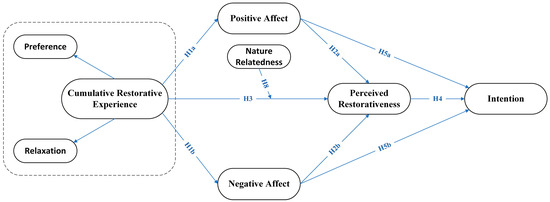
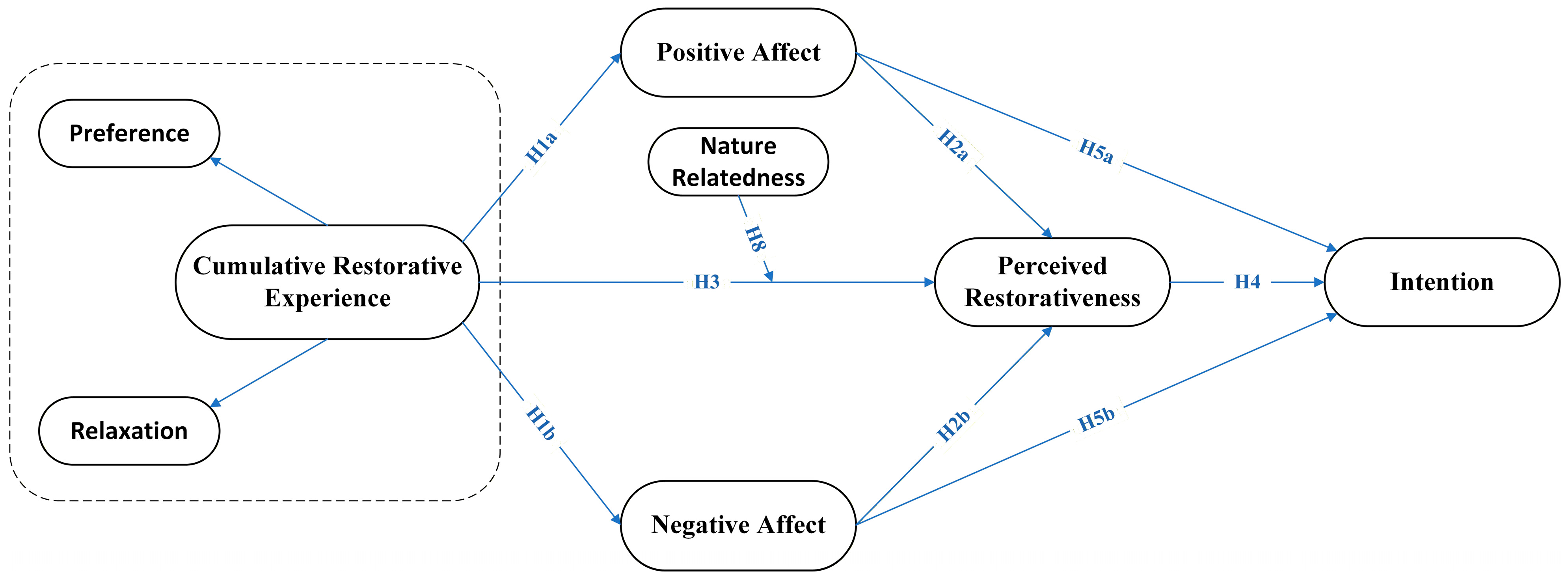
To address this gap, this study proposes a dual-layer analytical framework linking indoor plant visual features, restorative experience, affect, perceived restorativeness, and behavioural intention. First, at the single-image level, a visual feature indicator system is established to examine how specific plant configuration drives preference and relaxation. Second, at the image-group level, these immediate responses are aggregated into a cumulative restorative experience. This experience serves as the antecedent to investigate subsequent mediated pathways through positive affect (PA), negative affect (NA), and perceived restorativeness (PR) toward behavioural intention, while also testing the potential moderating role of nature relatedness (NR). Based on environmental psychology theories and previous research, a conceptual model (Figure 1) was developed, and the following hypotheses were proposed.
Figure 1.
Conceptual framework of the study and hypothesized relationships (Source: Authors). The dashed box groups Preference and Relaxation as components of cumulative restorative experience. The arrows indicate the hypothesized relationship among the constructs.
Hypothesis 1 (H1):
Restorative experience has significant effects on affective responses. Specifically, higher restorative experience is associated with higher positive affect (H1a) and lower negative affect (H1b).
Hypothesis 2 (H2):
Affective states have significant effects on perceived restorativeness. Positive affect is expected to enhance perceived restorativeness (H2a), whereas negative affect is expected to weaken it (H2b).
Hypothesis 3 (H3):
Restorative experience has a significant positive effect on perceived restorativeness.
Hypothesis 4 (H4):
Perceived restorativeness has a significant positive effect on behavioural intention.
Hypothesis 5 (H5):
Affective states significantly influence behavioural intention. Specifically, positive affect exerts a positive effect (H5a), whereas negative affect exerts a negative effect (H5b) on behavioural intention.
Building upon these direct relationships, this study further considers the mediating and moderating roles within the restorative pathway.
Hypothesis 6 (H6):
Affective states mediate the relationship between restorative experience and perceived restorativeness. Specifically, positive affect mediates the relationship between restorative experience and perceived restorativeness (H6a), whereas negative affect mediates the relationship between restorative experience and perceived restorativeness (H6b).
Hypothesis 7 (H7):
Perceived restorativeness mediates the relationship between affective states and behavioural intention. Specifically, it mediates the pathway from positive affect to behavioural intention (H7a) and from negative affect to behavioural intention (H7b).
Hypothesis 8 (H8):
Nature relatedness moderates the relationship between restorative experience and perceived restorativeness.
2. Materials and Methods
2.1. Participants
The questionnaire was distributed via the online survey platform Credamo 2.0.20 (Global Station). Prior to the survey, all participants were informed of the study’s purpose and provided informed consent for their voluntary participation. A total of 253 valid questionnaires were retained for analysis (n = 253). Among the participants, 156 were female (61.7%), and 97 were male (38.3%). Most participants were born in the 2000s (n = 161, 63.6%) or the 1990s (n = 69, 27.3%). In terms of disciplinary background, 53.0% of the participants (n = 134) had a design- or architecture-related background. In addition, 29.6% of participants (n = 75) reported exposure to indoor plants almost every day. The sample included participants from China (n = 202, 79.8%) and from other countries (n = 51, 20.2%). The questionnaire was administered in a bilingual format (Chinese and English) to accommodate respondents with different language preferences. Demographic information is shown in Table 1.
Table 1.
Demographic characteristics of participants (Source: Authors).
2.2. Measures
Given the online, image-based nature of this study, participants were required to evaluate 20 images consecutively within a relatively short timeframe. To prevent respondent fatigue, brief and well-validated instruments with clear dimensional structures were prioritized. Affective states were assessed using the International Positive and Negative Affect Schedule Short Form (I-PANAS-SF) [25]. This scale comprises two dimensions: positive affect (PA; e.g., “active, alert”) and negative affect (NA; e.g., “afraid, upset”). Subjective perceptions of the restorative environment were measured using the 11-item Perceived Restorativeness Scale (PRS-11) [26,27], which covers four dimensions: Being Away, Fascination, Coherence, and Extent. Additionally, the Nature Relatedness Scale (NR-6) was employed to measure individuals’ emotional connectedness, attentional orientation, and self-identification with the natural world [28].
Behavioural intention was measured using three items assessing respondents’ tendencies to approach, stay in, and use similar indoor greenery spaces after viewing each image group. Based on previous research [29,30], behavioural intention was treated as the downstream outcome variable in the restorative pathway to examine whether experiences elicited by indoor greenery images could further influence approach-oriented responses toward similar spaces.
For immediate responses to individual images, two indicators were utilized: preference and image-induced relaxation. Preference was used to assess participants’ overall liking of the current greenery scene, whereas relaxation was used to capture the subjective sense of ease and relief elicited while viewing the image [31,32].
2.3. Stimuli and Quantification of Visual Features
The visual stimuli for this study focused on greenery scenes within public or semi-public indoor spaces. Three researchers conducted extensive image searches across Google Images, Pixabay, and Pexels. During the selection process, the team excluded highly recognizable locations and meticulously screened the images to ensure they contained no explicit emotional cues. More specifically, the scenes were selected according to the following criteria: (1) Only images depicting indoor or semi-indoor public or semi-public spaces were retained, whereas outdoor scenes lacking clear spatial attributes were excluded. (2) Image quality was controlled to ensure that all selected images were sufficiently clear for visual feature coding; images with heavy editing or rendering traces or highly stylized visual effects were excluded. (3) Images containing human figures, recognizable logos, text, or identifiable landmark locations were excluded. Images with explicit emotional cues were also excluded. (4) Regarding lighting conditions, images with severe overexposure, heavy colour filters, or night-time environments were excluded, whereas moderate variation under everyday lighting conditions was retained. To minimize potential evaluative bias stemming from personal preferences for specific interior design styles, the researchers compiled a highly diverse sample of indoor and semi-indoor environments. Ultimately, 200 representative images of indoor greenery scenes were selected as the final stimulus set.
Building on previous studies that examined individual plant features [20,26,33], this study developed a quantitative framework of visual features. The framework decomposed indoor greenery scenes into two dimensions, spatial features and morphological features, comprising a total of 11 indicators. The details are presented in Table 2.
Table 2.
Quantitative framework of visual features for indoor greenery scenes (Source: Authors).
During the extraction and quantification of these 11 visual features, a combination of objective calculations and expert ratings was used. ImageJ software (version 1.54g) was used to identify plant contours and extract greenery pixels from each image. Specifically, each image was imported into ImageJ, and visible greenery regions were delineated as regions of interest (ROIs) based on visible plant contours. The pixel areas of the full image and of each ROI were measured to calculate the objective features S1 green view index (GVI), S2 planting mode proportions, S4 spatial layer proportions, and M1 leaf shape proportions. M2 mean saturation was obtained from the saturation channel after converting the greenery ROIs into HSV colour space. Additionally, features M5 plant health status, M6 species richness, and M7 flower presence were determined through manual observation.
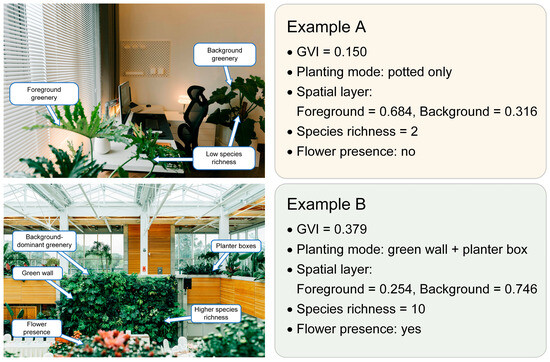
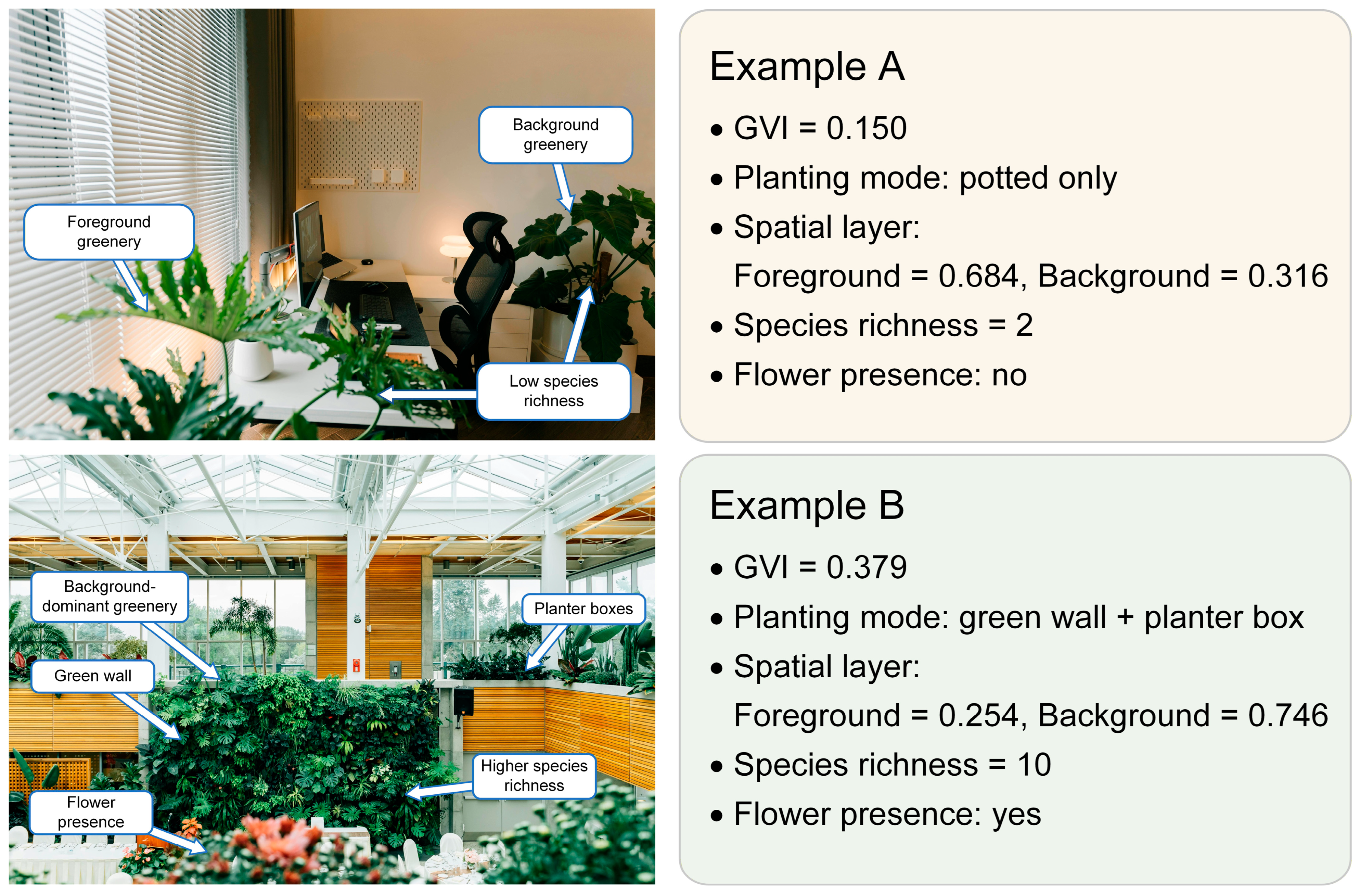
For the three features requiring subjective judgement on a five-point scale, S3 enclosure, M3 colour diversity, and M4 growth form compactness, four experts holding a master’s degree or above in design-related disciplines were invited to rate each image under blind-review conditions independently. To assess the consistency of these subjective ratings, inter-rater reliability was evaluated using the intraclass correlation coefficient (ICC). Since the mean ratings of the four experts were utilized as the final scores for subsequent analyses, the ICC (3, k) was adopted. The results showed high inter-rater reliability across all three features (ICC_S3 = 0.859, ICC_M3 = 0.832, ICC_M4 = 0.819), indicating that the average ratings were both reasonable and reliable for further analysis. Figure 2 presents one representative indoor greenery scene together with its coded feature values.
Figure 2.
Examples of feature coding for representative indoor greenery scenes (Source: www.Pexels.com). The figure highlights the most visually intuitive coded features. Other variables, including enclosure, leaf-shape proportions, colour diversity, growth form compactness, and plant health status, are defined and quantified in Section 2.3 and Table 2.
2.4. Experimental Design
This study employed an online image-based questionnaire to examine the effects of indoor greenery visual features on individuals’ immediate restorative responses, restorative experience, and behavioural intention. To reduce visual fatigue caused by evaluating a large number of images consecutively, a group-based design was adopted.
During the experiment, the 200 selected indoor greenery scene images were randomly and evenly assigned to 10 groups, with 20 images in each group. Each participant was randomly assigned to one of the image groups for image evaluation. Within each group, the 20 images were presented in a fixed sequential order. No fixed minimum or maximum viewing time was imposed; participants viewed each image at their own pace, completed the immediate ratings, and then proceeded to the next image. The questionnaire consisted of three stages. In the first stage, participants completed the demographic questionnaire and the NR-6. In the second stage, participants viewed and evaluated the 20 assigned images one by one. They were asked to report their preference for each greenery scene and their image-induced relaxation response immediately after viewing each image. Both evaluations were measured using a five-point Likert scale. Since each participant independently evaluated 20 images, a total of 5060 image-level observations were collected. In the third stage, after evaluating all 20 images, participants completed the I-PANAS-SF, the PRS-11, and the three-item behavioural intention questionnaire based on their overall experience of the image group.
2.5. Data Analysis
The dataset included both image-level and group-level ratings. For the 5060 image-level observations, each rating was jointly influenced by both participant- and image-level factors, forming a typical cross-classified data structure. Therefore, linear mixed-effects models (LMMs) were used for analysis [40]. Participants and images were specified as random effects to control for individual differences in rating behaviour and stimulus-related variation. At the same time, preference and image-induced relaxation were treated as dependent variables, and the visual features of indoor greenery were entered as fixed effects. Except for the binary variable M7, all variables were Z-score standardized prior to model estimation. Since S2, S4, and M1 were within-group proportional variables, potted proportion, background proportion, and dot-shaped proportion were, respectively, used as reference baselines. Accordingly, the corresponding regression coefficients should be interpreted as proportional reallocation effects relative to the baseline components, rather than the absolute effect of increasing a single feature in isolation. The reported LMM coefficients were estimated using restricted maximum likelihood (REML). The models were fitted in the R environment (R version 4.5.0) using the lme4 (version 2.0.1) and lmerTest (version 3.2.1) packages with the nloptwrap optimizer, and both main models converged normally. For diagnostic comparison, corresponding null models including only random intercepts for participants and images were additionally estimated using maximum likelihood.
At the group level, partial least squares structural equation modelling (PLS-SEM) was employed to examine the restorative mechanism pathways. First, image-level preference and relaxation were aggregated by calculating each participant’s mean preference and mean relaxation scores across the viewed image group, thereby representing cumulative restorative experience. In the structural model, cumulative restorative experience (Experience), positive affect (PA), negative affect (NA), perceived restorativeness (PR), and behavioural intention (Intention) were modelled as latent variables, whereas nature relatedness (NR) was included as an individual-difference variable to test its moderating role. For PR, the PRS-11 items were first aggregated into four dimensions, Being Away, Fascination, Coherence, and Extent, according to the scale structure, and these four dimensions were then used to measure the latent construct of PR. The analysis was conducted in SmartPLS 4 using the PLS algorithm, and bootstrapping was applied to test the path relationships and associated effects.
2.6. Ethics
This study received approval from the Human Research Ethics Committee of University of Technology Sydney. The approval number is ETH25-11290.
3. Results
3.1. Preliminary Analysis
A total of 253 valid questionnaires were collected in this study. The distribution of participants across the 10 image groups was relatively balanced. Descriptive statistics of the core variables indicated that respondents’ overall evaluations of the viewed indoor greenery scenes were above the midpoint of the scale, as shown in Table 3.
Table 3.
Descriptive statistics and correlations among the core variables (Source: Authors).
Preliminary correlation analysis showed a strong positive association between mean preference and mean relaxation (r = 0.917, p < 0.001), indicating a high degree of consistency between the two constructs in the present study and suggesting that both reflect positive immediate responses to indoor greenery scenes. Further variance inflation factor (VIF) testing indicated that, when the two variables were entered into the structural model as independent variables, their VIFs would exceed the commonly used threshold of 5, suggesting a risk of multicollinearity. Based on this result, the two variables were aggregated into a cumulative restorative experience variable and included in the PLS-SEM analysis. Meanwhile, both preference and relaxation were significantly positively correlated with PA, PR, and intention, with the strongest association observed between PR and Intention (r = 0.821, p < 0.001). In contrast, NA was not significantly correlated with preference or relaxation but was significantly negatively correlated with PR (r = −0.311, p < 0.001) and Intention (r = −0.345, p < 0.001). These findings suggest that image-level preference and relaxation not only capture immediate restorative responses, but are also clearly linked to subsequent affective states, PR, and intention, thereby providing preliminary support for the subsequent LMM and PLS-SEM analyses.
3.2. Effects of Indoor Plant Features on Single-Image Preference and Relaxation
3.2.1. Main Effects
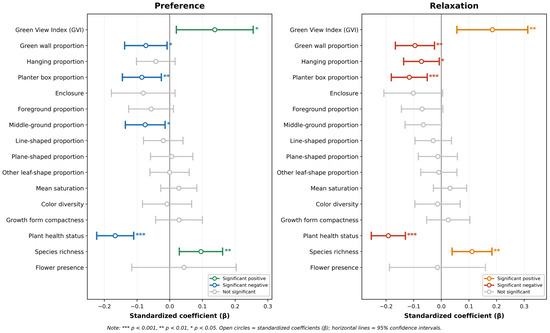
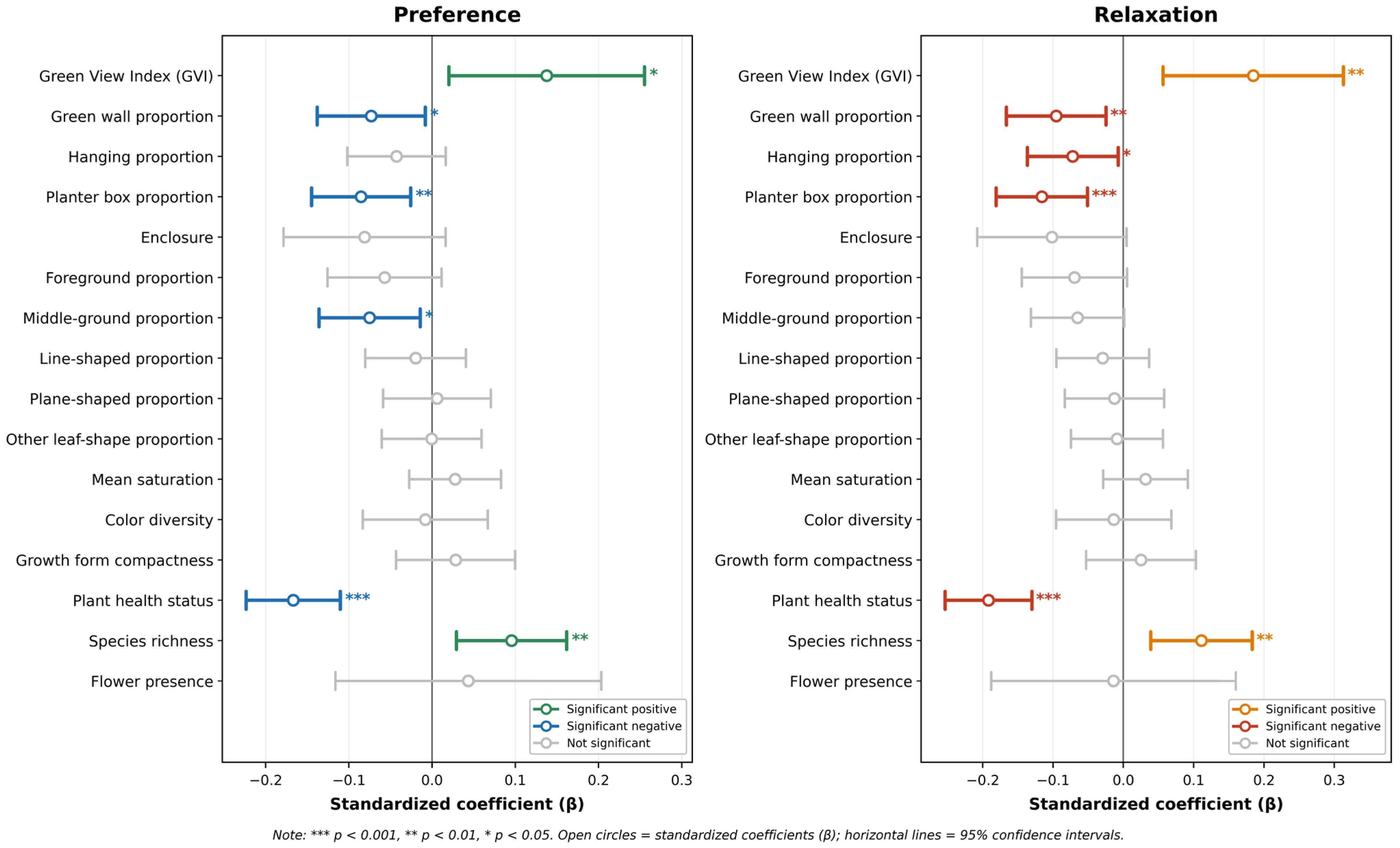
As shown in Figure 3, the LMM results indicated that the effects of indoor greenery features on image-level preference and image-induced relaxation were broadly consistent. Detailed coefficients are presented in Table 4. Additional diagnostics supported the use of cross-classified LMMs. In the preference model, the participant-, image-, and residual-level variances were 0.320, 0.091, and 0.813, corresponding to participant- and image-level ICCs of 0.261 and 0.075, respectively. In the relaxation model, the corresponding variances were 0.319, 0.112, and 0.899, with ICCs of 0.240 and 0.084. In addition, compared with null random-intercept models, the full models showed significantly better fit in likelihood-ratio tests and lower AIC values than the null models (see Table S1).
Figure 3.
Standardized fixed effects from the LMM for image-level preference and image-induced relaxation (Source: Authors).
Table 4.
Standardized fixed effects of indoor greenery visual features on image-level preference and image-induced relaxation (Source Authors).
In both models, GVI showed significant positive effects. Higher GVI was significantly associated with higher preference (β = 0.138, p = 0.022) and higher relaxation (β = 0.185, p = 0.005). This indicates that a greater proportion of visible greenery within the image was associated with more positive immediate evaluations of indoor greenery scenes. At the same time, species richness was also positively associated with both outcomes. Specifically, a greater number of distinguishable plant species were linked to higher preference (β = 0.095, p = 0.005) and higher relaxation (β = 0.111, p = 0.003). Plant health status showed significant negative effects in both models (preference: β = −0.167, p < 0.001, relaxation: β = −0.192, p < 0.001). Because this variable was coded from 1 (healthy) to 3 (unhealthy), the negative coefficients indicate that healthier plants were associated with more positive immediate restorative responses.
For planting mode-related features, with potted proportion used as the reference baseline, a higher green wall proportion was significantly associated with lower preference (β = −0.073, p = 0.027) and lower relaxation (β = −0.096, p = 0.008). Planter box proportion also showed significant negative effects in both models (preference: β = −0.085, p = 0.005; relaxation: β = −0.116, p < 0.001). In contrast, hanging proportion showed a significant negative effect only on relaxation (β = −0.072, p = 0.029), but not on preference (p = 0.157). These results suggest that, relative to potted planting, green walls, planter boxes, and, to some extent, hanging arrangements did not lead to more positive immediate responses.
For the spatial layer, with background proportion as the reference baseline, middle-ground proportion showed a significant negative effect on preference (β = −0.075, p = 0.015). However, its effect on relaxation did not reach statistical significance (β = −0.065, p = 0.054). Foreground proportion was not significant in either model. This suggests that relative to greenery distributed mainly in the background, a higher proportion of greenery in the middle ground may be less favourable for preference evaluations, whereas this tendency was weaker for relaxation.
Variables such as enclosure, leaf shape proportions, mean saturation, colour diversity, growth form compactness, and flower presence did not show statistically significant main effects on image-level preference or image-induced relaxation.
3.2.2. Nonlinear and Interaction Effects of Green View
Beyond the main effects, the models further included the quadratic term of GVI and its related interaction terms, as shown in Table 4. The results indicated that the quadratic term of GVI was significant in both the preference and relaxation models, suggesting a significant nonlinear relationship between green view and immediate restorative responses. In combination with the positive main effects, this pattern indicates that preference and image-induced relaxation generally increased with higher GVI, but the magnitude of this positive effect did not increase linearly and instead showed diminishing returns at higher levels of green view.
In addition, the interaction term between GVI and mean saturation (GVI × mean saturation) showed significant positive effects in both models (preference: β = 0.072, p = 0.008; relaxation: β = 0.083, p = 0.006). This finding indicates that mean saturation strengthened the positive effect of green view on immediate responses. Compared with scenes with lower saturation, increases in GVI produced greater gains in preference and relaxation when the greenery images were more saturated in colour.
3.3. Assessment of the Measurement Model
Prior to evaluating the structural pathways, the measurement model at the group level (n = 253) was assessed for reliability and validity using the PLS algorithm. The results are shown in Table 5 and Table 6. The model included six latent constructs: restorative experience (Experience), behavioural intention (Intention), positive affect (PA), negative affect (NA), perceived restorativeness (PR), and nature relatedness (NR). Following the commonly used criteria for PLS-SEM proposed by Hair et al. [41], all constructs showed acceptable levels of Cronbach’s alpha and composite reliability (CR), and all average variance extracted (AVE) values exceeded 0.50, indicating satisfactory convergent validity.
Table 5.
Reliability, convergent validity, and outer loadings of the measurement model (Source: Authors).
Table 6.
Discriminant validity assessment based on the Fornell–Larcker criterion (diagonal and upper triangle) and HTMT ratios (lower triangle) (Source: Authors).
Regarding outer loadings, most indicators reached relatively high levels. The two indicators of Experience, pref_mean and relax_mean, showed loadings of 0.978 and 0.980, respectively, indicating that both reliably reflected the same experiential construct. The three indicators of Intention ranged from 0.890 to 0.907, while the five indicators of NA ranged from 0.662 to 0.903. Among the PA indicators, PA_alert showed a relatively low loading (0.433), suggesting a weaker contribution to the PA construct than the other items. Following the guideline of Hair et al. [42], indicators with loadings between 0.40 and 0.708 should be considered for removal only when deletion leads to an increase in internal consistency reliability or convergent validity above the suggested threshold value. The Cronbach’s alpha, CR, and AVE of PA already met the recommended criteria (see Table 5), and “alert” is a core item of the Positive Affect dimension in the original I-PANAS-SF scale [25]. An additional robustness check showed that removing this item slightly improved the measurement indicators of PA, but did not materially change the structural results. Therefore, the original PA specification was retained in the main analysis to preserve content coverage. For the PRS-11, the items were first aggregated into four dimensions according to the original scale structure before entering the model. The loadings of these four dimension-level indicators ranged from 0.761 to 0.881, indicating that the latent construct of PR was stably reflected.
The results for discriminant validity also generally supported the distinctiveness of the constructs. As shown in Table 6, the Fornell–Larcker criterion indicated that the square root of the AVE for each construct was higher than its correlations with the other constructs. The HTMT ratios further supported discriminant validity. Overall, 14 of the 15 inter-construct HTMT values were below the conservative threshold of 0.85. The only exception was PR and Intention (HTMT = 0.944), which is consistent with the empirically close relationship between PR and Intention under the Fornell–Larcker criterion. Nevertheless, because PRS captures a subjective, cognitive evaluation of an environment’s restorative potential, whereas Intention represents downstream behavioural tendencies to approach, stay in, and use similar spaces, the two constructs remain conceptually distinguishable. Therefore, they were retained as separate latent variables for the subsequent structural model analysis.
3.4. Structural Model Results and Hypothesis Testing
3.4.1. Direct Effects
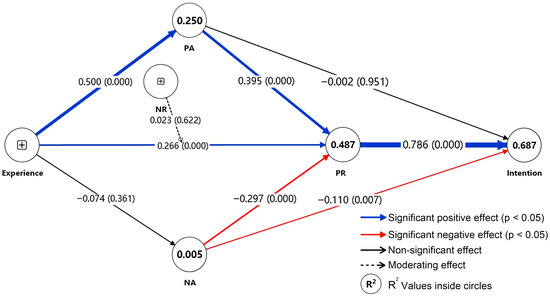
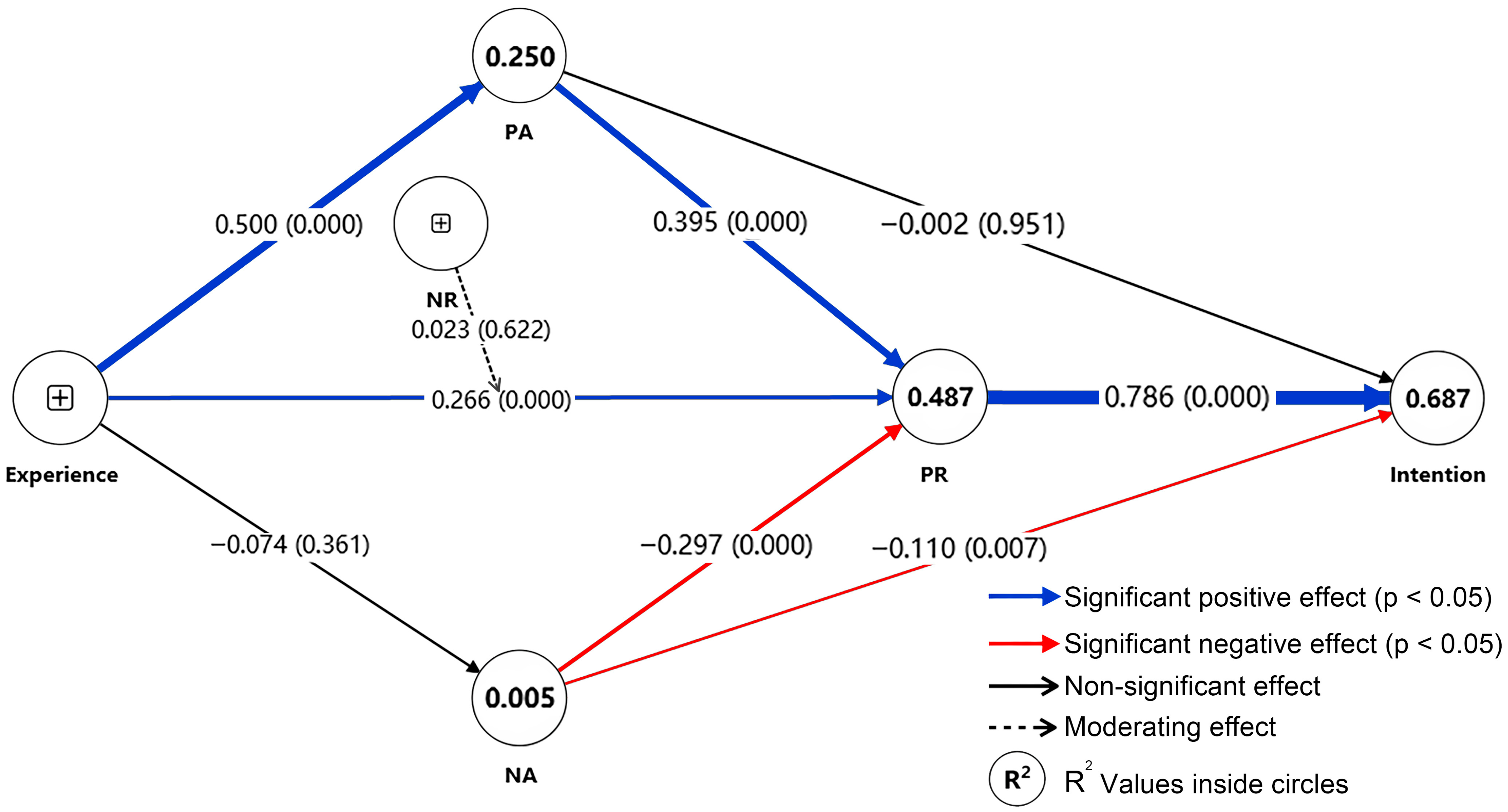
The structural model further examined the relationships among Experience, affective states, perceived restorativeness (PR), and Intention. A bootstrapping procedure with 5000 resamples was used to estimate the significance of the path coefficients, and the full results are presented in Table 7 and Figure 4.
Table 7.
Structural path coefficients and hypothesis testing results (Source: Authors).
Figure 4.
Structural model results (Source: Authors).
Experience showed a significant positive effect on positive affect (β = 0.500, p < 0.001), indicating that a higher level of Experience was associated with higher positive affect. In contrast, the direct effect of Experience on NA was not significant (β = −0.074, p = 0.361), and H1b was not supported. Experience exerted a significant direct effect on PR (β = 0.266, p < 0.001), suggesting that stronger Experience significantly increased respondents’ evaluations of the restorative potential of the scenes. Thus, H3 was supported. At the same time, affective states also showed significant effects on PR (PA: β = 0.395, p < 0.001; NA: β = −0.297, p < 0.001), indicating that positive affect enhanced perceived restorativeness, whereas negative affect weakened it. Accordingly, both H2a and H2b were supported.
With respect to Intention, PR had a significant positive effect on Intention (β = 0.786, p < 0.001), indicating that the more respondents perceived a group of indoor greenery scenes as restorative, the stronger their tendency to approach, stay in, or use similar spaces. Therefore, H4 was supported. For the direct paths from affective states to behavioural Intention, PA and NA showed different patterns. NA significantly reduced respondents’ approach tendency toward similar spaces (β = −0.110, p = 0.007), whereas the effect of PA was not significant (β = −0.002, p = 0.951). Therefore, only H5b was supported.
In addition, regarding the moderating effect of individual differences, the interaction term between Experience and NR did not show a significant effect on PR (β = 0.023, p = 0.622), suggesting that in the present sample, nature relatedness did not significantly alter the effect of Experience on perceived restorativeness. Thus, H8 was not supported.
As shown in Figure 4, the structural model explained a relatively large proportion of variance in Intention (R2 = 0.687) and a moderate proportion in PR (R2 = 0.487), consistent with the guidelines for evaluating R2 in PLS-SEM [41]. By contrast, the explained variance was lower for PA (R2 = 0.250) and particularly limited for NA (R2 = 0.005). This pattern is consistent with the structural relationships reported above, as PA and NA were each predicted only by Experience, and the near-zero R2 for NA corresponds to the non-significant path from Experience to NA (H1b).
3.4.2. Mediation Analysis
The mediation analysis further clarified the mechanisms linking Experience, affective states, and perceived restorativeness, and the results are presented in Table 8. Between Experience and PR, Experience showed a significant indirect effect through PA (β = 0.197, p < 0.001), thereby supporting H6a. In contrast, the indirect effect through NA on PR was not significant (p = 0.369), and H6b was therefore not supported. The results further indicated that the effect of Experience on Intention was primarily realized through indirect pathways rather than through a single mechanism. Specifically, the indirect effect of Experience on Intention through PR was significant (β = 0.209, p < 0.001), and the serial mediation pathway through PA and PR was also significantly positive (β = 0.155, p < 0.001). Regarding the formation of Intention, both H7a and H7b were supported, indicating that PR played an important mediating role. Although the direct effect of PA on Intention was not significant, it indirectly enhanced Intention by increasing PR (β = 0.310, p < 0.001). At the same time, the indirect effect of NA on Intention through PR was also significant (β = −0.234, p < 0.001).
Table 8.
Indirect effects and mediation analysis results (Source: Authors).
Overall, the mediation results suggest that the effect of Experience on subsequent Intention mainly depended on the mediating processes of PA and PR. Among these, PR occupied a central position within the structural chain, as it not only transmitted the effects of Experience and affective states, but also directly promoted individuals’ tendencies to use indoor greenery spaces.
4. Discussion
4.1. Indoor Plant Features and Restorative Responses
The image-level results of this study indicate that multiple visual features jointly shaped individuals’ immediate restorative responses to indoor greenery scenes. Overall, both GVI and species richness showed stable positive effects on preference and image-induced relaxation. In addition, the effects of certain planting modes, spatial layers, and the interaction between green view and colour-related attributes further suggest that restorative responses to indoor greenery are better understood as integrated outcomes shaped by multiple visual cues rather than by a single feature in isolation. This finding is consistent with the general conclusion of previous indoor greenery research, namely that indoor nature exposure tends to improve subjective evaluations and emotional states [32,43]. This study extends this line of evidence to a more fine-grained level of visual features.
Among the plant features examined in this study, the effect of GVI was the most stable. Existing research on visible greenness and restorative environments generally suggests that greater exposure to visible greenery is associated with greater perceived restorativeness, more positive affective responses, and stronger environmental preference [44,45]. However, the positive effect of GVI did not increase linearly. The present results show that while GVI had a significant positive effect on immediate restorative responses, its quadratic term was significantly negative, suggesting the possibility of a threshold effect or diminishing returns at higher levels of visible greenery. This finding is broadly consistent with the general pattern reported in previous studies, although differences remain in the estimated threshold levels [26,33,44,46]. Such variation may be related to differences across studies in stimulus materials, reference environments, and the ways in which greenness was presented, which in turn may influence how participants respond to changes in visible greenery.
The positive effect of species richness also deserves emphasis. Research on landscape preference has shown that higher species richness is associated with ecological diversity and esthetic judgement [38]. This study provides further support for the role of this feature: even in an image-based evaluation task, respondents consistently responded to the species richness of indoor plant scenes, and this pattern was reflected in both preference and relaxation. This suggests that restorative responses to indoor greenery depend not only on the amount of greenery present, but also on whether the visual information it provides contains sufficient variation and layering.
In contrast, the results for planting mode proportions suggest that the restorative effects of indoor plants cannot be simply distinguished by their presentation. With potted proportion as the reference baseline, both green wall proportion and planter box proportion showed negative effects on restorative responses, whereas hanging proportion was mainly associated with less favourable relaxation responses. This finding is not entirely consistent with studies emphasizing the display advantages of green walls. For example, Wang et al. [47] reported that highly preferred indoor green walls could elicit more positive affective and restorative responses. One possible explanation is that green walls may produce stronger visual impact in VR-based experimental settings or display-oriented scenes, whereas in more complex real indoor environments, potted plants may be more likely to form clear, recognizable, and intentionally placed natural visual elements. In other words, green walls and planter boxes may be more easily integrated into background surfaces or decorative components. Under such conditions, potted plants may be more readily perceived as authentic natural elements and may better match people’s everyday expectations of naturalness in indoor or semi-indoor spaces.
The results for spatial layer proportions provide further support for this interpretation. With background proportion as the reference baseline, a higher middle-ground proportion was significantly associated with lower preference, whereas foreground proportion did not show a stable effect. This suggests that the spatial distribution of greenery influences immediate responses, but such influence cannot be reduced to a simple assumption that closer is better. Instead, it is more likely related to how greenery participates in the overall spatial composition. Greenery in the background may more likely create a continuous natural atmosphere, whereas excessive emphasis on the middle ground may weaken the coherence of spatial organization. Accordingly, these proportional features are better understood as experiential differences arising from the reallocation of visual resources across spatial layers, rather than as the isolated effect of increasing a single layer alone.
Overall, the findings regarding indoor plant features suggest that multiple features and configurational factors jointly shape indoor greenery scenes. In other words, designing restorative indoor greenery environments is not simply a matter of increasing the number of plants or raising the overall level of greening, but rather of achieving effective coordination among multiple visual and spatial factors. This also provides an important basis for Section 4.2, which discusses the pathways linking Experience, affective states, PR, and behavioural intention.
4.2. Restorative Pathways from Experience to Intention
The structural model results suggest that the cumulative impact of indoor greenery scenes operated primarily through a mechanism linking affective states and perceived restorativeness. Specifically, Experience significantly increased PA and PR, while PR in turn significantly predicted Intention. In contrast, the direct effect of PA on Intention was not significant. This suggests that, in indoor greenery contexts, individuals’ willingness to approach, stay in, or use similar spaces depends more on whether the environment is judged to possess restorative potential. This general mechanism is broadly consistent with the PLS-SEM findings reported by Li and Liu [22] for audiovisual park environments. In this study, PR exhibited a particularly strong structural role. Across both urban nature research and studies of biodiversity perception, restorative judgement is usually not the endpoint of the pathway, but rather an important mediator linking environmental experience to subsequent responses [23,24].
PA and NA showed an asymmetric pattern in their pathways to Intention. In the current model, the direct path from PA to Intention was not significant, whereas its indirect effect through PR was significant. By contrast, NA not only weakened PR, but also directly reduced Intention. This suggests that positive affect may function as a preparatory signal that requires further processing through perceived restorativeness. Negative affect may operate more as an inhibitory signal, influencing both judgments of restorative potential and the tendency to approach the environment. The non-significant direct effect of Experience on NA further supports this asymmetric structure. It indicates that the cumulative experience elicited by indoor greenery images is more likely to manifest as an increase in positive affect, rather than automatically as a decrease in negative affect. This finding is also partly in line with the indoor nature exposure study by Rhee et al. [45], which showed that increased vegetation and natural views significantly improved restorative quality and cognitive performance, but that the benefits of short-term visual exposure were not always reflected in the simultaneous reduction in all negative states.
In summary, the restorative significance of indoor and semi-indoor greenery spaces does not stop at immediate preference or relaxation, but can be further translated into more stable behavioural tendencies through PA and PR. In combination with the previous discussion of indoor plant features, the findings suggest the following pathway: multiple visual plant features shape cumulative experience, which is then further translated through affective states and perceived restorativeness, ultimately influencing whether individuals are willing to approach and use similar spaces. In this process, PR carries forward the effects of Experience and constitutes the cognitive basis for the formation of behavioural intention. This is also an important reason why indoor greenery spaces can be understood as restorative environments rather than merely decorative ones.
4.3. Implications for Indoor and Semi-Indoor Design
The results of this study suggest that the key to greenery design in indoor and semi-indoor spaces lies not merely in whether plants are introduced, but in how they are transformed into visual and spatial resources that can be perceived and can support restorative judgement. This is consistent with the basic premise of biophilic design. In the practical framework of biophilic design, Kellert [9] emphasized that introducing natural elements should reconstruct perceptible human-nature relationships, enabling built environments to provide more stable, health-supportive, and restorative value. Zhong et al. [7] similarly argued that the significance of biophilic design in architecture lies not in simply adding natural elements, but in treating nature as a design medium that can be experienced, interpreted, and involved in behavioural choice. From this perspective, the primary premise of greenery design in indoor spaces is that greenery must be perceptible [32,48]. Therefore, GVI and species richness, as the most stable positive features identified in this study, may be treated as priority considerations in the design of restorative indoor environments. Design in indoor spaces should attend to whether greenery actually enters the primary field of view and whether sufficient visual layering is created through differences in plant species.
In addition, the quadratic effect of GVI suggests that restorative benefits do not continue to increase linearly with greater visible greenery, but instead tend to level off at higher levels of coverage. As discussed in Section 4.1, previously reported threshold values vary substantially, ranging from around 12% in VR-based studies [33] to approximately 45–60% in window-view studies [46]. This variation reflects differences in viewing media and reference environments. Accordingly, we do not recommend treating any single numerical threshold as a universal standard. Nevertheless, these studies show a consistent qualitative pattern: restorative benefits tend to weaken at very high levels of greenness. In practical terms, this provides useful guidance for designers: greenery should be clearly visible and visually salient, while layouts that sacrifice spatial openness or create visual saturation should be avoided. Regarding species richness, most images in the present dataset contained 2–5 distinguishable plant species, and species richness showed a positive association with immediate restorative responses across the observed range of 1–13 species. Therefore, in indoor greenery design, a composition with approximately 3–5 distinguishable species may serve as a practical starting point for balancing visual richness against the risk of visual clutter. However, the precise optimum still requires further validation.
At the same time, the results for planting mode proportions and spatial layer proportions further indicate that, beyond increasing plant presence, design optimization also needs to consider how greenery is organized within space. This implies that different types of plant features should be used hierarchically. GVI and species richness may be treated as dominant design cues, whereas planting mode proportions, spatial layer proportions, and certain leaf shape or colour-related features may be better understood as secondary indicators of configurational optimization. In other words, even when some proportional features did not reach statistical significance after controlling for other variables, they should not be excluded from design judgement, because in real spaces they often operate jointly through composition, combination, and background relationships. For example, movable potted plants combine flexibility in spatial arrangement with relatively high visual accessibility. They may therefore serve as a reliable baseline planting strategy, whereas other planting modes may be used more selectively to increase structural diversity. The negative effect of middle-ground greenery on preference suggests that designers should avoid allowing planting to occupy the central line of sight. By contrast, greenery distributed in the background may be more conducive to maintaining spatial continuity and openness, while foreground planting may serve as a perceptual entry point closer to the user, provided that it does not create visual crowding. In addition, the significant positive interaction between GVI and mean saturation suggests that, in spaces where visible greenery is already abundant (such as atria, lobbies, or garden cafes), plant materials with clearer, more vivid green tones may be prioritized over duller or grey-green species, as this may further enhance restorative effects. Plant health status showed the largest negative effect in the linear mixed-effects models, which also deserves particular emphasis: rather than installing a large number of plants that cannot be maintained in good condition, it may be more effective to use a smaller number of well-maintained plants and incorporate routine maintenance into the operational plan from the design stage onward. These suggestions are also consistent with the findings of Fang et al. [20], who similarly argued that the restorative effects of indoor greenery are typically produced through the coordinated configuration of multiple parameters rather than by any single parameter alone.
These findings also suggest that indoor greenery design can shift from experience-based arrangement toward evidence-based parametric judgement. The plant features identified in this study are not merely explanatory variables in statistical models but can also be understood as quantifiable parameters for design decision-making. Compared with arranging plants primarily based on intuition or stylistic preference, this approach supports more explicit judgments at the design stage. It helps identify which features are more likely to serve as dominant cues of restorative experience and which are better suited as auxiliary parameters for scene optimization. For indoor and semi-indoor spaces, the designer should incorporate plant configuration earlier in the design process to support spatial organization, stay nodes, and the creation of a restorative environment, rather than treating plants merely as decorative elements added at a later stage.
4.4. Indoor Restorative Spaces Within Wider Urban Nature Systems
The findings of this study suggest that indoor and semi-indoor greenery spaces possess restorative potential and may be regarded as components of wider urban nature systems, particularly as micro-restorative nodes along everyday public activity routes. This interpretation is consistent with current research on urban restorative environments [49]. This point is particularly important for urban health and climate adaptation. As extreme heat, heavy rainfall, fluctuations in air quality, and the pressures associated with dense built environments continue to increase, outdoor nature exposure is not always accessible, comfortable, or suitable for staying. Under such conditions, indoor and semi-indoor greenery spaces may serve as more stable restorative alternatives. Existing studies have shown that indoor green spaces are associated with improvements in mental health and can support emotional relief and restorative experiences in high-stress settings [50,51]. Thus, when outdoor climatic conditions are less favourable, indoor green spaces may serve as an important supplement to everyday urban health-support systems. In this sense, previous studies have also shown that greenness, vegetation structure, and perceived restorativeness are closely related to restorative benefits among urban residents [24,52]. From this perspective, the findings regarding greenery features and the mechanism of perceived restorativeness may also have a certain degree of transferability to outdoor settings. However, such transferability does not mean that indoor findings can be directly equated with conclusions for outdoor design. Indoor and outdoor environments differ substantially in terms of thermal conditions, lighting, accessibility, multisensory stimulation, and activity patterns.
Beyond the conceptual framing, several specific pathways may be considered for integrating indoor greenery spaces into wider urban nature systems. At the spatial level, urban green networks may be extended from outdoor to indoor environments through deliberate spatial continuity. For example, greenery at building entrances and lobbies can be designed as an extension of outdoor networks. This allows pedestrians to experience a continuous visual sequence of nature as they move from the street indoors. At the functional level, indoor greenery may be strategically distributed along everyday public activity routes, thereby forming a distributed network of micro-restorative nodes. This idea also resonates with discussions of the 15 min city [53]. Opportunities for restoration need not be limited to designated park environments. They can also be embedded in daily spaces, such as transport hubs, commercial lobbies, healthcare and educational facilities, and public areas within workplaces. For groups with limited access to outdoor green space, indoor restorative nodes may provide frequent, short-duration opportunities for contact with nature, which may accumulate over time into longer-term health-supportive effects. At the institutional level, realizing these pathways requires coordination among planning, architecture, and interior design. Currently, urban greening policies and infrastructure planning tend to focus on outdoor spaces. Meanwhile, indoor greenery is often left to individual building projects or interior design decisions. Therefore, integrating indoor greenery into broader urban systems requires identifying priority locations for restorative nodes at the city scale. These priorities should be translated into actionable guidelines for building and interior design.
Accordingly, this study provides a transferable analytical framework and design cues for restorative indoor spaces within urban natural systems. From a broader urban systems perspective, indoor and semi-indoor greenery complement and extend the restorative functions of outdoor nature in everyday urban settings constrained by climate and the built environment. Ultimately, this integration helps create a more continuous urban restorative network.
4.5. Limitations and Future Research
This study has several limitations that provide a basis for our future research.
- (1)
- This study used 2D static images as visual stimuli. Although this approach offers clear advantages in terms of variable control and large-scale analysis, it cannot fully reproduce the multisensory inputs of real spaces. Future research may therefore employ immersive virtual environments to investigate indoor greenery scenes. Compared with static images, such an approach can provide a more realistic sense of spatial immersion while still maintaining a relatively high degree of experimental control, thereby offering more suitable conditions for testing the quantitative features and underlying mechanisms proposed in this study.
- (2)
- The data collected in this study relied primarily on respondents’ subjective evaluations. As a result, the present findings are better understood as explaining subjective restorative experience and its psychological mechanisms, but they still lack cross-validation from objective physiological indicators. Although subjective measures are meaningful in restorative environment research, future studies should incorporate electroencephalography (EEG), electrocardiography (ECG), eye-tracking, or other physiological and behavioural measures to establish a multidimensional dataset combining subjective and objective evidence. This would allow the present findings to be validated and extended more comprehensively.
- (3)
- The results of this study are currently limited to indoor and semi-indoor spatial contexts and therefore cannot be directly generalized to outdoor settings. Although the preceding discussion suggests that indicators such as GVI show some consistency across indoor and outdoor studies, the two environments still differ substantially in thermal conditions, lighting, accessibility, multisensory stimulation, and activity patterns. Relatedly, although the present sample included both Chinese (n = 202) and non-Chinese (n = 51) respondents and the questionnaire was administered bilingually, Chinese respondents still accounted for approximately 80% of the sample. The mechanistic relationships identified in this study may have broader relevance, but the specific feature-outcome magnitudes may partially reflect the cultural composition of the sample. Future research could further examine outdoor micro-spaces, park nodes, and other urban settings across different cultural contexts by incorporating a broader range of environmental variables. Such cross-setting and cross-cultural work would help to test more systematically the applicability and boundary conditions of the feature framework and mechanism pathways proposed in this study.
- (4)
- Finally, in the structural model, PR and Intention still showed a relatively close empirical association. Future studies may therefore refine the measurement of behavioural intention or introduce more direct behavioural indicators, such as space choice, duration of stay, or visit frequency, in combination with subjective measures, to further examine how perceived restorativeness is translated into concrete behaviour.
5. Conclusions
This study focuses on greenery scenes in indoor and semi-indoor public spaces. It developed a two-level analytical framework that combines image-level and group-level analyses, based on 200 images and their multidimensional visual features. By integrating linear mixed-effects models (LMMs) and partial least squares structural equation modelling (PLS-SEM), the study not only identified the key visual plant features that shape immediate restorative responses, but also further revealed how indoor greenery experiences influence behavioural intention through affective states and perceived restorativeness. The results showed that Green View Index (GVI) and species richness were the most stable positive features. Plant health status, certain planting modes, and spatial layer-related features also showed significant effects, thereby providing parameter-based evidence for indoor greenery design. In addition, because the present study was primarily based on subjective evaluation data, it cannot yet fully capture the broader health-related effects of these key features. However, it offers directions for further empirical research on indoor biophilic design.
At the mechanism level, the study further showed that the cumulative experience from indoor greenery scenes was mainly translated into a tendency to use similar spaces through positive affect (PA) and perceived restorativeness (PR). Among these variables, PR played a central role throughout the structural pathway. It carried forward the effects of Experience and affective states, and also directly promoted the formation of behavioural intention. Overall, this study provides quantitative evidence for the restorative value of indoor and semi-indoor greenery spaces from both the perspective of visual plant features and restorative mechanisms, while also offering operational parameter references for evidence-based biophilic design. More broadly, these findings support the understanding of indoor restorative spaces as complementary nodes within wider urban nature systems, thereby extending the role of indoor public spaces in health support and urban restorative networks.
Supplementary Materials
The following supporting information can be downloaded at: https://www.mdpi.com/article/10.3390/land15050741/s1. Table S1. Additional diagnostics for the cross-classified LMMs (Source: Authors); Table S2. Collinearity diagnostics for fixed effects (VIF) (Source: Authors); Table S3. Summary statistics of the image feature dataset (N = 200 images).
Author Contributions
Conceptualization, L.M., J.C. and D.C.; methodology, L.M. and S.W.; software, X.H.; validation, X.H. and J.C.; formal analysis, L.M.; investigation, L.M. and Q.Z.; resources, L.M.; supervision, S.W. and D.C.; project administration, S.W.; funding acquisition, D.C. All authors have read and agreed to the published version of the manuscript.
Funding
This research was funded by Fundamental and Interdisciplinary Disciplines Breakthrough Plan of the Ministry of Education of China, grant number JYB2025XDXM605.
Data Availability Statement
The raw data supporting the conclusions of this article will be made available by the authors on request.
Conflicts of Interest
The authors declare no conflicts of interest. The funders had no role in the design of the study; in the collection, analyses, or interpretation of data; in the writing of the manuscript; or in the decision to publish the results.
Abbreviations
The following abbreviations are used in this manuscript:
| LMM | Linear mixed-effects model |
| PLS-SEM | Partial least squares structural equation modelling |
| GVI | Green view index |
References
- Li, Z.; Wang, Y.; Liu, H.; Liu, H. Physiological and Psychological Effects of Exposure to Different Types and Numbers of Biophilic Vegetable Walls in Small Spaces. Build. Environ. 2022, 225, 109645. [Google Scholar] [CrossRef] [Scilit]
- Ma, L.; Chen, J.; An, Q.; Hou, X.; Qiao, Y.; Wu, J.; Zhu, Q.; Li, Y.; Feng, Y.; Chen, D. Immersive Virtual Nature Environments for Stress Reduction: A Between-Subjects Experimental Study. Ann. N. Y. Acad. Sci. 2026, 1556, e70145. [Google Scholar] [CrossRef] [Scilit]
- Zhang, Y.; Rao, F.; Xue, J.; Lai, D. Dependence of Urban Park Visits on Thermal Environment and Air Quality. Urban For. Urban Green. 2023, 79, 127813. [Google Scholar] [CrossRef] [Scilit]
- Rao, F.; Xiao, P.; Zhang, Y.; Lai, D. Unravelling Key Environmental Factors Influencing Urban Park Visits: Thermal Comfort and Air Quality. Urban Clim. 2024, 57, 102096. [Google Scholar] [CrossRef] [Scilit]
- Romanello, M.; Walawender, M.; Hsu, S.-C.; Moskeland, A.; Palmeiro-Silva, Y.; Scamman, D.; Ali, Z.; Ameli, N.; Angelova, D.; Ayeb-Karlsson, S.; et al. The 2024 Report of the Lancet Countdown on Health and Climate Change: Facing Record-Breaking Threats from Delayed Action. Lancet 2024, 404, 1847–1896. [Google Scholar] [CrossRef] [Scilit]
- Lau, S.S.; Fong, J.W.; Zsido, A.N.; Soga, M. Impacts of More Immediate and Less Immediate Nature Experiences on Young Adults’ Mental Health: The Mediating Role of Nature Connectedness in a Compact City in China. Urban For. Urban Green. 2025, 114, 129160. [Google Scholar] [CrossRef] [Scilit]
- Zhong, W.; Schröder, T.; Bekkering, J. Biophilic Design in Architecture and Its Contributions to Health, Well-Being, and Sustainability: A Critical Review. Front. Archit. Res. 2022, 11, 114–141. [Google Scholar] [CrossRef] [Scilit]
- Tekin, B.H.; Izmir Tunahan, G.; Disci, Z.N.; Ozer, H.S. Biophilic Design in the Built Environment: Trends, Gaps and Future Directions. Buildings 2025, 15, 2516. [Google Scholar] [CrossRef] [Scilit]
- Kellert, S.R. Nature by Design: The Practice of Biophilic Design; Yale University Press: London, UK, 2018; ISBN 0-300-21453-7. [Google Scholar]
- Browning, W.D.; Ryan, C.O. What Is Biophilia and What Does It Mean for Buildings and Spaces. In Nature Inside: A Biophilic Design Guide; RIBA Publishing: London, UK, 2020; p. 1e5. [Google Scholar] [CrossRef] [Scilit]
- Latini, A.; Torresin, S.; Oberman, T.; Di Giuseppe, E.; Aletta, F.; Kang, J.; D’Orazio, M. Effects of Biophilic Design Interventions on University Students’ Cognitive Performance: An Audio-Visual Experimental Study in an Immersive Virtual Office Environment. Build. Environ. 2024, 250, 111196. [Google Scholar] [CrossRef] [Scilit]
- Moslehian, A.S.; Roos, P.B.; Gaekwad, J.S.; Van Galen, L. Potential Risks and Beneficial Impacts of Using Indoor Plants in the Biophilic Design of Healthcare Facilities: A Scoping Review. Build. Environ. 2023, 233, 110057. [Google Scholar] [CrossRef] [Scilit]
- Barbiero, G.; Berto, R.; Venturella, A.; Maculan, N. Bracing Biophilia: When Biophilic Design Promotes Pupil’s Attentional Performance, Perceived Restorativeness and Affiliation with Nature. Environ. Dev. Sustain. 2021, 27, 20417–20431. [Google Scholar] [CrossRef] [Scilit]
- Gong, Y.; Zoltan, E.S.; Janos, G. Healthy Dwelling: The Perspective of Biophilic Design in the Design of the Living Space. Buildings 2023, 13, 2020. [Google Scholar] [CrossRef] [Scilit]
- Yin, J.; Yuan, J.; Arfaei, N.; Catalano, P.J.; Allen, J.G.; Spengler, J.D. Effects of Biophilic Indoor Environment on Stress and Anxiety Recovery: A between-Subjects Experiment in Virtual Reality. Environ. Int. 2020, 136, 105427. [Google Scholar] [CrossRef] [Scilit] [PubMed]
- Zhang, P.; Yu, Z.; Hou, G.; Shu, P.; Bo, Y.; Shi, Y.; Nie, R. Enhancing Cognitive Performance and Physiological Benefit in Workspaces Through Patterns of Biophilic Design: A Restorative Approach. Buildings 2024, 14, 3293. [Google Scholar] [CrossRef] [Scilit]
- Yin, J.; Zhu, H.; Yuan, J. Health Impacts of Biophilic Design from a Multisensory Interaction Perspective: Empirical Evidence, Research Designs, and Future Directions. Land 2024, 13, 1448. [Google Scholar] [CrossRef] [Scilit]
- Tokuhiro, K.; Sugimoto, H.; Ikeuchi, A.; Tsujie, T.; Wada, E.; Muramatsu, M.; Ohto, C. Subjective Mapping of Indoor Plants Based on Leaf Shape Measurements to Select Suitable Plants for Indoor Landscapes. Build. Environ. 2025, 276, 112828. [Google Scholar] [CrossRef] [Scilit]
- Shibata, S.; Tokuhiro, K.; Ikeuchi, A.; Ito, M.; Kaji, H.; Muramatsu, M. Visual Properties and Perceived Restorativeness in Green Offices: A Photographic Evaluation of Office Environments with Various Degrees of Greening. Front. Psychol. 2024, 15, 1443540. [Google Scholar] [CrossRef] [Scilit]
- Fang, Z.; Xu, H.; Tao, L.; Tan, Y.; Li, Y.; Wu, J. Effects of Volume Ratio, Layout and Leave Size of Indoor Plants on Workers’ Attention Recovery in Factory Staff Break Area. Buildings 2023, 13, 622. [Google Scholar] [CrossRef] [Scilit]
- Zhang, Z.; Andersen, M. A Review of the Effectiveness of Metrics for Assessing Human Responses to Biophilic Environments Involving Views, Shading, and Interior Design Elements. J. Environ. Psychol. 2025, 105, 102669. [Google Scholar] [CrossRef] [Scilit]
- Li, W.; Liu, Y. The Influence of Visual and Auditory Environments in Parks on Visitors’ Landscape Preference, Emotional State, and Perceived Restorativeness. Humanit Soc. Sci. Commun. 2024, 11, 1491. [Google Scholar] [CrossRef] [Scilit]
- Weng, S.; Zhang, X.; Yin, M.; Tian, H.; Liu, H.; Li, H. The Mediating Role of Environmental Restorativeness between Vegetation Levels and Physical Activity Intention: A Photo-Based Experimental Study. Front. Public. Health 2025, 13, 1653065. [Google Scholar] [CrossRef] [Scilit]
- Orth, U.R.; Timm, J.; Sager, A.-L.; Tischler, S.; Crouch, R. Linking Biodiversity Perception with Restorativeness: Mechanism and Moderators. J. Environ. Psychol. 2025, 105, 102671. [Google Scholar] [CrossRef] [Scilit]
- Thompson, E.R. Development and Validation of an Internationally Reliable Short-Form of the Positive and Negative Affect Schedule (PANAS). J. Cross-Cult. Psychol. 2007, 38, 227–242. [Google Scholar] [CrossRef] [Scilit]
- Rhee, J.H.; Schermer, B.; Cha, S.H. Effects of Indoor Vegetation Density on Human Well-Being for a Healthy Built Environment. Dev. Built Environ. 2023, 14, 100172. [Google Scholar] [CrossRef] [Scilit]
- Pasini, M.; Berto, R.; Brondino, M.; Hall, R.; Ortner, C. How to Measure the Restorative Quality of Environments: The PRS-11. Procedia-Soc. Behav. Sci. 2014, 159, 293–297. [Google Scholar] [CrossRef] [Scilit]
- Nisbet, E.K.; Zelenski, J.M. The NR-6: A New Brief Measure of Nature Relatedness. Front. Psychol. 2013, 4, 813. [Google Scholar] [CrossRef] [Scilit]
- Kumar, D.S.; Purani, K.; Viswanathan, S.A. The Indirect Experience of Nature: Biomorphic Design Forms in Servicescapes. J. Serv. Mark. 2020, 34, 847–867. [Google Scholar] [CrossRef] [Scilit]
- Guzzo, R.F.; Suess, C.; Legendre, T.S. Biophilic Design for Urban Hotels-Prospective Hospitality Employees’ Perspectives. Int. J. Contemp. Hosp. Manag. 2022, 34, 2914–2933. [Google Scholar] [CrossRef] [Scilit]
- Franěk, M. Landscape Preference: The Role of Attractiveness and Spatial Openness of the Environment. Behav. Sci. 2023, 13, 666. [Google Scholar] [CrossRef] [Scilit] [PubMed]
- Bellini, S.; Miola, L.; Sperduti, A.; Caccaro, A.; Pinton, E.; Graffeo, M.; Pazzaglia, F. Green Design in Living and Bedroom Spaces: Exploring Environmental Restorativeness and Affective Qualities of Spaces. Front. Psychol. 2025, 16, 1631417. [Google Scholar] [CrossRef] [Scilit]
- Lei, Q.; Yuan, C.; Lau, S.S.Y. A Quantitative Study for Indoor Workplace Biophilic Design to Improve Health and Productivity Performance. J. Clean. Prod. 2021, 324, 129168. [Google Scholar] [CrossRef] [Scilit]
- Liu, Y.; Wang, H.; Li, W.; Li, Y. Effects of Green-Wall Layouts on Psychological and Physiological Responses in Office Environments: A Virtual-Environment Study. Front. Psychol. 2026, 16, 1711317. [Google Scholar] [CrossRef] [Scilit] [PubMed]
- Sun, K.; Li, Z.; Zheng, S.; Qu, H. Quantifying Environmental Characteristics on Psychophysiological Restorative Benefits of Campus Window Views. Build. Environ. 2024, 262, 111822. [Google Scholar] [CrossRef] [Scilit]
- Shi, Y.; Zhang, J.; Shen, X.; Chen, L.; Xu, Y.; Fu, R.; Su, Y.; Xia, Y. Designing Perennial Landscapes: Plant Form and Species Richness Influence the Gaze Perception Associated with Aesthetic Preference. Land 2022, 11, 1860. [Google Scholar] [CrossRef] [Scilit]
- Ha, J.; Kim, H.J. The Restorative Effects of Campus Landscape Biodiversity: Assessing Visual and Auditory Perceptions among University Students. Urban For. Urban Green. 2021, 64, 127259. [Google Scholar] [CrossRef] [Scilit]
- Wang, Y.; Ibrahim, F.I.; Chang, J.; Abidin, S.N.Z. Assessing Stress Restorative Potential of Plant Species Richness and Plant Landscape Types of Pocket Parks: The Mediating Role of Aesthetic Quality. PLoS ONE 2026, 21, e0343001. [Google Scholar] [CrossRef] [Scilit]
- Du, M.; Zhang, Y.; Zhang, X.; Tang, Z.; Zhai, M.; Hong, B. Floral Walls versus Green Wall for Stress Recovery and Cognitive Restoration in Underground Environments: A VR-Based Experimental Study. Dev. Built Environ. 2025, 24, 100819. [Google Scholar] [CrossRef] [Scilit]
- Brown, V.A. An Introduction to Linear Mixed-Effects Modeling in R. Adv. Methods Pract. Psychol. Sci. 2021, 4, 2515245920960351. [Google Scholar] [CrossRef] [Scilit]
- Hair, J.F.; Risher, J.J.; Sarstedt, M.; Ringle, C.M. When to Use and How to Report the Results of PLS-SEM. EBR 2019, 31, 2–24. [Google Scholar] [CrossRef] [Scilit]
- Hair, J.F.; Hult, G.T.M.; Ringle, C.M.; Sarstedt, M.; Danks, N.P.; Ray, S. Partial Least Squares Structural Equation Modeling (PLS-SEM) Using R: A Workbook; Springer: Berlin/Heidelberg, Germany, 2021. [Google Scholar]
- Lan, Y.; Liu, Q. The Restorative and Contingent Value of Biophilic Indoor Environments in Healthcare Settings. Sustainability 2023, 15, 11676. [Google Scholar] [CrossRef] [Scilit]
- Kim, W.-J.; Lee, T.-K. Greenness Index and Preferences for Interior Landscapes in Residential Spaces. Sustainability 2022, 14, 5183. [Google Scholar] [CrossRef] [Scilit]
- Rhee, J.H.; Schermer, B.; Han, G.; Park, S.Y.; Lee, K.H. Effects of Nature on Restorative and Cognitive Benefits in Indoor Environment. Sci. Rep. 2023, 13, 13199. [Google Scholar] [CrossRef] [Scilit] [PubMed]
- Song, M.; Xu, M.; Wang, Y.; Lu, S.; Gong, X.; Si, R.; Xu, F. Is More Vegetation Always Better? Evaluation of Restorative Benefits and Preference for Window Views. Build. Environ. 2025, 272, 112660. [Google Scholar] [CrossRef] [Scilit]
- Wang, M.; Zhang, N.; Yang, L.; Zhang, W.; Gao, W. Impact of Visual Preferences for Indoor Green Walls on Emotion and Brain Activity of College Students. Sci. Rep. 2025, 15, 35318. [Google Scholar] [CrossRef] [Scilit]
- Xu, M.; Gong, X.; Xu, L.; Si, R.; Xu, F. More Senses, Greater Benefits? Evaluating the Restorative Effects of Plant Exposure on Older Adults in Thermoneutral Indoor Environments. Build. Environ. 2026, 289, 114083. [Google Scholar] [CrossRef] [Scilit]
- Bornioli, A.; Vermeulen, S.; Ratcliffe, E.; Anderson, T.; Pasanen, T.; Subiza-Pérez, M. Where Do Urban Residents Go to Restore? A Comparative Mixed-Methods Study on Psychological Experiences in Everyday Favourite Urban Indoor and Outdoor Places. J. Environ. Psychol. 2025, 102, 102551. [Google Scholar] [CrossRef] [Scilit]
- Paniccià, M.; Acito, M.; Grappasonni, I. How Outdoor and Indoor Green Spaces Affect Human Health: A Literature Review. Ann. Ig. Med. Prev. E Comunita 2024, 10, 333–349. [Google Scholar]
- Miola, L.; Boldrini, A.; Pazzaglia, F. The Healing Power of Nature. Biophilic Design Applied to Healthcare Facilities. Curr. Opin. Psychol. 2025, 64, 102049. [Google Scholar] [CrossRef] [Scilit]
- Yang, D.; Xie, S.; Su, R.; Wu, W. Urban Park Restorative Effects in an Integrated Model of Positive Emotion and Leisure Involvement Moderation. Sci. Rep. 2025, 15, 34100. [Google Scholar] [CrossRef] [Scilit] [PubMed]
- Moreno, C.; Allam, Z.; Chabaud, D.; Gall, C.; Pratlong, F. Introducing the “15-Minute City”: Sustainability, Resilience and Place Identity in Future Post-Pandemic Cities. Smart Cities 2021, 4, 93–111. [Google Scholar] [CrossRef] [Scilit]

Disclaimer/Publisher’s Note: The statements, opinions and data contained in all publications are solely those of the individual author(s) and contributor(s) and not of MDPI and/or the editor(s). MDPI and/or the editor(s) disclaim responsibility for any injury to people or property resulting from any ideas, methods, instructions or products referred to in the content. |
© 2026 by the authors. Licensee MDPI, Basel, Switzerland. This article is an open access article distributed under the terms and conditions of the Creative Commons Attribution (CC BY) license.