Article

Tourism Mobility and Urban Environment—Sustainability Effects of Local Leisure Resources

1
School of Economics and Management, China University of Geosciences, Wuhan 430078, China
2
Hubei Key Laboratory of Environment and Culture in Yangtze Regions, China University of Geosciences, Wuhan 430078, China
3
School of Economics and Management, Wuwei Occupational College, Wuwei 733000, China
4
Faculty of Law, University College Wroclaw (WSKZ), 50-138 Wroclaw, Poland
*
Author to whom correspondence should be addressed.
Current address: Marketing Department, She County Tobacco Monopoly Bureau, Huangshan 245200, China.
Land 2026, 15(5), 743; https://doi.org/10.3390/land15050743
Submission received: 10 March 2026 / Revised: 20 April 2026 / Accepted: 22 April 2026 / Published: 27 April 2026

Abstract

Tourism development has, in the past decades, brought new opportunities and challenges to residents’ livability in urban destinations, due to mobility, landscape and environmental quality effects. Quality of life may comprise, inter alia, a clean environment, historic atmosphere, cultural identity or a relaxed inner city. In recent years, uncontrolled tourism has led to ‘overcrowding’ and has prompted ‘mixed feelings’ on tourism among residents, despite clear economic benefits. Clearly, tourism takes place in a conflicting domain with different local actors. There is a rising fear in many historic cities that the long-run effects of mass tourism may be detrimental to the locals. This study seeks to examine local tensions among different interest groups in the tourism sector as a result of negative externalities such as decay of local livability, traffic congestion, or quality decline in the supply of tourism attractions. In this paper a novel supply-oriented concept, Local Leisure Resources, is put forward to uncover the externality effects of tourism and tourism mobility on urban livability, as well as the moderating effect of intra-city destination mobility of visitors. This concept will be tested for sustainability challenges in urban areas in China. Our empirical modeling analysis, based on data from 247 Chinese tourist places over the years 2008–2018, shows that local leisure resources have a clear mediating effect on the relationship between tourist visits and quality of life in urban destinations. The internal mobility appears to have a positive moderating effect on the role of diverse local leisure resources in supporting place-based livability of various local groups of actors involved. This research highlights the complex mechanism of tourism development on urban livability and environmental landscapes from the new concept of local leisure resources. It provides a solid basis and reference for sustainable development strategies for local policy actors regarding local destination livability.

1. Introduction

Rapid urban and regional expansion prompts issues of land use shortage and environmental quality decline, which seriously threaten sustainable development [1]. Quality of life, authenticity of historic cities and architectural beauty are more and more subjected to negative crowding effects in major cities, especially in those cities that have an attractive urban ambiance. In this context, the multiple and varied negative impacts of tourism development are increasingly visible, ranging from undesirable effects on public space or urban gentrification to excessive interference in citizens’ daily lives in tourist destinations; see, e.g., [2,3]. Urban agglomerations nowadays have to deal with a mix of new opportunities and challenges, as visitors are eager to get involved more fully in local life and to explore new and original tourism experiences [4].
Since cities are ‘the home of man’ [5], the residents’ quality of life can be regarded as a basic performance indicator for sustainable tourism development [6]. This does not only refer to physical environmental quality in cities but also to cultural heritage and historical atmosphere. Consequently, livability has become central to urban brand building and tourism marketing [7]. This also holds for China, which has a wide range of historico-cultural cities. Along with the national goal to improve social justice and people’s sense of happiness in China [8], the continuous prosperity of urban residents, the enhancement of their material life, and the upsurge in spiritual pursuits promote the ‘touristification’ of residents [9]. Moreover, recreation and leisure-related functions are increasingly integrated into urban plans [10]. Therefore, it is important to understand how local communities can benefit or may suffer from evolving trends in the recreation and leisure sector [11]. Consequently, due attention to balancing the interests of residents and tourists from a ‘beyond GDP’ perspective is justified [12].
The comprehensive local livability effects of tourism development have been widely discussed in the literature (see, e.g., [4,10,13,14]), and several studies focused on the complex mechanism and coordination path of tourism development on the one hand and destination livability and residents’ well-being or quality of life on the other hand (see, e.g., [4,15,16,17]). Although carrying capacity studies have explored multiple determinants of optimal overnight stay volume, it is clear that the underlying social and psychological factors are dynamic and complex [18]. Meanwhile, there has not yet been a satisfactory interpretative and theoretical design focus on the particular mediating and moderating mechanism of all forces at hand, let alone a solid empirical test that can further support the effectiveness of policy recommendations.
Furthermore, the leisure space of tourists and urban residents is often relatively independent in time and space, but it may also overlap. With the continuous development of tourism, the ‘localization’ of tourist behavior has exacerbated spatial demand and use conflicts. Recreational and leisure amenities are crucial for the residents’ quality of life [19]. Therefore, the primary reason why tourism development causes both a positive effect and a threat to local livability is that there is a close connection between the urban leisure system, the daily livability system, and the tourism system [20]. Clearly, a local recreation system (including historic neighborhoods) improves the coupling coordination degree of tourism and livability systems [21]. And degradation of life quality is one of the key triggering factors that stimulate citizen conflict, which is caused by the empowered resistance of disadvantaged actors against power imbalances [22]. Therefore, considering the competition for leisure resources and the decay of usability of recreational spaces brought about by tourism development for urban residents, the net positive impact of leisure resources available to residents is the core driving force for tourism development to benefit urban livability.
Last but not least, both the new quality and the traditional productivity of a city, such as related innovation and land use, determine the upper limit of urban leisure resource supply [23], which further influences a potential win-win situation of tourism development and local livability. Therefore, the research questions in our study are as follows: (1) What is the mediating factor that can explain how tourism impacts the livability of a destination? (2) There are significant moderating effects that impact the livability effect of tourism, and what is the emerging different role that new quality and traditional productivity of urban leisure resource supply play on the livability effect of tourism?
The new concept of local leisure resources—as well as a new analytical framework—is put forward in this study in order to assess the local livability effects of tourism development, which will shed new insight on the study of the tourism destination life cycle and on balanced sustainable tourism development [4]. Local leisure resources refer to the stock of ecosystem services, recreational assets and outdoor entertainment amenities that serve human health and social well-being; see also [24,25,26]. This may also bring new inspiration to studies on recreational belts around the periphery of metropolitan areas [27] by underlining particular moderating effects. The notion of local leisure resources (including authentic inner-city amenities) articulates the in-depth local impact of tourism development while forming an effective complement to studies on (cultural) ecosystem services and city products [28] in the context of spatial mobility. Except for the basic mediating mechanism, this paper will also address the different moderating effects of new-quality productive forces and traditional production modes in destination places. Based on a panel threshold model, we will conduct here a fine-grained examination of the regulatory role of new-quality productivity and clarify the differences in efficiency effects of different coordination paths between tourism development and urban livability under the new and old production models. Although it is increasingly recognized that new-quality productive forces have distinct power to improve development [29], there is still insufficient empirical insight into the difference in the effect of new quality and traditional productivity of local leisure amenity supply. The threshold effects tested in this study are helpful for identifying actual development bottlenecks and new growth potentials, thus leading to more rational strategic policy formulation and enterprise investment.
This paper is organized in the following way. After the previous introductory section, Section 2 will provide a focused literature overview, followed by an exposition of the research strategy in Section 3. The empirical methodological framework is next presented in Section 4, while the empirical model findings are given in Section 5. The study offers interpretations and conclusions in the final section.

2. Literature Review

2.1. Interaction Between Tourism Development and Local Livability

The present study seeks to identify the moderating factors impacting livability in tourist destinations. The term ‘livability’ encompasses the pleasant ecological and harmonious human-oriented environment that is necessary for a convenient, comfortable, healthy, and safe life [30]. Livability is a balanced mode of living encompassing human habitat conditions, land use, and human development, which is closely related to the quality of life and well-being of residents [31]. Diversity and pleasure, as well as fairness and participation, are also crucial for a liveable settlement [32]. Existing studies show that environmental quality, neighborhood satisfaction, and happiness have a significant impact on livability [33,34]. Livability has thus a wide array of externalities, which can also impact housing prices [35] and tourism attractions [36].
A city provides a large number of leisure opportunities such as art, entertainment, and sports, which are an important part of the tourism attraction system [37]. The residents’ quality of life itself can also act as a tourism attraction, which benefits tourism development [16]. Although the benefit of tourism development on residents’ quality of life has been widely discussed, where the effect on job increase is relatively universally acknowledged, some tourist destinations—such as Costa Rica—were also used as a counter-example [38]. Nevertheless, the potential positive contribution of tourism to the city is related to its cultural dynamics and vitality, as well as to landscape patterns, employment opportunities, green infrastructure, and public services [2]. Panel analyses based on world-wide tourism destinations have underlined that, by increasing urbanization and informatization, strengthening connections between cities, or reducing internal transaction costs, tourism development may ultimately contribute to the revitalization of the city’s culture and enhance the resilience of destination places [39].
However, because of the finite nature of resources, tourism flows often lead to conflicts of interest between tourists and residents, leading to environmental degradation, traffic congestion, and cultural decay, thus impacting the sustainable development of cities, local residents’ quality of life, and tourists’ experience value [40]. Although the tourism industry is treated as a good alternative development pattern in China, it is still a double-edged sword [41]. Homogeneous mass tourism development could lead to a declining sense of identity among native inhabitants in tourist cities, the disappearance of traditional commercial areas, an increase in property prices, the commodification of public space, the instability of employment, and environmental degradation caused by pollution, garbage, and noise [42].
Therefore, ‘overtourism’ poses a threat to local livability [3], and thus the effect of tourism development on city livability is dialectical. Studies on residents’ quality of life in the tourism destination and the attitudes of residents to tourism development help us get some clues about the residents’ black box of the socio-cultural contradictions that are coupled with tourism development. Based on social spillover theory, approaches related to the “urban commoning” and the value co-production process may lead to a better understanding of the perceived livability by benefiting residents’ quality of life via their perceived empowerment [43]. Moreover, tourism development benefits both the leisure and cultural life of residents, especially at its initial and growth stages [17]. However, the social value perception of tourism may change when it comes to particular (often negative) development patterns [15]. Outcomes of the tourism destination life cycle approaches also show a lack of analytical consensus regarding the evaluation of the livability effects of tourism development.
The impact of tourism development on destination livability is a complex manifestation of different forces that are influenced by multi-faceted drivers on the level of people, industries and regions, such as participation in and interaction with tourism industries and attractions, existence of contrasting development patterns, rise in digital technology, differences in land use patterns, and destination resilience; see, e.g., [3,9,10,17,36]. Clearly, the overall practical significance of many studies was limited due to the differentiated perspectives and the inherent complex policy coordination mechanism. Moreover, many conventional methods try to explore the influence of tourism development on residents’ well-being, quality of life, or destination livability by employing a subjective approach on an individual analysis level; see, e.g., [10,17]. Meanwhile, it is hard to provide effective policy handles for sustainable tourism development based on unobserved latent variables and psychological factors. Consequently, causal research for the identification of particular mediating and moderating factors, empirically tested by sufficiently large samples on the nexus of destination livability and tourism, is crucial for an operational construction of a reliable and theory-based exploration [44].

2.2. Leisure Resources and the Nexus of Residents and Tourists

Leisure is a popular research topic in the context of tourism, as free or self-determined time allocation is critical in tourism and recreation [45]. Leisure covers a wide array of individual and group decisions and behaviors on non-working time, while also the supply of leisure resources in destination places at different spatial levels receives increasing attention [46]. The extant literature on leisure is broad and rich, with quite some variation in scope and interest in different parts of the world. In general, leisure time is conceived of as discretionary time of ‘free choice’; in other words, time that people do not necessarily spend for (financial) economic purposes [47]. Traditional focal points in socio-economic leisure research are, inter alia, well-being impacts of leisure (see, e.g., [48]) or productivity or efficiency-enhancing impacts of leisure [49], while in more recent years much attention is also paid to the relationship between leisure time and income (or income expectations) or consumption expenditures [50]. Clearly, in addition to socio-economic arguments and determinants, the broader societal dimensions of leisure time are also extensively addressed in, e.g., sociology and psychology, in particular in relation to individual or group happiness, livability, self-esteem or creativity [51]. Various quantitative studies on well-being, happiness and livability have been pursued in the past years, including recent studies on the significance of access to urban leisure services for quality of life, e.g., in the context of the currently popular 15 min city notion; see, e.g., [52]. Clearly, the analysis of leisure time also meets various research challenges. For instance, Beatty and Torbert [53] mention several caveats in applied quantitative research on leisure effects in the social sciences. In the present paper, we will in particular pay attention to the relationship between leisure decisions and behaviors of tourist visitors on the one hand and local livability or quality of life of residents on the other.
Many cognitive, social, escapist or hedonic activities consist of a Tourism–Leisure Continuum, as people may perform them whether in the place they live or during a vacation [54]. Therefore, the availability of recreation and tourism sector leisure resources is critical for the tourists’ and residents’ experience regarding both livability and tourism development. Studies in the context of Northern and Southern hemispheres within Eastern and Western cultural backgrounds underlined that tourism attractions in destination places do in general benefit the well-being of local communities through leisure participation [45], although residents may also suffer from the costs of space–resource exchange during tourism development [55], while equity issues, which serve as a factor of livability [56], can be caused by the scarcity and exclusiveness of leisure resources.
The tension between supply and demand of leisure resources is not only reflected in the competition and cooperation of tourists and residents in space use but also in the coordination and interaction between tourism development and livability. The increasing shortage in leisure resources supply as a result of tourism development may cause an uncertain or negative impact of tourism development on local livability. And, therefore, there is a clear need to empirically study and interpret the underlying mechanism of interactions.

3. Hypotheses and Framework

3.1. The Mediating Role of Local Leisure Resources in the Impact of Tourism Development on Destination Livability

The recreational function, as an important extension of destination functions, holds a significant position in the evaluation of residents’ livability. In a quality-of-life context, leisure resources such as ecology, culture and facilities are the core components of both a destination reception system and a local livability system. The development of tourism has multiple impacts on the level of local residents’ appreciation and use of leisure resources, which in turn affects their livability level.
On one hand, the rise in the tourism industry pushes cities to spontaneously improve the necessary infrastructure, ecosystem services, culture and commerce, which has been demonstrated in many areas such as Turkey and Hungary [57,58]. Clearly, tourism development can also lead to the leakage of urban leisure resources. Generally, with the influx of a large number of tourists, there is competition for resources between tourists and urban residents [21,59]. Excessive tourism may interfere with high-quality destination functions and pose challenges to environmental carrying capacity and ecological restoration [18]. Furthermore, the sensitivity of residents to local quality of life has also increased due to tourism spillovers [60]. The current tourist market is characterized by intense competition, which has also stimulated over-investments—and thus resource idleness—resulting in a decline in the utilization efficiency of recreational resources [61] or an unbalanced local land layout; the accompanying price increase and unequal resource distribution prompt a fairness issue in the access to resource amenities caused inter alia by gentrification, especially for the economically vulnerable segments of society [62]. Clearly, leisure places serve community interests [63] and strengthen the social connections with neighbors and the place attachment of residents [34]. In principle, the competition–cooperation game between residents and tourists may promote the increase in leisure resources. Nevertheless, the competition for space and resource usage between the players may lead to a conflict between supply and demand for leisure resources, which, in fact, reflects the fundamental conflict between tourism development and livability.
Hence, our study regards local leisure resources as a potentially net contributor to the residents’ livability generated by tourism development, while taking into account the competition for leisure resources and the environmental decay of local recreation space. Local leisure resources may determine the leisure resources supply for residents, and thus impact its livability in a destination place; the impact of tourism on residents’ livability acts through local leisure resources. Hence, the first hypothesis is proposed:
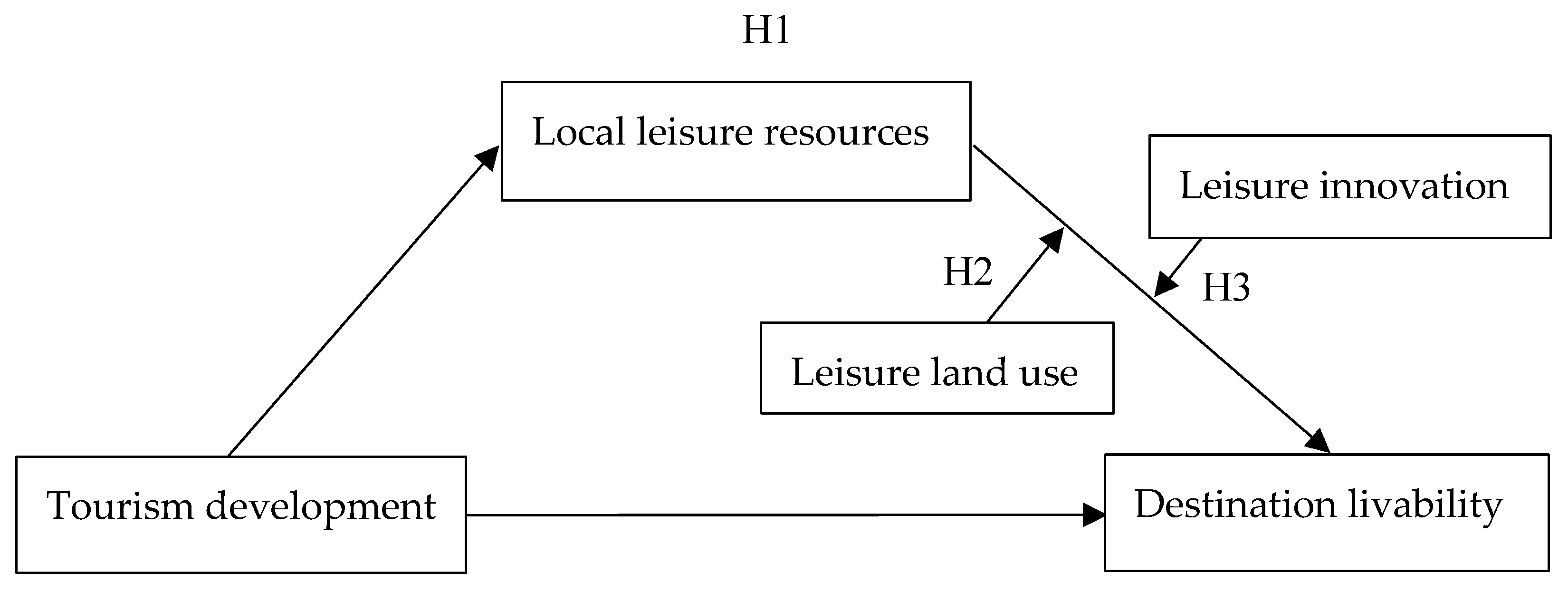
H1: 
Local leisure resources play a mediating role in the impact of tourism development on destination livability.

3.2. The Moderating Role of Spatial and Physical Constraints of Local Leisure Resources

The quality of a leisure system in a tourist destination may vary with its development level; the demands, costs and mobility attributes of a leisure system make a difference to the interaction between tourism and livability [21]. The impact of tourism development on the urban living environment is in general dialectical, as it is the combined manifestation of multiple factors and paths influenced by economy, culture, ecology, and society. Along with the strategic goals of national and regional development, the transformation of land-use functions, and the changes in consumption patterns brought about by technological innovation and the chain of changes it triggers may all bring about improvements in the infrastructure, ecosystem and ambiance of a leisure system and thereby benefit livability [64].
The adequacy of tourism and recreational land supply is also a determinant of the formation and development of peri-urban recreational areas [65]. For instance, remote sensing studies in the context of Romania expressed the coupled social–ecological process of urban expansion driven by population growth, tourism development, and real estate development [66]. Clearly, excessive density of land for building/construction can lead to a scarcity of recreational resources [67]. Therefore, the scarcity of land resources may intensify the competition for space use and recreational opportunities among tourists and residents, such as the encroachment of for-profit hospitality facilities on public recreational land in Mediterranean destinations [68]. Rationally planned land use helps local leisure resources to contribute better to the improvement of residents’ quality of life [69]. Areas with limited supply of recreational land are less attractive for urban recreational spaces, and the improvement in residents’ livability brought about by the increase in local leisure resources may be weaker. Consequently, the following hypothesis is proposed:
H2: 
The scale of local land use plays a moderating role in the impact of local leisure resources on destination livability.
Various approaches to local innovations are of great significance for an optimization of new industrial systems or an adaptation to new developments [23], among which digitalization and smart decisions are the main characteristics of new quality productive forces [29]. Generally, the use of innovation elements has a positive effect on improving the recreation resource allocation system and enhancing residents’ happiness [70]. Obviously, vigorous innovation reduces costs [71] and benefits entrepreneurship [72], which in turn may benefit cultural diversity and leisure resources. Moreover, continuous innovation creates the possibility of increasing the quality and quantity of leisure supply while avoiding a disorderly and inefficient resource development [73]. For example, digitization of cultural heritage and development of virtual tourism products have greatly promoted equitable access to cultural and recreational resources and brought about diversified development of related consumer economies [74,75]. Hence, cities with an active recreation industry innovation may further stimulate the great potential of effective recreation resource supply so as to better meet the diverse needs of tourists, thereby exerting a powerful industrial linkage effect and promoting the realization of high urban livability. Clearly, the lagging levels of leisure innovation may become restrictive factors for effective local leisure resources. Based on this, this study further proposes the following hypothesis:
H3: 
Leisure innovation activities play a moderating role in the impact of local leisure resources on destination livability.
In summary, this study will explore the role of local leisure resources in the impact of tourism development on urban livability, as well as the moderating role of spatial and technical restrictive factors of local leisure resource supply. The influence mechanism is shown in the flow diagram in Figure 1.

4. Methodology

4.1. Scope of the Study

Due to the COVID-19 pandemic, the development of China’s tourism industry drastically changed, significantly affecting available tourist data [76]. As a result, data from that period were excluded. Based on the availability of data, a panel data set of 247 prefecture-level cities, related to 30 Chinese provinces with varied tourism development levels, from 2008 to 2018 was chosen for the cities with relatively complete data to conduct the mediating effect test. Due to limitations in the availability of land use data—namely, the first and second National Territorial Survey by the National Department of Natural Resources—the datasets from 2009 to 2016 were used for the testing of moderating effects.

4.2. Model

Based on the classical mediating effect test programs [77], the following models were established to be estimated and tested:
l n Live it = α 0 + α 1 l n T o u r i t + Σ σ i X it + δ it
ln Re it = β 0 + β 1 l n T o u r i t + Σ η i X i t + θ it
l n Live it = ρ 0 + ρ 1 l n T o u r i t + ρ 2 ln Re it + μ i X i t + ε i t
where i is the city; t is time; Live it refers to livability; T o u r i t refers to urban tourism; and R e i t refers to local leisure resources. Xjt refers to the control variables.
To mitigate the threat of collinearity and precisely delineate the changing trend of the moderating effect, the test of the moderating effects was carried out, based on the Threshold Effect Model [78]:
l n Live it = φ 0 + φ 1 l n T o u r i t + φ 2 ln Re it ( D i t < γ ) + φ 3 ln Re it ( D i t   γ ) + ω i X i t + θ i t
where D i t   acts as the threshold variable, which refers to the abovementioned land use scale (Spaceit) and recreation innovation (Techit), respectively; and γ is the threshold value. A single threshold model was used in this approach, while the empirical regression model was employed on the Chinese dataset.

4.3. Measurement

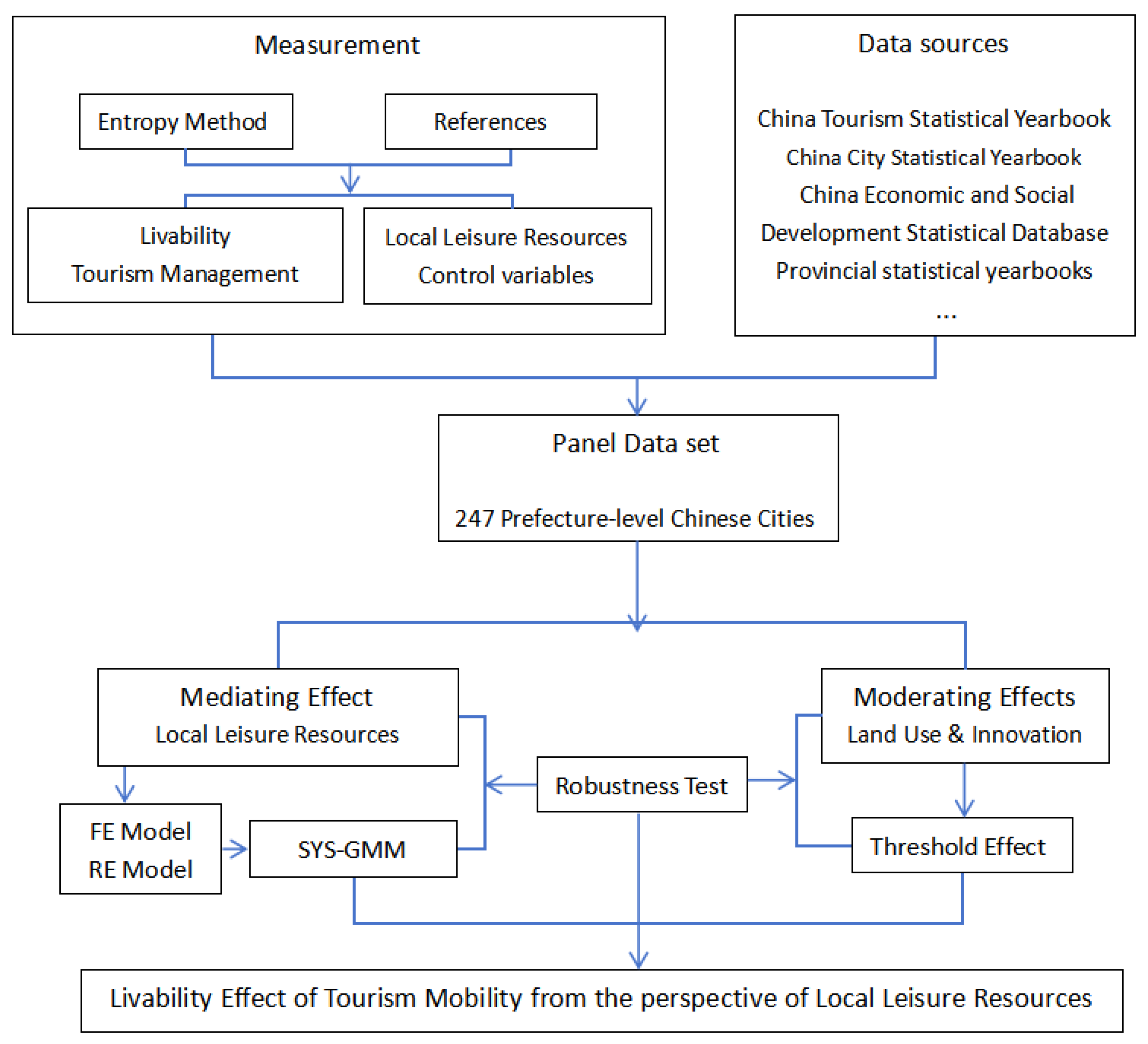
Livability is clearly a broad concept with many dimensions related to economic, cultural, ecological, social, institutional, and political elements. To avoid subjectivity in the assignment of weights to various livability indicators, the Entropy Method [79] was used to measure the levels of urban livability and tourism development. The main variables’ measurements, as listed in Table 1, were selected based on existing studies [36,80,81] and data availability.
Due to the lack of measurable data on local leisure resources in the qualitative part of our study, the operational assumption was made that the level of local leisure resources (Reit) depends on the supply of urban leisure resources and the crowding-out effect of tourism development. The supply of leisure resources was divided into public leisure resources and commercial ones [82]. Public leisure resources rely on non-profit recreation facilities and services, typically provided by the government in China.
Using a production function approach, this study comprehensively measured public leisure resources ( P w i t )   by considering the number of people employed in public service facilities (Lit), urban maintenance and construction expenditure (Kit), and the area of green space in parks (Git) [83]. The commercial leisure resource ( C s i t ) supply was calculated as the value-added in the service sector. The crowding effect of tourism development is further measured based on tourism density. As local leisure resources focus on the net leisure resources of residents, considering the competition of tourists, the range Re of the Arc-Tangent Function (−π/2, π/2) is a suitable measurement of local leisure resources:
Re it = 1 τ P w i t C s i t = 1 2 π a r c t a n T D it P w i t C s i t ,
where
P w it = L i t K i t β G i t σ
and where T D i t refers to tourism density, measured by the ratio of the number of tourists to the urban population; θ refers to the crowding-out effect, which is equal to 2 π a r c t a n T D it ; as T D it > 0 and 2 π a r c t a n T D it ( 0,1 ) , τ ( 0,1 ) ; , β and σ ( 0,1 ) .
The threshold variables in this study are the scale of relevant land use and leisure innovation. First, population growth and urbanization development lead to an increase in construction land use, raising the demand for recreational space in cities and driving the expansion of urban recreational space. Therefore, the total area of relevant land—including forest land, garden land and water area—is used to measure the scale of relevant land use (Spaceit). Second, relevant innovation (Techit) is measured by the number of approved recreational-related patents in each destination place.
Existing studies have shown that the expansion of a city’s size can enhance its livability level [64], while over the past years affordability has also become one of the important strategic goals for building a livable city [35]. Internal mobility within the city also affects the quality of life of local residents and the experience value for tourists [40]. To avoid multicollinearity, the control variables—city scale (Scit), ability to pay (Cpit), and internal mobility (Imit)—were evaluated by the urban land acreage, the sequential growth rate of wages, and the sequential growth rate of per capita occupancy of public vehicles, respectively. Figure 2 describes the logic of the methodology.

4.4. Data Sources and Preprocessing

The original data were sourced from the China Statistical Yearbook, China Tourism Statistical Yearbook, China City Statistical Yearbook, EPS (Easy Professional Superior) statistical data platform, China Economic and Social Development Statistical Database, provincial statistical yearbooks, and the Statistical Bulletin of National Economic and Social Development. The base period for the relevant economic indicators was set to 2008 to eliminate the effects of inflation.
Four different methods—LLC (Levin-Lin-Chu), Hadri Z, IPS (Im-Pesaran-Shin), and Fisher-ADF tests—were used to validate the variables [32]. As shown in Table 2, the stationarity test confirmed that each variable is stable.

5. Findings and the Robustness Test

5.1. Mediating Effect

Panel data analysis was next conducted to test the hypotheses; the results are listed in Table 3. Based on the results of a Hausman test, Fixed Effects (FE) models appear to perform better than Random Effects (RE) models. In Models 2–4, the Fixed Effects model is used to estimate the relevant relationships. The estimation results show that tourism development has a significant impact on livability, and that part of this impact is mediated through local leisure resources, with the indirect effect calculated as 0.004 *** (0.8362 × 0.0044) and the direct effect as 0.0226 **.
The SYS-GMM (System-Generalized Method of Moments) models were ultimately chosen to address potential endogeneity issues in regular panel data regressions, where lagged terms of the dependent variable are considered among the influencing factors. Both the Sargan test and the Arellano-Bond test confirmed the absence of second-order sequence correlation in the model’s residuals, ensuring that the standard econometric requirements were met. Results of Models 5–7 in Table 3 show that tourism development impacts destination livability directly and indirectly through its influence on local leisure resources, and the effects are still significant when the lagged terms of livability and more endogeneity issues are considered. These results support the connection between the three systems, meaning H1 cannot be rejected.
Two ways were used to text the robustness of the findings (see Table 4). Firstly, a winsorization process was applied at the top and bottom 1% [84] in order to control for the influence of extreme values in the sample data. Fixed Effects (FE) or Random Effects (RE) models were compared based on the Hausman test; the results of the chosen models are shown in Models 1–3, combined with the results of SYS-GMM models (see Models 4–6). It is clear that all regression results appear to be consistent with the initial findings.
Additionally, the measurement of local leisure resources was adjusted using the following equation:
Re it = 1 e x p f ( T D i t ) P w i t C s i t
and
f T D i t = ( T D i t m i n   { T D i t } ) / ( max T D i t ) m i n { T D i t } ) ω ,
where T D i t refers to the standardized value of T D i t , ωN; and e x p f ( T D i t ) ∈ (0, 1). An opposite number function was chosen so as to keep 1 e x p f ( T D i t ) ∈ (0, 1), thus being consistent with the conceptual connotation of local leisure resources.
The results of panel data analysis and SYS-GMM models are shown in Models 7–8 and Models 9–10, respectively. Combined with Model 2 and Model 5 in Table 3, it is clear that the direct impact of tourism development on livability and its indirect impact through local leisure resources are all significant, whether we use the Fixed Effects models or SYS-GMM models to evaluate. The same situation was also confirmed in the first robustness analysis. Therefore, the results of these multiple robustness tests appear to support the robustness of the mediating effect of local leisure resources on the impact from tourism to livability.

5.2. Moderating Effect

Table 5 shows the tests of the moderating effects based on the threshold effect models, while the robustness tests were undertaken based on the same two ways as indicated above. There appear to be three threshold effects from both land use and innovation, which show the different nonlinear effects from new quality productive forces and traditional production modes. It is notable that innovation appears to have a progressive, increasing positive moderating effect on the impact from local leisure resources on destination livability (Models 4–6), while the significant effect of land use is decreasing (Models 1–3). Along with the increase in related innovation activity, livability appears to benefit more and more from local leisure resources, while there is no clear rise in effect when it comes to land supply. Apparently, as an important driving force of new productive forces, leisure innovation serves as a powerful means and an essential strategy for local leisure resources to enhance destination livability.

6. Discussion and Conclusions

6.1. Discussion

Given the fluctuations in destination leisure resources because of tourism development, the concept of local leisure resources put forward in this study allowed the identification of a serious tension between tourism development and destination livability from the perspective of leisure coopetition (cooperation and competition) between residents and tourists. Various studies support the fact that, besides multiple complex and interrelated impacts [40], tourism development may promote recreational programs, particularly commercial ones [20], and leisure resources positively influence individual and community well-being [85]. These findings align with the mediating effect of local leisure resources, suggesting that subjective environmental assessment impacts livability and influences the effect of tourism attractions on residents’ living satisfaction [10].
Secondly, the moderating effects of related land use explored in this paper appear to be significant. The physical and social psychological carrying capacity of destinations suffers from land use intensity, especially unregulated and sprawling developments [44]. Tourists may use particular “tourism precincts”, so that similar demands of locals and tourists may lead to buyers’ conflicts [86]. It is also noteworthy that land use change caused by tourism development may reduce residents’ quality of life [9]. Furthermore, along with the change in demography, leisure lifestyle and people’s assessment of recreation benefits, leisure space mainly composed of ecosystem services will rely more on commercial and community spaces [87]. Instead of scale management, this study highlights the need for balanced transformative development [23], including a sustainable spatial layout and structural adjustment of recreational land for maximizing social welfare [88].
Thirdly, the moderating effect of leisure innovation helps identify and examine one of the key factors of high-quality tourism development from the perspective of destination sustainability. The distinct threshold effects of land use and innovation highlighted the significant productivity of transformative and traditional approaches. The study emphasizes the importance of ecosystem innovation for tourism competitiveness [89], as well as the significance of eco-technological innovation to curtail sustainable development risk caused by large-scale tourism specialization [90]. In particular, original innovation and digital innovation activity in the museum and the sector benefit the local attractiveness and competitiveness of cultural leisure spaces [91]. This finding corresponds to studies on the driving effect of technological and marketing innovations on tourism productivity in small and medium enterprises [92]. Particularly, navigating local innovation in the tourism sector is important, especially for developing destinations [23]. This also holds for intellectual property protection, as there is synergistic growth between it and new quality productivity [93]. This observation also calls due attention to the broader quality of life dimensions of tourism, including the cultural heritage and historic authenticity of cities.

6.2. Conclusions

This paper explored the tourism interaction mechanism by putting forward the novel concept of local leisure resources, which refers to the net increase in leisure resource benefits brought to residents by tourism development. Firstly, panel data analysis was conducted to further support the arguments that local leisure resources mediate the relationship between tourism development and livability. Secondly, the key constraints and potential coordination mechanisms were further identified and examined; the scale of related land use and leisure innovation play clearly a moderating role in the impact of local leisure resources on destination livability, where innovation has a continuously increasing positive effect. Additionally, the possible measurements of local leisure resources were also explored and tested for further study.

6.3. Implications

This study enriched the research on tourism and destination livability and provided a solid theoretical basis for coordinated development. Firstly, the mediating effect model shows that local leisure resources play an important role in the interaction between tourism development and urban livability; tailor-made and place-based arrangements inspired by smart city concepts and related digital technologies are crucial for urban planning to minimize resource waste and mitigate conflicting spatial demands from the outset. Particularly, digital systems may be developed for fine-grained applications, personalized leisure flow guidance, and high-efficiency ecosystem services.
Secondly, the threshold model developed in our study shows that as the leisure innovation improves, the positive impact effect of local leisure resources on the livability of cities gradually increases, indicating that the new quality productive forces can continuously inject new vitality into the sustainable development of destinations. Governance capacity improvement based on innovative public services, including a friendly institutional environment, necessary standardized systems and social capital support for collaboration, can benefit the livability and competitiveness of a tourist region or city, thus helping seize the opportunity for a leapfrog increase in our digital era.
Clearly, based on the moderating effect of related land use, a balanced level of urban sprawl within a controlled city scale is urgently needed for most cities so as to achieve sustainable development. Appropriate expansion of leisure land within a reasonable range for local livability is necessary. Clearly, protection of historic inner cities and of original architectural expressions are a necessary condition for sustainable tourism management.

6.4. Limitations and Future Research

The main imitations of this study and suggestions for future research are as follows. Firstly, this study explored the novel concept of ‘local leisure resources’ and its empirical measurement. This paper has focused more on the macro mechanism based on a large sample, since the availability of micro data to evaluate the level of local leisure resources is limited. But future studies should seek to explore the micro-based mechanisms in order to improve the measurement of local leisure resources at the citizen level. Additionally, although the moderating effects of the limiting factors of local leisure resources—from the perspective of both the new quality productivity and the traditional approach—were tested, complementary factors for sustainable management of both local leisure resources and destination development may be explored.
Lastly, as the impacts of tourism on residents’ quality of life vary not only during off-peak or midseason periods [55] but also from central to peripheral parts of a country [94], a temporal and spatial evolution analysis of particular cities is a fruitful complement for a systematic exploration of the effect of local leisure resources.

Author Contributions

Conceptualization, J.L. (Jingjing Liu) and P.N.; methodology, J.L. (Jingjing Liu) and J.L. (Jinping Liu); software, J.L. (Jingjing Liu) and J.L. (Jinping Liu); validation, Y.W. and J.L. (Jingjing Liu); formal analysis, P.N.; investigation, P.N., Y.W. and H.L.; resources, J.L. (Jingjing Liu) and H.L.; data curation, J.L. (Jinping Liu) and Y.W.; writing—original draft preparation, J.L. (Jingjing Liu), J.L. (Jinping Liu) and P.N.; writing—review and editing, Y.W.; visualization, J.L. (Jingjing Liu); supervision, J.L. (Jingjing Liu) and P.N.; project administration, P.N. and H.L.; funding acquisition, J.L. (Jingjing Liu) and P.N. All authors have read and agreed to the published version of the manuscript.

Funding

This work was supported by the National Natural Science Foundation of China, under Grant No. 41801138.

Data Availability Statement

The datasets used in the current study are available from the corresponding author on reasonable request.

Acknowledgments

We would like to thank the reviewers for their thoughtful comments that helped improve the quality of the work.

Conflicts of Interest

The authors declare no conflicts of interest.

References

  1. Hao, J.; Zhang, P.; Yu, W.; Mou, X. Causes of spatial patterns of livability in Chinese cities: MGWRL analysis based on Did’s big data. J. Urban Plan. Dev. 2021, 147, 04021025. [Google Scholar] [CrossRef] [Scilit]
  2. Romão, J.; Domènech, A.; Nijkamp, P. Tourism in common: Policy flows and participatory management in the Tourism Council of Barcelona. Urban Res. Pract. 2021, 16, 222–245. [Google Scholar] [CrossRef] [Scilit]
  3. Fernandes, J.; Chamusca, P.; Lois, R.; Madureira, H.; Mattos, J.; Pinto, J. Tourism-Led Change of the City Centre. Land 2024, 13, 100. [Google Scholar] [CrossRef] [Scilit]
  4. Liu, J.; Chen, J.M.; Nijkamp, P.; Petrick, J.F. Threshold effect of tourism density on urban livability: A modeling study on Chinese cities. Ann. Reg. Sci. 2023, 70, 315–331. [Google Scholar] [CrossRef] [Scilit]
  5. Ward, B. The Home of Man; Norton: New York, NY, USA, 1976. [Google Scholar]
  6. Uysal, M.; Sirgy, M.J. Quality-of-life indicators as performance measures. Ann. Tour. Res. 2019, 76, 291–300. [Google Scholar] [CrossRef] [Scilit]
  7. Romão, J.; Kourtit, K.; Neuts, B.; Nijkamp, P. The smart city as a common place for tourists and residents: A structural analysis of the determinants of urban attractiveness. Cities 2018, 78, 67–75. [Google Scholar] [CrossRef] [Scilit]
  8. The State Council of the People’s Republic of China. Premier Stresses Implementation of Guidelines for 14th Five-Year Plan 2020; The State Council of the People’s Republic of China: Beijing, China, 2020.
  9. Huang, W.; Li, M.; He, J.; Chan, W. Conflicts and interactions in urban tourism: Use of urban public space by residents, tourists, and migrant domestic workers in Hong Kong. Tour. Manag. 2024, 105, 104960. [Google Scholar] [CrossRef] [Scilit]
  10. Kang, L.; Yang, Z.; Dang, Y.; Zhang, W.; Liu, C. Can tourism development make cities more livable? Investigating 40 cities in China. Int. J. Environ. Res. Public Health 2022, 19, 472. [Google Scholar] [CrossRef] [Scilit]
  11. Panayiotopoulos, A.; Pisano, C. Overtourism dystopias and socialist utopias: Towards an urban armature for Dubrovnik. Tour. Plan. Dev. 2019, 16, 393–410. [Google Scholar] [CrossRef] [Scilit]
  12. Dwyer, L. Tourism development and sustainable well-being: A Beyond GDP perspective. J. Sustain. Tour. 2020, 31, 2399–2416. [Google Scholar] [CrossRef] [Scilit]
  13. Liu, J.; Huang, X.; Lin, D. Research of the relationship between urban livability and tourism Development: An analysis of panel data. Hum. Geogr. 2016, 131, 143–152. [Google Scholar]
  14. Romão, J. Economic Geography of Tourism; Springer: Singapore, 2024. [Google Scholar]
  15. Perdue, R.R.; Long, P.T.; Yong, S.K. Boomtown tourism and resident quality of life: The marketing of gaming to host community residents. J. Bus. Res. 1999, 44, 165–177. [Google Scholar] [CrossRef] [Scilit]
  16. Ridderstaat, J.; Croes, R.; Nijkamp, P. The tourism development—Quality of life nexus in a small island destination. J. Travel Res. 2016, 55, 79–94. [Google Scholar] [CrossRef] [Scilit]
  17. Uysal, M.; Sirgy, M.J.; Woo, E.; Kim, H. Quality of life (QOL) and well-being research in tourism. Tour. Manag. 2016, 53, 244–261. [Google Scholar] [CrossRef] [Scilit]
  18. Baños-Pino, J.F.; Boto-García, D.; Zapico, E.; Mayor, M. Optimal carrying capacity in rural tourism: Crowding, quality deterioration, and productive inefficiency. Tour. Manag. 2024, 105, 104968. [Google Scholar] [CrossRef] [Scilit]
  19. Liu, Y.; Xiao, W.; Xu, T.; He, B.; Wang, Y.; Mu, J. Spatial agglomeration mining of urban recreational amenities: The case of the greater bay area in China. Leis. Sci. 2024, 1–27. [Google Scholar] [CrossRef] [Scilit]
  20. Dong, E. Tourism, recreation and regional development: Perspectives from France and abroad. Ann. Tour. Res. 2016, 55, 189–190. [Google Scholar] [CrossRef] [Scilit]
  21. Liu, J.; Ren, L.; Su, Y.; Nijkamp, P.; Li, H. Spatial tourism spillovers and urban livability: Coupling coordination effects in recreation mobility in China. In Spatial Spillovers; New Frontiers in Regional Science: Asian Perspectives; Springer: Singapore, 2024; Volume 78, pp. 219–241. [Google Scholar]
  22. Abdullah, T.; Carr, N.; Lee, C. A conceptualization of conflict involving local people in tourist destinations. Curr. Issues Tour. 2025, 1–17. [Google Scholar] [CrossRef] [Scilit]
  23. Farsari, I.; Persson-Fischier, U.; Poort, M.E. An Enabling Approach to Sustainability Transformations in Tourism. Leis. Sci. 2025, 1–24. [Google Scholar] [CrossRef] [Scilit]
  24. Lin, Y.X.; Liu, Y. Let the City Heal You: Environment and Activity’s Distinct Roles in Leisure Restoration and Satisfaction. Cities 2024, 154, 105336. [Google Scholar] [CrossRef] [Scilit]
  25. Morse, W.C.; Stein, M.; Blahna, D.; Stein, T. Recreation as a Transformative Experience: Synthesizing the Literature on Outdoor Recreation and Recreation Ecosystem Services into a Systems Framework. J. Outdoor Recreat. Tour. 2022, 38, 100492. [Google Scholar] [CrossRef] [Scilit]
  26. Rodriguez de la Vega, L.; Toscano, W.N. Handbook of Leisure, Physical Activity, Sports, Recreation and Quality of Life; Springer: Berlin, Germany, 2018. [Google Scholar]
  27. Kong, X.; Ling, L.; Chen, D. Role of public space in remodeling residents’ sense of place in new communities surrounding development zones: Based on the survey in typical communities surrounding the Changsha Technical Development Zone. Urban Probl. 2015, 9, 49–56. [Google Scholar]
  28. Niu, Y.; Dong, L.; Niu, Y.; Deng, F. Resident-defined measurement scale for a city’s products. Landsc. Urban Plan. 2017, 167, 177–188. [Google Scholar] [CrossRef] [Scilit]
  29. Zuo, B. Developing new quality productive forces to promote the iteration and transition of tourism production function. Tour. Hosp. Prospect. 2024, 8, 12–22. [Google Scholar]
  30. Zhang, Y.; Sun, G. Spatial relation between city size and tourism growth, and its evolution and driving factors: New understanding of city level system in the Yangtze River Delta. Sci. Geogr. Sin. 2016, 36, 1877–1884. [Google Scholar]
  31. Okulicz-Kozaryn, A.; Valente, R.R. Livability and subjective well-being across European cities. Appl. Res. Qual. Life 2019, 14, 197–220. [Google Scholar] [CrossRef] [Scilit]
  32. Huang, H.; Qiao, X.; Zhang, J.; Li, Y.; Zeng, Y. Spatio-temporal differentiation and influencing factors of regional tourism carbon emissions under the background of green development: A case study of the Yangtze River Economic Belt. Econ. Geogr. 2019, 39, 214–224. [Google Scholar]
  33. Parker, J.; Simpson, G.D. Public Green Infrastructure Contributes to City Livability: A Systematic Quantitative Review. Land 2019, 7, 161. [Google Scholar] [CrossRef] [Scilit]
  34. Veenhoven, R.; Ouweneel, P. Livability of the welfare-state. Soc. Indic. Res. 1995, 36, 1–48. [Google Scholar] [CrossRef] [Scilit]
  35. Wu, G.; Niu, X.; Tian, W. Study on new mechanism of urban regeneration in China’s megalopolis: Compare and implication of three global cities. China Soft Sci. 2016, 9, 88–98. [Google Scholar]
  36. Liu, J.; Nijkamp, P.; Huang, X.; Lin, D. Urban livability and tourism development in China: Analysis of sustainable development by means of spatial panel data. Habitat Int. 2017, 68, 99–107. [Google Scholar] [CrossRef] [Scilit]
  37. Bichler, B.F.; Pikkemaat, B. Winter sports tourism to urban destinations: Identifying potential and comparing motivational differences across skier groups. J. Outdoor Recreat. Tour. 2021, 36, 100420. [Google Scholar] [CrossRef] [Scilit]
  38. Croes, R.R. Assessing Tourism Development from Sen’s Capability Approach. J. Travel Res. 2012, 51, 542–554. [Google Scholar] [CrossRef] [Scilit]
  39. Adedoyin, F.F.; Erum, N.; Bekun, F.V. How does institutional quality moderates the impact of tourism on economic growth? Startling evidence from high earners and tourism-dependent economies. Tour. Econ. 2022, 28, 1311–1332. [Google Scholar] [CrossRef] [Scilit]
  40. Bimonte, S.; D’Agostino, A. Tourism development and residents’ well-being: Comparing two seaside destinations in Italy. Tour. Econ. 2021, 27, 1508–1525. [Google Scholar] [CrossRef] [Scilit]
  41. Zeng, J.; Wen, Y.; Bi, C.; Feiock, R. Effect of tourism development on urban air pollution in China: The moderating role of tourism infrastructure. J. Clean. Prod. 2021, 280, 124397. [Google Scholar] [CrossRef] [Scilit]
  42. Almeida-García, F.; Cortés-Macías, R.; Parzych, K. Tourism impacts, tourism-phobia and gentrification in historic centers: The cases of Málaga (Spain) and Gdansk (Poland). Sustainability 2021, 13, 408. [Google Scholar] [CrossRef] [Scilit]
  43. Li, R.; Wu, D.; Ying, H. Mechanism model and demonstration of residents’ satisfaction in Guizhou ethnic tourism villages: A comparative study of community-driven, government-driven and enterprise-driven ethnic tourism villages. Acta Geogr. Sin. 2016, 71, 1416–1435. [Google Scholar]
  44. Uysal, M.; Berbekova, A.; Wang, J. Quality-of-life: A critical examination of research progress. Tour. Manag. 2025, 107, 105070. [Google Scholar] [CrossRef] [Scilit]
  45. Hede, A.M.; Hall, J. Leisure experiences in tourist attractions: Exploring the motivations of local residents. J. Hosp. Tour. Manag. 2006, 13, 10–22. [Google Scholar] [CrossRef] [Scilit]
  46. Henderson, K.; Presley, J.; Bialeschki, M.D. Theory in recreation and leisure research: Reflections from the editors. Leis. Sci. 2004, 26, 411–425. [Google Scholar] [CrossRef] [Scilit]
  47. Stiglitz, J.E. Economics of the Public Sector; China Renmin University Press: Beijing, China, 2001. [Google Scholar]
  48. Cracolici, M.F.; Cuffaro, M.; Nijkamp, P. The Measurement of Economic, Social and Environmental Performance of Countries: A Novel Approach. Soc. Indic. Res. 2010, 95, 339–356. [Google Scholar] [CrossRef] [Scilit]
  49. Shilling, C. Physical Capital and Situated Action: A New Direction for Corporeal Sociology. Br. J. Sociol. Educ. 2004, 25, 473–487. [Google Scholar] [CrossRef] [Scilit]
  50. Lundberg, S. Tiger Parenting and American Inequality: An Essay on Chua and Rubenfeld’s The Triple Package: How Three Unlikely Traits Explain the Rise and Fall of Cultural Groups in America. J. Econ. Lit. 2015, 53, 945–960. [Google Scholar] [CrossRef] [Scilit]
  51. Nimrod, G. Retirees’ Leisure: Activities, Benefits, and Their Contribution to Life Satisfaction. Leis. Stud. 2007, 26, 65–80. [Google Scholar] [CrossRef] [Scilit]
  52. Glover, T.D. Conspiracy Thinking About the 15-Minute City: Something from Nothing? Leis. Sci. 2024, 47, 443–463. [Google Scholar] [CrossRef] [Scilit]
  53. Beatty, J.E.; Torbert, W.R. The False Duality of Work and Leisure. J. Manag. Inq. 2003, 12, 239–252. [Google Scholar] [CrossRef] [Scilit]
  54. Carr, N. The tourism-leisure behavioural continuum. Annals of Tourism Research 2002, 29, 972–986. [Google Scholar] [CrossRef] [Scilit]
  55. Bimonte, S.; Faralla, V. Does residents’ perceived life satisfaction vary with tourist season? A two-step survey in a Mediterranean destination. Tour. Manag. 2016, 55, 199–208. [Google Scholar] [CrossRef] [Scilit]
  56. Huang, X.; Zhen, F.; Cao, X.; Wang, L. Concept, elements and framework of livable transportation based on multi-dimensional objectives. Hum. Geogr. 2015, 30, 77–83. [Google Scholar]
  57. Karamustafa, K.; Ülker, P.; Çalhan, H. Do level of tourism development and its type make a difference in residents’ perceptions? Learning from Turkish cases. J. Hosp. Tour. Insights 2020, 5, 138–165. [Google Scholar] [CrossRef] [Scilit]
  58. Rátz, T.; Smith, M.; Michalkó, G. New places in old spaces: Mapping tourism and regeneration in Budapest. Tour. Geogr. 2008, 10, 429–451. [Google Scholar] [CrossRef] [Scilit]
  59. Tokarchuk, O.; Gabriele, R.; Maurer, O. Development of city tourism and well-being of Urban residents: A case of German magic cities. Tour. Econ. 2017, 23, 343–359. [Google Scholar] [CrossRef] [Scilit]
  60. Horita, Y. Urban Development and Tourism in Japanese Cities. Tour. Plan. Dev. 2017, 15, 26–39. [Google Scholar] [CrossRef] [Scilit]
  61. Wan, H.; Zhao, Y.; Shi, W.; Mao, N.; Sang, X.; Bai, F. Construction of the tourist circle of Guantian Economic Zone Based on the core-periphery theory. Areal Res. Dev. 2019, 38, 97–100. [Google Scholar]
  62. Mullenbach, L.E.; Baker, B.L. Environmental Justice, Gentrification, and Leisure: A Systematic Review and Opportunities for the Future. Leis. Sci. 2018, 42, 430–447. [Google Scholar] [CrossRef] [Scilit]
  63. Alexander, R.; Berbary, L.A. Placemaking as Unmaking: Settler Colonialism, Gentrification, and the Myth of “Revitalized” Urban Spaces. Leis. Sci. 2021, 43, 644–660. [Google Scholar] [CrossRef] [Scilit]
  64. Jia, Z.; Gu, G. Urban livability and influencing factors in Northeast China: An empirical study based on panel data, 2007–2014. Prog. Geogr. 2017, 36, 832–842. [Google Scholar]
  65. Almeida-García, F.; Monserrat-Febrer, A.; Cortés-Macías, R.; Coll-Ramis, M.À. Touristification and Expansion of Short-Term Rentals in Mediterranean Destinations: The Case of Rural Areas. Land 2025, 14, 881. [Google Scholar] [CrossRef] [Scilit]
  66. Mihalache, C.E.; Dumitrașcu, M. Urban Expansion and Landscape Transformation in Năvodari, Romania: An Integrated Geospatial and Socio-Economic Perspective. Land 2025, 14, 1496. [Google Scholar] [CrossRef] [Scilit]
  67. Zhang, B.; Xie, Z.; Hao, L.; Gao, J. The leisure service and its spatial differences of urban green space in Shanghai. Ecol. Sci. 2022, 41, 114–123. [Google Scholar]
  68. Pons-Esteva, A.; Rullán-Salamanca, O.; Murray-Mas, I. Tourism capitalism and island urbanization: Tourist accommodation diffusion in the Balearics, 1936–2010. Isl. Stud. J. 2014, 9, 239–258. [Google Scholar] [CrossRef] [Scilit]
  69. Cunha, J.d.C.; Costa, E.M.d.; Morgado, S. Urban Green Spaces and Their Role in Enhancing Liveability: Lessons from a Lisbon Neighbourhood During the COVID-19 Pandemic. Land 2026, 15, 78. [Google Scholar] [CrossRef] [Scilit]
  70. Chen, J.; Yang, Z.; Zhang, Y. China’s Scientific and Technological Innovation under the Perspective of Common Prosperity: Logical Turn and Paradigm Innovation. Reform 2022, 335, 1–15. [Google Scholar]
  71. Glaeser, E.L.; Kallal, H.D.; Scheinkman, J.A.; Shleifer, A. Growth in cities. J. Political Econ. 1992, 100, 1126–1152. [Google Scholar] [CrossRef] [Scilit]
  72. Liu, J.; Nijkamp, P. Inbound tourism as a driving force for regional innovation: A spatial impact study on China. J. Travel Res. 2019, 58, 594–607. [Google Scholar] [CrossRef] [Scilit]
  73. Iliodromitis, A.; Tsilimantou, E.; Kopelou, P.; Anastasiou, D.; Koulidou, S.; Spanodimos, C.; Chrysostomou, G.; Dimou, V.; Pagounis, V. Three-Dimensional Digital Geospatial Documentation for Cultural Heritage Preservation and Sustainable Management of Tourism Through a Web Platform: The Case Study of the Archaeological Park of Dion, Greece. Land 2025, 14, 1062. [Google Scholar] [CrossRef] [Scilit]
  74. Maietti, F. Heritage Enhancement through Digital Tools for Sustainable Fruition—A Conceptual Framework. Sustainability 2023, 15, 11799. [Google Scholar] [CrossRef] [Scilit]
  75. Murphy, M.; Pavía, S.; Cahill, J.; Lenihan, S.; Corns, A. An initial design framework for virtual historic Dublin. Int. Arch. Photogramm. Remote Sens. Spatial Inf. Sci. 2019, 42, 901–907. [Google Scholar] [CrossRef] [Scilit]
  76. Shen, P.; Yin, P.; Zhang, T. The combined effects of high-speed rail and aviation on tourist arrivals in China. Res. Transp. Bus. Manag. 2023, 48, 100970. [Google Scholar] [CrossRef] [Scilit]
  77. Wen, Z.; Ye, B. Different methods for testing moderated mediation models: Competitors or Backups? Acta Psychol. Sin. 2014, 46, 714–726. [Google Scholar] [CrossRef] [Scilit]
  78. Hansen, B.E. Threshold effects in non-dynamic panels: Estimation, testing, and inference. J. Econom. 1999, 93, 345–368. [Google Scholar] [CrossRef] [Scilit]
  79. Guo, Z.; Yao, S.; Chen, S.; Wu, W.; Liu, W. Spatial-Temporal evolution of the livability levels in the Yangtze River delta urban agglomerations and its influencing factors. Econ. Geogr. 2020, 40, 79–88. [Google Scholar]
  80. Castro-Nuño, M.; Molina-Toucedo, J.A.; Pablo-Romero, M.P. Tourism and GDP: A Meta-analysis of Panel Data Studies. J. Travel Res. 2013, 52, 745–758. [Google Scholar] [CrossRef] [Scilit]
  81. Khorrami, Z.; Ye, T.; Sadatmoosavi, A.; Mirzaee, M. The indicators and methods used for measuring urban livability: A scoping review. Rev. Environ. Health 2021, 36, 397–441. [Google Scholar] [CrossRef] [Scilit]
  82. Jacob, M.; Hellstr, T. Public-space planning in four Nordic cities: Symbolic values intension. Geoforum 2010, 41, 657–665. [Google Scholar] [CrossRef] [Scilit]
  83. Luo, H.; Chen, R. A study on the growth accounting of China’s hotel industry. Tour. Trib. 2020, 35, 14–25. [Google Scholar]
  84. Wu, X.; Zhao, L. Finding the driving force for China’s industrial structure change: A case from tourism. Tour. Sci. 2019, 33, 80–103. [Google Scholar]
  85. Sancho-Pivoto, A.; Raimundo, S.; Santos, G.E.D. Contributions of visitation in parks to health and wellness: A comparative study between natural and urban parks in Brazil. Tour. Plan. Dev. 2025, 22, 139–158. [Google Scholar] [CrossRef] [Scilit]
  86. Maitland, R.; Newman, P. Visitor-host relationships: Conviviality between visitors and host communities. In City Spaces-Tourist Places: Urban Tourism Precincts; Butterworth-Heinemann: Oxford, UK, 2008. [Google Scholar]
  87. Hughes, C.A.; Paveglio, T.B. Assessing visitor perceptions of recreation benefits from nearby public lands. J. Outdoor Recreat. Tour. 2024, 46, 100735. [Google Scholar] [CrossRef] [Scilit]
  88. Zachariou, M.; Burgess, D. Mapping the excess demand for recreation in Northern Ireland to inform land use policy. J. Outdoor Recreat. Tour. 2023, 42, 100638. [Google Scholar] [CrossRef] [Scilit]
  89. Zhang, J. Patterns of innovation-driven tourism competitiveness: Insights from 270 Chinese cities. Tour. Manag. 2025, 107, 105063. [Google Scholar] [CrossRef] [Scilit]
  90. Musah, M.; Mensah, I.A.; Onifade, S.T.; Ankrah, I.; Gyamfi, B.A. On China’s sustainable future: How do eco-technological innovations and financial development moderate the tourism-environmental pollution nexus? J. Clean. Prod. 2025, 498, 144987. [Google Scholar] [CrossRef] [Scilit]
  91. Xu, J.; Shi, P.H.; Chen, X. Curators or creators: Role configurations of digital innovation strategy in museum tourism destination and the principles underlying their attractiveness. Tour. Manag. 2025, 106, 105024. [Google Scholar] [CrossRef] [Scilit]
  92. Nguyen, V.K.; Natoli, R.; Divisekera, S. Innovation and productivity in tourism small and medium enterprises: A longitudinal study. Tour. Manag. Perspect. 2021, 38, 100804. [Google Scholar] [CrossRef] [Scilit]
  93. Ruanzhou, Y.; Guo, R. New Quality Productivity and Intellectual Property Protection. Financ. Res. Lett. 2025, 38, 107650. [Google Scholar] [CrossRef] [Scilit]
  94. Chancellor, C.; Yu, C.; Shu, T.C. Exploring quality of life perceptions in rural Midwestern (USA) communities: An application of the Core-Periphery concept in a tourism development context. Int. J. Tour. Res. 2011, 13, 496–507. [Google Scholar] [CrossRef] [Scilit]
Figure 1. Conceptual model of the impact mechanism of tourism development on destination livability.
Land 15 00743 g001
Figure 2. Diagram of the work process. Note: FE = Fixed Effects, RE = Random Effects, and SYS-GMM = System-Generalized Method of Moments. As there are many data sources and only limited available space here, “…” (which was now modified to be “…”) refers to the unmentioned data sources.
Land 15 00743 g002
Table 1. Employed diagnostic variables.
VariableIndicator
Livability
( L i v e i t )
Real GDP per capita (RMB)
Average salary (RMB)
Unemployment rate (%) (Reciprocal)
Number of public transport vehicles per 10,000 population
Road area (10,000 m2) per 10,000 population
Number of books in public libraries per 10,000 population
Number of theaters per 10,000 population
Number of hospital beds per 10,000 population
Number of practicing (assistant) physicians per 10,000 population
Square of green area per capita (hectare)
Disposal rate of sewage (%)
Disposal rate of life waste (%)
Tourism Development
( T o u r i t )
Number of domestic tourists
Number of inbound tourists
Foreign tourism income/(in U.S. Dollars)
Domestic tourism income (in RMB)
Table 2. Unit root test results.
VariablesLLC TestHadri Z TestIPS TestFisher-ADF Test
l n L i v e i t 14.6687 ***78.4911 ***7.4016 ***18.4219 ***
l n T o u r i t −20.5967 ***21.3320 ***−3.5330 ***−4.7383 ***
l n R e i t −21.7999 ***23.4097 ***−17.1039 ***−7.3853 ***
l n S c i t −0.0001 **20.4335 ***−37.8118 ***−4.6708 ***
C p i t −16.2486 ***17.7844 ***−16.6685 ***−23.2765 ***
I m i t −14.7434 ***14.9457 ***−11.6384 ***−20.5250 ***
lnSpaceit−25.0175 ***28.5168 ***−2.9016 ***37.9463 ***
Techit−9.4493 ***−8.2612 ***−58.9924 ***31.2540 ***
Note: *** and ** indicate, respectively, statistical significance at the 1% and 5%.
Table 3. Mediating effect of local leisure resources.
Variables l n L i v e i t l n L i v e i t l n R e i t l n L i v e i t l n L i v e i t l n R e i t l n L i v e i t
Model 1Model 2Model 3Model 4Model 5Model 6Model 7
FEFEFEFESYS-GMMSYS-GMMSYS-GMM
lnlivei(t−1) 0.8940 *** 0.8909 ***
lnTourit0.0225 ***0.0226 ***0.8362 ***0.0189 ***0.0001 ***0.0860 ***0.0007 ***
Cpit 0.00080.1815 **−0.0000−0.0011 ***0.0090 ***−0.0012 ***
Imit 0.00020.00840.00010.0003 ***0.0057 ***0.0003 ***
LnScit −0.00590.4696−0.0080 *−0.0046 ***−0.3415 ***−0.0042 ***
lnReit 0.0044 ** 0.0003 ***
lnRei(t−1) 0.7342 ***
R20.55700.55780.22720.6110
Hausman0.00000.00000.00000.0000
AR(1) 0.00520.00000.000
AR(2) 0.54260.40530.5531
Sargan 0.73530.75120.7718
Notes: ① lnlivei(t−1) and lnRei(t−1) refer to the level of livability and local leisure resources of city i in period t−1, respectively. ② ***, ** and * indicate, respectively, statistical significance at the 1%, 5% and 10% levels. ③ FE = Fixed Effects models, and SYS-GMM = System-Generalized Method of Moments models. ④ AR (n), the Sargan and Hausman tests refer to the p-values of the related Arellano-Bond, Sargan and Hausman tests, respectively.
Table 4. Robustness test of the mediating effect.
Variables l n L i v e i t l n R e i t l n L i v e i t l n R e i t l n L i v e i t l n R e i t l n L i v e i t l n R e i t l n L i v e i t
Model 1Model 2Model 3Model 4Model 5Model 6Model 7Model 8Model 9Model 10
FEFEFESYS-GMMSYS-GMMSYS-GMMREFESYS-GMMSYS-GMM
lnlivei(t−1) 0.9299 *** 0.9244 *** 0.8455 ***
lnTourit0.0227 ***0.8490 ***0.0191 ***0.0005 ***0.0647 ***0.0002 ***1.7161 ***0.0135 ***0.3518 ***0.056 ***
Cpit0.00060.1848 **−0.0002−0.0007 ***0.0041 ***−0.0007 ***0.1651 *−0.0001−0.0050 **0.004 ***
Imit0.00020.00820.00010.0003 ***−0.0051 ***0.0003 ***0.00830.0001−0.0048 ***−0.0011 ***
LnScit−0.0066 *0.4913 *−0.0087 **−0.0043 ***−0.4698 ***−0.0036 ***−0.0011−0.0070 *−0.3284 ***−0.0047 ***
lnReit 0.0005 *** 0.0053 *** 0.0007 ***
lnRei(t−1) 0.7283 *** 0.7052 ***
R20.56600.22410.6183 0.52290.6414
Hausman0.00000.00000.0000 0.43820.0000
AR(1) 0.00000.00000.0000 0.00000.0000
AR(2) 0.53840.40630.49990 0.53890.5600
Sargan 0.76830.81520.7730 0.84880.3608
Notes: ① lnlivei(t−1) and lnRei(t−1) refer to the level of livability and local leisure resources of city i in period of t−1, respectively. ② ***, ** and * indicate, respectively, statistical significance at the 1%, 5% and 10% levels. ③ FE = Fixed Effects models, RE = Random Effects models, and SYS-GMM = System-Generalized Method of Moments models. ④ AR (n), the Sargan and Hausman tests refer to the p values of the related Arellano-Bond, Sargan and Hausman tests, respectively. ⑤ The results of the LLC, Hadri Z, IPS, and Fisher-ADF tests of renewed lnReit were, respectively, 24.0232 ***, 23.3116 ***, −24.0232 ***, −7.6488 ***.
Table 5. Threshold effects and the robustness tests.
Variables l n L i v e i t l n L i v e i t l n L i v e i t l n L i v e i t l n L i v e i t l n L i v e i t
Model 1Model 2Model 3Model 4Model 6Model 7
lnTourit0.0190 ***0.0191 ***0.0144 ***0.0179 ***0.0178 ***0.0139 ***
Cpit−0.0001−0.0004−0.00000.0001−0.00020.0001
Imit0.0002 ***0.0002 ***0.0002 ***0.0002 ***0.0002 ***0.0002 ***
lnScit−0.0043−0.0043 **0.0063 **−0.0116 **−0.0122 ***−0.0109 *
lnReit(lnSpaceit < γ 11 )0.0056 ***0.0057 ***0.0060 ***
lnReit( γ 11 lnSpaceit < γ 12 )0.0047 ***0.0048 ***0.0053 ***
lnReit( γ 12 lnSpaceit < γ 13 )0.0036 ***0.0040 ***0.0042 ***
lnReit(lnSpaceit γ 13 )0.0024 ***0.0028 ***0.0032 ***
lnReit(Techit < γ 21 ) 0.0035 ***0.0034 ***0.0043 ***
lnReit( γ 21 Techit < γ 22 ) 0.0037 ***0.0037 ***0.0044 ***
lnReit( γ 22 Techit < γ 23 ) 0.0041 ***0.0040 ***0.0047 ***
lnReit(Techit γ 23 ) 0.0045 ***0.0044 ***0.0050 ***
Notes: ① ***, ** and * indicate, respectively, statistical significance at the 1%, 5% and 10% levels.
Disclaimer/Publisher’s Note: The statements, opinions and data contained in all publications are solely those of the individual author(s) and contributor(s) and not of MDPI and/or the editor(s). MDPI and/or the editor(s) disclaim responsibility for any injury to people or property resulting from any ideas, methods, instructions or products referred to in the content.