


Abstract
Cities worldwide are turning to green infrastructure (GI) as a potential decentralized pathway to stormwater management, heat abatement, and other climate adaptation and wellbeing benefits. As with environmental governance, public engagement in GI planning—from design to implementation and maintenance—is necessary to incorporate diverse perspectives, better understand the potential impact of environmental policies, and ensure fair and equitable outcomes. However, GI is different from broader environmental governance approaches in that it demands on-the-ground labor and long-term maintenance, which are crucial for ecosystem function. In this paper, we conduct a comprehensive literature review of 46 articles published between 2014 and 2024 to provide a more nuanced understanding of public engagement for GI in municipal settings. Results reveal diverse and innovative approaches to engagement that involve integrating social and environmental data, on-the-ground activities, and working groups. We further highlight four key characteristics of GI engagement: (1) the multifunctionality of GI, (2) the incorporation of public and private land, (3) effects on community-building and sense of place, and (4) environmental and social justice. By embracing the multifunctionality of GI and centering justice, engagement efforts are more likely to recruit diverse community members, maintain long-term engagement, and simultaneously address multiple social and environmental needs.
1. Introduction
As urbanization accelerates and climate change increases vulnerability in cities, local governments and communities are turning to green infrastructure (GI) to adapt (e.g., flooding, extreme heat) [1], enhance quality of life (e.g., clean air and water, food provision, noise reduction) [2,3], or improve wellbeing (e.g., increase physical activity, lower stress, improve mood, support sense of community) [4,5]. GI is defined as a network of natural and man-made systems that operate at multiple scales and deliver multiple functions [6]. In this way, GI installations encompass not only greenspace (parks, sports fields, urban forests), but also blue infrastructure (lakes, rivers, creeks, washes, wetlands) and grey infrastructure (hardscape, stormwater conveyance systems) [7]. At varying scales, GI installations include rain gardens, urban forests, green roofs, bioswales, detention basins, retention ponds, permeable parking, disconnected downspouts, curb cuts, etc. [8].
City governments around the world, service providers, and other resource managers are developing greening programs that shift the traditional way of governing urban water—instead of focusing on delivering services (water supply, sewage treatment, flood control), they are expanding their roles and responsibilities to include GI [9]. In the US, GI has been primarily promoted to address water quality issues and comply with environmental regulations [10]. However, in desert cities of the US Southwest, GI investment is mainly driven to decrease potable water use in landscape irrigation, the most extensive residential water use, and to infiltrate runoff into aquifers [11]. In this way, GI is increasingly considered in urban water management as it shifts toward decentralized and integrative approaches (e.g., One Water and Net Zero Urban Water), where water supply and wastewater are considered as a single water resource [12]. GI is a critical component of expanding the water supply portfolio because it enables rainwater harvesting and the capture of stormwater runoff, adding two local water sources (rainwater and stormwater) that have often been ignored. As GI provides a decentralized and versatile local water source, it can be implemented across different scales (parcels, neighborhoods, regions), depending on the land availability and GI strategy employed [13].
A diverse water supply portfolio, featuring both centralized and decentralized solutions, will necessitate distinct infrastructure, management systems, and new rules and codes [13]. Therefore, integrative approaches require sociocultural shifts in attitudes toward water and water scarcity, which necessitate public understanding and buy-in for successful implementation [13]. Public engagement becomes necessary not only for outreach and capacity-building but also for integrating communities’ views and perspectives to inform these transformations in infrastructure and resource management [6].
As these transformations unfold, it becomes essential to better understand public engagement in GI to help inform practice. The purpose of this study is to synthesize recent literature on public engagement in GI planning to identify key characteristics that shape engagement processes in the municipal context. In this comprehensive review, we examined the peer-reviewed research of the past decade (2014–2024) on GI and public engagement. While we found a prevalence of traditional engagement activities—such as surveys, interviews, workshops, and other public comment arenas—we also discovered some more innovative, hands-on approaches. These activities’ potential for meaningful engagement is bolstered by their embrace of GI’s multifunctionality. Furthermore, by understanding the various drivers for participation beyond environmental concerns, leaders may be better equipped to recruit more diverse community members, maintain ongoing engagement, and address multiple social and ecological needs simultaneously.
In this paper, we provide some background on public engagement in GI, followed by a description of our methods. Then, we report our findings around three types of GI engagement: (1) engagement that combines social and environmental data, (2) on-the-ground activities, and (3) working groups. Finally, we highlight four unique characteristics of GI engagement and interpret our results within the broader literature, providing insights for researchers and practitioners. By increasing our understanding of public engagement in GI, practitioners and academics are more likely to successfully engage the public, inform policymakers, accelerate climate change adaptation, and enhance the quality of life for all residents.
Public Engagement in GI
Public engagement has become nearly ubiquitous in environmental management and decision-making. In the US, engagement has been mandated by local, state, and federal agencies and enshrined in policies like the National Environmental Protection Act (NEPA) since the 1970s [14]. Environmental management has traditionally been centered on ecosystem health and has been led by governmental agencies. Because an ecosystem-centered approach involves the use of natural boundaries for management (e.g., watershed), the legitimacy of governance initially required the inclusion of stakeholders who represent the different jurisdictions [15]. Over time, violations of environmental regulations that resulted in litigation led to the involvement of non-state organizations and Indigenous tribes [16]. In this way, to avoid conflict and ensure the implementation of environmental policy, governance has broadened to include more voices in the decision-making process [17].
Much scholarship exists that speaks to the benefits of engagement (public buy-in, information-gathering and -sharing, capacity-building) and its challenges (power discrepancies, barriers to participation, and insufficient resources) [14]. Early scholarship on public engagement in environmental governance identified different levels of power in decision-making [18]. Further studies have identified various modes of participation (communication, consultation, deliberation, and co-production), with different levels of agency (top-down vs. bottom-up) [19]. Scholars have also identified parity as a key factor in addressing power disparities [20], and trusted facilitation as a critical element in mitigating conflict [21].
When it comes to the planning, design, and implementation of GI specifically, many of these same findings apply. However, GI also presents a case of environmental action where public engagement is uniquely situated. Most saliently, GI’s physical presence in communities demands labor and maintenance that, by definition, extends beyond the theoretical [22]. This stands in stark contrast to other types of engagement in environmental decision-making, where community members often report that their participation feels superficial or symbolic [23].
Public engagement is an increasingly important aspect of urban greening [24]. Prior research has consistently demonstrated that incorporating public input into greenspace development projects leads to more inclusive, functional, and context-sensitive outcomes [25]. Such outcomes are especially impactful for vulnerable communities where residents often face disproportionate exposure to environmental hazards and have been historically excluded from decision-making processes [26].
Community participation in the planning, design, and implementation of GI projects helps ensure that projects reflect the values, needs, and aspirations of the communities they serve [27]. This is particularly relevant as the success of projects is often measured by their ability to support everyday use and enhance ecological function, among other outcomes. Public engagement also fosters a sense of ownership and stewardship, which can increase long-term maintenance [28]. Additionally, engagement helps integrate local knowledge and lived experiences into decision-making processes, resulting in more innovative and relevant design solutions [29].
Yet, the benefits extend beyond physical design outcomes. Participatory processes can enhance social capacity and build socio-ecological resilience by creating opportunities for collaboration to address environmental hazards [30]. Furthermore, these processes can empower communities, enhance the legitimacy of planning outcomes, and support inclusive governance structures [19]. Thus, public participation supports the creation of spaces that are not only environmentally sustainable but also socially vibrant and culturally meaningful.
These points underscore the importance of public engagement throughout all stages of GI development, encompassing planning and design, implementation, governance, and maintenance. Importantly for marginalized communities, participatory approaches can help address historical disinvestment and foster more equitable access to the benefits of GI [31]. As cities continue to invest in GI for sustainability and resilience, meaningful public engagement will be essential for achieving just and lasting outcomes [6].
2. Methods and Approach
Following the scoping literature review framework developed by Arksey and O’Malley [32], we examine the recently published scholarship on the connection between GI and public engagement. A scoping review broadly aims to lay out key concepts, evidence, and research gaps in a given field [33], and it involves systematically searching for literature relevant to specific objectives, selecting pertinent studies, and synthesizing key research findings. In alignment with Arksey and O’Malley [32], our focus is not necessarily on frequency or weight, but on themes that present something novel or important for further consideration. This scoping review examines the extent, range, and nature of literature about public engagement strategies in GI planning and implementation. While not necessarily representative of the field at large, we go beyond a mere summary of existing scholarship to characterize engagement in GI and expound insights relevant to both scholars and practitioners.
We used the Scopus database to identify, screen, and select relevant peer-reviewed journal articles. Scopus provides a comprehensive and multidisciplinary sample of relevant academic literature; this multidisciplinarity is especially important, given the diversity of scholars and practitioners addressing GI through public engagement. Our initial search of peer-reviewed articles (excluding book chapters, conference abstracts, or grey literature) used the terms “green infrastructure” AND “engagement” in the article title, abstract, or keywords. This initially resulted in 60 articles, published from 2014 through September 2024. In order to capture the diverse contexts and applications of this topic, we included studies across disciplines and across all parts of the world. However, they must have reported on specific cases of engagement in GI; as such, papers that were solely theoretical or where there was no discussion of a specific engagement strategy or case were excluded.
In the end, 14 articles were excluded, resulting in 46 articles being reviewed (see Appendix A). Three team members independently reviewed titles and abstracts, followed by a full-text assessment to determine relevance. They met weekly with a fourth team member to discuss progress, raise issues, justify their coding choices, and resolve any discrepancies in coding. Our sample included diverse projects, stakeholders, and geographies, but was limited to those written in the English language. We acknowledge this may introduce a bias in the representation of populations and regions.
Following the multidisciplinary analysis conducted by Zuniga-Teran and Gerlak [22], we used Ulrichsweb Global Serials Directory to identify the disciplinary subjects of the journals in which the sample articles were published. In our sample of 27 journals, we found 15 distinct subject classifications, with 10 journals listing multiple subject categories. About half of the articles (n = 38, 48%) were published in journals listing the subject “environmental studies,” followed by 13 articles (16%) published in journals containing the subject “housing and urban planning,” and 6 articles (7.5%) published in journals containing the subject “conservation.” Table 1 below reports the rest of the subject classification of our sample.
Table 1.
Subject classification and the number of articles in our sample.
The data collection process involved extracting key information from the selected studies in a consistent manner. We created a shared coding spreadsheet in Excel (v16.105, Microsoft 365, Redmond, WA, USA) and iteratively refined it based on collaborative review of the first several publications. Initial categories of data collection included key details, such as the geographic location, tools of engagement, duration, stakeholder groups, objectives, and type of GI. After collaboratively reading the first several articles, our team added several additional categories based on what we found. These included the authors’ justification for the engagement (why it was necessary), additional recruitment details (participant selection criteria), and the use of digital technologies. Where appropriate, gaps, limitations, and/or future directions were also included. Data was collected qualitatively, where each theme was summarized with brief text, key details were documented, and relevant quotations included. This enabled rich discussion among team members, justification of coding, and identification of frequent and/or emergent themes.
Following data collection, the themes herein emerged through an inductive analytical process. At least two researchers separately read through and sorted results from each column into several categories. Team members were encouraged to start with sorting into many specific categories, some of which were later collapsed into broader themes, and that were then refined through comparisons with one another and in-depth discussion. In this way, we were able to categorize types of engagement activities and recognize some recurrent themes which, considered alongside the broader literature, led to the four central characteristics of GI engagement discussed in this paper. In line with the aims of a scoping review, these themes aim to clarify existing concepts and identify future ones, rather than represent the scholarship at-large.
3. Approaches to Engagement
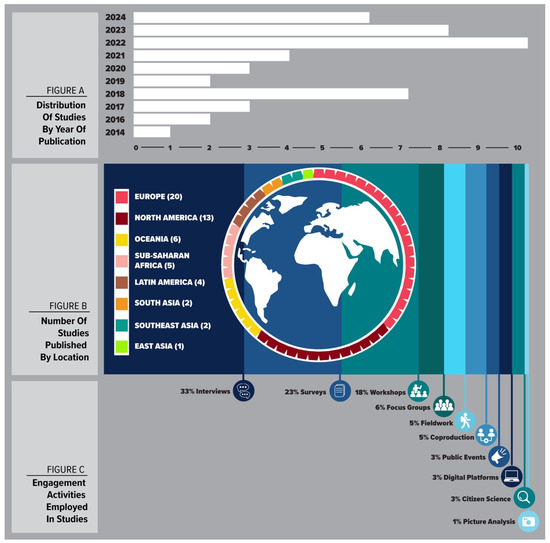
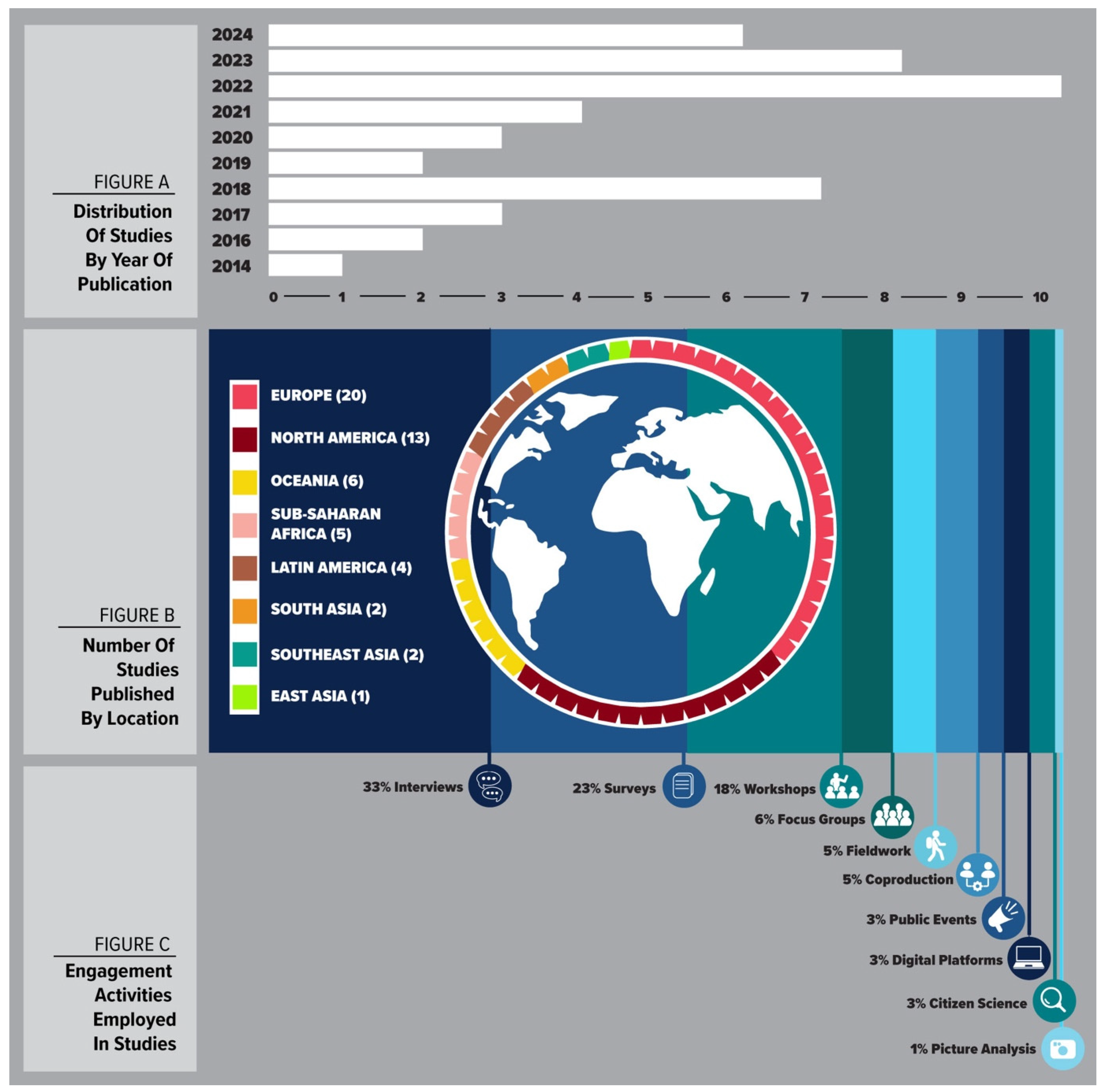
We reviewed 46 published studies related to GI engagement from the last decade, observing an increase in papers, with peaks in 2018 and 2022 (Figure 1A). Following Gerlak et al.’s [34] categorization of geographic regions, our sample mainly consisted of papers from Europe and North America, followed by Oceania and Sub-Saharan Africa (Figure 1B). Interestingly, among the 20 European studies, most (n = 12) were conducted in the UK. Likewise, for the 13 studies in North America, most (n = 9) were conducted in the US. All studies from Oceania were from Australia. No studies were found from the Middle East and North Africa region. Six studies considered several countries. While systematic analysis of these various characteristics is beyond the scope of the current study, their applications are undoubtedly shaped by spatiality, including rural–urban divides. For now, we provide basic geographic data to illustrate the diverse applications of GI engagement and to clarify some potential pathways for future work.
Figure 1.
Descriptive statistics of sample articles.
In examining engagement activities, we find that over a third of the studies (n = 17, 36%) employ two or more engagement methods, resulting in the number of engagement methods exceeding the number of studies. Analyzing the engagement methods independently of the number of studies, we find that interviews are the most common method (33%), followed by surveys (23%) and workshops (18%) (Figure 1C). Other forms of engagement activities include focus groups, field work, and public events. Some studies use more novel participatory approaches, including picture analysis [35], digital platforms and applications [36,37], citizen science [38], and co-production [38,39,40].
While we did not find a relationship between engagement activities and the disciplinary subject of the journals, we found that most studies published in journals that list their subject as “housing and urban planning” (71%) employed group activities, such as workshops, co-production, citizen science, and focus groups. Also, interestingly, the only study classified as “sciences—comprehensive works” used “picture analysis” as its sole engagement method [35]. In terms of urban scale, we find that a wide variety of scales, ranging from global studies that examined GI engagement worldwide, e.g., [7], in multiple cities, e.g., [37], or in single cities of a range of sizes (e.g., Phoenix [35], Lodz, Poland [36], urban areas in New Castle-upon-Tyne, UK [39]). Some studies encompass multiple sites, as they report on activities conducted by a research laboratory [38].
Here, we document three notable trends in GI engagement that provide some valuable lessons for both practitioners and scholars. These do not strictly align with the aforementioned engagement methods, as each of these may include any combination of those more specific strategies—or none at all. Rather, the trends discussed in this section speak to the broader goals related to GI engagement. Further, these are not exhaustive but rather a useful springboard for thinking about what GI engagement could look like in practice. Using examples from our sample, we highlight a potential pathway toward capitalizing on the uniqueness of public engagement in GI planning, design, and implementation. While more traditional approaches like surveys and interviews continue to dominate the literature, we highlight some novel approaches on the horizon for GI engagement. For these purposes, we focus on: (1) engagement that combines social and environmental data, (2) on-the-ground engagement activities, and (3) engagement through working groups.
3.1. Engagement That Combines Social and Environmental Data
This approach integrates some of the more traditional methods of engagement, such as interviews or surveys, with local environmental data to provide a more comprehensive picture of environmental issues and the relevance of proposed GI projects. The focus on ecosystem services—the various benefits humans may gain from a given environment [41]—highlights the need for data that speaks to both human and ecosystem outcomes. For example, Sjöman et al. [42] explain how “the concept of ecosystem services (ES) helps explain how human wellbeing is contingent and interdependent on nature” (p. 2). This type of approach is mainly facilitated by digital technologies, which make the integration of social and environmental data more seamless.
A salient example of engagement that combines social and environmental data is the i-Tree toolbox in urban forestry initiatives [42]. Estimated to have more than 320,000 users across 130 countries, this suite of digital tools engages local communities in environmental data collection and supports the appraisal of ecosystem services. It helps decision-makers understand not only the physical landscape but also how local environments support the needs and goals of the people who live there. In their evaluation of the tool, Sjöman et al. [42] found that it can improve communication and cross-sectoral collaboration, increase capacity, and “support changes to knowledge, awareness, and attitudes” (p. 8). Urban tree officers appreciate the ability of the tool to translate environmental data into measures that are socially, economically, and politically legible.
Another example is Bannan et al.’s [38] approach to address multifaceted challenges at the nexus of climate change, urban development, and public health. By combining atmospheric data, sensor captures of activity in public spaces, and observational measures of health and well-being, decision-makers can apply place-based interventions. Similarly, Barwise et al. [40] conducted workshops to develop the Hedge Design for the Abatement of Traffic Emissions (HedgeDATE) tool in response to air pollution. Users input local data, such as the type of road, distance from the road, and other site-specific characteristics into the tool, which then generates recommendations for mitigating traffic-related emissions. This includes the type and size of vegetation barriers and suggested plant species.
Decision-makers increasingly recognize the co-benefits for environmental and community resilience that are derived from GI. To document such outcomes, better tools are needed to collect data on a wide range of indicators, such as ecosystem monitoring, access to basic needs, and communication [43]. To this end, other approaches rely on more qualitative social measures. For example, a study on spatial multi-criteria decision analysis (SMCDA) in Finland combines GIS data with practitioner workshops to inform decisions about greenspace infill development [44]. Likewise, in a UK study, Cookes and Russo [45] combine GIS data with focus groups and interviews to evaluate the socioeconomic benefits of a proposed park. Their assessment highlighted both the positive ecological impact and potential social benefits, including community-building, economic opportunities, improved health, and more inclusive access. Similarly, Lacroix et al. [46] applied a values-focused thinking (VFT) framework to GI development, incorporating spatial attributes alongside social objectives raised in workshops. These examples illustrate the need to leverage both social and environmental data in GI engagement and decision-making processes.
3.2. On-the-Ground Engagement Activities
On-the-ground engagement activities involve individuals in the hands-on work of building and/or maintaining GI in their communities. This may feel productive for participants, as they can see the local physical manifestations of their work. It may also encourage participation by offering opportunities for learning new skills, such as gardening or construction, fostering relationships with neighbors, or simply having fun.
Gardens and urban agriculture are the most common types of hands-on engagement. Critical gardening, as described by Gasperi et al. [47], has dual benefits: On the one hand, urban gardens are elective tools for residents, through which they revitalize social ties and a sense of community on a local level. On the other hand, urban gardens become a field of civic engagement, participation, and empowerment at both the individual and group level. These efforts may take place on residential properties [48], vacant lands [47], or in other public spaces. Support for residential gardening could help remove barriers and overcome socioeconomic inequities that exist in home gardens, which are prominent in gentrifying areas [48]. It can also benefit biodiversity and the broader provision of ecosystem services [35].
Schools provide an opportunity to support learning and engage the public through hands-on activities. In Melbourne, Australia, primary schools have received funding and support from the government, nonprofits, and the private sector to develop and implement GI. Two of these schools developed projects to improve water efficiency through rainwater tanks, improved drainage, and stormwater-irrigated gardens [49]. By engaging students in these initiatives, they advance sustainability education, promote student well-being, and build relationships with the broader community. Still, the authors highlight multiple ongoing barriers generally centered on institutional practices [49].
Hands-on engagement in public spaces can have more powerful social, economic, and ecological impacts [50]. Although recruitment generally requires some skills training, regular participation in GI projects builds capacity beyond municipal bodies and may encourage broader environmentally conscious behaviors. Lamond and Everett [51] refer to this capacity-building process as “stewardship as a social practice” (p. 2). The authors describe a volunteer program in Portland, Oregon, US, called Green Streets Stewards (GSS), where residents maintain GI and people participate as a form of “localized social practice of community-care” [51] (p. 3).
Similarly, “green volunteers” in Denmark create and sustain diverse projects through physical participation, leading to localized, environmentally aware, and socially cohesive solutions [52]. While volunteerism in greening projects fills important capacity gaps, managing and training volunteers can also be time-consuming. Among most agencies, volunteers’ work is considered supplemental, indicating an opportunity for more strategic engagement [52]. Another example of volunteerism and environmental stewardship is documented by Chou et al. [53]: a traditional farm pond in Taiwan, which was transformed into “a catalyst for the Gaoyuan community’s progress toward sustainability” (p. 1) through cooperative urban agriculture.
While the community-building benefits of these types of engagement are well-documented [30,54], they can also support mental health goals by encouraging people to engage with nature. In Singapore, nature-placemaking activities support psychological well-being by reconnecting people with their natural environment. Located on a campus outside the city, the program includes traditional activities such as farming and wood workshops, as well as more innovative ones, including sketching and the use of an earth oven [55]. This type of engagement illustrates the benefits people can take from more geographically remote initiatives, which they bring back and apply at home.
3.3. Engagement Through Working Groups
Whereas the above category speaks to the physical construction and/or maintenance of GI, engagement through working groups offers a shared, collaborative, and often bottom-up approach to managing GI. Because of the localized nature of these projects, participants can often play a more active role in decision-making than in other types of public forums, such as those soliciting public feedback for state or federal actions. Rather than waiting for an invitation to the table, many of these working groups organize and act independently, representing a model for community-driven management.
The above-mentioned farm pond initiative in Taiwan is not only an example of on-the-ground activities, but also an example of a working group that is a “successful bottom-up, community-led project” [53] (p. 1). Results indicate that bottom-up working groups can have agency in environmental stewardship. For example, Moonee Ponds Creek and Merri Creek, located near Melbourne, Australia, have become polluted over decades of industrial and urban development. In response, community-led and co-designed catchment management efforts have emerged that involve various community groups and other stakeholders [56]. Evaluations suggest that: “Community participants were generally empowered to make independent decisions or innovate solutions when it comes to hands-on activities based on a bottom-up engagement approach rather than waiting for governments to organize or collaborate themselves in these activities” [56] (p. 10). Still, even in community-driven initiatives, power imbalances are unavoidable, and further efforts are needed to ensure genuine and inclusive community empowerment in decision-making [56].
Our review reveals how public engagement through GI working groups can also enhance learning. A study on Learning and Action Alliances (LAA) provides a framework for community partnerships in GI management [39]. This approach is grounded in a foundation of social knowledge, where stakeholders can share and co-produce knowledge about the community, the landscape, and GI implementation [39]. While implementing LAA in Newcastle, UK, O’Donnell et al. [39] found that social learning encouraged action, facilitated creativity and innovation, and fostered trust across groups. Still, barriers persist, especially in issues like water management, where knowledge and action are traditionally fragmented. Beyond water managers and community members, academic institutions can also play a crucial role in initiating and executing learning alliances [36].
Working groups not only diversify the voices included in the process, but also the outcomes. Everett et al. [57] offer principles for the co-design and co-production of GI that can transform passive recipients into active community members. They present a matrix of community engagement based on levels of acceptance and influence. To move beyond oversimplified demands for “bottom-up” processes, the authors propose outcome- and process-oriented goals for practitioner–community partnerships. Table 2 below summarizes novel approaches to GI engagement from the literature.
Table 2.
Summary of GI engagement approaches.
4. Characterizing GI Engagement
Embedded within the above approaches to engagement are several characteristics of GI that are notably different from other types of environmental governance. These characteristics emerged through our analysis inductively, as they were unanticipated findings that appeared repeatedly in the literature. They represent important areas for further research as they may present unique challenges and opportunities that are not adequately addressed by the broader environmental governance scholarship. These four characteristics include: (1) the multifunctionality of GI, (2) GI in public and private spaces, (3) community building and sense of place, and (4) environmental and social justice. Here, we examine these characteristics, followed by a summary that can inform the work of academics and practitioners.
4.1. The Multifunctionality of GI
GI has many functions, including climate resilience [39,50,58], food security [48], health and well-being [45,53,59,60,61], professional training and cultural enrichment [47], and beautification [45,62,63], among others. This multifunctionality speaks to diverse motivations for participation, increasing the number of stakeholders that need to be included in the decision-making process. GI multifunctionality is also evident in the diversity of disciplinary subjects in which recent studies were published. While GI is primarily promoted in cities to support urban water management through a decentralized yet integrated approach [13] and comply with water quality regulations [10], other functions extend beyond water management goals. Therefore, GI planning, design, and implementation require the input of not only the engineers who design water infrastructure, but also of the wider community—something that is typical in environmental governance but not at this local water infrastructure level.
The multifunctionality of GI can lead to tensions in governance and management because agencies in charge of water infrastructure and city planning regularly focus on the GI functions they seek to promote [64], excluding groups that do not seek those functions [6]. A narrow view of GI functions can result in biased engagement processes and hinder the adoption of GI in certain areas of the city [65], ultimately leading to distributional environmental injustice [66]. Additionally, the long-term maintenance requirements of GI, which ensure the system’s continuous functioning, require public buy-in and local support. Therefore, the multifunctionality of GI requires broad and continuous engagement in the technical aspects of the infrastructure (flood management, policy compliance), the biophysical benefits of GI (heat and flood mitigation), and the social aspects (food provision, recreation, aesthetics, cultural identity) that vary widely across groups. Engagement that acknowledges this multifunctionality of GI also provides an opportunity to address injustice by fostering a more inclusive decision-making process [6].
Future research can explore the tensions between the different drivers for greening through a multidisciplinary approach. To better design GI, engagement should account for its multifunctionality [67]. The public may be more inclined to participate in engagement activities that address social issues or environmental issues over engineering solutions. Building on a study by Frantzeskaki et al. [67], who pose six questions about GI design (Which nature? Where? For what? How? When? And for whom?), we outline five key questions for GI engagement that can inform recruitment efforts: Who decides the GI functions? What other functions are feasible? Who benefits from all these functions? Who else can benefit? Who will maintain GI in the long term?
4.2. GI in Public and Private Spaces
One characteristic of GI engagement that sets it apart from other types of environmental management is that laws (endangered species, water quality) do not apply to urban private property. While cities may declare some areas as protected land [36], urban property owners are the ultimate decision-makers. This situation hinders the broad adoption of GI through top-down approaches [68]. Therefore, water managers and other proponents of GI must rely on the voluntary participation of residents, making engagement processes with property owners crucial for widespread adoption. Indeed, many GI approaches aim to engage private landowners in implementing projects, ranging from plant selection to stormwater collection through financial incentives or other types of support. Engagement targeting property owners can gauge their interest in payments (financial or in-kind) [69], residential gardening [35,48], and GI installation [70], among others.
Schools and vacant lots represent an intersection between public and private land. Schools, in particular, are key opportunities for hands-on engagement activities, environmental education, and relationship building [49]. Greening schools and vacant land can not only address water management challenges [35,47,48] but also provide habitat for biodiversity and enhance food security at the neighborhood level, which calls for the engagement of NGOs, the local government, and academics.
Land tenure complicates engagement processes further. Although tenants are the ones who benefit or suffer from GI implementation or exclusion (they will experience more or less heat and flooding), and the ones more likely to be in charge of the maintenance, it is the landlords who ultimately decide what happens on their properties [71]. While the landlords will appreciate an increase in property prices from GI, this can lead to gentrification, which will negatively affect the tenants [72]. In this way, engagement processes will necessarily have to include both the tenants and the landlords to find a way in which both groups benefit from GI in the short and long term.
Future research on GI engagement can consider verges (or rights-of-way), as these spaces are technically public land, but it is the neighboring residents who can maintain GI at the local level, and they are the ones experiencing the impacts (positive or negative). Verges are also key in connecting greenspace and creating the network of GI across the city. Therefore, GI on verges is crucial for achieving the broader sustainability goals expected from greening, which necessitates both wide and targeted public engagement.
4.3. Community-Building and Sense of Place
Another notable feature of engagement in GI is community-building and sense of place, which can lead to synergies in achieving other societal goals, including building capacity, increasing environmental stewardship, enhancing local agency, improving civic participation, and supporting local data infrastructure.
GI engagement can foster and strengthen community ties, which in turn support both short-term and long-term success of GI projects. By encouraging public buy-in, practitioners can ensure ample human capital to build, maintain, and use infrastructure. Engagement can provide community members with a sense of ownership over projects, making them more likely to stay invested in their stewardship long-term [37]. This may be especially valuable for organizations and agencies that struggle with insufficient resources. This increased capacity further facilitates knowledge-sharing and promotes collective decision-making through negotiation and conflict resolution [39]. Engagement can also help resolve power dynamics, enhance local agency, and support further collaborative approaches going forward [56]. Engagement also has much to offer in terms of community well-being through increased community trust and autonomy, effective integration of local knowledge [73], improved health and well-being, reduced inequalities [60], and enhanced economic opportunities [50].
When done well, GI engagement promotes “an ecological sense of self and place” (p. 8) [62]. Through collaboration with others, communities can craft a shared sense of place, whereby common values are defined and enacted [55]. In some cases, by reclaiming vacant areas, communities can reassert a positive collective identity [47]. This can lead to positive individual outcomes (self-efficacy and self-esteem) and communal ones (sense of community, social cohesion) [55].
Finally, GI engagement can support local data infrastructure, inform policy and planning, and empower local action [42]. Data collected and shared through these processes can provide important feedback mechanisms [37] and inform future risk assessment and management [74]. In these ways, community-engaged data collection may help facilitate a more comprehensive approach to urban planning and policy changes [38].
Future research can evaluate and quantify the outcomes and synergies related to community and sense of place. Studies that investigate changes in local agency derived from GI engagement can advance democratic processes that better represent local issues. Likewise, research examining capacity-building at the community level because of GI engagement can lead to the creation of targeted job opportunities, connections with academics and NGOs (such as in citizen science projects), and enhanced social networks. Ultimately, research is needed that examines community resilience as a consequence of engagement.
4.4. Environmental and Social Justice
In ideal cases of environmental governance, public engagement incorporates diverse voices, thereby mitigating the negative impacts of environmental policy and addressing procedural injustice [14]. However, for GI in cities, the situation is a bit different because GI can both address and perpetuate injustice. GI implementation in disadvantaged neighborhoods may address inequities in the short term (e.g., decrease heat, mitigate flooding, and provide recreational opportunities that were lacking). Still, in the longer term, GI may displace low-income families through gentrification processes [72]. Displaced families not only lose their homes and the benefits of new GI, but they also lose social capital that helped them navigate life (caregivers, shared neighborhood watch).
Similarly, in some countries in the Global South, GI is promoted to advance sustainability goals, and these projects often happen in marginalized areas or slums [75], where displaced families suffer. This phenomenon is equivalent to what is occurring in the US in river revitalization projects, where waterfront land is being developed into greenways, displacing unhoused populations who often find shelter in these vulnerable areas [76]. Therefore, there is a need to find the sweet spot for greening that addresses these potential injustices [77]. Engagement that informs inter- and transdisciplinary research and practice [67] can help with finding this balance.
Here, we find community benefits stemming from GI engagement that address injustice. For example, GI engagement can enhance food security [47,48], which is often an issue in disadvantaged neighborhoods [78]. Likewise, GI projects may enhance urban resilience [39,50,58], as well as quality of life and well-being [7,45,53,59,60,79], which again is typically lower in disadvantaged neighborhoods [6]. Finally, GI can help train future professionals [47] and support access to funding for future GI projects [42,50,80], which represents a virtuous cycle toward justice. Centering engagement processes around justice is critical to ensure this virtuous cycle.
Evaluating the justice outcomes of public engagement in environmental governance in general is still needed [14], as well as in GI engagement. So too are new strategies around inter- and transdisciplinary knowledge needed to better achieve justice outcomes in the design, planning, and implementation of GI [67]. Future research can examine the level of greening that does not result in gentrification and the justice outcomes of different engagement processes across various timelines (short and long-term) and at different scales, in both private and public land. It is essential to reach out to disadvantaged communities and document their personal opinions and perspectives. Only by raising their voices can engagement be designed with a justice-centered approach.
4.5. Summary, Research Gaps, and Recommendations for Practitioners
In Table 3, we synthesize the key concepts of GI engagement, as well as the research gaps and how these insights can inform practice.
Table 3.
Summary of key concepts of GI engagement, research gaps, and recommendations for practitioners.
Following Meerow [64], we recommend that engagement activities explicitly address the social aspects of GI, rather than solely focusing on its technical functions. It is essential to recognize that identifying the community’s desired functions necessitates its own engagement process [6]. By designing engagement around functions that people can relate to, practitioners are more likely to recruit participants and achieve public buy-in, which can increase the likelihood of long-term maintenance. We also recommend that practitioners better acknowledge the challenge of engaging both the broader community while targeting local residents, particularly renters, other groups without land tenure claims, and residents living along verges, and work collectively to develop appropriate strategies for engagement. Likewise, we recommend a broader recognition of the societal benefits (community ties) that can emerge from engagement, supporting capacity-building and fundraising for the engagement process. Finally, we recommend that practitioners center engagement on justice, as GI development can either address or enhance existing disparities.
5. Conclusions
Like other cases of environmental governance, GI planning, design, and implementation require public engagement. However, GI presents a unique case: its short- and long-term success often relies not only on technical performance but also depends on the labor and involvement of local residents. Therefore, it is critical to characterize engagement in GI. To do this, we conducted a scoping review of the published scholarship over the past decade. Our findings reveal diverse and innovative approaches at various stages of the process—from data collection and tree-planting volunteering initiatives to harvesting, cleaning, and maintenance events. We find that some of the engagement approaches combine social and environmental data, incorporate on-the-ground activities, and involve working groups.
Our analysis of GI engagement offers four salient points. First, GI engagement is distinct for its multifunctionality, which requires the involvement not only of engineers who design water infrastructure but also of local governments, NGOs, academics, and, most notably, local communities. Also, the continuous functioning of GI demands ongoing engagement. Second, GI’s provision of broad benefits depends on a network of GI projects in both public and private land. Because property owners decide what happens on their land, engagement becomes critical for the widespread implementation of a GI network. Schools and vacant land provide opportunities for a new type of engagement, where decision-making is truly a combination of top-down and bottom-up approaches. Third, GI engagement can build community and foster a sense of place, something that is less present in other cases of environmental governance. The process itself can improve neighborhoods in ways that reflect the community’s own cultural identity. Stronger social ties can lead to capacity-building and community resilience. Finally, GI engagement is crucial in addressing environmental justice issues, and the lack of engagement with vulnerable groups can result in the opposite—more injustice.
It is notable that these characteristics may vary significantly across contexts, considering different needs, landscapes, and resources available. For example, cities in countries without well-established democracies may not recognize the benefits of public engagement in urban planning, which may be reflected in our sample of studies, mostly from the Global North. In addition, communities in the Global North and South may demand drastically different functions from their GI, ranging from clean and accessible drinking water to public enjoyment. These differences are only exacerbated by vulnerability to climate change; GI may enhance climate resilience, but its adoption is also shaped by the environmental, political, and financial resources that are available. The same may be true for rural and urban distinctions, as their tax base and civic capacity may vary. Types of GI likely also encounter disparate challenges. For example, while GI can enhance a landscape, it can also be costly, labor-intensive, or conflict with existing place meanings—all factors that may inhibit its implementation on private property.
These considerations point to some of the limitations of this scoping review. While we provide a broad overview of the scholarship, there are distinctions that warrant further systematic investigation (Global North/Global South, rural/urban, spatiality, types of GI). Indeed, the dominance of Europe and North America in our sample suggests a geographic bias, which is also a challenge of academic research more broadly. To reconcile this, future research may want to conduct more targeted research on underrepresented areas. Additionally, our sample was limited to English-speaking articles, undoubtedly missing important international work. Our focus on academic, peer-reviewed studies likely had a similar effect, missing on-the-ground projects reported in grey literature.
The strength of the current study, however, is our identification of key concepts and research gaps that can better inform the work of practitioners involved in GI engagement. We recommend that practitioners center their engagement efforts around justice to ensure GI does not perpetuate inequities, consider the multifunctional nature of GI in terms of recruitment, and be intentional in fostering a sense of community and sense of place. A close community of GI stewards across the urban landscape is necessary to create and maintain a network of GI that can help cities withstand the long-term impacts of climate change.
Author Contributions
Conceptualization, A.A.Z.-T. and A.R.B.; methodology, A.A.Z.-T., A.R.B. and K.F.; coding of articles, K.F., S.G.L. and C.A.B.; data analysis, A.R.B., K.F. and S.G.L.; original draft preparation, A.R.B., K.F. and A.A.Z.-T.; writing—review and editing, A.A.Z.-T., A.R.B., K.J.K., C.C. and A.K.G.; supervision, A.R.B.; project administration, C.C. and A.A.Z.-T.; resources, A.K.G.; funding acquisition, C.C. All authors have read and agreed to the published version of the manuscript.
Funding
This study was funded by a grant from the US National Science Foundation Civic Innovation Challenge (2432226). We also received financial support from the Udall Center for Studies in Public Policy.
Data Availability Statement
Data are available in Appendix A.
Acknowledgments
We appreciate Amy Jorgenson for her support with graphic design.
Conflicts of Interest
The authors declare no conflicts of interest. The funders had no role in the design of the study; in the collection, analyses, or interpretation of data; in the writing of the manuscript; or in the decision to publish the results.
Abbreviations
The following abbreviations are used in this manuscript:
| GI | Green infrastructure |
| LAA | Learning and action alliances |
| NEPA | National Environmental Protection Act |
| NGOs | Non-governmental organizations |
| SMCDA | Spatial multi-criteria decision analysis |
| UK | United Kingdom |
| US | United States |
| VFT | Values-focused thinking |
Appendix A
Table A1.
Articles included in final sample, sorted by year of publication and alphabetically by first author’s last name.
References
- Staddon, C.; Ward, S.; De Vito, L.; Zuniga-Teran, A.; Gerlak, A.K.; Schoeman, Y.; Hart, A.; Booth, G. Contributions of green infrastructure to enhancing urban resilience. Environ. Syst. Decis. 2018, 3, 330–338. [Google Scholar] [CrossRef] [Scilit]
- Pennino, M.J.; McDonald, R.I.; Jaffe, P.R. Watershed-scale impacts of stormwater green infrastructure on hydrology, nutrient fluxes, and combined sewer overflows in the mid-Atlantic region. Sci. Total. Environ. 2016, 65, 1044–1053. [Google Scholar] [CrossRef] [Scilit] [PubMed]
- Nowak, D.J.; Hirabayashi, S.; Bodine, A.; Greenfield, E. Tree and forest effects on air quality and human health in the United States. Environ. Pollut. 2014, 3, 119–129. [Google Scholar] [CrossRef] [Scilit]
- Ambrey, C.L. An investigation into the synergistic wellbeing benefits of greenspace and physical activity: Moving beyond the mean. Urban For. Urban Green. 2016, 19, 7–12. [Google Scholar] [CrossRef] [Scilit]
- Conniff, A.; Craig, T. A methodological approach to understanding the wellbeing and restorative benefits associated with greenspace. Urban For. Urban Green. 2016, 19, 103–109. [Google Scholar] [CrossRef] [Scilit]
- Zuniga-Teran, A.A.; Kokroko, K.J.; Radonic, L.M.; Hovis, M.E.; Brown, A.R.; Gaxiola, I.E.; Sandoval, F.; Bryson, M.; Aguilar-Murrieta, C.; Rodriguez-Ponce, O.A.; et al. Beyond native plants: Aligning greening programs with disadvantaged communities’ landscape needs for more equitable green infrastructure planning. Geoforum 2025, 166, 104393. [Google Scholar] [CrossRef] [Scilit]
- Zuniga-Teran, A.A.; Staddon, C.; de Vito, L.; Gerlak, A.K.; Ward, S.; Schoeman, Y.; Hart, A.; Booth, G. Challenges of mainstreaming green infrastructure in built environment professions. J. Environ. Plan. Manag. 2019, 63, 710–732. [Google Scholar] [CrossRef] [Scilit]
- US EPA. Green Infrastructure in Arid and Semi-Arid Climates: Adapting Innovative Stormwater Management Techniques to the Water-Limited West. 2010. Available online: https://www.epa.gov/system/files/documents/2021-10/greeninfrastructureinaridandsemiaridclimates.pdf (accessed on 20 March 2025).
- Radonic, L.; Zuniga-Teran, A. When Governing Urban Waters Differently: Five Tenets for Socio-Environmental Justice in Urban Climate Adaptation Interventions. Sustainability 2023, 15, 1598. [Google Scholar] [CrossRef] [Scilit]
- Wang, R.; Eckelman, M.J.; Zimmerman, J.B. Consequential Environmental and Economic Life Cycle Assessment of Green and Gray Stormwater Infrastructures for Combined Sewer Systems. Environ. Sci. Technol. 2013, 47, 11189–11198. [Google Scholar] [CrossRef] [Scilit]
- Albrecht, T.R.; Gerlak, A.K.; Zuniga-Teran, A.A. Viewpoint—Urban Water Conservation and Sustainability in the Colorado River Basin. Water Altern. 2024, 17, 586–606. [Google Scholar]
- Crosson, C.; Achilli, A.; Zuniga-Teran, A.A.; Mack, E.A.; Albrecht, T.; Shrestha, P.; Boccelli, D.L.; Cath, T.Y.; Daigger, G.T.; Duan, J.; et al. Net Zero Urban Water from Concept to Applications: Integrating Natural, Built, and Social Systems for Responsive and Adaptive Solutions. ACS EST Water 2020, 1, 518–529. [Google Scholar] [CrossRef] [Scilit]
- Crosson, C.; Pincetl, S.; Scruggs, C.; Gupta, N.; Bhushan, R.; Sharvelle, S.; Porse, E.; Achilli, A.; Zuniga-Teran, A.; Pierce, G.; et al. Advancing a Net Zero Urban Water Future in the United States Southwest: Governance and Policy Challenges and Future Needs. ACS EST Water 2024, 4, 1966–1977. [Google Scholar] [CrossRef] [Scilit]
- Zuniga-Teran, A.A.; Brown, A.R.; Gerlak, A.K. The Evolution of Public Engagement in United States Environmental Governance: A Justice-Centered Framework. Soc. Nat. Resour. 2025, 38, 494–515. [Google Scholar] [CrossRef] [Scilit]
- Cutts, B.B.; Greenlee, A.J.; Chantrill, C.V. Coupling ecosystem-centered governance modes with environmental justice. Front. Sustain. Cities 2022, 4, 826326. [Google Scholar] [CrossRef] [Scilit]
- Tucson Water, City of Tucson. Drought Preparedness and Response Plan. June 2021 Update. Available online: https://www.tucsonaz.gov/files/sharedassets/public/v/1/city-services/tucson-water/documents/drought_preparedness_and_response_plan_june_28_2021_update.pdf (accessed on 20 March 2026).
- Colding, J.; Barthel, S. Exploring the social-ecological systems discourse 20 years later. Ecol. Soc. 2019, 24, 2. [Google Scholar] [CrossRef] [Scilit]
- Arnstein, S.R. A Ladder Of Citizen Participation. J. Am. Inst. Plan. 1969, 35, 216–224. [Google Scholar] [CrossRef] [Scilit]
- Reed, M.S.; Vella, S.; Challies, E.; De Vente, J.; Frewer, L.; Hohenwallner-Ries, D.; Huber, T.; Neumann, R.K.; Oughton, E.A.; Del Ceno, J.S.; et al. A theory of participation: What makes stakeholder and public engagement in environmental management work? A theory of participation. Restor. Ecol. 2018, 26, S7–S17. [Google Scholar] [CrossRef] [Scilit]
- Blue, G.; Rosol, M.; Fast, V. Justice as Parity of Participation: Enhancing Arnstein’s Ladder Through Fraser’s Justice Framework. J. Am. Plan. Assoc. 2019, 85, 363–376. [Google Scholar] [CrossRef] [Scilit]
- Lacroix, K.E.M.; Megdal, S.B. Synthesize, and Repeat: Unraveling Complex Water Management Issues through the Stakeholder Engagement Wheel. Water 2016, 8, 118. [Google Scholar] [CrossRef] [Scilit]
- Zuniga-Teran, A.A.; Gerlak, A.K. A Multidisciplinary Approach to Analyzing Questions of Justice Issues in Urban Greenspace. Sustainability 2019, 11, 3055. [Google Scholar] [CrossRef] [Scilit]
- Altman, K.; Yelton, B.; Porter, D.E.; Kelsey, R.H.; Friedman, D.B. The Role of Understanding, Trust, and Access in Public Engagement with Environmental Activities and Decision Making: A Qualitative Study with Water Quality Practitioners. Environ. Manag. 2023, 71, 1162–1175. [Google Scholar] [CrossRef] [Scilit] [PubMed]
- Calderon, C.; Butler, A. Politicising the landscape: A theoretical contribution towards the development of participation in landscape planning. Landsc. Res. 2020, 45, 152–163. [Google Scholar] [CrossRef] [Scilit]
- Mullenbach, L.E.; Baker, B.L.; Benfield, J.; Hickerson, B.; Mowen, A.J. Assessing the relationship between community engagement and perceived ownership of an urban park in Philadelphia. J. Leis. Res. 2019, 50, 201–219. [Google Scholar] [CrossRef] [Scilit]
- Heximer, C. Shifting to an equitable development framework. In Teaching and Designing in Detroit; Vogel, S., Blume, L., Eds.; Routledge: New York, NY, USA, 2020; pp. 129–142. [Google Scholar] [CrossRef] [Scilit]
- Jones, J.; Russo, A. Exploring the role of public participation in delivering inclusive, quality, and resilient green infrastructure for climate adaptation in the UK. Cities 2024, 148, 104879. [Google Scholar] [CrossRef] [Scilit]
- Shandas, V.; Messer, W.B. Fostering Green Communities Through Civic Engagement: Community-Based Environmental Stew-ardship in the Portland Area. J. Am. Plan. Assoc. 2008, 74, 408–418. [Google Scholar] [CrossRef] [Scilit]
- Sanders, E.B.-N.; Stappers, P.J. Co-creation and the new landscapes of design. CoDesign 2008, 4, 5–18. [Google Scholar] [CrossRef] [Scilit]
- Hovis, M.; Cubbage, F.; Katti, M.; McGinley, K. Participant and Socio-Ecological Outcomes of the Hofmann Open-Water Laboratory (HOWL) Citizen Science Project. J. Community Engag. Sch. 2021, 13. [Google Scholar] [CrossRef] [Scilit]
- Zhao, Y.; Li, J.; Collins, R.M.; Deng, K.; Wu, H.; Yang, L.; Chang, F.; Wan, J. Bridging the gap: Public engagement in blue-green space development for healthier urban futures. J. Environ. Manag. 2024, 360, 121173. [Google Scholar] [CrossRef] [Scilit]
- Arksey, H.; O’Malley, L. Scoping studies: Towards a methodological framework. Int. J. Soc. Res. Methodol. 2005, 8, 19–32. [Google Scholar] [CrossRef] [Scilit]
- Peters, M.D.J.; Godfrey, C.M.; Khalil, H.; McInerney, P.; Parker, D.; Soares, C.B. Guidance for conducting systematic scoping reviews. Int. J. Evid. Based Health 2015, 13, 141–146. [Google Scholar] [CrossRef] [Scilit]
- Gerlak, A.K.; House-Peters, L.; Varady, R.G.; Albrecht, T.; Zúñiga-Terán, A.; de Grenade, R.R.; Cook, C.; Scott, C.A. Water security: A review of place-based research. Environ. Sci. Policy 2018, 82, 79–89. [Google Scholar] [CrossRef] [Scilit]
- Beumer, C.; Martens, P. Biodiversity in my (back)yard: Towards a framework for citizen engagement in exploring biodiversity and ecosystem services in residential gardens. Sustain. Sci. 2015, 10, 87–100. [Google Scholar] [CrossRef] [Scilit]
- Ratajczyk, N.; Wagner, I.; Wolanska-Kaminska, A.; Jurczak, T.; Zalewski, M. University’s multi-scale initiatives for redefining city development. Int. J. Sustain. High. Educ. 2017, 18, 50–62. [Google Scholar] [CrossRef] [Scilit]
- Møller, M.S.; Olafsson, A.S. The Use of E-Tools to Engage Citizens in Urban Green Infrastructure Governance: Where Do We Stand and Where Are We Going? Sustainability 2018, 10, 3513. [Google Scholar] [CrossRef] [Scilit]
- Bannan, T.J.; Evans, J.; Benton, J.S.; Edwards, P.; Diez, S.; Marsden, N.; Flynn, M.; Coe, H.; Burke, C.; Murabito, E.; et al. Monitoring and Understanding Urban Transformation: A Mixed Method Approach. Front. Sustain. Cities 2022, 3, 787484. [Google Scholar] [CrossRef] [Scilit]
- O’Donnell, E.; Lamond, J.; Thorne, C. Learning and Action Alliance framework to facilitate stakeholder collaboration and social learning in urban flood risk management. Environ. Sci. Policy 2018, 80, 1–8. [Google Scholar] [CrossRef] [Scilit]
- Barwise, Y.; Kumar, P.; Tiwari, A.; Rafi-Butt, F.; McNabola, A.; Cole, S.; Field, B.C.; Fuller, J.; Mendis, J.; Wyles, K.J. The co-development of HedgeDATE, a public engagement and decision support tool for air pollution exposure mitigation by green infrastructure. Sustain. Cities Soc. 2021, 75, 103299. [Google Scholar] [CrossRef] [Scilit]
- Coutts, C.; Hahn, M. Green Infrastructure, Ecosystem Services, and Human Health. Int. J. Environ. Res. Public Health 2015, 12, 9768–9798. [Google Scholar] [CrossRef] [Scilit]
- Sjöman, J.D.; Tuhkanen, E.-M.; Mänttäri, M.; Cimburová, Ž.; Stålhammar, S.; Barton, D.N.; Randrup, T.B. Expectations of i-Tree Eco as a tool for urban tree management in Nordic cities. Front. Sustain. Cities 2024, 5, 1325039. [Google Scholar] [CrossRef] [Scilit]
- Tariq, H.; Pathirage, C.; Fernando, T.; Sulaiman, N.; Nazir, U.; Latib, S.K.K.A.; Masram, H. Measuring Environmental Resilience Using Q-Methods: A Malaysian Perspective. Sustainability 2022, 14, 14749. [Google Scholar] [CrossRef] [Scilit]
- Tiitu, M.; Viinikka, A.; Kopperoinen, L.; Geneletti, D. Balancing Urban Green Space and Residential Infill Development: A Spatial Multi-Criteria Approach Based on Practitioner Engagement. J. Environ. Assess. Policy Manag. 2018, 20, 1840004. [Google Scholar] [CrossRef] [Scilit]
- Cookes, K.M.; Russo, A. An Exploration of the Socioeconomic Benefits of Designating a Regional Park in the Severn Vale, UK. J. Park Recreat. Adm. 2022, 40, 1–24. [Google Scholar] [CrossRef] [Scilit]
- Lacroix, S.; Kuller, M.; Gougeon, G.; Petrucci, J.; Lemieux-Chalifour, F.; Rioux, A.; Dagenais, D.; Bichai, F. Can we stop reinventing the wheel in blue-green infrastructure planning? Using value-focused thinking to enable transferability of a multicriteria planning support system. Landsc. Urban Plan. 2024, 252, 105188. [Google Scholar] [CrossRef] [Scilit]
- Gasperi, D.; Pennisi, G.; Rizzati, N.; Magrefi, F.; Bazzocchi, G.; Mezzacapo, U.; Stefani, M.C.; Sanyé-Mengual, E.; Orsini, F.; Gianquinto, G. Towards Regenerated and Productive Vacant Areas through Urban Horticulture: Lessons from Bologna, Italy. Sustainability 2016, 8, 1347. [Google Scholar] [CrossRef] [Scilit]
- McClintock, N.; Mahmoudi, D.; Simpson, M.; Santos, J.P. Socio-spatial differentiation in the Sustainable City: A mixed-methods assessment of residential gardens in metropolitan Portland, Oregon, USA. Landsc. Urban Plan. 2016, 148, 1–16. [Google Scholar] [CrossRef] [Scilit]
- Onori, A.; Lavau, S.; Fletcher, T. Implementation as more than installation: A case study of the challenges in implementing green infrastructure projects in two Australian primary schools. Urban Water J. 2018, 15, 911–917. [Google Scholar] [CrossRef] [Scilit]
- Williams, J. Circular Cities: What Are the Benefits of Circular Development? Sustainability. Sustainability 2021, 13, 5725. [Google Scholar] [CrossRef] [Scilit]
- Lamond, J.; Everett, G. Sustainable Blue-Green Infrastructure: A social practice approach to understanding community preferences and stewardship. Landsc. Urban Plan. 2019, 191, 103639. [Google Scholar] [CrossRef] [Scilit]
- Gentin, S.; Herslund, L.B.; Gulsrud, N.M.; Hunt, J.B. Mosaic governance in Denmark: A systematic investigation of green volunteers in nature management in Denmark. Landsc. Ecol. 2023, 38, 4177–4192. [Google Scholar] [CrossRef] [Scilit]
- Chou, R.-J.; Wu, C.-T.; Huang, F.-T. Fostering Multi-Functional Urban Agriculture: Experiences from the Champions in a Revitalized Farm Pond Community in Taoyuan, Taiwan. Sustainability 2017, 9, 2097. [Google Scholar] [CrossRef] [Scilit]
- Gerlak, A.K.; Elder, A.; Pavao-Zuckerman, M.; Zuniga-Teran, A.; Sanderford, A.R. Agency and governance in green infrastructure policy adoption and change. J. Environ. Policy Plan. 2021, 23, 599–615. [Google Scholar] [CrossRef] [Scilit]
- Benjumea, D.M.; Kato, Y.; Chong, K.H. Participatory approaches to enact meaningful interconnectedness with the natural envi-ronment: A case study in Singapore. Cities Health 2022, 6, 1134–1151. [Google Scholar] [CrossRef] [Scilit]
- Perera, E.D.; Moglia, M.; Glackin, S. Beyond “Community-Washing”: Effective and Sustained Community Collaboration in Urban Waterways Management. Sustainability 2023, 15, 4619. [Google Scholar] [CrossRef] [Scilit]
- Everett, G.; Adekola, O.; Lamond, J. Developing a blue-green infrastructure (BGI) community engagement framework template. Urban Des. Int. 2023, 28, 172–188. [Google Scholar] [CrossRef] [Scilit]
- Suárez, M.; Rieiro-Díaz, A.M.; Alba, D.; Langemeyer, J.; Gómez-Baggethun, E.; Ametzaga-Arregi, I. Urban resilience through green infrastructure: A framework for policy analysis applied to Madrid, Spain. Landsc. Urban Plan. 2024, 241, 104923. [Google Scholar] [CrossRef] [Scilit]
- Santiago, L.; Flores, D.; Hong, C.-Y. The impact of extreme weather events on community risk planning and management: The case of San Juan, Puerto Rico after hurricane Maria. Urbe Rev. Bras. Gest. Urbana 2020, 12, e20190062. [Google Scholar] [CrossRef] [Scilit]
- Dang, H.-A.N.; Legg, R.; Khan, A.; Wilkinson, S.; Ibbett, N.; Doan, A.-T. Users’ Perceptions of the Contribution of a University Green Roof to Sustainable Development. Sustainability 2023, 15, 6772. [Google Scholar] [CrossRef] [Scilit]
- Dennis, M.; Barker, A.; Anderson, J.; Ashton, J.C.; Cavan, G.; Cook, P.A.; French, D.; Gilchrist, A.; James, P.; Phillipson, C.; et al. Integrating knowledge on green infrastructure, health and well-being in ageing populations: Principles for research and practice. Ambio 2023, 52, 107–125. [Google Scholar] [CrossRef] [Scilit]
- Pistón, N.; Filho, D.S.S.; Dias, A.T. Social inequality deeply affects people’s perception of ecosystem services and disservices provided by street trees. Ecosyst. Serv. 2022, 58, 101480. [Google Scholar] [CrossRef] [Scilit]
- Dreiseitl, H. Blue–green social place-making: Infrastructures for sustainable cities. J. Urban Regen. Renew. 2015, 8, 161. [Google Scholar] [CrossRef] [Scilit]
- Meerow, S. The politics of multifunctional green infrastructure planning in New York City. Cities 2020, 100, 102621. [Google Scholar] [CrossRef] [Scilit]
- Campbell, L.K.; Svendsen, E.S.; Roman, L.A. Knowledge Co-production at the Research–Practice Interface: Embedded Case Studies from Urban Forestry. Environ. Manag. 2016, 57, 1262–1280. [Google Scholar] [CrossRef] [Scilit]
- Zuniga-Teran, A.A.; Gerlak, A.K.; Elder, A.D.; Tam, A. The unjust distribution of urban green infrastructure is just the tip of the iceberg: A systematic review of place-based studies. Environ. Sci. Policy 2021, 126, 234–245. [Google Scholar] [CrossRef] [Scilit]
- Frantzeskaki, N.; Wijsman, K.; Kabisch, N.; McPhearson, T. Inter- and transdisciplinary knowledge is critical for nature-based so-lutions to contribute to just urban transformations. Proc. Natl. Acad. Sci. USA 2025, 122, e2315911121. [Google Scholar] [CrossRef] [Scilit] [PubMed]
- Baptiste, A.K.; Foley, C.; Smardon, R. Understanding urban neighborhood differences in willingness to implement green infra-structure measures: A case study of Syracuse, NY. Landsc. Urban Plan. 2015, 136, 1–12. [Google Scholar] [CrossRef] [Scilit]
- Brauman, K.A.; Bremer, L.L.; Hamel, P.; Ochoa-Tocachi, B.F.; Roman-Dañobeytia, F.; Bonnesoeur, V.; Arapa, E.; Gammie, G. Producing valuable information from hydrologic models of nature-based solutions for water. Integr. Environ. Assess. Manag. 2021, 18, 135–147. [Google Scholar] [CrossRef] [Scilit] [PubMed]
- Barona, C.O.; Conway, T.M.; Roman, L.A. Intention to Install Green Infrastructure Features in Private Residential Outdoor Space. Front. Sustain. Cities 2021, 3, 805884. [Google Scholar] [CrossRef] [Scilit]
- Gerlak, A.K.; Zuniga-Teran, A.A. Addressing injustice in green infrastructure through socio-ecological practice: What is the role of university–community partnerships? Socio-Ecol. Pract. Res. 2020, 2, 149–159. [Google Scholar] [CrossRef] [Scilit]
- Anguelovski, I.; Connolly, J.J.T.; Pearsall, H.; Shokry, G.; Checker, M.; Maantay, J.; Gould, K.; Lewis, T.; Maroko, A.; Roberts, J.T. Why green “climate gentrification” threatens poor and vulnerable populations. Proc. Natl. Acad. Sci. USA 2019, 116, 26139–26143. [Google Scholar] [CrossRef] [Scilit]
- Diep, L.; Dodman, D.; Parikh, P. Green Infrastructure in Informal Settlements through a Multiple-Level Perspective. Water Altern. 2019, 12, 554–570. [Google Scholar]
- Breed, C.A.; Engemann, K.; Pasgaard, M. A transdisciplinary multiscaled approach to engage with green infrastructure planning, restoration and use in sub-Saharan Africa. Urban Ecosyst. 2024, 27, 895–907. [Google Scholar] [CrossRef] [Scilit]
- Sultana, R.; Birtchnell, T.; Gill, N. Urban greening and mobility justice in Dhaka’s informal settlements. Mobilities 2020, 15, 273–289. [Google Scholar] [CrossRef] [Scilit]
- Elder, A. Partnerships and Collaboration in Water Governance. Ph.D. Dissertation, University of Arizona, Tucson, AZ, USA, 2025. Available online: http://hdl.handle.net/10150/677507 (accessed on 20 January 2026).
- Wolch, J.R.; Byrne, J.; Newell, J.P. Urban green space, public health, and environmental justice: The challenge of making cities “just green enough”. Landsc. Urban Plan. 2014, 125, 234–244. [Google Scholar] [CrossRef] [Scilit]
- Bao, K.Y.; Tong, D.; Plane, D.A.; Buechler, S. Urban food accessibility and diversity: Exploring the role of small non-chain grocers. Appl. Geogr. 2020, 125, 102275. [Google Scholar] [CrossRef] [Scilit]
- Dennis, M.; Barlow, D.; Cavan, G.; Cook, P.A.; Gilchrist, A.; Handley, J.; James, P.; Thompson, J.; Tzoulas, K.; Wheater, C.P.; et al. Mapping Urban Green Infrastructure: A Novel Land-scape-Based Approach to Incorporating Land Use and Land Cover in the Mapping of Human-Dominated Systems. Land 2018, 7, 17. [Google Scholar] [CrossRef] [Scilit]
- Ravindran, K.; Chandan, A.C.; Sivakumar, D.; Inayath Ahamed, S.B.; Dhanabalan, T.; Kumaresan, V. Urban management and sustainable business by entrepreneurs. Int. J. Hum. Cap. Urban Manag. 2024, 9, 413–428. [Google Scholar] [CrossRef]

Disclaimer/Publisher’s Note: The statements, opinions and data contained in all publications are solely those of the individual author(s) and contributor(s) and not of MDPI and/or the editor(s). MDPI and/or the editor(s) disclaim responsibility for any injury to people or property resulting from any ideas, methods, instructions or products referred to in the content. |
© 2026 by the authors. Licensee MDPI, Basel, Switzerland. This article is an open access article distributed under the terms and conditions of the Creative Commons Attribution (CC BY) license.