


Abstract
Growing inequalities and illness among citizens call for innovative methods for developing resilient societies. This paper highlights the importance of urban design, which includes aspects of interactive communities, using participatory approaches such as co-design early in the process. To exemplify the method of co-design, this paper uses one case study from northern Sweden with two growing local initiatives, one focused on common cultivation, and another connected to youth activities for sustainability and recycling. Using design methods such as braindrawing and the Who, What, Where, When, Why, and How [WWWWH] enables people to stay in the conceptual stages, develop it and understand it further. Ideas that emerge from local initiatives can expand beyond the group itself, fostering more interactions and places for people to gather. Supporting these projects can significantly impact local communities by improving social and cultural sustainability, making it essential to promote community-led initiatives in urban design to enhance human wellbeing. The findings show the importance of embedding relational infrastructuring participatory approaches early in the process for designers and planners to identify local drivers for change that is aligned with community values, as well as fostering wellbeing through meaningful long-term involvement. Design can serve as an enabling practice contributing to ecological, social, and cultural sustainability.
1. Introduction
The growing pressures on citizens’ health, fueled by factors such as rising inequalities and climate anxiety, have led to the erosion of everyday wellbeing, revealing deep cracks in how societies imagine urban and rural life [1]. These pressures are intertwined: social dividers limit collective capacity to act, while environmental stress deepens uncertainty and isolation [2,3]. Together, they weaken the sense of belonging on which communities depend on to stay healthy and adaptive [4]. In this context, resilience, i.e., the capacity to maintain or adapt to change, has become a defining goal of urban and regional planning, yet it is often treated narrowly as the protection of assets or the management of risk [5,6]. A more useful view begins with people’s capacity to connect, collaborate, and care—conditions that anchor psychological wellbeing and allow communities to adapt together [7]. Participating in a community creates a sense of meaning for its inhabitants, highlighting the importance of urban design that enables interaction and shared spaces [8]. Innovative methods that open participatory collaboration with communities can help develop healthy, sustainable cities [9], and co-design offers one route to strengthen these conditions. One challenge concerns how stakeholders can operationalize co-design in ways that meaningfully address complex societal issues while fostering citizen dialogue. In this case study, we attempt to bridge this research gap by exploring how a service node in northern Sweden took on this challenge by introducing design methods early in the planning processes. The aim is to better understand how co-design, in combination with specific design methods, can support community-led initiatives and inspire stakeholders to engage design approaches from the outset. In addition, we explore what kinds of values, particularly those related to different dimensions of wellbeing, can be cultivated through such processes.
Rooted in Scandinavian Participatory Design [10,11,12], co-design invites residents to act as collaborators rather than recipients of expert-driven plans. In this tradition, design is not limited to producing discrete solutions but is understood as ‘infrastructuring’, as in the ongoing work of building and sustaining socio-material relations that enable further participation [10]. Infrastructuring shifts attention from short-term project outcomes to the long-term cultivation of capacities, relationships, and arenas for collective action. Here, design becomes a continuous civic practice that shapes the conditions under which communities can articulate concerns, negotiate differences, and pursue shared agendas. Björgvinsson et al. [10] further frame participatory design as agonistic, emphasizing that democratic design processes must make space for contestation and the expression of conflicting perspectives. This stance challenges interpretations of co-design as inherently harmonious collaboration. Rather than seeking consensus from the outset, agonistic participatory design recognizes that disagreement, power asymmetries, and competing visions are constitutive of public life. From an infrastructuring perspective, such tensions are not temporary disruptions but integral to the gradual formation of more inclusive and resilient participatory arrangements [10].
In our case study, collaboration may appear harmonious; however, we do not interpret this as the absence of agonism but as the result of infrastructuring that enabled differences to be surfaced, mediated, and translated into collective commitments. Design methods functioned as socio-material supports. Boundary objects [13], such as shared maps, visualizations, and prototypes, allowed actors with divergent perspectives to coordinate without requiring full consensus. Prototyping, understood as solution-testing as well as a mode of inquiry and worldmaking [14], was used to make abstract values tangible and negotiable. Facilitated generative sessions and dialogical formats, as emphasized in co-design practice [15], structured participation in ways that encouraged expressions of lived experiences, gradually reconfigured into actionable directions. Harmony, in this sense, was not presumed but emergent, it developed through processes that acknowledged disagreement while incrementally building shared visions and trust. By situating our findings within an infrastructuring lens [10], we in this paper highlight how early-stage design interventions contributed to immediate project outcomes, as well as long-term capacities within municipal contexts. From this perspective, design as infrastructuring becomes a civic practice: it builds relationships, sustain arenas for public deliberation, and connects local knowledge to broader social and cultural sustainability agendas [15,16]. Societies that value participatory approaches and engage citizens in local decision-making are seen to be better equipped to meet community needs, foster inclusion, and strengthen collective empowerment [17].
An important consideration in participatory planning is when communities are involved in the process. To support a socially sustainable society, community influence must occur from the very beginning and continue throughout project development, rather than being restricted to late evaluation stages [9]. Early engagement strengthens infrastructuring efforts by embedding participatory capacities from the outset, creating conditions in which both agonistic expression and collaborative problem-solving can unfold over time. This sustained engagement helps ensure that design outcomes respond to lived experience while nurturing the collective agency necessary for long-term success.
The association UNEK in northern Sweden illustrates this principle. Established through the EU project Collective Service, financed by Tillväxtverket, it operates independently as a local initiative supporting rural life and municipal services [18,19]. The association maintains a service node for nearby villages providing residents and small businesses with information, guidance, bookings, and contact with public authorities. It also functions as a meeting place where residents in the area discuss issues affecting the community and develop collaborative projects. Co-design contexts such as this offers a valid and timely approach for addressing the intertwined challenges of climate change and social sustainability, because it brings diverse actors together to negotiate futures that are both ecologically sound and socially just. Rather than positioning solutions as solely technical or top-down, co-design creates space for situated knowledge, lived experience, and local practices to inform transformative change [16,17,20]. Through this, communities not only produce solutions but also strengthen the capacity of societies to act collectively toward resilient and equitable futures.
Designing spaces for interaction, enables engagement and builds trust. Focusing on interaction and relations improves health since it reduces social isolation and creates bridges between people [21]. Two local initiatives emerging from UNEK demonstrates this dynamic. The first, common cultivation, replaces individual crop-growing with shared plots. Pooling materials and labor so that participants support one another. Everyone contributes what they can both in material and in time, and by coming together they build social resilience and create value that reaches beyond the crops. The second initiative has its roots in sustainability and recycling. This initiative creates youth-focused leisure activities linked to circular practices and partnerships between entrepreneurs, schools, and associations. Both initiatives reach beyond their original project groups to foster participation, strengthen local identity, and enhance the area’s attractiveness.
Using co-design helps such initiatives to grow. Scandinavian participatory design approaches highlight the importance of letting the user of a system also take part in designing it. This connects to democracy and the mindset that “People who are affected by a decision or event should have an opportunity to influence it” [22] (p. xii). The designer’s role therefore shifts from detached observer to facilitator who works with users in partnerships and trust, and remaining adaptive as understanding [20,23].
In this study, different co-design methods were applied to advance the locally initiated concepts, align group perspectives and move ideas towards implementation. The approach co-produces knowledge and practice, pointing toward a flexible and context-sensitive governance model that reflects the community realities [24]. First, this study demonstrates the kind of initiatives municipality, inhabitants and companies can create if the interactions are enabled through rural spaces early in the process. Second, it encourages diverse stakeholders to use co-design methods to translate intention into action in creating a democratic society. Third, it explores how such initiatives contribute to holistic wellbeing among inhabitants. The following section elaborates on wellbeing and social sustainability and discusses how co-design methods can be used to respond to these interconnected challenges.
2. Theories and Practices
2.1. Wicked Problems and Co-Design
The complex and urgent challenges of climate change, social fragmentation, and wellbeing inequities can widely be described as “wicked problems” [25,26]. Wicked problems are characterized by uncertainty, interdependence, contested values and the absence of definitive solutions [26]. They involve multiple stakeholders with potentially conflicting perspectives, and they resist linear planning approaches. Climate change and social sustainability exemplify this wickedness. For instance, promoting pro-environmental behaviours requires more than linear models; it demands frameworks that recognize ambiguity, pluralism, and contestation. This aligns with calls in design research [10,27] to develop processes and infrastructures that support participation. In this context, wicked problems in design practice do not seek final solutions but focus on iterative practices of sense-making, creativity, and co-creation that mirror the lived realities of those most affected.
Within participatory design, Björgvinsson, Ehn and Hillgren [10] propose infrastructuring as a response to such complexity. Rather than viewing design as the delivery of final solutions, infrastrucuring refers to the ongoing creating socio-material conditions that enable sustained participation. It emphasizes long-term relationship-building, capacity development, and the creation of arenas where publics can gather around shared concerns [10]. In this sense, infrastructuring shifts design from object-production to the cultivation of participatory ecosystems.
Infrastructuring is closely linked to agonistic participatory design [10]. Democratic processes should in this view make space for contestation and the expression of divergent perspectives. Disagreement and power asymmetries are not anomalies but constitutive features of public life. From this perspective, the goal is not premature consensus but rather the creation of formats that allow conflicting values to be articulated, negotiated, and gradually translated into collective commitments.
This understanding aligns with Akama, Pink and Sumartojo’s [27] call to “stay with the trouble” of participation, recognizing engagement as messy, emotional, and uncertain. It also resonates Krippendorff’s [28] argument that design operates through semantic negotiation rather than technical optimization. Addressing wicked problems therefore require processes that are iterative, dialogical, and capable of sustaining participation beyond a single intervention. Thackara [29] similarly critiques top-down planning models and emphasizes the need to design enabling platforms that connects people, resources, and knowledge in adaptive ways.
In light of this, planners or designers are not the sole authors of fixed solutions but facilitators in processes centred on mediation and social learning. These arguments reinforce infrastructuring as the core theoretical anchor of this study, as in designing the continuous cultivation of participatory conditions in the face of complexity.
2.2. Epistemic Plurality Within Infrastructuring
If infrastructuring concerns the building of participatory conditions over time, it necessarily depends on what Fry [30], Escobar [31], and Schön [32] describe as epistemic plurality. Sustainable futures cannot emerge from a single universal epistemology. Knowledge is generated through reflection-in-action [32], lived experience, embodied practice, and intercultural exchange. Escobar’s [31] notion of the pluriverse emphasizes that multiple worlds and knowledge systems coexist and should be recognized in sustainability transitions. Akama [33] similarly frames design as operating “in between-ness”, where diverse perspectives meet. Under participatory conditions, epistemic plurality ensures that experiential, visual, strategic, and intuitive forms of knowing can coexist.
In this study, epistemic plurality is not presented as a parallel theoretical strand. Rather, it is seen as a necessary condition of infrastructuring. It becomes operational through the deliberate combination of different design methods, such as SWOT and DESTEP [34,35,36,37], which enable structured contextual and strategic reflection; WWWWWH (5W1H) [34,38,39,40] to support relational and value-based explorations; braindrawing [34,41,42] to facilitate visual, intuitive, and embodied idea development; and probes, toolkits, and prototypes [43] to enable externalization and negotiation of meaning. This approach enables moving between analytical mapping, reflective questioning, and imaginative visualization. Hence, participants can engage in multiple modes of sense-making. This methodological diversity reflects epistemic plurality in practice and strengthens the infrastructuring process by widening participation beyond purely verbal or strategic reasoning.
2.3. Lateral Thinking as a Generative Mechanism
Where epistemic plurality concerns diversity of knowledge forms, lateral thinking [34] concerns the deliberate disruption of habitual cognitive patterns. De Bono [44] argues that innovation requires breaking away from established logics. In sustainability contexts, incremental optimization often reproduces existing unsustainable structures. Within this framework, lateral thinking functions as a generative mechanism insides infrastructuring.
Design methods such as braindrawing [34,41,42], iterative reframing in WWWWWH [34,38,39,40], and diagnostic and strategic internal strengths/weaknesses as well as external opportunity/threat factors in SWOT/TOWS [34,35,36], create structured opportunities to rethink assumptions and explore unexpected connections. For example, combining internal strengths with external opportunities through SWOT/TOWS [34,35,36] moves discussion from problem fixation to possibility orientation. DESTEP [34,37] expands contextual awareness by situating local initiatives within demographic, economic, socio-cultural, ecological, and political dimensions. Braindrawing [34,41,42] bypasses verbal constraints and enables intuitive associations to emerge. Such methods align with Krippendorff’s [28] emphasis on meaning-making and with Akama et al.’s [27] argument that design should remain open to uncertainty. Lateral thinking is thus a practical dimension of infrastructuring that helps communities imagine alternative futures beyond current or dominant paradigms.
2.4. Wellbeing as Process and Outcome
Wellbeing, understood as relational and collectively produced [45], resonates with infrastructuring. Self-Determination Theory [45] emphasizes autonomy, competence, and relatedness as fundamental psychological needs. Participatory design processes can nurture these dimensions by enabling individuals to influence decisions, contribute skills, and build meaningful connections.
Infrastructuring therefore contributes to wellbeing in two interconnected ways: (1) instrumentally, by supporting sustainable initiatives that address ecological and social challenges; (2) relationally, by strengthening agency, belonging, and shared purpose. As Fry [30] argues, design has historically functioned as a “defuturing” force when aligned with unsustainable systems. However, through infrastructuring, design can instead support sustainment by cultivating the long-term capacities of communities. This aligns with broader transformation beyond technology efficiency [46].
2.5. Methodology—Infrastructuring Operationalization
The design methods applied in this study are not understood as neutral tools but as infrastructuring practices. They create structured yet flexible spaces in which epistemic plurality can unfold, and lateral thinking can emerge. For example, SWOT and DESTEP are seen as methods that support situating initiatives within systemic contexts [34,35,36,37]. WWWWWH are methods that deepen reflection on values, actors, and timing [34,38,39,40]. Braindrawing is a method seen to support collective visualization and meaning negotiation [34,41,42]. Methods supporting participatory make practices align with co-design traditions [17,43]. Design methods such as these can be seen to contribute to building relational infrastructures that extend beyond the workshop sessions, operationalizing infrastructuring by cultivating trust, shared language, and collaborative capacity.
2.6. SWOT and DESTEP
SWOT is a systematic analysis that positions an organization based on internal strengths and weaknesses that you can control, as well as external opportunities and threats that are harder to influence. The purpose of conducting a SWOT analysis is to establish a shared understanding of the current context, creating a foundation for informed and strategic design decisions [34]. A next step can be to translate the results into a strategy using a TOWS matrix [35]. This tool allows the team to combine internal strengths with external opportunities to identify potential directions and opportunity areas for ideation and further development. While commonly used in business and development, the SWOT method can also be a valuable tool in design and community research as well as practice. It has, for instance, been applied to the development of communication and VR technologies, gamification strategies, and product and service design [35,36]. In design for wellbeing, the SWOT can help map user needs, device interactions, and environmental factors that influence the overall project or service experience [35].
In this study, the Sustainability and Recycling project group had prepared a project plan in advance, including conducting a SWOT analysis. Since the project group was not part of a company, the analysis focused on the initiative itself, and on the group’s collective strengths, weaknesses, opportunities, and threats. This made the process less about competition and more about collaboration and shared reflection. To ensure a successful analysis, it is essential to define the project’s scope clearly, so that all participants begin from a common understanding [34].
To further contextualize the SWOT results and identify driving forces and trends, the DESTEP framework—Demographic, Economic, Socio-cultural, Ecological, and Political/Institutional—can be combined with the SWOT analysis [35,38]. DESTEP functions as a structured checklist that expands the analysis with key questions across these dimensions. This situates the SWOT analysis within its broader context and helps tailor it to the specific design challenge at hand.
2.7. WWWWWH or 5W1H
Another systematic design method is the WWWWWH framework, also known as 5W1H, which stands for Who, What, Where, When, Why and How. This method acts as a structured checklist of key questions that helps designers and participants analyze and deepen their understanding of a design challenge by mapping values, stakeholders, and contextual aspects connected to the issue [34,38]. In a design context, WWWWWH supports designers in mapping both the tangible and intangible dimensions of a challenge, thereby providing a foundation for framing and reframing design directions.
Each question highlights a particular aspect of the design situation. The What question identifies the objectives or desired outcomes of the problem, while the Why question reveals underlying motivations and values that guide design intentions. The When question gives input on the timing and sequencing of actions, and the Where question concerns the contexts—whether physical or digital—in which design activities or interactions take place. The Who question connects to the people involved, such as users, stakeholders, and other participants in the design process, while the How question relates to methods, tools, or approaches used to realize ideas and create change [34,39].
The WWWWWH method can also be repeated iteratively by reframing the same questions to access necessity or relevance, such as by asking: Why should we do this at this time and why should we do it here? [40]. Such reflections can help designers identify assumptions, explore alternatives, and evaluate the appropriateness of a given solution. Similarly, questions such as: Is there a more appropriate time or a more suitable location?, can support critical reflection and contextual adaptation within the design process.
2.8. Braindrawing
Another design method, braindrawing, is used to develop and exchange ideas through sketching. In this method, participants draw their ideas on a sheet of paper and then pass it on to another participant after a set period of time, allowing the next person to build upon or modify the original idea [34]. Each participant creates a sketch linked to the current theme, and through this sequential process, ideas evolve collaboratively as others add, refine, or challenge previous contributions.
At the end of the braindrawing, the sketches are typically shared in a show-and-tell session where participants present and compare their ideas [41]. This visual and participatory process is particularly valuable when thoughts are abstract or difficult to articulate verbally, as drawing allows for more intuitive and expressive forms of communication. The resulting sketches often represent richer and more elaborate ideas that can serve as a foundation for further development [34].
Braindrawing can be applied in various stages of the design process, such as in developing early prototypes, creating storyboards, or outlining the narratives and interaction elements [42]. The drawings capture each participant’s perceptions and preferences in a visual, collaborative format, which is especially useful in participatory design settings. By allowing ideas to be externalized, shared, and discussed, braindrawing supports communication within the design team and also enhances dialog with stakeholders and other participants, contributing to a more inclusive and reflective design process [42].
3. Materials and Methods
To highlight the importance of engaging local co-design early in the process to capture lived experiences for long-term success, the authors took part of two local initiatives that were both started at UNEK. By taking part in already-initiated projects, the locals had already chosen the main theme of the initiative and were all taking part in it voluntarily, without any influence from the researchers. Both projects were in the earliest phase where the teams had found each other but needed to explore what next step could be. To make the workshops more inclusive, an open call was posted through UNEK’s social media to invite volunteer participants to the project groups.
3.1. Sustainability and Recycling
Four women from the area of Unbyn in northern Sweden, all with a shared interest in sustainability and recycling, participated in a two-hour workshop held locally in Autumn 2024. The women were all part of the initial project idea and were familiar with each other due to living in the same rural area. Before the session began, the participants received a brief introduction to the research project and were informed about the purpose and ethical considerations. Written consent was collected from all participants together with the information that their participation in the workshop was completely voluntary, that they had the option to withdraw at any time, and, lastly, that if they preferred not to be photographed, they could inform the workshop leader not to take photos. Since no sensitive personal data was collected during the workshop, according on the guidelines of the Swedish ethics review authority (Etikprövningsmyndigheten), no ethical approval was needed for this research.
The workshop began with a current situation mapping exercise based on the project group’s previously developed activity plan. The focus of this initial discussion was to review the distribution of responsibilities among the participants and to identify any areas that required updates or clarification. Once everyone was aligned on the project’s status, the group worked to establish a shared understanding of their collective scope and purpose, addressing the questions: who are we and what do we want to accomplish?
The next phase involved conducting a SWOT analysis [34] to explore central questions such as the following: Why is this project important? Who are the key stakeholders and target groups? What is currently missing? What has been done before, and why is it not being done today? To deepen the analysis and situate the project within its broader context, the DESTEP framework [34] was used as a complementary method.
Through the DESTEP framework, participants were guided to reflect on demographic, economic, socio-cultural, ecological, and political factors that could influence the project’s development and outcomes. Demographic aspects included questions such as what we know about the target groups, and which companies could be interested in collaborating. Economic aspects included questions such as how the overall economy looks and how that impacted the project. The socio-cultural dimension explored questions such as the area is known for, what has been here before, what we are proud of, how the target group behaves today and why, and what their values and trends in behaviour are. Technological reflections included questions such as whether there are any innovations that can be used in our project, knowledge levels in the target group, and future technologies. Ecological aspects encompassed questions such as climate change, waste management, recycling, what can be an opportunity and what can be a threat? Finally, the political and institutional dimensions concerned questions such as regulations, laws, and policies that need to be considered.
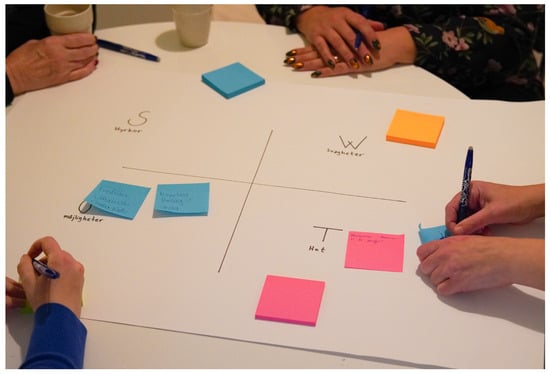
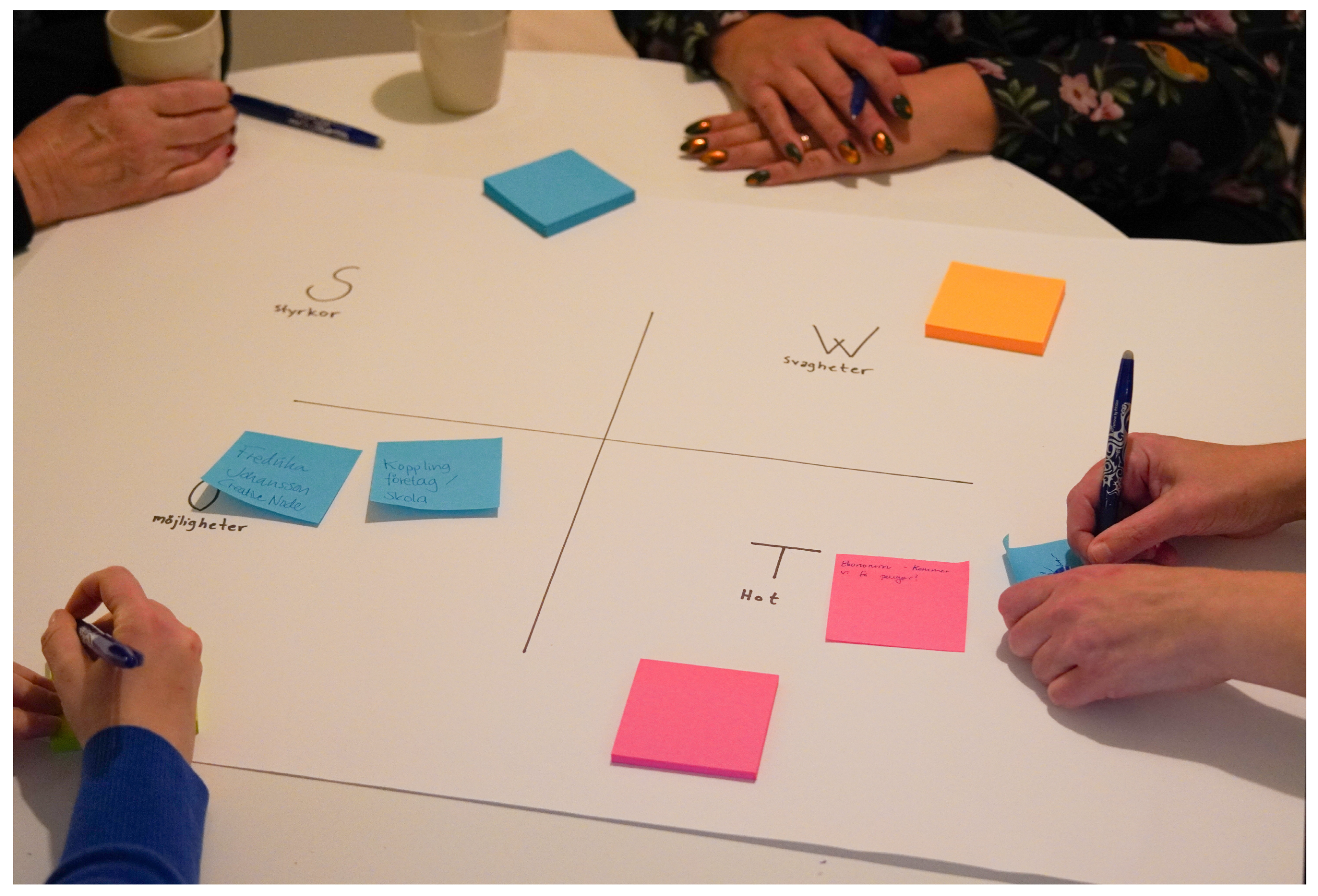
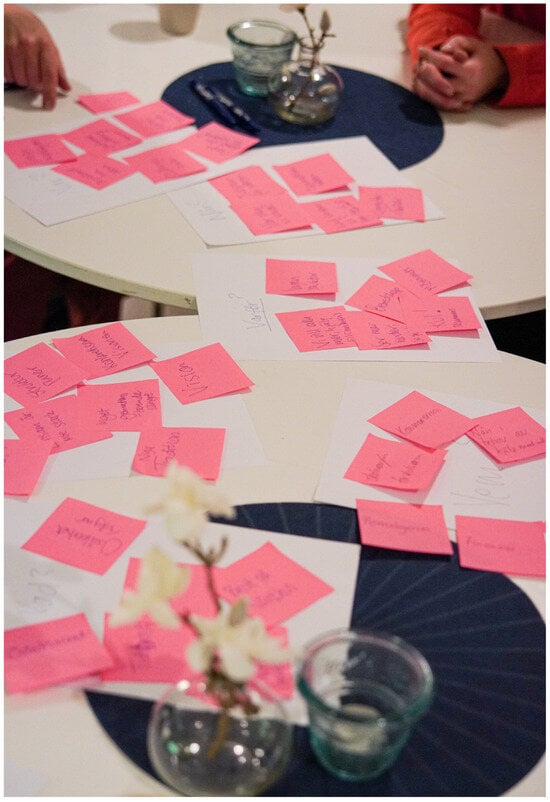
Each DESTEP theme was introduced sequentially, and the participants collaboratively generated ideas and reflections for each topic. These were written down on Post-it notes and placed on a large sheet of paper containing a SWOT matrix (Figure 1). When participants exhausted their thoughts within one thematic area, the next DESTEP theme was introduced, and the process continued until all aspects of the framework had been explored.
Figure 1.
The SWOT analysis with Post-it notes placed in the matrix by the participants. @Author.
To deepen the understanding developed through the previous analysis, an internal reflection was conducted on the strengths and weaknesses within the project group. This phase aimed to identify what the participants considered themselves particularly skilled at, what aspects were unique to the group, and what areas could be improved in relation to their collective knowledge, resources, capacities, and networks. Following the SWOT analysis, participants were encouraged to combine internal strengths with external opportunities to identify potential project areas and to let creativity emerge. This process enabled the group to recognize activities that aligned with their actual capabilities and resources while also responding to identified needs within the community. In doing so, the outcomes became more realistic and grounded, increasing the likelihood of developing socially and environmentally sustainable innovations.
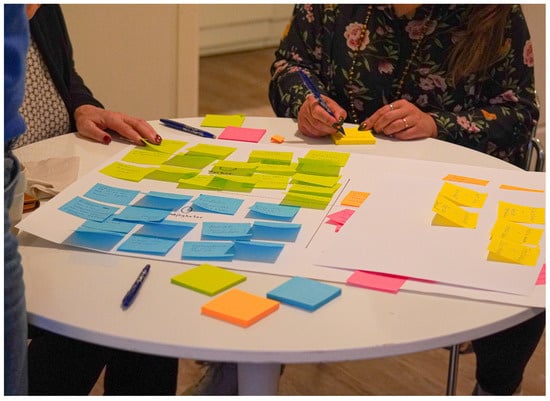
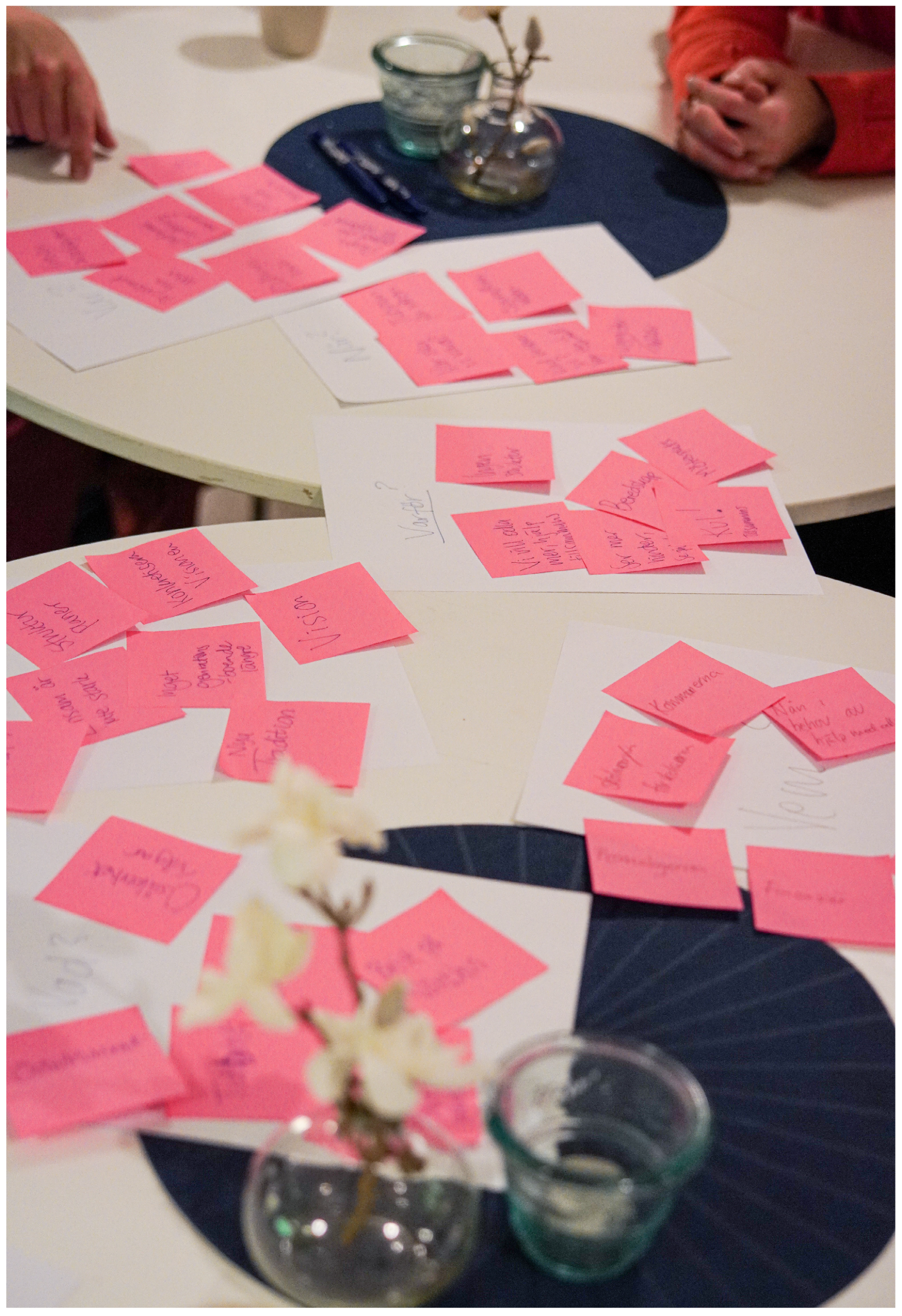
The identified project areas were written down on Post-it notes and placed on a separate sheet of paper (Figure 2). A future step for the group would be to further elaborate on these ideas by adding more details and exploring how they could be implemented. This workshop concluded with a discussion of the next steps for the project group, including how they wished to communicate, when and where to meet, and what actions to prioritize moving forward. The session also included reflective questions about the methods used during the workshop, encouraging participants to consider how the tools they applied supported their collaborative design process. Refreshments were served during the workshop, contributing to an open and relaxed atmosphere conducive to dialog and creativity.
Figure 2.
Finding potential project areas by combining internal strengths with external possibilities. @Author.
3.2. Growing Crops Together
Five women from the area of Unbyn and Avan in northern Sweden, all sharing an interest in collaborative crop-growing, participated in a two-hour evening workshop held locally during autumn 2024. The women were all part of the initial project idea and were familiar with each other due to living in the same rural area. Before the session began, participants received a brief introduction to the research, including its purpose and ethical considerations, and written consent was obtained from all participants. They were informed that their participation in the workshop was completely voluntary, that they had the option to withdraw at any time, and, lastly, that if they preferred not to be photographed, they could inform the workshop leader not to take photos. Since no sensitive personal data was collected during the workshop, according on the guidelines of the Swedish ethics review authority (Etikprövningsmyndigheten), no ethical approval was needed for this research.
The workshop began by exploring the concept of growing crops together and how participants understood and practiced it. As a first step, the group was asked to formulate a concise definition of the concept in one or two sentences.
The following phase focused on structuring thoughts to create a shared understanding of the idea, identifying challenges, and finding possible ways forward. To support this process, the design method WWWWWH [34] was introduced to deepen and expand the participants’ reflections.
The WWWWWH consists of six guiding questions—Who, What, Where, When, Why, and How—that help provide multiple dimensions to an idea. The participants began with Who, considering who owns the problem, who wants to find a solution, who could take part, and who the key stakeholders might be. They then moved on to What, reflecting on what the problem is and what had been done previously to address it. The Where dimension focused on the location of both the problem and potential solutions, exploring where the idea could be realized in practice. The When question addressed temporal aspects, when the problem emerged and when it should ideally be resolved. The Why question encouraged participants to articulate the underlying motivations and reasons for engaging with the issue, such as why it matters and why no solution exists yet. Finally, How focused on understanding how the problems have developed, how stakeholders have responded so far, and how the group could proceed collectively.
Each question was presented sequentially, and the participants wrote their reflections and ideas on Post-it notes, which they then placed on large sheets of paper labelled with the corresponding questions. After all dimensions were discussed, the group reviewed the collected notes together, identifying missing insights or ideas that might be repositioned into different categories. The next step was to prioritize the gathered information to distinguish what was most important, what was less significant, and why. After examining the concept from multiple perspectives, the group returned to their initial definition of growing crops together to assess whether their understanding had changed or developed during the process.
In the second phase of the workshop, participants were asked to visualize their ideas using the creative design method braindrawing [34]. Before the activity began, basic ground rules were established: participants were encouraged to suspend judgement, avoid evaluating ideas based on feasibility, freely build on each other’s ideas, and value quantity and imagination over refinement at this early stage. Each participant received an A3 sheet of paper and colored pencils to sketch how they envisioned the idea of growing crops together. To guide their visualizations, prompts were provided such as, What might be present at the site? What do you want to see, feel, hear, smell at the site? What does the place look like during different seasons? Who is there?
After approximately 20 min, participants exchanged their drawings with the person next to them, who continued developing the idea further. When this phase concluded, each participant created a brief description of their concept—a short pitch—and presented it to the group in a “show-and-tell” session. As a final step, the participants collectively selected the idea that best represented the concept of growing crops together and discussed how it might be implemented in practice, including potential next steps and practical considerations. The session concluded with a short reflective discussion about the workshop and the methods used. Refreshments were served throughout the evening, contributing to a relaxed and creative atmosphere that encouraged participation and dialogue.
3.3. Thematic and Qualitative Analysis
Following the workshops, the empirical material consisting of written notes, Post-it reflections, photographs of workshop outputs, audio-supported field notes, and visual sketches produced during the braindrawing sessions, was analyzed using a qualitative, interpretive approach. The analysis combined thematic analysis with qualitative visual content analysis of the drawings. Rather than treating the material only as representations of opinions or ideas, the analyses focused on meaning, relationships, and capacities were constructed through the participatory design practices. In line with infrastructuring, the analytical focus extended beyond identifying themes to understanding how the workshops contributed to building shared language, collective orientation, and relational agency.
The textual data were analyzed using thematic analysis following the principles outlined by Braun and Clarke’s [47] process. The process included familiarization, as in reviewing workshop material several times to understand the overall narrative and relational dynamics. Then, the theme development was initiated, clustering into broader themes that reflected patterns in the material. The themes were interpreted in dialog with infrastructuring [10], relational wellbeing [45], and epistemic plurality [30,31,32,33]. The process followed an abductive logic [28,32], moving iteratively between empirical material and theoretical concepts. While themes emerged inductively from participants’ reflections, they were interpreted through the lens of infrastruturing to explore how participatory formats enabled participants to form around shared concerns [10].
The drawings produced during braindrawing were analyzed using qualitative analysis [48] combined with interpretative visual analysis [49]. The sketches were treated as illustrative artifacts that express epistemic and relational tools through which participants externalized, negotiated, and materialized shared imaginaries [43]. The visual analysis went through the stages of 1) descriptive mapping to identify explicit elements such as physical infrastructures (e.g., greenhouses, compost areas), social arrangements (e.g., gathering spaces, intergenerational interaction), and ecological loops (e.g., recycling, water storage), and 2) interpretative integration analyzing the visual elements alongside participants’ verbal explanations from the show-and-tell sessions to identify implicit meanings, values, and aspirations. Special attention was paid to how the drawings represented social connectivity and gathering, care and mutual support, temporal continuity, shared ownership of space, and ecological awareness and circularity.
To ensure coherence between textual and visual analysis, themes derived from the verbal material were systematically compared with patterns identified in the drawings. convergences were interpreted as shared collective orientations, while divergences were analyzed as indicators of aspirations or tensions within the group. The analysis considered the discursive level, including what participants explicitly articulated, the material-imaginary level, and how ideas were visualized and spatialized, as well as the relational level, including how participatory processes contributed to building trust, shared language, and collective agency. This approach aligns with participatory design that understands co-design as both epistemic and infrastructural practice [10,17,27]. This approach is also seen to strengthen interpretive validity [50] and reflects epistemic plurality in practice, acknowledging that meaning is produced through multiple modalities [31,32,33].
4. Results
4.1. Sustainability and Recycling
The SWOT analysis, conducted with the support from the DESTEP framework, generated a substantial number of ideas and reflections across all four analytical dimensions. In terms of strengths, the participants identified seventeen different aspects that could support the initiative. These included comments such as “Creative & Innovative”, “We have talented and committed people in the area who can be part of the project” and “The participants in the project group are all of different ages and bring with them different experiences of the countryside” (participants’ notes, workshop Autumn 2024, Authors translation).
When discussing weaknesses, five main themes were identified. Among these were reflections such as “Health and endurance”, “Some of us are not very good at finishing things...” and “Knowledge of the place outside of Unbyn and Avan” (participants’ notes, workshop Autumn 2024, Authors translation).
The group also identified fifteen opportunities, including “The connection companies/school”, “Behavioral trend and awareness of self-sufficiency, cultivation and recycling” and “Companies have demands for sustainable development and this can benefit the companies’ recycling work” (participants’ notes, workshop Autumn 2024, Authors translation).
Seventeen threats were noted, illustrating the potential challenges the project might face. Examples included “Ambiguity, uncertainty for the recipient --> good name for the project”, “People get stuck in social media”, and “Time to reach everyone” (participants’ notes, workshop Autumn 2024, Authors translation).
In the second part of the workshop, the group combined internal strengths with external opportunities to identify potential project areas. This process resulted in eleven distinct areas, including combinations such as “Crafts and creation + School/preschool”, “Circularity + Company excess” and “Book circle + Creative and innovative” (participants’ notes, workshop Autumn 2024, Authors translation).
Participant feedback on the workshop was positive. Reflections from the participants concerning the workshop design methods and layout included statements such as “Good to get follow-up questions during the work”, “Good to have someone external who brings different perspectives”, “Good to have someone who keeps the work going” and “Good to get help with the structure” (participants’ quotes, workshop Autumn 2024, Authors translation). The design methods helped the participants to explore their experiences and knowledge deeper with follow-up questions and the structure of moving forward.
4.2. Growing Crops Together
During the workshop on the theme growing crops together, the participants collaboratively articulated short sentences and value statements connected to the concept. These included expressions such as “Have fun”, “Eatable”, “Generational bridging”, “To help each other” and “Knowledge exchange throughout the process” (participants’ notes, workshop Autumn 2024, Authors translation). Together, the group formulated a shared statement to define their scope and vision: “A community around cultivation where we have fun, learn and help each other with our crops” (participants’ notes, workshop Autumn ’24, Authors translation).
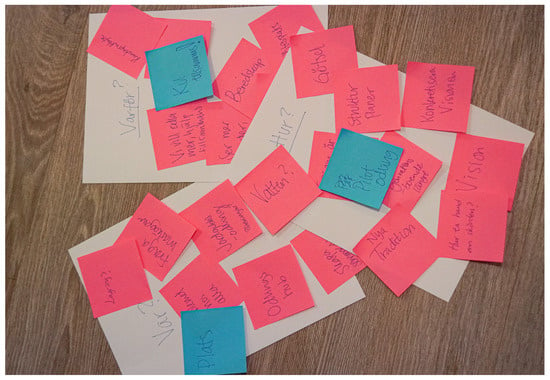
The WWWWWH session (Figure 3) expanded on this foundation and generated a wide range of ideas across the six guiding dimensions. Under Who, the group produced seven ideas, mentioning actors such as municipalities, schools and preschools, and pomologists (participants’ notes, workshop Autumn 2024, Authors translation). For What, six different aspects were identified, including “Lack of greenhouses”, “Lack of time” and “uncertainty/dare to” (participants’ notes, workshop Autumn 2024, Authors translation).
Figure 3.
Workshop session using questions from the design method WWWWWH to explore the concept of growing crops together deeper. @Author.
The Where dimension resulted in six ideas that linked the concept to potential sites, including “Cultivation hub”, “Strawberry farming” and “Central location in the villages” [participants’ notes, workshop Autumn 2024, Authors translation]. Under When, five notes were recorded, referring to “Time plan for the spring”, “Assignments/responsibility” and “Sporadic meetings” (participants’ notes, workshop Autumn 2024, Authors translation). The Why reflections included six statements such as “Fun! Together”, “Preparedness” and “Meeting place”, emphasizing both social and practical motivations. Finally, the How category generated eight ideas, including “Concretize visions”, “New traditions” and “Manure” (participants’ notes, workshop Autumn 2024, Authors translation).
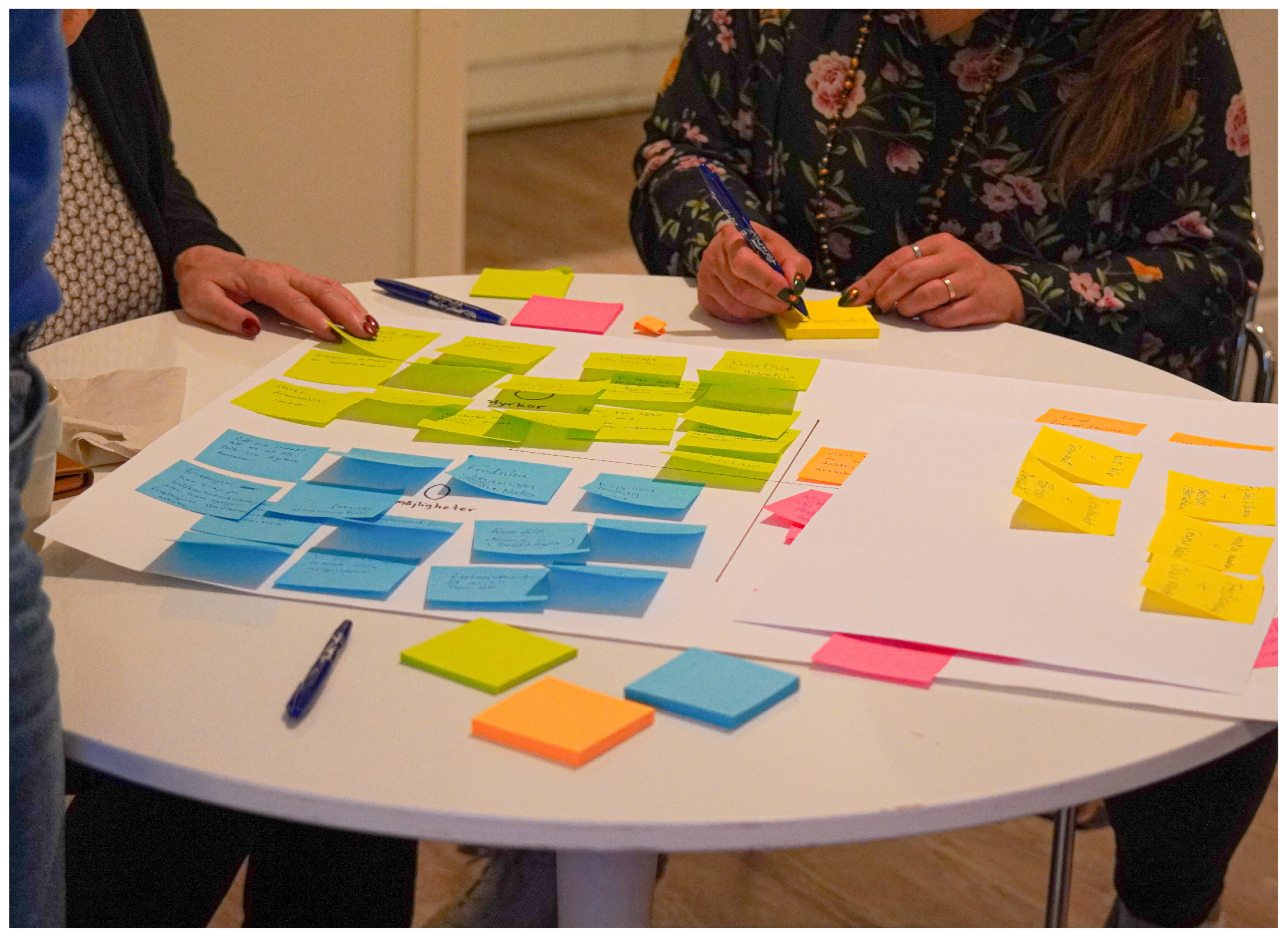
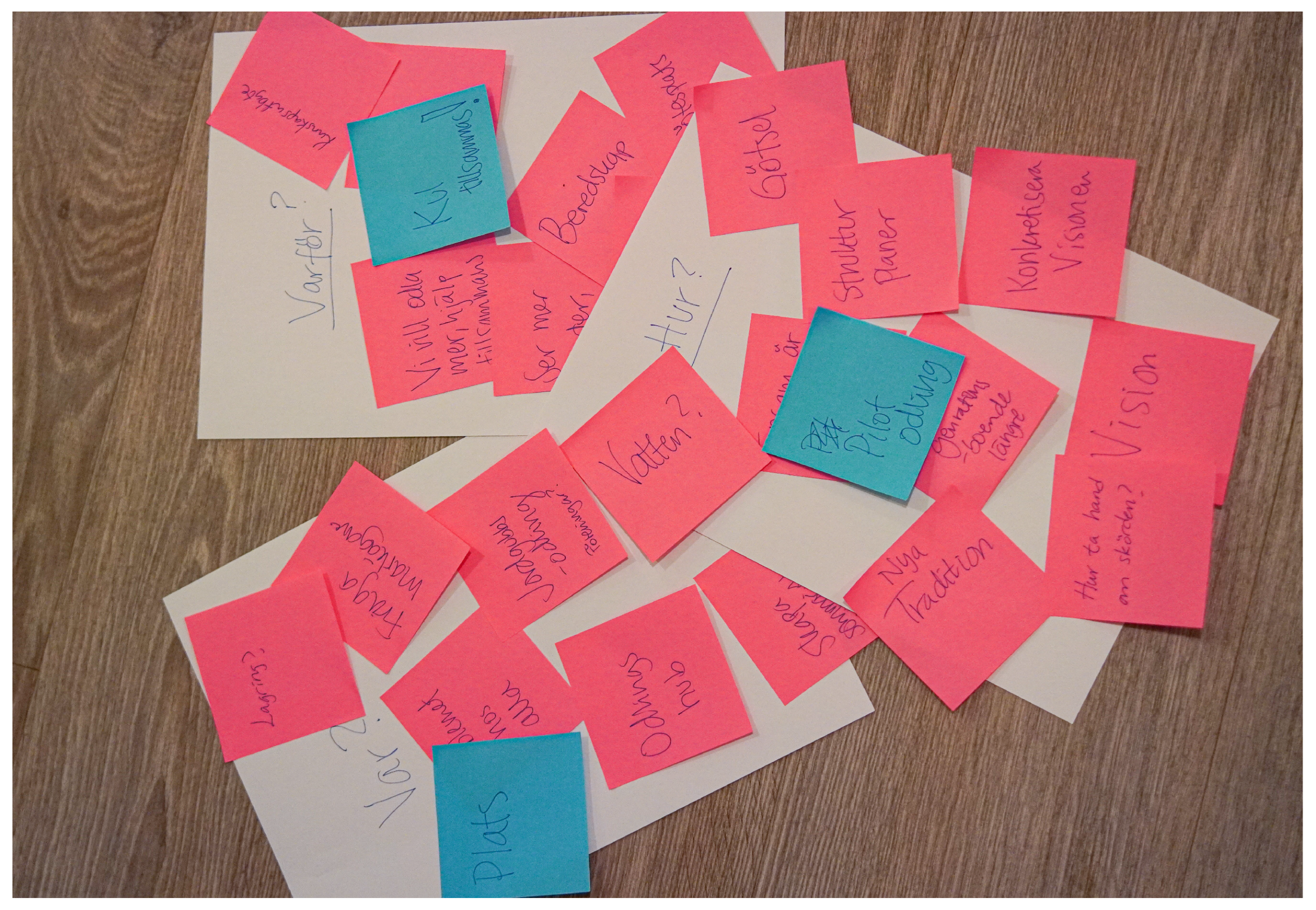
The participants identified and summarized key insights from the different question areas, which they wrote on blue Post-it notes. These included statements such “Fun together!”, “Location” and “Pilot cultivation” (participants’ notes, workshop Autumn 2024, Authors translation), (Figure 4).
Figure 4.
Participants locating core ideas and analyzing notes about growing crops together using the design method WWWWWH. @Author.
After completing the WWWWWH and reviewing the collected notes, the group agreed to retain the original formulation of their core idea without modifications: “A community around cultivation where we have fun, learn and help each other with our crops” (participants’ notes, workshop Autumn 2024, Authors translation).
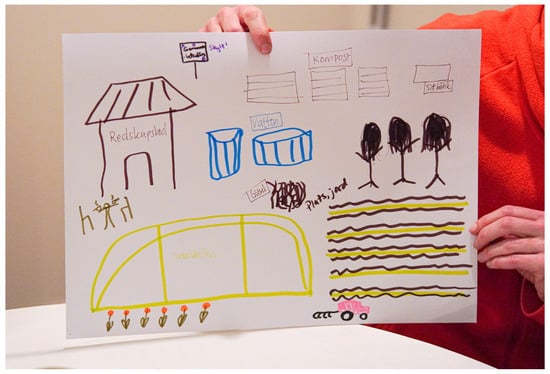
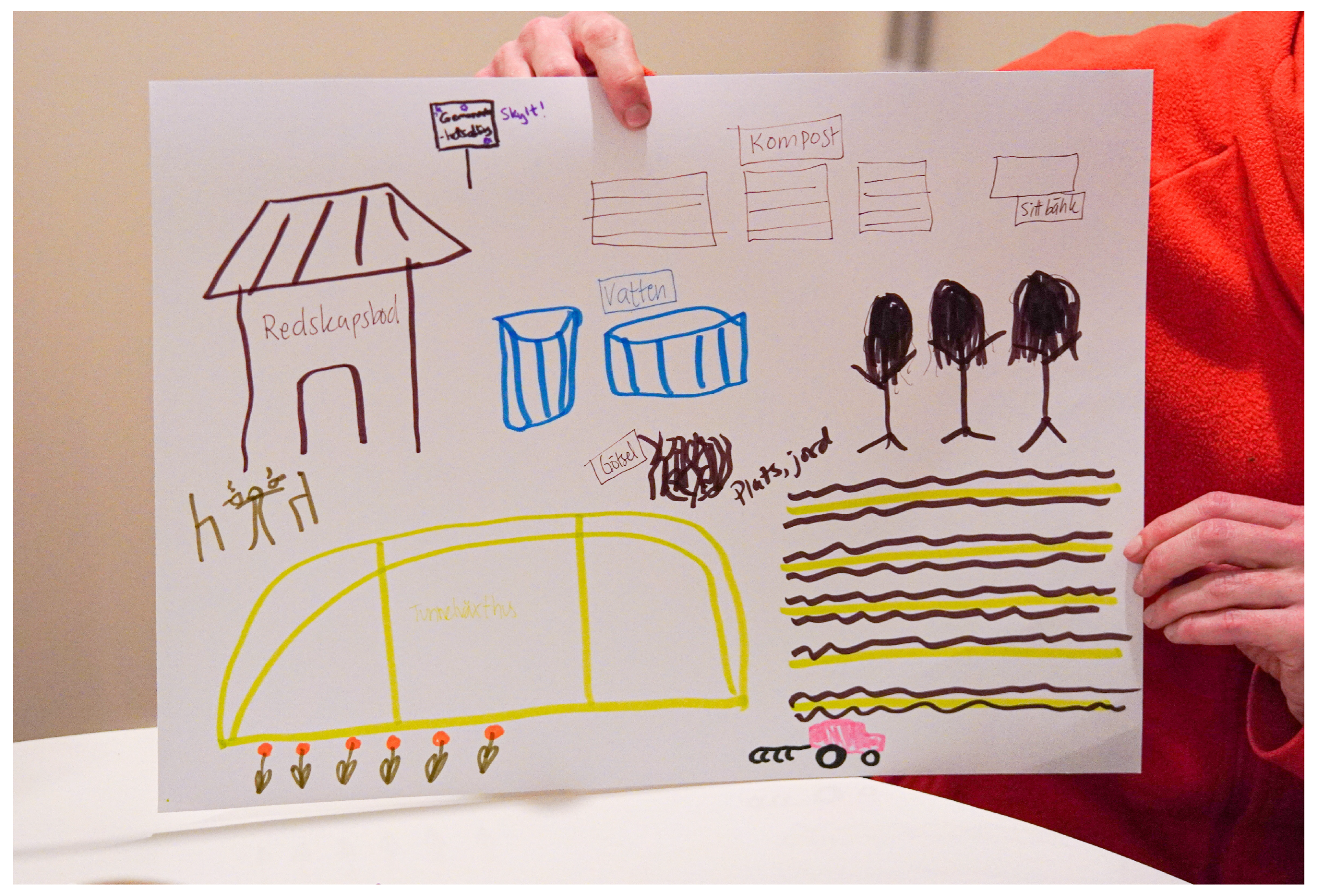
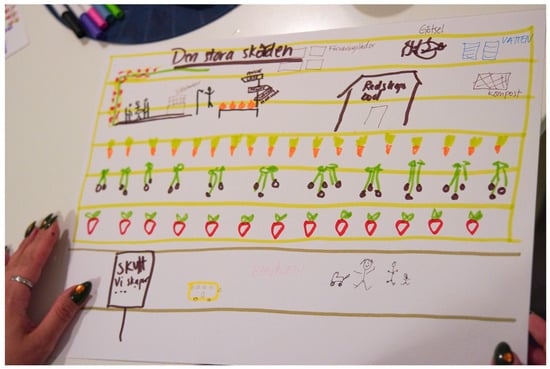
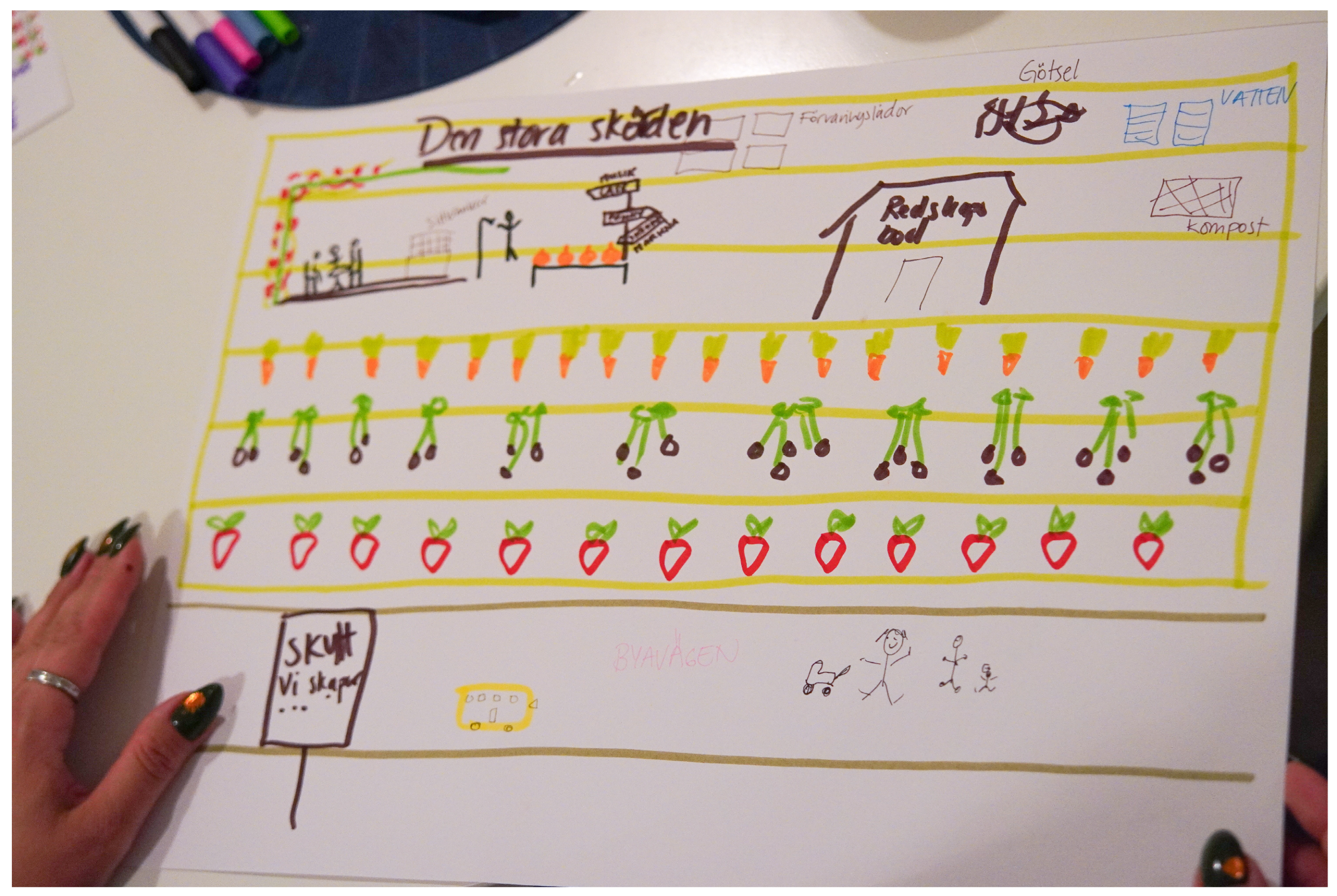
During the braindrawing session, the participants visualized this concept by creating four different sketches illustrating how they imagined the idea of growing crops together. Common elements across all drawings included sowing beds, greenhouses, water storage, and compost areas. Some of the sketches also featured tool sheds, seating areas such as benches and hammocks, as well as spaces for the sheep, social gatherings with music, cafés, pony riding, harvest markets, and play areas for children (Figure 5 and Figure 6).
Figure 5.
Visualizations of growing crops together made by the participants during the braindrawing session. @Author.
Figure 6.
Visualizations of growing crops together made by the participants during the braindrawing session. @Author.
A thematic analysis of the workshop material identified five primary clusters that shaped the common view of the concept growing crops together:
Areas for cultivation: beds for vegetables in combination with beds of flowers for pollinators, greenhouses, apple trees.
Public areas: cafés with sitting areas, harvest market, pony riding, music, lights, play areas for children.
Resting areas: benches, hammocks.
Storage areas: tool sheds, storage boxes.
Soil care: compost, manure, water storage.
The participants’ feedback on the WWWWWH method was predominantly positive. They highlighted its ability to stimulate imagination and structure reflection, with comments such as “You can picture yourself what could be” and “It kick-started the work moving it forward” (participants’ quotes, workshop Autumn 2024, Authors translation). One critical remark concerned the use of the word problem in the guiding questions, which was perceived as less relevant for this particular group. Since the focus was on developing an idea rather than solving a problem, some participants felt that alternative phrasing might have been more appropriate.
Feedback on the braindrawing method was entirely positive. Participants described the activity as enjoyable and engaging, appreciating the opportunity to visualize their thoughts and see how the ideas took form on paper. One participant reflected that drawing felt “Easier than formulating words. I can’t draw, so there is no pressure to deliver. It is easy to get stuck in language and become more critical when describing with words” (participant’s quote, workshop Autumn 2024, Authors translation). This comment suggests that the visual and playful nature of the method supported openness and creativity, reducing the pressure of verbal expression and enabling more intuitive exploration.
5. Discussion
The main finding of this study extends beyond positive participant feedback on the workshop design methods: it concerns how early-stage co-design practices contributed to the cultivation of relational and participatory capacities, especially in facilitating the formation of the group organization. Participants reported that the methods enabled deeper reflection, structured dialog, and the articulation of new perspectives. While the group were already self-organized and possessed an initial foundation of trust, the workshops functioned as infrastructuring moments [10], involved in strengthening shared language, clarifying collective intentions, and translating individual ideas into more coherent and collectively owned directions.
In particular, the structured analytical methods (SWOT, DESTEP, WWWWWH) supported epistemic plurality by allowing participants to move between strategic, contextual, experiential, and value-based modes of reasoning [30,31,32,33]. Rather than reinforcing a single problem definition, the methods created space for multiple interpretations to coexist and be discussed. This reflects participatory design’s agonistic dimension [10], where differences are surfaced and worked through rather than suppressed. The combination of structured reflection and open-ended exploration enabled participants to shift from fragmented individual contributions toward collectively framed opportunity spaces. The braindrawing session further illustrates how visual and embodied methods can function as epistemic artifacts [43], externalizing tacit assumptions and making abstract aspirations tangible. Participants described the experience as enjoyable and liberating, suggesting that creative modalities reduced linguistic constraints and supported lateral exploration [44]. We propose that this affective dimension, the energy, enjoyment, and playfulness, should not be dismissed as peripheral. From an infrastructuring perspective, such affective engagement contributes to sustaining participation over time by reinforcing motivation, shared ownership, and relational wellbeing. Thus, we propose that the value of these methods lies not just in idea generation but in their capacity to scaffold collective sense-making and adaptive orientation. Early co-design, when structured through complementary analytical and generative tools, can support the emergence of what we term relational infrastructures, socio-material conditions that enable continued collaboration and future-oriented action. This way, design contributes to resilience as a formative practice that strengthens communities’ ability to reflect, reframe, and act together.
This study demonstrates how locally initiated, participatory processes in urban and rural development can foster relational infrastructure that contributes to wellbeing, agency, and sustainability when viewed through a design lens. As discussed in the theoretical framework, design is not only a means of materializing ideas but also of facilitating relational and sense-making processes [27]. By engaging participants in co-creative explorations, such processes activate what Ryan and Deci [45] describe as the core psychological needs of self-determination theory—autonomy, competence, and relatedness—which are essential for intrinsic motivation and human flourishing. When people are invited to shape their own environment, they experience an increased sense of control and belonging, reinforcing their agency and connection to place. In this study, the participants were able to shape their projects focus and goal outcome based on their own competence to make positive changes. This could be performed in an open and accepted milieu, where they explored their experiences with the help of different design methods. The projects were initiated by themselves, nurturing autonomy.
The workshops showed that space for interaction—both conceptual and physical—serves as a catalyst for cooperation and long-term engagement. In line with Wangel and Fauré’s [46] critique of ecomodernist approaches that prioritize technological over social transformation, this study underscores that sustainable urban and rural development depends equally on relational ‘infrastructuring’ [10], forming the networks of trust, dialogue, and reciprocity that enable communities to act collectively. However, as participants pointed out, such trust develops gradually over time. A sustained commitment to participation is necessary to cultivate what Manzini [19] describes as the capacity of communities to live and act together with care and creativity, which could also very well be a definition of what we propose relational infrastructuring to be about.
The initiatives, Growing Crops Together and Sustainability and Recycling, illustrate how small-scale, community-led design interventions can evolve into broader forms of social innovation. These cases exemplify how design can serve as a facilitator of locally grounded change rather than a top-down intervention. The cultivation project, for example, built a shared sense of purpose and belonging through collaborative activities such as sowing and harvesting. Similarly, the sustainability initiative expanded beyond its initial scope to include equality and participatory decision-making, integrating residents’ voices through co-creative approaches. These examples resonate with theories of transformative agency [33] by showing how participatory design can strengthen people’s confidence and capacity to act, thereby linking individual motivation to collective wellbeing.
Providing initial municipal support or “seed funding” for such initiatives can be seen as a design intervention in governance, creating the enabling conditions for community-led innovation. This aligns with the concept of epistemic pluralism introduced earlier in this paper—recognizing that a variety of methods and tools are needed to inspire a variety of knowledge forms, such as visual/representational knowledge and situated knowledge, and recognizing that local knowledge, lived experience, and informal networks are crucial components of sustainable transformation. When citizens are included early in the process, urban design and development can become more democratic as well as becoming more adaptive and resilient. These processes, as both Fry [30] and Björgvinsson et al. [10] argue, can be seen as a form of sustainment or infrastructuring; designing ways that nurture continuity, care, and the ongoing capacity of communities to evolve responsibility within ecological limits.
The use of design methods such as SWOT, DESTEP, WWWWWH, and braindrawing [34] proved valuable in operationalizing these theoretical insights. These tools made abstract ideas tangible and created structured yet flexible formats for collaborative reflection. By allowing participants to approach issues through different modalities—visual, verbal, and reflective—they supported diverse communication preferences and enhanced inclusivity. As shown in previous research [43], such participatory design methods foster dialog across differences and enable participants to externalize, visualize, and negotiate meanings together. Notably, applying SWOT in this context—focused on individuals rather than institutions—shifted the analysis from corporate strategy to human-centered reflection, grounding design in lived experience rather than abstraction.
Through these processes, participants expressed a sense of pride and belonging, which connects directly to the notion of cultural sustainability discussed earlier. Culture, as both memory and practice, is not static but continually reinterpreted through everyday actions. The workshops made visible how cultural identity can be sustained through change—by integrating knowledge of the history with new forms of making and social interaction. This dynamic aligns with Escobar’s [31] call for design for the pluriverse, where local knowledge systems, hence relational infrastructures, are recognized as valid and vital in shaping sustainable futures.
5.1. Conceptual Clarification
The concepts of relational infrastructure and design-enabled resilience are, in this paper, used to emphasize the formative role of participatory design processes in cultivating adaptive capacity. Relational infrastructure does not replace the concept of social capital as described by Adger [2], which refers to networks, trust, and norms facilitating collective action. Rather, relational infrastructuring highlights the socio-material and procedural conditions intentionally created through co-design, such as dialog formats, shared artifacts, and iterative reflection, which enable such networks and trust to develop. In this sense, relational infrastructure can be understood as a design-mediated layer that supports the emergence and maintenance of social capital.
Similarly, design-enabled resilience differs from socio-ecological resilience as defined by Meerow et al. [5], which focuses on the capacity of urban systems to absorb, adapt, and transform in response to disturbance. While socio-ecological resilience concerns system properties, design-enabled resilience emphasizes how participatory design practices contribute to shaping those capacities at the community level. It foregrounds the role of design in enabling collective sense-making, reframing challenges, and building shared agency. Thus, it is not seen here as a proposal of a new resilience category, but rather to highlight the processual contribution of design to existing resilience framework.
5.2. Research Limitations and Future Research
While this study provides valuable insights into participatory urban and rural development through design-led methods, several limitations should be acknowledged. First, the scope of participation was limited to small, locally based groups that, although deeply engaged, do not fully represent the diversity of perspectives within the broader community. Future research should therefore explore ways to include a wider range of participants, including those less likely to engage voluntarily, such as marginalized groups, newcomers, or individuals experiencing economic vulnerability. Broader participation would strengthen the inclusivity and demographic depth of the co-design process. Secondly, the time frame of the study was relatively short, capturing only the early stages of collaboration. As discussed in the results, trust and collective capacity develop over time, suggesting a need for longitudinal studies that follow such initiatives as they evolve. A long-term perspective would make it possible to evaluate how design methods and participatory processes contribute to sustained engagement, social innovation, and community wellbeing over several years. Third, while methods such as SWOT, DESTEP, WWWWWH, and braindrawing were effective in enabling dialog and creativity, they also reveal a heavy reliance on facilitation quality. The researcher’s dual role as facilitator and observer may have influenced the dynamics of participation and interpretation of outcomes. Future studies could benefit from collaborative facilitation models or peer-led design processes, where local actors gradually take on the role of facilitators themselves. This would allow for a deeper understanding of how co-design competences can be built and transferred within communities. A further limitation concerns the contextual specificity of the study. Conducted in a northern Sweden locality, the findings reflect cultural, climatic, and socio-economic conditions particular to this setting. Replicating or adapting the process in other geographic and cultural contexts—urban centers, post-industrial regions, or areas facing acute climate challenges—could generate comparative insights into how local conditions shape participation, agency, and sustainability outcomes.
For future work, it would be valuable to expand the methodological framework by integrating other design approaches that stimulate embodied sense-making, to explore how people imagine, feel, and co-create sustainable futures beyond purely cognitive or strategic modes of engagement. This could deepen the understanding of how design supports sense-making, imagination, and emotional connection in collective transitions. Future steps for the ongoing community initiatives could include developing indicators to measure the social, cultural, democratic, and ecological impacts over time [Design value framework]. This might involve participatory indicators for wellbeing, sense of belonging, and environmental awareness, designed and owned by the community itself. In doing so, it could contribute to theoretical development within design for sustainability, as well as practical tools for local governance and policy, aligning with broader agendas such as the European Green Deal [51] and Agenda 2030 [52].
6. Conclusions
Public space such as UNEK thus emerge as physical infrastructures, as well as social and epistemic hubs, as spaces for knowledge exchange, civic learning, and shared care. These hubs cultivate what could be termed design-enabled resilience, where relationships, mutual support, and practical collaboration form the foundation of social sustainability. They also provide a relational infrastructure for collective preparedness, enabling communities to respond to environmental changes or crises in adaptive and supportive ways.
In light of the accelerating challenges of climate change, resource depredation, and social fragmentation, this study suggests that urban and regional development must integrate co-design as a core practice rather than as an add-on consultation step. By embedding participatory methods early in the process, designers and planners can identify local drivers of change, align initiatives with community values, and foster wellbeing through meaningful involvement. As this study shows, design can serve as an enabling practice, a means of cultivating agency, care, and social cohesion while also contributing to ecological and cultural resilience.
The findings reinforce the idea that the future of sustainable urban development is not only designed but co-designed. The role of designers and municipalities is to provide frameworks and tools that help communities articulate their visions, connect their capacities, and act collectively. In doing so, design becomes a bridge between self-determination and social transformation, enabling communities to imagine and construct futures that are both locally rooted and globally responsive.
Author Contributions
Conceptualization, J.R. (Jessica Rohdin); Methodology, J.R. (Jessica Rohdin); Formal analysis, J.R. (Jessica Rohdin); Investigation, J.R. (Jessica Rohdin); Writing—original draft, J.R. (Jessica Rohdin); Writing—review & editing, Å.W.-N. and J.R. (Jeandri Robertson); Supervision, Å.W.-N.; Project administration, J.R. (Jessica Rohdin). All authors have read and agreed to the published version of the manuscript.
Funding
This research was sponsored by PRECISE—Innovative Precision Health at Luleå University of Technology.
Data Availability Statement
The original contributions presented in this study are included in the article. Further inquiries can be directed to the corresponding author.
Acknowledgments
We would like to extend an extra-warm Thank You to UNEK and all the participants in the workshops.
Conflicts of Interest
The authors declare no conflicts of interest.
References
- Hickman, C.; Marks, E.; Pihkala, P.; Clayton, S.; Lewandowski, R.E.; Mayall, E.E.; Wray, B.; Mellor, C.; van Susteren, L. Climate anxiety in children and young people and their beliefs about government responses to climate change: A global survey. Lancet Planet. Health 2021, 5, e863–e873. [Google Scholar] [CrossRef] [Scilit]
- Adger, W.N. Social capital, collective action, and adaptation to climate change. Econ. Geogr. 2003, 79, 387–404. [Google Scholar] [CrossRef] [Scilit]
- Clayton, S.; Karazsia, B.T. Development and validation of a measure of climate change anxiety. J. Environ. Psychol. 2020, 69, 101434. [Google Scholar] [CrossRef] [Scilit]
- Scannell, L.; Gifford, R. The experienced psychological benefits of place attachment. J. Environ. Psychol. 2017, 51, 256–269. [Google Scholar] [CrossRef] [Scilit]
- Meerow, S.; Newell, J.P.; Stults, M. Defining urban resilience: A review. Landsc. Urban Plan. 2016, 147, 38–49. [Google Scholar] [CrossRef] [Scilit]
- Cretney, R.M. Resilience for whom? Emerging critical geographies of socio-ecological resilience. Geogr. Compass 2014, 8, 627–640. [Google Scholar] [CrossRef] [Scilit]
- Berkes, F.; Ross, H. Community resilience: Toward an integrated approach. Soc. Nat. Resour. 2013, 26, 5–20. [Google Scholar] [CrossRef] [Scilit]
- Manzo, L.C.; Devine-Wright, P. (Eds.) Place Attachment: Advances in Theory, Methods and Applications; Routledge: London, UK, 2014. [Google Scholar] [CrossRef] [Scilit]
- Prendergast, K.; Hayward, B.; Aoyagi, M.; Burningham, K.; Hasan, M.M.; Jackson, T.; Jha, V.; Loukianov, A.; Mattar, H.; Schudel, I.; et al. Towards a relational understanding of youth lifestyles and wellbeing in climate-resilient urban development: Insights from a seven-city study of young people. Local Environ. 2025, 30, 1002–1019. [Google Scholar] [CrossRef] [Scilit]
- Björgvinsson, E.; Ehn, P.; Hillgren, P.A. Agonistic participatory design: Working with marginalised social movements. CoDesign 2012, 8, 127–144. [Google Scholar] [CrossRef] [Scilit]
- Simonsen, J.; Robertson, T. (Eds.) Routledge International Handbook of Participatory Design; Routledge: London, UK, 2013. [Google Scholar] [CrossRef] [Scilit]
- Ehn, P. Participation in design things. In Proceedings of the 10th Anniversary Conference on Participatory Design (PDC 2008); ACM Press: Bloomington, IN, USA, 2008; pp. 92–101. Available online: https://dl.acm.org/doi/10.5555/1795234.1795248 (accessed on 6 February 2026).
- Star, S.L.; Griesemer, J.R. Institutional ecology, “translations” and boundary objects: Amateurs and professionals in Berkley’s Museum of Zoology, 1907–1939. Soc. Stud. Sci. 1989, 19, 387–420. [Google Scholar]
- Lim, Y.-K.; Stolterman, E.; Teneneberg, J. The anatomy of prototypes: Prototypes as filters, prototypes as manifestation of design ideas. ACM Trans. Comput.-Hum. Interact. 2008, 15, 1–27. [Google Scholar]
- Botero, A.; Hyysalo, S. Ageing together: Steps towards evolutionary co-design in everyday practices. CoDesign 2013, 9, 37–54. [Google Scholar] [CrossRef] [Scilit]
- Akama, Y.; Light, A.; Kamihira, T. Expanding participation to design with more-than-human concerns. In ACM International Conference Proceeding Series; Association for Computing Machinery: New York, NY, USA, 2020; pp. 1–11. [Google Scholar]
- Sanders, E.B.-N.; Stappers, P.J. Co-creation and the new landscapes of de-sign. CoDesign 2008, 4, 5–18. [Google Scholar] [CrossRef] [Scilit]
- UNEK. Vad är Servicepunkten? Available online: https://www.unek.se/servicepunkten-2-2-2/ (accessed on 6 February 2026).
- Manzini, E. Design, When Everybody Designs: An Introduction to Design for Social Innovation; MIT Press: Cambridge, MA, USA, 2015. [Google Scholar]
- Fleming, A.; Bohensky, E.; Dutra, L.X.C.; Lin, B.B.; Melbourne-Thomas, J.; Moore, T.; Stone-Jovicich, S.; Tozer, C.; Clarke, J.M.; Donegan, L.; et al. Perceptions of co-design, co-development and co-delivery (Co-3D) as part of the co-production process–Insights for climate services. Clim. Serv. 2023, 30, 100364. [Google Scholar] [CrossRef] [Scilit]
- Bonner, A. Social Determinants of Health: An Interdisciplinary Approach to Social Inequality and Well-Being; Policy Press: Bristol, UK, 2018; 351p. [Google Scholar]
- Schuler, D.; Namioka, A. (Eds.) Participatory Design: Principles and Practices, 1st ed.; CRC Press: Boca Raton, FL, USA, 1993. [Google Scholar] [CrossRef] [Scilit]
- Davis, A.; Tuckey, M.; Gwilt, I.; Wallace, N. Understanding Co-Design Practice as a Process of “Welldoing”. Int. J. Art Des. Educ. 2023, 42, 278–293. [Google Scholar] [CrossRef]
- Dell’Ovo, M.; Datola, G.; Di Pirro, E.; Ronchi, S.; Arcidiacono, A.; Attia, S.; Baronchelli, D.; Benedini, A.; Buffoli, M.; Calvi, G.; et al. A Participatory SWOT-Based Approach to Nature-Based Solutions Within Urban Fragile Territories: Operational Barriers and Strategic Roadmaps. Land 2025, 14, 1847. [Google Scholar] [CrossRef] [Scilit]
- Rittel, H.W.J.; Webber, M.M. Dilemmas in a General Theory of Planning. Policy Sci. 1973, 4, 155–169. [Google Scholar] [CrossRef] [Scilit]
- Proczek, M.; Garbarczyk, M. Wicked problems and the design thinking method as a tool to solve these problems. The case Alien Project. East. Eur. J. Reg. Stud. 2023, 9, 21–31. [Google Scholar] [CrossRef] [Scilit]
- Akama, Y.; Pink, S.; Sumartojo, S. Uncertainty and Possibility: New Approaches to Future Making in Design Anthropology, 1st ed; Routledge: London, UK, 2018. [Google Scholar]
- Krippendorff, K. The Semantic Turn: A New Foundation for Design, 1st ed; CRC Press: New York, NY, USA, 2005. [Google Scholar]
- Thackara, J. In the Bubble: Designing in a Complex World; MIT Press: Cambridge, UK, 2005. [Google Scholar]
- Fry, T. Design Futuring: Sustainability, Ethics and New Practice, English edition; Berg Publishers: New York, NY, USA, 2009. [Google Scholar]
- Escobar, A. Designs for the Pluriverse: Radical Interdependence, Autonomy, and the Making of Worlds; Duke University Press: Durham, NC, USA, 2017. [Google Scholar]
- Schön, D.-A. The Reflective Practitioner: How Professionals Think in Action; Basic Books: New York, NY, USA, 1983. [Google Scholar]
- Akama, Y. Being awake to Ma: Designing in between-ness as a way of becoming with. CoDesign 2015, 11, 262–274. [Google Scholar] [CrossRef] [Scilit]
- van Boeijen, A.; Daalhuizen, J.; Zijlstra, J. Delft Design Guide: Perspectives, Models, Approaches, Methods, 2nd ed; BIS Publisher: Amsterdam, The Netherlands, 2020; pp. 1–224. [Google Scholar]
- Ma, M.Y.; Wu, F.G.; Chang, R.H. A new design approach of user-centered design on a personal assistive bathing device for hemiplegia. Disabil. Rehabil. 2007, 29, 1077–1089. [Google Scholar] [CrossRef] [Scilit]
- Rapp, A. A SWOT analysis of the gamification practices: Challenges, open issues and future perspectives. In Advances in Affective and Pleasurable Design, Proceedings of the 5th AHFE International Conference; AHFE Conference: Kraków, Poland, 2014; Volume 19, pp. 476–487. [Google Scholar]
- Mutubuki, E.N.; Moye-Holz, D.; Peyroteo, M.; Lapão, L.V.; Hilderink, H.B.M. Foresight in public health: A tutorial on application and insights on challenges from the PHIRI foresight exercise. Eur. J. Public Health 2024, 34, i87–i93. [Google Scholar] [CrossRef] [Scilit]
- Yu, Y.; Bi, Y. A study on “5W1H” user analysis on interaction design of interface. In Proceedings of the 2010 IEEE 11th International Conference on Computer-Aided Industrial Design & Conceptual Design 1, Yiwu, China, 17–19 November 2010; pp. 329–332. [Google Scholar] [CrossRef] [Scilit]
- Benaddi, H.; Laaz, N.; El Kettani, E.; Hannad, Y. Ontology Model for Public Services in Morocco Based on 5W1H Approach: PSOM-eGovMa. Procedia Comput. Sci. 2022, 198, 429–434. [Google Scholar] [CrossRef] [Scilit]
- Xianjin, X.; Yanlong, Z.; Hao, L.; Min, L. Research on the Recycling Strategy of Used Textbooks in Colleges and Universities. In Proceedings of the 2nd International Conference on Social Science and Higher Education (ICSSHE 2016); Atlantis Press: Dordrecht, The Netherlands, 2016. [Google Scholar]
- Blum Haddad, F.B.; Miguel Naldi Dias, L.; Corrêa, C.G.; Mara Peres, L. Building a digital educational game supported by Socially Aware Design. In Proccedings of the 2022 IEEE Frontiers in Education Conference (FIE), Uppsala, Sweden, 8–11 October 2022; IEEE: New York, NY, USA, 2022; pp. 1–9. [Google Scholar] [CrossRef] [Scilit]
- Haddad, F.B.B.; Almeida, E.M.; Gimenez, C.; L’Erario, A.; Peres, L.M. Socially Aware Design Workshop to Discover Socio-Technical Requirements: Planning, Execution, and Results. In Proceedings of the 2024 IEEE Frontiers in Education Conference (FIE), Washington, DC, USA, 13–16 October 2024; IEEE: New York, NY, USA, 2024; pp. 1–9. [Google Scholar] [CrossRef] [Scilit]
- Sanders, E.B.N.; Stappers, P.J. Probes, toolkits and prototypes: Three approaches to making in codesigning. CoDesign 2014, 10, 5–14. [Google Scholar] [CrossRef] [Scilit]
- De Bono, E. Lateral Thinking: A Textbook of Creativity; Penguin Books: London, UK, 2009. [Google Scholar]
- Ryan, R.M.; Deci, E.L. Self-Determination Theory and the Facilitation of Intrinsic Motivation, Social Development, and Well-Being Self-Determination Theory. Am. Psychol. 2000, 55, 68–78. [Google Scholar] [CrossRef]
- Wangel, J.; Fauré, E. Beyond Efficiency: A Speculative Design Research Anthology in Which We Seek to Deconstruct Ecomodern Imaginaries of Urban Sustainability Through Exploring What More Just and Sustainable Living Environments Could Be Like; illustrated edition; Art Architecture Design Research: Bamberg, Germany, 2022. [Google Scholar]
- Braun, V.; Clarke, V. Using thematic analysis in psychology. Qual. Res. Psychol. 2006, 3, 77–101. [Google Scholar] [CrossRef] [Scilit]
- Schreier, M. Qualitative Content Analysis in Practice; Sage: London, UK, 2012. [Google Scholar]
- Rose, G. Visual Methodologies: An introduction to researching with visual materials. In Research Methods for English Studies; Griffin, G., Ed.; Sage: London, UK, 2022; pp. 69–92. [Google Scholar]
- Pink, S. Doing Visual Ethnography; Sage: London, UK, 2013. [Google Scholar]
- European Commission. The European Green Deal: Striving to Be the First Climate-Neutral Continent. Available online: https://commission.europa.eu/strategy-and-policy/priorities-2019-2024/european-green-deal_en (accessed on 3 December 2025).
- United Nations. Globala Målen. Available online: https://globalamalen.se/ (accessed on 3 December 2025).
Disclaimer/Publisher’s Note: The statements, opinions and data contained in all publications are solely those of the individual author(s) and contributor(s) and not of MDPI and/or the editor(s). MDPI and/or the editor(s) disclaim responsibility for any injury to people or property resulting from any ideas, methods, instructions or products referred to in the content. |
© 2026 by the authors. Licensee MDPI, Basel, Switzerland. This article is an open access article distributed under the terms and conditions of the Creative Commons Attribution (CC BY) license.